Monthly Archives: March 2016

Abercorn Restaurant bombing – 4 March 1972

Abercorn Restaurant Bombing

Image result for Abercorn Restaurant bombing - 4 March 1972

4 March 1972


The Abercorn Restaurant bombing was a paramilitary attack that took place in a crowded city centre restaurant and bar in Belfast, Northern Ireland on 4 March 1972. The bomb explosion claimed the lives of two young women and injured over 130 people. Many of the injuries were severe and included the loss of limbs and eyes.

The Provisional IRA was blamed, although no organisation ever claimed responsibility and nobody was ever charged in connection with the bombing. According to Ed Moloney, an Irish journalist who has written extensively about the IRA, republican sources have unofficially confirmed the group’s involvement.

Abercorn Restaurant bombing
Abercorn bomb.jpg

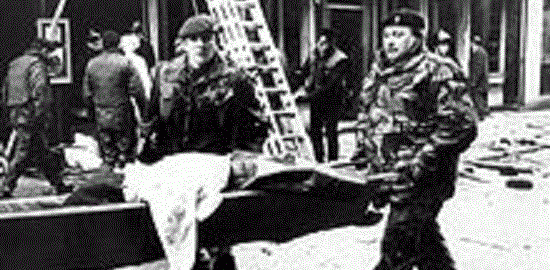
A victim’s body being removed from the scene by members of the security forces following the bomb explosion
Location Abercorn Restaurant and Bar, 7–11 Castle Lane, Belfast, Northern Ireland
Date 4 March 1972
16:30 (UTC)
Attack type
Bombing
Deaths 2 civilians
Non-fatal injuries
130
Suspected perpetrator
Provisional IRA (Belfast Brigade)


Disclaimer

The views and opinions expressed in this post and page are soley intended to educate and provide background information to those interested in the Troubles of Northern Ireland.

They in no way reflect my own opinions and I take no responsibility for any inaccuracies or factual errors

The bombing

————————————-

Abercorn Restaurant Bombing 1972

————————————-

Telephone warning

The Abercorn was on 7-11 Castle Lane in central Belfast and housed a ground-floor restaurant and upstairs bar. It was owned by 45-year-old Bill O’Hara, a Catholic businessman.[1] On Saturday 4 March 1972 it was packed with late afternoon shoppers when an anonymous caller issued a bomb warning to 999 at 4.28 pm.

The caller did not give a precise location, but advised that a bomb would go off in Castle Lane in five minutes’ time. The street, located in the busy Cornmarket area, milled with crowds of people shopping and browsing as was typical on a Saturday in Belfast.[2]

Explosion


Castle Lane as it appeared in 2007. The Abercorn Restaurant and Bar was close by the spot from which the photograph was taken.

Two minutes later, at 4.30 PM, a handbag containing a five-pound gelignite bomb exploded under a table inside the ground-floor restaurant.

Two young Catholic friends were killed outright: Anne Owens (22), who was employed at the Electricity Board, and Janet Bereen (21), a hospital radiographer.

The young women had been out shopping together and had stopped at the Abercorn to have coffee; they were seated at the table nearest the bomb and took the full force of the blast.

 Owens had survived a previous bombing at her workplace. More than 130 were injured in the explosion, which overturned tables and chairs, and had brought the ceiling crashing down onto the ground floor restaurant. Many people were severely maimed. Some had their limbs blown off; others suffered terrible head and facial injuries, burns, deep cuts and perforated eardrums. Three had eyes destroyed by shards of flying glass.

Two sisters, Jennifer and Rosaleen McNern (one of whom was due to be married), were both horrifically mutilated; Jennifer lost both legs, and Rosaleen (the bride-to-be) lost her legs, her right arm and one of her eyes.

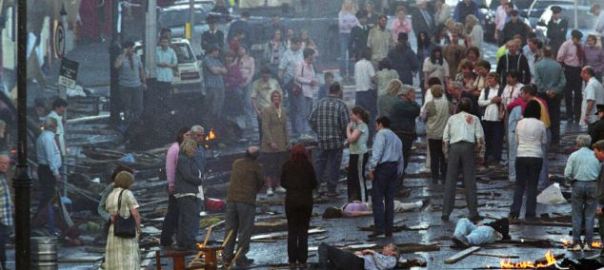
Witnesses described a scene of panic and chaos as the bloodied survivors stumbled through the smoke, broken glass, blood, and rubble, crawling over one another to get away, whilst firemen attempted to bring out the injured, many of whom lay with their bodies mangled, unable to move. An RUC officer was one of the first people to arrive on the scene. He described the carnage that greeted him as something he would never forget.

“All you could hear was the moaning and squealing and the people with limbs torn from their bodies”.


One reporter who arrived in the wake of the bombing was Northern Irish presenter Gloria Hunniford. Although the bodies of the dead and injured had been removed, she saw their belongings lying in the street amongst the Abercorn’s debris. The gaping leather handbags with their contents spilling out and charred cuddly toys revealed that most of the victims had been young women and children.

A woman who had been inside the restaurant before the blast later told an inquest that she had seen two young teenage girls walk out of the Abercorn leaving a handbag behind shortly before the explosion. This same woman had been waiting at a bus stop when the bomb went off. A detective-sergeant established that the explosion’s epicentre was to the right of the table where the two girls had been sitting. The bomb had reportedly been left behind inside a handbag.

AyoungboybeingcarriedoutoftheAberco

Responsibility

Nobody was ever charged in connection with the bombing and no paramilitary organisation ever claimed responsibility for it. Both wings of the IRA denied involvement and condemned the bombing. However, the RUC and British Military Intelligence blamed the Provisional IRA First Battalion Belfast Brigade  and it is now widely accepted that it was responsible.

There was a public backlash against the organisation in Irish nationalist and Catholic areas such as West Belfast. The two dead women had both been Catholic, along with many of the injured including the McNern sisters, and the Abercorn Bar was a popular venue with many young Catholics and nationalists.

Image result for Seán Mac Stíofáin

Provisional IRA Chief of Staff Seán Mac Stíofáin claimed the bombing was the work of loyalist paramilitaries. According to Mac Stíofáin, the Woodvale Defence Association (WDA) had made threats against the Abercorn in its weekly newsletter after the Abercorn management refused to play the British national anthem.

The WDA denied the allegations, adding that one of its members had a friend who been badly injured in the blast. The day after the bombing, a leaflet allegedly circulated by the loyalist Ulster Vanguard declared:

“We make no apologies for Abercorn. No apologies were made for Aldershot . These premises were being used extensively by Southern Irish shoppers for the transmission of information vital to the terrorist campaign…”.

According to Ed Moloney in his book Voices from the Grave, IRA sources have since confirmed, albeit unofficially, that the Provisional IRA was responsible.

Moloney suggested that, based on eyewitness accounts, two teenaged IRA girls were probably the bombers.[3] Unnamed republican sources suggested that the Abercorn was targeted because the upstairs bar was frequented by off-duty British Army soldiers.

Aftermath

——————–

Victims

——————–

04 March 1972
Janet Bereen,   (21)

Catholic
Status: Civilian (Civ),

Killed by: Irish Republican Army (IRA)
Killed in bomb attack on Abercorn Restaurant, Castle Lane, Belfast.

——————–

04 March 1972


Anne Owens,   (22)

Catholic
Status: Civilian (Civ),

Killed by: Irish Republican Army (IRA)
Killed in bomb attack on Abercorn Restaurant, Castle Lane, Belfast

——————–

The detonation of a bomb in a city centre restaurant on a Saturday afternoon packed with shoppers, and the severity of the injuries—inflicted on mostly women and children—ensured that the attack caused much revulsion and left a lasting impression on the people of Belfast. It was condemned by both unionist and Irish nationalist politicians and also by church leaders.

Ian Paisley called on the government

“to mobilise and arm every able-bodied volunteer to meet the enemy”.

The extent of the injuries the blast had inflicted resulted in the Royal Victoria Hospital implementing a ‘disaster plan’ for the first time.

Belfast city centre was again targeted by the IRA just over two weeks later when it exploded its first car bomb in Donegall Street after issuing a misleading warning, killing seven people and wounding 148. As was the case in the Abercorn bombing, the injuries included the loss of limbs and eyes.

Unrelated to the bombing, the Abercorn featured in a sectarian attack in July 1972, when Michael McGuigan, a Catholic working in the bar, was abducted by loyalist paramilitaries, shot and left for dead, but survived. He had been dating a Protestant waitress who also worked in the Abercorn, and this had provoked the loyalist group to carry out the attack.

The Abercorn was demolished in 2007.

See:  4th March – Deaths & Events in Northern Ireland Troubles

3rd March – Deaths & Events in Northern Ireland Troubles


Key Events & Deaths on this day in Northern Ireland Troubles

3rd March

—————————————-

Monday 3 March 1969

The Cameron commission was established to consider the reasons for the unrest in Derry.

Wednesday 3 March 1976

‘Maguire Seven’ Convicted The trial of members of the Maguire family, known as the ‘Maguire Seven’, ended at the Old Bailey in London. They had been arrested on 3 December 1974. All seven defendents were found guilty of possession of explosives

(although none were found).

(Their case was linked to that of the ‘Guildford Four’ who were found guilty at the Old Bailey on 22 October 1975 of causing explosions on 5 October 1974.) Anne Maguire was sentenced to 14 years; Patrick (Paddy) Maguire 14 years; Sean Smyth 14 years; Giuseppe Conlon 14 years; Pat O’Neill 12 years; Vincent Maguire (aged 16) 5 years; and Patrick Jnr. (aged 13) 4 years.

[This was one of a series of high profile cases of miscarriage of justice involving Irish people living in England. On 26th June 1991  the Magure Seven had their convictions quashed by the Court of Appeal in London.  On 9 February 2005 Tony Blair, then British Prime Minister, issued an apology to the Maguire Seven and the Guildford Four.]

A further meeting of the Constitutional Convention again called for the return of the Stormont government. The meeting ended in uproar and was to be the last meeting of the Covention.

[The British Government brought the Convention to an end on 5 March 1976.]

Thursday 3 March 1977

Brian Faulkner died in a riding accident during a hunt.

[Faulkner had been Prime Minister of Northern Ireland in 1971 to 1972 and had been Chief Executive in the power-sharing Executive of 1974.] [ Education. ]

Friday 3 March 1978

A British soldier and a Protestant civilian searcher were both killed in an Irish Republican Army (IRA) gun attack on a British Army pedestrian checkpoint in Donegall Street, Belfast.

Tuesday 3 March 1981

Humphrey Atkins, then Secretary of State for Northern Ireland, made a statement in the House of Commons in which he said that there would be no political status for prisoners regardless of the hunger strike. [ 1981 Hunger Strike.]

Monday 3 March 1986

Unionist ‘Day of Action’

There was a widespread general strike, or ‘Day of Action’, in Northern Ireland in support of Unionist demands for the ending of the Anglo-Irish Agreement (AIA). Most aspects of life across the region were disrupted as factories and shops closed. Public transport including air travel was also affected.

[While many Protestants supported the strike and voluntarily stayed at home there was also a high level of intimidation with masked Loyalists setting up barricades. There were riots in Loyalist areas during the evening and night and shots were fired at the Royal Ulster Constabulary (RUC). Later RUC figures showed that there had been 237 reported cases of intimidation, 57 people arrested, and 47 RUC officers injured. The government and the security forces were later criticised for not keeping the main roads open and for not trying to end the intimidation.]

Friday 3 March 1989

Michael-Stone 2

Michael Stone, the Loyalist gunman responsible for killing three mourners at Milltown Cemetery on 16 March 1988, was sentenced to prison for 30 years.

[Stone was released in 2000 under the terms of the Good Friday Agreement.]

See Michael Stone

Sunday 3 March 1991

The Ulster Volunteer Force (UVF) carried out a gun attack on a public house in Cappagh, County Tyrone, and killed four Catholic men.

[Some time later the Irish Republican Army (IRA) announced that three of its members had been killed in the attack. The fourth person killed was a Catholic civilian. As the men had only decided to go to the pub on the spur of the moment they were unlikely to have been the original target of the attack.]

Wednesday 3 March 1993

Six Ulster Defence Regiment (UDR) soldiers were awarded undisclosed damages against Hugh Annesley, then Chief Constable of the Royal Ulster Constabulary (RUC), as a result of their arrest on 8 October 1989. The men had been arrested on the orders of the Stevens inquiry into allegations of collusion between the security forces and Loyalist paramilitary groups.

Monday 3 March 1997

A bomb was found outside the office of Sinn Féin (SF) in Monaghan, Republic of Ireland. The bomb, which contained two and a half kilos of Powergel (a commercial explosive), was defused by members of the Irish Army.

[There was no claim of responsibility, but the Ulster Volunteer Force (UVF) was believed to be behind the attack. The UVF have used Powergel on a number of occasions. Representatives of the Progressive Unionist Party (PUP) insisted that the Loyalist ceasefire was intact. Later it was believed that this was one of a series of ‘no claim, no blame’ incidents, whereby paramilitary groups which were officially on ceasefire could carry out attacks without their political representatives being removed from the Stormont talks.]

There was a meeting of the British-Irish Parliamentary body held in Dublin. At the meeting Kevin McNamara, a former Labour Party spokesperson on Northern Ireland, said that Roisín McAliskey, then being held in prison awaiting a decision about extradition, had been strip-searched 75 times between 20 November 1996 and 16 February 1997, despite being pregnant. McNamara called for her release on bail.

Tuesday 3 March 1998

Poyntzpass Killings Two lifelong friends Damian Traynor (26), a Catholic civilian, and Philip Allen (34), a Protestant civilian, were shot dead and two other men injured by Loyalist paramilitaries in the Railway Bar in Poyntzpass, County Armagh.

Loyalist paramilitaries entered the pub and ordered the two men to lie on the floor and then shot them dead. The Loyalist Volunteer Force (LVF) was believed to be responsible for the killings which caused shock across Northern Ireland.

[The fact that the killings happened in a mixed community which had experienced little of the conflict had a profound impact on opinion in Northern Ireland.]

The Garda Síochána (the Irish police) discovered a car bomb, estimated at 600 pounds, in County Louth, which was believed to be in preparation for an attack by the Continuity Irish Republican Army (CIRA) in Armagh.

Jacques Santer, then President of the European Commission, announced that there would be an extra £88 million of funding for urban and rural regeneration in Northern Ireland. The announcement was welcomed by most political parties with the exception of the Democratic Unionist Party (DUP) who expressed concern at how the money would be spent.

Wednesday 3 March 1999

Marjorie (Mo) Mowlam, then Secretary of State for Northern Ireland, signalled her willingness to delay the triggering of devolution until the end of March, although she warned against excessive delay in creating an Executive. Her comments came as Séamus Mallon, then Deputy First Minister Designate, called on the Irish Republican Army (IRA) to make a statement indicating that its campaign of violence was over.

He suggested that this would help to break the logjam over the decommissioning of paramilitary weapons.

The Red Hand Defenders (RHD) and the Orange Volunteers (OV), two groups which had claimed responsibility for attacks in recent months including two killings, were banned by the Secretary of State.

[In 2001 it became apparent that RHD was a cover name used by both the Ulster Defence Association (UDA) and the Ulster Volunteer Force (UVF).] Mowlam also announced that she has accepted the INLA’s six-month ceasefire as complete and unequivocal. The Belfast Telegraph (a Belfast based newspaper) published the results of an opinion poll it had commissioned. The poll showed that, of those who responded, 93 per cent of people wanted the Good Friday Agreement to work – this included 70 per cent of Democratic Unionist Party (DUP) supporters [the DUP opposed the Agreement].

—————————————————————

Remembering all innocent victims of the Troubles

Today is the anniversary of the death of the following people killed as a results of the conflict in Northern Ireland

“To live in hearts we leave behind is not to die

– Thomas Campbell

To the innocent on the list – Your memory will live  forever

– To  the Paramilitaries  –

There are many things worth living for, a few things worth dying for, but nothing worth killing for.

13  People   lost their lives on the  3rd  March between 1972– 1998


  —————————————————————————

03 March 1972


Stephen Keating,  (18)

nfNI
Status: British Army (BA),

Killed by: Irish Republican Army (IRA)
Shot while on British Army (BA) foot patrol, Manor Street, Belfast.

  —————————————————————————

03 March 1973
David Deacon,  (39)

Protestant
Status: Ulster Defence Regiment (UDR),

Killed by: Irish Republican Army (IRA)
Off duty. Found shot in laneway, Mullennan, near Derry.

  —————————————————————————

03 March 1974
Robert Moffett,  (30)

Protestant
Status: Ulster Defence Regiment (UDR),

Killed by: Irish Republican Army (IRA)
Killed in land mine attack on Ulster Defence Regiment mobile patrol, Dunnamore, near Cookstown, County Tyrone.

  —————————————————————————

03 March 1978
James Nowosad,   (21)

nfNI
Status: British Army (BA),

Killed by: Irish Republican Army (IRA)
Shot while at British Army (BA) pedestrian check point, Donegall Street, Belfast

  —————————————————————————

03 March 1978


Norma Spence,   (25)

Protestant
Status: Civilian (Civ),

Killed by: Irish Republican Army (IRA)
Civilian searcher. Shot while at British Army (BA) pedestrian check point, Donegall Street, Belfast

  —————————————————————————

03 March 1984


Herbert Burrows,   (37)

Protestant
Status: Civilian (Civ),

Killed by: Irish Republican Army (IRA)
Killed by booby trap bomb attached to garage door, at his workplace, Alexander Road, Armagh.

  —————————————————————————

03 March 1985


Hugh McCormac,  (40)

Catholic
Status: Royal Ulster Constabulary (RUC),

Killed by: Irish Republican Army (IRA)
Off duty. Shot outside St Gabriel’s Roman Catholic Church, Graan, near Enniskillen, County Fermanagh.

  —————————————————————————

03 March 1991


John Quinn,   (23)

Catholic
Status: Irish Republican Army (IRA),

Killed by: Ulster Volunteer Force (UVF)
Shot in car park next to Boyle’s Bar, Cappagh, County Tyrone.

  —————————————————————————

03 March 1991


Dwayne O’Donnell,   (17)

Catholic
Status: Irish Republican Army (IRA),#

Killed by: Ulster Volunteer Force (UVF)
Shot in car park next to Boyle’s Bar, Cappagh, County Tyrone.

  —————————————————————————

03 March 1991


Malcolm Nugent,   (20)

Catholic
Status: Irish Republican Army (IRA),

Killed by: Ulster Volunteer Force (UVF)
Shot in car park next to Boyle’s Bar, Cappagh, County Tyrone.

  —————————————————————————

03 March 1991


Thomas Armstrong,   (50)

Catholic
Status: Civilian (Civ),

Killed by: Ulster Volunteer Force (UVF)
Shot during gun attack, Boyle’s Bar, Cappagh, County Tyrone

  —————————————————————————

03 March 1998


Damian Trainor,   (26)

Catholic
Status: Civilian (Civ),

Killed by: Loyalist Volunteer Force (LVF)
Shot, during gun attack on Railway Bar, Poyntzpass, County Armagh.

  —————————————————————————

03 March 1998


Philip Allen,  (34)

Protestant
Status: Civilian (Civ),

Killed by: Loyalist Volunteer Force (LVF)
Shot, during gun attack on Railway Bar, Poyntzpass, County Armagh.

  —————————————————————————


Royal Ulster Rifles – Thomas Shaw June 1899 – 2nd March 2002

Royal Ulster Rifles

Thomas Shaw fought in Messines, Ypres, and Passchendaele
Thomas Shaw

Thomas Shaw June 1899 – 2 March 2002

Shaw was born in Belfast, Northern Ireland, in June 1899. He first enlisted as a rifleman at 15 in 1914 and went into battle, but was sent home after his brother, a military policeman, met him by chance while in France. In 1916 he joined the 16th battalion of the Royal Irish Rifles and fought in battles such as Messines and Passchendaele. He stayed in Germany as part of the Army of Occupation for six months after the war ended and returned home in April 1919.

During World War II he was in charge of meat rations in Belfast. In 1942, he married his girlfriend Nell; they spent the last 12 years living at sheltered accommodation in Savoy, Bangor, County Down. He died on 2 March 2002 at the age of 102 and was buried in Clandeboye cemetery in Bangor.

Thomas Shaw joins ranks of NI's dead war veterans
Northern Irelands dead War veterans


A plaque in honour of Thomas Shaw was put up at the front door of the Savoy in Bangor on 4 August 2014

————————————————

Royal Ulster Rifles

D Company, Eighteenth Platoon, 2nd Battalion of the Royal Ulster Rifles

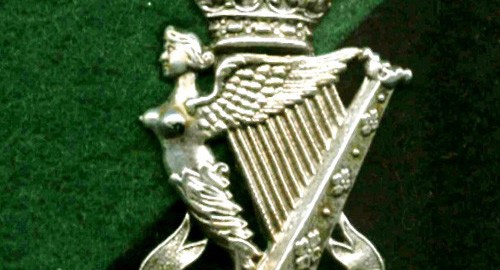
The Royal Irish Rifles (became the Royal Ulster Rifles from 1 January 1921) was an infantry rifle regiment of the British Army, first created in 1881 by the amalgamation of the 83rd (County of Dublin) Regiment of Foot and the 86th (Royal County Down) Regiment of Foot. The regiment saw service in the Second Boer War, the First World War, the Second World War and the Korean War.

In 1968 the Royal Ulster Rifles was amalgamated with the other regiments of the North Irish Brigade, the Royal Irish Fusiliers (Princess Victoria’s) and the Royal Inniskilling Fusiliers to create the Royal Irish Rangers. However, in 1992, the Royal Irish Rangers was later merged with the Ulster Defence Regiment to form the Royal Irish Regiment.

———————————

Royal Ulster Rifles – 1954

———————————

Active1793–1968
Country United Kingdom
Branch British Army
TypeRifles
RoleLight infantry
Size1-2 Regular battalions
3 Militia and Special Reserve battalions
Up to 16 Hostilities-only battalions
Garrison/HQRHQ – Victoria Barracks, Belfast (1881-1937)
St Patrick’s Barracks, Ballymena (1937-1968)
Nickname(s)The Stickies,[1] The Rifles
MottoQuis Separabit (Who shall separate us [from the love of Christ]) (Latin)
ColoursNone as a rifle regiment
MarchQuick: “The Ulster Rifles march ‘Off, Off, Said the Stranger'”

Slow: “The South Down Militia”

EngagementsBadajoz, Jhansi, Somme, Normandy Landings, Rhine Crossing, Korea


History

The regiment’s history dates backs to the reign of King George III. In 1793 the British army expanded to meet the commitments of the war with the French First Republic. As part of that expansion it raised two new regiments of foot, the 83rd and the 86th. At the same time the counties Antrim, Down and Louth regiments of militia were raised.

In 1881, under the Childers Reforms, the 83rd and 86th were amalgamated into a single regiment, named the Royal Irish Rifles, one of eight infantry regiments raised and garrisoned in Ireland. It was the county regiment of Antrim, Down, Belfast and Louth, with its depot located at Belfast. Militarily, the whole of Ireland was administered as a single command within the United Kingdom with Command Headquarters at Parkgate (Phoenix Park) Dublin, directly under the War Office in London.

South African War 1899–1902

Also known as the Second Boer War.

Monument to Royal Irish Rifles in grounds of Belfast City Hall

In October 1905, a memorial was erected in the grounds of Belfast City Hall in memory of the 132 who did not return. Field Marshal Lord Grenfell unveiled the memorial while the Times reported the event.

First World War

Infantry of the Royal Irish Rifles during the Battle of the Somme (1916) in the Great War.

The regiment provided battalions to all three Irish infantry divisions of the Great War: 10th (Irish), 16th (Irish) and 36th (Ulster). Members of the Ulster Volunteers, Young Citizen Volunteers (and national Volunteers served in all three divisions with the majority of the first two named in 36th (Ulster) Infantry Division. In addition, the 7th Battalion became home to a company of the Royal Jersey Militia, sometimes known as the Jersey Pals.

Most battalions served in the trenches of the Western Front.

Men of the 16th (Service) Battalion, Royal Irish Rifles, the pioneer battalion of the 36th (Ulster) Division, moving to the frontline 20 November 1917.

The Royal Irish Rifles lost 25,000 officers and men throughout the Great War, with over 7,000 of them being killed in action.

Between the world wars

After the Great War the War Office decided that Ulster should be represented on the Army List as Connaught, Leinster and Munster already had their own regiments and so, in 1920, a new name was proposed for the Royal Irish Rifles. From 1 January 1921 the regiment became the Royal Ulster Rifles.

Despite the change of name, the Regiment continued to accept recruits from the rest of Ireland; for example, almost 50% of personnel in the 1st Battalion who arrived in Korea in 1950 were Irish nationals.

In 1937 the already close relationship with the London Irish Rifles was formally recognised when they were incorporated into the Corps while still retaining their regimental identity as a territorial battalion. Two years later the London Irish formed a second battalion.

Second World War

Regular Army

When war was declared the 1st Battalion was serving in India, with the 31st Independent Brigade Group, which was trained in mountain warfare. When the brigade returned to the United Kingdom, it was decided that, with its light scale of equipment, the brigade could be converted into a glider-borne unit. 31st Infantry Brigade, which also included the 1st Border Regiment, 2nd South Staffs and 2nd Ox and Bucks, was renamed 1st Airlanding Brigade and trained as glider infantry.

They were assigned to the 1st Airborne Division, part of the British Army’s airborne forces. The battalion, along with the 2nd Oxford and Bucks Light Infantry, were later transferred to join the 12th Devonshire Regiment in the 6th Airlanding Brigade as part of the newly raised 6th Airborne Division which was actually only the second of two airborne divisions created by the British Army in World War II.

Riflemen of the Royal Ulster Rifles, 6 Airlanding Brigade, aboard a jeep and trailer, driving off Landing Zone N past a crashed Airspeed Horsa glider on the evening of 6 June

Carried in Horsa gliders, the battalion took part in Operation Mallard, the British glider-borne landings in the later afternoon of 6 June 1944, otherwise known as D-Day. They served throughout the Battle of Normandy employed as normal infantry until August 1944 and the breakout from the Normandy beachhead where the entire 6th Airborne Division advanced 45 miles in 9 days. They returned to England in September 1944 for rest and retraining until December 1944 when the 6th Airborne was then recalled to Belgium after the surprise German offensive in the Ardennes which is now known as the Battle of the Bulge where the division played a comparatively small role in the mainly-American battle.

They then took part in their final airborne mission of the war known as Operation Varsity, which was the airborne element of Operation Plunder, the crossing of the River Rhine by the 21st Army Group in March 1945. The 6th Airborne was joined by the US 17th Airborne Division, and both divisions suffered heavy casualties.

The 2nd Battalion was part of the 9th Infantry Brigade, 3rd Infantry Division serving with the British Expeditionary Force (BEF) in France from 1939-1940. The division was commanded by the then Major General Bernard Montgomery who would eventually lead the Anglo-Canadian forces as commander of the 21st Army Group in the North West Europe Campaign. The 3rd Infantry Division took part in the Battle of Dunkirk, where it gained a decent reputation and earned the nickname of ^Monty’s Ironsides^, and had to be evacuated from Dunkirk with the rest of the BEF.

The battalion returned to Europe for the D-Day landings in June 1944 and fought in the Battle of Normandy, specifically in Operation Charnwood where they were the first British troops to enter the city of Caen, which had previously seen bitter fighting in the British attempt to capture it. The battalion later fought in Belgium, Holland and Germany

Hostilities-only

The 6th (Home Defence) Battalion was raised in 1939 from No. 200 Group National Defence Companies and consisting of older men with previous military experience who were unfit for active service. On 24 December 1940 the battalion was redesignated as the 30th Battalion, dropping the Home Defence from its title, and converted to a regular infantry battalion. It was disbanded in Northern Ireland in May 1943.

The 7th (Home Defence) Battalion was raised on 29 June 1940, joining the 215th Independent Infantry Brigade (Home). The battalion served in Ulster until leaving for the United Kingdom in September 1942. On 24 December 1941, the battalion was redesignated the 31st Battalion and dropped the Home Defence title.

The 8th Battalion, Royal Ulster Rifles was also raised in 1940, and joined 203rd Independent Infantry Brigade (Home). In early 1942 the battalion was transferred to the Royal Artillery and converted into the 117th Light Anti-Aircraft Regiment, Royal Artillery. The regiment served with Home Forces until November 1942 when it was sent overseas to North Africa to fight in the final stages of the North African Campaign as part of the British First Army.

In September 1943 the regiment landed in Italy shortly after the initial invasion, now as part of the British Eighth Army, and served on the Italian Front until June 1944, when the regiment was broken up and the men were retrained as infantrymen, due to a severe shortage of infantrymen, particularly in Italy. Many of the men retrained were sent to the 2nd, 7th and 10th battalions of the Rifle Brigade (Prince Consort’s Own), another rifle regiment, in 61st Lorried Infantry Brigade, 6th Armoured Division.

The 70th (Young Soldiers) Battalion was formed on 12 September 1940 at Holywood from the younger soldiers of the 6th and 7th battalions and volunteers of the ages of 18 and 19 who were too young for conscription. The battalion spent most of its time guarding airfields and aerodromes before moving to the United Kingdom in October 1941.

The Royal Ulster Rifles had the unique distinction of being the only infantry regiment of the British Army to have both of its regular battalions involved in the Normandy landings.

After World War II

In 1947 the Royal Ulster Rifles were grouped with the other two remaining Irish regiments, the Royal Inniskilling Fusiliers and the Royal Irish Fusiliers, into the North Irish Brigade. A year later, the regiment formed a pipe band, wearing saffron kilts and playing Irish Warpipes. In the same year, in 1948, the 2nd Battalion was amalgamated with the 1st Battalion to form the 1st Battalion, Royal Ulster Rifles (83rd and 86th), thus retaining the history of both of the previous regiments of foot. This happened throughout the British Army in 1948 after India gained its independence.

Korean War

The 1st Battalion, Royal Ulster Rifles disembarked at Pusan in early November as part of the 29th Independent Infantry Brigade Group. They were transported forward to Uijongbu, where under the direct command of the Eighth United States Army they were directed against guerrilla forces swept past by the rapid progress of the United Nations Army.

By mid December a defensive line was being prepared on the south bank of the River Han on the border with North Korea. protecting the approach to Seoul, the capital of South Korea. As the New Year started, the Fiftieth Chinese Communist Army engaged the United Nations troops focusing on 29 Brigade, who were dispersed over a very wide front (12 miles). The Rifles fighting with 1st Battalion, Royal Northumberland Fusiliers were able to hold their position in their first major action at the Battle of Chaegunghyon and the Communist Army’s progress was halted, at least temporarily.

The Chinese Fifth Phase Campaign or the Battle of the Imjin River began on 22 April with the goal of taking Seoul. By 25 April, the Brigade was ordered to withdraw as the Communist forces were threatening to encircle it. With virtually no cover and seriously outnumbered, the Rifles came under heavy fire as they withdrew to a blocking position. The Brigade was able to hold its position, despite fierce fighting, and neutralized the effectiveness of the Sixty-fourth Chinese Communist Army. Although the enemy’s offensive had come within 5 miles of Seoul, the capital had been saved.

At the time, the Times reported the Battle of Imjin concluding with:

The fighting 5th wearing St George and the Dragon and the Irish Giants with the Harp and Crown have histories that they would exchange with no one. As pride, sobered by mourning for fallen observes how well these young men have acquitted themselves in remotest Asia. The parts taken by the regiments may be seen as a whole. The motto of the Royal Ulster Rifles may have the last word Quis Separabit. (Who shall separate us)

As a result of this action, members of the Rifles were awarded 2 Distinguished Service Orders, 2 Military Crosses, 2 Military Medals, and 3 men were Mentioned in Despatches. When the area was recaptured, a memorial was erected to the 208 men killed or missing after the battle. It stood over-looking the battlefield till 1962 when Seoul’s growth threatened to consume it, and it was carried by HMS Belfast back to Ireland where it was the focusof the Regiment’s St Patrick’s Barracks in Ballymena. When the barracks closed in 2008,[ the Imjin River Memorial was again moved, this time to the grounds of the Belfast City Hall.

In 1968 the Royal Ulster Rifles amalgamated with the Royal Inniskilling Fusiliers and the Royal Irish Fusiliers to form the Royal Irish Rangers (27th (Inniskilling), 83rd and 87th). A further amalgamation took place with the Ulster Defence Regiment in 1992 to form the Royal Irish Regiment (27th Inniskilling, 83rd, 87th and the Ulster Defence Regiment).


Veterans

Veterans of the Royal Ulster Rifles in Northern Ireland remain few, as only around four veterans are known to be still alive today in Northern Ireland. However, many of them are still widely involved today, as several of them have participated in the annual Korea Day in Northern Ireland, along with three of them travelling to South Korea on the Revisit Program in April 2013 in association with the Somme Association to visit the sites of Battles like the Battle of the Imjin River, with the help of current serving Army officers in Northern Ireland. The legacy of these veterans is still alive today, as one of the dedicated veterans’ grandson travelled to Seoul, South Korea to attend a United Nations Youth Peace Camp in Seoul with 16 other delegations in July 2014, to learn about the sacrifice their grandparents had made to themselves and their country, and the Republic of Korea 60 years ago.

Victoria Cross

Recipients of the Victoria Cross:

  • Lieutenant H. S. Cochrane, 86th (Royal County Down) Regiment of Foot, Betwa, India, April 1858
  • Lieutenant H. E. Jerome, 86th (Royal County Down) Regiment of Foot, Jhansi, India, April 1858
  • Private James Byrne, 86th (Royal County Down) Regiment of Foot, Jhansi, India, April 1858
  • Private James Pearson, 86th (Royal County Down) Regiment of Foot, Jhansi, India, April 1858
  • Rifleman William Frederick McFadzean. 14th (Service) Battalion, Royal Irish Rifles. 1916. Thiepval.
  • Rifleman Robert Quigg. 12th (Service) Battalion, Royal Irish Rifles. 1916. Hamel, Somme.
  • Second Lieutenant Edmund De Wind. 15th (Service) Battalion, Royal Irish Rifles. 1918. Grugies, France.

Visit the Royal Ulster Rifles Museum

2nd March – Deaths & Events in Northern Ireland Troubles

Key Events & Deaths on this day in Northern Ireland Troubles

2nd March

——————————————————-

Tuesday 2 March 1971

Harry Tuzo, then a Lieutenant-General, replaced Vernon Erskine-Crum who had been appointed General Officer Commanding (GOC) of the British Army (BA) in Northern Ireland on 4 February 1971, but who had suffered a heart attack.

[Erskine-Crum died on 17th March 1971]

Wednesday 2 March 1977

Donald Robinson (56), an English businessman, was shot dead by the Irish Republican Army (IRA) at his place of work near University Street, Belfast.

The British Broadcasting Corporation (BBC) programme ‘Tonight’ carried out an investigation into interrogation techniques employed at Castlereagh holding centre.

[This programme subsequently led Amnesty International to conduct its own investigation which was published in June 1978.

The reaction to the programme also led to the publication of the Bennett Report from British government which was published in March 1979. Both these reports were critical of the methods used to interrogate people suspected of paramilitary involvement.]

Republican prisoners decided to call off the ‘blanket protest’  so as not to detract attention from the hunger strike.

See  1981 Hunger Strike.

Wednesday 2 March 1983

The Northern Ireland Assembly passed a motion urging the British government to do all in its power to stop the proposed inquiry into the Northern Ireland conflict by the Political Committee of the European Parliament. The Rapporteur was Mr N.J. Haagerup.

[The report was drawn up and passed by the European Parliament on 29th March 1982 ]

The Assembly also established a Security and Home Affairs Committee.

Monday 2 March 1987

The Ulster Clubs announced a plan to set up an alternative system of government.

Friday 2 March 1990

There was a meeting of the Anglo-Irish Intergovernmental Conference (AIIC) in London.

Monday 2 March 1992

Two Ulster Defence Regiment (UDR) soldiers were convicted, along with a third man, of ‘aiding and abetting’ the Ulster Freedom Fighters (UFF), a cover name (pseudonym) used by the Ulster Defence Association (UDA), in the killing of Loughlin Maginn on 25 August 1989.

[The killing led to the establishment of the Stevens Inquiry.] Muammar Gaddafi, then President of Libya, announced that he was breaking his country’s links with the Irish Republican Army (IRA).

Tuesday 2 March 1993

Patrick Mayhew, then Secretary of State for Northern Ireland, gave a speech in Bangor, County Down, in which he said that Britain was “neutral” with regard to Northern Ireland’s position within the United Kingdom (UK). Mayhew stressed that the union between Britain and Northern Ireland would only be changed if a majority of the population voted for some new constitutional arrangement.

Wednesday 2 March 1994

The European Commission recommended continuation of its 15 million ecu support for the International Fund for Ireland (IFI).

Thursday 2 March 1995

James Seymour, formerly a Royal Ulster Constabulary (RUC) officer, died nearly 22 years after being shot by the Irish Republican Army (IRA), outside Coalisland RUC base, County Tyrone. [He had been shot on 4 May 1973 and was paralysed and partly comatose since the incident.]

Saturday 2 March 1996

David Trimble, then leader of the Ulster Unionist Party (UUP), and Ian Paisley, then leader of the Democratic Unionist Party (DUP), said they would not attend the ‘proximity’ talks at Stormont.

Sunday 2 March 1997

An Irish Republican Army (IRA) mortar was discovered close to Warrenpoint, County Down.

Saturday 2 March 2002

Two 16 year old boys were slightly injured when an explosive device, hidden in a police traffic cone, detonated as they moved it. The device had been left at the Farmacaffley point-to-point races and the boys had moved the traffic cone to allow a car to pass.

[Dissident Republican paramilitaries were thought to have been responsible for the attack and it was believed that the intended target was the security forces.]

John Reid, then Secretary of State for Northern Ireland, delivered a speech at the New University of Ireland in Galway in which he called on Nationalists to reassure Unionists that “what matters is a peaceful, just, democratic, and richly diverse island, not an ancient constitutional struggle”.

Thomas Shaw fought in Messines, Ypres, and Passchendaele
Thomas Shaw

Thomas Shaw, the last veteran in Ireland of the First World War, died at the age of 102. Shaw, who was from Belfast, joined the 16th battalion of the Royal Irish Rifles (RIR) in 1916.

He had enlisted earlier at the age of 15 when he lied about his age. However his brother, who was a Military Policeman, met him by accident while in France and had him sent home. He rejoined the RIR at the end of the Battle of the Somme. Shaw saw action at Messines, Ypres, and Passchendaele. He returned to Northern Ireland in April 1919.

See: Thomas Shaw June 1899 – 2 March 2002


  —————————————————————

Remembering all innocent victims of the Troubles

Today is the anniversary of the death of the following people killed as a results of the conflict in Northern Ireland

“To live in hearts we leave behind is not to die

– Thomas Campbell

To the innocent on the list – Your memory will live  forever

– To  the Paramilitaries  –

There are many things worth living for, a few things worth dying for, but nothing worth killing for.

8 People   lost their lives on the  2nd March between 1972– 1995


  —————————————————————————

02 March 1972


Thomas Morrow,  (28)

Protestant
Status: Royal Ulster Constabulary (RUC),

Killed by: Official Irish Republican Army (OIRA)
Died two days after being shot while investigating break-in at factory, Camlough Road, Newry, County Down.

  —————————————————————————

02 March 1973


Patrick Crossan,  (34)

Catholic
Status: Civilian (Civ),

Killed by: Ulster Volunteer Force (UVF)
Bus driver. Shot as he stopped at bus stop, Woodvale Road, Belfast.

  —————————————————————————

02 March 1973
George Walmsley,   (52)

Protestant
Status: Civilian (Civ),

Killed by: non-specific Republican group (REP)
Shot shortly after leaving Orange Hall, Ligoniel Road, Belfast

  —————————————————————————

02 March 1974


Thomas McClinton,   (28)

Protestant
Status: Royal Ulster Constabulary (RUC),

Killed by: Irish Republican Army (IRA)
Shot while on Royal Ulster Constabulary (RUC) foot patrol, Donegall Street, Belfast.

  —————————————————————————

02 March 1977
Donald Robinson,  (56)

nfNI
Status: Civilian (Civ),

Killed by: Irish Republican Army (IRA)
English businessman. Shot at his workplace, Lawrence Street, off University Street, Belfast.

  —————————————————————————

02 March 1983


Lindsay McCormack,   (49)

Protestant
Status: Royal Ulster Constabulary (RUC),

Killed by: Irish Republican Army (IRA)
Shot while on Royal Ulster Constabulary (RUC) foot patrol, Serpentine Road, Greencastle, Belfast.

  —————————————————————————

02 March 1984


Thomas Loughlin,   (40)

Protestant
Status: Ulster Defence Regiment (UDR),

Killed by: Irish Republican Army (IRA)
Off duty. Killed by booby trap bomb, attached to his van, outside his home, Castlederg, County Tyrone.

  —————————————————————————

02 March 1995


James Seymour,  (55)

Protestant
Status: Royal Ulster Constabulary (RUC),

Killed by: Irish Republican Army (IRA)
Died nearly 22 years after being shot by sniper, outside Coalisland Royal Ulster Constabulary (RUC) base, County Tyrone. Been in a coma since the incident on 4 May 1973.

  —————————————————————————

ISIS Execute Eight Dutch militants

ISIS executed eight of their Dutch members in east of Raqqa

ISIS has executed eight Dutch members of its own jihadist fighting force in in Maadan, Raqqa province, in Syria, after accusing them of desertion and mutiny (stock image)

The so-called Islamic State has killed eight Dutch members whom it accused of trying to desert, activists have said.

As cracks start to show and more and more foreign fighters become disillusioned  ISIS has executed 424 of its own fighters in its 20 month reign in Syria

“Daesh [Isis] executed eight Dutch fighters on Friday in Maadan, Raqqa province, after accusing them of attempting desertion and mutiny,” said Abu Mohammad, a member of the citizen journalist group Raqqa is Being Slaughtered Silently (RBSS), via Twitter on Monday.

RBSS has been documenting the group’s abuses in its de facto capital in northern Syria since April 2014. The Twitter group said tension between 75 Dutch militants – some of them of Moroccan origin – and Isis intelligence operatives from Iraq hadreached a new height over the past month.

Three other Dutch militants were arrested by Iraqi Isis members who accused them of wanting to flee, and one of the detainees was beaten to death during the interrogation, according to RBSS.

Isis leaders in Raqqa sent a delegate to solve the dispute with the Dutch cell’s enraged members, but they murdered the intermediary in vengeance, the citizen journalist group added.

The Isis leadership in Iraq then ordered the arrest of all the members of the Dutch group and imprisoned them in Tabaqa and Maadan in Syria before killing eight of them, RBSS said.

The so-called Syrian Observatory for Human Rights, which monitors the conflict, could not confirm the report. However it said three European militants of North African origin were killed in what Isis calls the Wilayet al-Furat – an area stretching across the Syrian-Iraqi frontier.

According to the Dutch secret services, 200 people from the Netherlands including 50 women have joined Isis in Syria and Iraq.

Omagh Bombing – The IRA’s Deadliest Massacre of Civilians

belfastchildis's avatar

Omagh Bombing – The IRA’s Deadliest Massacre of Civilians

See real IRA page

See 29 people Slaughtered by the Real IRA

The Omagh bombing was a deliberate massacre of civilians carried out by the Irish Republican Army on Saturday 15 August 1998, in Omagh, County Tyrone, Northern Ireland. Twenty-nine people were murdered in the attack and approximately 220 people were injured. The attack was described by the BBC as “Northern Ireland’s worst single terrorist atrocity” and by the British Prime Minister, Tony Blair, as an “appalling act of savagery and evil”.

The victims included people from many different backgrounds: Protestants, Catholics, a Mormon teenager, five other teenagers, six children, a woman pregnant with twins, two Spanish tourists, and other tourists on a day trip from the Republic of Ireland. The nature of the bombing created a strong international and local outcry against the IRA, and spurred on the Northern Ireland…

View original post 177 more words

EUROMILLIONS Syndicate

EUROMILLIONS LOTTERY

My father – in – law recently won almost  £100,000 in a Euro  Millions syndicate ( I’m still waiting on him sharing some of it with me )  and this has got me thinking that I should set up my own syndicate and here it is.


Euromillions is the biggest lottery in Europe with a weekly Jackpot which can reach 190 million euros.

The draw is held in twice per week – every Tuesday and Friday.

To play you select s five main numbers between 1-50 and two lucky star numbers between 1-11. To win the Jackpot all seven numbers must be matched.

However there are 13 levels of prizes and you need to find only two main numbers to win a prize.

EUROMILLIONS SYNDICATE

If you play Euromillions as an individual the odds against a single ticket winning the jackpot are astronomical , but did you know that 1 in 3 of the BIG Jackpots wins are won by syndicates.

If you would like to join my syndicate please fill in the form below and when it has been processed I will send you confirmation by email and an online invoice. I will post the current tickets on this page and you can check the numbers as they are drawn live on the show.

Sample Tickets

I will also send you a syndicate contract  and welcome pack and list all current syndicate members for relevant draws.

You have to be in it to win it!


← Back

Thank you for your response. ✨

Euro Millions(required)
Weekly or Monthly Play