Category Archives: Blog

Alexander Litvinenko – Russian President Vladimir Putin “personally ordered” the killing

belfastchildis's avatar

Panorama: How to poison a spy

Vladimir Putin ‘ordered killing’,

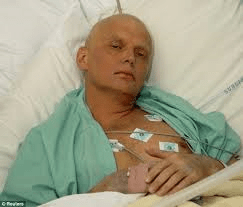
Russian President Vladimir Putin “personally ordered” the killing of Alexander Litvinenko, the inquiry into the former spy’s death has heard.

Ben Emmerson QC, for Mr Litvinenko’s family, said in his closing statement that Russian state responsibility had been proven “beyond reasonable doubt”.

Mr Litvinenko’s widow Marina said she believed her husband’s “murderers and their paymasters” had “been unmasked”.

But the Kremlin told the BBC it did not trust the inquiry.

‘Tinpot despot’

Dissident Mr Litvinenko, 43, drank tea containing a fatal dose of radioactive polonium during a meeting with suspects Dmitry Kovtun and Andrei Lugovoi in London in 2006.

The Kremlin wanted Mr Litvinenko dead and provided theThe Kremlin used to kill him, Mr Emmerson alleged.

Scientific evidence proves Mr Kovtun and Mr Lugovoi killed the former spy, he added.

Alexander Litvinenko
Alexander Litvinenko “vowed to expose corruption”, his widow said outside…

View original post 6,390 more words

What is Polonium ? – Used to kill Alexander Litvinenko

What is

Polonium

President Putin ‘probably’ approved Litvinenko murder

See The Death of Alexander Litvinenko

  Russian President Vladimir Putin

The murder of ex-Russian spy Alexander Litvinenko in 2006 in the UK was “probably” approved by President Vladimir Putin, an inquiry has found.

Mr Putin is likely to have signed off the poisoning of Mr Litvinenko with polonium-210 in part due to personal “antagonism” between the pair, it said.

Home Secretary Theresa May said the murder was a “blatant and unacceptable” breach of international law.

But the Russian Foreign Ministry said the public inquiry was “politicised”.

It said: “We regret that the purely criminal case was politicised and overshadowed the general atmosphere of bilateral relations.”

Litvinenko inquiry reaction: Latest updates

Key findings of the public inquiry

Who was Alexander Litvinenko?

Who are the Litvinenko murder suspects?

Story of a perplexing murder

The long-awaited report into Mr Litvinenko’s death found that two Russian men – Andrei Lugovoi and Dmitry Kovtun – deliberately poisoned the 43-year-old in London in 2006 by putting the radioactive substance polonium-210 into his drink at a hotel.

Sir Robert Owen, the public inquiry chairman, said he was “sure” Mr Litvinenko’s murder had been carried out by the two men and that they were probably acting under the direction of Moscow’s FSB intelligence service, and approved by the organisation’s chief, Nikolai Patrushev, as well as the Russian president.

He said Mr Litvinenko’s work for British intelligence agencies, his criticism of the FSB and Mr Putin, and his association with other Russian dissidents were possible motives for his killing.

There was also “undoubtedly a personal dimension to the antagonism” between Mr Putin and Mr Litvinenko, he said.

See BBC News for full story

—————————————————

Polonium

Polonium is a chemical element with symbol Po and atomic number 84, discovered in 1898 by Marie Curie and Pierre Curie. A rare and highly radioactive element with no stable isotopes, polonium is chemically similar to bismuth and tellurium, and it occurs in uranium ores. Applications of polonium are few. They include heaters in space probes, antistatic devices, and sources of neutrons and alpha particles. Because of its position in the periodic table, polonium is sometimes classified as a metalloid.[3] Other sources say that on the basis of its properties and behavior, it is “unambiguously a metal”.[4]

Characteristics

Isotopes

Main article: Isotopes of polonium

Polonium has 33 known isotopes, all of which are radioactive. They have atomic masses that range from 188 to 220 u. 210Po (half-life 138.376 days) is the most widely available. The longer-lived 209Po (half-life 125.2 ± 3.3 years, longest-lived of all polonium isotopes)[2] and 208Po (half-life 2.9 years) can be made through the alpha, proton, or deuteron bombardment of lead or bismuth in a cyclotron.[5]

210Po is an alpha emitter that has a half-life of 138.4 days; it decays directly to its stable daughter isotope, 206Pb. A milligram (5 curies) of 210Po emits about as many alpha particles per second as 5 grams of 226Ra.[6] A few curies (1 curie equals 37 gigabecquerels, 1 Ci = 37 GBq) of 210Po emit a blue glow which is caused by excitation of surrounding air.[citation needed]

About one in 100,000 alpha emissions causes an excitation in the nucleus which then results in the emission of a gamma ray with a maximum energy of 803 keV.[7][8]

Solid state form
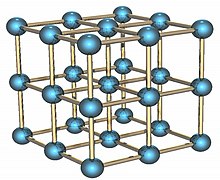
The alpha form of solid polonium.

Polonium is a radioactive element that exists in two metallic allotropes. The alpha form is the only known example of a simple cubic crystal structure in a single atom basis, with an edge length of 335.2 picometers; the beta form is rhombohedral.[9][10][11] The structure of polonium has been characterized by X-ray diffraction[12][13] and electron diffraction.[14]

210Po (in common with 238Pu) has the ability to become airborne with ease: if a sample is heated in air to 55 °C (131 °F), 50% of it is vaporized in 45 hours to form diatomic Po2 molecules, even though the melting point of polonium is 254 °C (489 °F) and its boiling point is 962 °C (1,764 °F).[15][16][1] More than one hypothesis exists for how polonium does this; one suggestion is that small clusters of polonium atoms are spalled off by the alpha decay.

Chemistry

The chemistry of polonium is similar to that of tellurium and bismuth. Polonium dissolves readily in dilute acids, but is only slightly soluble in alkalis. Polonium solutions are first colored in pink by the Po2+ ions, but then rapidly become yellow because alpha radiation from polonium ionizes the solvent and converts Po2+ into Po4+. This process is accompanied by bubbling and emission of heat and light by glassware due to the absorbed alpha particles; as a result, polonium solutions are volatile and will evaporate within days unless sealed.[17][18]

Compounds

Polonium has no common compounds, and almost all of its compounds are synthetically created; more than 50 of those are known.[19] The most stable class of polonium compounds are polonides, which are prepared by direct reaction of two elements. Na2Po has the antifluorite structure, the polonides of Ca, Ba, Hg, Pb and lanthanides form a NaCl lattice, BePo and CdPo have the wurtzite and MgPo the nickel arsenide structure. Most polonides decompose upon heating to about 600 °C, except for HgPo that decomposes at ~300 °C and the lanthanide polonides, which do not decompose but melt at temperatures above 1000 °C. For example, PrPo melts at 1250 °C and TmPo at 2200 °C.[20] PbPo is one of the very few naturally occurring polonium compounds, as polonium alpha decays to form lead.[21]

Polonium hydride

(PoH2) is a volatile liquid at room temperature prone to dissociation.[20] The two oxides PoO2 and PoO3 are the products of oxidation of polonium.[22]

Halides of the structure PoX2, PoX4 and PoX6 are known. They are soluble in the corresponding hydrogen halides, i.e., PoClX in HCl, PoBrX in HBr and PoI4 in HI.[23] Polonium dihalides are formed by direct reaction of the elements or by reduction of PoCl4 with SO2 and with PoBr4 with H2S at room temperature. Tetrahalides can be obtained by reacting polonium dioxide with HCl, HBr or HI.[24]

Other polonium compounds include acetate, bromate, carbonate, citrate, chromate, cyanide, formate, hydroxide, nitrate, selenate, monosulfide, sulfate and disulfate.[23][25]

Polonium compounds[24][26]
Formula Color m.p. (°C) Sublimation
temp. (°C)
Symmetry Pearson symbol Space group No a (pm) b(pm) c(pm) Z ρ (g/cm3) ref
PoO2 pale yellow 500 (dec.) 885 fcc cF12 Fm3m 225 563.7 563.7 563.7 4 8.94 [27]
PoCl2 dark red 355 130 orthorhombic oP3 Pmmm 47 367 435 450 1 6.47 [28]
PoBr2 purple-brown 270 (dec.) [29]
PoCl4 yellow 300 200 monoclinic [28]
PoBr4 red 330 (dec.) fcc cF100 Fm3m 225 560 560 560 4 [29]
PoI4 black [30]
Oxides

Hydrides

Halides

History


Also tentatively called “radium F“, polonium was discovered by Marie and Pierre Curie in 1898,[31] and was named after Marie Curie’s native land of Poland (Latin: Polonia).[32][33] Poland at the time was under Russian, German, and Austro-Hungarian partition, and did not exist as an independent country. It was Curie’s hope that naming the element after her native land would publicize its lack of independence.[34] Polonium may be the first element named to highlight a political controversy.[34]

This element was the first one discovered by the Curies while they were investigating the cause of pitchblende radioactivity. Pitchblende, after removal of the radioactive elements uranium and thorium, was more radioactive than the uranium and thorium combined. This spurred the Curies to search for additional radioactive elements. They first separated out polonium from pitchblende in July 1898, and five months later, also isolated radium.[17][31][35]

In the United States, polonium was produced as part of the Manhattan Project‘s Dayton Project during World War II. It was a critical part of the implosion-type nuclear weapon design used in the Fat Man bomb on Nagasaki in 1945. Polonium and beryllium were the key ingredients of the ‘urchin‘ detonator at the center of the bomb’s spherical plutonium pit.[36] The urchin ignited the nuclear chain reaction at the moment of prompt-criticality to ensure the bomb did not fizzle.[36]

Much of the basic physics of polonium was classified until after the war. The fact that it was used as an initiator was classified until the 1960s.[37]

The Atomic Energy Commission and the Manhattan Project funded human experiments using polonium on five people at the University of Rochester between 1943 and 1947. The people were administered between 9 and 22 microcuries (330 and 810 kBq) of polonium to study its excretion.[38][39][40]

Detection

Emission intensity vs. photon energy for three polonium isotopes.

Gamma counting

By means of radiometric methods such as gamma spectroscopy (or a method using a chemical separation followed by an activity measurement with a non-energy-dispersive counter), it is possible to measure the concentrations of radioisotopes and to distinguish one from another. In practice, background noise would be present and depending on the detector, the line width would be larger which would make it harder to identify and measure the isotope. In biological/medical work it is common to use the natural 40K present in all tissues/body fluids as a check of the equipment and as an internal standard.[41][42]

Alpha counting

Emission intensity vs. alpha energy for four isotopes, note that the line width is narrow and the fine details can be seen.

The best way to test for (and measure) many alpha emitters is to use alpha-particle spectroscopy. It is common to place a drop of the test solution on a metal disk which is then dried out to give a uniform coating on the disk. This is then used as the test sample. If the thickness of the layer formed on the disk is too thick then the lines of the spectrum are broadened; this is because some of the energy of the alpha particles is lost during their movement through the layer of active material. An alternative method is to use internal liquid scintillation where the sample is mixed with a scintillation cocktail. When the light emitted is then counted, some machines will record the amount of light energy per radioactive decay event. Due to the imperfections of the liquid scintillation method (such as a failure of all the photons to be detected, cloudy or coloured samples can be difficult to count) and the fact that random quenching can reduce the number of photons generated per radioactive decay, it is possible to get a broadening of the alpha spectra obtained through liquid scintillation. It is likely that these liquid scintillation spectra will be subject to a Gaussian broadening rather than the distortion exhibited when the layer of active material on a disk is too thick.[42]

A third energy dispersive method for counting alpha particles is to use a semiconductor detector.[42]

From left to right the peaks are due to 209Po, 210Po, 239Pu and 241Am. The fact that isotopes such as 239Pu and 241Am have more than one alpha line indicates that the nucleus has the ability to be in different discrete energy levels (like a molecule can).

Emission intensity vs. alpha energy for four isotopes, note that the line width is wide and some of the fine details can not be seen. This is for liquid scintillation counting where random effects cause a variation in the number of visible photons generated per alpha decay.

Occurrence and production

Polonium is a very rare element in nature because of the short half-life of all its isotopes. 210Po, 214Po, and 218Po appear in the decay chain of 238U; thus polonium can be found in uranium ores at about 0.1 mg per metric ton (1 part in 1010),[43][44] which is approximately 0.2% of the abundance of radium. The amounts in the Earth’s crust are not harmful. Polonium has been found in tobacco smoke from tobacco leaves grown with phosphate fertilizers.[45][46][47]

Because it is present in such small concentrations, isolation of polonium from natural sources is a very tedious process. The largest batch of the element ever extracted, performed in the first half of the 20th century, contained only 40 Ci (1.5 TBq) (9 mg) of polonium-210 and was obtained by processing 37 tonnes of residues from radium production.[48] Polonium is now obtained by irradiating bismuth with high-energy neutrons or protons.[17][49]

Neutron capture

Synthesis by (n,γ) reaction

In 1934, an experiment showed that when natural 209Bi is bombarded with neutrons, 210Bi is created, which then decays to 210Po via beta-minus decay. The final purification is done pyrochemically followed by liquid-liquid extraction techniques.[50] Polonium may now be made in milligram amounts in this procedure which uses high neutron fluxes found in nuclear reactors.[49] Only about 100 grams are produced each year, practically all of it in Russia, making polonium exceedingly rare.[51][52]

This process can cause problems in lead-bismuth based liquid metal cooled nuclear reactors such as those used in the Soviet Navy‘s K-27. Measures must be taken in these reactors to deal with the unwanted possibility of 210Po being released from the coolant.[53][54]

Proton capture

Synthesis by (p,n) and (p,2n) reactions

It has been found that the longer-lived isotopes of polonium can be formed by proton bombardment of bismuth using a cyclotron. Other more neutron-rich isotopes can be formed by the irradiation of platinum with carbon nuclei.[55]

Applications

Polonium-based sources of alpha particles were produced in the former Soviet Union.[56] Such sources were applied for measuring the thickness of industrial coatings via attenuation of alpha radiation.[57]

Because of intense alpha radiation, a one-gram sample of 210Po will spontaneously heat up to above 500 °C (932 °F) generating about 140 watts of power. Therefore, 210Po is used as an atomic heat source to power radioisotope thermoelectric generators via thermoelectric materials.[6][17][58][59] For instance, 210Po heat sources were used in the Lunokhod 1 (1970) and Lunokhod 2 (1973) Moon rovers to keep their internal components warm during the lunar nights, as well as the Kosmos 84 and 90 satellites (1965).[56][60]

The alpha particles emitted by polonium can be converted to neutrons using beryllium oxide, at a rate of 93 neutrons per million alpha particles.[58] Thus Po-BeO mixtures or alloys are used as a neutron source, for example in a neutron trigger or initiator for nuclear weapons[17][61] and for inspections of oil wells. About 1500 sources of this type, with an individual activity of 1,850 Ci (68 TBq), have been used annually in the Soviet Union.[62]

Polonium was also part of brushes or more complex tools that eliminate static charges in photographic plates, textile mills, paper rolls, sheet plastics, and on substrates (such as automotive) prior to the application of coatings. Alpha particles emitted by polonium ionize air molecules that neutralize charges on the nearby surfaces.[63][64] Polonium needs to be replaced in these devices nearly every year because of its short half-life; it is also highly radioactive and therefore has been mostly replaced by less dangerous beta particle sources.[6]

Tobacco smoke from cigarettes contains a small amount of polonium isotope 210, which can become deposited inside smokers’ airways and deliver radiation directly to surrounding cells.

The lungs of smokers can be exposed to four times more polonium than those of non-smokers and specific parts may get a hundred times more radiation. One study estimated that someone smoking one and half packs a day receives the equivalent amount of radiation as someone having 300 chest X-rays a year.[65]

Biology and toxicity

Overview

Polonium is highly dangerous and has no biological role.[17] By mass, polonium-210 is around 250,000 times more toxic than hydrogen cyanide (the LD50 for 210Po is less than 1 microgram for an average adult (see below) compared with about 250 milligrams for hydrogen cyanide[66]). The main hazard is its intense radioactivity (as an alpha emitter), which makes it very difficult to handle safely. Even in microgram amounts, handling 210Po is extremely dangerous, requiring specialized equipment (a negative pressure alpha glove box equipped with high performance filters), adequate monitoring, and strict handling procedures to avoid any contamination. Alpha particles emitted by polonium will damage organic tissue easily if polonium is ingested, inhaled, or absorbed, although they do not penetrate the epidermis and hence are not hazardous as long as the alpha particles remain outside the body. Wearing chemically resistant and “intact” gloves is a mandatory precaution to avoid transcutaneous diffusion of polonium directly through the skin. Polonium delivered in concentrated nitric acid can easily diffuse through inadequate gloves (e.g., latex gloves) or the acid may damage the gloves.[67]

It has been reported that some microbes can methylate polonium by the action of methylcobalamin.[68][69] This is similar to the way in which mercury, selenium and tellurium are methylated in living things to create organometallic compounds. Studies investigating the metabolism of polonium-210 in rats have shown that only 0.002 to 0.009% of polonium-210 ingested is excreted as volatile polonium-210.[70]

Acute effects

The median lethal dose (LD50) for acute radiation exposure is generally about 4.5 Sv.[71] The committed effective dose equivalent 210Po is 0.51 µSv/Bq if ingested, and 2.5 µSv/Bq if inhaled.[72] So a fatal 4.5 Sv dose can be caused by ingesting 8.8 MBq (240 µCi), about 50 nanograms (ng), or inhaling 1.8 MBq (49 µCi), about 10 ng. One gram of 210Po could thus in theory poison 20 million people of whom 10 million would die. The actual toxicity of 210Po is lower than these estimates, because radiation exposure that is spread out over several weeks (the biological half-life of polonium in humans is 30 to 50 days[73]) is somewhat less damaging than an instantaneous dose. It has been estimated that a median lethal dose of 210Po is 15 megabecquerels (0.41 mCi), or 0.089 micrograms, still an extremely small amount.[74][75] For comparison, one grain of table salt is about 0.06 mg = 60 μg.[3]

Long term (chronic) effects

In addition to the acute effects, radiation exposure (both internal and external) carries a long-term risk of death from cancer of 5–10% per Sv.[71] The general population is exposed to small amounts of polonium as a radon daughter in indoor air; the isotopes 214Po and 218Po are thought to cause the majority[76] of the estimated 15,000–22,000 lung cancer deaths in the US every year that have been attributed to indoor radon.[77] Tobacco smoking causes additional exposure to polonium.[78]

Regulatory exposure limits and handling

The maximum allowable body burden for ingested 210Po is only 1.1 kBq (30 nCi), which is equivalent to a particle massing only 6.8 picograms. The maximum permissible workplace concentration of airborne 210Po is about 10 Bq/m3 (6990300000000000000♠3×10⁻¹⁰ µCi/cm3).[79] The target organs for polonium in humans are the spleen and liver.[80] As the spleen (150 g) and the liver (1.3 to 3 kg) are much smaller than the rest of the body, if the polonium is concentrated in these vital organs, it is a greater threat to life than the dose which would be suffered (on average) by the whole body if it were spread evenly throughout the body, in the same way as caesium or tritium (as T2O).

210Po is widely used in industry, and readily available with little regulation or restriction[citation needed]. In the US, a tracking system run by the Nuclear Regulatory Commission was implemented in 2007 to register purchases of more than 16 curies (590 GBq) of polonium-210 (enough to make up 5,000 lethal doses). The IAEA “is said to be considering tighter regulations … There is talk that it might tighten the polonium reporting requirement by a factor of 10, to 1.6 curies (59 GBq).”[81] As of 2013, this is still the only alpha emitting byproduct material available, as a NRC Exempt Quantity, which may be held without a radioactive material license.[citation needed]

Polonium and its compounds must be handled in a glove box, which is further enclosed in another box, maintained at a slightly higher pressure than the glove box to prevent the radioactive materials from leaking out. Gloves made of natural rubber do not provide sufficient protection against the radiation from polonium; surgical gloves are necessary. Neoprene gloves shield radiation from polonium better than natural rubber.[82]

Well-known poisoning case

20th century


Polonium was administered to humans for experimental purposes from 1943 to 1947; it was injected into four hospitalised patients, and orally given to a fifth. Studies such as this were funded by the Manhattan Project and the AEC, and conducted at the University of Rochester. The objective was to obtain data on human excretion of polonium to correlate with more extensive data from rats. Patients selected as subjects were chosen because experimenters wanted persons who had not been exposed to polonium either through work or accident. All subjects had incurable diseases. Excretion of polonium was followed, and an autopsy was conducted at that time on the deceased patient to determine which organs absorbed the polonium. Patients’ ages ranged from ‘early thirties’ to ‘early forties.’ The experiments were described in a Studies of polonium metabolism in human subjects, Chapter 3 of Biological Studies with Polonium, Radium, and Plutonium, National Nuclear Energy Series, Volume VI-3, McGraw-Hill, New York, 1950. Not specified is the isotope under study, but at the time polonium-210 was the most readily available polonium isotope. The DoE factsheet submitted for this experiment reported no follow up on these subjects.[83]

It has also been suggested that Irène Joliot-Curie was the first person to die from the radiation effects of polonium. She was accidentally exposed to polonium in 1946 when a sealed capsule of the element exploded on her laboratory bench. In 1956, she died from leukemia.[84]

According to the 2008 book The Bomb in the Basement, several deaths in Israel during 1957–1969 were caused by 210Po.[85] A leak was discovered at a Weizmann Institute laboratory in 1957. Traces of 210Po were found on the hands of professor Dror Sadeh, a physicist who researched radioactive materials. Medical tests indicated no harm, but the tests did not include bone marrow. Sadeh died from cancer. One of his students died of leukemia, and two colleagues died after a few years, both from cancer. The issue was investigated secretly, and there was never any formal admission that a connection between the leak and the deaths had existed.[86]

21st century


Alexander Litvinenko

The cause of death in the 2006 murder of Russian dissident Alexander Litvinenko was determined to be 210Po poisoning.[87][88] According to Prof. Nick Priest of Middlesex University, an environmental toxicologist and radiation expert, speaking on Sky News on December 2, Litvinenko was probably the first person to die of the acute α-radiation effects of 210Po.[89]

Abnormally high concentrations of 210Po were detected in July 2012 in clothes and personal belongings of the Palestinian leader Yasser Arafat, a heavy smoker, who died on 11 November 2004 of uncertain causes. The spokesman for the Institut de Radiophysique in Lausanne, Switzerland, where those items were analyzed, stressed that the “clinical symptoms described in Arafat’s medical reports were not consistent with polonium-210 and that conclusions could not be drawn as to whether the Palestinian leader was poisoned or not”, and that “the only way to confirm the findings would be to exhume Arafat’s body to test it for polonium-210.”[90] On 27 November 2012 Arafat’s body was exhumed and samples were taken for separate analysis by experts from France, Switzerland and Russia.[91] On 12 October 2013, The Lancet published the group’s finding that high levels of the element were found in Arafat’s blood, urine, and in saliva stains on his clothes and toothbrush.[92] The French tests later found some polonium but stated it was from “natural environmental origin.”[93] Following later Russian tests, Vladimir Uiba, the head of the Russian Federal Medical and Biological Agency, stated in December 2013 that Arafat died of natural causes, and they had no plans to conduct further tests.[93]

Treatment

It has been suggested that chelation agents such as British Anti-Lewisite (dimercaprol) can be used to decontaminate humans.[94] In one experiment, rats were given a fatal dose of 1.45 MBq/kg (8.7 ng/kg) of 210Po; all untreated rats were dead after 44 days, but 90% of the rats treated with the chelation agent HOEtTTC remained alive after 5 months.[95]

Detection in biological specimens

Polonium-210 may be quantified in biological specimens by alpha particle spectrometry to confirm a diagnosis of poisoning in hospitalized patients or to provide evidence in a medicolegal death investigation. The baseline urinary excretion of polonium-210 in healthy persons due to routine exposure to environmental sources is normally in a range of 5–15 mBq/day. Levels in excess of 30 mBq/day are suggestive of excessive exposure to the radionuclide.[96]

Commercial products containing polonium

210Po is manufactured in a nuclear reactor by bombarding 209Bi with neutrons. 100 grams are produced each year, almost all in Russia.[97]

210Po is contained in anti-static brushes, which are used in some printing presses.[98] Some anti-static brushes contain up to 500 microcuries (20 MBq) of 210Po as a source of charged particles for neutralizing static electricity.[99] In USA, the devices with no more than 500 µCi (19 MBq) of (sealed) 210Po per unit can be bought in any amount under a “general license”,[100] which means that a buyer need not be registered by any authorities.

Tiny amounts of such radioisotopes are sometimes used in the laboratory and for teaching purposes—typically of the order of 4–40 kBq (0.11–1.08 µCi), in the form of sealed sources, with the polonium deposited on a substrate or in a resin or polymer matrix—are often exempt from licensing by the NRC and similar authorities as they are not considered hazardous. Small amounts of 210Po are manufactured for sale to the public in the United States as ‘needle sources’ for laboratory experimentation, and are retailed by scientific supply companies. The polonium is a layer of plating which in turn is plated with a material such as gold, which allows the alpha radiation (used in experiments such as cloud chambers) to pass while preventing the polonium from being released and presenting a toxic hazard. According to United Nuclear, they typically sell between four and eight sources per year.[101][102]

Occurrence in humans and the biosphere

Polonium-210 is widespread in the biosphere, including in human tissues, because of its position in the uranium-238 decay chain. Natural uranium-238 in the Earth’s crust decays through a series of solid radioactive intermediates including radium-226 to the radioactive gas radon-222, some of which, during its 3.8-day half-life, diffuses into the atmosphere. There it decays through several more steps to polonium-210, much of which, during its 138-day half-life, is washed back down to the Earth’s surface, thus entering the biosphere, before finally decaying to stable lead-206.[103][104][105]

As early as the 1920s Antoine Lacassagne, using polonium provided by his colleague Marie Curie, showed that the element has a very specific pattern of uptake in rabbit tissues, with high concentrations particularly in liver, kidney and testes.[106] More recent evidence suggests that this behavior results from polonium substituting for sulfur in sulfur-containing amino-acids or related molecules[107] and that similar patterns of distribution occur in human tissues.[108] Polonium is indeed an element naturally present in all humans, contributing appreciably to natural background dose, with wide geographical and cultural variations, and particularly high levels in arctic residents, for example.[109]

Tobacco

Polonium-210 in tobacco contributes to many of the cases of lung cancer worldwide. Most of this polonium is derived from lead-210 deposited on tobacco leaves from the atmosphere; the lead-210 is a product of radon-222 gas, much of which appears to originate from the decay of radium-226 from fertilizers applied to the tobacco soils.[47][110][111][112][113]

The presence of polonium in tobacco smoke has been known since the early 1960s.[114][115] Some of the world’s biggest tobacco firms researched ways to remove the substance—to no avail—over a 40-year period. The results were never published.[47]

Food

Polonium is also found in the food chain, especially in seafood.[


Spike Lee is a Racist & needs to shut up

Lee said on Instagram he “cannot support” the “lily white” awards show.

That sounds like racism to me!

Maybe I’m missing something here – but shouldn’t awards and accolades be based on performance and critical acclaim and not on the colour of your skin?

Not according to Mr. Lee and Jada Pinkett Smith’s gut retching display on the News today had me reaching for the off-button  – see below for full story.

Regardless of who you are, what colour you are or which  god you worship , no one has the right to demand special attention due to their race or creed.

I mean imagine if  Liam Neeson didn’t win an award or recognition for one of his movies , you wouldn’t  hear him  banging on about “Not enough Irish leprechaun’s are being given awards etc. ” or anything ridiculous like that , so why should the likes of Lee feel they have a god given right to an advantage over others.

For years the racist card has been overplayed and abused by all and  sundry and rightly so racism has no place in  modern democracies  like the UK and USA , but when it is abused and Reverse Racism is at play no one want to hear  about it and everyone is so paranoid about how they will perceived if they speak out against being accused of racism.

At the end of the day the best and most deserving actor’s/actress’s should be awarded Oscar’s based on performance and critical acclaim , regardless of colour or creed and it may just be the case that this year none of those nominated were black and all were white. So what?

Lee and his deluded supporters are a disgrace for calling the race card and I sincerely hope that someone with some balls in Hollywood stands up to them and Oscars head Cheryl Boone is big enough to tell him and his supporters the plain truth , they weren’t considered good enough this season – Get over it.

——————————————-

Oscars head acts over lack of nominees’ diversity

Cheryl Boone Isaacs

Oscars head Cheryl Boone Isaacs is taking action to “alter the make-up” of their membership, after Spike Lee and Jada Pinkett Smith’s refusal to attend because of the mostly white nominees.

Boone Isaacs praised the “wonderful work” of the nominees but said she was “heartbroken” at the lack of diversity.

Lee said on Instagram he “cannot support” the “lily white” awards show.

Jada Pinkett Smith said in a video message on Facebook that she would not be attending the awards ceremony.

Boone Isaacs added that “dramatic steps” were being taken, saying: “In the coming days and weeks we will conduct a review of our membership recruitment in order to bring about much-needed diversity in our 2016 class and beyond.”

See BBC News for full story


Big Brother’s Steph’s latest melt down

This series of Big Brother is turning out to be the most entertaining in years and I hardly have time to digest one unfolding drama before the next one kicks off. Half the housemates seem to have gone insane and the remainder are suffering from post traumatic stress disorder ,  as they watch  their fellow housemates stumble from one melt down to the next.

Tonight Angie Bowie was the first to show signs of cracking and charged into the daily room and demanded her passport and a car to take her to who knows where. Was she going straight to the airport and hopping back over the pond perhaps?

It was telling that one of the first comments she made to Big Brother was ” she didn’t care about the money” , when she clearly did care about the money as she miraculously changed her mind and as of writing this she is still in the house.

I have often pondered what Big Brother says to these exploding “stars” as they are on the brink of throwing the towel in and walking away from the BB house.


Money is obviously a factor and I understand that if they leave early or are removed from the house for unacceptable behaviour , then as per their contracts their fee is subject to penalties or in serve cases withheld.

But  wouldn’t it  be nice to be a fly on the wall and see  exactly how  Big Brother dealt with celebrity tantrums and manages to defuse an exploding ego.

Angie eventually calm down and surprisingly (not) opted to remain in the house and BB rewarded her with a sleeping pass and this seemed to satisfy  all parties.

Meanwhile David Gest is being paid £600,000 to make occasional guest appearances in the main house. He seems to spend more time in the bb guest bedroom and never seems to be involved in anything of any interest. He is reportedly the highest paid housemate ever and to be honest if I was BB I would ask for a refund.

Come on David earn your money and entertain us!

Meanwhile Stephanie’s  love triangle dominated most of the rest of the show and she had melt down number five thousand and thirty two. For the umpteenth time she threatened to leave the house , but was ahem… talked round  again.

Jeremy seems to be playing her like a fiddle and although she is very annoying and obviously deranged I do feel sorry for her and the boyfriend she may or may not have when she leaves the house. Her meltdown tonight was up  there with the best of them and Gemma Collin’s was on the receiving end of her hysterical outburst. When she stormed into thee dairy room and demanded to leave I didn’t think for a second that she would walk. And strangely not because of the money ( like most ) but because of her fatal attraction to Jeremy and the thought of leaving him is something she could never face.

Also whilst in the dairy room she  managed to insult and probably alienate every reality TV star in the  UK and perhaps further afield. The poor girl had lost it and watching her tonight I felt that she was her own worst enemy.

I know she’ is bang out of order and has thrown herself at Jeremy heart and soul, but she is obviously a young women with bigger issues and seems unstable and emotional damaged and I can’t help but feel for her.

I just hopes she survives Big Brother and is able to deal with the fall out that will  surely come.

Jeremy  is a slimey dog and he should be ashamed of the way he is/has treated her.

Anyways Big Brother give her some space to cool down and placed her in solitary confinement , booth for her own good and to stop her from tearing Gemma Collins to pieties , although if they did have a fight my money would be on Gemma.

Unfortunately solitary confinement was the last thing she needed and the show ended with her ranting and raving like a deranged and on the brink of a complete melt down.

I hope Big Brother are proud of the way they have treated this fragile girl’s public meltdown ( which BB orchestrated )  and they give her the support she will need when she leaves the house – for good

Keep up the good work Big Brother.


Alex Higgins – The People’s Champion

Alex Higgins

18 March 1949 – 24 July 2010

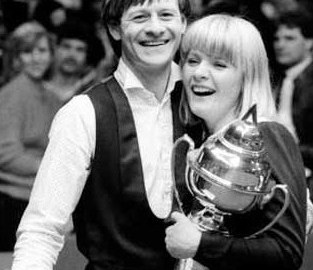
Like many Belfast and Northern Ireland people Alex Higgins was a hero of mine and as a teenager I remember watching the Hurricane win the world championship in 1982 and becoming the pride of Ulster and a national treasure.

I was lucky to meet him on a few occasions, my dad and his brothers use to hang about with him in the Jampot in Sandy Row and when my grandmother died he came to the wake and drank us all under the table.

Sadly his antics away from the table made uncomfortable viewing and I watch with a heavy heart as he stumbled from one calamity to another and eventually he  faded away from the game and spent his later life drinking and gambling and was a common sight in The Crown Bar and betting shops in Belfast City Centre. 

Cancer finally took him off this mortal coil and the Hurricane  run out of steam. But he was and remains The Pride  of Belfast

—————————————————

Alexander Gordon “Alex” Higgins (18 March 1949 – 24 July 2010)[6] was a Northern Irish professional snooker player, who is remembered as one of the most iconic figures in the game. Nicknamed Hurricane Higgins because of his fast play,[7] he was World Champion in 1972 and 1982, and runner-up in 1976 and 1980. He won the UK Championship in 1983 and the Masters in 1978 and 1981, making him one of ten players to have completed snooker’s Triple Crown. He was also World Doubles champion with Jimmy White in 1984, and won the World Cup three times with the All Ireland team.

Higgins came to be known as the “People’s Champion” because of his popularity,[8] and is often credited with having brought the game of snooker to a wider audience, contributing to its peak in popularity in the 1980s.[9] He had a reputation as an unpredictable and difficult character.[10] He was a heavy smoker,[11] struggled with drinking and gambling,[9][12] and admitted to using cocaine and marijuana.[7] First diagnosed with throat cancer in 1998,[13] Higgins died of multiple causes in his Belfast home on 24 July 2010.

—————————————————–

Alex Higgins BBC Documentary – The People’s Champion

—————————————————–

Life and career

Early life

Higgins (right) with David Taylor at an exhibition at Queen’s University Belfast, 1968

Alex Higgins was born in Belfast[14] and had three sisters.[13] He started playing snooker at the age of 11,[15] often in the Jampot club in his native Sandy Row area of south Belfast and later in the YMCA in the nearby city centre. At age 14 and weighing seven and a half stone (47.6 kg), he left for England and a career as a jockey.[16] However, he never made the grade because, in his youth, he drank a lot of Guinness and ate a lot of chocolate, making him too heavy to ride competitively.[17] He returned to Belfast and by 1965, aged 16, he had compiled his first maximum break.[15] In 1968 he won the All-Ireland and Northern Ireland Amateur Snooker Championships.[14]

World titles

Higgins turned professional at the age of 22, winning the World Championship at his first attempt in 1972, against John Spencer winning 37–32.[18] Higgins was then the youngest ever winner of the title, a record retained until Stephen Hendry‘s 1990 victory at the age of 21.[19] In April 1976, Higgins reached the final again and faced Ray Reardon. Higgins led 11–9, but Reardon made four centuries and seven breaks over 60 to pull away and win the title for the fifth time with the score of 27–16. Higgins was also the runner-up to Cliff Thorburn in 1980, losing 18–16, after being 9–5 up. Higgins won the world title for a second time in 1982 after beating Reardon 18–15 (with a 135 total clearance in the final frame); it was an emotional as well as professional victory for him. Higgins would have been ranked No. 1 in the world rankings for the 1982/83 season had he not forfeited ranking points following disciplinary action.[20][21]

Other victories

Throughout his career, Higgins won 20 other titles, one of the most notable being the 1983 UK Championship. In the final he trailed Steve Davis 0–7 before producing a famous comeback to win 16–15.[22] He also won the Masters twice, in 1978 and in 1981, beating Cliff Thorburn and Terry Griffiths in the finals respectively.[23] Another notable victory was his final professional triumph in the 1989 Irish Masters at the age of 40 when he defeated a young Stephen Hendry.

Post-retiremen

After his retirement from the professional game, Higgins spent time playing for small sums of money in and around Northern Ireland. He made appearances in the 2005 and 2006 Irish Professional Championship, these comebacks ending in first-round defeats by Garry Hardiman and Joe Delaney respectively.

On 12 June 2007, it was reported that Higgins had assaulted a referee at a charity match in the north-east of England.[24] Higgins returned to competitive action in September 2007 at the Irish Professional Championship in Dublin but was whitewashed 0–5 by former British Open champion Fergal O’Brien in the first round at the Spawell Club, Templelogue.[25]

Higgins continued to play fairly regularly, and enjoyed “hustling” all comers for small-time stakes in clubs in Northern Ireland and beyond; in May 2009 he entered the Northern Ireland Amateur Championship, “to give it a crack”,[26] but failed to appear for his match.

On 8 April 2010, Higgins was part of the debut Snooker Legends Tour event in Sheffield, at the Crucible, checking himself out of hospital two days before the event, after having been admitted with pneumonia and breathing problems.[27] Appearing alongside other retired or close-to-retiring professionals, including John Parrott, Jimmy White, John Virgo and Cliff Thorburn, he faced Thorburn in his match, but lost 2–0.[28]

It is estimated that Higgins earned and spent £3–4 million in his career as a snooker player.[29][30]

Playing style


Higgins’s speed around the table, his ability to pot balls at a rapid rate and flamboyant style earned him the nickname “Hurricane Higgins” and made him a very high-profile player. His highly unusual cueing technique sometimes included a body swerve and movement, as well as a stance that was noticeably higher than that of most professionals.

The unorthodox play of Higgins was encapsulated in his break of 69, made under unusual pressure, against Jimmy White in the penultimate frame of their World Professional Snooker Championship semi-final in 1982. Higgins was 0–59 down in that frame, but managed to compile an extremely challenging clearance during which he was scarcely in position until the colours. In particular, former world champion Dennis Taylor considers a three-quarter-ball pot on a blue into the green pocket especially memorable, not only for its extreme degree of difficulty but for enabling Higgins to continue the break and keep White off the table and unable to clinch victory at that moment. In potting the blue, Higgins screwed the cue-ball on to the side cushion to bring it back towards the black/pink area with extreme left-hand sidespin, a shot Taylor believes could be played 100 times without coming close to the position Higgins reached with cue-ball. He went a little too far for ideal position on his next red but the match-saving break was still alive.[31][citation needed]

Higgins drank alcohol and smoked during tournaments, as did many of his contemporaries. A volatile personality got him into frequent fights and arguments, both on and off the snooker table. One of the most serious of these clashes was when he head-butted a referee at the UK championship in 1986. This led to his being fined £12,000 and banned from five tournaments.[32] He was convicted of assault and criminal damage, and fined £250 by a court.[33] Another came at the 1990 World Championship; after losing his first-round match to Steve James, he punched tournament official Colin Randle in the abdomen, before the start of a press conference at which he announced his retirement. This, added to his having threatened to have fellow player and compatriot Dennis Taylor shot, led to a ban for the whole of the following season.[34]

Outside snooker

At the time of his 1972 triumph at the World Championship, Higgins had no permanent home and by his own account had recently lived in a row of abandoned houses in Blackburn which were awaiting demolition. In one week he had moved into five different houses on the same street, moving down one every time his current dwelling was demolished.[35]

In 1975, Higgins’ son Chris Delahunty was born.[17] Higgins’s first marriage was to Australian[17] Cara Hasler in April 1975 in Sydney. They had a daughter Christel[12] and divorced. His second marriage was to Lynn Avison in 1980 at a United Reformed Church.[16] They had a daughter Lauren (born late 1980)[36] and son Jordan (born March 1983).[13][37][38][39] They split in 1985[33] and divorced. In the same year, Higgins began a relationship with Siobhan Kidd, which ended in 1989 after he allegedly hit her with a hairdryer.[40]

He had a long and enduring friendship with Oliver Reed and was a good friend of John Sykes, with whom he often played exhibition matches.[41]

While not normally noted for his philanthropy, in 1983 Higgins helped a young boy from the Manchester area, a fan of his who had been in a coma for two months. His parents were growing desperate and wrote to Higgins. He recorded his voice on a tape and sent it to the boy with his best wishes. He later visited the boy in hospital, unannounced, and promised that if the boy recovered they would play snooker together. True to his word, once the boy was out, the match was held.[42]

In 1996, Higgins was convicted of assaulting a 14-year-old boy,[30] while in 1997 then-girlfriend Holly Haise stabbed him three times during a domestic argument.[33] He published his autobiography, From the Eye of the Hurricane: My Story, in 2007.[43] Higgins appeared in the Sporting Stars edition of the British television quiz The Weakest Link on 25 July 2009.[44]

Illness and death

For many years, Higgins smoked 60 cigarettes a day.[17] He had cancerous growths removed from his mouth in 1994 and 1996.[45] In June 1998, he was found to have throat cancer;[13] on 13 October of that year, he had major surgery.[46]

By 2009, Higgins lived alone in a caravan.[30] In spring 2010, he contracted pneumonia.[39] In April 2010 Higgins’s friends announced that they had set up a campaign to help raise the £20,000 he needed for teeth implants, to enable him to eat properly again and put on weight. Higgins had lost his teeth after intensive radiotherapy used to treat his throat cancer. It was reported that since losing them he had been living on liquid food, and had become increasingly depressed, even contemplating suicide.[47] He was too ill to have the implants fitted.[48] Despite his illness he continued to smoke cigarettes and drink heavily until the end of his life.[49]

At the end of his life, Higgins’ weight fell to 6 stone (38 kilograms).[30] He lived in sheltered housing on the Donegall Road, Belfast.[39] Despite having once been worth £4 million, he was bankrupt and survived on a £200-a-week disability allowance.[47] He was found dead in bed in his flat on 24 July 2010.[6][14][38] The cause of death was a combination of malnutrition, pneumonia, a bronchial condition and throat cancer.[50] His children survive him.[51]

Higgins’ funeral service was held in Belfast on 2 August 2010. He was cremated, and his ashes were interred in Carnmoney Cemetery in Newtownabbey, County Antrim.

Legacy

Higgins was inducted into the Snooker Hall of Fame in 2011.

Alex Higgins was an inspiration to many subsequent professional snooker players, including Ken Doherty, Jimmy White and Ronnie O’Sullivan, who in an interview stated “Alex was an inspiration to players like Jimmy White and thousands of snooker players all over the country, including me. The way he played at his best is the way I believe the game should be played. It was on the edge, keeping the crowd entertained and glued to the action.”[52]

In Clive Everton‘s TV documentary The Story of Snooker (2002), Steve Davis described Higgins as the “one true genius that snooker has produced”,[53] despite the autobiography of a contemporary leading professional Willie Thorne characterising Higgins as “not a great player”.[54] Higgins arguably fulfilled his potential only intermittently during his career peak in the 1970s and ’80s; Everton puts this down to Davis and Ray Reardon generally being too consistent for him.[55]

Regardless, Higgins’ exciting style and explosive persona helped make snooker a growing television sport in the 1970s and 1980s. Higgins also made the first 16-red clearance (in a challenge match in 1976); it was a break of 146 (with the brown as the first “red”, and sixteen colours: 1 green, 5 pinks and 10 blacks).[56]

Performance timeline

Tournament 1971/
72
1972/
73
1973/
74
1974/
75
1975/
76
1976/
77
1977/
78
1978/
79
1979/
80
1980/
81
1981/
82
1982/
83
1983/
84
1984/
85
1985/
86
1986/
87
1987/
88
1988/
89
1989/
90
1990/
91
1991/
92
1992/
93
1993/
94
1994/
95
1995/
96
1996/
97
1997/
98
UK Championship NH NH NH NH NH NH SF SF QF F QF F W F 2R SF 2R 1R 1R A LQ LQ LQ 2R LQ LQ LQ
The Masters NH NH NH QF QF SF W F F W SF 1R QF QF 1R F QF A WR A LQ LQ LQ A LQ A A
World Championship W SF QF SF F 1R 1R QF F 2R W SF 1R 2R 2R 2R 1R LQ 1R A LQ LQ 1R LQ LQ LQ A
Performance Table Legend
LQ lost in qualifying draw #R lost in the early rounds of the tournament
(WR = Wildcard round)
QF advanced to but not past the quarterfinals SF advanced to but not past the semi-finals
F advanced to the final, tournament runner-up W won the tournament
NH event was not held A did not participate in the tournament

Career finals[edit]

Ranking event finals: 6 (1 title, 5 runner-ups)[edit]

Legend
World Championship (1–2)
UK Championship (0–1)
Other (0–2)
Outcome No. Year Championship Opponent in the final Score
Runner-up 1. 1976 World Championship Wales Reardon, RayRay Reardon 16–27
Runner-up 2. 1980 World Championship Canada Thorburn, CliffCliff Thorburn 16–18
Winner 1. 1982 World Championship Wales Reardon, RayRay Reardon 18–15
Runner-up 3. 1984 UK Championship England Davis, SteveSteve Davis 8–16
Runner-up 4. 1988 Grand Prix England Davis, SteveSteve Davis 6–10
Runner-up 5. 1990 British Open Canada Chaperon, BobBob Chaperon 8–10

Tournament wins

Ranking wins:(1)

Non-ranking wins: (23)[edit]

Team wins

Pro-Am wins

  • Pontin’s Spring Open[60]

Amateur wins

  • All Ireland Amateur Championship – 1968[61]
  • Northern Ireland Amateur Championship – 1968[58]


Megan McKenna gets a formal warning


Big Brother has issued Megan McKenna with a formal warning following her drunken meltdown in last nights show.

See below for Big Brother Rules


The Ex On the Beach star launched a violent, foul-mouthed outburst at fellow housemates Tiffany Pollard and John Partridge after a row quickly escalated out of control.

When Tiffany and Megan nearly came to blows, the young reality star was ordered to go into the bathroom before she was called into the Diary Room and eventually removed from the house by security when she failed to calm down.

The argument began when Megan, who had earlier admitted to being “p****d as a fart”, said she was fed up of cleaning up after people in the house.

When John contested that she doesn’t clean up after him, Megan replied: “It’s always John, ‘I’m the perfect one’. I f**king respect people in here, John. I respect people but I’ve lost it in here with you!”

See Mirror for full story


Big Brother Rules

1.There is no direct contact with the outside world.

    * Big Brother never discusses anything that has happened in the outside world.
    * Big Brother never enters into any negotiations about how certain actions, conversations or events that may have occurred in the house will be shown on the television.
    * Housemates are not permitted to make any attempts to communicate personal messages with members of the outside world by means of written messages, symbols or personalised clothing.
    * If any objects appear in the garden Housemates must not touch or inspect them unless instructed to do so.
    * If people appear in the garden Housemates MUST NOT communicate with them.
    * In the event of any of these events occurring Housemates must make their way immediately inside and close the doors, even if not specifically asked to do so.

2.Housemates are filmed 24 hours a day and must wear personal microphones at all times.

    * Big Brother will not broadcast images from the toilet on the television or internet unless it is being used for purposes other than those for which it was designed. For example, images of two people talking in the toilet may be broadcast.
    * It is strictly against the Rules to interfere for any reason with the camera or sound equipment installed in the House and garden or to do anything which may hinder the working of the equipment in any way.
    * It is against the rules to try and locate and/or acknowledge cameras through the mirrors. It is also against the rules to discuss camera positions.
    * Nothing must be placed in front of mirrors to impede camera coverage. Housemates are forbidden to move vases and bowls and any other decorative items.
    * No furniture can be moved from one part of the house to another.
    * Housemates are forbidden to hang towels anywhere in the House except on the heated towel rails in the bathroom.
    * It is compulsory to wear a personal microphone at all times except when sleeping, showering or taking part in any activity in which the microphone may be damaged.

FALIURE TO WEAR MICROPHONES WILL RESULT IN FINES.

3.The Diary Room is the only place in the house where Big Brother will acknowledge housemates. Visits to the Diary Room are a vital part of the Big Brother experience and are, therefore, compulsory.

    * Housemates are welcome to enter the Diary Room at any time of the day or night.
    * The Diary Room is the only place in the House that Big Brother acknowledges what Housemates say.
    * Housemates may not wear sunglasses or hats in the Diary Room.
    * The Diary Room can only be entered if there is no-one in the room. It is electronically locked at all other times. It will also be locked while Housemates are in the room.
    * Big Brother can call individual Housemates to the Diary Room at any time. Housemates must come when called, failure to do so or responding in an offensive manner to Big Brother may result in disqualification and early eviction.
    * It is compulsory for Housemates to enter the Diary Room to make their nominations.
    * Big Brother is the only person who communicates with the Housemates. On occasion, Big Brother may not answer questions immediately but will always eventually return an answer. Big Brother will not answer personal questions.
    * If a Housemate decides to leave voluntarily, they must explain their reasons why in the Diary Room.
    * Any questions asked by Big Brother in the Diary Room cannot be divulged to other Housemates.
    * Occasionally Housemates may need minor medical treatment. On these occasions professionals will usually treat them in the Diary Room. It is prohibited to try and seek information about the outside world from these professionals.
    * If a Housemate is having a consultation with the counsellor or psychologist (either at their request or at the suggestion of Big Brother) then this conversation will be confidential. It will not be recorded and members of the production team will not be able to hear or see the consultation.

4.Each week, Housemates are required to go to the Diary Room and nominate two people for potential eviction.

    * Housemates must give frank and honest reasons for their nominations.
    * If any Housemate is deemed to be holding back a valid reason for nominating a fellow Housemate, a formal warning may be issued.
    * Housemates are not allowed to nominate themselves or any inanimate objects.

5.Housemates are not permitted to discuss nominations with any other Housemates.

This includes:

    * Any discussion with another Housemate that could be interpreted as a deliberate attempt to influence their nominations.
    * Predicting or guessing who may be nominated or evicted.
    * Discussing the reasons Housemates might use for nominating.
    * Discussing the type of person Housemates are thinking of nominating.
    * Writing down or using materials at Housemates disposal to form names, initials or other symbols. For this reason the use of pens, pencils or any written communication is strictly against the rules.
    * Communicating in code or languages other than English and/or devising other methods of communication.

Housemates are, of course, free to talk about how they feel about the other Housemates. Their good and bad points may be discussed with others but NOT as part of a discussion about nominations.

6.Housemates may not intimidate, threaten or act violently towards any other Housemate.

Big Brother has the right to evict Housemates without warning if their behaviour is deemed to warrant it.

7.Housemates may not communicate in code and/or foreign or sign languages.

    * Housemates are forbidden to write anything using any material or surface in the House eg steam on glass.
    * On the occasion Housemates are provided with a writing implement it is forbidden for this implement to be used for anything other than the express purpose for which it is provided.
    * Housemates must speak in English at all times.

8.All tasks, unless otherwise stated, are compulsory.

    * The supply of food and other household goods is generally dependant on Housemates’ performance in compulsory weekly tasks.
    * Succeeding in the task results in a substantial shopping budget, failing the task means Housemates may have to live on “staples”. Staple foodstuffs are supplied by Big Brother and provide enough calories and the appropriate balance of nutrients from all the major food groups for each Housemate for the week. Big Brother retains the right to change the rules of any task at any stage.
    * In addition to the weekly tasks Big Brother may also set other challenges.
    * If a task is deemed compulsory, any Housemate refusing to take part will attract a fine and may be evicted.
    * The rules of all tasks are non-negotiable.

9.Housemates may not discuss any previous series of Big Brother. Housemates are forbidden to discuss their plans for the prize money.

    * Housemates may not discuss any previous series of Big Brother – either Australian or international – or former Housemates – either Australian or international – with any other Housemate.
    * Under no circumstances may any of the Housemates discuss how they intend to spend the prize money should they win it. In particular, any pacts to share or split the prize money between Housemates are against the rules and may result in the prize money being withdrawn altogether.
    * Housemates may not discuss any aspect of the audition process or any person they met during the auditions or at any other time during pre-production or in Lockdown.

10. Big Brother reserves the right to change the rules at any time.


John Partridge is Fowl

A few nights ago I blogged that  John Partridge was shifty and not to be trusted.

Now I would like to amend that statement  to include the fact he  is a two-face , shifty, heartless,  slimey dog , self serving bore and  Megan McKenna  was right to blow up at him tonight and although it was uncomfortable to watch at times – it was bloody funny.


Partridge for reasons  known only to himself has appointed himself judge and jury over his fellow housemate and last night poor Darren Day came under fire at what was the most outrageous , brutal , twofaced   betrayal in reality TV history and Partridge should be ashamed of himself.

I  mean what right has that prat to stand there , all self righteous and nominate poor Darren because he had a few fags to deal with what was by any standards a stressful day.

Darren had taken Partridge into his trust and confided some of his personal issues and yet Partridge stood there and mortified Darren   in front of his fellow  housemates and the great British public. I could hardly believe what I was hearing and to make it so much worse Partridge tried wiggling himself out of it and Darren seem to buy his shit and forgive the useless prat.

I take my hat off to Darren , not only for his ongoing battle with the demons of addictions , but being a bigger man than me and not knocking Partridge out cold last night.

If it had been me  I would have smacked him in the mouth and told him to keep outta my face for the remainder of their time in the house and forever after.

Partridge played  a role in getting the clueless Winton chucked out of the house  first (although Winston didn’t need much help really, did he?  ) , then he lead the charge in the witch hunt to get Tiffany to leave the house and was disgustingly rude and heartless in the slimey way he related the request to her – did you see the barley concealed sneer on his face when he forgot the camera’s were there?

Megan was gold viewing tonight and she was right to air the obvious truth apart Partridge , although she did go a little over board -Just a tiny bit.

Hopefully the rest of the house have wakened up to the real John Partridge and they make their views and disgust known to him tomorrow and knock that vile prat off his perch!

A baby Partridge

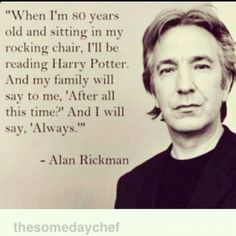
Alan Rickman 21 February 1946 – 14 January 2016

Alan Sidney Patrick Rickman

Alan Rickman, Harry Potter and Die Hard actor, dies aged 69

Actor Alan Rickman, known for films including Harry Potter, Die Hard and Robin Hood: Prince of Thieves, has died at the age of 69, his family has said.

The star had been suffering from cancer, a statement said.

He became one of Britain’s best-loved acting stars thanks to roles including Professor Snape in the Harry Potter films and Hans Gruber in Die Hard.

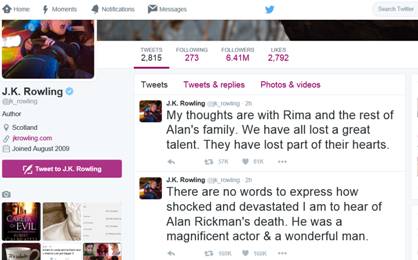
Harry Potter author JK Rowling led the tributes, describing him as “a magnificent actor and a wonderful man”.

She wrote on Twitter: “There are no words to express how shocked and devastated I am to hear of Alan Rickman’s death.”

She added: “My thoughts are with [Rickman’s wife] Rima and the rest of Alan’s family. We have all lost a great talent. They have lost part of their hearts.”

See BBC News for full story:

—————————————

Alan Sidney Patrick Rickman

(21 February 1946 – 14 January 2016)

A Young Rickman


Alan Sidney Patrick Rickman (21 February 1946 – 14 January 2016) was an English actor and director, known for playing a variety of roles on stage and screen, often as a complex antagonist. Rickman was a member of the Royal Shakespeare Company performing in both modern and classical theatre productions. His first major television role came in 1982, but his big break was his role as the Vicomte de Valmont in the stage production of Les Liaisons Dangereuses in 1985, for which he was nominated for a Tony Award. Rickman gained wider notice for his film performances as Hans Gruber in Die Hard and Severus Snape in the Harry Potter film series.

J.K. Rowling Tweet

alan rick man jk rowling tweet.jpg

Rickman’s other film roles included the Sheriff of Nottingham in Robin Hood: Prince of Thieves, Jamie in Truly, Madly, Deeply, Colonel Brandon in Ang Lee‘s Sense and Sensibility, Harry in Love Actually, P.L. O’Hara in An Awfully Big Adventure, Alexander Dane in Galaxy Quest, and Judge Turpin in the film adaptation of Stephen Sondheim‘s musical of Sweeney Todd: The Demon Barber of Fleet Street.

In 1995, Rickman was awarded a Golden Globe Award, an Emmy Award and a Screen Actors Guild Award for his portrayal of Rasputin in Rasputin: Dark Servant of Destiny. He won a BAFTA Award for his role in Robin Hood. He was godfather to actor Tom Burke.[1]

Rickman died of cancer on 14 January 2016 at the age of 69

Early life

Rickman was born in Acton, London,[2][3] to a working class family, the son of Margaret Doreen Rose (née Bartlett), a housewife, and Bernard Rickman, a factory worker.[4] His ancestry was English, Irish and Welsh; his father was Catholic and his mother a Methodist.[5][6] His family included an older brother, David (b. 1944), a graphic designer, a younger brother, Michael (b. 1947), a tennis coach, and a younger sister, Sheila (b. 1950).[5][7] Rickman attended Derwentwater Primary School, in Acton, a school that followed the Montessori method of education.[8]

Alan Rickman BAMII.jpg

When he was eight, Rickman’s father died, leaving his mother to raise him and his three siblings mostly alone. She married again, but divorced his stepfather after three years. “There was one love in her life”, Rickman later said of her.[5] He excelled at calligraphy and watercolour painting. From Derwentwater Junior School he won a scholarship to Latymer Upper School in London, where he became involved in drama. After leaving Latymer, he attended Chelsea College of Art and Design and then the Royal College of Art. This education allowed him to work as a graphic designer for the radical newspaper the Notting Hill Herald,[9] which he considered a more stable occupation than acting. “Drama school wasn’t considered the sensible thing to do at 18”, he said.[10]

After graduation, Rickman and several friends opened a graphic design studio called Graphiti, but after three years of successful business, he decided that if he was going to pursue acting professionally, it was now or never. He wrote to the Royal Academy of Dramatic Art (RADA) requesting an audition[11] and was awarded a place at RADA, which he attended from 1972-74. While there, he studied Shakespeare and supported himself by working as a dresser for Nigel Hawthorne and Sir Ralph Richardson.[12] He left after winning several prizes, including the Emile Littler Prize, the Forbes Robertson Prize and the Bancroft Gold Medal.[citation needed]

Career

————————

Alan Rickman talks Severus Snape

————————

After graduating from RADA, Rickman worked extensively with British repertory and experimental theatre groups in productions including Chekhov‘s The Seagull and Snoo Wilson‘s The Grass Widow at the Royal Court Theatre, and appeared three times at the Edinburgh International Festival. In 1978, he performed with the Court Drama Group, gaining parts in Romeo and Juliet and A View from the Bridge, among other plays. While working with the Royal Shakespeare Company (RSC) he was cast in As You Like It. He appeared in the BBC’s adaptation of Trollope‘s first two Barchester novels known as The Barchester Chronicles (1982), as the Reverend Obadiah Slope.

He was given the male lead, the Vicomte de Valmont, in the 1985 Royal Shakespeare Company’s production of Christopher Hampton‘s adaptation of Les Liaisons Dangereuses, directed by Howard Davies.[13] After the RSC production transferred to Broadway in 1987, Rickman received both a Tony Award nomination[14] and a Drama Desk Award nomination for his performance.

His career was filled with a wide variety of roles. He played romantic leads like Colonel Brandon in Sense and Sensibility (1995), and Jamie in Truly, Madly, Deeply (1991); numerous villains in Hollywood big budget films, like German terrorist Hans Gruber in Die Hard (1988) and the Sheriff of Nottingham in Robin Hood: Prince of Thieves (1991); the very occasional television role such as the “mad monk” Rasputin in an HBO biopic Rasputin: Dark Servant of Destiny (1996), for which he won a Golden Globe and an Emmy.[15] In 1992, he was the “master of ceremonies” on Mike Oldfield‘s album Tubular Bells II where he read off a list of instruments on the album.

His role in Die Hard earned him a spot on the AFI’s 100 Years…100 Heroes & Villains as the 46th best villain in film history, though he revealed he almost did not take the role as he did not think Die Hard was the kind of film he wanted to make.[16] His performance as the Sheriff of Nottingham in Robin Hood: Prince of Thieves also made him known as one of the best actors to portray a villain in films.[17][18]

Rickman took issue with being typecast as a “villain actor”, citing the fact that he had not portrayed a stock villain character since the Sheriff of Nottingham in 1991. He played the ambiguous character of Severus Snape, the potions master in the Harry Potter series (2001–11). During his career Rickman played comedic roles, sending up classically trained British actors who take on “lesser roles” as the character Sir Alexander Dane/Dr. Lazarus in the science fiction parody Galaxy Quest (1999), portraying the angel Metatron, the voice of God, in Dogma (also 1999), appearing as Emma Thompson‘s foolish husband Harry in Love Actually (2003), providing the voice of Marvin the Paranoid Android in The Hitchhiker’s Guide to the Galaxy, and the egotistical, Nobel Prize-winning father in Nobel Son.[citation needed]

Rickman at the 2007 Tribeca Film Festival

Rickman was nominated for an Emmy for his work as Dr. Alfred Blalock in HBO’s Something the Lord Made (2004). He also starred in the independent film Snow Cake (with Sigourney Weaver and Carrie-Anne Moss) which had its debut at the Berlin International Film Festival, and also Perfume: The Story of a Murderer (with Dustin Hoffman), directed by Tom Tykwer. Rickman appeared as the evil Judge Turpin in the critically acclaimed Sweeney Todd: The Demon Barber of Fleet Street (2007) directed by Tim Burton, alongside Harry Potter co-stars Helena Bonham Carter and Timothy Spall. Rickman also appeared as Absolem the Caterpillar in Burton’s film Alice in Wonderland (2010).[citation needed]

He performed onstage in Noël Coward‘s romantic comedy Private Lives, which transferred to Broadway after its successful run in London at the Albery Theatre and ended in September 2002; he reunited with his Les Liaisons Dangereuses co-star Lindsay Duncan and director Howard Davies in the Tony Award-winning production. His previous stage performance was as Mark Antony, opposite Dame Helen Mirren as Cleopatra, in the Royal National Theatre’s production of Antony and Cleopatra at the Olivier Theatre in London, which ran from 20 October to 3 December 1998. Rickman appeared in Victoria Wood with All The Trimmings (2000), a Christmas special with Victoria Wood, playing an aged colonel in the battle of Waterloo who is forced to break off his engagement to Honeysuckle Weeks‘ character. Harry Potter co-star Imelda Staunton also appeared in the special. Rickman was originally cast as the voice of Lord Farquaad in the movie Shrek, but he turned it down to play Severus Snape instead. He was replaced by John Lithgow.[citation needed]

Rickman had also directed The Winter Guest at London’s Almeida Theatre in 1995 and the film version of the same play in 1996 starring Emma Thompson and her real life mother Phyllida Law. He compiled (with Katharine Viner) and directed the play My Name Is Rachel Corrie in April 2005 at the Royal Court Theatre, London, and won the Theatre Goers’ Choice Awards for Best Director. In 2009, Rickman was awarded the James Joyce Award by University College Dublin’s Literary and Historical Society.[19]

In October and November 2010, Rickman starred in the eponymous role in Henrik Ibsen‘s John Gabriel Borkman at the Abbey Theatre, Dublin alongside Lindsay Duncan and Fiona Shaw.[20] The Irish Independent called Rickman’s performance breathtaking.[21] This production subsequently travelled to the Brooklyn Academy of Music for performances in January and February 2011.[citation needed]

In 2011, Rickman again appeared as Severus Snape in the final installment in the Harry Potter series, Harry Potter and the Deathly Hallows – Part 2. Throughout the series, his portrayal of Snape garnered widespread critical acclaim.[22][23][24]

Kenneth Turan of The Los Angeles Times said Rickman “as always, makes the most lasting impression,”[25] while Peter Travers of Rolling Stone called Rickman “sublime at giving us a glimpse at last into the secret nurturing heart that […] Snape masks with a sneer.”[26] Media coverage characterised Rickman’s performance as worthy of an Academy Award for Best Supporting Actor nomination.[27][28][29][30][31]

Rickman earned his first award nominations for his role as Snape at the 2011 Alliance of Women Film Journalists Awards, 2011 Saturn Awards, 2011 Scream Awards and 2011 St. Louis Gateway Film Critics Association Awards in the Best Supporting Actor category.[32]

On 21 November 2011, Rickman opened in Seminar, a new play by Theresa Rebeck, at the John Golden Theatre on Broadway.[33] Rickman, who left the production on 1 April, won the Broadway.com Audience Choice Award for Favorite Actor in a Play[34] and was nominated for a Drama League Award.[35]

Rickman starred with Colin Firth and Cameron Diaz in a remake of 1966’s Gambit by Michael Hoffman.[36]

In 2013, he played Hilly Kristal, the founder of the famous East Village punk-rock club CBGB, in the CBGB film with Rupert Grint.[37]

In the media

Alan Rickman posing for a fan after a performance of John Gabriel Borkman in 2011

Rickman was chosen by Empire as one of the 100 Sexiest Stars in film history (No 34) in 1995 and ranked No 59 in Empire’s “The Top 100 Movie Stars of All Time” list in October 1997. In 2009 and 2010 Rickman ranked once again as one of the 100 Sexiest Stars by Empire, both times Rickman was placed 8th out of the 50 actors chosen. Rickman became Vice-Chairman of the Royal Academy of Dramatic Art (RADA) in 2003.[citation needed]

He was voted No 19 in Empire magazine’s Greatest Living Movie Stars over the age of 50 and was twice nominated for Broadway’s Tony Award as Best Actor (Play): in 1987 for Les Liaisons Dangereuses, and in 2002 for a revival of Noël Coward‘s Private Lives. The Guardian named Rickman as an “honourable mention” in a list of the best actors never to have received an Academy Award nomination.[38]

Two researchers, a linguist and a sound engineer, found “the perfect [male] voice” to be a combination of Rickman’s and Jeremy Irons‘s voices based on a sample of 50 voices.[39]

Rickman featured in several musical works – most notably in a song composed by the English songwriter Adam Leonard entitled “Not Alan Rickman”.[40] Moreover, the actor played a “Master of Ceremonies” part in announcing the various instruments in Mike Oldfield‘s Tubular Bells II on the track The Bell.[41] Rickman was one of the many artists who recited Shakespearian sonnets on the 2002 album When Love Speaks, and is also featured prominently in a music video by the band Texas entitled “In Demand“,[42] which premiered on Europe MTV in August 2000.

Personal life

In 1965, at the age of 19, Rickman met 18-year-old Rima Horton, who became his first girlfriend and would later be a Labour Party councillor on the Kensington and Chelsea London Borough Council (1986–2006) and an economics lecturer at the nearby Kingston University.[43][44][45] They lived together from 1977 until his death.

In 2015, Rickman confirmed that they had married in a private ceremony in New York City in 2012.[46][47] He was an active patron of the charity Saving Faces[48] and honorary president of the International Performers’ Aid Trust, a charity that alleviates poverty in some of the world’s toughest conditions.[49]

When discussing politics, Rickman said he “was born a card-carrying member of the Labour Party”.[citation needed]

Death

Rickman’s family reported on 14 January 2016 that he had died, aged 69. He had been suffering from cancer

David Gest is dead – Really ?

The first fifteen  minutes of Big Brother tonight was the funniest thing I have seen on telly in donkeys years  and I almost had a heart attack laughing.  It had drama, comedy and tragedy and a cast of characters straight out off central casting.

Picture the scene….

Angie Bowie breaking down in the Dairy Room ( after saying she wasn’t going to cry) on being told of David Bowie’s death. John and David Gest are called in to support her and she sees an opportunity and begins milking it like a German farmer taking part in the annual Dusseldorf milking competition.


Theres more…

.

She gets David and John to promise not to tell anyone and they agree and they all make their way back into the main house.

Angie is trying to hold it together, but without really trying at all and a blind and deaf man  would have guessed that she was upset about something .

Enter Tiffany….

Angie proclaims that its not just  a  ” silly cold – its much worst than that ” and Tiffany shows her heart and goes to comfort her. After a millisecond of saying she can’t say – she makes Tiffany promise not to repeat what she is about to tell here . After Tiffany eagerly agrees Angie blurts out that :

“David was Dead”

And Tiffany goes into melt down.

I mean a real melt down –  it was as if she had lost a close family member the  way she was crying and becoming hysterical .

Now at this point I said to the wife that Tiffany must be a David Bowie superfan , as she seems to be taking his death worse than Angie and to be honest I thought she was acting a little bit unhinged.

 Tiffany rushes outside and proclaims to everyone that David was dead as she made her way to the bedroom.

On entering the bedroom she makes her way straight to David Gest’s bed and he’s in bed resting , with the covers over his head. Tiffany looks as if she is going to have a breakdown and is getting more hysterical and unhinged  by the second.

Then the penny dropped –

She had thought that David Gest had died and bizarrely some of the other housemates who had followed her to the bedroom had come  to the same ridiculous conclusion.

It was absolutely hilarious and a piece of TV gold and it give my humour gene a right good chuckle.

Then things turned dark and fowl  and before you could say boo to a goose the rest of the house had turned on Tiffany and lead by the ever vigilant and extremely shifty John Partridge ( did you see what I done there ?)  called for her to be thrown out of the house – or else they would all leave.

Hmmmm. Yeah right!

Back  to John , who put you in charge and what give you the right to have Tiffany thrown out of the house. You’ve already engineered the departure of the clueless Winston’s McKenzie. Are you trying to get better odds on you winning by getting rid of the competition?

You are starting to become boring.

Anyways they all turned on Tiffany and she came out fighting and it was uncomfortable to for a while, but Tiffany is made of sterner stuff and held her own.   Her situation was not help by having the ever clueless Gemma Collins throwing in random clichés and offering useless advice : ” Tomorrow is another day” , being my favourite.

I personally think they were being a bit hard on Tiffany , after all in was a stupid misunderstanding and they need to give her a break and a second chance. Providing that fowl prat  Partridge can get off his soap box and shut the hell up – although I doubt it

Chin up Tiffany , after all Tomorrow is another day.

If you’ve not seen it you’ll never know how funny it was.

Oh and that useless nob Johnathan ( I think that’s his name ) left the BB house and I hardly noticed – Bye!

Robert Black – Death of a Monster!


Robert Black

Normally the death of  fella human being would upset  me and depending on  the individual I might spent a few moments reflecting on their life’s and the legacy they have left behind .

But when I heard the News today that Child serial Killer Robert Black had died it brought a smile to my face , although I was disappointed to hear that he had died of natural causes, as surely Karama should have made his miserable life a living hell and given him an unimaginably  painful death.

Hopefully he will now be burning in the eternal fires of hell and suffering never ending torments.

Life is woefully short and for a child to have that time cut short by a sadistic bastard like Robert Black is the sickest twist of fate. The Gods surely have no compassion if they can stand by and watch a poor , innocent child cross paths with a monster like Black.

So today I am happy and celebrating the death of a worthless human being and I hope his passing gives a little comfort to the friends and families of his innocent victims.

Rot in hell Black

————————————————–

Robert Black

Death of a Monster

The child killer Robert Black, who was convicted of the murders of four children from across the UK in the 1980s, has died in prison.

Robert Black

The child killer Robert Black, who was convicted of the murders of four children from across the UK in the 1980s, has died in prison.

Black, 68, had a history of abducting, abusing and murdering young girls.

His victims were nine-year-old Jennifer Cardy from Northern Ireland; Sarah Harper, 10, from England, and 11-year-old Susan Maxwell and five-year-old Caroline Hogg both from Scotland.

Black died of natural causes in Maghaberry prison, Northern Ireland.

See BBC News for full story

See Below for History, Background and Documentary

——————————————

Robert Black

Robert Black (21 April 1947 – 12 January 2016) was a Scottish serial killer convicted of the kidnapping and murder of four girls between the ages of 5 and 11, between 1981 and 1986 in the United Kingdom. He was convicted of sexually assaulting one of the girls, and of raping the other three. Black was also convicted of the kidnapping of a fifth girl, and the attempted kidnapping of a sixth.

Black is also suspected of unsolved child murders in the United Kingdom, dating back to 1969 and others in the 1970s, throughout Europe.

—————————————

Serial Killers – Robert Black (Smelly Bob) – Documentary

—————————————


Early life

Black was born in Grangemouth, Stirlingshire. Black’s natural mother, Jessie Hunter Black, refused to put his father’s name on his birth certificate and had him fostered. Black was brought up by a foster couple who were in their 50s, Jack and Margaret Tulip. Black did not fit in at school and was given the nickname ‘Smelly Robby Tulip’ by his classmates, who noticed that Black preferred to hang around with children a year or two younger than he was, rather than people his own age.[1] He developed an early reputation for aggressive and wayward behaviour. Locals recalled that Black often had bruises, although Black later said he could not recollect where these injuries came from.[1] Margaret Tulip looked after Black on her own from when he was five[2] until she died in 1958 when he was 11. He was then sent to a children’s home in Falkirk.

Early crimes

While living with the Tulips, Robert Black developed sexual self-awareness at a young age. He later said that from the age of eight he would often push objects up his anus.[3] This was a practice that he would continue into adulthood. As a young child, he also had an interest in the genitals of other children. At the age of five, he and a girl both took off their clothes and compared each other’s genitals.[3]

Black first attempted rape at the age of 12 along with two other boys. They attacked a girl in a field, but found themselves unable to complete the act of penetration.[4] The authorities were notified and Black was moved to the Red House in Musselburgh. While there, a male staff member sexually abused him. It was while Black was at Red House that he also entered Musselburgh Grammar School, where he developed an interest in football and swimming.[4]

At 15, Black left Red House and found a job working as a delivery boy in Greenock near Glasgow. He later admitted that, while on his rounds, he molested 30 to 40 girls. None of these incidents seem to have been officially reported until his first conviction at the age of 17 when he lured a seven-year-old girl to a deserted building, strangled her until she lost consciousness and then masturbated over her unconscious body. He was arrested and convicted of ‘lewd and libidinous’ behaviour for this offence, but received only an admonishment.[5]

After this, Black moved back to Grangemouth and got a job with a builders’ supply company. He also found a girlfriend, Pamela Hodgson, and asked her to marry him. Black was devastated when she ended the relationship several months later. In 1966, Black molested his landlord’s and landlady’s nine-year-old granddaughter. The girl eventually told her parents. They took no legal action but Black was ordered to leave the house.[5]

At this time, Black moved back to Kinlochleven, where he was raised. He took a room with a couple who had a seven-year-old daughter. As before, Black molested the girl. This time, when the sexual abuse was discovered, police were notified. Black was sentenced to a year of borstal training at Polmont.[6]

On his release, Black left Scotland and moved to London. In London, Black found work as a swimming pool attendant, and would sometimes go underneath the pool, remove the lights and watch young girls as they swam. Soon, a young girl reported that Black had touched her, and although no official charges were brought, Black lost his job.[6]

While Black lived in London he spent a lot of time in pubs playing darts. He became a reasonably good player, and a well-known face on the amateur darts circuit. Darts world champion Eric Bristow knew Black vaguely during this time, remembering him as a “loner” who never seemed to have a girlfriend.[6] In 1976, Black began working as a van driver. It was while working as a driver that he developed a thorough knowledge of some of the United Kingdom’s roads, particularly its minor roads.[6]

Murder of Jennifer Cardy

On 12 August 1981, nine-year-old Jennifer Cardy cycled from her house in Ballinderry, County Antrim in Northern Ireland to meet a friend. Her bicycle was recovered close to her home. Her body was found at McKee’s Dam near Hillsborough, County Down six days later. She had been sexually assaulted. Black, who at the time was working in the area for a poster-delivery company, was convicted of her kidnap, sexual assault and murder at Armagh Crown Court on 27 October 2011.[7]

On 8 December 2011, he was sentenced to 25 years for her murder and told by the judge he would be at least 89 before he was considered for release.[8]

Murder of Susan Maxwell

On 30 July 1982, 11-year-old Susan Maxwell from Cornhill on Tweed, on the English side of the English/Scottish border left her home to play a game of tennis across the border in Coldstream. Several local witnesses remembered seeing her until she crossed the bridge over the River Tweed, after which there were no sightings of Susan. Nobody saw it happen, but at some point between the river and Coldstream, Susan was abducted by Black.

He raped and strangled her and dumped her body about 250 miles away by the side of the A518 at Loxley near Uttoxeter, Staffordshire, England.[9]

Murder of Caroline Hogg

On the evening of 8 July 1983, five-year-old Caroline Hogg from Portobello, an eastern suburb of Edinburgh, went out to play near her home for a few minutes. She never returned. Many witnesses reported seeing a scruffy-looking man watching a young girl, believed to be Caroline, in the playground near her home, then holding hands with her in a nearby amusement arcade. The man was Robert Black. Caroline’s body was found 10 days later in a ditch in Leicestershire, around 300 miles from her home.

The cause of death could not be determined due to decomposition (as had been the case with Susan Maxwell), but the absence of clothes suggested a sexual motive.

Murder of Sarah Harper

Three years later, on 26 March 1986, 10-year-old Sarah Harper went missing from Morley in Leeds after leaving her home to go to the corner shop to buy a loaf of bread. The shopkeeper remembered Sarah coming into the shop, but she never returned home. The last sighting of Sarah was of her walking towards the snicket that she used as a shortcut. Black kidnapped, raped and murdered her. Her body was found dumped in the River Trent near Nottingham a month later.

Police investigation

The bodies of Maxwell, Hogg and Harper were found within 26 miles (42 km) of each other, and police already believed that these three murders were linked. Detectives also thought that, because all three victims had been left long distances from where they had been taken, the killer travelled as part of his occupation – possibly a lorry driver. The police faced great pressure to solve the crimes, as some newspapers compared them to the Moors Murders. It was one of the first inquiries to use the HOLMES computer system widely, following recommendations in the aftermath of the Yorkshire Ripper investigation.[10]

Black has been considered as a suspect by police in the unsolved murder or disappearance of other girls, including the disappearance of April Fabb in April 1969, and the disappearance of Genette Tate in August 1978. He has been questioned about these cases, but prosecutors have said that there is insufficient evidence to charge Black.[11][12]

Capture and first trial

Black was arrested on 14 July 1990, near Stow, Scotland. He was seen snatching a six-year-old girl off the street, and bundling her into his van. An alert member of the public called the police, who chased after the van and subsequently apprehended Black, when the van was recognised as he doubled back.

The policeman discovered that the child in the back of the van, tied up, gagged with tape and stuffed head-first into a sleeping bag was his daughter. She had been sexually assaulted. A search of Black’s home revealed a large collection of child pornography.[13]

The following month, Black was convicted of abduction and was sentenced to life imprisonment.

Murder trials

Police suspected Black of the murders of Susan Maxwell, Caroline Hogg and Sarah Harper. They checked his petrol receipts and eventually charged Black with all three murders, in addition to the attempted kidnapping of a 15-year-old girl who had escaped from a man who had tried to drag her into a van in 1988.

On 13 April 1994, Black stood trial at Newcastle upon Tyne Moot Hall, and denied the charges. Having sifted through many thousands of petrol-station receipts, the prosecution was able to place him at all the scenes and show the similarities between the three killings, and the kidnap of the six-year-old girl who had been rescued. Juries are not usually allowed to know of a defendant’s current or past convictions, but in this case the judge allowed it.

On 19 May, the jury found Black guilty on all counts, and he was sentenced to life imprisonment and told that he should serve at least 35 years. This would keep him behind bars until at least 2029, when he would be 82.

On 16 December 2009, Black was charged with the murder of Jennifer Cardy.[14] He was found guilty on 27 October 2011 and was given a further life sentence by Armagh Crown Court.[7] On 8 December 2011, Black was told that he would be at least 89 years old before he would be considered for release.[15]

Attack by prison inmate

Black was attacked in his Wakefield prison cell in July 1995 after being ambushed by two inmates. Convicted robber Andrew Wilson, 22, threw boiling water mixed with sugar over Black in an attempt to ‘rip his skin off’, then battered him with a table leg, while murderer Craig Hendley, 25, stabbed Black in the back and neck with a homemade knife. Hendley later told police “I’ll kill the next nonce to come near me.” A court subsequently heard that “Black was a particularly notorious prisoner because of the nature of the offences for which he was serving his sentence. It was for this reason he became a target.”[16][17]

Death

Black died of natural causes in Maghaberry Prison on January 12, 2016