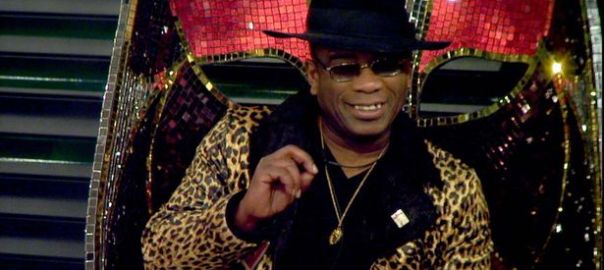
Like the vast majority of Big Brother viewers (Ahem…. the wife makes me watch it ) and the Great British public I found the views and actions of ex-boxer come errr politician Winston McKenzie offensive and hard to watch and yet I felt a tiny bit of sympathy for him , but this was short lived.
The fact of the matter is BB knew all about his views before he entered the house and the producers/researcher’s must have been beside themselves with anticipation of it all kicking off – and they were not to be disappointed.
Homophobia is a hate crime and rightly has no place in a democratic and tolerant society such as the UK. The producers of BB knew that when Winston’s views were aired during the show last night the shit would hit the fan and Winston would be sent packing faster than a rat up a drain pipe.
And it was no surprise to anyone on planet earth that he was the 1st to be evicted from the house.
But BB are guilty of setting Winston up for a mighty fall and today’s Papers and social media are going into over drive as the country debates the heinous crimes of a clueless Winston McKenzie .
The producers of the show should be ashamed of themselves for the way they have manipulated and edited the show and the fact that yesterdays task was the catalyst for Winston’s downfall left a sour taste in my mouth.
Its not the first time the show has acted in such a way and Helen Wood is testament to the shows love of the a ” Pantomime baddie ” and the levels the producers are willing to sink to in order to get a few extra viewers and free nationwide publicity.
But should Winston have been included in the show in the first place ?
After all , I assume they have a vetting process and under normal circumstances anyone with Winston’s views would not have got passed the 1st hurdle in any other mainline show and yet he was signed up and permitted to take part in the show – despite BB knowing that his views about gays and his attitude towards women would offend all right minded people the length and breadth of the country.
Watching Emma doing the exit interview last night I noted that 90% of the questions were related to his homophobic comments and Ms Willis was not happy and on a roll. The interview seemed more like a grilling by a hard nosed News reporter and Emma barley mentioned his time in the house apart from the obvious and nor did she follow the normal eviction formula.
Winston’s attitude towards women in the house was creepy to say the least and uncomfortable to watch and his barely concealed homophobia leads me to believe the man is obviously a few shillings short of a full deck and begs the question why did he agree to enter the house in the first place?
Have years of being punched in the head lead to a malfunction of normal rational behaviour and should his agent now be looking for a new job?
Despite the outcry over his comments and his nethanderal attitude to modern life/families , I do feel that Winston is a victim of BB’s hysterical desire to increase viewing figures and raise its profile and BB have stooped to new depths in inviting Winston to take part in the show and then hanging him out to dry when he delivered what they had prayed for when they signed him up.
Being homophobia and a chauvinistic pig should have excluded Winston from getting anywhere near the show and BB should be ashamed of themselves for setting this fool up for such a mighty fall on national TV and trying to manipulate public opinion as a means of increasing the shows profile.
I have little sympathy for Winston and I am sure he will live with the fallout of this episode for many years to come and yet I have a funny suspicion that the BB team are patting themselves on the back and are already searching for the next “Lamb to the Slaughter”
Key Events & Deaths on this day in Northern Ireland Troubles
9th January
Thursday 9 January 1969
Terence O’Neill, then Prime Minister of Northern Ireland, travelled to London to meet James Callaghan, then British Home Secretary, to brief him on the growing violence in Northern Ireland.
Tuesday 9 January 1990
Peter Brooke, then Secretary of State for Northern Ireland, delivered a speech in Bangor, County Down, in which he sought to break the political stalemate by seeking to encourage a fresh round of inter-party talks aimed at restoring devolved power to Northern Ireland. In particular he stressed that sufficient “common ground” existed for progress to be made and urged Unionist politicians to resume contact with the British government. Whilst reluctant to make any commitment to suspend the Anglo-Irish Agreement (AIA) to allow for Unionists to engage in discussions, Brooke did hold out the promise that he would seek to work the AIA in a sensitive manner.
Tuesday 9 January 1996
A debate opened in the House of Commons, Westminster on the Northern Ireland (Emergency Provisions) Bill which was drafted to replace the Prevention of Terrorism Act and the Emergency Provisions (Northern Ireland) Act. The Bill contained a proposal on the videotaping of Royal Ulster Constabulary (RUC) interviews.
Friday 9 January 1998
Marjorie (Mo) Mowlam, then Secretary of State for Northern Ireland, went into the Maze Prison to meet Ulster Defence Association (UDA) and Ulster Freedom Fighters (UFF) prisoners in an attempt to change their decision to end their support for the peace process.
Mowlam’s decision met with severe criticism from Unionist politicians. After the meeting, the prisoners agreed that the Ulster Democratic Party (UDP), the political representatives of the UDA and the UFF, should continue in the talks. Edward Kennedy, then United States (US) Senator, paid a visit to Derry and delivered a speech on the American view of the prospects for peace in Northern Ireland.
Tuesday 9 January 2001
There was a pipe-bomb attack on the home of a Catholic family in Larne. The device was thrown through the front window of the house but only partially exploded. A mother and her son were in the living room at the time but the two escaped uninjured. The Royal Ulster Constabulary (RUC) described the incident as attempted murder. The attack was carried out by Loyalist paramilitaries.
Wednesday 9 January 2002
Violence Outside Holy Cross School
There were confrontations outside the Holy Cross Girls’ Primary School in Ardoyne, north Belfast, during the early afternoon. Disturbances and rioting quickly spread to other surrounding areas and there was serious rioting in Ardoyne during the evening and into the night. Catholic parents and Protestant residents of the Glenbryn estate each claimed that the other side started the trouble. Catholic parents said that they had faced increased verbal abuse since Monday during their walks to and from the Holy Cross school and they were attacked while coming from school in the early afternoon. A Catholic mother claimed she was punched in the face as she walked home from the school with her child.
Some Police Service of Northern Ireland (PSNI) officers said they arrived at a confrontation between a Protestant woman and a Catholic woman close to the school. The police moved to make an arrest but the person was protected by other residents. There was a report that some Loyalists had driven a car at the school gates in an attempt to enter the school. Police officers said they had to draw their weapons. Some school children had to be taken home through another school while a bus carrying other children was attacked on its way down the Ardoyne Road..
Protestant residents claimed the trouble started when Catholics removed a wreath from a lamppost. Disturbances continued later in the afternoon: Loyalist youths petrol-bombed and destroyed a police vehicle; 4 Catholic youths were taken to hospital when they were hit by pellets from a shotgun at Hesketh Park; a number of Catholic homes were attacked in the upper Crumlin Road; Catholic youths petrol-bombed a car; a Catholic woman was knocked down by a car at the nearby Twaddell Avenue; a 13-year-old Protestant schoolboy was injured when a bus taking him home through the area was attacked, a Catholic man was struck by a police vehicle.
During the evening the rioting became more serious and was mainly centred on the Nationalist end of the Ardoyne. The police fired 8 plastic baton rounds and three Catholics were injured. Three people were arrested. As the trouble further escalated, 200 police officers, backed by 200 soldiers, were drafted on to the streets. At least 14 police officers were injured during the evening.
Up to 500 nationalists and loyalists were involved in the disturbances on the Ardoyne Road, Crumlin Road and Brompton Park areas and 130 petrol-bombs, acid-bombs, and fireworks were thrown.
[A Loyalist blockade of the school had first begun on 19 June 2001 and continued until the end of term on Friday 29 June 2001. The protest resumed after the summer break on Monday 3 September 2001 but was ‘suspended’ on 23 November 2001. The protest at the school lasted for 14 weeks during 2001.]
The Northern Ireland Arms Decommissioning (Amendment) Bill was given a third reading in the House of Commons, London. The Bill was introduced to extend the time allowed for Decommissioning of paramilitary weapons by one year, with possible annual extensions up to a maximum of five years. The Bill was opposed by Unionists and Conservatives who objected to the extra time and they forced a vote which was won by the Labour government by 357 votes to 142.
During the debate David Trimble, then leader of the Ulster Unionist Party (UUP), warned that if the government did not apply pressure on the Irish Republican Army (IRA) for continued decommissioning then he would. The current legislation only extends the work of the Independent International Decommissioning Commission (IIDC) to 26 February 2002.
——————————————————————————
Remembering all innocent victims of the Troubles
Today is the anniversary of the death of the following people killed as a results of the conflict in Northern Ireland
“To live in hearts we leave behind is not to die
– Thomas Campbell
To the innocent on the list – Your memory will live forever
– To the Paramilitaries –
There are many things worth living for, a few things worth dying for, but nothing worth killing for.
4 People lost their lives on the 9th January between 1977 – 1992
————————————————————
09 January 1977
Martin Walsh, (28)
nfNI Status: British Army (BA),
Killed by: Irish Republican Army (IRA) Killed by booby trap bomb left in shop, Gortnacarrow, near Newtownbutler, County Fermanagh.
————————————————————
09 January 1987
Ivan Crawford, (49)
Protestant Status: Royal Ulster Constabulary (RUC),
Killed by: Irish Republican Army (IRA) Killed by remote controlled bomb hidden in litter bin, detonated when Royal Ulster Constabulary (RUC) foot patrol passed, High Street, Enniskillen, County Fermanagh
————————————————————
09 January 1990
Olven Kilpatrick, (32)
Protestant Status: Ulster Defence Regiment (UDR),
Killed by: Irish Republican Army (IRA) Off duty. Shot at his shop, Main Street, Castlederg, County Tyrone.
————————————————————
09 January 1992
Philip Campbell, (28)
Catholic Status: Civilian (Civ),
Killed by: Ulster Freedom Fighters (UFF) Shot at his mobile fish and chip van, Airport Road, Moira, County Down.
————————————————————
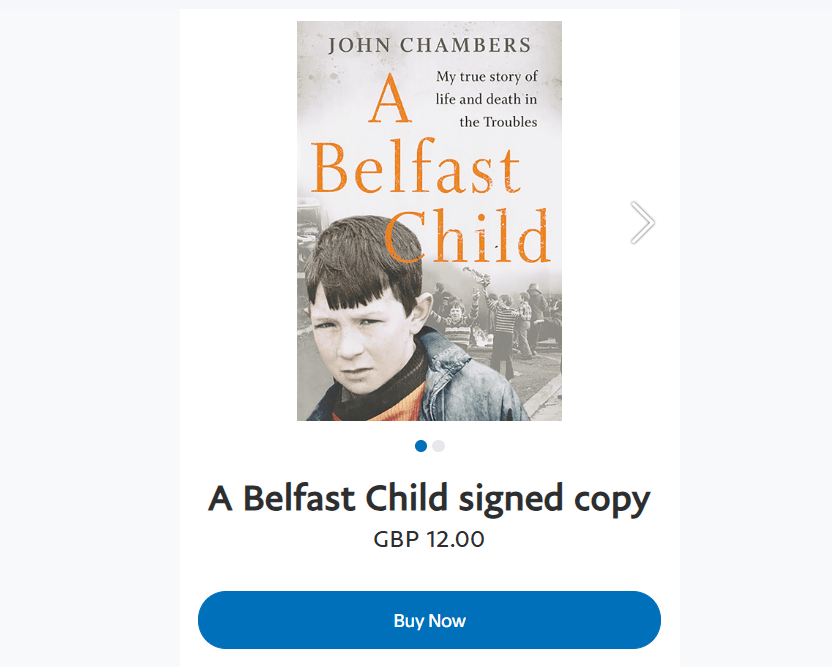
This is simply the story of a boy trying to grow up, survive, thrive, have fun & discover himself against a backdrop of events that might best be described as ‘explosive’, captivating & shocking the world for thirty long years.
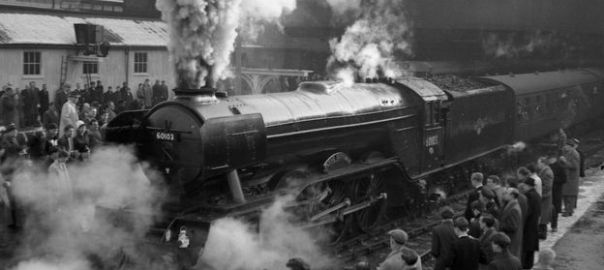
Flying Scotsman wearing its British Railways livery and numbering, equipped with double chimney and smoke deflectors
The locomotive set two world records for steam traction, becoming the first steam locomotive to be officially authenticated at reaching 100 miles per hour (160.9 km/h) on 30 November 1934,[1] and then setting a record for the longest non-stop run by a steam locomotive when it ran 422 miles (679 km) on 8 August 1989 while in Australia.[2]
Retired from regular service in 1963 after covering 2,076,000 miles (3,341,000 km),[1][3][4]Flying Scotsman gained considerable fame in preservation under the ownership of, successively, Alan Pegler, William McAlpine, Tony Marchington, and finally the National Railway Museum (NRM). As well as hauling enthusiast specials in the United Kingdom, the locomotive toured extensively in the United States and Canada (from 1969 to 1973)[5] and Australia (from 1988 to 1989).[6]Flying Scotsman has been described as the world’s most famous steam locomotive
————————————————
The Flying Scotsman in Australia
————————————————
History
The locomotive was completed in 1923, construction having been started under the auspices of the Great Northern Railway (GNR). It was built as an A1, initially carrying the GNR number 1472, because the LNER had not yet decided on a system-wide numbering scheme.[9]
Flying Scotsman was something of a flagship locomotive for the LNER. It represented the company at the British Empire Exhibition at Wembley in 1924 and 1925. Before this event, in February 1924 it acquired its name and the new number of 4472.[10] From then on it was commonly used for promotional purposes.
With suitably modified valve gear, this locomotive was one of five Gresley Pacifics selected to haul the prestigious non-stop Flying Scotsman train service from London to Edinburgh, hauling the inaugural train on 1 May 1928. For this the locomotives ran with a new version of the large eight-wheel tender which held 9 long tons of coal. This and the usual facility for water replenishment from the water trough system enabled them to travel the 392 miles (631 km) from London to Edinburgh in eight hours non-stop. The tender included a corridor connection and tunnel through the water tank giving access to the locomotive cab from the train so that the driver and fireman could be changed without stopping the train.
The following year the locomotive appeared in the film The Flying Scotsman. On 30 November 1934, driven by Bill Sparshatt and running a light test train, 4472 became the first steam locomotive to be officially recorded at 100 mph (160.9 km/h) and earned a place in the land speed record for railed vehicles; the publicity-conscious LNER made much of the fact.[1][11]
The locomotive ran with a corridor tender between April 1928 and October 1936, after which it reverted to the original type; but in July 1938, it was paired with a streamlined non-corridor tender, and ran with this type until withdrawal.[12] On 22 August 1928, there appeared an improved version of this Pacific type classified A3; older A1 locomotives were later rebuilt to conform. On 25 April 1945, A1-class locomotives not yet rebuilt were reclassified A10 to make way for newer Thompson and Peppercorn Pacifics. Flying Scotsman emerged from Doncaster works on 4 January 1947 as an A3, having received a boiler with the long “banjo” dome of the type it carries today. By this time it had been renumbered twice: under Edward Thompson’s comprehensive renumbering scheme for the LNER, it became No. 502 in January 1946; but in May the same year, under an amendment to that plan, it become No. 103.[9] Following nationalisation of the railways on 1 January 1948, almost all of the LNER locomotive numbers were increased by 60000, and No. 103 duly became 60103 in December 1948.[12]
Flying Scotsman wearing its British Railways livery and numbering, equipped with double chimney and smoke deflectors
All A3 Pacifics were subsequently fitted with a double Kylchap chimney to improve performance and economy. This caused soft exhaust and smoke drift that tended to obscure the driver’s forward vision; the remedy was found in the German-type smoke deflectors fitted from 1960, which somewhat changed the locomotives’ appearance but solved the problem
————————————————
The Flying Scotsman (1968)
————————————————
Preservation
In 1962, British Railways announced that they would scrap Flying Scotsman.[14] Number 60103 ended service with its last scheduled run on 14 January 1963.[15]
Proposed to be saved by a group called “Save Our Scotsman”, they were unable to raise the required £3,000, the scrap value of the locomotive. Having first seen the locomotive at the British Empire Exhibition in 1924,[16] in 1961 Alan Pegler had received £70,000 for his share holding when Northern Rubber was sold to Pegler’s Valves, a company started by his grandfather.[17] Pegler stepped in and bought the locomotive outright, with the political support of Harold Wilson.[18] He spent the next few years spending large amounts of money having the locomotive restored at Doncaster Works as closely as possible to its LNER condition: the smoke deflectors were removed; the double chimney was replaced by a single chimney; and the tender was replaced by one of the corridor type with which the locomotive had run between 1928 and 1936. It was also repainted into LNER livery. Pegler then persuaded the British Railways Board to let him run enthusiasts specials, then the only steam locomotive running on mainline British Railways.[18] It worked a number of rail tours, including a non-stop London–Edinburgh run in 1968 – the year steam traction officially ended on BR. In the meantime, the watering facilities for locomotives were disappearing, so in September 1966 Pegler purchased a second corridor tender, and adapted as an auxiliary water tank; retaining its through gangway, this was coupled behind the normal tender.[19]
Flying Scotsman ready for US tour c1969
Pegler had a contract permitting him to run his locomotive on BR until 1972, but following overhaul in the winter of 1968–69 then Prime Minister Harold Wilson agreed to support Pegler via the Trade Department running the locomotive in the United States and Canada to support British exports. To comply with local railway regulations, it was fitted with: a cowcatcher; bell; buckeye couplings; American-style whistle;[20] air brakes; and high-intensity headlamp.
Flying Scotsman at San Francisco’s Fisherman’s Wharf, March 1972
Starting in Boston, Massachusetts,[17] the tour ran into immediate problems, with some states seeing the locomotive as a fire-hazard, and there-by raising costs through the need for diesel-headed-haulage through them. However, the train ran from Boston to New York, Washington and Dallas in 1969; from Texas to Wisconsin and finishing in Montreal in 1970; and from Toronto to San Francisco in 1971 — a total of 15,400 miles (24,800 km).[16]
Flying Scotsman at Carnforth in 1982 with original single chimney and without the later German-style smoke deflectors
However, in 1970 Ted Heath‘s Conservatives ousted Wilson’s Labour Party, and withdrew financial support from the tour; but Pegler decided to return for the 1970 season. By the end of that season’s tour, the money had run out and Pegler was £132,000 in debt, with the locomotive in storage at the US ArmySharpe Depot to keep it away from unpaid creditors.[16] Pegler worked his passage home from San Francisco to England on a P&O cruise ship in 1971, giving lectures about trains and travel; he was declared bankrupt in the High Court 1972.[16][17][18][21]
Fears then arose for the engine’s future, the speculation being that it could take up permanent residence in America or even be cut up. After Alan Bloom made a personal phone call to him in January 1973, William McAlpine stepped in and bought the locomotive for £25,000 direct from the finance company in San Francisco docks. After its return to the UK via the Panama Canal in February 1973, McAlpine paid for the locomotive’s restoration at Derby Works. Trial runs took place on the Paignton and Dartmouth Steam Railway in summer 1973, after which it was transferred to Steamtown (Carnforth), from where it steamed on various tours.[22]
Flying Scotsman at Seymour railway station, Victoria in 1989, equipped with electric lighting and air brakes for operation on Australian railways[23]
In 1988 the organizers of the Aus Steam 88 event were interested in having LNER A4 No 4468 Mallard visit Australia for Australia’s bicentennial celebrations that year. Unfortunately due to 4468’s 50th anniversary of her world record breaking run she was unavailable and 4472 was recommended as her worthy replacement. In October 1988 Flying Scotsman arrived in Australia[24] to take part in that country’s bicentenary celebrations as a central attraction in the Aus Steam ’88 festival. During the course of the next year it travelled more than 45,000 kilometres (28,000 mi) over Australian rails, concluding with a return transcontinental run from Sydney to Perth via Alice Springs in which it became the first steam locomotive to travel on the recently built standard gauge Central Australia Railway.[25] Other highlights included Flying Scotsmandouble-heading with NSWGR Pacific locomotive 3801, a triple-parallel run alongside broad gaugeVictorian Railways R class locomotives, and parallel runs alongside South Australian Railways locomotives 520 and 621. Its visit to Perth saw a reunion with GWR 4073 ClassPendennis Castle, which had been exhibited alongside Flying Scotsman at the 1924 British Empire Exhibition.[26] On 8 August 1989 Flying Scotsman set another record en route to Alice Springs from Melbourne, travelling 679 kilometres (422 mi) from Parkes to Broken Hill non-stop, the longest such run by a steam locomotive ever recorded.[7] The same journey also saw Flying Scotsman set its own haulage record when it took a 735-ton train over the 490-mile (790 km) leg between Tarcoola and Alice Springs.[27]
Flying Scotsman returned to Britain in 1990 and continued working on the mainline until her mainline certificate expired in 1993. 4472 then toured preserved railways and to raise funds for her upcoming overhaul was returned to BR condition with the refitting of the German style smoke deflectors, refitting of the double chimney and repainting of the locomotive into BR Brunswick green. By 1995 it was in pieces at Southall Railway Centre in West London, owned by a consortium that included McAlpine as well as music guru and well-known railway enthusiast Pete Waterman. Facing an uncertain future owing to the cost of restoration and refurbishment necessary to meet the stringent engineering standards required for main line operation, salvation came in 1996 when Dr Tony Marchington, already well known in the vintage movement, bought the locomotive, and had it restored over three years to running condition at a cost of £1 million,[28] a restoration which is still recognised as the most extensive in the locomotive’s history. Marchington’s time with the Flying Scotsman was documented in a documentary, the Channel 4 programme A Steamy Affair: The Story of Flying Scotsman.[29]
Flying Scotsman at Leamington Spa, Warwickshire UK. October 2005
With Flying Scotsman’s regular use both on the VSOE Pullman and with other events on the main line, in 2002, Marchington proposed a business plan, which included the construction of a “Flying Scotsman Village” in Edinburgh, to create revenue from associated branding. After floating on OFEX as Flying Scotsman plc in the same year,[29] in 2003 Edinburgh City Council turned down the village plans, and in September 2003 Marchington was declared bankrupt.[30] At the company’s AGM in October 2003, CEO Peter Butler announced losses of £474,619, and with a £1.5 million overdraft at Barclays Bank and stated that the company only had enough cash to trade until April 2004. The company’s shares were suspended from OFEX on 3 November 2003 after it had failed to declare interim results.[30]
With the locomotive effectively placed up for sale, after a high-profile national campaign it was bought in April 2004 by the National Railway Museum in York,[31] and it is now part of the National Collection. After 12 months of interim running repairs, it ran for a while to raise funds for its forthcoming 10-year major overhaul.
In the NRM Workshop (18 November 2007)
In January 2006, Flying Scotsman entered the Museum’s workshops for a major overhaul to return it to Gresley’s original specification and to renew its boiler certificate; originally planned to be completed by mid 2010 if sufficient funds were raised,[32][33][34] but late discovery of additional problems meant it would not be completed on time.[35][36][37] In October 2012, the Museum published a report examining the reasons for the delay and additional cost.[38] The locomotive was moved in October 2013 to Bury for work to return it to running condition in 2015.[39] On 29 April 2015, Flying Scotsman’s boiler left the National Railway Museum to be reunited with the rest of the locomotive at Riley & Sons E (Ltd) in Bury.[40]
The bay in which the locomotive was being refurbished was on view to visitors to the NRM but the engine was rapidly dismantled to such an extent that the running plate was the only component recognisable to the casual observer. Early in 2009 it emerged that the overhaul would see the loco reunited with the last remaining genuine A3 boiler (acquired at the same time as the locomotive as a spare). The A4 boiler that the loco had used since the early 1980s was sold to Jeremy Hosking for potential use on his locomotive, LNER Class A4 4464 Bittern.[41]
Debate over restoration
In the Museum’s workshops in 2012 for restoration
Choice of livery is an emotive subject amongst some of those involved in the preservation of historic rolling stock, and Flying Scotsman has attracted more than its fair share[citation needed] due to 40 years continuous service, during which the locomotive underwent several changes to its livery.
Alan Pegler’s preferred option was evidently to return the locomotive as far as possible to the general appearance and distinctive colour it carried at the height of its fame in the 1930s. A later option was to re-install the double Kylchap chimney and German smoke deflectors that it carried at the end of its career in the 1960s, which encouraged more complete combustion, a factor in dealing with smoke pollution and fires caused by spark throwing.[citation needed]
More recently, until its current overhaul it was running in a hybrid form, retaining the modernised exhaust arrangements while carrying the LNER ‘Apple Green’ livery of the 1930s. Some believe that the more famous LNER colour scheme should remain, while others take the view that, to be authentic, only BR livery should be used when the loco is carrying these later additions. The subject is further complicated by the fact that, while she was in Brunswick Green in BR service, the locomotive never ran with its corridor tender.[citation needed]
The National Railway Museum announced on 15 February 2011 that Flying Scotsman will be painted in LNER Wartime Black livery when it undergoes its steam tests and commissioning runs. The letters ‘NE’ appear on the sides of the tender, along with the number ‘103’ on one side of the cab and ‘502’ on the other – the numbers it was given under the LNER’s renumbering system. Flying Scotsman will be repainted in its familiar-look Apple Green livery in the summer, but remained in black for the NRM’s Flying Scotsman Preview Weekend which took place on 28–30 May 2011. Furthermore, during the National Railway Museum‘s ‘railfest’ event on 2–10 June 2012, Flying Scotsman was in attendance, being kept in front of Mallard in a siding, still in its Wartime Black livery.[42] A report on the restoration was published, in redacted form, on 7 March 2013.[43] On 23 January 2015, the NRM announced that as it will retain its smoke deflectors and double chimney and they wish to keep it as historically accurate as possible, Flying Scotsman will be painted in BR Green as No. 60103.[44]
In popular culture
Because of the LNER’s emphasis on using the locomotive for publicity purposes, and then its eventful preservation history, including two international forays, it is one of the UK’s most recognised locomotives. One of its first film appearances was in the 1929 film The Flying Scotsman, which featured an entire sequence set aboard the locomotive.[45]
Flying Scotsman was featured in The Railway Series books by the Rev. W. Awdry. The locomotive visited the fictional Island of Sodor in the book Enterprising Engines to visit its only remaining brother: Gordon. At this time it had two tenders, and this was a key feature of the plot of one of the stories, “Tenders for Henry”. When the story was filmed for the television series Thomas & Friends, renamed as “Tender Engines” only Flying Scotsman’s two tenders were seen outside a shed.[46] He originally was intended to have a larger role in this episode, but because of budgetary constraints, the modelling crew could not afford to build the entire engine.[47]
A model of the Flying Scotsman appeared in Episode 6 and “The Great Train Race” episodes of James May’s Toy Stories. It was James May‘s personal childhood model and was chosen by him to complete a world record for the longest model railway.[49] The train was meant to travel 7 miles from Barnstaple to Bideford, in North Devon and it failed early in the trip in Episode 6[49] but managed to complete it in “The Great Train Race” which took place on 16 April 2011.[50]
One of the specially produced £5 coins for the 2012 Summer Olympics featured an engraving of the Flying Scotsman on the back.[4]
Key Events & Deaths on this day in Northern Ireland Troubles
8th January
—————————
Monday 8 January 1968
Terence O’Neill, then Northern Ireland Prime Minister, travelled to Dublin to meet with Jack Lynch, then Taoiseach (Irish Prime Minister), to continue discussions on matters of joint interest to Northern Ireland and the Republic of Ireland.
Tuesday 8 January 1974
Sunningdale; Ulster Workers’ Council Strike.
Sunday 8 January 1978
Jack Lynch, then Taoiseach (Irish Prime Minister), called for a British declaration of intent to withdraw from Northern Ireland. The statement was supported by many in the Nationalist community in Northern Ireland.
Friday 8 January 1988
The Royal Ulster Constabulary (RUC) searched three cars near Portadown, County Armagh and found a large number of firearms. The arms were on route to the Ulster Defense Association (UDA).
Peter Robinson was re-elected as deputy leader of the Democratic Unionist Party (DUP) at the party’s annual meeting (he had resigned on 2 July 1987 )
Monday 8 February 1993
The leaders of the four main churches (Catholic; Presbyterian; Church of Ireland; and Methodist) travelled to the United States of America (USA) to encourage new business investment in Northern Ireland.
Saturday 8 January 1994
The Ulster Freedom Fighters (UFF), a cover name (pseudonym) used by the Ulster Defence Association (UDA), carried out a rocket and gun attack on a pub on the Falls Road in Belfast and injured three people.
Gerry Adams, then President of Sinn Féin (SF), said in an interview with the Irish News (a Belfast based newspaper), that the ‘Republican struggle’ could go on for another 25 years. He also criticised statements made by Patrick Mayhew, then Secretary of State for Northern Ireland, since the publication of the Downing Street Declaration (DSD). Mayhew had said that talks between the British government and SF would concern the decommissioning of IRA weapons.
Thursday 8 January 1998
It was announced that in addition to her meeting with Loyalist prisoners Marjorie (Mo) Mowlam, then Secretary of State for Northern Ireland, could also meet Republican prisoners at the Maze Prison.
Three British Army soldiers were killed in a road accident near Markethill, County Armagh.
Garda Síochána (the Irish police) uncovered an estimated one and a half tonnes of home-made explosives in a disused shop at Howth pier in Dublin. Four men were arrested as part of the operation. One of the men was believed to have links to the Thirty-Two County Sovereignty Committee.
Dissident Republicans believed to be led by a former Irish Republican Army (IRA) Quartermaster General were believed to be responsible for the bomb.
Bernadette Sands McKevitt, the vice-chairperson of the Thirty-Two County Sovereignty Committee and sister of Bobby Sands, criticised the peace process. She said that her brother and other Republicans did not die for cross-border bodies with executive powers.
Friday 8 January 1999
The Royal Ulster Constabulary (RUC) announced that it would close its office at the Castle Court shopping centre in Belfast. Republican supporters had held a number of protests when the office opened.
Tuesday 8 January 2002
A delegation of Social Democratic and Labour Party (SDLP) Members of the Legislative Assembly (MLAs) and councillors held a meeting with Jane Kennedy, then Security Minister, to discuss attacks by the Ulster Defence Association (UDA) on Catholic homes in north Belfast
. In particular the SDLP claimed that the Police Service of Northern Ireland (PSNI) had not shown “sufficient vigour in the prosecution of those directing these attacks given the fact that UDA is not on ceasefire and its commanders are well known”.
Kennedy undertook to raise the matter with Ronnie Flanagan, then Chief Constable of the PSNI. The SDLP also called for more support in the re-housing of those intimidated from their homes.
——————————————————————————
Remembering all innocent victims of the Troubles
Today is the anniversary of the death of the following people killed as a results of the conflict in Northern Ireland
“To live in hearts we leave behind is not to die
– Thomas Campbell
To the innocent on the list – Your memory will live forever
– To the Paramilitaries –
There are many things worth living for, a few things worth dying for, but nothing worth killing for.
3 People lost their lives on the 8th January between 1972 – 1983
————————————————————
08 January 1972 Peter Woods, (29)
Catholic Status: Civilian (Civ),
Killed by: non-specific Loyalist group (LOY) Shot at his home, Lowwood Park, Skegoneill, Belfast.
————————————————————
08 January 1982
Steven Carleton, (24)
Protestant Status: Ulster Defence Regiment (UDR),
Killed by: Irish Republican Army (IRA) Off duty. Shot while working at petrol station, Antrim Road, Belfast.
————————————————————
08 January 1983 Thomas Edgar, (28)
Protestant Status: Ulster Defence Association (UDA),
Killed by: Ulster Defence Association (UDA) Found shot in house, Woodvale Road, Belfast. Internal Ulster Defence Association dispute.
————————————————————
This is simply the story of a boy trying to grow up, survive, thrive, have fun & discover himself against a backdrop of events that might best be described as ‘explosive’, captivating & shocking the world for thirty long years.
Key Events & Deaths on this day in Northern Ireland Troubles
7th January
Monday 7 January 1974
Brian Faulkner, then Chief Executive of the Northern Ireland Executive, resigned as leader of Ulster Unionist Party (UUP) after it rejected the Sunningdale Agreement on 4 January 1974.
Tuesday 7 January 1975
Representatives of the Democratic Unionist Party (DUP) held a meeting with Merlyn Rees, then Secretary of Sate for Northern Ireland. However the meeting broke up over arguments about the contacts between government officials and the Irish Republican Army (IRA).
Wednesday 7 January 1976
British Army Base South Armagh , 1977
In response to demands for a tougher security response, a unit of the Special Air Service (SAS) was moved into the South Armagh area.
[This was the first occasion when the deployment of SAS troops was officially acknowledged.]
Monday 7 January 1980
Constitutional Conference / Atkins Talks The talks called by Humphrey Atkins, then Secretary of State for Northern Ireland, got under way at Stormont. As part of the wider Atkins talks a constitutional conference was arranged at Stormont involving the Democratic Unionist Party (DUP), the Social Democratic and Labour Party (SDLP), and the Alliance Party (APNI). The Ulster Unionist Party (UUP) refused to take part in the conference. Atkins conceded a parallel conference which would allow the SDLP to raise issues, in particular an ‘Irish dimension’, which were not covered by the original terms of reference.
The DUP refused to get involved with the parallel conference.
[The Atkins talks continued until 24 March 1980 but did not succeed in achieving consensus amongst the parties.] [ Political Developments.]
Monday 7 January 1991
Richard Needham, then a Northern Ireland Office (NIO) Minister, criticised Gerry Adams, then President of Sinn Féin (SF), for his support of the Irish Republican Army (IRA). The criticism followed a recent fire-bomb campaign by the IRA. Needham queried whether the jobs for west Belfast, that were demanded by Sinn Féin (SF), would also be fire-bombed. Gerry Adams, then President of Sinn Féin (SF), accused Needham of “theatrical hysterics”.
Friday 7 January 1994
The Irish Republican Army (IRA) carried out a bomb attack on a joint Royal Ulster Constabulary (RUC) and British Army patrol in the Andersonstown area of Belfast.
Gerry Adams, then President of Sinn Féin (SF), wrote to John Major, then British Prime Minister, seeking clarification of the Downing Street Declaration (DSD). Patrick Mayhew, then Secretary of State, appeared to rule out clarification of the DSD for SF because he said clarification would lead to negotiations.
[On 20 January 1994 SF got a reply from Major’s office saying there could be no re-negotiation of the DSD.]
The Standing Advisory Commission on Human Rights (SACHR) called again for a bill of rights for Northern Ireland.
Tuesday 7 January 1997
Royal Ulster Constabulary (RUC) officers travelling in two Landrovers in the Shantallow area of Derry escaped injury when a bomb was thrown at their vehicles. There was disruption in Belfast caused by three bomb alerts.
Wednesday 7 January 1998
Marjorie (Mo) Mowlam, then Secretary of State for Northern Ireland, announced that she would go into the Maze Prison to meet Ulster Defence Association (UDA) and Ulster Freedom Fighters (UFF) prisoners in an attempt to change their decision to end their support for the peace process. The Democratic Unionist Party (DUP) described the decision by Mowlam as “madness”. The Ulster Unionist Party (UUP) welcomed the decision.
Thursday 7 January 1999
The Ulster Unionist Party (UUP) warned that the failure of the Irish Republican Army (IRA) to decommission its weapons could result in the re-negotiation of the Good Friday Agreement.
Friday 7 January 2000
There was a pipe-bomb attack on the home of a Catholic man at Andraid Close, in the mainly Loyalist Stiles Estate. The blast occurred shortly after 4.00am in the rear garden of the house, causing minor damage. No one was injured. The attack was carried out by Loyalist paramilitaries.
Sunday 7 January 2001
There were pipe-bomb attacks on two families in Ballymena, County Antrim. It is understood that 11 people, including six children, escaped injury in the two attacks which took place within an hour of each other during the evening. In the first incident, a pipe-bomb was thrown through the living room window of a house on Ballymena’s Cushendall Road at 8.30pm. At around 9.20pm a pipe-bomb was thrown at a house in Clonavon Road near Ballymena town centre. Three adults and three children in the house escaped injury. The attacks were carried out by Loyalist paramilitaries.
Monday 7 January 2002
Figures released by the Police Service of Northern Ireland (PSNI) showed that there had been a 50 per cent increase in armed robberies in one year. There were 927 armed robberies in 2000 / 2001 compared with 682 in 1999 / 2000. Hijackings had almost doubled with 182 in 2000 / 2001 compared with 91 in 1999 / 2000.
——————————————————————————
Remembering all innocent victims of the Troubles
Today is the anniversary of the death of the following people killed as a results of the conflict in Northern Ireland
“To live in hearts we leave behind is not to die
– Thomas Campbell
To the innocent on the list – Your memory will live forever
– To the Paramilitaries –
There are many things worth living for, a few things worth dying for, but nothing worth killing for.
3 People lost their lives on the 7th January between 1972 – 1990
————————————————————
07 January 1972
Daniel O’Neill, (20)
Catholic Status: Irish Republican Army (IRA),
Killed by: British Army (BA) Died two days after being shot during gun battle, Oranmore Street, Falls, Belfast
————————————————————
07 January 1976 Michael Dickson, (17)
Protestant Status: Civilian (Civ),
Killed by: Irish Republican Army (IRA) Found shot in entry, off Rockview Street, Belfast.
————————————————————
07 January 1990 Martin Byrne, (28)
Catholic Status: Civilian (Civ),
Killed by: Protestant Action Force (PAF) Taxi driver. Found shot in his car, Aghacommon, Derrymacash, near Lurgan, County Armagh.
————————————————————
This is simply the story of a boy trying to grow up, survive, thrive, have fun & discover himself against a backdrop of events that might best be described as ‘explosive’, captivating & shocking the world for thirty long years.
The Islamic State group has executed what is believed to be the first female citizen journalist for reporting inside its territory, Syrian activists reported.
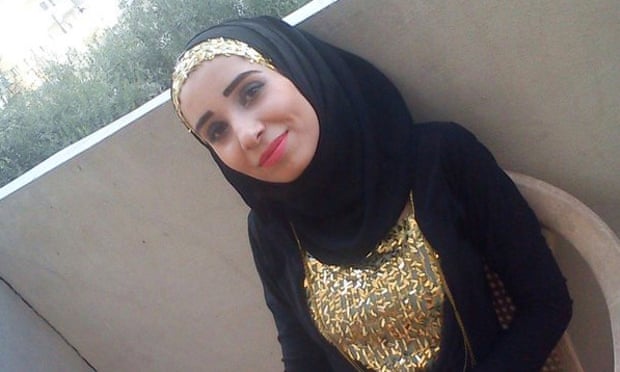
Ruqia Hassan, 30, wrote about daily life in Raqqa, IS’s Syrian stronghold and the frequent target of coalition airstrikes against the group. Her frequent Facebook posts appeared under the pen name Nissan Ibrahim.
The exact date of Hassan’s execution is unknown, but her presence on social media stopped abruptly in July 2015.
News of her death was confirmed this week by Raqqa is Being Slaughtered Silently (RBSS), a group exposing human rights abuses from within Syria.
RBSS founder Abu Mohammed tweeted Hassan’s last known message:
“I’m in Raqqa and I received death threats, and when #ISIS [arrests] me and kills me it’s ok because they will cut my head and I have dignity its better than I live in humiliation with #ISIS.”
Hassan was an independent reporter who studied philosophy at Aleppo University and joined the opposition to Syrian President Bashar al-Assad’s government when the revolution began in Raqqa.
After IS entered the city, she refused to leave and began reporting on the human rights abuses occurring there.
————————————————
Life in Raqqa
———————————
Raqqa woman secretly flims her life under ISIS rule.
———————————
———————————
Exclusive report: Raqqa’s Rebel, the Syrian woman who dared film life under the IS group
In a new video purportedly released by the Islamic State, a British executioner calls Prime Minister David Cameron an “imbecile” before executing five men accused of spying against the Islamic State for the United Kingdom. The video was allegedly filmed in Raqqa, the “capital” of the terrorist Islamic State.
————————————–
————————————–
The executioner is suspected to be London born Abu Rumaysah also known as Siddhartha Dhar according to reports. He has been called the New Jihad John in the British press.
The propaganda video is ten minutes long and includes the execution of five shackled men dressed in orange boilersuits who “confessed” to spying for Great Britain
————————————–
In another new video purportedly released by the Islamic State, men and soldiers are beheaded and executed en masse in “Wilayat Sinai” peninsula, Egypt. The video is titled “War of the Minds” and was released on January 4, 2015.
Key Events & Deaths on this day in Northern Ireland Troubles
6th January
———————————
Sunday 6 January 1980
Three members of the Ulster Defence Regiment (UDR) where killed by the Irish Republican Army (IRA) in a land mine attack near Castlewellan, County Down.
[These deaths brought the ‘official’ death toll, as compiled by the Royal Ulster Constabulary (RUC), to over 2,000. RUC figures do not count those killed outside of Northern Ireland.]
Thursday 6 January 1994
The Ulster Freedom Fighters (UFF), a cover name (pseudonym) used by the Ulster Defence Association (UDA), injured a Catholic man (21) in a gun attack in west Belfast.
Monday 6 January 1997
The Irish Republican Army (IRA) carried out a ‘rocket’ attack at the Royal Courts of Justice in Belfast injuring a Royal Ulster Constabulary (RUC) officer in the leg.
A man was shot in the leg in a ‘punishment’ attack in West Belfast.
[It was claimed by some people that this shooting was carried out by the Official IRA.]
Tuesday 6 January 1998
A large car bomb was defused in the centre of Banbridge, County Down.
[The bomb, estimated at 500 pounds, was planted by the Continuity Irish Republican Army (CIRA).]
A Catholic man was shot and injured in the Meadows Tavern bar, Boucher Road, Belfast. It was believed that he had been shot by Direct Action Against Drugs (DAAD) which is considered to be a cover name (pseudonym) for the Irish Republican Army (IRA).
Wednesday 6 January 1999
A man was injured in Magherafelt, County Derry, in a blast-bomb attack carried out by Loyalist paramilitaries.
A man was injured in a Loyalist gun attack in Bangor, County Down. The Social Democratic and Labour Party (SDLP) and the Ulster Unionist Party (UUP) argued over the implementation of the pre-Christmas arrangement on government departments and North-South bodies. The UUP wanted the Northern Ireland Assembly to “take note” of the agreement, whereas the SDLP wanted the two parties to approve and accept it.
The Irish Republican Army (IRA) published a New Year Message in ‘An Phoblacht / Republican News’ in which they said that the Good Friday Agreement had failed to deliver meaningful change and that Unionists were pursuing conditions that had contributed to the breakdown of the 1994 ceasefire.
[Unionists regarded the statement as a threat by the IRA to end its ceasefire.]
Thursday 6 January 2000
The Irish Republican Army (IRA) issued a new year statement in An Phoblact / Republican News. The statement warned that any move on decommissioning would depend on a dramatic reduction in the British military presence in Northern Ireland.
Saturday 6 January 2001
The body of George Legge (37), a former senior member of the Ulster Defence Association (UDA), was found dumped in a field at Clontonacally Road in Carryduff, County Antrim. Police said that he had been badly beaten before being stabbed to death.
[It was believed that the UDA was responsible for the killing which was part of an internal UDA dispute. There was media speculation that Legge had been involved in drugs and had fallen out of favour with the UDA. He had been drinking in a public house, the ‘Bunch of Grapes’ in east Belfast, and it is thought that he was first attacked there. There was a malicious fire at the rear of the pub shortly after the discovery of Legge’s body. The Irish Times (a Dublin based newspaper) reported that Legge had been decapitated.]
Sunday 6 January 2002
Loyalist paramilitaries carried out a pipe-bomb attack on the home of a prison officer in Westway Park, Ballygomartin, Belfast, at approximately 10.00pm (2200GMT). The officer’s wife and four year old daughter needed hospital treatment for shrapnel wounds, cuts, and shock. The bomb had been thrown through the living room window of the house. The Red Hand Defenders (RHD) said it was responsible for the attack.
[The RHD is a cover name that has been used in the past by members of the Ulster Defence Association (UDA) and Loyalist Volunteer Force (LVF).] The RHD said the attack was in response to alleged harassment of Loyalist prisoners including Johnny Adair and Gary Smyth in Magheraberry jail, County Antrim.
——————————————————————————
Remembering all innocent victims of the Troubles
Today is the anniversary of the death of the following people killed as a results of the conflict in Northern Ireland
“To live in hearts we leave behind is not to die
– Thomas Campbell
To the innocent on the list – Your memory will live forever
– To the Paramilitaries –
There are many things worth living for, a few things worth dying for, but nothing worth killing for.
6 People lost their lives on the 6th January between 1980 – 2001
————————————————————
06 January 1980
Robert Smyth, (18)
Protestant Status: Ulster Defence Regiment (UDR),
Killed by: Irish Republican Army (IRA) Killed in land mine attack on Ulster Defence Regiment (UDR) mobile patrol, Burren Bridge, near Castlewellan, County Down.
————————————————————
06 January 1980
James Cochrane, (21)
Catholic Status: Ulster Defence Regiment (UDR),
Killed by: Irish Republican Army (IRA) Killed in land mine attack on Ulster Defence Regiment (UDR) mobile patrol, Burren Bridge, near Castlewellan, County Down.
————————————————————
06 January 1980 Richard Wilson, (21)
Protestant Status: Ulster Defence Regiment (UDR),
Killed by: Irish Republican Army (IRA) Killed in land mine attack on Ulster Defence Regiment (UDR) mobile patrol, Burren Bridge, near Castlewellan, County Down.
————————————————————
06 January 1983
Eric Brown, (41)
Protestant Status: Royal Ulster Constabulary (RUC),
Killed by: Irish Republican Army (IRA) Shot while sitting in stationary Royal Ulster Constabulary (RUC) civilian-type car, Bridge street, Rostrevor, County Down.
————————————————————
06 January 1983
Brian Quinn, (23)
Catholic Status: Royal Ulster Constabulary (RUC),
Killed by: Irish Republican Army (IRA) Shot while sitting in stationary Royal Ulster Constabulary (RUC) civilian-type car, Bridge street, Rostrevor, County Down.
————————————————————
06 January 2001
George Legge, (37)
Protestant Status: Ulster Defence Association (UDA),
Killed by: Ulster Defence Association (UDA) Found beaten and stabbed to death, off Clontonacally Road, near Carryduff, County Down. Internal Ulster Defence Association (UDA) dispute.
————————————————————
This is simply the story of a boy trying to grow up, survive, thrive, have fun & discover himself against a backdrop of events that might best be described as ‘explosive’, captivating & shocking the world for thirty long years.
ISIS Militants Strap Bomb on 4 Year-Old Boy and Blow Him Up after Killing the Child’s Father
ISIS strapped a bomb to a four year-old child and blew him up a week after executing the boy’s father in the Al-Shirqat district.
In yet another heinous crime committed by the ISIS terror organization, the group has blown up a four-year-old child just one week after executing the child’s father.
Speaking to Alsumaria News, a senior official in the Iraqi national organization the Popular Mobilization Forces, Jabar el-Maamouri, said ISIS exploded “a bomb that was attached to a four-year-old child through a remote-controlled device so that his organs would be blown apart. ISIS executed the boy’s father a week ago who they accused of participating in an attack on one their outposts a month ago that killed two ISIS gunmen.”
The killings took place in the Al-Shirqat district north of Salah ad Din province.
El-Maamouri called human rights organizations to “document the crimes of ISIS and to publicize the incident to the international community to condemn its funders and supporters with money and words.”
ISIS has controlled the Al-Shirqat district since June, 2014. The area is considered to be one of the organization’s strongholds.
Elsewhere in Iraq, a local source in Nineveh province who asked to remain anonymous told Alsumaria News that the ISIS wiped out a village after its residents rebelled against the group.
“ISIS executed dozens of civilians including old people, women and children in the village of Al-Choud in area of Al-Keraya (85 kilometers south of Nineveh),” he said. a week after executing the boys father.
Siddhartha Dhar, also known as Abu Rumaysah, is thought to be the new man behind the mask fronting threats to the UK from inside Syria.
Child in Isil video has now been identified as Isa Dare, the son of Grace Dare a Jihadi bride from Lewisham
———————————————–
Unlike the man he appears to have replaced – Briton Mohammed Emwazi, dubbed “Jihadi John” – Mr Rumaysah was a well-known and prolific figure among radical Islamists in London.
He disappeared in September 2014, shortly after being released on bail while under investigation for allegedly encouraging terrorism.
Police banned him from travelling and ordered him to hand in his passport. However, he boarded a coach for Paris at London’s Victoria Station, along with his wife and children.
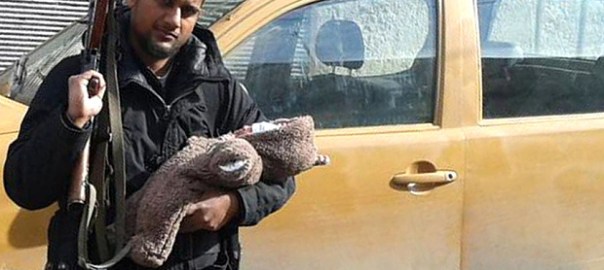
Weeks later, he announced his arrival in Syria by posting an image online of himself holding a rifle, and his newborn and fourth child.
“What a shoddy security system Britain must have to allow me to breeze through Europe to [IS],” he tweeted.
Mr Rumaysah, who is in his early 30s, was born and raised in the UK in a Hindu family – his original name is Siddhartha Dhar.
Following his conversion, he became a leading member and speaker for the al-Muhajiroun network, a group banned under terrorism legislation.
He would regularly attend demonstrations against the US, Israel, Arab regimes or any other cause the group believed to be un-Islamic.
He would stand outside mosques on Friday afternoons, seeking to find new followers to the radical network’s way of thinking. He would post videos online and rarely turned down an opportunity to speak to the media.
And when he spoke he barely hid his radical views.
When so-called Islamic State claimed to have destroyed the border between Iraq and Syria in 2014, he believed it was the moment a new Islamic regime worthy of global support had been born.
“The caliphate [a state governed in accordance with Islamic law, or Sharia] is a dream for all Muslims worldwide,” he said in one of his YouTube videos.
“We can finally have a sanctuary where we can practice our religion and live under the Sharia. It is a big, big thing.”
In an appearance on the BBC’s Sunday Morning Live programme, he expanded on these views.
“Now that we have this caliphate I think you’ll see many Muslims globally seeing it as an opportunity for the Koran to be realised,” he said.
“As a Muslim I would like to see the UK governed by the Sharia. It is far superior to democracy. I don’t really identify myself with British values. I am Muslim first, second and last.”
‘Travel guide’
In 2014, Mr Rumaysah was asked by a TV journalist whether he would condemn the killing of US journalist James Foley by IS.
—————————————
‘Save Steven Sotloff’ by Abu Rumaysah on Channel 4
—————————————
He refused to answer the question – saying only that he condemned US airstrikes killing Muslims in the “caliphate”.
In May 2015, he “published” a sort of travel guide for would-be fellow travellers.
The 40-page document, which opens with an image of a fictional battle on the edge of Jerusalem, is designed to encourage Muslims to stop procrastinating and join what Mr Rumaysah claims are the swelling ranks of Islamic State.
Most of the rest of the booklet is devoted to the kind of information that features in a standard travel guide: food, weather and transport.
“If you thought London or New York was cosmopolitan, then wait until you step foot in the Islamic State because it screams diversity,” he wrote.
“In my short time here I have met people from absolutely every walk of life, proof that the caliphate’s pulling power is strong and tenacious.”
He glossed over public executions, rape of women held as slaves and other punishments meted out to anyone who does not adhere to the fighting group’s ideology.



















 belfastchildis.com