Category Archives: Deaths in the Troubles

5th August – Deaths & Events in Northern Ireland Troubles

5th August

Key Events & Deaths on this day in Northern Ireland Troubles

Thursday 5 August 1971

There was a debate at Westminster on the situation in Northern Ireland. Brian Faulkner, then Northern Ireland Prime Minister, met with Edward Heath, then British Prime Minister, and Harry Tuzo, then General Officer Commanding the British Army (BA), in London to discuss the security situation.

5th August 1969

The UVF planted their first bomb in the Republic of Ireland , damaging the RTE Television Centre in Dublin


Sunday 5 August 1973


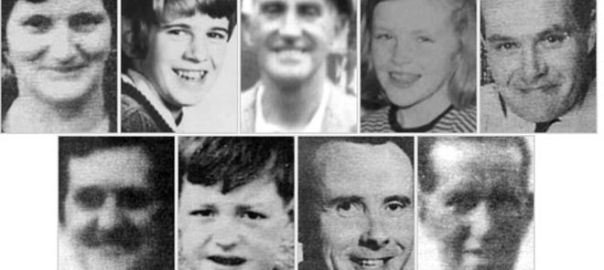
Francis & Bernadette Mullen

A Catholic husband and wife, Francis Mullan (59) and Bernadette Mullan (39), were found shot dead at their farmhouse near Moy, County Tyrone.

They had been killed by an unidentified Loyalist paramilitary group.

Friday 5 August 1977

There was a series of fire bomb attacks in Belfast and Lisburn, County Antrim.

Wednesday 5 August 1981

The Irish Republican Army (IRA) carried out a series of car bomb and incendiary bomb attacks in seven areas of Northern Ireland including Belfast, Derry and Lisburn. The attacks caused serious damage to property and minor injuries to a number of people.

Friday 5 August 1983

The ‘supergrass’ trial of 38 alleged members of the Irish Republican Army (IRA) ended in Belfast. The trial had lasted 120 days with most of the evidence being offered by IRA supergrass Christopher Black.

I.R.A supergrass Christopher Black

The judge jailed 22 of the accused to sentences totalling more that 4,000 years. Four people were acquitted and others received suspended sentences.

In 1986, 18 of the 22 who received prison sentences had their convictions quashed by the Court of Appeal.

Tuesday 5 August 1986

The Irish Republican Army (IRA) issued another warning that contractors who were carrying out work for the security services in Northern Ireland would be considered ‘part of the war machine’ and would be ‘treated as collaborators’.

Monday 5 August 1996

A meeting between the Apprentice Boys of Derry and the Bogside Residents Association ended without agreement about the march due to take place on 10 August 1996. A series of meetings between the two groups had been chaired by the local Member of Parliament John Hume, then leader of the Social Democratic and Labour Party (SDLP).

Tuesday 5 August 1997

A Catholic taxi driver survived an attempt to kill him when the gun being used by a Loyalist paramilitary jammed.

The attack occurred in the Parkmore estate in Lurgan.

The Loyalist Volunteer Force (LVF) later claimed responsibility for the attack.

A hoax bomb was sent to Sammy Wilson, then a Democratic Unionist Party (DUP) councillor, at Belfast City Hall.

Marjorie (Mo) Mowlam, then Secretary of State for Northern Ireland, held her first meeting with Gerry Adams, then President of Sinn Féin (SF), since the Irish Republican Army (IRA) announced its renewed ceasefire.

The Irish Times carried a report that John Hume, then leader of the Social Democratic and Labour Party (SDLP), was considering accepting the position of President of the Republic of Ireland as an agreed all-party candidate. Hume did not comment on the story.

The Bogside Residents Group (BRG) gave agreement to the planned Apprentice Boys of Derry (ABD) march in the city on 9 August 1997. This followed the news that the Royal Ulster Constabulary (RUC) would reroute a number of ABD ‘feeder’ parades in other Nationalist areas of Northern Ireland.

Thursday 5 August 1999

Two pipe-bombs were discovered by the Royal Ulster Constabulary (RUC) in a hedge in Glengormley, County Antrim. Police made the discovery at 2.45am during a search carried out at the junction between Elmfield Crescent and Elmfield Road in the town.

A report of the Victims’ Commission, established by the Irish government, into the 1974 Dublin and Monaghan bombings recommended the appointment of a former Supreme Court judge to inquire privately into events surrounding the bombings which killed 33 people and injured over 400.

Although it was intended that the findings would eventually be made public, the families of the victims wanted the immediate establishment of a public tribunal of Inquiry.

Other recommendations of the report were that a similar Inquiry be established into the killing of Seamus Ludlow on 2 May 1976, and that the Irish government should make a £10,000 payment to the 150 families affected by the bombings.

——————————————

Remembering all innocent victims of the Troubles

Today is the anniversary of the death of the following people killed as a results of the conflict in Northern Ireland

“To live in hearts we leave behind is not to die

– Thomas Campbell

To the innocent on the list – Your memory will live forever

– To the Paramilitaries –

There are many things worth living for, a few things worth dying for, but nothing worth killing for.

5  People lost their lives on the 5th August   between 1973 – 1994

——————————————

 05 August 1973

Francis Mullen,   (59)

Catholic
Status: Civilian (Civ),

Killed by: Ulster Volunteer Force (UVF)
Found shot at his farmhouse, Gorestown, near Moy, County Tyrone.

————————————————————–

 05 August 1973

Bernadette Mullen,   (39)

Catholic
Status: Civilian (Civ),

Killed by: Ulster Volunteer Force (UVF)
Found shot at her farmhouse, Gorestown, near Moy, County Tyrone.

————————————————————–

 05 August 1974

Martha Lavery,   (67)

Catholic
Status: Civilian (Civ),

Killed by: British Army (BA)
Shot while in her home during gun battle between Irish Republican Army (IRA) and British Army (BA), Jamaica Street, Ardoyne, Belfast.

————————————————————–

 05 August 1991

Eric Boyd,  (42)

Protestant
Status: ex-Ulster Defence Regiment (xUDR),

Killed by: Irish Republican Army (IRA)
Shot shortly after leaving his workplace, while driving along Altmore Road, Cappagh, County Tyrone.

————————————————————–

 05 August 1994

David Thompson,  (48)

Protestant
Status: Civilian (Civ),

Killed by: Ulster Volunteer Force (UVF)
Found shot, Ballyhill Lane, Nutts Corner, near Crumlin, County Antrim.

4th August – Deaths & Events in Northern Ireland Troubles

4th  August

Key Events & Deaths on this day in Northern Ireland Troubles

Friday 4 August 1972


 Public Records 1972 – Released 1 January 2003:

Note from R.T. Armstrong, then with the Prime Minister’s office, to T.C. Platt, then with the Northern Ireland Office (NIO).

The note shows that Edward Heath, then Prime Minister, was highly sensitive to the issue of  interrogation of prisoners by the security forces.

Thursday 4 August 1988


William Hassard &  Frederick Love

Two Protestant building workers, were killed by the Irish Republican Army (IRA) in Belleek, County Fermanagh. The two workers had been carrying out repairs at Belleek police station.

Tuesday 4 August 1998

Dissident Republicans carried out an attack on a police patrol outside an Royal Ulster Constabulary (RUC) station in Lurgan, County Armagh.

——————————————

Remembering all innocent victims of the Troubles

Today is the anniversary of the death of the following people killed as a results of the conflict in Northern Ireland

“To live in hearts we leave behind is not to die

– Thomas Campbell

To the innocent on the list – Your memory will live forever

– To the Paramilitaries –

There are many things worth living for, a few things worth dying for, but nothing worth killing for.

————————————————————–

  5 People lost their lives on the 4th  of August between 1972  – 1988

——————————————

 04 August 1972

David Card,  (21) nfNI Status: British Army (BA),

Killed by: Irish Republican Army (IRA)

Shot while on British Army (BA) foot patrol, Commedagh Drive, Andersonstown, Belfast.

——————————————

 04 August 1977

John McCartan,  (55)

Catholic

Status: Civilian (Civ),

Killed by: British Army (BA)

Manager of Andersonstown Social Club. Shot as he was leaving the club premises, off South Link, Andersonstown, Belfast.

——————————————

 04 August 1986

Denis Taggart,  (33)

Protestant

Status: Ulster Defence Regiment (UDR),

Killed by: Irish Republican Army (IRA)

Off duty. Shot outside his home, Battenberg Street, Shankill, Belfast.

——————————————

 04 August 1988

William Hassard,  (59)

Protestant

Status: Civilian (Civ),

Killed by: Irish Republican Army (IRA)

Shot shortly after driving out of Belleek Royal Ulster Constabulary (RUC) / British Army (BA) base, County Fermanagh. Contractor to British Army (BA) / Royal Ulster Constabulary (RUC).

——————————————

 04 August 1988

Frederick Love,   (64)

Protestant

Status: Civilian (Civ),

Killed by: Irish Republican Army (IRA)

Shot shortly after driving out of Belleek Royal Ulster Constabulary (RUC) / British Army (BA) base, County Fermanagh. Employed by contractor to British Army (BA) / Royal Ulster Constabulary (RUC).

——————————————

3rd August – Deaths & Events in Northern Ireland Troubles

3rd  August

Key Events & Deaths on this day in Northern Ireland Troubles

Tuesday 3 August 1976

The Irish Republican Army (IRA) carried out a series of six bomb attacks on Portrush, County Antrim.

Monday 3 August 1981

 Liam McCloskey, then an Irish National Liberation Army (INLA) prisoner, joined the hunger strike.

Sunday 3 August 1997

Nationalist residents of Newtownbutler, County Fermanagh, protested against a Royal Black Preceptory march in the village.

The parade was escorted by Royal Ulster Constabulary (RUC) officers in riot gear. Six people were injured in disturbances.

The Claudy Bombing

The 25th anniversary of the bombing of Claudy, County Derry was marked in the village when approximately 1,500 people attended an open air service

See Claudy Bombing

Although no group claimed responsibility for the explosions it was widely believed that the Irish Republican Army (IRA) had planted the three car bombs in the village which resulted in the deaths of nine people. Inadequate warnings were given about the bombs.

Monday 3 August 1998

In the first break-through of its kind, Nationalists and Loyalists in Derry reached an agreement over the Apprentice Boys march in the city planned for 8 August 1999.

The agreement came after three days of shuttle (indirect) negotiations between the parties. [However, there were some minor disturbances following the march.]

Tuesday 3 August 1999

Security sources confirmed that the Irish Republican Army (IRA) was considered responsible for the death of Charles Bennett on 30 July 1999.

Republican sources claimed he was killed to pacify hardliners over decommissioning and the lack of political progress.

Friday 3 August 2001

The Ardchomhairle of Sinn Féin held a meeting to consider the party’s response to the British and Irish governments’ Implementation Plan. The meeting took place in County Louth, Republic of Ireland.

The Ardchomhairle is comprised of 41 members, including Gerry Adams, then President of SF, Mitchel McLaughlin, then Chairman, Pat Doherty, then Vice-President, and Martin McGuinness.

Sinn Féin rejected Monday’s deadline and said that the party needed to see the detail and guarantees on policing reform and demilitarisation.

In the days following the meeting SF said it needed to see more detail on policing, demilitarisation and criminal justice before it could support the package.

 3rd August   2010

Óglaigh na hÉireann claimed responsibility for detonating a 200 lb car bomb outside Strand Road PSNI station in Derry.

——————————————

Remembering all innocent victims of the Troubles

Today is the anniversary of the death of the following people killed as a results of the conflict in Northern Ireland

“To live in hearts we leave behind is not to die

– Thomas Campbell

To the innocent on the list – Your memory will live forever

– To the Paramilitaries –

There are many things worth living for, a few things worth dying for, but nothing worth killing for.

10  People lost their lives on the 3rd of August between 1972  – 1992

————————————————————–

03 August 1972

William Clark,   (34) nfNI
Status: British Army (BA),

Killed by: Irish Republican Army (IRA)
Killed attempting to defuse bomb discovered by side of road, Urney, near Clady, County Tyrone.

See: The Long Walk 

————————————————————–

03 August 1972

Robert McCrudden,   (19)

Catholic
Status: Irish Republican Army (IRA),

Killed by: British Army (BA)
Shot during gun battle, Hooker Street, Ardoyne, Belfast.

————————————————————–

03 August 1973
James Farrell,  (50) nfNIRI
Status: Civilian (Civ),

Killed by: Irish Republican Army (IRA)
Shot, during armed robbery, while delivering wages to British Leyland factory, Cashel Road, Crumlin, Dublin.

————————————————————–

 03 August 1974

Martin Skillen, (21)

Catholic
Status: Irish Republican Army (IRA),

Killed by: British Army (BA)
Shot from British Army (BA) undercover observation post in Clonard cinema building, Falls Road, Belfast.

————————————————————–

 03 August 1974
Charles McKnight,   (25)

Protestant
Status: Civilian (Civ),

Killed by: Irish Republican Army (IRA)
Killed by booby trap bomb when he entered the cab of his employer’s lorry, parked outside house, Ballycraigy, Newtownabbey, County Antrim.

————————————————————–

 03 August 1976
Alan Watkins,   (20) nfNI
Status: British Army (BA),

Killed by: Irish National Liberation Army (INLA)
Shot by sniper while on British Army (BA) foot patrol, Dungiven, County Derry.

————————————————————–

03 August 1979
Whilliam Whitten  (65)

Protestant
Status: Civilian (Civ),

Killed by: Irish Republican Army (IRA)
Died six weeks after being injured in bomb attack on Marine Hotel, Ballycastle, County Antrim. He was wounded on 19 June 1979. Inadequate warning given.

————————————————————–

 03 August 1980
William Clarke, (59)

Protestant
Status: Ulster Defence Regiment (UDR),

Killed by: Irish Republican Army (IRA)
Off duty. Shot while travelling in his car along laneway, Gortnessy, near Pettigoe, County Donegal.

————————————————————–

 03 August 1988

Raymond McNicholl,  (30)

Protestant
Status: Ulster Defence Regiment (UDR),

Killed by: Irish Republican Army (IRA)
Off duty. Shot by sniper, while driving his car to work, Desertcreat Road, near Cookstown, County Tyrone.

————————————————————–

03 August 1992
Damian Shackleton,   (24) nfNI
Status: British Army (BA),

Killed by: Irish Republican Army (IRA)
Shot by sniper while on British Army (BA) mobile patrol, Duncairn Avenue, New Lodge, Belfast.

————————————————————–

2nd August – Deaths & Events in Northern Ireland Troubles

2nd August

Key Events & Deaths on this day in Northern Ireland Troubles


Monday 2 August 1976

Cornelius Neeson (49), a Catholic civilian, was killed with an axe as he walked home along the Cliftonville Road, Belfast. Members of he Ulster Volunteer Force (UVF) gang known as the ‘Shankill Butchers’ were responsible for the killing.

See Shankilll Butchers Documentary

2 August 1978

Roy Mason, then Secretary of State for Northern Ireland, announced that a sports car factory would be built in West Belfast and would mean 2,000 new jobs. The new factory was seen as a breakthrough in securing American investment in Northern Ireland.


However the DeLorean factory required a British investment of £56 million out of a total of £65 million. At the time a number of commentators expressed reservations about the potential success of the venture and indeed the business did fail with the loss of substantial public funds.

Thursday 2 August 1979

Two British soldiers were killed by the Irish Republican Army (IRA) in a landmine attack at Cathedral Road, Armagh.

These deaths brought the total number of British Army soldiers killed in Northern Ireland since 1969 to 301.

A Royal Ulster Constabulary (RUC) officer was shot dead by the IRA in Belfast.

Sunday 2 August 1981

Eighth Hunger Striker Died

Kieran Doherty (25) died after 73 days on hunger strike. Doherty was a member of the Irish Republican Army (IRA) and had been elected as a Teachta Dáil (TD) during the general election in the Republic of Ireland on 11 June 1981.


John Smyth & Andrew Wood

Two Royal Ulster Constabulary (RUC) officers were killed in a landmine attack carried out by the Irish Republican Army (IRA) in Loughmacrory, near Omagh, County Tyrone.

Sunday 2 August 1992

Two bombs, each estimated at 200 pounds, exploded in Bedford Street, Belfast. Extensive damage was done to buildings in the area.

Hugh Annesley, Chief Constable of the Royal Ulster Constabulary (RUC), issued a statement on the Channel 4 programme entitled ‘The Committee’ broadcast on 2 October 1991. Annesley stated that there was no truth to the allegations.

Tuesday 2 August 1994

According to a report in the Irish Press (a Dublin based newspaper) on 8 August 1994 a meeting took place on 2 August between representatives of the Ulster Volunteer Force (UVF) and those of the Ulster Freedom Fighters (UFF), a cover name (pseudonym) used by the Ulster Defence Association (UDA).

At that meeting it was decided that Loyalist paramilitaries would continue with their campaigns of attacking Catholics irrespective of any future Irish Republican Army (IRA) ceasefire.

Friday 2 August 1996

U.V.F Logo

In a statement the Ulster Volunteer Force (UVF) announced that the Portadown unit of the Mid-Ulster Brigade was to disband. The statement also said that activities of the Portadown unit would be investigated.

Sinn Féin (SF) denied organising boycotts of Protestant businesses in rural areas of Northern Ireland.

Since the stand-off at Drumcree some nationalists had been boycotting Protestant businesses in Armagh, Castlederg, Lisnaskea, Omagh and Pomery.

Nationalists claimed that the business people had taken part in Orange roadblocks during the stand-off.

Thursday 2 August 2001

Amateur footage of the explosion

Bomb Explosion in London

Republican paramilitaries carried out a car bomb attack in the Ealing area of London. The explosion occurred just before midnight and caused six injuries and some damage to property. A telephone warning was received at 11.33pm (2333BST) but the area was still being cleared when the explosion happened.

The bomb (estimated at 40 kilograms of home-made explosives) was thought to have been planted by the “real” Irish Republican Army (rIRA).

Police in London criticised the warning as being imprecise as to the location; the warning referred to ‘Ealing Broadway Road’ instead of ‘The Broadway, Ealing’ .


Edward_Daly_Bloody_Sunday

Former soldiers who were involved in the shootings in Derry on ‘Bloody Sunday’, 30 January 1972, announced that they would seek a judical review of a ruling by the Inquiry that they must give their evidence in Derry rather than in Britain.

The soldiers had won an earlier ruling allowing them to retain anonymity when giving evidence.

See Bloody Sunday

—————————-

Remembering all innocent victims of the Troubles

Today is the anniversary of the death of the following people killed as a results of the conflict in Northern Ireland

“To live in hearts we leave behind is not to die

– Thomas Campbell

To the innocent on the list – Your memory will live forever

– To the Paramilitaries –

There are many things worth living for, a few things worth dying for, but nothing worth killing for.

11 People lost their lives on the 2nd August  between 1975 – 1988

——————————-

02 August 1975

George McCall, (22)

Protestant

Status: ex-Ulster Defence Regiment (xUDR),

Killed by: Irish Republican Army (IRA)

Shot while walking near his home, Moy, County Tyrone.

————————————————————–

02 August 1976

Cornelius Neeson,  (49)

Catholic

Status: Civilian (Civ),

Killed by: Ulster Volunteer Force (UVF)

Died a short time after being found badly beaten, at the junction of Manor Street and Cliftonville Road, Belfast.

————————————————————–

02 August 1978

John Lamont, (21)

Protestant

Status: Royal Ulster Constabulary (RUC),

Killed by: Irish Republican Army (IRA)

Shot from passing car, while on Royal Ulster Constabulary (RUC) foot patrol, George Street, Ballymena, County Antrim.

————————————————————–

02 August 1979

Paul Reece, Paul (18) nfNI

Status: British Army (BA),

Killed by: Irish Republican Army (IRA)

Killed in land mine attack on British Army (BA) mobile patrol, Cathedral Road, Armagh.

————————————————————–

02 August 1979

Richard Furminger , (19) nfNI

Status: British Army (BA),

Killed by: Irish Republican Army (IRA)

Killed in land mine attack on British Army (BA) mobile patrol, Cathedral Road, Armagh.

————————————————————–

02 August 1979

Derek Davidson, (26)

Protestant

Status: Royal Ulster Constabulary (RUC),

Killed by: Irish Republican Army (IRA)

Shot by sniper when Royal Ulster Constabulary (RUC) patrol lured to scene of bogus robbery, Clondara Street, Falls, Belfast.

————————————————————–

02 August 1981

Kieran Dohert (25)

Catholic

Status: Irish Republican Army (IRA),

Killed by: not known (nk)

Also Teachta Dala. Died on the 73rd day of hunger strike, Long Kesh / Maze Prison, County Down.

————————————————————–

02 August 1981

John Smyth , (34)

Protestant

Status: Royal Ulster Constabulary (RUC),

Killed by: Irish Republican Army (IRA)

Killed in land mine attack on Royal Ulster Constabulary (RUC) mobile patrol, Loughmacrory, near Omagh, County Tyrone.

————————————————————–

02 August 1981

Andrew Wood, (50)

Protestant

Status: Royal Ulster Constabulary (RUC),

Killed by: Irish Republican Army (IRA)

Killed in land mine attack on Royal Ulster Constabulary (RUC) mobile patrol, Loughmacrory, near Omagh, County Tyrone

————————————————————–

02 August 1988

John Warnock, (45)

Protestant

Status: Royal Ulster Constabulary (RUC),

Killed by: Irish Republican Army (IRA)

Killed by booby trap bomb attached to his car outside Lisburn Royal Ulster Constabulary (RUC) base, County Antrim.

————————————————————–

02 August 1988

  Roy  Butler (29)

Protestant

Status: Ulster Defence Regiment (UDR),

Killed by: Irish Republican Army (IRA)

Off duty. Shot while in Park Shopping Centre, Donegall Road, Belfast.

1st August – Deaths & Events in Northern Ireland Troubles


1st August

Key Events & Deaths on this day in Northern Ireland Troubles Claudy Bomb

Friday 1 August 1975

James Marks

 Two Catholic civilians, Joseph Toland (78) and James Marks (42), died as a result of a gun attack on a minibus near Gilford, County Down. Marks died from his injuries on 7 January 1976.

No group claimed responsibility but ‘Lost Lives’ (2004; p614) records: “the attack …, according to reliable loyalist sources, was carried out by the UVF”.

Lt Gen David Leakey.jpg

David House, then a Lieutenant-General in the British Army, replaced Frank King as General Officer Commanding (GOC) of the army in Northern Ireland.

Tuesday 1 August 1978

 Tomás Ó Fiaich, Catholic Primate of Ireland, who had paid a visit to Republican prisoners in the Maze Prison on 30 July 1978, issued a statement saying that the prisoners engaged in the ‘blanket protest’ where living in ‘inhuman’ conditions.

At this stage of the ‘blanket protest’ over 300 Republican prisoners were refusing to wear prison clothes or follow normal prison regulations. This protest was an attempt to secure a return of special category status for people convicted of politically motivated crimes.

Wednesday 1 August 1979

The United States (US) State Department halted a private firearms shipment to Northern Ireland. The shipment also included firearms that were intended for the Royal Ulster Constabulary (RUC). The RUC later purchased the arms from West Germany instead.

This decision by the US State Department was brought about by a campaign to try to bring pressure on the British government to undertake a new political initiative in Northern Ireland to find a solution to the conflict.

The campaign was headed by the so-called ‘Four Horsemen’ who were: ‘Tip’ O’Neill, then Speaker of the House of Representatives, Edward Kennedy, then a Senator, Daniel Moynihan, then a Senator, and Hugh Carey, then Governor of New York. Previously the US had been uncritical of British policy in Northern Ireland and these developments were to prove worrying for the British

Saturday 1 August 1981

Seventh Hunger Striker Died

Kevin Lynch (25) died after 71 days on hunger strike. Lynch was a member of the Irish National Liberation Army (INLA).

See 1981 Hungry Strikes

Monday 1 August 1988

An Irish Republic Army (IRA) bomb killed one soldier and injured nine at an army barracks in London. It was the first IRA bomb in Britain since the ‘Brighton’ bombing on 12 October 1984.

Friday 1 August 1997

Stewart Hunter (24), a Protestant civilian, was found dead at the side of a road near his home near Larne, County Antrim.

It was believed that Loyalist paramilitaries were responsible for the killing

Saturday 1 August 1998

Thirty-three civilians and two members of the Royal Ulster Constabulary (RUC) were injured when a car bomb, estimated at 500 pounds, exploded in Banbridge, County Down.

Extensive damage was also caused in the explosion that was later claimed by the “real” Irish Republican Army (rIRA).

The government in the Republic of Ireland took the decision to release six Irish Republican Army (IRA) prisoners from Portlaoise Prison. [Unionists reacted angrily to the announcement.

Sunday 1 August 1999

In the aftermath of the killing of Charles Bennett on 30 July 1999, John Bruton, then Leader of Fine Gael, called upon Bertie Ahern, then Taoiseach (Irish Prime Minister), to make “an authoritative statement” on the relationship between Sinn Féin (SF) and the Irish Republican Army (IRA).


Wednesday 1 August 2001

Implementation Plan Published and Bomb At Belfast Airport

British Army technical officers defused a car-bomb was left in the main car park at Belfast International Airport. There had been an initial warning at 5.00am (0500BST) but security forces were unable to locate the bomb. Following a second warning the vehicle was found close to the main terminal building.

The car park was closed but flights in and out of the airport were not affected. The “real” Irish Republican Army (rIRA) was thought to have been responsible for the attack.

The British and Irish governments published their Implementation Plan for the Good Friday Agreement. The document addressed the remaining issues of policing, normalisation, stability of the institutions, and decommissioning of paramilitary weapons.

The political parties were given until Monday 6 August 2001 to give their response to the proposals. The funeral of Gavin Brett (18), who had been shot dead by Loyalist paramilitaries on 29 July 2001, took place at Carnmoney Parish Church. Nigel Baylor (Rev), then Church of Ireland rector, said that those responsible for the killing “have done nothing but bring shame on the name of Protestantism

——————————

——————————————

Remembering all innocent victims of the Troubles

Today is the anniversary of the death of the following people killed as a results of the conflict in Northern Ireland

“To live in hearts we leave behind is not to die

– Thomas Campbell

To the innocent on the list – Your memory will live forever

– To the Paramilitaries –

There are many things worth living for, a few things worth dying for, but nothing worth killing for.

6 People lost their lives on the 1st August   between 1972 – 2001

——————————————


01 August 1973

Peter Wilson, (21)

Catholic

Status: Civilian (Civ),

Killed by: Irish Republican Army (IRA)

Abducted somewhere in the St. James area, Belfast. His remains eventually found by information supplied anonymously, buried in land at foreshore, Waterfoot, County Antrim, on 2 November 2010.

 ————————————————————–

01 August 1975

Joseph Toland,  (78)

Catholic

Status: Civilian (Civ),

Killed by: non-specific Loyalist group (LOY)

Shot during gun attack while travelling in mini bus, near Gilford, County Down.

————————————————————–

01 August 1975

James Marks,  (42)

Catholic

Status: Civilian (Civ),

Killed by: non-specific Loyalist group (LOY)

Shot during gun attack while driving mini bus, near Gilford, County Down. He died 7 January 1976.

 ————————————————————–

01 August 1976

John Bovaird, (33)

Protestant

Status: Civilian (Civ),

Killed by: Ulster Defence Association (UDA)

Shot at his home, Annalee Street, Lower Oldpark, Belfast. Lived with Catholic family.

 ————————————————————–

01 August 1981

Kevin Lynch, (25)

Catholic

Status: Irish National Liberation Army (INLA),

Killed by: Hunger Striker

Died on the 71st day of hunger strike, Long Kesh / Maze Prison, County Down.

————————————————————–

01 August 1988

Michael Robbins, (23) nfNIB

Status: British Army (BA),

Killed by: Irish Republican Army (IRA)

Killed in time bomb attack on Inglis British Army (BA) base, Mill Hill, London. 

31st July Deaths & Events in Northern Ireland Troubles

31st  July

Key Events & Deaths on this day in Northern Ireland Troubles Claudy Bomb

Monday 31 July 1972 ‘Operation Motorman

Prior to the military operation 4,000 extra troops were brought into Northern Ireland to take part in the dismantling of barricades on the boundaries of ‘no-go’ areas.

It turned out to be the biggest British military operation since the Suez crisis. Some 12,000 British troops supported by tanks and bulldozers smashed through the barricades. Two people, a Catholic teenager and a member of the Irish Republican Army (IRA), were shot by the British Army during the operation in Derry.

The number of house searches and the number of Catholics interned were to increase over the coming months.

Claudy Bomb

The Irish Republican Army (IRA) exploded three car bombs in Claudy, County Derry killing six people instantly while a further three people died of their injuries over the next 12 days. Five of those who were killed were Catholic civilians while the other four were Protestant civilians.

The first bomb exploded at approximately 10.15am close to McElhinney’s Bar on Main Street, Claudy. Three people died at the scene. At approximately 10.30am there were two further bomb explosions.

The first was outside the Beaufort Hotel, Church Street – three people were killed by the explosion.

The last bomb exploded outside the Post Office on Main Street. This bomb had been spotted earlier by a police officer and a member of the public. No one was killed by this bomb but some of the people cleared from Main Street had moved around the corner to Church Street and were caught in the blast outside the Beaufort Hotel.

Claudy Bomb Victims

See Claudy Bombing

Tuesday 31 July 1973

First Assembly Meeting The new Northern Ireland Assembly met for the first time amid noisy scenes of protest.

Thursday 31 July 1975

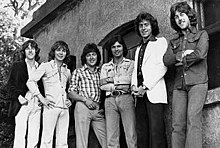
Miami Showband Killings / ‘Miami Massacre

The Ulster Volunteer Force (UVF) carried out a gun and bomb attack on the members of the Miami Showband. Three members of the band were killed and one seriously injured during the attack. Two members of the UVF gang were also killed when a bomb they were handling exploded prematurely. The Miami Showband had been playing at ‘The Castle Ballroom’ in Banbridge, Count Down.

Five members of the band left in their minibus and travelled south on the main dual-carriageway. The minibus was stopped by what appeared to be a Ulster Defence Regiment (UDR) checkpoint at Buskhill, near Newry. However the checkpoint was bogus and was being operated by approximately 10 members of the UVF – at least four of whom were also members of the UDR.

The members of the band were ordered out of the van and told to line up by the side of the road. Two UVF men then planted a bomb into the van.

The bomb exploded prematurely killing the two UVF members. At this point the other UVF members opened fire on the band musicans. Francis (Fran) O’Toole (29), the lead singer with band and famous for his good looks, was shot 22 times in the face while he lay on his back on the ground. Two other band members Anthony Geraghty (23), who was shot four times in the back, and Brian McCoy (33), shot nine times, both died at the scene.

Another member of the group was shot with a ‘dum-dum’ bullet and seriously injured but survived. The two UVF men who died were Harris Boyle (22) and Wesley Somerville (34); both were also members of the UDR. [There was speculation after the event that the UVF had tried to hide the bomb on the minibus with the intention of the bomb exploding after the members of the van had resumed their journey. It would then have been claimed that the members of the band were transporting explosives on behalf of the IRA.

In 1976 two members of the UDR were sentenced to prison for their part in the attack. They received life sentences but were later released under the terms of the Good Friday Agreement

The HET report found that Robin Jackson (aka ‘the Jackal’), a leading mid-Ulster member of the UVF, had been linked by fingerprints to one of the weapons used. Jackson later claimed in police interviews he had been tipped off by a senior RUC officer to lie low after the killings. RUC headquarters was told about this claim, but no action was taken. The HET report said that Jackson claimed that he was told that his fingerprints had been found on a silencer attached to a Luger pistol used in the murders. The HET said the murders raised “disturbing questions about collusive and corrupt behave.

See Miami Showband Killings

Sunday 31 July 1994

Two UDA Men Killed by IRA

Joe Bratty

Joe Bratty (33) and Raymond Elder (32), both members of the Ulster Defence Association (UDA), were shot and killed by the Irish Republican Army (IRA) while they were walking along Ormeau Road, Ballynafeigh, Belfast.

Thursday 31 July 1997

A bomb, estimated at between 500 and 1,000 pounds, was left by the Continuity Irish Republican Army (CIRA) in the grounds of Carrybridge Hotel, near Lisballaw, County Fermanagh. The British Army defused the bomb.

The Northern Ireland Office (NIO) announced that it would carry out a review of the electoral system in the region following numerous allegations of fraud during both the last general election and local government elections

The NIO also announced that Andy Wood, who had been chief Press Officer at the NIO for 14 years, was resigning. In the House of Commons it was revealed that David Fell, then head of the Northern Ireland Civil Service, would be given £1,000,000 in a lump sum retirement settlement together with £42,188 per annum for six years. iour”.

Friday 31 July 1992

Channel 4 and Box Productions were fined £75,000 in the High Court in London for failing to reveal the source of information for a programme entitled ‘The Committee’ broadcast on 2 October 1991.

The programme claimed that there was an ‘inner circle’ in the Royal Ulster Constabulary (RUC) and Ulster Defence Regiment (UDR) which was colluding with Loyalist paramilitaries in the killing of Catholics.

A subsequent book on the controversy, also entitled ‘The Committee’, was not released in the United Kingdom (UK) by the American publishers who feared libel proceedings

——————————————

Remembering all innocent victims of the Troubles

Today is the anniversary of the death of the following people killed as a results of the conflict in Northern Ireland

“To live in hearts we leave behind is not to die

– Thomas Campbell

To the innocent on the list – Your memory will live forever

– To the Paramilitaries –

There are many things worth living for, a few things worth dying for, but nothing worth killing for.

24 People lost their lives on the 31st of   July between 1970– 1994

——————————————

31 July 1970

Daniel O’Hagan,  (19)

Catholic

Status: Civilian (Civ),

Killed by: British Army (BA)

Shot during street disturbances, New Lodge Road, Belfast.

————————————————————–

    31 July 1972

 Daniel Hegarty, (15)

Catholic

Status: Civilian (Civ),

Killed by: British Army (BA)

Shot while walking along Creggan Heights, Creggan, Derry.

————————————————————–

   31 July 1972

Seamus Bradley,  (19)

Catholic

Status: Irish Republican Army (IRA),

Killed by: British Army (BA)

Shot, Bligh’s Lane, Creggan, Derry.

————————————————————–

    31 July 1972

 Kathryn Eakin,   (8) Protestant

Status: Civilian (Civ),

Killed by: Irish Republican Army (IRA)

Killed when car bomb exploded outside McElhinney’s Bar, Main Street, Claudy, County Derry. Inadequate warning given.

See Claudy Bombing

————————————————————–

   31 July 1972

 Elizabeth McElhinney, (59)

Catholic

Status: Civilian (Civ),

Killed by: Irish Republican Army (IRA)

Killed when car bomb exploded outside McElhinney’s Bar, Main Street, Claudy, County Derry. Inadequate warning given.

See Claudy Bombing

————————————————————–

   31 July 1972

 Joseph McCloskey  (38) Catholic

Status: Civilian (Civ),

Killed by: Irish Republican Army (IRA)

Killed when car bomb exploded outside McElhinney’s Bar, Main Street, Claudy, County Derry. Inadequate warning given.

See Claudy Bombing

————————————————————–

    31 July 1972

Rose  McLaughlin,   (52) Catholic

Status: Civilian (Civ),

Killed by: Irish Republican Army (IRA)

Injured when car bomb exploded outside McElhinney’s Bar, Main Street, Claudy, County Derry. She died 3 August 1972. Inadequate warning given.

See Claudy Bombing

————————————————————–

   31 July 1972

 Joseph Connolly,   (15)

Catholic

Status: Civilian (Civ),

Killed by: Irish Republican Army (IRA)

Injured when car bomb exploded outside McElhinney’s Bar, Main Street, Claudy, County Derry. He died 8 August 1972. Inadequate warning given.

See Claudy Bombing

————————————————————–

   31 July 1972

Arthur  Hone,  (38) Catholic

Status: Civilian (Civ),

Killed by: Irish Republican Army (IRA)

Injured when car bomb exploded outside McElhinney’s Bar, Main Street, Claudy, County Derry. He died 12 August 1972. Inadequate warning given.

See Claudy Bombing

————————————————————–

   31 July 1972

 James McClelland,  (65)

Protestant

Status: Civilian (Civ),

Killed by: Irish Republican Army (IRA)

Killed when car bomb exploded outside Beaufort Hotel, Church Street, Claudy, County Derry. Inadequate warning given.

See Claudy Bombing

————————————————————–

    31 July 1972

 David  Miller (60)

Protestant

Status: Civilian (Civ),

Killed by: Irish Republican Army (IRA)

Killed when car bomb exploded outside Beaufort Hotel, Church Street, Claudy, County Derry. Inadequate warning given.

See Claudy Bombing

————————————————————–

   31 July 1972

William  Temple, (16)

Protestant

Status: Civilian (Civ),

Killed by: Irish Republican Army (IRA)

Killed when car bomb exploded outside Beaufort Hotel, Church Street, Claudy, County Derry. Inadequate warning given.

See Claudy Bombing

————————————————————–

  31 July 1975

Fran O’Toole,   (27) nfNI

Status: Civilian (Civ),

Killed by: Ulster Volunteer Force (UVF)

Member of Miami showband. Shot shortly after their minibus was stopped at bogus vehicle check point, Buskhill, near Newry, County Down.

See Miami Showband Killings

————————————————————–

   31 July 1975

Brian  McCoy, 33)

Protestant

Status: Civilian (Civ),

Killed by: Ulster Volunteer Force (UVF)

Member of Miami showband. Shot shortly after their minibus was stopped at bogus vehicle check point, Buskhill, near Newry, County Down.

See Miami Showband Killings

————————————————————–

   31 July 1975

 Tony Geraghty  (23) nfNI

Status: Civilian (Civ),

Killed by: Ulster Volunteer Force (UVF)

Member of Miami showband. Shot shortly after their minibus was stopped at bogus vehicle check point, Buskhill, near Newry, County Down.

See Miami Showband Killings

————————————————————–

   31 July 1975

 Harris  Boyle,  (22)

Protestant

Status: Ulster Volunteer Force (UVF),

Killed by: Ulster Volunteer Force (UVF)

Also Ulster Defence Regiment member. Killed in premature explosion while planting bomb on minibus belonging to Miami showband, Buskhill, near Newry, County Down.

See Miami Showband Killings

————————————————————–

   31 July 1975

  Wesley Somerville  (34)

Protestant

Status: Ulster Volunteer Force (UVF),

Killed by: Ulster Volunteer Force (UVF)

Also Ulster Defence Regiment member. Killed in premature explosion while planting bomb on minibus belonging to Miami showband, Buskhill, near Newry, County Down.

See Miami Showband Killings

————————————————————–

   31 July 1976

 Thomas Cush,   (52)

Protestant

Status: Royal Ulster Constabulary (RUC),

Killed by: Irish Republican Army (IRA)

Shot by sniper while standing at security barrier, Church Street, Lurgan, County Armagh.

————————————————————–

  31 July 1979

 George  Walsh,   (51)

Protestant

Status: Royal Ulster Constabulary (RUC),

Killed by: Irish National Liberation Army (INLA)

Shot from passing car while sitting in stationary car, outside Armagh Courthouse, Armagh.

————————————————————–

   31 July 1981

Thomas  Harpur,   (30)

Protestant

Status: ex-Royal Ulster Constabulary (xRUC),

Killed by: Irish National Liberation Army (INLA)

Shot while visiting friend’s home, Mount Sion, Ballycolman, Strabane, County Tyrone.

————————————————————–

   31 July 1981

 Peter  Doherty (36)

Catholic

Status: Civilian (Civ),

Killed by: British Army (BA)

Shot by plastic bullet at his home, Divis Flats, Belfast.

————————————————————–

    31 July 1990

 John Judge,  (34)

Catholic

Status: Civilian (Civ),

Killed by: Ulster Freedom Fighters (UFF)

Shot outside his home, Valleyside Close, off Springfield Road, Belfast.

————————————————————–

   31 July 1994

 Joe  Bratty,   (33)

Protestant

Status: Ulster Defence Association (UDA),

Killed by: Irish Republican Army (IRA)

Shot, while walking along Ormeau Road, Ballynafeigh, Belfast.

————————————————————–

   31 July 1994

Raymond  Elder,   (32)

Protestant

Status: Ulster Defence Association (UDA),

Killed by: Irish Republican Army (IRA)

Shot, while walking along Ormeau Road, Ballynafeigh, Belfast.

————————————————————–

30th July Deaths & Events in Northern Ireland Troubles

3oth July

Key Events & Deaths on this day in Northern Ireland Troubles

Thursday 30 July 1970

There were further riots in Belfast.

Monday 30 July 1990 Ian Gow Killed

Ian Gow, then the Conservative Member of Parliament (MP) for Eastbourne, was killed outside his home by an Irish Republican Army (IRA) bomb that had been planted on his car. Gow had been a vocal critic of the IRA and a close friend of Margaret Thatcher, then British Prime Minister.

Friday 30 July 1976

Four Protestant civilians were shot dead at a pub off Milltown Road, Belfast. The attack was claimed by the Republican Action Force.[59]

Wednesday 30 July 1986

John Kyle (40), a Protestant civilian, was shot dead by the Irish Republican Army (IRA) as he sat in McCullagh’s Bar, Greencastle, County Tyrone. Kyle had been working as a contractor to the Royal Ulster Constabulary (RUC). [This killing followed threats made by the IRA on 28 July 1986.]

Sunday 30 July 1978

Tomás Ó Fiaich, Catholic Primate of Ireland, paid a visit to Republican prisoners in the Maze Prison. The prisoners were taking part in the ‘blanket protest’. [Over 300 Republican prisoners were refusing to wear prison clothes or follow normal prison regulations in an attempt to secure a return of special category status.]

Friday 31 July 1981

Peter Doherty (36), a Catholic civilian, was shot dead by a plastic bullet fired by the British Army while at his home in Divis Flats, Belfast. A former member of the RUC was shot dead by the INLA in Strabane, County Tyrone.

The family of Paddy Quinn, then on day 47 of his hunger strike, intervened and asked for medical treatment to save his life. [This series of events was to be repeated a number of times towards the end of the hunger strike as more and more familles intervened to save the hunger strikers.]

Sunday 30 July 1995

The Royal Ulster Constabulary (RUC) prevented a Sinn Féin (SF) march from entering the centre of Lurgan, County Armagh. The reason given was the presence of a counter-demonstration of 1,500 Loyalists. The Loyalists were addressed by Peter Robinson, then deputy leader of the Democratic Unionist Party (DUP), and David Trimble, then Ulster Unionist Party (UUP) MP.

Three RUC officers and one civilian were injured when Loyalists rioted. Trimble called the violence “insignificant”. [Later Ken Maginnis, then UUP MP, disagreed and criticised the violence as “deliberate thuggery”. The Portadown Branch of the UUP criticised the RUC and in particular “a well known Roman Catholic” Bill McCreesh, then a Chief Superintendent.]

The Irish government ordered the early release of 12 Republican prisoners. [This brought the total number of early releases in the Republic of Ireland to 33.]

Thursday 30 July 1998

There was a series of fire-bomb attacks on shops in Portadown, County Armagh. Republican dissidents were believed to be responsible. The government released the names of the ten members of the Commission dealing with releases of paramilitary prisoners. The joint chairpersons were John Blelloch, formerly a Northern Ireland Office (NIO) permanent secretary, and Brian Currin, then a South African lawyer.

Friday 30 July 1999

Charles Bennett Killed

Charles Bennett (22), a Catholic civilian, was shot dead in Belfast. It was believed that he had been abducted and held for four days before being bound and then shot twice in the head. Bennett was a taxi-driver from New Lodge and his body, which showed evidence of him having been beaten, was found off the Falls Road. [The IRA later admitted responsibility for the killing.]


Today is the anniversary of the following  people killed as a results of the conflict in Northern Ireland

To the innocent on the list – Your memory will life forever

– To  the Paramilitaries  –

“There are many things worth living for, a few things worth dying for, but nothing worth killing for.”

————————————————————–

13  People lost their lives on the 30th July between 1969 – 2015

30 July 1972

William McAfee,  (54)

Protestant

Status: Civilian (Civ),

Killed by: non-specific Loyalist group (LOY) Found shot, Cairnburn Road, off Old Holywood Road, Belfast.

————————————————————–

30 July 1974

Bernard Fearns,  (34) nfNI

Status: British Army (BA),

Killed by: Irish Republican Army (IRA) Shot by sniper while on British Army (BA) foot patrol, Hillman Street, New Lodge, Belfast.

————————————————————–

 July 1976

Robert Scott,  (28)

Protestant

Status: Ulster Defence Regiment (UDR),

Killed by: Irish Republican Army (IRA) Off duty. Killed by booby trap bomb attached to gate at his father’s farm, Druminard, near Moneymore, County Derry.

————————————————————–

30 July 1976

John McCleave, (48)

Protestant

Status: Civilian (Civ),

Killed by: Republican Action Force (RepAF) Shot during gun attack on Stag Inn, off Milltown Road, Belvoir, Belfast.

————————————————————–

30 July 1976

John McKay,  (50)

Protestant

Status: Civilian (Civ),

Killed by: Republican Action Force (RepAF) Shot during gun attack on Stag Inn, off Milltown Road, Belvoir, Belfast

————————————————————–

30 July 1976

James Doherty,  (70)

Protestant Status: Civilian (Civ),

Killed by: Republican Action Force (RepAF) Shot during gun attack on Stag Inn, off Milltown Road, Belvoir, Belfast.

————————————————————–

30 July 1976

Thompson McCreight, (60)

Protestant

Status: Civilian (Civ),

Killed by: Republican Action Force (RepAF) Shot during gun attack on Stag Inn, off Milltown Road, Belvoir, Belfast. He died 8 August 1976

————————————————————–

 July 1983

Martin Malone,  (18)

Catholic

Status: Civilian (Civ),

Killed by: Ulster Defence Regiment (UDR) Shot during altercation between local people and Ulster Defence Regiment (UDR) foot patrol, Callan Terrace, Armagh.

————————————————————–

30 July 1983

Mark Kinghan, (19)

Protestant

Status: Civilian (Civ),

Killed by: not known (nk) Died eight days after being hit on head by brick thrown during street disturbances at junction of Whitewell Road and Shore Road, Greencastle, Belfast.

————————————————————–

 30 July 1986

John Kyle,  (40)

Protestant

Status: Civilian (Civ),

Killed by: Irish Republican Army (IRA) Shot while in McCullagh’s Bar, Greencastle, County Tyrone. Contractor to Royal Ulster Constabulary (RUC).

————————————————————–

30 July 1990

Ian Gow,  (53) nfNIB

Status: Civilian Political Activist (CivPA),

Killed by: Irish Republican Army (IRA) Conservative Member of Parliament. Killed by booby trap bomb attached to his car outside his home, Hankham, Pevensey, Sussex, England.

See:  Ian Gow’s death

————————————————————–

30 July 1999

Charles Bennett,  (22)

Catholic

Status: Civilian (Civ),

Killed by: non-specific Republican group (REP) Found shot in car park, by St. Gall’s GAA Club, off Falls Road, Belfast.

————————————————————–

30 July 2005

photo

Stephen Paul (28)

Protestant

Status: Civilian (Civ)

Killed by: Ulster Volunteer Force (UVF)

Shot dead at Wheatfield Crescent, off the Crumlin Road, Belfast. [Media reports claimed that Stephen Paul was linked to the Loyalist Volunteer Force (LVF). It was believed that the kiling was part of a feud between the UVF and the LVF


See: Ian Gow 


My book is now available to order online see below 

29th July Deaths & Events in Northern Ireland Troubles

29th July

Key events & Deaths on this day in Northern Ireland Troubles

Thursday 29 July 1976

Three Catholic civilians were killed as a result of a bomb attack on Whitefort Inn, Andersonstown Road, Belfast. The attack was carried out by Loyalist paramilitaries.

An off-duty RUC officer was killed by a British soldier following an argument at a check point in Bessbrook, County Armagh.

Wednesday 29 July 1981

Representatives from Sinn Féin (SF) and the Irish Republican Socialist Party (IRSP) visited those taking part in the hunger strike. SF and the IRSP suggested that the strike be suspended for three months to allow time to monitor prison reforms. This suggestion was rejected by the hunger strikers and Republican prisoners.

Merlyn Rees, then Secretary of Sate for Northern Ireland, said in the House of Commons that there had been no contacts between government officials and Sinn Féin (SF) since the beginning of the year.

Thursday 29 July 1982

Margaret Thatcher, then British Prime Minister, stated that, “no commitment exists for Her Majesty’s government to consult the Irish government on matters affecting Northern Ireland”.

Monday 29 July 1985

The Irish Republican Army (IRA) exploded a large van bomb in the centre of Belfast and caused damage to the Magistrates’ Court.

Monday 29 July 1991

Rhonda Paisley, then a Democratic Unionist Party (DUP) councillor and daughter of Ian Paisley, said that the bomb attacks the previous day by the Ulster Freedom Fighters (UFF) were “perfectly understandable” given the “betrayal” of Northern Ireland by the British government.

Wednesday 29 July 1992

Three of the four people known as the ‘UDR (Ulster Defence Regiment) Four’ were released from prison following the quashing of their convictions. The court had heard that Royal Ulster Constabulary (RUC) notes of the confessions had been tampered with. The fourth member, Neil Latimer, was not released because there was other evidence against him.

Friday 29 July 1994

The Irish Republican Army (IRA) carried out a mortar attack on a Royal Ulster Constabulary (RUC) station in Newry, County Down. Over 40 people were injured in the attack.

Monday 29 July 1996

Agreement on procedures for talks was reached at the Stormont talks. There was no movement on the setting of the agenda for substantive talks.

Wednesday 29 July 1998

 Rhonda Paisley daughter of Ian Paisley, then leader of the Democratic Unionist Party (DUP), was awarded £24,249 by Northern Ireland’s Fair Employment Tribunal. It ruled that she had been discriminated against after being turned down for the post of Arts Co-operation Officer.

Thursday 29 July 1999

A man, in his mid-50s and from the USA, was arrested by Garda Síochána (the Irish police) in Clifden, County Galway, in connection with a suspected conspiracy to smuggle arms into the State. Earlier, Gardaí discovered a two handguns and a quantity of ammunition in a parcel at the SDS postal depot on the Naas Road in Dublin.

In Fort Lauderdale, three Irish people arrested in connection with the conspiracy were refused bail by a Federal Court judge. A prosecution lawyer for one of the men, Conor Anthony Claxton, said he described himself as “a member of the Irish Republican Army”.

Gerry Adams, then President of Sinn Féin (SF), said the current setback in the peace process was “not a blip but the possible meltdown of the political conditions that led to the Agreement”. However it was announced that SF would take part in the Mitchell Review of the Agreement.

Chinook helicopter Crash

‘Channel 4 News’ and ‘Computer Weekly’ both made claims that there was a “cover up” by the Ministry of Defence (MOD) of the true reasons for the Chinook helicopter crash on the Mull of Kintyre on 2 June 1994.


The crash resulted in the deaths of 29 security force and intelligence personnel. While the MOD insisted that pilot error was to blame it emerged that the computer navigation equipment on the helicopter was at the centre of a legal dispute between the MOD and the suppliers of the equipment and software.

See Chinook helicopter Crash

Sunday 29 July 2001

Loyalists Kill Protestant Teenager

Gavin Brett (18), a Protestant civilian, was killed by the Ulster Defence Association (UDA) in a ‘drive-by’ shooting in Glengormley, County Antrim. Brett was hit by automatic gunfire in a random attack as he stood with Catholic friends outside a Gaelic Athletic Association (GAA) club on the outskirts of Glengormley, near Belfast.

The Red Hand Defenders (RHD), a cover name used by members of the UDA, claimed responsibility for the killing.

——————————————

Remembering all innocent victims of the Troubles

Today is the anniversary of the death of the following people killed as a results of the conflict in Northern Ireland

“To live in hearts we leave behind is not to die

– Thomas Campbell

To the innocent on the list – Your memory will live forever

– To the Paramilitaries –

There are many things worth living for, a few things worth dying for, but nothing worth killing for.

8 People lost their lives on the29th July  between 1972 – 2001

——————————————

29 July 1972

Daniel Dunne,  (19)

Catholic

Status: Civilian (Civ),

Killed by: Ulster Defence Association (UDA)

Shot outside his home, Blackwood Street, off Ormeau Road, Belfast.

————————————————————–

29 July 1974

John Murdock, (45)

Protestant

Status: Civilian (Civ),

Killed by: not known (nk)

Shot from passing car while walking along Shore Road, near Fortwilliam Crescent, Belfast.

————————————————————–

29 July 1974

 Ann Ogilby, (31)

Protestant

Status: Civilian (Civ),

Killed by: Ulster Defence Association (UDA)

Found beaten to death beside M1 motorway, Stockman’s Lane, Belfast.

See spotlight below for more details on this brutal murder.

————————————————————–

 29 July 1976

George Johnston,  (24)

Protestant

Status: Royal Ulster Constabulary (RUC),

Killed by: British Army (BA) Off duty.

Shot while travelling in car at British Army (BA) Vehicle Check Point (VCP), Bessbrook, County Armagh.

————————————————————–

29 July 1976

Daniel McGrogan, (27)

Catholic Status: Civilian (Civ),

Killed by: non-specific Loyalist group (LOY)

Killed in bomb attack on Whitefort Inn, Andersonstown Road, Andersonstown, Belfast.

————————————————————–

29 July 1976

Joseph Watson,  (65)

Catholic

Status: Civilian (Civ),

Killed by: non-specific Loyalist group (LOY)

Killed in bomb attack on Whitefort Inn, Andersonstown Road, Andersonstown, Belfast

————————————————————–

 July 1976

Thomas Hall,  (62)

Catholic

Status: Civilian (Civ),

Killed by: non-specific Loyalist group (LOY)

Injured in bomb attack on Whitefort Inn, Andersonstown Road, Andersonstown, Belfast. He died 8 September 1976

————————————————————–

29 July 2001

Gavin Brett,  (18)

Protestant

Status: Civilian (Civ),

Killed by: Red Hand Defenders (RHD)

Shot from passing car, while standing with friend, near to St. Enda’s GAA Club, Hightown Road, Glengormley, near Belfast, County Antrim. Assumed to be a Catholic.

————————————————————–

Uncertain if conflict-related

 July 2006

Ronald Mackie (36) nfNI

Status: Civilian (Civ),

Killed by: Unknown (loyalist) From Scotland; travelled to Northern Ireland to attend an Orange Order parade. Involved in a dispute at a disco at Tobermore United Football Club, Tobermore, near Magherafelt, County Derry. Badly assaulted by a gang of men and left on a road where he was hit by a passing car. [There was media speculation that the Ulster Volunteer Force (UVF) was responsible for the killing.]


Spotlight

Ann Ogilby

Murder of Ann Ogilby

Ann Ogilby murder
Anne Ogilby.jpg

Victim Ann Ogilby
Location Warwick’s Bakery, 114 Hunter Street, Sandy Row, south Belfast, Northern Ireland
Date 24 July 1974
16.00 BST
Attack type
Punishment beating
Weapons Bricks, sticks
Deaths 1 Protestant civilian
Perpetrator Sandy Row women’s UDA unit

Few murders have shocked and appalled me more than  the brutal killing of Ann Ogilby , an innocent women killed by the UDA and all those involved are a disgrace to the loyalist community of Northern Ireland.

The murder of Ann Ogilby, also known as the “Romper Room murder”,  took place in Sandy Row, south Belfast, Northern Ireland on 24 July 1974. It was a punishment killing, carried out by members of the Sandy Row women’s Ulster Defence Association (UDA) unit.

At the time the UDA was a legal Ulster loyalist paramilitary organisation. The victim, Ann Ogilby, a Protestant single mother of four, was beaten to death by two teenaged girls after being sentenced to a “rompering” (UDA slang term for a torture session followed by death) at a kangaroo court.

Ogilby had been having an affair with a married UDA commander, William Young, who prior to his internment, had made her pregnant. His wife, Elizabeth Young, was a member of the Sandy Row women’s UDA unit. Ogilby had made defamatory remarks against Elizabeth Young in public regarding food parcels. Eight weeks after Ogilby had given birth to Young’s son, the women’s unit decided that Ogilby would pay for both the affair and remarks with her life.

The day following the kangaroo court “trial”, they arranged for the kidnapping of Ogilby and her six-year-old daughter, Sharlene, outside a Social Services office by UDA man Albert “Bumper” Graham.

A group of UDA women then followed the minibus which brought Ogilby and Sharlene to a disused bakery in Hunter Street, Sandy Row; this empty building had been converted into a UDA club and “romper room”. After Sharlene was sent by Graham to a shop to buy sweets, Ogilby was made to sit on a bench and a hood placed over her head.

Two teenagers, Henrietta Cowan and Christine Smith, acting on the orders previously given them by the unit’s leader, Elizabeth “Lily” Douglas, proceeded to savagely beat Ogilby to death with bricks and sticks. As Ogilby screamed and pleaded for her life, Sharlene, who had already returned from the shop, overheard her mother being beaten and killed.

A later autopsy report revealed that Ogilby had sustained 24 blows to the head and body, 14 of which caused a “severe fracture to the bulk of the skull”.

Within weeks of the killing, ten women and one man were arrested in connection with the murder. They were convicted in February 1975. All but one, a minor whose sentence was suspended, went to prison.

The murder caused widespread revulsion, shock and horror throughout Northern Ireland and remained long in the public psyche even at a time when bombings and killings were daily occurrences. The Ann Ogilby murder was investigated by the Historical Enquiries Team (HET) which was established by the Police Service of Northern Ireland (PSNI) to investigate the most controversial killings carried out during the Troubles.

Events leading to the murder

Ann Ogilby

On a date that has not been firmly established, Ann Ogilby (born c.1942/1943 and sometimes referred to as Anne Ogilby),  a young Protestant woman moved to Belfast from Sion Mills, County Tyrone. She was one of 13 children from a poor family.

Described as a “very attractive girl with dark-brown silky hair and blue eyes”, and a slender figure, she embarked on a transient lifestyle, regularly changing her address and employment. The jobs she held were mostly low-paid positions in offices and shops,  and she was often evicted for failing to pay the rent.  Her striking good looks made her popular with men.

In about 1968 she became a single mother, having been made pregnant by a married British soldier stationed in Northern Ireland who had abandoned her and their child after he was transferred to another duty station. She started socialising with a rough crowd and in August 1972, she met William Young, a married high-ranking member of the then-legal Ulster Defence Association (UDA) and began living with him in south Belfast.

Young came from the loyalist Donegall Pass area and was a local UDA commander. He told Ogilby his marriage had already broken up and that his divorce hadn’t been finalised. Ogilby by that time had three children each by a different partner: Sharlene, Stephen and Gary. The boys had been put up for adoption after their birth, leaving only the eldest child, her daughter Sharlene, in her care.

When Young was interned inside the Maze Prison in 1973, she often visited him where he complained that his estranged wife, Elizabeth never sent him food parcels, despite her having been provided with money by the Loyalist Prisoners’ Association (LPA). The LPA was unaware of the Young couple’s estrangement.

The delivery of food parcels by women to imprisoned members was a long-established practice by the UDA and a “particular source of pride for the organisation”. Ogilby was required to make up and send him the food parcels herself which she felt was an imposition as these had to come out of her own money, although she was almost destitute.

When Ogilby mistakenly repeated Young’s complaint in a Sandy Row pub, the local Sandy Row women’s UDA unit (of which Elizabeth was a member) overheard her words and became violently angry; especially as Elizabeth was able to prove that she had been sending her husband food parcels.

Ogilby’s comments were regarded by the women’s UDA as a grievous insult to its integrity as the unit was responsible for the assembly and distribution of the parcels. The group was already antagonistic due to Ogilby’s affair with Young, and her defamatory remarks only added fuel to their wrath.

The women considered her behaviour in public immoral, ostentatious, and extremely unconventional because she frequented clubs and pubs on her own instead of with female friends which was the custom in Sandy Row. Furthermore, they believed her loud and independent personality, status as an unmarried mother, and habit of what was described by a local as “flaunting herself” was a cultural infraction that brought shame upon their community.

Sandy Row, south Belfast, where loyalist paramilitaries have always had a strong presence since the early days of the Troubles

Social milieu

Sandy Row is an Ulster Protestant working-class enclave just south of Belfast city centre closely affiliated with the Orange Order whose 12 July parades are gaudy, elaborate events made notable by the traditional Orange Arches erected for the occasion.

Prior to late 20th-century urban redevelopment beginning in the 1980s, rows of 19th-century terraced houses lined the streets and backstreets that branched off the main commercial thoroughfare. Loyalist paramilitaries have always had an active presence there since the early days of the Troubles. By 1974, the violent ethno-political conflict waged between the Protestant loyalists/Unionists and Catholic nationalists/republicans was six years old and showed no sign of abating; bombings, shootings, sectarian murders, intimidation, security alerts and military patrols were a daily feature of life in Belfast and the rest of Northern Ireland.

There was no family in loyalist, working-class areas of Belfast that remained unscathed by the Troubles or insusceptible to the effects of the disorder, tension and carnage.  The Provisional Irish Republican Army (IRA)’s bombing campaign had escalated sharply in 1972 and began to increasingly target Belfast city centre, often with lethal consequences such as Bloody Friday on 21 July 1972 when the IRA had exploded 22 bombs across the city, killing nine people and injuring over 100. This necessitated the erection of steel gates, manned by the British Army, thus effectively putting a security cordon or “ring of steel” around the city centre.

This resulted in people from both the Protestant and Catholic communities retreating further into their segregated neighbourhoods that rapidly fell under the sway of local paramilitary groups who exerted a strong influence in their respective districts. These groups also assumed the role of policing their communities and rooting out what they described as anti-social elements. In the February 1974 edition of Ulster Loyalist, a UDA publication, the UDA warned that it intended to take firm action against teenaged criminals and vandals in the Sandy Row and Village areas.

Robert Fisk, Belfast correspondent for The Times between the years 1972-75, regarded the Sandy Row UDA as having been one of the most truculent of all paramilitary outfits in Belfast. Their bellicose stance over the street barricades they erected during the Ulster Workers Council Strike in May 1974 almost led them into direct confrontation with the British Army and had even made preparations to fight if the latter had smashed the UDA roadblocks.

The Sandy Row UDA’s commander during this volatile period was Sammy Murphy who used as his headquarters the local Orange Hall. In addition to Sandy Row, Murphy had overall command of the South Belfast UDA and was referred to as a community leader in the Army’s press releases although his name and paramilitary affiliation were not mentioned.

To defuse the explosive situation, Murphy engaged in talks with the Army which proved successful. According to journalists Henry McDonald and Jim Cusack, the Sandy Row and Donegall Pass UDA were almost completely out of control by this time; both the male and female members were caught up in violence, drunkenness and already inured to beatings and killings. Drinking clubs or shebeens where alcohol was obtained cheaply, were common features in the area.

Author David M. Kiely suggested that by this stage the women’s unit was more about gangsterism and mob rule than adhering to a political cause.

The Sandy Row unit was not the only women’s unit within the UDA. There was a particularly active women’s group on the Shankill Road which had been established by Wendy “Bucket” Millar as the first UDA women’s unit.

A number of the members were highly visible due to the beehive hairstyles they typically wore.  Although each unit was independent of the others,  Jean Moore and later Hester Dunn served as the overall leaders of the UDA’s women’s department at the UDA headquarters in Gawn Street, east Belfast.

Tanya Higgins and Nancy Brown Diggs observed in their book Women Living in Conflict that the loyalist paramilitary women were “angrier and more militant” than their male counterparts. Another analysis was provided by Sandra McEvoy in her report Women Loyalist Paramilitaries in Northern Ireland:

Duty, Agency and Empowerment – a Report from the Field in which she suggested that by joining paramilitary groups like the UDA, loyalist women were provided with a sense of freedom and personal and political power that had previously been denied them in the domestic sphere; furthermore by taking up “the gun”, the women proved they were willing to go to prison for their beliefs and loyalist cause.

The commander of the Sandy Row women’s unit was Elizabeth “Lily” Douglas, described by Kiely as having revered power above everything else in her life. The middle of three daughters, she was born and raised in an impoverished working-class family. She married at the age of 17 and had four children. By 1974, Douglas (aged 40) who lived in a terraced house in Sandy Row’s City Street had a criminal record dating back over ten years for various offences which included smuggling, forgery, assault, inflicting bodily harm and running a brothel.

Kangaroo court

On 23 July 1974, eight weeks after Ogilby gave birth to a premature son, Derek, fathered by Young, five UDA women, including her lover’s wife Elizabeth Young (32), Kathleen Whitla (49, the second-in-command), Josephine Brown (18), Elizabeth Douglas (19), led by the latter’s mother, commander Elizabeth “Lily” Douglas, abducted Ogilby from a friend’s house in the Suffolk housing estate. They took her back to Sandy Row and put her before a kangaroo court held inside the disused Warwick’s Bakery in 114 Hunter Street between Felt Street and Oswald Street, which had been converted into a UDA club.  Ogilby had often frequented the club with Young on previous occasions prior to his internment; according to Kiely she had enjoyed the company of the other patrons and being part of the camaraderie of loyalists “against the Fenians”.

A total of eight women and two men presided over this “trial”; Elizabeth Young, however, had by then absented herself as she was not part of Douglas’ “Heavy Squad”. The “Heavy Squad” were the members of the Sandy Row women’s UDA unit who meted out punishment beatings by Douglas’ orders. Ogilby was grilled for an hour over her affair with Young and regarding her calumnies over the food parcels. At some stage, Douglas told her, “We have rules here. We all stick to them and I expect anybody new to do the same”. Ogilby was additionally informed that if found guilty, she would be subjected to a “rompering”. The notorious UDA “romper rooms” had been invented in the early 1970s by UDA North Belfast Brigadier Davy Payne.

Named after the children’s television programme, these “romper rooms” were located inside vacant buildings, warehouses, lock-up garages, and rooms above pubs and drinking clubs. Once inside, a victim would be “rompered” (beaten and tortured) before being killed. Although most of the victims were Catholics, many Protestants were also consigned to the “romper rooms”.

Despite the UDA women having found Ogilby guilty, the two UDA men present at the “trial” couldn’t reach a verdict and gave orders that she be released. The women drove her to the Glengall Street bus station where she got on a bus headed for the YWCA hostel she had moved to on the Malone Road. The women then “rearrested” her. It was alleged that this decision came about after she sarcastically remarked in reference to Douglas, “Who does she think she is? The Queen?” which had freshly infuriated Douglas and the others.

Blocking the bus as it pulled out of the station into the street, Douglas and her “Heavy Squad” then boarded the bus and dragged her off into the waiting car for a further grilling. Minutes later, after being alerted by the bus station staff, the car was stopped by the Royal Ulster Constabulary (RUC). Although Douglas claimed they were on their way to a party, the querying policeman told the women about the report of one of them having been forced off the bus. In an attempt to mollify Douglas,[3] Ogilby then spoke up admitting that she was the person who had been removed from the bus but that “It was nothing. Just a couple of us fooling around”.

The police however remained unconvinced of their claims and the eight women and Ogilby were taken into the RUC Queen Street station for questioning. All of the women were asked for their names and addresses; the majority lived in the Sandy Row area.  Fearing the grisly fate that typically befell informers, Ogilby did not say anything to the RUC about the UDA kangaroo court or threats against her. Therefore, she and the eight other women were released without being charged the following morning at 2.00 a.m.

Ogilby returned to the police station a few hours later, visibly frightened, but was sent home in a taxi after refusing to give the reason for her distress. That same day inside a Sandy Row pub, Douglas told the other women that Ogilby was a troublemaker who had to die, and she speedily made arrangements to facilitate the murder.

“Romper room” beating

That same Wednesday 24 July 1974 at 3.30 p.m., outside the Social Services office in Shaftesbury Square, Ogilby and her daughter were kidnapped by 25-year-old UDA man Albert “Bumper” Graham, while members of Elizabeth Douglas’ “Heavy Squad” waited at the nearby Regency Hotel lounge bar overlooking the office. They knew beforehand that Ogilby had an appointment that afternoon at the Shaftesbury Square office. Using the pretext that a UDA commander wished to speak with her, Graham was able to abduct Ogilby and her daughter Sharlene as they left the office; Ogilby, taken in by Graham’s words, willingly got into his blue minibus.

Having made a pre-arranged signal to the watching women, Graham drove the two females away to the UDA club in Hunter Street, Sandy Row, which had been turned into a “romper room”. When the UDA women, led by Douglas, arrived on the scene, Ogilby tried to escape, but was grabbed and forcibly detained. After Graham sent Sharlene to a corner shop to buy sweets, Ogilby was ordered by Douglas to be dragged inside the former bakery and forced upstairs to the first floor where she was made to sit on a wooden bench, blindfolded and a hood placed over her head.

By this stage, Ogilby was so intimidated and terrorised by the “Heavy Squad”, she no longer put up any resistance. Sunday Life newspaper suggested that she was bound to a chair instead of a bench. Ciarán Barnes, a journalist writing for the paper, had conducted an interview with Sharlene Ogilby in 2010  . Retired RUC detective, Alan Simpson, who devoted a chapter to the Ann Ogilby murder in his 1999 book Murder Madness: True Crimes of The Troubles, however affirmed that Ogilby was forced by her captors to sit on a wooden bench. Although hooded and blindfolded, her hands remained untied.

Acting under earlier instructions by Douglas, who had remained downstairs, to give Ogilby a “good rompering”,  two members of the “Heavy Squad”, teenagers Henrietta Cowan (17) and Christine Smith (16), both of whom were wearing masks, proceeded to attack Ogilby. Cowan punched her forcefully in the face, knocking her to the floor.

Ogilby was then kicked in the face, head, and stomach by both girls before blows from sticks were rained down upon her. When the two teenagers began battering Ogilby’s face and head with bricks,  Albert Graham and “Heavy Squad” member Josephine Brown (who was also masked), saw Ogilby’s blood splotching the hood and realising things had gone too far, started to panic and remonstrated with the girls to discontinue the beating.  Cowan and Smith did stop to smoke cigarettes and make plans to attend a disco that evening.  Simpson suggested that during the attack, Ogilby had placed her hands inside the hood in a futile attempt to protect her face from the force of the bricks.

Meanwhile, Ogilby’s daughter, Sharlene, had returned from the shops; she entered the club, climbed the stairs to the first floor and began banging on the door and crying for her mother. Although by this stage Ogilby had sustained severe head injuries from the brutal assault, Sharlene heard her screaming and pleading with her assailants for mercy while they danced to blaring disco music. Ignoring the injured woman’s pleas for her life and Sharlene’s cries, Henrietta Cowan, once again wielding a brick, resumed beating Ogilby on the head with renewed vigour until she lay dead on the floor. T

he beating session had lasted for over an hour. Ogilby received (according to the later autopsy report) a total of 24 blows to the head and body with a blunt object, 14 of which had caused “a severe fracture to the bulk of the skull”.

Albert Graham took Sharlene out of the building and drove her back to the YWCA hostel; as he left her on the doorstep he reassured the little girl that her mother was inside waiting for her. Sharlene was looked after by the hostel staff until she was placed in the care of the Social Services. Back at the UDA club, Cowan removed the bloodstained hood and saw by her appalling head wounds and badly-bruised, disfigured face that Ann Ogilby was obviously dead; the body was then wrapped up in a brown sack and carried downstairs. The killers went to have a drink with Elizabeth Douglas to whom they recounted the details of the fatal beating as she had remained on the ground floor the entire time. Afterwards, Cowan and Smith got dressed up and went out to the disco as planned.

Aftermath

The M1 motorway at Stockman’s Lane close to where Ann Ogilby’s body was found


Douglas arranged for the body’s disposal and unnamed UDA men later loaded it onto a van and dumped it in a ditch in Stockman’s Lane near the M1 motorway.  It was discovered five days later on 29 July by motorway maintenance men. The RUC were immediately called to the scene which was then photographed and mapped. Ogilby, clad in a red jumper, grey trousers and wearing just one shoe, was lying on her back partly submerged in 18 inches of stagnant water with her blackened and battered face visible and her arms outstretched. Her missing shoe and a large brown sack were discovered not far away from her body at the top of the ditch.

There were no identifying documents found on her. The press, along with local television and radio news bulletins, released details regarding her physical appearance and the distinctive rings on her fingers. Hours later, a social worker from the Shaftesbury Square Social Services office, who had been scheduled to meet with Ann Ogilby on 24 July, contacted the RUC telling them that Ogilby and her daughter Sharlene had arrived at the office late for the appointment but left without explanation before the social worker could speak with Ann. She informed the RUC that Ogilby had not been seen since that afternoon.[8] The social worker was then taken to the mortuary where she confirmed that the dead woman inside was Ann Ogilby. One of Ogilby’s brothers later positively identified her .  The police were told Sharlene was in the care of Social Services.

Due to the location of the body, the murder investigation was allocated to the RUC B Division (West Belfast), based at the Springfield Road station where CID Detective Alan Simpson served. He formed part of the CID team set up to investigate the Ogilby killing.

After Sharlene was located in a children’s home, she was interviewed by a female detective; she clearly remembered the events of 24 July. It was arranged for Sharlene to accompany three CID detectives in a car to Sandy Row and she was able to direct them to the disused bakery in Hunter Street. A Scenes of Crime Officer was sent to the scene to examine the building’s interior and collect the evidence. Forensics later showed that the bloodstains police detectives found on the floor and on the items retrieved from inside the UDA club matched Ogilby’s blood group.

Documents were also found on the premises bearing William Young’s name. By that time the suspects had already been rounded up and taken in for interrogation. These were the eight women who had been inside the car with Ogilby on the evening of 23 July following the fracas outside the Glengall Street bus station.

Ann Ogilby’s grave at Umgall Cemetery.


Ogilby, aged 31 or 32 at the time of her death, was buried in Umgall Cemetery, Templepatrick, County Antrim. Her children Sharlene and Derek were put into care. The Ogilby family received only £149 compensation from the State to cover her funeral expenses.

It was later revealed that Ogilby had planned to relocate to Edinburgh, Scotland as soon as her infant son, Derek, was released from hospital (on account of his premature birth).

Reactions

Ogilby’s murder caused widespread revulsion and shock throughout Northern Ireland, even though it had taken place during the most turbulent period of the Troubles when bombings and sectarian killings had become commonplace. The Protestant community was especially appalled that Ogilby, herself a Protestant, had become a victim of loyalist violence and angrily denounced the UDA for allowing it to happened .

Journalist Ciarán Barnes described it as being one of the most brutal murders of the Troubles; adding that its sheer savagery and the fact that it was carried out by women against another woman within earshot of her child has left a lasting impression upon the public psyche. The UDA leadership had not sanctioned the killing;  and there was general condemnation from the UDA prisoners inside the Maze Prison.

According to Ian S. Wood, the UDA’s commander, Andy Tyrie had not sufficient control over the many units that comprised the UDA to have been able to prevent the punishment beating from being carried out. A spokesman for the UDA released a statement condemning the killing and the women’s unit that carried it out which was first published in the Irish Times on 8 February 1975:

“We have completely disowned them [Sandy Row women’s UDA]. We think the whole affair was foul and sickening. Ogilby was cleared by the UDA of an allegation about her private life long before she was killed.

The killing was an act of jealousy by a group of women.”

Following the Ogilby attack, the Sandy Row women’s UDA unit was permanently disbanded by the UDA leadership. None of the other UDA women’s units had consented to or been aware of the fatal punishment beating until it was reported in the news. Additionally, the Sandy Row women’s unit notwithstanding, UDA “romper rooms” were more commonly used by male members of the organisation than by their female counterparts..

Journalists Henry McDonald and Jim Cusack described Ogilby’s death as typical of the “brutish … culture” that dominated the UDA and other paramilitary groups in Northern Ireland. In reference to this attack and other cases of “rompering”, the authors argue that “rape and the beating and humiliation of women in working-class Belfast was as routine as gunfire but was subsumed in the maelstrom of violence engulfing the North”.

Convictions

Former Armagh Women’s Prison. Ann Ogilby’s killers were imprisoned here after being convicted of her murder. Albert Graham was sent to the Maze


Within weeks of the killing, the RUC had arrested ten women and one man in connection with the murder; this group contained Douglas’ entire “Heavy Squad”.  Most of the women were unemployed and at least three had male relatives imprisoned for paramilitary offences. On 6 February 1975 at the Belfast City Commission, teenagers Henrietta Cowan and Christine Smith pleaded guilty to murder. They were now aged 18 and 17 respectively. Characterised as having been “without feeling or remorse”, they were convicted of carrying out the murder and sentenced to be detained at Armagh Women’s Prison for life at the pleasure of the Secretary of State.

Smith was not the only member of her family to be involved in loyalist paramilitary activity. Her elder brother, prominent South Belfast UDA member Francis “Hatchet” Smith (28), was shot dead in Rodney Parade, off Donegall Road, by the IRA in January 1973 after he, as part of a UDA unit, gunned down Peter Watterson, a 15-year-old Catholic boy, in a drive-by sectarian shooting at the Falls Road/Donegall Road junction.

A roofer by trade who was married with one child; despite his wife having been Catholic  he was the local UDA commander in the Village area where he lived.

Described to the court as the leader of the Sandy Row women’s UDA unit, Elizabeth Douglas (Sr), who had ordered the fatal punishment beating, pleaded guilty to manslaughter. The charge of murder was withdrawn on the grounds that she had not actually intended for her “Heavy Squad” to kill Ann Ogilby and  she was subsequently sentenced to ten years imprisonment inside Armagh Prison.

She received two further sentences (which were to run concurrently with her 10 years) of three years each, for intimidation and detaining Ogilby against her will. The exact motive for the murder was not established in court.  During police interrogation, Douglas maintained that Ogilby’s killing was the result of a personal vendetta, stating “It was not a UDA operation, they had nothing to do with it. It was just a move between a lot of women, a personal thing”. In his book The Protestants of Ulster which was published in 1976, Geoffrey Bell stated that the women murdered her as punishment for her affair with William Young.

Henry McDonald and Jim Cusack suggested that jealousy and blood lust were the motives for the murder. The others received lesser sentences: Albert Graham and Josephine Brown, after pleading guilty, were sentenced to three years imprisonment on charges of being accessories after the fact and causing grievous bodily harm to Ann Ogilby; the Crown withdrew the murder charge against the pair after recognising their attempt to prevent Cowan and Smith from continuing with the fatal beating.

The unit’s second-in-command, Kathleen Whitla was given two years for intimidation; Maud Tait (21), Anne Gracey (28), Elizabeth Douglas, Jr (19) and Marie Lendrum (23), were all sentenced to 18 months imprisonment for intimidation, and an unnamed 16-year-old was given an 18-months suspended sentence for intimidation. The convictions resulted in the largest single ingress of loyalist women into a Northern Ireland prison

Denouncing the UDA, the trial judge, Mr. Justice McGonigle stated, “What appears before me today under the name of the UDA is gun law, a vicious, brutalising organisation of persons who take the law into their own hands and who, by kangaroo courts and the infliction of physical brutality, terrorise a neighbourhood through intimidation”.[13] During the trial, it emerged that plans to kill Ogilby had been formulated by the UDA unit several months before her kangaroo court “trial” .

Douglas was lambasted by Justice McGonigle, “You ordered and directed the punishment of this girl. You chose and chose well those who were to carry out your directions. When you heard what had happened you organised the cover-up and disposal of the body. Your concern was that these happenings should not come to light. You were the commander of these women; your responsibility was great. You are no stranger to crime. You have a record of smuggling, forgery, assault and actual bodily harm and aiding and abetting the keeping of a brothel. Though the last of these was in 1961 it is an indication of your character.”

The Northern Irish press dubbed Elizabeth Douglas “the Sandy Row executioner”.

Later years

Sharlene Ogilby later married and has three children of her own. After her mother’s murder she was taken to live in Sion Mills by an uncle and aunt. For a while she had kept in touch with her brother Gary but has since lost contact; however she has no knowledge of what happened to her other brothers Stephen and Derek.

Elizabeth “Lily” Douglas died shortly after being released from Armagh Prison on compassionate grounds in 1979; Kathleen Whitla is also deceased. Henrietta Cowan and Christine Smith were both released from Armagh in December 1983 after serving nine years. They returned to the Sandy Row area. Loyalist sources claimed Smith “deeply regretted” the part she played in Ogilby’s murder. Graham, following his release from prison, also returned to south Belfast. To the present day he has steadfastly refused to discuss the murder. The rest of the women involved in Ogilby’s murder are to date living in Sandy Row or the Village. William Young died in 2007.

The disused bakery in Hunter Street has since been demolished.

Belfast poet Linda Anderson wrote a poem, “Gang-Bang Ulster Style”, based on the Ogilby killing. It was published in the August 1989, no. 204 edition of Spare Rib. Ann Ogilby’s murder also featured in a Gavin Ewart poem entitled, “The Gentle Sex (1974)”.

The murder was investigated by the Historical Enquiries Team (HET), which was established by the PSNI to inquire into the most controversial deaths perpetrated during the Troubles.
28th July – Deaths & Events in Northern Ireland Troubles

28th July

Key events & Deaths on this day in Northern Ireland Troubles

Saturday 28 July 1984

Martin Galvin, then leader of NORAID (Irish Northern Aid Committee), was banned from entering the United Kingdom (UK).

[Despite the ban Galvin appeared at rallies in Derry (9 August 1984) and Belfast (12 August 1984) where a Catholic civilian was killed by the Royal Ulster Constabulary (RUC).]

Monday 28 July 1986

The Irish Republican Army (IRA) issued a statement threatening any civilians who worked for the Royal Ulster Constabulary (RUC) or the British Army (BA).

On 30 July 1986 the IRA killed a civilian contractor who worked for the RUC. On 5 August 1986 the IRA issued a further threat to people working with the security

Sunday 28 July 1991

The Ulster Freedom Fighters (UFF) exploded seven incendiary devices in shops in the Republic of Ireland.

Friday 28 July 1995

The British government transferred three Republican prisoners involved in a ‘dirty’ protest at Whitemoor Prison in Cambridgeshire to prisons in Northern Ireland. Four other prisoners continued with their protest at Whitemoor.

This brought the number of prisoners transferred to Northern Ireland to 21.

Patrick Mayhew, then Secretary of State for Northern Ireland, lifted a fund-raising ban on organisations suspected of having paramilitary links. The ban had been imposed 10 years earlier.

Monday 28 July 1997

James Coopey (26) from County Down was charged with the murder of James Morgan on 24 July 1997.

[Later a second man was also charged with the killing.]

Tuesday 28 July 1998

The Northern Ireland (Sentences) Act became law. The legislation allowed for the early release of paramilitary prisoners. Only prisoners who were members of organisations that were observing ceasefires could benefit from the legislation. Marjorie (Mo) Mowlam, then Secretary of State for Northern Ireland, declared that the Irish Republican Army (IRA), Ulster Defence Association (UDA), and the Ulster Volunteer Force (UVF), were inactive.

[There was criticism of this decision by those who highlighted continuing violence by these organisations.]

Ronnie Flanagan, then Chief Constable of the Royal Ulster Constabulary (RUC), announced that the Union Flag would not be flown outside RUC stations on public holidays.


Flanagan said that this would bring RUC policy on the matter into line with the rest of the United Kingdom (UK). [Some Unionists reacted angrily to the announcement.

As part of a government reshuffle of ministerial posts, John McFall replaced Tony Worthington at the Northern Ireland Office (NIO).

Wednesday 28 July 1999

Marjorie (Mo) Mowlam, then Secretary of State for Northern Ireland, retained her position in a British government reshuffle that left all but one member of Tony Blair’s cabinet in place. Mowlam had earlier briefed journalists that she wanted to stay in post to complete the Good Friday Agreement. Peter Robinson, then deputy leader of the Democratic Unionist Party (DUP), called the decision “a disaster”, however, Nationalists welcomed the development.

Relatives of the 14 men shot dead and 13 people wounded by British soldiers in Derry on 30 January 1972 expressed disappointment at an Appeal Court ruling that the soldiers who opened fire would not be named during the proceedings of the Bloody Sunday Inquiry.

——————————————

Remembering all innocent victims of the Troubles

Today is the anniversary of the death of the following people killed as a results of the conflict in Northern Ireland

“To live in hearts we leave behind is not to die

– Thomas Campbell

To the innocent on the list – Your memory will live forever

– To the Paramilitaries –

There are many things worth living for, a few things worth dying for, but nothing worth killing for.

4  People lost their lives on the 28th  July between 1972 – 1998

——————————————

28 July 1972

Seamus Cassidy, (22)

Catholic

Status: Irish Republican Army (IRA),

Killed by: British Army (BA)

Died one day after being shot by sniper while sitting in parked car outside Starry Plough Bar, New Lodge Road, Belfast.

————————————————————–

28 July 1972

Philip Maguire,  (55)

Catholic

Status: Civilian (Civ),

Killed by: non-specific Loyalist group (LOY)

Found shot in his firm’s van, Carrowreagh Road, Dundonald, Belfast.

————————————————————–

28 July 1979
James McCann,  (20)

Catholic
Status: Civilian (Civ),

Killed by: Ulster Volunteer Force (UVF)
Shot while walking along Obins Street, Portadown, County Armagh.

————————————————————–

28 July 1988

Michael Matthews,  (37) nfNI

Status: British Army (BA),

Killed by: Irish Republican Army (IRA)

Died one day after being injured during land mine attack on British Army (BA) / Royal Ulster Constabulary (RUC) foot patrol, Cullyhanna, County Armagh.

27th July – Deaths & Events in Northern Ireland Troubles


Key Events & Deaths on this day in Northern Ireland Troubles

27th July

Wednesday 27 July 1977

Four people were shot dead and 18 were injured in the continuing feud between the Provisional Irish Republican Army (PIRA) and members of the Official Irish Republican Army (OIRA).

An off-duty member of the Ulster Defence Regiment (UDR) was shot dead by the IRA in Belfast.

Tuesday 27 July 1993

Albert Reynolds, then Taoiseach (Irish Prime Minister), argued that the suggested Northern Ireland Select Committee for the House of Commons would have an adverse affect on the Anglo-Irish Agreement (AIA).

Thursday 27 July 1995

Patrick Mayhew, then Secretary of State for Northern Ireland, and Gerry Adams, then President of Sinn Féin (SF), met for their first official talks at Stormont.

Sunday 27 July 1997

James Morgan (16), a Catholic civilian, was found dead in a field in County Down. It was believed that he had been abducted by the Loyalist Volunteer Force (LVF).

Morgan had been missing since 24 July 1997. He had lived near Castlewellan, County Down.

[He had been tortured before being killed.]

27th or 29th July

 James Marley (21) from west Belfast hung himself on the railings of a motorway in Belfast. He had previously suffered a paramilitary ‘punishment’ attack, and had both his legs broken, because of his alleged involvement in ‘joyriding’ in the west Belfast area.

Hours before he committed suicide he had attended an anti-joyriding meeting where he had appealed for more youth facilities in the area.

Monday 27 July 1998

Two brothers, both Catholic civilians, were shot and wounded in a Loyalist attack in Derry.

Bernadete Sands-McKevitt, sister of Bobby Sands and member of the 32 County Sovereignty Committee, said that the use of physical force by Republicans would not end until British rule in Ireland ended

Tuesday 27 July 1999

Garda Síochána (the Irish police) investigating a plot to smuggle handguns from the United States of America arrested a man and two women in Inverin, County Galway, and recovered eight handguns that had arrived in two parcels through the post.

Earlier, in the US, the FBI detained two men and a woman in Fort Lauderdale, Florida, and a Belfast man in Philadelphia in a transatlantic operation involving British and Irish police.

An FBI source was reported as saying that the guns were intended for the Irish Republican Army (IRA).

A Catholic church in Moneymore, County Derry, was attacked with a pipe-bomb. No one was injured in the incident.

A woman escaped injury after a bomb was left at her house in Larne, County Antrim. The woman heard a noise around midnight and discovered the device at the front of her house. The Royal Ulster Constabulary (RUC) moved the residents living on the street from their homes.

Both attacks were carried out by Loyalist paramilitaries.

——————————————

Remembering all innocent victims of the Troubles

Today is the anniversary of the death of the following people killed as a results of the conflict in Northern Ireland

“To live in hearts we leave behind is not to die

– Thomas Campbell

To the innocent on the list – Your memory will live forever

– To the Paramilitaries –

There are many things worth living for, a few things worth dying for, but nothing worth killing for.

10 People lost their lives on the 27th  July between 1972 – 1997

——————————————


————————————————————–

27 July 1972

Francis McStravick,  (42)

Catholic

Status: Civilian (Civ),

Killed by: Ulster Defence Association (UDA)

Found shot on waste ground, off Linfield Road, Sandy Row, Belfast.

————————————————————–

27 July 1975

William Hanna, (46)

Protestant

Status: Ulster Volunteer Force (UVF),

Killed by: Ulster Volunteer Force (UVF) Also off duty Ulster Defence Regiment (UDR) member.

Shot outside his home, Houston Park, Mourneview, Lurgan, County Armagh.

————————————————————–

27 July 1977

James McFaul, (38)

Protestant

Status: Ulster Defence Regiment (UDR),

Killed by: Irish Republican Army (IRA)

Off duty. Shot at his home, Woodvale Avenue, Belfast.

————————————————————–

 July 1977

Trevor McNulty,  (26)

Catholic

Status: Civilian Political Activist (CivPA),

Killed by: Irish Republican Army (IRA)

Republican Clubs member. Shot in the foyer of Alexander House, New Lodge, Belfast. Official Irish Republican Army (OIRA) / Irish Republican Army (IRA) feud.

————————————————————–

27 July 1977

James Foots,  (27)

Catholic

Status: Civilian (Civ),

Killed by: Official Irish Republican Army (OIRA)

Shot as he got out of car, Unity Flats, off Upper Library Street, Belfast. Brother member of Sinn Fein (SF). Official Irish Republican Army (OIRA) / Irish Republican Army (IRA) feud.

————————————————————–

27 July 1977

Thomas Toland,  (31)

Catholic

Status: Irish Republican Army (IRA),

Killed by: Official Irish Republican Army (OIRA)

Shot while walking along Divismore Crescent, Ballymurphy, Belfast. Official Irish Republican Army (OIRA) / Irish Republican Army (IRA) feud.

————————————————————–

27 July 1977

Daniel Cowan, (39)

Catholic

Status: Civilian (Civ),

Killed by: Official Irish Republican Army (OIRA)

Shot at his home, Riverdale Park East, Andersonstown, Belfast. Previous occupier intended target. Official Irish Republican Army (OIRA) / Irish Republican Army (IRA) feud

————————————————————–

27 July 1979

JAMES Wright,  (48)

Protestant

Status: ex-Royal Ulster Constabulary (xRUC),

Killed by: Irish National Liberation Army (INLA)

Killed by booby trap bomb attached to his car, outside his home, Corcrain Drive, Portadown, County

————————————————————–

 27 July 1980

Robert Thompson, (26) nfNI

Status: British Army (BA),

Killed by: Irish Republican Army (IRA)

Killed by remote controlled bomb hidden in parked car, detonated when British Army (BA) foot patrol approached, Moy Bridge, near Aughnacloy, County Tyrone.

————————————————————–

27 July 1997

James Morgan,  (16)

Catholic

Status: Civilian (Civ),

Killed by: Loyalist Volunteer Force (LVF)

Found beaten to death, in field, off Blackstaff Road, Clough, near Castlewellan, County Down.