Escape from Camp 14 – Shin Dong-hyuk’s Story.

Shin Dong-hyuk


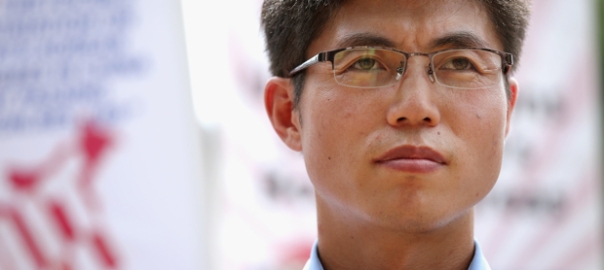
Twenty-seven years ago, Shin Dong-hyuk was born inside Camp 14, one of five sprawling political prisons in the mountains of North Korea. Located about 55 miles north of Pyongyang, the labor camp is a ‘complete control district,’ a no-exit prison where the only sentence is life.

No one born in Camp 14 or in any North Korean political prison camp has escaped. No one except Shin. This is his story.

A gripping, terrifying memoir with a searing sense of place, ESCAPE FROM CAMP 14 will unlock, through Shin, a dark and secret nation, taking readers to a place they have never before been allowed to go.

‘This is a story unlike any other’ Barbara Demick, author of Nothing to Envy: Ordinary Lives in North Korea


———————————————————–

This extraordinary story lifts the lid on the secretive  and  brutal totalitarian regime of North Korean ‘s labour camps and the forgotten political prisoners and their families whom are destined too  suffer unbelievable  inhumanity and are subject to summary execution at  the whims of their “guards”.

Shin Dong-hyuk ‘s story appalled and horrified me and I’m still trying to work out how such a place and regime could still exist in the 21st century and why the world is not doing more to eradicate the brutal and oppressive abuse of over 23 million North Korean people.

North Korea is a problem that the world will have to face up to at some stage and whilst   the supreme  leader Kim Jong-un   is obviously mad as a march hare and insane , his quest for nuclear weapons is not just a threat to his neighbour – but to the world in general and the stability to  the entire region.

—————————————————-

Shin Dong-hyuk

Shin Dong-hyuk (born 19 November 1982 or 1980 as Shin In Geun) is reputed to be the only known prisoner to have successfully escaped from a “total-control zone” grade internment camp in North Korea.

He was the subject of a biography, Escape from Camp 14: One Man’s Remarkable Odyssey From North Korea to Freedom in the West, by former Washington Post journalist Blaine Harden. Shin has given talks to audiences around the world about his life in Camp 14 and about the totalitarian North Korean regime to raise awareness of the situation in North Korean internment and concentration camps and North Korea.

Shin has been described as the world’s “single strongest voice” on the atrocities inside North Korean camps by a member of the United Nations’ first commission of inquiry into human rights abuses of North Korea. In January 2015, he recanted aspects of his story but a majority of experts continued to support his credibility as a victim of North Korean human rights abuses.

——————————————————

Camp 14: Total Control Zone

——————————————————

Biography

The following is Shin’s biography as told by him prior to 2015 which he later partially recanted.

Early life

Shin Dong-hyuk was born Shin In Geun  at the Kaechon internment camp, commonly known as Camp 14. He was born to two prisoners who were allowed to marry as a reward for good work, although:

“neither bride nor groom had much say in deciding whom they would marry.”

Shin’s father, Shin Gyung Sub, told Shin that the guards gave him his mother, Jang Hye-gyung, as payment for his skill in operating a metal lathe in the camp’s machine shop. Shin lived with his mother until he was 12. He rarely saw his father who lived elsewhere in the camp and was allowed to visit a few times a year. According to Shin, he saw his mother as a competitor for their insufficient food rations, and consequently had no bonds of affection with his parents or his brother, Shin He Geun.

The North Korean government officials and camp guards told him he was imprisoned because his parents had committed crimes against the state, and that he had to work hard and always obey the guards; otherwise he would be punished or executed.

Shin went to primary and secondary school while in the camp. The secondary school was “little more than slave quarters from which he was sent out as a rock picker, weed puller and dam labourer.” At one point, a young girl was beaten to death by the teacher for hoarding a few kernels of corn. His education did not include propaganda or even basic information about North Korea. The personality cult around Kim Il-Sung and Kim Jong-Il was also absent; for example there were no portraits of the Kim leaders on display.

The camp was near a hydroelectric dam and mines in which the prisoners were forced to labour. In one of Shin’s prison cells, where he was held during an interrogation, he said he had electricity and running water. Shin’s mother lived in a house with multiple rooms in a “model village” in the camp, given to women who had children.

Shin experienced considerable violence in the camp, and witnessed dozens of executions every year.Part of Shin’s right middle finger was cut off by his supervisor as punishment for accidentally breaking a sewing machine. He witnessed adult prisoners and children beaten every day, and many prisoners dying of starvation, illness, torture and work accidents. He learned to survive by any means, including eating rats, frogs, and insects, and reporting fellow inmates for rewards.

Scars and deformed arms  due to torture


Mother and brother plan to escape

When Shin was 13 years old, he overheard his mother and brother planning an escape attempt. Shin had just finished eating watery corn porridge, and was trying to sleep until he overheard that He Geun, his brother had run from the cement factory. Shin’s mother, Jang was preparing rice, a symbol of wealth in North Korea for the escape from Camp 14. Shin was jealous his brother was getting rice. Shin’s teacher was already in the gated Bowiwon village, so Shin told the night guard of his school with another boy, as informing was something he was taught to do from an early age, and he hoped to be rewarded. However, the school night guard took full credit for discovering the plan, and rather than being rewarded, Shin was arrested and guards tortured him for four days to extract more information, believing him to be part of the plan to escape.

According to Shin, the guards lit a charcoal fire under his back and forced a hook into his skin so that he could not struggle which caused many large scars still visible on his body.

On 29 November 1996, after approximately seven months spent in a tiny concrete prison cell, he was released and joined by his father, who had also been imprisoned. They were driven back to the main camp wearing blindfolds and their hands tied behind their backs. Camp officials then forced Shin and his father to watch the public executions of Shin’s mother and brother; he then understood he had been responsible for the executions.

Shin stated that at the time of the executions of his brother and mother, in his teenaged mind he felt they “deserved” their fates for both breaking prison rules and, conversely, not including him in the escape plan. Shin has since expressed remorse over his actions, saying in an interview with Anderson Cooper for the CBS television show 60 Minutes

, “My mother and brother, if I could meet them through a time machine, I would like to go back and apologize”.

In interviews to South Korea’s National Intelligence Service and others, and in his Korean language memoir, Shin had said that he had no prior knowledge of the escape. It was only when talking to Harden that he revised his story and said that he had informed on his mother and brother.

Escape with Park

While working at a textile factory, Shin became friends with a 40-year-old political prisoner from Pyongyang (surnamed Park), who was educated and had traveled outside North Korea. Park had been to East Germany, and China. Park said that he shook Kim Jong Il’s hand. Park told him about the outside world, such as stories about food that Shin had not experienced before. According to Shin, nearly every meal he had eaten up to that point had been a soupy gruel of cabbage, corn, and salt, with occasional wild-caught rats and insects. He was excited by the idea of being able to eat as much food as he wanted to, which Shin considered to be the essence of freedom. “I still think of freedom as roasted chicken,” he later acknowledged.

Shin decided to attempt to escape with Park. They formed a plan in which Shin would provide local information about the camp, while Park would use his knowledge once outside the camp to escape the country. On 2 January 2005, the pair was assigned to a work detail near the camp’s electric fence on the top of a 1,200-foot (370 m) mountain ridge to collect firewood. Noting the long interval between the guards’ patrols, the two waited until the guards were out of sight, then made their attempt to escape.

Park attempted to go through first, but was fatally electrocuted climbing the high voltage fence. Shin managed to pass over the wire using Park’s body as a shield to ground the current, but still suffered severe burns and permanent scars when his legs slipped onto the lowermost wire as he crawled over Park’s body.

After escaping, Shin broke into a nearby farmer’s barn and found an old military uniform. Wearing the uniform, he was able to masquerade as a North Korean soldier at times. He survived by scrounging and stealing food.Shin was unfamiliar with money, but within two days of his escape, he had sold a 10 lb (4.5 kg) bag of rice stolen from a house and used the money to buy cookies and cigarettes. Eventually, he reached the northern border with China along the Tumen River and bribed destitute North Korean border guards with food and cigarettes.

Revision in 2015

In January 2015, Shin contacted Blaine Harden and recanted parts of his story.Harden outlined the changes to Shin’s account in a new foreword to his book, Escape from Camp 14, but did not revise every detail. He said a complete revision of the book would have taken months and he wanted to publish the new version as soon as possible.


With Blain Harden


Shin told Harden that he had changed some dates and locations and incorporated some “fictive elements” into the story. Shin said that he did not spend his entire North Korean life at Camp 14. He said that he was born there, but when he was young, his family was transferred to the less severe Camp 18, and spent several years there. He said that not only did he inform on the escape plan of his mother and brother, but also falsely implicated them in murder. He said that he twice escaped from Camp 18. The first time, in 1999, he was caught within days. The second time, in 2001, he said he crossed into China, but was caught after four months by Chinese police and sent back to North Korea. He said that he was tortured in Camp 14 in 2002, when he was 20 years old (not 13, as previously stated), as punishment for his escape. He said he was repeatedly burned and tortured in an underground prison for six months. As a result of education in Camp 18, and his previous escapes, he said he wasn’t as naive about the outside world when he made his final escape from Camp 14 as he had previously described.

In Escape from Camp 14 Blaine Harden commented that, “Shin was the only available source of information about his early life.” In his new foreword for the book in 2015, he described Shin as an “unreliable narrator” and commented that, “It seems prudent to expect new revisions”, but also clarifying “I don’t know if that’s true (that the story will change)”. Harden theorized that “Shin appears to have been exposed to prolonged and repeated torture. We can expect that this would have a major impact on every aspect of who he is, on his memory, his emotional regulation, his ability to relate to others, his willingness to trust, his sense of place in the world, and the way he gives his testimony.”

A Russian-born Korean specialist Andrei Lankov commented that “some suspicions had been confirmed when Shin suddenly admitted what many had hitherto suspected”, described Harden’s book as unreliable, and noted that defectors faced considerable psychological pressure to embroider their stories.

Shin explained he did not tell the full story because he wished to hide “that my mother and brother were executed because of my report,” saying “the most important reason why I could not reveal all of the truth was because of my family.” He went on to say:

“All I did until last September was discuss the camps as they were, but once the video was released [of his father], the nastiness of North Korea infuriated me. Then I realized I should not hold anything back.”

Post-North Korea life

After spending some time working as a laborer in different parts of China, Shin was accidentally discovered by a journalist in a restaurant in Shanghai, and the reporter recognized the importance of his story. The journalist brought Shin to the South Korean embassy for asylum, and from there he traveled to South Korea, where he underwent extensive questioning from authorities to determine if he was a North Korean assassin or spy. Afterwards, his story was broadcast by the press and he published a Korean language memoir.

Shin later moved to southern California, changing his name from Shin In Geun to Shin Dong-hyuk in “an attempt to reinvent himself as a free man,” and worked for Liberty in North Korea (LiNK), a non-profit organization that raises awareness of human rights issues in North Korea and provides aid to North Korean refugees. Shin moved back to South Korea to campaign for the eradication of the North Korean prison camps.

In August 2013, Shin gave several hours of testimony to the United Nations‘ first commission of inquiry into human rights abuses of North Korea. A member of the UN commission described Shin as the world’s “single strongest voice” on the atrocities inside North Korean camps.

Shin described some aspects of his personal life in South Korea in a Financial Times interview, on popular culture saying that “I don’t really know anything about music. I can’t sing and I don’t feel any emotion from it. But I do watch lots of films and the one that moves me the most is Schindler’s List“. On food he says “I know everything is delicious. I look at the colours and the way the food is presented on the plate but it’s very difficult to choose. When I first came to South Korea, I was so greedy that I used to order too much food. Nowadays I try to order only as much as I can handle.” Although Shin lives in South Korea, he was informally adopted by an American couple in Ohio during his time in the United States. He says he maintains the relationship, “I have a good relationship with my US foster parents. I contact them often. Whenever I have a holiday, I visit them. I think of them as good parents and I try to be a good son.”

In December 2013, Shin wrote an open letter in the Washington Post to American basketball star Dennis Rodman who visited North Korea a number of times as a self-avowed “friend for life”[43] of Kim Jong-un.

North Korean response

In 2012, when the United Nations Working Group on Arbitrary Detention asked the North Korean government about the status of Shin Dong-hyuk’s father, they responded that there was no such person.  Then in 2014, after identifying Shin Dong-hyuk as Shin In Geun, the North Korean government produced a video which attempted to discredit Shin through interviews with his father and other supposed witnesses. His father denied Shin had grown up in a prison camp. According to the video, Shin had worked in a mine and fled North Korea after being accused of raping a 13-year-old girl. It also said that Shin’s mother and brother were guilty of murder. The video claimed he was now spreading “preposterous false information” about human rights. Shin confirmed the man was his father. He said that the rape allegation was a fabrication that he had heard before. He later confirmed that his mother and brother were convicted of murder, but stated they were innocent.

Shin said that he believed the North Korean government was sending him a message to be quiet about human rights abuses or his father would be killed, in effect holding his father hostage. The video prompted Shin to recant parts of his story.

Books and films

In 2012, journalist Blaine Harden published Escape from Camp 14: One Man’s Remarkable Odyssey From North Korea to Freedom in the West, based on his interviews with Shin. Harden gave a one-hour interview about the book on the C-SPAN television program Q&A.

Executive Director of the US Committee for Human Rights in North Korea, Greg Scarlatoiu, said the book played “an important role” in raising wider public awareness of the North Korean camps.  Dalhousie University issued a statement averring that Shin’s story, as told through the book, “has shifted the global discourse about North Korea, shining a light on the human rights abuses so prevalent within the regime.”

A German documentary, Camp 14: Total Control Zone, directed by Marc Wiese, was released in 2012.  It includes interviews with Shin Dong-hyuk and two former North Korean officers: the first, Kwon Hyuk, was a guard in Camp 22 and brought out amateur film footage (the only known footage of Camp 22), and the second, Oh Yang-nam, was a secret policeman who arrested people who were sent to camps. Supplementing the film are animated sequences of the camp created by Ali Soozandeh.

On 2 December 2012, Shin was featured on 60 Minutes during which he recounted to Anderson Cooper his story of his life in Camp 14 and escape. Shin said “when I see videos of the Holocaust it moves me to tears. I think I am still evolving—from an animal to a human.”

Awards and honours

In June 2013, Shin received the Moral Courage Award given by UN Watch, a Geneva-based NGO (non-governmental organization).

In May 2014, Shin was awarded an honorary Doctor of Laws degree from Dalhousie University (Nova Scotia, Canada). Students at the university “held a peace march and launched a social media campaign to raise awareness of human rights violations in North Korea. They then fundraised to bring Mr. Shin to Halifax, where his speech to an over-capacity crowd drew international attention

——————————————————————–

Camp 14

Kaechon internment camp

Kaechon internment camp (Hangeul: 개천 제14호 관리소, also spelled Kae’chŏn or Gaecheon) is a forced labor camp in North Korea for political prisoners. The official name is Kwan-li-so (Penal-labor colony) No. 14. It is not to be confused with Kaechon concentration camp (Kyo-hwa-so No. 1), which is located 20 km (12 mi) to the northwest. This place is commonly known as Camp 14.

Description

Kaechon internment camp is located in North Korea

Pyongyang
Pyongyang
Kaechon
Kaechon

Location of Kaechon camp in North Korea

The camp was established around 1959  in central North Korea near Kae’chŏn county, South Pyongan Province. It is situated along the middle reaches of Taedong river, which forms the southern boundary of the camp, and includes the mountains north of the river, including Purok-san. Bukchang, a concentration camp (Kwan-li-so No. 18) adjoins the southern banks of the Taedong River. The camp is about 155 km2 (60 sq mi) in area, with farms, mines and factories threaded through steep mountain valleys.

The camp includes overcrowded barracks that house males, females, and older children separately, and a headquarters with administration and guards housing.

Altogether around 15,000 prisoners live in Kaechon internment camp.

Purpose

The main purpose of Kaechon internment camp is to keep politically unreliable persons classed “unredeemable”[1] isolated from society, and exploit their labor. Those sent to the camp include officials perceived to have performed poorly in their job, people who criticize the regime and anyone suspected of engaging in “anti-government” activities. Prisoners have to work in one of the coal mines, in one of the factories that produce textiles, paper, food, rubber, shoes, ceramics and cement or in agriculture.

Human rights situation

Many prisoners of the camp were born there under North Korea’s “three generations of punishment”. This means anyone found guilty of committing a crime, which could be as simple as trying to escape North Korea, would be sent to the camp along with that person’s entire family. The subsequent two generations of family members would be born in the camp and must also live their entire lives and die there.

As reported by witnesses, the prisoners have to do very hard and dangerous work in mines and other workplaces from 5:30 in the morning until midnight. Even 11-year-old children have to work after school and may see their parents rarely. People are forced to work like slaves and are tortured in case of minor offences.

Food rations are very small, consisting of salted cabbage and corn, so that the prisoners are very skinny and weak. Many die of undernourishment, illness, work accidents, and the aftereffects of torture. Many prisoners resort to eating frogs, insects, rats, snakes, and even convert to cannibalism in order to try to survive.  Eating rat flesh helps to prevent pellagra, a common disease in the camp which results from the absence of protein and niacin in the diet. In order to eat anything outside of the prison-sanctioned meal, including these animals, prisoners must first get permission from the guards.

Imprisoned witnesses

Shin Dong-hyuk
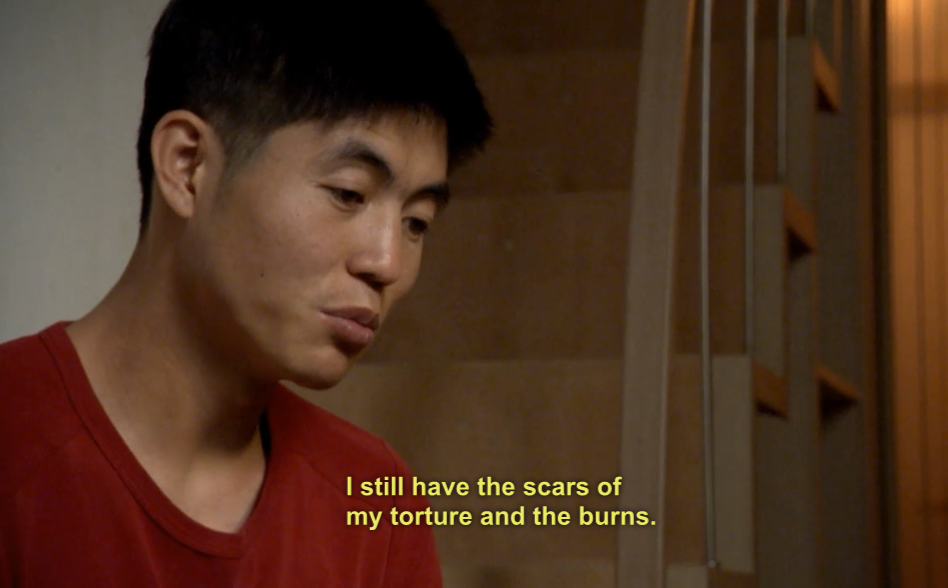
In his official biography Escape from Camp 14 by Blaine Harden, Shin Dong-hyuk claimed that he was born in the camp and lived there until escaping in his early twenties. In 2015, Shin recanted some of this story.  Shin told Harden that he had changed some dates and locations and incorporated some “fictive elements” into his account. Harden outlined these revisions in a new foreword, but did not revise the entire book. Shin said that he did not spend his entire North Korean life at Camp 14. Though maintaining that he was born there, he stated that, when he was young, his family was transferred to the less severe Camp 18, and spent several years there. He said that he was tortured in Camp 14 in 2002, as punishment for escaping from Camp 18.

Kim Yong

Kim Yong (1995–1996 in Kaechon, then in Bukchang) was imprisoned after it was revealed that two men executed as alleged US spies were his father and brother. He witnessed approximately 25 executions in his section of the camp within less than two years


13th March – Deaths & Events in Northern Ireland Troubles

Key Events & Deaths on this day in Northern Ireland Troubles

13th March

Monday 13 March 1972

[Public Records 1972 – Released 1 January 2003:

A Letter from Sir Alec Douglas-Home, then Foreign Secretary, to Edward Heath, then Prime Minister. The letter sets out Douglas-Home’s opposition to Direct Rule and a preference for a United Ireland.]

Wednesday 13 March 1974

Liam Cosgrave, then Taoiseach (Irish Prime Minister), made a statement in the Dáil in which he said that the position of Northern Ireland within the United Kingdom could not be changed except with the consent of a majority of the people of Northern Ireland.

Thursday 13 March 1975

Two people died as a result of a Ulster Volunteer Force (UVF) gun and bomb attack on Conway’s Bar, Greencastle, Belfast.

One of those killed was a Catholic civilian, and the other was a member of the UVF who died when the bomb he was planting in the pub exploded prematurely. A Catholic civilian died three weeks after been shot by Loyalists in Belfast.

Thursday 13 March 1986

It was announced that additional British Army soldiers would be sent to Northern Ireland to support the Royal Ulster Constabulary (RUC).

The move was the result of Unionist protests against the Anglo-Irish Agreement (AIA).

In the High Court in Glasgow, Scotland, two men were sentenced to eight years’ imprisonment for attempting to acquire arms for the Ulster Volunteer Force (UVF).

Tuesday 13 March 1990

The Irish Supreme Court upheld the appeal of Dermot Finucane and James Clarke against extradition to Northern Ireland. The two men had escaped from the Maze Prison, Northern Ireland, on 25 September 1983. The decision caused uproar among Unionist politicians and the British Government

Wednesday 13 March 1991

An opinion poll carried out for The Guardian (a British newspaper) by International Communications and Marketing showed that 43 per cent of people were in support of the withdrawal of the British Army from Northern Ireland.

Of those questioned, 43 per cent were in favour of the reunification of Ireland, while 30 per cent wanted Northern Ireland to remain part of the United Kingdom (UK).

Friday 13 March 1992

The Garda Síochána (the Irish police) uncovered a number of weapons at County Donegal, Republic of Ireland.

Sunday 13 March 1994

Third IRA Mortar Attack on Heathrow

Heathrow Airport was closed for two hours following a third Irish Republican Army (IRA) mortar attack. None of the mortars exploded.

[The mortars had been concealed underground and were fired from a wooded area close to the perimeter fence. There had been two previous attacks on 9 March 1994 and 11 March 1994.]

The leadership of the IRA issued a statement which said that their “positive and flexible” attitude to the peace process was “abiding and enduring”.

Thursday 13 March 1997

The Irish Republican Army (IRA) carried out a bomb attack in the Short Strand area of east Belfast and injured a British soldier and a Royal Ulster Constabulary (RUC) officer.

Twenty Republicans were warned by the RUC that their names were on a list found in the possession of a man suspected of being a member of the Ulster Volunteer Force (UVF).

The man was arrested during an attempted post office robbery in the Village area of Belfast.

The British Home Office announced that Roisín McAliskey, then being held in prison awaiting a decision about extradition, would be allowed to keep her baby in the mother and baby unit of Holloway Prison.

Wednesday 13 March 2002

There was a series of events in the White House, Washington, USA, to mark the celebrations leading to St Patrick’s Day.

The leaders of the three main political parties in Northern Ireland attended, however Ian Paisley, then leader of the Democratic Unionist Party (DUP), stayed away from the event because he did not wish to be photographed alongside Gerry Adams, then President of Sinn Féin (SF).

Bertie Ahern, then Taoiseach (Irish Prime Minister), presented George Bush, then President of the USA, with a bowl of shamrock. Ahern dismissed comments earlier in the day by David Trimble, then leader of the Ulster Unionist Party (UUP).

At a morning debate Trimble had renewed his criticism of the Republic of Ireland. He described the recent abortion referendum as “a sectarian exercise” and a “sectarian vote”.

In Northern Ireland the prospect of an agricultural show being held on a Sunday was averted. The Orange Order had threatened “to take every action necessary, regardless of the consequences”, to prevent the 102 year old Ballymena Show being extended into the Sabbath for the first time.

In the face of such opposition the County Antrim Agricultural Association withdrew the proposal. Ken Good (49), the Church of Ireland Archdeacon of Dromore, was appointed as Bishop of Derry and Raphoe. He succeeded James Mehaffey, who retired in January.

  ——————————————————————

Remembering all innocent victims of the Troubles

Today is the anniversary of the death of the following people killed as a results of the conflict in Northern Ireland

“To live in hearts we leave behind is not to die

– Thomas Campbell

To the innocent on the list – Your memory will live  forever

– To  the Paramilitaries  –

There are many things worth living for, a few things worth dying for, but nothing worth killing for.

13 People   lost their lives on the 13th March between 1972 – 1991

 —————————————————————————

13 March 1972
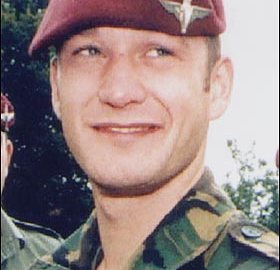
Patrick McCrory,   (19)

Catholic
Status: Civilian (Civ),

Killed by: Ulster Volunteer Force (UVF)
Shot at his home, Ravenhill Avenue, Belfast.

 —————————————————————————

13 March 1973
John King,  (22)

nfNI
Status: British Army (BA),

Killed by: Irish Republican Army (IRA)
Killed by booby trap bomb while on British Army (BA) foot patrol, Coolderry, near Crossmaglen, County Armagh.

 —————————————————————————

13 March 1974


David Farrington,  (23)

nfNI
Status: British Army (BA),

Killed by: Irish Republican Army (IRA)
Shot while at British Army (BA) pedestrian check point, Chapel Lane, Belfast

 —————————————————————————

13 March 1975
Marie Doyle,  (38)

Catholic
Status: Civilian (Civ),

Killed by: Ulster Volunteer Force (UVF)
Shot, during gun and bomb attack on Conways Bar, Greencastle, Belfast.

 —————————————————————————

13 March 1975
George Brown,  (22)

Protestant
Status: Ulster Volunteer Force (UVF),

Killed by: Ulster Volunteer Force (UVF)
Injured in premature explosion during Ulster Volunteer Force (UVF) bomb and gun attack on Conways Bar, Greencastle, Belfast. He died 28 April

 —————————————————————————

13 March 1975
Robert Skillen,   (19)

Catholic
Status: Civilian (Civ),

Killed by: Ulster Defence Association (UDA)
Died three weeks after being shot in Parke’s grocery shop, North Queen Street, New Lodge, Belfast.

 —————————————————————————

13 March 1976
 Alexander Frame,  (26)

Protestant
Status: Ulster Volunteer Force (UVF),

Killed by: Ulster Defence Association (UDA)
Found beaten to death, Aberdeen Street, Shankill, Belfast. Ulster Defence Association / Ulster Volunteer Force (UVF) feud

 —————————————————————————

13 March 1976


Nicholas White,   (34)

nfNI
Status: ex-British Army (xBA),

Killed by: Irish Republican Army (IRA)
Youth worker. Shot at youth club, Alliance Avenue, Ardoyne, Belfast.

 —————————————————————————

13 March 1977
William Brown,   (18)

Protestant
Status: Royal Ulster Constabulary (RUC),

Killed by: Irish Republican Army (IRA)
Shot by sniper while on Royal Ulster Constabulary (RUC) mobile patrol, Ballagh Cross Roads, Donagh, near Lisnaskea, County Fermanagh.

 —————————————————————————

13 March 1979
Robert McNally,   (20)

Protestant
Status: Ulster Defence Regiment (UDR),

Killed by: Irish National Liberation Army (INLA)
Off duty. Died seven days after being injured by booby trap bomb attached to his car, which exploded while leaving car park, West Street, Portadown, County Armagh.

 —————————————————————————

13 March 1984


Ronald Funston,  (28)

Protestant
Status: ex-Ulster Defence Regiment (xUDR),

Killed by: Irish Republican Army (IRA)
Shot at his farm, Lowery, near Pettigoe, County Fermanagh.

 —————————————————————————

13 March 1987
John Chambers,  (56)

Protestant
Status: Civilian (Civ),

Killed by: Irish Republican Army (IRA)
Shot while driving lorry, Killowen, near Rostrevor, County Down. Off duty Ulster Defence Regiment (UDR) member intended target.

 —————————————————————————

13 March 1991
Lord Kaberry,  (83)

nfNIB
Status: Civilian Political Activist (CivPA),

Killed by: Irish Republican Army (IRA)
Former Conservative Member of Parliament. Died 8 months after being injured, in bomb attack on Carlton Club, St James Street, London. Attack occurred on 25 June 1990

 —————————————————————————

Veronica Guerin – 1958 – 1996.Life & Death

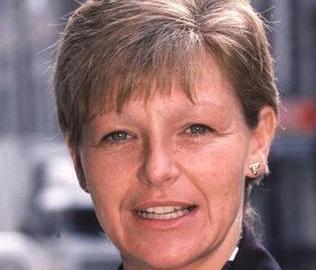
Veronica Guerin

5 July 1958 – 26 June 1996

Veronica Guerin (5 July 1958 – 26 June 1996) was an Irish crime reporter who was murdered on 26 June 1996 by drug lords, an event which helped establish the Criminal Assets Bureau.

Veronica Guerin
Veronica Guerin real person.jpg

Guerin in the 1990s
Born (1958-07-05)5 July 1958[1]
Dublin, Ireland
Died 26 June 1996(1996-06-26) (aged 37)
Naas Dual Carriageway, Newlands Cross, County Dublin
Education Trinity College, Dublin
Occupation Accountant, journalist
Years active 1990–1996
Notable credit(s)
Religion Roman Catholic
Spouse(s) Graham Turley
Children Cathal

———————-

Dublin Gangland

———————-

Early and personal life

The daughter of accountant Christopher and his wife Bernadette,  Veronica was nicknamed “Ronnie.” She and her four siblings were born and brought up in Artane, Dublin, and attended Catholic school where she excelled in athletics. Besides basketball and camogie, aged 15 she played in the all-Ireland football finals with a slipped disc.  Guerin studied accountancy at Trinity College, Dublin.

Guerin married Graham Turley, and the couple had a son Cathal. A big fan of Manchester United football team, her prized possession was a photo of her and Eric Cantona taken on a visit to Old Trafford.

PR career: 1983–1990

After she graduated, her father employed her at his company; but following his death three years later, she changed professions and started a public relations firm in 1983, which she ran for seven years.
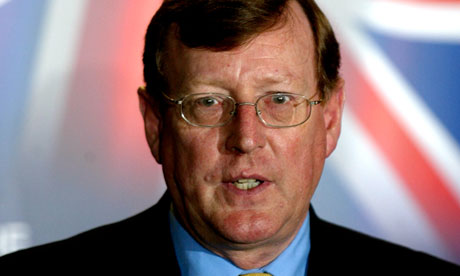
In 1983–84, she served as secretary to the Fianna Fáil group at the New Ireland Forum.[5] She served as Charles Haughey‘s personal assistant, and became a family friend, taking holidays with his children. In 1987 she served as election agent and party treasurer in Dublin North for Seán Haughey.

Journalism career: 1990–1996

In 1990, she changed careers again, switching to journalism as a reporter with the Sunday Business Post and Sunday Tribune, working under editor Damien Kiberd. Craving first-hand information, she pursued a story directly to the source with little regard for her personal safety, to engage those she deemed central to a story. This allowed her to build close relationships with both the legitimate authorities, such as the Garda Síochána (police), and the criminals, with both sides respecting her diligence by providing highly detailed information. She also reported on Irish Republican Army activities in the Republic of Ireland.

From 1994 onwards, she began to write about criminals for the Sunday Independent. Using her accountancy knowledge to trace the proceeds of illegal activity, she used street names or pseudonyms for underworld figures to avoid Irish libel laws.

When she began to cover drug dealers, and gained information from convicted drugs criminal John Traynor, she received numerous death threats. The first violence against her occurred in October 1994, when two shots were fired into her home after her story on murdered crime kingpin Martin Cahill was published. Guerin dismissed the “warning”. The day after writing an article on Gerry “The Monk” Hutch, on 30 January 1995, she answered her doorbell to a man pointing a revolver at her head. The gunman missed and shot her in the leg. Regardless, she vowed to continue her investigations. Independent Newspapers installed a security system to protect her, and the police gave her a 24-hour escort; however, she did not approve of this, saying that it hampered her work.[citation needed]

On 13 September 1995, convicted criminal John Gilligan, Traynor’s boss, attacked her when she confronted him about his lavish lifestyle with no source of income. He later called her at home and threatened to kidnap and rape her son, and kill her if she wrote anything about him.

Guerin received the International Press Freedom Award from the Committee to Protect Journalists in December 1995.

Murder

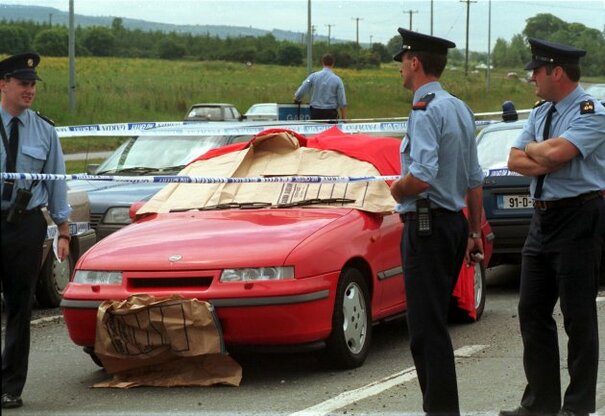
Murder Scene


—————————————-

Veronica Guerin – Murder

—————————————-

On the evening of 25 June 1996, Gilligan drug gang members Charles Bowden, Brian Meehan, Peter Mitchell and Seamus Ward had met at their distribution premises on the Greenmount Industrial Estate. Bowden, the gang’s distributor and ammunition quartermaster, had supplied the three with a Colt Python revolver loaded with .357 Magnum Semiwadcutter bullets.

On 26 June 1996, while driving her red Opel Calibra, Guerin stopped at a red traffic light on the Naas Dual Carriageway near Newlands Cross, on the outskirts of Dublin, unaware she was being followed. She was shot six times, fatally, by one of two men sitting on a motorcycle.

About an hour after Guerin was murdered, a meeting took place in Moore Street, Dublin, between Bowden, Meehan, and Mitchell. Bowden later denied under oath in court that the purpose of the meeting was the disposal of the weapon but rather that it was an excuse to appear in a public setting to place them away from the incident.

At the time of her murder, Traynor was seeking a High Court order against Guerin, to prevent her from publishing a book about his involvement in organised crime.[

Guerin was killed two days before she was due to speak at a Freedom Forum conference in London. The topic of her segment was “Dying to Tell the Story: Journalists at Risk.

Her funeral was attended by Ireland’s Taoiseach John Bruton, and the head of the armed forces. It was covered live by Raidió Teilifís Éireann. On 4 July, labour unions across Ireland called for a moment of silence in her memory, which was duly observed by people around the country. Guerin is buried in Dardistown Cemetery, County Dublin.

Aftermath

—————————————

Ward charged with murder

—————————————

Guerin’s murder caused outrage, and Taoiseach John Bruton called it “an attack on democracy”. The Oireachtas, the Irish parliament, realised the potential of using tax enforcement laws as a means of deterring and punishing criminals. Within a week of her murder, it enacted the Proceeds of Crime Act 1996 and the Criminal Assets Bureau Act 1996, so that assets purchased with money obtained through crime could be seized by the government. This led to the formation of the Criminal Assets Bureau (CAB).

After the murder of Guerin, Bowden was arrested as were the other members of Gilligan’s gang who were still in Ireland. In an agreement with the Attorney General of Ireland, Bowden agreed to turn state’s witness, and become the first person to enter the Republic of Ireland’s Witness Security Programme. Granted immunity from prosecution for the murder of Guerin, he was the only witness to give evidence against all four drug gang members at their trials in the Special Criminal Court: Patrick Holland, Paul “Hippo” Ward, Brian Meehan and John Gilligan. The investigation into Guerin’s death resulted in over 150 other arrests and convictions, as well as seizures of drugs and arms. Drug crime in Ireland dropped 15 percent in the following 12 months.

Patrick “Dutchy” Holland

In 1997 while acting as a Garda witness, Bowden named Patrick “Dutchy” Holland in court as the man he supplied the gun to, and hence suspected of shooting Guerin. Holland was never convicted of the murder, and he denied the accusation up until his death in June 2009 while in prison in the UK.

In November 1998, after evidence from Bowden and others, Paul “Hippo” Ward was convicted of the murder and sentenced to life in prison as an accomplice, because he had disposed of the murder weapon and the motorbike. This conviction was later overturned on appeal.

Brian Meehan fled to Amsterdam with Traynor (who later escaped to Portugal). After the court dismissed additional evidence from Bowden, Meehan was convicted on the testimony of gang member turned state’s witness Russell Warren, who had followed Guerin’s movements in the hours before the murder, and then called Meehan on a mobile phone with the details. Meehan was convicted of murdering Guerin, and sentenced to life imprisonment.

John Gilligan left Ireland the day before Guerin was murdered, on a flight to Amsterdam. He was arrested 12 months later in the United Kingdom trying to board a flight for Amsterdam, after a routine search of his baggage revealed $500,000 in cash. Claiming it was the proceeds of gambling, he was charged with money laundering. After a three-year legal battle, he was extradited to Ireland on 3 February 2000. Tried and acquitted of Guerin’s murder, he was later convicted of importing 20 tonnes of cannabis and sentenced to 28 years in prison, reduced to 20 years on appeal.

Pursued by CAB, in January 2008, Gilligan made a court appearance in an attempt to stop the Irish State from selling off his assets. He accused Traynor of having ordered Guerin’s murder without his permission. Despite the presiding judge’s attempt to silence Gilligan, he continued to blame a botched Gardaí investigation and planted evidence as the reason for his current imprisonment. Traynor had fled to Portugal after Guerin’s murder, and having been on the run from British authorities since 1992, resided mainly in Spain and the Netherlands from 1996 onwards. After a failed extradition from the Netherlands in 1997, which brought Meehan back to Ireland, in 2010 Traynor was arrested after a joint UK SOCA/Regiokorpsen operation in Amsterdam. Traynor, as of 2013, is living in Kent, England after serving time in an English gaol. It is reported that he is still wanted for tax evasion in Ireland.

Turley remarried in 2011

Memorial

Monument to Veronica Guerin, located in Dublin Castle gardens


A memorial statue to Guerin is located in Dubh Linn Gardens, in the grounds of Dublin Castle.

On 2 May 1997, at a ceremony in Arlington, Virginia, her name and those of 38 other international journalists who died in the line of duty in 1996 were added to the Freedom Forum Journalists Memorial. Her husband addressed the audience:

“Veronica stood for freedom to write. She stood as light, and wrote of life in Ireland today, and told the truth. Veronica was not a judge, nor was she a juror, but she paid the ultimate price with the sacrifice of her life.”

In 2000, Guerin was named as one of the International Press Institute‘s 50 World Press Freedom Heroes of the past 50 years.

In 2007, the Veronica Guerin Memorial Scholarship was set up at Dublin City University, offering a bursary intended to meet the cost of fees and part of the general expenses of an MA in Journalism student who wishes to specialise in investigative journalism

—————————————

The murder of Veronica Guerin

—————————————

See Dublin’s deadly Gang War

david byrne bobdy

See Dublin’s deadly Gang War

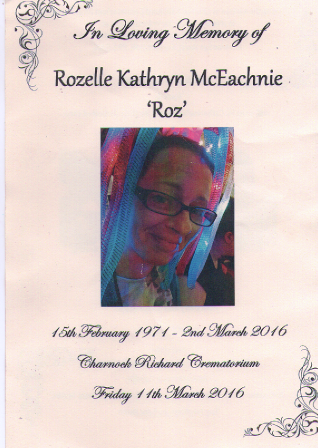
Rozelle Kathryn McEachnie 15th Feb 1971 -2nd March 2016

Rest in Peace – Roz, I still can’t believe your gone.

rozell funeral order of service resized

I said goodbye to a friend today for the final time and now I feel sad and depressed and a dark cloud  of  melancholy is threatening to envelope my entire being.

Normally I like to embrace the good in  life and am a happy chappy by nature – but certain things like the death of a loved one or someone close to me can send me off on a journey down the dark corridors of depression and I can spend days/weeks in varying states of gloom.

But I’m making an effort not to give in to the depression  – because Roz was always happy and  faced her illness with her usual attitude towards life and just got on with it.

But this was one battle she could never beat and in the end Cancer claimed another beautiful, young  life that was cut way too short  and left friends and family without a mother, wife, daughter,sister, aunty ,cousin, a friend ………….and so very much more..

Death comes to us all and yet the reality of seeing someone you loved or cared for for the final time can never be easy and we are left with a lifetime of sorrow and never ending grief .

But life must go on and it always does, but always in the background there is something missing and our hearts  are scarred forever by the pain of missing someone we can never again see in this lifetime.

So rest in peace Roz, until me will again!!

xx

12th March – Deaths & Events in Northern Ireland Troubles

Key Events & Deaths on this day in Northern Ireland Troubles

12th March

———————————————

Friday 12 March 1971

Thousands of Belfast shipyard workers took part in a march demanding the introduction of Internment for members of the Irish Republican Army (IRA).

Saturday 12 March 1977

Roy Mason, then Secretary of State, denied that his officials were engaged in ‘black propaganda’.

Wednesday 12 March 1986

Evelyn Glenhomes, then wanted by British police on suspicion of involvement in the Brighton bombing on 12 October 1984, was arrested in Ireland.

[The British authorities began a process to extradite Glenhomes. However, on 24 March 1986 Glenhomes was released from custody due to administrative errors in the extradition warrant.]

Wednesday 12 March 1997

The Irish News carried a report which claimed that the group ‘Loyalist Solidarity on the Right to March’ was planning to hold a series of rallies in areas where Orange Order parades were being contested.

There was a meeting in Dublin of the Anglo-Irish Conference attended by Patrick Mayhew, then Secretary of State for Northern Ireland, and Dick Spring, then Tánaiste (deputy Irish Prime Minister and Minister for Foreign Affairs).


In their joint communiqué there was a call for compromise over the issue of contentious parades. Mary Robinson, then President of the Republic of Ireland, announced that she would not be seeking a second term of office.

Thursday 12 March 1998

Gerry Adams, then President of Sinn Féin (SF), travelled to London for talks with Tony Blair, then British Prime Minister.

In the Republic of Ireland the Irish Labour Party has won by-elections in Limerick East and Dublin North, which reduced the government’s overall majority to one.


The punt hit its lowest level against sterling for nine years, closing at 81.95p. Albert Reynolds, formerly Taoiseach (Irish Prime Minister) announced his retirement when he said that he would not stand for the Daíl at the next general election.

[Reynolds had played a vital role in the Peace Process.]

Friday 12 March 1999

A man was shot in the leg during a paramilitary ‘punishment’ attack in Newry, County Armagh. Republican paramilitaries were believed to have been responsible

Tuesday 12 March 2002

David Trimble (UUP), then First Minister, and Mark Durkan (SDLP), then Deputy First Minister, arrived in Washington, USA, to carry out a series of engagements during a three-day visit. These included meetings with a number of senior representatives of the US administration, among them Colin Powell (Gen.), then Secretary of State.

Bertie Ahern, then Taoiseach (Irish Prime Minister), was also in Washington where he attended the annual dinner of the US Ireland Fund, and was presented with an award for his contribution to the peace process.

The Garda Síochána (the Irish police) and the Police Service of Northern Ireland (PSNI) launched their first formal exchange training programme aimed at forging closer ties between the two services.


 —————————————————————————

Remembering all innocent victims of the Troubles

Today is the anniversary of the death of the following people killed as a results of the conflict in Northern Ireland

“To live in hearts we leave behind is not to die

– Thomas Campbell

To the innocent on the list – Your memory will live  forever

– To  the Paramilitaries  –

There are many things worth living for, a few things worth dying for, but nothing worth killing for.

7 People   lost their lives on the 12th March between 1972 – 1992


—————————————————————————

12 March 1972


Bernadette Hyndman,   (24)

Catholic
Status: Civilian (Civ),

Killed by: Official Irish Republican Army (OIRA)
Shot outside her home during sniper attack on British Army (BA) foot patrol, Abyssinia Street, Lower Falls, Belfast.

—————————————————————————

12 March 1973


Edward Sharpe, (28)

Catholic
Status: Civilian (Civ),

Killed by: British Army (BA)
Shot by British Army (BA) sniper, at the front door of his home, Cranbrook Gardens, Ardoyne, Belfast.

—————————————————————————

12 March 1973
Alan Welsh, (16)

Protestant
Status: Ulster Defence Association (UDA),

Killed by: Ulster Defence Association (UDA)
Died one week after being injured in premature explosion at derelict shop, Woodstock Road, Belfast.

—————————————————————————

12 March 1974


Billy Fox, (36)

nfNIRI
Status: Civilian Political Activist (CivPA),

Killed by: Irish Republican Army (IRA)
Fine Gael member of Seanad Eireann. Found shot near to his girlfriend’s home, Tircooney, near Clones, County Monaghan.

—————————————————————————

12 March 1975

Clarke, Joseph


Joseph Clarke,   (18)

Catholic
Status: Civilian (Civ),

Killed by: non-specific Loyalist group (LOY)
Died eight days after being shot at his home, Rushfield Avenue, Ballynafeigh, Belfast

—————————————————————————

12 March 1975


Raymond Carrothers, (51)

Protestant
Status: Civilian (Civ),

Killed by: non-specific Republican group (REP)
Shot at his home, Orient Gardens, off Cliftonville Road, Belfast.

—————————————————————————

12 March 1992


Liam McCartan,  (32)

Catholic
Status: Civilian (Civ),

Killed by: Ulster Freedom Fighters (UFF)
Shot at his home, Alliance Avenue, Ardoyne, Belfast.

—————————————————————————


11th March – Deaths & Events in Northern Ireland Troubles

Key Events & Deaths on this day in Northern Ireland Troubles

11th March

—————————————————

Tuesday 11 March 1969

The Parliamentary Commissioner Bill was introduced which would allow for the appointment of an Ombudsman to investigate complaints against Stormont government departments.

Friday 11 March 1977

Twenty-six members of the UVF were sentenced in a Belfast court to a total of 700 years in prison.

[The imprisonment of so many members of the UVF is believed to have helped curtailed paramilitary activities by this group.]
Tuesday 11 March 1980

The body of Thomas Niedermayer, a West German industrialist who had disappeared in December 1973, was found at Colinglen Road, West Belfast.

Friday 11 March 1983

The Irish government announced that it was establishing a forum which became known as the New Ireland Forum. The Forum was proposed by the Social Democratic and Labour Party (SDLP).

[Many commentators considered the Forum to be a response to the perceived threat that was presented by Sinn Féin (SF) to the electoral position of the SDLP as the main Nationalist party in Northern Ireland. All the constitutional Nationalist parties in Ireland, with the exception of SF, were invited to attend the Forum. The first meeting of the Forum took place on 30 May 1983 and the final report was published on 2 May 1984.]

James Prior, then Secretary of State for Northern Ireland, said that the British government would not co-operate with the inquiry on the conflict that had been set up by the Political Committee of the European Parliament. The Rapporteur was Mr N.J. Haagerup.

[The report was drawn up and passed by the European Parliament on 29 March 1984.]

Tuesday 11 March 1986

The Royal Ulster Constabulary (RUC) arrested three Democratic Unionist Party (DUP) Assembly Members when they tried to enter Stormont Castle where the Anglo-Irish Intergovernmental Conference was in session.

[The DUP members were attempting to cut through a wire fence when they were arrested.]

The House of Representatives in the United States of America (USA) unanimously voted to approve a $250 million aid package, over a five year period, to Northern Ireland to support the Anglo-Irish Agreement (AIA).

Wednesday 11 March 1987

Garret FitzGerald resigned as leader of Fine Gael (FG). He was replaced on 21 March 1987 by Alan Dukes.

Friday 11 March 1988

Andy Tyrie, then chairman of the Ulster Defense Association (UDA), resigned his post after losing a vote of confidence. A bomb had been planted under his car several days earlier and it was widely assumed to have been planted by Loyalists.

Wednesday 11 March 1992

John Major, then British Prime Minister, announced that there would be a general election on 9 April 1992.

Friday 11 March 1994

Second IRA Mortar Attack on Heathrow

Francis Brown (38), a Catholic civilian, was killed by a bomb planted by the Ulster Volunteer Force (UVF) in Portadown, County Armagh.

In a second attack on Heathrow Airport the Irish Republican Army (IRA) launched four mortars over the perimeter fence. None of the mortars exploded. A Royal Air Force plane with the Queen on board landed at the airport while the security forces were conducting a search of the terminal.

[There had been a previous attack on 9 March 1994. The mortars were fired from a wooded area close to the perimeter fence. The police carried out a further search of wooded areas but discovered no further mortars. However, there was another attack on the airport on 13 March 1994.]

Monday 11 March 1996

David Trimble, then leader of the Ulster Unionist Party (UUP), met with the leaders of the Irish Coalition Government in Dublin

Thursday 11 March 1999

lee glegg

See Lee Clegg

Lee Clegg, then a soldier in the Parachute Regiment, was cleared in a Belfast court of murdering teenager Karen Reilly during an incident involving a stolen car in west Belfast on 30 September 1990. Justice Kerr ruled that it was not certain that Clegg had fired the fatal shot. The judge upheld Clegg’s conviction for attempting to wound Martin Peake with intent. The judge described Clegg’s version of events as “untruthful and incapable of belief”.

[Clegg had been released from prison in 1995.]

Monday 11 March 2002

There was further reaction to a speech made by David Trimble, then leader of the Ulster Unionist Party (UUP), on Saturday 9 March 2002.

Trimble said that he stood by his description of the Republic of Ireland as “pathetic, sectarian State”, and he accused nationalists of over-reacting.

Martin McGuinness, then Vice-President of Sinn Féin (SF), described Trimble as “a twit” and said it was not the behaviour expected of a Nobel Peace Prize winner.

Walton Empey (Dr), then Archbishop of Dublin, said Trimble’s comments were totally uncalled for.

Ruairí Quinn, then Labour leader, said the comments were ill-considered and ill-informed.

The Garda Síochána (the Irish police) arrested Martin Ferris, then Sinn Féin (SF) candidate for Kerry North, Republic of Ireland, and questioned him about an alleged vigilante abduction in early December 2001.

A total of six SF members had been questioned about the incident. George Bush, then President of the United States of America (USA), decreed March as Irish-American Heritage Month with a proclamation that paid tribute to the role of the Irish in the history of the US.

    —————————————————————————

Remembering all innocent victims of the Troubles

Today is the anniversary of the death of the following people killed as a results of the conflict in Northern Ireland

“To live in hearts we leave behind is not to die

– Thomas Campbell

To the innocent on the list – Your memory will live  forever

– To  the Paramilitaries  –

There are many things worth living for, a few things worth dying for, but nothing worth killing for.

6 People   lost their lives on the 11th March between 1974 – 1994


—————————————————————————

11 March 1974


George Keating,  (47)

Catholic
Status: Civilian (Civ),

Killed by: Ulster Volunteer Force (UVF)
Shot during gun attack on Bunch of Grapes Bar, Garmoyle Street, Belfast.

—————————————————————————

11 March 1976
Harry Scott,  (64)

Protestant
Status: Civilian (Civ),

Killed by: Irish Republican Army (IRA)
Shot at the entrance to Farmer’s Inn, Collin Glen Road, Collin, Belfast

—————————————————————————

11 March 1982


Norman Hanna,  (28)

Protestant
Status: ex-Ulster Defence Regiment (xUDR),

Killed by: Irish Republican Army (IRA)
Shot outside his workplace, Department of the Environment office, Rathfriland Road, Newry, County Down

—————————————————————————

11 March 1983


Eamon Kerr,  (33)

Catholic
Status: Civilian Political Activist (CivPA),

Killed by: not known (nk)
Workers’ Party (WP) member. Shot at his home, Cape Street, Lower Falls, Belfast.

—————————————————————————

11 March 1990
Eamon Quinn,  (32)

Catholic
Status: Civilian (Civ),

Killed by: Ulster Freedom Fighters (UFF)
Shot while working on his car outside his home, Kashmir Road, Falls, Belfast.

—————————————————————————

11 March 1994


Francis Brown,  (38)

Catholic
Status: Civilian (Civ),

Killed by: Ulster Volunteer Force (UVF)
Killed by booby trap bomb, hidden in concrete block under his parked lorry, Obins Street, Portadown, County Armagh.

—————————————————————————


10th March – Deaths & Events in Northern Ireland Troubles


Key Events & Deaths on this day in Northern Ireland Troubles

10th March

Tuesday 10 March 1970

Members of the Stormont parliament were given police protection.

Wednesday 10 March 1971

See IRA Honey Trap Killings

Untitled 33 - Sign

Dougald McCaughey (23), Joseph McCaig (18) and John McCaig (17), all three members of the Royal Highland Fusiliers (a regiment of the British Army; BA), were killed by members of the Irish Republican Army (IRA).

The soldiers were off-duty and lured from a pub where they had been drinking. Their bodies were found at Squire’s Hill, in the Ligoniel area of Belfast.

[There was widespread condemnation of the killings and increased pressure on Chichester-Clark, then Northern Ireland Prime Minister, to take a tougher line on security in the region.]

See IRA Honey Trap Killings

Sunday 10 March 1974

Michael McCreesh

Two Catholic teenagers were killed by an Irish Republican Army (IRA) booby-trap bomb near Forkhill, County Armagh. The bomb had been intended for a British Army foot patrol.

Wednesday 10 March 1976

Sammy Smith

The Irish Republican Army (IRA) shot and killed Sammy Smyth (46), a former spokesman for the Ulster Defence Association (UDA), at his sister’s house in Alliance Avenue, Ardoyne, Belfast.

A Protestant civilian was shot dead by the IRA in an attack on a public house near Lisburn, County Antrim.

The Irish government referred Britain to the European Commission on Human Rights over the case of alleged ill-treatment of internees in 1971.

[A decision by the Commission was announced on 2 September 1976. The case was then passed to the European Court of Human Rights who made a further ruling on 18 January 1978.] [ Hunger Strike. ]

Monday 10 March 1986

Unionist leaders said that they would resume talks with the British government if the Anglo-Irish Agreement (AIA) was suspended.

Tuesday 10 March 1987

Fianna Fáil (FF), then led by Charles Haughey, formed a minority government in the Republic of Ireland.

Thursday 10 March 1988

Sixty British Labour Party Members of Parliament (MPs) criticised the shootings in Gibraltar on 6 March 1988.

Tuesday 10 March 1992

The Garda Síochána (the Irish police) uncovered an estimated 3,500 pounds of explosives together with a number of weapons at Drumkeen in County Donegal, Republic of Ireland.

Wednesday 10 March 1993

The House of Commons at Westminster decided by 329 to 202 votes to renew the Prevention of Terrorism Act. The Labour Party voted against the motion whereas in previous years the party had abstained.

Thursday 10 March 1994

James Haggan (33), an Royal Ulster Constabulary (RUC) officer, was shot dead by the Irish Republican Army (IRA) while he was off-duty at a greyhound track in north Belfast.

Friday 10 March 1995

The Ulster Unionist Party (UUP) rejected all the proposals in the ‘Framework Documents’ (22 February 1995).

Monday 10 March 1997

Maurice Hayes

Maurice Hayes, the former Northern Ireland Ombudsman, was appointed by the Northern Ireland Office (NIO) to investigate the claim that a Catholic woman, who was the victim of sectarian harassment, was moved from her job in the office of Baroness Denton.

Michael Ancram, then Political Development Minister, condemned the picketing by Loyalists of the Catholic chapel at Harryville, Ballymena. Ancram made the comments when on a visit to Catholic schools in Ballymena which had been damaged in arson attacks.

steven roderick

The parents of Stephen Restorick, a British soldier who had been shot dead by the Irish Republican Army (IRA) on 12 February 1997, received a letter of condolence from Gerry Adams, then President of Sinn Féin (SF).

See Lance Bombardier Stephen Restorick

Tuesday 10 March 1998

Republican paramilitaries carried out a mortar attack on the Royal Ulster Constabulary (RUC) base on the Newry Road in Armagh.

A British Army patrol spotted the mortars and raised the alarm. People were evacuated from the surrounding area and there were no injuries.

[It was believed that the attack was carried out by the Continuity Irish Republican Army (CIRA).]

A west Belfast Republican activist accused members of a joint Royal Ulster Constabulary (RUC) and British Army patrol of firing blank shots at him after they had carried out a body search and an identity check.

A British soldier fired live rounds 20 minutes later in a nearby area when he believed he had seen a gunman. No shots were fired at the patrol.

The chairmen of the multi-party talks issued a discussion paper on the proposed cross-border bodies.

Wednesday 10 March 1999

Bertie Ahern, then Taoiseach (Irish Prime Minister) issued a statement on the present state of the peace process and the implementation of the Good Friday Agreement.

Friday 10 March 2000

The Belfast shipbuilding company Harland and Wolff lost a contract worth £400m to build the passenger ship Queen Mary II. The contract would have helped to secure the company’s future.

  —————————————————————————

Remembering all innocent victims of the Troubles

Today is the anniversary of the death of the following people killed as a results of the conflict in Northern Ireland

“To live in hearts we leave behind is not to die

– Thomas Campbell

To the innocent on the list – Your memory will live  forever

– To  the Paramilitaries  –

There are many things worth living for, a few things worth dying for, but nothing worth killing for.

13 People   lost their lives on the 10th March between 1971 – 1994


—————————————————————————

Untitled 33 - Sign

10 March 1971


Dougald McCaughey,  (23)

nfNI
Status: British Army (BA),

Killed by: Irish Republican Army (IRA)
Off duty. Found shot, Squire’s Hill, Ligoniel, Belfast.

See IRA Honey Trap Killings

—————————————————————————

10 March 1971

Joseph McCaig,   (18)

nfNI
Status: British Army (BA),

Killed by: Irish Republican Army (IRA)
Off duty. Found shot, Squire’s Hill, Ligoniel, Belfast.

See IRA Honey Trap Killings

—————————————————————————

10 March 1971

John McCaig,   (17)

nfNI
Status: British Army (BA),

Killed by: Irish Republican Army (IRA)
Off duty. Found shot, Squire’s Hill, Ligoniel, Belfast.

See IRA Honey Trap Killings

—————————————————————————

10 March 1973
Denis Eccles,   (25)

Protestant
Status: Ulster Defence Association (UDA),

Killed by: non-specific Loyalist group (LOY)
Shot while in Ulster Defence Association social club, Silverstream Road, Ballysillan, Belfast.

—————————————————————————

10 March 1974


Michael McCreesh,   (15)

Catholic
Status: Civilian (Civ),

Killed by: Irish Republican Army (IRA)
Killed by booby trap bomb hidden in abandoned car, Dromintee, near Forkhill, County Armagh. Intended for British Army (BA) foot patrol.

—————————————————————————

10 March 1974
Michael Gallagher,   (18)

Catholic
Status: Civilian (Civ),

Killed by: Irish Republican Army (IRA)
Injured by booby trap bomb hidden in abandoned car, Dromintee, near Forkhill, County Armagh. Intended for British Army (BA) foot patrol. He died 14 March 1974.

—————————————————————————

10 March 1976
Robert Dorman, (60)

Protestant
Status: Civilian (Civ),

Killed by: Irish Republican Army (IRA)
Shot during gun attack on Homestead Inn, Ballyaghlis, near Lisburn, County Antrim

—————————————————————————

10 March 1976


Sammy Smyth,   (46)

Protestant
Status: Ulster Defence Association (UDA),

Killed by: Irish Republican Army (IRA)
Shot while at his relative’s home, Alliance Avenue, Ardoyne, Belfast.

—————————————————————————

10 March 1977
Norman Sharkie,  (18)

Protestant
Status: Civilian (Civ),

Killed by: Irish Republican Army (IRA)
Shot during bomb attack on his workplace, a shop in York Street, Belfast.

—————————————————————————

10 March 1987


Peter Nesbitt,  (32)

Protestant
Status: Royal Ulster Constabulary (RUC),

Killed by: Irish Republican Army (IRA)
Killed by remote controlled bomb hidden in derelict shop, detonated when Royal Ulster Constabulary (RUC) mobile patrol lured to bogus robbery at an adjoining shop, Ardoyne shops, Crumlin Road, Belfast.

—————————————————————————

10 March 1989


James McCartney,  (38)

Catholic
Status: Civilian (Civ),

Killed by: Protestant Action Force (PAF)
Security man. Shot outside Orient Bar, Springfield Road, Belfast.

—————————————————————————

10 March 1993


Norman Truesdale,  (39)

Protestant
Status: Ulster Defence Association (UDA),

Killed by: Irish Republican Army (IRA)
Shot at his shop, Century Street, Lower Oldpark, Belfast.

—————————————————————————

10 March 1994


John Haggan,  (33)

Protestant
Status: Royal Ulster Constabulary (RUC),

Killed by: Irish Republican Army (IRA)
Off duty. Shot while at Dunmore Greyhound Stadium, off Antrim Road, Belfast.

—————————————————————————


9th March – Deaths & Events in Northern Ireland Troubles


Key Events & Deaths on this day in Northern Ireland Troubles

9th March

————————————————————-

Thursday 9 March 1972

Gerard Crossan one of the IRA members killed in premature bomb

Four members of the Irish Republican Army (IRA) died in a premature explosion at a house in Clonard Street, Lower Falls, Belfast.


Saturday 9 March 1974

The United Ulster Unionist Council (UUUC) organise a protest march to Stormont to call for an end to the Executive.

Tuesday 9 March 1976


 Anthony  & Myles O’Reilly

Two Catholic civilians were shot dead during a gun and bomb attack on their restaurant, the Golden Pheasant Inn, Ballynahinch Road, Baillies Mills, near Lisburn, County Down. The attack was carried out by Loyalist paramilitaries. Merlyn Rees, then Secretary of State, announced the dissolution of the Constitutional Convention.

Sunday 9 March 1986

John Hermon, then Chief Constable of the Royal Ulster Constabulary (RUC), defended the action of the Royal Ulster Constabulary (RUC) during the ‘Day of Action’ on 3 March 1986.

[The RUC had been criticised for not dealing with the high level of intimidation and for not keeping main roads open.]

Monday 9 March 1987

In a sex-discrimination case against the Chief Constable of the Royal Ulster Constabulary (RUC), 31 women RUC officers were awarded £240,000 compensation.

Monday 9 March 1992

Plenary Session of Talks

Representatives of the four main political parties in Northern Ireland held a ‘plenary session’ of talks (later known as the Brooke / Mayhew talks) in Stormont. The parties agreed to meet again following the forthcoming general election.

The Fair Employment Commission (FEC) published a report on the religious composition of the workforce based on returns from over 1,700 employers in Northern Ireland. The report showed that Catholics made up 35 per cent of those employed but 38 per cent of those available for work.

Wednesday 9 March 1994

First IRA Mortar Attack on Heathrow

The Irish Republican Army (IRA) carried out a mortar attack on the perimeter of Heathrow Airport. Although the five mortars fell inside the airport grounds none of them exploded. The mortars were fired from a car parked near to the perimeter fence.

[Police and security services searched the area looking for other vehicles containing mortars but found none. However, this turned out to be the first in a series of three carefully planned attacks on the airport; the others happened on 11 March 1994 and 13 March 1994.]

The House of Commons voted to set up a select committee on Northern Ireland affairs. The Commons also voted to renew the Prevention of Terrorism Act (PTA).

Thursday 9 March 1995

The White House in Washington announced that Gerry Adams, then President of Sinn Féin (SF), would be allowed to raise funds in the United States on behalf of SF and that he would be invited to attend the President’s St Patrick’s Day reception.

[The British government reacted furiously to the announcement and indeed for several days John Major, then British Prime Minister, refused for accept a call from Bill Clinton, then President of the USA. The two men met on 4 April 1995 and began to repair the damage to relations between the two administrations.]


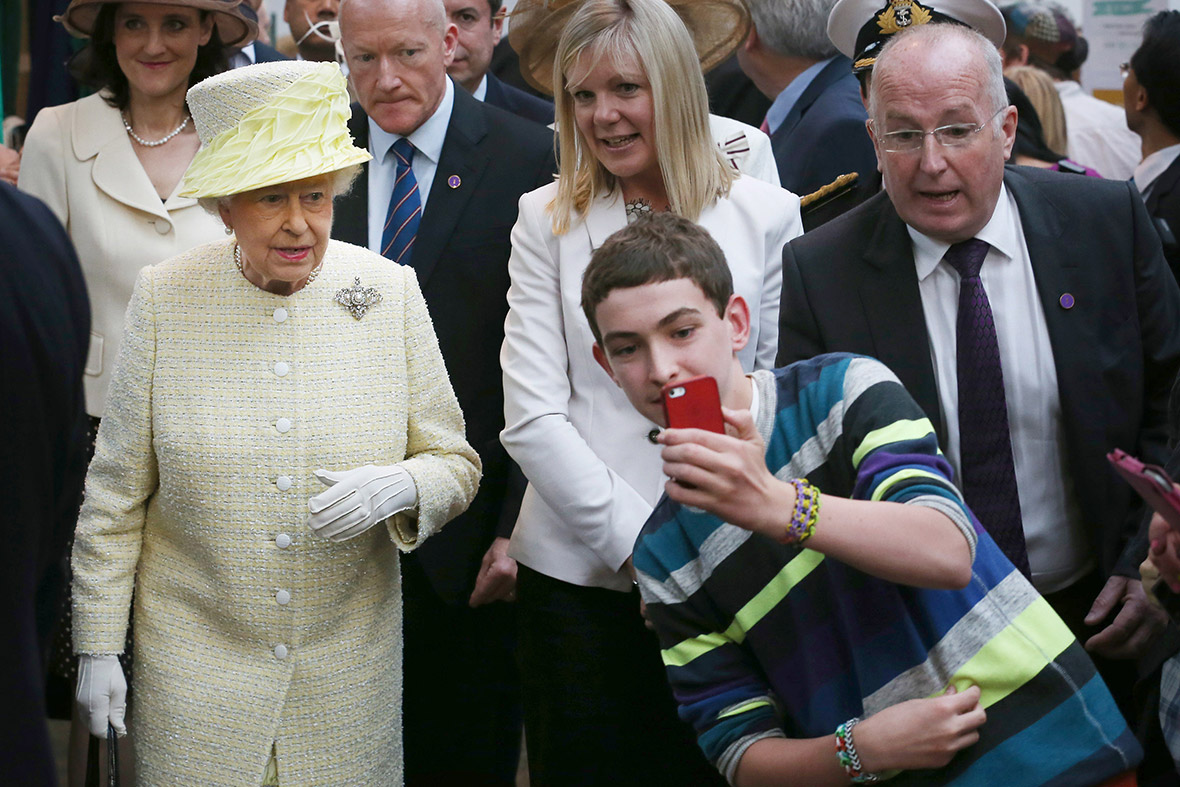
Boy grabs a cheeky selfie with Queen in Northern Ireland


The Queen paid a one day visit to Northern Ireland. During her visit the Queen met Cardinal Cahal Daly, then Catholic Primate.

Saturday 9 March 1996

The Irish Republican Army (IRA) later admitted responsibility for a small ‘improvised device’ which exploded in Old Brompton Road, London. The explosion caused no injuries and only minor damage.

Monday 9 March 1998

Decision Not To Extradite McAliskey

The British government took the decision not to extradite Roísín McAliskey to Germany. The charge related to an Irish Republican Army (IRA) mortar attack on the British Army Osnabruck barracks in Germany on 28 June 1996.

McAliskey was five months pregnant at the time of her arrest. The British decision was based on medical grounds and followed the detention of McAliskey for a period of 16 months during which time she gave birth to a baby girl. McAliskey was subsequently released in April 1998 and returned to Northern Ireland.

[There had been a strong campaign to secure her release in Britain, Ireland, Europe and the United States of America (USA). A number of commentators felt that the timing of the announcement was designed to increase the pressure on Sinn Féin (SF) to rejoin the multi-party talks at Stormont.]

Tuesday 9 March 1999

There was a pipe-bomb attack in Portadown, County Armagh. Nine families had to be evacuated from houses nearby while the device was made safe.

Representatives of the Ulster Unionist Party (UUP) and Sinn Féin (SF) met at Stormont for talks. Paul Murphy, then Political Development Minister, introduced the Implementation Bodies (Northern Ireland) Order in the House of Commons.

Saturday 9 March 2002

Sectarian State Speech by Trimble

David Trimble, then leader of the Ulster Unionist Party (UUP), gave a (scripted) speech to the annual general meeting of the Ulster Unionist Council (UUC) during which he referred to the Republic of Ireland as a: “pathetic sectarian, mono-ethnic, mono-cultural state”.

[The comments provoked widespread criticism from Nationalists in Northern Ireland and in the Republic.]

At a press conference following the meeting Trimble defended his comments. He maintained that what he had said was “self-evident” but refused requests from reporters to provide evidence to support his claims.

During his speech Trimble also called for a border poll to test whether a majority of people in Northern Ireland would favour a united Ireland. He suggested that the referendum be held on the same day as the next Northern Ireland Assembly election (1 May 2003).

[A number of commentators suggested this was a ploy which would have the effect of maximising the UUP vote at the Assembly election.]

During his speech Trimble also criticised the work of the two Sinn Féin (SF) ministers Martin McGuinness, then Education Minister, and Bairbre de Brún, then Minister of Health.

At the UUC meeting Trimble was re-elected unopposed as leader of the party.

Bertie Ahern, then Taoiseach (Irish Prime Minister), later responded to the criticism by insisting that no one would identify the description “sectarian state” with the Republic which did not have “the Drumcrees or the Garvaghy Roads” of Northern Ireland.

  —————————————————————————

Remembering all innocent victims of the Troubles

Today is the anniversary of the death of the following people killed as a results of the conflict in Northern Ireland

“To live in hearts we leave behind is not to die

– Thomas Campbell

To the innocent on the list – Your memory will live  forever

– To  the Paramilitaries  –

There are many things worth living for, a few things worth dying for, but nothing worth killing for.

9 People   lost their lives on the 9th March between 1972 – 2009


—————————————————————————

09 March 1972


Gerard Crossen,  (19)

Catholic
Status: Irish Republican Army (IRA),

Killed by: Irish Republican Army (IRA)
Died in premature bomb explosion in house, Clonard Street, Lower Falls, Belfast

—————————————————————————

09 March 1972
Anthony Lewis,   (16)

Catholic
Status: Irish Republican Army (IRA),

Killed by: Irish Republican Army (IRA)
Died in premature bomb explosion in house, Clonard Street, Lower Falls

—————————————————————————

09 March 1972
Sean Johnson,   (19)

Catholic
Status: Irish Republican Army (IRA),

Killed by: Irish Republican Army (IRA)
Died in premature bomb explosion in house, Clonard Street, Lower Falls, Belfast

—————————————————————————

09 March 1972
Thomas McCann,  (20)

Catholic
Status: Irish Republican Army (IRA),

Killed by: Irish Republican Army (IRA)
Died in premature bomb explosion in house, Clonard Street, Lower Falls, Belfast

—————————————————————————

09 March 1976


Anthony O’Reilly,   (43)

Catholic
Status: Civilian (Civ),

Killed by: non-specific Loyalist group (LOY)
Shot, together with his brother, during gun and bomb attack on their restaurant, Golden Pheasant Inn, Ballynahinch Road, Baileysmill, near Lisburn, County Down.

—————————————————————————

09 March 1976


Myles O’Reilly,  (41)

Catholic
Status: Civilian (Civ),

Killed by: non-specific Loyalist group (LOY)
Shot, together with his brother, during gun and bomb attack on their restaurant, Golden Pheasant Inn, Ballynahinch Road, Baileysmill, near Lisburn, County Down.

—————————————————————————

09 March 1977
John Reid,  (53)

Protestant
Status: Ulster Defence Regiment (UDR), K

illed by: Irish Republican Army (IRA)
Off duty. Shot at his farm, Annaghroe, near Caledon, County Tyrone.

—————————————————————————

09 March 1983
James Hogg,  (23)

Protestant
Status: Civilian (Civ),

Killed by: non-specific Republican group (REP)
Shot while renovating houses, Dobbin Lane, Armagh.

—————————————————————————

9 March 2009

photo

Stephen Paul Carroll (48)

Catholic
Status: Police Service of Northern Ireland (PSNI)

Killed by:Continuity Irish Republican Army (CIRA)
Shot dead at Lismore Manor, Craigavon, County Armagh.

First member of the PSNI to be killed. The previous RUC officer killed, died from injuries on 6 October 1998.

—————————————————————————-

Source:  

index link.PNG

8th March – Deaths & Events in Northern Ireland Troubles

Key Events & Deaths on this day in Northern Ireland Troubles

8th March

————————————————-

Monday 8 March

1971

Members of the Official Irish Republican Army (OIRA) engaged in a gun battle with members of the Provisional IRA (PIRA). One man was killed. The feud between the two wings of the IRA had been developing ever since the Republic movement split on 11 January 1970.

Thursday 8 March 1973

The Border Poll

 image002.jpg


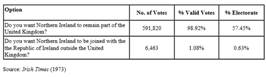
A referendum was held on whether or not the people of Northern Ireland wanted to remain part of the United Kingdom (UK). This referendum became known as the ‘Border Poll’. However, Nationalists boycotted the referendum and only 57 per cent of the electorate took part in the poll. It was not surprising therefore that, of those who took part, 98 per cent were in favour of maintaining the Union with Britain.

A British soldier guarding a polling station in the lower Falls area of Belfast was shot dead by the Irish Republican Army (IRA).

A Catholic civilian was found shot dead in an abandoned car in the Oldpark area of Belfast. He had been killed by Loyalist paramilitaries.

The IRA exploded two car bombs in London and injured over 200 people. (One person in the vicinity died a sudden death due to a heart problem; listed in appendix to Sutton.)

One of the bombs had been planted at the ‘Old Bailey’ court in London. Two other car bombs were diffused.

[Nine people were found guilty of the bombings on 14th November 1973. Among those found guilty was Gerry Kelly. Kelly was later to become a leading member of Sinn Féin and played a role in the negotiations that led to the Goody Friday Agreement on 10th April 1998  ]

There were bombs in Belfast and Derry. Loyalist paramilitaries carried out a raid on an Ulster Defence Regiment (UDR) guard at a polling station in east Belfast and stole 8 British Army issue self-loading rifles (SLRs) and ammunition. The members of the guard claimed that they were ‘overpowered’ by the Loyalists.

Tuesday 8 March 1977

Eight members of the SAS were each fined £100 in a Dublin court for carrying guns without a certificate. The men had been found in the Republic of Ireland and were arrested.

Wednesday 8 March 1978

Thomas Trainor (29), a member of the Irish National Liberation Army (INLA), and Denis Kelly (31), a Catholic civilian, were shot dead by the Red Hand Commando (RHC) in Portadown, County Armagh.

[The RHC was a Loyalist paramilitary group with links to the Ulster Volunteer Force (UVF).]

Sunday 8 March 1987

The body of Lorraine McCausland’s (23), a Protestant civilian, was found in a stream near a Tynedale loyalist club in north Belfast.

McCausland had been drinking in the club the night before her half-naked body was discovered. She had been beaten to death.

[The book ‘Lost Lives’ (2004; p1064) included a claim that “Reliable loyalist sources said the men who killed her belonged to the UDA”. However, currently (2007) the motivation for the killing remains unclear.]

Tuesday 8 March 1988

A car believed to belong to those killed in Gibraltar was found in Marbella and was discovered to contain 140 pounds of high explosives.

Wednesday 8 March 1989


Miles Amos & Stephen Cummins

The Irish Republican Army (IRA) killed two soldiers and injured six others in a landmine explosion on the Buncrana Road near Derry. The Emergency Provision Act was renewed in the House of Commons.

Monday 8 March 1993

Patrick Mayhew, then Secretary of State for Northern Ireland, welcomed the speech made by Dick Spring, then Tánaiste (deputy Irish Prime Minister and Minister for Foreign Affairs), on 5 March 1993. Mayhew said that Spring was someone he could “do business with”.

Wednesday 8 March 1995

Michael Howard, then British Home Secretary, lifted exclusion orders against 16 people. The orders were made under the Prevention of Terrorism Act (PTA). The Northern Ireland Office (NIO) announced that security barriers in Belfast city centre would be removed.

Friday 8 March 1996

David Cook, then chairman of the Police Authority of Northern Ireland, and Chris Ryder, then a Police Authority member, were both dismissed from their positions on the Authority by Patrick Mayhew, then Secretary of State for Northern Ireland. The two men had earlier lost a vote of confidence.

Saturday 8 March 1997

or

Sunday 9 March 1997

 The Loyalist Volunteer Force (LVF) planted firebombs in the offices of the Northern Ireland Tourist Board (NITB) in Banbridge and Newcastle, which caused serious damage.

[The attacks were believed to be a response to the marketing of the whole of Ireland as a tourist destination by the Northern Ireland Tourist Board in conjunction with Bord Fáilte (the tourist board in the Republic of Ireland). Many Loyalists are opposed to cross-border co-operation of any kind.]

There were demonstrations in support of Roisín McAliskey, then being held in prison awaiting a decision about extradition, in Dublin, London, New York, Washington, and a number of other cities.

Sunday 8 March 1998

Loyalist paramilitaries carried out a bomb attack on the home of a Catholic man and his Protestant partner in Larne, County Antrim. The man claimed that attack was sectarian and blamed local members of the Ulster Defence Association (UDA); he said that he was involved in a ‘run-in’ (a fracas) with a leading Loyalist figure the previous week.

The Royal Ulster Constabulary (RUC) said that no motive had been established for the attack.

The Loyalist Volunteer Force (LVF) issued threats against Protestant churchmen, business leaders and politicians whom it claimed were “colluding” with the peace process. In a ‘policy document’ the LVF expressed support for Ian Paisley, then leader of the Democratic Unionist Party (DUP), saying “Paisley has got it absolutely right”.

Gerry Adams, then President of Sinn Féin (SF), conceded that there was no prospect of an imminent united Ireland. An article written by Adams appeared in the Ireland on Sunday (a Republic of Ireland newspaper) set out the minimum demands that would have to be met before SF would sign any agreement.

An opinion  poll published in the same paper reported that 71 per cent of people in the Republic of Ireland wanted to see a united Ireland.

Monday 8 March 1999

Treaties Signed

The British and Irish governments signed four international treaties providing the legal framework for the establishment of the associated institutions of devolved government in Northern Ireland. The treaties covered: the six North-South implementation bodies; the North-South Ministerial Council; the British-Irish Council; and the British-Irish Intergovernmental Conference.

David Trimble, then First Minister Designate, reacted angrily to Marjorie (Mo) Mowlam’s, then Secretary of State for Northern Ireland, announcement extending the deadline for the creation of the Northern Ireland Executive until Easter week (2 April 1999).

Sinn Féin (SF) also criticised the delay.

Bertie Ahern, then Taoiseach (Irish Prime Minister), met with Gerry Adams, then President of SF, in Government Buildings in Dublin.

Loyalists carried out a ‘pipe-bomb’ attack on the home of a family in Portadown, County Armagh

. It was disclosed that the Royal Ulster Constabulary (RUC) had advised Gerry Adams of a threat to his life from dissident Republicans.

On International Women’s Day, the President, Mrs McAleese, said “skewed, twisted and unhealthy” thinking and teaching about the role of women over generations had left an obstacle course of impediments to their equal treatment.

A special debate in Parliament Buildings, Stormont, was among many events to mark the day on both sides of the Border.

Thursday 8 March 2001

Political Talks in Northern Ireland

Tony Blair, then British Prime Minister, and Bertie Ahern, then Taoiseach (Irish Prime Minister), held new talks in Belfast with the political parties. It appeared that the two governments were resigned to being unable to achieve any breakthrough deal before the British general election.

However the two men hoped for an interim agreement to keep the peace process alive.

The Irish Republican Army (IRA) stated that it was willing to meet with John de Chastelain (Gen.), then head of the Independent International Commission on Decommissioning (IICD).

[This was to be the first meeting since June 2000. Most Unionists were not impressed by the IRA offer of talks and demanded action on disarmament.]

 —————————————————————————

Remembering all innocent victims of the Troubles

Today is the anniversary of the death of the following people killed as a results of the conflict in Northern Ireland

“To live in hearts we leave behind is not to die

– Thomas Campbell

To the innocent on the list – Your memory will live  forever

– To  the Paramilitaries  –

There are many things worth living for, a few things worth dying for, but nothing worth killing for.

14 People   lost their lives on the 8th March between 1971 – 1993


—————————————————————————

08 March 1971


Charles Hughes,   (26)

Catholic
Status: Irish Republican Army (IRA),

Killed by: Official Irish Republican Army (OIRA)
Shot while leaving house, Leeson Street, Lower Falls, Belfast. Official Irish Republican Army (OIRA) / Irish Republican Army (IRA) feud.

  —————————————————————————

08 March 1972
Eamon Gamble,  (27)

Catholic
Status: non-specific Republican group (REP),

Killed by: non-specific Republican group (REP)
Died one month after being injured in an explosion at temporary council offices in school hall, Keady, County Armagh. Explosion occurred on 6 February 1972.

  —————————————————————————

08 March 1972


Joseph Jardine,   (44)

Protestant
Status: Ulster Defence Regiment (UDR),

Killed by: Irish Republican Army (IRA)
Off duty. Shot at his workplace, Ministry of Agriculture office, Middletown, County Armagh.

  —————————————————————————

08 March 1973


David Glennon,   (45)

Catholic
Status: Civilian (Civ),

Killed by: non-specific Loyalist group (LOY)
Found shot in abandoned car, Summer Street, Lower Oldpark, Belfast

  —————————————————————————

08 March 1973
John Green,   (21)

nfNI
Status: British Army (BA),

Killed by: Irish Republican Army (IRA)
Shot by sniper while guarding polling station, Slate Street School, Lower Falls,

  —————————————————————————

08 March 1973
Joseph Leahy,  (31)

nfNI
Status: British Army (BA),

Killed by: Irish Republican Army (IRA)
Died two days after being injured when detonated booby trap bomb in derelict house, Mullaghbawn, near Forkhill, County Armagh.

  —————————————————————————

08 March 1975
Michael Adamson,  (23)

Catholic
Status: Civilian (Civ),

Killed by: Ulster Volunteer Force (UVF)
Shot at his home, Clifton Drive, off Cliftonville Road, Belfast.

  —————————————————————————

08 March 1978
Thomas Trainor,  (29)

Catholic
Status: Irish National Liberation Army (INLA),

Killed by: Ulster Volunteer Force (UVF)
Shot from passing motorcycle shortly after leaving Department of Health and Social Services office, Armagh Road, Portadown, County Armagh.

  —————————————————————————

08 March 1978
Denis Kelly,   (31)

Catholic
Status: Civilian (Civ),

Killed by: Ulster Volunteer Force (UVF)
Shot from passing motorcycle shortly after leaving Department of Health and Social Services office, Armagh Road, Portadown, County Armagh.

  —————————————————————————

08 March 1984


David Montgomery,  (24)

Protestant
Status: Ulster Defence Regiment (UDR),

Killed by: Irish Republican Army (IRA)
Off duty. Shot at his workplace, a petrol station, Airport Road, near Moira, County Down.

  —————————————————————————

08 March 1989


Miles Amos,  (18)

nfNI
Status: British Army (BA),

Killed by: Irish Republican Army (IRA)
Killed in land mine attack, while on British Army (BA) mobile patrol, Buncrana Road, near Derry.

  —————————————————————————

08 March 1989


Stephen Cummins,   (24)

nfNI
Status: British Army (BA),

Killed by: Irish Republican Army (IRA)
Killed in land mine attack while on British Army (BA) mobile patrol, Buncrana Road, near Derry.

  —————————————————————————

08 March 1990


Thomas Jamison,   (40)

Protestant
Status: Ulster Defence Regiment (UDR),

Killed by: Irish Republican Army (IRA)
Off duty. Shot while driving his firm’s lorry, Tullynure, near Donaghmore, County Tyrone.

  —————————————————————————

08 March 1993
Nigel McCollum,   (25)

Protestant
Status: Civilian (Civ),

Killed by: Irish Republican Army (IRA)
Killed in mortar bomb attack on Keady British Army (BA) / Royal Ulster Constabulary (RUC) base, County Armagh. Construction worker at the base.

  —————————————————————————

Battle of Clontarf . Brian Boru: 1014

Battle of Clontarf Part 1 Part 2 The Battle of Clontarf (Irish: Cath Chluain Tarbh) was a battle that took place on 23 April 1014 at Clontarf, near Dublin, on the east coast of Ireland. It pitted t…

Source: Battle of Clontarf . Brian Boru: 1014