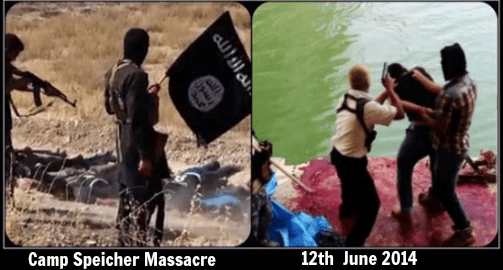
Camp Speicher Massacre 12th June 2014

Camp Speicher Massacre

 12th  June 2014


Image result for camp speicher massacre

Iraqi soldiers carry coffins containing the remains of ten of their comrades who were killed in Camp Speicher massacre.

Salahuddin – (IraqiNews.com) High Commission for Human rights announced on Wednesday pulling bodies of 25 victims of the massacre of Camp Speicher from Tigris River in Tikrit, and pointed out that it is keen to reveal the crimes, genocides and violations committed by the Islamic State extremist group.

The Commission said in a press release, “The commission followed the information about the discovery of a mass grave in al-Kosour area in Salahuddin province, and it held a number of meetings with the concerned authorities to open graves and pull the remains of martyrs from the Tigris River.”

“These efforts allowed the divers of River Emergency Directorate to pull the bodies of 25 victims of Camp Speicher massacre and handed them to Salahuddin Police Directorate,” the release explained.

The commission also renewed its condemnation of the dangerous violations committed by ISIS terrorist gangs, including genocides and crimes against humanity, and emphasized its humanitarian and national role to serve the Iraqi people.

On 12 June 2014, the Islamic State extremist group (ISIS) killed at least 1,700 Shia Iraqi Air Force cadets in an attack on Camp Speicher in Tikrit.

Original story IraqiNews.com

The Attack

&

Background


Over 1500 Killed


On 12 June 2014, the Islamic State of Iraq and the Levant (ISIS) killed at least 1,566 Shia Iraqi Air Force cadets in an attack on Camp Speicher in Tikrit. At the time of the attack there were between 4,000 and 11,000 unarmed cadets in the camp.

Alleged ISIS fighters singled out Shia and non-Muslim cadets from Sunni ones and murdered them. The Iraqi government blamed the massacre on both ISIS and members from the Arab Socialist Ba’ath Party – Iraq Region.

Attack

Iraqi politician Mish’an al-Jubori stated:

“Some of the chief officers of the camp ordered the cadets to have a rest for 15 days and to go to their families, with civilian clothes.  While they were walking on the highway looking for a bus to take them near Baghdad. Then two buses being driven by Ayman Sabawi Ibrahim, the son of Saddam Hussein‘s half brother, Sabawi Ibrahim al-Tikriti, stopped near them with 10 armed men inside of them.

They told the cadets that they were from the Arab tribes of Tikrit, and told them to follow them until they find buses to get them to Baghdad. Instead, several buses with ISIS members in them kidnapped the cadets and brought them to the Al-Qusour Al-Re’asiya region (The Presidential Palaces), where they committed the massacre.”

Several survivors assured that their head officers in the camp forced them to leave it.

Image result for camp speicher massacre perpetrators

Peter Bouckaert, the emergencies director for Human Rights Watch, stated

“The photos and satellite images from Tikrit provided a strong evidence of a horrible war crime that needs further investigation. [ISIS] and other abusive forces should know that the eyes of Iraqis and the world are watching”.

The HRW also said that ISIS posted on its websites many videos and photographs showing how they beheaded, shot, and choked the victims while they celebrated.

The photos show masked ISIS fighters tying up the cadets and loading them up on trucks, with other photographs showing ISIS fighters executing dozens of the cadets while they are lying down. ISIS propaganda videos show them shooting at hundreds of lined up men in mass graves in the desert. Some cadets faked their death, covering themselves with blood and lying down to escape at night.

Image result for Ali Hussein Kadhim

Survivor Ali Hussein Kadhim told his story to the New York Times following his escape from the massacre.

The Islamic State released the videos, as part of their propaganda video titled ‘Upon the Prophetic Methodology’. The cadets are seen to be cramped upon trucks, some of them wearing civilian clothes to hide their actual military uniform. Most of them lied on the ground, with their jeans stripped to reveal camouflages underneath. Some of the prisoners were forced to decry Iraq’s prime minister, others forced to say ‘Long Live the Islamic State’. Some of them lined up as a cadet was bashed with a rifle. The executions vary, from shooting them one by one to shooting them while lying down many times to ensure death.

Aftermath

Coat of arms (emblem) of Iraq 1991-2004.svg

The Iraqi government revealed that 57 members of Arab Socialist Ba’ath Party – Iraq Region were a part of the massacre.

Although pictures showed that every armed man was from ISIS, the government stated

“Without any doubts and suspicion, all of these criminals are from the banned Ba’ath Party.”

Sadun Dulaymi at the Pentagon May 22, 2012.jpg

Sa’dun al-Dulaimi

The minister of defence, Sa’dun al-Dulaimi, stated that the massacre wasn’t sectarian in nature. although, the spokesman of the Iraqi Armed Forces, Qasim Atta, stated that there are almost 11,000 cadets and soldiers missing from Camp Speicher, he also stated that thousands were executed in near the Presidential Palaces, al-Bu Agail region and the Badoush prison by sectarian violence.

On 2 September, more than 100 members of the families of the killed and missing cadets and soldiers broke into the Iraqi Parliament and hit three of the security guards. After a day, a session started in the parliament with the attendance of representatives of the families and Sa’dun al-Dulaimi, along with other military officials to discuss the massacre.

On 16 September, the Kurdish Asayish arrested 4 people suspected to be involved in the massacre in southern Kirkuk. An unnamed security source stated:

“The operation was executed by relying on intelligence information to arrest them.”

On 18 September, the Iraqi Human Rights ministry stated that as of 17 September, the total of missing soldiers and cadets was 1095,  denying the most popular figure of 1700 soldiers having been killed. The ministry added:

“The ministry relied in its statistics on spreading forms on the families of the missing people in Baghdad and the other Provinces within its quest to document the crimes and violations that the terrorist group of the Islamic State is committing towards our people.”

The Iraqi government ordered to pay 10,000,000 IQD (equivalent to US$8,600) to the families of the missing cadets.

Following the Iraqi forces’ victory over ISIS in Tikrit in early April 2015, mass graves containing some of the murdered cadets were located and the decomposed corpses began to be exhumed.

Two of the alleged perpetrators of the massacre were arrested in Forssa, Finland, in December 2015. The suspects were identified from ISIS propaganda videos in which the executions of 11 men took place. Police did not disclose whether the men had made applications for asylum in Finland.

In August 2016 thirty-six men were hanged for their part in the massacre.

On 6 September 2016, mass graves were found by the Kata’ib al-Imam brigade containing the remains of over 30 people killed in the massacre.

———————

Justice ?

Image result for camp speicher massacre perpetrators

Of the 600 people wanted by Iraqi authorities in connection with the massacre, only 24 people have been convicted so far.

In July, a group of 28 men went on trial in Baghdad over the Camp Speicher killings, all but four of the men were given death sentences, with the remainder acquitted for lack of evidence.

The sentencing was greeted by cheers from the families of victims present, with many shouting “God is Great” and “Ya Hussein”, in reference to a revered Shia figure.

See Aljeera for full story

The Sheikh of Slaughters – Abu Musab al-Zarqawi

belfastchildis's avatar

Abu Musab al-Zarqawi

The Founding Father of Islamic State

Abu Musab al-Zarqawi (Arabic: أبو مصعب الزرقاوي‎‎, About this sound pronunciation ’Abū Muṣ‘ab az-Zarqāwī, Abu Musab from Zarqa; October 20, 1966 – June 7, 2006), born Ahmad Fadeel al-Nazal al-Khalayleh (أحمد فضيل النزال الخلايله, ’Aḥmad Faḍīl an-Nazāl al-Ḫalāyla), was a militant Islamist from Jordan who ran a paramilitary training camp in Afghanistan. He became known after going to Iraq and being responsible for a series of bombings, beheadings, and attacks during the Iraq War, reportedly

“turning an insurgency against US troops” in Iraq “into a Shia-Sunni civil war”.

He was sometimes known as “Shaykh of the slaughterers”.

He formed al-Tawhid wal-Jihad in the 1990s, and led it until his death in June 2006. Zarqawi took responsibility, on several audio and video recordings, for numerous acts of violence in…

View original post 11,073 more words

Birmingham Pub Bombings – 21st November, 1974

Birmingham Pub Bombings IRA Slaughter  21 Innocent People ‘IRA mole tipped off police’ —————————————…

Source: Birmingham Pub Bombings – 21st November, 1974

Birmingham Pub Bombings – 21 November, 1974

belfastchildis's avatar

Birmingham Pub Bombings

IRA Slaughter  21 Innocent People

‘IRA mole tipped off police’

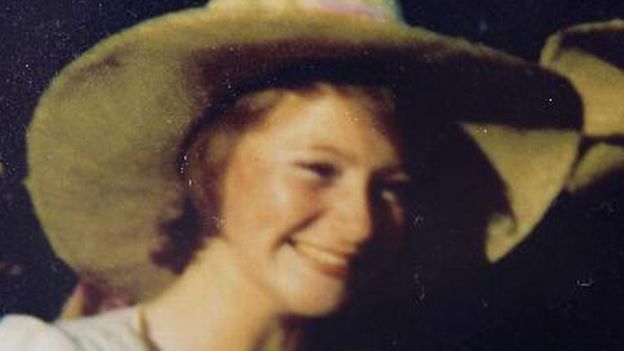
Maxine Hambleton Maxine Hambleton was 18 when she was killed in the 1974 bombing

————————————————————–

An IRA informant may have told police about the 1974 Birmingham pub bombs before they exploded, a coroner heard.

Ashley Underwood QC, who represents some of the victims’ families, told a hearing into whether to reopen inquests for the 21 victims there was “reason to believe it’s the case”.

Birmingham and Solihull coroner Louise Hunt is hearing an application to resume inquests into the 1974 atrocity.

It is widely acknowledged the IRA was behind the bombings.

Ms Hunt is hearing three days of submissions for and against the inquests being resumed. A decision is expected in two weeks.

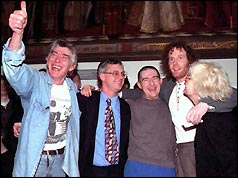
Mr Underwood said West Midlands Police officers may have wrongly prosecuted six men – who became known as the Birmingham Six and whose convictions were quashed…

View original post 9,176 more words

Khalid Kelly – Irish Jihadi Blows himself up!

belfastchildis's avatar

Irish jihadist ‘Khalid Kelly’ blows himself up in Isil suicide bombing near Mosul

A high-profile Irish Islamist who was once arrested for threatening to kill President Barack Obama during a trip to Dublin has blown himself up in a suicide attack for Islamic State of Iraq and the Levant (Isil) outside Mosul, according to the jihadist group.

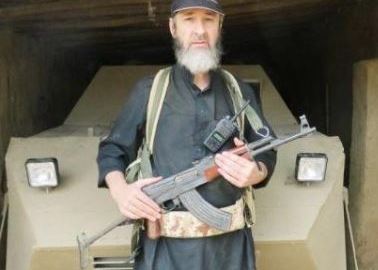
Terence Kelly, a Dubliner known as “Taliban Terry” or “Khalid Kelly”, was killed after he drove an armoured truck laden with explosives at an Iraqi militia group on Friday, Isil said in a statement.

The jihadist group released a picture of the bearded Kelly, who was in his late 40s, standing in front of a vehicle and clutching a Kalashnikov rifle. It referred to him by the nom de guerre Abu Osama Irelandi.

“Brother martyr Abu Osama Irelandi, may Allah accept his soul, attacked a group of animals from the Hashd [Shia militia] in the…

View original post 1,338 more words

Abu Azrael, Ayyub al-Rubaie – Angel of Death – Scaring the Hell out of IS

Abu Azrael —————————————————————– Meet Abu Azrael, ‘Iraq’s Rambo’…

Source: Abu Azrael, Ayyub al-Rubaie – Angel of Death – Scaring the Hell out of IS

The Golden Division – Bringing Death to IS Scum

Iraqi Special Operations Forces

( AKA The Golden Division )

 iraqs-golden-divion-smaller

Insignia

Special Operations Iraq SSI.svg

Active December 26, 2003 – Present
Country  Iraq
Branch Iraqi Army
Type Special Forces
Size 18,000
Part of Iraqi Counter Terrorism Service (reports directly to Prime Minister of Iraq)
Motto(s) May you sleep peacefully in your bed tonight for a mighty sword stands ready to strike fear in the hearts of those who would terrorize us!
Engagements Anti-guerrilla operations in Iraq as part of the Iraq War
Iraqi Civil War (2014–present)
Commanders
Current
commander
Major General Fadhil Jalil al-Barwari


Iraqi Special Operations Forces (ISOF) (Arabic: قوات العمليات الخاصة العراقية‎‎) are Iraqi special forces unit created by coalition forces after the 2003 invasion. The forces, directed by the Iraqi Counter Terrorism Service, consist of the Iraqi Counter Terrorism Command, which has three brigades subordinate to it. The Counter Terrorism Service (Jihaz Mukafahah al-Irhab, originally translated as Counter Terrorism Bureau) is funded by the Iraq Ministry of Defence.

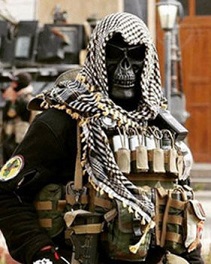
Image result for the golden division iraq with skull masks


History

Special operations troops in the old Iraqi army were first established when Colonel Khaleel Jassim Al-Dabbagh built the first royal special units in the name of “Queen Alia Forces” in the mid 1950s. It consisted of Sunni, Shia Arabs and other components of Iraqi population. They were mainly used on an emergency basis to carry out special missions inside of Iraq and outside when the country was in war.

After the Invasion in 2003, Iraqi forces were made redundant by the Invasion forces and because of this, the current Iraqi commando force were recruited from scratch, mostly from Shia Arabs, Kurds and few Sunni.

In November 2005, after training in Jordan with Jordanian Special Forces and US Army Special Forces (“Green Berets”), the Iraqi Special Operations Force had 1,440 men trained, composed into two combat battalions, considered equal in training and combat effectiveness to an average US Army Infantry battalion, and two support battalions.


Image result for the golden division iraq with skull masks

In March 2008, the force consisted of a single brigade which in turn was made up of an Iraqi Counter-Terrorism Force (ICTF) battalion, three Commando battalions, a support battalion and a special reconnaissance unit.

In the Battle of Mosul that began in October 2016, the special ops forces were correctly expected to be the first division into the city of Mosul, which has been occupied by ISIL since 2014.

On 1 November 2016 the 1st Iraqi Special Forces Division fought its way into the Gogjali quarter of the city, becoming the first Iraqi unit to enter the city during the offensive.

Command structure

The 1st Special Operations Brigade is based in Baghdad and has the 1st, 2nd, and 5th Battalions, a brigade support battalion and a training battalion/Iraqi Special Warfare Center and School. The 1st Battalion is the renamed Iraqi 36th Commando Battalion.


Image result for the golden division iraq with skull masks

The 1st Brigade is often referred to as the Golden Division, and previously the Golden Brigade.

The 2nd Special Operations Brigade has four commando battalions [1,440 men], which were at Basra, Mosul, Diyala and Al Asad prior to the formation of the 3rd Brigade. The battalions at Basra and Mosul achieved Iraqi Operational Control (IOC) in January 2008 and conducted local operations. Regional CT Centers (RCCs), similar to Joint Interagency Task Force (JIATF) organizations, were to be established at all four regional commando bases to develop intelligence on terrorist networks in their region.

The 3rd Brigade was established in Basra by spring 2013, following an order by the prime minister in January 2012 that the forces expand by an additional brigade. It consisted of regional commando battalions in Basra, Diwaniya, Najaf, Maysan, Dhi Qar and Muthana provinces, a recce battalion, and a support battalion.


CT pilot training

In February 2008, the Iraqi Air Force, with Coalition Advisors, began night vision goggle (NVG) training as the basis for future counter-terrorism (CT) pilot training. Potential CT pilots and aircrew will undergo NVG flying introduction in order to select the best pilots for advanced CT aviation training as early as April 2008. Selected pilots will continue to log NVG training hours in order to attain a proficiency level that prepares them for Advanced Special Operations specific training as early as late summer 2008.

Once fielded, this special operations aviation capability will reside in the Iraqi Air Force’s 15 Squadron

Image result for the golden division iraq with skull masks

——————————

See The National for more details on Golden Division

See Skull-faced commandos bringing TERROR to ISIS DailyStar


The Islamic State (Full Length)

———————————————————-

Islamic State’s Latest Propaganda Campaign: Don’t Leave

———————————————————-

Surreal Scenes of Life Under ISIS in Mosul, Iraq

———————————————————-

ON THIS DAY in 1979 Paperboy’s killers convicted

Carl Bridgewater

New claims in a TV programme about the murder of Carl Bridgewater nearly 40 years ago are being examined by police.

Staffordshire Police said officers are “considering the content” of the documentary about the 1978 shooting.

Newspaper boy Carl, 13, died after apparently disturbing a burglary at Yew Tree Farm, near Stourbridge.

Image result for Carl Bridgewater.

Questions about the alibi of initial suspect Bert Spencer, raised in the Channel 4 documentary, are also to be examined by the Home Office.

Mr Spencer was a questioned by police at the time, but has always denied killing Carl.

‘Disposed of shotgun’

An ex-hospital secretary, who provided Mr Spencer with a “cast-iron” alibi on the day of Carl’s killing, told the programme she cannot now prove where he was that day.

In the programme, Mr Spencer’s ex-wife Janet also spoke for the first time about how her then husband disposed of a legally-owned shotgun at the time, and how she had come home to find him washing a green jumper which she never saw again.

Mr Spencer denied her claims.

Police went on to charge suspects, who became known as the Bridgewater Four, after they were arrested in connection with an armed robbery in nearby Halesowen.

Patrick Molloy, James Robinson, and cousins Michael and Vincent Hickey had their convictions overturned after 18 years, in 1997, amid concerns about the police evidence.

See BBC News for full story

Bridgewater Four

Image result for bridgewater four


The Bridgewater Four was the collective name given to the quartet of men who were tried and found guilty of killing 13-year-old paperboy Carl Bridgewater, who was shot in the head at close range near Stourbridge, England in 1978. In February 1997, after almost two decades of imprisonment, their convictions were overturned on technical grounds. While the Appeals Court noted the continued existence of incriminating evidence, the men were never re-tried, and Bridgewater’s murder remains officially unsolved.

Murder

Carl Bridgewater (January 2, 1965 – September 19, 1978) was shot dead at Yew Tree Farm on the A449 in Staffordshire (approximately three miles north-west of Stourbridge), when he disturbed burglars while delivering a newspaper to the house on 19 September 1978. The elderly couple who lived there were not at home. The paperboy entered the property as he was familiar with the occupants; an open door led him to worry and investigate further. He was subsequently forced into the living room of the house and blasted in the head with a shotgun at point-blank range.

He was already dead when a friend of the house’s occupants found him.

Conviction and sentencing

The Bridgewater Four were Patrick Molloy, James Robinson and cousins Michael Hickey and Vincent Hickey.

They came to police attention following further serious crimes later in 1978. On 24 November, Robinson, Michael Hickey and an unidentified third man carried out an armed robbery at a Tesco supermarket on the Castle Vale estate in Birmingham. Hickey and Robinson raided the safe while the third man held several terrified shoppers at bay with a gun. When the manager tried to intervene a shot was fired over his head.

Six days later, Robinson and the Hickey brothers robbed an elderly couple at Chapel Farm, Romsley, near Halesowen. Vincent Hickey stayed in the car while Robinson and Michael Hickey charged into the house wearing balaclavas, brandishing a shotgun and shouting for money. The victims of this robbery displayed great courage but the robbers got away with £200. Robinson took the lead, hitting one of the victims with the gun but not firing it.

Molloy was the first to be arrested. During questioning which also covered Carl’s murder, Molloy told police that he had been in an upstairs bedroom at Yew Tree Farm while robbing the house when he heard a gunshot downstairs. Shortly afterwards, the other three men were arrested.

All denied committing murder, but three of them were convicted of murder at Stafford Crown Court on 9 November 1979. The fourth, Molloy, was found guilty of manslaughter. They were sentenced on 12 November.

James Robinson (aged 45) and Vincent Hickey (aged 25) were both sentenced to life imprisonment with a recommended minimum term of 25 years, which would have kept them behind bars until at least 2004 and the ages of 70 and 50 respectively. Michael Hickey (aged 18) was sentenced to be detained indefinitely at Her Majesty’s pleasure, though it was anticipated he would serve a shorter sentence than the two others convicted of murder due to his age. Patrick Molloy (aged 51) received a 12-year prison sentence on the manslaughter charge, but he died of a heart attack in prison two years later.

Case quashed

An appeal in March 1989 was rejected,but in February 1997, the latest in a number of appeals finally saw the men’s convictions overturned, after the Court of Appeal ruled that the trial had been unfair, due to certain areas of evidence fabricated by police in order to persuade Molloy to make a confession. However, the Appeal Judges noted that in the light of Vincent Hickey’s confessions to being present at the farm where Bridgewater was shot dead:

“we consider that there remains evidence on which a reasonable jury properly directed could convict.”

Despite this, in the light of the judgment, the Crown Prosecution Service had decided not to apply for a retrial involving Vincent Hickey in the public interest nor proceed with an outstanding armed robbery charge against him. Hickey said,

“My conviction has been quashed, so I am absolved and as far as I’m concerned that’s the end of it.”

The campaign to free and absolve the four men was led by Michael Hickey’s mother, Ann Whelan, and campaigning journalist Paul Foot. Preparations were made for a case against four police officers in the Staffordshire force on charges of fabricating evidence, but the case was dropped in December 1998.

In a ruling condemned as “sick” by prison campaigners, the Court of Appeal agreed with a Home Office-appointed assessor that the cousins Michael and Vincent Hickey should lose a quarter of loss-of-earnings compensation for their free food and accommodation inside. This has set a precedent which is still being used by the Home Office.

Jim Robinson died on 30 August 2007 of lung cancer at the age of 73.

Bert Spencer

Over the years, convicted murderer Hubert Spencer (born 1940) has been mentioned in the media as a possible suspect for the murder. Spencer, a uniformed ambulance driver from Wordsley and a very close neighbour of Carl’s (only 5 doors away), was investigated by police in the immediate aftermath of the murder, not least because he drove a blue Vauxhall Viva – the same type of car which had been seen at the farm on the afternoon of the murder. Witnesses also said that the driver of the car was a uniformed man. Spencer had a shotgun licence and was regularly allowed to shoot at Yew Tree Farm.

However, he was eliminated from police inquiries after the arrest of the four other suspects. Shortly afterwards, Spencer shot dead 70-year-old Hubert Wilkes at neighbouring Holloway Farm. Like Carl, Wilkes had been shot while sitting on a sofa. Spencer was jailed for life in 1980 and served 15 years before being paroled in 1995.

Spencer is featured in a book, Scapegoat for Murder: The Truth About the Killing of Carl Bridgewater (D&B Publishing), written by true crime author, Simon W. Golding. The author invited criminologist Professor David Wilson to interview Spencer, and in June 2016, Channel 4 screened a television documentary, Interview with a Murderer.

Image result for yew tree farm carl bridgewater

In the course of the “interview of the year”, Spencer’s daughter revealed that she felt that her father was indeed at Yew Tree Farm on the day of Carl’s killing “and possibly saw something”. A secretary (who was also a friend) who had provided the “cast iron” alibi that he had been “at work all day”, admitted that she could not be sure that Spencer had not left at some point. Prof. Wilson, in his final meeting with Spencer, told him that he saw through Spencer’s “kindly old grandfather schtick”, adding that a P-scan test indicated Spencer was a manipulative and callous psychopath.

The tv documentary concluded with Prof. Wilson interviewing Spencer’s former wife, who had not spoken publicly before. She said that the day after Carl’s murder, Spencer told her he was disposing of his shotgun. She added that, Spencer having chosen to revive the issue to protest his innocence, it seemed likely that the police would reopen the case. [17] Meanwhile, Spencer continues to deny killing Carl Bridgewater


Fools Paradise -Muslim Martyrs & 72 Virgins?

belfastchildis's avatar

Suicide is Forbidden

The-Holy-Quran-Stock-Photo resized.jpg

Although suicide is forbidden in Islam  the madmen of Islamic State and their deluded followers choose to ignore this founding concept of Islam  and they are masters at twisting and distorting the teachings of The Prophet Muhammad , to align with their own sick , twisted medieval interpretation of the Islamic Faith .

Most of the suicide bombers are lost souls , disillusioned with life and eager to embrace the utopia of  an everlasting   ” Paradise ” and are mere pawns to the puppet masters who control Islamic State and other extremist Islamic groups.

But at least  they have their 72 blue eyed virgins waiting for them in paradise – Don’t they?

Not that I have any sympathy with them , if they choose to blow themselves to bits – that’s fine by me , but when they kill innocent people in the process That’s  NOT at all right with…

View original post 3,170 more words