All posts by belfastchildis

26th October – Deaths & Events in Northern Ireland Troubles

Key Events & Deaths on this day in Northern Ireland Troubles

 26th October

——————————————————————————

Tuesday 26 October 1971

A man was found shot dead in Belfast.

An Assembly, attended only by Nationalist politicians, and acting as an alternative to Stormont, met in Dungiven Castle.

[The Assembly only ever met on two occasions.]

————————————————————————————————————————

Monday 26 October 1981

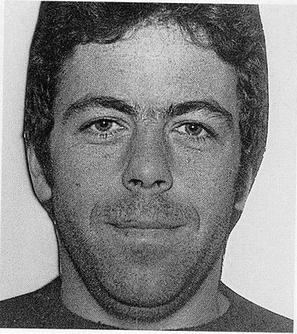
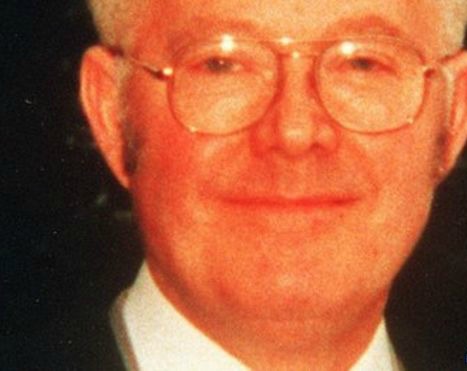
Kennethhoworth.JPG
Kenneth Haworth

Kenneth Haworth (49), a police explosives officer, was killed when the bomb he was trying to defuse exploded in Oxford Street, London.

Kenneth Robert Howorth, GM, (28 September 1932 – 26 October 1981), was a British explosives officer with London’s Metropolitan Police Service who was killed whilst attempting to defuse a bomb planted by the Provisional Irish Republican Army in Oxford Street.

Howorth served for twenty-three years with the Royal Army Ordnance Corps (RAOC) with postings to Austria, Japan, Tripoli in Libya, Stonecutters Island in Hong Kong and various United Kingdom bases. He reached the rank of Warrant Officer Class 1 (Conductor) before leaving to join the Metropolitan Police Service as a civilian explosives officer in 1973.[1]

On 26 October 1981, police received warnings that bombs on a busy shopping street in central London would explode within thirty minutes. A booby-trapped improvised explosive device (IED), planted by the IRA, was discovered in the basement toilet of a Wimpy restaurant on Oxford Street. While attempting to defuse the bomb, Howorth was killed instantly when it detonated.[2]

Howorth was survived by his wife Ann (died 25 November 2003), his son Steven and his daughter Susan. In 1983, he was posthumously awarded the George Medal for gallantry.

In 1985, IRA volunteers Paul Kavanagh and Thomas Quigley, both from Belfast, were convicted of his murder (along with other attacks including the Chelsea Barracks nail bomb in September 1981) and each handed five life sentences with a minimum tariff of thirty-five years. They were released in 1999 under the terms of the Good Friday Agreement

The Long Walk

See: The Long Walk – Iconic Pictures & Story behind them

————————————————————————————————————————

Thursday 26 October 1989

A member of the Royal Air Force (RAF) and his six-month old daughter were killed in an Irish Republican Army (IRA) attack in Germany.

Tuesday 26 October 1993

Gerry Adams carrying the coffin of IRA bomber Thomas Begley in 1993

Two Catholic civilians were shot dead and five others injured, in a Ulster Freedom Fighters (UFF), a cover name (pseudonym) used by the Ulster Defence Association (UDA), gun attack at Kennedy Way in west Belfast.

At the funeral service of the Irish Republican Army (IRA) member killed in the Shankill Road Bombing on 23 October 1993, Gerry Adams, then President of Sinn Féin (SF), helped carry the coffin.

See Shankill Road Bomb

Thursday 26 October 1995

The Northern Ireland Office (NIO) announced that the oath of allegiance to the Queen made by Queen’s Councils (QCs) in Northern Ireland would be repealed. Unionists criticised the decision.

Sunday 26 October 1997

A Protestant parish hall in Millfield, Belfast, was damaged in an arson attack. The Royal Ulster Constabulary (RUC) rerouted a planned parade by Ballynafeign Orange Lodge through the Nationalist lower Ormeau Road area of Belfast.

Monday 26 October 1998

Hew Pike (Sir),

Hew Pike (Sir), then a Lieutenant-General in the British Army, became the commanding officer of the army in Northern Ireland. Ronnie Flanagan, then Chief Constable of the Royal Ulster Constabulary (RUC), announced that Whiterock army base in west Belfast would close. Bertie Ahern, then Taoiseach (Irish Prime Minister), said that there was no chance of the North-South Ministerial Council being established before the 31 October 1998 deadline.

David Trimble, then First Minister designate, said that the 31 October was not an absolute deadline. Martin McGuinness, the Vice-President of Sinn Féin (SF), accused Unionists of trying to rewrite the Good Friday Agreement. In a book of memoirs Conor Cruise O’Brien said that Unionists may one day have to negotiate entry into a United Ireland.

[Following the revelation of the book’s content O’Brien felt obliged to resigned from the United Kingdom Unionist Party (UKUP).]

Tuesday 26 October 1999

Two men e arrested near Dungannon, County Tyrone, after the Royal Ulster Constabulary (RUC) discovered explosives in their van. Army technical experts then carried out a controlled explosion on the vehicle. The men are thought to be involved with dissident Loyalists; the van contained a pipe-bomb and two hand grenades.

Clifford Peebles

One of the men arrested was Clifford Peebles, then a preacher based in Woodvale in north Belfast.

[The men appeared in Cookstown courthouse on 29 October 1999.]

Thursday 26 October 2000 A pipe-b

A pipe-bomb was discovered underneath an Royal Ulster Constabulary (RUC) officer’s car close to the courthouse in Antrim. A fuse had been lit but had burned out without detonating the pipe-bomb. Loyalist paramilitaries were blamed for the attack on the officer who was a witness in a Northern Ireland arms trial.

Friday 26 October 2001

A British Army soldier (18) was seriously injured when Loyalist paramilitaries threw a pipe-bomb at a group of soldiers in the Ardoyne Road, north Belfast, at 9.00pm (2100BST).

The Royal Ulster Constabulary (RUC) claimed that the soldiers had been lured into an ambush and that the Ulster Defence Association (UDA) was responsible for the attack. Several RUC officers were also injured in the attack. Loyalist paramilitaries carried out a pipe-bomb attack on the home of a Catholic family in the Waterside area of Derry. The attack happened shortly after midnight (0015BST) and there was extensive damage to the house but no injuries to the six occupants. The dwelling was home to a Social Democratic and Labour Party (SDLP) councillor.

[The RUC said that it was the most powerful pipe-bomb ever to have been used and it contained four inch nails. The incident was part of an extensive series of on-going attacks across Northern Ireland on Nationalist political representatives and Catholic families.]

A Catholic boy (14) was attacked and beaten up by a gang of Loyalist youths in Galgorm Road, Ballymena, County Antrim

. [The boy is believed to be Kieran O’Loan the son of Nuala O’Loan, then Northern Ireland Police Ombudsman, and it is thought he was singled out for attack.]

Two people were arrested during the the Loyalist protest outside the Holy Cross Girls’ Primary School in Ardoyne, north Belfast. Loyalists had tried to block the road and prevent parents from gaining access to the school.

—————————————————————————————–

———————————————————————————

Remembering all innocent victims of the Troubles

Today is the anniversary of the death of the following  people killed as a results of the conflict in Northern Ireland

“To live in hearts we leave behind is not to die

– Thomas Campbell

To the innocent on the list – Your memory will live  forever

– To  the Paramilitaries  –

There are many things worth living for, a few things worth dying for, but nothing worth killing for.

  11 People lost their lives on the 26th  October  between 1971 – 1993

————————————————————–

26 October 1971


Robert McFarland,  (26)

Protestant
Status: Civilian (Civ),

Killed by: Irish Republican Army (IRA)
Found shot in Altcar Street, Short Strand, Belfast.

————————————————————–

26 October 1976


Joseph Wilson,  (55)

Protestant
Status: Ulster Defence Regiment (UDR),

Killed by: Irish Republican Army (IRA)
Off duty. Shot at his workplace, supermarket, Eglish Street, Armagh.

————————————————————–

26 October 1981


Kenneth Howorth,   (49) nfNIB
Status: British Police (BP),

Killed by: Irish Republican Army (IRA)
Killed while attempting to defuse bomb in a cafe, Oxford Street, London.

————————————————————–

26 October 1983


Gerard Barkley,  (27)

Catholic
Status: Irish National Liberation Army (INLA),

Killed by: Irish National Liberation Army (INLA)
Found shot near Redhills, County Cavan. Alleged informer.
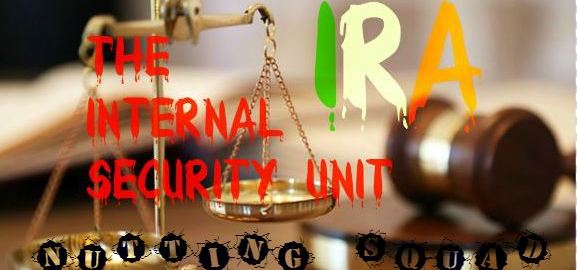
See: IRA Internal Security Unit – Nutting Squad

————————————————————–

26 October 1988
Wilson Smyth,   (41)

Protestant
Status: Civilian (Civ),

Killed by: Irish Republican Army (IRA)
Killed by booby trap bomb attached to his car at his workplace, postal sorting office, Tomb Street, off Corporation Street, Belfast.

————————————————————–

26 October 1988


Huge McCrone,  (20)

Protestant
Status: Royal Ulster Constabulary (RUC),

Killed by: Irish Republican Army (IRA)
Off duty. Shot by sniper while driving his car shortly after leaving Kinawley Royal Ulster Constabulary (RUC) base, County Fermanagh.

————————————————————–

26 October 1989
Maheshkumar Islania,   (34) nfNIE
Status: Royal Air Force (RAF),

Killed by: Irish Republican Army (IRA)
Off duty. Shot during gun attack on his car while at petrol filling station, Wildenrath, West Germany.

————————————————————–

26 October 1989
Niurati Islania,  (0) nfNIE
Status: Civilian (Civ),

Killed by: Irish Republican Army (IRA)
Shot during gun attack on her Royal Air Force (RAF) member father’s car while at petrol filling station, Wildenrath, West Germany.

————————————————————–

26 October 1990


Thomas Casey,   (57)

Catholic
Status: Civilian Political Activist (CivPA),

Killed by: Ulster Volunteer Force (UVF)
Sinn Fein (SF) member. Shot outside neighbour’s home, Kildress, near Cookstown, County Tyrone.

————————————————————–

26 October 1993
James Cameron,  (54)

Catholic
Status: Civilian (Civ),

Killed by: Ulster Freedom Fighters (UFF)
Shot at his workplace, Council Depot, Kennedy Way, Andersonstown, Belfast.

————————————————————–

26 October 1993


Mark Rodgers, (28)

Catholic
Status: Civilian (Civ),

Killed by: Ulster Freedom Fighters (UFF)
Shot at his workplace, Council Depot, Kennedy Way, Andersonstown, Belfast.

————————————————————–
“Stakeknife” – Is time running out for Freddie Scappaticci ?

Will the IRA’s ‘double-agent assassin’ face justice at last?

TO the IRA, he was one of their trusted, cold-blooded killers — yet to the British military, “Stakeknife” was their top informant.

  “Stakeknife

——————————————————————————————-

Freddie Scappaticci Stakeknife Secret Recordings.

——————————————————————————————-


See Martin McGartland and Republican Informers

See Brian Nelson

The Nutting Squad

Freddie Scapatticci British Agent License to Kill

That was the codename given to Alfredo “Freddie” Scappaticci by his spy handlers at the top secret Force Research Unit (FRU).

As chief of the IRA’s Nutting Squad, who shot victims through the head, he is thought to have killed at least 40 people over 25 years.

Yet at the same time Stakeknife — who always taped his victims screaming for mercy as he tortured them — was pocketing £80,000 a year from the Brits for information that led to the deaths and imprisonment of dozens of IRA members.

Families of some of his victims claim Stakeknife was allowed to get away with murder because he was the “jewel in the crown” of informants.

Britain has always said it did not deal with the IRA during the Troubles, but a new probe could blow that assertion out of the water

——————————————————————————————-

Gen. John Wilsey confirms: Stakeknife is Freddie Scappaticci

——————————————————————————————-

This week Northern Ireland’s director of public prosecutions, Barra McGrory, ordered an inquiry into Stakeknife. He announced he had asked PSNI Chief Constable George Hamilton to look into the case.

PSNI Chief Constable George Hamilton

It comes as three investigations into alleged police and Army collusion in around 24 murders have been collectively examined by Northern Ireland’s Police Ombudsman.

A major Stakeknife investigation promises justice at last for the relatives of his victims, who will finally hear just how much he and British military intelligence were involved in Northern Ireland’s “dirty war”.

Shauna Moreland,

People like Shauna Moreland, 31, whose mother Caroline was tortured then executed by Stakeknife and his Nutting Squad in 1994, two months before the IRA ceasefire.

The bloodied body of the 34-year-old mother of three was found dumped on wasteland in Co Fermanagh. She had been held and tortured for 15 days for telling police about the location of a single rifle.

In one of Stakeknife’s sick recordings, released after her death, Caroline is heard pleading for her life.

Victim ... Caroline Moreland
Victim … Caroline Moreland

Remembering the last day she saw her mother, Shauna recalls: “It was just a normal day. She was in the kitchen ironing. She was going off for the day on a bus run somewhere.

“I was going over to my granny’s. It was just the normal getting stuff together, giving her a kiss and a hug and saying ‘I love you, goodbye’.”

She adds: “I was ten at the time she was killed. She was missing for 15 days and I don’t have memories of all that time, it was a hard time.

“She is on my mind always, it is every day. And I have a memory of the day I found out she was dead.”

Shauna believes her mother, like many of Stakeknife’s victims, was “sacrificed” by the British military to protect their agent.

When Stakeknife, now 68, was finally unmasked in 2003, he was allowed to flee Northern Ireland to a safe house abroad amid allegations that the British secret services were protecting him.

Martin Ingram, the former FRU member who first outed Stakeknife, said the double agent was allowed to kill because he was too valuable an agent to British military intelligence.

It is alleged that even when they had prior knowledge of his actions they did not stop him. And his victims are said to have included other military intelligence agents.

Martin says: “He was an agent who killed his own people. Simple as that.”

Shortly after he was outed as Stakeknife, Scappaticci — or “Scap” to his IRA pals — undertook a High Court action in the UK asking the British Government to publicly deny he was an agent. They refused, saying to do so would put other agents in danger.

They have consistently refused to comment on Stakeknife but it was revealed in court documents during another case that Scappaticci was being given security by the British Government at that time.

Since then there have been constant calls for Stakeknife to be prosecuted for the crimes he allegedly committed.

Shauna Moreland says: “Someone, somewhere is sitting in an office and deciding what I can and cannot know about my mother’s murder. That’s hard, really hard.” Earlier this year she confronted former IRA commander and Northern Ireland’s Deputy First Minister Martin McGuinness, demanding something was done about Stakeknife.

Shauna said McGuinness assured her he was “looking into it” but she has heard nothing since.

Though pleased with this week’s announcement that Stakeknife WILL finally be investigated, she adds: “Justice is going to take a while, it’s not going to happen overnight.

“But I am hopeful we will get there in some way. There will be some sort of closure to this, I have to believe that . . . My hope is that one day the public might be told exactly what happened and wh

Why someone turned a blind eye, despite knowing the identity of those involved in her mother’s murder, before and after it took place.

Martin Ingram

Talking about why he unmasked Stakeknife, Martin Ingram says: “Certain activities of the FRU sickened me.I believe genuine secrets deserve to be protected, acquiescence in murder does not.”

Martin had not handled Stakeknife but was aware of his existence and what the FRU was doing with him.

He outed him to a journalist in 2000 after picking up Killing Range, a book by IRA member Eamon Collins in which Stakeknife was said to have joked about the killing of an informer. It horrified Martin because he knew Stakeknife had been the FRU’s top grass.

When he tried to whistleblow in the Press he was prosecuted by the British Government, his house burgled and important documents stolen. It was three years later that Stakeknife’s identity was finally revealed in the newspapers.

When Stakeknife was outed Scappaticci was, according to sources, ordered by the IRA to “go on the attack and brazen it out”.

He spoke to reporters on his doorstep. He pointed to the brickdust stains on his shorts and said, matter-of-factly: “Listen, I’ve been building blocks all day. Does it look like I’ve been getting £80,000 a year?”

He also said he was suffering “depression and stress” as a result of the allegations, and told Irish paper the Sunday Business Post: “My life’s been turned upside down.

“I’m not a religious person but I’ve been in touch with the priests. It’s for spiritual help.”

Scappaticci later said: “According to the Press I am guilty of 40 murders. But I am telling you this now, after this has settled I want to meet the families of the people that they said I murdered.

“And when I do I will stand in front of them and say, ‘I didn’t do it. I had no part in it’. And I will look them straight in the eye when I do it.”

But within weeks he had gone into hiding. His whereabouts remain unknown. Among those who would like to look him in the eye is the brother of Robin Hill, who was executed by the Nutting Squad in 1992.

Robin was kidnapped and held for a week before he was shot dead and dumped in a back alley in the Beechmount area of West Belfast.

Speaking of Stakeknife, Randolph Hill, 54, said, yesterday: “If I knew where he was, I would call at his door. It is good that the police are looking into all of this but there is a lot to get through to get to the bottom of it.

“The only thing that would satisfy me is an international investigation, an outside police force, outside the UK or Ireland, looking at it.”

Original story by The Sun

————————————————————————————

Freddie “Stakeknife” Scappaticci

Bomb plot foiled, but at what cost?

SHORT, stocky and swarthy, Freddie “Stakeknife” Scappaticci is an unlikely looking secret agent.

His Italian grandfather was an ice-cream seller who migrated to Ireland in the 1920s and Freddie grew up in a small, red-bricked terraced house in West Belfast.

In his youth he was a talented footballer who tried out for Nottingham Forest.

A builder by trade, Freddie joined the IRA in 1970 and was interned twice — once with current Sinn Fein leader Gerry Adams.

A committed republican, he quickly rose through the ranks to become chief of the Nutting Squad, but after falling out with a fellow IRA man he was given a brutal punishment beating.

He approached British military intelligence in around 1976 and was handed over to the FRU, which gave him his codename.

Such was the quality of Stakeknife’s information that soon a whole department, known as the Rat Hole, was set up to handle him. One of his biggest “successes” as far as the FRU was concerned was the “Death on the Rock” SAS ambush of three IRA members, believed to be planning a bomb attack in Gibraltar in 1988.

Stakeknife’s tip led to the three, who included a woman, being killed before they could carry out the murderous plot.

Such coups are said to be why even when Stakeknife warned the FRU he had been asked to target a suspect informer — even requesting the person be moved to the UK — the killing was allowed to go ahead.

Some of the victims are said to have included people the FRU knew were British agents, sometimes working for the Royal Ulster Constabulary.

The FRU is said to have gone to extreme lengths to protect its “golden egg”.

In one case it is said to have set up an innocent 66-year old pensioner to be assassinated instead of Stakeknife.

Having got wind of a plot by the Ulster Freedom Fighters to assassinate the top agent it handed over a fake dossier suggesting the target was actually another Italian — retired taxi driver Francisco Notorantonio, who died in a hail of bullets.

—————————————————–

Additional Information

Stakeknife[1] is the code name of a spy who infiltrated the Provisional Irish Republican Army (IRA) at a high level, while working for the top secret Force Research Unit (FRU) of the British Army. Reports claim that Stakeknife worked for British intelligence for 25 years.[2]

Stakeknife had his own dedicated handlers and agents and it was suggested that he was important enough that MI5 set up an office dedicated solely to him. Rumours suggested that he was being paid at least £80,000 a year and had a bank account in Gibraltar.[3]

Serious allegations have emerged to the effect that the British government allowed up to forty people to be killed via the IRA’s Internal Security Unit or “Nutting Squad” to protect his cover.[4] In 1987 Sam McCrory, an Ulster Defence Association/”Ulster Freedom Fighters” member, killed the 66-year-old Francisco Notarantonio at his home in Ballymurphy in West Belfast.[5] The UDA/UFF had discovered that a senior IRA member was working for the FRU.[clarification needed] It has been alleged that FRU agent Brian Nelson gave Notarantonio’s name to the UDA/UFF to protect the identity of the real spy.

On 11 May 2003, several newspapers named Freddie Scappaticci as Stakeknife. Scappaticci denied the claims and launched an unsuccessful legal action to have the British government state he was not their agent.[6] He later left Northern Ireland and was rumoured to be living in Cassino, Italy. There were also reported sightings in Tenerife.[7]

A report in a February 2007 edition of the Belfast News Letter reported that a cassette recording allegedly of Scappaticci talking about the number of murders he was involved in via the “Nutting Squad”, as well as his work as an Army agent, had been lodged with the PSNI in 2004 and subsequently passed to the Stevens Inquiry in 2005.[8]

The former British Intelligence agent who worked in the FRU known as “Martin Ingram” has written a book titled Stakeknife since the original allegations came to light in which it says Scappaticci was the agent in question.

In October 2015 is was announced that Scappaticci was to be investigated by the Police Service of Northern Ireland over at least 24 murders.[9]

———————————————————————–

Force Research Unit

Republican mural explaining collusion between Force Research Unit operatives and the Ulster Defence Regiment

The Force Research Unit or Field Reconnaissance Unit (FRU)[1] was a covert military intelligence unit of the British Army that was active during the Troubles in Northern Ireland. It was established in the early 1980s by the United Kingdom Ministry of Defence and was a successor to similar units such as the MRF and SRU. The FRU was part of the British Army’s Intelligence Corps and was based at Thiepval Barracks in Lisburn. From 1987 to 1991, it was commanded by Gordon Kerr.

The FRU used double agents to infiltrate Irish republican and Ulster loyalist paramilitary groups.[2] Its existence was revealed in the 1990s by the Stevens Inquiries. The inquiries found that—in its efforts to defeat the Provisional IRA—the FRU used these agents to help loyalists to kill people, including civilians. This has been confirmed by some former members of the unit.[3] The unit also mounted undercover surveillance operations.

Training

Because this unit was an Intelligence Corps-sponsored unit, all FRU personnel were trained at a “Top Secret” intelligence facility in Templer Barracks, Ashford, known as the Specialised Intelligence Wing (SIW)[citation needed] (often wrongly called the Special Intelligence Wing[citation needed]). The Specialised Intelligence Wing was part of the School of Service Intelligence within Templer Barracks and was commanded by an Intelligence Corps Lieutenant-Colonel. The Senior Instructor was always an Intelligence Corps officer but Directing Staff (DS) were drawn from a variety of British Army units, including Special Forces. The unit was simply referred to as “The Manor” by soldiers because the unit was based in Repton Manor, a grade 2 listed building. Repton Manor also contained the Photographic Section run by Royal Air Force personnel. There were additional pre-fabricated buildings at the rear of the manor house used by SIW’s L Branch who had the responsibility of re-settling and protecting former high-value Irish informers and agents throughout the United Kingdom and abroad. Much FRU training took place nearby at the Cinque Ports Ranges in Hythe and Lydd (Northern Ireland Training and Advisory Team) and at Overhill Camp, Cheriton, Folkestone (an Intelligence Corps sub-unit). The barn and stables behind Repton Manor were used to keep surveillance-adapted cars and vans which were used by soldiers for surveillance tasks.[citation needed]

Collusion with loyalist paramilitaries


A mural of the UDA/UFF

In the mid 1980s, the FRU recruited Brian Nelson as a double agent inside the Ulster Defence Association (UDA). The UDA was a legal Ulster loyalist paramilitary group that had been involved in hundreds of attacks on Catholic and nationalist civilians, as well as a handful on republican paramilitaries. The FRU helped Nelson become the UDA’s chief intelligence officer.[4] In 1988, weapons were shipped to loyalists from South Africa under Nelson’s supervision.[4] Through Nelson, the FRU helped the UDA to target people for assassination. FRU commanders say their plan was to make the UDA “more professional” by helping it to kill republican activists and prevent it from killing uninvolved Catholic civilians.[2] They say if someone was under threat, agents like Nelson were to inform the FRU, who were then to alert the police.[2] Gordon Kerr, who ran the FRU from 1987 to 1991, claimed Nelson and the FRU saved over 200 lives in this way.[2][5] However, the Stevens Inquiries found evidence that only two lives were saved and said many loyalist attacks could have been prevented but were allowed to go ahead.[5] The Stevens team believes that Nelson was responsible for at least 30 murders and many other attacks, and that many of the victims were uninvolved civilians.[5] One of the most prominent victims was solicitor Pat Finucane. Although Nelson was imprisoned in 1992, FRU intelligence continued to help the UDA and other loyalist groups.[6][7] From 1992 to 1994, loyalists were responsible for more deaths than republicans for the first time since the 1960s.[8]

Allegations exist that the FRU sought restriction orders in advance of a number of loyalist paramilitary attacks in order to facilitate easy access to and escape from their target. A restriction order is a de-confliction agreement to restrict patrolling or surveillance in an area over a specified period. This de-confliction activity was carried out at a weekly Tasking and Co-ordination Group which included representatives of the Royal Ulster Constabulary, MI5 and the British Army. It is claimed the FRU asked for restriction orders to be placed on areas where they knew loyalist paramilitaries were going to attack.[9]

Alleged infiltration of republican paramilitary groups

FRU are also alleged to have handled agents within republican paramilitary groups. A number of agents are suspected to have been handled by the FRU including IRA units who planted bombs and assassinated.[citation needed] Attacks are said to have taken place involving FRU-controlled agents highly placed within the IRA. The main agent to have been uncovered so far was codenamed “Stakeknife“. There is a debate as to whether this agent is IRA member Freddie Scappaticci or another, as yet unidentified, IRA member.[10]

“Stakeknife” is thought to have been a member of the IRA’s Internal Security Unit – a unit responsible for counter-intelligence, interrogation and court martial of informers within the IRA. It is believed that “Stakeknife” was used by the FRU to influence the outcome of investigations conducted by the IRA’s Internal Security Unit into the activities of IRA volunteers.

It is alleged that in 1997 the UDA came into possession of details relating to the identity of the FRU-controlled IRA volunteer codenamed “Stakeknife”. It is further alleged that the UDA, unaware of this IRA volunteer’s value to the FRU, planned to assassinate him. It is alleged that after the FRU discovered “Stakeknife” was in danger from UDA assassination they used Brian Nelson to persuade the UDA to assassinate Francisco Notarantonio instead, a Belfast pensioner who had been interned as an Irish republican in the 1940s.[11] The killing of Notarantonio was claimed by the UFF at the time.[12] Following the killing of Notarantonio, unaware of the involvement of the FRU, the IRA assassinated two UDA leaders in reprisal attacks. It has been alleged that the FRU secretly passed details of the two UDA leaders to the IRA via “Stakeknife” in an effort to distract attention from “Stakeknife” as a possible informer

See Martin McGartland and Republican Informers

See Brian Nelson

See Raymond Gilmour

——————————————-

The Dirty War

Click to buy this book

1969 was a year of rising tension, violence and change for the people of Northern Ireland. Rioting in Derry’s Bogside led to the deployment of British troops and a shortlived, uneasy truce. The British army soon found itself engaged in an undercover war against the Provisional IRA, which was to last for more than twenty years.

In this enthralling and controversial book, Martin Dillon, author of the bestselling The Shankill Butchers, examines the roles played by the Provisional IRA, the State forces, the Irish Government and the British Army during this troubled period. He unravels the mystery of war in which informers, agents and double agents operate, revealing disturbing facts about the way in which the terrorists and the Intelligence Agencies target, undermine and penetrate each other’s ranks.

The Dirty War is investigative reporting at its very best, containing startling disclosures and throwing new light on previously inexplicable events.


Please consider making a small or large donation as I am very poor and every donation is most welcome and goes towards the cost of running this blog.


Make a small donation

paypal donation button

Thank you!


25th October – Deaths & Events in Northern Ireland Troubles

Key Events & Deaths on this day in Northern Ireland Troubles

 25th October

————————————

Monday 25 October 1971

A man died two days after being shot during an Irish Republican Army (IRA) attack on the British Army (BA) in Belfast.

Thursday 25 October 1979

Humphrey Atkins, then Secretary of State for Northern Ireland, announced that he was going to invite the four main parties (Ulster Unionist Party, UUP; Democratic Unionist Party, DUP; Social Democratic and Labour Party, SDLP; and Alliance Party, APNI) to a conference held at Stormont to discuss potential political settlements. The UUP rejected the invitation and called on the government to introduce a system of two-tier local government. [At the time of the Atkins initiative there was little support for another round of talks and some commentators believed the initiative was a response to try to ease growing American pressure for action.]

Saturday 25 October 1981

By this date most Republican prisoners had ended their ‘blanket protest’.

Thursday 25 October 1984

Nineteen Republican prisoners appeared in court on charges related to the killing of a Prison Officer.

[The men had been part of the group of 38 who escaped from the Maze Prison on 25 September 1983.]


Friday 25 October 1991

The Fair Employment Commission (FEC) announced that a Belfast company had been disqualified from receiving government contracts because it did not comply with the fair employment legislation. The company had failed to provide details of the religious composition of its staff.

Monday 25 October 1993

The Ulster Volunteer Force (UVF) shot and killed Sean Fox (72), a Catholic pensioner, at his home in Harmin Park, Glengormley, near Belfast.

[After the killing the UVF rang a Belfast newsroom to claim responsibility and also stated that its members had spent over an hour interrogating Fox before killing him.]

A Catholic civilian died two days after being shot in Belfast. Thousands of (Protestant) workers from Harland and Wolff shipbuilders and the Shorts factory took time off work to walk to the scene of the Shankill Road Bombing.

Wednesday 25 October 1995

Mary Robinson, then President of the Republic of Ireland, travelled to London for a first public engagement with the Queen. The meeting was to celebrate the 150th anniversary of the founding of Queen’s University, Belfast, University College, Cork, and University College, Galway. Evidence was heard in a Northern Ireland court, for the first time, in the trial of a man charged with attempted murder of the Republic of Ireland.

Friday 25 October 1996

Patrick Mayhew, then Secretary of State for Northern Ireland, stated that there would be no concessions for Loyalist prisoners as a “reward” for the continuing ceasefire.

Saturday 25 October 1997

Glen Greer (28), a Protestant man, died in a car-bomb attack in Bangor, County Down. His killing was thought to have been part of a Loyalist feud. Greer was a father of three children and his partner was expecting a fourth child.

[The Royal Ulster Constabulary (RUC) blamed the breakdown in the Combined Loyalist Military Command (CLMC) ceasefire for this bombing and other violence between the Ulster Volunteer Force (UVF) and the Ulster Freedom Fighters (UFF).]

The Ulster Unionist Party (UUP) held their annual conference in Newcastle, County Down. There was some criticism of the fact that the UUP was participating in the multi-party talks. David Trimble, then leader of the UUP, said that the party would not accept “any Trojan horse that would be a vehicle that will trundle us into a United Ireland”.

Monday 25 October 1999

A cache of weapons believed to belong to the dissident republican group the “real” Irish Republican Army (rIRA) was uncovered near Stamullen in County Meath, close to the spot where an underground firing range was discovered on 20 October 1999. Garda Síochána (the Irish police) said the new cache contained a type of rocket launcher – an RPG 18 – never before seen in arms finds on either side of the Border. Peter Mandelson, then Secretary of State for Northern Ireland, held a meeting with Ronnie Flanagan, then Chief Constable of the Royal Ulster Constabulary (RUC). Mandelson said the that the proposed Patten reforms would strengthen the police.

Wednesday 25 October 2000

The Irish Republican Army (IRA) announced that it would permit a further inspection of some of its arms dumps. The IRA also stated that its representative would hold more talks with General John de Chastelain, then head of the Independent International Commission on Decommissioning (IICD).

Thursday 25 October 2001

The Democratic Unionist Party (DUP) announced that it was appointing two of its Members of the Legislative Assembly (MLAs) as Ministers in the Northern Ireland Executive. The DUP used the opportunity to rotate the two positions amongst its senior members. Peter Robinson, then deputy leader of the DUP, was appointed as Regional Development Minister, and Nigel Dodds, then DUP MLA, as Social Development Minister.

————————————————————–

———————————————————————————

Remembering all innocent victims of the Troubles

Today is the anniversary of the death of the following  people killed as a results of the conflict in Northern Ireland

“To live in hearts we leave behind is not to die

– Thomas Campbell

To the innocent on the list – Your memory will live  forever

– To  the Paramilitaries  –

There are many things worth living for, a few things worth dying for, but nothing worth killing for.

  8 People lost their lives on the 25th October  between 1971 – 1997

————————————————————–

25 October 1971
Robert Lindsay,  (47)

Catholic
Status: Civilian (Civ),

Killed by: Irish Republican Army (IRA)
Died two days after being shot during sniper attack on British Army (BA) mobile patrol, junction of Springfield Road and Falls Road, Belfast.

————————————————————–

25 October 1978
William Smyth,  (54)

Catholic
Status: Civilian (Civ),

Killed by: non-specific Loyalist group (LOY)
Shot near to his home, at the junction of Oldpark Road and Ballynure Street, Belfast.

————————————————————–

25 October 1982


Peter Corrigan,  (47)

Catholic
Status: Civilian Political Activist (CivPA),

Killed by: Protestant Action Force (PAF)
Sinn Fein (SF) member. Shot from passing car while walking along Loughgall Road, Armagh.

————————————————————–

25 October 1990


John Skey,  (28)

Protestant
Status: Ulster Defence Association (UDA),

Killed by: Ulster Freedom Fighters (UFF)
Found shot behind row of shops, Finwood Park, Taughmonagh, Belfast. Alleged informer.

————————————————————–

25 October 1991


Sean Anderson,  (32)

Catholic
Status: ex-Irish Republican Army (xIRA)

, Killed by: Ulster Volunteer Force (UVF)
Former Republican prisoner. Shot while driving his car in the laneway of his home, Loughbracken Road, Pomeroy, County Tyrone.

————————————————————–

25 October 1993

Martin Moran,   (22)

Catholic
Status: Civilian (Civ),

Killed by: non-specific Loyalist group (LOY)
Take away delivery driver. Died two days after being shot when lured to bogus call, Vernon Court, off Donegall Pass, Belfast.

————————————————————–

25 October 1993
Sean Fox,  (72)

Catholic
Status: Civilian (Civ),

Killed by: Ulster Volunteer Force (UVF)
Found shot at his home, Harmin Park, Glengormley, near Belfast, County Antrim.

————————————————————–

25 October 1997
Glenn Greer,  (28)

Protestant
Status: Civilian (Civ),

Killed by: Ulster Volunteer Force (UVF)
Killed by booby trap bomb, attached to his car, which exploded while driving along, Drumhirk Drive, Kilcooley, Bangor, County Down.

————————————————————–


24th October – Deaths & Events in Northern Ireland Troubles

Key Events & Deaths on this day in Northern Ireland Troubles

 24th October

Sunday 24 October 1971 A member of the Irish Republican Army (IRA) was shot dead by undercover Royal Ulster Constabulary (RUC) officers during a bomb attack in Belfast.

Ruairi O’Brady

Ruairi O’Brady, then President of Sinn Féin (SF), addressed a SF Ard Fheis in Dublin and said that the North of Ireland must be made ungovernable as first step in achieving a united Ireland.

Tuesday 24 October 1972

Michael Naan & Andrew Murray

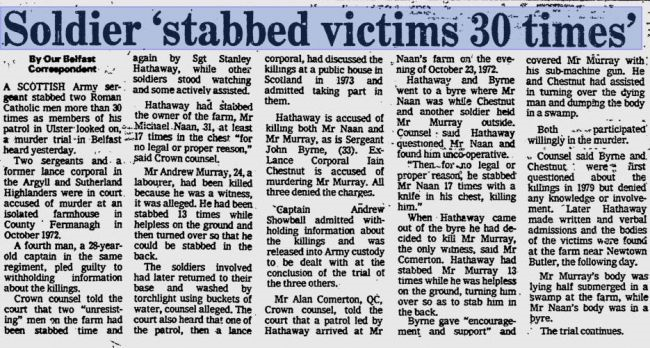
Two Catholic men were found dead at a farm at Aughinahinch, near Newtownbbutler, County Fermanagh. The incident was referred to as ‘the pitchfork killings’ and was initially thought to have been carried out by Loyalists. However it was later discovered that British soldiers had carried out the killings.

pitcfork murders
Newspaper Report on the murders

Thursday 24 October 1974

The Irish Republican Army (IRA) carried out a bomb attack on a cottage in the grounds of Harrow School in north-west London. No one was injured in the explosion. The time bomb, estimated to have contained 5lbs of explosives, exploded shortly before midnight just outside the cottage which had until just before this date been occupied by the head of the school’s Combined Cadet Force.

At 11.30pm a telephone warning about the bomb had been given to the Press Association.

Sunday 24 October 1976

Oakfield Street, 1970’s

Two British soldiers died as a result of a gun attack at Oakfield Street, Ardoyne, Belfast. The attack was carried out by the Irish Republican Army (IRA).

Monday 24 October 1977

Michael Neill (16), a Catholic boy, was shot dead by the British Army on Cliftonville Road, Belfast. He had been in the vicinity of an attempted bus-hijacking.

Sunday 24 October 1982

Joseph Donegan (48), a Catholic civilian, was abducted, tortured, and beaten to death by members of a Ulster Volunteer Force (UVF) gang in an attack that bore the hallmarks of the ‘Shankill Butchers’.

See Shankill Butchers

[Lenny Murphy, who had been leader of the ‘Shankill Butchers’, was one of the gang who abducted and killed Donegan (Dillon, 1990).]

Lenny Murphy

Friday 24 October 1986 The Northern Ireland Office (NIO) announced that legislation would be introduced to allow public houses in Northern Ireland to open on Sundays.

Wednesday 24 October 1990 ‘Proxy Bomb’ Attacks

proxy bomb

See Coshquinn Proxy Bomb

The Irish Republican Army (IRA) launched three bomb attacks at British Army check points. The attacks became know as ‘proxy bombs’ or ‘human bombs’ because three Catholic men, whom the IRA claimed had worked for the security forces, were tied into cars which had been loaded with explosives and ordered to drive to the check points. At the Coshquin checkpoint near Derry five soldiers and the man who was forced to drive the car were all killed.

In a second attack, at Killeen near Newry, a soldier was killed. The third bomb, that had been driven to Omagh, County Tyrone, failed to detonate. The attacks resulted in widespread outrage.

The Protestant Action Force (PAF) shot and killed a Catholic taxi driver, Francis Hughes, near Moy, County Tyrone.

Monday 24 October 1994

British Army (BA) soldiers stopped patrolling in Derry.

[Troops had been patrolling the city since August 1969.]

Royal Ulster Constabulary (RUC) officers in Belfast began to patrol without bullet-proof (‘flak’) jackets. A six member delegation of Loyalist representatives addressed the National Committee on American Foreign Policy in Washington. The delegation was led by Gary McMichael, then leader of the Ulster Democratic Party (UDP), and David Ervine, then leader of the Progressive Unionist Party (PUP).

Saturday 24 October 1998

David Trimble, then leader of the Ulster Unionist Party (UUP), delivered a speech to the Annual Conference of the UUP. Trimble repeated his view that Sinn Féin (SF) members could not become part of an Executive before decommissioning by the Irish Republican Army (IRA).

Wednesday 24 October 2001

Two men were arrested when RUC officers stopped a car near Moira, County Down, and discovered a sub-machine gun. The car was on the Moira interchange at the M1 motorway.

[The two men were believed to be members of a dissident Republican paramilitary group. The incident happened at approximately 4.00pm (1600BST).]

There were disturbances on the Crumlin Road, north Belfast. Loyalists blocked the main road at approximately 4.30pm (1630BST) thus preventing Catholic school children from getting home. Nationalists tried to get up the Crumlin Road to escort their children home and the Royal Ulster Constabulary (RUC) moved between the two groups. Bricks and bottles were thrown by both groups.

Flax Street – Crumlin Road

[The Crumlin Road is the ‘alternative’ route that Loyalists want Catholic children and their parents to use when going to and from the Holy Cross Girls’ Primary School on the nearby Ardoyne Road.]

A man (40) was shot in the leg at 8.00pm (2000BST) in the Kilcooley Estate, Bangor, County Down.

[The Royal Ulster Constabulary (RUC) were investigating the motive for the shooting.]

There were a number of statements in the House of Commons. Tony Blair, then British Prime Minister, welcomed the decommissioning by the Irish Republican Army (IRA). David Trimble, then leader of the Ulster Unionist Party (UUP), said that he had reappointed the three UUP Ministers to the Northern Ireland Executive “without prejudice” to the decision to be taken by the UUP executive on Saturday 27 October 2001. However, Trimble asked Blair,

“what sanctions will the government apply to them [those who had not decommissioning by February 2002] so as to avoid others having to apply sanctions?”.

[Trimble was thus explicitly setting a new deadline in the peace process.]

John Reid, then Secretary of State for Northern Ireland, announced that work had begun on the dismantling of two British Army observation towers in south Armagh. One on Sturgan mountain and one on Camlough mountain. He also announced that work would begin on Thursday 25 October 2001 on demolishing a sangar at Newtownhamilton police station in south Armagh, and also on demolishing the British Royal Irish Regiment (British Army) base in Magherafelt, County Derry. Reid also pledged to introduce a progressive programme of security normalisation as the paramilitary threat lessened.

[The demolition work is expected to take a year to complete. There was no word on the other watch towers (12?) in south Armagh. It is envisaged that there would be further cuts in the number of British Army troops based in Northern Ireland. It is also likely that the British government will make further movement on police-reform legislation, review criminal justice, and honour human rights and equality measures. Some of the security (and other) measures were ones outlined in the British and Irish governments’ Implementation Plan published on 1 August 2001.]

Tony Blair with Martti Ahtisaari (c) and Cyril Ramaphosa (r)

Cyril Ramaphosa and Martti Ahtisarri, the two independent arms inspectors, announced that they had resigned their positions. They said that they were no longer required given that the IICD and the IRA were dealing with the weapons issue. [The arms inspectors had been appointed on 14 May 2000.] The Social Democratic and Labour Party (SDLP) called on Loyalist paramilitaries to begin the process of decommissioning their weapons.

 ————————————————————–

———————————————————————————

Remembering all innocent victims of the Troubles

Today is the anniversary of the death of the following  people killed as a results of the conflict in Northern Ireland

“To live in hearts we leave behind is not to die

– Thomas Campbell

To the innocent on the list – Your memory will live  forever

– To  the Paramilitaries  –

There are many things worth living for, a few things worth dying for, but nothing worth killing for.

  18 People lost their lives on the 24th  October  between 1971 – 1990

————————————————————–

24 October 1971


Martin Forsythe,  (19)

Catholic
Status: Irish Republican Army (IRA),

Killed by: Royal Ulster Constabulary (RUC)
Shot by undercover RUC during bomb attack on Celebrity Club, Donegall Place, Belfast.

————————————————————–

24 October 1972
Robert Mason,  (19) nfNI
Status: British Army (BA),

Killed by: Irish Republican Army (IRA)
Shot by sniper while on British Army (BA) foot patrol, Naples Street, off Grosvenor Road, Belfast.

————————————————————–

24 October 1972
John Morrell,   (32) nfNI
Status: British Army (BA),

Killed by: Irish Republican Army (IRA)
Died ten days after being injured when detonated booby trap bomb while searching house, Drumarg, Armagh.

————————————————————–

24 October 1976
Anthony Abbott,  (19) nfNI
Status: British Army (BA),

Killed by: Irish Republican Army (IRA)
Shot by snipers while checking abandoned car, Oakfield Street, Ardoyne, Belfast.

————————————————————–

24 October 1976
Maurice Murphy,   (26) nfNI
Status: British Army (BA),

Killed by: Irish Republican Army (IRA)
Shot by snipers while checking abandoned car, Oakfield Street, Ardoyne, Belfast. He died 23 November 1976.

————————————————————–

24 October 1977


Michael Neill,   (16)

Catholic
Status: Civilian (Civ),

Killed by: British Army (BA)
Shot while in the vicinity of an attempted hijacking of bus, junction of Cliftonville Road and Oldpark Road, Belfast.

————————————————————–

24 October 1979


Walter Moore,   (50)

Protestant
Status: Civilian (Civ),

Killed by: Irish Republican Army (IRA)
Shot outside his home, Lyndhurst Parade, off Ballygomartin Road, Belfast.

————————————————————–

24 October 1982


Joseph Donegan,   (48)

Catholic
Status: Civilian (Civ),

Kiddlled by: Ulster Volunteer Force (UVF)
Abducted while walking along Falls Road, Belfast. Found beaten to death, in entry, off Brookmount Street, Shankill, Belfast, on 25 October 1982.

See Shankill Butchers

————————————————————–

24 October 1983


Cyrus Campbell,  (49)

Protestant
Status: Ulster Defence Regiment (UDR),

Killed by: Irish Republican Army (IRA)
Off duty. Shot while driving car at his farm, Carricklongfield, near Aughnacloy, County Tyrone.

————————————————————–

24 October 1986
Kenneth Johnston,  (25)

Protestant
Status: Civilian (Civ),

Killed by: Irish Republican Army (IRA)
Shot while sitting in his firm’s stationary car, Magherafelt, County Derry. His firm contractor to British Army (BA) / Royal Ulster Constabulary (RUC).

————————————————————–

24 October 1990


 Francis Hughes,  (61)

Catholic
Status: Civilian (Civ),

Killed by: Protestant Action Force (PAF)
Taxi driver. Found shot in his burnt out car Derryane Road, near Moy, County Tyrone.

————————————————————–

24 October 1990
Stephen Burrows,   (30) nfNI
Status: British Army (BA),

Killed by: Irish Republican Army (IRA)
Killed in van bomb attack on permanent British Army (BA) Vehicle Check Point (VCP), Buncrana Road, Coshquinn, near Derry.

See Coshquin Proxy Bomb

————————————————————–

24 October 1990
Stephen Beacham,   (20) nfNI
Status: British Army (BA),

Killed by: Irish Republican Army (IRA)
Killed in van bomb attack on permanent British Army (BA) Vehicle Check Point (VCP), Buncrana Road, Coshquinn, near Derry.

————————————————————–

24 October 1990


Paul Worrall,  (23) nfNI
Status: British Army (BA),

Killed by: Irish Republican Army (IRA)
Killed in van bomb attack on permanent British Army (BA) Vehicle Check Point (VCP), Buncrana Road, Coshquinn, near Derry.

————————————————————–

24 October 1990
Vincent Scott,   (21) nfNI
Status: British Army (BA),

Killed by: Irish Republican Army (IRA)
Killed in van bomb attack on permanent British Army (BA) Vehicle Check Point (VCP), Buncrana Road, Coshquinn, near Derry.

————————————————————–

24 October 1990
David Sweeney,  (19) nfNI
Status: British Army (BA),

Killed by: Irish Republican Army (IRA)
Killed in van bomb attack on permanent British Army (BA) Vehicle Check Point (VCP), Buncrana Road, Coshquinn, near Derry.

————————————————————–

24 October 1990


Patrick Gillespie,   (42)

Catholic
Status: Civilian (Civ),

#Killed by: Irish Republican Army (IRA)
Killed in van bomb attack on permanent British Army (BA) Vehicle Check Point (VCP), Buncrana Road, Coshquinn, near Derry. A civilian employed by British Army (BA), he was forced to drive the van bomb to the Vehicle Check Point (VCP).

————————————————————–

24 October 1990


Cyril Smith,   (21)

Catholic
Status: British Army (BA),

Killed by: Irish Republican Army (IRA)
From Northern Ireland. Killed in van bomb attack on permanent British Army (BA) Vehicle Check Point (VCP), Dublin Road, Killeen, County Armagh.

————————————————————–

My Daughter wants Oysters ?

Well woke up this morning and still half sleeping  I vaguely recalled a conversation between my daughter ( Autumn ) and wife (Simone). I can’t remember much of the conversation but I did hear hair mentioned and a shopping list being put together. The plan was to purchase a list of items which would enhance and make Autumn’s hair grow longer, stronger and healthier. There were also a number of vitamins  and other beauty products.

Not my Daughter – but nice hair!

Getting random  shopping lists is a regular   occurrence with a teenage daughter and I though nothing more until the wife showed me the list – which I have scanned and posted below……

autumn letter 2
Daughter’s Shopping list

Now I’m no expert , but I was still  rather surprised and slightly worried to see item number nine  on the list , under the heading “food & drink”

Oysters…

Oysters

OYSTER ?

I mean is she going to eat them ?  or does she have to wash her hair in them. Do  they have to be a particular breed of Oyster or will any do?  ?

And are there more than one type of Oyster available to purchase?

As these questions drifting about my mind I tried to recall my lifetime knowledge of Oysters and I’m afraid that it only amounted to a distasteful memory of eating something that was cold , slimy and felt similar to swallowing (and I feel sick even saying this) a mouthful of Phlegm. Not that I’ve ever swallowed a mouthful of phlegm, I assure you.

Scanning the rest of column one everything else seemed to a reasonable request and I moved onto the second column. All was going well and fitting in with the “hair” and healthy living theme until I came to the last item on the list.


Spongebob washing his hair

Spongbob Square Pants ?

Well you could have blown me over with a feather.

She’s 16 years old and is dating her first serious (not in my eyes) boyfriend and all her time, energy and daily moods swings are dependent  on  this relationship running smoothly – Which I am sad to admit is not always the case.

I’m starting to depress myself now – so I’ll just go along with the list and make  a fatherly contribution to my beautiful daughters emotional wellbeing. Because – I know if I don’t get everything on the list I’ll be in for a hissy fit and dirty looks over  the dinning table.

Now then  , where do I buy Oysters?

23rd October – Deaths & Events in Northern Ireland Troubles

Key Events & Deaths on this day in Northern Ireland Troubles

 23rd Octobe

——————–

Friday 23 October 1970

Charles Haughey, and two others were found not guilty of illegal arms importation by a Dublin jury. The ‘Arms Trial’ had begun on 28 May 1970. Neil Blaney, a co-accused, had been found not guilty on 2 July 1970.

Saturday 23 October 1971

Funeral of Mrs Maura Meehan 31

Two female members of the Irish Republican Army (IRA), Maura Meehan (30) and Dorothy Maguire (19), were shot dead by the British Army (BA) in the Lower Falls area of Belfast. The two women had been travelling the area warning people of British Army raids on houses.

[The two women were the first members of Cumann na mBan to die in the conflict.] Three Catholic civilians, Sean Ruddy (28), James McLaughlin (26) and Robert Anderson (26), were shot dead by the British Army during an attempted robbery in Newry, County Down.

Tuesday 23 October 1973

The Standing Committee of the Ulster Unionist Party (UUP) voted by 132 to 105 to support a policy which would allow UUP members to take part in any future power-sharing executive.

[While Brian Faulkner, then leader of the UUP expressed his public pleasure at the result, the narrowness of the victory was an indication of deep divisions within the UUP.]

Thursday 23 October 1975

Two Catholic civilians, Peter McKearney (63) and his wife Jane McKearney (58), were shot dead by the Ulster Volunteer Force (UVF) at their home near Moy, County Tyrone.

The Irish Republican Army (IRA) planted a bomb on a car outside the home of Hugh Fraser, then a Conservative Member of Parliament (MP). A person passing the car was killed when the bomb exploded prematurely.

Monday 23 October 1978 [ Hunger Strike. ]

Friday 23 October 1981

Ulster Unionist Party conference took place over two days (23 – 24 October 1981). [ Political Developments.]

Friday 23 October 1987

Sinn Féin (SF) gained by-election victories in elections to Belfast City Council.

Tuesday 23 October 1990

The Irish Republican Army (IRA) shot and killed a Protestant taxi driver, William Aitken, in Belfast.

Saturday 23 October 1993

Shankill Road Bombing

See Shankill Bomb

See Greysteel

Ten people were killed when a bomb being planted by the Irish Republican Army (IRA) exploded prematurely as it was being planted in a fish shop on the Shankill Road, Belfast. With the exception of one of the bombers who was also killed, the rest of those who died were Protestant civilians. The bombing represented the greatest loss of life in Northern Ireland in a single incident since the Enniskillen bombing on 8 November 1987.

A further 57 people were injured in the attack. There was a wave of condemnations of the attack. Loyalist paramilitaries reacted immediately shooting two Catholic men one of whom died later from his wounds.

[Over the next week Loyalist paramilitaries killed a total of 12 Catholic civilians. The IRA later claimed that the intended target of the bomb was a meeting of Ulster Freedom Fighters (UFF) members that was believed to be taking place in the former Ulster Defence Association (UDA) office above the fish shop.]

It was announced that the Anglo-Irish Intergovernmental Conference (AIIC) meeting planned for 27 October would be postponed as a mark of respect following the Shankill Road bombing. The Ulster Unionist Party (UUP) in Belfast City Council decided not to engage with the Social Democratic and Labour Party (SDLP) until the Hume-Adams Initiative had ended.

Sunday 23 October 1994

Martin McGuinness, then Vice-President of Sinn Féin (SF), who was on a visit to London, stated that the Irish Republican Army (IRA) could end its ceasefire if a satisfactory outcome was not produced by the peace process.

Monday 23 October 1995

Dick Spring, then Tánaiste (deputy Irish Prime Minister and Minister for Foreign Affairs), travelled to Belfast for talks with David Trimble, then leader of the Ulster Unionist Party (UUP). The two men failed to agree on the issue of the decommissioning of paramilitary weapons. Spring also held a meeting with a delegation from the Progressive Unionist Party (PUP) which was led by Gusty Spence, former leader of the Ulster Volunteer Force (UVF).

Wednesday 23 October 1996

In the Queen’s speech during the opening of a new session of the British parliament, the government announced that it would pass a bill on decommissioning. Later John Major, then British Prime Minister, stated that it would require more than a new ceasefire to allow Sinn Féin (SF) to enter the Stormont talks. James Molyneaux, the former leader of the Ulster Unionist Party (UUP), announced that he would not be standing for re-election to the Lagan Valley constituency.

Friday 23 October 1998

Davy Jones, then a Orange Order spokesperson, was suspended by Dennis Watson, then Grand Master of Armagh, for “breaching Orange protocol”

. [The suspension was lifted the following day.]

Saturday 23 October 1999

Senator George Mitchell announced his review of the Good Friday Agreement would be extended as the pro-Agreement parties met at Castle Buildings, Stormont, Belfast. Sinn Féin (SF), the Ulster Unionist Party (UUP) and the Social Democratic and Labour Party (SDLP) were attempting to end the stalemate over decommissioning and the formation of an Executive. David Trimble, then leader of the UUP, wrote an article for the Newsletter (a Belfast based newspaper).

Tuesday 23 October 2001

IRA Began Decommissioning

Loyalist paramilitaries threw a pipe-bomb at the home of a Catholic family on the Deerpark Road, north Belfast, at approximately 9.00pm (2100BST). The RUC said the family, “narrowly escaped death or injury”. There was some damage to the house and a car. At around 4.00pm (1600BST) the Irish Republican Army (IRA) issued a statement that announced that the organisation had begun to decommission its weapons.

The IRA statement included the sentence:

“Therefore, in order to save the peace process we have implemented the scheme agreed with the IICD [Independent International Commission on Decommissioning] in August [2001].”

Later in the day the IICD issued a statement, part of which read: “We have now witnessed an event – which we regard as significant – in which the IRA has put a quantity of arms completely beyond use. The material in question includes arms, ammunition and explosives.” David Trimble, then leader of the Ulster Unionist Party (UUP), held a meeting with John de Chastelain (Gen.), then chairman of the IICD, to discuss the act of decommissioning by the IRA. Following the discussions Trimble announced that he would would be recommending to a meeting of the UUP executive on Saturday (27 October 20001) that the UUP ministers retake their seats on the Northern Ireland Executive. The announcements by the IRA and the IICD were welcomed by the British and Irish governments, by the American administration, by Nationalists, and by some Unionists. The Democratice Unionist Party (DUP) and some members of the UUP claimed the move by the IRA was “one-off gesture” or a “stunt”.

———————————————————————————

Remembering all innocent victims of the Troubles

Today is the anniversary of the death of the following  people killed as a results of the conflict in Northern Ireland

“To live in hearts we leave behind is not to die.”
Thomas Campbell

To the innocent on the list – Your memory will live  forever

– To  the Paramilitaries  –

There are many things worth living for, a few things worth dying for, but nothing worth killing for.

  22  People lost their lives on the 23rd  October  between 1971 – 1993

————————————————————–

23 October 1971


Maura Meehan,  (30)

Catholic
Status: Irish Republican Army (IRA),

Killed by: British Army (BA)
Shot while travelling in car warning local residents of British Army (BA) house raids, Cape Street, Lower Falls, Belfast.

————————————————————–

23 October 1971


Dorothy Maguire,  (19)

Catholic
Status: Irish Republican Army (IRA),

Killed by: British Army (BA)
Shot while travelling in car warning local residents of British Army (BA) house raids, Cape Street, Lower Falls, Belfast.

————————————————————–

23 October 1971


Sean Ruddy,   (19)

Catholic
Status: Civilian (Civ),

Killed by: British Army (BA)
Shot by undercover British Army (BA) members, from nearby roof top, during attempted robbery of man outside bank, Hill Street, Newry, County Down. Assumed to be an Irish Republican Army (IRA) member.

————————————————————–

23 October 1971
Thomas McLoughlin,   (27)

Catholic
Status: Civilian (Civ),

Killed by: British Army (BA)
Shot by undercover British Army (BA) members, from nearby roof top, during attempted robbery of man outside bank, Hill Street, Newry, County Down. Assumed to be an Irish Republican Army (IRA) member.

————————————————————–

23 October 1971


Robert Anderson,  (25)

Catholic
Status: Civilian (Civ),

Killed by: British Army (BA)
Shot by undercover British Army (BA) members, from nearby roof top, during attempted robbery of man outside bank, Hill Street, Newry, County Down. Assumed to be an Irish Republican Army (IRA) member.

————————————————————–

23 October 1972


Michael Naan,  (31)

Catholic
Status: Civilian (Civ),

Killed by: British Army (BA)
Stabbed to death at his farm, Aghnahinch, near Newtownbutler, County Fermanagh. His body found on 24 October 1972.

————————————————————–

23 October 1972


Andrew Murray, (24)

Catholic
Status: Civilian (Civ),

Killed by: British Army (BA)
Stabbed to death at his workplace, Michael Naan’s farm, Aghnahinch, near Newtownbutler, County Fermanagh. His body found on 24 October 1972.

————————————————————–

23 October 1974
Michael Simpson,   (21) nfNI
Status: British Army (BA),

Killed by: Irish Republican Army (IRA)
Died three weeks after being shot by sniper while on British Army (BA) foot patrol, Racecourse Road, Shantallow, Derry.

————————————————————–

23 October 1975


Peter McKearney,  (63)

Catholic
Status: Civilian (Civ),

Killed by: Ulster Volunteer Force (UVF)
Shot at his home, Listamlet, near Moy, County Tyrone.

————————————————————–

23 October 1975


Jane McKearney,   (58)

Catholic
Status: Civilian (Civ),

Killed by: Ulster Volunteer Force (UVF)
Shot at her home, Listamlet, near Moy, County Tyrone.

————————————————————–

23 October 1975
Gordon Hamilton-Fairley,   (45) nfNIB
Status: Civilian (Civ),

Killed by: Irish Republican Army (IRA)
Passerby. Killed when bomb attached to the car of Conservative MP Hugh Fraser exploded prematurely, Campden Hill Square, Kensington, London.

————————————————————–

23 October 1990
William Aitken,   (53)

Protestant
Status: Ulster Volunteer Force (UVF),

Killed by: Irish Republican Army (IRA)
Taxi driver. Shot when he left off passenger at Royal Victoria Hospital, Falls Road, Belfast.

————————————————————–

The Shankill Bombing

————————————————————

The Bomber

23 October 1993


Thomas Begley,   (23)

Catholic
Status: Irish Republican Army (IRA),

Killed by: Irish Republican Army (IRA)
Killed by bomb which exploded prematurely in shop, during attack on the upstairs Ulster Defence Association (UDA) office, Shankill Road, Belfast.

————————————————————

The Innocent Victims

——————————————–

23 October 1993

4
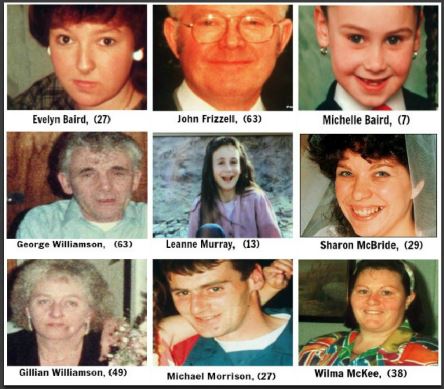
John Frizzell, (63)


John Frizzell,  (63)

Protestant
Status: Civilian (Civ),

Killed by: Irish Republican Army (IRA)
Killed by bomb which exploded prematurely in shop, during attack on the upstairs Ulster Defence Association (UDA) office, Shankill Road, Belfast.

——————————————–

23 October 1993

_45418618_sharon226

Sharon McBride, (29)


Sharon McBride,  (29)

Protestant
Status: Civilian (Civ),

Killed by: Irish Republican Army (IRA)
Killed by bomb which exploded prematurely in shop, during attack on the upstairs Ulster Defence Association (UDA) office, Shankill Road, Belfast.

——————————————–

23 October 1993

NWS_20131023_NEW_006_29372561_I4

Michael Morrison, (27)


Michael Morrison,  (27)

Protestant
Status: Ulster Defence Association (UDA),

Killed by: Irish Republican Army (IRA)
Killed by bomb which exploded prematurely in shop, during attack on the upstairs Ulster Defence Association (UDA) office, Shankill Road, Belfast.

——————————————–

23 October 1993

6

Evelyn Baird, (27)


Evelyn Baird,  (27)

Protestant
Status: Civilian (Civ),

Killed by: Irish Republican Army (IRA)
Killed by bomb which exploded prematurely in shop, during attack on the upstairs Ulster Defence Association (UDA) office, Shankill Road, Belfast.

——————————————–

23 October 1993

2

Michelle Baird, (7)


Michelle Baird,  (7)

Protestant
Status: Civilian (Civ),

Killed by: Irish Republican Army (IRA)
Killed by bomb which exploded prematurely in shop, during attack on the upstairs Ulster Defence Association (UDA) office, Shankill Road, Belfast.

——————————————–

23 October 1993

11

Leanne Murray, (13)


Leanne Murray,   (13)

Protestant
Status: Civilian (Civ),

Killed by: Irish Republican Army (IRA)
Killed by bomb which exploded prematurely in shop, during attack on the upstairs Ulster Defence Association (UDA) office, Shankill Road, Belfast.

——————————————–

23 October 1993

3

George Williamson, (63)


George Williamson,   (63)

Protestant
Status: Civilian (Civ),

Killed by: Irish Republican Army (IRA)
Killed by bomb which exploded prematurely in shop, during attack on the upstairs Ulster Defence Association (UDA) office, Shankill Road, Belfast.

——————————————–

23 October 1993

10

Gillian Williamson, (49)


Gillian Williamson,   (49)

Protestant
Status: Civilian (Civ),

Killed by: Irish Republican Army (IRA)
Killed by bomb which exploded prematurely in shop, during attack on the upstairs Ulster Defence Association (UDA) office, Shankill Road, Belfast.

——————————————–

23 October 1993

5

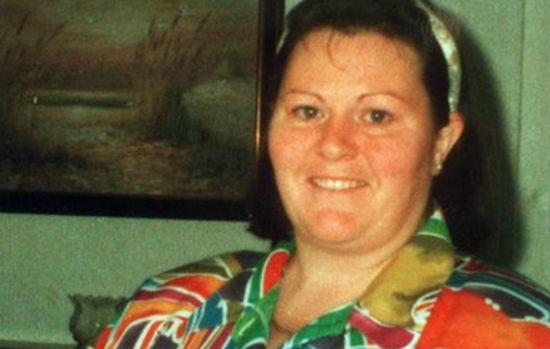
Wilma McKee, (38)


Wilma McKee,  (38)

Protestant
Status: Civilian (Civ),

Killed by: Irish Republican Army (IRA)
Killed by bomb which exploded prematurely in shop, during attack on the upstairs Ulster Defence Association (UDA) office, Shankill Road, Belfast.

——————————————–


The Shankill Bomb – Never Forgotten

The Shankill Bomb

23rd  October 1993

Irish News - Shankill.jpg

The Shankill Road bombing was carried out by the Provisional Irish Republican Army (IRA) on 23 October 1993 and is one of the most notorious incidents of the Troubles in Northern Ireland

———————————————————–

Shankill Bombing

————————————————————

Tomorrow marks the 27  anniversary of the Shankill Bomb and as usual my thoughts are with the innocent victims of this brutal attack and their families who have been sentence to a lifetime of grief and bereavement .

The pain of losing someone loved never really goes away , it just becomes more bearable as time crawls on  and we find comfort in memories that  we relive a thousands time a year.

The Shankill Bomb was one of the pivotal moments of my “journey” through the  Troubles and coming from the Shankill community I felt the grief in a personal way . I had known many of the victims and had been in the same class as Michael (Minnie) Morrison  throughout  secondary school and I knew Evelyn his girlfriend from living in Glencairn.

And everyone a wasted life

But the Shankill bombing had a profound effect on me and although I was living in London at the time , my heart was firmly in Belfast , as my community came to terms with this savage attack.

When the first reports of the bomb started coming in I felt an overwhelming sense of dread and as I watched the news unfold my first instinct was to worry about my  family  back in Belfast.Many who lived and shopped on the Shankill rd daily. I immediately  made contact with them and thankfully they were all safe and well , although a few of them had been in the vicinity of the explosion and had helped in the recuse effort immediately  after the bomb.

I had also known  the brother of the bomber Begley , although he was in no way a friend or acquaintance.

In the mid eighties I had enrolled in a YTP and this was based off the Crumlin Road in Belfast and Catholic’s were also attending the programme. Strange though it may seem this was my first time in close proximity to my catholic counterpart’s ( apart from rioting) and to be honest the two sides didn’t really mix , they done their thing and we done ours.

But it was a learning curve for me and I was able to see the “enemy” up close for the first time. But deep down as I grew older and wiser I came to the realization they really weren’t that different from us, apart from their political and religious identities.

There was a guy called Begley from Ardoyne on the same programme and my memory of him was that  he was smelly, dirty  and looked unwashed. When the name and picture of the Shankill bomber was first released I immediately made the connection , as he was the spitting image of his brother and he also looked dirty and unwashed.

Karma always collects  its debts!

————————————————

shankill-bomb-collage

The Innocent Victims

This slideshow requires JavaScript.

The Shankill Bomb

———————————————-

20th anniversary of the Shankill Bomb we talk to the victims’ families

———————————————-

The Shankill Road bombing was carried out by the Provisional Irish Republican Army (IRA) on 23 October 1993 and is one of the most notorious incidents of the Troubles in Northern Ireland. The IRA intended to assassinate the leaders of the Ulster Defence Association (UDA), who were to be meeting in a room above Frizzell’s fish shop on Shankill Road, Belfast. Two IRA members were to enter the shop disguised as deliverymen, then force the customers out at gunpoint and plant a time bomb with a short fuse. However, when the IRA members entered the shop with the bomb, it exploded prematurely. One of the IRA members was killed along with a UDA member and eight Protestant civilians.[1] More than fifty people were wounded. Unbeknownst to the IRA, the meeting had been rescheduled.

The Ulster loyalist Shankill Road had been the location of other bomb and gun attacks, including the Balmoral Furniture Company bombing in 1971 and Bayardo Bar attack in 1975, but the 1993 bombing had the highest casualties and resulted in a wave of revenge attacks by loyalists. In the week that followed, loyalists killed 14 civilians, almost all of them Irish Catholics. The deadliest attack took place in Greysteel, where UDA members opened fire in a pub frequented by Catholics, killing eight civilians and wounding 13.

————————————————————

The  Shankill Bomb

————————————————————

The Innocent Victims

——————————————–

23 October 1993

4
John Frizzell, (63)


John Frizzell,  (63)

Protestant
Status: Civilian (Civ),

Killed by: Irish Republican Army (IRA)
Killed by bomb which exploded prematurely in shop, during attack on the upstairs Ulster Defence Association (UDA) office, Shankill Road, Belfast.

——————————————–

23 October 1993

_45418618_sharon226
Sharon McBride, (29)


Sharon McBride,  (29)

Protestant
Status: Civilian (Civ),

Killed by: Irish Republican Army (IRA)
Killed by bomb which exploded prematurely in shop, during attack on the upstairs Ulster Defence Association (UDA) office, Shankill Road, Belfast.

——————————————–

23 October 1993

NWS_20131023_NEW_006_29372561_I4
Michael Morrison, (27)


Michael Morrison,  (27)

Protestant
Status: Ulster Defence Association (UDA),

Killed by: Irish Republican Army (IRA)
Killed by bomb which exploded prematurely in shop, during attack on the upstairs Ulster Defence Association (UDA) office, Shankill Road, Belfast.

——————————————–

23 October 1993

6
Evelyn Baird, (27)


Evelyn Baird,  (27)

Protestant
Status: Civilian (Civ),

Killed by: Irish Republican Army (IRA)
Killed by bomb which exploded prematurely in shop, during attack on the upstairs Ulster Defence Association (UDA) office, Shankill Road, Belfast.

——————————————–

23 October 1993

2
Michelle Baird, (7)


Michelle Baird,  (7)

Protestant
Status: Civilian (Civ),

Killed by: Irish Republican Army (IRA)
Killed by bomb which exploded prematurely in shop, during attack on the upstairs Ulster Defence Association (UDA) office, Shankill Road, Belfast.

——————————————–

23 October 1993

11
Leanne Murray, (13)


Leanne Murray,   (13)

Protestant
Status: Civilian (Civ),

Killed by: Irish Republican Army (IRA)
Killed by bomb which exploded prematurely in shop, during attack on the upstairs Ulster Defence Association (UDA) office, Shankill Road, Belfast.

——————————————–

23 October 1993

3
George Williamson, (63)


George Williamson,   (63)

Protestant
Status: Civilian (Civ),

Killed by: Irish Republican Army (IRA)
Killed by bomb which exploded prematurely in shop, during attack on the upstairs Ulster Defence Association (UDA) office, Shankill Road, Belfast.

——————————————–

23 October 1993

10
Gillian Williamson, (49)


Gillian Williamson,   (49)

Protestant
Status: Civilian (Civ),

Killed by: Irish Republican Army (IRA)
Killed by bomb which exploded prematurely in shop, during attack on the upstairs Ulster Defence Association (UDA) office, Shankill Road, Belfast.

——————————————–

23 October 1993

5
Wilma McKee, (38)


Wilma McKee,  (38)

Protestant
Status: Civilian (Civ),

Killed by: Irish Republican Army (IRA)
Killed by bomb which exploded prematurely in shop, during attack on the upstairs Ulster Defence Association (UDA) office, Shankill Road, Belfast.

——————————————–

————————————————————————

The Bomber

23 October 1993

Begley, Thomas (23)

Catholic
Status: Irish Republican Army (IRA),

Killed by: Irish Republican Army (IRA)
Killed by bomb which exploded prematurely in shop, during attack on the upstairs Ulster Defence Association (UDA) office, Shankill Road, Belfast.

——————————————————————-

Background

During the early 1990s, loyalist paramilitaries drastically increased their attacks on the Irish Catholic and Irish nationalist community and – for the first time since the beginning of the Troubles – were responsible for more deaths than republicans.[2][3] The UDA’s West Belfast brigade, and its commander Johnny Adair, played a key role in this. Adair had become the group’s commander in 1990.

The UDA’s Shankill headquarters was above Frizzell’s fish shop on the Shankill Road.[4][5] The UDA’s Inner Council and West Belfast brigade regularly met there on Saturdays.[4][6][7] Peter Taylor says it was also the office of the Loyalist Prisoners’ Association (LPA), and on Saturday mornings was normally crowded, as that was when money was given to prisoners’ families.[8] According to Henry McDonald and Jim Cusack, the IRA had the building under surveillance for some time.[4] They say that the IRA decided to strike when one of their scouts spotted Adair entering the building on the morning of Saturday 23 October 1993.[4] Later, in a secretly-recorded conversation with police, Adair confirmed that he had been in the building that morning.[5]

The bombing

The IRA’s Belfast Brigade launched an operation to assassinate the UDA’s top commanders, whom it believed were at the meeting.[4][5] The plan was for two IRA members to enter the shop with a time bomb, force out the customers at gunpoint and flee before it exploded; killing those at the meeting.[4] As they believed the meeting was being held in the room above the shop, the bomb was designed to send the blast upwards. IRA members maintained that they would have warned the customers as the bomb was primed.[9] It had an eleven-second fuse, and the IRA explained that this would have allowed just enough time to clear the downstairs shop but not enough for those upstairs to escape.[6][7]

The operation would be carried out by Thomas Begley and Seán Kelly, two relatively young IRA members from Ardoyne. They drove from Ardoyne to the Shankill in a hijacked blue Ford Escort, which they parked on Berlin Street, around the corner from Frizzell’s. Dressed as deliverymen, they entered the shop with the five-pound bomb in a holdall.[5] It was shortly after 1PM on a Saturday afternoon and the area was crowded with mostly women and children.[10] Whilst Kelly waited at the door, Begley made his way through the customers towards the counter, where the bomb detonated prematurely.[9] Forensic evidence showed that Begley had been holding the bomb over the refrigerated serving counter when it exploded.[11] Begley was blown to pieces and nine other people[9]—including the owner John Frizzell, his daughter Sharon McBride, 13-year-old Leanne Murray and UDA member Michael Morrison—were killed in the blast. His common-law wife Evelyn Baird and seven-year-old daughter Michelle were also killed as was another couple, George and Gillian Williamson, and Wilma McKee.[12] The force of the blast caused the old building to collapse into a pile of rubble. The upper floor came down upon those inside the shop, crushing many of the survivors under the rubble, where they remained until rescued some hours later by volunteers and emergency services. About 57 people were injured.[6] At the scene during the rescue operation were several senior loyalists, including Adair and Billy McQuiston. The latter had been in a pub on the nearest corner when the bomb went off.[2][8] Among those rescued from the rubble was the badly-wounded Seán Kelly.[4]

Unknown to the IRA, the UDA meeting had ended early[7][5] and those attending it had left the building before the bomb exploded.[5][4] McDonald and Cusack claim that Adair and his men had stopped using the room for important meetings, allegedly because a sympathiser within the Royal Ulster Constabulary (RUC) told Adair that the police had it bugged.[4]

Aftermath

Scene of the bombing, as of 2011

There was great anger and outrage in the Shankill in the wake of the bombing. Billy McQuiston told journalist Peter Taylor that “anybody on the Shankill Road that day, from a Boy Scout to a granny, if you’d given them a gun they would have gone out and retaliated”.[8] Many Protestants saw the bombing as an indiscriminate attack on them.[6] Adair believed that the bomb was meant for him.[6] Two days after the bombing, as Adair was driving away from his house, he stopped and told a police officer “I’m away to plan a mass murder”.[13] In the week following the bombing, the UDA and UVF launched a wave of “revenge attacks”, killing 14 civilians.[12] The UDA shot a Catholic delivery driver in Belfast after luring him to a bogus call just a few hours after the bombing. He died on 25 October.[14] On 26 October, the UDA shot dead another two Catholic civilians and wounded five in an indiscriminate attack at a Council Depot on Kennedy Way, Belfast.[12] On 30 October, UDA members entered a pub in Greysteel frequented by Catholics and again opened-fire indiscriminately. Eight civilians (six Catholics and two Protestants) were killed and 13 were wounded. This became known as the Greysteel massacre. The UDA claimed it was a direct retaliation for the Shankill Road bombing.[2] Michael Stone and another UDA member said that Adair also vowed to launch simultaneous attacks on Catholics attending mass in Belfast. The day after the attack (Sunday), the security forces were sent to guard all Catholic churches in Belfast. A UDA member said that a carload of gunmen were sent to attack Holy Family Catholic Church on the Limestone Road, but called off the attack due to the high security.[6] Adair denied the claims.[6] The UVF shot dead a Catholic man in Newtownabbey and two Catholic brothers in Bleary.[12]

At Begley’s wake, a British soldier fired upon a group of mourners standing outside Begley’s home. The soldier fired twenty shots from a passing Land Rover. Among those wounded was republican activist Eddie Copeland, who needed extensive surgery. The court heard that the soldiers had been shown a photograph of Copeland before being sent on patrol. The soldier who fired the shots, Trooper Andrew Clarke, was jailed for ten years for attempted murder.[15][16] Begley was given a well-attended republican funeral in west Belfast.[17][18] Gerry Adams, president of Sinn Féin, used “unusually strong language” in condemning the bombing, saying it was wrong and could not be excused. However, he was criticised for being a pall-bearer at Begley’s funeral.[10][19] David McKittrick and Eamonn Mallie wrote that if Adams had shunned the funeral it would have been “the end of him as a republican leader”. They explain that it would have severely damaged his credibility within the republican movement and made it difficult for him to secure an IRA ceasefire.[20] Others, such as Taoiseach Albert Reynolds and RUC Chief Constable Hugh Annesley, agreed with this view.[21]

Seán Kelly, the surviving IRA member, was badly wounded in the blast, having lost his left eye and unable to move his left arm.[9] Upon his release from hospital, however, he was arrested and convicted of nine counts of murder, each with a corresponding life sentence. In July 2000, he was released under the terms of the Belfast Agreement.[9] In an interview shortly after his release, he said he had never intended to kill innocent people and regrets what happened.[9]

Relatives of those killed in the Shankill Road bombing adopted different positions during the 20th anniversary commemorative events in 2013.

See Greysteel

See Shankill Bomb

22nd October – Deaths & Events in Northern Ireland Troubles

Key Events & Deaths on this day in Northern Ireland Troubles

 22nd October

Tuesday 22 October 1974

Members of Parliament (MPs) who were part of the United Ulster Unionist Council (UUUC) elected James Molyneaux as their leader. The Irish Republican Army (IRA) carried out a bomb attack on the Brooks club, in St James’s Square in London. Although the bomb was thrown into an empty dining room, two members of the kitchen staff were severly injured in the blast.

Wednesday 22 October 1975

gilford four cropped

‘Guildford Four’ Patrick Armstrong, Gerard Conlon, Paul Hill, and Carole Richardson (who became known as the ‘Guildford Four’) were found guilty at the Old Bailey in London of causing explosions in London in October 1974. The four were sentenced to life imprisonment.

[Following an appeal the four were released on 19 October 1989. The court of appeal decided that the ‘confessions’ had been fabricated by the police.]

Thursday 22 October 1981

The European Court ruled against the British government on the grounds that it was discriminating against homosexuals by treating homosexuality as a crime in Northern Ireland.

Monday 22 October 1984

The European Commission on Human Rights decided that the use of plastic bullets by security forces in Northern Ireland was justified in riot situations.

Friday 22 October 1993

While addressing the House of Commons at Westminster, John Hume, then leader of the Social Democratic and Labour Party (SDLP), said that he thought the Hume-Adams Initiative was the best chance of achieving peace that he had seen in 20 years. The Irish Republican Army (IRA) issued threats against the staff of five firms that were undertaking building work on behalf of the security forces.
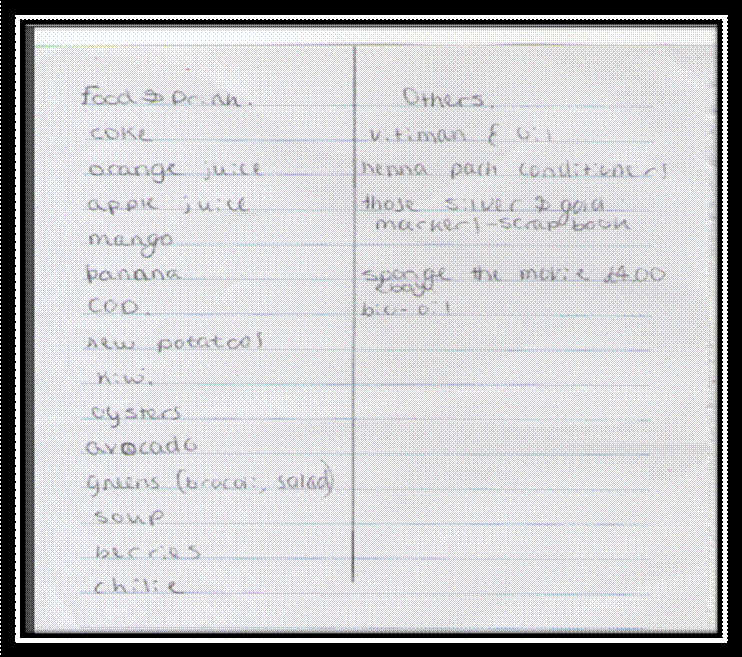
Tuesday 22 October 1996

The Irish News (a Belfast based newspaper) published details of an opinion poll  One result showed that 94 per cent of all respondents, and 70 per cent of Sinn Féin (SF) supporters, wanted an immediate Irish Republican Army (IRA) ceasefire.

Friday 22 October 1999

Some journalists were shown identity cards that were alleged to have been taken from two British soldiers who had been “arrested” by the Irish Republican Army (IRA) in the Short Strand area of east Belfast. Republicans claimed that the soldiers had been involved with a group of Loyalists in throwing stones at Nationalist residents of Short Strand. It was said that the two soldiers had been questioned by the IRA before being released.

Two men were shot in the legs in a paramilitary ‘punishment’ shooting in Strabane, County Tyrone. The IRA were believed to have been responsible for the attack. Following their arrest on 20 October 1999, seven men were charged with firearms offences and in the case of three other men files were forwarded to the Director of Public Prosecutions in the Republic of Ireland. Political talks that formed part of the Mitchell Review of the Agreement continued late at Stormont, Belfast.

Monday 22 October 2001

Adams Asks IRA to Decommission At around 1.00am (0100BST) rioting resumed in the Limestone Road and Halliday’s Road area of north Belfast. Petrol bombs and fireworks were thrown at the Royal Ulster Constabulary (RUC). John Reid, then Secretary of State for Northern Ireland, gave a speech in Belfast in which he said that the British government would not be “grudging or ungenerous” in the event of decommissioning of weapons by paramilitary groups. Later in the day Reid met a number of political leaders to discuss the issue of decommissioning.

Gerry Adams, then President of Sinn Féin (SF), held separate meetings with John Reid and David Trimble, then leader of the Ulster Unionist Party (UUP). Adams later made what he described as a significant speech at 5.00pm (1700BST). In his speech he said: “Martin McGuinness and I have also held discussions with the IRA and we have put to the IRA the view that if it could make a ground-breaking move on the arms issue that this could save the peace process from collapse and transform the situation.”

[The IRA responded on Tuesday 23 October 2001.]

The announcement was welcomed by Nationalists, the Irish government, the British Government, and the American administration. Those Unionists who had supported the Good Friday Agreement also welcomed the announcement. Adams also confirmed that one of the three men arrested in Columbia, South America, on 13 August 2001, was SF’s representative in Cuba. Adams said that Niall Connolly, who had lived in Cuba for a number of years, had been asked to represent SF in Cuba by a senior member of the party. However, Adams said that the “decision was taken without the knowledge or authorisation of the international department or any other party structure including the party chairperson or myself”.

———————————————————————————

Remembering all innocent victims of the Troubles

Today is the anniversary of the death of the following  people killed as a results of the conflict in Northern Ireland

“To live in hearts we leave behind is not to die.”
Thomas Campbell

To the innocent on the list – Your memory will live  forever

– To  the Paramilitaries  –

There are many things worth living for, a few things worth dying for, but nothing worth killing for.

  4  People lost their lives on the 22nd October  between 1972 – 1982

————————————————————–

22 October 1972


John Bell,   (21)

Protestant
Status: Ulster Defence Regiment (UDR),

Killed by: Irish Republican Army (IRA)
Off duty. Shot at his farm, Derrydoon, near Newtownbutler, County Fermanagh.

————————————————————–

22 October 1973
Ronald Fletcher,  (46)

Protestant
Status: Civilian (Civ),

Killed by: non-specific Loyalist group (LOY)
Killed during bomb attack on Wilson’s Bar, Upper Newtownards Road, Ballyhackamore, Belfast.

————————————————————–

22 October 1974
Dominic Donnelly, (48)

Catholic
Status: Civilian (Civ),

Killed by: non-specific Loyalist group (LOY)
Killed by booby trap bomb hidden in radio, at Eastwood’s Bookmakers, Marquis Street, Belfast.

————————————————————–

22 October 1982


Thomas Cochrane,   (54)

Protestant
Status: Ulster Defence Regiment (UDR),

Killed by: Irish Republican Army (IRA)
Off duty. Abducted while travelling to work, Glennane, near Markethill, County Armagh. Found shot Lislea, near Camlough, County Armagh, on 29 October 1982.

————————————————————–


ISIS Getting a taste of their own medicine – compilation

ISIS Getting a taste of their own medicine

Whilst I am a pacifist at heart the crimes and outrageous actions of IS & other Islamic Extremist  has shocked and sickened me to the core and like many people I feel a sense of frustration that mostly their crimes seems to go unpunished.

Therefore  I have put together this  short  compilation of these disgusting animals getting a taste of their own medicine.

Some of the clips  did arouse an element of sympathy within me, briefly , but then I remembered Alan Henning , James Foley , David Haines and all those other innocent , good people that  these scum killed and all thoughts of sympathy disappeared.

Some of these video contain scenes that may upset some people –  you have been warned!

———————————————————————

Syrian army beating terrorist that killed Christians

———————————————————————

———————————————————————

ISIS spy caught by Iraq army..not a great interrogation

———————————————————————

———————————————————————

ISIS crying becuase Iraqi Special Forces beat’em up

———————————————————————

———————————————————————

Shia special forces capture 10 ISIS Terrorists

———————————————————————

———————————————————————

Mystery sniper kills three ISIS leaders in Libya in ten days

———————————————————————

———————————————————————

YPG sniper kill 50 Isis

———————————————————————

———————————————————————

The Moment an ISIS Fighter is Shot Dead by Syria Army

———————————————————————

———————————————————————

The moment of death of Islamist commander Saifullah al Shishani by mortar shrapnel

———————————————————————

Khansaa Brigade – ISIS ‘female ” Police “

Khansaa Brigade

The Al-Khansaa Brigade, also spelled Al-Khanssaa Brigade, is an all-women police or religious enforcement unit of the jihadist Islamic State of Iraq and the Levant (ISIL), operating in its de facto capital of Raqqa and Mosul.[1] Formed in early 2014 and apparently named after Al-Khansa, a female Arabic poet from the earliest days of Islam, it is unclear how widespread and sustained the group is.

An ISIL official, Abu Ahmad, said in 2014, “We have established the brigade to raise awareness of our religion among women, and to punish women who do not abide by the law.”[2] The outfit has also been called ISIL’s ‘moral police’

ISIS ‘female Gestapo’ leading campaign of terror against own sex – and 60 are British

Al Khansaa brigade rule by terror

———————————————————–

Daesh Defectors – 3 women leave al-Khansaa brigade

———————————————————–

Islamic State’s ‘female Gestapo’ is conducting a sickening campaign of terror against their own sex.

The special brigade – set up to enforce the terror group’s strict Islamic views – bite and whip any woman who steps out of line and force girls to become sex slaves.

As many as 60 British women are thought to be members of the brigade, which operate in ISIS’ self-proclaimed capital Raqqa, in Syria.

The city is ruled by fear, with torture, stoning and crucifixions common.. All women are prohibited from going outside or travelling without a male relative.

———————————————————–

What It’s Like To Be A Woman In Islamic State

———————————————————–

ISIS imposes a strict dress code demanding all females from puberty upwards wear two gowns to hide their body shape, black gloves to cover their hands, and three veils so their faces cannot be seen, even in direct sunlight.

Women have been publicly buried alive in sand for breaking the code.

One former Syrian schoolteacher trapped in the city opened up to Channel 4 in a documentary, Escape From ISIS, to be aired next week.

She said: “We have no freedom. We cannot go out on the balcony or look through the window. They will arrest a woman if she wears perfume or raises her voice. A woman’s voice cannot be heard.”

The teacher told of her horrifying capture by the city’s ruthless all-women police unit, the Al-Khansa brigade.

“They said my eyes were visible through my veil. I was tortured. They lashed me. Now some of them punish women by biting. They give you the option between getting bitten or lashed.”

———————————————————–

ISIS: Women’s Role In The Islamic State |

———————————————————–

Brigade member: Aqsa Mahmood, 20, from Glasgow

British women in the brigade are thought to include Aqsa Mahmood, the 20-year-old Glaswegian woman who left her family to join ISIS last year.

They are paid up to £100 a month, a relative fortune.

Marriage: Many women who join ISIS become jihadi brides

One former Al-Khansa enforcer, a young Syrian woman called Umm Abaid, told the filmmakers how she had led a normal life until the arrival of ISIS and the imposition of Sharia law in Raqqa.

“I went to school, to coffee shops,” she said, “but slowly, slowly my husband [a Saudi Arabian IS fighter killed in a suicide bomb attack] convinced me about Islamic State and its ideas. I joined the brigade and was responsible for enforcing the clothing regulations.

“Anyone who broke the rules, we would lash. Then we would take her male guardian, her brother, father or husband, and lash him, too.”

The brigade even stops buses to check women passengers.

If one is found breaking the code, all the passengers are forced to get off and the bus is refused permission to proceed. The driver can be lashed because he let the woman on board.

Some of the Al-Khansa members operate undercover, posing as housewives and mingling in the crowds to listen for any dissent.


They also run brothels where kidnapped girls are expected to satisfy fighters returning from battle.

———————————————————–

ISIS Sex Slave Operation

———————————————————–

Those who have escaped the brothels say they have slept with 100 different fighters in a few weeks.

Emily Dyer, a research fellow with the Henry Jackson Society, spends hours tracking social media messages sent to the West by jihadi brides.

She says many Muslim British women see joining ISIS as an “attractive option” but once they arrive in Syria the reality of their situation is wholly different from the propaganda they are fed.

Under ISIS prohibitions, single women live in all-female safe houses called maqqars. If they are married, they must be only mothers or housewives unless selected to be IS ‘enforcers’ or fighters.

A girl tracked by Emily on Twitter said: “I’m fed up. They make me do the washing up.”

Another said: “I’ve done nothing except hand out clothes and food. I help clean weapons and transport dead bodies from the front. It’s beginning to get really hard.’

One complained: ‘My iPod doesn’t work any more. I have to come back [to the West

Women in maqqars are forbidden access to mobile phones or the internet.. They are then prepared to become jihadi brides, even if they are young teenagers.

But girls who marry one fighter, have found they are expected to spend a week with their new ‘spouse’ before they are ‘divorced’ by an Islamic cleric and married to another fighter for a week.

Yet more Muslim girls and women from Europe, and notably the UK, arrive in Raqqa each month to join ISIS.

It’s just one of the reasons politicians view the threat from ISIS so seriously