The summer solstice occurs during a hemisphere’s summer. This is the northern solstice in the northern hemisphere and the southern solstice in the southern hemisphere. Depending on the shift of the calendar, the summer solstice occurs some time between June 20 and June 22 in the northern hemisphere and between December 20 and December 23 each year in the southern hemisphere.
————————-
What is Summer Solstice 2016 – Longest day
————————-
The same dates in the opposite hemisphere are referred to as the winter solstice.
When on a geographic pole, the Sun reaches its greatest height, the moment of solstice, it can be noon only along that longitude which at that moment lies in the direction of the Sun from the pole. For other longitudes, it is not noon. Noon has either passed or has yet to come. Hence the notion of a solstice day is useful.
————————-
————————-
The term is colloquially used like midsummer to refer to the day on which solstice occurs. The summer solstice day has the longest period of daylight – except in the polar regions, where daylight is continuous, from a few days to six months around the summer solstice.
Worldwide, interpretation of the event has varied among cultures, but most recognize the event in some way with holidays, festivals, and rituals around that time with themes of religion or fertility.
Solstice is derived from the Latin words sol (sun) and sistere (to stand still).
Diagram of the Earth‘s seasons as seen from the north.
Far left: summer solstice for the Northern Hemisphere.
Front right: summer solstice for the Southern Hemisphere.
The summer solstice occurs when the tilt of a planet’s semi-axis, in either northern or southern hemispheres, is most inclined toward the star that it orbits.
Earth’s maximum axial tilt toward the Sun is 23° 26′. This happens twice each year (once in each hemisphere), at which times the Sun reaches its highest position in the sky as seen from the north or the south pole.
——————————-
Stonehenge Summer Solstice 2016
Summer Solstice 2016
Stonehenge is an ancient prehistoric site which has been a place of worship and celebration at the time of Summer Solstice for thousands of years.
This important place is seen by many as a sacred site – please respect it and please respect each other.
Open Access
English Heritage is pleased to provide free Managed Open Access to Stonehenge for Summer Solstice 2016 and ask that if you are planning to join us for this peaceful and special occasion that you follow these Conditions of Entry. These are written to ensure enjoyment and safety for everyone attending Summer Solstice at Stonehenge.
Please note to reduce risk to those attending and to the monument itself, alcohol is not permitted in the monument field during Summer Solstice. If you have any questions regarding the ceremonial use of mead please contact Solstice.Stonehenge@English-Heritage.org.uk
MONDAY 20 JUNE
Access to monument field – 7pm
Sunset – 9:26pm
TUESDAY 21 JUNE
Sunrise – 4:52am
Monument field closes – 8am
The Solstice Car Park opens at 7pm on 20th June with last admissions at 6am (or when full, if earlier) on 21st June. The car park will close at 12 noon on 21st June.
Admission, Parking and Planning Your Journey
Admission to the Summer Solstice at Stonehenge is free of charge, however please note that parking fees apply.
We strongly recommend travelling by public transport or arranging to car share. Help with planning your journey and accomodation can be found on the pages below, along with other helpful advice if you are planning to come to Summer Solstice.
Key Events & Deaths on this day in Northern Ireland Troubles
20th June
——————————–
Tuesday 20 June 1972
Secret Meeting Between IRA and British Officials
[There was a secret meeting between representatives of the Provisonal Irish Republican Army (PIRA) and officials from William Whitelaw’s office (Whitelaw was then Secretary of State for Northern Ireland). The meeting took place at 3.00pm in a country house in Ballyarnet, close to the Derry / Donegal border. The PIRA representatives were David O’Connell and Gerry (Gerard) Adams. The officials acting on behalf of William Whitelaw were P.J. Woodfield and Frank Steele (who, at the time, was actually an MI6 Intelligence Officer).]
“There is no doubt whatever that these two at least [O’Connell and Adams] genuinely want a cease fire and a permanent end to violence. Whatever pressures in Northern Ireland have brought them to this frame of mind there is also little doubt that now that the prospect of peace is there they have a strong personal incentive to try and get it. … Their appearance and manner were respectable and respectful. … Their behaviour and attitude appeared to bear no relation to the indiscriminate campaigns of bombing and shooting in which they have both been prominent leaders”.
[Public Records 1972 – Released 1 January 2003: Note of the discussions that took place during a secret meeting between officials from William Whitelaw’s office and representatives of the Provisonal Irish Republican Army (PIRA). The meeting laid the groundwork for a PIRA ceasefire and a direct (secret) meeting between the PIRA and the British government on 7 July 1972.]
Thursday 20 June 1974
Assembly By-Election There was a Northern Ireland Assembly by-election in the constituency of North Antrim. Clifford Smyth was elected.
Francis Sullivan (36), a Catholic civilian, was shot dead at his home in the Falls Road area of Belfast by Loyalist paramilitaries.
Wednesday 20 June 1984
Neil Kinnock, then leader of the Labour Party, said that he was in favour of a united Ireland by consent.
Friday 20 June 1986
John Hermon, then Chief Constable of the Royal Ulster Constabulary (RUC), threatened to take libel action against those in the media who accused him of being involved in the decision to remove John Stalker, then Deputy Chief Constable of the Greater Manchester Police, from the ‘shoot to kill’ investigation.
Tuesday 20 June 1995
Patrick Mayhew, then Secretary of State for Northern Ireland, said that Sinn Féin (SF) could not join full political talks unless the decommissioning of Irish Republican Army (IRA) weapons began to happen first.
Martin McGuinness, then Vice-President of SF, said that:
“in reality there is not a snowball’s chance in hell of any weapons being decommissioned this side of a negotiated settlement.”
Thursday 20 June 1996
An Irish Republican Army (IRA) ‘bomb factory’ was found by Gardí near Clonasee, County Laois, Republic of Ireland. In response the Irish Government ended all contacts with Sinn Féin (SF).
Friday 20 June 1997
Patrick Kane, then serving a life sentence for the murders of corporals Derek Wood and David Howes on 19 March 1988, was cleared of the killings by the Court of Appeal in Belfast.
Mickey Timmons and John Kelly, the other members of the ‘Casement Three’, continued to insist that they were also innocent of the killings.
Tony Blair, then British Prime Minister, paid a visit to the United States of America (USA). During the visit he said: “a moment of decision is coming for Sinn Féin (SF) and the IRA [Irish Republican Army] as to whether they want to be any part of a forward process that is going to lead to a lasting settlement for peace”.
Wednesday 20 June 2001
The Catholic Holy Cross Girls’ Primary School in Ardoyne north Belfast was forced to close when Loyalists from the Glenbryn estate blockaded the entrance to the school. Royal Ulster Constabulary (RUC) officers advised children and parents not to attempt to enter the school.
During the evening there were serious distrubances in the area around the Holy Cross school as hundreds of Loyalists and Nationalists were involved in riots with the Royal Ulster Constabulary (RUC).
Shots were also fired at the police during the evening. During the riots the RUC fired a number of the new ‘L21 A1’ plastic baton rounds.
[This was the first time the new rounds had been used.]
——————————————
Remembering all innocent victims of the Troubles
Today is the anniversary of the death of the following people killed as a results of the conflict in Northern Ireland
“To live in hearts we leave behind is not to die
– Thomas Campbell
To the innocent on the list – Your memory will live forever
– To the Paramilitaries –
There are many things worth living for, a few things worth dying for, but nothing worth killing for.
5 People lost their lives on the 20th June between 1975 – 1981
——————————————
20 June 1975 Anthony Molloy (18)
Catholic Status: Civilian (Civ),
Killed by: Protestant Action Force (PAF)
Shot at his home, Ballymena Street, Oldpark, Belfast.
——————————————
20 June 1976 Edmund McNeill (22)
Catholic Status: Civilian (Civ),
Killed by: non-specific Loyalist group (LOY)
Found stabbed to death beside Ballysillan Playing Fields, Alliance Road, Belfast.
——————————————
20 June 1976 Richard Doherty (27)
Protestant Status: Civilian (Civ),
Killed by: non-specific Republican group (REP)
Shot at his home, Alexandra Park Avenue, Skegoneill, Belfast.
——————————————
20 June 1979 Francis Sullivan (36)
Catholic Status: Civilian (Civ),
Killed by: Ulster Volunteer Force (UVF)
Shot at his home, Bombay Street, Falls, Belfast
——————————————
20 June 1981
Neal Quinn (53)
Catholic Status: Royal Ulster Constabulary (RUC),
Killed by: Irish Republican Army (IRA)
Off duty. Shot while in Bridge Bar, Newry, County Down.
——————————————
As I child I learned the stories & legends of the Battle of Boyne & Siege of Derry at my grandfather’s & father’s k… twitter.com/i/web/status/1…— Belfast Child (@bfchild66) June 07, 2020
Roberto Calvi (13 April 1920 – 17 June 1982) was an Italianbanker dubbed “God’s Banker” (Italian: Banchiere di Dio) by the press because of his close association with the Holy See. A native of Milan, Calvi was Chairman of Banco Ambrosiano, which collapsed in one of modern Italy’s biggest political scandals. His death in London in June 1982 is a source of enduring controversy and was ruled a murder after two coroner‘s inquests and an independent investigation. In Rome, in June 2007, five people were acquitted of the murder.
—————————-
Roberto Calvi
Gods Banker Life & Death
—————————-
Claims have been made that factors in Calvi’s death were the Vatican Bank, Banco Ambrosiano’s main shareholder; the Mafia, which may have used Banco Ambrosiano for money laundering; and the Propaganda Due or P2 clandestine Masonic Lodge.
The Banco Ambrosiano scandal
Roberto Calvi was the chairman of Italy’s second largest private bank, Banco Ambrosiano, when it collapsed in 1982. In 1978, the Bank of Italy produced a report on the Banco Ambrosiano, which found that several billion lire had been exported illegally, leading to criminal investigations. In 1981, Calvi was tried, given a four-year suspended sentence and fined $19.8 million for transferring $27 million out of the country in violation of Italian currency laws.
He was released on bail pending appeal and kept his position at the bank. During his short spell in jail, he attempted suicide. Calvi’s family maintains that he was manipulated by others and was innocent of the crimes attributed to him.
The controversy surrounding Calvi’s dealings at Banco Ambrosiano echoed a previous scandal in 1974, when the Holy See lost an estimated $30 million upon the collapse of the Franklin National Bank, owned by the Sicilian-born financier Michele Sindona. Bad loans and foreign currency transactions led to the collapse of the bank. Sindona later died in prison after drinking coffee laced with cyanide.
On 5 June 1982, two weeks before the collapse of Banco Ambrosiano, Calvi wrote a letter of warning to Pope John Paul II, stating that such a forthcoming event would :
“provoke a catastrophe of unimaginable proportions in which the Church will suffer the gravest damage.”
Banco Ambrosiano collapsed in June 1982 following the discovery of debts (according to various sources) between 700 million and 1.5 billion US dollars. Much of the money had been siphoned off via the Vatican Bank (strictly named the Istituto per le Opere Religiose or Institute for Works of Religion), which owned 10% of Banco Ambrosiano, and was their main shareholder.
In 1984, the Vatican Bank agreed to pay US$224 million to the 120 creditors of the failed Banco Ambrosiano as a “recognition of moral involvement” in the bank’s collapse.
Death
On 10 June 1982, Calvi went missing from his Rome apartment, having fled the country on a false passport in the name of Gian Roberto Calvini. He shaved off his moustache and fled initially to Venice. From there, he apparently hired a private plane to London via Zurich. At 7:30 am on Friday, 18 June 1982, a postal clerk was crossing Blackfriars Bridge and noticed his body hanging from scaffolding beneath Blackfriars Bridge on the edge of the financial district of London. Calvi’s clothing was stuffed with bricks, and he was carrying around $15,000 worth of cash in three different currencies.
Calvi was a member of Licio Gelli‘s illegal masonic lodge, P2, and members of P2 referred to themselves as frati neri or “black friars”. This led to a suggestion in some quarters that Calvi was murdered as a masonic warning because of the symbolism associated with the word “Blackfriars”.
The day before his body was found, Calvi was stripped of his post at Banco Ambrosiano by the Bank of Italy, and his 55-year-old private secretary, Graziella Corrocher, jumped to her death from a fifth floor window at Banco Ambrosiano. Corrocher left behind an angry note condemning the damage that Calvi had done to the bank and its employees. Corrocher’s death was ruled a suicide.
Calvi’s death was the subject of two coroner‘s inquests in the United Kingdom. The first recorded a verdict of suicide in July 1982. The Calvi family then secured the services of George Carman QC. At the second inquest, in July 1983, the jury recorded an open verdict, indicating that the court had been unable to determine the exact cause of death. Calvi’s family maintained that his death had been a murder.
In 1991 the Calvi family commissioned the New York-based investigation company Kroll Associates to investigate the circumstances of Calvi’s death. The case was assigned to Jeff Katz, who was then a senior case manager for the company in London. As part of his two-year investigation, Katz instructed former Home Office forensic scientists, including Angela Gallop, to undertake forensic tests.
As a result, it was found that Calvi could not have hanged himself from the scaffolding because the lack of paint and rust on his shoes proved that he had not walked on the scaffolding. In October 1992 the forensic report was submitted to the Home Secretary and the City of London Police, who dismissed it at the time.
Following the exhumation of Calvi’s body in December 1998, an Italian court commissioned a German forensic scientist to repeat the work produced by Katz and his forensic team. That report was published in October 2002, ten years after the original, and confirmed the first report. In addition, it said that the injuries to Calvi’s neck were inconsistent with hanging and he had not touched the bricks found in his pockets.
When Calvi’s body was found, the level of the Thames had receded with the tide, giving the scene the appearance of a suicide by hanging, but at the exact time of his death, the place on the scaffolding where the rope had been tied could have been reached by a person standing in a boat. That had also been the conclusion of a separate report by Katz to the Calvi family in 1992, which also detailed a reconstruction based on Calvi’s last known movements in London and theorized that Calvi had been taken by boat from a point of access to the River Thames in West London.[
Roberto Calvi’s life was insured for $10 million with Unione Italiana. Attempts by his family to obtain a payout resulted in litigation (Fisher v Unione Italiana [1998] CLC 682). Following the forensic report of 2002, which established that Calvi had been murdered, the policy was finally settled, although around half of the sum was paid to creditors of the Calvi family who incurred considerable costs during their attempts to establish that Calvi had been murdered.[5][13][14]
Prosecution of Giuseppe Calò and Licio Gelli
In July 1991, the Mafia pentito (a mafioso turned informer) Francesco Marino Mannoia claimed that Roberto Calvi had been killed because he had lost Mafia funds when Banco Ambrosiano collapsed.
According to Mannoia, the killer was Francesco Di Carlo, a mafioso living in London at the time. The order to kill Calvi had come from Mafia boss Giuseppe Calò and Licio Gelli. When Di Carlo became an informer in June 1996, he denied he was the killer, but admitted he had been approached by Calò to do the job. However, Di Carlo could not be reached in time. When he later called Calò, the latter said that everything had been taken care of. According to Di Carlo, the killers were Vincenzo Casillo and Sergio Vaccari, who belonged to the Camorra from Naples and were later killed.
In 1997, Italian prosecutors in Rome implicated a member of the Sicilian Mafia, Giuseppe Calò, in Calvi’s murder, along with Flavio Carboni, a Sardinian businessman with wide ranging interests. Two other men, Ernesto Diotallevi (purportedly one of the leaders of the Banda della Magliana, a Roman Mafia-like organization) and former Mafia member turned informer Francesco Di Carlo, were also alleged to be involved in the killing.
In July 2003, the Italian prosecutors concluded that the Mafia acted not only in its own interests, but also to ensure that Calvi could not blackmail :
“politico-institutional figures and [representatives] of freemasonry, the P2 lodge, and the Institute of Religious Works with whom he had invested substantial sums of money, some of it from Cosa Nostra and Italian public corporations”.
The Square and Compasses is one of the most prominent symbols of Freemasonry.
On 19 July 2005, Licio Gelli, the grand master of the Propaganda Due or P2 masonic lodge, received a notification – required by Italian law – informing him that he was formally under investigation on charges of ordering the murder of Calvi along with Giuseppe Calò, Ernesto Diotallevi, Flavio Carboni and Carboni’s Austrian ex-girlfriend, Manuela Kleinszig. The four other suspects were already indicted on murder charges in April in a separate indictment. According to the indictment, the five ordered Calvi’s murder to prevent the banker “from using blackmail power against his political and institutional sponsors from the world of Masonry, belonging to the P2 lodge, or to the Institute for Religious Works (the Vatican Bank) with whom he had managed investments and financing with conspicuous sums of money, some of it coming from Cosa Nostra and public agencies”.
Gelli was accused of provoking Calvi’s death to punish him for embezzling money from Banco Ambrosiano that was owed to him and the Mafia. The Mafia allegedly wanted to prevent Calvi from revealing that Banco Ambrosiano was used for money laundering. Gelli denied involvement, but acknowledged that the financier was murdered. In his statement before the court, he said the killing was commissioned in Poland. This is thought to be a reference to Calvi’s alleged involvement in financing the Solidarity trade union movement at the request of Pope John Paul II, allegedly on behalf of the Vatican.
However, Gelli’s name was not in the final indictment at the trial that started in October 2005.
Trials in Italy
In 2005 the Italian magistrates investigating Calvi’s death took their inquiries to London in order to question witnesses. They had been cooperating with Chief Superintendent Trevor Smith who built his case partly on evidence provided by Jeff Katz. Smith had been able to make the first ever arrest of a UK witness who had allegedly committed perjury during the Calvi inquest.
On 5 October 2005, the trial of the five individuals charged with Calvi’s murder began in Rome. The defendants were Giuseppe Calò, Flavio Carboni, Manuela Kleinszig, Ernesto Diotallevi, and Calvi’s former driver and bodyguard Silvano Vittor. The trial took place in a specially fortified courtroom in Rome’s Rebibbia prison.
On 6 June 2007, all five individuals were cleared by the court of murdering Calvi.
Mario Lucio d’Andria, the presiding judge at the trial, threw out the charges citing “insufficient evidence” after hearing 20 months of evidence. The verdict was a surprise to some observers. The court ruled that Calvi’s death was murder and not suicide.
The defence suggested there were plenty of people with a motive for Calvi’s murder, including Vatican officials and Mafia figures who wanted to ensure his silence.
Legal experts following the trial said that the prosecutors found it hard to present a convincing case due to the 25 years that elapsed since Calvi’s death. Additionally, key witnesses were unwilling to testify, untraceable, or dead.
The prosecution called for Manuela Kleinszig to be cleared, stating that there was insufficient evidence against her, but sought life sentences for the four men.
The private investigator Jeff Katz, hired by Calvi’s family in 1991 to look into his death, claimed it was likely that senior figures in the Italian establishment escaped prosecution. “The problem is that the people who probably actually ordered the death of Calvi are not in the dock – but to get to those people might be very difficult indeed,” he said in an interview. Katz said it was “probably true” that the Mafia carried out the killing, but that the gangsters suspected of the crime were either dead or missing.
The verdict in the trial was not the end of the matter, since by June 2007 the prosecutor’s office in Rome had opened a second investigation implicating, among others, Licio Gelli.
In May 2009, the case against Licio Gelli was dropped. According to the magistrate there was insufficient evidence to argue that Gelli, the former head of the secret Masonic lodge P2, had played a role in the planning and execution of the crime.
On 7 May 2010, the Court of Appeals confirmed the acquittal of Calò, Carboni and Diotallevi. The public prosecutor, Luca Tescaroli, commented, after the verdict, that for the family
“Calvi has been murdered for the second time.”
On November 18, 2011, the court of last resort, the Court of Cassation, confirmed the acquittal. Giuseppe Calò is still serving a life sentence on unrelated Mafia charges.
Films about Calvi’s death
————————
The Pope and the Mafia Millions Documentary
————————
A 1983 PBS Frontline Documentary, titled “God’s Banker” investigated Calvi’s links with the Vatican, P-2, and if his death was really a suicide.
The circumstances surrounding Calvi’s death were made into a feature film, I Banchieri di Dio – Il Caso Calvi (God’s Bankers – The Calvi Case), in 2001.
Following the release of the film, Flavio Carboni sued the director Giuseppe Ferrara for slander, but lost the action. The lawsuit caused the film to be withdrawn from Italian cinemas, but it was released on video when the legal action ended.
A heavily fictionalized version of Calvi appears in the film The Godfather Part III in the character of Frederick Keinszig.
With the same director and co-writers, the comedy film The Pope Must Die (1991), in which a naive priest, played by Robbie Coltrane, is unexpectedly made Pope and takes on a mafia dominated Vatican, has been described by Variety as “Loosely based on the Roberto Calvi banking scandal”.
Key Events & Deaths on this day in Northern Ireland Troubles
19th June
——————————————–
Monday 19 June 1972
Desmond Mackin (37), a Catholic civilian, was shot dead by the Provisional Irish Republican Army (PIRA) in the Cracked Cup Social Club, Leeson Street, Lower Falls, Belfast.
Mackin was involved in an altercation with PIRA members, part of a feud between the Official Irish Republican Army (OIRA) and the Provisionals.
Representatives of the Social Democratic and Labour Party (SDLP) held another meeting with William Whitelaw, then Secretary of State for Northern Ireland.
There was a hunger strike at Crumlin Road Jail at the time and Whitelaw conceded ‘special category’ status, or ‘political status’ for paramilitary prisoners.
Wednesday 19 June 1974
Representatives of Loyalist paramilitaries held a ‘conference’ which announced their support for the negotiated independence of Northern Ireland.
Sunday 19 June 1977
Robert Muldoon, then New Zealand Prime Minister, held talks with representatives of the Peace People in Belfast.
One of the items discussed was the possibility of of ex-paramilitaries being allowed to emigrate to New Zealand.
Monday 19 June 1978
Margaret Thatcher, then leader of the Conservative Party, paid a visit to Northern Ireland.
Thursday 19 June 1980
The European Commission on Human Rights rejected a case brought on behalf of Republican prisoners taking part in the ‘blanket protest’ at the Maze Prison.
The Commission found that the conditions were self-inflicted but the Commission also criticised the British government for being inflexible.
Friday 19 June 1992
There was a meeting between representatives of the British and Irish Governments and the Northern Ireland parties to discuss an agenda for Strand Two of the political talks (later known as the Brooke / Mayhew talks).
Wednesday 19 June 1996
The Irish Republican Army (IRA) issued a statement in which it said: “We are still prepared to enhance the democratic peace process”.
Friday 19 June 1998
In a debate in the House of Commons on the Northern Ireland (Sentences) Bill there were divisions over the issue of the release of paramilitary prisoners. David Trimble, then leader of the Ulster Unionist Party (UUP), and John Taylor, then deputy leader of the UUP, abstained from voting but six UUP Members of Parliament (MPs) voted against the bill along with Conservative MPs.
Saturday 19 June 1999
David Trimble, then leader of the Ulster Unionist Party (UUP), invited Jeffrey Donaldson, a critic of the Good Friday Agreement, to rejoin his talks team in preparation for meetings with the British and Irish governments over the 30 June 1999 devolution deadline.
[The move seemed to dispel hopes in London and Dublin that the UUP leader might be persuaded to form the Northern Ireland Executive without a hard and fast agreement on IRA decommissioning.]
Ten men were arrested on both sides of the Border in connection with the bombing of Omagh on 15 August 1998. A further two men were arrested on 21 June 1999.
Tuesday 19 June 2001
School-children Face Loyalist Protest
Royal Ulster Constabulary (RUC) officers had to protect children and parents entering the Catholic Holy Cross Girls’ Primary School in north Belfast after they were attacked by Loyalist stone throwers. Police described the attack as “vicious”.
The school is on the Ardoyne Road next to the Loyalist Glenbryn estate.
Following the incident a blockade of the school developed.
[The blockade was to continue each morning during the remainder of the school term (until 29 June 2001) with Loyalists standing across the road and RUC officers refusing Catholic children and their parents permission to proceed along the road to the school.
Some of the school-children and their parents were forced to enter the building through the grounds of another school. The protests resumed on 3 September 2001 when the school reopened for the new term.]
——————————————
Remembering all innocent victims of the Troubles
Today is the anniversary of the death of the following people killed as a results of the conflict in Northern Ireland
“To live in hearts we leave behind is not to die
– Thomas Campbell
To the innocent on the list – Your memory will live forever
– To the Paramilitaries –
There are many things worth living for, a few things worth dying for, but nothing worth killing for.
8 People lost their lives on the 19th June between 1972 – 1991
——————————————
19 June 1972 Desmond Mackin (37)
Catholic Status: Civilian (Civ),
Killed by: Irish Republican Army (IRA) Shot during altercation with Irish Republican Army (IRA) members in Cracked Cup Social Club, Leeson Street, Lower Falls, Belfast. Official Irish Republican Army (OIRA) / Irish Republican Army (IRA) feud.
——————————————
19 June 1972
Bryan Sodden, (21)
nfNI Status: British Army (BA),
Killed by: Irish Republican Army (IRA) Shot by sniper while on British Army (BA) mobile patrol, Brompton Park, Ardoyne, Belfast.
——————————————
19 June 1975
Francis Bradley (16)
Catholic Status: Civilian (Civ),
Killed by: Protestant Action Force (PAF) Killed by bomb left in oil can at Shamrock Filling Station, Great Patrick Street, Belfast.
——————————————
19 June 1976 William Rankin (32)
Protestant Status: Civilian (Civ),
Killed by: Irish Republican Army (IRA) Shot at his home, Westland Road, Belfast.
——————————————
19 June 1976 Wesley Nicholl (40)
Protestant Status: Ulster Defence Association (UDA),
Killed by: Irish Republican Army (IRA) Shot at his home, Larch Grove, Seymour Hill, Dunmurry, near Belfast, County Antrim
——————————————
19 June 1977 Robert Whitten (73)
Protestant Status: Civilian (Civ),
Killed by: Irish National Liberation Army (INLA) Magistrate. Died three months after being shot from passing car while walking along Thomas Street, Portadown, County Armagh.
——————————————
19 June 1979 John Hannigan (34)
Protestant Status: Ulster Defence Regiment (UDR),
Killed by: Irish Republican Army (IRA) Off duty. Shot while on his way to work, Omagh, County Tyrone.
——————————————
19 June 1991
Anthony Harrison (21)
nfNI Status: British Army (BA),
Killed by: Irish Republican Army (IRA) Off duty. Shot at his girlfriend’s home, Nevis Avenue, Strandtown, Belfast.
——————————————
As I child I learned the stories & legends of the Battle of Boyne & Siege of Derry at my grandfather’s & father’s k… twitter.com/i/web/status/1…— Belfast Child (@bfchild66) June 07, 2020
Key Events & Deaths on this day in Northern Ireland Troubles
18th June
——————————
Wednesday 18 June 1969
A report was published by the International Commission of Jurists (ICJ) on the British government’s policy in Northern Ireland.
The report was critical of both the British government and the Northern Ireland government.
Thursday 18 June 1970
Westminster General Election
A general election was held across the United Kingdom with the Conservative Party replacing the Labour Party to form the government at Westminster.
Edward Heath became Prime Minister.
Reginald Maudling, was appointed as Home Secretary and had responsibility for Northern Ireland.
In Northern Ireland the Unionist Party held ‘only’ eight of the 12 seats.
Ian Paisley, gained North Antrim, Frank McManus, a Nationalist unity candidate, gained Fermanagh-South Tyrone, Gerry Fitt held West Belfast and Bernadette Devlin held Mid-Ulster.
Friday 18 June 1971
Social Democratic and Labour Party (SDLP) and Nationalist Members of Parliament (MPs) refuse to attend the state opening of Stormont.
Sunday 18 June 1972
Arthur McMillan & Colin Leslie
(Two of the murdered soldiers)
Three members of the British Army were killed by an Irish Republican Army (IRA) bomb in a derelict house near Lurgan, County Down.
Wednesday 18 June 1975
At Westminster a Bill was introduced to make amendments to the Northern Ireland Emergency Provision Act (1973).
The main amendment had the effect of giving control of detention to the Secretary of State.
Sunday 18 June 1978
Hugh Murphy, then a Catholic priest was kidnapped in retaliation for the abduction of a Royal Ulster Constabulary (RUC) officer the day before, 17 June 1978.
The kidnappers issued a statement saying that they would return the priest in the same condition as the RUC officer is returned.
A number of Protestant ministers appealed for the priest to be released and he was subsequently returned unharmed.
[On 10 July 1978 the body of Officer Turbitt was discovered. In December 1978 three RUC officers were charged with kidnapping the Catholic priest. The same officers were also charged, along with two additional officers, of killing a Catholic shopkeeper in Ahoghill on 19 April 1977.]
Wednesday 18 July 1979
Ian Paisley, then leader of the Democratic Unionist Party (DUP), tried to interrupt Jack Lynch, then Taoiseach (Irish Prime Minister) and President of the European Council, but was shouted down by other Members of the European Parliament (MEPs).
Wednesday 18 June 1980
Hunger Strike.]
Friday 18 June 1982
Lord Gowrie, then a Northern Ireland Office (NIO) Minister, was quoted as saying:
“Northern Ireland is extremely expensive on the British taxpayer … if the people of Northern Ireland wished to join with the South of Ireland, no British government would resist it for twenty minutes.”
Tuesday 18 June 1991
An additional 500 British Army soldiers arrived in Northern Ireland bringing the total number deployed to approximately 11,000.
Friday 18 June 1993
President Shakes Adams’ Hand
Mary Robinson, then President of the Republic of Ireland, paid an unofficial visit to community groups in Belfast.
The visit went ahead against the wishes of the British government and the Northern Ireland Office (NIO). During the visit Robinson met Gerry Adams, then President of Sinn Féin (SF), and shook his hand.
[This gesture provoked a lot of criticism amongst Unionists.]
Robinson also visited Coalisland, in County Tyrone.
Saturday 18 June 1994
Loughlinisland Killings
The Ulster Volunteer Force (UVF) killed six Catholic men and wounded five others in a gun attack on a bar in Loughlinisland, County Down.
The people in the bar were watching a televised World Cup football match when the gunmen entered.
———————–
———————–
[The attack was widely condemned. Patrick Mayhew, then Secretary of State for Northern Ireland, said that the “moral squalor” of the killers was beyond description. Dick Spring, then Tánaiste (deputy Irish Prime Minister and Minister for Foreign Affairs), said it was a “night of savagery”.]
Shots were fired into the home of a Catholic family in Lisburn, County Antrim.
Sunday 18 June 1995
The Royal Ulster Constabulary (RUC) rerouted an Orange Order parade away from the Nationalist area of the lower Ormeau Road, Belfast.
Tuesday 18 June 1996
Parts of the centre of Dublin were evacuated in a bomb hoax which was believed to have been made by the Ulster Freedom Fighters (UFF).
Friday 18 June 1999
Lee Clegg, then a soldier in the Parachute Regiment, was sentenced to four years for attempting to wound Martin Peake with intent in west Belfast on 30 September 1990.
Clegg was however immediately released because of the time he had already served in prison.
[Clegg was originally convicted of the murder of Karen Reilly during the same incident but was cleared on appeal on 11 March 1999.]
Three people from Northern Ireland were appointed as Working Peers by the Labour government. They were John Laird, a former Ulster Unionist Party (UUP) Stormont MP; Dennis Rogan, then UUP Chairman; and May Bloody, then a Shankill Road community worker.
James McCarry, then a Sinn Féin Councillor, became the first Republican to obtain a firearms licence following the personal intervention of Marjorie (Mo) Mowlam, then Secretary of State for Northern Ireland.
Monday 18 June 2001
New Political Talks
Tony Blair, then British Prime Minister, and Bertie Ahern, then Taoiseach (Irish Prime Minister), launched another attempt to find a resolution of the outstanding issues in the peace process. The two leaders held talks with represetatives of the three main pro-Agreement parties: the Ulster Unionist Party (UUP), the Social Democratic and Labour Party (SDLP), and Sinn Féin (SF).
——————————————
Remembering all innocent victims of the Troubles
Today is the anniversary of the death of the following people killed as a results of the conflict in Northern Ireland
“To live in hearts we leave behind is not to die
– Thomas Campbell
To the innocent on the list – Your memory will live forever
– To the Paramilitaries –
There are many things worth living for, a few things worth dying for, but nothing worth killing for.
13 People lost their lives on the 18th June between 1972 – 1994
——————————————
18 June 1972
Arthur McMillan (37)
nfNI Status: British Army (BA),
Killed by: Irish Republican Army (IRA)
Killed by booby trap bomb in derelict house, Bleary, near Lurgan, County Down.
——————————————
18 June 1972 Ian Mutch (31)
nfNI Status: British Army (BA),
Killed by: Irish Republican Army (IRA)
Killed by booby trap bomb in derelict house, Bleary, near Lurgan, County Down
——————————————
18 June 1972
Colin Leslie (26)
nfNI Status: British Army (BA),
Killed by: Irish Republican Army (IRA)
Killed by booby trap bomb in derelict house, Bleary, near Lurgan, County Down.
——————————————
18 June 1974
John Forsythe (30)
Protestant Status: Royal Ulster Constabulary (RUC),
Killed by: Irish Republican Army (IRA)
Killed by booby trap bomb while on Royal Ulster Constabulary (RUC) foot patrol, in entry off Market Street, Lurgan, County Armagh.
——————————————
18 June 1976 Robert Craven (51)
Catholic Status: Civilian (Civ),
Killed by: non-specific Loyalist group (LOY)
Killed in bomb attack on Conway’s Bar, Greencastle, Belfast.
Killed by: Irish Republican Army (IRA)
Civilian employed by the Royal Ulster Constabulary (RUC). Shot while driving his car, near to his home, Balmoral Park, Newry, County Down.
——————————————
18 June 1985
William Gilliland (39)
Protestant Status: Royal Ulster Constabulary (RUC),
Killed by: Irish Republican Army (IRA)
Killed in land mine attack on Royal Ulster Constabulary (RUC) mobile patrol, Coragh Glebe, near Kinawley, County Fermanagh.
——————————————
18 June 1994
Adrian Rogan (34)
Catholic Status: Civilian (Civ),
Killed by: Ulster Volunteer Force (UVF)
Shot, during gun attack, on The Heights Bar, Loughinisland, County Down.
——————————————
18 June 1994
Malcolm Jenkinson (52)
Catholic Status: Civilian (Civ),
Killed by: Ulster Volunteer Force (UVF)
Shot, during gun attack, on The Heights Bar, Loughinisland, County Down.
——————————————
18 June 1994
Barney Greene (87)
Catholic Status: Civilian (Civ),
Killed by: Ulster Volunteer Force (UVF)
Shot, during gun attack, on The Heights Bar, Loughinisland, County Down.
——————————————
18 June 1994
Daniel McCreanor (59)
Catholic Status: Civilian (Civ),
Killed by: Ulster Volunteer Force (UVF)
Shot, during gun attack, on The Heights Bar, Loughinisland, County Down.
——————————————
18 June 1994
Patrick O’Hare (35)
Catholic Status: Civilian (Civ),
Killed by: Ulster Volunteer Force (UVF)
Shot, during gun attack, on The Heights Bar, Loughinisland, County Down.
——————————————
18 June 1994
Eamon Byrne (39)
Catholic Status: Civilian (Civ),
Killed by: Ulster Volunteer Force (UVF)
Shot, during gun attack, on The Heights Bar, Loughinisland, County Down.
——————
As I child I learned the stories & legends of the Battle of Boyne & Siege of Derry at my grandfather’s & father’s k… twitter.com/i/web/status/1…— Belfast Child (@bfchild66) June 07, 2020
Key Events & Deaths on this day in Northern Ireland Troubles
17th June
———————–
Monday 17 June 1974
The Irish Republican Army (IRA) exploded a bomb at Westminster Hall in London, 11 people were injured in the explosion.
Thursday 17 June 1976
Brendan Meehan & Gerard Stitt
Two Catholic civilians were shot dead, by the UDA or (UVF), as they travelled on a bus on Crumlin Road, Belfast. A Catholic civilian died 11 days after being shot by the IRA in a case of mistaken identity.
Saturday 17 June 1978
Hugh McConnell & William Turbitt
The Irish Republican Army (IRA) carried out a gun attack on an Royal Ulster Constabulary (RUC) patrol car near Crossmaglen, County Armagh.
One officer, Hugh McConnell (32), was killed at the scene and a second officer, William Turbitt (42), was kidnapped.
A Catholic priest was kidnapped the following day in retaliation but was later released.
On 10 July 1978 the body of Officer Turbitt was discovered.
In December 1978 three RUC officers were charged with kidnapping the Catholic priest. The same officers were also charged, along with two additional officers, of killing a Catholic shopkeeper in Ahoghill on 19 April 1977.
Kevin Dyer, Kevin
A Catholic civilian was found beaten to death on a rubbish tip in Belfast. He had been killed by Loyalists.
Tuesday 17 July 1979
Ian Paisley, then leader of the Democratic Unionist Party (DUP), interrupted the opening proceedings of the European parliament to protest that the Union flag was flying the wrong way up on the Parliament Buildings.
Monday 17 June 1991
Political Talks Began
The four main political parties met at Stormont, Belfast, to begin talks on the future of Northern Ireland.
The talks (later known as the Brooke / Mayhew talks) began with opening statements from each of the parties. Prospects of a breakthrough however are slim given the fact that a meeting of the Anglo-Irish Intergovernmental Conference (AIIC) is scheduled for the middle of July.
This event is important given the fact that Unionists have stated that they will withdraw from the talks once the two governments begin their preparations for the AIIC.
Friday 17 June 1994
Three Men Shot by UVF
Gerald Brady (27), a Catholic civilian, was shot dead by the Ulster Volunteer Force (UVF). Brady was a taxi driver and was found shot in his car, Blackthorn Park, Sunnylands, Carrickfergus, County Antrim.
Cecil Dougherty (30), a Protestant civilian, was shot dead by the UVF) during a gun attack on a workers hut, Rushpark, off Shore Road, Newtownabbey, County Antrim.
He was assumed to have been a Catholic.
In the same attack William Corrigan (32), a Protestant civilian, was also shot and mortally wounded.
He died 10 July 1994.
Corrigan was also assumed to have been a Catholic.
A meeting of the Anglo-Irish Intergovernmental Conference took place in Dublin, Republic of Ireland. Patrick Mayhew, then Secretary of State for Northern Ireland, stated that there would be no successful political solution in Northern Ireland unless Articles 2 and 3 of the Irish Constitution were amended.
Dick Spring, then Tánaiste (deputy Irish Prime Minister and Minister for Foreign Affairs), replied by saying that the British government would have to make changes to Section 75 of the Government of Ireland Act.
Saturday 17 June 1995
Gerry Adams, then President of Sinn Féin (SF), said that preliminary talks with British ministers had run their course and were now over.
Tuesday 17 June 1997
There were arson attacks on the homes of two Prison Officers.
[The attacks were blamed on the Ulster Volunteer Force (UVF).] Marjorie (Mo) Mowlam, then Secretary of State for Northern Ireland, held separate meetings with representatives of the Orange Order and representatives of the residents of the Garvaghy Road in an attempt to find a settlement to the dispute over the parade planned for Sunday 6 July 1997.
Thursday 17 June 1999
Martin McGartland, formerly a member of the Irish Republican Army (IRA) who turned informer, was shot seven times and seriously injured at his home in Whitley Bay, England. McGartland blamed the IRA for trying to kill him.
The High Court in London passed a ruling (by 2 to 1) that the 17 former soldiers giving evidence to the Saville Inquiry into Bloody Sunday could remain anonymous.
The ruling was criticised by relatives of the victims. Bertie Ahern, then Taoiseach (Irish Prime Minister), corrected a statement he had made in the Dáil earlier in the day.
In the statement he had said that he believed the Garda Síochána (the Irish police) had given up on some of the sites being searched for the remains of those killed and buried in secret by the Irish Republican Army (IRA).
He said he had discussions with officials from the Department of Justice and had been assured that the Garda had not given up on the searches.
——————————————
Remembering all innocent victims of the Troubles
Today is the anniversary of the death of the following people killed as a results of the conflict in Northern Ireland
“To live in hearts we leave behind is not to die
– Thomas Campbell
To the innocent on the list – Your memory will live forever
– To the Paramilitaries –
There are many things worth living for, a few things worth dying for, but nothing worth killing for.
13 People lost their lives on the 17th June between 1973 – 1994
——————————————
17 June 1973 Joseph Kelly (25)
Catholic Status: Civilian (Civ),
Killed by: Ulster Freedom Fighters (UFF)
Found shot by Corr’s Corner, Larne Road, near Glengormley, County Antrim.
——————————————
17 June 1976 Daniel McCann (50)
Catholic Status: Civilian (Civ),
Killed by: Irish Republican Army (IRA)
Died 11 days after being shot at a relative’s home, Ringford Park, Suffolk, Belfast. Mistaken for Ulster Defence Association (UDA) member.
——————————————
17 June 1976
Brendan Meehan (48)
Catholic Status: Civilian (Civ),
Killed by: Ulster Defence Association (UDA)
Shot while sitting in Citybus travelling along Crumlin Road, Belfast.
——————————————
17 June 1976
Gerard Stitt (21)
Catholic Status: Civilian (Civ),
Killed by: Ulster Defence Association (UDA)
Shot while sitting in Citybus travelling along Crumlin Road, Belfast.
——————————————
17 June 1978
Kevin Dyer (26)
Catholic Status: Civilian (Civ),
Killed by: non-specific Loyalist group (LOY)
Found beaten to death on rubbish tip, Glencairn Road, Belfast.
——————————————
17 June 1978
Hugh McConnell (32)
Protestant Status: Royal Ulster Constabulary (RUC),
Killed by: Irish Republican Army (IRA)
Shot by snipers while travelling in Royal Ulster Constabulary (RUC) civilian type car, Sturgan Brae, by Cam Lough, near Belleek, County Armagh.
——————————————
17 June 1978
William Turbitt (42)
Protestant Status: Royal Ulster Constabulary (RUC),
Killed by: Irish Republican Army (IRA)
Shot by snipers while travelling in Royal Ulster Constabulary (RUC) civilian type car, Sturgan Brae, by Cam Lough, near Belleek, County Armagh.
Apparently still alive, abducted by the IRA from the scene of the ambush. Body found, on information supplied by the IRA, in derelict farmhouse, Drumlougher, near Crossmaglen, County Armagh, on 10 July 1978.
——————————————
17 June 1981
Christopher Kyle (25)
Protestant Status: Royal Ulster Constabulary (RUC),
Killed by: Irish Republican Army (IRA)
Off duty. Shot near to his home, Beragh, County Tyrone.
——————————————
17 June 1991
Brian Lawrence (34)
Protestant Status: Ulster Defence Regiment (UDR),
Killed by: Irish Republican Army (IRA)
Off duty. Shot at his workplace, tyre depot, Duncrue Street, Belfast.
Killed by: Irish National Liberation Army (INLA)
Shot while inside York Hotel, Botanic Avenue, Belfast.
——————————————
17 June 1994
Gerard Brady (27)
Catholic Status: Civilian (Civ),
Killed by: Ulster Volunteer Force (UVF)
Taxi driver. Found shot in his car, Blackthorn Park, Sunnylands, Carrickfergus, County Antrim.
——————————————
17 June 1994
Cecil Dougherty (30)
Protestant Status: Civilian (Civ),
Killed by: Ulster Volunteer Force (UVF)
Shot, during gun attack on workers hut, Rushpark, off Shore Road, Newtownabbey, County Antrim. Assumed to be a Catholic.
——————————————
17 June 1994 William Corrigan (32)
Protestant Status: Civilian (Civ), Killed by: Ulster Volunteer Force (UVF)
Shot, during gun attack on workers hut, Rushpark, off Shore Road, Newtownabbey, County Antrim. Assumed to be a Catholic. He died 10 July 1994.
——————————————
As I child I learned the stories & legends of the Battle of Boyne & Siege of Derry at my grandfather’s & father’s k… twitter.com/i/web/status/1…— Belfast Child (@bfchild66) June 07, 2020
The views and opinions expressed in this blog post are soley intended to educate and provide background information to those interested in the Troubles of Northern Ireland. They in no way reflect my own opinions and I take no responsibility for any inaccuracies or factual errors.
Allegations persist that police (Royal Ulster Constabulary) double agents or informers were linked to the massacre and that police protected those informers by destroying evidence and failing to carry out a proper investigation.
At the request of the victims’ families, the Police Ombudsman investigated the police. The Ombudsman concluded that there were major failings in the police investigation, but no evidence that police colluded with the UVF.
However, the Ombudsman did not investigate the role of informers and the report was branded a whitewash. Ombudsman investigators demanded to be disassociated from the report because their original findings “were dramatically altered without reason”, and they believed key intelligence had been deliberately withheld from them.
This led to the report being quashed, the Ombudsman being replaced and a new inquiry ordered. In June 2016, a new Police Ombudsman report was released indicating that there had been “collusion” between the police and the UVF, but that the police had no advance knowledge of the attack.
However, most of its victims were Irish Catholic civilians, who were often killed at random. Whenever it claimed responsibility for attacks, the UVF usually claimed that those targeted were IRA members or were helping the IRA. Other times, attacks on Catholic civilians were claimed as “retaliation” for IRA actions, since the IRA draws almost all its support from the Catholic population.
Since the mid-1960s, the UVF had carried out many gun and bomb attacks on Catholic-owned pubs and there had been many incidents of collusion between the UVF and members of the state security forces. During the early 1990s, loyalists drastically increased their attacks on Catholics and Irish nationalists and – for the first time since the conflict began – were responsible for more deaths than republicans or the security forces.
Mural for Trevor King & Other UVF Members
On 16 June 1994, the Irish National Liberation Army (INLA) shot dead three UVF members – Trevor King, Colin Craig and David Hamilton – on the Shankill Road in Belfast. The following day, the UVF launched two ‘retaliatory’ attacks. In the first, UVF members shot dead a Catholic civilian taxi driver in Carrickfergus. In the second, they shot dead two Protestant civilians in Newtownabbey, whom they believed were Catholics.
The Loughinisland shootings, a day later, are believed to have been further retaliation.
On the evening of 18 June 1994, about 24 people were gathered in The Heights bar and lounge watching the Republic of IrelandvsItaly in the World Cup.
At 10:10pm, two UVF members wearing boiler suits and balaclavas walked into the bar and opened fire on the crowd with assault rifles, spraying the small room with more than sixty bullets.
Six men were killed outright, and five other people were wounded. Witnesses said the gunmen then ran to a getaway car, “laughing”.
One described:
“bodies … lying piled on top of each other on the floor”.
The dead were Adrian Rogan (34), Malcolm Jenkinson (52), Barney Greene (87), Daniel McCreanor (59), Patrick O’Hare (35) and Eamon Byrne (39), all Catholic civilians. O’Hare was the brother-in-law of Eamon Byrne and Greene was one of the oldest people to be killed during the Troubles.
——————————————
Victims
——————————————
18 June 1994
Adrian Rogan (34)
Catholic Status: Civilian (Civ),
Killed by: Ulster Volunteer Force (UVF)
Shot, during gun attack, on The Heights Bar, Loughinisland, County Down.
——————————————
18 June 1994
Malcolm Jenkinson (52)
Catholic Status: Civilian (Civ),
Killed by: Ulster Volunteer Force (UVF)
Shot, during gun attack, on The Heights Bar, Loughinisland, County Down.
——————————————
18 June 1994
Barney Greene (87)
Catholic Status: Civilian (Civ),
Killed by: Ulster Volunteer Force (UVF)
Shot, during gun attack, on The Heights Bar, Loughinisland, County Down.
——————————————
18 June 1994
Daniel McCreanor (59)
Catholic Status: Civilian (Civ),
Killed by: Ulster Volunteer Force (UVF)
Shot, during gun attack, on The Heights Bar, Loughinisland, County Down.
——————————————
18 June 1994
Patrick O’Hare (35)
Catholic Status: Civilian (Civ),
Killed by: Ulster Volunteer Force (UVF)
Shot, during gun attack, on The Heights Bar, Loughinisland, County Down.
——————————————
18 June 1994
Eamon Byrne (39)
Catholic Status: Civilian (Civ),
Killed by: Ulster Volunteer Force (UVF)
Shot, during gun attack, on The Heights Bar, Loughinisland, County Down.
——————
The UVF claimed responsibility within hours of the attack. It claimed that an Irish republican meeting was being held in the pub and that the shooting was retaliation for the INLA attack.
However, police said there is no evidence that The Heights Bar had any links to republican paramilitary activity. Journalist Peter Taylor suggested in his book Loyalists that it was not entirely certain that the UVF Brigade Staff (Belfast leadership) had sanctioned the attack, and that it was instead carried out by a local UVF unit. In the event of an “enemy” attack, these UVF units were given freedom to retaliate against what they deemed to be appropriate targets.
An unnamed UVF member told Taylor that the UVF believed IRA members would be in the pub that evening. The Brigade Staff later assured Progressive Unionist Party (PUP) leader David Ervine that there would never again be another attack such as Loughinisland.
The attack received international media coverage and was widely condemned. Among those who sent messages of sympathy were Pope John Paul II, Queen Elizabeth II and US President Bill Clinton. Local Protestant families visited their wounded neighbours in hospital, expressing their shock and disgust.
Provisional IRA response
The massacre ultimately led to a temporary return to tit-for-tat violence. The following month, the IRA shot dead three high-ranking members of the Ulster Defence Association (UDA), the other main loyalist paramilitary group alongside the UVF. It is claimed this was retaliation for the Loughinisland massacre.
The IRA stated that the men were directing the UDA’s campaign of violence against Catholics.
Ray Smallwoods
On 11 July the IRA shot dead Ray Smallwoods, a member of the UDA’s Inner Council and spokesman for its political wing, the Ulster Democratic Party. Six days later, UDA gunmen tried to repeat the Loughinisland massacre when they attacked the Hawthorn Inn at nearby Annaclone.
About 40 people were inside watching the football World Cup final. The pub’s thick doors had been locked and so the gunmen instead fired through the windows, wounding seven people.
Bratty commemorated with other South Belfast UDA members on a Sandy Row plaque
On 31 July, the IRA shot dead UDA commander Joe Bratty and his right-hand man Raymond Elder.
Investigation and campaign by victims’ families
The morning after the attack, the getaway car—a red Triumph Acclaim—was found abandoned in a field near Crossgar.
On 4 August, one of the vz. 58 rifles used in the attack was found hidden at a bridge near Saintfield along with a holdall containing boiler suits, balaclavas, gloves, three handguns and ammunition.
In 2006, following claims that “an RUC agent” had supplied the getaway car to the gunmen, the victims’ families lodged an official complaint about the investigation with the Police Ombudsman. The complaint included allegations “that the investigation had not been efficiently or properly carried out; no earnest effort was made to identify those responsible; and there were suspicions of state collusion in the murders”.
It was alleged that police agents or informers within the UVF were linked to the attack, and that the police’s investigation was hindered by its desire to protect those informers. The victims’ families also alleged that the police had failed to keep in contact with them about the investigation, even about significant developments.
It was revealed that the police had destroyed key evidence and documents. The car had been disposed of in April 1995, ten months into the investigation.
In 1998, police documents related to the investigation were destroyed at Gough Barracks RUC station, allegedly because of fears they were contaminated by asbestos. It is believed they included the original notes, made during interviews of suspects in 1994 and 1995.
A hair follicle had been recovered from the car but nobody had yet been charged, while the other items (balaclavas, gloves, etc.) had not been subjected to new tests made possible by advances in forensic science.
It was alleged that the rifle used in the attack had been part of a shipment smuggled into Northern Ireland for loyalists by British agent Brian Nelson.
A key eyewitness claimed she gave police a description of the getaway driver within hours of the massacre, but that police failed to record important information she gave them and never asked her to identify suspects. A serving policeman later gave the woman’s personal details to a relative of the suspected getaway driver. Police then visited her and advised her to increase her security for fear she could be shot.
The Office of the Police Ombudsman, which investigated the police over the massacre
In 2008 it was revealed that, since the shootings, up to 20 people had been arrested for questioning but none had ever been charged.
In January 2010 a reserve Police Service of Northern Ireland officer (formerly an RUC officer) was arrested by detectives from the Police Ombudsman’s Office and questioned over “perverting the course of justice” and “aiding the killers’ escape”.
Later that year, the Public Prosecution Service (PPS) concluded there wasn’t enough evidence to prosecute. In reply, the Ombudsman’s Office said it would consider disciplinary action against the officer.
Police Ombudsman’s report and aftermath
In September 2009 it was revealed that a Police Ombudsman’s report on the killings was to be published on 15 September.
At the same time, some details of the report were made known. Police sources said the report would expose the role of four RUC informers in “ordering or organising” the attack. The report was also said to highlight a series of major failings in the police investigation – including that not enough effort was made to identify those responsible, that police failed to speak to people of interest, that key evidence was destroyed and that there was poor record management.
However, shortly after these revelations, the Ombudsman postponed publication of the report as “new evidence” had emerged.
The Ombudsman’s report was finally published on 24 June 2011. It said that the police investigation had lacked “diligence, focus and leadership”; that there were failings in record management; that significant lines of enquiry were not identified; and that police failed to communicate effectively with the victims’ families.
However, it said that there was “insufficient evidence of collusion” and “no evidence that police could have prevented the attack”.
Margaret Ritchie
The report was harshly criticized for not investigating the role of RUC informers inside the UVF. Social Democratic and Labour Party leader Margaret Ritchie said the findings were flawed and contrary “to a mountain of evidence of collusion”. She added: “It completely lets down the victims’ families and the wider community. Al Hutchinson paints a picture of an incompetent keystone cops type of police force when the reality was that the RUC and Special Branch were rotten to the core”.
Niall Murphy, the solicitor for the victims’ relatives, described the report’s findings as “timid, mild and meek”. He added: “The ombudsman has performed factual gymnastics to ensure there was no evidence of collusion in his conclusion”. The relatives stated that they believe the report proves police colluded with those involved and made “no real attempt to catch the killers”.
After the report’s publication, there were calls for Al Hutchinson to resign, and the victims’ families began a High Court challenge to have the report’s findings quashed.
In September 2011, the Criminal Justice Inspectorate (CJI) criticized Hutchinson and recommended that the Ombudsman’s Office be suspended from investigating historic murders because its independence had been compromised. CJI inspectors found “major inconsistencies” in the Ombudsman’s report. Ombudsman investigators had demanded to be disassociated from the report because their original findings “were dramatically altered without reason”. Ombudsman investigators also believed that key intelligence had been deliberately withheld from them.
In 2012, the Belfast High Court quashed the report’s findings and Hutchinson was replaced by Michael Maguire, who ordered a new inquiry into the massacre.
Maguire, after investigating the killings, stated with regard to the RUC police force colluding with the murderers: “I have no hesitation in unambiguously determining that collusion is a significant feature of the Loughinisland murders.” He said the VZ58 rifle used in the attack was part of a shipment of weapons brought by loyalist paramilitaries into Northern Ireland late 1987 or early 1988.
Responding to Mafuire’s report, Foreign Minister Flanagan said : “The Ombudsman’s findings are deeply disturbing – in particular his determination that ‘collusion is a significant feature of the Loughinisland murders.
Commemoration
On the 18th anniversary of the attack, the Republic of Ireland football team again played Italy – this time in the Euro 2012 at Poznań, Poland. The Irish team wore black armbands during the match, to commemorate those killed while watching the same teams playing 18 years before. The idea was proposed by the Football Association of Ireland (FAI) and backed by UEFA. Some prominent loyalists berated the move. South Belfast UDA brigadier Jackie McDonald said that it was “bringing politics into sport” and would lead to “dire repercussions” for football.
Another leading loyalist, Winston Churchill Rea, also raised concerns about the tribute. However, the victims’ families fully supported the gesture.
On 29 April 2014, ESPN, as part of their 30 for 30 series, broadcast a documentary about the shootings, named “Ceasefire Massacre”.
As I child I learned the stories & legends of the Battle of Boyne & Siege of Derry at my grandfather’s & father’s k… twitter.com/i/web/status/1…— Belfast Child (@bfchild66) June 07, 2020
The views and opinions expressed in this blog post are soley intended to educate and provide background information to those interested in the Troubles of Northern Ireland. They in no way reflect my own opinions and I take no responsibility for any inaccuracies or factual errors.
—————
Trevor James King, also known as “Kingso” (c. 1953 – 9 July 1994), was a BritishUlster loyalist and a senior member of the Ulster Volunteer Force (UVF). He was commander of the UVF’s “B” Company, 1st Belfast Battalion, holding the rank of Lieutenant Colonel. On 16 June 1994, he was one of three UVF men gunned down by the Irish National Liberation Army as he stood on the corner of Spier’s Place and the Shankill Road in West Belfast, close to the UVF headquarters.
His companion Colin Craig was killed on the spot, and David Hamilton, who was seriously wounded, died the next day in hospital. King was also badly injured; he lived for three weeks on a life-support machine before making the decision himself to turn it off.
There are several murals in the Shankill Road area commemorating King. One of these is a mural and plaque dedicated to him, David Hamiliton and William “Frenchie” Marchant, which stands at the Spiers Place and Shankill Road junction.
An oversized mural painted on the gable end of a house in Disraeli Street, Woodvale, features a portrait of King with an inscription from a poem by Siegfried Sassoon.
He was arrested that same night by the Royal Ulster Constabulary (RUC) after he and another young man were caught working with a rifle bolt in the rear yard of a house in Blackmountain Pass. The rifle had jammed and the men had been attempting to free its bolt. Inside a bedroom, police found three Steyr rifles, ammunition and illuminating flares. Several hours earlier the UVF had exploded a car bomb outside Kelly’s Bar on Whiterock Road and then taken up sniping positions from high-rise flats in Springmartin. T
he IRA responded by shooting at British Army troops who arrived on the scene before exchanging gunfire with the UVF snipers. That Saturday night saw the most violent gun battles since the suspension of Stormont and imposition of Direct Rule from London. Five people died in the clashes which continued on 14 May; these deaths included British soldier Alan Buckley, and teenagers John Pedlow (17), Michael Magee (15), and Martha Campbell (13).
When arraigned for trial after his arrest King told the court:
“I refuse to recognise this court, as an instrument of an illegal and undemocratic regime. Also I would like to make it clear [fellow UVF member and arrestee William] Graham is innocent of all charges”.
King spent time in prison for his involvement in the gun battle whilst Graham was acquitted. Evidence supplied by a supergrass helped to ensure that King was sent to Crumlin Road gaol.
Following his release King rose in the organisation’s ranks to become a senior leader as commander of the UVF “B” Company, 1st Belfast Battalion which covered West Belfast, including the Shankill Road. He held the rank of lieutenant colonel, and was the director of UVF military operations.
Although King had been arrested numerous times, he was never prosecuted as witnesses were afraid to testify against him. According to The People newspaper he maintained an “iron grip” on the UVF from 1974. He was however held on remand in the Maze during the early 1980s and whilst in the prison camp he was close to Billy Hutchinson, who was Officer Commanding of the Maze UVF at the time.
In 1984 he was charged in connection with the 1975 killings of Catholic civilians Gerard McClenahan and Anthony Molloy after being named by supergrass John Gibson as the latter’s accomplice. King was acquitted after the case fell apart.
Shooting
Mural and plaque commemorating Trevor King, William Marchant and David Hamilton on the corner of Spiers Place and the Shankill Road
On 16 June 1994, King was standing on the corner of the Shankill Road and Spier’s Place talking to fellow UVF members, David Hamilton (43) and Colin Craig (31). They were about one hundred yards away from the UVF headquarters, which was located in rooms above a shop known as “The Eagle”. A car drove past them and as it did so, Irish National Liberation Army (INLA) gunmen inside the vehicle opened fire on the three men
David Lister and Hugh Jordan claimed that Gino Gallagher, who was himself shot dead in 1996 in an internal feud, was the main INLA gunman in the attack. Colin Craig was killed on the spot. King and David Hamilton lay in the street, seriously wounded as panic and chaos erupted on the Shankill in the wake of the shooting. Presbyterian minister, the Reverend Roy Magee was in “the Eagle” discussing an upcoming Combined Loyalist Military Command (CLMC) meeting and the possibility of a loyalist ceasefire with the UVF Brigade Staff (leadership) when the attack took place.
He and the others raced out of the building after hearing the gunfire. He later described the scene he came upon outside.
“With some others, I ran down to where the men were. One was already dead and the others were in a very, very bad physical state. The road was in pandemonium at that stage. You could see that the leadership of the UVF was quite naturally very, very broken and disturbed about the shooting of their colleague. He [Trevor King] was a senior commander”.
King was rushed to hospital where he was put on a life-support machine. The shooting had left him paralysed from the neck down. He died on 9 July with Reverend Magee at his bedside. According to Magee, King himself made the decision to turn off the machine.
The People alleged that prior to his shooting, he had been moving the UVF towards drug dealing and racketeering.
The UVF leadership was badly shaken by the attack, as it had taken place on the staunchly loyalist Shankill Road and involved a high-ranking member.
The next day, after David Hamilton succumbed to his injuries, the UVF made its first moves to punish Catholics. A Catholic taxi driver was killed in Carrickfergus and two Protestants mistaken for Catholics were shot dead in Newtownabbey.
On 18 June, the UVF struck again. Their target was the Heights Bar in Loughinisland, County Down. As customers sat watching Ireland play Italy in the World Cup football match, UVF gunmen stormed in spraying the bar with gunfire. In all, six Catholics died and another five were wounded in the attack.
A revenge attack on the INLA was also planned and in September UVF gunmen occupied the Lower Falls home of INLA chief of staff Hugh Torney and held his family hostage whilst they awaited Torney’s return home. However the INLA leader, who had a reputation for being especially guarded about his public safety, got wind of the event and did not return home, resulting in the UVF members abandoning their attempt and releasing Torney’s family.
It was subsequently revealed that Colin Craig had been an RUC informer. It was believed that he had provided intelligence to the security forces which enabled an undercover British Army unit to shoot UVF hitman Brian Robinson dead in 1989. A UVF leader had suggested after the triple shooting that Craig had been in line to be killed by the UVF anyway.
Legacy
Close-up of plaque on King’s Disraeli Street mural
King has been commemorated in loyalist songs, annual parades, and murals. A memorial plaque and mural stands at the junction of Spier’s Place and Shankill Road junction close to the spot where King was fatally wounded. It is dedicated to him, David Hamilton and William “Frenchie” Marchant, a leading UVF member gunned down by the IRA at the same location in 1987.
On the gable of a house in Disreali Street in the Woodvale area, King is featured on one of three outsized murals commemorating killed loyalist paramilitaries (a fourth at the start of the street commemorates the Woodvale Defence Association in general). His is the middle mural, flanked by those representing Brian Robinson and Sam Rockett, UVF men killed by the Force Research Unit and Ulster Defence Association respectively. Beside King’s mural there is an inscription taken from Suicide in the Trenches, a poem written by Siegfried Sassoon in 1917. It reads:
“You smug faced crowds with kindling eye
who cheer when soldier lads pass by
sneak home and pray you’ll never know
the hell where youth and laughter go”.
There was a parade and ceremony to mark the mural’s completion in July 1995, the first anniversary of his death. Loyalist bands paraded and laid floral wreaths at the base, and Billy Hutchinson of the Progressive Unionist Party (and King’s former Officer Commanding in Long Kesh) made a speech honouring King’s memory.
In July 2000, on the sixth anniversary of his death, hundreds of people turned out on the Shankill Road to watch a memorial service held in honour of King. Three masked UVF men, two of whom were armed with rifles, took part in the ceremony. One supporter commented, “King was a legend in this area and it is only fitting that his anniversary should be marked by the organisation to which he devoted his life.
Key Events & Deaths on this day in Northern Ireland Troubles
16th June
————————————–
Friday 16 June 1972
John Johnson (59), who had been shot twice on ‘Bloody Sunday’ (30 January 1972), died. His family was convinced that he died prematurely and that his death was a result of the injuries he received and the trauma he underwent on that day.
The Fianna Fáil (FF) party won the general election in the Republic of Ireland. FF had a majority of 20 seats. Jack Lynch became the new Taoiseach (Irish Prime Minister).
Friday 16 June 1978
Kevin Dyer (26), a Catholic civilian, was found beaten to death on a rubbish tip at Glencairn Road, Belfast. He had been killed by Loyalists.
Monday 16 June 1980
Brooks Richards was appointed as security co-ordinator for Northern Ireland.
Wednesday 16 June 1993
John Major, then British Prime Minister, and Albert Reynolds, then Taoiseach (Irish Prime Minister), held a meeting in London and both called for talks between the Northern Ireland political parties to be resumed.
Thursday 16 June 1994
Three UVF Members Shot by INLA
The Irish National Liberation Army (INLA) carried out a gun attack on a group of Loyalists on the Shankill Road, west Belfast. Two members of the Ulster Volunteer Force (UVF) were shot.
One died at the scene, and the second died on 9 July 1994.
A Protestant civilian was also mortally injured and died on 17 June 1984. A fourth man was injured in the attack.
[The UVF carried out a series of ‘revenge’ attacks over the coming days and killed 9 people – 7 Catholic civilians and 2 Protestant civilians mistakenly believed to be Catholics.]
Monday 16 June 1997
Two RUC Officers Killed by IRA
John Graham & John Graham
Roland John Graham (34), a Royal Ulster Constabulary (RUC) officer, and David Andrew Johnston (30), a RUC reserve officer, were shot dead in Lurgan, County Armagh.
The two officers were shot from close range from behind. The Irish Republican Army (IRA) admitted responsibility for the killings. The two men were survived by five children.
[The RUC officers were the first to be killed by the IRA since the ending of its ceasefire on 9 February 1996.]
——————————————
Remembering all innocent victims of the Troubles
Today is the anniversary of the death of the following people killed as a results of the conflict in Northern Ireland
“To live in hearts we leave behind is not to die
– Thomas Campbell
To the innocent on the list – Your memory will live forever
– To the Paramilitaries –
There are many things worth living for, a few things worth dying for, but nothing worth killing for.
9 People lost their lives on the 16th June between 1972 – 1997
——————————————
16 June 1972 Charles Connor (32)
Catholic Status: Civilian (Civ),
Killed by: Ulster Defence Association (UDA)
Found shot Minnowburn, Shaw’s Bridge, Belfast.
——————————————
16 June 1973 Daniel Rouse (17)
Catholic Status: Civilian (Civ),
Killed by: Ulster Freedom Fighters (UFF)
Found shot at the side of Dunmurry Lane, Dunmurry, near Belfast, County Antrim
——————————————
16 June 1978
Robert Struthers (19)
Protestant Status: Royal Ulster Constabulary (RUC), K
illed by: Irish Republican Army (IRA)
Off duty reservist. Shot at his workplace, Foyle Street, Derry.
——————————————
16 June 1986 Terence McKeever (30)
Catholic Status: Civilian (Civ),
Killed by: Irish Republican Army (IRA)
Found shot at Mullaghduff, near Cullyhanna, County Armagh. Contractor to British Army (BA) / Royal Ulster Constabulary (RUC) .
——————————————
16 June 1994
Colin Craig (31)
Protestant Status: Ulster Volunteer Force (UVF),
Killed by: Irish National Liberation Army (INLA)
Shot while standing outside shop, junction of Spiers Place and Shankill Road, Belfast.
——————————————
16 June 1994 David Hamilton (43)
Protestant Status: Ulster Volunteer Force (UVF),
Killed by: Irish National Liberation Army (INLA)
Shot while standing outside shop, junction of Spiers Place and Shankill Road, Belfast. He died 17 June 1994
——————————————
16 June 1994
Mural for Trevor King
Trevor King (41)
Protestant Status: Ulster Volunteer Force (UVF),
Killed by: Irish National Liberation Army (INLA)
Shot while standing outside shop, junction of Spiers Place and Shankill Road, Belfast. He died 9 July 1994.
Protestant Status: Royal Ulster Constabulary (RUC), Killed by: Irish Republican Army (IRA)
Shot, while on Royal Ulster Constabulary (RUC) foot patrol, Church Walk, Lurgan, County Armagh.
——————————————
16 June 1997
David Johnston (30)
Protestant Status: Royal Ulster Constabulary (RUC),
Killed by: Irish Republican Army (IRA)
Shot, while on Royal Ulster Constabulary (RUC) foot patrol, Church Walk, Lurgan, County Armagh.
——————————————
As I child I learned the stories & legends of the Battle of Boyne & Siege of Derry at my grandfather’s & father’s k… twitter.com/i/web/status/1…— Belfast Child (@bfchild66) June 07, 2020


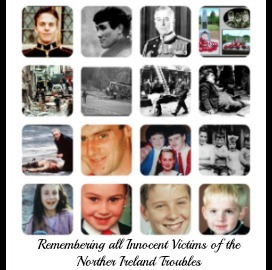


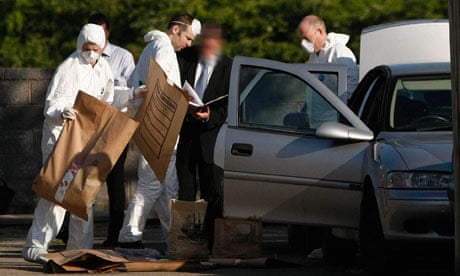


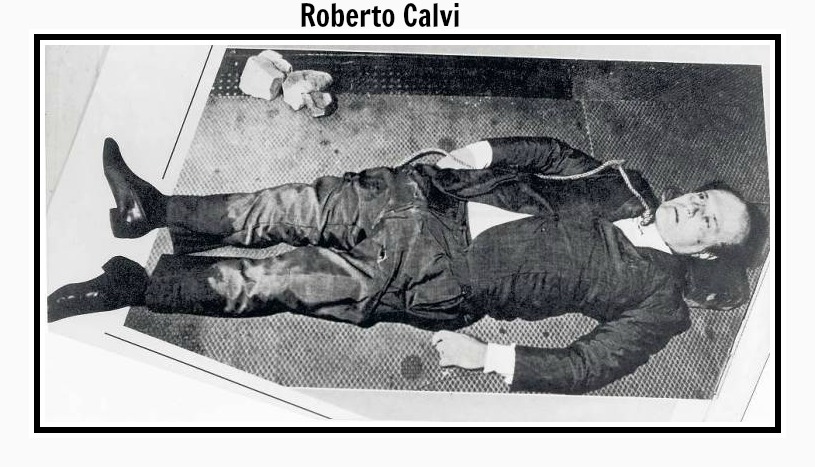

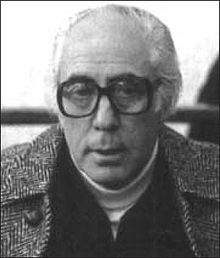




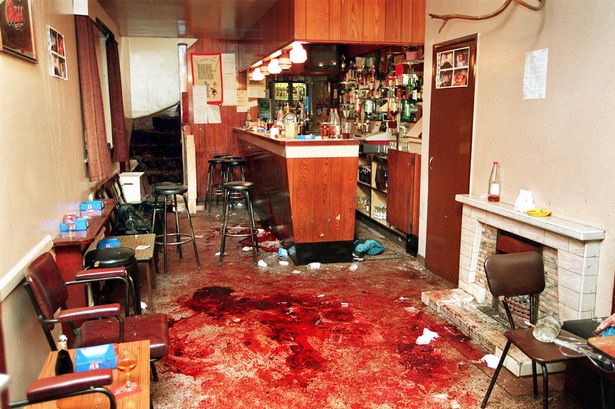

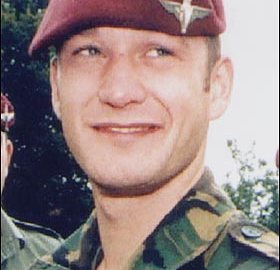


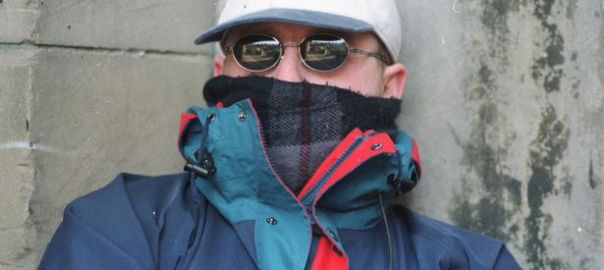
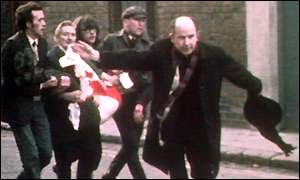
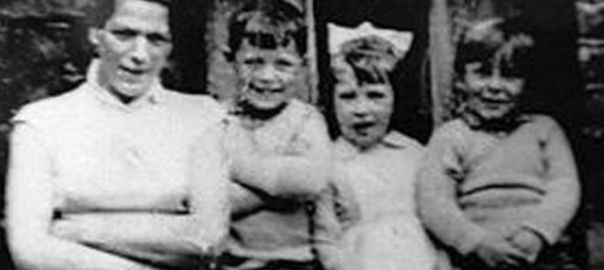


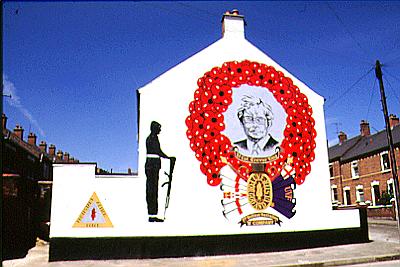


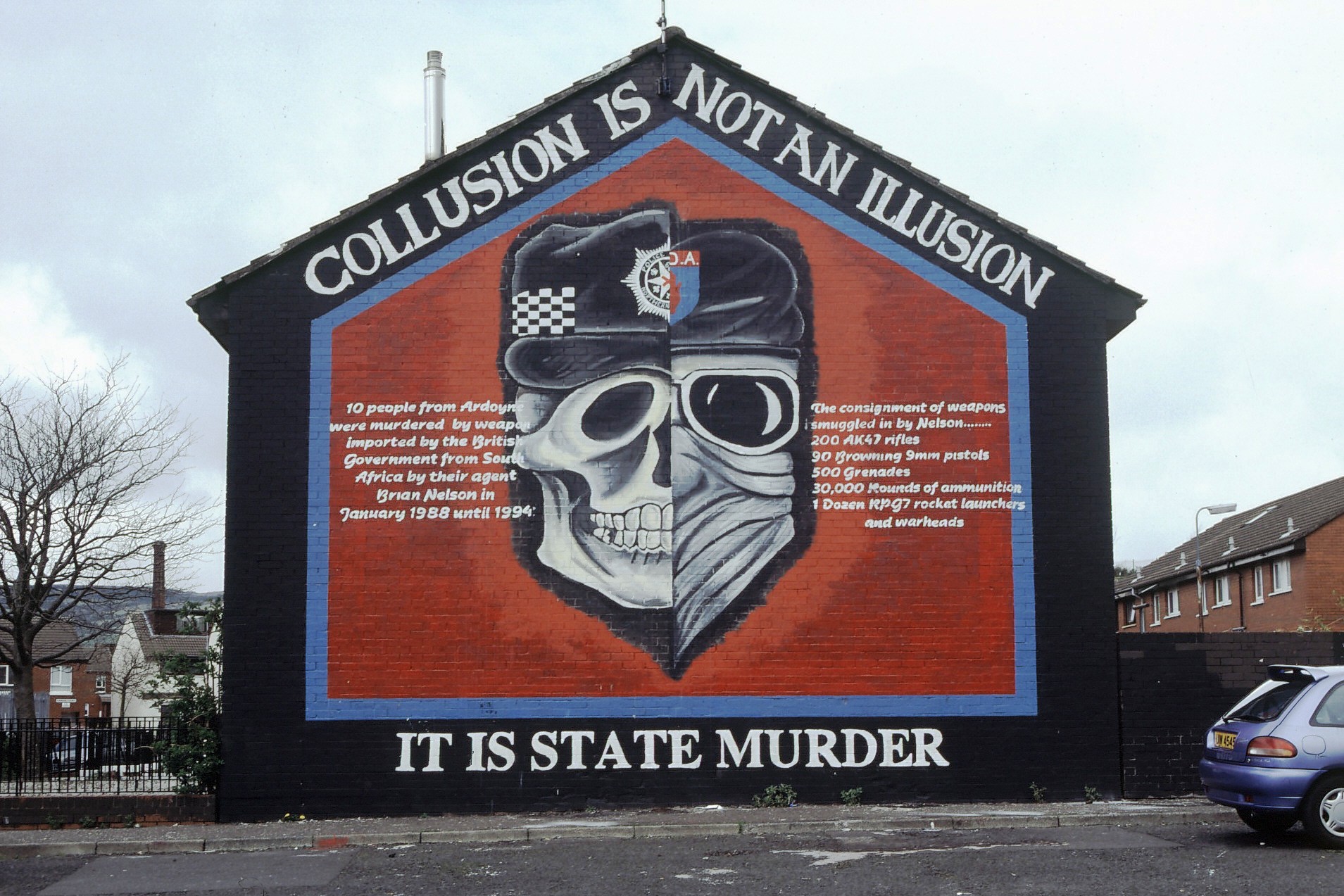

.JPG)