Yearly Archives: 2016

Lord Kitchener’s Call of Duty 1914 – Your Country Needs You!

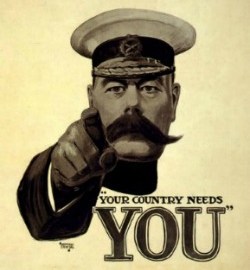
Lord Kitchener Wants You was a 1914 advertisement by Alfred Leete which was developed into a recruitment poster. It depicted Lord Kitchener, the British Secretary of State for War, above the words “WANTS YOU”.

Kitchener, wearing the cap of a British Field Marshal, stares and points at the viewer calling them to enlist in the British Army against the Central Powers. The image is considered one of the most iconic and enduring images of World War I.

A hugely influential image and slogan, it has also inspired imitations in other countries, from the United States to the Soviet Union

                                                                 Lord Kitchener Wants You
30a Sammlung Eybl Großbritannien. Alfred Leete (1882–1933) Britons (Kitchener) wants you (Briten Kitchener braucht Euch). 1914 (Nachdruck), 74 x 50 cm. (Slg.Nr. 552).jpg

“Britons: Lord Kitchener Wants You. Join Your Country’s Army! God save the King.”
Language English
Media watercolour; print
Release date(s) 1914
Country United Kingdom


Development

Prior to the institution of conscription in 1916, the United Kingdom relied upon volunteers for military service. Until the outbreak of the First World War, recruiting posters had not been used in Britain on a regular basis since the Napoleonic Wars. UK government advertisements for contract work were handled by His Majesty’s Stationery Office, who passed this task onto the publishers of R. F. White & Sons in order to avoid paying the government rate to newspaper publishers.

As war loomed in late 1913 the number of advertising contracts expanded to include other firms. J. E. B. Seely, then the Secretary of State for War, awarded Sir Hedley Le Bas, Eric Field, and their Caxton Advertising Agency a contract to advertise for recruits in the major UK newspapers. Eric Field designed a prototype full-page advertisement with the Coat of Arms of King George V and the phrase “Your King and Country Need You.”

Britain declared war on the German Empire on 4 August 1914 and the first run of the full-page ran the next day in those newspapers owned by Lord Northcliffe.


Eric Field’s original design that caught the attention of Lord Kitchener

Herbert Henry Asquith.jpg


Prime Minister of the United Kingdom H. H. Asquith had appointed Kitchener as Secretary of State for War. Kitchener was the first currently serving soldier to hold the post and was given the task of recruiting a large army to fight Germany.

Unlike some of his contemporaries who expected a short conflict, Kitchener foresaw a much longer war requiring hundreds of thousands of enlistees. According to Gary S. Messinger, Kitchener reacted well to Field’s advertisement although insisting “that the ads should all end with ‘God Save the King’ and that they should not be changed from the original text, except to say ‘Lord Kitchener needs YOU.'” In the following months Le Bas formed an advisory committee of ad men to develop further newspaper recruiting advertisements, most of which ran vertically 11 inches (28 cm), two columns wide.

Kitchener poster by Alfred Leete.jpg

Alfred Leete, one Caxton’s illustrators, designed the now-famous image as a cover illustration for the 5 September 1914 issue of London Opinion, a popular weekly magazine, taking cues from Field’s earlier recruiting advertisement.  At the time, the magazine had a circulation of 300,000.  In response to requests for reproductions, the magazine offered postcard-sized copies for sale. The Parliamentary Recruiting Committee obtained permission to use the design in poster form.

A similar poster used the words “YOUR COUNTRY NEEDS YOU”.

Kitchener, a “figure of absolute will and power, an emblem of British masculinity”, was a natural subject for Leete’s artwork as his name was directly attached to the recruiting efforts and the newly-forming Kitchener’s Army.

Sir Hedley Le Bas was the founder of the Caxton Publishing Company Limited

Le Bas of Caxton Advertising (for whom Leete worked) chose Kitchener for the advertisement because Kitchener was “the only soldier with a great war name, won in the field, within the memory of the thousands of men the country wanted.”

Kitchener made his name in the Sudan Campaign, avenging the death of General Gordon with brutality and efficiency. He became a hero of “New Imperialism” alongside other widely regarded figures in Britain like Field Marshal Wolseley and Field Marshal Roberts.

Kitchener’s appearance including his bushy mustache and court dress jacket was reminiscent of romanticized Victorian era styles. Kitchener, 6 ft 2 in (188 cm) tall and powerfully built, was for many the personification of military ethos so popular in the present Edwardian era. After the scorched earth tactics and hard-fought victory of the Second Boer War, Kitchener represented a return to the military victories of the colonial era.

The fact that Kitchener’s name is not used in the poster demonstrates how easily he was visually recognized.  David Lubin opines that the image may be one of the earliest successful celebrity endorsements as the commercial practice expanded greatly in the 1920s.[20] Keith Surridge posits that Kitchener’s features evoked the harsh, feared militarism of the Germans which bode well for British fortune in the war.

HMS Hampshire (1903).jpg

Hampshire at anchor

Kitchener would not see the end of the war; he died onboard HMS Hampshire in 1916.

Original versions by Alfred Leete

Alfred Leete in uniform, c. 1916

See Below for more details on Alfred Leete.


The 5 September 1914 London Opinion magazine cover that inspired the posters. The caption reads “Your Country Needs YOU”

The  Britons (Lord Kitchener) Wants YOU  poster dating from September 1914

The “Britons (Lord Kitchener) Wants YOU” poster dating from September 1914


“He is not a great man, he is a great poster.”

Margot Asquith


Leete’s drawing of Kitchener was the most famous image used in the British Army recruitment campaign of World War I. It continues to be considered a masterful piece of wartime propaganda as well as an enduring and iconic image of the war.

Recruitment posters in general have often been seen as a driving force helping to bring more than a million men into the Army. September 1914, coincident with publication of Leete’s image, saw the highest number of volunteers enlisted.

The Times recorded the scene in London on 3 January 1915; “Posters appealing to recruits are to be seen on every hoarding, in most windows, in omnibuses, tramcars and commercial vans. The great base of Nelson’s Column is covered with them. Their number and variety are remarkable. Everywhere Lord Kitchener sternly points a monstrously big finger, exclaiming ‘I Want You'”.

One contemporaneous publication decried the use of advertising methods to enlist soldiers:

“the cold, basilisk eye of a gaudily-lithographed Kitchener rivets itself upon the possible recruit and the outstretched finger of the British Minister of War is levelled at him like some revolver, with the words, ‘I want you.’ The idea is stolen from the advertisement of a 5c. American cigar.”


Although it became one of the most famous posters in history, its widespread circulation did not halt the decline in recruiting.

This 30-word poster was an official product of the Parliamentary Recruitment Committee and was more popular contemporaneously.

The use of Kitchener’s image for recruiting posters was so widespread that Lady Asquith referred to the Field Marshal simply as “the Poster.”

Imperial War Museums logo.png

The placement of the Kitchener posters including Alfred Leete’s design has been examined and questioned following an Imperial War Museum publication in 1997. The War Museum suggested that the poster itself was a “non event” and was made popular by postwar advertising by the war museum, perhaps conflating Leete’s design with the so-called “30-word” poster, an official product from the Parliamentary Recruitment Committee.

The 30-word design was the most popular recruitment poster at the time having been printed ten times the volume of Leete’s image. Leete’s image has been praised for being more arresting while his accompanying text is also far less verbose. The official wording, taken from a Kitchener speech, may seem more fitting for a character in a Henry James novel.

The 30-word recruiting poster was developed as Britons’ collective hopes of the war being over by Christmas were dashed in January 1915 and volunteer enlistments fell. A 2013 book researched by James Taylor counters the popular belief that the Leete design was an influential recruitment tool during the war. He claims the original artwork was acquired by the Imperial War Museum in 1917 and catalogued as a poster in error.[8]

Though the image of Kitchener (Britain’s most popular soldier) inspired several other poster designs, Taylor says he can find no evidence in photographs of the time that the Leete poster was used, although a photograph from 15 December 1914 taken at the Lancashire and Yorkshire Railway station in Liverpool clearly depicts Leete’s depiction among other recruiting posters.[8][34]

The effectiveness of the image upon the viewer is attributed to what E. B. Goldstein has called the ‘differential rotation effect.’ Because of this effect, Kitchener’s eyes and his foreshortened arm and hand appear to follow the viewer regardless of the viewer’s orientation to the artwork.[35][36][37] Historian Carlo Ginzburg compared Leete’s image of Kitchener to similar images of Christ and Alexander the Great as depicting the viewer’s contact with a powerful figure.[38] Pearl James commented on Ginzburg’s analysis agreeing that the strength of the connotation lies with a clever use of discursive psychology and that art historical methods better illuminate why this image has such resonance.[39] The capitalized word “YOU” grabs the reader, bringing them directly to Kitchener’s message.[20] The textual focus on “you” engages the reader about their own participation in the war.[40] Nicholas Hiley differs in that Leete’s portrayal of Kitchener is less about immediate recruiting statistics but the myth that has grown around the image, including ironic parodies.[13][41] Leete’s Kitchener poster caught the attention of a then eleven-year-old George Orwell, who may have used as it the basis for his description of the “Big Brother” posters in his novel 1984.

In 1997 the British Army created a recruiting ad re-using Leete’s image substituting Kitchener’s face with that of a British Army non-commissioned officer of African descent. Leete’s image of Kitchener is featured on a 2014 £2 coin produced by sculptor John Bergdahl for the Royal Mint.

The coin was the first of a five-year series to commemorate the centennial of the war. Use of Leete’s image of Kitchener has been criticized by some for its pro-war connotation in light of the human losses of the First World War and the violence of Kitchener’s campaign in Sudan. In July 2014, one of only four original posters known to exist went to auction for more than £10,000. The other three originals exist on display in State Library of Victoria, the Museum of Brands, Packaging and Advertising, and the Imperial War Museum. Leete’s design was also used for a corn maze in the Skylark Garden Centre in Wimblington to mark the centenary of World War I.

Imitations

The image of Lord Kitchener with his hand pointing directly at the viewer has inspired numerous imitations:

 British World War I recruiting poster featuring the national personification, John Bull, c. 1915. Who's absent Is it you

British World War I recruiting poster featuring the national personification, John Bull, c. 1915. “Who’s absent? Is it you?”

United States, 1917. J. M. Flagg's Uncle Sam recruited soldiers for World War I and World War II. I Want YOU for U.S. Army

United States, 1917. J. M. Flagg‘s Uncle Sam recruited soldiers for World War I and World War II. “I Want YOU for U.S. Army

United States, World War I. Daughter of Zion (in Yiddish) Your Old New Land must have you! Join the Jewish regiment.png

United States, World War I. Daughter of Zion (in Yiddish): “Your Old New Land must have you! Join the Jewish regiment

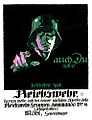
Reichswehr recruitment poster by Julius Ussy Engelhard, 1919. You too should join the Reichswehr.png

Reichswehr recruitment poster by Julius Ussy Engelhard, 1919. “You too should join the Reichswehr”

Bolshevik recruitment poster from the Civil War of 1920, by Dmitri Moor. You, have you volunteered.png

Bolshevik recruitment poster from the Civil War of 1920, by Dmitri Moor. “You, have you volunteered?
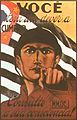
Brazilian Constitutionalist Revolution recruitment poster, 1932. You have a duty to fulfill. Ask your conscience

Brazilian Constitutionalist Revolution recruitment poster, 1932. “You have a duty to fulfill. Ask your conscience

United States 1985 Smokey Bear poster. The Only You  refers to his famous quotation, Only You Can Prevent Forest Fires.png

United States 1985 Smokey Bear poster. The “Only You” refers to his famous quotation, “Only You Can Prevent Forest Fires

Alfred Leete

Alfred Leete and his son John, c.1916

Alfred Ambrose Chew Leete (1882–1933) was a British graphic artist. Born at Thorpe Achurch, Northamptonshire, he studied at Kingsholme School and The School of Science and Art (now Weston College) in Weston-super-Mare, before moving to London in 1899 and taking a post as an artist with a printer.

His career as a paid artist had begun in 1897 when the Daily Graphic accepted one of his drawings; later he contributed regularly to a number of magazines including Punch magazine, the Strand Magazine, Tatler, etc. As a commercial artist he designed numerous posters and advertisements, especially in the 1910s and 1920s, for such brands as Rowntrees chocolates, Guinness and Bovril, and his series of advertisements for the Underground Electric Railways Company (the London Underground) were very well known; his work as a wartime propagandist includes the poster for which he is known above all, the Lord Kitchener poster design, which first appeared on the cover of the weekly magazine London Opinion on 5 September 1914.

“His prolific output was characterized by its humour, keen observation of the everyday, and an eye for strong design”

Invitation to one of the regular “smoking” evenings at the London Sketch Club, dated at 11 November 1921. Designed by Alfred Leete.

Leete died in London in 1933. In 2004, Leete’s work was on display in his native Weston at the North Somerset Museum

28th June – Deaths & Events in Northern Ireland Troubles

Key Events & Deaths on this day in Northern Ireland Troubles

28th June

——————————

Sunday 28 June 1970

Around 500 Catholic workers at the Harland and Wolff shipyard were forced to leave their work by Protestant employees. Most of the Catholic workers were unable to return and lost their jobs.


Serious rioting continued in Belfast.


Thursday 28 June 1973

Northern Ireland Assembly Election

Elections to the Northern Ireland Assembly were contested in Northern Ireland. There was some violence during the day, some of which was directed against a number of polling stations.

However, the turnout was high at 72.3 per cent.

The election gave those parties supporting the White Paper 52 seats whereas those parties against the paper obtained 26 seats. However, a number of the candidates who were elected with the ‘pro-White Paper’ parties were themselves against the proposals so reducing the margin in the new Assembly.


Tuesday 28 June 1983

John Hume, then leader of the Social Democratic and Labour Party (SDLP), addressed the House of Commons in Westminster in his ‘maiden speech’. He spoke of Britain’s ‘psychological withdrawal’ from Northern Ireland.

Tuesday 28 June 1988

Margaret Thatcher, then British Prime Minister, met Charles Haughey, then Taoiseach (Irish Prime Minister), following a European Community summit in Hanover. The British government announced that the Harland and Wolff shipyard was to be privatised.

Friday 28 June 1991

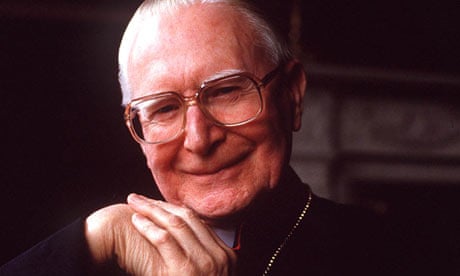
Cahal Daly, then Archbishop, was elevated by the Pope to Cardinal.

Monday 28 June 1993

It was disclosed that the British Labour Party had produced a discussion document in 1992 on the future of Northern Ireland .

The document contained a proposal that, in the absence of agreement between the political parties, there should be joint authority, between Britain and the Republic of Ireland, over Northern Ireland for a period of 20 years.

[The proposals were welcomed by Nationalists but were rejected by Unionists.]

Wednesday 28 June 1995

Patrick Mayhew, then Secretary of State for Northern Ireland, said that if Republican and Loyalist paramilitaries did not decommission their weapons then political talks would proceed without their political representatives.

Friday 28 June 1996

The Irish Republican Army (IRA) launched an attack at a British Army barracks in Osnabreuck, Germany. Three mortars were fired in the attack but there were no injuries. Several buildings were damaged.

Saturday 28 June 1997

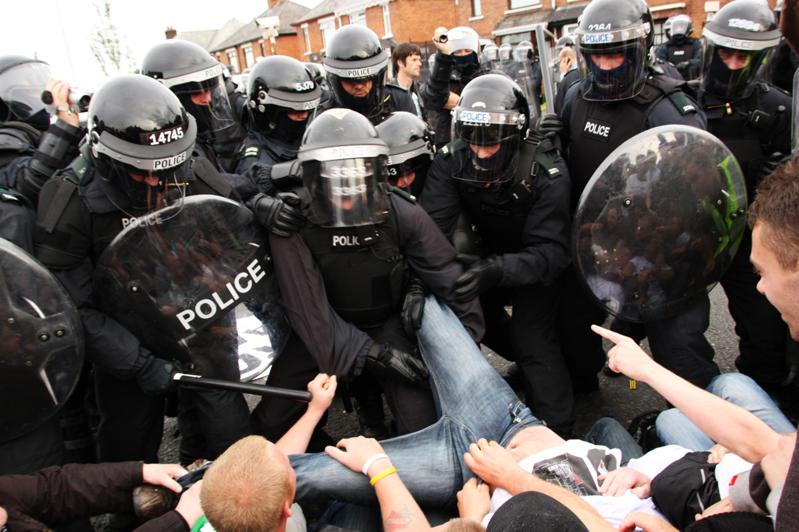
Following an Orange Order parade on the Springfield Road in west Belfast there were scuffles between the Royal Ulster Constabulary (RUC) and nationalists.

Monday 28 June 1999

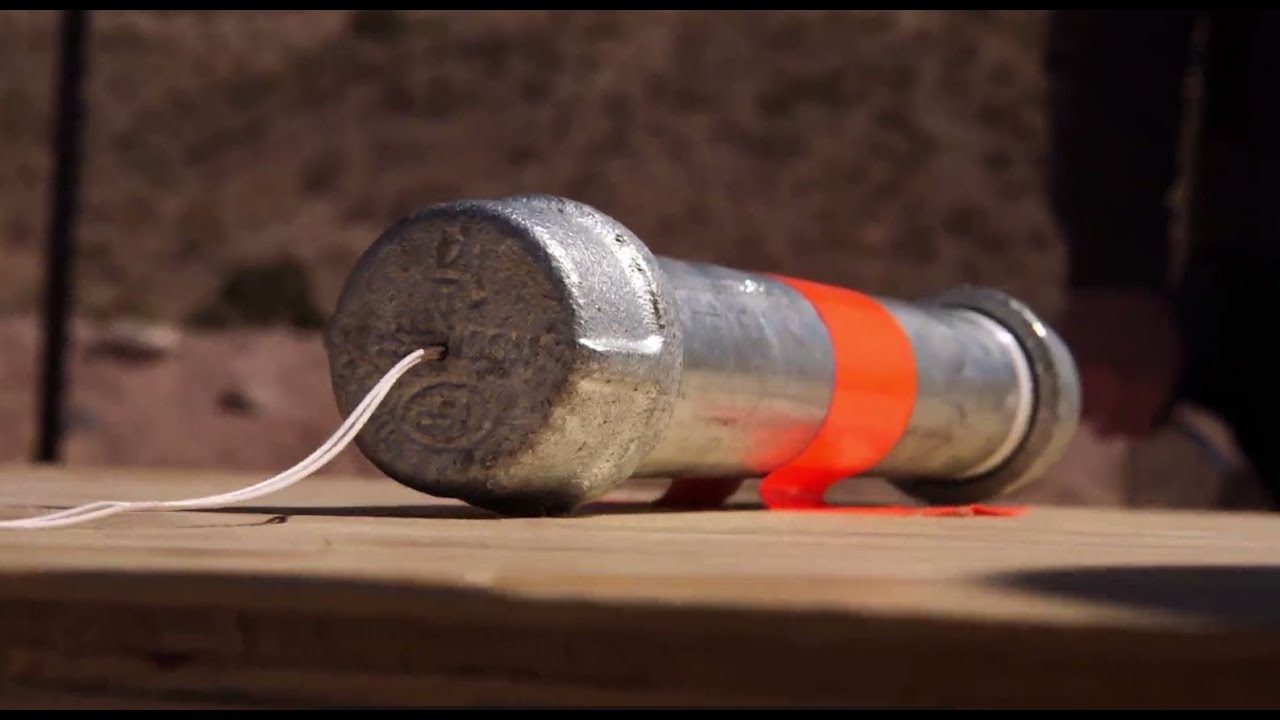
A Catholic woman (45) and her six year old son escaped injury when there was a pipe-bomb attack on their south Belfast home.

Police say bomb disposal experts called to the scene in Belfast’s Finaghy area found the remnants of a pipe-bomb which had been pushed through the letter box in the front door.

The attack was carried out by Loyalist paramilitaries.

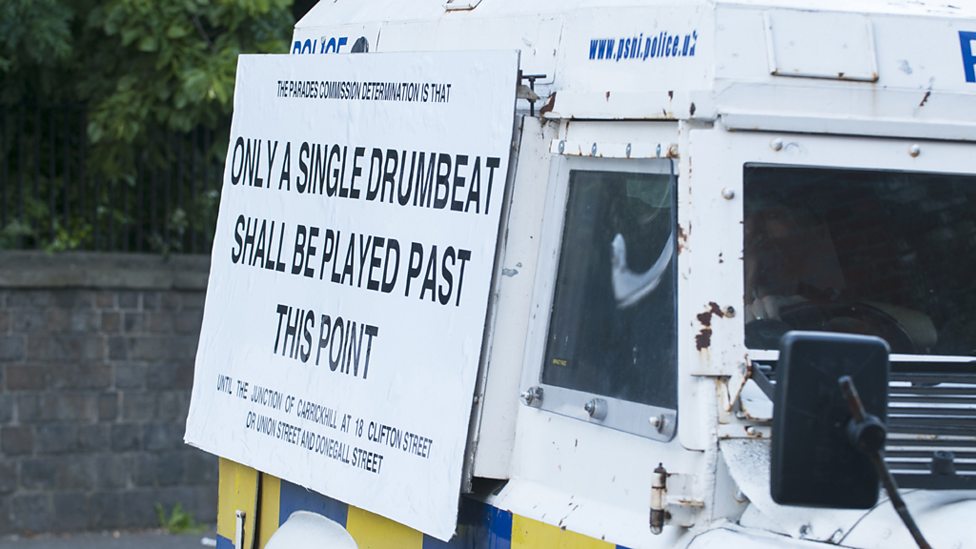
The Parades Commission issued its decision on the proposed parade by the Portadown District of the Orange Order along the Garvaghy Road, Portadown, on Sunday 4 July 1999. The decision re-routed the Orange Order parade away from the Garvaghy Road and instructed the order to use the outward route when returning from Drumcree.

The decision followed the breakdown of talks between Garvaghy Road residents and the Orange Order.

The Commission also re-routed the ‘Long March’ away from Nationalist areas of Lurgan, County Armagh, on Friday 2 July 1999.

The press conference at which the decisions were announced was disrupted by a bomb alert, which turned out to be a hoax telephone call.

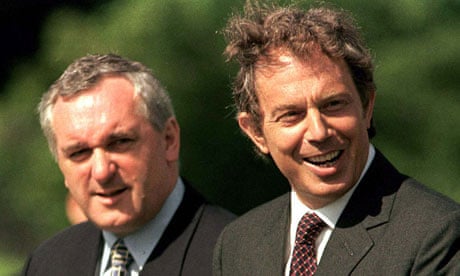
Tony Blair, then British Prime Minister, and Bertie Ahern, then Taoiseach (Irish Prime Minister), began a “final push” to end the impasse over decommissioning and the formation of the Executive. David Trimble, then leader of the Ulster Unionist Party (UUP), issued a statement on decommissioning.

——————————————

Remembering all innocent victims of the Troubles

Today is the anniversary of the death of the following people killed as a results of the conflict in Northern Ireland

“To live in hearts we leave behind is not to die

– Thomas Campbell

To the innocent on the list – Your memory will live forever

– To the Paramilitaries –

There are many things worth living for, a few things worth dying for, but nothing worth killing for.

4  People lost their lives on the 28th  June between 1975 – 1980

——————————————

28 June 1975


Patrick Rolston  (16)

Catholic
Status: Civilian (Civ),

Killed by: Ulster Volunteer Force (UVF)
Found shot by entrance to Throne Hospital, Whitewell Road, Greencastle, Belfast.

——————————————

28 June 1976
John Freeburn   (30)

Protestant
Status: ex-Ulster Defence Regiment (xUDR),

Killed by: Irish Republican Army (IRA)
Shot while in Celtic Supporters’ Social Club, Edward Street, Lurgan, County Armagh

——————————————

28 June 1976


William Snowdon  (18)

nfNI
Status: British Army (BA),

Killed by: Irish Republican Army (IRA)
Died five days after being injured in a land mine attack on British Army (BA) foot patrol, Drumlougher, near Crossmaglen, County Armagh

——————————————

28 June 1980
William Elliott   (48)

Protestant
Status: ex-Ulster Defence Regiment (xUDR),

Killed by: Irish Republican Army (IRA)
From Northern Ireland. Shot at cattle mart, Ballybay, County Monaghan.

—————————————— 

27th June – Deaths & Events in Northern Ireland Troubles

Key Events & Deaths on this day in Northern Ireland Troubles

27th June

——————————–

Saturday 27 June 1970 Major Gun Battle in Belfast

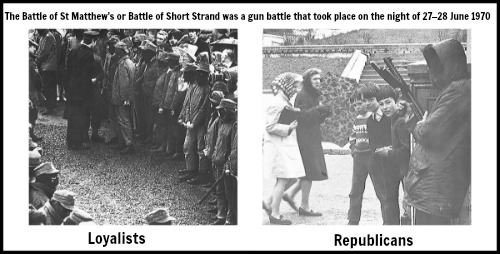
Battle of St Matthew's collage 4 500

There was serious rioting in Belfast involving Protestants and Catholics. During the evening groups of Loyalist rioters began to make incursions into the Catholic Short Strand enclave of east Belfast.

Catholics in the area believed that they were going to be burnt out of their homes and claimed that there were no British Army troops on the streets to protect the area. Members of the Irish Republican Army (IRA) took up sniping positions in the grounds of St Matthew’s Catholic Church and engaged in a prolonged gun battle with the Loyalists.

This was the most significant IRA operation to date. Across Belfast six people were killed of whom five were Protestants shot by the IRA. A Protestant man was mortally wounded when struck on the head by a missile. He died on 3 July 1970.

See Battle of St Matthew’s

Thursday 27 June 1985

Patrick Morrissey

The Irish National Liberation Army (INLA) shot dead a member of the Garda Síochána (the Irish police) during an armed robbery at a post office in Ardee, County Louth, Republic of Ireland.

Douglas Hurd, then Secretary of State for Northern Ireland, announced that certain community groups in Northern Ireland would receive no further government funding because of their alleged “close links with paramilitary organisations”.

Tuesday 27 June 1995

John Major, then British Prime Minister, and John Bruton, then Taoiseach (Irish Prime Minister), agreed to ask European Commission officials to look at ways in which the Commission might assist with the issue of decommissioning of paramilitary weapons.

[Major and Bruton were attending a European Union summit at Cannes at the time.]

Thursday 27 June 1996

Gardí in the Republic of Ireland recovered 100 pounds of home-made explosives at Clones, County Monaghan.

Saturday 27 June 1998

There were clashes between Nationalists and the Royal Ulster Constabulary (RUC) in west Belfast during an Orange Order parade.

Two men were killed and another seriously injured when a car ploughed into cyclists who were taking part in the Co-operation North Cross-Border mara-cycle.

The vehicle involved did not stop at the scene of the accident.

[The driver of the car was later arrested.]

Counting in the Northern Ireland Assembly Elections came to a close.

 The Ulster Unionist Party (UUP) emerged as the largest party with 28 seats. The Social Democratic and Labour Party (SDLP) had 24, the Democratic Unionist Party (DUP) 20, Sinn Féin (SF) 18, Alliance Party of Northern Ireland (APNI) 5, the United Kingdom Unionist Party (UKUP) 5, Progressive Unionist Party (PUP) 2, Northern Ireland Women’s Coalition (NIWC) 2, Independent Unionist 1, UU 1, and the UUU 1. In a major political breakthrough for the nationalist community, the SDLP emerged as the largest gainers of the first preference vote with 22%.

Sunday 27 June 1999

David Trimble, then leader of the Ulster Unionist Party (UUP), challenged Sinn Féin (SF) to get a pledge from the Irish Republican Army (IRA) to disarm by May 2000.

Martin McGuinness, then SF’s chief negotiator, said he could not speak on behalf of the Irish Republican Army (IRA).

Seamus Mallon, then deputy leader of the Social Democratic and Labour Party (SDLP), interpreted Trimble’s challenge as indicating an acceptance that the demand for prior disarmament would not be met.

Proximity talks between the Orange Order and representatives of the Garvaghy Road Residents’ Coalition (GRRC) failed to reach an agreement over the planned Drumcree Parade on 4 July 1999.


——————————————

Remembering all innocent victims of the Troubles

Today is the anniversary of the death of the following people killed as a results of the conflict in Northern Ireland

“To live in hearts we leave behind is not to die

– Thomas Campbell

To the innocent on the list – Your memory will live forever

– To the Paramilitaries –

There are many things worth living for, a few things worth dying for, but nothing worth killing for.

10 People lost their lives on the 27th   June between 1970 – 1989

——————————————

27 June 1970


William Kincaid   (28)

Protestant
Status: Civilian (Civ),

Killed by: Irish Republican Army (IRA)
Shot during street disturbances, Disraeli Street, off Crumlin Road, Belfast.

——————————————

27 June 1970


David Loughins   (32)

Protestant
Status: Civilian (Civ),

Killed by: Irish Republican Army (IRA)
Shot during street disturbances, Palmer Street, off Crumlin Road, Belfast.

——————————————

27 June 1970


Alexander Gould   (18)

Protestant
Status: Civilian (Civ),

Killed by: Irish Republican Army (IRA)
Shot during street disturbances, Disraeli Street, off Crumlin Road, Belfast.

——————————————

27 June 1970
Robert Neill   (38)

Protestant
Status: Civilian (Civ),

Killed by: Irish Republican Army (IRA)
Shot during street disturbances, at the junction of Central Street and Newtownards Road, Belfast.

——————————————

27 June 1970
James McCurrie   (34)

Protestant
Status: Civilian (Civ),

Killed by: Irish Republican Army (IRA)
Shot during street disturbances, Beechfield Street, Short Strand, Belfast.

——————————————

27 June 1972
William Galloway   (18)

Protestant
Status: Ulster Defence Association (UDA),

Killed by: non-specific Republican group (REP)
Shot during street disturbances, Edlingham Street, Tiger’s Bay, Belfast.

——————————————

27 June 1972
Bernard Norney  (38)

Catholic
Status: Civilian (Civ),

Killed by: Irish Republican Army (IRA)
Shot while attempting to drive through Irish Republican Army (IRA) roadblock, Whiterock Road, Ballymurphy, Belfast.

——————————————

27 June 1983


Malvern Moffatt   (36)

Protestant
Status: Civilian (Civ),

Killed by: non-specific Republican group (REP)
Shot while cutting hedge, Drumnakilly, near Omagh, County Tyrone.

——————————————

27 June 1985


Patrick Morrissey   (49)

nfNIRI
Status: Garda Siochana (GS),

Killed by: Irish National Liberation Army (INLA)
Shot during armed robbery at post office, Ardee, County Louth.

——————————————

27 June 1989


David Black   (34)

Protestant
Status: Royal Ulster Constabulary (RUC),

Killed by: Irish Republican Army (IRA)
Off duty. Killed by booby trap bomb attached to his car outside his home, Ballyheather Road, Artigarvan, near Strabane, County Tyrone.

——————————————


Battle of St Matthew’s – 27th –28th June 1970

The Battle of St Matthew’s also known as

The Battle of Short Strand


The Battle of St Matthew’s or Battle of Short Strand  was a gun battle that took place on the night of 27–28 June 1970 in Belfast, Northern Ireland.

It was fought between the Provisional Irish Republican Army (IRA) and Ulster loyalists in the area around St Matthew’s Roman Catholic church. This lies at the edge of the Short Strand, a Catholic enclave in a mainly-Protestant part of the city. Violence had erupted there, and in other parts of Belfast, following marches by the Orange Order.

The battle lasted about five hours and ended at dawn when loyalists withdrew. The British Army and police were deployed nearby but did not intervene. Three people were killed and at least 26 wounded in the fighting, while another three were killed in north Belfast.

The battle was the Provisional IRA’s first major action during the Troubles and was a propaganda victory for the organization. It presented itself as having successfully defended a vulnerable Catholic enclave from armed loyalist mobs. Loyalists, however, argue that the IRA lured them into a carefully prepared trap.

————————

1969 Northern Ireland Riots and and the Catholic-Protestant

————————

Background

Battle of bogside.jpg

The Northern Ireland riots of August 1969 marked the beginning of the Troubles. In Belfast, Catholic Irish nationalists clashed with Protestant Ulster loyalists and the mainly-Protestant Royal Ulster Constabulary (RUC), Northern Ireland’s police force.

Catholics believed that they were about to become “victims of a Protestant pogrom” and Protestants believed they were on the “eve of an IRA insurrection”.

Hundreds of Catholic homes and businesses were burnt out and more than 1,000 families, mostly Catholic, were forced to flee.

————————–

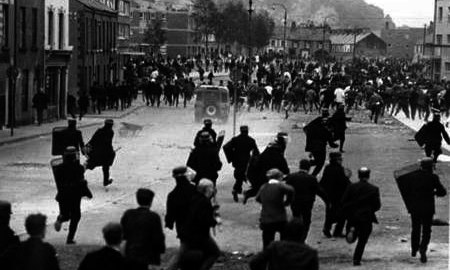
Street Riot In Belfast 1970

————————–

The Irish Republican Army (IRA) had few weapons or members and was unable to adequately defend the Catholic areas. The rioting ended with the deployment of British troops. In December 1969, the IRA split into the ‘Official’ IRA and ‘Provisional’ IRA—with the Provisionals vowing to defend Catholic areas in future.

The Short Strand is a Catholic/nationalist enclave in East Belfast, a mainly Protestant/Ulster unionist part of the city. In the early years of the Troubles, Catholics in Short Strand numbered about 6,000, while their Protestant neighbours totalled about 60,000.

 – Disclaimer –

The views and opinions expressed in these pages/documentaries are solely intended to educate and provide background information to those interested in the Troubles of Northern Ireland. They in no way reflect my own opinions and I take no responsibility for any inaccuracies or factual errors.

Preceding violence

The Orange Order Logo.jpg

On Saturday 27 June 1970, a large march by the Orange Order took place in West Belfast, which was joined by Ulster loyalist bands from other parts of the city. Many Protestants saw these marches as part of Protestant culture, while many Catholics/Irish nationalists saw them as provocative displays of Protestant/unionist supremacism. Rioting erupted when the march entered a Catholic neighbourhood; missiles were thrown by both sides, buildings were set ablaze, and the British Army fired CS gas in an attempt to disperse the crowds.

Rioting also erupted on Crumlin Road, the boundary between the Catholic Ardoyne and Protestant Woodvale areas. The rioting developed into a gun battle, in which three loyalists were shot dead by republican paramilitaries. A number of people were wounded, including a Royal Navy petty officer who was shot in the jaw while driving a field ambulance. The fighting took place near Holy Cross Catholic Church.

Battle

Violence erupted at St Matthew’s Catholic church on the evening of 27 June. It began after a loyalist band and supporters marched through the area on their return from the main parade. Rival groups gathered, taunting led to stone-throwing, and eventually shots were fired.

As the situation worsened, Catholic residents feared that the gathering crowds of loyalists would attempt to invade the Short Strand and burn them from their homes.

Local IRA volunteers retrieved weapons from arms dumps. A young resident, Jim Gibney, recalled:

“I saw neighbours, people I knew, coming down the street carrying rifles. I was just dumbstruck by this experience. I’d never seen such a thing before”.

The battle began at about 10pm and would continue for the next five hours.

Loyalists began attacking the church and surrounding property with petrol bombs. A small house in the church grounds, where the sexton lived with his family, was set ablaze. A nearby Catholic pub was also looted and burnt.

M1 Carbine Mk I - USA - Armémuseum.jpg

A small group of IRA volunteers and members of the Citizens’ Defence Committee  took up positions in the church grounds and in adjoining streets. The IRA volunteers were armed with M1 carbines and were led by Billy McKee, commander of the IRA’s Belfast Brigade.

Also present was Billy Kelly, commander of the Belfast Brigade’s 3rd Battalion.  The IRA volunteers fired at the loyalists, some of whom were positioned on the roofs opposite.

Jim Magee, a local loyalist, said he saw wounded people lying on the road and asked the police (RUC) for help. According to Magee,

“[they] said ‘if you have anything, get it out and protect your people’. So we got an old rifle and went into Frazer Street and started firing back”.


The security forces were deployed in the area at the time, but did not intervene to end the fighting. Shortly after the shooting began, Stormont MP Paddy Kennedy went with Short Strand residents to the local RUC base and demanded protection for their homes.

Across the River Lagan, in the Markets area, other IRA volunteers assembled and prepared to reinforce the Short Strand should it be invaded. British soldiers eventually arrived in armoured vehicles and cordoned off the roads around the Short Strand, which denied the IRA “any hope of reinforcement”.

At the time, the British Army said that its soldiers fired no shots because “owing to the confused situation, it was impossible to identify targets.

British Army Colonel Mike Dewar later said:

“The whole incident had taken its course because the Army was so chronically overstretched that night in Belfast. The one spare platoon in the whole of west Belfast was not able to get through rioting Protestants to the Short Strand”.

Journalist Tony Geraghty wrote that sometimes “The gunfire eased long enough to allow an occasional British Army personnel carrier (a ‘Pig‘) to whine past, illuminated by the flames in a token gesture of law-and-order”. Another journalist who witnessed the battle, Peter Taylor, later said:

The shooting intensified but the soldiers still declined to intervene and separate the two sides – either because they felt they were not numerically strong enough or because they did not wish to get caught up in the middle of a sectarian fight, in the darkness, with shots being fired by both sides.

Liz Maskey, who was a volunteer nurse that night, said that the Short Strand was surrounded by loyalists and claimed they attacked her ambulance as it tried to leave the area.

The loyalists withdrew after about five hours, as dawn broke. IRA leader Billy McKee claimed that his unit had fired 800 rounds during the battle.

Casualties

Three people were killed in the fighting. At least 26 were wounded — including Billy McKee, who was shot five times.

Deaths

Robert Neil, a 38-year-old Protestant, died instantly when a shot fired from the church bounced off the pavement and hit him in the spine.

James McCurrie, a 34-year-old Protestant, was shot dead on Beechfield Street.

 Henry McIlhone, a 33-year-old Catholic, was helping to defend Short Strand when   he was accidentally shot from the republican side. He died on 29 June.


However, McKee maintains that McIlhone was shot by loyalists.  Tírghrá, the IRA’s official list of its fallen, lists McIlhone as a “volunteer” but adds “although not a member of the IRA, Henry McIlhone was included in the republican role of honour as a mark of respect for this great Irishman by republican comrades he fought alongside”.

Aftermath

Republicans and loyalists disagree over who started the violence and fired the first shots. Republicans claim that the violence was started by a mob of loyalists returning from an Orange march. They say that the loyalists tried to set the church alight  and invade Short Strand, with the intention of burning the residents from their homes. , republicans argue that they were defending the Short Strand from loyalist attack. Loyalists claim the violence was begun by republicans; allegedly when the returning Orangemen and supporters were attacked on Newtownards Road.

They argue that republicans attacked Protestants to lure them into “a carefully prepared trap”.

The following day, loyalists expelled 500 Catholic workers from the nearby Harland and Wolff shipyard.Shortly after, the British government’s representative at Stormont said that the decision to allow Orange marches to go ahead on that day was;

“the greatest single miscalculation I have ever seen made in the course of my life”.

Many Catholics and nationalists believed that the IRA had been unable to defend them during the August 1969 riots. However, it is argued that the IRA’s defence of Short Strand redeemed it in the eyes of many Catholics and nationalists.  Among republicans, the battle is seen as a key event in the growth of the Provisional IRA.

Less than a week later, the British Army seized a large haul of Official IRA weapons during a three-day operation in west Belfast. Nationalists saw this as a confiscation of their defences.

battle05 of bogside

See Battle of Bogside


26th June – Deaths & Events in Northern Ireland Troubles

Key Events & Deaths on this day in Northern Ireland Troubles

26th June

——————————-

Friday 26 June 1970

Five People Killed in Premature Explosion

Thomas McCool

Two young girls, aged 9 years and 4 years, died in a premature explosion at their home in the Creggan area of Derry.

Their father, a member of the Irish Republican Army (IRA), had been making an incendiary device, presumably for use against the British Army. The explosion killed two other members of the IRA.

The girls were the first females to die in ‘the Troubles’.

Bernadette Devlin, Member of Parliament (MP), was arrested and jailed for six months for riotous behaviour during the ‘Battle of the Bogside’.

battle05 of bogside

See Battle of Bogside

There was rioting between the British Army and local residents in Derry following the news of the arrest. The riots spread to Belfast.

Monday 26 June 1972

Start of ‘Truce’

The Provisional Irish Republican Army (IRA) began a “bi-lateral truce” as at midnight.

[The move was made as a prelude to secret talks with the British Government. The ceasefire ended on 9 July 1972.]

The Irish Republican Army (IRA) killed two British Army soldiers in separate attacks during the day.

Tuesday 26 June 1973

senator paddy wilson

Paddy Wilson (39), then a Social Democratic and Labour Party (SDLP) Stormont Senator, and Irene Andrews (29), then his secretary, were found stabbed to death in a quarry on the Hightown Road, Belfast.

They had been killed by members of the Ulster Freedom Fighters (UFF) a covername for the Ulster Defence Association (UDA).

[John White was later convicted for his part in these killings. White was later to become a leading spokesman for the Ulster Democratic Party (UDP) and was involved in the negotiations that led to the ‘Good Friday’ Peace Agreement on 10 April 1998.]

See Paddy Wilson and Irene Andrews killings

A civilian employed by the British Army was shot dead by the IRA as he left an Army base in Derry. A Catholic civilian died four days after been shot by the British Army in Derry.

Thursday 26 June 1980

Miriam Daly, a prominent member of the National H-Block / Armagh Committee, was shot dead by Loyalist paramilitaries at her home in Andersontown, Belfast.

Thursday 26 June 1986

A constitution referendum on the issue of divorce was held in the Republic of Ireland.

[When the votes were counted the population had rejected the opportunity to introduce a restricted form of divorce by 63.5 per cent to 36.5 per cent. Many Unionists in Northern Ireland saw the result as confirming their view that the Republic was intolerant of Protestants.

Garret FitzGerald, then Taoiseach (Irish Prime Minister), said that the Republic had a long way to go to create “a society that would seem welcoming to, open to and attractive to people of the Northern Unionist tradtion.]

Wednesday 26 June 1991

Maguire Seven Freed The convictions of the group of people known as the ‘Maguire Seven’ were quashed by the Court of Appeal in London. The seven had been convicted of supplying the bombs that were used in Guildford and Woolwich.

[This was the latest in a series of high profile cases of miscarriage of justice involving Irish people living in England.]

Saturday 26 June 1993

John Major, then British Prime Minister, began a two-day visit to Northern Ireland. Major called for a resumption of political talks between the constitutional parties.

The Royal Ulster Constabulary (RUC) moved to prevent an Orange Order parade close to the peace line in the Springfield area of Belfast. The action led to rioting.

Brian McCallum (26), a member of the Ulster Volunteer Force (UVF), was mortally wounded when a grenade he was handling exploded prematurely. Eighteen other people were injured.

[McCallum died on 29 June 1993.]

Monday 26 June 1995

The High Court in Belfast awarded compensation to the mother of Karen Reilly (16) who was shot dead by a British soldier on 30 September 1990.

lee glegg

[The amount of the compensation was not disclosed. Reilly had been shot dead by Lee Clegg, a paratrooper with the British Army, during a ‘joyriding’ incident. Clegg was released from prison on 3 July 1995.]

See Lee Clegg

Wednesday 26 June 1996

David Trimble, then leader of the Ulster Unionist Party (UUP), admitted bringing pressure to bear on the Director of Public Prosecutions (DPP) and the Royal Ulster Constabulary (RUC) over the events on the Garvaghy Road in 1995.

Trimble had pressed for prosecutions against the leaders of the Garvaghy Road residents who had opposed the 1995 Drumcree Orange march. Prosecutions were dismissed. Veronica Guerin, an investigative journalist in Dublin, was shot dead near to Dublin.

Thursday 26 June 1997

The Fianna Fáil (FF) party appointed Ray Burke as Irish Minister for Foreign Affairs. It was also announced that David Andrews (FF) would be Minister for Defence and Liz O’Donnell (Progressive Democrats) would be Junior Minister for Foreign Affairs, and that both these ministers would assist Burke at Stormont.

[These appointments were part of the cabinet announced by Bertie Ahern, then Taoiseach (Irish Prime Minister), following the general election in the Republic of Ireland on 6 June 1997.]

Friday 26 June 1998

As counting got under way in the Northern Ireland Assembly election the relatively poor early showing of the Ulster Unionist Party (UUP) resulted in the bitter divisions within the party becoming public.

Jeffrey Donaldson, then UUP Member of Parliament (MP), who opposed the Good Friday Agreement accused his party colleague, Ken Maginnis, in a televised debate of:

“presiding over an electoral disaster”.

Maginnis replied by accusing Donaldson of “gloating over the difficulties that he and others like him” had created for the party.

Both nationalist parties, the Social Democratic and Labour Party (SDLP) and Sinn Féin (SF), were pleased with a strong first preference showing

Monday 26 June 2000

IRA Arms Inspected

The Irish Republican Army (IRA) issued a statement to say that it had opened some of its arms dumps to be viewed by the independent weapons inspectors. Cyril Ramaphosa and Martti Ahtisaari, then independent weapons inspectors, held a meeting with Tony Blair, then British Prime Minister, in Downing Street and confirmed that the inspection had taken place.


——————————————

Remembering all innocent victims of the Troubles

Today is the anniversary of the death of the following people killed as a results of the conflict in Northern Ireland

“To live in hearts we leave behind is not to die

– Thomas Campbell

To the innocent on the list – Your memory will live forever

– To the Paramilitaries –

There are many things worth living for, a few things worth dying for, but nothing worth killing for.

18 People lost their lives on the 26th   June between 1970 – 1993

——————————————

26 June 1970


Thomas McCool  (40)

Catholic
Status: Irish Republican Army (IRA),

Killed by: Irish Republican Army (IRA)
Died in premature explosion of incendiary device at his home, Dunree Gardens, Creggan, Derry.

——————————————

26 June 1970
 Bernadette McCool   (9)

Catholic
Status: Civilian (Civ),

Killed by: Irish Republican Army (IRA)
Died in premature explosion of incendiary device at her home, Dunree Gardens, Creggan, Derry.

——————————————

26 June 1970
Carol Ann McCool  (4)

Catholic
Status: Civilian (Civ),

Killed by: Irish Republican Army (IRA)
Died in premature explosion of incendiary device at her home, Dunree Gardens, Creggan, Derry.

——————————————

26 June 1970


Joseph Coyle   (40)

Catholic
Status: Irish Republican Army (IRA),

Killed by: Irish Republican Army (IRA)
Died in premature explosion of incendiary device at the McCool household, Dunree Gardens, Creggan, Derry

——————————————

26 June 1970


Thomas Carlin  (55)

Catholic
Status: Irish Republican Army (IRA),

Killed by: Irish Republican Army (IRA)
Injured in premature explosion of incendiary device at the McCool household, Dunree Gardens, Creggan, Derry. He died 8 July 1970.

——————————————

26 June 1972


David Houston   (22)

Protestant
Status: Royal Ulster Constabulary (RUC),

Killed by: Irish Republican Army (IRA)
Shot attempting to stop bomb attack on The Stables Bar, Water Street, Newry, County Down.

——————————————

26 June 1972
James Meredith   (20)

nfNI
Status: British Army (BA),

Killed by: Irish Republican Army (IRA)
Shot while on British Army (BA) foot patrol, Abercorn Road, Derry.

——————————————

26 June 1972


Malcolm Banks   (30)

nfNI
Status: British Army (BA),

Killed by: Irish Republican Army (IRA)
Shot by sniper while on British Army (BA) mobile patrol, junction of Seaforde Street and Comber Street, Short Strand, Belfast.

——————————————

26 June 1972
 John Black  (32)

Protestant
Status: Ulster Defence Association (UDA),

Killed by: British Army (BA)
Died five weeks after being shot at barricade during street disturbances, Douglas Street, off Beersbridge Road, Belfast.

——————————————

26 June 1973


Paddy Wilson  (39)

Catholic
Status: Civilian Political Activist (CivPA),

Killed by: Ulster Freedom Fighters (UFF)
Social Democratic and Labour Party (SDLP) Stormont Senator and Councillor. Together with his secretary, found stabbed to death in quarry, Hightown Road, near Belfast, County Antrim.

See Paddy Wilson and Irene Andrews killings

——————————————

26 June 1973


Irene Andrews  (29)

Protestant
Status: Civilian (Civ),

Killed by: Ulster Freedom Fighters (UFF)
Together with Social Democratic and Labour Party (SDLP) Stormont Senator and Councillor, Paddy Wilson, found stabbed to death in quarry, Hightown Road, near Belfast, County Antrim.

See Paddy Wilson and Irene Andrews killings

——————————————

26 June 1973
Noorbaz Khan  (45)

nfNI
Status: Civilian (Civ),

Killed by: Irish Republican Army (IRA)
Civilian employed by British Army (BA). Shot shortly after driving out of Bligh’s Lane British Army (BA) base, Creggan, Derry.

——————————————

26 June 1973


Robert McGuinness  (22)

Catholic
Status: Civilian (Civ),

Killed by: British Army (BA)
Died four days after being shot while walking along Brandywell Avenue, Derry

——————————————

26 June 1976
Daniel Mackin  (20)

Catholic
Status: Civilian (Civ),

Killed by: non-specific Loyalist group (LOY)
Found stabbed to death, Brookvale Street, off Cliftonville Road, Belfast.

——————————————

26 June 1980


Miriam Daly  (45)

Catholic
Status: Civilian Political Activist (CivPA),

Killed by: non-specific Loyalist group (LOY)
Irish Republican Socialist Party (IRSP) member. Found shot at her home, Andersonstown Road, Andersonstown, Belfast.

——————————————

26 June 1981
Vincent Robinson   (29)

Catholic
Status: Civilian (Civ),

Killed by: Irish Republican Army (IRA)
Found shot, Divis Flats, Belfast. Alleged informer.

——————————————

26 June 1987


John Tracey  (46)

Protestant
Status: Ulster Defence Regiment (UDR),

Killed by: Irish Republican Army (IRA)
Off duty. Shot while renovating house, Surrey Street, off Lisburn Road, Belfast.

——————————————

26 June 1993
John Randall  (19)

nfNI
Status: British Army (BA),

Killed by: Irish Republican Army (IRA)
Shot by sniper, while on British Army (BA) foot patrol, crossing field, near Newtownhamilton, County Armagh.

——————————————

Armed Forces Day – What’s it all about?


Remembering all our brave  and women, past and present  who have fought and died for our freedom.

We salute you all!

————————
We Can Be Heroes – British Army Tribute
————————
Armed Forces Day

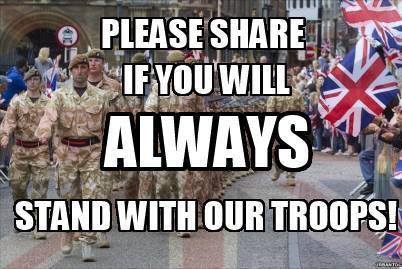
Troops Always support

 
Official name Armed Forces Day
Observed by United Kingdom
Significance Celebration of the contributions, both past and present, of those who have served in the British Armed Forces
Observances Parades, silences, celebrations
Date so far on last Saturday of June
2015 date 27 June
Frequency annual
Related to Remembrance Day


————————–

The British Grenadiers March

————————–

Armed Forces Day (formerly Veterans’ Day) in the United Kingdom is an annual event celebrated in late June to commemorate the service of men and women in the British Armed Forces. Veterans’ Day was first observed in 2006. Although an official event, it is not a public holiday in the UK. The name was changed to Armed Forces Day in 2009. Armed Forces Day has so far been observed on the last Saturday of June.

——————————-

In Flanders Fields by John McCrae

——————————-

Origins

Plans for a Veterans’ Day were announced in February 2006 by then-Chancellor of the Exchequer, Gordon Brown, who said the aim was to ensure the contribution of veterans was never forgotten. The day is marked across the UK by local ceremonies and the presentation of medals to living ex-servicemen and women. The date of 27 June was chosen as it came the day after the anniversary of the first investiture of the Victoria Cross, in Hyde Park, London in 1857.

Veterans Day was created as a permanent extension of Veterans’ Awareness Week first held in 2005. Armed Forces Day generally focuses on celebrating living current/ex servicemen & women, whereas Remembrance Day focuses on honouring the dead. Although it used to be called Veteran’s Day in the UK, it is not the same as the United States’ Veterans Day which is more similar to Remembrance Day in the Commonwealth.

On 25 June 2007, Jim Devine the Member of Parliament for Livingston, tabled a House of Commons Early Day Motion calling for the day to be a public holiday, stating “that this House recognises the outstanding contribution that veterans have made to the country; and believes that Veterans’ Day should be a national public holiday across the United Kingdom.”

——————————

British Military Tribute – Far away

——————————

Veterans’ Day 2006

The first Veterans’ Day in 2006 saw a series of events across the UK which included an event at the Imperial War Museum in London, which was attended by Lachhiman Gurung VC, a Nepalese recipient of the Victoria Cross, which was awarded for bravery in 1945 when he was a Rifleman in the 4th Battalion of The 8th Gurkha Rifles, British Indian Army during World War II in Burma (Myanmar), and Corporal Christopher Finney GC of the Blues and Royals who was awarded the George Cross for bravery under friendly fire during the 2003 invasion of Iraq. Parades were held in Dundee and Staffordshire as well as a service at Westminster Abbey. There was also an evening reception at 10 Downing Street for representatives of veterans associations.

——————————-

Tribute to the British soldiers who have died in Iraq and Afghanistan

——————————-

Veterans’ Day 2007

—————————–

The 2007 national event was held in Birmingham as the start of a five-day event from 27 June to 1 July. In the morning there was a “Parade of Standards” which was led by The Central Band of the Royal Air Force, from the International Convention Centre (ICC) to the Hall of Memory in Centenary Square. The day also included celebrations in Victoria Square where a Spitfire aircraft was on display and the Minister for Veterans Derek Twigg presented five Veterans’ Badges and met the families of service personnel who died in the line of duty.

Veterans’ Day 2008

———————

———————

For the 2008 Veterans’ Day, the national event was hosted in Blackpool as part of the resorts annual “National Veterans’ Week” which ran from 21 to 29 June 2008.

Events were held throughout the UK and the day was promoted by a nationwide television advert. The National Veterans’ Day Service was held at Blackpool Cenotaph, a Grade II Listed building which had just been restored, by North Pier on central promenade. The service was led by the Bishop of Blackburn and was attended by Camilla, Duchess of Cornwall, Derek Twigg and General Sir Richard Dannatt, the Chief of the General Staff, as well as Henry Allingham (at the time, he was the oldest surviving veteran of World War I). The service was followed by a “Schools Veterans’ Day Thank You” performed by local school children,

Various other events were held throughout Blackpool during the day including a “Badge Presentation ceremony” in the Tower Ballroom with the Duchess of Cornwall presenting veteran badges to among others, Martin Bell.

There was also a Veterans’ Parade along the promenade  and a Falklands War veteran abseiled down Blackpool Tower.

The weekly BBC Radio 2 programme, Friday Night is Music Night was broadcast live from the Opera House presented by Ken Bruce with the BBC Concert Orchestra, Alfie Boe and Rebecca Thornhill.  The Red Devils parachute display team performed an illuminated “night time parachute drop” outside North Pier[13] and the day ended with a Firework Finale from the pier.

Other events included a commemoration at Trafalgar Square in London.

Armed Forces Day 2009

Armed Forces Day
2009 London
2010 Cardiff

In 2009 the name of the event was changed to Armed Forces Day, to raise awareness and appreciation for those on active duty. It took place on Saturday 27 June.The host town was Chatham, Kent with events elsewhere, including London.

Armed Forces Day 2010

In 2010, Armed Forces Day was held on Saturday 26 June hosted in the Welsh capital of Cardiff.

The day-long celebrations included a military parade from Cardiff Castle to Cardiff Bay and the city’s waterfront, where a range of events, activities and artistic performances were staged on land, sea and air. The parade was led by HRH the Prince of Wales and the Duchess of Cornwall. Royal Navy frigate HMS Kent was docked in Cardiff to take part in the events. An estimated 50,000 people attended the celebrations in the city.

Among the cities joining Cardiff in hosting events were Glasgow, Edinburgh, Aberdeen, Plymouth, Nottingham, Bristol and Manchester.

Events in Cardiff included:

  • A traditional Drumhead Service in Roald Dahl Plass
  • Fly-overs by the Battle of Britain Memorial Flight, the Red Arrows and Helicopter Formation
  • Arena displays in Roald Dahl Plass including the Royal Marine Commando Display Team, and the Royal Marine Band
  • Military displays representing all of the armed forces throughout Cardiff Bay
  • Search and rescue Sea King rescue display on the water
  • The opportunity to go aboard HMS Kent docked in Roath Basin for the weekend
  • An evening of stage performances featuring The Soldiers and Only Men Aloud!
  • A firework finale over the waters of Cardiff Bay

Armed Forces Day 2011

Armed Forces Day 2011 took place on Saturday 25 June, with the main parade held on the Royal Mile in the Scottish capital of Edinburgh, which was this year’s host city. The personnel of the Royal Navy, British Army and Royal Air Force took the salute from Prince Charles, at the Scottish Parliament, in the presence of dignitaries, including the Prime Minister, the Foreign Secretary, the Defence Secretary, the First Minister of Scotland, and the Chief of the Defence Staff. Over Edinburgh there was a fly-past by the Battle of Britain Memorial Flight and the Red Arrows. HMS Portland, a Royal Navy frigate, was moored at Leith, Edinburgh’s port, for public tours.

In Windsor, Berkshire, at the Victoria Barracks, the Irish Guards were awarded their Afghan operational medals by Prince William – who is their ceremonial Colonel of the Regiment – and Catherine, Duchess of Cambridge.

Further events and parades were held across the United Kingdom.

At the Royal Navy’s base in Portsmouth, a number of public events took place over the weekend, and Royal Navy destroyers HMS Gloucester and HMS Daring were docked and available to the public.

Armed Forces Day 2012

UK Armed Forces Day 2012 was centred on Plymouth and took place on Saturday 30 June. Similar events were held throughout the United Kingdom.

Armed Forces Day 2013

UK Armed Forces Day 2013 was centred on Nottingham and took place on Saturday 29 June. Over 300 similar events were held throughout the United Kingdom.

Armed Forces Day 2014

UK Armed Forces Day 2014 was centred on Stirling and took place on Saturday 28 June. Hundreds of similar events were held throughout the United Kingdom.

Armed Forces Day 2015

UK Armed Forces Day 2015 was centred on Guildford on Saturday 27 June. Hundreds of similar local events were held throughout the United Kingdom.

Armed Forces Day 2016


Detail of armed services memorial gate, Cleethorpes

UK Armed Forces Day 2016 will be centred on the Lincolnshire resort of Cleethorpes on Saturday 25 June,  with some activities on 26 June being hosted in Grimsby Docks.


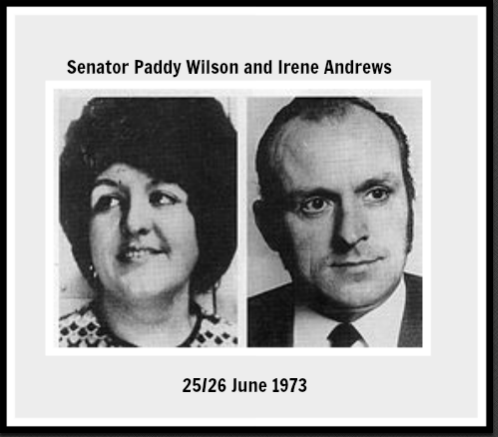
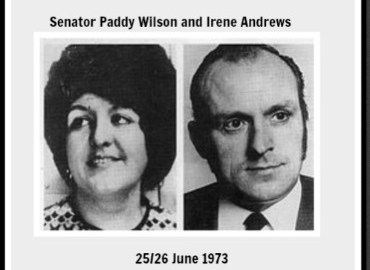
Senator Paddy Wilson and Irene Andrews

Paddy Wilson and Irene Andrews killings


The killings of Paddy Wilson and Irene Andrews took place in Belfast, Northern Ireland on the night of 25/26 June 1973. The victims, Roman Catholic Senator Paddy Wilson and his Protestant friend, Irene Andrews, were hacked and repeatedly stabbed to death by members of the “Ulster Freedom Fighters” (UFF).


John White


This was a cover name for the Ulster Defence Association (UDA), a then-legal Ulster loyalist paramilitary organisation. John White, the UFF’s commander, who used the pseudonym “Captain Black”, was convicted of the sectarian double murder in 1978 and sentenced to life imprisonment.

White, however maintained that the UFF’s second-in-command Davy Payne helped him lead the assassination squad and played a major part in the attack. Although questioned by the Royal Ulster Constabulary (RUC) after the killings, Payne admitted nothing and was never charged.

— Disclaimer –

The views and opinions expressed in this post/documentaries  are soley intended to educate and provide background information to those interested in the Troubles of Northern Ireland. They in no way reflect my own opinions and I take no responsibility for any inaccuracies or factual errors.

———————————————————


SDLP logo


Wilson was one of the founders and General Secretary of the Social Democratic and Labour Party (SDLP) and Irene Andrews was noted in Belfast as a popular ballroom dancer.

Their mutilated bodies were found lying in pools of blood on either side of Wilson’s car, which was parked in a quarry off the Hightown Road near Cavehill. Wilson had been hacked and stabbed 30 times and his throat cut from ear to ear. Andrews had received 20 knife wounds. The killings were described by the judge at White’s trial as “a frenzied attack, a psychotic outburst”.

Paddy Wilson and Irene Andrews killings
Paddy wilson and irene andrews.jpg

Victims Irene Andrews and Senator Paddy Wilson
Location Quarry off the Hightown Road, Belfast, Northern Ireland
Date 25/26 June 1973
Attack type
Stabbing
Deaths 2 civilians
Perpetrator Ulster Freedom Fighters (UFF

The double killings

On the evening of 25 June 1973, Stormont Senator Paddy Wilson (39), a Roman Catholic native of Belfast’s Sailortown, and General Secretary and founder of the Social Democratic and Labour Party (SDLP), had been drinking at the Old Vic Lounge inside McGlade’s Bar, a fashionable pub located in Donegall Street, Belfast city centre.

He was in the company of a Protestant friend, Irene Andrews (29), who worked as a clerk in the Department of Education and was one of Belfast’s most popular ballroom dancers who had been a member of Northern Ireland’s “Come Dancing” team.

According to Peter McKenna, a journalist for the Irish Independent who had been socialising with Wilson, Andrews and others on the night, an inebriated Andrews had spent much of the night making passes at Wilson but he had rejected her advances and had asked for McKenna to make an “urgent” phone call to the pub calling him away in an attempt to separate himself from Andrews. The ruse was not successful, however, and Wilson and Andrews left the pub together.

He offered her a lift back to her home on the Crumlin Road and they drove away from the pub at about 11:30pm in Wilson’s red mini. The couple never arrived at their destination.

At 1:30am, the loyalist Ulster Freedom Fighters (UFF), using their codename “Captain Black”, called the Belfast News Letter advising them that:

” tonight we have got Senator Paddy Wilson and a lady friend. Their bodies are lying in the Hightown Road.”

The UFF had been founded that same year by John White, who employed the pseudonym “Captain Black”. The UFF was a cover name to claim attacks carried out by the then-legal Ulster Defence Association to avoid the latter’s proscription by the British Government. “Captain Black” furthermore claimed that the killings were in retaliation for the shooting death of a mentally-retarded Protestant teenager the previous summer by the Provisional IRA.

The mutilated bodies of Wilson and Andrews were discovered by the security forces at 4am. They were lying in pools of blood on either side of Wilson’s Mini at a quarry off the Hightown Road near Cavehill as described by the UFF caller.

The Royal Ulster Constabulary (RUC) and British Army had proceeded carefully to the quarry in case the bodies had been booby-trapped. Wilson had been stabbed to death 30 times and his throat sliced from ear-to-ear. There was evidence that he had put up a struggle before he was killed.

Andrews had received 20 knife wounds. A UFF Brigade Staff member described the killings to a journalist as ritualistic ,  in addition to the multiple stabbings, Irene Andrews also had her breasts hacked off.

Oldpark Wards.png

The killings took place at the quarry and it was suggested by police that Wilson’s Mini had been stopped on the road leading to Ballysillan and they were forced at gunpoint to drive out to the quarry.

According to Martin Dillon forensic evidence indicated that Wilson had been dragged from the car and pinned to the ground where he was stabbed and Andrews was killed afterwards. Dillon speculated that the killers had made Andrews watch Wilson being killed.

Liam Cosgrave crop.png

There was widespread shock and condemnation throughout the North in the wake of the killings. Politicians, including Taoiseach Liam Cosgrave and SDLP leader Gerry Fitt, personally offered their condolences to the Wilson and Andrews’ families, whilst Democratic Unionist Party leader Ian Paisley blamed the IRA.

According to Peter Taylor, there had never been a crime so brutal carried out in Northern Ireland before.

Author Dervla Murphy in her travel book, A Place Apart (based on her experiences in Northern Ireland), stated that nine months before the double killing, a loyalist community newspaper had published allegations regarding a possible relationship between a prominent member of the SDLP and a young Protestant woman from Belfast’s Crumlin Road.

Conviction

UFF leader and self-styled “Captain Black” John White confessed to the killings during a police interrogation for other offences at the Castlereagh Holding Centre in 1976. He was convicted of the murders in 1978 and given two life sentences.

The trial judge described the killings as “a frenzied attack, a psychotic outburtst”. White maintained that the UFF’s second-in-command (and later North Belfast UDA brigadier) Davy Payne, also known as “The Psychopath”, was part of the assassination squad and played a leading role in the killings. Historian Ian S. Wood confirmed Payne’s central involvement in the double killing.

Although Payne had been questioned by the RUC after the killings, he admitted nothing and never faced any charges. It was alleged that whenever Payne wished to frighten or intimidate others he would shout:

“Do you know who I am? I’m Davy Payne. They say I killed Paddy Wilson”.


Following White’s release from the Maze Prison in 1992, he joined the Ulster Democratic Party. A prominent figure in the Northern Ireland Peace Process, in 1996 he comprised part of a four-man loyalist delegation to 10 Downing Street where he met British Prime Minister John Major.

Railway Road bomb 1973.jpeg

Later when asked why he had perpetrated the killings, White claimed that they were carried out to strike fear into the Catholic community after the IRA’s 1973 Coleraine bombings. Regarding Irene Andrews, White replied:

“We didn’t know she was a Protestant, we just thought she was a Catholic to be honest”.

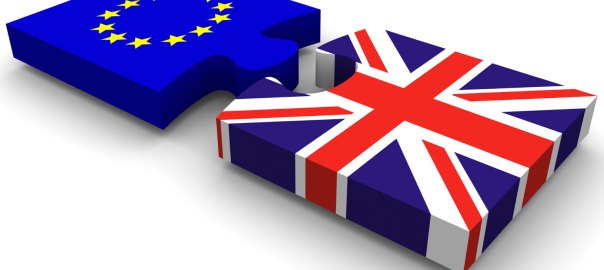
Article 50 – What’s it all about?

What is Article 50?

Article 50 of the Treaty on European Union allows a member state to notify the EU of its withdrawal and obliges the EU to try to negotiate a ‘withdrawal agreement’ with that state – it involves five points laid out below.

  1. “Any Member State may decide to withdraw from the Union in accordance with its own constitutional requirements.
  2. A Member State which decides to withdraw shall notify the European Council of its intention. In the light of the guidelines provided by the European Council, the Union shall negotiate and conclude an agreement with that State, setting out the arrangements for its withdrawal, taking account of the framework for its future relationship with the Union. That agreement shall be negotiated in accordance with Article 218(3) of the Treaty on the Functioning of the European Union. It shall be concluded on behalf of the Union by the Council, acting by a qualified majority, after obtaining the consent of the European Parliament.
  3. The Treaties shall cease to apply to the State in question from the date of entry into force of the withdrawal agreement or, failing that, two years after the notification referred to in paragraph 2, unless the European Council, in agreement with the Member State concerned, unanimously decides to extend this period.
  4. For the purposes of paragraphs 2 and 3, the member of the European Council or of the Council representing the withdrawing Member State shall not participate in the discussions of the European Council or Council or in decisions concerning it. A qualified majority shall be defined in accordance with Article 238(3)(b) of the Treaty on the Functioning of the European Union.
  5. If a State which has withdrawn from the Union asks to rejoin, its request shall be subject to the procedure referred to in Article 49.”

The form of any withdrawal agreement would depend on the negotiations and there is therefore no guarantee the UK would find the terms acceptable. The EU Treaties would cease to apply to the UK on the entry into force of a withdrawal agreement or, if no new agreement is concluded, after two years, unless there is unanimous agreement to extend the negotiating period.

During the two-year negotiation period, EU laws would still apply to the UK. The UK would continue to participate in other EU business as normal, but it would not participate in internal EU discussions or decisions on its own withdrawal. On the EU side, the agreement would be negotiated by the European Commission following a mandate from EU ministers and concluded by EU governments “acting by a qualified majority, after obtaining the consent of the European Parliament.” This means that the European Parliament would be an additional unpredictable factor in striking a deal.

However, if the final agreement cuts across policy areas within the preserve of the member states, such as certain elements of services, transport and investment protection – as many recent EU FTAs have done (for example with Peru and with Columbia) – it will be classed as a ‘mixed agreement’ and require additional ratification by every national parliament in the EU. The EU Treaties would also need to be amended to reflect the UK’s departure. In effect, this means that the final deal at the end of a negotiated UK exit from the EU would need to be ratified by EU leaders via a qualified majority vote, a majority in the European Parliament and by the remaining 27 national parliaments across the EU.

Article 50 Table itemprop=

Are there withdrawal options other than Article 50?

Theoretically, there is nothing to stop a British Government unilaterally withdrawing from the EU by simply repealing the 1972 European Communities Act. Article 50 compels only the EU to seek a negotiation, not the withdrawing member state. However, while this may be the case in principle, such an approach would likely damage the UK’s chances of striking a preferential trade agreement with the EU after exit – since its first act as an ‘independent’ nation would have been to have reneged on its EU treaty commitments. It would also mean there is no transition period, so EU legislation along with the UK’s free trade agreements via the EU lapse immediately. Since some EU law applies in the UK directly, the UK would need to legislate to replace it.

When would Article 50 be triggered?

The Prime Minister’s spokeswoman said today “a vote to leave is a vote to leave” and suggested that Article 50 would be triggered immediately if the referendum vote were for Leave. This was confirmed by David Cameron in the House of Commons, adding that Article 50 is the only way to leave. When it is triggered is ultimately up to the UK government but it is hard to imagine that it could be significantly delayed after a leave vote. Some have suggested that, since the EU cannot throw the UK out, one way would be for the UK government to use a No vote in the referendum as a de facto negotiating mandate. But this would depend on the EU’s willingness to negotiate an exit before Article 50 was triggered.

Similarly, any alternative mechanism for exit would need to be devised and agreed by the rest of the EU – a significant gesture of goodwill. Nevertheless, any potential agreement the UK struck with the EU at any point after withdrawal would come up against the same dynamics as Article 50, most notably requiring approval by EU leaders, MEPs and national parliaments. Therefore, unless the UK is truly prepared to ‘go it alone’, any ‘unilateral withdrawal’ option is tricky.

See BBC News for more details

25th June – Deaths & Events in Northern Ireland Troubles

Key Events & Deaths on this day in Northern Ireland Troubles

25th June

Monday 25 June 1973

Three members of the Irish Republican Army (IRA) were killed when a bomb they were transporting exploded prematurely on the Gortin Road, near Omagh, County Tyrone.

A Protestant civilian was shot dead by Loyalists in Belfast.

Friday 25 June 1976

Three Protestant civilians were shot dead during a gun attack on The Store Bar, Lyle Hill Road, Templepatrick, County Antrim.

The attack was carried out by a group called the Republican Action Force (RAF), believed to be a covername for some members of the Irish Republican Army (IRA).

Wednesday 25 June 1980

The Democratic Party in the United States of America (USA) adopted as policy a proposal put forward by Edward Kennedy, then a Senator. The new policy called for an end to the divisions of the Irish people and a solution based on the consent of all of the parties.

Tuesday 25 June 1985

The United States of America (USA) and the United Kingdom (UK) sign a bilateral treaty that would prevent people facing extradition from claiming that their crimes had a political motive.

Thursday 25 June 1992

James Molyneaux, then leader of the Ulster Unionist Party (UUP), together with Ian Paisley, then leader of the Democratic Unionist Party (DUP), put a motion before the House of Commons which called for the setting up of a Northern Ireland Select Committee.

The motion was supported by the Liberal Democrats, and the Welsh and Scottish Nationalist parties. However the government opposed the motion which failed to gain sufficient suppport.

Wednesday 25 June 1997

The Royal Ulster Constabulary (RUC) carried out a search of a house in Dunmurray, Belfast, and found a number of AK47 rifles.

The police had earlier gone to the wrong address.

Colin Duffy was charged with the murder of two RUC officers in Lurgan on 16 June 1997. Duffy’s solicitor alleged that the RUC had mistreated Duffy while in custody.

The British and Irish governments announced that they were giving the Irish Republican Army (IRA) a period of five weeks during which to call an unequivocal ceasefire.

Following any ceasefire a further period of six weeks would then elapse before Sinn Féin (SF) could enter the talks at Stormont when they resumed on 15 September 1997. The talks were scheduled to conclude in May 1998.

[SF later called for “clarification” of the statement but were told that they would not be given any.]

Friday 25 June 1999

Marjorie (Mo) Mowlam, then Secretary of State for Northern Ireland, rejected demands for an Inquiry into the killing of Billy Wright inside the Maze Prison on 27 December 1997.

billy writgt

See Billy Wright

Tony Blair, the British Prime Minster, and Bertie Ahern, then Taoiseach (Irish Prime Minister), travelled to Belfast for a series of meetings at Stormont with the political parties.

[These meetings were held prior to a week of intensive negotiations, beginning on Monday 28 June. The deadline for overcoming the political impasse had been set for 30 June.]


——————————————

Remembering all innocent victims of the Troubles

Today is the anniversary of the death of the following people killed as a results of the conflict in Northern Ireland

“To live in hearts we leave behind is not to die

– Thomas Campbell

To the innocent on the list – Your memory will live forever

– To the Paramilitaries –

There are many things worth living for, a few things worth dying for, but nothing worth killing for.

11 People lost their lives on the 25th  June between 1972 – 1987

——————————————

25 June 1972
James Bonner  (19)

Catholic
Status: Civilian (Civ),

Killed by: British Army (BA)
Shot while travelling in stolen car, Whiterock Road, Ballymurphy, Belfast.

——————————————

25 June 1973


Joseph Cunningham   (36)

Protestant
Status: Civilian (Civ),

Killed by: Ulster Freedom Fighters (UFF)
Shot at his home, Nore Street, Lower Oldpark, Belfast. Alleged informer.

——————————————

25 June 1973
Sean Loughran   (37)

Catholic
Status: Irish Republican Army (IRA),

Killed by: Irish Republican Army (IRA)
Died in premature bomb explosion while travelling in car, Gortin Road, near Omagh, County Tyrone.

——————————————

25 June 1973
Patrick Carty  (26)

Catholic
Status: Irish Republican Army (IRA),

Killed by: Irish Republican Army (IRA)
Died in premature bomb explosion while travelling in car, Gortin Road, near Omagh, County Tyrone.

——————————————

25 June 1973
Dermot Crowley   (18)

nfNI
Status: Irish Republican Army (IRA), Killed by: Irish Republican Army (IRA)
From County Cork. Died in premature bomb explosion while travelling in car, Gortin Road, near Omagh, County Tyrone.

——————————————

25 June 1976
Ruby Kidd  (28)

Protestant
Status: Civilian (Civ),

Killed by: Republican Action Force (RepAF)
Shot during gun attack on Walker’s Bar, Lyle Hill Road, Templepatrick, County Antrim.

——————————————

25 June 1976
Francis Walker   (17)

Protestant
Status: Civilian (Civ),

Killed by: Republican Action Force (RepAF)
Shot during gun attack on Walker’s Bar, Lyle Hill Road, Templepatrick, County Antrim

——————————————

25 June 1976
Joseph McBride   (56)

Protestant
Status: Civilian (Civ),

Killed by: Republican Action Force (RepAF)
Shot during gun attack on Walker’s Bar, Lyle Hill Road, Templepatrick, County Antrim

——————————————

25 June 1978
Patrick McEntee   (54)

Catholic
Status: Civilian (Civ),

Killed by: Irish Republican Army (IRA)
Found shot, Ballsmill, near Forkhill, County Armagh. Alleged informer.

——————————————

25 June 1978
Alan Ferguson   (23)

Protestant
Status: Ulster Defence Regiment (UDR),

Killed by: Irish Republican Army (IRA)
Shot during sniper and landmine attack on British Army (BA) Armoured Personnel Carrier, Belcoo, County Fermanagh

——————————————

25 June 1987


Dominic O’Connor   (30)

Catholic
Status: Civilian (Civ),

Killed by: Ulster Volunteer Force (UVF)
Shot outside his home, Springfield Road, Belfast.

——————————————


24th June – Deaths & Events in Northern Ireland Troubles

Key Events & Deaths on this day in Northern Ireland Troubles

24th June

Tuesday 24 June 1969

The Parliamentary Commissioner Act (Northern Ireland) became law. The act provided for a Commissioner to investigate complaints of maladministration against government departments.

Saturday 24 June 1972

David Moon, one of the victims

The Irish Republican Army (IRA) killed three British Army soldiers in a land mine attack near Dungiven, County Derry.

Monday 24 June 1974


Gerard Craig  &  David Russell

Two members of the Irish Republican Army (IRA) were killed in a premature explosion while planting a bomb at a shop on Greenhaw Road, Shantallow, Derry.

Tuesday 24 June 1986

Ian Paisley, then leader of the Democratic Unionist Party (DUP), said that Northern Ireland was on the verge of civil war.

Thursday 24 June 1993

Michael Mates, then a Northern Ireland Office (NIO) Minister, resigned his post. [He was replaced by John Wheeler.]

Friday 24 June 1994

John Major, then British Prime Minister, held a meeting with Albert Reynolds, then Taoiseach (Irish Prime Minister), during a European Union conference in Corfu.

Saturday 24 June 1995

There was a clash between Sinn Féin (SF) supporters and Royal Ulster Constabulary (RUC) officers during a protest against an Orange Order parade in the Whiterock area of Belfast.

Wednesday 24 June 1998

A Republican paramilitary group exploded a car bomb, estimated at 200 pounds, in the centre of Newtownhamilton, County Armagh. A 50 minute warning about the bomb had been received but people were still being cleared when it exploded and six people, including a 15 year old boy, were injured.

The Irish National Liberation Army (INLA) claimed responsibility for the bomb.

[Security sources believed that the “real” Irish Republican Army (rIRA) was involved in supplying the INLA with Semtex commercial explosive which was thought to have been used as a component in the bomb.]

Thursday 24 June 1999

Officers in the Traffic Branch of the Garda Síochána (the Irish police) intercepted 300lb of explosives in a car outside Letterkenny in the Republic of Ireland.

William Stobie (48), of Forthriver Road, Belfast, was charged with the killing of the Belfast solicitor Pat Finucane on 12 February 1989.

William Stobie.jpg

Stobie, who had served in the Ulster Defence Regiment (UDR), was remanded in custody to the Maze Court on 14 July 1999. Stobie was claimed to have been the west Belfast quartermaster for the Ulster Freedom Fighters (UFF), a cover name (pseudonym) used by the Ulster Defence Association (UDA).

His lawyers claimed that Stobie had been an informer for Royal Ulster Constabulary (RUC) Special Branch at the time of the killing.

See William “Billy” Stobie

The Orange Order began a 10 day ‘Long March’ from Derry to Drumcree. The march was in support of Protestant rights and the Portadown Orangemen who wished to march down the Garvaghy Road on 4 July 1999

——————————————

Remembering all innocent victims of the Troubles

Today is the anniversary of the death of the following people killed as a results of the conflict in Northern Ireland

“To live in hearts we leave behind is not to die

– Thomas Campbell

To the innocent on the list – Your memory will live forever

– To the Paramilitaries –

There are many things worth living for, a few things worth dying for, but nothing worth killing for.

11 People lost their lives on the 24th June between 1972 – 1993

——————————————

24 June 1972
Christopher Stevenson  (24)

nfNI
Status: British Army (BA),

Killed by: Irish Republican Army (IRA)
Killed in land mine attack on British Army (BA) mobile patrol, Crabarkey, near Dungiven, County Derry.

——————————————

24 June 1972


David Moon   (24)

nfNI
Status: British Army (BA),

Killed by: Irish Republican Army (IRA)
Killed in land mine attack on British Army (BA) mobile patrol, Crabarkey, near Dungiven, County Derry.

——————————————

24 June 1972
Stuart Reid   (26)

nfNI
Status: British Army (BA),

Killed by: Irish Republican Army (IRA)
Killed in land mine attack on British Army (BA) mobile patrol, Crabarkey, near Dungiven, County Derry.

——————————————

24 June 1972
John Brown   (29)

Protestant
Status: Ulster Defence Association (UDA),

Killed by: Ulster Defence Association (UDA)
Found shot near his home, Blackmountain Parade, Springmartin, Belfast. Internal Ulster Defence Association dispute.

——————————————

24 June 1974


Gerard Craig  (17)

Catholic
Status: Irish Republican Army (IRA),

Killed by: Irish Republican Army (IRA)
Killed in premature explosion while planting bomb at supermarket, Greenhaw Road, Shantallow, Derry.

——————————————

24 June 1974


David Russell   (18)

Protestant
Status: Irish Republican Army (IRA),

Killed by: Irish Republican Army (IRA)
Killed in premature explosion while planting bomb at supermarket, Greenhaw Road, Shantallow, Derry

——————————————

24 June 1975


Alan Ralph  (25)

Protestant
Status: Civilian (Civ),

Killed by: non-specific Republican group (REP)
Shot shortly after leaving work, while getting into his car, Balfour Avenue, off Ormeau Road, Belfast

——————————————

24 June 1979
 Joseph Porter   (63)

Protestant
Status: Ulster Defence Regiment (UDR),

Killed by: Irish Republican Army (IRA)
Off duty. Shot near to his home, Mountnorris, near Markethill, County Armagh.

——————————————

24 June 1987


Thomas Wilson   (35)

Catholic
Status: Civilian Political Activist (CivPA),

Killed by: Irish Republican Army (IRA)
Workers’ Party activist. Found shot, in entry, off Rodney Parade, Falls, Belfast. Alleged informer.

——————————————

24 June 1989
Liam McKee   (36)

Catholic
Status: Civilian (Civ),

Killed by: Ulster Freedom Fighters (UFF)
Shot at his home, Donard Drive, Tonagh, Lisburn, County Antrim.

——————————————

24 June 1993


John Lyness   (57)

Protestant
Status: ex-Ulster Defence Regiment (xUDR),

Killed by: Irish Republican Army (IRA)
Shot outside his home, Lime Grove, Lurgan, County Armagh.

——————————————