Tag Archives: ruc

20th May – Deaths & Events in Northern Ireland Troubles

Key Events & Deaths on this day in Northern Ireland Troubles

20th May

Monday 20 May 1968

Terence O’Neill


Terence O’Neill, then Northern Ireland Prime Minister, was showered with eggs, flour and stones after a meeting of the Woodvale Unionist Association.

Monday 20 May 1974

Day 6 of the UWC strike

Michael Mallon (20), a Catholic civilian, was shot dead by the Ulster Freedom Fighters (UFF) a covername for the Ulster Defence Association (UDA), and left by the side of the road at Shaw’s Bridge, Belfast.

Many roads in Northern Ireland were closed because of barricades. Electricity generation dropped to about one-third of normal levels. People were asked only to use telephones in an emergency.

Five hundred additional troops arrived in Northern Ireland.

An advertisement in the News Letter (a Belfast newspaper), which had been placed by Unionist politicians, called for support of the strike.

Stanley Orme, then Minister of Sate at the Northern Ireland Office (NIO), repeated the government’s position of not negotiating with the Ulster Workers’ Council (UWC) Strike Committee.

 [Public Records 1974 – Released 1 January 2005:

Note of a statement made by Stanley Orme, then Minister of Sate at the Northern Ireland Office (NIO), to the House of Commons. The statement sought to explain the circumstances surrounding the decision by Merlyn Rees, then Secretary of Sate for Northern Ireland, to announce a State of Emergency (Section 40, Northern Ireland Constitution Act 1973) on 19 May 1974.]

Friday 20 May 1977

Daniel McCooey (20), a Catholic civilian, died three weeks after he had been severely beaten by members of a British Army foot patrol in Castle Street, Belfast.

A member of the Royal Ulster Constabulary (RUC) was shot dead by the Irish Republican Army (IRA) in County Tyrone.

Tuesday 20 May 1980
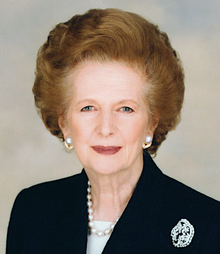
Margaret Thatcher, then British Prime Minister, stated in the House of Commons:

“The future of the constitutional affairs of Northern Ireland is a matter for the people of Northern Ireland, this government and this parliament and no one else.”

This statement was made the day before Charles Haughey, then Taoiseach (Irish Prime Minister), was due to arrive in London with talks with Thatcher.

Wednesday 20 May 1981

District Council Elections

Local government elections were held in Northern Ireland against the backdrop of the continuing hunger strike. In the increased tension in the region, ‘moderate’ parties all suffered a decline in support.

The Democratic Unionist Party (DUP) achieved 26.6 per cent of the vote compared to the 26.5 per cent recorded by the Ulster Unionist Party (UUP). The Social Democratic and Labour Party (SDLP) obtained 17.5 per cent of the first preference votes compared to 20.6 per cent in 1977.

 See  1981 Hunger Strike

Monday 20 May 1985


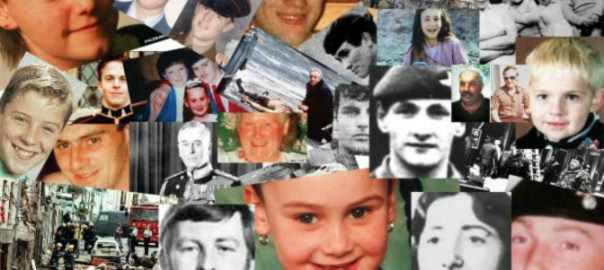
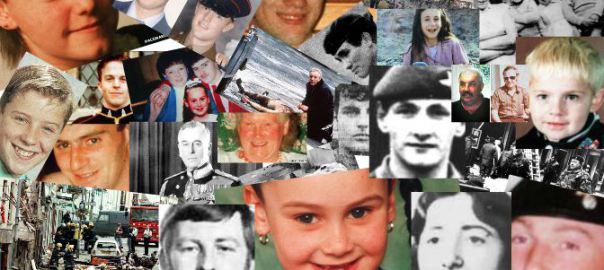
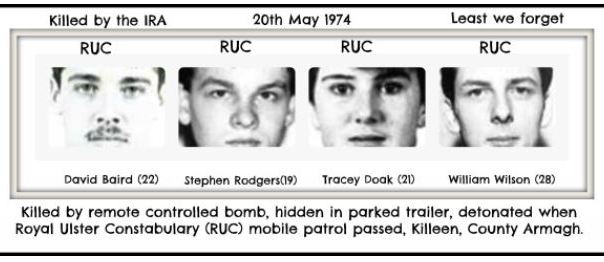
RUC  Collage

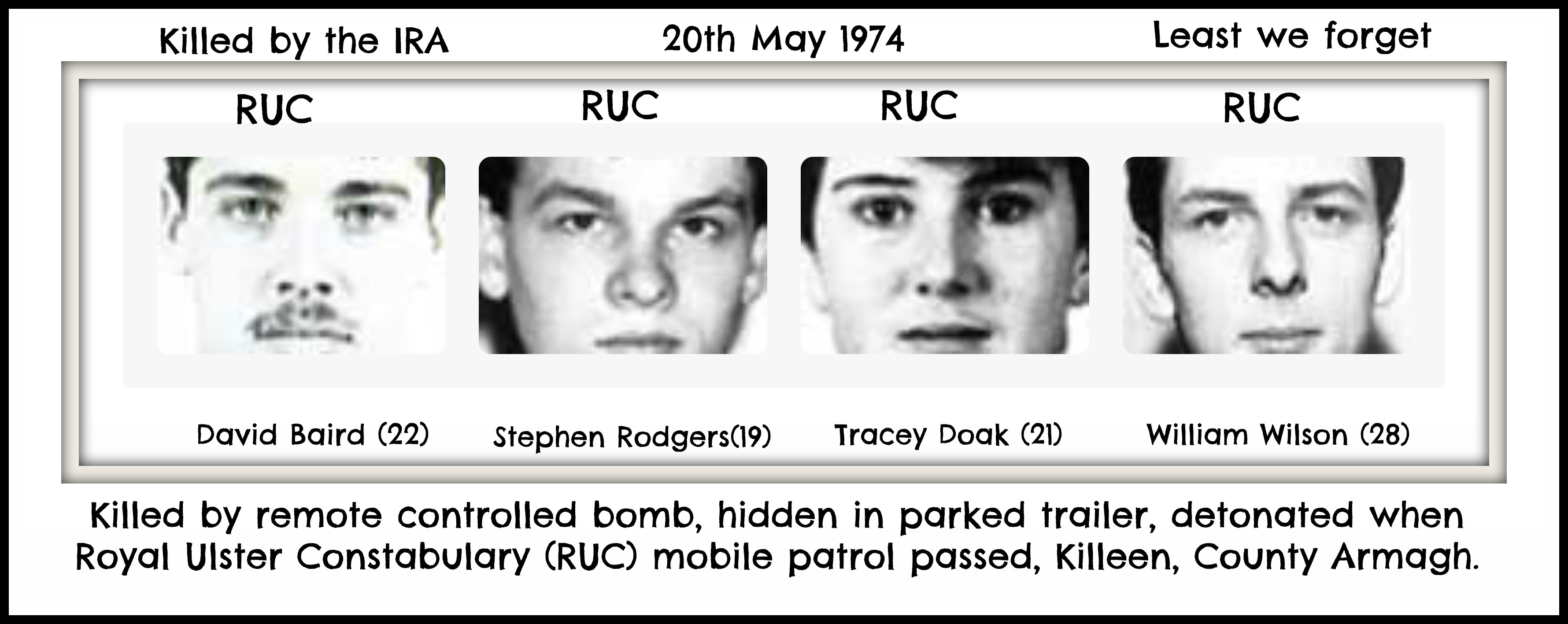
Four Royal Ulster Constabulary (RUC) officers in a mobile patrol were killed when the Irish Republican Army (IRA) exploded a bomb in a parked trailer at Killeen, County Down.

Tuesday 20 May 1986

Nicholas Scott, then a Northern Ireland Office (NIO) Minister, provided information in the House of Commons on the level of intimidation that Royal Ulster Constabulary (RUC) officers had faced from Loyalists during protests at the Anglo-Irish Agreement (AIA).

Scott said that there had been 368 cases of intimidation.

[Later information provided by the RUC indicated that the final number was over 500 homes attacked and 150 RUC families forced to move.]

Monday 20 May 1991

The Social Democratic and Labour Party (SDLP) announced that it was leaving the political talks (later known as the Brooke / Mayhew talks) until such time as the procedures for the main talks were agreed by the other parties.

Thursday 20 May 1993

The Irish Republican Army (IRA) exploded a bomb, estimated at 1,000 pounds, in Glengall Street, Belfast. Thirteen people were injured in the explosion. The bomb was placed outside the Grand Opera House and close to the Headquarters of the Ulster Unionist Party (UUP).

[Later estimates put the cost of the damage at £6.5 million.]

Friday 20 May 1994

There was serious rioting in Protestant areas of Belfast following the appearance in Belfast Magistrates’ Court of a man accused of ‘directing the activities’ of the Ulster Freedom Fighters (UFF), a cover name (pseudonym) used by the Ulster Defence Association (UDA).

Monday 20 May 1996

Gerry Adams, then President of Sinn Féin (SF), said that SF was prepared to accept the six ‘Mitchell Principles’ if the other parties agreed to them.

Tuesday 20 May 1997

John Hume, then leader of the Social Democratic and Labour Party (SDLP), tabled a motion in the House of Commons calling on the British government to conduct a new inquiry into the events of ‘Bloody Sunday‘ in Derry on 30 January 1972.

Jack Straw, then British Home Secretary, announced that two Irish Republican Army (IRA) prisoners, Danny McNamee and Liam McCotter, would be transferred to prisons in Northern Ireland.

Wednesday 20 May 1998

Blair’s Pledges

Tony Blair, then British Prime Minister, delivered a speech at the Coleraine campus of the University of Ulster in which he unveiled a hand-written set of pledges to the people of Northern Ireland in advance of the Referendum on 22 May 1998. The text of the pledges was as follows: “I pledge to the people of Northern Ireland:

  • No change in the status of Northern Ireland without the express consent of the people of Northern Ireland.
  • Power to take decisions returned to a Northern Ireland Assembly, with accountable North/South co-operation.
  • Fairness and equality guaranteed for all.
  • Those who use or threaten violence excluded from the Government of Northern Ireland.
  • Prisoners kept in unless violence is given up for good.

Whatever the Referendum result, as Prime Minister of the United Kingdom I will continue to work for stability and prosperity for all the people of Northern Ireland

.” Bill Clinton, then President of the United States of America (USA), sent a personal message to the people of Northern Ireland calling on them to vote ‘Yes’ in the

forthcoming referendum.

In the final hours of campaigning David Trimble, then leader of the Ulster Unionist Party (UUP), and Ian Paisley, then leader of the Democratic Unionist Party (DUP), took part in a live television debate.

The 10 minute encounter took place on the BBC’s ‘Newsline’ programme. The debate was heated with Paisley accusing Trimble of being prepared to “break the union”.

Thursday 20 May 1999

There were disturbances involving Loyalists and the Royal Ulster Constabulary (RUC) in Portadown, County Armagh.

The Ulster Unionist Party (UUP) delegation did not arrive for a second day of talks at Downing Street. The UUP stated that it had not been informed of the continuation of the talks.

Sinn Féin (SF) accused the UUP of a deliberate snub of the Prime Minister.
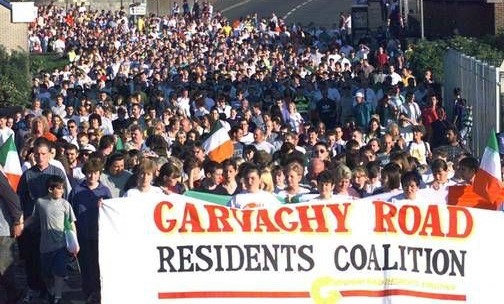
garvaghy road residents coalition 2

The Garvaghy Road Residents Coalition (GRRC) called for the Parades Commission to re-route the part of the Drumcree parade which passed close to Obins Street and St John’s Catholic Church.

Paul Berry, then a Democratic Unionist Party (DUP) Assemblyman, responded in an interview on Radio Ulster and said Loyalists would not be stopped from getting down the Garvaghy Road,

“If it is a matter of taking the law into our own hands then we are going to have to do it. That is a threat.”

(Reported in ‘Fortnight’ magazine, September 1999, p6). Mr Berry later denied making a threat. Planners from the Department of the Environment (DOE) in Northern Ireland told a regional planning conference in Dublin that Derry would be developed as the growth hub of the north-west.


 ——————————————

Remembering all innocent victims of the Troubles

Today is the anniversary of the death of the following people killed as a results of the conflict in Northern Ireland

“To live in hearts we leave behind is not to die

– Thomas Campbell

To the innocent on the list – Your memory will live forever

– To the Paramilitaries –

There are many things worth living for, a few things worth dying for, but nothing worth killing for.

10 People lost their lives on the 20th  May between 1972 – 1986

 ——————————————

20 May 1972
Henry Gillespie  (32)

Protestant
Status: Ulster Defence Regiment (UDR),

Killed by: Irish Republican Army (IRA)
Shot by sniper while on Ulster Defence Regiment mobile patrol, Killyliss, near Dungannon, County Tyrone.

 ——————————————

20 May 1974
Miicahel Mallon   (20)

Catholic
Status: Civilian (Civ),

Killed by: Ulster Defence Association (UDA)
Found shot by side of Milltown Road, Shaw’s Bridge, Belfast.

 ——————————————

20 May 1977


Robert North  (52)

Protestant
Status: Royal Ulster Constabulary (RUC),

Killed by: Irish Republican Army (IRA)
Off duty reservist. Shot while driving school bus along Drumlee Road, near Benburb, County Tyrone

 ——————————————

20 May 1977


 Daniel McCooey  (20)

Catholic
Status: Civilian (Civ),

Killed by: British Army (BA)
Died three weeks after being badly beaten by British Army (BA) foot patrol, Castle Street, Belfast.

 ——————————————

20 May 1979


Stanley Wray  (50)

Protestant
Status: Royal Ulster Constabulary (RUC),

Killed by: Irish Republican Army (IRA)
Off duty. Shot shortly after leaving Claremont Presbyterian Church, Northland Road, Derry.

 ——————————————

20 May 1985


William Wilson   (28)

Protestant
Status: Royal Ulster Constabulary (RUC),

Killed by: Irish Republican Army (IRA)
Killed by remote controlled bomb, hidden in parked trailer, detonated when Royal Ulster Constabulary (RUC) mobile patrol passed, Killeen, County Armagh.

 ——————————————

20 May 1985


Stephen Rodgers   (19)

Protestant
Status: Royal Ulster Constabulary (RUC),

Killed by: Irish Republican Army (IRA)
Killed by remote controlled bomb, hidden in parked trailer, detonated when Royal Ulster Constabulary (RUC) mobile patrol passed, Killeen, County Armagh.

 ——————————————

20 May 1985


David Baird   (22)

Protestant
Status: Royal Ulster Constabulary (RUC),

Killed by: Irish Republican Army (IRA)
Killed by remote controlled bomb, hidden in parked trailer, detonated when Royal Ulster Constabulary (RUC) mobile patrol passed, Killeen, County Armagh.

 ——————————————

20 May 1985

Tracey Doak   (21)

Protestant
Status: Royal Ulster Constabulary (RUC),

Killed by: Irish Republican Army (IRA)
Killed by remote controlled bomb, hidden in parked trailer, detonated when Royal Ulster Constabulary (RUC) mobile patrol passed, Killeen, County Armagh.

 ——————————————

20 May 1986
Colm McKevitt  (30)

Catholic
Status: Civilian (Civ),

Killed by: Irish Republican Army (IRA)
Shot shortly after being abducted from his sister’s home, Killeen, County Armagh. Alleged informer.

 ——————————————

3rd November – Deaths & Events in Northern Ireland Troubles

Key Events & Deaths on this day in Northern Ireland Troubles

3rd November

——————————————————————-

November 1975

Monday 3 November 1975

James Fogarty (22), who had been a Republican Clubs member, was shot dead at his home in Ballymurphy, Belfast, by members of the Provisional Irish Republican Army (PIRA). This killing was part of the continuing feud between the two wings of the IRA.

Wednesday 3 November 1976

Two Protestant civilians were killed in separate shooting incidents carried out by Republican paramilitaries in Dundrod, County Antrim and Tiger’s Bay, Belfast.

Saturday 3 November 1979

The Social Democratic and Labour Party (SDLP) held its annual conference. The party rejected calls for talks with the Irish Republican Army (IRA). The party also called for a joint approach by the British and Irish governments to finding a solution to the problems in Northern Ireland.

Tuesday 3 November 1981 s[ Political Developments.]

Friday 3 November 1989

In a speech, Peter Brooke, then Secretary of State for Northern Ireland, said that the Irish Republican Army (IRA) could not be defeated militarily. He also said that he would not rule out talks with Sinn Féin (SF) in the event of an end to violence. [His remarks caused controversy.]

Tuesday 3 November 1992

The ‘Belfast Brigade’ of the Irish People’s Liberation Organisation (IPLO) that it would disband. [This followed an internal feud and the intervention of the Irish Republican Army (IRA) on 31 October 1992.]

Wednesday 3 November 1993

The Irish Congress of Trade Unions (ICTU) organised peace rallies in Belfast and Derry.

Thursday 3 November 1994

Albert Reynolds, then Taoiseach (Irish Prime Minister), said that there would be no change in the constitutional status of Northern Ireland without the consent of the majority of its people.

Friday 3 November 1995

The Northern Ireland Office (NIO) published a document referred to as the ‘Building Blocks’ paper. Copies of the document had been given to the political parties and the Irish and American government during the previous week. The paper suggested that: “all-party preparatory talks and an independent international body to consider the decommissioning issue will be convened in parallel by the two governments”

. Hence the process was to be called the ‘twin-track’ process. Martin McGuinness, then Vice-President of Sinn Féin (SF), held a meeting with Michael Ancram, the Political Development Minister at the NIO, and discussed decommissioning of paramilitary weapons and also all-party talks.

Sunday 3 November 1996

Gerry Adams, then President of Sinn Féin (SF), refused to comment on reports in the Sunday Tribune (a Dublin based newspaper) that the British government had reopened contacts with Sinn Féin (SF). Sean Brady succeeded Cathal Daly and was appointed as Archbishop of Armagh and head of the Catholic church in Ireland.

Wednesday 3 November 1999

The Royal Ulster Constabulary (RUC) conducted a series of raids in County Armagh and County Antrim against Loyalist paramilitaries. Fifty RUC detectives were involved in the operation and three men were arrested and arms and explosives recovered. In one of the raids at Stoneyford Orange Hall, County Antrim, the police held six men for questioning when military documents were uncovered with the personal details of over 300 Republicans from Belfast and south Armagh.

The Orange Order said it was “aghast” at the finds. Sinn Féin (SF) said the documents were evidence of collusion between the security forces and Loyalist paramilitaries. The RUC held three men for questioning about the killing of Pat Finucane, a Belfast solicitor shot dead on 12 February 1989. The arrests were made at the request of the team carrying out an inquiry into the killing. The team was headed by John John Stevens, then Commissioner of the Metropolitan Police. John White, then Ulster Democratic Party (UDP) spokesman, accused the inquiry team of “deliberately harassing Loyalists”.

Saturday 3 November 2001

Saturday (midnight) marked the new deadline for the election of a First Minister and a Deputy First Minister by the parties in the Northern Ireland Assembly (NIA).

[The date represented a period of six weeks since the political institutions were restored to power following their last 24 hour suspension (22 September 2001). John Reid, then Secretary of State for Northern Ireland, allowed the deadline to pass without taking any action. The intention was to try to elect a First Minister and a Deputy First Minister on Monday 5 November 2001. The Democratic Unionist Party (DUP) announced that it would seek a legal challenge to the decision taken by Reid.]

——————————————————————————————


———————————————————————————

Remembering all innocent victims of the Troubles

Today is the anniversary of the death of the following  people killed as a results of the conflict in Northern Ireland

“To live in hearts we leave behind is not to die

– Thomas Campbell

To the innocent on the list – Your memory will live  forever

– To  the Paramilitaries  –

There are many things worth living for, a few things worth dying for, but nothing worth killing for.

  4   People lost their lives on the 3rd November between 1975 – 1991

————————————————————

03 November 1975


 James Fogarty,  (22)

Catholic
Status: Civilian Political Activist (CivPA),

Killed by: Irish Republican Army (IRA)
Former Republican Clubs member. Shot at his home, Rock Grove, Ballymurphy, Belfast. Official Irish Republican Army (OIRA) / Irish Republican Army (IRA) feud.

————————————————————

03 November 1976
Samuel McConnell,  (59)

Protestant
Status: Civilian (Civ), Killed by: non-specific Republican group (REP)
Shot at his farm, Sycamore Road, Dundrod, County Antrim.

————————————————————

03 November 1976


Georgina Strain,   (50)

Protestant
Status: Civilian (Civ),

Killed by: non-specific Republican group (REP)
Shot at her home, Hogarth Street, Tiger’s Bay, Belfast.

————————————————————

03 November 1991


 Gerard Maginn,   (17)

Catholic
Status: Civilian (Civ),

Killed by: Royal Ulster Constabulary (RUC)
Found shot in abandoned stolen car, Glen Road, Andersonstown, Belfast.

————————————————————

See below on how to order a copy of my No.1 Bestselling book: A Belfast Child 

18th September – Deaths & Events in Northern Ireland Troubles

Key Events & Deaths on this day in Northern Ireland Troubles

18th September

Tuesday 18 September 1973

Edward Heath, then British Prime Minister, gave a media interview where he said that if the Northern Ireland Assembly failed to establish a power-sharing Executive by March 1974 then the best option would be to integrate Northern Ireland fully into the United Kingdom (UK).

Saturday 18 September 1976

Two Royal Ulster Constabulary (RUC) officers were shot by the Irish Republican Army (IRA) during a gun attack in Portadown, County Armagh. Albert Craig (33), then a Sergeant, was pronounced dead on arrival at Craigavon Hospital.

Thursday 18 September 1986

International Fund for Ireland

The International Fund for Ireland was established by the British and Irish governments.

[The fund was designed to support economic developments in Northern Ireland and the border counties in the Republic of Ireland. The initial £36 million for the fund was donated by the United States of America (which gave the bulk of the money), Canada, New Zealand and, since 1988, the European Community Commission.]

Saturday 18 September 1993

An interview with Martin McGuinness, then Vice-President of Sinn Féin (SF), was published in the Guardian (a British newspaper). McGuinness stated that any political settlement should be decided by the people of Ireland and spoke of the “right to self-determination of the Irish people”.

The Royal Ulster Constabulary (RUC) issued a statement in reply to Sinn Féin (SF) claims that members of the party had been refused licences to carry firearms for personal protection. The RUC denied that was any such policy and stated that five SF councillors had been issued with firearm certificates.

Sunday 18 September 1994

The Observer (a London based newspaper) carried a report of an interview with Albert Reynolds, then Taoiseach (Irish Prime Minister). Reynolds was reported as saying that the unification of Ireland would not come about “in this generation”.

Monday 18 September 1995

Mitchel McLaughlin, then Sinn Féin (SF) chairman, and Gary McMichael, then leader of the Ulster Democratic Party (UDP), took part in a debate during the Liberal Democrats’ conference in Glasgow, Scotland. This was the first time representatives of the two parties shared a platform.

Thursday 18 September 1997

The Irish News carried a story that on Friday 12 September 1997 four unarmed members of the Irish Republican Army (IRA) stopped a member of the Continuity Irish Republican Army (CIRA) and took a gun off him. The incident happened in the Ardoyne area of Belfast. [The story was later confirmed as true by Ruairí O Brádaigh, then President of Republican Sinn Féin (RSF).] During a referendum in Wales the electorate voted by a narrow majority for a Welsh Assembly. [This followed the vote for a Scottish Parliament held on 11 September 1997.]

Saturday 18 September 1999

A rally in Belfast against the reform of the Royal Ulster Constabulary (RUC) proposed by the Patten report was addressed by a former chief constable of the force, Sir John Hermon. He warned against pushing the report’s recommendations through the British parliament before the Northern Ireland Assembly was properly in place. The dissident Republican group, the 32-County Sovereignty Movement, opened a branch in Derry saying it plans to build “the strongest Republican opposition ever to British rule”.

Tuesday 18 September 2001

There was a gun attack on a man sitting in a car in the Loyalist Killycomaine estate, Portadown, County Armagh, shortly before 8.00am (08.00BST). The man was uninjured. A group of men in a second car fired several shots before driving off.

[The attack is believed to have been carried out by the Ulster Volunteer Force (UVF). Royal Ulster Constabulary (RUC) officers are considering the possibility that the incident is related to an on-going feud between the Loyalist Volunteer Force (LVF) and the UVF in the Portadown area..]

The Loyalist protest at the Holy Cross Girls’ Primary School continued. The protest was silent as Catholic children and parents entered the school but protesters jeered, shouted abuse, waved flags, held up banners, and whistled as the parents returned from the school. Catholic parents were scheduled to have a meeting with John Reid, then Secretary of State for Northern Ireland, at Hillsborough, County Down, about the situation at Holy Cross school.

Seamus Mallon, then deputy leader of the Social Democratic and Labour Party (SDLP), announced that he would not be standing for leader of the party in the forthcoming leadership contest in November. He also announced that he wished to stand down as deputy leader of the party. Following the announcement Alban Maginness declared that he would stand as a candidate for the deputy leadership post. British and Irish officials are expected to meet in London this afternoon at the beginning of a new round of political talks to try and resolve remaining issues in the peace process. The current deadline for agreement between the political parties is 22 September 2001.


Remembering all innocent victims of the Troubles

Today is the anniversary of the follow  people killed as a results of the conflict in Northern Ireland

To the innocent on the list – Your memory will live  forever

– To  the Paramilitaries  –

“There are many things worth living for, a few things worth dying for, but nothing worth killing for.

  7 People lost their lives on the 18th September  between 1971 – 1976

————————————————————–

18 September 1971


Robert Leslie,  (20)

Protestant
Status: Royal Ulster Constabulary (RUC),

Killed by: Irish Republican Army (IRA)
Shot while on Royal Ulster Constabulary (RUC) foot patrol, Abercorn Square, Strabane County Tyrone.

————————————————————–

18 September 1972
Edmund Woolsey,  (32)

Catholic
Status: Civilian (Civ),

Killed by: not known (nk)
Killed by booby trap bomb attached to a friend’s stolen car, which exploded when he attempted to open the door, Glassdrumman, near Crossmaglen, County Armagh.

————————————————————–

18 September 1972
John Van Beck,   (26) nfNI
Status: British Army (BA),

Killed by: Irish Republican Army (IRA)
Died one day after being shot while on British Army (BA) foot patrol, Lecky Road, Derry

————————————————————–

18 September 1973


Richard Miller,   (21) nfNI
Status: British Army (BA),

Killed by: Irish Republican Army (IRA)
Undercover British Army (BA) member. Died three weeks after being shot outside Royal Victoria Hospital, Falls Road, Belfast. He was wounded on 25 August 1973.

————————————————————–

18 September 1974


Patrick McGreevy,  (15)

Catholic
Status: Official Irish Republican Army Youth Section (OIRAF),

Killed by: Ulster Volunteer Force (UVF)
Shot from passing car while standing outside Pacific Cafe, Clifton Street, Belfast.

————————————————————–

18 September 1975


Brendan Doran,  (29)

Catholic
Status: Civilian (Civ),

Killed by: non-specific Loyalist group (LOY)
Shot at his workplace, newsagent’s, Greenway, Cregagh, Belfast.

————————————————————–

18 September 1976


Albert Craig,  (33)

Protestant
Status: Royal Ulster Constabulary (RUC),

Killed by: Irish Republican Army (IRA)
Shot while directing traffic, Brownstone Road, Portadown, County Armagh.

————————————————————–

15th September – Deaths & Events in Northern Ireland Troubles

Key Events & Deaths on this day in Northern Ireland Troubles

15th September

——————————————————————-

Tuesday 15 September 1970

Another landmark in the violence was reached when the one hundredth explosion in 1970 occurred. Officers of the Royal Ulster Constabulary (RUC) voted narrowly in favour of remaining unarmed.

[The policy was overtaken by events and eventually all officers were rearmed.]

Wednesday 15 September 1971

A Catholic civilian, William McGreanery (43), was shot dead by a British soldier in the early hours of the morning as he made his way home. McGreanery was at the junction of Westland Street and Lone Moor Road when he was shot by a soldier in a sanger in the Army base in the old Essex factory.

The soldier who shot him made a statement at the time stating he had fired at a man aiming a rifle at his post. Friends and eyewitnesses said that Mr. McGreanery was unarmed when he was shot.

[On 20 June 2010 a Historical Enquires Team (HET) report into the shooting concluded that: “It is the view of the HET that he was not pointing a rifle at the soldier at the time. He was not involved with any paramilitary organisation, he was not carrying a firearm of any description, and he posed no threat to the soldiers at the observation post.” What was also revealed during the HET investigation was that the soldier shot dead on 14 September 1971 had two close relatives also serving in Derry at that time. One of them was in the same Army base in the old Essex factory and the other in Drumahoe just outside the city.] 4

A British soldier died one day after being shot in Belfast.

Tuesday 15 September 1987

The Northern Ireland Office (NIO) issued guidelines on fair employment Religious Equality of Opportunity in Employment: An Employers’ Guide to Fair Employment. Many commentators saw this initiative as a response to growing pressure from supporters of the MacBride Principles in the United States of America.

Sunday 15 September 1996

There was media speculation that the Irish Republican Army (IRA) was about to call a permanent ceasefire, but this was rejected by republican representatives. There were a series of pickets by loyalists outside Catholic chapels in Ballymena, Bushmills and Dervock, all in County Antrim.

A Democratic Unionist Party (DUP) councillor, David McAllister, said the pickets were a response to the rerouting of Orange parades and the boycott of Protestant businesses by Catholics. The protests were widely condemned. The Royal Ulster Constabulary (RUC) arrested three men in connection with the murder of Michael Whelan (35) on 12 September 1996.

Monday 15 September 1997

Multi-Party Talks Resumed While Sinn Féin (SF) entered Stormont, Belfast, to take part in the multi-party talks, the Ulster Unionist Party (UUP), the Progressive Unionist Party (PUP), and the Ulster Democratic Party (UDP) did not turn up for the for first plenary session. Instead the three Unionist parties attended a special meeting at the UUP headquarters in Glengall Street, Belfast.

[The three parties rejoined the talks on 17 September 1997.]

In addition to SF, the Alliance Party of Northern Ireland (APNI), Labour (Lab), the Social Democratic and Labour Party (SDLP), and the Northern Ireland Women’s Coalition (NIWC) all attended the talks. The Democratic Unionist Party (DUP) and the United Kingdom Unionist Party (UKUP) had walked out of Stormont on 21 July 1997 in protest at the decision to allow SF to enter Castle Buildings at Stormont. Paul Murphy, then Political Development Minister, held a meeting with UUP leaders.

Wednesday 15 September 1999

Research showed that the forensic testing for use of firearms was flawed. The ‘paraffin’ test had been used to find traces of lead particles, for example on the hands or clothing of people suspected of firing weapons.

However, research that had been commissioned by the Bloody Sunday Inquiry found that such testing was “flawed” because, for example, exposure to car exhaust could show a ‘positive’ result.

There was a paramilitary ‘punishment’ attack on a man (52) in the Waterside area of Derry. The man was shot in one leg. Loyalists carried out incendiary bomb attacks on three businesses in Ballycastle, County Antrim.

There was an arson attack on an Orange hall in Donaghmore, near Newry, County Down. The hall was damaged in the attack and “real IRA” graffiti was painted on the walls.

Saturday 15 September 2001

Loyalist paramilitaries attempted to kill a Catholic taxi driver at Parkmount Terrace, Shore Road, north Belfast, at 06.00am (06.00BST). Two youths fired a shot at the taxi which struck the vehicle but misted the driver.

The Red Hand Defenders (RHD), a cover name used by members of the Ulster Defence Association (UDA), claimed responsibility for the attack. Police recovered a handgun in the area. Alban Maginness, then a Social Democratic and Labour Party (SDLP) Assembly member for the area, said the attack again called into question the Loyalist ceasefires.

A house in Donard Drive, Lisburn, County Antrim, was attacked with a petrol bomb at approximately 11.00pm (23.00BST). The house was unoccupied at the time of the attack and the kitchen was extensively damaged by fire


Remembering all innocent victims of the Troubles

Today is the anniversary of the follow  people killed as a results of the conflict in Northern Ireland

To the innocent on the list – Your memory will live  forever

– To  the Paramilitaries  –

“There are many things worth living for, a few things worth dying for, but nothing worth killing for.

  6 People lost their lives on the 15th September  between 1971 – 1993

————————————————————–

15 September 1971


William McGreanery,  (43)

Catholic
Status: Civilian (Civ),

Killed by: British Army (BA)
Died shortly after being shot by sniper from Bligh’s Lane British Army (BA) base, while walking at the junction of Laburnum Terrace and Westland Street, Derry.

————————————————————–

15 September 1971
Paul Carter,  (21) nfNI
Status: British Army (BA),

Killed by: Irish Republican Army (IRA)
Died one day after being shot outside Royal Victoria Hospital, Falls Road, Belfast.

————————————————————–

15 September 1972
John Davis, (22) nfNI
Status: British Army (BA),

Killed by: Irish Republican Army (IRA)
Died three weeks after being shot while on British Army (BA) foot patrol, Meenan Square, Bogside, Derry.

————————————————————–

15 September 1973
Maurice Spence,   (25)

Protestant
Status: Civilian (Civ),

Killed by: non-specific Loyalist group (LOY)
Found shot in his car, Glenwherry, near Ballymena, County Antrim

————————————————————–

15 September 1990


Louis  Robinson,   (42)

Protestant
Status: Royal Ulster Constabulary (RUC),

Killed by: Irish Republican Army (IRA)
Off duty. Abducted at Irish Republican Army (IRA) roadblock, while travelling in minibus, Killeen, County Armagh. Body found shot by the side of Concession Road, Cullaville, near Crossmaglen, County Armagh, on 18 September 1990.

————————————————————–

15 September 1993
Adrian McGovern,   (34)

Catholic
Status: Civilian (Civ),

Killed by: Irish Republican Army (IRA)
Shot outside his home, Stoneyford Road, Lisburn, County Antrim. Contractor to British Army (BA) / Royal Ulster Constabulary (RUC).

————————————————————–

14th September – Deaths & Events in Northern Ireland Troubles

Key Events & Deaths on this day in Northern Ireland Troubles

14th September

————————————————————————–

Tuesday 14 September 1971

Two British soldiers, Martin Carroll (23) and John Rudman (21) were killed in separate shooting incidents in Derry and Edendork, near Coalisland, County Tyrone. Another soldier was seriously injured during the incident in Derry which took place at the Army base in the old Essex factory.

[A Catholic civilian was shot dead in the early hours of the next morning from the same Army base.]

Thursday 14 September 1972

Two people were killed and one mortally wounded in a UVF bomb attack on the Imperial Hotel, Belfast.

Monday 14 September 1981

Gerard Hodgkins, then an Irish Republican Army (IRA) prisoner, joined the hunger strike.

Monday 14 September 1987

James Molyneaux, then leader of the Ulster Unionist Party (UUP), and Ian Paisley, then leader of the Democratic Unionist Party (DUP), met Tom King, then Secretary of State for Northern Ireland. The meeting was the first of a series of ‘talks about talks’. This was the first meeting between government ministers and leaders of Unionist parties in 19 months.

Friday 14 September 1990

There was a meeting of the Anglo-Irish Intergovernmental Conference (AIIC) in Dublin.

Tuesday 14 September 1993

Jean Kennedy Smith, then USA Ambassador to the Republic of Ireland, began a week-long fact-finding visit to Northern Ireland.

Thursday 14 September 1995

The ‘Unionist Commission’ held an inaugural meeting in Belfast. The commission was comprised of 14 members representing a range of Unionist opinion. The Democratic Unionist Party (DUP) was responsible for the initiative. The Ulster Unionist Party (UUP) was represented by two councillors acting in a personal capacity. Kevin McNamara, then opposition spokesperson on the civil service, resigned his post as a protest over the Labour Party policy which he considered was “slavishly” following the approach of the Conservative government.

Sunday 14 September 1997

An Orange Order parade planned for the Nationalist village of Dunloy, County Antrim, was rerouted by the Royal Ulster Constabulary (RUC). The Loyalists responsible for a picket outside the Catholic church at Harryville in Ballymena, County Antrim, said that because Orangemen were unable to parade at Dunloy the picket would resume.

Gerry Adams, then President of Sinn Féin (SF), addressed a rally at Belfast City Hall in support of Saoirse.

Monday 14 September 1998

The Northern Ireland Assembly met for the first time since July 1998. David Trimble, then First Minister designate, said that the issue of decommissioning remained an obstacle to the establishment of the Northern Ireland Executive. The formation of the Executive was postponed.

[The executive was established on 29 November 1999.]

Trimble also said that the Democratic Unionist Party (DUP) could not take part in the Executive in a selective fashion. Two former members of the UUP and an Independent Unionist joined together to form the United Unionist Assembly Party (UUAP).

Tuesday 14 September 1999

Johnny Adair became the 293rd prisoner to be freed under the Good Friday Agreement’s early release scheme. He was one of Northern Ireland’s most notorious Loyalist paramilitaries and had been sentenced in 1995 to 16 years imprisonment for directing terrorism.

There were two separate paramilitary ‘punishment’ attacks on 14 year old boys. One attack took place in Dundonald, near Belfast, and the second on the Ardowen estate, near Craigavon, County Armagh. Both boys were hospitalised as a result of their injuries.

Thursday 14 September 2000

A pipe-bomb exploded at a house in Coleraine, County Derry, although the two occupants were uninjured. The Royal Ulster Constabulary (RUC) said that the motive for the attack was unclear.

Friday 14 September 2001

never forget

People throughout Northern Ireland will observe three-minutes of silence at 11.00am (11.00BST) as a mark of respect to those who lost their lives in the terrorist attacks in the United States of America (USA). The Republic of Ireland is holding a national day of mourning for the victims of the terrorist attacks in the United States of America (USA). Bertie Ahern, then Taoiseach (Irish Prime Minister), and Mary McAleese, then President of the Republic of Ireland, will lead the mourning at an ecumenical service in Dublin.

The Irish Government asked shops, banks, schools, government offices, and businesses, to close and people attended religious services. Pubs and hotels also closed and there was limited public transport. The Republic is expected to a virtual standstill. Loyalist protesters at the Holy Cross Girls’ Primary School have said they will call off their protest at the school for one day only as a mark of respect for what happened in the USA.

John Reid, then Secretary of State for Northern Ireland, is to hold a meeting in London with David Trimble, then leader of the Ulster Unionist Party (UUP), and Ian Paisley, then leader of the Democratic Unionist Party (DUP). The meeting will discuss the future of policing in Northern Ireland.


Remembering all innocent victims of the Troubles

Today is the anniversary of the follow  people killed as a results of the conflict in Northern Ireland

To the innocent on the list – Your memory will live  forever

– To  the Paramilitaries  –

“There are many things worth living for, a few things worth dying for, but nothing worth killing for.

  10 People lost their lives on the 14th September  between 1971 – 1986

————————————————————–

14 September 1971

Martin Carroll,  (23) nfNI

Status: British Army (BA),

Killed by: Official Irish Republican Army (OIRA)
Shot by sniper at British Army (BA) base, Eastway Gardens, Creggan, Derry.

————————————————————–

14 September 1971


 John Rudman,  (21) nfNI
Status: British Army (BA),

Killed by: Irish Republican Army (IRA)
Shot while on British Army (BA) mobile patrol, Edendork, near Coalisland, County Tyrone.

————————————————————–

14 September 1972
Andrew McKibben,  (28)

Protestant
Status: Civilian (Civ),

Killed by: Ulster Volunteer Force (UVF)
Killed in car bomb explosion outside Imperial Hotel, Cliftonville Road, Belfast. Driving past at the time of the explosion.

————————————————————–

14 September 1972
Martha Smilie,  (91)

Protestant
Status: Civilian (Civ),

Killed by: Ulster Volunteer Force (UVF)
Killed in car bomb explosion outside Imperial Hotel, Cliftonville Road, Belfast.

————————————————————–

14 September 1972
Anne Murray,  (53)

Catholic
Status: Civilian (Civ),

Killed by: Ulster Volunteer Force (UVF)
Injured in car bomb explosion outside Imperial Hotel, Cliftonville Road, Belfast. She died 16 September 1972.

————————————————————–

14 September 1975
Seamus Hardy,  (20)

Catholic
Status: Civilian (Civ),

Killed by: non-specific Loyalist group (LOY)
Found shot in entry, off Columbia Street, Shankill, Belfast.

————————————————————–

14 September 1979


George Foster (30)

Protestant
Status: Prison Officer (PO),

Killed by: Irish Republican Army (IRA)
Off duty. Shot outside Buffs Social Club, Century Street, off Crumlin Road, Belfast.

————————————————————–

14 September 1981


John Proctor,  (25)

Protestant
Status: Royal Ulster Constabulary (RUC),

Killed by: Irish Republican Army (IRA)
Off duty. Shot while leaving Magherafelt Hospital, County Derry.

————————————————————–

14 September 1986

————————————————————

Orangemen show their support for Sectarian Murderers

————————————————————
John Bingham,  (33)

Protestant
Status: Ulster Volunteer Force (UVF),

Killed by: Irish Republican Army (IRA)
Shot at his home, Ballysillan Crescent, Ballysillan, Belfast.

See below for more details on John Bingham

————————————————————–

14 September 1986


James McKernan, (29)

Catholic
Status: Irish Republican Army (IRA),

Killed by: British Army (BA)
Shot shortly after being involved in Irish Republican Army (IRA) sniper attack on British Army (BA) foot patrol, Andersonstown Road, Belfast.


See:

12th September – Deaths & Events in Northern Ireland Troubles

Key Events & Deaths on this day in Northern Ireland Troubles

12th   September

Sunday 12 September 1971

A statement on Internment, violence and the ill-treatment of detainees was released by the William Conway, then Catholic Cardinal of Ireland, and six Bishops. In a statement Cardinal Conway asked, ‘Who wanted to bomb one million Protestants into a United Ireland?’

Thursday 12 September 1974

Demonstrations were held in Belfast by Loyalists and Republicans in support of prisoners who were protesting about parole and food.

Monday 12 September 1977

Roy Mason, then Secretary of State for Northern Ireland, marked the end of his first year in the region by stating that ‘the myth of British withdrawal from Northern Ireland’ was now dead.

Tuesday 12 September 1989

Margaret Thatcher, then British Prime Minister, paid a visit to Northern Ireland and described the Ulster Defence Regiment (UDR) as a group of “very, very, very brave men”. In Dublin Sinn Féin (SF) announced the launch of the Irish National Congress.

Saturday 12 September 1992

A confidential discussion paper was leaked from the political talks (later known as the Brooke / Mayhew talks). It was claimed that the paper had been prepared by Patrick Mayhew, then Secretary of State for Northern Ireland, in an attempt to overcome a perceived lack of channels of communication between Northern Ireland and the Republic of Ireland.

[The paper was heavily criticised by Unionists and was later withdrawn when James Molyneaux, then leader of the Ulster Unionist Party (UUP), threatened to leave the talks. In particular Unionists were angered by certain phrases that had been used such as ‘an agreed Ireland’ as well as ‘powers to be exercised through North/South channels’. There were further leaks on 20 September 1992.]

Sunday 12 September 1993

Patrick Mayhew, then Secretary of State for Northern Ireland, gave a speech to the British Irish Association. Mayhew called for flexibility on the part of the political parties. The Democratic Unionist Party (DUP) published a policy document entitled ‘Breaking the Log-Jam’.

Monday 12 September 1994

The Ulster Volunteer Force (UVF) planted a 1.5kg bomb on the Belfast to Dublin train. Only the detonator exploded and two people were injured. on 20 September 1992.

Tuesday 12 September 1995

Patrick Mayhew, then Secretary of State for Northern Ireland, held his first formal talks with representatives of the Ulster Democratic Party (UDP) and representatives of the Progressive Unionist Party (PUP). David Trimble, then leader of the Ulster Unionist Party (UUP), said he would not attend the Forum for Peace and Reconciliation in Dublin. Trimble held a meeting with Peter Robinson, then deputy leader of the Democratic Unionist Party (DUP), and Robert McCartney, then leader of the United Kingdom Unionist Party (UKUP), to discuss proposals for Unionist unity.

Thursday 12 September 1996

Mary Robinson, then President of the Republic of Ireland, had a number of engagements in Belfast. There were protests at one of the venues, a women’s centre on the Donegal Road, and the centre was later badly damaged in an arson attack. Michael Whelan (35), a Catholic man, was discovered beaten to death in the lower Ormeau area of Belfast. The Royal Ulster Constabulary (RUC) later said the motive for the killing was sectarian.

Friday 12 September 1997

Tony Blair, then British Prime Minister, issued a statement calling on David Trimble, then leader of the Ulster Unionist Party (UUP), to remain in the multi-party talks at Stormont. Mary Robinson formally resigned as President of the Republic of Ireland. She took up a new position as High Commissioner for Human Rights at the United Nations.

Sunday 12 September 1999

Ronnie Flanagan, then Chief Constable of the Royal Ulster Constabulary (RUC), speaking on ‘Sunday With Adam Boulton’ on Sky News, said the threat from dissident Republicans was growing. Groups such as the ‘real IRA’ were regrouping and posed a threat, especially in border areas, he said. There was a sectarian attack by loyalists on the home of Danny O’Connor, then Social Democratic and Labour Party (SDLP) MLA. A group of loyalists had gathered outside his home shouting threats and causing damage to his car. It was the third sectarian attack on his home in three months.

Tuesday 12 September 2000

British army bomb disposal experts defused a pipe-bomb thrown through the window of a house in the upper Shankill on Sunday night. The house on the Ballygomartin Road was unoccupied when the device and a petrol bomb were thrown through the living room window at around 11.00pm.

A pipe-bomb was thrown at the home of a Loyalist politician during an outbreak of violence on the Loyalist Shankill Road area of Belfast. Billy Hutchinson, Progressive Unionist Party (PUP) Assemblyman, was at the scene of the attack when a device was thrown at his home in the Shankill area. Hutchinson’s wife and father-in-law had to be moved from the house and other nearby homes were evacuated.

Wednesday 12 September 2001

There was a bomb attack at 12.30am (0030BST) on an Royal Ulster Constabulary (RUC) patrol in Derry. Three RUC officers were investigating a burning car at a building site when a bomb exploded at the side of the road. The officers were treated for shock.

[The attack was thought to have been carried out by dissident Republican paramilitaries.]

The Loyalist protest at the Holy Cross Girls’ Primary School followed the pattern of Monday and Tuesday. However, before going to the school the children and parents held a a prayer service and a minute’s silence for the victims of the terrorist attacks in the United States of America (USA) on 11 September 2001.

Richard Haass, then a United States special envoy, had a series of meetings with political leaders in Northern Ireland. Bertie Ahern, then Taoiseach (Irish Prime Minister), announced that Friday would be a national day of mourning for the victims of the terrorist attacks in the USA.

Ronnie Flanagan, then Chief Constable of the Royal Ulster Constabulary (RUC), announced that the target of 50:50 recruitment of Catholics and Protestants to the new Police Service of Northern Ireland (PSNI) was being achieved. New policing legislation following recommendations in the Patten Report had laid down 50:50 recruitment rule. During the first phase of the application process 8000 people had applied for jobs of whom 550 were deemed qualified and a minimum of 260, possibly as many as 300, would be offered places on the trainee program.

[The first recruits to the PSNI will begin their training in the period between 14 October and 4 November 2001. They are expected to be on duty by the spring of 2002.]


Remembering all innocent victims of the Troubles

Today is the anniversary of the follow  people killed as a results of the conflict in Northern Ireland

To the innocent on the list – Your memory will live  forever

– To  the Paramilitaries  –

“There are many things worth living for, a few things worth dying for, but nothing worth killing for.

 4 People lost their lives on the 12th September  between 1975 – 1986

————————————————————–

12 September 1975
John Snoddy,  (32)

Protestant
Status: Civilian (Civ),

Killed by: non-specific Republican group (REP)
Shot at his home, Milltown Avenue, Derriaghy, near Belfast.

————————————————————–

12 September 1979


Gabriel Wiggans,   (56)

Catholic
Status: Civilian (Civ),

Killed by: Ulster Volunteer Force (UVF)
Shot at his home, Springfield Road, Belfast.

————————————————————–

12 September 1981


Alan Clarke,  (20)

Protestant
Status: Ulster Defence Regiment (UDR),

Killed by: Irish Republican Army (IRA)
Off duty. Shot while walking along Hall Street, Maghera, County Derry.

————————————————————–

12 September 1986
Kenneth Robinson,   (30)

Protestant
Status: Civilian (Civ),

Killed by: Irish Republican Army (IRA)
Killed by booby trap bomb, attached to his Ulster Defence Regiment (UDR) member father’s car outside their home, Clonmakane Court, Caw, Derry.

————————————————————–

10th September – Deaths & Events in Northern Ireland Troubles

Key Events & Deaths on this day in Northern Ireland Troubles

10th  September

Sunday 10 September 1972

Three British soldiers were killed in a land mine attack near Dungannon, County Tyrone.

Monday 10 September 1973

There were two bomb attacks at train stations in London; the attacks were carried out by the Irish Republican Army (IRA). At 1.00pm a small bomb exploded at King’s Cross Railway Station, London. At 1.05pm the Press Association received a phone call warning of a bomb at Euston Railway Station. At 1.15pm another small bomb (estimated at 2-5 pounds of explosives) exploded outside the Rail Bar at Euston Station, London. There were no deaths but 12 people were injured in the blast.

Friday 10 September 1976

Roy Mason succeeded Merlyn Rees as Secretary of Sate for Northern Ireland. [Mason was to oversee a period involving a much more severe security regime in the region.]

Monday 10/11th  September 1984 

Douglas Hurd replaced James Prior as Secretary of State for Northern Ireland. Rhodes Boyson became the Minister of State at the Northern Ireland Office (NIO).

Wednesday 10 September 1986

There was a ministerial reshuffle at the Northern Ireland Office (NIO). Nicholas Scott was promoted to Minster of State and Deputy Secretary of State while Peter Viggers replaced Rhodes Boyson at Economic Development.

Friday 10 September 1993

Three Royal Ulster Constabulary (RUC) detectives who had been involved in the original ‘UDR [Ulster Defence Regiment] Four’ case were themselves sent for trial.

Saturday 10 September 1994

Five Irish Republican Army (IRA) prisoners, together with a sixth prisoner, attempted to escape from Whitemoor jail in Cambridgeshire, England. [On 22 September 1994 the prison authorities found plastic explosive and detonators at the prison.]

Sunday 10 September 1995

There were disturbances involving Gaelic Athletic Association (GAA) supporters and Orange Order members at a parade in the village of Dunloy, County Antrim. Four Royal Ulster Constabulary (RUC) officers and several civilians were injured during the clashes.

Tuesday 10 September 1996

The two governments, British and Irish, decided that the Progressive Unionist Party (PUP) and the Ulster Democratic Party (UDP) were not in breach of the ‘Mitchell Principles’ and therefore could remain in the talks at Stormont.

Wednesday 10 September 1997

Mary McAleese, then a Pro-Vice Chancellor at Queen’s University of Belfast, announced that she would enter the contest to become the Fianna Fáil (FF) nomination for President of Ireland.

[McAleese was successful and went on to win the Presidential election.]

Thursday 10 September 1998

Meeting Between Trimble and Adams David Trimble, then First Minister designate and leader of the Ulster Unionist Party (UUP), held his first face-to-face meeting with Gerry Adams, then President of Sinn Féin (SF). The meeting took place in private at Stormont, Belfast. Both men later described the meeting as cordial and businesslike. Adams said: “He is a man I can do business with” but repeated his position that he could not deliver on decommissioning.

[This was the first meeting between SF and a Unionist leader since the formation of Northern Ireland.]

Ronnie Flanagan, then Chief Constable of the Royal Ulster Constabulary (RUC), announced that British army patrols in Belfast would cease from the weekend because of the reduced threat from paramilitaries.

Monday 10 September 2001

There was a pipe-bomb attack on a house in the Woodburn estate, Carrickfergus, County Antrim. The attack took place in the early hours of Monday morning when the device exploded in the living room of the dwelling. There were no injuries but there was some damage to the property.

British Army bomb disposal officers had to defuse a pipe-bomb that had been left in a public house in Portstewart, County Derry. The device had been left in the pub the previous day by Loyalist paramilitaries.

The first part of the protest by Loyalists at the Holy Cross Girls’ Primary School passed off quietly as Catholic children and parents made their way into the school along a security cordon. However, as the parents returned from the school the protest turned noisy and more abusive. Protesters used air horns (klaxons), blew whistles, and banged metal bin lids, as the Catholic parents made their way back down the Ardoyne Road.

Some of the Loyalist protesters shouted “Fenian scum” at the parents. [This was day 6 of the most recent protest.] Richard Haass, then a United States special envoy, held a meeting with John Reid, then Secretary of State for Northern Ireland, in London about the current political situation in Northern Ireland. The two men also discussed the protest at the Holy Cross Girls’ Primary School in north Belfast.

[Haass is expected to travel to Northern Ireland on Tuesday to meet with representatives of the main political parties.]

Gerry Kelly, then a senior member of Sinn Féin (SF), introduced a private members’ motion in the Northern Ireland Assembly proposing that the “Assembly supports the right to education of children attending the Holy Cross Primary School in north Belfast”. Unionist members proposed an ammendment to the motion to make it apply to all schools in the area. The amended motion was passed by the Assembly.


Remembering all innocent victims of the Troubles

Today is the anniversary of the follow  people killed as a results of the conflict in Northern Ireland

To the innocent on the list – Your memory will live forever

– To  the Paramilitaries  –

“There are many things worth living for, a few things worth dying for, but nothing worth killing for.

 7 People lost their lives on the 10th September  between 1972 – 1991

————————————————————–

10 September 1972


Douglas  Richmond,   (21) nfNI
Status: British Army (BA),

Killed by: Irish Republican Army (IRA)
Killed in land mine attack on British Army (BA) Armoured Personnel Carrier, Sanaghanroe, near Dungannon, County Tyrone.

————————————————————–

10 September 19724


Duncan McPhee,  (21) nfNI
Status: British Army (BA),

Killed by: Irish Republican Army (IRA)
Killed in land mine attack on British Army (BA) Armoured Personnel Carrier, Sanaghanroe, near Dungannon, County Tyrone.

————————————————————–

10 September 1972


William McIntyre,   (23) nfNI
Status: British Army (BA),

Killed by: Irish Republican Army (IRA)
Killed in land mine attack on British Army (BA) Armoured Personnel Carrier, Sanaghanroe, near Dungannon, County Tyrone.

————————————————————–

10 September 1975
Michael O’Toole,  (41)

Catholic

Status: Civilian (Civ), Killed by: non-specific Loyalist group (LOY)
Died two days after being injured by booby trap bomb attached to his car, outside his home, Coast Road, Larne, County Antrim.

————————————————————–

10 September 1979
Hugh O’Halloran, (28)

Catholic
Status: Civilian (Civ),

Killed by: Official Irish Republican Army (OIRA)
Died two days after being badly beaten by group of men near his home, Moyard Park, Ballymurphy, Belfast.

————————————————————–

10 September 1986
David McVeigh,  (37)

Catholic
Status: Irish Republican Army (IRA),

Killed by: Irish Republican Army (IRA)
Found shot by the side of the road, Flagstaff, near Killeen, County Armagh. Alleged informer.

————————————————————–

10 September 1991


John Hanna,  (19)

Protestant
Status: Ulster Volunteer Force (UVF),

Killed by: Irish Republican Army (IRA)
Shot at his home, Donegall Road, Village, Belfast.


Main source CAIN Web Service

Major Events in the Troubles

See: 11th Sept

30th August – Deaths & Events in Northern Ireland Troubles

30th of  August

Key Events & Deaths on this day in Northern Ireland Troubles

Saturday 30 August 1975

Two Catholic civilians died as a result of injuries received during a gun and bomb attack on the Harp Bar, Hill Street, Belfast. The attack was carried out by the Ulster Freedom Fighters (UFF), a cover name used by the Ulster Defence Association

(UDA). Stephen Geddis (10) a Catholic boy died two days after being hit by a rubber bullet fired by a British soldier. An off-duty member of the Ulster Defence Regiment (UDR) was shot dead by the Irish Republican Army (IRA) near Whitecross, County Armagh. The Irish Republican Army (IRA) planted a time bomb in High Holborn, London. No one was injured in the explosion.

Tuesday 30 August 1977

Jimmy Carter, then President of the USA, gave a keynote speech on Northern Ireland. In the speech he said that the American government would support any initiative that led to a form of government in Northern Ireland which had the support of both sections of the community. In particular the support would take the form of trying to create additional jobs in the region. He also called on Americans not to provide financial and other support for groups using violence in Northern Ireland.

Thursday 30 August 1979

A decision was taken by the British government to increase the size of the Royal Ulster Constabulary (RUC) by 1,000 officers to 7,500

. [This reflected a continuation of the policy of ‘Ulsterisation’ or ‘police primacy’. There was some continuing friction between the British Army (BA) and the RUC over this policy. On 2 October 1979 a new post of security Co-ordinator for Northern Ireland was created to try to improve relations between the BA and the RUC.]

Friday 30 August 1985

James Molyneaux, then leader of the Ulster Unionist Party (UUP), and Ian Paisley, then leader of the Democratic Unionist Party (DUP), attended a meeting at Downing Street, London, with Margaret Thatcher, then British Prime Minister. The two Unionist leaders had asked for the meeting to protest at the continuing Anglo-Irish talks between the two governments.

Tuesday 30 August 1988

Three members of the Irish Republican Army (IRA) were shot dead by soldiers of the Special Air Force (SAS) near Drumnakilly, County Tyrone.

Last in a series meetings between John Hume, then leader of the Social Democratic and Labour Party (SDLP) and Gerry Adams, then leader of Sinn Fein (SF). A joint statement was issued following the meeting.

Wednesday 30 August 1995

Gerry Adams, then President of Sinn Féin (SF), said that his party would consider constructively any proposals which addressed the decommissioning of paramilitary weapons. However, Martin McGuinness, then Vice-President of SF, ruled out the possibility of the Irish Republican Army (IRA) decommissioning any weapons as a way of overcoming the deadlock in the peace process.

Wednesday 30 August 1995

Gerry Adams, then President of Sinn Féin (SF), said that his party would consider constructively any proposals which addressed the decommissioning of paramilitary weapons. However, Martin McGuinness, then Vice-President of SF, ruled out the possibility of the Irish Republican Army (IRA) decommissioning any weapons as a way of overcoming the deadlock in the peace process.

Friday 30 August 1996

Following a series of interviews the Police Authority of Northern Ireland announced that Ronnie Flanagan was to be appointed as the new Royal Ulster Constabulary (RUC) Chief Constable. Ronnie Flanagan took over from Hugh Annesley in November 1996.

Saturday 30 August 1997

The New Barnsley Royal Ulster Constabulary (RUC) police station in west Belfast was attacked by a crowd of people who threw petrol bombs and set a lookout post on fire. The RUC responded by firing plastic baton rounds. The Royal Black Preceptory cancelled or rerouted planned parades in Strabane and Pomeroy, County Tyrone, and Bellaghy, County Derry.

Monday 30 August 1999

The LVF announced that it intended to engage in a second handover of weapons following an earlier initiative on 18 December 1998.

Thursday 30 August 2001

A man was shot and wounded during a gun attack at Bellavale Terrace, Coalisland, County Tyrone. He managed to drive off before being taken to Dungannon Royal Ulster Constabulary (RUC) station where he received initial treatment for his wounds. He was later taken on to Craigavon hospital.

[Vincent Currie, then a Social Democratic and Labour Party (SDLP) councillor, claimed that the Irish Republican Army (IRA) were responsible for the attack. The Red Hand Defenders (RHD), a Loyalist paramilitary group, later claimed responsibility for the attack but this was dismissed as unlikely by most commentators.]

The Royal Ulster Constabulary (RUC) stated that Loyalist paramilitaries had carried out 129 pipe-bomb attacks so far this year. Of these 53 had exploded and 89 were defused. Mitchel McLaughlin, then Sinn Féin Chairman, accused John Reid, then Secretary of State, of turning a blind eye to ongoing Loyalist attacks.

The Northern Ireland Housing Executive (NIHE) published its Annual Report which marked the 30th anniversary since it was established in 1971. The report showed that a total of 22,000 people were on the public sector housing waiting list and of these 10,366 were classified as being in urgent need. According to the report there were 44,000 dwellings unfit for human habitation in Northern Ireland.


Remembering all innocent victims of the Troubles

Today is the anniversary of the follow  people killed as a results of the conflict in Northern Ireland

To the innocent on the list – Your memory will life forever

– To  the Paramilitaries  –

“There are many things worth living for, a few things worth dying for, but nothing worth killing for.

13 People lost their lives on the 29th of  August between 1972 – 1993

————————————————————–

30 August 1972


David Griffiths,  (20) nfNI
Status: British Army (BA),

Killed by: Irish Republican Army (IRA)
Shot by sniper while on British Army (BA) foot patrol, Clonard Street, Lower Falls, Belfast

————————————————————–

30 August 1972


Roy Christopher,  (20) nfNI

Status: British Army (BA),

Killed by: Irish Republican Army (IRA)
Died 12 days after being injured in bomb attack on British Army (BA) foot patrol, Cupar Street, Belfast.

————————————————————–

30 August 1973


Ronald Beckett,   (36) nfNI

Status: British Army (BA),

Killed by: Irish Republican Army (IRA)
Killed attempting to defuse bomb at Tullyhomman Post Office, near Pettigoe, County Fermanagh.

————————————————————–

30 August 1973


Francis Hall,  (29)

Catholic
Status: Irish Republican Army (IRA),

Killed by: Irish Republican Army (IRA)
Died one week after being injured in premature bomb explosion in house, Elaine Street, Stranmillis, Belfast

————————————————————–

30 August 1975


Stephen Geddis,   (10)

Catholic
Status: Civilian (Civ),

Killed by: British Army (BA)
Died two days after being hit by plastic bullet, Divis Flats, Belfast.

————————————————————–

30 August 1975


Robert Frazer,   (50)

Protestant
Status: Ulster Defence Regiment (UDR),

Killed by: Irish Republican Army (IRA)
Off duty. Shot while driving away from friend’s farm, Ballymoyer, near Whitecross, County Armagh.

————————————————————–

30 August 1975


Denis McAuley,  (30)

Catholic
Status: Civilian (Civ),

Killed by: Ulster Freedom Fighters (UFF)
Shot during gun and bomb attack on Harp Bar, Hill Street, Belfast

————————————————————–

30 August 1975


John Doherty,  (28)

Catholic
Status: Civilian (Civ),

Killed by: Ulster Freedom Fighters (UFF)
Injured during gun and bomb attack on Harp Bar, Hill Street, Belfast. He died 10 September 1975

————————————————————–

30 August 1987


Winston Finlay,  (44)

Protestant
Status: Royal Ulster Constabulary (RUC),

Killed by: Irish Republican Army (IRA)
Off duty. Shot outside his home, Ballyronan, County Derry.

————————————————————–

30 August 1988


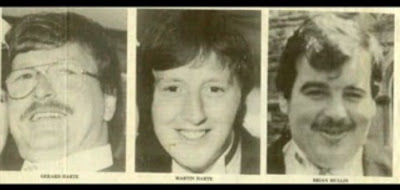
Gerard Harte,  (29)

Catholic
Status: Irish Republican Army (IRA),

Killed by: British Army (BA)
Shot by undercover British Army (BA) members, while approaching abandoned lorry, Drumnakilly, near Carrickmore, County Tyrone.

————————————————————–

30 August 1988


Martin Harte,   (21)

Catholic
Status: Irish Republican Army (IRA),

Killed by: British Army (BA)
Shot by undercover British Army (BA) members, while approaching abandoned lorry, Drumnakilly, near Carrickmore, County Tyrone.

————————————————————–

30 August 1988


Brain Mullin,   (26)

Catholic
Status: Irish Republican Army (IRA),

Killed by: British Army (BA)
Shot by undercover British Army (BA) members, while approaching abandoned lorry, Drumnakilly, near Carrickmore, County Tyrone.

————————————————————–

30 August 1993


Teresa Dowds De Mogollan,   (48)

Catholic
Status: Civilian (Civ),

Killed by: Ulster Freedom Fighters (UFF)
Shot at her home, Fortwilliam Park, Mount Vernon, Belfast.


Main source CAIN Web Service

See: SAS killed eight Irish terrorists

21st August – Deaths & Events in Northern Ireland Troubles


21st   August

Key Events & Deaths on this day in Northern Ireland Troubles

Friday 21 August 1970 SDLP Formed

The Social and Democratic Labour Party (SDLP) was established. The first leader of the party was Gerry Fitt and the deputy leader John Hume. Other prominent members included, Paddy Devlin, Austin Currie, Ivan Cooper, Paddy O’Hanlon and Paddy Wilson. [The party effectively took over from most of the various Nationalist and Labour party groupings and became the main political voice of Nationalists in Northern Ireland until Sinn Fein began to contest elections in the early 1980s.]

Saturday 21 August 1976

Approximately 20,000 people, mainly women from Protestant and Catholic areas of Belfast, attended a Peace People’s rally at Ormeau Park, Belfast.

Wednesday 21 August 1991

The Irish Republican Army (IRA) exploded a large bomb, estimated at 500 pounds, near an Royal Ulster Constabulary (RUC) station in Kilrea, County Derry. The explosion causes damage to nearby homes and churches.

Gerry Adams, then President of Sinn Féin (SF), wrote a letter, seeking ‘open-ended discussions’, to the British and Irish governments and to political and Church leaders in Northern Ireland.

Friday 21 August 1992

Hugh McKibben (21), then a member of the Irish People’s Liberation Organisation (IPLO), was shot dead at the Lámh Dhearg Gaelic Athletic Association (GAA) social club on the outskirts of Belfast. His was killed by the Belfast Brigade of the IPLO during an internal IPLO feud. Two other men were wounded in the attack.

Saturday 21 August 1999

The remains of Tom Williams were exhumed from Crumlin Road Prison and handed over to his surviving family members. Williams had been a member of the Irish Republican Army (IRA) and was hanged in 1942 for the killing of Patrick Murphy a Constable in the Royal Ulster Constabulary (RUC).

Monday 21 August 2000 Loyalist Paramilitary Feud

Two men, Jackie Coulter and Bobby Mahood, were killed as the Loyalist paramilitary feud erupted into further violence. Coulter, who had Ulster Defence Association (UDA) connections and was an associate of Johnny Adair, died immediately at the scene. Mahood, who had been seriously wounded, died later in hospital.

Flag_of_the_Ulster_Defence_Association_svg

Loyalist sources said that Mahood had Ulster Volunteer Force (UVF) connections but he opposed the Belfast Agreement and the policies of the Progressive Unionist Party (PUP). The killings were carried out by the UVF and were part of a feud between the UDA and the UVF.

U.V.F Logo
U.V.F Logo

In addition to the shootings there were also attacks on offices used by the two Loyalist parties closely associated with the UDA and the UVF. Troops were deployed on the streets of Belfast to try to control the situation.

[Seven people were killed during the feud which officially ended on 15 December 2000.]

Tuesday 21 August 2001

Two pipe-bombs were thrown at two separate houses at Inchcolme Avenue, Ballymena, County Antrim, at about 12.30am (0030BST). The front door of one house was damaged and a window broken in the other house. There were no injuries in the two attacks.

[The RUC have not established a motive for the attacks.]

The Ulster Unionist Party (UUP) announced that it required more time to respond to the ‘Patten Report – Updated Implementation Plan 2001’ (issued on 17 August 2001). James Cooper, then Chairman of the UUP, said that:

“While we are not opposed in principle to nominations to the police board, we still have a number of concerns.”

The Democratic Unionist Party (DUP) also missed the British government’s deadline of midday in which to respond to the policing proposals.

[The DUP were critical of the new implementation plan and were expected to make a detailed response at a later date.]

John Reid, then Secretary of State for Northern Ireland, said that he believed that the new Police Board would be operational at the end of September 2001. Nigel Baylor (Rev), then Church of Ireland rector, criticised as “insulting” the Ulster Defence Association (UDA) parade and ‘show of strength’ on the Shankill Road in Belfast on Saturday 19 August 2001.

Baylor had led the service at the funeral of Gavin Brett (18), who had been shot dead by Loyalist paramilitaries on 29 July 2001.

[Although the Red Hand Defenders (RHD) had claimed responsibility for the killing most people blamed the UDA.]

The Guardian (a British newspaper) carried a report  on the results of an opinion poll on the future of Northern Ireland carried out by ICM in Britain. Of those questioned, 41 per cent stated that they thought there should be a united Ireland. Only 26 per cent felt that Northern Ireland should remain part of the United Kingdom (UK). The report stated: “For unionists, many of whom consider themselves British and refer to Britain as ‘the mainland’, today’s findings amount to a cold shoulder from their fellow citizens. Only one in four wants the province to stay part of the country.”

[This survey maked a significant shift in public opinion in Britain from the 1980s and 1990s when there was a majority in favour of Northern Ireland remaining within the UK.]

William Esson, then a reserve judge with the Bloody Sunday Inquiry, announced that he was resigning from the inquiry for reasons of ill health.


Remembering all innocent victims of the Troubles

Today is the anniversary of the follow  people killed as a results of the conflict in Northern Ireland

To the innocent on the list – Your memory will live forever

– To  the Paramilitaries  –

“There are many things worth living for, a few things worth dying for, but nothing worth killing for.

6 people lost their lives on the 21st  August between 1975 – 2000

————————————————————–

21 August 1975


John Finlay,   (30)

Catholic
Status: Civilian (Civ),

Killed by: non-specific Loyalist group (LOY)
Shot while walking to work along Brougham Street, Belfast.

————————————————————–

21 August 1975
David Davidson,   (30)

Protestant
Status: Civilian (Civ),

Killed by: non-specific Republican group (REP)
Shot at his workplace, scrapyard / garage, Antrim Road, Ballyvessy, near Glengormley, County Antrim.

————————————————————–

21 August 1978


Patrick Fee,  (64)

Catholic
Status: Civilian (Civ),

Killed by: Irish Republican Army (IRA)
Shot by sniper while travelling to work in his firm’s van, Scribbagh, near Garrison, County Fermanagh. The van driver, an off duty Ulster Defence Regiment (UDR) member, the intended target.

————————————————————–

21 August 1992


Isobel Leyland,  (40)

Catholic
Status: Civilian (Civ),

Killed by: Irish Republican Army (IRA)
Shot during sniper attack on nearby Royal Ulster Constabulary (RUC) mobile patrol, while walking at the junction of Ardoyne Avenue and Flax Street, Ardoyne, Belfast

————————————————————–

21 August 2000


Jackie Coulter,   (46)

Protestant
Status: Ulster Defence Association (UDA),

Killed by: Ulster Volunteer Force (UVF)
Shot while sitting in stationary jeep, Crumlin Road, Belfast. Ulster Defence Association (UDA) / Ulster Volunteer Force (UVF) feud.

————————————————————–

21 August 2000


Bobby Mahood,  (48)

Protestant
Status: Ulster Volunteer Force (UVF),

Killed by: Ulster Volunteer Force (UVF)
Shot while sitting with UDA member Jackie Coulter, in stationary jeep, Crumlin Road, Belfast. Ulster Defence Association (UDA) / Ulster Volunteer Force (UVF) feud.

————————————————————–

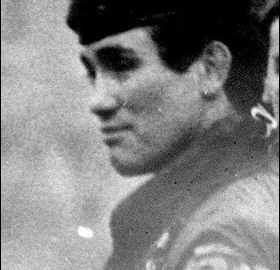
Robert Nairac – Undercover Soldier & Hero His Capture & Death


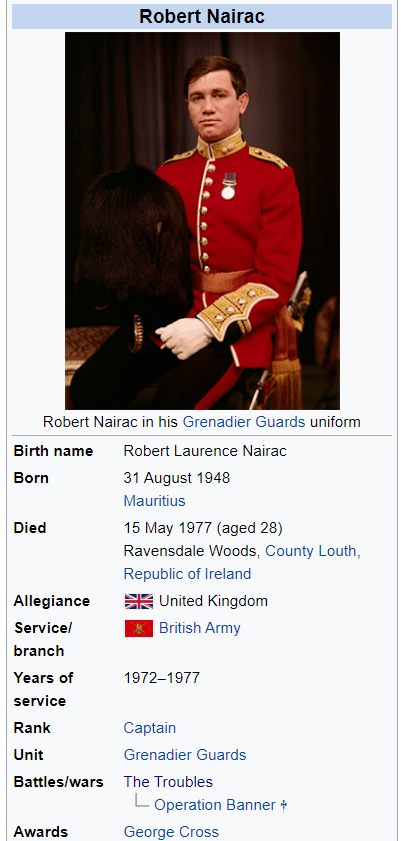
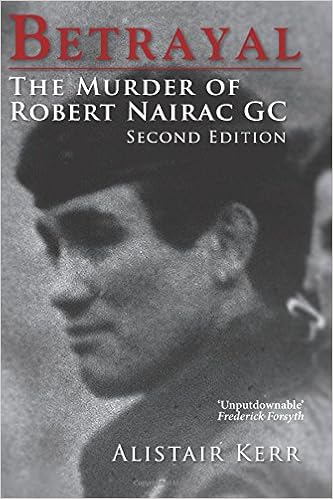
Captain Robert Laurence Nairac GC (31 August 1948 –15 May 1977) was a British Army officer who was abducted from a pub in Dromintee, south County Armagh, during an undercover operation and killed by the Provisional Irish Republican Army (IRA) on his fourth tour of duty in Northern Ireland as a Military Intelligence Liaison Officer. He was posthumously awarded the George Cross in 1979.

A number of claims have been made about both Nairac’s involvement in the killing of an IRA member and his collusion with loyalist paramilitaries, although he was never charged.

Whilst several men have been imprisoned for his death, the whereabouts of his body remains unknown.

– Disclaimer –

The views and opinions expressed in these blog post/documentary are solely intended to educate and provide background information to those interested in the Troubles of Northern Ireland. They in no way reflect my own opinions and I take no responsibility for any inaccuracies or factual errors

Background

Nairac was born in Mauritius to English parents. His family – long settled in Gloucestershire – had ancestors from the south of Ireland. His family name originates from the Gironde area of France. His father was an eye surgeon who worked first in the north of England and then in Gloucester. He was the youngest of four children, with two sisters and a brother.

Nairac, aged 10, attended prep school at Gilling Castle, a feeder school for the Roman Catholic public school Ampleforth College which he attended a year later. He gained nine O levels and three A levels, was head of his house and played rugby for the school. He became friends with the sons of Lord Killanin and went to stay with the family in Dublin and Spiddal in County Galway.

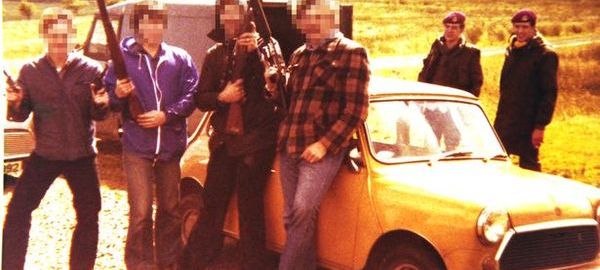
This iconic picture of Robert was published in Republican News & was used widely by the IRA in press reports of his “execution” . It was taken by a fellow soldier and was not intended for general release. How the IRA got a hold of a copy is still a mystery.

The guy with the long hair is John Todd , who went on to join and serve time as an IRA terrorist

He read medieval and military history at Lincoln College, Oxford, and excelled in sport; he played for the Oxford rugby 2nd XV and revived the Oxford boxing club where he won four blues in bouts with Cambridge. He was also a falconer, keeping a bird in his room which was used in the film Kes.

He left Oxford in 1971 to enter Royal Military Academy Sandhurst under the sponsorship of the Grenadier Guards and was commissioned with them upon graduation.After Sandhurst he undertook post-graduate studies at the University of Dublin, before joining his regiment.

In fact he did not attend University of Dublin according to Author Alistair Kerr

Nairac has been described by former army colleagues as “a committed Roman Catholic” and as having “a strong Catholic belief”.

Military career in Northern Ireland

Nairac’s first tour of duty in Northern Ireland was with No.1 Company, the Second Battalion of the Grenadier Guards. The Battalion was stationed in Belfast from 5 July 1973 to 31 October 1973. The Grenadiers were given responsibility first for the Protestant Shankill Road area and then the predominantly Catholic Ardoyne area. This was a time of high tension and regular contacts with paramilitaries. Ostensibly, the battalion’s two main objectives were to search for weapons and to find paramilitaries.

Nairac was frequently involved in such activity on the streets of Belfast. He was also a volunteer in community relations activities in the Ardoyne sports club. The battalion’s tour was adjudged a success with 58 weapons, 9,000 rounds of ammunition and 693 lbs of explosive taken and 104 men jailed.

The battalion took no casualties and had no occasion to shoot anyone. After his tour had ended he stayed on as liaison officer for the replacement battalion, the 1st Battalion of the Argyll and Sutherland Highlanders. The new battalion suffered a baptism of fire with Nairac narrowly avoiding death on their first patrol when a car bomb exploded on the Crumlin Road.

Rather than returning to his battalion, which was due for rotation to Hong Kong, Nairac volunteered for military intelligence duties in Northern Ireland. Following completion of several training courses, he returned to Northern Ireland in 1974 attached to 4 Field Survey Troop, Royal Engineers, one of the three sub-units of a Special Duties unit known as 14 Intelligence Company (14 Int).

See: Military Reaction Force

Posted to South County Armagh, 4 Field Survey Troop was given the task of performing surveillance duties. Nairac was the liaison officer among the unit, the local British Army brigade, and the Royal Ulster Constabulary.

He also took on duties which were outside his official jurisdiction as a liaison officer – working undercover, for example. He apparently claimed to have visited pubs in republican strongholds and sung Irish rebel songs and acquired the nickname “Danny Boy”. He was often driven to pubs by former Conservative MP Patrick Mercer, who was then an Army officer. Former SAS Warrant Officer Ken Connor, who was involved in the creation of 14 Int, wrote of him in his book, Ghost Force, p. 263:

Had he been an SAS member, he would not have been allowed to operate in the way he did. Before his death we had been very concerned at the lack of checks on his activities. No one seemed to know who his boss was, and he appeared to have been allowed to get out of control, deciding himself what tasks he would do.

Nairac finished his tour with 14th Int in mid-1975 and returned to his regiment in London. Nairac was promoted to captain on 4 September 1975. Following a rise in violence culminating in the Kingsmill massacre, British Army troop levels were increased and Nairac accepted a post again as a liaison officer back in Northern Ireland.

Nairac on his fourth tour was a liaison officer to the units based at Bessbrook Mill. It was during this time that he was abducted and killed.

BBC Panorama – Bandit Country, South Armagh

Shot by the Provisional IRA

On the evening of 14 May 1977, Nairac arrived at The Three Steps pub in Dromintee, South Armagh, by car, alone. He is said to have told regulars of the pub that his name was Danny McErlaine, a motor mechanic and member of the Official IRA from the republican Ardoyne area in north Belfast. The real McErlaine, on the run since 1974, was killed by the Provisional IRA in June 1978 after stealing arms from the organisation.

Witnesses say that Nairac got up and sang a republican folk songThe Broad Black Brimmer” with the band who were playing that night. At around 11.45 p.m., he was abducted following a struggle in the pub’s car park and taken across the border into the Republic of Ireland to a field in the Ravensdale Woods in County Louth. Following a violent interrogation during which Nairac was allegedly punched, kicked, pistol-whipped and hit with a wooden post, he was shot dead.

He did not admit to his true identity. Terry McCormick, one of Nairac’s abductors, posed as a priest in order to try to elicit information by way of Nairac’s confession. Nairac’s last words according to McCormick were: ‘Bless me Father, for I have sinned’

His disappearance sparked a huge search effort throughout Ireland. The hunt in Northern Ireland was led by Major H. Jones, who as a colonel in the Parachute Regiment was to be awarded a posthumous Victoria Cross in the Falklands War. Jones was Brigade Major at HQ 3rd Infantry Brigade. Nairac and Jones had become friends and would sometimes go to the Jones household for supper. After a four-day search, the Garda Síochána confirmed to the Royal Ulster Constabulary that they had reliable evidence of Nairac’s killing.

An edition of Spotlight broadcast on 19 June 2007, claimed that his body was not destroyed in a meat grinder, as alleged by an unnamed IRA source. McCormick, who has been on the run in the United States for thirty years because of his involvement in the killing (including being the first to attack Nairac in the car park), was told by a senior IRA commander that it was buried on farmland, unearthed by animals, and reburied elsewhere. The location of the body’s resting place remains a mystery.

Nairac is one of nine IRA victims, whose graves have never been revealed and who are collectively known as ‘The Disappeared’. The cases are under review by the Independent Commission for the Location of Victims’ Remains.

See: The Disappeared – N.I Secret Victims

In May 2000 allegations were made claiming that Nairac had married, and fathered a child with a woman named Nel Lister, also known as Oonagh Flynn or Oonagh Lister. In 2001, her son sought DNA testing himself and revealed the allegations to be a hoax.

Criminal prosecutions

In November 1977, Liam Townson, a 24-year-old IRA member from the village of Meigh outside Newry, was convicted of Nairac’s murder. Townson was the son of an Englishman who had married a County Meath woman. He confessed to killing Nairac and implicated other members of the unit involved. Townson made two admissible confessions to Garda officers. The first was made around the time of his arrest, it started with

“I shot the British captain. He never told us anything. He was a great soldier.”

The second statement was made at Dundalk police station after Townson had consulted a solicitor. He had become hysterical and distressed and screamed a confession to the officer in charge of the investigation.

Townson was convicted in Dublin’s Special Criminal Court of Nairac’s murder and sentenced to life imprisonment. He served 13 years in prison and was released in 1990. He was part of Conor Murphy‘s 1998 election campaign team and as of 2000 he was living in St. Moninna Park, in Meigh.

In 1978, the RUC arrested five men from the South Armagh area. Three of them – Gerard Fearon, 21, Thomas Morgan, 18, and Daniel O’Rourke, 33 -were charged with Nairac’s murder. Michael McCoy, 20, was charged with kidnapping, and Owen Rocks, 22, was accused of withholding information. Fearon and Morgan were convicted of Nairac’s murder. O’Rourke was acquitted but found guilty of manslaughter and jailed for ten years. McCoy was jailed for five years and Rocks for two. Morgan died in a road accident in 1987, a year after his release. O’Rourke became a prominent Sinn Féin member in Drumintee.

Two other men, Terry McCormick and Pat Maguire, wanted in connection with this incident remain on the run. Maguire has been reported as living in New Jersey in the US.

————————

Man charged with murder of undercover British Army officer in 1977

A man has been charged with the murder of Robert Nairac, an undercover British Army officer, in Northern Ireland more than 30 years ago

Kevin Crilly: Man charged with murder of undercover British Army officer in 1977
Crilly was interviewed by detectives in the weeks after the incident but left for the United States before officers could arrest him on suspicion of murder Photo: PA
 

Kevin Crilly, 59, from Lower Foughill Road, Jonesborough, Co Armagh, is already facing charges of kidnapping and falsely imprisoning the 29-year-old Grenadier Guardsman near the Irish border in 1977.

The captain, originally from Gloucestershire, was interrogated, tortured and then shot dead by the IRA after being snatched from a pub car park near Jonesborough and driven to a field at Ravensdale, Co Louth. His body has never been found.

Prosecutors laid the murder charge before Crilly as he appeared at Newry Magistrates’ Court for a routine bail hearing on the two lesser counts, with which he was charged last year.

District Judge Austin Kennedy granted Crilly bail; however, he ordered him to remain in custody after Crown lawyers indicated that they may seek to appeal against the decision in the High Court in Belfast.

In the years after Capt Nairac’s disappearance, three men were convicted of his murder, but police have always said they were looking for more suspects.

Crilly was interviewed by detectives in the weeks after the incident but left for the United States before officers could arrest him on suspicion of murder.

Judge Kennedy was told today that the suspect had remained in the US for almost 30 years.

Investigating officer Detective Sergeant Barry Graham said that, when he returned, he took another name, explaining that Crilly was adopted as a child and had assumed his birth name of Declan Parr.

“The only reason he returned to Northern Ireland was because he was in a long-term relationship in America and that relationship had broken down,” he said.

The officer told the judge that he could connect Crilly with the murder charge and the two other counts of kidnapping and false imprisonment.

Crilly, dressed in a black leather jacket, white check shirt and blue jeans, spoke only to acknowledge that he understood the charges that he was facing.

His defence team objected that the prosecution had given them no prior warning that the murder charge would be put to their client or that they would be objecting to his bail.

Noting that Crilly had complied with all bail requirements since his original arrest 18 months ago and pointing out that, at that point, the defendant was aware that the Public Prosecution Service was examining whether there were grounds for charging him with murder, Judge Kennedy rejected the prosecution objection to bail.

The magistrate said any appeal against his decision would have to be lodged within two hours. He ordered that Crilly was held in the cells until the PPS signalled its intentions.

————————

On 20 May 2008, 57-year-old IRA veteran Kevin Crilly of Jonesborough, County Armagh, was arrested at his home by officers of the Police Service of Northern Ireland (PSNI). He had been on the run in the United States but had returned to Northern Ireland under an alias after the 1998 Belfast Agreement. He was charged the following day with the kidnapping and false imprisonment of Nairac.

In November 2009, Crilly was also charged with the murder of Robert Nairac at Newry magistrates’ court during a bail hearing on the two counts on which he had been charged in 2008. Crilly was cleared on all counts in April 2011 as the Judge considered that the prosecution failed to prove intention or prior knowledge on the part of Crilly.

Nairac’s killing is one of those under investigation by the PSNI’s Historical Enquiries Team (HET).

George Cross award

On 13 February 1979 Nairac was posthumously awarded the George Cross.

Captain Nairac’s posthumous George Cross citation reads, in part:

[…]On his fourth tour Captain Nairac was a Liaison Officer at Headquarters 3 Infantry Brigade. His task was connected with surveillance operations.


On the night of 14/15 May 1977 Captain Nairac was abducted from a village in South Armagh by at least seven men. Despite his fierce resistance he was overpowered and taken across the border into the nearby Republic of Ireland where he was subjected to a succession of exceptionally savage assaults in an attempt to extract information which would have put other lives and future operations at serious risk. These efforts to break Captain Nairac’s will failed entirely. Weakened as he was in strength – though not in spirit – by the brutality, he yet made repeated and spirited attempts to escape, but on each occasion was eventually overpowered by the weight of the numbers against him. After several hours in the hands of his captors Captain Nairac was callously murdered by a gunman of the Provisional Irish Republican Army who had been summoned to the scene. His assassin subsequently said ‘He never told us anything’.

Captain Nairac’s exceptional courage and acts of the greatest heroism in circumstances of extreme peril showed devotion to duty and personal courage second to none.

Collusion allegations

Claims have been made abouts Nairac’s involvement in the killing of an IRA member in the Republic of Ireland and his relationship with Ulster loyalist paramilitaries.

Hidden Hand documentary

Dublin Monaghan Bombings 1974 – First Tuesday -1993

See : Dublin Monaghan Bombings

Allegations were made concerning Nairac in a 1993 Yorkshire Television documentary about the Dublin and Monaghan Bombings of 1974 entitled Hidden Hand. The narrator of Hidden Hand states:

We have evidence from police, military and loyalist sources which confirms the links between Nairac and the Portadown loyalist paramilitaries. And also that in May 1974, he was meeting with these paramilitaries, supplying them with arms and helping them plan acts of terrorism against republican targets. In particular, the three prime Dublin suspects, Robert McConnell, Harris Boyle and the man called ‘The Jackal’ (Robin Jackson, Ulster Volunteer Force [UVF] member from Lurgan), were run before and after the Dublin bombings by Captain Nairac.

According to the documentary, support for this allegation was said to have come from various sources:

They include officers from RUC Special Branch, CID and Special Patrol Group; officers from the Gardaí Special Branch; and key senior loyalists who were in charge of the County Armagh paramilitaries of the day….

Holroyd

It was alleged by a former Secret Intelligence Service operative, Captain Fred Holroyd, that Nairac admitted involvement in the assassination of IRA member John Francis Green on 10 January 1975 to him. Holroyd claimed in a New Statesman article written by Duncan Campbell that Nairac had boasted about Green’s death and showed him a colour Polaroid photograph of Green’s corpse taken directly after his assassination.

These claims were given prominence when, in 1987, Ken Livingstone MP told the House of Commons that Nairac was quite likely to have been the person who organised the killing of three Miami Showband musicians.

The Barron Report stated that:

The evidence before the Inquiry that the polaroid photograph allegedly taken by the killers after the murder was actually taken by a Garda officer on the following morning seriously undermines the evidence that Nairac himself had been involved in the shooting.

Holroyd’s evidence was also questioned by Barron in the following terms:

The picture derived from this is of a man increasingly frustrated with the failure of the British Authorities to take his claims seriously; who saw the threat to reveal a crossborder SAS assassination as perhaps his only remaining weapon in the fight to secure a proper review of his own case. His allegations concerning Nairac must be read with that in mind.[36]

Barron report

Nairac was mentioned in Justice Henry’ Barron’s inquiry into the Dublin and Monaghan bombings when it examined the claims made by the Hidden Hand documentary, Holroyd and Colin Wallace

Former RUC Special Patrol Group member John Weir, who was also a UVF member, claimed he had received information from an informant that Nairac was involved in the killing of Green:

The men who did that shooting were Robert McConnell, Robin Jackson and I would be almost certain, Harris Boyle who was killed in the Miami attack. What I am absolutely certain of is that Robert McConnell, Robert McConnell knew that area really, really well. Robin Jackson was with him. I was later told that Nairac was with them. I was told by… a UVF man, he was very close to Jackson and operated with him. Jackson told [him] that Nairac was with them.

In addition, “Surviving Miami Showband members Steve Travers and Des McAlee testified in court that an Army officer with a crisp English accent oversaw the Miami attack” (see Miami Showband killings), the implication being that this was Nairac.[38] Fred Holroyd and John Weir also linked Nairac to the Green and Miami Showband killings. Martin Dillon, however, in his book The Dirty War maintained that Nairac was not involved in either attack.

Colin Wallace, in describing Nairac as a Military Intelligence Liaison Officer (MILO) said “his duties did not involve agent handling”. Nevertheless, Nairac “seems to have had close links with the Mid-Ulster UVF, including Robin Jackson and Harris Boyle”. According to Wallace, “he could not have carried out this open association without official approval, because otherwise he would have been transferred immediately from Northern Ireland”

Wallace wrote in 1975; Nairac was on his fourth tour of duty in 1977.

Robin Jackson was implicated in the Dublin and Monaghan bombings of May 1974, and Harris Boyle was blown up by his own bomb during the Miami Showband massacre.

The Barron Inquiry found a chain of ballistic history linking weapons and killings under the control of a group of UVF and security force members, including RUC Special Patrol Group members John Weir and Billy McCaughey, that is connected to those alleged to have carried out the bombings. This group was known as the “Glenanne gang“. Incidents they were responsible for “included, in 1975, three murders at Donnelly’s bar in Silverbridge, the murders of two men at a fake Ulster Defence Regiment checkpoint, the murder of IRA man John Francis Green in the Republic, the murders of members of the Miami showband and the murder of Dorothy Trainor in Portadown in 1976, they included the murders of three members of the Reavey family, and the attack on the Rock Bar in Tassagh.”

According to Weir, members of the gang began to suspect that Nairac was playing republican and loyalist paramilitaries off against each other, by feeding them information about murders carried out by the “other side” with the intention of “provoking revenge attacks”.

The Pat Finucane Centre stated when investigating allegations of collusion between the security forces and loyalist paramilitaries, that although Nairac has been linked to many attacks, “caution has to be taken when dealing with Nairac as attacks are sometimes attributed to him purely because of his reputation”.

Im reading a great book about Robert Nairac at the moment . I’ll do a review when I’ve completed it. See below:

Click to buy

See Forkhil – Bandit Country

See The Disappeared