ISIS Execute Eight Dutch militants

ISIS executed eight of their Dutch members in east of Raqqa

ISIS has executed eight Dutch members of its own jihadist fighting force in in Maadan, Raqqa province, in Syria, after accusing them of desertion and mutiny (stock image)

The so-called Islamic State has killed eight Dutch members whom it accused of trying to desert, activists have said.

As cracks start to show and more and more foreign fighters become disillusioned  ISIS has executed 424 of its own fighters in its 20 month reign in Syria

“Daesh [Isis] executed eight Dutch fighters on Friday in Maadan, Raqqa province, after accusing them of attempting desertion and mutiny,” said Abu Mohammad, a member of the citizen journalist group Raqqa is Being Slaughtered Silently (RBSS), via Twitter on Monday.

RBSS has been documenting the group’s abuses in its de facto capital in northern Syria since April 2014. The Twitter group said tension between 75 Dutch militants – some of them of Moroccan origin – and Isis intelligence operatives from Iraq hadreached a new height over the past month.

Three other Dutch militants were arrested by Iraqi Isis members who accused them of wanting to flee, and one of the detainees was beaten to death during the interrogation, according to RBSS.

Isis leaders in Raqqa sent a delegate to solve the dispute with the Dutch cell’s enraged members, but they murdered the intermediary in vengeance, the citizen journalist group added.

The Isis leadership in Iraq then ordered the arrest of all the members of the Dutch group and imprisoned them in Tabaqa and Maadan in Syria before killing eight of them, RBSS said.

The so-called Syrian Observatory for Human Rights, which monitors the conflict, could not confirm the report. However it said three European militants of North African origin were killed in what Isis calls the Wilayet al-Furat – an area stretching across the Syrian-Iraqi frontier.

According to the Dutch secret services, 200 people from the Netherlands including 50 women have joined Isis in Syria and Iraq.

Omagh Bombing – The IRA’s Deadliest Massacre of Civilians

belfastchildis's avatar

Omagh Bombing – The IRA’s Deadliest Massacre of Civilians

See real IRA page

See 29 people Slaughtered by the Real IRA

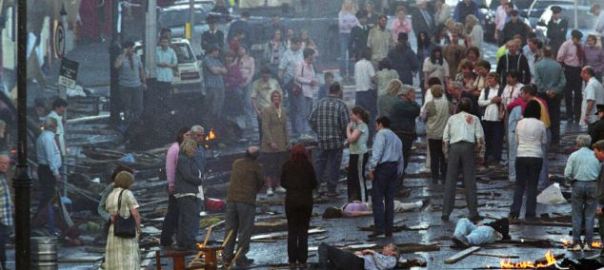
The Omagh bombing was a deliberate massacre of civilians carried out by the Irish Republican Army on Saturday 15 August 1998, in Omagh, County Tyrone, Northern Ireland. Twenty-nine people were murdered in the attack and approximately 220 people were injured. The attack was described by the BBC as “Northern Ireland’s worst single terrorist atrocity” and by the British Prime Minister, Tony Blair, as an “appalling act of savagery and evil”.

The victims included people from many different backgrounds: Protestants, Catholics, a Mormon teenager, five other teenagers, six children, a woman pregnant with twins, two Spanish tourists, and other tourists on a day trip from the Republic of Ireland. The nature of the bombing created a strong international and local outcry against the IRA, and spurred on the Northern Ireland…

View original post 177 more words

EUROMILLIONS Syndicate

EUROMILLIONS LOTTERY

My father – in – law recently won almost  £100,000 in a Euro  Millions syndicate ( I’m still waiting on him sharing some of it with me )  and this has got me thinking that I should set up my own syndicate and here it is.


Euromillions is the biggest lottery in Europe with a weekly Jackpot which can reach 190 million euros.

The draw is held in twice per week – every Tuesday and Friday.

To play you select s five main numbers between 1-50 and two lucky star numbers between 1-11. To win the Jackpot all seven numbers must be matched.

However there are 13 levels of prizes and you need to find only two main numbers to win a prize.

EUROMILLIONS SYNDICATE

If you play Euromillions as an individual the odds against a single ticket winning the jackpot are astronomical , but did you know that 1 in 3 of the BIG Jackpots wins are won by syndicates.

If you would like to join my syndicate please fill in the form below and when it has been processed I will send you confirmation by email and an online invoice. I will post the current tickets on this page and you can check the numbers as they are drawn live on the show.

Sample Tickets

I will also send you a syndicate contract  and welcome pack and list all current syndicate members for relevant draws.

You have to be in it to win it!


← Back

Thank you for your response. ✨

Euro Millions(required)
Weekly or Monthly Play

1st March – Deaths & Events in Northern Ireland Troubles

Key Events & Deaths on this day in Northern Ireland Troubles

1st March

—————————————-

Wednesday 1 March 1972

Two Catholic teenagers were shot dead by the Royal Ulster Constabulary (RUC) while ‘joy riding’ in a stolen car in Belfast.

Thursday 1 March 1973

There was a general election in the Republic of Ireland. As a result of the election there was a change of government. Fine Gael / Labour coalition government took over from Fianna Fáil which had been in power for 16 years.

Liam Cosgrave succeeded Jack Lynch as Taoiseach (Irish Prime Minister).

Monday 1 March 1976

End of Special Category Status Prisoners

Merlyn Rees, then Secretary of Sate for Northern Ireland, announced that those people convicted of causing terrorist offences would no longer be entitled to special category status. In other words they were to be treated as ordinary criminals.

[This was part of a process, which some commentators called ‘criminalisation’, which saw the British government move from trying to reach a settlement with the Irish Republican Army (IRA) to treating the conflict. On 14 September 1976 Kieran Nugent was the first prisoner to be sentenced under the new regime and he refused to wear prison clothes choosing instead to wrap a blanket around himself. So started the ‘Blanket Protest’.]

Sunday 1 March 1981 1981

Hunger Strike Began

hungry strikes

Bobby Sands, then leader of the Irish Republican Army (IRA) in the Maze Prison, refused food and so began a new hunger strike . The choice of the start date was significant because it marked the fifth anniversary of the ending of special category status (1 March 1976). The main aim of the new strike was to achieve the reintroduction of political status for Republican prisoners. Edward Daly, then Catholic Bishop of Derry, criticised the decision to begin another hunger strike.

[Sands was to lead the hunger strike but it was decided that Brendan McFarlane would take over Sands’ role as leader of the Irish Republican Army (IRA) in the Maze Prison. It later became clear that the IRA leadership outside the prison was not in favour of a new hunger strike following the outcome of the 1980 strike. The main impetus came from the prisoners themselves. The strike was to last until 3 October 1981 and was to see 10 Republican prisoners starve themselves to death in support of their protest. The strike led to a heightening of political tensions in the region. It was also to pave the way for the emergence of Sinn Féin (SF) as a major political force in Northern Ireland.]

See Hungry Strike

Monday 1 March 1982

The British Enkalon company announced that it would close its factory in Antrim with the loss of 850 jobs.

Tuesday 2 March 1982

Lord Lowry, then Northern Ireland Lord Chief Justice, was attacked by the Irish Republican Army (IRA) as he paid a visit to the Queen’s University of Belfast. The IRA fired several shots at Lowry who was not injured but a lecturer at the university was wounded by the gunfire.

Thursday 1 March 1984

Frank Millar, Ulster Unionist Party, won a Northern Ireland Assembly by-election. He was returned unopposed.


Thursday 1 March 1990

McGimpsey Appeal on Irish Constitution

An appeal to the Irish Supreme Court by Chris McGimpsey and Michael McGimpsey on the issue of Articles 2 and 3 of the Irish Constitution was rejected. The Court ruled that Articles 2 and 3 are a ‘claim of legal right’ over the ‘national territory’. The Court stated that the articles represented a ‘constitutional imperative’ rather than merely an aspiration.

Friday 1 March 1991

The Irish Republican Army (IRA) carried out a (horizontal) mortar attack on a Ulster Defence Regiment (UDR) mobile patrol on the Killylea Road, Armagh. One UDR soldier was killed and another, who was mortally wounded, died on 4 March 1991.

The European Court of Human Rights agreed to hear another complaint against the British government. The case involved the United Kingdom’s (UK) derogation from the European Convention of Human Rights on the matter of the seven-day detention of suspects under the Prevention of Terrorism Act.

Tuesday 1 March 1994

John Major, then British Prime Minister, completed a two-day visit to Washington, USA. [The visit was reported as an attempt to repair damage to Anglo-American relations following the decision to grant a visa to Gerry Adams, then President of Sinn Féin (SF).

Wednesday 1 March 1995

The British Army (BA) ended patrols in east Belfast and Belfast city centre.

Monday 1 March 1999

A chocolate box containing a bomb was left on the windowsill of a Catholic house in Coalisland, County Tyrone. The owner of the house said the bomb was in a large Roses tin and was first spotted as she returned home by taxi after 10.00pm. The attack was carried out by Loyalist paramilitaries.

A pipe-bomb was found in Derriaghy, south of Belfast.

The new Northern Ireland Human Rights Commission (NIHRC) was established and replaced the Standing Advisory Commission on Human Rights (SACHR). The first Chief Commissioner of the NIHRC was Professor Brice Dickson of the University of Ulster. Unionists criticised the balance of the new Commission.

Friday 1 March 2002

It was reported that almost 2,000 Catholics had applied to join the Police Service of Northern Ireland (PSNI) as part of the latest recruitment drive.

Advertisements were placed in a range of outlets during October 2001 as part of the second phase of recruitment to the police service.

[Almost 5,000 people applied, of whom 38 per cent were Catholic. Those who meet the basic requirements are then selected under the 50-50 Catholic-Protestant recruitment arrangements. The first pool of recruits who joined in 2001 complete their training on 5 April 2002. The new police badge and uniform will be introduced on the same date.]

The section of the Police (NI) Act 2000 which guarantees Catholics 50 per cent of new recruit places for the PSNI was challenged in the High Court in Belfast by a Protestant man (18) whose application was rejected. The section of legislation states: “In making appointments the Chief Constable shall appoint from a pool of qualified applicants an even number of whom one half shall be persons who are treated as Roman Catholic and one half shall be persons who are not so treated.”

Lawyers will argue that this section is incompatible with Article 9 of the European Convention of Human Rights and Article 14. Martin McGuinness (SF), then Education Minister, asked Unionist politicians to reconsider their views on academic selection at aged 11 years (the ’11-plus’ exam). McGuinness was addressing the northern conference of the Irish National Teachers’ Organisation (INTO) in Newcastle, County Down.

[Most Unionist politicians had expressed opposition to any changes to the current system of selection.]

James Sheehan, then Sinn Féin (SF) director of elections in Kerry North, was released without charge by Garda Síochána (the Irish police) in Killarney. He had been questioned as part of an investigation into an alleged vigilante-style abduction in the area that had taken place before Christmas.

  —————————————————————

Remembering all innocent victims of the Troubles

Today is the anniversary of the death of the following people killed as a results of the conflict in Northern Ireland

“To live in hearts we leave behind is not to die

– Thomas Campbell

To the innocent on the list – Your memory will live  forever

– To  the Paramilitaries  –

There are many things worth living for, a few things worth dying for, but nothing worth killing for.

8 People   lost their lives on the 1st March between 1972– 1991


  —————————————————————————

01 March 1972
John Fletcher,   (43)

Protestant
Status: Ulster Defence Regiment (UDR),

Killed by: Irish Republican Army (IRA)
Off duty. Shot outside his home, Frevagh, near Garrison, County Fermanagh.

  —————————————————————————

01 March 1972
John Mahon,   (16)

Catholic
Status: Civilian (Civ),

Killed by: Royal Ulster Constabulary (RUC)
Shot while travelling in stolen car in Belfast city centre. Car abandoned outside Royal Victoria Hospital, Falls Road, Belfast.

  —————————————————————————

01 March 1972
Michael Connors,   (14)

Catholic
Status: Civilian (Civ),

Killed by: Royal Ulster Constabulary (RUC)
Shot while travelling in stolen car in Belfast city centre. Car abandoned outside Royal Victoria Hospital, Falls Road, Belfast.

  —————————————————————————

01 March 1973
Stephen Kernan,   (54)

Catholic
Status: Civilian (Civ),

Killed by: Ulster Volunteer Force (UVF)
Taxi driver. Found shot in his car, Mansfield Street, Shankill, Belfast.

  —————————————————————————

01 March 1973
Daniel Bowen,  (38)

Catholic
Status: Civilian (Civ),

Killed by: not known (nk)
Shot while walking along Linenhall Street West, Belfast

  —————————————————————————

01 March 1978
Paul Sheppard,   (20)

nfNI
Status: British Army (BA),

Killed by: Irish Republican Army (IRA)
Killed in machine gun attack on British Army (BA) mobile patrol, Cliftonpark Avenue, Belfast

  —————————————————————————

01 March 1991


Paul Sutcliffe,  (32)

nfNI
Status: Ulster Defence Regiment (UDR),

Killed by: Irish Republican Army (IRA)
Originally from England. Killed in horizontal mortar attack on Ulster Defence Regiment (UDR) mobile patrol, Killylea Road, Armagh.

  —————————————————————————

01 March 1991


Roger Love,   (20)

Protestant
Status: Ulster Defence Regiment (UDR),

Killed by: Irish Republican Army (IRA)
Injured in horizontal mortar attack on Ulster Defence Regiment (UDR) mobile patrol, Killylea Road, Armagh. He died 4 March 1991.

  —————————————————————————

Republican Hunger Strike 1981

Sunday 1 March 1981 1981

Hunger Strike Began

Bobby Sands, then leader of the Irish Republican Army (IRA) in the Maze Prison, refused food and so began a new hungry strike . The choice of the start date was significant because it marked the fifth anniversary of the ending of special category status (1 March 1976).

—————————

Bobby Sands and the 1981 Hunger Strike Documentary

—————————

The main aim of the new strike was to achieve the reintroduction of political status for Republican prisoners. Edward Daly, then Catholic Bishop of Derry, criticised the decision to begin another hunger strike.

Brendan McFarlane


Sands was to lead the hunger strike but it was decided that Brendan McFarlane would take over Sands’ role as leader of the Irish Republican Army (IRA) in the Maze Prison. It later became clear that the IRA leadership outside the prison was not in favour of a new hunger strike following the outcome of the 1980 strike. The main impetus came from the prisoners themselves.

The strike was to last until 3 October 1981 and was to see 10 Republican prisoners starve themselves to death in support of their protest. The strike led to a heightening of political tensions in the region. It was also to pave the way for the emergence of Sinn Féin (SF) as a major political force in Northern Ireland.

————————————————————–

Margaret Thatcher’s letters to families of hunger strikers released

Margaret Thatcher

Margaret Thatcher, later Baroness Thatcher, was implacably opposed to the hunger strikers

Secret Government documents also reveal Thatcher’s fears after 1984 Brighton bombing

Margaret Thatcher privately expressed regret over the 1981 Irish hunger strike, newly released letters to the families of prisoners show.

In the notes the prime minister said she cared “deeply” about those affected by the protest. But she turned down a request for a meeting from two mothers, stating: “I really do not see how such a meeting could help”.

The letters are contained within files released today by the National Archives in Kew, south-west London.

The files also reveal Thatcher’s fear that she would be targeted again by the IRA after narrowly avoiding assassination in the Brighton bombing of October 12, 1984, and how the attack nearly derailed secret Northern Ireland peace negotiations.


Mrs Thatcher and her cabinet were staying at the Grand Hotel in the city for the Conservative Party conference when they were targeted. The long-delay time bomb, which had been planted four weeks earlier, killed five and injured 31.

Afterwards, in a handwritten note to Charles Powell, one of her closest advisors, Mrs Thatcher said: “The bomb has slowed things down and may in the end kill any new initiative because I suspect it will be the first in a series”.

Four months earlier, Mrs Thatcher had sought Cabinet approval for a series of secret liaisons with the Republic of Ireland.

The negotiations helped lay the ground for the subsequent 1985 Anglo-Irish Agreement but the documents show Mrs Thatcher was reluctant to allow them to continue after the bomb, commenting that she was “very pessimistic” about their outcome in November 1984.

She added Britain must avoid the impression of “being bombed into making concession to the Republic”.

On the hunger strikes, the files show that Mrs Thatcher urged the sister of one of the prisoners to convince her brother his protest was pointless.

Outwardly, Mrs Thatcher was typically unyielding during the crisis, stating there would be no concessions or reform of the prison system until the hunger strike had ended.

But in the letter to Sharon McCloskey, Mrs Thatcher said: “I want you to know that despite what is said and written by some people about my attitude to the hunger strike, I very much regret that young men have been prepared to throw away their lives for an objective which – as I have said on many occasions – no responsible Government anywhere could grant, since it could only aid and abet those who advocate and use violence to political ends.”

She added: “I can only urge you all to impress on him that the five demands of the prisoners amount to a prison regime which no Government could concede, for the reason I have given. It may be that if this is put to him by people he knows and trusts, he will decide to stop his fast and so save his life.”

Liam McCloskey’s mother Philomena also wrote to the prime minister requesting a meeting.

“I hope that you will receive this letter personally as I want you to know of my despair and desperation,” she wrote to Thatcher.

“I am the widowed mother of Liam McCloskey who, today completes thirty days on hunger strike in the prison hospital of Long Kesh [later known as HMP Maze]. I would like to meet you and believe that such a meeting would perhaps give you a better understanding of my position.”

In her response, Mrs Thatcher said: “I do care very deeply about those to whom the hunger strike has brought pain and bereavement, as I do for all those in Northern Ireland who have suffered from violence in whatever form that has taken.

“I hope you will understand that I really do not see how such a meeting could help. I believe myself that the Government’s position has already been set out very clearly.”

Liam McCloskey ended his strike after 55 days when his family intervened.

He was one of a number of republican prisoners at HMP Maze in Belfast who stopped eating in protest at the removal of so-called “special category status” for inmates who considered themselves political prisoners.

They were demanding that members of paramilitary groups should be treated differently from other prisoners including the right wear civilian clothes and to refrain from prison work.

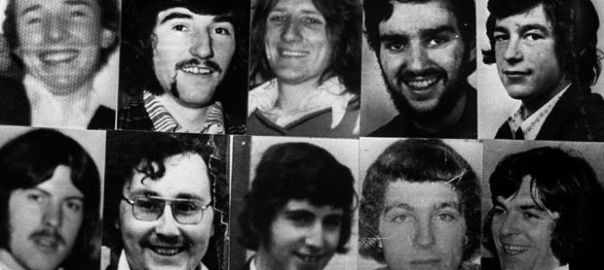
In total 10 men died, including Bobby Sands, who became the best known of the protestors after he was elected as an MP during his time on strike. He died after 66 days.

The hunger strike ended on October 3, 1981, when James Prior, the Northern Ireland secretary, announced prisoners could wear their own clothes and remission lost would be restored.


—————————————————-

Background & History

of

1981 Hungry Strike

The 1981 Irish hunger strike was the culmination of a five-year protest during “the Troubles” by Irish republican prisoners in Northern Ireland. The protest began as the blanket protest in 1976, when the British government withdrew Special Category Status for convicted paramilitary prisoners. In 1978, after a number of attacks on prisoners leaving their cells to “slop out“, the dispute escalated into the dirty protest, where prisoners refused to leave their cells to wash and covered the walls of their cells with excrement. In 1980, seven prisoners participated in the first hunger strike, which ended after 53 days.[1]

The second hunger strike took place in 1981 and was a showdown between the prisoners and the Prime Minister, Margaret Thatcher. One hunger striker, Bobby Sands, was elected as a Member of Parliament during the strike, prompting media interest from around the world.[2] The strike was called off after ten prisoners had starved themselves to death—including Sands, whose funeral was attended by 100,000 people.[1] The strike radicalised Irish nationalist politics, and was the driving force that enabled Sinn Féin to become a mainstream political party.

Background

There had been hunger strikes by Irish republican prisoners since 1917, and twelve had previously died on hunger strike, including Thomas Ashe, Terence MacSwiney, Seán McCaughey, Michael Gaughan and Frank Stagg.[4] After the introduction of internment in 1971, Long Kesh—later known as HM Prison Maze—was run like a prisoner of war camp. Internees lived in dormitories and disciplined themselves with military-style command structures, drilled with dummy guns made from wood, and held lectures on guerrilla warfare and politics.[5] Convicted prisoners were refused the same rights as internees until July 1972, when Special Category Status was introduced following a hunger strike by 40 Provisional Irish Republican Army (IRA) prisoners led by the veteran republican Billy McKee. Special Category, or political, status meant prisoners were treated similarly to prisoners of war; for example, not having to wear prison uniforms or do prison work.[5] In 1976, as part of its policy of “criminalisation”, the British government brought an end to Special Category Status for newly convicted paramilitary prisoners in Northern Ireland. The policy was not introduced for existing prisoners, but for those convicted of offences after 1 March 1976.[6] The end to Special Category Status was a serious threat to the authority which the paramilitary leaderships inside prison had been able to exercise over their own men, as well as being a propaganda blow.[5]

Blanket and dirty protests

Main articles: Blanket protest and dirty protest

On 14 September 1976, newly convicted prisoner Kieran Nugent began the blanket protest, in which IRA and Irish National Liberation Army (INLA) prisoners refused to wear prison uniform and either went naked or fashioned garments from prison blankets.[6] In 1978, after a number of attacks on prisoners leaving their cells to “slop out” (i.e., empty their chamber pots), this escalated into the dirty protest, where prisoners refused to leave their cells to wash or slop out. To mitigate the build-up of flies, they smeared their excrement on the walls of their cells.[7] These protests aimed to re-establish their political status by securing what were known as the “Five Demands”:

  1. the right not to wear a prison uniform;
  2. the right not to do prison work;
  3. the right of free association with other prisoners, and to organise educational and recreational pursuits;
  4. the right to one visit, one letter and one parcel per week;
  5. full restoration of remission lost through the protest.[8]

Initially, this protest did not attract a great deal of attention, and even the IRA regarded it as a side-issue compared to their armed campaign.[9][10] It began to attract attention when Tomás Ó Fiaich, the Roman Catholic Archbishop of Armagh, visited the prison and condemned the conditions there.[11] In 1979, former MP Bernadette McAliskey stood in the election for the European Parliament on a platform of support for the protesting prisoners, and won 5.9% of the vote across Northern Ireland, even though Sinn Féin had called for a boycott of the election.[12][13] Shortly after this, the broad-based National H-Block/Armagh Committee was formed, on a platform of support for the “Five Demands”, with McAliskey as its main spokesperson.[14][15] The period leading up to the hunger strike saw assassinations by both republicans and loyalists. The IRA shot and killed a number of prison officers;[9][16] while loyalist paramilitaries shot and killed a number of activists in the National H-Block/Armagh Committee and badly injured McAliskey and her husband in an attempt on their lives.[17][18]

First hunger strike

On 27 October 1980, republican prisoners in HM Prison Maze began a hunger strike. Many prisoners volunteered to be part of the strike, but a total of seven were selected to match the number of men who signed the Easter 1916 Proclamation of the Republic. The group consisted of IRA members Brendan Hughes, Tommy McKearney, Raymond McCartney, Tom McFeeley, Sean McKenna, Leo Green, and Irish National Liberation Army (INLA) member John Nixon.[19] On 1 December three prisoners in Armagh Women’s Prison joined the strike, including Mairéad Farrell, followed by a short-lived hunger strike by several dozen more prisoners in HM Prison Maze. In a war of nerves between the IRA leadership and the British government, with McKenna lapsing in and out of a coma and on the brink of death, the government appeared to concede the essence of the prisoners’ five demands with a thirty-page document detailing a proposed settlement. With the document in transit to Belfast, Hughes took the decision to save McKenna’s life and end the strike after 53 days on 18 December.[8]

Second hunger strike

A hunger strike memorial in Milltown Cemetery, Belfast

In January 1981 it became clear that the prisoners’ demands had not been conceded. Prison authorities began to supply the prisoners with officially issued civilian clothing, whereas the prisoners demanded the right to wear their own clothing. On 4 February the prisoners issued a statement saying that the British government had failed to resolve the crisis and declared their intention of “hunger striking once more”.[20] The second hunger strike began on 1 March, when Bobby Sands, the IRA’s former commanding officer (CO) in the prison, refused food. Unlike the first strike, the prisoners joined one at a time and at staggered intervals, which they believed would arouse maximum public support and exert maximum pressure on Prime Minister Margaret Thatcher.[21]

The republican movement initially struggled to generate public support for the second hunger strike. The Sunday before Sands began his strike, 3,500 people marched through west Belfast; during the first hunger strike four months earlier the marchers had numbered 10,000.[22] Five days into the strike, however, Independent Republican MP for Fermanagh and South Tyrone Frank Maguire died, resulting in a by-election. There was debate among nationalists and republicans regarding who should contest the election: Austin Currie of the Social Democratic and Labour Party expressed an interest, as did Bernadette McAliskey and Maguire’s brother Noel.[1] After negotiations, and implied threats to Noel Maguire, they agreed not to split the nationalist vote by contesting the election and Sands stood as an Anti H-Block candidate against Ulster Unionist Party candidate Harry West.[22][23] Following a high-profile campaign the election took place on 9 April, and Sands was elected to the British House of Commons with 30,492 votes to West’s 29,046.[24]

Sands’ election victory raised hopes that a settlement could be negotiated, but Thatcher stood firm in refusing to give concessions to the hunger strikers. She stated “We are not prepared to consider special category status for certain groups of people serving sentences for crime. Crime is crime is crime, it is not political”.[25] The world’s media descended on Belfast, and several intermediaries visited Sands in an attempt to negotiate an end to the hunger strike, including Síle de Valera, granddaughter of Éamon de Valera, Pope John Paul II‘s personal envoy John Magee, and European Commission of Human Rights officials.[2][26] With Sands close to death, the government’s position remained unchanged, with Secretary of State for Northern Ireland Humphrey Atkins stating “If Mr. Sands persisted in his wish to commit suicide, that was his choice. The Government would not force medical treatment upon him”.[26]

Deaths and end of strike

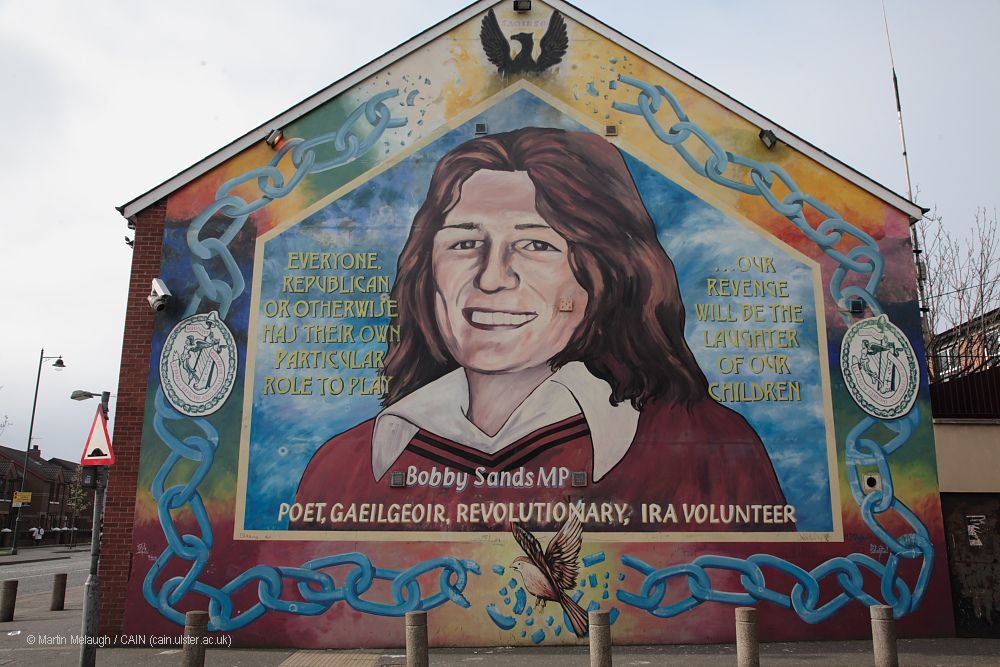
Bobby Sands Wandmalerei in Belfast
————————————-
Reaction to the death of Bobby Sands M.P (1981)
————————————-

On 5 May, Sands died in the prison hospital on the sixty-sixth day of his hunger strike, prompting rioting in nationalist areas of Northern Ireland.[1] Humphrey Atkins issued a statement saying that Sands had committed suicide “under the instructions of those who felt it useful to their cause that he should die”.[27] Over 100,000 people lined the route of his funeral, which was conducted with full IRA military honours. Margaret Thatcher showed no sympathy for his death, telling the House of Commons that “Mr. Sands was a convicted criminal. He chose to take his own life. It was a choice that his organisation did not allow to many of its victims”.[26]

In the two weeks following Sands’ death, three more hunger strikers died. Francis Hughes died on 12 May, resulting in further rioting in nationalist areas of Northern Ireland, in particular Derry and Belfast. Following the deaths of Raymond McCreesh and Patsy O’Hara on 21 May, Tomás Ó Fiaich, by then Primate of All Ireland, criticised the British government’s handling of the hunger strike.[1] Despite this, Thatcher still refused to negotiate a settlement, stating “Faced with the failure of their discredited cause, the men of violence have chosen in recent months to play what may well be their last card”, during a visit to Belfast in late May.[27]

Nine protesting prisoners contested the general election in the Republic of Ireland in June. Kieran Doherty and Paddy Agnew (who was not on hunger strike) were elected in Cavan–Monaghan and Louth respectively, and Joe McDonnell narrowly missed election in Sligo–Leitrim.[28][29] There were also local elections in Northern Ireland around that time and although Sinn Féin did not contest them, some smaller groups and independents who supported the hunger strikers won seats, e.g. the Irish Independence Party won 21 seats, while the Irish Republican Socialist Party (the INLA’s political wing) and People’s Democracy (a Trotskyist group) won two seats each, and a number of pro-hunger strike independent candidates also won seats.[30][31] The British government rushed through the Representation of the People Act 1981 to prevent another prisoner contesting the second by-election in Fermanagh and South Tyrone, which was due to take place following the death of Sands.[1]

A memorial to hunger striker Kieran Doherty

Following the deaths of Joe McDonnell and Martin Hurson the families of some of the hunger strikers attended a meeting on 28 July with Catholic priest Father Denis Faul. The families expressed concern at the lack of a settlement to the priest, and a decision was made to meet with Gerry Adams later that day. At the meeting Father Faul put pressure on Adams to find a way of ending the strike, and Adams agreed to ask the IRA leadership to order the men to end the hunger strike.[32] The following day Adams held a meeting with six of the hunger strikers to outline a proposed settlement on offer from the British government should the strike be brought to an end.[33] The strikers rejected the settlement, believing that accepting anything less than the “Five Demands” would be a betrayal of the sacrifice made by Bobby Sands and the other men who had died.[34]

On 31 July the hunger strike began to break, when the mother of Paddy Quinn insisted on medical intervention to save his life. The following day Kevin Lynch died, followed by Kieran Doherty on 2 August, Thomas McElwee on 8 August and Michael Devine on 20 August.[35] On the day Devine died, Sands’ election agent Owen Carron won the Fermanagh and South Tyrone by-election with an increased number of votes.[36] On 6 September the family of Laurence McKeown became the fourth family to intervene and asked for medical treatment to save his life, and Cahal Daly issued a statement calling on republican prisoners to end the hunger strike. A week later James Prior replaced Humphrey Atkins as Secretary of State for Northern Ireland, and met with prisoners in an attempt to end the strike.[1] Liam McCloskey ended his strike on 26 September after his family said they would ask for medical intervention if he became unconscious, and it became clear that the families of the remaining hunger strikers would also intervene to save their lives. The strike was called off at 3:15 pm on 3 October,[37] and three days later Prior announced partial concessions to the prisoners including the right to wear their own clothes at all times.[3] The only one of the “Five Demands” still outstanding was the right not to do prison work. Following sabotage by the prisoners and the Maze Prison escape in 1983 the prison workshops were closed, effectively granting all of the “Five Demands” but without any formal recognition of political status from the government.[38]

Participants who died on hunger strike


Over the summer of 1981, ten hunger strikers had died. Their names, paramilitary affiliation, dates of death, and length of hunger strike are as follows:

Name Paramilitary affiliation Strike started Date of death Length of strike
Bobby Sands IRA 1 March 5 May 66 days
Francis Hughes IRA 15 March 12 May 59 days
Raymond McCreesh IRA 22 March 21 May 61 days
Patsy O’Hara INLA 22 March 21 May 61 days
Joe McDonnell IRA 8 May 8 July 61 days
Martin Hurson IRA 28 May 13 July 46 days
Kevin Lynch INLA 23 May 1 August 71 days
Kieran Doherty IRA 22 May 2 August 73 days
Thomas McElwee IRA 8 June 8 August 62 days
Michael Devine INLA 22 June 20 August 60 days

The original pathologist‘s report recorded the hunger strikers’ cause of death as “self-imposed starvation“. This was later amended to simply “starvation”, after protests from the dead strikers’ families. The coroner recorded verdicts of “starvation, self-imposed”.[39]

Other participants in the hunger strike

Although ten men died during the course of the hunger strike, thirteen others began refusing food but were taken off hunger strike, either due to medical reasons or after intervention by their families. Many of them still suffer from the effects of the strike, with problems including digestive, visual, physical and neurological disabilities.[40][41]

Name Paramilitary affiliation Strike started Strike ended Length of strike Reason for ending strike
Brendan McLaughlin IRA 14 May 26 May 13 days Suffering from a perforated ulcer and internal bleeding
Paddy Quinn IRA 15 June 31 July 47 days Taken off by his family
Laurence McKeown IRA 29 June 6 September 70 days Taken off by his family
Pat McGeown IRA 9 July 20 August 42 days Taken off by his family
Matt Devlin IRA 14 July 4 September 52 days Taken off by his family
Liam McCloskey INLA 3 August 26 September 55 days His family said they would intervene if he became unconscious
Patrick Sheehan IRA 10 August 3 October 55 days End of hunger strike
Jackie McMullan IRA 17 August 3 October 48 days End of hunger strike
Bernard Fox IRA 24 August 24 September 32 days Suffering from an obstructed kidney
Hugh Carville IRA 31 August 3 October 34 days End of hunger strike
John Pickering IRA 7 September 3 October 27 days End of hunger strike
Gerard Hodgins IRA 14 September 3 October 20 days End of hunger strike
James Devine IRA 21 September 3 October 13 days End of hunger strike

Consequences

A hunger strike memorial in Derry’s Bogside on Free Derry Corner

The British press hailed the hunger strike as a triumph for Thatcher, with The Guardian newspaper stating “The Government had overcome the hunger strikes by a show of resolute determination not to be bullied”.[42] However, the hunger strike was a Pyrrhic victory for Thatcher and the British government.[43] Thatcher became a republican hate figure of Cromwellian proportions, with Danny Morrison describing her as “the biggest bastard we have ever known”.[43] At the time most thought the hunger strike a crushing defeat for the republicans, a view shared by many within the IRA and Sinn Féin, but Sands’ by-election win was a propaganda victory.[2] As with internment in 1971 and Bloody Sunday in 1972, IRA recruitment was boosted, resulting in a new surge of paramilitary activity.[43] There was an upsurge of violence after the comparatively quiet years of the late 1970s, with widespread civil disorder in Northern Ireland and rioting outside the British Embassy in Dublin.[1] Security forces fired 29,695 plastic bullets in 1981, causing seven deaths, compared to a total of around 16,000 bullets and four deaths in the eight years following the hunger strikes.[44] The IRA continued its armed campaign during the seven months of the strike, killing 13 policemen, 13 soldiers, including five members of the Ulster Defence Regiment and five civilians. The seven months were one of the bloodiest periods of the Troubles with a total of 61 people killed, 34 of them civilians.[45] Three years later the IRA perpetrated the Brighton hotel bombing, an attack on the Conservative party conference that killed five people and in which Thatcher herself only narrowly escaped death.[2]

The hunger strike prompted Sinn Féin to move towards electoral politics. Sands’ election victory, combined with that of pro-hunger strike candidates in the Northern Ireland local elections and Dáil elections in the Republic of Ireland, gave birth to the armalite and ballot box strategy. Gerry Adams remarked that Sands’ victory “exposed the lie that the hunger strikers—and by extension the IRA and the whole republican movement—had no popular support”.[46] The election victories of Doherty and Agnew also had political impact in the Republic of Ireland, as they denied power to Charles Haughey’s outgoing Fianna Fáil government.[28] In 1982 Sinn Féin won five seats in the elections to the Northern Ireland Assembly, and in 1983 Gerry Adams won a seat in the UK general election.[47] As a result of the political base built during the hunger strike, Sinn Féin continued to grow in the following two decades. After the United Kingdom general election, 2001, it became the largest nationalist party in Northern Ireland[3] and after the 2014 local and European elections held on both sides of the border, asserted it was now the largest party in Ireland.[48]

In 2005, the role of Gerry Adams was questioned by former prisoner Richard O’Rawe, who was the public relations officer inside the prison during the strike. O’Rawe states in his book Blanketmen that Adams prolonged the strike as it was of great political benefit to Sinn Féin and allowed Owen Carron to win Sands’ seat.[49][50] This claim is denied by several hunger strikers and Brendan McFarlane, who was O/C inside the prison during the hunger strike.[51] McFarlane claims O’Rawe’s version of events is confused and fragmentary, and states “We were desperate for a solution. Any deal that went some way to meeting the five demands would have been taken. If it was confirmed in writing, we’d have grabbed it . . . There was never a deal, there was never a “take it or leave it” option at all”.[52]

Commemorations

A hunger strike memorial near Crossmaglen, County Armagh

There are memorials and murals in memory of the hunger strikers in towns and cities across Ireland, including Belfast, Dublin, Derry, Crossmaglen and Camlough.[53] Annual commemorations take place across Ireland for each man who died on the hunger strike, and an annual hunger strike commemoration march is held in Belfast each year, which includes a Bobby Sands memorial lecture.[54][55] Several towns and cities in France have named streets after Bobby Sands, including Paris and Le Mans.[2][56] The Iranian government also named a street running alongside the British embassy in Tehran after Bobby Sands, which was formerly called Winston Churchill Street.[57]

A memorial to the men who died in the Irish Rebellion of 1798, the Easter Rising and the hunger strike stands in Waverley Cemetery, Sydney, Australia, which is also the burial place of Michael Dwyer of the Society of United Irishmen.[58][59] In 1997 NORAID‘s Hartford Unit in the United States dedicated a monument to Bobby Sands and the other hunger strikers.[60] The monument stands in a traffic circle known as “Bobby Sands Circle”, at the bottom of Maple Avenue near Goodwin Park.[61] On 20 March 2001 Sinn Féin’s national chairperson Mitchel McLaughlin opened the National Hunger Strike Commemoration Committee’s exhibition at the Europa Hotel in Belfast, which included three original works of art from Belfast-based artists.[62] A separate exhibition was also launched in Derry the following month.[63] Three films have been made based on the events of the hunger strike, Some Mother’s Son starring Helen Mirren, H3 (which was co-written by former hunger striker Laurence McKeown), and Steve McQueen‘s Hunger.

29th February – Deaths & Events in Northern Ireland Troubles

Key Events & Deaths on this day in Northern Ireland Troubles

29th February

———————————–

Wednesday 29 February 1984

The Northern Ireland Assembly voted by 20 votes to 1 against a proposal to extend the 1967 Abortion Act, which covered Britain, to Northern Ireland.

Monday 29 February 1988

Martin McGuinness with masked IRA men at the funeral of Brendan Burns in 1988

Two Irish Republican Army (IRA) members were killed in a premature explosion in County Armagh.

Thursday 29 February 1996

The Irish Republican Army (IRA) issued a stamen following talks between John Hume, then leader of the Social Democratic and Labour Party (SDLP), Gerry Adams, then President of Sinn Féin (SF), and representatives of the IRA.


Irish Republican Army (IRA) Statement, 29 February 1996

The IRA released a statement in Dublin on 29 February 1996 following a meeting between the IRA Army Council and the leaders of Sinn Féin and the SDLP.

The IRA statement said there had been a detailed and open exchange of views.

“We listened attentively to the case presented by both leaders and noted their shared commitment to restoring the peace process.”

The statement continued:

“For our part we restated our absolute commitment to our republican objectives which include the free exercise by the Irish people of our inalienable right to national self-determination. We also took the opportunity to reiterate what we said on February 9th, stressing that a resolution of the conflict in our country demands justice and an inclusive negotiated settlement without preconditions.

We pointed out to Mr Hume and Mr Adams that the failure of by the British government to put in place inclusive negotiations free from preconditions, the abuse of the peace process by the British over 18 months and the absence of an effective and democratic aproach capable of providing an irrevocable momentum towards a just and lasting peace in Ireland, were the critical elements which led to the failure, thus far, of the Irish peace process. We repeat that we are prepared to face up to our responsibilities; others need to do likewise.”


P O’Neill,
Irish Republican Publicity Bureau, Dublin.

—————————————————————

Remembering all innocent victims of the Troubles

Today is the anniversary of the death of the following people killed as a results of the conflict in Northern Ireland

“To live in hearts we leave behind is not to die

– Thomas Campbell

To the innocent on the list – Your memory will live  forever

– To  the Paramilitaries  –

There are many things worth living for, a few things worth dying for, but nothing worth killing for.

4 People   lost their lives on the 29th  February between 1972– 1998

Bizarrely three of the people killed on the 29th of February were called Brendan. 

  —————————————————————————

29 February 1972
Henry Dickson,  (46)

Protestant
Status: Ulster Defence Regiment (UDR),

Killed by: Irish Republican Army (IRA)
Off duty. Shot at his home, Lawrence Street, Lurgan, County Armagh.

  —————————————————————————

29 February 1980
Brendan McLaughlin,   (32)

Catholic
Status: Civilian (Civ),

Killed by: Ulster Volunteer Force (UVF)
Shot from passing car while walking along Clonard Street, Lower Falls, Belfast. Sinn Fein (SF) member intended target.

  —————————————————————————

29 February 1988
Brendan Burns,   (30)

Catholic
Status: Irish Republican Army (IRA),

Killed by: Irish Republican Army (IRA)
Killed in premature explosion while loading bomb into van, Creggan, near Crossmaglen, County Armagh.

  —————————————————————————

29 February 1988


Brendan Moley, (30)

Catholic
Status: Irish Republican Army (IRA),

Killed by: Irish Republican Army (IRA)
Killed in premature explosion while loading bomb into van, Creggan, near Crossmaglen, County Armagh.

  —————————————————————————


28th February – Deaths & Events in Northern Ireland Troubles

Key Events & Deaths on this day in Northern Ireland Troubles

28th February

———————-

Friday 28 February 1969

Terence O’Neill was re-elected as leader of the Unionist Parliamentary Party and thus was confirmed as Northern Ireland Prime Minister.

Sunday 28 February 1971

A British soldier died in Derry as a result of inhaling chemicals from fire extinguisers that were used to put out a fire inside the vehicle he was travelling in. The vehicle had been attacked with petrol bombs.

Thursday 28 February 1974

General Election

A general election was held in the United Kingdom. In Northern Ireland 30,000 members of the security forces were on duty during the day however there were a number of shooting and bombing incidents across the region.

The election in Northern Ireland was in effect a referendum on power-sharing, and the Council of Ireland as proposed in the Sunningdale Agreement. There was no electoral pact between the parties in favour of the Executive. There was however a very successful pact amongst those opposed to the Sunningdale Agreement who joined forces in the United Ulster Unionist Council (UUUC)

. The UUUC was formed by three main Loyalist parties: Democratic Unionist Party (DUP), (Ulster) Vanguard, and Official Unionists (West). These parties agreed to put forward one candidate in each of the constituencies.

The Campaign slogan of the UUUC was, ‘Dublin is just a Sunningdale away’. Candidates standing on behalf of the UUUC won 11 of the 12 Northern Ireland seats, gaining 51.1 per cent of the valid votes. The Social Democratic and Labour Party (SDLP) held West Belfast.

[While the election did not mean an immediate end to the power-sharing Executive, it did provide those opposed to the Sunningdale Agreement with a powerful mandate to continue their opposition to it.]

[In Britain the Labour Party won the general election by a narrow margin. Harold Wilson, then leader of the Labour Party, became Prime Minister of the United Kingdom. Merlyn Rees was appointed as Secretary of State for Northern Ireland on 5 March 1974.]

Monday 28 February 1977

  Political Development

Thursday 28 February 1985
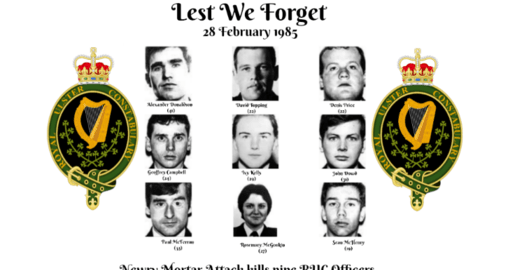
ruc killed in troubles

Nine RUC Officers Killed

The Irish Republican Army (IRA) carried out a home-made mortar attack on the Royal Ulster Constabulary (RUC) station in Newry, County Down, and killed nine RUC officers and injured 30 others. [This incident represented the greatest loss of life for the RUC in a single incident. The number of deaths was high because most of those killed were inside temporary dwellings within the RUC base.] A member of the Ulster Defence Regiment (UDR) was killed by the IRA in County Tyrone.

See Newry Mortar Attack


Friday 28 February 1992

The Irish Republican Army (IRA) exploded a bomb at London Bridge railway station in London and injured 28 people.

Sunday 28 February 1993

Dick Spring, then Tánaiste (deputy Irish Prime Minister and Minister for Foreign Affairs), gave an interview to the British Broadcasting Corporation (BBC) in which he stated that Articles 2 and 3 of the Irish Constitution were not “cast in bronze”.

Monday 28 February 1994

The Ulster Unionist Party (UUP) published its plans for administrative devolution. Party representatives said that the UUP would not take part in any future three-strand talks process.

Wednesday 28 February 1996

John Major, then British Prime Minister, and John Bruton, then Taoiseach (Irish Prime Minister), held a summit meeting in London. In their Communique, the two Governments set a date (10 June 1996) for the start of all-party talks.

It was announced that parties to the talks would have to agree to abide by the six ‘Mitchell Principles’ and there would be a period of ‘proximity’ talks to decide on an agenda and the administration of the process.

Saturday 28 February 1998

The Irish National Liberation Army (INLA) carried out a hand grenade attack on Royal Ulster Constabulary (RUC) officers who were investigating a break-in and arson attack on Hazelwood Integrated College in north Belfast.

Two RUC officers and two civilians were treated for shock as a result of the incident.

Mary McAleese, then President of the Republic of Ireland, indicated that she would celebrate the two major holidays on the island of Ireland, St Patrick’s Day on 17 March and the Orange Order’s celebration of the victory at the Battle of the Boyne on 12 July.

It was announced that parties would be held at Aras an Uachtarain on these two dates. The celebrations were believed to be part of a “bridge building” theme which the President plans to adopt during her term of office.

Sunday 28 February 1999

Sinn Féin (SF) held a rally outside the City Hall in Belfast. Mitchel McLaughlin, then a senior member of SF, demanded that the deadline of 10 March 1999 for the formation of the Executive should be met. The rally was attended by thousands of SF supporters.

Thursday 28 February 2002

A book entitled ‘The Long Road to Peace in Northern Ireland‘ was launched in Belfast. The book is a collection of essays on the state of the peace process and was compiled by Marianne Elliott (Prof.) of the Institute of Irish Studies in Liverpool. The essays were based on lectures delivered at the university between 1996 and 2000.

 —————————————————————

Remembering all innocent victims of the Troubles

Today is the anniversary of the death of the following people killed as a results of the conflict in Northern Ireland

“To live in hearts we leave behind is not to die

– Thomas Campbell

To the innocent on the list – Your memory will live  forever

– To  the Paramilitaries  –

There are many things worth living for, a few things worth dying for, but nothing worth killing for.

18 People   lost their lives on the 28th February between 1971– 1985

  —————————————————————————

28 February 1971
William Jolliffe,  (18)

nfNI
Status: British Army (BA),

Killed by: not known (nk)
Died from inhaling fumes from fire extinguisher, when British Army (BA) Armoured Personnel Carrier came under petrol bomb attack, Westland Street, Bogside, Derry.

  —————————————————————————

28 February 1973


Kevin Heatley,   (12)

Catholic
Status: Civilian (Civ),

Killed by: British Army (BA)
Shot near his home, Main Avenue, Derrybeg, Newry, County Down

  —————————————————————————

28 February 1973
Alan Kennington,  (20)

nfNI
Status: British Army (BA),

Killed by: Irish Republican Army (IRA)
Shot while on British Army (BA) foot patrol, Crumlin Road, Ardoyne, Belfast

  —————————————————————————

28 February 1974
Hugh Harvey,   (33)

Protestant
Status: Civilian (Civ),

Killed by: Ulster Volunteer Force (UVF)
Killed in bomb attack on Red Star Bar, Donegall Quay, Belfast

  —————————————————————————

28 February 1975


Michael Convery,   (22)

Catholic
Status: Civilian (Civ),

Killed by: non-specific Loyalist group (LOY)
Shot while walking along Antrim Road, near Camberwell Terrace, Belfast.

  —————————————————————————

28 February 1975
Thomas Truesdale,   (20)

Protestant
Status: Civilian (Civ),

Killed by: non-specific Republican group (REP)
Shot from passing car, while standing at the junction of Benview Park and Ballysillan Crescent, Ballysillan, Belfast.

  —————————————————————————

28 February 1976
Harold Blair,   (35)

Protestant
Status: Civilian (Civ),

Killed by: Irish Republican Army (IRA)
Northern Ireland Electricity Company employee. Died one day after being injured by booby trap bomb, when he entered unoccupied house to check electric supply, Landseer Street, Stranmillis, Belfast.

  —————————————————————————

28 February 1978


Charles Simpson,   (26)

Protestant
Status: Royal Ulster Constabulary (RUC),

Killed by: Irish Republican Army (IRA)
Shot during sniper attack on Royal Ulster Constabulary (RUC) mobile patrol at junction of Clarendon Street and Francis Street, Rosemount, Derry.

  —————————————————————————

8 February 1985


Alexander Donaldson,  (41)

Protestant
Status: Royal Ulster Constabulary (RUC),

Killed by: Irish Republican Army (IRA)
Killed in mortar bomb attack on Royal Ulster Constabulary (RUC) base, Edward Street, Newry, County Down.

  —————————————————————————

28 February 1985


Rosemary McGookin,  (27)

Protestant
Status: Royal Ulster Constabulary (RUC),

Killed by: Irish Republican Army (IRA)
Killed in mortar bomb attack on Royal Ulster Constabulary (RUC) base, Edward Street, Newry, County Down.

See Newry Mortar Attack 1985

  —————————————————————————

28 February 1985


Geoffrey Campbell, (24)

Protestant
Status: Royal Ulster Constabulary (RUC),

Killed by: Irish Republican Army (IRA)
Killed in mortar bomb attack on Royal Ulster Constabulary (RUC) base, Edward Street, Newry, County Down.

See Newry Mortar Attack 1985

  —————————————————————————

28 February 1985


Denis Price,  (22)

Catholic
Status: Royal Ulster Constabulary (RUC),

Killed by: Irish Republican Army (IRA)
Killed in mortar bomb attack on Royal Ulster Constabulary (RUC) base, Edward Street, Newry, County Down.

See Newry Mortar Attack 1985

  —————————————————————————

28 February 1985


Paul McFerran,  (33)

Catholic
Status: Royal Ulster Constabulary (RUC),

Killed by: Irish Republican Army (IRA)
Killed in mortar bomb attack on Royal Ulster Constabulary (RUC) base, Edward Street, Newry, County Down

See Newry Mortar Attack 1985

  —————————————————————————

28 February 1985


Sean McHenry, (19)

Protestant
Status: Royal Ulster Constabulary (RUC),

Killed by: Irish Republican Army (IRA)
Killed in mortar bomb attack on Royal Ulster Constabulary (RUC) base, Edward Street, Newry, County Down

See Newry Mortar Attack 1985

  —————————————————————————

28 February 1985


David Topping,  (22)

Protestant
Status: Royal Ulster Constabulary (RUC),

Killed by: Irish Republican Army (IRA)
Killed in mortar bomb attack on Royal Ulster Constabulary (RUC) base, Edward Street, Newry, County Down.

See Newry Mortar Attack 1985

  —————————————————————————

28 February 1985


John Dowd,  (31)

Protestant
Status: Royal Ulster Constabulary (RUC),

Killed by: Irish Republican Army (IRA)
Killed in mortar bomb attack on Royal Ulster Constabulary (RUC) base, Edward Street, Newry, County Down.

See Newry Mortar Attack 1985

  —————————————————————————

28 February 1985


Ivy Kelly,  (29)

Protestant
Status: Royal Ulster Constabulary (RUC),

Killed by: Irish Republican Army (IRA)
Killed in mortar bomb attack on Royal Ulster Constabulary (RUC) base, Edward Street, Newry, County Down.

See Newry Mortar Attack 1985

  —————————————————————————

28 February 1985


Trevor Harkness (36)

Protestant
Status: Ulster Defence Regiment (UDR),

Killed by: Irish Republican Army (IRA)
Killed by remote controlled bomb, hidden in telegraph pole, while on Ulster Defence Regiment (UDR) foot patrol, Pomeroy, County Tyrone.

  —————————————————————————


27th February – Deaths & Events in Northern Ireland Troubles


Key Events & Deaths on this day in Northern Ireland Troubles

27th February

———————————-

Tuesday 27 February 1973


Two Royal Ulster Constabulary (RUC) officers were shot by the Irish Republican Army (IRA) near Moira, County Antrim. [One officer died at the scene and the other died from his wounds on 25 March 1973.]

Friday 27 February 1976

 Hunger Strikes.

Sunday 27 February 1977

Two members of the Ulster Volunteer Force (UVF) were killed when a bomb they were planting exploded prematurely in Exchange Street, Belfast.

A former member of the British army was shot dead by the Irish Republican Army (IRA) in Belfast.

Friday 27 February 1981

A large van bomb exploded in the centre of Limavady, County Derry, causing damage to 40 premises.

[It was believed that the Irish Republican Army (IRA) were responsible for the attack.]

Sunday 27 February 1983

Charles Haughey, then leader of Fianna Fáil (FF), addressed his party’s conference in Dublin and called on the British and Irish governments to organise a constitutional conference to consider options for the future of Northern Ireland.

Wednesday 27 February 1985

The Irish National Liberation Army (INLA) planted a bomb close to Windsor Park in Belfast during a World Cup soccer match between England and Northern Ireland. The bomb was defused  The INLA also issued a general death threat against any visiting British sports teams.

Tuesday 27 February 1990

The Irish Times (a Dublin based newspaper) published an article which outlined a set of proposals on Northern Ireland which were purported to have been handed to Tom King, then Secretary of Sate for Northern Ireland, in January 1988 by James Molyneaux, then leader of the Ulster Unionist Party (UUP), and Ian Paisley, then leader of the Democratic Unionist Party (DUP).

These proposals contained suggestions about the future governance of Northern Ireland. Whilst claiming that the report was not entirely accurate Molyneaux also stressed that Unionists were prepared to discuss the ideas further in future negotiations, if and when the Anglo-Irish Agreement (AIA) was suspended.

Saturday 27 February 1999

David Trimble, First Minster Designate, warned Republicans that he intended to press for the transfer of powers to a new Executive, even without Sinn Féin (SF) participation. The man that Garda Síochána (the Irish police) believed had directed the Omagh bombing on 15 August 1998 was reported to have disappeared from his home in the Border area and to have fled the country. Three other people were arrested in the Republic of Ireland in connection with the bombing.

Wednesday 27 February 2002

Martin McGuinness (SF), then Education Minister, launched a draft action plan to address racism within the education system. The plan was drawn up in conjunction with the Equality Commission. McGuinness also launched a leaflet and poster campaign, produced by the Equality Commission and the Irish National Consultative Committee, on racism and inter-culturalism.

—————————————————————

Remembering all innocent victims of the Troubles

Today is the anniversary of the death of the following people killed as a results of the conflict in Northern Ireland

“To live in hearts we leave behind is not to die

– Thomas Campbell

To the innocent on the list – Your memory will live  forever

– To  the Paramilitaries  –

There are many things worth living for, a few things worth dying for, but nothing worth killing for.

8 People   lost their lives on the 27th February between 1973– 1989

  —————————————————————————

27 February 1973


Raymond Wylie,   (25)

Protestant
Status: Royal Ulster Constabulary (RUC),

Killed by: Irish Republican Army (IRA)
Shot during sniper attack on Royal Ulster Constabulary (RUC) mobile patrol, Aghagallon, near Moira, County Antrim.

 —————————————————————————

27 February 1973


Ronald Macauley,   (42)

Protestant
Status: Royal Ulster Constabulary (RUC),

Killed by: Irish Republican Army (IRA)
Shot during sniper attack on Royal Ulster Constabulary (RUC) mobile patrol, Aghagallon, near Moira, County Antrim. He died on 25 March 1973.

 —————————————————————————

27 February 1975


Wesley Black, (31)

Protestant
Status: Civilian (Civ),

Killed by: non-specific Republican group (REP)
Shot during gun attack on the home of a Ulster Defence Association member, West Circular Road, Highfield, Belfast. Walking past the house at the time of the attack.

 —————————————————————————

27 February 1976
Kenneth Lenaghan,   (35)

Protestant
Status: Ulster Volunteer Force (UVF),

Killed by: Irish Republican Army (IRA)
Shot from passing car while standing outside Victor’s Bar, Coyle’s Place, Donegall Pass, Belfast.

 —————————————————————————

27 February 1977
James Cordner,  (23)

Protestant
Status: Ulster Volunteer Force (UVF),

Killed by: Ulster Volunteer Force (UVF)
Killed in premature explosion while carrying bomb along Exchange Street, off, Corporation Street, Belfast.

 —————————————————————————

27 February 1977
Joseph Long,   (35)

Protestant
Status: Ulster Volunteer Force (UVF),

Killed by: Ulster Volunteer Force (UVF)
Killed in premature explosion while carrying bomb along Exchange Street, off, Corporation Street, Belfast

 —————————————————————————

27 February 1977


John Lee,   (35)

Catholic
Status: ex-British Army (xBA),

Killed by: Irish Republican Army (IRA)
From Northern Ireland. Shot outside Crumlin Star Social Club, Balholm Drive, Ardoyne, Belfast.

 —————————————————————————

27 February 1989
Gabriel Mullaly,   (54)

Catholic
Status: ex-Royal Ulster Constabulary (xRUC),

Killed by: Irish Republican Army (IRA)
Killed by booby trap bomb attached to his car which exploded while travelling along North Road, Bloomfield, Belfast.

 —————————————————————————


Newry Mortar Attack kills nine RUC Officers

1985 Newry Mortar Attack


On 28 February 1985, the Provisional Irish Republican Army (IRA) launched a heavy mortar attack on the Royal Ulster Constabulary (RUC) base at Corry Square in Newry, Northern Ireland.

The attack killed nine RUC officers and injured almost 40 others; the highest death toll ever suffered by the RUC. Afterwards, a major building scheme was begun, to give police and military bases better protection from such attacks

—————————

IRA kill 9 RUC officers in mortar attack, Newry

—————————

Background

In the early 1970s, after the onset of the Troubles, the Provisional IRA launched a campaign aimed at forcing the British to withdraw from Northern Ireland. Republicans saw the RUC—Northern Ireland’s police force—as illegitimate, sectarian, and enforcing British rule.The RUC was a highly militarized police force.

The IRA—particularly its South Armagh Brigade—had repeatedly attacked the British Army and RUC with home-made mortars, but with limited success. Between 1973 and early 1978 a total of 71 mortar attacks were recorded, but none caused direct British Army or RUC deaths.

There were only two deadly mortar attacks before 1985. The first was on 19 March 1979, when Private Peter Woolmore of the Queen’s Regiment was killed in a mortar attack on Newtownhamilton British Army base.

The second was on 12 November 1983, when an RUC officer was killed and several hurt in a mortar attack on Carrickmore RUC base.

The attack

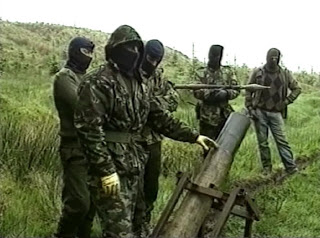
The attack was jointly planned by members of the South Armagh Brigade and an IRA unit in Newry. The homemade mortar launcher, dubbed the ‘Mark 10‘, was bolted on to the back of a Ford lorry that had been hijacked in Crossmaglen.

Shortly after 6.30PM on 28 February, nine shells were launched from the lorry, which had been parked on Monaghan Street, about 250 yards (230 m) from the base. At least one 50 lb shell landed on a portacabin containing a canteen, where many officers were having their evening tea break.

Nine police officers were killed and 37 people were hurt, including 25 civilian police employees;[5] the highest death toll inflicted on the RUC in its history. Another shell hit the observation tower, while the rest landed inside and outside the perimeter of the base.[6]

—————————-

The  Innocent Victims

—————————-

28 February 1985


Alexander Donaldson,  (41)

Protestant
Status: Royal Ulster Constabulary (RUC),

Killed by: Irish Republican Army (IRA)
Killed in mortar bomb attack on Royal Ulster Constabulary (RUC) base, Edward Street, Newry, County Down.

—————————-

28 February 1985

Rosemary McGookin, (27)


Rosemary McGookin,  (27)

Protestant
Status: Royal Ulster Constabulary (RUC),

Killed by: Irish Republican Army (IRA)
Killed in mortar bomb attack on Royal Ulster Constabulary (RUC) base, Edward Street, Newry, County Down.

—————————-

28 February 1985


Geoffrey Campbell, (24)

Protestant
Status: Royal Ulster Constabulary (RUC),

Killed by: Irish Republican Army (IRA)
Killed in mortar bomb attack on Royal Ulster Constabulary (RUC) base, Edward Street, Newry, County Down.

—————————-

28 February 1985


Denis Price,  (22)

Catholic
Status: Royal Ulster Constabulary (RUC),

Killed by: Irish Republican Army (IRA)
Killed in mortar bomb attack on Royal Ulster Constabulary (RUC) base, Edward Street, Newry, County Down.

—————————-

28 February 1985


Paul McFerran,  (33)

Catholic
Status: Royal Ulster Constabulary (RUC),

Killed by: Irish Republican Army (IRA)
Killed in mortar bomb attack on Royal Ulster Constabulary (RUC) base, Edward Street, Newry, County Down

—————————-

28 February 1985


Sean McHenry, (19)

Protestant
Status: Royal Ulster Constabulary (RUC),

Killed by: Irish Republican Army (IRA)
Killed in mortar bomb attack on Royal Ulster Constabulary (RUC) base, Edward Street, Newry, County Down

—————————-

28 February 1985


David Topping,  (22)

Protestant
Status: Royal Ulster Constabulary (RUC),

Killed by: Irish Republican Army (IRA)
Killed in mortar bomb attack on Royal Ulster Constabulary (RUC) base, Edward Street, Newry, County Down.

—————————-

28 February 1985


John Dowd,  (31)

Protestant
Status: Royal Ulster Constabulary (RUC),

Killed by: Irish Republican Army (IRA)
Killed in mortar bomb attack on Royal Ulster Constabulary (RUC) base, Edward Street, Newry, County Down.

—————————-

28 February 1985


Ivy Kelly,  (29)

Protestant
Status: Royal Ulster Constabulary (RUC),

Killed by: Irish Republican Army (IRA)
Killed in mortar bomb attack on Royal Ulster Constabulary (RUC) base, Edward Street, Newry, County Down.

—————————-

Aftermath

The day was dubbed “Bloody Thursday” by the British press. British prime minister, Margaret Thatcher, called the attack “barbaric”, while the Republic’s prime minister, Garret FitzGerald, said it was “cruel and cynical”, and pledged the help of the ROI security forces to catch those responsible.

Although not involved in the attack, Newry IRA member Eamon Collins was arrested shortly afterwards and interrogated. After five days of questioning, Collins broke under interrogation and turned supergrass, leading to more than a dozen arrests of other IRA members.

The attack prompted calls from unionist politicians to “increase security”, and the British government launched a multi-million pound programme of construction to protect bases from similar attacks. This involved installing reinforced roofs and building blast-deflecting walls around the base of buildings.

After the successful attack in Newry, the IRA carried out a further nine mortar attacks in 1985. On 4 September, an RUC training centre in Enniskillen was attacked; 30 cadets narrowly escaped death due to poor intelligence-gathering by the IRA unit responsible. The cadets were expected to be in bed sleeping, but were instead eating breakfast when the bombs landed.

In November 1986, the IRA launched another attack on the RUC base in Newry, but the bombs fell short of their target and landed on residential houses. A four-year-old Catholic girl was badly wounded and another 38 people were hurt, prompting the IRA to admit that:

“this incident left us open to justified criticism”.


See here for more details on the RUC

police role of honour.PNG

See here for RUC deaths in the Troubles : 

26th February – Deaths & Events in Northern Ireland Troubles

Key Events & Deaths on this day in Northern Ireland Troubles

26th February

————————————

Friday 26 February 1971


Two Royal Ulster Constabulary (RUC) officers, Cecil Patterson (45) and Robert Buckley (30), were shot and killed by the Irish Republican Army (IRA) while on a mobile patrol in the Ardoyne area of Belfast.

Wednesday 26 February 1975

A member of the Irish Republican Army (IRA) shot dead a police officer in London. During a subsequent search operation a bomb-making facility was uncovered in Hammersmith.

Saturday 26 February 1983

Ken Livingstone, then leader of the Greater London Council (GLC), travelled to Belfast to begin a two day visit at the invitation of Sinn Féin (SF). The visit drew strong criticism from Unionists.

Wednesday 26 February 1986

Leaders of Unionism announced that there would be a general strike, or ‘Day of Action’, on 3 March (1986) against the Anglo-Irish Agreement (AIA).

Friday 26 February 1993

The Irish Republican Army (IRA) exploded three bombs at a gas works in Warrington, England. The bombs caused a large explosion. Two men were later arrested.

.

Saturday 26 February 1994

Sinn Féin (SF) held its Ard Fheis in Dublin, Republic of Ireland .

Gerry Adams, then President of SF, addressed the conference and said that the Downing Street Declaration (DSD) was a significant departure from previous policy by the British in its attitude towards Ireland. He added:

“… does anyone really expect the IRA to cease its activities so that British civil servants can discuss with Sinn Féin the surrender of IRA weapons after we have been “decontaminated”?”

)

Monday 26 February 1996

In a crucial vote at Westminster on the Scott report (on shipments of arms to Iraq) the Ulster Unionist Party (UUP), the Social Democratic and Labour Party (SDLP), and the United Kingdom Unionist (UKU) member voted against the Government. The Democratic Unionist Party (DUP) abstained. The Government won the debate by one vote.

Wednesday 26 February 1997

Two members of the Irish Republican Army (IRA) carried out a ‘punishment’ style attack on a 16 year old girl, Judith Boylan, in Armagh.

A survey in the Irish News reported that 62 per cent of respondents favoured compromise on the issue of contentious parades.

Thursday 26 February 1998

The Court of Appeal ruled that Paratrooper Lee Clegg should be granted a retrial.

[The family of Karen Reilly who was shot dead in a ‘joy-riding’ incident on 30 September 1990 were said to be “devastated” by the news of the retrial.]

See Lee Clegg

Friday 26 February 1999

Tony Blair, then British Prime Minister, and Bertie Ahern, then Taoiseach (Irish Prime Minister), held discussions on decommissioning and the transfer of powers to the Northern Ireland Assembly. The discussions took place during a meeting of European Union heads of government in Germany.

Monday 26 February 2001

Brian Keenan made a speech warning that there could be a return to armed conflict if the political process broke down.

[Keenan was reportedly the then Chief of Staff of the (Provisional) Irish Republican Army (IRA).]

Tuesday 26 February 2002

British Army bomb disposal officers defused a pipe-bomb that had been left in the garden of a house in Ballynure, County Antrim. The crude device was discovered at approximately 4.30pm (1630GMT).

Daniel McColgan


The Police Service of Northern Ireland (PSNI) announced that a £20,000 reward was being offered for information leading to the prosecution of those who had killed Daniel McColgan (20), a Catholic civilian, on 12 January 2002.

The Ulster Defence Association (UDA) admitted responsibility for the killing. The reward money had been raised by a number of groups.

Alex Maskey, then Sinn Féin (SF) Chief Whip, said that the party had turned down an invitation to discuss a Northern Ireland Policing Board (NIPB) plan with Alan McQuillan, then Assistant Chief Constable.

Maskey said the party would play a “full and active” role when there was a new beginning to policing in the North.

Mark Durkan

Mark Durkan, then leader of the Social Democratic and Labour Party (SDLP), addressed the Oxford University Union. He said that the focus of a new campaign for Nationalism should be to persuade Unionists of the benefits of an integrated agreed Ireland.


Robert McCartney


Robert McCartney, then leader of the United Kingdom Unionist Party (UKUP), was expelled from the Northern Ireland Assembly chamber for one day for repeatedly talking to a colleague during a speech by an Social Democratic and Labour Party (SDLP) member.

Quentin Davies


It was reported that Quentin Davies, then Conservative Party spokesman on Northern Ireland, had attended a meeting in Belfast of the Loyalist Commission at which Loyalist paramilitaries were present.

It was announced that the 26 District Councils in Northern Ireland would undertake a £52m development package to assist their local economies. The funding was provided jointly by the European Union (EU) and the District Councils. The EU funding (£26m) was made available under the Local Economic Development Measure of the Building Sustainable Prosperity Programme.

PricewaterhouseCoopers published its latest ‘UK Economic Outlook and Regional Trends’ survey in which the economy of Northern Ireland was expected to grow at a rate of just under 2 per cent during 2002.

An independent report published by the General Consumer Council indicated that passenger satisfaction with bus and rail services were at an all-time low. Passenger satisfaction had dropped to 63.2 per cent on Northern Ireland Railways, 62.8 per cent on Citybus, and 71.5 per cent on Ulsterbus.

John Reid, then Secretary of State for Northern Ireland, wrote to the Commission of Inquiry into the Dublin and Monaghan bombings providing a response to a letter sent by the Inquiry on 10 November 2000.

[The information was provided in the form of a ten-page. An appendix to the letter consisting of six pages gave details concerning the structure and control of intelligence gathering in Northern Ireland during the 1970s.]

—————————————————————

Remembering all innocent victims of the Troubles

Today is the anniversary of the death of the following people killed as a results of the conflict in Northern Ireland

“To live in hearts we leave behind is not to die

– Thomas Campbell

To the innocent on the list – Your memory will live  forever

– To  the Paramilitaries  –

There are many things worth living for, a few things worth dying for, but nothing worth killing for.

7 People   lost their lives on the 26th February between 1971– 1989

  —————————————————————————

26 February 1971


Cecil Patterson,  (45)

Protestant
Status: Royal Ulster Constabulary (RUC),

Killed by: Irish Republican Army (IRA)
Shot while on Royal Ulster Constabulary (RUC) mobile patrol, Etna Drive, Ardoyne, Belfast.

  —————————————————————————

26 February 1971


Robert Buckley,  (30)

Protestant
Status: Royal Ulster Constabulary (RUC),

Killed by: Irish Republican Army (IRA)
Shot while on Royal Ulster Constabulary (RUC) mobile patrol, Etna Drive, Ardoyne, Belfast

  —————————————————————————

26 February 1975
Stephen Tibble,   (22)

nfNIB
Status: British Police (BP),

Killed by: Irish Republican Army (IRA)
Shot while pursuing Irish Republican Army (IRA) member along Charleville Road, Baron’s Court, London

  —————————————————————————

26 February 1976
Joseph McCullough,   (57)

Protestant
Status: Ulster Defence Regiment (UDR),

Killed by: Irish Republican Army (IRA)
Off duty. Found stabbed to death at his farm, Tullyvallen, near Newtownhamilton, County Armagh.

  —————————————————————————

26 February 1977


Robert Mitchell,  (68)

Protestant
Status: Civilian (Civ),

Killed by: Irish Republican Army (IRA)
Justice of the Peace. Shot at his home, Windsor Avenue, Newry, County Down

  —————————————————————————

26 February 1978


Paul Duffy,  (23)

Catholic
Status: Irish Republican Army (IRA),

Killed by: British Army (BA)
Shot by undercover British Army (BA) members at arms cache, in yard of unoccupied farmhouse, The Diamond, near Coagh, County Tyrone.

  —————————————————————————

26 February 1989
Joseph Fenton,  (35)

Catholic
Status: Civilian (Civ),

Killed by: Irish Republican Army (IRA)
Found shot in entry off Bunbeg Park, Lenadoon, Belfast. Alleged informer.

  —————————————————————————