On 24 October 1990 the Provisional Irish Republican Army (IRA) developed the tactic by introducing the so-called “human proxy bomb”. Three men deemed by the IRA to be “collaborators” (i.e. helping the security forces in some way) were strapped into three vehicles and forced to drive to three British military targets.
However, unlike the earlier proxy bombings, they were not given the chance to escape. The three synchronised attacks took place at Coshquin (near Derry), Cloghoge (near Newry), and Omagh in the early morning of 24 October 1990.
The Coshquin attack was the deadliest, killing the human proxy and six soldiers. One soldier was killed at Cloghoge, but the proxy survived. At Omagh there were no fatalities due to a faulty detonator.
Memorial stone
The Innocent Victims
—————————————————-
24 October 1990 Stephen Burrows, (30) nfNI Status: British Army (BA),
Killed by: Irish Republican Army (IRA)
Killed in van bomb attack on permanent British Army (BA) Vehicle Check Point (VCP), Buncrana Road, Coshquinn, near Derry.
—————————————————-
24 October 1990 Stephen Beacham, (20) nfNI Status: British Army (BA),
Killed by: Irish Republican Army (IRA)
Killed in van bomb attack on permanent British Army (BA) Vehicle Check Point (VCP), Buncrana Road, Coshquinn, near Derry.
—————————————————-
24 October 1990
Paul Worrall, (23) nfNI Status: British Army (BA),
Killed by: Irish Republican Army (IRA)
Killed in van bomb attack on permanent British Army (BA) Vehicle Check Point (VCP), Buncrana Road, Coshquinn, near Derry.
—————————————————-
24 October 1990 Vincent Scott, (21) nfNI Status: British Army (BA),
Killed by: Irish Republican Army (IRA)
Killed in van bomb attack on permanent British Army (BA) Vehicle Check Point (VCP), Buncrana Road, Coshquinn, near Derry.
—————————————————-
24 October 1990 David Sweeney, (19) nfNI Status: British Army (BA),
Killed by: Irish Republican Army (IRA)
Killed in van bomb attack on permanent British Army (BA) Vehicle Check Point (VCP), Buncrana Road, Coshquinn, near Derry.
—————————————————-
24 October 1990
Patrick Gillespie, (42) Catholic Status: Civilian (Civ),
Killed by: Irish Republican Army (IRA)
Killed in van bomb attack on permanent British Army (BA) Vehicle Check Point (VCP), Buncrana Road, Coshquinn, near Derry. A civilian employed by British Army (BA), he was forced to drive the van bomb to the Vehicle Check Point (VCP).
—————————————————-
Proxy Bomb
The proxy bomb (also known as a human bomb) was a tactic used mainly by the Provisional Irish Republican Army (IRA) in Northern Ireland during the conflict known as “the Troubles“. It involved forcing people (including civilians, off-duty members of the British security forces, or people working for the security forces) to drive car bombs to British military targets, after placing them or their families under some kind of threat. The tactic was later adopted by FARC in Colombia and by rebels in the Syrian civil war.
The tactic has been compared to a suicide bomb, although each bomber in these cases is coerced rather than being a volunteer.
Early proxy bombs
The first proxy bombs took place in Northern Ireland during the Troubles. By 1973, increased searches and surveillance by the British security forces was making it harder for IRA members to plant their bombs and escape. In response, the IRA introduced the ‘proxy bomb’ tactic in March of that year.
In these early proxy bombings, the driver and nearby civilians would usually be given enough time to flee the area before the bomb detonated. One of the proxy bomb attacks carried out by the IRA during this period took place in 1975, when an employee of Northern Ireland‘s Forensics Laboratory in Newtownbreda was forced to drive a car laden with explosives to the building. The explosion caused moderate damage, and operations resumed quickly. The Laboratory would be the subject of one of the largest IRA bombings in 1992, when a 1,700 kg van bomb abandoned in the laboratory parking lot demolished the facilities and caused widespread damage inside a radius of 1 km.
The proxy bomb was also used by Northern Irish loyalists, on at least one occasion. On 11 September 1974, masked gunmen in British Army uniform hijacked a car in Northern Ireland, placed a time bomb inside and forced the owner to drive it into the village of Blacklion in the Republic of Ireland. They claimed to be from the Ulster Volunteer Force and threatened to attack his family if he did not comply. The village was evacuated and the Irish Army carried out a controlled explosion on the car. They estimated that the bomb would have destroyed most of the village.
On 24 October 1990 the Provisional Irish Republican Army (IRA) developed the tactic by introducing the so-called “human proxy bomb”. Three men deemed by the IRA to be “collaborators” (i.e. helping the security forces in some way)were strapped into three vehicles and forced to drive to three British military targets. However, unlike the earlier proxy bombings, they were not given the chance to escape.
The three synchronised attacks took place at Coshquin (near Derry), Cloghoge (near Newry), and Omagh in the early morning of 24 October 1990. The Coshquin attack was the deadliest, killing the human proxy and six soldiers. One soldier was killed at Cloghoge, but the proxy survived. At Omagh there were no fatalities due to a faulty detonator.
Coshquin
The Coshquin operation involved 11 members of the IRA’s Derry City Brigade. RUCSpecial Branch had received some intelligence about the operation, but it was said to be only a “vague outline” of an “impending assault against a base” in the area.
A Catholic, Patrick Gillespie (aged 42), who lived in the Shantallow area of Derry and worked as a cook at the Fort George British Army base in the city, had been warned to stop working at the base or risk reprisal. On one occasion, the IRA had forced him to drive a bomb into the base, giving him just enough time to escape. However, that bomb had failed to detonate.
On 24 October 1990, members of the IRA’s Derry City Brigade took over Gillespie’s house. While his family was held at gunpoint, he was forced to drive his car to a rural spot on the other side of the border in County Donegal. Gillespie was then put in a van loaded with 1,000 pounds (450 kg) of explosives and told to drive to the Coshquin permanent border checkpoint on Buncrana Road.
An armed IRA team followed him by car to ensure he obeyed their commands. Four minutes from the checkpoint, the IRA team armed the bomb remotely. When Gillespie reached the checkpoint, at 3:55 AM, he tried to get out and warn the soldiers, but the bomb detonated when he attempted to open the door.
IRA bomb makers had installed a detonation device linked to the van’s courtesy light, which came on whenever the van door opened. As a safeguard, the bombers also used a timing device to ensure the bomb detonated at the right moment. Gillespie and six soldiers were killed, including Ranger Cyril J. Smith, from B. Coy. 2nd Battalion Royal Irish Rangers, was posthumously awarded the QGM as he tried to warn his comrades about the bomb rather than running for cover.
Smith was a Roman Catholic and native of Northern Ireland.
Witnesses reported hearing “shouting, screaming and then shots” right before the explosion. The bomb devastated the base, destroying the operations room and a number of armoured vehicles. It was claimed that the death toll would have been much higher had the soldiers not been sleeping in a recently built mortar-proof bunker. The blast damaged 25 nearby houses.[10]
At Gillespie’s funeral, Bishop Edward Daly said the IRA and its supporters were
“…the complete contradiction of Christianity. They may say they are followers of Christ. Some of them may even still engage in the hypocrisy of coming to church, but their lives and their works proclaim clearly that they follow Satan.”
Cloghoge
In tandem with the Coshquin operation, members of the IRA’s South Down Brigade took over the house of a Catholic man, James McAvoy (aged 65) in Newry. He was allegedly targeted because he served RUC officers at his filling station, which was beside the house.
He was driven away in a Toyota HiAce van while his family was held at gunpoint. At Flagstaff Hill, near the border with the Republic, members of the IRA’s South Armagh Brigade loaded the van with one ton of explosives. McAvoy was strapped into the driver’s seat and told to drive the van to the accommodation block at Cloghoge permanent vehicle checkpoint. Before he drove off, a senior IRA member seemed:
“to have a pang of conscience” and whispered in McAvoy’s ear, “don’t open the door; go out through the window”.
An IRA team followed the van in a car and turned into a side-road shortly before it reached the checkpoint. When McAvoy stopped the van and climbed out the window, a soldier came over and began shouting at him to move the vehicle. Moments later, a timer detonated the bomb. The soldier was killed outright and 13 other soldiers were injured. McAvoy survived but suffered a broken leg.
Omagh
At about the same time, there was a third attempted proxy bombing in County Tyrone. A third man was strapped into a car and forced to drive it to Lisanelly British Army base in Omagh while his family was held at gunpoint.
This third bomb weighed 1,500 pounds (680 kg) but, due to a faulty detonator, the main explosive charge failed to explode.
Later proxy bombs
Several more ‘human proxy bombings’ were planned, but the operations were called-off, partly because of the outrage it drew from all sections of the community.
Nevertheless, there were a few more ‘traditional’ proxy bombings in the following months.
At 9:30 am on 22 November 1990, the IRA took over a man’s house in Newtownbutler, County Fermanagh. While his parents were held at gunpoint, he was forced to drive a Toyota Hilux pick-up truck to Annaghmartin military checkpoint.
He was told that the truck carried a bomb on a five-minute timer. When he reached the checkpoint he shouted a warning and a small explosion was heard, but the main bomb failed to detonate. The vehicle was found to contain 3,500 pounds (1,600 kg) of homemade explosives; the biggest IRA bomb up to that point.
The same checkpoint was the subject of a heavy machine gun attack on 26 December.
In early February 1991, another proxy bomb wrecked an Ulster Defence Regiment base in Magherafelt, County Londonderry, but there were no fatalities.
The proxy bomb tactic caused outrage in both the unionist and Irish nationalist communities. The final IRA use of proxy bombs came on 24 April 1993, when they forced two London taxi drivers to drive bombs towards Downing Street and New Scotland Yard. There were no casualties, however, as the drivers managed to shout warnings and to abandon their cars in time. A conventionally delivered bomb was detonated by the IRA on the same day in the financial centre of Bishopsgate in central London.
In the early 2000s, FARC rebels began to use proxy car bombs in Colombia. This has been attributed to training given to FARC by members of the Provisional IRA. In the Colombian province of Arauca in February 2003, three brothers were forced to drive car bombs into military checkpoints, each told that the other brothers would be killed if they did not comply.
In December 2013 Óglaigh na hÉireann, a Real IRA splinter group, claimed responsibility for an attempted bomb attack on Belfast City centre in which a car was hijacked and its driver forced to deliver the bomb to its intended target. The bomb only partially detonated leaving no casualties.
Effect of the tactic
The ‘human proxy bombings’ of October 1990 caused widespread outrage even among some IRA supporters, who claimed it irreparably damaged the republican movement.
“as an operation calculated to undermine the IRA’s armed struggle, alienate even its most loyal supporters and damage Sinn Féin politically, it had no equal.”
Moloney has suggested that the tactic may have been calculated to weaken the position of alleged “hawks” in republicanism—those who favoured armed action over electoral politics. At the same time Moloney argues that the widespread public revulsion would have strengthened the position of those in the IRA such as Gerry Adams who were considering how republicanism could abandon violence and focus on electoral politics.
Peter Taylor wrote of the proxy bombs that, by such actions and the revulsion they caused in the community, IRA hardliners inadvertently strengthened the hand of those within the republican movement who argued that an alternative to armed struggle had to be found.
This is simply the story of a boy trying to grow up, survive, thrive, have fun & discover himself against a backdrop of events that might best be described as ‘explosive’, captivating & shocking the world for thirty long years.
Evening all , Im heading home to Belfast tomorrow for the Easter period and hopefully a trip down south to visit my bro and his family in County Meath , depending on a few factors which are out of my control 😜 Belfast will always be my home and although I look forward to visiting … Continue reading Belfast & Meath trip starts tomorrow→
Hi folks, Just a shortish blog post to wish you all a wonderful evening and a fantastic Xmas day. Some of you guys have followed me and my story for years now and during recent tragic soul destroying lows to a few joy filled epic highs you have been there to support , comfort and … Continue reading Merry Christmas to all my friends out there X→
Last chance to order before Xmas delivery cut-off period nxt Wednesday . A personally signed copy of my No.1 Best Selling book : A Belfast Child , which may be worth a few quid if my story is made into a movie – watch this space ! UK Orders Free postage for UK orders only … Continue reading A singed copy of my book for Xmas ?→
And Im happy to bribe you with a free giveaway 🎁 Read on for more detail… Ive doing a soft launch of my online shop : https://deadongifts.co.uk/ which I set up with my sister Mags and I need to drive some traffic to the store and start creating an online presence. The shop will be … Continue reading I need some help folks 😜→
Key Events & Deaths on this day in Northern Ireland Troubles
Friday 21 August 1970SDLP Formed
The Social and Democratic Labour Party (SDLP) was established. The first leader of the party was Gerry Fitt and the deputy leader John Hume. Other prominent members included, Paddy Devlin, Austin Currie, Ivan Cooper, Paddy O’Hanlon and Paddy Wilson. [The party effectively took over from most of the various Nationalist and Labour party groupings and became the main political voice of Nationalists in Northern Ireland until Sinn Fein began to contest elections in the early 1980s.]
Saturday 21 August 1976
Approximately 20,000 people, mainly women from Protestant and Catholic areas of Belfast, attended a Peace People’s rally at Ormeau Park, Belfast.
Wednesday 21 August 1991
The Irish Republican Army (IRA) exploded a large bomb, estimated at 500 pounds, near an Royal Ulster Constabulary (RUC) station in Kilrea, County Derry. The explosion causes damage to nearby homes and churches.
Gerry Adams, then President of Sinn Féin (SF), wrote a letter, seeking ‘open-ended discussions’, to the British and Irish governments and to political and Church leaders in Northern Ireland.
Friday 21 August 1992
Hugh McKibben (21), then a member of the Irish People’s Liberation Organisation (IPLO), was shot dead at the Lámh Dhearg Gaelic Athletic Association (GAA) social club on the outskirts of Belfast. His was killed by the Belfast Brigade of the IPLO during an internal IPLO feud. Two other men were wounded in the attack.
Saturday 21 August 1999
The remains of Tom Williams were exhumed from Crumlin Road Prison and handed over to his surviving family members. Williams had been a member of the Irish Republican Army (IRA) and was hanged in 1942 for the killing of Patrick Murphy a Constable in the Royal Ulster Constabulary (RUC).
Monday 21 August 2000Loyalist Paramilitary Feud
Two men, Jackie Coulter and Bobby Mahood, were killed as the Loyalist paramilitary feud erupted into further violence. Coulter, who had Ulster Defence Association (UDA) connections and was an associate of Johnny Adair, died immediately at the scene. Mahood, who had been seriously wounded, died later in hospital.
Loyalist sources said that Mahood had Ulster Volunteer Force (UVF) connections but he opposed the Belfast Agreement and the policies of the Progressive Unionist Party (PUP). The killings were carried out by the UVF and were part of a feud between the UDA and the UVF.
U.V.F Logo
In addition to the shootings there were also attacks on offices used by the two Loyalist parties closely associated with the UDA and the UVF. Troops were deployed on the streets of Belfast to try to control the situation.
[Seven people were killed during the feud which officially ended on 15 December 2000.]
Tuesday 21 August 2001
Two pipe-bombs were thrown at two separate houses at Inchcolme Avenue, Ballymena, County Antrim, at about 12.30am (0030BST). The front door of one house was damaged and a window broken in the other house. There were no injuries in the two attacks.
[The RUC have not established a motive for the attacks.]
The Ulster Unionist Party (UUP) announced that it required more time to respond to the ‘Patten Report – Updated Implementation Plan 2001’ (issued on 17 August 2001). James Cooper, then Chairman of the UUP, said that:
“While we are not opposed in principle to nominations to the police board, we still have a number of concerns.”
The Democratic Unionist Party (DUP) also missed the British government’s deadline of midday in which to respond to the policing proposals.
[The DUP were critical of the new implementation plan and were expected to make a detailed response at a later date.]
John Reid, then Secretary of State for Northern Ireland, said that he believed that the new Police Board would be operational at the end of September 2001. Nigel Baylor (Rev), then Church of Ireland rector, criticised as “insulting” the Ulster Defence Association (UDA) parade and ‘show of strength’ on the Shankill Road in Belfast on Saturday 19 August 2001.
Baylor had led the service at the funeral of Gavin Brett (18), who had been shot dead by Loyalist paramilitaries on 29 July 2001.
[Although the Red Hand Defenders (RHD) had claimed responsibility for the killing most people blamed the UDA.]
The Guardian (a British newspaper) carried a report on the results of an opinion poll on the future of Northern Ireland carried out by ICM in Britain. Of those questioned, 41 per cent stated that they thought there should be a united Ireland. Only 26 per cent felt that Northern Ireland should remain part of the United Kingdom (UK). The report stated: “For unionists, many of whom consider themselves British and refer to Britain as ‘the mainland’, today’s findings amount to a cold shoulder from their fellow citizens. Only one in four wants the province to stay part of the country.”
[This survey maked a significant shift in public opinion in Britain from the 1980s and 1990s when there was a majority in favour of Northern Ireland remaining within the UK.]
William Esson, then a reserve judge with the Bloody Sunday Inquiry, announced that he was resigning from the inquiry for reasons of ill health.
Remembering all innocent victims of the Troubles
Today is the anniversary of the follow people killed as a results of the conflict in Northern Ireland
To the innocent on the list – Your memory will live forever
– To the Paramilitaries –
“There are many things worth living for, a few things worth dying for, but nothing worth killing for.
6 people lost their lives on the 21st August between 1975 – 2000
————————————————————–
21 August 1975
John Finlay, (30)
Catholic Status: Civilian (Civ),
Killed by: non-specific Loyalist group (LOY)
Shot while walking to work along Brougham Street, Belfast.
————————————————————–
21 August 1975 David Davidson, (30)
Protestant Status: Civilian (Civ),
Killed by: non-specific Republican group (REP)
Shot at his workplace, scrapyard / garage, Antrim Road, Ballyvessy, near Glengormley, County Antrim.
————————————————————–
21 August 1978
Patrick Fee, (64)
Catholic Status: Civilian (Civ),
Killed by: Irish Republican Army (IRA)
Shot by sniper while travelling to work in his firm’s van, Scribbagh, near Garrison, County Fermanagh. The van driver, an off duty Ulster Defence Regiment (UDR) member, the intended target.
————————————————————–
21 August 1992
Isobel Leyland, (40)
Catholic Status: Civilian (Civ),
Killed by: Irish Republican Army (IRA)
Shot during sniper attack on nearby Royal Ulster Constabulary (RUC) mobile patrol, while walking at the junction of Ardoyne Avenue and Flax Street, Ardoyne, Belfast
————————————————————–
21 August 2000
Jackie Coulter, (46)
Protestant Status: Ulster Defence Association (UDA),
Killed by: Ulster Volunteer Force (UVF)
Shot while sitting in stationary jeep, Crumlin Road, Belfast. Ulster Defence Association (UDA) / Ulster Volunteer Force (UVF) feud.
————————————————————–
21 August 2000
Bobby Mahood, (48)
Protestant Status: Ulster Volunteer Force (UVF),
Killed by: Ulster Volunteer Force (UVF)
Shot while sitting with UDA member Jackie Coulter, in stationary jeep, Crumlin Road, Belfast. Ulster Defence Association (UDA) / Ulster Volunteer Force (UVF) feud.
The views and opinions expressed in this page and documentaries are soley intended to educate and provide background information to those interested in the Troubles of Northern Ireland.
They in no way reflect my own opinions and I take no responsibility for any inaccuracies or factual errors.
Johnny ‘Mad Dog’ Adair, Former UDA & UFF Loyalist Commander Talks About His Life.
—————————————————
U.V.F Logo
Although the UDA and UVF have frequently co-operated and generally co-existed, the two groups have clashed. Two particular feuds stood out for their bloody nature.
1974-1975
UDA Logo
A feud in the winter of 1974-75 broke out between the UDA and the UVF, the two main loyalist paramilitary organisations in Northern Ireland. The bad blood originated from an incident in the Ulster Workers’ Council strike of May 1974 when the two groups were co-operating in support of the Ulster Workers’ Council.
That support the UDA & UVF members were giving involved shutting down their own social clubs & pubs due to complaints from loyalist wives of the striking men, the reason for this was with the men not working & funds being tight the wives saw what little money they did have being spent at the pubs & social clubs controlled by UDA/UVF, therefore the wives put pressure on the leaders of both groups to shut them down for the duration of the strike & after consultation they agreed.
All shut down except for a lone UVF affiliated pub on the shankill road. On a November night in 1974, a UVF man named Joe Shaw visited the pub for a drink. While there, he was “ribbed by the regulars about having allowed his local to be closed”.[2] A few pints later Shaw and some friends returned to their local, on North Queen St., and open it up. UDA men patrolling the area had seen the pubs lights on and ordered Shaw and his friends to close the place down & go home. Shaw refused, and the UDA men left, but they returned a short while later with a shotgun, determined to close the pub down.
Stephen Goatley
In the brawl that developed Shaw was fatally shot. A joint statement described it as a tragic accident although a subsequent UVF inquiry put the blame on Stephen Goatley and John Fulton, both UDA men. With antagonism grown another man was killed in a drunken brawl on 21 February 1975, this time the UDA’s Robert Thompson. This was followed by another pub fight in North Belfast in March and this time the UVF members returned armed and shot and killed both Goatley and Fulton, who had been involved in the earlier fight.
The following month UDA Colonel Hugh McVeigh and his aide David Douglas were the next to die, kidnapped by the UVF on the Shankill Road and taken to Carrickfergus where they were beaten before being killed near Islandmagee.
The UDA retaliated in East Belfast by attempting to kill UVF leader Ken Gibson who in turn ordered the UDA’s headquarters in the east of the city to be blown up, although this attack also failed. The feud rumbled on for several months in 1976 with a number of people, mostly UDA members, being killed before eventually the two groups came to an uneasy truce.
2000
Although the two organisations had worked together under the umbrella of the Combined Loyalist Military Command, the body crumbled in 1997 and tensions simmered between West Belfast UDA Brigadier Johnny Adair, who had grown weary of the Northern Ireland peace process and the Good Friday Agreement, and the UVF leadership. Adair by this time had forged close links with the dissident LVF, a group which the UVF had been on poor terms with since its foundation.
Amidst an atmosphere of increasing tension in the area, Adair decided to host a “Loyalist Day of Culture” on the Shankill on Saturday 19 August 2000, which saw thousands of UDA members from across Northern Ireland descend on his Lower Shankill stronghold, where a series of newly commissioned murals were officially unveiled on a day which also featured a huge UDA/UFF parade and armed UDA/UFF show of strength.
Unknown to the UVF leadership, who had sought and been given assurances that no LVF regalia would be displayed on the Shankill on the day of the procession, as well as the rest of the UDA outside of Adair’s “C Company”, Adair had an LVF flag delivered to the Lower Shankill on the morning of the celebrations, which he planned to have unfurled as the procession passed the Rex Bar, a UVF haunt, in order to antagonise the UVF and try and drag it into conflict with as much of the UDA as possible.
———————————————————————–
The Rex Bar – Shankill
———————————————————————–
Adair waited until the bulk of the parade of UDA men had made its way up into the heart of the Shankill before initiating the provocative gesture. When it happened skirmishes broke out between UVF men who had been standing outside the Rex watching the procession and the group involved in unfurling the contentious flag, which had been discreetly concealed near the tail end of the parade. Prior to this the atmosphere at the Rex had been jovial, with the UVF spectators even joining in to sing UDA songs along to the tunes of the UDA-aligned flute bands which accompanied the approximately ten thousand UDA men on their parade up the Shankill Road.
But vicious fighting ensued, with a roughly three hundred-strong C Company (the name given to the Lower Shankill unit of the UDA’s West Belfast Brigade, which contained Adair’s most loyal men) mob attacking the patrons of the Rex, initially with hand weapons such as bats and iron bars, before they shot up the bar as its patrons barricaded themselves inside.
Also shot up was the Progressive Unionist Party (PUP) headquarters which faced the pub. C Company then went on the rampage in the Lower Shankill, attacking the houses of known UVF members and their families, including the home of veteran UVF leader Gusty Spence, and evicting the inhabitants at gunpoint as they wrecked and stole property and set fire to homes. By the end of the day nearly all those with UVF associations had been driven from the Lower Shankill.
Later that night C Company gunmen shot up the Rex again, this time from a passing car. While most of the UDA guests at Adair’s carnival had duly left for home when it became apparent that he was using it to engineer violent conflict with the UVF, festivities nonetheless continued late into the night on the Lower Shankill, where Adair hosted an open air rave party and fireworks display.
The UVF struck back on Monday morning, shooting dead two Adair associates, Jackie Coulter and Bobby Mahood, as they sat in a Range Rover on the Crumlin Road. The UVF also shot up the Ulster Democratic Party headquarters on the Middle Shankill. An hour later Adair’s unit burned down the PUP’s offices close to Agnes Street, the de facto border between the UVF-dominated Middle and Upper Shankill and the UDA-dominated Lower Shankill. The UVF responded by blowing up the UDP headquarters on the Middle Shankill. Adair was returned to prison by the Secretary of State on 14 September, although the feud continued with four more killed before the end of the year.
Violence also spread to North Belfast, where members of the UVF’s Mount Vernon unit shot and killed a UDA member, David Greer, in the Tiger’s Bay area, sparking a series of killings in that part of the city. In another incident the County Londonderry town of Coleraine saw tumult in the form of an attempted expulsion of UVF members by UDA members, which was successfully resisted by the UVF.
But aside from these exceptions Adair’s attempt to ignite a full-scale war between the two organisations failed, as both the UVF and UDA leaderships moved decisively to contain the trouble within the Shankill area, where hundreds of families had been displaced, and focused on dealing with its source as well as its containment. To Adair’s indignation even the “A” and “B” Companies of his West Belfast Brigade of the UDA declined to get involved in C Company’s war with the UVF.
Eventually a ceasefire was reluctantly agreed upon by the majority of those involved in the feuding after new procedures were established with the aim of preventing the escalation of any future problems between the two organisations, and after consideration was paid to the advice of Gary McMichael and David Ervine, the then leaders of the two political wings of loyalism.
UVF-LVF feuds
——————————————-
Loyalist Feud in Portadown, March 2000
——————————————-
The nature of the LVF, which was founded by Billy Wright when he, along with the Portadown unit of the UVF Mid-Ulster Brigade, was stood down by the UVF leadership on 2 August 1996 for breaking the ceasefire has led to frequent battles between the two movements. This had come about when Wright’s unit killed a Catholic taxi-driver during the Drumcree standoff.
Although Wright had been expelled from the UVF, threatened with execution and an order to leave Northern Ireland, which he defied, the feud was largely contained during his life and the two major eruptions came after his death.
1999-2001
Simmering tensions boiled over in a December 1999 incident involving LVF members and UVF Mid-Ulster brigadier Richard Jameson and his men at the Portadown F.C. social club in which the LVF supporters were severely beaten. The LVF members swore revenge and on 10 January 2000 they took it by shooting Jameson dead on the outskirts of Portadown.[14] The UVF retaliated by killing two Protestant teenagers suspected of LVF membership and involvement in Jameson’s death. As it turned out, the victims, Andrew Robb and David McIlwaine, were not part of any loyalist paramilitary organisation.
The UDA’s Johnny Adair supported the LVF and used the feud to stoke up the troubles that eventually flared in his feud with the UVF later that year. Meanwhile the UVF attempted to kill the hitman responsible for Jameson, unsuccessfully, before the LVF struck again on 26 May, killing PUP man Martin Taylor in Ballysillan. The LVF then linked up with Johnny Adair’s C Company for a time as their feud with the UVF took centre stage.
However the UVF saw fit to continue the battle in 2001, using its satellite group the Red Hand Commando to kill two of the LVF’s leading figures, Adrian Porter and Stephen Warnock. Adair however convinced the LVF that the latter killing was the work of one of his rivals in the UDA, Jim Gray, who the LVF then unsuccessfully attempted to assassinate.
In July 2005 the feud came to a conclusion as the UVF made a final move against its rival organisation. The resulting activity led to the deaths of at least four people, all associated with the LVF. As a result of these attacks on 30 October 2005 the LVF announced that its units had been ordered to cease their activity and that it was disbanding. In February 2006, the Independent Monitoring Commission reported that this feud had come to an end.
UDA internal feuds
The UDA, the largest of the loyalist paramilitary groups, has seen a number of internal struggles within its history.
Gangsters At War – Loyalist Paramilitaries in Northern Ireland
1972-1974
From its beginnings the UDA was wracked by internal problems and in 1972, the movement’s first full year of existence, three members, Ingram Beckett, John Brown and Ernest Elliott were killed by other UDA members. The main problems were between East Belfast chief Tommy Herron and Charles Harding Smith, his rival in the west of the city, over who controlled the movement. Although they had agreed to make compromise candidate Andy Tyrie the leader, each man considered himself the true leader. Herron was killed in September 1973 in an attack that remains unsolved.
Andy Tyrie
However with confirmed in overall control of the UDA Harding Smith initially remained silent until in 1974 he declared that the West Belfast brigade of the movement was splitting from the mainstream UDA on the pretext of a visit to Libya organised by Tyrie in a failed attempt to procure arms from Colonel Qadaffi. The trip had been roundly criticised by the Unionist establishment and raised cries that the UDA was adopting socialism, and so Harding Smith used it re-ignite his attempts to take charge.
Harding Smith survived two separate shootings but crucially lost the support of other leading Shankill Road UDA figures and eventually left Belfast after being visited by North Belfast Brigadier Davy Payne, who warned him that he would not survive a third attack.
1987-1989
South Belfast Brigadier John McMichael was killed by the Provisional IRA in December 1987 but it was later admitted that UDA member James Pratt Craig, a rival of McMichael’s within the movement, had played a role in planning the murder. A new generation of leaders emerged at this time and decided that the woes facing the UDA, including a lack of arms and perceived poor leadership by ageing brigadiers, were being caused by the continuing leadership of Andy Tyrie.
Tyrie was forced to resign in March 1988 and the new men, most of whom had been trained up by McMichael, turned on some of the veterans whom Tyrie had protected. Craig was killed, Tommy Lyttle was declared persona non grata and various brigadiers were removed from office, with the likes of Jackie McDonald, Joe English and Jim Gray taking their places.
2002-2003
————————-
JOHN GREGG UDA- LEADERS FUNERAL
————————-
A second internal feud arose in 2002 when Johnny Adair and former politician John White were expelled from the UDA. Many members of the 2nd Battalion Shankill Road West Belfast Brigade, commonly known as ‘C’ Company, stood by Adair and White, while the rest of the organisation were involved with attacks on these groups and vice versa. There were four murders; the first victim being a nephew of a leading loyalist opposed to Adair, Jonathon Stewart, killed at a party on 26 December 2002.
Roy Green was killed in retaliation. The last victims were John ‘Grug’ Gregg (noted for a failed attempt on the life of Gerry Adams) and Robert Carson, another Loyalist. Adair’s time as leader came to an end on 6 February 2003 when south Belfast brigadier Jackie McDonald led a force of around 100 men onto the Shankill to oust Adair, who promptly fled to England. Adair’s former ally Mo Courtney, who had returned to the mainstream UDA immediately before the attack, was appointed the new West Belfast brigadier, ending the feud.
UVF internal feuds
The feud between the UVF and the LVF began as an internal feud but quickly changed when Billy Wright established the LVF as a separate organisation. Beyond this the UVF has largely avoided violent internal strife, with only two killings that can be described as being part of an internal feud taking place on Belfast’s Shankill Road in late November 1975, with Archibald Waller and Noel Shaw being the two men killed. Several months prior to these killings, Mid-Ulster BrigadierBilly Hanna was shot dead outside his Lurgan home on 27 July 1975, allegedly by his successor, Robin Jackson. This killing, however, was not part of a feud but instead carried out as a form of internal discipline from within the Mid-Ulster Brigade.
Princess Victoria of Hesse and by Rhine, Prince Louis of Battenberg and their four children Princess Alice, Princess Louise, Prince George and Prince Louis.
His paternal grandparents were Prince Alexander of Hesse and by Rhine (1823–1888) and Princess Julia of Battenberg. His paternal grandparents’ marriage was morganatic because his grandmother was not of royal lineage; as a result, he and his father were styled “Serene Highness” rather than “Grand Ducal Highness”, were not eligible to be titled Princes of Hesse and were given the less exalted Battenberg title.
Young Mountbatten’s nickname among family and friends was “Dickie”, although “Richard” was not among his given names. This was because his great-grandmother, Queen Victoria, had suggested the nickname of “Nicky”, but to avoid confusion with the many Nickys of the Russian Imperial Family (“Nicky” was particularly used to refer to Nicholas II, the last Tsar), “Nicky” was changed to “Dickie”.
In childhood he visited the Imperial Court of Russia at St Petersburg and became intimate with the doomed Russian Imperial Family, harbouring romantic feelings towards Grand Duchess Maria Nikolaevna, whose photograph he kept at his bedside for the rest of his life.
Lord Mountbatten interview – Today Thames Television 1969
In June 1917, when the Royal Family stopped using their German names and titles and adopted the more British-sounding “Windsor”: Prince Louis of Battenberg became Louis Mountbatten, and was created Marquess of Milford Haven. His second son acquired the courtesy titleLord Louis Mountbatten and was known as Lord Louis until he was created a peer in 1946.
After his war service, and having been promoted sub-lieutenant on 15 January 1919, Mountbatten attended Christ’s College, Cambridge for two terms where he studied engineering in a programme that was specially designed for ex-servicemen.
He was posted to the battlecruiser HMS Renown in March 1920 and accompanied Edward, Prince of Wales, on a royal tour of Australia in her. Promoted lieutenant on 15 April 1920, he transferred to the battlecruiser HMS Repulse in March 1921 and accompanied Edward on a Royal tour of India and Japan. Edward and Mountbatten formed a close friendship during the trip. He was posted to the battleship HMS Revenge in the Mediterranean Fleet in January 1923.
Pursuing his interests in technological development and gadgetry, Mountbatten joined the Portsmouth Signals School in August 1924 and then went on briefly to study electronics at the Royal Naval College, Greenwich. Mountbatten became a Member of the Institution of Electrical Engineers (IEE), now the Institution of Engineering and Technology (IET), which annually awards the Mountbatten Medal for an outstanding contribution, or contributions over a period, to the promotion of electronics or information technology and their application.
He was posted to the battleship HMS Centurion in the Reserve Fleet in 1926 and became Assistant Fleet Wireless and Signals Officer of the Mediterranean Fleet under the command of Admiral Sir Roger Keyes in January 1927. Promoted lieutenant-commander on 15 April 1928, he returned to the Signals School in July 1929 as Senior Wireless Instructor. He was appointed Fleet Wireless Officer to the Mediterranean Fleet in August 1931, and having been promoted commander on 31 December 1932, was posted to the battleship HMS Resolution.
In 1934, Mountbatten was appointed to his first command – the destroyer HMS Daring. His ship was a new destroyer which he was to sail to Singapore and exchange for an older ship, HMS Wishart. He successfully brought Wishart back to port in Malta and then attended the funeral of King George V in January 1936. Mountbatten was appointed a Personal Naval Aide-de-Camp to King Edward VIII on 23 June 1936, and, having joined the Naval Air Division of the Admiralty in July 1936, he attended the coronation of King George VI in May 1937. He was promoted Captain on 30 June 1937 and was then given command of the destroyer HMS Kelly in June 1939.
In July 1939 Mountbatten was granted a patent (UK Number 508,956) for a system for maintaining a warship in a fixed position relative to another ship.[17]
When war broke out in September 1939, Mountbatten became commander of the 5th Destroyer Flotilla aboard his ship Kelly, which became famous for its exploits. In late 1939 he brought the Duke of Windsor back from exile in France and in early May 1940, Mountbatten led a British convoy in through the fog to evacuate the Allied forces participating in the Namsos Campaign during the Norwegian Campaign.
On the night 9 May/10 May 1940, Kelly was torpedoed amidships by a German E-boatS 31 off the Dutch coast, and Mountbatten thereafter commanded the 5th Destroyer Flotilla from the destroyer HMS Javelin. He rejoined Kelly in December 1940, by which time the torpedo damage had been repaired.
Kelly was sunk by German dive bombers on 23 May 1941 during the Battle of Crete; the incident serving as the basis for Noël Coward‘s film In Which We Serve. Coward was a personal friend of Mountbatten, and copied some of his speeches into the film.
Mountbatten, General Walter Short, Admiral Husband Kimmel in Hawaii 1941
President Franklin Delano Roosevelt, Sir Winston Churchill, Baron Hastings Ismay, Mountbatten: January 1943 in Casablanca.
In August 1941, Mountbatten was appointed captain of the aircraft carrierHMS Illustrious which lay in Norfolk, Virginia, for repairs following action at Malta in the Mediterranean in January. During this period of relative inactivity he paid a flying visit to Pearl Harbor, where he was not impressed with the state of readiness of that U.S. base.
Mountbatten was a favourite of Winston Churchill (although Churchill was furious at Mountbatten’s later role in the partition and independence of India and Pakistan, he later invited him to dinner and “forgave” him in September 1952). On 27 October 1941 Mountbatten replaced Roger Keyes as Chief of Combined Operations and promoted commodore.
Another project that Mountbatten proposed to Churchill was Project Habakkuk. It was to be a massive and impregnable 600-metre aircraft carrier made from reinforced ice (“Pykrete“): Habakkuk was never carried out due to its enormous cost.
In his role with Combined Operations, Mountbatten also planned commando raids across the English Channel. As acting vice-admiral in March 1942, he was in large part responsible for the planning and organisation of The Raid at St. Nazaire in mid-1942, an operation which put out of action one of the most heavily defended docks in Nazi-occupied France until well after war’s end, the ramifications of which contributed to allied supremacy in the Battle of the Atlantic.
He personally pushed through the disastrous Dieppe Raid of 19 August 1942, (which some among the Allied forces, notably Field Marshal Montgomery, later claimed was ill-conceived from the start). The raid on Dieppe was a disaster, with casualties (including those wounded or taken prisoner) numbering in the thousands, the great majority of them Canadians.
Historian Brian Loring Villa concluded that Mountbatten conducted the raid without authority, but that his intention to do so was known to several of his superiors, who took no action to stop him. As a result of the Dieppe raid, Mountbatten became a controversial figure in Canada, with the Royal Canadian Legion distancing itself from him during his visits there during his later career; his relations with Canadian veterans “remained frosty”.
Lord Louis Mountbatten, Supreme Allied Commander, seen during his tour of the Arakan Front in February 1944.
Mountbatten claimed that the lessons learned from the Dieppe Raid were necessary for planning the Normandy invasion on D-Day nearly two years later. However, military historians such as former Royal Marine Julian Thompson have written that these lessons should not have needed a debacle such as Dieppe to be recognised.
Nevertheless, as a direct result of the failings of the Dieppe raid, the British made several innovations – most notably Hobart’s Funnies – specialized armoured vehicles which, in the course of the Normandy Landings, undoubtedly saved many lives on those three beachheads upon which Commonwealth soldiers were landing (Gold Beach, Juno Beach, and Sword Beach).
Mountbatten making an address on the steps of Municipal Building in Singapore, 1945.
In August 1943, Churchill appointed Mountbatten the Supreme Allied Commander South East Asia Command (SEAC) with promotion to acting full admiral. His less practical ideas were sidelined by an experienced planning staff led by Lt-Col. James Allason, though some, such as a proposal to launch an amphibious assault near Rangoon, got as far as Churchill before being quashed.
British interpreter Hugh Lunghi recounted an embarrassing episode which occurred during the Potsdam Conference, when Mountbatten, desiring to receive an invitation to visit the Soviet Union, repeatedly attempted to impress Stalin with his former connections to the Russian imperial family. The attempt fell predictably flat, with Stalin dryly inquiring whether “it was some time ago that he had been there.” Says Lunghi,
“The meeting was embarrassing because Stalin was so unimpressed. He offered no invitation. Mountbatten left with his tail between his legs.”
During his time as Supreme Allied Commander of the Southeast Asia Theatre, his command oversaw the recapture of Burma from the Japanese by General William Slim.[30] A personal high point was the reception of the Japanese surrender in Singapore when British troops returned to the island to receive the formal surrender of Japanese forces in the region led by General Itagaki Seishiro on 12 September 1945, codenamed Operation Tiderace.
South East Asia Command was disbanded in May 1946 and Mountbatten returned home with the substantive rank of rear-admiral.
Last viceroy and first Governor-General
His experience in the region and in particular his perceived Labour sympathies at that time led to Clement Attlee appointing him Viceroy of India on 20 February 1947 charged with overseeing the transition of British India to independence no later than 1948. Mountbatten’s instructions emphasised a united India as a result of the transference of power but authorised him to adapt to a changing situation in order to get Britain out promptly with minimal reputational damage. Soon after he arrived, Mountbatten concluded that the situation was too volatile for even that short a wait.
Although his advisers favoured a gradual transfer of independence, Mountbatten decided the only way forward was a quick and orderly transfer of independence before 1947 was out. In his view, any longer would mean civil war. The Viceroy also hurried so he could return to his senior technical Navy courses.
Lord and Lady Mountbatten at Mussoorie with Congress leader Sardar Patel, his daughter Manibehn Patel and Nehru in the background.
Mountbatten was fond of Congress leader Jawaharlal Nehru and his liberal outlook for the country. He felt differently about the Muslim leader Muhammed Ali Jinnah, but was aware of his power, stating:
“If it could be said that any single man held the future of India in the palm of his hand in 1947, that man was Mohammad Ali Jinnah.”
During his meeting with Jinnah on 5 April 1947, Mountbatten tried to persuade Jinnah of a united India, citing the difficult task of dividing the mixed states of Punjab and Bengal, but the Muslim leader was unyielding in his goal of establishing a separate Muslim state called Pakistan.
Lord and Lady Mountbatten with Mahatma Gandhi, 1947
Given the British government’s recommendations to grant independence quickly, Mountbatten concluded that a united India was an unachievable goal and resigned himself to a plan for partition, creating the independent nations of India and Pakistan.
Mountbatten set a date for the transfer of power from the British to the Indians, arguing that a fixed timeline would convince Indians of his and the British government’s sincerity in working towards a swift and efficient independence, excluding all possibilities of stalling the process.
Among the Indian leaders, Mahatma Gandhi emphatically insisted on maintaining a united India and for a while successfully rallied people to this goal. During his meeting with Mountbatten, Gandhi asked Mountbatten to invite Jinnah to form a new Central government, but Mountbatten never uttered a word of Gandhi’s ideas to Jinnah. And when Mountbatten’s timeline offered the prospect of attaining independence soon, sentiments took a different turn. Given Mountbatten’s determination, Nehru and Patel’s inability to deal with the Muslim League and lastly Jinnah’s obstinacy, all Indian party leaders (except Gandhi) acquiesced to Jinnah’s plan to divide India, which in turn eased Mountbatten’s task.
Mountbatten also developed a strong relationship with the Indian princes, who ruled those portions of India not directly under British rule. His intervention was decisive in persuading the vast majority of them to see advantages in opting to join the Indian Union. On one hand, the integration of the princely states can be viewed as one of the positive aspects of his legacy. But on the other, the refusal of Hyderabad, Kashmir, and Junagadh to join one of the dominions led to future tension between Pakistan and India
Mountbatten brought forward the date of the partition from August 1948 to 15 August 1947 . The uncertainty of the borders caused Muslims and Hindus to move into the direction where they felt they would get the majority. Hindus and Muslims were thoroughly terrified, and the Muslim movements from the East was balanced by the similar movement of Hindus from the West.
Lord Mountbatten with Pandit Jawaharlal Nehru the first Prime Minister of sovereign India in Government House, Lady Mountbatten standing to their left.
When India and Pakistan attained independence at midnight on the night of 14–15 August 1947, Mountbatten remained in New Delhi for 10 months, serving as India’s first governor general until June 1948.
Lord and Lady Mountbatten with Muhammad Ali Jinnah
Notwithstanding the self-promotion of his own part in Indian independence — notably in the television series The Life and Times of Admiral of the Fleet Lord Mountbatten of Burma, produced by his son-in-law Lord Brabourne, and Freedom at Midnight by Dominique Lapierre and Larry Collins (of which he was the main quoted source) — his record is seen as very mixed; one common view is that he hastened the independence process unduly and recklessly, foreseeing vast disruption and loss of life and not wanting this to occur on the British watch, but thereby actually helping it to occur, especially in Punjab and Bengal.
John Kenneth Galbraith, the Canadian-American Harvard University economist, who advised governments of India during the 1950s, an intimate of Nehru who served as the American ambassador from 1961 to 1963, was a particularly harsh critic of Mountbatten in this regard.
Career after India and Pakistan
Mountbatten arrives on board HMS Glasgow at Malta to assume command of the Mediterranean Fleet, 16 May 1952
After India, Mountbatten served as commander of the 1st cruiser squadron in the Mediterranean Fleet and, having been granted the substantive rank of vice admiral on 22 June 1949, he became Second-in-Command of the Mediterranean Fleet in April 1950.
Mountbatten served his final posting at the Admiralty as First Sea Lord and Chief of the Naval Staff from April 1955 to July 1959, the position which his father had held some forty years prior. This was the first time in Royal Naval history that a father and son had both attained such high rank.
While serving as First Sea Lord, his primary concerns dealt with devising plans on how the Royal Navy would keep shipping lanes open if Britain fell victim to a nuclear attack. Today, this seems of minor importance but at the time few people comprehended the potentially limitless destruction nuclear weapons possess and the ongoing dangers posed by the fallout. Military commanders did not understand the physics involved in a nuclear explosion.
This became evident when Mountbatten had to be reassured that the fission reactions from the Bikini Atoll tests would not spread through the oceans and blow up the planet.[57] As Mountbatten became more familiar with this new form of weaponry, he increasingly grew opposed to its use in combat yet at the same time he realised the potential nuclear energy had, especially with regards to submarines. Mountbatten expressed his feelings towards the use of nuclear weapons in combat in his article “A Military Commander Surveys The Nuclear Arms Race,” which was published shortly after his death in International Security in the winter of 1979–80.
After leaving the Admiralty, Lord Mountbatten took the position of Chief of the Defence Staff. He served in this post for six years during which he was able to consolidate the three service departments of the military branch into a single Ministry of Defence.
In 1969, Mountbatten tried unsuccessfully to persuade his cousin, the Spanish pretender Don Juan, to ease the eventual accession of his son, Juan Carlos, to the Spanish throne by signing a declaration of abdication while in exile.
The next year Mountbatten attended an official White House dinner during which he took the opportunity to have a 20-minute conversation with Richard Nixon and Secretary of State William P. Rogers, about which he later wrote,
“I was able to talk to the President a bit about both Tino and Juanito to try and put over their respective points of view about Greece and Spain, and how I felt the US could help them.”
In January 1971, Nixon hosted Juan Carlos and his wife Sofia (ex-King Constantine’s sister) during a visit to Washington and later that year the Washington Post published an article alleging that Nixon’s administration was seeking to get Franco to retire in favour of the young Bourbon prince.
From 1967 until 1978, Mountbatten was president of the United World Colleges Organisation, then represented by a single college: that of Atlantic College in South Wales. Mountbatten supported the United World Colleges and encouraged heads of state, politicians and personalities throughout the world to share his interest. Under Mountbatten’s presidency and personal involvement, the United World College of South East Asia was established in Singapore in 1971, followed by the United World College of the Pacific (now known as the Lester B Pearson United World College of the Pacific) in Victoria, British Columbia, in 1974.
In 1978, Mountbatten passed the presidency of the college to his great-nephew, the Prince of Wales.
Alleged plots against Harold Wilson
Peter Wright, in his book Spycatcher, claimed that in 1967 Mountbatten attended a private meeting with press baron and MI5 agent Cecil King, and the Government’s chief scientific adviser, Solly Zuckerman. King and Peter Wright were members of a group of 30 MI5 officers who wanted to stage a coup against the then crisis-stricken Labour Government of Harold Wilson, and King allegedly used the meeting to urge Mountbatten to become the leader of a government of national salvation. Solly Zuckerman pointed out that it was treason, and the idea came to nothing because of Mountbatten’s reluctance to act.
In 2006, the BBC documentary The Plot Against Harold Wilson alleged that there had been another plot involving Mountbatten to oust Wilson during his second term in office (1974–76). The period was characterised by high inflation, increasing unemployment and widespread industrial unrest. The alleged plot revolved around right-wing former military figures who were supposedly building private armies to counter the perceived threat from trade unions and the Soviet Union.
They believed that the Labour Party, which is partly funded by affiliated trade unions, was unable and unwilling to counter these developments and that Wilson was either a Soviet agent or at the very least a Communist sympathiser – claims Wilson strongly denied. The documentary alleged that a coup was planned to overthrow Wilson and replace him with Mountbatten using the private armies and sympathisers in the military and MI5.
The first official history of MI5, The Defence of the Realm published in 2009, tacitly confirmed that there was a plot against Wilson and that MI5 did have a file on him. Yet it also made clear that the plot was in no way official and that any activity centred on a small group of discontented officers. This much had already been confirmed by former cabinet secretaryLord Hunt, who concluded in a secret inquiry conducted in 1996 that:
“there is absolutely no doubt at all that a few, a very few, malcontents in MI5…a lot of them like Peter Wright who were rightwing, malicious and had serious personal grudges – gave vent to these and spread damaging malicious stories about that Labour government.”
There followed a glamorous honeymoon tour of European courts and America which included a visit to Niagara Falls (because “all honeymooners went there”).
Mountbatten admitted:
“Edwina and I spent all our married lives getting into other people’s beds.”
He maintained an affair for several years with Frenchwoman Yola Letellier, and a sexual interest in men has also been alleged.
Edwina and Jawaharlal Nehru became intimate friends after Indian Independence. During the summers, she would frequent the prime minister’s house so she could lounge about on his veranda during the hot Delhi days. Personal correspondence between the two reveals a satisfying yet frustrating relationship. Edwina states in one of her letters:
“Nothing that we did or felt would ever be allowed to come between you and your work or me and mine – because that would spoil everything.”
Since Mountbatten had no sons, when he was created Viscount Mountbatten of Burma, of Romsey in the County of Southampton on 27 August 1946 and then Earl Mountbatten of Burma and Baron Romsey, in the County of Southampton on 28 October 1947, the Letters Patent were drafted such that in the event he left no sons or issue in the male line, the titles could pass to his daughters, in order of seniority of birth, and to their heirs respectively.
Leisure interests
Like many members of the royal family, Mountbatten was an aficionado of polo. He received U.S. patent 1,993,334 in 1931 for a polo stick. Mountbatten introduced the sport to the Royal Navy in the 1920s, and wrote a book on the subject. He also served as Commodore of Emsworth Sailing Club in Hampshire from 1931.
Mountbatten was a strong influence in the upbringing of his grand-nephew, Prince Charles, Prince of Wales, and later as a mentor—”Honorary Grandfather” and “Honorary Grandson”, they fondly called each other according to the Jonathan Dimbleby biography of the Prince—though according to both the Ziegler biography of Mountbatten and the Dimbleby biography of the Prince, the results may have been mixed.
He from time to time strongly upbraided the Prince for showing tendencies towards the idle pleasure-seeking dilettantism of his predecessor as Prince of Wales, King Edward VIII, whom Mountbatten had known well in their youth. Yet he also encouraged the Prince to enjoy the bachelor life while he could and then to marry a young and inexperienced girl so as to ensure a stable married life.
Mountbatten’s qualification for offering advice to this particular heir to the throne was unique; it was he who had arranged the visit of King George VI and Queen Elizabeth to Dartmouth Royal Naval College on 22 July 1939, taking care to include the young Princesses Elizabeth and Margaret in the invitation, but assigning his nephew, Cadet Prince Philip of Greece, to keep them amused while their parents toured the facility. This was the first recorded meeting of Charles’s future parents.
But a few months later, Mountbatten’s efforts nearly came to naught when he received a letter from his sister Alice in Athens informing him that Philip was visiting her and had agreed to permanently repatriate to Greece. Within days, Philip received a command from his cousin and sovereign, King Geórgios II of the Hellenes, to resume his naval career in Britain which, though given without explanation, the young prince obeyed.
In 1974, Mountbatten began corresponding with Charles about a potential marriage to his granddaughter, Hon. Amanda Knatchbull. It was about this time he also recommended that the 25-year-old prince get on with “sowing some wild oats”. Charles dutifully wrote to Amanda’s mother (who was also his godmother), Lady Brabourne, about his interest. Her answer was supportive, but advised him that she thought her daughter still rather young to be courted.
In February 1975, Charles visited New Delhi to play polo and was shown around the Presidential Palace by Mountbatten.
Four years later Mountbatten secured an invitation for himself and Amanda to accompany Charles on his planned 1980 tour of India. Their fathers promptly objected. Prince Philip thought that the Indian public’s reception would more likely reflect response to the uncle than to the nephew. Lord Brabourne counselled that the intense scrutiny of the press would be more likely to drive Mountbatten’s godson and granddaughter apart than together.
Charles was re-scheduled to tour India alone, but Mountbatten did not live to the planned date of departure. When Charles finally did propose marriage to Amanda later in 1979, the circumstances were changed, and she refused him.
Television appearances
In 1969 Earl Mountbatten participated in a 12-part autobiographical television series Lord Mountbatten: A Man for the Century, also known as The Life and Times of Lord Mountbatten, produced by Associated-Rediffusion and scripted by historian John Terraine. The episodes were:
1. The King’s Ships Were at Sea (1900–1917)
2. The Kings Depart (1917–1922)
3. Azure Main (1922–1936)
4. The Stormy Winds (1936–1941)
5. United We Conquer (1941–1943)
6. The Imperial Enemy
7. The March to Victory
8. The Meaning of Victory (1945–1947)
9. The Last Viceroy
10. Fresh Fields (1947–1955)
11. Full Circle (1955–1965)
12. A Man of This Century (1900–1968)
On 27 April 1977, shortly before his 77th birthday, Mountbatten became the first member of the Royal Family to appear on the TV guest show This Is Your Life.
Mountbatten usually holidayed at his summer home, Classiebawn Castle, in Mullaghmore, a small seaside village in County Sligo, Ireland. The village was only 12 miles (19 km) from the border with Northern Ireland and near an area known to be used as a cross-border refuge by IRA members. In 1978, the IRA had allegedly attempted to shoot Mountbatten as he was aboard his boat, but “choppy seas had prevented the sniper lining up his target”.
Despite security advice and warnings from the Garda Síochána, on 27 August 1979, Mountbatten went lobster-potting and tuna fishing in his 30-foot (9.1 m) wooden boat, the Shadow V, which had been moored in the harbour at Mullaghmore. IRA member Thomas McMahon had slipped onto the unguarded boat that night and attached a radio-controlled bomb weighing 50 pounds (23 kg). When Mountbatten was aboard, just a few hundred yards from the shore, the bomb was detonated. The boat was destroyed by the force of the blast, and Mountbatten’s legs were almost blown off. Mountbatten, then aged 79, was pulled alive from the water by nearby fishermen, but died from his injuries before being brought to the shore.
Also aboard the boat were his eldest daughter Patricia (Lady Brabourne), her husband John (Lord Brabourne), their twin sons Nicholas and Timothy Knatchbull, John’s mother Doreen (Baroness Brabourne), and Paul Maxwell, a young crew member from County Fermanagh. Nicholas (aged 14) and Paul (aged 15) were killed by the blast and the others were seriously injured. Baroness Brabourne (aged 83) died from her injuries the following day.
The IRA issued a statement afterward, saying:
The IRA claim responsibility for the execution of Lord Louis Mountbatten. This operation is one of the discriminate ways we can bring to the attention of the English people the continuing occupation of our country. […] The death of Mountbatten and the tributes paid to him will be seen in sharp contrast to the apathy of the British government and the English people to the deaths of over three hundred British soldiers, and the deaths of Irish men, women and children at the hands of their forces.
Six weeks later, Sinn Féin vice-president Gerry Adams said of Mountbatten’s death:
The IRA gave clear reasons for the execution. I think it is unfortunate that anyone has to be killed, but the furor created by Mountbatten’s death showed up the hypocritical attitude of the media establishment. As a member of the House of Lords, Mountbatten was an emotional figure in both British and Irish politics. What the IRA did to him is what Mountbatten had been doing all his life to other people; and with his war record I don’t think he could have objected to dying in what was clearly a war situation. He knew the danger involved in coming to this country. In my opinion, the IRA achieved its objective: people started paying attention to what was happening in Ireland.
On the day of the bombing, the IRA also ambushed and killed eighteen British soldiers in Northern Ireland, sixteen of them from the Parachute Regiment, in what became known as the Warrenpoint ambush. It was the deadliest attack on the British Army during the Troubles.
Thomas McMahon, who had been arrested two hours before the bomb detonated at a Garda checkpoint between Longford and Granard on suspicion of driving a stolen vehicle, was tried for the assassinations in the Republic of Ireland, and convicted by forensic evidence supplied by James O’Donovan that showed flecks of paint from the boat and traces of nitroglycerine on his clothes.
Funeral
Mountbatten’s tomb at Romsey Abbey
Lord Mountbatten’s Ceremonial Funeral
On 5 September 1979 Lord Mountbatten received a ceremonial funeral at Westminster Abbey, which was attended by the Queen, the Royal Family and members of the European royal houses. Watched by thousands of people, the funeral procession, which started at Wellington Barracks, included representatives of all three British Armed Services, and military contingents from Burma, India, the United States, France and Canada. His coffin was drawn on a gun carriage by 118 Royal Navy ratings. During the televised service, the Prince of Wales read the lesson from Psalm 107. In an address, the Archbishop of Canterbury, Donald Coggan, highlighted his various achievements and his “lifelong devotion to the Royal Navy”. After the public ceremonies, which he had planned himself, Mountbatten was buried in Romsey Abbey. As part of the funeral arrangements, his body had been embalmed by Desmond Henley.
Aftermath
On 23 November 1979 Thomas McMahon was convicted of murder based on forensic evidence collected by James O’Donovan, for his part in the bombing. He was released in 1998 under the terms of the Good Friday Agreement.
On hearing of Mountbatten’s death the then Master of the Queen’s Music, Malcolm Williamson, was moved to write the Lament in Memory of Lord Mountbatten of Burma for violin and string orchestra. The 11-minute work was given its first performance on 5 May 1980 by the Scottish Baroque Ensemble, conducted by Leonard Friedman.
Legacy
Mountbatten took pride in enhancing intercultural understanding and in 1984, with his elder daughter as the patron, the Mountbatten Institute was developed to allow young adults the opportunity to enhance their intercultural appreciation and experience by spending time abroad.
The city of Ottawa, Ontario, erected Mountbatten Avenue in his memory. The avenue runs from Blossom Drive to Fairbanks Avenue.
The arms of the Earl Mountbatten of Burma consist of:
Crest
Crests of Hesse modified and Battenberg.
Helm
Helms of Hesse modified and Battenberg.
Escutcheon
Within the Garter, Quarterly, 1st and 4th, Hesse with a bordure compony argent and gules; 2nd and 3rd, Battenberg; charged at the honour point with an inescutcheon of the British Royal arms with a label of three points argent, the centre point charged with a rose gules and each of the others with an ermine spot sable (Princess Alice, his grandmother).[123]
Supporters
Two Lions queue fourchée and crowned all or.
Motto
In honour bound
Orders
The Order of the Garter ribbon. Honi soit qui mal y pense (Shame be to him who thinks evil of it)
Disclaimer – The views and opinions expressed in these documentary are soley intended to educate and provide background information to those interested in the Troubles of Northern Ireland. They … Continue reading The Shankill Bomb→
This is simply the story of a boy trying to grow up, survive, thrive, have fun & discover himself against a backdro… twitter.com/i/web/status/1…— Belfast Child (@bfchild66) July 23, 2020
My niece was married at Narrow Castle a few years ago and it touched my heart and soul to stand at the exact spot where this horrendous, unforgivable , cowardly act took place. I could feel the ghosts of those poor soldiers all around me and the hair on the back of my neck stood up.Surely one of the darkest deeds ever to take place during the thirty years of hell that wa the troubles
——————————–
————————————————————————————–
————————————————————————————–
27 August 1979
David Blair, (40) nfNI Status: British Army (BA),
Killed by: Irish Republican Army (IRA)
Killed in two remote controlled bomb attacks at Narrow Water, near Warrenpoint, County Down. The first bomb was left in parked lorry and detonated when British Army (BA) lorry passed. The second bomb was left in a nearby Gate Lodge and detonated when British Army (BA) reinforcements arrived at the scene of the first explosion.
————————————————————————————–
27 August 1979
Thomas Vance (23) nfNI
Status: British Army (BA),
Killed by: Irish Republican Army (IRA)
Killed in two remote controlled bomb attacks at Narrow Water, near Warrenpoint, County Down. The first bomb was left in parked lorry and detonated when British Army (BA) lorry passed. The second bomb was left in a nearby Gate Lodge and detonated when British Army (BA) reinforcements arrived at the scene of the first explosion.
————————————————————————————–
27 August 1979
Ian Rogers, (31) nfNI Status: British Army (BA),
Killed by: Irish Republican Army (IRA)
Killed in two remote controlled bomb attacks at Narrow Water, near Warrenpoint, County Down. The first bomb was left in parked lorry and detonated when British Army (BA) lorry passed. The second bomb was left in a nearby Gate Lodge and detonated when British Army (BA) reinforcements arrived at the scene of the first explosion.
————————————————————————————–
27 August 1979
Roberts England, (23) nfNI
Status: British Army (BA)
Killed by: Irish Republican Army (IRA)
Killed in two remote controlled bomb attacks at Narrow Water, near Warrenpoint, County Down. The first bomb was left in parked lorry and detonated when British Army (BA) lorry passed. The second bomb was left in a nearby Gate Lodge and detonated when British Army (BA) reinforcements arrived at the scene of the first explosion.
————————————————————————————–
27 August 1979
Jeffrey Jones, (18) nfNI
Status: British Army (BA)
Killed by: Irish Republican Army (IRA)
Killed in two remote controlled bomb attacks at Narrow Water, near Warrenpoint, County Down. The first bomb was left in parked lorry and detonated when British Army (BA) lorry passed. The second bomb was left in a nearby Gate Lodge and detonated when British Army (BA) reinforcements arrived at the scene of the first explosion.
————————————————————————————–
27 August 1979
Gary Barnes, (18) nfNI
Status: British Army (BA)
Killed by: Irish Republican Army (IRA)
Killed in two remote controlled bomb attacks at Narrow Water, near Warrenpoint, County Down. The first bomb was left in parked lorry and detonated when British Army (BA) lorry passed. The second bomb was left in a nearby Gate Lodge and detonated when British Army (BA) reinforcements arrived at the scene of the first explosion.
————————————————————————————–
27 August 1979
Anthony Wood, (19) nfNI
Status: British Army (BA)
Killed by: Irish Republican Army (IRA)
Killed in two remote controlled bomb attacks at Narrow Water, near Warrenpoint, County Down. The first bomb was left in parked lorry and detonated when British Army (BA) lorry passed. The second bomb was left in a nearby Gate Lodge and detonated when British Army (BA) reinforcements arrived at the scene of the first explosion.
————————————————————————————–
27 August 1979
John Giles, (22) nfNI
Status: British Army (BA)
Killed by: Irish Republican Army (IRA)
Killed in two remote controlled bomb attacks at Narrow Water, near Warrenpoint, County Down. The first bomb was left in parked lorry and detonated when British Army (BA) lorry passed. The second bomb was left in a nearby Gate Lodge and detonated when British Army (BA) reinforcements arrived at the scene of the first explosion.
————————————————————————————–
27 August 1979
Victor MacLeod, (24) nfNI Status: British Army (BA)
Killed by: Irish Republican Army (IRA)
Killed in two remote controlled bomb attacks at Narrow Water, near Warrenpoint, County Down. The first bomb was left in parked lorry and detonated when British Army (BA) lorry passed. The second bomb was left in a nearby Gate Lodge and detonated when British Army (BA) reinforcements arrived at the scene of the first explosion.
————————————————————————————–
27 August 1979
Leonard Jones, (26) nfNI Status: British Army (BA)
Killed by: Irish Republican Army (IRA)
Killed in two remote controlled bomb attacks at Narrow Water, near Warrenpoint, County Down. The first bomb was left in parked lorry and detonated when British Army (BA) lorry passed. The second bomb was left in a nearby Gate Lodge and detonated when British Army (BA) reinforcements arrived at the scene of the first explosion.
————————————————————————————–
27 August 1979
Robert Jones, (18) nfNI
Status: British Army (BA)
Killed by: Irish Republican Army (IRA)
Killed in two remote controlled bomb attacks at Narrow Water, near Warrenpoint, County Down. The first bomb was left in parked lorry and detonated when British Army (BA) lorry passed. The second bomb was left in a nearby Gate Lodge and detonated when British Army (BA) reinforcements arrived at the scene of the first explosion.
————————————————————————————–
27 August 1979
Donald Blair, (23) nfNI
Status: British Army (BA)
Killed by: Irish Republican Army (IRA)
Killed in two remote controlled bomb attacks at Narrow Water, near Warrenpoint, County Down. The first bomb was left in parked lorry and detonated when British Army (BA) lorry passed. The second bomb was left in a nearby Gate Lodge and detonated when British Army (BA) reinforcements arrived at the scene of the first explosion.
————————————————————————————–
27 August 1979
Nicholas Andrew, (24) nfNI
Status: British Army (BA)
Killed by: Irish Republican Army (IRA)
Killed in two remote controlled bomb attacks at Narrow Water, near Warrenpoint, County Down. The first bomb was left in parked lorry and detonated when British Army (BA) lorry passed. The second bomb was left in a nearby Gate Lodge and detonated when British Army (BA) reinforcements arrived at the scene of the first explosion.
————————————————————————————–
27 August 1979
Raymond Dunn, (20) nfNI
Status: British Army (BA)
Killed by: Irish Republican Army (IRA)
Killed in two remote controlled bomb attacks at Narrow Water, near Warrenpoint, County Down. The first bomb was left in parked lorry and detonated when British Army (BA) lorry passed. The second bomb was left in a nearby Gate Lodge and detonated when British Army (BA) reinforcements arrived at the scene of the first explosion.
————————————————————————————–
27 August 1979
Michael Woods, (18) nfNI
Status: British Army (BA)
Killed by: Irish Republican Army (IRA)
Killed in two remote controlled bomb attacks at Narrow Water, near Warrenpoint, County Down. The first bomb was left in parked lorry and detonated when British Army (BA) lorry passed. The second bomb was left in a nearby Gate Lodge and detonated when British Army (BA) reinforcements arrived at the scene of the first explosion.
————————————————————————————–
27 August 1979
Peter Fursman, (35) nfNI
Status: British Army (BA)
Killed by: Irish Republican Army (IRA)
Killed in two remote controlled bomb attacks at Narrow Water, near Warrenpoint, County Down. The first bomb was left in parked lorry and detonated when British Army (BA) lorry passed. The second bomb was left in a nearby Gate Lodge and detonated when British Army (BA) reinforcements arrived at the scene of the first explosion.
————————————————————————————–
27 August 1979
Christopher Ireland, (25) nfNI
Status: British Army (BA)
Killed by: Irish Republican Army (IRA)
Killed in two remote controlled bomb attacks at Narrow Water, near Warrenpoint, County Down. The first bomb was left in parked lorry and detonated when British Army (BA) lorry passed. The second bomb was left in a nearby Gate Lodge and detonated when British Army (BA) reinforcements arrived at the scene of the first explosion.
————————————————————————————–
27 August 1979
Walter Beard, (33) nfNI
Status: British Army (BA)
Killed by: Irish Republican Army (IRA)
Killed in two remote controlled bomb attacks at Narrow Water, near Warrenpoint, County Down. The first bomb was left in parked lorry and detonated when British Army (BA) lorry passed. The second bomb was left in a nearby Gate Lodge and detonated when British Army (BA) reinforcements arrived at the scene of the first explosion.
The first bomb targeted a British Army convoy and the second targeted the reinforcements sent to deal with the incident. IRA volunteers hidden in nearby woodland also allegedly fired on the troops. The castle is on the banks of the Newry River, which marks the border between Northern Ireland and the Republic of Ireland.
Eighteen British soldiers were killed and six were seriously injured, making it the deadliest attack on the British Army during the Troubles. An English civilian was also killed and another injured when British soldiers fired across the border after the first blast. The attack happened on the same day that the IRA assassinated Lord Louis Mountbatten.
—————————————————–
The day Mountbatten died and Warrenpoint bombs
—————————————————————-
Lest We Forget !
—————————————————————-
Warrenpoint
Never Forgotten
—————————————————————-
First explosion
At 16:40, a British Army convoy consisting of one Land Rover and two four-ton lorries was driving past Narrow Water Castle on the A2 road. As it passed, a 500-pound (227 kg) fertiliser bomb, hidden in a lorry loaded with strawbales and parked near the castle, was detonated by remote control. The explosion caught the last lorry in the convoy, hurling it on its side and instantly killing six members of 2nd Battalion, The Parachute Regiment, whose bodies were scattered across the road.
There were only two survivors amongst the soldiers travelling in the lorry; they both received serious injuries. Anthony Wood (19), the lorry’s driver, was one of those killed. All that remained of Wood’s body was his pelvis, which had been welded to the seat by the fierce heat of the blast.
Immediately after the blast, the soldiers said they were targeted by sniper fire, coming from woods on the other side of the border. The soldiers began firing back across the water. An uninvolved civilian, Michael Hudson (an Englishman who was a coachman at Buckingham Palace), was killed by the soldiers’ gunfire and his cousin Barry Hudson wounded. They had been birdwatching on an island opposite the castle.
However, according to Royal Ulster Constabulary (RUC) researchers, the soldiers may have mistaken the sound of ammunition cooking off for enemy gunfire. Two IRA members arrested by the Gardaí and suspected of being behind the ambush, Brendan Burns and Joe Brennan, had traces of gunsmoke residue on their hands and the motorbike they were riding on.
On hearing the first explosion a Royal Marine unit alerted the British Army and reinforcements from other units of the Parachute Regiment were dispatched to the scene by road. A rapid reaction unit, consisting of medical staff and senior commander Lieutenant-Colonel David Blair (the commanding officer of the Queen’s Own Highlanders), together with his signaller Lance Corporal Victor MacLeod, were sent by Gazelle helicopter; another helicopter, a Wessex, landed to pick up the wounded. Colonel Blair assumed command once at the site.
Second explosion
The IRA had been studying how the British Army behaved after a bombing and correctly predicted that they would set up an incident command point (ICP) in the gatehouse on the opposite side of the road. At 17:12, thirty-two minutes after the first explosion, an 800-pound (363 kg) bomb hidden in milk pails exploded against the gatehouse, destroying it and hurling lumps of granite through the air. It detonated as the Wessex helicopter was taking off carrying wounded soldiers. The helicopter was damaged by the blast but did not crash.
Narrow Water Castle
The second explosion killed twelve soldiers: ten from the Parachute Regiment and the two from the Queen’s Own Highlanders. Mike Jackson, then a major in the Parachute Regiment, was at the scene soon after the second explosion and later described seeing body parts scattered over the road, in the water and hanging from the trees. He was asked to identify the face of his friend, Major Peter Fursman, still recognisable after it had been completely ripped from his head by the explosion and recovered from the water by divers from the Royal Engineers. Only one of Colonel Blair’s epaulettes remained to identify him as his body had been vaporised in the blast.
The epaulette was taken from the scene by Brigadier David Thorne to a security briefing with Prime Minister Margaret Thatcher to “illustrate the human factor” of the attack.
Press photographer Peter Molloy, who arrived at the scene after the first explosion, came close to being shot by an angry paratrooper who saw him taking photographs of the dead and dying, instead of offering to help the wounded. The soldier was tackled by his comrades. Molloy said,
“I was shouted at and called all sorts of things but I understood why. I had trespassed on the worst day of these fellas’ lives and taken pictures of it.”
Aftermath
The Warrenpoint ambush was a propaganda victory for the IRA. It was the deadliest attack on the British Army during the Troubles and the Parachute Regiment’s biggest loss since World War II. The 2nd battalion of the British Paratrooper regiment sustained sixteen casualties. The first battalion of the British Paratrooper regiment was responsible for Bloody Sunday on the 30, January 1972 where 14 unarmed protesters were shot dead.
The IRA made clear it was targeting British paratroopers because of Bloody Sunday. General Sir James Glover, Commander of British forces in Northern Ireland, said it was
“arguably the most successful and certainly one of the best planned IRA attacks of the whole campaign”.
Shortly after the Warrenpoint ambush, IRA members Brendan Burns and Joe Brennan were arrested by Gardaí (the Irish police). They were stopped while riding a motorbike on a road opposite Narrow Water Castle. However, they were later released on bail due to lack of evidence.
Immediately after the Mountbatten and Warrenpoint attacks, the Ulster Volunteer Force (UVF) retaliated by shooting dead a Catholic man, John Patrick Hardy (43), at his home in Belfast’s New Lodge estate. Hardy was targeted in the mistaken belief that he was an IRA member.
According to Toby Harnden, the attack “drove a wedge” between the Army and the RUC. Lieutenant-General Sir Timothy Creasey, General Officer Commanding Northern Ireland, suggested to Margaret Thatcher that internment should be brought back and that liaison with the Gardaí should be left in the hands of the military.Sir Kenneth Newman, the RUC Chief Constable, claimed instead that the British Army practice, already in place since 1975, of supplying their garrisons in South County Armagh by helicopter, gave too much freedom of movement to the IRA. One tangible security outcome was the appointment of Sir Maurice Oldfield to a new position of Co-ordinator of Security Intelligence in Northern Ireland. His role was to co-ordinate intelligence between the military, MI5 and the RUC. The other was the expansion of the RUC by 1,000 members.
Lieutenant-Colonel Blair is remembered on a memorial at Radley School.
IRA member Brendan Burns was killed in 1988 when a bomb he was transporting exploded prematurely.
IRA member Joe Brennan was jailed in 1982 for carrying out an armed bank raid to raise funds for the organisation. He left the IRA in 1986 and went on to become a successful property developer and novelist.
Disclaimer – The views and opinions expressed in these documentary are soley intended to educate and provide background information to those interested in the Troubles of Northern Ireland. They … Continue reading The Shankill Bomb→
This is simply the story of a boy trying to grow up, survive, thrive, have fun & discover himself against a backdro… twitter.com/i/web/status/1…— Belfast Child (@bfchild66) July 23, 2020
[The Command Paper set out the Northern Ireland Government’s reponse to criticism that it had failed to meet its commitments under the ‘Downing Street Declaration‘ of 19 August 1969.]
A man died nine days after being mortally wounded in Belfast.
Thursday 20 August 1981
Michael Devine
Tenth Hunger Striker Died Michael Devine (27) died after 60 days on hunger strike. Devine had been a member of the Irish National Liberation Army (INLA). The family of Patrick McGeown, who had been on hunger strike for 42 days, agreed to medical intervention to save his life. A by-election was held in Fermanagh / South Tyrone to elect a Member of Parliament (MP) to Westminster to the seat that became vacant on the death of Bobby Sands. Owen Carron, who had been Sands’ campaign manager, was proposed by Sinn Féin (SF). Carron won the by-election with an increased number of votes over the total achieved by Sands. The Social Democratic and Labour Party (SDLP) had again decided not to contest the election.
Tuesday 20 August 1985
The Irish Republican Army (IRA) shot and killed Seamus McAvoy (46) at his home in Dublin, Republic of Ireland. McAvoy had sold portable buildings to the Royal Ulster Constabulary (RUC) and was the first person to be killed for providing goods or services to the security forces in Northern Ireland.
[This killing marked the beginning of a campaign against what the IRA termed ‘legitimate targets’.]
Saturday 20 August
See bottom of page for more details on Ballygawley Bus Bombing
1988Ballygawley Bombing
Eight British Army soldiers were killed when the Irish Republican Army (IRA) exploded a bomb at Ballygawley, County Tyrone. A further 28 soldiers were injured.
Loyalists carried out a bomb attack on a Catholic public house in the Markets area of Belfast. Republicans held a ‘Time for Peace – Time to Go’ rally in Dublin, Republic of Ireland. There was an estimated crowd of 10,000 people at the rally.
Tuesday 20 August 1996
John Alderdice, then leader of the Alliance Party of Northern Ireland (APNI), was awarded a life peerage to the House of Lords. His name had been sponsored by the British Liberal Democrats.
Wednesday 20 August 1997
Up to 30 men who claimed to be members of the Ulster Volunteer Force (UVF) badly damaged a public house, The Golden Hind, in Portadown, County Armagh. The pub was allegedly a frequent meeting place for members of the Loyalist Volunteer Force (LVF).
Friday 20 August 1999
There were disturbances between Nationalists and Royal Ulster Constabulary (RUC) officers in the Seacourt Estate in Larne, County Antrim. During the trouble a shotgun was fired and stones thrown.
Nine men, including Gerard Rice, then spokesman for the Lower Ormeau Concerned Community, were charged with obstruction following the protest on 14 August 1999. There was a meeting between the Bogside Residents’ Group and the Apprentice Boys of Derry to discuss the Lundy’s Day parade planned for December.
Monday 20 August 2001SDLP Support Policing Plan
The Social Democratic and Labour Party (SDLP) held a meeting to decide on whether or not to accept the ‘Patten Report – Updated Implementation Plan 2001’ that was issued on 17 August 2001. Following the meeting the party announced that it would nominate representatives to the proposed 19 member Policing Board which would oversee the new Police Service of Northern Ireland (PSNI). John Hume, then leader of the SDLP, said:
“We will respond positively to an invitation to join the Policing Board and we will be encouraging people from all sections of the community to join the new police service.”
The SDLP issued a document outlining its reasons for the change in policy.
[The decision represented a historic shift in SDLP policy given that the party had withheld support from the Royal Ulster Constabulary (RUC) since 1970. The decision was welcomed by the Irish government, the British government, the Catholic Church, and the Department of Sate in the United States of America (USA).]
There was a gun attack on a house at Mounthill Drive, Cloughmills, County Antrim, at approximately 10.30pm (2230BST). Two shots were fired at a bedroom window of the dwelling but none of the family of five in the house at the time were injured. The estate where the shooting happened was mixed and the house was owned by a Protestant family.
[The RUC have not established a motive for the attack.]
A ‘paint-bomb’ was thrown at the home of a Protestant man in Hesketh Park, north Belfast. The bottle of paint broke a window and caused paint damage to fittings and furnishings. The man had taken part in a Loyalist stand-off in Ardoyne in June which prevented primary school-children from going to the Catholic Holy Cross Girls’ Primary School. Nelson McCausland, then Democratic Unionist Party (DUP) councillor, accused Republicans of being responsible for the attack.
There were two security alerts in west Belfast. One suspect device was thrown at a house in Tullymore Gardens in Andersonstown, while the other device was discovered on the Hannahstown Road. Sinn Féin accused the Ulster Defence Association (UDA) of being responsible for the attacks.
The Equality Commission for Northern Ireland published an annual report on the religions composition of the workforce in the region: A Profile of the Workforce in Northern Ireland, Summary of 2000 Monitoring Returns. The report showed that the overall composition of the monitored workforce was 60.4 per cent Protestant and 39.6 per cent Catholic. Other surveys showed that the economically active population is 58 per cent Protestant and 42 per cent Catholic. The imbalance between Catholic and Protestant employment rates has narrowed over the past 10 years. However the last year saw the smallest improvement at 0.1 per cent.
Remembering all innocent victims of the Troubles
Today is the anniversary of the follow people killed as a results of the conflict in Northern Ireland
To the innocent on the list – Your memory will live forever
– To the Paramilitaries –
“There are many things worth living for, a few things worth dying for, but nothing worth killing for.
13 people lost their lives on the 20th August between 1971 – 1988
————————————————————–
20 August 1971 John McKerr, (49)
Catholic Status: Civilian (Civ),
Killed by: not known (nk)
Died nine days after being shot while standing outside Corpus Christi Roman Catholic Church, Ballymurphy, Belfast.
————————————————————–
20 August 1972 James Lindsay, (45)
Protestant Status: Civilian (Civ),
Killed by: Ulster Volunteer Force (UVF)
Found shot, Glencairn Road, Glencairn, Belfast.
————————————————————–
20 August 1973
Charles O’Donnell, (61)
Catholic Status: Civilian (Civ),
Killed by: Ulster Volunteer Force (UVF)
Killed by bomb thrown into his home, Grampian Avenue, Strandtown, Belfast.
————————————————————–
20 August 1981
Mickey Devine, (27)
Catholic Status: Irish National Liberation Army (INLA),
Killed by: not known (nk)
Died on the 60th day of hunger strike, Long Kesh / Maze Prison, County Down.
Killed by: Irish Republican Army (IRA)
Shot at his home, Eglinton Road, Donnybrook, Dublin. Contractor to British Army (BA) / Royal Ulster Constabulary (RUC) .
————————————————————–
20 August 1988
Jayson Burfitt, (19) nfNI Status: British Army (BA),
Killed by: Irish Republican Army (IRA)
Killed in land mine attack on British Army (BA) coach, Curr, near Ballygawley, County Tyrone
————————————————————–
20 August 1988 Richard Greener, (21) nfNI Status: British Army (BA),
Killed by: Irish Republican Army (IRA)
Killed in land mine attack on British Army (BA) coach, Curr, near Ballygawley, County Tyrone.
————————————————————–
20 August 1988
Mark Norsworthy, (18) nfNI Status: British Army (BA),
Killed by: Irish Republican Army (IRA)
Killed in land mine attack on British Army (BA) coach, Curr, near Ballygawley, County Tyrone.
————————————————————–
20 August 1988
Stephen Wilkinson, (18) nfNI Status: British Army (BA),
Killed by: Irish Republican Army (IRA)
Killed in land mine attack on British Army (BA) coach, Curr, near Ballygawley, County Tyrone.
————————————————————–
20 August 1988
Jason Winter, (19) nfNI Status: British Army (BA),
Killed by: Irish Republican Army (IRA)
Killed in land mine attack on British Army (BA) coach, Curr, near Ballygawley, County Tyrone.
————————————————————–
20 August 1988
Blair Bishop, (19) nfNI Status: British Army (BA),
Killed by: Irish Republican Army (IRA)
Killed in land mine attack on British Army (BA) coach, Curr, near Ballygawley, County Tyrone.
————————————————————–
20 August 1988 Alexander Lewis, (18) nfNI Status: British Army (BA),
Killed by: Irish Republican Army (IRA)
Killed in land mine attack on British Army (BA) coach, Curr, near Ballygawley, County Tyrone.
————————————————————–
20 August 1988
Peter Bullock, (21) nfNI Status: British Army (BA),
Killed by: Irish Republican Army (IRA)
Killed in land mine attack on British Army (BA) coach, Curr, near Ballygawley, County Tyrone.
It was the second-deadliest attack on the British Army in Northern Ireland during the Troubles, after the Warrenpoint ambush of 1979. In the wake of the bombing the British Army began ferrying its troops in and out of the region by helicopter.
Victims
————————————————————–
20 August 1988
Jayson Burfitt, (19) nfNI Status: British Army (BA),
Killed by: Irish Republican Army (IRA) Killed in land mine attack on British Army (BA) coach, Curr, near Ballygawley, County Tyrone
————————————————————–
20 August 1988 Richard Greener, (21) nfNI Status: British Army (BA),
Killed by: Irish Republican Army (IRA) Killed in land mine attack on British Army (BA) coach, Curr, near Ballygawley, County Tyrone.
————————————————————–
20 August 1988
Mark Norsworthy, (18) nfNI Status: British Army (BA),
Killed by: Irish Republican Army (IRA) Killed in land mine attack on British Army (BA) coach, Curr, near Ballygawley, County Tyrone.
————————————————————–
20 August 1988
Stephen Wilkinson, (18) nfNI Status: British Army (BA),
Killed by: Irish Republican Army (IRA) Killed in land mine attack on British Army (BA) coach, Curr, near Ballygawley, County Tyrone.
————————————————————–
20 August 1988
Jason Winter, (19) nfNI Status: British Army (BA),
Killed by: Irish Republican Army (IRA) Killed in land mine attack on British Army (BA) coach, Curr, near Ballygawley, County Tyrone.
————————————————————–
20 August 1988
Blair Bishop, (19) nfNI Status: British Army (BA),
Killed by: Irish Republican Army (IRA) Killed in land mine attack on British Army (BA) coach, Curr, near Ballygawley, County Tyrone.
————————————————————–
20 August 1988 Alexander Lewis, (18) nfNI Status: British Army (BA),
Killed by: Irish Republican Army (IRA) Killed in land mine attack on British Army (BA) coach, Curr, near Ballygawley, County Tyrone.
————————————————————–
20 August 1988
Peter Bullock, (21) nfNI Status: British Army (BA),
Killed by: Irish Republican Army (IRA) Killed in land mine attack on British Army (BA) coach, Curr, near Ballygawley, County Tyrone.
————————————————————–
Background
The Provisional IRA had been attacking British Army patrols and convoys with roadside bombs regularly since the early 1970s. Most of these attacks took place in rural parts of Northern Ireland; especially County Tyrone (where the IRA’s Tyrone Brigade was active) and southern County Armagh (heartland of the South Armagh Brigade). In August 1979, the IRA ambushed a British Army convoy with two large roadside bombs near Warrenpoint, killing eighteen soldiers. This was the deadliest attack on the British Army in Northern Ireland during the Troubles.
In May 1981, five British soldiers were killed when their Saracen APC was ripped apart by a roadside bomb near Bessbrook, County Armagh. In July 1983, four British soldiers were killed when their vehicle struck an IRA landmine near Ballygawley, County Tyrone. In December 1985, the Tyrone IRA launched an assault on the police barracks in Ballygawley, shooting dead two officers and destroying the barracks with a bomb.
In June 1988, six off-duty British soldiers were killed when an IRA bomb exploded underneath their van in Lisburn. It had been attached to the van as they were taking part in a charity marathon.
Attack
On the night of 19/20 August 1988, an unmarked 52-seater bus was transporting 36 soldiers of The Light Infantry from RAF Aldergrove to a military base near Omagh. The soldiers, who came from England, had just finished 18 months of a two-year tour of duty in Northern Ireland and were returning to the base after a short holiday.
As it was driving along the main road from Ballygawley to Omagh, at about 12:30AM, IRA members remotely detonated a roadside bomb containing 200 pounds (91 kg) of semtex. According to police, the bomb had been planted in a vehicle by the roadside and had been detonated by command wire from 330 yards (300 m) away.
The blast hurled the bus 30 metres down the road and threw the soldiers into neighbouring hedges and fields. It left a crater 6 feet (1.8 m) deep and scattered body parts and twisted metal over a wide area. Witnesses described finding dead, dying and wounded soldiers strewn on the road and caught in the wreckage of the bus. Others were walking around, “stunned”.
Some of the first to arrive on the scene and offer help were loyalist bandsmen of the Omagh Protestant Boy’s Band returning from a parade in Portadown, who had also been travelling in buses.
Eight of the soldiers were killed and the remaining 28 were wounded. The soldiers killed were: Jayson Burfitt (19), Richard Greener (21), Mark Norsworthy (18), Stephen Wilkinson (18), Jason Winter (19), Blair Bishop (19), Alexander Lewis (18) and Peter Bullock (21).
This was the single biggest loss of life for the British Army since the Warrenpoint ambush in 1979. An account from one of the survivors was published in Ken Wharton‘s book A Long Long War: Voices from the British Army in Northern Ireland, 1969–98.
An inquest into the attack was told that the road was usually off-limits to military vehicles, due to the threat from the IRA. The driver of the bus, who was also a soldier, claimed he had been directed on to the road by diversion signs. The inquest heard that signs had not been placed by the police or the roads service. The IRA denied placing any signs and said that military buses often used the road. The mother of one of those killed accused the British military of negligence and claimed it was “trying to conceal the truth”.[9]
Aftermath
Shortly thereafter, the Provisional IRA issued a statement claiming responsibility. It said that the attack had been carried out by its Tyrone Brigade and added:
“We will not lay down our arms until the peace of a British disengagement from Ireland”.
The security forces suspected that an informer may have told the IRA of the bus’s route and the time it would pass a specific spot. After the attack the British military decided to start ferrying their troops to and from East Tyrone by helicopter to avoid any future attacks like this.
Tom King, then British Government’s Northern Ireland Secretary, said there was “some evidence” that the explosives used were part of a consignment from Libya (see Provisional IRA arms importation). He also stated that the possibility of reintroducing internment was “under review”. Libyan weaponry enabled the IRA to mount some of its biggest operations during its campaign. The Ballygawley bus bombing is believed to have been one of these attacks.
On 30 August 1988, three IRA members were ambushed and killed by the Special Air Service (SAS) at Drumnakilly, County Tyrone. The men—Gerard Harte, Martin Harte and Brian Mullin—were identified by British intelligence as the perpetrators of the bombing.
Two months after the attack, the British Government introduced the broadcasting ban. It meant that the voices of Sinn Féin and IRA members were not allowed to be broadcast on television or radio. The Ballygawley bus bombing is believed to have influenced the Government’s decision to introduce the ban.
This is simply the story of a boy trying to grow up, survive, thrive, have fun & discover himself against a backdrop of events that might best be described as ‘explosive’, captivating & shocking the world for thirty long years.
Key Events & Deaths on this day in Northern Ireland Troubles
Tuesday 19 August 1969
Representatives of the British and Northern Ireland governments held a meeting in London lasting two days.
A Communique and Declaration was issued at the end of the first day. The declaration affirmed that there would be no change in the constitutional status of Northern Ireland without the consent of the Parliament of Northern Ireland.
[This Joint Declaration became known as the ‘Downing Street Declaration’, a name which was applied to another document on 15 December 1993.]
Wednesday 19 August 1998
Bertie Ahern, then Taoiseach (Irish Prime Minister), announced his governments intention to introduce tough anti-terrorist measures. The proposals would include seizure of land or other property which has been used for storing weapons or making bombs. In addition it was announced that a suspect’s right to silence would be withdrawn. Ahern admitted that the measures could be described as “draconian”.
Sunday 19 August 2001
Catholic bishops in Northern Ireland issued a statement calling on people to support the latest proposals on policing in the region:
“We believe the time is now right for all those who sincerely want a police service that is fair, impartial and representative to grasp the opportunity that is presented and to exercise their influence to achieve such a service.”
Remembering all innocent victims of the Troubles
5 People lost their lives on the 19th August between 1972 – 1997
Today is the anniversary of the follow people killed as a results of the conflict in Northern Ireland
To the innocent on the list – Your memory will live forever
– To the Paramilitaries –
“There are many things worth living for, a few things worth dying for, but nothing worth killing for.
————————————————————–
19 August 1972
James Neill, (44)
Protestant Status: Civilian (Civ),
Killed by: Irish Republican Army (IRA)
Found shot, Elswick Street, off Springfield Road, Belfast.
————————————————————–
19 August 1976
William Creighton, (77)
Protestant Status: Civilian (Civ),
Killed by: Irish Republican Army (IRA)
Shot attempting to stop bomb attack on his garage, Upper Lisburn Road, Finaghy, Belfast.
Killed by: Irish Republican Army (IRA)
Died two months after being shot at his home, Denmark Street, Shankill, Belfast
————————————————————–
19 August 1997 Brian O’Raw, (31) nfNI
Status: Ulster Defence Association (UDA),
Killed by: Ulster Volunteer Force (UVF)
Originally from Scotland. Abducted somewhere in the Dundonald area, County Down. Found beaten to death, Kiltonga nature reserve, off Belfast Road, Newtownards, County Down, on 26 September 1977. Ulster Defence Association (UDA) / Ulster Volunteer Force (UVF) feud
Key Events & Deaths on this day in Northern Ireland Troubles
Wednesday 18 August 1971
Eamon Lafferty (20), a member of the Irish Republican Army (IRA), was shot dead by the British Army (BA) during a gun battle in the Creggan area of Derry. Eamon McDevitt (24), a Catholic civilian who was deaf and dumb, was shot dead by the British Army in Strabane, County Tyrone.
Thursday 19 August 1971
The British Broadcasting Corporation (BBC) was accused of political bias by the then British Minister of Defence, Lord Carrington.
[This was the first of many direct and indirect attempts by successive British governments to influence the way the media reported the conflict in Northern Ireland.]
Wednesday 18 August 1976
Brian Faulkner announced that he would be retiring from active political life.
Tuesday 18 August 1992
Jimmy Brown (36), then a member of the Irish People’s Liberation Organisation (IPLO), was shot dead in Belfast at the start of an internal IPLO feud. [It was later revealed that a new group called the Belfast Brigade of the IPLO was responsible for the killing.]
Thursday 18 August 1994
The Irish Republican Army (IRA) left an incendiary device which exploded in a Protestant public house in Belfast.
Martin Cahill (45), who was alleged to be a leading Dublin criminal, was shot dead by the Irish Republican Army (IRA).
He was killed while driving his car, at the junction of Oxford Road and Charleston Road, Ranelagh, Dublin.
[His nickname was ‘The General’ and his life formed the basis of a film of the same name. A second film called ‘Ordinary Decent Criminal’ also was based on aspects of his life.]
Friday 18 August 1995
Sir Hugh Annesley, then Chief Constable of the Royal Ulster Constabulary (RUC), said that he believed Irish Republican Army (IRA) units were active behind the scenes. However, he believed that the IRA ceasefire would hold.
Monday 18 August 1997
In the Student Union building in Queen’s University of Belfast, signs which were in English and Irish were removed. This was in response to a report which claimed that the Irish language alienated Protestant students by causing a “chill factor”.
[The Student Union had a policy of promoting bilingualism.]
13 Republican prisoners serving sentences in Britain had their security status reduced allowing them to be moved from Special Secure Units to main prison accommodation.
Tuesday 18 August 1998“real” IRA Suspension of Military Actions
The “real” Irish Republican Army (rIRA) announced that “all military operations have been suspended”. The announcement came in a telephone call to the Irish News, a Northern Ireland newspaper, at 11.35 pm and the ‘suspension’ took effect from midnight. Earlier in the day the rIRA had contacted the Dublin office of the Irish News and stated that the organisation was responsible for the Omagh bombing but denied that it had deliberately set out to kill people. During the day people all over Ireland were still coming to terms with the death toll in the Omagh bomb as the first of the funerals took place. Funerals continued for the rest of the week.
Friday 18 August 2000
The Royal Ulster Constabulary (RUC) defused a pipe-bomb in Cullybackey near Ballymena, County Antrim. Police ruled out a sectarian motive for a pipe-bomb attack in which a woman in her 80’s escaped injury. The device was found by a neighbour on the windowsill of the house at Lowtown Terrace in Cullybackey at about 7.30am. The police said the fuse of the bomb had been lit but it did not explode.
Saturday 18 August 2001
The Ulster Defence Association (UDA) held a parade down the Shankill Road in Belfast. The paramilitary march involved an estimated 15,000 members of the organisation. Around 100 masked members of the Ulster Freedom Fighters (UFF), a cover name used by the UDA, together with 16 bands took part in the parade. The event was held to commemorate Jackie Coulter (46) who was shot dead during the Loyalist feud on 21 August 2000.
Remembering all innocent victims of the Troubles
Today is the anniversary of the follow people killed as a results of the conflict in Northern Ireland
To the innocent on the list – Your memory will live forever
– To the Paramilitaries –
“There are many things worth living for, a few things worth dying for, but nothing worth killing for.
11 people lost their lives on the 18th August between 1971 – 1994
————————————————————–
18 August 1971
Eamon Lafferty, (20)
Catholic Status: Irish Republican Army (IRA),
Killed by: British Army (BA)
Shot during gun battle, Kildrum Gardens, Creggan, Derry
————————————————————–
18 August 1971
Eamon McDevitt, (24)
Catholic Status: Civilian (Civ),
Killed by: British Army (BA)
Deaf and dumb man, shot during street disturbances, Fountain Street, Strabane, County Tyrone.
————————————————————–
18 August 1972 Philip Faye, (21)
Catholic Status: Civilian (Civ),
Killed by: Ulster Defence Association (UDA)
Shot at his home, Island Street, Belfast.
————————————————————–
18 August 1972 Leonard Layfield, (24) nfNI Status: British Army (BA),
Killed by: Irish Republican Army (IRA)
Shot by sniper while at British Army (BA) Vehicle Check Point (VCP), junction of Falls Road and Beechmount Avenue, Belfast.
————————————————————–
18 August 1972 Richard Jones, (23) nfNI Status: British Army (BA),
Killed by: Irish Republican Army (IRA)
Shot by sniper while on British Army (BA) mobile patrol, Excise Street, off Grosvenor Road, Belfast.
————————————————————–
18 August 1973
Trevor Holland, (36)
Protestant Status: Civilian (Civ),
Killed by: Irish Republican Army (IRA)
Shot from passing car while standing outside cafe, West Street, Edgarstown, Portadown
————————————————————–
18 August 1976 Robert Walker, (32)
Protestant Status: Ulster Volunteer Force (UVF),
Killed by: Ulster Defence Association (UDA)
Found shot by the side of Flush Road, off Crumlin Road, Belfast. Ulster Defence Association (UDA) / Ulster Volunteer Force (UVF) feud.
————————————————————–
18 August 1988 Michael Laverty, (32)
Catholic Status: Civilian (Civ),
Killed by: Ulster Volunteer Force (UVF)
Shot while renovating house, Cliftonville Road, Belfast.
————————————————————–
18 August 1990 Andrew Bogle, (43)
Protestant Status: Civilian (Civ),
Killed by: Irish Republican Army (IRA)
Killed by booby trap bomb when he entered his workplace, building site, Strabane Road, Castlederg, County Tyrone.
Killed by: Irish People’s Liberation Organisation Belfast Brigade (IPLOBB)
Shot while sitting in his car, Clonard Street, Lower Falls, Belfast. Internal Irish People’s Liberation Oraganisation (IPLO) feud.
————————————————————–
18 August 1994
Martin Cahill, (45) nfNIRI Status: Civilian (Civ),
Killed by: Irish Republican Army (IRA)
Shot, while driving his car, at the junction of Oxford Road and Charleston Road, Ranelagh, Dublin. Alleged criminal.
Key Events & Deaths on this day in Northern Ireland Troubles
Monday 17 August 1981
Jackie McMullan, then an Irish Republican Army (IRA) prisoner, joined the hunger strike. [ 1981 Hunger Strike.]
Friday 17 August 1984
Clive Soley, then Labour Party spokesperson on Northern Ireland, called for ‘harmonisation’ of Northern Ireland society to that in the Republic of Ireland in preparation for the reunification of the island.
Wednesday 17 August 1994
The Irish Republican Army (IRA) carried out two bomb attacks on public houses in Belfast. One bomb exploded and badly damaged a bar on York Road. The second bomb in a pub on the Shankill Road was defused. Ian Paisley, then leader of the Democratic Unionist Party (DUP), said that his party would not take part in any fresh round of political talks.
Thursday 17 August 1995
Gerry Adams, then President of Sinn Féin (SF), said that the Republican Movement was ready to make “critical compromises” to achieve peace. He appealed to Unionists to enter all-party talks.
Thursday 17 August 1995
Gerry Adams, then President of Sinn Féin (SF), said that the Republican Movement was ready to make “critical compromises” to achieve peace. He appealed to Unionists to enter all-party talks.
Monday 17 August 1998
The Irish Republican Socialist Party (IRSP) issued a statement calling upon the Irish National Liberation Army (INLA) to announce a ceasefire. The IRSP said that it felt, in the light of the Omagh bombing, that the ‘armed struggle’ could no longer be justified. The IRSP also felt that the INLA would call a ceasefire in the near future.
Tuesday 17 August 1999
Marjorie (Mo) Mowlam, then Secretary of State for Northern Ireland, met the Martin McGuinness, then Vice-President of Sinn Féin (SF), at Stormont. She was seeking further information from US and Irish authorities on the attempt to import arms from Florida and the recent murder in west Belfast of Charles Bennett, before deciding if the Irish Republican Army (IRA) had broken its ceasefire.
Friday 17 August 2001Policing Implementation Plan Published
A number of shots were fired at a house in the Westacres area of Craigavon, County Armagh. Nobody was injured in the attack which happened at around 12.20am (0020BST). A gang of seven or eight masked men broke into a house at Donegore Drive in Antrim shortly after midnight. They were armed with a handgun, a machete, and knives. There were seven people in the house at the time and all were assaulted and injured. The revised proposals for the policing service were published. Entitled ‘The Patten Report | Updated Implementation Plan 2001‘ [PDF document; 366KB] the report was issued by the British government. John Reid, then Secretary of State for Northern Ireland, urged everyone to back the Implementation Plan and said it offered “unprecedented opportunities for a new start, a real partnership to policing”. He set a deadline of midday on Tuesday (21 August 2001) for the political parties to respond to the plan. The Northern Ireland Police Federation welcomed the fact that many of the recommendations in the plan were dependent on an assessment of the security situation. The Democratic Unionist Party (DUP) rejected the plan stating that the measures it contained went far beyond the Patten Report. The Social Democratic and Labour Party (SDLP) said it would consider the plan in detail before responding. [Some of the pro-Agreement political parties had been shown a copy of the plan prior to its publication. Sinn Féin (SF) had rejected the document for not going far enough and the Ulster Unionist Party (UUP) stated that it would not consider the issue of policing without IRA decommissioning.] The Irish government called on the SDLP and SF to support the Implementation Plan and to nominate representatives to the Northern Ireland Policing Board. Nuala O’Loan, then Northern Ireland Police Ombudsman, announced that her office would investigate claims that security sources had prior warning about the Omagh bomb (15 August 1998). The claim was made by former British Army informant who uses the pseudonym Kevin Fulton. Ronnie Flanagan, then Chief Constable of the Royal Ulster Constabulary (RUC), welcomed the investigation but said the claim was “preposterous”.
Friday 17 August 2001Policing Implementation Plan Published
A number of shots were fired at a house in the Westacres area of Craigavon, County Armagh. Nobody was injured in the attack which happened at around 12.20am (0020BST). A gang of seven or eight masked men broke into a house at Donegore Drive in Antrim shortly after midnight. They were armed with a handgun, a machete, and knives. There were seven people in the house at the time and all were assaulted and injured. The revised proposals for the policing service were published. Entitled ‘The Patten Report | Updated Implementation Plan 2001‘ [PDF document; 366KB] the report was issued by the British government. John Reid, then Secretary of State for Northern Ireland, urged everyone to back the Implementation Plan and said it offered “unprecedented opportunities for a new start, a real partnership to policing”. He set a deadline of midday on Tuesday (21 August 2001) for the political parties to respond to the plan. The Northern Ireland Police Federation welcomed the fact that many of the recommendations in the plan were dependent on an assessment of the security situation. The Democratic Unionist Party (DUP) rejected the plan stating that the measures it contained went far beyond the Patten Report. The Social Democratic and Labour Party (SDLP) said it would consider the plan in detail before responding. [Some of the pro-Agreement political parties had been shown a copy of the plan prior to its publication. Sinn Féin (SF) had rejected the document for not going far enough and the Ulster Unionist Party (UUP) stated that it would not consider the issue of policing without IRA decommissioning.] The Irish government called on the SDLP and SF to support the Implementation Plan and to nominate representatives to the Northern Ireland Policing Board. Nuala O’Loan, then Northern Ireland Police Ombudsman, announced that her office would investigate claims that security sources had prior warning about the Omagh bomb (15 August 1998). The claim was made by former British Army informant who uses the pseudonym Kevin Fulton. Ronnie Flanagan, then Chief Constable of the Royal Ulster Constabulary (RUC), welcomed the investigation but said the claim was “preposterous”.
Saturday 18 August 2001
UDA Logo
The Ulster Defence Association (UDA) held a parade down the Shankill Road in Belfast. The paramilitary march involved an estimated 15,000 members of the organisation. Around 100 masked members of the Ulster Freedom Fighters (UFF), a cover name used by the UDA, together with 16 bands took part in the parade. The event was held to commemorate Jackie Coulter (46) who was shot dead during the Loyalist feud on 21 August 2000.
Sunday 19 August 2001
Catholic bishops in Northern Ireland issued a statement calling on people to support the latest proposals on policing in the region: “We believe the time is now right for all those who sincerely want a police service that is fair, impartial and representative to grasp the opportunity that is presented and to exercise their influence to achieve such a service.”
Monday 20 August 2001SDLP Support Policing Plan
The Social Democratic and Labour Party (SDLP) held a meeting to decide on whether or not to accept the ‘Patten Report – Updated Implementation Plan 2001’ that was issued on 17 August 2001. Following the meeting the party announced that it would nominate representatives to the proposed 19 member Policing Board which would oversee the new Police Service of Northern Ireland (PSNI). John Hume, then leader of the SDLP, said: “We will respond positively to an invitation to join the Policing Board and we will be encouraging people from all sections of the community to join the new police service.” The SDLP issued a document outlining its reasons for the change in policy. [The decision represented a historic shift in SDLP policy given that the party had withheld support from the Royal Ulster Constabulary (RUC) since 1970. The decision was welcomed by the Irish government, the British government, the Catholic Church, and the Department of Sate in the United States of America (USA).] There was a gun attack on a house at Mounthill Drive, Cloughmills, County Antrim, at approximately 10.30pm (2230BST). Two shots were fired at a bedroom window of the dwelling but none of the family of five in the house at the time were injured. The estate where the shooting happened was mixed and the house was owned by a Protestant family. [The RUC have not established a motive for the attack.] A ‘paint-bomb’ was thrown at the home of a Protestant man in Hesketh Park, north Belfast. The bottle of paint broke a window and caused paint damage to fittings and furnishings. The man had taken part in a Loyalist stand-off in Ardoyne in June which prevented primary school-children from going to the Catholic Holy Cross Girls’ Primary School. Nelson McCausland, then Democratic Unionist Party (DUP) councillor, accused Republicans of being responsible for the attack. There were two security alerts in west Belfast. One suspect device was thrown at a house in Tullymore Gardens in Andersonstown, while the other device was discovered on the Hannahstown Road. Sinn Féin accused the Ulster Defence Association (UDA) of being responsible for the attacks. The Equality Commission for Northern Ireland published an annual report on the religions composition of the workforce in the region: A Profile of the Workforce in Northern Ireland, Summary of 2000 Monitoring Returns. The report showed that the overall composition of the monitored workforce was 60.4 per cent Protestant and 39.6 per cent Catholic. Other surveys showed that the economically active population is 58 per cent Protestant and 42 per cent Catholic. The imbalance between Catholic and Protestant employment rates has narrowed over the past 10 years. However the last year saw the smallest improvement at 0.1 per cent.
17th August
Key Events & Deaths on this day in Northern Ireland Troubles
Today is the anniversary of the follow people killed as a results of the conflict in Northern Ireland
To the innocent on the list – Your memory will live forever
– To the Paramilitaries –
“There are many things worth living for, a few things worth dying for, but nothing worth killing for.
4 people lost their lives on the 17th August between 1972 – 1991
————————————————————–
17 August 1972
Michael Boddy, (24) nfNI Status: British Army (BA),
Killed by: Irish Republican Army (IRA)
Shot by sniper while on British Army (BA) foot patrol, Selby Street, off Grosvenor Road, Belfast.
————————————————————–
17 August 1978 Robert Miller, Robert (22) nfNI Status: British Army (BA),
Killed by: Irish Republican Army (IRA)
Killed by remote controlled bomb hidden in parked car, detonated when British Army (BA) foot patrol passed, Forkhill, County Armagh.
————————————————————–
17 August 1988
Frederick Otley, (44)
Protestant Status: ex-Ulster Volunteer Force (xUVF),
Killed by: Irish National Liberation Army (INLA)
Shot at his shop, Shankill Road, Belfast.
————————————————————–
17 August 1991
Simone Ware, (22) nfNI Status: British Army (BA),
Killed by: Irish Republican Army (IRA)
Killed in land mine attack on British Army (BA) foot patrol, Carrickrovaddy, near Cullyhanna, County Armagh.
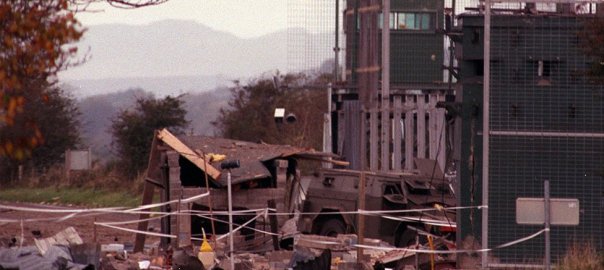



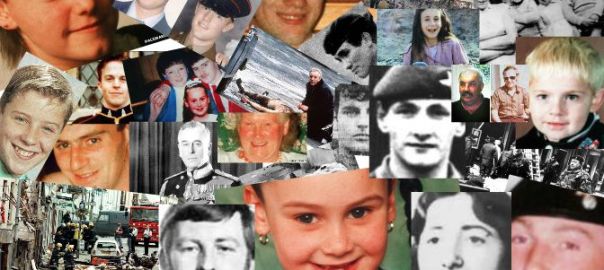







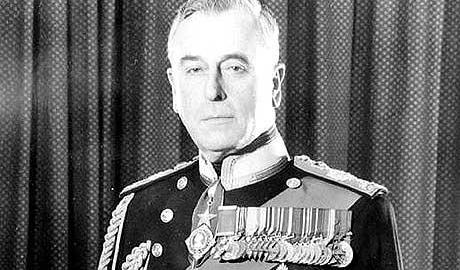


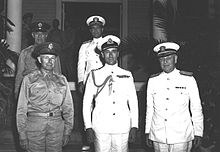


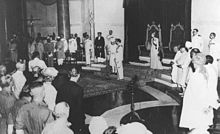
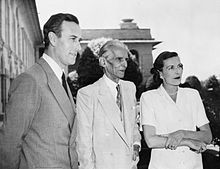


_ribbon.png)


_ribbon_-vector.svg)


_ribbon.png)


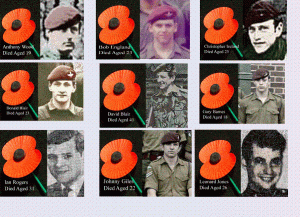
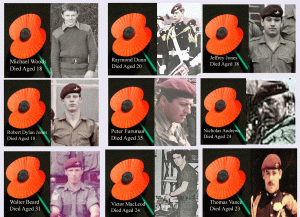

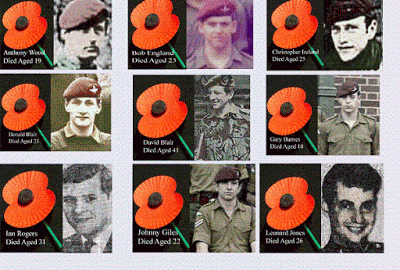


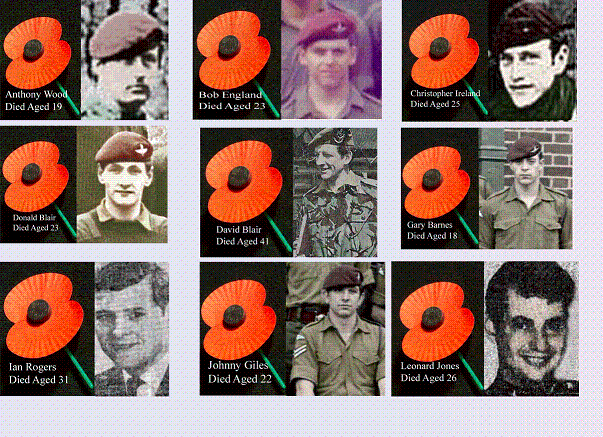
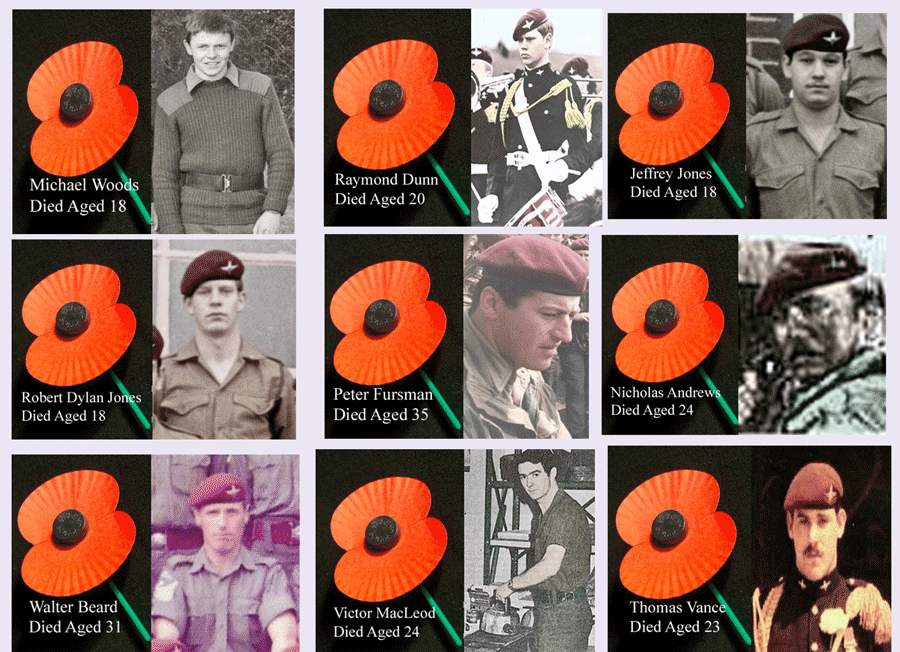
![[ 2 Para Remember ]](https://i0.wp.com/www.parachuteregiment-hsf.org/Warren-Point.gif)

![[ Private Thomas R. Vance ]](https://i0.wp.com/www.parachuteregiment-hsf.org/Pte-Thomas-Vance.gif)


![[ Private Gary I. Barnes ]](https://i0.wp.com/www.parachuteregiment-hsf.org/Barns.gif)


![[ Corporal Leonard Jones ]](https://i0.wp.com/www.parachuteregiment-hsf.org/Leonard_Jones.gif)
![[ Private Robert D. Vaughan-Jones ]](https://i0.wp.com/www.parachuteregiment-hsf.org/VJ.gif)
![[ Lance Corporal Donald F. Blair ]](https://i0.wp.com/www.parachuteregiment-hsf.org/Donald%20Blair.JPG)
![[ Private Raymond Dunn ]](https://i0.wp.com/www.parachuteregiment-hsf.org/Pte_Dunn.gif)
![[ Private Michael Woods ]](https://i0.wp.com/www.parachuteregiment-hsf.org/M_Woods.gif)
![[ Major Peter Fursman ]](https://i0.wp.com/www.parachuteregiment-hsf.org/Fursman.gif)
![[ Lance Corporal Chris G. Ireland ]](https://i0.wp.com/www.parachuteregiment-hsf.org/Chris-Irelands.gif)

![[ Warrant Officer Walter Beard ]](https://i0.wp.com/www.parachuteregiment-hsf.org/Wally_Beard.gif)




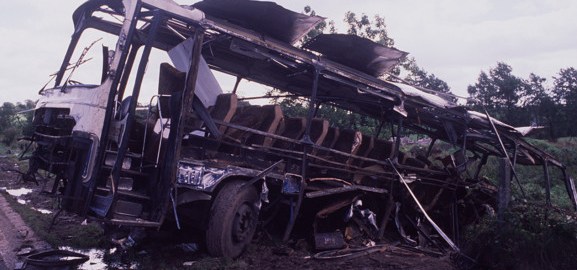

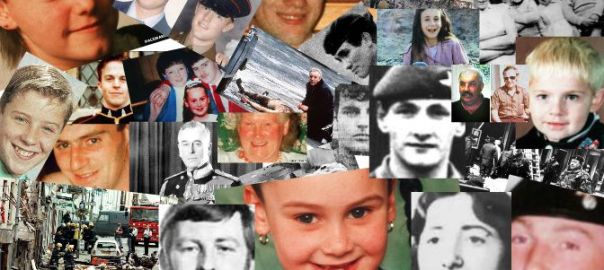





 belfastchildis.com


.jpg)


