Category Archives: Deaths in the Troubles

29th April – Deaths & Events in Northern Ireland Troubles

Key Events & Deaths on this day in Northern Ireland Troubles

29th April

—————————————–

Thursday 29 April 1976

An off-duty member of the Ulster Defence Regiment (UDR) and a Protestant civilian died as a result of an Irish Republican Army (IRA) attack near Dungannon, County Tyrone.

Friday 29 April 1977

Ian Paisley, then leader of the Democratic Unionist Party (DUP), warned in a statement that if the British authorities failed to alter its policies then loyalists might have to consider taking over the administration of Northern Ireland. He also called for people to consider a rent, rates and Value Added Tax (VAT) strike.

A meeting was held in Harland and Wolff shipyard at which a large majority of workers voted not to support the planned UUAC strike.

In addition workers at the Ballylumford power station made it clear that they would only support the stoppage if it obtained clear support across all sectors of Northern Ireland industry.

Following a request by Roy Mason, then Secretary of State, it was announced that extra British soldiers would be sent to Northern Ireland to maintain law and order in anticipation of the UUAC strike taking place.

[1,200 soldiers arrived on 1 May 1977.]

It was reported that approximately 200 Ulster Defence Association (UDA) men from Scotland along with 50 more from Liverpool had arrived in Belfast to support the strike planned by the UUAC.

Monday 29 April 1991

CLMC Ceasefire

The ceasefire announced on 17 April 1991 by the Combined Loyalist Military Command (CLMC) began at midnight.

 The ceasefire was ended by the CLMC on 4 July 1991

Wednesday 29 April 1992

Political Talks Recommenced The political talks (later known as the Brooke / Mayhew talks) recommenced at Stormont with the four main political parties making opening statements.

Saturday 29 April 1995

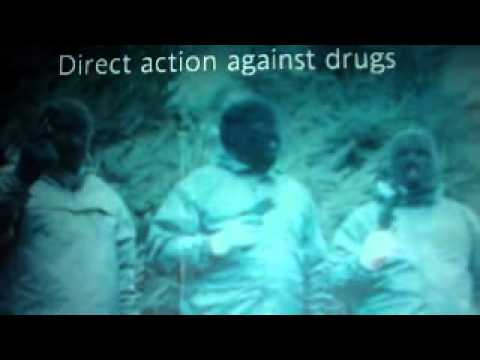
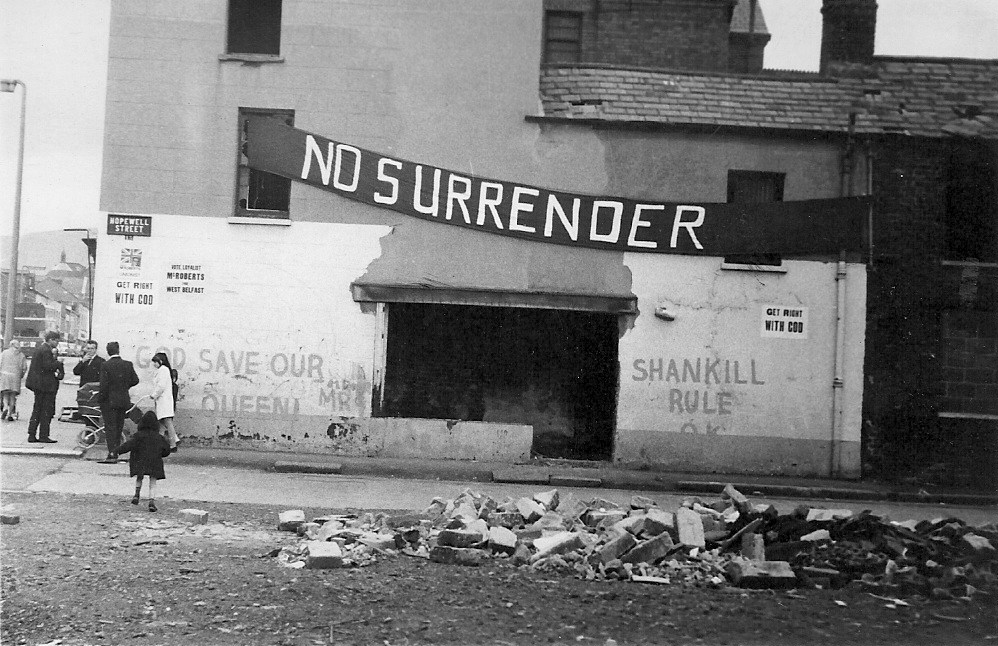
The Royal Ulster Constabulary (RUC) closed an illegal drinking den in the Shankill Road area of Belfast. Following the closure four vehicles were set on fire.

Monday 29 April 1996

Dick Spring, then Tánaiste (deputy Irish Prime Minister and Minister for Foreign Affairs), made a proposal that the issue of decommissioning should become a ‘fourth strand’ in the proposed all-party talks.

Tuesday 29 April 1997

Ulster Volunteer Force (UVF) and Ulster Freedom Fighters (UFF) prisoners caused a riot and staged a protest on top of the roofs of blocks H1 and H2 in the Maze Prison.

There were protesting at the tighter security rules that were approved on 28 April 1997. The Loyalist prisoners said that the new rules should only apply to Republican prisoners.

John Major, then British Prime Minister, in an article in the Irish Times said that “some decommissioning would have to take place during talks” but he indicated that Sinn Féin (SF) could enter the talks when there was an Irish Republican Army (IRA) ceasefire.

Wednesday 29 April 1998

Further allegations were made that there had been collusion between the security forces and Loyalists in the killing of Pat Finucane on 12 February 1989. Sir Kenneth Bloomfield, then Northern Ireland Victims Commissioner, published his report, We Will Remember Them, on the victims of the conflict in Northern Ireland.

See Pat Finucane

The European Parliament welcomed a joint presentation on Northern Ireland from Marjorie (Mo) Mowlam, then Secretary of State for Northern Ireland, and David Andrews, then Irish Foreign Minister.

4The MEPs then listened in silence as Ian Paisley, then leader of the Democratic Unionist Party (DUP), declared that: “Ulster people will not be bullied and will not be bribed”.

Thursday 29 April 1999

A survey on behalf of the Parades Commission showed that of those questioned 82 per cent wanted the Orange Order to engage in talks with the Commission about the issue of contentious parades.

Saturday 29 April 2000

Patrick Neville (31), a civilian from the Republic of Ireland, was found shot dead on a stairway in a block of flats near to his home in Inchicore, Dublin. It was believed that the Irish National Liberation Army (INLA) was responsible for his killing.

[His death was linked to the killing of Patrick Campbell on 10 October 1999.]

———————————————

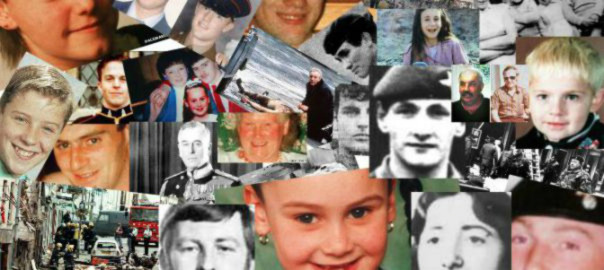
Remembering all innocent victims of the Troubles

Today is the anniversary of the death of the following people killed as a results of the conflict in Northern Ireland

“To live in hearts we leave behind is not to die

– Thomas Campbell

To the innocent on the list – Your memory will live forever

– To the Paramilitaries –

There are many things worth living for, a few things worth dying for, but nothing worth killing for.

 11  People lost their lives on the 29th  April   between 1972– 2000

———————————————–

29 April 1972

Rosaleen Gavin,   (8)

Catholic
Status: Civilian (Civ),

Killed by: Irish Republican Army (IRA)
Shot during sniper attack on British Army (BA) base, Oldpark Road, Belfast.

———————————————–

29 April 1973


Graham Cox,  (19)

nfNI
Status: British Army (BA),

Killed by: Irish Republican Army (IRA)
Shot by sniper while on British Army (BA) mobile patrol, New Lodge Road, Belfast.

———————————————–

29 April 1976
 Edmund Stewart   (31)

Protestant
Status: Ulster Defence Regiment (UDR),

Killed by: Irish Republican Army (IRA)
Off duty. Shot while visiting a friend’s farm, Dunamony, near Dungannon, County Tyrone

———————————————–

29 April 1976
Stanley Arthurs   (43)

Protestant
Status: Civilian (Civ),

Killed by: Irish Republican Army (IRA)
Shot, together with off duty Ulster Defence Regiment member, at his farm, Dunamony, near Dungannon, County Tyrone. He died 3 May 1976

———————————————–

29 April 1977
Eric Shiells   (49)

Protestant
Status: Ulster Defence Regiment (UDR),

Killed by: Irish Republican Army (IRA)
Off duty. Shot outside his home, Northland Row, Dungannon, County Tyrone.

———————————————–

29 April 1979
Samuel Gibson   (52)

Protestant
Status: Ulster Defence Regiment (UDR),

Killed by: Irish Republican Army (IRA)
Off duty. Shot by sniper while driving to work, Edendork, near Coalisland, County Tyrone

———————————————–

29 April 1980
George Kerr   (44)

Protestant
Status: Civilian (Civ),

Killed by: non-specific Loyalist group (LOY)
Shot at his home, Chadolly Street, off Newtownards Road, Belfast.

———————————————–

29 April 1984


Thomas McGeary   (48)

Catholic
Status: Civilian (Civ),

Killed by: non-specific Republican group (REP)
Killed by booby trap bomb attached to his car, while driving along Old Moy Road, Drumarn, near Armagh.

———————————————–

29 April 1992


Conor Maguire   (22)

Catholic
Status: Irish People’s Liberation Organisation (IPLO),

Killed by: Ulster Volunteer Force (UVF)
Shot at his workplace, Ligoniel Improvements Association, Conneywarren Lane, Ligoniel, Belfast.

———————————————–

29 April 1994
 Michael Brown   (23)

nfNI
Status: Irish Republican Army (IRA),

Killed by: Irish Republican Army (IRA)
From County Leitrim. Found shot, by the side of Omeath Road, near Newry, County Down. Alleged informer

———————————————–

29 April 2000
Patrick Neville   (31)

nfNIRI
Status: Civilian (Civ),

Killed by: Irish National Liberation Army (INLA)
Found shot on stairway in block of flats, near to his home, St. Michael’s estate, Inchicore, Dublin. (His death was linked to the killing of Patrick Campbell on 10 October 1999.)

———————————————–

Source: CAIN Web Service

28th April – Deaths & Events in Northern Ireland Troubles

Key Events & Deaths on this day in Northern Ireland Troubles

                                                                                           28th April

—————————–

Monday 28 April 1969

As he was unable to regain the confidence of the Unionist party Terence O’Neill, then Northern Ireland Prime Minister, resigned to be replaced later by James Chichester-Clark.

Monday 28 April 1975

Liam McMillan (48), then a member of the Official Irish Republican Army (OIRA), was shot dead by the People’s Liberation Army (PLA) in the continuing feud between the OIRA and the INLA.

A Protestant civilian was shot dead by Loyalists in Belfast. His Catholic workmate had been the intended target.

Wednesday 27 April 1977

A series of personal attacks on one another by leading figures such as Enoch Powell, James Molyneaux, and Ian Paisley, illustrated the growing disagreement within unionism on the issue of the planned United Unionist Action Council (UUAC) strike.

Roy Mason, then Secretary of State, announced that the Harland and Wolff shipyard in Belfast was to receive an order worth some £70 million to co

nstruct two liquid gas carriers.

Tuesday 28 April 1981

The private secretary of Pope John Paul II paid a visit to Bobby Sands in the Maze Prison but was unable to persuade him to end his hunger strike.

Humphrey Atkins, then Secretary of State for Northern Ireland, stated that: “If Mr Sands persisted in his wish to commit suicide, that was his choice. The government would not force medical treatment upon him.” In the United States of America (USA) Ronald Reagan, then President of the USA, said that America would not intervene in the situation in Northern Ireland but he was “deeply concerned” at events there.

Thursday 28 April 1988

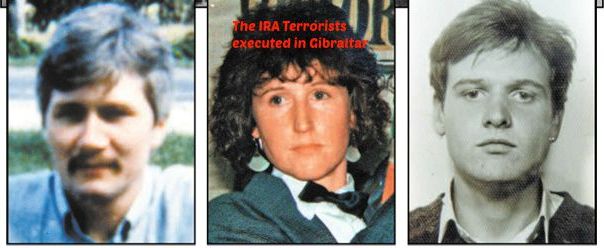
A Thames Television documentary, Death on the Rock, about the deaths of the three Irish Republican Army (IRA) members in Gilbraltar on 6 March 1988 was screened. Sir Geoffrey Howe, then British Foreign Secretary, unsuccessfully tried to have the programme banned.

gib3 with text

See Operation Flavius

Tuesday 28 April 1992

Philomena Hanna (26), a Catholic civilian, was shot dead by the Ulster Freedom Fighters (UFF), a cover name (pseudonym) used by the Ulster Defence Association (UDA), at her place of work – a chemist shop on the Springfield Road, west Belfast.

[There was widespread condemnation at the killing of a woman whose work meant that she delivered medical supplies to both communities in the area.]

Wednesday 28 April 1993

Ian Paisley, then leader of the Democratic Unionist Party (DUP), said that he would not enter new political talks.

Thursday 28 April 1994

James Brown (47), a Catholic civilian, was shot dead by the Ulster Volunteer Force (UVF) at his shop, Garmoyle Street, Docks, Belfast.

Eric Smyth (40), an ex-member of the Ulster Defence Regiment (UDR), was shot dead by the Irish Republican Army (IRA) outside his home, Salters Grange Road, near Armagh.

Mitchell McLaughlin, then Sinn Féin (SF) chairman, was given a United States visa to allow him into the USA to speak at a conference in Cleveland, Ohio.

The Iranian Chargé d’Affaires was summoned to the Foreign Office, London, to explain claims that the government in Iran was planning to supply the Irish Republican Army (IRA) with arms and money.

Friday 28 April 1995

Catholic Civilian Killed by IRA

Michael Mooney (34), a Catholic civilian, was shot dead while in the ’18 Steps Bar’, Ann Street, Belfast.

[Although no organisation claimed responsibility it was generally believed that the Irish Republican Army (IRA) had carried out the killing. It was alleged that Mooney was involved in drug dealing and this was the reason why he had been shot. A number of other men were killed by the IRA during the year. The Royal Ulster Constabulary (RUC) issued a statement on 20 December 1995 about the killings.]

There was a ceremony in Dublin to commemorate all Irishmen who had died in the two world wars. The ceremony was attended by: John Bruton, then Taoiseach (Irish Prime Minister), Patrick Mayhew, then Secretary of State for Northern Ireland, Ken Maginnis, then Security Spokesman of the Ulster Unionist Party (UUP), and John Alderdice, then leader of the Alliance Party of Northern Ireland (APNI).

Tom Hartley, then Chairman of Sinn Féin (SF), also attended the ceremony.

Sunday 28 April 1996

Michael Ancram, then Political Development minister at the Northern Ireland Office (NIO), said that the Irish Republican Army (IRA) must restore its ceasefire and Sinn Féin (SF) must agree to be bound by the six ‘Mitchell Principles’ before it could join all-party talks.

The Royal Ulster Constabulary (RUC) stopped a group of Orangemen from marching through the lower Ormeau Road in Belfast. This decision led to a two-hour stand-off.

Monday 28 April 1997

A car bomb was planted by Loyalist paramilitaries outside the Falls Road office of Sinn Féin (SF).

The bomb was defused. Irish National Liberation Army (INLA) prisoners at Maghaberry Prison held a prison officer hostage at gunpoint before giving themselves up. The prisoners were protesting at the transfer of Billy Wright, then leader of the Loyalist Volunteer Force (LVF), from Maghaberry to the Maze Prison.

[The INLA killed Wright in the Maze Prison on 27 December 1997.]

Patrick Mayhew, then Secretary of State for Northern Ireland, approved tighter security measures in the Maze Prison following the discovery of an escape tunnel on 24 March 1997.
John Major, then British Prime Minister, paid an election campaign visit to Belfast. Tony Blair, then leader of the Labour Party, called on the Irish Republican Army (IRA) to renew their ceasefire and to agree to the Mitchell principles, and then to “take their place at the talks table”.

Tuesday 28 April 1998

It was confirmed that Chris Patten, a former Governor of Hong Kong, would chair the new Commission on the future role of the Royal Ulster Constabulary (RUC). The Ulster Unionist Party (UUP) had objected to the appointment of an “non British” person to head the Commission.

Wednesday 28 April 1999

A pipe-bomb exploded in the car park of the Ramble Inn, situated on the main Antrim to Ballymena Road. Several cars damaged, but there were no injuries.

The Loyalist paramilitary group the Orange Volunteers (OV) claimed responsibility for the attack.

John Stevens, then Deputy Commissioner of the Metropolitan Police, stated that during one of his earlier investigations of collusion between Loyalists paramilitaries and the security forces had found a connection to the killing of Pat Finucane that had caused him “concern”.
The Northern Ireland (Location of Victims’ Remains) Bill was presented to the House of Commons at Westminster.

[The Bill became law in late May 1999. The first body was recovered on 28 May 1999.]

———————————————

Remembering all innocent victims of the Troubles

Today is the anniversary of the death of the following people killed as a results of the conflict in Northern Ireland

“To live in hearts we leave behind is not to die

– Thomas Campbell

To the innocent on the list – Your memory will live forever

– To the Paramilitaries –

There are many things worth living for, a few things worth dying for, but nothing worth killing for.

 9 People lost their lives on the 28th  April   between 1973– 1995

———————————————–

28 April 1973
Kerry Venn (23)

nfNI
Status: British Army (BA),

Killed by: Irish Republican Army (IRA)
Shot by sniper while on British Army (BA) foot patrol, Carn Hill, Shantallow, Derry.

———————————————–

28 April 1975


Liam McMillen    (48)

Catholic
Status: Official Irish Republican Army (OIRA),

Killed by: People’s Liberation Army (PLA)
Shot while walking along Falls Road at the junction with Spinner Street, Belfast. Official Irish Republican Army (OIRA) / Irish Nationalist Liberation Army (INLA) feud.

———————————————–

28 April 1975
Samuel Grierson   (25)

Protestant
Status: Civilian (Civ),

Killed by: Ulster Defence Association (UDA)
Shot while working on railway line, near Donegall Road, Belfast. Catholic workmate the intended target.

———————————————–

28 April 1981
Richard McKee   (27)

Protestant
Status: Ulster Defence Regiment (UDR),

Killed by: Irish Republican Army (IRA)
Shot by sniper while travelling in British Army (BA) civilian-type van, Dublin Road, Castlewellan, County Down.

———————————————–

28 April 1987

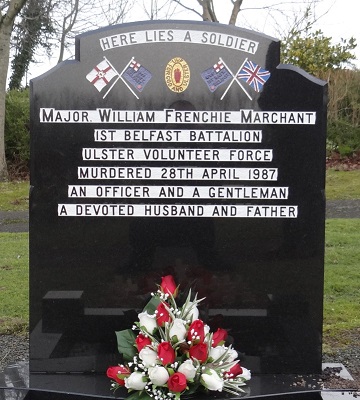
William ” Frenchie” Marchant (39)

Protestant
Status: Ulster Volunteer Force (UVF),

Killed by: Irish Republican Army (IRA)
Shot from passing car while standing outside Progressive Unionist Party office, Shankill Road, Belfast.

See William ” Frenchie” Marchant 

———————————————–

28 April 1992


Philomena Hanna   (26)

Catholic
Status: Civilian (Civ),

Killed by: Ulster Freedom Fighters (UFF)
Shot at her workplace, chemist shop, Springfield Road, Belfast.

———————————————–

28 April 1994


James Brown   (47)

Catholic
Status: Civilian (Civ),

Killed by: Ulster Volunteer Force (UVF)
Shot, at his shop, Garmoyle Street, Docks, Belfast.

———————————————–

28 April 1994
Eric Smyth  (40)

Protestant
Status: ex-Ulster Defence Regiment (xUDR),

Killed by: Irish Republican Army (IRA)
Shot, outside his home, Salters Grange Road, near Armagh.

———————————————–

28 April 1995
Michael Mooney   (34)

Catholic
Status: Civilian (Civ),

Killed by: Irish Republican Army (IRA)
Shot, while in 18 Steps Bar, Ann Street, Belfast.

———————————————–


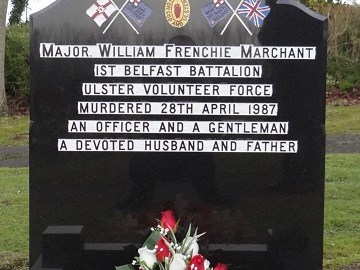
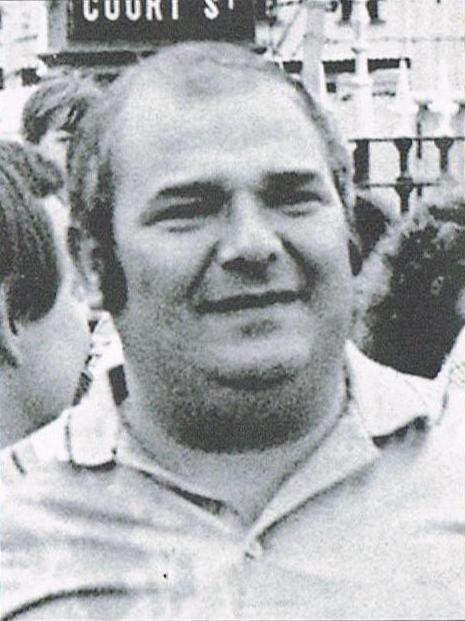
William “Frenchie” Marchant 1948 – 28 April 1987

William ” Frenchie ”  Marchant

Frenchie_Marchant

1948 – 1987


Disclaimer 

The views and opinions expressed in these pages/documentaries are soley intended to educate and provide background information to those interested in the Troubles of Northern Ireland. They in no way reflect my own opinions and I take no responsibility for any inaccuracies or factual errors.

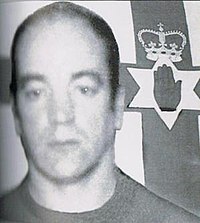
William “Frenchie” Marchant (c. 1948 – 28 April 1987) was a Northern Irish loyalist and a high-ranking volunteer in the Ulster Volunteer Force (UVF).

He was on a Garda list of suspects in the 1974 Dublin car bombings which left a total of 26 people dead and close to 300 injured. Marchant was allegedly the leader of the Belfast UVF unit known as “Freddie and the Dreamers” which hijacked and stole the three cars which were used in the bombings.

Nine days after the bombings he was arrested and interned at the Maze Prison in relation to the bombings. When questioned by detectives regarding the latter he refused to answer. He was never brought to trial due to lack of evidence. Marchant held the rank of major in the UVF’s A Company, 1st Battalion Belfast Brigade. He was shot to death by a Provisional IRA volunteer from a passing car as he stood outside “The Eagle” chip shop below the offices where the UVF Brigade Staff had their headquarters on the Shankill Road.

Dublin car bombings

A green 1970 model Hillman Avenger was one of the hijacked cars used in the Dublin bombings. It exploded in Parnell Street, killing 10 people.
Marchant was born in Belfast, Northern Ireland in about 1948. He grew up in the Ulster loyalist Shankill Road neighbourhood and was brought up as a Protestant. Some time prior to 1974, he joined the Ulster Volunteer Force (UVF), an illegal loyalist paramilitary organisation. He held the rank of major in its A Company, 1st Battalion Belfast Brigade. Marchant’s nickname was “Frenchie”.


Dublin and Monaghan bombings victim

Two units from the UVF’s Belfast and Mid-Ulster Brigades exploded three no-warning car bombs in Dublin’s city centre on 17 May 1974, the third day of the Ulster Workers Council Strike.

This was a general strike in Northern Ireland called by hard-line unionists, who opposed the Sunningdale Agreement and the Northern Ireland Assembly which had proposed their sharing political power with nationalists and planned a role for the Republic of Ireland in the governance of Northern Ireland. The explosions occurred almost simultaneously during evening rush hour resulting in the deaths of 26 people, mostly young women; close to 300 people were injured, many maimed and scarred for life.

According to former British soldier and psychological warfare operative Colin Wallace, the bombings had been organised by Billy Hanna, the Mid-Ulster Brigade’s commander at the time.

The three cars used in the attacks had been stolen and hijacked that morning in Belfast by a UVF unit known as “Freddie and the Dreamers” (named after the 1960s English pop group) allegedly led by Marchant, and then, according to the 1993 Yorkshire Television documentary The Hidden Hand: The Forgotten Massacre, driven to a farm in Glenanne, County Armagh. This farm, which had been used to make and store the bombs, was owned by Royal Ulster Constabulary (RUC) reservist James Mitchell of the Glenanne gang.

See Dublin and Monaghan Bombings

———————————–

Dublin Monaghan Bombings 1974 – First Tuesday -1993

———————————–


After the cars were delivered to the waiting bomb unit, the latter drove them across the border down to the Coachman’s Inn pub carpark. Journalist Joe Tiernan suggested that the cars were driven directly to the North Dublin carpark, with only one stop in Portadown by one of the cars to collect David Alexander Mulholland, one of the alleged bombers.

Robin  “the Jackal ” Jackson


It was at the carpark that the three bombs, which had been transported in a chicken lorry by senior Mid-Ulster UVF member Robin “the Jackal” Jackson, were placed inside the boots of the cars by Hanna and Jackson. The cars – a metallic green 1970 model Hillman Avenger and blue Austin 1800 Maxi – that ended up in Parnell Street and South Leinster Street had been hijacked while the metallic blue mink Ford Escort which detonated in Talbot Street had been stolen from Belfast’s docks area. All three cars had retained their original registration numbers.

The Hidden Hand: The Forgotten Massacre named Marchant as having been on a Garda Síochána list of suspects as the leader of the gang which obtained the bomb cars.[12]

Ninety minutes after the Dublin blasts, another car bomb exploded in Monaghan, causing a further seven deaths. A detective from Dublin’s Store Street Garda Station received confidential information that Marchant had masterminded both the Dublin and Monaghan attacks.

On 26 May, he was arrested by the Northern Ireland security forces under the Northern Ireland (Emergency Provision) Act 1974 and interned at the Maze Prison on an Interim Custody Order partly on suspicion of having participated in the car bombings. He was interrogated by detectives but refused to reply to any questions relating to the Dublin bombings.

Marchant and the others who had also been interned as suspects in the attacks, were never brought to trial due to lack of evidence. The RUC Special Branch, in a reply dated 23 July 1974 to an earlier Garda enquiry regarding Marchant, stated that Marchant “was our guest for a number of hours (and CID) but with negative result”.

The Barron Report which was the findings of the official investigation into the car bombings commissioned by Irish Supreme Court Justice Henry Barron confirmed that Marchant was named in the Garda files as the leader of the gang which provided the bomb cars.  Colin Wallace briefed the media without attribution, identifying Marchant as the person responsible for the car hijackings and theft, based on his own information.

In a written statement to Justice For the Forgotten (an organisation of victims and relatives seeking justice for the Dublin and Monaghan bombings), Wallace maintained that Marchant was “identified to [British] Army Intelligence as a Special Branch source being run by a named officer”. When queried by the organisation’s legal team, Wallace qualified the statement by adding:

“That’s right, that was my belief…there were a number of Special Branch people who at this time appeared to have very close links with various loyalist groups. I’m not saying for good or ill, but certainly had close links with key loyalists. Marchant may well have been an informant, but I don’t know”.


Peter Taylor


Many years later, journalist Peter Taylor questioned Progressive Unionist Party politician and former senior Belfast UVF member David Ervine about UVF motives for bombing Dublin in 1974. He replied they [UVF] were “returning the serve”. Although Ervine said he had nothing to do with the bombings, he said they were carried out to make Catholics in the Republic suffer as Protestants in Northern Ireland had been suffering as the result of the IRA bombing campaign.

As of 2015, nobody has ever been convicted of the Dublin and Monaghan bombings.

Supergrass trials

In the mid-1980s Marchant was one of a number of leading UVF figures arrested on the evidence of William “Budgie” Allen, a UVF member who turned supergrass and provided evidence on the activities of a number of his fellow members.

Initially held in 1983, Marchant was granted bail in order to marry although he failed to return and was eventually rearrested after a high speed pursuit through the Shankill Road.

Based on Allen’s evidence Marchant faced a number of charges, including the attempted murder of a member of Gerry Adams’ family. However, although he was held in custody for eighteen months, Marchant was released from prison in 1985 after the Allen trial collapsed.

Although he had appeared before Belfast’s Crumlin Road Crown Court, the case against him and the others had collapsed when the judge decided Allen’s evidence was “”totally unreliable”. Allen was declared persona non grata by the UVF, who announced that he would be killed if he left his hiding place in England, although Marchant surprisingly announced that he personally forgave Allen.

Killing

 Marchant commemorated, along with Trevor King and Davy Hamilton, on the Shankill Road at the corner of Spier’s Place. Marchant was shot dead by IRA gunmen from a passing car as he stood outside “The Eagle” chip shop on the crowded Shankill Road on 28 April 1987. The UVF Brigade Staff had their headquarters in the rooms above the shop.
The shooting took place close to the offices of the Progressive Unionist Party (PUP). Marchant’s fatal shooting was in retaliation for the UVF’s killing of Larry Marley, a close friend of Sinn Féin President Gerry Adams and a senior IRA member from Ardoyne, less than a month before.
The IRA claimed in a statement that Marchant had been directly involved in the killing of Marley.
On 1 May 1987, Marchant was given a full UVF paramilitary funeral.  The address given at his funeral service, which denounced all paramilitary organisations and their acts of violence, was afterwards praised by Roman Catholic bishop Cathal Daly.
Marchant’s widow later gave her permission for their son to go to the USA for an ecumenical student exchange visit.
George Seawright, Independent Unionist candidate, June 1987, UK General Election, 19870603GS1 Copyright Image from Victor Patterson, 54 Dorchester Park, Belfast, UK, BT9 6RJ Tel: +44 28 9066 1296 Mob: +44 7802 353836 Voicemail +44 20 8816 7153 Skype: victorpattersonbelfast Email: victorpatterson@me.com Email: victorpatterson@ireland.com (back-up) IMPORTANT: If you wish to use this image or any other of my images please go to www.victorpatterson.com and click on the Terms & Conditions. Then contact me by email or phone with the reference number(s) of the image(s) concerned.

See George Seawright

George Seawright, a member of Belfast City Council who also maintained clandestine UVF membership, stated in the aftermath of Marchant’s shooting that he had “no hesitation in calling for revenge and retribution”. Several months after Marchant’s shooting, the UVF sought to avenge his death with an attempt on the life of Anthony “Booster” Hughes, a suspected IRA man from Ardoyne.

According to author and journalist Martin Dillon, Marchant’s daily movements leading up to his death had been unpredictable and erratic; this indicated the possibility that just before his shooting someone had alerted the IRA by telephone, advising them of Marchant’s presence on the Shankill Road.

The IRA would normally have kept a hit squad on standby in a neighbourhood close to
where their intended target was likely to be.
See John Bingham
Marchant’s killing was the third assassination carried out in the 1980s by the IRA against senior UVF members. The UVF conducted an internal inquiry in an attempt to establish whether someone within the organisation had supplied information to the IRA which had led to the killings of Marchant and the other two: Lenny Murphy and John Bingham.

Although the inquiry revealed that Marchant – as well as Murphy and Bingham – had quarrelled with powerful West Belfast UDA fund-raiser James Pratt Craig before their deaths, the UVF Brigade Staff did not consider the evidence sufficient to warrant an attack against Craig, who ran a large protection racket.

According to Dillon, Marchant had been due to meet Craig outside “The Eagle” before he was shot dead. Instead of getting out of the car at the chip shop where Marchant waited, Craig got out at the Inter-City furniture shop on the corner of Conway Street. There he engaged in conversation with another person for five minutes. Within the five minutes, Marchant was gunned down just 50 yards away. In October 1988, Craig was shot to death in an East Belfast pub by the UDA (using their cover name Ulster Freedom Fighters) for “treason”, claiming that he had been involved in the death of UDA leader John McMichael, who was blown up the previous December in a booby-trap car bomb planted by the IRA.

Steve Bruce disputes the claim that Craig was involved in Marchant’s death and quotes another (anonymous) UVF member who stated that Marchant was “like a bloody cigar store Indian”, spending long periods standing outside the PUP headquarters taking to various people.

At the junction of Spier’s Place and the Shankill Road, there is a mural and memorial plaque commemorating Marchant

27th April – Deaths & Events in Northern Ireland Troubles

Key Events & Deaths on this day in Northern Ireland Troubles

27th April

————————————————-

Saturday 27 April 1968

The Northern Ireland Civil Rights Association (NICRA) held a rally to protest at the banning of a Republican Easter parade.

Sunday 27 April 1975


Three Catholic civilians were shot dead by the Protestant Action Force (PAF), which was a covername used by the Ulster Volunteer Force (UVF), during an attack on a social club, Bleary, near Lurgan, County Down.

Wednesday 27 April 1983

Fianna Fáil (FF), then in opposition in the Dáil, managed to have an anti-abortion amendment to the Irish constitution carried by 87 votes to 13.

[The amendment was the subject of a referendum on 8 September 1983.]

Thursday 27 April 1989

Bob Cooper was appointed to head the new Fair Employment Commission (FEC). The Northern Ireland Office refused to provide compensation to Gerry Adams, then President of Sinn Féin (SF), for injuries received when he was shot and wounded by Loyalist gunmen in 1984.

Friday 27 April 1990

The convictions of the ‘Winchester Three’ were overturned by the Court of Appeal in England. The three people had been sentenced for conspiring to murder Tom King, a former Secretary of State for Northern Ireland. Upon their release the three people were arrested and deported from Britain under the Prevention of Terrorism legislation.

Monday 27 April 1992

There was an announcement at the Anglo-Irish Intergovernmental Conference (AIIC) that there would be a three-month suspension of its meetings to allow the political talks (later known as the Brooke / Mayhew talks) to recommence.

Differences however emerged between the British and Irish governments with Sir Patrick Mayhew, then Secretary of State for Northern Ireland, and David Andrews, then Irish Minister of Foreign Affairs, publicly disagreeing as to whether, amongst other things, the Government of Ireland Act was open for discussion

Tuesday 27 April 1993

James Molyneaux, then leader of the Ulster Unionist Party (UUP), stated that he would not enter new political talks while the Social Democratic and Labour Party (SDLP) was in talks with Sinn Féin (SF).

Wednesday 27 April 1994

Gerald Evans (43), a Protestant civilian, was shot dead by the Irish National Liberation Army (INLA) at his shop, Northcott Shopping Centre, Ballyclare Road, Glengormley, near Belfast.

Paul Thompson (25), a Catholic civilian, was shot dead by the Ulster Freedom Fighters (UFF), a cover name (pseudonym) used by the Ulster Defence Association (UDA), while he sat in a stationary taxi, outside house, Springfield Park, Ballymurphy, Belfast.

Thursday 27 April 1995

The Royal Ulster Constabulary (RUC) warned that Loyalist paramilitaries had moved into the drugs trade. [Loyalist leaders warned their members about drug dealing on 11 May 1995.]

Sunday 27 April 1997

Robert Hamill, a Catholic civilian, was severely beaten in a sectarian attack by a gang of up to 30 loyalists in the centre of Portadown, County Armagh.

[Hamill died from head injuries on 8 May 1997.]

Royal Ulster Constabulary (RUC) officers were present close to the scene of the attack in a police vehicle some 30 meters away and were accused by witnesses and Hamill’s family of not intervening to save him.

[The Independent Commission for Police Complaints later began an investigation into the incident.]

A teenager from Lurgan was shot and injured by a plastic bullet which was fired by the British Army.

The RUC prevented an Orange march from walking through the Nationalist lower Ormeau Road area of Belfast. The Orangemen staged a protest for several hours at the police line.

Bertie Ahern, then leader of Fianna Fáil (FF), criticised John Bruton, the Taoiseach (Irish Prime Minister), for his handling of the peace process.

Monday 27 April 1998

Sinn Féin (SF) representatives travelled to London to attend a meeting with Tony Blair, then British Prime Minister, in Downing Street. Afterwards Gerry Adams, then President of SF, described the meeting as “constructive” and said that his party would “keep moving forward” in the search for peace in Northern Ireland.

Tuesday 27 April 1999

Marjorie (Mo) Mowlam, then Secretary of State for Northern Ireland, travelled to Dublin to sign a new British-Irish agreement which dealt with the issue of the recovery of the bodies of the ‘disappeared’. The agreement established a three-member commission to receive information about the burial sites of the victims of paramilitary killings.


———————————————

Remembering all innocent victims of the Troubles

Today is the anniversary of the death of the following people killed as a results of the conflict in Northern Ireland

“To live in hearts we leave behind is not to die

– Thomas Campbell

To the innocent on the list – Your memory will live forever

– To the Paramilitaries –

There are many things worth living for, a few things worth dying for, but nothing worth killing for.

 10 People lost their lives on the 27th April   between 1973– 1994

———————————————–

27 April 1973
Anthony Goodfellow   (26)

nfNI
Status: British Army (BA), K

illed by: Official Irish Republican Army (OIRA)
Shot by sniper while at British Army (BA) Vehicle Check Point (VCP), Westway, Creggan, Derry.

———————————————–

27 April 1975


 Joseph Toman   (45)

Catholic
Status: Civilian (Civ),

Killed by: Protestant Action Force (PAF)
Shot during gun attack on social club, Bleary, near Lurgan, County Down.

———————————————–

27 April 1975


John Feeney   (45)

Catholic
Status: Civilian (Civ),

Killed by: Protestant Action Force (PAF)
Shot during gun attack on social club, Bleary, near Lurgan, County Down.

———————————————–

27 April 1975


Brendan O’Hara   (40)

Catholic
Status: Civilian (Civ),

Killed by: Protestant Action Force (PAF)
Shot during gun attack on social club, Bleary, near Lurgan, County Down

———————————————–

27 April 1976
Mathew Campbell   (22)

Catholic
Status: Civilian (Civ),

Killed by: non-specific Loyalist group (LOY)
Died three days after being injured in bomb attack on Ulster Bar, Warrenpoint, County Down.

———————————————–

27 April 1981


Gary Martin   (28)

Protestant
Status: Royal Ulster Constabulary (RUC),

Killed by: Irish National Liberation Army (INLA)
Killed by booby trap bomb hidden in abandoned lorry, junction of Shaw’s Road and Glen Road, Andersonstown, Belfast.

———————————————–

27 April 1982


Leslie Hamilton   (37)

Protestant
Status: Ulster Defence Regiment (UDR),

Killed by: Irish Republican Army (IRA)
Off duty. Shot while delivering bread to Long’s Supermarket, Lisnagelvin, Derry.

———————————————–

27 April 1990


Kenneth Graham  (46)

Protestant
Status: Civilian (Civ),

Killed by: Irish Republican Army (IRA)
Killed by booby trap bomb attached to his car outside his home, Newry Road, Kilkeel, County Down. Contractor to British Army (BA) / Royal Ulster Constabulary (RUC

———————————————–

27 April 1994
Gerard Evans  (43)

Protestant
Status: Civilian (Civ),

Killed by: Irish National Liberation Army (INLA)
Shot, at his shop, Northcott Shopping Centre, Ballyclare Road, Glengormley, near Belfast, County Antrim.

———————————————–

27 April 1994

Paul Thompson   (25)

Catholic
Status: Civilian (Civ),

Killed by: Ulster Freedom Fighters (UFF)
Shot, while sitting in stationary taxi, outside house, Springfield Park, Ballymurphy, Belfast.

———————————————–


26th April – Deaths & Events in Northern Ireland Troubles

Key Events & Deaths on this day in Northern Ireland Troubles

26th April

———————————————

Saturday 26 April 1969 Loyalist Bomb

There was another explosion at a water pipeline carrying supplies to Belfast.

[It was later established that the bomb was planted by Loyalists who were members of the Ulster Volunteer Force (UVF) and the Ulster Protestant Volunteers (UPV). Much of Belfast was without water following the latest explosion. See 30 March 1969.]

Thursday 26 April 1984 The Ulster Unionist Party (UUP) issued a series of proposals for the future of Northern Ireland. The UUP suggested that the area should have a regional council with administrative powers.

Tuesday 26 April 1988

Two members of the security forces were killed in separate incidents. A delegation from the Social Democratic and Labour Party (SDLP) met with Tom King, then Secretary of State for Northern Ireland, at Stromont.

Friday 26 April 1991

There was a meeting of the Anglo-Irish Intergovernmental Conference. This was the last meeting for a 10 week period to allow talks to take place between the political parties.

Tuesday 26 April 1994

Joseph McCloskey (52), a Catholic Civilian, was killed by the Ulster Freedom Fighters (UFF), a cover name (pseudonym) used by the Ulster Defence Association (UDA), at his home, Lepper Street, New Lodge, Belfast.

Wednesday 26 April 1995

The Independent Police Complaints Commission for Northern Ireland reported that the number of complaints made against the Royal Ulster Constabulary (RUC) during 1994 was 2,503. This represented an increase of 16 per cent over the figure for 1993.

The Irish News (a Belfast based newspaper) claimed that there had been secret talks between the Northern Ireland Office (NIO) and the Irish Republican Socialist Party (IRSP). [The IRSP was considered to be closely aligned with the Irish National Liberation Army (INLA).]

Friday 26 April 1996

The Irish Republican Army (IRA) accepted responsibility for the bomb at Hammersmith Bridge, London (Thursday 25 April 1996). Jim Nicholoson, then Chairman of the Ulster Unionist Party (UUP), stepped down as UUP Chairman. Dennis Rogan, then Vice-Chairman of the UUP, succeeded him.

Sunday 26 April 1998

An Orange Order parade was banned from walking along the mainly Catholic lower Ormeau Road in Belfast. Those taking part in the parade held a protest meeting at the police line. The march passed off peacefully.

Bertie Ahern, then Taoiseach (Irish Prime Minister), addressed a commemoration of the Easter Rising (which took place in 1916) in Dublin, and said that Britain had been “effectively ruled out of the equation” in regard to the future of Northern Ireland. The principle of consent, he said, was now the guiding factor in any future developments.

[The remarks were thought to have given the ‘No’ campaign a boost.]

Monday 26 April 1999

It was revealed that David Trimble, then leader of the Ulster Unionist Party (UUP), and Dennis Rogan, then Chairman of the UUP, were both facing expulsion from the Orange Order because they had attended the funeral mass of three of the victims of the Omagh bombing on 15 August 1998.

[The ‘Qualifications of an Orangeman’ expressly state that he should: “strenuously oppose the fatal errors and doctrines of the Church of Rome, and scrupulously avoid countenancing (by his presence or otherwise) any act of ceremony of Popish worship”.]

The results of an Ulster Marketing Surveys (UMS) opinion poll conducted for The Irish Times (a Dublin based newspaper) and Radio Telefis Éireann (RTE) were published.

The results suggested that the Good Friday Agreement would receive a slightly higher level of support, 73 per cent, among voters in Northern Ireland in the event of a second referendum. However, only half of those questioned in Northern Ireland felt that the Agreement would survive another year. Of those questioned a majority in Northern Ireland were also in favour of forming an Executive only after paramilitary weapons were decommissioned.

———————————————

Remembering all innocent victims of the Troubles

Today is the anniversary of the death of the following people killed as a results of the conflict in Northern Ireland

“To live in hearts we leave behind is not to die

– Thomas Campbell

To the innocent on the list – Your memory will live forever

– To the Paramilitaries –

There are many things worth living for, a few things worth dying for, but nothing worth killing for.

 5 People lost their lives on the 26th  April   between 1976– 1994

———————————————–

26 April 1976


Rory Hawkins   (27)

Catholic
Status: Civilian (Civ),

Killed by: British Army (BA)
Died two weeks after being shot during altercation with British Army (BA) patrol outside LESA Social Club, Clyde Street, Short Strand, Belfast.

———————————————–

26 April 1986


Seamus McElwaine   (25)

nfNI
Status: Irish Republican Army (IRA),

Killed by: British Army (BA)
From County Monaghan. Shot by undercover British Army (BA) members while approaching abandoned Irish Republican Army (IRA) land mine, Mullaghglass, near Rosslea, County Fermanagh.

———————————————–

26 April 1988


Edward Gibson   (22)

Protestant
Status: Ulster Defence Regiment (UDR),

Killed by: Irish Republican Army (IRA)
Off duty. Shot while working as bin man, Moortown, near Ardboe, County Tyrone.

———————————————–

26 April 1988


Lyndon Morgan   (20)

nfNI
Status: British Army (BA),

Killed by: Irish Republican Army (IRA)
Killed by remote controlled bomb, hidden in gas cylinder, detonated when British Army (BA) foot patrol passed, Drumnakilly Road, Carrickmore, County Tyrone.

———————————————–

26 April 1994


Joseph McCloskey (52)

Catholic
Status: Civilian (Civ),

Killed by: Ulster Freedom Fighters (UFF)
Shot, at his home, Lepper Street, New Lodge, Belfast.

———————————————–


25th April – Deaths & Events in Northern Ireland Troubles

Key Events & Deaths on this day in Northern Ireland Troubles

25th April

—————————————–

Sunday 25 April 1971

Cenus

The Northern Ireland census was held.

[Various reports based on the census were published over the next few years. The total population was enumerated at 1,519,640. A large number of people (142,500) refused to state their religious denomination. This meant that the percentage of Catholics recorded as 31.4% (477,921) was a minimum figure. Statistical estimates of the probable size of the Catholic population put the figure at 36.8% (559,800), (see Compton and Power, 1986).]

Monday 25 April 1977

The United Unionist Action Council (UUAC), which was led by Ian Paisley, then leader of the Democratic Unionist Party (DUP), and Ernie Baird, then leader of the United Ulster Unionist Movement (UUUM), announced that it would hold a region-wide strike in May 1977.

The strike was organised to demand a tougher security response from the government and a return to ‘majority-rule’ government at Stormont.

The strike was supported by the Ulster Workers’ Council (UWC), the group that had organised the successful strike of May 1974, and also by the Ulster Defence Association (UDA), the largest of the Loyalist paramilitary groups.

The UUAC gave Roy Mason, then Secretary of State for Northern Ireland, seven days to respond to their demands. The threat of strike action by the UUAC was condemned by other groupings within unionism including the Vanguard Unionist Party (VUP), the Ulster Unionist Party (UUP), and the Orange Order.

Saturday 25 April 1981

Paul Whitters

Paul Whitters (15), a Catholic teenager, died as a result of injuries received ten days earlier when he was shot in the head by a plastic bullet by the Royal Ulster Constabulary (RUC).

Two Commissioners from the European Commission on Human Rights tried to visit Bobby Sands but are unable to do so because Sands requested the presence of representatives of Sinn Féin (SF).

Sands had insisted that he would only meet the Commissioners if Brendan McFarlane, who had taken over as leader of the Irish Republican Army (IRA) in the Maze Prison, and Gerry Adams, then Vice-President of SF, and Danny Morrison, then editor of An Phoblacht, were also allowed to attend the meeting. [On 4 May 1981 the European Commission on Human Rights announced that it had no power to proceed with the Sands’ case.]

Sunday 25 April 1982

Sinn Féin (SF) the Workers’ Party changed its name to the Workers’ Party.

Friday 25 April 1986

The Ulster Unionist Party (UUP) Executive voted to end the special relationship with the British Conservative Party.

[The relationship dated from the first Home Rule crises. The Conservative and Unionist Party was the official title of the conservatives.]

Saturday 25 April 1987


Gibson & Cecily Maurice 

A senior Northern Ireland judge and his wife were killed by an Irish Republican Army (IRA) bomb at Killeen, County Armagh. The judge was the fifth member of the Northern Ireland judiciary to be killed by the IRA. A member of the Ulster Defence Regiment (UDR) was shot dead by the IRA in County Tyrone.

Monday 25 April 1994

The Irish Republican Army (IRA) shot dead Francis Rice (23), a Catholic Civilian, beside Half Moon Lake, off Suffolk Road, Suffolk, Belfast. The IRA alleged that Rice was a criminal and drug dealer.

[This was the first of a series of killings of alleged drug dealers over the next couple of years. Many of these killings were claimed by ‘Direct Action Against Drugs’ (DAAD) which was believed to be a cover name (pseudonym) used by the IRA.] The IRA carried out ‘punishment shootings’ on 16 men whom it alleged were drug dealers. A number of other men were ordered to leave the country.

Tuesday 25 April 1995

A Catholic man, who was a taxi driver, was shot and seriously injured near Lurgan, County Armagh.

Friday 25 April 1997

A Catholic church, St Nicholas’s chapel in Carrickfergus, County Antrim, was attacked and damaged by arsonists. The attack was believed to have been carried out by Loyalists.

Billy Wright, then leader of the Loyalist Volunteer Force (LVF), was moved to the Maze Prison. The move followed threats made by the LVF against the lives of prison officers, if the prison authorities did not allow LVF inmates to have their own ‘wing’ in one of the H-blocks at the Maze Prison.

Wright and three other LVF prisoner were moved into one wing of H6. The remainder of H6 was occupied by Irish National Liberation Army (INLA) prisoners.

See Billy Wright

[Wright was subsequently shot and kille d by the INLA in the prison on 27 December 1997.]

Sunday 25 April 1999

Loyalist paramilitaries carried out a grenade attack on a house in the Legoniel area of Belfast. The Orange Volunteers (OV) claimed responsibility for the attack.

Sinn Féin (SF) lost a court action to try to force the British Broadcasting Corporation (BBC) to broadcast the whole of its election video.

———————————————

Remembering all innocent victims of the Troubles

Today is the anniversary of the death of the following people killed as a results of the conflict in Northern Ireland

“To live in hearts we leave behind is not to die

– Thomas Campbell

To the innocent on the list – Your memory will live forever

– To the Paramilitaries –

There are many things worth living for, a few things worth dying for, but nothing worth killing for.

 13 People lost their lives on the 25th  April   between 1976– 1998

———————————————–

25 April 1972
Joseph Gold  (29)

nfNI
Status: British Army (BA)

Killed by: Irish Republican Army (IRA)
Died four days after being shot at British Army (BA) Vehicle Check Point (VCP), Donegall Road, Belfast.

———————————————–

25 April 1975


Samuel Johnston  (33)

Protestant
Status: Civilian (Civ),

Killed by: non-specific Republican group (REP)
Shot from passing car while walking at the junction of Batchelors Walk and Carrickblatter Road, Portadown, County Armagh.

———————————————–

25 April 1979


William Carson   (32)

Catholic
Status: Irish Republican Army (IRA),

Killed by: Ulster Defence Association (UDA)
Shot at his home, Rosevale Street, off Oldpark Road, Belfast.

———————————————–

25 April 1979
John Graham  (55)

Protestant
Status: Ulster Defence Regiment (UDR),

Killed by: Irish Republican Army (IRA)
Off duty. Shot by sniper while driving lorry, Seskinore, County Tyrone.

———————————————–

25 April 1980
Michael Madden  (65)

Catholic
Status: Civilian (Civ),

Killed by: Irish Republican Army (IRA)
Shot at his home, Lenadoon Avenue, Belfast. Alleged informer.

———————————————–

25 April 1981


Paul Whitters  (15)

Catholic
Status: Civilian (Civ),

Killed by: Royal Ulster Constabulary (RUC)
Died 10 days after being shot by plastic bullet, Great James Street, Derry.

———————————————–

25 April 1987

Maurice Gibson   (74)

Protestant
Status: Civilian (Civ)

Killed by: Irish Republican Army (IRA)
Chief Justice, together with his wife, killed by remote controlled bomb hidden in parked car detonated when they drove past, Killeen, County Armagh.

———————————————–

25 April 1987


Cecily Gibson  (67)

Protestant
Status: Civilian (Civ),

Killed by: Irish Republican Army (IRA)
Killed together with her Chief Justice husband, by remote controlled bomb hidden in parked car detonated when they drove past, Killeen, County Armagh.

———————————————–

25 April 1987


William Graham   (44)

Protestant
Status: Ulster Defence Regiment (UDR),

Killed by: Irish Republican Army (IRA)
Off duty. Shot at his family’s farm, off Gortscraheen Road, near Pomeroy, County Tyrone

———————————————–

25 April 1990


Brian McKimm   (22)

Protestant
Status: Civilian (Civ),

Killed by: Ulster Volunteer Force (UVF)
Shot from passing car while walking along Limehill Grove, Ligoniel, Belfast. Assumed to be a Catholic.

———————————————–

25 April 1993


David Martin   (33)

Protestant
Status: ex-Ulster Defence Regiment (xUDR),

Killed by: Irish Republican Army (IRA)
Killed by booby trap bomb attached to his car which exploded while travelling along Flo Road, Kildress, near Cookstown, County Tyrone.

———————————————–

25 April 1994
Francis Rice   (23)

Catholic
Status: Civilian (Civ),

Killed by: Irish Republican Army (IRA)
Found shot, by Half Moon Lake, off Suffolk Road, Suffolk, Belfast. Alleged criminal

———————————————–

25 April 1998
Ciaran Heffron   (22)

Catholic
Status: Civilian (Civ),

Killed by: Loyalist Volunteer Force (LVF)
Shot, while walking near to his home, along Glenoak Gardens, Crumlin, County Antrim.

———————————————–

24th April – Deaths & Events in Northern Ireland Troubles

Key Events & Deaths on this day in Northern Ireland Troubles

24th April

————————————

Thursday 24 April 1969

Loyalist Bomb

There was an explosion at a water pipeline between Lough Neagh and Belfast.

[It was later established that the bomb was planted by Loyalists who were members of the Ulster Volunteer Force (UVF) and the Ulster Protestant Volunteers (UPV). See 30 March 1969.]

Saturday 24 April 1993 Bishopsgate Bomb

Bishopsgate bombing 2.jpg

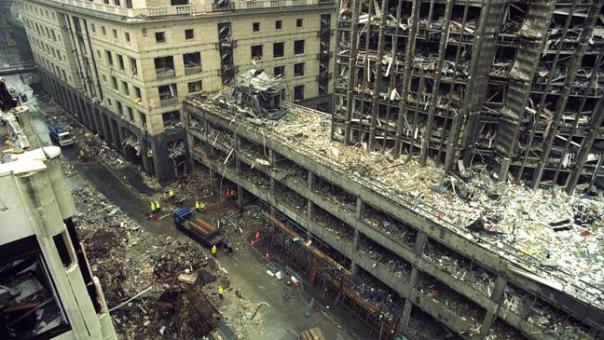
The Irish Republican Army (IRA) exploded a large bomb, estimated at over a ton of home-made explosives, at Bishopsgate in London. One person was killed and over 30 people injured in the explosion.

[Later estimates put the cost of repair at £350 million (some reported estimates were as high as £1,000 million).]

See Bishopsgate Bomb

John Hume, then leader of the Social Democratic and Labour Party (SDLP), and Gerry Adams, then President of Sinn Féin (SF), held their second meeting in a fortnight and issued a first joint statement.

Sunday 24 April 1994

Two Protestants Killed by IRA


Alan Smith & John McCloy

The Irish Republican Army (IRA) shot dead Alan Smith (40) and John McCloy (28), both Protestant civilians, while they were sitting in a stationary car, on Main Street, Garvagh, County Derry.

[The IRA alleged that Smith was a member of the Ulster Defence Association (UDA) but this was denied by family and friends.]

Monday 24 April 1995

The Northern Ireland Office (NIO) announced that ministers would begin exploratory dialogue with representatives of Sinn Féin (SF).

Wednesday 24 April 1996

The Irish Republican Army (IRA) planted two bombs at Hammersmith Bridge, London. The bombs contained 30 pounds of Semtex and although the detonators went off the main charges failed to explode. There were no injuries and no damage was caused.

There were claims, in a Channel 4 ‘Dispatches’ programme, that the British Government had sanctioned secret talks with Sinn Féin (SF) which began in 1990. Patrick Mayhew, then Secretary of State for Northern Ireland, denied the claims and stated that talks only began in 1993.

Thursday 24 April 1997

Maurice Hayes claimed that Baroness Denton and Patrick Mayhew, then Secretary of State for Northern Ireland, had misrepresented his report when they claimed that the report “vindicated” Denton’s actions.

[Hayes was appointed on 10 March 1997 to investigate allegations made in the Irish News on 20 February 1997 that a Catholic woman, who was the victim of sectarian harassment was moved from Denton’s office in breach of Fair Employment guidelines.]

The British Broadcasting Corporation (BBC) in Northern Ireland refused to screen a Sinn Féin (SF) party political broadcast. The BBC objected to two scenes in the video which showed David Trimble, then leader of the Ulster Unionist Party (UUP), at Drumcree and William McCrea, then Democratic Unionist Party (DUP) MP, sharing a platform with Billy Wright, then leader of the Loyalist Volunteer Force (LVF).

Robert McCartney, then leader of the United Kingdom Unionist Party (UKUP) , won a libel case against the Irish Times and was awarded £80,000 in damages. The action resulted from an article that appeared in the Irish Times which was written by David Ervine, then a spokesperson for the Progressive Unionist Party (PUP).

Friday 24 April 1998

Last Meeting Of Forum

The Northern Ireland Forum held its final session as the body was wound up. Only 30 of the original 110 members attended the final session.

[The Forum had held 71 plenary sessions since May 1996. Sinn Féin (SF) had never taken any of the 17 seats won by the party and the Social Democratic and Labour Party (SDLP) withdrew its 24 members after 3 weeks of the operation of the Forum. The Forum then became a Unionist talking shop and was best known for infighting between the Democratic Unionist Party (DUP) and the Ulster Unionist Party (UUP). The DUP were also accused of making sexist remarks when addressing members of the Northern Ireland Women’s Coalition (NIWC), in one instance telling them to “go home and breed for Ulster”. The total cost of running the Forum was estimated at £7 million.]

The Ulster Defence Association (UDA) and Ulster Freedom Fighters (UFF) issued a statement in support of the Good Friday Agreement saying that it would not lead to a united Ireland

———————————————

Remembering all innocent victims of the Troubles

Today is the anniversary of the death of the following people killed as a results of the conflict in Northern Ireland

“To live in hearts we leave behind is not to die

– Thomas Campbell

To the innocent on the list – Your memory will live forever

– To the Paramilitaries –

There are many things worth living for, a few things worth dying for, but nothing worth killing for.

 4 People lost their lives on the 24th  April   between 1976– 1994

———————————————–

24 April 1976


James Byrne   (63)

Catholic
Status: Civilian (Civ),

Killed by: non-specific Loyalist group (LOY)
Killed in car bomb explosion outside Shamrock Bar, Main Street, Hilltown, County Down.

———————————————–

24 April 1993
Edward Henty  (34)

nfNIB
Status: Civilian (Civ),

Killed by: Irish Republican Army (IRA)
Photographer. Died when lorry bomb exploded, Bishopsgate, London. He entered evacuated area after bomb warning given.

———————————————–

24 April 1994


Alan Smith  (40)

Protestant
Status: Civilian (Civ),

Killed by: Irish Republican Army (IRA)
Shot, while sitting in his stationary car, Main Street, Garvagh, County Derry.

———————————————–

24 April 1994


John McCloy,  (28)

Protestant
Status: Civilian (Civ),

Killed by: Irish Republican Army (IRA)
Shot, while sitting in his stationary car, Main Street, Garvagh, County Derry.

———————————————–

23rd April – Deaths & Events in Northern Ireland Troubles

Key Events & Deaths on this day in Northern Ireland Troubles

23rd April

———————————————

Wednesday 23 April 1969

The Unionist Parliamentary Party voted by 28 to 22 to introduce universal adult suffrage in local government elections in Northern Ireland. The demand for ‘one man, one vote’ had been one of the most powerful slogans of the civil rights movement. James Chichester-Clark, then Minister of Agriculture, resigned in protest at the reform.

[This move further undermined the position of O’Neill who resigned on 28 April 1969, to be replaced by Chichester-Clark.]

Sunday 23 April 1972

The Sunday Times Insight Team published their account of the events of ‘Bloody Sunday’ (30 January 1972).

See: Bloody Sunday

Tuesday 23 April 1974

The United Ulster Unionist Council (UUUC) held a three-day conference in Portrush, County Antrim. The conference was attended by representatives of the Ulster Defence Association (UDA) and also by Enoch Powell.

The main focus of the conference is to agree a strategy for bringing about the end of the Executive. At the end of the conference (26 April 1974) the UUUC called for a Northern Ireland regional parliament in a federal United Kingdom (UK).

Saturday 23 April 1977

Paisley, in his role as head of the United Unionist Action Council (UUAC), threatened to organise a region-wide strike unless Roy Mason, then Secretary of State, acted against the Irish Republican Army (IRA) and also implemented the Convention Report.

Thomas Passmore, then the County Grand Master of the Orange Order in Belfast, launched a verbal attack on the UUAC and its plans for a general strike. In addition he alleged that a member of the UUAC had been involved in discussions with the Irish Republican Army (IRA).

See The Orange Order 

Thursday 23 April 1981

In what was seen as a response to continuing rioting in Catholic areas, Loyalist paramilitaries decided to meet under the auspices of the Ulster Army Council (UAC) which was effectively a co-ordinating committee for Loyalist groups.

Marcella Sands, the sister of Bobby Sands, made an application to the European Commission on Human Rights claiming that the British government had broken three articles of the European Convention on Human Rights in their treatment of Republican prisoners.

[Two Commissioners tried to visit Bobby Sands on 25 April 1981 but are unable to do so because Sands requested the presence of representatives of Sinn Féin (SF). On 4 May 1981 the European Commission on Human Rights announced that it had no power to proceed with the Sands’ case.]

Wednesday 23 April 1986

James Molyneaux, then leader of the Ulster Unionist Party (UUP), and Ian Paisley, then leader of the Democratic Unionist Party (DUP), announced a 12-point plan of civil disobedience in protest at the Anglo-Irish Agreement (AIA). Among the measures was a ‘rates’ (local government taxes) strike.

Thursday 23 April 1987

Peter Archer, then British Labour Party spokesman on Northern Ireland affairs, expressed support in a letter for the MacBride principles.

Thursday 23 April 1992

Two former Moderators of the Presbyterian Church revealed that they had held private talks with Gerry Adams, then President of Sinn Féin (SF), and Tom Hartley also of SF.

Friday 23 April 1993

The Irish Republican Army (IRA) carried out a bomb attack on an oil terminal in North Shields, England. The bomb damaged a large storage tank.

John Hume, then leader of the Social Democratic and Labour Party (SDLP), and Gerry Adams, then President of Sinn Féin (SF), held another meeting.

Patrick Mayhew, then Secretary of State for Northern Ireland, made a major speech on Northern Ireland to an audience at the Institute of Irish Studies in Liverpool. Mayhew stated that the British government was against the notion of “joint sovereignty” but did want to see a devolved government with wide powers.

Sunday 23 April 1995

The Sunday Tribune (a Dublin based newspaper) published what it claimed to be an internal Irish Republican Army (IRA) document. The document had been circulated within the Republican movement before being leaked and was believed to have dated from prior to the 1994 ceasefire.

The text contained the acronym ‘TUAS‘ which people were led to believed meant ‘Totally UnArmed Struggle’.

[Following the ending of the first IRA ceasefire some people suggested that TUAS actually stood for ‘Tactical Use of Armed Struggle’. Others suggested that the two interpretations were meant for two different audiences – inside and outside the Republican movement.]

Thursday 23 April 1998

kneecapping reversed.jpg

A 79 year old Catholic man living in the Nationalist New Lodge area of North Belfast was ‘kneecapped’ in his home. The man was tied up and beaten about the head before being shot in both knees and both ankles in a paramilitary style ‘punishment’ attack.

[No organisation claimed responsibility for the incident but local people blamed the Irish Republican Army (IRA) for the attack. The man was the oldest person in Northern Ireland to be the subject of a ‘punishment’ shooting.]

Five Irish Republican Army (IRA) prisoners, who were serving sentences in England, were transferred to Portlaoise Prison in the Republic of Ireland.

Three members of the Ulster Unionist Party (UUP) shared a platform at the Ulster Hall in Belfast with Ian Paisley, then leader of the Democratic Unionist Party (DUP), as part of a rally against the Good Friday Agreement.

The three UUP members were: William Ross, William Thompson, and Roy Beggs.

Also at the rally was Robert (Bob) McCartney, then leader of the United Kingdom Unionist Party (UKUP), and also representatives of the Orange Order. Two Unionist members of the Parades Commission, Glen Barr and Tommy Cheevers, resigned from the organisation. The reason given for their decision was the level of media attention they had received since their original appointments to the Commission.

The Joint Oireachtas Committee on the Irish Constitution began considering a proposal that Members of Parliament (MPs) elected in Northern Ireland should be entitled to sit in the Daíl. The committee also began considering the possibility of permitting Irish citizens living in the North to vote in presidential elections and referendums.

Friday 23 April 1999

A ‘Support Drumcree’ rally was held in Newtownards, County Down, and was attended by several hundred people. Adam Ingram, then Security Minister at the Northern Ireland Office (NIO), announced that the Royal Ulster Constabulary (RUC) team investigating the killing of Rosemary Nelson was to get more assistance in the form of detectives from outside Northern Ireland.

See Rosemary Nelson

Sunday 23 April 2000

It was rumoured that Peter Mandelson, then Secretary of State for Northern Ireland, might quit his position to return to Britain to help the Labour Party fight the next general election.

———————————————

Remembering all innocent victims of the Troubles

Today is the anniversary of the death of the following people killed as a results of the conflict in Northern Ireland

“To live in hearts we leave behind is not to die

– Thomas Campbell

To the innocent on the list – Your memory will live forever

– To the Paramilitaries –

There are many things worth living for, a few things worth dying for, but nothing worth killing for.

 7  People lost their lives on the 23rd  April   between 1977– 1987

———————————————–

23 April 1977


Patrick Devlin  (72)

Catholic
Status: Civilian (Civ),

Killed by: Ulster Volunteer Force (UVF)
Security man. Shot at entrance to Legahory Inn, Craigavon, County Armagh.

———————————————–

23 April 1977


Brendan O’Callaghan  (21)

Catholic
Status: Irish Republican Army (IRA),

Killed by: British Army (BA)
Shot from concealed British Army (BA) observation post, while in car park of Hunting Lodge Bar, Stewartstown Road, Belfast.

———————————————–

23 April 1981
John Robinson  (38)

Protestant
Status: ex-Ulster Defence Regiment (xUDR),

Killed by: Irish Republican Army (IRA)
Shot while driving firm’s van, Mullacreevie Park, Armagh.

———————————————–

23 April 1984
Neil Clarke   (21)

nfNI
Status: British Army (BA),

Killed by: Irish Republican Army (IRA)
Shot by sniper, while on British Army (BA) mobile patrol, Bishop Street, Derry.

———————————————–

23 April 1986


 James Hazlett,   (54)

Protestant
Status: Royal Ulster Constabulary (RUC),

Killed by: Irish Republican Army (IRA)
Off duty. Shot outside his home, Bryansford Road, Newcastle, County Down.

———————————————–

23 April 1987


Thomas Cooke  (52)

Protestant
Status: Royal Ulster Constabulary (RUC),

Killed by: Irish Republican Army (IRA)
Off duty. Shot shortly after leaving golf club, Prehen, Derry.

———————————————–

22nd April – Deaths & Events in Northern Ireland Troubles

Key Events & Deaths on this day in Northern Ireland Troubles

22nd April

—————————————-

Tuesday 22 April 1969

Bernadette Devlin, then a newly elected MP, made a controversial maiden speech in the House of Commons. Devlin was the youngest woman ever to be elected to Westminster and took her seat on her 22nd birthday.

Saturday 22 April 1972

Francis Rowntree, an 11 year-old Catholic boy, was killed by a ‘rubber bullet’ fired by the British Army.

[This was the first death to result from the use of the rubber bullet baton round.]

Sunday 22 April 1973

One of the leaders of the Irish Republican Army (IRA), Dáithí Ó Conaill, addressed a public demonstration to commemorate the 1916 Easter Rising in Dublin. Following the speech he managed to avoid arrest.

Sunday 22 April 1979

The body of Martin McConville (25), a Catholic civilian, was found in the Bann River, at Portadown, County Armagh. McConville had been abducted by Loyalists one month earlier and had been beaten to death.

Wednesday 22 April 1981

Dolours Price, who had been serving a sentence along with her sister Marion for a car bombing in London on 8 March 1973 was released from Armagh Prison on medical grounds.

[Dolours Price was suffering from anorexia nervosa the same condition her sister suffered from. Marion Price had been released from prison on 30 April 1980.]

Thursday 22 April 1982

Sinn Féin (SF) the Workers’ Party denied media claims that the Official Irish Republican Army (OIRA) was still active.

Monday 22 April 1991

The Fair Employment Commission (FEC) published its first report on the religious composition of the workforce in Northern Ireland in those companies with more that 25 employees. The report showed that 65 per cent of the workforce was Protestant while Catholics accounted for 35 per cent.

Wednesday 22 April 1998

The Northern Ireland Parades Commission cancelled the publication of a crucial report on contentious parades after the personal intervention of Tony Blair, then British Prime Minister. Blair argued that it was too sensitive a time to publish the report which would have given an initial outline of the Commissions plans for dealing with contentious parades in the coming year.

[The Parades Commission denied that Blair’s intervention amounted to political interference. Unionists were highly critical of the decision and called for the scrapping of the Commission.]

The Irish parliament passed the 19th Amendment to the Constitution Bill which would allow for the necessary changes following the Good Friday Agreement. A ministerial order was also signed to allow for the referendum on 22 May 1998 which would ratify the proposed changes to the Irish Constitution.

Thursday 22 April 1999

David Trimble, then leader of the Ulster Unionist Party (UUP), visited John Paul II in the Vatican as part of a meeting of Nobel laureates with the Pope. This was the first meeting between a leader of the UUP and a pope (and possibly also the first meeting between an Orangeman and a pope). Trimble described the visit as a courtesy call. Talks between the main political parties resumed at Stormont in Belfast. The Department of Justice agreed to grant a pension to, and clear the name of, a 100-year-old former Garda superintendent who was dismissed from the force 71 years ago. William Geary was sacked for allegedly accepting a £100 bribe from the IRA

———————————————

Remembering all innocent victims of the Troubles

Today is the anniversary of the death of the following people killed as a results of the conflict in Northern Ireland

“To live in hearts we leave behind is not to die

– Thomas Campbell

To the innocent on the list – Your memory will live forever

– To the Paramilitaries –

There are many things worth living for, a few things worth dying for, but nothing worth killing for.

 7  People lost their lives on the 22nd April   between 1972– 1982

———————————————–

22 April 1972


Francis Rowntree   (11)

Catholic
Status:

Civilian (Civ),

Killed by: British Army (BA)
Shot by rubber bullet, Divis Flats, Belfast.

———————————————–

22 April 1973
Mervyn Connor   (20)

Protestant
Status: Ulster Volunteer Force (UVF),

Killed by: Ulster Volunteer Force (UVF)
Found poisoned in his cell, Crumlin Road Prison, Belfast. Internal UVF dispute.

———————————————–

22 April 1974


Mohammed Khalid   (18)

nfNI
Status: Civilian (Civ),

Killed by: Irish Republican Army (IRA)
Civilian employed by British Army (BA) . Found shot in his car, Silverbridge, near Crossmaglen, County Armagh.

———————————————–

22 April 1975


Owen Boyle   (41)

Catholic
Status: Civilian (Civ),

Killed by: Protestant Action Force (PAF)
Died 10 days after being shot at his home, ‘Glencull’, Benburb Road, Aughnacloy, County Tyrone.

———————————————–

22 April 1976


William Crooks  (31)

Protestant
Status: Royal Ulster Constabulary (RUC),

Killed by: Irish Republican Army (IRA)
Shot by sniper while on Royal Ulster Constabulary (RUC) mobile patrol, Stewartstown Road, Coalisland, County Tyrone.

———————————————–

22 April 1978


Miller McAllister,  (36)

Protestant
Status: Royal Ulster Constabulary (RUC),

Killed by: Irish Republican Army (IRA)
Off duty. Shot at his home, Woodland Park, Lisburn, County Antrim.

———————————————–

22 April 1982


Raymond Devlin,   (19)

Catholic
Status: Civilian (Civ),

Killed by: Irish Republican Army (IRA)
Shot outside his home, Ladybrook Park, Andersonstown, Belfast. Allegedly involved in crime.

———————————————–


21st April – Deaths & Events in Northern Ireland Troubles

Key Events & Deaths on this day in Northern Ireland Troubles

21st April

——————————————–

Monday 21 April 1969

The Ministry of Defence in London announced that British troops would be used in Northern Ireland to guard key public installations. The announcement was made in response to a request from the Northern Ireland government.

[The troops to be used were ones already stationed in the region.]

Tuesday 21 April 1970 Alliance Party Formed

The Alliance Party of Northern Ireland (APNI) was formed.

The founders of the party were attempting to appeal to Catholics and Protestant to unite in support of moderate policies.

[Oliver Napier became leader of the party in 1972.]

Monday 21 April 1975

Three Catholic civilians, two brothers and a sister, were killed by a booby-trap bomb in a house in Killyliss, near Dungannon, County Tyrone.

The attack was claimed by the Protestant Action Force (PAF), which was a covername used by the Ulster Volunteer Force (UVF).

Tuesday 21 April 1981

Margaret Thatcher, then British Prime Minister, spoke to a press conference in Saudi Arabia and stated that the British government would not meet with Irish TDs (Teachta Dáil;

Members of the Irish Parliament) to discuss the hunger strike. Thatcher went on to say: “We are not prepared to consider special category status for certain groups of people serving sentences for crime. Crime is crime is crime, it is not political.”

Friday 21 April 1989

Three Loyalists were arrested in Paris, France, as they were in the process of giving parts from a Shorts Aircraft Company Blowpipe missile to a South African embassy official. The incident revived claims of links between the then South African Government and Loyalist paramilitaries.

Sunday 21 April 1991 Census

The United Kingdom (UK) census was held with information being collected across Northern Ireland. Unlike the situation in 1981 there was no protest against the census by Republicans. [When the religion report was published in 1993 it showed that the total population was 1,577,836.

The breakdown of the main denominations was: 605,639 Catholic; 336,891 Presbyterians; 279,280 Church of Ireland; and 59,517 Methodists. A large number of people did not provide information on religion with 7.3 per cent not stating a denomination and 3.8 per cent stating ‘none’ to the religion question. Later analysis revealed that the likely size of the Catholic population was approximately 41.5 per cent.

Wednesday 21 April 1993

Albert Reynolds, then Taoiseach (Irish Prime Minister), travelled to the United States of America (USA). While in Boston he said that the suggestion of a ‘peace envoy’ was “not appropriate at present”.

Thursday 21 April 1994

Brian Hutton (Sir), then Northern Ireland Lord Chief Justice, quashed the conviction of Paul Hill for the murder of a former British soldier in 1974. Hutton declared that the conviction was “unsafe and unsatisfactory”.

Sunday 21 April 1996

Bertie Ahern, then leader of Fianna Fáil, criticised the Irish government’s approach to Northern Ireland. He placed some of the blame for the ending of the Irish Republican Army’s (IRA) ceasefire on John Bruton, then Taoiseach (Irish Prime Minister).

The criticism placed strain on the bipartisan approach to Northern Ireland in the Dáil.

Monday 21 April 1997

The Irish Republican Army (IRA) issued a series of hoax bomb warnings in central London which caused widespread disruption. A group of men claiming to be members of the Irish People’s Liberation Organisation (IPLO) carried out a robbery on the office of a Credit Union in Newry.

Tuesday 21 April 1998

Adrian Lamph (29), a Catholic civilian, was shot dead by the Loyalist Volunteer Force (LVF) at the council yard where he worked in Portadown, County Armagh. Lamph was the first victim of the conflict since the signing of the Good Friday Agreement.

[He had lived on the Garvaghy Road in the mainly Protestant town of Portadown. He left a partner and a 2 year old son.]

The Democratic Unionist Party (DUP) held the first of a series of anti-Agreement rallies in the run up to the referendum. The 32 County Sovereignty Committee issued a statement rejecting the Agreement as “fundamentally undemocratic, anti-Republican and unacceptable”.

The Celtic Tiger phenomenon continued with the Republic of Ireland being ranked 11th in a league table of the world’s 20 most competitive economies, ahead of both Japan and Britain.

The Freedom of Information Act, which allows access to personal information held by public bodies, came into effect in the Republic of Ireland. In the light of the Good Friday Agreement the Gaelic Athletic Association (GAA) came under renewed pressure to remove the rule from its constitution which excluded members of the security forces in Northern Ireland from joining the organisation.

Wednesday 21 April 1999

The Belfast Telegraph (a Belfast based newspaper) carried a report which claimed that Royal Ulster Constabulary (RUC) sources believed that Éamon Collins had been killed by Irish Republican Army (IRA) members from south Armagh. The RUC sources said that it was unclear if the killing had been sanctioned by the leadership of the IRA

Saturday 21 April 2001

Christopher O’Kane (37), a Catholic civilian, was shot dead near to his home in Tullyally, Derry. [It was believed that Republican paramilitaries carried out the killing although no organisations claimed responsibility.]

 ———————————————

Remembering all innocent victims of the Troubles

Today is the anniversary of the death of the following people killed as a results of the conflict in Northern Ireland

“To live in hearts we leave behind is not to die

– Thomas Campbell

To the innocent on the list – Your memory will live forever

– To the Paramilitaries –

There are many things worth living for, a few things worth dying for, but nothing worth killing for.

 10  People lost their lives on the 21st  April   between 1974– 2001

———————————————–

21 April 1974
James Murphy,  (40)

Catholic
Status: Civilian Political Activist (CivPA),

Killed by: Ulster Volunteer Force (UVF)
Sinn Fein (SF) member. Found shot at his garage, Corravehy, near Derrylin, County Fermanagh.

———————————————–

21 April 1975


Seamus McKenna,  (25)

Catholic
Status: Civilian (Civ),

Killed by: Protestant Action Force (PAF)
Killed, together with his sister and brother, when they detonated booby trap bomb at the future home of his sister, Killyliss, near Dungannon, County Tyrone.

———————————————–

21 April 1975


Michael McKenna   (27)

Catholic
Status: Civilian (Civ),

Killed by: Protestant Action Force (PAF)
Killed, together with his sister and brother, when they detonated booby trap bomb at the future home of his sister, Killyliss, near Dungannon, County Tyrone.

———————————————–

21 April 1975


Marion Bowen   (21)

Catholic
Status: Civilian (Civ),

Killed by: Protestant Action Force (PAF)
Killed, together with her brothers, when they detonated booby trap bomb at her future home, Killyliss, near Dungannon, County Tyrone.

———————————————–

21 April 1977
Brian Smith  (24)

Protestant
Status: Civilian (Civ),

Killed by: Republican Action Force (RepAF)
Shot at the corner of Snugville Street and Queensland Street, Shankill, Belfast.

———————————————–

21 April 1984


Richard Quigley,   (20)

Catholic
Status: Irish Republican Army (IRA),

Killed by: Irish Republican Army (IRA)
Killed by flying shrapnel while involved in remote controlled bomb attack on British Army (BA) mobile patrol, Foyle Street, Derry.

———————————————–

21 April 1987


Harold Henry   (52)

Protestant
Status: Civilian (Civ),

Killed by: Irish Republican Army (IRA)
Shot at his home, The Loup, near Moneymore, County Derry. Contractor to British Army (BA) / Royal Ulster Constabulary (RUC).

———————————————–

21 April 1989


William Thompson  (26)

Protestant
Status: Civilian (Civ),

Killed by: Irish Republican Army (IRA)
Shot from passing car while driving his Shankill black taxi, Crumlin Road, Belfast.

———————————————–

21 April 1998


Adrian Lamph (29)

Catholic
Status: Civilian (Civ),

Killed by: Loyalist Volunteer Force (LVF)
Shot, at his workplace, council depot, Duke Street, Portadown, County Armagh.

———————————————–

21 April 2001


Christopher O’Kane  (37)

Catholic
Status: Civilian (Civ),

Killed by: non-specific Republican group (REP)
Shot near to his home, Milldale Crescent, Tullyally, Derry.

———————————————–