Category Archives: Blog

Bradford City Stadium Fire – Saturday 11th May 1985

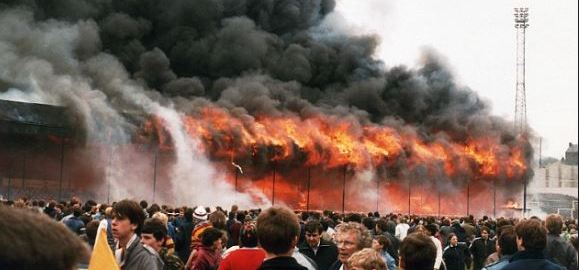
Bradford City Stadium Fire

56 Dead & 100’s Injured

Image result for Bradford City stadium fire

The Bradford City stadium fire was a stadium disaster that occurred during an English League Third Division fixture between Bradford City and Lincoln City on Saturday, 11 May 1985, killing 56 and injuring at least 265.

Image result for Bradford City and Lincoln City

The Valley Parade stadium, long-established home to Bradford City Football Club, had been noted for its antiquated design and facilities, including the wooden roof of the main stand. Warnings had also been given about a major build-up of litter just below the seats. The stand had been officially condemned and was due for demolition.

The match against Lincoln City had started in a celebratory atmosphere, with the home-team receiving the Football League Third Division trophy. At 3.40 pm, a small fire was reported by TV commentator John Helm, but in less than four minutes, in windy conditions, it had engulfed the whole stand, trapping some people in their seats. In the panic that ensued, fleeing crowds had to break down locked exits to escape, and many were burnt to death at the turnstiles, which were also locked. There were many cases of heroism, with more than fifty people receiving police awards or commendations.

The disaster led to new safety standards in UK football grounds, including the banning of new wooden grandstands.

Bradford City continues to support the Burns Unit at Bradford Royal Infirmary as its official charity.

Memorial to Valley Parade Fire, Bradford (Taken by Flickr user 25 February 2012)
Date 11 May 1985 (1985-05-11)
Location Valley Parade
Bradford, West Yorkshire
Coordinates 53°48′15″N 001°45′32″W / 53.80417°N 1.75889°W / 53.80417; -1.75889Coordinates: 53°48′15″N 001°45′32″W / 53.80417°N 1.75889°W / 53.80417; -1.75889
Deaths 56
Non-fatal injuries 265
Inquiries Popplewell Inquiry
Coroner James Turnbull
Website www.bradfordcityfire.co.uk

Background

Image result for Bradford City Football Club

Bradford City Association Football Club had played their home games at Valley Parade, in Bradford, since the club was formed in 1903. It had been the former home of Manningham Rugby Football Club, which had moved into the ground in 1886. The playing area and stands were very basic but the ground had enough room for 18,000 spectators.

When the association football club was formed, the ground was changed very little and had no covered accommodation. However, when Bradford City won promotion to the highest level of English football, Division One, in 1908, club officials sanctioned an upgrade programme.

Archibald-Leitch.jpg

Football architect Archibald Leitch was commissioned to carry out the work. By 1911, his work was completed.

It included a main stand which seated 5,300 fans, and had room for a further 7,000 standing spectators in the paddock in front.The main stand was described as a “mammoth structure”, but was unusual for its time because of its place on the side of a hill. The entrances to the stand were all at the rear and were higher than the rest of the ground.

Although there had been some changes to other parts of the ground, the main stand remained unaltered by 1985. Football ground writer Simon Inglis had described the view from the stand as “like watching football from the cockpit of a Sopwith Camel” because of its antiquated supports and struts.

However, he also warned the club of a build-up of litter beneath the stand because of a gap between the seats. Some repair work was carried out, but in July 1984 the club was warned again, this time by a county council engineer, because of the club’s plans to claim for ground improvements from the Football Trust. One letter from the council said the problems “should be rectified as soon as possible”; a second said: “A carelessly discarded cigarette could give rise to a fire risk.” In March 1985, the club’s plans became more apparent when it took delivery of steel for a new roof.

Related image

Peter Jackson was presented with the league trophy before the final game.


The 1984–85 season had been one of Bradford City’s most successful seasons. Following a 1–0 defeat to Leyton Orient at the end of September, the side went 13 games undefeated, during which they went top of the Division Three table by defeating Millwall 3–1. City maintained their superiority and opened up an 11-point gap over the rest of the league by February, and were assured of the championship title courtesy of a 2–0 victory against Bolton Wanderers in the penultimate game of the season, guaranteeing Division Two football for the first time since 1937. As a result, Bradford-born captain Peter Jackson was presented with the league trophy before the final game of the season with mid-table Lincoln City at Valley Parade on 11 May 1985.

As it was the first piece of league silverware that the club had captured since they won the Division Three (North) title 56 years earlier, 11,076 supporters were in the ground. It was nearly double the season’s average of 6,610 and included 3,000 fans in the ground’s main stand.

In the crowd were local dignitaries and guests from three of Bradford’s twin townsVerviers, in Belgium, and Mönchengladbach and Hamm, in Germany. The city’s newspaper, the Telegraph & Argus, published a souvenir issue for the day, entitled “Spit and Polish for the Parade Ground”. It detailed the safety work which would be carried out as a result of the club’s promotion, admitting the ground was “inadequate in so many ways for modern requirements”. Steel was to be installed in the roof,and the wooden terracing was to be replaced with concrete. The work was expected to cost £400,000.

The Teams

The Bradford City matchday squad of players and staff consisted of Terry Yorath, Trevor Cherry, Chris Withe, Don Goodman, Eric McManus, Tony Clegg, John Hawley, Dave Evans, Bryan Edwards, John Hendrie, Mark Ellis, Stuart McCall, Peter Jackson, Bobby Campbell, Martin Singleton and Greg Abbott.

Fire
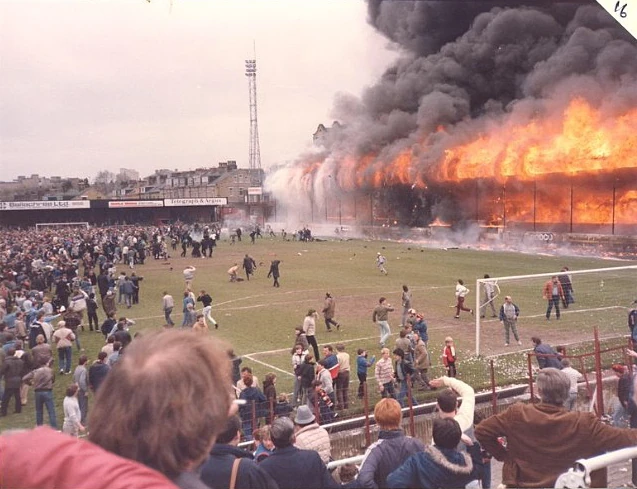
Image result for Bradford City stadium fire

After 40 minutes of the first half, the score remained 0–0, in what was described as a drab affair with neither team threatening to score. At 3:40 pm, five minutes before half-time, the first sign of a fire—a glowing light—was noticed three rows from the back of block G,as reported by TV commentator John Helm.

Helm described the start of the fire in an interview to the Express newspaper:

“a man over from Australia visiting his son got two tickets to the game. He lit a cigarette and when it was coming to an end he put it down on to the floorboard and tried to put his foot on it to put it out. It slipped through a hole in the floorboard. A minute later he saw a small plume of smoke so he poured his coffee on it and so did his son. It seemed to put it out. But a minute or so later there was suddenly a bigger whoosh of smoke so they went to get a steward. By the time they got back, the whole thing had taken off.”

One witness saw paper or debris on fire, about nine inches below the floor boards.The stand seats did not have risers; this had allowed a huge accumulation of rubbish and paper under the stand.

Spectators initially felt their feet becoming warmer; one of them ran to the back of the stand for a fire extinguisher but found none. A police officer shouted to a colleague for an extinguisher. However, his call was misheard and instead the fire brigade were radioed.

The call was timed at 3:43 pm. However, the fire escalated rapidly and flames became visible, and so police started to evacuate the stand. The blaze began to spread; the roof and wooden stands were soon on fire.

One eyewitness, Geoffrey Mitchell, told the BBC:

“It spread like a flash. I’ve never seen anything like it. The smoke was choking. You could hardly breathe.”

One of the linesmen informed match referee Norman Glover who stopped the game with three minutes remaining before half-time. The original match referee (as named on the match programme) was Don Shaw, but he could not officiate due to injury and Norman Glover (Chorley) was appointed. Shaw is still sometimes named as the match referee.

The highly flammable wooden roof, which was covered with tarpaulin and sealed with asphalt and bitumen, caught fire. Burning timbers and molten materials fell from the roof onto the crowd and seating below, and black smoke enveloped a passageway behind the stand, where many spectators were trying to escape.

It took less than four minutes for the entire stand to be engulfed in flames.

There were no extinguishers in the stand’s passageway for fear of vandalism, and one spectator ran to the clubhouse to find one, but was overcome by smoke and others trying to escape. Supporters either ran upwards to the back of the stand or downwards to the pitch to escape. The stand had no perimeter fencing to keep fans from accessing the pitch, thus averting an instance of crush asphyxia, such as occurred the 1989 Hillsborough disaster. Footage of the accident at this point shows levels of confusion among the spectators – while many were trying to escape or to cross the pitch to the relative safety of the neighbouring stands, other spectators were observed cheering or waving to the still-rolling pitchside cameras.

The lack of perimeter fencing undoubtedly kept the death toll down, and prevented it from reaching the hundreds or potentially the thousands, although the Bradford City stadium fire was still the worst sporting tragedy of its kind in England at the time of the fatalities. Elsewhere in Britain, only the 66 deaths at Ibrox Stadium in Scotland 14 years earlier had seen a higher death toll.

Most of the exits at the back were locked or shut, and there were no stewards present to open them, but seven were forced open or found open. Three men smashed down one door and at least one exit was opened by people outside, which again helped prevent further deaths.

Geoffrey Mitchell said:

“There was panic as fans stampeded to an exit which was padlocked. Two or three burly men put their weight against it and smashed the gate open. Otherwise, I would not have been able to get out.”

At the front of the stand, men threw children over the wall to help them escape. Most of those who escaped onto the pitch were saved.

People who had escaped the fire then tried to assist their fellow supporters. Police officers also assisted in the rescue attempts. One man clambered over burning seats to help a fan,  as did player John Hawley,  and one officer led fans to an exit, only to find it shut and turn around.

Bradford City’s coach Terry Yorath, whose family was in the stand,ran onto the pitch to help evacuate people. Another player went into the office space to ensure there was nobody there. One fan put his jumper over a fellow supporter’s head to extinguish flames.

Those who escaped were taken out of the ground to neighbouring homes and a pub, where a television screened World of Sport, which had live pictures from the ground. They queued there for a telephone to ring their families.

Image result for Geoffrey Mitchell bradford stadium fire

The fire brigade arrived at the ground four minutes after they were called. However, the fire had consumed the stand by that point and they were faced with huge flames and dense smoke. Because supporters were still being rescued from the stand, they were unable to immediately start fighting the fire. The fire destroyed the main stand and left only burned seats, lamps and fences. Some of those who died were still sitting upright in their seats, covered by remnants of tarpaulin from the roof. Police worked until 4 am the next morning, under lighting, to remove all the bodies.

Within a few hours of the blaze starting, it was established that 56 people had been killed, although some of them had survived until reaching hospital.

Victims and injured

56 people died in the fire

Of the 56 people who died in the fire, 54 were Bradford supporters and two were Lincoln. They included three who tried to escape through the toilets, 27 who were found by exit K and turnstiles 6 to 9 at the rear centre of the stand, and two elderly people who died in their seats. Some had been crushed as they tried to crawl under turnstiles to escape. One retired mill worker made his way to the pitch, but was walking about on fire from head to foot. People smothered him to extinguish the flames, but he later died in hospital.

Half of those who died were either aged under 20 or over 70, and the oldest victim was the club’s former chairman, Sam Firth, aged 86. More than 265 supporters were injured; the fire was described as the worst fire disaster in the history of British football, and the worst disaster since 66 spectators died at the Ibrox disaster.

Television Broadcast

The match was recorded by Yorkshire Television for their Sunday afternoon regional football show The Big Match. Coverage of the fire was transmitted minutes after the event on the live ITV Saturday afternoon sports programme World of Sport and the BBC’s Grandstand.

Reaction

The tragedy received media attention and support from across the world, with those offering their sympathy including Queen Elizabeth II, Prime Minister Margaret Thatcher and Pope John Paul II. Messages of condolence were also received from Helmut Kohl, Chedli Klibi and Felipe González.

The club’s chairman, Stafford Heginbotham, said:

“It was to be our day”.

Image result for Terry Yorath bradford

Coach Terry Yorath described the events as “the worst day in my life.”

Police Superintendent Barry Osborne, divisional commander for the area, said many of his officers cried when they saw how badly people had been burned. Matthew Wildman was 17 at the time and suffered from rheumatoid arthritis, which meant he needed crutches to walk. He was helped out of the stand by other fans and spent a period of time in hospital. He later said:

“I have never known anything like it, either before, or since. Everybody in the city was devastated, but there was an amazing number of volunteers. […] I still have terrible memories of the day, but it is the humanity of those that helped us that I reflect on.”

Aftermath

Appeal fund

The Bradford Disaster Appeal fund, set up within 48 hours of the disaster, eventually raised over £3.5 million. The most memorable of hundreds of fundraising events was a reunion of the 1966 World Cup Final Starting XI that began with the original starting teams of both England and West Germany, and was held at Leeds United‘s stadium, Elland Road, in July 1985 to raise funds for the Appeal fund. England won the re-match 6–4.

Part of the Appeal funds were raised by The Crowd‘s recording of “You’ll Never Walk Alone” from Rodgers and Hammerstein’s musical Carousel, which reached number 1 in the UK Singles chart. The money raised from this record was contributed to fund the internationally renowned burns unit that was established in partnership between the University of Bradford and Bradford Royal Infirmary, immediately after the fire, which has also been Bradford City’s official charity for well over a decade.

For the 30th anniversary of the fire a new version of “You’ll Never Walk Alone” was recorded at Voltage Studios in Bradford. On the recording are Dene Michael (Black Lace), The Chuckle Brothers, Clive Jackson of Dr & The Medics, Owen Paul, Billy Pearce, Billy Shears, Flint Bedrock, Danny Tetley and Rick Wild of The Overlanders. It was the brainchild of Bradford City fan Lloyd Spencer with all profits going to the Bradford Royal Infirmary Burns Unit.

Memorial service and memorial

A memorial, erected on the main stand of Valley Parade, to the victims of the fire


A capacity 6,000 crowd attended a multi-denominational memorial service, held on the pitch in the sunny shadow of the burnt out stand at Valley Parade in July 1985. A giant Christian cross, made up of two large charred wooden members  that had once been part of the stand, was constructed in front of the middle of the stand and behind the pitchside speaker’s platform.

Part of the service was also held in Urdu and Punjabi as a sign of appreciation to the local ethnically Asian Subcontinental community in Manningham, Bradford and around Valley Parade that had opened up their doors to Bradford City supporters in the immediate aftermath of the disaster. The next day work began on clearing the burnt out shell of the stand, and Justice Popplewell released his findings into the disaster.


A memorial in Bradford City Centre.

Whilst Bradford City initially prospered in the Second Division – only missing out on promotion to the First Division in 1988 after failing to beat Ipswich Town at home on the final day of their first full season back at Valley Parade (a match which coincided with the third anniversary of the fire and at which no minute’s silence was held before the game

At Valley Parade there are now two memorials. One, now re-situated to that end of the stand where the fire began, is a sculpture donated on the initial re-opening of Valley Parade in December 1986 by Sylvia Graucob, a then Jersey-based former West Yorkshire woman. The other, situated by the main entrance, was donated by the club after its £7.5million rebuilding of the original main stand in 2002. It has a black marble fascia on which the names and ages of those that died are inscribed in gold, and a black marble platform on which people can leave flowers and mementos.

There is a twin memorial sculpture, unveiled on 11 May 1986, which has the names of the dead inscribed on it. They were donated by Bradford’s twin city of Hamm, Germany, and are situated in front of Bradford City Hall in both locations. After the fire, Bradford City also announced they would thereafter play with black trim on their shirt collars and arms as a permanent memorial to those who had died.

Commendations

Four police officers, Police Constables David Britton and John Richard Ingham and Chief Inspectors Charles Frederick Mawson and Terence Michael Slocombe, and two spectators, Richard Gough and David Hustler, were awarded the Queen’s Gallantry Medal for their actions.

PCs Peter Donald Barrett and David Charles Midgley, along with spectators Michael William Bland and Timothy Peter Leigh received the Queen’s Commendation for Brave Conduct. In total, 28 police officers and 22 supporters, who were publicly documented as having saved at least one life, later received police commendations or bravery awards. Together, flanked by undocumented supporters, they managed to clear all but one person who made it to the front of the stand. Club coach Terry Yorath incurred minor injuries while taking part in the rescue.

The main stand following further redevelopment in 2001


While Valley Parade was re-developed, Bradford City played games at various neighbouring grounds: Elland Road, Leeds; Leeds Road, Huddersfield; and Odsal Stadium, Bradford. Valley Parade re-opened on 14 December 1986, when Bradford City beat an England XI 2–1 in a friendly. Since then, it has been further re-developed and, today, Valley Parade is a modern 25,136 all-seater stadium, which is virtually unrecognisable from how it was at the time of the disaster, save for the original clubhouse that still stands beside the main stand, and the flank support wall that runs down the Hollywell Ash Lane at the “Bradford End”.

Effect on Lincoln City


Valley Parade after Bradford City’s return in late 1986, but before further developments during the 1990s

Lincoln City suffered two successive relegations, first to the Fourth Division in 1986, and again in 1987, becoming the first team to be automatically relegated from the Football League itself. They were immediately promoted back to the Football League in 1988, and survived for 23 years before being relegated again in 2011. Although some attributed Lincoln City’s sudden demise to the psychological effects of the fire on its players (together with the resignation of successful manager Colin Murphy shortly before the fire), it symbolised the wider crisis that the introduction of new safety legislation brought to Lincoln’s Sincil Bank home.

The timber construction of St. Andrew’s Stand, Main Stand and the roof of its popular Railway End terrace were immediately condemned as fire hazards, which saw seating capacity briefly cut to nil. Lincoln City’s board responded by committing £1,100,000 to their ground’s renovation in the year that immediately followed the fire at Valley Parade, and over the following decade made improvements that eventually totalled £3,000,000. After its renovation in 1990 they named the home end of their ground the ‘Stacey-West Stand’, in honour of Bill Stacey and Jim West, the two Lincoln City supporters who were amongst the 56 to die at Bradford.

Today, with its 10,120 all-seater capacity Lincoln can rightly boast that they have “one of the best stadiums in lower league football”, which is fitting homage to their tragic involvement in events at Bradford in 1985. Each year Lincoln send representatives to the annual memorial service in Bradford city centre, and between 2007 and 2009 were managed by Bradford’s captain that day, Peter Jackson.

The two sides met for the first time after the fire in April 1989, when they arranged a benefit match in aid of the Hillsborough disaster, at Valley Parade.

Treatment of casualties and Burns Research Unit

The Bradford Burns Unit was set up by Professor David Sharpe after he received many of the victims following the fire. As he received the injured at Bradford Royal Infirmary he was able to call upon 10% of the UK’s population of plastic surgeons. It was during this treatment that Professor Sharpe began to create the Bradford Sling,  which applies even pressure across sensitive areas. The sling is now used internationally in the treatment of burns.

Immediately after the fire, Professor Sharpe planned and treated the injuries of over 200 individuals, with many experimental treatments being used. Mathew Wildman, aged 17 at the time of the fire, commented that

“I must have had five different experiments carried out on me with all sorts of new techniques for skin grafts and I had potions injected into me that helped my face repair naturally over time.”

On the 25th anniversary of the fire, the University of Bradford established the United Kingdom’s largest academic research centre in skin sciences as an extension to its plastic surgery and burns research unit.

Inquiry, Inquest and legal action

Popplewell Inquiry

The inquiry into the disaster, chaired by Sir Oliver Popplewell and known as the Popplewell Inquiry, led to the introduction of new legislation to improve safety at the UK’s football grounds. Among the main outcomes of the inquiry were the banning of new wooden grandstands at all UK sports grounds, the immediate closure of other wooden stands deemed unsafe and the banning of smoking in other wooden stands.

At the time of the disaster, many stadiums had perimeter fencing between the stands and the pitch to prevent incidents of football hooliganism – particularly pitch invasions – which were rife during the 1980s. The main stand at Bradford was not surrounded by fencing, and therefore most of the spectators in it could escape onto the pitch – if they had been penned in then the death toll would inevitably have been in the hundreds if not the thousands.

However, the turnstiles were locked and none of the stadium staff were present to unlock them, leaving no escape through the normal entrances and exits. Most of the fans who took this escape route were killed or seriously injured. Fans in the next stand (the “Bradford End”) pulled down the fence separating them from the pitch.

The Popplewell Inquiry found that the club had been warned about the fire risk that the rubbish accumulating under the stand had posed. The stand had already been condemned, and the demolition teams were due to start work two days later. However, as there was no real precedent, most Bradfordians accepted that the fire was a terrible piece of misfortune. A discarded cigarette and a dilapidated wooden stand, which had survived because the club did not have the money to replace it, were considered to have conspired to cause the worst disaster in the history of the Football League.

Inquest and legal test case

In July 1985 an inquest was held into the deaths, at the hearings the coroner James Turnbull recommended a death by misadventure outcome, which the jury agreed upon. Following the hearing in 1986 a test case was brought against the club by David Britton, a police sergeant serving on the day, and by Susan Fletcher, who lost her husband John, 11-year-old son Andrew, John’s brother Peter and his father Edmond in the fire. On 23 February 1987 Sir Joseph Cantley found the club two thirds responsible and the county council (which by this time had been abolished) one third responsible

Explaining his decision, Sir Joseph Canley stated:

“As I have already stated, the primary duty was on the Club and the functions of the County Council were supervisory and its liability is for negligent breach of a common law duty arising out of the way in which they dealt with or ignored their statutory powers. That duty was not a duty to the Club but a duty to the spectators and other persons in the stand. However, the responsibility of the Club is, in my view, very much the greater and I apportion responsibility between the two defendants as to two-thirds on the first defendant and one-third on the third defendant.”

West Yorkshire Metropolitan Borough Council was found to have failed in its duty under the Fire Precautions Act 1971. The Health and Safety Executive who were also part of the legal action were found to be non-liable. Criticising Bradford City during the case, Mr. Michael Ogden QC, highlighted that the Club ‘gave no or very little thought to fire precautions’, despite repeated warnings.

The outcome of the test case resulted in over 154 claims being addressed (110 civilians and 44 police officers by the injured or bereaved. Speaking at the close of the case, the Judge said:

“They (the club) were at fault, no one in authority seemed to have appreciated the fire hazard. No one gave it the attention it ought to have received.. .. The fact is that no one person was concerned with the safety of the premises.”

Central to the test case were two letters sent to Bradford City’s Club Secretary at the time, the second letter dated 18 July 1984 highlighted in full the improvements needed to be actioned at the ground as well as the fire risk at the main stand. When cross examined by QC Robert Smith, then Chairman Stafford Heginbotham said he knew about the fire risk at the ground.

During the case, Sir Joseph Canley stated that:

“It is only right that I should say that I think it would be unfair to conclude that Mr Heginbotham, Mr Tordoff, the Board of Directors, or any of them, were intentionally and callously indifferent to the safety of spectators using the stand. They were at fault, but the fault was that no-one in authority seems ever to have properly appreciated the real gravity of this fire hazard and consequently no-one gave it the attention it certainly ought to have received.”

The total amount of compensation to the 154 claimants was reported to be as high as £20million, with the payouts covered by insurance taken out by the club.  In 1988, the first compensation payments were made to survivors of the fire, with over 40 people receiving up to £40,000 each. By this date the appeal fund set up for survivors had paid out more than £4m with further payouts expected as the effects of physical and mental injury were determined.

Comments by Martin Fletcher

Fifty-Six: The Story of the Bradford Fire

Image result for fifty-six: The Story of the Bradford Fire

In 2010, Susan Fletcher’s son and survivor of the Bradford City fire (and witness to the Hillsborough disaster), Martin Fletcher, openly criticised the club’s hierarchy at the time of the fire and the subsequent investigation. Fletcher said that “The club at the time took no actual responsibility for its actions and nobody has ever really been held accountable for the level of negligence which took place. It was appalling that public money was given to the club while it was still owned by the same shareholders under whose direction the fire had happened. I do not include the people currently running the club, who have always displayed a great, sensitive duty to the memory of those who died.”

After controversial comments made by Sir Oliver Popplewell about the Hillsborough Disaster, Fletcher raised further concerns about the events following the fire saying that “I have many unanswered questions still about the fire in which four of my family died, as does my mother. Popplewell’s report was nowhere close to the quality of Lord Justice Taylor’s report after Hillsborough, and since reading it as an adult I have always been very disappointed in it and considered it a poor piece of work.”

Fletcher subsequently published a book in 2015, Fifty-Six: The Story of the Bradford Fire which revealed a history of fires at businesses owned by the Bradford City chairman Stafford Heginbotham. Eight fires in the 18 years before the Bradford City fire were identified, many catastrophic and leading to large insurance payouts.

Dramatisations, documentaries and published works

In 2014 the theatre company Funny You Should Ask (FYSA) premiered their heartfelt tribute to the 56 people who died at the fire. Called ‘The 56’ the play dramatises actual accounts of the Bradford City Fire with the purpose of the play showing how in times of adversity, the Football Club and the local community came together.

Profits from the play’s run at The Edinburgh Fringe were donated to the Bradford Burns Unit.

In 2005 Parrs Wood Press published ‘Four Minutes to Hell: The Story of the Bradford City Fire’ by author Paul Firth.The title of the book refers to the estimated time it took for the stand to be fully ablaze from the first flames being seen.

On 1 May 2010 to commemorate the 25th anniversary of the fire the football TV show Football Focus was hosted from Valley Parade by Dan Walker, the show included interviews with Terry Yorath and John Hendrie.

In 1986, a year after the disaster, Yorkshire Television aired a documentary presented by John Helm entitled ‘Bradford City – A year of healing’. The Documentary highlighted the ‘poison pen letters’ and graffiti targeted at the then club chairman ‘Stafford Heginbotham’ over accusations that he was in some way responsible for the deaths of the 56 people who died at the fire.

Calls for a new inquiry

Image result for Sir Joseph Canley bradford city fire

Following the release of Martin Fletcher’s book Fifty-Six: The Story of the Bradford Fire, fire investigator Nigel Adams joined the call for a fresh inquiry into the disaster stating that Fletcher’s book was “one of the best accounts of a fire, as seen from a victim’s point of view, and as a piece of investigative writing, I have ever read”. He agreed that the inquiry into Bradford, led by the judge Oliver Popplewell, was inadequate and that there are many unanswered questions. He went on to state:

“In 1985 fire investigation in Britain was in its infancy and some would say at that time most fire investigators were not much more than dust-kickers. Like all areas of forensic investigations, it has come on leaps and bounds. However, there is a lot in this book that troubles me about the science, or lack of it, used in the testing of the investigators’ hypothesis as to the source of the ignition. The book also raises concerns about the speed of the inquiry and the fact that it commenced a few weeks after the fire and lasted for only a few days, whereas other inquiries into similar incidents, pre and post the Bradford fire, have taken years to come to fruition and months to be heard. The fact the inquiry also embraced the investigation into another incident which happened on the same day, a riot in which a young boy died at Birmingham City, makes it seem more frivolous.”

Adams also went on to state that “I have read in some newspapers that he is being berated for his campaign to have a new inquiry. I don’t see that. There is no malicious vendetta, there is no over-exaggeration, there are no trumped-up facts. It is a simple account laid out for all to see. Fletcher has taken facts and presented them in such a way that it should make it moralistically impossible for this incident not to be looked at again.”

On 26 January 2016, the IPCC declined calls for an investigation and published its full response online.

Eric Bennett controversy

Image result for Detective Inspector Raymond Falconer

On 17 April 2015 retired Detective Inspector Raymond Falconer highlighted in a report by the Telegraph and Argus that police were aware of an Australian man who admitted to starting the fire.Following the 30th anniversary of the fire, a number of news organisations named this man as Eric Bennett who was visiting his nephew in Bradford from Australia and attended the game on the day.

Following this report, Leslie Brownlie, who was the nephew in question, is reported to have said that his uncle never made such an admission of starting the fire. He is quoted as saying: “I don’t believe the statement of [retired Detective Inspector Raymond] Falconer at all. I don’t know where Falconer is getting this cock-and-bull story from… the inaccuracies in this report [documentary] are dumbfounding.”.

Raymond Falconer’s reliability had previously been questioned by Daniel Taylor in The Guardian who stated that: “The Bradford Telegraph and Argus described him as a ‘top detective’. He was actually one of the detectives involved in one of the gravest miscarriages of justices in the country, the murder of Carol Wilkinson in Bradford, where someone was locked up for 20 years for a murder he didn’t commit

……………………………………………………………
bradford statium fire website.JPG

Visit websites for more details: bradfordcityfire.co.uk

Guess Where I’m going ? And I got a banging hang-over Grrrrrrrr

100_7736.JPG


Well Son’s week long Birthday celebrations comes to a close today with a visit to the local Park and the visiting Circus.


I did a quick check online and came across this short clip of “A” Canadian Circus & if these are the right guys it might just be fun –

– providing I can shake off this niggling little hang-over that is following me around this morning. Grrrrrrr –

Laters………………


Paradise Lost – The Child Murders at Robin Hood Hills

The Child Murders at Robin Hood Hills

robin hood victims1.jpg

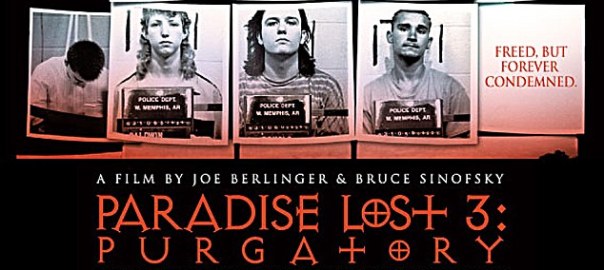
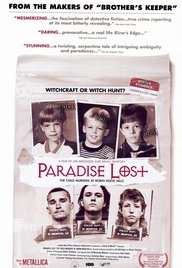
Paradise Lost: The Child Murders at Robin Hood Hills is a 1996 documentary film directed by Joe Berlinger and Bruce Sinofsky about the trials of three teenage boys who came to be known as the West Memphis Three in West Memphis, Arkansas. The teenagers—Jessie Misskelley, Damien Echols and Jason Baldwin—were accused of the May 1993 murder and sexual mutilation of three prepubescent boys. The film was followed by two sequels: Paradise Lost 2: Revelations and Paradise Lost 3: Purgatory.

Description

paradise lost


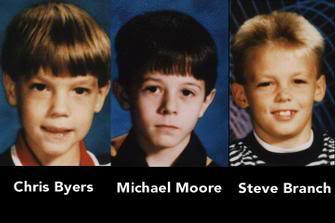
The film documents the events from the arrests of Misskelley, Echols and Baldwin for the murders of Christopher Byers, Michael Moore and Stevie Branch. Their naked and hogtied bodies were discovered in a ditch in a wooded area of West Memphis, Arkansas, known as “Robin Hood Hills”.

Image result for Joe Berlinger and Bruce Sinofsky

Filmmakers Joe Berlinger and Bruce Sinofsky interview numerous people connected with the case, including the parents of the victims, the parents of the accused, members of the West Memphis Police Department (WMPD) and all the defendants involved in the trial. Berlinger and Sinofsky are not filmed themselves, and the dialogue is provided by the interviewee, rather than using a “Q & A” format.

The film starts with an introduction to the case, before moving on to the arrests of the three teenagers. Much of the community, including the detectives and the victims’ parents believe the murders were committed by the teenagers as part of a Satanic ritual. The community is shown to be politically conservative and strongly Evangelical Christian. Because Misskelley had provided police with a confession, his trial is separated from that of Damien and Jason, and is covered in the first half of the film.

Trials coverage

The first trial to be covered in the film is that of Misskelley, a trial which was severed from those of Echols and Baldwin since it was Misskelley who submitted a confession. Emphasis is placed on the fact that there is a strong possibility that the confession was coerced. Interviews are conducted with Misskelley himself, his family and friends, and his attorney Dan Stidham. Misskelley is sentenced to life in prison.

Part two of the film documents the trials of Echols and Baldwin. Like the coverage of Misskelley’s trial, there are interviews with both defendants, their attorneys and their families. The families of the victims also share their views.

During the course of filming, John Mark Byers, the stepfather of one of the victims (Christopher Byers), gives the filmmakers a knife which has blood in the hinge. The filmmakers turn the knife over to police, who examine it; the DNA is similar to that of John Byers and Christopher, but the evidence is nonetheless inconclusive since the DNA evidence produced was fragmented and can not provide concrete links.

Production

The production had 79 filming days over a 10-month period, starting in the weeks after the murders through the trials and convictions, at the actual Arkansas locations. The movie marks the first time Metallica allowed their music to be used in a movie. A decade later the directors made Some Kind of Monster about Metallica.

Some kind of minster (film).jpg

Reception

The movie was well received by critics, including Siskel and Ebert praising the movie. The film was followed by two sequels. First Paradise Lost 2: Revelations (2000), which suggests that further evidence was missed or suppressed and attempts to prove Echols’ innocence. Followed by Paradise Lost 3: Purgatory (2011), which was nominated for the Academy Award for Best Documentary Feature.

Aftermath

Following a successful decision in 2010 by the Arkansas Supreme Court regarding recently uncovered DNA evidence, the West Memphis Three reached a deal with prosecutors. On August 19, 2011, they entered Alford pleas, which allow them to assert their innocence and were sentenced to time served, effectively freeing them.

See Paradise Lost

See West Memphis Three

See Damien Echols

See Life after Death –

West Memphis Three – The Devil’s Disciples ?

West Memphis Three 

Image result for west memphis 3

The West Memphis Three are three men who – while teenagers – were tried and convicted, in 1994, of the 1993 murders of three boys in West Memphis, Arkansas. Damien Echols was sentenced to death, Jessie Misskelley, Jr. was sentenced to life imprisonment plus two 20-year sentences, and Jason Baldwin was sentenced to life imprisonment. During the trial, the prosecution asserted that the children were killed as part of a Satanic ritual.

A number of documentaries have explored the case. Celebrities and musicians have held fundraisers in the belief that the three young men convicted of the crime are innocent.

In July 2007, new forensic evidence was presented in the case. A status report jointly issued by the state and the defense team stated: “Although most of the genetic material recovered from the scene was attributable to the victims of the offenses, some of it cannot be attributed to either the victims or the defendants.” On October 29, 2007, the defense filed a Second Amended Writ of Habeas Corpus, outlining the new evidence.

Seal of the Supreme Court of Arkansas.svg

Following a successful decision in 2010 by the Arkansas Supreme Court regarding newly produced DNA evidence, the West Memphis Three negotiated a plea bargain with prosecutors. On August 19, 2011, they entered Alford pleas, which allowed them to assert their innocence while acknowledging that prosecutors have enough evidence to convict them. Judge David Laser accepted the pleas and sentenced the three to time served. They were released with 10-year suspended sentences, having served 18 years and 78 days in prison.

The Crime

Three eight-year-old boys—Steve Branch, Michael Moore, and Christopher

Image result for Stevie Branch, Michael Moore, and Christopher Byers

Byers—were reported missing on May 5, 1993. The first report to the police was made by Byers’ adoptive father, John Mark Byers, around 7:00 pm. The boys were allegedly last seen together by three neighbors, who in affidavits told of seeing them playing together around 6:30 pm the evening they disappeared, and seeing Terry Hobbs, Steve Branch’s stepfather, calling them to come home.

Initial police searches made that night were limited. Friends and neighbors also conducted a search that night, which included a cursory visit to the location where the bodies were later found.

A more thorough police search for the children began around 8:00 am on May 6, led by the Crittenden County Search and Rescue personnel. Searchers canvassed all of West Memphis but focused primarily on Robin Hood Hills, where the boys were reported last seen. Despite a shoulder-to-shoulder search of Robin Hood Hills by a human chain, searchers found no sign of the missing boys.

Around 1:45 pm, juvenile Parole Officer Steve Jones spotted a boy’s black shoe floating in a muddy creek that led to a major drainage canal in Robin Hood Hills. A subsequent search of the ditch revealed the bodies of three boys.

Related image

They had been stripped naked and were hogtied with their own shoelaces: their right ankles tied to their right wrists behind their backs, the same with their left arms and legs. Their clothing was found in the creek, some of it twisted around sticks that had been thrust into the muddy ditch bed.

The clothing was mostly turned inside-out; two pairs of the boys’ underwear were never recovered. Christopher Byers had lacerations to various parts of his body, and mutilation of his scrotum and penis.

The autopsies, by the forensic pathologist Frank J. Peretti, indicated that Byers died of “multiple injuries”, while Moore and Branch died of “multiple injuries with drowning”.

Police initially suspected the boys had been raped;  however, later expert testimony disputed this finding despite trace amounts of sperm DNA found on a pair of pants recovered from the scene. Prosecution experts claim Byers’ wounds were the results of a knife attack and that he had been purposely castrated by the murderer; defense experts claim the injuries were more probably the result of post-mortem animal predation. Police believed the boys were assaulted and killed at the location where they were found; critics argued that the assault, at least, was unlikely to have occurred at the creek.

Byers was the only victim with drugs in his system; he was prescribed Ritalin (methylphenidate) in January 1993, as part of an attention-deficit hyperactivity disorder treatment.  The initial autopsy report describes the drug as Carbamazepine, and that dosage was found to be at sub-therapeutic level. John Mark Byers said that Christopher Byers may not have taken his prescription on May 5, 1993.

Victims

Grave of Stevie Branch

Grave of Christopher Byers

Grave of Michael Moore

Memorial for the West Memphis Three victims

Stevie Edward Branch, Christopher Byers, and Michael Moore, were all second graders at Weaver Elementary School. Each had achieved the rank of “Wolf” in the local Cub Scout pack, and they were best friends.

Steve Edward Branch

Image result for Steve Edward Branch

Stevie Branch (November 26, 1984 – May 5, 1993)  was the son of Steven and Pamela Branch, who divorced when he was an infant. His mother was awarded custody and later married Terry Hobbs. Branch was eight years old, 4 ft. 2 tall, weighed 65 lbs, and had blond hair. He was last seen wearing blue jeans and a white T-shirt, and riding a black and red bicycle. He was an honor student. He lived with his mother, Pamela Hobbs, his stepfather, Terry Hobbs, and a four-year-old half-sister, Amanda.

Steve Edward Branch is buried in Mount Zion Cemetery in Steele, Missouri.

Christopher Mark Byers

Image result for Christopher Mark Byers

Christopher Byers (June 23, 1984 – May 5, 1993)  was born to Melissa DeFir and Ricky Murray. His parents divorced when he was four years old; shortly afterward, his mother married John Mark Byers, who adopted the boy. Byers was eight years old, 4 ft. tall, weighed 52 lbs, and had light brown hair. He was last seen wearing blue jeans, dark shoes, and a white long sleeved shirt.

He lived with his mother, Sharon Melissa Byers, his stepfather, John Mark Byers, and his stepbrother, Shawn Ryan Clark, aged 13. According to his mother, Christopher was a typical eight-year-old. “He still believed in the Easter Bunny and Santa Claus”.

Christopher Mark Byers is buried in Forest Hill Cemetery East in Memphis, Tennessee.

James Michael Moore

Image result for James Michael Moore

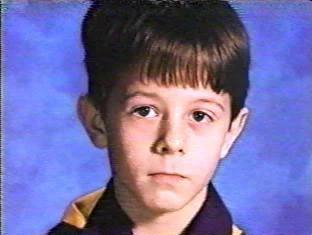
Michael Moore (July 27, 1984 – May 5, 1993)  was the son of Todd and Dana Moore. He was eight years old, 4 ft. 2 tall, weighed 55 lbs, and had brown hair. He was last seen wearing blue pants, a blue Boy Scouts of America shirt, and an orange and blue Boy Scout hat, and riding a light green bicycle. Moore enjoyed wearing his scout uniform even when he was not at meetings.

He was considered the leader of the three. He lived with his parents and his nine-year-old sister, Dawn.  James Michael Moore is buried in Crittenden Memorial Park Cemetery in Marion, Arkansas.

West Memphis Three victims memorial

Image result for West Memphis Three victims memorial

In 1994, a memorial was erected for the three murder victims. The memorial is located in the playground of Weaver Elementary School in West Memphis, where all three victims were second graders at the time of the crime. In May 2013, for the 20th anniversary of the slayings, Weaver Elementary School principal Sheila Grissom raised funds to refurbish the memorial.

Suspects

Baldwin, Echols, and Misskelley

Image result for Baldwin, Echols, and Misskelley

At the time of their arrests, Jessie Misskelley, Jr. was 17 years old, Jason Baldwin was 16 years old, and Damien Echols was 18 years old.

Baldwin and Echols had been previously arrested for vandalism and shoplifting, respectively, and Misskelley had a reputation for his temper and for engaging in fistfights with other teenagers at school. Misskelley and Echols had dropped out of high school; however, Baldwin earned high grades and demonstrated a talent for drawing and sketching, and was encouraged by one of his teachers to study graphic design in college.

Echols and Baldwin were close friends, and bonded over their similar tastes in music and fiction, and over their shared distaste for the prevailing cultural climate of West Memphis, situated in the Bible Belt. Baldwin and Echols were acquainted with Misskelley from school, but were not close friends with him.

Echols’ family was poor and received frequent visits from social workers, and he rarely attended school. He and a girlfriend had run off and later broken into a trailer during a rain storm; they were arrested, though only Echols was charged with burglary.

Echols spent several months in a mental institution in Arkansas and afterward received “full disability” status from the Social Security Administration.[10] During Echols’ trial, Dr. George W. Woods testified (for the defense) that Echols suffered from:

serious mental illness characterized by grandiose and persecutory delusions, auditory and visual hallucinations, disordered thought processes, substantial lack of insight, and chronic, incapacitating mood swings.

At his death penalty sentencing hearing, Echols’ psychologist reported that months before the murders, Echols had claimed that he obtains super powers by drinking human blood.  At the time of his arrest, Echols was working part-time with a roofing company and expecting a child with his girlfriend, Domini Teer.

Chris Morgan and Brian Holland

Early in the investigation, the WMPD briefly regarded two West Memphis teenagers as suspects. Chris Morgan and Brian Holland, both with drug offense histories, had abruptly departed for Oceanside, California, four days after the bodies were discovered.

Morgan was presumed to be at least casually familiar with all three murdered boys, having previously driven an ice cream truck route in their neighborhood.

Arrested in Oceanside on May 17, 1993, Morgan and Holland both took polygraph exams administered by California police. Examiners reported that both men’s charts indicated deception when they denied involvement in the murders. During subsequent questioning, Morgan claimed a long history of drug and alcohol use, along with blackouts and memory lapses. He claimed that he “might have” killed the victims but quickly recanted this part of his statement.

California police sent blood and urine samples from Morgan and Holland to the WMPD, but there is no indication WMPD investigated Morgan or Holland as suspects following their arrest in California. The relevance of Morgan’s recanted statement would later be debated in trial, but it was eventually barred from admission as evidence.

“Mr. Bojangles”

The citing of a black male as a possible alternate suspect was implied during the beginning of the Misskelley trial. According to local West Memphis police officers, on the evening of May 5, 1993, at 8:42 pm, workers in the Bojangles’ restaurant located about a mile from the crime scene in Robin Hood Hills reported seeing a black male who seemed “mentally disoriented” inside the restaurant’s ladies’ room.

The man was bleeding and had brushed against the restroom walls. Officer Regina Meeks responded to the call, taking the restaurant manager’s report through the eatery’s drive-through window. By then, the man had left, and police did not enter the restroom on that date.

The day after the victims’ bodies were found, Bojangles’ manager Marty King, thinking there was a possible connection to the bloody man found in the bathroom, reported the incident to police officers who then inspected the ladies’ room. King gave the officers a pair of sunglasses he thought the man had left behind, and the detectives took some blood samples from the walls and tiles of the restroom. Police detective Bryn Ridge testified that he later lost those blood scrapings. A hair identified as belonging to a black male was later recovered from a sheet wrapped around one of the victims.

Investigation

Evidence and interviews

Image result for wm3 Evidence and interviews

Police officers James Sudbury and Steve Jones felt that the crime had “cult” overtones, and that Damien Echols might be a suspect because he had an interest in occultism, and Jones felt Echols was capable of murdering children. The police interviewed Echols on May 7, two days after the bodies were discovered.

During a polygraph examination, he denied any involvement. The polygraph examiner claimed that Echols’ chart indicated deception. On May 9, during a formal interview by Detective Bryn Ridge, Echols mentioned that one of the victims had wounds to the genitals; law enforcement viewed this knowledge as incriminating.

After a month had passed with little progress in the case, police continued to focus their investigation upon Echols, interrogating him more frequently than any other person. Nonetheless, they claimed he was not regarded as a direct suspect but a source of information.

On June 3, the police interrogated Jessie Misskelley, Jr. Despite his reported IQ of 72 (categorizing him as borderline intellectual functioning) and his status as a minor, Miskelley was questioned alone; his parents were not present during the interrogation. Misskelley’s father gave permission for Misskelley to go with police but did not explicitly give permission for his son to be questioned or interrogated.

Misskelley was questioned for roughly 12 hours. Only two segments, totaling 46 minutes, were recorded. Misskelley quickly recanted his confession, citing intimidation, coercion, fatigue, and veiled threats from police.  Misskelley specifically said he was “scared of the police” during this confession.

Though he was informed of his Miranda rights, Misskelley later claimed he did not fully understand them.  In 1996, the Arkansas Supreme Court ruled that Misskelley’s confession was voluntary and that he did, in fact, understand the Miranda warning and its consequences.  Portions of Misskelley’s statements to the police were leaked to the press and reported on the front page of the Memphis Commercial Appeal before any of the trials began.

Shortly after Misskelley’s first confession, police arrested Echols and his close friend Baldwin. Eight months after his original confession, on February 17, 1994, Misskelley made another statement to police. His lawyer, Dan Stidham, remained in the room and continually advised Misskelley not to say anything. Misskelley ignored this advice and went on to detail how the boys were abused and murdered. Stidham, who was later elected to a municipal judgeship, has written a detailed critique of what he asserts are major police errors and misconceptions during their investigation.

Vicki Hutcheson

Vicki Hutcheson, a new resident of West Memphis, would play an important role in the investigation, though she would later recant her testimony, claiming her statements were fabricated due in part to coercion from police.

On May 6, 1993 (before the victims were found later the same day), Hutcheson took a polygraph exam by Detective Don Bray at the Marion Police Department, to determine whether or not she had stolen money from her West Memphis employer. Hutcheson’s young son, Aaron, was also present, and proved such a distraction that Bray was unable to administer the polygraph. Aaron, a playmate of the murdered boys’, mentioned to Bray that the boys had been killed at “the playhouse.”

When the bodies proved to have been discovered near where Aaron indicated, Bray asked Aaron for further details, and Aaron claimed that he had witnessed the murders committed by Satanists who spoke Spanish. Aaron’s further statements were wildly inconsistent, and he was unable to identify Baldwin, Echols, or Misskelley from photo line-ups, and there was no “playhouse” at the location Aaron indicated. A police officer leaked portions of Aaron’s statements to the press contributing to the growing belief that the murders were part of a Satanic rite.

Image result for wm3 Vicki Hutcheson

On or about June 1, 1993, Hutcheson agreed to police suggestions to place hidden microphones in her home during an encounter with Echols. Misskelley agreed to introduce Hutcheson to Echols. During their conversation, Hutcheson reported that Echols made no incriminating statements. Police said the recording was “inaudible”, but Hutcheson claimed the recording was audible. On June 2, 1993, Hutcheson told police that about two weeks after the murders were committed, she, Echols, and Misskelley attended a Wiccan meeting in Turrell, Arkansas.

Hutcheson claimed that, at the Wiccan meeting, a drunken Echols openly bragged about killing the three boys. Misskelley was first questioned on June 3, 1993, a day after Hutcheson’s purported confession. Hutcheson was unable to recall the Wiccan meeting location and did not name any other participants in the purported meeting. Hutcheson was never charged with theft. She claimed she had implicated Echols and Misskelley to avoid facing criminal charges, and to obtain a reward for the discovery of the murderers.

Trials

Image result for wm3 Misskelley's trial

Misskelley was tried separately, and Echols and Baldwin were tried together in 1994. Under the “Bruton rule“, Misskelley’s confession could not be admitted against his co-defendants; thus he was tried separately. All three defendants pleaded not guilty.

Misskelley’s trial

During Misskelley’s trial, Dr. Richard Ofshe, an expert on false confessions and police coercion, and Professor of Sociology at UC Berkeley, testified that the brief recording of Misskelley’s interrogation was a “classic example” of police coercion. Critics have also stated that Misskelley’s various “confessions” were in many respects inconsistent with each other, as well as with the particulars of the crime scene and murder victims, including (for example) an “admission” that Misskelley “watched Damien rape one of the boys.”

Police had initially suspected that the victims had been raped because their anuses were dilated. However, there was no forensic evidence indicating that the murdered boys had been raped. Dilation of the anus is a normal post-mortem condition.

On February 5, 1994, Misskelley was convicted by a jury of one count of first-degree murder and two counts of second-degree murder.  The court sentenced him to life plus 40 years in prison. His conviction was appealed, but the Arkansas Supreme Court affirmed the conviction.

Echols’ and Baldwin’s trial

Image result for wm3 Echols' and Baldwin's trial

Three weeks later, Echols and Baldwin went on trial. The prosecution accused the three young men of committing a Satanic murder. The prosecution called Dale W. Griffis, a graduate of Columbia Pacific University, as an expert in the occult to testify the murders were a Satanic ritual. On March 19, 1994 Echols and Baldwin were found guilty on three counts of murder.

The court sentenced Echols to death and Baldwin to life in prison.

At trial, the defense team argued that news articles from the time could have been the source for Echols’ knowledge about the genital mutilation, and Echols said his knowledge was limited to what was “on TV”.

The prosecution claimed that Echols’ knowledge was nonetheless too close to the facts, since there was no public reporting of drowning or that one victim had been mutilated more than the others. Echols testified that Detective Ridge’s description of their earlier conversation (which was not recorded) regarding those particular details was inaccurate (and indeed that some other claims by Ridge were “lies”). Mara Leveritt, an investigative journalist and the author of Devil’s Knot, argues that Echols’ information may have come from police leaks, such as Detective Gitchell’s comments to Mark Byers, that circulated amongst the local public.

Devil's Knot - The True Story of the West Memphis Three.jpg

The defense team objected when the prosecution attempted to question Echols about his past violent behaviors, but the defense objections were overruled.

Aftermath

Criticism of the investigation

Dan Stidham

Image result for John Mark Byers Dan Stidham

There has been widespread criticism of how the police handled the crime scene. Misskelley’s former attorney Dan Stidham cites multiple substantial police errors at the crime scene, characterizing it as “literally trampled, especially the creek bed.” The bodies, he said, had been removed from the water before the coroner arrived to examine the scene and determine the state of rigor mortis, allowing the bodies to decay on the creek bank and to be exposed to sunlight and insects. The police did not telephone the coroner until almost two hours after the discovery of the floating shoe, resulting in a late appearance by the coroner. Officials failed to drain the creek in a timely manner and secure possible evidence in the water (the creek was sandbagged after the bodies were pulled from the water).

Moreover, Stidham calls the coroner’s investigation “extremely substandard.” There was a small amount of blood found at the scene that was never tested. According to HBO’s documentaries Paradise Lost: The Child Murders at Robin Hood Hills (1996) and Paradise Lost 2: Revelations (2000), no blood was found at the crime scene, indicating that the location where the bodies were found was not necessarily the location where the murders actually happened. After the initial investigation, the police failed to control disclosure of information and speculation about the crime scene.

According to Leveritt,

“Police records were a mess. To call them disorderly would be putting it mildly.”

Leveritt speculated that the small local police force was overwhelmed by the crime, which was unlike any they had ever investigated. Police refused an unsolicited offer of aid and consultation from the violent crimes experts of the Arkansas State Police, and critics suggested this was due to the WMPD’s being under investigation by the Arkansas State Police for suspected theft from the Crittenden County drug task force.

Leveritt further noted that some of the physical evidence was stored in paper sacks obtained from a supermarket (with the supermarket’s name printed on the bags) rather than in containers of known and controlled origin.

When police speculated about the assailant, the juvenile probation officer assisting at the scene of the murders speculated that Echols was “capable” of committing the murders,” stating:

“it looks like Damien Echols finally killed someone.”

Brent Turvey, a forensic scientist and criminal profiler, stated in the film Paradise Lost 2 that human bite marks could have been left on at least one of the victims. However, these potential bite marks were first noticed in photographs years after the trials and were not inspected by a board-certified medical examiner until four years after the murders.

The defense’s expert testified that the mark in question was not an adult bite mark, while experts put on by the State concluded that there was no bite mark at all. The State’s experts had examined the actual bodies for any marks, and others conducted expert photo analysis of injuries. Upon further examination, it was concluded that if the marks were bite marks, they did not match the teeth of any of the three convicted.

Appeals and new evidence

In May 1994, the three defendants appealed their convictions;  the convictions were upheld on direct appeal.

Image result for west memphis Echols

In 2007, Echols petitioned for a retrial, based on a statute permitting post-conviction testing of DNA evidence due to technological advances made since 1994 which might provide exoneration for the wrongfully convicted. However, the original trial judge, Judge David Burnett, disallowed presentation of this information in his court. This ruling was in turn thrown out by the Arkansas Supreme Court as to all three defendants on November 4, 2010.

John Mark Byers’ knife (1993)

Image result for John Mark Byers'

John Mark Byers, the adoptive father of victim Christopher Byers, gave a knife to cameraman Doug Cooper, who was working with documentary makers Joe Berlinger and Bruce Sinofsky while filming the first Paradise Lost feature. The knife was a folding hunting knife manufactured by Kershaw. According to the statements given by Berlinger and Sinofsky, Cooper informed them of his receipt of the knife on December 19, 1993.

After the documentary crew returned to New York, Berlinger and Sinofsky were reported to have discovered what appeared to be blood on the knife. HBO executives ordered them to return the knife to the West Memphis Police Department. The knife was not received at the West Memphis Police Department until January 8, 1994.

See Paradise Lost

Byers initially claimed the knife had never been used. However, after blood was found on the knife, Byers stated that he had used it only once, to cut deer meat. When told the blood matched both his and Chris’ blood type, Byers said he had no idea how that blood might have gotten on the knife. During interrogation, West Memphis police suggested to Byers that he might have left the knife out accidentally, and Byers agreed with this.

Byers later stated that he may have cut his thumb. Further testing of the knife produced inconclusive results about the source of the blood. Uncertainty remained due to the small amount of blood and because both John Mark Byers and Chris Byers had the same HLA-DQα genotype.

Byers agreed to and passed a polygraph test about the murders during the filming of Paradise Lost 2: Revelations, but the documentary indicated that Byers was under the influence of several psychoactive prescription medications that could have affected the test results.

Possible teeth imprints (1996–1997)

Image result for west memphis 3 teeth immprint

Following their convictions, Echols, Misskelley, and Baldwin submitted imprints of their teeth. These were compared to the alleged bite marks on Stevie Branch’s forehead that had not been mentioned in the original autopsy or trial. No matches were found.  John Mark Byers had his teeth removed in 1997, after the first trial but before an imprint could be made. His stated reasons for the removal are apparently contradictory. He has claimed both that the seizure medication he was taking caused periodontal disease, and that he planned the removal because of other kinds of dental problems which had troubled him for years.

After an expert examined autopsy photos and noted what he thought might be the imprint of a belt buckle on Byers’ corpse, the elder Byers revealed to the police that he had spanked his stepson shortly before the boy disappeared.

See wm3.wikia.com/wiki/John Mark Byers

See West Memphis Three Discussion on John Mark Byers

Vicki Hutcheson’s recantation (2003)

Image result for wm3 Vicki Hutcheson


In October 2003, Vicki Hutcheson, who had played a part in the arrests of Misskelley, Echols, and Baldwin, gave an interview to the Arkansas Times in which she stated that every word she had given to the police was a fabrication. She further asserted that the police had implied that if she did not cooperate with them they would take away her child. She said that when she visited the police station, employees had photographs of Echols, Baldwin, and Misskelley on the wall and were using them as dart targets. She also claims that an audiotape the police said was “unintelligible” (and that they eventually lost) was perfectly clear and contained no incriminating statements.

DNA testing and new physical evidence (2007)

In 2007, DNA collected from the crime scene was tested. None was found to match DNA from Echols, Baldwin, or Misskelley. A hair “not inconsistent with” Stevie Branch’s stepfather, Terry Hobbs, was found tied into the knots used to bind one of the victims. The prosecutors, while conceding that no DNA evidence tied the accused to the crime scene, said:

“The State stands behind its convictions of Echols and his codefendants.”

Pamela Hobbs’ May 5, 2009 declaration in the United States District Court, Eastern District of Arkansas, Western Division indicates that “one hair was consistent with the hair of [Terry’s] friend, David Jacoby” (Point 16), and:

“17. Additionally, after the Murders my sister Jo Lynn McCauhey and I found in Terry’s nightstand a knife that Stevie carried with him constantly and which I had believed was with him when he died. It was a pocket knife that my father had given to Stevie, and Stevie loved that knife. I had been shocked that the police did not find it with Stevie when they found his body. I had always assumed that my son’s murderer had taken the knife during the crime. I could not believe it was in Terry’s things. He had never told me that he had it.

18. Also, my sister Jo Lynn told me that she saw Terry wash clothes, bed linens and curtains from Stevie’s room at an odd time around the time of the Murders.

19. There was additional new evidence discovered in 2007 that I cannot now recall.”

Foreman and jury misconduct (2008)

Image result for Jason Baldwin and Damien Echols

In July 2008, it was revealed that Kent Arnold, the jury foreman on the Echols-Baldwin trial, had discussed the case with an attorney prior to the beginning of deliberations. Arnold was accused of advocating for the guilt of the West Memphis Three and sharing knowledge of inadmissible evidence, like the Jessie Misskelley statements, with other jurors. At the time, legal experts agreed that this issue could result in the reversal of the convictions of Jason Baldwin and Damien Echols.

In September 2008, attorney (now judge) Daniel Stidham, who represented Misskelley in 1994, testified at a postconviction relief hearing. Stidham testified under oath that during the trial, Judge David Burnett erred by making an improper communication with the jury during its deliberations. Stidham overheard Judge Burnett discuss taking a lunch break with the jury foreman and heard the foreman reply that the jury was almost finished. He testified Judge Burnett responded, “You’ll need food for when you come back for sentencing,” and that the foreman asked in return what would happen if the defendant was acquitted. Stidham said the judge closed the door without answering.

He testified that his own failure to put this incident on the court record and his failure to meet the minimum requirements in state law to represent a defendant in a capital murder case was evidence of ineffective assistance of counsel and that Misskelley’s conviction should therefore be vacated.

Request for retrial (2007–2010)

On October 29, 2007, papers were filed in federal court by Echols’s defense lawyers seeking a retrial or his immediate release from prison. The filing cited DNA evidence linking Terry Hobbs (stepfather of one of the victims) to the crime scene, and new statements from Hobbs’ now ex-wife. Also presented in the filing was new expert testimony that the supposed knife marks on the victims, including the injuries to Byers’ genitals, were in fact the result of animal predation after the bodies had been dumped.

On September 10, 2008, Circuit Court Judge David Burnett denied the request for a retrial, citing the DNA tests as inconclusive.  That ruling was appealed to the Arkansas Supreme Court, which heard oral arguments in the case on September 30, 2010.

Arkansas Supreme Court ruling (2010)

Related image

On November 4, 2010, the Arkansas Supreme Court ordered a lower judge to consider whether newly analyzed DNA evidence might exonerate the three. The justices also instructed the lower court to examine claims of misconduct by the jurors who sentenced Damien Echols to death and Jessie Misskelley and Jason Baldwin to life in prison.

In early December 2010, David Burnett was elected to the Arkansas State Senate. Circuit Court Judge David Laser was selected to replace David Burnett and preside in the evidentiary hearings mandated by the successful appeal.

Plea deal and release (2011)

After weeks of negotiations, on August 19, 2011, Echols, Baldwin and Misskelley were released from prison as part of a plea deal, making the hearings ordered by the Arkansas Supreme Court unnecessary. The three entered into unusual Alford plea deals. The Alford plea is a legal mechanism that allows defendants to plead guilty while still asserting their actual innocence, in cases where defendants concede that prosecutors have sufficient evidence to secure a conviction. Stephen Braga, an attorney with Ropes & Gray who took up Echols’s defense on a pro bono basis beginning in 2009, negotiated the plea agreement with prosecutors.

Under the deal, Judge David Laser vacated the previous convictions, including the capital murder convictions for Echols and Baldwin, and ordered a new trial. Each man then entered an Alford plea to lesser charges of first- and second-degree murder while verbally stating their innocence.

Judge Laser then sentenced them to time served, a total of 18 years and 78 days, and they were each given a suspended imposition of sentence for 10 years. If they re-offend they can be sent back to prison for 21 years.

Factors cited by prosecutor Scott Ellington for agreeing to the plea deal included that two of the victims’ families had joined the cause of the defense, that the mother of a witness who testified about Echols’s confession had questioned her daughter’s truthfulness, and that the State Crime Lab employee who collected fiber evidence at the Echols and Baldwin homes after their arrests had died. As part of the plea deal, the three men cannot pursue civil action against the state for wrongful imprisonment.

Many of the men’s supporters, and opponents who still believe them guilty, were unhappy with the unusual plea deal. In 2011, supporters pushed Arkansas Governor Mike Beebe to pardon Echols, Baldwin, and Misskelley based on their innocence. Beebe said he would deny the request unless there was evidence showing someone else committed the murders.

Prosecutor Scott Ellington said the Arkansas state crime laboratory would help seek other suspects by running searches on any DNA evidence produced in private laboratory tests during the defense team’s investigation. This would include running the results through the FBI’s Combined DNA Index System database.

Ellington said that, although he still considered the men guilty, the three would likely be acquitted if a new trial were held because of the powerful legal counsel representing them now, the loss of evidence over time, and the change of heart among some of the witnesses.

Family and law enforcement opinions

The families of the three victims are divided in their opinions as to the guilt or innocence of the West Memphis Three. In 2000, the biological father of Christopher Byers, Rick Murray, expressed his doubts about the guilty verdicts on the West Memphis Three website.  In 2007, Pamela Hobbs, the mother of victim Stevie Branch, joined those who have publicly questioned the verdicts, calling for a reopening of the verdicts and further investigation of the evidence.

In late 2007, John Mark Byers–who was previously vehement in his belief that Echols, Misskelley, and Baldwin were guilty–also announced that he now believes that they are innocent.

“I had made the comment if it were ever proven the three were innocent, I’d be the first to lead the charge for their freedom,”

said Byers, and take

“every opportunity that I have to voice that the West Memphis Three are innocent and the evidence and proof prove they’re innocent.”

Byers has spoken to the media on behalf of the convicted, and has expressed his desire for justice for the families of both the victims and the three accused.

In 2010, district Judge Brian S. Miller ordered Terry Hobbs, the stepfather of victim Stevie Branch, to pay $17,590 to Dixie Chicks singer Natalie Maines for legal costs stemming from a defamation lawsuit he filed against the band. Miller dismissed a suit Hobbs filed over Maines’ remarks and writings implying that he was involved in killing his stepson. The judge said Hobbs had chosen to involve himself in public discussion over whether the convictions were just.

John E. Douglas, a former longtime FBI agent and current criminal profiler, said that the murders were more indicative of a single murderer intent on degrading and punishing the victims, than of a trio of “unsophisticated” teenagers. Douglas believed that the perpetrator had a violent history and was familiar with the victims and with local geography. Douglas was formerly FBI Unit Chief for 25 years of the Investigative Support Unit of the National Center for the Analysis of Violent Crime.

He stated in his report for Echols’s legal team that there was no evidence the murders were linked to satanic rituals and that post-mortem animal predation could explain the alleged knife injuries. He said that the victims had died from a combination of blunt force trauma and drowning, in a crime which he believed was driven by personal cause.

Documentaries, publications and studies

Paradise Lost Dvd.jpg

Three films, Paradise Lost: The Child Murders at Robin Hood Hills, Paradise Lost 2: Revelations, and Paradise Lost 3: Purgatory, directed by Joe Berlinger and Bruce Sinofsky, have documented this case and are strongly critical of the verdict. The films marked the first time Metallica allowed their music to be used in a movie, which drew attention to the case.

There have been a number of books, including Blood of Innocents by Guy Reel, The Last Pentacle of the Sun: Writings in Support of the West Memphis Three, edited by Brett Alexander Savory & M. W. Anderson, featuring dark fiction and non-fiction by well-known speculative fiction writers, and Devil’s Knot by Mara Leveritt, which also argue that the suspects were wrongly convicted. In 2005, Damien Echols completed his memoir, Almost Home, Vol 1, offering his perspective of the case.

A biography of John Mark Byers by Greg Day was published in May 2012.

Many songs were written about the case, and two albums released in support of the defendants. In 2000, The album Free the West Memphis 3 was released by KOCH Records. Organized by Eddie Spaghetti of the band Supersuckers, the album featured a number of original songs about the case and other recordings by artists such as Steve Earle, Tom Waits, L7, and Joe Strummer. In 2002, Henry Rollins worked with other vocalists from various rock, hip hop, punk and metal groups and members of Black Flag and the Rollins Band on the compilation album Rise Above: 24 Black Flag Songs to Benefit the West Memphis Three. All money raised from sales of the album are donated to the legal funds of the West Memphis Three. Metalcore band Zao‘s 2002 album Parade of Chaos included a track inspired by the case named “Free The Three”. On April 28, 2011, the band Disturbed released a song entitled “3” as a download on their website. The song is about the West Memphis Three, with 100% of the proceeds going to their benefit foundation for their release.

A website by Martin David Hill, containing approximately 160,000 words and intending to be a “thorough investigation”, collates and discusses many details surrounding the murders and investigation, including some anecdotal information.

Investigative journalist Aphrodite Jones undertook an exploration of the case on her Discovery Network show True Crime With Aphrodite Jones following the DNA discoveries. The episode premiered May 5, 2011, with extensive background information included on the show’s page at the Investigation Discovery site. In August 2011, White Light Productions announced that the West Memphis Three would be featured on their new program Wrongfully Convicted.

In January 2010, the CBS television news journal 48 Hours aired “The Memphis 3”, an in-depth coverage of the history of the case including interviews with Echols and supporters. On September 17, 2011, 48 Hours re-aired the episode with the update of their release and interviews from Echols and his wife, and Baldwin. Piers Morgan Tonight aired an episode on September 29, 2011, about the three’s plans for the future and continued investigations on the case.

West of Memphis poster.jpg

West of Memphis, directed and written by Amy J. Berg, and produced by Peter Jackson, as well as by Echols himself, premiered at the 2012 Sundance Film Festival. Actor Johnny Depp, a longtime supporter of the West Memphis Three and personal friend of Damien Echols, was on hand to support the film in its premiere at the Toronto International Film Festival in 2012.

Atom Egoyan directed a dramatized feature film of the case, titled Devil’s Knot, released in U.S. theaters on May 9, 2014. The film stars Reese Witherspoon and Colin Firth.

Defendants

Jessie Misskelley

Image result for Jessie Misskelley

Jessie Misskelley Jr. (born July 10, 1975) was arrested in connection to the murders of May 5, 1993. After a reported 12 hours of interrogation by police, Misskelley, who has an IQ of 72, confessed to the murders, and implicated Baldwin and Echols. However, the confession was at odds with facts known by police, such as the time of the murders.

Under the “Bruton rule”, his confession could not be admitted against his co-defendants and thus he was tried separately. Misskelley was convicted by a jury of one count of first-degree murder and two counts of second-degree murder. The court sentenced him to life plus 40 years in prison. His conviction was appealed and affirmed by the Arkansas Supreme Court.

On August 19, 2011, Misskelley, along with Baldwin and Echols, entered an Alford plea. Judge David Laser then sentenced them to 18 years and 78 days, the amount of time they had served, and also levied a suspended sentence of 10 years. All three were released from prison that same day. Since his release, Misskelley has become engaged to his high school girlfriend and enrolled in a community college to train as an auto mechanic.

Charles Jason Baldwin

Image result for Charles Jason Baldwin

Charles Jason Baldwin (born April 11, 1977) along with Misskelley and Echols, entered an Alford plea on August 19, 2011. Baldwin pleaded guilty to three counts of first degree murder while still asserting his actual innocence. The judge then sentenced the three men to 18 years and 78 days, the amount of time they had served, and also levied a suspended sentence of 10 years.

Baldwin was initially resistant to agree to this deal, insisting as a matter of principle that he would not plead guilty to something he did not do. But, he said, his refusal would have meant that Echols stayed on death row.

“This was not justice,” he said of the deal. “However, they’re trying to kill Damien.”

Since his release, Baldwin has moved to Seattle to live with friends. He is in a relationship with a woman who befriended him while he was in prison. He has stated that he plans on enrolling in college to become a lawyer in order to help wrongfully convicted persons prove their innocence. Baldwin said in a 2011 interview with Piers Morgan that he worked for a construction company and he was learning how to drive.

Damien Wayne Echols

Image result for Damien Wayne Echols

Damien Wayne Echols (born Michael Wayne Hutchison,  December 11, 1974) was on death row, locked-down 23 hours per day at the Varner Unit Supermax. On August 19, 2011, Echols, along with Baldwin and Misskelley, was released from prison after their attorneys and the judge handling the upcoming retrial agreed to a deal. Under the terms of the Alford guilty plea, Echols and his co-defendants accepted the sufficiency of evidence supporting the three counts of first degree murder while maintaining their innocence. DNA evidence at the scene was not found to include any from Echols or his co-defendants.

Echols, ADC# 000931, entered the system on March 19, 1994. Until August 2011, he was incarcerated in the Arkansas Department of Correction (ADC) Varner Unit Supermax. In prison in 1999, he married landscape architect Lorri Davis. He moved to New York City after his release.

Appeal

Echols’ mental stability during the years immediately prior to the murders and during his trial was the focus of his appellate legal team in their appeal attempts. In his efforts to win a new trial, Echols, 27 at the time of the appeal, claimed he was incompetent to stand trial because of a history of mental illness. The record on appeal spells out a long history of Echols’ mental health problems, including a May 5, 1992, Arkansas Department of Youth Services referral for possible mental illness, a year to the day before the murders.

Hospital records for his treatment in Little Rock 11 months before the killings show a history of self-mutilation and assertions to hospital staff that he gained power by drinking blood, that he had inside him the spirit of a woman who had killed her husband, and that he was having hallucinations. He also told mental health workers that he was

“going to influence the world.”

The appellate legal team argued that Echols did not waive his assertion that he was not mentally competent before his 1994 trial because he was not competent to waive it. To assist in the appeals process, Echols’ appellate legal team retained a Berkeley, California-based forensic psychiatrist, Dr. George Woods, to make their case.

Echols’ lawyers claimed that his condition worsened during the trial, when he developed a “psychotic euphoria that caused him to believe he would evolve into a superior entity” and eventually be transported to a different world. His psychosis dominated his perceptions of everything going on in court, Woods wrote.

Echols’s mental state while in prison awaiting trial was also called into question by his appellate team.

Damien Echols at the 2012 Texas Book Festival.

Retrial request

While in prison, Echols wrote letters to Gloria Shettles, an investigator for his defense team. Echols sought to overturn his conviction based on trial error, including juror misconduct, as well as the results of a DNA Status Report filed on July 17, 2007, which concluded “none of the genetic material recovered at the scene of the crimes was attributable to Mr. Echols, Echols’ co-defendant, Jason Baldwin, or defendant Jessie Misskelley …. Although most of the genetic material recovered from the scene was attributable to the victims of the offenses, some of it cannot be attributed to either the victims or the defendants.”

Image result for Advanced DNA


Advanced DNA and other scientific evidence – combined with additional evidence from several different witnesses and experts – released in October 2007 had cast strong doubts on the original convictions. A hearing on Echols’ petition for a writ of habeas corpus was held in the Federal District Court for the Eastern District of Arkansas.

Release

Image result for Arkansas Supreme Court ruling (2010) west memphis 3

On August 19, 2011, Echols, along with Baldwin and Misskelley, entered an Alford plea, while asserting their innocence. The judge sentenced them to 18 years and 78 days, the amount of time they had served, and levied a suspended sentence of 10 years. Echols’ sentence was reduced to three counts of first degree murder. Lawyers representing the West Memphis Three reached the plea deal that allowed the men to be released from prison.

They were transferred to the hearing with their possessions. The plea deal did not technically result in a full exoneration; some of the convictions would stand, but the men would not admit guilt. The counsel representing the men said they would continue to pursue full exoneration.

Aftermath

Echols relocated to Salem, Massachusetts with his wife and has no intentions of returning to Arkansas. In an interview with Piers Morgan, he said that he would like to have a career in writing and visual arts.

Media projects

Echols self-published the memoir, Almost Home: My Life Story Vol. 1 (2005), while still in prison. After his release, he has worked on a number of additional media projects.

Music
  • He co-wrote the lyrics to the song “Army Reserve”, on Pearl Jam‘s self-titled album (2006)
  • Echols and Graves released an album titled Illusions (October 2007).
Art
  • Echols began creating art while on death row as a “side effect of my spiritual, magical practice.” The Copro Gallery in Los Angeles exhibited Echols’ artwork (March 19-April 16, 2016).  The focus of the exhibit, entitled ‘SALEM,’ draws attention to the comparison between the historical U.S. Salem witch trials and Echols’ own experience during a modern-day U.S. witch-hunt known for false accusations of Satanic ritual abuse.
  • On March 23, 2016, Echols gave a presentation about his art processes at the Rubin Museum of Art.
Spoken word
  • The transcript of Echols’ spoken word performance in The Moth is included in a written compilation of 50 stories from the show’s archives, published in 2013.
Written works
  • Punk musician Michale Graves, formerly of The Misfits, has written music to coincide with Echols’ poetry
  • Echols’ poetry has appeared in the Porcupine Literary Arts magazine (Volume 8, Issue 2)
  • He has written non-fiction for the Arkansas Literary Forum.
  • Since his release, he has published a non-fiction book about both his childhood and incarceration, Life After Death (2012), which includes material from his 2005 memoir
  • He and Lorri Davis, a NYC landscape architect who initiated a correspondence with Echols in 1999 and ultimately became his wife, co-authored Yours for Eternity: A Love Story on Death Row (2014)

See Paradise Lost

See West Memphis Three

See Damien Echols

See Life after Death –

Armenian Genocide – 1.5 Million Christians Slaughtered

Also known as the Armenian Holocaust

Image result for Armenian Genocide

The Armenian Genocide (Armenian: Հայոց ցեղասպանություն, Hayots tseghaspanutyun), also known as the Armenian Holocaust, was the Muslim Ottoman government‘s systematic extermination of 1.5 million Armenian Christians,mostly Ottoman citizens within the Ottoman Empire and its successor state, the Republic of Turkey. The starting date is conventionally held to be 24 April 1915, the day that Ottoman authorities rounded up, arrested, and deported 235 to 270 Armenian intellectuals and community leaders from Constantinople to the region of Ankara, the majority of whom were eventually murdered.

The genocide was carried out during and after World War I and implemented in two phases: the wholesale killing of the able-bodied male population through massacre and subjection of army conscripts to forced labour, followed by the deportation of women, children, the elderly, and the infirm on death marches leading to the Syrian desert. Driven forward by military escorts, the deportees were deprived of food and water and subjected to periodic robbery, rape, and massacre.

Other indigenous and Christian ethnic groups such as the Assyrians and the Ottoman Greeks were similarly targeted for extermination by the Ottoman government in the Assyrian genocide and the Greek genocide, and their treatment is considered by some historians to be part of the same genocidal policy. Most Armenian diaspora communities around the world came into being as a direct result of the genocide.

Raphael Lemkin was explicitly moved by the Armenian annihilation to define systematic and premeditated exterminations within legal parameters and to coin the word genocide in 1943. The Armenian Genocide is acknowledged to have been one of the first modern genocides, because scholars point to the organized manner in which the killings were carried out in order to eliminate the Armenians, and it is the second most-studied case of genocide after the Holocaust.

Turkey, the successor state of the Ottoman Empire, denies the word genocide as an accurate term for the mass killings of Armenians that began under Ottoman rule in 1915. It has in recent years been faced with repeated calls to recognize them as genocide. To date, 29 countries have officially recognized the mass killings as genocide, as have most genocide scholars and historians.

See here for details:  Armenian Genocide

armenian genocide 2

Frequently Asked Questions about the Armenian Genocide

See here for more details : www.armenian-genocide.org


Dad – There’s nothing for Breakfast !

KIDS!

Related image

My nine  year old son interrupted my sleep in this morning to inform me ( with attitude ) that there was nothing for breakfast. Strange thinks I as  dragged myself out of bed ( its was only 9 O’clock on a Sunday morning for Christ’s sake) and checked for myself.

cearals

Nothing for breakfast – Really?

Well I was flabbergasted with the array of choice –  there were eggs, bacon, beans, toast , fruit , croissants etc. and more  Cereals than you could shake a stick at.

Image result for a stick

Mussolini – Killed By Italian Partisans on this day in 1945

Benito Mussolini

Image result for Benito Mussolini

Benito Amilcare Andrea Mussolini

29 July 1883 – 28 April 1945


The dictator was killed along his  mistress  , Clara Petacci. Their bodies were taken to Milan from the Lecco district near Lake Como where they were arrested and killed.

According to the Times correspondent in Milan, the corpses of Mussolini, Petacci and 12 Fascists are on display in Piazzale Loreto “with ghastly promiscuity in the open square under the same fence against which one year ago 15 partisans had been shot by their own countrymen”.

Image result for Clara Petacci

Clara Petacci

One woman fired five shots into Mussolini’s body, according to Milan Radio, and shouted: “Five shots for my five assassinated sons!”

Other passers-by spat on the bodies

The executions are the first conspicuous demonstration of mob violence carried out by the partisans who until now have been kept under control by their leaders.


Image result for General Raffaele Cadorna

The partisan commander-in-chief General Raffaele Cadorna said such incidents were regrettable but desirable in this case as a way for the public to vent their anger against the former dictator and his cohorts.

Among the bodies were former general secretary of the Fascist Party, Roberto Farinacci and Carlo Scorza, former secretary of the party.

Mussolini was spotted  heading towards Switzerland by an Italian customs guard at Dongo, near Lake Como. He was driving a car in a column of other German cars wearing a German greatcoat over his uniform.

Other members of his party were found in neighbouring villages.

It was in Milan that Mussolini founded Europe’s first fascist movement – Fasci di Combattimento – in 1919.

He came to power in 1922 after the so-called March on Rome.

By 1928 Mussolini was absolute dictator and took the title of Duce, leader, and embarked on an expansionist foreign policy taking Ethiopia in 1935 and annexing Albania in 1939. That same year Mussolini signed a Tripartite Pact with Adolf Hitler’s Germany and Imperial Japan.

After defeats in Greece, the Balkans, North Africa and Russia, Mussolini lost popularity. Then on 9 July 1943 the Allies landed in Sicily and Italy was faced with an invasion of its mainland.

Mussolini failed to secure assurances from Germany of adequate support against such an invasion and the Fascist Grand Council turned against him and had him arrested on 25 July.

Marshal Pietro Badoglio was appointed prime minister, dissolved fascist organisations and negotiated an armistice with the Allies.

Six weeks later the Germans launched a dramatic rescue of Mussolini. He was made head of the puppet republic of Salo – also known as the Italian Social Republic – once the Germans had occupied northern Italy in September 1943.

On 11 October 1943 the Badoglio government declared war on Germany

See here for more details on : Benito_Mussolini

See here for more details : History.com


The Battle of Danny Boy – Southern Iraq 14th May 2004

Leigh Day lawyers knew murder and torture claims against UK soldiers were false, tribunal hears.

(Left to right) Anna Crowther, Martyn Day and Sapna Malik arrive at the Solicitors Disciplinary Tribunal in London.

Enemies of The State

(Left to right) Anna Crowther, Martyn Day and Sapna Malik arrive at the tribunal in London. Credit: PA

A leading law firm and three of its lawyers have been accused of allowing false claims of murder and torture to be made against British soldiers.

Martyn Day, the boss of Leigh Day solicitors, and two members of staff, Sapna Malik and Anna Crowther, all face charges linked to the alleged ambulance chasing in Iraq and the subsequent hounding of British soldiers.

It was alleged at a solicitors tribunal into their activities that over a period of seven years the three allowed the allegations to be made while knowing they were false.

The lawyers are said to have known their clients were members of the Shia militia, the Mahdi Army, and not “the innocent bystanders” that was later claimed.

As a result Leigh Day is accused of causing British soldiers and their families “years of torment”.

Soldiers were questioned over actions during the Battle of Danny Boy near Basra in 2004.

Soldiers were questioned over actions during the Battle of Danny Boy near Basra in 2004. Credit: PA

Outlining the case against them, Tim Dutton QC told the tribunal the reality was soldiers had fought valiantly after they had “been subjected to a murderous ambush”.

The events followed the Battle of Danny Boy near Basra in 2004.

Image result for martyn day leigh day

Leigh Day are also accused of failing to disclose a document known as the ‘OMS list’ to other solicitors, the Ministry of Defence or the Al Sweady Inquiry, which investigated the allegations UK soldiers mistreated Iraqis.

This list showed the principal claimant, Kurd Al Sweady, and nine other claimants were all Mahdi Army members.

The Al Sweady inquiry found in 2014 the allegations were “wholly unfounded” and false.

If the list had been disclosed the inquiry, which cost £29 million of public money, “would have taken a very different course”.

Instead it was alleged Leigh Day ignored the evidence they were receiving about Kurd Al Sweady “because they regarded him as central to their success”.

It was claimed Leigh Day were very heavily invested in the Iraq business. In total the tribunal was told they had earned fees of £9.7 million.

To ensure they got the business, clients had to be referred to them. It is alleged they paid the equivalent of “bribes” to their agents in Iraq.

Leigh Day and three solicitors deny all 20 charges and say they will “strongly contest” the allegations.

Original story ITV New

Image result for The Al Sweady inquiry

See here for more details on The Al Sweady inquiry

Battle of Danny Boy

Image result for Battle of Danny Boy

The Battle of Danny Boy took place close to the city of Amarah in southern Iraq on 14 May 2004, between British soldiers and about 100 Iraqi insurgents of the Mahdi Army. The battle is named after a local British checkpoint called Danny Boy.

Battle

The insurgents ambushed a patrol of Argyll and Sutherland Highlanders close to a checkpoint known as Danny Boy near Majar al-Kabir. The Argylls called in reinforcements from the 1st Battalion of the Princess of Wales’s Royal Regiment; the latter were also ambushed and due to an electronic communications failure it was some time before further British relief arrived. While waiting for reinforcements the British were involved in one of the fiercest engagements they fought in Iraq. The fighting involved close-quarter rifle fire and bayonets.

The battle lasted for about three hours during which 28 Mahdi Army insurgents were killed; the British suffered some wounded, but none were killed in the action.

Aftermath

Image result for Sergeant Brian Wood, of the Princess of Wales's Royal Regiment

Sergeant Brian Wood, of the Princess of Wales’s Royal Regiment was awarded the Military Cross for his part in the battle.

On 25 November 2009, Bob Ainsworth, then the British Minister of State for the Armed Forces, announced that retired High Court judge Sir Thayne Forbes would chair the Al-Sweady Inquiry, after high court judges found that the MoD had committed “serious breaches” of its duty. It was alleged that 20 Iraqis, taken prisoner during the battle, were murdered and that others were tortured. The British Ministry of Defence denied that the 20 were captured, stating that 20 bodies were removed from the battlefield for identification and then returned to their families; a further nine were taken prisoner and held for questioning but were not mistreated.

In March 2013, Christopher Stanley of the UK-based Rights Watch group said that MoD was trying to get away with grave human rights violations – including killing – without punishment or due process of law.

On 4 March 2013 the hearings of the Al-Sweady Public Inquiry opened in London. On 20 March 2014 Public Interest Lawyers, a British law firm acting for the families of the dead Iraqis, announced that they were withdrawing the allegations against British soldiers. They accepted that there was no evidence that the Iraqis had been alive when taken into the British compound.

On 17 December 2014 the inquiry, which cost £31 million, returned its findings. It found that no prisoners had been murdered, nor that their bodies had been mutilated. However, the enquiry did find that British soldiers mistreated nine Iraqi prisoners, but not deliberately. It stated that the ill-treatment was much milder than the initial accusations of torture, mutilation and murder. Sir Thayne said that the “most serious allegations” which “have been hanging over [the British] soldiers for the past 10 years” have been found to be “without foundation”.

The inquiry found that the allegations made by the Iraqis and their lawyers were based on “deliberate lies, reckless speculation and ingrained hostility”. As a result of the inquiry’s findings Public Interest Lawyers and Leigh Day, another firm involved in cases against British troops, were referred to the Solicitors Regulatory Authority. In August 2016 Public Interest Lawyers went out of business, while the British government announced it would take steps to prevent further spurious claims against troops.

In December 2016 Professor Phil Shiner, head of Public Interest Lawyers, admitted guilt in relation to claims of wrongdoing by British troops in the context of professional misconduct proceedings. He was struck off the roll of solicitors by the Solicitors Disciplinary Tribunal in February 2017.

Enoch Powell’s Rivers of Blood Speech

Rivers of Blood

Related image

Enoch Powell‘s 20 April 1968 address to the General Meeting of the West Midlands Area Conservative Political Centre was a speech criticising Commonwealth immigration to the United Kingdom and the then-proposed Race Relations Bill. Powell (1912–1998) was the Conservative Member of Parliament for Wolverhampton South West. He referred to the speech as “the Birmingham speech” but it is otherwise known as the “Rivers of Blood” speech, an allusion to a line from Virgil‘s Aeneid (“As I look ahead, I am filled with foreboding; like the Roman, I seem to see the River Tiber foaming with much blood“), although the expression “rivers of blood” does not appear in Powell’s address.

The speech caused a political storm, making Powell one of the most talked about, and divisive, politicians in the country, and leading to his controversial dismissal from the Shadow Cabinet by Conservative Party leader Edward Heath.

According to most accounts, the popularity of Powell’s perspective on immigration may have played a decisive contributory factor in the Conservatives’ surprise victory in the 1970 general election, and he became one of the most persistent rebels opposing the subsequent Heath government.


Background

Powell made the speech on 20 April 1968 in Birmingham to a meeting of the Conservative Political Centre. The Labour government‘s Race Relations Bill 1968 was to have its second reading the following Tuesday, and the Conservative Opposition had tabled an amendment significantly weakening its provisions.

The Bill was a successor to the Race Relations Act 1965.

The Birmingham-based television company ATV saw an advance copy of the speech on the Saturday morning, and its news editor ordered a television crew to go to the venue, where they filmed sections of the speech. Earlier in the week, Powell said to his friend Clement (Clem) Jones, a journalist and then editor at the Wolverhampton Express & Star, “I’m going to make a speech at the weekend and it’s going to go up ‘fizz’ like a rocket; but whereas all rockets fall to the earth, this one is going to stay up.”

In preparing his speech, Powell had applied Clem Jones’ advice that to make hard-hitting political speeches and short-circuit interference from his party organisation, his best timing was on Saturday afternoons, after delivering embargoed copies the previous Thursday or Friday to selected editors and political journalists of Sunday newspapers; this tactic could ensure coverage of the speech over three days through Saturday evening bulletins then Sunday newspapers, so that the coverage would be picked up in Monday newspapers.

Speech

Powell recounted a conversation with one of his constituents, a middle-aged working man, a few weeks earlier. Powell said that the man told him: “If I had the money to go, I wouldn’t stay in this country… I have three children, all of them been through grammar school and two of them married now, with family. I shan’t be satisfied till I have seen them all settled overseas.

” The man finished by saying to Powell: “In this country in 15 or 20 years’ time the black man will have the whip hand over the white man.”

Powell went on:

Here is a decent, ordinary fellow Englishman, who in broad daylight in my own town says to me, his Member of Parliament, that the country will not be worth living in for his children. I simply do not have the right to shrug my shoulders and think about something else. What he is saying, thousands and hundreds of thousands are saying and thinking – not throughout Great Britain, perhaps, but in the areas that are already undergoing the total transformation to which there is no parallel in a thousand years of English history. We must be mad, literally mad, as a nation to be permitting the annual inflow of some 50,000 dependents, who are for the most part the material of the future growth of the immigrant descended population.

It is like watching a nation busily engaged in heaping up its own funeral pyre. So insane are we that we actually permit unmarried persons to immigrate for the purpose of founding a family with spouses and fiancées whom they have never seen.

Powell quoted a letter he received from a woman in Northumberland, about an elderly woman living on a Wolverhampton street where she was the only white resident. The elderly woman had lost her husband and her two sons in World War II and had rented out the rooms in her house. Once immigrants had moved into the street she was living in, her white lodgers left. Two black men had knocked on her door at 7:00 am to use her telephone to call their employers, but she refused, as she would have done to any other stranger knocking at her door at such an hour, and was subsequently verbally abused.

The woman had asked her local authority for a rates reduction, but was told by a council officer to let out the rooms of her house. When the woman said the only tenants would be black, the council officer replied: “Racial prejudice won’t get you anywhere in this country.”

He advocated voluntary re-emigration by “generous grants and assistance” and he mentioned that immigrants had asked him whether it was possible. Powell said that all citizens should be equal before the law, and that:

This does not mean that the immigrant and his descendants should be elevated into a privileged or special class or that the citizen should be denied his right to discriminate in the management of his own affairs between one fellow-citizen and another or that he should be subjected to an inquisition as to his reasons and motives for behaving in one lawful manner rather than another.

He argued that journalists who urged the government to pass anti-discrimination laws were “of the same kidney and sometimes on the same newspapers which year after year in the 1930s tried to blind this country to the rising peril which confronted it”. Powell said that such legislation would be used to discriminate against the indigenous population and that it would be like “throwing a match on to gunpowder.”

Powell described what he perceived to be the evolving position of the indigenous population:

For reasons which they could not comprehend, and in pursuance of a decision by default, on which they were never consulted, they found themselves made strangers in their own country. They found their wives unable to obtain hospital beds in childbirth, their children unable to obtain school places, their homes and neighbourhoods changed beyond recognition, their plans and prospects for the future defeated; at work they found that employers hesitated to apply to the immigrant worker the standards of discipline and competence required of the native-born worker; they began to hear, as time went by, more and more voices which told them that they were now the unwanted. On top of this, they now learn that a one-way privilege is to be established by Act of Parliament; a law which cannot, and is not intended to, operate to protect them or redress their grievances, is to be enacted to give the stranger, the disgruntled and the agent provocateur the power to pillory them for their private actions.

Powell argued that he felt that although “many thousands” of immigrants wanted to integrate, he felt that the majority did not, and that some had vested interests in fostering racial and religious differences “with a view to the exercise of actual domination, first over fellow-immigrants and then over the rest of the population”

Powell’s peroration of the speech gave rise to its popular title. He quotes the Sibyl‘s prophecy in the epic poem Aeneid, 6, 86–87, of “wars, terrible wars, / and the Tiber foaming with much blood.”

As I look ahead, I am filled with foreboding. Like the Roman, I seem to see “the River Tiber foaming with much blood”. That tragic and intractable phenomenon which we watch with horror on the other side of the Atlantic but which there is interwoven with the history and existence of the States itself, is coming upon us here by our own volition and our own neglect. Indeed, it has all but come. In numerical terms, it will be of American proportions long before the end of the century. Only resolute and urgent action will avert it even now. Whether there will be the public will to demand and obtain that action, I do not know. All I know is that to see, and not to speak, would be the great betrayal.


Background

Powell made the speech on 20 April 1968 in Birmingham to a meeting of the Conservative Political Centre. The Labour government‘s Race Relations Bill 1968 was to have its second reading the following Tuesday, and the Conservative Opposition had tabled an amendment significantly weakening its provisions. The Bill was a successor to the Race Relations Act 1965.

The Birmingham-based television company ATV saw an advance copy of the speech on the Saturday morning, and its news editor ordered a television crew to go to the venue, where they filmed sections of the speech. Earlier in the week, Powell said to his friend Clement (Clem) Jones, a journalist and then editor at the Wolverhampton Express & Star,

“I’m going to make a speech at the weekend and it’s going to go up ‘fizz’ like a rocket; but whereas all rockets fall to the earth, this one is going to stay up.”

n preparing his speech, Powell had applied Clem Jones’ advice that to make hard-hitting political speeches and short-circuit interference from his party organisation, his best timing was on Saturday afternoons, after delivering embargoed copies the previous Thursday or Friday to selected editors and political journalists of Sunday newspapers; this tactic could ensure coverage of the speech over three days through Saturday evening bulletins then Sunday newspapers, so that the coverage would be picked up in Monday newspapers.

Speech

Powell recounted a conversation with one of his constituents, a middle-aged working man, a few weeks earlier. Powell said that the man told him: “If I had the money to go, I wouldn’t stay in this country… I have three children, all of them been through grammar school and two of them married now, with family. I shan’t be satisfied till I have seen them all settled overseas.” The man finished by saying to Powell:

“In this country in 15 or 20 years’ time the black man will have the whip hand over the white man.”

Powell went on:

Here is a decent, ordinary fellow Englishman, who in broad daylight in my own town says to me, his Member of Parliament, that the country will not be worth living in for his children. I simply do not have the right to shrug my shoulders and think about something else. What he is saying, thousands and hundreds of thousands are saying and thinking – not throughout Great Britain, perhaps, but in the areas that are already undergoing the total transformation to which there is no parallel in a thousand years of English history. We must be mad, literally mad, as a nation to be permitting the annual inflow of some 50,000 dependents, who are for the most part the material of the future growth of the immigrant descended population. It is like watching a nation busily engaged in heaping up its own funeral pyre. So insane are we that we actually permit unmarried persons to immigrate for the purpose of founding a family with spouses and fiancées whom they have never seen.

Powell quoted a letter he received from a woman in Northumberland, about an elderly woman living on a Wolverhampton street where she was the only white resident. The elderly woman had lost her husband and her two sons in World War II and had rented out the rooms in her house. Once immigrants had moved into the street she was living in, her white lodgers left. Two black men had knocked on her door at 7:00 am to use her telephone to call their employers, but she refused, as she would have done to any other stranger knocking at her door at such an hour, and was subsequently verbally abused.

The woman had asked her local authority for a rates reduction, but was told by a council officer to let out the rooms of her house. When the woman said the only tenants would be black, the council officer replied: “Racial prejudice won’t get you anywhere in this country.”

He advocated voluntary re-emigration by “generous grants and assistance” and he mentioned that immigrants had asked him whether it was possible. Powell said that all citizens should be equal before the law, and that:

This does not mean that the immigrant and his descendants should be elevated into a privileged or special class or that the citizen should be denied his right to discriminate in the management of his own affairs between one fellow-citizen and another or that he should be subjected to an inquisition as to his reasons and motives for behaving in one lawful manner rather than another.

He argued that journalists who urged the government to pass anti-discrimination laws were “of the same kidney and sometimes on the same newspapers which year after year in the 1930s tried to blind this country to the rising peril which confronted it”. Powell said that such legislation would be used to discriminate against the indigenous population and that it would be like “throwing a match on to gunpowder.”[8] Powell described what he perceived to be the evolving position of the indigenous population:

For reasons which they could not comprehend, and in pursuance of a decision by default, on which they were never consulted, they found themselves made strangers in their own country. They found their wives unable to obtain hospital beds in childbirth, their children unable to obtain school places, their homes and neighbourhoods changed beyond recognition, their plans and prospects for the future defeated; at work they found that employers hesitated to apply to the immigrant worker the standards of discipline and competence required of the native-born worker; they began to hear, as time went by, more and more voices which told them that they were now the unwanted. On top of this, they now learn that a one-way privilege is to be established by Act of Parliament; a law which cannot, and is not intended to, operate to protect them or redress their grievances, is to be enacted to give the stranger, the disgruntled and the agent provocateur the power to pillory them for their private actions.

Powell argued that he felt that although “many thousands” of immigrants wanted to integrate, he felt that the majority did not, and that some had vested interests in fostering racial and religious differences

“with a view to the exercise of actual domination, first over fellow-immigrants and then over the rest of the population”.

Powell’s peroration of the speech gave rise to its popular title. He quotes the Sibyl‘s prophecy in the epic poem Aeneid, 6, 86–87, of “wars, terrible wars, / and the Tiber foaming with much blood.”

As I look ahead, I am filled with foreboding. Like the Roman, I seem to see “the River Tiber foaming with much blood”. That tragic and intractable phenomenon which we watch with horror on the other side of the Atlantic but which there is interwoven with the history and existence of the States itself, is coming upon us here by our own volition and our own neglect. Indeed, it has all but come. In numerical terms, it will be of American proportions long before the end of the century. Only resolute and urgent action will avert it even now. Whether there will be the public will to demand and obtain that action, I do not know. All I know is that to see, and not to speak, would be the great betrayal.  

Reaction

Political

According to C. Howard Wheeldon, who was present at the meeting in which Powell gave the speech, “it is fascinating to note what little hostility emerged from the audience. To the best of my memory, only one person voiced any sign of annoyance.”

The day after the speech Powell went to Sunday Communion at his local church and when he emerged there was a crowd of journalists and a local plasterer (Sidney Miller) said to Powell: “Well done, sir. It needed to be said.”

Powell asked the assembled journalists: “Have I really caused such a furore?” At midday Powell went on the BBC‘s World This Weekend to defend his speech and he appeared later that day on ITN news.

Although the majority of the Parliamentary Labour Party did not wish to “stir up the Powell issue”, Labour MP Edward Leadbitter said he would refer the speech to the Director of Public Prosecutions. The Liberal Party leader Jeremy Thorpe spoke of a prima facie case against Powell for incitement. Lady Gaitskell called the speech “cowardly” and the cricketer Sir Learie Constantine condemned it.

Labour MP Tony Benn said:

The flag of racialism which has been hoisted in Wolverhampton is beginning to look like the one that fluttered 25 years ago over Dachau and Belsen. If we do not speak up now against the filthy and obscene racialist propaganda … the forces of hatred will mark up their first success and mobilise their first offensive. …
Enoch Powell has emerged as the real leader of the Conservative Party. He is a far stronger character than Mr. Heath. He speaks his mind; Heath does not. The final proof of Powell’s power is that Heath dare not attack him publicly, even when he says things that disgust decent Conservatives.


Photograph

The leading Conservatives in the Shadow Cabinet were outraged by the speech. Iain Macleod, Edward Boyle, Quintin Hogg and Robert Carr all threatened to resign from the front bench unless Powell was sacked. Margaret Thatcher thought that some of Powell’s speech was “strong meat”, and said to Heath when he telephoned her to inform her Powell was to be sacked: “I really thought that it was better to let things cool down for the present rather than heighten the crisis”. The Conservative leader, Edward Heath, sacked Powell from his post as Shadow Defence Secretary, telling him on the telephone that Sunday evening (it was the last conversation they would have).

Heath said of the speech in public that it was “racialist in tone and liable to exacerbate racial tensions”. Conservative MPs on the right of the party—Duncan Sandys, Gerald Nabarro, Teddy Taylor—spoke against Powell’s sacking. On 22 April 1968, Heath went on Panorama, telling Robin Day: “I dismissed Mr Powell because I believed his speech was inflammatory and liable to damage race relations. I am determined to do everything I can to prevent racial problems developing into civil strife… I don’t believe the great majority of the British people share Mr Powell’s way of putting his views in his speech.”

The Times newspaper declared it “an evil speech”, stating “This is the first time that a serious British politician has appealed to racial hatred in this direct way in our postwar history.” The Times went on to record incidents of racial attacks in the immediate aftermath of Powell’s speech. One such incident, reported under the headline “Coloured family attacked”, took place on 30 April 1968 in Wolverhampton itself: it involved a slashing incident with 14 white youths chanting “Powell” and “Why don’t you go back to your own country?” at patrons of a West Indian christening party. One of the West Indian victims, Wade Crooks of Lower Villiers Street, was the child’s grandfather. He had to have eight stitches over his left eye. He was reported as saying,

“I have been here since 1955 and nothing like this has happened before. I am shattered.”

Image result for opinion poll

An opinion poll commissioned by the BBC television programme Panorama in December 1968 found that eight per cent of immigrants believed that they had been treated worse by white people since Powell’s speech, 38 per cent would like to return to their country of origin if offered financial help, and 47 per cent supported immigration control, with 30 per cent opposed.

The speech generated much correspondence to newspapers, most markedly with the Express & Star in Wolverhampton itself, whose local sorting office over the following week received 40,000 postcards and 8,000 letters addressed to its local newspaper. Clem Jones recalled:

Ted Heath made a martyr out of Enoch, but as far as Express & Star’s circulation area was concerned, virtually the whole area was determined to make a saint out of him. From the Tuesday through to the end of the week, I had ten, fifteen to twenty bags full of readers’ letters: 95 per cent of them were pro-Enoch.

At the end of that week there were two simultaneous processions in Wolverhampton, one of Powell’s supporters and another of opponents, who each brought petitions to Clem Jones outside his office, the two columns being kept apart by police.

On 23 April 1968, the Race Relations Bill had its second reading in the House of Commons. Many MPs referred or alluded to Powell’s speech. For Labour, Paul Rose, Maurice Orbach, Reginald Paget, Dingle Foot, Ivor Richard, and David Ennals were all critical.

Among the Conservatives, Quintin Hogg and Nigel Fisher were critical, while Hugh Fraser, Ronald Bell, Dudley Smith, and Harold Gurden were sympathetic. Powell was present for the debate but did not speak.

Earlier that day, 1,000 London dockers had gone on strike in protest of Powell’s sacking and marched from the East End to the Palace of Westminster carrying placards saying “Don’t knock Enoch” and “Back Britain, not Black Britain”. Three hundred of them went into the palace, 100 to lobby the MP for Stepney, Peter Shore, and 200 to lobby the MP for Poplar, Ian Mikardo. Shore and Mikardo were shouted down and some dockers kicked Mikardo. Lady Gaitskell shouted:

“You will have your remedy at the next election.” The dockers replied: “We won’t forget.”

The organiser of the strike, Harry Pearman, headed a delegation to meet Powell and said after: “I have just met Enoch Powell and it made me feel proud to be an Englishman. He told me that he felt that if this matter was swept under the rug he would lift the rug and do the same again. We are representatives of the working man. We are not racialists.”

On 24 April 600 dockers at St Katharine Docks voted to strike and numerous smaller factories across the country followed. Six hundred Smithfield meat porters struck and marched to Westminster and handed Powell a 92-page petition supporting him. Powell advised against strike action and asked them to write to Harold Wilson, Heath or their MP. However, strikes continued, reaching Tilbury by 25 April and he allegedly received his 30,000th letter supporting him, with 30 protesting against his speech. By 27 April, 4,500 dockers were on strike. On 28 April, 1,500 people marched to Downing Street chanting “Arrest Enoch Powell”.

Powell claimed to have received 43,000 letters and 700 telegrams supporting him by early May, with 800 letters and four telegrams against. On 2 May, the attorney-general, Sir Elwyn Jones, announced he would not prosecute Powell after consulting the director of public prosecutions.

The Gallup Organization took an opinion poll at the end of April and found that 74 per cent agreed with what Powell had said in his speech; 15 per cent disagreed. 69 per cent felt Heath was wrong to sack Powell and 20 per cent believed Heath was right. Before his speech Powell was favoured to replace Heath as Conservative leader by one per cent, with Reginald Maudling favoured by 20 per cent; after his speech 24 per cent favoured Powell and 18 per cent Maudling. 83 per cent now felt immigration should be restricted (75 per cent before the speech) and 65 per cent favoured anti-discrimination legislation.

Powell defended his speech on 4 May through an interview for the Birmingham Post: “What I would take ‘racialist’ to mean is a person who believes in the inherent inferiority of one race of mankind to another, and who acts and speaks in that belief. So the answer to the question of whether I am a racialist is ‘no’—unless, perhaps, it is to be a racialist in reverse. I regard many of the peoples in India as being superior in many respects—intellectually, for example, and in other respects—to Europeans. Perhaps that is over-correcting.”

According to most accounts, the popularity of Powell’s perspective on race may have played a decisive contributory factor in the Conservatives’ surprise victory in the 1970 general election, although Powell became one of the most persistent rebels opposing the subsequent Heath government.

In “exhaustive research” on the election, the American pollster Douglas Schoen and University of Oxford academic R. W. Johnson believed it “beyond dispute” that Powell had attracted 2.5 million votes to the Conservatives, but nationally the Conservative vote had increased by only 1.7 million since 1966.

In his own constituency at that election – his last in Wolverhampton – his majority of 26,220 and a 64.3 per cent share of the vote were then the highest of his career.

Cultural

Powell was mentioned in early versions of the song “Get Back” by the Beatles.

On 5 August 1976, Eric Clapton provoked an uproar and lingering controversy when he spoke out against increasing immigration during a concert in Birmingham. Visibly intoxicated, Clapton voiced his support of the controversial speech, and announced on stage that Britain was in danger of becoming a “black colony”. Among other things, Clapton said “Keep Britain white!” which was at the time a British National Front slogan.

In November 2010, the actor and comedian Sanjeev Bhaskar recalled the fear which the speech instilled in Britons of Indian origin: “At the end of the 1960s, Enoch Powell was quite a frightening figure to us. He was the one person who represented an enforced ticket out, so we always had suitcases that were ready and packed. My parents held the notion that we may have to leave.”

Whilst a section of the white population appeared to warm to Powell over the speech, the author Mike Phillips recalls that it legitimised hostility, and even violence, towards black Britons like himself.


In his book The British Dream (2013), David Goodhart claims that Powell’s speech in effect “put back by more than a generation a robust debate about the successes and failures of immigration”.

Just when a discussion should have been starting about integration, racial justice, and distinguishing the reasonable from the racist complaints of the white people whose communities were being transformed, he polarised the argument and closed it down.

Identity of the woman mentioned in the speech

After Powell delivered the speech, there were attempts to locate the Wolverhampton constituent whom Powell described as being victimised by non-white residents. Despite combing the electoral register and other sources, the editor of the local Wolverhampton newspaper the Express & Star, Clem Jones (a close friend of Powell who broke off relations with him over the controversy) failed to identify the woman.

Shortly after Powell’s death, Kenneth Nock, a Wolverhampton solicitor, wrote to the Express and Star in April 1998 to claim that his firm had acted for the woman in question, but that he could not name her owing to rules concerning client confidentiality.  In January 2007, the BBC Radio Four programme Document, followed by the Daily Mail, claimed to have uncovered the woman’s identity. They said she was Druscilla Cotterill (1907–1978), the widow of Harry Cotterill, a battery quartermaster sergeant with the Royal Artillery who had been killed in World War II (and second cousin of Mark Cotterill, a figure in British far-right politics).

She lived in Brighton Place in Wolverhampton, which by the 1960s was dominated by immigrant families. In order to increase her income, she rented rooms to lodgers, but did not wish to rent rooms to West Indians and stopped taking in any lodgers when the Race Relations Act 1968 banned racial discrimination in housing. She locked up the spare rooms and lived only in two rooms of the house. According to those who remember the period, the many children in the street regarded her as a figure of fun and taunted her.

Support for the speech

Image result for enoch powell rivers of blood

In the United Kingdom, particularly in England, “Enoch [Powell] was right” is a phrase of political rhetoric, inviting comparison of aspects of contemporary English society with the predictions made by Powell in the “Rivers of Blood” speech. The phrase implies criticism of racial quotas, immigration and multiculturalism. Badges, T-shirts and other items bearing the slogan have been produced at different times in the United Kingdom.  Powell gained support from both right-wing and traditionally left-leaning, working-class voters for his anti-immigration stance.

Powell gained the support of the far-right in Britain. Badges, T-shirts and fridge magnets emblazoned with the slogan “Enoch was right” are regularly seen at far-right demonstrations, according to VICE News, and sample recordings of Powell speeches feature heavily in the music of the neo-Nazi hardcore band Of Wolves and Angels.

Powell also has a presence on social media, with an Enoch Powell page on Facebook run by the far-right Traditional Britain Group amassed several thousands of likes, and similar pages which post “racist memes and Daily Mail stories” have been equally successful, such as British nationalist and anti-immigration Britain First‘s Facebook page.

In The Trial of Enoch Powell, a Channel 4 television broadcast in April 1998, on the thirtieth anniversary of his Rivers of Blood speech (and two months after his death), 64% of the studio audience voted that Powell was not a racist. Some in the Church of England, of which Powell had been a member, took a different view. Upon Powell’s death, Barbados-born Wilfred Wood, then Bishop of Croydon, stated, “Enoch Powell gave a certificate of respectability to white racist views which otherwise decent people were ashamed to acknowledge”.

In November 2007, Nigel Hastilow resigned as Conservative candidate for Halesowen and Rowley Regis after he wrote an article in the Wolverhampton Express & Star that included the statement: “Enoch, once MP for Wolverhampton South-West, was sacked from the Conservative front bench and marginalised politically for his 1968 ‘rivers of blood’ speech, warning that uncontrolled immigration would change Britain irrevocably. He was right and immigration has changed the face of Britain dramatically”.

Nigel Farage MEP 1, Strasbourg - Diliff.jpg

In January 2014, UK Independence Party leader Nigel Farage stated that ‘the basic principle’ of one passage of the speech which had been read to him was ‘right’.  In June of that year, in response to an Islamist plot to infiltrate schools in Birmingham, Conservative peer and former minister Norman Tebbit wrote in The Daily Telegraph “No one should have been surprised at what was going on in schools in Birmingham. It is precisely what I was talking about over 20 years ago and Enoch Powell was warning against long before that.

We have imported far too many immigrants who have come here not to live in our society, but to replicate here the society of their homelands”. Conservative MP Gerald Howarth said on the same issue “Clearly, the arrival of so many people of non-Christian faith has presented a challenge, as so many of us, including the late Enoch Powell, warned decades ago”.

In March 2016, German writer Michael Stürmer wrote a retrospective pro-Powell piece in Die Welt, opining that nobody else had been “punished so mercilessly” by fellow party members and media for their viewpoints.

Acknowledgement from politicians

In an interview for Today shortly after her departure from office as Prime Minister in 1991, Margaret Thatcher said that Powell had “made a valid argument, if in sometimes regrettable terms.”

Thirty years after the speech, Edward Heath said that Powell’s remarks on the “economic burden of immigration” had been “not without prescience.”

The Labour Party MP Michael Foot remarked to a reporter that it was “tragic” that this “outstanding personality” had been widely misunderstood as predicting actual bloodshed in Britain, when in fact he had used the Aeneid quotation merely to communicate his own sense of foreboding.

Dramatic portrayals

The speech is the subject of a play, What Shadows, written by Chris Hannan. The play was staged in Birmingham from 27 October to 12 November 2016, with Powell portrayed by Ian McDiarmid and Clem Jones by George Costigan.[

Background

Powell made the speech on 20 April 1968 in Birmingham to a meeting of the Conservative Political Centre. The Labour government‘s Race Relations Bill 1968 was to have its second reading the following Tuesday, and the Conservative Opposition had tabled an amendment significantly weakening its provisions.

The Bill was a successor to the Race Relations Act 1965.

The Birmingham-based television company ATV saw an advance copy of the speech on the Saturday morning, and its news editor ordered a television crew to go to the venue, where they filmed sections of the speech. Earlier in the week, Powell said to his friend Clement (Clem) Jones, a journalist and then editor at the Wolverhampton Express & Star, “I’m going to make a speech at the weekend and it’s going to go up ‘fizz’ like a rocket; but whereas all rockets fall to the earth, this one is going to stay up.”

In preparing his speech, Powell had applied Clem Jones’ advice that to make hard-hitting political speeches and short-circuit interference from his party organisation, his best timing was on Saturday afternoons, after delivering embargoed copies the previous Thursday or Friday to selected editors and political journalists of Sunday newspapers; this tactic could ensure coverage of the speech over three days through Saturday evening bulletins then Sunday newspapers, so that the coverage would be picked up in Monday newspapers.

Speech

Powell recounted a conversation with one of his constituents, a middle-aged working man, a few weeks earlier. Powell said that the man told him: “If I had the money to go, I wouldn’t stay in this country… I have three children, all of them been through grammar school and two of them married now, with family. I shan’t be satisfied till I have seen them all settled overseas.” The man finished by saying to Powell: “In this country in 15 or 20 years’ time the black man will have the whip hand over the white man.”

Powell went on:

Here is a decent, ordinary fellow Englishman, who in broad daylight in my own town says to me, his Member of Parliament, that the country will not be worth living in for his children. I simply do not have the right to shrug my shoulders and think about something else. What he is saying, thousands and hundreds of thousands are saying and thinking – not throughout Great Britain, perhaps, but in the areas that are already undergoing the total transformation to which there is no parallel in a thousand years of English history. We must be mad, literally mad, as a nation to be permitting the annual inflow of some 50,000 dependents, who are for the most part the material of the future growth of the immigrant descended population. It is like watching a nation busily engaged in heaping up its own funeral pyre. So insane are we that we actually permit unmarried persons to immigrate for the purpose of founding a family with spouses and fiancées whom they have never seen.

Powell quoted a letter he received from a woman in Northumberland, about an elderly woman living on a Wolverhampton street where she was the only white resident. The elderly woman had lost her husband and her two sons in World War II and had rented out the rooms in her house. Once immigrants had moved into the street she was living in, her white lodgers left. Two black men had knocked on her door at 7:00 am to use her telephone to call their employers, but she refused, as she would have done to any other stranger knocking at her door at such an hour, and was subsequently verbally abused.

The woman had asked her local authority for a rates reduction, but was told by a council officer to let out the rooms of her house. When the woman said the only tenants would be black, the council officer replied: “Racial prejudice won’t get you anywhere in this country.”

He advocated voluntary re-emigration by “generous grants and assistance” and he mentioned that immigrants had asked him whether it was possible. Powell said that all citizens should be equal before the law, and that:

This does not mean that the immigrant and his descendants should be elevated into a privileged or special class or that the citizen should be denied his right to discriminate in the management of his own affairs between one fellow-citizen and another or that he should be subjected to an inquisition as to his reasons and motives for behaving in one lawful manner rather than another.

He argued that journalists who urged the government to pass anti-discrimination laws were “of the same kidney and sometimes on the same newspapers which year after year in the 1930s tried to blind this country to the rising peril which confronted it”. Powell said that such legislation would be used to discriminate against the indigenous population and that it would be like “throwing a match on to gunpowder.”

Powell described what he perceived to be the evolving position of the indigenous population:

For reasons which they could not comprehend, and in pursuance of a decision by default, on which they were never consulted, they found themselves made strangers in their own country. They found their wives unable to obtain hospital beds in childbirth, their children unable to obtain school places, their homes and neighbourhoods changed beyond recognition, their plans and prospects for the future defeated; at work they found that employers hesitated to apply to the immigrant worker the standards of discipline and competence required of the native-born worker; they began to hear, as time went by, more and more voices which told them that they were now the unwanted. On top of this, they now learn that a one-way privilege is to be established by Act of Parliament; a law which cannot, and is not intended to, operate to protect them or redress their grievances, is to be enacted to give the stranger, the disgruntled and the agent provocateur the power to pillory them for their private actions.

Powell argued that he felt that although “many thousands” of immigrants wanted to integrate, he felt that the majority did not, and that some had vested interests in fostering racial and religious differences “with a view to the exercise of actual domination, first over fellow-immigrants and then over the rest of the population”. Powell’s peroration of the speech gave rise to its popular title. He quotes the Sibyl‘s prophecy in the epic poem Aeneid, 6, 86–87, of “wars, terrible wars, / and the Tiber foaming with much blood.”

As I look ahead, I am filled with foreboding. Like the Roman, I seem to see “the River Tiber foaming with much blood”. That tragic and intractable phenomenon which we watch with horror on the other side of the Atlantic but which there is interwoven with the history and existence of the States itself, is coming upon us here by our own volition and our own neglect. Indeed, it has all but come. In numerical terms, it will be of American proportions long before the end of the century. Only resolute and urgent action will avert it even now. Whether there will be the public will to demand and obtain that action, I do not know. All I know is that to see, and not to speak, would be the great betrayal.

Reaction

Political

Image result for enoch powell rivers of blood

According to C. Howard Wheeldon, who was present at the meeting in which Powell gave the speech, “it is fascinating to note what little hostility emerged from the audience. To the best of my memory, only one person voiced any sign of annoyance.”  The day after the speech Powell went to Sunday Communion at his local church and when he emerged there was a crowd of journalists and a local plasterer (Sidney Miller) said to Powell: “Well done, sir. It needed to be said.”

Powell asked the assembled journalists: “Have I really caused such a furore?” At midday Powell went on the BBC‘s World This Weekend to defend his speech and he appeared later that day on ITN news.

Although the majority of the Parliamentary Labour Party did not wish to “stir up the Powell issue”, Labour MP Edward Leadbitter said he would refer the speech to the Director of Public Prosecutions. The Liberal Party leader Jeremy Thorpe spoke of a prima facie case against Powell for incitement. Lady Gaitskell called the speech “cowardly” and the cricketer Sir Learie Constantine condemned it. Labour MP Tony Benn said:

The flag of racialism which has been hoisted in Wolverhampton is beginning to look like the one that fluttered 25 years ago over Dachau and Belsen. If we do not speak up now against the filthy and obscene racialist propaganda … the forces of hatred will mark up their first success and mobilise their first offensive. …
Enoch Powell has emerged as the real leader of the Conservative Party. He is a far stronger character than Mr. Heath. He speaks his mind; Heath does not. The final proof of Powell’s power is that Heath dare not attack him publicly, even when he says things that disgust decent Conservatives.

The leading Conservatives in the Shadow Cabinet were outraged by the speech. Iain Macleod, Edward Boyle, Quintin Hogg and Robert Carr all threatened to resign from the front bench unless Powell was sacked. Margaret Thatcher thought that some of Powell’s speech was “strong meat”, and said to Heath when he telephoned her to inform her Powell was to be sacked: “I really thought that it was better to let things cool down for the present rather than heighten the crisis”.

Image result for Edward Heath

The Conservative leader, Edward Heath, sacked Powell from his post as Shadow Defence Secretary, telling him on the telephone that Sunday evening (it was the last conversation they would have). Heath said of the speech in public that it was “racialist in tone and liable to exacerbate racial tensions”. Conservative MPs on the right of the party—Duncan Sandys, Gerald Nabarro, Teddy Taylor—spoke against Powell’s sacking.

On 22 April 1968, Heath went on Panorama, telling Robin Day: “I dismissed Mr Powell because I believed his speech was inflammatory and liable to damage race relations. I am determined to do everything I can to prevent racial problems developing into civil strife… I don’t believe the great majority of the British people share Mr Powell’s way of putting his views in his speech.”

The Times newspaper declared it “an evil speech”, stating “This is the first time that a serious British politician has appealed to racial hatred in this direct way in our postwar history.”  The Times went on to record incidents of racial attacks in the immediate aftermath of Powell’s speech. One such incident, reported under the headline “Coloured family attacked”, took place on 30 April 1968 in Wolverhampton itself: it involved a slashing incident with 14 white youths chanting “Powell” and “Why don’t you go back to your own country?” at patrons of a West Indian christening party. One of the West Indian victims, Wade Crooks of Lower Villiers Street, was the child’s grandfather.

He had to have eight stitches over his left eye. He was reported as saying, “I have been here since 1955 and nothing like this has happened before. I am shattered.”  An opinion poll commissioned by the BBC television programme Panorama in December 1968 found that eight per cent of immigrants believed that they had been treated worse by white people since Powell’s speech, 38 per cent would like to return to their country of origin if offered financial help, and 47 per cent supported immigration control, with 30 per cent opposed.

The speech generated much correspondence to newspapers, most markedly with the Express & Star in Wolverhampton itself, whose local sorting office over the following week received 40,000 postcards and 8,000 letters addressed to its local newspaper. Clem Jones recalled:

Ted Heath made a martyr out of Enoch, but as far as Express & Star’s circulation area was concerned, virtually the whole area was determined to make a saint out of him. From the Tuesday through to the end of the week, I had ten, fifteen to twenty bags full of readers’ letters: 95 per cent of them were pro-Enoch.

At the end of that week there were two simultaneous processions in Wolverhampton, one of Powell’s supporters and another of opponents, who each brought petitions to Clem Jones outside his office, the two columns being kept apart by police.

On 23 April 1968, the Race Relations Bill had its second reading in the House of Commons. Many MPs referred or alluded to Powell’s speech. For Labour, Paul Rose, Maurice Orbach, Reginald Paget, Dingle Foot, Ivor Richard, and David Ennals were all critical. Among the Conservatives, Quintin Hogg and Nigel Fisher were critical, while Hugh Fraser, Ronald Bell, Dudley Smith, and Harold Gurden were sympathetic.

Powell was present for the debate but did not speak.

Earlier that day, 1,000 London dockers had gone on strike in protest of Powell’s sacking and marched from the East End to the Palace of Westminster carrying placards saying “Don’t knock Enoch” and “Back Britain, not Black Britain”. Three hundred of them went into the palace, 100 to lobby the MP for Stepney, Peter Shore, and 200 to lobby the MP for Poplar, Ian Mikardo. Shore and Mikardo were shouted down and some dockers kicked Mikardo. Lady Gaitskell shouted:

“You will have your remedy at the next election.” The dockers replied: “We won’t forget.”

The organiser of the strike, Harry Pearman, headed a delegation to meet Powell and said after: “I have just met Enoch Powell and it made me feel proud to be an Englishman. He told me that he felt that if this matter was swept under the rug he would lift the rug and do the same again. We are representatives of the working man. We are not racialists.”

On 24 April 600 dockers at St Katharine Docks voted to strike and numerous smaller factories across the country followed. Six hundred Smithfield meat porters struck and marched to Westminster and handed Powell a 92-page petition supporting him. Powell advised against strike action and asked them to write to Harold Wilson, Heath or their MP. However, strikes continued, reaching Tilbury by 25 April and he allegedly received his 30,000th letter supporting him, with 30 protesting against his speech. By 27 April, 4,500 dockers were on strike.

Related image

On 28 April, 1,500 people marched to Downing Street chanting “Arrest Enoch Powell”.

Powell claimed to have received 43,000 letters and 700 telegrams supporting him by early May, with 800 letters and four telegrams against. On 2 May, the attorney-general, Sir Elwyn Jones, announced he would not prosecute Powell after consulting the director of public prosecutions.

The Gallup Organization took an opinion poll at the end of April and found that 74 per cent agreed with what Powell had said in his speech; 15 per cent disagreed. 69 per cent felt Heath was wrong to sack Powell and 20 per cent believed Heath was right. Before his speech Powell was favoured to replace Heath as Conservative leader by one per cent, with Reginald Maudling favoured by 20 per cent; after his speech 24 per cent favoured Powell and 18 per cent Maudling. 83 per cent now felt immigration should be restricted (75 per cent before the speech) and 65 per cent favoured anti-discrimination legislation.

Powell defended his speech on 4 May through an interview for the Birmingham Post:

“What I would take ‘racialist’ to mean is a person who believes in the inherent inferiority of one race of mankind to another, and who acts and speaks in that belief. So the answer to the question of whether I am a racialist is ‘no’—unless, perhaps, it is to be a racialist in reverse. I regard many of the peoples in India as being superior in many respects—intellectually, for example, and in other respects—to Europeans. Perhaps that is over-correcting.”

According to most accounts, the popularity of Powell’s perspective on race may have played a decisive contributory factor in the Conservatives’ surprise victory in the 1970 general election, although Powell became one of the most persistent rebels opposing the subsequent Heath government.

In “exhaustive research” on the election, the American pollster Douglas Schoen and University of Oxford academic R. W. Johnson believed it “beyond dispute” that Powell had attracted 2.5 million votes to the Conservatives, but nationally the Conservative vote had increased by only 1.7 million since 1966. In his own constituency at that election – his last in Wolverhampton – his majority of 26,220 and a 64.3 per cent share of the vote were then the highest of his career.

Cultural

Beatles Get Back.jpg

Powell was mentioned in early versions of the song “Get Back” by the Beatles.

On 5 August 1976, Eric Clapton provoked an uproar and lingering controversy when he spoke out against increasing immigration during a concert in Birmingham. Visibly intoxicated, Clapton voiced his support of the controversial speech, and announced on stage that Britain was in danger of becoming a “black colony”. Among other things, Clapton said:

Keep Britain white!”

which was at the time a British National Front slogan.

In November 2010, the actor and comedian Sanjeev Bhaskar recalled the fear which the speech instilled in Britons of Indian origin: “At the end of the 1960s, Enoch Powell was quite a frightening figure to us. He was the one person who represented an enforced ticket out, so we always had suitcases that were ready and packed. My parents held the notion that we may have to leave.

Whilst a section of the white population appeared to warm to Powell over the speech, the author Mike Phillips recalls that it legitimised hostility, and even violence, towards black Britons like himself.

In his book The British Dream (2013), David Goodhart claims that Powell’s speech in effect “put back by more than a generation a robust debate about the successes and failures of immigration”.

Just when a discussion should have been starting about integration, racial justice, and distinguishing the reasonable from the racist complaints of the white people whose communities were being transformed, he polarised the argument and closed it down.

Identity of the woman mentioned in the speech

After Powell delivered the speech, there were attempts to locate the Wolverhampton constituent whom Powell described as being victimised by non-white residents. Despite combing the electoral register and other sources, the editor of the local Wolverhampton newspaper the Express & Star, Clem Jones (a close friend of Powell who broke off relations with him over the controversy) failed to identify the woman.

Shortly after Powell’s death, Kenneth Nock, a Wolverhampton solicitor, wrote to the Express and Star in April 1998 to claim that his firm had acted for the woman in question, but that he could not name her owing to rules concerning client confidentiality.[37] In January 2007, the BBC Radio Four programme Document, followed by the Daily Mail, claimed to have uncovered the woman’s identity. They said she was Druscilla Cotterill (1907–1978), the widow of Harry Cotterill, a battery quartermaster sergeant with the Royal Artillery who had been killed in World War II (and second cousin of Mark Cotterill, a figure in British far-right politics).

She lived in Brighton Place in Wolverhampton, which by the 1960s was dominated by immigrant families. In order to increase her income, she rented rooms to lodgers, but did not wish to rent rooms to West Indians and stopped taking in any lodgers when the Race Relations Act 1968 banned racial discrimination in housing. She locked up the spare rooms and lived only in two rooms of the house. According to those who remember the period, the many children in the street regarded her as a figure of fun and taunted her.

Support for the speech

In the United Kingdom, particularly in England, “Enoch [Powell] was right” is a phrase of political rhetoric, inviting comparison of aspects of contemporary English society with the predictions made by Powell in the “Rivers of Blood” speech. The phrase implies criticism of racial quotas, immigration and multiculturalism. Badges, T-shirts and other items bearing the slogan have been produced at different times in the United Kingdom.[citation needed] Powell gained support from both right-wing and traditionally left-leaning, working-class voters for his anti-immigration stance.

Powell gained the support of the far-right in Britain. Badges, T-shirts and fridge magnets emblazoned with the slogan “Enoch was right” are regularly seen at far-right demonstrations, according to VICE News, and sample recordings of Powell speeches feature heavily in the music of the neo-Nazi hardcore band Of Wolves and Angels.

Powell also has a presence on social media, with an Enoch Powell page on Facebook run by the far-right Traditional Britain Group amassed several thousands of likes, and similar pages which post “racist memes and Daily Mail stories” have been equally successful, such as British nationalist and anti-immigration Britain First‘s Facebook page.

In The Trial of Enoch Powell, a Channel 4 television broadcast in April 1998, on the thirtieth anniversary of his Rivers of Blood speech (and two months after his death), 64% of the studio audience voted that Powell was not a racist. Some in the Church of England, of which Powell had been a member, took a different view. Upon Powell’s death, Barbados-born Wilfred Wood, then Bishop of Croydon, stated,

“Enoch Powell gave a certificate of respectability to white racist views which otherwise decent people were ashamed to acknowledge”.

In November 2007, Nigel Hastilow resigned as Conservative candidate for Halesowen and Rowley Regis after he wrote an article in the Wolverhampton Express & Star that included the statement: “Enoch, once MP for Wolverhampton South-West, was sacked from the Conservative front bench and marginalised politically for his 1968 ‘rivers of blood’ speech, warning that uncontrolled immigration would change Britain irrevocably. He was right and immigration has changed the face of Britain dramatically”.

Logo of UKIP.svg

In January 2014, UK Independence Party leader Nigel Farage stated that ‘the basic principle’ of one passage of the speech which had been read to him was ‘right’. In June of that year, in response to an Islamist plot to infiltrate schools in Birmingham, Conservative peer and former minister Norman Tebbit wrote in The Daily Telegraph “No one should have been surprised at what was going on in schools in Birmingham. It is precisely what I was talking about over 20 years ago and Enoch Powell was warning against long before that. We have imported far too many immigrants who have come here not to live in our society, but to replicate here the society of their homelands”.

Conservative MP Gerald Howarth said on the same issue “Clearly, the arrival of so many people of non-Christian faith has presented a challenge, as so many of us, including the late Enoch Powell, warned decades ago”.

In March 2016, German writer Michael Stürmer wrote a retrospective pro-Powell piece in Die Welt, opining that nobody else had been “punished so mercilessly” by fellow party members and media for their viewpoints.

Image result for Birmingham Post enoch powell

Acknowledgement from politicians

In an interview for Today shortly after her departure from office as Prime Minister in 1991, Margaret Thatcher said that Powell had “made a valid argument, if in sometimes regrettable terms.”

Thirty years after the speech, Edward Heath said that Powell’s remarks on the “economic burden of immigration” had been “not without prescience.”

The Labour Party MP Michael Foot remarked to a reporter that it was “tragic” that this “outstanding personality” had been widely misunderstood as predicting actual bloodshed in Britain, when in fact he had used the Aeneid quotation merely to communicate his own sense of foreboding.

Dramatic portrayals

The speech is the subject of a play, What Shadows, written by Chris Hannan. The play was staged in Birmingham from 27 October to 12 November 2016, with Powell portrayed by Ian McDiarmid and Clem Jones by George Costigan.[

Political

According to C. Howard Wheeldon, who was present at the meeting in which Powell gave the speech, “it is fascinating to note what little hostility emerged from the audience. To the best of my memory, only one person voiced any sign of annoyance.” The day after the speech Powell went to Sunday Communion at his local church and when he emerged there was a crowd of journalists and a local plasterer (Sidney Miller) said to Powell: “Well done, sir. It needed to be said.” Powell asked the assembled journalists: “Have I really caused such a furore?” At midday Powell went on the BBC‘s World This Weekend to defend his speech and he appeared later that day on ITN news.

Although the majority of the Parliamentary Labour Party did not wish to “stir up the Powell issue”, Labour MP Edward Leadbitter said he would refer the speech to the Director of Public Prosecutions. The Liberal Party leader Jeremy Thorpe spoke of a prima facie case against Powell for incitement. Lady Gaitskell called the speech “cowardly” and the cricketer Sir Learie Constantine condemned it.

Tony Benn2.jpg


 Labour MP Tony Benn said:

The flag of racialism which has been hoisted in Wolverhampton is beginning to look like the one that fluttered 25 years ago over Dachau and Belsen. If we do not speak up now against the filthy and obscene racialist propaganda … the forces of hatred will mark up their first success and mobilise their first offensive. …
Enoch Powell has emerged as the real leader of the Conservative Party. He is a far stronger character than Mr. Heath. He speaks his mind; Heath does not. The final proof of Powell’s power is that Heath dare not attack him publicly, even when he says things that disgust decent Conservatives.

The leading Conservatives in the Shadow Cabinet were outraged by the speech. Iain Macleod, Edward Boyle, Quintin Hogg and Robert Carr all threatened to resign from the front bench unless Powell was sacked. Margaret Thatcher thought that some of Powell’s speech was “strong meat”,  and said to Heath when he telephoned her to inform her Powell was to be sacked: “I really thought that it was better to let things cool down for the present rather than heighten the crisis”. The Conservative leader, Edward Heath, sacked Powell from his post as Shadow Defence Secretary, telling him on the telephone that Sunday evening (it was the last conversation they would have).

Heath said of the speech in public that it was “racialist in tone and liable to exacerbate racial tensions”. Conservative MPs on the right of the party—Duncan Sandys, Gerald Nabarro, Teddy Taylor—spoke against Powell’s sacking. On 22 April 1968, Heath went on Panorama, telling Robin Day: “I dismissed Mr Powell because I believed his speech was inflammatory and liable to damage race relations. I am determined to do everything I can to prevent racial problems developing into civil strife… I don’t believe the great majority of the British people share Mr Powell’s way of putting his views in his speech.”

The Times newspaper declared it “an evil speech”, stating “This is the first time that a serious British politician has appealed to racial hatred in this direct way in our postwar history.”[19] The Times went on to record incidents of racial attacks in the immediate aftermath of Powell’s speech. One such incident, reported under the headline “Coloured family attacked”, took place on 30 April 1968 in Wolverhampton itself: it involved a slashing incident with 14 white youths chanting “Powell” and “Why don’t you go back to your own country?” at patrons of a West Indian christening party. One of the West Indian victims, Wade Crooks of Lower Villiers Street, was the child’s grandfather. He had to have eight stitches over his left eye. He was reported as saying,

“I have been here since 1955 and nothing like this has happened before. I am shattered.”

An opinion poll commissioned by the BBC television programme Panorama in December 1968 found that eight per cent of immigrants believed that they had been treated worse by white people since Powell’s speech, 38 per cent would like to return to their country of origin if offered financial help, and 47 per cent supported immigration control, with 30 per cent opposed.

The speech generated much correspondence to newspapers, most markedly with the Express & Star in Wolverhampton itself, whose local sorting office over the following week received 40,000 postcards and 8,000 letters addressed to its local newspaper. Clem Jones recalled:

Ted Heath made a martyr out of Enoch, but as far as Express & Star’s circulation area was concerned, virtually the whole area was determined to make a saint out of him. From the Tuesday through to the end of the week, I had ten, fifteen to twenty bags full of readers’ letters: 95 per cent of them were pro-Enoch.

At the end of that week there were two simultaneous processions in Wolverhampton, one of Powell’s supporters and another of opponents, who each brought petitions to Clem Jones outside his office, the two columns being kept apart by police.

On 23 April 1968, the Race Relations Bill had its second reading in the House of Commons. Many MPs referred or alluded to Powell’s speech. For Labour, Paul Rose, Maurice Orbach, Reginald Paget, Dingle Foot, Ivor Richard, and David Ennals were all critical. Among the Conservatives, Quintin Hogg and Nigel Fisher were critical, while Hugh Fraser, Ronald Bell, Dudley Smith, and Harold Gurden were sympathetic. Powell was present for the debate but did not speak.

Earlier that day, 1,000 London dockers had gone on strike in protest of Powell’s sacking and marched from the East End to the Palace of Westminster carrying placards saying “Don’t knock Enoch” and “Back Britain, not Black Britain”. Three hundred of them went into the palace, 100 to lobby the MP for Stepney, Peter Shore, and 200 to lobby the MP for Poplar, Ian Mikardo. Shore and Mikardo were shouted down and some dockers kicked Mikardo. Lady Gaitskell shouted:

“You will have your remedy at the next election.” The dockers replied: “We won’t forget.”

The organiser of the strike, Harry Pearman, headed a delegation to meet Powell and said after: “I have just met Enoch Powell and it made me feel proud to be an Englishman. He told me that he felt that if this matter was swept under the rug he would lift the rug and do the same again. We are representatives of the working man. We are not racialists.”[23]

On 24 April 600 dockers at St Katharine Docks voted to strike and numerous smaller factories across the country followed. Six hundred Smithfield meat porters struck and marched to Westminster and handed Powell a 92-page petition supporting him. Powell advised against strike action and asked them to write to Harold Wilson, Heath or their MP. However, strikes continued, reaching Tilbury by 25 April and he allegedly received his 30,000th letter supporting him, with 30 protesting against his speech. By 27 April, 4,500 dockers were on strike.

On 28 April, 1,500 people marched to Downing Street chanting “Arrest Enoch Powell”. Powell claimed to have received 43,000 letters and 700 telegrams supporting him by early May, with 800 letters and four telegrams against. On 2 May, the attorney-general, Sir Elwyn Jones, announced he would not prosecute Powell after consulting the director of public prosecutions.

The Gallup Organization took an opinion poll at the end of April and found that 74 per cent agreed with what Powell had said in his speech; 15 per cent disagreed. 69 per cent felt Heath was wrong to sack Powell and 20 per cent believed Heath was right. Before his speech Powell was favoured to replace Heath as Conservative leader by one per cent, with Reginald Maudling favoured by 20 per cent; after his speech 24 per cent favoured Powell and 18 per cent Maudling. 83 per cent now felt immigration should be restricted (75 per cent before the speech) and 65 per cent favoured anti-discrimination legislation.

Image result for Birmingham Post

Powell defended his speech on 4 May through an interview for the Birmingham Post:

“What I would take ‘racialist’ to mean is a person who believes in the inherent inferiority of one race of mankind to another, and who acts and speaks in that belief. So the answer to the question of whether I am a racialist is ‘no’—unless, perhaps, it is to be a racialist in reverse. I regard many of the peoples in India as being superior in many respects—intellectually, for example, and in other respects—to Europeans. Perhaps that is over-correcting.”

According to most accounts, the popularity of Powell’s perspective on race may have played a decisive contributory factor in the Conservatives’ surprise victory in the 1970 general election, although Powell became one of the most persistent rebels opposing the subsequent Heath government. In “exhaustive research” on the election, the American pollster Douglas Schoen and University of Oxford academic R. W. Johnson believed it “beyond dispute” that Powell had attracted 2.5 million votes to the Conservatives, but nationally the Conservative vote had increased by only 1.7 million since 1966.

In his own constituency at that election – his last in Wolverhampton – his majority of 26,220 and a 64.3 per cent share of the vote were then the highest of his career.

See Birmingham Mail for more details

See BBC ONTHISDAY for more details

Enoch Powell 6 Allan Warren.jpg

See here for more details on Enoch Powell


Buy Me A Coffee

The Battle of Vimy Ridge – four days of Hell.

The Battle of Vimy Ridge

vimy ridge harry and williamVimy Ridge: Royals commemorate defining WW1 battle

Prince Charles has paid tribute to the soldiers who paid the “unbearably high cost” of victory at one of the fiercest battles of World War One.

The four-day Battle of Vimy Ridge in northern France saw the deaths of 3,598 Canadian forces under British command in April 1917.

Events marking the centenary are taking place on the site of the battlefield.

The Duke of Cambridge and Prince Harry have joined their father for the service, and the Queen sent a message.

She told the people of Canada it was important to “remember and honour those who served so valiantly and who gave so much here at Vimy Ridge”.

The events began with a ceremony attended by Canadian PM Justin Trudeau and French President Francois Hollande.

About 25,000 people, including relatives of those who fought in the battle, are attending the commemorations at the Canadian National Memorial on the battlefield near Arras.

See BBC News for full story

————————————————————————

The Battle of Vimy Ridge, 9-12 APRIL 1917

Many historians and writers consider the Canadian victory at Vimy a defining moment for Canada, when the country emerged from under the shadow of Britain and felt capable of greatness. Canadian troops also earned a reputation as formidable, effective troops because of the stunning success. But it was a victory at a terrible cost, with more than 10,000 killed and wounded.

The Canadian Corps was ordered to seize Vimy Ridge in April 1917. [Map] Situated in northern France, the heavily-fortified seven-kilometre ridge held a commanding view over the Allied lines. The Canadians would be assaulting over an open graveyard since previous French attacks had failed with over 100,000 casualties. Naval 12 inch howitzer in action

Naval 12 inch howitzer in action

To capture this difficult position, the Canadians would carefully plan and rehearse their attack. To provide greater flexibility and firepower in battle, the infantry were given specialist roles as machine-gunners, rifle-men and grenade-throwers. These same soldiers underwent weeks of training behind the lines using models to represent the battlefield, and new maps crafted from aerial photographs to guide their way. To bring men forward safely for the assault, engineers dug deep tunnels from the rear to the front. Despite this training and preparation, the key to victory would be a devastating artillery barrage that would not only isolate enemy trenches, but provide a moving wall of high explosives and shrapnel to force the Germans to stay in their deep dugouts and away from their machine-guns. “Chaps, you shall go over exactly like a railroad train, on time, or you shall be annihilated,” warned Canadian Corps commander Sir Julian Byng.

Canadians Returning from Vimy Ridge 1917, First World War

In the week leading up to the battle, Canadian and British artillery pounded the enemy positions on the ridge, killing and tormenting defenders. New artillery tactics allowed the gunners to first target, then destroy enemy positions. A nearly limitless supply of artillery shells and the new 106 fuse, which allowed shells to explode on contact, as opposed to burying themselves in ground, facilitated the destruction of hardened defences and barbed wire. The Canadian infantry would be well supported when it went into battle with over 1,000 artillery pieces laying down withering, supportive fire.

Taking Vimy Ridge, advancing with tank class=

Attacking together for the first time, the four Canadian divisions stormed the ridge at 5:30am on 9 April 1917. More than 15,000 Canadian infantry overran the Germans all along the front. Incredible bravery and discipline allowed the infantry to continue moving forward under heavy fire, even when their officers were killed.There were countless acts of sacrifice, as Canadians single-handedly charged machine-gun nests or forced the surrender of Germans in protective dugouts. Hill 145, the highest and most important feature of the Ridge, and where the Vimy monument now stands, was captured in a frontal bayonet charge against machine-gun positions. Three more days of costly battle delivered final victory. The Canadian operation was an important success, even if the larger British and French offensive, of which it had been a part, had failed. But it was victory at a heavy cost: 3,598 Canadians were killed and another 7,000 wounded.

The capture of Vimy was more than just an important battlefield victory. For the first time all four Canadian divisions attacked together: men from all regions of Canada were present at the battle. Brigadier-General A.E. Ross declared after the war, “in those few minutes I witnessed the birth of a nation.” Canadians Returning from Vimy Ridge 1917, First World War

By Tim Cook


See:   www.Canadian War Museum for full story

canadian war museum

Battle of Vimy Ridge

Image result for Battle of Vimy Ridge

The Battle of Vimy Ridge was a military engagement fought primarily as part of the Battle of Arras, in the Nord-Pas-de-Calais region of France, during the First World War. The main combatants were the Canadian Corps, of four divisions, against three divisions of the German Sixth Army. The battle, which took place from 9 to 12 April 1917, was part of the opening phase of the British-led Battle of Arras, a diversionary attack for the French Nivelle Offensive.

The objective of the Canadian Corps was to take control of the German-held high ground along an escarpment at the northernmost end of the Arras Offensive. This would ensure that the southern flank could advance without suffering German enfilade fire. Supported by a creeping barrage, the Canadian Corps captured most of the ridge during the first day of the attack. The town of Thélus fell during the second day of the attack, as did the crest of the ridge once the Canadian Corps overcame a salient against considerable German resistance. The final objective, a fortified knoll located outside the village of Givenchy-en-Gohelle, fell to the Canadian Corps on 12 April. The German forces then retreated to the OppyMéricourt line.

Historians attribute the success of the Canadian Corps in capturing the ridge to a mixture of technical and tactical innovation, meticulous planning, powerful artillery support and extensive training, as well as the failure of the German Sixth Army to properly apply the new German defensive doctrine. The battle was the first occasion when all four divisions of the Canadian Expeditionary Force participated in a battle together and it was made a symbol of Canadian national achievement and sacrifice. Recent historical research[5] has called this patriotic narrative into question, showing that it developed in the latter part of the twentieth century. The nation-building story only emerged fully formed after most of those who experienced the Great War directly or indirectly had passed from the scene. A 100-hectare (250-acre) portion of the former battleground serves as a memorial park and site of the Canadian National Vimy Memorial

See Wikipedia for more details