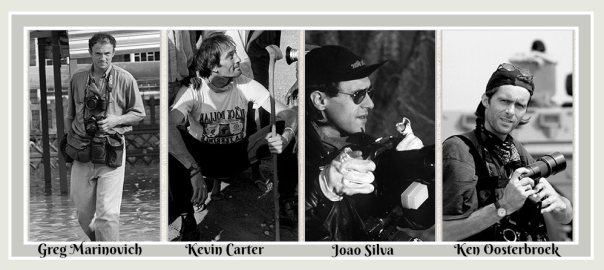
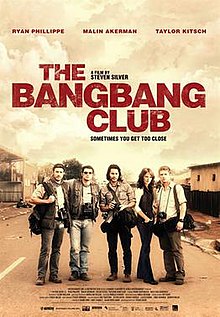
The Bang Bang Club was a group of four conflict photographers active within the townships of South Africa between 1990 and 1994, during the transition from the apartheid system to democracy.
This period saw much black on black factional violence, particularly fighting between ANC and IFP supporters, after the lifting of the bans on both political parties. But groups like the Afrikaner Weerstandsbeweging were also involved in violence.
The name “The Bang Bang Club” was born out of an article published in the South African magazine Living. Originally named The Bang Bang Paparazzi, it was changed to “Club” because the members felt the word paparazzi misrepresented their work.
The name comes from the culture itself; township residents spoke to the photographers about the “bang-bang” in reference to violence occurring within their communities, but more literally, “bang-bang” refers to the sound of gunfire and is a colloquialism used by conflict photographers.
On 18 April 1994, during a firefight between the National Peacekeeping Force and African National Congress supporters in the Thokoza township, friendly fire killed Oosterbroek and seriously injured Marinovich. An inquest into Oosterbroek’s death began in 1995.
The magistrate ruled that no party should be blamed for the death. In 1999, peacekeeper Brian Mkhize told Marinovich and Silva that he believed that the bullet that killed Oosterbroek had come from the National Peacekeeping Force.
In July 1994, Carter committed suicide.
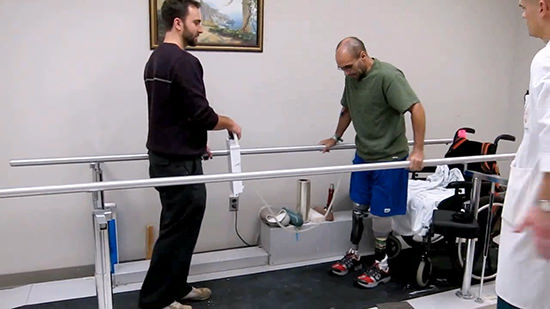
On 23 October 2010, Silva stepped on a land mine while on patrol with U.S. soldiers in Kandahar, Afghanistan and lost both legs below the knee.
Ken Oosterbroek: World Press Photo 1993, 2nd prize stories, General News; Ilford Press Photographer of the Year in 1989 and 1994; nominated the South African Press Photographer of The Year three times.
Ken Oosterbroek, one of South Africa’s top news photographers, is held by fellow photographer Gary Bernard of the Johannesburg Star after his was killed by police gunfire in the Kathelong black township of Johannesburg 18 April 1994.
———————————————————————————–
João Silva won the South African Press Photographer of the Year Award in 1992; World Press Photo 2007, Honorable mention stories, Spot News.
Photojournalist João Silva lost his legs to a land mine in Afghanistan
A documentary entitled When Under Fire: Shoot Back! premiered at the Denver Film Festival in November 2014.
In popular culture
The Bang-Bang Club are referenced in the 1996 Manic Street Preachers song “Kevin Carter” that features the lyric “Bang-Bang Club, AK-47 Hour.” The album “Poets and Madmen” by Savatage is inspired by the life of Kevin Carter.
Reception
The work by the members of the Bang-Bang Club between 1990 and 1994 was well known in South Africa. The fight against apartheid on the way to democracy was becoming a bloodbath at this time and Desmond Tutu, Archbishop Emeritus of Cape Town, South Africa wrote in the foreword of the book The Bang-bang Club: Snapshots From A Hidden War, 2000. The story of this fight needed to be told to the world, Tutu wrote:
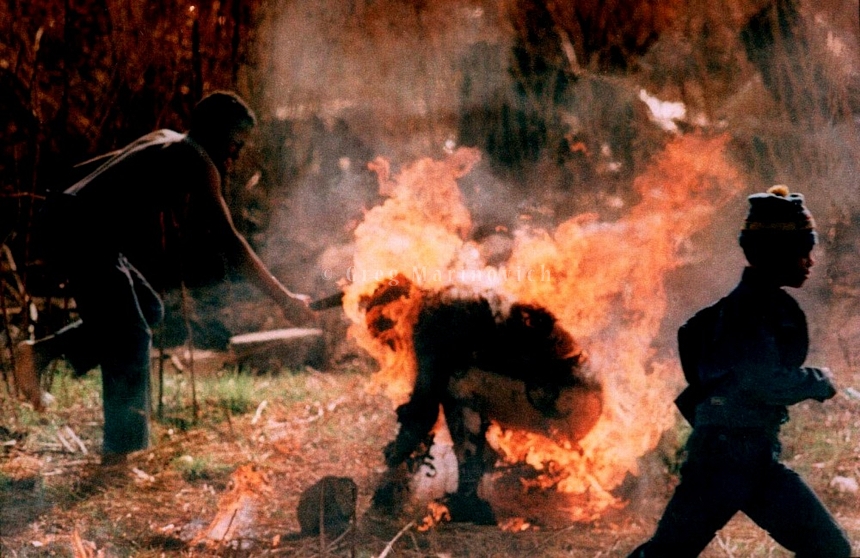
We were greatly blessed to have some of the most gifted journalists and brilliant photographers. They helped to tell the story. They captured some riveting moments on film, such as a gruesome necklacing (Kevin Carter), and the barbaric turning on a helpless victim by a baying crowd from one or other side of the conflict (Greg Marinovich”
Tutu remarked that the work by the Bang-Bang club was affecting the life of the photographers too:
“And we know a little about the cost of being traumatized that drove some to suicide, that, yes, these people were human beings operating under the most demanding of conditions.”
The Bang-Bang Club in the words by Greg and João
Le Bang-Bang Club est un mythe, glisse João. Il n’a jamais existé. Ce ‘’était que quatre potes qui voulaient témoigner d’un moment de lHistoire… – “The Bang-Bang Club is a myth,” says João. It never existed. It was only four friends who wanted to witness a moment of history. …
Silva told Michel Peyrard this in an interview for Paris Match in 2013. Marinovitch and Silva expressed the same thing in other words in her book.
Greg Marinovich, the writer in the team of the book The Bang-bang Club: Snapshots From A Hidden War, wrote in the preface
“The name gives a mental image of a group of hard-living men who worked, played and hung out together pretty much all of the time.”
Let us set the record straight: there never was such a creature, there never was a club, and there never were just the four of us in some kind of silver halide cult – dozens of journalists covered the violence during the period from Nelson Mandela’s release from jail to the first fully democratic election
Greg Marinovich explained about the key members of the Bang-Bang Club and what bound these four men together:
We discovered that one of the strongest links among us was questions about the morality of what we do: when do you press the shutter release and when do you cease being a photographer?
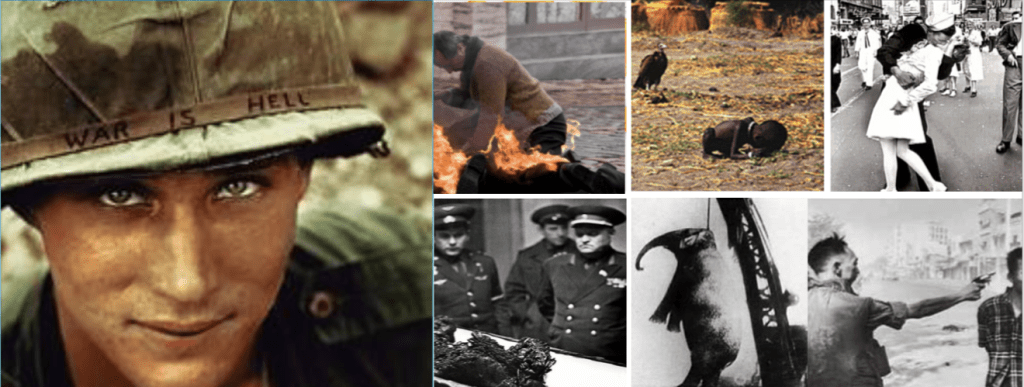
See below for other Iconic Pictures & pictures that changed the world.
a. A supporter of union between Great Britain and Northern Ireland
b. A person who remains loyal to the established ruler or government, especially in the face of a revolt.
Growing up in and around the Shankill during the worst years of the Troubles it is hardly surprising to learn that I hated Republicans and all they stood for. But that doesn’t mean I hated Catholic’s or Irish people and would wish any harm on them – I don’t and I didn’t.
It means I have a different point of view and democracy is all about freedom of choice and my choice is to maintain the Union with the UK and embrace and celebrate my loyalist culture and traditions. It also means I have the right to take pride in the union with the rest of the UK and I wear my nationality like a badge of honor for all the world to see.
The other woman in my life
——————————————————————————————————-
I’m helping ( just a little ) an American student write a thesis on Conflict and Compromise for an annual competition , National History Day and he has chosen to write about the Troubles and the Northern Ireland Conflict and asked me for some input.
Which I’m happy to do so – but as a Proud protestant from the Shankill Road I’m always a little suspicious when people , especially Americans & Irish folk ask me about the Troubles & what my views on the the various paramilitary groups are.
Often they seem to think that I am guilty via association and make gross generalizations about my people and local community and I have also experienced much prejudice both in mainland UK and abroad directed at my culture and protestant heritage. Ignorance reigns supreme and I have been astounded by the sheer stupidity & lack of understanding most folk have regarding the complex events that lead to 30 years of sectarian madness on the streets of Belfast & throughout Northern Ireland and the slaughter of 1000’s of innocent people from both communities.
I have learnt from personal experience that many ” Irish Americans ” and other deluded folk have a romantic view of Republican terrorists and to put it frankly this really pisses me off. However I’ll save that rant for another post.
Once when I was in New York visiting an American friend I was invited to a family gathering and a group of about thirty of us went out for a meal. It was a pleasant enough evening until the talk turned to Northern Ireland and the “war” against British oppression being waged by the “boys” in other words the IRA.
Now a few of the folk were second & third generation American Irish and boy did they get a bee in their bonnets and I was left in no doubt were their loyalties lay.
Then to my utter amazement some fool called Sean starting saying it was all the fault of the PRODS (protestants )and they were solely responsible for the “war” and should all fuck of back to Scotland & mainland England and leave Ireland to the Irish. I was fecking furious and had a face of thunder.
Apart from my friend none of those gathered knew I was protestant and I could see my friend dying a death at the other end of the table , obviously mortified. I excused myself and went to the toilet , stopping at the bar for a quick drink to calm myself down. When I got back to the table….total silence and I assumed my friend had informed them of my protestant background.
The rest of the evening was awkward to say the lest and I ignored the sectarian bigot and other fools who had insulted my culture.
At the end of the evening the biggest fool Sean came up and tried to apologize and offered me his hand in friendship. I leaned over and informed him I thought he was a fecking dickhead and he should be ashamed of himself.He looked a bit startled and made his way out of the restaurant and I’m glad to say it was the last and thankfully only time I came across this bigoted bastard.
Questions about growing up in Loyalist west Belfast
Here are the questions I have been asked to address and please feel free to supply some feedback or your own views in the space at the bottom of the page.
How did the IRA affect your life in Northern Ireland?
How did the UDA (and other Protestant organizations) affect your life in Northern Ireland?
What religion were you raised under?
Did you receive discrimination due to your religion?
Did you and your family feel that you had a better Quality of Life than Catholic families?
Were you ever a victim of violence by the IRA?
Do you believe that the Northern Ireland Conflict was either side’s (Unionists or Nationalists) fault?
Do you believe that there is still a divide between Unionists or Nationalists in Northern Ireland today?
After reports and evidence came out, do you have a position on Bloody Sunday?
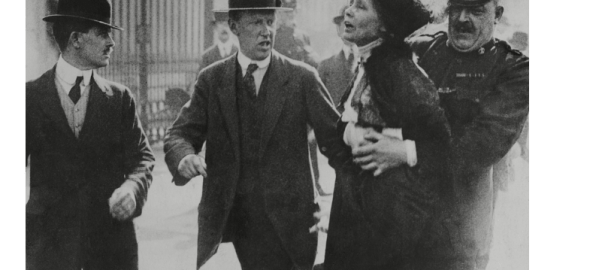
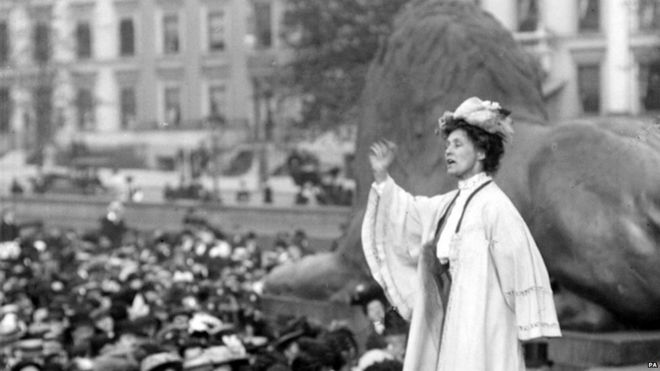
Emmeline Pankhurst (née Goulden; 15 July 1858 – 14 June 1928) was a British political activist and leader of the British suffragette movement who helped women win the right to vote.
“she shaped an idea of women for our time; she shook society into a new pattern from which there could be no going back”.
She was widely criticised for her militant tactics, and historians disagree about their effectiveness, but her work is recognised as a crucial element in achieving women’s suffrage in Britain.
Born in Moss Side, Manchester to politically active parents, Pankhurst was introduced at the age of 14 to the women’s suffrage movement. On 18 December 1879, she married Richard Pankhurst, a barrister 24 years older than her, known for supporting women’s rights to vote; they had five children over the next ten years.
He supported her activities outside the home, and she founded and became involved with the Women’s Franchise League, which advocated suffrage for both married and unmarried women. When that organisation broke apart, she tried to join the left-leaning Independent Labour Party through her friendship with socialist Keir Hardie but was initially refused membership by the local branch on account of her gender.
While working as a Poor Law Guardian, she was shocked at the harsh conditions she encountered in Manchester’s workhouses.
The 1971 Ibrox disaster was a crush among the crowd at an Old Firmfootball game, which led to 66 deaths and more than 200 injuries. It happened on 2 January 1971 in an exit stairway at Ibrox Park (now Ibrox Stadium) in Glasgow, Scotland.
During 1963, concerns were raised about the safety of the stairway adjacent to passageway 13 (colloquially known as Stairway 13), the exit closest to Copland Road subway station. It was documented that the stairs provided very little freedom of movement due to crowd pressure; many were lifted off their feet by the crowd and had no choice in which lane they were going to use, or at what pace.
On 16 September 1961 two people were killed in a crush on the stairway, and there were two other incidents – in 1967 and 1969. In 1967, eight spectators were injured when leaving the stadium. In 1969, 26 were injured in an accident on Stairway 13 during egress.
No steps were taken to consult a professional firm to discuss the potential dangers from crowds on Stairway 13 following these events. Subsequent to the 1961 accident, Rangers had by then spent a total of £150,000 on improvements to Ibrox, a very significant sum of money for the time (2.3 million pounds in 2017 money).
Events
The disaster occurred on Saturday, 2 January 1971, when 66 people were killed in a crush, as supporters tried to leave the stadium. The match was an Old Firm game (Rangers v Celtic) and was attended by more than 80,000 fans. In the 90th minute, Celtic took a 1–0 lead and some Rangers supporters started to leave the stadium.
However, in the final moments of the match, Colin Stein scored an equaliser for Rangers.
As thousands of spectators were leaving the ground by stairway 13, it appears that someone, possibly a child being carried on his father’s shoulders, fell, causing a massive chain-reaction pile-up of people.
The tragic loss included many children – five of them schoolmates from the town of Markinch in Fife. The youngest child to die was Nigel Patrick Pickup of Liverpool, age 9. Most of the deaths were caused by compressive asphyxia, with bodies being stacked up to six feet deep in the area. More than 200 other fans were injured.
Initially there was speculation that some fans left the ground slightly early when Celtic scored, but then turned back when they heard the crowd cheering when Stein scored the equaliser, colliding with fans leaving the ground when the match ended.
The official inquiry into the disaster indicated that there was no truth in this hypothesis, however, as all the spectators were heading in the same direction at the time of the collapse.
Consequences
John Greig statue in remembrance of the victims of the Ibrox disasters.
The disaster spurred the UK government to look into safety at sports grounds. In February 1971, Scottish judge Lord Wheatley was asked to conduct an inquiry.[10] His findings, published in May 1972, formed the basis for the Guide to Safety at Sports Grounds (Green Guide), first published in 1973.
The 1971 disaster led to a huge redevelopment of the Ibrox ground, spearheaded by the then-manager Willie Waddell, who visited Borussia Dortmund‘s Westfalenstadion for inspiration. After three years’ reconstruction work – three quarters of the ground being replaced by modern all-seater stands – Ibrox was converted to a 44,000-capacity stadium by 1981. Further work in the 1990s increased the stadium capacity to 50,000, and Ibrox was subsequently awarded UEFA five-star status.
For some years after the 1971 disaster there was only a small plaque at the corner of the ground where it happened. However, in 1995 Rangers announced plans to commemorate the 66 fans killed in the 1971 disaster.
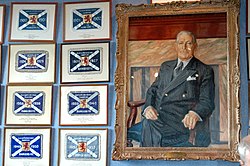
On 2 January 2001, the thirtieth anniversary of the tragedy, a larger monument was unveiled at the corner of the Bill Struth Main Stand and the Copland Road Stand. The monument contains blue plaques displaying the names of each person killed in all three incidents. A statue of John Greig, the Rangers captain at the time of the 1971 disaster, stands atop the monument.
Bill Struth
In 2011, the 40th anniversary of the disaster was commemorated before the Old Firm game on 2 January 2011 when a one-minute silence was observed before the game. Both teams wore black armbands as a sign of respect and were led out by John Greig and Billy McNeill – the respective club captains at the time of the disaster (although Billy McNeill had not played due to injury).
Damages claims
Sheriff James Irvine Smith, in his damages statement, ruled: “The said accident was due to the fault and negligence of the defenders, Rangers F.C.”.[1] Smith found Rangers F.C. guilty on four counts in the case of the death of Charles Dougan, a 31-year-old boilermaker from Clydebank who died, as did 56 others, from traumatic asphyxia.
After hearing of a series of accidents on Stairway Thirteen including September 1961 when there were 70 people injured and two deaths, September 1967 when 11 people were taken to hospital, and January 1969 when 29 people were injured, Sheriff Irvine Smith stated,
So far as the evidence is concerned, the Board never so much as considered that it ought to apply its mind to the question of safety on that particular stairway […] and would appear – I put it no higher – to have proceeded on the view that if the problem was ignored long enough it would eventually go away […] Indeed it goes further than this because certain of their actions can only be interpreted as a deliberate and apparently successful attempt to deceive others that they were doing something, when in fact they were doing nothing.
— Sheriff Irvine Smith, damages statement.
In the case of Charles Dougan and a further 60 cases brought by relatives of the dead, Rangers F.C. did not dispute the findings of Sheriff Irvine Smith and instead merely disputed the calculation of the damages as can be seen from the appeal judgement of the Sheriff Principal.
A more detailed report can be found on the evidence heard and the veracity of Rangers F.C. witnesses in a December 1974 edition of Foul – The Alternative Football Paper.
In his book, Irvine Smith states that 30, and nearly 40 years after his decision, he is viewed with disapproval by some Rangers-supporting friends, who accuse him of “disloyalty”
Rangers legend John Greig lays a wreath at the memorial marking the 1971 Ibrox Disaster
Outside Ibrox Stadium today a group gathered beneath the shadows of the looming stand in silence. Some within it carried wreaths and flowers, others gripped their scarves as prayers were read.
The year always starts the same way in Govan. With a quiet and simple act of remembrance, remembering the 66 fans who lost their lives in one of the most terrible tragedies in the history of British football.
Even though Ibrox Stadium has changed dramatically since January 2 1971, any football fan who has ever attended a Glasgow derby can imagine the events of that day, the closing moments of the game and the aftermath which led to 66 deaths and over 200 being injured in Stairwell 13.
Celtic, the away side, took the lead through Jimmy Johnstone in the 90th minute of the game, leaving Rangers with virtually no chance of scoring a leveller. Somehow they managed it, with Colin Stein levelling seconds later.
The Rangers’ ends, who had thought they were beaten, celebrated wildly and, when the final whistle sounded, began to file out many heading to the exit which was closest to Copland Road Subway.
This is simply the story of a boy trying to grow up, survive, thrive, have fun & discover himself against a backdrop of events that might best be described as ‘explosive’, captivating & shocking the world for thirty long years.
The West Memphis Three are three men who – while teenagers – were tried and convicted, in 1994, of the 1993 murders of three boys in West Memphis, Arkansas. Damien Echols was sentenced to death, Jessie Misskelley, Jr. was sentenced to life imprisonment plus two 20-year sentences, and Jason Baldwin was sentenced to life imprisonment. During the trial, the prosecution asserted that the children were killed as part of a Satanic ritual.
A number of documentaries have explored the case. Celebrities and musicians have held fundraisers in the belief that the three young men convicted of the crime are innocent.
In July 2007, new forensic evidence was presented in the case. A status report jointly issued by the state and the defense team stated: “Although most of the genetic material recovered from the scene was attributable to the victims of the offenses, some of it…
This was more than a victory, it was the complete destruction of three Roman legions and all their commanders; the few men who survived were made slaves.
It was the greatest disaster in Roman military history. Apart from occasional raids and campaigns, the Romans never again held the Germanic land across the Rhine.
The battle began a seven-year war which ended with the Rhine as the boundary of the Roman Empire for the next four hundred years, until the decline of the Western Roman Empire.
My thoughts…..
I have long held a fascination bordering on obsession with ancient Rome and all things related to the birth and brutal uncompromising rise of one of the greatest Empires ever known to mankind.
If I could travel through time and space I would travel to the last days of the Roman Republic and witness the giants of ancient Rome , Caesar , Pompey & Crassus rule the known world and the rise of the first emperor Octavian , known as Augustus , who paved the way for the demonic Caligula and the depraved Nero.
Imagine watching as Caesar crossed the Rubicon and change the course of Rome’s history forever or witnessing his legions historic battles during the brutal Gallic Wars. Or standing on the sidelines watching general Publius Cornelius Scipio , ( Scipio ) one of the greatest generals and military strategists of all time taking on the might of Carthage and defeating Hannibal at the final battle at Zama
Sadly but unsurprisingly Caesar , Pompey & Crassus and many others met with violent deaths and the Ides of March marked a pivotal change of direction for the Roman people and those they ruled and subjugated without remorse.
The age of Emperors had arrived and Rome would never be the same.
I would like to visit Antony and Cleopatra and see what all the fuss was about and watch as the original love story unfolded and witness their sad demise and the suicides that would immortalized their love for all time.
I would watch as the Roman legions marched against countless armies opposed to the Empire’s iron rule and ruthlessly destroyed all in their paths and the dithering Claudius’s desperate attempt to conquer Britannia in his quest for eternal glory and the love of the mobs in the forums of Rome.
Imagine the sights and sounds of the legions faced with the wicked druids on the island of Anglesey, or Mona as it was then known, at the edge of the known world and I would marvel as the mother of Girl Power Boudica led the Iceni tribe in an uprising that pushed the legions to their very limits.
I could go on all day but I’ve just realized I’m boring myself stupid and gods knows what I’m doing to you.
The Battle of the Teutoburg Forest was a pivotal moment in Rome’s history and has long fascinated me, hence this post.
“To Marcus Caelius, son of Titus, of the Lemonian district, from Bologna, first centurion of the eighteenth legion. 53½ years old. He fell in the Varian War. His freedman’s bones may be interred here. Publius Caelius, son of Titus, of the Lemonian district, his brother, erected (this monument).”
The Roman commander, Varus, was about the fourth most important man in Rome. He was known and feared because of his ruthless actions and his crucifixion of defeated enemies. It is certain this was known to the Germans, and may have helped the tribes come together to resist him.
The German commander was Arminius, who had been given a Roman military education. He had spent his youth in Rome as a hostage. Therefore, he knew Roman military methods: this knowledge was to be crucial.
Later, Arminius returned to Germania with Varus, and became his trusted advisor.
In secret, he forged an alliance of Germanic tribes that had traditionally been enemies. He was helped to do this by the anger over Varus’ insolence and cruelty to the people he defeated.
“…Stratagem was, therefore, indispensable; and it was necessary to blind Varus to their schemes until a favorable opportunity should arrive for striking a decisive blow…”
British historian Edward Shepherd Creasy (1812–1878)
While Varus was on his way from his summer camp, west of the Weser river, to the winter headquarters near the Rhine, he heard reports of a local rebellion. This was faked by Arminius.
“…This was represented to Varus as an occasion which required his prompt attendance at the spot; but he was kept in studied ignorance of its being part of a concerted national rising; and he still looked on Arminius as his submissive vassal…” Edward Shepherd Creasy
Recent archaeological finds place the battle at Kalkriese Hill in Osnabrück County, Lower Saxony. The Romans must at this time have been marching northwestward from the area that is now the city of Detmold, passing east of Osnabrück; they must then have camped in this area before being attacked.
Battle
Varus’s forces included three legions, six cohorts of auxiliary troops (non-citizens or allied troops) and three squadrons of cavalry. Many of them had little combat experience with Germanic fighters under local conditions.
The Roman forces were not marching in combat formation, and there were also large numbers of camp-followers. As they entered the forest they found the track narrow and muddy; according to Dio Cassius a violent storm had also arisen. He also writes that Varus neglected to send out advance reconnaissance parties.
The line of march was dangerously stretched out – estimates are that it was more than 15 km (9 miles), and was perhaps as long as 20 km (12 miles).
It was then suddenly attacked by Germanic warriors who were carrying some light swords, large lances and spears that came with short and narrow blades, so sharp and warrior friendly that they could be used as required. The Germanic warriors surrounded the entire Roman army and rained down javelins on the intruders.
The Romans were able to set up a fortified night camp, and the next morning broke out into open country, near the modern town of Ostercappeln. The break-out cost them heavy losses, as did a further attempt to escape by marching through another forest area, with heavy rains continuing. The rain stopped them from using their bows because sinew strings become slack when wet, and left them virtually defenseless as their shields also became waterlogged.
The Romans then began a night march to escape, but marched into another trap that Arminius had set, at the foot of a hill near Osnabrück. There, the sandy, open strip on which the Romans could march easily narrowed at the bottom of the hill. There was a gap of only about 100 m between the woods and the swampland at the edge of the Great Bog.
The road was blocked by a trench, and, towards the forest, an earthen wall had been built along the roadside. This let the tribesmen to attack the Romans from cover.
The Romans made a desperate attempt to storm the wall, but failed. The Germanic warriors then stormed the field and slaughtered the Romans; Varus committed suicide.
Around 15,000–20,000 Roman soldiers must have died; not only Varus, but also many of his officers are said to have taken their own lives by falling on their swords in the approved manner.
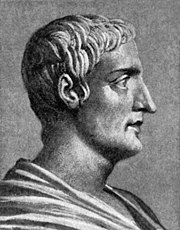
Tacitus
Tacitus wrote that many officers were sacrificed by the Germans as part of their indigenous religious ceremonies, cooked in pots and their bones used for rituals.[11] However, others were ransomed, and some of the common soldiers were enslaved.
The victory over the legions was followed by a clean sweep of all Roman forts, garrisons and cities – of which there were at least two – east of the Rhine. The remaining two Roman legions in Germany were stationed in a fort at Mainz, and commanded by Varus’ nephew. They were content to try to hold the Rhine.
Varus’s mistakes
Segestes, father of Arminius’ wife and opposed to the marriage, warned Varus about Arminius. The night before the Roman forces left, he suggested Varus arrest Arminius and several other Germanic leaders. He must have known they were plotting an uprising. Varus dismissed the advice as motivated by a personal feud. Arminius then left saying he would drum up Germanic forces to support the Roman campaign. Instead he led his troops, who must have been waiting close by, in attacks on surrounding Roman garrisons.
Even without this warning, Varus, as a matter of policy, should have been less trusting of Arminius, who turned out to be a double agent.
The choice of a march through the forest was against normal Roman military methods, because both vision and defence are limited in a forest. The march was not done in combat formation. Obviously, this route was chosen as a ‘short cut’, but Varus had no proof that such urgency was really necessary. This was doubly so as the forest caused the line to stretch so far that one part could not support another.
The lack of scouts (‘reconnaissance parties’) was almost criminal, and would probably have had Varus executed had he not taken his life.
The bad weather was another good reason for caution when going into the forest. The forest was unknown ground to Varus. New routes should always be scouted.
Though we can never know why Varus made these mistakes, his reputation for arrogance and over-confidence suggests he under-estimated the Germans. But all Rome’s previous experience, from Caesar onwards, had shown the Germanic tribes as strong in war.
Aftermath
Upon hearing of the defeat, the Emperor Augustus, according to the Roman historian Suetonius in his work De vita Caesarum (On the life of the Caesars), was so shaken by the news that he stood butting his head against the wall of his palace, repeatedly shouting:
„Quintili Vare, legiones redde!“ (‘Quintilius Varus, give me back my legions!’)
The three legion numbers were never used again by the Romans after this defeat, unlike other legions that were restructured – a case unique in Roman history.
The battle ended the period of triumphant Roman expansion that had followed the end of the Civil Wars 40 years earlier. Augustus’ stepson Tiberius took effective control, and prepared for the continuation of the war. Three legions were sent to the Rhine to replace the lost legions.
Roman retaliation
The Roman commander Germanicus was the opponent of Arminius in 14–16 AD
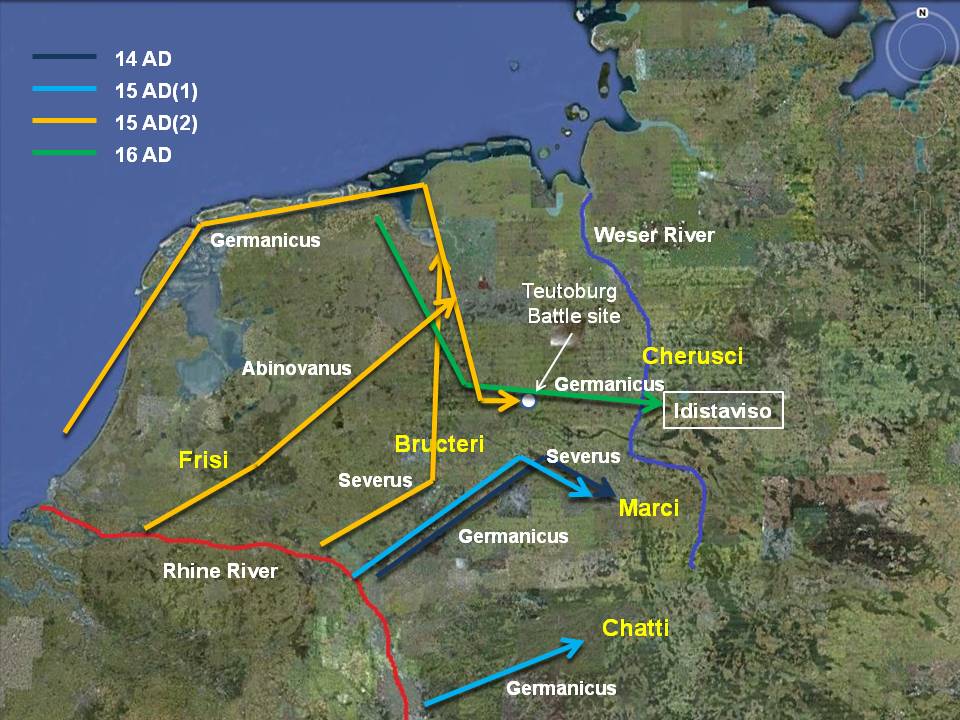
Though their shock at the slaughter was great, the Romans began a slow, systematic preparation to reconquer the country. In 14 AD, just after Augustus’ death, and the accession of his heir and stepson Tiberius, a huge raid was led by the new emperor’s nephew Germanicus.
On a starry night he massacred the Marsi and ravaged their villages with fire and sword. That night the Germans had celebrated; drunk and asleep, they were surprised by Germanicus. The temple of their deity was destroyed.
Several other tribes were roused by this slaughter and ambushed Germanicus on the way to his winter-quarters, but were defeated with heavy losses.
battles with a large army estimated at 55,000–70,000 men, backed by naval forces. In spring 15 AD, the legate Caecina Severus invaded the Marsi a second time with 25,000–30,000 men, causing great havoc.
Meanwhile, Germanicus’ troops had built a fort on Mount Taunus from where he marched with 30 to 35,000 men against the Chatti (probably a region of villages) and slaughtered children, women and the elderly. The able-bodied men fled across a river and hid themselves in the forests. After this blow Germanicus marched on Mattium and burned the city down.
In summer 15 AD, the army visited the site of the first battle. According to Tacitus, they found heaps of bones, and skulls nailed to trees, which they buried,
“…looking on all as kinsfolk and of their own blood…”.
Burial pits with remains fitting this description have been found at Kalkriese Hill.
Under Germanicus, the Romans marched another army, with allied Germanic soldiers, into Germania in 16 AD. He was able to fight his way across the Weser near modern Minden, suffering some losses. He forced Arminius’ army to stand in open battle at the Weser River. Germanicus’s legions inflicted huge casualties on the Germanic armies while sustaining only minor losses.
One final battle was fought at the Angivarian Wall, west of modern Hanover. Again many Germanic soldiers were killed, which forced them to flee. In summer 16 AD, Caius Silius marched against the Chatti with 33,000 men. Germanicus invaded the Marsi for a third time and devastated their land.
With his main goals reached and winter coming, Germanicus ordered his army back to their winter camps, with the fleet getting damaged in a storm in the North Sea. After a few more raids across the Rhine, with the recovery of two of the three Roman legions’ eagles lost in 9 AD, Tiberius ordered the Roman forces to halt and withdraw across the Rhine. Germanicus was recalled to Rome and informed by Tiberius that he would be given a Triumph and a new command.
Germanicus’ campaign had been to revenge the defeat at Teutoburg, and also partly in reaction to signs of mutiny amongst his troops.
Arminius, who had been considered a real threat to stability by Rome, was now defeated. Once his allied Germanic coalition had been broken and honour avenged, the huge cost and risk of keeping the Roman army operating beyond the Rhine was not worth any likely benefit to be gained.
The last chapter of this story is told by the historian Tacitus. Around 50 AD, bands of Chatti invaded Roman territory and began to plunder (take everything of value). The Roman commander, with a legionary force supported by Roman cavalry and auxiliaries, attacked the Chatti from both sides and defeated them. Great was the joy when they found Roman prisoners, including some from Varus’ legions who had been held by the Chatti for 40 years.
The Lost Legions of Varus
Later German nationalism
The battle, and the histories of Tacitus, had a big effect on 19th century German nationalism. In the 19th century the Germans were still divided into many German states, but they linked themselves with the Germanic tribes as shared ancestors of one “German people”.
In 1808, the German author Heinrich von Kleist‘s play Die Hermannsschlacht aroused anti-Napoleonic sentiment, even though it could not be performed under French occupation.
Later, the figure of Arminius was used to represent the ideals of freedom and unification – as supported by German liberals, and opposed by reactionary rulers. A memorial – the Hermannsdenkmal – was begun during this period, and Arminius became a symbol of Pan-Germanism. The monument remained unfinished for decades, until after the Franco-Prussian War of 1870–71 unified the country. The completed monument was then a symbol of conservative German nationalism.
The club was formed on McIndoe’s initiative in June 1941 with 39 patients, primarily as a drinking club. The members were aircrew patients in the hospital and the surgeons and anaesthetists who treated them. Aircrew members had to be serving airmen who had gone through at least two surgical procedures. By the end of the war the club had 649 members.


























 belfastchildis.com