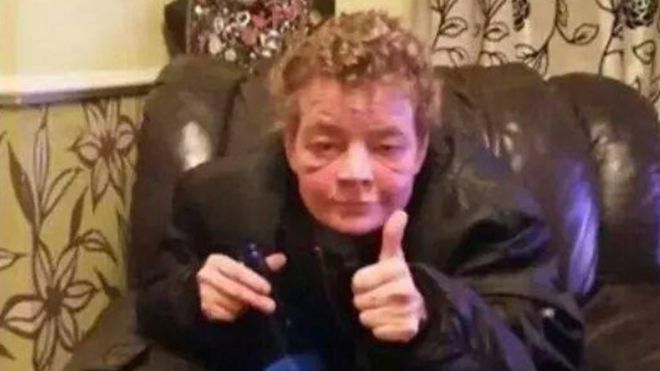
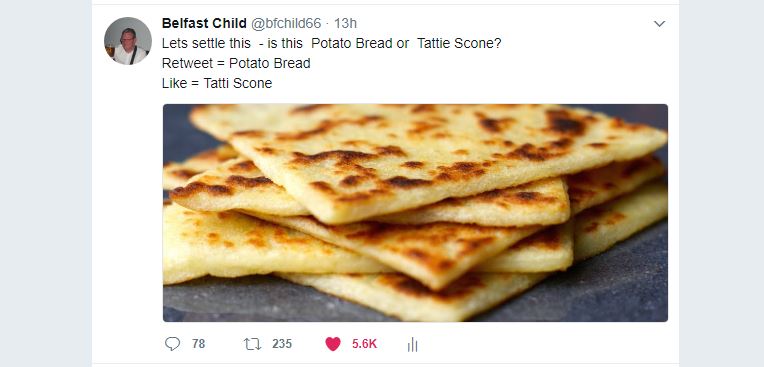
I posted this question on Twitter yesterday after a few people people pulled me up for calling it Potato Bread and not a Tatti Scone. I had been blogging about food I like and the wife found gross and naturally I included my childhood favorite Potato Bread .
This slideshow requires JavaScript.
And so the debate began.
To date the Scottish vote is embarrassingly in front with a whopping 5.6 k votes and the Northern Ireland vote is a shameful 235 – and this must be put right.
If you would like to vote and address this outrageous imbalance go to my Twitter page @bfchild66 and look for the Tweet in question or click the link below.
Lets settle this – is this Potato Bread or Tattie Scone?
Retweet = Potato Bread
Like = Tatti Scone pic.twitter.com/arHnUxHEI1
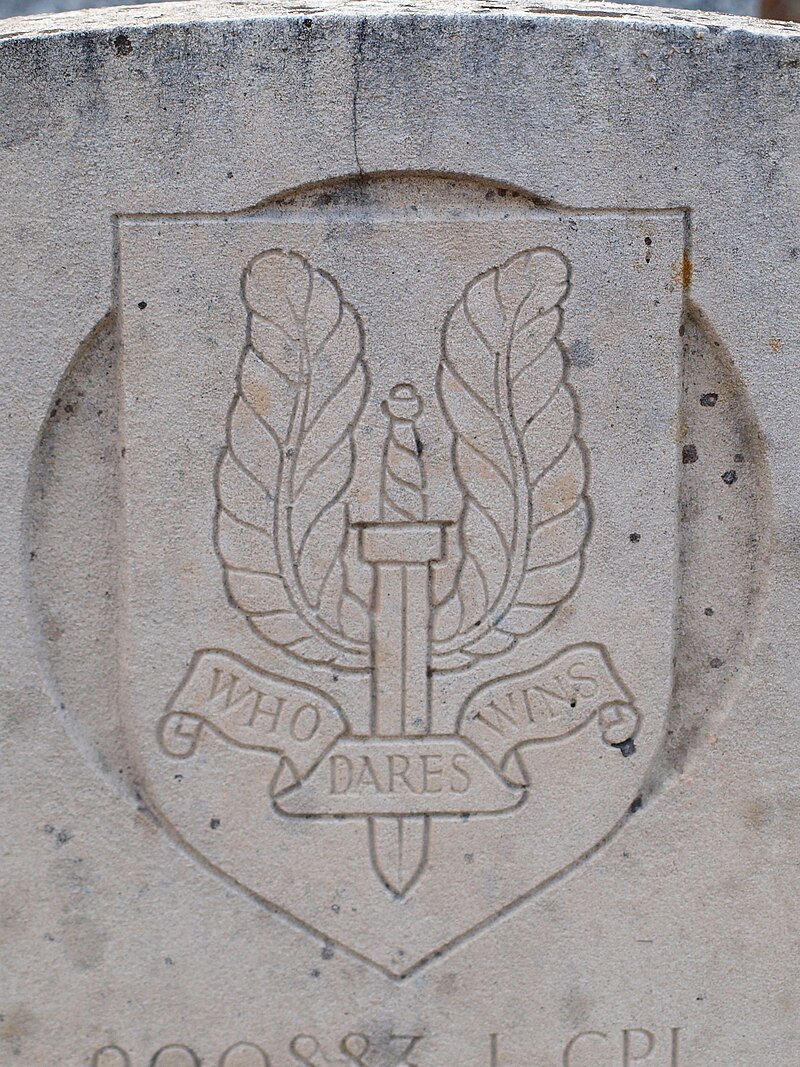
The motto has been used by twelve elite special forces units around the world that in some way have historical ties to the British SAS.
An early statement of the idea is ‘τοῖς τολμῶσιν ἡ τύχη ξύμφορος’ (“fortune favours the bold”) from the Ancient Greek soldier and historian Thucydides.
. ‘C Squadron (Rhodesia) Special Air Service’ Mil. Abbrev. ‘C Sqn SAS’. Later ‘Rhodesian Special Air Service Regiment’ in Kabrit Barracks, Salisbury (now Harare)
She is most notable for her characteristic emotional and sometimes vitriolic tone, described as “passionate”, “vaguely menacing”, and “aggressive”. Ri made the official announcements of the deaths of Kim Il-sung in 1994 and Kim Jong-il in 2011. In a news report by CCTV News on 24 January 2012, Ri announced her retirement as chief newsreader at KCTV. She has periodically reappeared on television in the years since, typically to make an announcement regarding the country’s militaristic developments.
Ri was born in 1943 to a poor family in Togchon, Gangwon, Japanese Korea. She was cultivated by the North Korean government because of her background of abject poverty, which is considered a sign of political trustworthiness in the country. Ri studied performance art at Pyongyang University of Theatre and Film and was recruited by KCTV.
Career
Ri began work onscreen in 1971, became chief news presenter of KCTV in 1974, and was consistently on‑air from the 1980s. Her career was unique for its longevity; while many at KCTV were demoted or purged, her career was never interrupted. After retiring in January 2012, she came out of retirement especially to announce that North Korea claims to have carried out an H-bomb detonation in January 2016 and that North Korea had launched a missile in February 2016. She also announced the nuclear test of September 2016.
Style
Ri has received high acclaim from the North Korean authorities for her resonant voice, impressive mood and outstanding eloquence. She is known for her melodramatic announcing style. She often speaks in a wavering and exuberant tone when praising the nation’s leaders, and conversely with visible anger when denouncing the West.
According to Brian Reynolds Myers, a professor at Dongseo University and an expert in North Korean propaganda, her training in drama serves her well, given the large amount of showmanship that is typical of North Korean broadcasting.
When she made the official announcement of Kim Il-sung’s death in 1994, Ri was visibly crying during the broadcast. Likewise, when she announced Kim Jong-il’s death in 2011, she was seen holding back tears. Her melodramatic style has been parodied in the character of Kim Bong Cha, a North Korean correspondent on The Noose.
Ri usually appears wearing either a pink, Western-style suit or in a traditional Korean hanbok
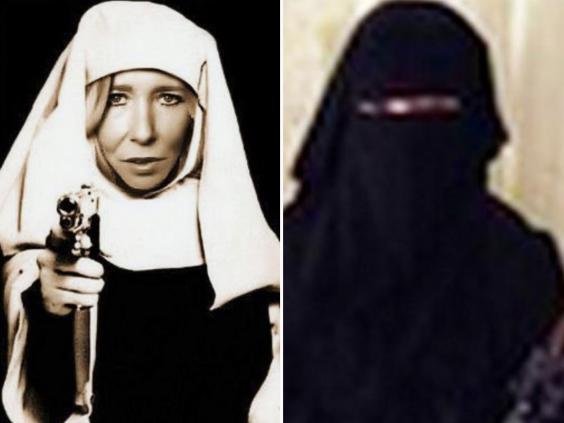
Isis recruiter Sally Jones reportedly wants to leave Raqqa and return to Britain
Sally Jones, the leading female recruiter for Isis, reportedly wants to leave Raqqa and come home to Britain. The former punk rocker who married a now-dead Isis fighter and took her son to Syria has been “crying and wants to get back to Britain,” according to reports.
Sky News spoke to an immigrant to the so-called Islamic caliphate now under Kurdish guard in a refugee camp who said that few immigrants wanted to join the war. “Aisha” told Sky News that she knew Jones
When asked if she met many British people, Aisha replied:
“I know one-Umma Hussain al Britani”.
She used Jones’ nom de guerre, according to Sky News. Jones was married to Junaid Hussain, Isis’ chief of digital jihad who was killed by a US drone strike in 2015.
“She lost her husband in battle last year. She had one boy,” Aisha continued.
Jones’ son Jojo was born in the UK and is about 12 years old. The boy’s grandparents and father expressed their fears in 2016 that he had been brainwashed into becoming an executioner for the terrorist group. A chilling video released by Isis shows a group of boys executing five Kurdish fighters.
Aisha said: “She was crying and wants to get back to Britain but Isis is preventing her because she is now a military wife. She told me she wish to go to her country.” Sky News noted that if that is in fact what Jones wants, she will have to be prepared to give up her jihadi recruiting and prepare to exchange life in Raqqa for a lifetime in prison.
Jones reportedly rose up a US kill list back in May, with analysts believing she was behind several Isis terror plots. “Mrs Terror,” as Jones has been dubbed, is reportedly behind more than 10 operations that targeted army personnel and civilians.
The first day of the Battle of the Somme, in northern France, was the bloodiest day in the history of the British Army and one of the most infamous days of World War One.
On 1 July 1916, the British forces suffered 57,470 casualties, including 19,240 fatalities. They gained just three square miles of territory. British and German troops faced each other’s trenches only separated by a few hundred yards of “no-man’s land”.
The British force consisted of soldiers from Britain and Ireland, as well as troops from Newfoundland, South Africa and India.
The British generals staged a massive artillery bombardment and sent 100,000 men over the top to take the German trenches.
They were confident of victory. But the British soldiers were unable to break through the German defences and were mown down in their thousands by machine gun and artillery fire.
This day set a bloody precedent: the Somme campaign wore on for five months and, in all, more than a million soldiers from the British, German and French armies were wounded or killed.
The attack began on Friday, 12 May 2017, and within a day was reported to have infected more than 230,000 computers in over 150 countries. Parts of the United Kingdom’s National Health Service (NHS), Spain’s Telefónica, FedEx and Deutsche Bahn were hit, along with many other countries and companies worldwide.
Shortly after the attack began, Marcus Hutchins, a 22-year-old web security researcher from North Devon in England, who blogs as “MalwareTech”, discovered an effective kill switch by registering a domain name he found in the code of the ransomware. This greatly slowed the spread of the infection, effectively halting the initial outbreak on Monday, 15 May 2017, but new versions have since been detected that lack the kill switch.
Researchers have also found ways to recover data from infected machines under some circumstances.
WannaCry propagates using EternalBlue, an exploit of Windows’ Server Message Block (SMB) protocol. Much of the attention and comment around the event was occasioned by the fact that the U.S. National Security Agency (NSA) had already discovered the vulnerability, but used it to create an exploit for its own offensive work, rather than report it to Microsoft.
However, many Windows users had not installed the patches when, two months later on May 12, 2017, WannaCry used the EternalBlue vulnerability to spread itself. The next day, Microsoft released emergency security patches for Windows 7 and Windows 8.
Those still running older, unsupported versions of Microsoft Windows, such as Windows XP and Windows Server 2003, were initially at particular risk, but Microsoft released an emergency security patch for these platforms as well. Almost all victims of the cyberattack were running Windows 7, prompting a security researcher to argue that its effects on Windows XP users were “insignificant” in comparison.
Within four days of the initial outbreak, security experts said that most organizations had applied updates, and that new infections had slowed to a trickle.
Several organizations released detailed technical writeups of the malware, including Microsoft, Cisco, Malwarebytes,Symantec and McAfee.
The “payload” works in the same fashion as most modern ransomware: it finds and encrypts a range of data files, then displays a “ransom note” informing the user and demanding a payment in bitcoin.
It is considered a network worm because it also includes a “transport” mechanism to automatically spread itself. This transport code scans for vulnerable systems, then uses the EternalBlue exploit to gain access, and the DoublePulsar tool to install and execute a copy of itself.
WannaCry
Screenshot of the ransom note left on an infected system
Date
12 May 2017 – 15 May 2017
(initial outbreak)
Location
Worldwide
Also known as
Transformations:
Wanna → Wana
Cryptor → Crypt0r
Cryptor → Decryptor
Cryptor → Crypt → Cry
Addition of “2.0”
Short names:
Wanna → WN → W
Cry → CRY
The software contained a URL that, when discovered and registered by a security researcher to track activity from infected machines, was found to act as a “kill switch” that shut down the software before it executed its payload, stopping the spread of the ransomware. The researcher speculated that this had been included in the software as a mechanism to prevent it being run on quarantined machines used by anti-virus researchers;
he observed that some sandbox environments will respond to all queries with traffic in order to trick the software into thinking that it is still connected to the internet, so the software attempts to contact an address which did not exist, to detect whether it was running in a sandbox, and do nothing if so. He also noted that it was not an unprecedented technique, having been observed in the Necurs trojan.
On 19 May, it was reported that hackers were trying to use a Mirai botnet variant to effect a distributed attack on WannaCry’s kill-switch domain with the intention of knocking it offline. On 22 May, @MalwareTechBlog protected the domain by switching to a cached version of the site, capable of dealing with much higher traffic loads than the live site.
EternalBlue exploits a vulnerability in Microsoft‘s implementation of the Server Message Block (SMB) protocol. This Windows vulnerability was not a zero-day flaw, but one for which Microsoft had released a “critical” advisory, along with a security patch to fix the vulnerability two months before, on 14 March 2017.
The day after the WannaCry outbreak Microsoft released updates for these too.
DoublePulsar
DoublePulsar is a backdoor tool, also released by The Shadow Brokers on 8 April 2017,[35] Starting from 21 April 2017, security researchers reported that computers with the DoublePulsar backdoor installed were in the tens of thousands By 25 April, reports estimated the number of infected computers to be up to several hundred thousands, with numbers increasing exponentially every day.
The WannaCry code can take advantage of any existing DoublePulsar infection, or installs it itself.
Attribution
Linguistic analysis of the ransom notes indicated the authors were likely fluent in Chinese and proficient in English, as the versions of the notes in those languages were probably human-written while the rest seemed to be machine-translated.
This could also be either simple re-use of code by another group or an attempt to shift blame—as in a cyber false flag operation; but a leaked internal NSA memo is alleged to have also linked the creation of the worm to North Korea.
North Korea itself denies being responsible for the cyberattack.
Cyberattack
Map of the countries initially affected
On 12 May 2017, WannaCry began affecting computers worldwide, with evidence pointing to an initial infection in Asia at 7:44am UTC. The initial infection was likely through an exposed vulnerable SMB port, rather than email phishing as initially assumed.
When executed, the malware first checks the “kill switch” domain name;[c] if it is not found, then the ransomware encrypts the computer’s data,[58][27][59] then attempts to exploit the SMB vulnerability to spread out to random computers on the Internet, and “laterally” to computers on the same network.
As with other modern ransomware, the payload displays a message informing the user that files have been encrypted, and demands a payment of around $300 in bitcoin within three days, or $600 within seven days. Three hardcoded bitcoin addresses, or “wallets”, are used to receive the payments of victims. As with all such wallets, their transactions and balances are publicly accessible even though the wallet owners remain unknown.
As of 14 June 2017, at 00:18 ET, a total of 327 payments totaling $130,634.77 (51.62396539 XBT) had been transferred.
Organizations that had not installed Microsoft’s security update were affected by the attack. Those still running the older Windows XP were at particularly high risk because no security patches had been released since April 2014 (with the exception of one emergency patch released in May 2014). However, on the day after the outbreak, an emergency, out-of-band security update was released for XP and Windows Server 2003.
A Kaspersky Labs study reported that less than 0.1 percent of the affected computers were running Windows XP, and that 98 percent of the affected computers were running Windows 7. In a controlled testing environment, the cybersecurity firm Kryptos Logic found that they were unable to infect a Windows XP system with WannaCry using just the exploits, as the payload failed to load, or caused the operating system to crash rather than actually execute and encrypt files. However, when executed manually, WannaCry could still operate on Windows XP.
Defensive response
Several hours after the initial release of the ransomware on 12 May 2017, while trying to establish the size of the attack, a researcher known by the name MalwareTech accidentally discovered what amounted to a “kill switch” hardcoded in the malware.
Registering a domain name for a DNS sinkhole stopped the attack spreading as a worm, because the ransomware only encrypted the computer’s files if it was unable to connect to that domain, which all computers infected with WannaCry before the website’s registration had been unable to do. While this did not help already infected systems, it severely slowed the spread of the initial infection and gave time for defensive measures to be deployed worldwide, particularly in North America and Asia, which had not been attacked to the same extent as elsewhere.
On 16 May 2017, researchers from University College London and Boston University reported that their PayBreak system could defeat WannaCry and several other families of ransomware.
Within four days of the initial outbreak, security experts were saying that most organizations had applied updates, and that new infections had slowed to a trickle.
It was discovered that Windows encryption APIs used by WannaCry may not completely clear from memory the prime numbers used to generate the payload’s private keys, making it possible to potentially retrieve the required key if they had not yet been overwritten or cleared from resident memory.
This behaviour was used by a French researcher to develop a tool known as WannaKey, which automates this process on Windows XP systems. This approach was iterated upon by a second tool known as Wanakiwi, which was tested to work on Windows 7 and Server 2008 R2 as well.
The scale of the attack and subsequent exposure of vulnerabilities prompted Micosoft to release new security updates for older versions of Windows that are no longer supported, including for Windows XP, Windows Server 2003, Windows XP Embedded and Windows 7 Embedded In a statement regarding the matter, the head of Microsoft’s Cyber Defense Operations Center, Adrienne Hall, said that
“Due to the elevated risk for destructive cyber-attacks at this time, we made the decision to take this action because applying these updates provides further protection against potential attacks with characteristics similar to WannaCrypt [alternative name to WannaCry]”.
Advice on ransom
Experts advised against paying the ransom due to no reports of people getting their data back after payment and as high revenues would encourage more of such campaigns.
Impact
The ransomware campaign was unprecedented in scale according to Europol, which estimates that around 200,000 computers were infected across 150 countries. According to Kaspersky Lab, the four most affected countries were Russia, Ukraine, India and Taiwan.
The attack affected many National Health Service hospitals in England and Scotland, and up to 70,000 devices – including computers, MRI scanners, blood-storage refrigerators and theatre equipment – may have been affected. On 12 May, some NHS services had to turn away non-critical emergencies, and some ambulances were diverted.
In 2016, thousands of computers in 42 separate NHS trusts in England were reported to be still running Windows XP. NHS hospitals in Wales and Northern Ireland were unaffected by the attack.
Nissan Motor Manufacturing UK in Tyne and Wear, England, halted production after the ransomware infected some of their systems. Renault also stopped production at several sites in an attempt to stop the spread of the ransomware.
The attack’s impact is said to be relatively low compared to other potential attacks of the same type and could have been much worse had a security expert, who was independently researching the malware, not discovered that a kill-switch had been built in by its creators or if it had been specifically targeted on highly critical infrastructure, like nuclear power plants, dams or railway systems.
According to Cyber risk modeling firm Cyence, economic losses from the cyber attack could reach up to $4 billion, with other groups estimating the losses to be in the hundreds of millions.
EternalRocks
Via a honeypot mechanism, Security researcher Miroslav Stampar detected a new malware named “EternalRocks” that uses seven leaked NSA hacking tools and leaves Windows machines vulnerable for future attacks that may occur at any time. When installed, the worm names itself WannaCry in attempt to evade security experts.
Reactions
A number of experts highlighted the NSA‘s non-disclosure of the underlying vulnerability, and their loss of control over the EternalBlue attack tool that exploited it. Edward Snowden said that if the NSA had
“privately disclosed the flaw used to attack hospitals when they found it, not when they lost it, the attack may not have happened”.
British cybersecurity expert Graham Cluley also sees “some culpability on the part of the U.S. intelligence services”. According to him and others :
“they could have done something ages ago to get this problem fixed, and they didn’t do it”.
He also said that despite obvious uses for such tools to spy on people of interest, they have a duty to protect their countries’ citizens. Others have also commented that this attack shows that the practice of intelligence agencies to stockpile exploits for offensive purposes rather than disclosing them for defensive purposes may be problematic.
Microsoft president and chief legal officer Brad Smith wrote, “Repeatedly, exploits in the hands of governments have leaked into the public domain and caused widespread damage. An equivalent scenario with conventional weapons would be the U.S. military having some of its Tomahawk missiles stolen.”[104][105][106] Russian President Vladimir Putin placed the responsibility of the attack on U.S. intelligence services, for having created EternalBlue.
On 17 May, United States bipartisan lawmakers introduced the PATCH Act that aims to have exploits reviewed by an independent board to:
“balance the need to disclose vulnerabilities with other national security interests while increasing transparency and accountability to maintain public trust in the process”.
The United States Congress will also hold a hearing on the attack on June 15. Two subpanels of the House Science Committee will hear the testimonies from various individuals working in the government and non-governmental sector about how the US can improve its protection mechanisms for its systems against similar attacks in the future.
A cybersecurity researcher, working in loose collaboration with UK’s National Cyber Security Centre, researched the malware and discovered a “kill switch”. Later globally dispersed security researchers collaborated online to developopen source tools that allow for decryption without payment under some circumstances. Snowden states that when “[NSA]-enabled ransomware eats the Internet, help comes from researchers, not spy agencies” and asks why this is the case.
Other experts also used the publicity around the attack as a chance to reiterate the value and importance of having good, regular and securebackups, good cybersecurity including isolating critical systems, using appropriate software, and having the latest security patches installed.Adam Segal, director of the digital and cyberspace policy program at the Council on Foreign Relations, stated that:
“the patching and updating systems are broken, basically, in the private sector and in government agencies”.
In addition, Segal said that governments’ apparent inability to secure vulnerabilities
“opens a lot of questions about backdoors and access to encryption that the government argues it needs from the private sector for security”.
“the current attacks show how vulnerable our digital societyis. It’s a wake-up call for companies to finally take IT security [seriously]”.
The effects of the attack also had political implications; in the United Kingdom, the impact on the National Health Service quickly became political, with claims that the effects were exacerbated by Government underfunding of the NHS; in particular, the NHS ceased its paid Custom Support arrangement to continue receiving support for unsupported Microsoft software used within the organization, including Windows XP.
Others argued that hardware and software vendors often fail to account for future security flaws, selling systems that − due to their technical design and market incentives − eventually won’t be able to properly receive and apply patches. The NHS denied that it was still using XP, claiming only 4.7% of devices within the organization ran Windows XP.
Petya virus – is it ransomware and which companies have been hit by the global cyber attack?
It’s locking users out of their computers and demanding a payment from them.
A CYBER attack dubbed “Petya” has hit computer servers around the world crippling companies in Britain, Europe and Chernobyl.
What is the Petya?
Petya is a malicious software which targeted victims in the UK, Europe and the US with computer screens warning that their files and systems would be destroyed if they did not send the equivalent of about £300 in bitcoin.
Travis Farral, director of security strategy at tech firm Anomali, said: “This is a global attack. Just like WannaCry, organisations are locked out of their networks and a fee demanded to decrypt files.
“Bitcoin payments are currently already at $2,000+ already. But it’s essential that victims understand that payment may not actually allow them to access their data, and may just fund hackers to commit further crimes.”
The cyber-assault is particularly severe because it is understood that just 10 out of 61 antivirus programs are capable of tackling it.
The source of the attacks was not immediately clear.
The unit is thought to have had jurisdiction over both Northern and Southern Commands of the IRA, (encompassing the whole of Ireland), and to have been directly attached to IRA General Headquarters (GHQ).
Duties of the ISU
The group was believed to have had a number of briefs:
Security and character vetting of new recruits to the IRA,
Collecting and collating material on failed and compromised IRA operations,
Collecting and collating material on suspect or compromised individuals (informers),
Interrogation and debriefing of suspects and compromised individuals,
Carrying out killings and lesser punishments of those judged guilty by IRA courts martial.
The ISU was believed to have unlimited access to the members, apparatus and resources of the IRA in carrying out its duties. Its remit could not be countermanded except by order of the Army Council.
Depositions obtained as part of its operation would ideally be noted on paper, and if possible recorded for the purposes of propaganda.
Examples of ISU activity
Debriefing of IRA volunteers following their detention by security forces operating in Northern Ireland. These interviews would take place to discover if a volunteer had flipped and decided to betray information or secrets of the organisation. They would also take place in the event of an operation, weapons cache, or unit being exposed to danger or uncovered.
Involvement in the Court Martial process as detailed in the IRA manual, The Green Book.
The membership of the IRA and wider republican community are expected to comply with requests for information made by the ISU, this information then being used to build or demolish accusations made against an IRA volunteer.
In the early 1980s Fenton agreed to help the IRA and moved explosives from an arms dump to a safe house. He was then approached by officers from the Royal Ulster Constabulary‘s Special Branch who said he could be prosecuted for the offence.
The officers said if Fenton agreed to work for them as an informer he would not be prosecuted, and he would be paid in addition. After agreeing to a further meeting with the officers, Fenton tried to extricate himself from the situation by attempting to start a new life in Australia with his wife and four children.
His immigration application was rejected by the Australian High Commission Consulate in Edinburgh, and Fenton started working as an informer for Special Branch in 1982. He started a new job as a salesman for an estate agent, and shortly after started his own estate agency named Ideal Homes based on the Falls Road.
In his role as an estate agent Fenton had access to empty homes that were for sale, which he allowed the IRA to use as safe houses, arms dumps and meeting places for IRA leaders and active service units. Special Branch bugged the houses using covert listening devices, enabling them to gather intelligence. Over twenty IRA members were arrested in possession of firearms, and several IRA bombing units were arrested as they travelled to targets.
A Special Branch officer said of Fenton:
Joe devastated the IRA in west Belfast in the mid-1980s. I was told he loved his work and got a great deal of pleasure after operations were compromised. He was a very willing agent and tried on at least two occasions to entrap senior republicans. But it was probably only a matter of time before he was caught out and by late 1988 he was under suspicion.
Fenton had previously been under suspicion in 1985 following a series of compromised IRA operations. The IRA’s Internal Security Unit (ISU) began an investigation, but Fenton diverted suspicion away from himself by providing the names of two other informers, Gerard and Catherine Mahon who were husband and wife.
The Mahons were interrogated by the ISU and confessed to informing, and were found shot dead in an alleyway in the Turf Lodge area on 8 September 1985. Fenton again came under suspicion in 1988 after four IRA members were arrested at a house in the Andersonstown area of Belfast which was being used as a mortar factory.
Only a few people had knowledge of the location of the factory, and the ISU began a new investigation. As a result of the new investigation the ISU concluded there was a link between compromised IRA operations and homes provided by Fenton. Fenton’s professional life was also investigated, and his sudden ability to start an estate agency business in the early 1980s could not be explained.
Fenton’s handlers in Special Branch stopped paying Fenton when the IRA stopped using properties provided by him, and by the end of 1988 Ideal Homes was facing closure.
By then Fenton was working as a taxi driver to supplement his income, and in early 1989 Ideal Homes ceased trading when the offices were closed by Fenton’s landlord due to unpaid rent.
England
Former Force Research Unit operative Martin Ingram states that Fenton was taken out of Northern Ireland and transported to England by his handlers in Special Branch. Ingram states Fenton wanted to return to Northern Ireland, and asked for help from Andrew Hunter, an MP for the Conservative Party.
Fenton returned to Northern Ireland, with Hunter stating:
“Special Branch told me that if he came home he would be killed very quickly. They warned me he was a marked man and that it was dangerous to be associated with him and I passed this on to him, but he still went back”.
According to Ingram, while back in Belfast Fenton continued to pass information to Special Branch, and in early February 1989 a planned IRA mortar attack was prevented and six IRA members were arrested.
Author and journalist Martin Dillon states Fenton fled to England from Northern Ireland of his own accord, based on an interview with a senior IRA member with access to details of Fenton’s court-martial. Dillon states that Fenton was ordered to return to Northern Ireland by his handlers in Special Branch, and say he had gone to England to see a boxing match. According to the IRA, Special Branch knew Fenton faced execution if he returned and that he was deliberately sacrificed to preoccupy the IRA and divert suspicion from another informer operating within the IRA’s Belfast Brigade.
Death
The IRA abducted Fenton on 24 February 1989, and took him to a house in the Lenadoon area of Belfast. He was interrogated by the ISU and confessed to working as an informer for Special Branch, and was court-martialled.
Fenton was found dead in an alley in Lenadoon on 26 February 1989; he had been shot four times. The following day the IRA issued a statement that Fenton had been killed because he was a “British agent”. In accordance with standard procedure the RUC denied Fenton had any connection with the police, while Fenton’s father Patrick blamed the RUC for his son’s death.
The IRA had shown Fenton’s written confession to his father, and Patrick Fenton stated:
Having seen and read evidence which was presented to me I accept his death and wish to say that the position in which he was placed, due to pressures brought to bear upon him by the Special Branch, led directly to the death of my son.
At Fenton’s funeral the local priest, Father Tom Toner, criticised the role of Special Branch in Fenton’s death stating:
The IRA is not the only secret, death-dealing agent in our midst. Secret agents of the state have a veneer of respectability on its dark deeds which disguises its work of corruption. They work secretly in dark places unseen, seeking little victims like Joe whom they can crush and manipulate for their own purposes. Their actions too corrupt the cause they purport to serve.
Toner was also critical of the IRA’s actions stating:
To you the IRA and all who support you or defend you, we have to say that we feel dirty today. Foul and dirty deeds by Irishmen are making Ireland a foul and dirty place, for it is things done by Irishmen that make us unclean. What the British could never do, what the Unionists could never do, you have done. You have made us bow our heads in shame and that is a dirty feeling.
The IRA is like a cancer in the body of Ireland, spreading death, killing and corruption. It is the unrelenting enemy of life and the community is afraid because it cannot see or identify it. We want the cancer of the IRA removed from our midst but not by means that will leave the moral fibre of society damaged and the system unclean. Fighting evil by corrupt means kills pawns like Joe and leaves every one of us vulnerable and afraid. And it allows Joe’s killers to draw a sickening veneer of respectability over cold-blooded murder and to wash their hands like Pontius Pilate.
Fenton was buried at St Agnes’ Church in Andersonstown, Belfast.
John Joe McGee
John Joe McGee (died 2002, Dundalk, County Louth, Ireland) was an IRA volunteer who was formerly in the British Special Boat Service.
Background
McGee had been a member of the Special Boat Service prior to joining the Irish Republican Army in the 1970s. He was a member of the Provisional IRA‘s ‘nutting squad’ (also known as ‘the unknowns’), the Internal Security Unit. He became its leader for around a decade between the mid-1980s to the mid-1990s. Between forty to fifty of those investigated by the unit were also executed as suspected informers or alleged British agents. Its sentences could only be countermanded by a member of the IRA Army Council. Members of the unit included Eamon Collins, Freddie Scappaticci, and “Kevin Fulton“. During a court appearance, Fulton stated:
“In 1979 I was approached by the Intelligence Corps, a branch of the British Army, whilst serving with my regiment the Royal Irish Rangers in Northern Ireland. I was asked to infiltrate a terrorist group, namely the PIRA during this time as part of my undercover work for the Force Research Unit. I was active in the commission of terrorist acts and crimes … During this time my handlers were fully conversant with my activities and had guided me in my work which included the security section of the PIRA. The commanding officer of this section was John Joe Magee, a former member of the Special Boat Squadron. The purpose of this unit was solely to hunt out agents and informers of the British state. The suspected agents would be … tortured and murdered after obtaining any information.”
Eamon Collins (later killed by the IRA) quoted a conversation he had with McGee and Scappaticci in his book, Killing Rage:
I asked whether they always told people that they were going to be shot. Scap said it depended on the circumstances. He turned to John Joe (his boss, John Joe Magee) and started joking about one informer who had confessed after being offered an amnesty. Scap told the man he would take him home, reassuring him he had nothing to worry about. Scap had told him to keep the blindfold on for security reasons as they walked from the car. “It was funny,” he (Scap) said, “watching the bastard stumbling and falling, asking me as he felt his way along railings and walls, “Is this my house now?” and I’d say, “No, not yet, walk on some more …” ” ‘And then you shot the f—er in the back of the head,” said John Joe, and both of them burst out laughing.”
Eamon Collins
Eamon Collins (1954 – 27 January 1999) was a Provisional Irish Republican Armyparamilitary in the late 1970s and early 1980s. He turned his back on the organisation in the late 1980s, and later co-authored a book called Killing Rage detailing his experiences within it. In January 1999 he was waylaid on a public road and murdered near his home in Newry in Ulster.
Early life
Collins, the son of a cattle dealer, grew up in a middle class Irish family in Camlough, a small, staunchly Irish republican town in South Armagh. Despite the sentiment of the area, the Collins family had no association and little interest in Irish Nationalist politics. Collins’ mother was devout Catholic, and he was brought up under her influence with a sense of awe for the martyrs of that religion in Irish history, in its conflicts with Protestantism.
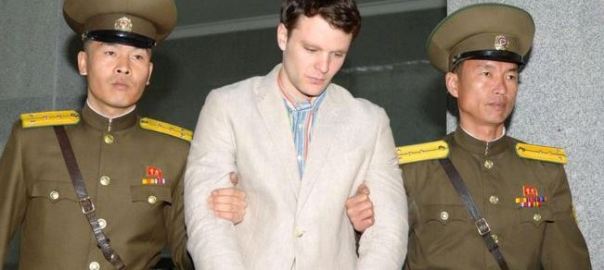
After completing his schooling, Collins worked for a time in the Ministry of Defence in a clerical capacity in London before studying Law at Queen’s University, where he became influenced by Marxist political ideology.
In Easter 1974, as he walked home to his parents’ home in South Armagh during a break from his studies in Belfast, on arrival he found both his parents being man-handled by British troops during a house-to-house raid searching for illegal weapons, and on remonstrating with them Collins was himself seriously assaulted, and both he and his father were arrested and detained.
Collins later attributed his crossing of the psychological threshold of actively supporting anti-British Irish paramilitarist terrorism to this incident. Another influence upon his radicalization at this time was a Law tutor at university who had persuaded him that the newly formed Provisional Irish Republican Army was, as well as a means opposing the British military presence in Ulster, a vehicle for Marxist revolutionary politics, in line with the radical ideological expression of a younger generation in the late 1960’s – early 1970’s that were now replacing an old guard of a movement that had engaged in little more than petty acts of Fenian paramilitary activity in the 1950’s-1960’s.
Collins subsequently dropped out of university, and after working in a pub for a period, he joined Her Majesty’s Customs & Excise Service, serving in Newry, and would go on to use this internal position within the administrative machinery of the British Government to support IRA operations against Crown Forces personnel.
Around this time he married Bernadette, with whom he subsequently had four children.
IRA career
Collins joined the Provisional IRA during the blanket protest by Long Kesh inmates in the late 1970s, which sought Special Category Status for republican prisoners, and he became involved in street demonstrations at this time. He joined the “South Down Brigade” of the IRA, based around Newry. This was not one of the organisation’s most active formations, but it sometimes worked alongside the “South Armagh Brigade“, which was one of its most aggressive units.
Psychologically unsuited to physical violence, Collins was appointed instead by the IRA as its South Down Brigade’s intelligence officer. This role involved gathering information on members of the Crown security forces personnel and installations for targeting in gun and bomb attacks. His planning was directly responsible for at least five murders, including that of the Ulster Defence Regiment Maj. Ivan Toombs in January 1981, with whom Collins worked in the Customs Station at Warrenpoint, and possibly three times that number.
Many of the bombing targets of his unit were of limited significance, such as the destruction of Newry public library, and a public house where a Royal Ulster Constabulary choir drank after practice.
Collins became noted within IRA circles for his hard-line views on the continuance of armed campaign, and later joined its Internal Security Unit. At the instigation of the South Armagh Brigade’s leadership he became a member of Sinn Féin in Newry. The South Armagh IRA wanted a hard-line militarist in the local party, as they were opposed to the increasing emphasis of the republican leadership on political over military activity.
Collins was not selected as a Sinn Féin candidate for local government elections, in part, due to his open expressions of suspicion of the IRA and Sinn Féin leadership, whom he accused of covertly moving towards a position of an abandonment of the IRA’s military campaign. Around this time Collins had a confrontation with Gerry Adams at the funeral of an IRA man killed in a failed bombing over how to deal with the funeral’s policing, where Collins accused Adams a being a “Stick” (a derogatory slang term among IRA supporters for activists among it who were considered lacking sincerity in their commitment to its cause).
Despite his militarist convictions at this time Collins found the psychological strain caused by his involvement in the terrorist war increasingly difficult to deal with. His belief in the martial discipline of IRA’s campaign had been seriously undermined by the event of the assassination of Norman Hanna, a 28 year old Newry man on the 11 March 1982 in front of his wife and young daughter, who had been targeted because of his former service with the Ulster Defence Regiment, which he had resigned from in 1976. Collins had opposed the targeting of Hanna on the basis that it wasn’t of a governmental entity, but had been over-ruled by his superiors, and he had gone along with the operation; his conscience burdened him afterwards about it though.
His uneasy state was further augmented by being arrested under anti-terrorism laws on two occasions, the second involving his detention at Gough Barracks in Armagh for a week, where he was subject to extensive sessions of interrogation in 1985 after an IRA mortar attack in Newry, which had claimed the lives of multiple police officers. Collins had not been involved in this operation, but after five days of incessant psychological pressure being exerted by R.U.C. specialist police officers, during which he had not said a word, he mentally broke, and yielded detailed information to the police about the organization.
As a result of his arrest he was dismissed from his career with H.M. Customs & Excise Service.
Collins subsequently stated that the strain of the interrogation merely exacerbated increasing doubts that he had already possessed about the moral justification of the IRA’s terrorist paramilitary campaign and his actions within it. These doubts had been made worse by the strategic view that he had come to that the organization’s senior leadership had in the early 1980’s quietly decided that the war had failed, and was now slowly manoeuvering the movement away from a military campaign to allow its political wing Sinn Féin to pursue its purposes by another means in what would become the Northern Ireland peace process.
This negated in Collins’ mind the justification for its then on-going military actions.
Statements against the IRA
After his confession of involvement in IRA activity, Collins became an IRA – in contemporary media language – “Supergrass“, upon whose evidence the authorities were able prosecute a large number of IRA members. Subsequently he was incarcerated in specialized protective custody with other paramilitaries who had after arrest given evidence against their organizations in the Crumlin Road Prison in Belfast from 1985 to 1987.
However, after an appeal from his wife who remained an IRA supporter, and on receiving a message from the IRA delivered by his brother on a visit to the prison, Collins legally retracted his evidence, in return for which he was given a guarantee of safety by the IRA, provided he consented to being debriefed by it. He agreed, and was in consequence transferred by the authorities to the Irish paramilitary wing of the prison.
Trial for murder
As a result of losing his previous legal status as a Crown protected witness, Collins was charged with several counts of murder and attempted murder. However, on being tried in 1987 he was acquitted as the statement in which he had admitted to involvement in these acts was ruled legally inadmissible by the court, as it was judged that it had been obtained under duress and was not supported by enough conclusive corroboratory evidence to allow a legally sound conviction.
On release from prison he spent several weeks being counter-interrogated by the IRA’s Internal Security Unit to discover what had been revealed to the authorities, after which he was exiled by the organization from Ulster, being warned that if he was found north of Drogheda after a certain date he would be executed by it. The technical acquittal in the Crown court based upon judicial legal principles made an impact upon Collins’ view of the British state, markedly contrasting with what he had witnessed in the IRA’s Internal Security Unit, and reinforced his disillusionment with Irish paramilitarism.
Post-IRA life
After his exile Collins moved to Dublin and squatted for a while in a deserted flat in the impoverished Ballymun area of the city. At the time the area was experiencing an epidemic of heroin addiction and he volunteered to help a local priest Peter McVerry, who ran programmes for local youths to try to keep them away from drugs. After several years in Dublin, he subsequently moved to Edinburgh, Scotland for a period, where he ran a youth centre. He would later write that because of his Ulster background he felt closer culturally to Scottish people than people from the Irish Republic.
In 1995 he returned to live in Newry, a district known for the militancy of its communal support of the IRA, with numerous IRA members in its midst. The IRA order exiling him from Ulster had not been lifted, but with a formal ceasefire from the organization in operation ordered by its senior command, and in the sweeping changes that were underway with renunciations of violence by all the paramilitary organizations in the province that had followed on from it, he judged it safer to move back in with his wife and children who had never left the town.
Broadcasting and published works
Having returned to live in Newry, rather than maintaining a low profile Collins decided to take a prominent role in the ongoing transition of Ulster’s post-war society, using his personal history as a platform in the media to analyze the adverse effects of terrorism. In 1995 he appeared in an ITV television documentary entitled ‘Confession’ giving an account of his disillusioning experiences and a bleak insight into Irish paramilitarism.
In 1997 he co-authored Killing Rage, with journalist Mick McGovern, a biographical account of his life and IRA career. He also contributed to the book Bandit Country by Toby Harnden about the South Armagh IRA. At the same time in the media he called for the re-introduction of Internment after the Omagh bombing for those continuing to engage in such acts; published newspaper articles openly denouncing and ridiculing the fringe Real IRA’s attempts to re-ignite paramilitary warfare in Ulster, alongside publicly analyzing his own past role in such activity, and the damage that it had caused on a personal and social level to the two communities of Ulster.
Witness evidence against Thomas Murphy
In May 1998 Collins gave evidence against leading republican Thomas “Slab” Murphy, in a libel case Murphy had brought against the Sunday Times, over a 1985 article naming him as the IRA’s Northern Commander.
Murphy denied IRA membership, but Collins took the witness stand against him, and testified that from personal experience he knew that Murphy had been a key military leader in the organization. Murphy subsequently lost the libel case and sustained substantial financial losses in consequence.
After giving his testimony Collins had said in the court-room to Murphy “No hard feelings Slab”. However, soon after the trial Collins’ home was attacked and daubed with graffiti calling him a “tout”, a slang word for an informer. Since his return to Newry in 1995 his home there had been intermittently attacked with acts of petty vandalism, but after the Murphy trial these intensified in regularity and severity, and another house belonging to his family in Camlough, in which no one was resident, was destroyed by arson. Threats were made against his children, and they faced persecution in school from elements among their peers. Graffiti threatening him with murder was also daubed on the walls of the streets in the vicinity of the family home in Newry.
Death
Collins was beaten and stabbed to death in his 45th year by an unidentified assailant(s) early in the morning of 27 January 1999, whilst walking his dogs near the Barcroft Park Estate in Newry along a quiet stretch of country lane at Doran’s Hill, just within sight of Sliabh gCuircin (Camlough Mountain). His body also bore marks of having been struck by a car moving at speed. The subsequent police investigation and Coroner’s Inquest commented upon the extremity of weaponed violence to Collins’ head and face used during the attack.
Rumoured reasons behind the murder were that he had returned to Ulster in breach of the IRA’s banning order, and further he had detailed IRA activities and publicly criticized in the media a multiplicity of Irish terrorist paramilitary splinter groups that had appeared after the IRA’s 1994 ceasefire, and that he had testified in court against Murphy.
Gerry Adams stated the murder was “regrettable”, but added that Collins had “many enemies in many places”.
After a traditional Irish wake, with a closed coffin necessitated due to the damage to his face, and a funeral service at St. Catherine’s Church in Newry, Collins’ body was buried at the town’s Monkshill Cemetery, not far from the grave of Albert White, a Catholic former Royal Ulster Constabulary Inspector, whose assassination he helped to organize in 1982.
Subsequent criminal investigations
In January 2014 the Police Service of Northern Ireland released a statement that a re-examination of the evidence from the scene of the 1999 murder had revealed new DNA material of a potential perpetrator’s presence, and made a public appeal for information, detailing the involvement of a specific car model (a white coloured Hyundai Pony), and a compasspommel that had broken off of a hunting knife during the attack and had been left behind at the scene.
In February 2014 detectives from the Serious Crime Branch arrested a 59 year old man at an address in Newry in relation to the murder, he was subsequently released without charge. In September 2014 the police arrested three men, aged 56, 55 and 42 in County Armagh in relation to inquiries into the murder, all of whom were subsequently released without charges after questioning
Murders of Catherine and Gerard Mahon
Catherine and Gerard Mahon were a husband and wife who lived with their children in Twinbrook, Belfast. Gerard, aged twenty-eight, was a mechanic; Catherine, was twenty-seven. They were killed by the Provisional Irish Republican Army (IRA) on 8 September 1985, the IRA alleging they were informers. However at least two of those responsible for their deaths were later uncovered as British agents within the IRA’s Internal Security Unit, leaving the actual status of the Mahons as informers open to doubt.
Background
The Mahons were neighbours of estate agent Joseph Fenton, a supplier of ‘safe houses’ for the IRA, but also a British agent. When a number of IRA missions were compromised, Fenton is believed to have directed a member of the Internal Security Unit, Freddie Scappaticci, and three other men, to the Mahons.
Abducted in August, interrogated and beaten for prolonged periods, the Mahons eventually confessed that their flat was bugged by the Royal Ulster Constabulary, who are alleged to have paid the couple for information, weapons finds, or arrests. The IRA took the couple to Norglen Crescent in Turf Lodge and shot them.
It is thought Catherine Mahon was shot in the back while trying to escape.
Those who found their bodies said at the time:
We heard two bursts of gunfire and then a car was driven away at high speed. We went out and discovered the girl. We thought she was dead. We tried first aid but the side of her head was blown away. A young lad came up to us saying there was a man lying in the entry a bit further up and still alive. We got to him and he was badly wounded. He was struggling to breath and choking on his own blood. He had been hit in the side of the head and the face. Whatever is behind it all, it’s ridiculous. Those responsible are animals. Nothing justifies murder. They had both been tied by their wrists – but they must have broken free by struggling when they realised what was going to happen.
This slaughter has few equals in barbarity and it proves the Provo idea of justice is warped. It makes us all sick.
Victims were ‘sacrificed’ by agent known as Stakeknife
SOME of the killings to be investigated as part of the new probe into the activities of the agent known as Stakeknife and those in the intelligence services who directed him:
* Husband and wife Gerard (28) and Catherine (27) Mahon, who were shot dead after being taken away from their Twinbrook home in west Belfast in September 1985 and interrogated by the IRA who claimed they were informers. The Mahons were neighbours of estate agent Joe Fenton, who was also later killed by the IRA. When a number of IRA missions were compromised, Fenton is believed to have directed a member of the IRA’s internal security unit to the Mahons
* Frank Hegarty. The body of the 45-year-old was discovered in Co Tyrone close to the border in May 1986. He had been shot dead and his eyes were taped shut. From the Shantallow area of Derry, the IRA alleged he was an informer who had revealed the location of an arms dump in Sligo to authorities
* Joseph Fenton. The 35-year-old, who worked as an estate agent, was shot in the head by the IRA in February 1989 after he was accused of working as an informer. It was alleged the father-of-four from west Belfast man was providing ‘safe houses’ for IRA planning meetings that were then bugged by the security forces
* Joseph Mulhern. The 22-year-old’s body was discovered close to the Tyrone border 10 days after he disappeared from west Belfast in 1993. The IRA alleged he was working for RUC Special Branch
* Caroline Moreland. The 34-year-old mother-of-three was abducted from her home in the Beechmount area of west Belfast in July 1994. Her body was discovered dumped on the Fermanagh border 10 days after she disappeared. Her family had been warned by the IRA not to report her missing
* Margaret Perry (26) disappeared from her hone of Portadown in July 1991, with her body found in shallow grave at Mullaghmore, Co Donegal in June 1992. The IRA claimed she was killed by three men acting on behalf of British intelligence because she had discovered her former boyfriend Gregory Burns (34) was informing to the security forces. He, along with Johnny Dingham (32) and Adrian Starrs (29), were abducted, tortured and shot dead by the IRA
* Charlie McIlmurray (32), from Slemish Way in Andersonstown, was shot by the IRA in April 1987 following allegations that he had been working as an informer. His body was discovered in a van at Killeen in Co Armagh on the border
* Peter Valente (33), a father of four, was killed as an alleged informer in November 1980. Unusually, his body was dumped in the loyalist Highfield estate and a statement was released by Sinn Féin blaming the UDA. However, it is now thought that along with a number of other victims he was targeted by Stakeknife to protect his own cover as an agent after the IRA became suspicious
* Vincent Robinson (29) from Andersonstown in west Belfast was found dead in a rubbish chute in the Divis flats complex in June 1981. The IRA claimed he was an informer and had been outed by Peter Valente, something that his family denied. Again it is believed he was ‘sacrificed’ in order to protect Stakeknife
* Maurice Gilvarry (24) from Ardoyne in north Belfast was shot dead in January 1981 and his body dumped in south Armagh. Again it was alleged he was implicated by Peter Valente but it is now thought he was killed to protect the identity of Stakeknife
* Patrick Trainor (28). Married with three children, his body was found at waste ground near the Glen Road in west Belfast after he had been abducted by the IRA who alleged he was an informer, based on information they claimed came from Peter Valente. This was denied by his family and an RUC detective at a subsequent inquest.
Pop culture echoes Trigger warning: ⚠️This post touches on my deep pride and love of my loyalist culture and traditions and if this is not of interest or offends you , please feel free to continue scrolling. Who Do You Think I Am? It’s a question that divides opinion, and I’m acutely aware that many … Continue reading Who do you think I am ?→
Well hello there…. Please check back soon—I’m still working on this post, and I’ll publish it once it’s finished. In the meantime, please subscribe to my blog to receive email notifications whenever I publish new content. Thank you.
Evening all , Im heading home to Belfast tomorrow for the Easter period and hopefully a trip down south to visit my bro and his family in County Meath , depending on a few factors which are out of my control 😜 Belfast will always be my home and although I look forward to visiting … Continue reading Belfast & Meath trip starts tomorrow→
Iraqi Prime Minister Haider al-Abadi says the destruction of an ancient mosque in the city of Mosul is “an official declaration of defeat” by so-called Islamic State (IS).
Iraqi forces say IS blew up the Great Mosque of al-Nuri and its famous leaning minaret as jihadists battled to stop advancing pro-government troops.
IS said American aircraft had destroyed the complex, a claim denied by the US.
Aerial photographs show the complex largely destroyed.
The mosque, which was more than 800 years old, was where in July 2014 IS leader Abu Bakr al-Baghdadi demanded allegiance in his first and only public appearance following the declaration days earlier of a “caliphate”.
The mosque’s destruction has brought widespread condemnation.
Lazare Eloundou Assomo, deputy director of the UN’s cultural organisation Unesco, said the “iconic” mosque could have helped foster “reconciliation and peace” in Iraq in future.
What happened to the Great Mosque?
The Iraqi commander in charge of the offensive to retake Mosul said troops were within 50m (160ft) of the mosque when IS “committed another historical crime”.
Footage released by the Iraqi forces shows the ancient landmark being demolished.
A caliphate (Arabic: خِلافة khilāfa) is an area containing an Islamic steward known as a caliph (Arabic: خَليفة khalīfah pronunciation (info. • help))—a person considered a religious successor to the Islamic prophet, Muhammad (Muhammad ibn ʿAbdullāh), and a leader of the entire Muslim community.
Isis chief Abu Bakr al-Baghdadi appears in first video
July 214
Abu Bakr al-Baghdadi, the leader of Islamist militant group Isis, has called on Muslims to obey him, in his first video sermon.
Baghdadi has been appointed caliph by the jihadist group, which has seized large swathes of Iraq and Syria.
The video appears to have been filmed on Friday during a sermon at the al-Nouri Mosque in Mosul, northern Iraq.
It surfaced on Saturday amid reports that he had been killed or wounded in an Iraqi air raid.
It was not clear when the attack was supposed to have taken place.
In the sermon, at Mosul’s most famous landmark, Baghdadi praised the establishment of the “Islamic state”, which was declared by Isis last Sunday.
Experts say the reclusive militant leader has never appeared on video before, although there are photographs of him.
“Appointing a leader is an obligation on Muslims, and one that has been neglected for decades,” he said.
He also said that he did not seek out the position of being the caliph, or leader, calling it a “burden”.
“I am your leader, though I am not the best of you, so if you see that I am right, support me, and if you see that I am wrong, advise me,” he told worshippers.
It was famous for its leaning minaret, which gave the city its nickname “the hunchback” (الحدباء al-Ḥadbāˈ). Tradition holds that the mosque was first built in the late 12th century, although it underwent many renovations over the years. Most of it was destroyed on 21 June 2017, during the Battle of Mosul. Islamic State of Iraq and the Levant (ISIS) claims that the USA destroyed it, while Iraqi troops claim ISIS was responsible. Iraqi Prime Minister Haider al-Abadi stated that the destruction of the mosque was ISIS’ “declaration of defeat.
It was famous for its leaning minaret, which gave the city its nickname “the hunchback” (الحدباء al-Ḥadbāˈ). Tradition holds that the mosque was first built in the late 12th century, although it underwent many renovations over the years. Most of it was destroyed on 21 June 2017, during the Battle of Mosul. Islamic State of Iraq and the Levant (ISIS) claims that the USA destroyed it, while Iraqi troops claim ISIS was responsible. Iraqi Prime Minister Haider al-Abadi stated that the destruction of the mosque was ISIS’ “declaration of defeat”.
Tradition holds that Nurettin Zengin (Nur ad-Din Zangi in Arabic) the Turkish atabeg built the mosque in 1172–1173 during the Abbasid Caliphate, shortly before his death. According to the chronicle of Ibn al-Athir, after Nur ad-Din took control of Mosul he ordered his nephew Fakhr al-Din to build the mosque:
[Nur ad-Din] rode in person to its site and viewed it. He climbed the minaret of the mosque of Abu Hadir, looked down on the site of his mosque and ordered that the neighbouring houses and shops should be added to the land that he viewed but that nothing should be taken without the willing agreement of the owners. He put the Sheikh Umar al-Malla in charge of the project, a pious and good man. The properties were purchased from their owners at most substantial prices and the construction began, on which large sums were expended. The building was completed in the year 568 [i.e. AD 1172-3].
In 1511, this mosque was extensively renovated by the Safavid Empire.
Minaret
The minaret and mosque in 1932
The mosque was well known for its leaning minaret, known as al-Hadba’ (“the hunchback”). Grattan Geary, a 19th-century traveler, described the minaret’s appearance:
It is several feet out of the perpendicular, though it starts fair from the ground, and at the top, before putting on its gallery and dome, it regains an erect posture. Its attitude is that of a man bowing.
When the cylindrical minaret was built it stood 45 metres (148 ft) high, with seven bands of decorative brickwork in complex geometric patterns ascending in levels towards the top. By the time the traveler Ibn Battuta visited in the 14th century it was already listing and had acquired its nickname.
The design of the minaret follows a form originally developed in neighboring Iran and Central Asia and shares similarities with other minarets in northern Iraq, such as those in Mardin, Sinjar and Arbil.
According to local tradition (which resolutely ignores chronology), the minaret gained its tilt after the Prophet Muhammad passed overhead while ascending to heaven. The minaret bowed itself in reverence but could only regain its balance after its top joint had been kinked in the opposite direction. According to local Christian tradition, however, the mosque’s tilt was due to its bowing towards the tomb of the Virgin Mary, reputedly located near Arbil.
Modern history
Both the mosque and its madrasa were dismantled and reassembled in 1942 in a restoration programme undertaken by the Iraqi government. The minaret remained unrestored, although attempts were made in 1981 by an Italian firm to stabilise it. The bombing of Mosul during the Iran–Iraq War in the 1980s broke underground pipes and caused leaks under the minaret that further undermined it. The lean later worsened by another 40 centimetres (16 in).
The cause of the lean was disputed – some have blamed the prevailing wind – but local officials have attributed it to the effects of thermal expansion caused by the heat of the sun, causing bricks on the sun-facing side to expand and progressively tilt the minaret. In recent years cracks proliferated along the base of the minaret, which leant nearly 3 metres (9.8 ft) off the vertical. It was listed by the World Monuments Fund as a site of concern due to the ongoing risk of collapse.
The structure was targeted by Islamic State of Iraq and the Levant militants who occupied Mosul on 10 June 2014, and previously destroyed the Tomb of Jonah. However, residents of Mosul, incensed with the destruction of their cultural sites, protected the mosque by forming a human chain and forming a resistance against ISIL.
Rather than destroying the site, Abu Bakr al-Baghdadi appeared during a Friday prayer in this mosque on 4 July 2014 to declare the formation of a new caliphate.
The mosque, including its minaret, was destroyed in June 2017 – according to the Iraqi Prime Minister, by ISIS fighters.
Destruction
By June 2017, the Battle of Mosul had progressed to the stage that ISIL-controlled territory in Mosul was limited to the Old City area, which included the mosque. On 21 June 2017, Iraqi government forces reported that the mosque had been blown up by ISIS forces at 9:50 PM and that the blast was indicative of bombs being deliberately placed to bring it down .
ISIL’s propaganda ministry Amaq claimed an airstrike by the United States is responsible for the destruction, but this claim does not appear to be substantiated by any information. Iraqi forces were within 50 meters of the mosque before the explosion which appears to have been an attempt to kill members of the approaching army by members of ISIL. Aerial photos of the destruction were released by the Iraqi military a few hours later.
Iraqi Prime Minister Haider al-Abadi stated that the destruction of the mosque was ISIS’ “declaration of defeat”. BBC News journalist Paul Adams wrote of the mosque’s destruction as ISIS’ “final act of angry defiance before finally losing their grip on Mosul”