
Rivers of Blood

Enoch Powell‘s 20 April 1968 address to the General Meeting of the West Midlands Area Conservative Political Centre was a speech criticising Commonwealth immigration to the United Kingdom and the then-proposed Race Relations Bill. Powell (1912–1998) was the Conservative Member of Parliament for Wolverhampton South West. He referred to the speech as “the Birmingham speech” but it is otherwise known as the “Rivers of Blood” speech, an allusion to a line from Virgil‘s Aeneid (“As I look ahead, I am filled with foreboding; like the Roman, I seem to see the River Tiber foaming with much blood“), although the expression “rivers of blood” does not appear in Powell’s address.
The speech caused a political storm, making Powell one of the most talked about, and divisive, politicians in the country, and leading to his controversial dismissal from the Shadow Cabinet by Conservative Party leader Edward Heath.
According to most accounts, the popularity of Powell’s perspective on immigration may have played a decisive contributory factor in the Conservatives’ surprise victory in the 1970 general election, and he became one of the most persistent rebels opposing the subsequent Heath government.
Background
Powell made the speech on 20 April 1968 in Birmingham to a meeting of the Conservative Political Centre. The Labour government‘s Race Relations Bill 1968 was to have its second reading the following Tuesday, and the Conservative Opposition had tabled an amendment significantly weakening its provisions.
The Bill was a successor to the Race Relations Act 1965.
The Birmingham-based television company ATV saw an advance copy of the speech on the Saturday morning, and its news editor ordered a television crew to go to the venue, where they filmed sections of the speech. Earlier in the week, Powell said to his friend Clement (Clem) Jones, a journalist and then editor at the Wolverhampton Express & Star, “I’m going to make a speech at the weekend and it’s going to go up ‘fizz’ like a rocket; but whereas all rockets fall to the earth, this one is going to stay up.”
In preparing his speech, Powell had applied Clem Jones’ advice that to make hard-hitting political speeches and short-circuit interference from his party organisation, his best timing was on Saturday afternoons, after delivering embargoed copies the previous Thursday or Friday to selected editors and political journalists of Sunday newspapers; this tactic could ensure coverage of the speech over three days through Saturday evening bulletins then Sunday newspapers, so that the coverage would be picked up in Monday newspapers.
Speech
Powell recounted a conversation with one of his constituents, a middle-aged working man, a few weeks earlier. Powell said that the man told him: “If I had the money to go, I wouldn’t stay in this country… I have three children, all of them been through grammar school and two of them married now, with family. I shan’t be satisfied till I have seen them all settled overseas.
” The man finished by saying to Powell: “In this country in 15 or 20 years’ time the black man will have the whip hand over the white man.”
Powell went on:
| “ | Here is a decent, ordinary fellow Englishman, who in broad daylight in my own town says to me, his Member of Parliament, that the country will not be worth living in for his children. I simply do not have the right to shrug my shoulders and think about something else. What he is saying, thousands and hundreds of thousands are saying and thinking – not throughout Great Britain, perhaps, but in the areas that are already undergoing the total transformation to which there is no parallel in a thousand years of English history. We must be mad, literally mad, as a nation to be permitting the annual inflow of some 50,000 dependents, who are for the most part the material of the future growth of the immigrant descended population.
It is like watching a nation busily engaged in heaping up its own funeral pyre. So insane are we that we actually permit unmarried persons to immigrate for the purpose of founding a family with spouses and fiancées whom they have never seen. |
” |
Powell quoted a letter he received from a woman in Northumberland, about an elderly woman living on a Wolverhampton street where she was the only white resident. The elderly woman had lost her husband and her two sons in World War II and had rented out the rooms in her house. Once immigrants had moved into the street she was living in, her white lodgers left. Two black men had knocked on her door at 7:00 am to use her telephone to call their employers, but she refused, as she would have done to any other stranger knocking at her door at such an hour, and was subsequently verbally abused.
The woman had asked her local authority for a rates reduction, but was told by a council officer to let out the rooms of her house. When the woman said the only tenants would be black, the council officer replied: “Racial prejudice won’t get you anywhere in this country.”
He advocated voluntary re-emigration by “generous grants and assistance” and he mentioned that immigrants had asked him whether it was possible. Powell said that all citizens should be equal before the law, and that:
| “ | This does not mean that the immigrant and his descendants should be elevated into a privileged or special class or that the citizen should be denied his right to discriminate in the management of his own affairs between one fellow-citizen and another or that he should be subjected to an inquisition as to his reasons and motives for behaving in one lawful manner rather than another. | ” |
He argued that journalists who urged the government to pass anti-discrimination laws were “of the same kidney and sometimes on the same newspapers which year after year in the 1930s tried to blind this country to the rising peril which confronted it”. Powell said that such legislation would be used to discriminate against the indigenous population and that it would be like “throwing a match on to gunpowder.”
Powell described what he perceived to be the evolving position of the indigenous population:
| “ | For reasons which they could not comprehend, and in pursuance of a decision by default, on which they were never consulted, they found themselves made strangers in their own country. They found their wives unable to obtain hospital beds in childbirth, their children unable to obtain school places, their homes and neighbourhoods changed beyond recognition, their plans and prospects for the future defeated; at work they found that employers hesitated to apply to the immigrant worker the standards of discipline and competence required of the native-born worker; they began to hear, as time went by, more and more voices which told them that they were now the unwanted. On top of this, they now learn that a one-way privilege is to be established by Act of Parliament; a law which cannot, and is not intended to, operate to protect them or redress their grievances, is to be enacted to give the stranger, the disgruntled and the agent provocateur the power to pillory them for their private actions. | ” |
Powell argued that he felt that although “many thousands” of immigrants wanted to integrate, he felt that the majority did not, and that some had vested interests in fostering racial and religious differences “with a view to the exercise of actual domination, first over fellow-immigrants and then over the rest of the population”
Powell’s peroration of the speech gave rise to its popular title. He quotes the Sibyl‘s prophecy in the epic poem Aeneid, 6, 86–87, of “wars, terrible wars, / and the Tiber foaming with much blood.”
| “ | As I look ahead, I am filled with foreboding. Like the Roman, I seem to see “the River Tiber foaming with much blood”. That tragic and intractable phenomenon which we watch with horror on the other side of the Atlantic but which there is interwoven with the history and existence of the States itself, is coming upon us here by our own volition and our own neglect. Indeed, it has all but come. In numerical terms, it will be of American proportions long before the end of the century. Only resolute and urgent action will avert it even now. Whether there will be the public will to demand and obtain that action, I do not know. All I know is that to see, and not to speak, would be the great betrayal. | ” |
Background
Powell made the speech on 20 April 1968 in Birmingham to a meeting of the Conservative Political Centre. The Labour government‘s Race Relations Bill 1968 was to have its second reading the following Tuesday, and the Conservative Opposition had tabled an amendment significantly weakening its provisions. The Bill was a successor to the Race Relations Act 1965.
The Birmingham-based television company ATV saw an advance copy of the speech on the Saturday morning, and its news editor ordered a television crew to go to the venue, where they filmed sections of the speech. Earlier in the week, Powell said to his friend Clement (Clem) Jones, a journalist and then editor at the Wolverhampton Express & Star,
“I’m going to make a speech at the weekend and it’s going to go up ‘fizz’ like a rocket; but whereas all rockets fall to the earth, this one is going to stay up.”
n preparing his speech, Powell had applied Clem Jones’ advice that to make hard-hitting political speeches and short-circuit interference from his party organisation, his best timing was on Saturday afternoons, after delivering embargoed copies the previous Thursday or Friday to selected editors and political journalists of Sunday newspapers; this tactic could ensure coverage of the speech over three days through Saturday evening bulletins then Sunday newspapers, so that the coverage would be picked up in Monday newspapers.
Speech
Powell recounted a conversation with one of his constituents, a middle-aged working man, a few weeks earlier. Powell said that the man told him: “If I had the money to go, I wouldn’t stay in this country… I have three children, all of them been through grammar school and two of them married now, with family. I shan’t be satisfied till I have seen them all settled overseas.” The man finished by saying to Powell:
“In this country in 15 or 20 years’ time the black man will have the whip hand over the white man.”
Powell went on:
| “ | Here is a decent, ordinary fellow Englishman, who in broad daylight in my own town says to me, his Member of Parliament, that the country will not be worth living in for his children. I simply do not have the right to shrug my shoulders and think about something else. What he is saying, thousands and hundreds of thousands are saying and thinking – not throughout Great Britain, perhaps, but in the areas that are already undergoing the total transformation to which there is no parallel in a thousand years of English history. We must be mad, literally mad, as a nation to be permitting the annual inflow of some 50,000 dependents, who are for the most part the material of the future growth of the immigrant descended population. It is like watching a nation busily engaged in heaping up its own funeral pyre. So insane are we that we actually permit unmarried persons to immigrate for the purpose of founding a family with spouses and fiancées whom they have never seen. | ” |
Powell quoted a letter he received from a woman in Northumberland, about an elderly woman living on a Wolverhampton street where she was the only white resident. The elderly woman had lost her husband and her two sons in World War II and had rented out the rooms in her house. Once immigrants had moved into the street she was living in, her white lodgers left. Two black men had knocked on her door at 7:00 am to use her telephone to call their employers, but she refused, as she would have done to any other stranger knocking at her door at such an hour, and was subsequently verbally abused.
The woman had asked her local authority for a rates reduction, but was told by a council officer to let out the rooms of her house. When the woman said the only tenants would be black, the council officer replied: “Racial prejudice won’t get you anywhere in this country.”
He advocated voluntary re-emigration by “generous grants and assistance” and he mentioned that immigrants had asked him whether it was possible. Powell said that all citizens should be equal before the law, and that:
| “ | This does not mean that the immigrant and his descendants should be elevated into a privileged or special class or that the citizen should be denied his right to discriminate in the management of his own affairs between one fellow-citizen and another or that he should be subjected to an inquisition as to his reasons and motives for behaving in one lawful manner rather than another. | ” |
He argued that journalists who urged the government to pass anti-discrimination laws were “of the same kidney and sometimes on the same newspapers which year after year in the 1930s tried to blind this country to the rising peril which confronted it”. Powell said that such legislation would be used to discriminate against the indigenous population and that it would be like “throwing a match on to gunpowder.”[8] Powell described what he perceived to be the evolving position of the indigenous population:
| “ | For reasons which they could not comprehend, and in pursuance of a decision by default, on which they were never consulted, they found themselves made strangers in their own country. They found their wives unable to obtain hospital beds in childbirth, their children unable to obtain school places, their homes and neighbourhoods changed beyond recognition, their plans and prospects for the future defeated; at work they found that employers hesitated to apply to the immigrant worker the standards of discipline and competence required of the native-born worker; they began to hear, as time went by, more and more voices which told them that they were now the unwanted. On top of this, they now learn that a one-way privilege is to be established by Act of Parliament; a law which cannot, and is not intended to, operate to protect them or redress their grievances, is to be enacted to give the stranger, the disgruntled and the agent provocateur the power to pillory them for their private actions. | ” |
Powell argued that he felt that although “many thousands” of immigrants wanted to integrate, he felt that the majority did not, and that some had vested interests in fostering racial and religious differences
“with a view to the exercise of actual domination, first over fellow-immigrants and then over the rest of the population”.
Powell’s peroration of the speech gave rise to its popular title. He quotes the Sibyl‘s prophecy in the epic poem Aeneid, 6, 86–87, of “wars, terrible wars, / and the Tiber foaming with much blood.”
| “ | As I look ahead, I am filled with foreboding. Like the Roman, I seem to see “the River Tiber foaming with much blood”. That tragic and intractable phenomenon which we watch with horror on the other side of the Atlantic but which there is interwoven with the history and existence of the States itself, is coming upon us here by our own volition and our own neglect. Indeed, it has all but come. In numerical terms, it will be of American proportions long before the end of the century. Only resolute and urgent action will avert it even now. Whether there will be the public will to demand and obtain that action, I do not know. All I know is that to see, and not to speak, would be the great betrayal. |
Reaction
Political
According to C. Howard Wheeldon, who was present at the meeting in which Powell gave the speech, “it is fascinating to note what little hostility emerged from the audience. To the best of my memory, only one person voiced any sign of annoyance.”
The day after the speech Powell went to Sunday Communion at his local church and when he emerged there was a crowd of journalists and a local plasterer (Sidney Miller) said to Powell: “Well done, sir. It needed to be said.”
Powell asked the assembled journalists: “Have I really caused such a furore?” At midday Powell went on the BBC‘s World This Weekend to defend his speech and he appeared later that day on ITN news.
Although the majority of the Parliamentary Labour Party did not wish to “stir up the Powell issue”, Labour MP Edward Leadbitter said he would refer the speech to the Director of Public Prosecutions. The Liberal Party leader Jeremy Thorpe spoke of a prima facie case against Powell for incitement. Lady Gaitskell called the speech “cowardly” and the cricketer Sir Learie Constantine condemned it.
Labour MP Tony Benn said:
| “ | The flag of racialism which has been hoisted in Wolverhampton is beginning to look like the one that fluttered 25 years ago over Dachau and Belsen. If we do not speak up now against the filthy and obscene racialist propaganda … the forces of hatred will mark up their first success and mobilise their first offensive. … Enoch Powell has emerged as the real leader of the Conservative Party. He is a far stronger character than Mr. Heath. He speaks his mind; Heath does not. The final proof of Powell’s power is that Heath dare not attack him publicly, even when he says things that disgust decent Conservatives. |
” |

The leading Conservatives in the Shadow Cabinet were outraged by the speech. Iain Macleod, Edward Boyle, Quintin Hogg and Robert Carr all threatened to resign from the front bench unless Powell was sacked. Margaret Thatcher thought that some of Powell’s speech was “strong meat”, and said to Heath when he telephoned her to inform her Powell was to be sacked: “I really thought that it was better to let things cool down for the present rather than heighten the crisis”. The Conservative leader, Edward Heath, sacked Powell from his post as Shadow Defence Secretary, telling him on the telephone that Sunday evening (it was the last conversation they would have).
Heath said of the speech in public that it was “racialist in tone and liable to exacerbate racial tensions”. Conservative MPs on the right of the party—Duncan Sandys, Gerald Nabarro, Teddy Taylor—spoke against Powell’s sacking. On 22 April 1968, Heath went on Panorama, telling Robin Day: “I dismissed Mr Powell because I believed his speech was inflammatory and liable to damage race relations. I am determined to do everything I can to prevent racial problems developing into civil strife… I don’t believe the great majority of the British people share Mr Powell’s way of putting his views in his speech.”
The Times newspaper declared it “an evil speech”, stating “This is the first time that a serious British politician has appealed to racial hatred in this direct way in our postwar history.” The Times went on to record incidents of racial attacks in the immediate aftermath of Powell’s speech. One such incident, reported under the headline “Coloured family attacked”, took place on 30 April 1968 in Wolverhampton itself: it involved a slashing incident with 14 white youths chanting “Powell” and “Why don’t you go back to your own country?” at patrons of a West Indian christening party. One of the West Indian victims, Wade Crooks of Lower Villiers Street, was the child’s grandfather. He had to have eight stitches over his left eye. He was reported as saying,
“I have been here since 1955 and nothing like this has happened before. I am shattered.”
An opinion poll commissioned by the BBC television programme Panorama in December 1968 found that eight per cent of immigrants believed that they had been treated worse by white people since Powell’s speech, 38 per cent would like to return to their country of origin if offered financial help, and 47 per cent supported immigration control, with 30 per cent opposed.
The speech generated much correspondence to newspapers, most markedly with the Express & Star in Wolverhampton itself, whose local sorting office over the following week received 40,000 postcards and 8,000 letters addressed to its local newspaper. Clem Jones recalled:
| “ | Ted Heath made a martyr out of Enoch, but as far as Express & Star’s circulation area was concerned, virtually the whole area was determined to make a saint out of him. From the Tuesday through to the end of the week, I had ten, fifteen to twenty bags full of readers’ letters: 95 per cent of them were pro-Enoch. | ” |
At the end of that week there were two simultaneous processions in Wolverhampton, one of Powell’s supporters and another of opponents, who each brought petitions to Clem Jones outside his office, the two columns being kept apart by police.
On 23 April 1968, the Race Relations Bill had its second reading in the House of Commons. Many MPs referred or alluded to Powell’s speech. For Labour, Paul Rose, Maurice Orbach, Reginald Paget, Dingle Foot, Ivor Richard, and David Ennals were all critical.
Among the Conservatives, Quintin Hogg and Nigel Fisher were critical, while Hugh Fraser, Ronald Bell, Dudley Smith, and Harold Gurden were sympathetic. Powell was present for the debate but did not speak.
Earlier that day, 1,000 London dockers had gone on strike in protest of Powell’s sacking and marched from the East End to the Palace of Westminster carrying placards saying “Don’t knock Enoch” and “Back Britain, not Black Britain”. Three hundred of them went into the palace, 100 to lobby the MP for Stepney, Peter Shore, and 200 to lobby the MP for Poplar, Ian Mikardo. Shore and Mikardo were shouted down and some dockers kicked Mikardo. Lady Gaitskell shouted:
“You will have your remedy at the next election.” The dockers replied: “We won’t forget.”
The organiser of the strike, Harry Pearman, headed a delegation to meet Powell and said after: “I have just met Enoch Powell and it made me feel proud to be an Englishman. He told me that he felt that if this matter was swept under the rug he would lift the rug and do the same again. We are representatives of the working man. We are not racialists.”
On 24 April 600 dockers at St Katharine Docks voted to strike and numerous smaller factories across the country followed. Six hundred Smithfield meat porters struck and marched to Westminster and handed Powell a 92-page petition supporting him. Powell advised against strike action and asked them to write to Harold Wilson, Heath or their MP. However, strikes continued, reaching Tilbury by 25 April and he allegedly received his 30,000th letter supporting him, with 30 protesting against his speech. By 27 April, 4,500 dockers were on strike. On 28 April, 1,500 people marched to Downing Street chanting “Arrest Enoch Powell”.
Powell claimed to have received 43,000 letters and 700 telegrams supporting him by early May, with 800 letters and four telegrams against. On 2 May, the attorney-general, Sir Elwyn Jones, announced he would not prosecute Powell after consulting the director of public prosecutions.
The Gallup Organization took an opinion poll at the end of April and found that 74 per cent agreed with what Powell had said in his speech; 15 per cent disagreed. 69 per cent felt Heath was wrong to sack Powell and 20 per cent believed Heath was right. Before his speech Powell was favoured to replace Heath as Conservative leader by one per cent, with Reginald Maudling favoured by 20 per cent; after his speech 24 per cent favoured Powell and 18 per cent Maudling. 83 per cent now felt immigration should be restricted (75 per cent before the speech) and 65 per cent favoured anti-discrimination legislation.
Powell defended his speech on 4 May through an interview for the Birmingham Post: “What I would take ‘racialist’ to mean is a person who believes in the inherent inferiority of one race of mankind to another, and who acts and speaks in that belief. So the answer to the question of whether I am a racialist is ‘no’—unless, perhaps, it is to be a racialist in reverse. I regard many of the peoples in India as being superior in many respects—intellectually, for example, and in other respects—to Europeans. Perhaps that is over-correcting.”
According to most accounts, the popularity of Powell’s perspective on race may have played a decisive contributory factor in the Conservatives’ surprise victory in the 1970 general election, although Powell became one of the most persistent rebels opposing the subsequent Heath government.
In “exhaustive research” on the election, the American pollster Douglas Schoen and University of Oxford academic R. W. Johnson believed it “beyond dispute” that Powell had attracted 2.5 million votes to the Conservatives, but nationally the Conservative vote had increased by only 1.7 million since 1966.
In his own constituency at that election – his last in Wolverhampton – his majority of 26,220 and a 64.3 per cent share of the vote were then the highest of his career.
Cultural
Powell was mentioned in early versions of the song “Get Back” by the Beatles.
On 5 August 1976, Eric Clapton provoked an uproar and lingering controversy when he spoke out against increasing immigration during a concert in Birmingham. Visibly intoxicated, Clapton voiced his support of the controversial speech, and announced on stage that Britain was in danger of becoming a “black colony”. Among other things, Clapton said “Keep Britain white!” which was at the time a British National Front slogan.
In November 2010, the actor and comedian Sanjeev Bhaskar recalled the fear which the speech instilled in Britons of Indian origin: “At the end of the 1960s, Enoch Powell was quite a frightening figure to us. He was the one person who represented an enforced ticket out, so we always had suitcases that were ready and packed. My parents held the notion that we may have to leave.”
Whilst a section of the white population appeared to warm to Powell over the speech, the author Mike Phillips recalls that it legitimised hostility, and even violence, towards black Britons like himself.
In his book The British Dream (2013), David Goodhart claims that Powell’s speech in effect “put back by more than a generation a robust debate about the successes and failures of immigration”.
| “ | Just when a discussion should have been starting about integration, racial justice, and distinguishing the reasonable from the racist complaints of the white people whose communities were being transformed, he polarised the argument and closed it down. | ” |
Identity of the woman mentioned in the speech
After Powell delivered the speech, there were attempts to locate the Wolverhampton constituent whom Powell described as being victimised by non-white residents. Despite combing the electoral register and other sources, the editor of the local Wolverhampton newspaper the Express & Star, Clem Jones (a close friend of Powell who broke off relations with him over the controversy) failed to identify the woman.
Shortly after Powell’s death, Kenneth Nock, a Wolverhampton solicitor, wrote to the Express and Star in April 1998 to claim that his firm had acted for the woman in question, but that he could not name her owing to rules concerning client confidentiality. In January 2007, the BBC Radio Four programme Document, followed by the Daily Mail, claimed to have uncovered the woman’s identity. They said she was Druscilla Cotterill (1907–1978), the widow of Harry Cotterill, a battery quartermaster sergeant with the Royal Artillery who had been killed in World War II (and second cousin of Mark Cotterill, a figure in British far-right politics).
She lived in Brighton Place in Wolverhampton, which by the 1960s was dominated by immigrant families. In order to increase her income, she rented rooms to lodgers, but did not wish to rent rooms to West Indians and stopped taking in any lodgers when the Race Relations Act 1968 banned racial discrimination in housing. She locked up the spare rooms and lived only in two rooms of the house. According to those who remember the period, the many children in the street regarded her as a figure of fun and taunted her.
Support for the speech

In the United Kingdom, particularly in England, “Enoch [Powell] was right” is a phrase of political rhetoric, inviting comparison of aspects of contemporary English society with the predictions made by Powell in the “Rivers of Blood” speech. The phrase implies criticism of racial quotas, immigration and multiculturalism. Badges, T-shirts and other items bearing the slogan have been produced at different times in the United Kingdom. Powell gained support from both right-wing and traditionally left-leaning, working-class voters for his anti-immigration stance.
Powell gained the support of the far-right in Britain. Badges, T-shirts and fridge magnets emblazoned with the slogan “Enoch was right” are regularly seen at far-right demonstrations, according to VICE News, and sample recordings of Powell speeches feature heavily in the music of the neo-Nazi hardcore band Of Wolves and Angels.
Powell also has a presence on social media, with an Enoch Powell page on Facebook run by the far-right Traditional Britain Group amassed several thousands of likes, and similar pages which post “racist memes and Daily Mail stories” have been equally successful, such as British nationalist and anti-immigration Britain First‘s Facebook page.
In The Trial of Enoch Powell, a Channel 4 television broadcast in April 1998, on the thirtieth anniversary of his Rivers of Blood speech (and two months after his death), 64% of the studio audience voted that Powell was not a racist. Some in the Church of England, of which Powell had been a member, took a different view. Upon Powell’s death, Barbados-born Wilfred Wood, then Bishop of Croydon, stated, “Enoch Powell gave a certificate of respectability to white racist views which otherwise decent people were ashamed to acknowledge”.
In November 2007, Nigel Hastilow resigned as Conservative candidate for Halesowen and Rowley Regis after he wrote an article in the Wolverhampton Express & Star that included the statement: “Enoch, once MP for Wolverhampton South-West, was sacked from the Conservative front bench and marginalised politically for his 1968 ‘rivers of blood’ speech, warning that uncontrolled immigration would change Britain irrevocably. He was right and immigration has changed the face of Britain dramatically”.

In January 2014, UK Independence Party leader Nigel Farage stated that ‘the basic principle’ of one passage of the speech which had been read to him was ‘right’. In June of that year, in response to an Islamist plot to infiltrate schools in Birmingham, Conservative peer and former minister Norman Tebbit wrote in The Daily Telegraph “No one should have been surprised at what was going on in schools in Birmingham. It is precisely what I was talking about over 20 years ago and Enoch Powell was warning against long before that.
We have imported far too many immigrants who have come here not to live in our society, but to replicate here the society of their homelands”. Conservative MP Gerald Howarth said on the same issue “Clearly, the arrival of so many people of non-Christian faith has presented a challenge, as so many of us, including the late Enoch Powell, warned decades ago”.
In March 2016, German writer Michael Stürmer wrote a retrospective pro-Powell piece in Die Welt, opining that nobody else had been “punished so mercilessly” by fellow party members and media for their viewpoints.
Acknowledgement from politicians
In an interview for Today shortly after her departure from office as Prime Minister in 1991, Margaret Thatcher said that Powell had “made a valid argument, if in sometimes regrettable terms.”
Thirty years after the speech, Edward Heath said that Powell’s remarks on the “economic burden of immigration” had been “not without prescience.”
The Labour Party MP Michael Foot remarked to a reporter that it was “tragic” that this “outstanding personality” had been widely misunderstood as predicting actual bloodshed in Britain, when in fact he had used the Aeneid quotation merely to communicate his own sense of foreboding.
Dramatic portrayals
The speech is the subject of a play, What Shadows, written by Chris Hannan. The play was staged in Birmingham from 27 October to 12 November 2016, with Powell portrayed by Ian McDiarmid and Clem Jones by George Costigan.[
Background
Powell made the speech on 20 April 1968 in Birmingham to a meeting of the Conservative Political Centre. The Labour government‘s Race Relations Bill 1968 was to have its second reading the following Tuesday, and the Conservative Opposition had tabled an amendment significantly weakening its provisions.
The Bill was a successor to the Race Relations Act 1965.
The Birmingham-based television company ATV saw an advance copy of the speech on the Saturday morning, and its news editor ordered a television crew to go to the venue, where they filmed sections of the speech. Earlier in the week, Powell said to his friend Clement (Clem) Jones, a journalist and then editor at the Wolverhampton Express & Star, “I’m going to make a speech at the weekend and it’s going to go up ‘fizz’ like a rocket; but whereas all rockets fall to the earth, this one is going to stay up.”
In preparing his speech, Powell had applied Clem Jones’ advice that to make hard-hitting political speeches and short-circuit interference from his party organisation, his best timing was on Saturday afternoons, after delivering embargoed copies the previous Thursday or Friday to selected editors and political journalists of Sunday newspapers; this tactic could ensure coverage of the speech over three days through Saturday evening bulletins then Sunday newspapers, so that the coverage would be picked up in Monday newspapers.
Speech
Powell recounted a conversation with one of his constituents, a middle-aged working man, a few weeks earlier. Powell said that the man told him: “If I had the money to go, I wouldn’t stay in this country… I have three children, all of them been through grammar school and two of them married now, with family. I shan’t be satisfied till I have seen them all settled overseas.” The man finished by saying to Powell: “In this country in 15 or 20 years’ time the black man will have the whip hand over the white man.”
Powell went on:
| “ | Here is a decent, ordinary fellow Englishman, who in broad daylight in my own town says to me, his Member of Parliament, that the country will not be worth living in for his children. I simply do not have the right to shrug my shoulders and think about something else. What he is saying, thousands and hundreds of thousands are saying and thinking – not throughout Great Britain, perhaps, but in the areas that are already undergoing the total transformation to which there is no parallel in a thousand years of English history. We must be mad, literally mad, as a nation to be permitting the annual inflow of some 50,000 dependents, who are for the most part the material of the future growth of the immigrant descended population. It is like watching a nation busily engaged in heaping up its own funeral pyre. So insane are we that we actually permit unmarried persons to immigrate for the purpose of founding a family with spouses and fiancées whom they have never seen. | ” |
Powell quoted a letter he received from a woman in Northumberland, about an elderly woman living on a Wolverhampton street where she was the only white resident. The elderly woman had lost her husband and her two sons in World War II and had rented out the rooms in her house. Once immigrants had moved into the street she was living in, her white lodgers left. Two black men had knocked on her door at 7:00 am to use her telephone to call their employers, but she refused, as she would have done to any other stranger knocking at her door at such an hour, and was subsequently verbally abused.
The woman had asked her local authority for a rates reduction, but was told by a council officer to let out the rooms of her house. When the woman said the only tenants would be black, the council officer replied: “Racial prejudice won’t get you anywhere in this country.”
He advocated voluntary re-emigration by “generous grants and assistance” and he mentioned that immigrants had asked him whether it was possible. Powell said that all citizens should be equal before the law, and that:
| “ | This does not mean that the immigrant and his descendants should be elevated into a privileged or special class or that the citizen should be denied his right to discriminate in the management of his own affairs between one fellow-citizen and another or that he should be subjected to an inquisition as to his reasons and motives for behaving in one lawful manner rather than another. | ” |
He argued that journalists who urged the government to pass anti-discrimination laws were “of the same kidney and sometimes on the same newspapers which year after year in the 1930s tried to blind this country to the rising peril which confronted it”. Powell said that such legislation would be used to discriminate against the indigenous population and that it would be like “throwing a match on to gunpowder.”
Powell described what he perceived to be the evolving position of the indigenous population:
| “ | For reasons which they could not comprehend, and in pursuance of a decision by default, on which they were never consulted, they found themselves made strangers in their own country. They found their wives unable to obtain hospital beds in childbirth, their children unable to obtain school places, their homes and neighbourhoods changed beyond recognition, their plans and prospects for the future defeated; at work they found that employers hesitated to apply to the immigrant worker the standards of discipline and competence required of the native-born worker; they began to hear, as time went by, more and more voices which told them that they were now the unwanted. On top of this, they now learn that a one-way privilege is to be established by Act of Parliament; a law which cannot, and is not intended to, operate to protect them or redress their grievances, is to be enacted to give the stranger, the disgruntled and the agent provocateur the power to pillory them for their private actions. | ” |
Powell argued that he felt that although “many thousands” of immigrants wanted to integrate, he felt that the majority did not, and that some had vested interests in fostering racial and religious differences “with a view to the exercise of actual domination, first over fellow-immigrants and then over the rest of the population”. Powell’s peroration of the speech gave rise to its popular title. He quotes the Sibyl‘s prophecy in the epic poem Aeneid, 6, 86–87, of “wars, terrible wars, / and the Tiber foaming with much blood.”
| “ | As I look ahead, I am filled with foreboding. Like the Roman, I seem to see “the River Tiber foaming with much blood”. That tragic and intractable phenomenon which we watch with horror on the other side of the Atlantic but which there is interwoven with the history and existence of the States itself, is coming upon us here by our own volition and our own neglect. Indeed, it has all but come. In numerical terms, it will be of American proportions long before the end of the century. Only resolute and urgent action will avert it even now. Whether there will be the public will to demand and obtain that action, I do not know. All I know is that to see, and not to speak, would be the great betrayal. | ” |
Reaction
Political

According to C. Howard Wheeldon, who was present at the meeting in which Powell gave the speech, “it is fascinating to note what little hostility emerged from the audience. To the best of my memory, only one person voiced any sign of annoyance.” The day after the speech Powell went to Sunday Communion at his local church and when he emerged there was a crowd of journalists and a local plasterer (Sidney Miller) said to Powell: “Well done, sir. It needed to be said.”
Powell asked the assembled journalists: “Have I really caused such a furore?” At midday Powell went on the BBC‘s World This Weekend to defend his speech and he appeared later that day on ITN news.
Although the majority of the Parliamentary Labour Party did not wish to “stir up the Powell issue”, Labour MP Edward Leadbitter said he would refer the speech to the Director of Public Prosecutions. The Liberal Party leader Jeremy Thorpe spoke of a prima facie case against Powell for incitement. Lady Gaitskell called the speech “cowardly” and the cricketer Sir Learie Constantine condemned it. Labour MP Tony Benn said:
| “ | The flag of racialism which has been hoisted in Wolverhampton is beginning to look like the one that fluttered 25 years ago over Dachau and Belsen. If we do not speak up now against the filthy and obscene racialist propaganda … the forces of hatred will mark up their first success and mobilise their first offensive. … Enoch Powell has emerged as the real leader of the Conservative Party. He is a far stronger character than Mr. Heath. He speaks his mind; Heath does not. The final proof of Powell’s power is that Heath dare not attack him publicly, even when he says things that disgust decent Conservatives. |
” |
The leading Conservatives in the Shadow Cabinet were outraged by the speech. Iain Macleod, Edward Boyle, Quintin Hogg and Robert Carr all threatened to resign from the front bench unless Powell was sacked. Margaret Thatcher thought that some of Powell’s speech was “strong meat”, and said to Heath when he telephoned her to inform her Powell was to be sacked: “I really thought that it was better to let things cool down for the present rather than heighten the crisis”.
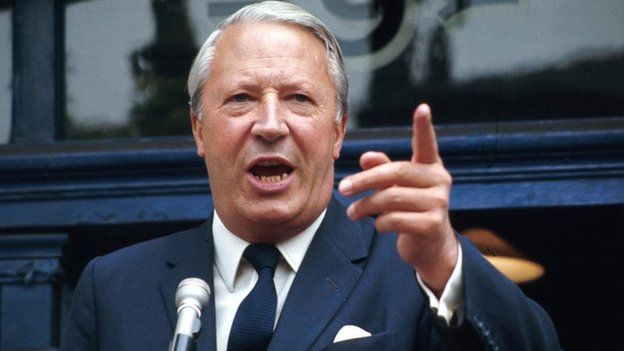
The Conservative leader, Edward Heath, sacked Powell from his post as Shadow Defence Secretary, telling him on the telephone that Sunday evening (it was the last conversation they would have). Heath said of the speech in public that it was “racialist in tone and liable to exacerbate racial tensions”. Conservative MPs on the right of the party—Duncan Sandys, Gerald Nabarro, Teddy Taylor—spoke against Powell’s sacking.
On 22 April 1968, Heath went on Panorama, telling Robin Day: “I dismissed Mr Powell because I believed his speech was inflammatory and liable to damage race relations. I am determined to do everything I can to prevent racial problems developing into civil strife… I don’t believe the great majority of the British people share Mr Powell’s way of putting his views in his speech.”
The Times newspaper declared it “an evil speech”, stating “This is the first time that a serious British politician has appealed to racial hatred in this direct way in our postwar history.” The Times went on to record incidents of racial attacks in the immediate aftermath of Powell’s speech. One such incident, reported under the headline “Coloured family attacked”, took place on 30 April 1968 in Wolverhampton itself: it involved a slashing incident with 14 white youths chanting “Powell” and “Why don’t you go back to your own country?” at patrons of a West Indian christening party. One of the West Indian victims, Wade Crooks of Lower Villiers Street, was the child’s grandfather.
He had to have eight stitches over his left eye. He was reported as saying, “I have been here since 1955 and nothing like this has happened before. I am shattered.” An opinion poll commissioned by the BBC television programme Panorama in December 1968 found that eight per cent of immigrants believed that they had been treated worse by white people since Powell’s speech, 38 per cent would like to return to their country of origin if offered financial help, and 47 per cent supported immigration control, with 30 per cent opposed.
The speech generated much correspondence to newspapers, most markedly with the Express & Star in Wolverhampton itself, whose local sorting office over the following week received 40,000 postcards and 8,000 letters addressed to its local newspaper. Clem Jones recalled:
| “ | Ted Heath made a martyr out of Enoch, but as far as Express & Star’s circulation area was concerned, virtually the whole area was determined to make a saint out of him. From the Tuesday through to the end of the week, I had ten, fifteen to twenty bags full of readers’ letters: 95 per cent of them were pro-Enoch. | ” |
At the end of that week there were two simultaneous processions in Wolverhampton, one of Powell’s supporters and another of opponents, who each brought petitions to Clem Jones outside his office, the two columns being kept apart by police.
On 23 April 1968, the Race Relations Bill had its second reading in the House of Commons. Many MPs referred or alluded to Powell’s speech. For Labour, Paul Rose, Maurice Orbach, Reginald Paget, Dingle Foot, Ivor Richard, and David Ennals were all critical. Among the Conservatives, Quintin Hogg and Nigel Fisher were critical, while Hugh Fraser, Ronald Bell, Dudley Smith, and Harold Gurden were sympathetic.
Powell was present for the debate but did not speak.
Earlier that day, 1,000 London dockers had gone on strike in protest of Powell’s sacking and marched from the East End to the Palace of Westminster carrying placards saying “Don’t knock Enoch” and “Back Britain, not Black Britain”. Three hundred of them went into the palace, 100 to lobby the MP for Stepney, Peter Shore, and 200 to lobby the MP for Poplar, Ian Mikardo. Shore and Mikardo were shouted down and some dockers kicked Mikardo. Lady Gaitskell shouted:
“You will have your remedy at the next election.” The dockers replied: “We won’t forget.”
The organiser of the strike, Harry Pearman, headed a delegation to meet Powell and said after: “I have just met Enoch Powell and it made me feel proud to be an Englishman. He told me that he felt that if this matter was swept under the rug he would lift the rug and do the same again. We are representatives of the working man. We are not racialists.”
On 24 April 600 dockers at St Katharine Docks voted to strike and numerous smaller factories across the country followed. Six hundred Smithfield meat porters struck and marched to Westminster and handed Powell a 92-page petition supporting him. Powell advised against strike action and asked them to write to Harold Wilson, Heath or their MP. However, strikes continued, reaching Tilbury by 25 April and he allegedly received his 30,000th letter supporting him, with 30 protesting against his speech. By 27 April, 4,500 dockers were on strike.
On 28 April, 1,500 people marched to Downing Street chanting “Arrest Enoch Powell”.
Powell claimed to have received 43,000 letters and 700 telegrams supporting him by early May, with 800 letters and four telegrams against. On 2 May, the attorney-general, Sir Elwyn Jones, announced he would not prosecute Powell after consulting the director of public prosecutions.
The Gallup Organization took an opinion poll at the end of April and found that 74 per cent agreed with what Powell had said in his speech; 15 per cent disagreed. 69 per cent felt Heath was wrong to sack Powell and 20 per cent believed Heath was right. Before his speech Powell was favoured to replace Heath as Conservative leader by one per cent, with Reginald Maudling favoured by 20 per cent; after his speech 24 per cent favoured Powell and 18 per cent Maudling. 83 per cent now felt immigration should be restricted (75 per cent before the speech) and 65 per cent favoured anti-discrimination legislation.
Powell defended his speech on 4 May through an interview for the Birmingham Post:
“What I would take ‘racialist’ to mean is a person who believes in the inherent inferiority of one race of mankind to another, and who acts and speaks in that belief. So the answer to the question of whether I am a racialist is ‘no’—unless, perhaps, it is to be a racialist in reverse. I regard many of the peoples in India as being superior in many respects—intellectually, for example, and in other respects—to Europeans. Perhaps that is over-correcting.”
According to most accounts, the popularity of Powell’s perspective on race may have played a decisive contributory factor in the Conservatives’ surprise victory in the 1970 general election, although Powell became one of the most persistent rebels opposing the subsequent Heath government.
In “exhaustive research” on the election, the American pollster Douglas Schoen and University of Oxford academic R. W. Johnson believed it “beyond dispute” that Powell had attracted 2.5 million votes to the Conservatives, but nationally the Conservative vote had increased by only 1.7 million since 1966. In his own constituency at that election – his last in Wolverhampton – his majority of 26,220 and a 64.3 per cent share of the vote were then the highest of his career.
Cultural

Powell was mentioned in early versions of the song “Get Back” by the Beatles.
On 5 August 1976, Eric Clapton provoked an uproar and lingering controversy when he spoke out against increasing immigration during a concert in Birmingham. Visibly intoxicated, Clapton voiced his support of the controversial speech, and announced on stage that Britain was in danger of becoming a “black colony”. Among other things, Clapton said:
“Keep Britain white!”
which was at the time a British National Front slogan.
In November 2010, the actor and comedian Sanjeev Bhaskar recalled the fear which the speech instilled in Britons of Indian origin: “At the end of the 1960s, Enoch Powell was quite a frightening figure to us. He was the one person who represented an enforced ticket out, so we always had suitcases that were ready and packed. My parents held the notion that we may have to leave.
Whilst a section of the white population appeared to warm to Powell over the speech, the author Mike Phillips recalls that it legitimised hostility, and even violence, towards black Britons like himself.
In his book The British Dream (2013), David Goodhart claims that Powell’s speech in effect “put back by more than a generation a robust debate about the successes and failures of immigration”.
| “ | Just when a discussion should have been starting about integration, racial justice, and distinguishing the reasonable from the racist complaints of the white people whose communities were being transformed, he polarised the argument and closed it down. | ” |
Identity of the woman mentioned in the speech
After Powell delivered the speech, there were attempts to locate the Wolverhampton constituent whom Powell described as being victimised by non-white residents. Despite combing the electoral register and other sources, the editor of the local Wolverhampton newspaper the Express & Star, Clem Jones (a close friend of Powell who broke off relations with him over the controversy) failed to identify the woman.
Shortly after Powell’s death, Kenneth Nock, a Wolverhampton solicitor, wrote to the Express and Star in April 1998 to claim that his firm had acted for the woman in question, but that he could not name her owing to rules concerning client confidentiality.[37] In January 2007, the BBC Radio Four programme Document, followed by the Daily Mail, claimed to have uncovered the woman’s identity. They said she was Druscilla Cotterill (1907–1978), the widow of Harry Cotterill, a battery quartermaster sergeant with the Royal Artillery who had been killed in World War II (and second cousin of Mark Cotterill, a figure in British far-right politics).
She lived in Brighton Place in Wolverhampton, which by the 1960s was dominated by immigrant families. In order to increase her income, she rented rooms to lodgers, but did not wish to rent rooms to West Indians and stopped taking in any lodgers when the Race Relations Act 1968 banned racial discrimination in housing. She locked up the spare rooms and lived only in two rooms of the house. According to those who remember the period, the many children in the street regarded her as a figure of fun and taunted her.
Support for the speech
In the United Kingdom, particularly in England, “Enoch [Powell] was right” is a phrase of political rhetoric, inviting comparison of aspects of contemporary English society with the predictions made by Powell in the “Rivers of Blood” speech. The phrase implies criticism of racial quotas, immigration and multiculturalism. Badges, T-shirts and other items bearing the slogan have been produced at different times in the United Kingdom.[citation needed] Powell gained support from both right-wing and traditionally left-leaning, working-class voters for his anti-immigration stance.
Powell gained the support of the far-right in Britain. Badges, T-shirts and fridge magnets emblazoned with the slogan “Enoch was right” are regularly seen at far-right demonstrations, according to VICE News, and sample recordings of Powell speeches feature heavily in the music of the neo-Nazi hardcore band Of Wolves and Angels.
Powell also has a presence on social media, with an Enoch Powell page on Facebook run by the far-right Traditional Britain Group amassed several thousands of likes, and similar pages which post “racist memes and Daily Mail stories” have been equally successful, such as British nationalist and anti-immigration Britain First‘s Facebook page.
In The Trial of Enoch Powell, a Channel 4 television broadcast in April 1998, on the thirtieth anniversary of his Rivers of Blood speech (and two months after his death), 64% of the studio audience voted that Powell was not a racist. Some in the Church of England, of which Powell had been a member, took a different view. Upon Powell’s death, Barbados-born Wilfred Wood, then Bishop of Croydon, stated,
“Enoch Powell gave a certificate of respectability to white racist views which otherwise decent people were ashamed to acknowledge”.
In November 2007, Nigel Hastilow resigned as Conservative candidate for Halesowen and Rowley Regis after he wrote an article in the Wolverhampton Express & Star that included the statement: “Enoch, once MP for Wolverhampton South-West, was sacked from the Conservative front bench and marginalised politically for his 1968 ‘rivers of blood’ speech, warning that uncontrolled immigration would change Britain irrevocably. He was right and immigration has changed the face of Britain dramatically”.

In January 2014, UK Independence Party leader Nigel Farage stated that ‘the basic principle’ of one passage of the speech which had been read to him was ‘right’. In June of that year, in response to an Islamist plot to infiltrate schools in Birmingham, Conservative peer and former minister Norman Tebbit wrote in The Daily Telegraph “No one should have been surprised at what was going on in schools in Birmingham. It is precisely what I was talking about over 20 years ago and Enoch Powell was warning against long before that. We have imported far too many immigrants who have come here not to live in our society, but to replicate here the society of their homelands”.
Conservative MP Gerald Howarth said on the same issue “Clearly, the arrival of so many people of non-Christian faith has presented a challenge, as so many of us, including the late Enoch Powell, warned decades ago”.
In March 2016, German writer Michael Stürmer wrote a retrospective pro-Powell piece in Die Welt, opining that nobody else had been “punished so mercilessly” by fellow party members and media for their viewpoints.

Acknowledgement from politicians
In an interview for Today shortly after her departure from office as Prime Minister in 1991, Margaret Thatcher said that Powell had “made a valid argument, if in sometimes regrettable terms.”
Thirty years after the speech, Edward Heath said that Powell’s remarks on the “economic burden of immigration” had been “not without prescience.”
The Labour Party MP Michael Foot remarked to a reporter that it was “tragic” that this “outstanding personality” had been widely misunderstood as predicting actual bloodshed in Britain, when in fact he had used the Aeneid quotation merely to communicate his own sense of foreboding.
Dramatic portrayals
The speech is the subject of a play, What Shadows, written by Chris Hannan. The play was staged in Birmingham from 27 October to 12 November 2016, with Powell portrayed by Ian McDiarmid and Clem Jones by George Costigan.[
Political
According to C. Howard Wheeldon, who was present at the meeting in which Powell gave the speech, “it is fascinating to note what little hostility emerged from the audience. To the best of my memory, only one person voiced any sign of annoyance.” The day after the speech Powell went to Sunday Communion at his local church and when he emerged there was a crowd of journalists and a local plasterer (Sidney Miller) said to Powell: “Well done, sir. It needed to be said.” Powell asked the assembled journalists: “Have I really caused such a furore?” At midday Powell went on the BBC‘s World This Weekend to defend his speech and he appeared later that day on ITN news.
Although the majority of the Parliamentary Labour Party did not wish to “stir up the Powell issue”, Labour MP Edward Leadbitter said he would refer the speech to the Director of Public Prosecutions. The Liberal Party leader Jeremy Thorpe spoke of a prima facie case against Powell for incitement. Lady Gaitskell called the speech “cowardly” and the cricketer Sir Learie Constantine condemned it.

Labour MP Tony Benn said:
| “ | The flag of racialism which has been hoisted in Wolverhampton is beginning to look like the one that fluttered 25 years ago over Dachau and Belsen. If we do not speak up now against the filthy and obscene racialist propaganda … the forces of hatred will mark up their first success and mobilise their first offensive. … Enoch Powell has emerged as the real leader of the Conservative Party. He is a far stronger character than Mr. Heath. He speaks his mind; Heath does not. The final proof of Powell’s power is that Heath dare not attack him publicly, even when he says things that disgust decent Conservatives. |
” |
The leading Conservatives in the Shadow Cabinet were outraged by the speech. Iain Macleod, Edward Boyle, Quintin Hogg and Robert Carr all threatened to resign from the front bench unless Powell was sacked. Margaret Thatcher thought that some of Powell’s speech was “strong meat”, and said to Heath when he telephoned her to inform her Powell was to be sacked: “I really thought that it was better to let things cool down for the present rather than heighten the crisis”. The Conservative leader, Edward Heath, sacked Powell from his post as Shadow Defence Secretary, telling him on the telephone that Sunday evening (it was the last conversation they would have).
Heath said of the speech in public that it was “racialist in tone and liable to exacerbate racial tensions”. Conservative MPs on the right of the party—Duncan Sandys, Gerald Nabarro, Teddy Taylor—spoke against Powell’s sacking. On 22 April 1968, Heath went on Panorama, telling Robin Day: “I dismissed Mr Powell because I believed his speech was inflammatory and liable to damage race relations. I am determined to do everything I can to prevent racial problems developing into civil strife… I don’t believe the great majority of the British people share Mr Powell’s way of putting his views in his speech.”
The Times newspaper declared it “an evil speech”, stating “This is the first time that a serious British politician has appealed to racial hatred in this direct way in our postwar history.”[19] The Times went on to record incidents of racial attacks in the immediate aftermath of Powell’s speech. One such incident, reported under the headline “Coloured family attacked”, took place on 30 April 1968 in Wolverhampton itself: it involved a slashing incident with 14 white youths chanting “Powell” and “Why don’t you go back to your own country?” at patrons of a West Indian christening party. One of the West Indian victims, Wade Crooks of Lower Villiers Street, was the child’s grandfather. He had to have eight stitches over his left eye. He was reported as saying,
“I have been here since 1955 and nothing like this has happened before. I am shattered.”
An opinion poll commissioned by the BBC television programme Panorama in December 1968 found that eight per cent of immigrants believed that they had been treated worse by white people since Powell’s speech, 38 per cent would like to return to their country of origin if offered financial help, and 47 per cent supported immigration control, with 30 per cent opposed.
The speech generated much correspondence to newspapers, most markedly with the Express & Star in Wolverhampton itself, whose local sorting office over the following week received 40,000 postcards and 8,000 letters addressed to its local newspaper. Clem Jones recalled:
| “ | Ted Heath made a martyr out of Enoch, but as far as Express & Star’s circulation area was concerned, virtually the whole area was determined to make a saint out of him. From the Tuesday through to the end of the week, I had ten, fifteen to twenty bags full of readers’ letters: 95 per cent of them were pro-Enoch. | ” |
At the end of that week there were two simultaneous processions in Wolverhampton, one of Powell’s supporters and another of opponents, who each brought petitions to Clem Jones outside his office, the two columns being kept apart by police.

On 23 April 1968, the Race Relations Bill had its second reading in the House of Commons. Many MPs referred or alluded to Powell’s speech. For Labour, Paul Rose, Maurice Orbach, Reginald Paget, Dingle Foot, Ivor Richard, and David Ennals were all critical. Among the Conservatives, Quintin Hogg and Nigel Fisher were critical, while Hugh Fraser, Ronald Bell, Dudley Smith, and Harold Gurden were sympathetic. Powell was present for the debate but did not speak.
Earlier that day, 1,000 London dockers had gone on strike in protest of Powell’s sacking and marched from the East End to the Palace of Westminster carrying placards saying “Don’t knock Enoch” and “Back Britain, not Black Britain”. Three hundred of them went into the palace, 100 to lobby the MP for Stepney, Peter Shore, and 200 to lobby the MP for Poplar, Ian Mikardo. Shore and Mikardo were shouted down and some dockers kicked Mikardo. Lady Gaitskell shouted:
“You will have your remedy at the next election.” The dockers replied: “We won’t forget.”
The organiser of the strike, Harry Pearman, headed a delegation to meet Powell and said after: “I have just met Enoch Powell and it made me feel proud to be an Englishman. He told me that he felt that if this matter was swept under the rug he would lift the rug and do the same again. We are representatives of the working man. We are not racialists.”[23]
On 24 April 600 dockers at St Katharine Docks voted to strike and numerous smaller factories across the country followed. Six hundred Smithfield meat porters struck and marched to Westminster and handed Powell a 92-page petition supporting him. Powell advised against strike action and asked them to write to Harold Wilson, Heath or their MP. However, strikes continued, reaching Tilbury by 25 April and he allegedly received his 30,000th letter supporting him, with 30 protesting against his speech. By 27 April, 4,500 dockers were on strike.
On 28 April, 1,500 people marched to Downing Street chanting “Arrest Enoch Powell”. Powell claimed to have received 43,000 letters and 700 telegrams supporting him by early May, with 800 letters and four telegrams against. On 2 May, the attorney-general, Sir Elwyn Jones, announced he would not prosecute Powell after consulting the director of public prosecutions.
The Gallup Organization took an opinion poll at the end of April and found that 74 per cent agreed with what Powell had said in his speech; 15 per cent disagreed. 69 per cent felt Heath was wrong to sack Powell and 20 per cent believed Heath was right. Before his speech Powell was favoured to replace Heath as Conservative leader by one per cent, with Reginald Maudling favoured by 20 per cent; after his speech 24 per cent favoured Powell and 18 per cent Maudling. 83 per cent now felt immigration should be restricted (75 per cent before the speech) and 65 per cent favoured anti-discrimination legislation.

Powell defended his speech on 4 May through an interview for the Birmingham Post:
“What I would take ‘racialist’ to mean is a person who believes in the inherent inferiority of one race of mankind to another, and who acts and speaks in that belief. So the answer to the question of whether I am a racialist is ‘no’—unless, perhaps, it is to be a racialist in reverse. I regard many of the peoples in India as being superior in many respects—intellectually, for example, and in other respects—to Europeans. Perhaps that is over-correcting.”
According to most accounts, the popularity of Powell’s perspective on race may have played a decisive contributory factor in the Conservatives’ surprise victory in the 1970 general election, although Powell became one of the most persistent rebels opposing the subsequent Heath government. In “exhaustive research” on the election, the American pollster Douglas Schoen and University of Oxford academic R. W. Johnson believed it “beyond dispute” that Powell had attracted 2.5 million votes to the Conservatives, but nationally the Conservative vote had increased by only 1.7 million since 1966.
In his own constituency at that election – his last in Wolverhampton – his majority of 26,220 and a 64.3 per cent share of the vote were then the highest of his career.
See Birmingham Mail for more details
See BBC ONTHISDAY for more details

See here for more details on Enoch Powell






 Vimy Ridge: Royals commemorate defining WW1 battle







 See
See 







 belfastchildis.com