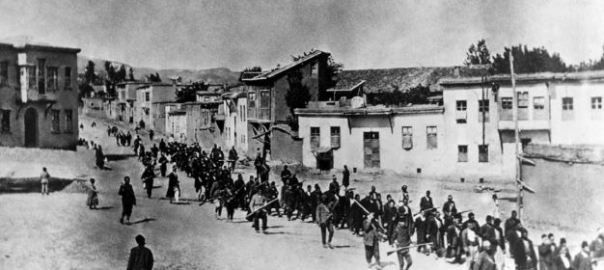
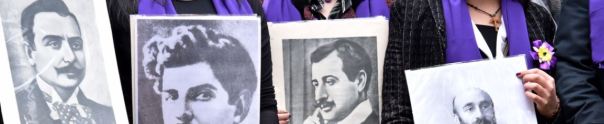
The Armenian Genocide (Armenian: Հայոց ցեղասպանություն, Hayots tseghaspanutyun), also known as the Armenian Holocaust, was the Muslim Ottoman government‘s systematic extermination of 1.5 million Armenian Christians,mostly Ottoman citizens within the Ottoman Empire and its successor state, the Republic of Turkey. The starting date is conventionally held to be 24 April 1915, the day that Ottoman authorities rounded up, arrested, and deported 235 to 270 Armenian intellectuals and community leaders from Constantinople to the region of Ankara, the majority of whom were eventually murdered.
The genocide was carried out during and after World War I and implemented in two phases: the wholesale killing of the able-bodied male population through massacre and subjection of army conscripts to forced labour, followed by the deportation of women, children, the elderly, and the infirm on death marches leading to the Syrian desert. Driven forward by military escorts, the deportees were deprived of food and water and subjected to periodic robbery, rape, and massacre.
Other indigenous and Christian ethnic groups such as the Assyrians and the Ottoman Greeks were similarly targeted for extermination by the Ottoman government in the Assyrian genocide and the Greek genocide, and their treatment is considered by some historians to be part of the same genocidal policy. Most Armenian diaspora communities around the world came into being as a direct result of the genocide.
Raphael Lemkin was explicitly moved by the Armenian annihilation to define systematic and premeditated exterminations within legal parameters and to coin the word genocide in 1943. The Armenian Genocide is acknowledged to have been one of the first modern genocides, because scholars point to the organized manner in which the killings were carried out in order to eliminate the Armenians, and it is the second most-studied case of genocide after the Holocaust.
Turkey, the successor state of the Ottoman Empire, denies the word genocide as an accurate term for the mass killings of Armenians that began under Ottoman rule in 1915. It has in recent years been faced with repeated calls to recognize them as genocide. To date, 29 countries have officially recognized the mass killings as genocide, as have most genocide scholars and historians.
My nine year old son interrupted my sleep in this morning to inform me ( with attitude ) that there was nothing for breakfast. Strange thinks I as dragged myself out of bed ( its was only 9 O’clock on a Sunday morning for Christ’s sake) and checked for myself.
Nothing for breakfast – Really?
Well I was flabbergasted with the array of choice – there were eggs, bacon, beans, toast , fruit , croissants etc. and more Cereals than you could shake a stick at.
David Copeland (born 15 May 1976) is a BritishNeo-Nazi militant who became known as the “London Nail Bomber” after a 13-day bombing campaign in April 1999 aimed at London’s black, South Asian and gay communities that resulted in three people killed and more than a hundred injured. Widely labelled a terrorist.
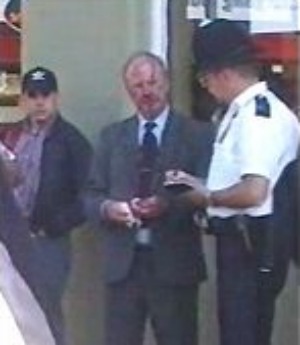
David Copeland with ex-BNP party leader John Tyndall
Over three successive weekends between 17 and 30 April 1999, Copeland placed homemade nail bombs, each containing up to 1,500 four-inch nails, in holdalls that he left in public spaces around London.
The first bomb was placed outside the Iceland supermarket in Electric Avenue, Brixton, an area of south London with a large black population.
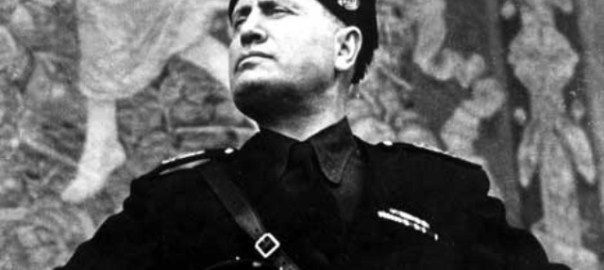
The dictator was killed along his mistress , Clara Petacci. Their bodies were taken to Milan from the Lecco district near Lake Como where they were arrested and killed.
According to the Times correspondent in Milan, the corpses of Mussolini, Petacci and 12 Fascists are on display in Piazzale Loreto “with ghastly promiscuity in the open square under the same fence against which one year ago 15 partisans had been shot by their own countrymen”.
Clara Petacci
One woman fired five shots into Mussolini’s body, according to Milan Radio, and shouted: “Five shots for my five assassinated sons!”
Other passers-by spat on the bodies
The executions are the first conspicuous demonstration of mob violence carried out by the partisans who until now have been kept under control by their leaders.
The partisan commander-in-chief General Raffaele Cadorna said such incidents were regrettable but desirable in this case as a way for the public to vent their anger against the former dictator and his cohorts.
Among the bodies were former general secretary of the Fascist Party, Roberto Farinacci and Carlo Scorza, former secretary of the party.
Mussolini was spotted heading towards Switzerland by an Italian customs guard at Dongo, near Lake Como. He was driving a car in a column of other German cars wearing a German greatcoat over his uniform.
Other members of his party were found in neighbouring villages.
It was in Milan that Mussolini founded Europe’s first fascist movement – Fasci di Combattimento – in 1919.
He came to power in 1922 after the so-called March on Rome.
By 1928 Mussolini was absolute dictator and took the title of Duce, leader, and embarked on an expansionist foreign policy taking Ethiopia in 1935 and annexing Albania in 1939. That same year Mussolini signed a Tripartite Pact with Adolf Hitler’s Germany and Imperial Japan.
After defeats in Greece, the Balkans, North Africa and Russia, Mussolini lost popularity. Then on 9 July 1943 the Allies landed in Sicily and Italy was faced with an invasion of its mainland.
Mussolini failed to secure assurances from Germany of adequate support against such an invasion and the Fascist Grand Council turned against him and had him arrested on 25 July.
Marshal Pietro Badoglio was appointed prime minister, dissolved fascist organisations and negotiated an armistice with the Allies.
Six weeks later the Germans launched a dramatic rescue of Mussolini. He was made head of the puppet republic of Salo – also known as the Italian Social Republic – once the Germans had occupied northern Italy in September 1943.
On 11 October 1943 the Badoglio government declared war on Germany
Soldiers injured in the bombing are pictured following the attack
The explosions killed 11 military personnel: four soldiers of the Blues & Royals at Hyde Park, and seven bandsmen of the Royal Green Jackets at Regent’s Park. Seven of the Blues & Royals’ horses also died in the attack. One seriously injured horse, Sefton, survived and was subsequently featured on television programmes and was awarded “Horse of the Year“.
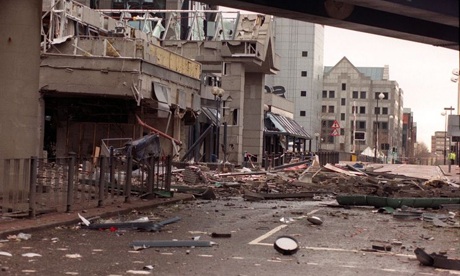
The London Docklands bombing (also known as the Canary Wharf bombing or South Quay bombing) occurred on 9 February 1996, when the Provisional Irish Republican Army (IRA) detonated a powerful truck bomb in Canary Wharf, one of the two financial districts of London. The blast devastated a wide area and caused an estimated £100 million worth of damage. Although the IRA had sent warnings 90 minutes beforehand, the area was not fully evacuated; two people were killed and 39 were injured.
———————————————-
IRA bombs Canary Wharf, London
———————————————-
It marked an end to the IRA’s seventeen-month ceasefire. The IRA had agreed to a ceasefire in August 1994, on the understanding that Sinn Féin would be allowed to take part in peace negotiations. However, when the British government then demanded the IRA must fully disarm before any negotiations, the IRA resumed its campaign. After…
Leigh Day lawyers knew murder and torture claims against UK soldiers were false, tribunal hears.
Enemies of The State
(Left to right) Anna Crowther, Martyn Day and Sapna Malik arrive at the tribunal in London. Credit: PA
A leading law firm and three of its lawyers have been accused of allowing false claims of murder and torture to be made against British soldiers.
Martyn Day, the boss of Leigh Day solicitors, and two members of staff, Sapna Malik and Anna Crowther, all face charges linked to the alleged ambulance chasing in Iraq and the subsequent hounding of British soldiers.
It was alleged at a solicitors tribunal into their activities that over a period of seven years the three allowed the allegations to be made while knowing they were false.
The lawyers are said to have known their clients were members of the Shia militia, the Mahdi Army, and not “the innocent bystanders” that was later claimed.
As a result Leigh Day is accused of causing British soldiers and their families “years of torment”.
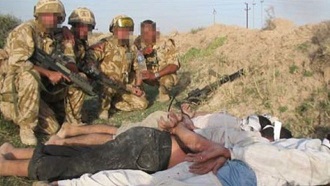
Soldiers were questioned over actions during the Battle of Danny Boy near Basra in 2004. Credit: PA
Outlining the case against them, Tim Dutton QC told the tribunal the reality was soldiers had fought valiantly after they had “been subjected to a murderous ambush”.
The events followed the Battle of Danny Boy near Basra in 2004.
Leigh Day are also accused of failing to disclose a document known as the ‘OMS list’ to other solicitors, the Ministry of Defence or the Al Sweady Inquiry, which investigated the allegations UK soldiers mistreated Iraqis.
This list showed the principal claimant, Kurd Al Sweady, and nine other claimants were all Mahdi Army members.
The Al Sweady inquiry found in 2014 the allegations were “wholly unfounded” and false.
If the list had been disclosed the inquiry, which cost £29 million of public money, “would have taken a very different course”.
Instead it was alleged Leigh Day ignored the evidence they were receiving about Kurd Al Sweady “because they regarded him as central to their success”.
It was claimed Leigh Day were very heavily invested in the Iraq business. In total the tribunal was told they had earned fees of £9.7 million.
To ensure they got the business, clients had to be referred to them. It is alleged they paid the equivalent of “bribes” to their agents in Iraq.
Leigh Day and three solicitors deny all 20 charges and say they will “strongly contest” the allegations.
The Battle of Danny Boy took place close to the city of Amarah in southern Iraq on 14 May 2004, between British soldiers and about 100 Iraqi insurgents of the Mahdi Army. The battle is named after a local British checkpoint called Danny Boy.
Battle
The insurgents ambushed a patrol of Argyll and Sutherland Highlanders close to a checkpoint known as Danny Boy near Majar al-Kabir. The Argylls called in reinforcements from the 1st Battalion of the Princess of Wales’s Royal Regiment; the latter were also ambushed and due to an electronic communications failure it was some time before further British relief arrived. While waiting for reinforcements the British were involved in one of the fiercest engagements they fought in Iraq. The fighting involved close-quarter rifle fire and bayonets.
The battle lasted for about three hours during which 28 Mahdi Army insurgents were killed; the British suffered some wounded, but none were killed in the action.
Aftermath
Sergeant Brian Wood, of the Princess of Wales’s Royal Regiment was awarded the Military Cross for his part in the battle.
On 25 November 2009, Bob Ainsworth, then the British Minister of State for the Armed Forces, announced that retired High Court judge Sir Thayne Forbes would chair the Al-Sweady Inquiry, after high court judges found that the MoD had committed “serious breaches” of its duty. It was alleged that 20 Iraqis, taken prisoner during the battle, were murdered and that others were tortured. The British Ministry of Defence denied that the 20 were captured, stating that 20 bodies were removed from the battlefield for identification and then returned to their families; a further nine were taken prisoner and held for questioning but were not mistreated.
In March 2013, Christopher Stanley of the UK-based Rights Watch group said that MoD was trying to get away with grave human rights violations – including killing – without punishment or due process of law.
On 4 March 2013 the hearings of the Al-Sweady Public Inquiry opened in London. On 20 March 2014 Public Interest Lawyers, a British law firm acting for the families of the dead Iraqis, announced that they were withdrawing the allegations against British soldiers. They accepted that there was no evidence that the Iraqis had been alive when taken into the British compound.
On 17 December 2014 the inquiry, which cost £31 million, returned its findings. It found that no prisoners had been murdered, nor that their bodies had been mutilated. However, the enquiry did find that British soldiers mistreated nine Iraqi prisoners, but not deliberately. It stated that the ill-treatment was much milder than the initial accusations of torture, mutilation and murder. Sir Thayne said that the “most serious allegations” which “have been hanging over [the British] soldiers for the past 10 years” have been found to be “without foundation”.
The inquiry found that the allegations made by the Iraqis and their lawyers were based on “deliberate lies, reckless speculation and ingrained hostility”. As a result of the inquiry’s findings Public Interest Lawyers and Leigh Day, another firm involved in cases against British troops, were referred to the Solicitors Regulatory Authority. In August 2016 Public Interest Lawyers went out of business, while the British government announced it would take steps to prevent further spurious claims against troops.
In December 2016 Professor Phil Shiner, head of Public Interest Lawyers, admitted guilt in relation to claims of wrongdoing by British troops in the context of professional misconduct proceedings. He was struck off the roll of solicitors by the Solicitors Disciplinary Tribunal in February 2017.
















 belfastchildis.com