
Vladimir Komarov

The Man who fell to Earth
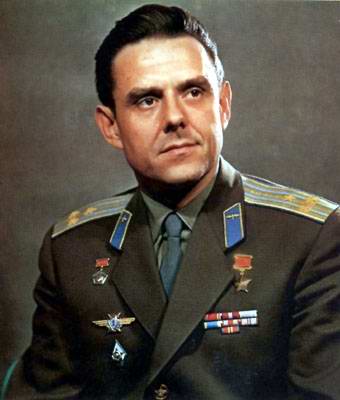
Vladimir Mikhaylovich Komarov (Russian: Влади́мир Миха́йлович Комаро́в; IPA: [vlɐˈdʲimʲɪr mʲɪˈxaɪləvʲɪtɕ kəmɐˈrof]; 16 March 1927 – 24 April 1967) was a Soviet test pilot, aerospace engineer and cosmonaut in the first group of cosmonauts selected in 1960. He was one of the most highly experienced and well-qualified candidates accepted into the Group Air Force № 1(the first squad of cosmonauts of the USSR) .
Komarov was declared medically unfit for training or spaceflight twice while he was in the program, but his perseverance and superior skills and his knowledge as an engineer allowed him to continue playing an active role. During his time at the Cosmonaut Training Center, he contributed to space vehicle design, cosmonaut training and evaluation and public relations.
He was eventually selected to command the first Soviet multiman Voskhod 1 spaceflight that presented a number of technical innovations in the Space Race. Komarov was later chosen for the rigorous task of commanding Soyuz 1 as part of the Soviet Union‘s bid to reach the Moon first.
His spaceflight on Soyuz 1 made him the first Soviet cosmonaut to fly into outer space more than once, and he became the first human to die on a space mission—he was killed when the Soyuz 1 space capsule crashed after re-entry on 24 April 1967 due to a parachute failure.
However, because he died when the capsule crashed into the ground, he is not considered to be the first human fatality in outer space.
| Vladimir Mikhaylovich Komarov | |
|---|---|

1965 USSR postage stamp honoring Vladimir Komarov
|
|
| Cosmonaut | |
| Nationality | Soviet |
| Born | (1927-03-16)16 March 1927 Moscow, Soviet Union |
| Died | 24 April 1967(1967-04-24) (aged 40) Orenburg Oblast, Russian SFSR, Soviet Union |
|
Other occupation
|
Engineer |
| Rank | Polkovnik (equiv. Colonel), Soviet Air Force |
|
Time in space
|
2d 03h 04m |
| Selection | Air Force Group 1 |
| Missions | Voskhod 1, Soyuz 1 |
|
Mission insignia
|
  |
| Awards |   |
Early life
Komarov was born in Moscow on 16 March 1927, where he grew up along with his sister Matilde. His father was a labourer who worked at various low-paid jobs to support the family. In 1935, Komarov began his formal education in the local elementary school. Here he showed a natural aptitude for mathematics.
In 1941, Komarov left school because of World War II, and the German invasion of the U.S.S.R., and he became a laborer on a collective farm. He showed an interest in aeronautics from an early age, and he collected magazines and pictures about aviation, in addition to making model aircraft and his own propeller.
At the age of fifteen in 1942, Komarov entered the “1st Moscow Special Air Force School” to pursue his dream of becoming an aviator. Shortly thereafter, his family learned that Komarov’s father had been killed in an “unknown war action.”
Of necessity because of the German invasion, the flight school was soon moved to the Tyumen Region in Siberia for the duration of the war. Students there learned a wide variety of subjects besides aviation – including zoology and foreign languages. In 1945, Komarov graduated from flight school with honors. Hostilities ended in World War II before Komarov was called on to enter combat.
In 1946, Komarov completed his first year of training at the Chkalov Higher Air Force School in Borisoglebsk in Voronezh Oblast. He then completed his training at the A.K. Serov Military Aviation College in Bataisk. Komarov’s mother died in 1948, seven months before his graduation (in 1949) at which he received his pilots wings and commission as a lieutenant in the Soviet Air Force.
Career in the Soviet Air Force
,_his_wife_Valentina_Komarov,_and_their_daughter_Irina.jpg)
Komarov with his wife Valentina Yakovlevna and daughter Irina Vladimirovna
In December 1949, Komarov served as the pilot of a fighter plane with the 383rd Regiment of the 42nd North Caucasian Fighter Air Division that was based in Grozny.
Komarov married Valentina Yakovlevna Kiselyova in October 1950. He was promoted to senior lieutenant in 1952, and he was later assigned as the chief pilot of the 486th Fighter Aviation Regiment of the 279th Fighter Air Division in the Prikarpate Region.
Komarov continued to fly in that position until 1954, and then he enrolled in an engineering course at the N.E. Zhukovsky Air Force Engineering Academy. In 1959, Komarov was promoted to the rank of senior engineer-lieutenant. Later that year he achieved his goal of becoming a test pilot at the Central Scientific Research Institute at Chkalovsky.
Cosmonaut selection

Air Force Group One
In September 1959, Komarov was promoted to engineer-captain and invited to participate in the selection process for cosmonaut candidate along with approximately 3,000 other pilots.[4] He was one of only twenty candidates selected for “Air Force Group One”, he and the others reported to the newly formed TsPK just outside Moscow for assignment on 13 March 1960.
Although eminently qualified, Komarov was not chosen in the top six candidates, because he did not meet the age, height and weight restrictions specified by the “Chief Designer” of Russia’s space program: Sergei Korolev.
“If the criteria had been different,” the cosmonaut trainer Mark Gallai noted in an interview, “certainly Komarov, who was very intelligent, would have been in the group. He had Air Force Academy flight experience. He had a great influence on the design of the Vostok and [the] Voskhod.”
At age 32, Komarov was the second oldest of the pilots chosen – Sergei Korolev had specified a maximum age of just 27. Of the first intake, only two members, Pavel Belyayev (of Voskhod 2) and Komarov, were also graduates of the Soviet Air Force Academy. In addition, of the intake, only Komarov had experience as a flight test engineer on new aircraft.
Training
Shortly after beginning his training Komarov was hospitalised for a minor operation in May 1960, which left him medically unfit for physical training for approximately 6 months. At the time, the selection criteria placed a heavy emphasis on the physical condition of cosmonauts and any imperfection led to instant disqualification. Since Komarov already held engineering qualifications, he was allowed to remain a part of the program after assuring the administration he would be able to catch up. He continued with the required academic studies while recovering.
He returned to training in October, because his recovery was more rapid than medical staff had expected. During that time he assisted his younger peers with their academic studies; earning him the casual nickname of “The Professor” which he shared with Belyayev who was two years his senior. In 1961 the first space flights began. By 1962, Komarov was the third highest paid cosmonaut, due to his qualifications, rank and experience. He earned 528 rubles a month, with only cosmonauts 1 and 2 Yuri Gagarin and Gherman Titov being more highly paid.
When Georgi Shonin demonstrated an unacceptable level of g-force susceptibility in the centrifuge he was replaced by Komarov in May 1962 for planned dual Vostok missions. Komarov was selected as back up for Pavel Popovich (Vostok 4), but subsequent routine ECG testing of Komarov revealed a heart irregularity and he was pulled from the program and replaced by Boris Volynov.
The same heart irregularity grounded American astronaut Deke Slayton. After Komarov persistently lobbied medical and military personnel to be readmitted into the program he was allowed to return to training.
In 1963, cosmonaut training was conducted in 6 Groups, with Komarov being selected in Group 2 with Valery Bykovsky and Volynov. This group was to train for missions of up to five days in duration scheduled for the latter part of 1963. In May 1963 Alekseyev proposed to Kamanin that Komarov be named backup for Vostok 5 rather than Khrunov because his suit was ready.
Komarov was later named in a further group for planned missions in 1964 with Belyaev, Shonin, Khrunov, Zaikin, Gorbatko, Volynov, and Leonov. The training groups were formed for later Vostok missions, (Vostok 7–13) but no actual crews were assigned and the missions did not occur under the auspices of the original Vostok program.
In December 1963, Komarov was shortlisted for flight by Kamanin with Volynov and Leonov, having completed two years of training.
In April 1964 Komarov was declared space-flight ready with Bykovsky, Popovich, Titov, Volynov, Leonov, Khrunov, Belyayev, and Lev Demin. From this group the commander of the planned Voskhod mission scheduled for late 1964 would be chosen. In May the group was reduced to Volynov, Komarov, Leonov, Khrunov.
During training, Komarov lived at the TsPK (which would later be nicknamed Star City by the Soviet press) with his wife Valentina and their two children Yevgeny and Irina. There he enjoyed hunting, cross country skiing, ice hockey and other social activities with his fellow trainees in their leisure time. Komarov was well liked by his peers and was referred to by them as Volodya (a diminutive of his first name). Pavel Popovich noted that Komarov was respected for his humility and experience: “…he was already an engineer when he joined us, but he never looked down on the others. He was warm-hearted, purposeful and industrious. Volodya’s prestige was so high that people came to him to discuss all questions: personal as well as questions of our work.”
Fellow cosmonaut Alexei Leonov described him as “…very serious. He was a first-class test pilot.”
Spaceflights
Voskhod 1
By July 1964, only seven cosmonauts remained eligible for the Voskhod crew after some of them had been disqualified on medical grounds. On 6 July, Komarov was named as the commander of the back-up crew for Voskhod 1. After much heated debate over several months about the selection of the crew between Nikolai Kamanin and Sergei Korolev, Komarov was named as prime crew commander on 4 October 1964, by the State Commission; just eight days before its scheduled launch. Kamanin played tennis with the Voskhod crew that evening and noted that Komarov played poorly in comparison to his crew: Boris Yegorov and Konstantin Feoktistov.
On 9 October, Komarov and the crew inspected the Voskhod with Korolev and other members of the administration. Later that day they were interviewed by the state press and played tennis for the benefit of photographers.
On the morning of 11 October, Komarov was given various communist relics to take with him into space the following day. In the afternoon the crew again inspected the capsule and were given their final instructions by Korolev. Komarov was the only member of the crew to have undertaken extensive training and was the only member with any flight experience; the two other crewmen being civilians. His call sign was “Ruby” (Russian: Рубин).
During the mission Komarov performed various tasks with the other crew members, including medical and navigational tests and observing the Aurora Borealis. He also made a number of radio transmissions, including a greeting to the Tokyo Olympics which had opened on 10 October. Some of the transmissions Komarov made were recorded by amateur radio operators like Sven Grahn. The mission lasted just over twenty-four hours. After the crew landed safely they were flown back to the launch site at Tyuratam (also known as Baikonur to disguise its true location). Kamanin noted in his diary that while his crew were in good spirits, Komarov was fatigued.
On 19 October, Komarov and his crew made reports in Red Square and attended an audience at the Kremlin. After the success of this short but scientifically important mission he was promoted to colonel. The success of the mission earned Komarov the awards of the Order of Lenin and Hero of the Soviet Union.
In December 1964, the RSVN (Strategic Rocket Forces) requested that Komarov be transferred from the VVS (Soviet Air Force) to the RSVN, in a move possibly motivated by the poor record of the RSVN in producing successful rockets compared to the VVS. The request was opposed by Kamanin.
In 1965, Komarov worked with Yuri Gagarin in supervising preparations for the flight of Voskhod 2, which carried out the first attempt of an extravehicular activity in outer space. These preparations included fitting of space suits on the cosmonauts and briefings for the spaceflight. In April of that year, Komarov toured St. Petersburg, Russia, with Kamanin, Gagarin, Gherman Titov, Belyayev, and Leonov, and Komarov visited Petropavlovsk Fortress with Valentin Glushko where he had conducted the first rocket experiments in the early 1930s.
In September that year, Komarov toured West Germany.
Soyuz 1
Komarov was assigned to the Soviet Soyuz program along with Yuri Gagarin and Alexei Leonov. In July 1966, Komarov was reprimanded by Kamanin for his unauthorised disclosure, while in Japan, that “the Soviet Union will, at the scheduled time, fly an automated spacecraft around the Moon and return it to (the) Earth, to be followed by a dog flight, then a manned circumlunar flight.”
The following month Komarov clashed with other engineers over ongoing design problems in which zero-G tests showed that the Soyuz module hatch was too small to allow the exit of a fully suited cosmonaut safely. Meanwhile, Komarov and his fellow cosmonauts had their groups and assignments constantly revised and they became increasingly anxious about the lack of response to their concerns about the design and manufacture of space craft which had been raised in a letter to Leonid Brezhnev by Yuri Gagarin on their behalf.
Komarov was selected to command the Soyuz 1, in 1967, with Yuri Gagarin as his backup cosmonaut. During the preparations for the spaceflight, both cosmonauts were working twelve- to fourteen-hour days. On orbital insertion, the solar panels of the Soyuz module failed to fully deploy thereby preventing the craft from being fully powered and obscuring some of the navigation equipment. Komarov reported:
“Conditions are poor. The cabin parameters are normal, but the left solar panel didn’t deploy. The electrical bus is at only 13 to 14 amperes. The HF (high frequency) communications are not working. I cannot orient the spacecraft to the sun. I tried orienting the spacecraft manually using the DO-1 orientation engines, but the pressure remaining on the DO-1 has gone down to 180.”
Komarov tried unsuccessfully to orient the Soyuz module for five hours. The craft was transmitting unreliable status information and communications were lost on orbits 13 through 15 due to the failure of the high frequency transmitter which would have maintained radio contact while the craft was out of range of the ultra-high frequency (UHF) receivers on the ground.
As a result of the problems with the craft, the second Soyuz module which was to have carried cosmonauts to perform an extra-vehicular activity (EVA) to the Soyuz 1 was not launched and the mission was cut short.
Komarov was ordered to re-orient the craft using the ion system on orbits 15 to 17. The ion engine system failed. Komarov did not have enough time to attempt a manual re-entry until orbit 19. Manual orientation relied on using the equipped Vzor device, but in order to do this, Komarov needed to be able to see the Sun. To reach the designated landing site at Orsk the retro-fire would need to take place on the night side of the Earth. Komarov oriented the spacecraft manually on the dayside then used the gyro-platform as a reference so that he could orient the craft for a night side retro-fire.
He successfully re-entered the Earth’s atmosphere on his 19th orbit, but the module’s drogue and main braking parachute failed to deploy correctly and the module crashed into the ground, killing Komarov. According to the 1998 book Starman, by Jamie Doran and Piers Bizony, as Komarov sped towards his death, U.S. listening posts in Turkey picked up transmissions of him crying in rage,
“cursing the people who had put him inside a botched spaceship.”

Response to Komarov’s death
On 25 April, a response to Komarov’s death by his fellow cosmonauts was published in Pravda: “For the forerunners it is always more difficult. They tread the unknown paths and these paths are not straight, they have sharp turns, surprises and dangers. But anyone who takes the pathway into orbit never wants to leave it. And no matter what difficulties or obstacles there are, they are never strong enough to deflect such a man from his chosen path. While his heart beats in his chest, a cosmonaut will always continue to challenge the universe. Vladimir Komarov was one of the first on this treacherous path.”
When interviewed on 17 May by the newspaper Komsomolskaya Pravda, Yuri Gagarin alluded to the failure of the administration to listen to the concerns about the Soyuz module that were identified by the cosmonaut corps and that Komarov’s death should teach the establishment to be more rigorous in its testing and evaluation of “all the mechanisms of the spaceship, even more attentive to all stages of checking and testing, even more vigilant in our encounter with the unknown.
He has shown us how dangerous the pathway to space is. His flight and his death will teach us courage.” In May 1967, Gagarin and Leonov criticised program head Vasily Mishin‘s “poor knowledge of the Soyuz spacecraft and the details of its operation, his lack of cooperation in working with the cosmonauts in flight and training activities” and asked Kamanin for him to be cited in the official report into the crash.
After Komarov’s death, the communications systems on board all Soviet spacecraft were modified because Komarov’s voice transmissions from Soyuz 1 had blocked its telemetry signals.
In Leo De Boer‘s 2000 documentary The Red Stuff, Alexei Leonov noted the profound effect that Komarov’s death had on the morale of the cosmonaut corps:
“He was our friend. Before his death the press and public had paid little attention to the extreme risks we took.”
Honours and awards
- Gold Star Hero of the Soviet Union, twice (19 October 1964, 1967 [posthumously])
- Order of Lenin (19 October 1964)
- Order of the Red Star (1961)
- Medal “For Combat Merit” (1956)
- Medal “For the Development of Virgin Lands” (1964)
- Pilot-Cosmonaut of the USSR
- Hero of Socialist Labour (Vietnam, 1964)
Posthumous honours
On 26 April 1967, Komarov was given a state funeral in Moscow, and his ashes were interred in the Kremlin Wall Necropolis at Red Square. The American astronauts requested the Soviet government to allow a representative to attend, but were turned down.
Komarov was posthumously awarded his second Order of Lenin and also the Order of Hero of the Soviet Union.
On 25 April 1968, a memorial service was held for Komarov at the crash site near Orsk
Kamanin noted in his diary that over 10,000 people were present at this service, “some driving hundreds of kilometres for the event.”
Komarov has been featured on commemorative First Day Covers and stamps for his contribution to the space program – from several different countries.
Komarov is commemorated with other prominent figures from the early Russian space program with a bust on Cosmonauts Alley in Moscow, and he is also honored with a monument at the crash site near Orsk.

Commemorative plaque and the Fallen Astronaut sculpture left on the Moon
Before leaving the Moon on Apollo 11, Neil Armstrong‘s final task was to place a small package of memorial items to honor Komarov, Yuri Gagarin, and the Apollo 1 astronauts Virgil Grissom, Edward White, and Roger Chaffee. Komarov’s name also appears on a commemorative plaque left at Hadley Rille on the Moon by the commander of Apollo 15, David Scott in memory of 14 deceased NASA astronauts and USSR cosmonauts, along with a small sculpture entitled Fallen Astronaut, on 1 August 1971. This plaque and the sculpture represent those astronauts and cosmonauts who died in the quest to reach outer space and the Moon.
The asteroid 1836 Komarov, discovered in 1971, was named in the honor of Komarov, as was a crater on the Moon.[35] This asteroid and the cosmonaut inspired the composer Brett Dean to write a piece of symphonic music commissioned by conductor Simon Rattle in 2006. The composition is named Komarov’s Fall, and it can be found on the EMI Classics Album of Simon Rattle’s The Planets.
Among other honors, the Vladimir M. Komarov Astronautical Rocketry Club (ARK) in Ljubljana has also borne Komarov’s name since 1969.
The Fédération Aéronautique Internationale‘s V.M. Komarov Diploma is named in Komarov’s honor.
There was formerly a Soviet satellite-tracking ship named for Komarov, the Kosmonaut Vladimir Komarov.
The Estonian band Sõpruse Puiestee (Friendship Boulevard) wrote a song “Planeetidegi vahel kehtib raskus” (“Difficulty stands even between planets”) in honor of Komarov. This recording was completed 43 years after Komarov’s death, on 24 April 2010.
The French electro band named Kowalsky wrote a song “Lost” (2008) in honor of Komarov, in which the listener can hear his last words.
The American progressive metal band Cormorant wrote a song “Unearthly Dreamings” (2011) about Komarov’s failed space mission.
Mehmet Baydur, a Turkish playwright who died on 24 November 2001, wrote a play titled Vladmir Komarov about what happened on his last day, 24 April 1967.
The Finnish band This Empty Flow wrote a song called “Towards Distant (the death of Komarov during re-entry).” It includes a broadcast message made by Komarov during the Soyuz 1 flight

Valentina Komarov, the widow of Soviet cosmonaut Vladimir Komarov, kisses a photograph of her dead husband during his official funeral, held in Moscow’s Red Square on April 26, 1967.
—————
- “Murderous Mary” – The Elephant they Hanged
- The Long Walk – Iconic Pictures & Story behind them
- V-J Day Kiss in Times Square 1945
- Vladimir Komarov – The Man who fell to Earth
- War is Hell – Iconic Pictures & Story behind them
- The Naked Gunner 1944 – Iconic Pictures
- Pictures that changed the World – Jan Palach – self-Immolation
- Tank Man – Tiananmen Square – Pictures that changed the World
- Earthrise from moon – Pictures that changed the World
- Pictures that changed the World. Dorothy Counts – High School Segregation























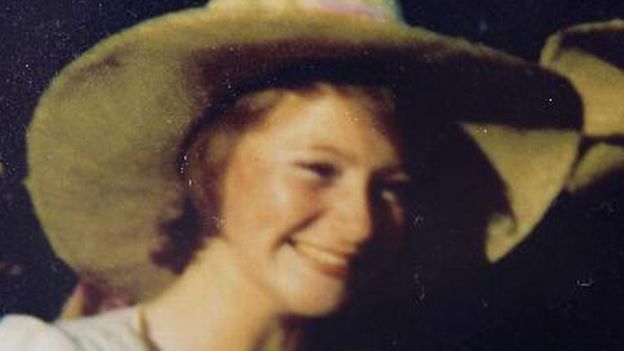 Maxine Hambleton was 18 when she was killed in the 1974 bombing
 belfastchildis.com