On a sunny day in 1970 my osteomyelitis was finally given the all clear and I was on my way home from the hospital, for a couple of years at least. I was so heartbroken to leave Nurse Brown, that on the day of my discharge I hid in a broom cupboard, in the childish belief if they couldn’t find me they would let me stay in the children’s ward with Nurse Brown.
The day before dad had explained to me that we had a new home and that‘s where I would be going to live when I left hospital. He explained that we had moved to Glencairn to be near his family, so that our grandmother could help look after us. We all loved my grandmother dearly and although I was grief stricken at the thought of leaving…
Tabby’s Star, the explanation that has everyone so intrigued, is that an alien civilization may be building a megastructure.
Beginning tonight (October 26, 2016), and over two more nights more in the coming two months, astronomers will use the Green Bank radio telescope in rural West Virginia to observe Tabby’s Star. Tabby herself – astronomer Tabetha Boyajian, formerly of Yale and now at Louisiana State University – will be there to help lead the observations.
Her Ted Talk earlier this year created a sensation when she called this star “the most mysterious in the universe.” Beginning tonight, the Breakthrough Listen project at University of California Berkeley is devoting eight hours per night for three nights to observing Tabby’s Star with the Green Bank telescope. The astronomers admit it’s a long-shot, but they want to see if this telescope can detect signals from a possible extraterrestrial civilization that might – or might not – reside on a planet orbiting this star.
Get Involved
The astronomers will also be doing a live chat from Green Bank Observatory today starting at 2000 UTC (4 p.m. Eastern, 1 p.m. Pacific; translate to your time zone) about the upcoming observations of Tabby’s Star.
KIC 8462852 (also Tabby’s Star or WTF Star) is an F-type main-sequence star located in the constellationCygnus approximately 454 parsecs (1,480 ly) from Earth. Unusual light fluctuations of the star were discovered by citizen scientists as part of the Planet Hunters project, and in September 2015 astronomers and citizen scientists associated with the project posted a preprint of a paper on arXiv describing the data and possible interpretations.
The discovery was made from data collected by the Kepler space telescope, which observes changes in the brightness of distant stars to detect exoplanets.
Several hypotheses have been proposed to explain the star’s large irregular changes in brightness as measured by its unusual light curve, but none have fully explained all aspects of the curve. The leading hypothesis, based on a lack of observed infrared light, posits a swarm of cold, dusty comet fragments in a highly eccentric orbit. Another hypothesis is that of a large number of small masses in “tight formation” orbiting the star.
It has been speculated that the changes in brightness could be signs of activity associated with intelligent extraterrestrial life constructing a Dyson swarm. The SETI Institute‘s initial radio reconnaissance of KIC 8462852, however, found no evidence of technology-related radio signals from the star.
KIC 8462852 is not the only star that has such large irregular dimmings. However, all other such stars are young stellar objects called YSO dippers that have different dimming patterns. An example of such an object is EPIC 204278916.
The names “Tabby’s Star” and “Boyajian’s Star” refer to the initial study’s lead author, Tabetha S. Boyajian; KIC 8462852 is also known as the “WTF Star”, after the study’s subtitle “Where’s The Flux?” (a joking reference to the colloquial expression of disbelief “WTF”).
Apparent location
Map showing location of NGC 6866. KIC 8462852 is northeast between NGC 6866 and ο¹ Cygni.
KIC 8462852 in Cygnus is located roughly halfway between the major visually apparent bright stars Deneb (α Cyg, α Cygni, Alpha Cygni) and Delta Cygni (δ Cyg, δ Cygni) to the eye as part of the Northern Cross. KIC 8462852 is situated south of Omicron¹ Cygni (ο¹ Cygni, 31 Cygni), and northeast of the star clusterNGC 6866.While only a few arcminutes away from the cluster, it is unrelated and closer to the Sun than it is to the star cluster.
With an apparent magnitude of 11.7, the star cannot be seen by the naked eye, but is visible with a 5-inch (130 mm) telescope in a dark sky with little light pollution.
History of observations
KIC 8462852 was observed as early as the year 1890. The star was cataloged in the Tycho, 2MASS, UCAC4 and WISEastronomical catalogs (published in 1997, 2003, 2009 and 2012, respectively).
The main source of information about the luminosity fluctuations of KIC 8462852 is the Kepler space observatory. During its primary and extended mission from 2009 to 2013 it continuously monitored the light curves of over 100,000 stars in a patch of sky in the constellations Cygnus and Lyra.
Luminosity
Observations of the luminosity of the star by the Kepler space telescope show small, frequent, non-periodic dips in brightness, along with two large recorded dips in brightness appearing to occur roughly 750 days apart. The amplitude of the changes in the star’s brightness, and the aperiodicity of the changes, mean that this star is of particular interest for astronomers. The star’s changes in brightness are consistent with many small masses orbiting the star in “tight formation”.
]
The first major dip, on 5 March 2011, obscured the star’s brightness by up to 15%, and the other (on 28 February 2013) by up to 22%. In comparison, a planet the size of Jupiter would only obscure a star of this size by 1%, indicating that whatever is blocking light during the star’s major dips is not a planet, but rather something covering up to half the width of the star.
Due to the failure of two of Kepler‘sreaction wheels, the star’s predicted 750-day dip around April 2015 was not recorded; further observations are planned for May 2017.
The irregular light dips do not show a pattern.
In addition to the day-long dimmings, a study of a century’s worth of photographic plates suggest the star has gradually faded from 1890 to 1989 by about 20%, which would be unprecedented for any F-type main sequence star. However, teasing accurate magnitudes from long-term photographic archives is a complex procedure, requiring adjustment for equipment changes, and is strongly dependent on the choice of comparison stars. A contrasting study, examining the same photographic plates, concluded that the possible century-long dimming was likely a data artifact, and not a real astrophysical event.
A third study, using light measured by the Kepler observatory over a four-year period, determined that KIC 8462852 dimmed at about 0.34 percent per year before dropping dramatically by about 2.5 percent in 200 days. It then returned to its original slow fade rate. The same technique was used to study 193 stars in its vicinity and 355 stars similar in size and composition to KIC 8462852. None of these stars exhibited such dimming.
Hypotheses
Based on KIC 8462852’sspectrum and stellar type, its changes in brightness could not be attributed to intrinsic variability; while a few hypotheses have been proposed involving material orbiting the star and blocking its light, none of these fully fit the observed data.
Some of the proposed explanations involve instrument or data artifacts, interstellar dust, a series of giant planets with very large ring structures, a recently captured asteroid field, the system undergoing Late Heavy Bombardment, and an artificial megastructure orbiting the star.
Younger star with coalescing material around it
Artist’s impression of a young star with coalescing material around it
Astronomer Jason Wright (who was consulted by Boyajian) and others who have studied KIC 8462852 have suggested in a follow-up paper that if the star is younger than its position and speed would suggest, then it may still have coalescing material around it.
Artist’s impression of a massive collision with a proto-planet
High-resolution spectroscopy and imaging observations have also been made, as well as spectral energy distribution analyses using the Nordic Optical Telescope in Spain. A massive collision scenario would create warm dust that glows in infrared wavelengths, but there is no observed excess infrared energy, ruling out massive planetary collision debris.
Other researchers think the planetary debris field explanation is unlikely, given the very low probability that Kepler would ever witness such an event due to the rarity of collisions of such size.
As with the possibility of coalescing material around the star, spectroscopic studies using the NASA IRTF found no evidence for hot close-in dust or circumstellar matter from an evaporating or exploding planet within a few astronomical units of the central star.
Similarly, a study of past infrared data from NASA’s Spitzer Space Telescope and Wide-field Infrared Survey Explorer found no evidence for an excess of infrared emission from the star, which would have been an indicator of warm dust grains that could have come from catastrophic collisions of meteors or planets in the system. This absence of emission supports the hypothesis that a swarm of cold comets on an unusually eccentric orbit could be responsible for the star’s unique light curve, but more studies are needed.
A cloud of disintegrating comets
Artist’s impression of an orbiting swarm of dusty comet fragments
One proposed explanation for the reduction in light is that it is due to a cloud of disintegrating comets orbiting the star elliptically. Under this scenario, gravity from a nearby star may have caused comets from KIC 8462852’sOort cloud to fall in-system. Evidence supporting this hypothesis includes an M-type red dwarf within 132 billion kilometers (885 AU) of KIC 8462852. However, the notion that disturbed Oort cloud comets orbiting elliptically close to the star could exist in high enough numbers to obscure 22% of the star’s observed luminosity has been doubted.
Submillimetre wavelength observations searching for farther-out cold dust in the system’s Kuiper Belt suggest that a distant “catastrophic” planetary disruption explanation is unlikely; the possibility of a disrupted Kuiper Belt scattering comets into the inner system is still to be determined.
An artificial megastructure
Artist’s impression of a Dyson swarm
Astronomer Jason Wright and others who have studied KIC 8462852 hypothesized that the objects eclipsing the star could be parts of a megastructure made by an alien civilization, such as a Dyson swarm, a hypothetical structure that an advanced civilization might build around a star to intercept some of its light for their energy needs. Due to extensive media coverage on this matter, KIC 8462852 has been compared by Kepler‘s Steve Howell with KIC 4110611, another star with an odd light curve (which proved, after years of research, to be a part of a five-star system). Regarding the current light curve data of KIC 8462852, Wright has emphasized the importance of upcoming spectral studies. According to Wright, the likelihood of extraterrestrial intelligence being the cause of the dimming is very low; however, the star remains an outstanding SETI target because natural explanations have yet to fully explain the dimming phenomenon.
Follow-up studies
Many optical telescopes are monitoring KIC 8462852 in anticipation of another multi-day dimming event, with planned follow-up observations of a dimming event using large telescopes equipped with spectrographs to determine if the eclipsing mass is a solid object, or if composed of dust or gas. Additional follow-up observations may involve the ground-based Green Bank Telescope, the Very Large Array Radio Telescope, and future orbital telescopes dedicated to exoplanetology such as WFIRST, TESS, and PLATO.
A fund-raising campaign was led by Tabetha Boyajian, the author of the initial study on KIC 8462852’s anomalous light curve. The project proposes to use the Las Cumbres Observatory Global Telescope Network to continue observation of the star in the future and observe it in additional wavelengths to reveal new details on the composition of the objects obfuscating the star. The campaign raised over US$100,000, enough for one year of observations.
SETI results
In October 2015, the SETI Institute used the Allen Telescope Array to look for radio emissions from possible intelligent extraterrestrial life in the vicinity of the star.[56][57] After an initial two-week survey, the SETI Institute reported that it found no evidence of technology-related radio signals from the star system.
No narrowband radio signals were found at a level of 180–300 Jy in a 1 Hz channel, or medium-band signals above 10 Jy in a 100 kHz channel. Another SETI-related study, one using archival VERITAS gamma-ray observatory observations from 2009 to 2015, found no evidence of pulsed optical beacons associated with KIC 8462852.
Astronomer Jason Wright and his colleagues plan to conduct another search beginning in October 2016 using West Virginia’s Green Bank Telescope.
A star called EPIC 204278916, as well as some other young stellar objects, was observed to have similar dips to those observed in KIC 8462852. However, they differ in many aspects. EPIC 204278916 shows much deeper dips than KIC 8462852, and the dips seem to be grouped over a short period of time, whereas the dips at KIC 8462852 are spread out over several years. Further, EPIC 204278916 is surrounded by a proto-stellar disc, while KIC 8462852 appears to be a normal F-type star displaying no evidence of a disc.
See also
PSR B1919+21, a pulsar mistaken for an alien radio signal (LGM-1)
Strange messages coming from the stars are ‘probably’ from aliens, scientists say.
‘It is too early to unequivocally attribute these purported signals to the activities of extraterrestrial civilizations,’ a group of scientists looking for aliens have warned – but the signals are encouraging.
Scientists have heard hugely unusual messages from deep in space that they think are coming from aliens.
A new analysis of strange modulations in a tiny set of stars appears to indicate that it could be coming from extraterrestrial intelligence that is looking to alert us to their existence.
The new study reports the finding of specific modulations in just 234 out of the 2.5 million stars that have been observed during a survey of the sky. The work found that a tiny fraction of them seemed to be behaving strangely…….
Disclaimer – The views and opinions expressed in these documentary are soley intended to educate and provide background information to those interested in the Troubles of Northern Ireland. They in no way reflect my own opinions and I take no responsibility for any inaccuracies or factual errors.
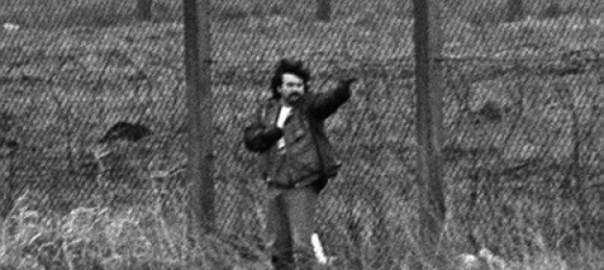
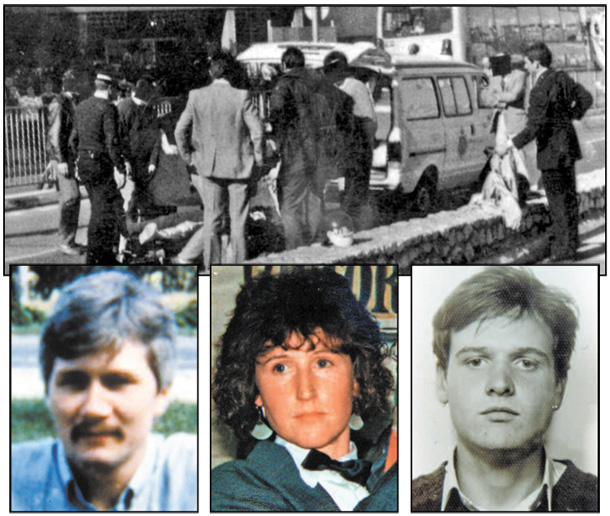
Operation Flavius
The execution of three members of the IRA in Gibraltar set in motion the chain of events that would lead to the killings of David Howes and David Howes
Operation Flavius (also referred to as the “Gibraltar killings“)[1][2] was a controversial military operation in which three members of the Provisional Irish Republican Army (IRA) were shot dead by the British Special Air Service (SAS) in Gibraltar on 6 March 1988. The three—Seán Savage, Daniel McCann, and Mairéad Farrell—were believed to be mounting a bombing attack on British military personnel in Gibraltar. SAS soldiers…
Below is a comprehensive list of 60 films about the “Troubles” and Republican/Loyalist paramilitaries . The list includes background information on the movies and where possible I have incl…
Fouzia Azeem (Urdu: فوزیہ عظیم; 1 March 1990 – 15 July 2016), better known by the name Qandeel Baloch (Urdu: قندیل بلوچ), was a Pakistani model, actress, woman’s rights activist and social media celebrity. Baloch rose to prominence due to her videos on social networks discussing her daily routine and various controversial issues.
Baloch first received recognition from the media in 2013, when she auditioned for Pakistan Idol; her audition went viral and she became an Internet celebrity. She was one of the top 10 most searched for persons on the internet in Pakistan and both celebrated and criticised for the content of her videos and posts.
During the evening of 15 July 2016, Baloch was asphyxiated while she was asleep in the house where her parents live in Multan. Her brother Waseem Azeem confessed to the murder saying she was “bringing disrepute” to the “family’s honour.
Early life
Baloch was born on 1 March 1990 in Dera Ghazi Khan, Punjab. She hailed from Shah Sadar Din. She had six brothers and six sisters. Her first job was as a bus hostess.
Career
Baloch’s fame was based on her social media posts – pictures, videos and comments. These were considered bold by the largely conservative Pakistani community.Some international news media compared her to Kim Kardashian; however, local commentators stated that she was more significant than Kardashian, as Baloch “went against the norms of society” and lived life on her own terms.
In June 2016, Baloch met senior cleric MuftiAbdul Qawi in a hotel room to learn more about her faith; the interaction between them brought about mayhem on social media platforms as their photos went viral online. She also wore a hat with the Mufti’s signature. The meeting led to the Mufti being suspended from his position on one of Pakistan’s religious committees.
A previous stunt which spread in social media was her promise to strip dance for her nation and to dedicate her dance to cricketer Shahid Afridi if Pakistan won the Twenty20 match against India on 19 March 2016. She released a teaser on social media, which went viral, but Pakistan lost the match. Some Indian media compared her with Poonam Pandey at this point due to her controversial personality.
As her media presence grew, Baloch began to use her position to comment on women’s position in Pakistani society. The week before she died, she released a music video entitled Ban, which mocked the restrictions placed on women in the country.In an interview with controversial anchor Mubashir Luqman, Baloch named Sunny Leone, Rakhi Sawant and Poonam Pandey as her inspirations.
She also said that many organizations, people and media groups were calling her to feature in their shows to increase their own ratings.
Security concerns
Following the June 2016 meeting with Qawi, Baloch reported that she received death threats both from him and from others.
At around the same time, Baloch’s ex-husband described in the media their brief marriage, revealing intimate details of their relationship. Baloch claimed her husband had been abusive, and cried publicly about the pain of the marriage.
Around 14 July 2016, Baloch spoke by phone to a reporter from the Express Tribune paper and stated that she feared for her life. She told the reporter that she had sought protection from the police but on receiving no response, had decided to move abroad with her parents after the Eid al-Fitr holiday as she felt unsafe in Pakistan.
Personal life
Baloch married Ashiq Hussain in 2008, aged 17, and had one son with him.Baloch left her husband a year later, saying he was abusive. There are reports Baloch was separated from a second marriage.
Death
On 15 July 2016, Baloch was drugged and then asphyxiated by her brother Waseem while she was asleep at her parents’ home in Multan. Her death was reported by her father Azeem. It was first reported as a shooting, but an autopsy report confirmed that Baloch was murdered by asphyxiation while she was asleep, on the night of 15–16 July, around 11:15 p.m. to 11:30 p.m. By the time her body was found she had already been dead for between fifteen and thirty-six hours.
Marks on Baloch’s body revealed that her mouth and nose were pinned shut to asphyxiate her. Police said that they would investigate all sides of the murder including honour killing.
A First Information Report against her brother Waseem and another brother Aslam Shaheen, who allegedly persuaded Waseem to kill their sister, was issued.[Baloch’s father Azeem stated in the FIR that his sons Aslam Shaheen and Waseem were responsible for their sister’s death and had killed her for her money. Her father told the press:
“my daughter was brave and I will not forget or forgive her brutal murder.”
Waseem was arrested on the evening of 16 July. He confessed to murdering his sister, saying :
“she [Qandeel Baloch] was bringing disrepute to our family’s honour and I could not tolerate it any further. I killed her around 11:30 p.m. on Friday night when everyone else had gone to bed. My brother is not involved in the murder”
The state was named as complainant in the murder case, making it impossible for the victim’s family to pardon the perpetrator (see the Pakistani diyaa law).
FIR nomination against Mufti Abdul Qavi
Mufti Abdul Qavi’s name has been mentioned in First Information Report (FIR) in an application of Qandeel’s father Azeem.He was already being investigated by the Multan police at the time of murder.
“I really feel that no woman is safe in this country, until we start making examples of people, until we start sending men who kill women to jail, unless we literally say there will be no more killing and those who dare will spend the rest of their lives behind bars.”
She further said,
“There is not a single day where you don’t pick up a paper and see a woman hasn’t been killed… this is an epidemic.”
British Prime Minister Theresa May also condemned the murder saying
“there is absolutely no honour in so-called honour killings and they should be referred to as acts of terror.”
May also said it was ‘criminal’ for women to be murdered by their male relatives on the grounds of defending family ‘honour’. The daughter of the Pakistani Prime Minister Maryam Nawaz announced that the government had finalized the draft law against honour killings in the light of negotiations and the final draft will be presented to a committee of joint session of parliament on July 21 for consideration and approval.”
The Shankill Bomb 23rd October 1993 The Shankill Road bombing was carried out by the Provisional Irish Republican Army (IRA) on 23 October 1993 and is one of the most notorious incidents of the Tr…
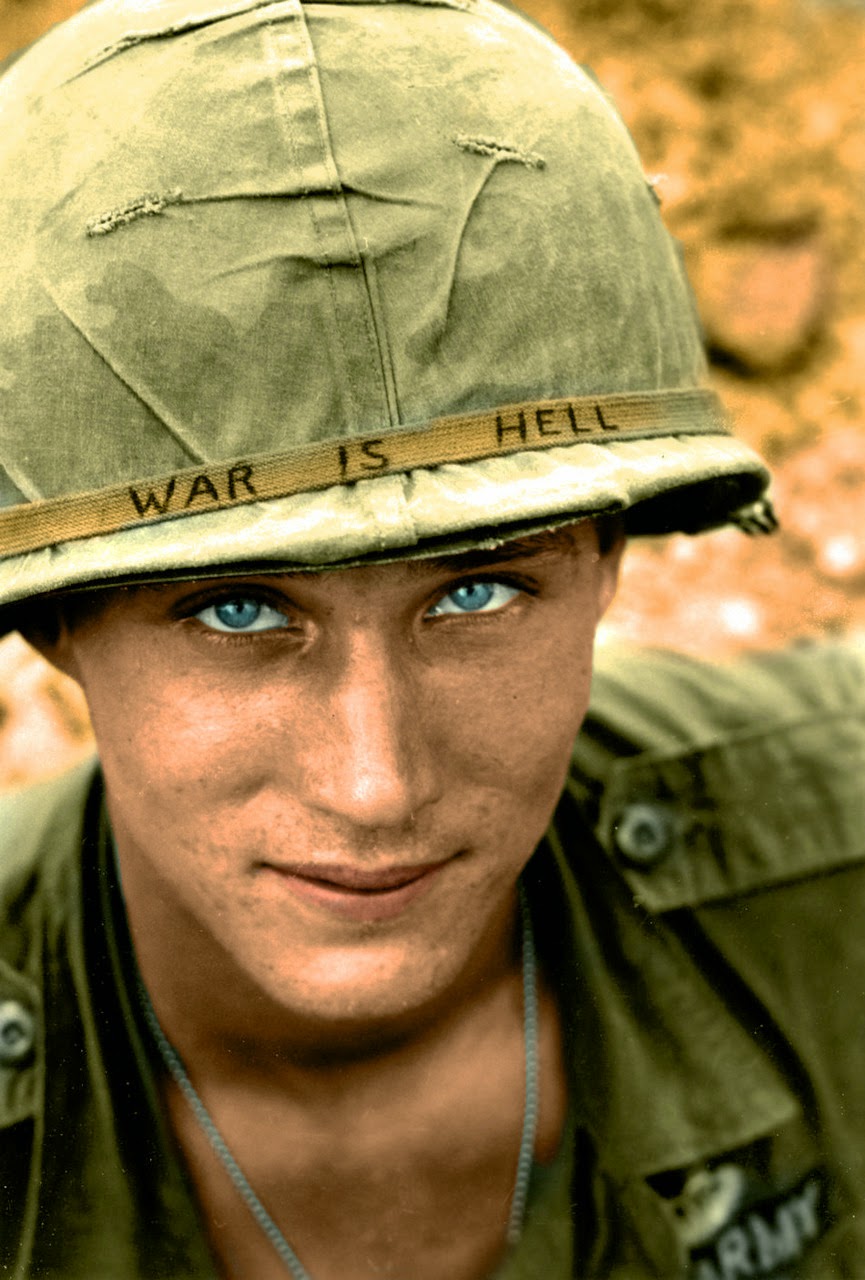
An American soldier wears a hand lettered “War Is Hell” slogan on his helmet, Vietnam, 1965
During the Vietnam War on June 18, 1965 173rd Airborne Brigade Battalion member Larry Wayne Chaffin smiles for the camera.
AP photojournalist Horst Faas took this iconic photo on June 18, 1965, during the Vietnam War with the 173rd Airborne Brigade Battalion on defense duty at Phouc Vinh airstrip in South Vietnam. The headband message “War is Hell” typified an acerbic attitude of many young American soldiers who were likely drafted and sent to the remote southeastern Asia jungles to engage in deadly and terrifying combat.
A lot of the soldiers wrote graffiti on their helmets with inscriptions of their attitudes about where they were and why they were there.
The contrast is what makes this photo iconic. You have this, bright, young handsome soldier with a smile on his face and then you have the text on his helmet. Take the helmet out, and this could easily be a high school yearbook photo. His face betrays a sense of innocence, but when you look at his helmet, you can tell that he is anything but. You know that he has witnessed the horrors of war firsthand and is trying to cover it all up on the outside.
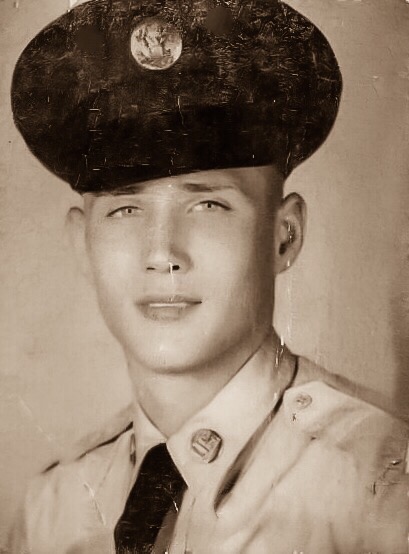
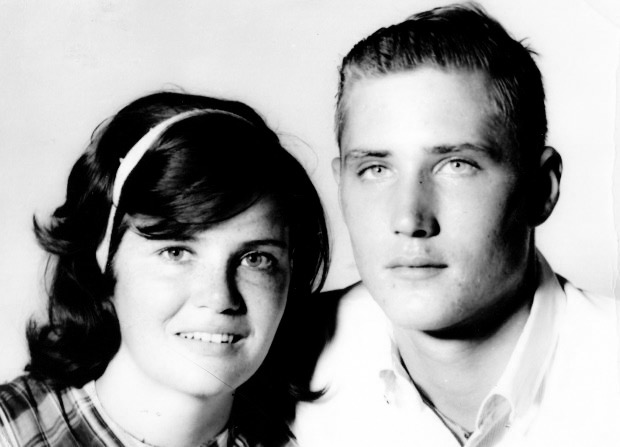
The identity of the soldier was unknown for many decades until recently when he was identified as Larry Wayne Chaffin from St. Louis. He served with that brigade in Vietnam for exactly one year beginning in May 1965 and when the photo was taken he was 19. Chaffin had many problems adjusting to civilian life when he returned from Vietnam.
With Wife Fran Chaffin Morrison
He died at the age of 39 from complications that arose from diabetes, an ailment he might have contracted from exposure to Agent Orange while serving in Vietnam.
He died in 1985.
Colour Version 1
Colour Version 2
The “War is Hell” quote originates from William Tecumseh Sherman’ address to the graduating class of the Michigan Military Academy (19 June 1879); but slightly varying accounts of this speech have been published. Sherman was a Union Army general during the American Civil War. He succeeded General U.S. Grant as commander of the Western Theatre of that war in the spring of 1864.
The full quote:
“I’ve been where you are now and I know just how you feel. It’s entirely natural that there should beat in the breast of every one of you a hope and desire that some day you can use the skill you have acquired here. Suppress it! You don’t know the horrible aspects of war. I’ve been through two wars and I know. I’ve seen cities and homes in ashes. I’ve seen thousands of men lying on the ground, their dead faces looking up at the skies. I tell you, War is Hell!“.
Born in Berlin, Germany, Faas began his photographic career in 1951 with the Keystone Agency, and by the age of 21 he was already covering major events concerning Indochina, including the peace negotiations in Geneva in 1954. In 1956 he joined the Associated Press (AP), where he acquired a reputation for being an unflinching hard-news war photographer, covering the wars in Vietnam and Laos, as well as in the Congo and Algeria. In 1962, he became AP’s chief photographer for Southeast Asia, and was based in Saigon until 1974.
His images of the Vietnam War won him a Pulitzer Prize in 1965. In 1967 he was severely wounded in the legs by a rocket-propelled grenade. In 1972, he collected a second Pulitzer, for his coverage of the conflict in Bangladesh. Inside Bangladesh, photographer Rashid Talukder considered it too dangerous to publish his photographs and he released them more than twenty years after Horst’s photographs had appeared.
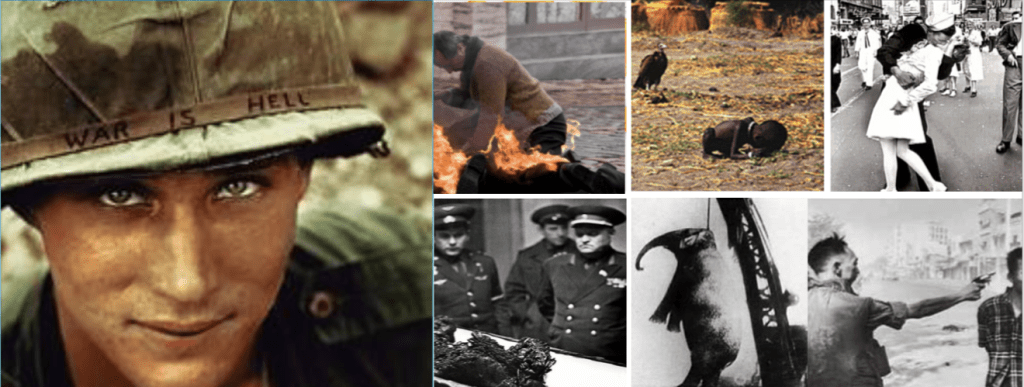
Faas is also famed for his work as a picture editor, and was instrumental in ensuring the publication of two of the most famous images of the Vietnam War. The notorious “Saigon Execution” photograph, showing the summary execution of a Viet Cong prisoner by Saigon police chief Nguyễn Ngọc Loan, taken by Eddie Adams in Saigon on February 1, 1968 was sent under his direction. Nick Ut‘s famous “Napalm Girl” photograph caused a huge controversy over at the AP bureau; an editor had objected to the photo, saying that the girl depicted was naked and that nobody would accept it. Faas ordered that Ut’s photo be sent over the wire.
In September 1990, freelance photographer Greg Marinovich submitted a series of graphic photos of a crowd executing a man to the AP bureau in Johannesburg. Once again, AP editors were uncertain if the photos should be sent over the wire. One editor sent the images to Faas, who telegrammed back, “send all photos.”
In 1976, Faas moved to London as AP’s senior photo editor for Europe; he retired in 2004. In retirement he organised reunions of the wartime Saigon press corps and ran international photojournalism symposiums.
He produced four books on his career and other news photographers, including Requiem, a book about photographers killed on both sides of the Vietnam War, co-edited with fellow Vietnam War photojournalist Tim Page.
In 2012 the subject of his iconic photo (a soldier at Phouc Vinh airstrip) is claimed to be Larry Wayne Chaffin, a soldier with the 173rd Airborne Brigade Battalion, who was on defence duty (18 June 1965) during the Vietnam War.
Awards
1965: Pulitzer Prize (Photography): “For his combat photography of the war in South Viet Nam during 1964.”
Inflation is seldom out of the news these days and the wife asked me to explain it to her – so here you are dear –
Inflation is defined as a sustained increase in the general level of prices for goods and services. It is measured as an annual percentage increase. As inflation rises, every dollar you own buys a smaller percentage of a good or service.
inflation
noun
noun: inflation
2.
Economics
a general increase in prices and fall in the purchasing value of money.
“policies aimed at controlling inflation”
What is Inflation?
The value of a dollar does not stay constant when there is inflation. The value of a dollar is observed in terms of purchasing power, which is the real, tangible goods that money can buy. When inflation goes up, there is a decline in the purchasing power of money. For example, if the inflation rate is 2% annually, then theoretically a $1 pack of gum will cost $1.02 in a year. After inflation, your dollar can’t buy the same goods it could beforehand.
There are several variations on inflation:
Deflation is when the general level of prices is falling. This is the opposite of inflation.
Hyperinflation is unusually rapid inflation. In extreme cases, this can lead to the breakdown of a nation’s monetary system. One of the most notable examples of hyperinflation occurred in Germany in 1923, when prices rose 2,500% in one month!
Stagflation is the combination of high unemployment and economic stagnation with inflation. This happened in industrialized countries during the 1970s, when a bad economy was combined with OPEC raising oil prices.
In recent years, most developed countries have attempted to sustain an inflation rate of 2-3%.
Causes of Inflation
Economists wake up in the morning hoping for a chance to debate the causes of inflation. There is no one cause that’s universally agreed upon, but at least two theories are generally accepted:
Demand-Pull Inflation – This theory can be summarized as “too much money chasing too few goods”. In other words, if demand is growing faster than supply, prices will increase. This usually occurs in growing economies.
Cost-Push Inflation – When companies’ costs go up, they need to increase prices to maintain their profit margins. Increased costs can include things such as wages, taxes, or increased costs of imports.
Costs of Inflation
Almost everyone thinks inflation is evil, but it isn’t necessarily so. Inflation affects different people in different ways. It also depends on whether inflation is anticipated or unanticipated. If the inflation rate corresponds to what the majority of people are expecting (anticipated inflation), then we can compensate and the cost isn’t high. For example, banks can vary their interest rates and workers can negotiate contracts that include automatic wage hikes as the price level goes up.
Problems arise when there is unanticipated inflation:
Creditors lose and debtors gain if the lender does not anticipate inflation correctly. For those who borrow, this is similar to getting an interest-free loan.
Uncertainty about what will happen next makes corporations and consumers less likely to spend. This hurts economic output in the long run.
People living off a fixed-income, such as retirees, see a decline in their purchasing power and, consequently, their standard of living.
The entire economy must absorb repricing costs (“menu costs”) as price lists, labels, menus and more have to be updated.
If the inflation rate is greater than that of other countries, domestic products become less competitive.
People like to complain about prices going up, but they often ignore the fact that wages should be rising as well. The question shouldn’t be whether inflation is rising, but whether it’s rising at a quicker pace than your wages.
Finally, inflation is a sign that an economy is growing. In some situations, little inflation (or even deflation) can be just as bad as high inflation. The lack of inflation may be an indication that the economy is weakening. As you can see, it’s not so easy to label inflation as either good or bad – it depends on the overall economy as well as your personal situation.
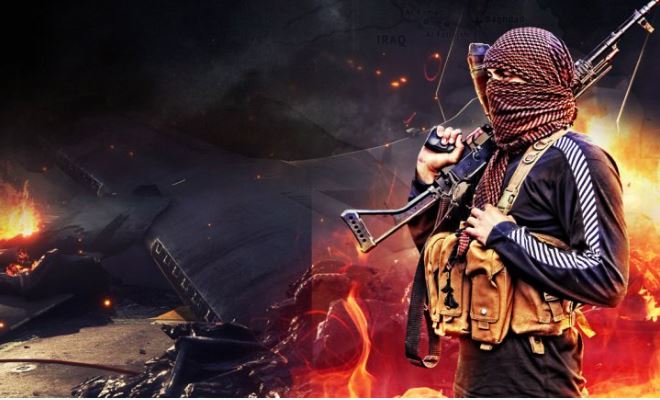
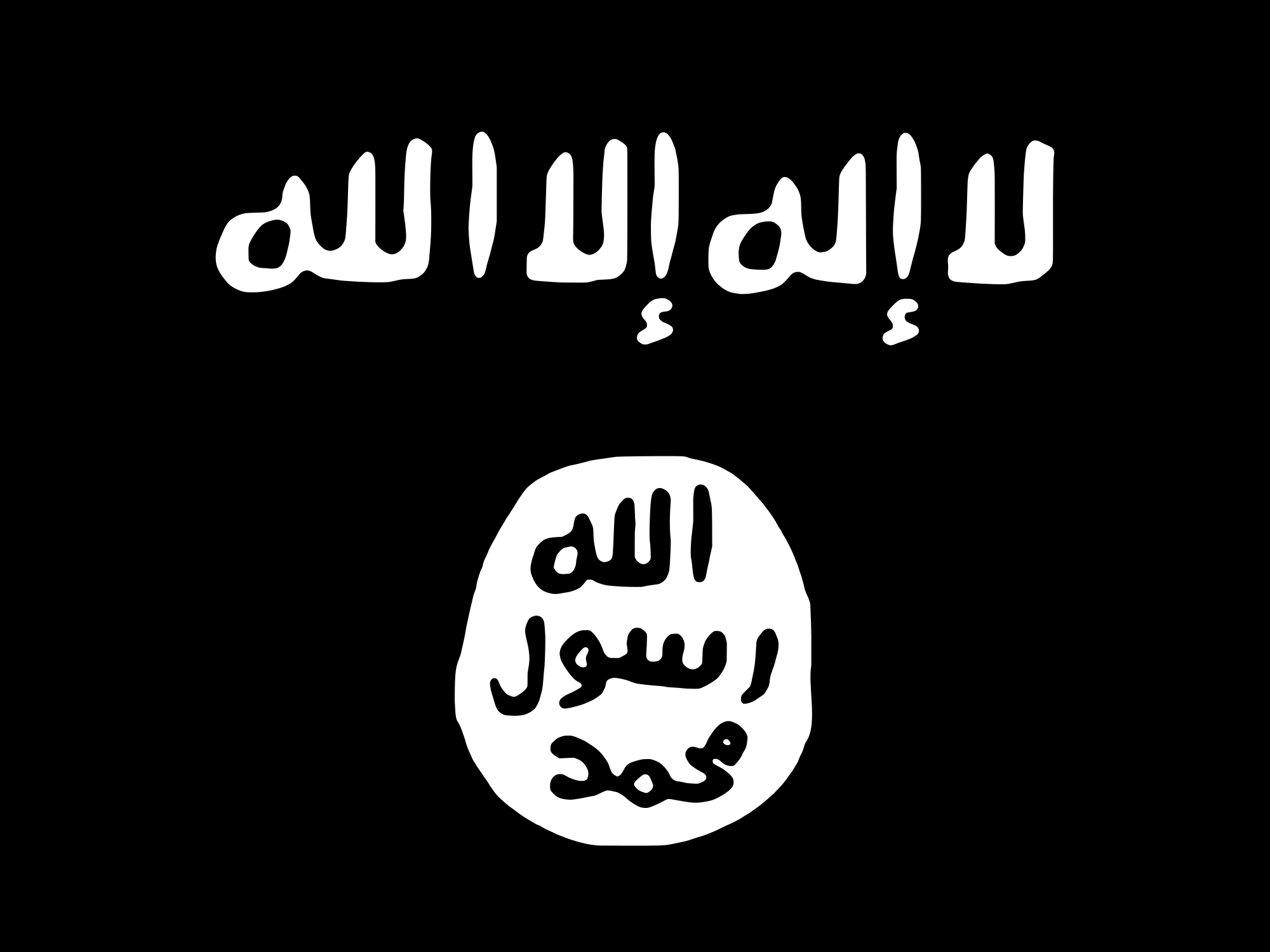
The net is slowly closing on IS and the news today that the Battle for Mosul has began could spell the beginning of the end of these Islamic Monsters and their twisted , wicked take Islam and Sharia Law ,which in my opinion has no place in the 21s Century anyway. See Shari Law
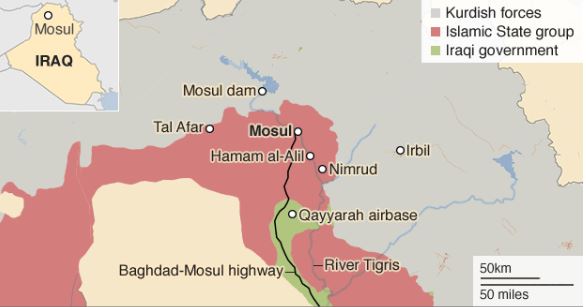
An Iraqi operation to recapture the city of Mosul, the last stronghold of the so-called Islamic State (IS) in the country, has started.
Artillery began firing on the city early on Monday, in a long-awaited assault from Kurdish Peshmerga, Iraqi government and allied forces.
Tanks are now moving towards the city, which has been held by IS since 2014.
The UN has expressed “extreme concern” for the safety of up to 1.5 million people in the area.
The BBC’s Orla Guerin, who is with Kurdish forces east of Mosul, says tanks are advancing on the city, kicking up clouds of dust.
As the operation began, one Kurdish general said: “If I am killed today I will die happy because I have done something for my people.”
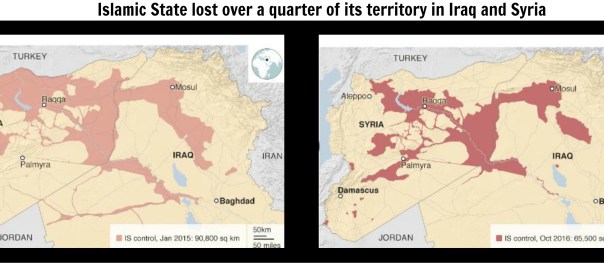
Islamic State lost over a quarter of its territory in Iraq and Syria
The Islamic State (ISIS) has lost more than a quarter of its territory in Syria and Iraq. According to defence analyst Information Handling Services (IHS), the group’s reach has been reduced by 28 per cent since January 2015.
IHS reported that ISIS-held territory fell from 78,000 km2 to 65,500 km2 during the first nine months of this year. However, the extremist group’s losses have decreased since last-July.
This change in tempo coincided with the launch of the Turkey-baked Euphrates Shield Operation and reduced Russian airstrikes against ISIS positions in Syria.
“Last September, President Putin said it was Russia’s mission to fight international terrorism and specifically the Islamic State,” Alex Kokcharov, principal Russia analyst at IHS, said. “Our data suggests that is not the case.”
According to Kokcharov, Moscow’s top priority is to preserve President Assad’s government through military support. Putin seeks to “transform the Syrian civil war from a multi-party conflict into a binary one between the Syrian government and jihadist groups like the Islamic State; thereby undermining the case for providing international support to the opposition.”
While ISIS appears to have a short reprieve, they continue to loose strategic territory. In August, ISIS militants lost the border pocket of Manbij to the US-backed Syrian Democratic Forces (SDF). In February, the extremist group was expelled from strategic areas in Hasakah Governorate by the Kurdish People’s Protection Units (YPG) and allied SDF fighters.
The Kurdish Peshmerga and the Iraqi Army have recaptured dozens of villages and towns from ISIS over the past several months.
Located some 400 km (250 mi) north of Baghdad, the original city stands on the west bank of the Tigris River on the east bank, but the metropolitan area has grown to encompass substantial areas on both the “Left Coast” (east side) and the “Right Coast” (west side) as the two banks are described in the local language.
At the start of the 21st century, the majority of Mosul’s population was Arab with Arameans, Armenian, Turkmen, Kurdish, Yazidi, Shabaki and other minorities. The city’s population grew rapidly around the turn of the millennium and by 2004 was estimated to be 1,846,500. An estimated half million persons fled Mosul in the second half of 2014, and while some returned, more fled in 2015 as ISIL violence in the city worsened.
Historically, important products of the area include Mosul marble and oil.
The city of Mosul is home to the University of Mosul and its renowned Medical College, which together was one of the largest educational and research centres in Iraq and the Middle East. The University has since been closed but at the choice of the Islamic State’s leadership in Mosul, the Medical College remains open but barely functional.
Until 2014 the city was a historic centre for the Syriac orthodox church of the indigenous Arameans, containing the tombs of several Old Testament prophets such as Jonah which was destroyed by the Islamic State occupation army in July 2014.
Etymology
The name of the city is first mentioned by Xenophon in his expeditionary logs in Achaemenid Assyria (Athura) of 401 BC, during the reign of the Persian Achaemenid dynasty in this region. There, he notes a small Assyrian town of “Mépsila” (Ancient Greek: Μέψιλα) on the Tigris somewhere about where modern Mosul is today (Anabasis, III.iv.10). It may be safer to identify Xenophon’s Mépsila with the site of Iski Mosul, or “Old Mosul”, about 30 km (19 mi) north of modern Mosul, where six centuries after Xenophon’s report, the SasanianPersian center of Budh-Ardhashīr was built. Be that as it may, the name Mepsila is doubtless the root for the modern name.
In its current Arabic form and spelling, the term Mosul, or rather “Mawsil”, stands for the “linking point” – or loosely, the Junction City, in Arabic. Mosul should not be confused with the ancient Assyrian capital of Nineveh which is located across the Tigris from Mosul on the eastern bank, at the famed archaeological mound of Kuyunjik (Turkoman for “sheep’s hill”). This area is known today as the town of Nebi Yunus (“prophet Jonah“) and is populated largely by Kurds, which makes it the only fully-Kurdish neighborhood in Mosul. The site contains the tomb of the Biblical Jonah, as he lived and died there, in the then capital of ancient Assyria. Today, this entire area has been absorbed into the Mosul metropolitan area. The indigenous [[Arameans] still refer to the entire city of Mosul as Nineveh (or rather, Ninweh).
The ancient Nineveh gave its place to Mepsila after the fall of the Assyrian Empire between 612-599 BC at the hands of a coalition of Babylonians, Medes, Persians, ScythiansSagartians, the Arameans largely abandoning the city and building new settlements such as Mepsila nearby.
Mosul is also named al-Faiha (“the Paradise”), al-Khaḍrah (“the Green”) and al-Hadbah (“the Humped”). It is sometimes described as “The Pearl of the North”[12] and “the city of a million soldiers”.
The area in which Mosul lies was an integral part of Assyria from as early as the 25th century BC, and after the Akkadian Empire (2335–2154 BC) and Neo-Sumerian Empire it again became a continuous part of Assyria proper from circa 2050 BC through to the fall of the Neo-Assyrian Empire between 612–599 BC.
In approximately 850 BC, King Ashurnasirpal II of Assyria chose the city of Kalhu as his capital in place of Assur (Ashur), 30 km (19 mi) from present day Mosul. In approximately 700 BC, King Sennacherib made Nineveh the new capital of Assyria. The mound of Kuyunjik in Mosul is the site of the palaces of King Sennacherib and his grandson Ashurbanipal, who established the Library of Ashurbanipal.
Mosul later succeeded Nineveh as the Tigris bridgehead of the road that linked Assyria and Anatolia with the short lived Median Empire and succeeding Achaemenid Empire (546–332 BC) where it was a part of the geo-political province of Athura (Assyria).
It became part of the Seleucid Empire after Alexander’s conquests in 332 BC. While little is known of the city from the Hellenistic period, Mosul likely belonged to the Seleucid satrapy of Syria (the Greek term for Assyria), which was conquered by the Parthian Empire circa 150 BC where it once more became a part of Athura.
The city changed hands once again with the rise of Sassanid Persia in 225 AD and became a part of Assuristan (Sassanid Persian for Assyria). Christianity was present among the indigenous Assyrian people in Mosul as early as the 1st century. It became an episcopal seat of the Assyrian Church of the East in the 6th century.
In 637 (other sources say 641), during the period of the CaliphUmar ibn al-Khattab, the city was annexed to the Rashidun Caliphate by Utba bin Farqad Al-Salami, during the ArabIslamic Conquest, after which Assyria/Athura/Assuristan was dissolved as a geo-political entity.
9th century to 1535
Rashid-al-Din Hamadani, “Siege of Mosul in 1261–63”, Jami’ al-tawarikh, Bibliothèque Nationale de France.
In the late 9th century control over the city was seized by the Turkish dynasts Ishaq ibn Kundajiq and his son Muhammad, but in 893 Mosul came once again under the direct control of the Abbasid Caliphate. In the early 10th century Mosul came under the control of the native Arab Hamdanid dynasty. From Mosul, the Hamdanids under Abdallah ibn Hamdan and his son Nasir al-Dawla expanded their control over the Jazira for several decades, first as governors of the Abbassids and later as de facto independent rulers. A century later they were supplanted by the Uqaylids.
Mosul was conquered by the Seljuks in the 11th century. After a period under semi-independent atabeg such as Mawdud, in 1127 it became the centre of power of the Zengid dynasty. Saladin besieged the city unsuccessfully in 1182 but finally gained control of it in 1186. In the 13th century it was captured by the Mongols led by Hulegu, but was spared the usual destruction since its governor, Badr al-Din Luʾluʾ, helped the Khan in his following campaigns in Syria. After the Mongol defeat in the Battle of Ain Jalut against the Mamluks, Badr al-Din’s son sided with the latter; this led to the destruction of the city, which later regained some importance but never recovered its original splendor. Mosul was thenceforth ruled by the Mongol Ilkhanid and Jalayrid dynasties, and escaped Tamerlan‘s destructions.
During 1165 Benjamin of Tudela passed through Mosul; in his papers he wrote that he found a small Jewish community estimated as 7000 people in Mosul, the community was led by rebbi Zakhi (זכאי) presumably connected to the King David dynasty. In 1288–1289, the Exilarch was in Mosul and signed a supporting paper for Maimonides. In the early 16th century Mosul was under the Turkmen federation of the Ak Koyunlu, but in 1508 it was conquered by the Persian Safawids.
Ottomans: 1535 to 1918
In 1535, OttomanSultanSuleyman the Magnificentadded Mosul to his empire by capturing it from his archrivals — Safavid Persia.[16] Thenceforth Mosul was governed by a pasha. Mosul was celebrated for its line of walls, comprising seven gates with large towers, a renowned hospital (maristan) and a covered market (qaysariyya), and was also famous for its fabrics and flourishing trades.
Although Mesopotamia had been conquered by the Ottoman Empire in 1533, gains which were confirmed by the Peace of Amasya (1555) until the reconquest of Baghdad in 1638, and the resulting treaty of the year after, Ottoman control over Mesopotamia was not decisive,and the city of Mosul was considered “still a mere fortress, important for its strategic position as an offensive platform for Ottoman campaigns into Iraq, as well as a defensive stronghold and (staging post) guarding the approaches to Anatolia and to the Syrian coast. Then with the Ottoman reconquest of Baghdad (1638), the liwa’ of Mosul became an independent wilaya.”:202 After the Peace of Amasya, the Safavids recaptured most of Mesopotamia one more time during the reign of king Abbas I (r. 1588-1629). Amongst the newly appointed Safavid governors of Mesopotamia during those years, was Qasem Sultan Afshar, who was appointed governor of Mosul in 1622.
Despite being a part of the Ottoman Empire, during the four centuries of Ottoman rule Mosul was considered “the most independent district” within the Middle East, following the Roman model of indirect rule through local notables.:203–4 “Mosuli culture developed less along Ottoman–Turkish lines than along Iraqi–Arab lines; and Turkish, the official language of the State, was certainly not the dominant language in the province.”:203
In line with its status as a politically stable trade route between the Mediterranean and the Persian Gulf the city developed considerably during the seventeenth and early eighteenth centuries. Similar to the development of the Mamluk dynasty in Baghdad, during this time “the Jalili family was establishing itself as the undisputed master of Mosul”, and “helping to connect Mosul with a pre-Ottoman, pre-Turcoman, pre-Mongol, Arab cultural heritage which was to put the town on its way to recapturing some of the prestige and prominence it had enjoyed under the golden reign of Badr ad-Din Lu’lu’.”203
Along with the al-Umari and Tasin al-Mufti families, the Jalilis formed an “urban-based small and medium gentry and a new landed elite”, which proceeded to displace the control of previous rural tribes. Such families proceed to establish themselves through private enterprise, solidifying their influence and assets through rents on land and taxes on urban and rural manufacturing.
As well as elected officials, the social architecture of Mosul was highly influenced by the Dominican fathers who arrived in Mosul in 1750, sent by Pope Benedict XIV (Mosul had a large Christian population, predominantly Assyrians).They were followed by the Dominican nuns in 1873. They established a number of schools, health clinics, a printing press and an orphanage. The nuns also established workshops to teach girls sewing and embroidery. A congregation of Dominican sisters, founded in the 19th century, still had its motherhouse in Mosul by the early 21st century. Over 120 Assyrian Iraqi Sisters belonged to this congregation.
In the nineteenth century the Ottoman government started to reclaim central control over its outlying provinces. Their aim was to “restore Ottoman law, and rejuvenate the military” as well as reviving “a secure tax base for the government”.:24–26 In order to reestablish rule in 1834 the Sultan abolished public elections for the position of governor, and began “neutraliz[ing] local families such as the Jalilis and their class.”:28–29 and appointing new, non-Maslawi governors directly. In line with its reintegration within central government rule, Mosul was required to conform to new Ottoman reform legislation, including the standardization of tariff rates, the consolidation of internal taxes and the integration of the administrative apparatus with the central government.:26
This process started in 1834 with the appointment of Bayraktar Mehmet Pasha, who was to rule Mosul for the next four years. After the reign of Bayraktar Mehmet Pasha, the Ottoman government (wishing still to restrain the influence of powerful local families) appointed a series of governors in rapid succession, ruling “for only a brief period before being sent somewhere else to govern, making it impossible for any of them to achieve a substantial local power base.”:29 Mosul’s importance as a trading center declined after the opening of the Suez canal, which enabled goods to travel to and from India by sea rather than by land across Iraq and through Mosul.
A coffee house in Mosul, 1914.
Mosul remained under Ottoman control until 1918 when it was taken by the British, with a brief break in 1623 when Persia seized the city, and was the capital of Mosul Vilayet one of the three vilayets (provinces) of Ottoman Iraq.
1918 to 2003
At the end of World War I in October 1918, after the signature of the Armistice of Mudros, British forces occupied Mosul. After the war, the city and the surrounding area became part of the Occupied Enemy Territory Administration (1918–20), and shortly Mandatory Iraq (1920–32). This mandate was contested by Turkey which continued to claim the area based on the fact that it was under Ottoman control during the signature of the Armistice. In the Treaty of Lausanne, the dispute over Mosul was left for future resolution by the League of Nations. Iraq’s possession of Mosul was confirmed by the League of Nations brokered agreement between Turkey and Great Britain in 1926. Former Ottoman Mosul Vilayet eventually became Nineveh Province of Iraq, but Mosul remained the provincial capital.
Mosul in 1932
The city’s fortunes revived with the discovery of oil in the area, from the late 1920s onward. It became a nexus for the movement of oil via truck and pipeline to both Turkey and Syria. Qyuarrah Refinery was built within about an hour’s drive from the city and was used to process tar for road-building projects. It was damaged but not destroyed during the Iran–Iraq War.
The opening of the University of Mosul in 1967 enabled the education of many in the city and surrounding areas.
After the 1991 uprisings by the Kurds Mosul did not fall within the Kurdish-ruled area, but it was included in the northern no-fly zone imposed and patrolled by the United States and Britain between 1991 and 2003.
Although this prevented Saddam‘s forces from mounting large-scale military operations again in the region, it did not stop the regime from implementing a steady policy of “Arabisation” by which the demography of some areas of Nineveh Governorate were gradually changed. Despite the program Mosul and its surrounding towns and villages remained home to a mixture of Arabs, Kurds, Assyrians, Armenians, Turkmens, Shabaks, a few Jews, and isolated populations of Yazidis, Mandeans, Kawliya and Circassians. Saddam was able to garrison portions of the 5th Army within the city of Mosul, had Mosul International Airport under military control, and recruited heavily from the city for his military’s officer corps; this may have been due to the fact that most of the officers and generals of the Iraqi Army were from Mosul long before the Saddam regime era.
Coalition Invasion in 2003 to 2014
Saddam Hussein’s sons Qusay and Uday were killed in a gun battle in Mosul on July 22, 2003
When the 2003 invasion of Iraq was being planned, the United States had originally intended to base troops in Turkey and mount a thrust into northern Iraq to capture Mosul. However, the Turkish parliament refused to grant permission for the operation. When the Iraq War did break out in March 2003, US military activity in the area was confined to strategic bombing with airdroppedspecial forces operating in the vicinity. Mosul fell on April 11, 2003, when the Iraqi Army 5th Corps, loyal to Saddam, abandoned the city and eventually surrendered, two days after the fall of Baghdad. US Army Special Forces with Kurdish fighters quickly took civil control of the city. Thereafter began widespread looting before an agreement was reached to cede overall control to US forces.
On July 22, 2003, Saddam Hussein’s sons, Uday Hussein and Qusay Hussein, were killed in a gunbattle with Coalition forces in Mosul after a failed attempt at their apprehension.[26] The city also served as the operational base for the US Army‘s 101st Airborne Division during the occupational phase of the Operation Iraqi Freedom. During its tenure, the 101st Airborne Division was able to extensively survey the city and, advised by the 431st Civil Affairs Battalion, non-governmental organizations, and the people of Mosul, began reconstruction work by employing the people of Mosul in the areas of security, electricity, local governance, drinking water, wastewater, trash disposal, roads, bridges, and environmental concerns.
Other US Army units to have occupied the city include the 4th Brigade Combat Team of the 1st Cavalry Division, the 172nd Stryker Brigade, the 3rd Brigade-2nd Infantry Division, 18th Engineer Brigade (Combat), Alpha Company 14th Engineer Battalion-555th Combat Engineer Brigade, 1st Brigade-25th Infantry Division, the 511th Military Police Company, the 812th Military Police Company and company-size units from Reserve components, an element of the 364th Civil Affairs Brigade, and the 404th Civil Affairs Battalion which covered the areas north of the Green Line.
On June 24, 2004, a coordinated series of car-bombs killed 62 people, many of them policemen.
The memorial that stands outside the entrance to the Dining Hall on FOB Marez where the December 21, 2004 suicide attack occurred.
On December 21, 2004, fourteen US soldiers, four American employees of Halliburton, and four Iraqi soldiers were killed in a suicide attack on a dining hall at the Forward Operating Base (FOB) Marez next to the main US military airfield at Mosul. The Pentagon reported that 72 other personnel were injured in the attack carried out by a suicide bomber wearing an explosive vest and the uniform of the Iraqi security services. The Islamist group Army of Ansar al-Sunna (partly evolved from Ansar al-Islam) declared responsibility for the attack in an Internet statement.
U.S. Army soldiers patrol the streets of Mosul, January 2005
In December 2007, Iraq reopened Mosul International Airport. An Iraqi Airways flight carried 152 Hajj pilgrims to Baghdad, the first commercial flight since US forces declared a no-fly zone in 1993, although further commercial flight remained prohibited. On January 23, 2008, an explosion in an apartment building killed 36 people. The following day, a suicide bomber dressed as a police officer assassinated the local police chief, Brig. Gen. Salah Mohammed al-Jubouri, the director of police for Ninevah province, as he toured the site of the blast.
In May 2008, a military offensive of the Ninawa campaign was launched by US-backed Iraqi Army Forces led by Maj. Gen. Riyadh Jalal Tawfiq, the commander of military operations in Mosul, in the hope of bringing back stability and security to the city. Though the representatives of Mosul in the Iraqi Parliament, the intellectuals of the city, and other concerned humanitarian groups agreed on the pressing need for a solution to the unbearable conditions of the city, they still believed that the solution was merely political and administrative. They also questioned whether such a large scale military offensive would spare the lives of innocent people.
All these factors deprived the city of its historical, scientific, and intellectual foundations in the last 4 years, when many scientists, professors, academics, doctors, health professionals, engineers, lawyers, journalists, religious clergy (both Muslims and Christians), historians, as well as professionals and artists in all walks of life, were either killed or forced to leave the city under the threat of being shot, exactly as happened elsewhere in Iraq in the years following 2003.
In 2008, many Assyrian Christians (about 12,000) fled the city following a wave of murders and threats against their community. The murder of a dozen Assyrians, threats that others would be murdered unless they converted to Islam and the destruction of their houses sparked a rapid exodus of the Christian population. Some families crossed the borders to Syria and Turkey while others were given shelter in churches and monasteries. Accusations were exchanged between Sunni fundamentalists and some Kurdish groups for being behind this new exodus. For the time being the motivation of these acts is unclear, but some claims linked it to the imminent provincial elections which took place in January 2009, and the related Assyrian Christians’ demands for broader representation in the provincial councils.[
As was predicted by the DIA and others, Mosul was attacked on June 4, 2014 and after 6 days of fighting, on June 10, 2014, the Islamic State of Iraq and Levanttook over the city during the 2014 Northern Iraq offensive.[39][40][41] As of August 2014, the city’s new ISIL administration was initially dysfunctional with frequent power cuts, tainted water supply, collapse of infrastructure support and failing health care.[42]
On June 10, 2014, Mosul was occupied by Islamic State of Iraq and the Levant (ISIL).[43][44] Troop shortages and infighting among top officers and Iraqi political leaders played into Islamic State’s hands and fueled panic that led to the city’s abandonment. Kurdish intelligence had been warned by a reliable source in early 2014 that Mosul would be attacked by ISIL and ex-Baathists (and had informed the US and UK); however, Iraqi Prime Minister Nouri al-Maliki and the Defence Minister turned down repeated offers of help from the peshmerga.
Half a million people escaped on foot or by car in the next 2 days. ISIL acquired three divisions’ worth of up-to-date American arms and munitions—including M1129 Stryker 120-mm mortars and at least 700 armoured Humvee vehicles from the then fleeing, or since massacred, Iraqi army. Many residents initially welcomed ISIL and according to a member of the UK Defence Select Committee Mosul “fell because the people living there were fed up with the sectarianism of the Shia dominated Iraqi government.”
On 21 January 2015, the US began coordinating airstrikes with a Kurdish-launched offensive, to help them begin the planned operation to retake the city of Mosul.
Once home to 70,000 Arameans (Syriac) Christians there are possibly none left today in Mosul, any that do remain are forced to pay a tax for remaining Christian, and live under the constant threat of violence. The indigenous Arameans who have a history in the region dating back over 4,000 years suffered their Christian churches and monasteries being vandalised and burned down,their ancient heritage sites dating back to the Iron Age destroyed, their homes and possessions stolen by ISIL, and ultimatums to convert to Islam, leave their ancient homelands, or be murdered.
During the ISIS occupation of Mosul, phone lines have been cut by ISIL and cell phone towers and internet access destroyed.The residents of the city have been de facto prisoners, forbidden to leave the city unless they post with ISIL a significant collateral of family members, personal wealth and property. They may then leave the city upon paying a significant “departure tax” on a three-day pass (for a higher fee they can surrender their home, pay the fee and leave for good) and if those with a three-day pass fail to return in that time their assets will be seized and family will be killed.
Most female Yazidis from Mosul and the greater Mosul region (Nineveh) are imprisoned and occasionally many are slaughtered because of their resistance[61] to being sold as sex slaves.[62] The Islamic State occupiers have murdered or driven out most minority groups and converted some Yazidi males and Christians to Islam. Women are required to cover their bodies from head to foot in a strict variant of Sharia rule and men are required to fully grow their beards and hair as does the members of the Islamic State. Life in Mosul is one of violent oppression where people suspected of activism against the occupiers, resistance activities, homosexuality, promiscuity or adultery are brutally and summarily tortured and murdered.
The ISIS governor of Mosul, Alian Natiq Mabroush was killed on 18 March 2016 along with ten other jihadist leaders in a U.S. airstrike.
During the occupation residents have fought back against ISIS. In one notable incident they were able to kill five ISIS militants and destroy two of their vehicles.
Women
Women must be accompanied by a male guardian and wear clothing that covers their body completely including gloves for the hands, niqab for the head and khimar for the full coverage of the body from shoulders to feet.
According to Canadian-based NGO “The RINJ Foundation” which operates medical clinics in Mosul, rape cases in the city prove a pattern of genocide and will lead to a conviction of genocide against the Islamic State, in the International Criminal Court, a permanent international tribunal to prosecute individuals for war-time rape, genocide, crimes against humanity, and aggression.
The Islamic State was in August 2015 reported to be selling captured women and girls to sex slave traders.
Persecution of religious and ethnic minorities and destruction of cultural sites
ISIL issued an edict expelling (in effect ethnically cleansing) the remaining predominantly ethnic Assyrian and Armenian Christian Mosul citizens, after the Christians failed to attend a meeting to discuss their future status. According to Duraid Hikmat, an expert on minority relationships and resident of Mosul, the Christians were fearful to attend. Emboldened ISIL authorities systematically destroyed and vandalised Abrahamic cultural artifacts such as the cross from St. Ephrem’s Cathedral, the tomb of Jonah, and a statue of the Virgin Mary. ISIL militants destroyed and pillaged the Tomb of Seth in Mosul. Artifacts within the tomb were removed to an unknown location.
Students from Muslim minorities have been abducted.
According to a UN report ISIL forces are persecuting ethnic groups in and near Mosul. The Assyrians, Kurds, Armenians, Yazidis, Turcoman, Mandeans and Shabaks are victims of unprovoked religiously motivated murders, assaults, theft, kidnappings and the destruction of their cultural sites.
Mosque of the Prophet Yunus or Younis (Jonah): On one of the two most prominent mounds of Nineveh ruins, used to rise the Mosque (an Assyrian Church year of Prophet Younis “Biblical Jonah“. Jonah the son of Amittai, from the 8th century BC, is believed to be buried here, where King Esarhaddon of Assyria had once built a palace. It was one of the most important mosques in Mosul and one of the few historic mosques that are found on the east side of the city. On July 24, 2014, the building was destroyed by explosives set by forces of the Islamic State of Iraq and the Levant.
Mosque of the Prophet Jerjis (Georges): The mosque is believed to be the burial place of Prophet Jerjis. Built of marble with shen reliefs and renovated last in 1393 AD it was mentioned by the explorer Ibn Jubair in the 12th century AD, and is believed also to embrace the tomb of Al-Hur bin Yousif.
Mashad Yahya Abul Kassem: Built in the 13th century it was on the right bank of the Tigris and was known for its conical dome, decorative brickwork and calligraphy engraved in Mosul blue marble.
Mosul library: Including the Sunni Muslim library, the library of the 265-year-old Latin Church and Monastery of the Dominican Fathers and the Mosul Museum Library. Among the 112,709 books and manuscripts thought lost are a collection of Iraqi newspapers dating from the early 20th century, as well as maps, books and collections from the Ottoman period; some were registered on a UNESCO rarities list. The library was ransacked and destroyed by explosives on 25 February 2015.
Mosul Museum and Nergal Gate: Statues and artefacts that date from the Assyrian and Akkadian empires, including artefacts from sites including the Assyrian cities of Nineveh, Ashur, Arrapha, Dur-Sharrukin and Kalhu (Nimrud) and the Neo-Assyrian site of Hatra.Their plans for uprising were accelerated when ISIL scheduled the destruction of the al-Ḥadbā[76] Many former supporters of ISIL’s Caliphate have voiced protest against ISIL online in the aftermath of destruction of ancient cultural sites.
Detention of diplomats
Turkish diplomats and consular staff were detained for over 100 days.
Human rights
Scores of people have been executed without fair trial. Civilians living in Mosul are not permitted to leave ISIS-controlled areas. ISIS has executed several civilians that were trying to flee Mosul.
Armed opposition
The urban guerrilla warfare groups may be called the Nabi Yunus Brigade after the Nabi Yunus mosque, or the Kataeb al-Mosul (Mosul Brigade). The brigade claims to have killed ISIL members with sniper fire. In the countryside around Mosul, Kurdish and Assyrianmilitia have also taken up arms to resist ISIL oppression.
During the 20th century, Mosul city had been indicative of the mingling ethnic and religious cultures of Iraq. There used to be a SunniArab majority in urban areas, such as downtown Mosul west of the Tigris; across the Tigris and further north in the suburban areas, thousands of Arameans, Kurds, Turkmens, Shabaks, Yazidis and Armenians made up the rest of Mosul’s population. Shabaks were concentrated on the eastern outskirts of the city.
Religion
A church in Mosul in about 1850
Mosul had a Jewish population. Like their counterparts elsewhere in Iraq, most left in 1950–51. Most Iraqi Jews have moved to Israel, and some to the United States. In 2003, during the Iraq War, a rabbi in the American army found an abandoned, dilapidated synagogue in Mosul dating back to the 13th century



















.jpeg)


.jpg)


 belfastchildis.com