Yearly Archives: 2015

World War I – Chemical Weapons – History & Background

Chemical weapons in World War I

————————————————————————

Chemical Weapons in World War I

————————————————————————

Chemical weapons in World War I were primarily used to demoralize, injure, and kill entrenched defenders, against whom the indiscriminate and generally slow-moving or static nature of gas clouds would be most effective. The types of weapons employed ranged from disabling chemicals, such as tear gas and the severe mustard gas, to lethal agents like phosgene and chlorine. This chemical warfare was a major component of the first global war and first total war of the 20th century. The killing capacity of gas was limited, with four percent of combat deaths caused by gas. Gas was unlike most other weapons of the period because it was possible to develop effective countermeasures, such as gas masks. In the later stages of the war, as the use of gas increased, its overall effectiveness diminished. The widespread use of these agents of chemical warfare, and wartime advances in the composition of high explosives, gave rise to an occasionally expressed view of World War I as “the chemists’ war”.[1][2]

The use of poison gas performed by all major belligerents throughout World War I constituted war crimes as its use violated the 1899 Hague Declaration Concerning Asphyxiating Gases and the 1907 Hague Convention on Land Warfare, which prohibited the use of “poison or poisoned weapons” in warfare.

History of poison gas in World War

1914: Tear gas

The earliest military uses of chemicals were tear-inducing irritants rather than fatal or disabling poisons. During the first World War, the French army was the first to employ gas, using 26 mm grenades filled with tear gas (ethyl bromoacetate) in August 1914. The small quantities of gas delivered, roughly 19 cm³ per cartridge, were not even detected by the Germans. The stocks were rapidly consumed and by November a new order was placed by the French military. As bromine was scarce among the Entente allies, the active ingredient was changed to chloroacetone.[5]

In October 1914, German troops fired fragmentation shells filled with a chemical irritant against British positions at Neuve Chapelle, though the concentration achieved was so small that it was barely noticed.[6] None of the combatants considered the use of tear gas to be a conflict with the Hague Treaty of 1899, which prohibited the launching of projectiles containing asphyxiating or poisonous gas.[7]

1915: Large-scale use and lethal gases

The first instance of large-scale use of gas as a weapon was on 31 January 1915, when Germany fired 18,000 artillery shells containing liquid xylyl bromide tear gas on Russian positions on the Rawka River, west of Warsaw during the Battle of Bolimov. However, instead of vaporizing, the chemical froze and failed to have the desired effect.[6]

The first killing agent employed by the German military was chlorine. Chlorine is a powerful irritant that can inflict damage to the eyes, nose, throat and lungs. At high concentrations and prolonged exposure it can cause death by asphyxiation.[8] German chemical companies BASF, Hoechst and Bayer (which formed the IG Farben conglomerate in 1925) had been producing chlorine as a by-product of their dye manufacturing.[9] In cooperation with Fritz Haber of the Kaiser Wilhelm Institute for Chemistry in Berlin, they began developing methods of discharging chlorine gas against enemy trenches.[10][11]

According to the fieldpost letter of Major Karl von Zingler, the first chlorine gas attack by German forces took place before 2 January 1915: “In other war theaters it does not go better and it has been said that our Chlorine is very effective. 140 English officers have been killed. This is a horrible weapon …”.

————————————————————————————–

Gas warfare in the First World War

————————————————————————————–

By 22 April 1915, the German Army had 168 tons of chlorine deployed in 5,730 cylinders from Langemark–Poelkapelle, north of Ypres. At 17:30, in a slight easterly breeze, the gas was released, forming a gray-green cloud that drifted across positions held by French Colonial troops from Martinique who broke ranks, abandoning their trenches and creating an 8,000-yard (7 km) gap in the Allied line. However, the German infantry were also wary of the gas and, lacking reinforcements, failed to exploit the break before the 1st Canadian Division and assorted French troops reformed the line in scattered, hastily prepared positions 1,000–3,000 yards (910–2,740 m) apart.[6] The Entente governments quickly claimed the attack was a flagrant violation of international law but Germany argued that the Hague treaty had only banned chemical shells, rather than the use of gas projectors.

———————————————————————————–

WW1: Chemical Warfare

———————————————————————————–

In what became the Second Battle of Ypres, the Germans used gas on three more occasions; on 24 April against the 1st Canadian Division,[14] on 2 May near Mouse Trap Farm and on 5 May against the British at Hill 60.[15] The British Official History stated that at Hill 60, “90 men died from gas poisoning in the trenches or before they could be got to a dressing station; of the 207 brought to the nearest dressing stations, 46 died almost immediately and 12 after long suffering.”[16]

On August 6, German troops used chlorine gas against Russian troops defending the Fortress of Osowiec. Surviving defenders drove back the attack and successfully retained the fortress.

Germany used chemical weapons on the eastern front in an attack at Rawka, south of Warsaw. The Russian army took 9,000 casualties, with more than 1,000 fatalities. In response, the artillery branch of the Russian army organized a commission to study the delivery of poison gas in shells.[17]

Effectiveness and countermeasures

British emplacement after German gas attack (probably phosgene)

It quickly became evident that the men who stayed in their places suffered less than those who ran away, as any movement worsened the effects of the gas, and that those who stood up on the fire step suffered less—indeed they often escaped any serious effects—than those who lay down or sat at the bottom of a trench. Men who stood on the parapet suffered least, as the gas was denser near the ground. The worst sufferers were the wounded lying on the ground, or on stretchers, and the men who moved back with the cloud.[18] Chlorine was less effective as a weapon than the Germans had hoped, particularly as soon as simple countermeasures were introduced. The gas produced a visible greenish cloud and strong odour, making it easy to detect. It was water-soluble, so the simple expedient of covering the mouth and nose with a damp cloth was somewhat effective at reducing the effect of the gas. It was thought to be even more effective to use urine rather than water, as it was known at the time that chlorine reacted readily with urea (present in urine) to form dichloro urea.[19]

Chlorine required a concentration of 1,000 parts per million to be fatal, destroying tissue in the lungs, likely through the formation of hydrochloric acid when dissolved in the water in the lungs (2Cl2 + 2H2O → 4HCl + O2).[20] Despite its limitations, however, chlorine was an effective psychological weapon—the sight of an oncoming cloud of the gas was a continual source of dread for the infantry.[21]

Countermeasures were quickly introduced in response to the use of chlorine. The Germans issued their troops with small gauze pads filled with cotton waste, and bottles of a bicarbonate solution with which to dampen the pads. Immediately following the use of chlorine gas by the Germans, instructions were sent to British and French troops to hold wet handkerchiefs or cloths over their mouths. Simple pad respirators similar to those issued to German troops were soon proposed by Lieutenant-Colonel N. C. Ferguson, the A.D.M.S. of the 28th Division. These pads were intended to be used damp, preferably dipped into a solution of bicarbonate kept in buckets for that purpose, though other liquids were also used. Because such pads could not be expected to arrive at the front for several days, army divisions set about making them for themselves. Locally available muslin, flannel and gauze were used, officers were sent to Paris to buy more and local French women were employed making up rudimentary pads with string ties. Other units used lint bandages manufactured in the convent at Poperinge. Pad respirators were sent up with rations to British troops in the line as early as the evening of 24 April.[22]

In Britain the Daily Mail newspaper encouraged women to manufacture cotton pads, and within one month a variety of pad respirators were available to British and French troops, along with motoring goggles to protect the eyes. The response was enormous and a million gas masks were produced in a day. Unfortunately, the Mail’s design was useless when dry and caused suffocation when wet—the respirator was responsible for the deaths of scores of men. By 6 July 1915, the entire British army was equipped with the far more effective “smoke helmet” designed by Major Cluny MacPherson, Newfoundland Regiment, which was a flannel bag with a celluloid window, which entirely covered the head. The race was then on between the introduction of new and more effective poison gases and the production of effective countermeasures, which marked gas warfare until the armistice in November 1918.[22]

British gas attacks

British infantry advancing through gas at Loos, 25 September 1915

Football team of British soldiers with gas masks, Western front, 1916

A British gas bomb from 1915

The British expressed outrage at Germany’s use of poison gas at Ypres but responded by developing their own gas warfare capability. The commander of II Corps, Lieutenant General Sir Charles Ferguson, said of gas:

It is a cowardly form of warfare which does not commend itself to me or other English soldiers … We cannot win this war unless we kill or incapacitate more of our enemies than they do of us, and if this can only be done by our copying the enemy in his choice of weapons, we must not refuse to do so.[23]

The first use of gas by the British was at the Battle of Loos, 25 September 1915, but the attempt was a disaster. Chlorine, codenamed Red Star, was the agent to be used (140 tons arrayed in 5,100 cylinders), and the attack was dependent on a favorable wind. However, on this occasion the wind proved fickle, and the gas either lingered in no man’s land or, in places, blew back on the British trenches.[6] This debacle was compounded when the gas could not be released from all the British canisters because the wrong turning keys were sent with them. Subsequent retaliatory German shelling hit some of those unused full cylinders, releasing more gas among the British troops.[24] Exacerbating the situation was the primitive flannel gas masks distributed to the British. The masks were hot and the small eye-pieces misted over, reducing visibility. Some of the troops lifted the masks to get some fresh air, causing them to be gassed.[25]

1915: More deadly gases

Plate I, Microscopic section of human lung from phosgene shell poisoning, American Red Cross and Medical Research Committee, An Atlas of Gas Poisoning, 1918

The deficiencies of chlorine were overcome with the introduction of phosgene, which was prepared by a group of French chemists led by Victor Grignard and first used by France in 1915.[26] Colourless and having an odor likened to “mouldy hay,” phosgene was difficult to detect, making it a more effective weapon. Although phosgene was sometimes used on its own, it was more often used mixed with an equal volume of chlorine, with the chlorine helping to spread the denser phosgene.[27] The Allies called this combination White Star after the marking painted on shells containing the mixture.[28]

Phosgene was a potent killing agent, deadlier than chlorine. It had a potential drawback in that some of the symptoms of exposure took 24 hours or more to manifest. This meant that the victims were initially still capable of putting up a fight; although this could also mean that apparently fit troops would be incapacitated by the effects of the gas on the following day.[29]

In the first combined chlorine–phosgene attack by Germany, against British troops at Wieltje near Ypres, Belgium on 19 December 1915, 88 tons of the gas were released from cylinders causing 1069 casualties and 69 deaths.[27] The British P gas helmet, issued at the time, was impregnated with sodium phenolate and partially effective against phosgene. The modified PH Gas Helmet, which was impregnated with phenate hexamine and hexamethylene tetramine (urotropine) to improve the protection against phosgene, was issued in January 1916.[27][30][31]

Around 36,600 tons of phosgene were manufactured during the war, out of a total of 190,000 tons for all chemical weapons, making it second only to chlorine (93,800 tons) in the quantity manufactured:[32]

  • Germany 18,100 tons
  • France 15,700 tons
  • United Kingdom 1,400 tons (although they also used French stocks)
  • United States 1,400 tons (although they also used French stocks)

Although phosgene was never as notorious in public consciousness as mustard gas, it killed far more people, about 85% of the 100,000 deaths caused by chemical weapons during World War I.

1917: Mustard gas

Plate X, Microscopic section of human lung from mustard gas poisoning, American Red Cross and Medical Research Committee, An Atlas of Gas Poisoning, 1918

The most widely reported and, perhaps, the most effective gas of the First World War was mustard gas. It was a vesicant that was introduced by Germany in July 1917 prior to the Third Battle of Ypres.[6] The Germans marked their shells yellow for mustard gas and green for chlorine and phosgene; hence they called the new gas Yellow Cross. It was known to the British as HS (Hun Stuff), while the French called it Yperite (named after Ypres).[33]

A Canadian soldier with mustard gas burns, 1917/1918

Mustard gas is not a particularly effective killing agent (though in high enough doses it is fatal) but can be used to harass and disable the enemy and pollute the battlefield. Delivered in artillery shells, mustard gas was heavier than air, and it settled to the ground as an oily liquid resembling sherry. Once in the soil, mustard gas remained active for several days, weeks, or even months, depending on the weather conditions.[34]

The skin of victims of mustard gas blistered, their eyes became very sore and they began to vomit. Mustard gas caused internal and external bleeding and attacked the bronchial tubes, stripping off the mucous membrane. This was extremely painful. Fatally injured victims sometimes took four or five weeks to die of mustard gas exposure.[35]

One nurse, Vera Brittain, wrote: “I wish those people who talk about going on with this war whatever it costs could see the soldiers suffering from mustard gas poisoning. Great mustard-coloured blisters, blind eyes, all sticky and stuck together, always fighting for breath, with voices a mere whisper, saying that their throats are closing and they know they will choke.”[36]

The polluting nature of mustard gas meant that it was not always suitable for supporting an attack as the assaulting infantry would be exposed to the gas when they advanced. When Germany launched Operation Michael on 21 March 1918, they saturated the Flesquières salient with mustard gas instead of attacking it directly, believing that the harassing effect of the gas, coupled with threats to the salient’s flanks, would make the British position untenable.[citation needed]

Gas never reproduced the dramatic success of 22 April 1915; however, it became a standard weapon which, combined with conventional artillery, was used to support most attacks in the later stages of the war. Gas was employed primarily on the Western Front—the static, confined trench system was ideal for achieving an effective concentration. Germany also made use of gas against Russia on the Eastern Front, where the lack of effective countermeasures resulted in deaths of over 56,000 Russians,[37] while Britain experimented with gas in Palestine during the Second Battle of Gaza.[38] Russia began manufacturing chlorine gas in 1916, with phosgene being produced later in the year. However, most of the manufactured gas was never used.[17]

The British Army believed that the use of gas was needed, but did not use mustard gas until November 1917 at Cambrai, after their armies had captured a stockpile of German mustard-gas shells. It took the British more than a year to develop their own mustard gas weapon, with production of the chemicals centred on Avonmouth Docks.[39][40] (The only option available to the British was the Despretz–Niemann–Guthrie process). This was used first in September 1918 during the breaking of the Hindenburg Line with the Hundred Days’ Offensive.

The Allies mounted more gas attacks than the Germans in 1917 and 1918 because of a marked increase in production of gas from the Allied nations. Germany was unable to keep up with this pace despite creating various new gases for use in battle, mostly as a result of very costly methods of production. Entry into the war by the United States allowed the Allies to increase mustard gas production far more than Germany.[41] Also the prevailing wind on the Western Front was blowing from west to east,[42] which meant the British more frequently had favorable conditions for a gas release than did the Germans.

Though the United States never used chemical weapons of its own manufacture in World War I (the Artillery used Mustard gas with significant effect during the Meuse Argonne Offensive on at least three occasions [43]), it had begun large-scale production of an improved vesicant gas known as Lewisite, for use in an offensive planned for early 1919. By the time of the armistice on 11 November, a plant near Willoughby, Ohio was producing 10 tons per day of the substance, for a total of about 150 tons. It is uncertain what effect this new chemical would have had on the battlefield, however, as it degrades in moist conditions.[44][45]

Post-war

By the end of the war, chemical weapons had lost much of their effectiveness against well trained and equipped troops. At that time, chemical weapon agents inflicted an estimated 1.3 million casualties.[46]

Nevertheless, in the following years, chemical weapons were used in several, mainly colonial, wars where one side had an advantage in equipment over the other. The British used adamsite against Russian revolutionary troops in 1919 and allegedly used mustard gas against Iraqi insurgents in the 1920s; Bolshevik troops used poison gas to suppress the Tambov Rebellion in 1920, Spain used chemical weapons in Morocco against Rif tribesmen throughout the 1920s[47] and Italy used mustard gas in Libya in 1930 and again during its invasion of Ethiopia in 1936.[48] In 1925, a Chinese warlord, Zhang Zuolin, contracted a German company to build him a mustard gas plant in Shenyang,[47] which was completed in 1927.

Public opinion had by then turned against the use of such weapons which led to the Geneva Protocol, an updated and extensive prohibition of poison weapons. The Protocol, which was signed by most First World War combatants in 1925, bans the use (but not the stockpiling) of lethal gas and bacteriological weapons. Most countries that signed ratified it within around five years, although a few took much longer – Brazil, Japan, Uruguay, and the United States did not do so until the 1970s, and Nicaragua ratified it only in 1990.[49] The signatory nations agreed not to use poison gas in the future, stating “the use in war of asphyxiating, poisonous or other gases, and of all analogous liquids, materials or devices, has been justly condemned by the general opinion of the civilised world.”[50]

Although chemical weapons have been used in at least a dozen wars since the end of the First World War,[48] they were not used in combat on a large scale until mustard gas and the more deadly nerve agents were used by Iraq during the 8-year Iran-Iraq war. It killed around 20,000 Iranian troops (and injured another 80,000), which is around a quarter of the number of deaths caused by chemical weapons during the First World War.[51]

Effect on World War II

Although all major combatants stockpiled chemical weapons during the Second World War, the only reports of its use in the conflict were the Japanese use of relatively small amounts of mustard gas and lewisite in China,[52][53] and very rare occurrences in Europe (for example some sulfur mustard bombs were dropped on Warsaw on 3 September 1939, which Germany acknowledged in 1942 but indicated had been accidental).[47] Mustard gas was the agent of choice, with the British stockpiling 40,719 tons, the Russians 77,400 tons, the Americans over 87,000 tons and the Germans 27,597 tons.[47] The destruction of a cargo ship containing mustard gas led to many casualties in Bari, Italy.

In both Axis and Allied nations, children in school were taught to wear gas masks in case of gas attack. Germany developed the poison gases tabun, sarin, and soman during the war, and used Zyklon B in their extermination camps. Neither Germany nor the Allied nations used any of their war gases in combat, despite maintaining large stockpiles and occasional calls for their use.[nb 1] Poison gas played an important role in the Holocaust.

Britain made plans to use mustard gas on the landing beaches in the event of an invasion of the United Kingdom in 1940.[54][55] The United States considered using gas to support their planned invasion of Japan.[56]

Casualties

The contribution of gas weapons to the total casualty figures was relatively minor. British figures, which were accurately maintained from 1916, recorded that only 3% of gas casualties were fatal, 2% were permanently invalid and 70% were fit for duty again within six weeks.[citation needed]

It was remarked as a joke that if someone yelled ‘Gas’, everyone in France would put on a mask. … Gas shock was as frequent as shell shock.

— H. Allen, Towards the Flame, 1934

John Singer Sargent‘s 1918 painting Gassed

Gas! GAS! Quick, boys! — An ecstasy of fumbling,
Fitting the clumsy helmets just in time;
But someone still was yelling out and stumbling,
And flound’ring like a man in fire or lime …
Dim, through the misty panes and thick green light,
As under a green sea, I saw him drowning.
In all my dreams, before my helpless sight,
He plunges at me, guttering, choking, drowning.

Plate III, Pallid type of asphyxia from phosgene poisoning, with circulatory failure, American Red Cross and Medical Research Committee, An Atlas of Gas Poisoning, 1918

Death by gas was often slow and painful. According to Denis Winter (Death’s Men, 1978), a fatal dose of phosgene eventually led to “shallow breathing and retching, pulse up to 120, an ashen face and the discharge of four pints (2 litres) of yellow liquid from the lungs each hour for the 48 of the drowning spasms.”

A common fate of those exposed to gas was blindness, chlorine gas or mustard gas being the main causes. One of the most famous First World War paintings, Gassed by John Singer Sargent, captures such a scene of mustard gas casualties which he witnessed at a dressing station at Le Bac-du-Sud near Arras in July 1918. (The gases used during that battle (tear gas) caused temporary blindness and/or a painful stinging in the eyes. These bandages were normally water-soaked to provide a rudimentary form of pain relief to the eyes of casualties before they reached more organized medical help.)

The proportion of mustard gas fatalities to total casualties was low; only 2% of mustard gas casualties died and many of these succumbed to secondary infections rather than the gas itself. Once it was introduced at the third battle of Ypres, mustard gas produced 90% of all British gas casualties and 14% of battle casualties of any type.

Estimated gas casualties[37]
Nation Fatal Total
(Fatal & Non-fatal)
Russia 56,000 419,340
Germany 9,000 200,000
France 8,000 190,000
British Empire
(includes Canada)
8,109 188,706
Austria-Hungary 3,000 100,000
United States 1,462 72,807
Italy 4,627 60,000
Total 90,198 1,230,853

Mustard gas was a source of extreme dread. In The Anatomy of Courage (1945), Lord Moran, who had been a medical officer during the war, wrote:

After July 1917 gas partly usurped the role of high explosive in bringing to head a natural unfitness for war. The gassed men were an expression of trench fatigue, a menace when the manhood of the nation had been picked over.[57]

Mustard gas did not need to be inhaled to be effective — any contact with skin was sufficient. Exposure to 0.1 ppm was enough to cause massive blisters. Higher concentrations could burn flesh to the bone. It was particularly effective against the soft skin of the eyes, nose, armpits and groin, since it dissolved in the natural moisture of those areas. Typical exposure would result in swelling of the conjunctiva and eyelids, forcing them closed and rendering the victim temporarily blind. Where it contacted the skin, moist red patches would immediately appear which after 24 hours would have formed into blisters. Other symptoms included severe headache, elevated pulse and temperature (fever), and pneumonia (from blistering in the lungs).

Many of those who survived a gas attack were scarred for life. Respiratory disease and failing eyesight were common post-war afflictions. Of the Canadians who, without any effective protection, had withstood the first chlorine attacks during 2nd Ypres, 60% of the casualties had to be repatriated and half of these were still unfit by the end of the war, over three years later.

In reading the statistics of the time, one should bear the longer term in mind. Many of those who were fairly soon recorded as fit for service were left with scar tissue in their lungs. This tissue was susceptible to tuberculosis attack. It was from this that many of the 1918 casualties died, around the time of the Second World War, shortly before sulfa drugs became widely available for its treatment.

British casualties

British forces gas casualties on the Western Front[citation needed]
Date Agent Casualties (official)
Fatal Non-fatal
April –
May 1915
Chlorine 350 7,000
May 1915 –
June 1916
Lachrymants 0 0
December 1915 –
August 1916
Chlorine 1,013 4,207
July 1916 –
July 1917
Various 532 8,806
July 1917 –
November 1918
Mustard gas 4,086 160,526
April 1915 –
November 1918
Total 5,981 180,539

A British nurse treating mustard gas cases recorded:

They cannot be bandaged or touched. We cover them with a tent of propped-up sheets. Gas burns must be agonizing because usually the other cases do not complain even with the worst wounds but gas cases are invariably beyond endurance and they cannot help crying out.[58]

A postmortem account from the British official medical history records one of the British casualties:

Case four. Aged 39 years. Gassed 29 July 1917. Admitted to casualty clearing station the same day. Died about ten days later. Brownish pigmentation present over large surfaces of the body. A white ring of skin where the wrist watch was. Marked superficial burning of the face and scrotum. The larynx much congested. The whole of the trachea was covered by a yellow membrane. The bronchi contained abundant gas. The lungs fairly voluminous. The right lung showing extensive collapse at the base. Liver congested and fatty. Stomach showed numerous submucous haemorrhages. The brain substance was unduly wet and very congested.[59]

Civilian casualties

The distribution of gas cloud casualties was not only limited to the front. Nearby towns were at risk from winds blowing the poison gases through. Civilians rarely had a warning system put into place to alert their neighbours of the danger. In addition to poor warning systems, civilians often did not have access to effective gas masks. Also, when the gas came to the towns over the wind, it could easily get into houses through open windows and doors. An estimated 100,000-260,000 civilian casualties were caused by chemical weapons during the conflict and tens of thousands of more (along with military personnel) died from scarring of the lungs, skin damage, and cerebral damage in the years after the conflict ended. Many commanders on both sides knew that such weapon would cause major harm to civilians as wind would blow poison gases into nearby civilian towns but nonetheless continued to use them throughout the war. British Field Marshal Sir Douglas Haig wrote in his diary: “My officers and I were aware that such weapon would cause harm to women and children living in nearby towns, as strong winds were common on the battlefront. However, because the weapon was to be directed against the enemy, none of us were overly concerned at all.

Countermeasures

None of the First World War’s combatants were prepared for the introduction of poison gas as a weapon. Once gas had appeared, development of gas protection began and the process continued for much of the war producing a series of increasingly effective gas masks.

Even at Second Ypres, Germany, still unsure of the weapon’s effectiveness, only issued breathing masks to the engineers handling the gas. At Ypres a Canadian medical officer, who was also a chemist, quickly identified the gas as chlorine and recommended that the troops urinate on a cloth and hold it over their mouth and nose. The first official equipment issued was similarly crude; a pad of material, usually impregnated with a chemical, tied over the lower face. To protect the eyes from tear gas, soldiers were issued with gas goggles.

British Vickers machine gun crew wearing PH gas helmets with exhaust tubes

The next advance was the introduction of the gas helmet — basically a bag placed over the head. The fabric of the bag was impregnated with a chemical to neutralize the gas — however, the chemical would wash out into the soldier’s eyes whenever it rained. Eye-pieces, which were prone to fog up, were initially made from talc. When going into combat, gas helmets were typically worn rolled up on top of the head, to be pulled down and secured about the neck when the gas alarm was given. The first British version was the Hypo helmet, the fabric of which was soaked in sodium hyposulfite (commonly known as “hypo”). The British P gas helmet, partially effective against phosgene and with which all infantry were equipped with at Loos, was impregnated with sodium phenolate. A mouthpiece was added through which the wearer would breathe out to prevent carbon dioxide build-up. The adjutant of the 1/23rd Battalion, The London Regiment, recalled his experience of the P helmet at Loos:

The goggles rapidly dimmed over, and the air came through in such suffocatingly small quantities as to demand a continuous exercise of will-power on the part of the wearers.[64]

A modified version of the P Helmet, called the PH Helmet, was issued in January 1916, and was additionally impregnated with hexamethylenetetramine to improve the protection against phosgene.[27]

Australian infantry wearing Small Box Respirators, Ypres, September 1917

Self-contained box respirators represented the culmination of gas mask development during the First World War. Box respirators used a two-piece design; a mouthpiece connected via a hose to a box filter. The box filter contained granules of chemicals that neutralised the gas, delivering clean air to the wearer. Separating the filter from the mask enabled a bulky but efficient filter to be supplied. Nevertheless, the first version, known as the Large Box Respirator (LBR) or “Harrison’s Tower”, was deemed too bulky — the box canister needed to be carried on the back. The LBR had no mask, just a mouthpiece and nose clip; separate gas goggles had to be worn. It continued to be issued to the artillery gun crews but the infantry were supplied with the “Small Box Respirator” (SBR).

The Small Box Respirator featured a single-piece, close-fitting rubberized mask with eye-pieces. The box filter was compact and could be worn around the neck. The SBR could be readily upgraded as more effective filter technology was developed. The British-designed SBR was also adopted for use by the American Expeditionary Force. The SBR was the prized possession of the ordinary infantryman; when the British were forced to retreat during the German Spring Offensive of 1918, it was found that while some troops had discarded their rifles, hardly any had left behind their respirators.

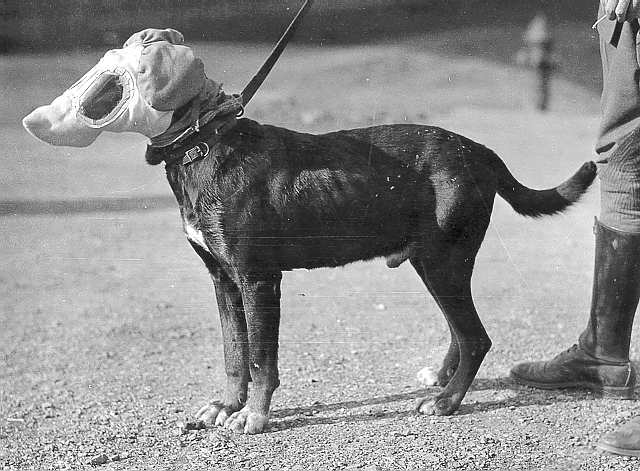
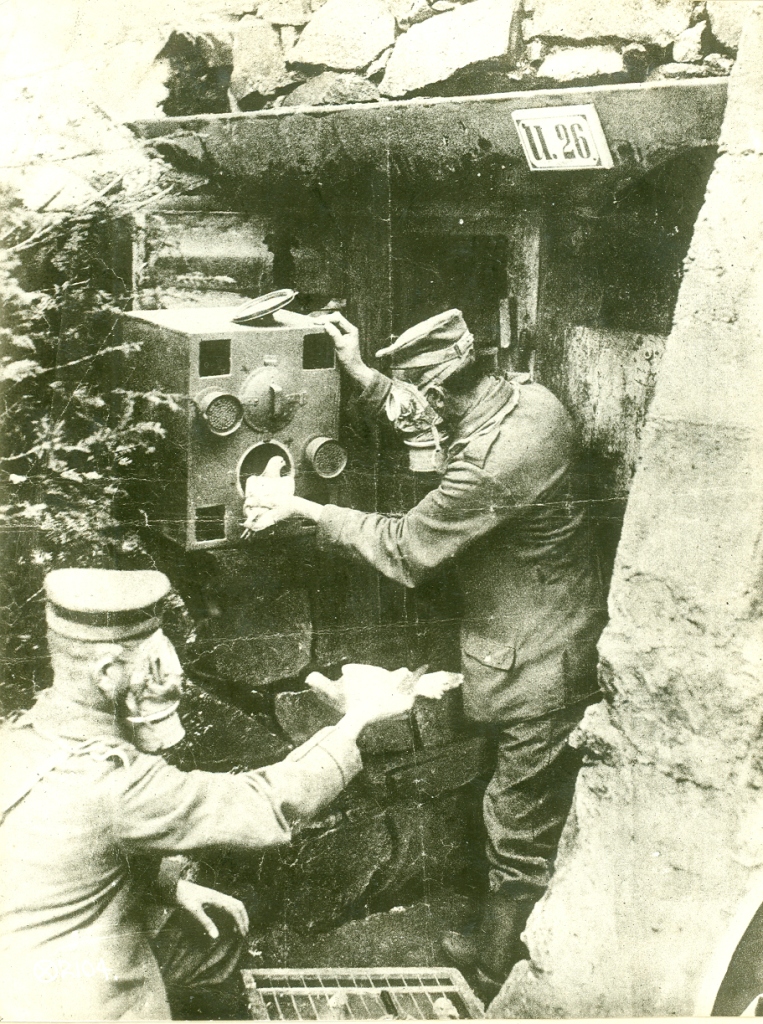
Humans were not the only ones that needed protection from gas clouds. Horses and mules were important methods of transportation that could be endangered if they came into close contact with gas. This was not so much of a problem until it became common to launch gas great distances. This caused many researchers to develop masks that could be used on animals such as dogs, horses, mules, and even carrier pigeons.[65]

The following are some examples of improvised animal gas masks that were implemented:

For mustard gas, which could cause severe damage by simply making contact with skin, no effective countermeasure was found during the war. The kilt-wearing Scottish regiments were especially vulnerable to mustard gas injuries due to their bare legs. At Nieuwpoort in Flanders some Scottish battalions took to wearing women’s tights beneath the kilt as a form of protection.

Gas alert by Arthur Streeton, 1918

Gas alert procedure became a routine for the front-line soldier. To warn of a gas attack, a bell would be rung, often made from a spent artillery shell. At the noisy batteries of the siege guns, a compressed air strombus horn was used, which could be heard nine miles (14 km) away. Notices would be posted on all approaches to an affected area, warning people to take precautions.

Other British attempts at countermeasures were not so effective. An early plan was to use 100,000 fans to disperse the gas. Burning coal or carborundum dust was tried. A proposal was made to equip front-line sentries with diving helmets, air being pumped to them through a 100 ft (30 m) hose.

However, the effectiveness of all countermeasures is apparent. In 1915, when poison gas was relatively new, less than 3% of British gas casualties died. In 1916, the proportion of fatalities jumped to 17%. By 1918, the figure was back below 3%, though the total number of British gas casualties was now nine times the 1915 levels.

Various gas masks employed on the Western Front during the war

Delivery systems

A British cylinder release at Montauban on the Somme, June 1916 — part of the preparation for the Battle of the Somme.

The first system employed for the mass delivery of gas involved releasing the gas cylinders in a favourable wind such that it was carried over the enemy’s trenches. The Hague Convention of 1899 prohibited the use of poisons gasses delivered by projectiles. The main advantage of this method was that it was relatively simple and, in suitable atmospheric conditions, produced a concentrated cloud capable of overwhelming the gas mask defences. The disadvantages of cylinder releases were numerous. First and foremost, delivery was at the mercy of the wind. If the wind was fickle, as was the case at Loos, the gas could backfire, causing friendly casualties. Gas clouds gave plenty of warning, allowing the enemy time to protect themselves, though many soldiers found the sight of a creeping gas cloud unnerving. Also gas clouds had limited penetration, only capable of affecting the front-line trenches before dissipating.

Finally, the cylinders had to be emplaced at the very front of the trench system so that the gas was released directly over no man’s land. This meant that the cylinders had to be manhandled through communication trenches, often clogged and sodden, and stored at the front where there was always the risk that cylinders would be prematurely breached during a bombardment. A leaking cylinder could issue a telltale wisp of gas that, if spotted, would be sure to attract shellfire.

German gas attack on the eastern front.

A British chlorine cylinder, known as an “oojah”, weighed 190 lb (86 kg), of which only 60 lb (27 kg) was chlorine gas, and required two men to carry. Phosgene gas was introduced later in a cylinder, known as a “mouse”, that only weighed 50 lb (23 kg).

Delivering gas via artillery shell overcame many of the risks of dealing with gas in cylinders. The Germans, for example, used 5.9-inch (150 mm) artillery shells (“five-nines”). Gas shells were independent of the wind and increased the effective range of gas, making anywhere within reach of the guns vulnerable. Gas shells could be delivered without warning, especially the clear, nearly odorless phosgene — there are numerous accounts of gas shells, landing with a “plop” rather than exploding, being initially dismissed as dud HE or shrapnel shells, giving the gas time to work before the soldiers were alerted and took precautions.

Loading a battery of Livens gas projectors

The main flaw associated with delivering gas via artillery was the difficulty of achieving a killing concentration. Each shell had a small gas payload and an area would have to be subjected to a saturation bombardment to produce a cloud to match cylinder delivery. Mustard gas, however, did not need to form a concentrated cloud and hence artillery was the ideal vehicle for delivery of this battlefield pollutant.

The solution to achieving a lethal concentration without releasing from cylinders was the “gas projector”, essentially a large-bore mortar that fired the entire cylinder as a missile. The British Livens projector (invented by Captain W.H. Livens in 1917) was a simple device; an 8-inch (200 mm) diameter tube sunk into the ground at an angle, a propellant was ignited by an electrical signal, firing the cylinder containing 30 or 40 lb (14 or 18 kg) of gas up to 1,900 meters. By arranging a battery of these projectors and firing them simultaneously, a dense concentration of gas could be achieved. The Livens was first used at Arras on 4 April 1917. On 31 March 1918 the British conducted their largest ever “gas shoot”, firing 3,728 cylinders at Lens.

Unexploded weapons

Phosgene delivery system unearthed at the Somme, 2006

Over 16,000,000 acres (65,000 km2) of France had to be cordoned off at the end of the war because of unexploded ordnance. About 20% of the chemical shells were duds, and approximately 13 million of these munitions were left in place. This has been a serious problem in former battle areas from immediately after the end of the War until the present. Shells may be, for instance, uncovered when farmers plough their fields (termed the ‘iron harvest‘), and are also regularly discovered when public works or construction work is done.[66]

An additional difficulty is the current stringency of environmental legislation. In the past, a common method of getting rid of unexploded chemical ammunition was to detonate or dump it at sea; this is currently prohibited in most countries.[67][nb 2]

The problems are especially acute in some northern regions of France. The French government no longer disposes of chemical weapons at sea. For this reason, piles of untreated chemical weapons accumulated. In 2001, it became evident that the pile stored at a depot in Vimy was unsafe; the inhabitants of the neighboring town were evacuated, and the pile moved, using refrigerated trucks and under heavy guard, to a military camp in Suippes.[68] The capacity of the plant is meant to be 25 tons per year (extensible to 80 tons at the beginning), for a lifetime of 30 years.[69]

Germany has to deal with unexploded ammunition and polluted lands resulting from the explosion of an ammunition train in 1919.[69]

Aside from unexploded shells, there have been claims that poison residues have remained in the local environment for an extended period, though this is unconfirmed; well known but unverified anecdotes claim that as late as the 1960s trees in the area retained enough mustard gas residue to injure farmers or construction workers who were clearing them.[70]

Gases used

Name First use Type Used by
Xylyl bromide[71] 1914 Lachrymatory, toxic Both
Chlorine[72] 1915 Corrosive. Lung Irritant Both
Phosgene[72] 1915 Irritant – Skin and mucous membranes. Corrosive, toxic Both
Benzyl bromide[71] 1915 Lachrymatory Central Powers
Chloromethyl chloroformate[71] 1915 Irritant – Eyes, skin, lungs Both
Trichloromethyl chloroformate[71] 1916 Severe irritant, causes burns Both
Chloropicrin[72] 1916 Irritant, lachrymatory, toxic Both
Stannic chloride[71] 1916 Severe irritant, causes asphyxiating Allies
Ethyl iodoacetate[71] 1916 Lachrymatory, toxic Allies
Bromoacetone[71] 1916 Lachrymatory, irritant Both
Monobromomethyl ethyl ketone[71] 1916 Lachrymatory, irritant Central Powers
Acrolein[71] 1916 Lachrymatory, toxic Central Powers
Hydrogen cyanide[71] (Prussic acid) 1916 Toxic, Chemical Asphyxiant Allies
Hydrogen sulfide[71] (Sulphuretted hydrogen) 1916 Irritant, toxic Allies
Diphenylchloroarsine[72] (Diphenyl chlorasine) 1917 Irritant/Sternutatory (causes sneezing) Central Powers
α-chlorotoluene (Benzyl chloride) 1917 Irritant, lachrymatory Central Powers
Mustard gas[72] (Bis(2-chloroethyl) sulfide) 1917 Vesicant (blistering agent), lung irritant Both
Bis(chloromethyl) ether (Dichloromethyl ether) 1918 Irritant, can blur vision Central Powers
Ethyldichloroarsine[72] 1918 Vesicant Central Powers
N-Ethylcarbazole 1918 Irritant Central Powers

Long-term health effects

Soldiers who claimed to have been exposed to chemical warfare have often presented with unusual medical conditions which has led to much controversy. The lack of information has left doctors, patients, and their families in the dark in terms of prognosis and treatment. Nerve agents such as sarin, tabun, and soman are believed to have the most significant long-term health effects.[73] Chronic fatigue and memory loss have been reported to last up to three years after exposure. In the years following World War One, there were many conferences held in attempts to abolish the use of chemical weapons all together, such as The Washington Conference (1921–22), Geneva Conference (1923–25) and the World Disarmament Conference (1933). Although the United States was an original signatory of the Geneva Protocol in 1925, the US Senate did not formally ratify it until 1975.

Although the health effects are generally chronic in nature, the exposures were generally acute. A positive correlation has been proven between exposure to mustard agents and skin cancers, other respiratory and skin conditions, leukemia, several eye conditions, bone marrow depression and subsequent immunosuppression, psychological disorders and sexual dysfunction.[74] Chemicals used in the production of chemical weapons have also left residues in the soil where the weapons were used. The chemicals that have been detected can cause cancer and can have an impact on a person’s brain, blood, liver, kidneys and skin.[75]

Despite the evidence in support of long-term health effects, there are studies that show just the opposite. Some US veterans who were closely affected by chemical weapons showed no neurological evidence in the following years. These same studies showed that one single contact with chemical weapons would be enough to cause long-term health effects.[76]

13th September – Deaths & Events in Northern Ireland Troubles

13th September

Key Events & Deaths on this day in Northern Ireland Troubles

Monday 13 September 1971

Two Loyalists, James Finlay (31) and John Thompson (21), were mortally injured when the bomb they were preparing exploded prematurely in a house in Bann Street, Belfast. Finlay died on 21 September 1971, and Thompson died on 12 October 1971.

Monday 13 September 1976

Following the resignation of Brian Faulkner the Unionist Party of Northern Ireland (UPNI) elected Anne Dickson as its new leader.

[Dickson became the first woman to lead a political party in Ireland.]

Tuesday 14 September 1976

‘Blanket Protest’ Began

Kieran Nugent was the first prisoner to be sentenced under the new prison regime introduced on 1 March 1976 which meant that he would not receive special category status. Nugent was sent to the new ‘H-Blocks’ of the Maze Prison where he refused to wear prison clothes choosing instead to wrap a blanket around himself.

[This marked the beginning of the ‘Blanket Protest’. This protest was to culminate in the hunger strikes of 1981 when 10 Republican prisoners died. Eventually many of the elements of special category status such as, no uniforms, free association and no prison work, were conceded to paramilitary prisoners.]

Sunday 13 September 1981

Humphrey Atkins, then Secretary of State for Northern Ireland, was appointed as deputy Foreign Secretary. James Prior was appointed by the British government to take over the post of Secretary of State. [ 1981 Hunger Strike.]

Tuesday 13 September 1983

James Prior, then Secretary of State for Northern Ireland, defended the use of evidence supplied by ‘supergrasses’.

Friday 14 September 1990

There was a meeting of the Anglo-Irish Intergovernmental Conference (AIIC) in Dublin.

Friday 13 September 1991

The Ulster Freedom Fighters (UFF), a cover name (pseudonym) used by the Ulster Defence Association (UDA), planted two bombs planted in Catholic areas. The devices were defused by the British Army. The Anglo-Irish Intergovernmental Conference (AIIC) held a meeting at Stormont in Belfast.

Tuesday 13 September 1994

There were sectarian clashes outside Crumlin Road Courthouse, Belfast, which were connected to a case being heard at the time. Later in the evening there was serious rioting in Loyalist areas of Belfast. Shots were fired, and petrol bombs were thrown, at the Royal Ulster Constabulary (RUC).

Friday 13 September 1996

British Government Ministers were reportedly warned that the Irish Republican Army (IRA) were ready to launch a renewed bombing campaign in Britain.

Saturday 13 September 1997

The Executive Council of the Ulster Unionist Party (UUP) held a meeting to decide its position on entering the resumed multi-party talks on 15 September 1997. However the meeting did not arrive at a decision and the matter was postponed to a further meeting on the morning of 15 September 1997. Loyalists held a parade on the Shankill Road with 70 bands taking part. Four members of the Ulster Volunteer Force (UVF) appeared during the parade and posed with weapons before slipping away into the crowd.

Monday 13 September 1999

The Ulster Unionist Party (UUP) executive set up a committee to devise an alternative to the Patten proposals for policing in Northern Ireland. David Trimble, then leader of the UUP, dismissed threats to his leadership and said his party would continue to be involved in the Mitchell Review of the Good Friday Agreement. A survey of public opinion in Northern Ireland found that of those questioned 69 per cent of Catholics approved of the proposals in the Patten report while 65 per cent of Protestants disapproved. The survey was conducted by Ulster Marketing Surveys.

Thursday 13 September 2001

The British Army had to deal with a pipe-bomb that had been discovered found at Carrowdore near Newtownards, County Down. Royal Ulster Constabulary (RUC) officers discovered a gun, ammunition, a telescopic sight, and bomb-making parts in a hedge on the Knockagh Road in Monkstown, County Antrim.

The Loyalist protest at the Holy Cross Girls’ Primary School followed the pattern of earlier in the week. The Northern Ireland Assembly met to discuss the motion: “This Assembly condemns the shocking and inhuman acts of terrorism carried out in the United States of America on Tuesday and, on behalf of the people of Northern Ireland, extends its sympathy to the government and people of America and all who have suffered so grievously.” The motion was a joint one submitted by Reg Empey (Sir), then Ulster Unionist Party (UUP) Minster of Development and Enterprise, and Seamus Mallon, then Social Democratic and Labour Party (SDLP) deputy First Minister.

Empey and Mallon described the attacks as “shocking and inhuman acts”. The motion was passed unanimously. However, during the debate Ian Paisley, then leader of the Democratic Unionist Party (DUP), led his party members out of the chamber when Gerry Adams, then President of Sinn Féin (SF), rose to speak. Iain Duncan Smith was elected leader of the Conservative Party. Quentin Davies of the Conservative Party was appointed the new shadow spokesman for Northern Ireland.


Remembering all innocent victims of the Troubles

Today is the anniversary of the follow  people killed as a results of the conflict in Northern Ireland

To the innocent on the list – Your memory will live  forever

– To  the Paramilitaries  –

“There are many things worth living for, a few things worth dying for, but nothing worth killing for.

  7 People lost their lives on the 13th September  between 1972 – 1993

————————————————————–

13 September 1972


Patrick Doyle,  (19)

Catholic
Status: Civilian (Civ),

Killed by: non-specific Loyalist group (LOY)
Son of publican. Shot in Divis Castle Bar, Springfield Road, Belfast.

————————————————————–

13 September 1972


Robert Warnock,  (18)

Protestant
Status: Ulster Defence Association (UDA),

Killed by: Royal Ulster Constabulary (RUC)
Shot by off duty Royal Ulster Constabulary (RUC) member during attempted armed robbery at Hillfoot Bar, Glen Road, Castlereagh, Belfast.

————————————————————–

13 September 1975


Leo Norney,  (17)

Catholic
Status: Civilian (Civ),

Killed by: British Army (BA)
Shot while walking along Shepherd’s Path, near Turf Lodge, Belfast.

————————————————————–

13 September 1977
Robin Smyrl,  (26)

Protestant
Status: Ulster Defence Regiment (UDR),

Killed by: Irish Republican Army (IRA)
Off duty. Shot while driving to his workplace, Gortin, County Tyrone.

————————————————————–

13 September 1978
Williams Crawford,  (17)

Protestant
Status: Civilian (Civ),

Killed by: Ulster Volunteer Force (UVF)
Died five days after being shot, during gun attack on Lawnbrook Social Club, Centurion Street, Shankill, Belfast. Intention to scare the patrons, after earlier fracas at the social club.

————————————————————–

13 September 1991


Kevin Flood,  (31)

Catholic
Status: Civilian (Civ),

Killed by: Ulster Volunteer Force (UVF)
Shot from passing car while standing outside his home, Ligoniel Road, Ligoniel, Belfast.

————————————————————–

13 September 1993
Vernon Bailie,  (41)

Protestant
Status: Civilian (Civ),

Killed by: Red Hand Commando (RHC)
Shot outside his girlfriend’s home, Johnston Park, Carrowdore, near Newtownards, County Down


See: 14th September

Main source CAIN Web Service

Major Events in the Troubles

12th September – Deaths & Events in Northern Ireland Troubles

Key Events & Deaths on this day in Northern Ireland Troubles

12th   September

Sunday 12 September 1971

A statement on Internment, violence and the ill-treatment of detainees was released by the William Conway, then Catholic Cardinal of Ireland, and six Bishops. In a statement Cardinal Conway asked, ‘Who wanted to bomb one million Protestants into a United Ireland?’

Thursday 12 September 1974

Demonstrations were held in Belfast by Loyalists and Republicans in support of prisoners who were protesting about parole and food.

Monday 12 September 1977

Roy Mason, then Secretary of State for Northern Ireland, marked the end of his first year in the region by stating that ‘the myth of British withdrawal from Northern Ireland’ was now dead.

Tuesday 12 September 1989

Margaret Thatcher, then British Prime Minister, paid a visit to Northern Ireland and described the Ulster Defence Regiment (UDR) as a group of “very, very, very brave men”. In Dublin Sinn Féin (SF) announced the launch of the Irish National Congress.

Saturday 12 September 1992

A confidential discussion paper was leaked from the political talks (later known as the Brooke / Mayhew talks). It was claimed that the paper had been prepared by Patrick Mayhew, then Secretary of State for Northern Ireland, in an attempt to overcome a perceived lack of channels of communication between Northern Ireland and the Republic of Ireland.

[The paper was heavily criticised by Unionists and was later withdrawn when James Molyneaux, then leader of the Ulster Unionist Party (UUP), threatened to leave the talks. In particular Unionists were angered by certain phrases that had been used such as ‘an agreed Ireland’ as well as ‘powers to be exercised through North/South channels’. There were further leaks on 20 September 1992.]

Sunday 12 September 1993

Patrick Mayhew, then Secretary of State for Northern Ireland, gave a speech to the British Irish Association. Mayhew called for flexibility on the part of the political parties. The Democratic Unionist Party (DUP) published a policy document entitled ‘Breaking the Log-Jam’.

Monday 12 September 1994

The Ulster Volunteer Force (UVF) planted a 1.5kg bomb on the Belfast to Dublin train. Only the detonator exploded and two people were injured. on 20 September 1992.

Tuesday 12 September 1995

Patrick Mayhew, then Secretary of State for Northern Ireland, held his first formal talks with representatives of the Ulster Democratic Party (UDP) and representatives of the Progressive Unionist Party (PUP). David Trimble, then leader of the Ulster Unionist Party (UUP), said he would not attend the Forum for Peace and Reconciliation in Dublin. Trimble held a meeting with Peter Robinson, then deputy leader of the Democratic Unionist Party (DUP), and Robert McCartney, then leader of the United Kingdom Unionist Party (UKUP), to discuss proposals for Unionist unity.

Thursday 12 September 1996

Mary Robinson, then President of the Republic of Ireland, had a number of engagements in Belfast. There were protests at one of the venues, a women’s centre on the Donegal Road, and the centre was later badly damaged in an arson attack. Michael Whelan (35), a Catholic man, was discovered beaten to death in the lower Ormeau area of Belfast. The Royal Ulster Constabulary (RUC) later said the motive for the killing was sectarian.

Friday 12 September 1997

Tony Blair, then British Prime Minister, issued a statement calling on David Trimble, then leader of the Ulster Unionist Party (UUP), to remain in the multi-party talks at Stormont. Mary Robinson formally resigned as President of the Republic of Ireland. She took up a new position as High Commissioner for Human Rights at the United Nations.

Sunday 12 September 1999

Ronnie Flanagan, then Chief Constable of the Royal Ulster Constabulary (RUC), speaking on ‘Sunday With Adam Boulton’ on Sky News, said the threat from dissident Republicans was growing. Groups such as the ‘real IRA’ were regrouping and posed a threat, especially in border areas, he said. There was a sectarian attack by loyalists on the home of Danny O’Connor, then Social Democratic and Labour Party (SDLP) MLA. A group of loyalists had gathered outside his home shouting threats and causing damage to his car. It was the third sectarian attack on his home in three months.

Tuesday 12 September 2000

British army bomb disposal experts defused a pipe-bomb thrown through the window of a house in the upper Shankill on Sunday night. The house on the Ballygomartin Road was unoccupied when the device and a petrol bomb were thrown through the living room window at around 11.00pm.

A pipe-bomb was thrown at the home of a Loyalist politician during an outbreak of violence on the Loyalist Shankill Road area of Belfast. Billy Hutchinson, Progressive Unionist Party (PUP) Assemblyman, was at the scene of the attack when a device was thrown at his home in the Shankill area. Hutchinson’s wife and father-in-law had to be moved from the house and other nearby homes were evacuated.

Wednesday 12 September 2001

There was a bomb attack at 12.30am (0030BST) on an Royal Ulster Constabulary (RUC) patrol in Derry. Three RUC officers were investigating a burning car at a building site when a bomb exploded at the side of the road. The officers were treated for shock.

[The attack was thought to have been carried out by dissident Republican paramilitaries.]

The Loyalist protest at the Holy Cross Girls’ Primary School followed the pattern of Monday and Tuesday. However, before going to the school the children and parents held a a prayer service and a minute’s silence for the victims of the terrorist attacks in the United States of America (USA) on 11 September 2001.

Richard Haass, then a United States special envoy, had a series of meetings with political leaders in Northern Ireland. Bertie Ahern, then Taoiseach (Irish Prime Minister), announced that Friday would be a national day of mourning for the victims of the terrorist attacks in the USA.

Ronnie Flanagan, then Chief Constable of the Royal Ulster Constabulary (RUC), announced that the target of 50:50 recruitment of Catholics and Protestants to the new Police Service of Northern Ireland (PSNI) was being achieved. New policing legislation following recommendations in the Patten Report had laid down 50:50 recruitment rule. During the first phase of the application process 8000 people had applied for jobs of whom 550 were deemed qualified and a minimum of 260, possibly as many as 300, would be offered places on the trainee program.

[The first recruits to the PSNI will begin their training in the period between 14 October and 4 November 2001. They are expected to be on duty by the spring of 2002.]


Remembering all innocent victims of the Troubles

Today is the anniversary of the follow  people killed as a results of the conflict in Northern Ireland

To the innocent on the list – Your memory will live  forever

– To  the Paramilitaries  –

“There are many things worth living for, a few things worth dying for, but nothing worth killing for.

 4 People lost their lives on the 12th September  between 1975 – 1986

————————————————————–

12 September 1975
John Snoddy,  (32)

Protestant
Status: Civilian (Civ),

Killed by: non-specific Republican group (REP)
Shot at his home, Milltown Avenue, Derriaghy, near Belfast.

————————————————————–

12 September 1979


Gabriel Wiggans,   (56)

Catholic
Status: Civilian (Civ),

Killed by: Ulster Volunteer Force (UVF)
Shot at his home, Springfield Road, Belfast.

————————————————————–

12 September 1981


Alan Clarke,  (20)

Protestant
Status: Ulster Defence Regiment (UDR),

Killed by: Irish Republican Army (IRA)
Off duty. Shot while walking along Hall Street, Maghera, County Derry.

————————————————————–

12 September 1986
Kenneth Robinson,   (30)

Protestant
Status: Civilian (Civ),

Killed by: Irish Republican Army (IRA)
Killed by booby trap bomb, attached to his Ulster Defence Regiment (UDR) member father’s car outside their home, Clonmakane Court, Caw, Derry.

————————————————————–

11th September – Deaths & Events in Northern Ireland Troubles

11th   September

Key Events & Deaths on this day in Northern Ireland Troubles

Thursday 11 September 1975

Harold Wilson, then British Prime Minister, together with Merlyn Rees, then Secretary of State for Northern Ireland, held a meeting with Margaret Thatcher, then leader of the Conservative Party, to brief her about a number of matters including Northern Ireland.

[On 3 May 2006 the Irish News (a Belfast based newspaper) published details of confidential cabinet minutes that had been taken at the meeting. The minutes reveal that the British government was aware of collusion between the security forces, particularly the Ulster Defence Regiment (UDR), and Loyalist paramilitaries.]

Monday 11 September 1989

Further security forces documents, containing details of suspected Irish Republican Army (IRA) members, were reported to have gone missing. Nationalists called for the disbandment of the Ulster Defence Regiment (UDR).

Wednesday 11 September 1996

John Bruton, then Taoiseach (Irish Prime Minister), addressed a joint session of the United States Congress. His address was upbeat and optimistic about the prospects for progress in the all-party talks and also the possibility of a new Irish Republican Army (IRA) ceasefire.

Thursday 11 September 1997

An Phoblacht published an interview with an Irish Republican Army (IRA) spokesperson who said that “the IRA would have problems with sections of the Mitchell Principles”. However, the person said that what Sinn Féin (SF) decided to do “was a matter for them”.

[SF signed up to the Mitchell Principles on 9 September 1997.]

In a referendum in Scotland the electorate voted for a devolved parliament with tax-raising powers.

[The Labour Party policy of conceding devolution was considered by many commentators as an attempt to undermine growing demands for independence for Scotland. Some people believe that independence in Scotland would have implications on the constitutional position of Northern Ireland.]

Friday 11 September 1998

First Paramilitary Prisoners Released Under Agreement The first of the paramilitary prisoners were released from jails in Northern Ireland under the terms of the Good Friday Agreement. Seven prisoners, including three Republican and three Loyalist, were released in a programme that was expected to take two years to complete.

Bertie Ahern, then Taoiseach (Irish Prime Minister), told Chris Patten, then chairman of the Commission reviewing the future of the Royal Ulster Constabulary (RUC), that major reform of the force was necessary if the force was to become acceptable to both communities in Northern Ireland. Ahern made his comments during a meeting with Patten at Government buildings in Dublin.

Monday 11 September 2000

A family escaped uninjured after a pipe-bomb was thrown at their home on the Ballysally estate in Coleraine, County Derry. The attack was carried out by Loyalist paramilitaries.

Tuesday 11 September 2001

Richard Haass, then a United States special envoy, was in Dublin for a meeting with Bertie Ahern, then Taoiseach (Irish Prime Minister), when news of the terrorist attacks in New York and Washington were passed to the two men. Richard Haass decided to continue with his meetings in Dublin and then to travel to Belfast for pre-arranged meetings with political leaders in Northern Ireland.

The Loyalist protest at the Holy Cross Girls’ Primary School followed the pattern of yesterday. Loyalist protesters remained silent as Catholic children and parents made their way into the school along a security cordon. However, protesters used air horns (klaxons), blew whistles, and banged metal bin lids, as the Catholic parents made their way back down the Ardoyne Road.

Aidan Troy (Fr), then Chairman of the Board of Governors of the Holy Cross Girls’ Primary School, together with a local Protestant clergyman, held a meeting with representatives of the Concerned Residents of Upper Ardoyne (CRUA) who were engaged in a protest at the school. The meeting was described as “exploratory”. John Reid, then Secretary of State for Northern Ireland, held a meeting with representatives of the residents of the Glenbryn estate who were engaged in the protest at the Holy Cross school in Ardoyne, north Belfast. The meeting lasted for 2 hours but residents made no comment after the meeting.


Remembering all innocent victims of the Troubles

Today is the anniversary of the follow  people killed as a results of the conflict in Northern Ireland

To the innocent on the list – Your memory will live  forever

– To  the Paramilitaries  –

“There are many things worth living for, a few things worth dying for, but nothing worth killing for.

 3 People lost their lives on the 11th September  between 1976 – 1992

————————————————————–

11 September 1976


Victor Moody,  (18)

Protestant
Status: Ulster Defence Association (UDA),

Killed by: Ulster Defence Association (UDA)
Found shot in entry off Disraeli Street, Shankill, Belfast. Internal Ulster Defence Association (UDA) dispute.

————————————————————–

11 September 1978


Howard Donaghy, (24)

Protestant
Status: Royal Ulster Constabulary (RUC),

Killed by: Irish Republican Army (IRA)
Off duty. Shot at the site of his new home, Loughmacrory, near Carrickmore, County Tyrone

————————————————————–

11 September 1992


Michael Macklin,   (31)

Catholic
Status: Civilian (Civ),

Killed by: Irish People’s Liberation Organisation (IPLO)
Shot outside his home, Whiterock Gardens, Ballymurphy, Belfast. Internal Irish People’s Liberation Oraganisation (IPLO) feud.


Main source CAIN Web Service

Major Events in the Troubles

See 12th Sept

10th September – Deaths & Events in Northern Ireland Troubles

Key Events & Deaths on this day in Northern Ireland Troubles

10th  September

Sunday 10 September 1972

Three British soldiers were killed in a land mine attack near Dungannon, County Tyrone.

Monday 10 September 1973

There were two bomb attacks at train stations in London; the attacks were carried out by the Irish Republican Army (IRA). At 1.00pm a small bomb exploded at King’s Cross Railway Station, London. At 1.05pm the Press Association received a phone call warning of a bomb at Euston Railway Station. At 1.15pm another small bomb (estimated at 2-5 pounds of explosives) exploded outside the Rail Bar at Euston Station, London. There were no deaths but 12 people were injured in the blast.

Friday 10 September 1976

Roy Mason succeeded Merlyn Rees as Secretary of Sate for Northern Ireland. [Mason was to oversee a period involving a much more severe security regime in the region.]

Monday 10/11th  September 1984 

Douglas Hurd replaced James Prior as Secretary of State for Northern Ireland. Rhodes Boyson became the Minister of State at the Northern Ireland Office (NIO).

Wednesday 10 September 1986

There was a ministerial reshuffle at the Northern Ireland Office (NIO). Nicholas Scott was promoted to Minster of State and Deputy Secretary of State while Peter Viggers replaced Rhodes Boyson at Economic Development.

Friday 10 September 1993

Three Royal Ulster Constabulary (RUC) detectives who had been involved in the original ‘UDR [Ulster Defence Regiment] Four’ case were themselves sent for trial.

Saturday 10 September 1994

Five Irish Republican Army (IRA) prisoners, together with a sixth prisoner, attempted to escape from Whitemoor jail in Cambridgeshire, England. [On 22 September 1994 the prison authorities found plastic explosive and detonators at the prison.]

Sunday 10 September 1995

There were disturbances involving Gaelic Athletic Association (GAA) supporters and Orange Order members at a parade in the village of Dunloy, County Antrim. Four Royal Ulster Constabulary (RUC) officers and several civilians were injured during the clashes.

Tuesday 10 September 1996

The two governments, British and Irish, decided that the Progressive Unionist Party (PUP) and the Ulster Democratic Party (UDP) were not in breach of the ‘Mitchell Principles’ and therefore could remain in the talks at Stormont.

Wednesday 10 September 1997

Mary McAleese, then a Pro-Vice Chancellor at Queen’s University of Belfast, announced that she would enter the contest to become the Fianna Fáil (FF) nomination for President of Ireland.

[McAleese was successful and went on to win the Presidential election.]

Thursday 10 September 1998

Meeting Between Trimble and Adams David Trimble, then First Minister designate and leader of the Ulster Unionist Party (UUP), held his first face-to-face meeting with Gerry Adams, then President of Sinn Féin (SF). The meeting took place in private at Stormont, Belfast. Both men later described the meeting as cordial and businesslike. Adams said: “He is a man I can do business with” but repeated his position that he could not deliver on decommissioning.

[This was the first meeting between SF and a Unionist leader since the formation of Northern Ireland.]

Ronnie Flanagan, then Chief Constable of the Royal Ulster Constabulary (RUC), announced that British army patrols in Belfast would cease from the weekend because of the reduced threat from paramilitaries.

Monday 10 September 2001

There was a pipe-bomb attack on a house in the Woodburn estate, Carrickfergus, County Antrim. The attack took place in the early hours of Monday morning when the device exploded in the living room of the dwelling. There were no injuries but there was some damage to the property.

British Army bomb disposal officers had to defuse a pipe-bomb that had been left in a public house in Portstewart, County Derry. The device had been left in the pub the previous day by Loyalist paramilitaries.

The first part of the protest by Loyalists at the Holy Cross Girls’ Primary School passed off quietly as Catholic children and parents made their way into the school along a security cordon. However, as the parents returned from the school the protest turned noisy and more abusive. Protesters used air horns (klaxons), blew whistles, and banged metal bin lids, as the Catholic parents made their way back down the Ardoyne Road.

Some of the Loyalist protesters shouted “Fenian scum” at the parents. [This was day 6 of the most recent protest.] Richard Haass, then a United States special envoy, held a meeting with John Reid, then Secretary of State for Northern Ireland, in London about the current political situation in Northern Ireland. The two men also discussed the protest at the Holy Cross Girls’ Primary School in north Belfast.

[Haass is expected to travel to Northern Ireland on Tuesday to meet with representatives of the main political parties.]

Gerry Kelly, then a senior member of Sinn Féin (SF), introduced a private members’ motion in the Northern Ireland Assembly proposing that the “Assembly supports the right to education of children attending the Holy Cross Primary School in north Belfast”. Unionist members proposed an ammendment to the motion to make it apply to all schools in the area. The amended motion was passed by the Assembly.


Remembering all innocent victims of the Troubles

Today is the anniversary of the follow  people killed as a results of the conflict in Northern Ireland

To the innocent on the list – Your memory will live forever

– To  the Paramilitaries  –

“There are many things worth living for, a few things worth dying for, but nothing worth killing for.

 7 People lost their lives on the 10th September  between 1972 – 1991

————————————————————–

10 September 1972


Douglas  Richmond,   (21) nfNI
Status: British Army (BA),

Killed by: Irish Republican Army (IRA)
Killed in land mine attack on British Army (BA) Armoured Personnel Carrier, Sanaghanroe, near Dungannon, County Tyrone.

————————————————————–

10 September 19724


Duncan McPhee,  (21) nfNI
Status: British Army (BA),

Killed by: Irish Republican Army (IRA)
Killed in land mine attack on British Army (BA) Armoured Personnel Carrier, Sanaghanroe, near Dungannon, County Tyrone.

————————————————————–

10 September 1972


William McIntyre,   (23) nfNI
Status: British Army (BA),

Killed by: Irish Republican Army (IRA)
Killed in land mine attack on British Army (BA) Armoured Personnel Carrier, Sanaghanroe, near Dungannon, County Tyrone.

————————————————————–

10 September 1975
Michael O’Toole,  (41)

Catholic

Status: Civilian (Civ), Killed by: non-specific Loyalist group (LOY)
Died two days after being injured by booby trap bomb attached to his car, outside his home, Coast Road, Larne, County Antrim.

————————————————————–

10 September 1979
Hugh O’Halloran, (28)

Catholic
Status: Civilian (Civ),

Killed by: Official Irish Republican Army (OIRA)
Died two days after being badly beaten by group of men near his home, Moyard Park, Ballymurphy, Belfast.

————————————————————–

10 September 1986
David McVeigh,  (37)

Catholic
Status: Irish Republican Army (IRA),

Killed by: Irish Republican Army (IRA)
Found shot by the side of the road, Flagstaff, near Killeen, County Armagh. Alleged informer.

————————————————————–

10 September 1991


John Hanna,  (19)

Protestant
Status: Ulster Volunteer Force (UVF),

Killed by: Irish Republican Army (IRA)
Shot at his home, Donegall Road, Village, Belfast.


Main source CAIN Web Service

Major Events in the Troubles

See: 11th Sept

9th September – Deaths & Events in Northern Ireland Troubles

9th September

Key Events & Deaths on this day in Northern Ireland Troubles

Wednesday 9 September 1971

A British soldier was killed trying to defuse a bomb near Lisburn.

Thursday 11 September 1975

Harold Wilson, then British Prime Minister, together with Merlyn Rees, then Secretary of State for Northern Ireland, held a meeting with Margaret Thatcher, then leader of the Conservative Party, to brief her about a number of matters including Northern Ireland.

[On 3 May 2006 the Irish News (a Belfast based newspaper) published details of confidential cabinet minutes that had been taken at the meeting. The minutes reveal that the British government was aware of collusion between the security forces, particularly the Ulster Defence Regiment (UDR), and Loyalist paramilitaries.]

Thursday 9 September 1976

The leaders of the main churches in Ireland issued a statement supporting the Women’s Peace Movement.

Wednesday 9 September 1992

Ian Paisley, then leader of the Democratic Unionist Party (DUP), together with Peter Robinson, then deputy leader of the DUP, walked out of Strand Two of the political talks (later known as the Brooke / Mayhew talks). The politicians left because Articles 2 and 3 of the Irish Constitution were not the first item on the agenda for the talks. Two members of the DUP remained in the talks as ‘observers’.

Friday 9 September 1994

John Taylor, then Deputy Leader of the Ulster Unionist Party (UUP), said that he believed that the Irish Republican Army (IRA) ceasefire was “for real”.

Monday 9 September 1996

The ‘General Head Quarters’ (GHQ) faction of the Irish National Liberation Army announced that the group was disbanding. This decision followed the killing of Hugh Torney on 3 September 1996.

This marked the ending of a feud within the INLA which started with the killing of Gino Gallagher on 30 January 1996.

This latest feud had claimed six lives.

The Stormont talks resumed after a break during the summer. The Democratic Unionist Party (DUP) and the United Kingdom Unionists brought a complaint against the Progressive Unionist Party (PUP) and the Ulster Democratic Party (UDP) for breach of the ‘Mitchell Principles’ because of their failure to condemn threats made against Billy Wright and Alex Kerr; both Loyalists from Portadown, County Armagh.

The Irish Times (a Dublin based newspaper) published the details of a poll, one of the results of which showed that two-thirds of people in Northern Ireland thought the Stormont talks would fail.

Tuesday 9 September 1997

Sinn Féin Signed Mitchell Principles

Petrol bombs were thrown at the homes of two Catholic families in the Protestant Ballykeel estate in Ballymena, County Antrim.

[One of the families, who had been living on the estate for 33 years, decided to leave their home following the attack.]

Representatives of Sinn Féin (SF) entered Stormont, Belfast, to sign a pledge that the party would agreed to abide by the Mitchell Principles.

[See 11 September 1997 for the reaction of the Irish Republican Army (IRA).]

The Ulster Unionist Party (UUP), the Progressive Unionist Party (PUP), and the Ulster Democratic Party (UDP) all refused to attend the session at Stormont. The PUP and the UDP held meetings with Adam Ingram, then Security Minister, to discuss the situation of Loyalist prisoners

. A number of UDP supporters took part in a protest outside the gates of Stormont. Madeline Albright, then Secretary of State of the United States of America (USA), asked the Attorney General to suspend the extradition to Britain of six men who were former members of the IRA.

Thursday 9 September 1999

Patten Report Published The Report of the Independent Commission on Policing in Northern Ireland was released and was accompanied by a statement from the author Chris Patten. Patten called on Catholics to join the Royal Ulster Constabulary (RUC). It contained recommendations for a radical overhaul of the police service in the region. The proposed changes to the ethos, composition, training and structure of the Royal Ulster Constabulary (RUC) met with a mixed reaction. David Trimble, then leader of the Ulster Unionist Party (UUP), described it as “the most shoddy piece of work I have seen in my entire life”, and there were strong objections from rank-and-file RUC officers.

The UUP also issued an initial statement on the report. Many criticisms related to the proposed change to the name and symbols of the RUC. Ian Paisley, then leader of the Democratic Unionist Party (DUP), issued a statement about the proposals.

The Social Democratic and Labour Party (SDLP) statement and the Sinn Féin (SF) statement indicated that the two parties were prepared to view the document positively. Marjorie (Mo) Mowlam, then Secretary of State of Northern Ireland, issued a statement. The Irish government issued a statement on the report. The Police Federation for Northern Ireland also issued a statement.

There was a sectarian attack on a 13 year old Catholic student attending Hazelwood Integrated College in north Belfast. The young boy was attacked by three loyalists and beaten with baseball bats and shot in the stomach with a pellet gun. The attack happened near the White City estate in Belfast. Police said the motive for the attack was sectarian.

William Billy Giles

There was an inquest in Belfast into the death by hanging of William Giles (41). Giles had been part of an Ulster Volunteer Force (UVF) gang which had abducted and killed Michael Fay (25), a Catholic civilian, on 20 November 1982.

Billy Giles.jpg
Billy Giles

Giles had been released from prison in 1997 after serving 15 years of a life sentence. It was claimed that Giles had hanged himself out of remorse.

See here for more info on: Billy Giles ,Life & Death


Remembering all innocent victims of the Troubles

Today is the anniversary of the follow  people killed as a results of the conflict in Northern Ireland

To the innocent on the list – Your memory will live forever

– To  the Paramilitaries  –

“There are many things worth living for, a few things worth dying for, but nothing worth killing for.

6 People lost their lives on the 9th September  between 1971 – 1988

————————————————————–

09 September 1971


David Stewardson,  (29) nfNI

Status: British Army (BA),

Killed by: Irish Republican Army (IRA)
Killed attempting to defuse bomb at Castlerobin Orange Hall, Drumankelly, near Lisburn, County Antrim.


See: The Long Walk – Iconic Pictures & Story behind them

————————————————————–

09 September 1975
George Quinn,  (41)

Catholic
Status: Civilian (Civ),

Killed by: non-specific Loyalist group (LOY)
Found shot near Turf Lodge roundabout, Springfield Road, Belfast.

————————————————————–

09 September 1985
James Burnett,   (28) nfNI
Status: Irish National Liberation Army (INLA),

Killed by: Irish National Liberation Army (INLA)
From County Dublin. Found shot, Killeen, County Armagh. Alleged informer.

————————————————————–

09 September 1987


Patrick Hamill,   (29)

Catholic
Status: Civilian (Civ),

Killed by: Ulster Freedom Fighters (UFF)
Died several hours after being shot at his home, Forfar Street, off Springfield Road, Belfast.

————————————————————–

09 September 1987


Harry Sloan,  (38)

Protestant
Status: Civilian (Civ),

Killed by: Irish Republican Army (IRA)
Shot outside his home, Alliance Parade, Belfast. Mistaken for off duty Ulster Defence Regiment (UDR) member.

————————————————————–

09 September 1988


Colin Abernethy,

(30) Protestant
Status: Civilian Political Activist (CivPA),

Killed by: Irish Republican Army (IRA)
Ulster Clubs member. Shot while travelling on train to his workplace, Finaghy, Belfast


Main source CAIN Web Service

Major Events in the Troubles

See: 10th September

8th September – Deaths & Events in Northern Ireland Troubles

8th September

Key Events & Deaths on this day in Northern Ireland Troubles

Wednesday 8 September 1971

Harold Wilson, then leader of the Labour Party, announced details of a plan for a united Ireland.

Friday 8 September 1972

[Public Records 1972 – Released 1 January 2003: Memo from the Cabinet Secretary to Edward Heath, then British Prime Minister. This memo covered: the future of Northern Ireland; the Security Package; and changes in the administration of justice (most notably the introduction of special courts).]

Monday 8 September 1975

During a United Ulster Unionist Council (UUUC) meeting William Craig was the only member to vote for a voluntary coalition with the Social Democratic and Labour Party (SDLP).

Sunday 8 September 1985

A married couple Gerard and Catherine Mahon, both Catholic civilians, were found shot dead in Turf Lodge in west Belfast. The couple had been shot by the Irish Republican Army (IRA) who alleged that they were informers working on behalf of the Royal Ulster Constabulary (RUC).

Thursday 8 September 1994

The Combined Loyalist Military Command (CLMC) set out a list of issues that it wished to receive assurances on before it considered calling a ceasefire of Loyalist paramilitary groups. In particular the CLMC wanted convinced that the Irish Republican Army (IRA) ceasefire was permanent and that no secret deal had been done to achieve it. British Army soldiers wore berets instead of steel helmets while on patrol in Belfast.

[It was viewed as a symbolic gesture representing a relaxation of security measures.]

The Belfast Coroner abandoned the Inquest into the deaths of the six men at the centre of the alleged ‘shoot to kill’ incidents in November and December 1982. The reason given for the action was the decision of Hugh Annesley (Sir), then Chief Constable of the Royal Ulster Constabulary (RUC), not to provide the Inquest with a copy of the Stalker report.

[The Belfast High Court had ruled against the Coroner on 11 July 1994 when the court said he could not have access to the contents of the Stalker report.]

Friday 8 September 1995

Trimble Elected Leader of UUP The Ulster Unionist Council (UUC) held a meeting to choose a new leader following the resignation of James Molyneaux on 28 August 1995. David Trimble, then UUP MP, won the contest on the third count beating John Taylor, then UUP MP, who had been considered the favourite to win. Trimble won by 466 to 333 votes.

Sunday 8 September 1996

An Orange parade in Dunloy, County Antrim was rerouted by the Royal Ulster Constabulary (RUC). In protest at this decision the Orangemen held a short stand-off at a police line.

Monday 8 September 1997

Mary Robinson, then President of the Republic of Ireland, paid her final visit before retiring to Northern Ireland. Robinson attended a meeting of the Council for Ethnic Minorities and also addressed a special meeting of community and voluntary sector groups at Balmoral, Belfast.

[Previous visits by the President had been criticised by Unionist politicians particularly when she shook hands with Gerry Adams, then President of Sinn Féin (SF), in 1993.]

John Hume, then leader of the Social Democratic and Labour Party (SDLP), announced that he would not be standing in the forthcoming Presidential election in the Republic of Ireland. Hume said that he felt a duty to stay with the SDLP at the “crucial stage” of the peace process.

Saturday 8 September 2001

A Catholic primary school Newington Avenue in north Belfast was damaged in an arson attack.


Remembering all innocent victims of the Troubles

Today is the anniversary of the follow  people killed as a results of the conflict in Northern Ireland

To the innocent on the list – Your memory will live forever

– To  the Paramilitaries  –

“There are many things worth living for, a few things worth dying for, but nothing worth killing for.

6 People lost their lives on the 8th September  between 1969 – 1985

————————————————————–

08 September 1969
John Todd,  (29)

Protestant
Status: Civilian (Civ),

Killed by: non-specific Republican group (REP)
Shot during street disturbances, Alloa Street, Lower Oldpark, Belfast.

————————————————————–

08 September 1974
Arthur Rafferty,   (56)

Catholic
Status: Civilian (Civ),

Killed by: Irish Republican Army (IRA)
Died three weeks after being shot in Newington Street, New Lodge, Belfast.

————————————————————–

08 September 1975
Andrew Craig,  (20)

Protestant
Status: Ulster Defence Association (UDA),

Killed by: Irish Republican Army (IRA)
Found shot at corner of Alfred Street and Russell Street, Markets, Belfast.

————————————————————–

08 September 1977
Hugh Rogers,  (50)

Catholic
Status: Ulster Defence Regiment (UDR),

Killed by: Irish Republican Army (IRA)
Off duty. Shot outside his home, Orchardville Crescent, Finaghy, Belfast.

————————————————————–

08 September 1985


Gerard Mahon,  (28)

Catholic
Status: Civilian (Civ),

Killed by: Irish Republican Army (IRA)
Found shot, together with his wife, in entry off Norglen Crescent, Turf Lodge, Belfast. Alleged informer.

————————————————————–

08 September 1985


Catherine Mahon,  (26)

Catholic
Status: Civilian (Civ),

Killed by: Irish Republican Army (IRA)
Found shot, together with her husband, in entry off Norglen Crescent, Turf Lodge, Belfast. Alleged informer.


Main source CAIN Web Service

Major Events in the Troubles

See: IRA Internal Security Unit – Nutting Squad

See: 9th September

Understanding the Syrian crisis & The Battle for Rojava – ISIS – Pushed back

The Rojava Revolution

—————————————————————

Pushing Back the Islamic State: The Battle for Rojava

—————————————————————

The Rojava Revolution is a political upheaval taking place in an autonomous region of Northern Syria, known as Rojava. The revolution has been characterized by the prominent role played by women both on the battlefield and within the newly formed political system, as well as the implementation of democratic confederalism, a form of grassroots democracy based on local assemblies.

—————————————————————

Understanding the Syrian crisis in 5 minutes

—————————————————————

—————————————————————

Islamic State Conquest: Map Time Lapse (August 2015 Update)

—————————————————————

Background

Further information: Kurds in Syria and Rojava

Kurds make up between nine and fifteen percent of Syria’s population, or well over 2 million people. The northeast of the country (where many Kurds live) is strategically important, because it contains a large percentage of Syria’s oil supplies.[31]

Qamishli riots

Further information: 2004 al-Qamishli riots

Since 2004, several riots in Western Kurdistan have prompted increased tension. In 2004, riots broke out against the government in the northeastern city of Qamishli. During a chaotic soccer match between a local Kurdish team and a visiting Arab team from Deir ez-Zor, some Arab fans brandished portraits of Saddam Hussein (who slaughtered tens of thousands of Kurds in Southern Kurdistan during the genocidal Al-Anfal Campaign in the 1980s), provoking strong reactions from the Kurds. Tensions quickly escalated into open protests, with Kurds raising their flag and taking to the streets to demand cultural and political rights. In the ensuing crackdown by the police and clashes between Kurdish and Arab groups, at least 30 people were killed, with some claims indicating a casualty count of about 100 people. Occasional clashes between Kurdish protesters and government forces occurred in the following years.[32][33]

State discrimination

Further information: Human rights in Syria

Anti-government sentiment has been present among the Kurdish population for a long time.[34] The Syrian government did not officially acknowledge the existence of Kurds in Syria[34] and a number of Kurds were stripped of their citizenship in 1962 and instead were registered as foreigners because their ancestors were not included in the Ottoman population registers for 1920. The Kurdish language and culture have also been suppressed. The government attempted to resolve these issues in 2011 by granting all Kurds citizenship, but only an estimated 6,000 out of 150,000 stateless Kurds have been given nationality and most discriminatory regulations, including the ban on teaching Kurdish, are still on the books.[35] Due to the Syrian Civil War that began in 2011, the government is no longer in a position to enforce these laws.

Syrian uprising

In 2011 the Arab Spring spread to Syria. Similar to the beginning of the Tunisian Revolution, Syrian citizen Hasan Ali Akleh soaked himself in gasoline and set himself on fire in the northern city of Al-Hasakah. This inspired activists to call for a “Day of Rage”, which ended up being sparsely attended, mostly because of fear of repression from the Syrian government. Days later, however, protests again took place, this time in response to the police beating of a shopkeeper.[citation needed]

Smaller protests continued, but it was on 7 March 2011, when thirteen political prisoners went on hunger strike, that momentum began to grow against the Assad government. Three days later dozens of Syrian Kurds went on hunger strike in solidarity.[36] On 12 March, major protests took place in Al-Qamishli and Al-Hasakah to both protest the Assad regime and commemorate Kurdish Martyrs Day.[37]

Protests grew over the months of March and April 2011. The Assad regime attempted to appease Kurds by promising to grant citizenship to thousands of Kurds, who until that time had been stripped of any legal status.[38] By the summer, protests had only intensified, as did violent crackdowns by the Syrian government.

In August a coalition of opposition groups formed the Syrian National Council in hopes of creating a democratic, pluralistic alternative to the Assad regime. However, internal fighting and disagreement over politics and inclusion plagued the group from its early beginnings. In the fall of 2011 the popular uprising escalated to an armed conflict. The Free Syrian Army (FSA) began to coalesce and armed insurrection spread largely across the central and southern parts of Syria.[citation needed]

Kurds and government opposition negotiations

2013 VOA report about the Kurdish situation in Syria

The National Movement of Kurdish Parties in Syria, which consisted of Syria’s 12 Kurdish parties, boycotted a Syrian opposition summit in Antalya, Turkey on 31 May 2011, stating that “any such meeting held in Turkey can only be a detriment to the Kurds in Syria, because Turkey is against the aspirations of the Kurds, not just with regards to northern Kurdistan, but in all four parts of Kurdistan, including the Kurdish region of Syria.” Kurdish Leftist Party representative Saleh Kado stated that “we, the Kurds in Syria, do not trust Turkey or its policies, and that is why we have decided to boycott the summit.”[39]

During the August summit in Istanbul, which led to the creation of the Syrian National Council, only two of the parties in the National Movement of Kurdish Parties in Syria, the Kurdish Union Party and the Kurdish Freedom Party, attended the summit. Kurdish leader Shelal Gado stated the reason they did not participate was that “Turkey is against the Kurds … in all parts of the world,” and that “If Turkey doesn’t give rights to its 25 million Kurds, how can it defend the rights of the Syrian people and the Kurds there?” Abdulbaqi Yusuf, representing the Kurdish Freedom Party, however, stated that his party felt no Turkish pressure during the meeting and participated to represent Kurdish demands.[40]

On 7 October 2011, prominent Kurdish rights activist Mashaal Tammo was assassinated when masked gunmen burst into his flat, with the Syrian government blamed for his death. At least 20 other civilians were also killed during crackdowns on demonstrations across the country.[41] On 20 September, the Kurdish politician Mahmoud Wali was assassinated by masked gunmen in the town of Ras al-Ayn.[42]

Ethnic minorities remain neutral

Democratic Union Party (PYD) chairman Salih Muslim Muhammad said that the lack of Kurdish participation was due to a tactical decision, explaining that: “There is a de facto truce between the Kurds and the government. The security forces are overstretched over Syria’s Arab provinces to face demonstrators, and cannot afford the opening of a second front in Rojava. On our side, we need the army to stay away. Our party is busy establishing organizations, committees, able to take over from the Ba’ath administration the moment the regime collapses.”[43]

Senior Kurdistan Workers’ Party (PKK) leader Cemil Bayik stated in November 2011 that if Turkey were to intervene in Rojava, the PKK would fight on the Syrian Kurdish side. The PKK’s Syrian branch was alleged in the same month to be involved in the targeting of Kurds participating in the uprising.[44] Murat Karayılan, the PKK’s military commander, threatened to turn all Kurdish-populated areas in Turkey into a war-zone if Turkish forces were to enter Syria’s Kurdish area.[45]

Erbil Agreement

On 22 July 2012, Serê Kaniyê (Ra’s al-‘Ayn) pictured above and a series of other towns in the Kurdish inhabited northeast of Syria were captured by the People’s Protection Units (YPG).

Anti-government protests had been ongoing in the Kurdish-inhabited areas of Syria since March 2011, as part of the wider Syrian uprising, but clashes started after the opposition Kurdish Democratic Union Party (PYD) and Kurdish National Council (KNC) signed a seven-point agreement on 11 June 2012 in Erbil under the auspice of Iraqi Kurdistan president Massoud Barzani. This agreement, however, failed to be implemented and so a new cooperation agreement between the two sides was signed on 12 July which saw the creation of the Kurdish Supreme Committee as a governing body of all Kurdish-controlled territories in Syria.[46][47][48]

YPG claims territory

The People’s Protection Units (YPG) captured the city of Kobanî on 19 July 2012, followed by the capture of Amuda (Kurdish: Amûdê‎) and Efrîn (Kurdish: Efrîn‎) on 20 July,[49] thus entering the Syrian Civil War as belligerent. The KNC and PYD afterwards formed a joint leadership council to run the captured cities. The cities fell without any major clashes, as Syrian security forces withdrew without any major resistance.[49] The Syrian Army pulled out to fight elsewhere.[50]

The YPG forces continued with their advancement and on 21 July captured Al-Malikiyah (Kurdish: Dêrika Hemko‎), which is located 10 kilometers from the Turkish border.[51] The rebels at the time also intended to capture Qamishli, the largest Syrian city with a Kurdish majority.[52] On the same day, the Syrian government attacked a patrol of Kurdish YPG members and wounded one fighter.[53] The next day it was reported that Kurdish forces were still fighting for Al-Malikiyah (Kurdish: Dêrika Hemko‎), where one young Kurdish activist was killed after government security forces opened fire on protesters. The YPG also took control over the towns of Ra’s al-‘Ayn (Kurdish: Serê Kaniyê‎) and Al-Darbasiyah (Kurdish: Dirbêsî‎), after the security and political units withdrew from these areas, following an ultimatum issued by the Kurds. On the same day, clashes erupted in Qamishli between YPG and government forces in which one Kurdish fighter was killed and two were wounded along with one government official.[54]

The ease with which Kurdish forces captured the towns and the government troops pulled back was speculated to be due to the government reaching an agreement with the Kurds so military forces from the area could be freed up to engage opposition forces in the rest of the country.[55] On 24 July, the PYD announced that Syrian security forces withdrew from the small Kurdish city of 16,000 of Al-Ma’bada (Kurdish: Girkê Legê‎), located between Al-Malikiyah and the Turkish borders. The YPG forces afterwards took control of all government institutions.[56]

Popular protest continued in Rojava through 2011 and into the spring of 2012 though most Kurds and other Northern Syrians did not join the FSA because of disagreements over Kurdish representation in a future Syria.[57]

Self-governed Rojava established

See also: Rojava

On 1 August 2012 Assad forces on the periphery of the country are pulled into the intensifying conflict taking place in Aleppo. During this large withdraw from the north, the People’s Protection Units (PYD), a pro-Kurdish militia that formed after the 2004 al-Qamishli riots[58] took control of at least parts of Qamishlo, Efrin, Amude, Terbaspi and Ayn El Arab with very little conflict or casualties.[59]

On 2 August 2012, the National Coordination Committee for Democratic Change announced that most Kurdish dominated cities in Syria, with the exception of Qamishli and Hasaka, were no longer controlled by government forces and were now being governed by Kurdish political parties.[60] In Qamishli, government military and police forces remained in their barracks and administration officials in the city allowed the Kurdish flag to be raised.[61]

It was reported in August that the Kurds in northern controlled Syria had set up local committees and checkpoints to search cars. The border crossing between northeastern Syria and Iraq was no longer occupied by government forces. Kurds stated that they would defend their towns if government or opposition forces attempted to enter them. In some areas of Qamishli, government checkpoints were still active, however, Kurds denied cooperation with the Syrian government and stated that the troops remained in their checkpoints with hopes of avoiding a military confrontation.[62] In the same month, the Free Syrian Army (FSA) successfully bombed the government’s intelligence center in the city.[63]

After months of de facto rule, the PYD officially announced its regional autonomy on 9 January 2014. Elections had been held and popular assemblies crafted and approved Constitution of Rojava. Since then, residents have been organizing local assemblies, re-opening schools, establishing community centers and pushing back ISIS to gain control of further territory. They see their model of grassroots democracy as a model that can be implemented throughout the country in a post-Assad Syria.

Social revolution

After declaring autonomy, grassroots organizers, politicians and other community members have radically changed the social and political make up of the area. The extreme laws restricting independent political organizing, women’s freedom, religious and cultural expression and the discriminatory policies carried out by the Assad regime have been abolished. In its place, a constitution guaranteeing the cultural, religious and political freedom of all people has been established. The constitution also explicitly states the equal rights and freedom of women and also “mandates public institutions to work towards the elimination of gender discrimination.”[citation needed]

The political and social changes taking place in Rojava have in large part been inspired by the libertarian socialist politics of Kurdish leader Abdullah Ocalan.[citation needed]

Direct democracy

The Rojava cantons are governed through a combination of district and civil councils. District councils consist of 300 members as well as two elected co-presidents- one man and one woman. District councils decide and carry out administrative and economic duties such as garbage collection, land distribution and cooperative enterprises.[64] Civil councils exist to promote the social and political rights within the community.

Women’s rights

Women’s councils have formed to handle domestic abuse and sexual assault cases. Additionally, there is a 40% quota required of all councils in order for a vote to take place. There have also been the establishment of women’s houses, which are safe houses for victims of violence to stay to seek refuge.[65]

Religious freedom

Christian Assyrians, Muslim Kurds and others have worked together both in fighting regime forces and Islamist groups as well as in managing political affairs. The right to religious expression is also safeguarded in the constitution. Because of this as well as the extreme hostility towards religious minorities in Islamist controlled areas has led to a large migration of religious minorities to Rojava.[66]

Cooperative economy

The vast majority of the economy continues to support forces fighting Assad forces, Islamist forces and now on occasion Turkish forces. However, the canton administration has been working to support worker cooperatives.[67]

Ethnic minority rights

Closely related to religious freedom and the protection of religious minorities is the protection of ethnic minorities. Kurds now have the right to study their language freely as do Assyrians. In some areas, there is an ethnic minority quota in addition to the gender quota for councils.[68]

Criticism

Criticism of the current political structure includes the marginalizing of dissident political parties and their repression by the community police, Asayish. The region has also implemented mandatory military service, which some oppose. Additionally, Human Rights Watch has found that the YPG, the People’s Protection Units still has youth under the age of 18 serving in the forces.

Combatants

There are four major forces involved in the Rojava Revolution. The People’s Protection Units are working with the PYD and other political parties to establish self-rule in Rojava. Syrian government forces still maintain rule in some areas of Rojava under the leadership of the Assad regime. A collection of Islamic forces, the largest being ISIS are fighting to rule the region by Sharia law. Finally, there are several militias under the general banner of the Free Syrian Army whose intentions and alliances have differed and shifted over time. At the moment, most FSA fighters are working with the YPG against Islamic forces and the Syrian government.

YPG-Syrian Government conflict

While conflict between the YPG and Syrian Government has not been as active as fighting against Islamist forces, there have been several conflicts between the two forces. Territory once controlled by the Syrian government in Qamishli and al-Hasakah have both been lost to YPG forces.

YPG and FSA relations

Main article: YPG and FSA Relations

The relationship between the People’s Protection Units (YPG) and the Free Syrian Army (FSA) has been one of tentative cooperation. Both are opposed to the Assad regime and ISIS, however clashes have taken place. Recently, the two forces have been working together to battle ISIS under the name of Euphrates Volcano.

YPG-Islamist conflict

Rojava territory controlled by the YPG in June 2015

On 4 May 2013, YPG forces and Jihadist militants, including Al Nusra, clashed in areas close to the cities of Hasaka and Ras al-Ain.[69] Reports seemed to suggest that FSA forces were arming Arab tribes in the town of Tal Tamer; encouraging them to confront Kurdish groups. Despite hit and run attacks which led to the deaths of several YPG members as well as civilians, YPG forces reportedly held off the armed groups.[70]

Map of the territory changes during the YPG-led Northern Syria offensive (2015)

The situation in the Al-Hasakah Governorate, as of 6 August 2015

YPG forces have clashed heavily with Islamist forces. Most notable have been the Siege of Kobani and more recently the Al-Hasakah Offensive and Tell Abyad Offensive. The YPG has been one of the most reliable and effective fighting forces against Islamic groups such as ISIL and al-Nusra Front.

Internal conflict

The majority of tension and conflict in Rojava has been between the YPG and Islamist groups. However, there has also been internal conflict between various Kurdish political parties and militias. This was particularly true at the beginning of the revolution, while those tensions have largely subsided as the autonomous administrations of Rojava have become more established and the urgency for a united front against Islamic forces has developed.

Towns under semi-autonomous rule

In January 2013, the following towns were under YPG control:

  1. Afrin (Efrîn)[71]
  2. Al-Darbasiyah (Dirbêsî)[54]
  3. Al‑Jawadiyah (Çil Axa)[72]
  4. Al-Ma’bada (Girkê Legê)[56]
  5. Al-Malikiyah (Dêrika Hemko)[71]
  6. Al-Qahtaniyah (Tirbespî)[73][74]
  7. Ali Kuz (Aali Kôz)[75]
  8. Ashrafiyeh (Eşrefiye, district of Aleppo)[76]
  9. Amuda (Amûdê)[71]
  10. Ayn al-Arab (Kobanê)[71]
  11. Ain Diwar (Eyndîwer)[77]
  12. Jindires (Cindirês)[73]
  13. Rajo (Raco)[78]
  14. Ra’s al-‘Ayn (Serêkanî)[71]
  15. Sheikh Maqsoud (Şêx Meqsûd, district of Aleppo)[76]
  16. Tel Adas (Girzîro)[79][80]
  17. Rumeylan[74]
  18. Tell Tamer (Girê Xurma[81]) also known as Tal Tamr or as Tal Tamir[82]
  19. Al-Yarubiya (Tel Koçer)
  20. SuluK or Saluq [83]
  21. Tell Abyad (Girê spî)[84]
  22. Ayn Issa (Ein Issa/Ain Issa)[85]
  23. Sarrin (Zêrîn)[86][87]

According to the Jerusalem Post, the YPG controls the city of Afrin along with its 360 surrounding villages.[88]

ISIS killing Christian – No one is safe from these scum

ISIS killing   Christian

—————————————————————————————

—————————————————————————————

 ISIS released a video showing the beheading of what they claimed were 21 Coptic Christians in Libya.

The group calling itself “The Tripoli Province of Islamic State” used the video as a warning to Christians and Christian nations at war with ISIS. The Egyptian men had traveled to Libya to find work. ISIS rounded them up in December and January. Some of the men are heard crying out “Oh God” and “Oh Jesus” as their captors push them to the ground.

Last week, ISIS took screen shots from the video and published them in its English-language magazine.

7th September – Deaths & Events in Northern Ireland Troubles

7th September

Key Events & Deaths on this day in Northern Ireland Troubles

UVF Logo
UVF Logo

Sunday 7 September 1975

The Ulster Volunteer Force (UVF) shot dead one of their members near Templepatrick, County Antrim, alleging that the had been an informer.

Friday 7 September 1979

James Molyneaux succeeded Harry West and became the leader of the Ulster Unionist Party (UUP). [Molyneaux was to remain as leader of the UUP until 28 August 1995.]

Monday 7 September 1981

Two Royal Ulster Constabulary (RUC) officers were killed in a landmine attack carried out by the Irish Republican Army (IRA) on their mobile patrol near Cappagh, County Tyrone. John Pickering, then an Irish Republican Army (IRA) prisoner, joined the hunger strike. [ 1981 Hunger Strike.]

Wednesday 7 September 1983

A referendum was held in the Republic of Ireland on whether or not to include an amendment to the Irish Constitution banning abortion. When the counting was completed 66.9 per cent had voted in favour of the ‘pro-life’ amendment. A number of Unionists in Northern Ireland criticised the outcome as demonstrating the sectarian nature of life in the Republic.

Friday 7 September 1984

A member of the Ulster Defence Regiment (UDR) and a Protestant civilian were killed in an Irish Republican Army (IRA) attack in County Tyrone.

Monday 7 September 1987

John Cushnahan, then leader of the Alliance Party of Northern Ireland (APNI) announced that he was to resign as party leader.

Thursday 7 September 1989

The Irish Republican Army (IRA) shot and killed Heidi Hazell, the German wife of a British Army soldier serving in Dortmund, West Germany.

Wednesday 7 September 1994

Patrick Mayhew, then Secretary of State for Northern Ireland, addressed a group of Orange Order member in Comber, County Down. Mayhew is reported to have told the group that there was no reason why north-south bodies could not have executive powers. Al Gore, then United States Vice-President, had a meeting with Albert Reynolds, then Taoiseach (Irish Prime Minister), at Shannon Airport, Republic of Ireland.

Monday 7 September 1998

“real” IRA Announce Ceasefire The “real” Irish Republican Army (rIRA) announced a “complete cessation” of its campaign of violence.

[The announcement came after weeks of intense pressure on the group in the wake of the Omagh bombing. The only remaining Republican grouping that had not called a ceasefire was the Continuity Irish Republican Army (CIRA).]

Bertie Ahern, then Taoiseach (Irish Prime Minister), called on the CIRA to state its position or face the full rigours of the law. A Royal Ulster Constabulary (RUC) officer was critically injured when a blast bomb was thrown at him as he policed an Orange Order / ‘Loyalist Right to March’ demonstration at Drumcree, County Armagh. Two Catholic-owned businesses were also destroyed in petrol bomb attacks.

Friday 7 September 2001

Loyalists held a silent protest as Catholic children and parents passed along a security cordon to get to the Holy Cross Girls’ Primary School. The decision on a silent protest was as a mark of respect for Thomas McDonald (16) the Protestant boy killed in Belfast on Tuesday (4 September 2001) who was due to be buried later in the day.

Catholic parents held a minute’s silence before beginning their walk to the school. Inside the school grounds prayers involving clergymen from both denominations were said.

[This was the fifth day in the current round of protest at the school which first began on 19 June 2001.]

During the evening two men were found in the Nationalist New Lodge area of Belfast with gunshot wounds following a Republican paramilitary ‘punishment’ attack. One had been shot in both ankles, the other had been shot in both wrists and both ankles. The men, one aged 18 years and the other aged 19 years, had been abducted by a gang of up to 15 men on Thursday evening.


Remembering all innocent victims of the Troubles

Today is the anniversary of the follow  people killed as a results of the conflict in Northern Ireland

To the innocent on the list – Your memory will live forever

– To  the Paramilitaries  –

“There are many things worth living for, a few things worth dying for, but nothing worth killing for.

16 People lost their lives on the 7th September  between 1972 – 1993

————————————————————–

07 September 1972


Robert McKinnie,   (49)

Protestant
Status: Civilian (Civ),

Killed by: British Army (BA)
Shot during street disturbances while driving his car along Matchett Street, Shankill, Belfast.

————————————————————–

07 September 1972


Robert Johnston,   (50)

Protestant
Status: Civilian (Civ),

Killed by: British Army (BA)
Shot during street disturbances, Berlin Street, Shankill, Belfast.

————————————————————–

07 September 1973
Mathew Lilley,   (54)

Protestant
Status: Ulster Defence Regiment (UDR),

Killed by: Irish Republican Army (IRA)
Off duty. Shot while collecting milk from farm, near Belcoo, County Fermanagh.

————————————————————–

07 September 1974
Mary Bingham,  (58)

Protestant
Status: Civilian (Civ),

Killed by: Irish Republican Army (IRA)
Shot during sniper attack on British Army (BA) foot patrol, Dungannon, County Tyrone.

————————————————————–

07 September 1975
Robert McCreight,  (21)

Protestant
Status: Ulster Volunteer Force (UVF),

Killed by: Ulster Volunteer Force (UVF)
Found shot at farm, Lylehill, near Templepatrick, County Antrim. Alleged informer.

————————————————————–

07 September 1977
John Lawlor,  (38) nfNIRI
Status: Civilian (Civ),

Killed by: Irish Republican Army (IRA)
Shot while in Timmon’s Bar, Watling Street, Dublin. Alleged informer.

————————————————————–

07 September 1981


Mark Evans,  (20)

Protestant
Status: Royal Ulster Constabulary (RUC),

Killed by: Irish Republican Army (IRA)
Killed in land mine attack on Royal Ulster Constabulary (RUC) mobile patrol, Sessadonaghy, near Cappagh, County Tyrone.

————————————————————–

07 September 1981


Stuart Montgomery,  (19)

Protestant
Status: Royal Ulster Constabulary (RUC),

Killed by: Irish Republican Army (IRA)
Killed in land mine attack on Royal Ulster Constabulary (RUC) mobile patrol, Sessadonaghy, near Cappagh, County Tyrone.

————————————————————–

07 September 1984

Robert Bennett,  (45)

Protestant
Status: Ulster Defence Regiment (UDR),

Killed by: Irish Republican Army (IRA)
Off duty. Shot at his workplace, a timber yard, Ballygawley Road, Dungannon, County Tyrone.

————————————————————–

07 September 1984


Malcolm Cullen,  (23)

Protestant
Status: Civilian (Civ),

Killed by: Irish Republican Army (IRA)
Shot at his workplace, a timber yard, Ballygawley Road, Dungannon, County Tyrone. With off duty Ulster Defence Regiment member at the time.

————————————————————–

07 September 1988


William Quee, (32)

Protestant
Status: Ulster Defence Association (UDA),

Killed by: Irish People’s Liberation Organisation (IPLO)
Shot at his shop, junction of Century Street and Oldpark Road, Belfast.

————————————————————–

07 September 1989


Heidi Hazell,  (26) nfNIE
Status: Civilian (Civ),

Killed by: Irish Republican Army (IRA)
German woman married to British Army (BA) member. Shot while sitting in stationary car outside British Army (BA) married quarters, Unna Messen, Dortmund, West Germany

————————————————————–

07 September 1990


Emmanuel Shields,  (34)

Catholic
Status: Civilian (Civ),

Killed by: Ulster Freedom Fighters (UFF)
Shot at his home, Deramore Street, Ballynafeigh, Belfast.

————————————————————–

07 September 1992


Charles Fox,   (63)

Catholic
Status: Civilian (Civ), Killed by:

Ulster Volunteer Force (UVF)
Shot at his home, Listamlat Road, near Moy, County Armagh.

————————————————————–

07 September 1992


Teresa Fox,  (53)

Catholic
Status: Civilian (Civ),

Killed by: Ulster Volunteer Force (UVF)
Shot at her home, Listamlat Road, near Moy, County Armagh.

————————————————————–

07 September 1993


Sean Hughes,  (40)

Catholic
Status: Civilian (Civ),

Killed by: Ulster Freedom Fighters (UFF)
Shot at his hairdresser’s shop, Donegall Road, Falls, Belfast


Main source CAIN Web Service

See: 8th September