I believe in calling a spade a spade and therefore as ISIS or Daesh are murdering scum why not address them as such.
The Arabic for Murdering B******s is قتل أوغاد , which loosely translates to ” Killing villains ”
—————————————–
What’s in a name? When it comes to how to refer to the extremist group that has terrorized Syria and northern Iraq and violently imposed a caliphate, a lot
You may have noticed over recent days and weeks more and more commentators and politicians are referring to ISIS as Daesh and there is increasing pressure to stop calling ISIS by their preferred name “Islamic State , on the grounds that it grants them an element of legitimacy.
The Islamic State of Iraq and Syria (ISIS) is a bit of a misnomer, as it lends the imprimatur of Islam to a group that the vast majority of Muslims finds despicable.
“This is a terrorist group and not a state. I do not recommend using the term Islamic State because it blurs the lines between Islam, Muslims, and Islamists,”
France’s Foreign Minister Laurent Fabius said in a statement. “The Arabs call it ‘Daesh’ and I will be calling them the ‘Daesh cutthroats.'”
The name Daesh, according to France24, is a “loose acronym” for “Islamic State of Iraq and the Levant” (al-Dawla al-Islamiya al-Iraq al-Sham). The name is commonly used by enemies of ISIS, and it also has many negative undertones, as Daesh sounds similar to the Arabic words Daes (“one who crushes something underfoot”) and Dahes (“one who sows discord”). Samantha Rollins
——————-
Downing Street announced on Wednesday that David Cameron and other Government ministers would start referring to the militant group known as “Isis” as “Daesh”.
In June David Cameron asked the BBC to stop using the term “Islamic State” and started using “Isil”.
Now it’s all change again. Here’s all you need to know about the term.
What does ‘Daesh’ mean?
“Daesh” is another name for the militant group which calls itself “Islamic State” which is often referred to in the media by its historic names Isis or Isil.
Where does the term ‘Daesh’ come from?
Read more
What does Daesh mean and is it significant the PM used the term?
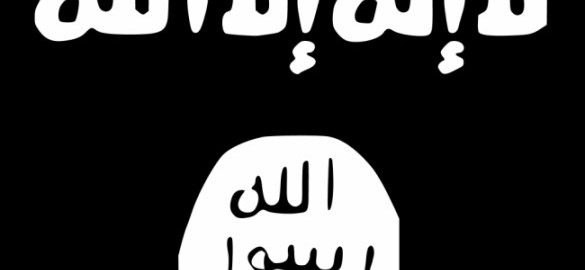
“Daesh”, sometimes spelled Daiish or Da’esh, it an acronym for “Dawlat al-Islamiyah f’al-Iraq wa al-Sham” – or in its Arabaic script form, الدولة الإسلامية في العراق والشام.
That phrase is the Arabic for “Islamic State in Iraq and the Levant”. “al-Sham” refers to Greater Syria, an area referred to in English as “the Levant”.
Who uses the term ‘Daesh’?
The French government has been referring to Isis as “Daesh” for some time. Since September 2014 it has been official French policy to use “Daesh” to refer to the group. The country’s foreign minister Laurent Fabius also asked journalists to use the phrase.
The term is the most widely used in Arab countries to refer to the group. In a speech at the weekend US secretary of state John Kerry used the term, possibly signalling a change in US policy.
What is the politics like around the different names?
Daesh, when spoken, sounds similar to the Arabic words for “the sowers of dischord” (Dahes) or “one who crushes underfoot” (Daes). It thus has negative connotations.
Islamic State, which the group changed its name to most recently, is an attempt by Isis to identify itself with the wider religion of Islam.
It is also supposed to make it sound more international than Isis or Isil, which refer to specific geographic areas.
Key Events & Deaths on this day in Northern Ireland Troubles
2nd December
————————————–
Thursday 2 December 1971
A teenage girl died four days after being shot during a gun attack on members of the Royal Ulster Constabulary (RUC).
Tuesday 2 December 1975
Two Protestant civilians were shot dead by Republican paramilitaries in the Dolphin Restaurant, Strand Road, Derry.
Sunday 2 December 1984
Enter a caption
A poster produced by Republicans warning people about the operation of undercover British Army Intelligence units
——————————————————-
An undercover British soldier, believed to be a member of the Special Air Service (SAS), and two members of the Irish Republican Army (IRA) were killed in an exchange of gun fire near Kesh, County Fermanagh.
Wednesday 2 December 1987
James Molyneaux, then leader of the Ulster Unionist Party (UUP), and Ian Paisley, then leader of the Democratic Unionist Party (DUP), again met Tom King, then Secretary of State for Northern Ireland, in an on-going series of ‘talks about talks’.
Monday 2 December 1991
The Anglo-Irish Intergovernmental Conference (AIIC) held a meeting in Dublin, Republic of Ireland. One of the outcomes of the meeting was a suggestion by the AIIC that there should be a single railway authority for the whole of Ireland.
Wednesday 2 December 1992
There was a series of 46 bomb hoaxes in Belfast and Lisburn, County Antrim.
Thursday 2 December 1993
Sinn Féin (SF) publicly released more information on the secret talks between the British government and the Republican Movement. Martin McGuinness, the Vice-President of Sinn Féin (SF), claimed that the British government had begun the contacts in 1990.
Saturday 2 December 1995
It was announced that 600 British soldiers serving with 45 Royal Marine Commando in Fermanagh had left Northern Ireland. The overall troop level in Northern Ireland was reported as being 17,000.
Tuesday 2 December 1997
The Royal Ulster Constabulary (RUC) announced that all day-time foot patrols by the British Army were to be withdrawn from all parts of Belfast.
George Mitchell, then Chairman of the multi-party talks, said that the negotiations were getting down to “brass tacks”. His comment followed the introduction a system whereby each of the parties would be represented by two delegates, instead of the pervious five, at future discussions. Hugh Smyth, a Progressive Unionist Party (PUP) councillor, said that Sinn Féin (SF) should be given a share of posts on Belfast City Council
Wednesday 2 December 1998
Tony Blair, then British Prime Minister, travelled to Belfast to try to aid the search for a deal on the issue of the setting up of departments and the North-South Ministerial Council. [By the time Blair left a number of commentators felt that agreement had been reached. However, any understanding that may have been reached soon fell apart with the Ulster Unionist Party (UUP) being blamed for stalling on the issue.]
Thursday 2 December 1999
New Devolved Government
Direct Rule came to an end as powers were devolved to the Northern Ireland Assembly (NIA).
[Devolution took effect as of midnight on 1 December 1999.]
At a meeting in Dublin at 9.00am the North-South Ministerial Council and the British-Irish Ministerial Council, as set out in the Good Friday Agreement, took effect. At the same time the Anglo-Irish Agreement (AIA) was replaced by the British-Irish Agreement. At 9.20am Articles 2 and 3 of the Irish Constitution were replaced by new Articles. Peter Mandelson, then Secretary of State for Northern Ireland, made a statement and David Andrews, then Irish Foreign Minister, also made a statement on the developments. At 3.00pm the new Executive of the Northern Ireland Assembly met for the first time. Present at the meeting were representatives of the Ulster Unionist Party (UUP), the Social Democratic and Labour Party (SDLP), and Sinn Féin (SF).
The Democratic Unionist Party (DUP) refused to attend. At 8.30pm the IRA issued a statement indicating that it would appoint a representative to meet the Decommissioning Body chaired by General de Chastelain.
[The new devolved government was suspended on midnight 11 February 2000 and direct rule re-introduced. The suspension covered the Northern Ireland Assembly, Executive, and other Institutions.]
Mary McAleese, then President of the Republic of Ireland, was in London for lunch with the Queen (Elizabeth II).
[There was speculation that the Queen might in the future visit the Republic of Ireland.]
Sunday 2 December 2001
A Catholic man was run down by a car as he stood on a pavement in the North Queen’s Street area of north Belfast. The car involved in the incident was found burnt out in the Loyalist Tigers Bay area. The man received head injuries, was knocked unconscious and was taken to hospital.
Eoin O’Brion, then a Sinn Féin (SF) councillor, said that it was a blatant attempt by Loyalist paramilitaries to murder a Catholic. There were disturbances in the Whitewell area of north Belfast. Catholic residents claimed that a Loyalist gang had attacked their homes. Police moved into the area and made two arrests. Police Service of Northern Ireland (PSNI) officers arrested four men who were travelling by car across the Foyle Bridge in Derry. The police said that several “items” were recovered. The bridge was closed for a while.
There was a special service of thanksgiving for the “service, dedication, sacrifice and leadership” of the Royal Ulster Constabulary (RUC). The service was held at St Anne’s Cathedral in Belfast and led by Robin Eames (Dr), then Archbishop of Armagh.
———————————————————————————
Remembering all innocent victims of the Troubles
Today is the anniversary of the death of the following people killed as a results of the conflict in Northern Ireland
“To live in hearts we leave behind is not to die
– Thomas Campbell
To the innocent on the list – Your memory will live forever
– To the Paramilitaries –
There are many things worth living for, a few things worth dying for, but nothing worth killing for.
10 People lost their lives on the 2nd December between 1972 – 1993
————————————————————
02 December 1972 Patrick Benstead, (23)
Catholic Status: Civilian (Civ),
Killed by: non-specific Loyalist group (LOY)
Found shot in entry, off Crossley Street, Belfast.
————————————————————
02 December 1972 Sandra Meli, (26)
Protestant Status: Civilian (Civ),
Killed by: non-specific Loyalist group (LOY)
Shot at her home, Flora Street, off Beersbridge Road, Belfast. Her Catholic husband was the intended target.
————————————————————
02 December 1974 John Maddocks, (32)
nfNI Status: British Army (BA),
Killed by: Irish Republican Army (IRA)
Killed by booby trap bomb hidden in milk churn left in field, while on British Army (BA) foot patrol, Gortmullan, near Derrylin, County Fermanagh.
————————————————————
02 December 1975 Charles McNaul, (55)
Protestant Status: Civilian (Civ),
Killed by: Irish National Liberation Army (INLA)
Shot while sitting in Dolphin Restaurant, Strand Road, Derry.
————————————————————
02 December 1975 Alexander Mitchell, (46)
Protestant Status: Civilian (Civ),
Killed by: Irish National Liberation Army (INLA)
Shot while sitting in Dolphin Restaurant, Strand Road, Derry.
Killed by: Irish Republican Army (IRA)
Shot while driving school bus, which had stopped to let passengers alight, Annaghmore, near Coalisland, County Tyrone.
————————————————————
02 December 1984 Alistair Slater, (28)
nfNI Status: British Army (BA),
Killed by: Irish Republican Army (IRA)
Shot during gun battle between undercover British Army (BA) unit and Irish Republican Army (IRA) unit, Drumrush, near Kesh, County Fermanagh.
————————————————————
02 December 1984 Antoine MacGiolla Bhrighde, (27)
Catholic Status: Irish Republican Army (IRA),
Killed by: British Army (BA)
Shot during gun battle between undercover British Army (BA) unit and Irish Republican Army (IRA) unit, Drumrush, near Kesh, County Fermanagh.
————————————————————
02 December 1984 Kieran Fleming, (26)
Catholic Status: Irish Republican Army (IRA),
Killed by: not known (nk)
Drowned in Bannagh River, near Kesh, County Fermanagh. Escaping from gun battle between undercover British Army (BA) unit and Irish Republican Army (IRA) unit. His body found in the river on 21 December 1984.
————————————————————
02 December 1993 Paul Garrett, (23)
nfNI Status: British Army (BA),
Killed by: Irish Republican Army (IRA)
Shot by sniper, while on British Army (BA) foot patrol, Victoria Street, Keady, County Armagh.
————————————————————
This is simply the story of a boy trying to grow up, survive, thrive, have fun & discover himself against a backdrop of events that might best be described as ‘explosive’, captivating & shocking the world for thirty long years.
The explosion caused the building to collapse, killing fifteen Catholic civilians—including two children—and wounding seventeen more. It was the deadliest attack in Belfast during the Troubles.
————————————–
McGurk’s Bar Bombing: Loss of Innocence
————————————–
Despite evidence to the contrary, the British security forces asserted that a bomb had exploded prematurely while being handled by Irish Republican Army (IRA) members inside the pub, implying that the victims themselves were partly to blame. A report later found that the police (Royal Ulster Constabulary) were biased in favour of this view, and that this hindered their investigation.
The victims’ relatives allege that the security forces deliberately spread disinformation to discredit the IRA. In 1977, UVF member Robert Campbell was sentenced to life imprisonment for his part in the bombing and served fifteen years.
The bombing sparked a series of tit-for-tat bombings and shootings by loyalists and republicans, which would help make 1972 the bloodiest year of the conflict.
McGurk’s Bar bombing
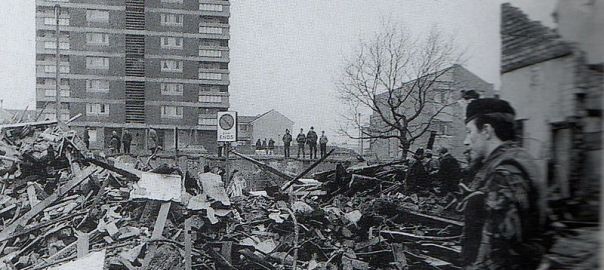
A British soldier surveys the aftermath of the bombing
The views and opinions expressed in these pages/documentaries are soley intended to educate and provide background information to those interested in the Troubles of Northern Ireland. They in no way reflect my own opinions and I take no responsibility for any inaccuracies or factual errors.
McGurk’s (also called the Tramore Bar) was a two-storey public house on the corner of North Queen Street and Great George’s Street, in the New Lodge area to the north of Belfast city centre. This was a mainly Irish nationalist and Catholic neighbourhood, and the pub’s regular customers were from the community.
The pub was owned by Patrick and Philomena McGurk, who lived on the upper floor with their four children.
During 1971, the violence gradually worsened. There were daily bombings and shootings by republicans, loyalists and the security forces. During the first two weeks of December, there were about 70 bombings and about 30 people were killed.
On 2 December, three republican prisoners escaped from Crumlin Road prison, not far from McGurk’s. Security was tightened and there was a heavy RUC and British Army presence in the area over the next two days.
Eyewitnesses asserted that the checkpoints around McGurk’s were removed just an hour before the attack.
The bombing
Plaque near the site of the bombing listing those killed
On the evening of Saturday 4 December 1971, a four-man UVF team met in the Shankill area of Belfast and were ordered to bomb a pub on North Queen Street. According to the only convicted bomber—Robert Campbell—they were told not to return until the job was done. Campbell said that their target had not been McGurk’s, but another pub nearby.
It is believed this was a pub called The Gem, which was allegedly linked to the Official IRA. The 50 pounds (23 kg) bomb was disguised as a brown parcel, which they placed in a car and drove to their target. Campbell says they stopped near The Gem at about 7:30pm, but could not gain access to it because there were security guards outside.
After waiting for almost an hour, they drove a short distance to McGurk’s. At about 8:45pm, one of them placed the bomb in the porch entrance on Great George’s Street and rushed back to the car.
It exploded just moments after they drove off. Campbell implied that McGurk’s had been chosen only because it was:
“the nearest Catholic pub”.
The blast caused the building to collapse. Bystanders immediately rushed to free the dead and wounded from the rubble. Firefighters, paramedics, police and soldiers were quickly on the scene. Fifteen Catholic civilians had been killed—including two children and a further seventeen wounded. The rescue effort lasted many hours.
The Innocent Victims
——————————————–
04 December 1971
Philomena McGurk, (46)
Catholic Status: Civilian (Civ),
Killed by: Ulster Volunteer Force (UVF) Killed in bomb attack on McGurk’s bar, junction of Gt. George’s Street and North Queen Street, New Lodge, Belfast.
——————————————–
04 December 1971
Maria McGurk, (14)
Catholic Status: Civilian (Civ),
Killed by: Ulster Volunteer Force (UVF) Killed in bomb attack on McGurk’s bar, junction of Gt. George’s Street and North Queen Street, New Lodge, Belfast.
——————————————–
04 December 1971
James Cromie, (13)
Catholic Status: Civilian (Civ),
Killed by: Ulster Volunteer Force (UVF) Killed in bomb attack on McGurk’s bar, junction of Gt. George’s Street and North Queen Street, New Lodge, Belfast.
——————————————–
04 December 1971 John Colton, (49)
Catholic Status: Civilian (Civ),
Killed by: Ulster Volunteer Force (UVF) Killed in bomb attack on McGurk’s bar, junction of Gt. George’s Street and North Queen Street, New Lodge, Belfast.
——————————————–
04 December 1971
Thomas McLaughlin, (55)
Catholic Status: Civilian (Civ),
Killed by: Ulster Volunteer Force (UVF) Killed in bomb attack on McGurk’s bar, junction of Gt. George’s Street and North Queen Street, New Lodge, Belfast.
——————————————–
04 December 1971 David Milligan, (53)
Catholic Status: Civilian (Civ),
Killed by: Ulster Volunteer Force (UVF) Killed in bomb attack on McGurk’s bar, junction of Gt. George’s Street and North Queen Street, New Lodge, Belfast.
——————————————–
04 December 1971
James Smyth, (58)
Catholic Status: Civilian (Civ),
Killed by: Ulster Volunteer Force (UVF) Killed in bomb attack on McGurk’s bar, junction of Gt. George’s Street and North Queen Street, New Lodge, Belfast.
——————————————–
04 December 1971
Francis Bradley, (62)
Catholic Status: Civilian (Civ),
Killed by: Ulster Volunteer Force (UVF) Killed in bomb attack on McGurk’s bar, junction of Gt. George’s Street and North Queen Street, New Lodge, Belfast.
——————————————–
04 December 1971
Thomas Kane, (48)
Catholic Status: Civilian (Civ),
Killed by: Ulster Volunteer Force (UVF) Killed in bomb attack on McGurk’s bar, junction of Gt. George’s Street and North Queen Street, New Lodge, Belfast.
——————————————–
04 December 1971
Kathleen Irvine, (53)
Catholic Status: Civilian (Civ),
Killed by: Ulster Volunteer Force (UVF) Killed in bomb attack on McGurk’s bar, junction of Gt. George’s Street and North Queen Street, New Lodge, Belfast.
——————————————–
04 December 1971
Philip Garry, (73)
Catholic Status: Civilian (Civ),
Killed by: Ulster Volunteer Force (UVF) Killed in bomb attack on McGurk’s bar, junction of Gt. George’s Street and North Queen Street, New Lodge, Belfast.
——————————————–
04 December 1971
Edward Kane, (29)
Catholic Status: Civilian (Civ),
Killed by: Ulster Volunteer Force (UVF) Killed in bomb attack on McGurk’s bar, junction of Gt. George’s Street and North Queen Street, New Lodge, Belfast.
——————————————–
04 December 1971
Edward Keenan, (69)
Catholic Status: Civilian (Civ),
Killed by: Ulster Volunteer Force (UVF) Killed in bomb attack on McGurk’s bar, junction of Gt. George’s Street and North Queen Street, New Lodge, Belfast.
——————————————–
04 December 1971
Sarah Keenan, (58)
Catholic Status: Civilian (Civ),
Killed by: Ulster Volunteer Force (UVF) Killed in bomb attack on McGurk’s bar, junction of Gt. George’s Street and North Queen Street, New Lodge, Belfast.
——————————————–
04 December 1971
Robert Spotswood, (38)
Catholic Status: Civilian (Civ),
Killed by: Ulster Volunteer Force (UVF) Killed in bomb attack on McGurk’s bar, junction of Gt. George’s Street and North Queen Street, New Lodge, Belfast.
——————————————–
Within two hours of the blast, a sectarian clash had erupted nearby at the New Lodge–Tiger’s Bay interface. The British Army and RUC moved in and a gun battle developed.
——————————————
Enter a caption
Major Jeremy Snow
In a despicable act the IRA shot Major Jeremy Snow as he attended the scene. He died of his injuries four days later on the 8th December .
Jeremy Snow was at the Royal Fusiliers headquarters a short distance away from the scene of the explosion when the bomb went off. Such was the strength of the blast that the soldiers initially thought that it was their building which had come under attack. Snow began organising the rescue operation but quickly handed this over to Major Mike Dudding who, using a loudhailer, organised a human chain of volunteers to remove the rubble.
At around 10pm a crowd of Protestants began gathering in the New Lodge/Tiger’s Bay area intent on mocking the Catholic victims of the blast. Before long a Catholic crowd of around 100 gathered and the two groups began trading insults and throwing stones at one another. Sensing trouble, Jeremy Snow called up a reserve platoon and, having decided that the crowds were getting out of hand, decided to separate the two groups at North Queen Street. At 10.30pm, as he alighted from his vehicle at Hillman Street a quarter of a mile from the scene of the bombing, he was shot and wounded in the neck by an Irish Republican Army sniper. He was placed on a stretcher and taken by armoured ambulance to the Royal Victoria Hospital. His wife was at his bedside when he died from his wounds four days later.
One of the soldiers from his Company wrote:-
“Major Snow was my company commander. Charlie Company, 2nd Battalion Royal Regiment of Fusiliers. I was with the Major the day of the incident. We were plodding along, like you do, when a civilian asked for directions. As Major Snow crossed the road to go to him, he was gunned down.
He was a lovely bloke, a real gent and we all had the utmost respect for him. We were all gutted when it happened. I met my wife to be at his memorial service and we have been together for 30 years and to this day we do not forget the sacrifice he made. He was one of the many casualties we had to bear to make N.I. the safe and secure place it is today… I salute you Sir…”
He was Mentioned in Despatches for his services in Northern Ireland which was announced by St James’s Palace on the 23rd of May 1972.
—————————————
A British Army officer, Major Jeremy Snow, was shot by the IRA on New Lodge Road and died of his wounds on 8 December. Two RUC officers and five civilians were also wounded by gunfire. Eventually, five companies of troops were sent into the district and they searched almost 50 houses.
Meanwhile, the UVF team had driven to a nearby pickup point where they dumped their car. They walked to the area of St Anne’s Cathedral and were picked up by another. They were driven back to the Shankill and met the man who had ordered the attack in an Orange Hall, telling him that:
“the job has been done”.
Among those killed were Philomena and Maria McGurk, wife and 12-year-old daughter of the pub owner Patrick McGurk. Patrick and his three sons were seriously injured. Shortly after the attack, McGurk appeared on television calling for no retaliation:
“It doesn’t matter who planted the bomb. What’s done can’t be undone. I’ve been trying to keep bitterness out of it.”
This is simply the story of a boy trying to grow up, survive, thrive, have fun & discover himself against a backdrop of events that might best be described as ‘explosive’, captivating & shocking the world for thirty long years.


.png)






 belfastchildis.com