Tag Archives: UVF

11th June – Deaths & Events in Northern Ireland Troubles

Key Events & Deaths on this day in Northern Ireland Troubles

11th June

————————————

Sunday 11 June 1972

There was a gun battle between Loyalist and Republican paramilitaries in the Oldpark area of Belfast.

There were shooting incidents in other areas of Belfast and Northern Ireland.

In all, two Catholics, a Protestant, and a British soldier were shot and killed.

Colonel Gaddafi announced that he had supplied arms to “revolutionaries” in Ireland.

Wednesday 11 June 1980

The Irish Republican Army (IRA) issued a statement that threatened to renew attacks on prison officers.

Thursday 11 June 1981

A general election was held in the Republic of Ireland.

[When counting was completed a minority government was formed between a coalition of Fine Gael (FG) and Labour. On 30 June 1981 Garret FitzGerald replaced Charles Haughey as Taoiseach (Irish Prime Minister).

Two H-Block prisoners were elected to the Dáil.]

Saturday 11 June 1983

In the new British cabinet announced by Margaret Thatcher, then British Prime Minister, James Prior, was reappointed as Secretary of State for Northern Ireland.

Wednesday 11 June 1986

Five people, one of whom was Patrick Magee, were found guilty at the ‘Old Bailey’ court in London of conspiring to cause explosions in Britain including the Brighton bomb on 12 October 1984.

[Magee later received eight life sentences.]

Thursday 11 June 1987

General Election

A general election was held across the United Kingdom (UK).

The Conservative Party was returned to power. In Northern Ireland the Social Democratic and Labour Party (SDLP) increased their vote and their share of the poll.

The overall Unionist vote fell as did the vote of Sinn Féin (SF).

Enoch Powell, formally an Ulster Unionist Party (UUP) Member of Parliament (MP), lost his South Down seat to Eddie McGrady of the Social Democratic and Labour Party (SDLP).

Friday 11 June 1993

Queen Elizabeth paid a visit to Northern Ireland.

John Hume, then leader of the Social Democratic and Labour Party (SDLP), held another meeting with Gerry Adams, then President of Sinn Féin (SF). Amnesty International criticised certain aspects of emergence powers in Northern Ireland.

Tuesday 11 June 1996

The second day of the Stormont talks were again spent in argument over the appointment of George Mitchell as chair and the extent of his “over-arching” role.

The Ulster Unionist Party (UUP) agreed to a compromise which reduced the role of George Mitchell but which let talks proceed.

Wednesday 11 June 1997

Robert (‘Basher’) Bates (48)
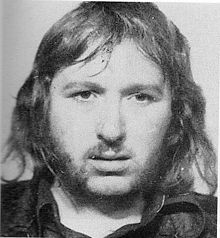
Robert Basher Bates

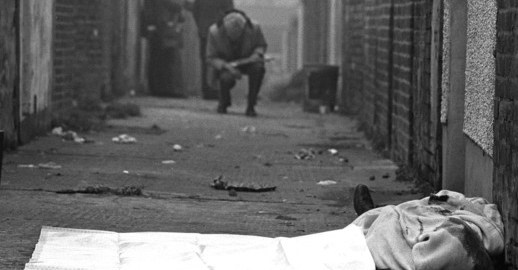
a former leading member of the Ulster Volunteer Force (UVF) ‘Shankill Butchers’ gang, was shot dead while opening the Ex-Prisoners Information Centre on Woodvale Road, Belfast.

Initially Republican paramilitaries were blamed for the killing but all the groups denied any involvement, and it later became clear that Loyalist paramilitaries were responsible.

Bates had pleaded guilty in January 1979 to 10 murders.

Most of the victims were Catholics who were abducted, tortured, and killed with butcher knives, hatchets and sometimes guns.

One of Bates’ victims was James Moorehead (30) who at the time was a member of the Ulster Defence Association (UDA). It was believed that Bates was killed in retaliation for his part in the murder of Moorehead.

See Robert “Basher” Bates

See Shankill Butchers

See Lenny Murphy

The Queen paid a visit to Northern Ireland and travelled to Dungannon, Belfast, and Hillsborough Castle where a garden reception for 2,000 people was held.

The police and customs officials carried out a series of raids in Britain and Ireland and broke up a drugs gang which had links to the UDA. Police seized £6 million pounds of property, £2 million pounds of illicit alcohol, and £500,000 in cash.

Thursday 11 June 1998

Three shots were fired at a Sinn Féin (SF) election worker in the Markets area of south Belfast.

[Republicans claimed that the attack was carried out by “Group B” a remnant of the Official Irish Republican Army (OIRA). Residents reported increased friction in west and south Belfast between supporters of the Provisionals and Officials in recent weeks.]

Friday 11 June 1999

Tony Blair, then British Prime Minister, intensified discussions to try to resolve the issues preventing the establishment of an Executive in Northern Ireland.

The Police Authority of Northern Ireland warned that the Royal Ulster Constabulary (RUC) did not have sufficient funds to meet the additional costs in policing the violence surrounding the Drumcree dispute.


——————————————

Remembering all innocent victims of the Troubles

Today is the anniversary of the death of the following people killed as a results of the conflict in Northern Ireland

“To live in hearts we leave behind is not to die

– Thomas Campbell

To the innocent on the list – Your memory will live forever

– To the Paramilitaries –

There are many things worth living for, a few things worth dying for, but nothing worth killing for.

9 People lost their lives on the 11th   June between 1972 – 1997

——————————————

11 June 1972
John Madden  (43)

Catholic
Status: Civilian (Civ),

Killed by: non-specific Loyalist group (LOY)
Shot outside his shop, Oldpark Road, Belfast.

——————————————

11 June 1972


Joseph Campbell  (16)

Catholic
Status: Irish Republican Army Youth Section (IRAF),

Killed by: British Army (BA)
Shot during gun battle, Eskdale Gardens, Ardoyne, Belfast.

——————————————

11 June 1972


Norman McGrath  (18)

Protestant
Status: Civilian (Civ),

Killed by: British Army (BA)
Shot from passing British Army (BA) Armoured Personnel Carrier as he walked along Alloa Street, Lower Oldpark, Belfast.

——————————————

11 June 1972
Peter Raistric  (18)

nfNI
Status: British Army (BA),

Killed by: Irish Republican Army (IRA)
Shot by sniper while in Brooke Park British Army (BA) base, Derry.

——————————————

11 June 1975
Kenneth Conway   (20)

Protestant
Status: Civilian (Civ),

Killed by: not known (nk)
Died one day after being shot at the junction of Woodvale Road and Glenvale Street, Shankill, Belfast.

——————————————

11 June 1976
William Palmer   (50)

Protestant
Status: Civilian (Civ),

Killed by: non-specific Republican group (REP)
Died three days after being shot at his home, Milltown Avenue, Derriaghy, near Belfast

——————————————

11 June 1976
Edward Walker  (20)

Protestant
Status: Ulster Defence Association (UDA),

Killed by: Royal Ulster Constabulary (RUC)
Shot while travelling in stolen car along Doagh Road, Newtownabbey, County Antrim

——————————————

11 June 1982


David Reeves  (24)

Protestant
Status: Royal Ulster Constabulary (RUC),

Killed by: Irish Republican Army (IRA)
Killed by booby trap bomb while searching garage, Carranbane Walk, Shantallow, Derry.

——————————————

11 June 1997

Robert Bates  (48)

Protestant
Status: Ulster Volunteer Force (UVF),

Killed by: Ulster Defence Association (UDA)
Shot, at his workplace, Ex-prisoners Interpretative Centre, Woodvale Road, Shankill, Belfast. Ulster Defence Association / Ulster Volunteer Force feud.

See Shankill Butchers

See Lenny Murphy

——————————————

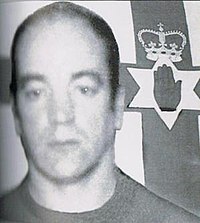
Robert “Basher” Bates 12th Dec 1948 – 11th June 1997. Shankill Butcher

Robert William Bates

” Basher “

Robert William Bates (nicknamed “Basher”) (12 December 1948 – 11 June 1997) was an Ulster loyalist from Belfast, Northern Ireland. He was a member of the Ulster Volunteer Force and the infamous Shankill Butchers gang, led by Lenny Murphy.

Shankill Butchers 

Shankill Butchers.

See Shankill Butchers

Disclaimer

The views and opinions expressed in this post and page are soley intended to educate and provide background information to those interested in the Troubles of Northern Ireland.

They in no way reflect my own opinions and I take no responsibility for any inaccuracies or factual errors


Bates was born into an Ulster Protestant family and grew up in the Shankill Road area of Belfast. He had a criminal record dating back to 1966,  and later became a member of the Ulster loyalist paramilitary organisation, the Ulster Volunteer Force (UVF).

Bates, employed as a barman at the Long Bar, was recruited into the Shankill Butchers gang in 1975 by its notorious ringleader, Lenny Murphy.

The gang used The Brown Bear pub, a Shankill Road drinking haunt frequented by the UVF, as its headquarters. Bates, a “sergeant” in the gang’s hierarchy, was an avid participant in the brutal torture and savage killings perpetrated against innocent Catholics after they were abducted from nationalist streets and driven away in a black taxi owned by fellow Shankill Butcher, William Moore.

William moore.jpg
William Moore

The killings typically involved grisly-throat slashings preceded by lengthy beatings and torture. Bates was said to have been personally responsible for beating James Moorhead, a member of the Ulster Defence Association, to death on 30 January 1977 and to have played a central role in the kidnapping and murder of Catholic Joseph Morrisey three days later. He also killed Thomas Quinn, a derelict, on 8 February 1976 and the following day was involved in shooting dead Archibald Hanna and Raymond Carlisle, two Protestant workmen that Bates and Murphy mistook for Catholics.

Martin Dillon revealed that Bates was also one of the four UVF gunmen who carried out a mass shooting in the Chlorane Bar attack in Belfast city centre on 5 June 1976. Five people (three Catholics and two Protestants) were shot dead. The UVF unit had burst into the pub in Gresham Street and ordered the Catholics and Protestants to line up on opposite ends of the bar before they opened fire. He later recounted his role in the attack to police; however, he had claimed that he never fired any shots due to his revolver having malfunctioned.

Forensics evidence contradicted him as it proved that his revolver had been fired inside the Chlorane Bar that night. Lenny Murphy was in police custody at the time the shooting attack against the Chlorane Bar took place.

Bates was arrested in 1977, along with Moore and other “Shankill Butcher” accomplices.

Gerard McLaverty and Joseph Morrissey

His arrest followed a sustained attack by Moore and Sam McAllister on Catholic Gerard McLaverty, after which they dumped his body, presuming him dead. However McLaverty survived and identified Moore and McAllister to the Royal Ulster Constabulary who drove him up and down the Shankill Road during a loyalist parade until he saw his attackers. During questioning both men implicated Bates, and other gang members, leading to their arrests.

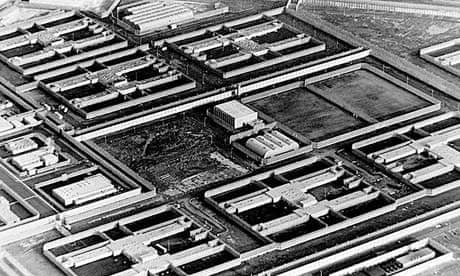
Following a long period spent on remand, he was convicted in February 1979 of murder related to the Shankill Butcher killings and given ten life sentences, with a recommendation by the trial judge, Mr Justice O’Donnell, that he should never be released.

In prison

At the start of his sentence, Bates was involved in a series of violent incidents involving other inmates. Bates later claimed that he had perpetrated these acts in order to live up to his “Basher” nickname.

He served as company commander of the UVF inmates and became noted as stern disciplinarian.

However while in the Maze Prison, he was said to have “found God”, and as a result became a born-again Christian. He produced a prison testimony, which was later reprinted in The Burning Bush, and, after publicly advocating an end to violence, was transferred to HMP Maghaberry.

Brendan hughes.jpg
Brendan Hughes

In prison, Bates formed a friendship with Provisional IRA member and fellow detainee Brendan Hughes. Bates foiled a UVF assassination plot on Hughes.

Early release and death


Ex-Prisoners Interpretative Centre, Woodvale Road, where Bates worked after his release and where he was shot

In October 1996, 18 months prior to the signing of the Good Friday Agreement, Bates was cleared for early release by the Life Sentence Review Board. He was given the opportunity of participating in a rehabilitation scheme, spending the day on a work placement and returning to prison at night.

As he arrived for work in his native Shankill area of Belfast early on the morning of 11 June 1997,  Bates was shot dead by the son of a UDA man he had killed in 1977.

The killer identified himself to Bates as the son of his victim before opening fire. Bates had been working at the Ex-Prisoners Interpretative Centre (EPIC), a drop-in centre for former loyalist prisoners.

Bates’ killing had not been sanctioned by the UDA leadership but nevertheless they refused to agree to UVF demands that the killer should be handed over to them, instead exiling him from the Shankill. He was rehoused in the Taughmonagh area where he quickly became an important figure in the local UDA as a part of Jackie McDonald‘s South Belfast Brigade.

Bates’ name was subsequently included on the banner of a prominent Orange Lodge on the Shankill Road, called Old Boyne Island Heroes.

Relatives of Shankill butchers victims Cornelius Neeson condemned the banner, stating that:

“it hurts the memory of those the butchers killed”.

A fellow Lodge member and former friend of Bates defended the inclusion of his name to journalist Peter Taylor:

“I knew him very well and he’d been a personal friend for twenty or thirty years and to me he was a gentleman”.

He went on to describe him as having been:

“an easy-going, decent fellow, and as far as the Lodge is concerned, a man of good-standing”.

He was a buried in a Free Presbyterian Church of Ulster ceremony by Reverend Alan Smylie.

Bates’ funeral was attended by a large representation from local Orange Lodges.

Mairead Maguire, July 2009

Mairead Maguire was also amongst the mourners, arguing that Bates had “repented, asked for forgiveness and showed great remorse for what he had done”, whilst a memorial service held at the spot of his killing two days after the funeral was attended by Father Gerry Reynolds of Clonard Monastery

See Shankill Butchers

Shankill Butchers.

See Shankill Butchers

lennie murphy

See Lenny Murphy

——————————————–

Wednesday 11 June 1997

From killer to victim: Basher’s death sums up the futility of the Troubles

Robert “Basher” Bates, who was gunned down in Belfast yesterday, was an icon. To some he represented the very worst that the troubles has produced: to others he was testimony that even the most brutal terrorist might not be beyond redemption.

Two decades ago the 10 murders he was involved in were among the most barbaric ever seen. He shot some of his victims but others he killed in the most cruel fashion, he and his associates wielded butcher’s knives, axes and cleavers on random Catholic victims. The Shankill Butchers slaughtered human beings as one would animals.

The horror of those killings took Belfast to a new low. Yesterday his death conjured up the most appalling vista of all: that the IRA was intent on regenerating the troubles. The relief was palpable when it emerged that he had been killed not by the IRA but by a loyalist, in what is thought to have been personal revenge for the murder by Bates of a close relative, 20 years ago in a bar room brawl.

Basher Bates was one of hundreds of convicted killers released after serving an average of 15 years behind bars. There are hundreds of unsettled personal grudges in Northern Ireland: quite a few people know, or think they know, who killed their fathers or other loved ones. Yet this seems to have been the first personal revenge killing of a released prisoner.

While loyalist groups have accounted for close on 1,000 of the 3,500 victims of the Troubles, the ferocity and awfulness of the Shankill Butchers’ killings have remained in the public memory for two full decades.

A book dwelling on the graphic details has been a local bestseller for 20 years, and can still be picked up in many of the garage shops of Belfast. It was, for example, the favourite reading of Thomas Begley, the young IRA man who four years ago carried a bomb into a Shankill Road fish shop, killing himself and nine Protestants.

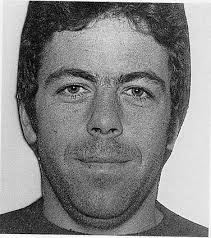
Bates was not the prime mover in the Shankill Butchers gang: that was UVF man Lennie Murphy, who was shot dead by the IRA in 1982. But he was one of the leading lights during their two-year reign of terror, and one photograph of him, looking like an unshaven, unkempt dullard, has remained lodged in the communal memory as a vision of a psychopathic killer.

The judge who gave him 16 life sentences for his killings told him, correctly, that his actions “will remain forever a lasting monument to blind sectarian bigotry.” When he told him he should remain behind bars for the rest of his natural life, society shuddered and hoped it had heard the last of Basher Bates.

But Northern Ireland has a scheme, not found in the rest of the UK, for the release of even the most notorious killers, and more than 300 loyalists and republicans have been quietly freed over the last decade. Many of these former lifers engross themselves, as Bates seemed to be doing, in community or welfare work.

As the years passed in jail, Bates was at first a difficult prisoner, then a troubled soul and finally a remorseful born-again Christian, praying fervently for forgiveness. One who knew him in prison said of him: “He’s now a shell of a man, very quiet and inoffensive in a bland kind of way. The hair has gone, he’s prematurely bald. He has found the Lord and he’s no threat to anyone.”

Basher Bates made a long and painful journey from merciless assassin to man of God. His personal odyssey seemed to be over: neither he nor anyone else could have foreseen the fateful circularity which in the end transformed him from killer to victim.


Buy Me A Coffee

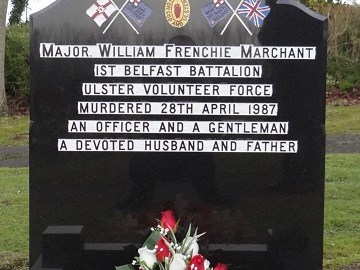
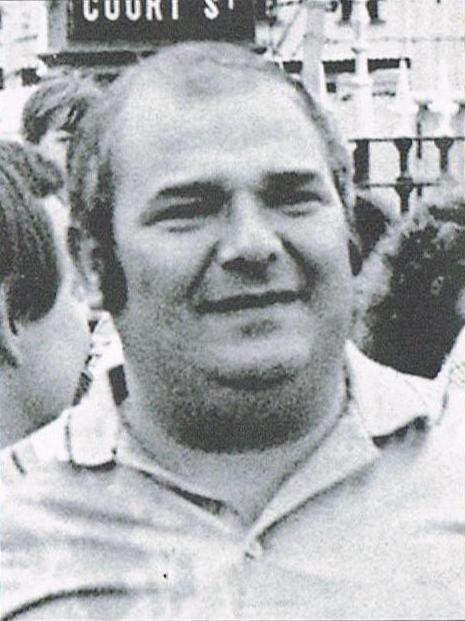
William “Frenchie” Marchant 1948 – 28 April 1987

William ” Frenchie ”  Marchant

Frenchie_Marchant

1948 – 1987


Disclaimer 

The views and opinions expressed in these pages/documentaries are soley intended to educate and provide background information to those interested in the Troubles of Northern Ireland. They in no way reflect my own opinions and I take no responsibility for any inaccuracies or factual errors.

William “Frenchie” Marchant (c. 1948 – 28 April 1987) was a Northern Irish loyalist and a high-ranking volunteer in the Ulster Volunteer Force (UVF).

He was on a Garda list of suspects in the 1974 Dublin car bombings which left a total of 26 people dead and close to 300 injured. Marchant was allegedly the leader of the Belfast UVF unit known as “Freddie and the Dreamers” which hijacked and stole the three cars which were used in the bombings.

Nine days after the bombings he was arrested and interned at the Maze Prison in relation to the bombings. When questioned by detectives regarding the latter he refused to answer. He was never brought to trial due to lack of evidence. Marchant held the rank of major in the UVF’s A Company, 1st Battalion Belfast Brigade. He was shot to death by a Provisional IRA volunteer from a passing car as he stood outside “The Eagle” chip shop below the offices where the UVF Brigade Staff had their headquarters on the Shankill Road.

Dublin car bombings

A green 1970 model Hillman Avenger was one of the hijacked cars used in the Dublin bombings. It exploded in Parnell Street, killing 10 people.
Marchant was born in Belfast, Northern Ireland in about 1948. He grew up in the Ulster loyalist Shankill Road neighbourhood and was brought up as a Protestant. Some time prior to 1974, he joined the Ulster Volunteer Force (UVF), an illegal loyalist paramilitary organisation. He held the rank of major in its A Company, 1st Battalion Belfast Brigade. Marchant’s nickname was “Frenchie”.


Dublin and Monaghan bombings victim

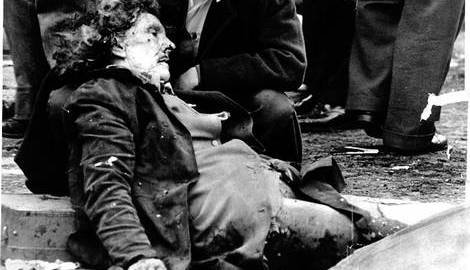
Two units from the UVF’s Belfast and Mid-Ulster Brigades exploded three no-warning car bombs in Dublin’s city centre on 17 May 1974, the third day of the Ulster Workers Council Strike.

This was a general strike in Northern Ireland called by hard-line unionists, who opposed the Sunningdale Agreement and the Northern Ireland Assembly which had proposed their sharing political power with nationalists and planned a role for the Republic of Ireland in the governance of Northern Ireland. The explosions occurred almost simultaneously during evening rush hour resulting in the deaths of 26 people, mostly young women; close to 300 people were injured, many maimed and scarred for life.

According to former British soldier and psychological warfare operative Colin Wallace, the bombings had been organised by Billy Hanna, the Mid-Ulster Brigade’s commander at the time.

The three cars used in the attacks had been stolen and hijacked that morning in Belfast by a UVF unit known as “Freddie and the Dreamers” (named after the 1960s English pop group) allegedly led by Marchant, and then, according to the 1993 Yorkshire Television documentary The Hidden Hand: The Forgotten Massacre, driven to a farm in Glenanne, County Armagh. This farm, which had been used to make and store the bombs, was owned by Royal Ulster Constabulary (RUC) reservist James Mitchell of the Glenanne gang.

See Dublin and Monaghan Bombings

———————————–

Dublin Monaghan Bombings 1974 – First Tuesday -1993

———————————–


After the cars were delivered to the waiting bomb unit, the latter drove them across the border down to the Coachman’s Inn pub carpark. Journalist Joe Tiernan suggested that the cars were driven directly to the North Dublin carpark, with only one stop in Portadown by one of the cars to collect David Alexander Mulholland, one of the alleged bombers.

Robin  “the Jackal ” Jackson


It was at the carpark that the three bombs, which had been transported in a chicken lorry by senior Mid-Ulster UVF member Robin “the Jackal” Jackson, were placed inside the boots of the cars by Hanna and Jackson. The cars – a metallic green 1970 model Hillman Avenger and blue Austin 1800 Maxi – that ended up in Parnell Street and South Leinster Street had been hijacked while the metallic blue mink Ford Escort which detonated in Talbot Street had been stolen from Belfast’s docks area. All three cars had retained their original registration numbers.

The Hidden Hand: The Forgotten Massacre named Marchant as having been on a Garda Síochána list of suspects as the leader of the gang which obtained the bomb cars.[12]

Ninety minutes after the Dublin blasts, another car bomb exploded in Monaghan, causing a further seven deaths. A detective from Dublin’s Store Street Garda Station received confidential information that Marchant had masterminded both the Dublin and Monaghan attacks.

On 26 May, he was arrested by the Northern Ireland security forces under the Northern Ireland (Emergency Provision) Act 1974 and interned at the Maze Prison on an Interim Custody Order partly on suspicion of having participated in the car bombings. He was interrogated by detectives but refused to reply to any questions relating to the Dublin bombings.

Marchant and the others who had also been interned as suspects in the attacks, were never brought to trial due to lack of evidence. The RUC Special Branch, in a reply dated 23 July 1974 to an earlier Garda enquiry regarding Marchant, stated that Marchant “was our guest for a number of hours (and CID) but with negative result”.

The Barron Report which was the findings of the official investigation into the car bombings commissioned by Irish Supreme Court Justice Henry Barron confirmed that Marchant was named in the Garda files as the leader of the gang which provided the bomb cars.  Colin Wallace briefed the media without attribution, identifying Marchant as the person responsible for the car hijackings and theft, based on his own information.

In a written statement to Justice For the Forgotten (an organisation of victims and relatives seeking justice for the Dublin and Monaghan bombings), Wallace maintained that Marchant was “identified to [British] Army Intelligence as a Special Branch source being run by a named officer”. When queried by the organisation’s legal team, Wallace qualified the statement by adding:

“That’s right, that was my belief…there were a number of Special Branch people who at this time appeared to have very close links with various loyalist groups. I’m not saying for good or ill, but certainly had close links with key loyalists. Marchant may well have been an informant, but I don’t know”.


Peter Taylor


Many years later, journalist Peter Taylor questioned Progressive Unionist Party politician and former senior Belfast UVF member David Ervine about UVF motives for bombing Dublin in 1974. He replied they [UVF] were “returning the serve”. Although Ervine said he had nothing to do with the bombings, he said they were carried out to make Catholics in the Republic suffer as Protestants in Northern Ireland had been suffering as the result of the IRA bombing campaign.

As of 2015, nobody has ever been convicted of the Dublin and Monaghan bombings.

Supergrass trials

In the mid-1980s Marchant was one of a number of leading UVF figures arrested on the evidence of William “Budgie” Allen, a UVF member who turned supergrass and provided evidence on the activities of a number of his fellow members.

Initially held in 1983, Marchant was granted bail in order to marry although he failed to return and was eventually rearrested after a high speed pursuit through the Shankill Road.

Based on Allen’s evidence Marchant faced a number of charges, including the attempted murder of a member of Gerry Adams’ family. However, although he was held in custody for eighteen months, Marchant was released from prison in 1985 after the Allen trial collapsed.

Although he had appeared before Belfast’s Crumlin Road Crown Court, the case against him and the others had collapsed when the judge decided Allen’s evidence was “”totally unreliable”. Allen was declared persona non grata by the UVF, who announced that he would be killed if he left his hiding place in England, although Marchant surprisingly announced that he personally forgave Allen.

Killing

 Marchant commemorated, along with Trevor King and Davy Hamilton, on the Shankill Road at the corner of Spier’s Place. Marchant was shot dead by IRA gunmen from a passing car as he stood outside “The Eagle” chip shop on the crowded Shankill Road on 28 April 1987. The UVF Brigade Staff had their headquarters in the rooms above the shop.
The shooting took place close to the offices of the Progressive Unionist Party (PUP). Marchant’s fatal shooting was in retaliation for the UVF’s killing of Larry Marley, a close friend of Sinn Féin President Gerry Adams and a senior IRA member from Ardoyne, less than a month before.
The IRA claimed in a statement that Marchant had been directly involved in the killing of Marley.
On 1 May 1987, Marchant was given a full UVF paramilitary funeral.  The address given at his funeral service, which denounced all paramilitary organisations and their acts of violence, was afterwards praised by Roman Catholic bishop Cathal Daly.
Marchant’s widow later gave her permission for their son to go to the USA for an ecumenical student exchange visit.
George Seawright, Independent Unionist candidate, June 1987, UK General Election, 19870603GS1 Copyright Image from Victor Patterson, 54 Dorchester Park, Belfast, UK, BT9 6RJ Tel: +44 28 9066 1296 Mob: +44 7802 353836 Voicemail +44 20 8816 7153 Skype: victorpattersonbelfast Email: victorpatterson@me.com Email: victorpatterson@ireland.com (back-up) IMPORTANT: If you wish to use this image or any other of my images please go to www.victorpatterson.com and click on the Terms & Conditions. Then contact me by email or phone with the reference number(s) of the image(s) concerned.

See George Seawright

George Seawright, a member of Belfast City Council who also maintained clandestine UVF membership, stated in the aftermath of Marchant’s shooting that he had “no hesitation in calling for revenge and retribution”. Several months after Marchant’s shooting, the UVF sought to avenge his death with an attempt on the life of Anthony “Booster” Hughes, a suspected IRA man from Ardoyne.

According to author and journalist Martin Dillon, Marchant’s daily movements leading up to his death had been unpredictable and erratic; this indicated the possibility that just before his shooting someone had alerted the IRA by telephone, advising them of Marchant’s presence on the Shankill Road.

The IRA would normally have kept a hit squad on standby in a neighbourhood close to
where their intended target was likely to be.
See John Bingham
Marchant’s killing was the third assassination carried out in the 1980s by the IRA against senior UVF members. The UVF conducted an internal inquiry in an attempt to establish whether someone within the organisation had supplied information to the IRA which had led to the killings of Marchant and the other two: Lenny Murphy and John Bingham.

Although the inquiry revealed that Marchant – as well as Murphy and Bingham – had quarrelled with powerful West Belfast UDA fund-raiser James Pratt Craig before their deaths, the UVF Brigade Staff did not consider the evidence sufficient to warrant an attack against Craig, who ran a large protection racket.

According to Dillon, Marchant had been due to meet Craig outside “The Eagle” before he was shot dead. Instead of getting out of the car at the chip shop where Marchant waited, Craig got out at the Inter-City furniture shop on the corner of Conway Street. There he engaged in conversation with another person for five minutes. Within the five minutes, Marchant was gunned down just 50 yards away. In October 1988, Craig was shot to death in an East Belfast pub by the UDA (using their cover name Ulster Freedom Fighters) for “treason”, claiming that he had been involved in the death of UDA leader John McMichael, who was blown up the previous December in a booby-trap car bomb planted by the IRA.

Steve Bruce disputes the claim that Craig was involved in Marchant’s death and quotes another (anonymous) UVF member who stated that Marchant was “like a bloody cigar store Indian”, spending long periods standing outside the PUP headquarters taking to various people.

At the junction of Spier’s Place and the Shankill Road, there is a mural and memorial plaque commemorating Marchant

Proud to be a Loyalist – But I don’t hate Catholic’s

I am 

Unashamedly Proud of My Loyalist and British Heritage.

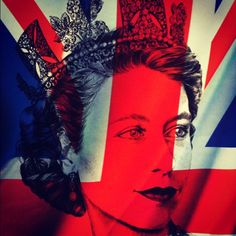
 queen union jack.jpg

In fact I want the world to know that despite what loony lefties and followers of Corbyn think – its perfectly normal to take pride in our country and celebrate and embrace our long and glorious history.

—————————-

Someone emailed me yesterday after visiting my website and praised me for writing about the history of The Troubles and commemorating the memory of all those who had died during the  30 year conflict.

So far – so good!

And then she asked me………..

“Did I hate Catholic’s and what I thought of a United Ireland ?”.

Well at this stage my antenna went up and I thought ” Here we go again “

Let me explain….

When I set up this blog/website  last year my primary objective was to promote my Autobiography Belfast Child and hopefully attract some attention from the publishing world and maybe one day see my book printed and share my story with the world.

That was the objective anyways and the process  has been long and full of disappointments – but I am now working with high profile ghost writing Tom Henry  to complete the book and his enthusiasm for the subject is feeding my dream.


I  have always   thought I had an interesting story to tell ( I would wouldn’t I ? ) and within weeks of launching the site I was pleasantly surprised to see that I was receiving a lot of visitors and people were commenting on my story. As of yesterday I have had more 100,000 visitors to the site and this figure is growing and increasing weekly by a few thousand and this I must say surprised me.

It had always been my aim to dedicate the book/my story to the memory of all those killed in the Troubles  and off course to the memory of  my beloved father John Chambers – who died way to young and left a wound in my soul that can never been healed or soothed.

So with this in mind I decided to use my website to tell the story of the Northern Ireland conflict and include an unbiased (mostly) comprehensive history of all major events and deaths in the Troubles. Due to my loyalist heritage and background this has not always been easy, considering I lived through the worst years of the Troubles among the loyalist communities of West Belfast and like those around me I was on the front-line of the sectarian slaughter and there was no escape from the madness that surrounded and engulfed us.

I blamed the IRA ( and other republican terrorists ) for all the woes of life in Belfast and  I hated them with a passion  – still do.

Growing up as a protestant in Northern Ireland  is unlike life in any other part of the UK or British territories and from cradle to grave our lives are governed by the tenuous umbilical cord that reluctantly connects us to the rest of the UK and Westminster’s corridors of power.

Unlike most other communities throughout the UK we are fanatically proud of our Britishness and we have literally fought for the right to remain part of Britain and have Queen Elizabeth II as the mother of our nation.

Long may she reign

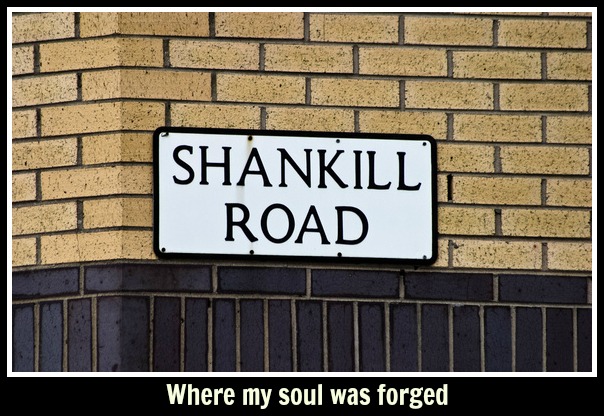
shankill road where my soul was forged.jpg

If you have read extracts from my Autobiography Belfast Child ( It’s worth it – promise ) you will know that  I was raised within the heartlands of loyalist Northern Ireland – The Glorious Shankill Road.

The UDA ( Ulster Defense Force) and other loyalist paramilitaries governed and controlled our daily lives and lived and operated among us. The loyalist community stood as one against the IRA and other republican terrorists and although there was often war between the various different groups , they were untied in their hatred of Republican’s and pride in the Union.

The definition of loyalist is :

a. A supporter of union between Great Britain and Northern Ireland

b. A person who remains loyal to the established ruler or government, especially in the face of a revolt.


—————————————–

Why Ireland split into the Republic of Ireland & Northern Ireland

—————————————–

A bit of history for you

A very brief  outlined of the beginning of the modern troubles

Whilst the Protestants’ clung to their British sovereignty and took pride in the union, our Catholic counterparts felt abandoned and second class citizens in a Unionist run state. The civil rights marches of the 60’s & Republican calls for a United Ireland were the catalyst for the IRA and other Republican terrorist groups to take up arms against the British and feed the paranoia of the loyalist community.

Northern Ireland descended into decades of sectarian conflict & slaughter. An attack on the crown was an attack on the Protestant people of the North and the Protestant paramilitaries took up arms and waged an indiscriminate war against the IRA, the Catholic population and each other. Many innocent Catholic’s and Protestant’s became targets of psychopathic sectarian murder squad’s. Murder was almost a daily occurrence and the killings on both sides perpetuated the hatred and mistrust between the two ever-warring communities. It was a recipe for disaster and Northern stood on the brink of all out civil war.

Growing up in this environment it is hardly surprising to learn that  I hated republicans and all they stood for. But that doesn’t mean I hated Catholic’s or Irish people and would  wish  any harm on them – I don’t and I didn’t.

It means I have a different point of view and democracy is all about freedom of choice and my choice is to maintain the Union with the UK and embrace and celebrate my loyalist culture and tradition. It also means I have the right to take pride in the union with the rest of the UK and I wear my nationality like a badge of honor for all the world to  see.

————————————–

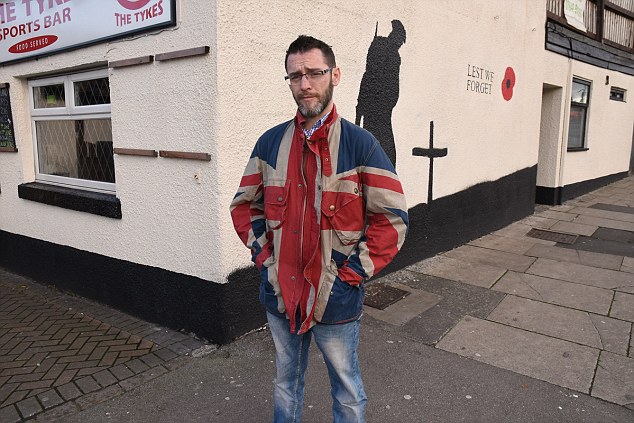
proud to be british jason mawer

Jason Mawer has been warned twice to remove his jacket in case it offends someone

The unique Mod-style jacket in red, white and blue was made a few years ago for a Who convention in London

Pub landlord Jason Mawer has twice been asked in public to remove his treasured Union Jack jacket – for risk of it being ‘offensive’.

He was told to take off his valuable Mod-style Barbour jacket – designed in honour of legendary rock band The Who – by officials who appeared to be council enforcement officers.

On the second occasion the female official warned him: ‘Would you mind removing your coat it might offend somebody.’

See Daily Mail for full Story 

————————————–

In recent years it has become almost politically  “incorrect” to show any signs of pride in being British and mad lefties and their deluded disciples are always banging on about offending other religions and communities throughout the UK. The fact that the UK has such a diverse melting pot of different nationalities and religions  and is generally accommodating to them – is lost on these do gooders and they ignore our country’s  long history of religious and politically tolerance and instead accuse us of being  xenophobic  and this offends me no end.

Have they forgotten that it was our forefathers who fought and died for our great nation and our democracy is built on their ultimate  sacrifice for our freedom – they did not die in vain.

…back to the email

If you had taken the time to have a proper  look through my site you would be aware that I commemorate the deaths of all innocent people killed as a direct result of the conflict in Northern Ireland , regardless of political or religious  background  . I also cover the deaths of paramilitaries from both sides killed “in Action” as my objective to to give a complete picture of the history of the Troubles.

I receive lots of emails and comments about my site and although most of these are positive –  a few ( normally from republicans ) accuse me of being a loyalist and somehow responsible for the all the deaths in Northern Ireland’s tortured history. Generally I ignore these emails as they are so far of the mark – if they had taken the time to read my story they would know a bit more about my history and know that I preach love – not hate!

Just because I am proud of the union and my British heritage does not mean I hate Catholics or Irish people or any others for that matter – in fact I judge no man on his colour , creed , religious or political background (apart from Republican Terrorists ).

I judge people on their humanity and empathy towards others and the world around us . Life is for living – so live and let live.

Anne Frank

“In spite of everything, I still believe that people are really good at heart.”
Anne Frank

14th April – Deaths & Events in Northern Ireland Troubles

Key Events & Deaths on this day in Northern Ireland Troubles

                                                                                           14th April   

———————————-      

Friday 14 April 1972

The Irish Republican Army (IRA) exploded 23 bombs at locations all over Northern Ireland.

[Public Records 1972 – Released 1 January 2003: Current Situation Report No 118 by A.W.Stephens, then Head of Defence Secretariat 10 at the Ministry of Defence, providing details of security incidents during the previous 24 hours in Northern Ireland.]

Wednesday 14 April 1982

The Royal Ulster Constabulary (RUC) carried out a raid on the Ulster Defence Association (UDA) headquarters in Belfast.

The raid uncovered ammunition and gun parts. Four leading members of the UDA were arrested.

[At this time the UDA was not a ‘proscribed’ organisation. It was only declared illegal on 10 August 1992.]

Sunday 14 April 1991

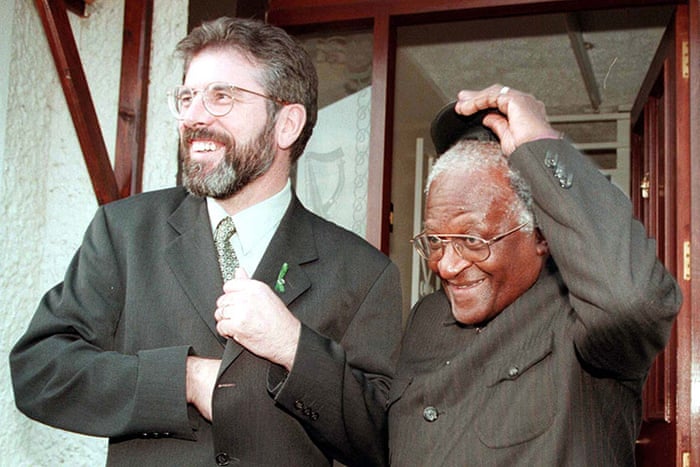
Bishop Desmond Tutu, from South Africa, attended an Anglican conference in Newcastle, County Down. Tutu said that Sinn Féin (SF) should be invited to attend the forthcoming talks on the future of Northern Ireland.

Tuesday 14 April 1992

Michael Newman

A British Army (BA) recruiting sergeant died after being shot by the Irish National Liberation Army (INLA) in Derby, England.

[This was the first killing by the INLA in Britain since March 1979.]

Thursday 14 April 1994

Teresa Clinton

Teresa Clinton (34), a Catholic Civilian, was shot dead by the Ulster Freedom Fighters (UFF), a cover name (pseudonym) used by the Ulster Defence Association (UDA), during a gun attack on her home, off Ormeau Road, Belfast.

Her husband had been a former Sinn Féin (SF) election candidate.

The UFF carried out another gun attack and wounded of two Catholic civilians.

The Northern Ireland Office (NIO) offered to clarify, for the benefit of SF, specific points related to the Downing Street Declaration (DSD).

Friday 14 April 1995

The Royal Ulster Constabulary (RUC) discovered 40 weapons and hundreds of rounds of ammunition which were believed to belong to the Ulster Volunteer Force (UVF). The cache was found in Holywood, County Down.

[Three men were arrested following the discovery. A second cache of arms was later found in the town.]

Monday 14 April 1997

There was an arson attack on St Peter’s Catholic church in Stoneyford, County Antrim. The chapel was badly damaged by the fire.

A man (24) was seriously injured in what was believed to be a Loyalist ‘punishment’ shooting that took place in the Ballysally estate in Coleraine, County Derry.

The Irish Republican Army (IRA) was believed to be responsible for a ‘punishment’ beating attack on a man in Derry. The man subsequently went into hiding.

See Corporal Killings

Patrick Mayhew, then Secretary of State for Northern Ireland, referred the case of Patrick Kane to the Court of Appeal. Kane had been convicted of, and was serving a life sentence for, the murder of corporals Derek Wood and David Howes on 19 March 1988.

Tuesday 14 April 1998

In the Republic of Ireland the Irish authorities released nine Irish Republican Army (IRA) prisoners from Portlaoise Prison. On their release the prisoners pledged their “total support” for the leadership of Sinn Féin (SF).

[The releases were criticised by Unionists and by the Garda Representative Association.]

Wednesday 14 April 1999

Liz O’Donnell, then Irish Minister of State for Foreign Affairs, acknowledged that the Hillsborough Declaration would not be the basis for resolving the decommissioning impasse.

Saturday 14 April 2001

Bomb Explosion in London

There was a bomb explosion at a Post Office delivery depot in north London at 11.28pm (2328BST).

There had been no warning of the bomb but no one was injured in the explosion which caused “minor” damage to the building at The Hyde in Hendon. The “real” Irish Republican Army (rIRA) was thought to have been responsible for the attack.


———————————————
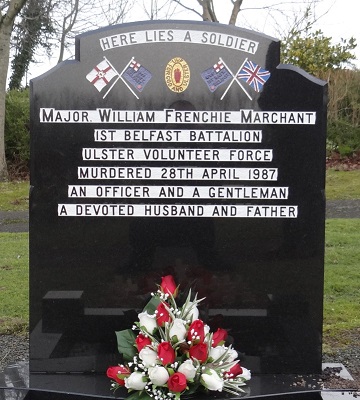
Remembering all innocent victims of the Troubles

Today is the anniversary of the death of the following people killed as a results of the conflict in Northern Ireland

“To live in hearts we leave behind is not to die

– Thomas Campbell

To the innocent on the list – Your memory will live forever

– To the Paramilitaries –

There are many things worth living for, a few things worth dying for, but nothing worth killing for.

8 People lost their lives on the 14th  April   between 1973– 1994

———————————————–

14 April 1973


Robert Millen,   (23)

Protestant
Status: Official Irish Republican Army (OIRA),

Killed by: Ulster Volunteer Force (UVF)
Shot from passing car while standing in McClure Street, off Ormeau Road, Belfast

———————————————–

14 April 1974
Anthony Pollen,  (27)

nfNI
Status: British Army (BA),

Killed by: Irish Republican Army (IRA)
Undercover British Army (BA) member. Shot while observing Republican Easter commemoration parade, Meenan Square, Bogside, Derry.

———————————————–

14 April 1975


Stafford Mateer,   (32)

Protestant
Status: Civilian (Civ),

Killed by: not known (nk)
Died two days after being shot while driving his car, at the junction of Albertbridge Road and Woodstock Road, Belfast.

———————————————–

14 April 1978


James McKee,  (61)

Protestant
Status: Ulster Defence Regiment (UDR),

Killed by: Irish Republican Army (IRA)
Off duty. Shot while driving school bus, Creggan, near Pomeroy, County Tyrone.

———————————————–

14 April 1978

Robert McCullough,   (27)

Protestant
Status: Civilian (Civ),

Killed by: Ulster Volunteer Force (UVF)
Shot at his home, Rathmore Drive, Rathcoole, Newtownabbey, County Antrim.

———————————————–

14 April 1986


White, Keith (20)

Protestant
Status: Civilian (Civ),

Killed by: Royal Ulster Constabulary (RUC)
Died 15 days after being shot by plastic bullet, during street disturbances, Woodhouse Street, Portadown, County Armagh.

———————————————–

14 April 1992


Michael Newman,   (34)

nfNIB
Status: British Army (BA),

Killed by: Irish National Liberation Army (INLA)
Shot shortly after leaving British Army (BA) recruiting office, Derby, England.

———————————————–

14 April 1994


Teresa Clinton,  (34)

Catholic
Status: Civilian (Civ),

Killed by: Ulster Freedom Fighters (UFF)
Shot during gun attack on her home, Balfour Avenue, off Ormeau Road, Belfast. Her husband a Sinn Fein (SF) member.

———————————————–


23rd February – Deaths & Events in Northern Ireland Troubles

Key Events & Deaths on this day in Northern Ireland Troubles

23rd February

Saturday 23 February 1974

In the Shankill Road area of Belfast taxi drivers hijacked buses and sealed off roads in a protest against alleged army harassment.

Monday 23 February 1976

Francis Rice


Francis Rice (24), a Catholic civilian, was abducted, beaten and had his throat and his body was found near Mayo Street, Shankill, Belfast.

Members of he Ulster Volunteer Force (UVF) gang known as the ‘Shankill Butchers’ were responsible for the killing. [See: 20 February 1979]

See Shankill Butchers

Tuesday 23 Februay 1982

The Irish Republican Army (IRA) sunk a British coal boat, the St Bedan, in Lough Foyle.

Wednesday 23 February 1983

The Political Committee of the European Parliament took the decision to commission a report on Northern Ireland to see if the (then) European Economic Community (EEC) could help find a solution to the conflict. The Rapporteur was Mr N.J. Haagerup.

The British government opposed what it saw as external interference in its internal affairs.

Saturday 23 February 1985

David Devine                        Michael Devine,                           Charles Breslin,


Three members of the Irish Republican Army (IRA) were shot dead by undercover British soldiers in the outskirts of Strabane, County Tyrone.

David Devine


The IRA men were believed to be returning weapons to an arms dump when they were killed. A man alleged to be an informer was shot dead by the IRA in Derry.

[John Hume, then leader of the Social Democratic and Labour Party (SDLP), walked out of a meeting with representatives of the Irish Republican Army (IRA) when it was suggested by the IRA that part of the proceedings be recorded on video. Information on what had occurred only became available some time afer the meeting.]

Monday 23 February 1987

Belfast City Council became the latest in a line of Northern Ireland councils to be fined for failing to conduct normal business. Many Unionist controlled councils had been refusing to conduct council business as part of a protest against the Anglo-Irish Agreement (AIA). The Department of the Environment appointed a commissioner to set a rate in those councils which have refused to do so.

Tuesday 23 February 1988

Ian Thain, a Private in the British Army and the first solder to be convicted of murder (14 December 1984) while on duty in Northern Ireland, was released from a life sentence. He had served 26 months and was allowed to rejoin his regiment.

Thursday 23 February 1989

Hugh Annesley, then Assistant Commissioner at the Metropolitan Police, was appointed by the Northern Ireland Police Authority (NIPA) as the next Chief Constable of the Royal Ulster Constabulary (RUC).

[Hugh Annesley took over the post on 31 May 1989.]

Monday 23 February 1998

A Republican paramilitary group exploded a large car bomb, estimated at 300 pounds, in the centre of Portadown, County Armagh. Many business premises in the centre of the town were severely damaged by the explosion and two buildings were completely demolished by the blast. There were no injuries in the explosion.

[It was thought that the bomb had been planted by the ‘Continuity’ Irish Republican Army (CIRA).]

Tuesday 23 February 1999

Stephen Melrose

Gerry Adams, then President of Sinn Féin (SF), was confronted by the family of a victim of the Irish Republican Army (IRA) as he continued his eight-day visit to Australia. Roy Melrose, the father of Stephen Melrose, a Brisbane lawyer who was mistaken by gunmen for an off-duty British soldier in the Netherlands on 27 May 1990, criticised the way Adams was being feted at a civic champagne reception.


Friday 23 February 2001

An advertising campaign was launched to try to attract a large number of recruits to the new Police Service of Northern Ireland (PSNI). The target was to attract equal numbers of Protestants and Catholics. Nationalists and Republicans argued that they had not yet endorsed the new force which is due to replace the Royal Ulster Constabulary (RUC). Sinn Féin (SF) had attempted in court to stop the adverts.

Saturday 23 February 2002

Police arrested three people in north Belfast following sporadic rioting around the Limestone road. The three are being held charged with riotous behaviour.

A police spokesperson said one officer had to draw his firearm as a crowd wielding iron bars and sticks tried to prevent an arrest of a man in the Newington Street area.

Gerard Brophy, then a Sinn Féin (SF) councillor, said the trouble started when a crowd of up to 60 loyalists armed with bricks, bottles and baseball bats, attacked Nationalist homes. He said the attack was clearly orchestrated and the crowd included members of the neo-Nazi group Combat 18.

These claims were disputed by Loyalist residents.

Twenty children from the Holy Cross Girls’ Primary School in Ardoyne, north Belfast, met Bertie Ahern, then Taoiseach (Irish Prime Minister), during a short visit to Dublin. Ahern said the trip would show support for the children from the people of the Republic.

——————————————————————
Remembering all innocent victims of the Troubles

Today is the anniversary of the death of the following people killed as a results of the conflict in Northern Ireland

“To live in hearts we leave behind is not to die

– Thomas Campbell

To the innocent on the list – Your memory will live  forever

– To  the Paramilitaries  –

There are many things worth living for, a few things worth dying for, but nothing worth killing for.

7 People   lost their lives on the 23rd February between 1976– 1985

  —————————————————————————

23 February 1976


Francis Rice,  (24)

Catholic
Status: Civilian (Civ),

Killed by: Ulster Volunteer Force (UVF)
Abducted while walking along Donegall Street, Belfast. Found stabbed to death several hours later, in entry, off Mayo Street, Shankill, Belfast.

  —————————————————————————
23 February 1977


Peter Hill,  (43)

Protestant
Status: Ulster Defence Regiment (UDR)

 Killed by: Irish Republican Army (IRA)
Off duty. Shot outside his home, Daphne Gardens, off Limavady Road, Waterside, Derry.

  —————————————————————————
23 February 1981

James Burns   (33)

Catholic
Status: Irish Republican Army (IRA),

Killed by: Ulster Volunteer Force (UVF)
Shot at his home, Rodney Drive, Falls, Belfast.

  —————————————————————————
23 February 1985


Michael Devine,  (22)

Catholic
Status: Irish Republican Army (IRA),

Killed by: British Army (BA)
Shot by undercover British Army (BA) members, while returning arms to dump, in field, off Plumbridge Road, Strabane, County Tyrone.

  —————————————————————————
23 February 1985


David Devine  (17)

Catholic
Status: Irish Republican Army (IRA),

Killed by: British Army (BA)
Shot by undercover British Army (BA) members, while returning arms to dump, in field, off Plumbridge Road, Strabane, County Tyrone.

  —————————————————————————

23 February 1985


Charles Breslin,   (20)

Catholic
Status: Irish Republican Army (IRA),

Killed by: British Army (BA)
Shot by undercover British Army (BA) members, while returning arms to dump, in field, off Plumbridge Road, Strabane, County Tyrone.

  —————————————————————————

23 February 1985


Kevin Coyle,  (24)

Catholic
Status: Civilian (Civ),

Killed by: Irish Republican Army (IRA)
Found shot Corporation Street, Bogside, Derry. Alleged informer.

  —————————————————————————

Lenny Murphy – Leader of The Shankill Butchers – Life & Death

Lenny Murphy

2 March 1952 – 16 November 1982

Leader  of The Shankill Butchers

Life & Death

Over a 10-year-year period, from 1972 to 1982, the Shankill Butchers gang, led by psychopath Lenny Murphy, terrorized Northern Ireland Catholics, becoming the most prolific group of serial killers in British history.

See Shankill Butchers

Hugh Leonard Thompson Murphy, who commonly went by the name Lenny (or Lennie) (2 March 1952 – 16 November 1982), was an Ulster loyalist from Belfast, Northern Ireland. Murphy was a member of the Ulster Volunteer Force (UVF) and leader of the infamous Shankill Butchers gang which became notorious for its torture and murder of Roman Catholic men. Although never convicted of murder, Murphy is thought to have been responsible for many deaths.[1] Murphy spent long periods in custody from late 1972 to July 1982, being free for a total of only thirteen months during that time. He was shot dead by the Provisional IRA in November 1982.

A Protestant, Murphy had a fanatical hatred of Roman Catholics. In his book The Shankill Butchers, Belfast journalist Martin Dillon suggests that Murphy’s visceral loathing of Catholics may have stemmed from his own family being suspected of having recent Catholic ancestry, because of his traditionally Irish surname which is more often associated with the other side of the religious divide in Northern Ireland.[2] After his death, his mother commented: “I don’t honestly believe he was a bad man”; however, an unnamed loyalist from the rival Ulster Defence Association described Murphy as a “typical psychopath”.

Disclaimer

The views and opinions expressed in this post and page are soley intended to educate and provide background information to those interested in the Troubles of Northern Ireland.

They in no way reflect my own opinions and I take no responsibility for any inaccuracies or factual errors

Lenny Murphy
Lenny murphy.jpg

Lenny Murphy in 1982
Born Hugh Leonard Thompson Murphy
2 March 1952
Shankill Road, Belfast, Northern Ireland
Died 16 November 1982 (aged 30)
Glencairn, upper Shankill Road, Belfast, Northern Ireland
Cause of death Over 20 fatal gunshot wounds
Nationality British
Other names Lenny or Lennie
Known for Leader of Shankill Butchers
Ulster Volunteer Force member
Religion Protestantism

Early life

Murphy was the youngest of three sons of Joyce and William Murphy from the loyalist Shankill Road, Belfast. William was originally from Fleet Street, Sailortown in the Belfast docks area. This was where he had met Joyce Thompson, who came from the Shankill. Like his own father (also named William), he worked as a dock labourer.[4]

The Murphy family changed their residence several times; in 1957 they returned to Joyce’s family home in the lower Shankill, at 28 Percy Street. Murphy’s father was reclusive which led to a rumour that he was not the same man and that Joyce was now living with a different ‘William Murphy’, one who was a Catholic. Lenny Murphy did not use his given first name because Hugh was perceived as Catholic-sounding, especially when coupled with the surname Murphy. Prior to the erection of a peace wall in the 1970s, Percy Street ran from the lower Shankill area to the Falls Road. A hoodlum at school (Argyle Primary), where he was known for the use of a knife and had his elder brothers to back him up, Murphy logged his first conviction at the age of twelve for theft. After leaving the Belfast Boys’ Model School at sixteen, he joined the Ulster Volunteer Force and was involved in the rioting that broke out in Belfast in August 1969.

His character was marked by a pathological hatred of Catholics which he brought into all of his conversations, often referring to them as “scum and animals”.[5] He held a steady job as a shop assistant, although his increasing criminal activities enabled him to indulge in a more high profile and flamboyant lifestyle which involved socialising with an array of young women and heavy drinking.[6]

Dillon wrote that it is “incredible to think that Murphy was in fact a murderer at the age of twenty” (1972). There were many people at the time who would have found it hard to believe as physically he did not differ from most young men of his age. Below average height, of slim build and sallow complexion, Murphy was blue eyed and had curly dark brown hair. He sported several tattoos; most of them bearing Ulster loyalist images.[7] He was a flashy dresser, too, often wearing a leather jacket and scarf, and occasionally a pair of leather driving-gloves, such that it reminded one contact of the time of a World War I fighter-pilot.[8]

First Crimes

The Lawnbrook Social Club in Shankill Road‘s Centurion Street, one of Murphy’s drinking haunts. It has since been demolished

According to Dillon, Murphy was involved in the torture and murder of four Catholic men as early as 1972. On 28 September of that year, a Protestant man named William Edward Pavis who had gone bird shooting with a Catholic priest, was killed at his home in East Belfast. Pavis had been threatened by loyalists who accused him of selling firearms to the IRA. Murphy was arrested for this crime along with an accomplice, Mervyn Connor.[9]

During pre-trial investigations, Murphy was placed in a line-up for possible identification by witnesses to Pavis’ shooting. Before the process began formally, he created a disturbance and stepped out of the line-up. However, two witnesses picked him out when order was restored.[9]

Connor and Murphy were held in prison together but, in April 1973, before the trial, Connor died after ingesting cyanide in his cell. He had written a suicide note in which he confessed to the crime and exonerated Murphy. It is believed Connor was forced to write the note and take the cyanide. Murphy was sent to trial for the murder of Pavis in June 1973. Although two witnesses identified him as the gunman, he was acquitted on the basis that their evidence may have been affected by the disturbance during the police line-up inquiry. However, Murphy was re-arrested and jailed for attempted escapes.[10]

By May 1975, Murphy, now aged twenty-three, was back on the streets of Belfast. On 5 May 1973, inside the Crumlin Road prison, he had married 19-year-old Margaret Gillespie, with whom he had a daughter.[11] He moved his wife and child to Brookmount Street in the upper Shankill where his parents also had a new home; however, he spent much of his time drinking in Shankill pubs such as The Brown Bear and Lawnbrook Social Club. He also regularly frequented the Bayardo Bar in Aberdeen Street.[12] Murphy later told a Provisional IRA inmate that on 13 August 1975 he had just left the Bayardo ten minutes before the IRA carried out a gun and bombing attack against the pub which killed a UVF man and four other Protestants and left over 50 injured.[13]

With his brother William he soon formed a gang of more than twenty men that would become known as the Shankill Butchers, one of his lieutenants being William Moore.

Brookmount Street (2009), where Murphy lived close to the top of the Shankill Road

Shankill Butchers murders

The gang shot dead four Catholics (two men and two women) during a robbery at a warehouse in October 1975. Over the next few months Murphy and his accomplices began to abduct, torture and murder random Catholic men they dragged off the streets late at night. Murphy regarded the use of a blade as the “ultimate way to kill”, ending the torture by hacking each victim’s throat open with a butcher’s knife. By February 1976 the gang had killed three Catholic men in this manner. Murphy achieved status though his paramilitary activity and was widely known in the Shankill. Many regarded his crimes as shaming the community but feared the consequences of testifying against him.[14][15] None of the victims had any connection to the IRA, and there was suspicion among some of their families that the murders were not properly investigated because those being killed were Catholics.[14]

The Butchers were also involved in the murder of Noel Shaw, a loyalist from a rival UVF unit, who had shot dead Butcher gang-member Archie Waller in Downing Street, off the Shankill Road, in November 1975. Four days before his death, Waller had been involved in the abduction and murder of the Butchers’ first victim, Francis Crossen. One day after Waller’s death, Shaw was beaten and pistol-whipped by Murphy while strapped to a chair, then shot. His body was later dumped in a back street off the Shankill.[16]

By the end of 1975, the UVF Brigade Staff had a new leadership of “moderates”, but Murphy refused to submit to their authority, preferring to carry out attacks by his own methods. Dillon suggested that whilst some of the Brigade Staff knew about Murphy’s activities (albeit not the precise details), they were too frightened of him and his gang to put a stop to them.[17]

On 10 January 1976, Murphy and Moore killed a Catholic man, Edward McQuaid (25), on the Cliftonville Road. Murphy, alighting from Moore’s taxi in the small hours, shot the man six times at close range.

Imprisonment

Early on 11 March 1976, Murphy shot and injured a young Catholic woman, once again on the Cliftonville. Arrested the next day after attempting to retrieve the gun used, Murphy was charged with attempted murder and remanded in custody for a prolonged period. However, he was able to plea bargain whereby he was allowed to plead guilty to the lesser charge of a firearms offence, and received twelve years’ imprisonment on 11 October 1977. Dillon notes that the police believed Murphy was involved in the Shankill Butcher murders. To divert suspicion from himself Murphy ordered the rest of the gang to continue the cut-throat murders while he was in prison. The Butchers, now under the operational command of William Moore, went on to kill and mutilate at least three more Catholics.

The team of Criminal Investigation Department (CID) detectives investigating the murders was led by Detective Chief Inspector Jimmy Nesbitt who headed C Division based at Tennent Street off the Shankill Road. However the police were overworked during this period and little progress was made in the investigation until one victim, Gerard McLaverty, survived his assault. Detectives were driving him down the Shankill Road on the way to the scene of his abduction when he recognized two of his assailants walking in the street. This identification of Sam McAllister and Benjamin Edwards led to the arrest of much of the gang in May 1977 and, in February 1979, they were imprisoned for long periods. Confessions of gang members had named Murphy as the leader but statements incriminating him were later retracted. He was questioned once again about the Butcher murders but denied involvement.

The total of sentences handed down to the gang at Belfast Crown Court was the longest in legal history in the United Kingdom.

Last months on the Shankill

On completing his sentence for the firearms charge, Lenny Murphy walked out of the Maze Prison on Friday, 16 July 1982. During his term inside, his wife Margaret had initiated divorce proceedings which were being finalised at the time of his death. Murphy returned to his old ways, killing at least four more people over the next four months. He beat to death a partially disabled man one day after returning to the Shankill. Another victim sold him a car and was shot dead after demanding full payment.[18] Murphy also attempted to extort money from local businessmen who had been sympathetic in the past; however, this encroached on other loyalist paramilitaries with established protection rackets.[19]

In late August 1982, Murphy killed a part-time Ulster Defence Regiment soldier from the Lower Shankill area who was closely involved with the UVF in Ballymena and was allegedly an informer. The man’s body was not discovered for almost a year.[1] In mid-October, Murphy and several associates kidnapped a Catholic man who was then tortured and beaten to death in Murphy’s own house (temporally vacated due to renovations). Murphy, who had left the house strewn with the victim’s blood and teeth, was arrested for questioning the next morning but later released. The sadism of the widely publicised killing led to loyalism receiving a great deal of bad publicity, and leading UVF figures concluded that Murphy’s horrific methods had made him too much of a liability.[9]

Death

On 16 November 1982, Murphy had just pulled up outside the rear of his girlfriend’s house in the Glencairn area of the upper Shankill when two Provisional IRA gunmen emerged from a black van nearby and opened fire with an assault rifle and a 9 mm pistol. Murphy was hit by more than twenty rounds and died instantly.[20] Coincidentally, he was gunned down just around the corner from where the bodies of many of the Butchers’ victims had been dumped. A few days after his death the IRA claimed responsibility. According to RUC reports, the UVF had provided the IRA hit team with the details of Murphy’s habits and movements, which allowed them to assassinate him at that particular location. Another line of inquiry ends at UDA leader James Craig,[19] who saw Murphy as a serious threat to his widespread racketeering and provided the IRA with key information on Murphy’s movements. Craig was known to meet IRA commanders to discuss their racketeering activities – he was later killed by his comrades for “treason”.[21]

Murphy was given a large paramilitary funeral by the UVF with a guard of honour wearing the UVF uniform and balaclavas. A volley of three shots was fired over his coffin as it was brought out of his house and a piper played “Abide With Me”. He was buried in Carnmoney Cemetery; on his tombstone the following words were inscribed: “Here Lies a Soldier”.[22] The tombstone was smashed in 1989.[23] His photograph was displayed inside “The Eagle”, the UVF Brigade Staff’s headquarters over a chip shop in the Shankill Road. According to investigative journalist Paul Larkin, it graced the walls as a “fallen officer” up until the late 1990s.[24

See Shankill Butchers

See Robert “Basher” Bates

Please consider making a small or large donation as I am very poor and every donation is most welcome and goes towards the cost of running this blog.

Make a small donation

paypal donation button

Thank you!

3rd November – Deaths & Events in Northern Ireland Troubles

Key Events & Deaths on this day in Northern Ireland Troubles

3rd November

——————————————————————-

November 1975

Monday 3 November 1975

James Fogarty (22), who had been a Republican Clubs member, was shot dead at his home in Ballymurphy, Belfast, by members of the Provisional Irish Republican Army (PIRA). This killing was part of the continuing feud between the two wings of the IRA.

Wednesday 3 November 1976

Two Protestant civilians were killed in separate shooting incidents carried out by Republican paramilitaries in Dundrod, County Antrim and Tiger’s Bay, Belfast.

Saturday 3 November 1979

The Social Democratic and Labour Party (SDLP) held its annual conference. The party rejected calls for talks with the Irish Republican Army (IRA). The party also called for a joint approach by the British and Irish governments to finding a solution to the problems in Northern Ireland.

Tuesday 3 November 1981 s[ Political Developments.]

Friday 3 November 1989

In a speech, Peter Brooke, then Secretary of State for Northern Ireland, said that the Irish Republican Army (IRA) could not be defeated militarily. He also said that he would not rule out talks with Sinn Féin (SF) in the event of an end to violence. [His remarks caused controversy.]

Tuesday 3 November 1992

The ‘Belfast Brigade’ of the Irish People’s Liberation Organisation (IPLO) that it would disband. [This followed an internal feud and the intervention of the Irish Republican Army (IRA) on 31 October 1992.]

Wednesday 3 November 1993

The Irish Congress of Trade Unions (ICTU) organised peace rallies in Belfast and Derry.

Thursday 3 November 1994

Albert Reynolds, then Taoiseach (Irish Prime Minister), said that there would be no change in the constitutional status of Northern Ireland without the consent of the majority of its people.

Friday 3 November 1995

The Northern Ireland Office (NIO) published a document referred to as the ‘Building Blocks’ paper. Copies of the document had been given to the political parties and the Irish and American government during the previous week. The paper suggested that: “all-party preparatory talks and an independent international body to consider the decommissioning issue will be convened in parallel by the two governments”

. Hence the process was to be called the ‘twin-track’ process. Martin McGuinness, then Vice-President of Sinn Féin (SF), held a meeting with Michael Ancram, the Political Development Minister at the NIO, and discussed decommissioning of paramilitary weapons and also all-party talks.

Sunday 3 November 1996

Gerry Adams, then President of Sinn Féin (SF), refused to comment on reports in the Sunday Tribune (a Dublin based newspaper) that the British government had reopened contacts with Sinn Féin (SF). Sean Brady succeeded Cathal Daly and was appointed as Archbishop of Armagh and head of the Catholic church in Ireland.

Wednesday 3 November 1999

The Royal Ulster Constabulary (RUC) conducted a series of raids in County Armagh and County Antrim against Loyalist paramilitaries. Fifty RUC detectives were involved in the operation and three men were arrested and arms and explosives recovered. In one of the raids at Stoneyford Orange Hall, County Antrim, the police held six men for questioning when military documents were uncovered with the personal details of over 300 Republicans from Belfast and south Armagh.

The Orange Order said it was “aghast” at the finds. Sinn Féin (SF) said the documents were evidence of collusion between the security forces and Loyalist paramilitaries. The RUC held three men for questioning about the killing of Pat Finucane, a Belfast solicitor shot dead on 12 February 1989. The arrests were made at the request of the team carrying out an inquiry into the killing. The team was headed by John John Stevens, then Commissioner of the Metropolitan Police. John White, then Ulster Democratic Party (UDP) spokesman, accused the inquiry team of “deliberately harassing Loyalists”.

Saturday 3 November 2001

Saturday (midnight) marked the new deadline for the election of a First Minister and a Deputy First Minister by the parties in the Northern Ireland Assembly (NIA).

[The date represented a period of six weeks since the political institutions were restored to power following their last 24 hour suspension (22 September 2001). John Reid, then Secretary of State for Northern Ireland, allowed the deadline to pass without taking any action. The intention was to try to elect a First Minister and a Deputy First Minister on Monday 5 November 2001. The Democratic Unionist Party (DUP) announced that it would seek a legal challenge to the decision taken by Reid.]

——————————————————————————————


———————————————————————————
Remembering all innocent victims of the Troubles

Today is the anniversary of the death of the following  people killed as a results of the conflict in Northern Ireland

“To live in hearts we leave behind is not to die

– Thomas Campbell

To the innocent on the list – Your memory will live  forever

– To  the Paramilitaries  –

There are many things worth living for, a few things worth dying for, but nothing worth killing for.

  4   People lost their lives on the 3rd November between 1975 – 1991

————————————————————

03 November 1975


 James Fogarty,  (22)

Catholic
Status: Civilian Political Activist (CivPA),

Killed by: Irish Republican Army (IRA)
Former Republican Clubs member. Shot at his home, Rock Grove, Ballymurphy, Belfast. Official Irish Republican Army (OIRA) / Irish Republican Army (IRA) feud.

————————————————————

03 November 1976
Samuel McConnell,  (59)

Protestant
Status: Civilian (Civ), Killed by: non-specific Republican group (REP)
Shot at his farm, Sycamore Road, Dundrod, County Antrim.

————————————————————

03 November 1976


Georgina Strain,   (50)

Protestant
Status: Civilian (Civ),

Killed by: non-specific Republican group (REP)
Shot at her home, Hogarth Street, Tiger’s Bay, Belfast.

————————————————————

03 November 1991


 Gerard Maginn,   (17)

Catholic
Status: Civilian (Civ),

Killed by: Royal Ulster Constabulary (RUC)
Found shot in abandoned stolen car, Glen Road, Andersonstown, Belfast.

————————————————————

See below on how to order a copy of my No.1 Bestselling book: A Belfast Child 

2nd November – Deaths & Events in Northern Ireland Troubles

Key Events & Deaths on this day in Northern Ireland Troubles

 2nd November

———————————————————————————————

Saturday 2 November 1968

There was a march in Derry by the fifteen committee members of the Derry Citizen’s Action Committee (DCAC). The march took place over the route of the banned 5 October 1968 march. Thousands of people walked in support behind the DCAC committee.

[Due to the number of people taking part the Royal Ulster Constabulary (RUC) were unable to prevent the march taking place.] [ Civil Rights Campaign; Law Order. ]

Tuesday 2 November 1971

The Irish Republican Army (IRA) exploded two bombs on the Ormeau Road in Belfast, one at a drapery shop and the other at the Red Lion bar, and killed three Protestant civilians; John Cochrane (67), Mary gemmell (55) and William Jordan (31).

Thursday 2 November 1972

Fianna Fáil, then the goverment of the Republic of Ireland, introduced a bill to the Dáil to remove the special position of the Catholic Church from the Irish Constitution.

Thursday 2 November 1978

[A British Army intelligence document, ‘Northern Ireland: Future Terrorist Trends’, was uncovered. The document contained an assessment of the capacity of the Irish Republican Army (IRA). It noted that the calibre of members was high and that the new ‘cell structure’ that the Active Service Units (ASUs) had adopted made them less vulnerable to informers.]

Tuesday 2 November 1982

Representatives of the Social Democratic and Labour Party (SDLP) held a meeting with James Prior, then Secretary of State for Northern Ireland, and told him that the party would continue its boycott of the Assembly.

Saturday 2 November 1985

Early Ulster Clubs

Loyalists began a campaign to establish ‘Ulster Clubs’ in each District Council area in Northern Ireland. To begin the campaign there was a march through Belfast by an estimated 5,000 members of the United Ulster Loyalist Front (UULF). The main aim of the organisation was to oppose any forthcoming Anglo-Irish agreement.

Sinn Féin began a two day Ard Fheis (annual conference) during which a debate was held on a motion that the party’s “… policy on abstentionism be viewed as a tactic and not as a principle”.

[In essence this proposed that SF should in the future consider taking up, if successful, any seats won by the party in the Dail, the parliament of the Republic of Ireland. After a vote however the motion was defeated by 187 votes to 161. The issue was debated again at the Ard Fheis held on 1-2 November 1986.]

Sunday 2 November 1986

SF End Abstentionism / Split in SF

During the second day of the Sinn Féin (SF) Ard Fheis in Dublin, a majority of delegates voted to end the party’s policy of abstentionism – that of refusing to take seats in Dáil Éireann. The change in policy led to a split in SF and Ruairí Ó Brádaigh, a former President of SF, Dáithí Ó Conaill, a former vice-President of SF, and approximately 100 people staged a walk-out. [Ó Brádaigh and Ó Conaill went on to establish a new organisation called Republican Sinn Féin (RSF).]

Saturday 2 November 1991

The Irish Republican Army (IRA) exploded a bomb at the military wing of Musgrave Park Hospital in Belfast killing two British soldiers. Eighteen people were also injured in the attack.

Tuesday 2 November 1993

John Major, then British Prime Minister, proposed a series of bilateral meetings with the leaders of the four main (constitutional) political parties to try to start a talks process. The Ulster Unionist Party (UUP) and the Democratic Unionist Party (DUP) said that the parties would not talk to the Social Democratic and Labour Party (SDLP) until the Hume-Adams Initiative was ended.

Thursday 2 November 1995

An article by Gerry Adams, then President of Sinn Féin (SF), entitled ‘Peace Process in Very Serious Difficulty‘, was published in An Phoblacht (Republican News). Adams held a meeting with John Bruton, then Taoiseach (Irish Prime Minister), in Dublin.

Monday 2 November 1998

Bertie Ahern, then Taoiseach (Irish Prime Minister), became the first Taoiseach in over 30 years to visit Stormont. Ahern was there to discuss the North-South Ministerial Council.

Tuesday 2 November 1999

Royal Ulster Constabulary (RUC) detectives found a number of pipe-bombs hidden in a hedgerow while conducting a search of the Loyalist Mourneview area of Lurgan, County Armagh.

Martin McGartland
Martin McGartland.

The RUC in Belfast and police in Glasgow, Scotland, arrested two men in a joint operation. The men were held for questioning about the shooting of Martin McGartland. McGartland, formerly a member of the Irish Republican Army (IRA) who turned informer, was shot and injured on 17 June 1999 at his home in Whitley Bay, England. McGartland blamed the IRA for trying to kill him.

[The two men were questioned by police in Northumbria but were released on 4 November 1999.] George Mitchell, then chairman of the Review of the Agreement, indicated that he thought the Review would end within a week. He also announced that he was asking John de Chastelain for an assessment of the impasse over decommissioning.

Friday 2 November 2001

There was a meeting of the Northern Ireland Assembly to try to elect a First Minister and a Deputy First Minister. David Trimble, then leader of the Ulster Unionist Party (UUP), stood for re-election to the post of First Minister.

Mark Durkan (leader in waiting of the Social Democratic and Labour Party; SDLP), then Minister of Finance and Personnel, stood for the post of Deputy First Minister. The Democratic Unionist Party (DUP) opposed the election of Trimble and the party obtained enough Unionist support to prevent his election. Trimble needed 30 ‘Unionist’ votes to secure his re-election but only managed to obtain 29 votes. The motion therefore fell although 72 voted in favour of it as opposed to 30 against. The Northern Ireland Women’s Coalition had earlier won a motion to reduce the 30 days notice required for Members of the Legislative Assembly (MLAs) to re-nominate themselves as ‘Unionist’, ‘Nationalist’, or ‘Other’.

The NIWC then changed the community nomination of its two MLAs from ‘Other’ to one ‘Unionist’ and one ‘Nationalist’. Despite this move Trimble failed to be elected. [John Reid, then Secretary of State for Northern Ireland, faced a decision on what action to take. He could have suspended the Assembly for either an open-ended period and thus re-introduce Direct Rule.

Another option was to call fresh Assembly elections. Another possibility was that the Secretary of State could have suspended the Assembly for one day (this has already been done twice before) which would allow a further six week period in which to find agreement. In the event Reid decided to simply ignore the deadline. The Assembly met again on Monday 5 November 2001 but it was at a meeting on Tuesday 6 November 2001 that Trimble and Durkan were elected.]

—————————————

———————————————————————————

Remembering all innocent victims of the Troubles

Today is the anniversary of the death of the following  people killed as a results of the conflict in Northern Ireland

“To live in hearts we leave behind is not to die

– Thomas Campbell

To the innocent on the list – Your memory will live  forever

– To  the Paramilitaries  –

There are many things worth living for, a few things worth dying for, but nothing worth killing for.

  10  People lost their lives on the 2nd November between 1971 – 1993

————————————————————

02 November 1971
John Cochrane, (67)

Protestant
Status: Civilian (Civ),

Killed by: Irish Republican Army (IRA)
Killed in bomb attacks on drapery shop and Red Lion Bar, either side of Ormeau Road Royal Ulster Constabulary (RUC) base, Belfast. Inadequate warning given.

————————————————————

02 November 1971
Mary Gemmell, (55)

Protestant
Status: Civilian (Civ),

Killed by: Irish Republican Army (IRA)
Killed in bomb attacks on drapery shop and Red Lion Bar, either side of Ormeau Road Royal Ulster Constabulary (RUC) base, Belfast. Inadequate warning given.

————————————————————

02 November 1971
William Jordan,  (31)

Protestant
Status: Civilian (Civ), Killed by: Irish Republican Army (IRA)
Injured in bomb attacks on drapery shop and Red Lion Bar, either side of Ormeau Road Royal Ulster Constabulary (RUC), Belfast. Inadequate warning given. He died on 4 November 1971.

————————————————————

02 November 1974
Lorenzo Sinclair,   (44)

Protestant
Status: Civilian (Civ),

Killed by: non-specific Republican group (REP)
Security man. Shot from passing car, at the entrance to Park Bar, Lawther Street, Tiger’s Bay, Belfast.

————————————————————

02 November 1976

Noel McCabe,   (25)

Protestant
Status: Royal Ulster Constabulary (RUC),

Killed by: Irish Republican Army (IRA)
Undercover Royal Ulster Constabulary (RUC) member. Shot while sitting in civilian type car, junction of Falls Road and Clonard Street, Belfast.

————————————————————

02 November 1977
Walter Kerr,  (34)

Protestant
Status: Ulster Defence Regiment (UDR),

Killed by: Irish Republican Army (IRA)
Off duty. Died one week after being injured when detonated booby trap bomb, attached to his car, outside his home, Magherafelt, County Derry.

————————————————————

02 November 1990
Albert Cooper,   (42)

Protestant
Status: Ulster Defence Regiment (UDR),

Killed by: Irish Republican Army (IRA)
Off duty. Killed by booby trap bomb attached to car at his workplace, a garage, Union Street, Cookstown, County Tyrone.

————————————————————

02 November 1991


Philip Cross,   (33)

nfNI
Status: British Army (BA),

Killed by: Irish Republican Army (IRA)
Killed in time bomb attack on Musgrave Park British Army (BA) hospital base, Belfast.

————————————————————

02 November 1991


Craig Pantry,  (20)

nfNI
Status: British Army (BA),

Killed by: Irish Republican Army (IRA)
Killed in time bomb attack on Musgrave Park British Army (BA) hospital base, Belfast.

————————————————————

02 November 1993


Brian Woods,  (30)

Protestant
Status: Royal Ulster Constabulary (RUC),

Killed by: Irish Republican Army (IRA)
Died two days after being shot by sniper, while at Royal Ulster Constabulary (RUC) Vehicle Check Point (VCP), Upper Edward Street, Newry, County Down.

————————————————————

See below on how to order a copy of my No.1 Bestselling book: A Belfast Child 

14th October – Deaths & Events in Northern Ireland Troubles


Key Events & Deaths on this day in Northern Ireland Troubles

14th October

Saturday 14 October 1972

Three people were killed in two incidents in Belfast. Loyalist paramilitaries carried out a raid on the Headquarters of the 10 Ulster Defence Regiment (UDR) at Lislea Drive in Belfast and stole 14 British Army issue self-loading rifles (SLRs) and a quantity of ammunition. The camp guard claimed that they were ‘overpowered’ by the Loyalists. [There was another raid on a UDR base on 23 October 1972.]

Friday 14 October 1977

Tomás Ó Fiaich was appointed as the new Catholic Primate of Ireland.

Saturday 14 October 1978

The Democratic Unionist Party (DUP) organised another march in Derry to protest against the march in the city on the previous Sunday, 8 October 1978. There were clashes between Loyalists and Royal Ulster Constabulary (RUC) officers which resulted in 32 policemen being injured and there was also damage to property in the city.

Monday 14 October 1985

the troubles new logo

The Irish Information Partnership published some results from its database of deaths from the conflict. The information showed that more than 50 per cent of the 2,400 dead had been killed by Republican paramilitaries. In addition the data also showed that over 25 per cent of those killed by Republicans were Catholic civilians.


Friday 14 October 1988

Duisburg Meetings Members from four Northern Ireland political parties met for talks in Duisburg, West Germany. The parties involved were; Alliance Party of Northern Ireland (APNI), Social Democratic and Labour Party (SDLP), Ulster Unionist Party (UUP) and Democratic Unionist Party (DUP). Little progress was reported from the meetings.

Friday 14 October 1994

John Major, then British Prime Minister, address the Conservative Party conference and told delegates that he would pursue the peace process in his own time.

Saturday 14 October 1995

There were scuffles between Sinn Féin (SF) supporters and Royal Ulster Constabulary (RUC) officers when SF attempted to hold a demonstration in the centre of Lurgan, County Armagh. The last ‘peace train’ travelled between Dublin and Belfast.

Monday 14 October 1996

Marjorie (Mo) Mowlam, then the British Labour Party spokesperson on Northern Ireland, met with Loyalist prisoners in the Maze Prison in an effort to “keep the talks process alive”. The Ulster Unionist Party (UUP) and the Social Democratic and Labour Party (SDLP) agreed on a draft agenda for the Stormont talks.

Thursday 14 October 1999

The funeral of Patrick Campbell, who was an Irish National Liberation Army (INLA) member, took place in Belfast.

Campbell had been injured on 6 October 1999 in Dublin and died on 10 October. Approximately 1,000 people attended the funeral among them Patrick’s father Robert Campbell who had been ‘on the run’ in the Republic of Ireland since 1981.

A joint statement was issued by anti-Agreement Unionists including the Democratic Unionist Party (DUP), the United Kingdom Unionist Party (UKUP), the Northern Ireland Unionist Party, and some members of the Ulster Unionist Party (UUP). The statement set out a common strategy for opposing any political deal leading the establishment of a power-sharing Executive which included Sinn Féin (SF).

Saturday 14 October 2000

A Catholic father-of-six and his two teenage sons all escaped uninjured when a bomb exploded in their car. The explosion happened shortly before 9.00pm at Blackstaff Way, off the Grosvenor Road, in west Belfast. The man said he was with his two sons, aged 17 and 18, for a driving lesson in the Kennedy Road Industrial Estate. He tried to adjust the driver’s seat, with one of his sons sitting in it, when he found a jar containing liquid and a pipe. He said it started to “fizz” and the three of them immediately fled from the vehicle just seconds before the device exploded. The attack was carried out by Loyalist paramilitaries.

Sunday 14 October 2001

Martin McGuinness, the Vice-President of Sinn Féin (SF), said that he was working “flat out” to convince the Irish Republican Army (IRA) to put its weapons beyond use.

[McGuinness made the comments on the British Broadcasting Corporation (BBC) ‘Radio Ulster’ programme. There was continuing media speculation that the IRA was close to making a move on decommissioning.]

Aidan Troy (Fr), then Chairman of the Board of Governors of the Holy Cross Girls’ Primary School, called on Loyalist protesters to immediately end the daily protest at the school. Troy was speaking at Sunday mass and said that a member of the congregation had made the point that the only other country where girls are prevented from having an education was Afghanistan.

It was revealed in the media that David Burnside, then Ulster Unionist Party (UUP) MP, had held a meeting with the ‘inner council’ of the Ulster Defence Association (UDA) sometime during the summer of 2001.

[Burnside later defended his decision to hold private talks with the Loyalist paramilitary group and said he would meet the group again if asked. Burnside said that he would not meet with the Irish Republican Army (IRA). Burside was an opponent of the Good Friday Agreement.]

The Irish government held a state funeral for 10 Irish Republican Army (IRA) men who had been executed by British authorities during Ireland’s War of Independence 80 years ago. The men had originally been buried in Mountjoy Prison but were reburied in Glasnevin cemetery following a mass at the Pro-Cathedral. The most famous of the 10 men was Kevin Barry an 18-year-old medical student who took part in the rebellion and was hanged in 1920. He is remembered today in a still-popular song that bears his name.


———————————————————————————

Remembering all innocent victims of the Troubles

Today is the anniversary of the death of the following  people killed as a results of the conflict in Northern Ireland

“To live in hearts we leave behind is not to die.”
Thomas Campbell

To the innocent on the list – Your memory will live  forever

– To  the Paramilitaries  –

There are many things worth living for, a few things worth dying for, but nothing worth killing for.

  6 People lost their lives on the 14th October  between 1972 – 1991

————————————————————–

14 October 1972
Terence Maguire,  (23)

Catholic
Status: Civilian (Civ),

Killed by: non-specific Loyalist group (LOY)
Found shot in entry, off Clandeboye Street, Belfast.

————————————————————–

14 October 1972
Leo John Duffy, (45)

Catholic
Status: Civilian (Civ),

Killed by: non-specific Loyalist group (LOY)
Shot at his workplace, Northern Wine Company, Tate’s Avenue, off Lisburn Road, Belfast.

————————————————————–

14 October 1972
Thomas Marron,  (59)

Catholic
Status: Civilian (Civ),

Killed by: non-specific Loyalist group (LOY)
Shot at his workplace, Northern Wine Company, Tate’s Avenue, off Lisburn Road, Belfast.

————————————————————–

14 October 1975


Andrew Baird,  (37)

Protestant
Status: Royal Ulster Constabulary (RUC),

Killed by: Irish Republican Army (IRA)
Died three weeks after being injured by booby trap bomb attached to security barrier, Church Street, Portadown, County Armagh.

————————————————————–

14 October 1975
Stewart Robinson,  (23)

Protestant
Status: Ulster Volunteer Force (UVF),

Killed by: Ulster Volunteer Force (UVF)
Found shot in entry off Aberdeen Street, Shankill, Belfast. Internal Ulster Volunteer Force (UVF) dispute.


See: Shankill Butchers 

————————————————————–

14 October 1991


Henry Conlon,   (54)

Catholic
Status: Civilian (Civ),

Killed by: Ulster Freedom Fighters (UFF)
Taxi driver. Shot when lured to bogus call, Finnis Drive, Taughmonagh, Belfast.

————————————————————–