Category Archives: Major events in The Troubles

Drumcree Conflict – What’s it all about?


The Drumcree conflict or Drumcree standoff is an ongoing dispute over yearly parades in the town of Portadown, Northern Ireland. The Orange Order (a Protestant, unionist organization) insists that it should be allowed to march its traditional route to-and-from Drumcree Church (see map).

———————————

– Disclaimer –

The views and opinions expressed in this blog post are soley intended to educate and provide background information to those interested in the Troubles of Northern Ireland. They in no way reflect my own opinions and I take no responsibility for any inaccuracies or factual errors.

———————————

Drumcree Riots & Background

However, most of this route is through the mainly Catholic/Irish nationalist part of town. The residents, who see the march as sectarian, triumphalist[1] and supremacist, have sought to ban it from their area. The Orangemen see this as an attack on their traditions; they had marched the route since 1807, when the area was mostly farmland.

The “Drumcree parade” is held on the Sunday before the Twelfth of July.
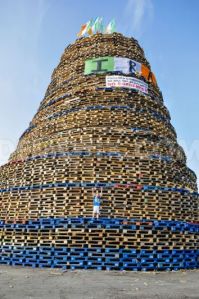
Shankill Road Bonefire

See The Glorious 12th

There has been intermittent violence over the march since the 1800s. The onset of the Troubles led to the dispute intensifying in the 1970s and 1980s. At this time, the most contentious part of the route was the outward leg along Obins Street. After serious violence two years in a row, the march was banned from Obins Street in 1986. The focus then shifted to the march’s return leg along Garvaghy Road.
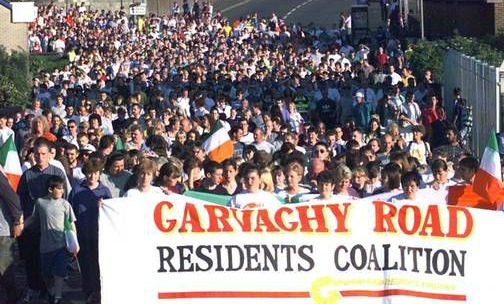
 

garvaghy road residents coalition 2.jpg


Each July from 1995–2000, the dispute drew international attention as it sparked protests and violence throughout Northern Ireland, prompted a massive police/British Army operation, and threatened to derail the peace process. The situation in Portadown was likened to a “war zone” and a “siege”.

During this time, the dispute led to the killing of at least six Catholic civilians. In 1995 and 1996, residents succeeded in stopping the march. This led to a standoff at Drumcree between the security forces and thousands of Orangemen/loyalists.

Following a wave of loyalist violence, the march was allowed through. In 1997, security forces locked-down the Catholic area and forced the march through, citing loyalist threats to kill Catholics. This sparked widespread protests and violence by nationalists. From 1998 onward the march was banned from Garvaghy Road and the Catholic area was sealed-off with large steel, concrete and barbed-wire barricades.

Each year there was a major standoff at Drumcree and widespread loyalist violence. Since 2001 things have been relatively calm, but moves to get the two sides into face-to-face talks have failed


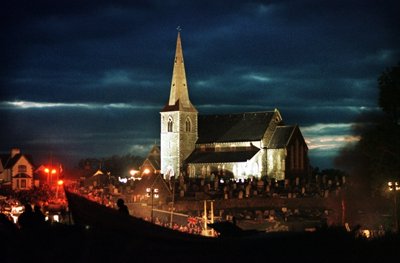
Drumcree Church

Some members of Portadown District Loyal Orange Lodge marching in Armagh during the 12 July parades, 2009

Background

An “Orange Arch” in Annalong.

Similar arches are erected in Portadown each summer, including one at the end of the mainly-nationalist/Catholic Garvaghy Road.

Portadown has long been mainly Protestant and unionist/loyalist. At the height of the conflict in the 1990s, about 70% of the population were from a Protestant background and 30% from a Catholic background. The town’s Catholics and Irish nationalists, as in the rest of Northern Ireland, had long suffered discrimination, especially in employment.

Throughout the 20th century, the police—Royal Ulster Constabulary (RUC)—was also almost wholly Protestant. Each summer the town centre is bedecked with loyalist flags and symbols.

A loyalist arch is raised over the Garvaghy Road at the Corcrain River, just inside the Catholic district. This is to coincide with the “marching season”, when numerous Protestant/loyalist marches are held in the town.

Each July there are five Protestant/loyalist parades that enter the mainly Catholic/Irish nationalist district:

  • The “Drumcree Sunday” parade from the town centre, to Drumcree Church, and back again. This is the biggest of the parades. Its traditional route was Obins Street→Corcrain Road→Dungannon Road→Drumcree Road→Garvaghy Road, but it is now banned from Obins Street and Garvaghy Road.
  • 12 July parade. This involves a morning march from Corcrain Orange Hall to the town centre. The marchers then travel to a bigger parade elsewhere, return to the town centre in the evening, and march back to Corcrain Orange Hall. Its traditional route was along Obins Street, but it is now along Corcrain Road.
  • 13 July parade. This follows the same format as the 12th parade.

There is also a junior Orange parade each May along the lower Garvaghy Road at Victoria Terrace.

Before partition

The Orange Order was founded in 1795 in the village of Loughgall, a few miles from Drumcree, after the Battle of the Diamond. Its first ever marches were held on 12 July 1796 in Portadown, Lurgan and Waringstown.

The area is thus seen as the birthplace of Orangeism.

War Walks – The Boyne

In July 1795, the year the Order formed, a Reverend Devine had held a Battle of the Boyne commemoration sermon at Drumcree Church.  In his History of Ireland Vol I (published in 1809), historian Francis Plowden described what followed this sermon:

[Reverend Devine] so worked up the minds of his audience, that upon retiring from service […] they gave full scope to the anti-papistical zeal, with which he had inspired them; falling upon every Catholic they met, beating and bruising them without provocation or distinction, breaking the doors and windows of their houses, and actually murdering two unoffending Catholics in a bog.

The first official Orange parade to and from Drumcree Church was in July 1807. Originally and traditionally it was to celebrate the Battle of the Boyne, but the Order now claims that it commemorates the Battle of the Somme during World War I.

See Battle of Somme

Each July, the Orangemen have marched from the town centre to Drumcree via Obins Street/Dungannon Road and returned along Garvaghy Road.  In the early 19th century, this area was mostly farmland. In 1835, Armagh magistrate William Hancock (a Protestant) wrote that “For some time past the peaceable inhabitants of the parish of Drumcree have been insulted and outraged by large bodies of Orangemen parading the highways, playing party tunes, firing shots and using the most opprobrious epithets they could invent”. He added that the Orangemen go “a considerable distance out of their way” to pass a Catholic chapel on their march to Drumcree.

There was violence during the Drumcree parades in 1873, 1883, 1885, 1886, 1892, 1903, 1905, 1909 and 1917.

After partition

After the partition of Ireland in 1921, the Northern Ireland Government‘s policy tended to favour Protestant and unionist parades. From 1922 to 1950, almost 100 parades and meetings were banned under the Special Powers Act – nearly all were Irish nationalist or republican. Although violence died down during this period, there were clashes at the 1931 and 1950 Drumcree parades.

The Public Order Act 1951 exempted ‘traditional’ parades from having to ask police permission, but ‘non-traditional’ parades could be banned or re-routed without appeal. Again, the legislation tended to benefit Protestant parades.

In the 1960s, housing estates were built along Garvaghy Road. In 1969, Northern Ireland was plunged into a conflict known as the Troubles. Portadown underwent major population shifts;  these new estates became almost wholly Catholic, while the rest of the town’s estates became almost wholly Protestant.

Many Orangemen joined the Northern Ireland security forces: the Royal Ulster Constabulary (RUC) and the British Army‘s Ulster Defence Regiment (UDR).

1970s and 1980s: Obins Street


The underpass leading from the town centre (behind camera) to Obins Street (beyond the bridge). The area is known as “the Tunnel”.

1972

In March 1972, thousands of loyalists attended an Ulster Vanguard rally in the town, which was addressed by Martin Smyth (‘Grand Master’ of the Orange Order) and the mayor of Portadown. After the rally, loyalists attacked the Catholic neighbourhood around Obins Street, known as “The Tunnel”.[ Following this, Catholic residents formed a protest group named the ‘Portadown Resistance Council’, which called for the upcoming marches to be re-routed away from Obins Street (see map).

The Ulster Defence Association (UDA), a then-legal loyalist vigilante and paramilitary group, warned of consequences if anything was done to stop the march.

The day before the march, Catholics sealed off Obins Street with makeshift barricades. On the morning of the march, Sunday 9 July, British troops and riot police moved in to secure the area. When they bulldozed the barricades they were stoned by Catholic protesters and responded by firing CS gas and rubber bullets.

Once the area was secured, they allowed the 1,200 Orangemen to march along the road, which was lined by at least fifty masked and uniformed UDA members. The UDA men then made their way to Drumcree and escorted the Orangemen back into town along Garvaghy Road.

With troops and police out in force, the march passed peacefully. However, on 12 July, three men were shot dead in Portadown. A Protestant, Paul Beattie, was shot in Churchill Park, a housing estate off Garvaghy Road. Hours later, a UDA member (and former police officer) entered McCabe’s Bar and shot the Catholic pub-owner, Jack McCabe, and a Protestant customer, William Cochrane.

That day, under tight security, the Orangemen again marched along Obins Street, this time from Corcrain Orange Hall to the town centre.

On 15 July, Catholic civilian Felix Hughes was kidnapped, beaten, tortured and shot dead by the UDA in a Protestant area of the town. He had been a long-time member of St Patrick’s Accordion Band based on Obins Street.

Later in the month, the Provisional Irish Republican Army (IRA) detonated a bomb on Woodhouse Street, and loyalists bombed a Catholic church. In the Obins Street area there was also a gun battle involving the IRA, the UDA, and the security forces.

The UDA’s involvement in the 1972 dispute made a lasting impression on Portadown’s Catholics and Irish nationalists.

The IRA warned that the UDA would not be allowed to repeat such actions.

DRUMCREE

1985

On Saint Patrick’s Day 1985 the Saint Patrick’s Accordion Band (a local Catholic marching band) was given permission to parade a two-mile ‘circuit’ of the mainly Catholic area. However, a small part of the two-mile route (about 150 yards of Park Road) was lined with Protestant-owned houses.

Arnold Hatch, the town’s Ulster Unionist Party mayor, demanded the march be banned. When the police let it go ahead, Hatch and a small group of loyalists staged a sit-down protest on Park Road. The police forced the band to turn around.

That evening, the band again tried to march the route. Although the protesters had gone, police again stopped the band and there was a confrontation between police and residents. Following this incident, Portadown Catholics boosted their campaign to ban Orange marches from Obins Street.  Social Democratic and Labour Party (SDLP) politician Bríd Rodgers described this incident as “pivotal” in the escalation of the parade dispute.

Shortly before the Drumcree parade of 7 July 1985, hundreds of residents staged a sit-down protest on Obins Street. Present was Eunice Kennedy Shriver, sister of former US president John F. Kennedy.

Among the 2,000 Orangemen were unionist politicians Martin Smyth (the Orange ‘Grand Master’), Harold McCusker and George Seawright. Riot police, armed with batons, forcefully removed the protesters and allowed the march to continue. At least one man was beaten unconscious by police and many were arrested. The whole length of Garvaghy Road was lined with British Army and police armoured vehicles for the march’s return leg.At one point stones were thrown at the marchers and an Orangeman was injured.

Police announced that the 12 and 13 July marches would be re-routed away from Obins Street. On 12 July, eight Orange lodges and hundreds of loyalist bandsmen met at Corcrain Orange Hall and tried to march through Obins Street to the town centre. When they were blocked by police, hundreds of loyalists gathered at both ends of Obins Street and attacked police lines for several hours. These clashes resumed the following evening and loyalists attacked police with ball bearings fired from slingshots. In the two-day clashes, at least 52 police officers and 28 rioters were injured, 37 people were arrested (including two Ulster Defence Regiment soldiers) and about 50 Catholic-owned homes and businesses were attacked.

 After this, police erected a barrier at each end of Obins Street.

In July 1985, residents of the Catholic district formed a group called People Against Injustice, later renamed the Drumcree Faith & Justice Group (DFJG).  It quickly became the main group representing the residents. The DFJG sought to explain to Orangemen how residents felt about the marches and to improve cross-community relations.

It organized peaceful protests, issued newsletters and held talks with police. It also tried, unsuccessfully, to hold talks with the Orangemen. One of the key figures in this group was a Jesuit priest who, during one of his Sunday sermons in Portadown, suggested that anyone who voted for Sinn Féin should consider themselves excommunicated.

1986

Apprentice Boys of Derry in Manchester – May 2008

The Apprentice Boys of Derry, a Protestant fraternity similar to the Orange Order, had planned to march along Garvaghy Road and through the town centre on the afternoon of 1 April (Easter Monday). On 31 March, police decided to ban the march as it believed loyalist paramilitaries were planning to hijack it. mThat evening, cars with loudspeakers toured Protestant areas and summoned people to gather in the town centre to contest the ban. At 1am, at least 3,000 loyalists gathered in the town centre, forced their way past a small group of police, and began marching along Garvaghy Road.

Ian Paisley at Drumcree 1995

Among them was Ian Paisley, leader of the Democratic Unionist Party and Free Presbyterian Church. Residents claimed that some of the marchers were carrying guns and were known to be members of the police and UDR. Some of the marchers attacked houses along the route and residents claimed the police did little or nothing to stop this.

There followed rioting between residents and the police, and residents set up barricades for fear of further attacks. There was a feeling among locals that police had “mutinied” and refused to enforce the ban.  In the afternoon, Apprentice Boys bands tried to enter the town centre for their planned march. When police blocked them, a fierce riot erupted. After negotiations, the bands were allowed to march through the town centre with some restrictions. However, loyalists then attacked police who had sealed off Obins Street. One of the loyalists, Keith White, was shot in the face by a plastic bullet and died in hospital on 14 April.

Police again decided that the Drumcree Sunday parade would be allowed along Obins Street with some restrictions, but that the 12 and 13 July parades would be re-routed. On 6 July 1985, an estimated 4,000 soldiers and police were deployed in the town for the Drumcree parade. Police said the Orange Order had allowed “known troublemakers” to take part in the march, contrary to a prior agreement.

Among them was George Seawright, a unionist politician and Ulster Volunteer Force (UVF) member who had proposed burning Catholics in ovens.
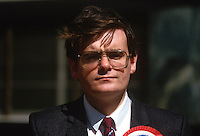
George Seawright, Independent Unionist candidate, June 1987, UK General Election, 19870603GS1

Copyright Image from Victor Patterson, 54 Dorchester Park, Belfast, UK, BT9 6RJ

Tel: +44 28 9066 1296
Mob: +44 7802 353836
Voicemail +44 20 8816 7153
Skype: victorpattersonbelfast
Email: victorpatterson@me.com
Email: victorpatterson@ireland.com (back-up)

IMPORTANT: If you wish to use this image or any other of my images please go to www.victorpatterson.com and click on the Terms & Conditions. Then contact me by email or phone with the reference number(s) of the image(s) concerned.

See  George Seawright

As the march entered the Catholic district, police seized Seawright and others. Orangemen then attacked the police  and journalists. A Catholic priest was assaulted by loyalists and at Drumcree a police landrover was overturned. Catholic youths also threw missiles at the police and marchers.

At least 27 officers were injured.

The 12 July march into the town centre was blocked from Obins Street for the second year. Instead, police escorted the march along Garvaghy Road without any bands. Although there was no violence on Garvaghy Road, loyalists later rioted with police in the town centre and tried to smash through the barrier leading to Obins Street.

1987 and 1988

In 1987 the Public Order Act was repealed by the Public Order (Northern Ireland) Order 1987, which removed the special status of ‘traditional’ parades. This meant that, after 1986, Orange marches were effectively banned from Obins Street indefinitely. The July 1987 march was re-routed and 3,000 soldiers and 1,000 police were sent to keep order.  Orangemen believed that sacrificing the Obins Street leg meant they would be guaranteed the Garvaghy Road leg.

Although the Garvaghy Road leg had caused trouble before, it was less populated than Obins Street at the time.

In June 1988 the Drumcree Faith & Justice Group (DFJG)—the group representing the Catholic/Irish nationalist residents—planned a march to the town centre to highlight what it saw as “double-standards” in the police’s handling of nationalist and loyalist parades. It asked permission from police, saying there would be only 30 marchers and they would carry no flags or banners. They were denied permission.

1990s and 2000s: Garvaghy Road


A mural supporting the Portadown Orangemen on Shankill Road, Belfast. On the left of the picture is a UDA/UFF flag.

Although a few years passed without serious conflict over the Drumcree parades, both sides remained unhappy with the situation. Orangemen took the new route each year, but continued to apply for marches along Obins Street.  Meanwhile, residents of Garvaghy Road and the surrounding Catholic district (see map) remained unhappy about what they viewed as “triumphalist” Orange marches through their area.

They made their opposition known in a number of ways: through the tenants’ associations that represented each housing estate, through the Drumcree Faith & Justice Group (DFJG), and through local politicians. A 1993 survey of people living on Garvaghy Road found that 95% of them were against Orange marches in the area.

Lead-up to July 1995

In 1994, the Provisional IRA and loyalist paramilitary groups called ceasefires.

In May 1995 the Garvaghy Road Residents Coalition (GRRC) was formed, comprising representatives from the DFJG and the tenants’ associations. Its main goal was to divert Orange marches away from Garvaghy Road through peaceful means. It held peaceful protests, petitioned the police and government ministers, and tried to draw media attention to the dispute.

The GRRC held regular public meetings with residents. There were usually about 12 representatives on the committee at any one time . According to one of its members, Joanne Tennyson,

“Although the GRRC could speak to anyone they wanted, at the end of the day no-one in the committee had the right to say we would do anything, not even […] the spokesman. The community had to agree as a whole and that was the purpose of holding public meetings”.

The GRRC’s first secretary and spokesman was Father Eamon Stack, a Jesuit priest and DFJG member who had lived in the area since 1993. Stack emphasized that the GRRC was non-sectarian and was not connected to any political parties. He would remain its spokesman until after July 1997.

By the mid-1990s, the population of Portadown was about 70% Protestant and 30% Catholic. There were three Orange halls in the town and an estimated 40 Protestant/loyalist marches each summer.

1995

On Sunday 9 July 1995, the Orangemen marched to Drumcree Church, held their church service, and then began marching towards the Garvaghy Road. However, hundreds of Catholic residents were holding a sit-down protest on Garvaghy Road to block the march.

Although the march was legal and the protest was not, police stopped the march from continuing. The Orangemen refused to take an alternate route, announcing that they would stay at Drumcree until they were allowed to continue. The Orangemen refused to negotiate with the residents’ group, and the Mediation Network was called upon to intercede. The police and local politicians were also involved in trying to resolve the deadlock.

Meanwhile, about 10,000 Orangemen and supporters had gathered at Drumcree and were engaged in a standoff with about 1,000 police. During this standoff, loyalists continuously threw missiles at the police and tried to break through the police blockade; police responded by firing 24 plastic bullets. In support of the Orangeman, loyalists blocked numerous roads across Northern Ireland, and sealed off the port of Larne.

There was violence in some Protestant areas.  On the evening of Monday 10 July, Ian Paisley (Democratic Unionist Party leader) and David Trimble (Ulster Unionist Party leader) held a rally at Drumcree. Afterwards, they gathered a number of Orangemen and tried to push through the police line, but were taken away by officers.

By the morning of Tuesday 11 July, a compromise was reached. The Orangemen would be allowed to march along Garvaghy Road on condition that they did so silently and without accompanying bands. Ronnie Flanagan (Deputy Chief Constable of the police) told the GRRC that residents should peacefully remove themselves from the road because “an angry scene between police and protesters could worsen the Ormeau marching dispute and even destabilise the ceasefires”.

When GRRC member Breandán Mac Cionnaith asked protesters to clear the road, some heckled him and refused. Flanagan was told there would be a better chance of the protesters moving if they knew there would be no march there next year. Flanagan replied that “there was no question of marches going where there was no consent from the community”. The residents were then persuaded to clear the road. This was all confirmed by the Mediation Network.

The Orangemen then marched along the road with Paisley and Trimble at the head of the march. As they reached the end of Garvaghy Road, Paisley and Trimble held their hands in the air in what appeared to be a gesture of triumph. Trimble claims that he only took Paisley’s hand to prevent the DUP leader from taking all the media attention.

Both sides were deeply unhappy with the events of July 1995. Residents were angered that the parade had gone ahead and at what they saw as unionist triumphalism, while Orangemen and their supporters were angered that their parade had been held up by an illegal protest. Some Orangemen formed a group called Spirit of Drumcree (SoD) to defend their “right to march”. At a SoD meeting in Belfast’s Ulster Hall one of the platform speakers said, to applause:

Sectarian means you belong to a particular sect or organisation. I belong to the Orange Institution. Bigot means you look after the people you belong to. That’s what I’m doing. I’m a sectarian bigot and proud of it.

1996

On Saturday 6 July 1996 the Chief Constable, Sir Hugh Annesley, stated that the parade would be banned from Garvaghy Road. Police checkpoints and barricades were set up on all routes into the nationalist area.

On Sunday 7 July the march made its way to Drumcree Church and, after the church service, was again blocked by police barricades. At least 4,000 Orangemen and loyalist supporters began another standoff. That afternoon, Orange ‘Grand Master’ Martin Smyth arrived at Drumcree and announced that there could be no compromise. Over the next three days, buses full of Orangemen and their supporters arrived in Portadown, bringing traffic to a standstill.

By Wednesday night the number of Orangemen and loyalists at Drumcree had risen to 10,000. Again, they pelted the police with missiles and tried to break through the blockade, while police responded with plastic bullets. Loyalists brought an armour-plated bulldozer to Drumcree, threatening to storm the police line.

Throughout Northern Ireland, loyalists blocked hundreds of roads, clashed with the police, and attacked or intimidated Catholics and nationalists. Many towns and villages were blockaded, either completely or for much of the daytime. Several Catholic families were forced to flee their homes in Belfast due to loyalist intimidation. Human Rights Watch said that the police failed to remove these illegal roadblocks and had “abandoned its traditional policing function in some areas”.  Loyalists also targeted the homes of police officers, mainly of those on duty at Drumcree. During the disorder, thousands of extra British troops were sent to Northern Ireland, bringing the total number of troops deployed to 18,500.

On the night of 7 July, Catholic taxi-driver Michael McGoldrick was shot dead near Lurgan by the Mid Ulster Brigade of the Ulster Volunteer Force (UVF), a loyalist paramilitary group. It is believed the killing was ordered by the brigade’s leader, Billy Wright, from Portadown.  Wright was frequently seen at Drumcree in the company of Harold Gracey, head of the Portadown Orange Lodge.

He also held a meeting with David Trimble, leader of the UUP. Members of the brigade smuggled homemade weaponry to Drumcree, apparently unhindered by the Orangemen. Allegedly, the brigade also had plans to drive petrol tankers into the Garvaghy area and blow them up.

On Wednesday 10 July, the police reported that, over the previous four days of loyalist protests, there had been:

  • 100 incidents of intimidation
  • 758 attacks on the police
  • 90 civilians injured
  • 50 police injured
  • 662 plastic bullets fired by the police and
  • 156 arrests made

Shortly before noon on Thursday 11 July, the Chief Constable reversed his decision and allowed the Orangemen to march along Garvaghy Road. The residents’ group had not been consulted on this and rioting erupted as police in armoured vehicles flooded the Garvaghy area and batoned hundreds of protesters off the Garvaghy Road.

About 1,200 Orangemen then marched down the road while residents were hemmed into their estates by riot police.There was outrage among the Catholic/nationalist community, who believed that the police had “surrendered” to loyalist violence and the threat of violence.

An article in the Irish News concluded that “the police did not have the will to impose the rule of law on the Orange Order and loyalists”. The Chief Constable said he believed the situation could no longer be contained. He claimed the crowd at Drumcree was expected to rise to 60,000 or 70,000 that night and would have broken through the defences and attacked the nationalist area. Nationalists argued that the police did nothing to stop the thousands of loyalists from gathering.[42]

Rioting erupted in nationalist areas of Lurgan, Armagh, Belfast and Derry.[41] In Derry, 22 protesters were seriously injured and one, Dermot McShane, died after being run-over by a British Army armoured vehicle.[41] Rioting continued throughout the week, during which time the police fired 6,000 plastic bullets, 5,000 of which were directed at nationalists.[41] The Committee on the Administration of Justice (CAJ), who had sent members to observe the situation, condemned this “completely indiscriminate” use of plastic bullets.[41] Human Rights Watch also accused the police of using “excessive force”.[44] Following the events, leaders of Sinn Féin and the SDLP stated that nationalists had completely lost faith in the police as an impartial police force.[41]

In August 1996, Billy Wright and his Portadown unit of the UVF were ‘stood down’ by the UVF leadership for breaking the ceasefire. The UVF warned Wright to leave Northern Ireland. He ignored the warning, and a large rally was held in Portadown in support of him. Harold Gracey (head of the Portadown Orange Lodge) and William McCrea (a DUP politician) attended the rally and made speeches in support of Wright.[47] Along with most of his Portadown unit, Wright then formed a splinter group called the Loyalist Volunteer Force (LVF).

Following the events of July 1996, many Catholics and nationalists began boycotting businesses run by Orangemen who had been involved in the standoff.[41]

1997[edit]

A placard opposing Orange marches in nationalist areas. Similar placards were used by protesters during the 1997 crisis

In May 1997 a local Catholic, Robert Hamill, was kicked to death by a gang of loyalists on Portadown’s main street. He and his friends were attacked while walking home.

Weeks before the July 1997 march, Secretary of State Mo Mowlam privately decided to let the march proceed along Garvaghy Road.[48] However, in the days leading up to the march, she insisted that no decision had been made.[48] Garvaghy Road residents applied to hold a festival on the day of the march. When this was banned by the police, local women set up a peace camp along the Garvaghy Road.[44][48] On Thursday 3 July, the Loyalist Volunteer Force (LVF) threatened to kill Catholic civilians if the march was blocked[48] and the Ulster Unionist Party threatened to withdraw from the Northern Ireland peace process.[49] The following day, sixty families had to be evacuated from their homes on Garvaghy Road after a loyalist bomb threat.[50]

In the days leading up to the march, thousands of British troops were flown to Northern Ireland.[48] Less than twelve hours before the Sunday 6 July march, the authorities still did not say whether it would be blocked. Then, at 3:30 am that morning, 1500 police and soldiers swept into the nationalist area in armoured vehicles and took control of the Garvaghy Road.[48] About 100 residents managed to get to the road and stage a sit-down protest.[51] They were forcefully removed by the police, who were then pelted with stones and petrol bombs as they pushed residents further back from the road.[48] Rosemary Nelson—a prominent human rights lawyer and the GRRC’s legal advisor—was physically and verbally abused by police officers.[51] From this point onward, residents were prevented from leaving their housing estates and accessing the Garvaghy Road.[48] As residents were also unable to reach the Catholic church, the local priests held an open-air mass in front of a line of soldiers and armoured personnel carriers.[48]

The Chief Constable said he had allowed the march to go ahead because of the threat to Catholic civilians by loyalist paramilitaries.[48] About 1,200 Orangemen marched along Garvaghy Road at noon that day.[44] After the march passed, the security forces began withdrawing from the area and severe rioting began. They were attacked by hundreds of nationalists with stones, bricks and petrol bombs. The security forces fired about 40 plastic bullets, and about 18 people were taken to hospital.[48] As news from Portadown emerged, violence erupted in several nationalist areas of Northern Ireland. The Provisional IRA launched numerous gun and bomb attacks on the security forces. Nationalists also attacked the security forces and blocked roads with burning vehicles. There were protests against the police and Orange marches, and a number of Orange halls were burnt. The widespread violence lasted until 10 July, when the Orange Order decided unilaterally to re-route or cancel several marches. By the end of the violence, more than 100 civilians and 60 police officers had been injured, while 117 people had been arrested. There had been 815 attacks on the security forces, 1,506 petrol bombs thrown and 402 hijackings. The police had fired 2,500 plastic bullets.[48]

In 1997, Sinn Féin leader Gerry Adams told an RTÉ journalist of his party’s involvement in the dispute:

Ask any activist in the north, ‘did Drumcree happen by accident?’, and he will tell you, ‘no’. Three years of work on the lower Ormeau Road, Portadown and parts of Fermanagh and Newry, Armagh and in Bellaghy and up in Derry. Three years of work went into creating that situation and fair play to those people who put the work in. They are the type of scene changes that we have to focus on and develop and exploit.[52][53][54]

After July 1997, GRRC member Brendan McKenna (Irish: Breandán Mac Cionnaith) replaced Eamon Stack as the group’s spokesman. Mac Cionnaith had been convicted and imprisoned for his involvement in a 1981 IRA bomb attack on Portadown’s Royal British Legion hall. He was released in 1984.[11][33]

This was the last time that the Orange Order was allowed to march on Garvaghy Road.[55]

1998[edit]

Early in 1998 the Public Processions Act was passed, establishing the Parades Commission. The Commission was now responsible for deciding what route contentious marches should take. On 29 June 1998, the Parades Commission decided to ban the march from Garvaghy Road.[56]

On Friday 3 July about 1,000 soldiers and 1,000 police were deployed in Portadown.[56] The soldiers built large barricades (made of steel, concrete and barbed wire) across all roads leading into the nationalist area. In the fields between Drumcree Church and the nationalist area they dug a trench, fourteen feet wide,[57] which was then lined with rows of barbed wire.[56] Soldiers also occupied the Catholic Drumcree College, St John the Baptist Primary School, and some properties near the barricades.[58]

On Sunday 5 July the Orangemen marched to Drumcree Church and stated that they would remain there until they were allowed to proceed.[56] About 10,000 Orangemen and loyalists arrived at Drumcree from across Northern Ireland.[59] A loyalist group calling itself “Portadown Action Command” issued a statement which read:

As from midnight on Friday 10 July 1998, any driver of any vehicle supplying any goods of any kind to the Gavaghy Road will be summarily executed.[11]

Over the next ten days, there were loyalist protests and violence across Northern Ireland in response to the ban. Loyalists blocked roads and attacked the security forces as well as Catholic homes, businesses, schools and churches.[59] On 7 July, the mainly-Catholic village of Dunloy was “besieged” by over 1,000 Orangemen. The County Antrim Grand Lodge said that its members had “taken up positions” and “held” the village.[59] On 8 July, eight blast bombs were thrown at Catholic homes in the Collingwood area of Lurgan.[59] There were also sustained attacks on the security forces at Drumcree and attempts to break through the blockade.[59] On 9 July, the security forces at Drumcree were attacked with gunfire and blast bombs; they responded with plastic bullets.[59] The police recorded 2,561 “public order incidents” throughout Northern Ireland,[56] including:[56]

  • 615 attacks on the security forces, which left 76 police offices injured
  • 24 shooting incidents
  • 45 blast bombs thrown
  • 632 petrol bombs thrown
  • 837 plastic bullets fired by the security forces
  • 144 houses and 165 other buildings attacked (the vast majority owned by Catholics/nationalists)
  • 467 vehicles damaged and 178 vehicles hijacked, and
  • 284 people arrested

On Sunday 12 July, Jason (aged 8), Mark (aged 9) and Richard Quinn (aged 10) were burnt to death when their home was petrol bombed by loyalists.[56] The boys’ mother was a Catholic, and their home was in a mainly-Protestant part of Ballymoney. Following the murders, William Bingham (County Grand Chaplain of Armagh and member of the Orange Order negotiating team) said that “walking down the Garvaghy Road would be a hollow victory, because it would be in the shadow of three coffins of little boys who wouldn’t even know what the Orange Order is about”. He said that the Order had lost control of the situation and that “no road is worth a life”.

However he later apologized for implying that the Order was responsible for the deaths. The murders provoked widespread anger and calls for the Order to end its protest at Drumcree. Although the number of protesters at Drumcree dropped considerably, the Portadown lodges voted unanimously to continue their standoff.

On Wednesday 15 July the police began a search operation in the fields at Drumcree. A number of loyalist weapons were found, including a homemade machine gun, spent and live ammunition, explosive devices, and two crossbows with more than a dozen homemade explosive arrows.

1999

In the year after July 1998, the Orange Order and GRRC tried to resolve the dispute through “proximity talks” using go-betweens, as the Orangemen refused to talk directly to the GRRC. Some senior Portadown Orangemen claim that they had been promised a parade on Garvaghy Road later that year if they could control things on the traditional parading dates.

Throughout the year the Orangemen and supporters held scores of protest rallies and marches in Portadown. Following one protest in September 1998, a Catholic RUC officer was killed by a blast bomb thrown by loyalist rioters. A renegade loyalist group, the Orange Volunteers, also began carrying out attacks on Catholics and Irish nationalists.

On 14 March 1999, the Parades Commission said the yearly march would again be banned from Garvaghy Road. The following day the GRRC’s legal advisor, Rosemary Nelson, was assassinated in Lurgan by loyalists.

In April, Portadown loyalists threatened to picket St John’s Catholic Church at the top of Garvaghy Road. On 29 May a ‘junior’ Orange march passed near Garvaghy Road. There were clashes following the march with 13 police officers and four civilians hurt. The police fired 50 plastic bullets during the clashes.

That month, DUP politician and Orangeman Paul Berry said Orangemen would not be stopped from marching the Garvaghy Road:

“If it is a matter of taking the law into our own hands then we are going to have to do it. That is a threat”.

On 24 June, Orangemen began a ten-day ‘Long March’ from Derry to Drumcree in protest at the ban.[63] The 1999 Drumcree march took place on Sunday 4 July. About 1,300 Orangemen marched to Drumcree and were met by several thousand supporters. The security forces had again blocked all roads leading into the nationalist area with large steel, concrete and barbed wire barricades. Rows of barbed wire were also stretched across the fields at Drumcree. There, loyalists threw missiles at police and soldiers, but there was less violence than the year before.

On 5 July, police in Portadown arrested four Belfast loyalists after finding pickaxe handles, wire cutters, petrol and combat clothing in their car. Later that day, six officers were hurt in clashes with loyalists near Garvaghy Road. The barricades were eventually removed on 14 July.

On 31 July, a drunken loyalist wielding an AK-47 and a handgun crossed the interface to Craigwell Avenue, a street of Catholic-owned houses. A resident wrestled him to the ground and disarmed him, but was shot and wounded while doing so. The loyalist was arrested and later convicted for attempted murder. In August, breeze blocks were thrown through the windows of houses on the street.

Also that year, the GRRC published a book detailing the history of Orange parades in the area. The book was called Garvaghy: A Community Under Siege.

In 1999, the Orange Order’s membership for the Portadown district, which had increased from 1995 through 1998, began a “catastrophic slump”.

2000 marching season

April-June

In April 2000, a newspaper reported that Portadown Orangemen had threatened British Prime Minister Tony Blair, saying that if that year’s march was banned from Garvaghy Road it would prove to be his “Bloody Sunday“.

The following month, almost 200 masked loyalists attacked Catholic-owned houses on Craigwell Avenue after assembling at Carlton Street Orange Hall. Allegedly, police landrovers were nearby but did not intervene.

On 27 May, the nationalist area was sealed-off so that a ‘junior’ Orange parade could march along the lower end of Garvaghy Road. The march included men in paramilitary uniform.

St John’s Catholic Church at the northern end of Garvaghy Road

The “peace line” (right) along Corcrain Road, seen from the loyalist side

On 31 May, a children’s cross-community concert at St John’s Catholic Church was disrupted by Portadown Orangemen beating Lambeg drums, allegedly trying to drown it out. Present at the concert were Secretary of State Peter Mandelson and UUP leader (and Orangeman) David Trimble.

After the concert, teachers, parents, children and guests held a reception at the Protestant Portadown College. A 300-strong loyalist mob hurled missiles and sectarian abuse while preventing families from leaving the College. The security forces were deployed but did not disperse the mob or make arrests.

On 7 June, St John’s Catholic Church was set alight by arsonists.

On 16 June, Catholic workers at Denny’s factory in Portadown walked-out after placards carrying sectarian slogans were erected near the main entrance. The week before, loyalists had thrown missiles at Catholics leaving the factory. The placards were removed shortly after. Later in the month, loyalists sent death threats to workers who were reinforcing the security barrier (or “peace line“) along Corcrain Road. The work stopped, leaving the nationalist area vulnerable to attack.

July

In July, it was revealed that members of neo-Nazi group Combat 18 were travelling from England to join the Orangemen at Drumcree. They were given shelter by LVF members in Portadown and Tandragee. That month, Portadown Orangeman Ivan Hewitt (who sported neo-Nazi tattoos) warned in a TV documentary that it may be time for loyalists to “bring their war to Britain”.

The 2000 Drumcree march took place on Sunday 2 July. It was again banned from Garvaghy Road and the nationalist area was sealed off with barricades. Speaking after the march was stopped, Orange ‘District Master’ Harold Gracey called for protests across Northern Ireland.

A prominent leader of the protesters, Mark Harbinson, a Stoneyford Orangeman who was associated with the paramilitary Orange Volunteers, proclaimed that “the war begins today”. On Monday 3 July a crowd of over fifty loyalists, led by UDA commander Johnny Adair, appeared at Drumcree with a banner bearing “Shankill Road UFF” [Ulster Freedom Fighters]. In the Corcrain area, LVF gunmen fired a volley of shots in the air for Adair and a cheering crowd.

On Tuesday 4 July, security forces used water cannon against loyalist protesters at the Drumcree barricade. This was their first deployment in Northern Ireland for over 30 years.

In an interview on 7 July, Harold Gracey refused to condemn the violence linked to the protests, saying “Gerry Adams doesn’t condemn violence so I’ll not”. On 9 July, the police warned that loyalists had threatened to “kill a Catholic a day” until the Orangemen were allowed to march along Garvaghy Road.

Two days later, a group of 150–200 loyalists ordered all shops in Portadown’s town centre to shut. Along with another group, they then tried to march on Garvaghy Road from both ends, but were held back by police. That night, 21 police officers were hurt during clashes with loyalists.

On 14 July, Portadown Orangemen’s calls for another day of widespread protest went unheeded as the Armagh and Grand Lodges refused to support their calls. Businesses remained open and only a handful of roads were blocked for a short time. The security barriers were removed and soldiers returned to barracks.

2001 onward

Since July 1998, the Orangemen have applied to march the traditional route every Sunday of the year – both the outward leg via Obins Street (which has been banned since 1986) and the return leg via Garvaghy Road.They have also held a small protest at Drumcree Church every Sunday. Their proposals have been rejected by the Parades Commission.

In February 2001, loyalists held protests on the lower Garvaghy Road as part of the run-up to “day 1000” of the standoff. The GRRC said that up to 300 people, some masked and armed with clubs, intimidated people living on Garvaghy Road. Some protesters also attacked a car with four women inside.[

There was further violence in May 2001. On 5 May, 300 Orangemen and supporters tried to march on to Garvaghy Road but were stopped by police. There were some scuffles between Orangemen and police officers. District Master Harold Gracey drew controversy when he said to the police officers: “We all know where you come from…you come from the Protestant community, the vast majority of you come from the Protestant community and it is high time that you supported your own Protestant people”.

On 12 May there were clashes between loyalists and nationalists on Woodhouse Street. On 27 May there were clashes between nationalists and police after a junior Orange march on the lower Garvaghy Road.

Four days before the July 2001 Drumcree march, 200 supporters and members of the UDA rallied at Drumcree. The Portadown Orange Lodge claimed that it was powerless to stop such people from gathering and that they could not be held responsible for their actions. Nevertheless, David Jones (the Lodge’s spokesman) said that he welcomed any support. Bríd Rogers, a local SDLP politician, called this “a further example” of the Orangemen’s “double standards”. She said that the Orangemen would not speak to the GRRC because of Mac Cionnaith’s “terrorist past”, yet they are “quite happy to associate with people who have a terrorist present”.

The march passed off peacefully under a heavy security presence.

Since 2001 Drumcree has been relatively calm, with outside support for the Portadown lodges’ campaign declining and the violence lessening greatly. Mac Cionnaith said that he believes the conflict is essentially over. The Orange Order continues to campaign for the right to march on Garvaghy Road.

Map

Routes of the Protestant parades before they were banned from Obins Street (A) in 1986.

Drumcree 1984.JPG

Red line:

Route taken by Orangemen on the Sunday before 12 July; from their Carlton Street Hall (D) under the railway bridge (C) along Obins Street (A) to Drumcree Church (F) and back along Garvaghy Road (B).
Blue line: Route taken on 12 July; from Corcrain Hall (E) along Obins Street (A) and under the railway bridge (C).
Green areas are largely nationalist/Catholic.
Orange areas are largely unionist/Protestant.


———————————

– Disclaimer –

The views and opinions expressed in this blog post are soley intended to educate and provide background information to those interested in the Troubles of Northern Ireland. They in no way reflect my own opinions and I take no responsibility for any inaccuracies or factual errors.

———————————

27th June – Deaths & Events in Northern Ireland Troubles

Key Events & Deaths on this day in Northern Ireland Troubles

27th June

——————————–

Saturday 27 June 1970 Major Gun Battle in Belfast

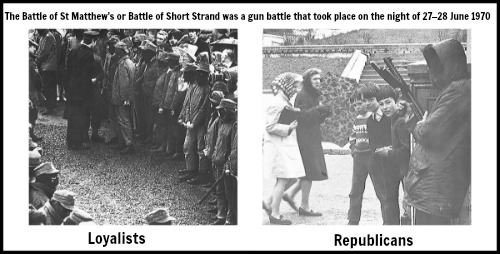
Battle of St Matthew's collage 4 500

There was serious rioting in Belfast involving Protestants and Catholics. During the evening groups of Loyalist rioters began to make incursions into the Catholic Short Strand enclave of east Belfast.

Catholics in the area believed that they were going to be burnt out of their homes and claimed that there were no British Army troops on the streets to protect the area. Members of the Irish Republican Army (IRA) took up sniping positions in the grounds of St Matthew’s Catholic Church and engaged in a prolonged gun battle with the Loyalists.

This was the most significant IRA operation to date. Across Belfast six people were killed of whom five were Protestants shot by the IRA. A Protestant man was mortally wounded when struck on the head by a missile. He died on 3 July 1970.

See Battle of St Matthew’s

Thursday 27 June 1985

Patrick Morrissey

The Irish National Liberation Army (INLA) shot dead a member of the Garda Síochána (the Irish police) during an armed robbery at a post office in Ardee, County Louth, Republic of Ireland.

Douglas Hurd, then Secretary of State for Northern Ireland, announced that certain community groups in Northern Ireland would receive no further government funding because of their alleged “close links with paramilitary organisations”.

Tuesday 27 June 1995

John Major, then British Prime Minister, and John Bruton, then Taoiseach (Irish Prime Minister), agreed to ask European Commission officials to look at ways in which the Commission might assist with the issue of decommissioning of paramilitary weapons.

[Major and Bruton were attending a European Union summit at Cannes at the time.]

Thursday 27 June 1996

Gardí in the Republic of Ireland recovered 100 pounds of home-made explosives at Clones, County Monaghan.

Saturday 27 June 1998

There were clashes between Nationalists and the Royal Ulster Constabulary (RUC) in west Belfast during an Orange Order parade.

Two men were killed and another seriously injured when a car ploughed into cyclists who were taking part in the Co-operation North Cross-Border mara-cycle.

The vehicle involved did not stop at the scene of the accident.

[The driver of the car was later arrested.]

Counting in the Northern Ireland Assembly Elections came to a close.

 The Ulster Unionist Party (UUP) emerged as the largest party with 28 seats. The Social Democratic and Labour Party (SDLP) had 24, the Democratic Unionist Party (DUP) 20, Sinn Féin (SF) 18, Alliance Party of Northern Ireland (APNI) 5, the United Kingdom Unionist Party (UKUP) 5, Progressive Unionist Party (PUP) 2, Northern Ireland Women’s Coalition (NIWC) 2, Independent Unionist 1, UU 1, and the UUU 1. In a major political breakthrough for the nationalist community, the SDLP emerged as the largest gainers of the first preference vote with 22%.

Sunday 27 June 1999

David Trimble, then leader of the Ulster Unionist Party (UUP), challenged Sinn Féin (SF) to get a pledge from the Irish Republican Army (IRA) to disarm by May 2000.

Martin McGuinness, then SF’s chief negotiator, said he could not speak on behalf of the Irish Republican Army (IRA).

Seamus Mallon, then deputy leader of the Social Democratic and Labour Party (SDLP), interpreted Trimble’s challenge as indicating an acceptance that the demand for prior disarmament would not be met.

Proximity talks between the Orange Order and representatives of the Garvaghy Road Residents’ Coalition (GRRC) failed to reach an agreement over the planned Drumcree Parade on 4 July 1999.


——————————————

Remembering all innocent victims of the Troubles

Today is the anniversary of the death of the following people killed as a results of the conflict in Northern Ireland

“To live in hearts we leave behind is not to die

– Thomas Campbell

To the innocent on the list – Your memory will live forever

– To the Paramilitaries –

There are many things worth living for, a few things worth dying for, but nothing worth killing for.

10 People lost their lives on the 27th   June between 1970 – 1989

——————————————

27 June 1970


William Kincaid   (28)

Protestant
Status: Civilian (Civ),

Killed by: Irish Republican Army (IRA)
Shot during street disturbances, Disraeli Street, off Crumlin Road, Belfast.

——————————————

27 June 1970


David Loughins   (32)

Protestant
Status: Civilian (Civ),

Killed by: Irish Republican Army (IRA)
Shot during street disturbances, Palmer Street, off Crumlin Road, Belfast.

——————————————

27 June 1970


Alexander Gould   (18)

Protestant
Status: Civilian (Civ),

Killed by: Irish Republican Army (IRA)
Shot during street disturbances, Disraeli Street, off Crumlin Road, Belfast.

——————————————

27 June 1970
Robert Neill   (38)

Protestant
Status: Civilian (Civ),

Killed by: Irish Republican Army (IRA)
Shot during street disturbances, at the junction of Central Street and Newtownards Road, Belfast.

——————————————

27 June 1970
James McCurrie   (34)

Protestant
Status: Civilian (Civ),

Killed by: Irish Republican Army (IRA)
Shot during street disturbances, Beechfield Street, Short Strand, Belfast.

——————————————

27 June 1972
William Galloway   (18)

Protestant
Status: Ulster Defence Association (UDA),

Killed by: non-specific Republican group (REP)
Shot during street disturbances, Edlingham Street, Tiger’s Bay, Belfast.

——————————————

27 June 1972
Bernard Norney  (38)

Catholic
Status: Civilian (Civ),

Killed by: Irish Republican Army (IRA)
Shot while attempting to drive through Irish Republican Army (IRA) roadblock, Whiterock Road, Ballymurphy, Belfast.

——————————————

27 June 1983


Malvern Moffatt   (36)

Protestant
Status: Civilian (Civ),

Killed by: non-specific Republican group (REP)
Shot while cutting hedge, Drumnakilly, near Omagh, County Tyrone.

——————————————

27 June 1985


Patrick Morrissey   (49)

nfNIRI
Status: Garda Siochana (GS),

Killed by: Irish National Liberation Army (INLA)
Shot during armed robbery at post office, Ardee, County Louth.

——————————————

27 June 1989


David Black   (34)

Protestant
Status: Royal Ulster Constabulary (RUC),

Killed by: Irish Republican Army (IRA)
Off duty. Killed by booby trap bomb attached to his car outside his home, Ballyheather Road, Artigarvan, near Strabane, County Tyrone.

——————————————


Battle of St Matthew’s – 27th –28th June 1970

The Battle of St Matthew’s also known as

The Battle of Short Strand


The Battle of St Matthew’s or Battle of Short Strand  was a gun battle that took place on the night of 27–28 June 1970 in Belfast, Northern Ireland.

It was fought between the Provisional Irish Republican Army (IRA) and Ulster loyalists in the area around St Matthew’s Roman Catholic church. This lies at the edge of the Short Strand, a Catholic enclave in a mainly-Protestant part of the city. Violence had erupted there, and in other parts of Belfast, following marches by the Orange Order.

The battle lasted about five hours and ended at dawn when loyalists withdrew. The British Army and police were deployed nearby but did not intervene. Three people were killed and at least 26 wounded in the fighting, while another three were killed in north Belfast.

The battle was the Provisional IRA’s first major action during the Troubles and was a propaganda victory for the organization. It presented itself as having successfully defended a vulnerable Catholic enclave from armed loyalist mobs. Loyalists, however, argue that the IRA lured them into a carefully prepared trap.

————————

1969 Northern Ireland Riots and and the Catholic-Protestant

————————

Background

Battle of bogside.jpg

The Northern Ireland riots of August 1969 marked the beginning of the Troubles. In Belfast, Catholic Irish nationalists clashed with Protestant Ulster loyalists and the mainly-Protestant Royal Ulster Constabulary (RUC), Northern Ireland’s police force.

Catholics believed that they were about to become “victims of a Protestant pogrom” and Protestants believed they were on the “eve of an IRA insurrection”.

Hundreds of Catholic homes and businesses were burnt out and more than 1,000 families, mostly Catholic, were forced to flee.

————————–

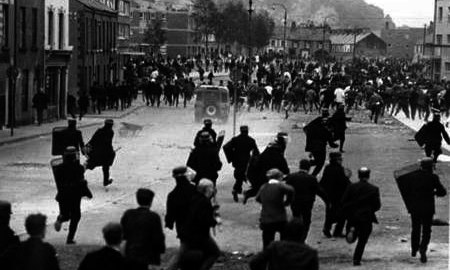
Street Riot In Belfast 1970

————————–

The Irish Republican Army (IRA) had few weapons or members and was unable to adequately defend the Catholic areas. The rioting ended with the deployment of British troops. In December 1969, the IRA split into the ‘Official’ IRA and ‘Provisional’ IRA—with the Provisionals vowing to defend Catholic areas in future.

The Short Strand is a Catholic/nationalist enclave in East Belfast, a mainly Protestant/Ulster unionist part of the city. In the early years of the Troubles, Catholics in Short Strand numbered about 6,000, while their Protestant neighbours totalled about 60,000.

 – Disclaimer –

The views and opinions expressed in these pages/documentaries are solely intended to educate and provide background information to those interested in the Troubles of Northern Ireland. They in no way reflect my own opinions and I take no responsibility for any inaccuracies or factual errors.

Preceding violence

The Orange Order Logo.jpg

On Saturday 27 June 1970, a large march by the Orange Order took place in West Belfast, which was joined by Ulster loyalist bands from other parts of the city. Many Protestants saw these marches as part of Protestant culture, while many Catholics/Irish nationalists saw them as provocative displays of Protestant/unionist supremacism. Rioting erupted when the march entered a Catholic neighbourhood; missiles were thrown by both sides, buildings were set ablaze, and the British Army fired CS gas in an attempt to disperse the crowds.

Rioting also erupted on Crumlin Road, the boundary between the Catholic Ardoyne and Protestant Woodvale areas. The rioting developed into a gun battle, in which three loyalists were shot dead by republican paramilitaries. A number of people were wounded, including a Royal Navy petty officer who was shot in the jaw while driving a field ambulance. The fighting took place near Holy Cross Catholic Church.

Battle

Violence erupted at St Matthew’s Catholic church on the evening of 27 June. It began after a loyalist band and supporters marched through the area on their return from the main parade. Rival groups gathered, taunting led to stone-throwing, and eventually shots were fired.

As the situation worsened, Catholic residents feared that the gathering crowds of loyalists would attempt to invade the Short Strand and burn them from their homes.

Local IRA volunteers retrieved weapons from arms dumps. A young resident, Jim Gibney, recalled:

“I saw neighbours, people I knew, coming down the street carrying rifles. I was just dumbstruck by this experience. I’d never seen such a thing before”.

The battle began at about 10pm and would continue for the next five hours.

Loyalists began attacking the church and surrounding property with petrol bombs. A small house in the church grounds, where the sexton lived with his family, was set ablaze. A nearby Catholic pub was also looted and burnt.

M1 Carbine Mk I - USA - Armémuseum.jpg

A small group of IRA volunteers and members of the Citizens’ Defence Committee  took up positions in the church grounds and in adjoining streets. The IRA volunteers were armed with M1 carbines and were led by Billy McKee, commander of the IRA’s Belfast Brigade.

Also present was Billy Kelly, commander of the Belfast Brigade’s 3rd Battalion.  The IRA volunteers fired at the loyalists, some of whom were positioned on the roofs opposite.

Jim Magee, a local loyalist, said he saw wounded people lying on the road and asked the police (RUC) for help. According to Magee,

“[they] said ‘if you have anything, get it out and protect your people’. So we got an old rifle and went into Frazer Street and started firing back”.


The security forces were deployed in the area at the time, but did not intervene to end the fighting. Shortly after the shooting began, Stormont MP Paddy Kennedy went with Short Strand residents to the local RUC base and demanded protection for their homes.

Across the River Lagan, in the Markets area, other IRA volunteers assembled and prepared to reinforce the Short Strand should it be invaded. British soldiers eventually arrived in armoured vehicles and cordoned off the roads around the Short Strand, which denied the IRA “any hope of reinforcement”.

At the time, the British Army said that its soldiers fired no shots because “owing to the confused situation, it was impossible to identify targets.

British Army Colonel Mike Dewar later said:

“The whole incident had taken its course because the Army was so chronically overstretched that night in Belfast. The one spare platoon in the whole of west Belfast was not able to get through rioting Protestants to the Short Strand”.

Journalist Tony Geraghty wrote that sometimes “The gunfire eased long enough to allow an occasional British Army personnel carrier (a ‘Pig‘) to whine past, illuminated by the flames in a token gesture of law-and-order”. Another journalist who witnessed the battle, Peter Taylor, later said:

The shooting intensified but the soldiers still declined to intervene and separate the two sides – either because they felt they were not numerically strong enough or because they did not wish to get caught up in the middle of a sectarian fight, in the darkness, with shots being fired by both sides.

Liz Maskey, who was a volunteer nurse that night, said that the Short Strand was surrounded by loyalists and claimed they attacked her ambulance as it tried to leave the area.

The loyalists withdrew after about five hours, as dawn broke. IRA leader Billy McKee claimed that his unit had fired 800 rounds during the battle.

Casualties

Three people were killed in the fighting. At least 26 were wounded — including Billy McKee, who was shot five times.

Deaths

Robert Neil, a 38-year-old Protestant, died instantly when a shot fired from the church bounced off the pavement and hit him in the spine.

James McCurrie, a 34-year-old Protestant, was shot dead on Beechfield Street.

 Henry McIlhone, a 33-year-old Catholic, was helping to defend Short Strand when   he was accidentally shot from the republican side. He died on 29 June.


However, McKee maintains that McIlhone was shot by loyalists.  Tírghrá, the IRA’s official list of its fallen, lists McIlhone as a “volunteer” but adds “although not a member of the IRA, Henry McIlhone was included in the republican role of honour as a mark of respect for this great Irishman by republican comrades he fought alongside”.

Aftermath

Republicans and loyalists disagree over who started the violence and fired the first shots. Republicans claim that the violence was started by a mob of loyalists returning from an Orange march. They say that the loyalists tried to set the church alight  and invade Short Strand, with the intention of burning the residents from their homes. , republicans argue that they were defending the Short Strand from loyalist attack. Loyalists claim the violence was begun by republicans; allegedly when the returning Orangemen and supporters were attacked on Newtownards Road.

They argue that republicans attacked Protestants to lure them into “a carefully prepared trap”.

The following day, loyalists expelled 500 Catholic workers from the nearby Harland and Wolff shipyard.Shortly after, the British government’s representative at Stormont said that the decision to allow Orange marches to go ahead on that day was;

“the greatest single miscalculation I have ever seen made in the course of my life”.

Many Catholics and nationalists believed that the IRA had been unable to defend them during the August 1969 riots. However, it is argued that the IRA’s defence of Short Strand redeemed it in the eyes of many Catholics and nationalists.  Among republicans, the battle is seen as a key event in the growth of the Provisional IRA.

Less than a week later, the British Army seized a large haul of Official IRA weapons during a three-day operation in west Belfast. Nationalists saw this as a confiscation of their defences.

battle05 of bogside

See Battle of Bogside


26th June – Deaths & Events in Northern Ireland Troubles

Key Events & Deaths on this day in Northern Ireland Troubles

26th June

——————————-

Friday 26 June 1970

Five People Killed in Premature Explosion

Thomas McCool

Two young girls, aged 9 years and 4 years, died in a premature explosion at their home in the Creggan area of Derry.

Their father, a member of the Irish Republican Army (IRA), had been making an incendiary device, presumably for use against the British Army. The explosion killed two other members of the IRA.

The girls were the first females to die in ‘the Troubles’.

Bernadette Devlin, Member of Parliament (MP), was arrested and jailed for six months for riotous behaviour during the ‘Battle of the Bogside’.

battle05 of bogside

See Battle of Bogside

There was rioting between the British Army and local residents in Derry following the news of the arrest. The riots spread to Belfast.

Monday 26 June 1972

Start of ‘Truce’

The Provisional Irish Republican Army (IRA) began a “bi-lateral truce” as at midnight.

[The move was made as a prelude to secret talks with the British Government. The ceasefire ended on 9 July 1972.]

The Irish Republican Army (IRA) killed two British Army soldiers in separate attacks during the day.

Tuesday 26 June 1973

senator paddy wilson

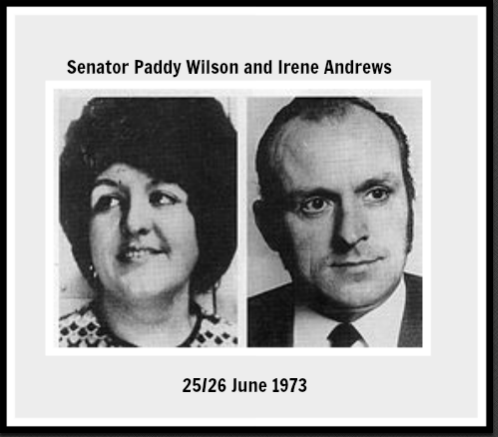
Paddy Wilson (39), then a Social Democratic and Labour Party (SDLP) Stormont Senator, and Irene Andrews (29), then his secretary, were found stabbed to death in a quarry on the Hightown Road, Belfast.

They had been killed by members of the Ulster Freedom Fighters (UFF) a covername for the Ulster Defence Association (UDA).

[John White was later convicted for his part in these killings. White was later to become a leading spokesman for the Ulster Democratic Party (UDP) and was involved in the negotiations that led to the ‘Good Friday’ Peace Agreement on 10 April 1998.]

See Paddy Wilson and Irene Andrews killings

A civilian employed by the British Army was shot dead by the IRA as he left an Army base in Derry. A Catholic civilian died four days after been shot by the British Army in Derry.

Thursday 26 June 1980

Miriam Daly, a prominent member of the National H-Block / Armagh Committee, was shot dead by Loyalist paramilitaries at her home in Andersontown, Belfast.

Thursday 26 June 1986

A constitution referendum on the issue of divorce was held in the Republic of Ireland.

[When the votes were counted the population had rejected the opportunity to introduce a restricted form of divorce by 63.5 per cent to 36.5 per cent. Many Unionists in Northern Ireland saw the result as confirming their view that the Republic was intolerant of Protestants.

Garret FitzGerald, then Taoiseach (Irish Prime Minister), said that the Republic had a long way to go to create “a society that would seem welcoming to, open to and attractive to people of the Northern Unionist tradtion.]

Wednesday 26 June 1991

Maguire Seven Freed The convictions of the group of people known as the ‘Maguire Seven’ were quashed by the Court of Appeal in London. The seven had been convicted of supplying the bombs that were used in Guildford and Woolwich.

[This was the latest in a series of high profile cases of miscarriage of justice involving Irish people living in England.]

Saturday 26 June 1993

John Major, then British Prime Minister, began a two-day visit to Northern Ireland. Major called for a resumption of political talks between the constitutional parties.

The Royal Ulster Constabulary (RUC) moved to prevent an Orange Order parade close to the peace line in the Springfield area of Belfast. The action led to rioting.

Brian McCallum (26), a member of the Ulster Volunteer Force (UVF), was mortally wounded when a grenade he was handling exploded prematurely. Eighteen other people were injured.

[McCallum died on 29 June 1993.]

Monday 26 June 1995

The High Court in Belfast awarded compensation to the mother of Karen Reilly (16) who was shot dead by a British soldier on 30 September 1990.

lee glegg

[The amount of the compensation was not disclosed. Reilly had been shot dead by Lee Clegg, a paratrooper with the British Army, during a ‘joyriding’ incident. Clegg was released from prison on 3 July 1995.]

See Lee Clegg

Wednesday 26 June 1996

David Trimble, then leader of the Ulster Unionist Party (UUP), admitted bringing pressure to bear on the Director of Public Prosecutions (DPP) and the Royal Ulster Constabulary (RUC) over the events on the Garvaghy Road in 1995.

Trimble had pressed for prosecutions against the leaders of the Garvaghy Road residents who had opposed the 1995 Drumcree Orange march. Prosecutions were dismissed. Veronica Guerin, an investigative journalist in Dublin, was shot dead near to Dublin.

Thursday 26 June 1997

The Fianna Fáil (FF) party appointed Ray Burke as Irish Minister for Foreign Affairs. It was also announced that David Andrews (FF) would be Minister for Defence and Liz O’Donnell (Progressive Democrats) would be Junior Minister for Foreign Affairs, and that both these ministers would assist Burke at Stormont.

[These appointments were part of the cabinet announced by Bertie Ahern, then Taoiseach (Irish Prime Minister), following the general election in the Republic of Ireland on 6 June 1997.]

Friday 26 June 1998

As counting got under way in the Northern Ireland Assembly election the relatively poor early showing of the Ulster Unionist Party (UUP) resulted in the bitter divisions within the party becoming public.

Jeffrey Donaldson, then UUP Member of Parliament (MP), who opposed the Good Friday Agreement accused his party colleague, Ken Maginnis, in a televised debate of:

“presiding over an electoral disaster”.

Maginnis replied by accusing Donaldson of “gloating over the difficulties that he and others like him” had created for the party.

Both nationalist parties, the Social Democratic and Labour Party (SDLP) and Sinn Féin (SF), were pleased with a strong first preference showing

Monday 26 June 2000

IRA Arms Inspected

The Irish Republican Army (IRA) issued a statement to say that it had opened some of its arms dumps to be viewed by the independent weapons inspectors. Cyril Ramaphosa and Martti Ahtisaari, then independent weapons inspectors, held a meeting with Tony Blair, then British Prime Minister, in Downing Street and confirmed that the inspection had taken place.


——————————————

Remembering all innocent victims of the Troubles

Today is the anniversary of the death of the following people killed as a results of the conflict in Northern Ireland

“To live in hearts we leave behind is not to die

– Thomas Campbell

To the innocent on the list – Your memory will live forever

– To the Paramilitaries –

There are many things worth living for, a few things worth dying for, but nothing worth killing for.

18 People lost their lives on the 26th   June between 1970 – 1993

——————————————

26 June 1970


Thomas McCool  (40)

Catholic
Status: Irish Republican Army (IRA),

Killed by: Irish Republican Army (IRA)
Died in premature explosion of incendiary device at his home, Dunree Gardens, Creggan, Derry.

——————————————

26 June 1970
 Bernadette McCool   (9)

Catholic
Status: Civilian (Civ),

Killed by: Irish Republican Army (IRA)
Died in premature explosion of incendiary device at her home, Dunree Gardens, Creggan, Derry.

——————————————

26 June 1970
Carol Ann McCool  (4)

Catholic
Status: Civilian (Civ),

Killed by: Irish Republican Army (IRA)
Died in premature explosion of incendiary device at her home, Dunree Gardens, Creggan, Derry.

——————————————

26 June 1970


Joseph Coyle   (40)

Catholic
Status: Irish Republican Army (IRA),

Killed by: Irish Republican Army (IRA)
Died in premature explosion of incendiary device at the McCool household, Dunree Gardens, Creggan, Derry

——————————————

26 June 1970


Thomas Carlin  (55)

Catholic
Status: Irish Republican Army (IRA),

Killed by: Irish Republican Army (IRA)
Injured in premature explosion of incendiary device at the McCool household, Dunree Gardens, Creggan, Derry. He died 8 July 1970.

——————————————

26 June 1972


David Houston   (22)

Protestant
Status: Royal Ulster Constabulary (RUC),

Killed by: Irish Republican Army (IRA)
Shot attempting to stop bomb attack on The Stables Bar, Water Street, Newry, County Down.

——————————————

26 June 1972
James Meredith   (20)

nfNI
Status: British Army (BA),

Killed by: Irish Republican Army (IRA)
Shot while on British Army (BA) foot patrol, Abercorn Road, Derry.

——————————————

26 June 1972


Malcolm Banks   (30)

nfNI
Status: British Army (BA),

Killed by: Irish Republican Army (IRA)
Shot by sniper while on British Army (BA) mobile patrol, junction of Seaforde Street and Comber Street, Short Strand, Belfast.

——————————————

26 June 1972
 John Black  (32)

Protestant
Status: Ulster Defence Association (UDA),

Killed by: British Army (BA)
Died five weeks after being shot at barricade during street disturbances, Douglas Street, off Beersbridge Road, Belfast.

——————————————

26 June 1973


Paddy Wilson  (39)

Catholic
Status: Civilian Political Activist (CivPA),

Killed by: Ulster Freedom Fighters (UFF)
Social Democratic and Labour Party (SDLP) Stormont Senator and Councillor. Together with his secretary, found stabbed to death in quarry, Hightown Road, near Belfast, County Antrim.

See Paddy Wilson and Irene Andrews killings

——————————————

26 June 1973


Irene Andrews  (29)

Protestant
Status: Civilian (Civ),

Killed by: Ulster Freedom Fighters (UFF)
Together with Social Democratic and Labour Party (SDLP) Stormont Senator and Councillor, Paddy Wilson, found stabbed to death in quarry, Hightown Road, near Belfast, County Antrim.

See Paddy Wilson and Irene Andrews killings

——————————————

26 June 1973
Noorbaz Khan  (45)

nfNI
Status: Civilian (Civ),

Killed by: Irish Republican Army (IRA)
Civilian employed by British Army (BA). Shot shortly after driving out of Bligh’s Lane British Army (BA) base, Creggan, Derry.

——————————————

26 June 1973


Robert McGuinness  (22)

Catholic
Status: Civilian (Civ),

Killed by: British Army (BA)
Died four days after being shot while walking along Brandywell Avenue, Derry

——————————————

26 June 1976
Daniel Mackin  (20)

Catholic
Status: Civilian (Civ),

Killed by: non-specific Loyalist group (LOY)
Found stabbed to death, Brookvale Street, off Cliftonville Road, Belfast.

——————————————

26 June 1980


Miriam Daly  (45)

Catholic
Status: Civilian Political Activist (CivPA),

Killed by: non-specific Loyalist group (LOY)
Irish Republican Socialist Party (IRSP) member. Found shot at her home, Andersonstown Road, Andersonstown, Belfast.

——————————————

26 June 1981
Vincent Robinson   (29)

Catholic
Status: Civilian (Civ),

Killed by: Irish Republican Army (IRA)
Found shot, Divis Flats, Belfast. Alleged informer.

——————————————

26 June 1987


John Tracey  (46)

Protestant
Status: Ulster Defence Regiment (UDR),

Killed by: Irish Republican Army (IRA)
Off duty. Shot while renovating house, Surrey Street, off Lisburn Road, Belfast.

——————————————

26 June 1993
John Randall  (19)

nfNI
Status: British Army (BA),

Killed by: Irish Republican Army (IRA)
Shot by sniper, while on British Army (BA) foot patrol, crossing field, near Newtownhamilton, County Armagh.

——————————————

Senator Paddy Wilson and Irene Andrews

Paddy Wilson and Irene Andrews killings


The killings of Paddy Wilson and Irene Andrews took place in Belfast, Northern Ireland on the night of 25/26 June 1973. The victims, Roman Catholic Senator Paddy Wilson and his Protestant friend, Irene Andrews, were hacked and repeatedly stabbed to death by members of the “Ulster Freedom Fighters” (UFF).


John White


This was a cover name for the Ulster Defence Association (UDA), a then-legal Ulster loyalist paramilitary organisation. John White, the UFF’s commander, who used the pseudonym “Captain Black”, was convicted of the sectarian double murder in 1978 and sentenced to life imprisonment.

White, however maintained that the UFF’s second-in-command Davy Payne helped him lead the assassination squad and played a major part in the attack. Although questioned by the Royal Ulster Constabulary (RUC) after the killings, Payne admitted nothing and was never charged.

— Disclaimer –

The views and opinions expressed in this post/documentaries  are soley intended to educate and provide background information to those interested in the Troubles of Northern Ireland. They in no way reflect my own opinions and I take no responsibility for any inaccuracies or factual errors.

———————————————————


SDLP logo


Wilson was one of the founders and General Secretary of the Social Democratic and Labour Party (SDLP) and Irene Andrews was noted in Belfast as a popular ballroom dancer.

Their mutilated bodies were found lying in pools of blood on either side of Wilson’s car, which was parked in a quarry off the Hightown Road near Cavehill. Wilson had been hacked and stabbed 30 times and his throat cut from ear to ear. Andrews had received 20 knife wounds. The killings were described by the judge at White’s trial as “a frenzied attack, a psychotic outburst”.

Paddy Wilson and Irene Andrews killings
Paddy wilson and irene andrews.jpg

Victims Irene Andrews and Senator Paddy Wilson
Location Quarry off the Hightown Road, Belfast, Northern Ireland
Date 25/26 June 1973
Attack type
Stabbing
Deaths 2 civilians
Perpetrator Ulster Freedom Fighters (UFF

The double killings

On the evening of 25 June 1973, Stormont Senator Paddy Wilson (39), a Roman Catholic native of Belfast’s Sailortown, and General Secretary and founder of the Social Democratic and Labour Party (SDLP), had been drinking at the Old Vic Lounge inside McGlade’s Bar, a fashionable pub located in Donegall Street, Belfast city centre.

He was in the company of a Protestant friend, Irene Andrews (29), who worked as a clerk in the Department of Education and was one of Belfast’s most popular ballroom dancers who had been a member of Northern Ireland’s “Come Dancing” team.

According to Peter McKenna, a journalist for the Irish Independent who had been socialising with Wilson, Andrews and others on the night, an inebriated Andrews had spent much of the night making passes at Wilson but he had rejected her advances and had asked for McKenna to make an “urgent” phone call to the pub calling him away in an attempt to separate himself from Andrews. The ruse was not successful, however, and Wilson and Andrews left the pub together.

He offered her a lift back to her home on the Crumlin Road and they drove away from the pub at about 11:30pm in Wilson’s red mini. The couple never arrived at their destination.

At 1:30am, the loyalist Ulster Freedom Fighters (UFF), using their codename “Captain Black”, called the Belfast News Letter advising them that:

” tonight we have got Senator Paddy Wilson and a lady friend. Their bodies are lying in the Hightown Road.”

The UFF had been founded that same year by John White, who employed the pseudonym “Captain Black”. The UFF was a cover name to claim attacks carried out by the then-legal Ulster Defence Association to avoid the latter’s proscription by the British Government. “Captain Black” furthermore claimed that the killings were in retaliation for the shooting death of a mentally-retarded Protestant teenager the previous summer by the Provisional IRA.

The mutilated bodies of Wilson and Andrews were discovered by the security forces at 4am. They were lying in pools of blood on either side of Wilson’s Mini at a quarry off the Hightown Road near Cavehill as described by the UFF caller.

The Royal Ulster Constabulary (RUC) and British Army had proceeded carefully to the quarry in case the bodies had been booby-trapped. Wilson had been stabbed to death 30 times and his throat sliced from ear-to-ear. There was evidence that he had put up a struggle before he was killed.

Andrews had received 20 knife wounds. A UFF Brigade Staff member described the killings to a journalist as ritualistic ,  in addition to the multiple stabbings, Irene Andrews also had her breasts hacked off.

Oldpark Wards.png

The killings took place at the quarry and it was suggested by police that Wilson’s Mini had been stopped on the road leading to Ballysillan and they were forced at gunpoint to drive out to the quarry.

According to Martin Dillon forensic evidence indicated that Wilson had been dragged from the car and pinned to the ground where he was stabbed and Andrews was killed afterwards. Dillon speculated that the killers had made Andrews watch Wilson being killed.

Liam Cosgrave crop.png

There was widespread shock and condemnation throughout the North in the wake of the killings. Politicians, including Taoiseach Liam Cosgrave and SDLP leader Gerry Fitt, personally offered their condolences to the Wilson and Andrews’ families, whilst Democratic Unionist Party leader Ian Paisley blamed the IRA.

According to Peter Taylor, there had never been a crime so brutal carried out in Northern Ireland before.

Author Dervla Murphy in her travel book, A Place Apart (based on her experiences in Northern Ireland), stated that nine months before the double killing, a loyalist community newspaper had published allegations regarding a possible relationship between a prominent member of the SDLP and a young Protestant woman from Belfast’s Crumlin Road.

Conviction

UFF leader and self-styled “Captain Black” John White confessed to the killings during a police interrogation for other offences at the Castlereagh Holding Centre in 1976. He was convicted of the murders in 1978 and given two life sentences.

The trial judge described the killings as “a frenzied attack, a psychotic outburtst”. White maintained that the UFF’s second-in-command (and later North Belfast UDA brigadier) Davy Payne, also known as “The Psychopath”, was part of the assassination squad and played a leading role in the killings. Historian Ian S. Wood confirmed Payne’s central involvement in the double killing.

Although Payne had been questioned by the RUC after the killings, he admitted nothing and never faced any charges. It was alleged that whenever Payne wished to frighten or intimidate others he would shout:

“Do you know who I am? I’m Davy Payne. They say I killed Paddy Wilson”.


Following White’s release from the Maze Prison in 1992, he joined the Ulster Democratic Party. A prominent figure in the Northern Ireland Peace Process, in 1996 he comprised part of a four-man loyalist delegation to 10 Downing Street where he met British Prime Minister John Major.

Railway Road bomb 1973.jpeg

Later when asked why he had perpetrated the killings, White claimed that they were carried out to strike fear into the Catholic community after the IRA’s 1973 Coleraine bombings. Regarding Irene Andrews, White replied:

“We didn’t know she was a Protestant, we just thought she was a Catholic to be honest”.

William ” Billy “Stobie 1950 – 12 Dec 2001

William “Billy” Stobie

———————————————

The views and opinions expressed in this documentary/ies and page are soley intended to educate and provide background information to those interested in the Troubles of Northern Ireland.

They in no way reflect my own opinions and I take no responsibility for any inaccuracies or factual errors

———————————————

William “Billy” Stobie (1950 – 12 December 2001) was an Ulster Defence Association (UDA) quartermaster and RUC Special Branch informer  who was involved in the shootings of student Brian Adam Lambert in 1987 and solicitor Pat Finucane in 1989.

See Pat Finucane

His 1990 admissions, to journalist Neil Mulholland, provided new information which led, in February 1999, to British Irish Rights Watch submitting a confidential report to the British Government.

This in turn would lead to the reopening of the Stevens Enquiry, which uncovered state/paramilitary collusion at a level “way beyond” what Sir John Stevens had originally reported.

William Stobie
William Stobie.jpg


Stobie leaving court in 2001
Born William Stobie
1950
Belfast, Northern Ireland
Died 12 December 2001 (age 51)
Glencairn estate, Belfast
Cause of death Multiple gunshot wounds
Nationality British
Organization Ulster Defence Association
Known for Special Branch agent
Title Quartermaster
Religion Protestantism

Early life

Stobie was a native of loyalist west Belfast who joined the UDA for the first time around the time of its foundation in 1971. After a short spell he left and joined the British Army, serving outside Northern Ireland. Returning to Belfast when his spell in the army ended he rejoined the UDA and served the organisation as an armourer.

Stobie had initially applied to join the Ulster Volunteer Force but was rejected by that organisation, which feared that he might be a government agent due to his time in the army, and instead rejoined the UDA, joining A Company of the UDA West Belfast Brigade in Highfield.

Brian Adam Lambert

On 8 November 1987, the IRA detonated a powerful bomb at the Enniskillen Remembrance Sunday ceremony killing eleven.

enniskillenpoppydayexplosion25thanniv011

See Enniskillen Remembrance Bomb

There was no immediate direct reprisal, partially as a result of an appeal by Gordon Wilson, father of one of the victims. The exception to this was when Brian Adam Lambert was mistakenly targeted and shot the following day at a building site in Highfield, Belfast. He was a 19-year-old Protestant student with no criminal record or paramilitary links, but was assumed to have been a Catholic.

At the Stevens Enquiry (“Overview & Recommendations”), Stobie admitted supplying the guns for the attack and driving Stephen Harbinson in the getaway car. Both Stobie and Harbinson stated they were sickened by the mistake and for the first time Stobie realised that the UDA was unprofessional. Harbinson was also arrested; he was convicted and sentenced to life imprisonment. Following his release under the Good Friday Agreement he skipped bail on drug dealing charges in Northern Ireland. He was rearrested on the Costa Del Sol on separate charges of drug trafficking, kidnapping and arms possession. Once more he was given bail and disappeared.

Discovery as an informer

Stobie’s informing did not go unnoticed and in May 1992 he narrowly avoided being killed by other members of the West Belfast Brigade who suspected he was a “tout”. At the time Stobie was operating the switchboard at Circle Taxis on the Shankill when their offices were raided by the police and the owners questioned about a taxi that had been ordered to the Glencairn estate.

MadDogAdair.jpg

This car had been hijacked whilst on that call by the UVF and used in an abortive operation by the group. West Belfast brigadier Johnny Adair was told by a friend that Stobie had told the police about the incident and it was decided that he would be shot as an informer.

On the evening of 21 May 1992, Stobie was called to the house of Jackie Thompson on Snugville Street where a party was being held, with Adair and fellow UDA members Donald Hodgen, Tommy Potts and others in attendance. Stobie did not attend so Thompson and Hodgen drove up to his house and dragged him out. They took him to an alleyway where Adair was waiting and after a struggle a fleeing Stobie was shot five times in the back and legs.

However he survived the attack despite his injuries.

Pat Finucane

Patrick Finucane

According to Henry McDonald and Jim Cusack, Stobie provided the gun used to kill Pat Finucane and they further claimed that once he gave the weapon to the hit team he called the RUC to let them know that a killing was about to take place.

In April 1999, as part of the Stevens Enquiry, Stobie was arrested and charged with Finucane’s murder. In June that year, as agreed, journalist Ed Moloney published Stobie’s version of the circumstances of Finucane’s death.The charges were later commuted to aiding and abetting the murder. Stobie’s trial eventually collapsed because of the failure of Neil Mulholland, by now Northern Ireland Office Press Officer, to take the witness stand.

See Pat Finucane

Stevens 3

Stobie was rearrested and charged with murder as a result of Stevens 3. At his trial the chief witness, Neil Mullholland, refused to take the witness stand and Stobie was released. In his overview and recommendations John Stevens stated:

“I have uncovered enough evidence to lead me to believe that the murders of Patrick Finucane and Brian Adam Lambert could have been prevented”.

Death

In 2001, Stobie let it be known that he would be willing to testify at an inquiry into Finucane’s killing, stating that he would not name loyalists but would name their RUC “handlers”. By declaring that he supported the Finucane family’s demand for a public inquiry he effectively made himself a target for his former UDA comrades.

On 12 December 2001, Stobie was shot dead outside his home at Forthriver Road, Glencairn, Belfast. The Red Hand Defenders (RHD) claimed responsibility. Stobie’s killers, who shot him five times, had actually belonged to the UDA and were using the Red Hand Defenders cover name. 

In a statement made by a masked paramilitary after the killing it was claimed:

“Billy Stobie could have stayed on the Shankill and been left alone had he not spoken out on Ulster Television and backed the public inquiry [into the Finucane killing,  He betrayed his comrades by doing that and for that reason he paid for his treason”


Who wants… A signed copy of my No.1 best selling book ? Makes a great Xmas gift for book lovers & those interested in the Troubles & the crazy, mad days my generation lived through.

Click here to order : https://tinyurl.com/2p9b958v

UK orders only – if you live outside the UK email me belfastchildis@googlemail.com and Ill send you a link for ordering outside the UK.

18th June – Deaths & Events in Northern Ireland Troubles

Key Events & Deaths on this day in Northern Ireland Troubles

18th June

——————————

Wednesday 18 June 1969

A report was published by the International Commission of Jurists (ICJ) on the British government’s policy in Northern Ireland.

The report was critical of both the British government and the Northern Ireland government.

Thursday 18 June 1970

Westminster General Election

A general election was held across the United Kingdom with the Conservative Party replacing the Labour Party to form the government at Westminster.

Edward Heath became Prime Minister.

Reginald Maudling, was appointed as Home Secretary and had responsibility for Northern Ireland.

In Northern Ireland the Unionist Party held ‘only’ eight of the 12 seats.

Ian Paisley, gained North Antrim, Frank McManus, a Nationalist unity candidate, gained Fermanagh-South Tyrone, Gerry Fitt held West Belfast and Bernadette Devlin held Mid-Ulster.

Friday 18 June 1971

Social Democratic and Labour Party (SDLP) and Nationalist Members of Parliament (MPs) refuse to attend the state opening of Stormont.

Sunday 18 June 1972


Arthur McMillan & Colin Leslie

(Two of the murdered soldiers)

Three members of the British Army were killed by an Irish Republican Army (IRA) bomb in a derelict house near Lurgan, County Down.

Wednesday 18 June 1975

At Westminster a Bill was introduced to make amendments to the Northern Ireland Emergency Provision Act (1973).

The main amendment had the effect of giving control of detention to the Secretary of State.

Sunday 18 June 1978

Hugh Murphy, then a Catholic priest was kidnapped in retaliation for the abduction of a Royal Ulster Constabulary (RUC) officer the day before, 17 June 1978.

The kidnappers issued a statement saying that they would return the priest in the same condition as the RUC officer is returned.

A number of Protestant ministers appealed for the priest to be released and he was subsequently returned unharmed.

[On 10 July 1978 the body of Officer Turbitt was discovered. In December 1978 three RUC officers were charged with kidnapping the Catholic priest. The same officers were also charged, along with two additional officers, of killing a Catholic shopkeeper in Ahoghill on 19 April 1977.]

Wednesday 18 July 1979

Ian Paisley, then leader of the Democratic Unionist Party (DUP), tried to interrupt Jack Lynch, then Taoiseach (Irish Prime Minister) and President of the European Council, but was shouted down by other Members of the European Parliament (MEPs).

Wednesday 18 June 1980

 Hunger Strike.]

Friday 18 June 1982

Lord Gowrie, then a Northern Ireland Office (NIO) Minister, was quoted as saying:

“Northern Ireland is extremely expensive on the British taxpayer … if the people of Northern Ireland wished to join with the South of Ireland, no British government would resist it for twenty minutes.”

Tuesday 18 June 1991

An additional 500 British Army soldiers arrived in Northern Ireland bringing the total number deployed to approximately 11,000.

Friday 18 June 1993

President Shakes Adams’ Hand

Mary Robinson, then President of the Republic of Ireland, paid an unofficial visit to community groups in Belfast.

The visit went ahead against the wishes of the British government and the Northern Ireland Office (NIO). During the visit Robinson met Gerry Adams, then President of Sinn Féin (SF), and shook his hand.

[This gesture provoked a lot of criticism amongst Unionists.]

Robinson also visited Coalisland, in County Tyrone.

Saturday 18 June 1994

Loughlinisland Killings

Loughinisland

The Ulster Volunteer Force (UVF) killed six Catholic men and wounded five others in a gun attack on a bar in Loughlinisland, County Down.

The people in the bar were watching a televised World Cup football match when the gunmen entered.

———————–

———————–

[The attack was widely condemned. Patrick Mayhew, then Secretary of State for Northern Ireland, said that the “moral squalor” of the killers was beyond description. Dick Spring, then Tánaiste (deputy Irish Prime Minister and Minister for Foreign Affairs), said it was a “night of savagery”.]

See Loughlinisland Massacre

Shots were fired into the home of a Catholic family in Lisburn, County Antrim.

Sunday 18 June 1995

The Royal Ulster Constabulary (RUC) rerouted an Orange Order parade away from the Nationalist area of the lower Ormeau Road, Belfast.

Tuesday 18 June 1996

Parts of the centre of Dublin were evacuated in a bomb hoax which was believed to have been made by the Ulster Freedom Fighters (UFF).

Friday 18 June 1999

lee glegg

Lee Clegg, then a soldier in the Parachute Regiment, was sentenced to four years for attempting to wound Martin Peake with intent in west Belfast on 30 September 1990.

Clegg was however immediately released because of the time he had already served in prison.

[Clegg was originally convicted of the murder of Karen Reilly during the same incident but was cleared on appeal on 11 March 1999.]

See Lee Clegg

Baroness May Blood

Three people from Northern Ireland were appointed as Working Peers by the Labour government. They were John Laird, a former Ulster Unionist Party (UUP) Stormont MP; Dennis Rogan, then UUP Chairman; and May Bloody, then a Shankill Road community worker.

James McCarry, then a Sinn Féin Councillor, became the first Republican to obtain a firearms licence following the personal intervention of Marjorie (Mo) Mowlam, then Secretary of State for Northern Ireland.

Monday 18 June 2001

New Political Talks

Tony Blair, then British Prime Minister, and Bertie Ahern, then Taoiseach (Irish Prime Minister), launched another attempt to find a resolution of the outstanding issues in the peace process. The two leaders held talks with represetatives of the three main pro-Agreement parties: the Ulster Unionist Party (UUP), the Social Democratic and Labour Party (SDLP), and Sinn Féin (SF).

——————————————

Remembering all innocent victims of the Troubles

Today is the anniversary of the death of the following people killed as a results of the conflict in Northern Ireland

“To live in hearts we leave behind is not to die

– Thomas Campbell

To the innocent on the list – Your memory will live forever

– To the Paramilitaries –

There are many things worth living for, a few things worth dying for, but nothing worth killing for.

13   People lost their lives on the 18th June between 1972 – 1994

——————————————

18 June 1972


Arthur McMillan   (37)

nfNI
Status: British Army (BA),

Killed by: Irish Republican Army (IRA)
Killed by booby trap bomb in derelict house, Bleary, near Lurgan, County Down.

——————————————

18 June 1972
Ian Mutch  (31)

nfNI
Status: British Army (BA),

Killed by: Irish Republican Army (IRA)
Killed by booby trap bomb in derelict house, Bleary, near Lurgan, County Down

——————————————

18 June 1972


Colin Leslie  (26)

nfNI
Status: British Army (BA),

Killed by: Irish Republican Army (IRA)
Killed by booby trap bomb in derelict house, Bleary, near Lurgan, County Down.

——————————————

18 June 1974


 John Forsythe  (30)

Protestant
Status: Royal Ulster Constabulary (RUC),

Killed by: Irish Republican Army (IRA)
Killed by booby trap bomb while on Royal Ulster Constabulary (RUC) foot patrol, in entry off Market Street, Lurgan, County Armagh.

——————————————

18 June 1976
Robert Craven  (51)

Catholic
Status: Civilian (Civ),

Killed by: non-specific Loyalist group (LOY)
Killed in bomb attack on Conway’s Bar, Greencastle, Belfast.

——————————————

18 June 1982
Albert White  (60)

Catholic
Status: ex-Royal Ulster Constabulary (xRUC),

Killed by: Irish Republican Army (IRA)
Civilian employed by the Royal Ulster Constabulary (RUC). Shot while driving his car, near to his home, Balmoral Park, Newry, County Down.

——————————————

18 June 1985


William Gilliland  (39)

Protestant
Status: Royal Ulster Constabulary (RUC),

Killed by: Irish Republican Army (IRA)
Killed in land mine attack on Royal Ulster Constabulary (RUC) mobile patrol, Coragh Glebe, near Kinawley, County Fermanagh.

——————————————

18 June 1994


Adrian Rogan   (34)

Catholic
Status: Civilian (Civ),

Killed by: Ulster Volunteer Force (UVF)
Shot, during gun attack, on The Heights Bar, Loughinisland, County Down.

——————————————

18 June 1994


Malcolm Jenkinson  (52)

Catholic
Status: Civilian (Civ),

Killed by: Ulster Volunteer Force (UVF)
Shot, during gun attack, on The Heights Bar, Loughinisland, County Down.

——————————————

18 June 1994


Barney Greene   (87)

Catholic
Status: Civilian (Civ),

Killed by: Ulster Volunteer Force (UVF)
Shot, during gun attack, on The Heights Bar, Loughinisland, County Down.

——————————————

18 June 1994


Daniel McCreanor  (59)

Catholic
Status: Civilian (Civ),

Killed by: Ulster Volunteer Force (UVF)
Shot, during gun attack, on The Heights Bar, Loughinisland, County Down.

——————————————

18 June 1994


Patrick O’Hare   (35)

Catholic
Status: Civilian (Civ),

Killed by: Ulster Volunteer Force (UVF)
Shot, during gun attack, on The Heights Bar, Loughinisland, County Down.

——————————————

18 June 1994


Eamon Byrne   (39)

Catholic
Status: Civilian (Civ),

Killed by: Ulster Volunteer Force (UVF)
Shot, during gun attack, on The Heights Bar, Loughinisland, County Down.

——————


17th June – Deaths & Events in Northern Ireland Troubles

Key Events & Deaths on this day in Northern Ireland Troubles

17th June

———————–

Monday 17 June 1974

The Irish Republican Army (IRA) exploded a bomb at Westminster Hall in London, 11 people were injured in the explosion.

Thursday 17 June 1976


Brendan Meehan & Gerard  Stitt

Two Catholic civilians were shot dead, by the UDA or  (UVF), as they travelled on a bus on Crumlin Road, Belfast. A Catholic civilian died 11 days after being shot by the IRA in a case of mistaken identity.

Saturday 17 June 1978


Hugh McConnell & William Turbitt

The Irish Republican Army (IRA) carried out a gun attack on an Royal Ulster Constabulary (RUC) patrol car near Crossmaglen, County Armagh.

One officer, Hugh McConnell (32), was killed at the scene and a second officer, William Turbitt (42), was kidnapped.

A Catholic priest was kidnapped the following day in retaliation but was later released.

On 10 July 1978 the body of Officer Turbitt was discovered.

In December 1978 three RUC officers were charged with kidnapping the Catholic priest. The same officers were also charged, along with two additional officers, of killing a Catholic shopkeeper in Ahoghill on 19 April 1977.

Kevin Dyer, Kevin 

A Catholic civilian was found beaten to death on a rubbish tip in Belfast. He had been killed by Loyalists.

Tuesday 17 July 1979

Ian Paisley, then leader of the Democratic Unionist Party (DUP), interrupted the opening proceedings of the European parliament to protest that the Union flag was flying the wrong way up on the Parliament Buildings.

Monday 17 June 1991

Political Talks Began

The four main political parties met at Stormont, Belfast, to begin talks on the future of Northern Ireland.

The talks (later known as the Brooke / Mayhew talks) began with opening statements from each of the parties. Prospects of a breakthrough however are slim given the fact that a meeting of the Anglo-Irish Intergovernmental Conference (AIIC) is scheduled for the middle of July.

This event is important given the fact that Unionists have stated that they will withdraw from the talks once the two governments begin their preparations for the AIIC.

Friday 17 June 1994

Three Men Shot by UVF

Gerald Brady (27), a Catholic civilian, was shot dead by the Ulster Volunteer Force (UVF). Brady was a taxi driver and was found shot in his car, Blackthorn Park, Sunnylands, Carrickfergus, County Antrim.

Cecil Dougherty (30), a Protestant civilian, was shot dead by the UVF) during a gun attack on a workers hut, Rushpark, off Shore Road, Newtownabbey, County Antrim.

He was assumed to have been a Catholic.

In the same attack William Corrigan (32), a Protestant civilian, was also shot and mortally wounded.

He died 10 July 1994.

Corrigan was also assumed to have been a Catholic.

A meeting of the Anglo-Irish Intergovernmental Conference took place in Dublin, Republic of Ireland. Patrick Mayhew, then Secretary of State for Northern Ireland, stated that there would be no successful political solution in Northern Ireland unless Articles 2 and 3 of the Irish Constitution were amended.

Dick Spring, then Tánaiste (deputy Irish Prime Minister and Minister for Foreign Affairs), replied by saying that the British government would have to make changes to Section 75 of the Government of Ireland Act.


Saturday 17 June 1995

Gerry Adams, then President of Sinn Féin (SF), said that preliminary talks with British ministers had run their course and were now over.

Tuesday 17 June 1997

There were arson attacks on the homes of two Prison Officers.

[The attacks were blamed on the Ulster Volunteer Force (UVF).] Marjorie (Mo) Mowlam, then Secretary of State for Northern Ireland, held separate meetings with representatives of the Orange Order and representatives of the residents of the Garvaghy Road in an attempt to find a settlement to the dispute over the parade planned for Sunday 6 July 1997.

Thursday 17 June 1999

Martin-McGartland

Martin McGartland, formerly a member of the Irish Republican Army (IRA) who turned informer, was shot seven times and seriously injured at his home in Whitley Bay, England. McGartland blamed the IRA for trying to kill him.

See Martin McGartland

The High Court in London passed a ruling (by 2 to 1) that the 17 former soldiers giving evidence to the Saville Inquiry into Bloody Sunday could remain anonymous.

Edward_Daly_Bloody_Sunday

See Bloody Sunday

The ruling was criticised by relatives of the victims. Bertie Ahern, then Taoiseach (Irish Prime Minister), corrected a statement he had made in the Dáil earlier in the day.

In the statement he had said that he believed the Garda Síochána (the Irish police) had given up on some of the sites being searched for the remains of those killed and buried in secret by the Irish Republican Army (IRA).

jeanmcconville2

See The Disappeared Northern Ireland’s Secret Victims

He said he had discussions with officials from the Department of Justice and had been assured that the Garda had not given up on the searches.

——————————————

Remembering all innocent victims of the Troubles

Today is the anniversary of the death of the following people killed as a results of the conflict in Northern Ireland

“To live in hearts we leave behind is not to die

– Thomas Campbell

To the innocent on the list – Your memory will live forever

– To the Paramilitaries –

There are many things worth living for, a few things worth dying for, but nothing worth killing for.

13   People lost their lives on the 17th  June between 1973 – 1994

——————————————

17 June 1973
Joseph Kelly  (25)

Catholic
Status: Civilian (Civ),

Killed by: Ulster Freedom Fighters (UFF)
Found shot by Corr’s Corner, Larne Road, near Glengormley, County Antrim.

——————————————

17 June 1976
Daniel McCann   (50)

Catholic
Status: Civilian (Civ),

Killed by: Irish Republican Army (IRA)
Died 11 days after being shot at a relative’s home, Ringford Park, Suffolk, Belfast. Mistaken for Ulster Defence Association (UDA) member.

——————————————

17 June 1976


Brendan Meehan   (48)

Catholic
Status: Civilian (Civ),

Killed by: Ulster Defence Association (UDA)
Shot while sitting in Citybus travelling along Crumlin Road, Belfast.

——————————————

17 June 1976


 Gerard Stitt  (21)

Catholic
Status: Civilian (Civ),

Killed by: Ulster Defence Association (UDA)
Shot while sitting in Citybus travelling along Crumlin Road, Belfast.

——————————————

17 June 1978


Kevin Dyer   (26)

Catholic
Status: Civilian (Civ),

Killed by: non-specific Loyalist group (LOY)
Found beaten to death on rubbish tip, Glencairn Road, Belfast.

——————————————

17 June 1978


Hugh McConnell   (32)

Protestant
Status: Royal Ulster Constabulary (RUC),

Killed by: Irish Republican Army (IRA)
Shot by snipers while travelling in Royal Ulster Constabulary (RUC) civilian type car, Sturgan Brae, by Cam Lough, near Belleek, County Armagh.

——————————————

17 June 1978


William Turbitt   (42)

Protestant
Status: Royal Ulster Constabulary (RUC),

Killed by: Irish Republican Army (IRA)
Shot by snipers while travelling in Royal Ulster Constabulary (RUC) civilian type car, Sturgan Brae, by Cam Lough, near Belleek, County Armagh.

Apparently still alive, abducted by the IRA from the scene of the ambush. Body found, on information supplied by the IRA, in derelict farmhouse, Drumlougher, near Crossmaglen, County Armagh, on 10 July 1978.

——————————————

17 June 1981


Christopher Kyle   (25)

Protestant
Status: Royal Ulster Constabulary (RUC),

Killed by: Irish Republican Army (IRA)
Off duty. Shot near to his home, Beragh, County Tyrone.

——————————————

17 June 1991


Brian Lawrence   (34)

Protestant
Status: Ulster Defence Regiment (UDR),

Killed by: Irish Republican Army (IRA)
Off duty. Shot at his workplace, tyre depot, Duncrue Street, Belfast.

——————————————

17 June 1993
John Murphy   (38)

Catholic
Status: ex-Royal Ulster Constabulary (xRUC),

Killed by: Irish National Liberation Army (INLA)
Shot while inside York Hotel, Botanic Avenue, Belfast.

——————————————

17 June 1994


Gerard Brady   (27)

Catholic
Status: Civilian (Civ),

Killed by: Ulster Volunteer Force (UVF)
Taxi driver. Found shot in his car, Blackthorn Park, Sunnylands, Carrickfergus, County Antrim.

——————————————

17 June 1994


Cecil Dougherty  (30)

Protestant
Status: Civilian (Civ),

Killed by: Ulster Volunteer Force (UVF)
Shot, during gun attack on workers hut, Rushpark, off Shore Road, Newtownabbey, County Antrim. Assumed to be a Catholic.

——————————————

17 June 1994
William Corrigan   (32)

Protestant
Status: Civilian (Civ), Killed by: Ulster Volunteer Force (UVF)
Shot, during gun attack on workers hut, Rushpark, off Shore Road, Newtownabbey, County Antrim. Assumed to be a Catholic. He died 10 July 1994.

——————————————


Loughinisland UVF Massacre – 18th June 1994

Loughinisland Massacre

Also known as The World Cup Massacre

victims collage.jpg

———————————

– Disclaimer –

The views and opinions expressed in this blog post are soley intended to educate and provide background information to those interested in the Troubles of Northern Ireland. They in no way reflect my own opinions and I take no responsibility for any inaccuracies or factual errors.

———————————
The Loughinisland massacre took place on 18 June 1994 in the small village of Loughinisland, County Down, Northern Ireland. Members of the Ulster Volunteer Force (UVF), a loyalist paramilitary group, burst into a pub with assault rifles and fired on the customers , killing six civilians and wounding five. The pub was targeted because it was frequented mainly by Catholics,  and was crowded with people watching the Republic of Ireland team playing in the 1994 FIFA World Cup.

1994 FIFA World Cup logo.svg

It is thus sometimes called the World Cup massacre.

The attack was claimed as retaliation for the killing of three UVF members by the Irish National Liberation Army (INLA).

See Trevor ( Kingso) King

Allegations persist that police (Royal Ulster Constabulary) double agents or informers were linked to the massacre and that police protected those informers by destroying evidence and failing to carry out a proper investigation.

At the request of the victims’ families, the Police Ombudsman investigated the police. The Ombudsman concluded that there were major failings in the police investigation, but no evidence that police colluded with the UVF.

However, the Ombudsman did not investigate the role of informers and the report was branded a whitewash. Ombudsman investigators demanded to be disassociated from the report because their original findings “were dramatically altered without reason”, and they believed key intelligence had been deliberately withheld from them.

This led to the report being quashed, the Ombudsman being replaced and a new inquiry ordered.  In June 2016, a new Police Ombudsman report was released indicating that there had been “collusion” between the police and the UVF, but that the police had no advance knowledge of the attack.

Loughinisland massacre
Loughinisland - geograph.org.uk - 199475.jpg

 
Location The Heights Bar, Loughinisland, County Down, Northern Ireland
Coordinates 54°20′17″N 5°49′30″W / 54.33806°N 5.82500°W / 54.33806; -5.82500Coordinates: 54°20′17″N 5°49′30″W / 54.33806°N 5.82500°W / 54.33806; -5.82500
Date 18 June 1994
10:10pm (GMT)
Attack type
Mass shooting
Weapons Assault rifles
Deaths 6 civilians
Non-fatal injuries
5 civilians
Perpetrator Ulster Volunteer Force

———————–

———————–

Background

The UVF’s claimed goal was to combat Irish republicanism – particularly the Provisional IRA – and maintain Northern Ireland‘s status as part of the United Kingdom.

However, most of its victims were Irish Catholic civilians, who were often killed at random.  Whenever it claimed responsibility for attacks, the UVF usually claimed that those targeted were IRA members or were helping the IRA. Other times, attacks on Catholic civilians were claimed as “retaliation” for IRA actions, since the IRA draws almost all its support from the Catholic population.

Since the mid-1960s, the UVF had carried out many gun and bomb attacks on Catholic-owned pubs and there had been many incidents of collusion between the UVF and members of the state security forces. During the early 1990s, loyalists drastically increased their attacks on Catholics and Irish nationalists and – for the first time since the conflict began – were responsible for more deaths than republicans or the security forces.

Trevor King UVF Mural

Mural for Trevor King & Other UVF Members

On 16 June 1994, the Irish National Liberation Army (INLA) shot dead three UVF members – Trevor King, Colin Craig and David Hamilton – on the Shankill Road in Belfast. The following day, the UVF launched two ‘retaliatory’ attacks. In the first, UVF members shot dead a Catholic civilian taxi driver in Carrickfergus. In the second, they shot dead two Protestant civilians in Newtownabbey, whom they believed were Catholics.

The Loughinisland shootings, a day later, are believed to have been further retaliation.

See Trevor ( Kingso) King

Attack on The Heights Bar

The pub in 2009

On the evening of 18 June 1994, about 24 people  were gathered in The Heights bar and lounge watching the Republic of Ireland vs Italy in the World Cup.

At 10:10pm, two UVF members wearing boiler suits and balaclavas walked into the bar and opened fire on the crowd with assault rifles, spraying the small room with more than sixty bullets.

Six men were killed outright,  and five other people were wounded. Witnesses said the gunmen then ran to a getaway car, “laughing”.

One described:

“bodies … lying piled on top of each other on the floor”.

The dead were Adrian Rogan (34), Malcolm Jenkinson (52), Barney Greene (87), Daniel McCreanor (59), Patrick O’Hare (35) and Eamon Byrne (39), all Catholic civilians. O’Hare was the brother-in-law of Eamon Byrne and Greene was one of the oldest people to be killed during the Troubles.

——————————————
Victims

——————————————

18 June 1994


Adrian Rogan   (34)

Catholic
Status: Civilian (Civ),

Killed by: Ulster Volunteer Force (UVF)
Shot, during gun attack, on The Heights Bar, Loughinisland, County Down.

——————————————

18 June 1994


Malcolm Jenkinson  (52)

Catholic
Status: Civilian (Civ),

Killed by: Ulster Volunteer Force (UVF)
Shot, during gun attack, on The Heights Bar, Loughinisland, County Down.

——————————————

18 June 1994


Barney Greene   (87)

Catholic
Status: Civilian (Civ),

Killed by: Ulster Volunteer Force (UVF)
Shot, during gun attack, on The Heights Bar, Loughinisland, County Down.

——————————————

18 June 1994


Daniel McCreanor  (59)

Catholic
Status: Civilian (Civ),

Killed by: Ulster Volunteer Force (UVF)
Shot, during gun attack, on The Heights Bar, Loughinisland, County Down.

——————————————

18 June 1994


Patrick O’Hare   (35)

Catholic
Status: Civilian (Civ),

Killed by: Ulster Volunteer Force (UVF)
Shot, during gun attack, on The Heights Bar, Loughinisland, County Down.

——————————————
18 June 1994


Eamon Byrne   (39)

Catholic
Status: Civilian (Civ),

Killed by: Ulster Volunteer Force (UVF)
Shot, during gun attack, on The Heights Bar, Loughinisland, County Down.

——————

Loughinisland

The UVF claimed responsibility within hours of the attack. It claimed that an Irish republican meeting was being held in the pub and that the shooting was retaliation for the INLA attack.

However, police said there is no evidence that The Heights Bar had any links to republican paramilitary activity. Journalist Peter Taylor suggested in his book Loyalists that it was not entirely certain that the UVF Brigade Staff (Belfast leadership) had sanctioned the attack, and that it was instead carried out by a local UVF unit. In the event of an “enemy” attack, these UVF units were given freedom to retaliate against what they deemed to be appropriate targets.

An unnamed UVF member told Taylor that the UVF believed IRA members would be in the pub that evening.  The Brigade Staff later assured Progressive Unionist Party (PUP) leader David Ervine that there would never again be another attack such as Loughinisland.

The attack received international media coverage and was widely condemned. Among those who sent messages of sympathy were Pope John Paul II, Queen Elizabeth II and US President Bill Clinton. Local Protestant families visited their wounded neighbours in hospital, expressing their shock and disgust.

Provisional IRA response

The massacre ultimately led to a temporary return to tit-for-tat violence. The following month, the IRA shot dead three high-ranking members of the Ulster Defence Association (UDA), the other main loyalist paramilitary group alongside the UVF. It is claimed this was retaliation for the Loughinisland massacre.

The IRA stated that the men were directing the UDA’s campaign of violence against Catholics.

Ray Smallwoods

On 11 July the IRA shot dead Ray Smallwoods, a member of the UDA’s Inner Council and spokesman for its political wing, the Ulster Democratic Party. Six days later, UDA gunmen tried to repeat the Loughinisland massacre when they attacked the Hawthorn Inn at nearby Annaclone.

About 40 people were inside watching the football World Cup final. The pub’s thick doors had been locked and so the gunmen instead fired through the windows, wounding seven people.

Bratty commemorated with other South Belfast UDA members on a Sandy Row plaque

On 31 July, the IRA shot dead UDA commander Joe Bratty and his right-hand man Raymond Elder.

Investigation and campaign by victims’ families

The morning after the attack, the getaway car—a red Triumph Acclaim—was found abandoned in a field near Crossgar.

Sa 58-JH01.jpg

On 4 August, one of the vz. 58 rifles used in the attack was found hidden at a bridge near Saintfield along with a holdall containing boiler suits, balaclavas, gloves, three handguns and ammunition.

In 2006, following claims that “an RUC agent” had supplied the getaway car to the gunmen, the victims’ families lodged an official complaint about the investigation with the Police Ombudsman. The complaint included allegations “that the investigation had not been efficiently or properly carried out; no earnest effort was made to identify those responsible; and there were suspicions of state collusion in the murders”.

It was alleged that police agents or informers within the UVF were linked to the attack, and that the police’s investigation was hindered by its desire to protect those informers. The victims’ families also alleged that the police had failed to keep in contact with them about the investigation, even about significant developments.

It was revealed that the police had destroyed key evidence and documents. The car had been disposed of in April 1995, ten months into the investigation.

In 1998, police documents related to the investigation were destroyed at Gough Barracks RUC station, allegedly because of fears they were contaminated by asbestos. It is believed they included the original notes, made during interviews of suspects in 1994 and 1995.

A hair follicle had been recovered from the car but nobody had yet been charged, while the other items (balaclavas, gloves, etc.) had not been subjected to new tests made possible by advances in forensic science.

It was alleged that the rifle used in the attack had been part of a shipment smuggled into Northern Ireland for loyalists by British agent   Brian Nelson.

Brian_Nelson_Loyalist


See Brian Nelson

A key eyewitness claimed she gave police a description of the getaway driver within hours of the massacre, but that police failed to record important information she gave them and never asked her to identify suspects. A serving policeman later gave the woman’s personal details to a relative of the suspected getaway driver. Police then visited her and advised her to increase her security for fear she could be shot.


The Office of the Police Ombudsman, which investigated the police over the massacre

In 2008 it was revealed that, since the shootings, up to 20 people had been arrested for questioning but none had ever been charged.

In January 2010 a reserve Police Service of Northern Ireland officer (formerly an RUC officer) was arrested by detectives from the Police Ombudsman’s Office and questioned over “perverting the course of justice” and “aiding the killers’ escape”.

Later that year, the Public Prosecution Service (PPS) concluded there wasn’t enough evidence to prosecute. In reply, the Ombudsman’s Office said it would consider disciplinary action against the officer.

Police Ombudsman’s report and aftermath

In September 2009 it was revealed that a Police Ombudsman’s report on the killings was to be published on 15 September.

At the same time, some details of the report were made known. Police sources said the report would expose the role of four RUC informers in “ordering or organising” the attack. The report was also said to highlight a series of major failings in the police investigation – including that not enough effort was made to identify those responsible, that police failed to speak to people of interest, that key evidence was destroyed and that there was poor record management.

However, shortly after these revelations, the Ombudsman postponed publication of the report as “new evidence” had emerged.

The Ombudsman’s report was finally published on 24 June 2011. It said that the police investigation had lacked “diligence, focus and leadership”; that there were failings in record management; that significant lines of enquiry were not identified; and that police failed to communicate effectively with the victims’ families.

However, it said that there was “insufficient evidence of collusion” and “no evidence that police could have prevented the attack”.

Margaret ritchie.jpg

Margaret Ritchie

The report was harshly criticized for not investigating the role of RUC informers inside the UVF. Social Democratic and Labour Party leader Margaret Ritchie said the findings were flawed and contrary “to a mountain of evidence of collusion”. She added: “It completely lets down the victims’ families and the wider community. Al Hutchinson paints a picture of an incompetent keystone cops type of police force when the reality was that the RUC and Special Branch were rotten to the core”.

Niall Murphy, the solicitor for the victims’ relatives, described the report’s findings as “timid, mild and meek”. He added: “The ombudsman has performed factual gymnastics to ensure there was no evidence of collusion in his conclusion”. The relatives stated that they believe the report proves police colluded with those involved and made “no real attempt to catch the killers”.

After the report’s publication, there were calls for Al Hutchinson to resign, and the victims’ families began a High Court challenge to have the report’s findings quashed.

In September 2011, the Criminal Justice Inspectorate (CJI) criticized Hutchinson and recommended that the Ombudsman’s Office be suspended from investigating historic murders because its independence had been compromised. CJI inspectors found “major inconsistencies” in the Ombudsman’s report. Ombudsman investigators had demanded to be disassociated from the report because their original findings “were dramatically altered without reason”. Ombudsman investigators also believed that key intelligence had been deliberately withheld from them.

In 2012, the Belfast High Court quashed the report’s findings and Hutchinson was replaced by Michael Maguire, who ordered a new inquiry into the massacre.

Maguire, after investigating the killings, stated with regard to the RUC police force colluding with the murderers: “I have no hesitation in unambiguously determining that collusion is a significant feature of the Loughinisland murders.” He said the VZ58 rifle used in the attack was part of a shipment of weapons brought by loyalist paramilitaries into Northern Ireland late 1987 or early 1988.

Responding to Mafuire’s report, Foreign Minister Flanagan said : “The Ombudsman’s findings are deeply disturbing – in particular his determination that ‘collusion is a significant feature of the Loughinisland murders.

Commemoration

On the 18th anniversary of the attack, the Republic of Ireland football team again played Italy – this time in the Euro 2012 at Poznań, Poland. The Irish team wore black armbands during the match, to commemorate those killed while watching the same teams playing 18 years before. The idea was proposed by the Football Association of Ireland (FAI) and backed by UEFA. Some prominent loyalists berated the move. South Belfast UDA brigadier Jackie McDonald said that it was “bringing politics into sport” and would lead to “dire repercussions” for football.

Another leading loyalist, Winston Churchill Rea, also raised concerns about the tribute. However, the victims’ families fully supported the gesture.

On 29 April 2014, ESPN, as part of their 30 for 30 series, broadcast a documentary about the shootings, named “Ceasefire Massacre”.

———————————–

ESPN – 30 For 30 – Soccer Stories – Ceasefire Massacre

———————————–

See Trevor ( Kingso) King

See UVF Page

————————

Manchester IRA Bombing – Saturday 15th June 1996

Manchester IRA Bomb 

Saturday 15th  June 1996

The 1996 Manchester bombing was an attack carried out by the Provisional Irish Republican Army (IRA) on Saturday 15 June 1996. The IRA detonated a powerful 3,300-pound (1,500 kg) truck bomb on Corporation Street in the centre of Manchester, England. The biggest bomb detonated in Great Britain since World War II, it targeted the city’s infrastructure and economy and caused widespread damage, estimated by insurers at £700 million (£1.2 billion as of 2016).

————————————

————————————

The IRA had sent telephoned warnings about 90 minutes before the bomb detonated. At least 75,000 people were evacuated from the area, but the bomb squad were unable to defuse the bomb in time. More than 200 people were injured, but there were no fatalities. At the time, England was hosting the Euro ’96 football championships and a Russia vs Germany match was to take place in Manchester the following day.

Since 1970 the Provisional IRA had been waging a campaign aimed at forcing the British government to negotiate a withdrawal from Northern Ireland. Although Manchester had been the target of IRA bombs before 1996, it had not been subjected to an attack on this scale. In February 1996, the IRA had ended its seventeen-month ceasefire with a similarly large truck bomb attack on London’s Canary Wharf financial district.

The Manchester bombing was condemned by the British and Irish governments and US President Bill Clinton. Five days after the blast, the IRA issued a statement in which it claimed responsibility, but regretted causing injury to civilians.

Several buildings near the explosion were damaged beyond repair and had to be demolished, while many more were closed for months for structural repairs. Most of the rebuilding work was completed by the end of 1999, at a cost of £1.2 billion, although redevelopment continued until 2005. The perpetrators of the attack have not been caught, and Greater Manchester Police have conceded it is unlikely that anyone will be charged in connection with the bombing.


Background


From 1970 the Provisional Irish Republican Army (IRA) was carrying out an armed campaign aimed ultimately at bringing about a united Ireland. As well as attacking military and political targets, it also bombed infrastructure and commercial targets in Northern Ireland and England. It believed that by damaging the economy and causing severe disruption, it could pressure the British government to negotiate a withdrawal from Northern Ireland.

Manchester had been the target of earlier IRA bombs. Firebombs damaged city centre businesses in 1973 and 1974, for which a man was later imprisoned. In April 1974, a bomb exploded at Manchester Magistrates’ Court, injuring twelve. In 1975, IRA bomb factories were found in Greater Manchester and five men were imprisoned for planning attacks in North West England.

On 4 December 1992, the IRA detonated two small bombs in Manchester city centre, forcing police to evacuate thousands of shoppers. More than 60 were hurt by shattered glass and the blasts cost an estimated £10 million in damage and business losses.

The Downing Street Declaration of 1993 allowed Sinn Féin, a political party associated with the IR  to participate in all-party peace negotiations on condition that the IRA called a ceasefire. The IRA called a ceasefire on 31 August 1994. John Major‘s government, dependent on Ulster unionist votes, then began insisting that the IRA must fully disarm before there could be any all-party negotiations. The IRA saw this as a demand for total surrender and believed the British were unwilling to hold negotiations. It ended its ceasefire on 9 February 1996 when it detonated a powerful truck bomb in Canary Wharf, one of the two financial districts of London. The blast killed two people and caused an estimated £150 million worth of damage.

The IRA then planted five other devices in London within the space of 10 weeks.

The IRA planned to carry out a similar bombing in Manchester. The city may have been chosen because it was one of the host cities of the Euro ’96 football tournament, attended by visitors and media organisations from all over Europe, guaranteeing the IRA what Margaret Thatcher called the “oxygen of publicity”. A Russia vs Germany match was to take place at Old Trafford in Manchester a day after the bombing.

The year before, Manchester had also won its bid to host the 2002 Commonwealth Games, at the time the biggest multi-sport event ever to be staged in Britain.

On 10 June 1996, multi-party negotiations began in Belfast. Sinn Féin had been elected to take part but were barred because the IRA had not resumed its ceasefire or agreed to disarm.

Details of the bombing

The IRA’s South Armagh Brigade was tasked with planning and carrying out the attack. It had also been responsible for the Canary Wharf bombing in February, and the Bishopsgate bombing in 1993. Its members mixed the explosives in Ireland and shipped them by freight from Dublin to England. In London, the bomb was assembled and loaded into the back of a red and white Ford Cargo box truck. On 14 June it was driven north towards Manchester, accompanied by a Ford Granada which served as a ‘scout car’.

Discovery


Three photographs arranged one on top of the other, taken from the air. The first shows a white truck parked outside a tall building. The second shows a sheet of flame, and the third, taken from further away than the first, shows a tall mushroom-shaped cloud rising into the sky above the surrounding buildings.

Stills taken from India 99, a Greater Manchester Police helicopter, showing the Ford Cargo truck moments before the blast, the explosion taking place, and the resulting mushroom cloud over the city, dwarfing the adjacent 23-storey high-rise, Arndale House.

At about 9:20 am on Saturday 15 June 1996, the Ford Cargo truck was parked on Corporation Street, outside the Marks & Spencer store, near the Arndale Centre.[1] After setting the bomb’s timer, two men – wearing hooded jackets, baseball caps and sunglasses – left the vehicle and walked to Cathedral Street, where a third man picked them up in the Ford Granada.

The truck had been parked on double yellow lines with its hazard lights flashing. Within three minutes a traffic warden had issued the vehicle with a parking ticket and called for its removal.

At about 9:40 am, Granada Studios on Quay Street received a telephone call claiming that there was a bomb at the corner of Corporation Street and Cannon Street and that it would explode in one hour. The caller had an Irish accent and gave an IRA codeword so that police would know the threat was genuine.

Four other telephoned warnings were sent to television/radio stations, newspapers and a hospital.

The first policeman to arrive on the scene noticed wires running from the truck’s dashboard through a hole into the back and reported that he had found the bomb. Forensic experts later estimated that the bomb weighed 3,300 to 3,500 pounds (1,500–1,600 kg)  and was a mixture of semtex, a military-grade plastic explosive, and ammonium nitrate fertiliser,  a cheap and easily obtainable explosive used extensively by the IRA. Components of what may have been a tremble trigger were also found later, designed to detonate the bomb if it was tampered with.

Evacuation

At 10:00 am, there were an estimated 75,000–80,000 people shopping and working in the vicinity. An evacuation of the area was undertaken by police officers from Bootle Street police station, supplemented by officers drafted into Manchester to control the football crowds. The police were helped by security guards from local shops.

One group worked to move people away from the bomb while another, assisted by firefighters and security guards, established a continuously expanding cordon around the area to prevent entry. By 11:10 am the cordon was at the greatest extent that available manpower would permit, about a quarter of a mile (400 m) from the truck and 1.5 miles (2.4 km) in circumference.

Explosion


The bomb squad arrived from their Liverpool base at 10:46 am and attempted to defuse the bomb using a remote-controlled device, but they ran out of time. The bomb exploded at 11:17 am, causing an estimated £700 million (£1.2 billion as of 2016) of damage and affecting a third of the city centre’s retail space. Marks & Spencer, the sky bridge connecting it with the Arndale Centre, and neighbouring buildings were destroyed. It was the largest peacetime bomb ever detonated in Great Britain,and the blast created a mushroom cloud which rose 300 metres (1,000 feet) from the ground.

15th June manchester bomb going off.png

The explosion could be heard up to 15 miles away and left a crater 15 metres wide.  Glass and masonry were thrown into the air, and behind the police cordon – up to 12 mi (800 m) away, people were showered by falling debris.

There were no fatalities, but 212 people were injured. A search of the area for casualties was confused by mannequins blasted from shop windows, which were sometimes mistaken for bodies. Hospitals across Greater Manchester were made ready to receive those injured in the blast. The police commandeered a Metrolink tram to take 50 of the casualties to North Manchester General Hospital, which treated 79 in total; a further 80 were cared for at the Manchester Royal Infirmary, and many others were treated in the streets by ambulance crews assisted by doctors and nurses who happened to be in the city centre that morning.

Reaction

The bombing was condemned by British Prime Minister John Major and his government, by the opposition, and by individual members of parliament (MPs) as a “sickening”, “callous” and “barbaric” terrorist attack. Early on, Major stated that,

“This explosion looks like the work of the IRA. It is the work of a few fanatics and … causes absolute revulsion in Ireland as it does here”.

Sinn Féin was criticised by Taoiseach John Bruton for being :

“struck mute” on the attack in the immediate aftermath. Bruton described the bombing as “a slap in the face to people who’ve been trying, against perhaps their better instincts, to give Sinn Féin a chance to show that they could persuade the IRA to reinstate the ceasefire”.

The President of the United States, Bill Clinton, stated he was “deeply outraged by the bomb explosion” and joined Bruton and Major in “utterly condemning this brutal and cowardly act of terrorism”. Sinn Féin President, Gerry Adams, stated that he was “shocked and saddened” by the bombing. He insisted that his party was committed to achieving a peace settlement and argued “it is sheer folly to return to the old agenda of excluding Sinn Féin and seeking to isolate republicans”.

On 20 June 1996, the IRA claimed responsibility for the bombing, and stated that it “sincerely regretted” causing injury to civilians.

The IRA statement continued:

The British Government has spent the last 22 months since August ’94 trying to force the surrender of IRA weapons and the defeat of the republican struggle. We are still prepared to enhance the democratic peace process […] but if there is to be a lasting peace […] then the British Government must put the democratic rights of all of the people of Ireland before its own party political self interest.

The bombing came five days after the beginning of the peace talks in Belfast, and represented the IRA’s opposition to talks which excluded republicans. The attack was part of a political strategy by the IRA to be included in negotiations on the IRA’s own terms.  According to historian Richard English:

“What they were doing with their return to bombings like the Manchester bomb was saying, ‘We can still return to war if we want to. We can still put off a huge bomb in your cities and devastate them and therefore you have to deal with us'”.

In an effort to allay fears that Manchester’s considerable Irish community might be subjected to reprisal attacks, Councillors Richard Leese and Martin Pagel – leader and deputy leader of Manchester City Council respectively – made a public visit to the Irish World Heritage Centre in Cheetham Hill. In the event there were only a few incidents, the most serious of which occurred on the evening of the bomb when a gang of ten men rampaged through an Irish-themed bar in the centre of Middleton shouting the Ulster loyalist slogan “No surrender” and smashing furniture and windows.

Seven days after the bombing, Manchester Council held a ‘family fun day’ in front of the Town Hall in Albert Square to encourage shoppers and visitors back into the city centre, the first of a “series of events and entertainments”.

The Euro ’96 football match between Russia and Germany at Old Trafford went ahead as planned the day following the bombing, after the stadium had been heavily guarded overnight and carefully searched; the game, which Germany won 3–0, was watched by a capacity crowd of 50,700.[43]

Investigation

A damaged traffic light that stood on the corner of the junction between Cross Street and Market Street at the time of the explosion, now in the Museum of Science and Industry

In an effort to trace the route of the Ford Cargo truck, police examined CCTV footage from every major road and motorway taken in England within two days of the bombing. Footage revealed that the truck was driven south along the M1 motorway into London on the Friday afternoon before the attack.

It was seen again heading north along the motorway at 7:40 pm, accompanied by the Ford Granada. Detectives surmised that the truck had been loaded with explosives in London and that the Granada was intended to be the getaway vehicle. The truck was last recorded travelling east along the M62 motorway towards Manchester at 8:31 am on the morning of the explosion.

Police in Manchester were aware that their Metropolitan Police colleagues in London were investigating a suspected IRA unit based in the capital, and wondered whether the London unit was responsible for the Manchester bombing. On 15 July, Metropolitan police arrested six men suspected of IRA membership: Donal Gannon, John Crawley, Gerard Hanratty, Robert Morrow, Patrick Martin, and Francis Rafferty. Each was tried and convicted of “conspiracy to cause explosions at National Grid electricity stations”, and sentenced to 35 years in jail. Police in Manchester meanwhile worked to establish if the men were also responsible for the Manchester bomb.

Their investigation was led by Detective Chief Inspector Gordon Mutch of the Greater Manchester Police (GMP), “astonishingly … the only person ever charged with a criminal offence in connection with the Manchester bomb”.

The truck’s last registered owner told police that he had sold it to a dealer in Peterborough, who had in turn sold the truck on to a man calling himself Tom Fox, two weeks before the bombing. After the purchase price was delivered in cash by a taxi driver, the dealer was instructed to take the truck to a nearby lorry park, and leave it there with the keys and documents hidden inside.

On checking records of telephone calls made to the dealer, the police found that some had been made from a mobile phone registered in Ireland, and on further checking the records of that phone it appeared that the calls were made from locations consistent with the known whereabouts of the Ford truck. One call was to a known IRA member.

The phone was last used at 9:23 am on the morning of the bombing, just three minutes after the bombers had parked their truck in Corporation Street. On 27 June, the phone’s registered owner reported that it had been stolen 17 days earlier, but the police felt they had gathered enough evidence to bring a prosecution against the six IRA men held in London.

At a meeting attended by the commander of Special Branch in Manchester, a GMP assistant chief constable and a “senior officer” from the Royal Ulster Constabulary, it was decided, for reasons never made public, not to present the findings of the investigation to the Crown Prosecution Service (CPS); the body responsible for undertaking criminal prosecutions in England.

The three may have felt that as the IRA suspects were already in police custody they were no longer a threat, or that to pursue the case against them may have jeopardised ongoing undercover operations. It was not until 1998 that the police finally sent their file to the CPS, who decided not to prosecute.

Leak

Early in 1999, Steve Panter, chief crime reporter for the Manchester Evening News, was leaked classified Special Branch documents naming those suspected of the bombing. The documents also revealed that the man suspected of organising the attack had visited Manchester shortly after the bombing and been under covert police surveillance as he toured the devastated city centre before returning to his home in South Armagh.

Suspicion fell on Mutch as the source of the leaked documents after an analysis of mobile phone records placed both him and Panter at the same hotel in Skipton, North Yorkshire, about 40 miles (64 km) from Manchester on the same evening.

On 21 April 1999, the Manchester Evening News named a man it described as “a prime suspect in the 1996 Manchester bomb plot”.

The newspaper reported that the file sent by Greater Manchester Police to the Crown Prosecution Service contained the sentence: “It is the opinion of the investigating officers of GMP that there is sufficient evidence to charge [him] with being a party in a conspiracy to cause explosions in the United Kingdom.”

The man denied any involvement.

The Attorney General wrote in a letter to a local MP that the advice given to the CPS by an independent lawyer was that “there was not a case to answer on the evidence available … a judge would stop the case”: the Attorney General further wrote that the decision not to prosecute was not influenced by the government. The newspaper also identified the six men arrested in London on 15 July as having planned the attack.

By July 2000 all six had been released under the terms of the 1998 Belfast Agreement.

As of 2016, Panter and Mutch are the only people to have been arrested in connection with the bombing. Mutch was tried for “misconduct in a public office” during an 11-day trial held in January 2002, but was acquitted. During the trial Panter was found in contempt of court for refusing to reveal his source, an offence punishable by a term of imprisonment without the right of appeal.

Greater Manchester Police announced in 2006 that there was no realistic chance of convicting those responsible for the bombing.[

Reconstruction

About twelve buildings in the immediate vicinity of the explosion were severely damaged. Overall, 530,000 square feet (49,000 m2) of retail space and 610,000 square feet (57,000 m2) of office space ere put out of use.

Insurers paid out £411 million (£700 million as of 2016) in damages for what was at the time one of the most expensive man-made disasters ever,and there was considerable under-insurance.

Victims of the bombing received a total of £1,145,971 in compensation from the Criminal Injuries Compensation Authority; one individual received £146,524, the largest amount awarded as a result of this incident.


Close to the location of the blast, 2009

According to Home Office statistics, an estimated 400 businesses within half a mile (0.8 km) of the blast were affected, 40% of which did not recover.

The heaviest damage was sustained by the three buildings nearest the bomb: Michael House, comprising a Marks & Spencer store and a six-storey office block; Longridge House, offices for Royal and Sun Alliance, an insurance company; and the Arndale Centre, a shopping mall. Michael House was deemed beyond economic repair and demolished. Marks & Spencer took the opportunity to acquire and demolish the adjacent Longridge House, using the enlarged site for the world’s biggest branch of the store.

The company’s fortunes changed during construction, and Selfridges subsequently co-occupied the building; Marks & Spencer leased part of the Lewis’s store in the interim. The frontage of the Arndale was badly damaged and was removed in a remodelling of that part of the city centre.

Coming to Manchester [after the bombing] was a journey I shall never forget. I sat on the train obviously deeply shocked and horrified. I knew that questions would be asked about what we were going to do; what is the right solution. Then I knew what the right solution was – to see this event, horrific as it was, as an opportunity and, no mucking about, we must do things on the grand scale and to the best quality we can.


Michael Heseltine, then-Deputy Prime Minister

The glass domes of the Corn Exchange and the Royal Exchange were blown in. The landlord of the Corn Exchange invoked a force majeure condition in the lease to evict all tenants, and the building was converted into a shopping centre. The dome of the Royal Exchange shifted in the blast; its reconstruction took two and a half years and cost £32 million, paid for by the National Lottery.

The possibility of rebuilding parts of the city centre was raised within days of the bomb. On 26 June 1996, Michael Heseltine, the Deputy Prime Minister, announced an international competition for designs of the redevelopment of the bomb-affected area. Bids were received from 27 entrants, five of whom were invited to submit designs in a second round.

It was announced on 5 November 1996 that the winning design was one by a consortium headed by EDAW.

Redevelopment

Much of the 1960s redevelopment of Manchester’s city centre was unpopular with residents. Market Street, near the explosion and at that time the second-busiest shopping street in the UK, was considered by some commentators a “fearful” place, to be “avoided like the plague”.

Until Margaret Thatcher‘s third consecutive election victory in 1987, the staunchly Labour-controlled Manchester Council believed that Manchester’s regeneration should be funded solely by public money, despite the government’s insistence on only funding schemes with a significant element of private investment. Graham Stringer, leader of Manchester City Council, later admitted that after the 1987 General Election result “there was no get out of jail card. We had gambled on Labour winning the General Election and we lost.”

Thatcher’s victory effectively put paid to Manchester’s “socialist experiment”, and Stringer shortly afterwards wrote a letter of capitulation to Nicholas Ridley, then Secretary of State for the Environment, saying, “in a nutshell; OK, you win, we’d like to work together with you”.

Efforts at improvement before the bombing had in some respects made matters worse, cutting off the area north of the Arndale Centre – the exterior of which was widely unloved – from the rest of the city centre. A large building nearby, now redeveloped as The Printworks and formerly occupied by the Daily Mirror newspaper, had been unoccupied since 1987.

Many locals therefore considered that “the bomb was the best thing that ever happened to Manchester” as it cleared the way for redevelopment of the dysfunctional city centre, a view also expressed in 2007 by Terry Rooney, MP for Bradford North. The leader of the Liberal Democrat opposition on Manchester City Council, Simon Ashley, responded that “I take exception to his [Rooney’s] comments about the IRA bomb.

No one who was in the city on that day, who lost their jobs or was scared witless or injured by the blast, would say the bomb was the best thing to happen to Manchester”.

Sir Gerald Kaufman, MP for Manchester Gorton, stated that the bomb provided the opportunity for redeveloping Manchester city centre, although it was not fully exploited. “The bomb was obviously bad but from a redevelopment point of view, it was a lost opportunity. While the area around St Ann’s Square and Deansgate is not disagreeable, if you compare it with Birmingham and its exciting development, we’ve got nothing to touch that in Manchester”.

Howard Bernstein, chief executive of Manchester City Council, has been quoted as saying “people say the bomb turned out to be a great thing for Manchester. That’s rubbish.” There was already substantial regeneration and redevelopment taking place in the city centre before the bombing, in support of the Manchester bid for the 2000 Summer Olympics, its second Olympic bid. Tom Bloxham, chairman of property development group Urban Splash and of the Arts Council England (North West), agreed with Bernstein that the bomb attack was not the trigger for the large-scale redevelopment that has taken place in Manchester since the early 1990s:


Standard red UK pillar box

A pillar box that withstood the bomb blast. A memorial brass plaque commemorates the 1996 bomb.

For me the turning point for Manchester came before the bomb … it was the second Olympic Games bid [in 1992] when we lost but the city suddenly had a realisation. There was a huge party in Castlefield and people grasped the idea that Manchester should no longer consider itself in competition with the likes of Barnsley and Stockport. It was now up against Barcelona, Los Angeles and Sydney and its aspirations increased accordingly.

Memorials

A pillar box that survived the blast, despite being yards from the explosion, now carries a small brass plaque recording the bombing. It was removed during construction and redevelopment work, and returned to its original spot when Corporation Street reopened.

The plaque reads:

This postbox remained standing almost undamaged on June 15th 1996 when this area was devastated by a bomb. The box was removed during the rebuilding of the city centre and was returned to its original site on
November 22nd 1999

A Thanksgiving service for the “Miracle of Manchester” was held at Manchester Cathedral on 24 July 2002, to coincide with the arrival of the Commonwealth Games baton, attended by Queen Elizabeth II and The Duke of Edinburgh. At 11:17 am on 15 June 2006, a candle was lit at a memorial held at Manchester Cathedral to mark the tenth anniversary of the bombing.