Category Archives: Deaths in the Troubles

24th May – Deaths & Events in Northern Ireland Troubles

Key Events & Deaths on this day in Northern Ireland Troubles

24th May

—————————–

Monday 24 May 1971

There was more violence in Belfast which was to continue sporadically throughout the summer.

Friday 24

May 1974 Day 10 of the UWC strike

Two brothers, Sean Byrne (54) and Brendan Byrne (45), both Catholic publicans, were shot dead at their public house The Wayside Halt, Tannaghmore, near Ballymena, County Antrim.

They had been shot by Loyalist paramilitaries.

Talks were held at Chequers, the country home of the British Prime Minister, involving: Harold Wilson, then British Prime Minister; Merlyn Rees, then Secretary of Sate for Northern Ireland, Brian Faulkner, then Chief Executive; Gerry Fitt, then Deputy Chief Executive; and Oliver Napier, then Legal Minister and Head of the Office of Law Reform.

A statement was issued after the talks which stated that there would be no negotiations with those who operated outside constitutional politics.

[Public Records 1974 – Released 1 January 2005: Note of the meeting held at Chequers, England.]

The British Government Cabinet held a special meeting later in the day.

[Although the Cabinet agreed to allow Rees to put troops into power stations if he wished there was little support for such a course of action on the part of senior ranks in the British Army in Northern Ireland.] [ Sunningdale; Ulster Workers’ Council Strike. ]

Monday 24 May 1982

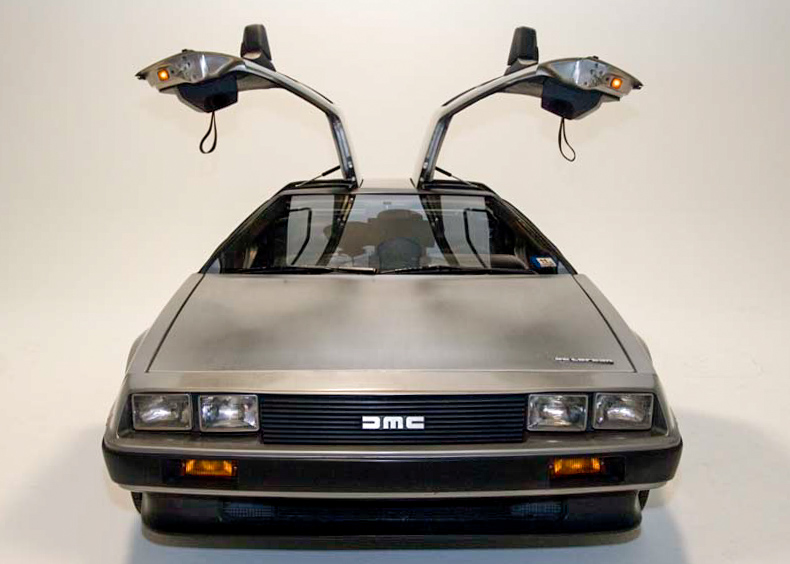
It was announced that the DeLorean car factory would close with the loss of 1,500 jobs.

Thursday 24 May 1984

Stalker Inquiry Begins

John Stalker, then Deputy Chief Constable of the Greater Manchester Police, arrived in Belfast to begin an investigation into the alleged ‘shoot to kill’ policy of security forces in the region.

[The investigation was to concentrate on three main cases that occurred on 11 November 1982, 24 November 1982, and 12 December 1982. However, in May 1986 before Stalker was to being the final part of his investigation he was removed from his duties as Deputy Chief Constable and ordered to return to England. He was subsequently reinstated but not allowed to return to Northern Ireland.]

Wednesday 24 May 1989

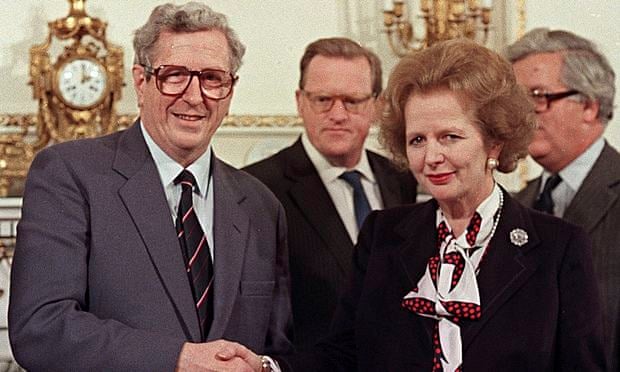
The scheduled assessment of the working of the Anglo-Irish Agreement (AIA) was published in a review document. The review was conducted under Article 11 of the AIA which stated that an assessment of the operation of the Intergovernmental Conference should be undertaken to see “whether any changes in the scope and nature of its activities are desirable”.

Thursday 24 May 1990

There was further trouble at Crumlin Road Prison over the issue of segregation. Peter Brooke, then Secretary of State for Northern Ireland, met with John Hume, then leader of the Social Democratic and Labour Party (SDLP), in London for talks.

Wednesday 24 May 1995

Mayhew Meeting With Adams

Patrick Mayhew, then Secretary of State for Northern Ireland, had an ‘informal’ private meeting with Gerry Adams, then President of Sinn Féin (SF), at an investment conference in Washington, USA. The meeting lasted about 35 minutes.

The conference was attended by 1,300 delegates. Michael Ancram, then Political Development Minister at the Northern Ireland Office (NIO), met a SF delegation at Stormont, Belfast.

The Northern Ireland Police Authority (NIPA) rejected the latest Annual Report from the Chief Constable. The Police Authority criticised the report as not meeting the required standards of public accountability.

Saturday 24 May 1997

A bomb was planted in Dundalk in the Republic of Ireland; the bomb was defused by Gardaí. The bomb was believed to have been planted by the Loyalist Volunteer Force (LVF).

Loyalists, who were continuing their picket of the Catholic church at Harryville in Ballymena, County Antrim, attacked Royal Ulster Constabulary (RUC) officers who were protecting those Catholics attending the mass.

Monday 24 May 1999

The News Letter (a Belfast based newspaper) denied claims by James Molyneaux, former leader of the UUP, that its editorial on 17 May 1999 had been drafted by Alistair Campbell, then offical spokesman for the Prime Minister.

——————————————

Remembering all innocent victims of the Troubles

Today is the anniversary of the death of the following people killed as a results of the conflict in Northern Ireland

“To live in hearts we leave behind is not to die

– Thomas Campbell

To the innocent on the list – Your memory will live forever

– To the Paramilitaries –

There are many things worth living for, a few things worth dying for, but nothing worth killing for.

6 People lost their lives on the 24th May between 1973 – 1982

 ——————————————

24 May 1973
John Wallace  (32)

nfNI
Status: British Army (BA),

Killed by: Irish Republican Army (IRA)
Killed by remote controlled bomb, detonated when British Army (BA) foot patrol were searching house, Cullaville, County Armagh.

 ——————————————

24 May 1973
Ian Donald  (35)

nfNI
Status: British Army (BA),

Killed by: Irish Republican Army (IRA)
Killed by remote controlled bomb, detonated when British Army (BA) foot patrol were searching house, Cullaville, County Armagh.

 ——————————————

24 May 1974
Sean Byrne  (54)

Catholic
Status: Civilian (Civ),

Killed by: non-specific Loyalist group (LOY)
Shot together with his brother, at their licensed premises, The Wayside Halt, Tavnaghmore, near Ballymena, County Antrim.

 ——————————————

24 May 1974
Brendan Byrne   (45)

Catholic
Status: Civilian (Civ),

Killed by: non-specific Loyalist group (LOY)
Shot together with his brother, at their licensed premises, The Wayside Halt, Tavnaghmore, near Ballymena, County Antrim.

 ——————————————

24 May 1975


Noel Davis   (22)

Protestant
Status: Royal Ulster Constabulary (RUC),

Killed by: Irish National Liberation Army (INLA)
Killed by booby trap bomb in abandoned car, Ballinahone, near Maghera, County Derry.

 ——————————————

24 May 1982
Anthony Anderson   (22)

nfNI
Status: British Army (BA),

Killed by: not known (nk)
Killed, when run over by British Army (BA) Armoured Personnel Carrier during petrol bomb attack on the vehicle, Butcher Street, Derry.

 ——————————————

23rd May – Deaths & Events in Northern Ireland Troubles

Key Events & Deaths on this day in Northern Ireland Troubles

23rd May

—————————————-

Thursday 23 May 1974

Day 9 of the UWC strike

Across Northern Ireland security forces removed barricades only to find that they had been replaced soon after. Workers in Derry were prevented from going to the Maydown Industrial Estate.

Although many schools managed to operate during the strike it was reported that some GCE examinations were affected.

Gerry Fitt, then Deputy Chief Executive, called on the British Government to send troops to the power stations and the oil refineries. Northern Ireland question time at Westminster again dealt with the strike.

Merlyn Rees, then Secretary of Sate for Northern Ireland, informed Harold Wilson, then British Prime Minister, that British Troops would have to be used to implement the ‘fuel oil plan’ being prepared by John Hume, then Minister of Commerce.

Friday 23 May 1975

Two Catholic civilians were shot dead by the Protestant Action Force (PAF), which was a covername used by the Ulster Volunteer Force (UVF), during an attack on a house in Mount Vernon, Belfast.

Monday 23 May 1977

Roy Mason, then Secretary of State, started a new round of talks with the leaders of the main political parties.

Saturday 23 May 1981

Joseph Lynch (33), a Catholic civilian, was killed during a street disturbance involving members of the Royal Ulster Constabulary (RUC) at the junction of Oldpark Road and Gracehill Street, Belfast.

Wednesday 23 May 1984

The Ulster Unionist Party (UUP) announced that it was ending its boycott of the Northern Ireland Assembly.

Sunday 23 May 1993

The Irish Republican Army (IRA) exploded a bomb, estimated at 1,500 pounds, in Magherafelt, County Derry. There was another IRA bomb in Belfast.

Monday 23 May 1994

Nigel Smith (19), a Protestant civilian, was shot dead by the Irish Republican Army (IRA) at his place of work in the Anderson and McAuley building, Castle Street, Belfast.

The Ulster Volunteer Force (UVF) carried out a bomb attack on the Sinn Féin (SF) office in Belfast City Hall. The explosion injured two workmen.

Friday 23 May 1997

John Hume, then leader of the Social Democratic and Labour Party (SDLP), held a meeting with David Trimble, then leader of the Ulster Unionist Party (UUP), to discuss the difficulties posed by the forthcoming ‘marching season’, particularly the Drumcree march in Portadown, County Armagh.

Saturday 23 May 1998

Garda Síochána (the Irish police) arrested two men when they discovered bomb-making material in two cars near Dundalk.

Sunday 23 May 1999

Tony Blair, then British Prime Minister, said he intended to invite representatives of the Garvaghy Road Residents’ Coalition (GRRC) and members of the Orange Order to intensive proximity-style talks on 3, 4, and 5 June 1999 in an effort to resolve the Drumcree parade dispute.

The United States Federal Bureau of Investigation (FBI) concluded its involvement in the inquiry into the death of Rosemary Nelson, a Lurgan solicitor killed on 15 March 1999, but announced it would continue to be available to assist the Royal Ulster Constabulary (RUC).

The Sunday Times (a London based newspaper) reported that David Trimble, then Leader of the Ulster Unionist Party (UUP), was suing Amazon.com for distributing the book ‘The Committee’ by Sean McPhilemy

Wednesday 23 May 2001

Bill Clinton, former President of the USA, paid another visit to Northern Ireland beginning in Derry. He said:

“I came here to reaffirm my belief in the Good Friday Agreement because it is still the right path to the future for peace, reconciliation, and fairness,”


——————————————

Remembering all innocent victims of the Troubles

Today is the anniversary of the death of the following people killed as a results of the conflict in Northern Ireland

“To live in hearts we leave behind is not to die

– Thomas Campbell

To the innocent on the list – Your memory will live forever

– To the Paramilitaries –

There are many things worth living for, a few things worth dying for, but nothing worth killing for.

8  People lost their lives on the 23rd May between 1972 – 1994

 ——————————————

23 May 1972


John Moran   (17)

Catholic
Status: Civilian (Civ),

Killed by: non-specific Loyalist group (LOY)
Died ten days after being injured by car bomb left outside Kelly’s Bar, Whiterock Road, Ballymurphy, Belfast.

 ——————————————

23 May 1972


Eustace Handley   (20)

nfNI
Status: British Army (BA),

Killed by: Irish Republican Army (IRA)
Shot by sniper while on British Army (BA) foot patrol, Springhill Avenue, Ballymurphy, Belfast.

 ——————————————

23 May 1972
Andrew Brennan   (22)

Catholic
Status: Civilian (Civ),

Killed by: Ulster Defence Association (UDA)
Shot outside his home, Sicily Park, Finaghy, Belfast.

 ——————————————

23 May 1975


John McErlaine   (29)

Catholic
Status: Civilian (Civ),

Killed by: Protestant Action Force (PAF)
Shot together with his brother, shortly after being lured to a house by a work colleague, Mount Vernon Green, Mount Vernon, Belfast.

 ——————————————

23 May 1975


Thomas McErlaine  (19)

Catholic
Status: Civilian (Civ),

Killed by: Protestant Action Force (PAF)
Shot together with his brother, shortly after being lured to a house by a work colleague, Mount Vernon Green, Mount Vernon, Belfast.

 ——————————————

23 May 1981
Joseph Lynch   (33)

Catholic
Status: Civilian (Civ),

Killed by: not known (nk)
Killed during street disturbance between local people and Royal Ulster Constabulary (RUC) patrol, junction of Oldpark Road and Gracehill Street, Belfast.

 ——————————————

23 May 1987


Dermot Hackett  (37)

Catholic
Status: Civilian (Civ),

Killed by: Ulster Freedom Fighters (UFF)
Shot by sniper while driving bread van, Drumhonish, near Drumquin, County Tyrone

 ——————————————

23 May 1994
Nigel Smith   (19)

Protestant
Status: Civilian (Civ), Killed by: Irish Republican Army (IRA)
Security man. Shot at his workplace, Anderson and McAuley building, Castle Street, Belfast.

 ——————————————

22nd May – Deaths & Events in Northern Ireland Troubles

Key Events & Deaths on this day in Northern Ireland Troubles

22nd May

Saturday 22 May 1971

Robert Bankier

A British soldier was killed by members of the Official Irish Republican Army (OIRA) in Belfast.

Monday 22 May 1972

Over 400 women in Derry attacked the offices of Official Sinn Féin (OSF) in Derry following the shooting of William Best by the Official Irish Republican Army (OIRA) on 21 May 1972.

Wednesday 22 May 1974

Day 8 of the UWC strike

In an attempt to resolve the strike the Northern Ireland Executive agreed to postpone certain sections of the Sunningdale Agreement until 1977 and to reduce the size of the ‘Council of Ireland’

. These proposals were rejected by leaders of the Ulster Workers’ Council (UWC) and other Loyalist leaders. The British government repeated their stance on not negotiating with the UWC. John Hume, then Minister of Commerce, worked on a ‘fuel oil plan’.

Saturday 22 May 1976

Ulster Volunteer Force (UVF) Ceasefire

The Ulster Volunteer Force (UVF) announced the beginning of a three-month ceasefire.

[This ceasefire was, however, broken on a number of occasions the first of which was on 5 June 1976 when five civilians were shot dead.]

Friday 22 May 1981

Henry Duffy (45), a Catholic civilian, was shot dead by a plastic bullet fired by the British Army as he walked through the Bogside area of Derry.

Carol Anne Kelly (12), a Catholic girl, died three days after being shot by a plastic bullet by the British Army as she walked along Cherry Park in the Twinbrook area of Belfast.

Kieran Doherty, an Irish Republican Army (IRA) prisoner in the Maze Prison, joined the hunger strike.

 See  1981 Hunger Strike

Thursday 22 May 1986


Andrew French ( BA)  David McBride & William Smyth (RUC)

Two Royal Ulster Constabulary (RUC) officers and one British soldier were killed by the Irish Republican Army (IRA) near Crossmaglen, County Armagh.

The three men had been part of a joint RUC / British Army (BA) foot patrol when the IRA detonated a remote controlled bomb hidden in a ditch.

Tuesday 22 May 1990

Peter Brooke, then Secretary of State for Northern Ireland, held a long meeting with Unionist leaders in London. James Molyneaux, then leader of the Ulster Unionist Party (UUP), and Ian Paisley, then leader of the Democratic Unionist Party (DUP), announced that they were ‘well satisfied with the results’. The Bank of Ireland published a report which estimated that the cost of ‘the Troubles’ to the British and Irish Governments was £410 million.

Wednesday 22 May 1991

In the political talks (later known as the Brooke / Mayhew talks) the venue for Strand Two (the North-South Stage) of the main talks was agreed by the parties.

Saturday 22 May 1993

The Irish Republican Army (IRA) exploded a bomb, estimated at 1,000 pounds, in Portadown, County Armagh. Six people were injured in the explosion.

[Later estimates put the cost of the damage at £8 million.]

Friday 22 May 1998 Referendum on The Agreement

There was a huge turnout throughout the island of Ireland as people in Northern Ireland and the Republic of Ireland voted on the Good Friday Agreement (in the Republic there was a further vote on the Ratification of the Amsterdam Treaty).

This was the first all-Ireland poll since the general election of 1918. It was clear from the number of people going to polling stations across Northern Ireland that there had been a high turnout (the figure was 81.10%).

[When all the votes were counted the results were as follows: Northern Ireland – Yes 71.12%, No 28.88% (turnout 81.10%); Republic of Ireland – Yes 94.39%, No 5.61% (turnout 56.26%); Ireland overall – Yes 85.46%, No 14.54%. While it was not possible to break down the Northern Ireland figures by community an exit poll for the Sunday Times (a British newspaper) found that, of those questioned, the Agreement was supported by 96 per cent of Catholics and 55 per cent of Protestants. In the Republic of Ireland, the Amsterdam Treaty was ratified, with the results as follows: Yes 62%, No 38%.]

Saturday 22 May 1999

Loyalists carried out a petrol-bomb attack on the home of a Catholic family in west Belfast.


——————————————

Remembering all innocent victims of the Troubles

Today is the anniversary of the death of the following people killed as a results of the conflict in Northern Ireland

“To live in hearts we leave behind is not to die

– Thomas Campbell

To the innocent on the list – Your memory will live forever

– To the Paramilitaries –

There are many things worth living for, a few things worth dying for, but nothing worth killing for.

11 People lost their lives on the 22nd May between 1971 – 1987

 ——————————————

22 May 1971


Robert Bankier   (25)

nfNI
Status: British Army (BA),

Killed by: Official Irish Republican Army (OIRA)
Shot by sniper as he left British Army (BA) Armoured Personnel Carrier, Cromac Square, Markets, Belfast.

 ——————————————

22 May 1972


William Hughes   (54)

Protestant
Status: Civilian (Civ),

Killed by: Irish Republican Army (IRA)
Shot while sitting in parked car, Moortown, near Coagh, County Tyrone. Mistaken for civilian-type Royal Ulster Constabulary (RUC) vehicle.

 ——————————————

22 May 1973


Thomas Friel   (21)

Catholic
Status: Civilian (Civ),

Killed by: British Army (BA)
Died five days after being hit by rubber bullet during street disturbances, Creggan Heights, Creggan, Derry.

 ——————————————

22 May 1975
Gerard
D’Eath   (30)

Catholic
Status: Civilian (Civ),

Killed by: Ulster Volunteer Force (UVF)
Killed by booby trap bomb hidden in flask at his workplace, building site, Hightown Road, Glengormley, near Belfast, County Antrim.

 ——————————————

22 May 1976


John McCambridge   (21)

Protestant
Status: Royal Ulster Constabulary (RUC),

Killed by: Irish Republican Army (IRA)
Off duty. Shot outside his home, Corrainy, near Dungannon, County Tyrone.

 ——————————————

22 May 1981


Henry Duffy  (45)

Catholic
Status: Civilian (Civ),

Killed by: British Army (BA)
Shot by plastic bullet while walking along street, Bogside, Derry

 ——————————————

22 May 1981


Carol Ann Kelly   (12)

Catholic
Status: Civilian (Civ),

Killed by: British Army (BA)
Died three days after being shot by plastic bullet while walking along Cherry Park, Twinbrook, Belfast.

 ——————————————

22 May 1986


Andrew French   (35)

nfNI
Status: British Army (BA),

Killed by: Irish Republican Army (IRA)
Killed by remote controlled bomb, hidden in ditch, detonated when joint British Army (BA) / Royal Ulster Constabulary (RUC) foot patrol passed, Milltown Bridge, near Crossmaglen, County Armagh.

 ——————————————

22 May 1986


David McBride  (27)

Protestant
Status: Royal Ulster Constabulary (RUC),

Killed by: Irish Republican Army (IRA)
Killed by remote controlled bomb, hidden in ditch, detonated when joint British Army (BA) / Royal Ulster Constabulary (RUC) foot patrol passed, Milltown Bridge, near Crossmaglen, County Armagh

 ——————————————

22 May 1986


William Smyth  (25)

Catholic
Status: Royal Ulster Constabulary (RUC),

Killed by: Irish Republican Army (IRA)
Killed by remote controlled bomb, hidden in ditch, detonated when joint British Army (BA) / Royal Ulster Constabulary (RUC) foot patrol passed, Milltown Bridge, near Crossmaglen, County Armagh.

 ——————————————

22 May 1987


Charles Watson   (35)

Protestant
Status: Ulster Volunteer Force (UVF),

Killed by: Irish Republican Army (IRA)
Shot at his home, Downpatrick Road, Clough, County Down.

 ——————————————

21st May – Deaths & Events in Northern Ireland Troubles

Key Events & Deaths on this day in Northern Ireland Troubles

21st May

Friday 21 June 1968

The annual conference of the Nationalist Party unanimously approved of the protest action by Austin Currie in Caledon, County Tryone on 20 June 1968.

Wednesday 21 May 1969

James Chichester-Clark, then Northern Ireland Prime Minister, together with other members of the Northern Ireland government, travelled to London for a meeting with Harold Wilson, then British Prime Minister, and James Callaghan, then British Home Secretary.

Sunday 21 May 1972

The Official Irish Republican Army (OIRA) kidnapped and shot dead William Best (19) who was a member of the Royal Irish Rangers. Best was originally from Derry and was visiting friends when he was picked up by the OIRA. There was outrage amoung local people at the killing.

[The public reaction to this incident was to lead to the OIRA calling a ceasefire on 29 May 1972.]

Tuesday 21 May 1974

Day 7 of the UWC strike

Len Murray, then General Secretary of the Trades Union Council (TUC), led a ‘back-to-work’ march which turned out to be a fiasco. The march was supported by leading local Trade Union officials and attempted to lead workers back to the Belfast shipyard and factories in east Belfast.

Only about 200 people joined the march.

The march was flanked by members of the Royal Ulster Constabulary (RUC) and British troops but a hostile crowd still managed to assault some of those marching. An updated list [PDF; 78KB]  of those services which were to be allowed through roadblocks and the opening times permitted for shops was issued by the ‘Ulster Army Council’.

At Westminster Harold Wilson, then British Prime Minister, attacked the strike saying that it was a “sectarian strike” and was “being done for sectarian purposes having no relation to this century but only to the seventeenth century”. [ Sunningdale; Ulster Workers’ Council Strike. ]

Wednesday 21 May 1980

Charles Haughey, then Taoiseach (Irish Prime Minister), travelled to London to attend a meeting with Margaret Thatcher, then British Prime Minister. A communiqué released after the meeting promised greater political co-operation between the two governments on the issue of Northern Ireland and referred to the “unique relationship” between the two countries.

Thursday 21 May 1981

Third and Fourth Hunger Strikers Died

Raymond McCreesh (24), a Irish Republican Army (IRA) prisoner, and Patsy O’Hara (23), an Irish National Liberation Army (INLA) prisoner, both died having spent 61 days on hunger strike. Tomás Ó Fiaich, then Catholic Primate of Ireland, criticised the British government’s attitude to the hunger strike.

See 1981 Hunger Strike

Thursday 21 May 1987

James Molyneaux, then leader of the Ulster Unionist Party, and Ian Paisley, then leader of the Democratic Unionist Party (DUP), issued a joint general election manifesto.

Saturday 21 May 1994

Members of the Irish Republican Army (IRA) abducted and then shot dead Reginald McCollum (19), an off-duty member of the Royal Irish Regiment (RIR).

His body was found in a field beside Mullaghcreevie housing estate, Armagh.

Martin Doherty (35), a member of the IRA, was shot dead by the Ulster Volunteer Force (UVF) as he attempted to stop a bomb attack on The Widow Scallans Bar, Pearse Street, Dublin, where a Sinn Féin (SF) function was taking place. Another man was seriously wounded in the attack.

Tuesday 21 May 1996

Hugh Annesley, then Chief Constable of the Royal Ulster Constabulary (RUC), announced that he would retire later in the year.

Wednesday 21 May 1997

Local Government Elections

There were elections to the 26 District Councils across Northern Ireland.

[When the counting of the votes was completed (most results were available by Friday 23 May 1997) the share of the first preference votes was: Ulster Unionist Party (UUP) – 27.8 per cent; Social Democratic and Labour Party (SDLP) – 20.7 per cent; Sinn Féin (SF) – 16.9 per cent; Democratic Unionist Party (DUP) – 15.6 per cent; Alliance Party of Northern Ireland (APNI) – 6.6 per cent; and other parties – 12.5 per cent. The most significant result of the election was that Unionists lost control of Belfast City Council for the first time in its history.

Unionists also lost control of the district councils in Fermanagh, Strabane, and Cookstown. The SDLP lost overall control of Derry City Council because of gains made by SF. SF increased its share of the vote and took 70 seats in total.]

Representatives of SF met with British officials at Stormont, Belfast. This was the first such meeting since the ending of the Irish Republican Army (IRA) ceasefire on 9 February 1997. Marjorie (Mo) Mowlam, then Secretary of State for Northern Ireland, held meetings with Nationalist residents groups of three areas where Orange Order parades were proving controversial.

The areas visited were, Dunloy village in County Antrim, the lower Ormeau Road of Belfast, and the Garvaghy Road in Portadown, County Antrim. Unionists criticised the meetings on the day of the local government elections. Mowlam also made a comment on the British Broadcasting Corporation (BBC) programme Newsnight that, “the [settlement] train might leave the station without Unionists”.

#[She was later forced to retract the comment.]

Friday 21 May 1999

Three men, who had been arrested in July 1998 and later found guilty of conspiracy to cause explosions, were sentenced at the Old Bailey in London. Anthony Hyland (26) was sentenced to 25 years imprisonment, and Darren Mulholland (20) and Liam Grogan (22) each received a sentence of 22 years.

The three had been accused of being part of a Real Irish Republican Army (rIRA) unit.

Two home-made grenades exploded outside two pubs on the Falls Road, in west Belfast. Three men were slightly injured. Sinn Féin accused the Ulster Freedom Fighters (UFF) of being responsible for the attacks. Seven shots were fired at Frank Petticrew, then a Catholic youth worker, as he escorted a Protestant girl back to her Shankill Road home following a cross-community event.

Petticrew claimed that he had been threatened with assassination by Royal Ulster Constabulary (RUC) officers six months earlier. He claimed the officers concerned wanted information on IRA members otherwise he would be shot dead by the Red Hand Defenders (RHD). The RUC denied the allegations.

Sunday 21 May 2000

David Trimble, then leader of the Ulster Unionist Party (UUP), stated that it was his belief that the offer by the Irish Republican Army (IRA) to open its arms dumps to international inspection means that its 30-year war is over.


——————————————

Remembering all innocent victims of the Troubles

Today is the anniversary of the death of the following people killed as a results of the conflict in Northern Ireland

“To live in hearts we leave behind is not to die

– Thomas Campbell

To the innocent on the list – Your memory will live forever

– To the Paramilitaries –

There are many things worth living for, a few things worth dying for, but nothing worth killing for.

12 People lost their lives on the 21st May between 1972 – 1994

 ——————————————

21 May 1972
Richard Oliver  (40)

Protestant
Status: Civilian (Civ),

Killed by: not known (nk)
Killed by falling telegraph pole which hijacked bus had collided with, during street disturbances, Ballysillan Road, Belfast.

 ——————————————

21 May 1972


William Best   (19)

Catholic
Status: British Army (BA),

Killed by: Official Irish Republican Army (OIRA)
On leave. Found shot, William Street, Derry.

 ——————————————

21 May 1972
Adrian Barton   (18)

Protestant
Status: Civilian (Civ),

Killed by: non-specific Loyalist group (LOY)
Shot from passing car shortly after leaving Whitehorse Inn, Springfield Road, Belfast. Assumed to be a Catholic.

 ——————————————

21 May 1976


Roberta Bartholomew   (22)

Protestant
Status: Civilian (Civ),

Killed by: Irish Republican Army (IRA)
Killed in bomb attack on Belfast-Portadown train, near Moira, County Down. Inadequate warning given.

 ——————————————

21 May 1977
Christopher Shaw  (63)

Protestant
Status: ex-Royal Ulster Constabulary (xRUC),

Killed by: Irish Republican Army (IRA)
Shot at his home, Fitzwilliam Street, off Lisburn Road, Belfast.

 ——————————————

21 May 1981


Raymond McCreesh   (24)

Catholic
Status: Irish Republican Army (IRA),

Killed by: not known (nk)
Died on the 61st day of hunger strike, Long Kesh / Maze Prison, County Down.

 ——————————————

21 May 1981


Patsy O’Hara   (23)

Catholic
Status: Irish National Liberation Army (INLA),

Killed by: not known (nk)
Died on the 61st day of hunger strike, Long Kesh / Maze Prison, County Down.

See Hungry Strike

 ——————————————

21 May 1987


Ivan Anderson   (47)

Protestant
Status: Ulster Defence Regiment (UDR),

Killed by: Irish Republican Army (IRA)
Off duty. Shot while travelling in his car near to his home, Tiroony, near Carrickmore, County Tyrone.

 ——————————————

21 May 1988


Derek Hayes   (28)

nfNI
Status: British Army (BA),

Killed by: Irish Republican Army (IRA)
Killed by booby trap bomb while British Army (BA) patrol were searching field, off Blaney Road, near Crossmaglen, County Armagh.

 ——————————————

21 May 1991
Wallace McVeigh   (45)

Protestant
Status: Civilian (Civ),

Killed by: Irish Republican Army (IRA)
Shot at his workplace, Balmoral Market, Boucher Road, Belfast. Contractor to British Army (BA) / Royal Ulster Constabulary (RUC).

 ——————————————

21 May 1994

Reginald McCollum   (19)

Protestant
Status: Royal Irish Regiment (RIR),

Killed by: Irish Republican Army (IRA)
Off duty. Found shot in field, by Mullaghcreevie housing estate, Armagh.

 ——————————————

21 May 1994


Martin Doherty   (35)

Catholic
Status: Irish Republican Army (IRA),

Killed by: Ulster Volunteer Force (UVF)
Shot, attempting to stop bomb attack on The Widow Scallans Bar, Pearse Street, Dublin. Sinn Fein (SF) function at the Bar.

 ——————————————

20th May – Deaths & Events in Northern Ireland Troubles

Key Events & Deaths on this day in Northern Ireland Troubles

20th May

Monday 20 May 1968

Terence O’Neill


Terence O’Neill, then Northern Ireland Prime Minister, was showered with eggs, flour and stones after a meeting of the Woodvale Unionist Association.

Monday 20 May 1974

Day 6 of the UWC strike

Michael Mallon (20), a Catholic civilian, was shot dead by the Ulster Freedom Fighters (UFF) a covername for the Ulster Defence Association (UDA), and left by the side of the road at Shaw’s Bridge, Belfast.

Many roads in Northern Ireland were closed because of barricades. Electricity generation dropped to about one-third of normal levels. People were asked only to use telephones in an emergency.

Five hundred additional troops arrived in Northern Ireland.

An advertisement in the News Letter (a Belfast newspaper), which had been placed by Unionist politicians, called for support of the strike.

Stanley Orme, then Minister of Sate at the Northern Ireland Office (NIO), repeated the government’s position of not negotiating with the Ulster Workers’ Council (UWC) Strike Committee.

 [Public Records 1974 – Released 1 January 2005:

Note of a statement made by Stanley Orme, then Minister of Sate at the Northern Ireland Office (NIO), to the House of Commons. The statement sought to explain the circumstances surrounding the decision by Merlyn Rees, then Secretary of Sate for Northern Ireland, to announce a State of Emergency (Section 40, Northern Ireland Constitution Act 1973) on 19 May 1974.]

Friday 20 May 1977

Daniel McCooey (20), a Catholic civilian, died three weeks after he had been severely beaten by members of a British Army foot patrol in Castle Street, Belfast.

A member of the Royal Ulster Constabulary (RUC) was shot dead by the Irish Republican Army (IRA) in County Tyrone.

Tuesday 20 May 1980

Margaret Thatcher, then British Prime Minister, stated in the House of Commons:

“The future of the constitutional affairs of Northern Ireland is a matter for the people of Northern Ireland, this government and this parliament and no one else.”

This statement was made the day before Charles Haughey, then Taoiseach (Irish Prime Minister), was due to arrive in London with talks with Thatcher.

Wednesday 20 May 1981

District Council Elections

Local government elections were held in Northern Ireland against the backdrop of the continuing hunger strike. In the increased tension in the region, ‘moderate’ parties all suffered a decline in support.

The Democratic Unionist Party (DUP) achieved 26.6 per cent of the vote compared to the 26.5 per cent recorded by the Ulster Unionist Party (UUP). The Social Democratic and Labour Party (SDLP) obtained 17.5 per cent of the first preference votes compared to 20.6 per cent in 1977.

 See  1981 Hunger Strike

Monday 20 May 1985


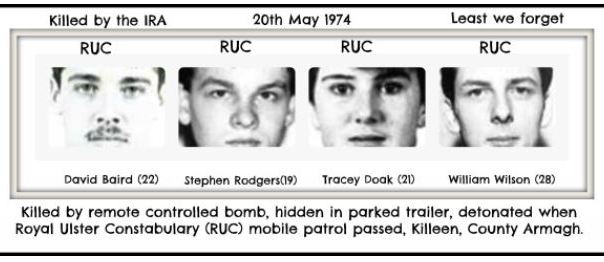
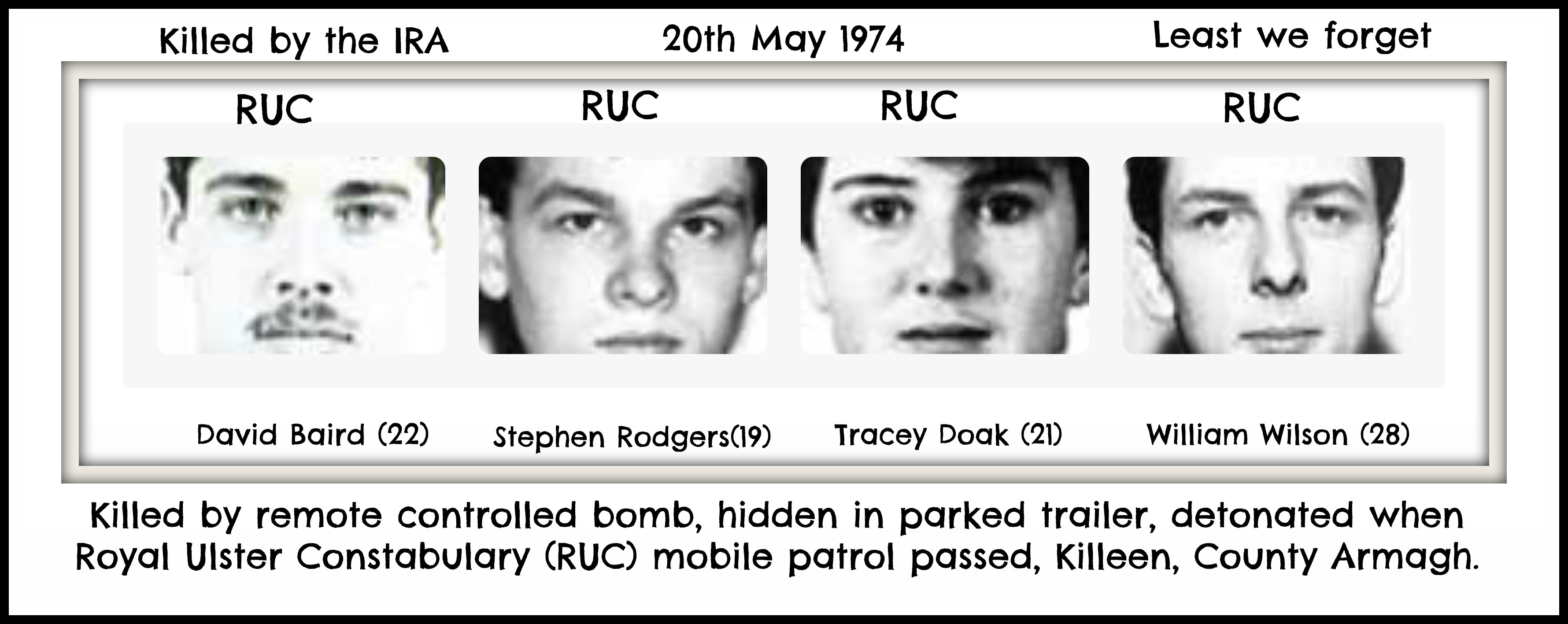
RUC  Collage

Four Royal Ulster Constabulary (RUC) officers in a mobile patrol were killed when the Irish Republican Army (IRA) exploded a bomb in a parked trailer at Killeen, County Down.

Tuesday 20 May 1986

Nicholas Scott, then a Northern Ireland Office (NIO) Minister, provided information in the House of Commons on the level of intimidation that Royal Ulster Constabulary (RUC) officers had faced from Loyalists during protests at the Anglo-Irish Agreement (AIA).

Scott said that there had been 368 cases of intimidation.

[Later information provided by the RUC indicated that the final number was over 500 homes attacked and 150 RUC families forced to move.]

Monday 20 May 1991

The Social Democratic and Labour Party (SDLP) announced that it was leaving the political talks (later known as the Brooke / Mayhew talks) until such time as the procedures for the main talks were agreed by the other parties.

Thursday 20 May 1993

The Irish Republican Army (IRA) exploded a bomb, estimated at 1,000 pounds, in Glengall Street, Belfast. Thirteen people were injured in the explosion. The bomb was placed outside the Grand Opera House and close to the Headquarters of the Ulster Unionist Party (UUP).

[Later estimates put the cost of the damage at £6.5 million.]

Friday 20 May 1994

There was serious rioting in Protestant areas of Belfast following the appearance in Belfast Magistrates’ Court of a man accused of ‘directing the activities’ of the Ulster Freedom Fighters (UFF), a cover name (pseudonym) used by the Ulster Defence Association (UDA).

Monday 20 May 1996

Gerry Adams, then President of Sinn Féin (SF), said that SF was prepared to accept the six ‘Mitchell Principles’ if the other parties agreed to them.

Tuesday 20 May 1997

John Hume, then leader of the Social Democratic and Labour Party (SDLP), tabled a motion in the House of Commons calling on the British government to conduct a new inquiry into the events of ‘Bloody Sunday‘ in Derry on 30 January 1972.

Jack Straw, then British Home Secretary, announced that two Irish Republican Army (IRA) prisoners, Danny McNamee and Liam McCotter, would be transferred to prisons in Northern Ireland.

Wednesday 20 May 1998

Blair’s Pledges

Tony Blair, then British Prime Minister, delivered a speech at the Coleraine campus of the University of Ulster in which he unveiled a hand-written set of pledges to the people of Northern Ireland in advance of the Referendum on 22 May 1998. The text of the pledges was as follows: “I pledge to the people of Northern Ireland:

  • No change in the status of Northern Ireland without the express consent of the people of Northern Ireland.
  • Power to take decisions returned to a Northern Ireland Assembly, with accountable North/South co-operation.
  • Fairness and equality guaranteed for all.
  • Those who use or threaten violence excluded from the Government of Northern Ireland.
  • Prisoners kept in unless violence is given up for good.

Whatever the Referendum result, as Prime Minister of the United Kingdom I will continue to work for stability and prosperity for all the people of Northern Ireland

.” Bill Clinton, then President of the United States of America (USA), sent a personal message to the people of Northern Ireland calling on them to vote ‘Yes’ in the

forthcoming referendum.

In the final hours of campaigning David Trimble, then leader of the Ulster Unionist Party (UUP), and Ian Paisley, then leader of the Democratic Unionist Party (DUP), took part in a live television debate.

The 10 minute encounter took place on the BBC’s ‘Newsline’ programme. The debate was heated with Paisley accusing Trimble of being prepared to “break the union”.

Thursday 20 May 1999

There were disturbances involving Loyalists and the Royal Ulster Constabulary (RUC) in Portadown, County Armagh.

The Ulster Unionist Party (UUP) delegation did not arrive for a second day of talks at Downing Street. The UUP stated that it had not been informed of the continuation of the talks.

Sinn Féin (SF) accused the UUP of a deliberate snub of the Prime Minister.

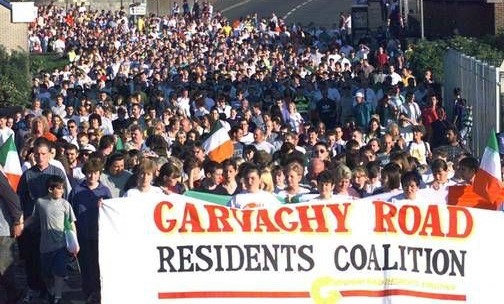
garvaghy road residents coalition 2

The Garvaghy Road Residents Coalition (GRRC) called for the Parades Commission to re-route the part of the Drumcree parade which passed close to Obins Street and St John’s Catholic Church.

Paul Berry, then a Democratic Unionist Party (DUP) Assemblyman, responded in an interview on Radio Ulster and said Loyalists would not be stopped from getting down the Garvaghy Road,

“If it is a matter of taking the law into our own hands then we are going to have to do it. That is a threat.”

(Reported in ‘Fortnight’ magazine, September 1999, p6). Mr Berry later denied making a threat. Planners from the Department of the Environment (DOE) in Northern Ireland told a regional planning conference in Dublin that Derry would be developed as the growth hub of the north-west.


 ——————————————

Remembering all innocent victims of the Troubles

Today is the anniversary of the death of the following people killed as a results of the conflict in Northern Ireland

“To live in hearts we leave behind is not to die

– Thomas Campbell

To the innocent on the list – Your memory will live forever

– To the Paramilitaries –

There are many things worth living for, a few things worth dying for, but nothing worth killing for.

10 People lost their lives on the 20th  May between 1972 – 1986

 ——————————————

20 May 1972
Henry Gillespie  (32)

Protestant
Status: Ulster Defence Regiment (UDR),

Killed by: Irish Republican Army (IRA)
Shot by sniper while on Ulster Defence Regiment mobile patrol, Killyliss, near Dungannon, County Tyrone.

 ——————————————

20 May 1974
Miicahel Mallon   (20)

Catholic
Status: Civilian (Civ),

Killed by: Ulster Defence Association (UDA)
Found shot by side of Milltown Road, Shaw’s Bridge, Belfast.

 ——————————————

20 May 1977


Robert North  (52)

Protestant
Status: Royal Ulster Constabulary (RUC),

Killed by: Irish Republican Army (IRA)
Off duty reservist. Shot while driving school bus along Drumlee Road, near Benburb, County Tyrone

 ——————————————

20 May 1977


 Daniel McCooey  (20)

Catholic
Status: Civilian (Civ),

Killed by: British Army (BA)
Died three weeks after being badly beaten by British Army (BA) foot patrol, Castle Street, Belfast.

 ——————————————

20 May 1979


Stanley Wray  (50)

Protestant
Status: Royal Ulster Constabulary (RUC),

Killed by: Irish Republican Army (IRA)
Off duty. Shot shortly after leaving Claremont Presbyterian Church, Northland Road, Derry.

 ——————————————

20 May 1985


William Wilson   (28)

Protestant
Status: Royal Ulster Constabulary (RUC),

Killed by: Irish Republican Army (IRA)
Killed by remote controlled bomb, hidden in parked trailer, detonated when Royal Ulster Constabulary (RUC) mobile patrol passed, Killeen, County Armagh.

 ——————————————

20 May 1985


Stephen Rodgers   (19)

Protestant
Status: Royal Ulster Constabulary (RUC),

Killed by: Irish Republican Army (IRA)
Killed by remote controlled bomb, hidden in parked trailer, detonated when Royal Ulster Constabulary (RUC) mobile patrol passed, Killeen, County Armagh.

 ——————————————

20 May 1985


David Baird   (22)

Protestant
Status: Royal Ulster Constabulary (RUC),

Killed by: Irish Republican Army (IRA)
Killed by remote controlled bomb, hidden in parked trailer, detonated when Royal Ulster Constabulary (RUC) mobile patrol passed, Killeen, County Armagh.

 ——————————————

20 May 1985

Tracey Doak   (21)

Protestant
Status: Royal Ulster Constabulary (RUC),

Killed by: Irish Republican Army (IRA)
Killed by remote controlled bomb, hidden in parked trailer, detonated when Royal Ulster Constabulary (RUC) mobile patrol passed, Killeen, County Armagh.

 ——————————————

20 May 1986
Colm McKevitt  (30)

Catholic
Status: Civilian (Civ),

Killed by: Irish Republican Army (IRA)
Shot shortly after being abducted from his sister’s home, Killeen, County Armagh. Alleged informer.

 ——————————————

19th May – Deaths & Events in Northern Ireland Troubles

Key Events & Deaths on this day in Northern Ireland Troubles

19th May

Sunday 19 May 1974

Day 5 of the UWC strike

Merlyn Rees, then Secretary of Sate for Northern Ireland, announced a State of Emergency (Section 40, Northern Ireland Constitution Act 1973).

Rees flew to Chequers, the country home of the Prime Minister, for talks.

The United Ulster Unionist Council (UUUC) met and agreed to support the Ulster Workers’ Council (UWC). The UWC withdrew its call for a total stoppage as of midnight. Some shops reported panic buying. A memorandum was submitted by the Northern Ireland Labour Party (NILP) to the Northern Ireland Office (NIO

Tuesday 19 May 1981

Five British soldiers were killed in an Irish Republican Army (IRA) landmine attack near Bessbrook, County Armagh. The soldiers had been travelling in an armoured vehicle when the bomb exploded.

Tuesday 19 May 1987

Robert McCarty

The Ulster Unionist Party (UUP) expelled Robert McCartney because of his criticism of UUP leaders and also for his involvement in the Campaign for Equal Citizenship.

Wednesday 19 May 1993

Local Government Elections

There were district council elections to choose 582 councillors for the 26 District Councils in Northern Ireland.

[When the results were declared they showed an increase in the percentage share of the vote for the Social Democratic and Labour Party (SDLP), Sinn Féin (SF), and the Alliance Party of Northern Ireland (APNI).]

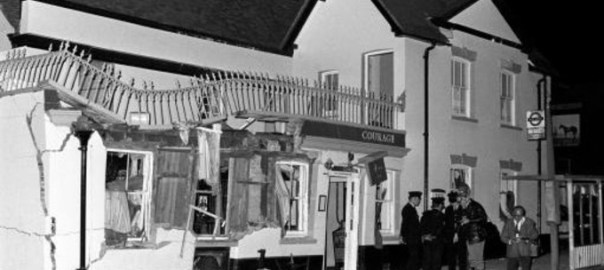
gilford pub bombing

Three former detectives in the British police who had been involved in the investigations that led to the convictions of the Guildford Four were cleared of conspiring to pervert the course of justice. The men were accused of having manufactured the interview notes of one of the Guildford Four.

See Guildford Bombing

Thursday 19 May 1994

The Northern Ireland Office (NIO) published a 21 page British government response to Sinn Féin (SF) questions that arose from the Downing Street Declaration (DSD). SF had submitted a series of 20 questions via the Irish government. Albert Reynolds, then Taoiseach (Irish Prime Minister), described the clarification as “comprehensive and positive”.

Friday 19 May 1995

At the Forum for Peace and Reconciliation in Dublin, Seamus Mallon, then deputy leader of the Social Democratic and Labour Party (SDLP), criticised the support by Sinn Féin (SF) for imposed all-Ireland institutions without a democratic assembly in Northern Ireland. Mallon argued in favour of the model in the Framework Documents (published on 22 February 1995).

Sunday 19 May 1996

Geoffrey Anderson, then a Royal Irish Regiment soldier, killed two people and injured a third before committing suicide.

See Irish Times for full story

There was a confrontation between the Royal Ulster Const abulary (RUC) and nationalists in the village of Dunloy, County Antrim, during an Apprentice Boys of Derry march

Monday 19 May 1997

Gerry Adams, then President of Sinn Féin (SF), and Martin McGuinness, then Vice-President of Sinn Féin (SF), travelled to Westminster to press their case for facilities within the House of Commons.

The two SF Members of Parliament (MPs) were denied access to the House when they refused to take their seats which would have involved taking an oath of allegiance to the Queen.

Tuesday 19 May 1998

John Hume, then leader of the Social Democratic and Labour Party (SDLP), and David Trimble, then leader of the Ulster Unionist Party (UUP), met on the stage at a U2 concert at Belfast’s Waterfront Hall.

The concert had been arranged to support the ‘Yes’ campaign.

[Bono, then lead singer with the group U2, joined the two party leaders on stage and held their arms aloft. This event was thought to have given the ‘Yes’ campaign a much needed boost. Until then the two party leaders had not campaigned together.]

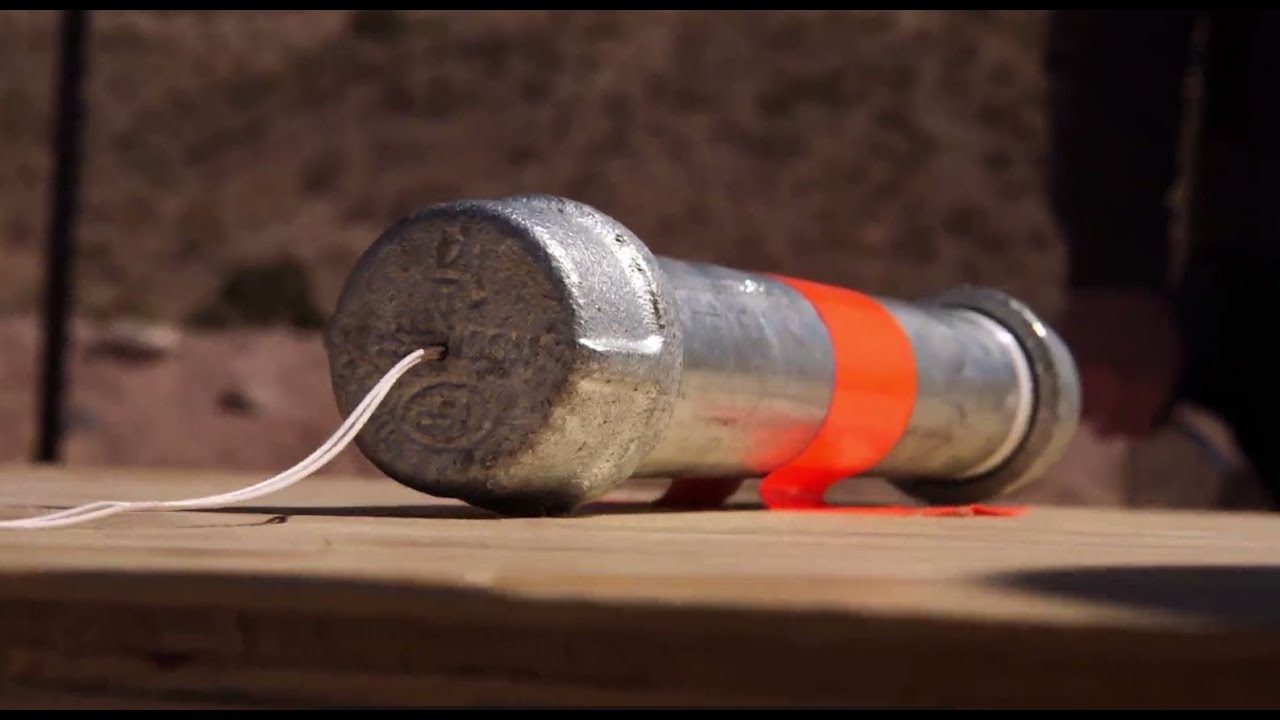
A ‘pipe-bomb’ contained in a parcel was delivered to the Dublin Tourist offices in St Andrew’s Street, Dublin, Republic of Ireland. The device was spotted and defused.

[An unknown Loyalist paramilitary group was thought to be responsible for the attack. Pipe-bombs were widely used by Loyalist paramilitaries over the coming years particularly in attacks on the homes of Catholic families in Northern Ireland.]

Wednesday 19 May 1999

John Pickering (Rev), then rector of Drumcree, together with his vestry, decided to defy the General Synod’s vote on 18 May 1999 and announced that they would go ahead with the service for the Orange Order at Drumcree on 4 July 1999.

Talks were held in Downing Street involving the Ulster Unionist Party (UUP), the Social Democratic and Labour Party (SDLP), and Sinn Féin (SF).

However the parties failed to reach agreement on outstanding issues.

Loyalists clashed with Royal Ulster Constabulary (RUC) officers in Portadown, County Armagh.

Eddie Copeland was awarded £27,500 by Belfast High Court in compensation for injuries received when he was shot by a British Army soldier on 26 October 1993. The case was taken against the Ministry of Defence. Copeland had been attending the funeral of Thomas Begley who was killed planting a bomb on the Shankill Road on 23 October 1993.

Garda Síochána (the Irish police) opened an inquiry into the killing of Seamus Ludlow on 2 May 1976 who was found shot in laneway near to his home, Thistlecross, near Dundalk, County Louth. Gardaí initially blamed the Irish Republican Army (IRA) for the killing.

[However later it was claimed that Ludlow had been killed by the Red Hand Commando (RHC) / Ulster Volunteer Force (UVF). There was also speculation of involvement by the Special Air Service (SAS) and also by the Ulster Defence Regiment (UDR).]


  ——————————————

Remembering all innocent victims of the Troubles

Today is the anniversary of the death of the following people killed as a results of the conflict in Northern Ireland

“To live in hearts we leave behind is not to die

– Thomas Campbell

To the innocent on the list – Your memory will live forever

– To the Paramilitaries –

There are many things worth living for, a few things worth dying for, but nothing worth killing for.

10 People lost their lives on the 19th May between 1972 – 1981

 ——————————————

19 May 1972
Harold Morris   (15)

Protestant
Status: Civilian (Civ),

Killed by: Irish Republican Army (IRA)
Shot by sniper while walking along Boundary Street, Shankill, Belfast.

 ——————————————

19 May 1972


Manus Deery  (15)

Catholic
Status: Civilian (Civ),

Killed by: British Army (BA)
Shot by sniper from British Army (BA) observation post on city walls, while in entry off Westland Street, Derry.

 ——————————————

19 May 1973
Robert McIntyre   (24)

Protestant
Status: Ulster Volunteer Force (UVF),

Killed by: Ulster Defence Regiment (UDR)
Died two days after being shot by off duty Ulster Defence Regiment (UDR) member while attempting to hijack a car, Shankill Road, Belfast.

 ——————————————

19 May 1973
Edward Coogan    (39)

Catholic
Status: Civilian (Civ),

Killed by: non-specific Loyalist group (LOY)
Shot from passing car while walking along Adela Street, off Antrim Road, Belfast.

 ——————————————

19 May 1979
Jack McClenaghan   (64)

Protestant
Status: ex-Ulster Defence Regiment (xUDR),

Killed by: Irish Republican Army (IRA)
Shot while delivering bread, Garrison, County Fermanagh.

 ——————————————

19 May 1981


Andrew Gavin   (19)

nfNI
Status: British Army (BA),

Killed by: Irish Republican Army (IRA)
Killed in land mine attack on British Army (BA) Armoured Personnel Carrier, Chancellor’s Road, Altnaveigh, near Bessbrook, County Armagh.

 ——————————————

19 May 1981


Paul Bulman  (19)

nfNI
Status: British Army (BA),

Killed by: Irish Republican Army (IRA)
Killed in land mine attack on British Army (BA) Armoured Personnel Carrier, Chancellor’s Road, Altnaveigh, near Bessbrook, County Armagh.

 ——————————————

19 May 1981


Michael Bagshaw   (25)

nfNI
Status: British Army (BA),

Killed by: Irish Republican Army (IRA)
Killed in land mine attack on British Army (BA) Armoured Personnel Carrier, Chancellor’s Road, Altnaveigh, near Bessbrook, County Armagh.

 ——————————————

19 May 1981
John King  (20)

nfNI
Status: British Army (BA),

Killed by: Irish Republican Army (IRA)
Killed in land mine attack on British Army (BA) Armoured Personnel Carrier, Chancellor’s Road, Altnaveigh, near Bessbrook, County Armagh.

 ——————————————

19 May 1981


Grenville Winstone  (27)

nfNI
Status: British Army (BA),

Killed by: Irish Republican Army (IRA)
Killed in land mine attack on British Army (BA) Armoured Personnel Carrier, Chancellor’s Road, Altnaveigh, near Bessbrook, County Armagh.

 ——————————————

See: Bessbrook : 

18th May – Deaths & Events in Northern Ireland Troubles

Key Events & Deaths on this day in Northern Ireland Troubles

18th May

——————————-

Saturday 18 May 1974

Day 4 of the UWC strike

The Ulster Workers’ Council (UWC) issued a statement calling for an all-out stoppage to begin at midnight on Sunday 19 May 1974.

The UWC criticised Merlyn Rees, then Secretary of Sate for Northern Ireland, for not meeting with leaders of the strike. Members of the Northern Ireland Executive were told that the Army could not run the power stations on their own.

There were attempts at negotiation by the Northern Ireland Labour Party (NILP).

[At this stage some people believed that there were grounds for thinking that the strike might not succeed. Many middle-class Protestants were against the strike, as were managers, technicians in power stations, doctors, lawyers, teachers and small shopkeepers.]

Joseph Shaw (22), a member of the Ulster Volunteer Force (UVF), was shot dead by a member of the Ulster Defence Association (UDA) during a fracas in North Star Bar, North Queen Street, Belfast. The killing was part of a feud between the UDA and the UVF.

Wednesday 18 May 1977

District Council Elections Elections were held to the 26 district councils in Northern Ireland. As the United Ulster Unionist Council (UUUC) had broken up the main Unionist parties stood against each other for the first time since 1974.

Saturday 18 May 1984

Two Royal Ulster Constabulary (RUC) officers were killed when the Irish Republican Army (IRA) exploded a land mine as their armoured patrol car travelled near Camlough, County Armagh.

Two British Army (BA) soldiers were killed, and another died later as a result of injuries, after the IRA planted a booby trap bomb under their car in Enniskillen, County Fermanagh. The soldiers were off-duty at the time and had just competed in a fishing competition.

Wednesday 18 May 1994

Two Catholics Killed by UVF

Gavin McShane (17) and Shane McArdle (17), both Catholic civilians, were killed when the Ulster Volunteer Force (UVF) carried out a gun attack on people in a taxi depot on Lower English Street, Armagh.

Thursday 18 May 1995

A joint delegation from the Ulster Unionist Party (UUP) and the Social Democratic and Labour Party (SDLP) held a meeting with John Major, then British Prime Minister, in London to discuss social and economic matters.

Following the meeting the Northern Ireland Office (NIO) released a statement saying that Patrick Mayhew, then Secretary of State for Northern Ireland, would meet with Gerry Adams, then President of Sinn Féin (SF), informally when they were both in Washington on 24 May 1995 attending an investment conference on Northern Ireland.

[Later James Molyneaux, then leader of the Ulster Unionist Party (UUP), announced that he would not attend the conference because of the planned meeting between Mayhew and Adams.]

Tuesday 18 May 1999

There was a Loyalist rally in Portadown, County Armagh, in support of Drumcree. Six Royal Ulster Constabulary (RUC) officers and six civilians were injured in disturbances at the rally.

David Trimble, then leader of the Ulster Unionist Party (UUP), reiterated his party’s position on Irish Republican Army (IRA) decommissioning as Tony Blair, then British Prime Minister, called the main party leaders back to Downing Street, London. The Prime Minister was hoping to resolve the impasse which threatened the Good Friday Agreement.

After the one-hour meeting, UUP party sources indicated that Trimble would propose that potential ministers in an Executive would be “identified”, though not “nominated”.

There was a meeting of the Church of Ireland General Synod in Dublin. The General Synod voted to urge Drumcree church vestry to withdraw its invitation to the Orange Order to hold services at the church if the Order did not give assurances to respect Church sanctity and property. John Pickering (Rev), then rector of Drumcree, voted against each of the three motions that arose in respect of Drumcree.

[On 19 May 1999 Pickering and his vestry decided to defy the Synod’s vote and announced that they would go ahead with the service for the Orange Order on 4 July 1999.]

The General Synod voted to stop flying the Union flag on churches to avoid giving offence.


  ——————————————

Remembering all innocent victims of the Troubles

Today is the anniversary of the death of the following people killed as a results of the conflict in Northern Ireland

“To live in hearts we leave behind is not to die

– Thomas Campbell

To the innocent on the list – Your memory will live forever

– To the Paramilitaries –

There are many things worth living for, a few things worth dying for, but nothing worth killing for.

13  People lost their lives on the 18th May between 1972 – 1997

 ——————————————

18 May 1972
John Hillman  (28)

nfNI
Status: British Army (BA),

Killed by: Irish Republican Army (IRA)
Died three days after being shot by sniper while in Flax Street British Army (BA) base, Ardoyne, Belfast.

 ——————————————

18 May 1973


Sean McKee   (17)

Catholic
Status: Irish Republican Army (IRA),

Killed by: British Army (BA)
Shot during attempted sniper attack on British Army (BA) foot patrol, Fairfield Street, Ardoyne, Belfast.

 ——————————————

18 May 1974
Joseph Shaw   (22)

Protestant
Status: Ulster Volunteer Force (UVF),

Killed by: Ulster Defence Association (UDA)
Shot during fracas in North Star Bar, North Queen Street, Belfast. Ulster Defence Association (UDA) / Ulster Volunteer Force (UVF) feud.

 ——————————————

18 May 1975
Francis Rice   (17)

Catholic
Status: Irish Republican Army (IRA),

Killed by: Ulster Volunteer Force (UVF)
Found stabbed to death on pathway, off Rathfriland Road, Castlewellan, County Down

 ——————————————

18 May 1984


Trevor Elliott  (28)

Protestant
Status: Royal Ulster Constabulary (RUC),

Killed by: Irish Republican Army (IRA)
Killed in land mine attack on Royal Ulster Constabulary (RUC) armoured patrol car, Lislea, near Camlough, County Armagh.

 ——————————————

18 May 1984


Neville Gray   (25)

Protestant
Status: Royal Ulster Constabulary (RUC),

Killed by: Irish Republican Army (IRA)
Killed in land mine attack on Royal Ulster Constabulary (RUC) armoured patrol car, Lislea, near Camlough, County Armagh

 ——————————————

18 May 1984
Thomas Agar  (35)

nfNI
Status: British Army (BA),

Killed by: Irish Republican Army (IRA)
Off duty. Killed by booby trap bomb attached to his car, outside Lakeland Forum Leisure Centre, Enniskillen, County Fermanagh.

 ——————————————

18 May 1984


Robert Huggins   (29)

nfNI
Status: British Army (BA),

Killed by: Irish Republican Army (IRA)
Off duty. Killed by booby trap bomb attached to his car, outside Lakeland Forum Leisure Centre, Enniskillen, County Fermanagh.

 ——————————————

18 May 1984
Peter Gallimore  (27)

nfNI
Status: British Army (BA),

Killed by: Irish Republican Army (IRA)
Off duty. Injured by booby trap bomb attached to his car, outside Lakeland Forum Leisure Centre, Enniskillen, County Fermanagh. He died 18 October 1984

 ——————————————

18 May 1993
Denis Headley   (38)

Catholic
Status: Civilian (Civ),

Killed by: not known (nk)
Found shot, in laneway off Sugarisland Road, Bleary, near Lurgan, County Down

 ——————————————

18 May 1994
Gavin McShane  (17)

Catholic
Status: Civilian (Civ),

Killed by: Ulster Volunteer Force (UVF)
Shot, while in taxi depot, Lower English Street, Armagh.

 ——————————————

18 May 1994
Shane McArdle   (17)

Catholic
Status: Civilian (Civ),

Killed by: Ulster Volunteer Force (UVF)
Shot, while in taxi depot, Lower English Street, Armagh.

 ——————————————

18 May 1997
John Harbinson  (39)

Protestant
Status: Civilian (Civ),

Killed by: Ulster Volunteer Force (UVF)
Found beaten to death in entry, off Mount Vernon Walk, Mount Vernon, Belfast.

 ——————————————

v

Dublin and Monaghan Bombings – 17th May 1974

Dublin and Monaghan Bombings 17 May 1974 The views and opinions expressed in this page and  documentaries are soley intended to educate and provide background information to those interested in the…

Source: Dublin and Monaghan Bombings – 17 May 1974

17th May – Deaths & Events in Northern Ireland Troubles


Key Events & Deaths on this day in Northern Ireland Troubles

17th May

——————————————-

Wednesday 17 May 1972

The Irish Republican Army (IRA) opened fire on workers leaving the Mackies engineering works in West Belfast.

[Although the factory was sited in a Catholic area it had an almost entirely Protestant workforce.]

Thursday 17 May 1973

The Irish Republican Army (IRA) carried out a booby-trap bomb attack on five members of the British Army who were off duty at the time. The attack occurred in Omagh, County Tyrone.

See Palace Barracks for more details

[Four soldiers were killed on the day and the fifth soldier died on 3 June 1973.]

Loyalists killed two Catholic civilians in Belfast.

The Royal Ulster Constabulary (RUC) shot dead a man in County Fermanagh.

Friday 17 May 1974

Dublin and Monaghan Bombings  33 People Killed

Day 3 of the UWC strike
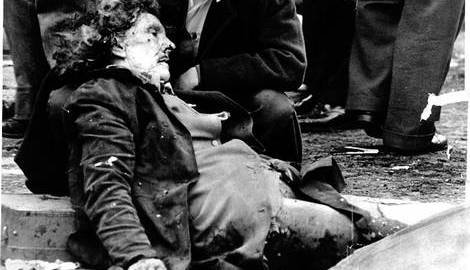
Dublin and Monaghan bombings victim

33 civilians and an unborn child were killed in the Republic of Ireland as a result of a series of explosions when four car bombs were planted by Loyalist paramilitaries in Dublin and Monaghan.

Approximately 258 people were also injured in the explosions. The death toll from the bombings was the largest in any single day of the conflict. No one was ever arrested or convicted of causing the explosions.

[On 15 July 1993 the Ulster Volunteer Force (UVF) claimed sole responsibility for carrying out the bomb attacks.]

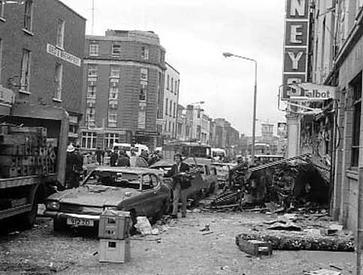
In Dublin three car bombs exploded, almost simultaneously at approximately 5.30pm, in Parnell Street, Talbot Street, and South Leinster Street. 23 men, women and children died in these explosions and 3 others died as a result of injuries over the following few days. Another car bomb exploded at approximately 7.00pm in North Road, Monaghan, killing 5 people initially with another 2 dying in the following weeks.

The first of the three Dublin bombs went off at approximately 5.28pm in Parnell Street. Eleven people died as a result of this explosion.

The second of the Dublin bombs went off at approximately 5.30pm in Parnell Street. Fourteen people died in this explosion. The third bomb went off at approximately 5.32pm in South Leinster Street. Two people were killed in this explosion.

News of car bombs in Dublin and Monaghan raised tensions in Northern Ireland. Sammy Smyth, then press officer of both the Ulster Defence Association (UDA) and the Ulster Workers’ Council (UWC) Strike Committee, said,

“I am very happy about the bombings in Dublin. There is a war with the Free State and now we are laughing at them.”

See Dublin and Monaghan Bombings

In Northern Ireland reductions in the supply of electricity continued to have serious consequences for industry, commerce, and the domestic sector. In addition to problems in maintaining petrol distribution, a lack of electricity also meant that pumps did not operate for substantial periods of each day. Postal delivery services came to a halt following intimidation of Royal Mail employees.

There were continuing problems in farming and in the distribution of food supplies. Special arrangements were made by the Northern Ireland Executive to ensure that payments of welfare benefits would be delivered to claimants.
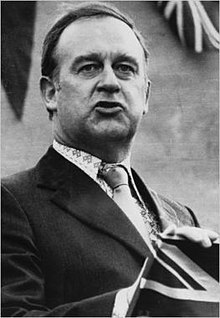
William Craig, then leader of (Ulster) Vanguard, criticised Merlyn Rees, then Secretary of Sate for Northern Ireland, for not negotiating with the Ulster Workers’ Council (UWC).

[Public Records 1974 – Released 1 January 2005: Letter from F.E.R. Butler, then in the Ministry of Defence, discussing the ‘Provision of Electric Power to Belfast’.]

Monday 17 May 1976

James Gallagher (20) was shot dead, as he travelled, as a passenger on a bus, past Fort George British Army base, Strand Road, Derry.

The soldier who shot him was on sentry duty in the base and as he handed over his rifle is reported to have said, “I’m cracking, I’m cracking”. Two other passengers on the bus, a man and a woman, were injured in the incident.

[Later Gallagher was listed on a Republican roll of honour as an Irish Republican Army (IRA) member.]

Two Protestant civilians were shot dead by Republican paramilitaries at a factory in Dungannon Street, Moy, County Tyrone.

Friday 17 May 1984
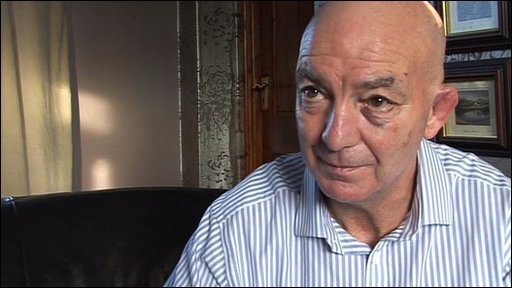
Jim Campbell, then Northern Editor of the Sunday World, was shot and seriously injured by the Ulster Volunteer Force (UVF) at his home in north Belfast.

See Martin Ohagan

Wednesday 17 May 1989

Local Government Elections

Local government elections were held across Northern Ireland.

[The percentage share of the vote was: Ulster Unionist Party (UUP) 31.4%; Democratic Unionist Party (DUP) 17.8%; Social Democratic and Labour Party (SDLP) 21.2%; Sinn Féin (SF) 11.3%; Alliance Party of Northern Ireland (APNI) 6.8%; Workers Party (WP) 2.1%; Others 9.4%; Turnout 56.0%. (See detailed results.)]

Thursday 17 May 1990

Summary of Stevens Report Published

A summary of the report of the Stevens Inquiry was published. The main finding of the report was that there had been evidence of collusion between members of the security forces and Loyalist paramilitaries.

However it was the view of the inquiry that any collusion was “restricted to a small number of members of the security forces and is neither widespread nor institutionalised”.

There was a Westminster by-election in the constituency of Upper Bann. David Trimble, of the Ulster Unionist Party (UUP), won the by-election with a majority of almost 14,000 votes. The Conservative Party candidate, Colette Jones, lost her deposit.

Sunday 17 May 1992

British soldiers of the King’s Own Scottish Borderers becamed involved in a fist-fight with local people in Coalisland, County Tyrone. Soon after members of the Parachute Regiment arrived and fired on a crowd of people standing outside a public house in the town, and shot and wounded three civilians and injured a further four others.

[This incident followed an earlier one on 12 May 1992. It was later reported that the commander of the army’s Third Brigade was transferred. Patrols by the Parachute Regiment were also ended before the official end of the regiment’s tour of duty.]

Monday 17 May 1993

The Combined Loyalist Military Command (CLMC) stated that it would look at the results of the local government elections on 19 May 1993 to see if there was any evidence of “pan-Nationalist candidates” co-operating with each other.

Tuesday 17 May 1994

Two Catholics Killed by UVF


Eamon Fox (42) and Gary Convie (24), both Catholic civilians, were shot dead by the Ulster Volunteer Force (UVF) at a building site on North Queen Street, in the Tiger Bay area of Belfast.

A review of the working of the Northern Ireland (Emergency Provisions) Act recommended that police interviews should be taped.

Wednesday 17 May 1995

Unemployment in Northern Ireland in April 1995 was recorded as 88,700 (11.8 per cent) the lowest it had been since December 1981

Saturday 17 May 1997

Gerry Adams, then President of Sinn Féin (SF), held a meeting with officials representing the Irish government at an undisclosed venue in Dublin. John Bruton, the Taoiseach (Irish Prime Minister), said afterwards that the meeting was to establish if the Irish Republican Army (IRA) was prepared to call a new ceasefire.

Sunday 17 May 1999

Tony Blair, then British Prime Minister, said there was no “plan B” if the Agreement was rejected in the referendum. Blair and Bill Clinton, then President of the United States of America (USA), issued a joint statement urging people to recognise the opportunities offered by the Agreement and to vote ‘Yes’.

Monday 17 May 1999

The Ulster Unionist Party (UUP) issued a blunt warning that it would not change its position on decommissioning before, during or after next month’s European election. David Trimble, then First Minister designate, challenged Tony Blair, then British Prime Minister, to state whether, in the British government’s view, devolution could proceed without the start of “actual decommissioning”.

In the Republic of Ireland 42 candidates were nominated for the European election on 11 June 1999. Fianna Fáil (FF) put forward eight candidates, Fine Gael seven, Labour five, Sinn Féin four, Natural Law Party four, and the Green Party three. For the first time there was no PD candidate.

Thursday 17 May 2001

Sean MacStiofain (73), former Chief of Staff of the (Provisional) Irish Republican Army (IRA), died in a hospital in the Republic of Ireland after a long illness. He became Chief of Staff of the Provisionals after they split from the Official IRA in 1970.

[MacStiofain had been born John Stephenson in London.]

Death

In 1993, Mac Stíofáin suffered a stroke. On 18 May 2001, he died in Our Lady’s Hospital, Navan, County Meath, after a long illness at the age of 73. He is buried in St Mary’s Cemetery, Navan.

Despite his controversial career in the IRA, many of his former comrades (and rivals) paid tribute to him after his death. Ruairí Ó Brádaigh, who attended the funeral, issued a glowing tribute, referring to Mac Stíofáin as an “outstanding IRA leader during a crucial period in Irish history” and as the “man for the job” as first Provisional IRA Chief of Staff. Gerry Adams and Martin McGuinness also attended. In her oration, Ita Ní Chionnaigh of Conradh na Gaeilge, whose flag draped the coffin, lambasted Mac Stíofáin’s “character assassination” by the “gutter press” and praised him as a man who had been “interested in the rights of men and women and people anywhere in the world who were oppressed, including Irish speakers in Ireland, who are also oppressed.

See here for more details on Sean MacStiofain


  ——————————————

Remembering all innocent victims of the Troubles

Today is the anniversary of the death of the following people killed as a results of the conflict in Northern Ireland

“To live in hearts we leave behind is not to die

– Thomas Campbell

To the innocent on the list – Your memory will live forever

– To the Paramilitaries –

There are many things worth living for, a few things worth dying for, but nothing worth killing for.

50  People lost their lives on the 17th between 1972 – 1990

 ——————————————

17 May 1972


Bernard Moane   (46)

Catholic
Status: Civilian (Civ),

Killed by: Ulster Defence Association (UDA)
Found shot by Knockagh War Memorial, near Greenisland, County Antrim.

 ——————————————

17 May 1972
Ronald Hurst  (25)

nfNI
Status: British Army (BA),

Killed by: Irish Republican Army (IRA)
Shot while working on perimeter fencing outside Crossmaglen Royal Ulster Constabulary (RUC) / British Army (BA) base, County Armagh.

 ——————————————

17 May 1973
Michael Leonard  (22)

nfNI
Status: Civilian (Civ),

Killed by: Royal Ulster Constabulary (RUC)
From County Donegal. Shot while driving his car, being pursued by Royal Ulster Constabulary (RUC) vehicle, Letter, near Pettigoe, County Fermanagh.

 ——————————————

17 May 1973


Eileen Mackin  (14)

Catholic
Status: Civilian (Civ),

Killed by: non-specific Loyalist group (LOY)
Shot by sniper while walking along Springhill Avenue, Ballymurphy, Belfast.

 ——————————————

17 May 1973


Thomas Ward   (34)

Catholic
Status: Civilian (Civ),

Killed by: Ulster Volunteer Force (UVF)
Shot during bomb and gun attack on Jubilee Arms, Lavinia Street, off Ormeau Road, Belfast.

 ——————————————

17 May 1973
Arthur Place   (29)

nfNI
Status: British Army (BA),

Killed by: Irish Republican Army (IRA)
Off duty. Killed by booby trap bomb while getting into car, outside Knock-na-Moe Castle Hotel, Omagh, County Tyrone.

 ——————————————

17 May 1973
 Derek Reed  (28)

nfNI
Status: British Army (BA),

Killed by: Irish Republican Army (IRA)
Off duty. Killed by booby trap bomb while getting into car, outside Knock-na-Moe Castle Hotel, Omagh, County Tyrone.

 ——————————————

17 May 1973
Sheridan Young  (26)

nfNI
Status: British Army (BA),

Killed by: Irish Republican Army (IRA)
Off duty. Killed by booby trap bomb while getting into car, outside Knock-na-Moe Castle Hotel, Omagh, County Tyrone. .

 ——————————————

17 May 1973
Barry Cox   (28)

nfNI
Status: British Army (BA),

Killed by: Irish Republican Army (IRA)
Off duty. Killed by booby trap bomb while getting into car, outside Knock-na-Moe Castle Hotel, Omagh, County Tyrone.

 ——————————————

17 May 1973
Frederick Drake  (25)

nfNI
Status: British Army (BA),

Killed by: Irish Republican Army (IRA)
Off duty. Injured by booby trap bomb while getting into car, outside Knock-na-Moe Castle Hotel, Omagh, County Tyrone. He died 3 June 1973

 ——————————————

Dublin and Monaghan Bombings

17 May 1974

Dublin and Monaghan bombings victim

33 People  lost their lives

See Dublin and Monaghan Bombings

————————————————-

17 May 1974

Marie Butler,  (21)

nfNIRI

Status: Civilian (Civ),

Killed by: Ulster Volunteer Force (UVF)
Killed when car bomb exploded Parnell Street, Dublin.

See Dublin and Monaghan Bombings

————————————————-

17 May 1974
John Dargle,   (80)

nfNIRI
Status: Civilian (Civ),

Killed by: Ulster Volunteer Force (UVF)
Killed when car bomb exploded Parnell Street, Dublin.

See Dublin and Monaghan Bombings

————————————————-

17 May 1974

Patrick Fay,  (47)

nfNIRI
Status: Civilian (Civ),

Killed by: Ulster Volunteer Force (UVF)
Killed when car bomb exploded Parnell Street, Dublin.

See Dublin and Monaghan Bombings

————————————————-

17 May 1974
Elizabeth Fitzgerald,   (59)

nfNIRI
Status: Civilian (Civ),

Killed by: Ulster Volunteer Force (UVF)
Injured when car bomb exploded Parnell Street, Dublin. She died 19 May 1974

See Dublin and Monaghan Bombings

————————————————-

17 May 1974

Antonio Magliocco,  (37)

nfNIRI
Status: Civilian (Civ),

Killed by: Ulster Volunteer Force (UVF)
Italian national. Killed when car bomb exploded Parnell Street,

See Dublin and Monaghan Bombings

————————————————-

17 May 1974

John O’Brien,   (24)

nfNIRI
Status: Civilian (Civ),

Killed by: Ulster Volunteer Force (UVF)
Killed when car bomb exploded Parnell Street, Dublin.

See Dublin and Monaghan Bombings

————————————————-

17 May 1974

Anna O’Brien  (22)

nfNIRI
Status: Civilian (Civ),

Killed by: Ulster Volunteer Force (UVF)
Killed when car bomb exploded Parnell Street, Dublin.

See Dublin and Monaghan Bombings

————————————————-

17 May 1974

Jacqueline O’Brien,   (1)

nfNIRI
Status: Civilian (Civ),

Killed by: Ulster Volunteer Force (UVF)
Killed when car bomb exploded Parnell Street, Dublin

See Dublin and Monaghan Bombings

————————————————-

17 May 1974
Anne Marie O’Brien,  (0)

nfNIRI
Status: Civilian (Civ),

Killed by: Ulster Volunteer Force (UVF)
Killed when car bomb exploded Parnell Street, Dublin.

See Dublin and Monaghan Bombings

————————————————-

17 May 1974


Edward O’Neill,  (39)

nfNIRI
Status: Civilian (Civ),

Killed by: Ulster Volunteer Force (UVF)
Killed when car bomb exploded Parnell Street, Dublin.

See Dublin and Monaghan Bombings

————————————————-

17 May 1974


Breda Turner,   (21)

nfNIRI
Status: Civilian (Civ),

Killed by: Ulster Volunteer Force (UVF)
Killed when car bomb exploded Parnell Street

See Dublin and Monaghan Bombings

————————————————-

17 May 1974

Anne Byrne,  (35)

nfNIRI
Status: Civilian (Civ),

Killed by: Ulster Volunteer Force (UVF)
Killed when car bomb exploded Talbot Street, Dublin.

See Dublin and Monaghan Bombings

————————————————-

17 May 1974

Simone Chetrit,   (30)

nfNIRI
Status: Civilian (Civ),

Killed by: Ulster Volunteer Force (UVF)
French national. Killed when car bomb exploded Talbot Street, Dublin.

See Dublin and Monaghan Bombings

————————————————-

17 May 1974


Colette Doherty,  (21)

nfNIRI
Status: Civilian (Civ),

Killed by: Ulster Volunteer Force (UVF)
Killed when car bomb exploded Talbot Street, Dublin

See Dublin and Monaghan Bombings

————————————————-

17 May 1974


Breda Grace,  (35)

nfNIRI
Status: Civilian (Civ)

, Killed by: Ulster Volunteer Force (UVF)
Killed when car bomb exploded Talbot Street, Dublin.

Dublin and Monagh Bombings

————————————————-

17 May 1974


Anna Marren,   (20)

nfNIRI
Status: Civilian (Civ),

Killed by: Ulster Volunteer Force (UVF)
Killed when car bomb exploded Talbot Street, Dublin.

See Dublin and Monaghan Bombings

————————————————-

17 May 1974

May McKenna,   (55)

nfNIRI
Status: Civilian (Civ),

Killed by: Ulster Volunteer Force (UVF)
Killed when car bomb exploded Talbot Street, Dublin.

See Dublin and Monaghan Bombings

————————————————-

17 May 1974

Dorothy  Morris,  (57)

nfNIRI
Status: Civilian (Civ),

Killed by: Ulster Volunteer Force (UVF)
Killed when car bomb exploded Talbot Street, Dublin.

See Dublin and Monaghan Bombings

————————————————-

17 May 1974


Marie Phelan,   (20)

nfNIRI
Status: Civilian (Civ),

Killed by: Ulster Volunteer Force (UVF)
Killed when car bomb exploded Talbot Street, Dublin.

See Dublin and Monaghan Bombings

————————————————-

17 May 1974

Siobhan Roice,   (19)

nfNIRI
Status: Civilian (Civ),

Killed by: Ulster Volunteer Force (UVF)
Killed when car bomb exploded Talbot Street, Dublin.

See Dublin and Monaghan Bombings

————————————————-

17 May 1974


Maureen Shields,  (46)

nfNIRI
Status: Civilian (Civ),

Killed by: Ulster Volunteer Force (UVF)
Killed when car bomb exploded Talbot Street, Dublin.

See Dublin and Monaghan Bombings

————————————————-

17 May 1974

John Walshe,   (27)

nfNIRI
Status: Civilian (Civ),

Killed by: Ulster Volunteer Force (UVF)
Killed when car bomb exploded Talbot Street, Dublin.

See Dublin and Monaghan Bombings

————————————————-

17 May 1974

Josephine Bradley,  (21)

nfNIRI
Status: Civilian (Civ),

Killed by: Ulster Volunteer Force (UVF)
Injured when car bomb exploded Talbot Street, Dublin. She died 20 May 1974

See Dublin and Monaghan Bombings

————————————————-

17 May 1974

Concepta  Dempsey,  (65)

nfNIRI
Status: Civilian (Civ),

Killed by: Ulster Volunteer Force (UVF)
Injured when car bomb exploded Talbot Street, Dublin. She died 11 June 1974.

See Dublin and Monaghan Bombings

————————————————-

17 May 1974


Anna Massey,  (21)

nfNIRI
Status: Civilian (Civ),

Killed by: Ulster Volunteer Force (UVF)
Killed when car bomb exploded South Leinster Street, Dublin

See Dublin and Monaghan Bombings

————————————————-

17 May 1974


Christine O’Loughlin,   (51)

nfNIRI
Status: Civilian (Civ),

Killed by: Ulster Volunteer Force (UVF)
Killed when car bomb exploded South Leinster Street, Dublin.

See Dublin and Monaghan Bombings

————————————————-

17 May 1974


Patrick Askin,   (44)

nfNIRI
Status: Civilian (Civ),

Killed by: Ulster Volunteer Force (UVF)
Killed when car bomb exploded Church Square, Monaghan, County Monaghan

See Dublin and Monaghan Bombings

————————————————-

17 May 1974
Thomas Campbell,  (52)

nfNIRI
Status: Civilian (Civ),

Killed by: Ulster Volunteer Force (UVF)
Killed when car bomb exploded Church Square, Monaghan, County Monaghan

See Dublin and Monaghan Bombings

————————————————-

17 May 1974

John Travers,   (28)

nfNIRI
Status: Civilian (Civ),

Killed by: Ulster Volunteer Force (UVF)
Killed when car bomb exploded Church Square, Monaghan, County Monaghan

See Dublin and Monaghan Bombings

————————————————-

17 May 1974

Peggy White,   (45)

nfNIRI
Status: Civilian (Civ),

Killed by: Ulster Volunteer Force (UVF)
Killed when car bomb exploded Church Square, Monaghan, County Monaghan.

See Dublin and Monaghan Bombings

————————————————-

17 May 1974

George Williamson,   (72)

nfNIRI
Status: Civilian (Civ),

Killed by: Ulster Volunteer Force (UVF)
Killed when car bomb exploded Church Square, Monaghan, County Monaghan

See Dublin and Monaghan Bombings

————————————————-

17 May 1974

Archie Harper,  (73)

nfNIRI
Status: Civilian (Civ),

Killed by: Ulster Volunteer Force (UVF)
Injured when car bomb exploded Church Square, Monaghan, County Monaghan. He died 21 May 1974.

See Dublin and Monaghan Bombings

————————————————-

17 May 1974

Thomas Croarkin,   (36)

nfNIRI
Status: Civilian (Civ),

Killed by: Ulster Volunteer Force (UVF)
Injured when car bomb exploded Church Square, Monaghan, County Monaghan. He died 24 July 1974.

See Dublin and Monaghan Bombings

————————————————-

17 May 1976
Robert Dobson  (35)

Protestant
Status: Civilian (Civ),

Killed by: non-specific Republican group (REP)
Shot, together with his brother, at their business premises, Dungannon Street, Moy, County Tyrone.

 ——————————————

17 May 1976
Thomas Dobson  (38)

Protestant
Status: Civilian (Civ),

Killed by: non-specific Republican group (REP)
Shot, together with his brother, at their business premises, Dungannon Street, Moy, County Tyrone.

 ——————————————

17 May 1976


James Gallagher  (20)

Catholic
Status: Irish Republican Army (IRA),

Killed by: British Army (BA)
Shot while travelling on bus which was passing Fort George British Army (BA) base, Strand Road, Derry.

 ——————————————

17 May 1986


David Wilson  (39)

Protestant
Status: Civilian (Civ),

Killed by: Irish Republican Army (IRA)
Shot while driving his firm’s van, Donaghmore, County Tyrone.

 ——————————————

17 May 1991


Douglas Carruthers   (41)

Protestant
Status: Royal Ulster Constabulary (RUC),

Killed by: Irish Republican Army (IRA)
Off duty. Killed by booby trap bomb attached to his car while driving near to his home, Mullybritt, Lisbellaw, County Fermanagh.

 ——————————————

17 May 1994


Eamon Fox  (42)

Catholic
Status: Civilian (Civ),

Killed by: Ulster Volunteer Force (UVF)
Shot, while sitting in stationary car, at his workplace, building site, North Queen Street, Tigers Bay, Belfast.

 ——————————————

17 May 1994


 Gary Convie  (24)

Catholic
Status: Civilian (Civ),

Killed by: Ulster Volunteer Force (UVF)
Shot, while sitting in stationary car, at his workplace, building site, North Queen Street, Tigers Bay, Belfast

 ——————————————
Dublin and Monaghan Bombings

Tomorrow is the anniversary of this brutal attack by the UVF.
They killed 33 civilians and a full-term unborn child, and injured almost 300.

belfastchildis's avatar

Dublin and Monaghan Bombings

17 May 1974

The views and opinions expressed in this page and  documentaries are soley intended to educate and provide background information to those interested in the Troubles of Northern Ireland. They in no way reflect my own opinions and I take no responsibility for any inaccuracies or factual errors

The Dublin and Monaghan

The Dublin and Monaghan bombings of 17 May 1974 were a series of co-ordinated no-warning car bombings in Dublin and Monaghan, Republic of Ireland. Three exploded in Dublin during rush hour and a fourth exploded in Monaghan almost ninety minutes later. They killed 33 civilians and a full-term unborn child, and injured almost 300. The bombings were the deadliest attack of the conflict known as the Troubles, and the deadliest terrorist attack in the Republic’s history.[2] Most of the victims were young women, although the ages of the…

View original post 6,567 more words