Category Archives: Blog

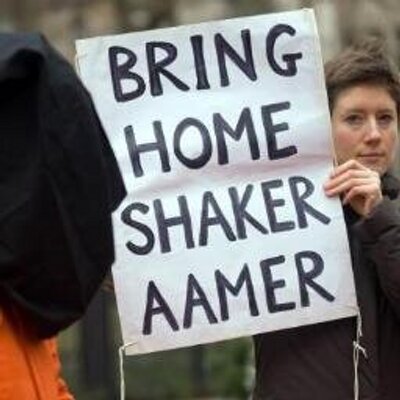
Shaker Aamer – Prisoner Number 239

belfastchildis's avatar

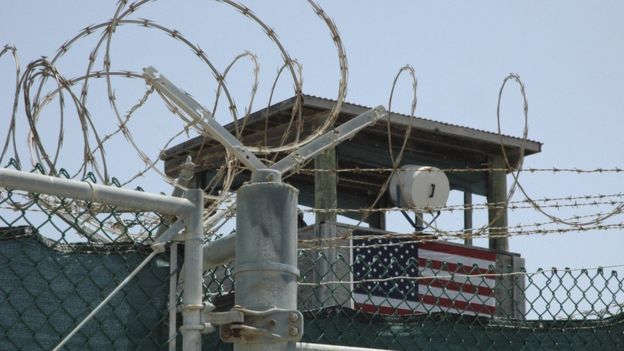
Shaker Aamer: Last UK Guantanamo Bay detainee released

———————————————————————————————-

Shaker Aamer Released From Guantanamo Bay Jail

———————————————————————————————-

Guantanamo Bay prison Shaker Aamer was detained at Guantanamo for 13 years
The last British resident to be held in Guantanamo Bay has been released, having been detained there for 13 years, the foreign secretary has said.

Philip Hammond said Shaker Aamer had left the US military base in Cuba and will return to the UK “later today”.

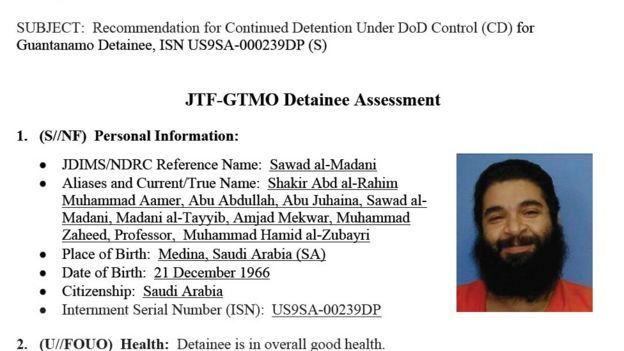
Shaker Aamer's file

The Saudi national, 48, whose family live in London, has never been charged.

Campaigners say his release was “long overdue”, while a Downing Street spokeswoman said any necessary security measures “will be put in place”.

Number 10 said Prime Minister David Cameron “welcomes” the release of Mr Aamer, who has four children and has permission to live in the UK indefinitely because his wife is British.

Mr Aamer’s father-in-law, Saeed Siddique, said his release was a “miracle”.

A…

View original post 3,541 more words

Shia, Sunni Muslims’ anti-Isis march in London

Shia, Sunni Muslims’ anti-Isis march in London not covered by mainstream media outlets

Organisers of an anti-Isis march in London have spoken of their frustration after mainstream media outlets failed to cover the demonstration.

Thousands of people took part in the annual UK Arbaeen Procession, coordinated by the Husaini Islamic Trust UK, on Sunday.

Although Shia Muslims take part in the march each year to mark the Arbaeen, or mourning, anniversary of Imam Husain – a seventh-century leader who fought for social justice – this year organisers decided to use the event as a platform to denounce terrorism following the recent Isis attacks in Paris, Beirut and elsewhere.

Organiser Waqar Haider said:

“This year we had hundreds of placards which were basically saying ‘no’ to terrorism and ‘no’ to Isis. A very direct message.

“For us it was a controversial move to go political. Normally we don’t mix politics with mourning. However with what’s happened recently, we thought we had to make sure we as a community totally disassociate ourselves with what’s happening elsewhere in the world.”

Despite this, Mr Haider said the demonstration still failed to garner attention in the mainstream media because of “stereotyping”.

“It is the oldest annual Muslim event in London but unfortunately it is very difficult to get any media coverage,” he said.

“I think it’s because of stereotyping. People see the entire Muslim community as one community.
“[But] the Muslim community is a very diverse community, with the vast majority of us horrified by Isis.

“With our event, we had so many people from different ethnic backgrounds. It’s more of a family event in terms of people it attracts.”

Volunteer Mohammed Al-Sharifi also commented on the lack of media coverage for the event.

In a tweet, he said: “Hundreds of Muslims flooded the streets of London yesterday to condemn terrorism. Media’s response: Silence.”

His post has been re-tweeted more than 5,000 times.

Other social media users also believed the demonstration should have been more widely covered.

Mr Al-Sharifi told The Independent: “I think the reason the mainstream media hasn’t covered the story is because I don’t think it’s juicy enough to sell papers. It’s simply not interesting enough.”

“Unfortunately [some] media outlets have gone for stories that to some extent can be divisive. If a group of Muslims do something good, it’s not mentioned or the religion is not mentioned. But if someone does something [negative], it is on the front page and their religion is mentioned.”

“It’s feeding this hatred and divisiveness and demonisation, I think, of Muslims.”

He said the media had an increased level of responsibility to create a cohesive society.

“The reason my tweet went viral… is because I think people realise there is a huge disparity between what they’re being fed in the media and the reality of the day-to-day interactions they have with Muslims at work, at school.”

Mr Al-Sharifi called on the country’s leadership to counter Islamophobia.

The Arbaeen processions take place in other locations around the world including Iraq, Nigeria and the US.

During this year’s event in Kano, a Boko Haram suicide bomber killed at least 21 people.

Arba’een (Arabic: الأربعين‎, “forty”), Chehelom (Persian: چهلم‎‎, the fortieth [day]”) is a Shia Muslim religious observance that occurs forty days after the Day of Ashura. It commemorates the martyrdom of Hussain ibn Ali, the grandson of Prophet Muhammad (PBUT), which falls on the 20th day of the month of Safar. Imam Hussain ibn Ali and 72 companions were martyred by tyrant Yazid I’s army in the Battle of Karbala in 61 AH (680 CE). Arbaeen is one of the largest pilgrimage gatherings on Earth, in which up to 30 million people go to the city of Karbala in Iraq.

Arbaeen is the world’s largest annual gathering, with the number of pilgrims far exceeding the two million visitors who descend on Mecca for the Hajj. The Kumbh Mela, a mass Hindu pilgrimage, attracts more pilgrims but is held only every three years.

Original Story Abna24

Understanding the Syrian crisis & The Battle for Rojava – ISIS – Pushed back

belfastchildis's avatar

The Rojava Revolution

—————————————————————

Pushing Back the Islamic State: The Battle for Rojava

—————————————————————

The Rojava Revolution is a political upheaval taking place in an autonomous region of Northern Syria, known as Rojava. The revolution has been characterized by the prominent role played by women both on the battlefield and within the newly formed political system, as well as the implementation of democratic confederalism, a form of grassroots democracy based on local assemblies.

—————————————————————

Understanding the Syrian crisis in 5 minutes

—————————————————————

—————————————————————

Islamic State Conquest: Map Time Lapse (August 2015 Update)

—————————————————————

Background

Further information: Kurds in Syria and Rojava

Kurds make up between nine and fifteen percent of Syria’s population, or well over 2 million people. The northeast of the country (where many Kurds live) is strategically important, because it contains a large percentage of Syria’s oil supplies.[31]

Qamishli riots

Further information: 2004 al-Qamishli riots

View original post 3,013 more words

George Best – 22 May 1946 – 25 November 2005

George Best

22 May 1946 –  25 November 2005

PicMonkey Collage

George Best (22 May 1946 – 25 November 2005) was a Northern Irish footballer who played as a winger for Manchester United and the Northern Ireland national team. In 1968 he won the European Cup with United, and was named the European Footballer of the Year and FWA Footballer of the Year. He is described by the Irish Football Association as the

“greatest player to ever pull on the green shirt of Northern Ireland”

George Best: Top 10 Goals

Born and brought up in Belfast, Best began his club career in England with Manchester United, with the scout who had spotted his talent at the age of 15 sending a telegram to manager Matt Busby which read: “I think I’ve found you a genius.” He went on to see success with United, scoring 179 goals from 470 appearances over 11 years, and was the club’s top goalscorer in the league for five consecutive seasons.

One of the greatest dribblers of all time, his playing style combined pace, skill, balance, feints, two-footedness, goalscoring and the ability to beat defenders.

Best unexpectedly quit United relatively early in 1974 at age 27, but returned to football for a number of clubs around the world in short spells, until finally retiring in 1983, age 37. In international football, he was an automatic choice when fit, being capped 37 times and scoring nine goals from 1964 to 1977, although a combination of the team’s performance and his lack of fitness in 1982 never allowed his talent to be displayed in the finals of a European Championship or World Cup.

Such was Best’s talent and charisma that he became one of the first celebrity footballers, earning the nickname “El Beatle“, but his subsequent extravagant lifestyle led to various problems, most notably alcoholism, which he suffered from for the rest of his life. These problems affected him on and off the field throughout his career, at times causing controversy.

Image result for "I spent a lot of money on booze, birds and fast cars – the rest I just squandered".

He often said of his career that:

“I spent a lot of money on booze, birds and fast cars – the rest I just squandered”.

After football he spent some time as a pundit, but his financial and health problems continued into his retirement. He died in 2005, age 59, due to complications from the immunosuppressive drugs he needed to take after being controversially granted an NHS liver transplant in 2002.

Best was married twice, to two former models, Angie Best and then Alex Best. His son Calum Best was born in 1981 from his first marriage.

Image result for Calum Best.


Before he died, Best was voted 16th in the IFFHS World Player of the Century election in 1999 and was one of the inaugural 22 inductees into the English Football Hall of Fame in 2002; in 2004 he was also voted 19th in the public UEFA Golden Jubilee Poll and was named in the FIFA 100 list of the world’s greatest living players. Former Brazilian footballer Pelé, considered by many as the world’s greatest, admired Best, stating,

“George Best was the greatest player in the world”, later adding that Best was “an unbelievable player.”


Best was once quoted as saying, “Pelé called me the greatest footballer in the world. That is the ultimate salute to my life.” After his death, on what would have been his 60th birthday, Belfast City Airport was renamed the George Best Belfast City Airport. According to the BBC, Best was remembered by mourners at his public funeral held in Belfast as “the beautiful boy” [with a] “beautiful game”.

Early years and family

Football George Best Early Life


George Best was the first child of Dickie Best (1919–2008) and Anne Best (née Withers; 1922–1978). He grew up in Cregagh, east Belfast. Best was brought up in the Free Presbyterian faith. His father was a member of the Orange Order and as a boy George carried the strings of the banner in his local Cregagh lodge. In his autobiography, Best mentioned how important the order was to his family.

Best had four sisters, Carol, Barbara, Julie and Grace, and one brother, Ian (Ian Busby Best). Best’s father died on 16 April 2008, at the age of 88, in the Ulster Hospital in Dundonald, Northern Ireland.

Best’s mother Anne died from alcoholism-related cardiovascular disease  in 1978, at the age of 55.


In 1957, at the age of 11, the academically gifted Best passed the 11 plus and went to Grosvenor High School, but he soon played truant as the school specialised in rugby. Best then moved to Lisnasharragh Secondary School, reuniting him with friends from primary school and allowing him to focus on football. He grew up supporting Glentoran and Wolverhampton Wanderers.

Club career

Manchester United

There’s Only One George Best

At the age of 15, Best was discovered in Belfast by Manchester United scout Bob Bishop, whose telegram to United manager Matt Busby read:


Image result for Matt Busby and george best

 “I think I’ve found you a genius.”

His local club Glentoran had previously rejected him for being “too small and light”.

Best was subsequently given a trial and signed up by United’s chief scout Joe Armstrong. His first time moving to the club, Best quickly became homesick and stayed for only two days before going back home to Northern Ireland.

He returned to Manchester and spent two years as an amateur, as English clubs were not allowed to take Northern Irish players on as apprentices. He was given a job as an errand boy on the Manchester Ship Canal, allowing him to train with the club twice a week.

Best made his First Division debut, aged 17, on 14 September 1963 against West Bromwich Albion at Old Trafford in a 1–0 victory. He then dropped back into the reserves, before scoring his first goal for the first team in his second appearance in a 5–1 win over Burnley on 28 December.

Manager Matt Busby then kept Best in the team, and by the end of the 1963–64 season, he had made 26 appearances, scoring six goals. Manchester United finished second, four points behind Liverpool. They also reached the semi-finals of the FA Cup, where a defeat to West Ham United cost Best the chance to break a record; in the final Preston North End‘s Howard Kendall became the youngest ever player in a FA Cup Final – he shared the same birthday as Best.

That same season, Best was a part of the Manchester United side that won the 1964 FA Youth Cup, the sixth FA Youth Cup won under the management of Jimmy Murphy, and the first since the 1958 Munich air disaster.

The United Trinity statue of Best (left), Denis Law (centre) and Bobby Charlton (right) outside Old Trafford


Though opponents would often use rough play to try to stifle his technical ability, Busby ensured that “fierce, sometimes brutal” training sessions left Best well used to coping with tough challenges.  In the 1964–65 season, his first full season as a first team regular, Best helped Manchester United to claim the league title.

A 1–0 victory at Elland Road proved decisive as the title race came down to goal average between the “Red Devils” and bitter rivals Leeds United; Leeds did manage to gain some measure of revenge though by knocking Manchester United out of the FA Cup at the semi-final stage. Over the course of the campaign Best contributed 14 goals in 59 competitive games.

Image result for george best

He scored the opening goal of the 1965 FA Charity Shield at Old Trafford, which ended in a 2–2 draw with Liverpool.

The rising star of English football, Best was catapulted to superstar status at the age of 19 when he scored two goals in a European Cup quarter-final match against Benfica at the Estádio da Luz on 9 March 1966.The Portuguese media dubbed him “O Quinto Beatle“, “the fifth Beatle” in English, and on the team’s return to England Best was photographed in his new sombrero with the headline, “El Beatle”.

His talent and showmanship made him a crowd and media favourite, and he went from being headline news in the back pages to the front pages. Other nicknames included the “Belfast Boy”, and he was often referred to as Georgie, or Geordie in his native Belfast. However United failed to win any major honours in the 1965–66 season, and Best was injured from 26 March onwards with a twisted knee following a bad tackle from a Preston North End player.

However United staff claimed it was light ligament damage so as to keep Best on the field for the rest of the campaign . He had little faith in the United medical staff, and so he secretly saw Glentoran’s physiotherapist, who readjusted his ligaments in a painful procedure.

His last game of the season, his knee strapped-up, came on 13 April, and ended in a 2–0 defeat to Partizan Belgrade at Partizan Stadium.

The 1966–67 season was again successful, as Manchester United claimed the league title by four points. Best stated that:

“if the championship was decided on home games we would win it every season. This time our away games made the difference. We got into the right frame of mind.”

An ever-present all season long, he scored ten goals in 45 games. He then helped the “Red Devils” to share the Charity Shield with a 3–3 draw with FA Cup winners Tottenham Hotspur; it was the first game to be broadcast in colour on British television.

Best scored twice against rivals Liverpool in a 2–0 win at Anfield, and also claimed a hat-trick over Newcastle United in a 6–0 home win on the penultimate league game of the season. However a home defeat to hated local rivals Manchester City proved costly, as City claimed the league title with a two-point lead over United. Yet the 1967–68 season would be remembered by United fans for the European Cup win.

After disposing of Maltese Hibernians, United advanced past Yugoslavian Sarajevo with a 2–1 home win – Best assisted John Aston for the first and scored the second himself, and was described as Geoffrey Green of The Times as “the centrepiece of the chessboard … a player full of fantasy; a player who lent magic to what might have been whimsy”.

In the quarter-finals United advanced past Polish club Górnik Zabrze 2–1 on aggregate, having held on to their aggregate lead in freezing temperatures in front of 105,000 at Silesian Stadium; despite losing the away tie 1–0, Best described the defeat as:

“one of our best-ever performances, given all the unwelcome circumstances”

Facing six times champions Real Madrid in the semi-finals, Best scored the only goal of the home fixture with a 15-yard strike that Alex Stepney described as one of Best’s finest goals.  In the tie at the Bernabéu, Best was marked effectively by Manuel Sanchís Martínez, but on the one time Best got the better of him he made a telling cross to Bill Foulkes, who calmly found the net to level the game at 3–3 and to win the aggregate tie 4–3.

Image result for george best FWA Footballer of the Year

Days after returning to England, as the First Division’s joint top-scorer (level on 28 goals with Southampton‘s Ron Davies) Best was presented with the FWA Footballer of the Year award, becoming the youngest ever recipient of the award.  Facing United in the European Cup Final at Wembley were Benfica; whilst his teammates rested, Best found “a novel way to relax” before the big game by sleeping with “a particular young lady called Sue”

The game went into extra-time, and just three minutes into extra-time Best went on a mazy run and beat goalkeeper José Henrique with a dummy, before rolling the ball into the net; two further goals from Brian Kidd and Bobby Charlton settled the tie at 4–1.

The victory was not only the pinnacle of Best’s career, but arguably Manchester United’s greatest achievement, considering the Munich air disaster had wiped out most of the Busby Babes just ten years previously.

Best also won the Ballon d’Or in 1968 after receiving more votes than Bobby Charlton, Dragan Džajić and Franz Beckenbauer. This meant that he had won the three major honours in club football at the age of just 22 (the league title, European Cup, and European Player of the Year award). After this, his steady decline began.

“It seems impossible to hurt him. All manner of men have tried to intimidate him. Best merely glides along, riding tackles and brushing giants aside like leaves.”


Image result for Joe Mercer
Joe Mercer, Manchester City manager, 1969.

The ‘holy trinity‘ of Best, Law and Charlton remained effective as ever in the 1968–69 campaign. However the club’s new recruits were not up to scratch, as United dropped to 11th in the league before Busby announced his retirement. Best later said that:

“I increasingly had the feeling that I was carrying the team at times on the pitch.”

He scored 22 goals in 55 games, though only he and Denis Law scored more than six league goals. In the Intercontinental Cup, fans and players alike looked forward to seeing United take on Argentine opposition Estudiantes de La Plata over the course of two legs. However Best said “no one tackled harder or dirtier than this Argentinian team” as a 1–0 defeat at the Estadio Camilo Cichero was followed by a 1–1 draw at Old Trafford.

In the home tie, Best was kicked and spat on by José Hugo Medina, and both players were sent off after Best reacted with a punch.

Despite their poor league form, United managed to reach the semi-finals of the European Cup (they had a relatively easy run in getting past Ireland‘s Waterford United, Belgium‘s Anderlecht, and Austria‘s Rapid Wien) where they were knocked out 2–1 on aggregate by A.C. Milan following a 2–0 defeat at the San Siro; Milan goalkeeper Fabio Cudicini was the hero after keeping United to only one goal at Old Trafford.

“It’s been a joke on the circuit ever since. You know, I’m on one side of the street, George Best is on the other. He nods to me and I dive under a bus.”


— Northampton goalkeeper Kim Book laughs about the jibes he has faced since being fooled by Best’s feint in the 1970 FA Cup game against Manchester United.

United improved slightly under new boss Wilf McGuinness, but still only managed an eighth-place finish in the 1969–70 season. Best hit 23 goals, including an FA Cup record six goals in an 8–2 win over Northampton Town in a mud-bath at the County Ground on 7 February 1970.

Best’s sixth goal saw him go one on one with Northampton goalkeeper Kim Book. Best made a feint to go right which put Book on his backside, before he went left and walked the ball into the net.

Of the goal Book said:

“I remember thinking George was going to go one way, but he dropped his shoulder and went the other, and by then I was already on the deck. He was just too good for me.”

Best’s six goal performance earned him an invitation to No 10 Downing Street from UK Prime Minister Harold Wilson, who had also regularly written fan letters to him.[47] In 2002 the British public voted Best’s record breaking performance #26 in the list of the 100 Greatest Sporting Moments.

Image result for george best scoring at half time

Busby returned as manager in December 1970, though the 1970–71 season also ended without a trophy. Best began to get into trouble with his discipline: he was fined by the Football Association for receiving three yellow cards for misconduct, and he was suspended by United for two weeks after missing his train to Stamford Bridge so as to spend a weekend with actress Sinéad Cusack.

New manager Frank O’Farrell led United to an eighth-place finish in 1971–72. Highlights for Best included hat-tricks against West Ham United and Southampton, as well as a goal against Sheffield United that came after he beat four defenders in a mazy run.

However he was also sent off against Chelsea, was the subject of death threats, and failed to turn up for training for a whole week in January as he instead spent his time with Miss Great Britain 1971, Carolyn Moore.

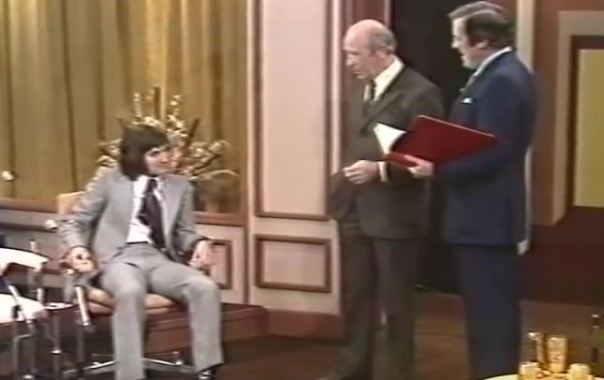
this is your life.JPG

Click here to watch


On 17 November, he was the subject of Eamonn Andrews‘s This Is Your Life when he was surprised at a central London restaurant. He would be the subject for a second time in 2003 when Michael Aspel surprised him at Teddington Studios. With 27 goals in 54 appearances, Best finished as the club’s top-scorer for the sixth – and final – consecutive season. Best then announced his retirement from football, but nevertheless turned up for pre-season training, and continued to play.

United’s decline continued in the 1972–73 season, as Best was part of the ‘old guard clique’ that barely talked to the newer, less talented players. Frustrated with the club’s decline, Best went missing in December to party at the London nightclubs.

He was suspended, and transfer-listed at a value of £300,000. After O’Farrell was replaced as manager by Tommy Docherty, Best announced his retirement for a second time.

He resumed training on 27 April.

Image result for george best queens park rangers

Best’s last competitive game for the club was on 1 January 1974 against Queens Park Rangers at Loftus Road, which United lost 3–0.

He failed to turn up for training three days later and was dropped by Docherty, though he claimed Docherty was deceitful with him.

Best was arrested and charged with stealing a fur coat, passport, and cheque book from Marjorie Wallace, but was later cleared of all charges. United went on to suffer relegation into the Second Division in 1973–74.

Best played at United when shirt numbers were assigned to positions, and not the player. When Best played at right wing, as he famously did during the later stages of the 1966 and 1968 European Cups, he donned the number 7. As a left winger, where he played exclusively in his debut season and nearly all of the 1971–72 campaign, he wore the number 11. Best wore the number 8 shirt at inside right on occasion throughout the 1960s, but for more than half of his matches during 1970–71.

He was playing at inside left (wearing the number 10) in 1972 when he famously walked out on United the first time but was back in the number 11 for the autumn of 1973 before leaving for good. Best even wore the number 9 jersey once for United, with Bobby Charlton injured, on 22 March 1969 at Old Trafford, scoring the only goal in a 1–0 win over Sheffield Wednesday.

In total Best made 470 appearances for Manchester United in all competitions from 1963 to 1974, and scored 179 goals. Over the next decade he went into an increasingly rapid decline, drifting between several clubs, including spells in South Africa, Ireland, the United States, Scotland, and Australia.

Later years

Best in 1976.


Playing only five competitive matches for Jewish Guild in South Africa, Best endured criticism for missing several training sessions. During his short time there, he was the main draw attracting thousands of spectators to the matches.

Best had a brief spell at Cork Celtic in December 1975 and January 1976. He made his League of Ireland debut against Drogheda United at Flower Lodge on 28 December. He played only three league games, the others against Bohemians and Shelbourne, but despite attracting big crowds he failed to score or impress. Being on a rolling contract with Cork his failure to show for a game saw him being dropped and subsequently leaving the club.

He had a brief resurgence in form with Second Division club Fulham in 1976–77, showing that, although he had lost some of his pace, he retained his skills. His time with the “Cottagers” is particularly remembered for a match against Hereford United on 25 September 1976 in which he tackled his own teammate, and old drinking mate, Rodney Marsh. Best stated later in life that he enjoyed his time most while at Craven Cottage, despite not winning any honours.

Best played for three clubs in the United States: Los Angeles Aztecs, Fort Lauderdale Strikers and later San Jose Earthquakes; he also played for the Detroit Express on a European tour. Best revelled in the anonymity the United States afforded him after England and was a success on the field, scoring 15 goals in 24 games in his first season with the Aztecs and named as the NASL’s best midfielder in his second.

He and manager Ken Adam opened “Bestie’s Beach Club” (now called “The Underground” after the London subway system) in Hermosa Beach, California in the 1970s, and continued to operate it until the 1990s.

Best caused a stir when he returned to the UK to play for the Scottish club Hibernian.

The club was suffering a decline in fortunes and was heading for relegation from the Premier Division, before Best was signed on a “pay per play” basis after the club chairman, Tom Hart, received a tip-off from an Edinburgh Evening News reporter that he was available.

Even though Best failed to save Hibs from relegation, gates increased dramatically, and the attendance quadrupled for his first match at Easter Road.

One infamous incident saw Best initially sacked by Hibs after he went on a massive drinking session with the French rugby team, who were in Edinburgh to play Scotland.

He was brought back a week later. In August 1982, he played 20 minutes for Scone Thistle against Scone Amateurs; the appearance fee he received helped to pay off an income tax bill.

Best in 1982.


He returned to the USA to play for the San Jose Earthquakes in what was officially described as a “loan”, though he only managed a handful of appearances for Hibs in the First Division in the following season.

Image result for Jackie McNamara, Sr.

He returned one last time to Easter Road in 1984, for Jackie McNamara’s testimonial match against Newcastle United.

In his third season in the States, Best scored once in 12 appearances. His moves to Fort Lauderdale and San Jose were also unhappy, as his off-field demons began to take control of his life again. After failing to agree terms with Bolton Wanderers in 1981, he was invited as a guest player and played three matches for two Hong Kong First Division teams (Sea Bee and Rangers) in 1982.

In late 1982, Bournemouth manager Don Megson signed the 36-year-old Best for the Third Division side, and he remained there until the end of the 1982–83 season, when he retired from football at the age of 37.

Best played in a friendly for Newry Town against Shamrock Rovers in August 1983,  before ending his professional career exactly 20 years after joining Manchester United with a brief four-match stint playing for the Brisbane Lions in the Australian National Soccer League during the 1983 season.

He also was a guest player for an exhibition match between Dee Why Football Club and Manly Warringah held on 27 July 1983; Dee Why won the match 2–1, with Best having scored the winning goal.

On 8 August 1988, a testimonial match was held for Best at Windsor Park. Among the crowd were Sir Matt Busby, Jimmy Murphy, and Bob Bishop, the scout who discovered Best, while those playing included Osvaldo Ardiles, Pat Jennings and Liam Brady. Best scored twice, one goal from outside the box, the other from the penalty spot.

International career

14-01-10-tbh-013.jpg

“George Best was one of the most talented players of all time and probably the best footballer who never made it to a major world final.”


— 1974 World Cup winning West Germany captain Franz Beckenbauer.

He was capped 37 times for Northern Ireland, scoring nine goals. Of his nine international goals four were scored against Cyprus and one each against Albania, England, Scotland, Switzerland and Turkey.

On 15 May 1971, Best scored possibly the most famous “goal” of his career at Windsor Park in Belfast against England. As Gordon Banks, the English goalkeeper, released the ball in the air in order to kick the ball downfield, Best managed to kick the ball first, which sent the ball high over their heads and heading towards the open goal.

Best outpaced Banks and headed the ball into the empty goal, but, although legal, the goal was disallowed by referee Alistair Mackenzie.

Best continued to be selected for Northern Ireland throughout the 1970s, despite his fluctuating form and off pitch problems. Dutch captain Johan Cruyff commented:

“What he [Best] had was unique, you can’t coach it”.

Best was considered briefly by manager Billy Bingham for the 1982 World Cup but, at the age of 36, with his football skills dulled by age and drink (and five years having passed since his last cap), he was not selected for the Northern Ireland squad.

A proponent of a United Ireland football team, in 2005 Best stated:

“I’ve always thought that at any given time both the Republic and Northern Ireland have had some great world-class players. I still hope that in my lifetime it happens.”

Personal life

Image result for george best teenager

During his early years at Old Trafford, Best was a shy teenager who passed his free time in snooker halls.

However he later became known for his long hair, good looks and extravagant celebrity lifestyle, and appeared on Top of the Pops in 1965.

He opened a nightclub called Slack Alice on Bootle Street in Manchester in 1973 and owned restaurants in the city including Oscars, on the site of the old Waldorf Hotel.

He also owned fashion boutiques, in partnership with Mike Summerbee. Best’s cousin Gary Reid, a member of the Ulster Defence Association, was killed in 1974 during an episode of serious rioting in east Belfast.

“In 1969 I gave up women and alcohol – it was the worst 20 minutes of my life.”

— Best quips on his lifestyle.

Best married Angela MacDonald-Janes on 24 January 1978 at Candlelight Wedding Chapel in Las Vegas, having met in the United States when Best was playing for the Los Angeles Aztecs. Their son, Calum, was born in 1981, but they separated the following year and divorced in 1986.

His niece by marriage is actress Samantha Janus, who is the daughter of Angie MacDonald-Janes’ brother.

He married Alex Pursey in 1995 in Kensington and Chelsea, London.  They divorced in 2004; they had no children. In 2004 she alleged that Best was violent towards her during their marriage, an issue that was, in fact, covered in Best’s authorised 1998 biographyBestie” in which Alex claimed that Best punched her in the face on more than one occasion.

Earlier in the book it is revealed that he struck another of his girlfriends at least once and was arrested and charged with assault on a waitress, Stevie Sloniecka, in November 1972, when he fractured her nose in Reuben’s nightclub, Manchester.

He was successfully defended when the case reached court in January 1973 by barrister George Carman QC, a close drinking companion of Best, as acknowledged in his book, Scoring at Half Time.

In the late 1960s and early 1970s, while at the peak of his career, Best advertised Cookstown Sausages on television with the phrase “the Best family sausages”. In 2007 a memorial plaque was placed outside the pork factory in the County Tyrone town.

Best had a cameo as himself in the 1971 British comedy film Percy. In 1984 he made a fitness album with Mary Stävin called Shape Up and Dance. A warts-and-all biographical film simply entitled Best was released in May 2000, with John Lynch as George Best. Indie rock band The Wedding Present named their first album George Best, and featured Best on the cover wearing his red Manchester United kit. After his death, Brian Kennedy and Peter Corry released a single entitled George Best – A Tribute.

Image result for george best GQ magazine

In 2007, GQ magazine named him as one of the 50 most stylish men of the past 50 years.

Best had at least six autobiographies and authorised biographies:

  • Bestie (co-written with Joe Lovejoy),
  • The Good, The Bad and The Bubbly (with Ross Benson)
  • Blessed: The Autobiography (with Roy Collins)
  • George Best: A Celebration (Bernie Smith and Maureen Hunt)
  • Scoring at Half Time (with Martin Knight).
  • Hard Tackles and Dirty Baths (with Harry Harris)

When Best played football, salaries were a fraction of what top players earn today but, with his pop star image and celebrity status, Best still earned a tidy fortune. He lost almost all of it. When asked what happened to the money he had earned, Best quipped:

‘I spent a lot of money on booze, birds (women) and fast cars. The rest I just squandered.’

Alcoholism

“I was born with a great gift, and sometimes with that comes a destructive streak. Just as I wanted to outdo everyone when I played, I had to outdo everyone when we were out on the town.”

— Best on his excesses off the field.

Best suffered from alcoholism for most of his adult life, leading to numerous controversies and, eventually, his death. In 1981, while playing in the United States, Best stole money from the handbag of a woman he did not know in order to fund a drinking session.

“We were sitting in a bar on the beach, and when she got up to go to the toilet I leaned over and took all the money she had in her bag.”


In 1984, Best received a three-month prison sentence for drunk driving, assaulting a police officer and failing to answer bail. He spent Christmas of 1984 behind bars at Ford Open Prison. Contrary to popular belief and urban legend he never played football for the prison team.

In September 1990, Best appeared on the primetime BBC chat show Wogan in which he was heavily drunk and swore, at one point saying to the host, “Terry, I like screwing”.

He later apologised and said this was one of the worst episodes of his alcoholism.

Best was diagnosed with severe liver damage in March 2000.

Related image

In 2001, he was admitted to hospital with pneumonia.  In August 2002, he had a successful liver transplant at King’s College Hospital in London. The transplant was performed at public expense on the NHS, a decision which was controversial due to Best’s alcoholism.  The controversy was reignited in 2003 when he was spotted openly drinking white wine spritzers.

On 2 February 2004, Best was convicted of another drink-driving offence and banned from driving for 20 months.

Death

Gates of Belfast City Hall soon after Best’s death, Another view.


Graffiti honouring Best like this one in the New Lodge area appeared all over Belfast after his death.


Best continued to drink, and was sometimes seen at his local pub in Surbiton, Southwest London. On 3 October 2005, Best was admitted to intensive care at the private Cromwell Hospital in London, suffering from a kidney infection caused by the side effects of immuno-suppressive drugs used to prevent his body from rejecting his transplanted liver.

On 27 October, newspapers stated that Best was close to death and had sent a farewell message to his loved ones. Close friends in the game visited his bedside to make their farewells, including Rodney Marsh, and the two other members of the “United Trinity”, Bobby Charlton and Denis Law.

On 20 November the British tabloid News of the World published a picture of Best at his own request, showing him in his hospital bed, along with a warning about the dangers of alcohol with his message:

“Don’t die like me”.

In the early hours of 25 November 2005, treatment was stopped; later that day he died, aged 59, as a result of a lung infection and multiple organ failure.

Maradona at 2012 GCC Champions League final.JPG

Tributes were paid to Best from around the world, including from arguably the three greatest football players ever, Pelé, Diego Maradona and Johan Cruyff. Maradona commented:

“George inspired me when I was young. He was flamboyant and exciting and able to inspire his team-mates. I actually think we were very similar players – dribblers who were able to create moments of magic.”

Famous for his quotations, fellow Manchester United legend Eric Cantona gave a eulogy to Best:

Eric Cantona à Namur pour "UBU ENCHAINE".jpg

“I would love him to save me a place in his team, George Best that is, not God.”


The Premier League announced that a minute’s silence would be observed before all Premier League games to be held over the weekend of his death; however at many grounds a minute’s applause broke out in his honour.

The first match at Old Trafford after Best’s death was a League Cup tie against West Bromwich Albion, the club against which he made his début for Manchester United in 1963.

The match, which United won, was preceded by tributes from former team-mate Sir Bobby Charlton. Best’s son Calum and former team-mates, surviving members from the West Brom team which he played against in his début, all joined the current United squad on the pitch for a minute’s silence, during which fans in every seat held aloft pictures of Best, which were given out before the match.

Funeral

His body left the family home at Cregagh Road, East Belfast, shortly after 10:00 UTC on Saturday, 3 December 2005. The cortege then travelled the short distance to Stormont. The route was lined with around 100,000 mourners. Former Northern Ireland manager Billy Bingham, international team-mates Derek Dougan, Peter McParland, Harry Gregg, Gerry Armstrong and Denis Law were the first to carry the coffin to the base of the Stormont steps.

There was an 11 am service in the Grand Hall attended by 300 invited guests relayed to around 25,000 mourners inside the grounds of Stormont. Best’s brother Ian, agent Phil Hughes, Dr Akeel Alisa, who treated Best, and his brothers-in-law Norman McNarry and Alan McPherson, were also pallbearers.

As the cortege left Stormont, the Gilnahirk pipe band played. The funeral was live on several television stations including BBC One. Afterward, Best was cremated, and his ashes were interred beside his mother Annie Elizabeth Kelly in a private ceremony at the hill-top Roselawn Cemetery, overlooking east Belfast.

Memorials

Following his death, the George Best Belfast City Airport was named after him.


Belfast City Airport was renamed George Best Belfast City Airport as a tribute to Best. The official new name and signage was unveiled to a gathering of the Best family and friends at the airport on 22 May 2006, which would have been his 60th birthday.

Public opinion in Northern Ireland about the renaming of the airport was divided, with one poll showing 52% in favour and 48% against.[105] Democratic Unionist Party (DUP) deputy leader and East Belfast Member of Parliament Peter Robinson, in whose constituency Belfast City airport is situated, stated that his preference was a sports stadium be named after Best.

“With feet as sensitive as a pickpocket’s hands, his control of the ball under the most violent pressure was astonishing. The bewildering repertoire of feints and swerves… and balance that would have made Isaac Newton decide he might as well have eaten the apple.”

Image result for Sports writer Hugh McIlvanney.
— Sports writer Hugh McIlvanney.

In March 2006, the airline Flybe named a Dash 8 (Q400) plane The George Best. The aircraft was later used to carry Best’s family across to the Manchester memorial service for Best.

Image result for George Best Egg,

In June 2006, Sarah Fabergé, great-granddaughter of Russian Imperial Jeweller Peter Carl Fabergé, was commissioned to create the George Best Egg, in tribute. A strictly limited edition of 68 eggs were produced, with all profits from the sale of the eggs going to the George Best Foundation, which promotes health through sport and supports people with alcohol and drug problems.

The first egg is on display at the George Best Airport.

Image result for george best banknote

For the first anniversary of his death, Ulster Bank issued one million commemorative five pound notes.  The notes sold out in five days. The notes sold on the online auction site eBay for up to £30.

In December 2006 the George Best Memorial Trust launched a fund-raising drive to raise £200,000 in subscriptions to pay for a life-size bronze sculpture of George Best. By 2008 the money had still not been raised until a local developer, Doug Elliott, announced on 29 January 2008, that he would put up the rest of the money and would manage delivery of the project.

Career statistics


Club Season League Cup League Cup Continental Other[nb 1] Total
Apps Goals Apps Goals Apps Goals Apps Goals Apps Goals Apps Goals
Manchester United 1963–64 17 4 7 2 2 0 0 0 26 6
1964–65 41 10 7 2 11 2 0 0 59 14
1965–66 31 9 5 3 6 4 1 1 43 17
1966–67 42 10 2 0 1 0 0 0 45 10
1967–68 41 28 2 1 9 3 1 0 53 32
1968–69 41 19 6 1 6 2 2 0 55 22
1969–70 37 15 8 6 8 2 0 0 53 23
1970–71 40 18 2 1 6 2 3 1 51 22
1971–72 40 18 7 5 6 3 1 1 54 27
1972–73 19 4 0 0 4 2 0 0 23 6
1973–74 12 2 0 0 0 0 0 0 12 2
Total 361 137 46 21 25 9 34 11 8 3 474 181
Stockport County 1975–76 3 2 0 0 0 0 3 2
Cork Celtic 1975–76 3 0 0 0 0 0 3 0
Los Angeles Aztecs 1976 23 15 1 0 24 15
Fulham 1976–77 32 6 2 0 3 2 37 8
1977–78 10 2 0 0 0 0 10 2
Total 42 8 2 0 3 2 47 10
Los Angeles Aztecs 1977 20 11 5 2 25 13
1978 12 1 12 1
Total 32 12 5 2 37 14
Fort Lauderdale Strikers 1978 9 4 5 1 14 5
1979 19 2 19 2
Total 28 6 5 1 33 7
Hibernian 1979–80 13 3 3 0 0 0 16 3
1980–81 4 0 0 0 2 0 6 0
Total 17 3 3 0 2 0 22 3
San Jose Earthquakes 1980 26 8 26 8
1981 30 13 30 13
Total 56 21 56 21
Bournemouth 1982–83 5 0 0 0 0 0 5 0
Brisbane Lions 1983 4 0 0 0 4 0
Tobermore United 1983–84 0 0 1 0 1 0
Career total 574 204 52 21 30 11 34 11 19 6 709 253

[120]

Northern Ireland national team
Year Apps Goals
1964 6 2
1965 6 1
1966 1 0
1967 1 0
1968 1 1
1969 4 0
1970 4 1
1971 6 4
1972 2 0
1973 1 0
1974 0 0
1975 0 0
1976 2 0
1977 3 0
Total 37 9

Honours

Club

Manchester United

Individual[edit]

Visit the website:  http://www.georgebest.com/

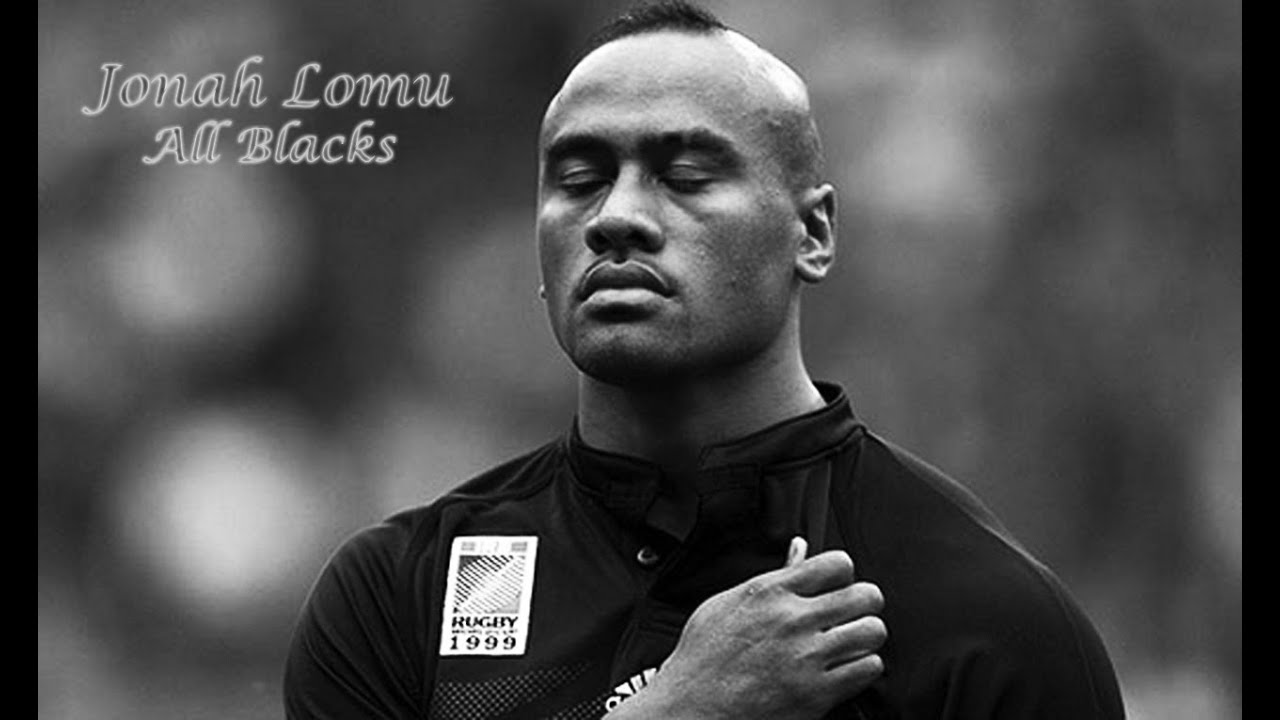
Jonah Lomu 12 May 1975 – 18 November 2015- R.I.P

Jonah Lomu

———————-

JONAH LOMU :

I just want to stay alive to see my kids make 21… Rugby’s first superstar is desperate for a second kidney transplant, but is still fighting

Sadly that wish  ended today

  • Rugby’s gentle giant catapulted to world fame after the 1995 World Cup 
  • It seemed then that nothing could ever stop him, not even the rare kidney disorder known as nephrotic syndrome
  • But rugby’s wunderkind is 40 now and he is at bay. A kidney transplant in 2004 fixed him for seven and a half years but his body rejected it in 2011 
  • He has been a prisoner of dialysis ever since
  • Now his ambition for life centres on seeing the sons he thought he could never have grow into men

‘My goal is to make it to the boys’ 21sts,’ says Lomu. ‘There are no guarantees that will happen, but it’s my focus. It’s a milestone that every parent wants to get to. My dad died young and that makes you think. I want my boys to be healthy and if they get to 21, they should be fit and healthy and live a normal life.’

So Lomu sinks into a sofa in the plush lobby of The Savoy hotel and smiles when he recalls taking the two children he thinks of as his ‘miracles’ on an open-top London double-decker bus last week. He and his wife, Nadene, retreated downstairs out of the wind and the rain. Brayley and Dhyreille insisted on staying upstairs, their hoods pulled tight around their faces, happy to be buffeted by the elements.

‘These are new adventures for them,’ says Lomu. ‘Getting them to write about this fantastic new world they have come to is going to be fun.’ He smiles again when he talks about how Nadene has to manage her ‘three boys’, but somewhere amid the great gentleness that is Lomu’s defining characteristic, there are also hints of melancholy and weariness.

Read full story Daily Mail

————-


Lomu ran riot against England four years later, scoring a memorable try in a comfortable 30-16 win 

Jonah Tali Lomu, MNZM (12 May 1975 – 18 November 2015) was a New Zealand rugby union player of Tongan descent.[1] He had sixty-three caps as an All Black after debuting in 1994. He has been described as the first true global superstar of rugby union[2] and as having a huge impact on the game.[3] He was inducted into the International Rugby Hall of Fame on 9 October 2007,[4] and the IRB Hall of Fame on 24 October 2011.[5]

———————————-

The Best of Jonah Lomu MUST SEE!! Part 1

Lomu burst onto the international rugby scene during the 1994 Hong Kong Sevens tournament and was widely acknowledged to be the top player at the 1995 World Cup in South Africa even though New Zealand lost the final to the host Springboks. At one time Lomu was considered ‘rugby union’s biggest drawcard’,[6] swelling attendances at any match where he appeared. He was one of the Rugby World Cup all-time top try scorers with 15 tries, a record he shares with Bryan Habana of South Africa—despite never winning a World Cup.[7]

He played for several domestic teams, in the Super Rugby, NPC and later the Magners League competitions. These included the Auckland Blues, Chiefs and Hurricanes, and Counties Manukau, Wellington and later North Harbour and Cardiff Blues. He made a comeback after undergoing a kidney transplant in 2004, finally retiring from professional rugby in 2007.


Early career

Lomu started his career in the forwards, mostly as an openside flanker (no.7)[8], before switching to the left wing in what he described as the “best move he could have made”.[9] He represented New Zealand in the national under-19 side in 1993, as well as the under-21 side the following year.[10] He first came to international attention at the 1994 Hong Kong Sevens tournament as part of a team including Eric Rush.[11]

At the age of 19 years and 45 days, Lomu became the youngest All Black test player as he debuted on the wing against France in 1994, breaking a record that had been held by Edgar Wrigley since 1905.[10] The match was played at Lancaster Park in Christchurch, and the All Blacks lost 22–8. The second match was played at Eden Park in Auckland with France winning again, 23–20. Lomu marked Emile N’tamack and admits that his inexperience led to him being exposed by the French team.[9]

——————-

Jonah Lomu creates carnage vs British Isles at RWC 1995

——————-

1995 World Cup

Despite having just two All Black caps, Lomu was included in the squad for the 1995 World Cup in South Africa. Lomu scored seven tries in five matches, two in the first match against Ireland in Johannesburg, a try in the quarter final against Scotland at Loftus Versfeld, and four tries in the semi-final against England at Newlands. The first try in the English match occurred after Lomu received a pass behind him, beat two defenders and then, after a stumble, ran straight over the top of Mike Catt.[12] This reduced one New Zealand commentator, Keith Quinn, to gasps.[13] After the game, England captain Will Carling said: “He is a freak and the sooner he goes away the better”.[14] In 2002 the UK public voted Lomu’s performance no. 19 in the list of the 100 Greatest Sporting Moments.[15] New Zealand played the World Cup final at Ellis Park against South Africa (the Springboks).[16] Neither side scored a try, with South Africa coming out on top 15–12 after kicking a drop-goal in extra time.

1996–1998

Following the World Cup New Zealand played Australia home and away for the Bledisloe Cup with Lomu scoring tries in both matches.[17] Lomu’s scoring for New Zealand continued later that year when he scored two tries in the All Blacks victory over Italy in Bologna.[18] Lomu played in a losing effort against France in Toulouse, where New Zealand failed to score any tries.[19] He scored a try in the second test in Paris, helping his team to victory. Lomu played for the All Blacks in matches against the touring Samoa[20] and Scotland teams in June 1996, scoring in one of the Scottish matches.[21]

Just before the World Cup final a deal was struck between South Africa, New Zealand and Australia (SANZAR) to create the Tri-Nations, an annual round robin competition between the three nations launched with the advent of professionalism in rugby.[22] New Zealand won all their games to become the first Tri-Nations winners.[23] Lomu scored a try in a 43–6 victory over Australia in the inaugural match, which has been described by New Zealand Herald journalist David Leggat as “the perfect wet-weather game”.[24]

Medal record
Commonwealth Games
Gold medal – first place 1998 Kuala Lumpur Rugby sevens

At the end of 1996, he was diagnosed with a rare and serious kidney disorder, which saw him take time off from the sport. As a result he did not play in the 1997 Tri Nations Series, but he was included in the All Blacks tour of the northern hemisphere at the end of the year. Lomu played in the two warm up matches, scoring tries against Wales ‘A’ and Emerging England. He played the first test against England at Old Trafford, as well as the test against Wales at Wembley Stadium, and the second match against England—he did not score in any of the three games.

At the 1998 Commonwealth Games in Kuala Lumpur, he won a gold medal representing New Zealand in the Sevens Rugby event.[25] The English rugby team came to New Zealand the following year for a two test series. Lomu played in both of the matches, scoring in the first, which was a 64–22 win in Dunedin, but not in the second test won 40–10 by the All Blacks.

1999 and the World Cup

Lomu’s 1999 international season kicked off with a warm-up match against New Zealand A, which was followed by a game against Samoa in which Lomu scored one of the All Blacks’ nine tries. He came on as a replacement in every game of the 1999 Tri Nations Series with Christian Cullen and Tana Umaga preferred as starters on the wings.[26][27][28][29] New Zealand were crowned Tri Nations champions despite losing the last game against Australia.

Lomu scored eight tries at the 1999 World Cup. In pool matches he scored two tries against Tonga, one against England and two against Italy. The All Blacks, finished top of their pool and proceeded to the quarter-finals. They defeated Scotland, with Lomu scoring one of New Zealand’s four tries. Lomu scored twice in the semi-final match against France, though it was not enough to see them through to the final as France went on to win 43–31.[30] Following the World Cup, despite speculation that he would be moving to play American Football in the National Football League or continue to play rugby in the English Premiership, Lomu returned to New Zealand.[31]

2000–2003

Jonah Lomu in training in 2001

After playing the 100+ victory over Tonga, Lomu and Tana Umaga scored five tries between them in the subsequent match against Scotland. One of Lomu’s tries was a characteristic bulldozing effort down the wing, leaving Scottish defenders in his wake. In the opening match of the 2000 Tri Nations Series, the All Blacks raced out to a 21 to nil lead, which had the potential to be 28, had George Gregan not stopped Lomu from scoring one of his own. Australia amazingly fought back, and with minutes remaining, both sides had scored five tries each.The world record rugby crowd of 109,874 was treated to the highest scoring match ever between the two sides. With just minutes remaining, the Wallabies led 35 to 34; until Lomu “brushed past a desperate Stephen Larkham to tip-toe down the line and score the winning try”.[32]

The match was followed by a victory over South Africa, and then a re-match of the thrilling Bledisloe Cup game, which Australia won by just a single point, 24 to 23. A barn-storming Lomu was stopped short of the line early in the second half in the final match against South Africa. The Springboks eventually won, 46 to 40. The All Blacks finished second on the table, with Australia winning the Tri Nations. Lomu played in one other test that year; against France at Stade de France in November, which the All Blacks won 39 to 26.

Lomu also led the New Zealand Sevens team to victory at the 2001 Sevens World Cup, filling in for Rush, who suffered a broken leg during the competition. In the lead up to the 2001 Tri Nations Series, the All Blacks played Argentina and France at home, Lomu scoring a try in the French match. Despite causing havoc for the Springboks, no tries were scored in the opening match of the Tri Nations, which was won on penalty goals by the All Blacks. Lomu played his 50th test for the All Blacks at the Carisbrook ‘House of Pain’, scoring a try in the second minute of play. The Wallabies spoiled the party however, winning 23 to 15. This was followed by a win over South Africa, and loss to the Wallabies at Stadium Australia.

During the 1999 off season, Lomu transferred to Wellington and won many plaudits by signing up with Wainuiomata RFC which at that time was a second division club. Lomu played his debut match against Northern United scoring twice and attracting a bumper crowd and followed that up with a further appearance in 2001. Supporters and club members were particularly proud when Lomu wore the green and black club socks when he played for the Barbarian F.C. in 2000.

At the end of the year, the All Blacks played Ireland at Lansdowne Road in Dublin. Lomu was a central figure in the 40 to 29 win, setting up Aaron Mauger for his debut try, and taking an inside pass to blast through for one of his own.[33] The All Blacks end of season tour continued at Murrayfield in Edinburgh, where they defeated Scotland 37 to six, with Lomu contributing one try. In the final match of the tour, the All Blacks played Argentina at the River Plate Stadium. Lomu put the All Blacks in front after Argentina took an early lead. New Zealand won the match by a score of 24 to 20.[34]

In his first test of 2002, he came off the bench in the second half to score a try in a match against Italy. He was again injected into play from the bench in the first of a two test series against Ireland in New Zealand; setting up the All Blacks second try coming on in the last fifteen minutes of play. Lomu was back at his usual starting position for the second test against the Irish, which New Zealand won 40 points to eight. Lomu did not score in the subsequent match against Fiji; though he did however make a trademark run down the wing, setting up Christian Cullen’s third try in the match. Lomu came off the bench in the All Blacks first game of the 2002 Tri Nations Series against South Africa, though he did not play in the rest of the tournament.

He was, however, back in his starting position on the wing for a game against England in November. Lomu ended up scoring a double, though it was not enough to secure a New Zealand victory, with England winning 31 to 28.[35] The subsequent match against France resulted in a draw, the first between the two nations in 96 years. The last match of the end of season tour was against Wales, which the All Blacks won 43 to 17.

Statistics

Jonah Lomu playing for Cardiff in 2006

International tries

Lomu scored tries against every major test playing nation in World Rugby except South Africa and Wales.[36] In his career, Lomu scored eight tries against England—more than any other All Black. Lomu set a record of 15 tries in World Cup tournaments, which was equaled by South African Bryan Habana in 2015.[37]

International analysis by opposition

Against Played Won Lost Drawn Tries Points  % Won
 Argentina 2 2 0 0 1 5 100
 Australia 13 6 7 0 6 30 46.15
 England 7 5 1 1 8 40 71.43
 Fiji 1 1 0 0 0 0 100
 France 8 3 4 1 4 20 37.5
 Ireland 4 4 0 0 3 15 100
 Italy 3 3 0 0 5 25 100
 Samoa 2 2 0 0 1 5 100
 Scotland 6 6 0 0 7 35 100
 South Africa 12 7 5 0 0 0 58.33
 Tonga 2 2 0 0 2 10 100
 Wales 3 3 0 0 0 0 100
Total 63 44 17 2 37 185 69.84

Personal life

Waxwork of Lomu in Madame Tussauds London

In 1996, Lomu married South African Tanya Rutter and they lived together in New Zealand for four years before divorcing. He married his second wife Fiona in a secret ceremony on Waiheke Island in August 2003, holding a party on the island a week later.[38] In 2008, Lomu and Fiona divorced after he had an affair with Nadene Quirk.[39] Lomu and Nadene later married and at the time of his death he was living with Nadene and their children.

Lomu was a member of the Champions for Peace club,[40] a group of 54 famous elite athletes committed to serving peace in the world through sport, created by Peace and Sport, a Monaco-based international organisation.[41] In 2012, Lomu and Nadene became members of The Church of Jesus Christ of Latter-day Saints.[42]

Lomu lent his name to various video games including Jonah Lomu Rugby and Rugby Challenge. He is portrayed by Isaac Fe’aunati in Invictus, a film chronicling Nelson Mandela‘s journey with the South African rugby team in the 1995 World Cup,

Health issues

At the end of 1995 Lomu was diagnosed with nephrotic syndrome, a serious kidney disorder. His rugby union career went on hold whilst the disorder was treated. In May 2003, the NZRFU announced that Lomu had been put on dialysis three times a week due to deterioration in his kidney function. Side effects of Lomu’s dialysis treatment led to severe nerve damage in his feet and legs; his doctors warned him that he faced life in a wheelchair if a kidney transplant was not performed soon.[43] At the end of July 2004 it was reported that Lomu had indeed undergone a kidney transplant on Tuesday, 28 July, in Auckland, New Zealand. The kidney was in fact donated by Wellington radio presenter Grant Kereama.[44]

Lomu’s vital statistics have been cited as an example of the problematic use of Body Mass Index as a measure of obesity.[45] Lomu had a BMI of 32, in excess of the value of 30 usually taken to signify obesity.[45]

Comeback

Jonah Lomu playing with French club Marseille on 22 November 2009.

In January 2005, Lomu announced his intention to lead a team against Martin Johnson‘s invitational XV on 4 June 2005, at Twickenham. He scored a try in the first half of the Johnson testimonial, but injured his shoulder in the process and did not return for the second half, dampening an otherwise encouraging first appearance.[46] As it turned out, his injury was more serious than originally thought; he underwent surgery on the shoulder, causing him to miss the 2005 NPC season.

Before returning to professional rugby, he needed special clearance from the World Anti-Doping Agency, as one of the anti-rejection drugs he was required to take is on the WADA list of banned substances.[47] On 8 April 2005, he signed a two-year contract to play for the New Zealand first division provincial team North Harbour in the NPC.[48]

On 9 August 2005, he joined North Harbour, but the shoulder injury he had picked up in the Martin Johnson testimonial game ruled him out for the season, so he worked with the team in a coaching capacity.[49] North Harbour agreed to allow him to play overseas during the NPC offseason, so Lomu signed with the Cardiff Blues of the Celtic League and began playing in Wales in December that year,[50] though he would then return to North Harbour for the 2006 NPC season.[51] Lomu made his first appearance in a competitive match since his transplant on 10 December, in Cardiff’s away Heineken Cup fixture against Italian club Calvisano. He started the match and played 60 minutes, although he did not score, making a key line break leading to Cardiff’s first try in their 25–10 win.

One week later, he made his home debut for Cardiff at Cardiff Arms Park and played for the whole match. Again, he did not get onto the scoresheet but his presence was enough to create space for other players to score in a 43–16 win over Calvisano. In front of a record home crowd, Lomu scored his first try for Cardiff on 27 December 2005, with a man-of-the-match performance during a Celtic League 41–23 win against the Newport Gwent Dragons. In early 2006, he was sidelined while he concentrated on gaining speed and strength, stating that “I have now lost between 10 and 11 kilos [1.7 and 1.9 st; 24 and 26 lb]”[52] He got his first start since January against Border Reivers on Saturday, 15 April, but broke his ankle as a result of a cover tackle on him four minutes from time. He was denied a try, but managed to get the ball away for Mark Lewis to score the Blues sixth try in their 46–11 win. He was estimated to be out for six weeks, as reported by his manager and wife, Fiona Lomu, meaning the end of his Celtic League season.

After three seasons of absence from rugby in New Zealand, Lomu played for Massey against Marist in the North Harbour club competition. Lomu was on for 30 minutes, making a blocking run before he twisted his right ankle and was subsequently replaced. Lomu said that it was “a small step”[53] in his comeback. Lomu’s aim was to return to the National Provincial Championship and reclaim his All Blacks jersey for the 2007 World Cup. Lomu ended up playing for North Harbour in round four of the National Provincial Championship, in a match against Wellington, playing in the last 26 minutes of the game. Harbour won the match 31–16. Lomu said after the match “For me it’s a dream come true… I’ve always said this is my goal—to come back and play in New Zealand.”

It became apparent in early 2007 that Lomu was not going to make the Rugby World Cup after not signing with a New Zealand Super 14 franchise, therefore ruling him out for the 2007 Rugby World Cup in France.[54] Previous to not gaining a Super 14 contract,[clarification needed] Lomu had been demoted to the North Harbour 2nd XV. Lomu stated that he was disappointed by his failure to gain a Super 14 contract, but that he had not failed himself.[54] It was subsequently speculated that Lomu may have played in Australia in 2007 for one of the then new national competition clubs.

On 16 October 2006, it was reported that Lomu was close to switching codes and signing for the Gold Coast Titans, a new Queensland franchise in the National Rugby League competition. He was offered a relatively small contract of one hundred thousand dollars. However, the deal did not materialise as Lomu had numerous important sponsorship contracts with companies associated with rugby union and it would have proved difficult to reconcile these if he was to play in the NRL.[55]

On 5 November 2006, the BBC reported that Lomu was considering a return to Welsh rugby.[56] He last played rugby in Hong Kong to take part in the Tens competition.

On 9 April 2007, Lomu appeared on New Zealand’s version of This Is Your Life, in which he was united with his brother John Lomu.

Lomu was appointed as a Member of the New Zealand Order of Merit in the Queen’s Birthday Honours list on 4 June 2007.[57]

Retirement

Lomu retired from rugby in 2007, but was persuaded to play in the Help For Heroes charity match at Twickenham a year later, although he had to withdraw after injuring his ankle in training.[58]

Later that year after recovering from the injury Lomu played in another charity match at Aberavon RFC‘s Talbot Athletic ground. The match was arranged by friends that Lomu had made during his playing days in Wales with Cardiff Blues. Lomu donned the navy blue jersey of the Aberavon Naval RFC, playing against a Port Talbot select XV made up of players from various local clubs such as; Aberavon Quins RFC, Baglan RFC & Taibach RFC in order to raise money for a local children’s charity. The match was covered by the BBC rugby show Scrum V.[59]

However, in June 2009, the BBC claimed he was close to joining French third division club Marseille Vitrolles and was expected to start in the first match of the new season.[60]

In September 2009, Lomu took part in an amateur bodybuilding contest in Wellington. He revealed that he had lost weight since preparing in March and weighed 115 kg (18.1 st; 254 lb), due to intensive gym work and a diet without carbohydrates. He claimed his weight had not been this low since he left school at 19. He finished second in two categories, including the men’s open over-90 kg, and the mixed pairs. His bodybuilding partner, Tracy Toulis, suffered from breast cancer but had recovered as Lomu had from his kidney transplant.[61] He also prepared for his comeback to rugby, joining French Fédérale 1 team Marseille Vitrolles in November.[62] Lomu made his debut against Montmelian, they won 64–13 at home.[63] Lomu started the match at centre and was nervous but enjoyed the occasion very much. Lomu then moved to number 8 successfully with Marseille Vitrolles Rugby, the position he played as a youngster in New Zealand.

Lomu also made an attempt to take part in a charity boxing event in New Zealand called “Fight for Life” 2011, which he was intended to be the captain of the rugby union team. He was intended to fight the main event against former league player Monty Betham. On 14 November Lomu pulled out of the competition as he had just recently been hospitalised for over a week due to his failing kidney.[64]

Death

On the morning of 18 November 2015, Lomu died unexpectedly in Auckland. The previous night he had returned from the United Kingdom with his family after a short holiday stay in Dubai. Lomu had been receiving dialysis treatments during his recent visit to Britain where he was involved in heavy promotional work during the 2015 Rugby World Cup

Lenny Murphy – Leader of The Shankill Butchers – Life & Death

Lenny Murphy

2 March 1952 – 16 November 1982

Leader  of The Shankill Butchers

Life & Death

Over a 10-year-year period, from 1972 to 1982, the Shankill Butchers gang, led by psychopath Lenny Murphy, terrorized Northern Ireland Catholics, becoming the most prolific group of serial killers in British history.

See Shankill Butchers

Hugh Leonard Thompson Murphy, who commonly went by the name Lenny (or Lennie) (2 March 1952 – 16 November 1982), was an Ulster loyalist from Belfast, Northern Ireland. Murphy was a member of the Ulster Volunteer Force (UVF) and leader of the infamous Shankill Butchers gang which became notorious for its torture and murder of Roman Catholic men. Although never convicted of murder, Murphy is thought to have been responsible for many deaths.[1] Murphy spent long periods in custody from late 1972 to July 1982, being free for a total of only thirteen months during that time. He was shot dead by the Provisional IRA in November 1982.

A Protestant, Murphy had a fanatical hatred of Roman Catholics. In his book The Shankill Butchers, Belfast journalist Martin Dillon suggests that Murphy’s visceral loathing of Catholics may have stemmed from his own family being suspected of having recent Catholic ancestry, because of his traditionally Irish surname which is more often associated with the other side of the religious divide in Northern Ireland.[2] After his death, his mother commented: “I don’t honestly believe he was a bad man”; however, an unnamed loyalist from the rival Ulster Defence Association described Murphy as a “typical psychopath”.

Disclaimer

The views and opinions expressed in this post and page are soley intended to educate and provide background information to those interested in the Troubles of Northern Ireland.

They in no way reflect my own opinions and I take no responsibility for any inaccuracies or factual errors

Lenny Murphy
Lenny murphy.jpg

Lenny Murphy in 1982
Born Hugh Leonard Thompson Murphy
2 March 1952
Shankill Road, Belfast, Northern Ireland
Died 16 November 1982 (aged 30)
Glencairn, upper Shankill Road, Belfast, Northern Ireland
Cause of death Over 20 fatal gunshot wounds
Nationality British
Other names Lenny or Lennie
Known for Leader of Shankill Butchers
Ulster Volunteer Force member
Religion Protestantism

Early life

Murphy was the youngest of three sons of Joyce and William Murphy from the loyalist Shankill Road, Belfast. William was originally from Fleet Street, Sailortown in the Belfast docks area. This was where he had met Joyce Thompson, who came from the Shankill. Like his own father (also named William), he worked as a dock labourer.[4]

The Murphy family changed their residence several times; in 1957 they returned to Joyce’s family home in the lower Shankill, at 28 Percy Street. Murphy’s father was reclusive which led to a rumour that he was not the same man and that Joyce was now living with a different ‘William Murphy’, one who was a Catholic. Lenny Murphy did not use his given first name because Hugh was perceived as Catholic-sounding, especially when coupled with the surname Murphy. Prior to the erection of a peace wall in the 1970s, Percy Street ran from the lower Shankill area to the Falls Road. A hoodlum at school (Argyle Primary), where he was known for the use of a knife and had his elder brothers to back him up, Murphy logged his first conviction at the age of twelve for theft. After leaving the Belfast Boys’ Model School at sixteen, he joined the Ulster Volunteer Force and was involved in the rioting that broke out in Belfast in August 1969.

His character was marked by a pathological hatred of Catholics which he brought into all of his conversations, often referring to them as “scum and animals”.[5] He held a steady job as a shop assistant, although his increasing criminal activities enabled him to indulge in a more high profile and flamboyant lifestyle which involved socialising with an array of young women and heavy drinking.[6]

Dillon wrote that it is “incredible to think that Murphy was in fact a murderer at the age of twenty” (1972). There were many people at the time who would have found it hard to believe as physically he did not differ from most young men of his age. Below average height, of slim build and sallow complexion, Murphy was blue eyed and had curly dark brown hair. He sported several tattoos; most of them bearing Ulster loyalist images.[7] He was a flashy dresser, too, often wearing a leather jacket and scarf, and occasionally a pair of leather driving-gloves, such that it reminded one contact of the time of a World War I fighter-pilot.[8]

First Crimes

The Lawnbrook Social Club in Shankill Road‘s Centurion Street, one of Murphy’s drinking haunts. It has since been demolished

According to Dillon, Murphy was involved in the torture and murder of four Catholic men as early as 1972. On 28 September of that year, a Protestant man named William Edward Pavis who had gone bird shooting with a Catholic priest, was killed at his home in East Belfast. Pavis had been threatened by loyalists who accused him of selling firearms to the IRA. Murphy was arrested for this crime along with an accomplice, Mervyn Connor.[9]

During pre-trial investigations, Murphy was placed in a line-up for possible identification by witnesses to Pavis’ shooting. Before the process began formally, he created a disturbance and stepped out of the line-up. However, two witnesses picked him out when order was restored.[9]

Connor and Murphy were held in prison together but, in April 1973, before the trial, Connor died after ingesting cyanide in his cell. He had written a suicide note in which he confessed to the crime and exonerated Murphy. It is believed Connor was forced to write the note and take the cyanide. Murphy was sent to trial for the murder of Pavis in June 1973. Although two witnesses identified him as the gunman, he was acquitted on the basis that their evidence may have been affected by the disturbance during the police line-up inquiry. However, Murphy was re-arrested and jailed for attempted escapes.[10]

By May 1975, Murphy, now aged twenty-three, was back on the streets of Belfast. On 5 May 1973, inside the Crumlin Road prison, he had married 19-year-old Margaret Gillespie, with whom he had a daughter.[11] He moved his wife and child to Brookmount Street in the upper Shankill where his parents also had a new home; however, he spent much of his time drinking in Shankill pubs such as The Brown Bear and Lawnbrook Social Club. He also regularly frequented the Bayardo Bar in Aberdeen Street.[12] Murphy later told a Provisional IRA inmate that on 13 August 1975 he had just left the Bayardo ten minutes before the IRA carried out a gun and bombing attack against the pub which killed a UVF man and four other Protestants and left over 50 injured.[13]

With his brother William he soon formed a gang of more than twenty men that would become known as the Shankill Butchers, one of his lieutenants being William Moore.

Brookmount Street (2009), where Murphy lived close to the top of the Shankill Road

Shankill Butchers murders

The gang shot dead four Catholics (two men and two women) during a robbery at a warehouse in October 1975. Over the next few months Murphy and his accomplices began to abduct, torture and murder random Catholic men they dragged off the streets late at night. Murphy regarded the use of a blade as the “ultimate way to kill”, ending the torture by hacking each victim’s throat open with a butcher’s knife. By February 1976 the gang had killed three Catholic men in this manner. Murphy achieved status though his paramilitary activity and was widely known in the Shankill. Many regarded his crimes as shaming the community but feared the consequences of testifying against him.[14][15] None of the victims had any connection to the IRA, and there was suspicion among some of their families that the murders were not properly investigated because those being killed were Catholics.[14]

The Butchers were also involved in the murder of Noel Shaw, a loyalist from a rival UVF unit, who had shot dead Butcher gang-member Archie Waller in Downing Street, off the Shankill Road, in November 1975. Four days before his death, Waller had been involved in the abduction and murder of the Butchers’ first victim, Francis Crossen. One day after Waller’s death, Shaw was beaten and pistol-whipped by Murphy while strapped to a chair, then shot. His body was later dumped in a back street off the Shankill.[16]

By the end of 1975, the UVF Brigade Staff had a new leadership of “moderates”, but Murphy refused to submit to their authority, preferring to carry out attacks by his own methods. Dillon suggested that whilst some of the Brigade Staff knew about Murphy’s activities (albeit not the precise details), they were too frightened of him and his gang to put a stop to them.[17]

On 10 January 1976, Murphy and Moore killed a Catholic man, Edward McQuaid (25), on the Cliftonville Road. Murphy, alighting from Moore’s taxi in the small hours, shot the man six times at close range.

Imprisonment

Early on 11 March 1976, Murphy shot and injured a young Catholic woman, once again on the Cliftonville. Arrested the next day after attempting to retrieve the gun used, Murphy was charged with attempted murder and remanded in custody for a prolonged period. However, he was able to plea bargain whereby he was allowed to plead guilty to the lesser charge of a firearms offence, and received twelve years’ imprisonment on 11 October 1977. Dillon notes that the police believed Murphy was involved in the Shankill Butcher murders. To divert suspicion from himself Murphy ordered the rest of the gang to continue the cut-throat murders while he was in prison. The Butchers, now under the operational command of William Moore, went on to kill and mutilate at least three more Catholics.

The team of Criminal Investigation Department (CID) detectives investigating the murders was led by Detective Chief Inspector Jimmy Nesbitt who headed C Division based at Tennent Street off the Shankill Road. However the police were overworked during this period and little progress was made in the investigation until one victim, Gerard McLaverty, survived his assault. Detectives were driving him down the Shankill Road on the way to the scene of his abduction when he recognized two of his assailants walking in the street. This identification of Sam McAllister and Benjamin Edwards led to the arrest of much of the gang in May 1977 and, in February 1979, they were imprisoned for long periods. Confessions of gang members had named Murphy as the leader but statements incriminating him were later retracted. He was questioned once again about the Butcher murders but denied involvement.

The total of sentences handed down to the gang at Belfast Crown Court was the longest in legal history in the United Kingdom.

Last months on the Shankill

On completing his sentence for the firearms charge, Lenny Murphy walked out of the Maze Prison on Friday, 16 July 1982. During his term inside, his wife Margaret had initiated divorce proceedings which were being finalised at the time of his death. Murphy returned to his old ways, killing at least four more people over the next four months. He beat to death a partially disabled man one day after returning to the Shankill. Another victim sold him a car and was shot dead after demanding full payment.[18] Murphy also attempted to extort money from local businessmen who had been sympathetic in the past; however, this encroached on other loyalist paramilitaries with established protection rackets.[19]

In late August 1982, Murphy killed a part-time Ulster Defence Regiment soldier from the Lower Shankill area who was closely involved with the UVF in Ballymena and was allegedly an informer. The man’s body was not discovered for almost a year.[1] In mid-October, Murphy and several associates kidnapped a Catholic man who was then tortured and beaten to death in Murphy’s own house (temporally vacated due to renovations). Murphy, who had left the house strewn with the victim’s blood and teeth, was arrested for questioning the next morning but later released. The sadism of the widely publicised killing led to loyalism receiving a great deal of bad publicity, and leading UVF figures concluded that Murphy’s horrific methods had made him too much of a liability.[9]

Death

On 16 November 1982, Murphy had just pulled up outside the rear of his girlfriend’s house in the Glencairn area of the upper Shankill when two Provisional IRA gunmen emerged from a black van nearby and opened fire with an assault rifle and a 9 mm pistol. Murphy was hit by more than twenty rounds and died instantly.[20] Coincidentally, he was gunned down just around the corner from where the bodies of many of the Butchers’ victims had been dumped. A few days after his death the IRA claimed responsibility. According to RUC reports, the UVF had provided the IRA hit team with the details of Murphy’s habits and movements, which allowed them to assassinate him at that particular location. Another line of inquiry ends at UDA leader James Craig,[19] who saw Murphy as a serious threat to his widespread racketeering and provided the IRA with key information on Murphy’s movements. Craig was known to meet IRA commanders to discuss their racketeering activities – he was later killed by his comrades for “treason”.[21]

Murphy was given a large paramilitary funeral by the UVF with a guard of honour wearing the UVF uniform and balaclavas. A volley of three shots was fired over his coffin as it was brought out of his house and a piper played “Abide With Me”. He was buried in Carnmoney Cemetery; on his tombstone the following words were inscribed: “Here Lies a Soldier”.[22] The tombstone was smashed in 1989.[23] His photograph was displayed inside “The Eagle”, the UVF Brigade Staff’s headquarters over a chip shop in the Shankill Road. According to investigative journalist Paul Larkin, it graced the walls as a “fallen officer” up until the late 1990s.[24

See Shankill Butchers

See Robert “Basher” Bates

Please consider making a small or large donation as I am very poor and every donation is most welcome and goes towards the cost of running this blog.

Make a small donation

paypal donation button

Thank you!

Guy Fawkes – The Gunpowder Plot – Exploding the Legend

Guy Fawkes

Born: April 13, 1570, York

Died: January 31, 1606, Westminster

———————————————————————–

The Gunpowder Plot Exploding the Legend

———————————————————————–

Guy Fawkes (/ˈɡ ˈfɔːks/; 13 April 1570 – 31 January 1606), also known as Guido Fawkes, the name he adopted while fighting for the Spanish, was a member of a group of provincial English Catholics who planned the failed Gunpowder Plot of 1605.

Gunpowder Plot
Guy Fawkes
Black-and-white drawing

George Cruikshank‘s illustration of Guy Fawkes, published in William Harrison Ainsworth‘s 1840 novel
Details
Parents Edward Fawkes, Edith (née Blake or Jackson)
Born 13 April 1570 (presumed)
York, England
Alias(es) Guido Fawkes, John Johnson
Occupation Soldier; Alférez
Plot
Role Explosives
Enlisted 20 May 1604
Captured 5 November 1605
Conviction(s) High treason
Penalty Hanged, drawn and quartered
Died 31 January 1606 (aged 35)
Westminster, London, England
Cause Hanged

Fawkes was born and educated in York. His father died when Fawkes was eight years old, after which his mother married a recusant Catholic. Fawkes later converted to Catholicism and left for the continent, where he fought in the Eighty Years’ War on the side of Catholic Spain against Protestant Dutch reformers in the Low Countries. He travelled to Spain to seek support for a Catholic rebellion in England but was unsuccessful. He later met Thomas Wintour, with whom he returned to England.

Wintour introduced Fawkes to Robert Catesby, who planned to assassinate King James I and restore a Catholic monarch to the throne. The plotters secured the lease to an undercroft beneath the House of Lords, and Fawkes was placed in charge of the gunpowder they stockpiled there. Prompted by the receipt of an anonymous letter, the authorities searched Westminster Palace during the early hours of 5 November, and found Fawkes guarding the explosives. Over the next few days, he was questioned and tortured, and eventually he broke. Immediately before his execution on 31 January, Fawkes jumped from the scaffold where he was to be hanged and broke his neck, thus avoiding the agony of the mutilation that followed.

Fawkes became synonymous with the Gunpowder Plot, the failure of which has been commemorated in Britain since 5 November 1605. His effigy is traditionally burned on a bonfire, commonly accompanied by a firework display.

———————————————————————–

Guy Fawkes and the Gunpowder Plot

———————————————————————–

Early life

Childhood

Photo

Fawkes was baptised at the church of St. Michael le Belfrey

Guy Fawkes was born in 1570 in Stonegate, York. He was the second of four children born to Edward Fawkes, a proctor and an advocate of the consistory court at York,[a] and his wife, Edith.[b] Guy’s parents were regular communicants of the Church of England, as were his paternal grandparents; his grandmother, born Ellen Harrington, was the daughter of a prominent merchant, who served as Lord Mayor of York in 1536.[4] However, Guy’s mother’s family were recusant Catholics, and his cousin, Richard Cowling, became a Jesuit priest.[5] Guy was an uncommon name in England, but may have been popular in York on account of a local notable, Sir Guy Fairfax of Steeton.[6]

The date of Fawkes’s birth is unknown, but he was baptised in the church of St. Michael le Belfrey on 16 April. As the customary gap between birth and baptism was three days, he was probably born about 13 April.[5] In 1568, Edith had given birth to a daughter named Anne, but the child died aged about seven weeks, in November that year. She bore two more children after Guy: Anne (b. 1572), and Elizabeth (b. 1575). Both were married, in 1599 and 1594 respectively.[6][7]

In 1579, when Guy was eight years old, his father died. His mother remarried several years later, to the Catholic Dionis Baynbrigge (or Denis Bainbridge) of Scotton, Harrogate. Fawkes may have become a Catholic through the Baynbrigge family’s recusant tendencies, and also the Catholic branches of the Pulleyn and Percy families of Scotton,[8] but also from his time at St. Peter’s School in York. A governor of the school had spent about 20 years in prison for recusancy, and its headmaster, John Pulleyn, came from a family of noted Yorkshire recusants, the Pulleyns of Blubberhouses. In her 1915 work The Pulleynes of Yorkshire, author Catharine Pullein suggested that Fawkes’s Catholic education came from his Harrington relatives, who were known for harbouring priests, one of whom later accompanied Fawkes to Flanders in 1592–1593.[9] Fawkes’s fellow students included John Wright and his brother Christopher (both later involved with Fawkes in the Gunpowder plot) and Oswald Tesimond, Edward Oldcorne and Robert Middleton, who became priests (the latter executed in 1601).[10]

After leaving school Fawkes entered the service of Anthony Browne, 1st Viscount Montagu. The Viscount took a dislike to Fawkes and after a short time dismissed him; he was subsequently employed by Anthony-Maria Browne, 2nd Viscount Montagu, who succeeded his grandfather at the age of 18.[11] At least one source claims that Fawkes married and had a son, but no known contemporary accounts confirm this.[12][c]

———————————————————————–

5 Things You Probably Didn’t Know About The Gunpowder Plot

———————————————————————–

Military career

In October 1591 Fawkes sold the estate in Clifton that he had inherited from his father.[d] He travelled to the continent to fight in the Eighty Years War for Catholic Spain against the new Dutch Republic and, from 1595 until the Peace of Vervins in 1598, France. Although England was not by then engaged in land operations against Spain, the two countries were still at war, and the Spanish Armada of 1588 was only five years in the past. He joined Sir William Stanley, an English Catholic and veteran commander in his mid-fifties who had raised an army in Ireland to fight in Leicester’s expedition to the Netherlands. Stanley had been held in high regard by Elizabeth I, but following his surrender of Deventer to the Spanish in 1587 he, and most of his troops, had switched sides to serve Spain. Fawkes became an alférez or junior officer, fought well at the siege of Calais in 1596, and by 1603 had been recommended for a captaincy.[3] That year, he travelled to Spain to seek support for a Catholic rebellion in England. He used the occasion to adopt the Italian version of his name, Guido, and in his memorandum described James I as “a heretic”, who intended “to have all of the Papist sect driven out of England.” He denounced Scotland, and the King’s favourites among the Scottish nobles, writing “it will not be possible to reconcile these two nations, as they are, for very long”.[13] Although he was received politely, the court of Philip III was unwilling to offer him any support.[14]

Gunpowder Plot

Main article: Gunpowder Plot
A monochrome engraving of eight men, in 17th-century dress.  All have beards, and appear to be engaged in discussion

A contemporary engraving of eight of the thirteen conspirators, by Crispijn van de Passe. Fawkes is third from the right.

In 1604 Fawkes became involved with a small group of English Catholics, led by Robert Catesby, who planned to assassinate the Protestant King James and replace him with his daughter, third in the line of succession, Princess Elizabeth.[15][16] Fawkes was described by the Jesuit priest and former school friend Oswald Tesimond as “pleasant of approach and cheerful of manner, opposed to quarrels and strife … loyal to his friends”. Tesimond also claimed Fawkes was “a man highly skilled in matters of war”, and that it was this mixture of piety and professionalism which endeared him to his fellow conspirators.[3] The author Antonia Fraser describes Fawkes as “a tall, powerfully built man, with thick reddish-brown hair, a flowing moustache in the tradition of the time, and a bushy reddish-brown beard”, and that he was “a man of action … capable of intelligent argument as well as physical endurance, somewhat to the surprise of his enemies.”[5]

The first meeting of the five central conspirators took place on Sunday 20 May 1604, at an inn called the Duck and Drake, in the fashionable Strand district of London.[e] Catesby had already proposed at an earlier meeting with Thomas Wintour and John Wright to kill the King and his government by blowing up “the Parliament House with gunpowder”. Wintour, who at first objected to the plan, was convinced by Catesby to travel to the continent to seek help. Wintour met with the Constable of Castile, the exiled Welsh spy Hugh Owen,[18] and Sir William Stanley, who said that Catesby would receive no support from Spain. Owen did, however, introduce Wintour to Fawkes, who had by then been away from England for many years, and thus was largely unknown in the country. Wintour and Fawkes were contemporaries; each was militant, and had first-hand experience of the unwillingness of the Spaniards to help. Wintour told Fawkes of their plan to “doe some whatt in Ingland if the pece with Spaine healped us nott”,[3] and thus in April 1604 the two men returned to England.[17] Wintour’s news did not surprise Catesby; despite positive noises from the Spanish authorities, he feared that “the deeds would nott answere”.[f]

One of the conspirators, Thomas Percy, was promoted in June 1604, gaining access to a house in London that belonged to John Whynniard, Keeper of the King’s Wardrobe. Fawkes was installed as a caretaker and began using the pseudonym John Johnson, servant to Percy.[20] The contemporaneous account of the prosecution (taken from Thomas Wintour’s confession)[21] claimed that the conspirators attempted to dig a tunnel from beneath Whynniard’s house to Parliament, although this story may have been a government fabrication; no evidence for the existence of a tunnel was presented by the prosecution, and no trace of one has ever been found; Fawkes himself did not admit the existence of such a scheme until his fifth interrogation, but even then he could not locate the tunnel.[22] If the story is true, however, by December 1604 the conspirators were busy tunnelling from their rented house to the House of Lords. They ceased their efforts when, during tunnelling, they heard a noise from above. Fawkes was sent out to investigate, and returned with the news that the tenant’s widow was clearing out a nearby undercroft, directly beneath the House of Lords.[3][23]

The plotters purchased the lease to the room, which also belonged to John Whynniard. Unused and filthy, it was considered an ideal hiding place for the gunpowder the plotters planned to store.[24] According to Fawkes, 20 barrels of gunpowder were brought in at first, followed by 16 more on 20 July.[25] On 28 July however, the ever-present threat of the plague delayed the opening of Parliament until Tuesday, 5 November.[26]

Overseas

In an attempt to gain foreign support, in May 1605 Fawkes travelled overseas and informed Hugh Owen of the plotters’ plan.[27] At some point during this trip his name made its way into the files of Robert Cecil, 1st Earl of Salisbury, who employed a network of spies across Europe. One of these spies, Captain William Turner, may have been responsible. Although the information he provided to Salisbury usually amounted to no more than a vague pattern of invasion reports, and included nothing which regarded the Gunpowder Plot, on 21 April he told how Fawkes was to be brought by Tesimond to England. Fawkes was a well-known Flemish mercenary, and would be introduced to “Mr Catesby” and “honourable friends of the nobility and others who would have arms and horses in readiness”.[28] Turner’s report did not, however, mention Fawkes’s pseudonym in England, John Johnson, and did not reach Cecil until late in November, well after the plot had been discovered.[3][29]

It is uncertain when Fawkes returned to England, but he was back in London by late August 1605, when he and Wintour discovered that the gunpowder stored in the undercroft had decayed. More gunpowder was brought into the room, along with firewood to conceal it.[30] Fawkes’s final role in the plot was settled during a series of meetings in October. He was to light the fuse and then escape across the Thames. Simultaneously, a revolt in the Midlands would help to ensure the capture of Princess Elizabeth. Acts of regicide were frowned upon, and Fawkes would therefore head to the continent, where he would explain to the Catholic powers his holy duty to kill the King and his retinue.[31]

Discovery

In a stone-walled room, several armed men physically restrain another man, who is drawing his sword.

Discovery of the Gunpowder Plot (c. 1823), Henry Perronet Briggs

A few of the conspirators were concerned about fellow Catholics who would be present at Parliament during the opening.[32] On the evening of 26 October, Lord Monteagle received an anonymous letter warning him to stay away, and to “retyre youre self into yowre contee whence yow maye expect the event in safti for … they shall receyve a terrible blowe this parleament”.[33] Despite quickly becoming aware of the letter – informed by one of Monteagle’s servants – the conspirators resolved to continue with their plans, as it appeared that it “was clearly thought to be a hoax”.[34] Fawkes checked the undercroft on 30 October, and reported that nothing had been disturbed.[35] Monteagle’s suspicions had been aroused, however, and the letter was shown to King James. The King ordered Sir Thomas Knyvet to conduct a search of the cellars underneath Parliament, which he did in the early hours of 5 November. Fawkes had taken up his station late on the previous night, armed with a slow match and a watch given to him by Percy “becaus he should knowe howe the time went away”.[3] He was found leaving the cellar, shortly after midnight, and arrested. Inside, the barrels of gunpowder were discovered hidden under piles of firewood and coal.[36]

Torture

Fawkes gave his name as John Johnson and was first interrogated by members of the King’s Privy chamber, where he remained defiant.[37] When asked by one of the lords what he was doing in possession of so much gunpowder, Fawkes answered that his intention was “to blow you Scotch beggars back to your native mountains.” [38] He identified himself as a 36-year-old Catholic from Netherdale in Yorkshire, and gave his father’s name as Thomas and his mother’s as Edith Jackson. Wounds on his body noted by his questioners he explained as the effects of pleurisy. Fawkes admitted his intention to blow up the House of Lords, and expressed regret at his failure to do so. His steadfast manner earned him the admiration of King James, who described Fawkes as possessing “a Roman resolution”.[39]

James’s admiration did not, however, prevent him from ordering on 6 November that “John Johnson” be tortured, to reveal the names of his co-conspirators.[40] He directed that the torture be light at first, referring to the use of manacles, but more severe if necessary, authorising the use of the rack: “the gentler Tortures are to be first used unto him et sic per gradus ad ima tenditur [and so by degrees proceeding to the worst]”.[37][41] Fawkes was transferred to the Tower of London. The King composed a list of questions to be put to “Johnson”, such as “as to what he is, For I can never yet hear of any man that knows him”, “When and where he learned to speak French?”, and “If he was a Papist, who brought him up in it?”[42] The room in which Fawkes was interrogated subsequently became known as the Guy Fawkes Room.[43]

Two signatures

Fawkes’s signature of “Guido”, made soon after his torture, is a barely evident scrawl compared to a later instance.

Sir William Waad, Lieutenant of the Tower, supervised the torture and obtained Fawkes’s confession.[37] He searched his prisoner, and found a letter, addressed to Guy Fawkes. To Waad’s surprise, “Johnson” remained silent, revealing nothing about the plot or its authors.[44] On the night of 6 November he spoke with Waad, who reported to Salisbury “He [Johnson] told us that since he undertook this action he did every day pray to God he might perform that which might be for the advancement of the Catholic Faith and saving his own soul”. According to Waad, Fawkes managed to rest through the night, despite his being warned that he would be interrogated until “I had gotton the inwards secret of his thoughts and all his complices”.[45] His composure was broken at some point during the following day.[46]

The observer Sir Edward Hoby remarked “Since Johnson’s being in the Tower, he beginneth to speak English”. Fawkes revealed his true identity on 7 November, and told his interrogators that there were five people involved in the plot to kill the King. He began to reveal their names on 8 November, and told how they intended to place Princess Elizabeth on the throne. His third confession, on 9 November, implicated Francis Tresham. Following the Ridolfi plot of 1571 prisoners were made to dictate their confessions, before copying and signing them, if they still could.[47] Although it is uncertain if he was tortured on the rack, Fawkes’s scrawled signature bears testament to the suffering he endured at the hands of his interrogators.[48]

Trial and execution

The trial of eight of the plotters began on Monday 27 January 1606. Fawkes shared the barge from the Tower to Westminster Hall with seven of his co-conspirators.[g] They were kept in the Star Chamber before being taken to Westminster Hall, where they were displayed on a purpose-built scaffold. The King and his close family, watching in secret, were among the spectators as the Lords Commissioners read out the list of charges. Fawkes was identified as Guido Fawkes, “otherwise called Guido Johnson”. He pleaded not guilty, despite his apparent acceptance of guilt from the moment he was captured.[50]

Etching

A 1606 etching by Claes (Nicolaes) Jansz Visscher, depicting Fawkes’s execution

The outcome was never in doubt. The jury found all of the defendants guilty, and the Lord Chief Justice Sir John Popham proclaimed them guilty of high treason.[51] The Attorney General Sir Edward Coke told the court that each of the condemned would be drawn backwards to his death, by a horse, his head near the ground. They were to be “put to death halfway between heaven and earth as unworthy of both”. Their genitals would be cut off and burnt before their eyes, and their bowels and hearts removed. They would then be decapitated, and the dismembered parts of their bodies displayed so that they might become “prey for the fowls of the air”.[52] Fawkes’s and Tresham’s testimony regarding the Spanish treason was read aloud, as well as confessions related specifically to the Gunpowder Plot. The last piece of evidence offered was a conversation between Fawkes and Wintour, who had been kept in adjacent cells. The two men apparently thought they had been speaking in private, but their conversation was intercepted by a government spy. When the prisoners were allowed to speak, Fawkes explained his not guilty plea as ignorance of certain aspects of the indictment.[53]

On 31 January 1606, Fawkes and three others – Thomas Wintour, Ambrose Rookwood, and Robert Keyes – were dragged (i.e. drawn) from the Tower on wattled hurdles to the Old Palace Yard at Westminster, opposite the building they had attempted to destroy.[54] His fellow plotters were then hanged and quartered. Fawkes was the last to stand on the scaffold. He asked for forgiveness of the King and state, while keeping up his “crosses and idle ceremonies”. Weakened by torture and aided by the hangman, Fawkes began to climb the ladder to the noose, but either through jumping to his death or climbing too high so the rope was incorrectly set, he managed to avoid the agony of the latter part of his execution by breaking his neck.[37][55][56] His lifeless body was nevertheless quartered[57] and, as was the custom,[58] his body parts were then distributed to “the four corners of the kingdom”, to be displayed as a warning to other would-be traitors.[59]

Legacy

Sketch of a group of children escorting an effigy

Procession of a Guy (1864)

On 5 November 1605 Londoners were encouraged to celebrate the King’s escape from assassination by lighting bonfires, “always provided that ‘this testemonye of joy be carefull done without any danger or disorder'”.[3] An Act of Parliament designated each 5 November as a day of thanksgiving for “the joyful day of deliverance”, and remained in force until 1859.[60] Although he was only one of 13 conspirators, Fawkes is today the individual most associated with the failed Plot.[61]

In Britain, 5 November has variously been called Guy Fawkes Night, Guy Fawkes Day, Plot Night[62] and Bonfire Night; the latter can be traced directly back to the original celebration of 5 November 1605.[63] Bonfires were accompanied by fireworks from the 1650s onwards, and it became the custom to burn an effigy (usually the pope) after 1673, when the heir presumptive, James, Duke of York, made his conversion to Catholicism public.[3] Effigies of other notable figures who have become targets for the public’s ire, such as Paul Kruger and Margaret Thatcher, have also found their way onto the bonfires,[64] although most modern effigies are of Fawkes.[60] The “guy” is normally created by children, from old clothes, newspapers, and a mask.[60] During the 19th century, “guy” came to mean an oddly dressed person, but in American English it lost any pejorative connotation, and was used to refer to any male person.[60][65]

Children preparing for Guy Fawkes night celebrations (1954)

William Harrison Ainsworth‘s 1841 historical romance Guy Fawkes; or, The Gunpowder Treason portrays Fawkes in a generally sympathetic light,[66] and transformed him in the public perception into an “acceptable fictional character”. Fawkes subsequently appeared as “essentially an action hero” in children’s books and penny dreadfuls such as The Boyhood Days of Guy Fawkes; or, The Conspirators of Old London, published in about 1905.[67] Historian Lewis Call has observed that Fawkes is now “a major icon in modern political culture”. He went on to write that the image of Fawkes’s face became “a potentially powerful instrument for the articulation of postmodern anarchism”[h] during the late 20th century, exemplified by the mask worn by V in the comic book series V for Vendetta, who fights against a fictional fascist English state.[68]

Guy Fawkes is sometimes toasted as “the last man to enter Parliament with honest intentions”.[69]

Pendle Witches – Life & Death. Background & Documentary

Pendle Witches

Two of the accused witches, Anne Whittle (Chattox) and her daughter Anne Redferne. Illustration from William Harrison Ainsworth’s 1849 novel, The Lancashire Witches.

The trials of the Pendle witches in 1612 are among the most famous witch trials in English history, and some of the best recorded of the 17th century. The twelve accused lived in the area around Pendle Hill in Lancashire, and were charged with the murders of ten people by the use of witchcraft. All but two were tried at Lancaster Assizes on 18–19 August 1612, along with the Samlesbury witches and others, in a series of trials that have become known as the Lancashire witch trials. One was tried at York Assizes on 27 July 1612, and another died in prison. Of the eleven who went to trial – nine women and two men – ten were found guilty and executed by hanging; one was found not guilty.

————————————————————————————–

A Pendle Witch Documentary

————————————————————————————–

The official publication of the proceedings by the clerk to the court, Thomas Potts, in his The Wonderfull Discoverie of Witches in the Countie of Lancaster, and the number of witches hanged together – nine at Lancaster and one at York – make the trials unusual for England at that time. It has been estimated that all the English witch trials between the early 15th and early 18th centuries resulted in fewer than 500 executions; this series of trials accounts for more than two per cent of that total.

Six of the Pendle witches came from one of two families, each at the time headed by a woman in her eighties: Elizabeth Southerns (aka Demdike[a]), her daughter Elizabeth Device, and her grandchildren James and Alizon Device; Anne Whittle (aka Chattox), and her daughter Anne Redferne. The others accused were Jane Bulcock and her son John Bulcock, Alice Nutter, Katherine Hewitt, Alice Gray, and Jennet Preston. The outbreaks of witchcraft in and around Pendle may demonstrate the extent to which people could make a living by posing as witches. Many of the allegations resulted from accusations that members of the Demdike and Chattox families made against each other, perhaps because they were in competition, both trying to make a living from healing, begging, and extortion.

Religious and political background

Photograph

Pendle Hill from the northwest. On the right is the eastern edge of Longridge Fell, which is separated from Pendle Hill by the Ribble valley.

The accused witches lived in the area around Pendle Hill in Lancashire, a county which, at the end of the 16th century, was regarded by the authorities as a wild and lawless region: an area “fabled for its theft, violence and sexual laxity, where the church was honoured without much understanding of its doctrines by the common people”.[2] The nearby Cistercian abbey at Whalley had been dissolved by Henry VIII in 1537, a move strongly resisted by the local people, over whose lives the abbey had until then exerted a powerful influence. Despite the abbey’s closure, and the execution of its abbot, the people of Pendle remained largely faithful to their Roman Catholic beliefs and were quick to revert to Catholicism on Queen Mary’s accession to the throne in 1553.[3]

When Mary’s Protestant half-sister Elizabeth came to the throne in 1558 Catholic priests once again had to go into hiding, but in remote areas such as Pendle they continued to celebrate Mass in secret.[3] In 1562, early in her reign, Elizabeth passed a law in the form of An Act Against Conjurations, Enchantments and Witchcrafts (5 Eliz. I c. 16). This demanded the death penalty, but only where harm had been caused; lesser offences were punishable by a term of imprisonment. The Act provided that anyone who should “use, practise, or exercise any Witchcraft, Enchantment, Charm, or Sorcery, whereby any person shall happen to be killed or destroyed”, was guilty of a felony without benefit of clergy, and was to be put to death.[4]

On Elizabeth’s death in 1603 she was succeeded by James I. Strongly influenced by Scotland’s separation from the Catholic Church during the Scottish Reformation, James was intensely interested in Protestant theology, focusing much of his curiosity on the theology of witchcraft. By the early 1590s he had become convinced that he was being plotted against by Scottish witches.[5] After a visit to Denmark, he had attended the trial in 1590 of the North Berwick witches, who were convicted of using witchcraft to send a storm against the ship that carried James and his wife Anne back to Scotland. In 1597 he wrote a book, Daemonologie, instructing his followers that they must denounce and prosecute any supporters or practitioners of witchcraft. One year after James acceded to the English throne, a law was enacted imposing the death penalty in cases where it was proven that harm had been caused through the use of magic, or corpses had been exhumed for magical purposes.[6] James was, however, sceptical of the evidence presented in witch trials, even to the extent of personally exposing discrepancies in the testimonies presented against some accused witches.[7]

In early 1612, the year of the trials, every justice of the peace (JP) in Lancashire was ordered to compile a list of recusants in their area, i.e. those who refused to attend the English Church and to take communion, a criminal offence at that time.[8] Roger Nowell of Read Hall, on the edge of Pendle Forest, was the JP for Pendle. It was against this background of seeking out religious nonconformists that, in March 1612, Nowell investigated a complaint made to him by the family of John Law, a pedlar, who claimed to have been injured by witchcraft.[9] Many of those who subsequently became implicated as the investigation progressed did indeed consider themselves to be witches, in the sense of being village healers who practised magic, probably in return for payment, but such men and women were common in 16th-century rural England, an accepted part of village life.[10]

It was perhaps difficult for the judges charged with hearing the trials – Sir James Altham and Sir Edward Bromley – to understand King James’s attitude towards witchcraft. The king was head of the judiciary, and Bromley was hoping for promotion to a circuit nearer London. Altham was nearing the end of his judicial career, but he had recently been accused of a miscarriage of justice at the York Assizes, which had resulted in a woman being sentenced to death by hanging for witchcraft. The judges may have been uncertain whether the best way to gain the king’s favour was by encouraging convictions, or by “sceptically testing the witnesses to destruction”.[11]

Events leading up to the trials

Family tree

                                                                             Elizabeth Southerns’ family[12]
Family tree

  Anne Whittle’s family[12]

One of the accused, Demdike, had been regarded in the area as a witch for fifty years, and some of the deaths the witches were accused of had happened many years before Roger Nowell started to take an interest in 1612.[13] The event that seems to have triggered Nowell’s investigation, culminating in the Pendle witch trials, occurred on 21 March 1612.[14]

On her way to Trawden Forest, Demdike’s granddaughter, Alizon Device, encountered John Law, a pedlar from Halifax, and asked him for some pins.[15] Seventeenth-century metal pins were handmade and relatively expensive, but they were frequently needed for magical purposes, such as in healing – particularly for treating warts – divination, and for love magic, which may have been why Alizon was so keen to get hold of them and why Law was so reluctant to sell them to her.[16] Whether she meant to buy them, as she claimed, and Law refused to undo his pack for such a small transaction, or whether she had no money and was begging for them, as Law’s son Abraham claimed, is unclear.[17] A few minutes after their encounter Alizon saw Law stumble and fall, perhaps because he suffered a stroke; he managed to regain his feet and reach a nearby inn.[18] Initially Law made no accusations against Alizon,[19] but she appears to have been convinced of her own powers; when Abraham Law took her to visit his father a few days after the incident, she reportedly confessed and asked for his forgiveness.[20]

Alizon Device, her mother Elizabeth, and her brother James were summoned to appear before Nowell on 30 March 1612. Alizon confessed that she had sold her soul to the Devil, and that she had told him to lame John Law after he had called her a thief. Her brother, James, stated that his sister had also confessed to bewitching a local child. Elizabeth was more reticent, admitting only that her mother, Demdike, had a mark on her body, something that many, including Nowell, would have regarded as having been left by the Devil after he had sucked her blood.[21] When questioned about Anne Whittle (Chattox), the matriarch of the other family reputedly involved in witchcraft in and around Pendle, Alizon perhaps saw an opportunity for revenge. There may have been bad blood between the two families, possibly dating from 1601, when a member of Chattox’s family broke into Malkin Tower, the home of the Devices, and stole goods worth about £1,[22] equivalent to about £100 as of 2008.[23] Alizon accused Chattox of murdering four men by witchcraft, and of killing her father, John Device, who had died in 1601. She claimed that her father had been so frightened of Old Chattox that he had agreed to give her 8 pounds (3.6 kg) of oatmeal each year in return for her promise not to hurt his family. The meal was handed over annually until the year before John’s death; on his deathbed John claimed that his sickness had been caused by Chattox because they had not paid for protection.[24]

On 2 April 1612, Demdike, Chattox, and Chattox’s daughter Anne Redferne, were summoned to appear before Nowell. Both Demdike and Chattox were by then blind and in their eighties, and both provided Nowell with damaging confessions. Demdike claimed that she had given her soul to the Devil 20 years previously, and Chattox that she had given her soul to “a Thing like a Christian man”, on his promise that “she would not lack anything and would get any revenge she desired”.[25] Although Anne Redferne made no confession, Demdike said that she had seen her making clay figures. Margaret Crooke, another witness seen by Nowell that day, claimed that her brother had fallen sick and died after having had a disagreement with Redferne, and that he had frequently blamed her for his illness[26] Based on the evidence and confessions he had obtained, Nowell committed Demdike, Chattox, Anne Redferne and Alizon Device to Lancaster Gaol, to be tried for maleficium – causing harm by witchcraft – at the next assizes.[27]

Meeting at Malkin Tower

The committal and subsequent trial of the four women might have been the end of the matter, had it not been for a meeting organised by Elizabeth Device at Malkin Tower, the home of the Demdikes,[28] held on Good Friday 10 April 1612.[29] To feed the party, James Device stole a neighbour’s sheep.[28]

Friends and others sympathetic to the family attended, and when word of it reached Roger Nowell, he decided to investigate. On 27 April 1612, an inquiry was held before Nowell and another magistrate, Nicholas Bannister, to determine the purpose of the meeting at Malkin Tower, who had attended, and what had happened there. As a result of the inquiry, eight more people were accused of witchcraft and committed for trial: Elizabeth Device, James Device, Alice Nutter, Katherine Hewitt, John Bulcock, Jane Bulcock, Alice Gray and Jennet Preston. Preston lived across the border in Yorkshire, so she was sent for trial at York Assizes; the others were sent to Lancaster Gaol, to join the four already imprisoned there.[30]

Malkin Tower is believed to have been near the village of Newchurch in Pendle,[31] or possibly in Blacko on the site of present-day Malkin Tower Farm,[32] and to have been demolished soon after the trials.[31]

Trials

The Pendle witches were tried in a group that also included the Samlesbury witches, Jane Southworth, Jennet Brierley, and Ellen Brierley, the charges against whom included child murder and cannibalism; Margaret Pearson, the so-called Padiham witch, who was facing her third trial for witchcraft, this time for killing a horse; and Isobel Robey from Windle, accused of using witchcraft to cause sickness.[33]

Some of the accused Pendle witches, such as Alizon Device, seem to have genuinely believed in their guilt, but others protested their innocence to the end. Jennet Preston was the first to be tried, at York Assizes.[34]

York Assizes, 27 July 1612

Jennet Preston lived in Gisburn, which was then in Yorkshire, so she was sent to York Assizes for trial. Her judges were Sir James Altham and Sir Edward Bromley.[35] Jennet was charged with the murder by witchcraft of a local landowner, Thomas Lister of Westby Hall,[36] to which she pleaded not guilty. She had already appeared before Bromley in 1611, accused of murdering a child by witchcraft, but had been found not guilty. The most damning evidence given against her was that when she had been taken to see Lister’s body, the corpse “bled fresh bloud presently, in the presence of all that were there present” after she touched it.[35] According to a statement made to Nowell by James Device on 27 April, Jennet had attended the Malkin Tower meeting to seek help with Lister’s murder.[37] She was found guilty and sentenced to death by hanging;[38] her execution took place on 29 July[39] on the Knavesmire, the present site of York Racecourse.[40]

Lancaster Assizes, 18–19 August 1612

Photograph

Lancaster Castle, where the Lancaster Assizes of 1612 took place[41]

All the other accused lived in Lancashire, so they were sent to Lancaster Assizes for trial, where the judges were once again Altham and Bromley. The prosecutor was local magistrate Roger Nowell, who had been responsible for collecting the various statements and confessions from the accused. Nine-year-old Jennet Device was a key witness for the prosecution, something that would not have been permitted in many other 17th-century criminal trials. However, King James had made a case for suspending the normal rules of evidence for witchcraft trials in his Daemonologie.[42] As well as identifying those who had attended the Malkin Tower meeting, Jennet also gave evidence against her mother, brother, and sister.

Nine of the accused – Alizon Device, Elizabeth Device, James Device, Anne Whittle, Anne Redferne, Alice Nutter, Katherine Hewitt, John Bulcock and Jane Bulcock – were found guilty during the two-day trial and hanged at Gallows Hill[43][b] in Lancaster on 20 August 1612; Elizabeth Southerns died while awaiting trial.[34] Only one of the accused, Alice Grey, was found not guilty.[44]

18 August

Anne Whittle (Chattox) was accused of the murder of Robert Nutter.[45] She pleaded not guilty, but the confession she had made to Roger Nowell was read out in court, and evidence against her was presented by James Robinson, who had lived with the Chattox family 20 years earlier. He claimed to remember that Nutter had accused Chattox of turning his beer sour, and that she was commonly believed to be a witch. Chattox broke down and admitted her guilt, calling on God for forgiveness and the judges to be merciful to her daughter, Anne Redferne.[46]

Statue of Alice Nutter in Roughlee

Elizabeth Device was charged with the murders of James Robinson, John Robinson and, together with Alice Nutter and Demdike, the murder of Henry Mitton. Potts records that “this odious witch”[47] suffered from a facial deformity resulting in her left eye being set lower than her right. The main witness against Device was her daughter, Jennet, who was about nine years old. When Jennet was asked to stand up and give evidence against her mother, Elizabeth began to scream and curse her daughter, forcing the judges to have her removed from the courtroom before the evidence could be heard.[48] Jennet was placed on a table and stated that she believed her mother had been a witch for three or four years. She also said her mother had a familiar called Ball, who appeared in the shape of a brown dog. Jennet claimed to have witnessed conversations between Ball and her mother, in which Ball had been asked to help with various murders. James Device also gave evidence against his mother, saying he had seen her making a clay figure of one of her victims, John Robinson.[49] Elizabeth Device was found guilty.[47]

James Device pleaded not guilty to the murders by witchcraft of Anne Townley and John Duckworth. However he, like Chattox, had earlier made a confession to Nowell, which was read out in court. That, and the evidence presented against him by his sister Jennet, who said that she had seen her brother asking a black dog he had conjured up to help him kill Townley, was sufficient to persuade the jury to find him guilty.[50][51]

19 August

The trials of the three Samlesbury witches were heard before Anne Redferne’s first appearance in court,[49] late in the afternoon, charged with the murder of Robert Nutter. The evidence against her was considered unsatisfactory, and she was acquitted.[52]

Anne Redferne was not so fortunate the following day, when she faced her second trial, for the murder of Robert Nutter’s father, Christopher, to which she pleaded not guilty. Demdike’s statement to Nowell, which accused Anne of having made clay figures of the Nutter family, was read out in court. Witnesses were called to testify that Anne was a witch “more dangerous than her Mother”.[53] But she refused to admit her guilt to the end, and had given no evidence against any others of the accused.[54] Anne Redferne was found guilty.[55]

Jane Bulcock and her son John Bulcock, both from Newchurch in Pendle, were accused and found guilty of the murder by witchcraft of Jennet Deane.[56] Both denied that they had attended the meeting at Malkin Tower, but Jennet Device identified Jane as having been one of those present, and John as having turned the spit to roast the stolen sheep, the centrepiece of the Good Friday meeting at the Demdike’s home.[57]

Alice Nutter was unusual among the accused in being comparatively wealthy, the widow of a tenant yeoman farmer. She made no statement either before or during her trial, except to enter her plea of not guilty to the charge of murdering Henry Mitton by witchcraft. The prosecution alleged that she, together with Demdike and Elizabeth Device, had caused Mitton’s death after he had refused to give Demdike a penny she had begged from him. The only evidence against Alice seems to have been that James Device claimed Demdike had told him of the murder, and Jennet Device in her statement said that Alice had been present at the Malkin Tower meeting.[58] Alice may have called in on the meeting at Malkin Tower on her way to a secret (and illegal) Good Friday Catholic service, and refused to speak for fear of incriminating her fellow Catholics. Many of the Nutter family were Catholics, and two had been executed as Jesuit priests, John Nutter in 1584 and his brother Robert in 1600.[57] Alice Nutter was found guilty.[59]

Katherine Hewitt (aka Mould-Heeles) was charged and found guilty of the murder of Anne Foulds.[60] She was the wife of a clothier from Colne,[61] and had attended the meeting at Malkin Tower with Alice Grey. According to the evidence given by James Device, both Hewitt and Grey told the others at that meeting that they had killed a child from Colne, Anne Foulds. Jennet Device also picked Katherine out of a line-up, and confirmed her attendance at the Malkin Tower meeting.[62]

Alice Gray was accused with Katherine Hewitt of the murder of Anne Foulds. Potts does not provide an account of Alice Gray’s trial, simply recording her as one of the Samlesbury witches – which she was not, as she was one of those identified as having been at the Malkin Tower meeting – and naming her in the list of those found not guilty.[63]

Alizon Device, whose encounter with John Law had triggered the events leading up to the trials, was charged with causing harm by witchcraft. Uniquely among the accused, Alizon was confronted in court by her alleged victim, John Law. She seems to have genuinely believed in her own guilt; when Law was brought into court Alizon fell to her knees in tears and confessed.[64] She was found guilty.[65]

The Wonderfull Discoverie of Witches in the Countie of Lancaster

Scan

Title page of the original edition published in 1613

Almost everything that is known about the trials comes from a report of the proceedings written by Thomas Potts, the clerk to the Lancaster Assizes. Potts was instructed to write his account by the trial judges, and had completed the work by 16 November 1612, when he submitted it for review. Bromley revised and corrected the manuscript before its publication in 1613, declaring it to be “truly reported” and “fit and worthie to be published”.[66]

Although written as an apparently verbatim account, The Wonderfull Discoverie is not a report of what was actually said at the trial but is instead reflecting what happened.[67] Nevertheless, Potts “seems to give a generally trustworthy, although not comprehensive, account of an Assize witchcraft trial, provided that the reader is constantly aware of his use of written material instead of verbatim reports”.[68]

The trials took place not quite seven years after the Gunpowder Plot to blow up the Houses of Parliament in an attempt to kill King James and the Protestant aristocracy had been foiled. It was alleged that the Pendle witches had hatched their own gunpowder plot to blow up Lancaster Castle, although historian Stephen Pumfrey has suggested that the “preposterous scheme” was invented by the examining magistrates and simply agreed to by James Device in his witness statement.[69] It may therefore be significant that Potts dedicated The Wonderfull Discoverie to Thomas Knyvet and his wife Elizabeth; Knyvet was the man credited with apprehending Guy Fawkes and thus saving the king.[70]

Modern interpretation

It has been estimated that all the English witch trials between the early 15th and early 18th centuries resulted in fewer than 500 executions, so this one series of trials in July and August 1612 accounts for more than two per cent of that total.[71] Court records show that Lancashire was unusual in the north of England for the frequency of its witch trials. Neighbouring Cheshire, for instance, also suffered from economic problems and religious activists, but there only 47 people were indicted for causing harm by witchcraft between 1589 and 1675, of whom 11 were found guilty.[72]

Pendle was part of the parish of Whalley, an area covering 180 square miles (470 km2), too large to be effective in preaching and teaching the doctrines of the Church of England: both the survival of Catholicism and the upsurge of witchcraft in Lancashire have been attributed to its over-stretched parochial structure. Until its dissolution, the spiritual needs of the people of Pendle and surrounding districts had been served by nearby Whalley Abbey, but its closure in 1537 left a moral vacuum.[73]

Many of the allegations made in the Pendle witch trials resulted from members of the Demdike and Chattox families making accusations against each other. Historian John Swain has said that the outbreaks of witchcraft in and around Pendle demonstrate the extent to which people could make a living either by posing as a witch, or by accusing or threatening to accuse others of being a witch.[17] Although it is implicit in much of the literature on witchcraft that the accused were victims, often mentally or physically abnormal, for some at least, it may have been a trade like any other, albeit one with significant risks.[74] There may have been bad blood between the Demdike and Chattox families because they were in competition with each other, trying to make a living from healing, begging, and extortion.[22] The Demdikes are believed to have lived close to Newchurch in Pendle, and the Chattox family about 2 miles (3.2 km) away, near the village of Fence.[31]

Aftermath and legacy

Photograph

A “The Witch Way” Transdev in Burnley & Pendle bus

Altham continued with his judicial career until his death in 1617, and Bromley achieved his desired promotion to the Midlands Circuit in 1616. Potts was given the keepership of Skalme Park by James in 1615, to breed and train the king’s hounds. In 1618, he was given responsibility for “collecting the forfeitures on the laws concerning sewers, for twenty-one years”.[75] Having played her part in the deaths of her mother, brother, and sister, Jennet Device may eventually have found herself accused of witchcraft. A woman with that name was listed in a group of 20 tried at Lancaster Assizes on 24 March 1634, although it cannot be certain that it was the same Jennet Device.[76] The charge against her was the murder of Isabel Nutter, William Nutter’s wife.[77] In that series of trials the chief prosecution witness was a ten-year-old boy, Edmund Robinson. All but one of the accused were found guilty, but the judges refused to pass death sentences, deciding instead to refer the case to the king, Charles I. Under cross-examination in London, Robinson admitted that he had fabricated his evidence,[76] but even though four of the accused were eventually pardoned,[78] they all remained incarcerated in Lancaster Gaol, where it is likely that they died. An official record dated 22 August 1636 lists Jennet Device as one of those still held in the prison.[79] These later Lancashire witchcraft trials were the subject of a contemporary play written by Thomas Heywood and Richard Brome, The Late Lancashire Witches.[80]

In modern times the witches have become the inspiration for Pendle’s tourism and heritage industries, with local shops selling a variety of witch-motif gifts. Burnley‘s Moorhouse’s produces a beer called Pendle Witches Brew, and there is a Pendle Witch Trail running from Pendle Heritage Centre to Lancaster Castle, where the accused witches were held before their trial.[14] The X43 bus route run by Transdev in Burnley & Pendle has been branded The Witch Way, with some of the vehicles operating on it named after the witches in the trial.[81] Pendle Hill, which dominates the landscape of the area, continues to be associated with witchcraft, and hosts a hilltop gathering every Halloween.[82]

A petition was presented to UK Home Secretary Jack Straw in 1998 asking for the witches to be pardoned, but it was decided that their convictions should stand.[83] Ten years later another petition was organised in an attempt to obtain pardons for Chattox and Demdike. It followed the Swiss government’s pardon earlier that year of Anna Göldi, beheaded in 1782, thought to be the last person in Europe to be executed as a witch.[84]

Literary adaptations and other media

William Harrison Ainsworth, a Victorian novelist considered in his day the equal of Dickens,[85] wrote a romanticised account of the Pendle witches published in 1849. The Lancashire Witches is the only one of his 40 novels never to have been out of print.[85] The British writer Robert Neill dramatised the events of 1612 in his novel Mist over Pendle, first published in 1951. The writer and poet Blake Morrison treated the subject in his suite of poems Pendle Witches, published in 1996, and in 2011 poet Simon Armitage narrated a documentary on BBC Four, The Pendle Witch Child.[86]

2012 anniversary

Pendle Hill marked with the date 1612 on the 400th anniversary of the trials

Events to mark the 400th anniversary of the trials in 2012 included an exhibition, “A Wonderful Discoverie: Lancashire Witches 1612–2012”, at Gawthorpe Hall staged by Lancashire County Council.[87] The Fate of Chattox, a piece by David Lloyd-Mostyn for clarinet and piano, taking its theme from the events leading to Chattox’s demise, was performed by Aquilon at the Chorlton Arts Festival.[88]

A life-size statue of Alice Nutter, by sculptor David Palmer, was unveiled in her home village, Roughlee.[89] In August, a world record for the largest group dressed as witches was set by 482 people who walked up Pendle Hill, on which the date “1612” had been installed in 400-foot-tall numbers by artist Philippe Handford using horticultural fleece.[90] The Bishop of Burnley, the Rt Rev John Goddard, expressed concern about marking the anniversary on the side of the hill.[91]

Publications in 2012 inspired by the trials include two novellas, The Daylight Gate by Jeanette Winterson and Malkin Child by Livi Michael. Blake Morrison published a volume of poetry, A Discoverie of Witches.[92]

Shaker Aamer – Prisoner Number 239

Shaker Aamer: Last UK Guantanamo Bay detainee released

———————————————————————————————-

Shaker Aamer Released From Guantanamo Bay Jail

———————————————————————————————-

Guantanamo Bay prison
Shaker Aamer was detained at Guantanamo for 13 years

The last British resident to be held in Guantanamo Bay has been released, having been detained there for 13 years, the foreign secretary has said.

Philip Hammond said Shaker Aamer had left the US military base in Cuba and will return to the UK “later today”.

Shaker Aamer's file

The Saudi national, 48, whose family live in London, has never been charged.

Campaigners say his release was “long overdue”, while a Downing Street spokeswoman said any necessary security measures “will be put in place”.

Number 10 said Prime Minister David Cameron “welcomes” the release of Mr Aamer, who has four children and has permission to live in the UK indefinitely because his wife is British.

Mr Aamer’s father-in-law, Saeed Siddique, said his release was a “miracle”.

A plane carrying Mr Aamer is expected to land at London’s Biggin Hill airport at around 13:00 GMT.

‘Areas of concern’

Downing Street said there were “no plans” to detain him after his arrival.

US authorities first held Mr Aamer in Afghanistan in 2001, alleging he had led a unit of Taliban fighters and had met former al-Qaeda leader Osama Bin Laden.

However, Mr Aamer maintains he was in Afghanistan with his family doing charity work.

Andy Worthington, co-director of the We Stand With Shaker campaign, said Mr Aamer, who is reported to have health problems, will require “psychological and medical care” when he returns to his family in London.

In letters sent to the BBC by his lawyers earlier this month, Mr Aamer described himself as “an old car that has not been to the garage for years”, saying the first thing he wanted once freed was a cup of coffee.

“I have known nothing about the real world for more than 13 years,” he wrote.

see BBC News for full story

———————————————————————————————————–

Shaker Aamer

Shaker Aamer (born 21 December 1966)[1] is a Saudi citizen released on 30 October 2015 from almost 14 years in the Guantanamo Bay detention camps in Cuba.[2] He was seized in Afghanistan by bounty hunters who handed him over to US forces in December 2001. Two months later, the US rendered Aamer to the Guantánamo camp; he has been held there without trial or charge since then.[3][4][5][6] Aamer had been legally resident in Britain for years before his imprisonment; the UK government has repeatedly demanded his release, and many people there have called for him to be released.[7][8]

According to documents published in the Guantanamo Bay files leak, the US military Joint Task Force Guantanamo believed that Aamer had led a unit of fighters in Afghanistan, including the Battle of Tora Bora, while his family was paid a stipend by Osama bin Laden. The file asserts past associations with Richard Reid and Zacarias Moussaoui.[7][8] Aamer denies being involved in terrorist activity and his lawyer, Clive Stafford Smith, said the leaked documents would not stand up in court. He claimed that part of the evidence comes from an unreliable witness and that confessions Aamer made had been obtained through torture.[9][10] Aamer’s father-in-law, Saaed Ahmed Siddique, said: “All of these claims have no basis. If any of this was true he would be in a court now.”[11] The Bush administration acknowledged later that it had no evidence against Aamer.[12]

Aamer has never been charged with any wrongdoing, was never on trial, and his lawyer says he is “totally innocent.”[13][14] He was approved for transfer to Saudi Arabia by the Bush administration in 2007 and the Obama administration in 2009.[15][14] He has been described as a “charismatic leader” who spoke up and fought for the rights of fellow prisoners. Aamer says that he has been subject to torture while in detention.[16] Campaigners allege that the US is refusing to release Aamer because it feared he would expose torture inside the Guantanamo prison.[17]

Aamer’s mental and physical health has been declining over the years, as he has participated in hunger strikes to protest detention condition and been held in solitary confinement much of the time. He claims to have lost 40 per cent of his body weight in captivity, but did not state his weight.[18][19][20] After a visit in November, 2011, his lawyer said, “I do not think it is stretching matters to say that he is gradually dying in Guantanamo Bay.”[21] In 2015, despite Aamer’s deteriorating health, the US denied a request for an independent medical examination.[22] On 25 September 2015 the US government announced that Aamer would be released back to the UK within the following thirty days.[23] He was released to the UK on 30 October 2015.[24]

Shaker Aamer
ISN 00239, Shaker Aamer.jpg

Aamer in Guantanamo (photo taken before 1 November 2007)
Born (1966-12-21) 21 December 1966 (age 48)
Medina, Saudi Arabia
Detained at Kandahar, Bagram and Guantánamo
ISN 239
Charge(s) None
Penalty None
Status Released from Guantanamp Bay on 30 October 2015 after 13 years, despite being cleared for release by two US presidents in 2007 and in 2009
Spouse Zin Siddique
Children Four children

Family and personal life

Aamer was born on 12 December 1968 and grew up in Medina in Saudi Arabia. He left the country at the age of 17. He lived and traveled in the United States, Europe and the Middle East.[25] Aamer lived and studied in Georgia and Maryland in 1989 and 1990 and during the Gulf War, he worked as a translator for the U.S. Army.[26]

He moved to the United Kingdom in 1996 where he met Zin Siddique, a British woman; they married in 1997 and have four British children. Aamer has never met his youngest son Faris, who was born after he was imprisoned.[27] Aamer had indefinite leave to remain in the UK, and was applying for British citizenship.[23]

Aamer worked as an Arabic translator for London law firms. Some of the solicitors he worked for dealt with immigration cases. In his spare time, Aamer helped refugees find accommodation and offered them advice on their struggles with the Home Office.[25]

Aamer’s family now live in Battersea, South London. His wife Zin Aamer has suffered from depression and mental episodes since his arrest.[20][28][29] Saeed Siddique, Aamer’s father-in-law, said in 2011, “When he was captured, Shaker offered to let my daughter divorce him, but she said, ‘No, I will wait for you.’ She is still waiting.”[30]

Capture and allegations

Aamer with daughter, Johnina (left), and son Michael (photo taken before his capture in 2001, released by his lawyer)

Aamer took his family to Afghanistan in 2001 where he was working for an Islamic charity. He was working for the charity when the U.S. invaded the country later that year.[27] The Northern Alliance took him into custody in Jalalabad on 24 November 2001, and passed him to the Americans. The US routinely paid ransom for Arabs handed over to them.[26] They interrogated Aamer at Bagram Theater Internment Facility and transported him to Guantánamo on 14 February 2002.

According to Joint Task Force Guantanamo assessments from 1 November 2007 the US military believed that Aamer was a “recruiter, financier, and facilitator” for al-Qaeda, based partly on evidence given by the informant Yasim Muhammed Basardah, a fellow detainee.[11] The leaked documents alleged that Aamer had confessed to interrogators that he was in Tora Bora with Osama bin Laden at the time of the US bombing.[8] The documents further note that the Saudi intelligence Mabahith identified Aamer “as a high priority for the government of Saudi Arabia, an indication of his law enforcement value to them.”[31]

In 2010 the Guantanamo Review Task Force released their report of the detainee assessments. In many instances, the Task Force largely agreed with prior threat assessments of the detainees and sometimes found additional information that further substantiated such assessments. In other instances, the Task Force found prior assessments to be overstated. Some assessments, for example, contained allegations that were not supported by the underlying source document upon which they relied. Other assessments contained conclusions that were stated categorically even though derived from uncorroborated statements or raw intelligence reporting of undetermined or questionable reliability. Conversely, in a few cases, the Task Force discovered reliable information indicating that a detainee posed a greater threat in some respects than prior assessments suggested.[32]

Aamer denies being involved in terrorist activity[33] and his attorney, Clive Stafford Smith of Reprieve, said the evidence against his client “would not stand up in court.” He pointed out that part of the evidence comes from Yasim Muhammed Basardah, whom American judges found to be “utterly incredible” and who was tortured and “promised all sorts of things.”[11]

The Bush administration acknowledged later that it had no evidence against Aamer, and he was cleared for transfer in 2007. [12][14] The clearance is for transfer to Saudi Arabia only.[15]

Aamer’s allegations of being tortured in Bagram

In September 2009, Zachary Katznelson, a Reprieve lawyer, said that Aamer had told of suffering severe beatings at the Bagram facility. Aamer said that close to a dozen men had beaten him, including interrogators who represented themselves as officers of MI5, the United Kingdom’s internal counter-terrorism agency. Following one severe beating, he recovered from being stunned to find that all the interrogators had left the room and put a pistol on the table.[34] He did not find out if the pistol was loaded. He said it occurred to him that it had been left either so he could kill himself, or that, if he picked it up, he could be shot and killed on the excuse he was trying to shoot them.[34]

Aamer says that the “MI5” interrogators told him he had two choices: (1) agree to spy on suspected jihadists in the United Kingdom; or (2) remain in US custody.[34] He said that guards/agents repeatedly knocked his head against the wall while an MI5 officer was in the room.

“All I know is that I felt someone grab my head and start beating my head into the back wall – so hard that my head was bouncing. And they were shouting that they would kill me or I would die.”[35]

Other former detainees have alleged similar mistreatment by MI5 and MI6 agents, including torture.[9][36] They filed suit against the British government over their mistreatment and torture. In November 2010, the British government settled the suit, paying the detainees millions of pounds in compensation.[37][38][39][40] Aamer is also on the compensation list and part of the deal, but details are not known as most of the deal is still secret.[41][42]

Guantanamo

Aamer has been described as an unofficial spokesman for the detainees at Guantanamo. He has spoken up for the welfare of prisoners, negotiating with camp commanders and organizing protests against cruel treatment. He organized and participated in a hunger strike in 2005 in which he lost half of his weight. He demanded the prisoners be treated according to the Geneva Convention, allowing the detainees to form a grievance committee. In negotiations, the camp administration promised a healthier diet for the prisoners after he agreed to end the hunger strike.[25][43] His lawyer Stafford Smith said the grievance committee was formed, but that the camp authorities disbanded it after a few days. American spokesmen Major Jeffrey Weir denied that the Americans had ever agreed to any conditions resulting from the hunger strike.

Since then, Aamer has been taking part in further hunger strikes. He has been held in solitary confinement for most of the time. His lawyers describe his solitary confinement as “cruel” and said his health has been affected to a point where they feared for his life. Stafford Smith said Aamer is “falling apart at the seams.”[21][25][44][45]

Given the time involved, the lengthy spells in solitary confinement and the torture allegedly used against him, Shaker Aamer’s plight has been one of the worst of all the detainees held at Guantanamo.

On 18 September 2006, Aamer’s attorneys filed a 16-page motion arguing for his removal from isolation in Guantanamo Bay prison.[47] The motion alleges that Aamer had been held in solitary confinement for 360 days at the time of filing, and was tortured by beatings, exposure to temperature extremes, and sleep deprivation, which together caused him to suffer to the point of becoming mentally unbalanced. The next day Katznelson filed a motion to enforce the Geneva Conventions on his behalf.[48]

In September 2011, Aamer’s lawyer Brent Mickum, who saw him in Guantánamo, alleges that Aamer was repeatedly beaten before their meetings. He said that Aamer’s mental and physical health is deteriorating. “It felt like he has given up: that’s what 10 years, mostly in solitary confinement will do to a person,” he said.[49]

Binyam Mohamed, an Ethiopian prisoner who formerly occupied a cell one door down from Aamer, has said since his release that he knows why Aamer is still in the prison camps.[25]

“I would say the Americans are trying to keep him as silent as they could. It’s not that he has anything. What happened in 2005 and 2006 is something that the Americans don’t want the world to know – hunger strikes, and all the events that took place, until the three brothers who died … insider information of all the events, probably. Obviously, Shaker doesn’t have it, but the Americans think he may have some of it, and they don’t like this kind of information being released.”

Clive Stafford Smith, his lawyer and director of human rights organisation Reprieve, comes to a similar conclusion. He said:[50]

“I have known Shaker for some time, because he is so eloquent and outspoken about the injustices of Guantanamo he is very definitely viewed as a threat by the US. Not in the sense of being an extremist but in the sense of being someone who can rather eloquently criticise the nightmare that happened there.”

Omar Deghayes, a former Guantanamo Detainee who knew Aamer, said of him,

“He was always forward, he would translate for people, he’d fight for them, and if he had any problems in the block he’d shout at the guards… until he would get you your rights. And that’s why he’s still in prison… because he’s very outspoken, a very intelligent person, somebody who would fight for somebody else’s rights.” [51]

At Camp “No” on June 2006

Aamer said that he was beaten for hours and subjected to interrogation methods that included asphyxiation on 9 June 2006, the same day that three fellow prisoners died in Guantanamo. Describing the event, Aamer said that he was strapped to a chair, fully restrained at the head, arms and legs. When MPs pressed on pressure points all over his body: his temples, just under his jawline, in the hollow beneath his ears. They bent his nose repeatedly, pinched his thighs and feet. They inflicted pain to his eyes, bent his fingers until he screamed and then they cut off his airway and put a mask over him, so he could not cry out.[52][53]

Please torture me in the old way … Here they destroy people mentally and physically without leaving marks.

Aamer in a letter to The Independent[18]

The law professor Scott Horton published an award-winning article in Harper’s Magazine in 2010. He said that Aamer had been brought to “Camp No,” a secret interrogation black site outside the camp, with the three men who died on the day of the event. Horton described Aamer’s account of having his airways cut off as “alarming” and wrote, “This is the same technique that appears to have been used on the three deceased prisoners.”[52][53] Colonel Michael Bumgarner, the commander of the camps during the incident and identified in Horton’s article as having been present during the interrogations, denied Horton’s claims.[54]

Horton wrote that Aamer’s repatriation was being delayed so that he could not testify about his alleged torture in Bagram or the events on 9 June 2006. He wrote: “American authorities may be concerned that Aamer, if released, could provide evidence against them in criminal investigations.”[52][53]

2013 hunger strike and detention condition

In 2013, Aamer told his attorneys that he is among the growing group of active hunger strikers. He said he has been refusing meals since February 15 and has lost 32 pounds.[26] In previous hunger strikes guards force-fed him with tubes down his nose.[26] His lawyer said Aamer spends 22 hours a day alone in his cell.[26] Aamer is not permitted visitors except his attorneys.[26]

2014 motion for release

In 2014, his lawyers filed a motion on Aamer’s behalf seeking his release on the grounds that his health is “gravely diminished,”. They argue that his various health problems cannot be treated in Guantanamo and “Even if he receives the intensive medical and therapeutic treatment his condition requires, Mr Aamer will take many years, if not a lifetime, to achieve any significant recovery,”. His lawyers argue that both the Geneva Convention and Army Regulation 190-8, requiring the repatriation of chronically ill prisoners.[55][56][57] In 2015 despite Aamer’s deteriorating health the US denied a request for an independent medical examination.[22]

UK release negotiations

The United Kingdom government initially refused to intervene on the behalf of Guantánamo detainees who were legal British residents without being British citizens. In August 2007, Foreign Secretary David Miliband requested the release of Aamer and four other men, based on their having been granted refugee status, or similar leave, to remain in Britain as residents prior to their capture by US forces.[27][43][58][59] With the repatriation of Binyam Mohammed in February 2009, all British citizens and residents other than Aamer had been released.[60][61][62]

The UK government officials have repeatedly raised Aamer’s case with the Americans. On a visit to the United States on 13 March 2009, when asked about Guantánamo captives, Home Secretary Jacqui Smith said that the US administration has said they do not want to return Aamer to the UK William Hague, the Foreign Secretary, raised Aamer’s case again with Hillary Clinton, US Secretary of State, in November 2010,[63] followed by meetings with other US officials. At the time, the US government had reached settlement with former detainees as a resolution for damages due to the use of torture in interrogation.[63]

In September 2011, Foreign Office Minister Alistair Burt said that negotiations are ongoing and confidential.[64] Supporters of Aamer have criticized the UK government for not doing enough on his behalf; they urged the government to step up their efforts.[14] In January 2012, The Independent revealed that the British government has spent £274,345 fighting in court to prevent Aamer’s lawyers from gaining access to evidence which may prove his innocence.[18] The newspaper reported that Aamer has several serious medical complaints from years of “inhumane” detention conditions, and that the UK gave false hope to his family.[44]

Calls for his release

  • September 2006, Aamer’s attorneys filed a 16-page motion arguing for his removal from isolation in Guantanamo Bay prison.[65]
  • In January 2010, his 12-year-old daughter Johina wrote a letter to Gordon Brown asking for his release.[28][65]
  • August, 2010, protesters disrupted a meeting that discussed plans to create a US Embassy near Battersea, the home of Aamer.[65][66]
  • On 11 December 2010, hundreds took to the streets in London near the US embassy to demand Aamer’s release.[65][67]
  • In February 2011, Amnesty International called Aamer’s ongoing incarceration a “mockery of justice” and denounced the “cruel limbo” he had been left in.[65][68] At the same time The Guardian reported that people had sent 12.000 emails to US Secretary of State Hillary Clinton and UK MPs in support of Aamer.[65][69]
  • In her 2011 album In The Current Climate, singer-songwriter Sarah Gillespie sang an imaginary first person song of Aamer entitled How The West was Won. Gillespie devoted the track to Aamer in the CD booklet.[70]
  • In May 2011, Students of University of St Andrews protested for the release of Aamer.[65][71]
  • In early 2012, approaching Aamer’s completion of ten years’ imprisonment in Guantánamo, campaigners stepped up efforts for his release. Among them, Jane Ellison, Tory MP for Battersea, wrote to Barack Obama to urge Aamer’s release.[65][72]
  • February 2012, marking the 10th anniversary of Aamer’s detention, a series of protests took place in England whilst a hunger strike was undertaken in Guantanamo.[65]
  • In December 2012, the comedian Frankie Boyle donated £50,000 to Aamer’s legal fund for suits against MI6.[73]
  • By April 2013, 117,384 British citizen or UK residents had signed an online petition e-petitions to pressure the UK Government for Aamer’s release.[74]
  • In July 2013, Clive Stafford-Smith, Frankie Boyle and Julie Christie went on a sequential hunger strike in support of Shaker Aamer and his release.[75][76]
  • In August 2013 the singer PJ Harvey released the song Shaker Aamer describing Aamer’s plight being force fed in restraining chairs and shackles during a month-long hunger strike.[77]
  • In March 2015 British lawmaker John McDonnell said “The case of Shaker Aamer is one of the worst cases of a miscarriage of justice in the last three decades at least … He has endured harsh, and brutal and inhuman treatment,” in a debate where members of all major political parties called for Aamer’s release.[78]
  • On July 4, 2015 (US Independence Day) 80 prominent Britons including six former cabinet ministers, leading writers, actors, directors and musicians urge Obama to free Aamer.[3]

Marine A – Parliament debated the petition you signed

Royal Marine Sergeant Alexander Wayne BlackmanSgt Alexander Blackman, of Taunton, was found guilty of murder at a court martial in November 2013 for murdering an insurgent in Afghanistan.

See Marine A & Join the campaign to free him

Dear John ,

Parliament debated the petition you signed – “Free Sergeant Alexander Blackman”

Watch the debate: http://parliamentlive.tv/Event/Index/3f66da89-fb5b-4720-8977-c6e50661f8a1

Read the transcript: http://www.publications.parliament.uk/pa/cm201516/cmhansrd/cm150916/halltext/150916h0001.htm#15091640000001

Thanks,
The Petitions team
UK Government and Parliament

Westminster Hall

Read the transcript:

Wednesday 16 September 2015

[Sir Roger Gale in the Chair]

Midland Main Line (Electrification)

9.30 am

Harry Harpham (Sheffield, Brightside and Hillsborough) (Lab): I beg to move,

That this House has considered electrification of the Midland Main Line.

There is no doubting the critical need for the country to keep its rail network up to date. Over the past 20 years, passenger numbers have doubled. Between 1997 and 2010, the number of inter-city trains went up from 580 per day to 1,228 per day. Current growth in use stands at 4%, and total movement of freight by rail is rising by 2.5% per year. With demand growing as it is, it is entirely understandable that there is cross-party consensus on the need for bold and ambitious upgrade works.

On the midland main line specifically, Leicester, Nottingham and Derby are all experiencing passenger growth at rates above the national average, and demand for rail in the east midlands as a whole is expected to rise by 16% by 2019. Coupled with that is the chronic lack of investment in the line over the past two decades when compared with other routes.

From anyone’s perspective, electrification is the next logical step for the rail network. Compared with a traditional service, an electrified line is more cost efficient, greener, thanks to reduced carbon emissions, and served by better rolling stock. There are also benefits in terms of reliability, connectivity, capacity and economic growth.

To take the midland main line as a specific example, electrifying the line from Bedford to Sheffield could cut carbon emissions by 13,000 tonnes per year. The project would also provide the higher W10 gauge clearance along the whole route, making it more accessible for freight, so there would be a further indirect environmental benefit, as the growing demand for freight could be met, taking more lorries off the roads. To give a rough idea of that benefit, on a traditional service a gallon of diesel will carry 1 tonne of freight 246 miles by rail as opposed to 88 miles by road; on an electrified line, of course, the environmental benefits would be even greater.

As for the economic benefits, it has been estimated that by cutting the costs of rolling stock, energy, track access and maintenance, electrification will cut rail industry costs by over £60 million per year, reducing the cost of the railway to the taxpayer. The midland main line serves one of the fastest growing areas of England, and a report prepared for east midlands councils and the South Yorkshire Passenger Transport Executive by the consultancy firm Arup estimated that electrification would generate £450 million-worth of wider economic benefits. If the Government want to get serious about growing our economic potential outside the south-east and giving the northern powerhouse brand some substance, as a starting point they will have to commit to funding the midland main line project, as well as the TransPennine route upgrade.

16 Sep 2015 : Column 306WH

Lack of investment in infrastructure has been one of the key restraints on growth outside London. In 2013-14 expenditure per head on transport capital was £166 in the north, whereas in London it was £332. Treasury figures published earlier in the year show that planned infrastructure expenditure on transport in real terms from 2015-16 is £2,604 per head in London, but only £391 per head in Yorkshire and the Humber, and just £346 per head in the east midlands. The lack of transport investment means that cities and towns in the north cannot link up into a single economy. Instead, we are still operating as single units and are not able to build up the economic scale and weight that would allow us to play to our strengths and complete globally.

The midland main line might feature only as a footnote in most discussions of the northern powerhouse, if it features at all—and I certainly do not want to get into a debate about what counts as “the north”, which might keep us all here a lot longer than we would like—but it is a vital link in the chain that will help with the Government’s stated objective of rebalancing the north-south divide. Without it, Sheffield and Nottingham will be left as the only core cities without a direct electrified connection to London.

In fact, the midland main line has the best business case of any major electrification scheme, including the Great Western main line. The Department for Transport’s own figures show a benefit-cost ratio of between 4.7:1 and 7.2:1 for the midland main line,

“dependent on train length and train type”,

compared with a ratio of 2.36:1 for the Great Western main line.

Mr Clive Betts (Sheffield South East) (Lab): Does my hon. Friend think there is a slight irony in the fact that, as he says quite rightly, the midland main line has a better business case than the Great Western main line—and arguably than some of the works on the west coast main line over the years—but electrification of the line has been paused as a direct result of the overspend on the Great Western main line?

Harry Harpham: I agree 100%. My hon. Friend makes an important point; the midland main line work is paused not because of the business case for the line, which everyone agrees is probably the best of the lot, but because of overspend in other areas.

Mr Peter Bone (Wellingborough) (Con): I congratulate the hon. Gentleman on securing a debate on this extremely important cross-party issue. Is not one of the problems—the hon. Member for Sheffield South East (Mr Betts) alluded to this—the fact that because we are in the east midlands we are always forgotten about? We have one of the lowest amounts of public expenditure per head of population in the whole country, not just on rail but across all infrastructure.

Harry Harpham: Again I agree wholeheartedly; I could not have put it better myself. When I go about meeting business leaders, council leaders and civic leaders across the east midlands and Yorkshire, and right up into the north, that point is made constantly.

By now, we are used to hearing about Ministers’ ambition for the north and for the electrification of the rail network, but in reality, in both cases there is a lack

16 Sep 2015 : Column 307WH

of drive to push through the work needed if that ambition is ever to amount to anything. That is why Labour has been calling on the Government to recommence the suspended work on the midland main line and TransPennine routes. Last month,

Rail Business Intelligence

reported that the Government had instructed Network Rail to “unpause” the electrification of the TransPennine route. As far as I am aware, that is just a rumour, but I would be grateful if the Minister provided some clarification. If true, it would be a welcome development, but of course it raises a question for the Minister: why not the midland main line too?

By calling the suspension “a pause”, the Secretary of State is trying to downplay the potential consequences. The word implies that it will be only a brief time before everything gets going again, and that work will resume as if nothing had happened. In reality, delays in large infrastructure projects always have cost implications—just look at Crossrail. The same story is beginning to play out in this case, too. Philip Rutnam, the permanent secretary at the Department for Transport, told the Transport Committee in July that the principal issue that led to the suspension of work on the midland main line was cost. Network Rail’s initial estimate, in 2013, for the cost of electrifying the midland main line was £540 million. By December 2014, that figure was £1.3 billion. When the work was paused, £250 million had already been spent on contracts for ancillary works, such as rebuilding bridges. Some of Network Rail’s resources have already been transferred to other projects, making it harder and more expensive for the work to get going again. Further delays will only increase the bill.

There are knock-on effects, too. The doubt the suspension has thrown up has led to questions about what rolling stock will operate on the line. There are worries that, assuming electrification does go ahead, the current 1970s-vintage InterCity 125 trains will be replaced by transferred east coast class 91 locomotives, which have poor acceleration; in fact, with those trains, some long distance journeys would take longer than they do at present. So far, the Department for Transport has made no public statement about the specification of the rolling stock that will be used on the midland main line, and I hope the Minister will be able to rectify that.

Mr Betts: I apologise, because I will have to leave before the end of the debate, as I have explained to the Chair. On timing, is it not crucial that the high-speed trains on the midland main line are replaced by 2020 because of issues over disability? Equally, Stagecoach’s franchise has just been extended to 2018, but there will have to be certainty about whether electrification goes ahead, because, as my hon. Friend says, that will affect the future rolling stock for the new franchise.

Harry Harpham: Once again, my hon. Friend is absolutely right.

The recent invitations to tender for the Northern and TransPennine Express franchises have been framed to ensure that they cater for Sheffield’s economic growth requirements. However, it will be possible to meet those needs only with additional diesel-powered rolling stock made available from recently electrified routes.

16 Sep 2015 : Column 308WH

The ongoing uncertainty over the future of the midland main line work is putting other projects in jeopardy. Those projects go beyond just the midland main line electrification. Some involve improvement works, which are to be delivered alongside electrification. Some £200 million has been set aside for improvements such as the remodelling of Derby station, the straightening of the curve through Market Harborough station and the four-tracking of the line from Bedford to Kettering and Corby. The Secretary of State has suggested that those works could go ahead independently of electrification, but the Department has failed to clarify whether they are still to happen.

There is one final side effect of the suspension. Skills providers have been gearing up to provide apprenticeships associated with the upgrade work, but those are now in doubt too. When the Select Committee asked the Secretary of State about that, he said that, although he was not able to give a precise number for those affected, he felt it was a key point, and he hoped to be in a better position to answer the next time he appeared before the Committee. I do not wish to usurp the Committee’s role, but is the Minister aware of any progress that has been made in quantifying the impact?

I do not wish to rake over the next point, but it is worth repeating that the Secretary of State had plenty of warning that the electrification projects were likely to run into substantial difficulties. As early as June last year, Network Rail told the South Yorkshire Passenger Transport Executive that there would be difficulties in getting the midland main line work done to the relevant timescale. Last year, as a matter of urgency, the Secretary of State commissioned a report on the state of Network Rail’s electrification programme, which he received in September. The Department has refused to publish the report, so we can only assume that it contained warnings of future problems.

In November, Network Rail began to compile a list of the projects at risk. In January, the Select Committee gave an explicit warning about projects being announced without a clear idea of where the funding would come from. It is vital that the Government get a grip on the situation. The Secretary of State has said he is waiting for Sir Peter Hendy’s review, but while he waits for it to give him a solution, the problem is getting worse. He needs to provide a clear commitment to restart work on the midland main line as soon as possible, and that should be backed by a clear timetable under which the project will resume. Otherwise, the uncertainty will mount, and, for all the talk of ambition, the very real fear will remain that the pause will turn into a cancellation.

We need only look at the Hendy review’s terms of reference to see that that is not scaremongering. The review states:

“work that cannot be afforded, or is not deliverable, between 2014 and 2019 is profiled for delivery beyond 2019”—

and then, the key phrase—

“pending availability of funding”.

Taken by itself, that might be dismissed as back covering, but taken with the Department’s recent letter to Network Rail, preparing it for further Treasury-mandated budget cuts of potentially £1.5 billion, it suggests that the ground is being quietly prepared for cancellation. Assuming the rumours about work on TransPennine restarting are true, I am left wondering whether that project has been

16 Sep 2015 : Column 309WH

saved to provide talk about the northern powerhouse with some credibility, while the midland main line is to be ditched as too costly.

Several hon. Members rose—

Sir Roger Gale (in the Chair): Order. Five or six people who wish to speak have already submitted their names to the Speaker’s office. I will not impose a formal time limit, but if hon. Members confine their remarks to about five minutes, we should be able to accommodate everybody who has applied and maybe one or two who have not.

9.45 am

Pauline Latham (Mid Derbyshire) (Con): I am delighted to serve under your chairmanship again, Sir Roger. I am pleased to be able to contribute to the debate, and I congratulate the hon. Member for Sheffield, Brightside and Hillsborough (Harry Harpham) on securing it. I was interested that he covered the costs involved in pausing work on the midland main line route, as well as the environmental aspects. I was also pleased that the hon. Member for Sheffield South East (Mr Betts) mentioned the extension of the East Midlands Trains franchise, which is very welcome. That is good news for the service and it will provide a lot of continuity.

The outcome of the Hendy review into Network Rail spending will have real consequences for my constituents. The line is essential for business and leisure travellers. We are keen to promote tourism in the area, but it will be affected if the service is not as good as it could be.

When it became clear that Network Rail’s programme for railway upgrades was behind schedule, I supported the Secretary of State’s decision to take action to get it back on track and to ensure that it delivered, in a financially responsible way, the improvements passengers want.

Much of the work that is needed on our railways should have been done decades ago. Governments of all hues have let the railway system down. It is a shame it has taken so long to focus on electrifying the majority of Britain’s railways—something that was started in the 18th century.

I agreed that bonuses to Network Rail’s executive directors should be suspended after the organisation failed to meet targets. That went some way to making up for previous years, when the company paid out £1 million in bonuses at the same time as being fined £53 million by the Office of Rail Regulation for failing to meet train punctuality targets. I have to say that, on Monday, every other train was cancelled because of rather poor signalling, which caused a lot of disruption for a lot of people.

With that in mind, I am waiting to see what Dame Colette Bowe’s review says later this month. Later today, like many other Members in the room, I will be meeting representatives of the East Midlands chamber of commerce, as well as local economic partnerships and councils from across the region, to discuss the paused electrification and the potential outcomes of the Hendy review.

In Derby, we have the largest rail forum in Europe, and the business community is understandably nervous about what the review will say about not just the electrification of the midland main line, but the other proposed upgrade projects. While the pausing of the

16 Sep 2015 : Column 310WH

midland main line electrification was disappointing for those of us looking for that long overdue project to get under way, it should not prevent other improvements from being made to the main line, because those can and must be undertaken.

In his statement on Network Rail’s performance before the House on 25 June, the Secretary of State said that better services can be delivered on the midland main line before electrification. Those include a four-track railway line from Bedford to Kettering, which will create a six-path on the midland main line, so more trains will be able to use it—something we desperately need.

Our trains are a victim of their own success, because they are pretty full most of the time. In addition, changing the layout of the tracks at Derby train station to separate the Birmingham and Leicester routes will make a big difference. The only problem I have with it is that we will never go into platform 1—the easiest one from which to get out of the station—again. However, that pales into insignificance against the fact that we will not always have to wait outside the station, which is the only one on the way up from London to Derby where trains wait outside and people cannot get off until they go in.

Mr Betts: The hon. Lady is demonstrating that we are mounting a cross-party argument today, with everyone behind it. She is right to mention the other works that are planned. Over the last few years, the journey time to Sheffield has been cut by 10 minutes for less than £100 million—great value. Will the Minister give a commitment today that the other improvement works will continue while the pause in electrification is in effect?

Pauline Latham: The hon. Gentleman is absolutely right: this is a cross-party issue that is important to all of us. It is important for businesses across the whole of the east midlands that there should be a much better service.

The proposals can clearly help to increase capacity on the main line route and provide economic benefits to the businesses that rely on them. I hope the Minister can inform us whether a clear green light to proceed will be given in the Hendy review. That will allow businesses and investors to make plans about investing in the necessary skills and capabilities needed to implement the improvements, without any concern that the rug might be pulled out from underneath them at a later date.

The business case for the upgrades and electrification remains strong. As well as creating an expected £450 million of economic benefits, the quicker and more reliable service would cut journey times by up to 15 minutes and improve freight access to the network. Numbers on the midland main line have increased by more than 130% over the last 15 years. A further 30% rise is expected in the next 10 years. All of us who travel on the trains will know that it is much harder to get a seat at peak times now.

I am hopeful that the Hendy review will give a clear answer about when electrification will be given the go-ahead again. A lot of companies in the supply chain part of the rail forum in Derby are waiting for the announcement. They need certainty to be able to plan, and so as not to have to reduce their workforce. The less ambiguous the answer, the better, because a lot of work

16 Sep 2015 : Column 311WH

has already gone into the electrification plans—for example, on the advanced design work for electrification and the re-building of a number of bridges. The longer we delay, however, the more uncertainty builds and the higher the costs will be if we decide to go ahead at a later date.

I am happy to continue working with the large number of stakeholders, including our local rail forum, who are looking to see the main line improvement go forward. Pausing it was the right thing to do, but I do not want this to be another project that is kicked into the long grass. I hope the Minister can inform us of when we will know for certain which projects are to be given the green light and what factors are being taken into consideration to determine that.

9.53 pm

Drew Hendry (Inverness, Nairn, Badenoch and Strathspey) (SNP): It is a pleasure to serve under your chairmanship, Sir Roger. I congratulate the hon. Member for Sheffield, Brightside and Hillsborough (Harry Harpham) on securing this important debate.

As well as being the transport group leader for the Scottish National party in Westminster, I also represent the constituency of Inverness, Nairn, Badenoch and Strathspey, which is quite a distance from the midlands, but that does not mean that I do not share the hon. Gentleman’s disappointment at the Government’s U-turn. When the news broke, people were quick to share their disappointment on Twitter, with the verdict that it was much less northern powerhouse than #northernpowercut. That was people showing how they feel when, as the hon. Member for Mid Derbyshire (Pauline Latham) said, the rug is pulled from under their feet. When vows are broken, it is always with a casual disregard for the people who based choices on them. In my view, the UK Government should reinstate plans to electrify the midland main line—and, for that matter, the trans- Pennine route.

The foundation on which a prosperous economy is built is its infrastructure and transport connections. That is as true in Scotland as it is in the north of England. That is why the SNP Scottish Government have already committed to a substantial rolling programme of electrification. They are keeping to what they said they would deliver for the people—a sharp contrast to what is being discussed here. In Scotland, more than 441 miles of track have already been electrified and 2016 will see the completion of the Glasgow-Edinburgh rail link. All that is happening in spite of the fact that the capital budget for Scotland was cut by 25% by the coalition Government. Indeed, there can be no doubt that in Scotland the electrification of the railways has a firm place in the Scottish Government’s blended transport strategy, as it should in the UK Government’s strategies for the north and south. I understand that, on making the announcement about pausing the projects, the Department for Transport shared its intention to pursue bigger and better solutions to increase capacity and reduce delays on the routes.

Mr Bone: I am listening carefully to the hon. Gentleman, and I think he is saying that the Government should reinstate this important project, which I agree with.

16 Sep 2015 : Column 312WH

However, does he agree with me that his constituents in Scotland have £2,000 more per person spent on them than those in the east midlands? Would he like Scotland to give some money back, so that we can have our line upgraded?

Drew Hendry: As on previous occasions, the hon. Gentleman will realise that I do not agree with him. I would be happy to have a separate debate to go through, line by line, why I do not agree, but I do not believe we have time for that today.

The north does not need a solution pushed out for the next political cycle, but instead a proper, continuing strategy. The Government hide behind the idea that they will sort things out for “the long term”—I heard the phrase used yesterday in this very Chamber. Well, the people are pretty fed up with being considered as commodities, to be told that they will be dealt with when the more important stuff is done. They were made promises and they want them carried out. They want a solution that satisfies current infrastructure needs and issues, as well as meeting the longer-term challenges and opportunities for the region.

We must have sympathy for those using current services. They would have put up with the teething problems of new services, but they are being asked, day in, day out, to cope with a diminishing service. It is not acceptable that thousands of passengers travelling on the routes in question spend the entire journey standing. Passenger numbers have already doubled since 1997, as the hon. Member for Sheffield, Brightside and Hillsborough said, and they are set to rise even further. The problem is not going away. Furthermore, the electrification of the routes is vital for improving transport connectivity. It is and will remain an integral part of the growing economy in the region.

Yesterday I had the great pleasure of chairing a meeting of the Westminster transport forum. When I asked one of the speakers, from the ports sector, what the biggest challenge to his industry was, he answered without hesitation that it was the railways. The investment that his company is making in northern ports will not be profitable or sustainable if there is not much improvement in railway infrastructure. The two must go hand in hand. The pause is not what was promised. There is concern and scepticism, rightly, about jam tomorrow; in fact, without greater rail investment, jams on the roads tomorrow are more likely.

We all remember the Chancellor’s visit to Manchester armed with a big commitment to rebalance the economy. Investment in the north was a top priority prior to the election; afterwards, there was no longer any money in the pot. That is simply not acceptable. It is understandable when people call what is happening yet another chapter in the story of the north losing out to the south. Surely the UK Government do not wish to perpetuate that feeling by failing in their promises yet again. More than 80% of transport infrastructure spending happens in the south, and people notice that it is not big ticket projects such as Crossrail that lose out. Without a serious shift in spending to give the north the investment it needs, the growth needed for competitiveness will simply not happen. The current poorly integrated and underfunded transport network is detrimental to business, commuters and freight movement and will certainly not deliver a prosperous economy.

16 Sep 2015 : Column 313WH

In conclusion, without a swift assurance of Government’s commitment to the northern economy through the reinstatement of this project, there will be little credibility left to the northern powerhouse agenda. The Government should honour the promises that they made about electrification.

9.59 am

Iain Stewart (Milton Keynes South) (Con): As ever, it is a pleasure to serve under your chairmanship, Sir Roger, and I congratulate the hon. Member for Sheffield, Brightside and Hillsborough (Harry Harpham) on securing this important debate.

I certainly support the electrification of the midland main line, for reasons that many speakers have outlined. I will not waste minutes by rehearsing them; rather, I want to make a specific point about a project that is connected with the midland main line but stands alone from it. That project is the east-west rail line, which will connect Bedford on the midland main line through my constituency of Milton Keynes to Oxford and into the great western network. The project is well advanced; construction is under way. It will unlock huge benefits, including around 12,000 new jobs and a £38 million annual increase to regional GDP. It will improve the environment, and there will also be all the other benefits that we will get from that rail line.

Significantly, the project it will also be a valuable addition to the whole national network and provide important connectivity for towns and cities on the midland main line through my constituency and into the south-west. To give an indication of the benefits that it may unlock, my local football team, MK Dons, plays in the same division as Sheffield Wednesday, Derby County and Nottingham Forest. If fans from those cities wish to come and see their teams lose in Milton Keynes, they will be able to do so very easily by rail, because Bletchley station is a short walk from Stadium mk. For that and many other reasons, the east-west project will be very significant.

I would like the Minister, first, to confirm that the basic east-west project, which is not an electrified line, will very much proceed as planned. Secondly, it was envisaged that the east-west line would be electrified as well, which will enhance the project, and not just for environmental reasons. Critically, as the hon. Member for Inverness, Nairn, Badenoch and Strathspey (Drew Hendry) said, that will add significantly to the national freight network, providing an electrified connection from the southern ports and western ports through the midlands to the north. I would be grateful if the Minister said something about how she envisages the electrification of east-west rail, as part of the consideration of the midland main line electrification.

10.2 am

Mr Clive Betts (Sheffield South East) (Lab): As I have said, Sir Roger, I have to leave before the end of the debate, as I have a prior engagement, so I apologise to my hon. Friend the Member for Sheffield, Brightside and Hillsborough (Harry Harpham), to the Minister and to you. I will not take up too much time—I understand that other hon. Members want to speak—but I want to re-emphasise some points that I made in interventions.

16 Sep 2015 : Column 314WH

I remember, when I was first elected back in 1992—a long time ago now—going in the cab of a train down to London and being shown all the problems on the midland main line compared with the straighter and quicker routes on the east coast lines, and eventually, the west coast lines. All the curves and bends prevented the trains from going at maximum speed. Ten years later, I remember going to a conference with Network Rail to talk about how we might deal with the problems on the line; and, another 10 years later, we finally got the upgrade. It was a long time in coming, but, as I said in an intervention, for less than £100 million, we cut 10 minutes off the journey time to Sheffield. When we consider how many billions were spent achieving not much more than that on the west coast line, we can see what good value the midland main line offers when improvements to it are carried out.

That is a good starting point, and it leads on to the point that my hon. Friend has made very eloquently. The business case for electrification of the midland main line is very strong indeed. It is one of the strongest—stronger than that of the great western line, so we have to ask why it was put behind the great western line. Maybe the question of having to replace the rolling stock on the great western line drove that decision and put it ahead in the queue, but it was certainly not the strength of the business case.

That leads me on to issues for the future. Given that we have already delivered track improvements on the midland main line and have progressively, over the years, brought the journey time to Sheffield down to two hours—a long-term objective that we have now achieved—why can we not have a serious commitment from the Minister now that, irrespective of the electrification pause, we can get on with the other track improvements? As I understand it, they will take another 10 minutes off the journey time to Sheffield and mean reductions in the journey time to the stations in between. The Government can do that. They have not announced a pause on those, so can we have clarification that those other improvements will go ahead? Of course we want electrification as well, but this commitment can be given ahead of any decision on electrification. The Minister can do it today.

There are two drivers of this. We have some challenges coming up, the first of which leads back to my point that perhaps a driver of the great western line electrification was the issue of rolling stock. My hon. Friend has already referred to the fact that if we get electrification, we will need the new Hitachi trains to run on the track, because only they will give time improvements with electrification, not the discarded, heavy trains that are currently running on the east coast line. However, the problem is that the HSTs on the route are old, out-of-date and not friendly for disabled people and will have to be replaced because of disability legislation by 2020. Indeed, the HSTs we have are themselves second-hand and discarded previously from other train lines. They were not new trains—most of them—when they came on the midland main line in the first place. There is therefore a big decision to be made. If the rolling stock is to be replaced, what will it be replaced with? The HSTs will have to be replaced because of disability issues, and in my view it will be nonsense to replace them with more diesel trains, thereby effectively locking out electrification for the foreseeable future.

16 Sep 2015 : Column 315WH

We also have the franchise issue. The hon. Member for Mid Derbyshire (Pauline Latham) referred to the good news, which has just been announced in the last few hours, about the extension of the Stagecoach franchise to 2018. That means we will have a new franchise from 2018, but will it be for an electrified service or a diesel service? Again, the franchisee will have to indicate what rolling stock they will use on the line. They are going to need clarification about the future of the line and electrification in order to make a sensible decision.

For all those reasons, it really requires the Minister to say yes to the track improvements now and to give a clear timetable for the decision on electrification, so that these other factors can be taken into account as part of that.

10.6 am

Amanda Solloway (Derby North) (Con): It is a pleasure to serve under your chairmanship, Sir Roger, and I thank the hon. Member for Sheffield, Brightside and Hillsborough (Harry Harpham) for securing this important debate.

Network Rail has said that it is committed to providing faster, more reliable trains on the midland main line and that investment will continue prior to electrification to improve performance and meet the growing demand from rail users in the east midlands. However, the Transport Secretary announced recently that work on the project had been paused. Network Rail has missed its targets and greatly overspent on the work that has been carried out. Sir Peter Hendy has since been appointed to review the failings of Network Rail. I hope his report will contribute to getting the proposed plans back on track as soon as possible.

The announcement of the pause has been met with much disappointment from businesses and constituents, not only in Derby North but in the east midlands as a region. The midland main line carries more than 13 million passengers a year. However, in recent years, when £12 billion has been spent on the rail network, only £200 million has been spent on the midland main line. We need to consider the fact that the midland main line network connects four of the largest cities in England: Derby, Nottingham, Leicester and Sheffield—although that might be just for football matches, as my hon. Friend the Member for Milton Keynes South (Iain Stewart) said. Those cities are contributing to one of the fastest growing regions in the country. In fact, our region has been outlined to be Britain’s engine for growth. However, I am concerned that that will be more difficult if we do not complete the electrification of this line.

The electrification of the midland main line will provide modern, cost-effective and reliable transport, and it will support the growth and competitiveness of the east midlands as a region.

Tom Pursglove (Corby) (Con): It is important to point out that this is not just about economic growth, but about housing growth. In north Northamptonshire we are seeing huge developments; Corby is, in fact, the fastest-growing town in the country. Does my hon. Friend agree that we need to look at this issue through that prism, too, and that areas that are taking growth

16 Sep 2015 : Column 316WH

need to be rewarded when it comes to infrastructure to meet not only existing need, but the need of people coming to the area?

Amanda Solloway: I absolutely agree with my hon. Friend. One thing that we are very conscious of in this region is the growth we are having in housing and the need for the infrastructure that goes with that.

Despite all that I have described, I do not think we have had enough investment in the midland main line. I would also like to point out that the trans-Pennine network, like the midland main line, has also been paused. Although it will play an important role in the northern powerhouse, there is stronger case—certainly a stronger business case—for electrification of the midland main line to take priority. It is estimated the scheme would generate over £450 million of economic benefits a year for the midlands, as a result of quicker, reliable services between the four major cities that I have mentioned. Designs have already been submitted in some areas and bridges have already been built to accommodate the line. We now need clarity on when we can expect the project to begin again. If we are to keep growing the midlands economy, we cannot continue to have the slowest inter-city line. We need investment, we need improvement and we need the electrification process to be restarted as soon as possible.

10.10 am

Paul Blomfield (Sheffield Central) (Lab): It is a pleasure to make a contribution under your chairmanship, Sir Roger. I congratulate my hon. Friend the Member for Sheffield, Brightside and Hillsborough (Harry Harpham) on securing this debate. I am delighted to follow the hon. Member for Derby North (Amanda Solloway), my friend and colleague on the Select Committee on Business, Innovation and Skills. Her contribution and the others we have heard this morning underline the cross-party unity on and concern about this issue.

Let us cast our minds back to 2009, when Network Rail published a study of the electrification options for the UK network. It identified the midland main line as having the best business case for electrification of any route in the country, with the great western line second. The great western work is going ahead, but the work on the midland main line has been paused. Colleagues have made comments about pausing, and I always understood a pause to have a start point and an end point. Clarification about the end point would be helpful, for all the reasons that hon. Members have given—to provide certainty and confidence that the process will not simply be ended.

I understand the concern about cost escalation across the network as a whole that led the Government to decide to pause, but the line with the worst cost escalation overall is the great western line—up £700 million, from £1 billion. The cost escalation on the midland main line is comparatively low. Within the framework of the decision that was made, it therefore does not make sense to have paused the work on the midland main line.

My hon. Friend the Member for Sheffield, Brightside and Hillsborough made a clear case for the benefits of electrification: the cost savings in revenue terms and the environmental benefits, such as lower CO2 emissions and pollutants. Others have made the point about the

16 Sep 2015 : Column 317WH

ability to have new trains—clearly most new trains are electric—and, in the long run, the work will have to be done to ensure compatibility with HS2. However, as others have pointed out, electrification is only one part of the discussion. It is important to continue to press for electrification, but we need to look at other line improvements, and there are clearly a number of places on the midland main line where work is required.

The Bedford to Kettering line needs additional track to be laid alongside the existing track to allow more trains to run and to speed up journeys to Sheffield and other points along the route. The single track on the Kettering to Corby line needs a second track. The speed restriction south of Leicester needs to be eliminated. The work that has been mentioned at Derby needs to be done and speeds between Derby and Chesterfield need to be raised. There is also the work at Market Harborough—I have worked closely with the right hon. Member for Loughborough (Nicky Morgan) on this issue, and I know that, were she not engaged in her responsibilities as Secretary of State for Education, she would be making this point—where the track needs to be straightened for about one and half miles to raise speeds from 60 mph to 90 mph and to allow the station to be rebuilt.

The overall cost of all that work is significantly less than the cost of electrification. We have seen two thirds of the investment in the midland main line—the electrification—paused. It would be an outrage if the remaining third—the track improvements and all the related infrastructure work—was also delayed. I am looking to the Minister this morning to provide unambiguous confirmation that the funding will be available to proceed on all those points.

On the Market Harborough campaign, we reached the point before the general election where £24 million had been allocated by Network Rail, with a further £13 million allocated from the local growth fund, through a unique coming-together of the three local enterprise partnerships: Sheffield City Region, D2N2—Derby, Derbyshire, Nottingham and Nottinghamshire—and Leicester and Leicestershire. However, there was a small gap in the remaining funding, which we were assured before the general election would be resolved. That assurance is what a number of us, on both sides of the Chamber, are looking for this morning.

When the Secretary of State made his statement on pausing back on 25 June, he told the right hon. and learned Member for Harborough (Sir Edward Garnier):

“We will press on with the rebuilding to speed up and straighten the track at Market Harborough…That will mean faster services soon”.—[Official Report, 25 June 2015; Vol. 597, c. 1073.]

We need to know when “soon” is. The Secretary of State also reaffirmed that commitment in an answer to me on the same date. Given that this issue has been well aired, I am assuming with some confidence that it will not be too difficult for the Minister to give a cast-iron guarantee this morning that that work will happen and that the money is available or to provide a date.

10.16 am

Nigel Mills (Amber Valley) (Con): Thank you for calling me to speak, Sir Roger. I join other hon. Members who have called strongly for the electrification of the midland main line to be unpaused as soon as possible,

16 Sep 2015 : Column 318WH

so that we can have it as close as possible to the original 2020 deadline. I also congratulate the hon. Member for Sheffield, Brightside and Hillsborough (Harry Harpham) on securing this important debate.

Let me say at the start that I understand why the Government felt a need to pause a scheme when they thought costs were spiralling out of control. Those of us who care about the responsible use of public money accept that if things are going wrong and costs are escalating, we have to get them under control and try to get the best value from the amount of money we can spend on such improvements. I therefore do not object to a brief pause to reset Network Rail’s capacity to understand what it is doing, but I do object if that brief pause becomes indefinite and starts to look like a cancellation to those of us who want the line electrified, with electric trains running on it.

As all the other speakers have said, there is a strong business case for electrifying the line, which has suffered from under-investment probably for the whole length of its history. The two competing lines—one to the east and one to the west—have dramatically faster journey times. If I travelled from Tamworth rather than Derby, I could get to London in one hour, rather than an hour and a half. If I choose to go from Newark or Grantham, rather than Nottingham, I can get a journey time of about one hour, rather than one hour and 40 minutes. Those who live east of Nottingham or west of Derby do not use the midline main line, because of the historic under-investment and much slower journey times. There is a clear need for investment in the line to get a service that is comparable to those around it and to give the important cities of Sheffield, Nottingham, Derby and Leicester the sort of rail service they need to attract the economic investment that the area so desperately wants and needs.

As other Members have said, that is a key point for the future of the line. We need to know by 2019 what rolling stock we are buying, because if we end up investing in the long term in diesel rolling stock, it will be much harder to make the case later for electrifying the line. The Government would then be faced with the question of whether to invest in dual-power trains to allow for possible future electrification. That would not be a sensible use of money.

My vision is for brand-new electric trains, built by Bombardier in Derby, operating on this line—I am not sure about those Hitachi things that the hon. Member for Sheffield South East (Mr Betts) mentioned—but if we do not get the decision right now, we could find, when the next franchise is let in 2018-19, that this will have been a long-term decision not to electrify the line, and that would be a very bad decision. If we want the east midlands to be the powerhouse of growth, I want the engine room to be electric, not diesel.

I have another little request. The original plan to electrify the line missed out a couple of stations on a bit of the line through Langley Mill and Alfreton, which is on the Nottingham to Sheffield stretch. It seemed bizarre to electrify most of the line and then miss out a bit. I am not sure what that would do for services from Sheffield to Nottingham. I cannot see that it would do much for the direct trains to London from Langley Mill and Nottingham, which are so valued by my constituents. I therefore say this to my hon. Friend the Minister: as we

16 Sep 2015 : Column 319WH

are looking to unpause this, let us actually do the whole line, not most of the line, and get that little branch line added into the programme.

It is already proving quite hard to sell HS2 to my constituents as a great idea because of the pretty low return on the investment—it is certainly much lower than for electrification of the midland main line. If we have to go to people and say, “Look, a return of £4 for every pound that’s spent isn’t enough. We can’t justify spending this money electrifying this line where you could have nice new clean and faster electric trains and faster journey times somewhere in the early 2020s”—I hope—they will probably not understand why we can spend a hell of a lot more money trying to get a line that would be a bit quicker sometime in the 2030s.

We must be consistent in how we evaluate investment in rail infrastructure. If we cannot afford this project—if we cannot justify it—then those of us who do support HS2 will have a much harder job of trying to understand and explain why we are still doing that. I think all our constituents up this line would say, “We would rather have this scheme and these improvements sooner than wait and hope that we might get an HS2 in 15 or 20 years’ time.” The Minister should be aware that we have to be consistent and clear in giving explanations, especially if rail investment is going through the east midlands up to Sheffield. We cannot have a nice grand project that we struggle to sell while we are not investing in the short-term stuff that we really need.

Mr Betts: The hon. Gentleman is making a very important point, and I support HS2 strongly as well. The Government have said repeatedly to people, “Don’t worry about HS2. It will not affect the investment in the rest of the railway.” Are people not likely to conclude that if electrification does not go ahead on the midland main line, that promise of no impact from HS2 is not being kept?

Nigel Mills: I think that would be the conclusion. People would see money being spent on rail improvements and think that it was all being sucked into HS2 and we were missing out on a much quicker and much more effective scheme, with a much higher rate of return. They would think that that was a somewhat strange decision, at a time when the Government are trying to get more value for money from public spending.

This is a very important scheme. It has a very strong business case. I think that it ought to go ahead. Let us get the pause done, get this re-energised, get a new timetable, which I hope would show completion in the early 2020s, and get the other improvements done. Let us get moving; let us get Network Rail under control, but this scheme should not be cancelled.

10.22 am

Robert Jenrick (Newark) (Con): I thank the hon. Member for Sheffield, Brightside and Hillsborough (Harry Harpham) for organising the debate. I represent the town of Newark, which has some of the best rail links in the east midlands. We are very fortunate, as a small market town, to be on the east coast main line. I can get to and from London in an hour and 10 minutes. There has been some good news for us recently, thanks to

16 Sep 2015 : Column 320WH

some Government investment. Our east-west rail links have improved. The Castle line, which takes us from Lincoln through to Newark and into Nottingham, has been upgraded, although I have to add that I have seen an election manifesto for my predecessor but three, from 1975, promising that he would upgrade the Castle line, so transport investments do take a long time. We are also hopeful that the Government will deliver the upgrade of another, smaller line—the Robin Hood line, in the constituency of my neighbour, my hon. Friend the Member for Sherwood (Mark Spencer)—which, equally, would provide an opportunity to unlock economic growth in an ex-coalfield community.

None the less, I cannot hide my constituents’ disappointment that the electrification has been paused, not because it affects Newark a great deal, but because it affects the large number of my constituents who commute into Nottingham and whose livelihoods rely on the economic success and vibrancy of that city, which, as has already been said, has comparatively extremely poor transport links. I can get to London in an hour and 10 minutes from Newark or in less time from Grantham, but for constituents taking the train from Nottingham, it will take two hours. That is clearly an absurd situation for a major city such as Nottingham versus a market town such as Newark.

I completely understand the Government’s reasons for the pause. As my hon. Friend the Member for Amber Valley (Nigel Mills) said, Conservative Members are the first to support sensible use of public funds. The pause seems entirely sensible as long as it is a pause and is not for too long. That is the overriding message from today.

I would like to make a few observations about Railtrack that have partly come out of my discussions with the Newark Business Club, which is one of the best business clubs in the east midlands and has a number of passionate campaigners for improvements in rail links not just for the Newark area, but for the whole of Lincolnshire and Nottinghamshire. None of us is an apologist for Network Rail, but I would like to make three points that might help people understand why we got into this situation, and to ask the Government to take them seriously in the future.

The first point, of course, is that in the history of Railtrack, as it then was, it was the darling of the City when it was first launched, but it quickly became apparent that the company had committed the cardinal sin of failing to invest in its own assets. Ever since its creation, and under a series of Governments, there has been a chronic failure to invest in projects such as this, which has led us to the present day. We need to correct that. One corollary of that failure to invest has been a severe lack of skills in the industry. It is undoubtedly true that if the Government do not do more electrification projects, we will not have more skilled workers who know how to do electrification projects, more projects will run over budget and more bad decisions will be made, because there will be fewer and fewer skilled workers in this country to do what can be quite difficult projects. If we want more projects to be delivered on time and more sensible decisions to be made, we need to do more of them and invest more in electrification.

Decision making is done in Network Rail, but also, inevitably, in the Government and in the Department for Transport, because Network Rail is guided by the

16 Sep 2015 : Column 321WH

Department when prioritising. That has been one of the main themes that we have heard this morning. Prioritisation of projects is, at best, surprising at times. It would be good if, in future, with the arrival of Sir Peter Hendy, he was given sufficient freedom to apply his very good judgment and experience to judge which projects make the most sense to deliver at any one time.

There are two elements to that. One is the assessment of how difficult projects are. I am not an engineer, but the engineers I have spoken to make it clear that not all electrification projects are technically difficult. Some are; some are not. Indeed, some of the projects that we have seen are basically simple civil engineering projects, which require a great deal less than specialist railway engineering skills. Examples are the upgrade of the infrastructure at Doncaster and grade separation at Newark.

A number of projects would not be especially difficult to achieve. It is surprising that several of those projects are being put on the back burner when more difficult projects have been given the green light. One of my constituents, who was part of the team who delivered it, raised with me the electrification of 200 miles of line between Crewe and Glasgow over three years, on time and on budget, in the early 1970s. That shows that we can do electrification projects as long as we pick and choose and prioritise the ones that do not require such technical skill. In contrast, some projects that have been given the go-ahead are very technically difficult and it is little wonder that they have ended up being delayed and over budget.

I would therefore like the Minister and the Government to give Sir Peter Hendy, whose arrival I welcome wholeheartedly, the discretion to try to improve decision making in Network Rail about the choice of projects, and for there to be less meddling in those decisions, so that projects with very compelling business cases, such as this one, are prioritised and there is better assessment of which projects are expensive to deliver and technically difficult, as opposed to those that could be given the green light straightaway.

My next point is with regard to the direct award to East Midlands Trains. Despite our concern about electrification of the line, that presents a great opportunity for my constituents and those of many other hon. Members in this room. I remember when the south-west got news of major improvements in its infrastructure due to its recent grant award. The Minister might like to tell us something of what she knows about those improvements, because it is a big opportunity to see upgrades of stations, services and rolling stock, regardless of the pause in electrifying the midland main line.

My last point concerns the depressing feeling that the east midlands always loses out. At an event two days ago in London, I met a number of people from across the country, none of whom lives in the east midlands but whose analysis of the reason why the Government have paused the project was that of all areas, the east midlands would give the Government the least aggro. I do not think that that is the case, but that is the perception across the country, within Government and among my constituents. It is all the more important that we MPs—there are not as many MPs here today as perhaps there should be—work together on a cross-party basis to give the east midlands as strong a lead in Government as we possibly can.

16 Sep 2015 : Column 322WH

Mr Bone: A number of other MPs would have liked to be here—I know that my hon. Friend the Member for Kettering (Mr Hollobone) is among them—but there are three East Midlands Trains events today. I believe that we will see all those Members at some time today.

Robert Jenrick: I thank my hon. Friend for that remark. The east midlands consistently loses out across a whole range of areas, which include funding for our schools, our police service, our fire authorities, our local councils and, indeed, rail investment and our LEPs. Part of the blame for that must rest on us as Members of Parliament, because we need to be better at putting forward a consistent and intelligent approach. I look forward to the Government’s taking the east midlands more seriously in the years to come.

Sir Roger Gale (in the Chair): Order. Mr Hendry, I called you earlier because I wanted to make absolutely certain that you had sufficient time to make your remarks. As a Front-Bench spokesman, if you wish to make any additional brief remarks now, you may do so.

Drew Hendry: Thank you for offering me the opportunity to make additional remarks, Sir Roger, but I do not need to do so.

10.31 am

Richard Burden (Birmingham, Northfield) (Lab): It is always a pleasure to serve under your chairmanship, Sir Roger. I always seem to do so in debates about infrastructure, and today is no exception. I congratulate my hon. Friend the Member for Sheffield, Brightside and Hillsborough (Harry Harpham) on securing this important and timely debate, which is his first in Westminster Hall. He introduced the subject skilfully and his arguments had great force. He has been a constant champion of public transport for many years, both on Sheffield City Council and since his election to this place.

It is four months or so since the publication of the Conservative party’s general election manifesto. Let us remind ourselves of what it said:

“We will back business by…electrifying the Midland Main Line from St Pancras to Sheffield”.

That is all very good. A decision to support electrification was made some three years ago, which was welcomed by passengers, local authorities and hon. Members of all parties. The midland main line has been the Cinderella of Britain’s main lines. As hon. Members have mentioned, the campaign to electrify the route goes back to the ’70s and ’80s, when British Rail said that doing so was “a first priority”, until the Conservative Government of the day withdrew their support. There is a distinct sense of history repeating itself. Nobody can fail to appreciate the strength of feeling that still exists on the issue in all parts of the House and all parties, and I am sure that passengers up and down the route will welcome the contributions of hon. Members on both sides of the Chamber.

The case for electrifying the midland main line is compelling. A Network Rail assessment in 2009 found that the project’s benefit-cost ratio was “technically infinite”, as my hon. Friend the Member for Sheffield Central (Paul Blomfield) has said. More recent figures

16 Sep 2015 : Column 323WH

published by the Department show that the benefit-cost ratio of the project is superior to those of other major projects that are proceeding. Network Rail has said that the project is

“critical to delivering a reliable and sustainable railway and tackling overcrowding.”

In 2012, the Government talked about an “electric spine” that would convey passengers and freight from Southampton to Sheffield, which was, again, described as a first priority in terms of rail investment.

Rail investment in the north of England, including Yorkshire, falls notoriously short compared with the funding made available to other regions. According to the Department’s own figures, rail investment per head is lower in the east midlands than in any other English region. That point has been emphasised by hon. Members from the region; I am sure that the Minister will agree that they have been giving her “aggro” about that, to quote the hon. Member for Newark (Robert Jenrick). The electrification of the midland main line would have gone some way towards addressing the inequalities.

Electrification is not the only problem, however. Some of the trains on the route date back to the 1970s. Although they have performed admirably over the years, they must be withdrawn or upgraded at significant cost by 2020 to comply with the Disability Discrimination Acts, as my hon. Friend the Member for Sheffield South East (Mr Betts) has pointed out. The clear aspiration was that the rolling stock would be replaced by superior electric trains, but that, too, has been thrown into doubt.

I will return to electrification in a moment, but it is important to set out that the upgrade package also contained significant speed improvements. Indeed, when the Secretary of State announced his decision to “pause” the electrification programme, he said:

“We will press on with the rebuilding to speed up and straighten the track at Market Harborough, and with the rebuilding of the Derby track layout. That will mean faster services soon, and it will enable us to make the most of the electrification and new trains that will result from future franchises.”—[Official Report, 25 June 2015; Vol. 597, c. 1073.]

That point has been made by several hon. Members. The problem is that as far as we can tell, there is still a £9 million funding gap for the Market Harborough project, and there has been no clarity from the Department about whether and how that gap will be filled. Worse still, there are worrying rumours and reports—most recently in Construction News—that the Hendy review has concluded that only a fraction of Network Rail’s control period 5 schemes are affordable. That throws into further doubt some of the things that the Government have been saying, so I hope that the Minister can provide some clarity today. It has been reported in The Sunday Times and Passenger Transport that on top of escalating costs, Network Rail’s budget may be cut further in the comprehensive spending review, threatening not only improvement projects, but essential maintenance.

That is a world away from what we were told in April, when the Chancellor said:

“Spending review will set out improvements to rail travel in East Mids including electrifying Midland Main Line from Bedford to Sheffield”.

16 Sep 2015 : Column 324WH

Let us not pretend that that has nothing to do with the choices that the Government have made, and nothing to do with the fact that different choices are announced before and after an election when marginal seats are at stake. Ministers have adopted a policy of implausible deniability on the matter, but let us recap some of the facts. We first raised concerns about cost overruns on the great western main line in in May 2014, just weeks into the new investment period. Last October, the then shadow Secretary of State, my hon. Friend the Member for Wakefield (Mary Creagh), asked the Transport Secretary to say

“which electrification projects will be delayed or cancelled”—[Official Report, 23 October 2014; Vol. 586, c. 1030.]

as a consequence of cost overruns. The Secretary of State was apparently so concerned about those matters that he ordered an “urgent” review of Network Rail’s projects, which he received in September. He has refused to publish it, so we can only speculate on its contents. The Transport Committee warned in January:

“We are concerned that key rail enhancement projects…have been announced by Ministers without Network Rail having a clear estimate of what the projects will cost, leading to uncertainty about whether the projects will be delivered on time, or at all.”

The Committee stated:

“Electrification of lines in the North West, the North trans-Pennine line, and the Midland Main Line, should not be put at risk due to the projected overspend on the Great Western Main Line.”

Crucially, we now know, thanks to documents obtained by Labour under the Freedom of Information Act, that in March, Network Rail’s board agreed to

“decisions required jointly with the DfT re enhancement deferrals from June”.

Unnamed sources in the Department initially denied to the BBC that there was any knowledge of these discussions before the election. However, Network Rail’s chief executive subsequently confirmed that:

“In mid-March 2015, Network Rail informed DfT that decisions may need to be made in the coming months about the deferral of certain schemes.”

Are we now asked to believe that Ministers really had no knowledge? I have previously described the midland main line as something of a Cinderella route, and to believe what the Government have been saying about the route is a bit like believing in fairy stories, which always seem to end with a silver carriage turning into a pumpkin.

Voters heard promises to deliver the electrification of the midland main line in the best of faith. The only people who did not know that the investment programme was collapsing, apparently, were Ministers in the Department for Transport. Will the Minister address that today? It is a straightforward question, but her Department has refused to answer it until now. When Network Rail told the Department in March that decisions may be required on the deferral of major rail projects, were Ministers in the Department informed?

The Parliamentary Under-Secretary of State for Transport (Claire Perry): I am happy to put to rest once and for all the conspiracy theory that the hon. Gentleman knows better than to perpetrate. My boss, the Secretary of State for Transport, has stated unequivocally on multiple occasions that the first time he received advice that either of these projects should be paused was on 15 June 2015.

16 Sep 2015 : Column 325WH

Richard Burden: The Minister has been very clear. She will have to answer my next set of questions, and I hope she will when she sums up. Were her officials therefore not telling her what they were being told by Network Rail, or was the chief executive of Network Rail telling porkies?

Looking ahead, it is not clear what remains of the Government’s much-heralded “biggest programme of rail investment since the Victorians.” It now looks as if the much-heralded northern powerhouse has had the power turned off, the midlands engine has been left to rust and the electric spine has been broken. There is enormous anger in the north of England about the northern powerhouse, of which the midland main line project is a part.

Mr Bone: I was not going to intervene, but I thought this debate had been constructive and useful on both sides of the Chamber. The shadow Minister’s political rant is out of place. I could easily ask, “How many miles of railway did Labour build in 13 years?” This is not the place for that debate.

Richard Burden: I have made it clear that there is cross-party anger about the delays to this project, and I think that anger is genuine from Government Members. I imagine that they are as concerned as Opposition Members about why something that was promised as recently as April has since been removed and about the discrepancies that appear to exist about what happened.

Mr Bone: Thirteen years.

Richard Burden: If the hon. Gentleman wants to talk about the record of the last Labour Government, I am happy to do so. There is not a lot of time.

Sir Roger Gale (in the Chair): Order. The shadow Minister might be happy to do so, but the Chairman is not.

Richard Burden: I will simply say that Labour invested more in the railways in real terms than any previous Government.

I hope the Minister is able to confirm today that, whatever happened in the past, Cinderella will finally get to the ball. Ultimately, passengers in that part of the country need to know whether the full speed improvements package will go ahead, as planned. I even hope that she is able to tell us that electrification of the midland main line will go ahead under a reasonable timetable, as promised. When will that announcement be made?

This has been happening not for years but for decades. Passengers deserve clarity, and the Government are the only people who can give that clarity. I hope the Minister will do that today.

10.44 am

The Parliamentary Under-Secretary of State for Transport (Claire Perry): It is always a pleasure to serve under your chairmanship, Sir Roger. I have many questions to answer, and I will do my best to answer them. If I do not answer Members’ questions, I will be extremely happy to write with any specifics.

16 Sep 2015 : Column 326WH

I will start by restoring what I agree with my hon. Friend the Member for Wellingborough (Mr Bone) was an important, factual and consensual debate that raised some extremely important questions about this vital infrastructure. I congratulate the hon. Member for Sheffield, Brightside and Hillsborough (Harry Harpham) on securing this debate, and I am delighted that it is his first debate—I still remember mine. He has big shoes and four paws to fill, and I hope he will personally pass my best wishes to his predecessor, with whom I worked and for whom I have the greatest respect.

It is great to see such a strong cross-party turnout for, and to hear such excellent contributions to, today’s important debate. I will address a couple of issues that came up. The first is the importance of investment in railways to drive economic growth on a local, regional and national basis, as the hon. Gentleman said in his opening speech.

I am delighted—I suspect this has something to do with some of his jobs in a former life—with the hon. Gentleman’s reference to freight, which is often not considered when we talk about improvements to the railways and which is vital to the economic prosperity of such regions that export and manufacture. Indeed, I have visited several upgrade projects across the region, such as the Great Northern Great Eastern line, that have been specifically designed and delivered to improve freight paths for manufacturers in the region. Investment in transport across the UK is vital if the economy is to grow. I am happy to give what should be not a cast-iron guarantee but a stainless-steel guarantee that £38 billion of investment will be spent on British railways over the next few years, which is the biggest spend in generations—since Brunel’s time.

My hon. Friend the Member for Wellingborough asked how many miles of track the last Labour Government electrified in 13 years, and the answer is nine. The shadow Minister, with whom I work frequently, is embarrassed to talk about that because we have finally woken up, on a cross-party basis, to the vital role of rail infrastructure investment in driving economic growth and better journeys for people using the railway.

I am happy to confirm that £38 billion is being spent. Successive Governments have not spent the right amount or invested enough in the railways. If we roll back the clock more than 10 years to 2003-04, when the last deals for the northern and TransPennine Express franchises were being negotiated, was there any conversation about replacing the clapped-out Pacers? There was none. The TPE and northern routes, which provide some services to the constituency of the hon. Member for Sheffield, Brightside and Hillsborough, will transform passenger services in the north of England. It cannot come too soon.

I will quickly cover a couple of other things. The first is the Sheffield city region, of which the hon. Gentleman is a great supporter. The city is working across parties, across business and across political boundaries, and it is working closely with Transport for the North, an organisation that my Government have funded to the tune of £30 million and is designed to pull such decisions about the right form of transport investment as close as possible to the region’s people and wealth creators. It is not enough for officials at Network Rail or in my Department to sit and plan what improvements should

16 Sep 2015 : Column 327WH

take place; those improvements have to deliver the maximum benefit for people and businesses using the railways.

Sheffield has been a strong supporter of the proposals to enhance east-west connectivity and to maximise the potential and benefit of High Speed 2, and I am delighted that we still have cross-party consensus on the importance of the HS2 route, despite the voting record of the new Leader of the Opposition—that is a cheap shot, but I could not resist. I am delighted that the Labour party is completely committed to going ahead with HS2.

The deal for Sheffield gives more control over local transport schemes. It enables Sheffield to work directly with Network Rail to support the delivery of the Sheffield to Rotherham tram-train project, and it improves the vital co-ordination between Sheffield, Network Rail and Highways England to ensure that investment is pulled through by local economic priorities. I thank Members who have championed the Sheffield devolution deal.

My second point is on the TPE and northern franchises. I will not be drawn on several things, including the debate on where “the north” starts and the prediction of football results, although I am disappointed that there was no mention of the Leicester Foxes, of whom I have been a lifelong supporter. But I can assure Members that the current franchise negotiations for the northern and TPE routes will be transformational for passengers in the north.

Train capacity into major cities will increase by 30%. There will be brand-new trains, not the Pacers and not reworked tube rolling stock. Existing trains will be fully modernised. There will be £30 million of northern station investment funds. I could go on. The franchise negotiations will transform travel in the north and change passenger experiences from among the worst to some of the best in the country.

As I have been asked many questions about the midland main line, I want to discuss it in detail. I emphasise that a pause is a pause. For me—I think my hon. Friend the Member for Mid Derbyshire (Pauline Latham) said this—when an organisation such as Network Rail has been given an unprecedented burden, because it has never been asked to do this much investment in the railway before, and there is evidence that some of the work is starting to go wrong and that promises will not be delivered on, one can either carry on and then not deliver or say, “We must get this right.”

We have to deliver these improvements. We understand the economic case for delivering them. We have to find someone, who in this case was Sir Peter Hendy—a railway man to his fingertips—who can take the organisation to a point where it can offer cast-iron guarantees about delivery dates. Network Rail is tasked with delivering the improvements. We are relying on Hendy and his team to come back and set out exactly what that delivery programme looks like. He will shortly deliver a plan that will outline the delivery of the upgrades and set out specific clarity around the electrification projects.

Many hon. Members have asked me what all this means for projects that are already happening. If one travels from Corby to Kettering, one can see that the

16 Sep 2015 : Column 328WH

four-track work is going ahead. It is being delivered and tens of millions of pounds are being spent on the track-doubling project. We are removing the long-standing bottleneck at Derby station to speed up both Midland Mainline and CrossCountry services. We are improving the line speed south of Leicester station, between Derby and Chesterfield and at Market Harborough. Station-lengthening work is going on right across the network to enable longer trains to run, and we are adding capacity between Bedford and Kettering.

I want to mention freight, because the hon. Member for Sheffield, Brightside and Hillsborough shares my interest in it. The promised freight gauge clearance schemes, which are vital to allow more freight on these lines, are going ahead, so additional freight services will be run.

Paul Blomfield: Before the Minister moves on—I appreciate that she is trying to answer all the questions —I want to be absolutely clear on Market Harborough, which she mentioned in passing and skipped over. Is it guaranteed that the full funding—the money topped up from that provided through the local growth fund and identified by Network Rail—will be available for the full necessary works at Market Harborough?

Claire Perry: The hon. Gentleman refers to the £9 million shortfall. I need to investigate that further and will write to him. I believe that efforts are being made by several organisations to fill that important funding gap.

The hon. Gentleman has prompted me to answer his important rolling stock question regarding electrification and the cascade, on which he is absolutely right to focus. It will be the case that when preparation work starts for the new franchise, which will be let in 2018, all the questions around rolling stock specification and the requirement for new trains will be put into it. When we invited tenders for the TPE franchise, we gave bidders an option and set out what we knew about improvement works.

By the way, there is this idea that we are somehow not investing in the north, but has the hon. Member for Birmingham, Northfield (Richard Burden) travelled on the new electric trains that run between Manchester and Liverpool and Liverpool and Wigan? Electrification has come to that part of the UK for the first time. I hope that he will join me in celebrating the fact that those cities now have new electric trains, which were delivered by this Government, as promised. We are 100% committed to ensuring that the £38 billion unprecedented investment in the railways happens right across the UK, not including HS2, which, as my hon. Friends pointed out, is vital to speed up journey times to and from the north and to pull wealth out of the south-east. We will also continue—[Interruption.] Did the hon. Gentleman want to celebrate and welcome that electrification?

Richard Burden: There have been reports—I mentioned the one in Construction News—that say that the Hendy review has already concluded that only a fraction of the control period 5 projects are financially sustainable. Does the Minister have those reports as well? If so, how does she square them with what she has just said?

16 Sep 2015 : Column 329WH

Claire Perry: If I had heeded all the reports, I would have been letting the East Coast franchise to a French company instead of a fine Scottish and English company that is delivering unprecedented improvements for passengers on the east coast main line. I want to see the facts. I do not want to speculate, which can damage business confidence. We must be absolutely clear about what has been delivered, and I will wait for Peter Hendy’s report and my Department’s response. I am always happy to work on a cross-party basis with Members who pay so much attention to these vital improvements. As we go forward with the investment programme, that will help us to understand where the most important connections need to be made.

I want to mention today’s franchise announcement, about which I have already spoken in public. Although this direct award has fewer than two and a half years to run, we have negotiated some pretty significant improvements for passengers. I hope that hon. Members will agree that East Midlands Trains is a good operator. Its punctuality record is good. It has won multiple awards and ranks pretty highly in terms of passenger satisfaction, so we have allowed it to continue operating the service. From today, there will be 22 extra services between Nottingham and Newark Castle. As my hon. Friend the Member for Newark (Robert Jenrick) mentioned, 24 new services were already delivered earlier this year. Timetable improvements will mean faster journey times and more services between Lincoln and Nottingham. Crucially, there will also be a pause—a freeze—on fares, so anytime fares on the route will not go up at all in the next two years. That is a company commitment.

Tom Pursglove: In light of what the Minister has just said, has consideration been given to increasing the number of services, both northbound and southbound, from Corby? There is currently a real appetite for that, and it would be welcome for the reasons of growth that I suggested earlier.

Claire Perry: I thank my hon. Friend for pointing out the crucial link between a growing local economy and transport. I encourage him, and all Members here, to submit such proposals to the franchising consultation and planning process, which will be starting in the next few months. It is vital that we get these important routes right.

16 Sep 2015 : Column 330WH

The freeze on fares—we will be paying the same in 2017 as we do now—is in addition to the Government’s cap on any rail fare increase above inflation for the next five years, which is a substantial commitment to ensuring that rail fares are appropriately priced for the travelling public. In addition, 15 more automatic ticket machines are being installed, along with better accessibility information and better customer information. There is an improved compensation scheme to ensure that if there are delays, such as those earlier this week mentioned by my hon. Friend the Member for Mid Derbyshire, passengers can quickly and easily get the compensation to which they are entitled in cash or bank transfer, not railway vouchers. We made that change earlier this year. Improved wi-fi across the service has already been delivered to ensure that people can work effectively on the train.

I talked about some of the schemes that are going ahead. They are tangible and can be seen as one travels along the line. I have discussed today’s announcement, which will deliver some substantial improvements for passengers, despite the direct award only having a short time to run. I reassure Members across the House about the seriousness and determination with which the Government and my Department take the improvements. We have to deliver on what we promise. That is the purpose of the Hendy re-plan, which means that we will have a deliverable and affordable set of improvements. I invite all Members to work together to develop the proposals as we go into the new franchise. When we get the Hendy re-plan and confirmation of the work, I ask Members to work with me and constituents to ensure that people are fully aware of what is going on.

In conclusion, I never interpret enthusiastic, honest and fact-filled debates and submissions from hon. Members or broader groups as “aggro”. I am happy to keep working and to be as open, honest and transparent as I can. I thank hon. Members and people right across the country for realising that a rail renaissance is taking place in Britain. It is vital that we get it right and that we deliver right across this great country.

Question put and agreed to.

Resolved,

That this House has considered electrification of the Midland Main Line.

16 Sep 2015 : Column 331WH

Magistrates Courts: Suffolk

11 am

Peter Aldous (Waveney) (Con): I beg to move,

That this House has considered magistrates courts in Suffolk.

Sir Roger, it is a pleasure to serve under your chairmanship.

I am pleased to have secured this debate on the future of magistrates courts in Suffolk, following the publication of the Government’s proposals to close two of the remaining three courts in Suffolk: the court at Lowestoft, which is in my Waveney constituency, and the court in Bury St Edmunds, which is in the constituency of my hon. Friend the Member for Bury St Edmunds (Jo Churchill). Sir Roger, with your approval and that of the Minister, I propose to speak for the majority of the time for this debate, and my hon. Friend will say a few words about the situation in Bury St Edmunds.

I am grateful to the Minister for the time that he has already given to me to listen to my concerns about the proposed closure of Lowestoft magistrates court. He has answered my questions in the Chamber and he and his officials have met Lowestoft solicitors and me.

There is no argument about the need to reform the justice system. However, any changes must not be at the expense of local access to justice. My concern is that the current proposals will imperil that. There is a need for a long-term vision of the future of our justice system, and it is important that local concerns and local knowledge are properly taken into account in the consultation that is now taking place.

There is a widespread view in Suffolk that the current proposals short-change Suffolk and that we have got a raw deal compared with other counties. The police and crime commissioner has expressed his concern, as have the temporary chief constable, the former superintendent in charge of the Lowestoft sector, the Police Federation, and the Suffolk and North Essex Law Society, as well as Lowestoft solicitors, who are working up an alternative proposal for Lowestoft. The East Anglian Daily Times has launched its “Justice for Suffolk” campaign and The Lowestoft Journal has launched a “Keep Justice Local” campaign.

In the early 1990s, there were 12 magistrates courts in Suffolk. If the Government’s current proposals go ahead, only one will remain, in Ipswich. Although Ipswich is the county town, it is located at the southern end of the county, and it is a long way from and inaccessible to much of the rest of the county, in particular—from my perspective— north-east Suffolk, including the Waveney constituency and Lowestoft. In Ministry of Justice questions last week, I highlighted the fact that under the current proposals Suffolk would be one of only six English counties with just one magistrates court. That contrasts with the three courts being proposed for Norfolk and the four that would remain in Essex.

Moreover, under the current proposals Suffolk would be the worst English county for the number of magistrates courts per square mile, with one for every 1,466 square miles, compared with one for every 692 square miles in neighbouring Norfolk, one for every 355 square miles in Essex and one for every 655 square miles in Cambridgeshire. In response to my question last week, the Minister referred to Suffolk’s being a very “law-abiding” county.

16 Sep 2015 : Column 332WH

That is true, but by no stretch of the imagination can Suffolk be described as twice as law-abiding as Norfolk, the neighbouring county, which has a very similar demography and geography.

In its consultation document, the Ministry of Justice stated that if its proposals are implemented across the country 95% of citizens will be able to reach their required court within one hour by car. If Lowestoft magistrates court closes, that will not be the case for many people in north Suffolk, whether they are urban or rural dwellers. Travel times from Lowestoft to Ipswich are approximately 90 minutes, whether by car or train, and there is no direct bus service. Journeys to Great Yarmouth and Norwich are by no means straightforward either. The position in Norfolk is very different, as Norwich is more centrally located in Norfolk than Ipswich is in Suffolk, with all the main roads to the different corners of Norfolk radiating out of the city.

Lowestoft magistrates court is a relatively modern building, which has the advantage of occupying a readily accessible location adjoining the police station. It is also close to the new shared offices of the national probation service and the community rehabilitation company, as well as the town centre, and within walking distance of both the bus and railway stations. There is also an adjacent car park, which is underutilised. The court’s concourse goes straight on to the pavement and there are lifts to the cells.

Any changes to the court estate must ensure that this strategically placed community asset continues to be used. The building is not expensive to run. Moreover, it has operated extremely efficiently over the years, outperforming other courts in Suffolk and Norfolk in terms of administering justice both promptly and fairly. It has been underutilised in recent years, although this is as a result of a reduction in the number of hearings scheduled for Lowestoft. Custodies have moved elsewhere, motoring offences have gone to Ipswich, and family proceedings also now take place in Ipswich. The magistrates court in Lowestoft sits less often than it used to, but that is not due to a lack of either magistrates or staff. The cynical might say that there has been a deliberate redirection of work away from Lowestoft, with fewer sittings taking place there so as to tie in with the agenda of Her Majesty’s Courts and Tribunals Service rather than to provide a service to the local citizens, whose needs the court—and us—should meet.

There is also a concern that the analysis of costs on which the Ministry of Justice is basing its decision to close Lowestoft magistrates court is incorrect. That analysis shows 31 staff working from the court. It would appear that that number includes those administrative staff who work on the first floor in the fines collection department. They cover the whole of East Anglia and will continue to be employed if the court closes. Therefore, it is not appropriate to include their costs in those of running Lowestoft magistrates court. In addition, a further advantage of the court remaining open is that the cost of upheaval and relocation of its staff would be avoided.

The closure of Lowestoft magistrates court would make it very difficult for many people in north-east Suffolk to access justice. If court work is transferred to Great Yarmouth, Norwich and Ipswich, many people in Lowestoft, in the market towns of Beccles and Bungay

16 Sep 2015 : Column 333WH

and in the surrounding rural areas could not reach the relevant court in one hour by public transport. They would face significant travel costs in an area where wages are generally low, with the poorest and most vulnerable being most at risk.

The feedback that I am receiving is that the very thought of having to attend a court hearing away from Lowestoft, whether as a victim, a defendant or a witness, could put off many people from attending. There is a worry that there could be more failed trials, due to the difficulties in getting defendants and witnesses to court. With a local court such as Lowestoft, it is relatively easy for the local police to find those people who fail to appear in court quickly.

There are also concerns about domestic violence cases, and there is a strong view that such cases should be listed locally in the first instance. There would be problems in getting both support staff and victims to court if such cases are not heard locally. There is also a real worry that victims, witnesses and defendants in domestic violence cases could all find themselves on the same train or bus to another court. It might even be the case that the magistrate would be on the same train or bus.

The feedback from those hearings that already take place away from Lowestoft is not encouraging. Private family cases have their first hearing in Ipswich. That means more expensive travel, which adds to the trauma of going a long way to consider what are often complicated and highly emotional issues, such as child arrangement orders. If the case goes on for two or three days, the parties who live in Lowestoft will have to travel to Ipswich daily. Ipswich family court is already at capacity and is not coping. Consequently, some cases have been redirected to Chelmsford, which is a very long way from Lowestoft. With a 9 am start for hearings, there is a real challenge for people to get to court on time. Also, if social workers have to attend, they are in effect unable to do any other work for the remainder of the day.

The Government are placing great stock on increased use of information technology extending the use of “virtual courts”, with victims, witnesses and defendants appearing on screen. There is a place for that, but the feedback that I am receiving locally is that where it is being used, there are “teething difficulties”, with what was previously being done in a morning in Lowestoft court now taking the whole day.

There is also a worry that some of the pilots that are being carried out are in metropolitan areas, which are completely different to shire counties such as Suffolk. The single justice procedure pathfinder court, which commenced in mid-May, is taking place in south-west London. The “make a plea online” service is being piloted in Manchester. The rota online pilot is taking place in Hampshire and in south-west London. There is a view that if we rush to close courts on the premise that digital services will step smoothly into the shoes of magistrates courts, courthouses will have to be reopened if the new arrangements do not work, and where the courthouses have been sold or are no longer available, new ones will have to be built.

James Cartlidge (South Suffolk) (Con): I congratulate my hon. Friend on securing the debate and on making a brilliant and passionate speech on a subject that is important both for his constituents and for mine in

16 Sep 2015 : Column 334WH

South Suffolk. On information technology, do we not have to factor in broadband speed in areas that might be expected to use the services?

Peter Aldous: My hon. Friend is correct. In the context of going from 12 courts in the 1990s to the one that is proposed now, one hoped that traditional forms of communication—road and rail—and also broadband would have improved dramatically. They are moving in the right direction, but I do not think that they have improved to such an extent.

In family court and domestic violence cases there is a role for video links in safeguarding victims. In certain circumstances they are extremely appropriate and necessary, but solicitors emphasise to me the importance of personal interaction in reaching the right verdict. There is a fear that the whole process could be dehumanised, with serious implications for the fair administration of justice.

The great advantage of magistrates courts is that magistrates are drawn from the local area. They know their patch and can set cases in the right context, which is important in administering local justice. Such localism could be lost if courts were closed and their jurisdiction transferred to others 30 to 40 miles away—for example Ipswich, which is not easy to get to from Lowestoft. Any review of the court system should look closely at the scope of the work being carried out in magistrates courts.

With digitalisation, Sir Brian Leveson’s review and the Government’s proposed changes, the role and work of magistrates will change. As part of that, the Government should seriously consider changing the jurisdiction of and extending the range of cases considered by magistrates. That would enable justice to be delivered more locally, closer to communities. It could also help victims, because magistrates courts are less intimidating than Crown courts, and cases would also be dealt with more promptly. Moreover, research shows that significant financial savings would be achieved. Such a reinvigorating of magistrates courts and local justice can readily take place by enacting sections 154, 280 and 281 of the Criminal Justice Act 2003. The Minister has confirmed to me that such a review is taking place, but it should not be carried out in a vacuum; it should form part of the consultation.

Work in local magistrates courts underpins the legal profession in a town such as Lowestoft. Like magistrates, local solicitors know and understand the area in which they work, and they are immediately on hand, available at all hours to provide advice and guidance to their clients. They very much take on the role of a trusted adviser, gaining the respect and confidence of their clients who know them and know that they will do their best in representing them during what can be a harrowing and traumatic experience.

There is a worry that, without local courts, local solicitors firms could struggle to survive and local people would have to obtain advice from solicitors offices miles away from where they live. It is vital in Lowestoft that we continue to have a wide range of independent solicitor practices in the town.

In response to the consultation, Lowestoft solicitors will come forward with an alternative proposal for the Minister to consider. I urge him to give it his full consideration, as it will have been produced with the benefit of local knowledge, taking into account the concerns that I have raised.

16 Sep 2015 : Column 335WH

Sir Roger, I am grateful to you for listening to me. I now hand over to my hon. Friend the Member for Bury St Edmunds and look forward to listening to the Minister’s response.

11.14 am

Jo Churchill (Bury St Edmunds) (Con): I do not wish to repeat what my hon. Friend the Member for Waveney (Peter Aldous) has said, but so many of his points apply to my constituents too. Ensuring that the vulnerable are not in vehicles with people with whom they would rather not spend the hour before going to court is hugely important. We have a paucity of broadband, but we have a paucity of buses and railways also. Physically getting around our county is difficult enough, so we cannot put up with the removal of vital services.

Suffolk is one of England’s 48 ceremonial counties and the eighth largest by area, but conversely it is ranked 32nd by population size. Should the proposals to close Bury and Lowestoft courts succeed, we will have, as my hon. Friend has said, the worst court-to-square-mile ratio, and be one of only six counties to operate a single court, based, in our case, far to the east in Ipswich.

Ironically, it is perhaps because of our size and relative sparseness that the magistrates court in Bury St Edmunds is under threat. I agree, however, that some change may be right and proper. Government figures have put utilisation of Bury court at 39%, with parts of it not used at all. Additionally, the accommodation in the current building is inadequate, and its annual running cost of more than £250,000 is undoubtedly high. Closing the service at its current location will save the taxpayer £206,000, recoverable in seven months, but one cannot put a price on local access to justice. In a system that claims to guarantee legal rights, access to justice sits at its foundations, for all the reasons my hon. Friend the Member for Waveney mentioned. That is the most basic requirement, and indeed it was the cornerstone of the Magna Carta which, incidentally, was planned by the barons in 1214 in Bury St Edmunds. One can see, therefore, why we are a little incensed.

I urge that due consideration be given to the effect on the justices of the peace, who do sterling work. As they have said to me, they know their communities. They save the legal system a great deal and add enormously to the effectiveness of local justice. What my constituents demand, as do local law professionals, the police and crime commissioner, the high sheriff, the lord lieutenant, and numerous other stakeholders, is local access to justice. It is neither feasible nor reasonable to ask the people of Suffolk—the people in my constituency—to travel 45 miles on the A14, which is often blocked solid by traffic and accidents, to access justice in Ipswich. Because of local transport cuts and the rural nature of our community, that is exactly what will be asked of them and I worry that it will be impossible for the poorest and the most vulnerable, the exact people who need justice the most.

Economically, the arguments for closing the magistrates court are compelling, and I accept that changes can be made, but we must keep a court in Bury. A superb opportunity exists, if the Ministry of Justice were to feel inclined, to use Bury as a trial and have a more peripatetic

16 Sep 2015 : Column 336WH

approach to justice that would allow it to come back into our communities. The consultation allows for that kind of approach to making the necessary improvements and savings, and the Ministry has stressed to me, during our many conversations, that it is looking for good ideas.

Integrating the court into the public service village in Bury could provide it with improved accommodation that could be shared when not in use, thereby delivering more cost-efficient services across the board. Such new ideas can be developed, with fines and other services being provided online, integrated for vulnerable people who do not have broadband access—I reiterate that I have villages with streets with no access. That suggestion is completely in line with the Cabinet Office’s One Public Estate programme. However, when one Department is in the process of advocating and advancing such a programme it seems counterproductive for another to cause panic by stating that it proposes to close a service that is so patently suitable for inclusion in the programme, instead suggesting that it relocate it to a town some 26 miles away. It appears, not for the first time, that we need better joined-up government, and not just between our local authorities and services. Such a move would keep access to justice local. It would locate the court adjacent to the NHS and social services, which will, it is anticipated, take up residence. Consequently, constituents —particularly those who are vulnerable—would have all the support they needed when using the court.

The design of the next phase of development is still being formulated. Specific requirements such as cells and van docks could be incorporated at the start, rather than retrospectively fitted. To that end, I and other colleagues in Suffolk have strongly urged the Justice Secretary in an open letter to look favourably on any such proposal and to keep justice local.

11.20 am

The Parliamentary Under-Secretary of State for Justice (Mr Shailesh Vara): As always, it is a great pleasure to serve under your chairmanship this morning, Sir Roger. I thank my three hon. Friends for their contributions today. I particularly thank my hon. Friend the Member for Waveney (Peter Aldous) for securing this important debate, but I also thank my hon. Friend the Member for Bury St Edmunds (Jo Churchill) for her contribution and my hon. Friend the Member for South Suffolk (James Cartlidge) for his intervention.

Let me make one thing absolutely clear. There is no doubt that all three Members have been diligent and conscientious in how they have spoken up for their constituents. They have corresponded with me and met me. Indeed, they have enforced the point by having this debate. I have to say that I have learned a lesson. I tried to jest a little in oral questions when I told my hon. Friend the Member for Waveney that the figures he cited reflected the low levels of crime in Suffolk. I had the last word in the Chamber, but that has rebounded, because he has been able to come back to me this morning. Nevertheless, he has eloquently put forward the arguments for his constituents, as have the other Members.

I again emphasise that the consultation on the reform of the court system in England and Wales is genuine. Indeed, the consultation asks people to make submissions

16 Sep 2015 : Column 337WH

if they can suggest alternative places where the court can sit. There is this notion of the majesty of the court building as we have all known it for centuries and decades, but the 21st century has brought about enormous changes, and with those changes we must recognise that the traditional court building can also change. That is why I have specifically asked for contributions from members of the public and the legal profession if they can suggest alternative venues, such as town halls or other civic buildings, where we might not need to sit for five days a week, but where we could sit simply for a day or two.

James Cartlidge: I accept the Minister’s point; we all support the overall principle of trying to achieve efficiency savings in public services and so on, but does he appreciate that if there is no alternative, it is about having a minimum level of access to justice and the concern that we might be going beyond that? If that is the case, we should accept that we may simply have to preserve the current building, for example in Lowestoft.

Mr Vara: I hear loud and clear what my hon. Friend says, but I will come on to what access really means in the 21st century shortly, if he bears with me. I make clear that any proposals from the consultation will be seriously considered by me and my officials. I take on board the figures that have been mentioned for the number of courts in Suffolk and the surrounding areas and the concerns expressed on the physical building being in Suffolk.

I also take on board what my hon. Friends say on travel times, but I turn to what precisely “access to justice” means. Access to justice in 21st-century Britain is different from what it has meant in centuries and decades before. Before, it meant proximity—the ability to go physically to a court, with all the majesty that goes with it—but the world has changed. People now work online. They do things from the comfort of their sitting room. People can now sit on a Saturday evening in the comfort of their armchair and, by use of their mobile phone, go online and plead guilty to low-level offences in a magistrates court, such as low-level traffic offences or the avoidance of payment of a TV licence. Likewise, people will be able, by use of their mobile phones, to pay any fines that may be imposed.

In like manner, access to justice can mean that victims and witnesses, particularly those who are vulnerable, do not have to go to a court and experience all the stress that goes with that. They can go to a room in their locality and, through video conferencing, access a court located elsewhere. Solicitors and barristers no longer have to go to court and hang around for two or three

16 Sep 2015 : Column 338WH

hours to have a five or 10-minute hearing before a judge. They can arrange a telephone conference. Lawyers on both sides of the case can sit in the comfort of their offices and a judge can sit in the comfort of his chambers, and at a given time the three of them can teleconference. That is happening. That is access to justice without moving, from people’s homes and offices.

James Cartlidge: Will the Minister give way?

Mr Vara: I am mindful of time. If my hon. Friend will bear with me—

James Cartlidge: What if people have no broadband?

Mr Vara: I am coming to modern technology. I appreciate the difficulties of broadband. I appreciate the IT teething problems that my hon. Friend the Member for Waveney mentioned. The Ministry of Justice is spending £130 million to ensure that the Courts and Tribunals Service will have an efficient communications system, fit for the 21st century. Of course there will be problems. Nothing will ever be perfect, but that is not to say that when we encounter a problem, we step back. Judiciaries and legal systems across the rest of the world are moving on. If Britain is to stay as a global legal player, we must move and recognise the way that access to justice, technology and the legal process now operate. We are working on the IT problems.

My hon. Friend spoke of his concern that the trials were being carried out only in metropolitan areas and said that that reflected badly on the service that people get in rural areas. Let me be absolutely clear: the service that people receive throughout England and Wales will be uniform. The pilots are carried out in metropolitan areas to ensure that the technology is tested against a whole range of cases, and that is more available in metropolitan areas than in rural areas, where volumes tend to be lower.

In the limited time remaining, which is about 90 seconds, I hope I can sum up by saying that the consultation is genuine. I welcome alternative proposals, whether they are on the siting of courts, the use of video conferencing or other measures that we may not even have thought of. I reassure my hon. Friend that this is a genuine consultation. I have taken on board all that he and my other hon. Friends have said, and I again commend him for having taken the trouble to secure this debate. I hope that I have given him some comfort that I will reflect carefully on all that he and my hon. Friends have to say.

Question put and agreed to.

11.29 am

Sitting suspended.

16 Sep 2015 : Column 339WH

Sgt Alexander Blackman (Marine A)

[Mark Pritchard in the Chair]

2.30 pm

Richard Drax (South Dorset) (Con): I beg to move,

That this House has considered the case of Sgt Alexander Blackman (Marine A).

It is a pleasure to serve under your chairmanship for what I believe is the first time, Mr Pritchard. Before I start, I welcome my hon. Friends the Members for Eastleigh (Mims Davies), for Taunton Deane (Rebecca Pow), for Plymouth, Moor View (Johnny Mercer), for Wells (James Heappey), and for Elmet and Rothwell (Alec Shelbrooke), along with our colleague, the hon. Member for Strangford (Jim Shannon). I thank them for coming to this debate. I also welcome Sergeant Blackman’s family, friends and relations, and the four members of the Royal Marines who are also here to listen.

We shall be debating an incident that took place thousands of miles away in one of the most hostile environments on earth; in fact, it is so hostile that 454 of our finest servicemen and woman have been killed there, and thousands more wounded. Lance Corporal Cassidy Little is one of those wounded men. He served with Sergeant Blackman during the fateful tour and is present today to support the debate. On behalf of us all, I thank him and his colleagues for their bravery, courage and devotion.

In Afghanistan, the enemy were clever, motivated, difficult to identify, ruthless and cruel. Torture and death faced those who fell into their hands. It was into this hellhole that Alexander Blackman and his fellow Royal Marines from 42 Commando were pitched in 2011. Sergeant Blackman was a 15-year veteran of six operational tours: one in Northern Ireland and three in Iraq, and he was on his second in Afghanistan. There is nothing that this former Royal Marine has not seen. In each tour he had served his country and his corps with great distinction and courage. He was that most valued member of the Royal Marines, the elite’s elite—a senior non-commissioned officer—and he had been recommended for promotion, but then came his last tour in Helmand province, the toughest of his military career.

Sergeant Blackman was posted to the remote command post Omar, with 15 younger Royal Marines under his command. They lived for more than six months in a small mud enclosure, in appalling conditions of physical discomfort. Daily, they patrolled on foot for up to 10 hours in a large hostile area where the Taliban were most active. IEDs, or improvised explosive devices, the roadside landmines favoured by the Taliban, were a constant threat, to the extent that the squad seldom used their vulnerable Jackal vehicle, preferring to patrol on foot instead. They were aware that hundreds of their comrades had already been killed or maimed by IEDs. The psychological impact was devastating. Firefights with the Taliban were common. So, too, were deaths and life-threatening injuries. Overall, 42 Commando lost seven men, and a further 45 were injured, many of them very seriously indeed.

On 28 May 2011, several Marines from Sergeant Blackman’s troop were tasked with establishing a new base in an area known as the badlands. During the

16 Sep 2015 : Column 340WH

operation, Corporal Little was caught in the same blast that killed Sergeant Blackman’s troop commander, Lieutenant Ollie Augustin, and Marine Sam Alexander, who had won a Military Cross on a previous tour. The blast also badly wounded Lance Corporal JJ Chalmers. Later that day, the Royal Marines discovered body parts hanging mockingly in a tree. We can all imagine the effect of such an incident on hard-pressed, very young troops.

While holding it together in such atrocious conditions, Sergeant Blackman’s frequent complaints to headquarters about the impossibility of performing his assigned tasks with such a small number of men for a period far longer than the recommended tour of duty went unanswered. He had one sole visit from his commanding officer, which shows how stretched 42 Commando was. For month after month, the huge weight of responsibility bore down on him as he tried to maintain morale, but a combination of factors were taking their toll.

Bob Stewart (Beckenham) (Con): When my hon. Friend says six months, does that mean Sergeant Blackman had no R and R?

Richard Drax: I welcome my gallant colleague to the debate. He did have two weeks for R and R.

Those factors taking their toll included: the inadequacy of the accommodation, equipment and supplies; Sergeant Blackman’s inability to sleep; the almost total lack of supervision; the general isolation; the recent death of his father; the ever-present fear of death or injury; exhaustion; and the strain of keeping the young men under his command alive, in itself an awesome responsibility.

On 15 September 2011, towards the end of their fraught tour, Sergeant Blackman and his patrol were directed to an insurgent who had been fatally wounded by gunfire from an Apache helicopter. Horribly exposed in a known hotspot for enemy activity, they knew that other insurgents were in the area. They dragged the fatally wounded man to cover. That Sergeant Blackman then shot him is beyond doubt: the incident was filmed by a head camera worn by one of the Marines on patrol. I have seen all the footage. What he did was unequivocal. He appeared calm and matter of fact—points made by Judge Advocate General Blackett in sentencing. However, no camera on earth can capture all the circumstances leading to that one momentary loss of control, or what was going on in Sergeant Blackman’s mind at the time.

Except for Corporal Little and his colleagues, none of us here has endured anything remotely approaching what those Royal Marines experienced, and, God willing, we never will. Although both the court martial and the Court of Appeal said that they took into account mitigating circumstances with regard to the sentence, Jonathan Goldberg, QC, who now heads the defence team and is here today, believes that a number of significant mistakes were made. The court was never given the chance to consider the lesser verdict of manslaughter by reason of loss of control owing to the appalling stresses to which Sergeant Blackman was subjected for months on end.

Mr Goldberg advises that, by law, the judge advocate general had a duty to direct the jury on all verdicts reasonably open to them, regardless of whether the prosecution or defence chose to raise them. The verdicts

16 Sep 2015 : Column 341WH

included the ability for a jury to return a verdict of not guilty of murder but guilty of manslaughter. Possible routes to such a manslaughter verdict included: temporary loss of control after months of cumulative stress; diminished responsibility owing to battlefield fatigue and post-traumatic stress disorder; and finally, by reason of an unlawful act, in that Sergeant Blackman admitted desecrating a dead body.

Inexplicably, none of the above possible lesser verdicts were ever raised, either at the court martial or on appeal. The judge advocate general failed to direct the jury panel on those available lesser alternatives, instead imposing the mandatory life sentence for murder, resulting in a good man serving a minimum of eight years in jail without being allowed to seek parole.

On the other hand, a manslaughter verdict on these extraordinary facts could reasonably have resulted in three years in prison at worst and a suspended sentence at best. Sergeant Blackman insists that he was never advised by his then defence team that a manslaughter verdict was even a possibility. Indeed, he knew nothing of the manslaughter option until recently, when his new defence took over. Almost unbelievably in a murder case of such complexity, Sergeant Blackman was never offered a psychiatric assessment prior to his conviction. Moreover, it is bizarre that the Judge Advocate General’s said this in his sentencing remarks after conviction:

“We accept that you were affected by the constant pressure, ever present danger and fear of death or serious injury. This was enhanced by the reduction of available men in your command post so that you had to undertake more patrols yourself and place yourself and your men in danger more often. We also accept the psychiatric evidence presented today that when you killed the insurgent it was likely that you were suffering to some degree from combat stress disorder.”

The psychiatric report he referring to was presented before sentencing and not conviction. In other words, the panel did not know about the report when they found Sergeant Blackman guilty. Why not? What was the defence team up to?

Further evidence that was never heard at Sergeant Blackman’s court martial comes in the form of a 50-odd page document—the Telemeter report. Written by Brigadier Huntley, a few pages of the executive summary were released only this morning, despite frequent requests for the whole report to be published. Apart from criticising Sergeant Blackman, it confirms that there were concerns that the culture within 42 Commando

“was perceived by many…to be overly aggressive.”

The report also states:

“A number of those involved in this incident both directly and indirectly, felt that the Chain of Command had failed to provide them with adequate support before, during and after the court martial.”

Bob Stewart: As a former commanding officer, I find it extraordinary that this group of Royal Marines was left in the same position, obviously one of huge danger, for the whole six months. Was the rotation of the men in that position not considered?

Richard Drax: That is a good question, and one that my hon. Friend can perhaps ask afterwards of the Royal Marines who were on that tour. As I understand it, they were covering a vast area of land, they were under-resourced and undermanned, and rotation was not possible.

16 Sep 2015 : Column 342WH

Bob Stewart: Why not?

Richard Drax: I do not know. It is perhaps something that the report—the 50 or so pages that we have not seen—may hint at. We call for the report to be published now, so that the new defence team can use it to build up its case. Ultimately, we will have to wait until, as we hope, the Criminal Cases Review Commission takes up the case and demands the release of the report, or the bits of it that we have not seen.

Rebecca Pow (Taunton Deane) (Con): On the psychiatric report, I believe that the sergeant was in hospital for a week, yet no reports were submitted about how he was, what the conclusions were and what his state was when he got home. Will my hon. Friend expand on that a little further? He mentioned it just now, but I think there is a bit more to say.

Richard Drax: I am unable to expand on that particular point other than to say what I have already said, which is that the psychiatric report was there for sentencing, but not for conviction. That is what I know. He did spend some time in hospital, but I cannot expand on that particular period.

Rebecca Pow: Or on how crucial it would be to have that?

Richard Drax: I am afraid that I cannot expand on that.

Mark Pritchard (in the Chair): Order. For the benefit of Hansard, I encourage Members to stand if they want to intervene.

James Heappey (Wells) (Con) rose—

Richard Drax: I give way to my hon. Friend.

James Heappey: Rather than mention this in my remarks later on, it is perhaps relevant to do so now. I was the adjutant of 2 Rifles in Sangin during Operation Herrick X in 2009, and there was a well-established mechanism of TRiM—trauma instant management—which is the peer-to-peer post-traumatic stress management of people after each traumatic experience. Those records should exist within Sergeant Blackman’s unit. If that process had been done properly, it should have been identified well before he reached his breaking point that he was very much at risk. Those records should exist. If they have not come to light, it is a gross injustice.

Richard Drax: My hon. Friend makes an interesting point. I cannot expand on that too much now, but we are aware that Colonel Oliver Lee, Royal Marines, had written a report identifying seven criteria that commanding officers should look out for. I also believe that, as far as Colonel Lee was concerned, Sergeant Blackman ticked every box.

From reading what we have of the executive summary of the Telemeter report—what we have got of it—there is strong reason to believe that the full report is critical of the overall command structure, including the lack of supervision over Sergeant Blackman and his men, which would certainly support Sergeant Blackman’s claims. A sergeant in the Royal Marines is probably—I will get

16 Sep 2015 : Column 343WH

myself into trouble here—superior to, shall we say, a line regiment sergeant, in the sense that they are trained to be far more independent. That was one explanation given to me as to why, in this instance, Sergeant Blackman was left out there for as long as he was—because he was a sergeant and highly respected, and so on.

However, what happened in this instance struck me, too, as extremely odd—my hon. and gallant Friend the Member for Beckenham (Bob Stewart) hinted at this earlier on, and I agree with him. We are both former soldiers, and it was our duty as officers to visit our men and make quite certain that they were safe and well and doing the job that they should be doing, because that was our task. If we did not do that, things began to unravel. Maybe that was one of the reasons why things unravelled in this particular instance.

Going back to the report—50 pages of which, as I have said, still remain unseen—it is no surprise that the Daily Mail and Frederick Forsyth thunder about a cover-up and attempts to make Sergeant Blackman a scapegoat for a much wider failure of high command. Would the full report have given Sergeant Blackman a better chance in court had it been written and published openly shortly after the events, rather than long after his conviction? Vice-Admiral Jones has reportedly asked both serving and former officers not to comment if the press start asking questions.

Also of great concern is the resignation of Colonel Lee. As I understand it, he was a high-flier who resigned his commission in disgust over how Sergeant Blackman was treated and the refusal to call him in evidence at the court martial. Colonel Lee became Sergeant Blackman’s commanding officer just six days before the incident, although they never met.

Bob Stewart: How come the defence counsel did not call the commanding officer to give evidence?

Richard Drax: Again, I am regrettably not a trained QC or lawyer—I wish I were. All I understand is that he was not, which can be further explored by the QC, who is actually in the room here today.

When he resigned, Colonel Lee wrote the following, which is one of the most damning indictments that I have found in the 10 or 11 months that I have been involved in this sad case:

“Sgt Blackman’s investigation, court martial and sentencing authority remain unaware to this day of the wider context within which he was being commanded when he acted as he did.”

He went on:

“My attempts to bring proper transparency to this process were denied by the chain of command. Sgt Blackman was therefore sentenced by an authority blind to facts that offered serious mitigation…The cause of this is a failure of moral courage by the chain of command.”

That is a devastating criticism and hardly a ringing endorsement of military justice. Colonel Lee’s evidence will be important if the case is referred to the appeal court by the Criminal Cases Review Commission, which we trust it will be. It must be.

Sergeant Blackman’s conviction in 2013 left a deep impression on me as a former soldier. I visited him in Lincoln prison in December 2014—had I not, I would have gone to my grave with this nagging whatever you

16 Sep 2015 : Column 344WH

like to call it on my conscience and preying on my mind. There I met an intelligent, proud and professional soldier, alongside whom I would have been proud to serve. Several prison guards told me as I left that Sergeant Blackman’s incarceration was hard to comprehend. “He shouldn’t be here”, they said.

As for Sergeant Blackman, understandably he feels betrayed—a scapegoat, hung out to dry by the military and political establishments. He was fighting a war at our behest and on our behalf. He believes that his small patrol was given an impossible mission with little support or command structure. They were undermanned and overstretched, the impossible was demanded and a decent man was pushed beyond endurance. In his words, it was a

“lack of self-control, momentary lapse in…judgement.”

The aim of today’s debate is to highlight a miscarriage of justice. The debate will send an important message to those charged with administering justice to Sergeant Blackman and it mirrors the public outcry. Sergeant Blackman is the first British serviceman to be tried for murder by a court martial since the second world war, and I hope he is the last. War is a dirty, filthy, horrible, frightening business and every man— even the very best —has his breaking point.

I am indebted to the highly respected author Frederick Forsyth for his immense help and his interest in the case; to Jonathan Goldberg QC and his team, who are now representing Sergeant Blackman and are in the Public Gallery today, as I said; to the Daily Mail—which I do not often praise—for running such a well-researched campaign and for going to such incredible lengths to support Sergeant Blackman and his case; to Sir Tim Rice and Major General Johnny Holmes, both highly distinguished in their own fields, who have volunteered as directors of a fund-raising effort; and of course to the public for their support and their donations, which have now reached about £120,000 in five days. In addition, there have been thousands of letters; the Daily Mail is having to employ a team to open them.

I conclude with two observations: one concerns the court-martial panel and the other is entirely my own. When Sergeant Blackman was sentenced for murder—murder—dismissed from the Royal Marines and ordered to march out of the court, he gave his final salute in uniform. The panel, to a man, returned his salute—an act that is, as far as I know, unprecedented, especially given that they had just condemned him for murder. To me, that act speaks eloquently of their deep feelings of ambiguity.

I end finally with my own thoughts, having been involved with the case for nearly a year. Sergeant Blackman was and is no cold-blooded killer. He was just a man pushed to the very edge and sent to do a filthy job with his hands tied behind his back, and he is now no threat at all to anyone. He is paying a terrible price for a lapse of judgment. He is a man who deserves another hearing and should be allowed to go home to his wife.

2.55 pm

Jim Shannon (Strangford) (DUP): It is an honour and a privilege to take part in this vital debate. I commend the hon. Member for South Dorset (Richard Drax) for giving us all the chance to participate and to hear at first hand his presentation in Westminster Hall

16 Sep 2015 : Column 345WH

today. I spoke to him last week to get some ideas and I asked whether the story would appear in the

Daily Mail

. He said, “I am not sure about that”—he knew of course, but he was preparing for the story to break.

This debate, arguably more than any other, is of the utmost importance as it comes at a time when a man’s fight for justice hangs in the balance. I am in the Chamber to participate both as the Member of Parliament for Strangford and as someone who is honoured to have served Queen and country in my time: as a member of the Ulster Defence Regiment and a Territorial Army soldier in the Royal Artillery for some 14 and a half years. I am here along with many other hon. and gallant Members.

Perhaps the case strikes such a chord with me because of my background, although it might simply be because justice was not done. That would explain why the case has caused such a public outcry, with more than 100,000 people calling for Sergeant Blackman’s conviction to be quashed. We in Britain pride ourselves on ensuring that justice prevails, but in this case I am afraid that it has not been done.

For the first time in history, a British serviceman has been convicted of murder. Given the injustices surrounding the court case, I am not surprised that the Daily Mail dubbed Sergeant Blackman a “political scapegoat”—well done to the Daily Mail for highlighting the case and giving us the chance to find out more about the background. What I find most shocking is that vital evidence was withheld and that a colonel who was blocked from telling the truth to the court martial was so disgusted that he resigned his commission.

Forgive me for a rather long quote, but it is important that it goes on the record. It needs to be heard in its entirety, because it is undoubtedly one of the most damning remarks made about the case. On his resignation, Colonel Lee said:

“Sgt Blackman’s investigation, court martial and sentencing authority remain unaware to this day of the wider context within which he was being commanded when he acted as he did.

My attempts to bring proper transparency to this process were denied by the chain of command. Sgt Blackman was therefore sentenced by an authority blind to facts that offered serious mitigation on his behalf”—

that is the thrust of the contribution of the hon. Member for South Dorset.

“The cause of this is a failure of moral courage by the chain of command.”

That is the quotation.

Given the evidence that has come to light and the failure to provide original evidence that might have resulted in a lesser charge of manslaughter, which was “deliberately withheld”, I see no reason why the case cannot be reviewed by the courts-martial appeal court. What has happened simply would not happen in any other case, particularly not in the British justice system that we regard so highly. For a British serviceman and acting colour sergeant in the Royal Marines, deemed to be a man of “impeccable moral courage”, to have been treated in such a way and to have been served with such injustice is downright wrong and completely and utterly unacceptable.