Although there’s nothing funny about the madmen of Islamic State and their crimes against humanity , its nice to see these fools getting a taste of their own medicine from time to time. The sheer incompetence of these idiots defies belief and the fact that they all think they are going to “paradise” and collecting 75 blue eyed virgins on the way speaks volumes for the twisted, deluded ideology they follow and in my opinion each and every one of them is clinical insane!
Therefore I have put together this short collection of video’s of the DOGS of Islam getting blown up, shooting themselves and well…being completely stupid and showing themselves for the amateur’s they really are. If they ever find themselves in a real battle with REAL warriors they wouldn’t last five minutes.
Nothing too gruesome as to be honest I can’t stomach watching people die and sleep well in my bed at night, even if it is these bastards getting a one way ticket to hell!
Enjoy………
————————————-
Stupidity of the Islamic Front. Footage is all recent from southern
————————————-
İSİS terrorists destroying themselves
————————————-
What It’s Really Like to Fight for the Islamic State
————————————-
Islamic state Suicide Bomber hit by a MILAN Rocket
————————————-
Kurds destroy a suicide bomber’s truck filled with explosives coming at them
I read this book in one sitting and to be honest the writing style and constant divergence from the main theme was a bit of distraction and at times tiring , but the subject matter is one I am very interested in and there was much to appreciate and learn from Anna’s journey.
Her online encounters with a senior ISIS recruiter and his attempts to groom her , with the ultimate aim of having her travel to Syria to becomes his wife and live in “ paradise “ , gives the reader an insight into the road to hell many young vulnerable and disillusioned European women ( and men) embark on and invariably come to regret.
Unfortunately for them few can escape and many end up being slaughtered by those that entice them to the Islamic “paradise” . Not that I have an ounce of sympathy for any that choose that path , for there lay demons and if you dance with the devil there can only ever be one outcome!
Karma always collects it debts!
————————————————
Previously published as ‘In the Skin of a Jihadist’
Twenty year-old “Mélodie”, a recent convert to Islam, meets the leader of an ISIS brigade on Facebook. In 48 hours he has ‘fallen in love’ with her, calls her every hour, urges her to marry him, join him in Syria in a life of paradise – and join his jihad.
Anna Erelle is the undercover journalist behind “Melodie”. Created to investigate the powerful propaganda weapons of Islamic State, “Melodie” is soon sucked in by Bilel, right-hand man of the infamous Abu Bakr al-Baghdadi. An Iraqi for whose capture the US government has promised $10 million, al-Baghdadi is described by Time Magazine as the most dangerous man in the world and by himself as the caliph of Islamic State. Bilel shows off his jeep, his guns, his expensive watch. He boasts about the people he has just killed.
With Bilel impatient for his future wife, “Melodie” embarks on her highly dangerous mission, which – at its ultimate stage – will go very wrong … Enticed into this lethal online world like hundreds of other young people, including many young British girls and boys, Erelle’s harrowing and gripping investigation helps us to understand the true face of terrorism.
Extracts
Listen to me! I love you more than I’ve loved anyone. You should be here with me. I can’t stand to think of you in that corrupt country. I’ll protect you. I’ll shelter you from the world’s evils. When you come to live with me, you’ll see what a paradise me and my men are building. You’ll be amazed. Here, people care about each other. They respect each other. We’re one big family, and we’ve already made a place for you—everyone is waiting for you! You should see how happy the women are here. They used to be like you—lost. One of my friends’ wives has arranged a program for your arrival. After your shooting lessons, she’ll take you to a very beautiful store, the only one in the country that sells fine cloth. I’ll pay for everything. You’ll establish your own little world here with your new friends. I’m so excited for you to be here. Mélodie, my wife! Hurry up; I can’t wait.”
Mélodie stares into her computer screen, admiring the strong man eighteen years her senior. She loves him, even if she’s only ever seen him on Skype.
“Do you really love me?” Mélodie murmurs, her voice childish and frail.
“I love you for the sake of Allah. You are my treasure, and the Islamic State is your home. Brick by brick, we’ll build a better world, a place where kafirs* won’t be allowed, and we’ll carve a name for ourselves in history. I’ve found a huge apartment for you! If you bring friends, I’ll find an even bigger one. You’ll take care of orphans and the wounded during the day, while I’m fighting. We’ll spend our evenings together . . . insha’Allah*.”
Mélodie feels loved. She feels useful. She’s been looking for purpose in her life: now she’s found it.
I was frustrated that Friday night as I left the editorial offices of a magazine where I do freelance work. The paper had received a letter from a lawyer forbidding me from publishing an article I’d written about a young female jihadist. I had just spent two days in Belgium with Samira, the girl’s mother. Her daughter ran away to Syria a year before to join Tarik, the man of her life and a fanatic devoted to the Islamic State’s cause. Naïve and blind with emotion, Leila* wanted to live with her great love. A bullet to the heart ended his twenty years and one spring. Samira was hopeful when she learned of the death of the man she’d been forced to consider her son-in-law. With Tarik dead, Samira saw no reason for her daughter to stay in the tragically war-torn country, but Leila was clear: she now belonged to that sacred land and wanted to do her part in the fight to create a religious state in the Middle East. With or without her husband. Tarik had been an emir,* which meant his widow was well taken care of. People respected her, and Leila asked her mother, “Why should I go back?”
Local news sources had picked up the story and begun comparing the eighteen-year-old jihadist to the black widow, a prominent figure in the world of international terrorism and the wife of the man who assassinated Ahmad Shah Massoud.* Samira’s love for her daughter was great, and her response to the situation swift, but she was coming up against an immense challenge. Not only did she have to find a way to repatriate Leila to Belgium; she also had to prove to the authorities that her daughter was living in one of the most dangerous countries on earth for humanitarian reasons. Otherwise, Leila would be considered a threat to domestic security and sent to prison, before potentially being banned from setting foot in her own country.
That was when Samira’s and my paths crossed. Journalism can lead a person to many things, sometimes to the aid of a distressed mother. Samira was beside herself, and she’d turned to Dimitri Bontinck, a former member of the Belgian Special Forces who famously managed to repatriate his own son from Syria. Dimitri is a source of hope for all these European families who wake up one morning to the harsh realization that even those they’d least suspect, even their own teenagers, could be jihadists. After his personal experience, Dimitri became a tireless crusader, volunteering for virtual suicide missions to save other youths—or at least dig up concrete information to help their families. Aware of the risks that Leila faced for being branded the “new black widow,” he’d asked me to meet her mother. I’m a journalist, and though I’m keenly interested in geopolitics, I’m not an expert. However, I’ve always been drawn to erratic behavior, whatever the cause—religion, nationality, social milieu. I’m fascinated by what motivates people to make fatal decisions. Sometimes it’s drugs. Sometimes it’s crime or marginality. I’ve also done a lot of work on radical Islam. Back then, I’d been studying European jihadists in the Islamic State for about a year. There were many similarities between the successive cases, but I was interested in understanding what it was that made each individual decide to give up everything and brave death for this cause.
At the time, Dimitri and I were writing a book about the nine horrifying months he spent looking for his son. We spoke with many European families facing the same ordeal. I tried to interview as many people as I could. I saw the impact of digital propaganda on God’s newly minted soldiers, but I still didn’t understand what drove them. Why did they leave everything—their past, their families? Over the course of a few weeks, they threw away their lives, convinced they’d never look back. Ever. Walking through their bedrooms, often preserved by their parents, always gave me chills. I was peering into other people’s intimate spaces, which had become shrines to forgotten lives, as if their teenage relics were the last proof of their existences. Leila’s existence seemed frozen in time. Pictures of her “normal” life abounded. There she was in a tank top, wearing makeup, at friends’ houses, or in a café. These idealized images were a far cry from the new Leila with her burqa and her Kalashnikov.
After listening to Samira’s story, I continued my investigation, which confirmed some of what she’d told me, and I wrote the article. Yet another piece on a subject that had become increasingly ubiquitous over the past several months. But it wouldn’t be published. Leila was furious when her mother mentioned our interview, and threatened to burn all bridges. “If you talk about me to the press,” her panicked mother tearfully reported her words, “not only will I never come back, you’ll never hear from me again. You won’t know if I’m dead or alive.” After that, I couldn’t convince the mother to let me publish. In absolute terms, I didn’t need her permission to do it—the story was already public knowledge in Belgium. But what good would it do? Sadly, each week brimmed with new stories like this one. I was all-too familiar with the determination of these young people who believed they’d found faith. All day, they were bombarded with messages to forget their “depraved” families and open their arms to their new brothers. “Infidels,” even if called “mom” or “dad,” were seen as obstacles in their spiritual journey.
It wasn’t Leila’s fault. She honestly believed she was protecting her mother by telling her how to behave. Alone at home, I got worked up over the methods of propaganda used by Islamists. Searching for videos of Tarik alive, I came across an incalculable number of propaganda films on YouTube. I muted the sound whenever the language wasn’t French or English. The monotonous chants went to my head, deadening my mind. I couldn’t listen to them anymore. Still, the sounds were more tolerable than the images of torture and charred bodies laid out in the sun. Wandering through jihadist Francophone networks online, I was continually shocked by the contrast between sound and image. The juvenile laughter accompanying these horrific scenes made the videos all the more unbearable. I’d noticed an uptick in activity over the past year. Many teenage jihadists have a second Facebook account, registered under a fake identity. They act normal around their families, but once alone in their bedrooms, they travel to their virtual world, which they take for reality. Some call for murder, though without really understanding the impact or significance of their messages. Others encourage jihad. Girls share links about Gazan children, underscoring the suffering of the very young. The girls’ pseudonyms all begin with Umm, “mom” in Arabic.
Social networks contain precious information for those who know how to look. That is why, like many other journalists, I had a fictional account I’d created several years before. I used it to keep an eye on current events. I rarely posted on the account, and when I did it was very brief, and only directed at my list of approximately one hundred “friends” from around the world. My name on this account was Mélodie. My followers weren’t using their real identities, either. Avatars ensure anonymity, which allows users to express themselves more freely and accounts for the growing number of young people attracted to Islamist propaganda. New technologies have of course bred new forms of proselytism. I spent hours scanning users’ public descriptions of gruesome or simply outrageous plans. Happily, not all of the teenagers writing about criminal activity become murderers. For some, Jihadism 2.0 is a fad. For others, it represents the first step on their path to radicalism.
I spent that Friday night in April on my couch, stewing over the gag order on my article and flicking from account to account. Suddenly I came across a video of a French jihadist who looked to be about thirty-five. The video showed him taking inventory of the items inside his SUV. It was like a bad parody of the farcical news show Les Guignols de l’info. I smiled wryly at the deplorable images. I wasn’t proud of myself, but I couldn’t help watching; it was absurd. The man in the video wore military fatigues and called himself Abu Bilel. He claimed to be in Syria. The scene around him, a true no-man’s-land, didn’t contradict him. He proudly brandished his CB radio, which looked like it came straight out of the 1970s. He used it to communicate with other militants when he couldn’t reach them through telephone networks. In reality, it crackled more than it communicated. In the back of his car, his bulletproof vest sat beside one of his machine guns, an Uzi—a historic gun originally manufactured for the Israeli military. He presented a series of weapons, including “an M16 stolen from a marine in Iraq”—I burst out laughing. The factoid, I would later learn, was entirely plausible. I would also discover that Abu Bilel was not as stupid as he seemed. In fact, he had spent the past fifteen years waging jihad all over the world. But for the moment I knew nothing of the bellicose man on my screen proudly unveiling the contents of his glove box—a thick stack of Syrian pounds, candy, a knife. He removed his reflective Ray-Bans, revealing darkly lined black eyes.
I knew that Afghani soldiers used eyeliner to keep their eyes from tearing up when exposed to smoke. Still, seeing a terrorist with eyes made up like my own was surprising, to say the least. Abu Bilel spoke perfect French, with what sounded to me like a very slight Algerian accent. He smiled broadly in an expression of self-satisfaction as he beckoned viewers and called for hijrah.*
I shared his video. I usually kept a low profile on my account, but I occasionally imitated my digital peers in order to carve a place for myself in their world. I didn’t preach or encourage the cause. I simply posted links to articles relating strikes by Bashar al-Assad’s army or videos like this one. My profile picture was a cartoon image of Princess Jasmine from the Disney movie Aladdin. For my cover photo, I uploaded a popular slogan I’d seen online: “We’ll do to you as you do unto us.” I tended to change my profile location depending on whatever story I was presently researching. Now I claimed to be in Toulouse, a city in southwestern France. Over the past five years, many stories had led me there, notably, the shooting carried out by Mohammed Merah in 2012. The housing project where he’d lived in the northeastern outskirts of Toulouse was an endless mine of information. It was also an important hub for the traffic of hashish.
I was actually in Paris, casting around for a fresh angle on the departures to Syria. Many of these tragic cases resembled one another, and I suspected that readers were saturated with information. In addition, the nightmarish situation in Syria made it difficult to analyze. Each week, I worked with editors, trying to find new angles. Each week, we arrived at the same conclusion: would-be jihadists came from all sorts of social backgrounds and religions; they turned to radical Islam after a single failure or a lifetime of not fitting in; then they left for Syria to join one of the many Islamist gangs that have been proliferating there. Yes, but despite the similarities, after having spent so much time working on these issues, I had grown attached to individual families. I cared about their children and their stories, even if I wasn’t likely to meet them. And I had actually met some “teens” drawn to jihadism while I was working on stories. Today, when I see them again, they tell me they want to go there. There? “What’s there for you?” I ask them, exasperated, “Except death and the opportunity to become cannon fodder?” The response is almost always the same: “You don’t understand, Anna. You’re thinking with your head, not with your heart.” I exhaust myself coming up with dubious comparisons to historic events. Germany, a country rich in culture, fell into Hitler’s hands during the last century. Or the black-and-white view of the world according to communism. Or the generation of 1970s intellectuals who extolled the virtues of Maoist thought, insisting that truth resided in the Little Red Book. But my cyber interlocutors poke fun at my historical references, pointing out that red and green are very different colors. However, I’m not talking about the Koran, which has nothing to do with fanatic ideology.
In 2014, journalism was no longer a respected profession. And when one worked on “societal” issues, it was out of passion. If only I could write about this topic in a new way, one that avoided treating individuals as part of a succession of similar cases. I wanted to investigate the roots of “digital jihadism” and get to the bottom of an evil phenomenon affecting more and more families—of all religious backgrounds. To dissect how kids here fell into the trap of propaganda, and to grasp the paradox of soldiers there who spent their days torturing, stealing, raping, killing, and being killed, and their nights staring into their computers and bragging about their “exploits” with the maturity of video-game-obsessed preteens.
Deep in reflection, I was feeling discouraged but unwilling to give up, when my computer alerted me to three messages sent to “Mélodie’s” private inbox from . . . Abu Bilel. It was surreal. There I was, at ten o’clock on a Friday night in spring, sitting on my sofa in my one-bedroom Parisian apartment, wondering how to continue my investigation on European teenagers tempted by Islamic extremism, when a French terrorist based in Syria all of a sudden started writing me. I was speechless. At that moment, the only thing of which I was certain was that I hadn’t imagined starting my weekend like this.
In a BBC interview, Harrison reported it took about nine shots for him and his spotter to range the target. Then, he reported, his first shot “on target” was a killing shot followed consecutively by a kill shot on a second machine gunner.
The bodies were later found by Afghan National Police looking to retrieve the weapon (which had already been removed). The first Taliban was shot in the gut and the other through the side. Later in the day an Apache helicopter hovered over the firing position, using its laser range finder to measure the distance to the machine-gun position, confirming it was the longest kill in history.
In the reports, Harrison mentions the environmental conditions were perfect for long range shooting: no wind, mild weather and clear visibility.
Private life
Harrison’s father and mother were dog handlers in the Royal Air Force (RAF). They separated when he was very young. Harrison was the younger of two boys. He joined the Household Cavalry at 16, and later served in the Blues and Royals. He is married to Tanya and has a daughter.
After returning from Afghanistan in 2009 he developed post-traumatic stress disorder (PTSD) and was discharged from the army in 2014.
He has stated since that:
“
I joined when I was 16 and since all of this has happened I felt abandoned, absolutely abandoned by my regiment. … I spent 22 years loyal to that regiment, putting my life on the line doing tours, and they just hung me out to dry. My trust in people, the armed forces — it’s gone.”
”
The Ministry of Defence paid Harrison £100,000 in compensation for revealing his identity which put him at risk of kidnapping by Al-Qaeda supporters. The blunder led to Harrison being placed on permanent sick leave and then discharged.
Harrison has written The Longest Kill, about his life and career as a sniper
Longest recorded sniper kills
Reports regarding the longest recorded sniper kill that contain information regarding the shooting distance and the identity of the sniper have been presented to the general public since 1967. Snipers in modern warfare have had a substantial history following the development of long distance weaponry. As weapons, ammunition, and aids to determine ballistic solutions improved, so too did the distance from which a kill could be targeted.
Although technology such as electronics has improved optical equipment such as rangefinders and ballistic calculators have eliminated manual mathematical calculations to determine elevation and windage, the fundamentals of accurate and precise long-range shooting are the same as throughout the history of shooting, and the skill and training of the shooter and his spotter where applicable are the primary factors. Accuracy and precision of ammunition and firearms are also still reliant primarily on human factors and attention to detail in the complex process of producing maximum performance.
The modern method of long-distance sniping (shots over 1.1 kilometres or 0.7 miles) requires intense training and practice. A sniper must have the ability to accurately estimate the various factors that influence a bullet‘s trajectory and point of impact, such as range to the target, wind direction, wind velocity, air density, elevation, and even the Coriolis effect due to the rotation of the Earth. Mistakes in estimation compound over distance and can cause a shot to only injure, or to miss completely.
Any given combination of firearm and ammunition will have an associated value, known as the circular error probable (CEP), defined as the radius of a circle whose boundary is expected to contain the impact points of half of the rounds fired.
If the shooter wishes to improve accuracy and precision, wishes to increase range or wishes to do all of these things, the accuracy of “estimates” of external factors must improve accordingly. At extreme ranges, extremely accurate “estimates” are required and even with the most accurate estimates, hitting the target becomes subject to uncontrollable factors. For example, a rifle capable of firing a 1/2 MOA (approximately 1/2″ center to center of the two holes furthest apart) 5-round group (often referred to using the verb “grouping”) at 100 yards will fire a theoretical 12.5 group at 2700 yards. Unless the group is centered perfectly on the target at 100 yards, the 2500- yard group will be centered 25 times the off-center error at 100 yards. This example ignores all other factors and assumes “perfect” no-wind shooting conditions and identical muzzle velocities and ballistic performance for each shot.
USMC Gunnery Sergeant Carlos Hathcock’s confirmed 2500-yard kill in Vietnam was primarily due to the enemy soldier stopping his bicycle on the spot Hathcock had fired at while sighting in his Browning M2 heavy machine-gun.
Devices such as laser rangefinders, handheld meteorological measuring equipment, handheld computers, and ballistic-prediction software can contribute to increased accuracy (i.e. reduced CEP), although they rely on proper use and training to realize any advantages. In addition, as instruments of measure, they are subject to accuracy errors and malfunction. Handheld meteorological instruments only measure conditions at the location they are used. Wind direction and speed can and do vary dramatically along the path of the bullet.
History
The science of long-range sniping came to fruition in the Vietnam War. Carlos Hathcock held the record from 1967 to 2002 at 2,286 m (2,500 yd). He recorded 93 official kills before an injury halted his service on the front lines.
After returning to the U.S., Hathcock helped to establish a school for training Marine snipers, the Marine Corps Scout Sniper School, at the Marine base at Quantico, Virginia.
In addition to his success and performance as a USMC Scout-Sniper during multiple deployments to Vietnam, Gunnery Sergeant Hathcock competed as a member of multiple USMC shooting teams. Gunnery Sergeant Hathcock also won the 1966 Wimbledon Cup, which is earned by the winner of the U.S. 1000-yard high-powered rifle National Championship. The competition is held annually at the Camp Perry Matches and the finest civilian and military marksmen in the world compete. Even after being severely burned during an attack on an amtrac on which he was riding and his efforts to rescue other soldiers, and after being diagnosed with Multiple Sclerosis, Hathcock continued to serve, shoot and instruct.
During his Vietnam service, Hathcock also completed missions involving a “through the scope” shot which killed an enemy sniper specifically hunting him, and performed a multiple-day solo stalk and kill of an enemy general officer in his compound.
The current record is held by Briton Corporal of Horse (CoH) Craig Harrison, of the UK’s Household Cavalry, who recorded a 2,475 m (2,707 yd) shot (confirmed by GPS) in November 2009, also during the War in Afghanistan, in which he hit two Taliban insurgents consecutively.CoH Harrison killed the two Taliban machine gunners with shots that took the 8.59 mm rounds almost five seconds to hit their targets, which were 914 metres (1,000 yd) beyond the L115A3 sniper rifle’s recommended range. A third shot took out the insurgents’ machine gun. The rifle used was made by Accuracy International.
Confirmed kills 1,250 m (1,367 yd) or greater
This list is not exhaustive, as such data is generally not tracked nor managed under any official procedure. For example, the Canadian Army 2002 sniper team that saw two soldiers (Arron Perry/2,310 m and Rob Furlong/2,430 m) set consecutive new records, also made a number of kills at 1,500 m that are not counted here. The list also shows that, in some cases, an armed force command may choose to withhold the name of the actual sniper for security reasons. The United Nations Security Forces, such as in the Balkans, also had one American sniper (name withheld) attributed with a 1271-metre shot.
While not on the list due to the range being less than the minimum distance used to compile it, USMC Gunnery Sergeant’s second-longest confirmed kill was 1200 yards (1097 m) using a “standard” USMC sniper rifle chambered in .30-06 Springfield. At the time of Hathcock’s service, snipers had essentially been eliminated from the USMC and its sniper rifles were a hodgepodge mix of commercial Remington 700 and Winchester Model 70 rifles chambered for multiple cartridges. The major challenges and efforts of Hathcock and other scout-snipers was improving the performance and reliability of their rifles and ammunition.
cartridges. The major challenges and efforts of Hathcock and other scout-snipers was improving the performance and reliability of their rifles and ammunition.
During the Vietnam War Hathcock had 93 confirmed kills of North Vietnamese Army and Viet-Cong personnel. During the Vietnam War, kills had to be confirmed by an acting third party, who had to be an officer, besides the sniper’s spotter. Hathcock himself estimated that he had killed 300 or more enemy personnel during his time in Vietnam.
Longest confirmed kill using 14.5×114 mm ammunition
Christopher Scott “Chris” Kyle (April 8, 1974 – February 2, 2013) was a United States Navy SEAL who claimed to be the most lethal sniper in American military history with 160 “confirmed” kills out of 255 claimed kills. This figure has been corroborated by the Department of Defense, U.S. Special Operations Command, and the U.S. Navy Special Warfare Command.
Longest confirmed kill using 12.7 mm multi-purpose ammunition
Longest confirmed kill with a 7.62×51mm NATO chambered rifle
Simo Häyhä, the Finnish sniper, who, using a standard iron-sighted bolt-action rifle, recorded the highest number of confirmed kills in any major war (505 or 542).
Some fool emailed me yesterday and although he was probably taking the pee he proclaimed he wanted to join the RIRA and enquired if I could help him.
This really pissed me off!
Well James there’s nothing funny about terrorists who killed innocent people and I’m in two minds whether to report you are not, who knows – the local police may be interested to know about your views or perhaps they are already familiar with you and know you are a complete Tosser .
So do me a favour and go away……….
For the record…….
My blog and other online platforms are dedicated to the memory of all innocent victims of the Northern Ireland Troubles ( regardless of political or religious background ) and I have never hid behind the fact that I am extremely proud of my Protestant upbringing in West Belfast .
That doesn’t mean I hate Catholics or wish harm on them, it means I have a different point of view and democracy is all about freedom of choice and my choice is to maintain the Union with the UK and embrace and celebrate my loyalist culture and traditions.
In fact during the worst years of the troubles whenever I learnt of the death of an innocent Catholic or anyone else for that matter, my heart would bleed for them and those they left behind.
My sympathy extended to all innocent victims of the conflict, regardless of religious or political background , including the army and other security forces tasked with the impossible job of policing two communities whom at times seemed to want to destroy each other.
I am a pacifist at heart and I abhor all murder, especially the murder of innocent people & those committed for political or religious reasons. Life’s to short and hard enough without having to worry that you will be killed for following a certain political system or worshipping a different god.
The definition of loyalist is :
a. A supporter of union between Great Britain and Northern Ireland
b. A person who remains loyal to the established ruler or government, especially in the face of a revolt.
Growing up in West Belfast during the height of the troubles was no laughing matter and I have seen things that no child should ever have to witness .Death stalked the streets of Belfast day in and day out and there was no escape from the madness that surrounded and engulfed us…
Tabby’s Star, the explanation that has everyone so intrigued, is that an alien civilization may be building a megastructure.
Beginning tonight (October 26, 2016), and over two more nights more in the coming two months, astronomers will use the Green Bank radio telescope in rural West Virginia to observe Tabby’s Star. Tabby herself – astronomer Tabetha Boyajian, formerly of Yale and now at Louisiana State University – will be there to help lead the observations.
Her Ted Talk earlier this year created a sensation when she called this star “the most mysterious in the universe.” Beginning tonight, the Breakthrough Listen project at University of California Berkeley is devoting eight hours per night for three nights to observing Tabby’s Star with the Green Bank telescope. The astronomers admit it’s a long-shot, but they want to see if this telescope can detect signals from a possible extraterrestrial civilization that might – or might not – reside on a planet orbiting this star.
Get Involved
The astronomers will also be doing a live chat from Green Bank Observatory today starting at 2000 UTC (4 p.m. Eastern, 1 p.m. Pacific; translate to your time zone) about the upcoming observations of Tabby’s Star.
KIC 8462852 (also Tabby’s Star or WTF Star) is an F-type main-sequence star located in the constellationCygnus approximately 454 parsecs (1,480 ly) from Earth. Unusual light fluctuations of the star were discovered by citizen scientists as part of the Planet Hunters project, and in September 2015 astronomers and citizen scientists associated with the project posted a preprint of a paper on arXiv describing the data and possible interpretations.
The discovery was made from data collected by the Kepler space telescope, which observes changes in the brightness of distant stars to detect exoplanets.
Several hypotheses have been proposed to explain the star’s large irregular changes in brightness as measured by its unusual light curve, but none have fully explained all aspects of the curve. The leading hypothesis, based on a lack of observed infrared light, posits a swarm of cold, dusty comet fragments in a highly eccentric orbit. Another hypothesis is that of a large number of small masses in “tight formation” orbiting the star.
It has been speculated that the changes in brightness could be signs of activity associated with intelligent extraterrestrial life constructing a Dyson swarm. The SETI Institute‘s initial radio reconnaissance of KIC 8462852, however, found no evidence of technology-related radio signals from the star.
KIC 8462852 is not the only star that has such large irregular dimmings. However, all other such stars are young stellar objects called YSO dippers that have different dimming patterns. An example of such an object is EPIC 204278916.
The names “Tabby’s Star” and “Boyajian’s Star” refer to the initial study’s lead author, Tabetha S. Boyajian; KIC 8462852 is also known as the “WTF Star”, after the study’s subtitle “Where’s The Flux?” (a joking reference to the colloquial expression of disbelief “WTF”).
Apparent location
Map showing location of NGC 6866. KIC 8462852 is northeast between NGC 6866 and ο¹ Cygni.
KIC 8462852 in Cygnus is located roughly halfway between the major visually apparent bright stars Deneb (α Cyg, α Cygni, Alpha Cygni) and Delta Cygni (δ Cyg, δ Cygni) to the eye as part of the Northern Cross. KIC 8462852 is situated south of Omicron¹ Cygni (ο¹ Cygni, 31 Cygni), and northeast of the star clusterNGC 6866.While only a few arcminutes away from the cluster, it is unrelated and closer to the Sun than it is to the star cluster.
With an apparent magnitude of 11.7, the star cannot be seen by the naked eye, but is visible with a 5-inch (130 mm) telescope in a dark sky with little light pollution.
History of observations
KIC 8462852 was observed as early as the year 1890. The star was cataloged in the Tycho, 2MASS, UCAC4 and WISEastronomical catalogs (published in 1997, 2003, 2009 and 2012, respectively).
The main source of information about the luminosity fluctuations of KIC 8462852 is the Kepler space observatory. During its primary and extended mission from 2009 to 2013 it continuously monitored the light curves of over 100,000 stars in a patch of sky in the constellations Cygnus and Lyra.
Luminosity
Observations of the luminosity of the star by the Kepler space telescope show small, frequent, non-periodic dips in brightness, along with two large recorded dips in brightness appearing to occur roughly 750 days apart. The amplitude of the changes in the star’s brightness, and the aperiodicity of the changes, mean that this star is of particular interest for astronomers. The star’s changes in brightness are consistent with many small masses orbiting the star in “tight formation”.
]
The first major dip, on 5 March 2011, obscured the star’s brightness by up to 15%, and the other (on 28 February 2013) by up to 22%. In comparison, a planet the size of Jupiter would only obscure a star of this size by 1%, indicating that whatever is blocking light during the star’s major dips is not a planet, but rather something covering up to half the width of the star.
Due to the failure of two of Kepler‘sreaction wheels, the star’s predicted 750-day dip around April 2015 was not recorded; further observations are planned for May 2017.
The irregular light dips do not show a pattern.
In addition to the day-long dimmings, a study of a century’s worth of photographic plates suggest the star has gradually faded from 1890 to 1989 by about 20%, which would be unprecedented for any F-type main sequence star. However, teasing accurate magnitudes from long-term photographic archives is a complex procedure, requiring adjustment for equipment changes, and is strongly dependent on the choice of comparison stars. A contrasting study, examining the same photographic plates, concluded that the possible century-long dimming was likely a data artifact, and not a real astrophysical event.
A third study, using light measured by the Kepler observatory over a four-year period, determined that KIC 8462852 dimmed at about 0.34 percent per year before dropping dramatically by about 2.5 percent in 200 days. It then returned to its original slow fade rate. The same technique was used to study 193 stars in its vicinity and 355 stars similar in size and composition to KIC 8462852. None of these stars exhibited such dimming.
Hypotheses
Based on KIC 8462852’sspectrum and stellar type, its changes in brightness could not be attributed to intrinsic variability; while a few hypotheses have been proposed involving material orbiting the star and blocking its light, none of these fully fit the observed data.
Some of the proposed explanations involve instrument or data artifacts, interstellar dust, a series of giant planets with very large ring structures, a recently captured asteroid field, the system undergoing Late Heavy Bombardment, and an artificial megastructure orbiting the star.
Younger star with coalescing material around it
Artist’s impression of a young star with coalescing material around it
Astronomer Jason Wright (who was consulted by Boyajian) and others who have studied KIC 8462852 have suggested in a follow-up paper that if the star is younger than its position and speed would suggest, then it may still have coalescing material around it.
Artist’s impression of a massive collision with a proto-planet
High-resolution spectroscopy and imaging observations have also been made, as well as spectral energy distribution analyses using the Nordic Optical Telescope in Spain. A massive collision scenario would create warm dust that glows in infrared wavelengths, but there is no observed excess infrared energy, ruling out massive planetary collision debris.
Other researchers think the planetary debris field explanation is unlikely, given the very low probability that Kepler would ever witness such an event due to the rarity of collisions of such size.
As with the possibility of coalescing material around the star, spectroscopic studies using the NASA IRTF found no evidence for hot close-in dust or circumstellar matter from an evaporating or exploding planet within a few astronomical units of the central star.
Similarly, a study of past infrared data from NASA’s Spitzer Space Telescope and Wide-field Infrared Survey Explorer found no evidence for an excess of infrared emission from the star, which would have been an indicator of warm dust grains that could have come from catastrophic collisions of meteors or planets in the system. This absence of emission supports the hypothesis that a swarm of cold comets on an unusually eccentric orbit could be responsible for the star’s unique light curve, but more studies are needed.
A cloud of disintegrating comets
Artist’s impression of an orbiting swarm of dusty comet fragments
One proposed explanation for the reduction in light is that it is due to a cloud of disintegrating comets orbiting the star elliptically. Under this scenario, gravity from a nearby star may have caused comets from KIC 8462852’sOort cloud to fall in-system. Evidence supporting this hypothesis includes an M-type red dwarf within 132 billion kilometers (885 AU) of KIC 8462852. However, the notion that disturbed Oort cloud comets orbiting elliptically close to the star could exist in high enough numbers to obscure 22% of the star’s observed luminosity has been doubted.
Submillimetre wavelength observations searching for farther-out cold dust in the system’s Kuiper Belt suggest that a distant “catastrophic” planetary disruption explanation is unlikely; the possibility of a disrupted Kuiper Belt scattering comets into the inner system is still to be determined.
An artificial megastructure
Artist’s impression of a Dyson swarm
Astronomer Jason Wright and others who have studied KIC 8462852 hypothesized that the objects eclipsing the star could be parts of a megastructure made by an alien civilization, such as a Dyson swarm, a hypothetical structure that an advanced civilization might build around a star to intercept some of its light for their energy needs. Due to extensive media coverage on this matter, KIC 8462852 has been compared by Kepler‘s Steve Howell with KIC 4110611, another star with an odd light curve (which proved, after years of research, to be a part of a five-star system). Regarding the current light curve data of KIC 8462852, Wright has emphasized the importance of upcoming spectral studies. According to Wright, the likelihood of extraterrestrial intelligence being the cause of the dimming is very low; however, the star remains an outstanding SETI target because natural explanations have yet to fully explain the dimming phenomenon.
Follow-up studies
Many optical telescopes are monitoring KIC 8462852 in anticipation of another multi-day dimming event, with planned follow-up observations of a dimming event using large telescopes equipped with spectrographs to determine if the eclipsing mass is a solid object, or if composed of dust or gas. Additional follow-up observations may involve the ground-based Green Bank Telescope, the Very Large Array Radio Telescope, and future orbital telescopes dedicated to exoplanetology such as WFIRST, TESS, and PLATO.
A fund-raising campaign was led by Tabetha Boyajian, the author of the initial study on KIC 8462852’s anomalous light curve. The project proposes to use the Las Cumbres Observatory Global Telescope Network to continue observation of the star in the future and observe it in additional wavelengths to reveal new details on the composition of the objects obfuscating the star. The campaign raised over US$100,000, enough for one year of observations.
SETI results
In October 2015, the SETI Institute used the Allen Telescope Array to look for radio emissions from possible intelligent extraterrestrial life in the vicinity of the star.[56][57] After an initial two-week survey, the SETI Institute reported that it found no evidence of technology-related radio signals from the star system.
No narrowband radio signals were found at a level of 180–300 Jy in a 1 Hz channel, or medium-band signals above 10 Jy in a 100 kHz channel. Another SETI-related study, one using archival VERITAS gamma-ray observatory observations from 2009 to 2015, found no evidence of pulsed optical beacons associated with KIC 8462852.
Astronomer Jason Wright and his colleagues plan to conduct another search beginning in October 2016 using West Virginia’s Green Bank Telescope.
A star called EPIC 204278916, as well as some other young stellar objects, was observed to have similar dips to those observed in KIC 8462852. However, they differ in many aspects. EPIC 204278916 shows much deeper dips than KIC 8462852, and the dips seem to be grouped over a short period of time, whereas the dips at KIC 8462852 are spread out over several years. Further, EPIC 204278916 is surrounded by a proto-stellar disc, while KIC 8462852 appears to be a normal F-type star displaying no evidence of a disc.
See also
PSR B1919+21, a pulsar mistaken for an alien radio signal (LGM-1)
Strange messages coming from the stars are ‘probably’ from aliens, scientists say.
‘It is too early to unequivocally attribute these purported signals to the activities of extraterrestrial civilizations,’ a group of scientists looking for aliens have warned – but the signals are encouraging.
Scientists have heard hugely unusual messages from deep in space that they think are coming from aliens.
A new analysis of strange modulations in a tiny set of stars appears to indicate that it could be coming from extraterrestrial intelligence that is looking to alert us to their existence.
The new study reports the finding of specific modulations in just 234 out of the 2.5 million stars that have been observed during a survey of the sky. The work found that a tiny fraction of them seemed to be behaving strangely…….
Fouzia Azeem (Urdu: فوزیہ عظیم; 1 March 1990 – 15 July 2016), better known by the name Qandeel Baloch (Urdu: قندیل بلوچ), was a Pakistani model, actress, woman’s rights activist and social media celebrity. Baloch rose to prominence due to her videos on social networks discussing her daily routine and various controversial issues.
Baloch first received recognition from the media in 2013, when she auditioned for Pakistan Idol; her audition went viral and she became an Internet celebrity. She was one of the top 10 most searched for persons on the internet in Pakistan and both celebrated and criticised for the content of her videos and posts.
During the evening of 15 July 2016, Baloch was asphyxiated while she was asleep in the house where her parents live in Multan. Her brother Waseem Azeem confessed to the murder saying she was “bringing disrepute” to the “family’s honour.
Early life
Baloch was born on 1 March 1990 in Dera Ghazi Khan, Punjab. She hailed from Shah Sadar Din. She had six brothers and six sisters. Her first job was as a bus hostess.
Career
Baloch’s fame was based on her social media posts – pictures, videos and comments. These were considered bold by the largely conservative Pakistani community.Some international news media compared her to Kim Kardashian; however, local commentators stated that she was more significant than Kardashian, as Baloch “went against the norms of society” and lived life on her own terms.
In June 2016, Baloch met senior cleric MuftiAbdul Qawi in a hotel room to learn more about her faith; the interaction between them brought about mayhem on social media platforms as their photos went viral online. She also wore a hat with the Mufti’s signature. The meeting led to the Mufti being suspended from his position on one of Pakistan’s religious committees.
A previous stunt which spread in social media was her promise to strip dance for her nation and to dedicate her dance to cricketer Shahid Afridi if Pakistan won the Twenty20 match against India on 19 March 2016. She released a teaser on social media, which went viral, but Pakistan lost the match. Some Indian media compared her with Poonam Pandey at this point due to her controversial personality.
As her media presence grew, Baloch began to use her position to comment on women’s position in Pakistani society. The week before she died, she released a music video entitled Ban, which mocked the restrictions placed on women in the country.In an interview with controversial anchor Mubashir Luqman, Baloch named Sunny Leone, Rakhi Sawant and Poonam Pandey as her inspirations.
She also said that many organizations, people and media groups were calling her to feature in their shows to increase their own ratings.
Security concerns
Following the June 2016 meeting with Qawi, Baloch reported that she received death threats both from him and from others.
At around the same time, Baloch’s ex-husband described in the media their brief marriage, revealing intimate details of their relationship. Baloch claimed her husband had been abusive, and cried publicly about the pain of the marriage.
Around 14 July 2016, Baloch spoke by phone to a reporter from the Express Tribune paper and stated that she feared for her life. She told the reporter that she had sought protection from the police but on receiving no response, had decided to move abroad with her parents after the Eid al-Fitr holiday as she felt unsafe in Pakistan.
Personal life
Baloch married Ashiq Hussain in 2008, aged 17, and had one son with him.Baloch left her husband a year later, saying he was abusive. There are reports Baloch was separated from a second marriage.
Death
On 15 July 2016, Baloch was drugged and then asphyxiated by her brother Waseem while she was asleep at her parents’ home in Multan. Her death was reported by her father Azeem. It was first reported as a shooting, but an autopsy report confirmed that Baloch was murdered by asphyxiation while she was asleep, on the night of 15–16 July, around 11:15 p.m. to 11:30 p.m. By the time her body was found she had already been dead for between fifteen and thirty-six hours.
Marks on Baloch’s body revealed that her mouth and nose were pinned shut to asphyxiate her. Police said that they would investigate all sides of the murder including honour killing.
A First Information Report against her brother Waseem and another brother Aslam Shaheen, who allegedly persuaded Waseem to kill their sister, was issued.[Baloch’s father Azeem stated in the FIR that his sons Aslam Shaheen and Waseem were responsible for their sister’s death and had killed her for her money. Her father told the press:
“my daughter was brave and I will not forget or forgive her brutal murder.”
Waseem was arrested on the evening of 16 July. He confessed to murdering his sister, saying :
“she [Qandeel Baloch] was bringing disrepute to our family’s honour and I could not tolerate it any further. I killed her around 11:30 p.m. on Friday night when everyone else had gone to bed. My brother is not involved in the murder”
The state was named as complainant in the murder case, making it impossible for the victim’s family to pardon the perpetrator (see the Pakistani diyaa law).
FIR nomination against Mufti Abdul Qavi
Mufti Abdul Qavi’s name has been mentioned in First Information Report (FIR) in an application of Qandeel’s father Azeem.He was already being investigated by the Multan police at the time of murder.
“I really feel that no woman is safe in this country, until we start making examples of people, until we start sending men who kill women to jail, unless we literally say there will be no more killing and those who dare will spend the rest of their lives behind bars.”
She further said,
“There is not a single day where you don’t pick up a paper and see a woman hasn’t been killed… this is an epidemic.”
British Prime Minister Theresa May also condemned the murder saying
“there is absolutely no honour in so-called honour killings and they should be referred to as acts of terror.”
May also said it was ‘criminal’ for women to be murdered by their male relatives on the grounds of defending family ‘honour’. The daughter of the Pakistani Prime Minister Maryam Nawaz announced that the government had finalized the draft law against honour killings in the light of negotiations and the final draft will be presented to a committee of joint session of parliament on July 21 for consideration and approval.”
Inflation is seldom out of the news these days and the wife asked me to explain it to her – so here you are dear –
Inflation is defined as a sustained increase in the general level of prices for goods and services. It is measured as an annual percentage increase. As inflation rises, every dollar you own buys a smaller percentage of a good or service.
inflation
noun
noun: inflation
2.
Economics
a general increase in prices and fall in the purchasing value of money.
“policies aimed at controlling inflation”
What is Inflation?
The value of a dollar does not stay constant when there is inflation. The value of a dollar is observed in terms of purchasing power, which is the real, tangible goods that money can buy. When inflation goes up, there is a decline in the purchasing power of money. For example, if the inflation rate is 2% annually, then theoretically a $1 pack of gum will cost $1.02 in a year. After inflation, your dollar can’t buy the same goods it could beforehand.
There are several variations on inflation:
Deflation is when the general level of prices is falling. This is the opposite of inflation.
Hyperinflation is unusually rapid inflation. In extreme cases, this can lead to the breakdown of a nation’s monetary system. One of the most notable examples of hyperinflation occurred in Germany in 1923, when prices rose 2,500% in one month!
Stagflation is the combination of high unemployment and economic stagnation with inflation. This happened in industrialized countries during the 1970s, when a bad economy was combined with OPEC raising oil prices.
In recent years, most developed countries have attempted to sustain an inflation rate of 2-3%.
Causes of Inflation
Economists wake up in the morning hoping for a chance to debate the causes of inflation. There is no one cause that’s universally agreed upon, but at least two theories are generally accepted:
Demand-Pull Inflation – This theory can be summarized as “too much money chasing too few goods”. In other words, if demand is growing faster than supply, prices will increase. This usually occurs in growing economies.
Cost-Push Inflation – When companies’ costs go up, they need to increase prices to maintain their profit margins. Increased costs can include things such as wages, taxes, or increased costs of imports.
Costs of Inflation
Almost everyone thinks inflation is evil, but it isn’t necessarily so. Inflation affects different people in different ways. It also depends on whether inflation is anticipated or unanticipated. If the inflation rate corresponds to what the majority of people are expecting (anticipated inflation), then we can compensate and the cost isn’t high. For example, banks can vary their interest rates and workers can negotiate contracts that include automatic wage hikes as the price level goes up.
Problems arise when there is unanticipated inflation:
Creditors lose and debtors gain if the lender does not anticipate inflation correctly. For those who borrow, this is similar to getting an interest-free loan.
Uncertainty about what will happen next makes corporations and consumers less likely to spend. This hurts economic output in the long run.
People living off a fixed-income, such as retirees, see a decline in their purchasing power and, consequently, their standard of living.
The entire economy must absorb repricing costs (“menu costs”) as price lists, labels, menus and more have to be updated.
If the inflation rate is greater than that of other countries, domestic products become less competitive.
People like to complain about prices going up, but they often ignore the fact that wages should be rising as well. The question shouldn’t be whether inflation is rising, but whether it’s rising at a quicker pace than your wages.
Finally, inflation is a sign that an economy is growing. In some situations, little inflation (or even deflation) can be just as bad as high inflation. The lack of inflation may be an indication that the economy is weakening. As you can see, it’s not so easy to label inflation as either good or bad – it depends on the overall economy as well as your personal situation.
The background to the battle was the death of the childless King Edward the Confessor in January 1066, which set up a succession struggle between several claimants to his throne. Harold was crowned king shortly after Edward’s death, but faced invasions by William, his own brother Tostig and the Norwegian King Harald Hardrada (Harold III of Norway). Hardrada and Tostig defeated a hastily gathered army of Englishmen at the Battle of Fulford on 20 September 1066, and were in turn defeated by Harold at the Battle of Stamford Bridge five days later.
The deaths of Tostig and Hardrada at Stamford Bridge left William as Harold’s only serious opponent. While Harold and his forces were recovering, William landed his invasion forces in the south of England at Pevensey on 28 September 1066 and established a beachhead for his conquest of the kingdom. Harold was forced to march south swiftly, gathering forces as he went.
The exact numbers present at the battle are unknown; modern estimates are around 10,000 for William and about 7,000 for Harold. The composition of the forces is clearer; the English army was composed almost entirely of infantry and had few archers, whereas only about half of the invading force was infantry, the rest split equally between cavalry and archers. Harold appears to have tried to surprise William, but scouts found his army and reported its arrival to William, who marched from Hastings to the battlefield to confront Harold.
The battle lasted from about 9 am to dusk. Early efforts of the invaders to break the English battle lines had little effect; therefore, the Normans adopted the tactic of pretending to flee in panic and then turning on their pursuers. Harold’s death, probably near the end of the battle, led to the retreat and defeat of most of his army. After further marching and some skirmishes, William was crowned as king on Christmas Day 1066.
There continued to be rebellions and resistance to William’s rule, but Hastings effectively marked the culmination of William’s conquest of England. Casualty figures are hard to come by, but some historians estimate that 2,000 invaders died along with about twice that number of Englishmen. William founded a monastery at the site of the battle, the high altar of the abbey church supposedly placed at the spot where Harold died.
In 911, French Carolingian ruler Charles the Simple allowed a group of Vikings to settle in Normandy under their leader Rollo. Their settlement proved successful, and they quickly adapted to the indigenous culture, renouncing paganism, converting to Christianity, and intermarrying with the local population.
Over time, the frontiers of the duchy expanded to the west. In 1002, King Æthelred II of England married Emma, the sister of Richard II, Duke of Normandy. Their son Edward the Confessor spent many years in exile in Normandy, and succeeded to the English throne in 1042. This led to the establishment of a powerful Norman interest in English politics, as Edward drew heavily on his former hosts for support, bringing in Norman courtiers, soldiers, and clerics and appointing them to positions of power, particularly in the Church.
Edward was childless and embroiled in conflict with the formidable Godwin, Earl of Wessex and his sons, and he may also have encouraged Duke William of Normandy’s ambitions for the English throne.
Succession crisis in England
Following King Edward’s death on 5 January 1066, the lack of a clear heir led to a disputed succession in which several contenders laid claim to the throne of England. Edward’s immediate successor was the Earl of Wessex, Harold Godwinson, the richest and most powerful of the English aristocrats and son of Godwin, Edward’s earlier opponent. Harold was elected king by the Witenagemot of England and crowned by Archbishop of YorkEaldred, although Norman propaganda claimed that the ceremony was performed by Stigand, the uncanonically elected Archbishop of Canterbury.
Harold was at once challenged by two powerful neighbouring rulers. Duke William claimed that he had been promised the throne by King Edward and that Harold had sworn agreement to this. Harald III of Norway, commonly known as Harald Hardrada, also contested the succession. His claim to the throne was based on an agreement between his predecessor Magnus I of Norway and the earlier King of England Harthacanute, whereby, if either died without heir, the other would inherit both England and Norway. William and Harald Hardrada immediately set about assembling troops and ships for separate invasions.
Tostig and Hardrada’s invasions
In early 1066, Harold’s exiled brother Tostig Godwinson raided south-eastern England with a fleet he had recruited in Flanders, later joined by other ships from Orkney. Threatened by Harold’s fleet, Tostig moved north and raided in East Anglia and Lincolnshire. He was driven back to his ships by the brothers Edwin, Earl of Mercia, and Morcar, Earl of Northumbria. Deserted by most of his followers, he withdrew to Scotland, where he spent the middle of the year recruiting fresh forces.
Hardrada invaded northern England in early September, leading a fleet of more than 300 ships carrying perhaps 15,000 men. Hardrada’s army was further augmented by the forces of Tostig, who supported the Norwegian king’s bid for the throne. Advancing on York, the Norwegians occupied the city after defeating a northern English army under Edwin and Morcar on 20 September at the Battle of Fulford.
The English army was organised along regional lines, with the fyrd, or local levy, serving under a local magnate – whether an earl, bishop, or sheriff. The fyrd was composed of men who owned their own land, and were equipped by their community to fulfil the king’s demands for military forces. For every five hides, or units of land nominally capable of supporting one household, one man was supposed to serve. It appears that the hundred was the main organising unit for the fyrd. As a whole, England could furnish about 14,000 men for the fyrd, when it was called out. The fyrd usually served for two months, except in emergencies.
It was rare for the whole national fyrd to be called out; between 1046 and 1065 it was only done three times, in 1051, 1052, and 1065. The king also had a group of personal armsmen, known as housecarls, who formed the backbone of the royal forces. Some earls also had their own forces of housecarls. Thegns, the local landowning elites, either fought with the royal housecarls or attached themselves to the forces of an earl or other magnate.[23] The fyrd and the housecarls both fought on foot, with the major difference between them being the housecarl’s superior armour. The English army does not appear to have had a significant number of archers.
Harold had spent mid-1066 on the south coast with a large army and fleet waiting for William to invade. The bulk of his forces were militia who needed to harvest their crops, so on 8 September Harold dismissed the militia and the fleet. Learning of the Norwegian invasion he rushed north, gathering forces as he went, and took the Norwegians by surprise, defeating them at the Battle of Stamford Bridge on 25 September. Harald Hardrada and Tostig were killed, and the Norwegians suffered such great losses that only 24 of the original 300 ships were required to carry away the survivors. The English victory came at great cost, as Harold’s army was left in a battered and weakened state.
William’s preparations and landing
Interior ruins at Pevensey Castle, some of which date to shortly after the Battle of Hastings
William assembled a large invasion fleet and an army gathered from Normandy and the rest of France, including large contingents from Brittany and Flanders. He spent almost nine months on his preparations, as he had to construct a fleet from nothing.[d] According to some Norman chronicles, he also secured diplomatic support, although the accuracy of the reports has been a matter of historical debate. The most famous claim is that Pope Alexander II gave a papal banner as a token of support, which only appears in William of Poitiers’s account, and not in more contemporary narratives.
In April 1066 Halley’s Comet appeared in the sky, and was widely reported throughout Europe. Contemporary accounts connected the comet’s appearance with the succession crisis in England.
William mustered his forces at Saint-Valery-sur-Somme, and was ready to cross the English Channel by about 12 August. But the crossing was delayed, either because of unfavourable weather or to avoid being intercepted by the powerful English fleet. The Normans crossed to England a few days after Harold’s victory over the Norwegians, following the dispersal of Harold’s naval force, and landed at Pevensey in Sussex on 28 September.
A few ships were blown off course and landed at Romney, where the Normans fought the local fyrd. After landing, William’s forces built a wooden castle at Hastings, from which they raided the surrounding area. More fortifications were erected at Pevensey.
Norman forces at Hastings
The exact numbers and composition of William’s force are unknown. A contemporary document claims that William had 776 ships, but this may be an inflated figure. Figures given by contemporary writers are highly exaggerated, varying from 14,000 to 150,000. Modern historians have offered a range of estimates for the size of William’s forces: 7,000–8,000 men, 1,000–2,000 of them cavalry; 10,000–12,000 men; 10,000 men, 3,000 of them cavalry; or 7500 men. The army consisted of cavalry, infantry, and archers or crossbowmen, with about equal numbers of cavalry and archers and the foot soldiers equal in number to the other two types combined.
Later lists of companions of William the Conqueror are extant, but most are padded with extra names; only about 35 named individuals can be reliably identified as having been with William at Hastings.
The main armour used was chainmail hauberks, usually knee-length, with slits to allow riding, some with sleeves to the elbows. Some hauberks may have been made of scales attached to a tunic, with the scales made of metal, horn or hardened leather. Headgear was usually a conical metal helmet with a band of metal extending down to protect the nose.[59] Horsemen and infantry carried shields. The infantryman’s shield was usually round and made of wood, with reinforcement of metal. Horsemen had changed to a kite-shaped shield and were usually armed with a lance.
The couched lance, carried tucked against the body under the right arm, was a relatively new refinement and was probably not used at Hastings; the terrain was unfavourable for long cavalry charges. Both the infantry and cavalry usually fought with a straight sword, long and double-edged. The infantry could also use javelins and long spears. Some of the cavalry may have used a mace instead of a sword. Archers would have used a self bow or a crossbow, and most would not have had armour.
Harold moves south
After defeating his brother Tostig and Harald Hardrada in the north, Harold left much of his forces in the north, including Morcar and Edwin, and marched the rest of his army south to deal with the threatened Norman invasion. It is unclear when Harold learned of William’s landing, but it was probably while he was travelling south. Harold stopped in London, and was there for about a week before Hastings, so it is likely that he spent about a week on his march south, averaging about 27 miles (43 kilometres) per day, for the approximately 200 miles (320 kilometres).
Harold camped at Caldbec Hill on the night of 13 October, near what was described as a “hoar-apple tree”. This location was about 8 miles (13 kilometres) from William’s castle at Hastings. Some of the early contemporary French accounts mention an emissary or emissaries sent by Harold to William, which is likely. Nothing came of these efforts.
Although Harold attempted to surprise the Normans, William’s scouts reported the English arrival to the duke. The exact events preceding the battle are obscure, with contradictory accounts in the sources, but all agree that William led his army from his castle and advanced towards the enemy. Harold had taken a defensive position at the top of Senlac Hill (present-day Battle, East Sussex), about 6 miles (9.7 kilometres) from William’s castle at Hastings.
English forces at Hastings
The exact number of soldiers in Harold’s army is unknown. The contemporary records do not give reliable figures; some Norman sources give 400,000 to 1,200,000 men on Harold’s side.[j] The English sources generally give very low figures for Harold’s army, perhaps to make the English defeat seem less devastating. Recent historians have suggested figures of between 5,000 and 13,000 for Harold’s army at Hastings, and most modern historians argue for a figure of 7,000–8,000 English troops.
These men would have been a mix of the fyrd and housecarls. Few individual Englishmen are known to have been at Hastings; about 20 named individuals can reasonably be assumed to have fought with Harold at Hastings, including Harold’s brothers Gyrth and Leofwine and two other relatives.
The English army consisted entirely of infantry. It is possible that some of the higher class members of the army rode to battle, but when battle was joined they dismounted to fight on foot The core of the army was made up of housecarls, full-time professional soldiers. Their armour consisted of a conical helmet, a mailhauberk, and a shield, which might be either kite-shaped or round. Most housecarls fought with the two-handed Danish battleaxe, but they could also carry a sword.
The rest of the army was made up of levies from the fyrd, also infantry but more lightly armoured and not professionals. Most of the infantry would have formed part of the shield wall, in which all the men in the front ranks locked their shields together. Behind them would have been axemen and men with javelins as well as archers.
Battle
Background and location
The battlefield from the north side
Because many of the primary accounts contradict each other at times, it is impossible to provide a description of the battle that is beyond dispute. The only undisputed facts are that the fighting began at 9 am on Saturday 14 October 1066 and that the battle lasted until dusk. Sunset on the day of the battle was at 4:54 pm, with the battlefield mostly dark by 5:54 pm and in full darkness by 6:24 pm. Moonrise that night was not until 11:12 pm, so once the sun set, there was little light on the battlefield.
William of Jumieges reports that Duke William kept his army armed and ready against a surprise night attack for the entire night before. The battle took place 7 miles (11 km) north of Hastings at the present-day town of Battle, between two hills – Caldbec Hill to the north and Telham Hill to the south. The area was heavily wooded, with a marsh nearby. The name traditionally given to the battle is unusual – there were several settlements much closer to the battlefield than Hastings.
The Anglo-Saxon Chronicle called it the battle “at the hoary apple tree”. Within 40 years, the battle was described by the Anglo-Norman chronicler Orderic Vitalis as “Senlac”,[m] a Norman-French adaptation of the Old English word “Sandlacu”, which means “sandy water”.[n] This may have been the name of the stream that crosses the battlefield.[o] The battle was already being referred to as “bellum Hasestingas” or “Battle of Hastings” by 1087, in the Domesday Book.
Sunrise was at 6:48 am that morning, and reports of the day record that it was unusually bright. The weather conditions are not recorded. The route that the English army took to the battlefield is not known precisely. Several roads are possible: one, an old Roman road that ran from Rochester to Hastings has long been favoured because of a large coin hoard found nearby in 1876. Another possibility is a Roman road between London and Lewes and then over local tracks to the battlefield.
Some accounts of the battle indicate that the Normans advanced from Hastings to the battlefield, but the contemporary account of William of Jumieges places the Normans at the site of the battle the night before. Most historians incline towards the former view, but M. K. Lawson argues that William of Jumieges’s account is correct.
Dispositions of forces and tactics
Battle dispositions
Harold’s forces deployed in a small, dense formation at the top of steep slope, with their flanks protected by woods and marshy ground in front of them. The line may have extended far enough to be anchored on a nearby stream. The English formed a shield wall, with the front ranks holding their shields close together or even overlapping to provide protection from attack. Sources differ on the exact site that the English fought on: some sources state the site of the abbey, but some newer sources suggest it was Caldbec Hill.
More is known about the Norman deployment. Duke William appears to have arranged his forces in three groups, or “battles”, which roughly corresponded to their origins. The left units were the Bretons, along with those from Anjou, Poitou and Maine. This division was led by Alan the Red, a relative of the Breton count. The centre was held by the Normans, under the direct command of the duke and with many of his relatives and kinsmen grouped around the ducal party.
The final division on the right consisted of the Frenchmen, along with some men from Picardy, Boulogne, and Flanders. The right was commanded by William fitzOsbern and Count Eustace II of Boulogne. The front lines were archers with a line of foot soldiers armed with spears behind. There were probably a few crossbowmen and slingers in with the archers. The cavalry was held in reserve, and a small group of clergymen and servants situated at the base of Telham Hill was not expected to take part in the fighting.
William’s disposition of his forces implies that he planned to open the battle with archers in the front rank weakening the enemy with arrows, followed by infantry who would engage in close combat. The infantry would create openings in the English lines that could be exploited by a cavalry charge to break through the English forces and pursue the fleeing soldiers.
Beginning of the battle
View of the battlefield looking towards Senlac Hill
The battle opened with the Norman archers shooting uphill at the English shield wall, to little effect. The uphill angle meant that the arrows either bounced off the shields of the English or overshot their targets and flew over the top of the hill.
The lack of English archers hampered the Norman archers, as there were few English arrows to be gathered up and reused. After the attack from the archers, William sent the spearmen forward to attack the English. They were met with a barrage of missiles, not arrows but spears, axes and stones. The infantry was unable to force openings in the shield wall, and the cavalry advanced in support. The cavalry also failed to make headway, and a general retreat began, blamed on the Breton division on William’s left.
A rumour started that the duke had been killed, which added to the confusion. The English forces began to pursue the fleeing invaders, but William rode through his forces, showing his face and yelling that he was still alive. The duke then led a counter-attack against the pursuing English forces; some of the English rallied on a hillock before being overwhelmed.
It is not known whether the English pursuit was ordered by Harold or if it was spontaneous. Wace relates that Harold ordered his men to stay in their formations but no other account gives this detail. The Bayeux Tapestry depicts the death of Harold’s brothers Gyrth and Leofwine occurring just before the fight around the hillock. This may mean that the two brothers led the pursuit. The Carmen de Hastingae Proelio relates a different story for the death of Gyrth, stating that the duke slew Harold’s brother in combat, perhaps thinking that Gyrth was Harold. William of Poitiers states that the bodies of Gyrth and Leofwine were found near Harold’s, implying that they died late in the battle.
It is possible that if the two brothers died early in the fighting their bodies were taken to Harold, thus accounting for their being found near his body after the battle. The military historian Peter Marren speculates that if Gyrth and Leofwine died early in the battle, that may have influenced Harold to stand and fight to the end.
Fact or Fiction E03 King Harold
Feigned flights
Scene from the Bayeux Tapestry showing mounted Norman cavalrymen fighting Anglo-Saxon infantry
A lull probably occurred early in the afternoon, and a break for rest and food would probably have been needed. William may have also needed time to implement a new strategy, which may have been inspired by the English pursuit and subsequent rout by the Normans. If the Normans could send their cavalry against the shield wall and then draw the English into more pursuits, breaks in the English line might form.
William of Poitiers says the tactic was used twice. Although arguments have been made that the chroniclers’ accounts of this tactic were meant to excuse the flight of the Norman troops from battle, this is unlikely as the earlier flight was not glossed over. It was a tactic used by other Norman armies during the period.
Some historians have argued that the story of the use of feigned flight as a deliberate tactic was invented after the battle; most historians agree that it was used by the Normans at Hastings.
“Harold Rex Interfectus Est” (“King Harold was killed”). Scene from the Bayeux Tapestry depicting the Battle of Hastings and the death of Harold
Although the feigned flights did not break the lines, they probably thinned out the housecarls in the English shield wall. The housecarls were replaced with members of the fyrd, and the shield wall held. Archers appear to have been used again before and during an assault by the cavalry and infantry led by the duke. Although 12th-century sources state that the archers were ordered to shoot at a high angle to shoot over the front of the shield wall, there is no trace of such an action in the more contemporary accounts.
It is not known how many assaults were launched against the English lines, but some sources record various actions by both Normans and Englishmen that took place during the afternoon’s fighting.The Carmen claims that Duke William had two horses killed under him during the fighting, but William of Poitiers’s account states that it was three.
Death of Harold
Stone marking the spot of the high altar at Battle Abbey, where Harold died
Harold appears to have died late in the battle, although accounts in the various sources are contradictory. William of Poitiers only mentions his death, without giving any details on how it occurred. The Tapestry is not helpful, as it shows a figure holding an arrow sticking out of his eye next to a falling fighter being hit with a sword. Over both figures is a statement “Here King Harold has been killed”.
It is not clear which figure is meant to be Harold, or if both are meant. The earliest written mention of the traditional account of Harold dying from an arrow to the eye dates to the 1080s from a history of the Normans written by an Italian monk, Amatus of Montecassino.
William of Malmesbury stated that Harold died from an arrow to the eye that went into the brain, and that a knight wounded Harold at the same time. Wace repeats the arrow-to-the-eye account. The Carmen states that Duke William killed Harold, but this is unlikely, as such a feat would have been recorded elsewhere.
The account of William of Jumièges is even more unlikely, as it has Harold dying in the morning, during the first fighting. The Chronicle of Battle Abbey states that no one knew who killed Harold, as it happened in the press of battle.
A modern biographer of Harold, Ian Walker, states that Harold probably died from an arrow in the eye, although he also says it is possible that Harold was struck down by a Norman knight while mortally wounded in the eye. Another biographer of Harold, Peter Rex, after discussing the various accounts, concludes that it is not possible to declare how Harold died.
Harold’s death left the English forces leaderless, and they began to collapse.Many of them fled, but the soldiers of the royal household gathered around Harold’s body and fought to the end. The Normans began to pursue the fleeing troops, and except for a rearguard action at a site known as the “Malfosse”, the battle was over.
Exactly what happened at the Malfosse, or “Evil Ditch”, and where it took place, is unclear. It occurred at a small fortification or set of trenches where some Englishmen rallied and seriously wounded Eustace of Boulogne before being destroyed by Duke William.
Line Of Fire Battle Of Hastings 1066
Reasons for the outcome
Harold’s defeat was probably due to several circumstances. One was the need to defend against two almost simultaneous invasions. The fact that Harold had dismissed his forces in southern England on 8 September also contributed to the defeat. Many historians fault Harold for hurrying south and not gathering more forces before confronting William at Hastings, although it is not clear that the English forces were insufficient to deal with William’s forces.
Against these arguments for an exhausted English army, the length of the battle, which lasted an entire day, show that the English forces were not tired by their long march. Tied in with the speed of Harold’s advance to Hastings is the possibility Harold may not have trusted Earls Edwin of Mercia and Morcar of Northumbria once their enemy Tostig had been defeated, and declined to bring them and their forces south. Modern historians have pointed out that one reason for Harold’s rush to battle was to contain William’s depredations and keep him from breaking free of his beachhead.
Most of the blame for the defeat probably lies in the events of the battle. William was the more experienced military leader, and in addition the lack of cavalry on the English side allowed Harold fewer tactical options. Some writers have criticised Harold for not exploiting the opportunity offered by the rumoured death of William early in the battle. The English appear to have erred in not staying strictly on the defence, for when they pursued the retreating Normans they exposed their flanks to attack. Whether this was due to the inexperience of the English commanders or the indiscipline of the English soldiers is unclear.
In the end, Harold’s death appears to have been decisive, as it signalled the break-up of the English forces in disarray. The historian David Nicolle said of the battle that William’s army “demonstrated – not without difficulty – the superiority of Norman-French mixed cavalry and infantry tactics over the Germanic-Scandinavian infantry traditions of the Anglo-Saxons.”
The day after the battle, Harold’s body was identified, either by his armour or marks on his body. His personal standard was presented to William, and later sent to the papacy. The bodies of the English dead, including some of Harold’s brothers and his housecarls, were left on the battlefield,[121] although some were removed by relatives later.
The Norman dead were buried in a large communal grave, which has not been found. Exact casualty figures are unknown. Of the Englishmen known to be at the battle, the number of dead implies that the death rate was about 50 per cent of those engaged, although this may be too high. Of the named Normans who fought at Hastings, one in seven is stated to have died, but these were all noblemen, and it is probable that the death rate among the common soldiers was higher.
Although Orderic Vitalis’s figures are highly exaggerated,[w] his ratio of one in four casualties may be accurate. Marren speculates that perhaps 2,000 Normans and 4,000 Englishmen were killed at Hastings. The Normans buried their dead in mass graves. Reports stated that some of the English dead were still being found on the hillside years later. Although scholars thought for a long time that remains would not be recoverable, due to the acidic soil, recent finds have changed this view.
One skeleton that was found in a medieval cemetery, and originally was thought to be associated with the 13th century Battle of Lewes now is thought to be associated with Hastings instead.
Ruins of the monks’ dormitory at Battle Abbey
One story relates that Gytha, Harold’s mother, offered the victorious duke the weight of her son’s body in gold for its custody, but was refused. William ordered that Harold’s body be thrown into the sea, but whether that took place is unclear.
Another story relates that Harold was buried at the top of a cliff. Waltham Abbey, which had been founded by Harold, later claimed that his body had been secretly buried there. Other legends claimed that Harold did not die at Hastings, but escaped and became a hermit at Chester.
William expected to receive the submission of the surviving English leaders after his victory, but instead Edgar the Ætheling[y] was proclaimed king by the Witenagemot, with the support of Earls Edwin and Morcar, Stigand, the Archbishop of Canterbury, and Ealdred, the Archbishop of York. William therefore advanced on London, marching around the coast of Kent. He defeated an English force that attacked him at Southwark but was unable to storm London Bridge, forcing him to reach the capital by a more circuitous route.
William moved up the Thames valley to cross the river at Wallingford, where he received the submission of Stigand. He then travelled north-east along the Chilterns, before advancing towards London from the north-west,[z] fighting further engagements against forces from the city. The English leaders surrendered to William at Berkhamsted, Hertfordshire. William was acclaimed King of England and crowned by Ealdred on 25 December 1066, in Westminster Abbey.
Despite the submission of the English nobles, resistance continued to erupt for several years. There were rebellions in Exeter in late 1067, an invasion by Harold’s sons in mid-1068, and an uprising in Northumbria in 1068.[In 1069 William faced more troubles from Northumbrian rebels, an invading Danish fleet, and rebellions in the south and west of England. He ruthlessly put down the various risings, culminating in the Harrying of the North in late 1069 and early 1070 that devastated parts of northern England.
A further rebellion in 1070 by Hereward the Wake was also defeated by the king, at Ely.
Battle Abbey was founded by William at the site of the battle. According to 12th-century sources, William made a vow to found the abbey, and the high altar of the church was placed at the site where Harold had died. More likely, the foundation was imposed on William by papal legates in 1070.
The topography of the battlefield has been altered by subsequent construction work for the abbey, and the slope defended by the English is now much less steep than it was at the time of the battle; the top of the ridge has also been built up and levelled.After the Dissolution of the Monasteries, the abbey’s lands passed to secular landowners, who used it as a residence or country house. In 1976 the estate was put up for sale and purchased by the government with the aid of some American donors who wished to honour the 200th anniversary of American independence.
The battlefield and abbey grounds are currently owned and administered by English Heritage and are open to the public.
The Bayeux Tapestry is an embroidered narrative of the events leading up to Hastings probably commissioned by Odo of Bayeux soon after the battle, perhaps to hang at the bishop’s palace at Bayeux.In modern times annual reenactments of the Battle of Hastings have drawn thousands of participants and spectators to the site of the original battle.
The Vikings in the region became known as the “Northmen,” from which “Normandy” and “Normans” are derived.
There is some slight confusion in the original sources about the exact date; it was most likely 5 January, but a few contemporaneous sources give 4 January.
Other contenders later came to the fore. The first was Edgar Ætheling, Edward the Confessor’s great nephew who was a patrilineal descendant of King Edmund Ironside. He was the son of Edward the Exile, son of Edmund Ironside, and was born in Hungary where his father had fled after the conquest of England by Cnut. After his family’s eventual return to England and his father’s death in 1057, Edgar had by far the strongest hereditary claim to the throne, but he was only about thirteen or fourteen at the time of Edward the Confessor’s death, and with little family to support him, his claim was passed over by the Witan. Another contender was Sweyn II of Denmark, who had a claim to the throne as the grandson of Sweyn Forkbeard and nephew of Cnut, but he did not make his bid for the throne until 1069.Tostig Godwinson‘s attacks in early 1066 may have been the beginning of a bid for the throne, but threw in his lot with Harald Hardrada after defeat at the hands of Edwin and Morcar and the desertion of most of his followers he.
The surviving ship list gives 776 ships, contributed by 14 different Norman nobles. This list does not include William’s flagship, the Mora, given to him by his wife, Matilda of Flanders. The Mora is depicted on the Bayeux Tapestry with a lion figurehead.
The comet’s appearance was depicted on the Bayeux Tapestry, where it is connected with Harold’s coronation, although the appearance of the comet was later, from 24 April to 1 May 1066. The image on the tapestry is the earliest pictorial depiction of Halley’s Comet to survive.
Most modern historians agree on this date, although a few contemporary sources have William landing on 29 September.
Most contemporary accounts have William landing at Pevensey, with only the E version of the Anglo-Saxon Chronicle giving the landing as taking place at Hastings. Most modern accounts also state that William’s forces landed at Pevensey.
Of those 35, 5 are known to have died in the battle: Robert of Vitot, Engenulf of Laigle, Robert fitzErneis, Roger son of Turold, and Taillefer.
“Hoar” means grey, and probably refers to a crab-apple tree covered with lichen that was likely a local landmark.
Of these named persons, eight died in the battle – Harold, Gyrth, Leofwine, Godric the sheriff, Thurkill of Berkshire, Breme, and someone known only as “son of Helloc”.
Some historians have argued, based on comments by Snorri Sturlson made in the 13th century, that the English army did occasionally fight as cavalry. Contemporary accounts, such as in the Anglo-Saxon Chronicle record that when English soldiers were forced to fight on horseback, they were usually routed, as in 1055 near Hereford.
This was the name popularised by Edward Freeman,a Victorian historian who wrote one of the definitive accounts of the battle.
“Sandlacu” can be rendered into Modern English as “sandlake”.
Freeman suggested that “Senlac” meant “sand lake” in Old English with the Norman conquerors calling it (in French) “sanguelac”. Freeman regarded this use as a pun because the English translation of “sanguelac” is “blood lake”.
There is a story that the first fighting at Hastings was between a jongleur named Taillefer and some of the English fighters which comes from three sources: the Carmen de Hastingae Proelio, Wace’s Romance de Rou, and the 12th-century account of Henry of Huntingdon.The story has two versions, in one of which Taillefer entertained the Norman army prior to the battle by juggling a sword but then killed an English soldier sent to kill him. Another version has the jongleur charging the English and killing two before dying himself.
The issue is furthered confused by the fact that there is evidence that the 19th century restoration of the Tapestry changed the scene by inserting or changing the placement of the arrow through the eye.
Amatus’ account is less than trustworthy because it also states that Duke William commanded 100,000 soldiers at Hastings.
Modern wargaming has demonstrated the correctness of not pursuing the fleeing Normans,with the historian Christopher Gravett stating that if in a wargame he allowed Harold to pursue the Normans, his opponent “promptly, and rightly, punished such rashness with a brisk counter-attack with proved to be the turning point of the battle — just as in 1066”.
A 12th-century tradition stated that Harold’s face could not be recognised and Edith the Fair, Harold’s common-law wife, was brought to the battlefield to identify his body from marks that only she knew.
It is possible the grave site was located where the abbey now stands.
He states that there were 15,000 casualties out of 60,000 who fought on William’s side at the battle.
This skeleton, numbered 180, sustained six fatal sword cuts to the back of the skull and was one of five skeletons that had suffered violent trauma. Analysis continues on the other remains to try and build up a more accurate picture of who the individuals are.
Ætheling is the Anglo-Saxon term for a royal prince with some claim to the throne.
William appears to have taken this route to meet up with reinforcements that had landed by Portsmouth and met him between London and Winchester. By swinging around to the north, William cut off London from reinforcements.
The first recorded mention of the tapestry is from 1476, but it is similar in style to late Anglo-Saxon manuscript illustrations and may have been composed and executed in England. The Tapestry now is displayed at the former Bishop’s Palace at Bayeux in France
Whatever makes a family commit the merciless crime of Filicide (the deliberate act of a parent murdering their own child.) in the name of family honour is almost beyond my comprehension and even more baffling to me is the fact that this crime is wide spread and is not confined to the backwaters of the Middle East or Pakistan , but is “practiced ” in the UK and other European countries and there have been many high profile cases in the UK over the past decade.
An honor killing or shame killing is the homicide of a member of a family by other members, due to the perpetrators’ belief that the victim has brought shame or dishonor upon the family, or has violated the principles of a community or a religion, usually for reasons such as refusing to enter an arranged marriage, being in a relationship that is disapproved by their family, having sex outside marriage, becoming the victim of rape, dressing in ways which are deemed inappropriate, engaging in non-heterosexual relations or renouncing a faith.
Honor killings are acts of vengeance, usually death, committed by male family members against female family members, who are held to have brought dishonor upon the family. A woman can be targeted by (individuals within) her family for a variety of reasons, including: refusing to enter into an arranged marriage, being the victim of a sexual assault, seeking a divorce—even from an abusive husband—or (allegedly) committing adultery. The mere perception that a woman has behaved in a way that “dishonors” her family is sufficient to trigger an attack on her life.
Although rarely, men can also be the victims of honor killings by members of the family of a woman with whom they are perceived to have an inappropriate relationship.
The loose term “honor killing” applies to killing of both men and women in cultures that practice it.
Some women who bridge social divides, publicly engage other communities, or adopt some of the customs or the religion of an outside group may be attacked. In countries that receive immigrants, some otherwise low-status immigrant men and boys have asserted their dominant patriarchal status by inflicting honor killings on female family members who have participated in public life, for example, in feminist and integration politics.
Worldwide, 91 percent of perpetrators were Muslims
General characteristics
The distinctive nature of honor killings is the collective nature of the crime – many members of an extended family plan the act together, sometimes through a formal “family council”. Another significant feature is the connection of honor killings to the control of women’s behavior, in particular in regard to sexuality/male interaction/marriage, by the family as a collective. Another key aspect is the importance of the reputation of the family in the community, and the stigma associated with losing social status, particularly in tight-knit communities.
Another characteristic of honor killings is that the perpetrators often don’t face negative stigma within their communities, because their behavior is seen as justified.
Extent
The incidence of honor killings is very difficult to determine and estimates vary widely. In most countries data on honor killings is not collected systematically, and many of these killings are reported by the families as suicides or accidents and registered as such.
Although honor killings are often associated with the Asian continent, especially the Middle East and South Asia, they occur all over the world. In 2000, the United Nations estimated that 5,000 women were victims of honor killings each year.
According to BBC:
“Women’s advocacy groups, however, suspect that more than 20,000 women are killed worldwide each year.”
Murder is not the only form of honor crime, other crimes such s acid attacks, abduction, mutilations, beatings occur; in 2010 the UK police recorded at least 2,823 such crimes.
Methods
Methods of killing include stoning, stabbing, beating, burning, beheading, hanging, throat slashing, lethal acid attacks, shooting and strangulation.
The murders are sometimes performed in public to warn the other women within the community of possible consequences of engaging in what is seen as illicit behavior.
Use of minors as perpetrators
Often, minor girls and boys are selected by the family to act as the killers, so that the killer may benefit of the most favorable legal outcome. Boys and sometimes women in the family are often asked to closely control and monitor the behavior of their sisters or other females in the family (there are also few cases of men or boys being killed in the name of ‘honor’, to ensure that the females do not do anything to tarnish the ‘honor’ and ‘reputation’ of the family. The boys are often asked to carry out the murder, and if they refuse, they may face serious repercussions from the family and community for failing to perform their “duty”
Culture
General cultural features
The cultural features which lead to honor killings are complex. Honor killings involve violence and fear as a tool of maintaining control. Honor killings are argued to have their origin among nomadic peoples and herdsmen: such populations carry all their valuables with them and risk having them stolen, and do not have proper recourse to law. As a result, inspiring fear, using aggression, and cultivating a reputation for violent revenge in order to protect property is preferred to other behaviors. In societies where there is a weak rule of law, people must build fierce reputations.
In many cultures where honor is of central value, men are sources, or active generators/agents of that honor, while the only effect that women can have on honor is to destroy it.
Once the family’s or clan’s honor is considered to have been destroyed by a woman, there is a need for immediate revenge to restore it, in order for the family to avoid losing face in the community. As Amnesty International statement notes:
The regime of honour is unforgiving: women on whom suspicion has fallen are not given an opportunity to defend themselves, and family members have no socially acceptable alternative but to remove the stain on their honour by attacking the woman.
The relation between social views on female sexuality and honor killings is complex. The way through which women in honor-based societies are considered to bring dishonor to men is often through their sexual behavior. Indeed, violence related to female sexual expression has been documented since Ancient Rome, when the pater familias had the right to kill an unmarried sexually active daughter or an adulterous wife. In medieval Europe, early Jewish law mandated stoning for an adulterous wife and her partner.
Carolyn Fluehr-Lobban, an anthropology professor at Rhode Island College, writes that an act, or even alleged act, of any female sexual misconduct, upsets the moral order of the culture, and bloodshed is the only way to remove any shame brought by the actions and restore social equilibrium. However, the relation between honor and female sexuality is a complicated one, and some authors argue that it is not women’s sexuality per se that is the ‘problem’, but rather women’s self-determination in regard to it, as well as fertility. Sharif Kanaana, professor of anthropology at Birzeit University, says that honor killing is:
A complicated issue that cuts deep into the history of Islamic society. .. What the men of the family, clan, or tribe seek control of in a patrilineal society is reproductive power. Women for the tribe were considered a factory for making men. The honour killing is not a means to control sexual power or behavior. What’s behind it is the issue of fertility, or reproductive power.
In some cultures, honor killings are considered less serious than other murders simply because they arise from long-standing cultural traditions and are thus deemed appropriate or justifiable. Additionally, according to a poll done by the BBC’s Asian network, 1 in 10 of the 500 young Asians surveyed said they would condone any murder of someone who threatened their family’s honor.
Nighat Taufeeq of the women’s resource center Shirkatgah in Lahore, Pakistan says:
“It is an unholy alliance that works against women: the killers take pride in what they have done, the tribal leaders condone the act and protect the killers and the police connive the cover-up.”
“The right to life of women in Pakistan is conditional on their obeying social norms and traditions.”
A July 2008 Turkish study by a team from Dicle University on honor killings in the Southeastern Anatolia Region, the predominantly Kurdish area of Turkey, has so far shown that little if any social stigma is attached to honor killing. It also comments that the practice is not related to a feudal societal structure,
“there are also perpetrators who are well-educated university graduates. Of all those surveyed, 60 percent are either high school or university graduates or at the very least, literate.”
In contemporary times, the changing cultural and economic status of women has also been used to explain the occurrences of honor killings. Women in largely patriarchal cultures who have gained economic independence from their families go against their male-dominated culture. Some researchers argue that the shift towards greater responsibility for women and less for their fathers may cause their male family members to act in oppressive and sometimes violent manners in order to regain authority.
This change of culture can also be seen to have an effect in Western cultures such as Britain where honor killings often arise from women seeking greater independence and adopting seemingly Western values. For women who trace their ancestry back to the Middle East or South Asia, wearing clothes that are considered Western, having a boyfriend, or refusing to accept an arranged marriage are all offenses that can and have led to an honor killing.
Fareena Alam, editor of a Muslim magazine, writes that honor killings which arise in Western cultures such as Britain are a tactic for immigrant families to cope with the alienating consequences of urbanization. Alam argues that immigrants remain close to the home culture and their relatives because it provides a safety net. She writes that,
“In villages “back home”, a man’s sphere of control was broader, with a large support system. In our cities full of strangers, there is virtually no control over who one’s family members sit, talk or work with.”
Alam argues that it is thus the attempt to regain control and the feelings of alienation that ultimately leads to an honor killing.
Refusal of an arranged marriage is often a cause of an honor killing. The family which has prearranged the marriage risks disgrace if the marriage does not proceed.
Seeking a divorce
A woman attempting to obtain a divorce or separation without the consent of the husband/extended family can also be a trigger for honor killings. In cultures where marriages are arranged and goods are often exchanged between families, a woman’s desire to seek a divorce is often viewed as an insult to the men who negotiated the deal.[38] By making their marital problems known outside the family, the women are seen as exposing the family to public dishonor.
Allegations and rumors about a family member
In certain cultures, an allegation against a woman can be enough to tarnish her family’s reputation, and to trigger an honor killing: the family’s fear of being ostracized by the community is enormous.
Victims of rape
In many cultures, victims of rape face severe violence, including honor killings, from their families and relatives. In many parts of the world, women who have been raped are considered to have brought ‘dishonor’ or ‘disgrace’ to their families. This is especially the case if the victim becomes pregnant.
Central to the code of honor, in many societies, is a woman’s virginity, which must be preserved until marriage. Suzanne Ruggi writes,
“A woman’s virginity is the property of the men around her, first her father, later a gift for her husband; a virtual dowry as she graduates to marriage.”
There is evidence that homosexuality can also be perceived as grounds for honor killing by relatives. It is not only same-sex sexual acts that trigger violence – behaviors that are regarded as inappropriate gender expression (e.g. a male acting or dressing in a “feminine way”) can also raise suspicion and lead to honor violence.
In one case, a gay Jordanian man was shot and wounded by his brother. In another case, in 2008, a homosexual Turkish-Kurdish student, Ahmet Yildiz, was shot outside a cafe and later died in the hospital. Sociologists have called this Turkey‘s first publicized gay honor killing.
In 2012, a 17-year-old gay youth was murdered by his father in Turkey in the southeastern province of Diyarbakır.
“claims made by LGBT persons often reveal exposure to physical and sexual violence, extended periods of detention, medical abuse, threat of execution and honour killing.”
Causes
There are multiple causes for which honor killings occur, and numerous factors interact with each other.
Views on women
Honor killings are often a result of strongly patriarchal views on women, and the position of women in society. In these traditional male-dominated societies women are dependent first on their father and then on their husband, whom they are expected to obey. Women are viewed as property and not as individuals with their own agency. As such, they must submit to male authority figures in the family – failure to do so can result in extreme violence as punishment. Violence is seen as a way of ensuring compliance and preventing rebellion.
According to Shahid Khan, a professor at the Aga Khan University in Pakistan:
“Women are considered the property of the males in their family irrespective of their class, ethnic, or religious group. The owner of the property has the right to decide its fate. The concept of ownership has turned women into a commodity which can be exchanged, bought and sold”.
In such cultures, women are not allowed to take control over their bodies and sexuality: these are the property of the males of the family, the father (and other male relatives) who must ensure virginity until marriage; and then the husband to whom his wife’s sexuality is subordinated – a woman must not undermine the ownership rights of her guardian by engaging in premarital sex or adultery.
Cultures of honor and shame
The concept of family honor is extremely important in many communities. The family is viewed as the main source of honor and the community highly values the relationship between honor and the family. Acts by family members which may be considered inappropriate are seen as bringing shame to the family in the eyes of the community. Such acts often include female behaviors that are related to sex outside marriage or way of dressing, but may also include male homosexuality (like the emo killings in Iraq).
The family loses face in the community, and may be shunned by relatives. The only way the shame can be erased is through a killing. The cultures in which honor killings take place are usually considered “high-context“, where the family is more important than the individual, and individualistic autonomy is seen as a threat to the collective family and its honor.
Forced suicide as a substitute
A forced suicide may be a substitute for an honor killing. In this case, the family members do not directly kill the victim themselves, but force him or her to commit suicide, in order to avoid punishment. Such suicides are reported to be common in southeastern Turkey, Iraq and Iran.
It was reported that in 2001, 565 women lost their lives in honor-related crimes in Ilam, Iran, of which 375 were reportedly staged as self-immolation.
In 2008, self-immolation, “occurred in all the areas of Kurdish settlement (in Iran), where it was more common than in other parts of Iran”. It is claimed that in Iraqi Kurdistan, many deaths are reported as “female suicides” in order to conceal honor-related crimes.
Restoring honor through a forced marriage
In the case of an unmarried girl associating herself with a man, losing virginity, or being raped, the family may attempt to restore its ‘honor’ with a ‘shotgun wedding’. The groom will usually be the man who has ‘dishonored’ the girl, but if this is not possible the family may try to arrange a marriage with another man, often a man who is part of the extended family of the one who has committed the acts with the girl. This being an alternative to an honor killing, the girl has no choice but to accept the marriage. The family of the man is expected to cooperate and provide a groom for the girl.
Religion
Widney Brown, the advocacy director of Human Rights Watch, said that the practice “goes across cultures and across religions”.
Phyllis Chesler stated in a study that worldwide, 91 percent of perpetrators were Muslims.
“The Assembly notes that whilst so-called ‘honour crimes’ emanate from cultural and not religious roots and are perpetrated worldwide (mainly in patriarchal societies or communities), the majority of reported cases in Europe have been amongst Muslim or migrant Muslim communities (although Islam itself does not support the death penalty for honour-related misconduct).”
Killing one’s wife or sister for tarnishing her honor or that of her family has not received approval from any Islamic scholar of any note, in either medieval or modern era.
Many Muslim commentators, and organizations condemn honor killings as an un-Islamic cultural practice. Tahira Shaid Khan, a professor of women’s issues at Aga Khan University, says that there is:
Nothing in the Qur’an that permits or sanctions honor killings
Khan instead blames it on attitudes (across different classes, ethnic, and religious groups) that view women as property with no rights of their own as the motivation for honor killings. Salafi scholar Muhammad Al-Munajjid asserts that the punishment of any crime is reserved for the Islamic ruler only. Ali Gomaa, Egypt‘s ex-Grand Mufti, has also spoken out forcefully against honor killings.
In history
Matthew A. Goldstein, J.D. (Arizona), has noted that honor killings were encouraged in ancient Rome, where male family members who did not take actions against the female adulterers in their family were “actively persecuted”.
The origin of honor killings and the control of women is evidenced throughout history in the culture and tradition of many regions. The Roman law of pater familias gave complete control to the men of the family over both their children and wives. Under these laws, the lives of children and wives were at the discretion of the men in their family. Ancient Roman Law also justified honor killings by stating that women found guilty of adultery could be killed by their husbands. Among the Ching dynasty in China, fathers and husbands had the right to kill females deemed to have dishonored them.
Among the AmerindianAztecs and Incas, adultery was punishable by death.During John Calvin’s control over Geneva, women found guilty of adultery were punished by being drowned in the Rhone river.
Honor killings have a long tradition in Mediterranean Europe. According to the Honour Related Violence – European Resource Book and Good Practice (page 234):
“Honour in the Mediterranean world is a code of conduct, a way of life and an ideal of the social order, which defines the lives, the customs and the values of many of the peoples in the Mediterranean moral”
According to Widney Brown, advocacy director for Human Rights Watch, the practice of honor killing “goes across cultures and across religion.”
Europe
The issue of honor killings has risen to prominence in Europe in recent years, prompting the need to address the occurrence of honor killings. The 2009 European Parliamentary Assembly noted this in their Resolution 1681 which noted the dire need to address honor crimes. The resolution stated that:
“On so-called ‘honor crimes,’ the Parliamentary Assembly notes that the problem, far from diminishing, has worsened, including in Europe. It mainly affects women, who are its most frequent victims, both in Europe and the rest of the world, especially in patriarchal and fundamentalist communities and societies. For this reason, it asked the Council of Europe member states to ‘draw up and put into effect national action plans to combat violence against women, including violence committed in the name of so-called ‘honor,’ if they have not already done so.”
“Certain Eastern European countries have recorded cases of HBV [honor based violence] within the indigenous populations, such as Albania and Chechnya, and there have been acts of ‘honour’ killings within living memory within Mediterranean countries such as Italy and Greece“.
In 2011, Belgium held its first honor killing trial, in which four Pakistani family members were found guilty of killing their daughter and sibling, Sadia Sheikh.
As a legacy of the very influential Napoleonic Code, before 1997, Belgian law provided for mitigating circumstances in the case of a killing or assault against a spouse caught in the act of adultery. (Adultery itself was decriminalized in Belgium in 1987.)
Ghazala Khan was shot and killed in Denmark in September 2005, by her brother, after she had married against the will of the family. She was of Pakistani origin. Her murder was ordered by her father to save the family ‘honor’, and several relatives were involved.
France
France has a large immigrant community from North Africa (especially from Algeria, Morocco and Tunisia) and honor violence occurs in this community. A 2009 report by the Council of Europe cited the United Kingdom, Germany, Belgium, France, and Norway as countries where honor crimes and honor killings occur.
France traditionally provided for leniency in regard to honor crimes, particularly against women who had committed adultery. The Napoleonic Code of 1804, established under Napoleon Bonaparte, is one of the origins of the legal leniency in regard to adultery-related killings in a variety of legal systems in several countries around the world. Under this code, a man who killed his wife whom he caught in the act of adultery could not be charged with premeditated murder – although he could be charged with other lesser offenses. This defense was available only for a husband, not for a wife. The Napoleonic Code has been very influential, and many countries, inspired by it, provided for lesser penalties or even acquittal for such crimes. This can be seen in the criminal codes of many former French colonies.
Germany
In 2005 Der Spiegel reported: “In the past four months, six Muslim women living in Berlin have been killed by family members”. The article went on to cover the case of Hatun Sürücü, a Turkish-Kurdish woman who was killed by her brother for not staying with the husband she was forced to marry, and of “living like a German“. Precise statistics on how many women die every year in such honor killings are hard to come by, as many crimes are never reported, said Myria Boehmecke of the Tuebingen-based women’s group Terre des Femmes. The group tries to protect Muslim girls and women from oppressive families.
The Turkish women’s organization Papatya has documented 40 instances of honor killings in Germany since 1996. Hatun Sürücü’s brother was convicted of murder and jailed for nine years and three months by a German court in 2006. In March 2009, a Kurdish immigrant from Turkey, Gülsüm S., was killed for a relationship not in keeping with her religious family’s plan for an arranged marriage.
In a well-known case, a Kurdish man killed his pregnant girlfriend in Berlin in January 2015 and burned her alive. In 2016 a Kurdish woman was shot dead at her wedding in Hannover for refusing to marry her cousin in a forced marriage.
Italy
Similar to other Southern/Mediterranean European areas, “honor” was traditionally important in Italy. Indeed, until 1981, the Criminal Code provided for mitigating circumstances for such killings; until 1981 the law read: Art. 587:
He who causes the death of a spouse, daughter, or sister upon discovering her in illegitimate carnal relations and in the heat of passion caused by the offence to his honour or that of his family will be sentenced to three to seven years. The same sentence shall apply to whom, in the above circumstances, causes the death of the person involved in illegitimate carnal relations with his spouse, daughter, or sister.
Traditionally, honor crimes used to be more prevalent in Southern Italy.
In 1546, Isabella di Morra, a young poet from Valsinni, Matera, was stabbed to death by her brothers for a suspected affair with a married nobleman, whom they also murdered.
In 2006, 20-year-old Hina Saleem, a Pakistani woman who lived in Brescia, Italy, was murdered by her father who claimed he was “saving the family’s honour”. She had refused an arranged marriage, and was living with her Italian boyfriend.
In 2009, in Pordenone, Italy, Sanaa Dafani, an 18-year-old girl of Moroccan origin, was murdered by her father because she had a relationship with an Italian man.
In 2011, in Cerignola, Italy, a man stabbed his brother 19 times because his homosexuality was a “dishonour to the family”.
Anooshe Sediq Ghulam was a 22-year-old Afghan refugee in Norway, who was killed by her husband in an honor killing. She had reported her husband to the police for domestic violence and was seeking a divorce.
Sweden
In Sweden the 26-year-old Iraqi Kurdish woman Fadime Şahindal was killed by her father in 2002. Pela Atroshi was a Kurdish girl who was shot by her uncle who was radical Muslim in a brutal honor killing in Sweden.
Switzerland
In 2010, a 16-year-old Pakistani girl was killed near Zurich, Switzerland, by her father who was dissatisfied with her lifestyle and her Christian boyfriend.
Every year in the United Kingdom (UK), officials estimate that at least a dozen women are victims of honor killings, almost exclusively within Asian and Middle Eastern families.
Often, cases cannot be resolved due to the unwillingness of family, relatives and communities to testify. A 2006 BBC poll for the Asian network in the UK found that one in ten of the 500 young Asians polled said that they could condone the killing of someone who dishonored their family.
“at least a dozen honour killings” between 2004 and 2005.
In 2010, Britain saw a 47% rise of honor-related crimes. Data from police agencies in the UK report 2283 cases in 2010, and an estimated 500 more from jurisdictions that did not provide reports. These “honor-related crimes” also include house arrests and other parental punishments. Most of the attacks were conducted in cities that had high immigrant populations.
Banaz Mahmod, a 20-year-old Iraqi Kurd woman from Mitcham, south London, was killed in 2006, in a murder orchestrated by her father, uncle and cousins.
Her life and murder were presented in a documentary called Banaz a Love Story, directed and produced by Deeyah Khan.
Another well-known case was Heshu Yones, stabbed to death by her Kurdish father in London in 2002 when her family heard a love song dedicated to her and suspected she had a boyfriend. Other examples include the killing of Tulay Goren, a Kurdish Shia Muslim girl who immigrated with her family from Turkey, and Samaira Nazir (Pakistani Muslim).
A highly publicized case was that of Shafilea Iftikhar Ahmed, a 17-year-old British Pakistani girl from Great Sankey, Warrington, Cheshire, who was murdered in 2003 by her parents However, a lesser-known case is that of Gurmeet Singh Ubhi, a Sikh man who, in February 2011, was found guilty of the murder of his 24-year-old daughter, Amrit Kaur Ubhi in 2010.
Ubhi was found to have murdered his daughter because he disapproved of her being ‘too westernised’. Likewise he also disapproved of the fact that she was dating a non-Sikh man.
In 2012, the UK had the first white victim of an honor killing: 17 year old Laura Wilson was killed by her Asian boyfriend, Ashtiaq Ashgar, because she revealed details of their relationship to his family, challenging traditional cultural values of the Asian family. Laura Wilson’s mother told Daily Mail, “I honestly think it was an honour killing for putting shame on the family. They needed to shut Laura up and they did”. Wilson was repeatedly knifed to death as she walked along a canal in Rotherham city.
In 2013, Mohammed Inayat was jailed for killing his wife and injuring three daughters by setting his house on fire in Birmingham. Inayat wanted to stop his daughter from flying to Dubai to marry her boyfriend, because he believed the marriage would dishonor his family.
In 2014, the husband of Syrian-born 25-year-old Rania Alayed, as well as three brothers of the husband, were jailed for killing her. According to the prosecution, the motive for the murder was that she had become “too westernised” and was “establishing an independent life”.
Honor killings also affect gay people. In 2008 a man had to flee from Turkey after his Kurdish boyfriend was killed by his own father.
Middle East
Egypt
Honor killings in Egypt occur due to reasons such as a woman meeting an unrelated man, even if this is only an allegation; or adultery (real or suspected). The exact number of honor killings is not known, but a report in 1995 estimated about 52 honor killings that year. In 2013, a woman and her two daughters were murdered by 10 male relatives, who strangled and beat them, and then threw their bodies in the Nile. Honor killings are illegal in Egypt and five of the ten men were arrested.
Iran
In Iran, honor killings occur primarily among tribal minority groups, such as Kurdish, Arab, Lori, Baluchi, and Turkish-speaking tribes, while honor-related crimes are not a tradition among Persians who are generally less socially conservative. Discriminatory family laws, articles in the Criminal Code that show leniency towards honor killings, and a strongly male dominated society have been cited as causes of honor killings in Iran. Honor killings are particularly prevalent in the provinces of Kordistan and Ilam. Discriminatory family laws, articles in the Criminal Code that show leniency towards honor killings, and a strongly male dominated society have been cited as causes of honor killings in Iran.
It was reported that in 2001, 565 women lost their lives in honor-related crimes in Ilam, Iran, of which 375 were reportedly staged as self-immolation.
In 2008, self-immolation:
“occurred in all the areas of Kurdish settlement (in Iran), where it was more common than in other parts of Iran”.
Iraq
In 2008, the United Nations Assistance Mission for Iraq (UNAMI) has stated that honor killings are a serious concern in Iraq, particularly in Iraqi Kurdistan.[145] The Free Women’s Organization of Kurdistan (FWOK) released a statement on International Women’s Day 2015 noting that “6,082 women were killed or forced to commit suicide during the past year in Iraqi Kurdistan, which is almost equal to the number of the Peshmerga martyred fighting Islamic State (IS),” and that a large number of women were victims of honor killings or enforced suicide – mostly self-immolation or hanging.
About 500 honor killings per year are reported in hospitals in Iraqi Kurdistan, although real numbers are likely much higher. It is speculated that alone in Erbil there is one honor killing per day.
The UNAMI reported that at least 534 honor killings occurred between January and April 2006 in the Kurdish Governorates.
It is claimed that many deaths are reported as “female suicides” in order to conceal honor-related crimes. Aso Kamal of the Doaa Network Against Violence claimed that they have estimated that there were more than 12,000 honor killings in Iraqi Kurdistan from 1991 to 2007. He also said that the government figures are much lower, and show a decline in recent years, and Kurdish law has mandated since 2008 that an honor killing be treated like any other murder.
Honor killings and other forms of violence against women have increased since the creation of Iraqi Kurdistan, and “both the KDP and PUK claimed that women’s oppression, including ‘honor killings’, are part of Kurdish ‘tribal and Islamic culture’”.
The honor killing and self-immolation condoned or tolerated by the Kurdish administration in Iraqi Kurdistan has been labeled as “gendercide” by Mojab (2003).
As many as 133 women were killed in the Iraqi city of Basra alone in 2006. 79 were killed for violation of “Islamic teachings” and 47 for honor, according to IRIN, the news branch of the U.N.’s Office for the Coordination of Humanitarian Affairs. Amnesty International says that armed groups, not the government, also kill politically active women and those who did not follow a strict dress code, as well as women who are perceived as human rights defenders.
17-year-old Du’a Khalil Aswad, an Iraqi girl of the Yazidi faith, was stoned to death in front of a mob of about 2000 men in 2007, possibly because she was allegedly planning to convert to Islam.
Jordan
There are still “honor” killings in Jordan. A 2008 report of the National Council of Family Affairs in Jordan, an NGO affiliated with the Queen of Jordan, indicated that the National Forensic Medicine Center recorded 120 murdered women in 2006, with 18 cases classified officially as crimes of honor.
In 2013, the BBC cited estimates by the National Council of Family Affairs in Jordan, an NGO, that as many as 50 Jordanian women and girls had been killed in the preceding 13 years. But the BBC indicated:
“the real figure” was probably “far higher,” because “most honour killings go unreported.”
Men receive reduced sentences for killing their wives or female family members if they are deemed to have brought dishonor to their family. Families often get sons under the age of 16—legally minors—to commit honor killings; the juvenile law allows convicted minors to serve time in a juvenile detention center and be released with a clean criminal record at the age of 16.
Rana Husseini, a leading journalist on the topic of honor killings, states that “under the existing law, people found guilty of committing honor killings often receive sentences as light as six months in prison”. According to UNICEF, there are an average of 23 honor killings per year in Jordan.
There has been public support in Jordan to amend Articles 340 and 98. In 1999 King Abdullah created a council to review the sex inequalities in the country. The Council returned with a recommendation to repeal Article 340. “[T]he cabinet approved the recommendation, the measure was presented to parliament twice in November 1999 and January 2000 and in both cases, though approved by the upper house, it failed to pass the elected lower house”.
In 2001, after parliament was suspended, a number of temporary laws were created which were subject to parliamentary ratification. One of the amendments was that “husbands would no longer be exonerated for killing unfaithful wives, but instead the circumstances would be considered as evidence for mitigating punishments”. In the interest of sex equality, women were given the same reduction in punishment if found guilty of the crime. But parliament returned to session in 2003 and the new amendments were rejected by the lower house after two successful readings in the upper house.
A 2013 survey of “856 ninth graders – average age of 15 – from a range of secondary schools across Amman – including private and state, mixed-sex and single gender” showed that attitudes favoring honor killings are present in the “next generation” Jordanians: “In total, 33.4% of all respondents either “agreed” or “strongly agreed” with situations depicting honour killings. Boys were more than twice as likely to support honour killings: 46.1% of boys and 22.1% of girls agreed with at least two honour killing situations in the questionnaire.” The parents’ education was found to be a significant correlation: “61% of teenagers from the lowest level of educational background showed supportive attitudes towards honour killing, as opposed to only 21.1% where at least one family member has a university degree.
Kuwait
Kuwait is relatively liberal (by Middle East standards), and honor killings are rare, but not unheard of – in 2006 a young woman died in an honor killing committed by her brothers. In 2008, a girl was given police protection after reporting that her family intended to kill her for having an affair with a man.
Lebanon
There are no exact official numbers about honor killings of women in Lebanon; many honor killings are arranged to look like accidents, but the figure is believed to be 40 to 50 per year. A 2007 report by Amnesty International said that the Lebanese media in 2001 reported 2 or 3 honor killings per month in Lebanon, although the number is believed to be higher by other independent sources.
On 4 August 2011, however, the Lebanese Parliament agreed by a majority to abolish Article 562, which for the past years had worked as an excuse to commute the sentence given for honor killing .
Palestinian Authority
The Palestinian Authority, using a clause in the Jordanian penal code still in effect in the West Bank, exempts men from punishment for killing a female relative if she has brought dishonor to the family . Mahmoud Abbas, President of the Palestinian Authority, issued a decree in May 2014 under which the exemption of men was abolished in cases of honor killings.
According to UNICEF estimates in 1999, two-thirds of all murders in the Palestinian territories were likely honor killings. The Palestinian Independent Commission for Human Rights has reported 29 women were killed 2007–2010, whereas 13 women were killed in 2011 and 12 in the first seven months of 2012. According to a PA Ministry of Women’s Affairs report the rate of:
‘Honor Killings’ went up by 100% in 2013, “reporting the number of ‘honor killing’ victims for 2013 at 27”.
Saudi Arabia
In 2008 a woman was killed in Saudi Arabia by her father for “chatting” with a man on Facebook. The killing became public only when a Saudi cleric referred to the case, to criticize Facebook for the strife it caused.
Syria
Some estimates suggest that more than 200 honor killings occur every year in Syria. The Syrian Civil War has been reported as leading to an increase in honor killings in the country, mainly due to the common occurrence of war rape, which led to the stigmatization of victims by their relatives and communities, and in turn to honor killings.
Turkey
A report compiled by the Council of Europe estimated that over 200 women were killed in honor killings in Turkey in 2007. A June 2008 report by the Turkish Prime Ministry’s Human Rights Directorate said that in Istanbul alone there was one honor killing every week, and reported over 1,000 during the previous five years. It added that metropolitan cities were the location of many of these, due to growing immigration to these cities from the East.
The mass migration during the past decades of rural population from Southeastern Turkey to big cities in Western Turkey has resulted in “modern” cities such as Istanbul, Ankara, Izmir, and Bursa having the highest numbers of reported honor killings.
A report by UNFPA identified the following situations as being common triggers for honor killings: a married woman having an extra-marital relationship; a married woman running away with a man; a married woman getting separated or divorced; a divorced woman having a relationship with another man; a young unmarried girl having a relationship; a young unmarried girl running away with a man; a woman (married or unmarried) being kidnapped and/or raped.
In Turkey, young boys are often ordered by other family members to commit the honor killing, so that they can get a shorter jail sentence (because they are minors). Forced suicides – where the victim who is deemed to have ‘dishonored’ the family is ordered to commit suicide in an attempt by the perpetrator to avoid legal consequences – also take place in Turkey, especially in Batman in southeastern Turkey, which has been nicknamed “Suicide City”.
In 2009 a Turkish news agency reported that a 2-day-old boy who was born out of wedlock had been killed for honor in Istanbul. The maternal grandmother of the infant, along with six other persons, including a doctor who had reportedly accepted a bribe to not report the birth, were arrested. The grandmother is suspected of fatally suffocating the infant. The child’s mother, 25, was also arrested; she stated that her family had made the decision to kill the child.
In 2010 a 16-year-old girl was buried alive by relatives for befriending boys in Southeast Turkey; her corpse was found 40 days after she went missing. Ahmet Yildiz, 26, a Turkish-Kurdish physics student who represented his country at an international gay conference in the United States in 2008, was shot dead leaving a cafe in Istanbul. Ahmet Yildiz was who was from deeply religious family was believed to be the victim of the country’s first gay honor killing.
Honor killings continue have some support in the conservative parts of Turkey. In 2005, A small survey in Diyarbakir in southeastern Turkey found that, when asked the appropriate punishment for a woman who has committed adultery, 37% of respondents said she should be killed, while 21% said her nose or ears should be cut off.
A July 2008 Turkish study by a team from Dicle University on honor killings in the Southeastern Anatolia Region, the predominantly Kurdish area of Turkey, has so far shown that little if any social stigma is attached to honor killing. It also comments that the practice is not related to a feudal societal structure:
“there are also perpetrators who are well-educated university graduates. Of all those surveyed, 60 percent are either high school or university graduates or at the very least, literate.”
There are well documented cases, where Turkish courts have sentenced whole families to life imprisonment for an honor killing. The most recent was on 13 January 2009, where a Turkish Court sentenced five members of the same Kurdish family to life imprisonment for the honor killing of Naile Erdas, a 16-year-old girl who got pregnant as a result of rape.
Yemen
Honor killings are common in Yemen. In some parts of the country, traditional tribal customs forbid contact between men and women before marriage. Yemeni society is strongly male dominated, Yemen being ranked last of 135 countries in the 2012 Global Gender Gap Report. It was estimated that about 400 women and girls died in honor killings in 1997 in Yemen . In 2013, a 15-year-old girl was killed by her father, who burned her to death, because she talked to her fiance before the wedding.
Maghreb
Honor killings in Maghreb are not as common as in the Asian countries of the Middle East and South Asia, but they do occur . In Libya, they are targeted particularly against rape victims.
South Asia
Afghanistan
In 2012, Afghanistan recorded 240 cases of honor killings, but the total number is believed to be much higher. Of the reported honor killings, 21% were committed by the victims’ husbands, 7% by their brothers, 4% by their fathers, and the rest by other relatives
India
Honor killings have been reported in northern regions of India, mainly in the Indian states of Punjab, Rajasthan, Haryana and Uttar Pradesh, as a result of people marrying without their family’s acceptance, and sometimes for marrying outside their caste or religion. In contrast, honor killings are prevalent to a lesser extent but are not completely non-existentin South India and the western Indian states of Maharashtra and Gujarat.
Haryana is notorious for incidents of honor killings, mainly in the upper caste of society, among Rajputs and Jats. Honor killings have been described as:
“chillingly common in villages of Haryana dominated by the lawless ‘khap panchayats’ (caste councils of village elders)”.
In a landmark judgement in March 2010, Karnal district court ordered the execution of five perpetrators of an honor killing in Kaithal, and imprisoning for life the khap (local caste-based council) chief who ordered the killings of Manoj Banwala (23) and Babli (19), a man and woman of the same clan who eloped and married in June 2007. Despite having been given police protection on court orders, they were kidnapped; their mutilated bodies were found a week later in an irrigation canal.
In 2013, a young couple who were planning to marry were murdered in Garnauthi village, Haryana, due to having a love affair. The woman, Nidhi, was beaten to death and the man, Dharmender, was dismembered alive. People in the village and neighbouring villages approved of the killings.
The Indian state of Punjab also has a large number of honor killings. According to data compiled by the Punjab Police, 34 honor killings were reported in the state between 2008 and 2010: 10 in 2008, 20 in 2009, and four in 2010.
Bhagalpur in the eastern Indian state of Bihar has also been notorious for honor killings. Recent cases include a 16-year-old girl, Imrana, from Bhojpur who was set on fire inside her house in a case of what the police called ‘moral vigilantism’. The victim had screamed for help for about 20 minutes before neighbours arrived, only to find her smouldering body. She was admitted to a local hospital, where she later died from her injuries. In May 2008, Jayvirsingh Bhadodiya shot his daughter Vandana Bhadodiya and struck her on the head with an axe.
Honor killings take place in Rajasthan, too. In June 2012, a man chopped off his 20-year-old daughter’s head with a sword in Rajasthan after learning that she was dating men. According to police officer:
“Omkar Singh told the police that his daughter Manju had relations with several men. He had asked her to mend her ways several times in the past. However, she did not pay heed. Out of pure rage, he chopped off her head with the sword”.
In 1990 the National Commission for Women set up a statutory body in order to address the issues of honor killings among some ethnic groups in North India. This body reviewed constitutional, legal and other provisions as well as challenges women face. The NCW’s activism has contributed significantly towards the reduction of honor killings in rural areas of North India.
According to Pakistani activists Hina Jilani and Eman M Ahmed, Indian women are considerably better protected against honor killings by Indian law and government than Pakistani women, and they have suggested that governments of countries affected by honor killings use Indian law as a model in order to prevent honor killings in their respective societies.
In June 2010, scrutinising the increasing number of honor killings, the Supreme Court of India demanded responses about honor killing prevention from the federal government and the state governments of Punjab, Haryana, Bihar, Uttar Pradesh, Rajasthan, Jharkhand, Himachal Pradesh and Madhya Pradesh.
Alarmed by the rise of honor killings, the Government planned to bring a bill in the Monsoon Session of Parliament July 201 to provide for deterrent punishment for ‘honor’ killings. According to the survey done by AIDWA, over 30% of the total honor killings in the country takes place in Western Uttar Pradesh.
Pakistan
In Pakistan honor killings are known locally as karo-kari. An Amnesty International report noted “the failure of the authorities to prevent these killings by investigating and punishing the perpetrators.” Official data puts the number of women killed in honor killings in 2015 at nearly 1,100. Recent cases include that of three teenage girls who were buried alive after refusing arranged marriages.
Another case was that of Taslim Khatoon Solangi, 17, of Hajna Shah village in Khairpur district, which was widely reported after her father, 57-year-old Gul Sher Solangi, publicized the case. He alleged his eight-months-pregnant daughter was tortured and killed on 7 March on the orders of her father-in-law, who accused her of carrying a child conceived out of wedlock.
Statistically, honor killings have a high level of support in Pakistan’s rural society, despite widespread condemnation from human rights groups
In 2002 alone over 382 people, about 245 women and 137 men, became victims of honor killings in the Sindh province of Pakistan
Over the course of six years, more than 4,000 women have died as victims of honor killings in Pakistan from 1999 to 2004.
In 2005 the average annual number of honor killings for the whole nation was stated to be more than 1,000 per year.
A 2009 study by Muazzam Nasrullah et al. reported a total of 1,957 honor crime victims reported in Pakistan’s newspapers from 2004 to 2007. Of those killed, 18% were below the age of 18 years, and 88% were married. Husbands, brothers and close relatives were direct perpetrators of 79% of the honor crimes reported by mainstream media. The method used for honor crime included firearms (most common), stabbing, axe and strangulation.
According to women’s rights advocates, the concepts of women as property, and of honor, are so deeply entrenched in the social, political and economic fabric of Pakistan that the government mostly ignores the regular occurrences of women being killed and maimed by their families.” Frequently, women killed in honor killings are recorded as having committed suicide or died in accidents.
On 27 May 2014, a pregnant woman was stoned to death by her own family in front of a Pakistani high court for marrying the man she loved.
“I killed my daughter as she had insulted all of our family by marrying a man without our consent, and I have no regret over it,”
Mujahid, the police investigator, quoted the father as saying. Prime Minister Nawaz Sharif described the stoning as “totally unacceptable,” and ordered the chief minister of Punjab province to provide an immediate report. He demanded to know why police did nothing, despite the killing taking place outside one of the country’s top courts, in the presence of police.
Honor killings are tried by the 1990 Qisas and Diyat Ordinance of Pakistan, which permits the individual and his or her family to retain control over a crime, including the right to determine whether to report the crime, prosecute the offender, or demand diyat (or compensation). Since most honor killings are committed by a close relative, if and when the case reaches a court of law, the victim’s family may ‘pardon’ the murderer, or be pressured to accept diyat (financial compensation). The murderer then goes free.
Once such a pardon has been secured, the state has no further writ on the matter although often the killers are relatives of the victim. Scholars suggest that the Islamic law doctrine of Qisas and Diyya encourages honor killings, particularly against females, as well as allows the murderer to go unpunished.
The Americas
Brazil
Throughout the 20th century, husbands have used in court cases the “legitimate defense of their honor” (legitima defesa da honra) as justification for adultery-related killings. Although this defense was not explicitly stipulated in the 20th century Criminal Code, it has been successfully pleaded by lawyers throughout the 20th century, in particular in the interior of the country, though less so in the coastal big cities. In 1991 Brazil’s Supreme Court explicitly rejected the “honor defense” as having no basis in Brazilian law.
Canada
A 2007 study by Dr. Amin Muhammad and Dr. Sujay Patel of Memorial University, Canada, investigated how the practice of honor killings has been brought to Canada. The report explained that “When people come and settle in Canada they can bring their traditions and forcefully follow them. In some cultures, people feel some boundaries are never to be crossed, and if someone would violate those practices or go against it, then killing is justified to them.” The report noted that “In different cultures, they can get away without being punished—the courts actually sanction them under religious contexts”.
The report also said that the people who commit these crimes are usually mentally ill, and that the mental health aspect is often ignored by Western observers because of a lack of understanding of the insufficiently developed state of mental healthcare in developing countries in which honor killings are prevalent.
Canada has been host to a number of high-profile killings, including the murder of Jaswinder Kaur Sidhu, the murder of Amandeep Atwal, the double murder of Khatera Sadiqi and her fiancé and the Shafia family murders.
Honor killings have become such a pressing issue in Canada that the Canadian citizenship study guide mentions it specifically, saying, “Canada’s openness and generosity do not extend to barbaric cultural practices that tolerate spousal abuse, ‘honour killings’, female genital mutilation, forced marriage or other gender-based violence.”
United States
Phyllis Chesler argues that the U.S., as well as in Canada, do not have proper measures in place to fight against honor killings, and do not recognize these murders as a specific form of violence, distinct from other domestic murders, due to fear of being labeled “culturally insensitive“. According to her, this often prevents government officials in the United States and the media from identifying and accurately reporting these incidents as “honor killings” when they occur. Failing to accurately describe the problem makes it more difficult to develop public policies to address it, she argues.
She also writes that, although there are not many cases of honor killings within the United States, the overwhelming majority of honor killings are perpetrated by Muslims against Muslims (90% of honor killings known to have taken place in Europe and the United States from 1998 to 2008). In these documented cases the victims were murdered because they were believed to have acted in a way against the religion of the family. In every case, perpetrators view their victims as violating rules of religious conduct and act without remorse.
Several honor killings have occurred in the U.S. during recent years. In 1989, in St. Louis, Missouri, 16-year-old Palestina “Tina” Isa was murdered by her Palestinian father with the aid of his wife. Her parents were dissatisfied with her “westernized” lifestyle.[249] In 2008, in Georgia, 25-year-old Sandeela Kanwal was killed by her Pakistani father for refusing an arranged marriage.
Amina and Sarah Said, two teenage sisters from Texas were killed, allegedly by their Egyptian father, Yaser Abdel Said, who is still at large. Yaser is currently on the FBI Ten Most Wanted Fugitives, and has been on the list since December 10, 2014. Aasiya Zubair was, together with her husband Muzzammil Hassan, the founder and owner of Bridges TV, the first American Muslim English-language television network. She was killed by her husband in 2009. Phyllis Chesler argued this was an honor killing.
In 2009, in Arizona, Noor Almaleki, aged 20, was killed by her father, an Iraqi immigrant, because she had refused an arranged marriage and was living with her boyfriend.
The extent of honor-based violence in the U.S. is not known, as no official data is collected. There is controversy about the reasons why such violence occurs, and about the extent to which culture, religion, and views on women cause these incidents.
Latin America
Crimes of passion within Latin America have also been compared to honor killings. Similar to honor killings, crimes of passion often feature the murder of a woman by a husband, family member, or boyfriend and the crime is often condoned or sanctioned. In Peru, for example, 70 percent of the murders of women in one year were committed by a husband, boyfriend or lover, and most often jealousy or suspicions of infidelity are cited as the reasons for the murders.
The law of Uruguay continues to tolerate crimes of passion due to adultery. However:
“while crimes of passion may be seen as somewhat premeditated to a certain extent, honour killings are usually deliberate, well planned and premeditated acts when a person kills a female relative ostensibly to uphold his honour.”
The view that violence can be justified in the name of honor and shame exists traditionally in Latin American societies, and machismo is often described as a code of honor. While some ideas originate in the Spanish colonial culture, others predate it: in the early history of Peru, the laws of the Incas allowed husbands to starve their wives to death if they committed adultery, while Aztec laws during early Mexico stipulated stoning or strangulation as punishment for female adultery.
Until a few decades ago, the marriage of a girl or woman to the man who had raped her was considered a “solution” to the incident in order to restore the ‘honor’. Indeed, although laws that exonerate the perpetrator of rape if he marries his victim after the rape are often associated with the Middle East, such laws were very common around the world until the second half of the 20th century, and as late as 1997, 14 Latin American countries had such laws,although most of these Latin American countries have now abolished them.
Jim Spigelman (who served as Chief Justice of the Supreme Court of New South Wales from 19 May 1998 until 31 May 2011) said that Australia’s increasing diversity was creating conflicts about how to deal with the customs and traditions of immigrant populations. He said:”There are important racial, ethnic and religious minorities in Australia who come from nations with sexist traditions which, in some respects, are even more pervasive than those of the West.” He said that honor crimes, forced marriages and other violent acts against women were becoming a problem in Australia.
In 2010, in New South Wales, Indonesian born Hazairin Iskandar and his son killed the lover of Iskandar’s wife. Iskandar stabbed the victim with a knife while his son bashed him with a hammer. The court was told that the reason for the murder was the perpetrators’ belief that extramarital affairs were against their religion; and that the murder was carried out to protect the honor of the family and was a “pre-planned, premeditated and executed killing”.
The judge said that:
“No society or culture that regards itself as civilized can tolerate to any extent, or make any allowance for, the killing of another person for such an amorphous concept as honour”.
Pela Atroshi was a Kurdish 19-year-old girl who was killed by her uncle in Iraqi Kurdistan in 1999. The decision to kill her was taken by a council of her male relatives, led by Pela’s grandfather, Abdulmajid Atroshi, who lived in Australia. One of his sons, Shivan Atroshi, who helped with the murder, also lived in Australia. Pela Atroshi was living in Sweden, but was taken by family members to Iraqi Kurdistan to be killed, as ordered by a family council of male relatives living in Sweden and Australia, because they claimed she had tarnished the family honor. Pela Atroshi’s murder was officially deemed an honor killing by authorities.
Article 42 – Unacceptable justifications for crimes, including crimes committed in the name of so-called “honour”
1. Parties shall take the necessary legislative or other measures to ensure that, in criminal proceedings initiated following the commission of any of the acts of violence covered by the scope of this Convention, culture, custom, religion, tradition or so-called “honour” shall not be regarded as justification for such acts. This covers, in particular, claims that the victim has transgressed cultural, religious, social or traditional norms or customs of appropriate behaviour.
2. Parties shall take the necessary legislative or other measures to ensure that incitement by any person of a child to commit any of the acts referred to in paragraph 1 shall not diminish the criminal liability of that person for the acts committed.
The World Health Organization (WHO) addressed the issue of honor killings and stated: “Murders of women to ‘save the family honour’ are among the most tragic consequences and explicit illustrations of embedded, culturally accepted discrimination against women and girls.” According to the UNODC:
“Honour crimes, including killing, are one of history’s oldest forms of gender-based violence. It assumes that a woman’s behaviour casts a reflection on the family and the community. … In some communities, a father, brother or cousin will publicly take pride in a murder committed in order to preserve the ‘honour’ of a family. In some such cases, local justice officials may side with the family and take no formal action to prevent similar deaths.”
Victims
This is an incomplete list of notable victims of Honor killing.
Honor killings are, along with dowry killings (mostly in South Asia), gang-related killings of women as revenge (killings of female members of rival gang members’ families – primarily, but not only, in Latin America) and witchcraft accusation killings (Africa, Oceania) some of the most recognized forms of gender based killings.
Some commentators have stressed that the focus on honor killings should not lead to ignoring other forms of gender-based killings of women, in particular those from Latin America (‘crimes of passion’ and gang related killings); the murder rate of women in this region being extremely high, with El Salvador being reported as the country with the highest murder rate of women in the world. In 2002, Widney Brown, advocacy director for Human Rights Watch, stated that “crimes of passion have a similar dynamic in that the women are killed by male family members and the crimes are perceived as excusable or understandable
Honor suicide
Honor suicide is a process whereby a person commits suicide to escape the shame of an immoral action, such as having had extra-marital sexual relations or defeat in battle. It is distinguished from regular suicide in that the subject is actively deciding to either privately or publicly kill themselves for the sake of restoring or protecting honor. Some honor suicides are a matter of personal choice and are devoid of any cultural context. For example, honor suicides have been committed by military figures when faced with defeat, such as Władysław Raginis and Hans Langsdorff.
Japan has a long history of suicide in its culture. Seppuku is a type of ritual suicide that was practiced by samurai to avoid capture. During World War 2, both Banzai charges and Kamikaze attacks were suicidal types of attacks used against the enemy. Suicides in Japan are also often used to atone for wrongdoing.[
‘The logic of the drugs war only leads one way: the police get smarter, so the criminals get nastier. Things can only ever go from bad to worse, from savagery to savagery…
Neil Woods takes you a on a roller coaster ride as he tells the frank and sometimes edge of seat frightening story of his life as an undercover cop and his infiltration of some of the most violent and ruthless drugs gangs in the UK.
Starting out in the early 90s and making the rules up as he went, Neil was at the forefront of police surveillance. He quickly earned a name as the most successful operative of his time and his expertise was called upon by drugs squads around the country to tackle an ever growing problem.
For fourteen long, lonely years Neil donned the persona of a low life drug addict and the fact that he grew to respect and sympathise with those he would ultimately need to betray – in order to gain access to the “main players” speaks volumes about the man’s character.
But after years on the streets, spending time with these vulnerable users at the bottom of the chain, Neil began to question the seemingly futile war he was risking both his life and sanity for. What if the real enemy wasn’t who he thought?
The strain of living on the edge and facing constant dangers eventually takes a heavy toll on Neil’s personnel life , marriage and health and its hardly a surprise when he has a complete mental meltdown and finds himself in a dark lonely place.
Good Cop, Bad War is an intense account of the true effects of the War on drugs and a gripping insight into the high pressure world of British undercover policing.
” I challenge anyone to read this book and not be convinced by Neil’s conclusions. After all, when cops say ‘legalise drugs’, you can’t help but ask why.”



 I read this book in one sitting and to be honest the writing style and constant divergence from the main theme was a bit of distraction and at times tiring , but the subject matter is one I am very interested in and there was much to appreciate and learn from Anna’s journey.















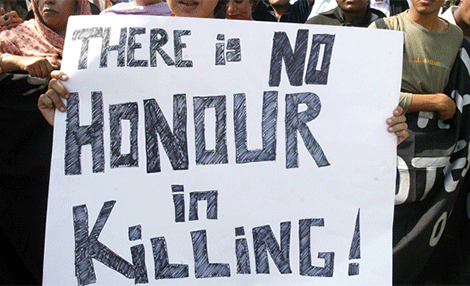





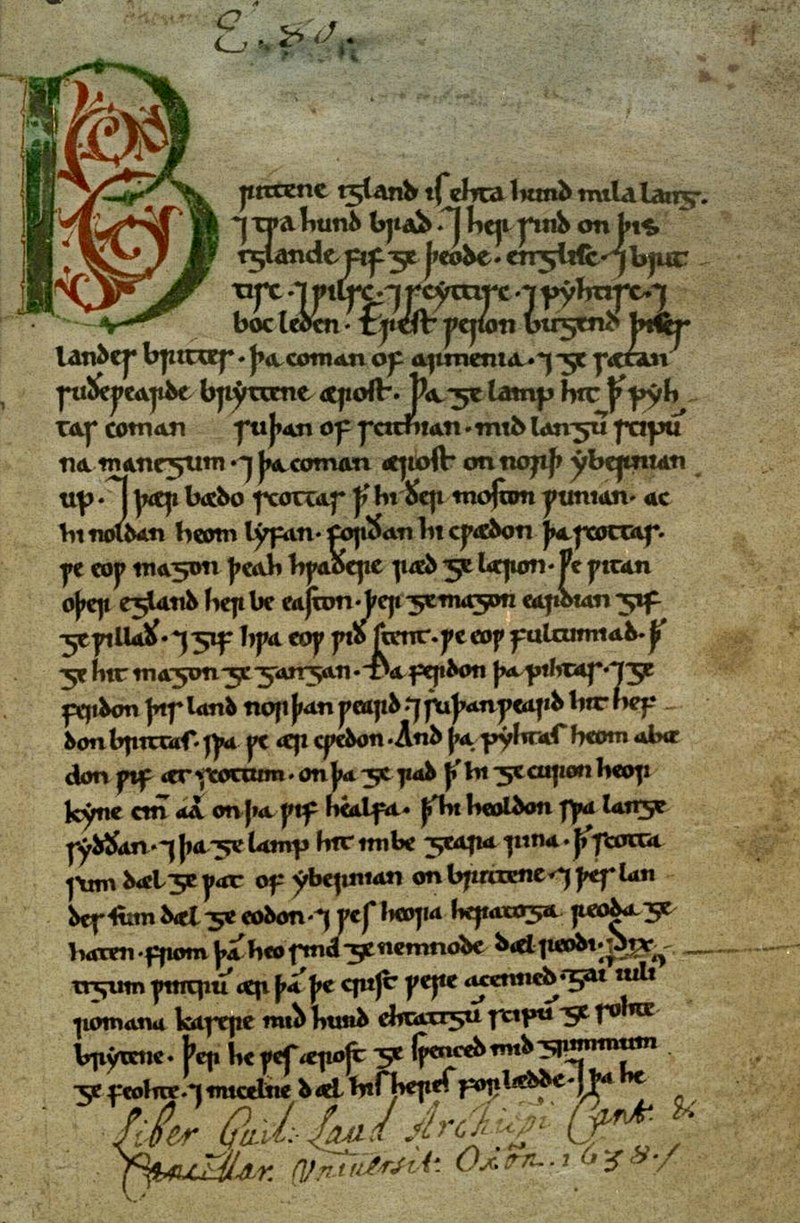


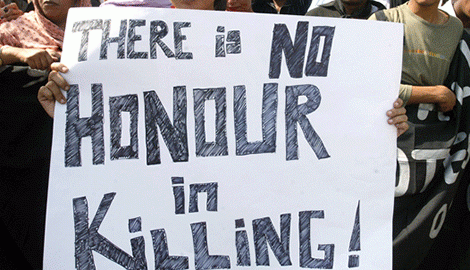
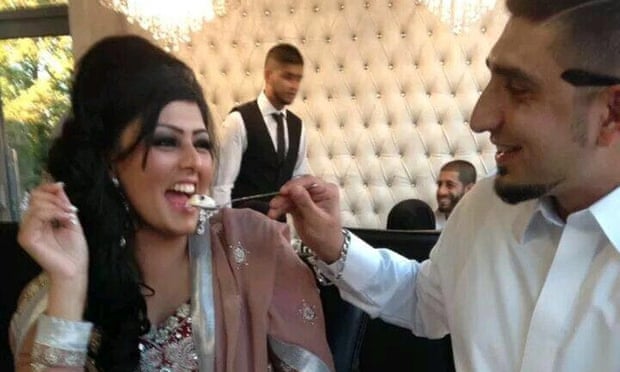














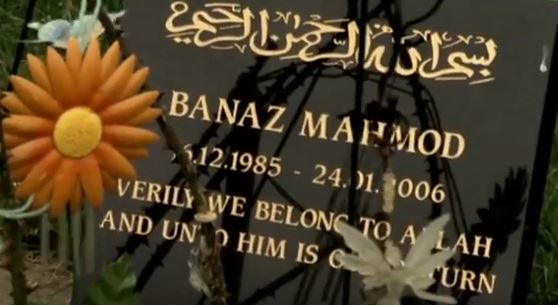







 belfastchildis.com