23rd July – Deaths & Events in Northern Ireland Troubles

Key Events & Deaths on this day in Northern Ireland Troubles

23rd July

Thursday 23 July 1970

A ban on parades and public processions until January 1971 was announced by the Stormont government

Friday 23 July 1971

The British Army (BA) carried out early morning raids across Northern Ireland and arrested 48 people.

Thursday 23 July 1981

The leader of the delegation from the International Committee of the Red Cross announced that the situation with regard to the hunger strike was deadlocked and in such circumstances they had no role to play.

Friday 23 July 1982

The ‘Northern Ireland Act 1982‘, which established the rules for the proposed Assembly, became law.

Saturday 23 July 1988

The Irish Republican Army (IRA) ‘mistakenly’ killed a married couple and their six-year old son in a bomb attack at Killeen, County Armagh.

Monday 23 July 1990

A report in The Times (a London based newspaper) detailed further disagreements between some of the Northern Ireland parties over the proposed political talks.

Whilst Unionists declared that they would only enter negotiations with the Irish government as part of a United Kingdom delegation, the Social Democratic and Labour Party (SDLP) outlined their opposition to any use of the term ‘United Kingdom’ and as an alternative argued for the use of ‘Britain’ and ‘Ireland’.

Following a reshuffle of ministerial posts at the Northern Ireland Office (NIO) Peter Bottomley was dropped.

Tuesday 23 July 1991

Announcement of Merger of UDR and RIR

A White Paper, outlining plans for changes to British Defence policy, was published. The plans included the news that the Royal Irish Rangers (RIR) and the Ulster Defence Regiment (UDR) would merge to form a new regiment to be called the Royal Irish Regiment (RIR).

[The British government denied Unionist claims of political interference in the decision. The UDR had been the subject of sustained criticism by Nationalists since the regiment was first formed.
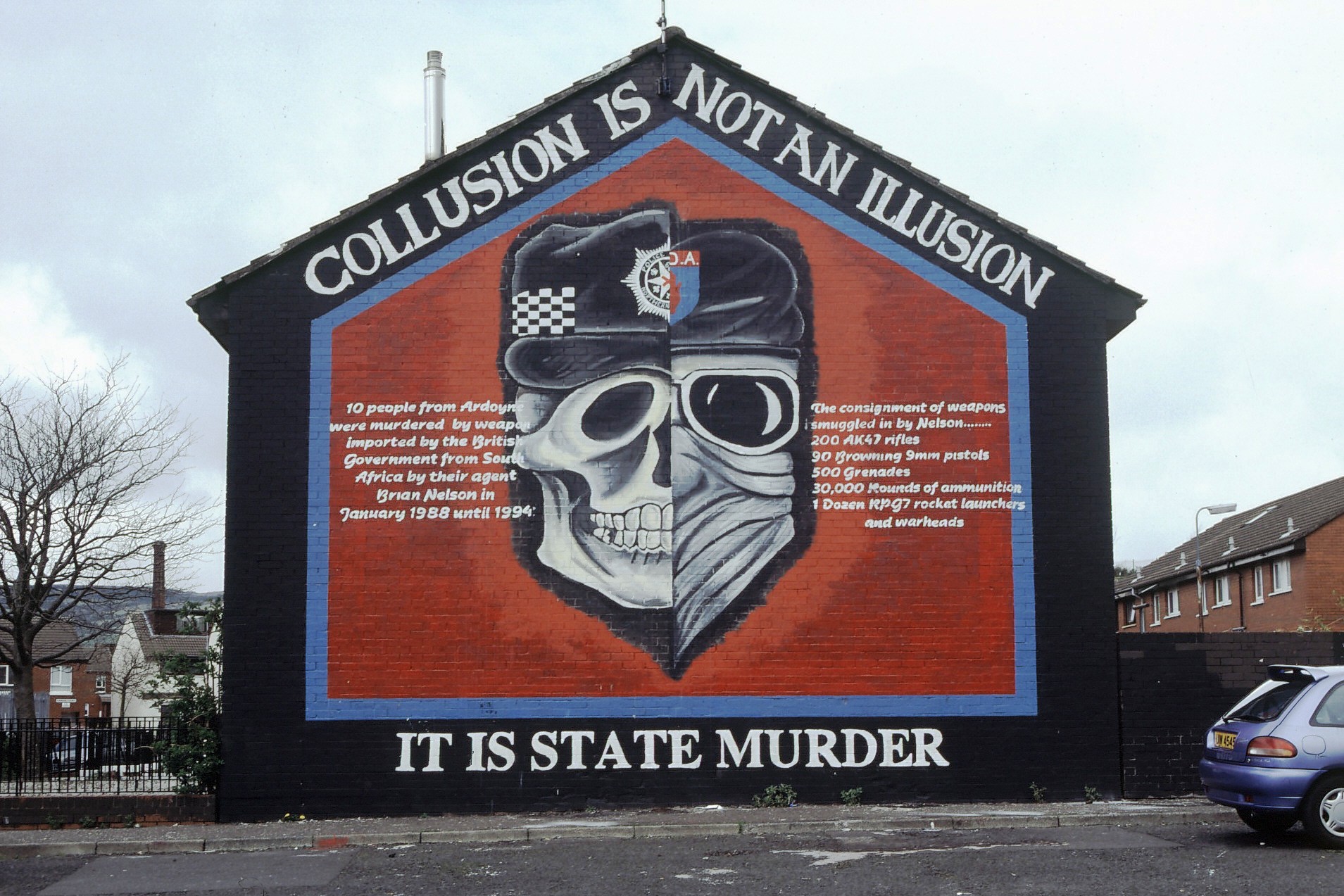
In particular it was claimed that there was collusion between members of the UDR and Loyalist paramilitary groups.

A British Army spokesperson said that while the UDR was 96 per cent Protestant the RIR was 30 per cent Catholic and many of its members were drawn from the Republic of Ireland.

Later the Army admitted there was an error in the figures and only 6 per cent of members of the RIR were Catholic. David Trimble, then Ulster Unionist Party (UUP) MP, said that only 83 of the 1,413 members of the RIR were form the Republic of Ireland.]

Friday 23 July 1993

John Major, then British Prime Minister, told the House of Commons that there was no truth in the rumour that he had entered into a deal with the Ulster Unionist Party (UUP) in return for support during the debate on the ‘Social Chapter’ of the Maastricht Treaty.

[Martin Smyth (Rev), then a UUP Member of Parliament (MP), stated that he expected a Select Committee on Northern Ireland to be established in the near future.]

Sunday 23 July 1995

Three Loyalists were arrested in Scotland under the Prevention of Terrorism Act (PTA). A number of weapons were also discovered. [One of those held was Lindsay Robb, a member of the Progressive Unionist Party (PUP), who had met Michael Ancram, then Political Development Minister at the Northern Ireland Office (NIO), on 22 March 1995.]

Wednesday 23 July 1997

A document containing proposals on decommissioning that had been prepared by the British and Irish governments was rejected by the Ulster Unionist Party (UUP) during a meeting at Stormont.

Despite this outcome the two governments insisted that substantive negotiations would begin at Stormont on 15 September 1997.
Dublin and Monaghan bombings victim

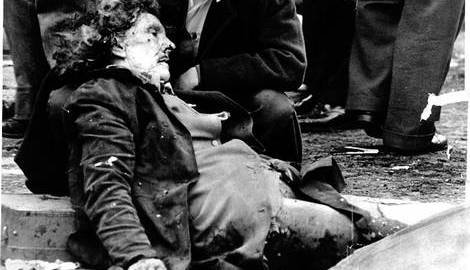
In the European Parliament, MEPs from many countries supported a call for the release of files related to the Dublin and Monaghan bombings in the Republic of Ireland on 17 May 1974 which resulted in the deaths of 33 people.

The relatives of those killed claimed that the Royal Ulster Constabulary (RUC) had hampered the investigations of the Garda Síochána (the Irish police) .

[Although the Ulster Volunteer Force (UVF) admitted responsibility for the bombs many commentators claimed that there had also been British Intelligence involvement.]

See Dublin and Monaghan bombings

Thursday 23 July 1998

The Northern Ireland Office (NIO) estimated that the disturbances surrounding the Drumcree parade had resulted in damage to property of £3 million.

[The estimate for 1997 was £10 million and 1996 £20 million.]

There was a demonstration in London as part of the campaign to secure the release of two Scots Guardsmen who had been sentenced for the murder of Peter McBride (18), a Catholic civilian, in Belfast on 4 September 1992.

Among those taking part in the demonstration were Martin Bell, then Member of Parliament (MP), and Lord Tebbit, former Conservative Party cabinet member.

Friday 23 July 1999

The owners of The Belfast Telegraph (a Belfast based newspaper), Trinity Holdings, were informed by Stephen Byers, then Trade and Industry Minister, that the group’s planned acquisition of Mirror Group Newspapers (MGN) would not be allowed to proceed as it would mean two of Belfast’s three daily newspapers would then be under single control.


——————————————

Remembering all innocent victims of the Troubles

Today is the anniversary of the death of the following people killed as a results of the conflict in Northern Ireland

“To live in hearts we leave behind is not to die

– Thomas Campbell

To the innocent on the list – Your memory will live forever

– To the Paramilitaries –

There are many things worth living for, a few things worth dying for, but nothing worth killing for.

7 People lost their lives on the 23rd  July between 1969 – 2015

——————————————

23 July 1972

Robert McComb  (22)

Protestant

Status: Ulster Defence Regiment (UDR),

Killed by: Irish Republican Army (IRA)

Off duty. Found shot, Kerrera Street, Ardoyne, Belfast.

Abducted by republicans as he walked home after an evening out with his girlfriend in Belfast. His body was found five hours later, His hair had turned grey, he had been tortured. He was single and off duty at the time of his abduction and murder

————————————————————–

23 July 1974

John Conley  (43)

Protestant

Status: Ulster Defence Regiment (UDR),

Killed by: Irish Republican Army (IRA) Killed when car bomb exploded while evacuating area, Bridge Street, Garvagh, County Derry. Inadequate warning given.

————————————————————–

23 July 1987

William Megrath  (46)

Catholic

Status: Ulster Defence Regiment (UDR),

Killed by: Irish Republican Army (IRA) Off duty. Shot while driving home from work, Stewartstown Road, Twinbrook, Belfast

————————————————————–

23 July 1988

Robin Hanna (44)

Protestant

Status: Civilian (Civ),

Killed by: Irish Republican Army (IRA) Killed together with his wife and son in land mine attack on his Shogun jeep, Killeen, County Armagh. Mistaken for vehicle carrying Judge Higgins.

————————————————————–

23 July 1988

Maureen Hanna  (44)

Protestant

Status: Civilian (Civ),

Killed by: Irish Republican Army (IRA) Killed together with her husband and son in land mine attack while travelling in Shogun jeep, Killeen, County Armagh. Mistaken for vehicle carrying Judge Higgins.

————————————————————–

23 July 1988

David Hanna  (6)

Protestant

Status: Civilian (Civ),

Killed by: Irish Republican Army (IRA) Killed together with his parents in land mine attack while travelling in Shogun jeep, Killeen, County Armagh. Mistaken for vehicle carrying Judge Higgins.

————————————————————–

23 July 1989

John Devine  (37)

Catholic

Status: Civilian (Civ),

Killed by: non-specific Loyalist group (LOY) Shot at his home, Fallswater Street, Falls, Belfast.

————————————————————–

22nd July – Deaths & Events in Northern Ireland Troubles

Key Events & Deaths on this day in Northern Ireland Troubles

22nd July

————————

Saturday 22 July 1972


 Patrick O’Neill  (26)

Two Catholics were abducted, beaten, and shot dead in a Loyalist area of Belfast.

In a separate incident a Catholic man was abducted, beaten, and shot dead in Belfast.

[Public Records 1972 – Released 1 January 2003: Document prepared for the British government which examined the possibility of redrawing the Northern Ireland border and carrying out a transfer of population.]

Tuesday 22 July 1986

A report on the Northern Ireland Civil Service showed that Catholics and women were under-represented in the top grades. The report did show however that there had been an improvement in the percentage of Catholics employed in the Civil Service compared to five years earlier.

The Ulster Volunteer Force (UVF) ‘supergrass’ informer Joe Bennett was sentenced by a Nottingham Crown Court to 10 years imprisonment for an armed robbery.

[Bennett had carried out the crime having been relocated to England by the security services and given a new identity with the name John Graham.]

Wednesday 22 July 1987

An inquiry, by the Fair Employment Agency (FEA), into claims of discrimination by Derry City Council against Protestants, cleared the council of these allegations.

Friday 22 July 1994

Robert Monaghan (44), a Catholic civilian, was shot dead by the Ulster Freedom Fighters (UFF), a cover name (pseudonym) used by the Ulster Defence Association (UDA).

He was killed while in a friend’s home in Rathcoole, Newtownabbey, County Antrim.

Monday 22 July 1996

Delegations from the Progressive Unionist Party (PUP) and the Ulster Democratic Party (UDP) met with John Major, then British Prime Minister, in Downing Street, London.

Tuesday 22 July 1997

Dublin and Monaghan bombings victim

The relatives of the 33 people killed by bombs in Dublin and Monaghan in the Republic of Ireland on 17 May 1974, said that they would take the case to Europe because of the failure of the Royal Ulster Constabulary (RUC) to establish a murder inquiry.

See Dublin and Monaghan Bombs

A Catholic boy aged 14 who had been critically injured when shot in the head by a plastic bullet on 7 July 1997 was released from hospital. He had spent three days in a coma.

Marjorie (Mo) Mowlam, then Secretary of State for Northern Ireland, wrote  an article in response to the renewal of the Irish Republican Army (IRA) ceasefire on 20 July 1997.

Thursday 22 July 1999

Sinn Féin (SF) and the Ulster Unionist Party (UUP) held separate talks with the Tony Blair, then British Prime Minister, at Downing Street. Following the meeting Martin McGuinness, then Vice-President of SF, said that Blair and David Trimble, then leader of the Ulster Unionist Party (UUP), had “more influence with the IRA than Gerry Adams or I ever could”.

He also stated that if the UUP maintained its “rejectionist approach” there there was no chance of IRA decommissioning by May 2000.

The membership of the Equality Commission for Northern Ireland was named with Joan Harbison as Chair, Broanagh Hinds as Deputy Chair, and 18 other commissioners. George Mitchell, former Chairman of the multi-party talks, announced that he would begin his review of the Good Friday Agreement on 6 September 1999.

The Arts Council of Northern Ireland (ACNI) withheld funding for a drama group called DubbelJoint. The group had intended to perform a play about the Royal Ulster Constabulary (RUC) entitled ‘Forced Upon Us’.

The ACNI said that the script for the play “fell below the artistic standards the Council expected”. DoubleJoint claimed the decision was politically motivated.

——————————————

Remembering all innocent victims of the Troubles

Today is the anniversary of the death of the following people killed as a results of the conflict in Northern Ireland

“To live in hearts we leave behind is not to die

– Thomas Campbell

To the innocent on the list – Your memory will live forever

– To the Paramilitaries –

There are many things worth living for, a few things worth dying for, but nothing worth killing for.

7 People lost their lives on the 22nd July between 1972 – 1994

——————————————

22 July 1972
Rosemary McCartney  (27)

Catholic
Status: Civilian (Civ),

Killed by: Ulster Defence Association (UDA)
Found shot in abandoned car, Forthriver Road, Glencairn, Belfast.

——————————————

22 July 1972


 Patrick O’Neill  (26)

Catholic
Status: Civilian (Civ),

Killed by: Ulster Defence Association (UDA)
Found shot in abandoned car, Forthriver Road, Glencairn, Belfast.

——————————————

22 July 1972
Francis Arthurs  (34)

Catholic
Status: Civilian (Civ),

Killed by: Ulster Volunteer Force (UVF)
Found shot in abandoned car, Liffey Street, Lower Oldpark, Belfast.

——————————————

22 July 1973
Brian Criddle   (34)

nfNI
Status: British Army (BA),

Killed by: Irish Republican Army (IRA)
Died four days after being injured in land mine attack on British Army (BA) foot patrol, near Clogher, County Tyrone.

——————————————

22 July 1973
Peter Linauer   (24)

nfNI
Status: Civilian (Civ),

Killed by: Ulster Volunteer Force (UVF)
German seaman. Found shot in entry off Klondyke Street, Shankill, Belfast.

——————————————

22 July 1977


Graham Fenton   (20)

Protestant
Status: Prison Officer (PO),

Killed by: Irish Republican Army (IRA)
Off duty. Shot while in Molloy’s Bar, Ballymoney, County Antrim.

——————————————

22 July 1994


Robert Monaghan  (44)

Catholic
Status: Civilian (Civ),

Killed by: Ulster Freedom Fighters (UFF)
Shot, while in friends home, Camross Park, Rathcoole, Newtownabbey, County Antrim

——————————————

Baby – Our Three Legged Cat

Well Baby is now home and recovering from the surgery and amputation of his left leg. Needless to say he is in a lot of pain , but he is on strong medication which is hopefully helping this and is also making his sleep a lot – which is good as his body needs as much rest as possible as it heals from this brutal accident and the trauma of  major surgery.


We had a bit of a scare this morning about 6:30 when Simone (the wife) woke up and checking Baby she was alarmed to find that he was bleeding heavily from the operation wound and there was a hell of a lot of blood coming out. We cleaned him up and had to wait until 8:30 for the vet to open and took him along for a check up.

The vet cleaned the would , checked it and give him some antibiotics and he is now back home and sleeping soundly.

We did take him into  the garden with Delilah this afternoon , but I think it depressed him as he watch Delilah climbing the tress and swinging from the branches , he used to love doing this and hopefully when he is fully recovered he will be able to do this again and fingers crossed he will get some of his old playful self back soon.

If you’d like to donate click link below:

Click to donate or follow link below

Click this link:  gofund.me/Babythreelegs


International iCatCare formerly feline advisory bureau

Amputee cats

Adapting to life on three legs, the story of Buba

Teresa Martins looks at how owners can help their cats adapt to disability and the loss of a limb

Sleeping on a chair was Buba’s most frequent (in)activity following the amputation of his left hind leg

Pet cats can sometimes find themselves having to adapt to life on three legs. The loss of a limb can affect normal feline behaviour and activity. Although cats usually find a way to adapt and live a happy life, the adaptation process can be aggravated by the distress of the incident or illness which resulted in amputation.

Buba was a neutered male six-year-old, extrovert and friendly domestic shorthair who lost his left hind limb in a motorbike accident. His story illustrates the process of adaptation pet cats must go through. After surgery a three-legged cat will find out that for some mysterious reason it is no longer able to perform some tasks it could easily do before. Frustration and anxiety can make the cat feel unsettled and can, in some cases, lead to distress and altered behaviour.

Facing up to life with three legs

Buba’s adaptation to life on three legs was not easy. He became depressed and inactive. He stopped playing, gave up grooming, stopped cleaning himself after using the litter tray and also stopped purring. Perhaps because he felt frustrated, Buba compulsively engaged in a behaviour that still gave him pleasure and caused him no pain: eating.

During the first days after hospitalisation Buba was unsettled, not least because he needed to wear a collar to prevent him damaging the wound. Initially, Buba also became more introverted and aloof, wary of strangers as he had never been before the accident. However, his extrovert character won the day and over time he gradually lost his fear of strangers.

Physical adaptation may be complicated by hallucinosis (phantom limb). The cat will feel that it can still rely on the missing leg and it may take longer for the cat to find alternative ways of performing tasks that involve the amputated leg. Four years after the accident, Buba still tries to scratch his left ear with his missing leg. Observation of Buba suggested that phantom pain may be a problem in cats, as in humans. Several months after the surgery, when healing was completed, Buba was uncomfortable with his stump being touched. During vaccination, he was extremely reactive when he was injected in his left hindquarters, near the stump. However, this sensation eventually seemed to subside and he could tolerate being touched on the stump.

The role of the owner

Even though a cat’s adaptation to a life on three legs will depend in part on their personality, it is clear this can be a difficult period for the cat. The pain and fear associated with many of the situations leading to limb loss can traumatise and distress the cat as well as adapting to their new limitations. It is important for owners to help their cats to cope with this new situation.

Buba faced a number of practical problems following the amputation. Jumping onto favourite furniture was difficult and he was inclined to give up. To aid him, furniture was rearranged enabling Buba to move from one piece to another, and gain easy access to favoured places. As his confidence and ability increased, so the furniture was moved apart until eventually it was returned to its normal location and Buba was able to go wherever he wanted.

Similarly, to enable him to get up on the bed, a step was provided at the side. As his confidence and muscle tone improved he was able to pull himself up and gained more freedom.

The litter tray was another problem. Despite the removal of its cover and the provision of a step, Buba was reluctant to use it. Buba was helped into the tray each time and initially helped to cover and dig which enabled him to gradually re-learn the habit and adjust to his new situation. Cleaning himself after using the tray was also initially difficult and he needed to be cleaned when he would not clean himself. However, as his balance and skills improved, and when he no longer fell over while trying to turn around to wash, normal grooming and cleaning habits were re-established.

Buba’s compulsion to over-eat was overcome by distracting him with play when he started to search of food. Soon his natural desire to play, along with steady adaptation to life on three legs, overwhelmed his compulsion to eat. A three-legged cat’s body weight should be controlled, as becoming overweight can exacerbate difficulties in them adapting to life. It may be useful to use low-calorie foods, especially as the cat will be less active (at least initially), and especially if they start to over-eat.

In summary, the owner has a critical role during the adaptation of cats to a life on three legs. Some cats adapt quicker than others, but especially when the process falters, a caring owner can help the cat adapt, help motivate them, and help them re-learn or develop new skills. Thoughtful adjustments will help accelerate the process of adaptation to enable the cat to have a full and enjoyable life.

Click to donate

21st July – Deaths & Events in Northern Ireland Troubles


Key Events & Deaths on this day in Northern Ireland Troubles

21st July

bloody frieday

Friday 21 July 1972

‘Bloody Friday’

Bloody Friday‘  is the name given to the events that occurred in Belfast on Friday 21 July 1972. During the afternoon of ‘Bloody Friday’ the Irish Republican Army (IRA) planted and exploded 22 bombs which, in the space of 75 minutes, killed 9 people and seriously injured approximately 130 others. In addition to the bombs there were numerous hoax warnings about other explosive devices which added to the chaos in the streets that afternoon. Many people believe these hoax warnings were deliberately used to reduce the effectiveness of the security forces in dealing with the real bombs.

The killings and maimings had a profound impact on most people in Northern Ireland. ‘Bloody Friday’ also led to the decision by the British Government to implement ‘Operation Motorman’ (31 July 1972) when, in the biggest British military operation since the 1956 Suez crisis, the British Army entered and ended the ‘no-go’ areas of Belfast and Derry.

See Bloody Friday

Joseph Rosato (59), a Catholic civilian, was shot dead by the Provisional Irish Republican Army (PIRA) at his home, Deerpark Road, Belfast. Rosato was the father of the intended target and the killing was part of a feud between the Official Irish Republican Army (OIRA) and the PIRA.

Saturday 21 July 1973

Two members of the Irish Republican Army (IRA) died when a bomb they were transporting exploded prematurely.

Wednesday 21 July 1976

British Ambassador to Ireland Killed

Christopher Ewart Biggs (54), then the British Ambassador to Ireland, was killed in a landmine attack on his official car in Sandyford, Dublin. His secretary, Judith Cook (25), was also killed in the explosion.

Merlyn Rees, then Secretary of Sate for Northern Ireland, was originally to have travelled in the car as well.

A British soldier was killed by a booby trap bomb in an Army base in Derry.

Sturday 21 July 1979

It was announced that Pope John Paul II would pay a visit to Ireland on 29 September 1979. Ian Paisley, then leader of the Democratic Unionist Party (DUP), and the Orange Order warned that he should not visit Northern Ireland.

Thursday 21 July 1983

Gerry Fitt, formerly the Member of Parliament (MP) for West Belfast, was made a life peer. James Molyneaux, then leader of the Ulster Unionist Party (UUP), was appointed as a Privy Councillor.

Sunday 21 July 1985

The United Ulster Loyalist Front (UULF) was formed in Portadown, County Armagh, to oppose the re-routing of Loyalist parades away from Catholic areas.

Tomás Ó Fiaich, then Catholic Primate of Ireland, was reported in an interview in the Universe, a Catholic religious newspaper, as having said that he believed that 90 per cent of religious bigotry in Northern Ireland was found among Protestants.

Thursday 21 July 1988

The British government announced that Shorts aircraft company in Belfast was to be privatised.

Monday 21 July 1997

Following a meeting with Tony Blair, then British Prime Minister, David Trimble, then leader of the Ulster Unionist Party (UUP), said that he could not support the proposals on decommissioning being put forward by the British and Irish governments. SF representatives were admitted to Castle Buildings in Stormont, Belfast, in order to establish their offices for the forthcoming talks.

The Democratic Unionist Party (DUP) and the United Kingdom Unionist Party (UKUP) immediately left the building and urged the Ulster Unionist Party (UUP) to do likewise.

Wednesday 21

July 1999

The Irish Republican Army (IRA) issued a statement rejecting demands for it to decommission its arsenal “in the current political context”, but confirmed its “definitive commitment” to the success of the peace process.

While it did not rule out the prospect of decommissioning, the IRA declined to confirm whether it supported the Sinn Féin (SF) initiative in signing up to the principle that decommissioning should take place before May 2000.

The 32 County Sovereignty Committee called for “an alternative peace strategy” to the ‘Way Forward’ proposals.

Eamonn Molloy

The first of the ‘Disappeared’ to be recovered, Eamonn Molloy, was buried in Belfast seven weeks after his remains were left in a graveyard in County Louth by the IRA

. Molloy had been abducted from his home in Ardoyne, Belfast, in 1975. There were accusations that he had been an informer for the security forces.

See The Disappeared


——————————————

Remembering all innocent victims of the Troubles

Today is the anniversary of the death of the following people killed as a results of the conflict in Northern Ireland

“To live in hearts we leave behind is not to die

– Thomas Campbell

To the innocent on the list – Your memory will live forever

– To the Paramilitaries –

There are many things worth living for, a few things worth dying for, but nothing worth killing for.

19  People lost their lives on the 21st   July between 1972 – 1991

——————————————

21 July 1972
Anthony Davidson   (21)

Catholic
Status: Civilian (Civ),

Killed by: non-specific Loyalist group (LOY)
Shot at his home, Clovelly Street, off Springfield Road, Belfast.

——————————————

21 July 1972
Stephen Cooper   (19)

nfNI
Status: British Army (BA),

Killed by: Irish Republican Army (IRA)
Killed in car bomb explosion at Oxford Street Bus Station, Belfast. Inadequate warning given

——————————————

21 July 1972
Philip Price   (27)

nfNI
Status: British Army (BA),

Killed by: Irish Republican Army (IRA)
Killed in car bomb explosion at Oxford Street Bus Station, Belfast. Inadequate warning given.

——————————————

21 July 1972


William Crothers   (15)

Protestant
Status: Civilian (Civ),

Killed by: Irish Republican Army (IRA)
Killed in car bomb explosion at Oxford Street Bus Station, Belfast. Inadequate warning given.

——————————————

21 July 1972


William Irvine  (18)

Protestant
Status: Ulster Defence Association (UDA),

Killed by: Irish Republican Army (IRA)
Killed in car bomb explosion at Oxford Street Bus Station, Belfast. Inadequate warning given

——————————————

21 July 1972


Thomas Killops   (39)

Protestant
Status: Civilian (Civ),

Killed by: Irish Republican Army (IRA)
Killed in car bomb explosion at Oxford Street Bus Station, Belfast. Inadequate warning given.

——————————————

21 July 1972


Jackie Gibson   (45)

Protestant
Status: Civilian (Civ),

Killed by: Irish Republican Army (IRA)
Killed in car bomb explosion at Oxford Street Bus Station, Belfast. Inadequate warning given.

——————————————

21 July 1972


Margaret O’Hare   (34)

Catholic
Status: Civilian (Civ),

Killed by: Irish Republican Army (IRA)
Killed in car bomb explosion outside row of shops, Cavehill Road, Belfast. Inadequate warning given.

——————————————

21 July 1972
Brigid Murray  (65)

Catholic
Status: Civilian (Civ),

Killed by: Irish Republican Army (IRA)
Killed in car bomb explosion outside row of shops, Cavehill Road, Belfast. Inadequate warning given.

——————————————

21 July 1972


Stephen Parker  (14)

Protestant
Status: Civilian (Civ),

Killed by: Irish Republican Army (IRA)
Killed in car bomb explosion outside row of shops, Cavehill Road, Belfast. Inadequate warning given.

——————————————

21 July 1972


Joseph Rosato   (59)

Catholic
Status: Civilian (Civ),

Killed by: non-specific Loyalist group (LOY)
Shot at his home, Deerpark Road, Oldpark, Belfast.

——————————————

21 July 1972


Joseph Downey   (23)

Catholic
Status: Irish Republican Army (IRA),

Killed by: British Army (BA)
Shot during gun battle, Cromac Street, Markets, Belfast.

——————————————

21 July 1973


Alphonsus  Cunningham   (21)

Catholic
Status: Irish Republican Army (IRA),

Killed by: Irish Republican Army (IRA)
Killed in premature bomb explosion while travelling in car, Newcastle, County Down.

——————————————

21 July 1973


Pauline Kane    (21)

Catholic
Status: Irish Republican Army (IRA),

Killed by: Irish Republican Army (IRA)
Killed in premature bomb explosion while travelling in car, Newcastle, County Down.

——————————————

21 July 1976


Christopher Ewart-Biggs   (54)

nfNIRI
Status: Civilian (Civ),

Killed by: Irish Republican Army (IRA)
British Ambassador to Ireland. Killed in land mine attack on his official car, Sandyford, County Dublin

——————————————

21 July 1976
Judith Cook  (25)

nfNIRI
Status: Civilian (Civ),

Killed by: Irish Republican Army (IRA)
British Ambassador to Ireland’s secretary. Killed in land mine attack on his official car, Sandyford, County Dublin.

——————————————

21 July 1976
David Evans   (20)

nfNI
Status: British Army (BA),

Killed by: Irish Republican Army (IRA)
Killed by booby trap bomb left inside Ebrington British Army (BA) base, Waterside, Derry

——————————————

21 July 1981
John Hazlett   (43)

Protestant
Status: Civilian (Civ),

Killed by: Irish Republican Army (IRA)
Shot while renovating premises, Bank Square, Maghera, County Derry. Fellow worker, off duty Ulster Defence Regiment member, the intended target.

——————————————

21 July 1991
Thomas Oliver  (43)

nfNI
Status: Civilian (Civ),

Killed by: Irish Republican Army (IRA)
From County Louth. Found shot, Belleek, near Newtownhamilton, County Armagh. Alleged informer

——————————————

20th July – Deaths & Events in Northern Ireland Troubles

Key Events & Deaths on this day in Northern Ireland Troubles

20th July

————————————-

Saturday 20 July 1974

The Ulster Defence Association (UDA) stepped down as a member of the Ulster Workers’ Council (UWC) and the Ulster Loyalist Central Co-ordinating Committee. The UDA also issued an invitation to representatives of the Catholic community to hold talks with them.

[On 1 August 1974 representatives of the Social Democratic and Labour Party (SDLP) held talks with the UDA.]

Sunday 20 July 1980

The Irish Republican Army (IRA) planted a car bomb in Lisnaskea, County Fermanagh, which caused extensive damage to the centre of the town.

Tuesday 20 July 1982

Hyde Park and Regent’s Park Bombs

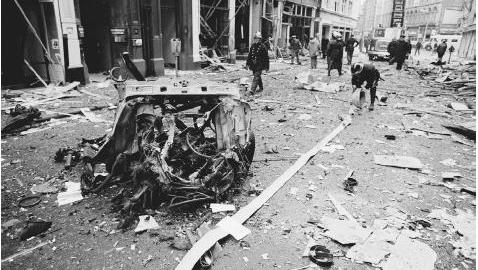
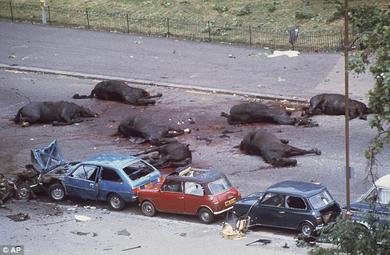
The Irish Republican Army (IRA) exploded two bombs in London, one at South Carriage Drive, close to Hyde Park and the other at the Bandstand in Regent’s Park, resulting in the deaths of 11 British Soldiers.

The first bomb exploded shortly before 11.00am when soldiers of the Blues and Royals were travelling on horseback to change the guard at Horseguards Parade. Three soldiers were killed instantly and a fourth died of his injuries on 23 July 1982. A number of civilians who had been watching the parade were also injured.

Hyde_Park_Bombing

One horse was killed in the explosion but a further six had to be shot due to their injuries. The bomb had been left in a car parked along the side of the road and is believed to have been detonated by a member of the IRA who was watching from within Hyde Park.

The second bomb, which exploded at lunch time, had been planted under the bandstand in Regent’s Park. The explosion killed 7 bandsmen of the Royal Green Jackets as they were performing a concert at the open-air bandstand.

Approximately two dozen civilians who had been listening to the performance were injured in the explosion. It is thought that the bomb had been triggered by a timing device and may have been planted some time in advance of the concert.

[British public opinion was outraged by the carnage caused by the IRA attacks.

In 1987 a man was sentenced to 25 years for conspiracy to cause explosions; the charges were linked to the Hyde Park bomb. He was released in 1998 under the terms of the Good Friday Agreement. In December 1998 he sucessfully appealed against his conviction which was quashed.]

See Hyde Park & Regents Park Bombings

Friday 20 July 1990

IRA Bomb Stock Exchange

The Irish Republican Army (IRA) exploded a large bomb at the London Stock Exchange causing massive damage.

Sunday 20 July 1997

Renewed IRA Ceasefire

At 12.00pm the renewed Irish Republican Army (IRA) ceasefire began. There was a report in the Sunday Tribune (a Dublin newspaper) which claimed that the IRA ceasefire would be limited to four months duration dependant on progress during the talks

 Sinn Féin (SF) later denied there was any truth in the report

[While most people welcomed the renewed ceasefire, Unionist politicians were highly sceptical of the intentions of the Republican movement.]

Tuesday 20 July 1999

Bertie Ahern, then Taoiseach (Irish Prime Minister), attempted to mend deteriorating relations with David Trimble, then leader of the Ulster Unionist Party (UUP), at informal talks in London.

A meeting between Ahern and Tony Blair, then British Prime Minister, was also arranged to confirm that George Mitchell would chair the review of the implementation of the Good Friday Agreement, triggered by the failure to establish the Executive. Within an hour of the announcement Mitchell held a meeting with Trimble. Mitchell later stated that the review “would be tightly focused” and aimed at “a speedy conclusion”.

[The review began on 6 September 1999.]

There was an announcement that the start of the main hearings of the Bloody Sunday Inquiry would be delayed by six months from 27 September 1999 to 27 March 2000. The delay was blamed on impending court cases.

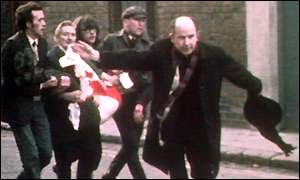
Edward_Daly_Bloody_Sunday

See Bloody Sunday


——————————————

Remembering all innocent victims of the Troubles

Today is the anniversary of the death of the following people killed as a results of the conflict in Northern Ireland

“To live in hearts we leave behind is not to die

– Thomas Campbell

To the innocent on the list – Your memory will live forever

– To the Paramilitaries –

There are many things worth living for, a few things worth dying for, but nothing worth killing for.

16 People lost their lives on the 20th July between 1972  – 1982

——————————————

20 July 1972
Robert Leggett   (50)

Protestant
Status: Civilian (Civ),

Killed by: Irish Republican Army (IRA)
Shot attempting to stop bomb attack on his shop, Springfield Road, Belfast.

——————————————

20 July 1973
Richard Jarman  (37)

nfNI
Status: British Army (BA),

Killed by: Irish Republican Army (IRA)
Killed by booby trap bomb while on British Army (BA) foot patrol, Middletown, County Armagh.

——————————————

20 July 1973
Sidney Watt  (36)

Protestant
Status: Ulster Defence Regiment (UDR),

Killed by: Irish Republican Army (IRA)
Off duty. Shot outside his home, Ballintemple, near Meigh, County Armagh.

——————————————

20 July 1974
Daniel Harkin  (47)

Catholic
Status: Civilian (Civ),

Killed by: not known (nk)
Died of head injuries, shortly after being attacked, in the back garden of his home, Meenashesk Place, Strabane, County Tyrone.

——————————————

20 July 1974


Brian Shaw   (21)

nfNI
Status: ex-British Army (xBA),

Killed by: Irish Republican Army (IRA)
Married to Northern Irish women. Found shot in derelict house, Arundel Street, off Grosvenor Road, Belfast.

——————————————

20 July 1982
Anthony Daly   (23)

nfNIB
Status: British Army (BA),

Killed by: Irish Republican Army (IRA)
Ceremonial Cavalryman. Killed when remote controlled car bomb exploded while riding horse along South Carriage Drive, Hyde Park, London.

——————————————

20 July 1982
Simon Tipper   (19)

nfNIB
Status: British Army (BA),

Killed by: Irish Republican Army (IRA)
Ceremonial Cavalryman. Killed when remote controlled car bomb exploded while riding horse along South Carriage Drive, Hyde Park, London.

——————————————

20 July 1982
Jeffrey Young  (19)

nfNIB
Status: British Army (BA),

Killed by: Irish Republican Army (IRA)
Ceremonial Cavalryman. Killed when remote controlled car bomb exploded while riding horse along South Carriage Drive, Hyde Park, London.

——————————————

20 July 1982
Roy Bright  (36)

nfNIB
Status: British Army (BA),

Killed by: Irish Republican Army (IRA)
Ceremonial Cavalryman. Injured when remote controlled car bomb exploded while riding horse along South Carriage Drive, Hyde Park, London. He died on 23 July 1982.

——————————————

20 July 1982
Graham Barker  (36)

nfNIB
Status: British Army (BA),

Killed by: Irish Republican Army (IRA)
Bandsman. Killed when bomb exploded at bandstand, Regents Park, London.

——————————————

20 July 1982
Robert Livingstone  (31)

nfNIB
Status: British Army (BA),

Killed by: Irish Republican Army (IRA)
Bandsman. Killed when bomb exploded at bandstand, Regents Park, London.

——————————————

20 July 1982
John McKnight   (30)

nfNIB
Status: British Army (BA),

Killed by: Irish Republican Army (IRA)
Bandsman. Killed when bomb exploded at bandstand, Regents Park, London.

——————————————

20 July 1982
George Mesure   (19)

nfNIB
Status: British Army (BA),

Killed by: Irish Republican Army (IRA)
Bandsman. Killed when bomb exploded at bandstand, Regents Park, London.

——————————————

20 July 1982


Keith Powell   (24)

nfNIB
Status: British Army (BA), K

illed by: Irish Republican Army (IRA)
Bandsman. Killed when bomb exploded at bandstand, Regents Park, London

——————————————

20 July 1982
Laurence Smith  (19)

nfNIB
Status: British Army (BA),

Killed by: Irish Republican Army (IRA)
Bandsman. Killed when bomb exploded at bandstand, Regents Park, London.

——————————————

20 July 1982
John Heritage  (29)

nfNIB
Status: British Army (BA),

Killed by: Irish Republican Army (IRA)
Bandsman. Injured when bomb exploded at bandstand, Regents Park, London. He died on 1 August 1982

——————————————

Hyde Park & Regent’s Park Bombings – 20th July 1982 – Lest We Forget!


 Hyde Park and Regent’s Park Bombings

Hyde Park

Regents Park

The Hyde Park and Regent’s Park bombings occurred on 20 July 1982 in London. Members of the Provisional Irish Republican Army (IRA) detonated two bombs during British military ceremonies in Hyde Park and Regent’s Park, both in central London.

Soldiers injured in the bombing are pictured following the attack


The explosions killed 11 military personnel:  four soldiers of the Blues & Royals at Hyde Park, and seven bandsmen of the Royal Green Jackets at Regent’s Park. Seven of the Blues & Royals’ horses also died in the attack. One seriously injured horse, Sefton, survived and was subsequently featured on television programmes and was awarded “Horse of the Year“.

McNamee

Gilbert “Danny” McNamee

In 1987, Gilbert “Danny” McNamee was convicted of making the Hyde Park bomb and jailed for 25 years.  He served 12 years before being released under the terms of the Good Friday Agreement; his conviction was later quashed.

John Downey

In 2013, John Downey was charged with four counts of murder in relation to the Hyde Park attack; his trial began in January 2014 but collapsed the following month after a ruling upon a letter sent to him by police assuring him that he would not be prosecuted over the attack.

No one has ever been charged in connection with the Regent’s Park bombing

———————-

Hyde park London 1982 IRA bombing

———————-

The attacks

Hyde Park bomb


U-shaped hedge enclosure surrounding an oblong slate plaque on a wedge-shaped plinth, with flowers laid at the bottom
Memorial in Hyde Park
Oblong slate plaque with inscriptions in gold, set into a low wall
Memorial in Regent’s Park

At 10:40 am, a nail bomb exploded in the boot of a blue Morris Marina parked on South Carriage Drive in Hyde Park.The bomb comprised 25 lb (11 kg) of gelignite and 30 lb (14 kg) of nails.

It exploded as soldiers of the Household Cavalry, Queen Elizabeth II‘s official bodyguard regiment, were passing. They were taking part in their daily Changing of the Guard procession from their barracks in Knightsbridge to Horse Guards Parade.

Blues and Royals cap badge.jpg

Three soldiers of the Blues & Royals were killed outright, and another, their standard-bearer, died from his wounds three days later. The other soldiers in the procession were badly wounded, and a number of civilians were injured. Seven of the regiment’s horses were also killed or had to be euthanised because of their injuries.

Explosives experts believed that the Hyde Park bomb was triggered by remote by an IRA member inside the park.

 Anthony Daley, Simon Tipper & Roy Bright

The four men who died in the attack were Denis Anthony Daly (known as Anthony Daly), Simon Tipper, Vernon Young, and Raymond Bright (in hospital three days later).

The seven horses who died in the attack were Cedric, Epaulette, Falcon, Rochester, Waterford, Yeastvite, and Zara.


Regent’s Park Bomb

The second attack happened at about 12:55 pm,when a bomb exploded underneath a bandstand in Regent’s Park. Thirty Military bandsmen of the Royal Green Jackets were on the stand performing music from Oliver! to a crowd of 120 people.

It was the first in a series of advertised lunchtime concerts there.Six of the bandsmen were killed outright and the rest were wounded; a seventh died of his wounds on 1 August. The seven men who died were Graham Barker, Robert Livingstone, John McKnight, John Heritage, George Mesure, Keith Powell and Laurence Smith. At least eight civilians were also injured.

The bomb had been hidden under the stand some time before and triggered by a timer.  Unlike the Hyde Park bomb, it contained no nails and seemed to be designed to cause minimal harm to bystanders.

Aftermath

A total of 22 people were detained in hospital as a result of the blasts: 18 soldiers, a police officer, and three civilians. The IRA claimed responsibility for the attacks by deliberately mirroring Prime Minister Margaret Thatcher‘s words a few months before when Britain entered the Falklands War. They proclaimed that:

“The Irish people have sovereign and national rights which no task or occupational force can put down”.

Reacting to the bombing, Thatcher stated:

“These callous and cowardly crimes have been committed by evil, brutal men who know nothing of democracy. We shall not rest until they are brought to justice.”

The bombings had a negative impact on public support in the United States for the Irish republican cause.

Sefton, a horse that survived the attack at Hyde Park despite suffering serious wounds, became famous after appearing in many television shows and was awarded Horse of the Year.

Sefton_Horse_of_the_Year

Sefton’s rider at the time of the bombing, Michael Pedersen, survived but claimed to suffer from posttraumatic stress disorder; after splitting from his wife he committed suicide in September 2012 after killing two of his children.

A memorial marks the spot of the Hyde Park bombing and the troop honours it daily with an eyes-left and salute with drawn swords. A plaque commemorating the victims of the second attack also stands in Regent’s Park.

——————————————

Victims

——————————————

20 July 1982
Anthony Daly   (23)

nfNIB
Status: British Army (BA),

Killed by: Irish Republican Army (IRA)
Ceremonial Cavalryman. Killed when remote controlled car bomb exploded while riding horse along South Carriage Drive, Hyde Park, London.

——————————————

20 July 1982
Simon Tipper   (19)

nfNIB
Status: British Army (BA),

Killed by: Irish Republican Army (IRA)
Ceremonial Cavalryman. Killed when remote controlled car bomb exploded while riding horse along South Carriage Drive, Hyde Park, London.

——————————————

20 July 1982
Jeffrey Young  (19)

nfNIB
Status: British Army (BA),

Killed by: Irish Republican Army (IRA)
Ceremonial Cavalryman. Killed when remote controlled car bomb exploded while riding horse along South Carriage Drive, Hyde Park, London.

——————————————

20 July 1982
Roy Bright  (36)

nfNIB
Status: British Army (BA),

Killed by: Irish Republican Army (IRA)
Ceremonial Cavalryman. Injured when remote controlled car bomb exploded while riding horse along South Carriage Drive, Hyde Park, London. He died on 23 July 1982.

——————————————

20 July 1982
Graham Barker  (36)

nfNIB
Status: British Army (BA),

Killed by: Irish Republican Army (IRA)
Bandsman. Killed when bomb exploded at bandstand, Regents Park, London.

——————————————

20 July 1982
Robert Livingstone  (31)

nfNIB
Status: British Army (BA),

Killed by: Irish Republican Army (IRA)
Bandsman. Killed when bomb exploded at bandstand, Regents Park, London.

——————————————

20 July 1982
John McKnight   (30)

nfNIB
Status: British Army (BA),

Killed by: Irish Republican Army (IRA)
Bandsman. Killed when bomb exploded at bandstand, Regents Park, London.

——————————————

20 July 1982
George Mesure   (19)

nfNIB
Status: British Army (BA),

Killed by: Irish Republican Army (IRA)
Bandsman. Killed when bomb exploded at bandstand, Regents Park, London.

——————————————

20 July 1982


Keith Powell   (24)

nfNIB
Status: British Army (BA), K

illed by: Irish Republican Army (IRA)
Bandsman. Killed when bomb exploded at bandstand, Regents Park, London

——————————————

20 July 1982
Laurence Smith  (19)

nfNIB
Status: British Army (BA),

Killed by: Irish Republican Army (IRA)
Bandsman. Killed when bomb exploded at bandstand, Regents Park, London.

——————————————

20 July 1982
John Heritage  (29)

nfNIB
Status: British Army (BA),

Killed by: Irish Republican Army (IRA)
Bandsman. Injured when bomb exploded at bandstand, Regents Park, London. He died on 1 August 1982

——————————————

Criminal proceedings

In October 1987, 27-year-old Gilbert “Danny” McNamee, from County Armagh, was sentenced at the Old Bailey to 25 years in prison for his role in the Hyde Park bombing and others, despite his plea that he was not guilty. In December 1998, shortly after his release from Maze prison under the Good Friday Agreement, three Court of Appeal judges quashed his conviction, deeming it “unsafe” because of withheld fingerprint evidence that implicated other bomb-makers. They stated that though the conviction was unsafe it did not mean McNamee was necessarily innocent of the charge.


On 19 May 2013, 61-year-old John Anthony Downey, from County Donegal, was charged with murder in relation to the Hyde Park bomb and intending to cause an explosion likely to endanger life. He appeared by videolink from Belmarsh prison for a bail hearing at the Old Bailey on 24 May and did not apply for bail so was remanded in custody.

At a hearing on 1 August 2013, Downey was granted conditional bail and a trial was scheduled for January 2014.

On 24 January 2014, Downey appeared at the Old Bailey for the beginning of his trial; he entered a not guilty plea on the four murder charges and the charge of intending to cause an explosion.

On 25 February 2014, it was revealed that Downey’s trial had collapsed after the presiding judge had ruled, on 21 February, upon a letter sent by the Police Service of Northern Ireland to Downey in 2007, assuring him that he would not face criminal charges over the attack. Although the assurance was made in error and the police realised the mistake, it was never withdrawn, and the judge ruled that therefore the defendant had been misled and prosecuting him would be an abuse of executive power.

Downey is one of 187 IRA suspects who received secret on-the-run letters guaranteeing them unofficial immunity from prosecution


19th July – Deaths & Events in Northern Ireland Troubles

Key Events & Deaths on this day in Northern Ireland Troubles

19th July

——————————–

Sunday 19 July 1981

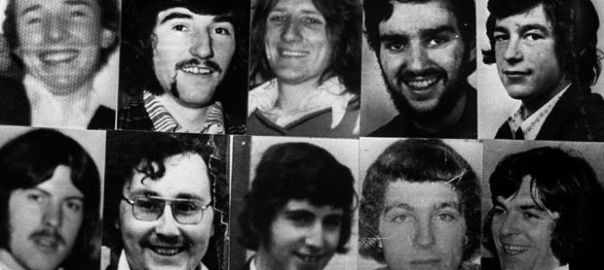
Those Republican prisoners taking part in the hunger strike rejected attempts by the International Committee of the Red Cross to act a mediators with the British government.

hungry strikes

See 1981 Hunger Strike

Monday 19 July 1982

James Prior, then Secretary of State for Northern Ireland, paid a visit to the United States of America (USA) to explain his ‘rolling devolution’ plans.

Friday 19 July 1996

Eight men were remanded in custody after appearing on charges of conspiring to cause explosions. The men were arrested on 15 July 1996.

At a meeting between Hugh Annesley, then Chief Constable of the Royal Ulster Constabulary (RUC), and the Police Authority of Northern Ireland, a motion of no-confidence in Hugh Annesley was dropped.

Saturday 19 July 1997

IRA Statment

The Irish Republican Army (IRA) issued a  statement   which announced that there would be a renewal of its 1994 ceasefire as of 12.00pm on 20 July 1997.

Irish Republican Army (IRA) Ceasefire Statement, 19 July 1997

“On August 31, 1994 the leadership of Oglaigh na hEireann (IRA) announced their complete cessation of military operations as our contribution to the search for lasting peace.

After 17 months of cessation in which the British government and the unionists blocked any possibility of real or inclusive negotiations, we reluctantly abandoned the cessation.

The IRA is committed to ending British rule in Ireland. It is the root cause of divisions and conflict in our country. We want a permanent peace and therefore we are prepared to enhance the search for a democratic peace settlement through real and inclusive negotiations.

So having assessed the current political situation, the leadership of Oglaigh na hEireann are announcing a complete cessation of military operations from 12 midday on Sunday 20 July, 1997.

We have ordered the unequivocal restoration of the ceasefire of August 1994. All IRA units have been instructed accordingly.”


Following the announcement the Democratic Unionist Party (DUP) and the United Kingdom Unionist Party (UKUP) said that the two parties would not be a part of the talks process.

Sunday 19 July 1998

Andrew Kearney (33), a Catholic civilian, died shortly after being shot in the legs by Republican paramilitaries, outside his girlfriends flat in the New Lodge area of Belfast.

[No organisation claimed responsibility but the Royal Ulster Constabulary (RUC) believed that the Irish Republican Army (IRA) was responsible for the shooting.]

There was a mortar attack on the Royal Ulster Constabulary (RUC) base in Newry, County Armagh. The “real” Irish Republican Army (rIRA) claimed responsibility for the attack.

Monday 19 July 1999

A parcel bomb addressed to a Progressive Unionist Party (PUP) member in Ballymena, County Antrim, was defused by British Army technical officers at a Post Office sorting room in the town.

 Dissident Loyalist paramilitaries were thought to have been responsible

Gerry Adams, then President of Sinn Féin (SF), met with Bertie Ahern, then Taoiseach (Irish Prime Minister), in Dublin for talks on the political developments in Northern Ireland. Adams later said that delays in implementing the Good Friday Agreement meant that it would be not be possible to meet the decommissioning deadline.

Thursday 19 July 2001

There was an arson attack on a Gaelic Athletic Association (GAA) clubhouse in Kilkeel, County Down. Loyalist paramilitaries were thought to have been responsible for the attack.

This was the first in a new series of attacks on GAA clubs across Northern Ireland; other attacks on 29 July 2001, 22 August 2001, 23 August 2001.

——————————————

Remembering all innocent victims of the Troubles

Today is the anniversary of the death of the following people killed as a results of the conflict in Northern Ireland

“To live in hearts we leave behind is not to die

– Thomas Campbell

To the innocent on the list – Your memory will live forever

– To the Paramilitaries –

There are many things worth living for, a few things worth dying for, but nothing worth killing for.

9 People lost their lives on the 19th  July between 1972 – 1998

——————————————

19 July 1972
Henry Gray   (71)

Protestant
Status: Civilian (Civ),

Killed by: Irish Republican Army (IRA)
Shot trying to stop bomb attack on Whitehorse Inn, Springfield Road, Belfast.

——————————————

19 July 1972
Alan Jack   (0)

Protestant
Status: Civilian (Civ),

Killed by: Irish Republican Army (IRA)
Killed in car bomb explosion, Canal Street, off Abercorn Square, Strabane, County Tyrone. Inadequate warning given.

——————————————

19 July 1972
Hugh Wright   (21)

Protestant
Status: Civilian (Civ),

Killed by: non-specific Loyalist group (LOY)
Found shot in field, off Hightown Road, near Belfast, County Antrim.

——————————————

19 July 1978
Mark Carnie   (18)

nfNI
Status: British Army (BA),

Killed by: Irish Republican Army (IRA)
Killed by remote controlled bomb hidden behind wall while on British Army (BA) foot patrol, Dungannon, County Tyrone.

——————————————

19 July 1980


Christopher Watson   (20)

nfNI
Status: British Army (BA),

Killed by: Irish Republican Army (IRA)
Off duty. Shot while in Village Inn, Rosemount, Derry.

——————————————

19 July 1986


Martin Duffy   (28)

Catholic
Status: Civilian (Civ),

Killed by: Protestant Action Force (PAF)
Taxi driver. Shot when lured to bogus pick-up, Chichester Park Central, off Antrim Road, Belfast.

——————————————

19 July 1987


Thomas Hewitt   (21)

nfNI
Status: British Army (BA),

Killed by: Irish Republican Army (IRA)
Shot by sniper while on British Army (BA) foot patrol, Belleek, County Fermanagh.

——————————————

19 July 1991


Thomas Hughes   (32)

Catholic
Status: Civilian (Civ),

Killed by: Ulster Volunteer Force (UVF)
Shot while driving his black taxi, junction of Divis Street and Westlink, Lower Falls, Belfast

——————————————

19 July 1998


Andrew Kearney  (33)

Catholic
Status: Civilian (Civ),

Killed by: non-specific Republican group (REP)
Died shortly after being shot in the legs, outside his girlfriends flat, Fianna House, New Lodge, Belfast

——————————————


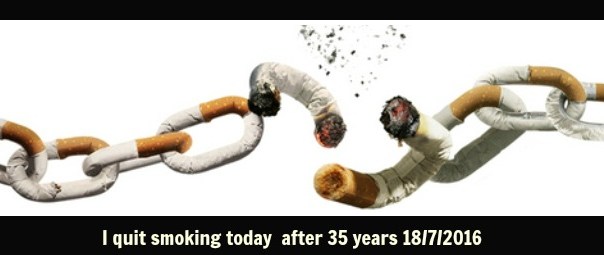
I quit Smoking today at 17:31:24

No-Smoking 2.jpg

Ok after thirty five years , 100’s of 1000’s of pounds and untold damage to my innards I have taken the first step to a healthier , wealthier & hopefully longer life and have STOPPED smoking. To be more precise I smoked my last fag a few hours ago and as a wise  man once said the first step in a thousand mile journey is the most important step and yeah – I’m with him on this.

I have tried a few times in the past , but these  were always half-arsed attempts and I knew deep down that I had no intentions of really stopping – Just wanted to keep the wife and daughter happy and told them what I though they needed to hear – and off course they knew I was bullshitting them all alone.

How do women do at?

106_3522.JPG
The Wife
autumn and me
Daughter & I

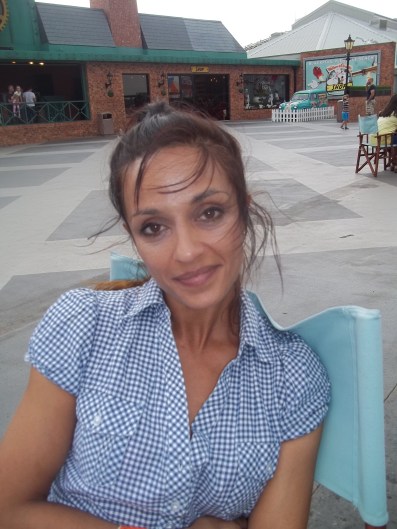
Anyways  if  you follow this blog you may be aware that it was my  BIG 50 last week and I have always kinda promised myself that when I reached this milestone I would try  and look after myself a bit better and quitting smoking was always top of this list.


So wish me luck and I promise to keep you up to date on this and other live-longer schemes I will be implementing over the next few weeks/months.

PS. Knowing my luck I’ll keel over and have a heart – attack any minute now!

smoking warning


…..

18th July – Deaths & Events in Northern Ireland Troubles

Key Events & Deaths on this day in Northern Ireland Troubles

18th July

——————————

Tuesday 18 July 1972

The 100th British soldier to die in the conflict was shot by a sniper in Belfast.

A Protestant man was found shot dead in Belfast.

Harold Wilson, then leader of the Labour Party, held a meeting with representatives of the Irish Republican Army (IRA).

Wednesday 18 July 1973

The ‘Northern Ireland Constitution Act‘ received its Royal Assent. The Act officially abolished the Stormont Parliament

Wednesday 18 July 1979

Ian Paisley, then leader of the Democratic Unionist Party (DUP), tried to interrupt Jack Lynch, then Taoiseach (Irish Prime Minister) and President of the European Council, but was shouted down by other Members of the European Parliament (MEPs).

Saturday 18 July 1981

There were serious clashes between Republican demonstrators and Gardaí following a demonstration outside the British embassy in Dublin, Republic of Ireland. Over 200 people where hurt during the clashes.

Wednesday 18 July 1984

The Public Accounts Committee of the House of Commons said that the loss of £77 million of public money on the De Lorean Motor Company was one “of the gravest cases of misuse of public resources in recent years”.

Friday 18 July 1986

The Orange Order announced the results of its inquiry into rioting in Portadown. The Orange Order blamed the Royal Ulster Constabulary (RUC) for the trouble.

Tuesday 18 July 1995

Secret Meeting Between British and SF

  Patrick Mayhew, then Secretary of State for Northern Ireland, and Michael Ancram, then Political Development Minister at the Northern Ireland Office (NIO), held a secret meeting in Derry with Gerry Adams, then President of Sinn Féin (SF), and Martin McGuinness, then Vice-President of SF.

News of the meeting was not broken until 24 July 1995; see Irish Times. John Major, then British Prime Minister, had authorised the meeting. It was also disclosed that there had been an earlier meeting between the two sides.

Friday 18 July 1997

Gerry Adams, then President of Sinn Féin (SF), and Martin McGuinness, then Vice-President of Sinn Féin (SF), both called on the Irish Republican Army (IRA) to renew its ceasefire.

Most commentators felt that this statement meant that an IRA ceasefire was imminent.

John Hume, then leader of the Social Democratic and Labour Party (SDLP), and Adams also issued a joint statement.

Saturday 18 July 1998

The Royal Ulster Constabulary (RUC) released figures on the level of violence that had been associated with the Drumcree disturbances which showed that there had been a total of 2,561 public order offences, and 50 RUC families had been forced to leave their homes.

Sunday 18 July 1999

The planned transfer of legislative powers from Westminster to the Northern Ireland Assembly did not take place because of the failure to appoint an Executive.

——————————————

Remembering all innocent victims of the Troubles

Today is the anniversary of the death of the following people killed as a results of the conflict in Northern Ireland

“To live in hearts we leave behind is not to die

– Thomas Campbell

To the innocent on the list – Your memory will live forever

– To the Paramilitaries –

There are many things worth living for, a few things worth dying for, but nothing worth killing for.

5  People lost their lives on the 18th   July between 1972  – 1991

——————————————

18 July 1972


James Jones  (18)

nfNI
Status: British Army (BA),

Killed by: Irish Republican Army (IRA)
Shot by sniper while inside Vere Foster School British Army (BA) base, Ballymurphy, Belfast.

——————————————

18 July 1972
Thomas Mills   (50)

Protestant
Status: Civilian (Civ),

Killed by: Irish Republican Army (IRA)
Security man. Found shot inside Finlay’s factory, Ballygomartin Road, Belfast.

——————————————

18 July 1976
Gordon Liddle   (28)

Protestant
Status: Civilian (Civ),

Killed by: Irish Republican Army (IRA)
Killed by booby trap bomb, in laneway of his home, Drumgole, Lisnaskea, County Fermanagh

——————————————

18 July 1989


John McAnulty  (48)

Catholic
Status: Civilian (Civ),

Killed by: Irish Republican Army (IRA)
Found shot, Lough Moss Road, Ballynacarry Bridge, near Crossmaglen, County Armagh. Alleged informer.

——————————————

18 July 1991


John McMaster   (47)

Protestant
Status: Royal Navy (RN),

Killed by: Irish People’s Liberation Organisation (IPLO)
Off duty Royal Navy (RN) reservist. Shot at his shop, Church Lane, Belfast

——————————————

Quinn Brothers killings – Murder of the Innocent

Quinn Brothers Killings

As a Protestant who was born and raised within the heartlands of Loyalist West Belfast I am fiercely proud of my Protestant culture and heritage and I take pride in the union with the rest of the UK and I adore and love our Queen ,  Elizabeth the 2nd of her name – long may she reign!

Queen Elizabeth II March 2015.jpg

Growing up in and around the Shankill Road & Glencairn I was on the front line of the sectarian slaughter that hunted the people of Belfast & Northern Ireland for 30 long painful years and I have seen more than my fair share of the misery and soul destroying agony of the paramilitary war that dominated and engulfed our daily lives.

Through the years many of the high profile killings and sectarian slaughter has had a profound effect on me and the death of these three innocent children still hunts my soul years after their tragic, senseless murder.

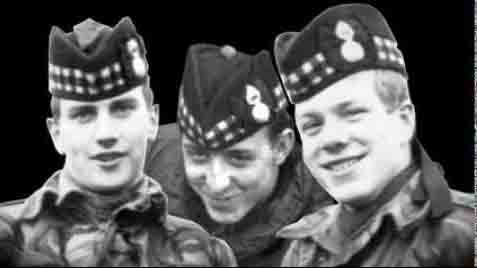
The death of the three young Scottish soldiers by an IRA honey trap also stands out  in my mind and the sheer brutality of these murders is beyond my comprehension and how those that perpetuated these and other murders live with themselves is beyond me.

Scots 3-x-

See IRA Honey Trap Killings

Thank god these dark days are behind us.

Safe in the arms of Jesus

Quinn brothers collage with text.jpg

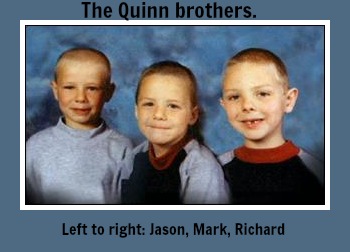
Jason, Richard and Mark Quinn were three brothers killed by the Ulster Volunteer Force (UVF) in a firebomb attack on their home in Ballymoney, County Antrim, Northern Ireland on 12 July 1998. Towards the end of the three-decade period known as “The Troubles“.


Background

A loyalist mural in Carnany

The Quinn family, consisting of mother Chrissie and sons Richard, Mark and Jason, lived in the Carnany estate in the predominantly Protestant town of Ballymoney. The family was of a mixed religious background. Mother Chrissie was Roman Catholic from a mixed background and the boys’ father Jim Dillon was Catholic.

After separating from her estranged husband, Chrissie reared the boys as Protestant “to avoid the hassle”. Chrissie lived with her Protestant partner Raymond Craig in Carnany which had only a few Catholic residents and was mostly Protestant, reflecting the religious make-up of Ballymoney itself. The boys, aged 9, 10 and 11, attended a local state school and on the evening before their deaths had been helping to build the estate’s Eleventh Night loyalist bonfire.

A fourth brother, Lee, was staying with his grandmother in Rasharkin at the time of the attack.

The entrance to Carnany

The killings took place at the height of the stand-off over the Orange Order march at Drumcree, which created a tense atmosphere in various towns across Northern Ireland. In Ballymoney, the previous year, an off-duty Royal Ulster Constabulary (RUC) officer, Gregory Taylor, was beaten to death by a group of loyalist bandsmen.

The killing followed a row about the RUC’s position after loyal order marches had been banned from the nearby nationalist village of Dunloy.

In the weeks before the fatal attack, the children’s mother Chrissie had expressed fear that she wasn’t welcome in the area and that there was a possibility the family home might be attacked by loyalists.

The Ballymoney Times reported a story the week of the deaths, stating that a resident of the Carnany estate called in and was concerned about tension in the area adding something serious might happen “unless Catholic residents were left alone“. Various members of Chrissie’s family had lived in Carnany but due to several incidents only Chrissie and her sons remained. The family had only been living in the home, which was previously occupied by the boys’ aunt, for six days before the attack.

The attack

quinn house 2.jpg

The attack occurred at around half past four in the morning as the inhabitants of the house slept. A car containing members of the Ulster Volunteer Force (UVF), a loyalist paramilitary organisation, arrived at the house and threw a petrol bomb through a window at the rear of the house. The petrol bomb was made from a whiskey bottle.

The sounds of the boys’ shouting had woken their mother, who found her bedroom full of smoke. Chrissie Quinn, Raymond Craig and a family friend Christina Archibald escaped the resulting fire with minor injuries. Chrissie had thought the boys had escaped the fire as she couldn’t locate them in the dense smoke before she jumped to safety from a first floor window. Two of the brother’s bodies were found in their mother’s bedroom and the other in another bedroom.

Chrissie was taken to hospital and released the next day after receiving minor injuries and shock in the attack.

Reaction

DrIanPaisley.jpg

The M.P. for the area, Dr. Ian Paisley, visited the site of the attack and described the killings as:

“diabolical”, “repugnant” and it “stained Protestantism”.

However, in an interview with ITN he stated that:

“The IRA have carried out worse murders than we had in Ballymoney over and over again”.

Then British Prime Minister Tony Blair denounced the attack as “an act of barbarism”.

Reaction from America was also noted as United States President Bill Clinton extended the condolences of the American people to the Quinn family.

Massachusetts Senator Edward Kennedy condemned the killings and stated:

“The Orange Order must recognize that its refusal to abide by the decision of the Parades Commission led to the murder of the Quinn boys”.

New York mayor Rudy Giuliani extended sympathy to the family from the city of New York.

Representatives of other groups from all sides of the constitutional issue in Northern Ireland also condemned the killings.

The then Chelsea F.C. chairman, Ken Bates, offered a £100,000 reward for information leading to a conviction for the attackers.

At the brothers’ Requiem Mass, the bishop of the Roman Catholic Diocese of Down and Connor, Dr. Walsh observed that:

“For all too long the airwaves and the printed page have been saturated with noises – strident, harsh, discordant noises – carrying words of hatred, of incitement, of recrimination, words not found in the vocabulary of Christianity. But the time for words is over. It’s now time for silence, a silence in which we will hear the voice of God.”

Irish Taoiseach Bertie Ahern attended a memorial mass in Dublin for the children.

The Progressive Unionist Party, which has political links to the UVF, made no comment that the UVF was implicated in the attack.

Conviction of Garfield Gilmour

Garfield Gilmour, a local loyalist, was found guilty of murder for his part in the attack and sentenced to life imprisonment in October 1999. He had driven the car which had transported the UVF unit containing Johnny McKay, brothers Raymond and Ivan Parke to the Quinn home.

Gilmour was described at his trial as a hard working, farm machinery salesman who came from a middle-class background who was unwillingly part of the attack which killed the Quinn brothers. The judge described Gilmour as an “accomplished liar”. Gilmour and his girlfriend Christina Lofthouse alleged that an uncle of the Quinn boys, Colm Quinn, had approached their daughter offering her a sweet, knowing it was a small piece of cannabis. Colm Quinn confirmed that the couple had made allegations against him previously that he was a drug dealer. He then had to flee the Carnany estate. However, returning to his old house three months before the fatal attack on his nephews, Quinn claimed he was confronted by Gilmour again and was warned he was “going to be sorted out”.

The Orange Order released a press statement a year after the attack, stating,

“According to today’s judgment the murders were a combination of a sectarian attack by the UVF and a personal grudge between Gilmour and the uncle of the three boys,” and voiced the “Order’s absolute commitment to ensuring that justice is done for their family.”

Gilmour had named the three alleged petrol bombers he had driven to the Quinn family home, but these men were never charged due to a lack of concrete evidence.[17]

Gilmour’s conviction for murder was reduced to manslaughter on appeal on 5 June 2000 and he was released six years later. Nine days later, his life sentence was replaced by a fixed prison sentence of 14 years.

Aftermath

After being released from hospital Chrissie Quinn returned to her mother’s native Rasharkin to live and decided to have the boys buried there. The boys were buried two days later in St Mary’s cemetery in Rasharkin after requiem Mass. Thousands of both Catholics and Protestants attended the funeral.

A number of loyalist bands defied RUC requests not to play music while marching past the boy’s grandmother’s house in the days after the killings.

In April 1999 the former home of the boys in Carnany Park was demolished and replaced with a children’s play park as a memorial.

An uncle of the boys, Frankie Quinn, appeared in court in 2007 accused of stabbing Garfield Gilmour in Ballymoney. Quinn was successful in an application for bail