Monthly Archives: February 2016

Valentine’s Day – What’s it all about?

Valentine’s Day, also called Saint Valentine’s Day or the Feast of Saint Valentine,[1] is an annual holiday celebrated on February 14. It originated as a Western Christian liturgical feast day honoring one or more early saints named Valentinus, and is recognized as a significant cultural and commercial celebration in many regions around the world, although it is not a public holiday in any country.

——————————————

Valentine’s Day funny Video

——————————————

Several martyrdom stories associated with the various Valentines that were connected to February 14 were added to later martyrologies,[2] including a popular hagiographical account of Saint Valentine of Rome which indicated he was imprisoned for performing weddings for soldiers who were forbidden to marry and for ministering to Christians, who were persecuted under the Roman Empire.[3] According to legend, during his imprisonment, Saint Valentine healed the daughter of his jailer, Asterius,[4] and before his execution, he wrote her a letter signed “Your Valentine” as a farewell.[5]

The day first became associated with romantic love within the circle of Geoffrey Chaucer in the 14th century, when the tradition of courtly love flourished. In 18th-century England, it evolved into an occasion in which lovers expressed their love for each other by presenting flowers, offering confectionery, and sending greeting cards (known as “valentines“). In Europe, Saint Valentine’s Keys are given to lovers “as a romantic symbol and an invitation to unlock the giver’s heart”, as well as to children, in order to ward off epilepsy (called Saint Valentine’s Malady).[6] Valentine’s Day symbols that are used today include the heart-shaped outline, doves, and the figure of the winged Cupid. Since the 19th century, handwritten valentines have given way to mass-produced greeting cards.[7]

Saint Valentine’s Day is an official feast day in the Anglican Communion,[8] as well as in the Lutheran Church.[9] Many parts of the Eastern Orthodox Church also celebrate Saint Valentine’s Day, albeit on July 6 and July 30, the former date in honor of the Roman presbyter Saint Valentine, and the latter date in honor of Hieromartyr Valentine, the Bishop of Interamna (modern Terni).[10]

Saint Valentine

Historical facts

Shrine of St. Valentine in Whitefriar Street Carmelite Church in Dublin, Ireland

Numerous early Christian martyrs were named Valentine.[11] The Valentines honored on February 14 are Valentine of Rome (Valentinus presb. m. Romae) and Valentine of Terni (Valentinus ep. Interamnensis m. Romae).[12] Valentine of Rome was a priest in Rome who was martyred about AD 496 and was buried on the Via Flaminia. The relics of Saint Valentine were kept in the Church and Catacombs of San Valentino in Rome, which “remained an important pilgrim site throughout the Middle Ages until the relics of St. Valentine were transferred to the church of Santa Prassede during the pontificate of Nicholas IV“.[13][14] The flower-crowned skull of Saint Valentine is exhibited in the Basilica of Santa Maria in Cosmedin, Rome. Other relics are found at Whitefriar Street Carmelite Church in Dublin, Ireland.[15]

Valentine of Terni became bishop of Interamna (modern Terni) about AD 197 and is said to have been martyred during the persecution under Emperor Aurelian. He is also buried on the Via Flaminia, but in a different location from Valentine of Rome. His relics are at the Basilica of Saint Valentine in Terni (Basilica di San Valentino). Jack B. Oruch states that “abstracts of the acts of the two saints were in nearly every church and monastery of Europe.”[16] The Catholic Encyclopedia also speaks of a third saint named Valentine who was mentioned in early martyrologies under date of February 14. He was martyred in Africa with a number of companions, but nothing more is known about him.[17] Saint Valentine’s head was preserved in the abbey of New Minster, Winchester, and venerated.[18]

February 14 is celebrated as St. Valentine’s Day in various Christian denominations; it has, for example, the rank of ‘commemoration’ in the calendar of saints in the Anglican Communion.[8] In addition, the feast day of Saint Valentine is also given in the calendar of saints of the Lutheran Church.[9] However, in the 1969 revision of the Roman Catholic Calendar of Saints, the feast day of Saint Valentine on February 14 was removed from the General Roman Calendar and relegated to particular (local or even national) calendars for the following reason: “Though the memorial of Saint Valentine is ancient, it is left to particular calendars, since, apart from his name, nothing is known of Saint Valentine except that he was buried on the Via Flaminia on February 14.”[19]

The feast day is still celebrated in Balzan (Malta) where relics of the saint are claimed to be found, and also throughout the world by Traditionalist Catholics who follow the older, pre-Second Vatican Council calendar. In the Eastern Orthodox Church, St. Valentine’s Day is celebrated on July 6, in which Saint Valentine, the Roman presbyter, is honoured; furthermore, the Eastern Orthodox Church observes the feast of Hieromartyr Valentine, Bishop of Interamna, on July 30.[20][21][22]

Legends

St Valentine baptizing St Lucilla, Jacopo Bassano

J.C. Cooper, in The Dictionary of Christianity, writes that Saint Valentine was “a priest of Rome who was imprisoned for succouring persecuted Christians.”[23] Contemporary records of Saint Valentine were most probably destroyed during this Diocletianic Persecution in the early 4th century.[24] In the 5th or 6th century, a work called Passio Marii et Marthae published a story of martyrdom for Saint Valentine of Rome, perhaps by borrowing tortures that happened to other saints, as was usual in the literature of that period. The same events are also found in Bede’s Martyrology, which was compiled in the 8th century.[24][25] It states that Saint Valentine was persecuted as a Christian and interrogated by Roman Emperor Claudius II in person. Claudius was impressed by Valentine and had a discussion with him, attempting to get him to convert to Roman paganism in order to save his life. Valentine refused and tried to convert Claudius to Christianity instead. Because of this, he was executed. Before his execution, he is reported to have performed a miracle by healing Julia, the blind daughter of his jailer Asterius. The jailer’s daughter and his forty-four member household (family members and servants) came to believe in Jesus and were baptized.[24]

A later Passio repeated the legend, adding that Pope Julius I built a church over his sepulchre (it is a confusion with a 4th-century tribune called Valentino who donated land to build a church at a time when Julius was a Pope).[25] The legend was picked up as fact by later martyrologies, starting by Bede‘s martyrology in the 8th century.[25] It was repeated in the 13th century, in Legenda Aurea.[26]

There is an additional embellishment to The Golden Legend, which according to Henry Ansgar Kelly, was added centuries later, and widely repeated.[27] On the evening before Valentine was to be executed, he is supposed to have written the first “valentine” card himself, addressed to the daughter of his jailer Asterius, who was no longer blind, signing as “Your Valentine.”[27] The expression “From your Valentine” was later adopted by modern Valentine letters.[28] This legend has been published by both American Greetings and The History Channel.[29]

Saint Valentine of Terni and his disciples

John Foxe, an English historian, as well as the Order of Carmelites, state that Saint Valentine was buried in the Church of Praxedes in Rome, located near the cemetery of Saint Hippolytus. This order says that according to legend, “Julia herself planted a pink-blossomed almond tree near his grave. Today, the almond tree remains a symbol of abiding love and friendship.”[30][31]

Another embellishment suggests that Saint Valentine performed clandestine Christian weddings for soldiers who were forbidden to marry.[32] The Roman Emperor Claudius II supposedly forbade this in order to grow his army, believing that married men did not make for good soldiers.[32][33] However, this supposed marriage ban was never issued, and in fact Claudius II told his soldiers to take two or three women for themselves after his victory over the Goths.[34]

According to legend, in order “to remind these men of their vows and God’s love, Saint Valentine is said to have cut hearts from parchment”, giving them to these soldiers and persecuted Christians, a possible origin of the widespread use of hearts on St. Valentine’s Day.[35]

Saint Valentine supposedly wore a purple amethyst ring, customarily worn on the hands of Christian bishops with an image of Cupid engraved in it, a recognizable symbol associated with love that was legal under the Roman Empire;[33][36] Roman soldiers would recognize the ring and ask him to perform marriage for them.[33] Probably due to the association with Saint Valentine, amethyst has become the birthstone of February, which is thought to attract love.[37]

Folk traditions

While the European folk traditions connected with Saint Valentine and St. Valentine’s Day have become marginalized by the modern Anglo-American customs connecting the day with romantic love, there are some remaining associations connecting the saint with the advent of spring.[citation needed]

While the custom of sending cards, flowers, chocolates and other gifts originated in the UK, Valentine’s Day still remains connected with various regional customs in England. In Norfolk, a character called ‘Jack’ Valentine knocks on the rear door of houses leaving sweets and presents for children. Although he was leaving treats, many children were scared of this mystical person.[38][39]

In Slovenia, Saint Valentine or Zdravko was one of the saints of spring, the saint of good health and the patron of beekeepers and pilgrims.[40] A proverb says that “Saint Valentine brings the keys of roots”. Plants and flowers start to grow on this day. It has been celebrated as the day when the first work in the vineyards and in the fields commences. It is also said that birds propose to each other or marry on that day. Another proverb says “Valentin – prvi spomladin” (“Valentine — the first spring saint”), as in some places (especially White Carniola), Saint Valentine marks the beginning of spring.[41] Valentine’s Day has only recently been celebrated as the day of love. The day of love was traditionally March 12, the Saint Gregory‘s day, or February 22, Saint Vincent’s Day. The patron of love was Saint Anthony, whose day has been celebrated on June 13.[40]

Connection with romantic love

Lupercalia

There is no evidence of any link between St. Valentine’s Day and the rites of the ancient Roman festival, despite many claims by many authors.[18][42][notes 1] The celebration of Saint Valentine did not have any romantic connotations until Chaucer‘s poetry about “Valentines” in the 14th century.[24]

Popular modern sources claim links to unspecified Greco-Roman February holidays alleged to be devoted to fertility and love to St. Valentine’s Day, but prior to Chaucer in the 14th century, there were no links between the Saints named Valentinus and romantic love.[24] Earlier links as described above were focused on sacrifice rather than romantic love. In the ancient Athenian calendar the period between mid-January and mid-February was the month of Gamelion, dedicated to the sacred marriage of Zeus and Hera.[citation needed]

In Ancient Rome, Lupercalia, observed February 13–15, was an archaic rite connected to fertility. Lupercalia was a festival local to the city of Rome. The more general Festival of Juno Februa, meaning “Juno the purifier” or “the chaste Juno”, was celebrated on February 13–14. Pope Gelasius I (492–496) abolished Lupercalia. Some researchers have theorized that Gelasius I replaced Lupercalia with the celebration of the Purification of Mary in February 14 and claim a connection to the 14th century’s connotations of romantic love, but there is no historical indication that he ever intended such a thing.[notes 2][43] Also, the dates don’t fit because at the time of Gelasius I the feast was only celebrated in Jerusalem, and it was on February 14 only because Jerusalem placed the Nativity on January 6.[notes 3] Although it was called “Purification of Mary”, it dealt mainly with the presentation of Jesus at the temple.[44] The Jerusalem’s Purification of Mary on February 14 became the Presentation of Jesus at the Temple on February 2 as it was introduced to Rome and other places in the sixth century, after Gelasius I’s time.[44]

Alban Butler in his Lifes of the Principal Saints (1756–1759) claimed without proof that men and women in Lupercalia drew names from a jar to make couples, and that modern Valentine’s letters originated from this custom. In reality, this practice originated in the Middle Ages, with no link to Lupercalia, with men drawing the names of girls at random to couple with them. This custom was combated by priests, for example by Frances de Sales around 1600, apparently by replacing it with a religious custom of girls drawing the names of apostles from the altar. However, this religious custom is recorded as soon as the 13th century in the life of Saint Elizabeth of Hungary, so it could have a different origin.[18]

Chaucer’s love birds

Jack B. Oruch writes that the first recorded association of Valentine’s Day with romantic love is in Parlement of Foules (1382) by Geoffrey Chaucer.[24] Chaucer wrote:

For this was on seynt Volantynys day
Whan euery bryd comyth there to chese his make.

[“For this was on St. Valentine’s Day, when every bird cometh there to choose his mate.”]

This poem was written to honor the first anniversary of the engagement of King Richard II of England to Anne of Bohemia.[45] A treaty providing for a marriage was signed on May 2, 1381.[46]

Readers have uncritically assumed that Chaucer was referring to February 14 as Valentine’s Day; however, mid-February is an unlikely time for birds to be mating in England. Henry Ansgar Kelly has observed that Chaucer might have had in mind the feast day of St. Valentine of Genoa, an early bishop of Genoa who died around AD 307; it was probably celebrated on 3 May.[45][47][48] Jack B. Oruch notes that the date on which spring begins has changed since Chaucer’s time because of the precession of the equinoxes and the introduction of the more accurate Gregorian calendar only in 1582. On the Julian calendar in use in Chaucer’s time, 14 February would have fallen on the date now called 23 February, a time when some birds have started mating and nesting in England.[24]

Chaucer’s Parliament of Foules refers to a supposedly established tradition, but there is no record of such a tradition before Chaucer. The speculative derivation of sentimental customs from the distant past began with 18th-century antiquaries, notably Alban Butler, the author of Butler’s Lives of Saints, and have been perpetuated even by respectable modern scholars. Most notably, “the idea that Valentine’s Day customs perpetuated those of the Roman Lupercalia has been accepted uncritically and repeated, in various forms, up to the present”.[18][49]

Three other authors who made poems about birds mating on St. Valentine’s Day around the same years: Otton de Grandson from Savoy, John Gower from England, and a knight called Pardo from Valencia. Chaucer most probably predated all of them but, due to the difficulty of dating medieval works, it is not possible to ascertain which of the four first had the idea and influenced the others.[50]

Court of love

The earliest description of February 14 as an annual celebration of love appears in the Charter of the Court of Love. The charter, allegedly issued by Charles VI of France at Mantes-la-Jolie in 1400, describes lavish festivities to be attended by several members of the royal court, including a feast, amorous song and poetry competitions, jousting and dancing.[51] Amid these festivities, the attending ladies would hear and rule on disputes from lovers.[52] No other record of the court exists, and none of those named in the charter were present at Mantes except Charles’s queen, Isabeau of Bavaria, who may well have imagined it all while waiting out a plague.[51]

Valentine poetry

The earliest surviving valentine is a 15th-century rondeau written by Charles, Duke of Orléans to his wife, which commences.

Je suis desja d’amour tanné
Ma tres doulce Valentinée…

— Charles d’Orléans, Rondeau VI, lines 1–2[53]

At the time, the duke was being held in the Tower of London following his capture at the Battle of Agincourt, 1415.[54]

The earliest surviving valentines in English appear to be those in the Paston Letters, written in 1477 by Margery Brewes to her future husband John Paston “my right well-beloved Valentine”.[55]

Valentine’s Day is mentioned ruefully by Ophelia in Hamlet (1600–1601):

To-morrow is Saint Valentine’s day,
All in the morning betime,
And I a maid at your window,
To be your Valentine.
Then up he rose, and donn’d his clothes,
And dupp’d the chamber-door;
Let in the maid, that out a maid
Never departed more.

— William Shakespeare, Hamlet, Act IV, Scene 5

John Donne used the legend of the marriage of the birds as the starting point for his epithalamion celebrating the marriage of Elizabeth, daughter of James I of England, and Frederick V, Elector Palatine, on Valentine’s Day:

Hayle Bishop Valentine whose day this is

All the Ayre is thy Diocese
And all the chirping Queristers
And other birds ar thy parishioners
Thou marryest every yeare
The Lyrick Lark, and the graue whispering Doue,
The Sparrow that neglects his life for loue,
The houshold bird with the redd stomacher
Thou makst the Blackbird speede as soone,
As doth the Goldfinch, or the Halcyon
The Husband Cock lookes out and soone is spedd
And meets his wife, which brings her feather-bed.
This day more cheerfully than ever shine

This day which might inflame thy selfe old Valentine.

— John Donne, Epithalamion Vpon Frederick Count Palatine and the Lady Elizabeth marryed on St. Valentines day

The verse Roses are red echoes conventions traceable as far back as Edmund Spenser‘s epic The Faerie Queene (1590):

She bath’d with roses red, and violets blew,
And all the sweetest flowres, that in the forrest grew.[56]

The modern cliché Valentine’s Day poem can be found in the collection of English nursery rhymes Gammer Gurton’s Garland (1784):

The rose is red, the violet’s blue,

The honey’s sweet, and so are you.
Thou art my love and I am thine;
I drew thee to my Valentine:
The lot was cast and then I drew,

And Fortune said it shou’d be you.[57][58]

Modern times

Valentine’s Day postcard, circa 1910

In 1797, a British publisher issued The Young Man’s Valentine Writer, which contained scores of suggested sentimental verses for the young lover unable to compose his own. Printers had already begun producing a limited number of cards with verses and sketches, called “mechanical valentines,” and a reduction in postal rates in the next century ushered in the less personal but easier practice of mailing Valentines. That, in turn, made it possible for the first time to exchange cards anonymously, which is taken as the reason for the sudden appearance of racy verse in an era otherwise prudishly Victorian.[59]

Paper Valentines became so popular in England in the early 19th century that they were assembled in factories. Fancy Valentines were made with real lace and ribbons, with paper lace introduced in the mid-19th century.[60] In 1835, 60,000 Valentine cards were sent by post in Britain, despite postage being expensive.[61] The Laura Seddon Greeting Card Collection at Manchester Metropolitan University gathers 450 Valentine’s Day cards dating from the early nineteenth century, printed by the major publishers of the day.[62] The collection is cataloged in Laura Seddon’s book Victorian Valentines (1996).[63]

In the United States, the first mass-produced valentines of embossed paper lace were produced and sold shortly after 1847 by Esther Howland (1828–1904) of Worcester, Massachusetts.[64][65] Her father operated a large book and stationery store, but Howland took her inspiration from an English Valentine she had received from a business associate of her father.[66][67] Intrigued with the idea of making similar Valentines, Howland began her business by importing paper lace and floral decorations from England.[67][68] A writer in Graham’s American Monthly observed in 1849, “Saint Valentine’s Day … is becoming, nay it has become, a national holyday.”[69] The English practice of sending Valentine’s cards was established enough to feature as a plot device in Elizabeth Gaskell‘s Mr. Harrison’s Confessions (1851): “I burst in with my explanations: ‘The valentine I know nothing about.’ ‘It is in your handwriting’, said he coldly.”[70] Since 2001, the Greeting Card Association has been giving an annual “Esther Howland Award for a Greeting Card Visionary”.[65]


Valentines candy
Valentine’s Day red roses
Box of Valentine chocolates

Since the 19th century, handwritten notes have given way to mass-produced greeting cards.[7] In the UK, just under half of the population spend money on their Valentines and around £1.3 billion is spent yearly on cards, flowers, chocolates and other gifts, with an estimated 25 million cards being sent.[71] The mid-19th century Valentine’s Day trade was a harbinger of further commercialized holidays in the United States to follow.[72]

In the second half of the 20th century, the practice of exchanging cards was extended to all manner of gifts. Such gifts typically include roses, and chocolates packed in a red satin, heart-shaped box. In the 1980s, the diamond industry began to promote Valentine’s Day as an occasion for giving jewelry.[citation needed]

The U.S. Greeting Card Association estimates that approximately 190 million valentines are sent each year in the US. Half of those valentines are given to family members other than husband or wife, usually to children. When the valentine-exchange cards made in school activities are included the figure goes up to 1 billion, and teachers become the people receiving the most valentines.[64] The average valentine’s spending has increased every year in the U.S, from $108 a person in 2010 to $131 in 2013.[73]

The rise of Internet popularity at the turn of the millennium is creating new traditions. Millions of people use, every year, digital means of creating and sending Valentine’s Day greeting messages such as e-cards, love coupons or printable greeting cards. An estimated 15 million e-valentines were sent in 2010.[64] Valentine’s Day is considered by some to be a Hallmark holiday due to its commercialization.[74]

In the modern era, liturgically, the Anglican Church has a service for St. Valentine’s Day (the Feast of St. Valentine), which includes the optional rite of the renewal of marriage vows.[75] In 2016, Catholic Bishops of England and Wales established a novena prayer “to support single people seeking a spouse ahead of St Valentine’s Day.”[76]

Celebration and status worldwide

Valentine’s Day customs[which?] developed in early modern England and spread throughout the Anglosphere in the 19th century. In the later 20th and early 21st centuries, these customs spread to other countries, but their effect has been more limited than those of Hallowe’en, or than aspects of Christmas, (such as Santa Claus).[citation needed]

Due to a concentrated marketing effort, Valentine’s Day is celebrated in some East Asian countries with Chinese and South Koreans spending the most money on Valentine’s gifts.[77]

Americas

Latin America

In some Latin American countries Saint Valentine’s Day is known as “el día de los enamorados” (day of lovers)[78] or as “Día del Amor y la Amistad” (Day of Love and Friendship). For example, Colombia,[79] Costa Rica,[80] Mexico,[81] and Puerto Rico, as well as others. It is also common to see people perform “acts of appreciation” for their friends. In Guatemala it is known as the “Día del Cariño” (Affection Day).[82]

In Brazil, the Dia dos Namorados (lit. “Lovers’ Day”, or “Boyfriends’/Girlfriends’ Day”) is celebrated on June 12, probably because that is the day before Saint Anthony’s day, known there as the marriage saint,[83] when traditionally many single women perform popular rituals, called simpatias, in order to find a good husband or boyfriend. Couples exchange gifts, chocolates, cards and flower bouquets. The February 14 Valentine’s Day is not celebrated at all because it usually falls too little before or too little after the Brazilian Carnival[84] — that can fall anywhere from early February to early March and lasts almost a week. Because of the absence of Valentine’s Day and due to the celebrations of the Carnivals, Brazil is a popular tourist spot during February for Western singles who want to get away from the holiday.[85]

In most of Latin America the Día del amor y la amistad and the Amigo secreto (“Secret friend”) are quite popular and are usually celebrated together on February 14 (one exception is Colombia, where it is celebrated on the third Saturday in September). The latter consists of randomly assigning to each participant a recipient who is to be given an anonymous gift (similar to the Christmas tradition of Secret Santa).[citation needed]

United States

Tree in San Diego decorated with hearts on Valentine’s Day

In the United States, about 190 million Valentine’s Day cards are sent each year, not including the hundreds of millions of cards school children exchange.[86] Additionally, in recent decades Valentine’s Day has become increasingly commercialized and a popular gift-giving event, with Valentine’s Day themed advertisements encouraging spending on loved ones. In fact, in the United States alone, the average valentine’s spending has increased every year, from $108 a person in 2010 to $131 in 2013.[73]

Asia

China

In Chinese, Valentine’s Day is called lovers’ festival (simplified Chinese: 情人节; traditional Chinese: 情人節; pinyin: qíng rén jié). The “Chinese Valentine’s Day” is the Qixi Festival, celebrated on the seventh day of the seventh month of the lunar calendar. It commemorates a day on which a legendary cowherder and weaving maid are allowed to be together. In Chinese culture, there is an older observance related to lovers, called “The Night of Sevens” (Chinese: 七夕; pinyin: Qi Xi). According to the legend, the Cowherd star and the Weaver Maid star are normally separated by the Milky Way (silvery river) but are allowed to meet by crossing it on the 7th day of the 7th month of the Chinese calendar.[citation needed]

In recent years, celebrating White Day has also become fashionable among some young people.[citation needed]

India

In India, in antiquity, there was a tradition of adoring Kamadeva, the lord of love; exemplificated by the erotic carvings in the Khajuraho Group of Monuments and by the writing of the Kamasutra treaty of lovemaking.[87] This tradition was lost around the Middle Ages, when Kamadeva was no longer celebrated, and public displays of sexual affection became frowned upon.[87] This repression of public affections persisted until the 1990s.[citation needed]

Valentine’s Day celebrations did not catch on in India until around 1992. It was spread due to the programs in commercial TV channels, such as MTV, dedicated radio programs and love letter competitions, in addition to an economical liberalization that allowed the explosion of the valentine card industry.[87][88] Economic liberalization also helped the Valentine card industry.[88] The celebration has caused a sharp change on how people have been displaying their affection in public since the Middle Ages.[87]

In modern times, Hindu and Islamic[89] traditionalists have considered the holiday to be cultural contamination from the West, a result of the globalization in India.[87][88] Shiv Sena and the Sangh Parivar have asked their followers to shun the holiday and the “public admission of love” because of them being “alien to Indian culture”.[90] Although these protests are organized by political elites, the protesters themselves are middle-class Hindu men who fear that the globalization will destroy the traditions in their society: arranged marriages, Hindu joint families, full-time mothers, etc.[88][89]

Despite these obstacles, Valentine’s Day is becoming increasingly popular in India.[91]

Valentine’s Day has been strongly criticized from a postcolonial perspective by intellectuals from the Indian left. The holiday is regarded as a front for “Western imperialism”, “neocolonialism“, and “the exploitation of working classes through commercialism by multinational corporations“.[92] It is claimed that as a result of Valentine’s Day, the working classes and rural poor become more disconnected socially, politically, and geographically from the hegemonic capitalist power structure. They also criticize mainstream media attacks on Indians opposed to Valentine’s Day as a form of demonization that is designed and derived to further the Valentine’s Day agenda.[93][94] Right wing Hindu nationalists are also hostile. In February 2012, Subash Chouhan of the Bajrang Dal warned couples that “They cannot kiss or hug in public places. Our activists will beat them up”.[95] He said “We are not against love, but we criticize vulgar exhibition of love at public places”.[96]

Iran

In the first part of the 21st century, the celebration of Valentine’s Day in Iran has been harshly criticized by Islamic teachers who see the celebrations as opposed to Islamic culture. In 2011, the Iranian printing works owners’ union issued a directive banning the printing and distribution of any goods promoting the holiday, including cards, gifts and teddy bears. “Printing and producing any goods related to this day including posters, boxes and cards emblazoned with hearts or half-hearts, red roses and any activities promoting this day are banned … Outlets that violate this will be legally dealt with”, the union warned.[97][98]

In Iran, the Sepandarmazgan, or Esfandegan, is a festival where people express love towards their mothers and wives, and it is also a celebration of earth in ancient Persian culture. It has been progressively forgotten in favor of the Western celebration of Valentine’s Day. The Association of Iran’s Cultural and Natural Phenomena has been trying since 2006 to make Sepandarmazgan a national holiday on February 17, in order to replace the Western holiday.[99]

Israel

In Israel, the Jewish tradition of Tu B’Av has been revived and transformed into the Jewish equivalent of Valentine’s Day. It is celebrated on the 15th day of the month of Av (usually in late August). In ancient times girls would wear white dresses and dance in the vineyards, where the boys would be waiting for them (Mishna Taanith end of Chapter 4). Today, Tu B’Av is celebrated as a second holiday of love by secular people (beside Valentine’s Day), and it shares many of the customs associated with Saint Valentine’s Day in western societies. In modern Israeli culture Tu B’Av is a popular day to pronounce love, propose marriage and give gifts like cards or flowers.[100]

Japan

In Japan, Morozoff Ltd. introduced the holiday for the first time in 1936, when it ran an advertisement aimed at foreigners. Later in 1953, it began promoting the giving of heart-shaped chocolates; other Japanese confectionery companies followed suit thereafter. In 1958, the Isetan department store ran a “Valentine sale”. Further campaigns during the 1960s popularized the custom.[101][102]

The custom that only women give chocolates to men may have originated from the translation error of a chocolate-company executive during the initial campaigns.[103] In particular, office ladies give chocolate to their co-workers. Unlike western countries, gifts such as greeting cards,[103] candies, flowers, or dinner dates[104] are uncommon, and most of the activity about the gifts is about giving the right amount of chocolate to each person.[103] Japanese chocolate companies make half their annual sales during this time of the year.[103]

Many women feel obliged to give chocolates to all male co-workers, except when the day falls on a Sunday, a holiday. This is known as giri-choko (義理チョコ), from giri (“obligation”) and choko, (“chocolate”), with unpopular co-workers receiving only “ultra-obligatory” chō-giri choko cheap chocolate. This contrasts with honmei-choko (本命チョコ, lit. “true feeling chocolate”), chocolate given to a loved one. Friends, especially girls, may exchange chocolate referred to as tomo-choko (友チョコ); from tomo meaning “friend”.[105]

In the 1980s, the Japanese National Confectionery Industry Association launched a successful campaign to make March 14 a “reply day”, where men are expected to return the favour to those who gave them chocolates on Valentine’s Day, calling it White Day for the color of the chocolates being offered. A previous failed attempt to popularize this celebration had been done by a marshmallow manufacturer who wanted men to return marshmallows to women.[101][102]

Men are expected to return gifts that are at least two or three times more valuable than the gifts received in Valentine’s Day. Not returning the gift is perceived as the man placing himself in a position of superiority, even if excuses are given. Returning a present of equal value is considered as a way to say that the relationship is being cut. Originally only chocolate was given, but now the gifts of jewelry, accessories, clothing and lingerie are usual. According to the official website of White Day, the color white was chosen because it’s the color of purity, evoking “pure, sweet teen love”, and because it’s also the color of sugar. The initial name was “Ai ni Kotaeru White Day” (Answer Love on White Day).[101][102]

In Japan, the romantic “date night” associated to Valentine’s Day is celebrated on Christmas Eve.[106]

In a 2006 survey of people between 10 and 49 years of age in Japan, Oricon Style found the 1986 Sayuri Kokushō singleValentine Kiss” to be the most popular Valentine’s Day song, even though it sold only 317,000 copies.[107] The singles it beat in the ranking were number one selling “Love Love Love” from Dreams Come True (2,488,630 copies) and “Valentine’s Radio” from Yumi Matsutoya (1,606,780 copies). The final song in the top five was “My Funny Valentine” by Miles Davis.[107]

In Japan, a slightly different version of a holiday based on a lovers’ story called Tanabata (七夕) has been celebrated for centuries, on July 7 (Gregorian calendar).[108] It has been considered by Westerners as similar to St. Valentine’s Day.[109]

Lebanon

Bouquet of homemade cupcakes made by Chantal Hanna on Valentine’s Day

Saint Valentine is the patron saint for a large part of the Lebanese population. Couples take the opportunity of Valentine’s feast day to exchange sweet words and gifts as proof of love. Such gifts typically include chocolates boxes, Valentine’s Cupcakes as well as red roses which are the emblem of sacrifice and passion.

Malaysia

Islamic officials in Malaysia warned Muslims against celebrating Valentine’s Day, linking it with vice activities. Deputy Prime Minister Muhyiddin Yassin said the celebration of romantic love was “not suitable” for Muslims. Wan Mohamad Sheikh Abdul Aziz, head of the Malaysian Islamic Development Department (Jakim), which oversees the country’s Islamic policies said that a fatwa (ruling) issued by the country’s top clerics in 2005 noted that the day ‘is associated with elements of Christianity,’ and ‘we just cannot get involved with other religions’ worshipping rituals.’ Jakim officials planned to carry out a nationwide campaign called “Awas Jerat Valentine’s Day” (“Mind the Valentine’s Day Trap”), aimed at preventing Muslims from celebrating the day on February 14, 2011. Activities include conducting raids in hotels to stop young couples from having unlawful sex and distributing leaflets to Muslim university students warning them against the day.[110][111]

On Valentine’s Day 2011, Malaysian religious authorities arrested more than 100 Muslim couples concerning the celebration ban. Some of them would be charged in the Shariah Court for defying the department’s ban against the celebration of Valentine’s Day.[112]

Pakistan

The concept of Valentine’s Day was introduced into Pakistan during the late 1990s with special TV and radio programs. The Jamaat-e-Islami political party has called for the banning of Valentine’s Day celebration.[91] Despite this, the celebration is becoming popular among urban youth and the florists expect to sell a great amount of flowers, especially red roses. The case is the same with card publishers.[113]

In 2016, local governing body of Peshwar officially banned the celebration of Valentine’s Day in the city of Peshwar. The ban was also implemented in other city such as Kohat by the local government. [114]

Philippines

In the Philippines, Valentine’s Day is called Araw ng mga Pusòin much the same manner as in the West. It is usually marked by a steep increase in the price of flowers, particularly red roses.[citation needed]

Saudi Arabia

In Saudi Arabia, in 2002 and 2008, religious police banned the sale of all Valentine’s Day items, telling shop workers to remove any red items, because the day is considered a Christian holiday.[115][116] This ban has created a black market for roses and wrapping paper.[116][117] In 2012, the religious police arrested more than 140 Muslims for celebrating the holiday, and confiscated all red roses from flower shops.[118] Muslims are not allowed to celebrate the holiday, and non-Muslims can celebrate only behind closed doors.[119]
“Saudi cleric Sheikh Muhammad Al-‘Arifi said on Valentine’s Day Eve that celebrating this holiday constitutes bid’a – a forbidden innovation and deviation from religious law and custom – and mimicry of the West.”[120][121]

Singapore

According to findings, Singaporeans are among the biggest spenders on Valentine’s Day, with 60% of Singaporeans indicating that they would spend between $100 and $500 during the season leading up to the holiday.[77]

South Korea

In South Korea, women give chocolate to men on February 14, and men give non-chocolate candy to women on March 14 (White Day). On April 14 (Black Day), those who did not receive anything on February 14 or March go to a Chinese-Korean restaurant to eat black noodles (자장면 jajangmyeon) and lament their ‘single life’.[104] Koreans also celebrate Pepero Day on November 11, when young couples give each other Pepero cookies. The date ’11/11′ is intended to resemble the long shape of the cookie. The 14th of every month marks a love-related day in Korea, although most of them are obscure. From January to December: Candle Day, Valentine’s Day, White Day, Black Day, Rose Day, Kiss Day, Silver Day, Green Day, Music Day, Wine Day, Movie Day, and Hug Day.[122] Korean women give a much higher amount of chocolate than Japanese women.[104]

Taiwan

Taipei 101 in Valentine’s Day 2006

In Taiwan, traditional Qixi Festival, Valentine’s Day and White Day are all celebrated. However, the situation is the reverse of Japan’s. Men give gifts to women on Valentine’s Day, and women return them on White Day.[104]

Europe

United Kingdom

In the UK, just under half of the population spend money on their Valentines and around £1.3 billion is spent yearly on cards, flowers, chocolates and other gifts, with an estimated 25 million cards being sent.

In Wales, some people celebrate Dydd Santes Dwynwen (St Dwynwen’s Day) on January 25 instead of (or as well as) Valentine’s Day. The day commemorates St Dwynwen, the patron saint of Welsh lovers.[citation needed]

Finland and Estonia

In Finland Valentine’s Day is called ystävänpäivä which translates into “Friend’s Day”. As the name indicates, this day is more about remembering friends, not significant others. In Estonia Valentine’s Day is called sõbrapäev, which has the same meaning.[123]

France

In France, a traditionally Catholic country, Valentine’s Day is known simply as “Saint Valentin“, and is celebrated in much the same way as other western countries.[citation needed]

Greece

St. Valentine’s Day, or Ημέρα του Αγίου Βαλεντίνου in Greek tradition was not associated with romantic love; In the Eastern Orthodox church there is another Saint who protects people who are in love, Hyacinth of Caesarea (feast day July 3), but in contemporary Greece, this tradition has mostly been superseded by the “globalized” form of Valentine’s Day.[citation needed]

Portugal

In Portugal it is more commonly referred to as “Dia dos Namorados” (Lover’s Day / Day of the Enamoured).[citation needed]

Romania

In recent years, Romania has also started celebrating Valentine’s Day. This has drawn backlash from several groups, institutions[124] and nationalist organizations like Noua Dreaptǎ, who condemn Valentine’s Day for being superficial, commercialist and imported Western kitsch. In order to counter the perceived denaturation of national culture, Dragobete, a spring festival celebrated in parts of Southern Romania, has been rekindled as the traditional Romanian holiday for lovers. Its date used to vary depending on the geographical area, however nowadays it is commonly observed on February 24. The holiday is named after a character from Romanian folklore who was supposed to be the son of Baba Dochia. His name has been associated, possibly through folk etymology, to the word drag (“dear”), which can also be found in the word dragoste (“love”).[citation needed]

Scandinavia

Lars Jacob and Emil Eikner host a Valentine’s Day celebration dinner in Stockholm in 2015

In Denmark and Norway, although February 14 is known as Valentinsdag, it is not celebrated to a large extent, but is largely imported from American culture, and some people take time to eat a romantic dinner with their partner, to send a card to a secret love or give a red rose to their loved one. The cut-flower industry in particular is still working on promoting the holiday. In Sweden it is called Alla hjärtans dag (“All Hearts’ Day”) and was launched in the 1960s by the flower industry’s commercial interests, and due to the influence of American culture. It is not an official holiday, but its celebration is recognized and sales of cosmetics and flowers for this holiday are only exceeded by those for Mother’s Day.[citation needed]

Spain

In Spain, Valentine’s Day is known as “San Valentín” and is celebrated the same way as in the UK, it is however not celebrated in Catalonia

The Troubles – History & Background

Source: The Troubles – History & Background

14th February – Deaths & Events in Northern Ireland Troubles

Key Events & Deaths on this day in Northern Ireland Troubles

14th February

———————————

Monday 14 February 1972

Lord Widgery arrived in Coleraine, where the ‘Bloody Sunday’ (30 January 1972) Tribunal was to be based, and held a preliminary hearing. During this initial hearing Widgery announced that the tribunal would be “essentially a fact-finding exercise” and then went on to narrow the terms of reference for the tribunal.

See Bloody Sunday

Wednesday 14 February 1979

There was a meeting between Roy Mason, then Secretary of State for Northern Ireland, and M. O’Kennedy, then Irish Minister for Foreign Affairs in London.

Tuesday 14 February 1989

John Davey, a Sinn Féin (SF) councillor, was shot dead by Loyalist gunmen near Maghera, County Derry.

Thursday 14 February 1991

Peter Brooke, then Secretary of State for Northern Ireland, told the House of Commons that there were still differences between the Northern Ireland political parties, the Northern Ireland Office (NIO), and Irish ministers, over the proposals for talks. Charges against Desmond Ellis, who had been extradited from the Republic of Ireland to Britain, were changed when he appeared in court. The introduction of new charges was contrary to Irish law and the incident sparked a row between the two countries.

[The decision was reversed on 4 June 1991 and the original charges reinstated.]

Tuesday 14 February 1995

A delegation from the Ulster Unionist Party (UUP) had a meeting with John Major, then British Prime Minister, in London. Following the meeting the UUP wrote to Major to state that the party would not take part in all-party talks based on a “nationalist agenda”.

Friday 14 February 1997

Relatives of those killed on ‘Bloody Sunday’ met with Patrick Mayhew, then Secretary of State for Northern Ireland, to put the case for a fresh inquiry in the events of 30 January 1972.

Sunday 14 February 1999

Bertie Ahern, then Taoiseach (Irish Prime Minister), was involved in controversy after making apparently contradictory statements about the decommissioning of IRA arms. In an interview with The Sunday Times (a London based newspaper) Ahern indicated that the Northern Ireland Executive could not be established without a start to decommissioning. Later, he said Sinn Féin (SF) should not be barred from the Executive in the absence of decommissioning. The President, Mrs McAleese, met the Archbishop of Canterbury, Dr George Carey, for the first time in Rome.

Sunday 14 February 1999

A pipe-bomb was thrown at a house, Graymount, north Belfast.


Thursday 14 February 2002

Police uncovered a pipe-bomb, and components parts for another two devices, during a search of houses in Ballymena, County Antrim. A sawn-off shotgun and automatic pistol were also found. There were no arrests.

During other searches in the Clogh area of County Antrim, shotgun cartridges and other ammunition were found. Again there were no arrests.

A Sinn Féin (SF) spokesperson said that the party’s four Members of Parliament (MPs) had already begun to complete the House of Commons register of members’ interests before a committee had ruled that the register would have to be completed. The previous rule had only applied to those MPs who were taking their seats at Westminster.

See Omagh Bomb

The Police Association, which represents all the members of the Police Service of Northern Ireland (PSNI), launched a legal action in the High Court in Belfast to attempt to quash the report by the Police Ombudsman on the Omagh bomb investigation. The Ombudsman report was critical of the handling of the investigation by the Chief Constable. The Omagh Victims’ Group said they welcomed the possibility that Ronnie Flanagan, then Chief Constable of the PSNI, may retire at the end of February 2002.

Charles, then Prince of Wales, arrived in Dublin on for his second official visit to the Republic. He met with Mary McAleese, then President of the Republic of Ireland, and Bertie Ahern, then Taoiseach (Irish Prime Minister).

  ———————————————————————

Remembering all innocent victims of the Troubles

Today is the anniversary of the death of the following  people killed as a results of the conflict in Northern Ireland

“To live in hearts we leave behind is not to die

– Thomas Campbell

To the innocent on the list – Your memory will live  forever

– To  the Paramilitaries  –

There are many things worth living for, a few things worth dying for, but nothing worth killing for.

6 People   lost their lives on the 14th February  between  1973– 1989

  —————————————————————————

14 February 1973
Edwin Weston,  (20)

nfNI
Status: British Army (BA),

Killed by: Irish Republican Army (IRA)
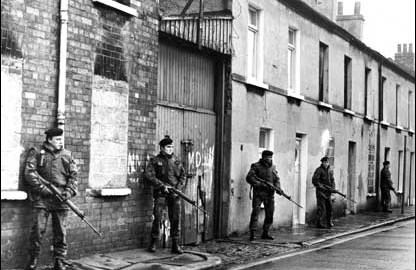
Shot by sniper while on British Army (BA) foot patrol, Divis Street, Lower Falls, Belfast.

  —————————————————————————

14 February 1976


Anthony Doherty,   (14)

Catholic
Status: Civilian (Civ),

Killed by: not known (nk)
Killed by exploding petrol tank of burning hijacked lorry, during street disturbances, Leeson Street, Lower Falls, Belfast.

  —————————————————————————

14 February 1976
William Wilson,   (57)

Protestant
Status: Civilian (Civ),

Killed by: non-specific Republican group (REP)
Died one month after being injured during bomb attack on his home, Fortwilliam Parade, Skegoneill, Belfast. He was wounded on 17 January 1976.

  —————————————————————————

14 February 1979


Steven Kirby,   (22)

nfNI
Status: British Army (BA),

Killed by: Irish Republican Army (IRA)
Shot by sniper while on British Army (BA) foot patrol, Abercorn Road, Derry.

  —————————————————————————

14 February 1980
John Morrow,   (37)

Catholic
Status: Civilian (Civ),

Killed by: non-specific Loyalist group (LOY)
Shot shortly after leaving Hatfield Bar, Ormeau Road, Belfast.

  —————————————————————————

14 February 1989


John Davey,   (61)

Catholic
Status: Civilian Political Activist (CivPA),

Killed by: Ulster Volunteer Force (UVF)
Sinn Fein (SF) Councillor. Shot as he drove his car into the laneway of his home, Gulladuff, near Maghera, County Derry.

  —————————————————————————


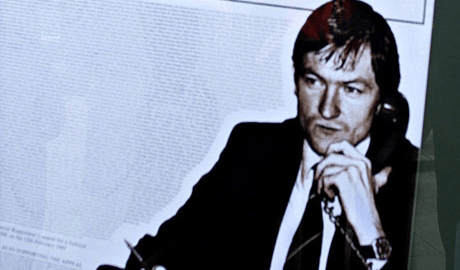
Pat Finucane – 12th February 1989 Executed by the UFF

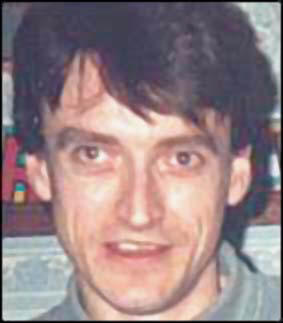
Patrick Finucane

Image result for patrick finucane

Patrick Finucane (1949 – 12 February 1989) was a Northern Irish human rights lawyer killed by loyalist paramilitaries acting in collusion with the British government intelligence service MI5

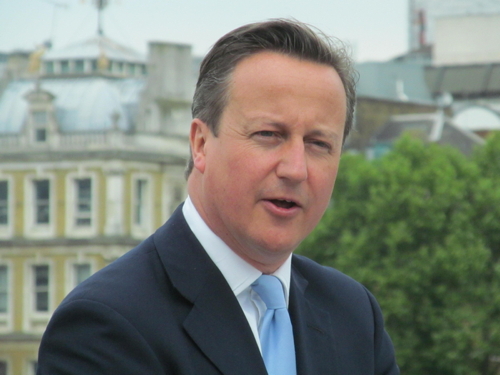
In 2011 British Prime Minister David Cameron met with Pat Finucane’s family and admitted the collusion, although no member of the British security services has yet been prosecuted.

Image result for David Cameron belfast

———————————————

 – Disclaimer –

The views and opinions expressed in these pages/documentaries are soley intended to educate and provide background information to those interested in the Troubles of Northern Ireland. They in no way reflect my own opinions and I take no responsibility for any inaccuracies or factual errors.

———————————————

Finucane’s killing was one of the most controversial during the Troubles in Northern IrelandFinucane came to prominence due to successfully challenging the British government in several important human rights cases during the 1980s. 

He was shot fourteen times as he sat eating a meal at his Belfast home with his three children and his wife, who was also wounded during the attack.

In September 2004, an Ulster Defence Association member, and at the time of the murder a paid informant for the Royal Ulster Constabulary, Ken Barrett, pleaded guilty to his murder. 

After much international pressure, the British government eventually announced that an inquiry would be held. This was one result of an agreement made between the British and Irish governments at Weston Park in 2001. The British government said it would comply with the terms agreed by the two governments at Weston Park.

They agreed to appoint an international judge that would review Finucane’s case and if evidence of collusion was found, a public inquiry would be recommended.  The British government reneged on this promise to Finucane’s family after the international judge found evidence of collusion.[10] The Daily Telegraph quoted Prime Minister David Cameron saying:

“[there are] people in buildings all around here who won’t let it happen”.

Two public investigations concluded that elements of the British security forces colluded in Finucane’s murder and there have been high-profile calls for a public inquiry. However, in October 2011, it was announced that a planned public inquiry would be replaced by a less wide-ranging review.

Image result for Desmond Lorenz de Silva

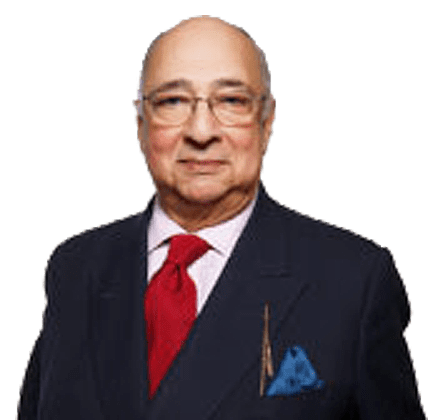
This review, led by Desmond Lorenz de Silva, released a report in December 2012 acknowledging that the case entailed:

“a wilful and abject failure by successive Governments”.

Finucane’s family called the De Silva report a “sham

Background

Born into a Catholic family in 1949, Finucane was the eldest child, with six brothers and one sister. He graduated from Trinity College, Dublin in 1973.

One of his brothers, John, a Provisional Irish Republican Army (IRA) member, was killed in a car crash in the Falls Road, Belfast, in 1972.

Another brother, Dermot, successfully contested attempts to extradite him to Northern Ireland from the Republic of Ireland for his part in the killing of a prison officer; he was one of 38 IRA prisoners who escaped from HMP Maze in 1983.

A third brother Seamus was the fiancé of Mairead Farrell, one of the IRA trio shot dead by the Special Air Service (SAS) in Gibraltar in March 1988.  Seamus was the leader of an IRA unit in west Belfast before his arrest in 1976 with Bobby Sands and seven other IRA men, during an attempt to destroy Balmoral’s furniture store in south Belfast.

Image result for Finucane's wife, Geraldine,

He was sentenced to 14 years’ imprisonment. Finucane’s wife, Geraldine, whom he met at Trinity College, is the daughter of middle-class Protestants; together they had three children.

His uncle Brendan ‘Paddy’ Finucane was an ace fighter pilot praised by Churchill for his heroism.

Pat Finnucane with Patrick McGeown


Pat Finucane’s best-known client was the IRA hunger striker Bobby Sands. He also represented other IRA and Irish National Liberation Army hunger strikers who died during the 1981 Maze prison protest, Brian Gillen, and the widow of Gervaise McKerr, one of three men shot dead by the Royal Ulster Constabulary (RUC) in a shoot-to-kill incident in 1982.

In 1988, he represented Pat McGeown, who was charged in connection with the Corporals killings, and was photographed with McGeown outside Crumlin Road Courthouse.

Killing

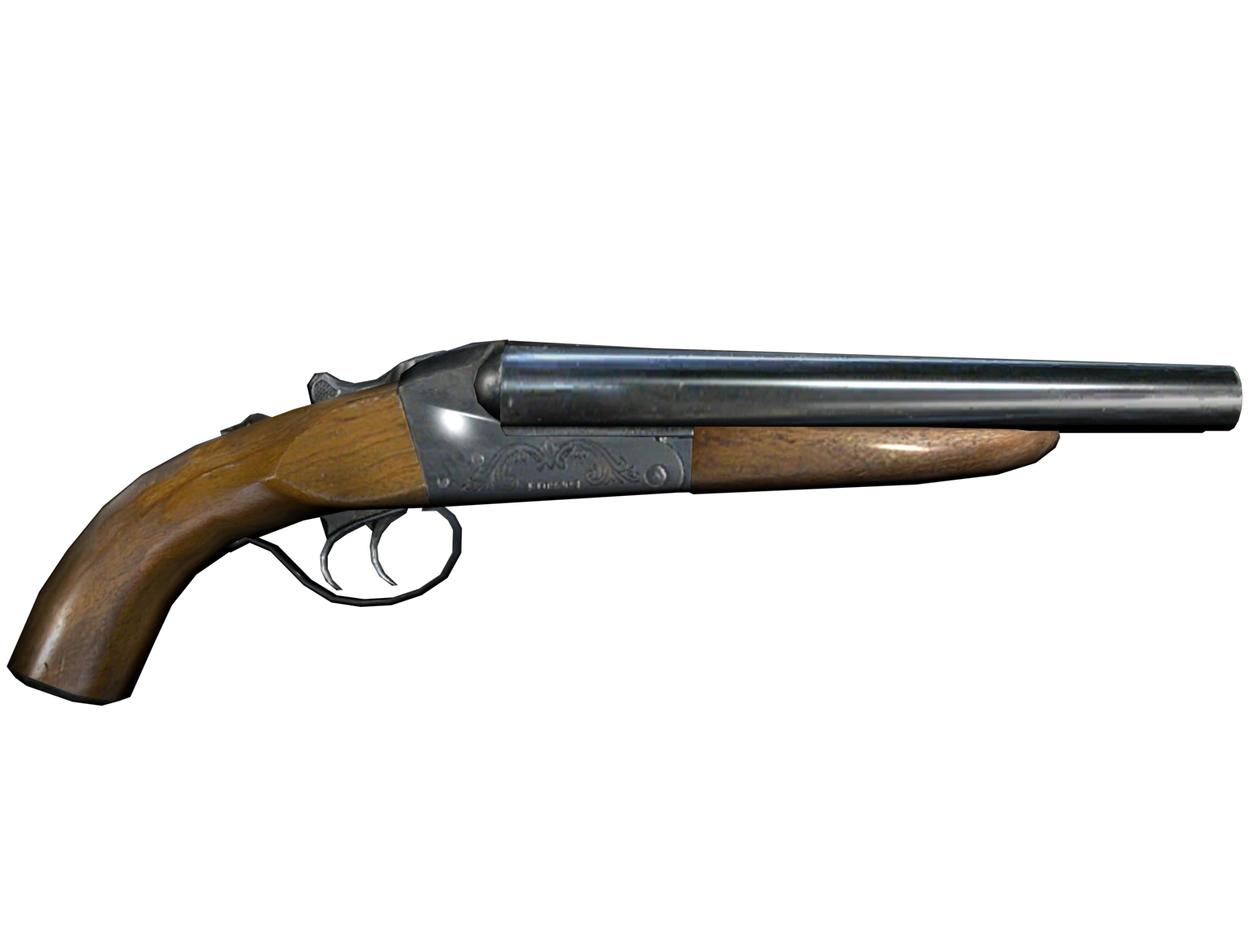
Finucane was shot dead at his home in Fortwilliam Drive, north Belfast, by Ken Barrett and another masked man using a Browning Hi-Power 9mm pistol and a .38 revolver respectively. He was hit 14 times.

Image result for Browning Hi-Power 9mm pistol

The two gunmen knocked down the front door with a sledgehammer and entered the kitchen where Finucane had been having a Sunday meal with his family; they immediately opened fire and shot him twice, knocking him to the floor. Then while standing over him, the leading gunman fired 12 bullets into his face at close range.

Gerldine Finucane

Finucane’s wife Geraldine was slightly wounded in the shooting attack which their three children witnessed as they hid underneath the table. The Royal Ulster Constabulary (RUC) immediately launched an investigation into the killing.

The senior officer heading the CID team was Detective Superintendent Alan Simpson, who set up a major incident room inside the RUC D Division Antrim Road station. Simpson’s investigation ran for six weeks and he later stated that from the beginning, there had been a noticeable lack of intelligence coming from the other agencies regarding the killing.

Finucane’s killing was widely suspected by human rights groups to have been perpetrated in collusion with officers of the RUC and, in 2003, the British Government Stevens Report stated that the killing was indeed carried out with the collusion of police in Northern Ireland.

The Ulster Defence Association/Ulster Freedom Fighters (UDA/UFF) claimed they killed the 39-year-old solicitor because he was a high-ranking officer in the IRA. Police at his inquest said they had no evidence to support this claim. Finucane had represented republicans in many high-profile cases, but he had also represented loyalists.

Image result for sean o'callaghan ira

Several members of his family had republican links, but the family strongly denied Finucane was a member of the IRA. Informer Sean O’Callaghan has claimed that he attended an IRA finance meeting alongside Finucane and Gerry Adams in Letterkenny in 1980.

However both Finucane and Adams have consistently denied being IRA members.

In Finucane’s case, both the RUC and the Stevens Report found that he was not a member of the IRA. Republicans have strongly criticised the claims made by O’Callaghan in his book ‘The Informer’ and subsequent newspaper articles. One Republican source says O’Callaghan:

“…has been forced to overstate his former importance in the IRA and to make increasingly outlandish accusations against individual republicans.”

———————————————-

Patrick Finucane and State collusion


———————————————-

Later investigations into the murder

In 1999, the third inquiry of John Stevens into allegations of collusion between the security forces and Loyalist paramilitaries concluded that there was such collusion in the murders of Finucane and Brian Adam Lambert.

As a result of the inquiry, RUC Special Branch agent and loyalist quartermaster William Stobie, a member of the Ulster Defence Association was later charged with supplying one of the pistols used to kill Finucane, but his trial collapsed because he claimed that he had given information about his actions to his Special Branch handlers.

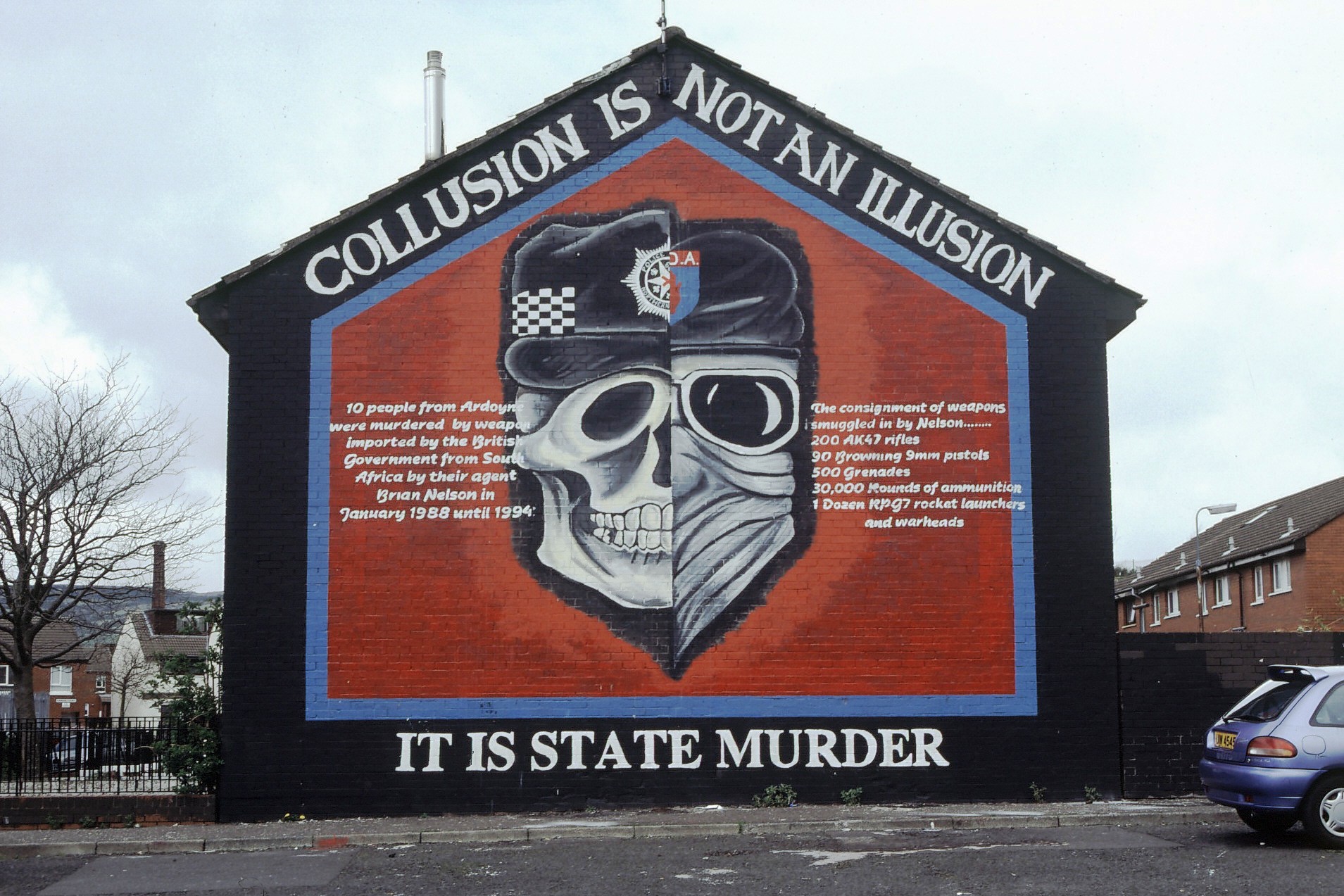
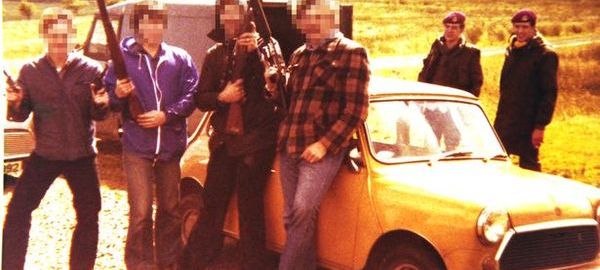
The pistol belonged to the UDA, which at the time was a legal organisation under British law. A further suspect, Brian Nelson, was a member of the Army’s Force Research Unit. He had provided information about Finucane’s whereabouts, and also claimed that he had alerted his handlers about the planned killing.

See : Force Research Unit 

In 2000, Amnesty International demanded that the then Secretary of State for Northern Ireland, Peter Mandelson, open a public inquiry into events surrounding his death. In 2001 as a result of the Weston Park talks, a retired Canadian Judge Peter Cory was appointed by the British and Irish governments to investigate the allegations of collusion by the RUC, British Army and the Gardaí in the killing of Finucane, Robert Hamill and other individuals during the Troubles.

Cory reported in April 2004, and recommended public enquiries be established including the case of the Finucane killing.

In 2004, a former policeman, Ken Barrett, pleaded guilty to Finucane’s murder. His conviction came after a taped confession to the police, lost since 1991, re-surfaced.

In June 2005, the then Irish Taoiseach Bertie Ahern told a US Special Envoy to Northern Ireland that “everyone knows” the UK government was involved in the murder of Pat Finucane.

On 17 May 2006, the United States House of Representatives then passed a resolution calling on the British government to hold an independent public inquiry into Finucane’s killing.

Initial investigations

A public inquiry was announced by the British Government in 2007, but it was halted under the Inquiries Act 2005, which empowers the government to block scrutiny of state actions. Finucane’s family criticised its limited remit and announced that they would not co-operate. Judge Peter Cory also strongly criticised the Act.

Amnesty International logo.svg

Amnesty International has reiterated its call for an independent inquiry, and have called on members of the British judiciary not to serve on the inquiry if it is held under the terms of the Act.

Finucane’s widow, Geraldine (born 1950), has written letters repeating this request to all the senior judges in Great Britain, and took out a full-page advertisement in the newspaper The Times to draw attention to the campaign. In June 2007, it was reported that no police or soldiers would be charged in connection with the killing.

On 11 October 2011, members of the Finucane family met with Prime Minister David Cameron in Downing Street. Cameron provided them with an official apology for state collusion into Pat Finucane’s death. Following the meeting, Finucane’s son Michael said that he and the family had been “genuinely shocked” to learn that the Cory recommendation of a public enquiry, previously accepted by Tony Blair, would not be followed, and that a review of the Stevens and Cory casefiles would be undertaken instead.

 Geraldine Finucane described the proposal as:

“nothing less than an insult…a shoddy, half-hearted alternative to a proper public inquiry”.

The following day, the official apology was given publicly in the House of Commons by the Secretary of State for Northern Ireland, Owen Paterson.[35]

De Silva report

Sir Desmond de Silva

On 12 December 2012, the government released the Pat Finucane Review, the results of the inquiry conducted by Sir Desmond de Silva.

The report documented extensive evidence of State collaboration with Loyalist gunmen, including the selection of targets, and concluded that “there was a wilful and abject failure by successive governments to provide the clear policy and legal framework necessary for agent-handling operations to take place effectively within the law.”

William Stobie.jpg

See : William Stobie 

Prime Minister David Cameron acknowledged “shocking levels of collusion” and issued an apology.

However, Finucane’s family denounced the De Silva report as a “sham” and a “suppression of the truth” into which they were allowed no input.

In May 2013, state documents dated 2011 disclosed through the courts revealed that David Cameron’s former director of security and intelligence, Ciarán Martin, had warned him that senior members of Margaret Thatcher’s government may have been aware of “a systemic problem with loyalist agents” at the time of Pat Finucane’s death but had done nothing about it.

Posthumous

Finucane’s law firm, Madden & Finucane Solicitors, led by Peter Madden, continues to act for those it considers to have been victims of mistreatment by the State, or their survivors. The Pat Finucane Centre (PFC), named in his honour, is a human rights advocacy and lobbying entity in Northern Ireland.

h

 – Disclaimer –

The views and opinions expressed in these pages/documentaries are soley intended to educate and provide background information to those interested in the Troubles of Northern Ireland. They in no way reflect my own opinions and I take no responsibility for any inaccuracies or factual errors.

13th February – Deaths & Events in Northern Ireland Troubles

Key Events & Deaths on this day in Northern Ireland Troubles

13th February

————————————-

Friday 13 February 1976

There were riots in Belfast and Derry following the news of the death of the Irish Republican Army (IRA) hunger-striker Frank Stagg in a prison in England on 12 February 1976.

Saturday 13 February 1988

Representatives of Sinn Féin (SF) endorsed the talks between John Hume, then leader of the Social Democratic and Labour Party (SDLP), and Gerry Adams, then leader of Sinn Féin (SF).

Tuesday 13 February 1996

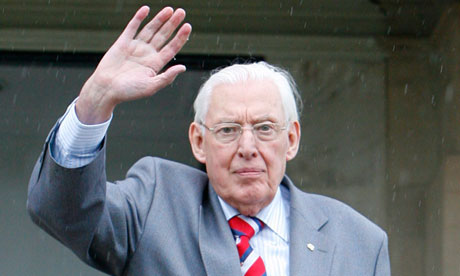
John Major, then British Prime Minister, met Ian Paisley, then leader of the Democratic Unionist Party (DUP), for talks at Downing Street, London.

Saturday 13 February 1999

The Royal Ulster Constabulary (RUC) released figures on the number of paramilitary ‘punishment’ attacks carried out by Republicans. There had been 18 attacks from 1 January 1999 to 2 February 1999 but no attacks since that date

Tuesday 13 February 2001

British Army (BA) technical experts have made safe a pipe-bomb in Belfast that had been picked up by a 4 year old girl and carried into her home. The target of the attack was a Catholic family living on the Springfield Road in the west of the city. The attack was carried out by Loyalist paramilitaries.

Wednesday 13 February 2002

Two men were charged in London with bombing offences during 2001.

The Metropolitan Police charged one man (33) with causing explosions outside the British Broadcasting Corporation (BBC) on 3 March 2001, in Ealing on 3 August 2001, and in Birmingham on 3 November 2001, and with a number of other offences. The second man (24) was charged with conspiracy to cause an explosion on or before 14 November 2001.

[The two men had been arrested separately in Northern Ireland on 6 and 9 February 2002. The men appeared at Belmarsh Magistrate’s Court on Thursday 14 February 2002.]

Jane kennedy, then Security Minister, announced in the House of Commons extra funding of £16 million for the Police Service of Northern Ireland (PSNI). The additional funding takes the total figure to £656 million. Ian Paisley, then leader of the Democratic Unionist Party (DUP), said the extra funding was not enough for policing needs.

Tony Blair, then British Prime Minister, called on Sinn Féin (SF) to take note of the plight of ‘exiles’ – people who had been forced to leave Northern Ireland by paramilitaries. He said that a resolution of the issue was an important part of the peace process.

[The issue was debated in the House of Commons on Thursday 14 February 2002.]

 ———————————————————————

Remembering all innocent victims of the Troubles

Today is the anniversary of the death of the following  people killed as a results of the conflict in Northern Ireland

“To live in hearts we leave behind is not to die

– Thomas Campbell

To the innocent on the list – Your memory will live  forever

– To  the Paramilitaries  –

There are many things worth living for, a few things worth dying for, but nothing worth killing for.

3 People   lost their lives on the 13th  February  between  1972 – 1984

  —————————————————————————

13 February 1972
Thomas McCann,  (19)

nfNI
Status: British Army (BA),

Killed by: non-specific Republican group (REP)
From Dublin. Off duty. Found shot, near Newtownbutler, County Fermanagh.

  —————————————————————————

13 February 1976
Sean Bailey,  (20)

Catholic
Status: Irish Republican Army (IRA),

Killed by: Irish Republican Army (IRA)
Died one day after being injured in premature bomb explosion in house, Nansen Street, Falls, Belfast.

  —————————————————————————

13 February 1984
 James Young,  (41)

Catholic
Status: Irish Republican Army (IRA),

Killed by: Irish Republican Army (IRA)
Found shot, Blaney Road, near Crossmaglen, County Armagh. Alleged informer

  —————————————————————————


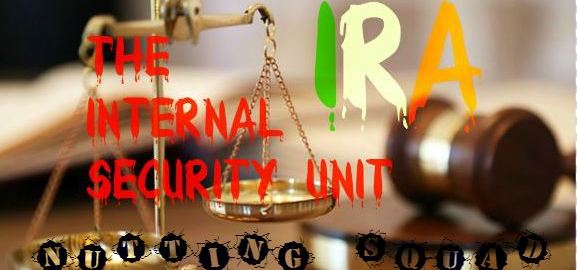
See: IRA Nutting Squad

Operation Banner – August 1969 – July 2007

belfastchildis's avatar

Remembering all our murdered Hero’s

1441 British armed force personnel died in Operation Banner

During the 38 year operation, 1,441 members of the British armed forces died in Operation Banner. This includes those who were killed in paramilitary attacks as well as those who died as a result of assault, accidents, suicide and natural causes

————————————-

Operation Banner – The Forgotten War Tribute

————————————-

Operation Banner was the operational name for the British Armed Forces‘ operation in Northern Ireland from August 1969 to July 2007. It was initially deployed at the request of the unionistgovernment of Northern Ireland to support the Royal Ulster Constabulary (RUC). After the 1998 Belfast Agreement, the operation was gradually scaled down. Its role was to assert the authority of the government of the United Kingdom in Northern Ireland.

The main opposition to the British military’s deployment came from the Provisional Irish Republican…

View original post 3,538 more words

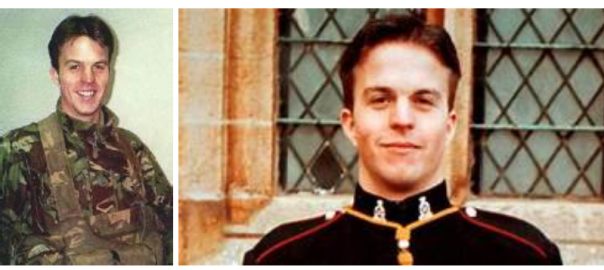
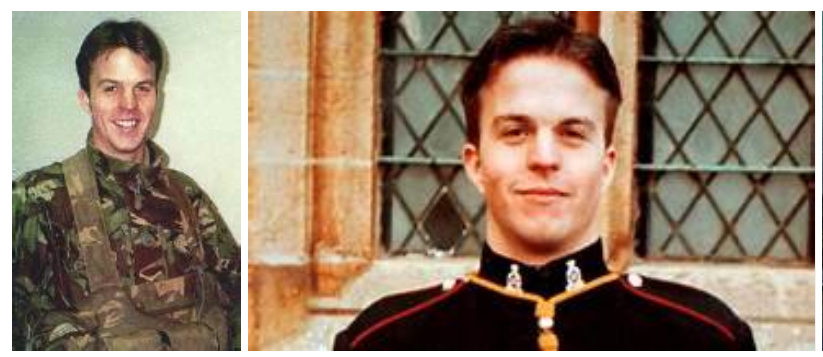
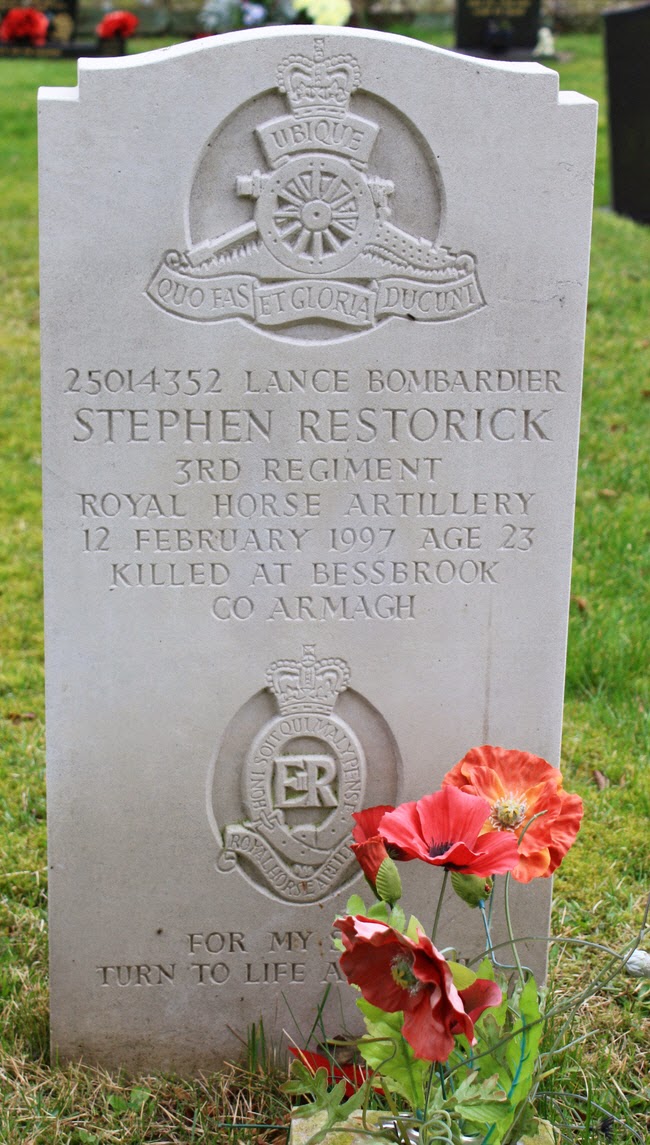
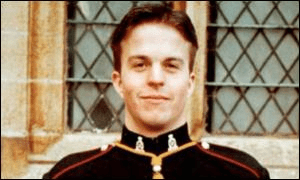
Lance Bombardier Stephen Restorick – Last soldier killed in Northern Ireland Troubles

Lance Bombardier Stephen Restorick

12th Februar  1997

The last British Soldier to die on active service in Northern Ireland as a consequence of the Troubles.

See operation banner

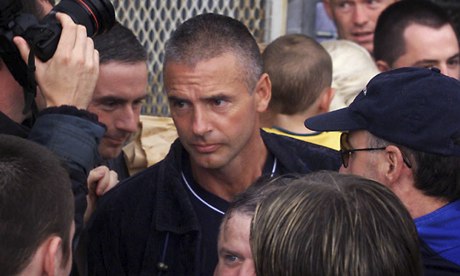
IRA Killer Bernard McGinn

Shot by IRA sniper Bernard McGinn  as he manned a checkpoint in Bessbrook, south Armagh, in February 1997 he held the tragic distinction of being the last British soldier to be murdered by paramilitaries in Northern Ireland. Until now.


The 23-year-old, serving with the 3rd Regiment Royal Horse Artillery, was five months into his second tour of duty in the Province when he was shot on Feb 12 1997.

He was manning a checkpoint on the Green Road outside the village when he was hit with single shot fired from a .50 calibre Barrett rifle.

Claims from a former soldier that an SAS team had been on standby ready to intercept the sniper that day but had been ordered to stand down, emerged six years later in the media.

The province’s police ombudsman, Nuala O’Loan, later concluded that the killing could not have been prevented – not because the snipers had not been under surveillance but because not enough resources had been devoted to the task that day, despite a raised threat level.

Within months of his killing, the Provisional IRA announced its second ceasefire, paving the way for the Good Friday Agreement and the road toward arms decommissioning.

In the intervening years his death has been the subject of intense controversy, amid claims that it could have been prevented and that he was deliberately sacrificed to save an informer.

But his parents, John and Rita, from Underwood, Notts, have been staunch supporters of the peace process, even facing criticism for doing so.

That support has been tested to the limit. When Bernard McGinn was convicted of the killing in 1999 he was sentenced to a total of 490 years in prison.

McGinn  who has since died  was captured by an SAS unit which raided a farmhouse in South Armagh three months after the Restorick murder. He was arrested along with a number of other key members of the Provisonal IRA’s South Armagh brigade during the security operation.

After his arrest McGinn confessed to his role in the IRA’s bombing campaign in England during the late 1980s and early 1990s. He also handed over the names of other IRA members during interrogations with the police.

McGinn admitted to police that he made explosives north and south of the border on an almost daily basis, “like a day’s work”. His information on other PIRA operatives provided vital intelligence for the security forces and caused anger among his former comrades.

———————————–

SOUTH ARMAGH I.R.A SNIPER TEAM JAILED

———————————–

He was sentenced to a total of 490 years in 1999 for 34 separate offences, including the murder of three British soldiers, his involvement in the 1992 bombing of the Baltic Exchange and the 1996 South Quay bombing, and the bombing of Hammersmith bridge later the same year.

However, he was released in 2000 under the Good Friday agreement after the IRA and loyalist paramilitary prisoners were granted a de facto amnesty for all crimes relating to the Troubles before Easter 1998.

He joined the Provisional IRA at the age of 15. His father was a former Sinn Féin councillor and he was the brother-in-law of Sinn Féin politician Caoimhghín Ó Caoláin.

Karma Collects its debt

McGinn was found dead in a house in the Irish Republic on 21st December 2013 , the Garda Síochána has announced. McGinn is believed to have died from natural causes after being discovered at the property in Monaghan town on Saturday.

Soldier’s family on sad pilgrimage

SD3537946@Elizabeth Cross P

Wednesday 19 March 1997

The parents of a young soldier shot dead by the IRA in Northern Ireland yesterday made a painful pilgrimage to the spot where he died.

John and Rita Restorick fought back tears as they laid flowers by the checkpoint outside the military base at Bessbrook in South Armagh where their son, Stephen, was murdered last month. Clutching each other’s hands tightly, they placed their floral tribute among dozens of others left by local people.

They were accompanied on their journey from Peterborough by their other son, Mark, 26, and eight uncles, aunts and cousins.

Lance Bombardier Restorick, 23, of the 3rd Battalion Royal Horse Artillery was killed by a single shot fired at long range by a hidden sniper as he manned the checkpoint.

The Restoricks were escorted by their son’s commanding officer, Lt Col Matthew Sykes, and Battery Commander Major Mark Vincent.

Afterwards, inside the heavily-fortified base, they attended a service to dedicate a marble memorial to Stephen.

R.I.P Stephen

God will judge them!


See operation banner

——————————————————-

Bernard Henry McGinn

Bernard Henry McGinn (c. 1957 – body discovered 21 December 2013) was a Provisional Irish Republican Army (PIRA) member, specialising in explosives, who was sentenced to a total of 490 years imprisonment in 1999.[1] He was released in 2000 under the terms of the Good Friday Agreement

Background and IRA activity

McGinn was born into an Irish republican family in Castleblayney, County Monaghan, Ireland. His father was a former Sinn Féin councillor and his brother-in-law, Caoimhghín Ó Caoláin, has been a Sinn Féin TD for Cavan–Monaghan since 1997.

In 1978 Dessie O’Hare and McGinn killed Thomas Johnston, a former member of the Ulster Defence Regiment (UDR) in Keady, South Armagh. In 1979 McGinn was arrested at a disused farmhouse and charged with possession of explosives. He failed to turn up at his trial and was sentenced to 10 years imprisonment in absentia. After several months on the run, he was arrested in Dundalk following a 27-hour siege, during which he held a family hostage with a pistol and a hand grenade.

McGinn was released from prison in 1987, and joined the IRA’s South Armagh Brigade. Initially viewed as an outsider, within several years he became a trusted member of the brigade, helping assemble bombs used by the IRA in England. He was a member of one of two sniper teams which killed nine members of the security forces between 1992 and 1997, including Lance Bombardier Stephen Restorick, who was killed by a single shot from a Barrett M90 sniper rifle on 12 February 1997, and was among the last British Army soldiers to be killed during The Troubles.

Arrest and trial

McGinn and other members of the sniper team were arrested by the Special Air Service at a farm near Crossmaglen on 10 April 1997, and taken to Gough Barracks in Armagh for questioning. During a week of questioning, McGinn confessed to his role in the IRA bombing campaign, and implicated more than twenty members of the South Armagh Brigade in attacks in Northern Ireland and England. He claimed to have manufactured explosive mixes varying from between 200 lb and 10 tons, and said it was “like a day’s work”.

On 19 March 1999 McGinn was sentenced to a total of 490 years imprisonment for 34 separate offences, including the murder of three British soldiers, and involvement in the 1992 bombing of the Baltic Exchange, the 1996 Docklands bombing, and the bombing of Hammersmith Bridge later the same year.

He laughed at his sentence, knowing that he would be freed, at most, in shortly over a year under the terms of the Good Friday Agreement. Two months after his conviction McGinn was temporarily released on compassionate grounds to visit his sick mother, which caused anger and consternation among unionists.

On 28 July 2000, McGinn was freed from HM Prison Maze, after serving 16 months.

Appeal

On 5 October 2000 McGinn’s convictions for explosives offences and the soldiers’ murders were overturned at the Court of Appeal in Belfast on the grounds that he was not properly cautioned before he confessed. The court, however, dismissed his appeals against convictions for conspiracy to murder and firearms possession for which he received a twenty-year sentence at his original trial

Death

McGinn was found dead at a house in Monaghan Town on 21 December 2013. The cause of death remains unknown, pending a post-mortem examination.


12th February – Deaths & Events in Northern Ireland Troubles

Key Events & Deaths on this day in Northern Ireland Troubles

12th February

——————————–

Tuesday 12 February 1974

The Irish Republican Army (IRA) exploded a bomb at the National Defence College at Latimer, Buckinghamshire, England. The bomb (estimated at 20 pounds) injured 10 people but there were no deaths.

Wednesday 12 February 1975

A series of seven ‘Incident Centres’ were established in Nationalist areas across Northern Ireland to monitor the Irish Republican Army (IRA) ceasefire and the response of the security forces. The centres were manned by members of Sinn Féin (SF) who liased with government officials at the Northern Ireland Office (NIO).

Thursday 12 February 1976

Frank Stagg, a member of the Irish Republican Army (IRA), died after 61 days on hunger strike in Wakefield Prison, Yorkshire, England. Stagg had been on hunger strike in protest at the British government’s refusal to transfer him to a prison in Northern Ireland.

A member of the RUC was shot dead by the IRA in Claudy, County Derry. A member of the youth section of the IRA was killed during an arson atttach on a warehouse in Belfast.

Talks between the United Ulster Unionist Council (UUUC) and the Social Democratic and Labour Party (SDLP) broke down after only an hour. The UUUC would not agree on SDLP involvement in any future Northern Ireland cabinet.

[This was a key element as far as Merlyn Rees, then Secretary of Sate for Northern Ireland, was concerned. The final meeting of the Convention took place on 3 March 1976. The British government brought the Convention to an end on 5 March 1976.] [ Constitutional Convention. ]

Thursday 12 February 1981

Ian Paisley, then leader of the Democratic Unionist Party (DUP), was suspended from the House of Commons when he repeatedly called Humphrey Atkins, then Secretary of State for Northern Ireland, a liar. [ Political Developments; Employment.]

Friday 12 February 1982

Three of the five members of the Committee of Inquiry set up to investigate the Kincora Scandal resigned. They claimed that the Royal Ulster Constabulary (RUC) had not dealt with all the major criminal matters surrounding the case. The DeLorean Motor Company laid off 1,100 of its 2,600 workers.

[This was a major blow to the economically deprived area of west Belfast.]

Thursday 12 February 1987

Unionist Petition A 400,000 signature petition was delivered to Buckingham Palace by Unionist Members of Parliament (MPs). The petition was in protest at the Anglo-Irish Agreement (AIA).

Sunday 12 February 1989

Finucane Killing

See Pat Finucane Post

Patrick Finucane (38), a Catholic civilian, was shot dead by members of the Ulster Freedom Fighters (UFF), a cover name (pseudonym) used by the Ulster Defence Association (UDA). Finucane was a Belfast solicitor who had represented a number of Republicans. He was killed at his home, Fortwilliam Drive, off Antrim Road, Belfast, in front of the members of his family.

The shooting followed comments made (on 17 January 1989) by Douglas Hogg, then a British Home Office Minister, about a “number of solicitors in Northern Ireland who are unduly sympathetic to the cause of the IRA”.

[There were a number of accusations that there had been collusion between Loyalist paramilitaries and the security forces in the killing of Finucane. There were futher claims of collusion on 29 August 1989. On 17 April 1999 John Stevens, then deputy commissioner of the Metropolitan Police, returned to Northern Ireland to launch a third Inquiry specifically into the killing of Finucane. He also began to investigate allegations raised by campaign group British-Irish Rights Watch and the United Nations. Stevens’ third report was presented to the Police Service of Northern Ireland (PSNI) on 17 April 2003. The report concluded that there had been collusion in the killing of Finucane between members of the security forces, especially the Force Research Unit (FRU), and Loyalists. See: Stevens summary report.]

Monday 12 February 1990

Harold McCusker, then Deputy Leader of the Ulster Unionist Party (UUP) and Member of Parliament (MP) for Upper Bann, died as a result of cancer at the age of 50. The Green Party, a political party with a mainly environmental platform, was launched in Northern Ireland.

Thursday 12 February 1993

Christopher Harte (24), a member of the Irish Republican Army (IRA), was found dead near Castlederg, County Tyrone. He had been shot dead by the IRA who claimed that he had been an informer.

Saturday 12 February 1994

The Ulster Freedom Fighters (UFF), a cover name (pseudonym) used by the Ulster Defence Association (UDA), carried out rocket attack on the headquarters of Sinn Féin (SF) in west Belfast.

Wednesday 12 February 1997

The Irish Republican Army (IRA) shot dead Stephen Restorick, then a British soldier, at an Army checkpoint in Bessbrook, County Armagh.

[This killing was often refered to as the last British soldier killed in Northern Ireland, until 7 March 2009 when two soldiers were killed by the Real IRA in County Antrim.]

See : Stephen Restorick

12 February 1998

The Irish Republican Army (IRA) issued a statement which said that the IRA’s ceasefire was still intact.

[This was seen as an attempt to prevent Sinn Féin (SF) from being expelled from the multi-party talks.]

Friday 12 February 1999

The Loyalist Volunteer Force (LVF) denied that it was involved in recent attacks on Catholic homes and businesses. Gerry Adams, then President of Sinn Féin (SF), gave an interview to the Press Association in which he said that Northern Ireland would be moving into a united Ireland in 15 years’ time.

[Reference may have been to the 100th anniversary of the Easter Rising of 1916?]

Tuesday 12 February 2002

The High Court in Belfast heard an appeal by lawyers representing the Bloody Sunday Inquiry for the court to postpone a court action brought (on 11 February 2002) by the families of those killed.

The action surrounded the Inquiry’s decision to allow police witnesses to give evidence from behind screens. The action was allowed to proceed and the Inquiry’s appeal was dismissed.

[On Wednesday 13 February 2002 the judge announced he would make a final decision on the families’ action during the following week.]

The Democratic Unionist Party (DUP) put forward a motion in the Northern Ireland Assembly that all primary school pupils should receive souvenir medals to mark the Queen’s Golden Jubilee. The motion was passed by 26 votes to 11 votes. Martin McGuinness (SF), then Minister for Education, said that his department would not pay for the medals. David Trimble (UUP), then First Minister, and Mark Durkan (SDLP), then Deputy First Minister, announced that they would begin a consultation process on a comprehensive review of public administration in Northern Ireland.

Among the matters for review are: local government structures (the 26 district councils); the five education and library boards; the four health boards; and the many unelected quangos (committees) that manage many areas of public administration.

The Lawyers Committee for Human Rights, a group based in the United States of America (USA), published a report in to the death of Pat Finucane, a Belfast solicitor killed on 12 February 1989. The report was entitled: ‘Beyond Collusion: The UK Security Forces and the Murder of Pat Finucane’ [PDF FILE 324KB]. The report repeated earlier allegations of collusion between security forces and Loyalist paramilitary groups and also claimed to have found new evidence to support the claims.

 ———————————————————————

Remembering all innocent victims of the Troubles

Today is the anniversary of the death of the following  people killed as a results of the conflict in Northern Ireland

“To live in hearts we leave behind is not to die

– Thomas Campbell

To the innocent on the list – Your memory will live  forever

– To  the Paramilitaries  –

There are many things worth living for, a few things worth dying for, but nothing worth killing for.

9 People   lost their lives on the 12th February  between  1974 – 1997

  —————————————————————————

12 February 1974


Peter Carty,   (57)

Catholic
Status: Civilian (Civ),

Killed by: Ulster Defence Association (UDA)
Shot at his workplace, Balmoral Service Station, Lisburn Road, Belfast.

  —————————————————————————

12 February 1976


Frank Stagg,  (34)

nfNIB
Status: Irish Republican Army (IRA),

Killed by: not known (nk)
Originally from County Mayo. Died on 62 day of hunger strike, Wakefield Prison, Yorkshire, England.

  —————————————————————————

12 February 1976


William Hamer,   (31)

Protestant
Status: Royal Ulster Constabulary (RUC),

Killed by: Irish Republican Army (IRA)
Shot while on Royal Ulster Constabulary (RUC) foot patrol, Claudy, County Derry

  —————————————————————————

12 February 1976


James O’Neill, (17)

Catholic
Status: Irish Republican Army Youth Section (IRAF),

Killed by: Irish Republican Army (IRA)
Died when badly burnt during arson attack on furniture warehouse, Antrim Road, New Lodge, Belfast.

  —————————————————————————

12 February 1977


Samuel McKane,  (33)

Protestant
Status: Royal Ulster Constabulary (RUC),

Killed by: Irish Republican Army (IRA)
Off duty. Shot outside his home, Cloughmills, County Antrim.

  —————————————————————————

12 February 1979
Patrick Sills,  (27)

nfNI
Status: Irish Republican Army (IRA),

Killed by: Irish Republican Army (IRA)
From County Donegal. Found shot in field, Laghtfoggy, near Castlederg, County Tyrone. Internal IRA dispute

  —————————————————————————

12 February 1989


Patrick Finucane,  (38)

Catholic
Status: Civilian (Civ),

Killed by: Ulster Freedom Fighters (UFF)
Lawyer. Shot at his home, Fortwilliam Drive, off Antrim Road, Belfast

See Pat Finucane Post

  —————————————————————————

12 February 1993
Christopher Harte,   (24)

Catholic
Status: Irish Republican Army (IRA),

Killed by: Irish Republican Army (IRA)
Found shot in ditch by side of Carn Road, near Castlederg, County Tyrone. Alleged informer.

  —————————————————————————

12 February 1997


Stephen Restorick,  (23)

nfNI
Status: British Army (BA),

Killed by: Irish Republican Army (IRA)
Shot, by sniper, while at British Army (BA) Vehicle Check Point (VCP), Green Road, Bessbrook, County Armagh.

  —————————————————————————

See Bombardier Stephen Restorick – Last soldier killed in Northern

11th February – Deaths & Events in Northern Ireland Troubles

Key Events & Deaths on this day in Northern Ireland Troubles

11th February

—————————————–

Monday 11 February 1974

Thomas Donaghy

Margaret McErlean 

Two Catholic civilians were shot (one died immediately, one died on 18 February 1974) as they arrived for work in Glenville Road, Newtownabbey, County Antrim. They were killed by the Ulster Freedom Fighters (UFF), a covername used by the Ulster Defence Association (UDA).

Monday 11 February 1980

Joseph Rose

Winston Howe

Two Royal Ulster Constabulary (RUC) officers were killed in a land mine attack at Rosslea, County Fermanagh.

Sunday 11 February 1986

An off-duty RUC officer and a Catholic civilian were killed in an Irish Republican Army (IRA) gun attack on the Talk of the Town bar in Maguiresbridge, County Fermanagh.

Tuesday 11 February 1992

John Major, then British Prime Minister, and Peter Brooke, then Secretary of State for Northern Ireland, held meetings with the leaders of the main political parties in Northern Ireland to discuss the security situation.

Friday 11 February 1994

The Ulster Freedom Fighters (UFF), a cover name (pseudonym) used by the Ulster Defence Association (UDA), carried out gun attacks on the homes of two Social Democratic and Labour Party (SDLP) members.

In one attack the son of one SDLP member was shot and wounded. James Molyneaux, then leader of the Ulster Unionist Party (UUP), said that the Downing Street Declaration (DSD) had failed and that an internal settlement for Northern Ireland should now be sought by the British government.

Tuesday 11 February 1997

Kevin McNamara, a former Labour Party Northern Ireland spokesperson, and Seamus Mallon, then deputy leader of the Social Democratic and Labour Party (SDLP), called for a new appeal for Danny McNamee who received a 25 year sentence in 1987 for Irish Republican Army (IRA) bomb making offences.

Roisin McAliskey


An International Urgent Alert was issued by Amnesty International on the case of Roisín McAliskey who was six months pregnant and was imprisoned pending a decision about extradition to Germany.

Thursday 11 February 1999

A new report on the death of Patrick Finucane, a Belfast solicitor who had represented a number of Republicans, claimed that there was collusion between Loyalist paramilitaries and British security forces in his death on 12 February 1989. More than 1,100 lawyers signed a petition calling for a independent judicial inquiry into the killing. The appeal for the inquiry was also supported by Amnesty International.

See: Pat Finucane – 12th February 1989 Executed by the UFF

Friday 11 February 2000

Assembly and Executive Suspended

Peter Mandelson, then Secretary of State for Northern Ireland, suspended the 72 day-old power-sharing Executive and restored Direct Rule of Northern Ireland from Westminster as of midnight. The move followed reports from the Independent International Commission on Decommissioning (IICD) that it had “received no information from the IRA as to when decommissioning will start.”

Sunday 11 February 2001

The Royal Ulster Constabulary (RUC) uncovered a ‘bomb factory’ in a block of flats in a Loyalist area of north Belfast. A significant amount of explosives and component parts for making pipe-bombs were seized during raids of three flats in Ross House in the Mount Vernon area. Police later linked the find to the Ulster Volunteer Force (UVF).

The home of a Catholic family was damaged in a pipe-bomb attack in north Belfast. The device was thrown at the back of the house shortly before 1.30am. A number of windows were smashed and a door was damaged. The people inside the house, two men and a woman, escaped injury. The attack was carried out by Loyalist paramilitaries

Monday 11 February 2002

There were disturbances in the Arthur Bridge area of the Whitewell Road, north Belfast, at approximately 7.00am (0700GMT).

The trouble began following reports of fireworks being thrown from the Loyalist White City area towards the Nationalist Longlands estate. Police arrested a man and a boy from the Longlands estate.

[There had been rioting in the same area on Saturday evening (9 February 2002) and Sunday evening (10 February 2002).]

A man (26) was shot in both ankles in a paramilitary ‘punishment’ attack in Kilrea, County Derry. A gang of four men broke into the victim’s house and beat him with iron bars before shooting him. The attack took place in front of the man’s wife and two young daughters.

Solicitors representing most of the families of those killed on Bloody Sunday (30 January 1972) lodged an application in the High Court in Belfast to challenge the decision of the Inquiry to allow police witnesses to be screened when giving evidence.

See Bloody Sunday

Geraldine Finucane the widow of Pat Finucane, a Belfast solicitor killed on 12 February 1989, criticised the British government for a delay in considering her appeal for an independent inquiry into the circumstances surrounding the death of her husband. In November 2001 John Reid, then Secretary of State for Northern Ireland, announced that an international judge would be appointed to decide if an independent public inquiry into her husband’s death was necessary.

[However this decision was criticised as a delaying tactic by the government.]

John Reid, then Secretary of State for Northern Ireland, travelled to Washington, United States of America (USA), for meetings with members of the Bush administration. During a media briefing he called on Sinn Féin (SF) to take up its seats in the Northern Ireland Policing Board (NIPB):

“The whole community has to take its part and its responsibilities in supporting that police service – and that includes Republicans.”

———————————————————————

Remembering all innocent victims of the Troubles

Today is the anniversary of the death of the following  people killed as a results of the conflict in Northern Ireland

“To live in hearts we leave behind is not to die

– Thomas Campbell

To the innocent on the list – Your memory will live  forever

– To  the Paramilitaries  –

There are many things worth living for, a few things worth dying for, but nothing worth killing for.

11 People   lost their lives on the 11th  February  between  1974 – 1993

  —————————————————————————

11 February 1974


Thomas Donaghy,   (16)

Catholic
Status: Civilian (Civ),

Killed by: Ulster Freedom Fighters (UFF)
Shot as he arrived at his workplace, Abbey Meat Packers, Glenville Road, Newtownabbey, County Antrim.

  —————————————————————————

11 February 1974


Margaret McErlean,  (18)

Catholic
Status: Civilian (Civ),

Killed by: Ulster Freedom Fighters (UFF)
Shot as she arrived at her workplace, Abbey Meat Packers, Glenville Road, Newtownabbey, County Antrim. She died 18 February 1974.

  —————————————————————————

11 February 1975


Christopher Mein,   (25)

Protestant
Status: Civilian (Civ),

Killed by: Irish Republican Army (IRA)
Relief milkman. Shot on his milk round, Galbally, Cappagh, County Tyrone. Regular milkman intended target.

  —————————————————————————

11 February 1978


 Mary Smyth,  (71)

Catholic
Status: Civilian (Civ),

Killed by: Ulster Volunteer Force (UVF)
Killed in bomb attack on her home, Oldpark Avenue, Belfast.

  —————————————————————————

11 February 1978


Michael Scott,  (10)

Catholic
Status: Civilian (Civ),

Killed by: Ulster Volunteer Force (UVF)
Killed in bomb attack, while in relative’s home, Oldpark Avenue, Belfast

  —————————————————————————

11 February 1980


Joseph Rose,   (21)

Protestant
Status: Royal Ulster Constabulary (RUC),

Killed by: Irish Republican Army (IRA)
Killed in land mine attack on Royal Ulster Constabulary (RUC) mobile patrol, Lisnaskea Road, near Rosslea, County Fermanagh.

  —————————————————————————

11 February 1980


Winston Howe,  (35)

Protestant
Status: Royal Ulster Constabulary (RUC),

Killed by: Irish Republican Army (IRA)
Killed in land mine attack on Royal Ulster Constabulary (RUC) mobile patrol, Lisnaskea Road, near Rosslea, County Fermanagh.

  —————————————————————————

11 February 1986

Derek Breen,   (29)

Protestant
Status: Royal Ulster Constabulary (RUC),

Killed by: Irish Republican Army (IRA)
Off duty. Shot together with barman while in Talk of the Town Bar, Maguiresbridge, County Fermanagh.

  —————————————————————————

11 February 1986
 John McCabe,   (25)

Catholic
Status: Civilian (Civ),

Killed by: Irish Republican Army (IRA)
Barman. Shot together with off duty Royal Ulster Constabulary (RUC) member while at his workplace, Talk of the Town Bar, Maguiresbridge, County Fermanagh.

  —————————————————————————

11 February 1987
 Nigel Watton,   (18)

Protestant
Status: Civilian (Civ),

Killed by: Ulster Volunteer Force (UVF)
Shot near his home, Ballybogey, near Ballymoney, County Antrim.

  —————————————————————————

11 February 1993
Thomas Molloy,  (32)

Catholic
Status: Civilian (Civ),

Killed by: Ulster Volunteer Force (UVF)
Shot at his home, Derrymagown Road, near Loughgall, County Armagh.

  —————————————————————————

The London Docklands bombing – 9 February 1996

Source: The London Docklands bombing – 9 February 1996