Monthly Archives: October 2015

1st November – Deaths & Events in Northern Ireland Troubles

Key Events & Deaths on this day in Northern Ireland Troubles

 1st November

Friday 1 November 1968

November 1973 The Ulster Volunteer Force (UVF) began what was to be a 43 day ceasefire.

Thursday 1 November 1973

Jamie Flanagan replaced Graham Shillington as the Chief Constable of the Royal Ulster Constabulary (RUC). Flanagan was the first Catholic to hold this post.

Tuesday 1 November 1977

Timothy Creasey, then a Lieutenant-General, took over from David House and the General Officer Commanding (GOC) of the British Army in Northern Ireland.

Thursday 1 November 1979

The Irish security forces seized a quantity of arms at Dublin docks which were believed to have originated in the United States of America (USA) and to be bound for the Irish Republican Army (IRA). The shipment totalled 156 weapons and included the M-60 machine gun and were worth an estimated £500,000. Jack Lynch, then Taoiseach (Irish Prime Minister), stated that he believed that the conflict in Northern Ireland continued to be “as intractable as at any stage in the last ten years”.

Thursday 1 November 1984

The Report of the unofficial Kilbrandon Committee was published. The Committee was established by the British Irish Association and consisted of politicians and academics. The Report was seen as a response to the New Ireland Forum Report. The Kilbrandon Report recommended that Northern Ireland should be governed by a five member Executive and that one of the members should be an Irish government minister.

Saturday 1 November 1986

James Molyneaux, then leader of the Ulster Unionist Party (UUP), and Ian Paisley, then leader of the Democratic Unionist Party (DUP), attended an Orange Order rally in Glasgow, Scotland. At the rally the Unionist leaders launched the start of a campaign in Britain against the Anglo-Irish Agreement (AIA).

Sunday 1 November 1987

A ship, the Eksund, was searched off the French coast and was found to be carrying 150 tons of arms bound for the Irish Republican Army (IRA).

[It later emerged that this shipment was one of four consignments of arms which originated in Libya. The other three shipments were believed to have been obtained by the IRA.]

Monday 1 November 1993

John Major, then British Prime Minister, told John Hume, then leader of the Social Democratic and Labour Party (SDLP), that the proposals contained in the Hume-Adams Initiative were “not the right way to proceed”. In reply to another member of the House of Commons Major said that to “sit down and talk with Mr Adams and the Provisional IRA … would turn my stomach”. [It was revealed on 28 November 1993 that the British government had a channel of communication with the Republican movement for three years and had been in regular contact since February.]

Tuesday 1 November 1994

Bill Clinton, then President of the United States of America (USA), announced that the US government would increase its contribution to the International Fund for Ireland (IFI) from $20 million to $30 million per year over the next two years. Clinton also announced that he intended to call a conference on trade and investment in Ireland to be held in Philadelphia in the spring of 1995.

Wednesday 1 November 1995

David Trimble, then leader of the Ulster Unionist Party (UUP), had a meeting with Bill Clinton, then President of the United States of America (USA), in Washington. Gerry Adams, then President of Sinn Féin (SF), said that the talks between SF and the British government had failed.

Monday 1 November 1999

Ed Moloney, then Northern editor of the Sunday Tribune (a Dublin based newspaper), was named Journalist of the Year in the annual ESB National Media Awards for “defending the highest journalistic standards”. Moloney had won a long-running legal battle against handing over interview notes to the Royal Ulster Constabulary (RUC).

Wednesday 1 November 2000

Mark Quail (26), a member of the Ulster Volunteer Force (UVF), was shot dead in front of his girlfriend at their flat in Ballyronan Park, Rathcoole, in north Belfast. The shooting was believed to have been carried out by the Ulster Defence Association (UDA) in retaliation for the killing on Tuesday of the Loyalist politician Tommy English by the rival UVF. The killing was part of a feud between the UDA and the UVF and brought to seven the number of men killed since August.

Thursday 1 November 2001

Loyalist paramilitaries carried out a ‘punishment’ beating attack on a man in Bangor, County Down, at approximately 10.35pm (2235GMT). The man was seriously injured in the attack. British Army technical officers were called to deal with a “crude explosive device” that had initially been left in a community centre in north Belfast. Children had moved the device to Roseleigh Street before their parents raised the alarm.

[It is believed that Loyalists left the device.]

Pauline Armitage, then Ulster Unionist Party (UUP) Member of the Legislative Assembly (MLA), announced that she would not be voting for her party leader David Trimble to be re-elected as First Minister on Friday 2 November 2001. The Democratic Unionist Party (DUP) said that John Reid, then Secretary of State for Northern Ireland, should call fresh Assembly elections if David Trimble, then leader of the UUP, does not get re-elected as First Minister. David Trimble, then leader of the UUP, together with two UUP colleagues, joined with members of the ‘Loyalist Commission’ to hold a joint meeting with Jane Kennedy, then Security Minister at the Northern Ireland Office (NIO).

[The Loyalist Commission is comprised of representatives of three Loyalist paramilitary groups – the Ulster Defence Association (UDA), the Ulster Volunteer Force (UVF), and the Red Hand Commando (RHC) – and Protestant church and community representatives from north Belfast. Members of the UUP help set up the new group.]

The meeting was to discuss the situation in Glenbryn, Ardoyne, north Belfast, where Loyalist residents are blockading the Holy Cross Girls’ Primary School.

[To date this year Loyalist paramilitaries have carried out five sectarian murders and over 200 pipe-bomb attacks.]

————————————————————-

———————————————————————————

Remembering all innocent victims of the Troubles

Today is the anniversary of the death of the following  people killed as a results of the conflict in Northern Ireland

“To live in hearts we leave behind is not to die

– Thomas Campbell

To the innocent on the list – Your memory will live  forever

– To  the Paramilitaries  –

There are many things worth living for, a few things worth dying for, but nothing worth killing for.

  5  People lost their lives on the 1st November between 1971 – 2000

————————————————————

01 November 1971


Stanley Corry,  (28)

Protestant
Status: Royal Ulster Constabulary (RUC),

Killed by: Irish Republican Army (IRA)
Shot while investigating burglary, Avoca Shopping Centre, Andersonstown, Belfast.

————————————————————

01 November 1971


William Russell,  (31)

Protestant
Status: Royal Ulster Constabulary (RUC),

Killed by: Irish Republican Army (IRA)
Shot while investigating burglary, Avoca Shopping Centre, Andersonstown, Belfast.

————————————————————

01 November 1973
Daniel Carson,  (28)

Catholic
Status: Civilian (Civ),

Killed by: non-specific Loyalist group (LOY)
Shot as he left his workplace, Dayton Street, Shankill, Belfast.

————————————————————

01 November 1973
Francis McNelis,  (65)

Catholic
Status: Civilian (Civ),

Killed by: Ulster Volunteer Force (UVF)
Killed when car bomb exploded outside Avenue Bar, Union Street, Belfast. He was a passer-by at the time of the incident.

————————————————————

01 November 2000
Mark Quail,  (26)

Protestant
Status: Ulster Volunteer Force (UVF),

Killed by: Ulster Defence Association (UDA)
Shot at his home, Ballyronan Park, Rathcoole, Newtownabbey, County Antrim. Ulster Defence Association (UDA) / Ulster Volunteer Force (UVF) feud.

————————————————————

See below on how to order a copy of my No.1 Bestselling book: A Belfast Child 

Pendle Witches – Life & Death. Background & Documentary

Pendle Witches

Two of the accused witches, Anne Whittle (Chattox) and her daughter Anne Redferne. Illustration from William Harrison Ainsworth’s 1849 novel, The Lancashire Witches.

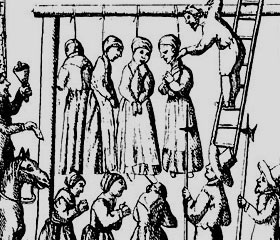
The trials of the Pendle witches in 1612 are among the most famous witch trials in English history, and some of the best recorded of the 17th century. The twelve accused lived in the area around Pendle Hill in Lancashire, and were charged with the murders of ten people by the use of witchcraft. All but two were tried at Lancaster Assizes on 18–19 August 1612, along with the Samlesbury witches and others, in a series of trials that have become known as the Lancashire witch trials. One was tried at York Assizes on 27 July 1612, and another died in prison. Of the eleven who went to trial – nine women and two men – ten were found guilty and executed by hanging; one was found not guilty.

————————————————————————————–

A Pendle Witch Documentary

————————————————————————————–

The official publication of the proceedings by the clerk to the court, Thomas Potts, in his The Wonderfull Discoverie of Witches in the Countie of Lancaster, and the number of witches hanged together – nine at Lancaster and one at York – make the trials unusual for England at that time. It has been estimated that all the English witch trials between the early 15th and early 18th centuries resulted in fewer than 500 executions; this series of trials accounts for more than two per cent of that total.

Six of the Pendle witches came from one of two families, each at the time headed by a woman in her eighties: Elizabeth Southerns (aka Demdike[a]), her daughter Elizabeth Device, and her grandchildren James and Alizon Device; Anne Whittle (aka Chattox), and her daughter Anne Redferne. The others accused were Jane Bulcock and her son John Bulcock, Alice Nutter, Katherine Hewitt, Alice Gray, and Jennet Preston. The outbreaks of witchcraft in and around Pendle may demonstrate the extent to which people could make a living by posing as witches. Many of the allegations resulted from accusations that members of the Demdike and Chattox families made against each other, perhaps because they were in competition, both trying to make a living from healing, begging, and extortion.

Religious and political background

Photograph

Pendle Hill from the northwest. On the right is the eastern edge of Longridge Fell, which is separated from Pendle Hill by the Ribble valley.

The accused witches lived in the area around Pendle Hill in Lancashire, a county which, at the end of the 16th century, was regarded by the authorities as a wild and lawless region: an area “fabled for its theft, violence and sexual laxity, where the church was honoured without much understanding of its doctrines by the common people”.[2] The nearby Cistercian abbey at Whalley had been dissolved by Henry VIII in 1537, a move strongly resisted by the local people, over whose lives the abbey had until then exerted a powerful influence. Despite the abbey’s closure, and the execution of its abbot, the people of Pendle remained largely faithful to their Roman Catholic beliefs and were quick to revert to Catholicism on Queen Mary’s accession to the throne in 1553.[3]

When Mary’s Protestant half-sister Elizabeth came to the throne in 1558 Catholic priests once again had to go into hiding, but in remote areas such as Pendle they continued to celebrate Mass in secret.[3] In 1562, early in her reign, Elizabeth passed a law in the form of An Act Against Conjurations, Enchantments and Witchcrafts (5 Eliz. I c. 16). This demanded the death penalty, but only where harm had been caused; lesser offences were punishable by a term of imprisonment. The Act provided that anyone who should “use, practise, or exercise any Witchcraft, Enchantment, Charm, or Sorcery, whereby any person shall happen to be killed or destroyed”, was guilty of a felony without benefit of clergy, and was to be put to death.[4]

On Elizabeth’s death in 1603 she was succeeded by James I. Strongly influenced by Scotland’s separation from the Catholic Church during the Scottish Reformation, James was intensely interested in Protestant theology, focusing much of his curiosity on the theology of witchcraft. By the early 1590s he had become convinced that he was being plotted against by Scottish witches.[5] After a visit to Denmark, he had attended the trial in 1590 of the North Berwick witches, who were convicted of using witchcraft to send a storm against the ship that carried James and his wife Anne back to Scotland. In 1597 he wrote a book, Daemonologie, instructing his followers that they must denounce and prosecute any supporters or practitioners of witchcraft. One year after James acceded to the English throne, a law was enacted imposing the death penalty in cases where it was proven that harm had been caused through the use of magic, or corpses had been exhumed for magical purposes.[6] James was, however, sceptical of the evidence presented in witch trials, even to the extent of personally exposing discrepancies in the testimonies presented against some accused witches.[7]

In early 1612, the year of the trials, every justice of the peace (JP) in Lancashire was ordered to compile a list of recusants in their area, i.e. those who refused to attend the English Church and to take communion, a criminal offence at that time.[8] Roger Nowell of Read Hall, on the edge of Pendle Forest, was the JP for Pendle. It was against this background of seeking out religious nonconformists that, in March 1612, Nowell investigated a complaint made to him by the family of John Law, a pedlar, who claimed to have been injured by witchcraft.[9] Many of those who subsequently became implicated as the investigation progressed did indeed consider themselves to be witches, in the sense of being village healers who practised magic, probably in return for payment, but such men and women were common in 16th-century rural England, an accepted part of village life.[10]

It was perhaps difficult for the judges charged with hearing the trials – Sir James Altham and Sir Edward Bromley – to understand King James’s attitude towards witchcraft. The king was head of the judiciary, and Bromley was hoping for promotion to a circuit nearer London. Altham was nearing the end of his judicial career, but he had recently been accused of a miscarriage of justice at the York Assizes, which had resulted in a woman being sentenced to death by hanging for witchcraft. The judges may have been uncertain whether the best way to gain the king’s favour was by encouraging convictions, or by “sceptically testing the witnesses to destruction”.[11]

Events leading up to the trials

Family tree

                                                                             Elizabeth Southerns’ family[12]
Family tree

  Anne Whittle’s family[12]

One of the accused, Demdike, had been regarded in the area as a witch for fifty years, and some of the deaths the witches were accused of had happened many years before Roger Nowell started to take an interest in 1612.[13] The event that seems to have triggered Nowell’s investigation, culminating in the Pendle witch trials, occurred on 21 March 1612.[14]

On her way to Trawden Forest, Demdike’s granddaughter, Alizon Device, encountered John Law, a pedlar from Halifax, and asked him for some pins.[15] Seventeenth-century metal pins were handmade and relatively expensive, but they were frequently needed for magical purposes, such as in healing – particularly for treating warts – divination, and for love magic, which may have been why Alizon was so keen to get hold of them and why Law was so reluctant to sell them to her.[16] Whether she meant to buy them, as she claimed, and Law refused to undo his pack for such a small transaction, or whether she had no money and was begging for them, as Law’s son Abraham claimed, is unclear.[17] A few minutes after their encounter Alizon saw Law stumble and fall, perhaps because he suffered a stroke; he managed to regain his feet and reach a nearby inn.[18] Initially Law made no accusations against Alizon,[19] but she appears to have been convinced of her own powers; when Abraham Law took her to visit his father a few days after the incident, she reportedly confessed and asked for his forgiveness.[20]

Alizon Device, her mother Elizabeth, and her brother James were summoned to appear before Nowell on 30 March 1612. Alizon confessed that she had sold her soul to the Devil, and that she had told him to lame John Law after he had called her a thief. Her brother, James, stated that his sister had also confessed to bewitching a local child. Elizabeth was more reticent, admitting only that her mother, Demdike, had a mark on her body, something that many, including Nowell, would have regarded as having been left by the Devil after he had sucked her blood.[21] When questioned about Anne Whittle (Chattox), the matriarch of the other family reputedly involved in witchcraft in and around Pendle, Alizon perhaps saw an opportunity for revenge. There may have been bad blood between the two families, possibly dating from 1601, when a member of Chattox’s family broke into Malkin Tower, the home of the Devices, and stole goods worth about £1,[22] equivalent to about £100 as of 2008.[23] Alizon accused Chattox of murdering four men by witchcraft, and of killing her father, John Device, who had died in 1601. She claimed that her father had been so frightened of Old Chattox that he had agreed to give her 8 pounds (3.6 kg) of oatmeal each year in return for her promise not to hurt his family. The meal was handed over annually until the year before John’s death; on his deathbed John claimed that his sickness had been caused by Chattox because they had not paid for protection.[24]

On 2 April 1612, Demdike, Chattox, and Chattox’s daughter Anne Redferne, were summoned to appear before Nowell. Both Demdike and Chattox were by then blind and in their eighties, and both provided Nowell with damaging confessions. Demdike claimed that she had given her soul to the Devil 20 years previously, and Chattox that she had given her soul to “a Thing like a Christian man”, on his promise that “she would not lack anything and would get any revenge she desired”.[25] Although Anne Redferne made no confession, Demdike said that she had seen her making clay figures. Margaret Crooke, another witness seen by Nowell that day, claimed that her brother had fallen sick and died after having had a disagreement with Redferne, and that he had frequently blamed her for his illness[26] Based on the evidence and confessions he had obtained, Nowell committed Demdike, Chattox, Anne Redferne and Alizon Device to Lancaster Gaol, to be tried for maleficium – causing harm by witchcraft – at the next assizes.[27]

Meeting at Malkin Tower

The committal and subsequent trial of the four women might have been the end of the matter, had it not been for a meeting organised by Elizabeth Device at Malkin Tower, the home of the Demdikes,[28] held on Good Friday 10 April 1612.[29] To feed the party, James Device stole a neighbour’s sheep.[28]

Friends and others sympathetic to the family attended, and when word of it reached Roger Nowell, he decided to investigate. On 27 April 1612, an inquiry was held before Nowell and another magistrate, Nicholas Bannister, to determine the purpose of the meeting at Malkin Tower, who had attended, and what had happened there. As a result of the inquiry, eight more people were accused of witchcraft and committed for trial: Elizabeth Device, James Device, Alice Nutter, Katherine Hewitt, John Bulcock, Jane Bulcock, Alice Gray and Jennet Preston. Preston lived across the border in Yorkshire, so she was sent for trial at York Assizes; the others were sent to Lancaster Gaol, to join the four already imprisoned there.[30]

Malkin Tower is believed to have been near the village of Newchurch in Pendle,[31] or possibly in Blacko on the site of present-day Malkin Tower Farm,[32] and to have been demolished soon after the trials.[31]

Trials

The Pendle witches were tried in a group that also included the Samlesbury witches, Jane Southworth, Jennet Brierley, and Ellen Brierley, the charges against whom included child murder and cannibalism; Margaret Pearson, the so-called Padiham witch, who was facing her third trial for witchcraft, this time for killing a horse; and Isobel Robey from Windle, accused of using witchcraft to cause sickness.[33]

Some of the accused Pendle witches, such as Alizon Device, seem to have genuinely believed in their guilt, but others protested their innocence to the end. Jennet Preston was the first to be tried, at York Assizes.[34]

York Assizes, 27 July 1612

Jennet Preston lived in Gisburn, which was then in Yorkshire, so she was sent to York Assizes for trial. Her judges were Sir James Altham and Sir Edward Bromley.[35] Jennet was charged with the murder by witchcraft of a local landowner, Thomas Lister of Westby Hall,[36] to which she pleaded not guilty. She had already appeared before Bromley in 1611, accused of murdering a child by witchcraft, but had been found not guilty. The most damning evidence given against her was that when she had been taken to see Lister’s body, the corpse “bled fresh bloud presently, in the presence of all that were there present” after she touched it.[35] According to a statement made to Nowell by James Device on 27 April, Jennet had attended the Malkin Tower meeting to seek help with Lister’s murder.[37] She was found guilty and sentenced to death by hanging;[38] her execution took place on 29 July[39] on the Knavesmire, the present site of York Racecourse.[40]

Lancaster Assizes, 18–19 August 1612

Photograph

Lancaster Castle, where the Lancaster Assizes of 1612 took place[41]

All the other accused lived in Lancashire, so they were sent to Lancaster Assizes for trial, where the judges were once again Altham and Bromley. The prosecutor was local magistrate Roger Nowell, who had been responsible for collecting the various statements and confessions from the accused. Nine-year-old Jennet Device was a key witness for the prosecution, something that would not have been permitted in many other 17th-century criminal trials. However, King James had made a case for suspending the normal rules of evidence for witchcraft trials in his Daemonologie.[42] As well as identifying those who had attended the Malkin Tower meeting, Jennet also gave evidence against her mother, brother, and sister.

Nine of the accused – Alizon Device, Elizabeth Device, James Device, Anne Whittle, Anne Redferne, Alice Nutter, Katherine Hewitt, John Bulcock and Jane Bulcock – were found guilty during the two-day trial and hanged at Gallows Hill[43][b] in Lancaster on 20 August 1612; Elizabeth Southerns died while awaiting trial.[34] Only one of the accused, Alice Grey, was found not guilty.[44]

18 August

Anne Whittle (Chattox) was accused of the murder of Robert Nutter.[45] She pleaded not guilty, but the confession she had made to Roger Nowell was read out in court, and evidence against her was presented by James Robinson, who had lived with the Chattox family 20 years earlier. He claimed to remember that Nutter had accused Chattox of turning his beer sour, and that she was commonly believed to be a witch. Chattox broke down and admitted her guilt, calling on God for forgiveness and the judges to be merciful to her daughter, Anne Redferne.[46]

Statue of Alice Nutter in Roughlee

Elizabeth Device was charged with the murders of James Robinson, John Robinson and, together with Alice Nutter and Demdike, the murder of Henry Mitton. Potts records that “this odious witch”[47] suffered from a facial deformity resulting in her left eye being set lower than her right. The main witness against Device was her daughter, Jennet, who was about nine years old. When Jennet was asked to stand up and give evidence against her mother, Elizabeth began to scream and curse her daughter, forcing the judges to have her removed from the courtroom before the evidence could be heard.[48] Jennet was placed on a table and stated that she believed her mother had been a witch for three or four years. She also said her mother had a familiar called Ball, who appeared in the shape of a brown dog. Jennet claimed to have witnessed conversations between Ball and her mother, in which Ball had been asked to help with various murders. James Device also gave evidence against his mother, saying he had seen her making a clay figure of one of her victims, John Robinson.[49] Elizabeth Device was found guilty.[47]

James Device pleaded not guilty to the murders by witchcraft of Anne Townley and John Duckworth. However he, like Chattox, had earlier made a confession to Nowell, which was read out in court. That, and the evidence presented against him by his sister Jennet, who said that she had seen her brother asking a black dog he had conjured up to help him kill Townley, was sufficient to persuade the jury to find him guilty.[50][51]

19 August

The trials of the three Samlesbury witches were heard before Anne Redferne’s first appearance in court,[49] late in the afternoon, charged with the murder of Robert Nutter. The evidence against her was considered unsatisfactory, and she was acquitted.[52]

Anne Redferne was not so fortunate the following day, when she faced her second trial, for the murder of Robert Nutter’s father, Christopher, to which she pleaded not guilty. Demdike’s statement to Nowell, which accused Anne of having made clay figures of the Nutter family, was read out in court. Witnesses were called to testify that Anne was a witch “more dangerous than her Mother”.[53] But she refused to admit her guilt to the end, and had given no evidence against any others of the accused.[54] Anne Redferne was found guilty.[55]

Jane Bulcock and her son John Bulcock, both from Newchurch in Pendle, were accused and found guilty of the murder by witchcraft of Jennet Deane.[56] Both denied that they had attended the meeting at Malkin Tower, but Jennet Device identified Jane as having been one of those present, and John as having turned the spit to roast the stolen sheep, the centrepiece of the Good Friday meeting at the Demdike’s home.[57]

Alice Nutter was unusual among the accused in being comparatively wealthy, the widow of a tenant yeoman farmer. She made no statement either before or during her trial, except to enter her plea of not guilty to the charge of murdering Henry Mitton by witchcraft. The prosecution alleged that she, together with Demdike and Elizabeth Device, had caused Mitton’s death after he had refused to give Demdike a penny she had begged from him. The only evidence against Alice seems to have been that James Device claimed Demdike had told him of the murder, and Jennet Device in her statement said that Alice had been present at the Malkin Tower meeting.[58] Alice may have called in on the meeting at Malkin Tower on her way to a secret (and illegal) Good Friday Catholic service, and refused to speak for fear of incriminating her fellow Catholics. Many of the Nutter family were Catholics, and two had been executed as Jesuit priests, John Nutter in 1584 and his brother Robert in 1600.[57] Alice Nutter was found guilty.[59]

Katherine Hewitt (aka Mould-Heeles) was charged and found guilty of the murder of Anne Foulds.[60] She was the wife of a clothier from Colne,[61] and had attended the meeting at Malkin Tower with Alice Grey. According to the evidence given by James Device, both Hewitt and Grey told the others at that meeting that they had killed a child from Colne, Anne Foulds. Jennet Device also picked Katherine out of a line-up, and confirmed her attendance at the Malkin Tower meeting.[62]

Alice Gray was accused with Katherine Hewitt of the murder of Anne Foulds. Potts does not provide an account of Alice Gray’s trial, simply recording her as one of the Samlesbury witches – which she was not, as she was one of those identified as having been at the Malkin Tower meeting – and naming her in the list of those found not guilty.[63]

Alizon Device, whose encounter with John Law had triggered the events leading up to the trials, was charged with causing harm by witchcraft. Uniquely among the accused, Alizon was confronted in court by her alleged victim, John Law. She seems to have genuinely believed in her own guilt; when Law was brought into court Alizon fell to her knees in tears and confessed.[64] She was found guilty.[65]

The Wonderfull Discoverie of Witches in the Countie of Lancaster

Scan

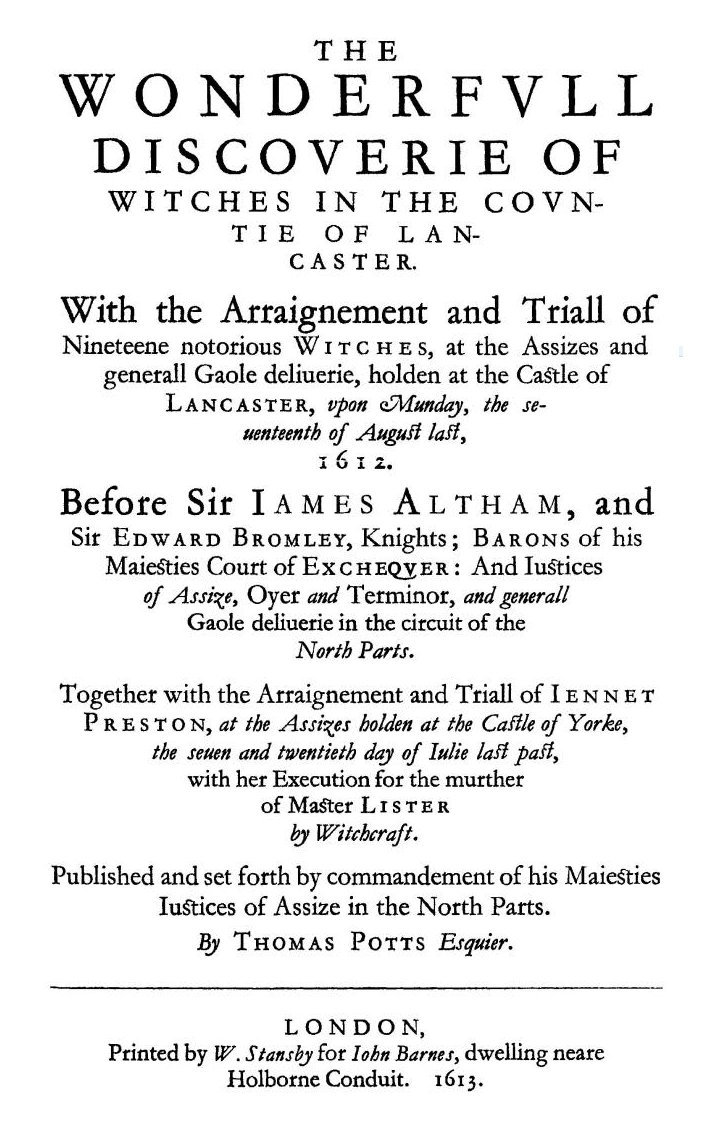
Title page of the original edition published in 1613

Almost everything that is known about the trials comes from a report of the proceedings written by Thomas Potts, the clerk to the Lancaster Assizes. Potts was instructed to write his account by the trial judges, and had completed the work by 16 November 1612, when he submitted it for review. Bromley revised and corrected the manuscript before its publication in 1613, declaring it to be “truly reported” and “fit and worthie to be published”.[66]

Although written as an apparently verbatim account, The Wonderfull Discoverie is not a report of what was actually said at the trial but is instead reflecting what happened.[67] Nevertheless, Potts “seems to give a generally trustworthy, although not comprehensive, account of an Assize witchcraft trial, provided that the reader is constantly aware of his use of written material instead of verbatim reports”.[68]

The trials took place not quite seven years after the Gunpowder Plot to blow up the Houses of Parliament in an attempt to kill King James and the Protestant aristocracy had been foiled. It was alleged that the Pendle witches had hatched their own gunpowder plot to blow up Lancaster Castle, although historian Stephen Pumfrey has suggested that the “preposterous scheme” was invented by the examining magistrates and simply agreed to by James Device in his witness statement.[69] It may therefore be significant that Potts dedicated The Wonderfull Discoverie to Thomas Knyvet and his wife Elizabeth; Knyvet was the man credited with apprehending Guy Fawkes and thus saving the king.[70]

Modern interpretation

It has been estimated that all the English witch trials between the early 15th and early 18th centuries resulted in fewer than 500 executions, so this one series of trials in July and August 1612 accounts for more than two per cent of that total.[71] Court records show that Lancashire was unusual in the north of England for the frequency of its witch trials. Neighbouring Cheshire, for instance, also suffered from economic problems and religious activists, but there only 47 people were indicted for causing harm by witchcraft between 1589 and 1675, of whom 11 were found guilty.[72]

Pendle was part of the parish of Whalley, an area covering 180 square miles (470 km2), too large to be effective in preaching and teaching the doctrines of the Church of England: both the survival of Catholicism and the upsurge of witchcraft in Lancashire have been attributed to its over-stretched parochial structure. Until its dissolution, the spiritual needs of the people of Pendle and surrounding districts had been served by nearby Whalley Abbey, but its closure in 1537 left a moral vacuum.[73]

Many of the allegations made in the Pendle witch trials resulted from members of the Demdike and Chattox families making accusations against each other. Historian John Swain has said that the outbreaks of witchcraft in and around Pendle demonstrate the extent to which people could make a living either by posing as a witch, or by accusing or threatening to accuse others of being a witch.[17] Although it is implicit in much of the literature on witchcraft that the accused were victims, often mentally or physically abnormal, for some at least, it may have been a trade like any other, albeit one with significant risks.[74] There may have been bad blood between the Demdike and Chattox families because they were in competition with each other, trying to make a living from healing, begging, and extortion.[22] The Demdikes are believed to have lived close to Newchurch in Pendle, and the Chattox family about 2 miles (3.2 km) away, near the village of Fence.[31]

Aftermath and legacy

Photograph

A “The Witch Way” Transdev in Burnley & Pendle bus

Altham continued with his judicial career until his death in 1617, and Bromley achieved his desired promotion to the Midlands Circuit in 1616. Potts was given the keepership of Skalme Park by James in 1615, to breed and train the king’s hounds. In 1618, he was given responsibility for “collecting the forfeitures on the laws concerning sewers, for twenty-one years”.[75] Having played her part in the deaths of her mother, brother, and sister, Jennet Device may eventually have found herself accused of witchcraft. A woman with that name was listed in a group of 20 tried at Lancaster Assizes on 24 March 1634, although it cannot be certain that it was the same Jennet Device.[76] The charge against her was the murder of Isabel Nutter, William Nutter’s wife.[77] In that series of trials the chief prosecution witness was a ten-year-old boy, Edmund Robinson. All but one of the accused were found guilty, but the judges refused to pass death sentences, deciding instead to refer the case to the king, Charles I. Under cross-examination in London, Robinson admitted that he had fabricated his evidence,[76] but even though four of the accused were eventually pardoned,[78] they all remained incarcerated in Lancaster Gaol, where it is likely that they died. An official record dated 22 August 1636 lists Jennet Device as one of those still held in the prison.[79] These later Lancashire witchcraft trials were the subject of a contemporary play written by Thomas Heywood and Richard Brome, The Late Lancashire Witches.[80]

In modern times the witches have become the inspiration for Pendle’s tourism and heritage industries, with local shops selling a variety of witch-motif gifts. Burnley‘s Moorhouse’s produces a beer called Pendle Witches Brew, and there is a Pendle Witch Trail running from Pendle Heritage Centre to Lancaster Castle, where the accused witches were held before their trial.[14] The X43 bus route run by Transdev in Burnley & Pendle has been branded The Witch Way, with some of the vehicles operating on it named after the witches in the trial.[81] Pendle Hill, which dominates the landscape of the area, continues to be associated with witchcraft, and hosts a hilltop gathering every Halloween.[82]

A petition was presented to UK Home Secretary Jack Straw in 1998 asking for the witches to be pardoned, but it was decided that their convictions should stand.[83] Ten years later another petition was organised in an attempt to obtain pardons for Chattox and Demdike. It followed the Swiss government’s pardon earlier that year of Anna Göldi, beheaded in 1782, thought to be the last person in Europe to be executed as a witch.[84]

Literary adaptations and other media

William Harrison Ainsworth, a Victorian novelist considered in his day the equal of Dickens,[85] wrote a romanticised account of the Pendle witches published in 1849. The Lancashire Witches is the only one of his 40 novels never to have been out of print.[85] The British writer Robert Neill dramatised the events of 1612 in his novel Mist over Pendle, first published in 1951. The writer and poet Blake Morrison treated the subject in his suite of poems Pendle Witches, published in 1996, and in 2011 poet Simon Armitage narrated a documentary on BBC Four, The Pendle Witch Child.[86]

2012 anniversary

Pendle Hill marked with the date 1612 on the 400th anniversary of the trials

Events to mark the 400th anniversary of the trials in 2012 included an exhibition, “A Wonderful Discoverie: Lancashire Witches 1612–2012”, at Gawthorpe Hall staged by Lancashire County Council.[87] The Fate of Chattox, a piece by David Lloyd-Mostyn for clarinet and piano, taking its theme from the events leading to Chattox’s demise, was performed by Aquilon at the Chorlton Arts Festival.[88]

A life-size statue of Alice Nutter, by sculptor David Palmer, was unveiled in her home village, Roughlee.[89] In August, a world record for the largest group dressed as witches was set by 482 people who walked up Pendle Hill, on which the date “1612” had been installed in 400-foot-tall numbers by artist Philippe Handford using horticultural fleece.[90] The Bishop of Burnley, the Rt Rev John Goddard, expressed concern about marking the anniversary on the side of the hill.[91]

Publications in 2012 inspired by the trials include two novellas, The Daylight Gate by Jeanette Winterson and Malkin Child by Livi Michael. Blake Morrison published a volume of poetry, A Discoverie of Witches.[92]

31st October – Deaths & Events in Northern Ireland Troubles

Key Events & Deaths on this day in Northern Ireland Troubles

 31st October

Looking through todays deaths and events two  things struck me and stood out .

  1. Was how many paramilitary members /associates were killed due to sectarian , internal and local feuds. Life was hard for everyone  during the Troubles , but  those that perpetrated the slaughter didn’t always get away scot free and many  paid the ultimate price for their part in Northern Ireland brutal, bloody  conflict.

Karma Always collects its debts

    2.     Two Children lost their lives and the deaths of children always saddens me and  makes me question if there really is a god?

———————————————————————————————————————————

Sunday 31 October 1971

A man died two days after being mortally wounded by a British soldier

A British soldier died three days after being mortally wounded by members of the Irish Republican Army (IRA) in Belfast. A man was found shot dead in Belfast.

The Irish Republican Army (IRA) exploded a bomb at the Post Office Tower in London.

[At the time part of the tower was open to members of the public and was a London tourist attraction. The public area was closed following the attack and did not reopen.]

—————————————————————————————————

Tuesday 31 October 1972

Benny’s Bar bombing

Paula Strong, Paula (6)
Clare Hughes (4)

Two Catholic children, aged 6 and 4 years, who were playing on the street were killed in a Ulster Freedom Fighters (UFF) car bomb attack on a bar in Ship Street, Belfast. Two other people were killed in separate incidents in Belfast.

Benny’s Bar bombing was a paramilitary attack on 31 October 1972 in Belfast, Northern Ireland. A unit of the Ulster Defence Association (UDA), a loyalist paramilitary group, detonated a no-warning car bomb outside the Irish Catholic-owned Benny’s Bar in the dockland area of Sailortown, killing two small girls who were celebrating Halloween outside. Twelve of the pub’s patrons were also injured.

Benny’s Bar bombing
Benny's bar.jpg

Benny’s Bar after the bombing
Location Benny’s Bar, Ship Street, Sailortown, Belfast,
Northern Ireland
Date 31 October 1972
Attack type
Car bombing
Deaths 2 Catholic civilians
Non-fatal injuries
12
Perpetrator Ulster Defence Association (UDA)

Lead-up to the attack

Since its foundation in September 1971, the UDA had killed over 30 Catholic civilians and attacked a number of Catholic-owned businesses. On 13 September 1972, UDA members opened-fire inside the Catholic-owned Divis Castle Bar on Springfield Road, Belfast. One Catholic civilian, the owner’s son, was killed.[1] On 5 October it detonated a bomb at another Belfast pub, the Capital Bar, killing a Protestant civilian.[2]

On the evening of Tuesday 31 October 1972 in Sailortown (a mixed Protestant and Catholic community beside Belfast Docks), a large group of local children in fancy dress were playing outside their houses near a bonfire in Ship Street to celebrate Halloween. Two small Catholic girls, Paula Strong (6) and Clare Hughes (4),[2] both dressed as witches, were approached by a white-haired man carrying a suitcase. He asked for directions to Benny’s Bar. After one of the girls gave him the directions, he gave her two pence and walked along Garmoyle Street to its junction with Ship Street, where the pub was located.[3] The two girls then went to the pub, knocked on the door and asked for pennies as a form of the traditional “trick-or-treating“.[4]

The explosion

The girls were in the vicinity of the Catholic-owned pub, which was full of patrons, when a maroon-coloured mini containing a 100 pounds (45 kg) bomb exploded outside the building’s Ship Street wall where it had been parked. No warning had been given.[3] Part of the building collapsed onto the customers inside, injuring 12 people. Flying glass and masonry was hurled out into the street, instantly killing Paula Strong and fatally injuring Clare Hughes. A local woman who came upon the bodies of the little girls described what she had seen: “They were just like bloody bundles of rags lying there”.[4]

The explosion took place only 20 yards (18 m) from the children’s bonfire, and the bomb had a very short fuse.[5] Houses and office buildings within a radius of several hundred yards suffered damage. The Strong family, who lived in the adjacent Marine Street felt the effects of the blast; Paula’s brother, Tony said that there was a massive explosion, the entire house shook and pictures fell off the walls.[6] Paula’s father, Gerry Strong, had gone to the pub to help dig out those buried beneath the rubble and found the body of his daughter on the pavement outside.[6] Clare Hughes’s brother Kevin had been playing near the bonfire when the bomb detonated. Their home was in Ship Street, facing the bonfire, and their mother immediately rushed to the scene and brought the gravely-wounded Clare into the house. She died shortly afterwards in hospital.[6]

The attack was the first major bombing in Northern Ireland for two weeks. With a total of 479 deaths—including those of the Bloody Sunday, Donegall Street, Springhill, Bloody Friday and Claudy atrocities—1972 was the bloodiest year of the 30-year ethno-political conflict known as the Troubles.[2]

Aftermath

Memorial plaque at St Joseph’s Church, Sailortown

The funerals of Paula Strong and Clare Hughes were conducted at the Roman Catholic St Joseph’s Chapel in Sailortown; many mourners lined the street and accompanied the coffins as they were carried inside the church.[3] The girls were buried in Milltown Cemetery.

The bombing had been carried out by a unit of the Ulster Defence Association (UDA), which was the largest loyalist paramilitary organisation in Northern Ireland and which was legal at the time.[2][7] Benny’s Bar was targeted by the UDA as it was believed to have been an Irish republican drinking den.[5] The three men who had driven the carbomb to the pub pleaded guilty to the murders. It emerged during the trial that one of the bombers had worked with Paula Strong’s father at the docks.[6]

The UDA continued attacking pubs owned or frequented by members of the Irish Catholic and nationalist community. Less than two months after the bombing, on 20 December, the UDA launched a gun attack on another Catholic-owned pub in Derry. That attack killed five Catholic civilians.[8]

Benny’s pub and the houses in Ship Street have since been torn down, leaving a small section of the street near the Garmoyle Street intersection extant. This is now an industrial zone. Ship Street and most of Sailortown was demolished to build the M2 motorway. There is a memorial plaque on an outside wall beneath a stained glass window at St Joseph’s Chapel commemorating Paula Strong and Clare Hughes.

—————————————————————————————————


Wednesday 31 October 1973

Séamus Twomey

The Irish Republican Army (IRA) use a hijacked helicopter to free three of their members from the exercise yard of Mountjoy Prison, Dublin. On of those who escaped was Séamus Twomey, then Chief of Staff of the IRA.

[Twomey was recaptured in December 1977.]


Friday 31 October 1975

Thomas Berry (27), then a member of the Official Irish Republican Army (OIRA), was shot dead by the Provisional IRA (PIRA) outside Sean Martin’s Gaelic Athletic Association (GAA) Club in the Short Strand, Belfast.

Seamus McCusker, a senior member of Provisional Sinn Féin (SF), was shot dead by the Official Irish Republican Army (OIRA) on the New Lodge Road, Belfast.

Both these killings were part of the continuing feud between the two wings of the IRA.

Columba McVeigh was abducted and became one of the ‘disappeared‘.

Columba McVeigh

[He is believed to have been killed by the IRA. His body has not been recovered.]

See The Disappeared for more info on Columba McVeigh

Friday 31 October 1980

Wednesday 31 October 1990

Peter Brooke, then Secretary of State for Northern Ireland, announced that the talks initiative was ‘on hold’. The Fianna Fáil (FF) and Progressive Democrat (PD) coalition Government in the Republic of Ireland survived a vote of no confidence following the sacking of Brian Lenihan, then deputy leader of FF.

Saturday 31 October 1992

The Irish Republican Army (IRA) shot and killed Samuel Ward (30) who was a member of the ‘Belfast Brigade’ of the Irish People’s Liberation Organisation (IPLO).

The IRA also injured a further eight members of the IPLO.

[Following this action the ‘Belfast Brigade’ announced on 3 November 1992 that it would disband. A similar decision was announced by the Army Council faction of the IPLO based in Dublin on 7 November 1992.]

Tuesday 31 October 1995

Michael Ancram

Michael Ancram, then Political Development Minister at the Northern Ireland Office (NIO), held a three hour meeting with representatives of Sinn Féin (SF).

[Further discussions were to be held until 3 November 1995 when they ended over disagreements on the issue of decommissioning of Irish Republican Army (IRA) weapons.]

Saturday 31 October 1998

Deadline for Formation of Executive

The deadline was missed for the formation of the Executive Committee of the Northern Ireland Assembly, and the North-South Ministerial Body. The main reasons for the failure to implement the Good Friday Agreement were to do with disagreements on the issue of decommissioning. Brain Service (35), a Catholic civilian, was shot dead by Loyalists after he left his brother’s house in north Belfast. Service was a single man from Ardoyne in Belfast.

[The Red Hand Defenders (RHD) later claimed responsibility for the killing. The RHD were a new Loyalist paramilitary grouping comprising dissent Loyalists opposed to the Good Friday Agreement and opposed to the ceasefires of the main Loyalist paramilitary organisations.]

In a joint statement the First, and Deputy First, Ministers pledged that the killing would not derail the peace process.

Sunday 31 October 1999

Michael Oatley

Michael Oatley, a former MI6 officer, wrote an article for the Sunday Times (a London based newspaper) in which he accused politicians in Northern Ireland and Britain of using the issue of the decommissioning of Irish Republican Army (IRA) weapons as an “excuse to avoid the pursuit of peace”

. [While involved in secret talks in Northern Ireland Oatley had been codenamed the ‘mountain climber’. He had been involved in secret talks during the hunger strikes and during the period 1990-1993.]

Tuesday 31 October 2000

Bertie Rice (63), an election worker for the Progressive Unionist Party (PUP), was shot in the chest at his home in Canning Street in north Belfast. He died later in hospital. The Ulster Defence Association (UDA) was blamed for this killing.

Later in the day, Tommy English (40), a former Ulster Democratic Party (UDP) politician, was shot dead at his home in Ballyfore Gardens in Newtownabbey, County Antrim. Loyalist sources said this was in retaliation for Bertie Rice’s death, and blamed the Ulster Volunteer Force (UVF) for the killing. The killings were part of a feud between the UDA and the UVF.

Wednesday 31 October 2001

Loyalist paramilitaries fired several shots at a Catholic taxi-driver who had gone to a house on the edge of the Loyalist Mourneview Estate, Lurgan, County Armagh. Several bullets struck the car. Royal Ulster Constabulary (RUC) officers said they were treating the attack as “attempted murder”.

[The attack may have been carried out by the Loyalist Volunteer Force (LVF).]

A Catholic woman was injured when Loyalist paramilitaries threw a pipe-bomb at her home in Newington Street, north Belfast. The bomb exploded at the back of the house breaking all the windows at the rear of the three-storey house. The woman was treated for cuts.

Loyalist paramilitaries carried out a ‘punishment’ shooting on two men (both in their 30s) in a field at Ballyreagh Road, Newtownards, County Down. One was shot in both knees and the other was shot in one leg. Both were treated in hospital.

A man (41) is due to appear in court in Belfast charged with ‘riotous behaviour’ following disturbances in the Duncairn Gardens, Belfast, on Tuesday 30 October 2001.

Peter Weir and Pauline Armitage, both Ulster Unionist Party (UUP) then Members of the Legislative Assembly (MLAs) opposed to the Good Friday Agreement, held a meeting with the Independent International Commission on Decommissioning (IICD). The two were seeking assurances that the Irish Republican Army (IRA) decommissioning initiative was both substantial and part of a continuing process.

[Both MLAs have stated that at present they do not intend to vote on Friday 2 November 2001 for David Trimble, then leader of the Ulster Unionist Party (UUP), as First Minister.]

—————————————————————————-


———————————————————————————

Remembering all innocent victims of the Troubles

Today is the anniversary of the death of the following  people killed as a results of the conflict in Northern Ireland

“To live in hearts we leave behind is not to die

– Thomas Campbell

To the innocent on the list – Your memory will live  forever

– To  the Paramilitaries  –

There are many things worth living for, a few things worth dying for, but nothing worth killing for.

  15  People lost their lives on the 31st October  between 1971 – 2000

————————————————————

31 October 1971


John Copeland,   (23)

Catholic
Status: Civilian (Civ),

Killed by: British Army (BA)
Died two days after being shot near his home, Strathroy Park, Ardoyne, Belfast.

————————————————————

31 October 1971
Ian Doherty,   (27)

nfNI
Status: British Army (BA),

Killed by: Irish Republican Army (IRA)
Died three days after being shot while on British Army (BA) mobile patrol, Stockman’s Lane, Belfast.

————————————————————

31 October 1971
Thomas Kells   (19)

Protestant
Status: Civilian (Civ),

Killed by: not known (nk)
Found shot by the side of Flowbog Road, Dundrod, near Belfast, County Antrim.

————————————————————

31 October 1972
James Kerr,   (17)

Catholic
Status: Civilian (Civ),

Killed by: Red Hand Commando (RHC)
Shot at his workplace, garage, Lisburn Road, Belfast.

————————————————————

31 October 1972
Richard Sinclair,  (19)

nfNI
Status: British Army (BA),

Killed by: Irish Republican Army (IRA)
Shot by sniper while on British Army (BA) foot patrol, Antrim Road, New Lodge, Belfast.

————————————————————

31 October 1972

Paula Strong,  (6)

Catholic
Status: Civilian (Civ),

Killed by: Ulster Defence Association (UDA)
Killed when car bomb exploded outside Benny’s Bar, corner of Garmoyle Street and Ship Street, Belfast.

————————————————————

31 October 1972


Clare Hughes,   (4)

Catholic
Status: Civilian (Civ),

Killed by: Ulster Defence Association (UDA)
Killed when car bomb exploded outside Benny’s Bar, corner of Garmoyle Street and Ship Street, Belfast.

————————————————————


Thomas Berry,   (27)

Catholic
Status: Official Irish Republican Army (OIRA),

Killed by: Irish Republican Army (IRA)
Shot outside Sean Martin’s Gaelic Athletic Association Club, Beechfield Street, Short Strand, Belfast. Official Irish Republican Army (OIRA) / Irish Republican Army (IRA) feud.

————————————————————

31 October 1975


Seamus McCusker,   (40)

Catholic
Status: Irish Republican Army (IRA),

Killed by: Official Irish Republican Army (OIRA)
Shot as he walked along New Lodge Road, Belfast. Official Irish Republican Army (OIRA) / Irish Republican Army (IRA) feud.

————————————————————

31 October 1975


Columba McVeigh,  (17)

Catholic
Status: Civilian (Civ),

Killed by: Irish Republican Army (IRA)
Abducted in the Donaghmore / Dungannon area of County Tyrone. Presumed killed. Body never recovered. Alleged informer.

————————————————————

31 October 1984


Harry Muldoon  (45)

Catholic
Status: Civilian (Civ),

Killed by: Ulster Volunteer Force (UVF)
Shot at his home, Mountainview Drive, off Crumlin Road, Belfast.

————————————————————

31 October 1992
Samuel Ward,  (30)

Catholic
Status: Irish People’s Liberation Organisation Belfast Brigade (IPLOBB),

Killed by: Irish Republican Army (IRA)
Shot while inside Sean Martin Gaelic Athletic Association Club, Beechfield Street, Short Strand, Belfast.

————————————————————

31 October 1998


Brian Service,  (35)

Catholic
Status: Civilian (Civ),

Killed by: Red Hand Defenders (RHD)
Shot while walking along Alliance Avenue, Ardoyne, Belfast.

————————————————————

31 October 2000


Herbert Rice,  (63)

Protestant
Status: Civilian Political Activist (CivPA),

Killed by: Ulster Defence Association (UDA)
Progressive Unionist Party (PUP) member. Shot at his home, Canning Street, Tigers Bay, Belfast. Ulster Defence Association (UDA) / Ulster Volunteer Force (UVF) feud.

————————————————————

31 October 2000


Tommy English,   (40)

Protestant
Status: Ulster Defence Association (UDA),

Killed by: Ulster Volunteer Force (UVF)
Shot at his home, Ballyfore Gardens, Ballyduff, Newtownabbey, County Antrim. Ulster Defence Association (UDA) / Ulster Volunteer Force (UVF) feud.

See Below for more info on Tommy English

————————————————————

Tommy English

Tommy English (loyalist)

Thomas English (1960 – 31 October 2000), usually known as Tommy English, was an Ulster loyalist paramilitary and politician. He served as a commander in the Ulster Defence Association (UDA) and was killed by members of the Ulster Volunteer Force (UVF) as part of a violent loyalist feud between the two organisations. English had also been noted as a leading figure in the Ulster Democratic Party (UDP) during the early years of the Northern Ireland peace process.

Ulster Defence Association

From an early age, English was involved in the North Belfast Brigade of the Ulster Defence Association (UDA), a loyalist paramilitary group. After his death, the Belfast Telegraph described him as a “UDA commander”,[1] while the BBC described him as a “paramilitary chief”.[2]

English also became involved in the political wing of the movement, the Ulster Democratic Party (UDP), becoming its Chairman.[3] He stood for the UDP in North Belfast in the 1996 Northern Ireland Forum election, and was also placed eighth on the party’s top-up list, but he was not elected.[4][5] He was active on behalf of the party in the discussions which led to the Good Friday Agreement.[6] A noted critic of the Democratic Unionist Party (DUP) during his political career, English gained notoriety for an appearance at a UDA rally in the Ulster Hall in Belfast when he took to the stage wearing an Ian Paisley mask and a clerical dog collar and proceeded to lampoon the DUP leader.[7] He was a regular visitor to conferences and events at the Glencree Centre for Peace and Reconciliation and was close to Republic of Ireland peace activists Paul Burton and Chris Hudson, visiting the site of the Battle of the Somme with them in 1999.[7] On St Patrick’s Day 1998 he met President of the USA Bill Clinton in Washington DC as part of the UDP delegation visiting the US capital.[8] He hit the headlines in 1997 when he was given a bravery award after breaking down the front door of a burning house and bringing the occupier out to safety.[8]

Alongside his political activism he remained involved in the paramilitary side of the UDA and played a leading role in orchestrating riots at two interface areas in north Belfast i.e. the Limestone Road – which divides Catholic Newington and Protestant Tigers Bay – and the Whitewell Road.[7] English and his family lived in Tiger’s Bay before moving to Newtownabbey at an unspecified period so as to “give our kids a chance so they could have a decent life” according to his wife Doreen.[8]

English left the UDP in 1998 after making a public statement against the Orange Order at a time when the party was widely supporting them in their attempts to march in Catholic areas.[8] English also claimed that he had been the subject of allegations about misappropriating money in the UDA and stated that, whilst the allegations were not widely believed by the group’s leadership, worries about them had led him to attempt suicide and seek treatment in a psychiatric hospital.[8]

In 1999, he was arrested on suspicion of headbutting and kicking a patron of the Crows Nest bar, having allegedly arrived with three associates armed with baseball bats, breaking glasses along the bar.[6] The case was still outstanding, with English awaiting charges, at the time of his death.[8]

Killing

UDA South East Antrim Brigade mural close to English’s home in Ballyduff

On 31 October 2000, English was fatally shot at his home in Ballyfore Gardens, on the Ballyduff estate in Newtownabbey, by a group of four men. His three children were inside the house at about 18.30 when the men entered through the back door as his wife, Doreen was preparing food for a Halloween party. She called out to her husband and attempted to close the door but they pushed past her, one of the men shouting “Get out of the fucking way, Doreen”. She kept trying to intervene in an effort to protect English, but she received several hard blows, mostly in the head, and her skull was fractured. English was shot several times as he lay face down in the hallway of his home; the last shot struck him in the lower back. He was rushed to Belfast’s Royal Victoria Hospital where he died shortly afterwards.[9]

The murder was blamed on the Ulster Volunteer Force (UVF), who at the time were involved in a violent dispute with the UDA.[10] At his funeral, his coffin was covered in UDA flags, and it was accompanied by men in paramilitary uniforms.[11] Among the mourners was a member of the UVF who was closely related to English.[8] Sympathy notices placed in the local press at the time included one from Johnny Adair, who described English as a “good and faithful servant”.[8]

English’s murder was said to have been in retaliation for the killing of UVF veteran Bertie Rice earlier that same day.[12] The UDA killed Mark Quail, a 26-year-old UVF member, at his Rathcoole home in retaliation on the following day, with Quail the seventh and final man killed as part of the loyalist feud.[12] David “Candy” Greer, a UDA member killed in the feud three days before English, had been a close friend from English’s days in Tiger’s Bay.[8] English had initially been described in press reports as a relative of UDP colleague and former South East Antrim brigadier Joe English although this was later corrected as the two were not related.[13]

Ten men were put on trial for the murder of English, including UVF North Belfast commander Mark Haddock. However, nine were acquitted of all charges, while the tenth was convicted only of “possessing items intended for terrorism”.[14] Following the acquittals, his widow announced that she would be suing police for allegedly failing to take action against an informant who was involved in a number of UVF murders in north Belfast.[15]

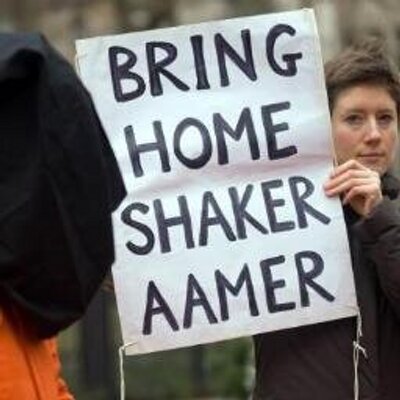
Shaker Aamer – Prisoner Number 239

Shaker Aamer: Last UK Guantanamo Bay detainee released

———————————————————————————————-

Shaker Aamer Released From Guantanamo Bay Jail

———————————————————————————————-

Guantanamo Bay prison
Shaker Aamer was detained at Guantanamo for 13 years

The last British resident to be held in Guantanamo Bay has been released, having been detained there for 13 years, the foreign secretary has said.

Philip Hammond said Shaker Aamer had left the US military base in Cuba and will return to the UK “later today”.

Shaker Aamer's file

The Saudi national, 48, whose family live in London, has never been charged.

Campaigners say his release was “long overdue”, while a Downing Street spokeswoman said any necessary security measures “will be put in place”.

Number 10 said Prime Minister David Cameron “welcomes” the release of Mr Aamer, who has four children and has permission to live in the UK indefinitely because his wife is British.

Mr Aamer’s father-in-law, Saeed Siddique, said his release was a “miracle”.

A plane carrying Mr Aamer is expected to land at London’s Biggin Hill airport at around 13:00 GMT.

‘Areas of concern’

Downing Street said there were “no plans” to detain him after his arrival.

US authorities first held Mr Aamer in Afghanistan in 2001, alleging he had led a unit of Taliban fighters and had met former al-Qaeda leader Osama Bin Laden.

However, Mr Aamer maintains he was in Afghanistan with his family doing charity work.

Andy Worthington, co-director of the We Stand With Shaker campaign, said Mr Aamer, who is reported to have health problems, will require “psychological and medical care” when he returns to his family in London.

In letters sent to the BBC by his lawyers earlier this month, Mr Aamer described himself as “an old car that has not been to the garage for years”, saying the first thing he wanted once freed was a cup of coffee.

“I have known nothing about the real world for more than 13 years,” he wrote.

see BBC News for full story

———————————————————————————————————–

Shaker Aamer

Shaker Aamer (born 21 December 1966)[1] is a Saudi citizen released on 30 October 2015 from almost 14 years in the Guantanamo Bay detention camps in Cuba.[2] He was seized in Afghanistan by bounty hunters who handed him over to US forces in December 2001. Two months later, the US rendered Aamer to the Guantánamo camp; he has been held there without trial or charge since then.[3][4][5][6] Aamer had been legally resident in Britain for years before his imprisonment; the UK government has repeatedly demanded his release, and many people there have called for him to be released.[7][8]

According to documents published in the Guantanamo Bay files leak, the US military Joint Task Force Guantanamo believed that Aamer had led a unit of fighters in Afghanistan, including the Battle of Tora Bora, while his family was paid a stipend by Osama bin Laden. The file asserts past associations with Richard Reid and Zacarias Moussaoui.[7][8] Aamer denies being involved in terrorist activity and his lawyer, Clive Stafford Smith, said the leaked documents would not stand up in court. He claimed that part of the evidence comes from an unreliable witness and that confessions Aamer made had been obtained through torture.[9][10] Aamer’s father-in-law, Saaed Ahmed Siddique, said: “All of these claims have no basis. If any of this was true he would be in a court now.”[11] The Bush administration acknowledged later that it had no evidence against Aamer.[12]

Aamer has never been charged with any wrongdoing, was never on trial, and his lawyer says he is “totally innocent.”[13][14] He was approved for transfer to Saudi Arabia by the Bush administration in 2007 and the Obama administration in 2009.[15][14] He has been described as a “charismatic leader” who spoke up and fought for the rights of fellow prisoners. Aamer says that he has been subject to torture while in detention.[16] Campaigners allege that the US is refusing to release Aamer because it feared he would expose torture inside the Guantanamo prison.[17]

Aamer’s mental and physical health has been declining over the years, as he has participated in hunger strikes to protest detention condition and been held in solitary confinement much of the time. He claims to have lost 40 per cent of his body weight in captivity, but did not state his weight.[18][19][20] After a visit in November, 2011, his lawyer said, “I do not think it is stretching matters to say that he is gradually dying in Guantanamo Bay.”[21] In 2015, despite Aamer’s deteriorating health, the US denied a request for an independent medical examination.[22] On 25 September 2015 the US government announced that Aamer would be released back to the UK within the following thirty days.[23] He was released to the UK on 30 October 2015.[24]

Shaker Aamer
ISN 00239, Shaker Aamer.jpg

Aamer in Guantanamo (photo taken before 1 November 2007)
Born (1966-12-21) 21 December 1966 (age 48)
Medina, Saudi Arabia
Detained at Kandahar, Bagram and Guantánamo
ISN 239
Charge(s) None
Penalty None
Status Released from Guantanamp Bay on 30 October 2015 after 13 years, despite being cleared for release by two US presidents in 2007 and in 2009
Spouse Zin Siddique
Children Four children

Family and personal life

Aamer was born on 12 December 1968 and grew up in Medina in Saudi Arabia. He left the country at the age of 17. He lived and traveled in the United States, Europe and the Middle East.[25] Aamer lived and studied in Georgia and Maryland in 1989 and 1990 and during the Gulf War, he worked as a translator for the U.S. Army.[26]

He moved to the United Kingdom in 1996 where he met Zin Siddique, a British woman; they married in 1997 and have four British children. Aamer has never met his youngest son Faris, who was born after he was imprisoned.[27] Aamer had indefinite leave to remain in the UK, and was applying for British citizenship.[23]

Aamer worked as an Arabic translator for London law firms. Some of the solicitors he worked for dealt with immigration cases. In his spare time, Aamer helped refugees find accommodation and offered them advice on their struggles with the Home Office.[25]

Aamer’s family now live in Battersea, South London. His wife Zin Aamer has suffered from depression and mental episodes since his arrest.[20][28][29] Saeed Siddique, Aamer’s father-in-law, said in 2011, “When he was captured, Shaker offered to let my daughter divorce him, but she said, ‘No, I will wait for you.’ She is still waiting.”[30]

Capture and allegations

Aamer with daughter, Johnina (left), and son Michael (photo taken before his capture in 2001, released by his lawyer)

Aamer took his family to Afghanistan in 2001 where he was working for an Islamic charity. He was working for the charity when the U.S. invaded the country later that year.[27] The Northern Alliance took him into custody in Jalalabad on 24 November 2001, and passed him to the Americans. The US routinely paid ransom for Arabs handed over to them.[26] They interrogated Aamer at Bagram Theater Internment Facility and transported him to Guantánamo on 14 February 2002.

According to Joint Task Force Guantanamo assessments from 1 November 2007 the US military believed that Aamer was a “recruiter, financier, and facilitator” for al-Qaeda, based partly on evidence given by the informant Yasim Muhammed Basardah, a fellow detainee.[11] The leaked documents alleged that Aamer had confessed to interrogators that he was in Tora Bora with Osama bin Laden at the time of the US bombing.[8] The documents further note that the Saudi intelligence Mabahith identified Aamer “as a high priority for the government of Saudi Arabia, an indication of his law enforcement value to them.”[31]

In 2010 the Guantanamo Review Task Force released their report of the detainee assessments. In many instances, the Task Force largely agreed with prior threat assessments of the detainees and sometimes found additional information that further substantiated such assessments. In other instances, the Task Force found prior assessments to be overstated. Some assessments, for example, contained allegations that were not supported by the underlying source document upon which they relied. Other assessments contained conclusions that were stated categorically even though derived from uncorroborated statements or raw intelligence reporting of undetermined or questionable reliability. Conversely, in a few cases, the Task Force discovered reliable information indicating that a detainee posed a greater threat in some respects than prior assessments suggested.[32]

Aamer denies being involved in terrorist activity[33] and his attorney, Clive Stafford Smith of Reprieve, said the evidence against his client “would not stand up in court.” He pointed out that part of the evidence comes from Yasim Muhammed Basardah, whom American judges found to be “utterly incredible” and who was tortured and “promised all sorts of things.”[11]

The Bush administration acknowledged later that it had no evidence against Aamer, and he was cleared for transfer in 2007. [12][14] The clearance is for transfer to Saudi Arabia only.[15]

Aamer’s allegations of being tortured in Bagram

In September 2009, Zachary Katznelson, a Reprieve lawyer, said that Aamer had told of suffering severe beatings at the Bagram facility. Aamer said that close to a dozen men had beaten him, including interrogators who represented themselves as officers of MI5, the United Kingdom’s internal counter-terrorism agency. Following one severe beating, he recovered from being stunned to find that all the interrogators had left the room and put a pistol on the table.[34] He did not find out if the pistol was loaded. He said it occurred to him that it had been left either so he could kill himself, or that, if he picked it up, he could be shot and killed on the excuse he was trying to shoot them.[34]

Aamer says that the “MI5” interrogators told him he had two choices: (1) agree to spy on suspected jihadists in the United Kingdom; or (2) remain in US custody.[34] He said that guards/agents repeatedly knocked his head against the wall while an MI5 officer was in the room.

“All I know is that I felt someone grab my head and start beating my head into the back wall – so hard that my head was bouncing. And they were shouting that they would kill me or I would die.”[35]

Other former detainees have alleged similar mistreatment by MI5 and MI6 agents, including torture.[9][36] They filed suit against the British government over their mistreatment and torture. In November 2010, the British government settled the suit, paying the detainees millions of pounds in compensation.[37][38][39][40] Aamer is also on the compensation list and part of the deal, but details are not known as most of the deal is still secret.[41][42]

Guantanamo

Aamer has been described as an unofficial spokesman for the detainees at Guantanamo. He has spoken up for the welfare of prisoners, negotiating with camp commanders and organizing protests against cruel treatment. He organized and participated in a hunger strike in 2005 in which he lost half of his weight. He demanded the prisoners be treated according to the Geneva Convention, allowing the detainees to form a grievance committee. In negotiations, the camp administration promised a healthier diet for the prisoners after he agreed to end the hunger strike.[25][43] His lawyer Stafford Smith said the grievance committee was formed, but that the camp authorities disbanded it after a few days. American spokesmen Major Jeffrey Weir denied that the Americans had ever agreed to any conditions resulting from the hunger strike.

Since then, Aamer has been taking part in further hunger strikes. He has been held in solitary confinement for most of the time. His lawyers describe his solitary confinement as “cruel” and said his health has been affected to a point where they feared for his life. Stafford Smith said Aamer is “falling apart at the seams.”[21][25][44][45]

Given the time involved, the lengthy spells in solitary confinement and the torture allegedly used against him, Shaker Aamer’s plight has been one of the worst of all the detainees held at Guantanamo.

On 18 September 2006, Aamer’s attorneys filed a 16-page motion arguing for his removal from isolation in Guantanamo Bay prison.[47] The motion alleges that Aamer had been held in solitary confinement for 360 days at the time of filing, and was tortured by beatings, exposure to temperature extremes, and sleep deprivation, which together caused him to suffer to the point of becoming mentally unbalanced. The next day Katznelson filed a motion to enforce the Geneva Conventions on his behalf.[48]

In September 2011, Aamer’s lawyer Brent Mickum, who saw him in Guantánamo, alleges that Aamer was repeatedly beaten before their meetings. He said that Aamer’s mental and physical health is deteriorating. “It felt like he has given up: that’s what 10 years, mostly in solitary confinement will do to a person,” he said.[49]

Binyam Mohamed, an Ethiopian prisoner who formerly occupied a cell one door down from Aamer, has said since his release that he knows why Aamer is still in the prison camps.[25]

“I would say the Americans are trying to keep him as silent as they could. It’s not that he has anything. What happened in 2005 and 2006 is something that the Americans don’t want the world to know – hunger strikes, and all the events that took place, until the three brothers who died … insider information of all the events, probably. Obviously, Shaker doesn’t have it, but the Americans think he may have some of it, and they don’t like this kind of information being released.”

Clive Stafford Smith, his lawyer and director of human rights organisation Reprieve, comes to a similar conclusion. He said:[50]

“I have known Shaker for some time, because he is so eloquent and outspoken about the injustices of Guantanamo he is very definitely viewed as a threat by the US. Not in the sense of being an extremist but in the sense of being someone who can rather eloquently criticise the nightmare that happened there.”

Omar Deghayes, a former Guantanamo Detainee who knew Aamer, said of him,

“He was always forward, he would translate for people, he’d fight for them, and if he had any problems in the block he’d shout at the guards… until he would get you your rights. And that’s why he’s still in prison… because he’s very outspoken, a very intelligent person, somebody who would fight for somebody else’s rights.” [51]

At Camp “No” on June 2006

Aamer said that he was beaten for hours and subjected to interrogation methods that included asphyxiation on 9 June 2006, the same day that three fellow prisoners died in Guantanamo. Describing the event, Aamer said that he was strapped to a chair, fully restrained at the head, arms and legs. When MPs pressed on pressure points all over his body: his temples, just under his jawline, in the hollow beneath his ears. They bent his nose repeatedly, pinched his thighs and feet. They inflicted pain to his eyes, bent his fingers until he screamed and then they cut off his airway and put a mask over him, so he could not cry out.[52][53]

Please torture me in the old way … Here they destroy people mentally and physically without leaving marks.

Aamer in a letter to The Independent[18]

The law professor Scott Horton published an award-winning article in Harper’s Magazine in 2010. He said that Aamer had been brought to “Camp No,” a secret interrogation black site outside the camp, with the three men who died on the day of the event. Horton described Aamer’s account of having his airways cut off as “alarming” and wrote, “This is the same technique that appears to have been used on the three deceased prisoners.”[52][53] Colonel Michael Bumgarner, the commander of the camps during the incident and identified in Horton’s article as having been present during the interrogations, denied Horton’s claims.[54]

Horton wrote that Aamer’s repatriation was being delayed so that he could not testify about his alleged torture in Bagram or the events on 9 June 2006. He wrote: “American authorities may be concerned that Aamer, if released, could provide evidence against them in criminal investigations.”[52][53]

2013 hunger strike and detention condition

In 2013, Aamer told his attorneys that he is among the growing group of active hunger strikers. He said he has been refusing meals since February 15 and has lost 32 pounds.[26] In previous hunger strikes guards force-fed him with tubes down his nose.[26] His lawyer said Aamer spends 22 hours a day alone in his cell.[26] Aamer is not permitted visitors except his attorneys.[26]

2014 motion for release

In 2014, his lawyers filed a motion on Aamer’s behalf seeking his release on the grounds that his health is “gravely diminished,”. They argue that his various health problems cannot be treated in Guantanamo and “Even if he receives the intensive medical and therapeutic treatment his condition requires, Mr Aamer will take many years, if not a lifetime, to achieve any significant recovery,”. His lawyers argue that both the Geneva Convention and Army Regulation 190-8, requiring the repatriation of chronically ill prisoners.[55][56][57] In 2015 despite Aamer’s deteriorating health the US denied a request for an independent medical examination.[22]

UK release negotiations

The United Kingdom government initially refused to intervene on the behalf of Guantánamo detainees who were legal British residents without being British citizens. In August 2007, Foreign Secretary David Miliband requested the release of Aamer and four other men, based on their having been granted refugee status, or similar leave, to remain in Britain as residents prior to their capture by US forces.[27][43][58][59] With the repatriation of Binyam Mohammed in February 2009, all British citizens and residents other than Aamer had been released.[60][61][62]

The UK government officials have repeatedly raised Aamer’s case with the Americans. On a visit to the United States on 13 March 2009, when asked about Guantánamo captives, Home Secretary Jacqui Smith said that the US administration has said they do not want to return Aamer to the UK William Hague, the Foreign Secretary, raised Aamer’s case again with Hillary Clinton, US Secretary of State, in November 2010,[63] followed by meetings with other US officials. At the time, the US government had reached settlement with former detainees as a resolution for damages due to the use of torture in interrogation.[63]

In September 2011, Foreign Office Minister Alistair Burt said that negotiations are ongoing and confidential.[64] Supporters of Aamer have criticized the UK government for not doing enough on his behalf; they urged the government to step up their efforts.[14] In January 2012, The Independent revealed that the British government has spent £274,345 fighting in court to prevent Aamer’s lawyers from gaining access to evidence which may prove his innocence.[18] The newspaper reported that Aamer has several serious medical complaints from years of “inhumane” detention conditions, and that the UK gave false hope to his family.[44]

Calls for his release

  • September 2006, Aamer’s attorneys filed a 16-page motion arguing for his removal from isolation in Guantanamo Bay prison.[65]
  • In January 2010, his 12-year-old daughter Johina wrote a letter to Gordon Brown asking for his release.[28][65]
  • August, 2010, protesters disrupted a meeting that discussed plans to create a US Embassy near Battersea, the home of Aamer.[65][66]
  • On 11 December 2010, hundreds took to the streets in London near the US embassy to demand Aamer’s release.[65][67]
  • In February 2011, Amnesty International called Aamer’s ongoing incarceration a “mockery of justice” and denounced the “cruel limbo” he had been left in.[65][68] At the same time The Guardian reported that people had sent 12.000 emails to US Secretary of State Hillary Clinton and UK MPs in support of Aamer.[65][69]
  • In her 2011 album In The Current Climate, singer-songwriter Sarah Gillespie sang an imaginary first person song of Aamer entitled How The West was Won. Gillespie devoted the track to Aamer in the CD booklet.[70]
  • In May 2011, Students of University of St Andrews protested for the release of Aamer.[65][71]
  • In early 2012, approaching Aamer’s completion of ten years’ imprisonment in Guantánamo, campaigners stepped up efforts for his release. Among them, Jane Ellison, Tory MP for Battersea, wrote to Barack Obama to urge Aamer’s release.[65][72]
  • February 2012, marking the 10th anniversary of Aamer’s detention, a series of protests took place in England whilst a hunger strike was undertaken in Guantanamo.[65]
  • In December 2012, the comedian Frankie Boyle donated £50,000 to Aamer’s legal fund for suits against MI6.[73]
  • By April 2013, 117,384 British citizen or UK residents had signed an online petition e-petitions to pressure the UK Government for Aamer’s release.[74]
  • In July 2013, Clive Stafford-Smith, Frankie Boyle and Julie Christie went on a sequential hunger strike in support of Shaker Aamer and his release.[75][76]
  • In August 2013 the singer PJ Harvey released the song Shaker Aamer describing Aamer’s plight being force fed in restraining chairs and shackles during a month-long hunger strike.[77]
  • In March 2015 British lawmaker John McDonnell said “The case of Shaker Aamer is one of the worst cases of a miscarriage of justice in the last three decades at least … He has endured harsh, and brutal and inhuman treatment,” in a debate where members of all major political parties called for Aamer’s release.[78]
  • On July 4, 2015 (US Independence Day) 80 prominent Britons including six former cabinet ministers, leading writers, actors, directors and musicians urge Obama to free Aamer.[3]

Marine A – Parliament debated the petition you signed

Royal Marine Sergeant Alexander Wayne BlackmanSgt Alexander Blackman, of Taunton, was found guilty of murder at a court martial in November 2013 for murdering an insurgent in Afghanistan.

See Marine A & Join the campaign to free him

Dear John ,

Parliament debated the petition you signed – “Free Sergeant Alexander Blackman”

Watch the debate: http://parliamentlive.tv/Event/Index/3f66da89-fb5b-4720-8977-c6e50661f8a1

Read the transcript: http://www.publications.parliament.uk/pa/cm201516/cmhansrd/cm150916/halltext/150916h0001.htm#15091640000001

Thanks,
The Petitions team
UK Government and Parliament

Westminster Hall

Read the transcript:

Wednesday 16 September 2015

[Sir Roger Gale in the Chair]

Midland Main Line (Electrification)

9.30 am

Harry Harpham (Sheffield, Brightside and Hillsborough) (Lab): I beg to move,

That this House has considered electrification of the Midland Main Line.

There is no doubting the critical need for the country to keep its rail network up to date. Over the past 20 years, passenger numbers have doubled. Between 1997 and 2010, the number of inter-city trains went up from 580 per day to 1,228 per day. Current growth in use stands at 4%, and total movement of freight by rail is rising by 2.5% per year. With demand growing as it is, it is entirely understandable that there is cross-party consensus on the need for bold and ambitious upgrade works.

On the midland main line specifically, Leicester, Nottingham and Derby are all experiencing passenger growth at rates above the national average, and demand for rail in the east midlands as a whole is expected to rise by 16% by 2019. Coupled with that is the chronic lack of investment in the line over the past two decades when compared with other routes.

From anyone’s perspective, electrification is the next logical step for the rail network. Compared with a traditional service, an electrified line is more cost efficient, greener, thanks to reduced carbon emissions, and served by better rolling stock. There are also benefits in terms of reliability, connectivity, capacity and economic growth.

To take the midland main line as a specific example, electrifying the line from Bedford to Sheffield could cut carbon emissions by 13,000 tonnes per year. The project would also provide the higher W10 gauge clearance along the whole route, making it more accessible for freight, so there would be a further indirect environmental benefit, as the growing demand for freight could be met, taking more lorries off the roads. To give a rough idea of that benefit, on a traditional service a gallon of diesel will carry 1 tonne of freight 246 miles by rail as opposed to 88 miles by road; on an electrified line, of course, the environmental benefits would be even greater.

As for the economic benefits, it has been estimated that by cutting the costs of rolling stock, energy, track access and maintenance, electrification will cut rail industry costs by over £60 million per year, reducing the cost of the railway to the taxpayer. The midland main line serves one of the fastest growing areas of England, and a report prepared for east midlands councils and the South Yorkshire Passenger Transport Executive by the consultancy firm Arup estimated that electrification would generate £450 million-worth of wider economic benefits. If the Government want to get serious about growing our economic potential outside the south-east and giving the northern powerhouse brand some substance, as a starting point they will have to commit to funding the midland main line project, as well as the TransPennine route upgrade.

16 Sep 2015 : Column 306WH

Lack of investment in infrastructure has been one of the key restraints on growth outside London. In 2013-14 expenditure per head on transport capital was £166 in the north, whereas in London it was £332. Treasury figures published earlier in the year show that planned infrastructure expenditure on transport in real terms from 2015-16 is £2,604 per head in London, but only £391 per head in Yorkshire and the Humber, and just £346 per head in the east midlands. The lack of transport investment means that cities and towns in the north cannot link up into a single economy. Instead, we are still operating as single units and are not able to build up the economic scale and weight that would allow us to play to our strengths and complete globally.

The midland main line might feature only as a footnote in most discussions of the northern powerhouse, if it features at all—and I certainly do not want to get into a debate about what counts as “the north”, which might keep us all here a lot longer than we would like—but it is a vital link in the chain that will help with the Government’s stated objective of rebalancing the north-south divide. Without it, Sheffield and Nottingham will be left as the only core cities without a direct electrified connection to London.

In fact, the midland main line has the best business case of any major electrification scheme, including the Great Western main line. The Department for Transport’s own figures show a benefit-cost ratio of between 4.7:1 and 7.2:1 for the midland main line,

“dependent on train length and train type”,

compared with a ratio of 2.36:1 for the Great Western main line.

Mr Clive Betts (Sheffield South East) (Lab): Does my hon. Friend think there is a slight irony in the fact that, as he says quite rightly, the midland main line has a better business case than the Great Western main line—and arguably than some of the works on the west coast main line over the years—but electrification of the line has been paused as a direct result of the overspend on the Great Western main line?

Harry Harpham: I agree 100%. My hon. Friend makes an important point; the midland main line work is paused not because of the business case for the line, which everyone agrees is probably the best of the lot, but because of overspend in other areas.

Mr Peter Bone (Wellingborough) (Con): I congratulate the hon. Gentleman on securing a debate on this extremely important cross-party issue. Is not one of the problems—the hon. Member for Sheffield South East (Mr Betts) alluded to this—the fact that because we are in the east midlands we are always forgotten about? We have one of the lowest amounts of public expenditure per head of population in the whole country, not just on rail but across all infrastructure.

Harry Harpham: Again I agree wholeheartedly; I could not have put it better myself. When I go about meeting business leaders, council leaders and civic leaders across the east midlands and Yorkshire, and right up into the north, that point is made constantly.

By now, we are used to hearing about Ministers’ ambition for the north and for the electrification of the rail network, but in reality, in both cases there is a lack

16 Sep 2015 : Column 307WH

of drive to push through the work needed if that ambition is ever to amount to anything. That is why Labour has been calling on the Government to recommence the suspended work on the midland main line and TransPennine routes. Last month,

Rail Business Intelligence

reported that the Government had instructed Network Rail to “unpause” the electrification of the TransPennine route. As far as I am aware, that is just a rumour, but I would be grateful if the Minister provided some clarification. If true, it would be a welcome development, but of course it raises a question for the Minister: why not the midland main line too?

By calling the suspension “a pause”, the Secretary of State is trying to downplay the potential consequences. The word implies that it will be only a brief time before everything gets going again, and that work will resume as if nothing had happened. In reality, delays in large infrastructure projects always have cost implications—just look at Crossrail. The same story is beginning to play out in this case, too. Philip Rutnam, the permanent secretary at the Department for Transport, told the Transport Committee in July that the principal issue that led to the suspension of work on the midland main line was cost. Network Rail’s initial estimate, in 2013, for the cost of electrifying the midland main line was £540 million. By December 2014, that figure was £1.3 billion. When the work was paused, £250 million had already been spent on contracts for ancillary works, such as rebuilding bridges. Some of Network Rail’s resources have already been transferred to other projects, making it harder and more expensive for the work to get going again. Further delays will only increase the bill.

There are knock-on effects, too. The doubt the suspension has thrown up has led to questions about what rolling stock will operate on the line. There are worries that, assuming electrification does go ahead, the current 1970s-vintage InterCity 125 trains will be replaced by transferred east coast class 91 locomotives, which have poor acceleration; in fact, with those trains, some long distance journeys would take longer than they do at present. So far, the Department for Transport has made no public statement about the specification of the rolling stock that will be used on the midland main line, and I hope the Minister will be able to rectify that.

Mr Betts: I apologise, because I will have to leave before the end of the debate, as I have explained to the Chair. On timing, is it not crucial that the high-speed trains on the midland main line are replaced by 2020 because of issues over disability? Equally, Stagecoach’s franchise has just been extended to 2018, but there will have to be certainty about whether electrification goes ahead, because, as my hon. Friend says, that will affect the future rolling stock for the new franchise.

Harry Harpham: Once again, my hon. Friend is absolutely right.

The recent invitations to tender for the Northern and TransPennine Express franchises have been framed to ensure that they cater for Sheffield’s economic growth requirements. However, it will be possible to meet those needs only with additional diesel-powered rolling stock made available from recently electrified routes.

16 Sep 2015 : Column 308WH

The ongoing uncertainty over the future of the midland main line work is putting other projects in jeopardy. Those projects go beyond just the midland main line electrification. Some involve improvement works, which are to be delivered alongside electrification. Some £200 million has been set aside for improvements such as the remodelling of Derby station, the straightening of the curve through Market Harborough station and the four-tracking of the line from Bedford to Kettering and Corby. The Secretary of State has suggested that those works could go ahead independently of electrification, but the Department has failed to clarify whether they are still to happen.

There is one final side effect of the suspension. Skills providers have been gearing up to provide apprenticeships associated with the upgrade work, but those are now in doubt too. When the Select Committee asked the Secretary of State about that, he said that, although he was not able to give a precise number for those affected, he felt it was a key point, and he hoped to be in a better position to answer the next time he appeared before the Committee. I do not wish to usurp the Committee’s role, but is the Minister aware of any progress that has been made in quantifying the impact?

I do not wish to rake over the next point, but it is worth repeating that the Secretary of State had plenty of warning that the electrification projects were likely to run into substantial difficulties. As early as June last year, Network Rail told the South Yorkshire Passenger Transport Executive that there would be difficulties in getting the midland main line work done to the relevant timescale. Last year, as a matter of urgency, the Secretary of State commissioned a report on the state of Network Rail’s electrification programme, which he received in September. The Department has refused to publish the report, so we can only assume that it contained warnings of future problems.

In November, Network Rail began to compile a list of the projects at risk. In January, the Select Committee gave an explicit warning about projects being announced without a clear idea of where the funding would come from. It is vital that the Government get a grip on the situation. The Secretary of State has said he is waiting for Sir Peter Hendy’s review, but while he waits for it to give him a solution, the problem is getting worse. He needs to provide a clear commitment to restart work on the midland main line as soon as possible, and that should be backed by a clear timetable under which the project will resume. Otherwise, the uncertainty will mount, and, for all the talk of ambition, the very real fear will remain that the pause will turn into a cancellation.

We need only look at the Hendy review’s terms of reference to see that that is not scaremongering. The review states:

“work that cannot be afforded, or is not deliverable, between 2014 and 2019 is profiled for delivery beyond 2019”—

and then, the key phrase—

“pending availability of funding”.

Taken by itself, that might be dismissed as back covering, but taken with the Department’s recent letter to Network Rail, preparing it for further Treasury-mandated budget cuts of potentially £1.5 billion, it suggests that the ground is being quietly prepared for cancellation. Assuming the rumours about work on TransPennine restarting are true, I am left wondering whether that project has been

16 Sep 2015 : Column 309WH

saved to provide talk about the northern powerhouse with some credibility, while the midland main line is to be ditched as too costly.

Several hon. Members rose—

Sir Roger Gale (in the Chair): Order. Five or six people who wish to speak have already submitted their names to the Speaker’s office. I will not impose a formal time limit, but if hon. Members confine their remarks to about five minutes, we should be able to accommodate everybody who has applied and maybe one or two who have not.

9.45 am

Pauline Latham (Mid Derbyshire) (Con): I am delighted to serve under your chairmanship again, Sir Roger. I am pleased to be able to contribute to the debate, and I congratulate the hon. Member for Sheffield, Brightside and Hillsborough (Harry Harpham) on securing it. I was interested that he covered the costs involved in pausing work on the midland main line route, as well as the environmental aspects. I was also pleased that the hon. Member for Sheffield South East (Mr Betts) mentioned the extension of the East Midlands Trains franchise, which is very welcome. That is good news for the service and it will provide a lot of continuity.

The outcome of the Hendy review into Network Rail spending will have real consequences for my constituents. The line is essential for business and leisure travellers. We are keen to promote tourism in the area, but it will be affected if the service is not as good as it could be.

When it became clear that Network Rail’s programme for railway upgrades was behind schedule, I supported the Secretary of State’s decision to take action to get it back on track and to ensure that it delivered, in a financially responsible way, the improvements passengers want.

Much of the work that is needed on our railways should have been done decades ago. Governments of all hues have let the railway system down. It is a shame it has taken so long to focus on electrifying the majority of Britain’s railways—something that was started in the 18th century.

I agreed that bonuses to Network Rail’s executive directors should be suspended after the organisation failed to meet targets. That went some way to making up for previous years, when the company paid out £1 million in bonuses at the same time as being fined £53 million by the Office of Rail Regulation for failing to meet train punctuality targets. I have to say that, on Monday, every other train was cancelled because of rather poor signalling, which caused a lot of disruption for a lot of people.

With that in mind, I am waiting to see what Dame Colette Bowe’s review says later this month. Later today, like many other Members in the room, I will be meeting representatives of the East Midlands chamber of commerce, as well as local economic partnerships and councils from across the region, to discuss the paused electrification and the potential outcomes of the Hendy review.

In Derby, we have the largest rail forum in Europe, and the business community is understandably nervous about what the review will say about not just the electrification of the midland main line, but the other proposed upgrade projects. While the pausing of the

16 Sep 2015 : Column 310WH

midland main line electrification was disappointing for those of us looking for that long overdue project to get under way, it should not prevent other improvements from being made to the main line, because those can and must be undertaken.

In his statement on Network Rail’s performance before the House on 25 June, the Secretary of State said that better services can be delivered on the midland main line before electrification. Those include a four-track railway line from Bedford to Kettering, which will create a six-path on the midland main line, so more trains will be able to use it—something we desperately need.

Our trains are a victim of their own success, because they are pretty full most of the time. In addition, changing the layout of the tracks at Derby train station to separate the Birmingham and Leicester routes will make a big difference. The only problem I have with it is that we will never go into platform 1—the easiest one from which to get out of the station—again. However, that pales into insignificance against the fact that we will not always have to wait outside the station, which is the only one on the way up from London to Derby where trains wait outside and people cannot get off until they go in.

Mr Betts: The hon. Lady is demonstrating that we are mounting a cross-party argument today, with everyone behind it. She is right to mention the other works that are planned. Over the last few years, the journey time to Sheffield has been cut by 10 minutes for less than £100 million—great value. Will the Minister give a commitment today that the other improvement works will continue while the pause in electrification is in effect?

Pauline Latham: The hon. Gentleman is absolutely right: this is a cross-party issue that is important to all of us. It is important for businesses across the whole of the east midlands that there should be a much better service.

The proposals can clearly help to increase capacity on the main line route and provide economic benefits to the businesses that rely on them. I hope the Minister can inform us whether a clear green light to proceed will be given in the Hendy review. That will allow businesses and investors to make plans about investing in the necessary skills and capabilities needed to implement the improvements, without any concern that the rug might be pulled out from underneath them at a later date.

The business case for the upgrades and electrification remains strong. As well as creating an expected £450 million of economic benefits, the quicker and more reliable service would cut journey times by up to 15 minutes and improve freight access to the network. Numbers on the midland main line have increased by more than 130% over the last 15 years. A further 30% rise is expected in the next 10 years. All of us who travel on the trains will know that it is much harder to get a seat at peak times now.

I am hopeful that the Hendy review will give a clear answer about when electrification will be given the go-ahead again. A lot of companies in the supply chain part of the rail forum in Derby are waiting for the announcement. They need certainty to be able to plan, and so as not to have to reduce their workforce. The less ambiguous the answer, the better, because a lot of work

16 Sep 2015 : Column 311WH

has already gone into the electrification plans—for example, on the advanced design work for electrification and the re-building of a number of bridges. The longer we delay, however, the more uncertainty builds and the higher the costs will be if we decide to go ahead at a later date.

I am happy to continue working with the large number of stakeholders, including our local rail forum, who are looking to see the main line improvement go forward. Pausing it was the right thing to do, but I do not want this to be another project that is kicked into the long grass. I hope the Minister can inform us of when we will know for certain which projects are to be given the green light and what factors are being taken into consideration to determine that.

9.53 pm

Drew Hendry (Inverness, Nairn, Badenoch and Strathspey) (SNP): It is a pleasure to serve under your chairmanship, Sir Roger. I congratulate the hon. Member for Sheffield, Brightside and Hillsborough (Harry Harpham) on securing this important debate.

As well as being the transport group leader for the Scottish National party in Westminster, I also represent the constituency of Inverness, Nairn, Badenoch and Strathspey, which is quite a distance from the midlands, but that does not mean that I do not share the hon. Gentleman’s disappointment at the Government’s U-turn. When the news broke, people were quick to share their disappointment on Twitter, with the verdict that it was much less northern powerhouse than #northernpowercut. That was people showing how they feel when, as the hon. Member for Mid Derbyshire (Pauline Latham) said, the rug is pulled from under their feet. When vows are broken, it is always with a casual disregard for the people who based choices on them. In my view, the UK Government should reinstate plans to electrify the midland main line—and, for that matter, the trans- Pennine route.

The foundation on which a prosperous economy is built is its infrastructure and transport connections. That is as true in Scotland as it is in the north of England. That is why the SNP Scottish Government have already committed to a substantial rolling programme of electrification. They are keeping to what they said they would deliver for the people—a sharp contrast to what is being discussed here. In Scotland, more than 441 miles of track have already been electrified and 2016 will see the completion of the Glasgow-Edinburgh rail link. All that is happening in spite of the fact that the capital budget for Scotland was cut by 25% by the coalition Government. Indeed, there can be no doubt that in Scotland the electrification of the railways has a firm place in the Scottish Government’s blended transport strategy, as it should in the UK Government’s strategies for the north and south. I understand that, on making the announcement about pausing the projects, the Department for Transport shared its intention to pursue bigger and better solutions to increase capacity and reduce delays on the routes.

Mr Bone: I am listening carefully to the hon. Gentleman, and I think he is saying that the Government should reinstate this important project, which I agree with.

16 Sep 2015 : Column 312WH

However, does he agree with me that his constituents in Scotland have £2,000 more per person spent on them than those in the east midlands? Would he like Scotland to give some money back, so that we can have our line upgraded?

Drew Hendry: As on previous occasions, the hon. Gentleman will realise that I do not agree with him. I would be happy to have a separate debate to go through, line by line, why I do not agree, but I do not believe we have time for that today.

The north does not need a solution pushed out for the next political cycle, but instead a proper, continuing strategy. The Government hide behind the idea that they will sort things out for “the long term”—I heard the phrase used yesterday in this very Chamber. Well, the people are pretty fed up with being considered as commodities, to be told that they will be dealt with when the more important stuff is done. They were made promises and they want them carried out. They want a solution that satisfies current infrastructure needs and issues, as well as meeting the longer-term challenges and opportunities for the region.

We must have sympathy for those using current services. They would have put up with the teething problems of new services, but they are being asked, day in, day out, to cope with a diminishing service. It is not acceptable that thousands of passengers travelling on the routes in question spend the entire journey standing. Passenger numbers have already doubled since 1997, as the hon. Member for Sheffield, Brightside and Hillsborough said, and they are set to rise even further. The problem is not going away. Furthermore, the electrification of the routes is vital for improving transport connectivity. It is and will remain an integral part of the growing economy in the region.

Yesterday I had the great pleasure of chairing a meeting of the Westminster transport forum. When I asked one of the speakers, from the ports sector, what the biggest challenge to his industry was, he answered without hesitation that it was the railways. The investment that his company is making in northern ports will not be profitable or sustainable if there is not much improvement in railway infrastructure. The two must go hand in hand. The pause is not what was promised. There is concern and scepticism, rightly, about jam tomorrow; in fact, without greater rail investment, jams on the roads tomorrow are more likely.

We all remember the Chancellor’s visit to Manchester armed with a big commitment to rebalance the economy. Investment in the north was a top priority prior to the election; afterwards, there was no longer any money in the pot. That is simply not acceptable. It is understandable when people call what is happening yet another chapter in the story of the north losing out to the south. Surely the UK Government do not wish to perpetuate that feeling by failing in their promises yet again. More than 80% of transport infrastructure spending happens in the south, and people notice that it is not big ticket projects such as Crossrail that lose out. Without a serious shift in spending to give the north the investment it needs, the growth needed for competitiveness will simply not happen. The current poorly integrated and underfunded transport network is detrimental to business, commuters and freight movement and will certainly not deliver a prosperous economy.

16 Sep 2015 : Column 313WH

In conclusion, without a swift assurance of Government’s commitment to the northern economy through the reinstatement of this project, there will be little credibility left to the northern powerhouse agenda. The Government should honour the promises that they made about electrification.

9.59 am

Iain Stewart (Milton Keynes South) (Con): As ever, it is a pleasure to serve under your chairmanship, Sir Roger, and I congratulate the hon. Member for Sheffield, Brightside and Hillsborough (Harry Harpham) on securing this important debate.

I certainly support the electrification of the midland main line, for reasons that many speakers have outlined. I will not waste minutes by rehearsing them; rather, I want to make a specific point about a project that is connected with the midland main line but stands alone from it. That project is the east-west rail line, which will connect Bedford on the midland main line through my constituency of Milton Keynes to Oxford and into the great western network. The project is well advanced; construction is under way. It will unlock huge benefits, including around 12,000 new jobs and a £38 million annual increase to regional GDP. It will improve the environment, and there will also be all the other benefits that we will get from that rail line.

Significantly, the project it will also be a valuable addition to the whole national network and provide important connectivity for towns and cities on the midland main line through my constituency and into the south-west. To give an indication of the benefits that it may unlock, my local football team, MK Dons, plays in the same division as Sheffield Wednesday, Derby County and Nottingham Forest. If fans from those cities wish to come and see their teams lose in Milton Keynes, they will be able to do so very easily by rail, because Bletchley station is a short walk from Stadium mk. For that and many other reasons, the east-west project will be very significant.

I would like the Minister, first, to confirm that the basic east-west project, which is not an electrified line, will very much proceed as planned. Secondly, it was envisaged that the east-west line would be electrified as well, which will enhance the project, and not just for environmental reasons. Critically, as the hon. Member for Inverness, Nairn, Badenoch and Strathspey (Drew Hendry) said, that will add significantly to the national freight network, providing an electrified connection from the southern ports and western ports through the midlands to the north. I would be grateful if the Minister said something about how she envisages the electrification of east-west rail, as part of the consideration of the midland main line electrification.

10.2 am

Mr Clive Betts (Sheffield South East) (Lab): As I have said, Sir Roger, I have to leave before the end of the debate, as I have a prior engagement, so I apologise to my hon. Friend the Member for Sheffield, Brightside and Hillsborough (Harry Harpham), to the Minister and to you. I will not take up too much time—I understand that other hon. Members want to speak—but I want to re-emphasise some points that I made in interventions.

16 Sep 2015 : Column 314WH

I remember, when I was first elected back in 1992—a long time ago now—going in the cab of a train down to London and being shown all the problems on the midland main line compared with the straighter and quicker routes on the east coast lines, and eventually, the west coast lines. All the curves and bends prevented the trains from going at maximum speed. Ten years later, I remember going to a conference with Network Rail to talk about how we might deal with the problems on the line; and, another 10 years later, we finally got the upgrade. It was a long time in coming, but, as I said in an intervention, for less than £100 million, we cut 10 minutes off the journey time to Sheffield. When we consider how many billions were spent achieving not much more than that on the west coast line, we can see what good value the midland main line offers when improvements to it are carried out.

That is a good starting point, and it leads on to the point that my hon. Friend has made very eloquently. The business case for electrification of the midland main line is very strong indeed. It is one of the strongest—stronger than that of the great western line, so we have to ask why it was put behind the great western line. Maybe the question of having to replace the rolling stock on the great western line drove that decision and put it ahead in the queue, but it was certainly not the strength of the business case.

That leads me on to issues for the future. Given that we have already delivered track improvements on the midland main line and have progressively, over the years, brought the journey time to Sheffield down to two hours—a long-term objective that we have now achieved—why can we not have a serious commitment from the Minister now that, irrespective of the electrification pause, we can get on with the other track improvements? As I understand it, they will take another 10 minutes off the journey time to Sheffield and mean reductions in the journey time to the stations in between. The Government can do that. They have not announced a pause on those, so can we have clarification that those other improvements will go ahead? Of course we want electrification as well, but this commitment can be given ahead of any decision on electrification. The Minister can do it today.

There are two drivers of this. We have some challenges coming up, the first of which leads back to my point that perhaps a driver of the great western line electrification was the issue of rolling stock. My hon. Friend has already referred to the fact that if we get electrification, we will need the new Hitachi trains to run on the track, because only they will give time improvements with electrification, not the discarded, heavy trains that are currently running on the east coast line. However, the problem is that the HSTs on the route are old, out-of-date and not friendly for disabled people and will have to be replaced because of disability legislation by 2020. Indeed, the HSTs we have are themselves second-hand and discarded previously from other train lines. They were not new trains—most of them—when they came on the midland main line in the first place. There is therefore a big decision to be made. If the rolling stock is to be replaced, what will it be replaced with? The HSTs will have to be replaced because of disability issues, and in my view it will be nonsense to replace them with more diesel trains, thereby effectively locking out electrification for the foreseeable future.

16 Sep 2015 : Column 315WH

We also have the franchise issue. The hon. Member for Mid Derbyshire (Pauline Latham) referred to the good news, which has just been announced in the last few hours, about the extension of the Stagecoach franchise to 2018. That means we will have a new franchise from 2018, but will it be for an electrified service or a diesel service? Again, the franchisee will have to indicate what rolling stock they will use on the line. They are going to need clarification about the future of the line and electrification in order to make a sensible decision.

For all those reasons, it really requires the Minister to say yes to the track improvements now and to give a clear timetable for the decision on electrification, so that these other factors can be taken into account as part of that.

10.6 am

Amanda Solloway (Derby North) (Con): It is a pleasure to serve under your chairmanship, Sir Roger, and I thank the hon. Member for Sheffield, Brightside and Hillsborough (Harry Harpham) for securing this important debate.

Network Rail has said that it is committed to providing faster, more reliable trains on the midland main line and that investment will continue prior to electrification to improve performance and meet the growing demand from rail users in the east midlands. However, the Transport Secretary announced recently that work on the project had been paused. Network Rail has missed its targets and greatly overspent on the work that has been carried out. Sir Peter Hendy has since been appointed to review the failings of Network Rail. I hope his report will contribute to getting the proposed plans back on track as soon as possible.

The announcement of the pause has been met with much disappointment from businesses and constituents, not only in Derby North but in the east midlands as a region. The midland main line carries more than 13 million passengers a year. However, in recent years, when £12 billion has been spent on the rail network, only £200 million has been spent on the midland main line. We need to consider the fact that the midland main line network connects four of the largest cities in England: Derby, Nottingham, Leicester and Sheffield—although that might be just for football matches, as my hon. Friend the Member for Milton Keynes South (Iain Stewart) said. Those cities are contributing to one of the fastest growing regions in the country. In fact, our region has been outlined to be Britain’s engine for growth. However, I am concerned that that will be more difficult if we do not complete the electrification of this line.

The electrification of the midland main line will provide modern, cost-effective and reliable transport, and it will support the growth and competitiveness of the east midlands as a region.

Tom Pursglove (Corby) (Con): It is important to point out that this is not just about economic growth, but about housing growth. In north Northamptonshire we are seeing huge developments; Corby is, in fact, the fastest-growing town in the country. Does my hon. Friend agree that we need to look at this issue through that prism, too, and that areas that are taking growth

16 Sep 2015 : Column 316WH

need to be rewarded when it comes to infrastructure to meet not only existing need, but the need of people coming to the area?

Amanda Solloway: I absolutely agree with my hon. Friend. One thing that we are very conscious of in this region is the growth we are having in housing and the need for the infrastructure that goes with that.

Despite all that I have described, I do not think we have had enough investment in the midland main line. I would also like to point out that the trans-Pennine network, like the midland main line, has also been paused. Although it will play an important role in the northern powerhouse, there is stronger case—certainly a stronger business case—for electrification of the midland main line to take priority. It is estimated the scheme would generate over £450 million of economic benefits a year for the midlands, as a result of quicker, reliable services between the four major cities that I have mentioned. Designs have already been submitted in some areas and bridges have already been built to accommodate the line. We now need clarity on when we can expect the project to begin again. If we are to keep growing the midlands economy, we cannot continue to have the slowest inter-city line. We need investment, we need improvement and we need the electrification process to be restarted as soon as possible.

10.10 am

Paul Blomfield (Sheffield Central) (Lab): It is a pleasure to make a contribution under your chairmanship, Sir Roger. I congratulate my hon. Friend the Member for Sheffield, Brightside and Hillsborough (Harry Harpham) on securing this debate. I am delighted to follow the hon. Member for Derby North (Amanda Solloway), my friend and colleague on the Select Committee on Business, Innovation and Skills. Her contribution and the others we have heard this morning underline the cross-party unity on and concern about this issue.

Let us cast our minds back to 2009, when Network Rail published a study of the electrification options for the UK network. It identified the midland main line as having the best business case for electrification of any route in the country, with the great western line second. The great western work is going ahead, but the work on the midland main line has been paused. Colleagues have made comments about pausing, and I always understood a pause to have a start point and an end point. Clarification about the end point would be helpful, for all the reasons that hon. Members have given—to provide certainty and confidence that the process will not simply be ended.

I understand the concern about cost escalation across the network as a whole that led the Government to decide to pause, but the line with the worst cost escalation overall is the great western line—up £700 million, from £1 billion. The cost escalation on the midland main line is comparatively low. Within the framework of the decision that was made, it therefore does not make sense to have paused the work on the midland main line.

My hon. Friend the Member for Sheffield, Brightside and Hillsborough made a clear case for the benefits of electrification: the cost savings in revenue terms and the environmental benefits, such as lower CO2 emissions and pollutants. Others have made the point about the

16 Sep 2015 : Column 317WH

ability to have new trains—clearly most new trains are electric—and, in the long run, the work will have to be done to ensure compatibility with HS2. However, as others have pointed out, electrification is only one part of the discussion. It is important to continue to press for electrification, but we need to look at other line improvements, and there are clearly a number of places on the midland main line where work is required.

The Bedford to Kettering line needs additional track to be laid alongside the existing track to allow more trains to run and to speed up journeys to Sheffield and other points along the route. The single track on the Kettering to Corby line needs a second track. The speed restriction south of Leicester needs to be eliminated. The work that has been mentioned at Derby needs to be done and speeds between Derby and Chesterfield need to be raised. There is also the work at Market Harborough—I have worked closely with the right hon. Member for Loughborough (Nicky Morgan) on this issue, and I know that, were she not engaged in her responsibilities as Secretary of State for Education, she would be making this point—where the track needs to be straightened for about one and half miles to raise speeds from 60 mph to 90 mph and to allow the station to be rebuilt.

The overall cost of all that work is significantly less than the cost of electrification. We have seen two thirds of the investment in the midland main line—the electrification—paused. It would be an outrage if the remaining third—the track improvements and all the related infrastructure work—was also delayed. I am looking to the Minister this morning to provide unambiguous confirmation that the funding will be available to proceed on all those points.

On the Market Harborough campaign, we reached the point before the general election where £24 million had been allocated by Network Rail, with a further £13 million allocated from the local growth fund, through a unique coming-together of the three local enterprise partnerships: Sheffield City Region, D2N2—Derby, Derbyshire, Nottingham and Nottinghamshire—and Leicester and Leicestershire. However, there was a small gap in the remaining funding, which we were assured before the general election would be resolved. That assurance is what a number of us, on both sides of the Chamber, are looking for this morning.

When the Secretary of State made his statement on pausing back on 25 June, he told the right hon. and learned Member for Harborough (Sir Edward Garnier):

“We will press on with the rebuilding to speed up and straighten the track at Market Harborough…That will mean faster services soon”.—[Official Report, 25 June 2015; Vol. 597, c. 1073.]

We need to know when “soon” is. The Secretary of State also reaffirmed that commitment in an answer to me on the same date. Given that this issue has been well aired, I am assuming with some confidence that it will not be too difficult for the Minister to give a cast-iron guarantee this morning that that work will happen and that the money is available or to provide a date.

10.16 am

Nigel Mills (Amber Valley) (Con): Thank you for calling me to speak, Sir Roger. I join other hon. Members who have called strongly for the electrification of the midland main line to be unpaused as soon as possible,

16 Sep 2015 : Column 318WH

so that we can have it as close as possible to the original 2020 deadline. I also congratulate the hon. Member for Sheffield, Brightside and Hillsborough (Harry Harpham) on securing this important debate.

Let me say at the start that I understand why the Government felt a need to pause a scheme when they thought costs were spiralling out of control. Those of us who care about the responsible use of public money accept that if things are going wrong and costs are escalating, we have to get them under control and try to get the best value from the amount of money we can spend on such improvements. I therefore do not object to a brief pause to reset Network Rail’s capacity to understand what it is doing, but I do object if that brief pause becomes indefinite and starts to look like a cancellation to those of us who want the line electrified, with electric trains running on it.

As all the other speakers have said, there is a strong business case for electrifying the line, which has suffered from under-investment probably for the whole length of its history. The two competing lines—one to the east and one to the west—have dramatically faster journey times. If I travelled from Tamworth rather than Derby, I could get to London in one hour, rather than an hour and a half. If I choose to go from Newark or Grantham, rather than Nottingham, I can get a journey time of about one hour, rather than one hour and 40 minutes. Those who live east of Nottingham or west of Derby do not use the midline main line, because of the historic under-investment and much slower journey times. There is a clear need for investment in the line to get a service that is comparable to those around it and to give the important cities of Sheffield, Nottingham, Derby and Leicester the sort of rail service they need to attract the economic investment that the area so desperately wants and needs.

As other Members have said, that is a key point for the future of the line. We need to know by 2019 what rolling stock we are buying, because if we end up investing in the long term in diesel rolling stock, it will be much harder to make the case later for electrifying the line. The Government would then be faced with the question of whether to invest in dual-power trains to allow for possible future electrification. That would not be a sensible use of money.

My vision is for brand-new electric trains, built by Bombardier in Derby, operating on this line—I am not sure about those Hitachi things that the hon. Member for Sheffield South East (Mr Betts) mentioned—but if we do not get the decision right now, we could find, when the next franchise is let in 2018-19, that this will have been a long-term decision not to electrify the line, and that would be a very bad decision. If we want the east midlands to be the powerhouse of growth, I want the engine room to be electric, not diesel.

I have another little request. The original plan to electrify the line missed out a couple of stations on a bit of the line through Langley Mill and Alfreton, which is on the Nottingham to Sheffield stretch. It seemed bizarre to electrify most of the line and then miss out a bit. I am not sure what that would do for services from Sheffield to Nottingham. I cannot see that it would do much for the direct trains to London from Langley Mill and Nottingham, which are so valued by my constituents. I therefore say this to my hon. Friend the Minister: as we

16 Sep 2015 : Column 319WH

are looking to unpause this, let us actually do the whole line, not most of the line, and get that little branch line added into the programme.

It is already proving quite hard to sell HS2 to my constituents as a great idea because of the pretty low return on the investment—it is certainly much lower than for electrification of the midland main line. If we have to go to people and say, “Look, a return of £4 for every pound that’s spent isn’t enough. We can’t justify spending this money electrifying this line where you could have nice new clean and faster electric trains and faster journey times somewhere in the early 2020s”—I hope—they will probably not understand why we can spend a hell of a lot more money trying to get a line that would be a bit quicker sometime in the 2030s.

We must be consistent in how we evaluate investment in rail infrastructure. If we cannot afford this project—if we cannot justify it—then those of us who do support HS2 will have a much harder job of trying to understand and explain why we are still doing that. I think all our constituents up this line would say, “We would rather have this scheme and these improvements sooner than wait and hope that we might get an HS2 in 15 or 20 years’ time.” The Minister should be aware that we have to be consistent and clear in giving explanations, especially if rail investment is going through the east midlands up to Sheffield. We cannot have a nice grand project that we struggle to sell while we are not investing in the short-term stuff that we really need.

Mr Betts: The hon. Gentleman is making a very important point, and I support HS2 strongly as well. The Government have said repeatedly to people, “Don’t worry about HS2. It will not affect the investment in the rest of the railway.” Are people not likely to conclude that if electrification does not go ahead on the midland main line, that promise of no impact from HS2 is not being kept?

Nigel Mills: I think that would be the conclusion. People would see money being spent on rail improvements and think that it was all being sucked into HS2 and we were missing out on a much quicker and much more effective scheme, with a much higher rate of return. They would think that that was a somewhat strange decision, at a time when the Government are trying to get more value for money from public spending.

This is a very important scheme. It has a very strong business case. I think that it ought to go ahead. Let us get the pause done, get this re-energised, get a new timetable, which I hope would show completion in the early 2020s, and get the other improvements done. Let us get moving; let us get Network Rail under control, but this scheme should not be cancelled.

10.22 am

Robert Jenrick (Newark) (Con): I thank the hon. Member for Sheffield, Brightside and Hillsborough (Harry Harpham) for organising the debate. I represent the town of Newark, which has some of the best rail links in the east midlands. We are very fortunate, as a small market town, to be on the east coast main line. I can get to and from London in an hour and 10 minutes. There has been some good news for us recently, thanks to

16 Sep 2015 : Column 320WH

some Government investment. Our east-west rail links have improved. The Castle line, which takes us from Lincoln through to Newark and into Nottingham, has been upgraded, although I have to add that I have seen an election manifesto for my predecessor but three, from 1975, promising that he would upgrade the Castle line, so transport investments do take a long time. We are also hopeful that the Government will deliver the upgrade of another, smaller line—the Robin Hood line, in the constituency of my neighbour, my hon. Friend the Member for Sherwood (Mark Spencer)—which, equally, would provide an opportunity to unlock economic growth in an ex-coalfield community.

None the less, I cannot hide my constituents’ disappointment that the electrification has been paused, not because it affects Newark a great deal, but because it affects the large number of my constituents who commute into Nottingham and whose livelihoods rely on the economic success and vibrancy of that city, which, as has already been said, has comparatively extremely poor transport links. I can get to London in an hour and 10 minutes from Newark or in less time from Grantham, but for constituents taking the train from Nottingham, it will take two hours. That is clearly an absurd situation for a major city such as Nottingham versus a market town such as Newark.

I completely understand the Government’s reasons for the pause. As my hon. Friend the Member for Amber Valley (Nigel Mills) said, Conservative Members are the first to support sensible use of public funds. The pause seems entirely sensible as long as it is a pause and is not for too long. That is the overriding message from today.

I would like to make a few observations about Railtrack that have partly come out of my discussions with the Newark Business Club, which is one of the best business clubs in the east midlands and has a number of passionate campaigners for improvements in rail links not just for the Newark area, but for the whole of Lincolnshire and Nottinghamshire. None of us is an apologist for Network Rail, but I would like to make three points that might help people understand why we got into this situation, and to ask the Government to take them seriously in the future.

The first point, of course, is that in the history of Railtrack, as it then was, it was the darling of the City when it was first launched, but it quickly became apparent that the company had committed the cardinal sin of failing to invest in its own assets. Ever since its creation, and under a series of Governments, there has been a chronic failure to invest in projects such as this, which has led us to the present day. We need to correct that. One corollary of that failure to invest has been a severe lack of skills in the industry. It is undoubtedly true that if the Government do not do more electrification projects, we will not have more skilled workers who know how to do electrification projects, more projects will run over budget and more bad decisions will be made, because there will be fewer and fewer skilled workers in this country to do what can be quite difficult projects. If we want more projects to be delivered on time and more sensible decisions to be made, we need to do more of them and invest more in electrification.

Decision making is done in Network Rail, but also, inevitably, in the Government and in the Department for Transport, because Network Rail is guided by the

16 Sep 2015 : Column 321WH

Department when prioritising. That has been one of the main themes that we have heard this morning. Prioritisation of projects is, at best, surprising at times. It would be good if, in future, with the arrival of Sir Peter Hendy, he was given sufficient freedom to apply his very good judgment and experience to judge which projects make the most sense to deliver at any one time.

There are two elements to that. One is the assessment of how difficult projects are. I am not an engineer, but the engineers I have spoken to make it clear that not all electrification projects are technically difficult. Some are; some are not. Indeed, some of the projects that we have seen are basically simple civil engineering projects, which require a great deal less than specialist railway engineering skills. Examples are the upgrade of the infrastructure at Doncaster and grade separation at Newark.

A number of projects would not be especially difficult to achieve. It is surprising that several of those projects are being put on the back burner when more difficult projects have been given the green light. One of my constituents, who was part of the team who delivered it, raised with me the electrification of 200 miles of line between Crewe and Glasgow over three years, on time and on budget, in the early 1970s. That shows that we can do electrification projects as long as we pick and choose and prioritise the ones that do not require such technical skill. In contrast, some projects that have been given the go-ahead are very technically difficult and it is little wonder that they have ended up being delayed and over budget.

I would therefore like the Minister and the Government to give Sir Peter Hendy, whose arrival I welcome wholeheartedly, the discretion to try to improve decision making in Network Rail about the choice of projects, and for there to be less meddling in those decisions, so that projects with very compelling business cases, such as this one, are prioritised and there is better assessment of which projects are expensive to deliver and technically difficult, as opposed to those that could be given the green light straightaway.

My next point is with regard to the direct award to East Midlands Trains. Despite our concern about electrification of the line, that presents a great opportunity for my constituents and those of many other hon. Members in this room. I remember when the south-west got news of major improvements in its infrastructure due to its recent grant award. The Minister might like to tell us something of what she knows about those improvements, because it is a big opportunity to see upgrades of stations, services and rolling stock, regardless of the pause in electrifying the midland main line.

My last point concerns the depressing feeling that the east midlands always loses out. At an event two days ago in London, I met a number of people from across the country, none of whom lives in the east midlands but whose analysis of the reason why the Government have paused the project was that of all areas, the east midlands would give the Government the least aggro. I do not think that that is the case, but that is the perception across the country, within Government and among my constituents. It is all the more important that we MPs—there are not as many MPs here today as perhaps there should be—work together on a cross-party basis to give the east midlands as strong a lead in Government as we possibly can.

16 Sep 2015 : Column 322WH

Mr Bone: A number of other MPs would have liked to be here—I know that my hon. Friend the Member for Kettering (Mr Hollobone) is among them—but there are three East Midlands Trains events today. I believe that we will see all those Members at some time today.

Robert Jenrick: I thank my hon. Friend for that remark. The east midlands consistently loses out across a whole range of areas, which include funding for our schools, our police service, our fire authorities, our local councils and, indeed, rail investment and our LEPs. Part of the blame for that must rest on us as Members of Parliament, because we need to be better at putting forward a consistent and intelligent approach. I look forward to the Government’s taking the east midlands more seriously in the years to come.

Sir Roger Gale (in the Chair): Order. Mr Hendry, I called you earlier because I wanted to make absolutely certain that you had sufficient time to make your remarks. As a Front-Bench spokesman, if you wish to make any additional brief remarks now, you may do so.

Drew Hendry: Thank you for offering me the opportunity to make additional remarks, Sir Roger, but I do not need to do so.

10.31 am

Richard Burden (Birmingham, Northfield) (Lab): It is always a pleasure to serve under your chairmanship, Sir Roger. I always seem to do so in debates about infrastructure, and today is no exception. I congratulate my hon. Friend the Member for Sheffield, Brightside and Hillsborough (Harry Harpham) on securing this important and timely debate, which is his first in Westminster Hall. He introduced the subject skilfully and his arguments had great force. He has been a constant champion of public transport for many years, both on Sheffield City Council and since his election to this place.

It is four months or so since the publication of the Conservative party’s general election manifesto. Let us remind ourselves of what it said:

“We will back business by…electrifying the Midland Main Line from St Pancras to Sheffield”.

That is all very good. A decision to support electrification was made some three years ago, which was welcomed by passengers, local authorities and hon. Members of all parties. The midland main line has been the Cinderella of Britain’s main lines. As hon. Members have mentioned, the campaign to electrify the route goes back to the ’70s and ’80s, when British Rail said that doing so was “a first priority”, until the Conservative Government of the day withdrew their support. There is a distinct sense of history repeating itself. Nobody can fail to appreciate the strength of feeling that still exists on the issue in all parts of the House and all parties, and I am sure that passengers up and down the route will welcome the contributions of hon. Members on both sides of the Chamber.

The case for electrifying the midland main line is compelling. A Network Rail assessment in 2009 found that the project’s benefit-cost ratio was “technically infinite”, as my hon. Friend the Member for Sheffield Central (Paul Blomfield) has said. More recent figures

16 Sep 2015 : Column 323WH

published by the Department show that the benefit-cost ratio of the project is superior to those of other major projects that are proceeding. Network Rail has said that the project is

“critical to delivering a reliable and sustainable railway and tackling overcrowding.”

In 2012, the Government talked about an “electric spine” that would convey passengers and freight from Southampton to Sheffield, which was, again, described as a first priority in terms of rail investment.

Rail investment in the north of England, including Yorkshire, falls notoriously short compared with the funding made available to other regions. According to the Department’s own figures, rail investment per head is lower in the east midlands than in any other English region. That point has been emphasised by hon. Members from the region; I am sure that the Minister will agree that they have been giving her “aggro” about that, to quote the hon. Member for Newark (Robert Jenrick). The electrification of the midland main line would have gone some way towards addressing the inequalities.

Electrification is not the only problem, however. Some of the trains on the route date back to the 1970s. Although they have performed admirably over the years, they must be withdrawn or upgraded at significant cost by 2020 to comply with the Disability Discrimination Acts, as my hon. Friend the Member for Sheffield South East (Mr Betts) has pointed out. The clear aspiration was that the rolling stock would be replaced by superior electric trains, but that, too, has been thrown into doubt.

I will return to electrification in a moment, but it is important to set out that the upgrade package also contained significant speed improvements. Indeed, when the Secretary of State announced his decision to “pause” the electrification programme, he said:

“We will press on with the rebuilding to speed up and straighten the track at Market Harborough, and with the rebuilding of the Derby track layout. That will mean faster services soon, and it will enable us to make the most of the electrification and new trains that will result from future franchises.”—[Official Report, 25 June 2015; Vol. 597, c. 1073.]

That point has been made by several hon. Members. The problem is that as far as we can tell, there is still a £9 million funding gap for the Market Harborough project, and there has been no clarity from the Department about whether and how that gap will be filled. Worse still, there are worrying rumours and reports—most recently in Construction News—that the Hendy review has concluded that only a fraction of Network Rail’s control period 5 schemes are affordable. That throws into further doubt some of the things that the Government have been saying, so I hope that the Minister can provide some clarity today. It has been reported in The Sunday Times and Passenger Transport that on top of escalating costs, Network Rail’s budget may be cut further in the comprehensive spending review, threatening not only improvement projects, but essential maintenance.

That is a world away from what we were told in April, when the Chancellor said:

“Spending review will set out improvements to rail travel in East Mids including electrifying Midland Main Line from Bedford to Sheffield”.

16 Sep 2015 : Column 324WH

Let us not pretend that that has nothing to do with the choices that the Government have made, and nothing to do with the fact that different choices are announced before and after an election when marginal seats are at stake. Ministers have adopted a policy of implausible deniability on the matter, but let us recap some of the facts. We first raised concerns about cost overruns on the great western main line in in May 2014, just weeks into the new investment period. Last October, the then shadow Secretary of State, my hon. Friend the Member for Wakefield (Mary Creagh), asked the Transport Secretary to say

“which electrification projects will be delayed or cancelled”—[Official Report, 23 October 2014; Vol. 586, c. 1030.]

as a consequence of cost overruns. The Secretary of State was apparently so concerned about those matters that he ordered an “urgent” review of Network Rail’s projects, which he received in September. He has refused to publish it, so we can only speculate on its contents. The Transport Committee warned in January:

“We are concerned that key rail enhancement projects…have been announced by Ministers without Network Rail having a clear estimate of what the projects will cost, leading to uncertainty about whether the projects will be delivered on time, or at all.”

The Committee stated:

“Electrification of lines in the North West, the North trans-Pennine line, and the Midland Main Line, should not be put at risk due to the projected overspend on the Great Western Main Line.”

Crucially, we now know, thanks to documents obtained by Labour under the Freedom of Information Act, that in March, Network Rail’s board agreed to

“decisions required jointly with the DfT re enhancement deferrals from June”.

Unnamed sources in the Department initially denied to the BBC that there was any knowledge of these discussions before the election. However, Network Rail’s chief executive subsequently confirmed that:

“In mid-March 2015, Network Rail informed DfT that decisions may need to be made in the coming months about the deferral of certain schemes.”

Are we now asked to believe that Ministers really had no knowledge? I have previously described the midland main line as something of a Cinderella route, and to believe what the Government have been saying about the route is a bit like believing in fairy stories, which always seem to end with a silver carriage turning into a pumpkin.

Voters heard promises to deliver the electrification of the midland main line in the best of faith. The only people who did not know that the investment programme was collapsing, apparently, were Ministers in the Department for Transport. Will the Minister address that today? It is a straightforward question, but her Department has refused to answer it until now. When Network Rail told the Department in March that decisions may be required on the deferral of major rail projects, were Ministers in the Department informed?

The Parliamentary Under-Secretary of State for Transport (Claire Perry): I am happy to put to rest once and for all the conspiracy theory that the hon. Gentleman knows better than to perpetrate. My boss, the Secretary of State for Transport, has stated unequivocally on multiple occasions that the first time he received advice that either of these projects should be paused was on 15 June 2015.

16 Sep 2015 : Column 325WH

Richard Burden: The Minister has been very clear. She will have to answer my next set of questions, and I hope she will when she sums up. Were her officials therefore not telling her what they were being told by Network Rail, or was the chief executive of Network Rail telling porkies?

Looking ahead, it is not clear what remains of the Government’s much-heralded “biggest programme of rail investment since the Victorians.” It now looks as if the much-heralded northern powerhouse has had the power turned off, the midlands engine has been left to rust and the electric spine has been broken. There is enormous anger in the north of England about the northern powerhouse, of which the midland main line project is a part.

Mr Bone: I was not going to intervene, but I thought this debate had been constructive and useful on both sides of the Chamber. The shadow Minister’s political rant is out of place. I could easily ask, “How many miles of railway did Labour build in 13 years?” This is not the place for that debate.

Richard Burden: I have made it clear that there is cross-party anger about the delays to this project, and I think that anger is genuine from Government Members. I imagine that they are as concerned as Opposition Members about why something that was promised as recently as April has since been removed and about the discrepancies that appear to exist about what happened.

Mr Bone: Thirteen years.

Richard Burden: If the hon. Gentleman wants to talk about the record of the last Labour Government, I am happy to do so. There is not a lot of time.

Sir Roger Gale (in the Chair): Order. The shadow Minister might be happy to do so, but the Chairman is not.

Richard Burden: I will simply say that Labour invested more in the railways in real terms than any previous Government.

I hope the Minister is able to confirm today that, whatever happened in the past, Cinderella will finally get to the ball. Ultimately, passengers in that part of the country need to know whether the full speed improvements package will go ahead, as planned. I even hope that she is able to tell us that electrification of the midland main line will go ahead under a reasonable timetable, as promised. When will that announcement be made?

This has been happening not for years but for decades. Passengers deserve clarity, and the Government are the only people who can give that clarity. I hope the Minister will do that today.

10.44 am

The Parliamentary Under-Secretary of State for Transport (Claire Perry): It is always a pleasure to serve under your chairmanship, Sir Roger. I have many questions to answer, and I will do my best to answer them. If I do not answer Members’ questions, I will be extremely happy to write with any specifics.

16 Sep 2015 : Column 326WH

I will start by restoring what I agree with my hon. Friend the Member for Wellingborough (Mr Bone) was an important, factual and consensual debate that raised some extremely important questions about this vital infrastructure. I congratulate the hon. Member for Sheffield, Brightside and Hillsborough (Harry Harpham) on securing this debate, and I am delighted that it is his first debate—I still remember mine. He has big shoes and four paws to fill, and I hope he will personally pass my best wishes to his predecessor, with whom I worked and for whom I have the greatest respect.

It is great to see such a strong cross-party turnout for, and to hear such excellent contributions to, today’s important debate. I will address a couple of issues that came up. The first is the importance of investment in railways to drive economic growth on a local, regional and national basis, as the hon. Gentleman said in his opening speech.

I am delighted—I suspect this has something to do with some of his jobs in a former life—with the hon. Gentleman’s reference to freight, which is often not considered when we talk about improvements to the railways and which is vital to the economic prosperity of such regions that export and manufacture. Indeed, I have visited several upgrade projects across the region, such as the Great Northern Great Eastern line, that have been specifically designed and delivered to improve freight paths for manufacturers in the region. Investment in transport across the UK is vital if the economy is to grow. I am happy to give what should be not a cast-iron guarantee but a stainless-steel guarantee that £38 billion of investment will be spent on British railways over the next few years, which is the biggest spend in generations—since Brunel’s time.

My hon. Friend the Member for Wellingborough asked how many miles of track the last Labour Government electrified in 13 years, and the answer is nine. The shadow Minister, with whom I work frequently, is embarrassed to talk about that because we have finally woken up, on a cross-party basis, to the vital role of rail infrastructure investment in driving economic growth and better journeys for people using the railway.

I am happy to confirm that £38 billion is being spent. Successive Governments have not spent the right amount or invested enough in the railways. If we roll back the clock more than 10 years to 2003-04, when the last deals for the northern and TransPennine Express franchises were being negotiated, was there any conversation about replacing the clapped-out Pacers? There was none. The TPE and northern routes, which provide some services to the constituency of the hon. Member for Sheffield, Brightside and Hillsborough, will transform passenger services in the north of England. It cannot come too soon.

I will quickly cover a couple of other things. The first is the Sheffield city region, of which the hon. Gentleman is a great supporter. The city is working across parties, across business and across political boundaries, and it is working closely with Transport for the North, an organisation that my Government have funded to the tune of £30 million and is designed to pull such decisions about the right form of transport investment as close as possible to the region’s people and wealth creators. It is not enough for officials at Network Rail or in my Department to sit and plan what improvements should

16 Sep 2015 : Column 327WH

take place; those improvements have to deliver the maximum benefit for people and businesses using the railways.

Sheffield has been a strong supporter of the proposals to enhance east-west connectivity and to maximise the potential and benefit of High Speed 2, and I am delighted that we still have cross-party consensus on the importance of the HS2 route, despite the voting record of the new Leader of the Opposition—that is a cheap shot, but I could not resist. I am delighted that the Labour party is completely committed to going ahead with HS2.

The deal for Sheffield gives more control over local transport schemes. It enables Sheffield to work directly with Network Rail to support the delivery of the Sheffield to Rotherham tram-train project, and it improves the vital co-ordination between Sheffield, Network Rail and Highways England to ensure that investment is pulled through by local economic priorities. I thank Members who have championed the Sheffield devolution deal.

My second point is on the TPE and northern franchises. I will not be drawn on several things, including the debate on where “the north” starts and the prediction of football results, although I am disappointed that there was no mention of the Leicester Foxes, of whom I have been a lifelong supporter. But I can assure Members that the current franchise negotiations for the northern and TPE routes will be transformational for passengers in the north.

Train capacity into major cities will increase by 30%. There will be brand-new trains, not the Pacers and not reworked tube rolling stock. Existing trains will be fully modernised. There will be £30 million of northern station investment funds. I could go on. The franchise negotiations will transform travel in the north and change passenger experiences from among the worst to some of the best in the country.

As I have been asked many questions about the midland main line, I want to discuss it in detail. I emphasise that a pause is a pause. For me—I think my hon. Friend the Member for Mid Derbyshire (Pauline Latham) said this—when an organisation such as Network Rail has been given an unprecedented burden, because it has never been asked to do this much investment in the railway before, and there is evidence that some of the work is starting to go wrong and that promises will not be delivered on, one can either carry on and then not deliver or say, “We must get this right.”

We have to deliver these improvements. We understand the economic case for delivering them. We have to find someone, who in this case was Sir Peter Hendy—a railway man to his fingertips—who can take the organisation to a point where it can offer cast-iron guarantees about delivery dates. Network Rail is tasked with delivering the improvements. We are relying on Hendy and his team to come back and set out exactly what that delivery programme looks like. He will shortly deliver a plan that will outline the delivery of the upgrades and set out specific clarity around the electrification projects.

Many hon. Members have asked me what all this means for projects that are already happening. If one travels from Corby to Kettering, one can see that the

16 Sep 2015 : Column 328WH

four-track work is going ahead. It is being delivered and tens of millions of pounds are being spent on the track-doubling project. We are removing the long-standing bottleneck at Derby station to speed up both Midland Mainline and CrossCountry services. We are improving the line speed south of Leicester station, between Derby and Chesterfield and at Market Harborough. Station-lengthening work is going on right across the network to enable longer trains to run, and we are adding capacity between Bedford and Kettering.

I want to mention freight, because the hon. Member for Sheffield, Brightside and Hillsborough shares my interest in it. The promised freight gauge clearance schemes, which are vital to allow more freight on these lines, are going ahead, so additional freight services will be run.

Paul Blomfield: Before the Minister moves on—I appreciate that she is trying to answer all the questions —I want to be absolutely clear on Market Harborough, which she mentioned in passing and skipped over. Is it guaranteed that the full funding—the money topped up from that provided through the local growth fund and identified by Network Rail—will be available for the full necessary works at Market Harborough?

Claire Perry: The hon. Gentleman refers to the £9 million shortfall. I need to investigate that further and will write to him. I believe that efforts are being made by several organisations to fill that important funding gap.

The hon. Gentleman has prompted me to answer his important rolling stock question regarding electrification and the cascade, on which he is absolutely right to focus. It will be the case that when preparation work starts for the new franchise, which will be let in 2018, all the questions around rolling stock specification and the requirement for new trains will be put into it. When we invited tenders for the TPE franchise, we gave bidders an option and set out what we knew about improvement works.

By the way, there is this idea that we are somehow not investing in the north, but has the hon. Member for Birmingham, Northfield (Richard Burden) travelled on the new electric trains that run between Manchester and Liverpool and Liverpool and Wigan? Electrification has come to that part of the UK for the first time. I hope that he will join me in celebrating the fact that those cities now have new electric trains, which were delivered by this Government, as promised. We are 100% committed to ensuring that the £38 billion unprecedented investment in the railways happens right across the UK, not including HS2, which, as my hon. Friends pointed out, is vital to speed up journey times to and from the north and to pull wealth out of the south-east. We will also continue—[Interruption.] Did the hon. Gentleman want to celebrate and welcome that electrification?

Richard Burden: There have been reports—I mentioned the one in Construction News—that say that the Hendy review has already concluded that only a fraction of the control period 5 projects are financially sustainable. Does the Minister have those reports as well? If so, how does she square them with what she has just said?

16 Sep 2015 : Column 329WH

Claire Perry: If I had heeded all the reports, I would have been letting the East Coast franchise to a French company instead of a fine Scottish and English company that is delivering unprecedented improvements for passengers on the east coast main line. I want to see the facts. I do not want to speculate, which can damage business confidence. We must be absolutely clear about what has been delivered, and I will wait for Peter Hendy’s report and my Department’s response. I am always happy to work on a cross-party basis with Members who pay so much attention to these vital improvements. As we go forward with the investment programme, that will help us to understand where the most important connections need to be made.

I want to mention today’s franchise announcement, about which I have already spoken in public. Although this direct award has fewer than two and a half years to run, we have negotiated some pretty significant improvements for passengers. I hope that hon. Members will agree that East Midlands Trains is a good operator. Its punctuality record is good. It has won multiple awards and ranks pretty highly in terms of passenger satisfaction, so we have allowed it to continue operating the service. From today, there will be 22 extra services between Nottingham and Newark Castle. As my hon. Friend the Member for Newark (Robert Jenrick) mentioned, 24 new services were already delivered earlier this year. Timetable improvements will mean faster journey times and more services between Lincoln and Nottingham. Crucially, there will also be a pause—a freeze—on fares, so anytime fares on the route will not go up at all in the next two years. That is a company commitment.

Tom Pursglove: In light of what the Minister has just said, has consideration been given to increasing the number of services, both northbound and southbound, from Corby? There is currently a real appetite for that, and it would be welcome for the reasons of growth that I suggested earlier.

Claire Perry: I thank my hon. Friend for pointing out the crucial link between a growing local economy and transport. I encourage him, and all Members here, to submit such proposals to the franchising consultation and planning process, which will be starting in the next few months. It is vital that we get these important routes right.

16 Sep 2015 : Column 330WH

The freeze on fares—we will be paying the same in 2017 as we do now—is in addition to the Government’s cap on any rail fare increase above inflation for the next five years, which is a substantial commitment to ensuring that rail fares are appropriately priced for the travelling public. In addition, 15 more automatic ticket machines are being installed, along with better accessibility information and better customer information. There is an improved compensation scheme to ensure that if there are delays, such as those earlier this week mentioned by my hon. Friend the Member for Mid Derbyshire, passengers can quickly and easily get the compensation to which they are entitled in cash or bank transfer, not railway vouchers. We made that change earlier this year. Improved wi-fi across the service has already been delivered to ensure that people can work effectively on the train.

I talked about some of the schemes that are going ahead. They are tangible and can be seen as one travels along the line. I have discussed today’s announcement, which will deliver some substantial improvements for passengers, despite the direct award only having a short time to run. I reassure Members across the House about the seriousness and determination with which the Government and my Department take the improvements. We have to deliver on what we promise. That is the purpose of the Hendy re-plan, which means that we will have a deliverable and affordable set of improvements. I invite all Members to work together to develop the proposals as we go into the new franchise. When we get the Hendy re-plan and confirmation of the work, I ask Members to work with me and constituents to ensure that people are fully aware of what is going on.

In conclusion, I never interpret enthusiastic, honest and fact-filled debates and submissions from hon. Members or broader groups as “aggro”. I am happy to keep working and to be as open, honest and transparent as I can. I thank hon. Members and people right across the country for realising that a rail renaissance is taking place in Britain. It is vital that we get it right and that we deliver right across this great country.

Question put and agreed to.

Resolved,

That this House has considered electrification of the Midland Main Line.

16 Sep 2015 : Column 331WH

Magistrates Courts: Suffolk

11 am

Peter Aldous (Waveney) (Con): I beg to move,

That this House has considered magistrates courts in Suffolk.

Sir Roger, it is a pleasure to serve under your chairmanship.

I am pleased to have secured this debate on the future of magistrates courts in Suffolk, following the publication of the Government’s proposals to close two of the remaining three courts in Suffolk: the court at Lowestoft, which is in my Waveney constituency, and the court in Bury St Edmunds, which is in the constituency of my hon. Friend the Member for Bury St Edmunds (Jo Churchill). Sir Roger, with your approval and that of the Minister, I propose to speak for the majority of the time for this debate, and my hon. Friend will say a few words about the situation in Bury St Edmunds.

I am grateful to the Minister for the time that he has already given to me to listen to my concerns about the proposed closure of Lowestoft magistrates court. He has answered my questions in the Chamber and he and his officials have met Lowestoft solicitors and me.

There is no argument about the need to reform the justice system. However, any changes must not be at the expense of local access to justice. My concern is that the current proposals will imperil that. There is a need for a long-term vision of the future of our justice system, and it is important that local concerns and local knowledge are properly taken into account in the consultation that is now taking place.

There is a widespread view in Suffolk that the current proposals short-change Suffolk and that we have got a raw deal compared with other counties. The police and crime commissioner has expressed his concern, as have the temporary chief constable, the former superintendent in charge of the Lowestoft sector, the Police Federation, and the Suffolk and North Essex Law Society, as well as Lowestoft solicitors, who are working up an alternative proposal for Lowestoft. The East Anglian Daily Times has launched its “Justice for Suffolk” campaign and The Lowestoft Journal has launched a “Keep Justice Local” campaign.

In the early 1990s, there were 12 magistrates courts in Suffolk. If the Government’s current proposals go ahead, only one will remain, in Ipswich. Although Ipswich is the county town, it is located at the southern end of the county, and it is a long way from and inaccessible to much of the rest of the county, in particular—from my perspective— north-east Suffolk, including the Waveney constituency and Lowestoft. In Ministry of Justice questions last week, I highlighted the fact that under the current proposals Suffolk would be one of only six English counties with just one magistrates court. That contrasts with the three courts being proposed for Norfolk and the four that would remain in Essex.

Moreover, under the current proposals Suffolk would be the worst English county for the number of magistrates courts per square mile, with one for every 1,466 square miles, compared with one for every 692 square miles in neighbouring Norfolk, one for every 355 square miles in Essex and one for every 655 square miles in Cambridgeshire. In response to my question last week, the Minister referred to Suffolk’s being a very “law-abiding” county.

16 Sep 2015 : Column 332WH

That is true, but by no stretch of the imagination can Suffolk be described as twice as law-abiding as Norfolk, the neighbouring county, which has a very similar demography and geography.

In its consultation document, the Ministry of Justice stated that if its proposals are implemented across the country 95% of citizens will be able to reach their required court within one hour by car. If Lowestoft magistrates court closes, that will not be the case for many people in north Suffolk, whether they are urban or rural dwellers. Travel times from Lowestoft to Ipswich are approximately 90 minutes, whether by car or train, and there is no direct bus service. Journeys to Great Yarmouth and Norwich are by no means straightforward either. The position in Norfolk is very different, as Norwich is more centrally located in Norfolk than Ipswich is in Suffolk, with all the main roads to the different corners of Norfolk radiating out of the city.

Lowestoft magistrates court is a relatively modern building, which has the advantage of occupying a readily accessible location adjoining the police station. It is also close to the new shared offices of the national probation service and the community rehabilitation company, as well as the town centre, and within walking distance of both the bus and railway stations. There is also an adjacent car park, which is underutilised. The court’s concourse goes straight on to the pavement and there are lifts to the cells.

Any changes to the court estate must ensure that this strategically placed community asset continues to be used. The building is not expensive to run. Moreover, it has operated extremely efficiently over the years, outperforming other courts in Suffolk and Norfolk in terms of administering justice both promptly and fairly. It has been underutilised in recent years, although this is as a result of a reduction in the number of hearings scheduled for Lowestoft. Custodies have moved elsewhere, motoring offences have gone to Ipswich, and family proceedings also now take place in Ipswich. The magistrates court in Lowestoft sits less often than it used to, but that is not due to a lack of either magistrates or staff. The cynical might say that there has been a deliberate redirection of work away from Lowestoft, with fewer sittings taking place there so as to tie in with the agenda of Her Majesty’s Courts and Tribunals Service rather than to provide a service to the local citizens, whose needs the court—and us—should meet.

There is also a concern that the analysis of costs on which the Ministry of Justice is basing its decision to close Lowestoft magistrates court is incorrect. That analysis shows 31 staff working from the court. It would appear that that number includes those administrative staff who work on the first floor in the fines collection department. They cover the whole of East Anglia and will continue to be employed if the court closes. Therefore, it is not appropriate to include their costs in those of running Lowestoft magistrates court. In addition, a further advantage of the court remaining open is that the cost of upheaval and relocation of its staff would be avoided.

The closure of Lowestoft magistrates court would make it very difficult for many people in north-east Suffolk to access justice. If court work is transferred to Great Yarmouth, Norwich and Ipswich, many people in Lowestoft, in the market towns of Beccles and Bungay

16 Sep 2015 : Column 333WH

and in the surrounding rural areas could not reach the relevant court in one hour by public transport. They would face significant travel costs in an area where wages are generally low, with the poorest and most vulnerable being most at risk.

The feedback that I am receiving is that the very thought of having to attend a court hearing away from Lowestoft, whether as a victim, a defendant or a witness, could put off many people from attending. There is a worry that there could be more failed trials, due to the difficulties in getting defendants and witnesses to court. With a local court such as Lowestoft, it is relatively easy for the local police to find those people who fail to appear in court quickly.

There are also concerns about domestic violence cases, and there is a strong view that such cases should be listed locally in the first instance. There would be problems in getting both support staff and victims to court if such cases are not heard locally. There is also a real worry that victims, witnesses and defendants in domestic violence cases could all find themselves on the same train or bus to another court. It might even be the case that the magistrate would be on the same train or bus.

The feedback from those hearings that already take place away from Lowestoft is not encouraging. Private family cases have their first hearing in Ipswich. That means more expensive travel, which adds to the trauma of going a long way to consider what are often complicated and highly emotional issues, such as child arrangement orders. If the case goes on for two or three days, the parties who live in Lowestoft will have to travel to Ipswich daily. Ipswich family court is already at capacity and is not coping. Consequently, some cases have been redirected to Chelmsford, which is a very long way from Lowestoft. With a 9 am start for hearings, there is a real challenge for people to get to court on time. Also, if social workers have to attend, they are in effect unable to do any other work for the remainder of the day.

The Government are placing great stock on increased use of information technology extending the use of “virtual courts”, with victims, witnesses and defendants appearing on screen. There is a place for that, but the feedback that I am receiving locally is that where it is being used, there are “teething difficulties”, with what was previously being done in a morning in Lowestoft court now taking the whole day.

There is also a worry that some of the pilots that are being carried out are in metropolitan areas, which are completely different to shire counties such as Suffolk. The single justice procedure pathfinder court, which commenced in mid-May, is taking place in south-west London. The “make a plea online” service is being piloted in Manchester. The rota online pilot is taking place in Hampshire and in south-west London. There is a view that if we rush to close courts on the premise that digital services will step smoothly into the shoes of magistrates courts, courthouses will have to be reopened if the new arrangements do not work, and where the courthouses have been sold or are no longer available, new ones will have to be built.

James Cartlidge (South Suffolk) (Con): I congratulate my hon. Friend on securing the debate and on making a brilliant and passionate speech on a subject that is important both for his constituents and for mine in

16 Sep 2015 : Column 334WH

South Suffolk. On information technology, do we not have to factor in broadband speed in areas that might be expected to use the services?

Peter Aldous: My hon. Friend is correct. In the context of going from 12 courts in the 1990s to the one that is proposed now, one hoped that traditional forms of communication—road and rail—and also broadband would have improved dramatically. They are moving in the right direction, but I do not think that they have improved to such an extent.

In family court and domestic violence cases there is a role for video links in safeguarding victims. In certain circumstances they are extremely appropriate and necessary, but solicitors emphasise to me the importance of personal interaction in reaching the right verdict. There is a fear that the whole process could be dehumanised, with serious implications for the fair administration of justice.

The great advantage of magistrates courts is that magistrates are drawn from the local area. They know their patch and can set cases in the right context, which is important in administering local justice. Such localism could be lost if courts were closed and their jurisdiction transferred to others 30 to 40 miles away—for example Ipswich, which is not easy to get to from Lowestoft. Any review of the court system should look closely at the scope of the work being carried out in magistrates courts.

With digitalisation, Sir Brian Leveson’s review and the Government’s proposed changes, the role and work of magistrates will change. As part of that, the Government should seriously consider changing the jurisdiction of and extending the range of cases considered by magistrates. That would enable justice to be delivered more locally, closer to communities. It could also help victims, because magistrates courts are less intimidating than Crown courts, and cases would also be dealt with more promptly. Moreover, research shows that significant financial savings would be achieved. Such a reinvigorating of magistrates courts and local justice can readily take place by enacting sections 154, 280 and 281 of the Criminal Justice Act 2003. The Minister has confirmed to me that such a review is taking place, but it should not be carried out in a vacuum; it should form part of the consultation.

Work in local magistrates courts underpins the legal profession in a town such as Lowestoft. Like magistrates, local solicitors know and understand the area in which they work, and they are immediately on hand, available at all hours to provide advice and guidance to their clients. They very much take on the role of a trusted adviser, gaining the respect and confidence of their clients who know them and know that they will do their best in representing them during what can be a harrowing and traumatic experience.

There is a worry that, without local courts, local solicitors firms could struggle to survive and local people would have to obtain advice from solicitors offices miles away from where they live. It is vital in Lowestoft that we continue to have a wide range of independent solicitor practices in the town.

In response to the consultation, Lowestoft solicitors will come forward with an alternative proposal for the Minister to consider. I urge him to give it his full consideration, as it will have been produced with the benefit of local knowledge, taking into account the concerns that I have raised.

16 Sep 2015 : Column 335WH

Sir Roger, I am grateful to you for listening to me. I now hand over to my hon. Friend the Member for Bury St Edmunds and look forward to listening to the Minister’s response.

11.14 am

Jo Churchill (Bury St Edmunds) (Con): I do not wish to repeat what my hon. Friend the Member for Waveney (Peter Aldous) has said, but so many of his points apply to my constituents too. Ensuring that the vulnerable are not in vehicles with people with whom they would rather not spend the hour before going to court is hugely important. We have a paucity of broadband, but we have a paucity of buses and railways also. Physically getting around our county is difficult enough, so we cannot put up with the removal of vital services.

Suffolk is one of England’s 48 ceremonial counties and the eighth largest by area, but conversely it is ranked 32nd by population size. Should the proposals to close Bury and Lowestoft courts succeed, we will have, as my hon. Friend has said, the worst court-to-square-mile ratio, and be one of only six counties to operate a single court, based, in our case, far to the east in Ipswich.

Ironically, it is perhaps because of our size and relative sparseness that the magistrates court in Bury St Edmunds is under threat. I agree, however, that some change may be right and proper. Government figures have put utilisation of Bury court at 39%, with parts of it not used at all. Additionally, the accommodation in the current building is inadequate, and its annual running cost of more than £250,000 is undoubtedly high. Closing the service at its current location will save the taxpayer £206,000, recoverable in seven months, but one cannot put a price on local access to justice. In a system that claims to guarantee legal rights, access to justice sits at its foundations, for all the reasons my hon. Friend the Member for Waveney mentioned. That is the most basic requirement, and indeed it was the cornerstone of the Magna Carta which, incidentally, was planned by the barons in 1214 in Bury St Edmunds. One can see, therefore, why we are a little incensed.

I urge that due consideration be given to the effect on the justices of the peace, who do sterling work. As they have said to me, they know their communities. They save the legal system a great deal and add enormously to the effectiveness of local justice. What my constituents demand, as do local law professionals, the police and crime commissioner, the high sheriff, the lord lieutenant, and numerous other stakeholders, is local access to justice. It is neither feasible nor reasonable to ask the people of Suffolk—the people in my constituency—to travel 45 miles on the A14, which is often blocked solid by traffic and accidents, to access justice in Ipswich. Because of local transport cuts and the rural nature of our community, that is exactly what will be asked of them and I worry that it will be impossible for the poorest and the most vulnerable, the exact people who need justice the most.

Economically, the arguments for closing the magistrates court are compelling, and I accept that changes can be made, but we must keep a court in Bury. A superb opportunity exists, if the Ministry of Justice were to feel inclined, to use Bury as a trial and have a more peripatetic

16 Sep 2015 : Column 336WH

approach to justice that would allow it to come back into our communities. The consultation allows for that kind of approach to making the necessary improvements and savings, and the Ministry has stressed to me, during our many conversations, that it is looking for good ideas.

Integrating the court into the public service village in Bury could provide it with improved accommodation that could be shared when not in use, thereby delivering more cost-efficient services across the board. Such new ideas can be developed, with fines and other services being provided online, integrated for vulnerable people who do not have broadband access—I reiterate that I have villages with streets with no access. That suggestion is completely in line with the Cabinet Office’s One Public Estate programme. However, when one Department is in the process of advocating and advancing such a programme it seems counterproductive for another to cause panic by stating that it proposes to close a service that is so patently suitable for inclusion in the programme, instead suggesting that it relocate it to a town some 26 miles away. It appears, not for the first time, that we need better joined-up government, and not just between our local authorities and services. Such a move would keep access to justice local. It would locate the court adjacent to the NHS and social services, which will, it is anticipated, take up residence. Consequently, constituents —particularly those who are vulnerable—would have all the support they needed when using the court.

The design of the next phase of development is still being formulated. Specific requirements such as cells and van docks could be incorporated at the start, rather than retrospectively fitted. To that end, I and other colleagues in Suffolk have strongly urged the Justice Secretary in an open letter to look favourably on any such proposal and to keep justice local.

11.20 am

The Parliamentary Under-Secretary of State for Justice (Mr Shailesh Vara): As always, it is a great pleasure to serve under your chairmanship this morning, Sir Roger. I thank my three hon. Friends for their contributions today. I particularly thank my hon. Friend the Member for Waveney (Peter Aldous) for securing this important debate, but I also thank my hon. Friend the Member for Bury St Edmunds (Jo Churchill) for her contribution and my hon. Friend the Member for South Suffolk (James Cartlidge) for his intervention.

Let me make one thing absolutely clear. There is no doubt that all three Members have been diligent and conscientious in how they have spoken up for their constituents. They have corresponded with me and met me. Indeed, they have enforced the point by having this debate. I have to say that I have learned a lesson. I tried to jest a little in oral questions when I told my hon. Friend the Member for Waveney that the figures he cited reflected the low levels of crime in Suffolk. I had the last word in the Chamber, but that has rebounded, because he has been able to come back to me this morning. Nevertheless, he has eloquently put forward the arguments for his constituents, as have the other Members.

I again emphasise that the consultation on the reform of the court system in England and Wales is genuine. Indeed, the consultation asks people to make submissions

16 Sep 2015 : Column 337WH

if they can suggest alternative places where the court can sit. There is this notion of the majesty of the court building as we have all known it for centuries and decades, but the 21st century has brought about enormous changes, and with those changes we must recognise that the traditional court building can also change. That is why I have specifically asked for contributions from members of the public and the legal profession if they can suggest alternative venues, such as town halls or other civic buildings, where we might not need to sit for five days a week, but where we could sit simply for a day or two.

James Cartlidge: I accept the Minister’s point; we all support the overall principle of trying to achieve efficiency savings in public services and so on, but does he appreciate that if there is no alternative, it is about having a minimum level of access to justice and the concern that we might be going beyond that? If that is the case, we should accept that we may simply have to preserve the current building, for example in Lowestoft.

Mr Vara: I hear loud and clear what my hon. Friend says, but I will come on to what access really means in the 21st century shortly, if he bears with me. I make clear that any proposals from the consultation will be seriously considered by me and my officials. I take on board the figures that have been mentioned for the number of courts in Suffolk and the surrounding areas and the concerns expressed on the physical building being in Suffolk.

I also take on board what my hon. Friends say on travel times, but I turn to what precisely “access to justice” means. Access to justice in 21st-century Britain is different from what it has meant in centuries and decades before. Before, it meant proximity—the ability to go physically to a court, with all the majesty that goes with it—but the world has changed. People now work online. They do things from the comfort of their sitting room. People can now sit on a Saturday evening in the comfort of their armchair and, by use of their mobile phone, go online and plead guilty to low-level offences in a magistrates court, such as low-level traffic offences or the avoidance of payment of a TV licence. Likewise, people will be able, by use of their mobile phones, to pay any fines that may be imposed.

In like manner, access to justice can mean that victims and witnesses, particularly those who are vulnerable, do not have to go to a court and experience all the stress that goes with that. They can go to a room in their locality and, through video conferencing, access a court located elsewhere. Solicitors and barristers no longer have to go to court and hang around for two or three

16 Sep 2015 : Column 338WH

hours to have a five or 10-minute hearing before a judge. They can arrange a telephone conference. Lawyers on both sides of the case can sit in the comfort of their offices and a judge can sit in the comfort of his chambers, and at a given time the three of them can teleconference. That is happening. That is access to justice without moving, from people’s homes and offices.

James Cartlidge: Will the Minister give way?

Mr Vara: I am mindful of time. If my hon. Friend will bear with me—

James Cartlidge: What if people have no broadband?

Mr Vara: I am coming to modern technology. I appreciate the difficulties of broadband. I appreciate the IT teething problems that my hon. Friend the Member for Waveney mentioned. The Ministry of Justice is spending £130 million to ensure that the Courts and Tribunals Service will have an efficient communications system, fit for the 21st century. Of course there will be problems. Nothing will ever be perfect, but that is not to say that when we encounter a problem, we step back. Judiciaries and legal systems across the rest of the world are moving on. If Britain is to stay as a global legal player, we must move and recognise the way that access to justice, technology and the legal process now operate. We are working on the IT problems.

My hon. Friend spoke of his concern that the trials were being carried out only in metropolitan areas and said that that reflected badly on the service that people get in rural areas. Let me be absolutely clear: the service that people receive throughout England and Wales will be uniform. The pilots are carried out in metropolitan areas to ensure that the technology is tested against a whole range of cases, and that is more available in metropolitan areas than in rural areas, where volumes tend to be lower.

In the limited time remaining, which is about 90 seconds, I hope I can sum up by saying that the consultation is genuine. I welcome alternative proposals, whether they are on the siting of courts, the use of video conferencing or other measures that we may not even have thought of. I reassure my hon. Friend that this is a genuine consultation. I have taken on board all that he and my other hon. Friends have said, and I again commend him for having taken the trouble to secure this debate. I hope that I have given him some comfort that I will reflect carefully on all that he and my hon. Friends have to say.

Question put and agreed to.

11.29 am

Sitting suspended.

16 Sep 2015 : Column 339WH

Sgt Alexander Blackman (Marine A)

[Mark Pritchard in the Chair]

2.30 pm

Richard Drax (South Dorset) (Con): I beg to move,

That this House has considered the case of Sgt Alexander Blackman (Marine A).

It is a pleasure to serve under your chairmanship for what I believe is the first time, Mr Pritchard. Before I start, I welcome my hon. Friends the Members for Eastleigh (Mims Davies), for Taunton Deane (Rebecca Pow), for Plymouth, Moor View (Johnny Mercer), for Wells (James Heappey), and for Elmet and Rothwell (Alec Shelbrooke), along with our colleague, the hon. Member for Strangford (Jim Shannon). I thank them for coming to this debate. I also welcome Sergeant Blackman’s family, friends and relations, and the four members of the Royal Marines who are also here to listen.

We shall be debating an incident that took place thousands of miles away in one of the most hostile environments on earth; in fact, it is so hostile that 454 of our finest servicemen and woman have been killed there, and thousands more wounded. Lance Corporal Cassidy Little is one of those wounded men. He served with Sergeant Blackman during the fateful tour and is present today to support the debate. On behalf of us all, I thank him and his colleagues for their bravery, courage and devotion.

In Afghanistan, the enemy were clever, motivated, difficult to identify, ruthless and cruel. Torture and death faced those who fell into their hands. It was into this hellhole that Alexander Blackman and his fellow Royal Marines from 42 Commando were pitched in 2011. Sergeant Blackman was a 15-year veteran of six operational tours: one in Northern Ireland and three in Iraq, and he was on his second in Afghanistan. There is nothing that this former Royal Marine has not seen. In each tour he had served his country and his corps with great distinction and courage. He was that most valued member of the Royal Marines, the elite’s elite—a senior non-commissioned officer—and he had been recommended for promotion, but then came his last tour in Helmand province, the toughest of his military career.

Sergeant Blackman was posted to the remote command post Omar, with 15 younger Royal Marines under his command. They lived for more than six months in a small mud enclosure, in appalling conditions of physical discomfort. Daily, they patrolled on foot for up to 10 hours in a large hostile area where the Taliban were most active. IEDs, or improvised explosive devices, the roadside landmines favoured by the Taliban, were a constant threat, to the extent that the squad seldom used their vulnerable Jackal vehicle, preferring to patrol on foot instead. They were aware that hundreds of their comrades had already been killed or maimed by IEDs. The psychological impact was devastating. Firefights with the Taliban were common. So, too, were deaths and life-threatening injuries. Overall, 42 Commando lost seven men, and a further 45 were injured, many of them very seriously indeed.

On 28 May 2011, several Marines from Sergeant Blackman’s troop were tasked with establishing a new base in an area known as the badlands. During the

16 Sep 2015 : Column 340WH

operation, Corporal Little was caught in the same blast that killed Sergeant Blackman’s troop commander, Lieutenant Ollie Augustin, and Marine Sam Alexander, who had won a Military Cross on a previous tour. The blast also badly wounded Lance Corporal JJ Chalmers. Later that day, the Royal Marines discovered body parts hanging mockingly in a tree. We can all imagine the effect of such an incident on hard-pressed, very young troops.

While holding it together in such atrocious conditions, Sergeant Blackman’s frequent complaints to headquarters about the impossibility of performing his assigned tasks with such a small number of men for a period far longer than the recommended tour of duty went unanswered. He had one sole visit from his commanding officer, which shows how stretched 42 Commando was. For month after month, the huge weight of responsibility bore down on him as he tried to maintain morale, but a combination of factors were taking their toll.

Bob Stewart (Beckenham) (Con): When my hon. Friend says six months, does that mean Sergeant Blackman had no R and R?

Richard Drax: I welcome my gallant colleague to the debate. He did have two weeks for R and R.

Those factors taking their toll included: the inadequacy of the accommodation, equipment and supplies; Sergeant Blackman’s inability to sleep; the almost total lack of supervision; the general isolation; the recent death of his father; the ever-present fear of death or injury; exhaustion; and the strain of keeping the young men under his command alive, in itself an awesome responsibility.

On 15 September 2011, towards the end of their fraught tour, Sergeant Blackman and his patrol were directed to an insurgent who had been fatally wounded by gunfire from an Apache helicopter. Horribly exposed in a known hotspot for enemy activity, they knew that other insurgents were in the area. They dragged the fatally wounded man to cover. That Sergeant Blackman then shot him is beyond doubt: the incident was filmed by a head camera worn by one of the Marines on patrol. I have seen all the footage. What he did was unequivocal. He appeared calm and matter of fact—points made by Judge Advocate General Blackett in sentencing. However, no camera on earth can capture all the circumstances leading to that one momentary loss of control, or what was going on in Sergeant Blackman’s mind at the time.

Except for Corporal Little and his colleagues, none of us here has endured anything remotely approaching what those Royal Marines experienced, and, God willing, we never will. Although both the court martial and the Court of Appeal said that they took into account mitigating circumstances with regard to the sentence, Jonathan Goldberg, QC, who now heads the defence team and is here today, believes that a number of significant mistakes were made. The court was never given the chance to consider the lesser verdict of manslaughter by reason of loss of control owing to the appalling stresses to which Sergeant Blackman was subjected for months on end.

Mr Goldberg advises that, by law, the judge advocate general had a duty to direct the jury on all verdicts reasonably open to them, regardless of whether the prosecution or defence chose to raise them. The verdicts

16 Sep 2015 : Column 341WH

included the ability for a jury to return a verdict of not guilty of murder but guilty of manslaughter. Possible routes to such a manslaughter verdict included: temporary loss of control after months of cumulative stress; diminished responsibility owing to battlefield fatigue and post-traumatic stress disorder; and finally, by reason of an unlawful act, in that Sergeant Blackman admitted desecrating a dead body.

Inexplicably, none of the above possible lesser verdicts were ever raised, either at the court martial or on appeal. The judge advocate general failed to direct the jury panel on those available lesser alternatives, instead imposing the mandatory life sentence for murder, resulting in a good man serving a minimum of eight years in jail without being allowed to seek parole.

On the other hand, a manslaughter verdict on these extraordinary facts could reasonably have resulted in three years in prison at worst and a suspended sentence at best. Sergeant Blackman insists that he was never advised by his then defence team that a manslaughter verdict was even a possibility. Indeed, he knew nothing of the manslaughter option until recently, when his new defence took over. Almost unbelievably in a murder case of such complexity, Sergeant Blackman was never offered a psychiatric assessment prior to his conviction. Moreover, it is bizarre that the Judge Advocate General’s said this in his sentencing remarks after conviction:

“We accept that you were affected by the constant pressure, ever present danger and fear of death or serious injury. This was enhanced by the reduction of available men in your command post so that you had to undertake more patrols yourself and place yourself and your men in danger more often. We also accept the psychiatric evidence presented today that when you killed the insurgent it was likely that you were suffering to some degree from combat stress disorder.”

The psychiatric report he referring to was presented before sentencing and not conviction. In other words, the panel did not know about the report when they found Sergeant Blackman guilty. Why not? What was the defence team up to?

Further evidence that was never heard at Sergeant Blackman’s court martial comes in the form of a 50-odd page document—the Telemeter report. Written by Brigadier Huntley, a few pages of the executive summary were released only this morning, despite frequent requests for the whole report to be published. Apart from criticising Sergeant Blackman, it confirms that there were concerns that the culture within 42 Commando

“was perceived by many…to be overly aggressive.”

The report also states:

“A number of those involved in this incident both directly and indirectly, felt that the Chain of Command had failed to provide them with adequate support before, during and after the court martial.”

Bob Stewart: As a former commanding officer, I find it extraordinary that this group of Royal Marines was left in the same position, obviously one of huge danger, for the whole six months. Was the rotation of the men in that position not considered?

Richard Drax: That is a good question, and one that my hon. Friend can perhaps ask afterwards of the Royal Marines who were on that tour. As I understand it, they were covering a vast area of land, they were under-resourced and undermanned, and rotation was not possible.

16 Sep 2015 : Column 342WH

Bob Stewart: Why not?

Richard Drax: I do not know. It is perhaps something that the report—the 50 or so pages that we have not seen—may hint at. We call for the report to be published now, so that the new defence team can use it to build up its case. Ultimately, we will have to wait until, as we hope, the Criminal Cases Review Commission takes up the case and demands the release of the report, or the bits of it that we have not seen.

Rebecca Pow (Taunton Deane) (Con): On the psychiatric report, I believe that the sergeant was in hospital for a week, yet no reports were submitted about how he was, what the conclusions were and what his state was when he got home. Will my hon. Friend expand on that a little further? He mentioned it just now, but I think there is a bit more to say.

Richard Drax: I am unable to expand on that particular point other than to say what I have already said, which is that the psychiatric report was there for sentencing, but not for conviction. That is what I know. He did spend some time in hospital, but I cannot expand on that particular period.

Rebecca Pow: Or on how crucial it would be to have that?

Richard Drax: I am afraid that I cannot expand on that.

Mark Pritchard (in the Chair): Order. For the benefit of Hansard, I encourage Members to stand if they want to intervene.

James Heappey (Wells) (Con) rose—

Richard Drax: I give way to my hon. Friend.

James Heappey: Rather than mention this in my remarks later on, it is perhaps relevant to do so now. I was the adjutant of 2 Rifles in Sangin during Operation Herrick X in 2009, and there was a well-established mechanism of TRiM—trauma instant management—which is the peer-to-peer post-traumatic stress management of people after each traumatic experience. Those records should exist within Sergeant Blackman’s unit. If that process had been done properly, it should have been identified well before he reached his breaking point that he was very much at risk. Those records should exist. If they have not come to light, it is a gross injustice.

Richard Drax: My hon. Friend makes an interesting point. I cannot expand on that too much now, but we are aware that Colonel Oliver Lee, Royal Marines, had written a report identifying seven criteria that commanding officers should look out for. I also believe that, as far as Colonel Lee was concerned, Sergeant Blackman ticked every box.

From reading what we have of the executive summary of the Telemeter report—what we have got of it—there is strong reason to believe that the full report is critical of the overall command structure, including the lack of supervision over Sergeant Blackman and his men, which would certainly support Sergeant Blackman’s claims. A sergeant in the Royal Marines is probably—I will get

16 Sep 2015 : Column 343WH

myself into trouble here—superior to, shall we say, a line regiment sergeant, in the sense that they are trained to be far more independent. That was one explanation given to me as to why, in this instance, Sergeant Blackman was left out there for as long as he was—because he was a sergeant and highly respected, and so on.

However, what happened in this instance struck me, too, as extremely odd—my hon. and gallant Friend the Member for Beckenham (Bob Stewart) hinted at this earlier on, and I agree with him. We are both former soldiers, and it was our duty as officers to visit our men and make quite certain that they were safe and well and doing the job that they should be doing, because that was our task. If we did not do that, things began to unravel. Maybe that was one of the reasons why things unravelled in this particular instance.

Going back to the report—50 pages of which, as I have said, still remain unseen—it is no surprise that the Daily Mail and Frederick Forsyth thunder about a cover-up and attempts to make Sergeant Blackman a scapegoat for a much wider failure of high command. Would the full report have given Sergeant Blackman a better chance in court had it been written and published openly shortly after the events, rather than long after his conviction? Vice-Admiral Jones has reportedly asked both serving and former officers not to comment if the press start asking questions.

Also of great concern is the resignation of Colonel Lee. As I understand it, he was a high-flier who resigned his commission in disgust over how Sergeant Blackman was treated and the refusal to call him in evidence at the court martial. Colonel Lee became Sergeant Blackman’s commanding officer just six days before the incident, although they never met.

Bob Stewart: How come the defence counsel did not call the commanding officer to give evidence?

Richard Drax: Again, I am regrettably not a trained QC or lawyer—I wish I were. All I understand is that he was not, which can be further explored by the QC, who is actually in the room here today.

When he resigned, Colonel Lee wrote the following, which is one of the most damning indictments that I have found in the 10 or 11 months that I have been involved in this sad case:

“Sgt Blackman’s investigation, court martial and sentencing authority remain unaware to this day of the wider context within which he was being commanded when he acted as he did.”

He went on:

“My attempts to bring proper transparency to this process were denied by the chain of command. Sgt Blackman was therefore sentenced by an authority blind to facts that offered serious mitigation…The cause of this is a failure of moral courage by the chain of command.”

That is a devastating criticism and hardly a ringing endorsement of military justice. Colonel Lee’s evidence will be important if the case is referred to the appeal court by the Criminal Cases Review Commission, which we trust it will be. It must be.

Sergeant Blackman’s conviction in 2013 left a deep impression on me as a former soldier. I visited him in Lincoln prison in December 2014—had I not, I would have gone to my grave with this nagging whatever you

16 Sep 2015 : Column 344WH

like to call it on my conscience and preying on my mind. There I met an intelligent, proud and professional soldier, alongside whom I would have been proud to serve. Several prison guards told me as I left that Sergeant Blackman’s incarceration was hard to comprehend. “He shouldn’t be here”, they said.

As for Sergeant Blackman, understandably he feels betrayed—a scapegoat, hung out to dry by the military and political establishments. He was fighting a war at our behest and on our behalf. He believes that his small patrol was given an impossible mission with little support or command structure. They were undermanned and overstretched, the impossible was demanded and a decent man was pushed beyond endurance. In his words, it was a

“lack of self-control, momentary lapse in…judgement.”

The aim of today’s debate is to highlight a miscarriage of justice. The debate will send an important message to those charged with administering justice to Sergeant Blackman and it mirrors the public outcry. Sergeant Blackman is the first British serviceman to be tried for murder by a court martial since the second world war, and I hope he is the last. War is a dirty, filthy, horrible, frightening business and every man— even the very best —has his breaking point.

I am indebted to the highly respected author Frederick Forsyth for his immense help and his interest in the case; to Jonathan Goldberg QC and his team, who are now representing Sergeant Blackman and are in the Public Gallery today, as I said; to the Daily Mail—which I do not often praise—for running such a well-researched campaign and for going to such incredible lengths to support Sergeant Blackman and his case; to Sir Tim Rice and Major General Johnny Holmes, both highly distinguished in their own fields, who have volunteered as directors of a fund-raising effort; and of course to the public for their support and their donations, which have now reached about £120,000 in five days. In addition, there have been thousands of letters; the Daily Mail is having to employ a team to open them.

I conclude with two observations: one concerns the court-martial panel and the other is entirely my own. When Sergeant Blackman was sentenced for murder—murder—dismissed from the Royal Marines and ordered to march out of the court, he gave his final salute in uniform. The panel, to a man, returned his salute—an act that is, as far as I know, unprecedented, especially given that they had just condemned him for murder. To me, that act speaks eloquently of their deep feelings of ambiguity.

I end finally with my own thoughts, having been involved with the case for nearly a year. Sergeant Blackman was and is no cold-blooded killer. He was just a man pushed to the very edge and sent to do a filthy job with his hands tied behind his back, and he is now no threat at all to anyone. He is paying a terrible price for a lapse of judgment. He is a man who deserves another hearing and should be allowed to go home to his wife.

2.55 pm

Jim Shannon (Strangford) (DUP): It is an honour and a privilege to take part in this vital debate. I commend the hon. Member for South Dorset (Richard Drax) for giving us all the chance to participate and to hear at first hand his presentation in Westminster Hall

16 Sep 2015 : Column 345WH

today. I spoke to him last week to get some ideas and I asked whether the story would appear in the

Daily Mail

. He said, “I am not sure about that”—he knew of course, but he was preparing for the story to break.

This debate, arguably more than any other, is of the utmost importance as it comes at a time when a man’s fight for justice hangs in the balance. I am in the Chamber to participate both as the Member of Parliament for Strangford and as someone who is honoured to have served Queen and country in my time: as a member of the Ulster Defence Regiment and a Territorial Army soldier in the Royal Artillery for some 14 and a half years. I am here along with many other hon. and gallant Members.

Perhaps the case strikes such a chord with me because of my background, although it might simply be because justice was not done. That would explain why the case has caused such a public outcry, with more than 100,000 people calling for Sergeant Blackman’s conviction to be quashed. We in Britain pride ourselves on ensuring that justice prevails, but in this case I am afraid that it has not been done.

For the first time in history, a British serviceman has been convicted of murder. Given the injustices surrounding the court case, I am not surprised that the Daily Mail dubbed Sergeant Blackman a “political scapegoat”—well done to the Daily Mail for highlighting the case and giving us the chance to find out more about the background. What I find most shocking is that vital evidence was withheld and that a colonel who was blocked from telling the truth to the court martial was so disgusted that he resigned his commission.

Forgive me for a rather long quote, but it is important that it goes on the record. It needs to be heard in its entirety, because it is undoubtedly one of the most damning remarks made about the case. On his resignation, Colonel Lee said:

“Sgt Blackman’s investigation, court martial and sentencing authority remain unaware to this day of the wider context within which he was being commanded when he acted as he did.

My attempts to bring proper transparency to this process were denied by the chain of command. Sgt Blackman was therefore sentenced by an authority blind to facts that offered serious mitigation on his behalf”—

that is the thrust of the contribution of the hon. Member for South Dorset.

“The cause of this is a failure of moral courage by the chain of command.”

That is the quotation.

Given the evidence that has come to light and the failure to provide original evidence that might have resulted in a lesser charge of manslaughter, which was “deliberately withheld”, I see no reason why the case cannot be reviewed by the courts-martial appeal court. What has happened simply would not happen in any other case, particularly not in the British justice system that we regard so highly. For a British serviceman and acting colour sergeant in the Royal Marines, deemed to be a man of “impeccable moral courage”, to have been treated in such a way and to have been served with such injustice is downright wrong and completely and utterly unacceptable.
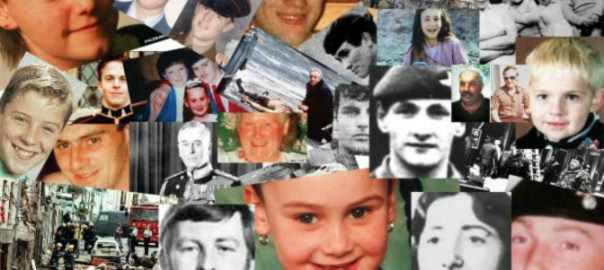
30th October – Deaths & Events in Northern Ireland Troubles

Key Events & Deaths on this day in Northern Ireland Troubles

 30th October

Wednesday 30 October 1968

Jack Lynch, then Taoiseach (Irish Prime Minister), met with Harold Wilson, then British Prime Minister, in London. The Taoiseach called for the ending of partition as a means to resolve the unrest in Northern Ireland. The Irish Times (a Dublin based newspaper) carried a report of an interview with Lord Brookeborough (former Prime Minister of Northern Ireland).

[ Derry March; Civil Rights; Anglo-Irish Relations; Partition]

Friday 30 October 1970

There were serious riots in the Catholic Ardoyne area of Belfast which lasted for three nights. Chichester-Clark, then Northern Ireland Prime Minister, met with Reginald Maulling, then British Home Secretary, on matters related to reforms and security.

Saturday 30 October 1971

A British soldier was killed in a bomb attack in Belfast.

Monday 30 October 1972

The Northern Ireland Office (NIO) issued a discussion document The Future of Northern Ireland. The paper states Britain’s commitment to the union as long as the majority of people wish to remain part of the United Kingdom (UK).

The paper also introduces the ideas of a power-sharing government in Northern Ireland and an ‘Irish Dimension’. Loyalist paramilitaries carried out a raid on an Royal Ulster Constabulary station in Claudy, County Derry, and stole 4 British Army issue Sterling sub-machine Guns (SMGs) that had been issued to Ulster Defence Regiment (UDR) soldiers. #

[There was another theft of UDR weapons on 8 March 1973.] [ Political Developments. ]

Saturday 30 October 1976

Two Catholic civilians were abducted and shot dead by the Ulster Volunteer Force (UVF) at Glenbank Place, Crumlin Road, Belfast. Stephen McCann (20), a Catholic civilian, was abducted and killed at the rear of Glencairn Community Centre, Belfast. Members of he Ulster Volunteer Force (UVF) gang known as the ‘Shankill Butchers’ were responsible for the killing. [See: 20 February 1979] McCann had been a founder member of the Witness for Peace movement and author of the song ‘What Price Peace?’

Thursday 30 October 1980 [ Hunger Strike.]

Wednesday 30 October 1985

James Molyneaux, then leader of the Ulster Unionist Party (UUP), and Ian Paisley, then leader of the Democratic Unionist Party (DUP), attended a meeting at Downing Street, London, with Margaret Thatcher, then British Prime Minister.

The two Unionists again protested at the continuing Anglo-Irish talks between the two governments. They warned that a consultative role in Northern Ireland affairs for the government in the Republic of Ireland would lead to a Loyalist backlash.

[ PRONI Records – October 1985]

Wednesday 30 October 1991

Desmond Ellis was acquitted of conspiring to cause explosions at a court in London.

[Ellis had been involved in an extradition dispute between the Republic of Ireland and Britain earlier in the year. On the following day the British Home Secretary signed an ‘exclusion order’ which banned Ellis from living in Britain.]

Friday 30 October 1992

The Irish Republican Army (IRA) exploded a bomb, estimated at 250 pounds, at Glengormley Royal Ulster Constabulary (RUC) station. Thirteen people were injured in the explosion and over 100 houses were damaged. The IRA forced a taxi driver in London to transport a bomb to a location close to Downing Street where it later exploded.

Saturday 30 October 1993

See Greysteel Article

See Shankill Butchers

Saturday 30th  October 1993

Greysteel Killings

Greysteel Killings The Ulster Freedom Fighters (UFF), a cover name (pseudonym) used by the Ulster Defence Association (UDA), killed six Catholics civilians and one Protestant civilian in an attack on the ‘Rising Sun’ bar in Greysteel, County Derry. A further 13 people were injured in the attack one of whom later died of his injuries on 14 April 1994. [One of the gunmen was hear to say “trick or treat” before he fired into the crowded bar. This was a reference to the Halloween celebration that was taking place. There was widespread condemnation of the attack. The UFF later claimed that it had attacked the “Nationalist electorate” in revenge for the Shankill Road Bombing on 23 October 1993. The killings brought the total number of deaths during October to 27 making it the worst month for casualties in 17 years.]

Sunday 30 October 1994

There were scuffles on the Ormeau Road, Belfast, between Royal Ulster Constabulary (RUC) officers and local residents who were protesting against an Orange Order parade passing through their area. Speaking in Dublin Gerry Adams, then President of Sinn Féin (SF), said that there were “clear efforts” by the British government to reduce the momentum of the peace process.

Thursday 30 October 1997

The Continuity Irish Republican Army (CIRA) said that it was responsible for the attempted bombing of government offices in Derry. The United Nations (UN) called for an judicial inquiry into the killing of Pat Finucane, at the time a solicitor based in Belfast, on 12 February 1989.

Finucane had represented a number of Republicans in high profile cases.

The Ulster Freedom Fighters (UFF), a covername used by the Ulster Defence Association (UDA), claimed responsibility for the killing. Republicans alleged that the Royal Ulster Constabulary (RUC) had colluded with the UFF in targeting Finucane. The UN also criticised the Law Society for not defending lawyers from threats and harassment from members of the security forces. Marjorie (Mo) Mowlam, then Secretary of State for Northern Ireland, gave an interview which was published by New Statesman in which she accused civil servants in the Northern Ireland Office (NIO) of undermining the peace process by engaging in a series of leaks to the media and political parties. Jack Straw, then British Home Secretary, announced in the House of Commons that the final 12 exclusion orders would be revoked.

He also announced that new ‘anti-terrorist legislation’ would be introduced on a United Kingdom (UK) wide basis. The Committee on the Administration of Justice (CAJ), based in Belfast, called on the government to repeal all emergency legislation. There was an election in the Republic of Ireland to elect a new President. [When the counting was completed Mary McAleese was elected as the eight President of Ireland.]

Tuesday 30 October 2001

Brian Cowen, then Irish Minister for Foreign Affairs, called on the British government to demilitarise places such as south Armagh and west Tyrone “very quickly”. He was speaking in New York, USA, at a meeting of the National Committee on American Foreign Policy.

A Protestant man was charged at Belfast Magistrates’ Court with ‘riotous behaviour’ in connection with sectarian clashes at Limestone Road, north Belfast, on Sunday 28 October 2001. Kenneth Bloomfield (Sir), former head of the Northern Ireland civil service, said that a commissioner should be appointed to safeguard the interests of victims of ‘the Troubles’.

——————————————————-

———————————————————————————

Remembering all innocent victims of the Troubles

Today is the anniversary of the death of the following  people killed as a results of the conflict in Northern Ireland

“To live in hearts we leave behind is not to die

– Thomas Campbell

To the innocent on the list – Your memory will live  forever

– To  the Paramilitaries  –

There are many things worth living for, a few things worth dying for, but nothing worth killing for.

  16  People lost their lives on the 30th October  between 1971 – 2001

————————————————————

30 October 1971
Norman Booth,   (22)

nfNI
Status: British Army (BA),

Killed by: Irish Republican Army (IRA)
Killed in bomb attack on British Army (BA) observation post, junction of Springfield Road and Cupar Street, Belfast.

————————————————————

30 October 1974


Gordon Catherwood,  (44)

Protestant
Status: Civilian (Civ),

Killed by: Irish Republican Army (IRA)
Shot at his home, Upper Hightown Road, near Belfast, County Antrim.

————————————————————

30 October 1974


Michael Meenan,  (16)

Catholic
Status: Irish Republican Army (IRA),

Killed by: Irish Republican Army (IRA)
Killed in premature bomb explosion at garage, Strand Road, Derry.

————————————————————

30 October 1975


Eileen Kelly, (6)

Catholic
Status: Civilian (Civ),

Killed by: Irish Republican Army (IRA)
Shot at her home, Beechmount Grove, Falls, Belfast. Father intended target. Official Irish Republican Army (OIRA) / Irish Republican Army (IRA) feud.

————————————————————

30 October 1976
Stephen McCann,  (20)

Catholic
Status: Civilian (Civ),

Killed by: Ulster Volunteer Force (UVF)
Abducted while walking along Millfield, Belfast. Found stabbed and shot a short time later, near the Community Centre, off Forthriver Road, Glencairn, Belfast.

————————————————————

30 October 1976


Charles Corbett,   (22)

Catholic
Status: Civilian (Civ),

Killed by: Ulster Volunteer Force (UVF)
Abducted while travelling in newspaper delivery van, Crumlin Road, Belfast. Found shot a short time later, Glenbank Place, off Crumlin Road, Belfast.

————————————————————

30 October 1976


John Maguire,   (56)

Catholic
Status: Civilian (Civ),

Killed by: Ulster Volunteer Force (UVF)
Abducted while travelling in newspaper delivery van, Crumlin Road, Belfast. Found shot a short time later, Glenbank Place, off Crumlin Road, Belfast.


 Steven Mullan,  (20)

Catholic
Status: Civilian (Civ),

Killed by: Ulster Freedom Fighters (UFF)
Shot during gun attack on Rising Sun Bar, Greysteel, County Derry.

————————————————————

30 October 1993


Karen Thompson,  (19)

Catholic
Status: Civilian (Civ),

Killed by: Ulster Freedom Fighters (UFF)
Shot during gun attack on Rising Sun Bar, Greysteel, County Derry.

————————————————————

30 October 1993


James Moore, (81)

Catholic
Status: Civilian (Civ),

Killed by: Ulster Freedom Fighters (UFF)
Shot during gun attack on Rising Sun Bar, Greysteel, County Derry.

————————————————————

30 October 1993


Joseph McDermott,  (60)

Catholic
Status: Civilian (Civ),

Killed by: Ulster Freedom Fighters (UFF)
Shot during gun attack on Rising Sun Bar, Greysteel, County Derry.

————————————————————

30 October 1993


Moira Duddy,  (59)

Catholic
Status: Civilian (Civ),

Killed by: Ulster Freedom Fighters (UFF)
Shot during gun attack on Rising Sun Bar, Greysteel, County Derry.

————————————————————

30 October 1993
John Moyne,  (50)

Catholic
Status: Civilian (Civ),

Killed by: Ulster Freedom Fighters (UFF)
Shot during gun attack on Rising Sun Bar, Greysteel, County Derry.

————————————————————

30 October 1993


John Burns,  (54)

Protestant
Status: Civilian (Civ),

Killed by: Ulster Freedom Fighters (UFF)
Shot during gun attack on Rising Sun Bar, Greysteel, County Derry.

————————————————————

30 October 1993
Victor Montgomery,  (76)

Protestant
Status: Civilian (Civ),

Killed by: Ulster Freedom Fighters (UFF)
Shot during gun attack on Rising Sun Bar, Greysteel, County Derry. He died 14 April 1994.

————————————————————

30 October 2001
Charles Folliard,   (
30)

Protestant
Status: ex-Ulster Defence Association (xUDA),

Killed by: non-specific Republican group (REP)
Shot outside his girlfriend’s home, Oakland Park, Ballycolman, Strabane, County Tyrone.

————————————————————

See Greysteel Article

See Shankill Butchers

War Remembrance Day Poppy – Wear it with PRIDE. In Flanders fields the poppies blow…….

Remembrance Day Poppy 

pumpkin soildier

——————————————————————————

In Flanders Fields

——————————————————————————

Wear it with PRIDE

—————————————————————————————–

John McCrae’s War – In Flanders Fields – Documentary

—————————————————————————————–

John McCrae

John McCrae

“In Flanders Fields” is a war poem in the form of a rondeau, written during the First World War by Canadian physician Major John McCrae. He was inspired to write it on May 3, 1915, after presiding over the funeral of friend and fellow soldier Alexis Helmer, who died in the Second Battle of Ypres.

According to legend, fellow soldiers retrieved the poem after McCrae, initially dissatisfied with his work, discarded it. “In Flanders Fields” was first published on December 8 of that year in the London-based magazine Punch.

A sculpture in the form of an open book. The text of the poem
Inscription of the complete poem in a bronze “book” at the John McCrae memorial at his birthplace in Guelph, Ontario, Canada.

Inscription of the complete poem in a bronze “book” at the John McCrae memorial at his birthplace in Guelph, Ontario, Canada.


It is one of the most popular and most quoted poems from the war. As a result of its immediate popularity, parts of the poem were used in propaganda efforts and appeals to recruit soldiers and raise money selling war bonds. Its references to the red poppies that grew over the graves of fallen soldiers resulted in the remembrance poppy becoming one of the world’s most recognized memorial symbols for soldiers who have died in conflict. The poem and poppy are prominent Remembrance Day symbols throughout the Commonwealth of Nations, particularly in Canada, where “In Flanders Fields” is one of the nation’s best-known literary works. The poem also has wide exposure in the United States, where it is associated with Memorial Day.

Backgound

John McCrae was a poet and physician from Guelph, Ontario. He developed an interest in poetry at a young age and wrote throughout his life.  His earliest works were published in the mid-1890s in Canadian magazines and newspapers. McCrae’s poetry often focused on death and the peace that followed.

At the age of 41, McCrae enrolled with the Canadian Expeditionary Force following the outbreak of the First World War. He had the option of joining the medical corps because of his training and age, but he volunteered instead to join a fighting unit as a gunner and medical officer.

It was his second tour of duty in the Canadian military. He had previously fought with a volunteer force in the Second Boer War. He considered himself a soldier first; his father was a military leader in Guelph and McCrae grew up believing in the duty of fighting for his country and empire.

McCrae fought in the second battle of Ypres in the Flanders region of Belgium where the German army launched one of the first chemical attacks in the history of war. They attacked the Canadian position with chlorine gas on April 22, 1915, but were unable to break through the Canadian line, which held for over two weeks. In a letter written to his mother, McCrae described the battle as a “nightmare”:

“For seventeen days and seventeen nights none of us have had our clothes off, nor our boots even, except occasionally. In all that time while I was awake, gunfire and rifle fire never ceased for sixty seconds…. And behind it all was the constant background of the sights of the dead, the wounded, the maimed, and a terrible anxiety lest the line should give way.”


Alexis Helmer, a close friend, was killed during the battle on May 2. McCrae performed the burial service himself, at which time he noted how poppies quickly grew around the graves of those who died at Ypres. The next day, he composed the poem while sitting in the back of an ambulance at an Advanced Dressing Station outside Ypres.

This location is today known as the John McCrae Memorial Site.


The poem handwritten by McCrae. In this copy, the first line ends with

An autographed copy of the poem from In Flanders Fields and Other Poems. Unlike the printed copy in the same book, McCrae’s handwritten version ends the first line with “grow”.


The first chapter of In Flanders Fields and Other Poems, a 1919 collection of McCrae’s works, gives the text of the poem as follows:

In Flanders fields the poppies blow
Between the crosses, row on row,
That mark our place; and in the sky
The larks, still bravely singing, fly
Scarce heard amid the guns below.

We are the Dead. Short days ago
We lived, felt dawn, saw sunset glow,
Loved and were loved, and now we lie
In Flanders fields.

Take up our quarrel with the foe:
To you from failing hands we throw
The torch; be yours to hold it high.
If ye break faith with us who die
We shall not sleep, though poppies grow
In Flanders fields.


As with his earlier poems, “In Flanders Fields” continues McCrae’s preoccupation with death and how it stands as the transition between the struggle of life and the peace that follows.  It is written from the point of view of the dead. It speaks of their sacrifice and serves as their command to the living to press on.

As with many of the most popular works of the First World War, it was written early in the conflict, before the romanticism of war turned to bitterness and disillusion for soldiers and civilians alike.

Publication

A page from a book. The first stanza of the poem is printed above an illustration of a white cross amidst a field of red poppies while two cannons fire in the background.

Illustrated page by Ernest Clegg. Note that the first line ends with “grow”.


Cyril Allinson was a sergeant major in McCrae’s unit. While delivering the brigade’s mail, he watched McCrae as he worked on the poem, noting that McCrae’s eyes periodically returned to Helmer’s grave as he wrote. When handed the notepad, Allinson read the poem and was so moved he immediately committed it to memory.

He described it as being “almost an exact description of the scene in front of us both”.

According to legend, McCrae was not satisfied with his work. It is said he crumpled the paper and threw it away. It was retrieved by a fellow member of his unit, either Edward Morrison or J. M. Elder, or Allinson himself.  McCrae was convinced to submit the poem for publication.

Another story of the poem’s origin claimed that Helmer’s funeral was actually held on the morning of May 2, after which McCrae wrote the poem in 20 minutes. A third claim, by Morrison, was that McCrae worked on the poem as time allowed between arrivals of wounded soldiers in need of medical attention.

Regardless of its true origin, McCrae worked on the poem for months before considering it ready for publication. He submitted it to The Spectator in London, but it was rejected. It was then sent to Punch, where it was published on December 8, 1915. It was published anonymously, but Punch attributed the poem to McCrae in its year-end index.

The word that ends the first line of the poem has been disputed. According to Allinson, the poem began with “In Flanders Fields the poppies grow” when first written.

However, since McCrae ended the second-to-last line with “grow”, Punch received permission to change the wording of the opening line to end with “blow”. McCrae himself used either word when making handwritten copies for friends and family.

Questions over how the first line should end have endured since publication. Most recently, the Royal Canadian Mint was inundated with queries and complaints from those who believed the first line should end with “grow” when a design for the ten-dollar bill was released in 2001 that featured the first stanza of “In Flanders Fields”, ending the first line with “blow”.

In song

It was set to music by Frank E. Tours. The score was published in New York and Chicago by M. Witmark & Sons in 1918.

Popularity

Painting of a soldier staring down at a white cross surrounded by red poppies. The text

Aspects of the poem were used in propaganda, such as this Canadian war bonds poster


According to historian Paul Fussell, “In Flanders Fields” was the most popular poem of its era. McCrae received numerous letters and telegrams praising his work when he was revealed as the author.

The poem was republished throughout the world, rapidly becoming synonymous with the sacrifice of the soldiers who died in the First World War. It was translated into numerous languages, so many that McCrae himself quipped that:

“it needs only Chinese now, surely”.

Its appeal was nearly universal. Soldiers took encouragement from it as a statement of their duty to those who died while people on the home front viewed it as defining the cause for which their brothers and sons were fighting.

It was often used for propaganda, particularly in Canada by the Unionist Party during the 1917 federal election amidst the Conscription Crisis. French Canadians in Quebec were strongly opposed to the possibility of conscription, but English Canadians voted overwhelmingly to support Prime Minister Robert Borden and the Unionist government. “In Flanders Fields” was said to have done more to “make this Dominion persevere in the duty of fighting for the world’s ultimate peace than all the political speeches of the recent campaign”.

McCrae, a staunch supporter of the empire and the war effort, was pleased with the effect his poem had on the election. He stated in a letter: “I hope I stabbed a [French] Canadian with my vote.”

The poem was a popular motivational tool in Great Britain, where it was used to encourage soldiers fighting against Germany, and in the United States where it was reprinted across the country. It was one of the most quoted works during the war, used in many places as part of campaigns to sell war bonds, during recruiting efforts and to criticize pacifists and those who sought to profit from the war.

American composer Charles Ives used “In Flanders Fields” as the basis for a song of the same name that premiered in 1917. Fussell criticized the poem in his work The Great War and Modern Memory (1975).He noted the distinction between the pastoral tone of the first nine lines and the “recruiting-poster rhetoric” of the third stanza. Describing it as “vicious” and “stupid”, Fussell called the final lines a “propaganda argument against a negotiated peace”.

Legacy

McCrae was moved to the medical corps and stationed in Boulogne, France, in June 1915 where he was promoted to Lieutenant-Colonel, and placed in charge of medicine at the Number 3 Canadian General Hospital.  He was promoted to the acting rank of Colonel on January 13, 1918, and named Consulting Physician to the British Armies in France. The years of war had worn McCrae down, however. He contracted pneumonia that same day, and later came down with cerebral meningitis.

On January 28, 1918, he died at the military hospital in Wimereux and was buried there with full military honours.

A book of his works, featuring “In Flanders Fields” was published the following year.

“In Flanders Fields” has attained iconic status in Canada, where it is a staple of Remembrance Day ceremonies and may be the most well known literary piece among English Canadians.

It has an official French adaptation, entitled “Au champ d’honneur“, written by Jean Pariseau and used by the Canadian government in French and bilingual ceremonies.

In addition to its appearance on the ten-dollar bill, the Royal Canadian Mint has released poppy-themed quarters on several occasions. A version minted in 2004 featured a red poppy in the centre and is considered the first multi-coloured circulation coin in the world.Among its uses in popular culture, the line “to you from failing hands we throw the torch, be yours to hold it high” has served as a motto for the Montreal Canadiens hockey club since 1940.

McCrae’s birthplace in Guelph, Ontario has been converted into a museum dedicated to his life and the war. In Belgium, the In Flanders Fields Museum in Ypres, named after the poem and devoted to the First World War, is situated in one of Flanders’ largest tourist areas.

Despite its enduring fame, “In Flanders Fields” is often ignored by academics teaching and discussing Canadian literature. The poem is sometimes viewed as an anachronism; It spoke of glory and honour in a war that has since become synonymous with the futility of trench warfare and the wholesale slaughter produced by 20th century weaponry.

Nancy Holmes, professor at the University of British Columbia, speculated that its patriotic nature and usage as a tool for propaganda may have led literary critics to view it as a national symbol or anthem rather than a poem.

Remembrance poppies


Main article: Remembrance poppy

Several wreaths of artificial red poppies with black centres. The logo of various veterans and community groups are printed in the middle of each.

Poppy wreaths at the Menin Gate in Ypres, Belgium


The red poppies that McCrae referred to had been associated with war since the Napoleonic Wars when a writer of that time first noted how the poppies grew over the graves of soldiers. The damage done to the landscape in Flanders during the battle greatly increased the lime content in the surface soil, leaving the poppy as one of the few plants able to grow in the region.

Inspired by “In Flanders Fields”, American professor Moina Michael resolved at the war’s conclusion in 1918 to wear a red poppy year-round to honour the soldiers who had died in the war. She also wrote a poem in response called “We Shall Keep the Faith“.

She distributed silk poppies to her peers and campaigned to have them adopted as an official symbol of remembrance by the American Legion. Madame E. Guérin attended the 1920 convention where the Legion supported Michael’s proposal and was herself inspired to sell poppies in her native France to raise money for the war’s orphans.

In 1921, Guérin sent poppy sellers to London ahead of Armistice Day, attracting the attention of Field Marshal Douglas Haig. A co-founder of The Royal British Legion, Haig supported and encouraged the sale. The practice quickly spread throughout the British Empire. The wearing of poppies in the days leading up to Remembrance Day remains popular in many areas of the Commonwealth of Nations, particularly Great Britain, Canada, and South Africa, and in the days leading up to ANZAC Day in Australia and New Zealand.

———————————

The Remembrance Poppy

———————————

The remembrance poppy (a Papaver rhoeas) has been used since 1921 to commemorate soldiers who have died in war. Inspired by the World War I poem “In Flanders Fields“, and promoted by Moina Michael, they were first adopted by the American Legion to commemorate American soldiers killed in that war (1914–1918). They were then adopted by military veterans‘ groups in parts of the former British Empire: the United Kingdom, Canada, Australia and New Zealand.

Today, they are most common in the UK and Canada, and are used to commemorate their servicemen and women killed in all conflicts since 1914. There, small artificial poppies are often worn on clothing for a few weeks prior to Remembrance Day/Armistice Day (11 November).

Poppy wreaths are also often laid at war memorials.

The remembrance poppy is especially prominent in the UK. In the weeks leading up to Remembrance Sunday, they are distributed by The Royal British Legion in return for donations to their “Poppy Appeal”, which supports all current and former British military personnel. During this time, it is an unwritten rule that all public figures and people appearing on television must wear them; some have berated this as “poppy fascism” and argued that the Appeal is being used to glorify current wars.

It is especially controversial in Northern Ireland; most Irish nationalists and Irish Catholics refuse to wear one, mainly due to actions of the British Army during the Troubles, while Ulster Protestants and Unionists usually wear them.

Origins

The use of the poppy was inspired by the World War I poem “In Flanders Fields“. Its opening lines refer to the many poppies that were the first flowers to grow in the churned-up earth of soldiers’ graves in Flanders, a region of Europe that overlies a part of Belgium.

The poem was written by Canadian physician and Lieutenant Colonel John McCrae on 3 May 1915 after witnessing the death of his friend, a fellow soldier, the day before. The poem was first published on 8 December 1915 in the London-based magazine Punch.

Moina Michael on a 1948 U.S. commemorative stamp


In 1918, Moina Michael, who had taken leave from her professorship at the University of Georgia to be a volunteer worker for the American YWCA, was inspired by the poem and published a poem of her own called “We Shall Keep the Faith“.

In tribute to McCrae’s poem, she vowed to always wear a red rememberance poppy as a symbol of remembrance for those who fought and helped in the war. At a November 1918 YWCA Overseas War Secretaries’ conference, she appeared with a silk poppy pinned to her coat and distributed 25 more to those attending. She then campaigned to have the poppy adopted as a national symbol of remembrance.

At a conference in 1920, the National American Legion adopted it as their official symbol of remembrance. At this conference, French-woman Anna E. Guérin was inspired to introduce the artificial poppies commonly used today. In 1921 she sent her poppy sellers to London, where they were adopted by Field Marshal Douglas Haig, a founder of the Royal British Legion. It was also adopted by veterans’ groups in Canada, Australia and New Zealand.

Usage

Canada

In Canada, the poppy is the official symbol of remembrance worn during the two weeks before 11 November, having been adopted in 1921. The Royal Canadian Legion, which has trademarked the image, suggests that poppies be worn on the left lapel, or as near the heart as possible.

Until 1996, poppies were made by disabled veterans in Canada, but they have since been made by a private contractor. The Canadian poppies consist of two pieces of moulded plastic covered with flocking with a pin to fasten them to clothing. At first the poppies were made with a black centre. From 1980 to 2002, the centres were changed to green. Current designs are black only; this change caused confusion and controversy to those unfamiliar with the original design.

In 2007, sticker versions of the poppy were made for children, the elderly, and healthcare and food industry workers. Canada also issues a cast metal “Canada Remembers” pin featuring a gold maple leaf and two poppies, one representing the fallen and the other representing those who remained on the home front.

Following the installation of the Tomb of the Unknown Soldier at the National War Memorial in Ottawa in 2000, where the national Remembrance service is held, a new tradition formed spontaneously as attendees laid their poppies on the tomb at the end of the service. This tradition, while not part of the official program, has become widely practised elsewhere in the country, with others leaving cut flowers, photographs, or letters to the deceased.

The poppy is also worn on Memorial Day, celebrated on July 1 each year in Newfoundland and Labrador.

United Kingdom

Royal British Legion poppy


A volunteer makes poppies at the Royal British Legion Poppy Factory in London, where over 30 million poppies are made by a small team each year


A poppy on a bus in Southampton, England (November 2008)


In the United Kingdom, remembrance poppies are sold by The Royal British Legion (RBL). This is a charity providing financial, social, political and emotional support to those who have served or who are currently serving in the British Armed Forces, and their dependants. They are sold on the streets by volunteers in the weeks before Remembrance Day. Other products bearing the Poppy, the Trademark of The Royal British Legion are sold throughout the year as part of the ongoing fundraising.

The RBL state,

“The red poppy is our registered mark and its only lawful use is to raise funds for the Poppy Appeal”;

its yearly fundraising drive in the weeks before Remembrance Day. The RBL says these poppies are:

“worn to commemorate the sacrifices of our Armed Forces and to show support to those still serving today”.


In England, Wales, and Northern Ireland, the poppies have two red paper petals, a green paper leaf and are mounted on a green plastic stem. In Scotland, the poppies are curled and have four petals with no leaf. The yearly selling of poppies is a major source of income for the RBL in the UK. The poppy has no fixed price; it is sold for a donation or the price may be suggested by the seller. The black plastic center of the poppy was marked “Haig Fund” until 1994 but is now marked “Poppy Appeal”.

A team of about 50 people—most of them disabled former British military personnel—work all year round to make millions of poppies at the Poppy Factory in Richmond. Scottish poppies are made in the Lady Haig Poppy Factory in Edinburgh.

In the early years after World War I, poppies were worn only on Remembrance Day itself. However, today the RBL’s “Poppy Appeal” has a higher profile than any other charity appeal in the UK. The poppies are widespread from late October until mid-November every year and are worn by the general public, politicians, the Royal Family and others in public life. It has also become common to see poppies on cars, lorries and public transport such as aeroplanes, buses, and trams. Many magazines and newspapers also show a poppy on their cover page, and some social network users add poppies to their avatars.

In 2011, a Second World War plane dropped 6,000 poppies over the town of Yeovil in Somerset.

Some have criticised the level of compulsion associated with the custom, something Channel 4 newsreader Jon Snow has called “poppy fascism”. Columnist Dan O’Neill wrote that “presenters and politicians seem to compete in a race to be first – poppies start sprouting in mid-October while the absence of a poppy is interpreted as absence of concern for the war dead, almost as an unpatriotic act of treachery”.

Likewise, Jonathan Bartley of the religious think-tank Ekklesia said “public figures in Britain are urged, indeed in many cases, required, to wear … the red poppy, almost as an article of faith. There is a political correctness about the red poppy”.

Journalist Robert Fisk complained that the poppy has become a seasonal “fashion accessory” and that people were “ostentatiously wearing a poppy for social or work-related reasons, to look patriotic when it suited them”. Kleshna, one of two businesses with an exclusive tie-in with the RBL, sells expensive crystal-clad poppy jewellery that has been worn by celebrities. In 1997 and again in 2000 the Royal British Legion registered the Poppy under Intellectual Property Rights (1997 Case EU000557058) and Trade Mark (2000 Trade Mark 2239583).

Northern Ireland

The Royal British Legion also holds a yearly poppy appeal in Northern Ireland and in 2009 raised more than £1 million. However, the wearing of poppies in Northern Ireland is controversial. It is seen by many as a political symbol  and a symbol of Britishness, representing support for the British Army.

The poppy has long been the preserve of the unionist/loyalist community.  Loyalist paramilitaries (such as the UVF and UDA) have also used poppies to commemorate their own members who were killed in The Troubles.

Most Irish nationalists/republicans, and members of the Irish Catholic community, choose not to wear poppies;  they regard the Poppy Appeal as supporting soldiers who killed Irish civilians (for example on Bloody Sunday) and who colluded with illegal loyalist paramilitaries (for example the Glenanne gang) during The Troubles.

In 2008, the director of Relatives for Justice condemned the wearing of poppies by police officers in Irish nationalist areas, calling it “repugnant and offensive to the vast majority of people within our community, given the role of the British Army“.

In 2009, Sinn Féin‘s Glenn Campbell berated the policy that all BBC TV presenters must wear poppies in the run-up to Remembrance Day and urged the BBC to drop the policy, as it is a publicly funded body. In the Irish Independent, it was claimed that “substantial amounts” of money raised from selling poppies are used “to build monuments to insane or inane generals or build old boys’ clubs for the war elite”.

However, on Remembrance Day 2010 the SDLP’s Margaret Ritchie was the first leader of a nationalist party to wear one.

Republic of Ireland

During World War I, all of Ireland was part of the UK and about 200,000 Irishmen fought in the British Army (see Ireland and World War I). Although the British Army is banned from actively recruiting in the Republic of Ireland, some of its citizens still enlist.

The RBL thus has a branch in the Republic and holds a yearly Poppy Appeal there.

Each July, the Republic has its own National Day of Commemoration for all Irish people who died in war. However, the wearing of poppies is much less common than in the UK and they are not part of the main commemorations. This is partly due to the British Army’s role in fighting against Irish independence, its activities during the War of Independence (for example the Burning of Cork) and the British Army’s role in Northern Ireland during the Troubles. Nevertheless, the RBL holds its own wreath-laying ceremony at St Patrick’s Cathedral, Dublin, which the President of Ireland has attended.

United States

In the United States, the Veterans of Foreign Wars conducted the first nationwide distribution of remembrance poppies before Memorial Day in 1922. Today, the American Legion Auxiliary distributes crepe-paper poppies in exchange for donations around Memorial Day and Veterans Day.

Elsewhere

In Hong Kong—which was formerly part of the British Empire—the poppy is worn by some participants on Remembrance Sunday each year.  It is not generally worn by the public, although The Royal British Legion’s Hong Kong and China Branch sells poppies to the public in a few places on the Hong Kong Island only.

Never Again symbol from Ukraine


During Victory Day 2014—which marks Nazi Germany’s surrender to the Soviet Union—some Ukrainians wore remembrance poppies instead of the usual Ribbon of Saint George, as the ribbon had become associated with pro-Russian separatists. A poppy logo was designed by Sergiy Mishakin, containing the text: “1939-1945 Never Again”.

From 2015 also official symbol of Remembrance and Reconciliation (May 8) and Victory Day over Nazism in World War II (May 9) days.

In Pakistan, in Northern Punjab and a few parts of the North-West Frontier (now Khyber Pakhtunkhwa), a private ceremony is celebrated each 11 November where red poppies are worn, by direct descendants of World War 1 veterans from the old British Indian Army belonging to these parts;  these people belong to the ‘Great War Company’, a non-governmental, non-profit organisation.

In Albania, government representatives including Prime-Minister Edi Rama, Speaker of the House Ilir Meta, and Minister of Defense Mimi Kodheli, wore the Remembrance Poppy during the commemoration ceremonies for the 70th Anniversary of the Liberation of Albania, in November 2014.

Other designs and purposes

White poppies

A white poppy left on Anzac Day in New Zealand, 2009


Some people choose to wear white poppies as a pacifist alternative to the red poppy. The white poppy and white poppy wreaths were introduced by Britain’s Co-operative Women’s Guild in 1933.

Today, white poppies are sold by Peace Pledge Union or may be home-made.

Purple poppies

To commemorate animal victims of war, Animal Aid in Britain has issued a purple poppy, which can be worn alongside the traditional red one, as a reminder that both humans and animals have been – and continue to be – victims of war.

Protests and controversy

Football clubs commonly wear jerseys with a poppy emblazoned on, as Celtic controversially did in 2010.


In 1993, The Royal British Legion complained about the logo of the game Cannon Fodder, because its use of iconography closely resembling of remembrance poppy. The Royal British pronunciated about, saying that was ‘sick and degenerate’ before its release trying to ban the game. A newspaper quoted the British Legion, Liberal Democrat MP Menzies Campbell and Viscount Montgomery of Alamein, calling the game offensive to “millions”, “monstrous” and “very unfortunate” respectively.

In the run-up to Remembrance Day, it has become common for UK football teams to play with artificial poppies sewn to their shirts, at the request of the Royal British Legion. This has caused some controversy. At a Celtic v Aberdeen match in November 2010, a group of Celtic supporters, called the Green Brigade, unfurled a large banner in protest at the team wearing poppies.

In a statement, it said:

“Our group and many within the Celtic support do not recognise the British Armed Forces as heroes, nor their role in many conflicts as one worthy of our remembrance”.


It gave Operation Banner (Northern Ireland), the Afghanistan War and the Iraq War as examples. In November 2011, it was proposed that the England football team should wear poppies on their shirts in a match against Spain. However, FIFA turned down the proposal, saying it would “open the door to similar initiatives” across the world, “jeopardising the neutrality of football”.

FIFA’s decision was attacked by Prince William and Prime Minister David Cameron, who said he would back any player who ignored the ban.

Members of the English Defence League (EDL) held a protest on the roof of FIFA’s headquarters in Zurich. Instead, the English Football Association came up with other ways to mark Remembrance Day; for example, the England players would wear poppies before kickoff and black armbands during the match, there would be a minute’s silence, a poppy wreath would be set on the pitch during the national anthems, poppies would be sold in the stadium and would be shown on the scoreboards and advertising boards.

FIFA subsequently allowed the English, Scottish and Welsh teams to wear poppies on black armbands. Irish footballer James McClean, who has played for a number of English teams, has received death threats and abuse since 2012 for refusing to wear a poppy on his shirt during matches. McClean is from Derry, where British soldiers shot dead 14 unarmed civilians on Bloody Sunday.

Other public figures have also been attacked for not wearing poppies. British journalist and newsreader Charlene White has faced racist and sexist abuse for not wearing a poppy on-screen. She explained “I prefer to be neutral and impartial on screen so that one of those charities doesn’t feel less favoured than another”.

Newsreader Jon Snow does not wear a poppy on-screen for similar reasons. He too was criticized and he condemned what he saw as “poppy fascism”. Well-known war-time journalist Robert Fisk published in November 2011 a personal account about the shifting nature of wearing a poppy, titled

“Do those who flaunt the poppy on their lapels know that they mock the war dead?”.

British Prime Minister David Cameron rejected a request from Chinese officials to remove his poppy during his visit to Beijing on Remembrance Day 2010. The poppy was deemed offensive because of its association with the Anglo-Chinese Opium Wars in the 19th century, after which the Qing Dynasty was forced to tolerate the British opium trade in China and to cede Hong Kong to the UK.

However, Cameron wore a poppy in October 2015 when he met Chinese President Xi Jinping in London.

A 2010 Remembrance Day ceremony in London was disrupted by members of Muslims Against Crusades, who were protesting against British Army actions in Afghanistan and Iraq. They burnt large poppies and chanted “British soldiers burn in hell” during the two-minute silence. Two of the men were arrested and charged for threatening behaviour. One was convicted and fined £50.

The same group planned to hold another protest in 2011, but was banned by the Home Secretary the day before the planned protest.

In recent years, people have been arrested in the UK for burning remembrance poppies. In November 2011 a number of people were arrested in Northern Ireland after a picture of two youths burning a poppy was posted on Facebook. The picture was reported to police by a member of the RBL.

The following year, a young Canterbury man was arrested for allegedly posting a picture of a burning poppy on Facebook, on suspicion of an offence under the Malicious Communications Act.

In 2011 it was revealed that Kleshna, one of two businesses selling its own poppies on the RBL website, gives only 10% of its sales to charity. Kleshna sells crystal-clad poppy jewellery which has been worn by celebrities on television

—————————————-

Visit the website or make a donation:

www.britishlegion.org.uk

donate

29th October – Deaths & Events in Northern Ireland Troubles

Key Events & Deaths on this day in Northern Ireland Troubles

 29th October

—————————————

Thursday 29 October 1970

The Electoral Reform Society called for the introduction of Proportional Representation (PR) in elections in Northern Ireland.

Friday 29 October 1971

A Royal Ulster Constabulary (RUC) officer was killed in a bomb attack in Belfast.

Wednesday 29 October 1975

The Provisional Irish Republican Army (IRA) shot and killed Robert Elliman (27), then a member of the Official IRA (OIRA), in McKenna’s Bar in the Markets area of Belfast.

[Between 29 October 1975 and 12 November 1975, 11 people were to died in the continuing feud between the two wings of the IRA. Most of those killed were members of the ‘official’ republican movement.] A Catholic civilian was shot dead by Loyalists in Lurgan, County Armagh.

Thursday 29 October 1981

 1981 Hunger Strike

Saturday 31 October 1981

Sinn Féin (SF) held its Ard Fheis (annual conference) in Dublin, Republic of Ireland. Danny Morrison, then editor of An Phoblacht, gave a speech in which he addressed the issue of the party taking part in future elections:

“Who here really believes we can win the war through the ballot box? But will anyone here object if, with a ballot paper in one hand and the Armalite in the other, we take power in Ireland?”

[This statement was subsequently often quoted as: ‘the Armalite in one hand and the Ballot box in the other’.]


Tuesday 29 October 1991

Peter Robinson, then Deputy Leader of the Democratic Unionist Party (DUP), said that Unionists were being ‘edged into a united Ireland’.

Friday 29 October 1993

John Major, then British Prime Minister, and Albert Reynolds, then Taoiseach (Irish Prime Minister), issued a joint statement from a meeting they held in Brussels. The statement contained six points and outlined the governments’ determination that there would be no secret deals with the paramilitary groups. However the statement also made clear that if there were an end to violence then the governments would respond imaginatively. The governments stated that they would not adopt or endorse the proposals contained in the Hume-Adams Initiative.

Tuesday 29 October 1996

Thomas Stewart (32), who had recently been a Ulster Volunteer Force (UVF) commander, was shot dead in Ballysillan in north Belfast. The Royal Ulster Constabulary (RUC) stated that the killing was ‘criminal’ rather that ‘political’.

The Democratic Unionist Party (DUP) celebrated the 25th anniversary of its formation.

Wednesday 29 October 1997

John Hume, then leader of the Social Democratic and Labour Party (SDLP), travelled to London for a meeting at Downing Street with Tony Blair, then British Prime Minister. Hume said afterwards that he had a “frank discussion” on the multi-party talks.

Four employees of the Coats Viyella shirt factory in Derry wore Armistice Day poppies to work in advance of the agreed dates for the display of the emblems. They refused to remove the poppies and were sent home.

[Gregory Campbell, then a Democratic Unionist Party (DUP) councillor, criticised the company. The workers were reinstated when the agreed date was reached.]

Davy Tweed, then a Democratic Unionist Party (DUP) councillor, was fined at Coleraine magistrates court for assaulting a man in a pub in Ballymoney, County Antrim. A Labour Force Survey in the Republic of Ireland showed that the work force stood at 1.3 million which was the highest level in the history of the state.

Friday 29 October 1999

David Trimble, then leader of the Ulster Unionist Party (UUP), and Gerry Adams, then President of Sinn Féin (SF), held a series of meetings at Stormont in an attempt to find a way of establishing the proposed Executive.

Garfield Gilmour was sentenced for the murder, on 12 July 1998, of three Catholic children Richard Quinn (11), Mark Quinn (10), and Jason Quinn (9). Gilmour had been part of a Loyalist gang which petrol bombed the boys’ home in Ballymoney, County Antrim. Gilmour claimed that he had waited in a car and had not thrown the petrol bomb. He had named two other men who he alleged were responsible for throwing the device.

See below  for more details on Quinn brothers’ killings

The Appeal Court in Belfast overturned the murder convictions that had been imposed on Paddy McKinney and Billy Gorman in 1980. McKinney and Gorman had been given life sentences for the killing of Thomas McClinton, then a member of the Royal Ulster Constabulary (RUC), on 2 March 1974. Both McKinney and Gorman claimed that they had been beaten while in police custody. An ESDA test carried out on their confessions and interview notes showed that these had been rewritten by police officers.

David Adams, an Irish Republican Army (IRA) prisoner, began an appeal against the decision of the Director of Public Prosecutions (DPP) not to bring charges against those RUC officers who had assaulted him in Castlereagh Holding Centre .

Adams had received £30,000 compensations for injuries, including a broken leg.

[See: 9 August 1999]

Monday 29 October 2001

Catholic Civilian and Protestant Civilian Shot Dead

Colin Foy (27), a Catholic civilian, was shot dead at Fivemiletown, County Tyrone, shortly after midnight. The man was drinking with his brother in the Four Ways Hotel in the town when he was shot dead.

A Royal Irish Regiment (RIR) soldier went to a Royal Ulster Constabulary (RUC) police station in the neighbouring village of Clogher immediately following the incident and gave himself up to police. The RUC stated initially that the shooting was not sectarian.

Sinn Féin (SF) said the killing was “blatently sectarian”.

[The RIR soldier was later charged with murder.]

Charles Folliard (30), a Protestant civilian, was shot and fatally injured in Strabane, County Tyrone, at approximately 11.30pm (2330GMT). Royal Ulster Constabulary (RUC) officers initially said that they believed that dissident Republican paramilitaries were responsible for the killing and said that: “a sectarian motive is one of the avenues we are looking at.”

The man was shot as he was leaving the home of his 16 year old Catholic girlfriend.

[Folliard had been involved with Loyalist paramilitaries and was jailed for 14 years in 1991 for conspiracy to murder a Catholic colleague at the quarry where he then worked and also for possessing firearms. Folliard was released in 1997. On 8 November 2001 detectives said that they believed that the Irish National Liberation Army (INLA) was responsible for the killing.]

[Another man was shot dead shortly after 1.00am (0100GMT) in Craigavon, County Armagh. Two men have been interviewed in connection with this shooting. Currently this shooting is not thought to be related to the conflict.]

Two men planted a small bomb (estimated at 5kg of explosives) on a bus and ordered the driver to take the bus to Woodburn Royal Ulster Constabulary (RUC) station, Stewartstown Road, west Belfast.

The men claimed to be from the Continuity Irish Republican Army (CIRA). British Army technical officers were in the process of dealing with the device when it exploded around 8.00pm (2000GMT) resulting in damage to the bus but causing no injuries. British Army technical experts were called to deal with a pipe-bomb at Skerrymore Place, Portrush, County Antrim, just before 8.00am (0800GMT).

The device had been left at the home of a Catholic family. The Army also had to deal with a pipe-bomb at Voltaire Gardens in the Whitewell Road area of north Belfast shortly before 3.30pm (1530GMT).

Loyalist paramilitaries were believed to be responsible for both devices.

There was further rioting in north Belfast. Six blast bombs were thrown at RUC officers and British Army soldiers in the Limestone Road area of north Belfast. A number of RUC officers were injured in the disturbances. A number of cars were hijacked and burnt. Two blast bombs were thrown at Catholics houses in the area. Sinn Féin’s (SF) Ard Chomhairle (ruling executive) held a meeting in Navan to discuss the recent decommissioning move by the Irish Republican Army (IRA). Gerry Adams, then President of Sinn Féin (SF), and Martin McGuinness, then Vice-President of Sinn Féin (SF), were among the group of 40 people who attended the meeting.

The Northern Ireland Women’s Coalition (NIWC) announced that it may table a motion, in the Northern Ireland Assembly on Friday 2 November 2001, to reduce the 30 days notice required for Members of the Legislative Assembly (MLAs) to re-nominate themselves as ‘Unionist’, ‘Nationalist’, or ‘Other’.

[The NIWC plan appears to be to change the community nomination of its two MLAs from ‘Other’ to one ‘Unionist’ and one ‘Nationalist’, and the ‘Unionist’ MLA would vote for David Trimble to be re-elected as First Minister.]

Seamus Heaney, Nobel Laureate, officially opened the Academy for Irish Cultural Heritages at the University of Ulster’s Magee Campus.

————————————————

———————————————————————————

Remembering all innocent victims of the Troubles

Today is the anniversary of the death of the following  people killed as a results of the conflict in Northern Ireland

“To live in hearts we leave behind is not to die

– Thomas Campbell

To the innocent on the list – Your memory will live  forever

– To  the Paramilitaries  –

There are many things worth living for, a few things worth dying for, but nothing worth killing for.

  9  People lost their lives on the 29th  October  between 1971 – 1996

————————————————————

29 October 1971


Michael McLarnon,   (22)

Catholic
Status: Civilian (Civ),

Killed by: British Army (BA)
Died shortly after being shot, while standing at the front door of his home, Etna Drive, Ardoyne, Belfast.

————————————————————

29 October 1971


Alfred Devlin,   (42)

Protestant
Status: Royal Ulster Constabulary (RUC),

Killed by: Irish Republican Army (IRA)
Killed in bomb attack on Chichester Road Royal Ulster Constabulary (RUC) base, off Antrim Road, Belfast.

————————————————————

29 October 1972
Michael Turner,   (16)

Catholic
Status: Civilian (Civ),

Killed by: Ulster Volunteer Force (UVF)
Shot from passing car while walking along Cliftonville Road, Belfast.

————————————————————

29 October 1973


Patrick Campbell, (34)

Catholic
Status: Civilian (Civ),

Killed by: Ulster Volunteer Force (UVF)
Shot at his home, Cline Walk, Banbridge, County Down.

————————————————————

29 October 1975


Robert Elliman,   (27)

Catholic
Status: Official Irish Republican Army (OIRA),

Killed by: Irish Republican Army (IRA)
Shot while in McKenna’s Bar, Stanfield Street, Markets, Belfast. Official Irish Republican Army (OIRA) / Irish Republican Army (IRA) feud.

————————————————————

29 October 1975


James Griffin,  (21)

Catholic
Status: Civilian (Civ),

Killed by: Ulster Volunteer Force (UVF)
Shot at his home, Hill Street, Lurgan, County Armagh.

————————————————————

29 October 1979

Fred Irwin,  (43)

Protestant
Status: Ulster Defence Regiment (UDR),

Killed by: Irish Republican Army (IRA)
Off duty. Shot while driving to his workplace, Oaks Road, Dungannon, County

————————————————————

29 October 1983


David Nocher,   (26)

Catholic
Status: Civilian Political Activist (CivPA),

Killed by: Protestant Action Force (PAF)
Workers’ Party member. Shot while cleaning shop window, Mill Road, Greencastle, Belfast.

————————————————————

29 October 1996
Thomas Stewart,   (32)

Protestant
Status: Ulster Volunteer Force (UVF),

Killed by: Ulster Volunteer Force (UVF)
Shot, near to his home, Benview Avenue, Ballysillan, Belfast. Internal Ulster Volunteer Force (UVF) dispute.

————————————————————

——————————————————————————————————–

Quinn brothers’ killings

Jason, Richard and Mark Quinn were three brothers killed by the Ulster Volunteer Force (UVF) in a firebomb attack on their home in Ballymoney, County Antrim, Northern Ireland on 12 July 1998, towards the end of the three-decade period known as “The Troubles

Background

A loyalist mural in Carnany

The Quinn family, consisting of mother Chrissie and sons Richard, Mark and Jason, lived in the Carnany estate in the predominantly Protestant town of Ballymoney. The family was of a mixed religious background. Mother Chrissie was Roman Catholic who herself was from a mixed background and the boys’ father Jim Dillon was Catholic. After separating from her estranged husband, Chrissie reared the boys as Protestant “to avoid the hassle”.[1] Chrissie lived with her Protestant partner Raymond Craig in Carnany which had only a few Catholic residents and was mostly Protestant, reflecting the religious make-up of Ballymoney itself. The boys, aged 9, 10 and 11, attended a local state school and on the evening before their deaths had been helping to build the estate’s Eleventh Night loyalist bonfire.[1] A fourth brother, Lee, was staying with his grandmother in Rasharkin at the time of the attack.

The entrance to Carnany

The killings took place at the height of the stand-off over the Orange Order march at Drumcree, which created a tense atmosphere in various towns across Northern Ireland. In Ballymoney, the previous year, an off duty Royal Ulster Constabulary (RUC) officer, Gregory Taylor, was beaten to death by a group of loyalist bandsmen.The killing followed a row about the RUC’s position after loyal order marches had been banned from the nearby nationalist village of Dunloy.[2] In the weeks before the fatal attack the children’s mother Chrissie had expressed fear that she wasn’t welcome in the area and that there was a possibility the family home might be attacked by loyalists.[3] The Ballymoney Times a local newspaper in the town, reported a story the week of the deaths, stating that a resident of the Carnany estate called in and was concerned about tension in the area adding something serious might happen “unless Catholic residents were left alone“.[4] Various members of Chrissie’s family had lived in Carnany but due to several incidents only Chrissie and her sons remained.The family had only been living in the home, which was previously occupied by the boys’ aunt, for six days before the attack.

The attack

The attack occurred at around half past four in the morning as the inhabitants of the house slept. A car containing members of the Ulster Volunteer Force (UVF), a loyalist paramilitary organisation, arrived at the house and threw a petrol bomb through a window at the rear of the house. The petrol bomb was made from a whiskey bottle.[5] The sounds of the boys’ shouting had woken their mother, who found her bedroom full of smoke. Chrissie Quinn, Raymond Craig and a family friend Christina Archibald escaped the resulting fire with minor injuries. Chrissie had thought the boys had escaped the fire as she couldn’t locate them in the dense smoke before she jumped to safety from a first floor window. Two of the brother’s bodies were found in their mother’s bedroom and the other in another bedroom.[6] Chrissie was taken to hospital and released the next day after receiving minor injuries and shock in the attack. It is believed that the attack was a misunderstanding and that the members of the UVF (Ulster Volunteer Force) had not known the Quinn brothers’ were inside the house.

Reaction

The M.P. for the area, Dr. Ian Paisley, visited the site of the attack and described the killings as “diabolical”, “repugnant” and it “stained Protestantism”.[7] However, in an interview with ITN he stated that “The IRA have carried out worse murders than we had in Ballymoney over and over again”.[8]

Then British Prime Minister Tony Blair denounced the attack as “an act of barbarism”.[4]

Reaction from America was also noted as United States President Bill Clinton extended the condolences of the American people to the Quinn family.[9]

Massachusetts Senator Edward Kennedy condemned the killings and stated “The Orange Order must recognize that its refusal to abide by the decision of the Parades Commission led to the murder of the Quinn boys”.[9]

New York mayor Rudy Giuliani extended sympathy to the family from the city of New York.[9]

Representatives of other groups from all sides of the constitutional issue in Northern Ireland also condemned the killings.[10]

The then Chelsea F.C. chairman, Ken Bates, offered a £100,000 reward for information leading to a conviction for the attackers.[11]

At the brothers’ Requiem Mass, the bishop of the Roman Catholic Diocese of Down and Connor, Dr. Walsh observed that “For all too long the airwaves and the printed page have been saturated with noises – strident, harsh, discordant noises – carrying words of hatred, of incitement, of recrimination, words not found in the vocabulary of Christianity. But the time for words is over. It’s now time for silence, a silence in which we will hear the voice of God.”

Irish Taoiseach Bertie Ahern attended a memorial mass in Dublin for the children.[12]

The Progressive Unionist Party, which has political links to the UVF, made no comment that the UVF was implicated in the attack.[13]

Conviction of Garfield Gilmour

Garfield Gilmour, a local loyalist, was found guilty of murder for his part in the attack and sentenced to life imprisonment in October 1999. He had driven the car which had transported the UVF unit containing Johnny McKay, brothers Raymond and Ivan Parke[14] to the Quinn home.[10] Gilmour was described at his trial as a hard working, farm machinery salesman who came from a middle-class background who was unwillingly part of the attack which killed the Quinn brothers. The judge described Gilmour as an “accomplished liar”.[15] Gilmour and his girlfriend Christina Lofthouse alleged that an uncle of the Quinn boys, Colm Quinn, had approached their daughter offering her a sweet, knowing it was a small piece of cannabis. Colm Quinn confirmed that the couple had made allegations against him previously that he was a drug dealer. He then had to flee the Carnany estate. However, returning to his old house three months before the fatal attack on his nephews, Quinn claimed he was confronted by Gilmour again and was warned he was “going to be sorted out”.[5]

The Orange Order released a press statement a year after the attack, stating, “According to today’s judgment the murders were a combination of a sectarian attack by the UVF and a personal grudge between Gilmour and the uncle of the three boys,” and voiced the “Order’s absolute commitment to ensuring that justice is done for their family.”[16]

Aftermath

After being released from hospital Chrissie Quinn returned to her mother’s native Rasharkin to live and decided to have the boys buried there. The boys were buried two days later in St Mary’s cemetery in Rasharkin after requiem Mass. Thousands of both Catholics and Protestants attended the funeral.[7]

A number of loyalist bands defied RUC requests not to play music while marching past the boy’s grandmother’s house in the days after the killings.[8]

In April 1999 the former home of the boys in Carnany Park was demolished and replaced with a children’s play park as a memorial.[8]

An uncle of the boys, Frankie Quinn, appeared in court in 2007 accused of stabbing Garfield Gilmour in Ballymoney. Quinn was successful in an application for bail.[17]


28th October – Deaths & Events in Northern Ireland Troubles


Key Events & Deaths on this day in Northern Ireland Troubles

 28th October

Thursday 28 October 1971

A man was shot and mortally wounded, as he stood at the front door of his house, by a British soldier.

Monday 28 October 1974

The Irish Republican Army (IRA) killed two British soldiers in a bomb attack outside Ballykinlar British Army base, County Down.

[ NAI Records – October 1974. ]

Thursday 28 October 1976

Máire Drumm, then Vice-President of Sinn Féin (SF), was shot dead by Loyalist paramilitaries while she was a patient in the Mater Hospital, Crumlin Road, Belfast. An off duty member of the Ulster Defence Regiment (UDR) was shot dead by the IRA near Pomeroy, County Tyrone.

24139e76ceb8730f15b3e6f866f06c25dec0385f

See: Máire Drumm

Sunday 28 October 1979

A British Army (BA) soldier and a Royal Ulster Constabulary (RUC) officer died as a result of an Irish Republican Army (IRA) gun attack on a joint BA and RUC mobile patrol at Springfield Road, Belfast.

Tuesday 28 October 1980

Margaret Thatcher, then British Prime Minister, said that the British government would not make any concessions to those on hunger strike.

Friday 28 October 1983

George Terry, a former Sussex Chief Constable, published a report on the scandal at the Kincora boys’ home in Belfast. Terry said that he had found no evidence that civil servants, members of the Royal Ulster Constabulary (RUC), or military intelligence, were involved in homosexual activities at the boys’ home nor had anyone tried to suppress information about the events.

[In spite of a number of investigations into the events surrounding Kincora many people in Northern Ireland remained convinced that some of the allegations were true.]

[ PRONI Records – October 1983.]


Thursday 28 October 1993

Two brothers, both Catholic civilians, were shot dead at their home near Lurgan by the Ulster Volunteer Force (UVF).

Friday 28 October 1994

Albert Reynolds, then Taoiseach (Irish Prime Minister), opened the Forum for Peace and Reconciliation in Dublin. The British ambassador to Ireland refused to attend the event because Sinn Féin (SF) representatives were present. The Catholic Reaction Force (CRF) announced a ceasefire. [The CRF was considered to be a cover name (pseudonym) used by the Irish National Liberation Army (INLA).]

Monday 28 October 1996

The Committee on the Administration of Justice (CAJ) published a report, The Misrule of Law {external_link}, on the action of the Royal Ulster Constabulary (RUC) during the marching season. The report was critical of many aspects of the policing of the Drumcree standoff and its aftermath, particularly the use of plastic bullets. Patrick Mayhew, the then Secretary of State for Northern Ireland, met wit representatives of the Ulster Democratic Party (UDP) and the Progressive Unionist Party (PUP) to discuss the issue of prisoners.

Wednesday 28 October 1998

It became apparent that Donegal Celtic, a Catholic soccer team based in west Belfast, would be playing an Royal Ulster Constabulary (RUC) team in a local cup competition. Sinn Féin (SF) called on Donegal Celtic to pull out of the match. [Following pressure on the team it reluctantly agreed to drop out of the competition.]

Thursday 28 October 1999

David Trimble and Gerry Adams continued discussions at Castle Buildings, Stormont, seeking a way out of the decommissioning logjam. They had been trying to put together a package of confidence building steps between their two parties to ensure the success of the Mitchell Review.

Saturday 28 October 2000

David Greer (21), a member of the Ulster Defence Association (UDA), was shot dead in Mountcollyer Street in north Belfast following a brawl between members of rival Loyalist paramilitary groups. The Ulster Volunteer Force (UVF) was responsible for the killing. The killing was part of a feud between the UDA and the UVF.

There was another meeting of the Ulster Unionist Council (UUC), the policy-making body of the Ulster Unionist Party (UUP). At the meeting Jeffrey Donaldson, then Lagan Valley MP, put forward a motion calling on David Trimble, then leader of the UUP, to leave the Executive if the Irish Republican Army (IRA) failed to decommission. Trimble proposed a different motion that would commit him to preventing Sinn Féin (SF) ministers from taking part in the meetings of the cross-border bodies established under the Good Friday Agreement, until the IRA had fully engaged with the Independent International Commission on Decommissioning (IICD). Trimble won the motion by 445 votes to 374. Gerry Adams, then President of Sinn Féin (SF), attacked Trimble for the latest moves.

Sunday 28 October 2001

There was serious rioting in the Limestone Road area of Belfast. Six blast bombs were thrown at Royal Ulster Constabulary (RUC) officers, 23 of whom were injured. British Army technical experts were called to deal with an unexploded device in nearby North Queen Street. A number of cars were also hijacked and burnt in the same area. There were also two blast bomb attacks in other areas of north Belfast.

One person was treated for shock when a blast bomb exploded at a house at Seaview drive, off the Shore Road. The South Armagh Farmers and Residents Group (SAFRG) together with Sinn Féin (SF) organised a protest at a British Army observation tower at Glassdrummond, near Crossmaglen, County Armagh. Police in riot gear were called to prevent the demonstrators from cutting their way through security fences. Six RUC officers were injured during the disturbances. The protesters called for ‘demilitarisation’ of the south Armagh area.

[An Irishman died in clashes between Colombian troops and the country’s second-largest guerrilla group. The man was believed to be wearing rebel clothing. The Colombian army did not know whether the man was a member of the left-wing National Liberation Army, or ELN, or a guerrilla kidnap victim.]

———————————————————————————

Remembering all innocent victims of the Troubles

Today is the anniversary of the death of the following  people killed as a results of the conflict in Northern Ireland

“To live in hearts we leave behind is not to die

– Thomas Campbell

To the innocent on the list – Your memory will live  forever

– To  the Paramilitaries  –

There are many things worth living for, a few things worth dying for, but nothing worth killing for.

  16  People lost their lives on the 28th  October  between 1972 – 2000

————————————————————

28 October 1972


Thomas McKay,  (29)

nfNI
Status: British Army (BA),

Killed by: Irish Republican Army (IRA)
Shot by sniper while on British Army (BA) mobile patrol, Bishop Street, Derry.

————————————————————–

28 October 1973
Stephen Hall,  (27)

nfNI
Status: British Army (BA),

Killed by: Irish Republican Army (IRA)
Shot by sniper while on British Army (BA) foot patrol, Market Square, Crossmaglen, County Armagh.

————————————————————–

28 October 1973


John Doherty,   (31)

nfNIRI
Status: Royal Ulster Constabulary (RUC),

Killed by: Irish Republican Army (IRA)
Originally from County Donegal. Off duty. Shot while visiting his mother’s home, near Lifford, County Donegal

————————————————————–

28 October 1974


Michael Swanick,   (20)

nfNI
Status: British Army (BA),

Killed by: Irish Republican Army (IRA)
Killed in van bomb attack outside Ballykinlar British Army (BA) base, County Down.

————————————————————–

28 October 1974


Alan Coughlan,  (22)

nfNI
Status: British Army (BA),

Killed by: Irish Republican Army (IRA)
Killed in van bomb attack outside Ballykinlar British Army (BA) base, County Down

————————————————————–

28 October 1976
Stanley Adams,   (29)

Protestant
Status: Ulster Defence Regiment (UDR),

Killed by: Irish Republican Army (IRA)
Off duty. Shot while delivering mail, Altmore, near Pomeroy, County Tyrone.

————————————————————–

28 October 1976


Maire Drumm,  (56)

Catholic
Status: Civilian Political Activist (CivPA),

Killed by: non-specific Loyalist group (LOY)
Vice-President of Sinn Fein (SF). Shot while patient in Mater Hospital, Crumlin Road, Belfast.

24139e76ceb8730f15b3e6f866f06c25dec0385f

See: Máire Drumm: Life & death 

————————————————————–

28 October 1979
David Bellamy,   (31)

nfNI
Status: British Army (BA),

Killed by: Irish Republican Army (IRA)
Shot during gun attack on British Army (BA) / Royal Ulster Constabulary (RUC) mobile patrol leaving Springfield Road Royal Ulster Constabulary (RUC) base, Belfast

————————————————————–

28 October 1979


Gerry Davidson,   (26)

Protestant
Status: Royal Ulster Constabulary (RUC),

Killed by: Irish Republican Army (IRA)
Shot during gun attack on Royal Ulster Constabulary (RUC) mobile patrol leaving Springfield Road British Army (BA) / Royal Ulster Constabulary (RUC) base, Belfast. He died 19 November 1979.

————————————————————–

28 October 1981


Edward Brogan,   (28)

Catholic
Status: Civilian (Civ),

Killed by: Irish National Liberation Army (INLA)
Found shot at rubbish dump, Shantallow, Derry. Alleged informer.

————————————————————–

28 October 1983


John Hallawell,  (35)

Protestant
Status: Royal Ulster Constabulary (RUC),

Killed by: Irish Republican Army (IRA)
Shot shortly after leaving house, Sheelin Park, Ballymagroarty, Derry.

————————————————————–

28 October 1987


Patrick Deery,  (31)

Catholic
Status: Irish Republican Army (IRA),

Killed by: Irish Republican Army (IRA)
Killed in premature bomb explosion while travelling in car, Cromore Gardens, Creggan, Derry.

————————————————————–

28 October 1987


Edward McSheffrey,   (29)

Catholic
Status: Irish Republican Army (IRA),

Killed by: Irish Republican Army (IRA)
Killed in premature bomb explosion while travelling in car, Cromore Gardens, Creggan, Derry.

————————————————————–

28 October 1993


Gerard Cairns,  (22)

Catholic
Status: Civilian (Civ),

Killed by: Ulster Volunteer Force (UVF)
Shot at his home, The Slopes, Bleary, near Lurgan, County Down.

————————————————————–

28 October 1993


Rory Cairns,  (18)

Catholic
Status: Civilian (Civ),

Killed by: Ulster Volunteer Force (UVF)
Shot at his home, The Slopes, Bleary, near Lurgan, County Down.

————————————————————–

28 October 2000


 David Greer,   (21)

Protestant
Status: Ulster Defence Association (UDA),

Killed by: Ulster Volunteer Force (UVF)
Shot while walking along Mountcollyer Street, Tigers Bay, Belfast. Ulster Defence Association (UDA) / Ulster Volunteer Force (UVF) feud.

————————————————————–


27th October – Deaths & Events in Northern Ireland Troubles

Key Events & Deaths on this day in Northern Ireland Troubles

 27th October

Wednesday 27 October 1971

David Tilbury (29) and Angus Stevens (18), both members of the British Army (BA), were killed by the Irish Republican Army (IRA) during an attack on their observation post in Rosemount, Derry.

Ronald Dodds (34), a Royal Ulster Constabulary (RUC) officer, was shot dead by the IRA near Toome, County Antrim. David Powell (22), a member of the British Army, was killed by a landmine planted by the IRA at Kinawley, County Fermanagh.

A man was found shot dead in Dublin in an apparent internal Saor Eire dispute.

Gerard Newe, was appointed as Minister of State in the Prime Minister’s Department at Stormont. He was the first Catholic to serve in any Northern Ireland government since 1920 and was appointed by Brian Faulkner, then Northern Ireland Prime Minister. Newe was appointed to try to improve community relations.

Monday 27 October 1980

Hunger Strike Began Seven Republican prisoners began a hunger-strike to protest at the ending of special category status. One of their key demands was that they should be allowed to wear their own clothes rather than prison uniforms. The Republican prisoners viewed themselves as ‘prisoners of war’ and were refusing to be treated, as they saw it, as ordinary criminals.

[The tactic of the hunger strike has a special place in Republican history and it was to have a profound affect on Nationalists in Northern Ireland. This particular strike was to be called off on 18 December 1980. However, it also marked an escalation of the campaign which was to see a larger more serious hunger strike take place in 1981.]

Wednesday 27 October 1982

Three Royal Ulster Constabulary (RUC) officers where killed when the Irish Republican Army (IRA) detonated a land mine as the RUC patrol passed near Oxford Island, near Lurgan, County Armagh

Thursday 27 October 1988

Tom King

Three people from the Republic of Ireland were found guilty of conspiracy to murder Tom King, then Secretary of State for Northern Ireland.

Friday 27 October 1989

It was revealed that the religious balance of the Northern Ireland Office was 78 per cent Protestant.

Saturday 27 October 1990

The Ulster Unionist Party (UUP) conference was held in Newcastle, County Down. James Molyneaux, then leader of the Ulster Unionist Party (UUP), attacked Articles 2 and 3 of the Irish Constitution.

Wednesday 27 October 1993

Dick Spring, then Tánaiste (deputy Irish Prime Minister and Minister for Foreign Affairs), speaking in the Dáil outlined proposals for sustainable peace that involved six “democratic principles”. Peace rallies were held at a number of venues in the Republic of Ireland including Dublin and Galway.

Thursday 27 October 1994

The European Parliament proposed that the European Union should provide £40 million to the International Fund for Ireland (IFI).

Friday 27 October 1995

Ian Paisley,

Ian Paisley, then leader of the Democratic Unionist Party (DUP), together with Peter Robinson, then deputy leader of the DUP, held a meeting at the White House, Washington, with Al Gore, then United States Vice-President, and Anthony Lake, then United States National Security Adviser.

Sunday 27 October 1996

An article in The Observer (a London based newspaper) on the financing of the Irish Republican Army (IRA), claimed that the IRA was obtaining funds by smuggling tobacco products and producing pirate versions of video tapes

Monday 27 October 1997

The Parades Commissions published three booklets which were intended to act as a guide to the issue in Northern Ireland: Procedural Rules, Guidelines, and Code of Conduct.

Alistair Graham, then Chairman of the Parades Commission, announced that details of decisions taken by the Commission on contentious parades would be made public five days in advance.

[The various Loyal Orders all criticised the powers of the Commission and said that they would have nothing to do with it.] Roy Magee, who had helped broker the Loyalist ceasefire in 1994, offered to mediate in the feud between the Ulster Volunteer Force (UVF) and the Ulster Freedom Fighters (UFF).

The News Letter, a Northern Ireland paper with a mainly unionist readership, published the results of a telephone poll on the multi-party talks at Stormont. Of the 13,000 readers who took part 47 per cent said that Ian Paisley, then leader of the Democratic Unionist Party (DUP), had adopted the right strategy whereas only 24 per cent supported David Trimble, then leader of the Ulster Unionist Party (UUP). [The UUP criticised the unscientific nature of the poll.]

Wednesday 27 October 1999

Ed Moloney, Northern editor of the Sunday Tribune (a Dublin based newspaper), won his legal battle against a judge’s decision ordering him to hand over his interview notes with loyalist paramilitary William Stobie. Stobie had been charged with murdering Pat Finucane, a Belfast solicitor killed on 12 February 1989. Costs, estimated at £160,000, were awarded to the newspaper. Bomb disposal officers defused a bomb left at the home of Liam Shannon, then a prominent Republican, in Belfast. Loyalist paramilitaries had planted the device.

Saturday 27 October 2001

The 110-member Ulster Unionist Party (UUP) policy-making executive met to hear a recommendation from David Trimble, then leader of the UUP, that their ministers should retake their posts in the Northern Ireland Executive. The executive endorsed Trimble’s plan and called on the UUP MLAs to support his re-election as First Minister.

[However, two UUP MLAs, Peter Weir and Pauline Armitage, have said that at the moment they could not vote for Trimble. The vote is likely to take place on Friday 2 November 2001.] There were further disturbances during the evening in the Glenbryn area, off the Ardoyne Road, north Belfast.

————————————————————


———————————————————————————

Remembering all innocent victims of the Troubles

Today is the anniversary of the death of the following  people killed as a results of the conflict in Northern Ireland

“To live in hearts we leave behind is not to die

– Thomas Campbell

To the innocent on the list – Your memory will live  forever

– To  the Paramilitaries  –

There are many things worth living for, a few things worth dying for, but nothing worth killing for.

  9  People lost their lives on the 27th October  between 1971 – 1982

————————————————————–

27 October 1971
David Tilbury,  (29) nfNI
Status: British Army (BA),

Killed by: Irish Republican Army (IRA)
Killed in bomb attack on British Army (BA) observation post at the rear of Rosemount Royal Ulster Constabulary (RUC) / British Army (BA) base, Derry.

————————————————————–

27 October 1971


Angus Stevens,  (18) nfNI
Status: British Army (BA),

Killed by: Irish Republican Army (IRA)
Killed in bomb attack on British Army (BA) observation post at the rear of Rosemount Royal Ulster Constabulary (RUC) / British Army (BA) base, Derry.

————————————————————–

27 October 1971
Peter Graham,   (26) nfNIRI
Status: Saor Eire (SE),

Killed by: Saor Eire (SE)
From Dublin. Found shot at his flat, St. Stephen’s Green, Dublin. Internal Saor Eire dispute.

————————————————————–

27 October 1971


Ronald Dodd,  (34)

Protestant
Status: Royal Ulster Constabulary (RUC),

Killed by: Irish Republican Army (IRA)
Shot by sniper when RUC mobile patrol arrived at scene of fire in a house, Gallagh, near Toome, County Antrim.

————————————————————–

27 October 1971
David Powell,  (22) nfNI
Status: British Army (BA),

Killed by: Irish Republican Army (IRA)
Killed in land mine attack on British Army (BA) Armoured Personnel Carrier, Kinawley, County Fermanagh.

————————————————————–

27 October 1974


Anthony Duffy,   (18)

Catholic
Status: Civilian (Civ),

Killed by: Ulster Volunteer Force (UVF)
Found shot in farmyard, off Mullantine Road, near Portadown, County Armagh.

————————————————————–

27 October 1982


Sean Quinn, (37)

Catholic
Status: Royal Ulster Constabulary (RUC),

Killed by: Irish Republican Army (IRA)
Killed in land mine attack on armoured Royal Ulster Constabulary (RUC) patrol car, Oxford Island, near Lurgan, County Armagh.

————————————————————–

27 October 1982


Alan McCloy,  (34)

Protestant
Status: Royal Ulster Constabulary (RUC),

Killed by: Irish Republican Army (IRA)
Killed in land mine attack on armoured Royal Ulster Constabulary (RUC) patrol car, Oxford Island, near Lurgan, County Armagh.

————————————————————–

27 October 1982


Paul Hamilton,  (26)

Protestant
Status: Royal Ulster Constabulary (RUC),

Killed by: Irish Republican Army (IRA)
Killed in land mine attack on armoured Royal Ulster Constabulary (RUC) patrol car, Oxford Island, near Lurgan, County Armagh.

————————————————————–