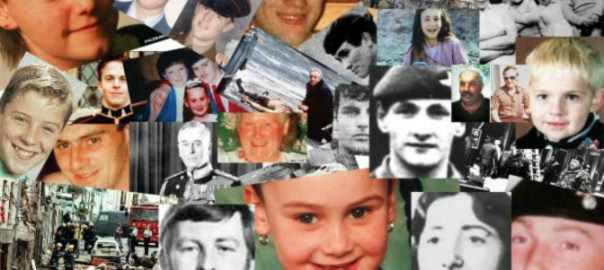
Key Events & Deaths on this day in Northern Ireland Troubles
30th October
Wednesday 30 October 1968

Jack Lynch, then Taoiseach (Irish Prime Minister), met with Harold Wilson, then British Prime Minister, in London. The Taoiseach called for the ending of partition as a means to resolve the unrest in Northern Ireland. The Irish Times (a Dublin based newspaper) carried a report of an interview with Lord Brookeborough (former Prime Minister of Northern Ireland).
[ Derry March; Civil Rights; Anglo-Irish Relations; Partition]
Friday 30 October 1970
There were serious riots in the Catholic Ardoyne area of Belfast which lasted for three nights. Chichester-Clark, then Northern Ireland Prime Minister, met with Reginald Maulling, then British Home Secretary, on matters related to reforms and security.
Saturday 30 October 1971
A British soldier was killed in a bomb attack in Belfast.
Monday 30 October 1972

The Northern Ireland Office (NIO) issued a discussion document The Future of Northern Ireland. The paper states Britain’s commitment to the union as long as the majority of people wish to remain part of the United Kingdom (UK).
The paper also introduces the ideas of a power-sharing government in Northern Ireland and an ‘Irish Dimension’. Loyalist paramilitaries carried out a raid on an Royal Ulster Constabulary station in Claudy, County Derry, and stole 4 British Army issue Sterling sub-machine Guns (SMGs) that had been issued to Ulster Defence Regiment (UDR) soldiers. #
[There was another theft of UDR weapons on 8 March 1973.] [ Political Developments. ]
Saturday 30 October 1976

Two Catholic civilians were abducted and shot dead by the Ulster Volunteer Force (UVF) at Glenbank Place, Crumlin Road, Belfast. Stephen McCann (20), a Catholic civilian, was abducted and killed at the rear of Glencairn Community Centre, Belfast. Members of he Ulster Volunteer Force (UVF) gang known as the ‘Shankill Butchers’ were responsible for the killing. [See: 20 February 1979] McCann had been a founder member of the Witness for Peace movement and author of the song ‘What Price Peace?’
Thursday 30 October 1980 [ Hunger Strike.]
Wednesday 30 October 1985
James Molyneaux, then leader of the Ulster Unionist Party (UUP), and Ian Paisley, then leader of the Democratic Unionist Party (DUP), attended a meeting at Downing Street, London, with Margaret Thatcher, then British Prime Minister.
The two Unionists again protested at the continuing Anglo-Irish talks between the two governments. They warned that a consultative role in Northern Ireland affairs for the government in the Republic of Ireland would lead to a Loyalist backlash.
[ PRONI Records – October 1985]
Wednesday 30 October 1991
Desmond Ellis was acquitted of conspiring to cause explosions at a court in London.
[Ellis had been involved in an extradition dispute between the Republic of Ireland and Britain earlier in the year. On the following day the British Home Secretary signed an ‘exclusion order’ which banned Ellis from living in Britain.]
Friday 30 October 1992
The Irish Republican Army (IRA) exploded a bomb, estimated at 250 pounds, at Glengormley Royal Ulster Constabulary (RUC) station. Thirteen people were injured in the explosion and over 100 houses were damaged. The IRA forced a taxi driver in London to transport a bomb to a location close to Downing Street where it later exploded.
Saturday 30 October 1993

Saturday 30th October 1993
Greysteel Killings
Greysteel Killings The Ulster Freedom Fighters (UFF), a cover name (pseudonym) used by the Ulster Defence Association (UDA), killed six Catholics civilians and one Protestant civilian in an attack on the ‘Rising Sun’ bar in Greysteel, County Derry. A further 13 people were injured in the attack one of whom later died of his injuries on 14 April 1994. [One of the gunmen was hear to say “trick or treat” before he fired into the crowded bar. This was a reference to the Halloween celebration that was taking place. There was widespread condemnation of the attack. The UFF later claimed that it had attacked the “Nationalist electorate” in revenge for the Shankill Road Bombing on 23 October 1993. The killings brought the total number of deaths during October to 27 making it the worst month for casualties in 17 years.]
Sunday 30 October 1994
There were scuffles on the Ormeau Road, Belfast, between Royal Ulster Constabulary (RUC) officers and local residents who were protesting against an Orange Order parade passing through their area. Speaking in Dublin Gerry Adams, then President of Sinn Féin (SF), said that there were “clear efforts” by the British government to reduce the momentum of the peace process.
Thursday 30 October 1997

The Continuity Irish Republican Army (CIRA) said that it was responsible for the attempted bombing of government offices in Derry. The United Nations (UN) called for an judicial inquiry into the killing of Pat Finucane, at the time a solicitor based in Belfast, on 12 February 1989.
Finucane had represented a number of Republicans in high profile cases.
The Ulster Freedom Fighters (UFF), a covername used by the Ulster Defence Association (UDA), claimed responsibility for the killing. Republicans alleged that the Royal Ulster Constabulary (RUC) had colluded with the UFF in targeting Finucane. The UN also criticised the Law Society for not defending lawyers from threats and harassment from members of the security forces. Marjorie (Mo) Mowlam, then Secretary of State for Northern Ireland, gave an interview which was published by New Statesman in which she accused civil servants in the Northern Ireland Office (NIO) of undermining the peace process by engaging in a series of leaks to the media and political parties. Jack Straw, then British Home Secretary, announced in the House of Commons that the final 12 exclusion orders would be revoked.
He also announced that new ‘anti-terrorist legislation’ would be introduced on a United Kingdom (UK) wide basis. The Committee on the Administration of Justice (CAJ), based in Belfast, called on the government to repeal all emergency legislation. There was an election in the Republic of Ireland to elect a new President. [When the counting was completed Mary McAleese was elected as the eight President of Ireland.]
Tuesday 30 October 2001
Brian Cowen, then Irish Minister for Foreign Affairs, called on the British government to demilitarise places such as south Armagh and west Tyrone “very quickly”. He was speaking in New York, USA, at a meeting of the National Committee on American Foreign Policy.
A Protestant man was charged at Belfast Magistrates’ Court with ‘riotous behaviour’ in connection with sectarian clashes at Limestone Road, north Belfast, on Sunday 28 October 2001. Kenneth Bloomfield (Sir), former head of the Northern Ireland civil service, said that a commissioner should be appointed to safeguard the interests of victims of ‘the Troubles’.
——————————————————-
———————————————————————————
Remembering all innocent victims of the Troubles
Today is the anniversary of the death of the following people killed as a results of the conflict in Northern Ireland
“To live in hearts we leave behind is not to die
– Thomas Campbell
To the innocent on the list – Your memory will live forever
– To the Paramilitaries –
There are many things worth living for, a few things worth dying for, but nothing worth killing for.
16 People lost their lives on the 30th October between 1971 – 2001
————————————————————
30 October 1971
Norman Booth, (22)
nfNI
Status: British Army (BA),
Killed by: Irish Republican Army (IRA)
Killed in bomb attack on British Army (BA) observation post, junction of Springfield Road and Cupar Street, Belfast.
————————————————————
30 October 1974

Gordon Catherwood, (44)
Protestant
Status: Civilian (Civ),
Killed by: Irish Republican Army (IRA)
Shot at his home, Upper Hightown Road, near Belfast, County Antrim.
————————————————————
30 October 1974

Michael Meenan, (16)
Catholic
Status: Irish Republican Army (IRA),
Killed by: Irish Republican Army (IRA)
Killed in premature bomb explosion at garage, Strand Road, Derry.
————————————————————
30 October 1975

Eileen Kelly, (6)
Catholic
Status: Civilian (Civ),
Killed by: Irish Republican Army (IRA)
Shot at her home, Beechmount Grove, Falls, Belfast. Father intended target. Official Irish Republican Army (OIRA) / Irish Republican Army (IRA) feud.
————————————————————
30 October 1976
Stephen McCann, (20)
Catholic
Status: Civilian (Civ),
Killed by: Ulster Volunteer Force (UVF)
Abducted while walking along Millfield, Belfast. Found stabbed and shot a short time later, near the Community Centre, off Forthriver Road, Glencairn, Belfast.
————————————————————
30 October 1976

Charles Corbett, (22)
Catholic
Status: Civilian (Civ),
Killed by: Ulster Volunteer Force (UVF)
Abducted while travelling in newspaper delivery van, Crumlin Road, Belfast. Found shot a short time later, Glenbank Place, off Crumlin Road, Belfast.
————————————————————
30 October 1976

John Maguire, (56)
Catholic
Status: Civilian (Civ),
Killed by: Ulster Volunteer Force (UVF)
Abducted while travelling in newspaper delivery van, Crumlin Road, Belfast. Found shot a short time later, Glenbank Place, off Crumlin Road, Belfast.

Steven Mullan, (20)
Catholic
Status: Civilian (Civ),
Killed by: Ulster Freedom Fighters (UFF)
Shot during gun attack on Rising Sun Bar, Greysteel, County Derry.
————————————————————
30 October 1993

Karen Thompson, (19)
Catholic
Status: Civilian (Civ),
Killed by: Ulster Freedom Fighters (UFF)
Shot during gun attack on Rising Sun Bar, Greysteel, County Derry.
————————————————————
30 October 1993
James Moore, (81)
Catholic
Status: Civilian (Civ),
Killed by: Ulster Freedom Fighters (UFF)
Shot during gun attack on Rising Sun Bar, Greysteel, County Derry.
————————————————————
30 October 1993

Joseph McDermott, (60)
Catholic
Status: Civilian (Civ),
Killed by: Ulster Freedom Fighters (UFF)
Shot during gun attack on Rising Sun Bar, Greysteel, County Derry.
————————————————————
30 October 1993

Moira Duddy, (59)
Catholic
Status: Civilian (Civ),
Killed by: Ulster Freedom Fighters (UFF)
Shot during gun attack on Rising Sun Bar, Greysteel, County Derry.
————————————————————
30 October 1993
John Moyne, (50)
Catholic
Status: Civilian (Civ),
Killed by: Ulster Freedom Fighters (UFF)
Shot during gun attack on Rising Sun Bar, Greysteel, County Derry.
————————————————————
30 October 1993

John Burns, (54)
Protestant
Status: Civilian (Civ),
Killed by: Ulster Freedom Fighters (UFF)
Shot during gun attack on Rising Sun Bar, Greysteel, County Derry.
————————————————————
30 October 1993
Victor Montgomery, (76)
Protestant
Status: Civilian (Civ),
Killed by: Ulster Freedom Fighters (UFF)
Shot during gun attack on Rising Sun Bar, Greysteel, County Derry. He died 14 April 1994.
————————————————————
30 October 2001
Charles Folliard, (30)
Protestant
Status: ex-Ulster Defence Association (xUDA),
Killed by: non-specific Republican group (REP)
Shot outside his girlfriend’s home, Oakland Park, Ballycolman, Strabane, County Tyrone.
————————————————————
- My Stop-Smoking Diary & cancer scareSaturday, July 1966 – Monday, 7 September 2026 The Promise I Made as a BoyI was ten years old when lung cancer took my dad. Watching him die such a horrible, painful death changed the shape of my life forever. It traumatised me. It carved a hole in my heart and soul that has never … Continue reading My Stop-Smoking Diary & cancer scare
- 100 Belfast & Northern Ireland Slang Phrases & MeaningBelfast slang is in a league of its own , so it is, and that’s a big part of the city’s craic. The accent and the banter have been shaped by Irish, Scots, and English influences, so if you’re not from here it can sound a wee bit strange at first and might do yer … Continue reading 100 Belfast & Northern Ireland Slang Phrases & Meaning
- Update: One foot in the Grave – countdown to my 60th Birthday has begunDate 3rd July 2026 Only thirteen days to go until I hit the big 6-0, and I have to admit I’m getting quite excited about my upcoming trip to Belfast and spending time with the people I love and cherish most in the world. At the same time, I’m feeling a little apprehensive. Reaching such … Continue reading Update: One foot in the Grave – countdown to my 60th Birthday has begun
- I Don’t Like Mondays – the Boomtown Rats: Iconic Songs & the story behind themI Don’t Like Mondays The Boomtown Rats 13 July 1979 Iconic Songs & the story behind them “I Don’t Like Mondays” is a song by the Irish new wave band the Boomtown Rats about the Cleveland Elementary School shooting in San Diego. It was released in 1979 as the lead single from their third studio album, The Fine Art of Surfacing. The song was a number-one … Continue reading I Don’t Like Mondays – the Boomtown Rats: Iconic Songs & the story behind them
- Who do you think I am ?Pop culture echoes Trigger warning: ⚠️This post touches on my deep pride and love of my loyalist culture and traditions and if this is not of interest or offends you , please feel free to continue scrolling. Who Do You Think I Am? It’s a question that divides opinion, and I’m acutely aware that many … Continue reading Who do you think I am ?
Discover more from
Subscribe to get the latest posts sent to your email.

