Britain’s young Muslims are taking the fight against President Bashir al-Assad from UK towns to the frontlines of Syria. . Amer Deghayes, a 20-year-old former student from Brighton, who joined the “holy war” against his father’s wishes after carrying out extensive research online.
We joined Amer after the death of his 18-year-old brother Abdullah, who died in a fierce battle against Assad forces in northern Syria. Undeterred by the bloody and brutal conflict, Amer’s 16-year-old brother Jaffer has since met up with him in Syria.
The UK is now attempting to combat, block, and remove thousands of items of “jihadist propaganda” from the internet in an attempt to deter Britons from taking up arms abroad. For Amer, the power of jihadist social media – which promotes stories of jihadi legend, martyrdom, and paradise – opened his eyes to the suffering of Muslims in Syria.
England is also now citing returning militants as “the biggest security threat to the United Kingdom.” The government’s position could leave Amer – and possibly thousands of unknown British fighters – stranded in increasingly fierce and bloody conflicts, and within the grasp of extremist jihadist groups.
Pushing Back the Islamic State: The Battle for Rojava
—————————————————————
The Rojava Revolution is a political upheaval taking place in an autonomous region of Northern Syria, known as Rojava. The revolution has been characterized by the prominent role played by women both on the battlefield and within the newly formed political system, as well as the implementation of democratic confederalism, a form of grassroots democracy based on local assemblies.
—————————————————————
Understanding the Syrian crisis in 5 minutes
—————————————————————
—————————————————————
Islamic State Conquest: Map Time Lapse (August 2015 Update)
Kurds make up between nine and fifteen percent of Syria’s population, or well over 2 million people. The northeast of the country (where many Kurds live) is strategically important, because it contains a large percentage of Syria’s oil supplies.[31]
Since 2004, several riots in Western Kurdistan have prompted increased tension. In 2004, riots broke out against the government in the northeastern city of Qamishli. During a chaotic soccer match between a local Kurdish team and a visiting Arab team from Deir ez-Zor, some Arab fans brandished portraits of Saddam Hussein (who slaughtered tens of thousands of Kurds in Southern Kurdistan during the genocidal Al-Anfal Campaign in the 1980s), provoking strong reactions from the Kurds. Tensions quickly escalated into open protests, with Kurds raising their flag and taking to the streets to demand cultural and political rights. In the ensuing crackdown by the police and clashes between Kurdish and Arab groups, at least 30 people were killed, with some claims indicating a casualty count of about 100 people. Occasional clashes between Kurdish protesters and government forces occurred in the following years.[32][33]
Anti-government sentiment has been present among the Kurdish population for a long time.[34] The Syrian government did not officially acknowledge the existence of Kurds in Syria[34] and a number of Kurds were stripped of their citizenship in 1962 and instead were registered as foreigners because their ancestors were not included in the Ottoman population registers for 1920. The Kurdish language and culture have also been suppressed. The government attempted to resolve these issues in 2011 by granting all Kurds citizenship, but only an estimated 6,000 out of 150,000 stateless Kurds have been given nationality and most discriminatory regulations, including the ban on teaching Kurdish, are still on the books.[35] Due to the Syrian Civil War that began in 2011, the government is no longer in a position to enforce these laws.
Syrian uprising
In 2011 the Arab Spring spread to Syria. Similar to the beginning of the Tunisian Revolution, Syrian citizen Hasan Ali Akleh soaked himself in gasoline and set himself on fire in the northern city of Al-Hasakah. This inspired activists to call for a “Day of Rage”, which ended up being sparsely attended, mostly because of fear of repression from the Syrian government. Days later, however, protests again took place, this time in response to the police beating of a shopkeeper.[citation needed]
Smaller protests continued, but it was on 7 March 2011, when thirteen political prisoners went on hunger strike, that momentum began to grow against the Assad government. Three days later dozens of Syrian Kurds went on hunger strike in solidarity.[36] On 12 March, major protests took place in Al-Qamishli and Al-Hasakah to both protest the Assad regime and commemorate Kurdish Martyrs Day.[37]
Protests grew over the months of March and April 2011. The Assad regime attempted to appease Kurds by promising to grant citizenship to thousands of Kurds, who until that time had been stripped of any legal status.[38] By the summer, protests had only intensified, as did violent crackdowns by the Syrian government.
In August a coalition of opposition groups formed the Syrian National Council in hopes of creating a democratic, pluralistic alternative to the Assad regime. However, internal fighting and disagreement over politics and inclusion plagued the group from its early beginnings. In the fall of 2011 the popular uprising escalated to an armed conflict. The Free Syrian Army (FSA) began to coalesce and armed insurrection spread largely across the central and southern parts of Syria.[citation needed]
2013 VOA report about the Kurdish situation in Syria
The National Movement of Kurdish Parties in Syria, which consisted of Syria’s 12 Kurdish parties, boycotted a Syrian opposition summit in Antalya, Turkey on 31 May 2011, stating that “any such meeting held in Turkey can only be a detriment to the Kurds in Syria, because Turkey is against the aspirations of the Kurds, not just with regards to northern Kurdistan, but in all four parts of Kurdistan, including the Kurdish region of Syria.” Kurdish Leftist Party representative Saleh Kado stated that “we, the Kurds in Syria, do not trust Turkey or its policies, and that is why we have decided to boycott the summit.”[39]
During the August summit in Istanbul, which led to the creation of the Syrian National Council, only two of the parties in the National Movement of Kurdish Parties in Syria, the Kurdish Union Party and the Kurdish Freedom Party, attended the summit. Kurdish leader Shelal Gado stated the reason they did not participate was that “Turkey is against the Kurds … in all parts of the world,” and that “If Turkey doesn’t give rights to its 25 million Kurds, how can it defend the rights of the Syrian people and the Kurds there?” Abdulbaqi Yusuf, representing the Kurdish Freedom Party, however, stated that his party felt no Turkish pressure during the meeting and participated to represent Kurdish demands.[40]
On 7 October 2011, prominent Kurdish rights activist Mashaal Tammo was assassinated when masked gunmen burst into his flat, with the Syrian government blamed for his death. At least 20 other civilians were also killed during crackdowns on demonstrations across the country.[41] On 20 September, the Kurdish politician Mahmoud Wali was assassinated by masked gunmen in the town of Ras al-Ayn.[42]
Ethnic minorities remain neutral
Democratic Union Party (PYD) chairman Salih Muslim Muhammad said that the lack of Kurdish participation was due to a tactical decision, explaining that: “There is a de facto truce between the Kurds and the government. The security forces are overstretched over Syria’s Arab provinces to face demonstrators, and cannot afford the opening of a second front in Rojava. On our side, we need the army to stay away. Our party is busy establishing organizations, committees, able to take over from the Ba’ath administration the moment the regime collapses.”[43]
Senior Kurdistan Workers’ Party (PKK) leader Cemil Bayik stated in November 2011 that if Turkey were to intervene in Rojava, the PKK would fight on the Syrian Kurdish side. The PKK’s Syrian branch was alleged in the same month to be involved in the targeting of Kurds participating in the uprising.[44]Murat Karayılan, the PKK’s military commander, threatened to turn all Kurdish-populated areas in Turkey into a war-zone if Turkish forces were to enter Syria’s Kurdish area.[45]
Anti-government protests had been ongoing in the Kurdish-inhabited areas of Syria since March 2011, as part of the wider Syrian uprising, but clashes started after the opposition Kurdish Democratic Union Party (PYD) and Kurdish National Council (KNC) signed a seven-point agreement on 11 June 2012 in Erbil under the auspice of Iraqi Kurdistan president Massoud Barzani. This agreement, however, failed to be implemented and so a new cooperation agreement between the two sides was signed on 12 July which saw the creation of the Kurdish Supreme Committee as a governing body of all Kurdish-controlled territories in Syria.[46][47][48]
YPG claims territory
The People’s Protection Units (YPG) captured the city of Kobanî on 19 July 2012, followed by the capture of Amuda (Kurdish: Amûdê) and Efrîn (Kurdish: Efrîn) on 20 July,[49] thus entering the Syrian Civil War as belligerent. The KNC and PYD afterwards formed a joint leadership council to run the captured cities. The cities fell without any major clashes, as Syrian security forces withdrew without any major resistance.[49] The Syrian Army pulled out to fight elsewhere.[50]
The YPG forces continued with their advancement and on 21 July captured Al-Malikiyah (Kurdish: Dêrika Hemko), which is located 10 kilometers from the Turkish border.[51] The rebels at the time also intended to capture Qamishli, the largest Syrian city with a Kurdish majority.[52] On the same day, the Syrian government attacked a patrol of Kurdish YPG members and wounded one fighter.[53] The next day it was reported that Kurdish forces were still fighting for Al-Malikiyah (Kurdish: Dêrika Hemko), where one young Kurdish activist was killed after government security forces opened fire on protesters. The YPG also took control over the towns of Ra’s al-‘Ayn (Kurdish: Serê Kaniyê) and Al-Darbasiyah (Kurdish: Dirbêsî), after the security and political units withdrew from these areas, following an ultimatum issued by the Kurds. On the same day, clashes erupted in Qamishli between YPG and government forces in which one Kurdish fighter was killed and two were wounded along with one government official.[54]
The ease with which Kurdish forces captured the towns and the government troops pulled back was speculated to be due to the government reaching an agreement with the Kurds so military forces from the area could be freed up to engage opposition forces in the rest of the country.[55] On 24 July, the PYD announced that Syrian security forces withdrew from the small Kurdish city of 16,000 of Al-Ma’bada (Kurdish: Girkê Legê), located between Al-Malikiyah and the Turkish borders. The YPG forces afterwards took control of all government institutions.[56]
Popular protest continued in Rojava through 2011 and into the spring of 2012 though most Kurds and other Northern Syrians did not join the FSA because of disagreements over Kurdish representation in a future Syria.[57]
On 1 August 2012 Assad forces on the periphery of the country are pulled into the intensifying conflict taking place in Aleppo. During this large withdraw from the north, the People’s Protection Units (PYD), a pro-Kurdish militia that formed after the 2004 al-Qamishli riots[58] took control of at least parts of Qamishlo, Efrin, Amude, Terbaspi and Ayn El Arab with very little conflict or casualties.[59]
On 2 August 2012, the National Coordination Committee for Democratic Change announced that most Kurdish dominated cities in Syria, with the exception of Qamishli and Hasaka, were no longer controlled by government forces and were now being governed by Kurdish political parties.[60] In Qamishli, government military and police forces remained in their barracks and administration officials in the city allowed the Kurdish flag to be raised.[61]
It was reported in August that the Kurds in northern controlled Syria had set up local committees and checkpoints to search cars. The border crossing between northeastern Syria and Iraq was no longer occupied by government forces. Kurds stated that they would defend their towns if government or opposition forces attempted to enter them. In some areas of Qamishli, government checkpoints were still active, however, Kurds denied cooperation with the Syrian government and stated that the troops remained in their checkpoints with hopes of avoiding a military confrontation.[62] In the same month, the Free Syrian Army (FSA) successfully bombed the government’s intelligence center in the city.[63]
After months of de facto rule, the PYD officially announced its regional autonomy on 9 January 2014. Elections had been held and popular assemblies crafted and approved Constitution of Rojava. Since then, residents have been organizing local assemblies, re-opening schools, establishing community centers and pushing back ISIS to gain control of further territory. They see their model of grassroots democracy as a model that can be implemented throughout the country in a post-Assad Syria.
Social revolution
After declaring autonomy, grassroots organizers, politicians and other community members have radically changed the social and political make up of the area. The extreme laws restricting independent political organizing, women’s freedom, religious and cultural expression and the discriminatory policies carried out by the Assad regime have been abolished. In its place, a constitution guaranteeing the cultural, religious and political freedom of all people has been established. The constitution also explicitly states the equal rights and freedom of women and also “mandates public institutions to work towards the elimination of gender discrimination.”[citation needed]
The Rojava cantons are governed through a combination of district and civil councils. District councils consist of 300 members as well as two elected co-presidents- one man and one woman. District councils decide and carry out administrative and economic duties such as garbage collection, land distribution and cooperative enterprises.[64] Civil councils exist to promote the social and political rights within the community.
Women’s rights
Women’s councils have formed to handle domestic abuse and sexual assault cases. Additionally, there is a 40% quota required of all councils in order for a vote to take place. There have also been the establishment of women’s houses, which are safe houses for victims of violence to stay to seek refuge.[65]
Religious freedom
Christian Assyrians, Muslim Kurds and others have worked together both in fighting regime forces and Islamist groups as well as in managing political affairs. The right to religious expression is also safeguarded in the constitution. Because of this as well as the extreme hostility towards religious minorities in Islamist controlled areas has led to a large migration of religious minorities to Rojava.[66]
Cooperative economy
The vast majority of the economy continues to support forces fighting Assad forces, Islamist forces and now on occasion Turkish forces. However, the canton administration has been working to support worker cooperatives.[67]
Ethnic minority rights
Closely related to religious freedom and the protection of religious minorities is the protection of ethnic minorities. Kurds now have the right to study their language freely as do Assyrians. In some areas, there is an ethnic minority quota in addition to the gender quota for councils.[68]
Criticism
Criticism of the current political structure includes the marginalizing of dissident political parties and their repression by the community police, Asayish. The region has also implemented mandatory military service, which some oppose. Additionally, Human Rights Watch has found that the YPG, the People’s Protection Units still has youth under the age of 18 serving in the forces.
Combatants
There are four major forces involved in the Rojava Revolution. The People’s Protection Units are working with the PYD and other political parties to establish self-rule in Rojava. Syrian government forces still maintain rule in some areas of Rojava under the leadership of the Assad regime. A collection of Islamic forces, the largest being ISIS are fighting to rule the region by Sharia law. Finally, there are several militias under the general banner of the Free Syrian Army whose intentions and alliances have differed and shifted over time. At the moment, most FSA fighters are working with the YPG against Islamic forces and the Syrian government.
While conflict between the YPG and Syrian Government has not been as active as fighting against Islamist forces, there have been several conflicts between the two forces. Territory once controlled by the Syrian government in Qamishli and al-Hasakah have both been lost to YPG forces.
The relationship between the People’s Protection Units (YPG) and the Free Syrian Army (FSA) has been one of tentative cooperation. Both are opposed to the Assad regime and ISIS, however clashes have taken place. Recently, the two forces have been working together to battle ISIS under the name of Euphrates Volcano.
On 4 May 2013, YPG forces and Jihadist militants, including Al Nusra, clashed in areas close to the cities of Hasaka and Ras al-Ain.[69] Reports seemed to suggest that FSA forces were arming Arab tribes in the town of Tal Tamer; encouraging them to confront Kurdish groups. Despite hit and run attacks which led to the deaths of several YPG members as well as civilians, YPG forces reportedly held off the armed groups.[70]
Map of the territory changes during the YPG-led Northern Syria offensive (2015)
The situation in the Al-Hasakah Governorate, as of 6 August 2015
YPG forces have clashed heavily with Islamist forces. Most notable have been the Siege of Kobani and more recently the Al-Hasakah Offensive and Tell Abyad Offensive. The YPG has been one of the most reliable and effective fighting forces against Islamic groups such as ISIL and al-Nusra Front.
The majority of tension and conflict in Rojava has been between the YPG and Islamist groups. However, there has also been internal conflict between various Kurdish political parties and militias. This was particularly true at the beginning of the revolution, while those tensions have largely subsided as the autonomous administrations of Rojava have become more established and the urgency for a united front against Islamic forces has developed.
Towns under semi-autonomous rule
In January 2013, the following towns were under YPG control:
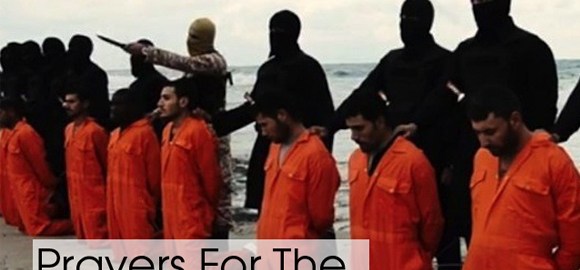
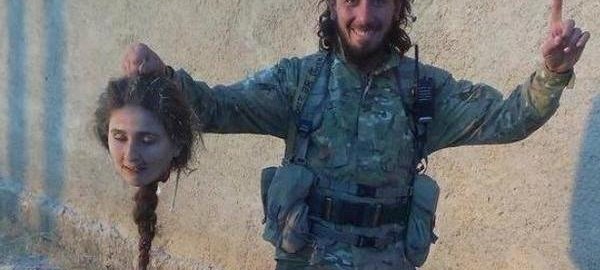
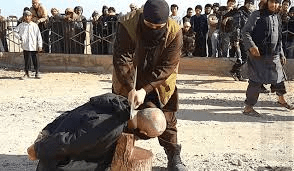
ISIS released a video showing the beheading of what they claimed were 21 Coptic Christians in Libya.
The group calling itself “The Tripoli Province of Islamic State” used the video as a warning to Christians and Christian nations at war with ISIS. The Egyptian men had traveled to Libya to find work. ISIS rounded them up in December and January. Some of the men are heard crying out “Oh God” and “Oh Jesus” as their captors push them to the ground.
Last week, ISIS took screen shots from the video and published them in its English-language magazine.
“I will cast terror into the hearts of those who disbelieve. Therefore strike off their heads and strike off every fingertip of them” No reasonable person would interpret this to mean a spiritual struggle.
——————————————————————————
Incredible: Man Survives an ISIS Massacre
——————————————————————————
Quran (8:67) –
“It is not for a Prophet that he should have prisoners of war until he had made a great slaughter in the land…“
“O ye who believe! When ye meet those who disbelieve in battle, turn not your backs to them. (16)Whoso on that day turneth his back to them, unless maneuvering for battle or intent to join a company, he truly hath incurred wrath from Allah, and his habitation will be hell, a hapless journey’s end.”
“Fight against them so that Allah will punish them by your hands and disgrace them and give you victory over them and heal the breasts of a believing people.”
——————————————————————————
Disturbing ISIS Film Shows 10-Year-Old Executing Two Men
“If the hypocrites, and those in whose hearts is a disease, and the alarmists in the city do not cease, We verily shall urge thee on against them, then they will be your neighbors in it but a little while. Accursed, they will be seized wherever found and slain with a (fierce) slaughter.”
“Those who disbelieve follow falsehood, while those who believe follow the truth from their Lord… So, when you meet (in fight Jihad in Allah’s Cause), those who disbelieve smite at their necks till when you have killed and wounded many of them, then bind a bond firmly (on them, i.e. take them as captives)…
——————————————————————————
Exclusive: the jihadi Brit who fought and died in Syria
“There is no blame for the blind, nor is there blame for the lame, nor is there blame for the sick (that they go not forth to war). And whoso obeyeth Allah and His messenger, He will make him enter Gardens underneath which rivers flow; and whoso turneth back, him will He punish with a painful doom.”
Islamic State is a one-way ticket for jihadi brides
—————————————————-
British Jihadi Women Documentary 2015
—————————————————-
Just two out of 600 females who have ran from the West to join the Islamic State (Isis) have returned home from Syria, government figures show.
But walking into the warzone is a one-way-ticket with a small chance of return, with little realising this, with only two of the so-called jihadi brides having escaped home.
In comparison to this, European government officials which monitor these numbers note that almost one-third of male jihadists have escaped the clutches of IS are on their way back from Syria.
According to researchers, many women and girls are unable to escape from the warzone – even if they realise they have made a huge mistake.
The girls who leave the west to join IS are married off straight away, either in Turkey or when they cross into Syria. There are around 20,000 foreign fighters and approximately 5,000 European fighters in Syria, so there is no shortage of men looking for wives. That number is expected to double by the end of 2015.
Sara Khan, a British Muslim whose group Inspire campaigns against the dangers of extremist recruiters, told the Associated Press: “It’s so romanticized, the idea of this utopia. I don’t even think those young girls have necessarily considered that there’s no way back now.”
The women are not allowed to travel without a male, if they do they could face punishment, according to material IS published.
Sterlina Petalo is a Dutch teenager who converted to Islam, and came to known as Aicha. She travelled to Syria in 2014 to marry a Dutch jihadi fighter there and managed to return months later – it is assumed she made her way to Turkey, where her mother picked her up and brought her back to the Netherlands. Back home, she was immediately arrested on suspicion of joining a terror group.
A 25-year-old Briton, who police did not name also made her way back to the UK along with her toddler that she took all the way to Raqqa. She decided she made a mistake and called home, she made her way back to Turkey and called her father there who met her there. In the UK she was detained and charged but is now free on bail.
Currently 60 British women and girls have fled the UK to become jihadi brides, including three girls from Bethnal Green in East London who ran away in February.
Amira Abase, 15, Shamima Begum, 15, and Kadiza Sultana, 16, were captured on CCTV before arriving in Syria. The video was recorded on 17 February, the day the three friends left their homes in East London, after telling their families they would be out for the day.
They are now believed to be living in the IS stronghold Raqqa, however reports suggest that they have been separated and possibly married off to fighters as jihadi brides.
These three girls left the UK on their own free will and are now apparently are being trained for “special missions’ and are likely to die in the Middle East as suicide bombers Um Asmah, a Islamic State commander who is now on the run, told Sky News.
Um Asmah said the girls were “very, very happy” on arrival and had been laughing and smiling, but they were unprepared and had little experience of living permanently veiled and under the strict regime.
Their fate has already been determined by the terror group, she explained, adding: “Everything is already decided for you and you cannot evade it or refuse it. You cannot have a mind of your own,” Asmah told Sky News.
She said the Bethnal Green trio are special to the terror group, but the extremist group has plenty more foreign girls, with more joining each month.
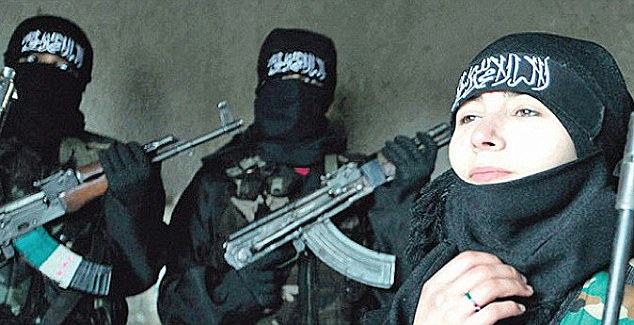
Jihadi bride: Another Briton who left Britain to join ISIS is Lewisham-born Khadijah Dare (left). Here she is pictured alongside her Swedish terrorist
Now on the run, Um Asmah says she will be killed if she is ever caught by IS fighters. “I am a traitor and an unbeliever now,” she said. “I am scared every minute and of everyone I meet.”
This week, Metropolitan Police counter terrorism officers stopped a 16-year-old girl from London travelling to Syria after she was groomed on Twitter to flee to the war zone and marry an IS soldier.
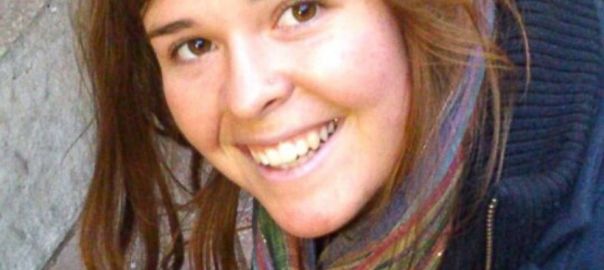
Islamic State leader Baghdadi ‘raped’ Kayla Mueller
PERVERTED KILLER Burn in hell!
An American aid worker who was killed in February while held hostage by Islamic State (IS) militants in Syria, was sexually abused by the group’s top leader, US officials tell ABC news.
Kayla Mueller, 26, was repeatedly raped by Abu Bakr al-Baghdadi, they said.
Counterterrorism officials made her family aware of the abuse in June.
Mueller was abducted while working in Aleppo, Syria, in 2013. IS said she was killed in a Jordanian air strike, but the US blames IS for her death.
“We were told Kayla was tortured, that she was the property of Baghdadi. We were told that in June by the government,” her parents, Carl and Marsha, told ABC News.
Baghdadi personally took the humanitarian aid worker to the home of another senior IS member – Abu Sayyaf – who was in charge of IS oil and gas until his death in a US special forces operation in May, ABC news, citing US officials, reports.
US special forces raid
The channel said he regularly visited the compound where she was being held and repeatedly assaulted her.
Officials said they had obtained information about the abuse from at least two teenage Yazidi girls who were held hostage as sex slaves and found inside the Sayyaf compound at the time of the US attack.
Mueller was reportedly held for some time by Sayyaf and his wife, Umm Sayyaf, who was also captured by US special forces in May.
At the time, the Pentagon said Umm was suspected of being an IS member and of being complicit in the enslavement of a young Yazidi woman who was rescued in the raid.
Hundreds of young women and girls – many of them Yazidis captured in northern Iraq – are believed to be held as sex slaves by IS militants in areas under their control.
The Yazidi girls provided intelligence used by the US to interrogate Sayyaf’s wife, who “spilled everything” about several IS leaders and their whereabouts, a counterterrorism official told ABC.
Umm Sayyaf was handed over to the Kurdish authorities in northern Iraq last week to face trial.
The information that has come to light appears to contradict speculation that Mueller was treated well in captivity, as a letter written in 2014 and smuggled out to her family implied.
In it, Mueller tried to reassure her family, saying that she had been treated with “utmost respect + kindness”.
The humanitarian aid worker from Prescott, Arizona, travelled to the Turkey-Syria border in 2012 to work with refugees.
—————————————————————
Kayla Mueller’s letter from captivity before her death
Kayla Mueller’s family have released a letter sent by the IS hostage before her death in what the jihadist group says was a coalition air strike in Syria.
Everyone,if you are receiving this letter it means I am still detained but my cell mates (starting from 11/2/2014) have been released. I have asked them to contact you +send you this letter.
It’s hard to know what to say.
Please know that I am in a safe location, completely unharmed + healthy (put on weight in fact); I have been treated w/ the utmost respect + kindness.
I wanted to write you all a well thought out letter (but I didn’t know if my cell mates would be leaving in the coming days or the coming months restricting my time but primarily) I could only but write the letter a paragraph at a time, just the thought of you all sends me into a fit of tears.
If you could say I have “suffered” at all throughout this whole experience it is only in knowing how much suffering I have put you all through; I will never ask you to forgive me as I do not deserve forgiveness.
I remember mom always telling me that all in all in the end the only one you really have is God.
I have come to a place in experience where, in every sense of the word, I have surrendered myself to our creator b/c literally there was no else…. + by God + by your prayers I have felt tenderly cradled in freefall.
I have been shown in darkness, light + have learned that even in prison, one can be free. I am grateful.
I have come to see that there is good in every situation, sometimes we just have to look for it. I pray each each day that if nothing else, you have felt a certain closeness + surrender to God as well + have formed a bond of love + support amongst one another…
I miss you all as if it has been a decade of forced separation. I have had many a long hour to think, to think of all the things I will do w/ Lex, our first family camping trip, the first meeting @ the airport.
I have had many hours to think how only in your absence have I finally @ 25 years old come to realize your place in my life.
Kyla Mueller sent the letter via other hostages who were released
The gift that is each one of you + the person I could + could not be if you were not a part of my life, my family, my support.
I DO NOT want the negotiations for my release to be your duty, if there is any other option take it, even if it takes more time. This should never have become your burden.
I have asked these women to support you; please seek their advice. If you have not done so already, [REDACTED] can contact [REDACTED] who may have a certain level of experience with these people.
None of us could have known it would be this long but know I am also fighting from my side in the ways I am able + I have a lot of fight left inside of me.
I am not breaking down + I will not give in no matter how long it takes.
I wrote a song some months ago that says “The part of me that pains the most also gets me out of bed, w/out your hope there would be nothing left…” aka ‐ the thought of your pain is the source of my own, simultaneously the hope of our reunion is the source of my strength.
Please be patient, give your pain to God.
I know you would want me to remain strong. That is exactly what I am doing.
Do not fear for me, continue to pray as will I + by God’s will we will be together soon.
Media had long reported that a 26-year-old American aid worker was being held by the Islamic State of Iraq and the Levant (ISIS) without naming her at her family’s request. Her captivity and death were widely reported upon confirmation of her death.
Food For Life Vrindavan, a local branch of Food For Life, which provides free food, education, and medical care for those in need in the region, for whom she taught English and kindergarten students.[4][5]
Just Peace, a social justice project of United Campus Ministries at Northern Arizona University, with whom she went on a humanitarian aid trip to Guatemala and with whom she advocated against torture and Guantanamo Bay.
New Day Peace Center in Flagstaff, Arizona, for whom she helped to establish services for veteran students at Northern Arizona University and at Coconino Community College.
Northern Arizona University Center for Intercultural Education, which provides services to international students at Northern Arizona University.
Prescott Area Women’s Shelter, where she worked during the nights to help meet the needs of homeless women, children, and families.
Save Darfur Coalition, with whom she volunteered for three years, for whom she conducted multiple letter-writing campaigns and led two silent walks.
STAND, for whom she served as the President of STAND:NAU, a local chapter at Northern Arizona University, as well as the Southwest Regional Outreach Coordinator of the parent organization.
Support to Life, an international aid organization, for whom she worked to help Syrian refugees in Turkey
Tibetan Hope Center, an organization that helps Tibetanrefugees to gain life skills to live independently in India, for whom she taught English and compiled a monthly newsletter.
Youth Count, where she volunteered in Prescott, Arizona participating in multiple environmental and inter-generational projects.
Capture and death
Mueller started working in southern Turkey in December 2012, where she was assisting Syrian refugees. On August 3, 2013, she drove to the northern Syrian city of Aleppo with a coworker/friend who was traveling to the Spanish Médecins Sans Frontières hospital in Aleppo to work for a day.[7] She worked with international aid agency Support to Life.[8][9] On her departure from Aleppo to return to Turkey, militants abducted her.[10]
According to anonymous sources of American reporter Catherine Herridge, the location of Mueller and other American hostages was known by the White House in May 2014, but a decision on a rescue mission was not made for seven weeks. By that time, the hostages had been dispersed.[11]
A media account affiliated with ISIS released a statement on February 6, 2015 claiming that a female American hostage held by the group was killed by one of around a dozen Jordanian airstrikes in ar-Raqqah, Syria. The statement came just days after the release of a video showing the burning of Jordanian fighter pilot Muath al-Kasasbeh by the militant group and the subsequent execution of Sajida Mubarak Atrous al-Rishawi and other prisoners of Jordan. The statement was later translated by the SITE Intelligence Group, identifying the hostage as Mueller.[12]
Mueller had been in ISIS custody for 18 months. A US mission to rescue her and several others in northern Syria in July 2014 failed when ISIS moved the prisoners. The US was unaware of her location since, though her family was told negotiations were underway to swap her for Aafia Siddiqui, according to Arizona House Representative Paul Gosar.[13]ABC News and CBS News reported that sources in the intelligence community believe Mueller may have been “given over” to an ISIS commander in a “forced marriage” and the group did not view her as a bargainable hostage. In a letter to her family, she spoke of being healthy, well-fed and treated with the utmost kindness and respect in a safe place. ISIS members corresponding with the Muellers referred to Kayla as their “guest”.[14][15]
On February 6, 2015, ISIS published a photo of a damaged building, named Mueller and her home town and alleged she had been killed in a Jordanian airstrike in the building where she was left alone with no guards, but no proof of death was provided.[8] The Pentagon agreed the building was one hit in the bombings, but disputed that Mueller, or any civilian, was inside. The site had been bombed by the coalition twice before, and was targeted again because ISIS soldiers sometimes return to bombed sites, thinking the coalition won’t return, according to Pentagon spokesman John Kirby. After this, Mueller’s name was released by American and other media with the family’s consent.[7][not in citation given]
On February 10, 2015, Mueller’s family announced ISIS had confirmed her death to them in an e-mail, with three photographs of her dead body, bruised on the face and wearing a black hijab.[16][17]National Security Council spokeswoman Bernadette Meehan said this message was authenticated by the intelligence community. President Barack Obama offered his condolences to Mueller’s family.[18]
It is reported Mueller was a “personal captive” of Abu Sayyaf.[19]
Reactions
Family
Mueller’s parents reportedly implored ISIS to contact them as they hoped their daughter may still be alive. “We have sent you a private message and ask that you respond to us privately”, Carl and Marsha Mueller said in a statement. They said they had not talked to the media as ISIS warned them not to.[20]
Government
An American official cautioned that without proof of Mueller’s death, the statement by ISIS could be a ploy to cause the Jordanians and the rest of the American-led coalition to refrain from any heavier airstrikes.[7]
Jordan’s Foreign Minister Nasser Judeh called ISIS’s claim “an old and sick trick” on Twitter. “So they behead innocent #US #UK & Japan hostages & BURN a brave #Jordan pilot ALIVE & now a hostage is killed by an airstrike? Sure! Sick!”, he said.[21][22] He further tweeted: “An old and sick trick used by terrorists and despots for decades: claiming that hostages human shields held captive are killed by air raids.”[23] Later upon confirmation of Mueller’s death he tweeted: “Saddened & angered to hear news confirming killing of #US hostage #kaylaMueller. Yet another ugly example of these terrorists’ brutality.”[24]
After many Western news outlets cast doubt on the claim of the hostage death and the extremists’ ability to identify Jordanian and U.S. made F-16s flying at high altitudes, Jordan dismissed the claim of a killed hostage as an ISIS publicity stunt and a lie, as the group is known for its propaganda techniques.[25]
After Mueller’s family confirmed her death, President Obama said “[Mueller] represents what is best about America, and expressed her deep pride in the freedoms that we Americans enjoy, and that so many others strive for around the world.” U.S. Secretary of State John Kerry issued a statement saying “ISIL, and ISIL alone, is the reason Kayla is gone.”[26]
The Pentagon declined to investigate whether Mueller was killed by the coalition airstrike. Policy dictates the US only investigates reports of civilian casualties when they come from a “credible source”, which ISIS is not.[27]
Media
Time magazine named Kayla Mueller as an ideal role model for Millennials, citing her selfless desire to end suffering, her activism, and her humanitarian aid work, praising her desire not to be seen, but to genuinely help people, and lauding her possession of Millennials’ positive good qualities of idealism, optimism, and love of families without troublesome qualities also associated with the Millennial generation.[28]
On February 23, 2015 the Mueller family was interviewed on The Today Show by Savannah Guthrie. Carl Mueller expressed his frustration with the Obama administration over the way it conducted negotiations with their daughter’s captors and their policy of not paying ransom money for hostages. “We understand the policy about not paying ransom, but on the other hand, any parents out there would understand that you would want anything and everything done to bring your child home,” Carl Mueller said. “And we tried, and we asked. But they put policy in front of American citizens’ lives. And it didn’t get it changed.”[29]
R.I.P
My autobiography: A Belfast Child is now available to pre-order on Amazon , launch date is 30th April.
Send in the SAS See how brave they are faced with real Warriors
——————————————————————————————————
British Forces In Firefight with Taliban ( Afghanistan )
The footage follows a squad of British soldiers on foot patrol through irrigated farmland who quickly, soon after leaving their combat outpost, run into a firefight with
Taliban insurgents
——————————————————————————————————
UK vs ISIS: Elite SAS soldiers deployed on secret sniper missions to kill Islamic State militants
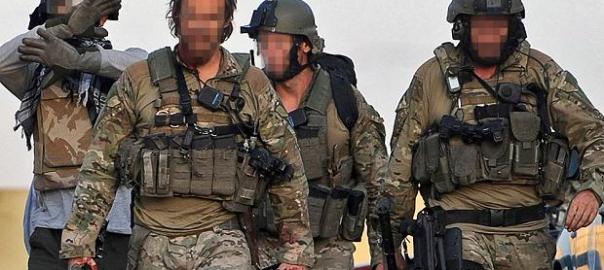
Squads of elite British Special Air Service soldiers have been deployed on secret missions to kill Islamic State militants, eliminating up to eight jihadists a day, according to a report in the Mail on Sunday.
Such attacks, which are often launched at night, may reflect a heightened effort from the United Kingdom to fight the Islamic State, as the SAS had previously said it was only engaged in non-combat missions in the area.
Before a mission begins, drones are sent to collect footage of potential target sites, while intelligence officials tap the phones of Islamic State leaders to gather more information.
SAS soldiers are carried to the drop site in Chinook helicopters. Since the helicopter’s engines are loud, the drop site can be as far as 80 kilometres from the target. The troops then prepare their heavy machine guns and sniper rifles before heading to the target site on quad bikes.
Their guerilla-style attacks take enemies by surprise and make it difficult for them to mount a defense. “Our tactics are putting the fear of God into IS as they don’t know where we’re going to strike next and there’s frankly nothing they can do to stop us,” an unnamed SAS source told the Mail on Sunday.
The United States and the United Kingdom will be coordinating an offensive by 20,000 Iraqi and Kurdish troops in spring.
Disclaimer – The views and opinions expressed in these documentaries are soley intended to educate and provide background information to those interested in Islamic State. They in no way reflect my own opinions and I take no responsibility for any inaccuracies or factual errors.
————————————————————————————————————————————
————————————————————————————————————————————-
ISIS – “Islamic” Extremism?
The following documentary contains scenes of a graphic nature which some viewers may find distressing.
Discretion is advised
—————————————————————————————————————————-
if you have enjoyed reading my story and daily blogs please consider making a small donation



_Kurdish_Syria.jpg)

.png)















 belfastchildis.com