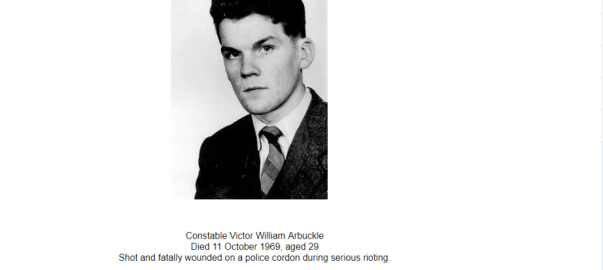
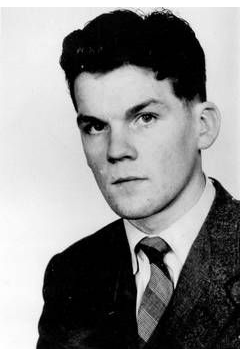
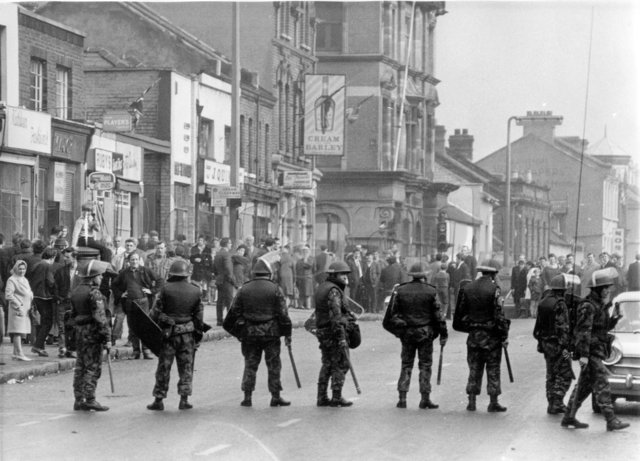
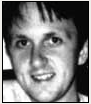
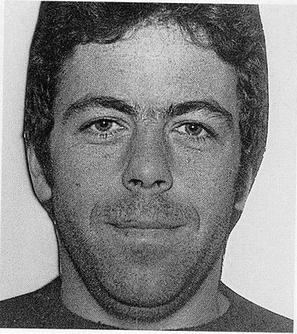
Victor Arbuckle (aged 29), a member of the Royal Ulster Constabulary (RUC), was shot dead by Loyalists during street disturbances on the Shankill Road in Belfast.
Two Protestant civilians were shot dead by the British Army during rioting.
They were:
————————————————————–
11 October 1969 Goerge Dickie, (25)
Protestant Status: Civilian (Civ),
Killed by: British Army (BA)
Shot during street disturbances, at the corner of Shankill Road and Downing Street, Belfast
————————————————————–
11 October 1969 Herbert Hawe, (32)
Protestant Status: Civilian (Civ),
Killed by: British Army (BA)
Shot during street disturbances, Hopeton Street, Shankill, Belfast.
————————————————————–
First deaths in Trouble
The first deaths of the Troubles occurred in July 1969. Francis McCloskey, a 67-year-old Catholic civilian had been found unconscious on 13 July near the DungivenOrange Hall following a police baton charge against a crowd who had been throwing stones at the hall.
Witnesses later said they had seen police batoning a figure in the doorway where McCloskey was found, although police claimed that he had been unconscious before the baton charge and may have been hit with a stone. He was taken to hospital and died the following day.
On 11 October 1969, Constable Victor Arbuckle was shot dead by loyalists on Belfast’s Shankill Road during serious rioting in protest at the recommendations of the Hunt Report. Arbuckle was the first police fatality of the Troubles.
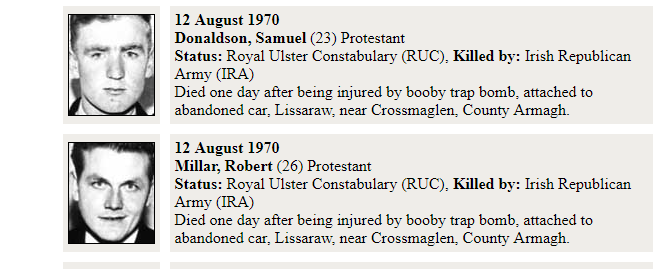
In August 1970, two young constables, Donaldson and Millar, died when an abandoned car they were examining near the strongly republican town of Crossmaglen exploded. They became the first security forces victims of the Provisional Irish Republican Army campaign.
This campaign involved the targeting of police officers, and continued until the final ceasefire in 1997, as the peace process gained momentum.
The last RUC officer killed, Constable Francis O’Reilly (a Catholic), was also killed by loyalists, in a September 1998 bombing during the Drumcree conflict.
———————————————
06 October 1998
Francis O’Reilly (30) Catholic
Status: Royal Ulster Constabulary (RUC),
Killed by: Red Hand Defenders (RHD)
Died one month after being injured by blast bomb, thrown during street disturbances, Charles Street, Portadown, County Armagh.
The Royal Ulster Constabulary was the police force in Northern Ireland from 1922 to 2001. Following the awarding of the George Cross in 2000, its formal title became the Royal Ulster Constabulary, GC. It was founded on 1 June 1922 as a successor to the Royal Irish Constabulary (RIC).
At its peak the force had around 8,500 officers with a further 4,500 who were members of the RUC Reserve.
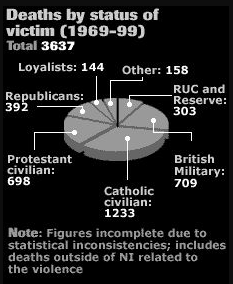
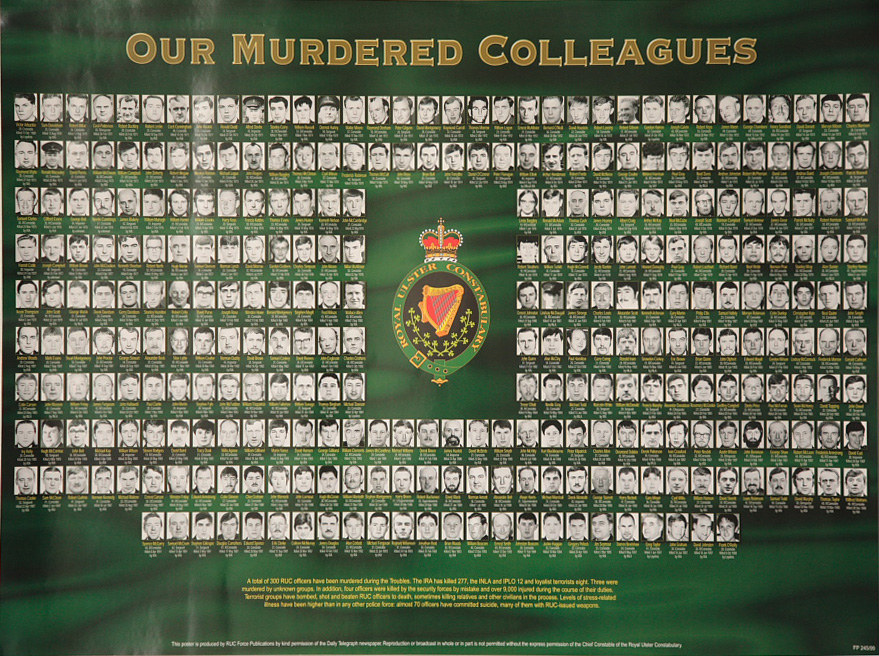
During the Troubles, 319 members of the RUC were killed and almost 9,000 injured in paramilitary assassinations or attacks, mostly by the Provisional IRA, which made the RUC, by 1983, the most dangerous police force in the world in which to serve.
In the same period, the RUC killed 55 people, 28 of whom were civilians.
The RUC has been accused by republicans and Irish nationalists of one-sided policing and discrimination, as well as collusion with loyalist paramilitaries. Conversely, it was praised as one of the most professional policing operations in the world by British security forces.
The allegations regarding collusion prompted several inquiries, the most recent of which was published by Police OmbudsmanNuala O’Loan. The report identified police, CID and Special Branch collusion with loyalist terrorists under 31 separate headings, in her report on the murder of Raymond McCord and other matters, but no member of the RUC has been charged or convicted of any criminal acts as a result of these inquiries. Ombudsman Dame Nuala O’Loan stated in her conclusions that there was no reason to believe the findings of the investigation were isolated incidents.
During 12–17 August 1969, intense political and sectarian rioting took place in Northern Ireland. There had been sporadic violence throughout the year arising from the civil rights campaign, which was demanding an end to discrimination against Irish Catholics. Civil rights marches were repeatedly attacked by both Ulster Protestantloyalists and by the Royal Ulster Constabulary (RUC), a unionist and largely Protestant police force.
The disorder led to the Battle of the Bogside in Londonderry, a three-day riot in the Bogside district between the RUC and the nationalist/Catholic residents. In support of the Bogsiders, nationalists and Catholics launched protests elsewhere in Northern Ireland. Some of these led to attacks by loyalists working alongside the police. The most bloody rioting was in Belfast, where seven people were killed and hundreds more wounded. Scores of houses, most of them owned by Catholics, as well as businesses and factories were burned out. In addition, thousands of mostly Catholic families were driven from their homes. In certain areas, the RUC helped the loyalists and failed to protect Catholic areas. Events in Belfast have been viewed by some as a pogrom against the Catholic and nationalist minority.[1][2]
The British Army was deployed to restore order and state control, and peace lines began to be built to separate the two sides. The events of August 1969 are widely seen as the beginning of the thirty-year conflict known as the Troubles.
This is simply the story of a boy trying to grow up, survive, thrive, have fun & discover himself against a backdrop of events that might best be described as ‘explosive’, captivating & shocking the world for thirty long years.
Key Events & Deaths on this day in Northern Ireland Troubles
11th October
Saturday 11 October 1969
Victor Arbuckle
First RUC Officer Killed Victor Arbuckle (aged 29), a member of the Royal Ulster Constabulary (RUC), was shot dead by Loyalists during street disturbances on the Shankill Road in Belfast. [Arbuckle was the first member of the RUC to be killed in ‘the Troubles’.] Two Protestant civilians were shot dead by the British Army during rioting.
A claim of maladministration in housing allocation against Dungannon Rural District Council was upheld by the Commissioner for Complaints
Friday 11 October 1974
The Irish Republican Army (IRA) carried out two bomb attacks on clubs in London. At 10.30pm a hand-thrown bomb with a short fuse was thrown through a basement window of the Victory, an ex-servicemen’s club in Seymour Street near Marble Arch. A short time later an identical bomb was thrown into the ground floor bar at the Army and Navy Club in St. James’s Square. Only one person was injured in these two attacks.
Lenny Murphy was found guilty of possession of firearms and sentenced to 12 years in jail.
[It was later revealed that Murphy was the leader of the ‘Shankill Butchers’ a Ulster Volunteer Force (UVF) gang which was responsible for the killings of at least 19 Catholic civilians.]
Tuesday 11 October 1983
James Prior, then Secretary of State for Northern Ireland, said that he would resign his post if the inquiry into the Maze prison escape on 25 September 1983 found that his policies had been responsible. [The report of the inquiry was published on 26 January 1984.]
Thursday 11 October 1984
The European Parliament voted in favour of a motion calling on the British government to ban the use of plastic bullets by the security forces in Northern Ireland. An opinion poll published in the Belfast Telegraph, a Northern Ireland newspaper, showed that 58 per cent of Protestants and 50 per cent of Catholics, among those questioned, were ‘basically satisfied’ with direct rule.
Sunday 11 October 1987
Charles Haughy, then Taoiseach (Irish Prime Minister), expressed his disappointment in the achievements of the Anglo-Irish Agreement (AIA).
Tuesday 11 October 1988
Ian Paisley, then leader of the Democratic Unionist Party (DUP) and Member of the European Parliament (MEP) for Northern Ireland, was physically removed from the European Parliament building when he mounted a protest at a speech being made by the Pope.
Tuesday 11 October 1994
The Royal Ulster Constabulary (RUC) began patrolling west Belfast without the support of British Army (BA) soldiers.
Wednesday 11 October 1995
John Bruton, then Taoiseach (Irish Prime Minister), said that he believed that Sinn Féin (SF) had satisfied the conditions of a commitment to exclusively peaceful means and thus all-party talks should begin.
Friday 11 October 1996
Warrant Officer James Bradwell (43) died of injuries received during the Irish Republic Army (IRA) bombing of the British Army Barracks on Monday 7 October 1996. There were reports in the Northern Ireland media that the Combined Loyalist Military Command (CLMC) had met during the day to consider their response to the IRA bombing.
At the Conservative Party conference in Bournemouth, John Major, then British Prime Minister, told delegates that the IRA would not bomb its way into the Stormont talks. About 1,000 people attended a peace rally organised by Women Together outside the City Hall in Belfast.
Monday 11 October 1999
Mandelson Appointed Secretary of Sate Marjorie (Mo) Mowlam (Dr), then Secretary of State for Northern Ireland, who had been in post since 3 May 1997 was replaced in a Cabinet reshuffle by Peter Mandelson. Although thought “too green” in her political leanings, Mowlam insisted she had not been forced out by Unionists. Mandelson had first been suggested for the position by David Trimble, then leader of the Ulster Unionist Party (UUP).
A pipe-bomb was thrown at the home of a Catholic family in the Twinbrook area of west Belfast. The device was hurled through the family’s living room window but failed to explode. A second pipe-bomb was found outside the house. A couple and their two-month old baby were in the house at the time but escaped injury. The attack was carried out by Loyalist paramilitaries. The Police Federation of Northern Ireland launched a petition to ‘defend the RUC’ from the proposal in the Patten report. Nuala O’Loan, a law lecturer and former member of the Police Authority, was appointed by Adam Ingram, then Security Minister at the Northern Ireland Office (NIO), as the new Police Ombudsman for Northern Ireland (PONI).
Thursday 11 October 2001
The Royal Ulster Constabulary (RUC) described an attack on a Catholic man (22) as attempted murder. A Loyalist gang attacked the man on the Westlink between Grosvenor Road and Broadway, Belfast, at 3.15am (0315BST). The gang got out of a passing car as the man walked home and hit him several times with a hammer and stabbed him in the arm. The man suffered a broken cheek bone and needed stitches for the knife wound.
There was serious rioting in a number of Loyalist areas of west and north Belfast. In the Shankill area of west Belfast a Loyalist crowd attacked security forces that were involved in a search of a house. Two RUC officers and a British soldier were injured in a sustained petrol bomb attack.
A pipe-bomb was discovered during the search and one man was arrested. The RUC later found three blank-firing pistols, a quantity of ammunition, a timer power unit, £900 worth of cannabis, and paramilitary regalia, during a follow-up search. There were further disturbances during the evening with cars hijacked and set on fire. There was a blast-bomb attack on a Catholic home in the New Lodge area of north Belfast at around 10.30pm (22.30BST). Sinn Féin (SF) blamed the Ulster Defence Association (UDA) for the attack. The house attacked was the one closest to the dividing line between Catholics and Protestants living in that part of north Belfast.
Shots were also heard in the area, as a crowd gathered following the attack. The Presbyterian Church in Ireland called for an end to the Loyalist protest at the Holy Cross school. There was a meeting of Catholic parents of children attending the Holy Cross school. The meeting had been called to learn about the outcome of face-to-face discussions with residents from the neighbouring Protestant Glenbryn estate held earlier this week. However, the meeting was interrupted by the news that Loyalist residents were staging a protest on the Ardoyne Road.
——————————————————————————
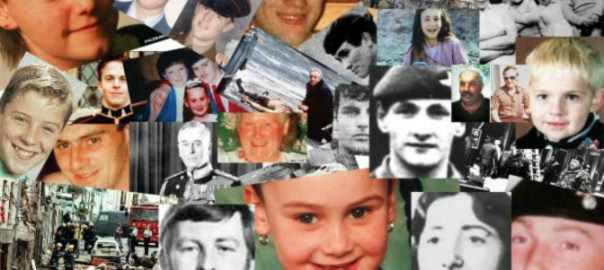
Remembering all innocent victims of the Troubles
Today is the anniversary of the death of the following people killed as a results of the conflict in Northern Ireland
“To live in hearts we leave behind is not to die.” ― Thomas Campbell
To the innocent on the list – Your memory will live forever
– To the Paramilitaries –
There are many things worth living for, a few things worth dying for, but nothing worth killing for.
10 People lost their lives on the 11th October between 1969 – 1996
————————————————————–
11 October 1969 Goerge Dickie, (25)
Protestant Status: Civilian (Civ),
Killed by: British Army (BA) Shot during street disturbances, at the corner of Shankill Road and Downing Street, Belfast
————————————————————–
11 October 1969 Herbert Hawe, (32)
Protestant Status: Civilian (Civ),
Killed by: British Army (BA) Shot during street disturbances, Hopeton Street, Shankill, Belfast.
————————————————————–
11 October 1969
Victor Arbuckle, (29)
Protestant Status: Royal Ulster Constabulary (RUC),
Killed by: non-specific Loyalist group (LOY) Shot during street disturbances, Shankill Road, Belfast.
————————————————————–
11 October 1971
Roger Wilkins, (32) nfNI Status: British Army (BA),
Killed by: Irish Republican Army (IRA) Died two weeks after being shot while on British Army (BA) foot patrol, Letterkenny Road, Derry.
————————————————————–
11 October 1974 James Hasty, (40)
Catholic Status: Civilian (Civ),
Killed by: Protestant Action Group (PAG) Shot as he walked to work along Brougham Street, New Lodge, Belfast.
————————————————————–
11 October 1976 Anne Magee, (15)
Catholic Status: Civilian (Civ),
Killed by: non-specific Loyalist group (LOY) Died two weeks after being shot while in shop, Manor Street, Lower Oldpark, Belfast.
————————————————————–
11 October 1976 Peter Woolsey, (39)
Catholic Status: Civilian (Civ),
Killed by: Ulster Volunteer Force (UVF) Shot at his farm, Cornascriebe, near Portadown, County Armagh.
————————————————————–
11 October 1986
Desmond Dobbin, (42)
Protestant Status: Royal Ulster Constabulary (RUC),
Killed by: Irish Republican Army (IRA) Killed in mortar bomb attack on New Barnsley British Army (BA) / Royal Ulster Constabulary (RUC) base, Springfield Road, Belfast.
————————————————————–
11 October 1988
John Larmour, (42)
Protestant Status: Royal Ulster Constabulary (RUC),
Killed by: Irish Republican Army (IRA) Off duty. Shot while working at his brother’s shop, Lisburn Road, Belfast.
————————————————————–
11 October 1996
James Bradwell, (43) nfNI Status: British Army (BA),
Killed by: Irish Republican Army (IRA) Died four days after being injured during car bomb attack on Thiepval British Army (BA) base, Lisburn, County Antrim.
————————————————————–
This is simply the story of a boy trying to grow up, survive, thrive, have fun & discover himself against a backdrop of events that might best be described as ‘explosive’, captivating & shocking the world for thirty long years.
Hi folks….. Jude has been helping declutter the loft ( getting in the way) and decided rather than binning everything he wants to try and sell some stuff so he can save up to buy some new Xbox accessories and games. I normally buy these and they cost a mint, but he wants to be … Continue reading I’m having an online car boot sale for Jude !→
Saturday, 3 October 2026 Hi folks, Yes, I’m still alive. A few of you have reached out recently, wondering why I’ve been so quiet on social media and the blog, so I thought I should pop into your timelines and give you a quick update. The truth is, I’m dealing with a few medical issues … Continue reading A quick update folks→
Saturday, July 1966 – Monday, 7 September 2026 The Promise I Made as a BoyI was ten years old when lung cancer took my dad. Watching him die such a horrible, painful death changed the shape of my life forever. It traumatised me. It carved a hole in my heart and soul that has never … Continue reading My Stop-Smoking Diary & cancer scare→
Belfast slang is in a league of its own , so it is, and that’s a big part of the city’s craic. The accent and the banter have been shaped by Irish, Scots, and English influences, so if you’re not from here it can sound a wee bit strange at first and might do yer … Continue reading 100 Belfast & Northern Ireland Slang Phrases & Meaning→
Date 3rd July 2026 Only thirteen days to go until I hit the big 6-0, and I have to admit I’m getting quite excited about my upcoming trip to Belfast and spending time with the people I love and cherish most in the world. At the same time, I’m feeling a little apprehensive. Reaching such … Continue reading Update: One foot in the Grave – countdown to my 60th Birthday has begun→
I Don’t Like Mondays The Boomtown Rats 13 July 1979 Iconic Songs & the story behind them “I Don’t Like Mondays” is a song by the Irish new wave band the Boomtown Rats about the Cleveland Elementary School shooting in San Diego. It was released in 1979 as the lead single from their third studio album, The Fine Art of Surfacing. The song was a number-one … Continue reading I Don’t Like Mondays – the Boomtown Rats: Iconic Songs & the story behind them→
Pop culture echoes Trigger warning: ⚠️This post touches on my deep pride and love of my loyalist culture and traditions and if this is not of interest or offends you , please feel free to continue scrolling. Who Do You Think I Am? It’s a question that divides opinion, and I’m acutely aware that many … Continue reading Who do you think I am ?→
Well hello there…. Please check back soon—I’m still working on this post, and I’ll publish it once it’s finished. In the meantime, please subscribe to my blog to receive email notifications whenever I publish new content. Thank you.