Key Events & Deaths on this day in Northern Ireland Troubles
28th May
——————————–
Wednesday 28 August 1968
Gerry Fitt, then an MP, tabled a House of Commons motion, which was signed by 60 Labour Party backbenchers, which criticised RUC action in Dungannon on 24 August 1968 and demanded that:
“citizens of Northern Ireland should be allowed the same rights of peaceful demonstration as those in other parts of the United Kingdom”.
Thursday 28 May 1970Arms Trial Began
Charles Haughey and Neil Blaney, both former Irish government ministers, together with two other men James Kelly (Captain), then an Irish Army Intelligence Officer, and John Kelly, a Belfast Republican, were charged in a Dublin court with conspiracy to illegally import arms for use by the Irish Republican Army (IRA).
It was alleged that the arms were to be smuggled to the IRA in Northern Ireland. The men denied any involvement in the affair.
[This was the first day of the ‘Arms Trial’. Blaney was found not guilty on 2 July 1970, Haughey and the others were found not guilty on 23 October 1970.
Sunday 28 February 1971
A British soldier died in Derry as a result of inhaling chemicals from fire extinguisers that were used to put out a fire inside the vehicle he was travelling in. The vehicle had been attacked with petrol bombs.
Sunday 28 May 1972
Eight people were killed when an Irish Republican Army (IRA) bomb prematurely exploded outside a house in Anderson Street, Short Strand, Belfast. Four of those killed were members of the IRA.
Tuesday 28 May 1974
Executive Collapsed, Direct Rule Resumed
Day 14 of the UWC strike
The crisis came to a head. Brian Faulkner resigned as Chief Executive following a refusal by Merlyn Rees, then Secretary of State for Northern Ireland, to meet with representatives from the Ulster Workers’ Council (UWC).
Faulkner’s Unionist colleagues also resigned. This effectively marked the end of the Northern Ireland Executive.
A large demonstration of farmers in tractors blocked the entrance to the Stormont parliament buildings and also much of the Upper Newtownards Road. News of the collapse of the Northern Ireland Executive spread to the protestors. Celebrations took place in Protestant areas across the region.
[Public Records 1974 – Released 1 January 2005: Telegram from General Idi Amin Dada, then President of the Republic of Uganda, to Harold Wilson, then British Prime Minister. Amin offers to host a conference in Uganda where representives of the conflict in Northern Ireland could meet.]
Friday 28 May 1976
David Robinson & Paul Hamill
A Catholic and a Protestant civilian were killed in a bomb attack on the Club Bar, University Road, Belfast. The attack was carried out by Loyalist paramilitaries.
Thursday 28 May 1981
Charles Maguire and George McBrearty
Charles Maguire (20) and George McBrearty (24), both members of the IRA, were shot dead as they approached a car on the Lone Moor Road in Derry.
The car contained undercover members of the British Army.
Mervyn Robinson
A member of the RUC was shot dead by the IRA near Bessbrook, County Armagh.
Martin Hurson, an Irish Republican Army (IRA) prisoner in the Maze Prison, joined the hunger strike to replace Brendan McLaughlin who had been taken off the strike on 26 May 1981.
Margaret Thatcher, then British Prime Minister, paid a visit to Northern Ireland and made a statement indicating the British government’s belief that the hunger strike was the ‘last card’ of the IRA.
Monday 28 May 1990
Peter Brooke, then Secretary of State for Northern Ireland, met with Charles Haughey, then Taoiseach (Irish Prime Minister), and Gerry Collins, then Minister of Foreign Affairs.
Sunday 28 May 1995
There was serious rioting on the Shankill Road, west Belfast. During the disturbances 17 Royal Ulster Constabulary (RUC) officers were injured.
A shot was also fired at the RUC.
Tuesday 28 May 1996
Dick Spring, then Tánaiste (deputy Irish Prime Minister and Minister for Foreign Affairs), met Patrick Mayhew, then Secretary of State for Northern Ireland, in Dublin after which they announced that George Mitchell, a former United States Senator, should play a key role in the proposed all-party talks.
Wednesday 28 May 1997
The civil liberties group Human Rights Watch published a report that was highly critical of the actions of the Royal Ulster Constabulary (RUC) during the events surrounding Drumcree in July 1996.
The report claimed that the RUC had used excessive force, been indiscriminate in its use of plastic bullets, failed to remove illegal roadblocks manned by the Orange Order and Loyalists, and had abandoned its “traditional policing function in some areas”.
Marjorie (Mo) Mowlam, then Secretary of State for Northern Ireland, held a meeting with representatives of the Apprentice Boys of Derry (ABD), the Grand Orange Lodge, Ballynafeigh Orangemen, and the Ulster Civil Rights group.
The meeting was called to discuss the forthcoming ‘marching season’. John Bruton, then Taoiseach (Irish Prime Minister), briefed the relatives of those killed on ‘Bloody Sunday’ on a report being prepared by the Irish government on the killings on 30 January 1972. Bruton said that a “grave injustice” had been done to the families of the dead.
[The report contained new information on events of the day and was eventually presented to the British government.]
Thursday 28 May 1998
Martin McGuinness, then Vice-President of Sinn Féin (SF), held a meeting with Marjorie (Mo) Mowlam, then Secretary of State for Northern Ireland.
Following the meeting McGuinness warned against “falling into the trap of trying to make decommissioning the most important item on the agenda”. A concert featuring Elton John was held in the grounds of Stormont.
Friday 28 May 1999
Body of One of the ‘Disappeared’ Recovered
The body of Eamon Molloy, one of the ‘disappeared’ who had been missing since 1975, was found above ground in a new coffin in a cemetery in County Louth, Republic of Ireland.
Garda Síochána (the Irish police) went to the site following information given by the Irish Republican Army (IRA) to the Independent Commission for the Location of Victims’ Remains (ICLVR). The IRA passed on information about the location of nine bodies at six sites in four counties in the Republic of Ireland.
The ICLVR was established jointly by Marjorie (Mo) Mowlam, then Secretary of State for Northern Ireland, and Mr O’Donoghue, then Minister for Justice in the Republic of Ireland.
The discovery marked the beginning of digging at a number of locations in Counties Louth, Monaghan, Meath, and Wicklow (all in the Republic of Ireland).
There was a pipe-bomb attack on the home of a Catholic family in Armagh. The device broke a window and caused minor damage to the house; the family escaped unharmed. The attacked was carried out by Loyalist paramilitaries.
——————————————
Remembering all innocent victims of the Troubles
Today is the anniversary of the death of the following people killed as a results of the conflict in Northern Ireland
“To live in hearts we leave behind is not to die
– Thomas Campbell
To the innocent on the list – Your memory will live forever
– To the Paramilitaries –
There are many things worth living for, a few things worth dying for, but nothing worth killing for.
16 People lost their lives on the 28th between 1972 – 1986
——————————————
28 May 1972
James Teer (21)
Catholic Status: Civilian (Civ),
Killed by: Ulster Volunteer Force (UVF)
Shot from passing car while walking along Springfield Road, Belfast
——————————————
28 May 1972 Joseph Fitzsimmons (17)
Catholic Status: Irish Republican Army (IRA),
Killed by: Irish Republican Army (IRA)
Died in premature bomb explosion in house, Anderson Street, Short Strand, Belfast.
——————————————
28 May 1972 John McIlhone (17)
Catholic Status: Irish Republican Army (IRA),
Killed by: Irish Republican Army (IRA)
Died in premature bomb explosion in house, Anderson Street, Short Strand, Belfast.
——————————————
28 May 1972 Edward McDonnell (29)
Catholic Status: Irish Republican Army (IRA),
Killed by: Irish Republican Army (IRA)
Died in premature bomb explosion in house, Anderson Street, Short Strand, Belfast.
——————————————
28 May 1972 Martin Engelen (19)
Catholic Status: Irish Republican Army (IRA),
Killed by: Irish Republican Army (IRA)
Died in premature bomb explosion in house, Anderson Street, Short Strand, Belfast.
——————————————
28 May 1972 Henry Crawford (39)
Catholic Status: Civilian (Civ),
Killed by: Irish Republican Army (IRA)
Died in premature bomb explosion in house, Anderson Street, Short Strand, Belfast.
——————————————
28 May 1972 Mary Clarke (27)
Catholic Status: Civilian (Civ),
Killed by: Irish Republican Army (IRA)
Died in premature bomb explosion in house, Anderson Street, Short Strand, Belfast
——————————————
28 May 1972 John Nugent (31)
Catholic Status: Civilian (Civ),
Killed by: Irish Republican Army (IRA)
Died in premature bomb explosion in house, Anderson Street, Short Strand, Belfast.
——————————————
28 May 1972 Geraldine McMahon (17)
Catholic Status: Civilian (Civ),
Killed by: Irish Republican Army (IRA)
Died in premature bomb explosion in house, Anderson Street, Short Strand, Belfast.
——————————————
28 May 1976
David Robinson (23)
Protestant Status: Civilian (Civ),
Killed by: non-specific Loyalist group (LOY)
Killed in bomb attack on Club Bar, University Road, Belfast.
——————————————
28 May 1976
Paul Hamill (21)
Catholic Status: Civilian (Civ),
Killed by: non-specific Loyalist group (LOY)
Killed in bomb attack on Club Bar, University Road, Belfast
——————————————
28 May 1981
Mervyn Robinson (47)
Protestant Status: Royal Ulster Constabulary (RUC),
Killed by: Irish Republican Army (IRA)
Off duty. Shot outside Wayside Inn, Whitecross, near Bessbrook, County Armagh.
——————————————
28 May 1981
Charles Maguire (20)
Catholic Status: Irish Republican Army (IRA),
Killed by: British Army (BA)
Shot by undercover British Army (BA) members, as he approached stationary car, Lone Moor Road, Creggan, Derry.
——————————————
28 May 1981
George McBrearty (24)
Catholic Status: Irish Republican Army (IRA),
Killed by: British Army (BA)
Shot by undercover British Army (BA) members, as he approached stationary car, Lone Moor Road, Creggan, Derry.
——————————————
28 May 1985
Gary Smith (19)
Protestant Status: Civilian (Civ),
Killed by: Irish Republican Army (IRA)
Royal Ulster Constabulary (RUC) applicant. Shot as he parked his car Millfield, Belfast.
——————————————
28 May 1986
Brian Brown (37)
Protestant Status: Ulster Defence Regiment (UDR),
Killed by: Irish Republican Army (IRA)
Killed by remote controlled bomb hidden in garage, detonated when Ulster Defence Regiment (UDR) foot patrol approached, Newry Road, Kilkeel, County Down.
——————————————
My autobiography:
A Belfast Child is now available to pre-order on Amazon , launch date now is 3rd September
" he began a turbulent and hedonistic adulthood in London "
Key Events & Deaths on this day in Northern Ireland Troubles
27th May
————————-
Tuesday 27 August 1968
The Derry Housing Action Committee (DHAC) organised another protest in the Guildhall’s council chamber. Immediately after the protest Eamon Melaugh phoned the Northern Ireland Civil Rights Association (NICRA) and invited them to organise a march in Derry.
Monday 27 May 1974
Day 13 of the UWC strike
Gas supplies to Belfast and other outlying districts were affected by a drop in pressure and a warning was issued that consumers should switch off their supply at the mains.
The British Army took charge of 21 petrol stations throughout Northern Ireland. These petrol stations were to supply petrol to essential users who could obtain a permit from the Ministry of Commerce.
The Ulster Workers’ Council (UWC) retaliated following the take over of the petrol stations. The UWC announced that the British Army would have to undertake the supply of all essential services including basics such as bread and milk. There was a call issued for workers to stop their assistance in the provision of essential services.
The UWC also stated that the Ballylumford power station, County Antrim, would close at midnight.
[Public Records 1974 – Released 1 January 2005: Memo from Merlyn Rees, then Secretary of Sate for Northern Ireland, to Harold Wilson, then British Prime Minister. In the memo Rees sets out ‘The Short-term Possibilities’ for Northern Ireland and the Executive.] [ Sunningdale; Ulster Workers’ Council Strike. ]
Sunday 27 May 1990
In a gun attack in Roermond, Netherlands, the Irish Republican Army (IRA) shot and killed two Australian lawyers on holiday.
It was claimed that the men were mistaken for off-duty British Army soldiers. [It was believed that the killings led to a drop in support for the IRA in Australia.]
Thursday 27 May 1993
Queen Meets President Mary Robinson, then President of the Republic of Ireland, travelled to London to attend a meeting with Queen Elizabeth at Buckingham Palace.
[The meeting was the first official contact between an Irish president and a British monarch.]
Michael Ancram replaced Jeremy Hanley at the Northern Ireland Office (NIO) to become the Political Development Minister.
Wednesday 27 May 1998
In the aftermath of the Good Friday Agreement the issue of the ‘decommissioning’ of paramilitary weapons began to dominate the political agenda.
[Decommissioning was to prove a stumbling block to the full implementation of the Agreement and the issue was still causing problems in May 2000.]
Thursday 27 May 1999
Leaders of the Presbyterian Church criticised the Orange Order in Portadown, County Armagh, for failing to commend the Christian faith during the Drumcree parade dispute.
Legislation was passed at Westminster and the Oireachtas which guaranteed immunity from prosecution for anyone providing information on the location of the bodies of the ‘disappeared’.
Saturday 27 May 2000
UUC Support Trimble
There was a meeting of the Ulster Unionist Council (UUC), the policy-making body of the Ulster Unionist Party (UUP).
David Trimble, then leader of the UUP, won a motion at the meeting which allowed him to re-enter the power-sharing Executive with Sinn Féin (SF).
The motion was on whether to accept the IRA offer on disarmament as a basis for the return to Stormont. Of the members present 459 voted in favour of a return to Stormont while 403 voted against.
[At a press conference following the UUC meeting it seemed that Trimble set out to offend Sinn Féin by remarking that the party had still to be politically “house-trained”.]
Sunday 27 May 2001
Stephen Manners (40), an ex-member of the Ulster Volunteer Force (UVF), was shot dead while in Jimmy Mac’s Bar, North Street, Newtownards, County Down.
[It was believed that Loyalist paramilitaries carried out the killing although no organisations claimed responsibility.]
——————————————
Remembering all innocent victims of the Troubles
Today is the anniversary of the death of the following people killed as a results of the conflict in Northern Ireland
“To live in hearts we leave behind is not to die
– Thomas Campbell
To the innocent on the list – Your memory will live forever
– To the Paramilitaries –
There are many things worth living for, a few things worth dying for, but nothing worth killing for.
10 People lost their lives on the 27th May between 1972 – 2001
——————————————
27 May 1972 Gerard Duddy (20)
Catholic Status: Civilian (Civ),
Killed by: non-specific Loyalist group (LOY) Shot while walking at the junction of Finaghy Road North and Andersonstown Road, Andersonstown, Belfast.
——————————————
27 May 1973
Margaret Hrykiewicz (24)
Catholic Status: Civilian (Civ),
Killed by: non-specific Loyalist group (LOY) Found stabbed to death on waste ground, Adela Street, off Antrim Road, Belfast
——————————————
27 May 1975 Patrick O’Reilly (52)
Catholic Status: Civilian (Civ),
Killed by: Ulster Volunteer Force (UVF) Shot while driving along road at Scallen, near Irvinestown, County Fermanagh.
——————————————
27 May 1975 Gerard McClenaghan (36)
Catholic Status: Civilian (Civ),
Killed by: Ulster Volunteer Force (UVF) Died nearly three months after being injured during gun and bomb attack on Bush Bar, Leeson Street, Lower Falls, Belfast. He was wounded on 4 March 1975.
——————————————
27 May 1976
Gerard Masterson (34)
Catholic Status: Civilian (Civ),
Killed by: non-specific Loyalist group (LOY) Shot at his home, Allworthy Avenue, off Antrim Road, Belfast.
——————————————
27 May 1978
Collette Brady (26)
Catholic Status: Civilian (Civ),
Killed by: Ulster Defence Association (UDA) Shot while walking along Cavehill Road, Belfast.
——————————————
27 May 1990 Stephen Melrose (24)
nfNIE Status: Civilian (Civ),
Killed by: Irish Republican Army (IRA) Australian national. Shot shortly after getting out of car, Town Square, Roermond, Netherlands. Assumed to be an off duty British Army (BA) member.
——————————————
27 May 1990 Nicholas Spanos (28)
nfNIE Status: Civilian (Civ),
Killed by: Irish Republican Army (IRA) Australian national. Shot shortly after getting out of car, Town Square, Roermond, Netherlands. Assumed to be an off duty British Army (BA) member.
——————————————
27 May 1991
Edward Spence (26)
Protestant Status: Royal Ulster Constabulary (RUC),
Killed by: Irish Republican Army (IRA) Died two days after being shot while on Royal Ulster Constabulary (RUC) foot patrol, Lower Crescent, off University Road, Belfast
——————————————
27 May 2001 Stephen Manners (40)
Protestant Status: ex-Ulster Volunteer Force (xUVF),
Killed by: non-specific Loyalist group (LOY) Shot while in Jimmy Mac’s Bar, North Street, Newtownards, County Down.
——————————————
My autobiography:
A Belfast Child is now available to pre-order on Amazon , launch date now is 3rd September
" he began a turbulent and hedonistic adulthood in London "
Key Events & Deaths on this day in Northern Ireland Troubles
25th May
————————–
Tuesday 25 May 1971
Michael Willets
A British soldier was killed in an Irish Republican Army (IRA) bomb attack on the joint Royal Ulster Constabulary (RUC) / British Army (BA) base on the Springfield Road in Belfast.
Saturday 25 May 1974
Day 11 of the UWC strike
Alfred Stilges (52), a Catholic civilian, was beaten to death by Loyalist paramilitaries in Forthriver Road, Glencairn, Belfast.
Harold Wilson, then British Prime Minister, made a broadcast [text of speech] on British Broadcasting Corporation (BBC) television and radio at 10.15pm.
[The speech proved to be totally counter-productive. At one point in the speech Wilson referred to ‘spongers’ – meaning the Ulster Workers’ Council (UWC) and its supporters.
However most Protestants took the reference as a slight on them. Indeed some Protestants took to wearing small sponges in their lapels the following day as a gesture of support for the strike.]
[Public Records 1974 – Released 1 January 2005: Fax sent on behalf of Harold Wilson to Liam Cosgrave, then Taoiseach (Irish Prime Minister). The fax contained the text of a statement that Wilson was due to give on British television later that day.] [ Sunningdale; Ulster Workers’ Council Strike. ]
Tuesday 25 May 1976
The Ulster Service Corps, a Loyalist paramilitary grouping, announced that it was going to mount ‘patrols’ because of the ‘deteriorating security situation’.
Wednesday 25 May 1977
James Callaghan, then British Prime Minister, announced that an all-party Speaker’s Conference was to be established to consider the merits of the argument for more Northern Ireland Members of Parliament.
Thursday 25 May 1978
Brian McKinney
Brian McKinney and John McClory, both Catholic civilians, were abducted by the Irish Republican Army (IRA) and ‘dissapeared’.
Friday 25 May 1984 Security forces in Northern Ireland discovered large quantities of explosives in County Tyrone and County Down. In the United States of America (USA) both houses of Congress unanimously backed the Report of the New Ireland Forum.
Wednesday 25 May 1988
Government White Paper
A White Paper on fair employment was issued by the British government. Suggestions included the compulsory monitoring of the religious composition of workforces in companies in Northern Ireland. A new Fair Employment Commission (FEC) was proposed to replace the Fair Employment Agency (FEA).
[A Bill was brought forward on 15 December 1988.]
Saturday 25 May 1991
Eddie Fullerton, then a Sinn Féin (SF) councillor in Buncrana, County Donegal, Republic of Ireland, was shot dead by the Ulster Freedom Fighters (UFF), a cover name (pseudonym) used by the Ulster Defence Association (UDA).
[This killing took place despite a Loyalist ceasefire announced by the Combined Loyalist Military Command (CLMC) that began at midnight on 29 April 1991. The UDA stated that the ceasefire did not apply to the Republic of Ireland.]
Terence O’Neill
A British soldier was killed in an Irish Republican Army (IRA) attack in Belfast.
Thursday 25 May 1995
Bill Clinton, then President of the United States of America (USA), addressed the investment conference in Washington, USA. He called for an end to paramilitary violence, ‘punishment’ beatings, and intimidation, in Northern Ireland. Clinton also announced a number of economic initiatives.
Saturday 25 May 1996
Dessie McCleery, then a member of the Irish National Liberation Army (INLA) ‘GHQ’ faction, was shot dead in central Belfast. The killing was part of a continuing INLA feud.
25 May 1998
Those responsible for the picket outside the Catholic church in Harryville, Ballymena, announced that they were calling a halt to the weekly Saturday evening protest.
The protest had begun in September 1996 and policing costs were estimated at £2 million.
The Ulster Volunteer Force (UVF) named Billy Hutchinson, then a Progressive Unionist Party (PUP) councillor, as its contact with the arms decommissioning body.
According to British statistics more than 5,300 women with addresses in the Republic of Ireland had abortions in Britain during 1997. This is the highest figure on record; in 1987 the figure was 3,673.
——————————————
Remembering all innocent victims of the Troubles
Today is the anniversary of the death of the following people killed as a results of the conflict in Northern Ireland
“To live in hearts we leave behind is not to die
– Thomas Campbell
To the innocent on the list – Your memory will live forever
– To the Paramilitaries –
There are many things worth living for, a few things worth dying for, but nothing worth killing for.
11 People lost their lives on the 25th May between 1971 – 1996
——————————————
25 May 1971
Michael Willets (27)
nfNI Status: British Army (BA),
Killed by: Irish Republican Army (IRA)
Killed by time bomb left inside Springfield Road Royal Ulster Constabulary (RUC) / British Army (BA) base, Belfast.
——————————————
25 May 1973
Joseph Matthews (30)
Catholic Status: Civilian (Civ),
Killed by: Ulster Defence Association (UDA)
Found shot at Giant’s Ring, near Shaw’s Bridge, Belfast.
——————————————
25 May 1974 Alfred Stilges (52)
Catholic Status: Civilian (Civ),
Killed by: non-specific Loyalist group (LOY)
Found beaten to death in partially-built house, Forthriver Road, Glencairn, Belfast.
——————————————
25 May 1975 Albert Ballantine (19)
Protestant Status: Civilian (Civ),
Killed by: Ulster Volunteer Force (UVF)
Found shot at side of Lettercor Road, near Gortin, County Tyrone.
——————————————
25 May 1978
Brian McKinney (22)
Catholic Status: Civilian (Civ),
Killed by: Irish Republican Army (IRA)
Abducted on his way to work, Andersonstown, Belfast. Remains eventually found, on general instructions from the IRA, buried in bogland, Colgagh, near Inniskeen, County Monaghan, on 29 June 1999.
——————————————
25 May 1978
John McClory (18)
Catholic Status: Civilian (Civ),
Killed by: Irish Republican Army (IRA)
Abducted on his way to work, Andersonstown, Belfast. Remains eventually found, on general instructions from the IRA, buried in bogland, Colgagh, near Inniskeen, County Monaghan, on 29 June 1999.
——————————————
25 May 1981 Thomas Ritchie (28)
Protestant Status: Ulster Defence Regiment (UDR),
Killed by: Irish Republican Army (IRA)
Shot by sniper while on Ulster Defence Regiment (UDR) mobile patrol, Gulladuff, near Maghera, County Derry.
——————————————
25 May 1986 Francis Hegarty (45)
Catholic Status: Irish Republican Army (IRA),
Killed by: Irish Republican Army (IRA)
Found shot, Cavan Road, near Castlederg, County Tyrone. Alleged informer.
——————————————
25 May 1991
Eddie Fullerton (56)
nfNIRI Status: Civilian Political Activist (CivPA),
Killed by: Ulster Freedom Fighters (UFF)
Sinn Fein (SF) Councillor. Shot at his home, Cockhill Cottages, Buncrana, County Donegal.
——————————————
25 May 1991
Terence O’Neill (44)
nfNI Status: British Army (BA),
Killed by: Irish Republican Army (IRA)
Killed by grenade, dropped into compound at British Army (BA) base, from adjoining derelict building, North Howard Street, Falls, Belfast.
——————————————
25 May 1996
Dessie McCleery (37)
Catholic Status: Irish National Liberation Army (INLA),
Killed by: Irish National Liberation Army (INLA)
Shot, while in pizza restaurant, Bankmore Street, off Dublin Road, Belfast. Internal Irish National Liberation Army (INLA) dispute.
——————————————
My autobiography:
A Belfast Child is now available to pre-order on Amazon , launch date now is 3rd September
" he began a turbulent and hedonistic adulthood in London "
Key Events & Deaths on this day in Northern Ireland Troubles
24th May
—————————–
Monday 24 May 1971
There was more violence in Belfast which was to continue sporadically throughout the summer.
Friday 24
May 1974Day 10 of the UWC strike
Two brothers, Sean Byrne (54) and Brendan Byrne (45), both Catholic publicans, were shot dead at their public house The Wayside Halt, Tannaghmore, near Ballymena, County Antrim.
They had been shot by Loyalist paramilitaries.
Talks were held at Chequers, the country home of the British Prime Minister, involving: Harold Wilson, then British Prime Minister; Merlyn Rees, then Secretary of Sate for Northern Ireland, Brian Faulkner, then Chief Executive; Gerry Fitt, then Deputy Chief Executive; and Oliver Napier, then Legal Minister and Head of the Office of Law Reform.
A statement was issued after the talks which stated that there would be no negotiations with those who operated outside constitutional politics.
[Public Records 1974 – Released 1 January 2005: Note of the meeting held at Chequers, England.]
The British Government Cabinet held a special meeting later in the day.
[Although the Cabinet agreed to allow Rees to put troops into power stations if he wished there was little support for such a course of action on the part of senior ranks in the British Army in Northern Ireland.] [ Sunningdale; Ulster Workers’ Council Strike. ]
Monday 24 May 1982
It was announced that the DeLorean car factory would close with the loss of 1,500 jobs.
Thursday 24 May 1984
Stalker Inquiry Begins
John Stalker, then Deputy Chief Constable of the Greater Manchester Police, arrived in Belfast to begin an investigation into the alleged ‘shoot to kill’ policy of security forces in the region.
[The investigation was to concentrate on three main cases that occurred on 11 November 1982, 24 November 1982, and 12 December 1982. However, in May 1986 before Stalker was to being the final part of his investigation he was removed from his duties as Deputy Chief Constable and ordered to return to England. He was subsequently reinstated but not allowed to return to Northern Ireland.]
Wednesday 24 May 1989
The scheduled assessment of the working of the Anglo-Irish Agreement (AIA) was published in a review document. The review was conducted under Article 11 of the AIA which stated that an assessment of the operation of the Intergovernmental Conference should be undertaken to see “whether any changes in the scope and nature of its activities are desirable”.
Thursday 24 May 1990
There was further trouble at Crumlin Road Prison over the issue of segregation. Peter Brooke, then Secretary of State for Northern Ireland, met with John Hume, then leader of the Social Democratic and Labour Party (SDLP), in London for talks.
Wednesday 24 May 1995
Mayhew Meeting With Adams
Patrick Mayhew, then Secretary of State for Northern Ireland, had an ‘informal’ private meeting with Gerry Adams, then President of Sinn Féin (SF), at an investment conference in Washington, USA. The meeting lasted about 35 minutes.
The conference was attended by 1,300 delegates. Michael Ancram, then Political Development Minister at the Northern Ireland Office (NIO), met a SF delegation at Stormont, Belfast.
The Northern Ireland Police Authority (NIPA) rejected the latest Annual Report from the Chief Constable. The Police Authority criticised the report as not meeting the required standards of public accountability.
Saturday 24 May 1997
A bomb was planted in Dundalk in the Republic of Ireland; the bomb was defused by Gardaí. The bomb was believed to have been planted by the Loyalist Volunteer Force (LVF).
Loyalists, who were continuing their picket of the Catholic church at Harryville in Ballymena, County Antrim, attacked Royal Ulster Constabulary (RUC) officers who were protecting those Catholics attending the mass.
Monday 24 May 1999
The News Letter (a Belfast based newspaper) denied claims by James Molyneaux, former leader of the UUP, that its editorial on 17 May 1999 had been drafted by Alistair Campbell, then offical spokesman for the Prime Minister.
——————————————
Remembering all innocent victims of the Troubles
Today is the anniversary of the death of the following people killed as a results of the conflict in Northern Ireland
“To live in hearts we leave behind is not to die
– Thomas Campbell
To the innocent on the list – Your memory will live forever
– To the Paramilitaries –
There are many things worth living for, a few things worth dying for, but nothing worth killing for.
6 People lost their lives on the 24th May between 1973 – 1982
——————————————
24 May 1973 John Wallace (32)
nfNI Status: British Army (BA),
Killed by: Irish Republican Army (IRA)
Killed by remote controlled bomb, detonated when British Army (BA) foot patrol were searching house, Cullaville, County Armagh.
——————————————
24 May 1973 Ian Donald (35)
nfNI Status: British Army (BA),
Killed by: Irish Republican Army (IRA)
Killed by remote controlled bomb, detonated when British Army (BA) foot patrol were searching house, Cullaville, County Armagh.
——————————————
24 May 1974 Sean Byrne (54)
Catholic Status: Civilian (Civ),
Killed by: non-specific Loyalist group (LOY)
Shot together with his brother, at their licensed premises, The Wayside Halt, Tavnaghmore, near Ballymena, County Antrim.
——————————————
24 May 1974 Brendan Byrne (45)
Catholic Status: Civilian (Civ),
Killed by: non-specific Loyalist group (LOY)
Shot together with his brother, at their licensed premises, The Wayside Halt, Tavnaghmore, near Ballymena, County Antrim.
——————————————
24 May 1975
Noel Davis (22)
Protestant Status: Royal Ulster Constabulary (RUC),
Killed by: Irish National Liberation Army (INLA)
Killed by booby trap bomb in abandoned car, Ballinahone, near Maghera, County Derry.
——————————————
24 May 1982 Anthony Anderson (22)
nfNI Status: British Army (BA),
Killed by: not known (nk)
Killed, when run over by British Army (BA) Armoured Personnel Carrier during petrol bomb attack on the vehicle, Butcher Street, Derry.
——————————————
My autobiography:
A Belfast Child is now available to pre-order on Amazon , launch date now is 3rd September
" he began a turbulent and hedonistic adulthood in London "
Key Events & Deaths on this day in Northern Ireland Troubles
23rd May
—————————————-
Thursday 23 May 1974
Day 9 of the UWC strike
Across Northern Ireland security forces removed barricades only to find that they had been replaced soon after. Workers in Derry were prevented from going to the Maydown Industrial Estate.
Although many schools managed to operate during the strike it was reported that some GCE examinations were affected.
Gerry Fitt, then Deputy Chief Executive, called on the British Government to send troops to the power stations and the oil refineries. Northern Ireland question time at Westminster again dealt with the strike.
Merlyn Rees, then Secretary of Sate for Northern Ireland, informed Harold Wilson, then British Prime Minister, that British Troops would have to be used to implement the ‘fuel oil plan’ being prepared by John Hume, then Minister of Commerce.
Friday 23 May 1975
Two Catholic civilians were shot dead by the Protestant Action Force (PAF), which was a covername used by the Ulster Volunteer Force (UVF), during an attack on a house in Mount Vernon, Belfast.
Monday 23 May 1977
Roy Mason, then Secretary of State, started a new round of talks with the leaders of the main political parties.
Saturday 23 May 1981
Joseph Lynch (33), a Catholic civilian, was killed during a street disturbance involving members of the Royal Ulster Constabulary (RUC) at the junction of Oldpark Road and Gracehill Street, Belfast.
Wednesday 23 May 1984
The Ulster Unionist Party (UUP) announced that it was ending its boycott of the Northern Ireland Assembly.
Sunday 23 May 1993
The Irish Republican Army (IRA) exploded a bomb, estimated at 1,500 pounds, in Magherafelt, County Derry. There was another IRA bomb in Belfast.
Monday 23 May 1994
Nigel Smith (19), a Protestant civilian, was shot dead by the Irish Republican Army (IRA) at his place of work in the Anderson and McAuley building, Castle Street, Belfast.
The Ulster Volunteer Force (UVF) carried out a bomb attack on the Sinn Féin (SF) office in Belfast City Hall. The explosion injured two workmen.
Friday 23 May 1997
John Hume, then leader of the Social Democratic and Labour Party (SDLP), held a meeting with David Trimble, then leader of the Ulster Unionist Party (UUP), to discuss the difficulties posed by the forthcoming ‘marching season’, particularly the Drumcree march in Portadown, County Armagh.
Saturday 23 May 1998
Garda Síochána (the Irish police) arrested two men when they discovered bomb-making material in two cars near Dundalk.
Sunday 23 May 1999
Tony Blair, then British Prime Minister, said he intended to invite representatives of the Garvaghy Road Residents’ Coalition (GRRC) and members of the Orange Order to intensive proximity-style talks on 3, 4, and 5 June 1999 in an effort to resolve the Drumcree parade dispute.
The United States Federal Bureau of Investigation (FBI) concluded its involvement in the inquiry into the death of Rosemary Nelson, a Lurgan solicitor killed on 15 March 1999, but announced it would continue to be available to assist the Royal Ulster Constabulary (RUC).
The Sunday Times (a London based newspaper) reported that David Trimble, then Leader of the Ulster Unionist Party (UUP), was suing Amazon.com for distributing the book ‘The Committee’ by Sean McPhilemy
Wednesday 23 May 2001
Bill Clinton, former President of the USA, paid another visit to Northern Ireland beginning in Derry. He said:
“I came here to reaffirm my belief in the Good Friday Agreement because it is still the right path to the future for peace, reconciliation, and fairness,”
——————————————
Remembering all innocent victims of the Troubles
Today is the anniversary of the death of the following people killed as a results of the conflict in Northern Ireland
“To live in hearts we leave behind is not to die
– Thomas Campbell
To the innocent on the list – Your memory will live forever
– To the Paramilitaries –
There are many things worth living for, a few things worth dying for, but nothing worth killing for.
8 People lost their lives on the 23rd May between 1972 – 1994
——————————————
23 May 1972
John Moran (17)
Catholic Status: Civilian (Civ),
Killed by: non-specific Loyalist group (LOY)
Died ten days after being injured by car bomb left outside Kelly’s Bar, Whiterock Road, Ballymurphy, Belfast.
——————————————
23 May 1972
Eustace Handley (20)
nfNI Status: British Army (BA),
Killed by: Irish Republican Army (IRA)
Shot by sniper while on British Army (BA) foot patrol, Springhill Avenue, Ballymurphy, Belfast.
——————————————
23 May 1972 Andrew Brennan (22)
Catholic Status: Civilian (Civ),
Killed by: Ulster Defence Association (UDA)
Shot outside his home, Sicily Park, Finaghy, Belfast.
——————————————
23 May 1975
John McErlaine (29)
Catholic Status: Civilian (Civ),
Killed by: Protestant Action Force (PAF)
Shot together with his brother, shortly after being lured to a house by a work colleague, Mount Vernon Green, Mount Vernon, Belfast.
——————————————
23 May 1975
Thomas McErlaine (19)
Catholic Status: Civilian (Civ),
Killed by: Protestant Action Force (PAF)
Shot together with his brother, shortly after being lured to a house by a work colleague, Mount Vernon Green, Mount Vernon, Belfast.
——————————————
23 May 1981 Joseph Lynch (33)
Catholic Status: Civilian (Civ),
Killed by: not known (nk)
Killed during street disturbance between local people and Royal Ulster Constabulary (RUC) patrol, junction of Oldpark Road and Gracehill Street, Belfast.
——————————————
23 May 1987
Dermot Hackett (37)
Catholic Status: Civilian (Civ),
Killed by: Ulster Freedom Fighters (UFF)
Shot by sniper while driving bread van, Drumhonish, near Drumquin, County Tyrone
——————————————
23 May 1994 Nigel Smith (19)
Protestant Status: Civilian (Civ), Killed by: Irish Republican Army (IRA)
Security man. Shot at his workplace, Anderson and McAuley building, Castle Street, Belfast.
——————————————
My autobiography:
A Belfast Child is now available to pre-order on Amazon , launch date now is 3rd September
" he began a turbulent and hedonistic adulthood in London "
Rigby was off duty and walking along Wellington Street when he was attacked.
————————–
Jurors Shown Footage Of Callous Murder Of Soldier Lee Rigby
————————–
Adebolajo and Adebowale ran him down with a car, then used knives and a cleaver to stab and hack him to death. The men dragged Rigby’s body into the road and remained at the scene until police arrived. They told passers-by that they had killed a soldier to avenge the killing of Muslims by the British armed forces. Unarmed police arrived at the scene nine minutes after an emergency call was received and set up a cordon. Armed police officers arrived five minutes later. The assailants, armed with a cleaver and brandishing a gun, charged at the police, who fired shots that wounded them both. They were apprehended and taken to separate hospitals. Adebolajo and Adebowale are British of Nigerian descent, were raised as Christians, and converted to Islam.
On 19 December 2013, both of the attackers were found guilty of Rigby’s murder. On 26 February 2014, they were sentenced to life imprisonment, with Adebolajo given a whole life order and Adebowale ordered to serve at least 45 years. The attack was condemned by political and Muslim leaders in the United Kingdom and in the international press.
Murder of Lee Rigby
Tribute to Lee Rigby
Manchester Day Parade, 2 June 2013
Retaliation for British military’s presence in Islamic countries
Victim
Fusilier Lee Rigby of the 2nd Battalion Royal Fusiliers
————————–
Lee Rigby
Least We Forget
————————-
The soldier killed in the attack was 25-year-old Lee Rigby, a drummer and machine-gunner in the 2nd Battalion of the Royal Regiment of Fusiliers. Rigby, from Middleton, Greater Manchester, had served in Cyprus, Germany, and Afghanistan before becoming a recruiter and assisting with duties in the Tower of London. He was attacked when he was returning to barracks from working at the Tower. Rigby married in 2007 and had a two-year-old son, but had separated from his wife.
He was engaged to a new fiancée at the time of his death.
Rigby supported British Armed Forces charity Help for Heroes and was wearing a hoodie supporting the charity when he was attacked. In the five days after his death the charity received more than £600,000 in donations.
Rigby was given a military funeral at Bury Parish Church on 12 July 2013. The service was attended by several thousand people, including present and former soldiers, Prime Minister David Cameron, and Mayor of London Boris Johnson. A private burial service was then held at nearby Middleton Cemetery. The first permanent memorial to him was installed in February 2014 at The Valley, a football stadium less than 1 mile (1.6 km) from the site of his murder.
——————–
Lee Rigby jury shown Adebolajo #039;eye for eye #039; video, BBC News
——————–
On 1 September 2014, Rigby was honoured at a ceremony in Staffordshire, with his name added to the Armed Forces Memorial at the National Memorial Arboretum.
Plans for a memorial to Rigby in Woolwich initially ran into opposition from local MP Nick Raynsford, who expressed concerns that it would generate “undesirable interest” or become a target for vandals. Greenwich Council said that it had not received a request from the Army to erect a memorial at the site.
Following a campaign for a memorial supported by Boris Johnson and a petition with 25,000 signatures, plans for a memorial near the site of the attack were announced on 11 June 2014. In April 2015, Greenwich Council said that rather than creating a memorial specific to Rigby’s memory, it would “create two memorials to both soldiers and civilians from the Royal Borough who have given their lives for our country”.
A memorial to Rigby in his home town of Middleton was unveiled on 29 March 2015.
Attack
The site of the attack in Wellington Street, with floral tributes and flags
The attack took place shortly before 14:20 in Wellington Street, and near its junction with John Wilson Street, part of the South Circular Road (A205) in Woolwich, near the perimeter of the Royal Artillery Barracks where Rigby was stationed.
Rigby had arrived at Woolwich Arsenal station at 14:10 and was walking down Wellington Street towards the Barracks.
While Rigby was crossing the road to get to a shop, two men, who were later identified as Michael Adebolajo and Michael Adebowale, drove a Vauxhall Tigra car at him at 30 to 40 miles per hour (50 to 60 km/h), knocking him to the ground.
———————-
Passerby Film Woolwich Soldier Murder Attackers London Suspect is Michael Adebolajo
———————-
They attacked Rigby with knives and a cleaver, and attempted to behead him.
Immediately after the attack, several passers-by stood over Rigby’s body to protect him from further injury.
Ingrid Loyau-Kennett, a cub scout leader from Cornwall, disembarked from a passing bus with the intention of rendering first aid, after she saw what she thought was a road accident. On discovering that the victim was dead she engaged one of the assailants in conversation. The man said he was responsible for killing the man on the ground – a British soldier who the attacker claimed had:
“killed Muslims in Iraq and in Afghanistan”.
She asked one of the men to hand over his weapons, but he refused.
In a video shot by a bystander, Adebolajo said:
The only reason we have killed this man today is because Muslims are dying daily by British soldiers. And this British soldier is one … By Allah, we swear by the almighty Allah we will never stop fighting you until you leave us alone. So what if we want to live by the Sharia in Muslim lands?
Why does that mean you must follow us and chase us and call us extremists and kill us? … when you drop a bomb do you think it hits one person?
Or rather your bomb wipes out a whole family? …
Through many passages in the Koran we must fight them as they fight us …
I apologise that women had to witness this today but in our lands women have to see the same. You people will never be safe. Remove your governments, they don’t care about you. You think David Cameron is gonna get caught in the street when we start busting our guns?
Do you think politicians are going to die? No, it’s going to be the average guy, like you and your children. So get rid of them. Tell them to bring our troops back … leave our lands and you will live in peace.
Adebolajo also gave a bystander at the scene a handwritten two-page note which set out his justification for his actions. The assailants remained at the scene and asked bystanders to call the police.
The Metropolitan Police received the first 999 call about an assault at 14:20 and regular unarmed police were deployed. Subsequent 999 calls said the attackers had a firearm, and armed police were ordered to the scene at 14:24. Unarmed police arrived at 14:29, set up a cordon, and remained behind it.
Authorised Firearms Officers arrived at 14:34. Two men, one brandishing a cleaver and the other a revolver, charged at the police. Armed police fired eight times and both men were wounded. They were arrested and taken to separate hospitals. A revolver, knives, and a cleaver were seized at the scene. The victim, Rigby, was pronounced dead and formally identified. The revolver was later determined to be a non-functioning 90-year-old Dutch KNIL 9.4mm. Adebowale pointed the gun at responding armed police officers, who opened fire and shot off one of his thumbs.
Attackers and other suspect..
The two men who carried out the attack, Michael Olumide Adebolajo, 28, and Michael Oluwatobi Adebowale, 22, are British of Nigerian descent.
Both men were known to British security services.
On 23 May, a man aged 29 and two women aged 31 and 29 were arrested on suspicion of conspiracy to murder.The Metropolitan Police arrested three people aged between 21 and 28 in south-east London, at two separate locations on the evening of 25 May.
On 26 May, a 22-year-old male was arrested in Highbury. On 27 May, a 50-year-old male was arrested in Welling. Of the eight people arrested, six were freed on bail, and two released without charge.
Michael Adebolajo
—————————-
Inside the mind of Lee Rigby’s killer Michael Adebolajo
—————————-
Adebolajo, born in Lambeth to a Christian family, went to Marshalls Park School and studied sociology at the University of Greenwich. He has a history of involvement in radical Islamist activities and had been arrested at a violent protest and later released.
————————————–
Crazy Muslim Cleric Anjem Choudary chants his shit on GMTV and ends up looking a tit
————————————–
According to Anjem Choudary, a radical Muslim cleric, Adebolajo converted to Islam in 2003 and was linked to the outlawed Islamist group al-Muhajiroun. In 2006, Adebolajo was arrested outside the Old Bailey during a protest about the trial of Mizanur Rahman.
“Don’t be scared of them, do not be scared of the police or the cameras. You are here only to please Allah. You’re not here for any other reason, if you are here just for a fight, please leave our ranks. We only want those who are sincere to Allah. Purify your intention.”
In 2010, Adebolajo was arrested in Kenya with five others. He travelled using a British passport in the name Michael Olemendis Ndemolaj Boniface Mwaniki, head of Kenya’s anti-terrorism unit, said he believed Adebolajo was planning to train with Al-Shabaab, a militant group linked to al-Qaeda. He was released to British authorities in Kenya and deported. The British Foreign Office confirmed “a British national was arrested in Kenya in 2010” was given consular assistance. No charges were filed against Adebolajo.
Abu Nusaybah, a friend of Adebolajo, said on BBC’s Newsnight on 25 May that Adebolajo had complained of persistent questioning by the British Security Service (MI5) specifically concerning his knowledge of “certain individuals”. He said Adebolajo alleged that MI5 had asked him to work with them and he had refused. He also said Adebolajo claimed he had been tortured and sexually assaulted by Kenyan troops after his arrest.
Adebolajo was released from hospital on 31 May and taken into police custody. The following day he was charged with Rigby’s murder, two charges of attempting to murder police officers, and possession of a firearm. At a court appearance on 3 June, he asked to be known as Mujahid Abu Hamza.On 17 July, Adebolajo lost two of his front teeth while being restrained by five prison officers at Belmarsh prison. The officers were suspended from duty.
Michael Adebowale
Following media reports that Michael Adebowale had attended the University of Greenwich with Michael Adebolajo, the university issued a statement, in which it said that there were “no records relating to [Adebowale] in connection with the Woolwich incident”, and that the university had launched an investigation into the matter. Adebolawe’s mother is a probation officer and his father a member of staff at the Nigerian High Commission.
On 28 May Adebowale was released from hospital and taken to a police station in south London.e charged him with the murder of Rigby and possession of a firearm.
Investigation
Investigators searched four houses in Greenwich, south London; one in Romford, east London; another in north London; and a property in Saxilby, Lincolnshire.
An Independent Police Complaints Commission investigation into the use of firearms by Metropolitan Police Officers, which was published on 19 December 2013 once a verdict had been reached in the defendants’ trial, concluded that the officers who had used force on 22 May 2013 had :
“acted entirely appropriately” and had shown “skill and professionalism”.
Home Secretary Theresa May chaired a meeting of the Cabinet Office Briefing Room committee (COBRA) attended by Defence Secretary Philip Hammond, the Mayor of London Boris Johnson, the Metropolitan Police Commissioner Sir Bernard Hogan-Howe, the Metropolitan Police Assistant Commissioner Cressida Dick and other unnamed members of the intelligence agencies.
The Prime Minister David Cameron cut short a visit to Paris to chair a second COBRA meeting.
Legal proceedings
On 31 May, the inquest into Rigby’s death was opened and adjourned at Southwark Coroner’s Court. The inquest heard that Rigby had been identified by his dental records.
On 27 September 2013, the two accused men appeared via videolink in court at the Old Bailey, where they both pleaded not guilty to the murder of Lee Rigby, and to other charges relating to the incident. The trial began at the Old Bailey on 29 November 2013. Adebolajo asked to be known as Mujaahid Abu Hamza in court with Adebowale wishing to be known as Ismail Ibn Abdullah.
On 19 December 2013, Michael Adebolajo and Michael Adebowale were found guilty of the murder of Lee Rigby. The judge, Mr Justice Sweeney, said that he would pass sentence after a key appeal court ruling on the use of whole life terms. On 26 February 2014, both men were sentenced to life imprisonment. Adebolajo was given a whole life order excluding the possibility of parole, and Adebowale, the younger of the two, was given a minimum term of 45 years in prison.
During the sentencing, Mr Justice Sweeney said that the extremist views of the attackers were a “betrayal of Islam”, prompting Adebowale to shout “That’s a lie”, while Adebolajo shouted “Allahu Akbar“.
Following a scuffle with security guards in the dock, both men were removed from the court and the sentencing continued in their absence.
On 8 April 2014, Adebolajo launched an appeal against his whole life term.
On 29 July, he was refused permission to appeal, and the case was heard by a panel of Court of Appeal judges.
On 3 December 2014, Rigby’s killers lost legal challenges to their sentences. Michael Adebolajo had attempted to have his conviction overturned and whole-life sentence reduced, while Michael Adebowale attempted a reduction in his minimum sentence of 45 years. Both requests were rejected at the Court of Appeal.
Subsequent events
The Ministry of Defence investigated the incident. Immediately after the death, British service members were advised not to wear military uniforms in public, although the advice was later relaxed.
In the immediate aftermath, Julie Siddiqi of the Islamic Society of Britain expressed concern that the killing would be used to create ethnic and community divisions. Sir Bernard Hogan-Howe condemned the attack and called for calm and a “measured response”, adding “we have met with community representatives, and extra officers remain on duty there tonight.
Across London our officers are in contact with their communities too.” Commander Simon Letchford later noted community concerns following the incident and assured that an investigation was under way. He also appealed for calm and avoidance of speculation. An additional 1,200 police officers were deployed across London to prevent revenge attacks on Muslim communities.
The British National Party (BNP) leader, Nick Griffin, posted a series of Twitter messages blaming “mass immigration” for the attack and called for a protest rally in Woolwich. After the English Defence League called on its supporters to mobilise, some members staged a protest at Woolwich Arsenal station in which bottles were thrown at police.
The BNP scheduled their protest for 1 June, but Scotland Yard refused to permit them to march from Woolwich Barracks; the demonstration instead took place at Whitehall in central London.Unite Against Fascism mounted a counter-protest. Police arrested 58 people, all anti-fascist protesters, for breaches of the Public Order Act.
On 7 June 2013, a 21-year-old woman from Harrow was ordered to complete 250 hours of unpaid work after tweeting that people in Help for Heroes T-shirts “deserve to be beheaded”.
On 14 March 2014, a married couple from London – who pleaded guilty to disseminating a terrorist publication – were jailed for posting videos on YouTube which condoned the death of Lee Rigby, with one video describing it as a “brilliant day”.
Anti-Muslim backlash
In the aftermath of the attack, an anti-Muslim backlash occurred across the United Kingdom.A representative of Hope not Hate said the number of phone calls to its helpline concerning anti-Muslim incidents greatly increased after the murder.
Hope not Hate reported 193 Islamophobic incidents, including attacks on 10 mosques, as of 27 May.On 1 June, Tell MAMA, a government-funded project, reported 212 anti-Muslim incidents, including 125 online incidents, 17 incidents involving physical attack, and 11 attacks on mosques.
It was reported on 9 June that government funding for Tell MAMA would not be renewed, due to concern over the reliability of data reported by the organisation, although the decision had been made before Rigby’s death.
Incidents ranged from verbal abuse to physical assaults in which women’s headscarves were pulled off.
Graffiti was scrawled over mosques and Muslim-owned businesses.Hope not Hate claimed that online activity suggested some of the attacks on Muslims were co-ordinated.
At least seven people have been arrested for a range of social media-related issues.
During the night after Rigby’s death, two mosques were attacked. In Braintree, Essex, a man entered a mosque with two knives, threatened the congregation, and threw an explosive device. Witnesses say the explosive device was a grenade or gas canister. In Gillingham, Kent, a man ran into a mosque and smashed windows and bookcases, specifically targeting those containing copies of the Quran. Two men were arrested in connection with the attacks.
On 26 May, several petrol bombs were thrown into a mosque in Grimsby. No one was injured and the fires were rapidly extinguished.Two former soldiers were arrested in connection with the attack.
On 5 June, the Al-Rahma Islamic Centre in Muswell Hill – which was used by children after school – was destroyed by a fire.
The building had been sprayed with graffiti making reference to the English Defence League.
The fire investigation is being conducted by Scotland Yard‘s counter-terrorism command, because of a possible link to domestic extremism. On 8 June, a fire at Darul Uloom School, an Islamic boarding school in southeast London, forced the evacuation of 128 students and teachers. Police said they feared the incident may have been a revenge attack.
On 10 June, a senior Metropolitan Police officer confirmed there had been an eight-fold increase in the number of Islamophobic incidents since Rigby’s death, and that the real figure may be higher due to under-reporting.
In the London Borough of Hackney the Stamford Hill Shomrim, a Jewish volunteer Neighbourhood Patrol Group, made an offer of help to the local Muslim community . which was welcomed and subsequently commended by Hackney Police Borough Commander Chief Superintendent Matthew Horne.
Video footage controversy
————————
London police shoot attackers who killed British soldier Lee Rigby
————————
Video footage of one of the perpetrators justifying the killing of Lee Rigby was obtained by The Sun and ITN. ITN’s video, which was edited before it was broadcast, aired during the 18:30 ITV News bulletin before the 21:00 watershed, and again in its 22:00 bulletin. After being posted on the ITN website in the afternoon, the high level of visits caused the site to crash and go offline for around half an hour.
Total traffic on the site, which averages 860,000 unique users per week, reached 1.2 million for the day of the attack.
Managing editor of The Sun, Richard Caseby, said the newspaper had faced “a very difficult decision”. Both media outlets argued they had released the video “in the public interest”. BBC News showed some parts of the video. Sky News decided not to follow suit, as senior editors were of the opinion that the graphic images were “unnecessarily distressing”. Both ITV and the BBC ran warnings before showing the footage.
Most of Britain’s national daily newspapers grabbed still images from the video footage for their front pages the next morning.
A BBC executive said that the news organisation edited the footage before broadcasting, and “dealt with the material as carefully as we could.” The spokesman said they “thought very carefully about the pictures… and gave great consideration to how we used the footage”. They argued that the footage was an important element of the story and shed light on the perpetrators and the possible motives for the attack.”
The Guardian reported there were “around 800 complaints from distressed viewers”.Most complaints were targeted at the television coverage, with ITV receiving 400 complaints in the 24 hours following the broadcast.
Sky News, which showed a still image of one of the suspected attackers with bloodied hands, received “a handful of complaints”.
On 17 June, the broadcasting standards watchdog Ofcom launched an investigation into broadcast of footage from the attack after receiving about 700 complaints. Ofcom published its findings on 6 January 2014, ruling that the news footage had not breached broadcasting regulations. Ofcom issued new guidelines to news outlets on giving appropriate warnings before airing distressing content.
Anti-terrorism task force
The UK government established a task force to look at ways of stemming the growth of Islamic extremism in Britain, focusing on the radicalisation of worshippers in mosques, university students and prisoners. The task force – chaired by David Cameron – had its inaugural meeting at 10 Downing Street on 3 June 2013, and includes Cabinet Ministers, and representatives from the police and intelligence services. Later that day Cameron made a House of Commons statement on the Woolwich attack, saying that lessons must be learned.
“When young men born and bred in this country are radicalised and turned into killers, we have to ask some tough questions about what is happening in our country. It is as if that for some young people there is a conveyor belt to radicalisation that has poisoned their minds with sick and perverted ideas. We need to dismantle this process at every stage – in schools, colleges, universities, on the internet, in our prisons, wherever it is taking place.”
Parliamentary inquiry
On 25 November 2014, the findings of a British parliamentary inquiry into the murder of Lee Rigby were published. The report found that the death could not have been prevented, although his killers had appeared in seven intelligence investigations.
In December 2012, Michael Adebowale had discussed killing a soldier on Facebook with a foreign-based extremist known as “Foxtrot”. The UK authorities did not have access to the details of the conversation until June 2013, when they were disclosed to GCHQ.
The Intelligence and Security Committee stated “Had MI5 had access to this exchange, their investigation into Adebowale would have become a top priority.” Facebook said that it did not comment on individual cases, but responded that “Facebook’s policies are clear, we do not allow terrorist content on the site and take steps to prevent people from using our service for these purposes.”
In an interview with BBC News on 26 November 2014, Richard Barrett, the former Director of Global Counter-terrorism at MI6, said that it was unfair to expect companies to monitor websites for all potentially extremist content. Facebook had blocked seven of Adebowale’s accounts prior to the killing, five of which had been flagged for links with extremism. The accounts had been flagged by an automated process, and no person at Facebook had manually checked the accounts.
Reactions
Queen Elizabeth II, political leaders and religious leaders variously expressed concern and distress over the incident, and called for calm. Prime Minister David Cameron made the following statement:
This country will be absolutely resolute in its stand against extremism and terror. This action was a betrayal of Islam and the Muslim communities that give so much to our country. We will defeat violent extremism by standing together. We will not rest until we know every detail.
The attackers told Ingrid Loyau-Kennett that] they wanted to start a war in London and she replied, “You are going to lose, it is you against many.” She speaks for all of us.
Many Muslim leaders denounced the attack. The Prime Minister’s statement was echoed by Shaykh Ibrahim Mogra, with the Archbishop of Canterbury, Justin Welby, the co-chair of the Christian Muslim Forum, in a joint statement.The Muslim Council of Britain said the attack “has no basis in Islam and we condemn this unreservedly”.
The head of the Ramadhan Foundation, Mohammed Shafiq, also condemned the attack. The director of Faith Matters and co-ordinator of the government-backed anti-Islamophobic project Tell MAMA stated:
“We, as the Muslim community, will work against anyone who promotes such hatred.”
“I’m not in the business of condemnation or condoning. I think if anyone needs to be condemned it is the British government and their foreign policy. It’s so clear that that is the cause.”
———————
Anjem Choudary defends Woolwich Attackers on Newsnight 2405.2013
———————
On BBC’s Newsnight, when Choudary was questioned about his role in the radicalisation of Michael Adebolajo, he denied any responsibility, and talked about such radicalisation as a means to an end. He stated that he believed that not many Muslims would disagree with what Adebolajo had said in his videoed statement.[131]
Asghar Bukhari of the UK Muslim Public Affairs Committee said that both the British Government and the Muslim community were at fault in dealing with “extremism”. He criticised the British Government for being involved in wars in Iraq and Afghanistan while “completely denying that it has anything to do with the political situation around the Muslim world”, and said that Muslim organisations “have failed their own community by not teaching these young, angry men how to get a democratic change to this policy that’s ruining so many lives”.
He described Muslim leaders as unwilling to bring about change, focussing on points of theology, rather than the practical education of young people in ways to achieve political change.
Baroness Neville-Jones, a former security minister and chairman of the British Joint Intelligence Committee, and Colonel Richard Kemp, a former Army commander, suggested blame could be put on internet hate preaching. Neville-Jones told the BBC Radio 4‘s Today programme that “the inspiration that comes from internet hate preaching and jihadist rhetoric… is a very, very serious problem now.”
George Galloway, then an MP, said that the attack on Lee Rigby was “indefensible”. He criticised British support for the Syrian rebels, stating that similar attacks are likely to occur “as long as we are, as a country, involved in spreading murder and mayhem across the Muslim world.”
Former UK Prime Minister Tony Blair saw the attack not as an isolated expression of two crazed individuals but part of the broader “problem within Islam”.
In foreign press reports there was widespread outrage and condemnation of the killing. Yusif al-Shihab, in Kuwait‘s Al-Abas, stated that the assailants have “deformed the image of Islam” while Batir Mohammad Wardum in the Jordanian daily Al-Dustur, and other Middle Eastern newspapers, stressed that their actions have endangered the lives of thousands of Muslims.
The killing triggered a public outpouring of grief and hundreds of bunches of flowers, teddy bears, poems and other tributes were left near the scene of the crime.
In a statement issued on 28 May, Adebolajo’s relatives condemned terrorism and violence in the name of religion, and expressed their horror at Rigby’s death.
In October 2013 British anti-terrorist police warned several Muslims who had spoken out against Islamist extremism, some of them explicitly against the murder of Rigby, that they had been targeted in a video created by Al-Shabaab, the group responsible for the attack on the Westgate shopping mall in Kenya.
—————————–
Drummer Lee Rigby’s funeral
—————————–
Attempted copycat cases
On 19 February 2015, 19-year-old Brusthom Ziamani was found guilty of preparing a terrorist act. He was arrested in London in August 2014 while carrying a 12-inch knife, hammer and black jihadist flag. Ziamani had said that he intended to attack and kill soldiers, and had described Adebolajo as a “legend”.
On 20 March Ziamani was sentenced to 22 years in prison.On 29 April 2015, 18-year-old Kazi Islam, who was inspired by the murder, was convicted by a jury at the Old Bailey of grooming a vulnerable friend to kill two soldiers, and buying ingredients for a pipe bomb.
On 29 May, he was sentenced to eight years in a young offenders’ institution.
On 14 January 2015, 26-year-old white supremacist Zack Davies of Mold, Flintshire attacked a Sikh dentist in a Tesco supermarket with a machete and a hammer. He claimed in court that the attack was revenge for the murder of Rigby.
Davies was sentenced to life imprisonment on 11 September 2015
As I child I learned the stories & legends of the Battle of Boyne & Siege of Derry at my grandfather’s & father’s knees, becoming immersed in the Loyalist culture that would shape & dominate my whole existence.
Key Events & Deaths on this day in Northern Ireland Troubles
22nd May
Saturday 22 May 1971
Robert Bankier
A British soldier was killed by members of the Official Irish Republican Army (OIRA) in Belfast.
Monday 22 May 1972
Over 400 women in Derry attacked the offices of Official Sinn Féin (OSF) in Derry following the shooting of William Best by the Official Irish Republican Army (OIRA) on 21 May 1972.
Wednesday 22 May 1974
Day 8 of the UWC strike
In an attempt to resolve the strike the Northern Ireland Executive agreed to postpone certain sections of the Sunningdale Agreement until 1977 and to reduce the size of the ‘Council of Ireland’
. These proposals were rejected by leaders of the Ulster Workers’ Council (UWC) and other Loyalist leaders. The British government repeated their stance on not negotiating with the UWC. John Hume, then Minister of Commerce, worked on a ‘fuel oil plan’.
Saturday 22 May 1976
Ulster Volunteer Force (UVF) Ceasefire
The Ulster Volunteer Force (UVF) announced the beginning of a three-month ceasefire.
[This ceasefire was, however, broken on a number of occasions the first of which was on 5 June 1976 when five civilians were shot dead.]
Friday 22 May 1981
Henry Duffy (45), a Catholic civilian, was shot dead by a plastic bullet fired by the British Army as he walked through the Bogside area of Derry.
Carol Anne Kelly (12), a Catholic girl, died three days after being shot by a plastic bullet by the British Army as she walked along Cherry Park in the Twinbrook area of Belfast.
Kieran Doherty, an Irish Republican Army (IRA) prisoner in the Maze Prison, joined the hunger strike.
Andrew French ( BA) David McBride & William Smyth (RUC)
Two Royal Ulster Constabulary (RUC) officers and one British soldier were killed by the Irish Republican Army (IRA) near Crossmaglen, County Armagh.
The three men had been part of a joint RUC / British Army (BA) foot patrol when the IRA detonated a remote controlled bomb hidden in a ditch.
Tuesday 22 May 1990
Peter Brooke, then Secretary of State for Northern Ireland, held a long meeting with Unionist leaders in London. James Molyneaux, then leader of the Ulster Unionist Party (UUP), and Ian Paisley, then leader of the Democratic Unionist Party (DUP), announced that they were ‘well satisfied with the results’. The Bank of Ireland published a report which estimated that the cost of ‘the Troubles’ to the British and Irish Governments was £410 million.
Wednesday 22 May 1991
In the political talks (later known as the Brooke / Mayhew talks) the venue for Strand Two (the North-South Stage) of the main talks was agreed by the parties.
Saturday 22 May 1993
The Irish Republican Army (IRA) exploded a bomb, estimated at 1,000 pounds, in Portadown, County Armagh. Six people were injured in the explosion.
[Later estimates put the cost of the damage at £8 million.]
Friday 22 May 1998Referendum on The Agreement
There was a huge turnout throughout the island of Ireland as people in Northern Ireland and the Republic of Ireland voted on the Good Friday Agreement (in the Republic there was a further vote on the Ratification of the Amsterdam Treaty).
This was the first all-Ireland poll since the general election of 1918. It was clear from the number of people going to polling stations across Northern Ireland that there had been a high turnout (the figure was 81.10%).
[When all the votes were counted the results were as follows: Northern Ireland – Yes 71.12%, No 28.88% (turnout 81.10%); Republic of Ireland – Yes 94.39%, No 5.61% (turnout 56.26%); Ireland overall – Yes 85.46%, No 14.54%. While it was not possible to break down the Northern Ireland figures by community an exit poll for the Sunday Times (a British newspaper) found that, of those questioned, the Agreement was supported by 96 per cent of Catholics and 55 per cent of Protestants. In the Republic of Ireland, the Amsterdam Treaty was ratified, with the results as follows: Yes 62%, No 38%.]
Saturday 22 May 1999
Loyalists carried out a petrol-bomb attack on the home of a Catholic family in west Belfast.
——————————————
Remembering all innocent victims of the Troubles
Today is the anniversary of the death of the following people killed as a results of the conflict in Northern Ireland
“To live in hearts we leave behind is not to die
– Thomas Campbell
To the innocent on the list – Your memory will live forever
– To the Paramilitaries –
There are many things worth living for, a few things worth dying for, but nothing worth killing for.
11 People lost their lives on the 22nd May between 1971 – 1987
——————————————
22 May 1971
Robert Bankier (25)
nfNI Status: British Army (BA),
Killed by: Official Irish Republican Army (OIRA)
Shot by sniper as he left British Army (BA) Armoured Personnel Carrier, Cromac Square, Markets, Belfast.
——————————————
22 May 1972
William Hughes (54)
Protestant Status: Civilian (Civ),
Killed by: Irish Republican Army (IRA)
Shot while sitting in parked car, Moortown, near Coagh, County Tyrone. Mistaken for civilian-type Royal Ulster Constabulary (RUC) vehicle.
——————————————
22 May 1973
Thomas Friel (21)
Catholic Status: Civilian (Civ),
Killed by: British Army (BA)
Died five days after being hit by rubber bullet during street disturbances, Creggan Heights, Creggan, Derry.
——————————————
22 May 1975
Gerard D’Eath (30)
Catholic Status: Civilian (Civ),
Killed by: Ulster Volunteer Force (UVF)
Killed by booby trap bomb hidden in flask at his workplace, building site, Hightown Road, Glengormley, near Belfast, County Antrim.
——————————————
22 May 1976
John McCambridge (21)
Protestant Status: Royal Ulster Constabulary (RUC),
Killed by: Irish Republican Army (IRA)
Off duty. Shot outside his home, Corrainy, near Dungannon, County Tyrone.
——————————————
22 May 1981
Henry Duffy (45)
Catholic Status: Civilian (Civ),
Killed by: British Army (BA)
Shot by plastic bullet while walking along street, Bogside, Derry
——————————————
22 May 1981
Carol Ann Kelly (12)
Catholic Status: Civilian (Civ),
Killed by: British Army (BA)
Died three days after being shot by plastic bullet while walking along Cherry Park, Twinbrook, Belfast.
——————————————
22 May 1986
Andrew French (35)
nfNI Status: British Army (BA),
Killed by: Irish Republican Army (IRA)
Killed by remote controlled bomb, hidden in ditch, detonated when joint British Army (BA) / Royal Ulster Constabulary (RUC) foot patrol passed, Milltown Bridge, near Crossmaglen, County Armagh.
——————————————
22 May 1986
David McBride (27)
Protestant Status: Royal Ulster Constabulary (RUC),
Killed by: Irish Republican Army (IRA)
Killed by remote controlled bomb, hidden in ditch, detonated when joint British Army (BA) / Royal Ulster Constabulary (RUC) foot patrol passed, Milltown Bridge, near Crossmaglen, County Armagh
——————————————
22 May 1986
William Smyth (25)
Catholic Status: Royal Ulster Constabulary (RUC),
Killed by: Irish Republican Army (IRA)
Killed by remote controlled bomb, hidden in ditch, detonated when joint British Army (BA) / Royal Ulster Constabulary (RUC) foot patrol passed, Milltown Bridge, near Crossmaglen, County Armagh.
——————————————
22 May 1987
Charles Watson (35)
Protestant Status: Ulster Volunteer Force (UVF),
Killed by: Irish Republican Army (IRA)
Shot at his home, Downpatrick Road, Clough, County Down.
——————————————
My autobiography:
A Belfast Child is now available to pre-order on Amazon , launch date now is 3rd September
" he began a turbulent and hedonistic adulthood in London "
Sergeant Talaiasi Labalaba with Omani children in Oman
Labalaba, aged 30, was shot dead whilst firing a 25-pounder gun at the attacking guerrilla forces.
He displayed notable bravery by continuing to fire the 25 pounder single handed in spite of being seriously wounded when a bullet hit him on the jaw, after his Omani loader was seriously wounded early in the battle.
Captain Mike Kealy, fellow troopers Tommy Tobin and Sekonaia Takavesi ran a gauntlet of enemy fire but arrived too late to save Labalaba. Both the troopers were also hit,
Sergeant Talaiasi Labalaba (left) and Sgt Sekonaia Takavesi (Right)
Takavesi was wounded in the back and Tobin was killed when a round crept through the sand-bagged walls and hit him in the face. Labalaba’s actions helped to keep the insurgents pinned down until Strikemaster jets of the SOAF arrived to drive back the attackers while reinforcements from Salalah could be organised.
BAC Strikemaster Mk82a
Fellow SAS trooper Roger Cole in his book of the battle, SAS: Operation Storm, paid tribute to Labalaba saying if the guerrilla force had taken the 25-pounder then the SAS would have surely lost the battle.
Labalaba was awarded a posthumous Mention in Dispatches for his actions in the Battle of Mirbat, although some of his former comrades have campaigned for him to be awarded a posthumous Victoria Cross. His body was returned to England and buried in the cemetery at St Martin’s Church, Hereford.
Grave of Sgt. T. Labalaba BEM, Special Air Service
Grave of Sgt. T. Labalaba BEM, Special Air Service
He was fighting a secret and brutal war in a dusty land far from home.
But while the 1972 clash between British forces and Communist rebels in Oman has long passed into history, the actions of Sergeant Talaiasi Labalaba have not.
Instead, the Fijian soldier’s exemplary courage under fire places him high on the pantheon of SAS heroes
Labalaba is remembered to this day. Next month, a statue of the soldier will be unveiled at SAS headquarters in Hereford in the run-up to Remembrance Sunday.
And in a week when the British National Party was accused of appropriating the British military for their own ends – and airbrushing ethnic minority personnel from history – his story seems particularly poignant.
The sergeant and his nine-strong SAS unit were part of a clandestine mission to protect the Sultan of Oman from the People’s Front for the Liberation of the Occupied Arab Gulf.
By July 1972, they had been in the country for a year and the assignment – codenamed Operation Jaguar – appeared to be going well.
But then the rebels stuck back. On the morning of July 19, around 250 elite fighters stormed MIrbat, a small town on the Arabian sea, leaving the SAS pinned down inside a fort.
As his comrades fought an increasingly desperate battle to hold off 250 insurgents, it dawned on Labalaba, 30, that they were about to be overrun.
With no cover and facing certain death, he sprinted across 800 metres of exposed ground to reach a 25-pound field-gun.
It was a brave – but apparently futile manouevre – as the huge weapon took three men to operate.
That, however, did not deter Labalaba. Nor did facial injuries which would have rendered a lesser man helpless.
As British forces watched in astonishment, Labalaba turned the cumbersome gun on the enemy and opened fire at near point blank range.
Prejudice: Walter Tull was made a second lieutenant despite a ban on the commissioning of soldiers with ‘Asiatic or negroid features’
He went on for six hours, decimating the rebels and ultimately paying for his courage with his life.
His comrades found him slumped face down by the massive gun. His selfless actions undoubtedly saved many of the British soldiers holed up inside the fort and won him a posthumous Mention in Despatches.
For many, his statue will be a long-overdue memorial to one of the SAS’s greatest heroes.
It is also some small recompense to thousands of ethnic minority servicemen, many from Commonwealth countries, who feel their courage and devotion has not been recognised in the same way as their white counterparts.
Labalaba and his comrade Trooper Sekonaia Takavesi, a fellow Fijian who rushed to his aid after he was wounded, are two of the most celebrated examples.
But there are countless others.
Among those are Second Lieutenant Walter Tull, born in Kent but the son of a former Barbados slave, who volunteered for the army just a week after the declaration of World War One.
He survived many battles, was the first British Army black officer to take charge of white troops and eventually died on the Western Front in 1918.
Tull’s career, however, was blighted by prejudice.
Despite being recommended for the Military Cross for ‘gallantry and coolness under fire’, he never received it.
Senior officers had defied a rule which prevented soldiers with ‘Asiatic or negroid features’ being commissioned to make Tull a second lieutenant.
Key Events & Deaths on this day in Northern Ireland Troubles
21st May
Friday 21 June 1968
The annual conference of the Nationalist Party unanimously approved of the protest action by Austin Currie in Caledon, County Tryone on 20 June 1968.
Wednesday 21 May 1969
James Chichester-Clark, then Northern Ireland Prime Minister, together with other members of the Northern Ireland government, travelled to London for a meeting with Harold Wilson, then British Prime Minister, and James Callaghan, then British Home Secretary.
Sunday 21 May 1972
The Official Irish Republican Army (OIRA) kidnapped and shot dead William Best (19) who was a member of the Royal Irish Rangers. Best was originally from Derry and was visiting friends when he was picked up by the OIRA. There was outrage amoung local people at the killing.
[The public reaction to this incident was to lead to the OIRA calling a ceasefire on 29 May 1972.]
Tuesday 21 May 1974
Day 7 of the UWC strike
Len Murray, then General Secretary of the Trades Union Council (TUC), led a ‘back-to-work’ march which turned out to be a fiasco. The march was supported by leading local Trade Union officials and attempted to lead workers back to the Belfast shipyard and factories in east Belfast.
Only about 200 people joined the march.
The march was flanked by members of the Royal Ulster Constabulary (RUC) and British troops but a hostile crowd still managed to assault some of those marching. An updated list [PDF; 78KB] of those services which were to be allowed through roadblocks and the opening times permitted for shops was issued by the ‘Ulster Army Council’.
At Westminster Harold Wilson, then British Prime Minister, attacked the strike saying that it was a “sectarian strike” and was “being done for sectarian purposes having no relation to this century but only to the seventeenth century”. [ Sunningdale; Ulster Workers’ Council Strike. ]
Wednesday 21 May 1980
Charles Haughey, then Taoiseach (Irish Prime Minister), travelled to London to attend a meeting with Margaret Thatcher, then British Prime Minister. A communiqué released after the meeting promised greater political co-operation between the two governments on the issue of Northern Ireland and referred to the “unique relationship” between the two countries.
Thursday 21 May 1981
Third and Fourth Hunger Strikers Died
Raymond McCreesh (24), a Irish Republican Army (IRA) prisoner, and Patsy O’Hara (23), an Irish National Liberation Army (INLA) prisoner, both died having spent 61 days on hunger strike. Tomás Ó Fiaich, then Catholic Primate of Ireland, criticised the British government’s attitude to the hunger strike.
See 1981 Hunger Strike
Thursday 21 May 1987
James Molyneaux, then leader of the Ulster Unionist Party, and Ian Paisley, then leader of the Democratic Unionist Party (DUP), issued a joint general election manifesto.
Saturday 21 May 1994
Members of the Irish Republican Army (IRA) abducted and then shot dead Reginald McCollum (19), an off-duty member of the Royal Irish Regiment (RIR).
His body was found in a field beside Mullaghcreevie housing estate, Armagh.
Martin Doherty (35), a member of the IRA, was shot dead by the Ulster Volunteer Force (UVF) as he attempted to stop a bomb attack on The Widow Scallans Bar, Pearse Street, Dublin, where a Sinn Féin (SF) function was taking place. Another man was seriously wounded in the attack.
Tuesday 21 May 1996
Hugh Annesley, then Chief Constable of the Royal Ulster Constabulary (RUC), announced that he would retire later in the year.
Wednesday 21 May 1997
Local Government Elections
There were elections to the 26 District Councils across Northern Ireland.
[When the counting of the votes was completed (most results were available by Friday 23 May 1997) the share of the first preference votes was: Ulster Unionist Party (UUP) – 27.8 per cent; Social Democratic and Labour Party (SDLP) – 20.7 per cent; Sinn Féin (SF) – 16.9 per cent; Democratic Unionist Party (DUP) – 15.6 per cent; Alliance Party of Northern Ireland (APNI) – 6.6 per cent; and other parties – 12.5 per cent. The most significant result of the election was that Unionists lost control of Belfast City Council for the first time in its history.
Unionists also lost control of the district councils in Fermanagh, Strabane, and Cookstown. The SDLP lost overall control of Derry City Council because of gains made by SF. SF increased its share of the vote and took 70 seats in total.]
Representatives of SF met with British officials at Stormont, Belfast. This was the first such meeting since the ending of the Irish Republican Army (IRA) ceasefire on 9 February 1997. Marjorie (Mo) Mowlam, then Secretary of State for Northern Ireland, held meetings with Nationalist residents groups of three areas where Orange Order parades were proving controversial.
The areas visited were, Dunloy village in County Antrim, the lower Ormeau Road of Belfast, and the Garvaghy Road in Portadown, County Antrim. Unionists criticised the meetings on the day of the local government elections. Mowlam also made a comment on the British Broadcasting Corporation (BBC) programme Newsnight that, “the [settlement] train might leave the station without Unionists”.
#[She was later forced to retract the comment.]
Friday 21 May 1999
Three men, who had been arrested in July 1998 and later found guilty of conspiracy to cause explosions, were sentenced at the Old Bailey in London. Anthony Hyland (26) was sentenced to 25 years imprisonment, and Darren Mulholland (20) and Liam Grogan (22) each received a sentence of 22 years.
The three had been accused of being part of a Real Irish Republican Army (rIRA) unit.
Two home-made grenades exploded outside two pubs on the Falls Road, in west Belfast. Three men were slightly injured. Sinn Féin accused the Ulster Freedom Fighters (UFF) of being responsible for the attacks. Seven shots were fired at Frank Petticrew, then a Catholic youth worker, as he escorted a Protestant girl back to her Shankill Road home following a cross-community event.
Petticrew claimed that he had been threatened with assassination by Royal Ulster Constabulary (RUC) officers six months earlier. He claimed the officers concerned wanted information on IRA members otherwise he would be shot dead by the Red Hand Defenders (RHD). The RUC denied the allegations.
Sunday 21 May 2000
David Trimble, then leader of the Ulster Unionist Party (UUP), stated that it was his belief that the offer by the Irish Republican Army (IRA) to open its arms dumps to international inspection means that its 30-year war is over.
——————————————
Remembering all innocent victims of the Troubles
Today is the anniversary of the death of the following people killed as a results of the conflict in Northern Ireland
“To live in hearts we leave behind is not to die
– Thomas Campbell
To the innocent on the list – Your memory will live forever
– To the Paramilitaries –
There are many things worth living for, a few things worth dying for, but nothing worth killing for.
12 People lost their lives on the 21st May between 1972 – 1994
——————————————
21 May 1972 Richard Oliver (40)
Protestant Status: Civilian (Civ),
Killed by: not known (nk)
Killed by falling telegraph pole which hijacked bus had collided with, during street disturbances, Ballysillan Road, Belfast.
——————————————
21 May 1972
William Best (19)
Catholic Status: British Army (BA),
Killed by: Official Irish Republican Army (OIRA)
On leave. Found shot, William Street, Derry.
——————————————
21 May 1972 Adrian Barton (18)
Protestant Status: Civilian (Civ),
Killed by: non-specific Loyalist group (LOY)
Shot from passing car shortly after leaving Whitehorse Inn, Springfield Road, Belfast. Assumed to be a Catholic.
——————————————
21 May 1976
Roberta Bartholomew (22)
Protestant Status: Civilian (Civ),
Killed by: Irish Republican Army (IRA)
Killed in bomb attack on Belfast-Portadown train, near Moira, County Down. Inadequate warning given.
Killed by: Irish Republican Army (IRA)
Shot at his home, Fitzwilliam Street, off Lisburn Road, Belfast.
——————————————
21 May 1981
Raymond McCreesh (24)
Catholic Status: Irish Republican Army (IRA),
Killed by: not known (nk)
Died on the 61st day of hunger strike, Long Kesh / Maze Prison, County Down.
——————————————
21 May 1981
Patsy O’Hara (23)
Catholic Status: Irish National Liberation Army (INLA),
Killed by: not known (nk)
Died on the 61st day of hunger strike, Long Kesh / Maze Prison, County Down.
See Hungry Strike
——————————————
21 May 1987
Ivan Anderson (47)
Protestant Status: Ulster Defence Regiment (UDR),
Killed by: Irish Republican Army (IRA)
Off duty. Shot while travelling in his car near to his home, Tiroony, near Carrickmore, County Tyrone.
——————————————
21 May 1988
Derek Hayes (28)
nfNI Status: British Army (BA),
Killed by: Irish Republican Army (IRA)
Killed by booby trap bomb while British Army (BA) patrol were searching field, off Blaney Road, near Crossmaglen, County Armagh.
——————————————
21 May 1991 Wallace McVeigh (45)
Protestant Status: Civilian (Civ),
Killed by: Irish Republican Army (IRA)
Shot at his workplace, Balmoral Market, Boucher Road, Belfast. Contractor to British Army (BA) / Royal Ulster Constabulary (RUC).
——————————————
21 May 1994
Reginald McCollum (19)
Protestant Status: Royal Irish Regiment (RIR),
Killed by: Irish Republican Army (IRA)
Off duty. Found shot in field, by Mullaghcreevie housing estate, Armagh.
——————————————
21 May 1994
Martin Doherty (35)
Catholic Status: Irish Republican Army (IRA),
Killed by: Ulster Volunteer Force (UVF)
Shot, attempting to stop bomb attack on The Widow Scallans Bar, Pearse Street, Dublin. Sinn Fein (SF) function at the Bar.
——————————————
My autobiography:
A Belfast Child is now available to pre-order on Amazon , launch date now is 3rd September
" he began a turbulent and hedonistic adulthood in London "
Terence O’Neill, then Northern Ireland Prime Minister, was showered with eggs, flour and stones after a meeting of the Woodvale Unionist Association.
Monday 20 May 1974
Day 6 of the UWC strike
Michael Mallon (20), a Catholic civilian, was shot dead by the Ulster Freedom Fighters (UFF) a covername for the Ulster Defence Association (UDA), and left by the side of the road at Shaw’s Bridge, Belfast.
Many roads in Northern Ireland were closed because of barricades. Electricity generation dropped to about one-third of normal levels. People were asked only to use telephones in an emergency.
Five hundred additional troops arrived in Northern Ireland.
An advertisement in the News Letter (a Belfast newspaper), which had been placed by Unionist politicians, called for support of the strike.
Stanley Orme, then Minister of Sate at the Northern Ireland Office (NIO), repeated the government’s position of not negotiating with the Ulster Workers’ Council (UWC) Strike Committee.
Note of a statement made by Stanley Orme, then Minister of Sate at the Northern Ireland Office (NIO), to the House of Commons. The statement sought to explain the circumstances surrounding the decision by Merlyn Rees, then Secretary of Sate for Northern Ireland, to announce a State of Emergency (Section 40, Northern Ireland Constitution Act 1973) on 19 May 1974.]
Friday 20 May 1977
Daniel McCooey (20), a Catholic civilian, died three weeks after he had been severely beaten by members of a British Army foot patrol in Castle Street, Belfast.
A member of the Royal Ulster Constabulary (RUC) was shot dead by the Irish Republican Army (IRA) in County Tyrone.
Tuesday 20 May 1980
Margaret Thatcher, then British Prime Minister, stated in the House of Commons:
“The future of the constitutional affairs of Northern Ireland is a matter for the people of Northern Ireland, this government and this parliament and no one else.”
This statement was made the day before Charles Haughey, then Taoiseach (Irish Prime Minister), was due to arrive in London with talks with Thatcher.
Wednesday 20 May 1981
District Council Elections
Local government elections were held in Northern Ireland against the backdrop of the continuing hunger strike. In the increased tension in the region, ‘moderate’ parties all suffered a decline in support.
The Democratic Unionist Party (DUP) achieved 26.6 per cent of the vote compared to the 26.5 per cent recorded by the Ulster Unionist Party (UUP). The Social Democratic and Labour Party (SDLP) obtained 17.5 per cent of the first preference votes compared to 20.6 per cent in 1977.
Four Royal Ulster Constabulary (RUC) officers in a mobile patrol were killed when the Irish Republican Army (IRA) exploded a bomb in a parked trailer at Killeen, County Down.
Tuesday 20 May 1986
Nicholas Scott, then a Northern Ireland Office (NIO) Minister, provided information in the House of Commons on the level of intimidation that Royal Ulster Constabulary (RUC) officers had faced from Loyalists during protests at the Anglo-Irish Agreement (AIA).
Scott said that there had been 368 cases of intimidation.
[Later information provided by the RUC indicated that the final number was over 500 homes attacked and 150 RUC families forced to move.]
Monday 20 May 1991
The Social Democratic and Labour Party (SDLP) announced that it was leaving the political talks (later known as the Brooke / Mayhew talks) until such time as the procedures for the main talks were agreed by the other parties.
Thursday 20 May 1993
The Irish Republican Army (IRA) exploded a bomb, estimated at 1,000 pounds, in Glengall Street, Belfast. Thirteen people were injured in the explosion. The bomb was placed outside the Grand Opera House and close to the Headquarters of the Ulster Unionist Party (UUP).
[Later estimates put the cost of the damage at £6.5 million.]
Friday 20 May 1994
There was serious rioting in Protestant areas of Belfast following the appearance in Belfast Magistrates’ Court of a man accused of ‘directing the activities’ of the Ulster Freedom Fighters (UFF), a cover name (pseudonym) used by the Ulster Defence Association (UDA).
Monday 20 May 1996
Gerry Adams, then President of Sinn Féin (SF), said that SF was prepared to accept the six ‘Mitchell Principles’ if the other parties agreed to them.
Tuesday 20 May 1997
John Hume, then leader of the Social Democratic and Labour Party (SDLP), tabled a motion in the House of Commons calling on the British government to conduct a new inquiry into the events of ‘Bloody Sunday‘ in Derry on 30 January 1972.
Jack Straw, then British Home Secretary, announced that two Irish Republican Army (IRA) prisoners, Danny McNamee and Liam McCotter, would be transferred to prisons in Northern Ireland.
Wednesday 20 May 1998
Blair’s Pledges
Tony Blair, then British Prime Minister, delivered a speech at the Coleraine campus of the University of Ulster in which he unveiled a hand-written set of pledges to the people of Northern Ireland in advance of the Referendum on 22 May 1998. The text of the pledges was as follows: “I pledge to the people of Northern Ireland:
No change in the status of Northern Ireland without the express consent of the people of Northern Ireland.
Power to take decisions returned to a Northern Ireland Assembly, with accountable North/South co-operation.
Fairness and equality guaranteed for all.
Those who use or threaten violence excluded from the Government of Northern Ireland.
Prisoners kept in unless violence is given up for good.
Whatever the Referendum result, as Prime Minister of the United Kingdom I will continue to work for stability and prosperity for all the people of Northern Ireland
.” Bill Clinton, then President of the United States of America (USA), sent a personal message to the people of Northern Ireland calling on them to vote ‘Yes’ in the
forthcoming referendum.
In the final hours of campaigning David Trimble, then leader of the Ulster Unionist Party (UUP), and Ian Paisley, then leader of the Democratic Unionist Party (DUP), took part in a live television debate.
The 10 minute encounter took place on the BBC’s ‘Newsline’ programme. The debate was heated with Paisley accusing Trimble of being prepared to “break the union”.
Thursday 20 May 1999
There were disturbances involving Loyalists and the Royal Ulster Constabulary (RUC) in Portadown, County Armagh.
The Ulster Unionist Party (UUP) delegation did not arrive for a second day of talks at Downing Street. The UUP stated that it had not been informed of the continuation of the talks.
Sinn Féin (SF) accused the UUP of a deliberate snub of the Prime Minister.
The Garvaghy Road Residents Coalition (GRRC) called for the Parades Commission to re-route the part of the Drumcree parade which passed close to Obins Street and St John’s Catholic Church.
Paul Berry, then a Democratic Unionist Party (DUP) Assemblyman, responded in an interview on Radio Ulster and said Loyalists would not be stopped from getting down the Garvaghy Road,
“If it is a matter of taking the law into our own hands then we are going to have to do it. That is a threat.”
(Reported in ‘Fortnight’ magazine, September 1999, p6). Mr Berry later denied making a threat. Planners from the Department of the Environment (DOE) in Northern Ireland told a regional planning conference in Dublin that Derry would be developed as the growth hub of the north-west.
——————————————
Remembering all innocent victims of the Troubles
Today is the anniversary of the death of the following people killed as a results of the conflict in Northern Ireland
“To live in hearts we leave behind is not to die
– Thomas Campbell
To the innocent on the list – Your memory will live forever
– To the Paramilitaries –
There are many things worth living for, a few things worth dying for, but nothing worth killing for.
10 People lost their lives on the 20th May between 1972 – 1986
——————————————
20 May 1972 Henry Gillespie (32)
Protestant Status: Ulster Defence Regiment (UDR),
Killed by: Irish Republican Army (IRA)
Shot by sniper while on Ulster Defence Regiment mobile patrol, Killyliss, near Dungannon, County Tyrone.
——————————————
20 May 1974 Miicahel Mallon (20)
Catholic Status: Civilian (Civ),
Killed by: Ulster Defence Association (UDA)
Found shot by side of Milltown Road, Shaw’s Bridge, Belfast.
——————————————
20 May 1977
Robert North (52)
Protestant Status: Royal Ulster Constabulary (RUC),
Killed by: Irish Republican Army (IRA)
Off duty reservist. Shot while driving school bus along Drumlee Road, near Benburb, County Tyrone
——————————————
20 May 1977
Daniel McCooey (20)
Catholic Status: Civilian (Civ),
Killed by: British Army (BA)
Died three weeks after being badly beaten by British Army (BA) foot patrol, Castle Street, Belfast.
——————————————
20 May 1979
Stanley Wray (50)
Protestant Status: Royal Ulster Constabulary (RUC),
Killed by: Irish Republican Army (IRA)
Off duty. Shot shortly after leaving Claremont Presbyterian Church, Northland Road, Derry.
——————————————
20 May 1985
William Wilson (28)
Protestant Status: Royal Ulster Constabulary (RUC),
Killed by: Irish Republican Army (IRA)
Killed by remote controlled bomb, hidden in parked trailer, detonated when Royal Ulster Constabulary (RUC) mobile patrol passed, Killeen, County Armagh.
——————————————
20 May 1985
Stephen Rodgers (19)
Protestant Status: Royal Ulster Constabulary (RUC),
Killed by: Irish Republican Army (IRA)
Killed by remote controlled bomb, hidden in parked trailer, detonated when Royal Ulster Constabulary (RUC) mobile patrol passed, Killeen, County Armagh.
——————————————
20 May 1985
David Baird (22)
Protestant Status: Royal Ulster Constabulary (RUC),
Killed by: Irish Republican Army (IRA)
Killed by remote controlled bomb, hidden in parked trailer, detonated when Royal Ulster Constabulary (RUC) mobile patrol passed, Killeen, County Armagh.
——————————————
20 May 1985
Tracey Doak (21)
Protestant Status: Royal Ulster Constabulary (RUC),
Killed by: Irish Republican Army (IRA)
Killed by remote controlled bomb, hidden in parked trailer, detonated when Royal Ulster Constabulary (RUC) mobile patrol passed, Killeen, County Armagh.
——————————————
20 May 1986 Colm McKevitt (30)
Catholic Status: Civilian (Civ),
Killed by: Irish Republican Army (IRA)
Shot shortly after being abducted from his sister’s home, Killeen, County Armagh. Alleged informer.
——————————————
My autobiography:
A Belfast Child is now available to pre-order on Amazon , launch date now is 3rd September
" he began a turbulent and hedonistic adulthood in London "


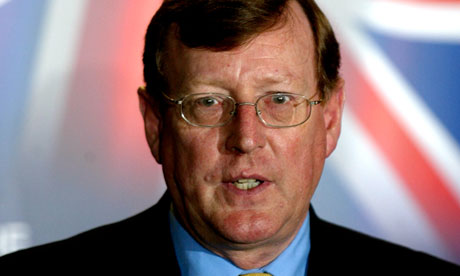


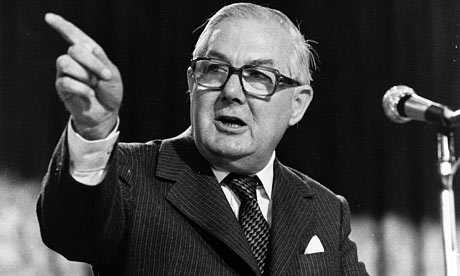


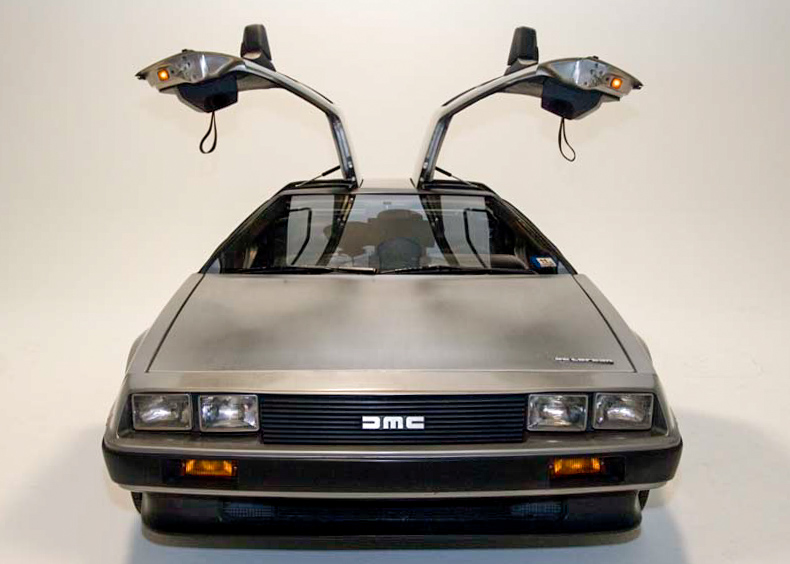

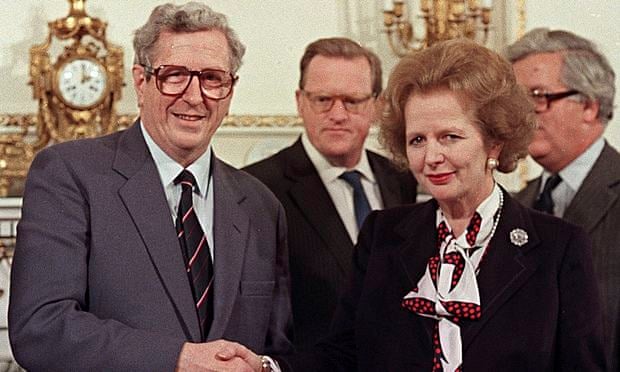





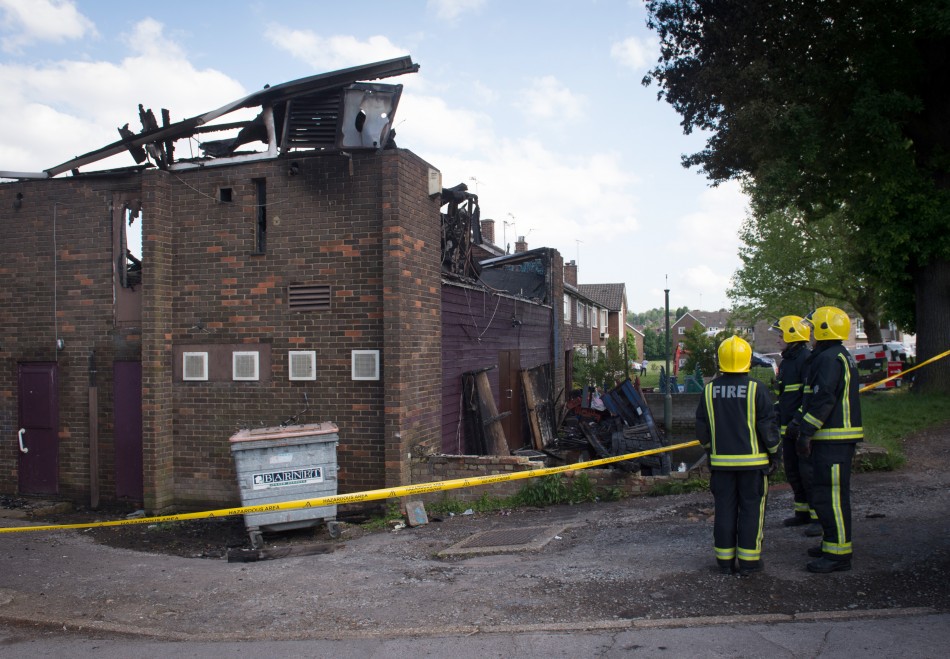


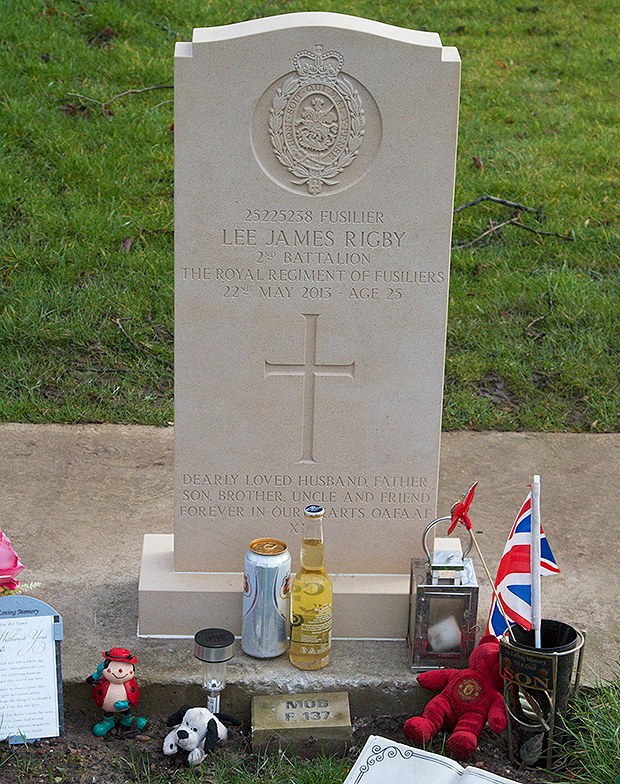


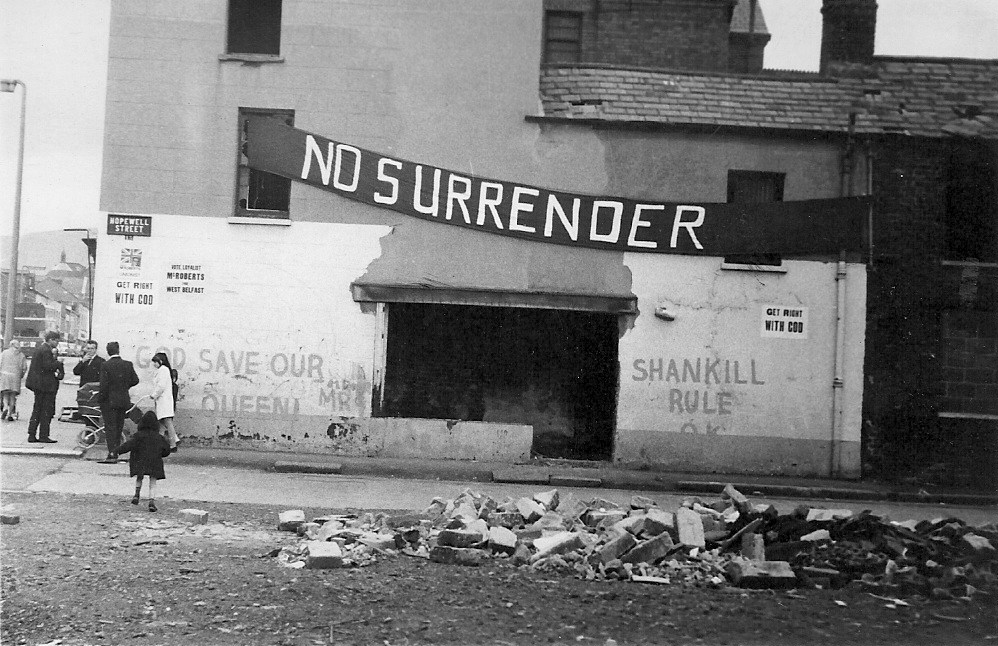


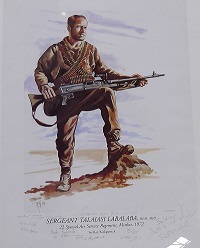


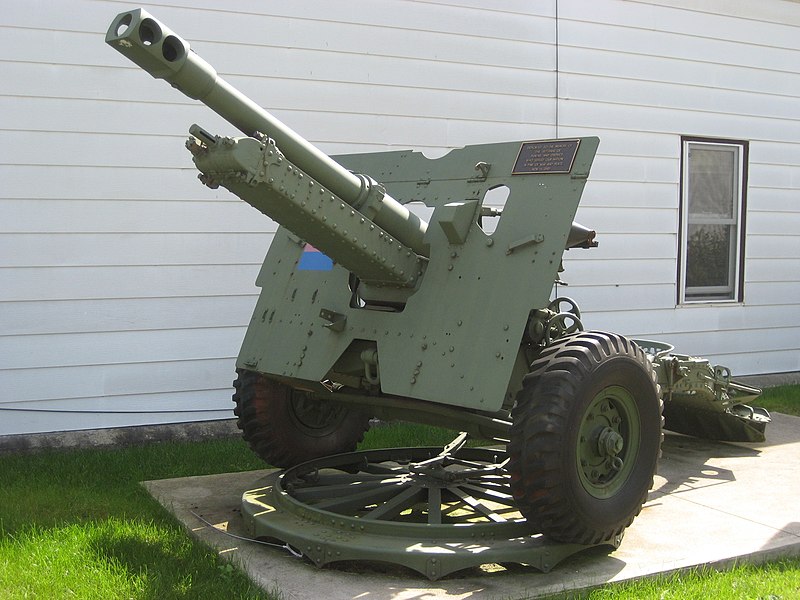


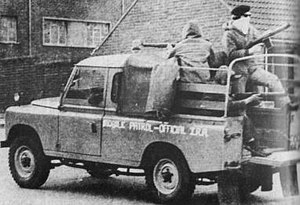




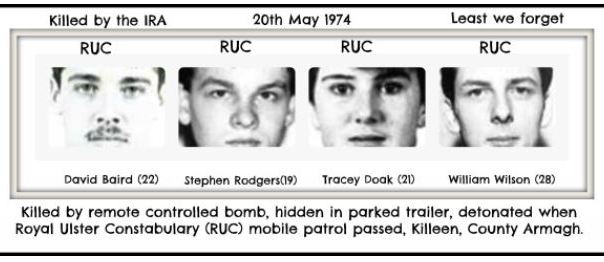



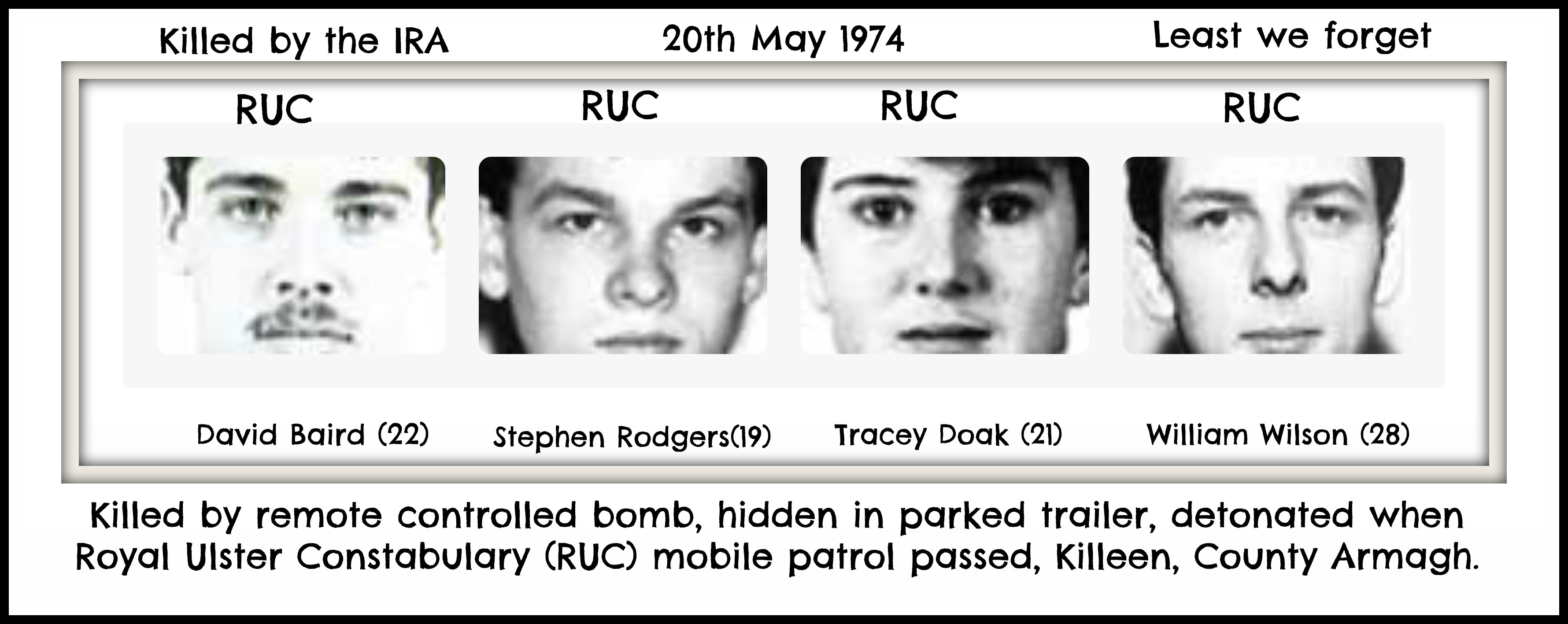


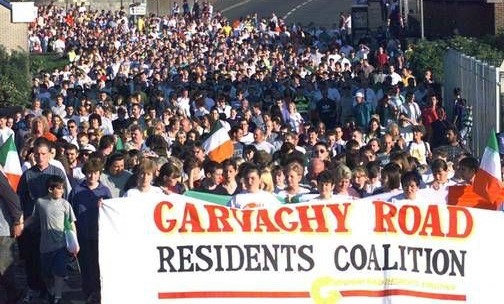


 belfastchildis.com