Battle of Bosworth 21 August 1485

Battle of Bosworth Field

Tomorrow marks the five hundred and thirty first anniversary of the Battle of Bosworth and the end of the  War of The Rose’s and for me and many a fascinating period of British/French history.  At the end of day  King Richard III lay dead ,  Plantagenet rule came to a bloody, brutal  end and the rise of the “sexy” Tudors has began.

As a lover of all things history , especially British/Irish/Roman I have always been fascinated by the key players in the ruthless War of the Rose’s and the sheer brutality of the murder’s they perpetuated  and casual deceit they used to forward their quest for the crown of England/Wales. Going against the grain of popular opinion I have always had a soft spot for Richard, regardless of the various murders he has been associated with , not least of all the Prince’s in the Tower. He only ruled for a short term and yet he will go down in history as a giant of British Royalty  and the last Battle King of England

Image result for battle of bosworth field

The Battle of Bosworth Field (or Battle of Bosworth) was the last significant battle of the Wars of the Roses, the civil war between the Houses of Lancaster and York that raged across England in the latter half of the 15th century. Fought on 22 August 1485, the battle was won by the Lancastrians.

King Henry VII.jpg

Their leader Henry Tudor, Earl of Richmond, by his victory became the first English monarch of the Tudor dynasty. His opponent, Richard III, the last king of the House of York, was killed in the battle. Historians consider Bosworth Field to mark the end of the Plantagenet dynasty, making it a defining moment of English and Welsh history.

Richard’s reign began in 1483. At the request of his brother Edward IV, Richard was acting as Lord Protector for his son Edward V. Richard had Parliament declare Edward V illegitimate and ineligible for the throne, and Richard took it for himself. Richard lost popularity when the boy and his younger brother disappeared after Richard incarcerated them in the Tower of London, and Richard’s support was further eroded by the popular belief that he was implicated in the death of his wife. Across the English Channel in Brittany, Henry Tudor, a descendant of the greatly diminished House of Lancaster, seized on Richard’s difficulties so that he could challenge Richard’s claim to the throne.

Henry’s first attempt to invade England was frustrated by a storm in 1483, but at his second attempt he arrived unopposed on 7 August 1485 on the southwest coast of Wales. Marching inland, Henry gathered support as he made for London. Richard mustered his troops and intercepted Henry’s army south of Market Bosworth in Leicestershire. Thomas, Lord Stanley, and Sir William Stanley brought a force to the battlefield, but held back while they decided which side it would be more advantageous to support.

Richard divided his army, which outnumbered Henry’s, into three groups (or “battles”). One was assigned to the Duke of Norfolk and another to the Earl of Northumberland. Henry kept most of his force together and placed it under the command of the experienced Earl of Oxford. Richard’s vanguard, commanded by Norfolk, attacked but struggled against Oxford’s men, and some of Norfolk’s troops fled the field. Northumberland took no action when signalled to assist his king, so Richard gambled everything on a charge across the battlefield to kill Henry and end the fight. Seeing the king’s knights separated from his army, the Stanleys intervened; Sir William led his men to Henry’s aid, surrounding and killing Richard. After the battle, Henry was crowned king below an oak tree in nearby Stoke Golding, now a residential garden.

Henry hired chroniclers to portray his reign favourably; the Battle of Bosworth was popularised to represent the Tudor dynasty as the start of a new age. From the 15th to 18th centuries the battle was glamorised as a victory of good over evil. The climax of William Shakespeare‘s play Richard III provides a focal point for critics in later film adaptations. The exact site of the battle is disputed because of the lack of conclusive data, and memorials have been erected at different locations.

In 1974, the Bosworth Battlefield Heritage Centre was built on a site that has since been challenged by several scholars and historians. In October 2009, a team of researchers, who had performed geological surveys and archaeological digs in the area from 2003, suggested a location two miles (3.2 km) southwest of Ambion Hill.


Background

Further information: Wars of the Roses and Princes in the Tower
Map of England showing the locations of towns and battles. Bosworth is in the centre, northwest of London.

During the 15th century, civil war raged across England as the Houses of York and Lancaster fought each other for the English throne. In 1471, the Yorkists defeated their rivals in the battles of Barnet and Tewkesbury. The Lancastrian King Henry VI and his only son, Edward of Lancaster, died in the aftermath of the Battle of Tewkesbury. Their deaths left the House of Lancaster with no direct claimants to the throne. The Yorkist king, Edward IV, was in complete control of England.

He attainted those who refused to submit to his rule, such as Jasper Tudor and his nephew Henry, naming them traitors and confiscating their lands. The Tudors tried to flee to France but strong winds forced them to land in Brittany, then a semi-independent duchy, where they were taken into the custody of Duke Francis II.

Henry’s mother, Lady Margaret Beaufort, was a great-granddaughter of John of Gaunt, uncle of King Richard II and father of King Henry IV. The Beauforts were originally bastards, but Henry IV legitimised them on the condition that their descendants were not eligible to inherit the throne. Henry Tudor, the only remaining Lancastrian noble with a trace of the royal bloodline, had a weak claim to the throne, and Edward regarded him as “a nobody”.

The Duke of Brittany, however, viewed Henry as a valuable tool to bargain for England’s aid in conflicts with France and kept the Tudors under his protection.

Edward IV died twelve years after Tewkesbury on 9 April 1483.

King Edward V from NPG.jpg

His twelve-year-old elder son succeeded him as King Edward V; the younger son, nine-year-old Richard of Shrewsbury, was next in line to the throne. Edward V was too young to rule and a Royal Council was established to rule the country until the king’s coming of age. The royal court was worried when they learned that the Woodvilles, relatives of Edward IV’s widow Elizabeth, were plotting to seize control of the council.

Having offended many in their quest for wealth and power, the Woodville family was not popular. To frustrate the Woodvilles’ ambitions, Lord Hastings and other members of the council turned to the new king’s uncle—Richard, Duke of Gloucester, brother of Edward IV. The courtiers urged Gloucester to assume the role of Protector quickly, as had been previously requested by his now dead brother.

Quartered arms of Sir Anthony Woodville, 2nd Earl Rivers, KG.png

Arms of Earl Rivers

On 29 April, Gloucester, accompanied by a contingent of guards and Henry Stafford, 2nd Duke of Buckingham, took Edward V into custody and arrested several prominent members of the Woodville family. After bringing the young king to London, Gloucester had two of the Woodvilles (Anthony Woodville, 2nd Earl Rivers and Richard Grey) executed, without trial, on charges of treason.

On 13 June, Gloucester accused Hastings of plotting with the Woodvilles and had him beheaded. Nine days later, Gloucester convinced Parliament to declare the marriage between Edward IV and Elizabeth illegal, rendering their children illegitimate and disqualifying them from the throne. With his brother’s children out of the way, he was next in the line of succession and was proclaimed King Richard III on 26 June.

The timing and extrajudicial nature of the deeds done to obtain the throne for Richard won him no popularity, and rumours that spoke ill of the new king spread throughout England. After they were declared bastards, the two princes were confined in the Tower of London and never seen in public again.

Discontent with Richard’s actions manifested itself in the summer after he took control of the country, as a conspiracy emerged to displace him from the throne. The rebels were mostly loyalists to Edward IV, who saw Richard as a usurper. Their plans were co-ordinated by a Lancastrian, Henry’s mother Lady Margaret, who was promoting her son as a candidate for the throne. The highest-ranking conspirator was Buckingham. No chronicles tell of the duke’s motive in joining the plot, although historian Charles Ross proposes that Buckingham was trying to distance himself from a king who was becoming increasingly unpopular with the people.

Michael Jones and Malcolm Underwood suggest that Margaret deceived Buckingham into thinking the rebels supported him to be king.

A blond woman with rosy cheeks holds a white rose. She wears a gilded black shawl over her head, and a red robe trimmed in white spotted fur.

Elizabeth of York: rumours of her marriage launched Henry’s invasion.

The plan was to stage uprisings within a short time in southern and western England, overwhelming Richard’s forces. Buckingham would support the rebels by invading from Wales, while Henry came in by sea. Bad timing and weather wrecked the plot. An uprising in Kent started 10 days prematurely, alerting Richard to muster the royal army and take steps to put down the insurrections. Richard’s spies informed him of Buckingham’s activities, and the king’s men captured and destroyed the bridges across the River Severn. When Buckingham and his army reached the river, they found it swollen and impossible to cross because of a violent storm that broke on 15 October.

Buckingham was trapped and had no safe place to retreat; his Welsh enemies seized his home castle after he had set forth with his army. The duke abandoned his plans and fled to Wem, where he was betrayed by his servant and arrested by Richard’s men. On 2 November 1483, he was executed.

Henry had attempted a landing on 10 October (or 19 October), but his fleet was scattered by a storm. He reached the coast of England (at either Plymouth or Poole), and a group of soldiers hailed him to come ashore. They were, in truth, Richard’s men, prepared to capture Henry once he set foot on English soil. Henry was not deceived and returned to Brittany, abandoning the invasion. Without Buckingham or Henry, the rebellion was easily crushed by Richard.

The survivors of the failed uprisings fled to Brittany, where they openly supported Henry’s claim to the throne. At Christmas, Henry Tudor swore an oath to marry Edward IV’s daughter, Elizabeth of York, to unite the warring houses of York and Lancaster.

Henry’s rising prominence made him a great threat to Richard, and the Yorkist king made several overtures to the Duke of Brittany to surrender the young Lancastrian. Francis refused, holding out for the possibility of better terms from Richard.  In mid-1484, Francis was incapacitated by illness and while recuperating, his treasurer, Pierre Landais, took over the reins of government. Landais reached an agreement with Richard to send back Henry and his uncle in exchange for military and financial aid. John Morton, a bishop of Flanders, learned of the scheme and warned the Tudors, who fled to France.

The French court allowed them to stay; the Tudors were useful pawns to ensure that Richard’s England did not interfere with French plans to annexe Brittany.

Anne Neville portrait.jpg

Anne Neville

On 16 March 1485, Richard’s queen, Anne Neville, died  and rumours spread across the country that she was murdered to pave the way for Richard to marry his niece, Elizabeth. The gossip alienated Richard from some of his northern supporters,  and upset Henry across the English Channel. The loss of Elizabeth’s hand in marriage could unravel the alliance between Henry’s supporters who were Lancastrians and those who were loyalists to Edward IV.

Anxious to secure his bride, Henry assembled approximately 2,000 men and set sail from France on 1 August.

Factions

Two men in armour stand opposite each other. They wear crowns and hold swords in their hands. Above the man on the left is a flag of a white boar and a white rose. Above  the man on the right is a flag of a red dragon and a red rose. Above and between the two roses is a white rose superimposed on a red rose.

A stained-glass window in St. James Church, Sutton Cheney, commemorates the Battle of Bosworth and the leaders of the combatants, Richard III (left) and Henry VII (right).

By the 15th century, English chivalric ideas of selfless service to the king had been corrupted.

Armed forces were mostly raised through musters in individual estates; every able-bodied man had to respond to his lord’s call to arms, and each noble had exclusive authority over his militia. Although a king could raise personal militia from his lands, he could only muster a significantly large army through the support of his nobles. Richard, like his predecessors, had to win over these men by granting gifts and maintaining cordial relationships. Powerful nobles could demand greater incentives to remain on the liege’s side or else they might turn against him.

Three groups, each with its own agenda, stood on Bosworth Field: Richard III and his Yorkist army; his challenger, Henry Tudor, who championed the Lancastrian cause; and the fence-sitting Stanleys.

Yorkis

Small and slender, Richard III did not have the robust physique associated with many of his Plantagenet predecessors. However, he enjoyed very rough sports and activities that were considered manly. His performances on the battlefield impressed his brother greatly, and he became Edward’s right-hand man.

During the 1480s, Richard defended the northern borders of England. In 1482, Edward charged him to lead an army into Scotland with the aim of replacing King James III with the Duke of Albany. Richard’s army broke through the Scottish defences and occupied the capital, Edinburgh, but Albany decided to give up his claim to the throne in return for the post of Lieutenant General of Scotland. As well as obtaining a guarantee that the Scottish government would concede territories and diplomatic benefits to the English crown, Richard’s campaign retook the town of Berwick-upon-Tweed, which the Scots had conquered in 1460.

Edward was not satisfied by these gains, which, according to Ross, could have been greater if Richard had been resolute enough to capitalise on the situation while in control of Edinburgh. In her analysis of Richard’s character, Christine Carpenter sees him as a soldier who was more used to taking orders than giving them. However, he was not averse to displaying his militaristic streak; on ascending the throne he made known his desire to lead a crusade against “not only the Turks, but all [his] foes”.

John-howard-1st-duke-of-norfolk.jpg

Duke of Norfolk

Richard’s most loyal subject was John Howard, 1st Duke of Norfolk.  The duke had served Richard’s brother for many years and had been one of Edward IV’s closer confidants. He was a military veteran, having fought in the Battle of Towton in 1461 and served as Hastings’ deputy at Calais in 1471.

Ross speculates that he may have borne a grudge against Edward for depriving him of a fortune. Norfolk was due to inherit a share of the wealthy Mowbray estate on the death of eight-year-old Anne de Mowbray, the last of her family. However, Edward convinced Parliament to circumvent the law of inheritance and transfer the estate to his younger son, who was married to Anne. Consequently, Howard supported Richard III in deposing Edward’s sons, for which he received the dukedom of Norfolk and his original share of the Mowbray estate.

Henry Percy, 4th Earl of Northumberland, also supported Richard’s seizure of the throne of England. The Percys were loyal Lancastrians, but Edward IV eventually won the earl’s allegiance. Northumberland had been captured and imprisoned by the Yorkists in 1461, losing his titles and estates; however, Edward released him eight years later and restored his earldom.

From that time, Northumberland served the Yorkist crown, helping to defend northern England and maintain its peace.  Initially the earl had issues with Richard III as Edward groomed his brother to be the leading power of the north. Northumberland was mollified when he was promised he would be the Warden of the East March, a position that was formerly hereditary for the Percys.

He served under Richard during the 1482 invasion of Scotland, and the allure of being in a position to dominate the north of England if Richard went south to assume the crown was his likely motivation for supporting Richard’s bid for kingship. However, after becoming king, Richard began moulding his nephew, John de la Pole, 1st Earl of Lincoln, to manage the north, passing over Northumberland for the position. According to Carpenter, although the earl was amply compensated, he despaired of any possibility of advancement under Richard.

Lancastrian

Henry Tudor was unfamiliar with the arts of war and a stranger to the land he was trying to conquer. He spent the first fourteen years of his life in Wales and the next fourteen in Brittany and France.  Slender but strong and decisive, Henry lacked a penchant for battle and was not much of a warrior; chroniclers such as Polydore Vergil and ambassadors like Pedro de Ayala found him more interested in commerce and finance.  Having not fought in any battles ] Henry recruited several experienced veterans on whom he could rely for military advice and the command of his armies.


Coat of arms of Sir John de Vere, 13th Earl of Oxford.png

John de Vere, 13th Earl of Oxford, was Henry’s principal military commander. He was adept in the arts of war. At the Battle of Barnet, he commanded the Lancastrian right wing and routed the division opposing him. However, as a result of confusion over identities, Oxford’s group came under friendly fire from the Lancastrian main force and retreated from the field. The earl fled abroad and continued his fight against the Yorkists, raiding shipping and eventually capturing the island fort of St Michael’s Mount in 1473. He surrendered after receiving no aid or reinforcement, but in 1484 escaped from prison and joined Henry’s court in France, bringing along his erstwhile gaoler Sir James Blount. Oxford’s presence raised morale in Henry’s camp and troubled Richard III.

Stanleys

In the early stages of the Wars of the Roses, the Stanleys of Cheshire had been predominantly Lancastrians.  Sir William Stanley, however, was a staunch Yorkist supporter, fighting in the Battle of Blore Heath in 1459 and helping Hastings to put down uprisings against Edward IV in 1471.  When Richard took the crown, Sir William showed no inclination to turn against the new king, refraining from joining Buckingham’s rebellion, for which he was amply rewarded. Sir William’s elder brother, Thomas Stanley, 2nd Baron Stanley, was not as steadfast. By 1485, he had served three kings, namely Henry VI, Edward IV, and Richard III. Lord Stanley’s skilled political manoeuvrings—vacillating between opposing sides until it was clear who would be the winner—gained him high positions;  he was Henry’s chamberlain and Edward’s steward.

His non-committal stance, until the crucial point of a battle, earned him the loyalty of his men, who felt he would not needlessly send them to their deaths.

Even though Lord Stanley had served as Edward IV’s steward, his relations with the king’s brother, the eventual Richard III, were not cordial. The two had conflicts that erupted into violence around March 1470.  Furthermore, having taken Lady Margaret as his second wife in June 1472, Stanley was Henry Tudor’s stepfather, a relationship which did nothing to win him Richard’s favour. Despite these differences, Stanley did not join Buckingham’s revolt in 1483. When Richard executed those conspirators who had been unable to flee England,  he spared Lady Margaret. However, he declared her titles forfeit and transferred her estates to Stanley’s name, to be held in trust for the Yorkist crown.

Richard’s act of mercy was calculated to reconcile him with Stanley, but it may have been to no avail—Carpenter has identified a further cause of friction in Richard’s intention to reopen an old land dispute that involved Thomas Stanley and the Harrington family. Edward IV had ruled the case in favour of Stanley in 1473, but Richard planned to overturn his brother’s ruling and give the wealthy estate to the Harringtons. Immediately before the Battle of Bosworth, being wary of Stanley, Richard took his son, Lord Strange, as hostage to discourage him from joining Henry.

Crossing the Channel and through Wales

Charles VIII Ecole Francaise 16th century Musee de Conde Chantilly.jpg

The attacking force consisted of around 500 exiled Welsh and Englishmen. The history of one “John Major” (published in 1521) said Charles VIII of France had granted Henry 5,000 men of whom 1,000 were Scots, headed by Sir Alexander Bruce. No mention of Scottish soldiers was made by subsequent English historians.  After the battle, Bruce was given an annuity of £20 by Henry for his “faithful services”.

How many Frenchmen actually sailed is unknown, but the historian Chris Skidmore estimates over half of Henry’s armed fleet. The Crowland Chronicler also recorded that Henry’s troops were “as much French as English”. Many of these French mercenaries were from the garrison of Phillipe de Crevecoeur, Lord of Esquerdes. Commynes recorded that these included:

“some 3,000 of the most unruly men in Normandy”.

This is partly the reason why they were taken up the coast of Wales, under Henry’s stern command, keeping them well apart from the Welsh soldiers under Rhys’ command.

Henry’s crossing of the English Channel in 1485 was without incident. Thirty ships sailed from Harfleur on 1 August and, with fair winds behind them, landed in his native Wales, at Mill Bay (near Dale) on the north side of Milford Haven on 7 August, easily capturing nearby Dale Castle. His long awaited arrival had been hailed by contemporary Welsh bards such as Dafydd Ddu and Gruffydd ap Dafydd as the true prince and “the youth of Brittany defeating the Saxons” in order to bring their country back to glory.

Mill Bay had been chosen as it was completely hidden from view and there was no resistance by the cohort of Richard’s men stationed at Dale where Henry and his men spent the first night.

In the morning they marched to Haverfordwest, the county town of Pembrokeshire, 12 miles away and were received “with the utmost goodwill of all”. Here, the Welshman Arnold Butler (who had met Henry in Brittany) announced that “the whole of Pembrokeshire was prepared to serve him”. Butler’s closest friend was Rhys ap Thomas. That afternoon, Henry and his troops headed north towards Cardigan and pitched camp “at the fifth milestone towards Cardigan” where they were joined by Gruffydd Rede with a band of soldiers and John Morgan of Tredegar. The following day, 9 August, they passed through Bwlch-y-gwynt and over the Preseli mountains and to Fagwyr Llwyd south of Cilgwyn.

Richard’s lieutenant in South Wales, Sir Walter Herbert, failed to move against Henry, and two of his officers, Richard Griffith and Evan Morgan, deserted to Henry with their men.

However, the most important defector to Henry in this early stage of the campaign was probably Rhys ap Thomas, who was the leading figure in West Wales. Richard had appointed Rhys Lieutenant in West Wales for his refusal to join Buckingham’s rebellion, asking that he surrender his son Gruffydd ap Rhys ap Thomas as surety, although by some accounts Rhys had managed to evade this condition. However, Henry successfully courted Rhys, offering the lieutenancy of all Wales in exchange for his fealty.

Henry marched via Aberystwyth while Rhys followed a more southerly route, recruiting 2,000 Welshmen en route to swell Henry’s army when they reunited at Cefn Digoll, Welshpool,  thus ensuring that the majority of Henry’s army in the ensuing battle would be Welsh. By 15 or 16 August, Henry and his men had crossed the English border, making for the town of Shrewsbury.

Shrewsbury: the gateway to England


March through Wales, to Bosworth Field.

Since 22 June 1485 Richard had been aware of Henry’s impending invasion, and had ordered his lords to maintain a high level of readiness. News of Henry’s landing reached Richard on 11 August, but it took three to four days for his messengers to notify his lords of their king’s mobilisation. On 16 August, the Yorkist army started to gather; Norfolk set off for Leicester, the assembly point, that night. The city of York, a traditional stronghold of Richard’s family, asked the king for instructions, and receiving a reply three days later sent 80 men to join the king. Simultaneously Northumberland, whose northern territory was the most distant from the capital, had gathered his men and ridden to Leicester.

Although London was his goal, Henry did not move directly towards the city. After resting in Shrewsbury, his forces went eastwards and picked up Sir Gilbert Talbot and other English allies, including deserters from Richard’s forces. Although its size had increased substantially since the landing, Henry’s army was not yet large enough to contend with the numbers Richard could muster.

Henry’s pace through Staffordshire was slow, delaying the confrontation with Richard so that he could gather more recruits to his cause. Henry had been communicating on friendly terms with the Stanleys for some time before setting foot in England,  and the Stanleys had mobilised their forces on hearing of Henry’s landing. They ranged themselves ahead of Henry’s march through the English countryside,  meeting twice in secret with Henry as he moved through Staffordshire.

At the second of these, at Atherstone in Warwickshire, they conferred “in what sort to arraign battle with King Richard, whom they heard to be not far off”.  On 21 August, the Stanleys were making camp on the slopes of a hill north of Dadlington, while Henry encamped his army at White Moors to the northwest of their camp.

Battlefield map. Three white boxes are across the top; arrows extend downward from the left two, labelled "Norfolk" and "Richard III", but not from the right one, "Northumberland". Two red boxes are at mid-left: the smaller is "Henry", and the larger, "Oxford" has an arrow going right and then reversing up. Two stationary blue boxes near the bottom are labelled "Lord Stanley" and "William Stanley".

Early battle (a scenario based on historical interpretations): elements of Richard’s army charged down Ambion Hill to engage Henry’s forces on the plain. The Stanleys stood at the south, observing the situation.

On 20 August, Richard reached Leicester, joining Norfolk. Northumberland arrived the following day. The royal army proceeded westwards to intercept Henry’s march on London. Passing Sutton Cheney, Richard moved his army towards Ambion Hill—which he thought would be of tactical value—and made camp on it.  Richard’s sleep was not peaceful and, according to the Croyland Chronicle, in the morning his face was “more livid and ghastly than usual”.

Engagement

Battlefield map. Red, white and blue boxes converge to the centre of the map. Richard charges into Henry. William Stanley advances to Henry's rescue. Richard fights to his death. Northumberland and Lord Stanley remain stationary.

Late battle (a scenario based on historical interpretations): Richard led a small group of men around the main battle and charged Henry, who was moving towards the Stanleys. William Stanley rode to Henry’s rescue.

The Yorkist army, numbering about 10,000 men, deployed on the hilltop  along the ridgeline from west to east. Norfolk’s group (or “battle” in the parlance of the time) of spearmen stood on the right flank, protecting the cannon and about 1,200 archers. Richard’s group, comprising 3,000 infantry, formed the centre. Northumberland’s men guarded the left flank; he had approximately 4,000 men, many of them mounted.  Standing on the hilltop, Richard had a wide, unobstructed view of the area. He could see the Stanleys and their 6,000 men holding positions on and around Dadlington Hill, while to the southwest was Henry’s army.

Henry had very few Englishmen—fewer than a thousand—in his army. Between three and five hundred of them were exiles who had fled from Richard’s rule, and the remainder were Talbot’s men and recent deserters from Richard’s army. Historian John Mackie believes that 1,800 French mercenaries, led by Philibert de Chandée, formed the core of Henry’s army .  John Mair, writing thirty-five years after the battle, claimed that this force contained a significant Scottish component, and this claim is accepted by some modern writers,  but Mackie reasons that the French would not have released their elite Scottish knights and archers, and concludes that there were probably few Scottish troops in the army, although he accepts the presence of captains like Bernard Stewart, Lord of Aubigny.

In total, Henry’s army was around 5,000 strong, a substantial portion of which was made up by the recruits picked up in Wales. Rhys ap Thomas’s Welsh force was described as being large enough to have “annihilated” the rest of Henry’s force.

In their interpretations of the vague mentions of the battle in the old text, historians placed areas near the foot of Ambion Hill as likely regions where the two armies clashed, and thought up possible scenarios of the engagement. In their recreations of the battle, Henry started by moving his army towards Ambion Hill where Richard and his men stood. As Henry’s army advanced past the marsh at the southwestern foot of the hill, Richard sent a message to Stanley, threatening to execute his son, Lord Strange, if Stanley did not join the attack on Henry immediately. Stanley replied that he had other sons. Incensed, Richard gave the order to behead Strange but his officers temporised, saying that battle was imminent, and it would be more convenient to carry out the execution afterwards.

Henry had also sent messengers to Stanley asking him to declare his allegiance. The reply was evasive—the Stanleys would “naturally” come, after Henry had given orders to his army and arranged them for battle. Henry had no choice but to confront Richard’s forces alone.

Well aware of his own military inexperience, Henry handed command of his army to Oxford and retired to the rear with his bodyguards. Oxford, seeing the vast line of Richard’s army strung along the ridgeline, decided to keep his men together instead of splitting them into the traditional three battles: vanguard, centre, and rearguard. He ordered the troops to stray no further than 10 feet (3.0 m) from their banners, fearing that they would become enveloped. Individual groups clumped together, forming a single large mass flanked by horsemen on the wings.]

The Lancastrians were harassed by Richard’s cannon as they manoeuvred around the marsh, seeking firmer ground. Once Oxford and his men were clear of the marsh, Norfolk’s battle and several contingents of Richard’s group, under the command of Sir Robert Brackenbury, started to advance. Hails of arrows showered both sides as they closed. Oxford’s men proved the steadier in the ensuing hand-to-hand combat; they held their ground and several of Norfolk’s men fled the field.

Recognising that his force was at a disadvantage, Richard signalled for Northumberland to assist but Northumberland’s group showed no signs of movement. Historians, such as Horrox and Pugh, believe Northumberland chose not to aid his king for personal reasons. Ross doubts the aspersions cast on Northumberland’s loyalty, suggesting instead that Ambion Hill’s narrow ridge hindered him from joining the battle. The earl would have had to either go through his allies or execute a wide flanking move—near impossible to perform given the standard of drill at the time—to engage Oxford’s men.

At this juncture Richard saw Henry at some distance behind his main force. Seeing this, Richard decided to end the fight quickly by killing the enemy commander. He led a charge of mounted men around the melee and tore into Henry’s group; several accounts state that Richard’s force numbered 800–1000 knights, but Ross says it was more likely that Richard was accompanied only by his household men and closest friends.

Richard killed Henry’s standard-bearer Sir William Brandon in the initial charge and unhorsed burly John Cheyne, Edward IV’s former standard-bearer,  with a blow to the head from his broken lance.  French mercenaries in Henry’s retinue related how the attack had caught them off guard and that Henry sought protection by dismounting and concealing himself among them to present less of a target. Henry made no attempt to engage in combat himself.

Oxford had left a small reserve of Pike-equipped men with Henry. They slowed the pace of Richard’s mounted charge and bought Tudor some critical time. The remainder of Henry’s bodyguards surrounded their master and succeeded in keeping him away from the Yorkist king. On seeing Richard embroiled with Henry’s men and separated from his main force, William Stanley made his move. He led his men into the fight at Henry’s side. Outnumbered, Richard’s group was surrounded and gradually pressed back.

Richard’s force was driven several hundred yards away from Tudor, near to the edge of a marsh. The king’s horse lost its footing and toppled into it. Richard gathered himself and rallied his dwindling followers, supposedly refusing to retreat:

“God forbid that I retreat one step. I will either win the battle as a king, or die as one.”

In the fighting Richard’s banner man—Sir Percival Thirlwall—lost his legs but held the Yorkist banner aloft until he was killed.

Polydore Vergil, Henry Tudor’s official historian, recorded that

“King Richard, alone, was killed fighting manfully in the thickest press of his enemies”.

Richard had come within a sword’s length of Henry Tudor before being surrounded by Sir William Stanley’s men and killed. The Burgundian chronicler Jean Molinet says that a Welshman struck the death-blow with a halberd while Richard’s horse was stuck in the marshy ground.

It was said that the blows were so violent that the king’s helmet was driven into his skull. The contemporary Welsh poet Guto’r Glyn implies the leading Welsh Lancastrian Rhys ap Thomas, or one of his men, killed the king, writing that he “killed the boar, shaved his head”.

The identification in 2013 of King Richard’s body shows that the skeleton had 10 wounds, eight of them to the head, clearly inflicted in battle and suggesting he had lost his helmet. The skull showed that a blade had hacked away part of the rear of the skull.

Richard’s forces disintegrated as news of his death spread. Northumberland and his men fled north on seeing the king’s fate, and Norfolk was killed.

Post-battle


Against a background of cheering men, an armoured man on the left hands a crown to a mounted armoured man on the right.

Finding Richard’s circlet after the battle, Lord Stanley hands it to Henry.

After the battle, Richard’s circlet was found and brought to Henry, who was crowned king at the top of Crown Hill, near the village of Stoke Golding. According to Vergil, Henry’s official historian, Lord Stanley found the circlet. Historian Stanley Chrimes and Professor Sydney Anglo dismiss the legend of the crown’s finding in a hawthorn bush; none of the contemporary sources reported such an event.

Ross, however, does not ignore the legend. He argues that the hawthorn bush would not be part of Henry’s coat of arms if it did not have a strong relationship to his ascendance.[120] In Vergil’s chronicle, 100 of Henry’s men, compared to 1,000 of Richard’s, died in this battle—a ratio Chrimes believes to be an exaggeration.

The bodies of the fallen were brought to St James Church at Dadlington for burial. However, Henry denied any immediate rest for Richard; instead the last Yorkist king’s corpse was stripped naked and strapped across a horse. His body was brought to Leicester and openly exhibited to prove that he was dead. Early accounts suggest that this was in the major Lancastrian collegiate foundation, the Church of the Annunciation of Our Lady of the Newarke.

After two days, the corpse was interred in a plain unmarked tomb,  within the church of the Greyfriars. The location of Richard’s tomb was long uncertain, as the church was demolished following its dissolution in 1538.

On 12 September 2012 archaeologists announced the discovery of a battle-damaged skeleton suspected to be Richard’s in the remains of his burial church in Leicester.  On 4 February 2013, it was announced that DNA testing had conclusively identified (“beyond reasonable doubt”) the remains as those of Richard. On Thursday 26 March 2015, these remains were ceremonially buried in Leicester Cathedral. On the following day the new royal tomb of Richard III was unveiled.

Henry dismissed the mercenaries in his force, retaining only a small core of local soldiers to form the “Yeomen of his Garde“,  and proceeded to establish his rule of England. Parliament reversed his attainder and recorded Richard’s kingship as illegal, although the Yorkist king’s reign remained officially in the annals of England history. The proclamation of Edward IV’s children as illegitimate was also reversed, restoring Elizabeth’s status to a royal princess.

The marriage of Elizabeth, the heiress to the House of York, to Henry, the master of the House of Lancaster, marked the end of the feud between the two houses and the start of the Tudor dynasty. The royal matrimony, however, was delayed until Henry was crowned king and had established his claim on the throne firmly enough to preclude that of Elizabeth and her kin.

Henry further convinced Parliament to backdate his reign to the day before the battle, retrospectively enabling those who fought against him at Bosworth Field to be declared traitors. Northumberland, who had remained inactive during the battle, was imprisoned but later released and reinstated to pacify the north in Henry’s name. The purge of those who fought for Richard occupied Henry’s first two years of rule, although later he proved prepared to accept those who submitted to him regardless of their former allegiances.

Of his supporters, Henry rewarded the Stanleys the most generously.  Aside from making William his chamberlain, he bestowed the earldom of Derby upon Lord Stanley along with grants and offices in other estates.  Henry rewarded Oxford by restoring to him the lands and titles confiscated by the Yorkists and appointing him as Constable of the Tower and admiral of England, Ireland, and Aquitaine.

For his kin, Henry created Jasper Tudor the Duke of Bedford. He returned to his mother the lands and grants stripped from her by Richard, and proved to be a filial son, granting her a place of honour in the palace and faithfully attending to her throughout his reign. Parliament’s declaration of Margaret as femme sole effectively empowered her; she no longer needed to manage her estates through Stanley.

Elton points out that despite his initial largesse, Henry’s supporters at Bosworth would only enjoy his special favour for the short term; in later years, he would instead promote those who best served his interests.

Like the kings before him, Henry faced dissenters. The first open revolt occurred two years after Bosworth Field; Lambert Simnel claimed to be Edward Plantagenet, 17th Earl of Warwick, who was Edward IV’s nephew. The Earl of Lincoln backed him for the throne and led rebel forces in the name of the House of York.

The rebel army fended off several attacks by Northumberland’s forces, before engaging Henry’s army at the Battle of Stoke Field on 16 June 1487.  Oxford and Bedford led Henry’s men,[137] including several former supporters of Richard III.  Henry won this battle easily, but other malcontents and conspiracies would follow.

A rebellion in 1489 started with Northumberland’s murder; military historian Michael C. C. Adams says that the author of a note, which was left next to Northumberland’s body, blamed the earl for Richard’s death.

Legacy and historical significance

Contemporary accounts of the Battle of Bosworth can be found in four main sources, one of which is the English Croyland Chronicle, written by a senior Yorkist chronicler who relied on second-hand information from nobles and soldiers.

The other accounts were written by foreigners—Vergil, Jean Molinet, and Diego de Valera. Whereas Molinet was sympathetic to Richard ,  Vergil was in Henry’s service and drew information from the king and his subjects to portray them in a good light. Diego de Valera, whose information Ross regards as unreliable,  compiled his work from letters of Spanish merchants.  However, other historians have used Valera’s work to deduce possibly valuable insights not readily evident in other sources

Ross finds the poem, The Ballad of Bosworth Field, a useful source to ascertain certain details of the battle. The multitude of different accounts, mostly based on second- or third-hand information, has proved an obstacle to historians as they try to reconstruct the battle. Their common complaint is that, except for its outcome, very few details of the battle are found in the chronicles. According to historian Michael Hicks, the Battle of Bosworth is one of the worst-recorded clashes of the Wars of the Roses.

Historical depictions and interpretations


An armoured and mounted man leads a small party, similarly dressed in mediaeval attire, along a road.

Newport History Society re-enacts Henry’s march through Wales to Bosworth Field during the battle’s quincentenary celebration.

Henry tried to present his victory as a new beginning for the country; he hired chroniclers to portray his reign as a “modern age” with its dawn in 1485. Hicks states that the works of Vergil and the blind historian Bernard André, promoted by subsequent Tudor administrations, became the authoritative sources for writers for the next four hundred years.

As such, Tudor literature paints a flattering picture of Henry’s reign, depicting the Battle of Bosworth as the final clash of the civil war and downplaying the subsequent uprisings.  For England the Middle Ages ended in 1485, and English Heritage claims that other than William the Conqueror‘s successful invasion of 1066, no other year holds more significance in English history. By portraying Richard as a hunchbacked tyrant who usurped the throne by killing his nephews, the Tudor historians attached a sense of myth to the battle: it became an epic clash between good and evil with a satisfying moral outcome.

According to Reader Colin Burrow, André was so overwhelmed by the historic significance of the battle that he represented it with a blank page in his Henry VII (1502).  For Professor Peter Saccio, the battle was indeed a unique clash in the annals of English history, because

“the victory was determined, not by those who fought, but by those who delayed fighting until they were sure of being on the winning side.”

Historians such as Adams and Horrox believe that Richard lost the battle not for any mythic reasons, but because of morale and loyalty problems in his army. Most of the common soldiers found it difficult to fight for a liege whom they distrusted, and some lords believed that their situation might improve if Richard was dethroned.

According to Adams, against such duplicities Richard’s desperate charge was the only knightly behaviour on the field. As fellow historian Michael Bennet puts it, the attack was “the swan-song of [mediaeval] English chivalry”. Adams believes this view was shared at the time by the printer William Caxton, who enjoyed sponsorship from Edward IV and Richard III. Nine days after the battle, Caxton published Thomas Malory‘s story about chivalry and death by betrayal—Le Morte d’Arthur—seemingly as a response to the circumstances of Richard’s death.

Elton does not believe Bosworth Field has any true significance, pointing out that the 20th-century English public largely ignored the battle until its quincentennial celebration. In his view, the dearth of specific information about the battle—no-one even knows exactly where it took place—demonstrates its insignificance to English society. Elton considers the battle as just one part of Henry’s struggles to establish his reign, underscoring his point by noting that the young king had to spend ten more years pacifying factions and rebellions to secure his throne.

Mackie asserts that, in hindsight, Bosworth Field is notable as the decisive battle that established a dynasty which would rule unchallenged over England for more than a hundred years.

Mackie notes that contemporary historians of that time, wary of the three royal successions during the long Wars of the Roses, considered Bosworth Field just another in a lengthy series of such battles. It was through the works and efforts of Francis Bacon and his successors that the public started to believe the battle had decided their futures by bringing about “the fall of a tyrant”.

Shakespearian dramatisation

William Shakespeare gives prominence to the Battle of Bosworth in his play, Richard III. It is the “one big battle”; no other fighting scene distracts the audience from this action, represented by a one-on-one sword fight between Henry Tudor and Richard III. Shakespeare uses their duel to bring a climactic end to the play and the Wars of the Roses; he also uses it to champion morality, portraying the “unequivocal triumph of good over evil”.

Richard, the villainous lead character, has been built up in the battles of Shakespeare’s earlier play, Henry VI, Part 3, as a “formidable swordsman and a courageous military leader”—in contrast to the dastardly means by which he becomes king in Richard III. Although the Battle of Bosworth has only five sentences to direct it, three scenes and more than four hundred lines precede the action, developing the background and motivations for the characters in anticipation of the battle.


A moustached man—dressed in white stockings, puffed breeches, and a red robe—props himself up with his left arm on a bed. His eyes are wide and his right hand raised, palm open towards the front. A suit of armour lays on the floor at the foot of his bed.

Richard III, Act 5, scene 3: Richard, played by David Garrick, awakens after a nightmare visit by the ghosts of his victims.

Shakespeare’s account of the battle was mostly based on chroniclers Edward Hall‘s and Raphael Holinshed‘s dramatic versions of history, which were sourced from Vergil’s chronicle. However, Shakespeare’s attitude towards Richard was shaped by scholar Thomas More, whose writings displayed extreme bias against the Yorkist king.

The result of these influences is a script that vilifies the king, and Shakespeare had few qualms about departing from history to incite drama.  Margaret of Anjou died in 1482, but Shakespeare had her speak to Richard’s mother before the battle to foreshadow Richard’s fate and fulfill the prophecy she had given in Henry VI.

Shakespeare exaggerated the cause of Richard’s restless night before the battle, imagining it as a haunting by the ghosts of those whom the king had murdered, including Buckingham. Richard is portrayed as suffering a pang of conscience, but as he speaks he regains his confidence and asserts that he will be evil, if such needed to retain his crown.

The fight between the two armies is simulated by rowdy noises made off-stage (alarums or alarms) while actors walk on-stage, deliver their lines, and exit. To build anticipation for the duel, Shakespeare requests more alarums after Richard’s councillor, William Catesby, announces that the king is “[enacting] more wonders than a man”. Richard punctuates his entrance with the classic line, “A horse, a horse! My kingdom for a horse!”

He refuses to withdraw, continuing to seek to slay Henry’s doubles until he has killed his nemesis. There is no documentary evidence that Henry had five decoys at Bosworth Field; the idea was Shakespeare’s invention. He drew inspiration from Henry IV‘s use of them at the Battle of Shrewsbury (1403) to amplify the perception of Richard’s courage on the battlefield.

Similarly, the single combat between Henry and Richard is Shakespeare’s creation. The True Tragedy of Richard III, a play earlier than Shakespeare’s, has no signs of staging such an encounter: its stage directions give not a hint of visible combat.


A view from the back of a stage. Two unkempt actors enact a sword fight for the audience. Men dressed as soldiers lounge and drink behind the props.

The Battle of Bosworth Field, a Scene in the Great Drama of History, illustrating Beckett’s mocking of Victorian attitude towards history

Despite the dramatic licences taken, Shakespeare’s version of the Battle of Bosworth was the model of the event for English textbooks for many years during the 18th and 19th centuries. This glamorised version of history, promulgated in books and paintings and played out on stages across the country, perturbed humorist Gilbert Abbott à Beckett.  He voiced his criticism in the form of a poem, equating the romantic view of the battle to watching a “fifth-rate production of Richard III“: shabbily costumed actors fight the Battle of Bosworth on-stage while those with lesser roles lounge at the back, showing no interest in the proceedings.

In Laurence Olivier‘s 1955 film adaptation of Richard III, the Battle of Bosworth is represented not by a single duel but a general melee that became the film’s most recognised scene and a regular screening at Bosworth Battlefield Heritage Centre. The film depicts the clash between the Yorkist and Lancastrian armies on an open field, focusing on individual characters amidst the savagery of hand-to-hand fighting, and received accolades for the realism portrayed.

One reviewer for The Manchester Guardian newspaper, however, was not impressed, finding the number of combatants too sparse for the wide plains and a lack of subtlety in Richard’s death scene. The means by which Richard is shown to prepare his army for the battle also earned acclaim. As Richard speaks to his men and draws his plans in the sand using his sword, his units appear on-screen, arraying themselves according to the lines that Richard had drawn. Intimately woven together, the combination of pictorial and narrative elements effectively turns Richard into a storyteller, who acts out the plot he has constructed.

Shakespearian critic Herbert Coursen extends that imagery: Richard sets himself up as a creator of men, but dies amongst the savagery of his creations. Coursen finds the depiction a contrast to that of Henry V and his “band of brothers”.

The adaptation of the setting for Richard III to a 1930s fascist England in Ian McKellen‘s 1995 film, however, did not sit well with historians. Adams posits that the original Shakespearian setting for Richard’s fate at Bosworth teaches the moral of facing one’s fate, no matter how unjust it is, “nobly and with dignity”.  By overshadowing the dramatic teaching with special effects, McKellen’s film reduces its version of the battle to a pyrotechnic spectacle about the death of a one-dimensional villain.  Coursen agrees that, in this version, the battle and Richard’s end are trite and underwhelming.

Battlefield location

Richard’s Field
A clearing sparsely surrounded by trees and bushes. A gravel-lined spot is at the centre, sporting a stone with flowers lain in front of it. On the left stands a flagpole, whose flag lies unfurled.
Rectangular plaque containing "Richard the last Plantagenet King of England was slain here 22nd August 1485"
The memorial and its plaque

Officially the site of the battle is deemed by Leicestershire County Council to be in the vicinity of the town of Market Bosworth.  The council engaged historian Daniel Williams to research the battle, and in 1974 his findings were used to build the Bosworth Battlefield Heritage Centre and the presentation it houses. Williams’s interpretation, however, has since been questioned. Sparked by the battle’s quincentenary celebration in 1985,  a dispute among historians has led many to suspect the accuracy of Williams’s theory.  In particular, geological surveys conducted from 2003 to 2009 by the Battlefields Trust, a charitable organisation that protects and studies old English battlefields, show that the southern and eastern flanks of Ambion Hill were solid ground in the 15th century, contrary to Williams’s claim that it was a large area of marshland.

Landscape archaeologist Glenn Foard, leader of the survey, said the collected soil samples and finds of medieval military equipment suggest that the battle took place two miles (3 km) southwest of Ambion Hill (52°34′41″N 1°26′02″W),  contrary to the popular belief that it was fought near the foot of the hill.


Bosworth Battlefield true location

Historians’ theories

The Historic Buildings and Monuments Commission for England (popularly referred to as “English Heritage”) argues that the battle was named after Market Bosworth because the town was the nearest significant settlement to the battlefield in the 15th century.

As explored by Professor Philip Morgan, a battle might initially not be named specifically at all. As time passes, writers of administrative and historical records find it necessary to identify a notable battle, ascribing it a name that is usually toponymical in nature and sourced from combatants or observers. This official name becomes accepted by society and future generations without question.

Early records associated the Battle of Bosworth with “Brownehethe”, “bellum Miravallenses“, “Sandeford” and “Dadlyngton field”. The earliest record, a municipal memorandum of 23 August 1485 from York,  locates the battle “on the field of Redemore”. This is corroborated by a 1485–86 letter that mentions “Redesmore” as its site.

According to historian Peter Foss, records did not associate the battle with “Bosworth” until 151

Foss is named by English Heritage as the principal advocate for “Redemore” as the battle site. He suggests the name is derived from “Hreod Mor“, an Anglo-Saxon phrase that means “reedy marshland”. Basing his opinion on 13th- and 16th-century church records, he believes “Redemore” was an area of wetland that lay between Ambion Hill and the village of Dadlington, and was close to the Fenn Lanes, a Roman road running east to west across the region.

Foard believes this road to be the most probable route that both armies took to reach the battlefield. Williams dismisses the notion of “Redmore” as a specific location, saying that the term refers to a large area of reddish soil; Foss argues that Williams’s sources are local stories and flawed interpretations of recor

Moreover, he proposes that Williams was influenced by William Hutton‘s 1788 The Battle of Bosworth-Field, which Foss blames for introducing the notion that the battle was fought west of Ambion Hill on the north side of the River Sence. Hutton, as Foss suggests, misinterpreted a passage from his source, Raphael Holinshed‘s 1577 Chronicle. Holinshed wrote, “King Richard pitched his field on a hill called Anne Beame, refreshed his soldiers and took his rest.” Foss believes that Hutton mistook “field” to mean “field of battle”, thus creating the idea that the fight took place on Anne Beame (Ambion) Hill. To “[pitch] his field”, as Foss clarifies, was a period expression for setting up a camp


Side view of a building, which has a small tower on the left side: tombstones lie in rows on plots in front.

St James the Greater, Dadlington: the dead of Bosworth Field were buried here.

Foss brings further evidence for his “Redemore” theory by quoting Edward Hall‘s 1550 Chronicle. Hall stated that Richard’s army stepped onto a plain after breaking camp the next day. Furthermore, historian William Burton, author of Description of Leicestershire (1622), wrote that the battle was:

“fought in a large, flat, plaine, and spacious ground, three miles [5 km] distant from [Bosworth], between the Towne of Shenton, Sutton [Cheney], Dadlington and Stoke [Golding]”.

In Foss’s opinion both sources are describing an area of flat ground north of Dadlington.

Physical site

English Heritage, responsible for managing England’s historic sites, used both theories to designate the site for Bosworth Field. Without preference for either theory, they constructed a single continuous battlefield boundary that encompasses the locations proposed by both Williams and Foss.

The region has experienced extensive changes over the years, starting after the battle. Holinshed stated in his chronicle that he found firm ground where he expected the marsh to be, and Burton confirmed that by the end of the 16th century, areas of the battlefield were enclosed and had been improved to make them agriculturally productive. Trees were planted on the south side of Ambion Hill, forming Ambion Wood. In the 18th and 19th centuries, the Ashby Canal carved through the land west and south-west of Ambion Hill. Winding alongside the canal at a distance, the Ashby and Nuneaton Joint Railway crossed the area on an embankment.

The changes to the landscape were so extensive that when Hutton revisited the region in 1807 after an earlier 1788 visit, he could not readily find his way around


A pyramidal stone structure stands in a small clearing surrounded by small trees and bushes. The structure, enclosed by a fence, has an opening in the front.

Richard’s Well, where the last Yorkist king supposedly took a drink of water on the day of the battle.

Bosworth Battlefield Heritage Centre was built on Ambion Hill, near Richard’s Well. According to legend, Richard III drank from one of the several springs in the region on the day of the battle. In 1788, a local pointed out one of the springs to Hutton as the one mentioned in the legend. A stone structure was later built over the location. The inscription on the well reads:

“Near this spot, on August 22nd 1485, at the age of 32, King Richard III fell fighting gallantly in defence of his realm & his crown against the usurper Henry Tudor.

The Cairn was erected by Dr. Samuel Parr in 1813 to mark the well from which the king is said to have drunk during the battle.

It is maintained by the Fellowship of the White Boar.”

Northwest of Ambion Hill, just across the northern tributary of the Sence, a flag and memorial stone mark Richard’s Field. Erected in 1973, the site was selected on the basis of Williams’s theory.  St James’s Church at Dadlington is the only structure in the area that is reliably associated with the Battle of Bosworth; the bodies of those killed in the battle were buried there.

The rediscovered battlefield and possible battle scenario

The very extensive survey carried out (2005-2009) by the Battlefields Trust headed by Glenn Foard led eventually to the discovery of the real location of the core battlefield.  This lies about a kilometer further west than the location suggested by Peter Foss. It is in what was at the time of the battle an area of marginal land at the meeting of several township boundaries. There was a cluster of field names suggesting the presence of marshland and heath. Thirty four lead round shot  were discovered as a result of systematic metal detecting (more than the total found previously on all other C15th European battlefields), as well as other significant finds,  including a small silver gilt badge depicting a boar. Experts believe that the boar badge could indicate the actual site of Richard III’s death, since this high-status badge depicting his personal emblem, was probably worn by a member of his close retinue.

A new interpretation   of the battle now integrates the historic accounts with the battlefield finds and landscape history. The new site lies either side of the Fenn Lanes Roman road, close to Fenn Lane Farm and is some three kilometers to the southwest of Ambion Hill.

Bosworth Battlefield (Fenn Lane Farm)

Based on the round shot scatter, the likely size of Richard III’s army, and the topography, Glenn Foard and Anne Curry think that Richard may have lined up his forces on a slight ridge which lies just east of Fox Covert Lane and behind a postulated medieval marsh. Richard’s vanguard commanded by the Duke of Norfolk was on the right (north) side of Richard’s battle line, with the Earl of Northumberland on Richard’s left (south) side.

Tudor’s forces approached along the line of the Roman road and lined up to the west of the present day Fenn Lane Farm, having marched from the vicinity of Merevale in Warwickshire.   The Stanleys were positioned on the south side of the battlefield, on rising ground towards Stoke Golding and Dadlington. The Earl of Oxford turned north to avoid the marsh (and possibly Richard’s guns). This manoeuvre put the marsh on Oxford’s right. He moved to attack Norfolk’s vanguard. Norfolk was subsequently killed.

Northumberland failed to engage, possibly due to the presence of the Stanleys, whose intentions were unclear, or due to the position of the marsh (or for both reasons). With Richard’s situation deteriorating, he decided to launch an attack against Henry Tudor, which almost succeeded, but the king’s horse became stuck in the marsh, and he was killed. Fen Hole (where the boar badge was found) is believed to be a residue of the marsh. When Richard began his charge, Sir William Stanley intervened from the vicinity of Stoke Golding. It was here, on what came to be known as Crown Hill (the closest elevated ground to the fighting), that Lord Stanley crowned Henry Tudor after Richard was killed.

Bosworth Battlefield actual site

The windmill close to which the Duke of Norfolk is said to have died (according to the ballad “Lady Bessy”) was Dadlington windmill. This has disappeared but is known to have stood at the time of the battle, in the vicinity of Apple Orchard Farm and North Farm, Dadlington. A small cluster of significant finds was made in this area, including a gold livery badge depicting an eagle. The windmill lay between the core battlefield and Richard’s camp on Ambion Hill and the rout of Norfolk’s vanguard was in this direction. This also accounts for the large number of dead in Dadlington parish, leading to the setting up of the battle chantry there.

Historic England have re-defined the boundaries of the registered Bosworth Battlefield to incorporate the newly identified site. There are hopes that public access to the site may be possible in the future.

Lady Flora Hastings – Queen Victoria’s Shame

I love history and watching the ITV drama Victoria I was curious about Lady Flora Hasting and her background and therefore I decided to look her up and learn a bit more about her. If like me your a history addict and need to know more about the people and places that came before us – see below for more details on this unfortunate woman’s story.

Lady Flora Elizabeth Rawdon-Hastings

Lady Flora Elizabeth Rawdon-Hastings (11 February 1806 – 5 July 1839) was a British aristocrat and lady-in-waiting to Queen Victoria‘s mother, the Duchess of Kent. Her death in 1839 was the subject of a court scandal that gave the Queen a negative image.

Lady Flora Hastings
LadyFloraHastings.jpg
Born 11 February 1806
Died 5 July 1839 (aged 33)
London, England
Cause of death Liver tumor
Resting place Loudoun Kirk, near Loudoun Castle, Scotland
Parent(s) Francis Rawdon-Hastings, 1st Marquess of Hastings
Flora Mure-Campbell, 6th Countess of Loudoun

Family

Lady Flora was born to Francis Rawdon-Hastings, 1st Marquess of Hastings (1754–1826) and his wife, Flora Mure-Campbell, 6th Countess of Loudoun (1780–1840). Her siblings were George, Sophia, Selina and Adelaide.

Scandal

Wax seal on a letter written by Hastings
Sir John Conroy, 1st Bt by Henry William Pickersgill.jpg

The unmarried Lady Flora was alleged to have had an affair with John Conroy, the “favourite” and also suspected lover of the Duchess of Kent.

Background

The Duchess’s daughter, Alexandrina Victoria (later Queen Victoria), detested Conroy, while Flora disliked the queen’s adored friend and mentor, Lady Lehzen, as well as the Prime Minister, Lord Melbourne.

As the Duchess of Kent’s lady-in-waiting, Hastings was party to Conroy’s infamous Kensington System by which he colluded with the Duchess to keep Victoria isolated from her Hanoverian uncles. For these reasons, the young Victoria hated and suspected Hastings, and was open to any accusation that could be laid at the feet of Conroy or his aides.

Once she ascended the throne in June 1837, Victoria made every attempt to keep her mother’s household, including Hastings and Conroy, away from her in distant parts of Buckingham Palace. It was only later, after Conroy’s departure and the birth of Victoria’s first child, that Prince Albert was able to effect a reconciliation between Victoria and the Duchess of Kent.

1839

Sometime in 1839, Hastings began to experience pain and swelling in her lower abdomen. She visited the queen’s physician, Sir James Clark, who could not diagnose her condition without an examination, which Hastings refused. Clark assumed the abdominal growth was pregnancy, and met with Hastings twice a week from 10 January to 16 February.[1] As Hastings was unmarried, his suspicions were hushed up. However, her enemies, Baroness Lehzen and the Marchioness of Tavistock (better known as the inventor of afternoon tea) spread the rumour that she was “with child”, and eventually Lehzen told Melbourne about her fears. On 2 February, the queen wrote in her journal that she suspected Conroy, a man whom she loathed intensely, to be the father

Lady Flora felt that she had to defend herself in public, publishing her version of events in the form of a letter which appeared in The Examiner, and blaming “a certain foreign lady” (Lehzen) for spreading the rumours.

The accusations were proven false when Lady Flora finally consented to a physical examination by the royal doctors, who confirmed that she was not pregnant. She did, however, have an advanced cancerous liver tumor, and had only months left to live. With only two months to live, Lady Flora wrote in 1839 to her mother on the subject of the upcoming Eglinton Tournament, expressing her concern that one of the knights might be killed in the violent sport.

Queen Victoria visited the now emaciated and clearly dying Lady Flora on 27 June.

Death

Lady Flora died in London on 5 July 1839, aged 33.  She was buried at Loudoun Castle, her family home. Conroy and Lord Hastings, her brother, stirred up a press campaign against both the Queen and Doctor Clark which attacked them for insulting and disgracing Lady Flora with false rumours and for plotting against her and the entire Hastings family.

Published in the Morning Post, their campaign also condemned the queen’s “fellow conspirators”, Baroness Lehzen and Lady Tavistock, as the guilty parties who had originated the false rumour of pregnancy.

These attempts fell far short of their goals of discrediting the queen and forcing her to appoint Conroy to some post close to her person. Victoria remained adamant that Conroy should never be close to the throne in any fashion. The next year, her marriage and subsequent pregnancy restored her to popular favour. Victoria remained haunted by guilty memories of Lady Flora, having nightmares about her for years afterwards.

Hastings was also a poet; her work, Poems by the lady Flora Hastings, was published posthumously in 1841 by her sister Sophia (mother of John, Marquess of Bute).

Popular culture

Lady Flora was portrayed in the 2009 film The Young Victoria by Irish actress Genevieve O’Reilly.

Bibliography

  • The Victim of Scandal. Memoir of the Late Lady Flora Hastings with the statement of the Marquis of Hastings, entire correspondence and a Portrait of her Ladyship (1839). Glasgow: Duncan Campbell.
  • The Story of Lady Flora Hastings, reprinted from Ayrshire Notes and Queries in the Kilmarnock Standard (1884; 3rd edition, with appendix), Kilmarnock: James McKie Publishers.

15th August Deaths & Events in Northern Ireland Troubles – Omagh Bomb Date

15th August

Key Events & Deaths on this day in Northern Ireland Troubles

Friday 15 August 1969 Six People Killed

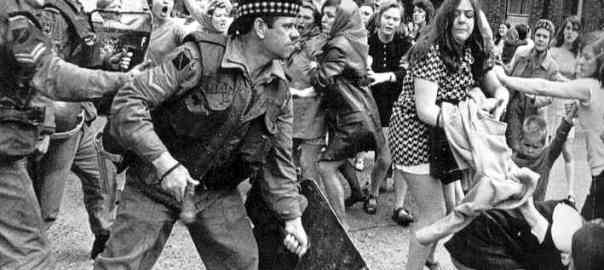
Six people were killed and many more injured during sectarian riots in Belfast. Many families were also forced to move from their homes. British troops took up duties on the streets of west Belfast.

 Political Developments; Law Order; Deployment of British Troops ] [ August 1969; United Nations; USA

Sunday 15 August 1971 Campaign of Civil Disobedience

The Social Democratic and Labour Party (SDLP) announced that it was starting a campaign of civil disobedience in response to the introduction of Internment. The SDLP also withdrew their representatives from a number of public bodies.

Friday 15 August 1980

An elderly Protestant man and his daughter were found dead at their home in Belfast; they had been beaten, stabbed and shot.

Sunday 15 August 1982

During a visit to the United States of America (USA) Martin Smyth, then Ulster Unionist Party (UUP) Member of Parliament (MP), alleged that the Central Intelligence Agency (CIA) was involved in Northern Ireland.

Wednesday 15 August 1984

There were serious riots in Protestant areas of Belfast following protests against a ‘surpergrass’ trial involving William ‘Budgie’ Allen.

[The riots continue for three nights.]

Friday 15 August 1986

Peter Robinson, then deputy leader of the Democratic Unionist Party (DUP), was remanded to Ballybay, Republic of Ireland, following a hearing in Dundalk, County Louth, because of a demonstration he led on 7 August 1986. A number of Robinson’s supporters were attacked in Dundalk with stones and petrol-bombs.

Monday 15 August 1994

John Bruton, then leader of Fine Gael (FG), said that Sinn Féin (SF) could not be involved in political talks until the Irish Republican Army (IRA) had called a total cessation of violence

Thursday 15 August 1996

The Police Authority of Northern Ireland estimated a cost of £10 million for police overtime during and after the Drumcree standoff.

Omagh Bombing The True Story

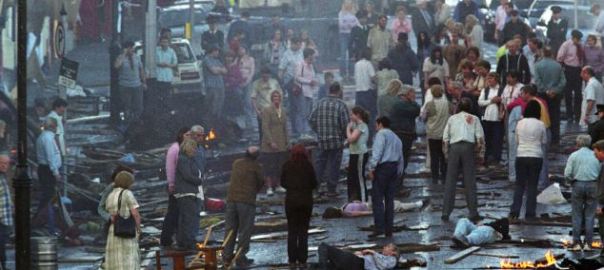
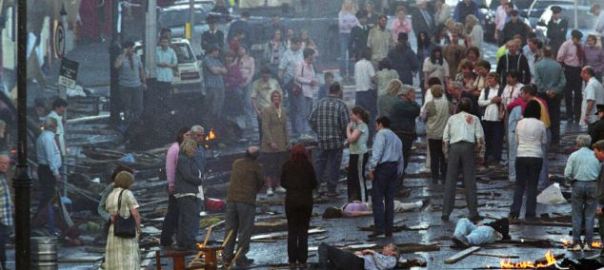
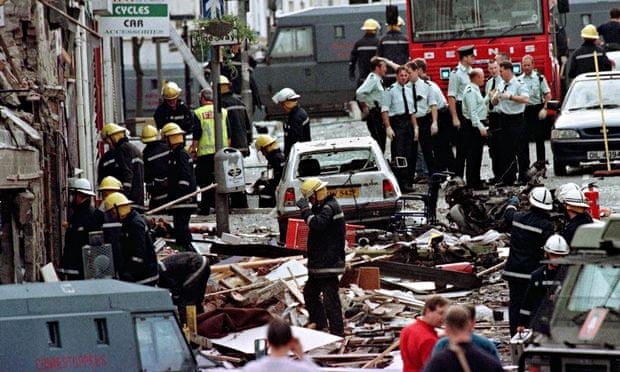
Saturday 15 August 1998 The Omagh Bomb

Featured Image -- 16824

See   Omage Bombing post

Twenty-nine people died as a result of an explosion at 3.10 pm in Omagh, County Tyrone. The bomb had been planted by the “real” Irish Republican Army (rIRA).

The death toll represented the single worst incident within Northern Ireland since the beginning of the conflict.

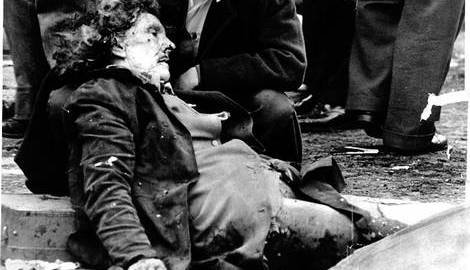
Dublin and Monaghan bombings victim

33 people were killed in bombs in Dublin and Monaghan on 17 May 1974.

See Dublin and Monaghan

Among the dead were family members, one family lost members from three generations, and close friends, and a number of tourists from the Republic of Ireland and Spain. One woman who died was pregnant with twins. There were hundreds of people injured some of whom lost limbs or their sight.

 28 people died on the day and an injured man died three weeks later. Another man was killed when the car he was driving was involved in a collision with an ambulance that was transporting injured people to a hospital in Belfast.

It was later learnt that there had been a misleading phone warning and the Royal Ulster Constabulary (RUC) directed people towards the bomb rather than away from it.

The code word used was that of the rIRA, a breakaway group of dissident members from the Provisional IRA who disagreed with the political direction being taken by the Sinn Féin leadership. There was outrage and shock across the whole population of Northern Ireland. Many people expressed the hope that this incident would mark a turning point in the conflict.

See   Omage Bombing post

Sunday 15 August 1999

Thousands gathered in Omagh and Buncrana to mark the first anniversary of the Omagh bombing. Silent vigils were kept at 3.10pm throughout the country to commemorate the 29 people killed and 300 injured in the attack which caused the biggest loss of life of any incident in the North.

Tuesday 15 August 2000

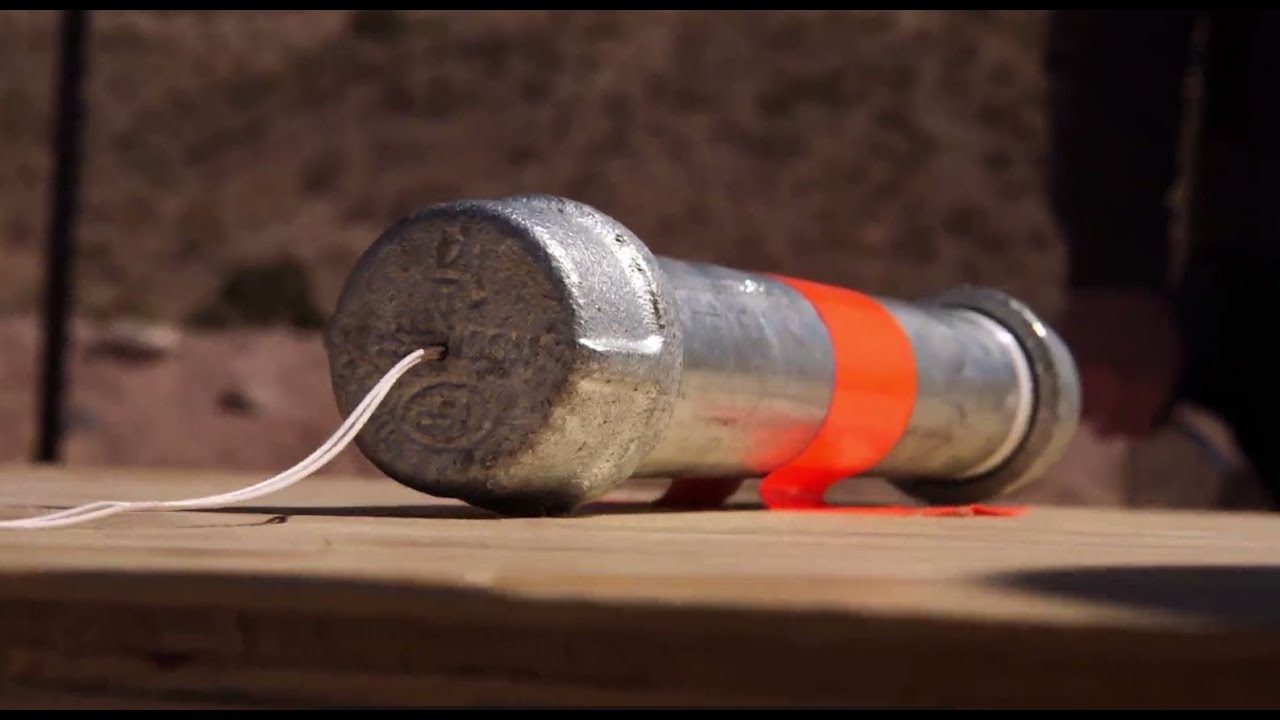
Johnny Adair, then a leader of the Ulster Freedom Fighters (UFF), a cover name (pseudonym) used by the Ulster Defence Association (UDA), claimed that Republicans were responsible for the pipe-bomb explosion that injured his hand.

The incident happened on Beechpark Street in the Protestant part of the Oldpark district.

The claim was dismissed by security force personnel who said the pipe-bomb fragments recovered were from a type of device frequently used by Loyalists. It was further alleged that Adair and some men with him were carrying the device in the car in which they were travelling when it exploded prematurely.

Wednesday 15 August 2001

A remembrance service was held in Omagh, County Tyrone, to mark the third anniversary of the “real” Irish Republican Army (rIRA) bomb attack on the town that left 29 people, and two unborn children, dead (15 August 1998).

The service took place at the Garden of Remembrance near the site of the bombing. The Royal Ulster Constabulary (RUC) and the Garda Síochána (the Irish police) held a joint press conference to appeal to members of the public for more information on the bombing. A relative of one of those killed interrupted the conference to criticise both the RUC and the Garda for their lack of progress in the investigation of the bombing.

Two men were treated in hospital after being shot and wounded in separate paramilitary ‘punishment’ attacks in west Belfast.

The first shooting happened at about 8.30pm at Lower Glen Parade, when the man was shot in both ankles. The other man was shot in one ankle at Vere Foster Walk at about 10.40pm. There was rioting in the Duncairn Gardens area of north Belfast.

Nationalist residents claimed that the RUC had to interven to rescue two young girls who had been surrounded by a Loyalist mob.

There was a series of bomb hoaxes in four towns in County Derry. British Army personnel dealt with suspect devices that were found in Desertmartin, Moneymore, Maghera, and Magherafelt.

The hoaxes caused widespread disruption. Sinn Féin released a report containing details of what the party claimed was more that 180 sectarian attacks carried out this year (to date) by the Ulster Defence Association (UDA) a Loyalist paramilitary group.

—————————————-

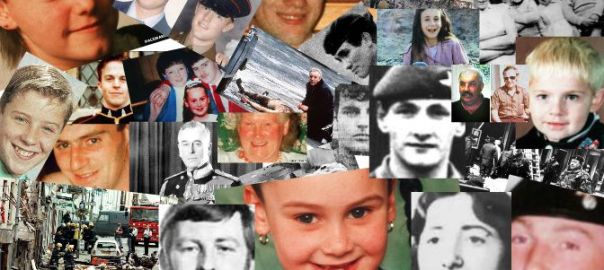
collage

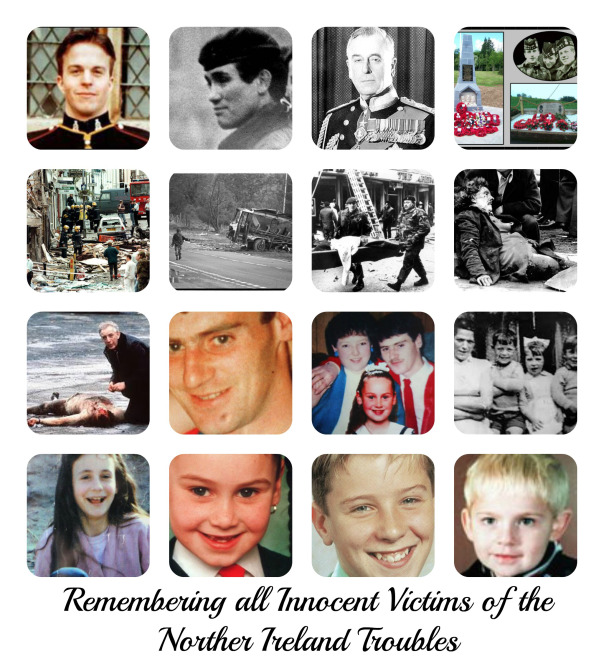
Remembering all innocent victims of the Troubles

Today is the anniversary of the follow  people killed as a results of the conflict in Northern Ireland

“To live in hearts we leave behind is not to die

– Thomas Campbell

To the innocent on the list – Your memory will live forever

– To  the Paramilitaries  –

“There are many things worth living for, a few things worth dying for, but nothing worth killing for.

44 people lost their lives on the 15th August between 1969 – 1998

Including 29 in Omagh Bombing

————————————————————–

15 August 1969

Herbert  Roy,   (26)

Protestant
Status: Civilian (Civ),

Killed by: non-specific Republican group (REP)
Shot while part of Loyalist crowd, during street disturbances, corner of Divis Street and Dover Street, Lower Falls, Belfast.

————————————————————–

15 August 1969


Huge McCabe,  

(20)Catholic
Status: British Army (BA),

Killed by: Royal Ulster Constabulary (RUC)
On leave. Shot during street disturbances while on the roof of Whitehall Block, Divis Flats, Belfast.

————————————————————–

15 August 1969

McLarnon, Samuel (27)

Catholic
Status: Civilian (Civ),

Killed by: Royal Ulster Constabulary (RUC)
Shot at his home during nearby street disturbances, Herbert Street, Ardoyne, Belfast

————————————————————–

15 August 1969


Michael Lynch,  (28)

Catholic
Status: Civilian (Civ),

Killed by: Royal Ulster Constabulary (RUC)
Shot during street disturbances, Butler Street, Ardoyne, Belfast.

————————————————————–

15 August 1969


Gerard McAuley,  (15)

Catholic
Status: Irish Republican Army Youth Section (IRAF),

Killed by: non-specific Loyalist group (LOY)
Shot during street disturbances, Bombay Street, Falls, Belfast.

————————————————————–

15 August 1969
David Linton,  (48)

Protestant
Status: Civilian (Civ),

Killed by: non-specific Republican group (REP)
Shot during street disturbances at the junction of Palmer Street and Crumlin Road, Belfast.

————————————————————–

15 August 1973
Edward Drummond,  (50)

Catholic
Status: Civilian (Civ),

Killed by: Ulster Volunteer Force (UVF)
Killed in car bomb attack, outside Sportsman’s Inn, Little Patrick Street, Belfast.

————————————————————–

15 August 1975


Norman Kerr,   (28)

Protestant
Status: Civilian (Civ),

Killed by: Irish Republican Army (IRA)
Disc Jockey. Shot while packing up his equipment, Camrick Bar, Market Street, Armagh.

————————————————————–

15 August 1975


Samuel Llewellyn,   (29)

Protestant
Status: Civilian (Civ), Killed by: Irish Republican Army (IRA)
Shot while driving van, shortly after delivering hardboard to premises damaged in bomb explosion, Osmond Street, Lower Falls, Belfast.

————————————————————–

15 August 1975
Cecil Anderson, (51)

Protestant
Status: Civilian (Civ),

Killed by: non-specific Republican group (REP)
Killed in bomb attack on Travellers Rest Inn, Derriaghy, near Belfast.

————————————————————–

15 August 1980


William Younger,   (87)

Protestant
Status: Civilian (Civ),

Killed by: not known (nk)
Found shot and stabbed at his home, Wolfhill Avenue South, Ligoniel, Belfast

————————————————————–

15 August 1980


Letitia Younger,  (57)

Protestant
Status: Civilian (Civ),

Killed by: not known (nk)
Found shot and stabbed at her home, Wolfhill Avenue South, Ligoniel, Belfast.

————————————————————–

15 August 1986
Patrick Murray,  (30)

Catholic
Status: Irish Republican Army (IRA),

Killed by: Irish Republican Army (IRA)
Found shot in entry off Clonard Street, Lower Falls, Belfast. Alleged informer.

————————————————————–

15 August 1991


Ronald Finlay  (47)

Protestant
Status: ex-Ulster Defence Regiment (xUDR),

Killed by: Irish Republican Army (IRA)
Shot at his workplace, farm, Brocklass Road, Sion Mills, County Tyrone.

————————————————————–

15 August 1991
James Woods,  (23) Catholic
Status: Civilian (Civ),

Killed by: Irish Republican Army (IRA)
Killed in grenade attack on British Army (BA) foot patrol, waste ground, off Gortfin Street, Falls, Belfast.

————————————————————–

Oamgh Bomb Victims

Omagh Victims

Never Forgotten

————————————————————————

15 August 1998


 James Barker,   (12) nfNI
Status: Civilian (Civ),

Killed by: real Irish Republican Army (rIRA)
From County Donegal. Killed in car bomb explosion, Market Street, Omagh, County Tyrone. Inadequate warning given.

————————————————————————

15 August 1998

Fernando Blasco  Bacelga,  (12) nfNI
Status: Civilian (Civ),

Killed by: real Irish Republican Army (rIRA)
Spanish visitor. Killed in car bomb explosion, Market Street, Omagh, County Tyrone. Inadequate warning given.

————————————————————————

15 August 1998

Geraldine Breslin,   (43)

Catholic
Status: Civilian (Civ),

Killed by: real Irish Republican Army (rIRA)
Killed in car bomb explosion, Market Street, Omagh, County Tyrone. Inadequate warning given.

————————————————————————

15 August 1998

Debra Ann Cartwright,  (20)

Protestant
Status: Civilian (Civ),

Killed by: real Irish Republican Army (rIRA)
Killed in car bomb explosion, Market Street, Omagh, County Tyrone. Inadequate warning given.

————————————————————————

15 August 1998

Gareth Conway,  (18)

Catholic
Status: Civilian (Civ),

Killed by: real Irish Republican Army (rIRA)
Killed in car bomb explosion, Market Street, Omagh, County Tyrone. Inadequate warning given.

————————————————————————

15 August 1998

Breda Devine,   (1)

Catholic
Status: Civilian (Civ),

Killed by: real Irish Republican Army (rIRA)
Killed in car bomb explosion, Market Street, Omagh, County Tyrone. Inadequate warning given.

————————————————————————

15 August 1998

Oran Doherty,   (8) nfNI
Status: Civilian (Civ),

Killed by: real Irish Republican Army (rIRA)
From County Donegal. Killed in car bomb explosion, Market Street, Omagh, County Tyrone. Inadequate warning given.

————————————————————————

15 August 1998


Adrian Gallagher,  (21)

Catholic
Status: Civilian (Civ),

Killed by: real Irish Republican Army (rIRA)
Killed in car bomb explosion, Market Street, Omagh, County Tyrone. Inadequate warning given.

————————————————————————

15 August 1998


Esther Gibson,  (36)

Protestant
Status: Civilian (Civ),

Killed by: real Irish Republican Army (rIRA)
Killed in car bomb explosion, Market Street, Omagh, County Tyrone. Inadequate warning given

————————————————————————

15 August 1998


Mary Grimes,  (65)

Catholic
Status: Civilian (Civ),

Killed by: real Irish Republican Army (rIRA)
Killed in car bomb explosion, Market Street, Omagh, County Tyrone. Inadequate warning given.

————————————————————————

15 August 1998


Olive Hawkes,  (60)

Protestant
Status: Civilian (Civ),

Killed by: real Irish Republican Army (rIRA)
Killed in car bomb explosion, Market Street, Omagh, County Tyrone. Inadequate warning given.

————————————————————————

15 August 1998


Julia Hughes,  (21)

Protestant
Status: Civilian (Civ),

Killed by: real Irish Republican Army (rIRA)
Killed in car bomb explosion, Market Street, Omagh, County Tyrone. Inadequate warning given

————————————————————————

15 August 1998

Brenda Logue,  (17)

Catholic
Status: Civilian (Civ),

Killed by: real Irish Republican Army (rIRA)
Killed in car bomb explosion, Market Street, Omagh, County Tyrone. Inadequate warning given.

————————————————————————

15 August 1998


Anne McCombe,  (48)

Protestant
Status: Civilian (Civ),

Killed by: real Irish Republican Army (rIRA)
Killed in car bomb explosion, Market Street, Omagh, County Tyrone. Inadequate warning given.

————————————————————————

15 August 1998


Brian McCrory,  (54)

Catholic
Status: Civilian (Civ),

Killed by: real Irish Republican Army (rIRA)
Killed in car bomb explosion, Market Street, Omagh, County Tyrone. Inadequate warning given.

————————————————————————

15 August 1998


Samantha McFarland, (17)

Protestant
Status: Civilian (Civ),

Killed by: real Irish Republican Army (rIRA)
Killed in car bomb explosion, Market Street, Omagh, County Tyrone. Inadequate warning given.

————————————————————————

15 August 1998


Sean McGrath,  (61)

Catholic
Status: Civilian (Civ),

Killed by: real Irish Republican Army (rIRA)
Injured in car bomb explosion, Market Street, Omagh, County Tyrone. Inadequate warning given. He died 5 September 1998.

————————————————————————

15 August 1998


Sean McLaughlin,  (12) nfNI
Status: Civilian (Civ),

Killed by: real Irish Republican Army (rIRA)
From County Donegal. Killed in car bomb explosion, Market Street, Omagh, County Tyrone. Inadequate warning given.

————————————————————————

15 August 1998


Jolene Marlow,  (17)

Catholic
Status: Civilian (Civ),

Killed by: real Irish Republican Army (rIRA)
Killed in car bomb explosion, Market Street, Omagh, County Tyrone. Inadequate warning given.

————————————————————————

15 August 1998


Avril Monaghan, (30)

Catholic
Status: Civilian (Civ),

Killed by: real Irish Republican Army (rIRA)
Killed in car bomb explosion, Market Street, Omagh, County Tyrone. Inadequate warning given.

————————————————————————

15 August 1998


Maura Monaghan, (1)

Catholic
Status: Civilian (Civ),

Killed by: real Irish Republican Army (rIRA)
Killed in car bomb explosion, Market Street, Omagh, County Tyrone. Inadequate warning given.

————————————————————————

15 August 1998


Alan Radford,  (16)

Protestant
Status: Civilian (Civ),

Killed by: real Irish Republican Army (rIRA)
Killed in car bomb explosion, Market Street, Omagh, County Tyrone. Inadequate warning given

————————————————————————

15 August 1998


Rocia Abad Ramos,  (23) nfNI
Status: Civilian (Civ),

Killed by: real Irish Republican Army (rIRA)
Spanish visitor. Killed in car bomb explosion, Market Street, Omagh, County Tyrone. Inadequate warning given.

————————————————————————

15 August 1998


Elizabeth Rush,   (57)

Catholic
Status: Civilian (Civ),

Killed by: real Irish Republican Army (rIRA)
Killed in car bomb explosion, Market Street, Omagh, County Tyrone. Inadequate warning given.

————————————————————————

15 August 1998


Veda Short,  (56)

Protestant
Status: Civilian (Civ),

Killed by: real Irish Republican Army (rIRA)
Killed in car bomb explosion, Market Street, Omagh, County Tyrone. Inadequate warning given.

————————————————————————

15 August 1998


Philomena Skelton,  (39)

Catholic
Status: Civilian (Civ),

Killed by: real Irish Republican Army (rIRA)
Killed in car bomb explosion, Market Street, Omagh, County Tyrone. Inadequate warning given.

————————————————————————

15 August 1998


Fred White,  (60)

Protestant
Status: Civilian (Civ),

Killed by: real Irish Republican Army (rIRA)
Killed in car bomb explosion, Market Street, Omagh, County Tyrone. Inadequate warning given.

————————————————————————

15 August 1998


Bryan White,  (26)

Protestant
Status: Civilian (Civ),

Killed by: real Irish Republican Army (rIRA)
Killed in car bomb explosion, Market Street, Omagh, County Tyrone. Inadequate warning given.

————————————————————————

15 August 1998


Lorraine Wilson , (15)

Protestant
Status: Civilian (Civ),

Killed by: real Irish Republican Army (rIRA)
Killed in car bomb explosion, Market Street, Omagh, County Tyrone. Inadequate warning given

————————————————————————

—————————————————————————————————————————–

14th August – Deaths & Events in Northern Ireland Troubles

14th August

Key Events & Deaths on this day in Northern Ireland Troubles

 Thursday 14 August 1969

British Army Troops Deployed

After two days of continuous battle, and with the Royal Ulster Constabulary (RUC) exhausted, the Stormont government asked the British government for permission to allow British troops to be deployed on the streets of Northern Ireland.

Late in the afternoon troops entered the centre of Derry. John Gallagher, a Catholic civilian, was shot dead by the Ulster Special Constabulary (‘B-Specials’) during street disturbances on the Cathedral Road in Armagh.

John Gallagher was recorded, by the Royal Ulster Constabulary (RUC), as the first ‘official’ victim of ‘the Troubles’.


In Belfast vicious sectarian riots erupted and continued the following day. In Divis Street the RUC fired a number of shots, from a heavy Browning machine-gun mounted on an armoured car, into the Divis Flats and Towers.

Patrick Rooney

One of the shots killed a young Catholic boy while he lay in bed.

Saturday 14 August 1971

A British soldier was killed by the Official Irish Republican Army (OIRA) in Belfast.

Monday 14 August 1972

Two British soldiers were killed by an IRA booby trap bomb in Belfast. A Catholic civilian was shot dead during an IRA attack on a British Army patrol in Belfast.

Saturday 14 August 1976

Majella O’Hare

Majella O’Hare (12), a young Catholic girl, was shot dead by British soldiers while she was walking near her home in Ballymoyer, Whitecross, County Armagh.

A rally in Andersontown to call for peace attracted a crowd of approximately 10,000 people. This rally was organised by the Women’s Peace Movement (later Peace People).

Monday 14 August 1978

The Daily Mirror, a British national newspaper, announced its support for a British withdrawal from Northern Ireland.

Sunday 14 August 1983

Security forces in France uncovered a haul of weapons believed to be on route to the Irish Republican Army (IRA) on a ferry from Le Harve to Rosslare in the Republic of Ireland.

Tuesday 14 August 1984

James Prior, then Secretary of State for Northern Ireland, said that the decision to ban Martin Galvin, then leader of NORAID (Irish Northern Aid Committee), from the UK had been “a bad mistake”.

[The decision and subsequent police action had led to the death of Sean Downes on 12 August 1984.]

Monday 14 August 1989

Twentieth anniversary of the deployment of the British Army on the streets of Northern Ireland. Peter Brook, then Secretary of State for Northern Ireland, had talks with James Molyneaux, then leader of the Ulster Unionist Party (UUP), and Ian Paisley, then leader of the Democratic Unionist Party (DUP).

Wednesday 14 August 1991

Loyalist paramilitaries attacked a bus near Markethill, County Armagh, that was carrying families of Republicans prisoners. Two women were injured in the attack.

Saturday 14 August 1993

A group of supporters of ETA from the Basque country paid a visit to Belfast and expressed support for Sinn Féin (SF) and the Irish Republican Army (IRA).

Sunday 14 August 1994

Sean Monaghan

Sean Monaghan (20), a Catholic civilian, was abducted and killed by the Ulster Freedom Fighters (UFF), a cover name (pseudonym) used by the Ulster Defence Association (UDA). He was found shot dead, on waste ground, off Ottawa Street, Woodvale, Belfast.

Gerry Adams, then President of Sinn Féin (SF), said that he had confidence that the peace process could move towards a negotiated political settlement.

Thursday 14 August 1997

A man  was killed by masked men who entered his flat on the Newtownards Road, Belfast. Four serving and former members of the prison service who lived in the mid-Ulster area had their homes attacked.

[The attacks were believed to have been carried out by the Loyalist Volunteer Force (LVF).]

Gerry Adams, then President of Sinn Féin (SF), Martin McGuinness, then Vice-President of Sinn Féin (SF), and a SF Teachta Dála (TD; member of Irish Parliament) were granted visas to visit the United States of America (USA) and to raise funds for SF.

Saturday 14 August 1999

There was violence in Derry and Belfast following Apprentice Boys parades through the Bogside and lower Ormeau Road. Several Nationalists engaged in a protest were injured as Royal Ulster Constabulary (RUC) officers cleared the lower Ormeau Road to allow the Loyal Order parade to pass.

The Northern Ireland politician, trade unionist and author, Paddy Devlin, died in Belfast. Devlin had been a founding member of the Social Democratic and Labour Party (SDLP). He had been awarded an MBE in 1998.

Tuesday 14 August 2001 IRA Withdraws Decommissioning Proposals

The Irish Republican Army (IRA) announced in a statement that it had withdrawn its plan on how to put its weapons beyond use. The Independent International Commission on Decommissioning (IICD) had announced on 6 August 2001 that the IRA had agreed a plan on how it was going to decommission its weapons.

This IRA move had been rejected by David Trimble, then leader of the Ulster Unionist Party (UUP), who said that the UUP wanted to see decommissioning actually begin (7 August 2001).

The UUP rejection, together with the British government’s decision to suspend the Assembly and the institutions, were the reasons given by the IRA for the decision to withdraw the plan.

The IRA statement concluded that: “Conditions therefore do not exist for progressing our proposition. We are withdrawing our proposal. The IRA leadership will continue to monitor developments. Peacekeeping is a collective effort”.

John Reid, then Secretary of State for Northern Ireland, said the move would “play into the hands of those sceptics who have always doubted their intention”. Brian Cowen, then Irish Minister for Foreign Affairs, said the decision was “very disappointing”.

All shades of Unionist opinion reacted with scorn to the news on decommissioning and also to the arrests of three suspected IRA members in Colombia (13 August 2001).

A 12 year-old Catholic boy was beaten in what police described as a sectarian attack in south Belfast. In north Belfast the British Army carried out a controlled explosion on a lorry, one of two vehicles that had been hi-jacked by Loyalists.

There was a pipe-bomb attack on a Catholic family in north Belfast at 11.15pm (2315BST). Two men were seen running away from the area after the attack.

Graham Shillington (90), a former Chief Constable of the Royal Ulster Constabulary (RUC), died in a nursing home in County Armagh. Shillington had been Chief Constable from 1970 to 1973.

The Irish Times (a Republic of Ireland newspaper) reported on the results of a survey into the level of knowledge that people in the two parts of Ireland had about the other.

The survey found that, of those questioned, residents in the Republic had

“considerable ignorance”

about the Northern Irish Protestant tradition, although 48 per cent said they would like to learn more.

Only 19 per cent of Northern Protestants felt they had a good or excellent understanding of the traditions and culture of the Republic. The survey had been carried out on behalf of Co-operation Ireland.

———————————–

collage

Remembering all innocent victims of the Troubles

Today is the anniversary of the follow  people killed as a results of the conflict in Northern Ireland

“To live in hearts we leave behind is not to die

– Thomas Campbell

To the innocent on the list – Your memory will live forever

– To  the Paramilitaries  –

“There are many things worth living for, a few things worth dying for, but nothing worth killing for.

12  people lost their lives on the 14Th August between 1969 – 1994

————————————————————–

14 August 1969


 John Gallagher,  (30)

Catholic
Status: Civilian (Civ),

Killed by: Ulster Special Constabulary (USC)
Shot during street disturbances, Cathedral Road, Armagh.

————————————————————–

14 August 1969

Patrick Rooney,   (9)

Catholic
Status: Civilian (Civ),

Killed by: Royal Ulster Constabulary (RUC)
Shot at his home, during nearby street disturbances, St Brendan’s Path, Divis Flats, Belfast.

————————————————————–

14 August 1971

John Robinson  (21) nfNI
Status: British Army (BA),

Killed by: Official Irish Republican Army (OIRA)
Shot by sniper while on British Army (BA) mobile patrol, Butler Street, Ardoyne, Belfast.

————————————————————–

14 August 1972

 David Storey,

(36) nfNI
Status: British Army (BA),

Killed by: Irish Republican Army (IRA)
Killed by booby trap bomb left outside Casement Park British Army (BA) base, Andersonstown, Belfast.

————————————————————–

14 August 1972
Brian Hope,   (20) nfNI
Status: British Army (BA),

Killed by: Irish Republican Army (IRA)
Killed by booby trap bomb left outside Casement Park British Army (BA) base, Andersonstown, Belfast.

————————————————————–

14 August 1972
Charles McNeill,  (70)

Catholic
Status: Civilian (Civ),

Killed by: Irish Republican Army (IRA)
Shot during sniper attack on British Army (BA) foot patrol, Brompton Park, Ardoyne, Belfast.

————————————————————–

14 August 1974
Joseph McGuinness  (13)

Catholic
Status: Civilian (Civ),

Killed by: Ulster Defence Association (UDA)
Shot while walking along North Queen Street, New Lodge, Belfast.

————————————————————–

14 August 1974

Paul Magorrian,  (21)

Catholic
Status: Irish Republican Army (IRA),

Killed by: British Army (BA)
Shot while walking through St Malachy’s estate, Castlewellan, County Down

————————————————————–

14 August 1975
William Meaklin,   (28)

Protestant
Status: ex-Royal Ulster Constabulary (xRUC),

Killed by: Irish Republican Army (IRA)
Abducted while driving his delivery van, Mullaghduff, near Cullyhanna, County Armagh. Found shot, near Newtownhamilton, County Armagh, on 15 August 1975.

————————————————————–

14 August 1976

Majella O’Hare,  (12)

Catholic
Status: Civilian (Civ),

Killed by: British Army (BA)
Shot while walking near to her home, Ballymoyer, near Whitecross, County Armagh.

————————————————————–

14 August 1980
James Bell,  (24)

Catholic
Status: Civilian (Civ),

Killed by: British Army (BA)
Shot during attempted burglary of Greenvale Restaurant, Cookstown, County Tyrone

————————————————————–

14 August 1994

Sean Monaghan,  (20)

Catholic
Status: Civilian (Civ),

Killed by: Ulster Freedom Fighters (UFF)
Found shot, on waste ground, off Ottawa Street, Woodvale, Belfast

————————————————————–


Sons of Anarchy – Saddam Hussein’s Sons

noun: anarchy
  1. :  A state of lawlessness or political disorder due to the absence of governmental authorityc:

Uday Hussein

Uday Saddam Hussein al-Tikriti (Arabic: عُدي صدّام حُسين‎‎) (18 June 1964 – 22 July 2003) was the eldest son of Saddam Hussein by his first wife, Sajida Talfah, and the brother of Qusay Hussein.

Uday was seen, for several years, as the likely successor to his father, but lost the place as heir apparent to Qusay due to injuries sustained in an assassination attempt, increasingly erratic behavior, and his troubled relationship with the family.

His reputed actions include multiple allegations of rape, murder and torture (including of Iraqi Olympic athletes and the national football team).

He was several times imprisoned, exiled and received a token death sentence by his father’s regime.

Following the United States-led invasion of Iraq in 2003, he was killed alongside his brother and nephew Mustapha by Task Force 20 after a three-hour gunfight in Mosul.


Uday Hussein
Uday Saddam Hussein.png
Commander of the Fedayeen Saddam
In office
1995–1996
Preceded by Position established
Succeeded by Qusay Saddam
Personal details
Born (1964-06-18)18 June 1964
Tikrit, Iraq
Died 22 July 2003(2003-07-22) (aged 39)
Mosul, Iraq
Parents Saddam Hussein (deceased)
Sajida Talfah
Relatives Qusay Hussein (brother, deceased)

Raghad Hussein (Sister)

Religion Sunni Islam
Military service
Allegiance Baathist Iraq
Service/branch Fedayeen Saddam
Years of service 1995-2003
Rank Commander
Battles/wars 2003 Iraq War


Biography

Uday Saddam was born in Tikrit to Saddam Hussein and Sajida Talfah while his father was in prison.

Uday graduated from high school with very high marks. He started his university days in the Baghdad University College of Medicine. He only lasted in the medical college for three days, after which he moved to College of Engineering about a kilometer away.

Uday gained a degree in engineering and graduated summa cum laude from Baghdad University, ranking No. 1 in a class of 76 students. However, some of his professors later admitted that Uday barely managed to earn passing grades in many of his classes, and was granted the honor of valedictorian namely because he was Saddam’s son.

Although his status as Saddam’s elder son made him Saddam’s prospective successor, Uday fell out of favour with his father.

In October 1988, at a party in honour of Suzanne Mubarak, wife of Egyptian President Hosni Mubarak, Uday murdered his father’s personal valet and food taster, Kamel Hana Gegeo, possibly at the request of his mother.

Before an assemblage of horrified guests, an intoxicated Uday bludgeoned Gegeo, reputedly stabbing him with an electric carving knife. Gegeo had recently introduced Saddam to a younger woman, Samira Shahbandar, who later became Saddam’s second wife. Uday considered his father’s relationship with Shahbandar an insult to his mother. He also may have feared losing succession to Gegeo, whose loyalty and fidelity to Saddam Hussein was unquestioned.

As punishment for the murder, Saddam briefly imprisoned his son and sentenced him to death; however Uday probably served only three months in a private prison.

In response to personal intervention from King Hussein of Jordan, Saddam released Uday, banishing him to Switzerland as the assistant to the Iraqi ambassador there. He was expelled by the Swiss government in 1990 after he was repeatedly arrested for fighting.

Saddam later appointed Uday chairman of the Iraqi Olympic Committee and the Iraq Football Association. In the former role, he tortured athletes who failed to win.

He also became the editor of the Babel newspaper, the general secretary of the Iraqi Union of Students and the head of the Fedayeen Saddam.

Uday seemed proud of his reputation and called himself Abu Sarhan, an Arabic term for “wolf”.

Uday sustained permanent injuries during an assassination attempt in December 1996. Struck by many bullets while driving,  Uday was initially believed to be paralyzed. Evacuated to Ibn Sina Hospital, he eventually recovered but with a noticeable limp.

Despite repeated operations, however, a bullet remained lodged in his spine and could not be removed due to its location near the spinal cord.

In the wake of Uday’s subsequent disabilities, Saddam gave Qusay increasing responsibility and authority, designating him as his heir apparent in 2000.

Uday opened accounts with Yahoo! and MSN Messenger, which created controversy when the provisioning of the accounts allegedly violated U.S. trade sanctions against Iraq.

Uday also amassed a large video collection, found in his palace in 2003, much of which featured himself in both public and private situations.

Personal life

In a sign of loyalty to Saddam, Izzat Ibrahim al-Douri who was vice president of the Revolutionary Command Council, consented to marry his daughter to Uday.

But al-Douri’s influence with Hussein was so substantial that he could even levy a condition: that the union would not be consummated. Because of Uday’s violent and erratic behaviour, al-Douri quickly petitioned that his daughter be permitted to divorce Uday.

Allegations of crimes

A report released on 20 March 2003, one day after the American led invasion of Iraq, by ABC News detailed several allegations against Uday:

As head of the Iraqi Olympic Committee, Uday oversaw the imprisonment and torture of Iraqi athletes who were deemed not to have performed to expectations. According to widespread reports, torturers beat and caned the soles of the football players’ feet—inflicting intense pain without leaving visible marks on the rest of their bodies . Uday reportedly kept scorecards with written instructions on how many times each player should be beaten after a poor showing. He would insult athletes who performed below his expectations by calling them dogs and monkeys to their faces.

One defector reported that jailed football players were forced to kick a concrete ball after failing to reach the 1994 FIFA World Cup finals.

The Iraqi national football team were seen with their heads shaved after failing to achieve a good result in a tournament in the 1980s. It was widely circulated that Uday ordered the shaving as part of the punishment.

Another defector claimed that athletes were dragged through a gravel pit and subsequently immersed in a sewage tank to induce infection in the victims’ wounds.

After Iraq lost 4–1 to Japan in the quarter finals of the 2000 AFC Asian Cup in Lebanon, goalkeeper Hashim Hassan, defender Abdul Jaber and forward Qahtan Chatir were labelled as guilty of loss and eventually flogged for three days by Uday’s security.

Other allegations include:

  • Kidnapping young Iraqi women from the streets in order to rape them. Uday was known to intrude on parties and otherwise “discover” women whom he would later rape. Time published an article in 2003 detailing his sexual brutality.
  • When U.S. troops captured his mansion in Baghdad, they found a personal zoo stocked with lions and cheetahs; an underground parking garage for his collection of luxury cars; paintings glorifying him and his mother with Saddam (which was known to have infuriated his father); Cuban cigars inscribed with his name; and millions of dollars worth of fine wines, liquor and heroin.
  • An HIV testing kit was also found among his personal effects.
  • He amassed millions of U.S. dollars by running façade corporations illegally trading with Iran (although, at that time, UN restrictions did not allow foreign trading. Only later, Iraq was allowed to import certain commodities such as food and medical supplies legally under the UN Oil For Food programme).
  • Usage of an iron maiden on persons running afoul of him.
  • Beating an army officer unconscious when the man refused to allow Uday to dance with his wife; the man later died of his injuries. Uday also shot and killed an army officer who did not salute him.
  • Stealing approximately 1,200 luxury vehicles, including a Rolls-Royce Corniche valued at over $200,000. A Lamborghini LM002, given to him as a gift by Libyan leader Muammar Gaddafi, was later blown up by U.S. forces to demonstrate the effects of a car bomb.
  • Plotting, in 2000, to assassinate Ahmed Chalabi, the leader of the Iraqi National Congress. This was done shortly after Saddam named his younger son heir apparent to the dictatorship, and Uday attempted to remove Qusay from that position by currying favor with his father through this assassination.

Death


House of Uday and Qusay in Mosul, Iraq destroyed by U.S. forces, 31 July 2003

On 22 July 2003, Task Force 20, aided by troops of the United States Army 101st Airborne Division, surrounded Uday, Qusay and Qusay’s 14-year-old son Mustapha during a raid on a home in the northern Iraqi city of Mosul.

He had been the Ace of Hearts on the most-wanted Iraqi playing cards (with Qusay being the Ace of Clubs). Acting on a tip from an unidentified Iraqi, the blocking element from the 101st Airborne Division provided security while the Task Force 20 operators attempted to apprehend the inhabitants of the house. After U.S. troops hotwired Uday’s Lamborghini,  he revealed himself, upon which a gunfight ensued. The assault element withdrew to request backup.

As many as 200 American troops, later aided by OH-58 Kiowa helicopters and an A-10 “Warthog”, surrounded and fired upon the house, thus killing Uday, Qusay, and Qusay’s son. After approximately four hours of battle, soldiers entered the house and found four bodies, including the Hussein brothers’ bodyguard.

Later, the American command said that dental records had conclusively identified two of the dead men as Saddam Hussein‘s sons. They also announced that the informant (possibly the owner of the villa in Mosul in which the brothers were killed) would receive the combined $30 million reward previously offered for their apprehension.


Soldiers of the 101st Airborne Division and U.S. Special Operations (Task Force 20) watch as a TOW missile strikes the side of a house occupied by Uday and Qusay Hussein in Mosul, on 22 July 2003

The owner of the villa, Nawaf az-Zeidan, who is distantly related to Saddam, was granted U.S. citizenship, and was permitted to leave Iraq. Locals claimed that Zeidan had informed United States forces that Saddam’s sons were staying there, as the brothers became overbearing in their demands and took his hospitality for granted. On 18 June 2004, Zeidan’s brother Salaah al-Zeidan was killed, as well as three of his male relatives (including an eight-year-old boy), who were travelling in the same vehicle.

The U.S. Administration released graphic pictures of the Hussein brothers’ bodies. When criticized, the U.S. military’s response was to point out that these men were no ordinary combatants, and to express hope that confirmation of the deaths would bring closure to the Iraqi people.

Uday was buried in a cemetery near Tikrit alongside Qusay and Mustapha Hussein.

That night, and several nights following Uday and Qusay Hussein’s death, celebratory gunfire could be heard throughout Baghdad

Qusay Hussein

Qusay Saddam Hussein al-Tikriti (or Qusai, Arabic: قصي صدام حسين‎‎; (1966-05-17)17 May 1966 – 22 July 2003(2003-07-22)) was the second son of Iraqi President Saddam Hussein. He was appointed as his father’s heir apparent in 2000.

Family

Qusay’s older brother Uday was viewed as Saddam’s heir-apparent until he sustained serious injuries in a 1996 assassination attempt. Unlike Uday, who was known for extravagance and erratic, violent behavior, Qusay Hussein kept a low profile. He was married to Sahar Maher Abd al-Rashid; the daughter of Maher Abd al-Rashid, a top ranking military official, and had three sons;one of the sons, Mustapha Qusay (born 3 January 1989 in Tikrit), was killed alongside his father in an attack by U.S. troops on their house.

The other two – Yahya Qusay (born 1991) and Yaqub Qusay – are presumed alive, but their whereabouts are unknown

Qusay Hussein
قصي صدام حسين
Qusay Hussein.jpg
Member of the Regional Command of the Iraqi Regional Branch
In office
18 May 2001 – 9 April 2003
Director of the Iraqi Special Security Organization
In office
1992–1997
Preceded by Fannar Zibin Al Hasan
Succeeded by Nawfal Mahjoom Al-Tikriti
Personal details
Born Qusay Saddam Hussein al-Tikriti
(1966-05-17)17 May 1966
Baghdad, Iraq
Died 22 July 2003(2003-07-22) (aged 37)
Mosul, Iraq
Resting place Al-Awja, Iraq
Nationality Iraqi
Political party Iraqi Regional Branch of the Arab Socialist Ba’ath Party
Spouse(s) Sahar (m. 1988–2003; his death)
Children Mustapha Qusay Saddam al-Tikriti (1989–2003; deceased)
Yahya Qusay Saddam al-Tikriti (born 1991)
Yaqub Qusay Saddam al-Tikriti
Parents Saddam Hussein (father, 1937–2006; deceased)
Sajida Talfah (mother, born 1937)
Relatives Uday Saddam Hussein (brother; deceased)
Maher Abd al-Rashid (father in law)
Religion Sunni Islam
Military service
Allegiance Baathist Iraq
Service/branch Iraqi Republican Guard
Years of service 2000-2003
Rank Honorable Supervisor of the Republican Guard
Battles/wars 2003 Iraq War


Before the 2003 invasion

Unlike other members of his family and the government, little information is known about Qusay, politically or personally. It is believed that until the 2003 Invasion of Iraq Qusay was the supervisor of the Iraqi Republican Guard and the head of internal security forces (possibly the Special Security Organization (SSO)), and had authority over other Iraqi military units.

Qusay played a role in crushing the Shiite uprising in the aftermath of the 1991 Gulf War and is also thought to have masterminded the destruction of the southern marshes of Iraq. The wholesale destruction of these marshes ended a centuries-old way of life that prevailed among the Shiite Marsh Arabs who made the wetlands their home, and ruined the habitat for dozens of species of migratory birds.

The Iraqi government stated that the action was intended to produce usable farmland, though a number of outsiders believe the destruction was aimed against the Marsh Arabs as retribution for their participation in the 1991 uprising.

Iraqi dissidents claim that Qusay was responsible for the killing of many political activists. The Sunday Times reported that Qusay ordered the killing of Khalis Mohsen al-Tikriti, an engineer at the military industrialization organization, because he believed Mohsen was planning to leave Iraq. In 1998, Iraqi opposition groups accused Qusay of ordering the execution of thousands of political prisoners after hundreds of inmates were similarly executed to make room for new prisoners in crowded jails.

Death


House of Uday and Qusay Hussein in Mosul, Iraq destroyed by American forces, 31 July 2003

U.S. Army soldiers from the 101st Airborne Division watch as a TOW missile strikes the side of a house of Uday and Qusay Hussein in Mosul, Iraq, 22 July 2003


Death

House of Uday and Qusay Hussein in Mosul, Iraq destroyed by American forces, 31 July 2003

U.S. Army soldiers from the 101st Airborne Division watch as a TOW missile strikes the side of a house of Uday and Qusay Hussein in Mosul, Iraq, 22 July 2003


Death

On the afternoon of 22 July 2003, troops of the 101st Airborne 3/327th Infantry HQ and C-Company, aided by U.S. Special Forces killed Qusay, his 14-year-old son Mustapha, and his older brother Uday, during a raid on a home in the northern Iraqi city of Mosul.

Acting on a tip from a cousin, a special forces team attempted to apprehend the inhabitants of the house. After being fired on, the special forces moved back and called for backup. As little as 40 101st Soldiers and 8 Task Force 121 operators were on the scene

After Task Force 121 members were wounded, the 3/327th Infantry surrounded and fired on the house with a TOW missile, Mark 19 Automatic Grenade Launcher, M2 50 Caliber Machine guns and small arms. After about four hours of battle (the whole operation lasted 6 hours), the soldiers entered the house and found four dead, including the two brothers and their bodyguard.

There were reports that Qusay’s 14-year-old son Mustapha was the fourth body found. Brig. Gen. Frank Helmick, the assistant commander of 101st Airborne, commented that all occupants of the house died during the fierce gun battle before U.S. troops entered.

On 23 July 2003, the American command said that it had conclusively identified two of the dead men as Saddam Hussein‘s sons from dental records. Because many Iraqis were skeptical of news of the deaths, the U.S. Government released photos of the corpses and allowed Iraq’s governing council to identify the bodies despite the U.S. objection to the publication of American corpses on Arab television. They also announced that the informant, possibly the owner of the house, would receive the combined $30 million reward on the pair.

Qusay was the ace of clubs in the coalition forces’ most-wanted Iraqi playing cards. His father was the ace of spades and his brother was the ace of hearts.

……..

The Bayardo Bar attack – 13 August 1975

The Bayardo Bar attack

Bayardo Bar memorial.jpg


The Bayardo Bar attack took place on 13 August 1975 in Belfast, Northern Ireland. A unit of the Provisional IRA Belfast Brigade, led by Brendan McFarlane, launched a bombing and shooting attack on the pub on Aberdeen Street (off the loyalist Shankill Road), which was frequented by Ulster Volunteer Force (UVF) members as well as civilians.

Four Protestant civilians and one UVF member were killed.

————————————————————–

13 August 1975

William Gracey,  (63)

Protestant
Status: Civilian (Civ),

Killed by: Irish Republican Army (IRA)
Shot during gun and bomb attack on Bayardo Bar, Shankill Road, Belfast.

See below for more details on this attack

————————————————————–

13 August 1975

 Samuel Gunning,   (55)

Protestant
Status: Civilian (Civ),

Killed by: Irish Republican Army (IRA)
Shot during gun and bomb attack on Bayardo Bar, Shankill Road, Belfast.

————————————————————–

13 August 1975

Hugh Harris,   (21)

Protestant
Status: Ulster Volunteer Force (UVF),

Killed by: Irish Republican Army (IRA)
Shot during gun and bomb attack on Bayardo Bar, Shankill Road, Belfast.

————————————————————–

13 August 1975

 Joanne McDowell,   (29)

Protestant
Status: Civilian (Civ),

Killed by: Irish Republican Army (IRA)
Shot during gun and bomb attack on Bayardo Bar, Shankill Road, Belfast.

————————————————————–

13 August 1975
Linda Boyle,  (19)

Protestant
Status: Civilian (Civ),

Killed by: Irish Republican Army (IRA)
Injured during gun and bomb attack on Bayardo Bar, Shankill Road, Belfast. She died 21 August 1975.

————————————————————–

According to journalists Alan Murray and Peter Taylor, it was retaliation for the Miami Showband massacre almost a fortnight earlier, when the popular Dublin-based band were ambushed by the UVF at a bogus military checkpoint. Three band members were shot dead by the UVF gunmen after their minibus was blown up in a premature explosion.

McFarlane and two other IRA volunteers, Peter “Skeet” Hamilton and Seamus Clarke, were sentenced to life imprisonment for perpetrating the Bayardo attack.

Background

By the year 1975, the religious-political conflict in Northern Ireland known as “the Troubles“— was more than six years old. On 10 February 1975, the Provisional IRA and British government entered into a truce and restarted negotiations. The IRA agreed to halt attacks on the British security forces, and the security forces mostly ended its raids and searches.

However, there were dissenters on both sides. Some Provisionals wanted no part of the truce, while British commanders resented being told to stop their operations against the IRA just when—they claimed—they had the Provisionals on the run.The security forces boosted their intelligence offensive during the truce and thoroughly infiltrated the IRA.

There was a rise in sectarian killings during the truce, which ‘officially’ lasted until early 1976. Ulster loyalists, fearing they were about to be forsaken by the British government and forced into a united Ireland,  increased their attacks on the Irish Catholic and nationalist community. They hoped to force the IRA to retaliate and thus hasten an end to the truce.

Under orders not to engage the security forces, some IRA units concentrated on tackling the loyalists. The fall-off of regular operations had caused serious problems of internal discipline and some IRA members, with or without permission from higher up, engaged in tit-for-tat killings.

In the early hours of 31 July 1975 the Miami Showband (a popular dance band) were driving back to Dublin following a gig in Banbridge. At Buskhill (outside Newry) they were flagged down at a checkpoint by Ulster Volunteer Force (UVF) gunmen (some of whom were Ulster Defence Regiment (UDR) soldiers) wearing British Army uniforms. The band’s minibus pulled into a layby on the main A1 road, and the gunmen ordered the group to line-up facing a ditch.

As one gunman took the names and addresses of the band members, two others hid a bomb in the back of the bus. However, the bomb detonated prematurely, and the two men were blown to bits. The surviving gunmen then opened fire on the five Miami Showband members, killing three and wounding two.

According to journalists Peter Taylor and Alan Murray, the attack on the Bayardo was retaliation for the massacre.

The attack

The Bayardo Bar was crowded with people of all ages on Wednesday 13 August 1975. Shortly before closing time a stolen green Audi car, containing a three-man unit of the IRA’s Belfast Brigade, pulled up outside. It was driven by the unit’s leader Brendan “Bik” McFarlane, a 24-year-old volunteer from Ardoyne.[7][8][9] Volunteers Seamus Clarke and Peter “Skeet” Hamilton got out and approached the pub’s side entrance in Aberdeen Street.

One of them immediately opened fire with an Armalite, instantly killing doorman William Gracey (63) and his brother-in-law Samuel Gunning (55), with whom he had been chatting outside.

The other volunteer then entered the pub, where patrons were drinking and singing, and at the entrance he dropped a duffel bag containing a ten-pound bomb. Both men made their getaway back to the waiting car.

As panicked customers ran to the toilets for safety, the bomb exploded and brought down a section of the old brick-and-plaster building upon them. The bodies of civilian Joanne McDowell (29) and UVF member Hugh Harris (21) were later found beneath the rubble of fallen masonry.

Seventeen-year-old civilian Linda Boyle was pulled out alive, but died of her injuries in hospital on 21 August.

Over 50 people were injured in the attack.

The Belfast Telegraph claimed that, as the IRA unit drove away down Agnes Street (an arterial road linking the Shankill to the Crumlin Road), they fired into a crowd of women and children queuing at a taxi rank; there were no fatalities.

Within 20 minutes of the blast, the IRA unit were arrested after their car was stopped at a roadblock. The Armalite that had been used to kill William Gracey and Samuel Gunning was found inside the car along with spent bullet cases and fingerprints belonging to the three IRA men.

The IRA did not initially claim responsibility, However, it later stated that the Bayardo was attacked because it was a pub where UVF associates relaxed and “planned terrorist assaults” against nationalists

The pub was in the UVF-dominated middle Shankill Road area, and the Ulster Banner was displayed from its upper windows. Martin Dillon said that the Bayardo was frequented by the UVF and that Lenny Murphy, head of the Shankill Butchers gang, was a regular customer.

Steve Bruce also maintained that in the early 1970s, the UVF’s Brigade Staff (Belfast leadership) would often be found drinking in the pub, which was just around the corner from their headquarters above “The Eagle” chip shop on the Shankill Road.[16] A former IRA prisoner claimed that fellow inmate Lenny Murphy told him he had left the Bayardo ten minutes before the attack and that the Brigade Staff had just finished holding a meeting there.[17]

Retaliation and counter-retaliation

Loyalists, especially the UVF, responded with another wave of sectarian attacks against Catholics. Two days after, a loyalist car bomb exploded without warning on the Falls Road, injuring 35 people.

On 22 August, the UVF launched a gun and bomb attack on McGleenan’s Bar in Armagh. The attack was strikingly similar to that at Bayardo. One gunman opened fire while another planted the bomb; the explosion causing the building to collapse. Three Catholic civilians were killed (one of whom died on 28 August) and several more were wounded.[19] That same night, another bomb wrecked a Catholic-owned pub in nearby Blackwatertown, although there were no injuries.

These loyalist attacks were responded to in kind by the IRA (sometimes using the cover name Republican Action Force or similar), with the months that followed the Bayardo attack being characterised as a bloody game of tit-for-tat. This was met with disillusionment by imprisoned republicans such as Gerry Adams and Brendan Hughes, with the latter claiming that sectarianism was “destroying the whole struggle”.

Convictions

In May 1976, Brendan McFarlane, Seamus Clarke, and Peter Hamilton were convicted in a non-jury Diplock Court and sentenced to life imprisonment inside the Maze Prison for carrying out the Bayardo murders.

Inside the Maze, McFarlane rose to become Officer Commanding IRA prisoners and in 1983 he led the Maze Prison escape, which was the mass break-out of 38 republican prisoners, including Clarke and Hamilton. McFarlane and Clarke then went on the run, although Hamilton was immediately recaptured outside the prison’s main perimeter gate. McFarlane has never spoken about the killings, and the IRA leadership has never encouraged him to do so, considering the attack was viewed as having been “purely sectarian”.

Sinn Féin president Gerry Adams, however, told journalist Alan Murray that McFarlane “hadn’t a single, sectarian bone in his body”. Peter “Skeet” Hamilton died of cancer in Dundalk on 25 February 2011 at the age of 57.

The Bayardo Somme Association has described the Bayardo attack as “a forgotten atrocity”.

The association erected a memorial to the victims on the site where the Bayardo Bar stood before its demolition. The large steel monument was incorporated into the remaining section of the original structure; it bears the names and photographs of the five people who were killed plus photos of the pub taken before and after the bombing.[22]

13th August – Deaths & Events in Northern Ireland Troubles

13th August

Key Events & Deaths on this day in Northern Ireland Troubles

Wednesday 13 August 1969

Serious rioting spread across Northern Ireland from Derry to other Catholic areas stretching the Royal Ulster Constabulary (RUC). The rioting deteriorated into sectarian conflict between Catholics and Protestants and many people, the majority being Catholics, were forced from their homes. 

Jack Lynch, then Taoiseach (Irish Prime Minister), made a television address in which he announced that ‘field hospitals’ would be set up in border areas. He went on to say that:

“… the present situation is the inevitable outcome of the policies pursued for decades by successive Stormont governments. It is clear also that the Irish government can no longer stand by and see innocent people injured and perhaps worse.”

Lynch is often misquoted as having said: ‘stand idly by’.] [ August 1969; Partition; United Nations

Friday 13 August 1971

Hugh Herron

A Catholic man was shot dead by the British Army in Derry.

Tuesday 13 August 1974


Dennis Leach  & Michael Southern

Two British soldiers were killed by the Irish Republican Army (IRA) in a remote controlled bomb attack near Crossmaglen, County Armagh.

Wednesday 13 August 1975

Bayardo_Bar_memorial 400

The Irish Republican Army (IRA) carried out a bomb and gun attack on the Bayardo Bar, Shankill Road, Belfast killing five people and injuring 40 others.

One of those killed was a member of the Ulster Volunteer Force (UVF) the other four were Protestant civilians.

See The Bayardo Bar attack

Saturday 13 August 1983

James Mallon ( INLA)

Two members of the Irish National Liberation Army (INLA) were shot dead by the Royal Ulster Constabulary (RUC) in Dungannon, County Tyrone.

Monday 13 August 1984

There was a march in west Belfast in honour of Sean Downes killed on 12 August 1984 by a plastic baton round fired by the Royal Ulster Constabulary (RUC). The march was followed by serious rioting in the area

Wednesday 13 August 1986

Gerard O’Reilly, then being held awaiting extradition from the Republic of Ireland, was freed from a Dublin court following an error in the extradition warrant.

Friday 13 August 1993

The Irish Republican Army (IRA) carried out a series of fire-bomb attacks on the pier at Bournemouth, England, and a number of shops.

Saturday 13 August 1994

An Irish Republican Army (IRA) incendiary device caused damage to shops in Bognor Regis, England. Another incendiary device was discovered and defused in Brighton.

Sunday 13 August 1995 IRA “Haven’t Gone Away”

Gerry Adams, then President of Sinn Féin (SF), addressed a demonstration at Belfast City Hall. During his speech a member of the crowd called out to Adams to, “bring back the IRA”. In an unscripted reply Adams said:

“They haven’t gone away, you know”.

[Although cheered by the crowd Adams was criticised for the remark. Unionists and the British government said that the remark highlighted the need for the decommissioning of Irish Republican Army (IRA) weapons. Since it was first uttered, the comment has been referred to repeatedly by critics of SF and the Good Friday Agreement.]

Thursday 13 August 1998

Mitchel McLaughlin, then National Chairperson of Sinn Féin (SF), issued a statement urging anyone with information about any of the ‘missing persons’ who disappeared during the course of the conflict to make that information available. [This statement was seen by many as having come about because of pressure on SF by relatives of people who had been abducted and never seen again.]

Friday 13 August 1999

Bernadette McAliskey, former MP, spoke at a rally held on the lower Ormeau Road in advance of the planned Apprentice Boys of Derry march. She said that

“marching is not a human right – for Orangemen or Republicans”.

The Progressive Unionist Party (PUP) criticised the decision of Castlereagh Borough Council decision to fly an Orange Order flag outside its civic offices. The PUP said it was “an affront to Roman Catholic and nationalist residents.

The Democratic Unionist Party (DUP) accused the PUP of hypocrisy because of the PUP’s support of the flying of Ulster Volunteer Force (UVF) flags.

Sunday 13 August 2000

The Royal Ulster Constabulary (RUC) made safe a pipe-bomb on Drumlee Road in Ballymoney, County Antrim. The device had been pushed through the letterbox of a Catholic home. The attack was carried out by Loyalist paramilitaries.

Monday 13 August 2001 Suspected IRA Men Arrested in Colombia

Three Irish men were arrested at Bogotá Airport in Colombia, South America, for travelling on false documents. Colombian authorities reported that two of the men were travelling on false British passports while the third man was using a false Irish passport.

[There was speculation that the three men were members of the (Provisional) Irish Republican Army (IRA). It was reported that the men had been in area of the country that was under the control of left-wing guerrillas.

There was further media speculation that the men had been involved in helping to train some of the guerrillas. The men were later identified as Niall Connolly, who had lived in Cuba for a number of years, James Monaghan, formerly a member of the Sinn Féin ardcomhairle, and Martin McCauley, who had been an election worker for Sinn Féin in Armagh.]

Two Catholics, one of them a 14 year-old boy, were injured when Loyalists threw a blast-bomb among a Nationalist crowd in north Belfast.

The attack happened during disturbances involving hundreds of Loyalists and Nationalists.

A hoax nail bomb and fireworks were thrown at two houses in Glengormley, County Antrim.

The British Army were also called to deal with a hoax pipe-bomb in the same area.

Thomas McCauley, formerly from Belfast, was stabbed to death in Waterford, Republic of Ireland.

McCauley was given a Republican funeral on Friday 17 August 2001. He was reported as having been a member of the IRA who had broken his links with the movement some time

collage

————————–

Remembering all innocent victims of the Troubles

Today is the anniversary of the follow  people killed as a results of the conflict in Northern Ireland

“To live in hearts we leave behind is not to die

– Thomas Campbell

To the innocent on the list – Your memory will live forever

– To  the Paramilitaries  –

“There are many things worth living for, a few things worth dying for, but nothing worth killing for.

12  people lost their lives on the 13th August between 1971 – 1983

————————————————————–

13 August 1971


Huge Herron,   (31)

Catholic
Status: Civilian (Civ),

Killed by: British Army (BA)
Shot during gun battle, Long Tower Street, Derry.

————————————————————–

13 August 1972
Thomas Madden, (48)

Catholic
Status: Civilian (Civ),

Killed by: non-specific Loyalist group (LOY)
Found stabbed and beaten to death in shop doorway, Oldpark Road, Belfast

————————————————————–

13 August 1973

William McIlveen,   (36)

Protestant
Status: Royal Ulster Constabulary (RUC),

Killed by: Irish Republican Army (IRA)
Off duty reservist. Shot at his workplace, a factory, Cathedral Road, Armagh.

————————————————————–

13 August 1974

Dennis Leach (24) nfNI
Status: British Army (BA),

Killed by: Irish Republican Army (IRA)
Killed in remote controlled bomb attack on hilltop British Army (BA) observation post, Drummuckavall, near Crossmaglen, County Armagh.

————————————————————–

13 August 1974

Michael Southern,  (19) nfNI
Status: British Army (BA),

Killed by: Irish Republican Army (IRA)
Killed in remote controlled bomb attack on hilltop British Army (BA) observation post, Drummuckavall, near Crossmaglen, County Armagh.

————————————————————–

13 August 1975

William Gracey,  (63)

Protestant
Status: Civilian (Civ),

Killed by: Irish Republican Army (IRA)
Shot during gun and bomb attack on Bayardo Bar, Shankill Road, Belfast.

See below for more details on this attack

————————————————————–

13 August 1975

 Samuel Gunning,   (55)

Protestant
Status: Civilian (Civ),

Killed by: Irish Republican Army (IRA)
Shot during gun and bomb attack on Bayardo Bar, Shankill Road, Belfast.

————————————————————–

13 August 1975

Hugh Harris,   (21)

Protestant
Status: Ulster Volunteer Force (UVF), Killed by: Irish Republican Army (IRA)
Shot during gun and bomb attack on Bayardo Bar, Shankill Road, Belfast.

————————————————————–

13 August 1975

 Joanne McDowell,   (29)

Protestant
Status: Civilian (Civ),

Killed by: Irish Republican Army (IRA)
Shot during gun and bomb attack on Bayardo Bar, Shankill Road, Belfast.

————————————————————–

13 August 1975
Linda Boyle,  (19)

Protestant
Status: Civilian (Civ),

Killed by: Irish Republican Army (IRA)
Injured during gun and bomb attack on Bayardo Bar, Shankill Road, Belfast. She died 21 August 1975.

————————————————————–

13 August 1983
Brendan Convery,   (25) Catholic
Status: Irish National Liberation Army (INLA),

Killed by: Royal Ulster Constabulary (RUC)
Shot during attempted ambush of Royal Ulster Constabulary (RUC) members at security barrier, Dungannon, County Tyrone.

————————————————————–

13 August 1983

James Mallon,  (28)

Catholic
Status: Irish National Liberation Army (INLA),

Killed by: Royal Ulster Constabulary (RUC)
Shot during attempted ambush of Royal Ulster Constabulary (RUC) members at security barrier, Dungannon, County Tyrone.

————————————————————–

See :  The Bayardo Bar attack

The Bayardo Bar attack

Bayardo Bar memorial.jpg

The Bayardo Bar attack took place on 13 August 1975 in Belfast, Northern Ireland. A unit of the Provisional IRA Belfast Brigade, led by Brendan McFarlane, launched a bombing and shooting attack on the pub on Aberdeen Street (off the loyalist Shankill Road), which was frequented by Ulster Volunteer Force (UVF) members as well as civilians.

Four Protestant civilians and one UVF member were killed.

According to journalists Alan Murray and Peter Taylor, it was retaliation for the Miami Showband massacre almost a fortnight earlier, when the popular Dublin-based band were ambushed by the UVF at a bogus military checkpoint. Three band members were shot dead by the UVF gunmen after their minibus was blown up in a premature explosion.

McFarlane and two other IRA volunteers, Peter “Skeet” Hamilton and Seamus Clarke, were sentenced to life imprisonment for perpetrating the Bayardo attack.

Background

Main article: The Troubles
 

By the year 1975, the religious-political conflict in Northern Ireland known as “the Troubles“— was more than six years old. On 10 February 1975, the Provisional IRA and British government entered into a truce and restarted negotiations. The IRA agreed to halt attacks on the British security forces, and the security forces mostly ended its raids and searches.[1] However, there were dissenters on both sides. Some Provisionals wanted no part of the truce, while British commanders resented being told to stop their operations against the IRA just when—they claimed—they had the Provisionals on the run.[1] The security forces boosted their intelligence offensive during the truce and thoroughly infiltrated the IRA.[1]

There was a rise in sectarian killings during the truce, which ‘officially’ lasted until early 1976. Ulster loyalists, fearing they were about to be forsaken by the British government and forced into a united Ireland, increased their attacks on the Irish Catholic and nationalist community.

They hoped to force the IRA to retaliate and thus hasten an end to the truce. Under orders not to engage the security forces, some IRA units concentrated on tackling the loyalists. The fall-off of regular operations had caused serious problems of internal discipline and some IRA members, with or without permission from higher up, engaged in tit-for-tat killings.

In the early hours of 31 July 1975 the Miami Showband (a popular dance band) were driving back to Dublin following a gig in Banbridge. At Buskhill (outside Newry) they were flagged down at a checkpoint by Ulster Volunteer Force (UVF) gunmen (some of whom were Ulster Defence Regiment (UDR) soldiers) wearing British Army uniforms.

The band’s minibus pulled into a layby on the main A1 road, and the gunmen ordered the group to line-up facing a ditch. As one gunman took the names and addresses of the band members, two others hid a bomb in the back of the bus. However, the bomb detonated prematurely, and the two men were blown to bits. The surviving gunmen then opened fire on the five Miami Showband members, killing three and wounding two.

According to journalists Peter Taylor and Alan Murray, the attack on the Bayardo was retaliation for the massacre.

The attack

The Bayardo Bar was crowded with people of all ages on Wednesday 13 August 1975. Shortly before closing time a stolen green Audi car, containing a three-man unit of the IRA’s Belfast Brigade, pulled up outside. It was driven by the unit’s leader Brendan “Bik” McFarlane, a 24-year-old volunteer from Ardoyne.

Volunteers Seamus Clarke and Peter “Skeet” Hamilton got out and approached the pub’s side entrance in Aberdeen Street.  One of them immediately opened fire with an Armalite, instantly killing doorman William Gracey (63) and his brother-in-law Samuel Gunning (55), with whom he had been chatting outside.

The other volunteer then entered the pub, where patrons were drinking and singing, and at the entrance he dropped a duffel bag containing a ten-pound bomb. Both men made their getaway back to the waiting car. As panicked customers ran to the toilets for safety, the bomb exploded and brought down a section of the old brick-and-plaster building upon them. The bodies of civilian Joanne McDowell (29) and UVF member Hugh Harris (21) were later found beneath the rubble of fallen masonry.

Seventeen-year-old civilian Linda Boyle was pulled out alive, but died of her injuries in hospital on 21 August.  Over 50 people were injured in the attack. 

The Belfast Telegraph claimed that, as the IRA unit drove away down Agnes Street (an arterial road linking the Shankill to the Crumlin Road), they fired into a crowd of women and children queuing at a taxi rank; there were no fatalities. Within 20 minutes of the blast, the IRA unit were arrested after their car was stopped at a roadblock. The Armalite that had been used to kill William Gracey and Samuel Gunning was found inside the car along with spent bullet cases and fingerprints belonging to the three IRA men.

The IRA did not initially claim responsibility, However, it later stated that the Bayardo was attacked because it was a pub where UVF associates relaxed and “planned terrorist assaults” against nationalists.

The pub was in the UVF-dominated middle Shankill Road area, and the Ulster Banner was displayed from its upper windows. Martin Dillon said that the Bayardo was frequented by the UVF and that Lenny Murphy, head of the Shankill Butchers gang, was a regular customer. Steve Bruce also maintained that in the early 1970s, the UVF’s Brigade Staff (Belfast leadership) would often be found drinking in the pub, which was just around the corner from their headquarters above “The Eagle” chip shop on the Shankill Road.

A former IRA prisoner claimed that fellow inmate Lenny Murphy told him he had left the Bayardo ten minutes before the attack and that the Brigade Staff had just finished holding a meeting there.

Retaliation and counter-retaliation

Loyalists, especially the UVF, responded with another wave of sectarian attacks against Catholics. Two days after, a loyalist car bomb exploded without warning on the Falls Road, injuring 35 people. On 22 August, the UVF launched a gun and bomb attack on McGleenan’s Bar in Armagh. The attack was strikingly similar to that at Bayardo. One gunman opened fire while another planted the bomb; the explosion causing the building to collapse. Three Catholic civilians were killed (one of whom died on 28 August) and several more were wounded.

That same night, another bomb wrecked a Catholic-owned pub in nearby Blackwatertown, although there were no injuries.

These loyalist attacks were responded to in kind by the IRA (sometimes using the cover name Republican Action Force or similar), with the months that followed the Bayardo attack being characterised as a bloody game of tit-for-tat. This was met with disillusionment by imprisoned republicans such as Gerry Adams and Brendan Hughes, with the latter claiming that sectarianism was “destroying the whole struggle”.[21]

Convictions

In May 1976, Brendan McFarlane, Seamus Clarke, and Peter Hamilton were convicted in a non-jury Diplock Court and sentenced to life imprisonment inside the Maze Prison for carrying out the Bayardo murders.[5][10][11] Inside the Maze, McFarlane rose to become Officer Commanding IRA prisoners and in 1983 he led the Maze Prison escape, which was the mass break-out of 38 republican prisoners, including Clarke and Hamilton. McFarlane and Clarke then went on the run, although Hamilton was immediately recaptured outside the prison’s main perimeter gate.

McFarlane has never spoken about the killings, and the IRA leadership has never encouraged him to do so, considering the attack was viewed as having been “purely sectarian”. Sinn Féin president Gerry Adams, however, told journalist Alan Murray that McFarlane “hadn’t a single, sectarian bone in his body”.

Peter “Skeet” Hamilton died of cancer in Dundalk on 25 February 2011 at the age of 57.

The Bayardo Somme Association has described the Bayardo attack as “a forgotten atrocity”. The association erected a memorial to the victims on the site where the Bayardo Bar stood before its demolition. The large steel monument was incorporated into the remaining section of the original structure; it bears the names and photographs of the five people who were killed plus photos of the pub taken before and after the bombing.

See: The Bayardo Bar attack

12th August – Deaths & Events in Northern Ireland Troubles

12th August

Key Events & Deaths on this day in Northern Ireland Troubles

Tuesday 12 August 1969

The Battle of the Bogside

———————————————————

Battle of the Bogside;Full Documentary

———————————————————

Battle of the Bogside

Tuesday 12 August 1969 Battle of the Bogside Began As the annual Apprentice Boys parade passed close to the Bogside area of Derry serious rioting erupted. The Royal Ulster Constabulary (RUC), using armoured cars and water cannons, entered the Bogside, in an attempt to end the rioting. The RUC were closely followed and supported by a loyalist crowd. The residents of the Bogside forced the police and the loyalists back out of the area. The RUC used CS gas to again enter the Bogside area.

[This period of conflict between the RUC and Bogside (and Creggan) residents was to become known as the ‘Battle of the Bogside’ and lasted for two days.]

There was also sporadic  riots and running battles on  the Shankill , Falls and other areas of the province

See Battle of Bogside page

Thursday 12 August 1971

A Protestant man died two days after being shot by a British soldier.

Sunday 12 August 1973

The Royal Ulster Constabulary (RUC) tried out a new plastic baton round during a riot.

[The plastic baton round was eventually to replace the rubber baton round that had been in use since 2 August 1970.]

Thursday 12 August 1976

A group of 1,000 women held a demonstration on the Finaghy Road in Andersontown at the place where the three Maguire children were killed on 10 August 1976. 6,000 people signed a petition in Andersonstown calling for peace.

Sunday 12 August 1984

Martin Galvin, then leader of NORAID (Irish Northern Aid Committee), appeared at another rally this time in Belfast. Galvin was banned from the UK and Royal Ulster Constabulary (RUC) officers moved to arrest him.

Sean Downes

During an altercation with protesters an RUC officer fired a plastic baton round at close range and killed Sean Downes (22), a Catholic civilian. An RUC officer was killed by the IRA in County Tyrone.

Wednesday 12 August 1987

Ian Paisley, then leader of the Democratic Unionist Party (DUP), turned down a plan for talks between the four main constitutional parties in Northern Ireland (UUP, SDLP, DUP and APNI) that had been suggested by Robin Eames, Church of Ireland Archbishop.

Monday 12 August 1991

Pádraig Ó Seanacháin

Pádraig Ó Seanacháin (33), who was Sinn Féin (SF) election worker, was shot dead by the Ulster Freedom Fighters (UFF), a cover name (pseudonym) used by the Ulster Defence Association (UDA), in Killen, County Tyrone. It was announced that there would be a review of the case of Judith Ward who had been convicted of the Bradford coach bombing in 1974.

Wednesday 12 August 1992

The Metropolitan Police in London uncovered approximately 12 tons of explosives when they seized three vans. The explosives had been manufactured by the Irish Republican Army (IRA).

Five people were initially arrested in connection with the find but were later released.

Thursday 12 August 1993

The Royal Ulster Constabulary (RUC) prevented a bomb attack when officers intercepted a van bomb, estimated at 3,000 pounds, in Portadown, County Armagh.

Saturday 12 August 1995

The Apprentice Boys of Derry (ABD) held their annual parade in Derry. Due to the opening of security gates on the city walls the ABD was able to parade around the walls for the first time in 25 years.

However, Republicans staged a sitdown demonstration before the parade began and were forcible removed by the Royal Ulster Constabulary (RUC).

There was rioting in Derry following the parade and police fired 40 plastic bullets. There were serious confrontations between the RUC and Nationalists in the lower Ormeau Road area of Belfast. An ABD ‘feeder’ parade passed along the street once police had cleared the route. There were also disturbances at Dunloy and Rasharkin, County Antrim.

Tuesday 12 August 1997

First Debate Between SF and UUP on TV

27 Loyalist Volunteer Force (LVF) prisoners in the Maze Prison began a riot which caused severe damage to C and D wings of H-Block 6.

Irish National Liberation Army (INLA) prisoners in wings A and B of H-Block 6 had to be moved as the LVF occupied the roof.

Ken Maginnis, then Ulster Unionist Party (UUP) Member of Parliament (MP), appeared in a British Broadcasting Corporation (BBC) Newsnight programme in a debate which involved Martin McGuinness, then Vice-President of Sinn Féin (SF) and MP. This was the first time that a member of the UUP had agreed to appear alongside a member of SF on British Television.

McGuinness began moves to have a judicial review of the decision of the Speaker of the House of Commons to refuse the two SF MPs office facilities. The reason given for the refusal was the fact that the two MPs had not taken their seats in the House, which would have involved an oath of allegiance to the Queen.

Two Republican prisoners being held in Portlaoise Prison in the Republic of Ireland, were given early conditional release.

Sunday 12 August 2001

Two men were shot and injured in a Loyalist paramilitary ‘punishment’ attack in Greencastle, County Antrim.

Another man was shot and injured in a separate Loyalist paramilitary ‘punishment’ attack in the Rathcollle estate, Newtownabbey, County Antrim.

John Reid, then Secretary of State for Northern Ireland, said in an interview on the BBC Television’s Breakfast With Frost programme that he believed that the parties were “tantalisingly close” to reaching agreement. He defended his decision to suspend the political institutions as the best of the options open to him.

Speaking on the same programme Martin McGuinness, then Vice-President of Sinn Féin (SF), said the suspension, together with the Unionist response to the developments on decommissioning, had caused “a serious situation”.

———————————-

collage

Remembering all innocent victims of the Troubles

Today is the anniversary of the follow  people killed as a results of the conflict in Northern Ireland

“To live in hearts we leave behind is not to die

– Thomas Campbell

To the innocent on the list – Your memory will live forever

– To  the Paramilitaries  –

“There are many things worth living for, a few things worth dying for, but nothing worth killing for

11  people lost their lives on the 12th August between 1970 – 1992

12th August

————————————————————–

12 August 1970

Samuel Donaldson,   (23)

Protestant
Status: Royal Ulster Constabulary (RUC),

Killed by: Irish Republican Army (IRA)
Died one day after being injured by booby trap bomb, attached to abandoned car, Lissaraw, near Crossmaglen, County Armagh.

————————————————————–

12 August 1970

Robert Millar,   (26)

Protestant
Status: Royal Ulster Constabulary (RUC),

Killed by: Irish Republican Army (IRA)
Died one day after being injured by booby trap bomb, attached to abandoned car, Lissaraw, near Crossmaglen, County Armagh.

————————————————————–

12 August 1971
William Ferris,   (38)

Protestant
Status: Civilian (Civ),

Killed by: British Army (BA)
Died two days after being shot while travelling in car along Crumlin Road, Belfast

————————————————————–

12 August 1972
Francis Wynne,   (37)

Catholic
Status: Civilian (Civ),

Killed by: non-specific Loyalist group (LOY)
Found shot in abandoned car, Jaffa Street, Shankill, Belfast.

————————————————————–

12 August 1975
John Hunter,  (57)

Protestant
Status: Civilian (Civ),

Killed by: Ulster Defence Association (UDA)
Shot at his workplace, council cleansing depot, off Albertbridge Road, Belfast

————————————————————–

12 August 1977

Neil Bewley,   (19) nfNI
Status: British Army (BA),

Killed by: Irish Republican Army (IRA)
Shot by sniper while on British Army (BA) foot patrol, Norglen Drive, Turf Lodge, Belfast.

————————————————————–

12 August 1984

Sean Downes,  (22)

Catholic
Status: Civilian (Civ),

Killed by: Royal Ulster Constabulary (RUC)
Shot by plastic bullet, during anti-internment march, Andersonstown Road, Belfast

————————————————————–

12 August 1984

Malcolm White,   (26)

Protestant
Status: Royal Ulster Constabulary (RUC),

Killed by: Irish Republican Army (IRA)
Killed in land mine attack on Royal Ulster Constabulary (RUC) mobile patrol, Crockanboy, Greencastle, County Tyrone.

————————————————————–

12 August 1988
Richard Heakin,  (30) nfNIE
Status: British Army (BA),

Killed by: Irish Republican Army (IRA)
Off duty. Shot while sitting in his car stopped at traffic lights, Oostende, Belgium

————————————————————–

12 August 1991

Padraig O’Seanachain,   (33)

Catholic
Status: Civilian Political Activist (CivPA),

Killed by: Ulster Freedom Fighters (UFF)
Sinn Fein (SF) member. Shot by sniper, while travelling to work, Killen, Castlederg, County Tyrone.

————————————————————–

12 August 1992

Robin Hill, Robin (22)

Catholic
Status: ex-Irish Republican Army (xIRA),

Killed by: Irish Republican Army (IRA)
Found shot, in entry off Beechmount Crescent, Falls, Belfast. Alleged informer


11th August – Deaths & Events in Northern Ireland Troubles

11th August

Key Events & Deaths on this day in Northern Ireland Troubles

Tuesday 11 August 1970


Two Royal Ulster Constabulary (RUC) officers were killed by the Irish Republican Army (IRA) when they set off a booby trap bomb planted in a car near Crossmaglen, County Armagh.

Wednesday 11 August 1971

Four people were shot dead in separate incidents in Belfast, three of them by the British Army (BA), as violence continued following the introduction of Internment.

Friday 11 August 1972

Two IRA members were killed when a bomb they were transporting exploded prematurely.

Saturday 11 August 1973

Two members of the Irish Republican Army (IRA) were killed when the bomb they were transporting exploded prematurely near Castlederg, County Tryone.

A Protestant civilian was shot dead by Loyalists in Belfast.

Wednesday 11 August 1976

The third of the Maguire children died as a result of injuries received on 10 August 197

Saturday 11 August 1979

Representatives from the Irish National Caucus paid a visit to Northern Ireland and said that the Caucus intended to make the conflict in the region a major issue during the 1980 United States (US) Presidential election. 6.

Sunday 11 August 1991

Sinn Féin (SF) held a rally in Belfast to mark the 20th anniversary of the introduction of Internment and the 10th anniversary of the hunger strike.

Wednesday 11 August 1993

Seamus Hopkins (24), a Catholic civilian, was found beaten to death in the Shankill area of Belfast.

Sir Hugh Annesley, then Chief Constable of the Royal Ulster Constabulary (RUC), announced that women officers would be armed from April 1994.

Thursday 11 August 1994

Martin L’Estrange (36), a Catholic civilian, was shot dead by the Ulster Freedom Fighters (UFF), a cover name (pseudonym) used by the Ulster Defence Association (UDA).

He was a printer and was killed at his workplace in William Street, Lurgan, County Armagh.

Monday 11 August 1997

Two Social Security officials had shots fired at their car which was also damaged by clubs in north Belfast.

There was an arson attack on the Orange Order Hall in Purdysburn in south Belfast.

Kevin Artt, Paul Brennan, and Terry Kirby, previously members of the Irish Republican Army (IRA), who had escaped from the Maze Prison on 25 September 1983 lost their case in an American court to try to stop their extradition.

The three men appealed against the decision.

Saturday 11 August 2001

Assembly Restored

John Reid, then Secretary of State for Northern Ireland, signed an order which restored the Northern Ireland Assembly and the other institutions of the Good Friday Agreement.

The latest period of suspension had lasted 24 hours and had the effect of postponing by six weeks the deadline for the election of the First Minister and Deputy First Minister (22 September 2001).

The main Apprentice Boys of Derry (ABOD) parade passed off without serious trouble. Around 10,000 ABOD members together with 170 bands marched around the city centre to commemorate the relief of the Siege of Derry in 1689.

A feeder parade in Belfast was prevented from marching past the Nationalist Ardoyne area following a Pardes Commission ruling.

The ABOD members decided to protest against the decision by blocking the Crumlin Road. The standoff with the police lasted for six hours.

—————————————————————

collage.png

Remembering all innocent victims of the Troubles

Today is the anniversary of the death of the following people killed as a results of the conflict in Northern Ireland

“To live in hearts we leave behind is not to die

– Thomas Campbell

To the innocent on the list – Your memory will live  forever

– To  the Paramilitaries  –

There are many things worth living for, a few things worth dying for, but nothing worth killing for.

14  People   lost their lives on the 11th August between 1971– 1994

  ————————————————————————

11 August 1971

John Laverty,  (20)

Catholic
Status: Civilian (Civ),

Killed by: British Army (BA)
Shot while walking along path by St Aidan’s Primary School, Ballymurphy

————————————————————–

11 August 1971
William Stronge,   (46)

Protestant
Status: Civilian (Civ),

Killed by: not known (nk)
Shot while moving furniture from sister’s home, Ballyclare Street, Belfast

————————————————————–

11 August 1971

Seamus Simpson,  (21)

Catholic
Status: Irish Republican Army (IRA),

Killed by: British Army (BA)
Shot while throwing bomb at British Army (BA) foot patrol, Rossnareen Avenue, Andersonstown, Belfast.

————————————————————–

11 August 1971

William McKavanagh,   (21)

Catholic
Status: Civilian (Civ),

Killed by: British Army (BA)
Shot while in McAuley Street, Markets, Belfast.

————————————————————–

11 August 1972
Anne Parker,  (18)

Catholic
Status: Irish Republican Army (IRA),

Killed by: Irish Republican Army (IRA)
Died in premature bomb explosion while travelling in van, North Howard Street, Lower Falls, Belfast.

————————————————————–

11 August 1972
Michael Clarke,  (22)

Catholic
Status: Irish Republican Army (IRA),

Killed by: Irish Republican Army (IRA)
Died in premature bomb explosion while travelling in van, North Howard Street, Lower Falls, Belfast

————————————————————–

11 August 1973
James McGlynn,   (20)

Catholic
Status: Irish Republican Army (IRA),

Killed by: Irish Republican Army (IRA)
Killed in premature bomb explosion while travelling in car, Kilclean, near Castlederg, County Donegal.

————————————————————–

11 August 1973

Seamus Harvey,   (23)

Catholic
Status: Irish Republican Army (IRA),

Killed by: Irish Republican Army (IRA)
Killed in premature bomb explosion while travelling in car, Kilclean, near Castlederg, County Donegal.

————————————————————–

11 August 1973
Norman Hutchinson,   (17)

Protestant
Status: Civilian (Civ),

Killed by: Ulster Volunteer Force (UVF)
Shot while walking along Ormeau Road, near University Street, Belfast.

————————————————————–

11 August 1976
Michael Quigley,  (33)

Catholic
Status: Civilian (Civ),

Killed by: Irish Republican Army (IRA)
Shot during Irish Republican Army (IRA) sniper attack on British Army (BA) observation post, while walking along Meenan Square, Bogside, Derry.

————————————————————–

11 August 1978
Alan Swift,  (25) nfNI
Status: British Army (BA),

Killed by: Irish Republican Army (IRA)
Undercover British Army (BA) member. Shot while sitting in stationary British Army (BA) civilian type car, Letterkenny Road, Derry.

————————————————————–

11 August 1981

Charles Johnston,  (43)

Protestant
Status: Civilian (Civ),

Killed by: Irish Republican Army (IRA)
Shot from passing motorcycle while walking along Talbot Street,

————————————————————–

11 August 1993

Seamus Hopkins,  (24)

Catholic
Status: Civilian (Civ),

Killed by: non-specific Loyalist group (LOY)
Found beaten to death on waste ground, off Sherbrook Way, Shankill, Belfast.

————————————————————–

11 August 1994

Martin L’Estrange,   (36)

Catholic
Status: Civilian (Civ),

Killed by: Ulster Freedom Fighters (UFF)
Shot, at his workplace, printers, William Street, Lurgan, County Armagh.

————————————————————–

Dad’s death – Extracts from Belfast Child

Chapter Six

Dad’s Death

11017548_10203103532783967_6123879336016174124_n


It was around 1976 that it first came to my attention that dad was ill and he was getting sicker and weaker by the day. He had always been a heavy drinker and smoker, but this was normal where we lived and we never really thought anything about it or the health implications these habits would have on him. One day when dad was supposed to be working I got home from school and found Margaret, Jean and some of their friend’s standing outside the front door. When I asked them what they were doing they said that had arrived home from school and on entering the house had heard a strange noise coming from upstairs and they had fled the house.

Trying to act all brave in from of my sisters I causally moved into the house, making sure I left the front door open, in case I had to make a quick getaway. After a nervous look downstairs and not finding anything, I began to make my way slowly up the stairs. As I got to the top I became aware of a deep rasping sound growing louder and louder that stopped me in my tracks. I’d seen enough of Dr. Who to know the sound I heard wasn’t coming from a human and I flew down the stairs and out of the house as fast as my legs could carry me. When the girls finally caught up with me I confirmed that I had indeed heard the sounds and I thought it might be one of those monsters from Dr.Who. The others looked rightly shocked at my analysis of the situation and it was decided that we would call the police. Christine Russell’s mum was the only neighbour we knew who had a phone and while Margaret and the other’s went to make the call, David and I made our way back to the house, making sure we kept a safe distance between us and the front door.

Word quickly spread around the estate that we had one of those monsters from Dr. Who hiding upstairs and before long large crowds began to gather, in the hope of seeing some action. When the police arrived they asked a few questions before entering the house and slowly making their way up the stairs. Whilst we were all waiting about outside to see what happened, Granny arrived and after a quick chat with a neighbour she made her way into the house with the police up stairs. After a while Granny came out with one of the policemen and explained to us that it was dad in the house, that he was sick and would have to go to hospital. In the distance we could hear the sound of an ambulance rushing towards us and suddenly it wasn’t funny or exciting anymore. I watched with the others as dad was stretchered out and placed in the ambulance and taken to the hospital. By the time everyone had cleared, Aunty Anne, dads younger sister arrived and explained to us that dad was going to be ok, but he would have to stay in hospital for a few days and she would be staying with us whilst he was away.

Being so young I don’t think I fully understood the magnitude of the situation and as usual I just ignored the situation that was going on around me and got on with my life. After that first time, dad was in and out of hospital all the time and gradually he became more and more ill. I remember many evenings at home, dad would take these horrible, agonising fits and one of us would have to run to Christine Russell’s house to call an ambulance. This became almost natural to us, but it was always distressing to see dad suffering so much and be unable to do anything to help.

Gradually we all began to realize that dad was very ill, although none of us wanted to accept or believe that he might die. I had already “lost” my mother and surely God wouldn’t take my dad away also? Once when he was in hospital Margaret decided that we would all do up the garden for dad and plant some rose bushes. We all went to work and by the time dad got out of hospital, the garden was looking great and dad was really impressed with our efforts and monitored the progress of the rose bushes with us. I remember the last time Granny took me up to the hospital to visit dad, I was really shocked and upset at how bad he looked. He was thin as a rake and I remember the watch he had worn all the time on his wrist had slide all the way up his arm to his elbow.

I’ve still got that watch, but I’ve never been able to wear it and every time I look at it I see dad in hospital, all skin and bones and at deaths door.

Although I didn’t know it at the time, I was too young to understand the seriousness of how ill dad was, this was the last time that I would see my dad alive.

I wish I had told him how much I loved him and told him how much the others and I would miss him, how much we needed him and didn’t want him to die.

When I got home I went straight to my room and begged God to save my dad and not take him away from us. But as usual God wasn’t listening and fate was once again messing with my destiny and making my young life a misery.

One day when we got home from school, Aunty Anne was waiting for us and told us that dad had been taken to hospital again, but he should be home in a few days. The day he was suppose to come home arrived and we all busied ourselves tidying up and making the place as nice as possible for him. Someone had told us that dad would be home around three o’clock and when the time came we all went down and stood on the main road watching for the car that would bring him home. Three o’clock came and went, then four and by 5 o’clock we were all getting bored waiting around. Eventually a car did approach us and pulled up, but our relief turned to panic when we realised that only Granny and Granddad were in the back. As they got out it was obvious that Granny was very upset and had been crying. Granddad told us he was taking her home and for us to wait indoors and they would come to see us in a while.

Dad never did come home.

Later that night Granny and Granddad gathered us all in the front room and through tears told us that dad wouldn’t be coming home. She explained to us that dad had died and was now in heaven watching over us. From the moment I heard the news I was distraught with grief and numb to everything going on around me. Dad had been the one stable thing in our lives since mum had left and now we were being told that he had died and we would never see him again.

The pain was almost too much to bear and I kept praying to myself that somehow there had been a terrible mistake and dad was going to walk through the door at any minute. But the brutal truth of the matter was that I wasn’t dreaming and once again fate and chance had entered my life and left a trail of misery and destruction in their wake.

The week of the funeral was the worst and longest of my live and to this day I am still trying to come to terms with dad’s death and the consequences it had on all our lives. After the autopsy dad’s body was brought home and laid to rest in Granny’s front room. Endless people came to pay their last respects and the sound of crying drifted constantly through the house, reminding me of my huge lose. Since the moments dad’s coffin was laid out in the front room, Shep curled up underneath and didn’t move the whole time it was in the house, apart from going for a pee. It was almost as if he was guarding dad’s body and at night when we were sleeping upstairs in Granny’s room, we could hear him whinging softly to himself, as he kept his 24 hour vigil. On the second night we were all brought in to see dad and as I stood over the coffin, looking into his lifeless face, I was praying and willing for him to move and for me to wake up from this horrible nightmare. I don’t know how long I stood looking down at him, but I was completely numb with pain and vaguely remember breaking down in tears and someone leading me away from the room.

When the day of the funeral finally arrived Granny got us all up early and dressed us in new clothes she had brought us for the funeral. I still remember the green and silver dogtooth blazer I wore that day as if it was yesterday and how I hated that jacket. After the coffin had been removed from the house we made our way to the church and I remember being surprised that there were so many people making their way to the church and the main road to see dad off. In the church we took our seats in front of the coffin and suddenly Granny absolutely lost it and threw herself over the coffin, screaming and crying for her baby son. It was really heartbreaking to see Granny suffer like that, but I was so numb with grief that it hardly registered at the time. It had been decided that dad’s band would all attend the funeral and when they stood up and played Amazing Grace it seemed as if everyone in the church was crying. When the service ended dad’s brothers and close family and friends lifted the coffin onto their shoulders and carried dad out of the church and unto the main road, for his final journey. Dads younger, Uncle Sam had been let out of jail for the funeral and his guards respectively give him the freedom to carry dad’s coffin. As the cortege made its way down the Glencairn Road, David and I fell in behind it and we followed the coffin down the Forthriver Road.

Dad had been such an integral part of the community that the whole of Glencairn came out that day to see him off and people lined the whole route all the way out of the estate. I don’t remember much about the graveyard, apart from the fact that it was a beautiful day and I could hear birds singing against the background of people crying. After the burial everyone headed back to Granny’s house for the wake and I remember wishing that I was at home in bed and alone with my broken heart, instead of being surrounded by people talking about dad and the happy memories he had left behind. It was the longest night of my life, with various people coming and going all the time and although they might have been trying to be kind to us, I just wished they would all go home and leave me alone, so I could go to bed and try to begin and comprehend dad’s death and life without him.

Eventually Aunty Anne gathered us all up and brought us home, to our own empty house and eventually got us into bed. I still remember lying there in the dark and thinking over and over again:

Why?

Why you dad?

Why, why, wh?

Surely if there really was a God, what possible reason would he have to let this happen to us.

Why would he let this happen to us, after everything else we had been through? I lay awake for hours tortured by the reality of what had happened and what the future now held for us without dad to protect us and mum being a distant memory.

Eventually I feel asleep from exhaustion and had a dream about dad that I was to have for many years after his death .In the dream I’m asleep in my bed and am woken up by the sound of dad gently calling my name. I begin searching the whole house for him and finally I realise that the voice is coming from the attic. When I get half way up the ladder, dads arm reaches down and helps me the rest of the way up. In the loft I notice that dads got a camp bed, a gas oven, kettle and it looks as if he has been here for some time. I ask him what he’s doing and tell him that I thought he was dead and I feel really happy now I know that he’s alive and well and still with us. Dad sits and talks to me for ages and when I ask him to come down and see the others he says he’s hiding and I have to keep it a secret from the others. The dream always ends with me crying hysterically for dad to come down from the loft with me and him reassuring me that everything would be ok. I would always wake up crying and upset and glace through the darkness towards the loft in the hallway, wishing the dream had been real.

The day after the funeral the reality of the situation hit all and we all dealt with our grief privately. Now that dad was dead there was the immediate problem of what was going to happen to us and where we were going to live. Aunty Ann had moved into the house and we all waited apprehensively to see what would happen to us. I remember thinking about mum and wishing she was there to pick up the piece and sooth our agony over dads death. Due to the fact that we were now orphans the social services got involved with the case and there was talk of us all going into a home. When we heard this we all prayed that it would never happen and in our childish innocence we hoped that they would let Margaret look after us, so we could all stay together.

This was never a realistic options as Margaret was only thirteen at the time and legally too young to look after us. Although we were all grief stricken at dad’s death, we really wanted to remain together as a family and we let Granny know this. Granny and the family pulled together and fought tooth and nail for the social services not to take us away from them and finally our future was decided. We were to be split up among the family in Glencairn. At least this meant we would still be living close together. Because Margaret was the oldest and closer to Granny and Granddad, she and David would go to live with them. Jean would go to live with dad’s brother Uncle Jim, his wife Maureen and my cousin’s Denise, Karen and Stephen, otherwise known as Pickle, at the top of the estate. I was going to live with Uncle Sam, Aunt Gerry (who was Maureen’s younger sister) and their children Wee Sam, Linda, Mandy and Joanne, on the Forthriver road. It was not a perfect solution and although we were all really upset that we were to be split up, at least we would all be living with members of the family and would see each other on a daily basis.

I was only 11 years old at the time and like the others had suffered a terrible life at the hands of fate and destiny, but there was one more tragedy just around the corner for me to deal with. Because I was so close to Shep, it was decided that he would come and live with me in Uncle Sam’s house. Since dad’s death Shep had refused to eat or drink and two weeks after the funeral he died one night in his sleep. The vet said that he had died of a broken heart and no one doubted this. There was so much misery in my life that I was almost to numb to mourn Shep’s death at the time. Beside’s I felt like I was also dying from a broken heart and I didn’t care whether I lived or died. I was 11 years old and I had lost the will to live.


Chapter Seven

Life without Dad