Category Archives: Major events in The Troubles

IRA Internal Security Unit – Nutting Squad

The Internal Security Unit

The

IRA’s Nutting Squad
nutting squad

The Internal Security Unit (ISU) was the counter-intelligence and interrogation unit of the Provisional Irish Republican Army (IRA). This unit was often referred to as the Nutting Squad.

The unit is thought to have had jurisdiction over both Northern and Southern Commands of the IRA, (encompassing the whole of Ireland), and to have been directly attached to IRA General Headquarters (GHQ).

Duties of the ISU
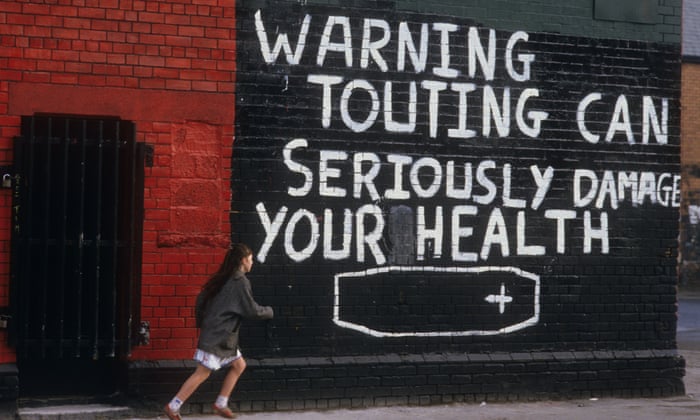
Image result for ira internal security victims

The group was believed to have had a number of briefs:

  • Security and character vetting of new recruits to the IRA,
  • Collecting and collating material on failed and compromised IRA operations,
  • Collecting and collating material on suspect or compromised individuals (informers),
  • Interrogation and debriefing of suspects and compromised individuals,
  • Carrying out killings and lesser punishments of those judged guilty by IRA courts martial.

The ISU was believed to have unlimited access to the members, apparatus and resources of the IRA in carrying out its duties. Its remit could not be countermanded except by order of the Army Council.

Depositions obtained as part of its operation would ideally be noted on paper, and if possible recorded for the purposes of propaganda.

Examples of ISU activity

  • Debriefing of IRA volunteers following their detention by security forces operating in Northern Ireland. These interviews would take place to discover if a volunteer had flipped and decided to betray information or secrets of the organisation. They would also take place in the event of an operation, weapons cache, or unit being exposed to danger or uncovered.
  • Involvement in the Court Martial process as detailed in the IRA manual, The Green Book.

greennbook smaller

See IRA Greenbook 

  • The membership of the IRA and wider republican community are expected to comply with requests for information made by the ISU, this information then being used to build or demolish accusations made against an IRA volunteer.

Joseph Fenton

Joseph “Joe” Fenton (c. 1953 – 26 February 1989) was an estate agent from Belfast, Northern Ireland, killed by the Provisional Irish Republican Army (IRA) for acting as an informer for RUC Special Branch.

Activity as an informer

In the early 1980s Fenton agreed to help the IRA and moved explosives from an arms dump to a safe house He was then approached by officers from the Royal Ulster Constabulary‘s Special Branch who said he could be prosecuted for the offence.

The officers said if Fenton agreed to work for them as an informer he would not be prosecuted, and he would be paid in addition. After agreeing to a further meeting with the officers, Fenton tried to extricate himself from the situation by attempting to start a new life in Australia with his wife and four children.

Image result for Australian High Commission Consulate i

His immigration application was rejected by the Australian High Commission Consulate in Edinburgh, and Fenton started working as an informer for Special Branch in 1982. He started a new job as a salesman for an estate agent, and shortly after started his own estate agency named Ideal Homes based on the Falls Road.

In his role as an estate agent Fenton had access to empty homes that were for sale, which he allowed the IRA to use as safe houses, arms dumps and meeting places for IRA leaders and active service units. Special Branch bugged the houses using covert listening devices, enabling them to gather intelligence. Over twenty IRA members were arrested in possession of firearms, and several IRA bombing units were arrested as they travelled to targets.

A Special Branch officer said of Fenton:

Joe devastated the IRA in west Belfast in the mid-1980s. I was told he loved his work and got a great deal of pleasure after operations were compromised. He was a very willing agent and tried on at least two occasions to entrap senior republicans. But it was probably only a matter of time before he was caught out and by late 1988 he was under suspicion.

Fenton had previously been under suspicion in 1985 following a series of compromised IRA operations. The IRA’s Internal Security Unit (ISU) began an investigation, but Fenton diverted suspicion away from himself by providing the names of two other informers, Gerard and Catherine Mahon who were husband and wife.

The Mahons were interrogated by the ISU and confessed to informing, and were found shot dead in an alleyway in the Turf Lodge area on 8 September 1985. Fenton again came under suspicion in 1988 after four IRA members were arrested at a house in the Andersonstown area of Belfast which was being used as a mortar factory.

Only a few people had knowledge of the location of the factory, and the ISU began a new investigation. As a result of the new investigation the ISU concluded there was a link between compromised IRA operations and homes provided by Fenton. Fenton’s professional life was also investigated, and his sudden ability to start an estate agency business in the early 1980s could not be explained.

Fenton’s handlers in Special Branch stopped paying Fenton when the IRA stopped using properties provided by him, and by the end of 1988 Ideal Homes was facing closure.

By then Fenton was working as a taxi driver to supplement his income, and in early 1989 Ideal Homes ceased trading when the offices were closed by Fenton’s landlord due to unpaid rent.

England

Former Force Research Unit operative Martin Ingram states that Fenton was taken out of Northern Ireland and transported to England by his handlers in Special Branch. Ingram states Fenton wanted to return to Northern Ireland, and asked for help from Andrew Hunter, an MP for the Conservative Party.

Fenton returned to Northern Ireland, with Hunter stating:

“Special Branch told me that if he came home he would be killed very quickly. They warned me he was a marked man and that it was dangerous to be associated with him and I passed this on to him, but he still went back”.

According to Ingram, while back in Belfast Fenton continued to pass information to Special Branch, and in early February 1989 a planned IRA mortar attack was prevented and six IRA members were arrested.

Author and journalist Martin Dillon states Fenton fled to England from Northern Ireland of his own accord, based on an interview with a senior IRA member with access to details of Fenton’s court-martial. Dillon states that Fenton was ordered to return to Northern Ireland by his handlers in Special Branch, and say he had gone to England to see a boxing match. According to the IRA, Special Branch knew Fenton faced execution if he returned and that he was deliberately sacrificed to preoccupy the IRA and divert suspicion from another informer operating within the IRA’s Belfast Brigade.

Death

ira green book graphic picmonkey

The IRA abducted Fenton on 24 February 1989, and took him to a house in the Lenadoon area of Belfast. He was interrogated by the ISU and confessed to working as an informer for Special Branch, and was court-martialled.

Image result for Fenton was found dead in an alley in Lenadoon

Fenton was found dead in an alley in Lenadoon on 26 February 1989; he had been shot four times. The following day the IRA issued a statement that Fenton had been killed because he was a “British agent”. In accordance with standard procedure the RUC denied Fenton had any connection with the police, while Fenton’s father Patrick blamed the RUC for his son’s death.

The IRA had shown Fenton’s written confession to his father, and Patrick Fenton stated:

Having seen and read evidence which was presented to me I accept his death and wish to say that the position in which he was placed, due to pressures brought to bear upon him by the Special Branch, led directly to the death of my son.

At Fenton’s funeral the local priest, Father Tom Toner, criticised the role of Special Branch in Fenton’s death stating:

The IRA is not the only secret, death-dealing agent in our midst. Secret agents of the state have a veneer of respectability on its dark deeds which disguises its work of corruption. They work secretly in dark places unseen, seeking little victims like Joe whom they can crush and manipulate for their own purposes. Their actions too corrupt the cause they purport to serve.

Toner was also critical of the IRA’s actions stating:

To you the IRA and all who support you or defend you, we have to say that we feel dirty today. Foul and dirty deeds by Irishmen are making Ireland a foul and dirty place, for it is things done by Irishmen that make us unclean. What the British could never do, what the Unionists could never do, you have done. You have made us bow our heads in shame and that is a dirty feeling.

The IRA is like a cancer in the body of Ireland, spreading death, killing and corruption. It is the unrelenting enemy of life and the community is afraid because it cannot see or identify it. We want the cancer of the IRA removed from our midst but not by means that will leave the moral fibre of society damaged and the system unclean. Fighting evil by corrupt means kills pawns like Joe and leaves every one of us vulnerable and afraid. And it allows Joe’s killers to draw a sickening veneer of respectability over cold-blooded murder and to wash their hands like Pontius Pilate.

Fenton was buried at St Agnes’ Church in Andersonstown, Belfast.

John Joe McGee

John Joe McGee (died 2002, Dundalk, County Louth, Ireland) was an IRA volunteer who was formerly in the British Special Boat Service.

Background

McGee had been a member of the Special Boat Service prior to joining the Irish Republican Army in the 1970s. He was a member of the Provisional IRA‘s ‘nutting squad’ (also known as ‘the unknowns’), the Internal Security Unit. He became its leader for around a decade between the mid-1980s to the mid-1990s. Between forty to fifty of those investigated by the unit were also executed as suspected informers or alleged British agents. Its sentences could only be countermanded by a member of the IRA Army Council. Members of the unit included Eamon Collins, Freddie Scappaticci, and “Kevin Fulton“. During a court appearance, Fulton stated:

“In 1979 I was approached by the Intelligence Corps, a branch of the British Army, whilst serving with my regiment the Royal Irish Rangers in Northern Ireland. I was asked to infiltrate a terrorist group, namely the PIRA during this time as part of my undercover work for the Force Research Unit. I was active in the commission of terrorist acts and crimes … During this time my handlers were fully conversant with my activities and had guided me in my work which included the security section of the PIRA. The commanding officer of this section was John Joe Magee, a former member of the Special Boat Squadron. The purpose of this unit was solely to hunt out agents and informers of the British state. The suspected agents would be … tortured and murdered after obtaining any information.”

Eamon Collins (later killed by the IRA) quoted a conversation he had with McGee and Scappaticci in his book, Killing Rage:

I asked whether they always told people that they were going to be shot. Scap said it depended on the circumstances. He turned to John Joe (his boss, John Joe Magee) and started joking about one informer who had confessed after being offered an amnesty. Scap told the man he would take him home, reassuring him he had nothing to worry about. Scap had told him to keep the blindfold on for security reasons as they walked from the car. “It was funny,” he (Scap) said, “watching the bastard stumbling and falling, asking me as he felt his way along railings and walls, “Is this my house now?” and I’d say, “No, not yet, walk on some more …” ” ‘And then you shot the f—er in the back of the head,” said John Joe, and both of them burst out laughing.”

Eamon Collins
Related image

Eamon Collins (1954 – 27 January 1999) was a Provisional Irish Republican Army paramilitary in the late 1970s and early 1980s. He turned his back on the organisation in the late 1980s, and later co-authored a book called Killing Rage detailing his experiences within it. In January 1999 he was waylaid on a public road and murdered near his home in Newry in Ulster.

Early life

Collins, the son of a cattle dealer, grew up in a middle class Irish family in Camlough, a small, staunchly Irish republican town in South Armagh. Despite the sentiment of the area, the Collins family had no association and little interest in Irish Nationalist politics. Collins’ mother was devout Catholic, and he was brought up under her influence with a sense of awe for the martyrs of that religion in Irish history, in its conflicts with Protestantism.

Image result for queen's university belfast

After completing his schooling, Collins worked for a time in the Ministry of Defence in a clerical capacity in London before studying Law at Queen’s University, where he became influenced by Marxist political ideology.

In Easter 1974, as he walked home to his parents’ home in South Armagh during a break from his studies in Belfast, on arrival he found both his parents being man-handled by British troops during a house-to-house raid searching for illegal weapons, and on remonstrating with them Collins was himself seriously assaulted, and both he and his father were arrested and detained.

Collins later attributed his crossing of the psychological threshold of actively supporting anti-British Irish paramilitarist terrorism to this incident. Another influence upon his radicalization at this time was a Law tutor at university who had persuaded him that the newly formed Provisional Irish Republican Army was, as well as a means opposing the British military presence in Ulster, a vehicle for Marxist revolutionary politics, in line with the radical ideological expression of a younger generation in the late 1960’s – early 1970’s that were now replacing an old guard of a movement that had engaged in little more than petty acts of Fenian paramilitary activity in the 1950’s-1960’s.

Collins subsequently dropped out of university, and after working in a pub for a period, he joined Her Majesty’s Customs & Excise Service, serving in Newry, and would go on to use this internal position within the administrative machinery of the British Government to support IRA operations against Crown Forces personnel.

Around this time he married Bernadette, with whom he subsequently had four children.

IRA career

Image result for ira blanket protest

Collins joined the Provisional IRA during the blanket protest by Long Kesh inmates in the late 1970s, which sought Special Category Status for republican prisoners, and he became involved in street demonstrations at this time. He joined the “South Down Brigade” of the IRA, based around Newry. This was not one of the organisation’s most active formations, but it sometimes worked alongside the “South Armagh Brigade“, which was one of its most aggressive units.

Psychologically unsuited to physical violence, Collins was appointed instead by the IRA as its South Down Brigade’s intelligence officer. This role involved gathering information on members of the Crown security forces personnel and installations for targeting in gun and bomb attacks. His planning was directly responsible for at least five murders, including that of the Ulster Defence Regiment Maj. Ivan Toombs in January 1981, with whom Collins worked in the Customs Station at Warrenpoint, and possibly three times that number.

Many of the bombing targets of his unit were of limited significance, such as the destruction of Newry public library, and a public house where a Royal Ulster Constabulary choir drank after practice.

Collins became noted within IRA circles for his hard-line views on the continuance of armed campaign, and later joined its Internal Security Unit. At the instigation of the South Armagh Brigade’s leadership he became a member of Sinn Féin in Newry. The South Armagh IRA wanted a hard-line militarist in the local party, as they were opposed to the increasing emphasis of the republican leadership on political over military activity.

Collins was not selected as a Sinn Féin candidate for local government elections, in part, due to his open expressions of suspicion of the IRA and Sinn Féin leadership, whom he accused of covertly moving towards a position of an abandonment of the IRA’s military campaign. Around this time Collins had a confrontation with Gerry Adams at the funeral of an IRA man killed in a failed bombing over how to deal with the funeral’s policing, where Collins accused Adams a being a “Stick” (a derogatory slang term among IRA supporters for activists among it who were considered lacking sincerity in their commitment to its cause).

Despite his militarist convictions at this time Collins found the psychological strain caused by his involvement in the terrorist war increasingly difficult to deal with. His belief in the martial discipline of IRA’s campaign had been seriously undermined by the event of the assassination of Norman Hanna, a 28 year old Newry man on the 11 March 1982 in front of his wife and young daughter, who had been targeted because of his former service with the Ulster Defence Regiment, which he had resigned from in 1976. Collins had opposed the targeting of Hanna on the basis that it wasn’t of a governmental entity, but had been over-ruled by his superiors, and he had gone along with the operation; his conscience burdened him afterwards about it though.

His uneasy state was further augmented by being arrested under anti-terrorism laws on two occasions, the second involving his detention at Gough Barracks in Armagh for a week, where he was subject to extensive sessions of interrogation in 1985 after an IRA mortar attack in Newry, which had claimed the lives of multiple police officers. Collins had not been involved in this operation, but after five days of incessant psychological pressure being exerted by R.U.C. specialist police officers, during which he had not said a word, he mentally broke, and yielded detailed information to the police about the organization.

As a result of his arrest he was dismissed from his career with H.M. Customs & Excise Service.

Collins subsequently stated that the strain of the interrogation merely exacerbated increasing doubts that he had already possessed about the moral justification of the IRA’s terrorist paramilitary campaign and his actions within it. These doubts had been made worse by the strategic view that he had come to that the organization’s senior leadership had in the early 1980’s quietly decided that the war had failed, and was now slowly manoeuvering the movement away from a military campaign to allow its political wing Sinn Féin to pursue its purposes by another means in what would become the Northern Ireland peace process.

This negated in Collins’ mind the justification for its then on-going military actions.

Statements against the IRA

After his confession of involvement in IRA activity, Collins became an IRA – in contemporary media language – “Supergrass“, upon whose evidence the authorities were able prosecute a large number of IRA members. Subsequently he was incarcerated in specialized protective custody with other paramilitaries who had after arrest given evidence against their organizations in the Crumlin Road Prison in Belfast from 1985 to 1987.

However, after an appeal from his wife who remained an IRA supporter, and on receiving a message from the IRA delivered by his brother on a visit to the prison, Collins legally retracted his evidence, in return for which he was given a guarantee of safety by the IRA, provided he consented to being debriefed by it. He agreed, and was in consequence transferred by the authorities to the Irish paramilitary wing of the prison.

Trial for murder

As a result of losing his previous legal status as a Crown protected witness, Collins was charged with several counts of murder and attempted murder. However, on being tried in 1987 he was acquitted as the statement in which he had admitted to involvement in these acts was ruled legally inadmissible by the court, as it was judged that it had been obtained under duress and was not supported by enough conclusive corroboratory evidence to allow a legally sound conviction.

On release from prison he spent several weeks being counter-interrogated by the IRA’s Internal Security Unit to discover what had been revealed to the authorities, after which he was exiled by the organization from Ulster, being warned that if he was found north of Drogheda after a certain date he would be executed by it. The technical acquittal in the Crown court based upon judicial legal principles made an impact upon Collins’ view of the British state, markedly contrasting with what he had witnessed in the IRA’s Internal Security Unit, and reinforced his disillusionment with Irish paramilitarism.

Post-IRA life

After his exile Collins moved to Dublin and squatted for a while in a deserted flat in the impoverished Ballymun area of the city. At the time the area was experiencing an epidemic of heroin addiction and he volunteered to help a local priest Peter McVerry, who ran programmes for local youths to try to keep them away from drugs. After several years in Dublin, he subsequently moved to Edinburgh, Scotland for a period, where he ran a youth centre. He would later write that because of his Ulster background he felt closer culturally to Scottish people than people from the Irish Republic.

In 1995 he returned to live in Newry, a district known for the militancy of its communal support of the IRA, with numerous IRA members in its midst. The IRA order exiling him from Ulster had not been lifted, but with a formal ceasefire from the organization in operation ordered by its senior command, and in the sweeping changes that were underway with renunciations of violence by all the paramilitary organizations in the province that had followed on from it, he judged it safer to move back in with his wife and children who had never left the town.

Broadcasting and published works

Having returned to live in Newry, rather than maintaining a low profile Collins decided to take a prominent role in the ongoing transition of Ulster’s post-war society, using his personal history as a platform in the media to analyze the adverse effects of terrorism. In 1995 he appeared in an ITV television documentary entitled ‘Confession’ giving an account of his disillusioning experiences and a bleak insight into Irish paramilitarism.

In 1997 he co-authored Killing Rage, with journalist Mick McGovern, a biographical account of his life and IRA career. He also contributed to the book Bandit Country by Toby Harnden about the South Armagh IRA. At the same time in the media he called for the re-introduction of Internment after the Omagh bombing for those continuing to engage in such acts; published newspaper articles openly denouncing and ridiculing the fringe Real IRA’s attempts to re-ignite paramilitary warfare in Ulster, alongside publicly analyzing his own past role in such activity, and the damage that it had caused on a personal and social level to the two communities of Ulster.

Witness evidence against Thomas Murphy

Image result for Thomas slab Murphy

In May 1998 Collins gave evidence against leading republican Thomas “Slab” Murphy, in a libel case Murphy had brought against the Sunday Times, over a 1985 article naming him as the IRA’s Northern Commander.

Murphy denied IRA membership, but Collins took the witness stand against him, and testified that from personal experience he knew that Murphy had been a key military leader in the organization. Murphy subsequently lost the libel case and sustained substantial financial losses in consequence.

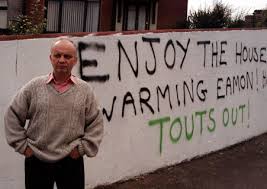
After giving his testimony Collins had said in the court-room to Murphy “No hard feelings Slab”. However, soon after the trial Collins’ home was attacked and daubed with graffiti calling him a “tout”, a slang word for an informer. Since his return to Newry in 1995 his home there had been intermittently attacked with acts of petty vandalism, but after the Murphy trial these intensified in regularity and severity, and another house belonging to his family in Camlough, in which no one was resident, was destroyed by arson. Threats were made against his children, and they faced persecution in school from elements among their peers. Graffiti threatening him with murder was also daubed on the walls of the streets in the vicinity of the family home in Newry.

Death

eamon collins body

Collins was beaten and stabbed to death in his 45th year by an unidentified assailant(s) early in the morning of 27 January 1999, whilst walking his dogs near the Barcroft Park Estate in Newry along a quiet stretch of country lane at Doran’s Hill, just within sight of Sliabh gCuircin (Camlough Mountain). His body also bore marks of having been struck by a car moving at speed. The subsequent police investigation and Coroner’s Inquest commented upon the extremity of weaponed violence to Collins’ head and face used during the attack.

Rumoured reasons behind the murder were that he had returned to Ulster in breach of the IRA’s banning order, and further he had detailed IRA activities and publicly criticized in the media a multiplicity of Irish terrorist paramilitary splinter groups that had appeared after the IRA’s 1994 ceasefire, and that he had testified in court against Murphy.

Gerry Adams stated the murder was “regrettable”, but added that Collins had “many enemies in many places”.

After a traditional Irish wake, with a closed coffin necessitated due to the damage to his face, and a funeral service at St. Catherine’s Church in Newry, Collins’ body was buried at the town’s Monkshill Cemetery, not far from the grave of Albert White, a Catholic former Royal Ulster Constabulary Inspector, whose assassination he helped to organize in 1982.

Subsequent criminal investigations

In January 2014 the Police Service of Northern Ireland released a statement that a re-examination of the evidence from the scene of the 1999 murder had revealed new DNA material of a potential perpetrator’s presence, and made a public appeal for information, detailing the involvement of a specific car model (a white coloured Hyundai Pony), and a compass pommel that had broken off of a hunting knife during the attack and had been left behind at the scene.

In February 2014 detectives from the Serious Crime Branch arrested a 59 year old man at an address in Newry in relation to the murder, he was subsequently released without charge. In September 2014 the police arrested three men, aged 56, 55 and 42 in County Armagh in relation to inquiries into the murder, all of whom were subsequently released without charges after questioning

Murders of Catherine and Gerard Mahon

Image result for Catherine and Gerard Mahon

Catherine and Gerard Mahon were a husband and wife who lived with their children in Twinbrook, Belfast. Gerard, aged twenty-eight, was a mechanic; Catherine, was twenty-seven. They were killed by the Provisional Irish Republican Army (IRA) on 8 September 1985, the IRA alleging they were informers. However at least two of those responsible for their deaths were later uncovered as British agents within the IRA’s Internal Security Unit, leaving the actual status of the Mahons as informers open to doubt.

Background

The Mahons were neighbours of estate agent Joseph Fenton, a supplier of ‘safe houses’ for the IRA, but also a British agent. When a number of IRA missions were compromised, Fenton is believed to have directed a member of the Internal Security Unit, Freddie Scappaticci, and three other men, to the Mahons.

Abducted in August, interrogated and beaten for prolonged periods, the Mahons eventually confessed that their flat was bugged by the Royal Ulster Constabulary, who are alleged to have paid the couple for information, weapons finds, or arrests. The IRA took the couple to Norglen Crescent in Turf Lodge and shot them.

It is thought Catherine Mahon was shot in the back while trying to escape.

Those who found their bodies said at the time:

We heard two bursts of gunfire and then a car was driven away at high speed. We went out and discovered the girl. We thought she was dead. We tried first aid but the side of her head was blown away. A young lad came up to us saying there was a man lying in the entry a bit further up and still alive. We got to him and he was badly wounded. He was struggling to breath and choking on his own blood. He had been hit in the side of the head and the face. Whatever is behind it all, it’s ridiculous. Those responsible are animals. Nothing justifies murder. They had both been tied by their wrists – but they must have broken free by struggling when they realised what was going to happen.

Dr Joe Hendron of the Social Democratic and Labour Party released a statement, remarking:

This slaughter has few equals in barbarity and it proves the Provo idea of justice is warped. It makes us all sick.

Victims were ‘sacrificed’ by agent known as Stakeknife

Image result for Catherine and Gerard Mahon   Image result for Catherine and Gerard Mahon

SOME of the killings to be investigated as part of the new probe into the activities of the agent known as Stakeknife and those in the intelligence services who directed him:

* Husband and wife Gerard (28) and Catherine (27) Mahon, who were shot dead after being taken away from their Twinbrook home in west Belfast in September 1985 and interrogated by the IRA who claimed they were informers. The Mahons were neighbours of estate agent Joe Fenton, who was also later killed by the IRA. When a number of IRA missions were compromised, Fenton is believed to have directed a member of the IRA’s internal security unit to the Mahons

* Frank Hegarty. The body of the 45-year-old was discovered in Co Tyrone close to the border in May 1986. He had been shot dead and his eyes were taped shut. From the Shantallow area of Derry, the IRA alleged he was an informer who had revealed the location of an arms dump in Sligo to authorities

* Joseph Fenton. The 35-year-old, who worked as an estate agent, was shot in the head by the IRA in February 1989 after he was accused of working as an informer. It was alleged the father-of-four from west Belfast man was providing ‘safe houses’ for IRA planning meetings that were then bugged by the security forces

* Joseph Mulhern. The 22-year-old’s body was discovered close to the Tyrone border 10 days after he disappeared from west Belfast in 1993. The IRA alleged he was working for RUC Special Branch

* Caroline Moreland. The 34-year-old mother-of-three was abducted from her home in the Beechmount area of west Belfast in July 1994. Her body was discovered dumped on the Fermanagh border 10 days after she disappeared. Her family had been warned by the IRA not to report her missing

* Margaret Perry (26) disappeared from her hone of Portadown in July 1991, with her body found in shallow grave at Mullaghmore, Co Donegal in June 1992. The IRA claimed she was killed by three men acting on behalf of British intelligence because she had discovered her former boyfriend Gregory Burns (34) was informing to the security forces. He, along with Johnny Dingham (32) and Adrian Starrs (29), were abducted, tortured and shot dead by the IRA

* Charlie McIlmurray (32), from Slemish Way in Andersonstown, was shot by the IRA in April 1987 following allegations that he had been working as an informer. His body was discovered in a van at Killeen in Co Armagh on the border

* Peter Valente (33), a father of four, was killed as an alleged informer in November 1980. Unusually, his body was dumped in the loyalist Highfield estate and a statement was released by Sinn Féin blaming the UDA. However, it is now thought that along with a number of other victims he was targeted by Stakeknife to protect his own cover as an agent after the IRA became suspicious

* Vincent Robinson (29) from Andersonstown in west Belfast was found dead in a rubbish chute in the Divis flats complex in June 1981. The IRA claimed he was an informer and had been outed by Peter Valente, something that his family denied. Again it is believed he was ‘sacrificed’ in order to protect Stakeknife

* Maurice Gilvarry (24) from Ardoyne in north Belfast was shot dead in January 1981 and his body dumped in south Armagh. Again it was alleged he was implicated by Peter Valente but it is now thought he was killed to protect the identity of Stakeknife

* Patrick Trainor (28). Married with three children, his body was found at waste ground near the Glen Road in west Belfast after he had been abducted by the IRA who alleged he was an informer, based on information they claimed came from Peter Valente. This was denied by his family and an RUC detective at a subsequent inquest.

See Stakeknife

See The Disappeared

See The IRA Greenbook

Buy Me A Coffee

The IRA Greenbook

The IRA Greenbook

IRA Green Book poster

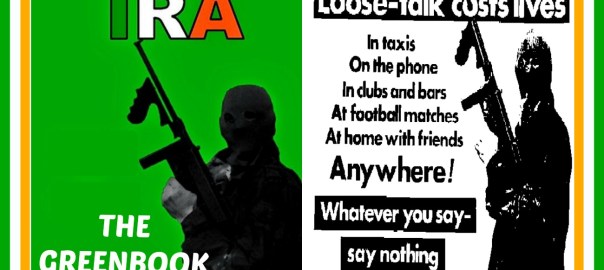
The Green Book is a training and induction manual issued by the Irish Republican Army to new volunteers. It was used by the post-Irish Civil War Irish Republican Army (IRA) and Cumann na mBan, (“League of Women”), along with later incarnations such as the Provisional IRA (PIRA). It includes a statement of military objectives, tactics and conditions for military victory against the British government.

— Disclaimer –

The views and opinions expressed in this post/documentaries  are soley intended to educate and provide background information to those interested in the Troubles of Northern Ireland. They in no way reflect my own opinions and I take no responsibility for any inaccuracies or factual errors.

This military victory was to be achieved as part of:

“the ongoing liberation of Ireland from foreign occupiers”

The Green Book has acted as a manual of conduct and induction to the organisation since at least the 1950s.

Extracts

What A Volunteer Should Do When Arrested!

1. The most important thing to bear in mind when arrested is that you are a
volunteer of a revolutionary Army, that you have been captured by an enemy force,
that your cause is a just one, that you are right and that the enemy is wrong and
that as a soldier you have taken the chance expected of a soldier and that there is
nothing to be ashamed of in being captured.

2. You must bear in mind that the treatment meted out to you is designed to break
you and so bleed you of all the information you may have with regard to the
organisation to which you belong.

3. They will attempt to intimidate you by sheer numbers and by brutality.
Volunteers who may feel disappointed are entering the first dangerous threshold
because the police will act upon this disappointment to the detriment of the
volunteer and to the furtherment of their own ends. Volunteers must condition
themselves that they can be arrested and if and when arrested they should expect
the worse and be prepared for it.


ira green book image.JPG


History

Image result for irish republican army iconic pictures

Because the IRA and later republican groupings have been identified as illegal organisations (the PIRA, IRA & Cumann na mBan have been proscribed – declared illegal – in the UK, the Republic of Ireland and a number of other countries)


The Green Book has been distributed and published secretly. It is published at unknown printing presses and distributed to or shared with IRA volunteers as they are accepted for active duty. Due to this secrecy only two editions of the Green Book have so far been released into the public domain. The first, published in 1956, appears to be intact.

Image result for Seamus Twomey ira

The second, publication date unknown but dating to the 1977 detention of then IRA Chief of Staff Seamus Twomey, has only been released in three parts (referred to here as the 1977 edition). With the beginning of the latest IRA ceasefire and the 2005 ending of their campaign, it seems unlikely that a new edition of the manual will have been issued in recent years by the IRA. However, it is possible that known/unknown groupings have issued a more recent version.

Volunteers’ treatment of the Green Book

The Green Book is issued to IRA volunteers as part of their training and is considered a secret document which should not be revealed to, or discussed with non-IRA members. In order to protect the organisation, disclosure of its training material and any other training documents, including the Green Book, would most likely carry stiff penalties up to and including Court Martial. Once issued, each volunteer is expected to study and learn from his/her copy of the manual, to apply the rules given in it, and to apply lessons learnt from it. While the manual is clearly not all the training a volunteer could expect, it gave a broad overview meant to go some way to preparing the volunteer for active duty with the organisation.

1977 and 1956 editions

Both known issues of the Green Book were in existence while the IRA, (in the case of the 1956 edition), and the PIRA, (in the case of the 1977 edition), were engaged in a military campaign. In 1956, this was the Border Campaign, in the 1970s it was the Provisional IRA campaign 1969-1997.

Commonalities and differences exist between the two documents. This demonstrates that the Green Book is a living document updated periodically. These updates are made to reflect changes in;

  • political policy and social structure,
  • military strategy and tactics of the organisation,
  • military strength of the organisation and,
  • the technology/tactics of the organisation’s enemies,

While splits in the IRA since 1922 up to the 1950s do not appear to be noted in the 1956 document, developments in the fields of insurgency and counter-insurgency are. Both T. E. Lawrence and Field Marshal Sir William Slim are quoted.

The 1977 edition appears to have been more heavily influenced by the work of Brigadier General Frank Kitson.

By the 1977 edition, the document had increased in scope with length remaining around the same. Some doctrinal sections from the 1956 edition were still appearing, while new sections aimed at combating the counter insurgency efforts of the British Army and RUC had appeared. Notably the 1977 edition would have existed alongside the IRA’s change in tactics towards the entirely self-reliant cell structure.

The 1956 edition on the other hand discusses the use of the IRA flying column – en masse attacks by large groups of volunteers against concentrations of the enemy. Another notable facet of the 1977 edition is the attention paid to mental preparation of IRA Volunteers, this being the time of the IRA’s “Long War” strategy. Readers of the 1977 edition are warned:

“The Army as an organisation claims and expects your total allegiance without reservation. It enters into every aspect of your life. It invades the privacy of your home life, it fragments your family and friends, in other words claims your total allegiance. All potential volunteers must realise that the threat of capture and of long jail sentences are a very real danger and a shadow which hangs over every volunteer…”

“..Another important aspect all potential volunteers should think about is their ability to obey orders from a superior officer. All volunteers must obey orders issued to them by a superior officer regardless of whether they like the particular officer or not”.

The 1956 edition, contains no such warning but appeals to the “Guerrilla code.” In ‘Chapter Five – Organisation and Arms’ the reader is advised:

“Leadership will not come so much by appointment as by the trust the guerrillas place in their commander. He must be worthy of that trust if he is to succeed. Instead of discipline of the regular army type there will be a more stern battle discipline: agreement on the job to be done, and the need to do it, and obedience to the guerrilla code, these take the place of the unthinking army type discipline. Breaches of the guerrilla code — desertion, betrayal, breach of confidence in any way — must be severely dealt with on the spot”.

Contents of the Green Book

The book contains information on:

  • political philosophy of the IRA,
  • Irish history in terms of struggle against the occupation of Ireland,
  • the military objectives of the organisation,
  • the military strategy for Guerrilla fighters,
  • the military equipment and tools that can be used by Guerrilla fighters,
  • the military equipment and training for tools available to the IRA,
  • propaganda techniques within the theatre of operations,
  • interrogation techniques and how to resist them.

The book has also included references to the training, development, and tactics employed by Regular & Irregular/Specialist forces in modern armies – particularly those of the British Army.

Green Book historical context

The 1956 document couches the violence and occupation of the island of Ireland in a long history of armed resistance to occupation. The first Chapter is entirely taken up with providing this history from the viewpoint of the organisation. It provides information on the Kerne, the battle of the Yellow Ford, Owen Roe O’Neill, the 1798 Rebellion and United Irishmen, James Fintan Lalor, and the Tan War.

All are described as being within the context of legitimate resistance to the occupation of Ireland. This discussion is largely romanticised and aimed at demonstrating a lineage of “armed struggle” from which the IRA assumes its legitimacy in the fight against “occupying forces in Ireland”.

One entry in this discussion is the fact that the efforts of IRA guerrillas were the direct cause in ending the British occupation of the 26 counties of Ireland—the territory that would become the Irish Free State, and later the Republic of Ireland. The 1956 manual also implies that the bulk of the IRA’s work in “freeing Ireland from occupation” is over. This indicates both a “southern” perspective on Irish independence and an underestimation of the resistance they would encounter during the Border Campaign, that was aimed at the end of British rule in Northern Ireland. With the publication of the 1977 edition this assumption of an easy victory in ending partition had been dropped and the “Long War” strategy adopted.

The 1956 edition summarises the result of the violence during the 1919-1921 Irish War of Independence (referred to by republicans, who considered independence as having been only partially achieved, as the Tan War) with this passage:

“The hammer blows of the guerrillas destroyed the British administration. The guerrillas acted in small numbers in the right localities and compelled the British to disperse to find them. Then as the British searched, they hit them at will by means of the ambush. Communications were systematically destroyed and even the British army’s transport system in the country was disorganised.”

“The enemy’s intelligence service was completely dislocated. The R.I.C.– the eyes and ears of British rule- was demoralised. British justice courts could not operate–for the people ignored them. The British gradually were forced to evacuate the smaller, more isolated garrisons. They concentrated in the larger towns. The areas evacuated came under sole control of The Republic. The next step was to isolate the larger centres and keep cutting communications and constantly hitting the enemy. In time these would have been evacuated too. Thus ended the last great phase of guerrilla operations against British rule in Ireland.”

Compare to the Marxist intrepretation in the 1977 edition, published during a new campaign and new conditions of waging war. The “struggle” is couched in more socio-economic terms, terms which would have made more sense to a generation living through unemployment and economic hardship in post industrial revolution Northern Ireland (referred to here as the “six counties”). It is also an indication of the influence of Marxist Philosophy that permeated the IRA in the late 1970s:

“The objective of the 800 years of oppression ‘is economic exploitation with the unjustly partitioned 6 counties remaining Britain’s directly controlled old-style colony’ and the South under the ‘continuing social, cultural and economic domination of London’. This last led to Irish savings being invested in England ‘for a higher interest rate’ and many hundreds of thousands of boys and girls from this country had to emigrate to England to seek the employment which those exported saving created.”

“Another aspect of economic imperialism at work is the export of raw, unprocessed materials: live cattle on the hoof – mineral wealth, fish caught by foreign trawlers, etc. Further, from 1956 on, the Free State abandoned all attempts to secure an independent economy, and brought in foreign multi-national companies to create jobs instead of buying their skills and then sending them home gradually. Africanisation’ is the word for this process elsewhere. Control of our affairs in all of Ireland lies more than ever since 1921 outside the hands of the Irish people. The logical outcome of all this was full immersion in the E.E.C. in the 1970s. The Republican Movement opposed this North and South in 1972 and 1975 and continues to do so. It is against such political economic power blocks East and West and military alliances such as NATO and the Warsaw Pact.”

While the 1956 edition does not engage in any legitimisation of the struggle beyond the historical context of resistance to occupation, the 1977 edition does – claiming direct legitimacy from the members of the Second Dáil who transferred their authority to the IRA in 1938 after the takeover of the IRA Army Council by Seán Russell.

This had always been the official ideology of the IRA, however after the split between the Provisional IRA and the Official IRA in 1969 it was probably deemed necessary to lay more of a claim to the historical struggle than the pre-split IRA had felt necessary. The 1956 edition would have also been published for use during a period when the failed S-Plan or Sabotage campaign was within living memory of younger IRA volunteers. Newer volunteers needed to be reminded of previous IRA activity in the “struggle for liberation”:

“The moral position of the Irish Republican Army, its right to engage in warfare, is based on:

  • (a) the right to resist foreign aggression;
  • (b) the right to revolt against tyranny and oppression; and
  • (c) the direct lineal succession with the Provisional Government of 1916, the first Dáil of 1919 and the second Dáil of 1921″.

“In 1938 the seven surviving faithful Republican Deputies delegated executive powers to the Army Council of the I.R.A. per the 1921 resolution. In 1969 the sole surviving Deputy, Joseph Clarke, reaffirmed publicly that the then Provisional Army Council and its successors were the inheritors of the first and second Dáil as a Provisional Government.”

In November 2003 during testimony to the Saville Inquiry on the events of Bloody Sunday alleged former Chief of Staff of the IRA, Martin McGuinness, denied that he had ever read such a book before he claims to have left the IRA in the 1970s. McGuinness reportedly said:

“When I was in the IRA there was no such book, I don’t know when it came into existence.”

When asked what the phrase “green book” meant, he stated: “I think it means the book was green.”

Extracts

Court Martial Procedure.

14. At any time it so desires, the Court may go into private session to decide on points
which may arise, such as the admissibility of evidence.

15. When all witnesses have testified, Defence Counsel will sum up and make closing
address to the Court. This will be followed by summing up and closing address of the
Prosecuting Counsel. The Court then goes into private session to consider its verdict and
sentence.

16. For breach of any General Army Order, the Court shall not have power to impose a
lesser penalty than that laid down in such order.

17. The verdict and sentence of the Court shall be set down in writing and signed by the
three members. This, together with a summary of the evidence, must be forwarded by the
President to the Convening Authority. Sentence is subject to the ratification of the
Convening Authority. Note: In the case of the death penalty, sentence must be ratified by
the A/C.

18. The accused may forward an appeal against the verdict or sentence or both to the
Adjutant-General who will place it before the Competent Authority. The appeal should
be forwarded by accused through his O/C. who in return will forward it to the AdjutantGeneral
with a signed copy of verdict and sentence and a summary of the evidence. The
Competent Authority may order a new trial or reduce the penalty but may not increase
the penalty imposed by the Court.

The Guerrilla / The Volunteer

The 1977 edition of the Green Book is very much focused on the mental strength of the volunteer. The manual is eager to draw a clear distinction between volunteer and his enemy:

“A member of the I.R.A. is such by his own choice, his convictions being the only factor which compels him to volunteer, his objectives the political freedom and social and economic justice for his people. Apart from the few minutes in the career of the average Brit that he comes under attack, the Brit has no freedom or personal initiative. He is told when to sleep, where to sleep, when to get up, where to spend his free time etc.”

In the 1977 edition the term Guerrilla is dropped in favour of “volunteer”, the new edition also stresses that this volunteer is part of a movement with common aims and objectives. From the PIRA’s point of view this would have been necessary to combating competing interpretations encountered in the community and the propaganda efforts of the enemy it faced:

“Before we go on the offensive politically or militarily we take the greatest defensive precautions possible to ensure success, e.g. we do not advocate a United Ireland without being able to justify our right to such a state as opposed to partition; we do not employ revolutionary violence as our means without being able to illustrate that we have no recourse to any other means. Or in more everyday simple terms: we do not claim that we are going to escalate the war if we cannot do just that; we do not mount an operation without first having ensured that we have taken the necessary defensive precautions of accurate intelligence, security, that weapons are in proper working order with proper ammunition and that the volunteers involved know how to handle interrogations in the event of their capture etc, and of course that the operation itself enhances rather than alienates our supporters.”

The 1956 edition on the other hand stresses the physical aspects of IRA operations:

“Outside of the support he [the Guerrilla] gets from the people among whom he operates-and this support must never be underestimated for it is vital to his eventual success-he fights alone. He is part of an independent formation that is in effect an army by itself. He must be self-contained. If necessary he must act alone and fight alone with the weapons at his disposal- and these very often will not be of the best. He must find his own supplies. His endurance has to be great: and for this he needs a fit body and an alert mind. Above all he must know what he is fighting for- and why.”

Military objectives in the Green Book

The 1977 edition describes the military objectives of the IRA as:

“The position of the Irish Republican Army since its foundation in 1916 has been one of sustained resistance and implacable hostility to the forces of imperialism, always keeping in the forefront of the most advanced revolutionary thinking and the latest guerrilla warfare techniques in the world.”

The enemy is described as:

“The establishment is all those who have a vested interest in maintaining the present status quo in politicians, media, judiciary, certain business elements and the Brit war machine comprising, the Brit Army, the U.D.R., R.U.C. (r) [reserve], Screws, Civilian Searchers. The cure for these armed branches of the establishment is well known and documented. But with the possible exceptions of the Brit Ministers in the ‘Northern Ireland Office’ and certain members of the judiciary, the overtly unarmed branches of the establishment are not so clearly identifiable to the people as our enemies as say armed Brits or R.U.C.”

The military objects of the IRA in 1977 are presented as closely tied to the political objectives of politicising the citizenry. Rather than the tactic of surgical strike, the tactic of continuous escalation or the strategy of what has been called the PIRA’s Tet offensive is preferred:

“By now it is clear that our task is not only to kill as many enemy personnel as possible but of equal importance to create support which will carry us not only through a war of liberation which could last another decade but which will support us past the ‘Brits Out’ stage to the ultimate aim of a Democratic Socialist Republic.”

“The Strategy is:

  1. A war of attrition against enemy personnel which is aimed at causing as many casualties and deaths as possible so as to create a demand from their people at home for their withdrawal.
  2. A bombing campaign aimed at making the enemy’s financial interest in our country unprofitable while at the same time curbing long term financial investment in our country.
  3. To make the Six Counties as at present and for the past several years ungovernable except by colonial military rule.
  4. To sustain the war and gain support for its ends by National and International propaganda and publicity campaigns.
  5. By defending the war of liberation by punishing criminals, collaborators and informers.”

The 1956 edition stresses the military objective and barely mentions political objectives. It contains a lot of practical advice on operating as a Guerrilla fighter and how to inflict damage on targets. No mention is made of the establishment of “a Democratic Socialist Republic”. This can probably been seen in the context of the IRA keeping pace with social changes and the material aspirations of Irish men and women living within the Republic of Ireland and Northern Ireland.

At the time of the Border Campaign the communities the IRA came to rely on were not politicised to the same degree as those in 1977. A lack of support within their host community is commonly given as the reason for the failure of the Border Campaign. This edition of the Green Book even goes so far as to announce the aim of restoring the Irish language as the national language, an aim not mentioned in the earlier edition.

Military equipment in the Green Book

The 1977 edition of the Green Book makes little mention of arms and equipment available to the volunteer. The one entry that does appear deals only with the issue of tactics as affected by lack of weaponry:

“Tactics are dictated by the existing conditions. Here again the logic is quite simple. Without support Volunteers, Dumps, Weapons, Finance, etc., we cannot mount an operation, much less a campaign. In September 1969 the existing conditions dictated that the Brits were not to be shot, but after the Falls curfew all Brits were to the people acceptable targets. The existing conditions had been changed.”

The 1956 edition goes into a lot of detail on arms that the volunteer can expect to encounter and how to use them. Explosives are detailed alongside what the Guerrilla should know about handling & preparing them. The sabotage techniques and weaponry available at the time had mostly ceased to be commonly used by the late 1970s, namely:

Detonators are also detailed with physical descriptions, handling instructions, and burning rates. Detonators covered include: Cordtex and FID.

Small arms listed range from the revolver, to the shotgun and submachine gun up to the flame thrower, which was almost never used, except for an attack on British soldiers of the King’s Own Scottish Borderers. It can be assumed that the use of these weapons, or at least supplies of them, had been diminished when the 1977 edition was published. Given that the organisation was having troubles with internal security, it may have also been considered a security risk for the IRA to detail its available weaponry too closely.

A generation earlier, IRA units operating during the S-Plan / Sabotage campaign did not have access to the above material, with the exception of Gelignite. IRA explosive devices of the 1930s and 1940s were prepared using materials such as Potassium chlorate, Carbide, Saxonite, Iron Oxide, Aluminium, sulfuric acid etc. By the time of the Northern Campaign (IRA) c. 1942, IRA Eastern Command, in cooperation with IRA Western Command could raise 12 tons of weapons and explosives at short notice. This was excluding the tons of weapons and explosives seized during the S-Plan campaign.

When the IRA split in the early 1970s into the Official IRA and Provisional IRA they divided the arms held in IRA weapons dumps. The Provisional IRA got the majority of these weapons. For details on the types of arms recently decommissioned by the IRA as part of their permanent cesation of violence see the article on the Independent International Commission on Decommissioning and a breakdown of the PIRA’s weapons before decommissioning took place in September 2005.

Propaganda techniques in the Green Book

The 1977 edition stresses that the volunteer is ultimately responsible within the framework of the movement for ensuring the formulation, dissemination and efficiency of propaganda. This process was to begin within the mind of the volunteer himself:

“A new recruit’s immediate obstacle is the removal of his (her) ignorance about how to handle weapons, military tactics, security, interrogations etc. An O.C.’s [Commanding Officer] might be how to put a unit on a military footing; an I.O.’s [Intelligence Officer] how to create an effective intelligence network; a Cumann na mBan Chairman’s how best to mount a campaign on a given issue, e.g. H Blocks etc., and for all members of the movement regardless of which branch we belong to, to enhance our commitment to and participation in the struggle through gaining as comprehensive an understanding as possible of our present society and the proposed Republican alternative through self and group education.”

The stated war objectives of the IRA within the 1977 document included the success of national and international propaganda as a war objective:

“We exploit these mistakes [mistakes by the British Army] by propagating the facts. So it was with their murderous mistakes of the Falls Road curfew, Bloody Sunday and internment, which were exploited to our advantage support- wise as was the murder of John Boyle in Dunloy.”

The 1956 edition is a lot more practical, suggesting a more limited, less well oiled organisational machine of the IRA then than today:

“The main channels of information available to the guerrillas are newspapers, leaflets, radio, word of mouth. Other methods may be worked out and new ones invented. For example: Painting of slogans, proclamations and manifestoes and so on. All the means of winning the confidence of the people must be utilised. The ideas of the movement must be so popularised that no one is in doubt-least of all the enemy-that it will win eventually.”

“This information service must function continuously to get maximum results. Among the things it must do are:

  • Show weakness of enemy position and propaganda used to bolster that position.
  • Show what is wrong with political and social order.
  • Suggest remedies and how they can be brought about.
  • Be in touch all the times with thinking of the people.”

“The world must know and understand what is being done, what the enemy is trying to destroy and why, and the way these things can be ended and peace restored and freedom won. The use of regular bulletins for foreign newspapers and news-agencies becomes a necessity. The bulletin should be of the documentary type: no room for emotional pleas or the like. Just the facts.”

While IRA volunteers also engaged in the above efforts, the techniques are not described in the 1977 Green Book.

Interrogation techniques

The 1956 edition contains no details on how to react to internment, capture, interrogation, or interrogation techniques. This was no doubt an oversight on the part of the IRA, one which they came to regret with the successful interrogation of IRA volunteers captured by their enemies.

By 1977, with the launching of the IRA’s campaign in Northern Ireland in 1969, the technical capabilities & anti-insurgency apparatus of the RUC, as well as the Regular and Specialist forces of the British Army had advanced. Coupled with this were technical advances in the intelligence gathering and interrogation techniques of those forces. The combination of these factors alongside political determination to capture and kill IRA forces and subdue the nationalist population of Northern Ireland led to changes in the Green Book.

Much more stress was placed on resisting interrogation in what has been called The Green Book II.[7] If captured, the PIRA volunteer is warned to remain mentally implacable:

  1. “The most important thing to bear in mind when arrested is that you are a volunteer of a revolutionary Army, that you have been captured by an enemy force, that your cause is a just one, that you are right and that the enemy is wrong and that as a soldier you have taken the chance expected of a soldier and that there is nothing to be ashamed of in being captured.
  2. You must bear in mind that the treatment meted out to you is designed to break you and so bleed you of all the information you may have with regard to the organisation to which you belong.
  3. They will attempt to intimidate you by sheer numbers and by brutality. Volunteers who may feel disappointed are entering the first dangerous threshold because the police will act upon this disappointment to the detriment of the volunteer and to the furtherment of their own ends. Volunteers must condition themselves that they can be arrested and if and when arrested they should expect the worse and be prepared for it.”

A series of tactics employed by interrogators are listed along with the stages the interrogation process the volunteer should expect to go through: physical torture, subtle psychological torture, and humiliation.

The remainder of the document persists in a similar vein, constantly stressing the dangers of submitting to interrogation techniques. This highlights the increasing threat the PIRA realised interrogations were having against the organisation. Most likely this was a result of experience gained throughout the 1970s and during the Border Campaign when arrest and imprisonment of IRA/PIRA volunteers seriously impacted the operational effectiveness of the respective organizations.

See also

The Green Book (Muammar Gaddafi)

IRA Nutting SquadIRA Nutting Squad

nutting squad


Click PDF to download

ira green book image


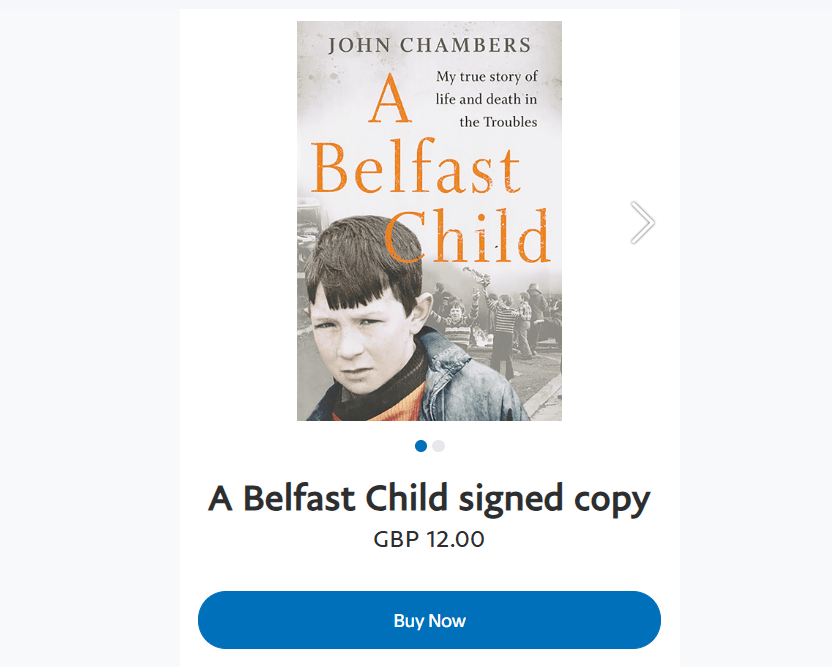
Who wants… A signed copy of my No.1 best selling book ? Makes a great Xmas gift for book lovers & those interested in the Troubles & the crazy, mad days my generation lived through.

Click here to order : https://tinyurl.com/2p9b958v

UK orders only – if you live outside the UK email me belfastchildis@googlemail.com and Ill send you a link for ordering outside the UK.

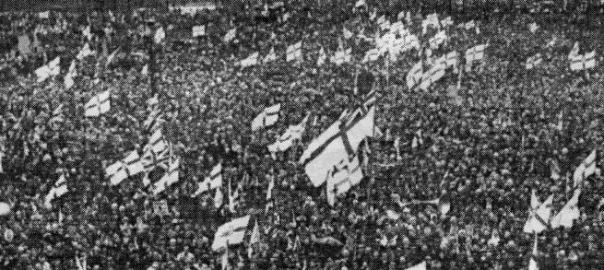
Protestant March ends in battle – 3rd June 1972

Protestant March ends in battle

Image result for Protestant March ends in battle 1972

Army uses water canon against protesters

A Protestant march against the creation of “no-go” areas in Londonderry has ended in a bloody battle on the Craigavon Bridge.

Image result for Craigavon Bridge. 1972

Soldiers used rubber bullets and water cannon to control the crowd when the so-called “Tartan gangs” at the tail end of the march began to throw bottles and stones at the Army.

The bridge was the centre of the trouble as it joins the Protestant side of the town to the “no-go” Roman Catholic areas of Bogside and Creggan.

Despite pleas from march organisers for the violence to stop it did not end until the Ulster Defence Association stepped in. They formed a human barrier between the protesters and the Army.

Image result for uda in  1972 londonderry

The confrontation lasted an hour and resulted in one man being injured but no arrests.


We are no longer protesting – we are demanding action


William Craig, Vanguard Movement

Related image

A spokesman for the Army said: “Naturally it is regretted that we have to fire rubber bullets but there we are. The only alternative is the Bogside would be invaded by the Protestant marchers.”

The biggest security operation since the start of the Troubles had been set up for the march with soldiers on every corner.

Despite the violence William Craig the leader of the Vanguard Movement, who organised the march, said the marches would go on.

“We are no longer protesting – we are demanding action” he said.

The 10,000 strong march set off from Irish Street at 1500GMT to call for an end to the ‘no-go’ areas on the east bank side of the River Foyle.

In Context
1972 became the bloodiest year of The Troubles. Some 470 people were killed that year, the overwhelming majority of them civilians.

On 31 July 1972 the then Northern Ireland Secretary William Whitelaw ordered 20,000 soldiers to dismantle IRA barricades in the no-go areas of Derry and Belfast.

Image result for The "no-go" areas, known as Free Derry

The “no-go” areas, known as Free Derry, were areas where both the IRA and Provisional IRA could openly patrol, train and open offices with widespread support and without involvement of security services.

Bogside, Creggan and Brandywell made up the area Free Derry, and it is still known by that name despite the barricades no longer being there.

Image result for Battle of Bogside

See Battle of Bogside 

See B-Specials 


Stephen McKeag – Top Gun ?

Stephen McKeag

Top Gun


Stephen McKeag (1 April 1970 – 24 September 2000), nicknamed “Top Gun“, was a Northern Irish loyalist and a Commander of the Ulster Defence Association‘s (UDA) ‘C’ Company in the 1990s. Although most of his operations took place from the Shankill Road in Belfast McKeag was actually a native of the lower Oldpark Road in the north of the city.


Stevie “Top Gun” McKeag
Stevie McKeag.png
Birth name Stephen McKeag
Born 1 April 1970
Belfast, Northern Ireland, UK
Died 24 September 2000 (aged 30)
Belfast
Allegiance Ulster Defence Association
Rank Commander
Unit C-Company, West Belfast Brigade
Conflict The Troubles

———————————————

Disclaimer

The views and opinions expressed in this post and page are soley intended to educate and provide background information to those interested in the Troubles of Northern Ireland.

They in no way reflect my own opinions and I take no responsibility for any inaccuracies or factual errors

——————————————

Early years

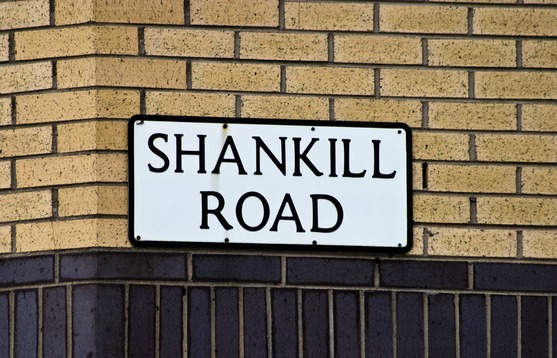
shankilled road cropped.jpg

McKeag’s first group affiliation was with the white power skinhead gangs that existed on the Shankill and which were co-opted into the UDA’s youth wing Ulster Young Militants.  McKeag then became a born-again Christian and married young to a woman named Alison.[3] His interest in Christianity would diminish as he became more involved in the UDA, whilst his marriage also broke up.

Along with Adair and other younger figures, McKeag helped to fill the power vacuum left in the UDA by the deaths of John McMichael and Jim Craig and the departures of Andy Tyrie and Tommy Lyttle.

Killings

McKeag became involved in ‘C’ Company of the lower Shankill – the most active unit of the UDA – around 1989, heading his own section of the company which was a hit squad (other sections concentrating on drug-dealing, money laundering and similar activities).[2] According to Henry McDonald and Jim Cusack, the UDA gave an annual “Volunteer of the Year” award to the organisation’s top hitman.

The award, presented on the Shankill Road and usually consisting of a trophy in the form of a model gun and plaque made by loyalists prisoners, was dominated by McKeag from 1990 onwards and helped to ensure that he became known as “Top Gun” both to his UDA comrades and his republican opponents.

In all, the RUC estimated that McKeag was responsible for at least 12 killings, although the figure was placed higher by a number of his former paramilitary associates.

One of McKeag’s earliest attacks occurred on 11 March 1990 when he shot and killed Eamon Quinn outside his Kashmir Road home in the Clonard district of the Falls Road, beginning a long campaign of sectarian killings by the UDA.

On 31 July he was behind a similar attack on the Springfield Road, where Catholic John Judge was killed after being shot five times by McKeag and his unit. This was followed on 16 October by the killing of Dermot McGuinness in Rosapena Street in north Belfast.[8] Another victim was Seamus Sullivan, the son of former Belfast City Council member Jim Sullivan of the Workers’ Party, killed on 4 September 1991 at the council depot on Springfield Avenue where he worked.

Lawrence Murchan, a shopkeeper who was killed by McKeag and his unit on St James’s Road on 28 September was the 2000th person to be killed during The Troubles. This was followed on 14 November by an attack on the Devenish Arms in Finaghy, resulting in the death of civil servant Aidan Wallace and wounding an 8-year-old boy who lost an eye.


Lanark Way, known to McKeag as the “Yellow Brick Road”

Following his killing of Catholic shop worker Philomena Hanna at a chemists near the Springfield Road on 28 April 1992, eyewitnesses reported that as McKeag and his driver sped back to the Shankill via Lanark Way they shouted and sang his favourite song, ‘Follow the Yellow Brick Road’ from The Wizard of Oz.

Other UDA members later confirmed that the Yellow Brick Road was McKeag’s nickname for Lanark Way, a street linking the Shankill and Springfield roads and favoured by loyalist hitmen as an escape route from republican west Belfast. An attack on 14 November 1992, launched by McKeag, under the orders of Johnny Adair, on a branch of Sean Graham’s bookmakers on the Oldpark Road left three Catholics dead and a number of others, including some Protestants who also frequented the betting shop, injured.

As well as civilian Catholics, McKeag was also involved on attacks upon republicans. On 1 May 1993 Alan Lundy, a former Provisional IRA activist, was killed by McKeag at the home of Sinn Féin’s councillor Alex Maskey, in the Andersonstown area. McKeag struck again on 8 August 1993, killing Sean Lavery at the Antrim Road home of his father Bobby Lavery, a Sinn Féin councillor who had been the target of the attack.

However non-republicans continued to be targets and on 30 August he killed Marie Teresa Dowds de Mogollon in an attack on her home, although this murder was seen as extreme by UDA brigadiers outside C Company, resulting in it eventually being claimed as an accident when it was claimed under the UDA’s Ulster Freedom Fighters cover name.

This was followed on 7 September 1993 when McKeag and two other UDA members entered a hairdresser’s shop on the upper Donegall Road and shot the proprietor Sean Hughes dead. Although brought to trial he was not convicted after eyewitness testimony did not stand up to scrutiny. The following day shopkeeper Michael Edwards was killed at his Finaghy home by McKeag and his unit and on 15 October McKeag killed Paddy McMahon after calling for him to deliver a pizza to a derelict house.

McKeag was held in prison soon after this attack for the Hughes trial and the mantle of top hitman in C Company temporarily passed to Gary “Smickers” Smyth.

Following the killing of Loyalist Volunteer Force (LVF) leader Billy Wright by the Irish National Liberation Army (INLA) inside the Maze Prison in December 1997, Adair, who was a strong admirer of “King Rat”, told McKeag that he had carte blanche to avenge the murder. McKeag did so on 28 December when he entered the Clifton Tavern in north Belfast and opened fire with an uzi, killing Edmund Trainor and injuring a number of others.

On 23 January 1998 he was also involved in the killing of Liam Conway on north Belfast’s Hesketh Road although McKeag was brought before the Inner Council of the UDA for this attack as the movement had declared a ceasefire a few hours earlier. McKeag claimed that the attack was in response to the continuing activity of the INLA, and his fearsome reputation meant that the Inner Council would not reprimand him, even though the murder resulted in the Ulster Democratic Party being excluded from all-party talks.

By this time McKeag was effectively in command of C Company whilst Adair was in prison.

Decline

In June 1998 McKeag, a keen motorcyclist, suffered serious injuries when his vehicle collided with a car being driven by a member of the Ulster Volunteer Force (UVF). He suffered a number of broken bones and required several operations, including the insertion of pins into his leg, and as a consequence he also developed an addiction to painkillers.

He also had a collapsed lung and stomach damage and for a time had to wear a urostomy bag.

A celebrated figure within loyalism for his exploits, cracks began to show in 1999, notably at an event at the Royal Antediluvian Order of Buffaloes on the Corcrain estate in Portadown where McKeag was mobbed by fans from the Loyalist Volunteer Force (LVF) and on stage was applauded by all except his C Company comrades Adair and Gary “Smickers” Smyth. Smyth continued the resentment a few months later when, as McKeag received another “Volunteer of the Year” prize, he yelled “what about me” from the audience.

With Adair in prison and Smyth in temporary command of C Company, McKeag fell out of favour and was soon ordered off the Shankill, ostensibly for becoming involved in fights between women at illegal UDA-run drinking dens on the Shankill.

When Adair returned to the Shankill in the summer of 2000 he brought McKeag back in order to use him for the loyalist feud he was planning against the UVF. McKeag however refused to take part and was severely beaten by Adair and his allies and cut off from organised loyalism altogether.

Some within C Company, including William “Winkie” Dodds, felt that Adair had a long-term jealousy of McKeag’s exploits as a killer and argued that Adair had based much of his own reputation for violence upon activities actually carried out by McKeag.

It was also claimed in An Phoblacht, Sinn Féin’s official newspaper, that McKeag had been involved in a £70,000 cocaine deal that he had excluded Adair from, although the allegation was not quoted elsewhere. One of McKeag’s last violent actions was opening fire on police with an AK-47 during riots in response to the Drumcree conflict on Belfast’s Carlisle Circus, a junction at the base of the Crumlin and Antrim roads near the city centre.

Personal life

Physically McKeag, like Johnny Adair, was shaven-headed, muscular and heavily tattooed and he wore a miniature golden gun around his neck on a thick gold chain.  Maintaining a number of girlfriends simultaneously, McKeag fathered four children by four different women – two daughters both called Stephanie and two sons both called Stephen. In the case of one child, McKeag even delivered it himself after his Newtownards-based girlfriend broke her waters in his car, forcing him to pull into a petrol station to deliver the baby.

One of McKeag’s girlfriends was Jacqueline Newell who had previously been involved with Derek Adgey, a one-time member of the Royal Marines. Both Newell and Adgey were sentenced in 1995 for passing information about leading republicans including Brian Gillen and Alex Maskey to the UDA and it has been claimed that McKeag was their main point of contact with the organisation. McKeag was also dating Tracey Coulter, daughter of the UDA’s Jackie Coulter (loyalist), later murdered in a UDA/UVF feud.

Outside of his loyalist activities McKeag also had a reputation for having unusual hobbies. An animal lover, McKeag variously owned a Rottweiler dog, a parrot, an iguana, a scorpion, a snake and a collection of tropical fish, and had even attempted to purchase a monkey until his then live-in girlfriend prevented him from doing so.

He had an extensive collection of electronic gadgets and mixed rave music tunes as a hobby. He was also known for the flashy Christmas decorations with which he festooned his house every December, including flashing lights and plastic reindeer on the roof.

Death and aftermath

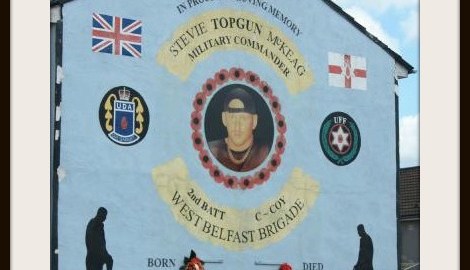
A mural commemorating McKeag on Hopewell Crescent, off Belfast‘s Shankill Road

McKeag was found dead by family members at his home at Florence Court off the Crumlin Road on 24 September 2000. With his face heavily bruised and a crossbow bolt embedded into the wall nearby, it was initially assumed that he had been killed; however a post-mortem found that his death was caused by a lethal combination of painkillers and cocaine.

Some of his supporters continued to blame Adair, due to the love triangle which emerged between him and McKeag when Tracey Coulter started sleeping with Adair too. It was claimed that Adair’s men had entered the house, attacked McKeag, who had fired the crossbow at them, and then forced quantities of cocaine down his throat in order to kill him. There was no evidence to support these claims.

McKeag was buried at Roselawn Cemetery in the east of the city in front of around 1,000 mourners, including Adair, Smyth and UVF/RHC representatives, with floral tributes sent by Ulster Young Militants and Combat 18.

Although by this time he was estranged from the leadership of C Company, McKeag’s litany of violence meant he retained his hero status with the younger members of the group and as a result a new mural was painted on the lower Shankill in commemoration of McKeag

———————————————

Disclaimer

The views and opinions expressed in this post and page are soley intended to educate and provide background information to those interested in the Troubles of Northern Ireland.

They in no way reflect my own opinions and I take no responsibility for any inaccuracies or factual errors

———————————————


The Bayardo Bar attack – 13 August 1975

The Bayardo Bar attack

Bayardo Bar memorial.jpg


The Bayardo Bar attack took place on 13 August 1975 in Belfast, Northern Ireland. A unit of the Provisional IRA Belfast Brigade, led by Brendan McFarlane, launched a bombing and shooting attack on the pub on Aberdeen Street (off the loyalist Shankill Road), which was frequented by Ulster Volunteer Force (UVF) members as well as civilians.

Four Protestant civilians and one UVF member were killed.

————————————————————–

13 August 1975

William Gracey,  (63)

Protestant
Status: Civilian (Civ),

Killed by: Irish Republican Army (IRA)
Shot during gun and bomb attack on Bayardo Bar, Shankill Road, Belfast.

See below for more details on this attack

————————————————————–

13 August 1975

 Samuel Gunning,   (55)

Protestant
Status: Civilian (Civ),

Killed by: Irish Republican Army (IRA)
Shot during gun and bomb attack on Bayardo Bar, Shankill Road, Belfast.

————————————————————–

13 August 1975

Hugh Harris,   (21)

Protestant
Status: Ulster Volunteer Force (UVF),

Killed by: Irish Republican Army (IRA)
Shot during gun and bomb attack on Bayardo Bar, Shankill Road, Belfast.

————————————————————–

13 August 1975

 Joanne McDowell,   (29)

Protestant
Status: Civilian (Civ),

Killed by: Irish Republican Army (IRA)
Shot during gun and bomb attack on Bayardo Bar, Shankill Road, Belfast.

————————————————————–

13 August 1975
Linda Boyle,  (19)

Protestant
Status: Civilian (Civ),

Killed by: Irish Republican Army (IRA)
Injured during gun and bomb attack on Bayardo Bar, Shankill Road, Belfast. She died 21 August 1975.

————————————————————–

According to journalists Alan Murray and Peter Taylor, it was retaliation for the Miami Showband massacre almost a fortnight earlier, when the popular Dublin-based band were ambushed by the UVF at a bogus military checkpoint. Three band members were shot dead by the UVF gunmen after their minibus was blown up in a premature explosion.

McFarlane and two other IRA volunteers, Peter “Skeet” Hamilton and Seamus Clarke, were sentenced to life imprisonment for perpetrating the Bayardo attack.

Background

By the year 1975, the religious-political conflict in Northern Ireland known as “the Troubles“— was more than six years old. On 10 February 1975, the Provisional IRA and British government entered into a truce and restarted negotiations. The IRA agreed to halt attacks on the British security forces, and the security forces mostly ended its raids and searches.

However, there were dissenters on both sides. Some Provisionals wanted no part of the truce, while British commanders resented being told to stop their operations against the IRA just when—they claimed—they had the Provisionals on the run.The security forces boosted their intelligence offensive during the truce and thoroughly infiltrated the IRA.

There was a rise in sectarian killings during the truce, which ‘officially’ lasted until early 1976. Ulster loyalists, fearing they were about to be forsaken by the British government and forced into a united Ireland,  increased their attacks on the Irish Catholic and nationalist community. They hoped to force the IRA to retaliate and thus hasten an end to the truce.

Under orders not to engage the security forces, some IRA units concentrated on tackling the loyalists. The fall-off of regular operations had caused serious problems of internal discipline and some IRA members, with or without permission from higher up, engaged in tit-for-tat killings.

In the early hours of 31 July 1975 the Miami Showband (a popular dance band) were driving back to Dublin following a gig in Banbridge. At Buskhill (outside Newry) they were flagged down at a checkpoint by Ulster Volunteer Force (UVF) gunmen (some of whom were Ulster Defence Regiment (UDR) soldiers) wearing British Army uniforms. The band’s minibus pulled into a layby on the main A1 road, and the gunmen ordered the group to line-up facing a ditch.

As one gunman took the names and addresses of the band members, two others hid a bomb in the back of the bus. However, the bomb detonated prematurely, and the two men were blown to bits. The surviving gunmen then opened fire on the five Miami Showband members, killing three and wounding two.

According to journalists Peter Taylor and Alan Murray, the attack on the Bayardo was retaliation for the massacre.

The attack

The Bayardo Bar was crowded with people of all ages on Wednesday 13 August 1975. Shortly before closing time a stolen green Audi car, containing a three-man unit of the IRA’s Belfast Brigade, pulled up outside. It was driven by the unit’s leader Brendan “Bik” McFarlane, a 24-year-old volunteer from Ardoyne.[7][8][9] Volunteers Seamus Clarke and Peter “Skeet” Hamilton got out and approached the pub’s side entrance in Aberdeen Street.

One of them immediately opened fire with an Armalite, instantly killing doorman William Gracey (63) and his brother-in-law Samuel Gunning (55), with whom he had been chatting outside.

The other volunteer then entered the pub, where patrons were drinking and singing, and at the entrance he dropped a duffel bag containing a ten-pound bomb. Both men made their getaway back to the waiting car.

As panicked customers ran to the toilets for safety, the bomb exploded and brought down a section of the old brick-and-plaster building upon them. The bodies of civilian Joanne McDowell (29) and UVF member Hugh Harris (21) were later found beneath the rubble of fallen masonry.

Seventeen-year-old civilian Linda Boyle was pulled out alive, but died of her injuries in hospital on 21 August.

Over 50 people were injured in the attack.

The Belfast Telegraph claimed that, as the IRA unit drove away down Agnes Street (an arterial road linking the Shankill to the Crumlin Road), they fired into a crowd of women and children queuing at a taxi rank; there were no fatalities.

Within 20 minutes of the blast, the IRA unit were arrested after their car was stopped at a roadblock. The Armalite that had been used to kill William Gracey and Samuel Gunning was found inside the car along with spent bullet cases and fingerprints belonging to the three IRA men.

The IRA did not initially claim responsibility, However, it later stated that the Bayardo was attacked because it was a pub where UVF associates relaxed and “planned terrorist assaults” against nationalists

The pub was in the UVF-dominated middle Shankill Road area, and the Ulster Banner was displayed from its upper windows. Martin Dillon said that the Bayardo was frequented by the UVF and that Lenny Murphy, head of the Shankill Butchers gang, was a regular customer.

Steve Bruce also maintained that in the early 1970s, the UVF’s Brigade Staff (Belfast leadership) would often be found drinking in the pub, which was just around the corner from their headquarters above “The Eagle” chip shop on the Shankill Road.[16] A former IRA prisoner claimed that fellow inmate Lenny Murphy told him he had left the Bayardo ten minutes before the attack and that the Brigade Staff had just finished holding a meeting there.[17]

Retaliation and counter-retaliation

Loyalists, especially the UVF, responded with another wave of sectarian attacks against Catholics. Two days after, a loyalist car bomb exploded without warning on the Falls Road, injuring 35 people.

On 22 August, the UVF launched a gun and bomb attack on McGleenan’s Bar in Armagh. The attack was strikingly similar to that at Bayardo. One gunman opened fire while another planted the bomb; the explosion causing the building to collapse. Three Catholic civilians were killed (one of whom died on 28 August) and several more were wounded.[19] That same night, another bomb wrecked a Catholic-owned pub in nearby Blackwatertown, although there were no injuries.

These loyalist attacks were responded to in kind by the IRA (sometimes using the cover name Republican Action Force or similar), with the months that followed the Bayardo attack being characterised as a bloody game of tit-for-tat. This was met with disillusionment by imprisoned republicans such as Gerry Adams and Brendan Hughes, with the latter claiming that sectarianism was “destroying the whole struggle”.

Convictions

In May 1976, Brendan McFarlane, Seamus Clarke, and Peter Hamilton were convicted in a non-jury Diplock Court and sentenced to life imprisonment inside the Maze Prison for carrying out the Bayardo murders.

Inside the Maze, McFarlane rose to become Officer Commanding IRA prisoners and in 1983 he led the Maze Prison escape, which was the mass break-out of 38 republican prisoners, including Clarke and Hamilton. McFarlane and Clarke then went on the run, although Hamilton was immediately recaptured outside the prison’s main perimeter gate. McFarlane has never spoken about the killings, and the IRA leadership has never encouraged him to do so, considering the attack was viewed as having been “purely sectarian”.

Sinn Féin president Gerry Adams, however, told journalist Alan Murray that McFarlane “hadn’t a single, sectarian bone in his body”. Peter “Skeet” Hamilton died of cancer in Dundalk on 25 February 2011 at the age of 57.

The Bayardo Somme Association has described the Bayardo attack as “a forgotten atrocity”.

The association erected a memorial to the victims on the site where the Bayardo Bar stood before its demolition. The large steel monument was incorporated into the remaining section of the original structure; it bears the names and photographs of the five people who were killed plus photos of the pub taken before and after the bombing.[22]

Operation Demetrius 9th -10th August 1971

Operation Demetrius

Operation Demetrius was a British Army operation in Northern Ireland on 9–10 August 1971, during the Troubles. It involved the mass arrest and internment (imprisonment without trial) of 342 people suspected of being involved with the Irish Republican Army (IRA), which was waging a campaign for a united Ireland against the British state. It was proposed by the Northern Ireland Government and approved by the British Government. Armed soldiers launched dawn raids throughout Northern Ireland, sparking four days of violence in which 20 civilians, two IRA members and two British soldiers were killed. All of those arrested were Irish nationalists, the vast majority of them Catholic. Due to faulty intelligence, many had no links with the IRA. Ulster loyalist paramilitaries were also carrying out acts of violence, which were mainly directed against Catholics and Irish nationalists, but no loyalists were included in the sweep.


The introduction of internment, the way the arrests were carried out, and the abuse of those arrested, led to mass protests and a sharp increase in violence. Amid the violence, about 7,000 people fled or were forced out of their homes. The interrogation techniques used on the internees were described by the European Commission of Human Rights in 1976 as torture, but the European Court of Human Rights (ECHR) ruled on appeal in 1978 that while the techniques were “inhuman and degrading”, they did not constitute torture.

It was later revealed that the British Government had withheld information from the ECHR and that a policy of torture had in fact been authorized by British Government ministers. In December 2014 the Irish government asked the ECHR to revise its 1978 judgement.

The policy of internment was to last until December 1975 and during that time 1,981 people were interned;  1,874 were nationalist, while 107 were loyalist. The first loyalist internees were detained in February 1973.

Background and planning

Internment had been used a number of times during Northern Ireland‘s (and the Republic of Ireland‘s) history, but had not yet been used during the Troubles, which began in the late 1960s. Ulster loyalist paramilitaries such as the Ulster Volunteer Force (UVF) had been engaged in a low-level violent campaign since 1966. After the August 1969 riots, the British Army was deployed on the streets to bolster the Royal Ulster Constabulary (RUC). Up until this point the Irish Republican Army (IRA) had been largely inactive. However, as the violence and political situation worsened, the IRA was divided over how to deal with it. It split into two factions, the Provisional IRA and Official IRA. In 1970–71, the Provisionals began to retaliate against the British Army and the RUC. The Officials’ policy was one more defensive.

During 1970–71 there were numerous clashes between state forces and the two wings of the IRA, between the IRAs and loyalists, and occasionally between the IRAs. Most loyalist attacks were directed against Catholic civilians, but they also clashed with state forces and the IRA on a number of occasions.

The idea of re-introducing internment for Irish republican militants came from the unionist government of Northern Ireland, headed by Prime Minister Brian Faulkner. It was agreed to re-introduce internment at a meeting between Faulkner and UK Prime Minister Edward Heath on 5 August 1971. The British cabinet recommended “balancing action”, such as the arrest of loyalist militants, the calling in of weapons held by (generally unionist) rifle clubs in Northern Ireland and an indefinite ban on parades (most of which were held by unionist/loyalist groups). However, Faulkner argued that a ban on parades was unworkable, that the rifle clubs posed no security risk and that there was no evidence of loyalist terrorism.

It was eventually agreed that there would be a six-month ban on parades but no interning of loyalists and that internment would go ahead on 9 August, in an operation carried out by the British Army.

On the initial list of those to be arrested, which was drawn up by RUC Special Branch and MI5, there were 450 names, but only 350 of these were found. Key figures on the list, and many who never appeared on them, had got wind of the swoop before it began. The list included leaders of the non-violent Northern Ireland Civil Rights Association such as Ivan Barr and Michael Farrell. But, as Tim Pat Coogan noted,

What they did not include was a single Loyalist. Although the UVF had begun the killing and bombing, this organisation was left untouched, as were other violent Loyalist satellite organisations such as Tara, the Shankill Defence Association and the Ulster Protestant Volunteers. Faulkner was urged by the British to include a few Protestants in the trawl but, apart from two republicans, he refused.

In a subsequent case brought to the European Commission of Human Rights by the Irish government against the government of the United Kingdom, it was conceded that Operation Demetrius was planned and implemented from the highest levels of the British government and that specially trained personnel were sent to Northern Ireland to familiarize the local forces in what became known as the ‘five techniques‘, methods of interrogation described by opponents as “a euphemism for torture”.

Legal basis


The internments were initially carried out under Regulations 11 and 12 of 1956 and Regulation 10 of 1957 (the Special Powers Regulations), made under the authority of the Special Powers Act. The Detention of Terrorists Order of 7 November 1972, made under the authority of the Temporary Provisions Act, was used after direct rule was instituted.

Internees arrested without trial pursuant to Operation Demetrius could not complain to the European Commission of Human Rights about breaches of Article 5 of the European Convention on Human Rights (ECHR) because on 27 June 1957, the UK lodged a notice with the Council of Europe declaring that there was a:

“public emergency within the meaning of Article 15(1) of the Convention.”

Operation and immediate aftermath


HMS Maidstone (pictured here in Algiers in the Second World War), a prison ship which docked at Belfast and where many internees were sent

Operation Demetrius began on Monday 9 August at about 4AM.

The operation was in two parts:

In the first wave of raids across Northern Ireland, 342 people were arrested. Many of those arrested reported that they and their families were assaulted, verbally abused and threatened by the soldiers. There were claims of soldiers smashing their way into houses without warning and firing baton rounds through doors and windows. Many of those arrested also reported being ill-treated during their three-day detention at the holding centres. They complained of being beaten, verbally abused, threatened, harassed by dogs, denied sleep, and starved. Some reported being forced to run a gauntlet of baton-wielding soldiers, being forced to run an ‘obstacle course’, having their heads forcefully shaved, being kept naked, being burnt with cigarettes, having a sack placed over their heads for long periods, having a rope kept around their necks, having the barrel of a gun pressed against their heads, being dragged by the hair, being trailed behind armoured vehicles while barefoot, and being tied to armoured trucks as a human shield.

Some were hooded, beaten and then thrown from a helicopter. They were told they were hundreds of feet in the air, but were actually only a few feet from the ground.

The operation sparked an immediate upsurge of violence, the worst since the August 1969 riots.

The British Army came under sustained attack from Irish nationalist rioters and gunmen, especially in Belfast. According to journalist Kevin Myers:

“Insanity seized the city. Hundreds of vehicles were hijacked and factories were burnt. Loyalist and IRA gunmen were everywhere”.

People blocked roads and streets with burning barricades to stop the British Army entering their neighbourhoods. In Derry, barricades were again erected around Free Derry and “for the next 11 months these areas effectively seceded from British control”.

Between 9 and 11 August, 24 people were killed or fatally wounded: 20 civilians (14 Catholics, 6 Protestants), two members of the Provisional IRA (shot dead by the British Army), and two members of the British Army (shot dead by the Provisional IRA).


A mural commemorating those killed in the Ballymurphy Massacre during Operation Demetrius


Of the civilians killed, 17 were killed by the British Army and the other three were killed by unknown attackers.  In West Belfast’s Ballymurphy housing estate, 11 Catholic civilians were killed by 1st Battalion, Parachute Regiment between 9 and 11 August in an episode that has become known as the Ballymurphy Massacre. Another flashpoint was Ardoyne in North Belfast, where soldiers shot dead three people on 9 August.

Many Protestant families fled Ardoyne and about 200 burnt their homes as they left, lest they “fall into Catholic hands”. Protestant and Catholic families fled “to either side of a dividing line, which would provide the foundation for the permanent peaceline later built in the area”Catholic homes were burnt in Ardoyne and elsewhere too.

About 7000 people, most of them Catholics, were left homeless.  About 2500 Catholic refugees fled south of the border, where new refugee camps were set up.

By 13 August, media reports indicated that the violence had begun to wane, seemingly due to exhaustion on the part of the IRA and security forces.

On 15 August, the nationalist Social Democratic and Labour Party (SDLP) announced that it was starting a campaign of civil disobedience in response to the introduction of internment. By 17 October, it was estimated that about 16,000 households were withholding rent and rates for council houses as part of the campaign of civil disobedience.

On 16 August, over 8,000 workers went on strike in Derry in protest at internment. Joe Cahill, then Chief of Staff of the Provisional IRA, held a press conference during which he claimed that only 30 Provisional IRA members had been interned.

On 22 August, in protest against internment, about 130 non-unionist councillors announced that they would no longer sit on district councils. The SDLP also withdrew its representatives from a number of public bodies.

On 19 October, five Northern Ireland Members of Parliament (MPs) began a 48-hour hunger strike against internment. The protest took place near 10 Downing Street in London. Among those taking part were John Hume, Austin Currie, and Bernadette Devlin.

Protests would continue until internment was ended in December 1975.

Long-term effects


Anti-internment mural in the Bogside area of Derry


The backlash against internment contributed to the decision of the British Government under Prime Minister Edward Heath to suspend the Northern Ireland Government and replace it with direct rule from Westminster, under the authority of a British Secretary of State for Northern Ireland. This took place in 1972.

Following the suspension of the Northern Ireland Government and Parliament, internment was continued by the direct rule administration until 5 December 1975. During this time a total of 1,981 people were interned: 1,874 were from an Irish nationalist background, while 107 were from a unionist background.

Historians generally view the period of internment as inflaming sectarian tensions in Northern Ireland, while failing in its goal of arresting key members of the IRA. Many of the people arrested had no links whatsoever with the IRA, but their names appeared on the list of those to be arrested through bungling and incompetence. The list’s lack of reliability and the arrests that followed, complemented by reports of internees being abused far in excess of the usual state violence, led to more nationalists identifying with the IRA and losing hope in non-violent methods.

After Operation Demetrius, recruits came forward in huge numbers to join the Provisional and Official wings of the IRA. Internment also led to a sharp increase in violence. In the eight months before the operation, there were 34 conflict-related deaths in Northern Ireland. In the four months following it, 140 were killed.

A serving officer of the British Royal Marines declared:

It (internment) has, in fact, increased terrorist activity, perhaps boosted IRA recruitment, polarised further the Catholic and Protestant communities and reduced the ranks of the much needed Catholic moderates.

In terms of loss of life, 1972 was the most violent year of the Troubles. The fatal march on Bloody Sunday (30 January 1972) in Derry, when 14 unarmed civil rights protesters were shot dead by British paratroopers, was an anti-internment march.

Interrogation of internees

All of those arrested were interrogated by the British Army and RUC. However, twelve internees were then chosen for further “deep interrogation”, using sensory deprivation. This took place at a secret interrogation centre, which was later revealed to be Shackleton Barracks, outside Ballykelly. In October, a further two internees were chosen for deep interrogation. These fourteen became known as “the Hooded Men”, or “the Guineapigs”.

After undergoing the same treatment as the other internees, the men were hooded, handcuffed and flown to the base by helicopter. On the way, soldiers severely beat them and threatened to throw them from the helicopter. When they arrived they were stripped naked, photographed, and examined by a doctor.

For seven days, when not being interrogated, they were kept hooded and handcuffed in a cold cell and subjected to a continuous loud hissing noise. Here they were forced to stand in a stress position for many hours and were repeatedly beaten on all parts of their body. They were deprived of sleep, food and drink. Some of them also reported being kicked in the genitals, having their heads banged against walls, being shot at with blank rounds, and being threatened with injections. The result was severe physical and mental exhaustion, severe anxiety, depression, hallucinations, disorientation and repeated loss of consciousness.

The interrogation methods used on the men became known as the ‘five techniques‘. Training and advice regarding the five techniques came from senior intelligence officials in the British government. The European Court of Human Rights (ECHR) defined the five techniques as follows:

  • (a) wall-standing: forcing the detainees to remain for periods of some hours in a “stress position”, described by those who underwent it as being “spreadeagled against the wall, with their fingers put high above the head against the wall, the legs spread apart and the feet back, causing them to stand on their toes with the weight of the body mainly on the fingers”;
  • (b) hooding: putting a black or navy coloured bag over the detainees’ heads and, at least initially, keeping it there all the time except during interrogation;
  • (c) subjection to noise: pending their interrogations, holding the detainees in a room where there was a continuous loud and hissing noise;
  • (d) deprivation of sleep: pending their interrogations, depriving the detainees of sleep;
  • (e) deprivation of food and drink: subjecting the detainees to a reduced diet during their stay at the centre and pending interrogations.

The fourteen Hooded Men were the only internees subjected to the full five techniques. However, over the following months, some internees were subjected to at least one of the five techniques, as well as other interrogation methods. These allegedly included waterboarding, electric shocks, burning with matches and candles, forcing internees to stand over hot electric fires while beating them, beating and squeezing of the genitals, inserting objects into the anus, injections, whipping the soles of the feet, and psychological abuse such as Russian roulette.

Parker Report

When the interrogation techniques used on the internees became known to the public, there was outrage at the British government, especially from Irish nationalists. In answer to the anger from the public and Members of Parliament, on 16 November 1971, the British government commissioned a committee of inquiry chaired by Lord Parker (the Lord Chief Justice of England) to look into the legal and moral aspects of the ‘five techniques’.

The “Parker Report”  was published on 2 March 1972 and found the five techniques to be illegal under domestic law:

10. Domestic Law …(c) We have received both written and oral representations from many legal bodies and individual lawyers from both England and Northern Ireland. There has been no dissent from the view that the procedures are illegal alike by the law of England and the law of Northern Ireland. … (d) This being so, no Army Directive and no Minister could lawfully or validly have authorized the use of the procedures. Only Parliament can alter the law. The procedures were and are illegal.

On the same day (2 March 1972), United Kingdom Prime Minister Edward Heath stated in the House of Commons:

[The] Government, having reviewed the whole matter with great care and with reference to any future operations, have decided that the techniques … will not be used in future as an aid to interrogation… The statement that I have made covers all future circumstances.

As foreshadowed in the Prime Minister’s statement, directives expressly forbidding the use of the techniques, whether alone or together, were then issued to the security forces by the government. While these are still legally in force and the use of such methods by UK security forces is not officially condoned by the government, the five techniques were still being used by the British Army in 2003.

European Commission of Human Rights

The Irish Government, on behalf of the men who had been subject to the five techniques, took a case to the European Commission on Human Rights (Ireland v. United Kingdom, 1976 Y.B. Eur. Conv. on Hum. Rts. 512, 748, 788–94 (Eur. Comm’n of Hum. Rts.)). The Commission stated that it

…unanimously considered the combined use of the five methods to amount to torture, on the grounds that (1) the intensity of the stress caused by techniques creating sensory deprivation “directly affects the personality physically and mentally”; and (2) “the systematic application of the techniques for the purpose of inducing a person to give information shows a clear resemblance to those methods of systematic torture which have been known over the ages…a modern system of torture falling into the same category as those systems applied in previous times as a means of obtaining information and confessions.

European Court of Human Rights

The Commissions findings were appealed. In 1978, in the European Court of Human Rights (ECHR) trial Ireland v. the United Kingdom (Case No. 5310/71),

the court ruled:

167. … Although the five techniques, as applied in combination, undoubtedly amounted to inhuman and degrading treatment, although their object was the extraction of confessions, the naming of others and/or information and although they were used systematically, they did not occasion suffering of the particular intensity and cruelty implied by the word torture as so understood. …

168. The Court concludes that recourse to the five techniques amounted to a practice of inhuman and degrading treatment, which practice was in breach of the European Convention on Human Rights Article 3 (art. 3).

On 8 February 1977, in proceedings before the ECHR, and in line with the findings of the Parker Report and UK Government policy, the Attorney-General of the United Kingdom stated:

The Government of the United Kingdom have considered the question of the use of the ‘five techniques’ with very great care and with particular regard to Article 3 (art. 3) of the Convention. They now give this unqualified undertaking, that the ‘five techniques’ will not in any circumstances be reintroduced as an aid to interrogation.

Later development

In 2013, declassified documents revealed the existence of the interrogation centre at Ballykelly. It had not been mentioned in any of the inquiries. Human rights group the Pat Finucane Centre accused the British Government of deliberately hiding it from the inquiries and the European Court of Human Rights.

In June 2014, an RTÉ documentary entitled The Torture Files uncovered a letter from the UK Home Secretary Merlyn Rees in 1977 to the then British Prime Minister James Callaghan. It confirmed that a policy of ‘torture’ had in fact been authorized by the British Government’s ministers—specifically the Secretary for Defence Peter Carrington—in 1971, contrary to the knowledge of the Irish government or the ECHR. The letter states:

“It is my view (confirmed by Brian Faulkner before his death) that the decision to use methods of torture in Northern Ireland in 1971/72 was taken by ministers – in particular Lord Carrington, then secretary of state for defence”.

Following the 2014 revelations, the President of Sinn Féin, Gerry Adams, called on the Irish government to bring the case back to the ECHR because the British government, he said, “lied to the European Court of Human Rights both on the severity of the methods used on the men, their long term physical and psychological consequences, on where these interrogations took place and who gave the political authority and clearance for it”.[

On 2 December 2014 the Irish government announced that, having reviewed the new evidence and following requests from the survivors, it had decided to officially ask the ECHR to revise its 1978 judgement.


The Claudy Bombing – IRA Priest Murders 9 Innocent People With Bomb In Claudy

The Claudy Bombing

The Claudy bombing occurred on 31 July 1972, when three car bombs exploded mid-morning on the Main Street of Claudy in County Londonderry, Northern Ireland. The attack killed nine civilians, and became known as “Bloody Monday”.[1] Those who planted the bombs had attempted to send a warning before the explosions took place. The warning was delayed, however, because the telephones were out of order due to an earlier bomb attack.[2] The Provisional Irish Republican Army (IRA) issued an immediate denial of responsibility,[2][3] and later claimed that “an internal court of inquiry” had found that its local unit did not carry out the attack.[4]

claudy news paper headline

Claudy Bomb IRA Victims

On 24 August 2010, following an eight-year investigation, the Police Ombudsman for Northern Ireland published a report into the bombing, which stated that the Royal Ulster Constabulary believed in the early 1970s that Father James Chesney, a local Roman Catholic priest, was the IRA’s quartermaster and Director of Operations of the South Derry Brigade.[5] The report found that the possibility of his involvement in activities including the Claudy bombing was covered up by senior police officers, government ministers and the Roman Catholic hierarchy.[6]

On the 40th anniversary of the bombing, former Provisional IRA leader Martin McGuinness described the events of that day as “appalling and indefensible” and “inflicted on totally innocent people”[7]

On 31 July 1972 at about 4:00 am,[8] the British Army had begun Operation Motorman. This was an operation to regain control of the “no-go areas” (areas controlled by Irish republican paramilitaries) that had been established in Belfast[9] and Derry. The bombing of Claudy may have been a response to this operation.[2]

Shortly before 10:00 am, three car bombs were placed in the centre of the village, which was busy with shoppers at the time. Initial police investigations found that a car was seen travelling from Claudy at 10:00. It had stopped at the nearby village of Feeny, where a passenger tried to use the public telephone box, which was out-of-order. The car then travelled to Dungiven where it stopped on the Main Street. Two men got out and went into separate shops to use the telephones, which were also out of order following a bomb attack at the local telephone exchange. The men then asked the shop assistants to tell the police at Dungiven that there were three bombs in Claudy, but by this time the first bomb had already detonated.[10]

The first bomb, hidden inside a stolen Ford Cortina, exploded at 10:15 outside McElhinney’s bar and store on Main Street.[10] Six people were killed by this bomb; among the dead were an eight-year-old girl and a 15-year-old boy.[11] A second bomb, hidden inside a stolen Morris Mini Van parked outside the post office on Main Street,[10] was spotted by a police officer, who then began directing people away from the area towards Church Street. At 10:30, a bomb hidden inside a stolen Mini Van detonated outside the Beaufort Hotel on Church Street.[10] The bomb outside the post office exploded almost simultaneously, killing three people, including a 16-year-old boy injured in the first blast.[11]

Victims

Elizabeth McElhinney

Elizabeth was serving petrol at a pump outside McElhinney’s pub on Main Street when the first car bomb exploded nearby.

The 59-year-old nurse was killed instantly.

————————————————————————————

Joseph McCloskey

Joseph McCluskey

Joseph, 39, was also killed instantly in the first explosion.

A father of seven, he had taken his four-year-old son into the village to buy a newspaper.

His son survived the explosion

————————————————————————————

Kathryn Eakin

Kathryn Eakin

Eight-year-old Kathryn was cleaning the windows of her family’s shop when the first bomb went off. She died instantly.

Her mother, Merle, saw a bomber leave what would be the second bomb beside their shop, not knowing what horror it would bring to her family.

“When he stepped out of that car, he saw Kathryn standing at that window,” she said.

“He should have shouted at her. But he didn’t, he just walked away.”

————————————————————————————

Rose McLaughlin

Rose McLaughlin

Rose was injured in the first explosion. The 52-year-old mother of eight died three days later on 3 August.

She owned a shop on Main Street and was hit by shrapnel while talking to a customer.

————————————————————————————

Joseph  ( Patrick ) Connolly

Fifteen-year-old Patrick, who was in Rose McLaughlin’s shop, was injured by flying metal from the first explosion.

He was flown to Altnagelvin Hospital in Londonderry, but died eight days later on 8 August.

————————————————————————————

Arthur Hone

Arthur Hone

Arthur was the final person to die as a result of the first bomb. The 38-year-old father of two died from his injuries on 13 August.

A keen musician who worked in Londonderry, he had stayed at home that day.

He was hit by shrapnel as he stood in Elizabeth McElhinney’s shop.

————————————————————————————

David Miller

David Miller

David died when the third bomb outside the Beaufort Hotel exploded. He was 60-years-old.

He had helped the injured after the first explosion, but when the second device was discovered by police he, along with many others, was directed into the path of the third explosion.

————————————————————————————

James McClelland

Sixty-five-year-old James was also instantly killed as the third bomb exploded. He too had been helping the injured aftert he first explosion

————————————————————————————

William Temple

William Temple

William, 16, had travelled to Claudy from Donemana in County Tyrone. He was a milkman’s helper and his round included the village.

He had been injured by the first explosion, but was killed instantly in the third.

————————————————————————————

Investigations

RUC investigation

The Derry Brigade of the Provisional Irish Republican Army denied involvement at the time of the attack.[2] Derry politician Ivan Cooper (of the Social Democratic and Labour Party), however, claimed in 2002 that the IRA and Father James Chesney (a Catholic priest from the nearby parish of Desertmartin) were involved in the attack. Cooper stated:

Within a couple of days, a man lurked like a scared rabbit outside one of my constituency offices. He told me the IRA was behind the bomb and I had every reason to believe him. He gave no names and I asked no names. That is the way it was then. It was dangerous to know too much. But several months later, I became aware of the identities and I have absolutely no doubt that Father Jim Chesney was involved.[2]

The type and colour of car used by those who gave the bomb warning were rare in Northern Ireland at that time. In the first week of August 1972, the RUC arrested a suspect (called “Man A”) who owned a similar car. He provided an alibi, however, that he had been at Chesney’s home in Bellaghy at the time. Chesney and another person corroborated the man’s alibi and he was released after being questioned. According to the Ombudsman’s report, when Chesney was stopped at a police checkpoint in September 1972, a sniffer dog found traces of explosives in his car. The police officers involved in the original police investigation suspected the following:

  • that the alibi had been prepared beforehand;
  • that “Man A” was an IRA member and had played a key role in the bombing; and
  • that Chesney was the quartermaster and “director of operations” for the South Derry IRA and had also been involved in the bombing.

In October 1972, police intelligence alleged that Chesney had formed an “independent group of the IRA”.

Some time after the bombing, Chesney was questioned by the then Bishop of Derry Neil Farren, and later again by Farren’s successor Bishop Edward Daly. At both times, Chesney denied any involvement. Chesney served in the parish of Cullion from July 1972 until November 1972. He was then hospitalised and spent a period of recovery in County Donegal. In December 1973, he was transferred to the parish of Convoy in County Donegal. Although he often crossed the border into Northern Ireland, he was never arrested and never faced a police interview.

A 2004 loyalist mural on Lower Newtownards Road in Belfast making reference to the bombing. It shows a priest wearing a balaclava and holding a bomb.

[12]

PSNI investigation

No person was arrested for the bombings at the time, but following calls for a new inquiry, a fresh investigation was started by the Police Service of Northern Ireland (PSNI) in 2002. As part of the investigation, the police uncovered documents showing that the then Secretary of State for Northern Ireland Willie Whitelaw discussed Chesney’s involvement with Cardinal William Conway. The actions of two other Catholic priests, Patrick Fell and John Burns, were also examined.[13]

On 30 November 2005, the PSNI detained four people in connection with the bombing.[14] They were, however, released without charge the next day and denied involvement.[15] Among those arrested was the then Sinn Féin MLA Francie Brolly,[16] who subsequently secured an out-of-court settlement in a legal action against the police.

Police Ombudsman report

On 24 August 2010, the Police Ombudsman for Northern Ireland published a report into the bombing which concluded that the British government and the Roman Catholic Church had conspired to cover up Chesney’s alleged involvement.[17] The report stated:

The arrest of a priest in connection with such an emotive atrocity at a time when sectarian killings in Northern Ireland were out of control and the province stood on the brink of civil war was feared, by senior politicians, as likely to destabilise the security situation even further. A deal was therefore arranged behind closed doors to remove Fr Chesney from the province without provoking sectarian fury.[17]

According to the report by Al Hutchinson, the Police Ombudsman,

The RUC’s decision to ask the government to resolve the matter with the Church and then accept the outcome, was wrong. The decision failed those who were murdered, injured and bereaved in the bombing. The police officers who were working on the investigation were also undermined. I accept that 1972 was one of the worst years of the Troubles and that the arrest of a priest might well have aggravated the security situation. Equally, I consider that the police failure to investigate someone they suspected of involvement in acts of terrorism could, in itself, have had serious consequences.[18]

The report found the following:

  • Detectives believed Father Chesney was the IRA’s director of operations in southern County Londonderry and was a prime suspect in the Claudy attack and other paramilitary incidents.[18]
  • A detective’s request to arrest Chesney was refused by an Assistant Chief Constable of RUC Special Branch who instead said that “matters are in hand”.[18]
  • The same senior officer wrote to the government about what action could be taken to “render harmless a dangerous priest” and asked if the matter could be raised with the Church’s hierarchy.[18]
  • In December 1972, William Whitelaw met the head of the Catholic Church in Ireland, Cardinal William Conway, to discuss the issue. According to a Northern Ireland Office official, “the Cardinal said he knew the priest was ‘a very bad man’ and would see what could be done”. The church leader mentioned “the possibility of transferring him to Donegal”. In response to this memo, RUC Chief Constable Sir Graham Shillington noted: “I would prefer transfer to Tipperary.”[18]
  • An entry in Cardinal Conway’s diary on 4 December 1972 confirmed that a meeting with Whitelaw had taken place and stated that there had been “a rather disturbing tete-a-tete at the end about C”.[18]
  • In another diary entry two months later, the Cardinal noted that he had discussed the issue with Father Chesney’s superior and that the superior “had given him orders to stay where he was, on sick leave, until further notice”.[18]

Whitelaw died in 1999, Cardinal Conway in 1977, Sir Graham in 2001 and Father Chesney (aged 46) in 1980.[18]

Memorial

Claudy bombing memorial statue by Elizabeth McLaughlin

A memorial to those killed and injured by the bombing was erected on Claudy’s Main Street in 2000, consisting of a bronze figure of a kneeling girl, created by sculptor Elizabeth McLaughlin, mounted on a stone plinth. A number of plaques commemorating the victims are affixed to the wall enclosing the statue.[19] The statue was damaged on 20 October 2006 when vandals knocked it from the plinth.[20

Major Events in the Troubles

Hyde Park & Regent’s Park Bombings – 20th July 1982 – Lest We Forget!


 Hyde Park and Regent’s Park Bombings

Hyde Park

Regents Park

The Hyde Park and Regent’s Park bombings occurred on 20 July 1982 in London. Members of the Provisional Irish Republican Army (IRA) detonated two bombs during British military ceremonies in Hyde Park and Regent’s Park, both in central London.

Soldiers injured in the bombing are pictured following the attack


The explosions killed 11 military personnel:  four soldiers of the Blues & Royals at Hyde Park, and seven bandsmen of the Royal Green Jackets at Regent’s Park. Seven of the Blues & Royals’ horses also died in the attack. One seriously injured horse, Sefton, survived and was subsequently featured on television programmes and was awarded “Horse of the Year“.

McNamee

Gilbert “Danny” McNamee

In 1987, Gilbert “Danny” McNamee was convicted of making the Hyde Park bomb and jailed for 25 years.  He served 12 years before being released under the terms of the Good Friday Agreement; his conviction was later quashed.

John Downey

In 2013, John Downey was charged with four counts of murder in relation to the Hyde Park attack; his trial began in January 2014 but collapsed the following month after a ruling upon a letter sent to him by police assuring him that he would not be prosecuted over the attack.

No one has ever been charged in connection with the Regent’s Park bombing

———————-

Hyde park London 1982 IRA bombing

———————-

The attacks

Hyde Park bomb


U-shaped hedge enclosure surrounding an oblong slate plaque on a wedge-shaped plinth, with flowers laid at the bottom
Memorial in Hyde Park
Oblong slate plaque with inscriptions in gold, set into a low wall
Memorial in Regent’s Park

At 10:40 am, a nail bomb exploded in the boot of a blue Morris Marina parked on South Carriage Drive in Hyde Park.The bomb comprised 25 lb (11 kg) of gelignite and 30 lb (14 kg) of nails.

It exploded as soldiers of the Household Cavalry, Queen Elizabeth II‘s official bodyguard regiment, were passing. They were taking part in their daily Changing of the Guard procession from their barracks in Knightsbridge to Horse Guards Parade.

Blues and Royals cap badge.jpg

Three soldiers of the Blues & Royals were killed outright, and another, their standard-bearer, died from his wounds three days later. The other soldiers in the procession were badly wounded, and a number of civilians were injured. Seven of the regiment’s horses were also killed or had to be euthanised because of their injuries.

Explosives experts believed that the Hyde Park bomb was triggered by remote by an IRA member inside the park.

 Anthony Daley, Simon Tipper & Roy Bright

The four men who died in the attack were Denis Anthony Daly (known as Anthony Daly), Simon Tipper, Vernon Young, and Raymond Bright (in hospital three days later).

The seven horses who died in the attack were Cedric, Epaulette, Falcon, Rochester, Waterford, Yeastvite, and Zara.


Regent’s Park Bomb

The second attack happened at about 12:55 pm,when a bomb exploded underneath a bandstand in Regent’s Park. Thirty Military bandsmen of the Royal Green Jackets were on the stand performing music from Oliver! to a crowd of 120 people.

It was the first in a series of advertised lunchtime concerts there.Six of the bandsmen were killed outright and the rest were wounded; a seventh died of his wounds on 1 August. The seven men who died were Graham Barker, Robert Livingstone, John McKnight, John Heritage, George Mesure, Keith Powell and Laurence Smith. At least eight civilians were also injured.

The bomb had been hidden under the stand some time before and triggered by a timer.  Unlike the Hyde Park bomb, it contained no nails and seemed to be designed to cause minimal harm to bystanders.

Aftermath

A total of 22 people were detained in hospital as a result of the blasts: 18 soldiers, a police officer, and three civilians. The IRA claimed responsibility for the attacks by deliberately mirroring Prime Minister Margaret Thatcher‘s words a few months before when Britain entered the Falklands War. They proclaimed that:

“The Irish people have sovereign and national rights which no task or occupational force can put down”.

Reacting to the bombing, Thatcher stated:

“These callous and cowardly crimes have been committed by evil, brutal men who know nothing of democracy. We shall not rest until they are brought to justice.”

The bombings had a negative impact on public support in the United States for the Irish republican cause.

Sefton, a horse that survived the attack at Hyde Park despite suffering serious wounds, became famous after appearing in many television shows and was awarded Horse of the Year.

Sefton_Horse_of_the_Year

Sefton’s rider at the time of the bombing, Michael Pedersen, survived but claimed to suffer from posttraumatic stress disorder; after splitting from his wife he committed suicide in September 2012 after killing two of his children.

A memorial marks the spot of the Hyde Park bombing and the troop honours it daily with an eyes-left and salute with drawn swords. A plaque commemorating the victims of the second attack also stands in Regent’s Park.

——————————————

Victims

——————————————

20 July 1982
Anthony Daly   (23)

nfNIB
Status: British Army (BA),

Killed by: Irish Republican Army (IRA)
Ceremonial Cavalryman. Killed when remote controlled car bomb exploded while riding horse along South Carriage Drive, Hyde Park, London.

——————————————

20 July 1982
Simon Tipper   (19)

nfNIB
Status: British Army (BA),

Killed by: Irish Republican Army (IRA)
Ceremonial Cavalryman. Killed when remote controlled car bomb exploded while riding horse along South Carriage Drive, Hyde Park, London.

——————————————

20 July 1982
Jeffrey Young  (19)

nfNIB
Status: British Army (BA),

Killed by: Irish Republican Army (IRA)
Ceremonial Cavalryman. Killed when remote controlled car bomb exploded while riding horse along South Carriage Drive, Hyde Park, London.

——————————————

20 July 1982
Roy Bright  (36)

nfNIB
Status: British Army (BA),

Killed by: Irish Republican Army (IRA)
Ceremonial Cavalryman. Injured when remote controlled car bomb exploded while riding horse along South Carriage Drive, Hyde Park, London. He died on 23 July 1982.

——————————————

20 July 1982
Graham Barker  (36)

nfNIB
Status: British Army (BA),

Killed by: Irish Republican Army (IRA)
Bandsman. Killed when bomb exploded at bandstand, Regents Park, London.

——————————————

20 July 1982
Robert Livingstone  (31)

nfNIB
Status: British Army (BA),

Killed by: Irish Republican Army (IRA)
Bandsman. Killed when bomb exploded at bandstand, Regents Park, London.

——————————————

20 July 1982
John McKnight   (30)

nfNIB
Status: British Army (BA),

Killed by: Irish Republican Army (IRA)
Bandsman. Killed when bomb exploded at bandstand, Regents Park, London.

——————————————

20 July 1982
George Mesure   (19)

nfNIB
Status: British Army (BA),

Killed by: Irish Republican Army (IRA)
Bandsman. Killed when bomb exploded at bandstand, Regents Park, London.

——————————————

20 July 1982


Keith Powell   (24)

nfNIB
Status: British Army (BA), K

illed by: Irish Republican Army (IRA)
Bandsman. Killed when bomb exploded at bandstand, Regents Park, London

——————————————

20 July 1982
Laurence Smith  (19)

nfNIB
Status: British Army (BA),

Killed by: Irish Republican Army (IRA)
Bandsman. Killed when bomb exploded at bandstand, Regents Park, London.

——————————————

20 July 1982
John Heritage  (29)

nfNIB
Status: British Army (BA),

Killed by: Irish Republican Army (IRA)
Bandsman. Injured when bomb exploded at bandstand, Regents Park, London. He died on 1 August 1982

——————————————

Criminal proceedings

In October 1987, 27-year-old Gilbert “Danny” McNamee, from County Armagh, was sentenced at the Old Bailey to 25 years in prison for his role in the Hyde Park bombing and others, despite his plea that he was not guilty. In December 1998, shortly after his release from Maze prison under the Good Friday Agreement, three Court of Appeal judges quashed his conviction, deeming it “unsafe” because of withheld fingerprint evidence that implicated other bomb-makers. They stated that though the conviction was unsafe it did not mean McNamee was necessarily innocent of the charge.


On 19 May 2013, 61-year-old John Anthony Downey, from County Donegal, was charged with murder in relation to the Hyde Park bomb and intending to cause an explosion likely to endanger life. He appeared by videolink from Belmarsh prison for a bail hearing at the Old Bailey on 24 May and did not apply for bail so was remanded in custody.

At a hearing on 1 August 2013, Downey was granted conditional bail and a trial was scheduled for January 2014.

On 24 January 2014, Downey appeared at the Old Bailey for the beginning of his trial; he entered a not guilty plea on the four murder charges and the charge of intending to cause an explosion.

On 25 February 2014, it was revealed that Downey’s trial had collapsed after the presiding judge had ruled, on 21 February, upon a letter sent by the Police Service of Northern Ireland to Downey in 2007, assuring him that he would not face criminal charges over the attack. Although the assurance was made in error and the police realised the mistake, it was never withdrawn, and the judge ruled that therefore the defendant had been misled and prosecuting him would be an abuse of executive power.

Downey is one of 187 IRA suspects who received secret on-the-run letters guaranteeing them unofficial immunity from prosecution


Quinn Brothers killings – Murder of the Innocent

Quinn Brothers Killings

As a Protestant who was born and raised within the heartlands of Loyalist West Belfast I am fiercely proud of my Protestant culture and heritage and I take pride in the union with the rest of the UK and I adore and love our Queen ,  Elizabeth the 2nd of her name – long may she reign!

Queen Elizabeth II March 2015.jpg

Growing up in and around the Shankill Road & Glencairn I was on the front line of the sectarian slaughter that hunted the people of Belfast & Northern Ireland for 30 long painful years and I have seen more than my fair share of the misery and soul destroying agony of the paramilitary war that dominated and engulfed our daily lives.

Through the years many of the high profile killings and sectarian slaughter has had a profound effect on me and the death of these three innocent children still hunts my soul years after their tragic, senseless murder.

The death of the three young Scottish soldiers by an IRA honey trap also stands out  in my mind and the sheer brutality of these murders is beyond my comprehension and how those that perpetuated these and other murders live with themselves is beyond me.

Scots 3-x-

See IRA Honey Trap Killings

Thank god these dark days are behind us.

Safe in the arms of Jesus

Quinn brothers collage with text.jpg

Jason, Richard and Mark Quinn were three brothers killed by the Ulster Volunteer Force (UVF) in a firebomb attack on their home in Ballymoney, County Antrim, Northern Ireland on 12 July 1998. Towards the end of the three-decade period known as “The Troubles“.


Background

A loyalist mural in Carnany

The Quinn family, consisting of mother Chrissie and sons Richard, Mark and Jason, lived in the Carnany estate in the predominantly Protestant town of Ballymoney. The family was of a mixed religious background. Mother Chrissie was Roman Catholic from a mixed background and the boys’ father Jim Dillon was Catholic.

After separating from her estranged husband, Chrissie reared the boys as Protestant “to avoid the hassle”. Chrissie lived with her Protestant partner Raymond Craig in Carnany which had only a few Catholic residents and was mostly Protestant, reflecting the religious make-up of Ballymoney itself. The boys, aged 9, 10 and 11, attended a local state school and on the evening before their deaths had been helping to build the estate’s Eleventh Night loyalist bonfire.

A fourth brother, Lee, was staying with his grandmother in Rasharkin at the time of the attack.

The entrance to Carnany

The killings took place at the height of the stand-off over the Orange Order march at Drumcree, which created a tense atmosphere in various towns across Northern Ireland. In Ballymoney, the previous year, an off-duty Royal Ulster Constabulary (RUC) officer, Gregory Taylor, was beaten to death by a group of loyalist bandsmen.

The killing followed a row about the RUC’s position after loyal order marches had been banned from the nearby nationalist village of Dunloy.

In the weeks before the fatal attack, the children’s mother Chrissie had expressed fear that she wasn’t welcome in the area and that there was a possibility the family home might be attacked by loyalists.

The Ballymoney Times reported a story the week of the deaths, stating that a resident of the Carnany estate called in and was concerned about tension in the area adding something serious might happen “unless Catholic residents were left alone“. Various members of Chrissie’s family had lived in Carnany but due to several incidents only Chrissie and her sons remained. The family had only been living in the home, which was previously occupied by the boys’ aunt, for six days before the attack.

The attack

quinn house 2.jpg

The attack occurred at around half past four in the morning as the inhabitants of the house slept. A car containing members of the Ulster Volunteer Force (UVF), a loyalist paramilitary organisation, arrived at the house and threw a petrol bomb through a window at the rear of the house. The petrol bomb was made from a whiskey bottle.

The sounds of the boys’ shouting had woken their mother, who found her bedroom full of smoke. Chrissie Quinn, Raymond Craig and a family friend Christina Archibald escaped the resulting fire with minor injuries. Chrissie had thought the boys had escaped the fire as she couldn’t locate them in the dense smoke before she jumped to safety from a first floor window. Two of the brother’s bodies were found in their mother’s bedroom and the other in another bedroom.

Chrissie was taken to hospital and released the next day after receiving minor injuries and shock in the attack.

Reaction

DrIanPaisley.jpg

The M.P. for the area, Dr. Ian Paisley, visited the site of the attack and described the killings as:

“diabolical”, “repugnant” and it “stained Protestantism”.

However, in an interview with ITN he stated that:

“The IRA have carried out worse murders than we had in Ballymoney over and over again”.

Then British Prime Minister Tony Blair denounced the attack as “an act of barbarism”.

Reaction from America was also noted as United States President Bill Clinton extended the condolences of the American people to the Quinn family.

Massachusetts Senator Edward Kennedy condemned the killings and stated:

“The Orange Order must recognize that its refusal to abide by the decision of the Parades Commission led to the murder of the Quinn boys”.

New York mayor Rudy Giuliani extended sympathy to the family from the city of New York.

Representatives of other groups from all sides of the constitutional issue in Northern Ireland also condemned the killings.

The then Chelsea F.C. chairman, Ken Bates, offered a £100,000 reward for information leading to a conviction for the attackers.

At the brothers’ Requiem Mass, the bishop of the Roman Catholic Diocese of Down and Connor, Dr. Walsh observed that:

“For all too long the airwaves and the printed page have been saturated with noises – strident, harsh, discordant noises – carrying words of hatred, of incitement, of recrimination, words not found in the vocabulary of Christianity. But the time for words is over. It’s now time for silence, a silence in which we will hear the voice of God.”

Irish Taoiseach Bertie Ahern attended a memorial mass in Dublin for the children.

The Progressive Unionist Party, which has political links to the UVF, made no comment that the UVF was implicated in the attack.

Conviction of Garfield Gilmour

Garfield Gilmour, a local loyalist, was found guilty of murder for his part in the attack and sentenced to life imprisonment in October 1999. He had driven the car which had transported the UVF unit containing Johnny McKay, brothers Raymond and Ivan Parke to the Quinn home.

Gilmour was described at his trial as a hard working, farm machinery salesman who came from a middle-class background who was unwillingly part of the attack which killed the Quinn brothers. The judge described Gilmour as an “accomplished liar”. Gilmour and his girlfriend Christina Lofthouse alleged that an uncle of the Quinn boys, Colm Quinn, had approached their daughter offering her a sweet, knowing it was a small piece of cannabis. Colm Quinn confirmed that the couple had made allegations against him previously that he was a drug dealer. He then had to flee the Carnany estate. However, returning to his old house three months before the fatal attack on his nephews, Quinn claimed he was confronted by Gilmour again and was warned he was “going to be sorted out”.

The Orange Order released a press statement a year after the attack, stating,

“According to today’s judgment the murders were a combination of a sectarian attack by the UVF and a personal grudge between Gilmour and the uncle of the three boys,” and voiced the “Order’s absolute commitment to ensuring that justice is done for their family.”

Gilmour had named the three alleged petrol bombers he had driven to the Quinn family home, but these men were never charged due to a lack of concrete evidence.[17]

Gilmour’s conviction for murder was reduced to manslaughter on appeal on 5 June 2000 and he was released six years later. Nine days later, his life sentence was replaced by a fixed prison sentence of 14 years.

Aftermath

After being released from hospital Chrissie Quinn returned to her mother’s native Rasharkin to live and decided to have the boys buried there. The boys were buried two days later in St Mary’s cemetery in Rasharkin after requiem Mass. Thousands of both Catholics and Protestants attended the funeral.

A number of loyalist bands defied RUC requests not to play music while marching past the boy’s grandmother’s house in the days after the killings.

In April 1999 the former home of the boys in Carnany Park was demolished and replaced with a children’s play park as a memorial.

An uncle of the boys, Frankie Quinn, appeared in court in 2007 accused of stabbing Garfield Gilmour in Ballymoney. Quinn was successful in an application for bail

13th July – Deaths & Events in Northern Ireland Troubles

Key Events & Deaths on this day in Northern Ireland Troubles

13th July

——————————-

Monday 13 July 1970

The annual ‘Twelfth’ parades pass off without serious incident.

[These parades are not normally held on a Sunday hence they took place on 13 July.]

Thursday 13 July 1972

Seven people were shot and killed in separate incidents in Belfast.

Sunday 13 July 1975

Denis Berry (21), then a member of the Ulster Defence Association (UDA), was shot dead by the Ulster Volunteer Force (UVF) in Belfast.

The killing was part of a continuing feud between the UDA and the UVF. A Catholic boy (16) was shot dead by the British Army in Belfast.

Monday 13 July 1981

Sixth Hunger Striker Died

Martin Hurson (29) died after 46 days on hunger strike.

Wednesday 13 July 1983

Four UDR Soldiers Killed


Ronald Alexander,  John Roxborough , Oswell Neely  & Thomas Harron 

The Irish Republican Army (IRA) exploded a land mine in Tyrone killing four members of the Ulster Defence Regiment (UDR).

[This was the highest casualty rate suffered by the UDR in a single incident.] The Irish National Liberation Army (INLA) shot dead two Catholic civilians in County Armagh.

The House of Commons rejected a motion calling for the reintroduction of capital punishment in Northern Ireland.

Sunday 13 July 1986

John Hermon, then Chief Constable of the Royal Ulster Constabulary (RUC), suspended two senior RUC officers following the investigations into the alleged ‘shoot to kill’ policy of the security forces in Northern Ireland

Friday 13 July 1990

The case of the Maguire family was referred to the Court of Appeal. Peter Brooke, then Secretary of State for Northern Ireland, met with Gerry Collins, then Irish Minister of Foreign Affairs, to review the ongoing stalemate in the political progress.

Saturday 13 July 1996 CIRA Bombing

A car bomb exploded outside the Kilyhelvin Hotel, Enniskillen, County Fermanagh, causing substantial damage. The bomb was estimated to have contained 1,200 pounds of home-made explosive and the large blast injured 17 people as they were being evacuated from the hotel.

The Irish Republican Army (IRA) denied responsibility for the bomb as did Republican Sinn Féin (RSF).

Security sources placed the blame for the attack on the Irish Republican National Army (IRNA) considered to be the military wing of RSF.

[A group calling itself the Continuity Irish Republican Army (CIRA) later claimed responsibility for the bomb.]

There were further riots in nationalist areas.

The Social Democratic and Labour Party announced that it would withdraw from the Northern Ireland Forum.

Sunday 13 July 1997

The Royal Ulster Constabulary (RUC) uncovered 500 pounds of explosives and three booster charges in the Creggan area of Derry.

Monday 13 July 1998

The Orange Order ‘Twelfth’ celebrations were held at centres across Northern Ireland (the parades were held on 13 July because the 12 July fell on a Sunday)

. Catholic residents of the Lower Ormeau Road held a peaceful protest against an Orange parade through the area.

Joel Patton, then leader of the ‘Spirit of Drumcree’ group, verbally attacked William Bingham, then a chaplain in the Orange Order, and accused him of betraying the Orangemen of Portadown.

The number of people involved in the Drumcree stand-off decreased considerably following the extensive condemnation of the Orange Order’s response to the deaths of the Ouinn children in a sectarian attack in Ballymoney, County Antrim, on 12 July 1998.

Tuesday 13 July 1999

David Trimble, then leader of the Ulster Unionist Party (UUP), failed to win any concessions from the British government on its failsafe legislation in the House of Commons. The Bill passed its third reading in the House of Commons by 343 votes to 24

Firday 13 July 2001

Political talks resumed at Weston Park in England.


——————————————

Remembering all innocent victims of the Troubles

Today is the anniversary of the death of the following people killed as a results of the conflict in Northern Ireland

“To live in hearts we leave behind is not to die

– Thomas Campbell

To the innocent on the list – Your memory will live forever

– To the Paramilitaries –

There are many things worth living for, a few things worth dying for, but nothing worth killing for.

18 People lost their lives on the 13th  July between 1972 – 1996

——————————————

13 July 1972


Martin Rooney   (22)

nfNI
Status: British Army (BA),

Killed by: Irish Republican Army (IRA)
Shot by sniper while on British Army (BA) mobile patrol, Clonard Street, Lower Falls, Belfast.

——————————————

13 July 1972


Kenneth Mogg   (29)

nfNI
Status: British Army (BA),

Killed by: Irish Republican Army (IRA)
Shot by sniper while on British Army (BA) mobile patrol, Dunville Park, Falls Road, Belfast

——————————————

13 July 1972
David Meeke   (24)

nfNI
Status: British Army (BA),

Killed by: Irish Republican Army (IRA)
Shot by sniper while on British Army (BA) foot patrol, Hooker Street, Ardoyne, Belfast

——————————————

13 July 1972
Henry Russell   (23)

Catholic
Status: Ulster Defence Regiment (UDR),

Killed by: non-specific Loyalist group (LOY)
Off duty. Found shot, Larkfield Drive, Sydenham, Belfast

——————————————

13 July 1972
Thomas Burns   (35)

Catholic
Status: Civilian (Civ),

Killed by: British Army (BA)
Shot while leaving Glenpark Social Club, Glenpark Street, Oldpark, Belfast.

——————————————

13 July 1972


James Reid   (27)

Catholic
Status: Irish Republican Army (IRA),

Killed by: British Army (BA)
Shot during gun battle Eskdale Gardens, Ardoyne, Belfast.

——————————————

13 July 1972


 Terence Toolan   (36)

Catholic
Status: Civilian (Civ),

Killed by: British Army (BA)
Shot during gun battle Eskdale Gardens, Ardoyne, Belfast

——————————————

13 July 1975


Charles Irvine   (16)

Catholic
Status: Civilian (Civ),

Killed by: British Army (BA)
Shot while travelling in car, junction of Falls Road and Waterford Street, Lower Falls, Belfast

——————————————

13 July 1975
Denis Berry   (21)

Protestant
Status: Ulster Defence Association (UDA),

Killed by: Ulster Volunteer Force (UVF)
Shot shortly after leaving Ulster Defence Association social club, Taughmonagh, Belfast. Ulster Defence Association (UDA) / Ulster Volunteer Force (UVF) feud.

——————————————

13 July 1976


Gerard Gilmore  (19)

Catholic
Status: Official Irish Republican Army (OIRA),

Killed by: non-specific Loyalist group (LOY)
Shot from passing car, while standing outside Boundary Bar, Shore Road, Greencastle, Belfast.

——————————————

13 July 1981


Martin Hurson   (29)

Catholic
Status: Irish Republican Army (IRA),

Killed by: not known (nk)
Died on the 46th day of hunger strike, Long Kesh / Maze Prison, County Down

——————————————

13 July 1983
Eamon McMahon  (35)

Catholic
Status: Civilian (Civ),

Killed by: Irish National Liberation Army (INLA)
Found shot in his car, Glassdrumman, near Crossmaglen, County Armagh.

——————————————

13 July 1983
Patrick Mackin   (37)

Catholic
Status: Civilian (Civ),

Killed by: Irish National Liberation Army (INLA)
Found shot in Eamon McMahon’s car, Glassdrumman, near Crossmaglen, County Armagh

——————————————

13 July 1983


Ronald Alexander  (19)

Protestant
Status: Ulster Defence Regiment (UDR),

Killed by: Irish Republican Army (IRA)
Killed in land mine attack on Ulster Defence Regiment (UDR) mobile patrol, near Ballygawley, County Tyrone.

——————————————

13 July 1983


 John Roxborough   (19)

Protestant
Status: Ulster Defence Regiment (UDR),

Killed by: Irish Republican Army (IRA)
Killed in land mine attack on Ulster Defence Regiment (UDR) mobile patrol, near Ballygawley, County Tyrone.

——————————————

13 July 1983


 Oswell Neely   (20)

Protestant
Status: Ulster Defence Regiment (UDR),

Killed by: Irish Republican Army (IRA)
Killed in land mine attack on Ulster Defence Regiment (UDR) mobile patrol, near Ballygawley, County Tyrone.

——————————————

13 July 1983


Thomas Harron   (25)

Protestant
Status: Ulster Defence Regiment (UDR),

Killed by: Irish Republican Army (IRA)
Killed in land mine attack on Ulster Defence Regiment (UDR) mobile patrol, near Ballygawley, County Tyrone.

——————————————

13 July 1984


William Price  (28)

Catholic
Status: Irish Republican Army (IRA),

Killed by: British Army (BA)
Shot by undercover British Army (BA) members, during attempted incendiary bomb attack on factory, Ardboe, County Tyrone.

——————————————

13 July 1996


Dermot McShane   (35)

Catholic
Status: ex-Irish National Liberation Army (xINLA),

Killed by: not known (nk)
Knocked down by British Army (BA) Armoured Personnel Carrier during street disturbances, Little James Street, Derry.

——————————————