Category Archives: Deaths in the Troubles

Deaths in Northern Ireland Troubles

21st January – Deaths & Events in Northern Ireland Troubles

Key Events & Deaths on this day in Northern Ireland Troubles

21st January

————————————————

Tuesday 21 January 1975

There was a series of bomb explosions in Belfast in attacks carried out by the Irish Republican Army (IRA).

Two members of the IRA were killed when a bomb they were transporting by car exploded in Victoria Street, Belfast.

Wednesday 21 January 1976

Government figures showed that 25,000 houses had been damaged in violence related to the conflict.

Gerry Fitt, then leader of the Social Democratic and Labour Party (SDLP), told Members of Parliament (MPs) that some Tenant’s Associations in Belfast were under the control of various paramilitary groups.

Monday 21 January 1980

Anne Maguire was found dead in what was believed to be a case of suicide. Anne Maguire was the mother of the three children who were killed in an incident on 10 August 1976 which led to the formation of the Peace People.

Wednesday 21 January 1981


Norman Stronge (86), a former speaker of the Stormont parliament, and James Stronge (48), his son, were shot dead by the Irish Republican Army (IRA) in an attack on their mansion, Tynan Abbey, near Middletown, County Armagh

Thursday 21 January 1982

Danny Morrison


Owen Carron and Danny Morrison, then both members of Sinn Féin (SF), were arrested when they tried to illegally enter the United States of America (USA) from Canada. Both men were later deported back to Canada.

James Prior, then Secretary of State for Northern Ireland, held a meeting with John DeLorean, then head of the DeLorean Motor Company, to discuss the financial problems that the company was going through.

[Wednesday 21 January 1987

The Irish National Liberation Army (INLA) announced that it would disband in its present form.

Wednesday 21 February 1990

Ian Paisley, then leader of the Democratic Unionist Party (DUP), and William McCrea, then DUP Member of Parliament (MP), hand in a ‘Hands off the Ulster Defence Regiment (UDR)’ petition to Downing Street.

Thursday 21 January 1993

John Major, then British Prime Minister, wrote a letter to John Hume, then leader of the Social Democratic and Labour Party (SDLP), in which he rejected calls for a new inquest into the events of Bloody Sunday.

Wednesday 21 January 1998

Benedict (Ben) Hughes (55), a Catholic civilian, was shot dead by the Ulster Freedom Fighters (UFF) in Utility Street, south Belfast. Hughes was shot as he left his place of work in Sandy Row a Protestant part of Belfast. Hughes was married with three children. No group claimed responsibility for the shooting.

[On 22 January 1998, Ronnie Flanagan, then Chief Constable of the Royal Ulster Constabulary (RUC), announced that the Ulster Freedom Fighters (UFF) were responsible for the killing of Benedict Hughes. The UFF is a cover name (pseudonym) used by the Ulster Defence Association (UDA). The UFF at the time was on a self-proclaimed ceasefire.]

John McFarland, a Catholic civilian, was shot and injured by a Loyalist paramilitary group in Belfast. McFarland was in his taxi at the time and was able to drive himself to hospital. Steven Paul, a Protestant man, was shot and injured by an unidentified Loyalist paramilitary group. Paul was shot in his home in Belvoir Park estate, Belfast.

The funeral of Fergal (Rick) McCusker took place near Maghera, County Derry. The Irish Republican Army (IRA) issued a statement that rejected the ‘Propositions of Heads of Agreement’ document as being pro-Unionist.

Thursday 21 January 1999

Billy Hutchinson, then a spokesman for the Progressive Unionist Party (PUP), said that if the Good Friday Agreement failed and was replaced by a new Anglo-Irish Agreement (AIA) then Loyalist paramilitaries could target tourists in the Republic of Ireland.

William Hague, then leader of the Conservative Party, called on the government to halt the release of paramilitary prisoners until such time as decommissioning had begun.

Monday 21 January 2002

The four Sinn Féin (SF) Members of Parliament (MPs) travelled to Westminster, London, to take their offices at the House of Commons. Previously SF had been banned from using parliamentary facilities; the ban was lifted in December 2001. The four MPs still refused to take the oath of allegiance to the Queen and said they would not be taking their seats in the debating chamber.

Allowances and office expenses for the four MPs are expected to total over £400.000. Prior to going to Westminster the four MPs had a meeting at Downing Street with Tony Blair, then British Prime Minister, about the security response to Loyalist violence in Northern Ireland. Gerry Adams, then President of Sinn Féin (SF), claimed that there had been collusion between the security services and Loyalist paramilitary groups. He also claimed that the British government had failed to deal adequately with recent Loyalist violence.

A man who had served 13 years in prison for murder had his appeal upheld by the Court of Appeal in Belfast. Thomas Green, a Protestant from the Ballysillan area of north Belfast, was convicted of the sectarian murder of John O’Neill, a Catholic, in 1985. Green lost an earlier appeal and was then freed in 1999 under the Good Friday Agreement. Green’s latest appeal was based on medical evidence which indicated that he may have been unaware of what he was doing when he signed the confession.

The Northern Ireland Assembly debated a motion tabled by Monica McWilliams, then member of the Northern Ireland Women’s Coalition (NIWC), and supported by the Alliance Party of Northern Ireland (APNI). The motion called on the British government to provide security documents on the Loyalist bombings in Dublin and Monaghan (on 17 May 1974) to the Commission of Inquiry taking place in the Republic of Ireland.
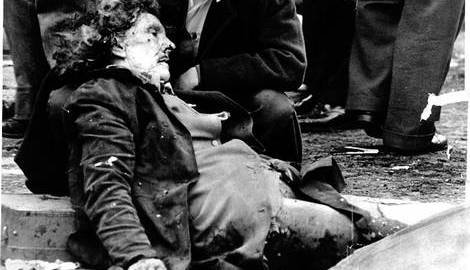
Dublin and Monaghan bombings victim
Victim of the Dublin and Monaghan Bombings

See Dublin and Monaghan Bombings


The NIWC had been approached by the organisation Justice For the Forgotten seeking aid to secure the documents given an alleged slow response by the British government. The Democratic Unionist Party (DUP) opposed the motion but it was passed in a vote. [33 people were killed in the bombs in Dublin and Monaghan. A letter dated 26 February 2002 was sent by John Reid, then Secretary of State for Northern Ireland, to the Commission of Inquiry.] John Hume, former leader of the Social Democratic and Labour Party (SDLP), gave evidence to the Bloody Sunday Inquiry.

Hume was asked why he had not supported the anti-Internment march on 30 January 2002.

[Two shots were fired from a shotgun into the ceiling of a public house in Quay Street in Ardglass, County Down. The attack was carried out by a man wearing a balaclava. The motive for the incident was unclear.]

—————————————————————————

Remembering all innocent victims of the Troubles

Today is the anniversary of the death of the following  people killed as a results of the conflict in Northern Ireland

“To live in hearts we leave behind is not to die

– Thomas Campbell

To the innocent on the list – Your memory will live  forever

– To  the Paramilitaries  –

There are many things worth living for, a few things worth dying for, but nothing worth killing for.

 11 People   lost their lives on the 21st  January  between  1972 – 1998

————————————————————

21 January 1972


Philip Stentiford,   (18)

nfNI
Status: British Army (BA),

Killed by: Irish Republican Army (IRA)
Killed in land mine attack on British Army (BA) foot patrol, Derrynoose, near Keady, County Armagh.

————————————————————

21 January 1974
John Haughey,  (32)

nfNI
Status: British Army (BA),

Killed by: Irish Republican Army (IRA)
Killed by remote controlled bomb, hidden in electricity distribution box, detonated when British Army (BA) foot patrol passed Lone Moor Road, Creggan, Derry

————————————————————

21 January 1975


John Kelly,   (26)

Catholic
Status: Irish Republican Army (IRA),

Killed by: Irish Republican Army (IRA)
Killed in premature bomb explosion while travelling in car along Victoria Street, Belfast.

————————————————————

21 January 1975


John Stone,  (23)

Catholic
Status: Irish Republican Army (IRA),

Killed by: Irish Republican Army (IRA)
Killed in premature bomb explosion while travelling in car along Victoria Street, Belfast

————————————————————

21 January 1977
Michael McHugh,  (35)

Catholic
Status: Civilian Political Activist (CivPA),

Killed by: Ulster Freedom Fighters (UFF)
Former Sinn Fein (SF) member. Shot in the laneway of his home, Corgary, near Castlederg, County Tyrone.

————————————————————

21 January 1977


 James McColgan,   (54)

Catholic
Status: Civilian (Civ),

Killed by: Irish Republican Army (IRA)
Nightwatchman. Died from inhaling fumes during fire caused by incendiary bomb, Castle Street, Belfast.

————————————————————

21 January 1981


Norman Stronge,   (86)

Protestant
Status: Civilian Political Activist (CivPA),

Killed by: Irish Republican Army (IRA)
Ulster Unionist Party (UUP) member, and former Speaker at Stormont. Shot together with his son at their mansion, Tynan Abbey, near Middletown, County Armagh.

————————————————————

21 January 1981


James Stronge,  (48)

Protestant
Status: Royal Ulster Constabulary (RUC),

Killed by: Irish Republican Army (IRA)
Off duty. Shot together with his father, the former Speaker at Stormont, at their mansion, Tynan Abbey, near Middletown, County Armagh.

————————————————————

21 January 1991
Cullen Stephenson,   (63)

Protestant
Status: ex-Royal Ulster Constabulary (xRUC),

Killed by: Irish Republican Army (IRA)
Shot outside his home, Church Street, Brookeborough, County Fermanagh.

————————————————————

21 January 1993


Samuel Rock,  (30)

Protestant
Status: Civilian (Civ),

Killed by: Irish National Liberation Army (INLA)
Shot at his home, Rosewood Street, Lower Oldpark, Belfast.

————————————————————

21 January 1998


Benedict Hughes,   (55)

Catholic
Status: Civilian (Civ),

Killed by: Ulster Defence Association (UDA)
Shot outside his workplace, Utility Street, off Donegall Road, Sandy Row, Belfast.

————————————————————


Buy Me A Coffee

20th January – Deaths & Events in Northern Ireland Troubles

Key Events & Deaths on this day in Northern Ireland Troubles

20th January

————————————

Wednesday 20 January 1971

It was announced that an independent commissioner would decide on the boundaries of the new district council areas.

Saturday 20 January 1973

A car bomb exploded in Sackville Place, Dublin, Republic of Ireland, and killed one person and injured 17 others. The person killed was Thomas Douglas (25). The car used in the bombing had been hijacked at Agnes Street, Belfast.

[No organisation claimed responsibility but the bomb was believed to have been planted by one of the Loyalist paramilitary organisations.]

Monday 20 January 1975

[Public Records 1975 – Released 1 January 2006:

Telegram containing a note of a meeting between Galsworth, then of the British Embassy in Dublin, and Liam Cosgrave, then Taoiseach (Irish Prime Minister). The telegram mentions the concerns of Cosgrave about the likely impact on public opinion if it became known that the British government was negotiating with the Irish Republican Army (IRA).]

[Public Records 1975 – Released 1 January 2006: Letter from Joel Barnett, then Chief Secretary to the Treasury, to Merlyn Rees, then Secretary of State for Northern Ireland, about the Harland and Wolff shipyard in Belfast.]

Tuesday 20 February 1979

lennie murphy
Leader of the Shankill Butchers Lenny Murphy


‘Shankill Butchers’ Sentenced A group of 11 Loyalists known as the ‘Shankill butchers’ were sentenced to life imprisonment for 112 offences including 19 murders. The 11 men were given 42 life sentences and received 2,000 years imprisonment, in total, in the form of concurrent sentences.

[The Shankill Butchers had begun killing Catholics in July 1972 and were not arrested until May 1977. The Loyalist gang operated out of a number of Ulster Volunteer Force (UVF) drinking dens in the Shankill Road area of Belfast. The gang was initially led by Lenny Murphy but it continued to operate following his imprisonment in 1976. The Shankill Butchers got their name because not only did they kill Catholics but they first abducted many of their victims, tortured them, mutilated them with butcher knives and axes, and then finally killed them.]

See Shankill Butchers

See Lenny Murphy

Tuesday 20 January 1981

Maurice Gilvarry (24), a member of the Irish Republican Army (IRA), was found shot dead near Jonesborough, County Armagh. He had been killed by other members of the IRA who alleged that he had acted as an informer.

A British soldier was shot dead by the IRA in Derry.

Sunday 20 January 1985

Douglas Hurd, then Secretary of State for Northern Ireland, was interviewed on Radio Telefis Éireann (RTE) during which he said that political arrangements could be created to improve Anglo-Irish relationships.

Tuesday 20 January 1987

Thomas Power


John O’Reilly


When two Irish National Liberation Army (INLA) members were shot dead by members of the Irish People’s Liberation Organisation (IPLO) in Drogheda, County Louth, Republic of Ireland, a feud began between the two organisations.

[The feud continued until 26 March 1987 with a final death toll of 11.]

The coalition government in the Republic of Ireland, led by Garret FitzGerald, ended after the Labour Party withdrew its support. John Taylor, then Member of the European Parliament (MEP) for Northern Ireland, left the European Democratic Group to join the European Right Group.

The case of the ‘Birmingham Six’ was referred to the Court of Appeal by Douglas Hurd, then British Home Secretary.

Wednesday 20 January 1988

The British government opposed the classification of Northern Ireland as one of Europe’s poorest regions thus reducing the amount of regional structural funds that it received.

Saturday 20 January 1990

Brian_Nelson_Loyalist

Brian Nelson appeared in court on charges relating to the Stevens Inquiry.

See Brian Nelson

[On 28 January 1990 the ‘Sunday Tribune’ (a newspaper published in the Republic of Ireland) alleged that Nelson had worked for British Army intelligence for a number of years.]

Monday 20 January 1992

John Major, then British Prime Minister, travelled to Northern Ireland and held meetings with senior members of the security services

Thursday 20 January 1994

The private secretary to John Major, then British Prime Minister, replied to a letter from Gerry Adams, then President of SF, to state that there “can be no question of renegotiation” of the Downing Street Declaration (DSD).

Monday 20 January 1997

A Catholic family escaped injury when a bomb exploded under their van in Larne.

[No group claimed responsibility but the incident was believed to be the work of the Loyalist Volunteer Force; LVF. ]

There was an attack on the Mountpottinger Royal Ulster Constabulary (RUC) station in Short Strand, Belfast. Two ‘coffee jar bombs’ were thrown at the station but there were no injuries. [The attack was believed to have been carried out by the Irish Republican Army (IRA) (?).]

Tuesday 20 January 1998

Gerry Adams, then President of Sinn Féin (SF), accused the Ulster Defence Association (UDA) / Ulster Freedom Fighters (UFF) of “actively” collaborating with the Loyalist Volunteer Force (LVF) in some of the recent killings of Catholics. However, Adams said that the Ulster Democratic Party (UDP), the political representatives of the UDA / UFF, should not be expelled from the multi-party Stormont talks.

Wednesday 20 January 1999

Kenny McClinton, then acting as Loyalist Volunteer Force (LVF) representative to the Independent International Commission on Decommissioning (IICD), said that the LVF was considering a second round of decommissioning.

[To date this second act of decommissioning had not taken place.]

Patrick Harty, a farmer from Toomevara, County Tipperary, refused to give evidence as a prosecution witness in the trial of the four men accused of the killing of Jerry McCabe, who was a Detective in the Garda Síochána (the Irish police). Harty said he could not give a reason for his refusal to give evidence and was jailed for 18 months.

Sunday 20 January 2002

There were disturbances in the Serpentine Gardens and White City areas of north Belfast. Catholic homes in the Serpentine Gardens area were petrol-bombed between midnight and approximately 1.30am (0130GMT). The devices were thrown from the Loyalist White City area.

In follow-up searches in White City the police found a crate of petrol-bombs – some with fireworks inside. At approximately 4.30am (0430GMT) the home of a Protestant family in White City was attacked with petrol-bombs. There was scorch damage to the house but no injuries. The petrol-bombs were thrown from the Nationalist Serpentine Gardens. The family of six said they would leave the area.

Shore Road Riots

There was also rioting in the nearby Shore Road and the Whitewell Road areas of north Belfast. Nationalists threw a petrol-bomb into a Protestant house on the Whitewell Road. The house was empty at the time and there were no injuries. There were then further disturbances involving Loyalists and Nationalists. Nationalists crowds throwing petrol-bombs, stones, and blast-bombs attacked police and fire officers who were dealing with burning barricades.


Nigel Dodds (DUP), then Member of Parliament (MP) for north Belfast, held a meeting with Alan McQuillan, then Assistant Chief Constable, to ask for 24-hour police patrols.

Independent Television (ITV) in the United Kingdom (UK) broadcast a film entitled ‘Bloody Sunday‘ that portrayed the events in Derry on 30 January 1972.

[Prior to broadcast the film had been criticised by some Unionists in Northern Ireland and by some members of the Conservative party in Britain. The film was also given a limited cinema release.]


—————————————————————————

Remembering all innocent victims of the Troubles

Today is the anniversary of the death of the following  people killed as a results of the conflict in Northern Ireland

“To live in hearts we leave behind is not to die

– Thomas Campbell

To the innocent on the list – Your memory will live  forever

– To  the Paramilitaries  –

There are many things worth living for, a few things worth dying for, but nothing worth killing for.

 10 People   lost their lives on the 20th January  between  1973 – 1987

————————————————————

20 January 1973
Thomas Douglas  (21)

nfNIRI
Status: Civilian (Civ),

Killed by: Ulster Volunteer Force (UVF)
Orginally from Scotland. Killed when car bomb exploded, Sackville Place, off O’Connell Street, Dublin.

————————————————————

20 January 1974
Desmond Mullan,   (33)

Catholic
Status: Civilian (Civ),

Killed by: non-specific Loyalist group (LOY)
Shot while walking along Maple Gardens, Carrickfergus, County Antrim.

————————————————————

20 January 1974


Cormac McCabe,   (42)

Protestant
Status: Ulster Defence Regiment (UDR),

Killed by: Irish Republican Army (IRA)
Off duty. Found shot in field, Altadaven, near Clogher, County Tyrone.

————————————————————

20 January 1975


Kevin Coen,   (28)

nfNI
Status: Irish Republican Army (IRA),

Killed by: British Army (BA)
From County Sligo. Shot during attempted hijacking of bus, Kinawley, County Fermanagh.

————————————————————

20 January 1981
 Christopher Shenton,   (21)

nfNI
Status: British Army (BA),

Killed by: Irish Republican Army (IRA)
Shot by sniper while in British Army (BA) observation post overlooking Bogside, City Walls, Derry

————————————————————

20 January 1981


Maurice Gilvarry,  (24)

Catholic
Status: Irish Republican Army (IRA),

Killed by: Irish Republican Army (IRA)
Found shot near Jonesborough, County Armagh. Alleged informer

————————————————————

20 January 1983


Frank McColgan,  (31)

Catholic
Status: Civilian (Civ),

Killed by: Royal Ulster Constabulary (RUC)
Shot during car chase, shortly after being involved in robbery, Black’s Road, Dunmurry, near Belfast, County Antrim.

————————————————————

20 January 1984
Colin Houston,  (30)

Protestant
Status: Ulster Defence Regiment (UDR),

Killed by: Irish National Liberation Army (INLA)
Off duty. Shot at his home, Sunnymede Avenue, Dunmurry, near Belfast, County Antrim

————————————————————

20 January 1987


Thomas Power,  (34)

Catholic
Status: Irish National Liberation Army (INLA),

Killed by: Irish People’s Liberation Organisation (IPLO)
Shot while in Rossnaree Hotel, Drogheda, County Louth. Irish National Liberation Army / Irish People’s Liberation Organisation feud.

————————————————————

20 January 1987


John O’Reilly,   (26)

Catholic
Status: Irish National Liberation Army (INLA),

Killed by: Irish People’s Liberation Organisation (IPLO)
Shot while in Rossnaree Hotel, Drogheda, County Louth. Irish National Liberation Army / Irish People’s Liberation Organisation feud.

————————————————————


Buy Me A Coffee

The Shankill Butchers – Documentary & Background

Source: The Shankill Butchers – Documentary & Background

19th January – Deaths & Events in Northern Ireland Troubles

Key Events & Deaths on this day in Northern Ireland Troubles

19th January

—————————————–

Friday 19 January 1968

Terence O’Neill, then Northern Ireland Prime Minister, made a speech marking five years in office to members of the Irish Association. O’Neill called for “a new endeavour by organisations in Northern Ireland to cross denominational barriers and advance the cause of better community relations” (The Times; 20 January 1968).

Sunday 19 January 1975

The Irish Republican Army (IRA) carried out two gun attacks on hotels in London. Shots were fired into the Carlton Tower Hotel and the Portman Hotel. Twelve people were injured in the attacks.

Wednesday 19 January 1977

The Irish Republican Army (IRA) carried out a series of booby-trap bomb attacks on security force members.

Tuesday 19 January 1982

The first meeting of Anglo-Irish Inter-government Council took place.

Wednesday 19 January 1994

Irish Broadcast Ban Lifted At midnight the broadcasting ban under section 31 of the Broadcasting Act was lifted in the Republic of Ireland.

[This allowed Sinn Féin (SF) access to the Irish media. The British broadcasting ban was ended on 16 September 1994.]

Thursday 19 January 1995

The appeal in the House of Lords by Lee Clegg, a private in the Parachute Regiment, against his murder conviction was dismissed by the Law Lords.

[An earlier appeal on 30 March 1994 had also been turned down. However, Clegg was released from prison on 3 July 1995 having served two years of a life sentence for the murder of Karen Reilly (16) on 30 September 1990.]

See Lee Clegg post

Monday 19 January 1998

Jim Guiney (38), then a commander in the Ulster Defence Association (UDA), was shot dead by two members of the Irish National Liberation Army (INLA) at his carpet shop in Dunmurray, Belfast.

Guiney was married with four children.

Larry Brennan (51), a Catholic civilian, was shot dead by the Ulster Freedom Fighters (UFF) on the Ormeau Road in Belfast. Brennan was working as a taxi-driver when he was shot at 7.20pm.

[The Loyalist Volunteer Force (LVF) initially claimed responsibility for the killing but many people considered it unlikely that the LVF would have acted alone. It was claimed that the attack was carried out by the Ulster Freedom Fighters (UFF) / Ulster Defence Association (UDA) in retaliation for the killing of Jim Guiney.

Brennan’s Protestant girlfriend was later told she would be shot if she went to his funeral and she also had to leave her home in a Loyalist area of Belfast.

On 22 January 1998, Ronnie Flanagan, then Chief Constable of the Royal Ulster Constabulary (RUC), announced that the UFF were responsible for the killing of Larry Brennan. The UFF is a cover name (pseudonym) used by the Ulster Defence Association (UDA). The UFF at the time was on a self-proclaimed ceasefire.

A delegation from Sinn Féin (SF) went to Downing Street, London to have talks with Tony Blair, then British Prime Minister, about the ‘Propositions of Heads of Agreement’ document. SF claimed that the document had emphasised a ‘partition solution’ to the problems of Northern Ireland at the expense of all-Ireland institutions. The Social Democratic and Labour Party (SDLP) rejected SF’s assessment of the document.

Tuesday 19 January 1999

A man was injured in the arm and leg when the Orange Volunteers (OV) threw a pipe-bomb thrown at his home in Loughinisland, County Down.

[The OV were a Loyalist paramilitary group opposed to the Good Friday Agreement.]

David Ervine, then leader of the Progressive Unionist Party (PUP), claimed on BBC Radio Ulster that the OV was largely made up of Loyalist Volunteer Force (LVF) members and was a combination of Protestant fundamentalists and drug dealers.

The Belfast Telegraph (a Belfast based newspaper) published a report claiming that only 29 per cent of killings carried out by Republicans had been ‘solved’ compared to 50 per cent of Loyalist killings.

CHANNEL 4 PICTURE PUBLICITY 124 Horseferry Road London SW1P 2TX 020 7306 8685 OMAGH Omagh Bomb Tx: This picture may be used solely for Channel 4 programme publicity purposes in connection with the current broadcast of the programme(s) featured in the national and local press and listings. Not to be reproduced or redistributed for any use or in any medium not set out above (including the internet or other electronic form) without the prior written consent of Channel 4 Picture Publicity 020 7306 8685

Andrew Hunter, then a Conservative Member of Parliament (MP), said that he would use Parliamentary privilege to name those he believed were responsible for the Omagh Bombing.

See Omagh Bombing

He also said he would name those involved in carrying out paramilitary ‘punishment’ attacks.

[Later the Chief Constable of the Royal Ulster Constabulary (RUC), and others, persuaded him to postpone his statement on the grounds that it might prejudice any future trial.]

Wednesday 19 January 2000

Peter Mandelson, then Secretary of State for Northern Ireland, made a statement to the House of Commons on the Patten Report.


 —————————————————————————

Remembering all innocent victims of the Troubles

Today is the anniversary of the death of the following  people killed as a results of the conflict in Northern Ireland

“To live in hearts we leave behind is not to die

– Thomas Campbell

To the innocent on the list – Your memory will live  forever

– To  the Paramilitaries  –

There are many things worth living for, a few things worth dying for, but nothing worth killing for.

 5 People   lost their lives on the 19th   January  between  1975 – 1998

————————————————————

19 January 1975


Patrick Toner,  (7)

Catholic
Status: Civilian (Civ),

Killed by: Irish Republican Army (IRA)
Killed by booby trap bomb in field near his home, Forkhill, County Armagh

————————————————————

19 January 1982
John Torbitt,   (29)

Catholic
Status: Irish Republican Army (IRA),

Killed by: Irish Republican Army (IRA)
Died three weeks after being shot at his home, Horn Drive, Lenadoon, Belfast. Alleged informer.

————————————————————

19 January 1988


Anthony McKiernan,   (44)

Catholic
Status: Irish Republican Army (IRA),

Killed by: Irish Republican Army (IRA)
Found shot Mica Drive, Beechmount, Belfast. Alleged informer.

————————————————————

19 January 1998


Jim Guiney,  (38)

Protestant
Status: Ulster Defence Association (UDA),

Killed by: Irish National Liberation Army (INLA)
Shot at his carpet shop, Kingsway, Dunmurry, near Belfast, County Antrim.

————————————————————

19 January 1998


Larry Brennan,  (52)

Catholic
Status: Civilian (Civ),

Killed by: Ulster Defence Association (UDA)
Taxi driver. Shot while sitting in his stationary car, outside taxi depot, Ormeau Road, Ballynafeigh, Belfast

————————————————————


Buy Me A Coffee

18th January – Deaths & Events in Northern Ireland Troubles


Key Events & Deaths on this day in Northern Ireland Troubles

18th January

—————————————

Monday 18 January 1971

James Chichester-Clark, then Northern Ireland Prime Minister, attended a meeting in London with Reginald Maudling, then British Home Secretary.

Tuesday 18 January 1972

Brian Faulkner, then Prime Minister of Northern Ireland, banned all parades and marches in Northern Ireland until the end of the year. [ Bloody Sunday; Internment; Law Order. ]

Wednesday 18 January 1978

European Court Decision on Treatment of Internees

The European Court of Human Rights made its ruling on the case of alleged ill-treatment of internees during 1971. The case had been initially referred to the European Commission by the Irish government on 10 March 1976. On 2 September 1976 the European Commission on Human Rights decided that Britain had to answer a case of ill-treatment of internees and referred the matter to the European Court of Human Rights.

The Commission found that the interrogation techniques did involve a breach of the Convention on Human Rights because they not only involved inhuman and degrading treatment but also torture. The European Court of Human Rights however decided that the Commission was wrong to use the word ‘torture’ but did agree that the internees had been subjected to ‘inhuman and degrading treatment’.

Tuesday 18 January 1983

Peter Barry, then Irish Foreign Minister, began a fact-finding visit to Belfast.

Wednesday 18 January 1984

James Prior, then Secretary of State for Northern Ireland, announced a public inquiry into the scandal at the Kincora Boy’s Home in Belfast.

Tuesday 18 January 1994

Sinn Féin (SF) launched a ‘peace commission’ which was set up to hear opinions on the future of the region.

 The first session was held in Derry on 27 January 1994.

Saturday 18 January 1997

The Irish Republican Army (IRA) fired two ‘horizontal type mortars’ at a Royal Ulster Constabulary (RUC) Landrover patrol in Downpatrick, County Down. There were no injuries.

An attempted mortar attack in Derry was foiled by the security forces in Derry.

John Hume, then leader of the Social Democratic and Labour Party (SDLP), confirmed that he would be the SDLP candidate for Foyle (in Derry) at the next general election.

[There had been suggestions that he might stand aside in favour of one of his colleagues. Hume at this time was both a Member of Parliament (MP) and a Member of the European Parliament (MEP).]

Sunday 18 January 1998

Fergal (Rick) McCusker (28), a Catholic man, was abducted and shot dead by the Loyalist Volunteer Force (LVF) at around 1.15 am in Maghera, County Derry.

McCusker was walking home after having been out drinking with friends. His body was discovered behind the premises of a youth club. McCusker had recently returned to Northern Ireland having worked for a while in the United States of America. He was the fourth Catholic to be killed since 27 December 1997.

Jean Kennedy Smith

Jean Kennedy Smith, then United States of America (USA) Ambassador to Ireland, came under attack from Ray Seitz, formerly US Ambassador to Britain (1991 to 1994), who branded her “an ardent IRA apologist”. Seitz made the claims in a recently published book of memoirs. Reacting to the claims, the White House said President Clinton had every confidence in Kennedy Smith.

Monday 18 January 1999

The Northern Ireland Assembly debated the proposed structures of government and the arrangements for the North-South bodies. Peter Weir, then Ulster Unionist Party (UUP) Member of the Legislative Assembly (MLA), voted against his own party line on the issue of the new structures for government.

[Weir was a member of the pressure group ‘Union First’ and opposed to the Good Friday Agreement. He was deprived of the UUP whip on 19 January 1999.] Representatives of the Garvaghy Road Residents’ Coalition (GRRC) had a meeting with Tony Blair, then British Prime Minister, at Downing Street, London. Blair called for renewed efforts to find a compromise to the Drumcree issue. Brice Dickson, then a Professor at the University of Ulster, was appointed as the head of the new Northern Ireland Human Rights Commission (NIHRC). [Some people complained of a lack of Unionist representation on the Commission.]

Friday 18 January 2002

Anti-Sectarian Rallies

Rallies were held across Northern Ireland at 1.00pm (1300GMT) to protest against Loyalist paramilitary death threats to postal workers and school staff and to call for an end to all paramilitary activity. The rallies took place in Belfast, Cookstown, Derry, Enniskillen, Newry, Omagh, and Strabane, and were attended by an estimated 25,000 people. Representatives of all major trade unions as well as ordinary men and women took part in the demonstrations.

Part of a resolution read out at the rallies stated: “we call on all those engaged in acts of sectarianism or paramilitary activity to stop”.

[The rallies were organised following the killing by the Ulster Defence Association (UDA) of Catholic postman Daniel McColgan (20) on Saturday 12 January 2002.]

 —————————————————————————

Remembering all innocent victims of the Troubles

Today is the anniversary of the death of the following  people killed as a results of the conflict in Northern Ireland

“To live in hearts we leave behind is not to die

– Thomas Campbell

To the innocent on the list – Your memory will live  forever

– To  the Paramilitaries  –

There are many things worth living for, a few things worth dying for, but nothing worth killing for.

6 People   lost their lives on the 18th January  between  1972 – 1998

————————————————————

18 January 1972
Sydney Agnew,  (40)

Protestant
Status: Civilian (Civ),

Killed by: Irish Republican Army (IRA)
Shot at his home, The Mount, off Albertbridge Road, Belfast. Witness to the hijacking of a bus.

————————————————————

18 January 1973


Francis Liggett,   (25)

Catholic
Status: Irish Republican Army (IRA),

Killed by: British Army (BA)
Shot during attempted armed robbery at Royal Victoria Hospital, Falls Road, Belfast

————————————————————

18 January 1980


Graham Cox,   (35)

Protestant
Status: Prison Officer (PO),

Killed by: Irish Republican Army (IRA)
Shot while driving home from Magilligan Prison, Limavady Road, Stradreagh, near Derry.

————————————————————

18 January 1983


 John Olphert,  (39)

Protestant
Status: Royal Ulster Constabulary (RUC),

Killed by: Irish Republican Army (IRA)
Off duty reservist. Shot at his supermarket, Nelson Drive, Caw, Derry.

————————————————————

18 January 1989


Ian Catney,  (27)

Catholic
Status: Civilian (Civ),

Killed by: Ulster Volunteer Force (UVF)
Shot at his workplace, his mother’s shop, Smithfield, Belfast.

————————————————————

18 January 1998


Fergal McCusker,   (28)

Catholic
Status: Civilian (Civ),

Killed by: Loyalist Volunteer Force (LVF)
Found shot, behind youth centre, off Tircane Road, Maghera, County Derry 

————————————————————


Buy Me A Coffee

Lee Clegg

Sergeant Lee Clegg is a British Army soldier who was convicted of murder for his involvement in the shooting dead of two teenage joyriders in West Belfast, Northern Ireland. His conviction was later overturned.


Shooting

The shooting took place in West Belfast on 30 September 1990. Clegg, then a private originally from Bradford, England, and his fellow soldiers manning the checkpoint on the Upper Glen Road, fired nineteen bullets into a stolen Vauxhall Astra that passed through their checkpoint travelling at high speed. Clegg fired four of the bullets, the last of which killed 18-year-old passenger Karen Reilly. The driver, 17-year-old Martin Peake, also died at the scene, and the third passenger, Markiewicz Gorman, escaped with minor injuries.

Sentencing

Clegg was sentenced to life imprisonment for murder in 1993, the court having decided that lethal force had been used without a lawful purpose. The fourth bullet was said to have been fired through the back of the car as it was leaving the checkpoint and was therefore no longer a threat to the soldiers. The murder conviction was condemned by unionists and some British newspapers, including the Daily Mail, which began a campaign for Clegg’s release on the grounds that he was just doing his job in difficult circumstances.

Release and aftermath

Clegg was released under licence by then Northern Ireland Secretary Patrick Mayhew in 1995, which in turn led to rioting in Irish nationalist areas of Belfast. Sinn Féin repeatedly called the decision a “threat to the peace process“. The release followed after a test shooting on another Astra conducted by pathologist Iain West and forensic expert Graham Renshaw on 4 June 1995.[1]

Appeals

A set of appeals to the Court of Appeal and House of Lords led to the quashing of the murder conviction in 1998 and a re-trial in March 1999, on the grounds that new evidence suggested that the fourth bullet entered the side of the car. At the retrial Clegg was cleared of murder, but a conviction for “attempting to wound” the driver of the car, Martin Peake, who also died in the incident, was upheld.

Another appeal, this time at the Northern Ireland Court of Appeal, led to that lesser conviction also being overturned on 31 January 2000 due to uncertainty over the accuracy of evidence that initially suggested Clegg’s final bullet was fired after the vehicle had passed.

——————————————

PRIVATE LEE CLEGGS RELEASE

——————————————

Clegg continued to serve as part of 16 Air Assault Brigade. In September 2007 the Daily Mail reported that Clegg would be serving in Afghanistan in 2008 as combat medic with the 2nd Battalion Parachute Regiment.[2][3]

Teebane Bombing -17th January 1992

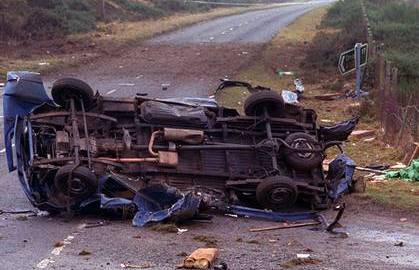
The Teebane bombing (or Teebane massacre)[1][2] took place on 17 January 1992 at a rural crossroads between Omagh and Cookstown in County Tyrone, Northern Ireland. A roadside bomb destroyed a van carrying 14 construction workers who had been repairing a British Army base in Omagh. Eight of the men were killed and the rest were wounded. The Provisional Irish Republican Army (IRA) claimed responsibility, saying that the workers were killed because they were “collaborating” with the “forces of occupation”.

———————————

The Victims

———————————

17 January 1992


David Harkness,  (23)

Protestant
Status: Civilian (Civ),

Killed by: Irish Republican Army (IRA)
Killed in land mine attack on firm’s van, returning home from Lisanelly British Army (BA) base, Omagh, at Teebane Crossroads, near Cookstown, County Tyrone.

———————————

17 January 1992


Gary Bleeks,  (25)

Protestant
Status: Civilian (Civ),

Killed by: Irish Republican Army (IRA)
Killed in land mine attack on firm’s van, returning home from Lisanelly British Army (BA) base, Omagh, at Teebane Crossroads, near Cookstown, County Tyrone.

———————————

17 January 1992


 Robert Dunseath,   (25)

Protestant
Status: Civilian (Civ),

Killed by: Irish Republican Army (IRA)
Killed in land mine attack on firm’s van, returning home from Lisanelly British Army (BA) base, Omagh, at Teebane Crossroads, near Cookstown, County Tyrone.

———————————

17 January 1992
John McConnell  (38)

Protestant
Status: Civilian (Civ),

Killed by: Irish Republican Army (IRA)
Killed in land mine attack on firm’s van, returning home from Lisanelly British Army (BA) base, Omagh, at Teebane Crossroads, near Cookstown, County Tyrone.

———————————

17 January 1992


James Caldwell,  (37)

Protestant
Status: Civilian (Civ),

Killed by: Irish Republican Army (IRA)
Killed in land mine attack on firm’s van, returning home from Lisanelly British Army (BA) base, Omagh, at Teebane Crossroads, near Cookstown, County Tyrone.

———————————

17 January 1992


Nigel McKee,   (22)

Protestant
Status: Civilian (Civ),

Killed by: Irish Republican Army (IRA)
Killed in land mine attack on firm’s van, returning home from Lisanelly British Army (BA) base, Omagh, at Teebane Crossroads, near Cookstown, County Tyrone.

———————————

17 January 1992


Robert Irons,  (61)

Protestant
Status: Civilian (Civ),

Killed by: Irish Republican Army (IRA)
Killed in land mine attack on firm’s van, returning home from Lisanelly British Army (BA) base, Omagh, at Teebane Crossroads, near Cookstown, County Tyrone.

———————————

17 January 1992
Oswald Gilchrist,   (44)

Protestant
Status: Civilian (Civ),

Killed by: Irish Republican Army (IRA)
Injured in land mine attack on firm’s van, returning home from Lisanelly British Army (BA) base, Omagh, at Teebane Crossroads, near Cookstown, County Tyrone. He died 21 January 1992

———————————

As all of those killed were Ulster Protestants, some Protestants interpreted the bombing as a sectarian attack against their community. On 5 February, the Ulster loyalist Ulster Defence Association (UDA) retaliated by shooting dead five Irish Catholics at a betting shop in an Irish nationalist area of Belfast.

Background

Since the beginning of its campaign in 1970, the Provisional IRA had launched frequent attacks on British Army and Royal Ulster Constabulary (RUC) bases in Northern Ireland. In August 1985 it began targeting civilians who offered services to the security forces, particularly those employed by the security forces to maintain and repair its bases. The first to be killed was a Catholic man who was shot dead for selling portable buildings to the RUC.[3] In October 1990, the IRA launched three “proxy bomb” attacks. Three men, who worked for the security forces, were tied into cars loaded with explosives and ordered to drive to British Army checkpoints while their families were held at gunpoint. The bombs were then remotely detonated. Six soldiers and one of the forced drivers were killed in the first two attacks.[4] A third proxy bomb was driven to Lisanelly British Army base in Omagh, but the main bomb failed to explode.[5] An earlier attack had taken place on this barracks in January, when an IRA bomb damaged the perimeter fence.[6] Between August 1985 and January 1992, the IRA killed 23 people who had been working for (or offering services to) the security forces.[7] The IRA also alleged that some of those targeted had links with Ulster loyalist paramilitaries.[7]

Bombing

On the evening of 17 January 1992, the 14 construction workers left work at Lisanelly British Army base in Omagh. They were employees of Karl Construction, based in Antrim.[7] They travelled eastward in a Ford Transit van towards Cookstown.[7] When the van reached the rural Teebane Crossroads, just after 5PM, IRA volunteers detonated a roadside bomb containing an estimated 600 pounds (270 kg) of home-made explosives in two plastic barrels.[8] Later estimates report a 1,500 pounds (680 kg) device.[9] The blast was heard from at least ten miles away. It ripped through one side of the van, instantly killing the row of passengers seated there. The vehicle’s upper part was torn asunder, and its momentum kept it tumbling along the road for 30 yards.[10] Some of the bodies of the dead and injured were blown into the adjacent field and ditch. IRA volunteers had detonated the bomb from about 100 yards away using a command wire.[11]

Seven of the men were killed outright. They were William Gary Bleeks (25), Cecil James Caldwell (37), Robert Dunseath (25), David Harkness (23), John Richard McConnell (38), Nigel McKee (22) and Robert Irons (61). The van’s driver, Oswald Gilchrist (44), died of his wounds in hospital four days later.[12] Robert Dunseath was a British soldier serving with the Royal Irish Rangers.[13] The other six men were badly injured.[14] It was the highest death toll from one incident in Northern Ireland since 1988.[11]

The IRA’s Tyrone Brigade claimed responsibility for the bombing shortly after.[7] It argued that the men were legitimate targets because they were “collaborators engaged in rebuilding Lisanelly barracks” and vowed that attacks on “collaborators” would continue.[7] The IRA’s statement said:

The IRA reiterates its long-standing call to those who continue to provide services or materials to the forces of occupation to desist immediately. Since 1985 the IRA has adopted a policy of taking military action aimed at ending Britain’s cynical use of non-military personnel for the servicing and maintenance of British Crown Forces’ bases and installations … for our part, we in the IRA will not tolerate a situation where military personnel are freed from essential services and maintenance tasks and then deployed where they can carry out wholesale repression within our community.[15]

Aftermath


Both unionist and Irish nationalist politicians condemned the attack.[7] Sinn Féin president Gerry Adams, however, described the bombing as “a horrific reminder of the failure of British policy in Ireland”. He added that it highlighted “the urgent need for an inclusive dialogue which can create a genuine peace process”.[7] British Prime Minister John Major visited Northern Ireland within days and promised more troops, pledging that the IRA would not change government policy.[7]

In his book The Long War, Brendan O’Brien wrote:

In terms of IRA military strategy, the Teebane bomb was a ‘success’. It struck with deadly ferocity and effect and would have been extremely intimidating to others contemplating taking jobs on bombed-out RUC and British Army buildings […] this bomb also served as a warning to loyalist paramilitaries who had carried out a succession of killings in Tyrone.[7]

Less than three weeks later, the Ulster Defence Association (UDA) launched a ‘retaliation’ for the bombing. At 2PM on 5 February, two masked men armed with an automatic rifle and revolver entered Sean Graham’s betting shop on Ormeau Road, Belfast.[16] The shop was in an Irish nationalist/republican area and was packed with customers at the time.[16] The men fired indiscriminately at the customers, killing five Irish Catholic civilians, before fleeing to a getaway car.[16] The UDA claimed responsibility using the covername “Ulster Freedom Fighters”, ending its statement with “Remember Teebane”.[17] After the shootings, a cousin of one of those killed at Teebane visited the betting shop. He said: “I just don’t know what to say but I know one thing – this is the best thing that’s happened for the Provos [Provisional IRA] in this area in years. This is the best recruitment campaign they could wish for”.[15]

The Historical Enquiries Team (HET) conducted an investigation into the bombing and released its report to the families of the victims. It found that the IRA unit had initially planned to carry out the attack on the morning of 17 January as the workers made their way to work but, due to fog, it was put off until the afternoon. Although suspects were rounded up and there were arrests in the wake of the attack, nobody has ever been charged or convicted of the bombing. Survivor Bobby O’Neill, who received serious injuries in the blast, told the RUC that as he lay injured on the ground, he had seen a “bearded man” appear at the scene of the bombing. The man dispassionately walked through the van’s wreckage, showing no compassion or emotion as he gazed upon each of the bodies of the dead and injured and making no attempt to help the wounded. O’Neill believed this man was one of the bombers and the following month, helped the RUC to compile a photo-fit image of him which was then circulated to all RUC divisions, but never released to the public.[18]

Karl Construction erected a granite memorial at the site of the attack[19] and a memorial service is held there each year. In January 2012, on the 20th anniversary of the attack, Democratic Unionist Party (DUP) MLA, Trevor Clarke, whose brother-in-law Nigel McKee at age 22 was the youngest person killed in the bombing, demanded that republicans provide the names of the IRA bombers  


Buy Me A Coffee

16th January – Deaths & Events in Northern Ireland Troubles

Key Events & Deaths on this day in Northern Ireland Troubles

16th January

—————————

Wednesday 16 January 1974

Brian Faulkner, then Chief Executive of the Northern Ireland Executive, travelled to Dublin for a meeting with Liam Cosgrave, then Taoiseach (Irish Prime Minister) following a ruling in the Dublin High Court. The ruling implied that the reunification of Ireland did not require the consent of the majority of people in Northern Ireland.

Sunningdale; Ulster Workers’ Council Strike.

Thursday 16 January 1975

The Irish Republican Army (IRA) announced that it would call off its ceasefire as of midnight 16 January 1975

Monday 16 January 1978

Tomás Ó Fiaich, then Catholic Primate of Ireland, was quoted in the Irish Press as saying: “I believe the British should withdraw from Ireland. I think that it is the only thing that will get things moving.” The comments drew a lot of criticism including from Ian Paisley, then leader of the Democratic Unionist Party (DUP), who called Ó Fiaich “the IRA’s bishop from Crossmaglen”.

Friday 16 January 1981

Bernadette McAliskey

Bernadette McAliskey (formally Devlin) and her husband were shot and seriously injured in a gun attack in their home near Coalisland, County Tyrone. It was believed that members of the Ulster Defence Association (UDA) were responsible for the attack. Bernadette McAliskey was shot seven times in front of her children, but both her and her husband recovered from their injuries.

Injured in loyalist shooting

On 16 January 1981, she and her husband were shot by members of the Ulster Freedom Fighters, who broke into their home near Coalisland, County Tyrone. The gunmen shot Devlin fourteen times in front of her children. British soldiers were watching the McAliskey home at the time, but failed to prevent the assassination attempt.An army patrol of the 3rd Battalion, The Parachute Regiment, entered the house and waited for half an hour. Bernadette Devlin McAliskey claimed they were waiting for the couple to die. Another group of soldiers then arrived. The paramilitaries had torn out the telephone and while the wounded couple were being given first aid by the newly arrived troops, a soldier ran to a neighbour’s house, commandeered a car, and drove to the home of a councillor to telephone for help. The couple were taken by helicopter to hospital in nearby Dungannon for emergency treatment and then to the Musgrave Park Hospital, Military Wing, in Belfast, under intensive care. The attackers, Ray Smallwoods, Tom Graham (38), both from Lisburn, and Andrew Watson (25) from Seymour Hill, Dunmurry, were captured by the army patrol and subsequently jailed. All three were members of the South Belfast UDA. Smallwoods was the driver of the getaway car.

Sunday 16 January 1983

William Doyle, a County Court judge, was shot dead by members of the Irish Republican Army (IRA) as he left mass at a Catholic church in south Belfast.

Thursday 16 January 1986

Security forces in Holland raided a flat in Amsterdam and arrested two Republicans, Brendan McFarlane and Gerard Kelly, who had escaped from the Maze prison on 25 September 1983.

[The two men were extradited to the United Kingdom (UK) on 3 December 1986.]

Friday 16 January 1987

Peter Robinson, then deputy leader of the Democratic Unionist Party (DUP), pleaded guilty in a Dublin court to unlawful assembly. Robinson paid £17,500 in fines and compensation and was freed.

Saturday 16 January 1988

Two members of the Ulster Defence Regiment (UDR) were killed in separate incidents.

Monday 16 January 1989

The case of the ‘Guildford Four’ was referred to the Court of Appeal.

Tuesday 16 January 1990

John Taylor, then Ulster Unionist Party (UUP) Member of Parliament, called for an end to the Unionist boycott of talks with Northern Ireland Office ministers.

Tommy Lyttle, then leader of the Ulster Defence Association (UDA), appeared in court on charges relating to the Stevens Inquiry

Tuesday 16 February 1993

Gerry Adams, then President of Sinn Féin (SF), gave an interview to the Irish News (a Northern Ireland newspaper) in which he called for “inclusive dialogue” and a new Irish-British agreement that would bring an end to partition.

Sunday 16 January 1994

The Sunday Independent (an Dublin based newspaper) contained a story about an alleged plan of the Ulster Defence Association (UDA) to carry out ‘ethnic cleansing’. The plan involved the repartition of Northern Ireland followed by the forced removal of Catholics from the remaining area.

Monday 16 January 1995

SF Meeting With NIO Officials A delegation from Sinn Féin (SF) held a meeting with Northern Ireland Office (NIO) officials at Stormont. SF accepted that the party had an “influence” on paramilitary weapons.

Michael Ancram, then Political Development Minister at the Northern Ireland Office (NIO), later said that the decommissioning of Irish Republican Army (IRA) weapons was not a precondition to SF’s entry into substantive talks.

Thursday 16 January 1997

The case of Lee Clegg was referred to the Court of Appeal by Patrick Mayhew, then Secretary of State for Northern Ireland.

[Clegg had been released from prison in 1995 having served two years of a life sentence for the murder of Karen Reilly (16) on 30 September 1990.]

The trial of six men who had escaped from Whitmoor Prison collapsed due to “prejudicial publicity” from the London Evening Standard. The trial was being heard in the High Court in London.

Saturday 16 January 1988

Two members of the Ulster Defence Regiment (UDR) were killed in separate incidents.

Saturday 16 January 1999

It was announced that a commission involving the Orange Order and the Ulster Unionist Party (UUP) would be established to consider formal links between the two organisations.

Tuesday 16 January 2001

There was a pipe-bomb attack on the home of a Catholic family in Coleraine, County Derry. A couple and their two children, aged seven and 13, were in the house at the Heights in Coleraine when the device exploded just after midnight. The attack was carried out by Loyalist paramilitaries.

British Army (BA) bomb disposal experts defused a pipe-bomb at the north Belfast home of the brother of Ronnie Flanagan, then Chief Constable of the Royal Ulster Constabulary (RUC). Loyalists paramilitaries were believed to be responsible for leaving the device in the front garden of the house on the Cavehill Road. No-one was in the house at the time.

Wednesday 16 January 2002

Postal deliveries throughout Northern Ireland were again suspended as the Communication Workers Union, together with other trade unions, continued efforts to have Ulster Defence Association (UDA) death threats lifted.

Alan McQuillan, then Assistant Chief Constable of PSNI, met leaders of the Communication Workers Union in Belfast and give them an “honest assessment” of the threat issued by the Red Hand Defenders (RHD). Following the meeting the Belfast postal workers said they would return to work beginning with the first shifts on Thursday 17 January 2002.

The body of Stephen McCullough (39) was found at the bottom of Cavehill in north Belfast. It appeared that he had fallen from the top of a cliff. Initially the police said a crime was not suspected.

[Later (on 21 January 2002) it was revealed that McCullough was a member of the UDA. It was also revealed that hours before his death McCullough had told Royal Irish Regiment (RIR) soldiers and some police officers that he had information about the killing of Daniel McColgan (12 January 2002). Nuala O’Loan, then Police Ombudsman for Northern Ireland (PONI), began an investigation into the death of McCullough.]

Richard Haass, then a special advisor to the US President, travelled to Belfast for talks with John Reid, then Secretary of State for Northern Ireland, and also met members of the Northern Ireland Policing Board (NIPB). Haass also met representatives of Unionist political parties. Haass urged Sinn Féin (SF) to join the Policing Board saying it was in the party’s own interests to serve alongside the other political parties.

[Haass met with other groups on 17 January 2002.]

The High Court in Belfast ruled that David Trimble (UUP), then First Minister, and Seamus Mallon (SDLP), former Deputy First Minister, were wrong to withhold Executive papers, relating to free public transport, from the Democratic Unionist Party (DUP).

[The two DUP ministers had refused to serve on the Executive.]

Pat Cox (49), a Liberal Democrat Member of the European Parliament (MEP) from the Republic of Ireland, won the election to become the President of the European Parliament.


—————————————————————————

Remembering all innocent victims of the Troubles

Today is the anniversary of the death of the following  people killed as a results of the conflict in Northern Ireland

“To live in hearts we leave behind is not to die

– Thomas Campbell

To the innocent on the list – Your memory will live  forever

– To  the Paramilitaries  –

There are many things worth living for, a few things worth dying for, but nothing worth killing for.

6 People   lost their lives on the 16th  January  between  1972 – 1988

————————————————————

16 January 1972


Eamon McCormick,  (17)

Catholic
Status: Irish Republican Army Youth Section (IRAF),

Killed by: British Army (BA)
Died over two months after being shot during gun battle, near St Peter’s School, Ballymurphy, Belfast.

————————————————————

16 January 1977
Seamus Harvey, (20)

Catholic
Status: Irish Republican Army (IRA),

Killed by: British Army (BA)
Shot by undercover British Army (BA) members, from concealed observation post, Drummuckavall, near Crossmaglen, County Armagh.

————————————————————

16 January 1981


Ivan Toombs,  (42)

Protestant
Status: Ulster Defence Regiment (UDR),

Killed by: Irish Republican Army (IRA)
Off duty. Shot at his workplace, Customs Office, Warrenpoint, County Down

————————————————————

16 January 1983


William Doyle,   (55)

Catholic
Status: Civilian (Civ),

Killed by: Irish Republican Army (IRA)
Judge. Shot outside St Brigid’s Roman Catholic Church, Derryvolgie Avenue, Malone, Belfast.

————————————————————
16 January 1988
Timothy Armstrong,   (29)

Protestant
Status: Ulster Defence Regiment (UDR),

Killed by: Ulster Defence Association (UDA)
Off duty. Shot while walking along Park Road, Ballynafeigh, Belfast. Assumed to be a Catholic.

————————————————————

16 January 1988


William Stewart,  (23)

Protestant
Status: Ulster Defence Regiment (UDR),

Killed by: Irish Republican Army (IRA)
Off duty. Died one day after being shot while driving his car near to his home, Brackaville, Coalisland, County Tyrone.

————————————————————


Buy Me A Coffee

15th January – Deaths & Events in Northern Ireland Troubles

Key Events & Deaths on this day in Northern Ireland Troubles

15th January

—————————–

Wednesday 15 January 1969

Terence O’Neill, then Northern Ireland Prime Minister, announced the setting up of an official inquiry into the disturbances in Derry and elsewhere. The inquiry, under the chairmanship of Lord Cameron, a Scottish judge, was asked to look into the causes of the civil unrest.

Friday 15 January 1971

Riots broke out in the Ardoyne area of Belfast.

Thursday 15 January 1976

Harold Wilson, then British Prime Minister, held an all-party meeting at Downing Street, London, to consider the security situation in Northern Ireland.

Monday 15 January 1982

James Prior, then Secretary of State for Northern Ireland, announced the setting up of a Committee of Inquiry into the sexual abuse of children who lived in the Kincora Boys Home in Belfast.

[The Kincora Scandal first broke on 3 April 1980 when three staff members of the Kincora Boys Home, Belfast, were charged with acts of gross indecency. Allegations continued to be made that elements of the security service, civil servants and a number of Loyalists had been involved in the abuse of young boys at Kincora. One of those sentenced was William McGrath who was the leader of a Loyalist paramilitary group called Tara.]

Sunday 15 January 1984

Tomás Ó Fiaich, then Catholic Primate of Ireland, sparked controversy when he criticised the visit of Margaret Thatcher, then British Prime Minister, to the Ulster Defence Regiment (UDR) base in Armagh. At the time several members of the UDR in Armagh were accused of the killing of Catholics and Ó Fiaich described the visit as ‘disgusting’.

The Cardinal also drew criticism when he stated that people may be morally justified in joining Sinn Féin (SF) if they joined to work on community issues. [The Irish government distanced itself from the Cardinal’s remarks.]

Tuesday 15 January 1985

Paul Kelly (17), a Catholic civilian, was shot dead by the Ulster Defence Regiment (UDR), as he ran away from a stationary stolen car at a UDR check-point at Kennedy Way, Belfast.

Saturday 15 January 1994

Edward Kennedy, together with three other Irish-American Senators, appealed to Bill Clinton, then President of the USA, to grant a visa to Gerry Adams, then President of SF.

Sunday 15 January 1995

The British government announced that the ban on ministers engaging in contacts with Sinn Féin (SF), the Ulster Democratic Party (UDP), or the Progressive Unionist Party (PUP), would end.

Monday 15 January 1996

The British and Irish Governments and the Social Democratic and Labour Party (SDLP) held a first tripartite meeting. The three members of the International Body on Arms Decommissioning met with Northern Ireland Office (NIO) ministers, and representatives of the Ulster Unionist Party (UUP) and Sinn Féin (SF) in Belfast.

Wednesday 15 January 1997

billy writgt

The trial of Billy Wright, then a leading Loyalist figure from Portadown, began at Belfast High Court. Wright was charged with threatening a witness.

[Wright was believed at this time to be the leader of the Loyalist Volunteer Force (LVF). The LVF was considered to be composed mainly of former members of the mid-Ulster Brigade of the Ulster Volunteer Force (UVF). Wright was killed in the Maze Prison on 27 December 1997.]

See Billy Wright page

Thursday 15 January 1998

The Social Democratic and Labour Party (SDLP) accused Royal Ulster Constabulary (RUC) officers of physically assaulting its Vice-Chairman Martin Morgan when he went to speak to protesters in the Whitewall Road area of Belfast. Morgan sustained a broken arm and bruising in the incident.

[Morgan had criticised the RUC in media reports about an incident in north Belfast on 1 January 1998. The RUC later announced an inquiry into the events surrounding Morgan’s injury.]

Ronnie Flanagan, then Chief Constable of the Royal Ulster Constabulary (RUC), said that he did not want RUC officers to belong to the Orange Order or any of the other loyal orders. The statement was made in the Channel 4 programme ‘Dispatches’.

In the same programme a group of defence lawyers claimed that there was compelling evidence that the RUC and the British Army had been involved in “numerous” illegal killings.

Sinn Féin (SF) staged a protest outside Antrim Road Royal Ulster Constabulary (RUC) station in Belfast. SF called for the release of ballistic reports on the gun which was used by Loyalist paramilitaries in the killing of Eddie Traynor on 31 December 1997. SF claimed that RUC ballistics reports were available within 24 hours whenever incidents involving Republican paramilitaries occurred.

Seven Irish Republican Army (IRA) prisoners who had been serving sentences in jails in Britain were transferred to Portlaoise Prison in the Republic of Ireland. Mary McAleese, then President of the Republic of Ireland, paid her first official visit to Britain since her election. She spoke of the prospect of the British and Irish people standing “on the threshold of a new and very healthy phase” in their relationship.

Friday 15 January 1999

The Ulster Democratic Party (UDP) warned that paramilitary prisoners who had been released on licence as part of the Good Friday Agreement could become involved in crime if they were unable to find employment.

Tuesday 15 January 2002

Daniel McColgan (20), who was killed by the Ulster Defence Association (UDA) on Saturday 12 January 2002, was buried in Carnmoney cemetery after a service at the Star of the Sea Church in nearby Whitehouse. There was a large attendance at his funeral.

Postal services in Northern Ireland were disrupted as many postal workers attended the funeral. Patrick Walsh, the Catholic Bishop of Down and Connor, said,

“Daniel was singled out for murder for one reason and one reason only – that he was a Catholic.” Walsh went on to say that he had been killed by, “an organisation that is driven by a single agenda of sectarian hatred of Catholics”.

During the evening the Ulster Freedom Fighters (UFF), a cover name used by the UDA issued a statement saying that it “unreservedly” condemned the death threats issued against Catholic teachers and Catholic postal workers. The statement further said that it was ordering the Red Hand Defenders (RHD), also a cover name used by the UDA, to stand down within 14 days.

[On Wednesday 16 January 2002 the RHD issued a statement to say it would stand down its members. Nationalists reacted sceptically to the two statements.]

It was revealed during a court case that British police investigating the Manchester bombing in 1996 agreed to a secret request from the Royal Ulster Constabulary (RUC) not to arrest and interview a prime suspect. As a result there was a 16 month delay in sending a file to the Crown Prosecution Service. The claim was made by a former head of Greater Manchester Police Special Branch who also said that a “cover story” was invented to account for the fact that no arrest had been made.


—————————————————————————

Remembering all innocent victims of the Troubles

Today is the anniversary of the death of the following  people killed as a results of the conflict in Northern Ireland

“To live in hearts we leave behind is not to die

– Thomas Campbell

To the innocent on the list – Your memory will live  forever

– To  the Paramilitaries  –

There are many things worth living for, a few things worth dying for, but nothing worth killing for.

5 People   lost their lives on the 15th January  between  1973 – 1989

————————————————————

15 January 1973
David Bingham,  (22)

Protestant
Status: Ulster Defence Regiment (UDR),

Killed by: Irish Republican Army (IRA)
Off duty. Abducted while driving his car along Grosvenor Road, Belfast. Found shot in abandoned car, Institution Place, off Durham Street, Belfast, on 16 January 1973.

————————————————————

15 January 1985


Paul Kelly,  (17)

Catholic
Status: Civilian (Civ),

Killed by: Ulster Defence Regiment (UDR)
Shot while running away from stationary stolen car, at Ulster Defence Regiment (UDR) Vehicle Check Point (VCP), Kennedy Way, Belfast.

————————————————————

15 January 1986


Victor Foster,   (18)

Protestant
Status: Ulster Defence Regiment (UDR),

Killed by: Irish Republican Army (IRA)
Off duty. Killed by booby trap bomb attached to his car outside his home, Gamble Park, Castlederg, County Tyrone.

————————————————————

15 January 1988


William Kane,  (20)

Catholic
Status: Civilian (Civ),

Killed by: Ulster Volunteer Force (UVF)
Shot at his home, Upper Meadow Street, New Lodge, Belfast

————————————————————

15 January 1989

 Harold Keys,  (25)

Protestant
Status: ex-Royal Ulster Constabulary (xRUC),

Killed by: Irish Republican Army (IRA)
From Northern Ireland. Shot outside his girlfriend’s home, Ballintra, County Donegal

————————————————————

Buy Me A Coffee

14th January – Deaths & Events in Northern Ireland Troubles

Key Events & Deaths on this day in Northern Ireland Troubles

14th January

———————–

Wednesday 14 January 1970

Royal Ulster Constabulary (RUC) officers began to patrol the Falls Road area of Belfast for the first time since August 1969

Sunday 14 January 1973

Two Royal Ulster Constabulary (RUC) officers were killed in Derry by a booby-trap bomb attached to their car by the Irish Republican Army (IRA).

A third RUC officer was killed in a land mine attack near Cappagh, County Tyrone.

Monday 14 January 1974

Sunningdale; Ulster Workers’ Council Strike

Wednesday 14 February 1979

There was a meeting between Roy Mason, then Secretary of State for Northern Ireland, and M. O’Kennedy, then Irish Minister for Foreign Affairs in London. [ Political developments. ]

Tuesday 14 January 1986

Tom King, then Secretary of State for Northern Ireland, said that the forthcoming Westminster by-elections, brought about in protest to the Anglo-Irish Agreement (AIA), would not change the government’s support for the Agreement.

Monday 14 January 1991

Tom King, then Secretary of State for Defence, paid a visit to Northern Ireland.

Friday 14 January 1994

Gerry Adams, then President of Sinn Féin (SF), stated in an Irish Times (a Dublin based newspaper) article that he could not move without clarification of the Downing Street Declaration (DSD).

John Major, then British Prime Minister, told John Hume, then leader of the SDLP, that the DSD spoke for itself.

Sunday 14 January 1996

Sinn Féin (SF) again stated that it thought the idea of a new elected assembly at Stormont was a “non-runner”.

Tuesday 14 January 1997

The Lord Chancellor’s office was criticised for refusing to answer a parliamentary question about whether or not Lord Carswell, then Northern Ireland Chief Justice, was a member of the Orange Order or the Free Masons.

Nora Owen, then Justice Minister in the Republic of Ireland, ordered that James Corry should be released from custody.

[Corry had been arrested following an extradition request by a court in Germany on matters related to the bombing at the British Army barracks in Osnabreuck, Germany, on 28 June 1996.]

Wednesday 14 January 1998

A uniformed Royal Ulster Constabulary (RUC) officer was shot in the chest at close range by a female member of the British Army who was travelling in plain clothes in an unmarked vehicle.

At approximately 1.15am an RUC patrol spotted two cars being driven in a suspicious manner in a Catholic area of north Belfast. The two cars drove off and the RUC patrol gave chase. One of the cars crashed at the junction of Crumlin Road and Antrim Road. As the RUC officer approached the vehicle he was shot and seriously injured.

Sinn Féin (SF) described the incident as sinister.

The funeral took place in Belfast of Terence (Terry) Enwright (28), a Catholic civilian, who was shot dead by the Loyalist Volunteer Force (LVF). Thousands of people of different ages and different religious backgrounds stood along the funeral route.

Thursday 14 January 1999

Shots were fired at an Royal Ulster Constabulary (RUC) station in west Belfast. Four men were arrested in a follow-up operation. The attack was believed to have been carried out by the Continuity Irish Republican Army (CIRA).

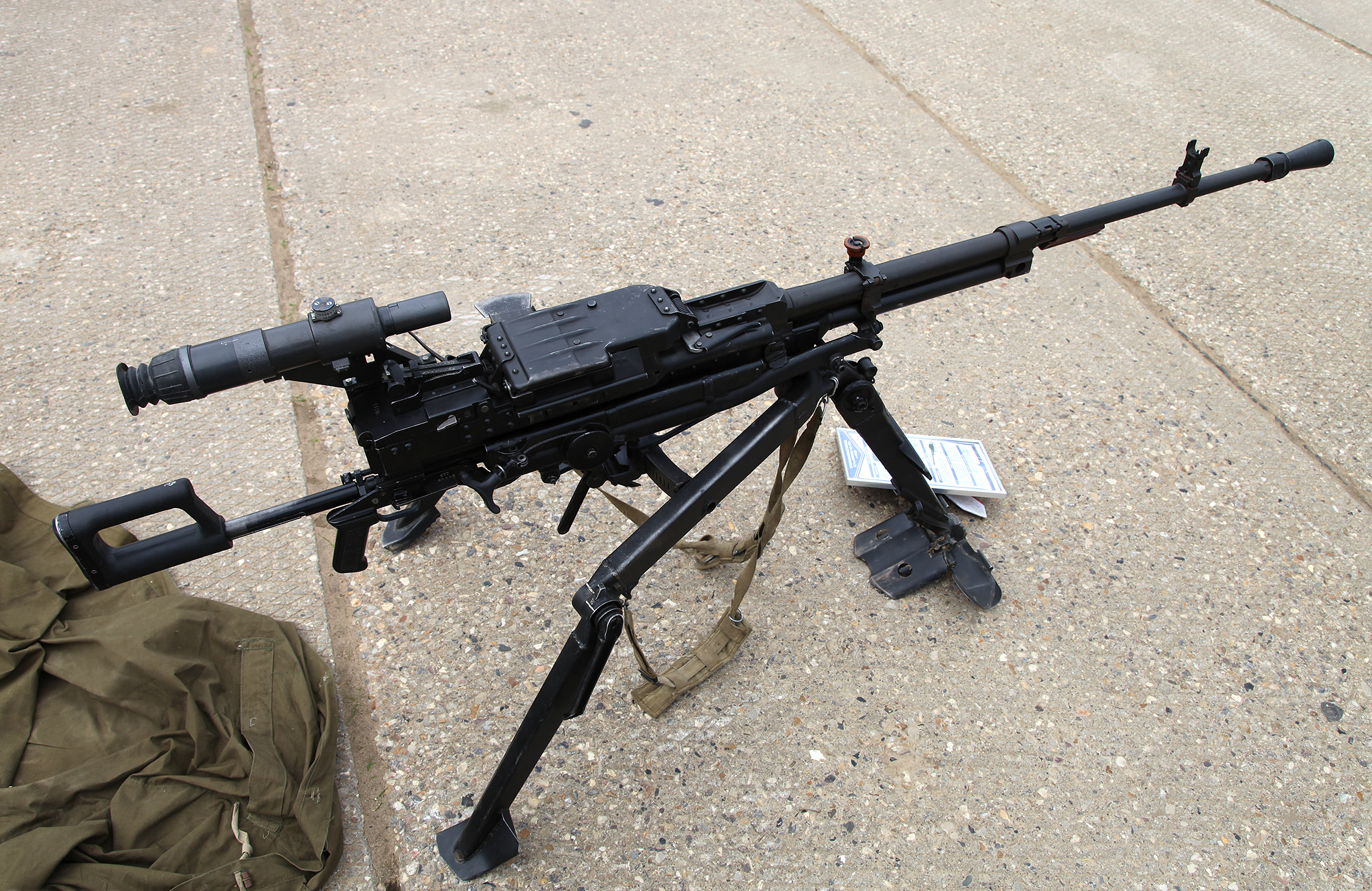
Three Russian-manufactured heavy machine guns were found on farmland at Blackstaff, five miles from Carrickmacross, County Monaghan, Republic of Ireland, and were believed to be part of the Irish Republican Army’s (IRA) arsenal.

Monday 14 January 2002

Increased security measures were put in place in north Belfast by the Police Service of Northern Ireland (PSNI) and the British Army (BA).

The move followed death threats made by the Ulster Defence Association (UDA) against Catholic teachers, and other Catholic employees of all schools, which was made on Friday 11 January 2002. The threat was extended to include Catholic postal workers following the killing of Danny McColgan on 12 January 2002.

Frank Bunting, then northern Secretary of the Irish National Teachers Organisation (INTO) and Chairman of the Teachers’ Council, was interviewed on British Broadcasting Corporation (BBC) Radio Ulster and called for the immediate lifting of the threats.

The PSNI arrested two men in connection with the killing of McColgan (12 January 2002).

[The two were released without charge on Tuesday 15 January 2002.]

Martin McGuinness (SF), then Education Minister, held a meeting with representatives of teaching unions and education officials to discuss what he called the “unacceptable” threat against Catholic teachers and school staff. David Cargo, then Chief Executive of the Belfast Education and Library Board, and Donal Flanagan, then Chief Executive of the Council for Catholic Maintained Schools, also attended the meeting. David Trimble (UUP), then First Minister, and Mark Durkan (SDLP), then Deputy First Minister, called for a lifting of the threats against Catholic teachers and Catholic postal workers.

Daniel McColgan

See Deaths & Events 12th January for more details

The two ministers described the killing of Daniel McColgan as horrific and said it had disgusted all right-thinking people. During a debate at the Northern Ireland Assembly a minute’s silence was observed by then Members of the Legislative Assembly (MLAs).

Postal deliveries throughout Northern Ireland were suspended as a mark of respect to McColgan. Postal workers in Derry took part in a silent march into the city centre to protest at the killing. The Irish Congress of Trade Unions (ICTU), called for a general half-day stoppage on Friday 18 January 2002 in protest at continuing attacks on workers. It also asked workers to observe a two-minute silence at midday on Tuesday 15 January 2002 to coincide with McColgan’s funeral. The union said the silence would be in memory of all workers and security force members murdered during the past 30 years.


—————————————————————————

Remembering all innocent victims of the Troubles

Today is the anniversary of the death of the following  people killed as a results of the conflict in Northern Ireland

“To live in hearts we leave behind is not to die

– Thomas Campbell

To the innocent on the list – Your memory will live  forever

– To  the Paramilitaries  –

There are many things worth living for, a few things worth dying for, but nothing worth killing for.

10 People   lost their lives on the 14th January  between  1973 – 1993

————————————————————

14 January 1973


Henry  Sandford,  (34)

Protestant
Status: Royal Ulster Constabulary (RUC),

Killed by: Irish Republican Army (IRA)
Killed in land mine attack on Royal Ulster Constabulary (RUC) mobile patrol, Aghnagar, near Ballygawley, County Tyrone.

————————————————————

14 January 1973


David Dorsett,   (37)

Protestant
Status: Royal Ulster Constabulary (RUC),

Killed by: Irish Republican Army (IRA)
Killed by booby trap bomb attached to Royal Ulster Constabulary (RUC) patrol car, Harbour Square, Derry.

————————————————————

14 January 1973


Mervyn Wilson,  (23)

Protestant
Status: Royal Ulster Constabulary (RUC),

Killed by: Irish Republican Army (IRA)
Killed by booby trap bomb attached to Royal Ulster Constabulary (RUC) patrol car, Harbour Square, Derry

————————————————————

14 January 1974


Andrew Jordan,  (41)

Protestant
Status: Civilian (Civ),

Killed by: Ulster Volunteer Force (UVF)
Found shot in field, Carrowdore, near Newtownards, County Down

————————————————————

14 January 1976


Samuel Millar,  (71)

Protestant
Status: Civilian (Civ),

Killed by: Ulster Defence Association (UDA)
Beaten to death at his farm, off Derrynoid Road, near Draperstown, County Derry. His body found, on information supplied to the British authorities, in disused quarry, Carmean, near Moneymore, County Derry, on 21 September 1977. He was a witness to a robbery.

————————————————————

14 January 1977


James Greer,   (27)

Protestant
Status: Royal Ulster Constabulary (RUC),

Killed by: Irish Republican Army (IRA)
Off duty. Killed by booby trap bomb attached to his car outside his parents’ home, Innishrush, near Portglenone, County Derry.

————————————————————

14 January 1981


Lindsay McDougall,   (36)

Protestant
Status: Royal Ulster Constabulary (RUC),

Killed by: Irish National Liberation Army (INLA)
Died six days after being shot while on Royal Ulster Constabulary (RUC) foot patrol, Great Victoria Street, Belfast

————————————————————

14 January 1986
Leo Scullion,  (55)

Catholic
Status: Civilian (Civ),

Killed by: Ulster Volunteer Force (UVF)
Nightwatchman. Found shot at his workplace, Working Men’s Club, Ligoniel, Belfast

————————————————————

14 January 1992
David Boyd,   (41)

Protestant
Status: Ulster Defence Association (UDA),

Killed by: Ulster Freedom Fighters (UFF)
Shot outside his home, Coronation Park, Dundonald, Belfast. Alleged informer.

————————————————————

14 January 1993
Anthony Butler,   (40)

Catholic
Status: ex-Irish Republican Army (xIRA),

Killed by: Ulster Freedom Fighters (UFF) 
Former republican prisoner. Shot while in friend’s home, Agra Street, Ballynafeigh, Belfast.

————————————————————


Buy Me A Coffee