I need to chill , the daily grind of everyday life gets a little boring sometimes , esp after 53 years of many crazy highs and at times epic lows .But I’ve got to be grateful for what I have. I know my life although far from perfect is much better than many others . Thank god for small mercies.
Hospital appointment tomorrow morning for over active thyroid , I ain’t complaining about it but my god I didn’t even know it was a thing until they found I had it after some blood tests. I knew there was something not quite right , but took ages to diagnose. Caused me loads of problems , mostly with my eyes which is kind of scary ,chronic tiredness , weight …..
Wifey going to Goa on Friday to teach yoga and go to a yoga retreat. I was invited along but not my kind of thing,. To be sure I like the philosophy of it all , just not bendy enough to do most of the moves. Might take up tai chi , that’s more my style. hee he.
She’s away for nine days so I’ll be in charge of the kids, two cats , one with only three legs and two very nervous goldfish. Hope I don’t drink myself to death. I wonder if she’ll make me a curry before she goes.. Hmmmm…
Wondering if I can be arsed joining the local astronomy club , or should I wait until spring/summer ? Star gazing is something I really enjoy, I have a telescope and all the equipment , but when no one else in the family is interested in sitting in the garden in the middle of winter in the dark and cold it can become quite a lonely venture. .Tried to get son interested, but he’s a teenager now, thinks he’s a gangster and hates me at least five times a day at the mo.
Wondering if that big asteroid gonna destroy the Earth and when we’ll ever hear the end of the harry and Meghan debate. Snzzzz……….
Worried and anxious about my forthcoming book , its a massive thing for me and I’m about to go down the rabbit hole and have no idea what I’ll find down there.
Considering if it would be a good idea to have a gin.
And finally Im testing out some new features on my blog and wanted to see how they all worked and looked , hence this boring post!
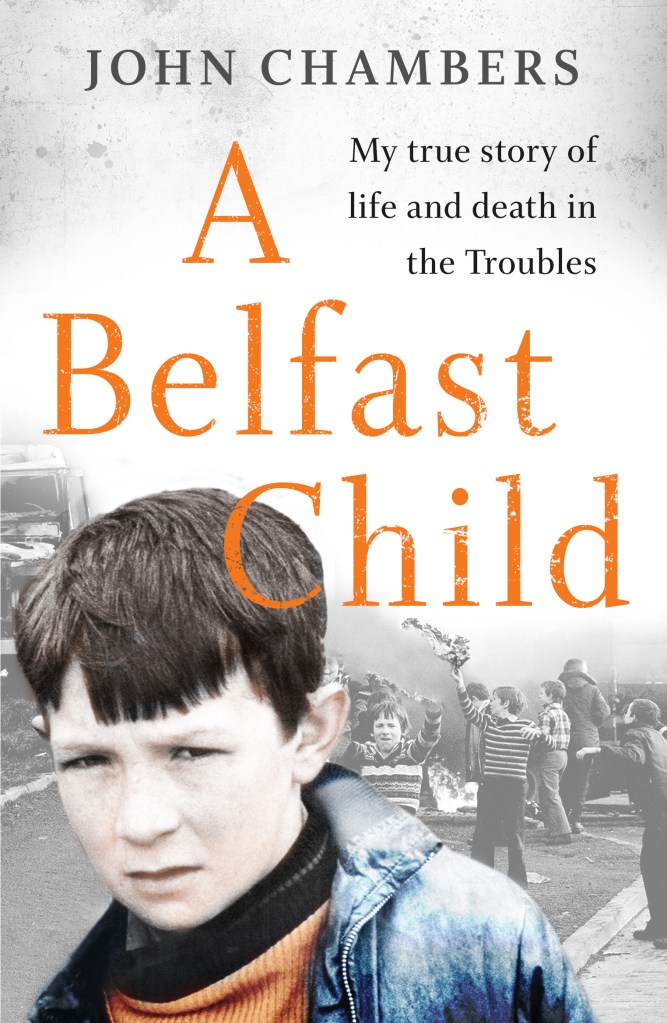
My autobiography: A Belfast Child is now available to pre-order on Amazon , launch date is 30th April.
Just a quick post to let you know my book: A Belfast Child is now avaiable on line from Amazon , see link below for details and how to order.
Cheers
My autobiography: A Belfast Child is now available to pre-order on Amazon , launch date is 30th April.
Image bel… twitter.com/i/web/status/1…— A Belfast Child (@ABelfastChild1) January 19, 2020
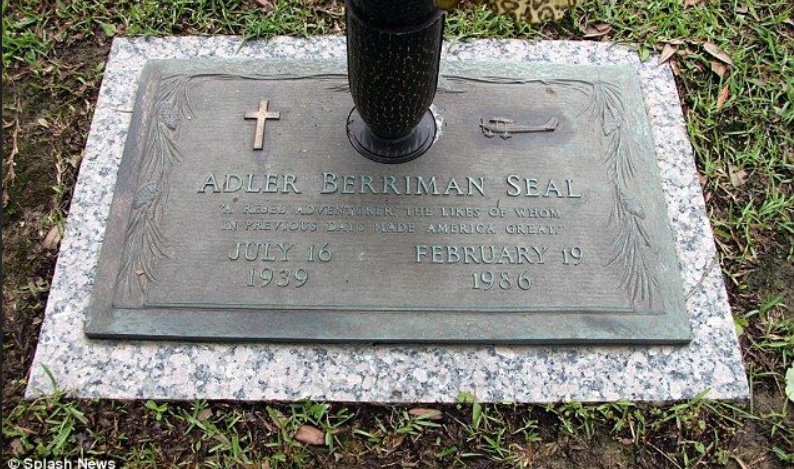
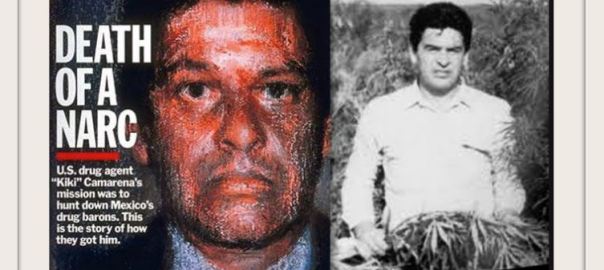
Adler Berriman “Barry” Seal (July 16, 1939 – February 19, 1986) was a Trans World Airlines (TWA) pilot who became a major drug smuggler for the Medellín Cartel. When Seal was convicted of smuggling charges, he became an informant for the Drug Enforcement Administration and testified in several major drug trials. He was murdered in 1986 by contract killers hired by Pablo Escobar, head of the Medellín Cartel.
——————————————————————–
The Rise & Fall of Pablo Escobar El Patron Medellin Cartel Documentary
——————————————————————–
Early life
Seal, born in Baton Rouge, Louisiana, was the son of Mary Lou (née Delcambre) and Benjamin Kurtis Seal, a candy wholesaler. Seal began flying as a teenager. According to his flight instructor, he was a naturally gifted pilot. He earned his student pilot certificate at 16 and a private pilot’s certificate at 17.
Seal joined TWA as a flight engineer in 1964 and was soon promoted to first officer, then captain, flying a Boeing 707 on a regular Western Europe route. He was one of the youngest 707 command pilots in the TWA fleet.
Seal’s career with TWA ended in July 1972, when he was arrested for involvement in a conspiracy to smuggle a shipment of plastic explosives to Mexico using a DC-4. The case was eventually dismissed in 1974 for prosecutorial misconduct, but TWA in the meantime fired Seal, who had falsely taken medical leave to participate in the scheme.
Drug smuggling career
According to statements Seal made after becoming a DEA informant, he began smuggling small quantities of cannabis . By 1978, he had begun flying significant loads of cocaine, because pound-for-pound it was more profitable.
In December 1979, Seal was arrested in Honduras after returning from a drug smuggling trip to Ecuador. Although the Honduran police did not find any cocaine, they did find an M-1 rifle, and Seal was imprisoned until July 1980.
Undeterred by his arrest, Seal expanded his operations upon returning to the United States. He hired William Bottoms, his ex-brother-in-law, as a pilot, and from 1980 on Bottoms was the main pilot in Seal’s smuggling enterprise, while Seal oversaw planning and operations.
Seal later began working for the Medellín Cartel as a pilot and drug smuggler. He transported numerous shipments of cocaine from Colombia and Panama to the United States, and earned as much as $1,300,000 per flight.
Seal was eventually arrested in connection with his drug smuggling activities. In a Florida federal court, he was indicted, tried, convicted and sentenced to 10 years in prison. After his sentencing, Seal approached the DEA and offered to cooperate with the government as an informant.
Federal officials agreed to use him in that capacity and mentioned his cooperation during hearings in which Seal sought a reduction of his sentence. With an agreement reached, Seal began working as a federal informant in March 1984.
According to the Frontline: Godfather of Cocaine investigation, Ernst “Jake” Jacobson was Seal’s DEA handler during this period. Jacobson claims he still has the high-tech message encrypter which he gave Seal.
“We made sure all of his aircraft were equipped with the most expensive cryptic radio communications we had ever seen at that time,”
Jacobson, testifying in 1988, told a House Judiciary Committee that Seal had flown to an airstrip in Nicaragua in an airplane that had cameras installed by the Central Intelligence Agency. Seal took pictures during the Nicaragua sting operation that showed Pablo Escobar, Jorge Luis Ochoa Vásquez, and other members of the Medellín Cartel loading kilos of cocaine onto a C-123 transport plane. Federico Vaughan, the Sandinista Minister of the Interior, who Seal claimed was a top aide of Tomas Borge‘s, was also photographed with Sandinista soldiers helping load the plane.
Pablo Escobar
Seal was both a smuggler and a DEA informant/operative in this sting operation against the Sandinista government in Nicaragua. In 1984, Seal flew from Nicaragua to Homestead Air Force Base in Florida with a shipment of cocaine that had been allegedly brokered through the Sandinista government.
This cocaine was seized by the DEA and was never received by the cartel’s distribution handlers in Florida, which in Medellín caused suspicion to fall upon Seal as the person responsible for this lost shipment.
Edmond Jacoby’s report in the July 17, 1984 issue of the Washington Times linked officials in the Sandinista government to the Medellín cartel and discussed Seal’s mission to Nicaragua. The public disclosures jeopardized Seal’s life and quickly brought an end to the sting operation designed to capture the cartel’s leaders.
Questioned about the identity of the source, Jacobson replied, “I heard that the leak came from an aide in the White House”. He stated that Iran–Contra figureOliver North had attended two meetings about the sting operation and had motivation to release the information. UPI reported: “By linking the Sandinistas with drug traffic … aid to the rebels accused of human rights violations might seem more palatable”.
Subcommittee chairman William J. Hughes strongly suggested that North was the source of the leak, but Representative Bill McCollum said,
“…we don’t know who leaked this. No one has been able to tell us”.
Citing testimony of DEA Administrator John C. Lawn, the report of the Kerry Committee released in December 1988 pinned the leak on North stating he “decided to play politics with the issue”. In an interview with Frontline, North said he was told by his superiors on the National Security Council to brief SenatorPaula Hawkins about the operation, but he denied leaking the report.
Hawkins told Frontline that neither she nor her staff leaked the information after the briefing.Jacoby later denied that North was the source of his story and attributed it to a deceased staff member for Representative Dan Daniel.
The Wall Street Journal also printed the story, contributing to media coverage that indirectly exposed Seal’s involvement in the operation. The articles also exposed the Colombian cartel leaders and Nicaraguan Interior Minister who had been photographed moving cocaine onto Seal’s aircraft. Despite these pressures, Seal went ahead and testified with the pictures taken during the trip showing Sandinista officials in Nicaragua brokering a cocaine deal with members of Colombia’s Medellín Cartel.
Murder
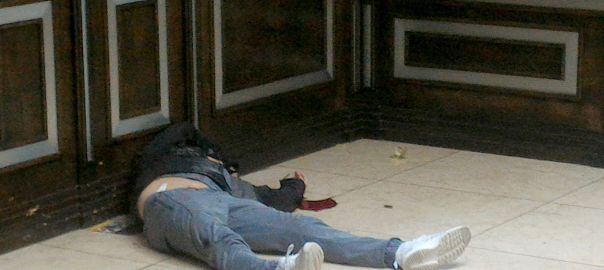
Seal was sentenced to work in public service at the Salvation Army facility on Airline Highway (U.S. 61), in Baton Rouge, as a modification by the judge to Seal’s original plea deal. On February 19, 1986, Seal was shot to death in front of the site. His murder abruptly brought the DEA’s investigation to an end.
Barry Seal | American Dope
Colombian assassins sent by the Medellín Cartel were apprehended while trying to leave Louisiana, soon after Seal’s murder. Authorities thus concluded Seal’s murderers were hired by Ochoa. The killers were indicted by a state grand jury on March 27, 1986.
In May 1987, Luis Carlos Quintero-Cruz, Miguel Vélez (died in custody 2015) and Bernardo Antonio Vásquez were convicted of first degree murder in Seal’s death, and sentenced to life in prison without parole.
Barry Seal’s Grave
Louisiana Attorney General William Guste wrote to United States Attorney General Edwin Meese criticizing the government’s failure to protect Seal as a witness. At Guste’s request, Meese launched an investigation to determine whether or not attorneys in Louisiana, Miami, and Washington had mishandled the case, and to determine whether or not Seal should have been forced into protective custody. Government attorneys stated that Seal placed himself in danger by refusing to move his family and enter a witness protection program.
In 1991, cartel member Max Mermelstein testified that he had been instructed in December 1984 either to kidnap Seal and return him to Colombia, or to murder him. The reward to kidnap Seal was $1 million, and the reward to kill him was $500,000.
Personal life
Deborah DuBois his third wife and children
Seal married three times; the first to Barbara Dodson from 1963 to 1971 and to Lynn Ross from 1971 to 1972 – ended in divorce. His marriage to Deborah DuBois, in 1973, ended with his death in 1986. Seal had 6 children, 2 from his first wife, one child from a relationship he had in between marriages and three more with Debbie.
Media depictions
Films
Seal is portrayed by Dennis Hopper in the docudramaDoublecrossed (1991), which prominently features Seal’s co-pilot and collaborator Emile Camp[27][28] (portrayed by G. W. Bailey), although some of the Camp plotlines stand in for actual events involving William Roger Reeves, who met Seal in jail and introduced him to the Medellín Cartel.
Seal is portrayed by Michael Paré in the American crime drama film The Infiltrator (2016), in two brief, historically inaccurate scenes that exercise dramatic license to depict the film’s title character, Robert Mazur, as a passenger in a car being driven by Seal who is killed in a motorcycle drive-by shooting.
Seal is portrayed by Tom Cruise in the crime drama-comedy film American Made (2017), loosely based on Seal’s life, produced by Imagine Entertainment. Little of the film is historically accurate; most of the plot, such as the assassination of Seal’s brother-in-law, were invented for purposes of the film.
Television
Seal is portrayed by theater director Thaddeus Phillips in the 2013 TV series Alias El Mexicano.
Seal is portrayed by Dylan Bruno in Season 1, Episode 4, of the Netflix series Narcos (2015).
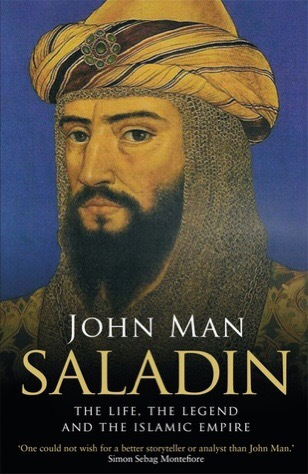
Saladin remains one of the most iconic figures of his age. As the man who united the Arabs and saved Islam from Christian crusaders in the 12th century, he is the Islamic world’s preeminent hero. Ruthless in defence of his faith, brilliant in leadership, he also possessed qualities that won admiration from his Christian foes. He knew the limits of violence, showing such tolerance and generosity that many Europeans, appalled at the brutality of their own people, saw him as the exemplar of their own knightly ideals.
My thoughts ?
A fascinating and engaging easy to follow account of the life and times of one of the greatest and most respected Muslim leaders ever to have lived in my humble opinion. At a time when religious wars dominated the political landscape and European Christians considered it a religious duty to wage holy war , Saladin’s story unfolds and what a story it is. With a cast of characters as diverse as Raynald of Châtillon , ( evil bastard ) , Richard the Lion Heart ( treacherous ) and the mysterious and much feared assassins this is a page turner and I read it within two days.
Well worth a read for those interested in this tumultuous period of history and the legacy of God’s ” Holy Warriors. “
But Saladin is far more than a historical hero. Builder, literary patron and theologian, he is a man for all times, and a symbol of hope for an Arab world once again divided. Centuries after his death, in cities from Damascus to Cairo and beyond, to the Arabian Peninsula and the Gulf, Saladin continues to be an immensely potent symbol of religious and military resistance to the West. He is central to Arab memories, sensibilities and the ideal of a unified Islamic state.
In this authoritative biography, historian John Man brings Saladin and his world to life in vivid detail. Charting his rise to power, his struggle to unify the warring factions of his faith, and his battles to retake Jerusalem and expel Christian influence from Arab lands, Saladin explores the life and the enduring legacy of this champion of Islam, and examines his significance for the world today.
Raynald of Châtillon, also known as Reynald or Reginald of Châtillon (French: Renaud de Châtillon; c. 1125 – 4 July 1187), was Prince of Antioch from 1153 to 1160 or 1161, and Lord of Oultrejordain from 1175 until his death. He was born as his father’s second son into a French noble family. After losing a part of his patrimony, he joined the Second Crusade in 1147. He settled in the Kingdom of Jerusalem and served in the royal army as a mercenary.
Raynald married Constance, the reigning Princess of Antioch, in 1153, in spite of her subjects’ opposition. He was always in need of funds. He captured and tortured Aimery of Limoges, Latin Patriarch of Antioch, because Aimery had refused to pay a subsidy to him. Raynald launched a plundering raid in Cyprus in 1155, causing great destruction. Four years later, the Byzantine Emperor, Manuel I Komnenos, came to Antioch at the head of a large army, forcing Raynald to beg for his mercy. Raynald made a raid in the valley of the river Euphrates at Marash to seize booty from the local peasants in 1160 or 1161, but he was captured by the governor of Aleppo.
Raynald was held in prison until 1176. After his release for a large ransom, he did not return to Antioch, because his wife had meanwhile died. He married Stephanie of Milly, the wealthy heiress of Oultrejordain. Since Baldwin IV of Jerusalem also granted Hebron to him, Raynald was one of the wealthiest barons of the realm. He controlled the caravan routes between Egypt and Syria. Baldwin, who suffered from leprosy, made him regent in 1177.
Raynald led the crusader army that defeated Saladin at the Battle of Montgisard. He was the only Christian leader to pursue an offensive policy against Saladin, making plundering raids against the caravans travelling near his domains. He built a fleet of five ships which plundered the coast of the Red Sea, threatening the route of the Muslim pilgrims towards Mecca in early 1183. Saladin pledged that he would never forgive Raynald.
Raynald was a firm supporter of Baldwin IV’s sister, Sybilla, and her husband, Guy of Lusignan, during conflicts regarding the succession of the king. Sibylla and Guy were able to seize the throne in 1186 due to Raynald’s co-operation with her uncle, Joscelin III of Courtenay. Raynald attacked a caravan travelling from Egypt to Syria in late 1186 or early 1187, claiming that the truce between Saladin and the Kingdom of Jerusalem did not bind him. After Raynald refused to pay a compensation, Saladin invaded the kingdom and annihilated the crusader army in the Battle of Hattin. Raynald was captured in the battlefield. Saladin personally beheaded him after he refused to convert to Islam. Most historians have regarded Raynald as an irresponsible adventurer whose lust for booty caused the fall of the Kingdom of Jerusalem. On the other hand, Bernard Hamilton says that he was the only crusader leader who tried to prevent Saladin from unifying the nearby Muslim states.
An-Nasir Salah ad-Din Yusuf ibn Ayyub (Arabic: صلاح الدين يوسف بن أيوب / ALA-LC: Ṣalāḥ ad-Dīn Yūsuf ibn Ayyūb; Kurdish: سەلاحەدینی ئەییووبی / ALA-LC: Selahedînê Eyûbî), known as Salah ad-Din or Saladin (/ˈsælədɪn/; 1137 – 4 March 1193), was the first sultan of Egypt and Syria and the founder of the Ayyubid dynasty. A SunniMuslim of Kurdish ethnicity, Saladin led the Muslim military campaign against the Crusader states in the Levant. At the height of his power, his sultanate included Egypt, Syria, Upper Mesopotamia, the Hejaz, Yemen and other parts of North Africa.
He was originally sent to Fatimid Egypt in 1164 alongside his uncle Shirkuh, a general of the Zengid army, on the orders of their lord Nur ad-Din to help restore Shawar as vizier of the teenage Fatimid caliph al-Adid. A power struggle ensued between Shirkuh and Shawar after the latter was reinstated. Saladin, meanwhile, climbed the ranks of the Fatimid government by virtue of his military successes against Crusader assaults against its territory and his personal closeness to al-Adid.
After Shawar was assassinated and Shirkuh died in 1169, al-Adid appointed Saladin vizier, a rare nomination of a Sunni Muslim to such an important position in the Isma’ili Shia caliphate. During his tenure as vizier, Saladin began to undermine the Fatimid establishment and, following al-Adid’s death in 1171, he abolished the Fatimid Caliphate and realigned the country’s allegiance with the Sunni, Baghdad-based Abbasid Caliphate.
In the following years, he led forays against the Crusaders in Palestine, commissioned the successful conquest of Yemen, and staved off pro-Fatimid rebellions in Upper Egypt. Not long after Nur ad-Din’s death in 1174, Saladin launched his conquest of Syria, peacefully entering Damascus at the request of its governor. By mid-1175, Saladin had conquered Hama and Homs, inviting the animosity of other Zengid lords, the official rulers of Syria’s various regions.
Soon after, he defeated the Zengid army at the Battle of the Horns of Hama and was thereafter proclaimed the “Sultan of Egypt and Syria” by the Abbasid caliph al-Mustadi. Saladin made further conquests in northern Syria and Jazira, escaping two attempts on his life by the “Assassins“, before returning to Egypt in 1177 to address issues there. By 1182, Saladin had completed the conquest of Muslim Syria after capturing Aleppo, but ultimately failed to take over the Zengid stronghold of Mosul.
Under Saladin’s command, the Ayyubid army defeated the Crusaders at the decisive Battle of Hattin in 1187, and thereafter wrested control of Palestine—including the city of Jerusalem—from the Crusaders, who had conquered the area 88 years earlier. Although the Crusader Kingdom of Jerusalem continued to exist until the late 13th century, its defeat at Hattin marked a turning point in its conflict with the Muslim powers of the region. Saladin died in Damascus in 1193, having given away much of his personal wealth to his subjects. He is buried in a mausoleum adjacent to the Umayyad Mosque. Saladin has become a prominent figure in Muslim, Arab, Turkish and Kurdish culture, and he has often been described as being the most famous Kurd in history.
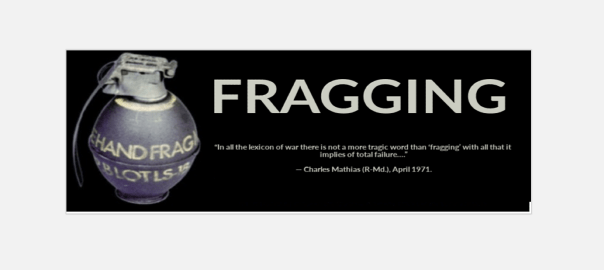
The deliberate killing or attempted killing by a soldier of a fellow soldier………
Fragging is the deliberate killing or attempted killing by a soldier of a fellow soldier, usually a superior officer or non-commissioned officer (NCO). The word was coined by U.S. military personnel during the Vietnam War, when such killings were most often attempted with a fragmentation grenade, sometimes making it appear as though the killing was accidental or during combat with the enemy. The term fragging is now often used to encompass any means used to deliberately and directly cause the death of military colleagues.
What was ‘Fragging’? (The Vietnam War)
The high number of fragging incidents in the latter years of the Vietnam War was symptomatic of the unpopularity of the war with the American public and the breakdown of discipline in the U.S. Armed Forces. Documented and suspected fragging incidents totaled nearly nine hundred from 1969 to 1972
Motivation
Soldiers have killed colleagues, especially superior officers, since the beginning of armed conflict, with many documented instances throughout history (one such attempt was on unpopular Civil War general Braxton Bragg). However, the practice of fragging seems to have been relatively uncommon in American armies until the Vietnam War. The prevalence of fragging was partially based on the ready availability of fragmentation hand grenades. Grenades were untraceable to an owner and did not leave any ballistic evidence. M18 Claymore mines and other explosives were also occasionally used in fragging, as were firearms, although the term, as defined by the military during the Vietnam War, applied only to the use of explosives to kill fellow soldiers.
Most fragging incidents were in the Army and Marine Corps. Fragging was rare among Navy and Air Force personnel who had less access to grenades and weapons than did soldiers and Marines.
The first known incidents of fragging in South Vietnam took place in 1966, but events in 1968 appear to have catalyzed an increase in fragging. After the Tet Offensive in January and February 1968, the Vietnam War became increasingly unpopular in the United States and among American soldiers in Vietnam, many of them conscripts. Secondly, racial tensions between white and African-American soldiers and Marines increased after the assassination of Martin Luther King in April 1968.
With soldiers reluctant to risk their lives in what was perceived as a lost war, fragging was seen by some enlisted men:
“as the most effective way to discourage their superiors from showing enthusiasm for combat.
Morale plummeted among soldiers and marines. By 1971, a U.S. Army colonel declared in the Armed Forces Journal that:
“The morale, discipline, and battleworthiness of the U.S. Armed Forces are, with a few salient exceptions, lower and worse than at any time in this century and possibly in the history of the United States.”
The U.S. military reflected social problems and issues in the U.S. such as racism, drug use, and resentment toward authoritarian leaders. As the U.S. began to withdraw its military forces from Vietnam, some American enlisted men and young officers lost their sense of purpose for being in Vietnam, and the relationship between enlisted men and their officers deteriorated.
The resentment directed from enlisted men toward older officers was exacerbated by generational gaps, as well as different perceptions of how the military should conduct itself. Enforcement of military regulations, especially if done overzealously, led to troops’ complaining and sometimes threats of physical violence directed toward officers.
A number of factors may have influenced the incidence of fragging. The demand for manpower for the war in Vietnam caused the armed forces to lower their standards for inducting both officers and enlisted men. The rapid rotation of personnel, especially of officers who served (on average) less than six months in command roles, decreased the stability and cohesion of military units.
Most important of all, perhaps, was the loss of purpose in fighting the war, as it became apparent to all that the United States was withdrawing from the war without having achieved any sort of victory. Morale and discipline deteriorated.
Most fragging was perpetrated by enlisted men against leaders. Enlisted men, in the words of one company commander, “feared they would get stuck with a lieutenant or platoon sergeant who would want to carry out all kinds of crazy John Wayne tactics, who would use their lives in an effort to win the war single-handedly, win the big medal, and get his picture in the hometown paper.”
Harassment of subordinates by a superior was another frequent motive. The stereotypical fragging incident was of “an aggressive career officer being assaulted by disillusioned subordinates.” Several fragging incidents resulted from alleged racism between African-American and white soldiers. Attempts by officers to control drug use caused others. Most known fragging incidents were carried out by soldiers in support units rather than soldiers in combat units.
Soldiers sometimes used non-lethal smoke and tear-gas grenades to warn superiors that they were in danger of being fragged if they did not change their behavior. A few instances occurred—and many more were rumored—in which enlisted men collected “bounties” on particular officers or non-commissioned officers to reward soldiers for fragging them.
Fragging: Why U. S. Soldiers Assaulted Their Officers In Vietnam
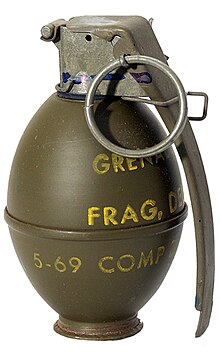
M26 grenade, issued to the U.S. Army and U.S. Marines in the Vietnam War, used in many fragging incidents
Fragging incidents
1969
1970
1971
1972
Army
96
209
222
28
Marine Corps
30+
50+
30+
5
Suspected
30
62
111
31
Total
156+
321+
363+
64
Deaths
46
38
12
3
Note: Statistics were not kept before 1969.
According to author George Lepre, the total number of known and suspected fragging cases by explosives in Vietnam from 1969 to 1972 totaled nearly 900 with 99 deaths and many injuries. This total is incomplete as some cases were not reported, nor were statistics kept before 1969 although several incidents from 1966 to 1968 are known. Most of the victims or intended victims were officers or non-commissioned officers. The number of fraggings increased in 1970 and 1971 even though the U.S. military was withdrawing and the number of U.S. military personnel in Vietnam was declining.
An earlier calculation by authors Richard A. Gabriel and Paul L. Savage, estimated that up to 1,017 fragging incidents may have taken place in Vietnam causing 86 deaths and 714 injuries of U.S. military personnel, the majority officers and NCOs.
Fragging statistics include only incidents involving explosives, most commonly grenades. Several hundred murders of U.S. soldiers by firearms occurred in Vietnam but most were of enlisted men killing enlisted men of nearly equal rank. Fewer than 10 officers are known to have been murdered by firearms. However, rumors and claims abound of deliberate killing of officers and non-commissioned officers by enlisted men under battlefield conditions. The frequency and number of these fraggings, indistinguishable from combat deaths, cannot be quantified.
Response
The U.S. military’s responses to fragging incidents included greater restrictions on access to weapons, especially grenades, for soldiers in non-combat units and “lockdowns” after a fragging incident in which a whole unit was isolated until an investigation was concluded. For example, in May 1971, the U.S. Army in Vietnam temporarily halted the issuance of grenades to nearly all its units and soldiers in Vietnam, inventoried stocks of weapons, and searched soldier’s quarters, confiscating weapons, ammunition, grenades, and knives.
This action, however, failed to reduce fragging incidents as soldiers could easily obtain weapons in a flourishing black market among nearby Vietnamese communities. The U.S. military also attempted to diminish adverse publicity concerning fragging and the security measures it was taking to reduce it.
Only a few fraggers were identified and prosecuted. It was often difficult to distinguish between fragging and enemy action. A grenade thrown into a foxhole or tent could be a fragging, or the action of an enemy infiltrator or saboteur. Enlisted men were often close-mouthed in fragging investigations, refusing to inform on their colleagues out of fear or solidarity.
Although the sentences prescribed for fragging were severe, the few men convicted often served fairly brief prison sentences. Ten fraggers were convicted of murder and served sentences ranging from ten months to thirty years with a mean prison time of about nine years.
Influence
In the Vietnam War, the threat of fragging caused many officers and NCOs to go armed in rear areas and to change their sleeping arrangements as fragging often consisted of throwing a grenade into a tent where the target was sleeping. For fear of being fragged, some leaders turned a blind eye to drug use and other indiscipline among the men in their charge. Fragging, the threat of fragging, and investigations of fragging sometimes disrupted or delayed tactical combat operations. Officers were sometimes forced to negotiate with their enlisted men to obtain their consent before undertaking dangerous patrols.
The breakdown of discipline, including fragging, was an important factor leading to the creation of an all-volunteer military force by the United States and the termination of conscription. The last conscript was inducted into the army in 1973. The volunteer military moderated some of the coercive methods of discipline previously used to maintain order in military ranks.
1847 – Mexican–American War: On two occasions, Lt.Col. Braxton Bragg (later a Confederate General) survived attempts on his life. Once an artillery shell exploded under his bed.
1894 – Battle of the Yalu River: Admiral Ding Ruchang‘s legs were crushed, either due to a construction defect or the deliberate misfiring of his ship’s main battery by the ship’s captain.
World War I
According to General Frank Percy Crozier, an unpopular British sergeant was killed when one of his men came up behind him and dropped an unpinned hand grenade down his trousers.
Vietnam War (U.S. forces)
On 21 April 1969, a grenade was thrown into the company office of K Company, 9th Marines, at Quảng Trị Combat Base, RVN; First Lieutenant Robert T. Rohweller died of wounds he received in the explosion. Private Reginald F. Smith pleaded guilty to the premeditated murder of Rohweller and was sentenced to 40 years’ imprisonment; he died in custody on 25 June 1982.
On 15 March 1971, a grenade tossed into an officer billet at Bien Hoa Army Airfield killed Lieutenants Thomas A. Dellwo and Richard E. Harlan of the 1st Cavalry Division (Airmobile); Private E-2 Billy Dean Smith was charged with killing the officers but was acquitted in November 1972.
Vietnam War (Australian forces)
On 23 November 1969, Lieutenant Robert Thomas Convery of the 9th Battalion of the Royal Australian Regiment was killed when a grenade exploded while he was sleeping in his tent at Nui Dat, South Vietnam. Private Peter Denzil Allen was convicted of Convery’s murder and served ten years and eight months of a life sentence in Risdon Prison.
On Christmas Day 1970, Sergeants Allan Brian Moss and John Wallace Galvin were shot dead and Sergeant Frederick Edwin Bowtell injured when Private Paul Ramon Ferriday opened fire with his rifle into the Sergeant’s Mess of the Royal Australian Army Service Corps at Nui Dat, South Vietnam after an all-day drinking session. Ferriday was convicted on two counts of manslaughter and one of assault with a weapon, and served eight years of a ten-year sentence.
Middle East peacekeeping
1982: Irish Army Private Michael McAleavey, serving at Tebnine with the United Nations Interim Force in Lebanon, opened fire with an FN FALbattle rifle and shot dead Corporal Gregory Morrow, Private Thomas Murphy and Private Peter Burke. He originally claimed they had been killed by Lebanese gunmen, but later admitted the killings, saying he had “snapped” due to dehydration and heat exhaustion. He received a life sentence at a court martial, being paroled in 2009.
In Country: A Vietnam Story
War in Afghanistan
17 August 2002, British Army Sergeant Robert Busuttil of the Royal Logistic Corps was shot dead by subordinate Corporal John Gregory during a barbecue at Kabul International Airport. It was later revealed that Corporal Gregory had been drinking and the two men had earlier been involved in an altercation. It was in the immediate aftermath of this that Corporal Gregory returned with his weapon loaded, and fired up to ten rounds killing Sergeant Busuttil as he lay in a hammock before turning the weapon on himself.
Iraq War (U.S. forces)
On 23 March 2003, in Kuwait, Sergeant Hasan Karim Akbar cut power to his base, threw four hand grenades into three tents where fellow members of the 101st Airborne Division were sleeping, and opened fire with his rifle when the personnel ran to take cover. Army Captain Christopher S. Seifert and Air Force Major Gregory L. Stone were killed, and fourteen other soldiers were wounded by shrapnel. Akbar was tried by court martial at Fort Bragg, North Carolina, in 2005. On 21 April 2005, Akbar was found guilty of two counts of premeditated murder and three counts of attempted premeditated murder and was sentenced to death on 28 April.
On 11 May 2009, Sergeant John Russell opened fire on Camp Liberty with an M16A2 rifle and shot dead five U.S. military personnel (U.S. Army Specialist Jacob D. Barton, Sergeant Christian E. Bueno-Galdos, Major Matthew P. Houseal, Private First Class Michael E. Yates, and U.S. Navy Commander Charles K. Springle). Russell pleaded guilty to five counts of premeditated murder and was sentenced to life in prison without the possibility of parole.
Royal Navy
On 8 April 2011, during a port visit to Southampton, Able Seaman Ryan Donovan abandoned his sentry post at the boarding ramp of submarine HMS Astute, and opened fire on CPOs David McCoy and Chris Brown after they confronted him at the submarine’s weapons locker; he then forced his way into the control room and opened fire, killing Lt Cdr Ian Molyneux and wounding Lt Cdr Christopher Hodge before being tackled to the ground by a visiting dignitary as he reloaded. Donovan pleaded guilty to Molyneux’s murder and the attempted murders of Hodge, Brown, and McCoy and was sentenced to life imprisonment with a minimum of 25 years.
Going Underground – The Jam: Iconic Songs & the story behind them
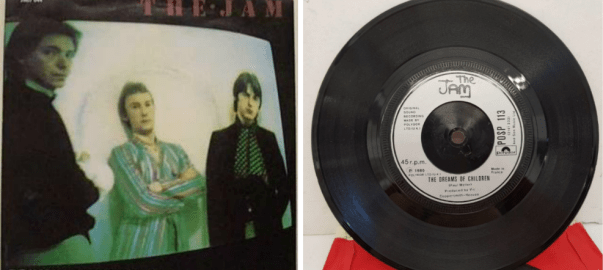
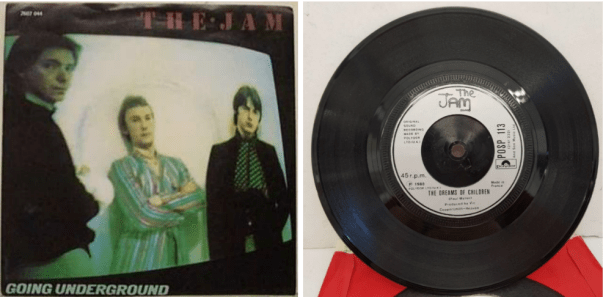
“Going Underground” is the first British #1 chart single by The Jam, released in March 1980. It went straight in at #1 in the UK Singles Chart, spending three weeks at the top.
It was the first of three instant chart-toppers for the group
Going Underground
Song profile
“Going Underground” was not released on any of the band’s six studio albums, although it has appeared on many compilations and re-releases since then. The song was released as a double A-side with “Dreams of Children”, which originally had been intended to be the sole A-side; following a mix-up at the pressing plant, the single became a double A-side, and DJs tended to choose the more melodic “Going Underground” to play on the radio.
The song was ranked at #2 among the “Tracks of the Year” for 1980 by NME. In March 2005, Q magazine placed “Going Underground” at #73 in its list of the 100 Greatest Guitar Tracks, and in October 2006, placed it at #98 in its list of the 100 Greatest Songs Ever.
Jam Facts:
The band released 18 consecutive Top 40 singles in the United Kingdom, from their debut in 1977 to their break-up in December 1982, including four number one hits
“The Eton Rifles“ (1979)”Going Underground” / “Dreams of Children” (1980)”Start!“ (1980)
My Thoughts ?
Me in my Mod days
Being an old Mod and a Jam super-fan this was one of the first Jam records I bought and from the first moment I heard it I loved it and became obsessed with the Jam and this set me on the road to becoming a Mod and the best years of my teenage/young adult life in Belfast, what I can remember anyways. The Jam became the sound track to my crazy teenage odyssey and I came to love everything about them and the Mod way of life and even to this day I still love all the Jams stuff and listen to it whenever the feelings take me , which is a few times a week at least.
My fav Jam album ?
Its a hard one but its between Setting Sons & Sound Affects , although I love In the City and This is a Modern World also . Grrrr…. Its like trying to choose which of your kids or pets you love best , an impossible task and Im the same with Jam albums I feel i’d be betraying those I left out. Going Underground is a personal fav of mine for the path it set me on but I have to say Thick as Thieves and That’s Entertainment are two of my fav Jam tunes off all time.
Some people might say my life is in a rut But I’m quite happy with what I’ve got People might say that I should strive for more But I’m so happy I can’t see the point
Something’s happening here today A show of strength with your boy’s brigade And I’m so happy and you’re so kind You want more money – of course I don’t mind To buy nuclear textbooks for atomic crimes And the public gets what the public wants
But I want nothing this society’s got I’m going underground (going underground) Well, let the brass bands play and feet start to pound Going underground (going underground) Well, let the boys all sing and let the boys all shout for tomorrow
Some people might get some pleasure out of hate Me, I’ve enough already on my plate People might need some tension to relax Me, I’m too busy dodging between the flak
What you see is what you get You’ve made your bed, you’d better lie in it You choose your leaders and place your trust As their lies wash you down and their promises rust You’ll see kidney machines replaced by rockets and guns And the public wants what the public gets
But I don’t get what this society wants I’m going underground (going underground) Well, let the brass bands play and feet start to pound Going underground (going underground) So let the boys all sing and let the boys all shout for tomorrow
La la la la…
We talk and we talk until my head explodes I turn on the news and my body froze These braying sheep on my TV screen Make this boy shout, make this boy scream!
Going underground, I’m going underground!
La la la la…
These braying sheep on my TV screen Make this boy shout, make this boy scream!
I’m going underground (going underground) Well, let the brass bands play and feet start to pound Going underground (going underground) Well, let the boys all sing and let the boys all shout, Going underground (going underground) Well, let the brass bands play and feet go pow, pow, pow Going underground (going underground) So let the boys all sing and let the boys all shout for tomorrow
The comedy band Amateur Transplants released a two-minute parody titled “London Underground” in 2005 in the light of the December strike. It became a popular download in the United Kingdom.
Jam Facts:
Jam biographer Sean Egan said of the Jam that they “took social protest and cultural authenticity to the top of the charts.
Daryl Denham released a version of the song titled “Go England” in 2002 after Weller gave permission for it to be adapted as a football song.
Jam Facts:
Paul Weller on becoming a Mod
“I saw that through becoming a Mod it would give me a base and an angle to write from, and this we eventually did. We went out and bought suits and started playing Motown, Stax and Atlantic covers. I bought a Rickenbacker guitar, a Lambretta GP 150 and tried to style my hair like Steve Marriott‘s circa ’66.
Dreams of Children
“Going Underground” was coupled with “Dreams of Children” as a double A-side. It opens and is intermittently accentuated with a backmasked sample of the band’s 1979 song “Thick as Thieves“. In the US the backwards intro was edited out making the single 10 seconds shorter than the UK Version. This US edit is available on the best-of compilation Snap!.
I Don’t Like Mondays The Boomtown Rats 13 July 1979 Iconic Songs & the story behind them “I Don’t Like Mondays” is a song by the Irish new wave band the Boomtown Rats about the Cleveland Elementary School shooting in San Diego. It was released in 1979 as the lead single from their third studio album, The Fine Art of Surfacing. The song was a number-one … Continue reading I Don’t Like Mondays – the Boomtown Rats: Iconic Songs & the story behind them→
Lola – The Kinks : Iconic Songs Iconic Songs and the story behind them “Lola” is a song written by Ray Davies and performed by English rock band the Kinks on their album Lola Versus Powerman and the Moneygoround, Part One. The song details a romantic encounter between a young man and a possible cross-dresser, whom he meets in a club in Soho, London. … Continue reading Lola – The Kinks : Iconic Songs & the story behind them→
Love Will Tear Us Apart Joy Division June 1980 Iconic Songs & the story behind them “Love Will Tear Us Apart” is a song by English rock band Joy Division, released in June 1980. Its lyrics were inspired by lead singer Ian Curtis‘ marriage problems and frame of mind before his suicide in May 1980 Recording Joy Division first … Continue reading Love Will Tear Us Apart – Joy Division: Iconic Songs & the story behind them→
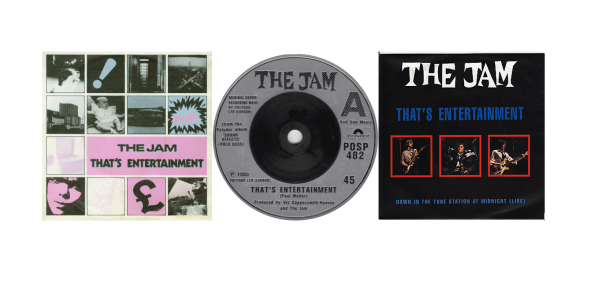
The Jam That’s Entertainment January 1981 The Jam : Iconic Songs & the story behind them “That’s Entertainment” is a 1980 song by British punk–mod revivalist group the Jam from their fifth album, Sound Affects. Although never released as a domestic single in the UK during the band’s lifetime, “That’s Entertainment” nonetheless charted as an import single (backed by a … Continue reading That’s Entertainment -The Jam : Iconic Songs & the story behind them→
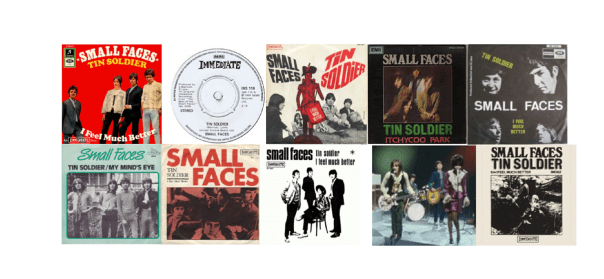
Small Faces TIN SOLDIER 2nd December 1967 Tin Soldier – Small Faces : Iconic Songs & the story behind them “Tin Soldier” is a song released by the English rock band Small Faces on 2 December 1967, written by Steve Marriott (credited to Marriott/Lane). The song peaked at number nine in the UK singles chart and number 38 in Canada. It has since … Continue reading Tin Soldier – Small Faces : Iconic Songs & the story behind them→
Going Underground – The Jam The Jam Going Underground March 1980 Going Underground – The Jam: Iconic Songs & the story behind them “Going Underground” is the first British #1 chart single by The Jam, released in March 1980. It went straight in at #1 in the UK Singles Chart, spending three weeks at the top. It was the first … Continue reading Going Underground – The Jam: Iconic Songs & the story behind them→
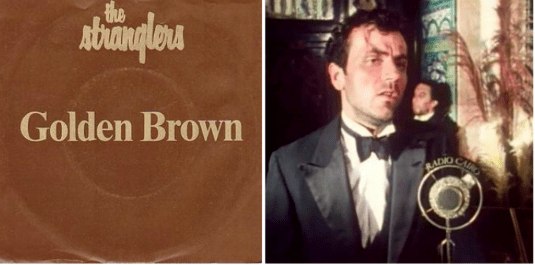
The Stranglers Golden Brown January 1982 Golden Brown – The Stranglers: Iconic Songs & the story behind them Golden Brown – The Stranglers “Golden Brown” is a song by the English rock band the Stranglers. It was released as a 7″ single in December 1981 in the United States and in January 1982 in the United … Continue reading Golden Brown – The Stranglers: Iconic Songs & the story behind them→
Golden Brown – The Stranglers: Iconic Songs & the story behind them
Golden Brown – The Stranglers
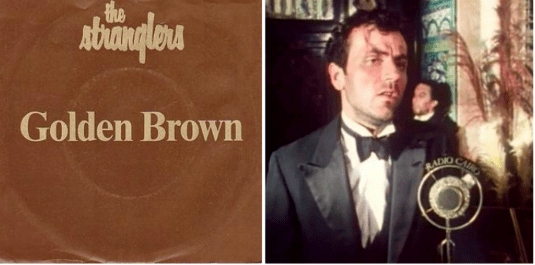
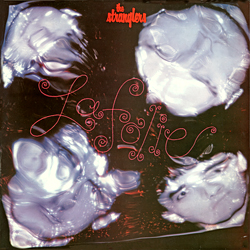
“Golden Brown” is a song by the English rock band the Stranglers. It was released as a 7″ single in December 1981 in the United States and in January 1982 in the United Kingdom, on Liberty. It was the second single released from the band’s sixth album La folie.
“Always the Sun (Sunny Side Up Mix)” (1991)”Golden Brown“ (1991)”Heaven or Hell” (1992)
My Thought ?
This is one of my favorite tunes of all time and I never tire of listening to it, especially after a skinfull of beer and/or a few wee Gin and Tonics , to get me in the mood so to speak. The hunting theme of the song and the hypnotic harpsichord always mesmerize me to the point I feel as though I’m in a trance and thats the kind of escapism I’m looking for when i want to chill out to some music and sooth my sometimes weary soul.
Lyrics
“Golden Brown”
Golden Brown texture like sun Lays me down with my mind she runs Throughout the night No need to fight Never a frown with Golden Brown
Every time just like the last On her ship tied to the mast To distant lands Takes both my hands Never a frown with Golden Brown
Golden Brown, finer temptress Through the ages she’s heading west From far away Stays for a day Never a frown with Golden Brown
(La la la la la la la la leeeah)
Never a frown With Golden Brown Never a frown With Golden Brown
Overview
Originally featured on the group’s album La folie, which was released in November 1981, and later on the USA pressings of Feline, “Golden Brown” was released as a single in December 1981, and was accompanied by a video.
The comparatively conservative BBC Radio 2, at that time a middle-of-the-road (MOR) music radio station, decided to make the record the single of the week, a surprising step considering the band were almost as notorious as Sex Pistols only a few years before.
The band claimed that the song’s lyrics were akin to an aural Rorschach test and that people only heard in it what they wanted to hear, although this did not prevent persistent allegations that the lyrics alluded to heroin.
How does the Rorschach inkblot test work?
The single was a top 10 hit around the world, including Australia. It was also featured in the film Snatch and is included on its soundtrack album.[
Meaning
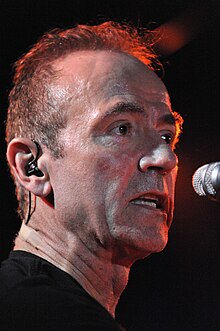
Hugh Cornwell
There has been much controversy surrounding the lyrics. In his book The Stranglers Song By Song (2001), Hugh Cornwell states “‘Golden Brown’ works on two levels. It’s about heroin and also about a girl.
” Essentially the lyrics describe how “both provided me with pleasurable times.”
Musical composition
The main body of the song has a 6/8 feel and is pitched halfway between the keys of E minor and E-flat minor, possibly to accommodate the tuning of the harpsichord. The instrumental introduction, in (a very flat) B minor, is unconventional. The keyboard and harpsichord vamp in 3/4, and in the head every fourth bar is in 4/4. The music was largely written by keyboardist Dave Greenfield and drummer Jet Black, with lyrics by singer/guitarist Hugh Cornwell.
The BBC newsreader Bill Turnbull attempted to waltz to the song in the 2005 series of Strictly Come Dancing. In February 2012, when interviewing Stranglers bassist Jean-Jacques Burnel on BBC Breakfast, Turnbull described the attempted dance as “a disaster”,
Burnel responded that the alternating time signatures made “Golden Brown” impossible to dance to; in contrast, a song written entirely in 6/8 is not unusual in waltzing.
Music video
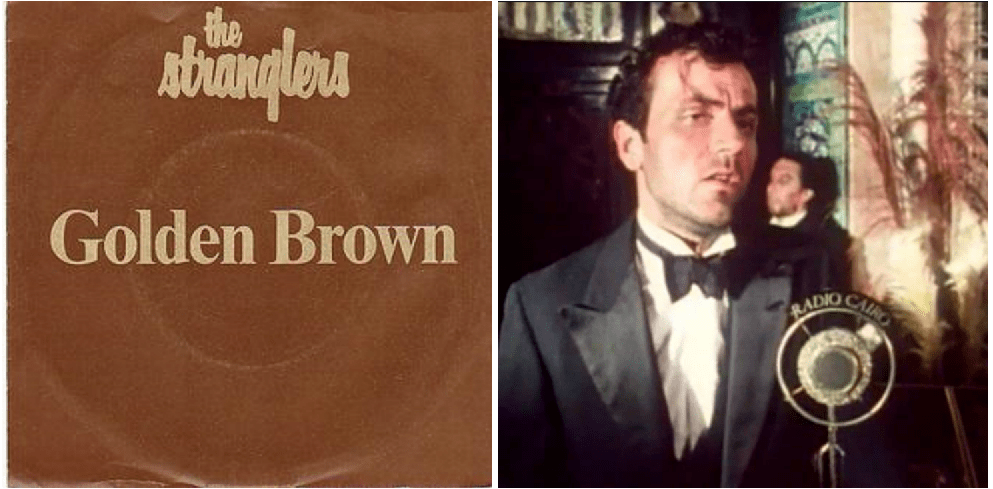
Two shots from Golden Brown: the band performing the song in Leighton House and as explorers
The video for “Golden Brown”, directed by Lindsey Clennell, depicts the band members both as explorers in an Arabian country and non-Arab Muslim countries (sequences include images of the Pyramids as well as the explorers studying a map of Egypt) in the 1920s and performers for a fictional “Radio Cairo”.
Golden Brown – The Stranglers (Restored Music Video)
I Don’t Like Mondays The Boomtown Rats 13 July 1979 Iconic Songs & the story behind them “I Don’t Like Mondays” is a song by the Irish new wave band the Boomtown Rats about the Cleveland Elementary School shooting in San Diego. It was released in 1979 as the lead single from their third studio album, The Fine Art of Surfacing. The song was a number-one … Continue reading I Don’t Like Mondays – the Boomtown Rats: Iconic Songs & the story behind them→
Lola – The Kinks : Iconic Songs Iconic Songs and the story behind them “Lola” is a song written by Ray Davies and performed by English rock band the Kinks on their album Lola Versus Powerman and the Moneygoround, Part One. The song details a romantic encounter between a young man and a possible cross-dresser, whom he meets in a club in Soho, London. … Continue reading Lola – The Kinks : Iconic Songs & the story behind them→
Love Will Tear Us Apart Joy Division June 1980 Iconic Songs & the story behind them “Love Will Tear Us Apart” is a song by English rock band Joy Division, released in June 1980. Its lyrics were inspired by lead singer Ian Curtis‘ marriage problems and frame of mind before his suicide in May 1980 Recording Joy Division first … Continue reading Love Will Tear Us Apart – Joy Division: Iconic Songs & the story behind them→
The Jam That’s Entertainment January 1981 The Jam : Iconic Songs & the story behind them “That’s Entertainment” is a 1980 song by British punk–mod revivalist group the Jam from their fifth album, Sound Affects. Although never released as a domestic single in the UK during the band’s lifetime, “That’s Entertainment” nonetheless charted as an import single (backed by a … Continue reading That’s Entertainment -The Jam : Iconic Songs & the story behind them→
Small Faces TIN SOLDIER 2nd December 1967 Tin Soldier – Small Faces : Iconic Songs & the story behind them “Tin Soldier” is a song released by the English rock band Small Faces on 2 December 1967, written by Steve Marriott (credited to Marriott/Lane). The song peaked at number nine in the UK singles chart and number 38 in Canada. It has since … Continue reading Tin Soldier – Small Faces : Iconic Songs & the story behind them→
Going Underground – The Jam The Jam Going Underground March 1980 Going Underground – The Jam: Iconic Songs & the story behind them “Going Underground” is the first British #1 chart single by The Jam, released in March 1980. It went straight in at #1 in the UK Singles Chart, spending three weeks at the top. It was the first … Continue reading Going Underground – The Jam: Iconic Songs & the story behind them→
The Stranglers Golden Brown January 1982 Golden Brown – The Stranglers: Iconic Songs & the story behind them Golden Brown – The Stranglers “Golden Brown” is a song by the English rock band the Stranglers. It was released as a 7″ single in December 1981 in the United States and in January 1982 in the United … Continue reading Golden Brown – The Stranglers: Iconic Songs & the story behind them→
It was a beautiful summers day the birds were singing in the trees and I was out walking in Hyde park with a ( rather hot ) lady nurse from Great Ormond Street Hospital and some of her nursy friends.
I’d not long been in London and was delighted when I moved jobs to work in Russell Square , as all the local bars and clubs were full of student nurses and other hospital staff and to my sheer joy they seemed to like my Belfast charm and accent and I felt confident that I may pull me a sexy nurse , if i got lucky!
Hey, I was a young hot blooded male back then.
It was also full of trainee police staff , but to be honest they kind of scared me a little and made me nervous and so I kept my distance. This was obviously a hangup from my days of growing up in Glencairn and in and around the Shankill/Woodvale and my experiences with the police thus far , as a petty criminal. Normally for joy riding ( I know, I’m ashamed of myself now , but I was a product of the time and place ) shop lifting and abusing myself with drugs ect , nothing too serious in the grand scheme of what was going on back then in Glencairn and throughout war torn Belfast. Back in those days we tended to police ourselfs ( well UDA / UVF did ) and whilst we respected the police it would never enter our heads to ask them to settle local disputes or fallouts and so I had a natural apprehension round the old bill that would take me a few years in London to shake off. The fact that the paramilitaries policed us was of little concern to us and we give it little thought, unless we were caught in the act, so to speak and then we knew would be fecked!
Once when I was in a stolen car and the police chased us all the way from the Antrim Rd, through Westland, up to Ballysillian , down Ballysillian rd and all the way up to the middle Glenciarn. I was absolutely shitting myself in the back of the car and was amazed and relieved when some how, I dont know how, we lost the police. The guys I was with were the best car thieves/joy riders in Glencairn and where legends to the many young hoods in the estate whom looked up to them. Maybe the police had been called to a more important job or something , but as we made our way through Glencairn I swear to myself I would never get in a stolen car again. Suddenly in the distance we heard the sound of police sirens coming our way and the driver put the foot down and we were almost flying as he tried to get away from the approaching police. Then he turned a corner and smashed smack bang into the car of a top UDA man in Glencian , whom was a bit of a nutter and not to be crossed. Anyways we all jumped out of the car and ran for our lives and to be honest i was more worried about the UDA guys car, than i was about the police.
Next day we were all summoned up to the community centre and questioned by the UDA about the crash and the top guy whose car we had almost written off is going ballistic and calling for blood. Denial was the only option open to us as we didn’t want to have our kneecaps rearranged , so we all lied through our teeth and stubbornly stuck to our story , despite the fact our interrogators and the mad man knew we were lying and anted to kill us . Thanks to some family connection I wasn’t shot that day, but when the guy brought a new car we had to wash it for him for the next few months and he took great pleasure expecting our work and making us do it over again and again.Lesson learnt, no more joy ridding.
Anyways back to the squirrel and the trainee police staff I certainly wasn’t brave enough at the time to hit on one and possibly be arrested. LOL
The day way going great until I heard the gentle hypnotic calling chimes of the Poke Man ( icecream van in Northern Ireland slang to those who don’t know )and thought I’d treat myself and all the nice girls to a nice big Poke.
I inquired of the ladies present if any of them would like to have a Poke with me and through howls of laughter I took their orders. Of I go and on my way through a grove of trees I look up and pause for a moment, watching as two beautiful squirrels seemed to play tag with each other , jumping and swinging from branch to branch they disappeared in to the tree tops above me. It felt like a special kind of moment in time and I was kind of entranced and touched by it all.
And then one of the little feckers shat on my head!
How feckin rude is that ?
I knew it was squirrel shit immediately because it was the most logical answer and also they were both up there in the trees, starring down at me and I swear I heard them snigger.
Also the one that done the dump on my head must have had a curry the night before because as it ran down the side of my face , hot and sticky it smelt shocking and to make matters worse I could feel lumps cascading through the shit and gagging I realised they were poo covered bits of nuts.
Bending over a tree I start throwing up all over the place and prayed for the ground to open up and swallow me alive. Sadly it didn’t happen.
Then to my utter shame and horror my Lady Nurse friend was beside me, stroking my back and asking if in a mummy voice if I was OK. It wasn’t a pretty sight to be fair and wiping my hair with a tissue I excused myself and proceeded to go get the pokes.
Sadly I wasn’t successfully that day in pulling a sexy nurse ( but more than made up for it over the comings months) and those are stories for any day.
HUNTSVILLE, Texas (AP) — A Texas inmate was executed Thursday evening for the killings nearly 30 years ago of his estranged wife’s parents and her brother, who was a police officer.
Billie Wayne Coble received lethal injection at the state penitentiary in Huntsville for the August 1989 shooting deaths of Robert and Zelda Vicha and their son, Bobby Vicha, at separate homes in Axtell, northeast of Waco.
Coble, 70, once described by a prosecutor as having “a heart full of scorpions,” was the oldest inmate executed by Texas since the state resumed carrying out capital punishment in 1982.
Asked to make a final statement, Coble replied: “That’ll be $5.”
He told the five witnesses he selected to be in attendance that he loved them, then again said: “That’ll be $5.” Coble nodded to the witnesses and added, “take care.”
He gasped several times and began snoring.
As Coble was finishing his statement, his son, a friend and a daughter-in-law became emotional and violent. They were yelling obscenities, throwing fists and kicking at others in the death chamber witness area.
Officers stepped in and the witnesses continued to resist. They were eventually moved to a courtyard and the two men were handcuffed.
“Why are you doing this?” the woman asked. “They just killed his daddy.”
While the witnesses were being subdued outside, the single dose of pentobarbital was being administered to Coble. He was pronounced dead 11 minutes later at 6:24 p.m.
Texas Department of Criminal Justice spokesman Jeremy Desel said the two men were arrested on a charge of resisting arrest and taken to the Walker County Jail.
The U.S. Supreme Court earlier Thursday turned down Coble’s request to delay his execution.
His attorneys had told the high court that Coble’s original trial lawyers were negligent for conceding his guilt by failing to present an insanity defense before a jury convicted him of capital murder.
A state appeals court had previously rejected Coble’s request to delay Thursday’s execution and the Texas Board of Pardons and Paroles turned down his request for a commutation.
Coble “does not deny that he bears responsibility for the victims’ loss of life, but he nonetheless wanted his lawyers to present a defense on his behalf,” his attorney, A. Richard Ellis, said in his appeal to the Supreme Court.
In Coble’s clemency petition to the Board of Pardons and Paroles, Ellis said his client suffered from post-traumatic stress disorder stemming from his time as a Marine during the Vietnam War and was convicted, in part, due to misleading testimony from two prosecution expert witnesses on whether he would be a future danger.
Coble was convicted in 1990 of killing his in-laws, Robert and Zelda Vicha, and their son, Waco police Sgt. Bobby Vicha, at the family’s Axtell home
After shooting the three, Coble kidnapped his estranged wife, Karen Vicha, threatened to sexually assault and kill her, but was injured when he crashed his vehicle during a police chase in Bosque County.
Coble has a list of appeals, the only one successful filed in 2007 with the U.S. Fifth Circuit Court of Appeals that resulted in the dismissal of the death sentence and an order for re-trial on punishment after the court’s opinion stated Coble’s jury faced two questions that were unconstitutional.
The punishment re-trial ended with the same result, a death sentence.
A retired police officer who worked on the Coble case and a current district judge who back then was a prosecutor and who took Coble to trial on the capital murder case for the first time were among a few dozen people who crowded into the 54th District Courtroom on Wednesday to watch the hearing.
After a few minutes the judge asked one of the bailiffs why Coble wasn’t in the courtroom and the bailiff said he was refusing to leave the holding cell.
Johnson sent a squad of bailiffs to retrieve Coble, but they reported he refused to come to the courtroom, after which Johnson called the case, read the preliminary documents concerning the appeals Coble has filed since his conviction, and then set the date.
Coble has a list of appeals, the only one successful filed in 2007 with the U.S. Fifth Circuit Court of Appeals that resulted in the dismissal of the death sentence and an order for re-trial on punishment after the court’s opinion stated Coble’s jury faced two questions that were unconstitutional.
Court grants Muslim death row inmate stay of execution
Melissa Brown
Montgomery Advertiser
The U.S. Court of Appeals has granted a stay of execution for a Muslim death row inmate in Alabama as he continues his ongoing bid to have an imam present at his execution.
Domineque Ray maintains the absence of his imam in Alabama’s death chamber would violate his constitutional rights, as the state has an established practice of including a Christian prison chaplain in previous executions. Wednesday’s ruling overturns a Montgomery federal judge’s denial of a stay last week.
Ray was sentenced to death for the 1995 rape and fatal stabbing of 15-year-old Tiffany Harville of Selma. Months before his death penalty trial, he was sentenced to life for a 1994 slaying of two teen brothers, The Associated Press reports.
The Alabama death row inmate, is challenging the state on religious grounds after prison officials denied his Muslim spiritual advisor access to the execution chamber.