Islamic State leader Baghdadi ‘raped’ Kayla Mueller
PERVERTED KILLER Burn in hell!
An American aid worker who was killed in February while held hostage by Islamic State (IS) militants in Syria, was sexually abused by the group’s top leader, US officials tell ABC news.
Kayla Mueller, 26, was repeatedly raped by Abu Bakr al-Baghdadi, they said.
Counterterrorism officials made her family aware of the abuse in June.
Mueller was abducted while working in Aleppo, Syria, in 2013. IS said she was killed in a Jordanian air strike, but the US blames IS for her death.
“We were told Kayla was tortured, that she was the property of Baghdadi. We were told that in June by the government,” her parents, Carl and Marsha, told ABC News.
Baghdadi personally took the humanitarian aid worker to the home of another senior IS member – Abu Sayyaf – who was in charge of IS oil and gas until his death in a US special forces operation in May, ABC news, citing US officials, reports.
US special forces raid
The channel said he regularly visited the compound where she was being held and repeatedly assaulted her.
Officials said they had obtained information about the abuse from at least two teenage Yazidi girls who were held hostage as sex slaves and found inside the Sayyaf compound at the time of the US attack.
Mueller was reportedly held for some time by Sayyaf and his wife, Umm Sayyaf, who was also captured by US special forces in May.
At the time, the Pentagon said Umm was suspected of being an IS member and of being complicit in the enslavement of a young Yazidi woman who was rescued in the raid.
Hundreds of young women and girls – many of them Yazidis captured in northern Iraq – are believed to be held as sex slaves by IS militants in areas under their control.
The Yazidi girls provided intelligence used by the US to interrogate Sayyaf’s wife, who “spilled everything” about several IS leaders and their whereabouts, a counterterrorism official told ABC.
Umm Sayyaf was handed over to the Kurdish authorities in northern Iraq last week to face trial.
The information that has come to light appears to contradict speculation that Mueller was treated well in captivity, as a letter written in 2014 and smuggled out to her family implied.
In it, Mueller tried to reassure her family, saying that she had been treated with “utmost respect + kindness”.
The humanitarian aid worker from Prescott, Arizona, travelled to the Turkey-Syria border in 2012 to work with refugees.
—————————————————————
Kayla Mueller’s letter from captivity before her death
Kayla Mueller’s family have released a letter sent by the IS hostage before her death in what the jihadist group says was a coalition air strike in Syria.
Everyone,if you are receiving this letter it means I am still detained but my cell mates (starting from 11/2/2014) have been released. I have asked them to contact you +send you this letter.
It’s hard to know what to say.
Please know that I am in a safe location, completely unharmed + healthy (put on weight in fact); I have been treated w/ the utmost respect + kindness.
I wanted to write you all a well thought out letter (but I didn’t know if my cell mates would be leaving in the coming days or the coming months restricting my time but primarily) I could only but write the letter a paragraph at a time, just the thought of you all sends me into a fit of tears.
If you could say I have “suffered” at all throughout this whole experience it is only in knowing how much suffering I have put you all through; I will never ask you to forgive me as I do not deserve forgiveness.
I remember mom always telling me that all in all in the end the only one you really have is God.
I have come to a place in experience where, in every sense of the word, I have surrendered myself to our creator b/c literally there was no else…. + by God + by your prayers I have felt tenderly cradled in freefall.
I have been shown in darkness, light + have learned that even in prison, one can be free. I am grateful.
I have come to see that there is good in every situation, sometimes we just have to look for it. I pray each each day that if nothing else, you have felt a certain closeness + surrender to God as well + have formed a bond of love + support amongst one another…
I miss you all as if it has been a decade of forced separation. I have had many a long hour to think, to think of all the things I will do w/ Lex, our first family camping trip, the first meeting @ the airport.
I have had many hours to think how only in your absence have I finally @ 25 years old come to realize your place in my life.
Kyla Mueller sent the letter via other hostages who were released
The gift that is each one of you + the person I could + could not be if you were not a part of my life, my family, my support.
I DO NOT want the negotiations for my release to be your duty, if there is any other option take it, even if it takes more time. This should never have become your burden.
I have asked these women to support you; please seek their advice. If you have not done so already, [REDACTED] can contact [REDACTED] who may have a certain level of experience with these people.
None of us could have known it would be this long but know I am also fighting from my side in the ways I am able + I have a lot of fight left inside of me.
I am not breaking down + I will not give in no matter how long it takes.
I wrote a song some months ago that says “The part of me that pains the most also gets me out of bed, w/out your hope there would be nothing left…” aka ‐ the thought of your pain is the source of my own, simultaneously the hope of our reunion is the source of my strength.
Please be patient, give your pain to God.
I know you would want me to remain strong. That is exactly what I am doing.
Do not fear for me, continue to pray as will I + by God’s will we will be together soon.
Media had long reported that a 26-year-old American aid worker was being held by the Islamic State of Iraq and the Levant (ISIS) without naming her at her family’s request. Her captivity and death were widely reported upon confirmation of her death.
Food For Life Vrindavan, a local branch of Food For Life, which provides free food, education, and medical care for those in need in the region, for whom she taught English and kindergarten students.[4][5]
Just Peace, a social justice project of United Campus Ministries at Northern Arizona University, with whom she went on a humanitarian aid trip to Guatemala and with whom she advocated against torture and Guantanamo Bay.
New Day Peace Center in Flagstaff, Arizona, for whom she helped to establish services for veteran students at Northern Arizona University and at Coconino Community College.
Northern Arizona University Center for Intercultural Education, which provides services to international students at Northern Arizona University.
Prescott Area Women’s Shelter, where she worked during the nights to help meet the needs of homeless women, children, and families.
Save Darfur Coalition, with whom she volunteered for three years, for whom she conducted multiple letter-writing campaigns and led two silent walks.
STAND, for whom she served as the President of STAND:NAU, a local chapter at Northern Arizona University, as well as the Southwest Regional Outreach Coordinator of the parent organization.
Support to Life, an international aid organization, for whom she worked to help Syrian refugees in Turkey
Tibetan Hope Center, an organization that helps Tibetanrefugees to gain life skills to live independently in India, for whom she taught English and compiled a monthly newsletter.
Youth Count, where she volunteered in Prescott, Arizona participating in multiple environmental and inter-generational projects.
Capture and death
Mueller started working in southern Turkey in December 2012, where she was assisting Syrian refugees. On August 3, 2013, she drove to the northern Syrian city of Aleppo with a coworker/friend who was traveling to the Spanish Médecins Sans Frontières hospital in Aleppo to work for a day.[7] She worked with international aid agency Support to Life.[8][9] On her departure from Aleppo to return to Turkey, militants abducted her.[10]
According to anonymous sources of American reporter Catherine Herridge, the location of Mueller and other American hostages was known by the White House in May 2014, but a decision on a rescue mission was not made for seven weeks. By that time, the hostages had been dispersed.[11]
A media account affiliated with ISIS released a statement on February 6, 2015 claiming that a female American hostage held by the group was killed by one of around a dozen Jordanian airstrikes in ar-Raqqah, Syria. The statement came just days after the release of a video showing the burning of Jordanian fighter pilot Muath al-Kasasbeh by the militant group and the subsequent execution of Sajida Mubarak Atrous al-Rishawi and other prisoners of Jordan. The statement was later translated by the SITE Intelligence Group, identifying the hostage as Mueller.[12]
Mueller had been in ISIS custody for 18 months. A US mission to rescue her and several others in northern Syria in July 2014 failed when ISIS moved the prisoners. The US was unaware of her location since, though her family was told negotiations were underway to swap her for Aafia Siddiqui, according to Arizona House Representative Paul Gosar.[13]ABC News and CBS News reported that sources in the intelligence community believe Mueller may have been “given over” to an ISIS commander in a “forced marriage” and the group did not view her as a bargainable hostage. In a letter to her family, she spoke of being healthy, well-fed and treated with the utmost kindness and respect in a safe place. ISIS members corresponding with the Muellers referred to Kayla as their “guest”.[14][15]
On February 6, 2015, ISIS published a photo of a damaged building, named Mueller and her home town and alleged she had been killed in a Jordanian airstrike in the building where she was left alone with no guards, but no proof of death was provided.[8] The Pentagon agreed the building was one hit in the bombings, but disputed that Mueller, or any civilian, was inside. The site had been bombed by the coalition twice before, and was targeted again because ISIS soldiers sometimes return to bombed sites, thinking the coalition won’t return, according to Pentagon spokesman John Kirby. After this, Mueller’s name was released by American and other media with the family’s consent.[7][not in citation given]
On February 10, 2015, Mueller’s family announced ISIS had confirmed her death to them in an e-mail, with three photographs of her dead body, bruised on the face and wearing a black hijab.[16][17]National Security Council spokeswoman Bernadette Meehan said this message was authenticated by the intelligence community. President Barack Obama offered his condolences to Mueller’s family.[18]
It is reported Mueller was a “personal captive” of Abu Sayyaf.[19]
Reactions
Family
Mueller’s parents reportedly implored ISIS to contact them as they hoped their daughter may still be alive. “We have sent you a private message and ask that you respond to us privately”, Carl and Marsha Mueller said in a statement. They said they had not talked to the media as ISIS warned them not to.[20]
Government
An American official cautioned that without proof of Mueller’s death, the statement by ISIS could be a ploy to cause the Jordanians and the rest of the American-led coalition to refrain from any heavier airstrikes.[7]
Jordan’s Foreign Minister Nasser Judeh called ISIS’s claim “an old and sick trick” on Twitter. “So they behead innocent #US #UK & Japan hostages & BURN a brave #Jordan pilot ALIVE & now a hostage is killed by an airstrike? Sure! Sick!”, he said.[21][22] He further tweeted: “An old and sick trick used by terrorists and despots for decades: claiming that hostages human shields held captive are killed by air raids.”[23] Later upon confirmation of Mueller’s death he tweeted: “Saddened & angered to hear news confirming killing of #US hostage #kaylaMueller. Yet another ugly example of these terrorists’ brutality.”[24]
After many Western news outlets cast doubt on the claim of the hostage death and the extremists’ ability to identify Jordanian and U.S. made F-16s flying at high altitudes, Jordan dismissed the claim of a killed hostage as an ISIS publicity stunt and a lie, as the group is known for its propaganda techniques.[25]
After Mueller’s family confirmed her death, President Obama said “[Mueller] represents what is best about America, and expressed her deep pride in the freedoms that we Americans enjoy, and that so many others strive for around the world.” U.S. Secretary of State John Kerry issued a statement saying “ISIL, and ISIL alone, is the reason Kayla is gone.”[26]
The Pentagon declined to investigate whether Mueller was killed by the coalition airstrike. Policy dictates the US only investigates reports of civilian casualties when they come from a “credible source”, which ISIS is not.[27]
Media
Time magazine named Kayla Mueller as an ideal role model for Millennials, citing her selfless desire to end suffering, her activism, and her humanitarian aid work, praising her desire not to be seen, but to genuinely help people, and lauding her possession of Millennials’ positive good qualities of idealism, optimism, and love of families without troublesome qualities also associated with the Millennial generation.[28]
On February 23, 2015 the Mueller family was interviewed on The Today Show by Savannah Guthrie. Carl Mueller expressed his frustration with the Obama administration over the way it conducted negotiations with their daughter’s captors and their policy of not paying ransom money for hostages. “We understand the policy about not paying ransom, but on the other hand, any parents out there would understand that you would want anything and everything done to bring your child home,” Carl Mueller said. “And we tried, and we asked. But they put policy in front of American citizens’ lives. And it didn’t get it changed.”[29]
R.I.P
My autobiography: A Belfast Child is now available to pre-order on Amazon , launch date is 30th April.
5 Surprising Facts About the Death Penalty Worldwide
Bullet holes are visible in the wood panel behind the execution chair at Utah State Prison, where convicted murderer Ronnie Lee Gardner was executed by firing squad in June 2010.
1. The United States ranked fifth for the highest number of executions.
The U.S. takes a spot behind China, Iran, Iraq, and Saudi Arabia for the most executions in the world last year, sitting ahead of Yemen and the Sudan.
This ranking comes as no surprise to Brian Evans, Amnesty International’s acting director on the Death Penalty Abolition Campaign, who said the same countries are in the top eight every year. (See video: “Inside Death Row.”)
But why is the U.S.—which seems like somewhat of an outlier politically, culturally, and geographically—always in the top five?
According to Evans, the U.S. has a strict attitude toward punishment in general. Having a severe attitude toward the death penalty is only natural when you consider that the U.S. leads the world in mass incarceration of prisoners and holds records for solitary confinement and sentences to life in prison.
2. Saudia Arabia saw the execution of one man by “crucifixion.”
Methods of execution vary between regions based on culture and available technology, and they usually include standard tactics, such as hanging, beheading, firing squad, and lethal injection. In Saudi Arabia, however, one accused man was put on display after being beheaded in a practice known as crucifixion, according to the country’s state news agency, SPA.
The reasoning behind executions also vary around the world. In Papua New Guinea, for example, a woman and her two daughters are currently being held captive with charges of sorcery and risk a death sentence. It’s common in the Pacific country for those accused of sorcery, especially women, to face horrific acts of violence that often end in death.
3. China keeps its execution numbers secret.
The Chinese government is notorious for keeping statistics about their criminal executions secret, and in past years, Amnesty International was forced to rank China based on the minimum number of executions that researchers could confirm. Since that number was always drastically lower than the assumed reality, researchers now use reliable media sources and human rights groups—rather than official government sources—to estimate the number of executions in China.
Using this data, the 2012 report estimates that thousands of criminals were killed in China last year alone, while the tally for the rest of the world combined stands at 682.
4. Japan’s executions actually increased in 2012 after a long hiatus.
While the global trend for the death penalty is actually declining around the world, Japan—and other notable countries such as India and Pakistan—resumed executing criminals after a long stint of being execution-free. At least seven death row inmates were killed in Japan last year, ending a 20-month period without executions.
Why the change? “It all depends on which political party is in power,” Evans said. One prime minister will come into power and abolish the practice, then the next will just reinstate it, leaving the lives of criminals in the hands of changing political whims.
5. Just 21 countries in the world carried out the death penalty last year.
In the broad scope of things, only a fraction of the world’s total countries (the total being 195 by National Geographic’s count) actually used execution as a means of punishment last year. That number is down from 28 countries just a decade earlier, suggesting a downward trend in the global practice.
The few countries that do still practice execution are situated in “regional pockets” around the world, Evans noted. Just four countries in the Middle East, for example, are responsible for all the executions in the region. And in the U.S., death penalty laws differ by state, with hotbeds of execution in the U.S. South, Ohio, and Arizona.
In December 2012, 111 countries—or more than half the world’s countries—voted in favor of a United Nations resolution that would declare a global moratorium on executions.
As for the other countries? “They’ll come around when they take a longer look at their death penalties,” Evans said, “but it’ll be a while.”
——————————————————————————————————————
Syrian Adulteress Survives Stoning Punishment, Jurist Spares Her From Death
Militants from Hizbul Islam haul Mohamed Ibrahim, 48, from a pit after stoning him to death for illicit sexual intercourse with a woman in the Afgoye district, December 13, 2009. Ibrahim was sentenced to death by a local Islamic court after he was found guilty of infidelity. Reuters
Similar to a Biblical event when Jesus Christ spared an adulteress from stoning, a Syrian woman with a similar crime and sentence miraculously survived the stoning that a male juror spared her from further death.
IJReview reports that the incident happened on Friday in northern Syria which is controlled by the Islamic State (IS). The source of the report is the Syrian Observatory for Human Rights.
According to the observatory, the sentence – an example of the IS brutality – was carried out in Raqqa by a group of gunmen who pelted the woman with heavy stones. They thought she was dead, but the adulteress stood up and started to walk away.
One of the jihadists prevent the woman from leaving and tried to capture her. He attempted to shoot her, but an Islamic jurist stopped him and said, “Her sentence is done, let her go and repent to her God,” quotes the observatory.
The jurist added that it was a miracle from God that she didn’t die.
Adultery and homosexuality are among the crimes that the IS, citing sharia law, punishes by stoning. The observatory said that of the 15 people stoned by the IS since July in Syria, 9 were women. Also punishable by stoning are blasphemy and apostasy.
In one of the stonings held in October 2014, the father of the sentenced woman even helped stone his daughter to death, reports The Clarion Project, which challenges extremism but promotes dialogue.
By stoking fear in the hearts of residents of the caliphate through brutal interpretation of Islamic laws, IS further holds parts of Syria and Iraq on its iron grip.
——————————————————————————————————————
Capital Punishment
CAPTIAL PUNISHMENT OVER THE YEARS – Discovery History Crime (full documentary)
——————————————————————————————————————
Capital punishment, death penalty or execution is punishment by death. The sentence that someone be punished in this manner is a death sentence. Crimes that can result in a death penalty are known as capital crimes or capital offences. The term capital originates from the Latincapitalis, literally “regarding the head” (referring to execution by beheading).[1]
Capital punishment has, in the past, been practiced by most societies, as a punishment for criminals, and political or religious dissidents. Historically, the carrying out of the death sentence was often accompanied by torture, and executions were most often public.[2]
36 countries actively practice capital punishment, 103 countries have completely abolished it de jure for all crimes, 6 have abolished it for ordinary crimes only (while maintaining it for special circumstances such as war crimes), and 50 have abolished it de facto (have not used it for at least ten years and/or are under moratorium).
Nearly all countries in the world prohibit the execution of individuals who were under the age of 18 at the time of their crimes; since 2009, only Iran, Saudi Arabia, and Sudan have carried out such executions.[3] Executions of this kind are prohibited under international law.[3]
Capital punishment is a matter of active controversy in various countries and states, and positions can vary within a single political ideology or cultural region. In the European Union member states, Article 2 of the Charter of Fundamental Rights of the European Union prohibits the use of capital punishment.[4] The Council of Europe, which has 47 member states, also prohibits the use of the death penalty by its members.
The use of formal execution extends to the beginning of recorded history. Most historical records and various primitive tribal practices indicate that the death penalty was a part of their justice system. Communal punishment for wrongdoing generally included compensation by the wrongdoer, corporal punishment, shunning, banishment and execution. Usually, compensation and shunning were enough as a form of justice.[17] The response to crime committed by neighbouring tribes or communities included an aformal apology, compensation or blood feuds.
A blood feud or vendetta occurs when arbitration between families or tribes fails or an arbitration system is non-existent. This form of justice was common before the emergence of an arbitration system based on state or organized religion. It may result from crime, land disputes or a code of honour. “Acts of retaliation underscore the ability of the social collective to defend itself and demonstrate to enemies (as well as potential allies) that injury to property, rights, or the person will not go unpunished.”[18] However, in practice, it is often difficult to distinguish between a war of vendetta and one of conquest.
Elaborations of tribal arbitration of feuds included peace settlements often done in a religious context and compensation system. Compensation was based on the principle of substitution which might include material (for example, cattle, slave) compensation, exchange of brides or grooms, or payment of the blood debt. Settlement rules could allow for animal blood to replace human blood, or transfers of property or blood money or in some case an offer of a person for execution. The person offered for execution did not have to be an original perpetrator of the crime because the system was based on tribes, not individuals. Blood feuds could be regulated at meetings, such as the Norsementhings.[19] Systems deriving from blood feuds may survive alongside more advanced legal systems or be given recognition by courts (for example, trial by combat). One of the more modern refinements of the blood feud is the duel.
In certain parts of the world, nations in the form of ancient republics, monarchies or tribal oligarchies emerged. These nations were often united by common linguistic, religious or family ties. Moreover, expansion of these nations often occurred by conquest of neighbouring tribes or nations. Consequently, various classes of royalty, nobility, various commoners and slave emerged. Accordingly, the systems of tribal arbitration were submerged into a more unified system of justice which formalized the relation between the different “classes” rather than “tribes”. The earliest and most famous example is Code of Hammurabi which set the different punishment and compensation, according to the different class/group of victims and perpetrators. The Torah (Jewish Law), also known as the Pentateuch (the first five books of the Christian Old Testament), lays down the death penalty for murder, kidnapping, magic, violation of the Sabbath, blasphemy, and a wide range of sexual crimes, although evidence suggests that actual executions were rare.[20]
A further example comes from Ancient Greece, where the Athenian legal system was first written down by Draco in about 621 BC: the death penalty was applied for a particularly wide range of crimes, though Solon later repealed Draco’s code and published new laws, retaining only Draco’s homicide statutes.[21] The word draconian derives from Draco’s laws. The Romans also used death penalty for a wide range of offenses.[22]
Tang dynasty
Although many are executed in the People’s Republic of China each year in the present day, there was a time in the Tang dynasty when the death penalty was abolished.[23] This was in the year 747, enacted by Emperor Xuanzong of Tang (r. 712–756). When abolishing the death penalty Xuanzong ordered his officials to refer to the nearest regulation by analogy when sentencing those found guilty of crimes for which the prescribed punishment was execution. Thus depending on the severity of the crime a punishment of severe scourging with the thick rod or of exile to the remote Lingnan region might take the place of capital punishment. However, the death penalty was restored only 12 years later in 759 in response to the An Lushan Rebellion.[24] At this time in the Tang dynasty only the emperor had the authority to sentence criminals to execution. Under Xuanzong capital punishment was relatively infrequent, with only 24 executions in the year 730 and 58 executions in the year 736.[23]
The two most common forms of execution in the Tang dynasty were strangulation and decapitation, which were the prescribed methods of execution for 144 and 89 offenses respectively. Strangulation was the prescribed sentence for lodging an accusation against one’s parents or grandparents with a magistrate, scheming to kidnap a person and sell them into slavery and opening a coffin while desecrating a tomb. Decapitation was the method of execution prescribed for more serious crimes such as treason and sedition. Interestingly, and despite the great discomfort involved, most of the Tang Chinese preferred strangulation to decapitation, as a result of the traditional Tang Chinese belief that the body is a gift from the parents and that it is, therefore, disrespectful to one’s ancestors to die without returning one’s body to the grave intact.
Some further forms of capital punishment were practiced in the Tang dynasty, of which the first two that follow at least were extralegal. The first of these was scourging to death with the thick rod which was common throughout the Tang dynasty especially in cases of gross corruption. The second was truncation, in which the convicted person was cut in two at the waist with a fodder knife and then left to bleed to death.[25] A further form of execution called Ling Chi (slow slicing), or death by/of a thousand cuts, was used from the close of the Tang dynasty (around 900) to its abolition in 1905.
When a minister of the fifth grade or above received a death sentence the emperor might grant him a special dispensation allowing him to commit suicide in lieu of execution. Even when this privilege was not granted, the law required that the condemned minister be provided with food and ale by his keepers and transported to the execution ground in a cart rather than having to walk there.
Nearly all executions under the Tang dynasty took place in public as a warning to the population. The heads of the executed were displayed on poles or spears. When local authorities decapitated a convicted criminal, the head was boxed and sent to the capital as proof of identity and that the execution had taken place.
In medieval and early modern Europe, before the development of modern prison systems, the death penalty was also used as a generalized form of punishment. During the reign of Henry VIII, as many as 72,000 people are estimated to have been executed.
During early modern Europe, a massive moral panic regarding witchcraft swept across Europe and later the European colonies in North America. During this period, there were widespread claims that malevolent Satanicwitches were operating as an organized threat to Christendom. As a result, tens of thousands of women were prosecuted and executed through the witch trials of the early modern period (between the 15th and 18th centuries).
The death penalty also targeted sexual offenses such as sodomy. In England, the Buggery Act 1533 stipulated hanging as punishment for “buggery“. James Pratt and John Smith were the last two Englishmen to be executed for sodomy in 1835.[27]
Despite the wide use of the death penalty, calls for reform were not unknown. The 12th century Jewish legal scholar, Moses Maimonides, wrote, “It is better and more satisfactory to acquit a thousand guilty persons than to put a single innocent man to death.” He argued that executing an accused criminal on anything less than absolute certainty would lead to a slippery slope of decreasing burdens of proof, until we would be convicting merely “according to the judge’s caprice”. Maimonides’ concern was maintaining popular respect for law, and he saw errors of commission as much more threatening than errors of omission.[28]
Islam on the whole accepts capital punishment,[29] and the AbbasidCaliphs in Baghdad, such as Al-Mu’tadid, were often cruel in their punishments.[30] For hudud crimes such as zina (consensual extramarital or homosexual sex) and apostasy (leaving Islam and converting to another religion), Sharia requires capital punishment in public, while for crimes such as murder and manslaughter, the victim’s family can either seek execution (Qisas) or can choose to spare the life of the killer in exchange for blood money restitution (Diyya).[31][32]
The breaking wheel was used during the Middle Ages and was still in use into the 19th century.
Modern era
Mexican execution by firing squad, 1916
The last several centuries have seen the emergence of modern nation-states. Almost fundamental to the concept of nation state is the idea of citizenship. This caused justice to be increasingly associated with equality and universality, which in Europe saw an emergence of the concept of natural rights. Another important aspect is that emergence of standing police forces and permanent penitential institutions. The argument that deterrence, rather than retribution, is the main justification for punishment is a hallmark of the rational choice theory and can be traced to Cesare Beccaria whose well-known treatise On Crimes and Punishments (1764), condemned torture and the death penalty and Jeremy Bentham who twice critiqued the death penalty.[33] Moving executions there inside prisons and away from public view was prompted by official recognition of the phenomenon reported first by Beccaria in Italy and later by Charles Dickens and Karl Marx of increased violent criminality at the times and places of executions.
By 1820 in Britain, there were 160 crimes that were punishable by death, including crimes such as shoplifting, petty theft, stealing cattle, or cutting down trees in public place.[34] The severity of the so-called Bloody Code, however, was often tempered by juries who refused to convict, or judges, in the case of petty theft, who arbitrarily set the value stolen at below the statutory level for a capital crime.[35]
The 20th century was a violent period. Tens of millions were killed in wars between nation-states as well as genocide perpetrated by nation states against political opponents (both perceived and actual), ethnic and religious minorities; the Turkish assault on the Armenians, Hitler’sattempt to exterminate the European Jews, the Khmer Rougedecimation of Cambodia, the massacre of the Tutsis in Rwanda, to cite four of the most notorious examples. A large part of execution was the summary execution of enemy combatants. In Nazi Germany there were three types of capital punishment; hanging, decapitation and death by shooting.[36] Also, modern military organisations employed capital punishment as a means of maintaining military discipline. The Soviets, for example, executed 158,000 soldiers for desertion during World War II.[37] In the past, cowardice, absence without leave, desertion, insubordination, looting, shirking under enemy fire and disobeying orders were often crimes punishable by death (see decimation and running the gauntlet). One method of execution, since firearms came into common use, has almost invariably been firing squad.
Various authoritarian states— for example those with fascist or communist governments—employed the death penalty as a potent means of political oppression. According to Robert Conquest, the leading expert on Stalin’s purges, more than 1 million Soviet citizens were executed during the Great Terror of 1937–38, almost all by a bullet to the back of the head.[38]Mao Zedong publicly stated that “800,000” people had been executed after the Communist Party’s victory in 1949. Partly as a response to such excesses, civil rights organizations have started to place increasing emphasis on the concept of human rights and an abolition of the death penalty.
Among countries around the world, almost all European and many Pacific Area states (including Australia, New Zealand and Timor Leste), and Canada have abolished capital punishment. In Latin America, most states have completely abolished the use of capital punishment while some countries, such as Brazil, allow for capital punishment only in exceptional situations, such as treason committed during wartime. The United States (the federal government and 31 of the states), Guatemala, most of the Caribbean and the majority of democracies in Asia (for example, Japan and India) and Africa (for example, Botswana and Zambia) retain it. South Africa’s Constitutional Court, in judgment of the case of State v Makwanyane and Another, unanimously abolished the death penalty on 6 June 1995.[39][40]
Abolition was often adopted due to political change, as when countries shifted from authoritarianism to democracy, or when it became an entry condition for the European Union. The United States is a notable exception: some states have had bans on capital punishment for decades (the earliest is Michigan, where it was abolished in 1846), while others actively use it today. The death penalty there remains a contentious issue which is hotly debated.
In abolitionist countries, the debate is sometimes revived by particularly brutal murders though few countries have brought it back after abolishing it. However, a spike in serious, violent crimes, such as murders or terrorist attacks, has prompted some countries (such as Sri Lanka and Jamaica) to effectively end the moratorium on the death penalty. In retention countries, the debate is sometimes revived when a miscarriage of justice has occurred though this tends to cause legislative efforts to improve the judicial process rather than to abolish the death penalty.
The public opinion on the death penalty varies considerably by country and by the crime in question, despite the evidence against its power as a deterrent.[41] Countries where a majority of people are against execution include New Zealand, where 55 percent of the population oppose its use,[42] Australia where only 23 percent support the death penalty,[43] and Norway where only 25 percent are in favour.[44] Most French, Finns and Italians also oppose the death penalty.[45] A 2010 Gallup poll shows that 64% of Americans support the death penalty for someone convicted of murder, down from 65% in 2006 and 68% in 2001.[46][47]
Use of capital punishment is growing in India in the 2010s[48] due to both a growth in right wing politics and due to anger over several recent brutal cases of rape.[48] While support for the death penalty for murder is still high in China executions have dropped precipitously, with only 3000 executed in 2012 versus 12,000 in 2002.[49] A poll in South Africa found that 76 percent of millennium generation South Africans support re-introduction of the death penalty, which is abolished in South Africa.[50]
Movements towards painless execution
Death Row The Final 24 Hours Documentary & Discovery HD Channel (Official) – documentary latest
Trends in most of the world have long been to move to less painful, or more humane, executions. France developed the guillotine for this reason in the final years of the 18th century, while Britain banned drawing and quartering in the early 19th century. Hanging by turning the victim off a ladder or by kicking a stool or a bucket, which causes death by suffocation, was replaced by long drop “hanging” where the subject is dropped a longer distance to dislocate the neck and sever the spinal cord. Shah of Persia introduced throat-cutting and blowing from a gun as quick and painless alternatives to more tormentous methods of executions used at that time.[51] In the U.S., the electric chair and the gas chamber were introduced as more humane alternatives to hanging, but have been almost entirely superseded by lethal injection, which in turn has been criticised as being too painful. Nevertheless, some countries still employ slow hanging methods, beheading by sword and stoning.
In early New England, public executions were a very solemn and sorrowful occasion, sometimes attended by large crowds, who also listened to a Gospel message[52] and remarks by local preachers and politicians. The Connecticut Courant records one such public execution on 1 December 1803, saying, “The assembly conducted through the whole in a very orderly and solemn manner, so much so, as to occasion an observing gentleman acquainted with other countries as well as this, to say that such an assembly, so decent and solemn, could not be collected anywhere but in New England.”[53]
Many countries have abolished capital punishment either in law or in practice. Since World War II there has been a trend toward abolishing capital punishment. 103 countries have abolished capital punishment altogether, 6 have done so for all offences except under special circumstances and 50 have abolished it in practice because they have not used it for at least 10 years or are under a moratorium.
The death penalty was banned in China between 747 and 759. In Japan, Emperor Saga abolished the death penalty in 818 under the influence of Shinto and it lasted until 1156.[54]
In England, a public statement of opposition was included in The Twelve Conclusions of the Lollards, written in 1395. Sir Thomas More’s Utopia, published in 1516, debated the benefits of the death penalty in dialogue form, coming to no firm conclusion. More recent opposition to the death penalty stemmed from the book of the Italian Cesare BeccariaDei Delitti e Delle Pene (“On Crimes and Punishments“), published in 1764. In this book, Beccaria aimed to demonstrate not only the injustice, but even the futility from the point of view of social welfare, of torture and the death penalty. Influenced by the book, Grand Duke Leopold II of Habsburg, famous enlightened monarch and future Emperor of Austria, abolished the death penalty in the then-independent Grand Duchy of Tuscany, the first permanent abolition in modern times. On 30 November 1786, after having de facto blocked capital executions (the last was in 1769), Leopold promulgated the reform of the penal code that abolished the death penalty and ordered the destruction of all the instruments for capital execution in his land. In 2000, Tuscany’s regional authorities instituted an annual holiday on 30 November to commemorate the event. The event is commemorated on this day by 300 cities around the world celebrating Cities for Life Day.
The Roman Republic banned capital punishment in 1849. Venezuela followed suit and abolished the death penalty in 1854[55] and San Marino did so in 1865. The last execution in San Marino had taken place in 1468. In Portugal, after legislative proposals in 1852 and 1863, the death penalty was abolished in 1867.
In the United Kingdom, it was abolished for murder (leaving only treason, piracy with violence, arson in royal dockyards and a number of wartime military offences as capital crimes) for a five-year experiment in 1965 and permanently in 1969, the last execution having taken place in 1964. It was abolished for all peacetime offences in 1998.[57]
In the United States, Michigan was the first state to ban the death penalty, on 18 May 1846.[58] The death penalty was declared unconstitutional between 1972 and 1976 based on the Furman v. Georgia case, but the 1976 Gregg v. Georgia case once again permitted the death penalty under certain circumstances. Further limitations were placed on the death penalty in Atkins v. Virginia (death penalty unconstitutional for people with an intellectual disability) and Roper v. Simmons (death penalty unconstitutional if defendant was under age 18 at the time the crime was committed). In the United States, 18 states and the District of Columbia ban capital punishment, with Maryland the most recent state to ban the practice.[59]
One of the latest countries to abolish the death penalty for all crimes was Gabon, in February 2010.[60]
Abolitionists believe capital punishment is the worst violation of human rights, because the right to life is the most important, and capital punishment violates it without necessity and inflicts to the condemned a psychological torture. Human rights activists oppose the death penalty, calling it “cruel, inhuman, and degrading punishment”. Amnesty International considers it to be “the ultimate, irreversible denial of Human Rights”.[61]
A public execution is a form of capital punishment in which “members of the general public may voluntarily attend”. The standard definition normally excludes the presence of a limited number of “passive citizens” that “witness the event to assure executive accountability”.[63] While today the great majority of the world considers public executions to be uncivilized and distasteful and most countries have outlawed the practice, throughout much of history executions were performed publicly as a means for the state to demonstrate “its power before those who fell under its jurisdiction be they criminals, enemies, or political opponents”. Additionally, it afforded the public a chance to witness “what was considered a great spectacle”.[64]
A map showing the use of the death penalty in the United States by individual states. Note that the death penalty is used throughout the United States for certain federal crimes.
State does not use the death penalty.
State uses the death penalty.
Many countries have abolished capital punishment either in law or in practice. Since World War II there has been a trend toward abolishing the death penalty. 36 retained the death penalty in active use, 103 countries had abolished capital punishment altogether, 6 had done so for all offences except under special circumstances and 50 have abolished it in practice because they had not used it for at least 10 years or were under a moratorium (see Use of capital punishment by country for details). According to Amnesty International, 22 countries were known to have had executions carried out in 2013.[68] There are countries which do not publish information on the use of capital punishment, most significantly China and North Korea.[69] At least 23,392 people worldwide were under sentence of death at the end of 2013.[68]
The use of the death penalty is becoming increasingly restrained in some retentionist countries including Taiwan and Singapore.[72] Indonesia carried out no executions between November 2008 and March 2013.[73]Japan and 31 states in the United States are the only developed countries that are classified by Amnesty International as ‘retentionist’ (South Korea is classified as ‘abolitionist in practice’).[74] Nearly all retentionist countries are situated in Asia, Africa and the Caribbean.[74] The only retentionist country in Europe is Belarus. The death penalty was overwhelmingly practised in poor and authoritarian states, which often employed the death penalty as a tool of political oppression. During the 1980s, the democratisation of Latin America swelled the ranks of abolitionist countries.
This was soon followed by the fall of Communism in Europe. Many of the countries which restored democracy aspired to enter the EU. The European Union and the Council of Europe both strictly require member states not to practise the death penalty (see Capital punishment in Europe). Public support for the death penalty in the EU varies.[75] The last execution on the present day territory of the Council of Europe has taken place in 1997 in Ukraine.[76][77] On the other hand, rapid industrialisation in Asia has been increasing the number of developed retention countries. In these countries, the death penalty enjoys strong public support, and the matter receives little attention from the government or the media; in China there is a small but growing movement to abolish the death penalty altogether.[78] This trend has been followed by some African and Middle Eastern countries where support for the death penalty is high.
Some countries have resumed practicing the death penalty after having suspended executions for long periods. The United States suspended executions in 1972 but resumed them in 1976, then again on 25 September 2007 to 16 April 2008; there was no execution in India between 1995 and 2004; and Sri Lanka declared an end to its moratorium on the death penalty on 20 November 2004,[79] although it has not yet performed any executions. The Philippines re-introduced the death penalty in 1993 after abolishing it in 1987, but abolished it again in 2006.
Japan and the US are the only developed countries to have carried out executions. The US is the only Western country in the Americas to have carried out executions.[70] 31 states in the United States carry out capital punishment. In 2012, there were 43 executions in the US, which have taken place in nine states: Arizona (6), Delaware (1), Florida (3), Idaho (1), Mississippi (6), Ohio (3), Oklahoma (6), South Dakota (2), Texas (15).[70] Of the states where the death penalty is permitted, California has the largest number of inmates on death row. Texas has performed the most executions (since the US Supreme Court allowed capital punishment to resume in 1976, 40% of all US executions have taken place in Texas),[80] and Oklahoma has had (through mid-2011) the highest per capita execution rate.[81]
The most recent country to abolish the death penalty was Suriname in March 2015 .[82]
The death penalty for juvenile offenders (criminals aged under 18 years at the time of their crime) has become increasingly rare. Considering the Age of Majority is still not 18 in some countries, since 1990 nine countries have executed offenders who were juveniles at the time of their crimes: The People’s Republic of China (PRC), Democratic Republic of the Congo, Iran, Nigeria, Pakistan, Saudi Arabia, Sudan, the United States (see List of juvenile offenders executed in the United States), and Yemen.[83] The PRC, Pakistan, the United States, Yemen and Iran have since raised the minimum age to 18.[84][85] Amnesty International has recorded 61 verified executions since then, in several countries, of both juveniles and adults who had been convicted of committing their offenses as juveniles.[86] The PRC does not allow for the execution of those under 18, but child executions have reportedly taken place.[87]
Starting in 1642 within British America, an estimated 365[88] juvenile offenders were executed by the states and federal government of the United States.[89] The United States Supreme Court abolished capital punishment for offenders under the age of 16 in Thompson v. Oklahoma (1988), and for all juveniles in Roper v. Simmons (2005). In addition, in 2002, the United States Supreme Court declared unconstitutional the execution of individuals with an intellectual disability, in Atkins v. Virginia.[90]
Between 2005 and May 2008, Iran, Pakistan, Saudi Arabia, Sudan and Yemen were reported to have executed child offenders, the most being from Iran.[91]
The United NationsConvention on the Rights of the Child, which forbids capital punishment for juveniles under article 37(a), has been signed by all countries and ratified, except for Somalia and the United States (notwithstanding the latter’s Supreme Court decisions abolishing the practice).[92] The UN Sub-Commission on the Promotion and Protection of Human Rights maintains that the death penalty for juveniles has become contrary to a jus cogens of customary international law. A majority of countries are also party to the U.N. International Covenant on Civil and Political Rights (whose Article 6.5 also states that “Sentence of death shall not be imposed for crimes committed by persons below eighteen years of age…”).
In Japan, the minimum age for the death penalty is 18 as mandated by the internationals standards. But under Japanese law, anyone under 20 is considered a juvenile. There are three men currently on death row for crimes they committed at age 18 or 19.
Iran, despite its ratification of the Convention on the Rights of the Child and International Covenant on Civil and Political Rights, was the world’s largest executioner of juvenile offenders, for which it has received international condemnation; the country’s record is the focus of the Stop Child Executions Campaign. But on 10 February 2012, Iran’s parliament changed the controversial law of executing juveniles. In the new law, the age of 18 (solar year) would be for both genders considered and juvenile offenders will be sentenced on a separate law than of adults.[84][85] Based on the Islamic law which now seems to have been revised, girls at the age of 9 and boys at 15 of lunar year (11 days shorter than a solar year) were fully responsible for their crimes.[84]
Iran accounted for two-thirds of the global total of such executions, and currently[dated info] has roughly 140 people on death row for crimes committed as juveniles (up from 71 in 2007).[93][94] The past executions of Mahmoud Asgari, Ayaz Marhoni and Makwan Moloudzadeh became international symbols of Iran’s child capital punishment and the judicial system that hands down such sentences.[95][96]
Saudi Arabia also executes criminals who were minors at the time of the offense.[97][98] In 2013, Saudi Arabia was the center of an international controversy after it executed Rizana Nafeek, a Sri Lankan domestic worker, who was believed to have been 17 years old at the time of the crime.[99]
Somalia
There is evidence that child executions are taking place in the parts of Somalia controlled by the Islamic Courts Union (ICU). In October 2008, a girl, Aisho Ibrahim Dhuhulow was buried up to her neck at a football stadium, then stoned to death in front of more than 1,000 people. The stoning occurred after she had allegedly pleaded guilty to adultery in a shariah court in Kismayo, a city controlled by the ICU. According to a local leader associated with the ICU, she had stated that she wanted shariah law to apply.[100] However, other sources state that the victim had been crying, that she begged for mercy and had to be forced into the hole before being buried up to her neck in the ground.[101] Amnesty International later learned that the girl was in fact 13 years old and had been arrested by the al-Shabab militia after she had reported being gang-raped by three men.[102]
A sign at the Taiwan Taoyuan International Airport warns arriving travelers that drug trafficking is a capital crime in the Republic of China (photo taken in 2005)
Some countries that retain the death penalty for murder and other violent crimes do not execute offenders for drug-related crimes. Countries that have statutory provisions for the death penalty for drug-related offences as of 2012[update] include:
* The capital punishment was not used in the last 10 years (or has a moratorium in effect)
Other offences
Other crimes that are punishable by death include terrorism, adultery (Saudi Arabia, Iran), sodomy, religious offences such as apostasy (Saudi Arabia, Iran) and blasphemy (Saudi Arabia, Pakistan), sorcery (Saudi Arabia), economic crimes (China), rape (Saudi Arabia), forms of aggravated robbery (Saudi Arabia, Kenya, Zambia), treason, acts against national security and other crimes against the state (Iran, Gambia, Kuwait, Lebanon, North Korea, Palestinian Authority, Somalia).[70]
Capital punishment is controversial. Death penalty opponents regard the death penalty as inhumane[113] and criticize it for its irreversibility[114] and assert that it lacks a deterrent effect,[115] as have several studies[116] and debunking studies that claim to show a deterrent effect.[117] There are many organizations worldwide, such as Amnesty International, and country-specific, such as the American Civil Liberties Union (ACLU), that have abolition of the death penalty as a fundamental purpose.[118][119]
Advocates of the death penalty argue that it deters crime,[120][121] is a good tool for police and prosecutors (in plea bargaining for example),[122] makes sure that convicted criminals do not offend again and is a just penalty for atrocious crimes such as child murders, serial killers or torture murderers.[123][124] Opponents of capital punishment argue that not all people affected by murder desire a death penalty, that execution discriminates against minorities and the poor, and that it encourages a “culture of violence” and that it violates human rights.[125]
Retribution
Ling Chi – execution by slow slicing – was reserved for crimes viewed as especially severe, such as killing one’s parents.
Supporters of the death penalty argued that death penalty is morally justified when applied in murder especially with aggravating elements such as for multiple homicide, child murderers, cop killers, torture murder and mass killing such as terrorism, massacre, or genocide. Some even argue that not applying death penalty in latter cases is patently unjust. This argument is strongly defended by New York Law School‘s Professor Robert Blecker,[126] who says that the punishment must be painful in proportion to the crime. 18th century philosopher Immanuel Kant sums it up as following;
But whoever has committed murder, must die. There is, in this case, no juridical substitute or surrogate, that can be given or taken for the satisfaction of justice. There is no likeness or proportion between life, however painful, and death; and therefore there is no equality between the crime of murder and the retaliation of it but what is judicially accomplished by the execution of the criminal.[127]
Abolitionists argue that retribution is simply revenge and cannot be condoned. Others while accepting retribution as an element of criminal justice nonetheless argue that life without parole is a sufficient substitute. It is also argued that the punishing of a killing with another killing is a relatively unique punishment for a violent act, because in general violent crimes are not punished by subjecting the perpetrator to a similar act (e.g. rapists are not punished by being sexually assaulted).[128]
Human rights
Abolitionists believe capital punishment is the worst violation of human rights, because the right to life is the most important, and capital punishment violates it without necessity and inflicts to the condemned a psychological torture. Human rights activists oppose the death penalty, calling it “cruel, inhuman and degrading punishment“. Amnesty International considers it to be “the ultimate irreversible denial of Human Rights”.[61]Albert Camus wrote in a 1956 book called Reflections on the Guillotine, Resistance, Rebellion & Death:
An execution is not simply death. It is just as different from the privation of life as a concentration camp is from prison. […] For there to be an equivalency, the death penalty would have to punish a criminal who had warned his victim of the date at which he would inflict a horrible death on him and who, from that moment onward, had confined him at his mercy for months. Such a monster is not encountered in private life.[129]
In the classic doctrine of natural rights as expounded by for instance Locke and Blackstone, on the other hand, it is an important idea that the right to life can be forfeited.[130] As John Stuart Mill explained in a speech against an amendment to abolish capital punishment for murder in 1868;
And we may imagine somebody asking how we can teach people not to inflict suffering by ourselves inflicting it? But to this I should answer – all of us would answer – that to deter by suffering from inflicting suffering is not only possible, but the very purpose of penal justice. Does fining a criminal show want of respect for property, or imprisoning him, for personal freedom? Just as unreasonable is it to think that to take the life of a man who has taken that of another is to show want of regard for human life. We show, on the contrary, most emphatically our regard for it, by the adoption of a rule that he who violates that right in another forfeits it for himself, and that while no other crime that he can commit deprives him of his right to live, this shall.[131]
Wrongful execution
Capital punishment was abolished in the United Kingdom in part because of the case of Timothy Evans, an innocent man who was hanged in 1950.
It is frequently argued that capital punishment leads to miscarriage of justice through the wrongful execution of innocent persons.[132] Many people have been proclaimed innocent victims of the death penalty.[133][134][135]
Some have claimed that as many as 39 executions have been carried out in the face of compelling evidence of innocence or serious doubt about guilt in the US from 1992 through 2004. Newly available DNA evidence prevented the pending execution of more than 15 death row inmates during the same period in the US,[136] but DNA evidence is only available in a fraction of capital cases.[137] However, since the death penalty reinstatement in the United States during the 1970s, no inmate executed has been granted posthumous pardon.[138]
Improper procedure may also result in unfair executions. For example, Amnesty International argues that in Singapore “the Misuse of Drugs Act contains a series of presumptions which shift the burden of proof from the prosecution to the accused. This conflicts with the universally guaranteed right to be presumed innocent until proven guilty”.[139] This refers to a situation when someone is being caught with drugs. In this situation, in almost any jurisdiction, the prosecution has a prima facie case.
Racial, ethnic and social class bias
Opponents of the death penalty argue that this punishment is being used more often against perpetrators from racial and ethnic minorities and from lower socioeconomic backgrounds, than against those criminals who come from a privileged background; and that the background of the victim also influences the outcome.[140][141][142] Researchers have shown that white Americans are more likely to support the death penalty when told that it is mostly applied to African Americans.[143]
International views
The United Nations introduced a resolution during the General Assembly’s 62nd sessions in 2007 calling for a universal ban.[144][145] The approval of a draft resolution by the Assembly’s third committee, which deals with human rights issues, voted 99 to 52, with 33 abstentions, in favour of the resolution on 15 November 2007 and was put to a vote in the Assembly on 18 December.[146][147][148]
Again in 2008, a large majority of states from all regions adopted a second resolution calling for a moratorium on the use of the death penalty in the UN General Assembly (Third Committee) on 20 November. 105 countries voted in favour of the draft resolution, 48 voted against and 31 abstained.
A range of amendments proposed by a small minority of pro-death penalty countries were overwhelmingly defeated. It had in 2007 passed a non-binding resolution (by 104 to 54, with 29 abstentions) by asking its member states for “a moratorium on executions with a view to abolishing the death penalty”.[149]
A number of regional conventions prohibit the death penalty, most notably, the Sixth Protocol (abolition in time of peace) and the 13th Protocol (abolition in all circumstances) to the European Convention on Human Rights. The same is also stated under the Second Protocol in the American Convention on Human Rights, which, however has not been ratified by all countries in the Americas, most notably Canada and the United States. Most relevant operative international treaties do not require its prohibition for cases of serious crime, most notably, the International Covenant on Civil and Political Rights. This instead has, in common with several other treaties, an optional protocol prohibiting capital punishment and promoting its wider abolition.[150]
Several international organizations have made the abolition of the death penalty (during time of peace) a requirement of membership, most notably the European Union (EU) and the Council of Europe. The EU and the Council of Europe are willing to accept a moratorium as an interim measure. Thus, while Russia is a member of the Council of Europe, and the death penalty remains codified in its law, it has not made use of it since becoming a member of the Council – Russia has not executed anyone since 1996. With the exception of Russia (abolitionist in practice), Kazakhstan (abolitionist for ordinary crimes only), and Belarus (retentionist), all European countries are classified as abolitionist.[74]
Latvia abolished de jure the death penalty for war crimes in 2012, becoming the last EU member to do so.[151]
The Protocol no.13 calls for the abolition of the death penalty in all circumstances (including for war crimes). The majority of European countries have signed and ratified it. Some European countries have not done this, but all of them except Belarus and Kazakhstan have now abolished the death penalty in all circumstances (de jure, and Russia de facto). Poland is the most recent country to ratify the protocol, on 28 August 2013.[152]
A map showing country votes on the 2008 UN death penalty moratorium.
In favour (106)
Against (46)
Abstained (34)
The Protocol no.6 which prohibits the death penalty during peacetime has been ratified by all members of the European Council, except Russia (which has signed, but not ratified).
Turkey has recently, as a move towards EU membership, undergone a reform of its legal system. Previously there was a de facto moratorium on the death penalty in Turkey as the last execution took place in 1984. The death penalty was removed from peacetime law in August 2002, and in May 2004 Turkey amended its constitution in order to remove capital punishment in all circumstances. It ratified Protocol no. 13 to the European Convention on Human Rights in February 2006. As a result, Europe is a continent free of the death penalty in practice, all states but Russia, which has entered a moratorium, having ratified the Sixth Protocol to the European Convention on Human Rights, with the sole exception of Belarus, which is not a member of the Council of Europe. The Parliamentary Assembly of the Council of Europe has been lobbying for Council of Europe observer states who practise the death penalty, the U.S. and Japan, to abolish it or lose their observer status. In addition to banning capital punishment for EU member states, the EU has also banned detainee transfers in cases where the receiving party may seek the death penalty.[155]
Sub-Saharan African countries that have recently abolished the death penalty include Burundi, which abolished the death penalty for all crimes in 2009,[156] and Gabon which did the same in 2010.[157] On 5 July 2012, Benin became part of the Second Optional Protocol to the International Covenant on Civil and Political Rights (ICCPR), which prohibits the use of the death penalty.[158]
The newly created South Sudan is among the 111 UN member states that supported the resolution passed by the United Nations General Assembly that called for the removal of the death penalty, therefore affirming its opposition to the practice. South Sudan, however, has not yet abolished the death penalty and stated that it must first amend its Constitution, and until that happens it will continue to use the death penalty.[159]
Among non-governmental organizations (NGOs), Amnesty International and Human Rights Watch are noted for their opposition to capital punishment. A number of such NGOs, as well as trade unions, local councils and bar associations formed a World Coalition Against the Death Penalty in 2002.
There is disagreement among Buddhists as to whether or not Buddhism forbids the death penalty. The first of the Five Precepts (Panca-sila) is to abstain from destruction of life. Chapter 10 of the Dhammapada states:
Everyone fears punishment; everyone fears death, just as you do. Therefore you do not kill or cause to be killed.[160]
Chapter 26, the final chapter of the Dhammapada, states, “Him I call a brahmin who has put aside weapons and renounced violence toward all creatures. He neither kills nor helps others to kill.” These sentences are interpreted by many Buddhists (especially in the West) as an injunction against supporting any legal measure which might lead to the death penalty. However, as is often the case with the interpretation of scripture, there is dispute on this matter. Historically, most states where the official religion is Buddhism have imposed capital punishment for some offenses. One notable exception is the abolition of the death penalty by the Emperor Saga of Japan in 818. This lasted until 1165, although in private manors executions continued to be conducted as a form of retaliation. Japan still imposes the death penalty, although some recent justice ministers have refused to sign death warrants, citing their Buddhist beliefs as their reason.[161] Other Buddhist-majority states vary in their policy. For example, Bhutan has abolished the death penalty, but Thailand still retains it, although Buddhism is the official religion in both. Mongolia abolished the death penalty in 2012.
Many stories in Buddhist scripture stress the superior power of the Buddha’s teaching to rehabilitate murderers and other criminals. The most well-known example is Angulimala in the TheravadanPali canon who had killed 999 people and then attempted to kill his own mother and the Buddha, but under the influence of the Buddha he repented and entered the monkhood. The Buddha succeeded when the King and all his soldiers failed to eliminate the murderer by force.[162]
A Mongolian woman condemned to die of starvation, c. 1913
Without one official teaching on the death penalty, Thai monks are typically divided on the issue with some favoring abolition of the death penalty while others see it as bad karma stemming from bad actions in the past. [163]
In the edicts of the great Buddhist king Ashoka (ca. 304–232 BC) inscribed on great pillars around his kingdom, the King showed reverence for all life by giving up the slaughtering of animals and many of his subjects followed his example. King Ashoka also extended the period before execution of those condemned to death so they could make a final appeal for their lives.
A close reading of texts in the Pali canon reveals different attitudes towards violence and capital punishment. The Pali scholar Steven Collins finds Dhamma in the Pali canon divided into two categories according to the attitude taken towards violence. In Mode 1 Dhamma the use of violence is “context-dependent and negotiable”. A King should not pass judgement in haste or anger but the punishment should fit the crime, with warfare and capital punishment acceptable in certain situations. In Mode 2 Dhamma the use of violence is “context-independent and non-negotiable” and the only advice to kings is to abdicate, renounce the world and leave everything to the law of karma. Buddhism is incompatible with any form of violence especially warfare and capital punishment. [164]
In the world that humans inhabit there is a continual tension between these two modes of Dhamma. This tension is best exhibited in the Cakkavatti Sihanada Sutta (Digha Nikaya 26 of the Sutta Pitaka of the Pāli Canon), the story of humanity’s decline from a golden age in the past. A critical turning point comes when the King decides not to give money to a man who has committed theft but instead to cut off his head and also to carry out this punishment in a particularly cruel and humiliating manner, parading him in public to the sound of drums as he is taken to the execution ground outside the city. In the wake of this decision by the king, thieves take to imitating the King’s actions and murder the people from whom they steal to avoid detection. Thieves turn to highway robbery and attacking small villages and towns far away from the royal capital where they won’t be detected. A downwards spiral towards social disorder and chaos has begun. [165]
Among the teachings of Jesus Christ in the Gospel of Luke and the Gospel of Matthew, the message to his followers that one should “Turn the other cheek” and his example in the story Pericope Adulterae, in which Jesus intervenes in the stoning of an adulteress, are generally accepted as his condemnation of physical retaliation (though most scholars[166][167] agree that the latter passage was “certainly not part of the original text of St John’s Gospel”[168]) More militant Christians consider Romans 13:3–4 to support the death penalty. Many Christians have believed that Jesus’ doctrine of peace speaks only to personal ethics and is distinct from civil government’s duty to punish crime.
In the Old Testament, Leviticus Leviticus 20:2–27 provides a list of transgressions in which execution is recommended. Christian positions on these passages vary.[169] The sixth commandment (fifth in the Roman Catholic and Lutheran churches) is translated as “Thou shalt not kill” by some denominations and as “Thou shalt not murder” by others. As some denominations do not have a hard-line stance on the subject, Christians of such denominations are free to make a personal decision.[170]
Eastern Orthodox Christianity does not officially condemn or endorse capital punishment. It states that it is not a totally objectionable thing, but also that its abolition can be driven by genuine Christian values, especially stressing the need for mercy.[171]
Another kind of lawful slaying belongs to the civil authorities, to whom is entrusted power of life and death, by the legal and judicious exercise of which they punish the guilty and protect the innocent. The just use of this power, far from involving the crime of murder, is an act of paramount obedience to this Commandment which prohibits murder. The end of the Commandment is the preservation and security of human life. Now the punishments inflicted by the civil authority, which is the legitimate avenger of crime, naturally tend to this end, since they give security to life by repressing outrage and violence. Hence these words of David: In the morning I put to death all the wicked of the land, that I might cut off all the workers of iniquity from the city of the Lord.[174]
In Evangelium Vitae, Pope John Paul II suggested that capital punishment should be avoided unless it is the only way to defend society from the offender in question, opining that punishment “ought not go to the extreme of executing the offender except in cases of absolute necessity: in other words, when it would not be possible otherwise to defend society. Today however, as a result of steady improvements in the organization of the penal system, such cases are very rare, if not practically non-existent.”[175] The most recent edition of the Catechism of the Catholic Church restates this view.[176] That the assessment of the contemporary situation advanced by John Paul II is not binding on the faithful was confirmed by Cardinal Ratzinger when he wrote in 2004 that,
if a Catholic were to be at odds with the Holy Father on the application of capital punishment or on the decision to wage war, he would not for that reason be considered unworthy to present himself to receive Holy Communion. While the Church exhorts civil authorities to seek peace, not war, and to exercise discretion and mercy in imposing punishment on criminals, it may still be permissible to take up arms to repel an aggressor or to have recourse to capital punishment. There may be a legitimate diversity of opinion even among Catholics about waging war and applying the death penalty, but not however with regard to abortion and euthanasia.[177]
The 1911 edition of the Catholic Encyclopedia suggested that Catholics must hold that “the infliction of capital punishment is not contrary to the teaching of the Catholic Church, and the power of the State to visit upon culprits the penalty of death derives much authority from revelation and from the writings of theologians”, but that the matter of “the advisability of exercising that power is, of course, an affair to be determined upon other and various considerations.”[178]
Protestants
Southern Baptists support the fair and equitable use of capital punishment for those guilty of murder or treasonous acts, so long as it does not constitute as an act of personal revenge or discrimination.[179]
This Conference: … 3. Urges the Church to speak out against: … (b) all governments who practise capital punishment, and encourages them to find alternative ways of sentencing offenders so that the divine dignity of every human being is respected and yet justice is pursued;….[180]
The United Methodist Church, along with other Methodist churches, also condemns capital punishment, saying that it cannot accept retribution or social vengeance as a reason for taking human life.[181] The Church also holds that the death penalty falls unfairly and unequally upon marginalised persons including the poor, the uneducated, ethnic and religious minorities, and persons with mental and emotional illnesses.[182] The General Conference of the United Methodist Church calls for its bishops to uphold opposition to capital punishment and for governments to enact an immediate moratorium on carrying out the death penalty sentence.
In a 1991 social policy statement, the ELCA officially took a stand to oppose the death penalty. It states that revenge is a primary motivation for capital punishment policy and that true healing can only take place through repentance and forgiveness.[183]
Community of Christ, the former Reorganized Church of Jesus Christ of Latter Day Saints (RLDS), is opposed to capital punishment. The first stand against capital punishment was taken by the church’s Presiding High Council in 1995. This was followed by a resolution of the World Conference in 2000. This resolution, WC 1273, states:
[W]e stand in opposition to the use of the death penalty; and … as a peace church we seek ways to achieve healing and restorative justice. Church members are encouraged to work for the abolition of the death penalty in those states and nations that still practise this form of punishment.[184]
The Church of Jesus Christ of Latter-day Saints neither supports nor opposes capital punishment, although the church’s founder, Joseph Smith, supported it.[188] However, today the church officially states that it is a “matter to be decided solely by the prescribed processes of civil law.”[189]
A basis can be found in Hindu teachings both for permitting and forbidding the death penalty. Hinduism preaches ahimsa (or ahinsa, non-violence), but also teaches that the soul cannot be killed and death is limited only to the physical body. The soul is reborn into another body upon death (until Moksha), akin to a human changing clothes. The religious, civil and criminal law of Hindus is encoded in the Dharmaśāstras and the Arthasastra. The Dharmasastras describe many crimes and their punishments and call for the death penalty in several instances, including murder and righteous warfare.[190]
Sharia, the religious law in Islam, requires capital punishment for certain crimes.[31][191] For example, the Quran states,
The punishment of those who wage war against Allah and His Messenger, and strive with might and main for mischief through the land is: execution, or crucifixion, or the cutting off of hands and feet from opposite sides, or exile from the land: that is their disgrace in this world, and a heavy punishment is theirs in the Hereafter.— Qur’an, Sura 5, ayat 33[192]
Similarly, capital punishment by stoning for zina (extramarital sex) is prescribed in Hadiths, the books most trusted in Islam after Quran, particularly in Kitab Al-Hudud.[193][194]
‘Ubada b. as-Samit reported: Allah’s Messenger as saying: Receive teaching from me, receive teaching from me. Allah has ordained a way for those women. When an unmarried male commits adultery with an unmarried female, they should receive one hundred lashes and banishment for one year. And in case of married male committing adultery with a married female, they shall receive one hundred lashes and be stoned to death.— Sahih Muslim, 17:4191
Allah’s Messenger awarded the punishment of stoning to death to the married adulterer and adulteress and, after him, we also awarded the punishment of stoning, I am afraid that with the lapse of time, the people may forget it and may say: We do not find the punishment of stoning in the Book of Allah, and thus go astray by abandoning this duty prescribed by Allah. Stoning is a duty laid down in Allah’s Book for married men and women who commit adultery when proof is established, or if there is pregnancy, or a confession.— Sahih Muslim, 17:4194
In the four primary schools of Sunnifiqh (Islamic jurisprudence) and the two primary schools of Shi’a fiqh, certain types of crimes mandate capital punishment. Certain hudud crimes, for example, are considered crimes against Allah and require capital punishment in public.[31] These include apostasy (leaving Islam to become an atheist or convert to another religion such as Christianity),[195][196]fasad (mischief in the land, or moral corruption against Allah, social disturbance and creating disorder within the Muslim state)[197][198] and zina (consensual heterosexual or homosexual relations not allowed by Islam).[193]
The right to be convinced and to convert from Islam to another religion is held by only a minority of Muslim scholars. This view of religious freedom is, however, not shared by the vast majority of Muslim scholars both past as well as present. Most classical and modern Muslim jurists regard apostasy (riddah), defined by them as an act of rejection of faith committed by a Muslim whose Islam had been affirmed without coercion, as a crime deserving the death penalty.— Abdul Rashied Omar[195]
Qisas is another category of sentencing where sharia permits capital punishment, for intentional or unintentional murder.[199] In the case of death, sharia gives the murder victim’s nearest relative or Wali (ولي) a right to, if the court approves, take the life of the killer.[200][201]
O ye who believe! the law of equality is prescribed to you in cases of murder: the free for the free, the slave for the slave, the woman for the woman. But if any remission is made by the brother of the slain, then grant any reasonable demand, and compensate him with handsome gratitude, this is a concession and a Mercy from your Lord. After this whoever exceeds the limits shall be in grave penalty.— Quran2:178
Further, in case of Qisas-related capital punishment, sharia offers the victim’s guardian the option of Diyya (monetary compensation).[22] In several Islamic countries such as Sunni Saudi Arabia and Pakistan, as well as Shia Iran, both hudud and qisas type capital punishment is part of the legal system and in use. In others, there is variation in the use of capital punishment.
Capital punishment for apostasy in Islam and stoning to death in Islam are controversial topics. Similarly, the discriminatory option between capital punishment and monetary compensation for crimes such as murder is controversial, where jurists have asked if poor offenders face trial and capital punishment while wealthy offenders avoid even a trial by paying off Qisas compensation.[202] Another historic and continuing controversy is the discrimination between the death of a Muslim and a non-Muslim dhimmi, as well as discrimination between the death of a man and a woman, used in sharia-ruled states. Woman’s life is considered half the worth of a man, while Christians and Jews are worth half of a Muslim, and the life of Buddhist, Hindu, folk religion or atheist is considered 1/16th the worth of a Muslim.[203] This has led certain Islamic nations to discriminate between Muslims and non-Muslims while imposing capital punishment and compensation, for both intentional murder and manslaughter, depending on whether the victim is Muslim or non-Muslim, as well as based on the religion of the individual who has committed the crime.[204]
Lethal stoning and beheading in public under sharia is controversial for being a cruel form of capital punishment.[205][206] These forms of execution remain part of the religious law enforced in Saudi Arabia, Yemen, Qatar, United Arab Emirates, Iran, Pakistan and Mauritania.[1][207][208]
The official teachings of Judaism approve the death penalty in principle but the standard of proof required for application of death penalty is extremely stringent. In practice, it has been abolished by various Talmudic decisions, making the situations in which a death sentence could be passed effectively impossible and hypothetical. A capital case could not be tried by a normal Beit Din of three judges, it can only be adjudicated by a Sanhedrin of a minimum of 23 judges.[209] Forty years before the destruction of the Temple in Jerusalem in approximately the year 70 CE,[210] i.e. in approximately 30 CE, the Sanhedrin effectively abolished capital punishment,[211] making it a hypothetical upper limit on the severity of punishment, fitting in finality for God alone to use, not fallible people.
The 12th-century Jewish legal scholar, Maimonides said:
“It is better and more satisfactory to acquit a thousand guilty persons than to put a single innocent one to death.”[212]
Maimonides argued that executing a defendant on anything less than absolute certainty would lead to a slippery slope of decreasing burdens of proof, until we would be convicting merely “according to the judge’s caprice”. Maimonides was concerned about the need for the law to guard itself in public perceptions, to preserve its majesty and retain the people’s respect.[213]
The state of Israel retains the death penalty only for Nazis convicted of crimes against humanity.[214] The only execution in Israeli history occurred in 1961, when Adolf Eichmann, one of the principal organizers of the Holocaust, was put to death after his trial in Jerusalem.
The massacre occurred over six weeks starting December 13, 1937, the day that the Japanese captured Nanjing. During this period, soldiers of the Imperial Japanese Army murdered an estimated 40,000 to over 300,000 Chinese civilians and disarmed combatants, and perpetrated widespread rape and looting.
Extremely rare evidence of Nanjing Massacre filmed by US pastor in 1937
Since most Japanese military records on the killings were kept secret or destroyed shortly after the surrender of Japan in 1945, historians have not been able to accurately estimate the death toll of the massacre. The International Military Tribunal for the Far East estimated in 1948 that over 200,000 Chinese were killed in the incident.
China’s official estimate is more than 300,000 dead based on the evaluation of the Nanjing War Crimes Tribunal in 1947. The death toll has been actively contested among scholars since the 1980s.
The event remains a contentious political issue, as aspects of it have been disputed by historical negationists and Japanese nationalists who assert that the massacre has been either exaggerated or fabricated for propaganda purposes.
Sword Killing Contest!!! First To 100 Wins – Death By Cold Steel Report
Military situation
In August 1937, the Japanese army invaded Shanghai where they met strong resistance and suffered heavy casualties. The battle was bloody as both sides faced attrition in urban hand-to-hand combat. By mid-November the Japanese had captured Shanghai with the help of naval bombardment. The General Staff Headquarters in Tokyo initially decided not to expand the war due to heavy casualties and low troop morale. Nevertheless, on December 1, headquarters ordered the Central China Area Army and the 10th Army to capture Nanjing, then-capital of the Republic of China.
Relocation of the capital
After losing the Battle of Shanghai, Chiang Kai-shek knew that the fall of Nanjing was a matter of time. He and his staff realized that they could not risk the annihilation of their elite troops in a symbolic but hopeless defense of the capital. To preserve the army for future battles, most of it was withdrawn. Chiang’s strategy was to follow the suggestion of his German advisers to draw the Japanese army deep into China and use China’s vast territory as a defensive strength. Chiang planned to fight a protracted war of attrition to wear down the Japanese in the hinterland of China.
Leaving General Tang Shengzhi in charge of the city for the Battle of Nanking, Chiang and many of his advisors flew to Wuhan, where they stayed until it was attacked in 1938.
Strategy for the defense of Nanking
In a press release to foreign reporters, Tang Shengzhi announced the city would not surrender and would fight to the death. Tang gathered about 100,000 soldiers, largely untrained, including Chinese troops who had participated in the Battle of Shanghai. To prevent civilians from fleeing the city, he ordered troops to guard the port, as instructed by Chiang Kai-shek. The defense force blocked roads, destroyed boats, and burnt nearby villages, preventing widespread evacuation.
The Chinese government left for relocation on December 1, and the president left on December 7, leaving the fate of Nanking to an International Committee led by John Rabe.
The defense plan fell apart quickly. Those defending the city encountered Chinese troops fleeing from previous defeats such as the Battle of Shanghai, running from the advancing Japanese army. This did nothing to help the morale of the defenders, many of whom were killed during the defense of the city and subsequent Japanese occupation.
Although the massacre is generally described as having occurred over a six-week period after the fall of Nanjing, the crimes committed by the Japanese army were not limited to that period. Many atrocities were reported to have been committed as the Japanese army advanced from Shanghai to Nanjing.
According to one Japanese journalist embedded with Imperial forces at the time,
“The reason that the [10th Army] is advancing to Nanking quite rapidly is due to the tacit consent among the officers and men that they could loot and rape as they wish.”
Novelist Tatsuzō Ishikawa vividly described how the 16th Division of the Shanghai Expeditionary Force committed atrocities on the march between Shanghai and Nanjing in his novel Ikiteiru Heitai (Living Soldiers), which was based on interviews that Ishikawa conducted with troops in Nanjing in January 1938.
Perhaps the most notorious atrocity was a killing contest between two Japanese officers as reported in the Tokyo Nichi Nichi Shimbun and the English language Japan Advertiser. The contest — a race between the two officers to see which could kill 100 people first using only a sword — was covered much like a sporting event with regular updates on the score over a series of days.
In Japan, the veracity of the newspaper article about the contest was the subject of ferocious debate for several decades starting in 1967.
In 2000, a historian concurred with certain Japanese scholars who had argued that the contest was a concocted story, with the collusion of the soldiers themselves for the purpose of raising the national fighting spirit.
In 2005, a Tokyo district judge dismissed a suit by the families of the lieutenants, stating that “the lieutenants admitted the fact that they raced to kill 100 people” and that the story cannot be proven to be clearly false. The judge also ruled against the civil claim of the plaintiffs because the original article was more than 60 years old.
The historicity of the event remains disputed in Japan.
Flight of Chinese civilians
As the Japanese army drew closer to Nanjing, panicked Chinese civilians fled in droves, not only because of the dangers of the anticipated battle but also because they feared the deprivation inherent in the scorched earth strategy that the Chinese troops were implementing in the area surrounding the city.
The Nanjing garrison force set fire to buildings and houses in the areas close to Xiakuan to the north as well as in the environs of the eastern and southern city gates. Targets within and outside of the city walls—such as military barracks, private homes, the Chinese Ministry of Communication, forests and even entire villages—were burnt to cinders, at an estimated value of 20 to 30 million (1937) US dollars.
Establishment of the Nanking Safety Zone
Many Westerners were living in the city at that time, conducting trade or on missionary trips. As the Japanese army approached Nanking, most of them fled the city, leaving 27 foreigners. Five of these were journalists who remained in the city a few days after it was captured, leaving the city on December 16. Fifteen of the remaining 22 foreigners formed a committee, called the International Committee for the Nanking Safety Zone in the western quarter of the city.
German businessman John Rabe was elected as its leader, in part because of his status as a member of the Nazi Party and the existence of the German-Japanese bilateral Anti-Comintern Pact.
The Japanese government had previously agreed not to attack parts of the city that did not contain Chinese military forces, and the members of the Committee managed to persuade the Chinese government to move their troops out of the area.
On December 1, 1937, Nanking Mayor Ma Chao-chun ordered all Chinese citizens remaining in Nanking to move into the “Safety Zone”. Many fled the city on December 7, and the International Committee took over as the de facto government of Nanking.
In a memorandum for the palace rolls, Hirohito singled Prince Yasuhiko Asaka out for censure as the one imperial kinsman whose attitude was “not good”. He assigned Asaka to Nanjing as an opportunity to make amends.
It appears that Hirohito had never learned about, or had refused to admit, Asaka’s role in the ensuing massacre.
On December 5, Asaka left Tokyo by plane and arrived at the front three days later. He met with division commanders, lieutenant-generals Kesago Nakajima and Heisuke Yanagawa, who informed him that the Japanese troops had almost completely surrounded 300,000 Chinese troops in the vicinity of Nanjing and that preliminary negotiations suggested that the Chinese were ready to surrender.
Prince Asaka is alleged to have issued an order to “kill all captives”, thus providing official sanction for the crimes which took place during and after the battle.
Some authors record that Prince Asaka signed the order for Japanese soldiers in Nanking to “kill all captives”.Others assert that lieutenant colonel Isamu Chō, Asaka’s aide-de-camp, sent this order under the Prince’s sign manual without the Prince’s knowledge or assent.
Nevertheless, even if Chō took the initiative, Asaka was nominally the officer in charge and gave no orders to stop the carnage. When General Matsui arrived four days after it had begun, he issued strict orders that resulted in its eventual end.
While the extent of Prince Asaka’s responsibility for the massacre remains a matter of debate, the ultimate sanction for the massacre and the crimes committed during the invasion of China were issued in Emperor Hirohito‘s ratification of the Japanese army’s proposition to remove the constraints of international law on the treatment of Chinese prisoners on August 5, 1937.
Battle of Nanking
Siege of the city
The Japanese military continued to move forward, breaching the last lines of Chinese resistance, and arriving outside the walled city of Nanking on December 9.
Demand for surrender
At noon on December 9, the military dropped leaflets into the city, urging the surrender of Nanking within 24 hours, promising annihilation if refused.
Meanwhile, members of the Committee contacted Tang and suggested a plan for three-day cease-fire, during which the Chinese troops could withdraw without fighting while the Japanese troops would stay in their present position.
General Tang
General Tang agreed with this proposal if the International Committee could acquire permission of Generalissimo Chiang Kai-shek, who had already fled to Hankow to which he had temporarily shifted the military headquarters two days earlier.
John Rabe boarded the U.S. gunboat Panay on December 9 and sent two telegrams, one to Chiang Kai-shek by way of the American ambassador in Hankow, and one to the Japanese military authority in Shanghai. The next day he was informed that Chiang Kai-shek, who had ordered that Nanking be defended “to the last man,” had refused to accept the proposal.
The Japanese awaited an answer to their demand for surrender but no response was received from the Chinese by the deadline on December 10. General Iwane Matsui waited another hour before issuing the command to take Nanking by force. The Japanese army mounted its assault on the Nanking walls from multiple directions; the SEF’s 16th Division attacked three gates on the eastern side, the 6th Division of the 10A launched its offensive on the western walls, and the SEF’s 9th Division advanced into the area in-between.
On December 12, under heavy artillery fire and aerial bombardment, General Tang Sheng-chi ordered his men to retreat. What followed was nothing short of chaos. Some Chinese soldiers stripped civilians of their clothing in a desperate attempt to blend in, and many others were shot by the Chinese supervisory unit as they tried to flee.
On 13 December, the 6th and the 116th Divisions of the Japanese Army were the first to enter the city, facing little military resistance. Simultaneously, the 9th Division entered nearby Guanghua Gate, and the 16th Division entered the Zhongshan and Taiping gates. That same afternoon, two small Japanese Navy fleets arrived on both sides of the Yangtze River.
Pursuit and mopping-up operations
Japanese troops pursued the retreating Chinese army units, primarily in the Xiakuan area to the north of the city walls and around the Zijin Mountain in the east. Although most sources suggest that the final phase of the battle consisted of a one-sided slaughter of Chinese troops by the Japanese, some Japanese historians maintain that the remaining Chinese military still posed a serious threat to the Japanese. Prince Yasuhiko Asaka told a war correspondent later that he was in a very perilous position when his headquarters was ambushed by Chinese forces that were in the midst of fleeing from Nanking east of the city. On the other side of the city, the 11th Company of the 45th Regiment encountered some 20,000 Chinese soldiers who were making their way from Xiakuan.
The Japanese army conducted its mopping-up operation both inside and outside the Nanking Safety Zone. Since the area outside the safety zone had been almost completely evacuated, the mopping-up effort was concentrated in the safety zone. The safety zone, an area of 3.85 square kilometres, was packed with the remaining population of Nanking. The Japanese army leadership assigned sections of the safety zone to some units to separate alleged plain-clothed soldiers from the civilians.
Massacre
Rape of Nanking Part I Atrocities in Asia Nanjing Massacre
Eyewitness accounts of Westerners and Chinese present at Nanking in the weeks after the fall of the city say that, over the course of six weeks following the fall of Nanking, Japanese troops engaged in rape, murder, theft, arson, and other war crimes. Some of these accounts, including the diaries of John Rabe and American Minnie Vautrin, came from foreigners who opted to stay behind to protect Chinese civilians from harm. Other accounts include first-person testimonies of Nanking Massacre survivors, eyewitness reports of journalists (both Western and Japanese), as well as the field diaries of military personnel. American missionary John Magee stayed behind to provide a 16 mm filmdocumentary and first-hand photographs of the Nanking Massacre.
A group of foreign expatriates headed by Rabe had formed the 15-man International Committee on November 22 and mapped out the Nanking Safety Zone in order to safeguard civilians in the city, where the population numbered from 200,000 to 250,000. Rabe and American missionary Lewis S. C. Smythe, secretary of the International Committee and a professor of sociology at the University of Nanking, recorded the actions of the Japanese troops and filed complaints to the Japanese embassy.
Massacre contest
In 1937, the Osaka Mainichi Shimbun and its sister newspaper, the Tokyo Nichi Nichi Shimbun, covered a “contest” between two Japanese officers, Toshiaki Mukai and Tsuyoshi Noda of the Japanese 16th Division.
The two men were described as vying to be the first to kill 100 people with a sword before the capture of Nanking. From Jurong to Tangshan (two cities in Jiangshu Province, China), Mukai had killed 89 people while Noda had killed 78 people. The contest continued because neither had killed 100 people.
By the time they had arrived at Zijin Mountain, Noda had killed 105 people while Mukai had killed 106 people. Both officers supposedly surpassed their goal during the heat of battle, making it impossible to determine which officer had actually won the contest. Therefore (according to journalists Asami Kazuo and Suzuki Jiro, writing in the Tokyo Nichi-Nichi Shimbun of December 13), they decided to begin another contest to kill 150 people.[43] The Nichi Nichi headline of the story of December 13 read “‘Incredible Record’ [in the Contest to] Behead 100 People—Mukai 106 – 105 Noda—Both 2nd Lieutenants Go Into Extra Innings”.
After Japan surrendered, Mukai and Noda were arrested, each charged as a “Civilized Public Enemy”, and executed at gunpoint in Nanking
Rape
Photo taken in Xuzhou, showing the body of a woman who was profaned in a way similar to the teenager described in case 5 of John Magee‘s movie.
Case 5 of John Magee‘s film: on December 13, 1937, about 30 Japanese soldiers murdered all but two of 11 Chinese in the house at No. 5 Xinlukou. A woman and her two teenaged daughters were raped, and Japanese soldiers rammed a bottle and a cane into her vagina.
An eight-year-old girl was stabbed, but she and her younger sister survived. They were found alive two weeks after the killings by an elderly woman shown in the photo. Bodies of the victims can also be seen in the photo.
A large portion of these rapes were systematized in a process in which soldiers would go from door to door, searching for girls, with many women being captured and gang raped. The women were often killed immediately after being raped, often through explicit mutilationor by pentetrating vaginas with bayonets, long sticks of bamboo, or other objects. Young children were not exempt from these atrocities and were cut open to allow Japanese soldiers to rape them.
On 19 December 1937, the Reverend James M. McCallum wrote in his diary:
I know not where to end. Never I have heard or read such brutality. Rape! Rape! Rape! We estimate at least 1,000 cases a night and many by day. In case of resistance or anything that seems like disapproval, there is a bayonet stab or a bullet … People are hysterical … Women are being carried off every morning, afternoon and evening. The whole Japanese army seems to be free to go and come as it pleases, and to do whatever it pleases.
On March 7, 1938, Robert O. Wilson, a surgeon at the American-administered University Hospital in the Safety Zone, wrote in a letter to his family,
“a conservative estimate of people slaughtered in cold blood is somewhere about 100,000, including of course thousands of soldiers that had thrown down their arms”.
Here are two excerpts from his letters of 15 and 18 December 1937 to his family:
The slaughter of civilians is appalling. I could go on for pages telling of cases of rape and brutality almost beyond belief. Two bayoneted corpses are the only survivors of seven street cleaners who were sitting in their headquarters when Japanese soldiers came in without warning or reason and killed five of their number and wounded the two that found their way to the hospital.
Let me recount some instances occurring in the last two days. Last night the house of one of the Chinese staff members of the university was broken into and two of the women, his relatives, were raped. Two girls, about 16, were raped to death in one of the refugee camps. In the University Middle School where there are 8,000 people the Japs came in ten times last night, over the wall, stole food, clothing, and raped until they were satisfied. They bayoneted one little boy of eight who [had] five bayonet wounds including one that penetrated his stomach, a portion of omentum was outside the abdomen. I think he will live.
In his diary kept during the aggression against the city and its occupation by the Imperial Japanese Army, the leader of the Safety Zone, John Rabe, wrote many comments about Japanese atrocities. For 17 December:
Two Japanese soldiers have climbed over the garden wall and are about to break into our house. When I appear they give the excuse that they saw two Chinese soldiers climb over the wall.
When I show them my party badge, they return the same way. In one of the houses in the narrow street behind my garden wall, a woman was raped, and then wounded in the neck with a bayonet. I managed to get an ambulance so we can take her to Kulou Hospital … Last night up to 1,000 women and girls are said to have been raped, about 100 girls at Ginling College. . . alone. You hear nothing but rape. If husbands or brothers intervene, they’re shot. What you hear and see on all sides is the brutality and bestiality of the Japanese soldiers.
There are also accounts of Japanese troops forcing families to commit incestuous acts. Sons were forced to rape their mothers, fathers were forced to rape their daughters. One pregnant woman who was gang-raped by Japanese soldiers gave birth only a few hours later; although the baby appeared to be physically unharmed (Robert B. Edgerton, Warriors of the Rising Sun).
Monks who had declared a life of celibacy were also forced to rape women.
Massacre of civilians
A boy killed by a Japanese soldier with the butt of a rifle because he did not take off his hat.
Following the capture of Nanking, a massacre, which was perpetrated by the Imperial Japanese Army (IJA), led to the deaths of up to 60,000 residents in the city, a figure difficult to precisely calculate due to the many bodies deliberately burnt, buried in mass graves, or deposited in the Yangtze River by the IJA.
Japanese ultra-nationalists have strongly disputed such death tolls, with some stating that only several hundred civilians were killed during the massacre. B. Campbell, in an article published in the journal Sociological Theory, has described the Nanking Massacre as a genocide considering the fact that the residents were still unilaterally killed en masse during the aftermath, despite the successful and certain outcome in battle.
On 13 December 1937, John Rabe wrote in his diary:
It is not until we tour the city that we learn the extent of destruction. We come across corpses every 100 to 200 yards. The bodies of civilians that I examined had bullet holes in their backs. These people had presumably been fleeing and were shot from behind. The Japanese march through the city in groups of ten to twenty soldiers and loot the shops … I watched with my own eyes as they looted the café of our German baker Herr Kiessling. Hempel’s hotel was broken into as well, as [was] almost every shop on Chung Shang and Taiping Road.
On 10 February 1938, Legation Secretary of the German Embassy, Rosen, wrote to his Foreign Ministry about a film made in December by Reverend John Magee to recommend its purchase. Here is an excerpt from his letter and a description of some of its shots, kept in the Political Archives of the Foreign Ministry in Berlin.
During the Japanese reign of terror in Nanking – which, by the way, continues to this day to a considerable degree – the Reverend John Magee, a member of the American Episcopal Church Mission who has been here for almost a quarter of a century, took motion pictures that eloquently bear witness to the atrocities committed by the Japanese … One will have to wait and see whether the highest officers in the Japanese army succeed, as they have indicated, in stopping the activities of their troops, which continue even today.
On December 13, about 30 soldiers came to a Chinese house at #5 Hsing Lu Koo in the southeastern part of Nanking, and demanded entrance. The door was open by the landlord, a Mohammedan named Ha. They killed him immediately with a revolver and also Mrs. Ha, who knelt before them after Ha’s death, begging them not to kill anyone else. Mrs. Ha asked them why they killed her husband and they shot her. Mrs. Hsia was dragged out from under a table in the guest hall where she had tried to hide with her 1 year old baby. After being stripped and raped by one or more men, she was bayoneted in the chest, and then had a bottle thrust into her vagina. The baby was killed with a bayonet. Some soldiers then went to the next room, where Mrs. Hsia’s parents, aged 76 and 74, and her two daughters aged 16 and 14 [were]. They were about to rape the girls when the grandmother tried to protect them. The soldiers killed her with a revolver. The grandfather grasped the body of his wife and was killed. The two girls were then stripped, the elder being raped by 2–3 men, and the younger by 3. The older girl was stabbed afterwards and a cane was rammed in her vagina. The younger girl was bayoneted also but was spared the horrible treatment that had been meted out to her sister and mother. The soldiers then bayoneted another sister of between 7–8, who was also in the room. The last murders in the house were of Ha’s two children, aged 4 and 2 respectively. The older was bayoneted and the younger split down through the head with a sword.
Bodies of Chinese massacred by Japanese troops along a river in Nanjing.
Pregnant women were targeted for murder, as their stomachs were often bayoneted, sometimes after rape. Tang Junshan, survivor and witness to one of the Japanese army’s systematic mass killings, testified:
The seventh and last person in the first row was a pregnant woman. The soldier thought he might as well rape her before killing her, so he pulled her out of the group to a spot about ten meters away. As he was trying to rape her, the woman resisted fiercely … The soldier abruptly stabbed her in the belly with a bayonet. She gave a final scream as her intestines spilled out. Then the soldier stabbed the fetus, with its umbilical cord clearly visible, and tossed it aside.
According to Navy veteran Sho Mitani, “The Army used a trumpet sound that meant ‘Kill all Chinese who run away'”. Thousands were led away and mass-executed in an excavation known as the “Ten-Thousand-Corpse Ditch”, a trench measuring about 300 m long and 5 m wide. Since records were not kept, estimates regarding the number of victims buried in the ditch range from 4,000 to 20,000. However, most scholars and historians consider the number to be more than 12,000 victims.
An elderly Hui man.
The Hui people, a minority Chinese group who are mainly Muslim, also suffered during the massacre, after which one mosque was found destroyed and others found to be “filled with dead bodies”. Hui volunteers and imams buried over 100 Hui following Muslim ritual.
Extrajudicial killing of Chinese prisoners of war
On August 6, 1937, Hirohito had personally ratified his army’s proposition to remove the constraints of international law on the treatment of Chinese prisoners. This directive also advised staff officers to stop using the term “prisoner of war” (POW).
A Chinese POW about to be beheaded by a Japanese officer with a shin gunto during the Nanking Massacre.
Immediately after the fall of the city, Japanese troops embarked on a determined search for former soldiers, in which thousands of young men were captured. Many were taken to the Yangtze River, where they were machine-gunned. What was probably the single largest massacre of Chinese troops occurred along the banks of the Yangtze River on December 18 in the Straw String Gorge Massacre.
Japanese soldiers took most of the morning tying all of the POWs’ hands together; in the dusk, the soldiers divided POWs into four columns and opened fire. Unable to escape, the POWs could only scream and thrash in desperation. It took an hour for the sounds of death to stop and even longer for the Japanese to bayonet each individual. Most were dumped into the Yangtze. It is estimated that at least 57,500 Chinese POWs were killed.
The Japanese troops gathered 1,300 Chinese soldiers and civilians at Taiping Gate and killed them. The victims were blown up with landmines, then doused with petrol before being set on fire. Those who were alive afterward were killed with bayonets.
F. Tillman Durdin and Archibald Steele, American news correspondents, reported that they had seen bodies of killed Chinese soldiers forming mounds six feet high at the Nanking Yijiang gate in the north. Durdin, who was working for The New York Times, toured Nanking before his departure from the city. He heard waves of machine-gun fire and witnessed the Japanese soldiers gun down some two hundred Chinese within ten minutes. Two days later, in his report to The New York Times, he stated that the alleys and street were filled with civilian bodies, including women and children.
According to a testimony delivered by missionary Ralph L. Phillips to the U.S. State Assembly Investigating Committee, he was “forced to watch while the Japs disembowled a Chinese soldier” and “roasted his heart and liver and ate them”.[71]
Theft and arson
One-third of the city was destroyed as a result of arson. According to reports, Japanese troops torched newly built government buildings as well as the homes of many civilians. There was considerable destruction to areas outside the city walls. Soldiers pillaged from the poor and the wealthy alike. The lack of resistance from Chinese troops and civilians in Nanking meant that the Japanese soldiers were free to divide up the city’s valuables as they saw fit. This resulted in the widespread looting and burglary.
On 17 December, chairman John Rabe wrote a complaint to Kiyoshi Fukui, second secretary of the Japanese Embassy. The following is an excerpt:
In other words, on the 13th when your troops entered the city, we had nearly all the civilian population gathered in a Zone in which there had been very little destruction by stray shells and no looting by Chinese soldiers even in full retreat … All 27 Occidentals in the city at that time and our Chinese population were totally surprised by the reign of robbery, raping and killing initiated by your soldiers on the 14th. All we are asking in our protest is that you restore order among your troops and get the normal city life going as soon as possible. In the latter process we are glad to cooperate in any way we can. But even last night between 8 and 9 p.m. when five Occidental members of our staff and Committee toured the Zone to observe conditions, we did not find any single Japanese patrol either in the Zone or at the entrances!
Nanking Safety Zone and the role of foreigners
The Japanese troops did respect the Zone to an extent; until the Japanese occupation, no shells entered that part of the city except a few stray shots. During the chaos following the attack of the city, some were killed in the Safety Zone, but the crimes that occurred in the rest of the city were far greater by all accounts.
The Japanese soldiers committed actions in the Safety Zone that were part of the larger Nanking Massacre. The International Committee appealed a number of times to the Japanese army, with Rabe using his credentials as a Nazi Party member, but to no avail. Rabe wrote that, from time to time, the Japanese would enter the Safety Zone at will, carry off a few hundred men and women, and either summarily execute them or rape and then kill them.
By February 5, 1938, the International Committee had forwarded to the Japanese embassy a total of 450 cases of murder, rape, and general disorder by Japanese soldiers that had been reported after the American, British and German diplomats had returned to their embassies.
“Case 5 – On the night of December 14th, there were many cases of Japanese soldiers entering houses and raping women or taking them away. This created panic in the area and hundreds of women moved into the Ginling College campus yesterday.”
“Case 10 – On the night of December 15th, a number of Japanese soldiers entered the University of Nanking buildings at Tao Yuen and raped 30 women on the spot, some by six men.”
“Case 13 – December 18, 4 p.m., at No. 18 I Ho Lu, Japanese soldiers wanted a man’s cigarette case and when he hesitated, one of the soldier crashed in the side of his head with a bayonet. The man is now at the University Hospital and is not expected to live.”
“Case 14 – On December 16, seven girls (ages ranged from 16 to 21) were taken away from the Military College. Five returned. Each girl was raped six or seven times daily- reported December 18th.”
“Case 15 – There are about 540 refugees crowded in #83 and 85 on Canton Road … More than 30 women and girls have been raped. The women and children are crying all nights. Conditions inside the compound are worse than we can describe. Please give us help.”
“Case 16 – A Chinese girl named Loh, who, with her mother and brother, was living in one of the Refugee Centers in the Refugee Zone, was shot through the head and killed by a Japanese soldier. The girl was 14 years old. The incident occurred near the Kuling Ssu, a noted temple on the border of the Refugee zone …”
“Case 19 – January 30th, about 5 p.m. Mr. Sone (of the Nanking Theological Seminary) was greeted by several hundred women pleading with him that they would not have to go home on February 4th. They said it was no use going home they might just as well be killed for staying at the camp as to be raped, robbed or killed at home. … One old woman 62 years old went home near Hansimen and Japanese soldiers came at night and wanted to rape her. She said she was too old. So the soldiers rammed a stick up her. But she survived to come back.”
It is said that Rabe rescued between 200,000 and 250,000 Chinese people.
Causes
Jonathan Spence writes “there is no obvious explanation for this grim event, nor can one be found. The Japanese soldiers, who had expected easy victory, instead had been fighting hard for months and had taken infinitely higher casualties than anticipated. They were bored, angry, frustrated, tired. The Chinese women were undefended, their menfolk powerless or absent. The war, still undeclared, had no clear-cut goal or purpose. Perhaps all Chinese, regardless of sex or age, seemed marked out as victims.”
Photo in the album taken in Nanjing by Itou Kaneo of the Kisarazu Air Unit of the Japanese Navy
On December 18, 1937, as General Iwane Matsui began to comprehend the full extent of the rape, murder, and looting in the city, he grew increasingly dismayed. He reportedly told one of his civilian aides:
“I now realize that we have unknowingly wrought a most grievous effect on this city. When I think of the feelings and sentiments of many of my Chinese friends who have fled from Nanking and of the future of the two countries, I cannot but feel depressed. I am very lonely and can never get in a mood to rejoice about this victory.”
He even let a tinge of regret flavor the statement he released to the press that morning:
“I personally feel sorry for the tragedies to the people, but the Army must continue unless China repents. Now, in the winter, the season gives time to reflect. I offer my sympathy, with deep emotion, to a million innocent people.”
On New Year’s Day, Matsui was still upset about the behavior of the Japanese soldiers at Nanking. Over a toast he confided to a Japanese diplomat:
“My men have done something very wrong and extremely regrettable.”
End of the massacre
In late January 1938, the Japanese army forced all refugees in the Safety Zone to return home, immediately claiming to have “restored order”.
After the establishment of the weixin zhengfu (the collaborating government) in 1938, order was gradually restored in Nanking and atrocities by Japanese troops lessened considerably.
On February 18, 1938, the Nanking Safety Zone International Committee was forcibly renamed “Nanking International Rescue Committee“, and the Safety Zone effectively ceased to function. The last refugee camps were closed in May 1938.
Recall of Matsui and Asaka
In February 1938 both Prince Asaka and General Matsui were recalled to Japan. Matsui returned to retirement, but Prince Asaka remained on the Supreme War Council until the end of the war in August 1945. He was promoted to the rank of general in August 1939, though he held no further military commands.
Death toll estimates
Estimates of the number of victims vary based on the definitions of the geographical range and the duration of the event.
The extent of the atrocities is debated, with numbers ranging from some Japanese claims of several hundred, to the Chinese claim of a non-combatant death toll of 300,000. Historian Tokushi Kasahara states “more than 100,000 and close to 200,000, or maybe more”, referring to his own book. This estimation includes the surrounding area outside of the city of Nanking, which is objected by a Chinese researcher (the same book, p. 146). Hiroshi Yoshida concludes “more than 200,000” in his book.[Tomio Hora writes of 50,000–100,000 deaths.
Mainstream scholars consider figures from 40,000 to over 300,000 to be an accurate estimate. According to the International Military Tribunal for the Far East, estimates made at a later date indicate that the total number of civilians and prisoners of war murdered in Nanking and its vicinity during the first six weeks of the Japanese occupation was up to 200,000. These estimates are borne out by the figures of burial societies and other organizations, which testify to over 155,000 buried bodies. These figures do not take into account those persons whose bodies were destroyed by burning, drowning or by other means, or whose bodies were interred in mass graves.
“more than 190,000 mass slaughtered civilians and Chinese soldiers killed by machine gun by the Japanese army, whose corpses have been burned to destroy proof. Besides, we count more than 150,000 victims of barbarian acts buried by the charity organizations. We thus have a total of more than 300,000 victims.”
However, this estimate includes an accusation that the Japanese Army murdered 57,418 Chinese POWs at Mufushan, though the latest research indicates that between 4,000 and 20,000 were massacred, and it also includes the 112,266 corpses allegedly buried by the Chongshantang, a charitable association, though today mainstream historians agree that the Chongshantang’s records were at least greatly exaggerated if not entirely fabricated.
Bob Wakabayashi concludes from this that estimates over 200,000 are not credible. Ikuhiko Hata considers the number of 300,000 to be a “symbolic figure” representative of China’s wartime suffering and not a figure to be taken literally.
Some researchers estimate that between 40,000 and 60,000 people were killed, which corresponds to the figures from three sources; one is the Red Army’s official journal of the time, Hangdibao and another is that of Miner Searle Bates of the International Safety Zone Committee, and the third is the aforementioned figure written by John Rabe in a letter.
John Rabe, Chairman of the International Committee and Nanking Safety Zone, estimated that between 50,000 and 60,000 (civilians) were killed However, Erwin Wickert, the editor of The diaries of John Rabe, points out that
“It is likely that Rabe’s estimate is too low, since he could not have had an overview of the entire municipal area during the period of the worst atrocities. Moreover, many troops of captured Chinese soldiers were led out of the city and down to the Yangtze, where they were summarily executed. But, as noted, no one actually counted the dead.”
The casualty count of 300,000 was first promulgated in January 1938 by Harold Timperley, a journalist in China during the Japanese invasion, based on reports from contemporary eyewitnesses. Other sources, including Iris Chang‘s The Rape of Nanking, also conclude that the death toll reached 300,000. In December 2007, newly declassified U.S. government archive documents revealed that a telegraph by the U.S. ambassador to Germany in Berlin sent one day after the Japanese army occupied Nanking, stated that he heard the Japanese Ambassador in Germany boasting that Japanese army killed 500,000 Chinese people as the Japanese army advanced from Shanghai to Nanking. According to the archives research
“The telegrams sent by the U.S. diplomats [in Berlin] pointed to the massacre of an estimated half a million people in Shanghai, Suzhou, Jiaxing, Hangzhou, Shaoxing, Wuxi and Changzhou”.
Range and duration
The most conservative viewpoint is that the geographical area of the incident should be limited to the few km2 of the city known as the Safety Zone, where the civilians gathered after the invasion. Many Japanese historians seized upon the fact that during the Japanese invasion there were only 200,000–250,000 citizens in Nanking as reported by John Rabe, to argue that the PRC’s estimate of 300,000 deaths is a vast exaggeration.
However, many historians include a much larger area around the city. Including the Xiaguan district (the suburbs north of Nanking, about 31 km2 in size) and other areas on the outskirts of the city, the population of greater Nanking was running between 535,000 and 635,000 civilians and soldiers just prior to the Japanese occupation.[93]
Some historians also include six counties around Nanking, known as the Nanking Special Municipality.
The duration of the incident is naturally defined by its geography: the earlier the Japanese entered the area, the longer the duration. The Battle of Nanking ended on December 13, when the divisions of the Japanese Army entered the walled city of Nanking. The Tokyo War Crime Tribunal defined the period of the massacre to the ensuing six weeks. More conservative estimates say that the massacre started on December 14, when the troops entered the Safety Zone, and that it lasted for six weeks.
Historians who define the Nanking Massacre as having started from the time that the Japanese Army entered Jiangsu province push the beginning of the massacre to around mid-November to early December (Suzhou fell on November 19), and stretch the end of the massacre to late March 1938.
Various estimates
Japanese historians, depending on their definition of the geographical and time duration of the killings, give wide-ranging estimates for the number of massacred civilians, from several thousand to upwards of 200,000. The lowest estimate by a Japanese historian is 40,000.
Chinese language sources tend to place the figure of massacred civilians upwards of 200,000.
For example, a postwar investigation by the Nanking District Court put the number of dead during the incident as 295,525, 76% of them men, 22% women and 2% children.
A 42-part Taiwanese documentary produced from 1995 to 1997, entitled An Inch of Blood For An Inch of Land (一寸河山一寸血), asserts that 340,000 Chinese civilians died in Nanking City as a result of the Japanese invasion: 150,000 through bombing and crossfire in the five-day battle, and 190,000 in the massacre, based on the evidence presented at the Tokyo Trials.
War crimes tribunals
Shortly after the surrender of Japan, the primary officers in charge of the Japanese troops at Nanking were put on trial. General Matsui was indicted before the International Military Tribunal for the Far East for “deliberately and recklessly” ignoring his legal duty “to take adequate steps to secure the observance and prevent breaches” of the Hague Convention. Hisao Tani, the lieutenant general of the 6th Division of the Japanese army in Nanking, was tried by the Nanjing War Crimes Tribunal.
Other Japanese military leaders in charge at the time of the Nanking Massacre were not tried. Prince Kan’in, chief of staff of the Imperial Japanese Army during the massacre, had died before the end of the war in May 1945. Prince Asaka was granted immunity because of his status as a member of the imperial family.[97]Isamu Chō, the aide of Prince Asaka, and whom some historians believe issued the “kill all captives” memo, had committed suicide during the defense of Okinawa.[98]
On May 1, 1946, SCAP officials interrogated Prince Asaka, who was the ranking officer in the city at the height of the atrocities, about his involvement in the Nanking Massacre and the deposition was submitted to the International Prosecution Section of the Tokyo tribunal. Asaka denied the existence of any massacre and claimed never to have received complaints about the conduct of his troops.[101] Whatever his culpability may have been, Asaka was not prosecuted before the International Military Tribunal for the Far East at least in part because under the pact concluded between General MacArthur and Hirohito, the Emperor himself and all the members of the imperial family were granted immunity from prosecution.
The prosecution began the Nanking phase of its case in July 1946. Dr. Robert O. Wilson, a surgeon and a member of the International Committee for the Nanking Safety Zone, took the witness stand first.
Other members of the International Committee for the Nanking Safety Zone who took the witness stand included Miner Searle Bates and John Magee. George A. Fitch, Lewis Smythe and James McCallum filed affidavits with their diaries and letters.
Another piece of evidence that was submitted to the tribunal was Harold Timperley’s telegram regarding the Nanking Massacre which had been intercepted and decoded by the Americans on January 17, 1938.
One of the books by Hsü, Documents of the Nanking Safety Zone, was also adduced in court.
According to Matsui’s own diary, one day after he made the ceremonial triumphal entry into the city on December 17, 1937, he instructed the chiefs of staff from each division to tighten military discipline and try to eradicate the sense of disdain for Chinese people among their soldiers.
On February 7, 1938, Matsui delivered a speech at a memorial service for the Japanese officers and men of the Shanghai Expeditionary Force who were killed in action. In front of the high-ranking officers, Domei News Agency reported, he emphasized the necessity to “put an end to various reports affecting the prestige of the Japanese troops.”
The entry for the same day in Matsui’s diary read, “I could only feel sadness and responsibility today, which has been overwhelmingly piercing my heart. This is caused by the Army’s misbehaviors after the fall of Nanking and failure to proceed with the autonomous government and other political plans.”
Matsui’s defense
Matsui’s defence varied between denying the mass-scale atrocities and evading his responsibility for what had happened. Eventually he ended up making numerous conflicting statements.
In the interrogation in Sugamo prison preceding the trial Matsui admitted that he heard about the many outrages committed by his troops from Japanese diplomats when he entered Nanking on December 17, 1937.
In court, he contradicted the earlier testimony and told the judges that he was not “officially” briefed at the consulate about the evildoings, presumably to avoid admitting any contact with the consulate officials such as Second Secretary (later Acting Consul-General) Fukui Kiyoshi and Attaché Fukuda Tokuyasu who received and dealt with the protests filed by the International Committee.
In the same interrogation session before the trial Matsui said one officer and three low-ranking soldiers were court-martialled because of their misbehavior in Nanking and the officer was sentenced to death.
In his affidavit Matsui said he ordered his officers to investigate the massacre and to take necessary action. In court, however, Matsui said that he did not have jurisdiction over the soldiers’ misconduct since he was not in the position of supervising military discipline and morals.
Matsui asserted that he had never ordered the execution of Chinese POWs. He further argued that he had directed his army division commanders to discipline their troops for criminal acts, and was not responsible for their failure to carry out his directives. At trial, Matsui went out of his way to protect Prince Asaka by shifting blame to lower ranking division commanders.[102]
Verdict
In the end the Tribunal convicted only two defendants to the Rape of Nanking.
Matsui was convicted of count 55, which charged him with being one of the senior officers who “deliberately and recklessly disregarded their legal duty [by virtue of their respective offices] to take adequate steps to secure the observance [of the Laws and Customs of War] and prevent breaches thereof, and thereby violated the laws of war.”
Kōki Hirota, who had been the Foreign Minister when Japan conquered Nanking, was convicted of participating in “the formulation or execution of a common plan or conspiracy” (count 1), waging “a war of aggression and a war in violation of international laws, treaties, agreements and assurances against the Republic of China” (count 27) and count 55.
Matsui was convicted by a majority of the judges at the Tokyo tribunal who ruled that he bore ultimate responsibility for the “orgy of crime” at Nanking because, “He did nothing, or nothing effective, to abate these horrors.”
Organized and wholesale murder of male civilians was conducted with the apparent sanction of the commanders on the pretext that Chinese soldiers had removed their uniforms and were mingling with the population. Groups of Chinese civilians were formed, bound with their hands behind their backs, and marched outside the walls of the city where they were killed in groups by machine gun fire and with bayonets. — From Judgment of the International Military Tribunal
Radhabinod Pal, the member of the tribunal from India, dissented from the conviction arguing that the commander-in-chief must rely on his subordinate officers to enforce soldier discipline. “The name of Justice,” Pal wrote in his dissent, “should not be allowed to be invoked only for … vindictive retaliation.”
Sentence
On November 12, 1948, Matsui and Hirota, along with five other convicted Class-A war criminals, were sentenced to death by hanging. Eighteen others received lesser sentences. The death sentence imposed on Hirota, a six-to-five decision by the eleven judges, shocked the general public and prompted a petition on his behalf, which soon gathered over 300,000 signatures but did not succeed in commuting the Minister’s sentence.[103][104]
General Hisao Tani was sentenced to death by the Nanking War Crimes Tribunal.[102]
Memorials
In 1985, the Nanjing Massacre Memorial Hall was built by the Nanking Municipal Government in remembrance of the victims and to raise awareness of the Nanking Massacre. It is located near a site where thousands of bodies were buried, called the “pit of ten thousand corpses” (wàn rén kēng).
In 1995, Daniel Kwan held a photograph exhibit in Los Angeles titled, “The Forgotten Holocaust”.
China and Japan have both acknowledged the occurrence of wartime atrocities. Disputes over the historical portrayal of these events continue to cause tensions between Japan on one side and China and other East Asian countries on the other side.
Cold War
Before the 1970s, China did relatively little to draw attention to the Nanking massacre. In her book Rape of Nanking Iris Chang asserted that the politics of the Cold War encouraged Mao to stay relatively silent about Nanking in order to keep a trade relationship with Japan. In turn, China and Japan occasionally used Nanking as an opportunity to demonize one another.[citation needed]
Debate in Japan
The major waves of Japanese treatment of these events have ranged from total cover-up during the war, confessions and documentation by the Japanese soldiers during the 1950s and 1960s, minimization of the extent of the Nanking Massacre during the 1970s and 1980s, official Japanese government distortion and rewriting of history during the 1980s, and total denial of the occurrence of the Nanking Massacre by some government officials in 1990.[106]
The debate concerning the massacre took place mainly in the 1970s. During this time, the Chinese government’s statements about the event were attacked by the Japanese because they were said to rely too heavily on personal testimonies and anecdotal evidence. Aspersions were cast regarding the authenticity and accuracy of burial records and photographs presented in the Tokyo War Crime Court, which were said to be fabrications by the Chinese government, artificially manipulated or incorrectly attributed to the Nanking Massacre.[107]
During the 1970s, Katsuichi Honda wrote a series of articles for the Asahi Shimbun on war crimes committed by Japanese soldiers during World War II (such as the Nanking Massacre).[108] The publication of these articles triggered a vehement response from Japanese right-wingers regarding the Japanese treatment of the war crimes. In response, Shichihei Yamamoto[109] and Akira Suzuki[110] wrote two controversial yet influential articles which sparked the negationist movement.
In 1984, in an attempt to refute the allegations of war crimes in Nanking, the Japanese Army Veterans Association (Kaikosha) interviewed former Japanese soldiers who had served in the Nanking area from 1937 to 1938. Instead of refuting the allegations, the interviewed veterans confirmed that a massacre had taken place and openly described and admitted to taking part in the atrocities. The results of the survey were published in the association’s magazine, Kaiko, in 1985 along with an admission and apology that read, “Whatever the severity of war or special circumstances of war psychology, we just lose words faced with this mass illegal killing. As those who are related to the prewar military, we simply apologize deeply to the people of China. It was truly a regrettable act of barbarity.”[111]
Apology and condolences by the Prime Minister and Emperor of Japan
On August 15, 1995, the fiftieth anniversary of the Surrender of Japan, the Japanese prime minister Tomiichi Murayama gave the first clear and formal apology for Japanese actions during the war. He apologized for Japan’s wrongful aggression and the great suffering that it inflicted in Asia. He offered his heartfelt apology to all survivors and to the relatives and friends of the victims. That day, the prime minister and the Japanese Emperor Akihito pronounced statements of mourning at Tokyo’s Nippon Budokan. The emperor offered his condolences and expressed the hope that such atrocities would never be repeated. Iris Chang, author of The Rape of Nanking, criticized Murayama for not providing the written apology that had been expected. She said that the people of China “don’t believe that an… unequivocal and sincere apology has ever been made by Japan to China” and that a written apology from Japan would send a better message to the international community.[18]
Denials of the massacre by public officials in Japan
In May 1994, Justice Minister Shigeto Nagano called the Nanjing Massacre a “fabrication”.[112]
On June 19, 2007, a group of around 100 Liberal Democratic Party (LDP) lawmakers again denounced the Nanjing Massacre as a fabrication, arguing that there was no evidence to prove the allegations of mass killings by Japanese soldiers. They accused Beijing of using the alleged incident as a “political advertisement”.[113][114]
On February 20, 2012, Takashi Kawamura, mayor of Nagoya, told a visiting delegation from Nanjing that the massacre “probably never happened”. Two days later he defended his remarks, saying, “Even since I was a national Diet representative, I have said [repeatedly] there was no [Nanjing] massacre that resulted in murders of several hundred thousands of people.”[115][116] On April 1, 2013, Kawamura said his position remained unchanged when the issue came up during an election debate.[117]
On February 24, 2012, Tokyo governor Shintaro Ishihara said that he also believes that the Nanjing massacre never happened. He reportedly claims it would have been impossible to kill so many people in such a short period of time.[118] He believes the actual death toll was 10,000.[119]
On February 3, 2014, Naoki Hyakuta, a member of the board of governors of Japan’s public broadcasting company, NHK, was quoted as saying the massacre never occurred.[120] He said that there were isolated incidents of brutality but no widespread atrocity, and criticized the Tokyo Trials figure of 200,000.[121]
Legacy
Effect on international relations
The memory of the Nanking Massacre has been a stumbling block in Sino-Japanese relations since the early 1970s. Bilateral exchanges on trade, culture and education have increased greatly since the two countries normalized their bilateral relations and Japan became China’s most important trading partner.[122] Trade between the two nations is worth over $200 billion annually. Despite this, many Chinese people still have a strong sense of mistrust and animosity toward Japan that originates from the memory of Japanese war crimes such as the Nanking Massacre. This sense of mistrust is strengthened by the belief that Japan is unwilling to admit to and apologize for the atrocities.[123]
Takashi Yoshida described how changing political concerns and perceptions of the “national interest” in Japan, China, and Western countries have shaped collective memory of the Nanking massacre. Yoshida asserted that over time the event has acquired different meanings to different people.[124]
Many Japanese prime ministers have visited the Yasukuni Shrine, a shrine for dead Japanese soldiers of World War II, including some war criminals of the Nanking Massacre. In the museum adjacent to the shrine, a panel informs visitors that there was no massacre in Nanjing, but that Chinese soldiers in plain clothes were “dealt with severely”. In 2006 former Japanese prime minister Junichiro Koizumi made a pilgrimage to the shrine despite warnings from China and South Korea. His decision to visit the shrine regardless sparked international outrage. Although Koizumi denied that he was trying to glorify war or historical Japanese militarism, The Chinese Foreign Ministry accused Koizumi of “wrecking the political foundations of China-Japan relations”. An official from South Korea said they would summon the Tokyo ambassador to protest.[125][126][127][128]
As a component of national identity
Takashi Yoshida asserts that, “Nanking has figured in the attempts of all three nations [China, Japan and the United States] to preserve and redefine national and ethnic pride and identity, assuming different kinds of significance based on each country’s changing internal and external enemies.”[129]
In Japan, the Nanking Massacre touches upon national identity and notions of “pride, honor and shame”. Yoshida argues that “Nanking crystallizes a much larger conflict over what should constitute the ideal perception of the nation: Japan, as a nation, acknowledges its past and apologizes for its wartime wrongdoings; or … stands firm against foreign pressures and teaches Japanese youth about the benevolent and courageous martyrs who fought a just war to save Asia from Western aggression.”[130] Recognizing the Nanking Massacre as such can be viewed in some circles in Japan as “Japan bashing” (in the case of foreigners) or “self-flagellation” (in the case of Japanese).[citation needed]
The majority of Japanese acknowledge that Japanese troops committed atrocities during the Nanking Massacre. Some Japanese officials and writers have openly denied the incident, claiming it to be propaganda designed to spark an anti-Japan movement. In many ways, how “atrocious” the massacre was is the touchstone of left–right divide in Japan; i.e., leftists feel this is a defining moment of the Imperial Japanese Army; rightists believe Perry’s opening of Japan and the atomic bombings are far more significant events.[citation needed]
The government of Japan believe it can not be denied that the killing of a large number of noncombatants, looting and other acts by Japanese army occurred. However, the actual number of victims is hard to be determined according to government of Japan.[131]
China
The Nanking massacre has emerged as a fundamental keystone in the construction of the modern Chinese national identity.[132] Modern Chinese (including citizens of the PRC, Taiwan, and overseas) will refer to the Nanking Massacre to explain certain stances they hold or ideas they have; this ‘national unifying event’ holds true to middle-school educated peasants and to senior government officials alike.
Although the Japanese government has admitted to the killing of a large number of non-combatants, looting, and other violence committed by the Imperial Japanese Army after the fall of Nanking,[17][18] and Japanese veterans who served there have confirmed that a massacre took place, a small but vocal minority within both the Japanese government and society have argued that the death toll was military in nature and that no such crimes ever occurred. Denial of the massacre and revisionist accounts of the killings have become a staple of Japanese nationalism.[19] In Japan, public opinion of the massacres varies, but few deny outright that it happened.[19]
Please consider making a small or large donation as I am very poor and every donation is most welcome and goes towards the cost of running this blog.
Karamjeet Singh Judge (1923-45) served as a Lieutenant in the 4th Battalion, 15th Punjab Regiment of the British Indian Army in Burma.
His actions on 18th March 1945 during the Battle of Meiktila (Burma Campaign) earned him a place in history as one of many courageous Indians who were awarded Victoria Crosses in recognition of their bravery.
Here’s a bit more about Karamjeet Singh Judge and his sacrifice during the Second World War.
On 18th March 1945 Lieutenant Judge, a Platoon Commander, was ordered to capture a strategically important cotton mill located just outside Myingyan, Burma.
The conditions for an attack were extremely difficult on that day. Lieutenant Judge faced very well defended enemy positions and intense enemy fire. He was supposed to have back up from British tanks but their ability to assist was held back by the unsuitability of the terrain.
Despite the difficult conditions Lieutenant Judge’s platoon spearheaded the British advance in what would come to be known as the Battle of Meiktila. During the battle Lieutenant Judge ‘dominated the entire battlefield by his numerous and successive acts of superb gallantry’ (London Gazette 1945). He continued to inspire his troops, personally leading numerous infantry charges and could always be found at the front with his men.
At one stage whilst leading an infantry attack, Karamjeet was confronted by two Japanese soldiers only 10 yards ahead charging towards him with their bayonets fixed – without hesitation he protected his platoon and fought off the Japanese.
Towards the end of the battle the final pockets of Japanese resistance were proving difficult to clear. The remaining three Japanese defended bunkers began to hold up both the infantry and tank advances. To put an end to this Lieutenant Judge displayed his valour and directed fire from the tanks at the same time as leading a small section in to clear the bunkers.
For what would be the final time, Lieutenant Judge showed the courageous leadership he would later be remembered for. At the same time as directing fire from the tanks he took it upon himself to lead a small section to clear the bunkers. As he approached the first bunk an enemy light machine gun opened fire. This fatally wounded Lieutenant Judge. His death spurred on his section to put an end to the long battle as they attacked and cleared the remaining bunkers. It was a sad day for the Punjab Regiment. They had lost one of their youngest and most courageous officers. However, had it not been for Lieutenant Judge’s action the Battle of Meiktila would have proved much more costly for the British and Indian Forces.
It was this type of commitment and immeasurable courage in putting the cause before self that exemplified the soldiers of the two and a half million strong British Indian Army – the largest volunteer army in history.
———————————————
Battle of Meiktila and Mandalay
The concurrent Battle of Meiktila and Battle of Mandalay were decisive engagements near the end of the Burma Campaign. Collectively, they are sometimes referred to as the Battle of Central Burma. Despite logistical difficulties, the Allies were able to deploy large armoured and mechanised forces in Central Burma, and also possessed air supremacy. Most of the Japanese forces in Burma were destroyed during the battles, allowing the Allies to later recapture the capital, Rangoon, and reoccupy most of the country with little organised opposition.
The Situation in 1945
The Japanese situation
In 1944, the Japanese had sustained several defeats in the mountainous frontier regions of Burma. In particular, at the Battle of Imphal and Battle of Kohima, the Japanese Fifteenth Army had suffered disastrous losses, mainly resulting from disease and starvation.
The heavy Japanese defeat prompted them to make sweeping changes among their commanders and senior staff officers in Burma. On 1 September 1944, Lieutenant General Hyotaro Kimura was appointed commander of the Burma Area Army, succeeding Lieutenant General Masakazu Kawabe whose health had broken down. At this stage of the war, the Japanese were in retreat on most fronts and were concentrating their resources for the defence of the homeland. Kimura had formerly been Vice-Minister for War, and had held other posts with responsibility for mobilising Japanese industry for the war effort. It was hoped that he could use the rice fields, factories and oil wells of Burma to make the Japanese forces there logistically self-sufficient.[1]
Lieutenant General Shinichi Tanaka was appointed to be Kimura’s Chief of Staff, with day-to-day responsibility for operations. He had formerly commanded the 18th Infantry Division in Northern Burma, and had a reputation for inflexible determination. (In a reversal of roles in the aftermath of the Imphal disaster, the former Chief of Staff of the Burma Area Army, Lieutenant General Eitaro Naka, was transferred to command the 18th Division.)[2]
Japanese losses in Burma and India in 1944 had been catastrophic. They were made up with drafts of conscripts, many of whom were not of the best physical categories. Kimura’s staff decreed that their divisions in Burma should have a strength of 10,000 (compared with their paper establishment of nearer 25,000), but most divisions mustered barely half this reduced strength.[3] Furthermore, they lacked anti-tank weapons. To face massed Allied armour, they would be forced to deploy their field artillery in the front line, which would affect their ability to give concentrated fire support to the infantry. Expedients such as lunge mines (an explosive charge on the end of a long pole), or suicide attacks by men wearing explosive charges, were not effective if the enemy tanks were closely supported by infantry.
Other losses handicapped the Japanese. Their 5th Air Division, deployed in Burma, had been reduced to only a few dozen aircraft to face 1,200 Allied aircraft. Their 14th Tank Regiment possessed only 20 tanks.[4]
Kimura accepted that his forces stood little chance against the numerically and materially superior Allies in open terrain. He therefore intended that while the Twenty-Eighth Army defended the coastal Arakan Province, relying on the difficult terrain to slow the Allied advances, and the Thirty-Third Army continued to fight rearguard actions against the American and Chinese forces which were trying to open a land route from India to China, the Fifteenth Army would withdraw behind the Irrawaddy River.[5] He hoped that the Allies would be overstretched trying to overcome this obstacle, perhaps to the point where the Japanese might even attempt a counteroffensive.
The Allied Situation
Series of maps showing the progress of the battles and their relation to the South East Asian theatre of war
The Allied South East Asia Command had begun making plans to reconquer Burma as early as June 1944 (while the Battle of Imphal was still being fought, although its outcome was clear). Three main options were proposed. One was to reoccupy Northern Burma only, to allow the Ledo Road to be completed, thus linking India and China by land. This was rejected, as it could use only a fraction of the available forces and fulfilled only an out-of-date strategic aim. A second option was to capture Rangoon, the capital and main seaport, by a seaborne invasion. This was also impractical, as it would require landing craft and other resources which would not be available until the end of the War in Europe. By default, the plan adopted was for an offensive into Central Burma by the British Fourteenth Army under Lieutenant General William Slim, to reconquer Burma from the north. The operation, originally codenamed Operation Capital, which was intended to capture Mandalay in Central Burma, was renamed Operation Extended Capital to encompass a subsequent pursuit to Rangoon.[6]
In support of Fourteenth Army’s offensive, the Indian XV Corps would advance in the coastal province of Arakan. The corps was also ordered to seize or construct airfields on the coast and on islands just offshore, which could be supplied by sea and which would be used as bases from which aircraft would supply Slim’s troops. The American-led Northern Combat Area Command, consisting mainly of Chinese troops, would continue its advance to link up with Chinese armies attacking from Yunnan province in south-west China and thus complete the Ledo Road linking China and India. It was hoped that XV Corps and the NCAC would distract as many Japanese forces as possible from the decisive front in Central Burma.
The chief problems which Fourteenth Army would face were logistical. The advancing troops would need to be supplied over crude roads stretching for far greater distances than were ever encountered in Europe. Although expedients such as locally constructed river transport and temporary all-weather coverings for roads (made from coarse hessian sacking material impregnated with bitumen and diesel oil) were to be used, transport aircraft were to be vital for supplying the forward units. Disaster threatened as early as 16 December 1944, when 75 American transport aircraft were abruptly transferred to China, where the Japanese Operation Ichi-Go was threatening American airfields.[7] Although aircraft were hastily transferred from the Mediterranean theatre to replace those despatched to China, continuing threats to deprive Fourteenth Army of the support of American transport aircraft were to be a constant concern for Slim during the forthcoming battles.[8]
The Fourteenth Army was supported by 221 Group RAF, which operated B-25 Mitchell bombers, Hawker Hurricane and P-47 Thunderbolt fighters and long-range Bristol Beaufighter fighter-bombers.[9] They could also call upon the B-24 Liberator heavy bombers of the Far Eastern Strategic Air Force. The most important aspect of air support was probably the Combat Cargo Task Force, which included both British and American squadrons of transport aircraft, in particular the ubiquitous C47. Fourteenth Army required 7,000 sorties by transport aircraft every day during the maximum intensity of the fighting.[7]
Most of Slim’s divisions were on a mixed Animal and Mechanical Transport establishment, which allowed them to operate in difficult terrain but restricted their tactical speed of movement to that of marching men or mules. In anticipation of fighting in the open country of Central Burma, Slim reorganised two of his divisions (Indian 5th Division and Indian 17th Division) as partly Motorized infantry and partly Airportable infantry formations.[10]
At this stage of the war, few British infantry reinforcements were available. In spite of expedients such as drafting anti-aircraft gunners into infantry units, the strength of Fourteenth Army’s British formations and of the British units in its Indian formations was dropping, and Indian and Gurkha units were increasingly to bear the brunt of the actions which followed.[11]
Intelligence
In the coming campaign, both the Allies and Japanese were to suffer from lack of intelligence about the enemy, and make incorrect assumptions about their opponent’s intentions.
The Allies had undisputed air superiority. In addition to the results of aerial reconnaissance, they also received reports from behind enemy lines from the reconnaissance units V Force and Z Force and the resistance liaison organisation Force 136. However, they lacked the detailed information available to commanders in Europe through Ultra radio intercepts, partly because Japanese radio security seems to have been good (until near the end of the battle, when their signal and staff arrangements largely collapsed), and partly because Japanese linguists were lacking at all headquarters levels.[12]
On the other hand, the Japanese were almost blind. They had very few aircraft with which to fly air reconnaissance missions, and they would receive little information from the Burmese population which was becoming disillusioned and restive under Japanese military control. Some formations had set up their own intelligence organisations; for example, Twenty-Eighth Army had created a branch of the Hikari Kikan, known as Hayate Tai, whose agents lived deep under cover in the frontier regions of Burma and in some of the remoter regions of Southern Burma.[13] However, these agents could not acquire or report information quickly enough to be tactically useful in a fast-moving mechanised battle.
Opening movements
As the monsoon season ended in late 1944, the Fourteenth Army had established two bridgeheads across the Chindwin River, using prefabricated Bailey bridges. Based on past Japanese actions, Slim assumed that the Japanese would fight in the Shwebo Plain, as far forward as possible between the Chindwin and Irrawaddy Rivers. On 29 November, Indian 19th Division launched British IV Corps‘ attack from the northern bridgeheads at Sittaung and Mawlaik, and on 4 December, Indian 20th Division under Indian XXXIII Corps attacked out of the southern bridgehead at Kalewa.
Both divisions made rapid progress, with little opposition. The 19th Division in particular, under Major General “Pete” Rees was approaching the vital rail centre of Indaw, 80 miles (130 km) east of Sittaung, after only five days. Slim realised at this point that his earlier assumption that the Japanese would fight forward of the Irrawaddy was incorrect. As only one of IV Corps’ divisions had so far been committed, he was able to make major changes to his original plan. The 19th Division was transferred to XXXIII Corps, which was to continue to clear the Shwebo plain and attack towards Mandalay. The remainder of IV Corps, strengthened by Fourteenth Army’s reserve divisions, was switched from the army’s left flank to its right. Its task was now to advance down the Gangaw Valley west of the Chindwin, cross the Irrawaddy near Pakokku and seize the vital logistic and communication centre of Meiktila by a rapid armoured thrust. To persuade the Japanese that IV Corps was still advancing on Mandalay, a dummy corps HQ was set up near Sittaung. All radio traffic to 19th Division was relayed through this installation.
To allow the main body of their divisions to retreat across the Irrawaddy, the Japanese had left rearguards in several towns in the Shwebo Plain. During January, the Indian 19th Division and British 2nd Division cleared Shwebo, while the Indian 20th Division had a hard battle to take Monywa, a major river port on the east bank of the Chindwin. The Japanese rearguards were largely destroyed.[14] The Japanese also retained a foothold in the Sagaing hills, north of the Irrawaddy near Mandalay.
Meanwhile, IV Corps began its advance down the Gangaw Valley. To conceal the presence of heavy units of IV Corps as long as possible, the advance of 7th Indian Infantry Division, which was intended to launch the assault across the Irrawaddy, was screened by the East African 28 Infantry Brigade and the improvised Lushai Brigade. Where these two lightly equipped formations met Japanese resistance at Pauk, the town was heavily bombed by Allied aircraft to soften up the defenders.
The route used by IV Corps required upgrading in several places to allow heavy equipment to pass. At one point, the trail of vehicles stretched from Pauk to Kohima, 350 miles (560 km) to the north by road.[15]
Crossing the Irrawaddy
The 19th Indian Division had slipped units across narrow stretches of the Irrawaddy at Thabeikkyin on 14 January 1945 and Kyaukmyaung 20 miles (32 km) south (and 40 miles (64 km) miles north of Mandalay) the next day. They faced a stiff fight for some weeks against attempts by the reinforced Japanese 15th Division to counter-attack their bridgeheads. The crossings downstream, where the river was much wider, would require more preparation. The assault boats, ferries and other equipment for the task were in short supply in Fourteenth Army, and much of this equipment was worn out, having already seen service in other theatres.
Slim planned for 20th Division of XXXIII Corps and 7th Division of IV Corps to cross simultaneously on 13 February, so as to further mask his ultimate intentions. On XXXIII Corps’ front, 20th Division crossed 20 miles (32 km) west of Mandalay. It successfully established small bridgeheads, but these were counter-attacked nightly for almost two weeks by the Japanese 31st Division. Orbiting patrols of fighter-bombers knocked out several Japanese tanks and guns. Eventually 20th Division expanded its footholds into a single firmly-held bridgehead.[16]
In IV Corps’s sector, it was vital for Slim’s overall plan for 7th Division to seize the area around Pakokku and establish a firm bridgehead quickly. The area was defended by the Japanese 72nd Mixed Brigade and units of the 2nd Division of the Indian National Army, under Shah Nawaz Khan. The 214th Regiment of the Japanese 33rd Division held a bridgehead at Pakokku.
The crossing by Indian 7th Division (which was delayed for 24 hours to repair the assault boats), was made on a wide front. The 28th East African Brigade made a feint towards Yenangyaung to distract the Japanese 72nd Brigade while another brigade attacked Pakokku. However, both the main attack at Nyaungu and a secondary crossing at Pagan (the former capital, and the site of many Buddhist temples) were initially disastrous. Pagan and Nyaungu were defended by two battalions of the INA’s 4th Guerrilla Regiment, with one held in reserve.[17] At Nyaungu, 2/South Lancashire Regiment suffered heavy losses as their assault boats broke down under machine-gun fire which swept the river.[18] Eventually, support from tanks of the 116 Regiment Royal Armoured Corps (formerly the 5th Battalion of the Gordon Highlanders) firing across the river and massed artillery suppressed the INA machine gun positions and allowed 4/15th Punjab Regiment to reinforce a company of the South Lancashire who had established a precarious foothold. The next day, the remaining defenders were sealed into a network of tunnels.[19] At Pagan, 1/11th Sikh Regiment‘s crossing fell into disorder under machine gun fire from the INA’s 9th battalion,[20] but a boat carrying a white flag was seen leaving Pagan. The defenders wished to surrender, and the Sikhs occupied Pagan without resistance.[21]
Slim noted in his memoirs that this action was “the longest opposed river crossing attempted in any theatre of the Second World War.”[17][22] Unknown to the Allies, Pagan was the boundary between the Japanese Fifteenth and Twenty-Eighth Armies. This delayed the Japanese reaction to the crossing.
Starting on 17 February, 255th Indian Tank Brigade and the motorised infantry brigades of 17th Division began crossing into 7th Division’s bridgehead. To further distract Japanese attention from this area, the British 2nd Division began crossing the Irrawaddy only 10 miles (16 km) west of Mandalay on 23 February. This crossing also threatened to be a disaster due to leaky boats and faulty engines, but one brigade crossed successfully and the other brigades crossed into its bridgehead.
Orders of battle
At this point, the Japanese were hastily reinforcing their Central Front with units from the northern front (where the American-led Northern Combat Area Command had largely ceased its operations as its Chinese units were recalled to China) and with reserve units from Southern Burma.
Do you have a family member who served during the Far East campaign? Share your story with us on Facebook or Tweet us @DefenceHQ using #VJDay70.
To find out what is happening to mark VJ Day 70 click here.
As the nation prepares to mark the 70th anniversary of VJ Day on Saturday 15 August, Countess Mountbatten of Burma has urged members of the public to attend and show their support.
Her father, Lord Mountbatten, was the Supreme Allied Commander South East Asia during the Second World War.
Get involved in VJ Day 70
VJ Day commemorations are happening on and around 15 August across the country, with HM Government hosting a ceremony for veterans and their families in London.
VJ Day 70
Her Majesty The Queen and members of The Royal Family will attend a series of events on Saturday 15 August 2015 in London to commemorate the 70th anniversary of VJ Day.
Members of the public are being encouraged to support this anniversary by lining Whitehall in Central London to watch a spectacular flypast of historic and modern military aircraft, view the drumhead service taking place in Horse Guards Parade on big screens, and cheer on the veterans as they parade supported by military bands and current personnel in honour of the role they played in the Second World War.
Visit VJ Day 70 for more information about the event and how you can take part. You can also join the conversation online by following #VJDay70.
Veterans, civilian internees and their descendents
Veterans and civilian internees, along with their descendents and families, can attend a special VJ Day commemorative event at Horse Guards Parade on 15 August.
The event will begin in spectacular style with a flypast of three historic aircraft; a Dakota and Hurricane of the Battle of Britain Memorial Flight and a Royal Navy Swordfish, together with a current RAF Typhoon.
This will be followed by a drumhead service – a church service conducted “in the field” where no altar is available – a wreath-laying ceremony, and a reading of Rudyard Kipling‘s poem ‘The Road to Mandalay’ by famed actor Charles Dance.
Members of the public
London, Whitehall
Big screens will be made available in and around Whitehall so that members of the public can get involved in the Horse Guards ceremony and, and cheer our VJ Day heroes during the parade.
Military bands will also line the route during the parade and the flypast will pass overhead.
VJ Day route map
Staffordshire, National Memorial Arboretum
A service will be held on Saturday 15 August in the Millennium Chapel, followed by a wreath-laying ceremony.
On Sunday 16 August the Far East Prisoner of War Building will be rededicated followed by a wreath-laying at the Far Ear Prisoners of War Grove.
Lichfield, Lichfield Cathedral
A Service of Thanksgiving will be held on Saturday 15 August
Manningtree, Manningtree War Memorial
On Saturday 15 August – The Manningtree and District Royal British Legion Branch will hold a ceremony at the Manningtree War Memorial.
Derbyshire, Hayfield Village War Memorial
Hayfield Royal British Legion Branch will hold a Service of Thanksgiving and commemoration at the village War Memorial on Saturday 15 August.
Portslade, Easthill Park War Memorial
A Far East Prisoners of War Service of Remembrance will be held on Sunday 16 August at the Easthill Park War Memorial in Manor Road, Portslade, near Brighton.
Portsmouth, Guildhall Square
Portsmouth City Council will host a service at the Second World War Memorial, next to the Cenotaph in Guildhall Square on Saturday 15 August. The service will be attended by the Lord Mayor of Portsmouth, veterans, representatives from the Armed Forces and community organisations and will feature readings and a wreath-laying ceremony.
Live coverage of the commemorative events being held in London will also be shown on the Big Screen in Guildhall Square.
On Sunday 16 August a Choral Evensong will be held at Portsmouth Cathedral, High Street, Old Portsmouth.
The beauty of our little planet , in our little insignificant corner of the Milky Way is all the more beautiful because its our HOME.
Earthrise :
Earthrise is a photograph of the Earth taken by astronaut William Anders in 1968, during the Apollo 8 mission. Nature photographer Galen Rowell declared it “the most influential environmental photograph ever taken.”[1] This had been preceded by the crude 1966 black-and-white raster earthrise image taken by the Lunar
Planet Earth seen from space (Full HD 1080p) ORIGINAL
Details
The conversation between Frank Borman and William Anders, during the taking of the Earthrise photograph
NASA | Earthrise: The 45th Anniversary
Earthrise is the name given to NASA image AS8-14-2383, taken by astronaut William Anders during the Apollo 8 mission, the first manned voyage to orbit the Moon.[1][2]
Initially, before Anders found a suitable 70 mm color film, mission commander Frank Borman took a black-and-white photograph[3] of the scene, with the Earth’s terminator touching the horizon. The land mass position and cloud patterns in this image are the same as those of the color photograph entitled Earthrise.[4]
The photograph was taken from lunar orbit on December 24, 1968, with a highly modified Hasselblad 500 EL with an electric drive. The camera had a simple sighting ring rather than the standard reflex viewfinder and was loaded with a 70 mm film magazine containing custom Ektachrome film developed by Kodak. An audio recording of the event is available[5] with transcription[6] which allows the event to be followed closely – excerpt:[7]
Anders: Oh my God! Look at that picture over there! There’s the Earth coming up. Wow, is that pretty.
Borman: Hey, don’t take that, it’s not scheduled. (joking)
Anders: (laughs) You got a color film, Jim?
Hand me that roll of color quick, would you…
Lovell: Oh man, that’s great!
Earthrise video captured by Apollo 10 crew on 1969
There were many images taken at that point. The mission audio tape establishes several photographs were taken, on Borman’s orders, with the enthusiastic concurrence of Lovell and Anders. Anders took the first color shot, then Lovell who notes the setting (1/250th of a second at f/11), followed by Anders with another two at varying exposures.
A nearly full-page black and white reproduction of Borman’s image may be viewed on page 164 of his 1988 autobiography, captioned, “One of the most famous pictures in photographic history — taken after I grabbed the camera away from Bill Anders”. Borman was the mission commander and notes[8] (pg. 212) that this is the image “the Postal Service used on a stamp, and few photographs have been more frequently reproduced” [but see above]. The photograph reproduced in the Frank Borman autobiography is not the same image as the Anders photograph; aside from the orientation, the cloud patterns differ.
The stamp issue reproduces the cloud, color, and crater patterns of the Anders picture. Anders is described (pg. 193) by Borman as holding “a masters degree in nuclear engineering”; Anders was thus tasked as “the scientific crew member … also performing the photography duties that would be so important to the Apollo crew who actually landed on the Moon”.
Geometry
The as-published photograph shows Earth:
Polar orientation: south to left, north to right (Antarctica at 10 o’clock)
Equator: center, running westward toward top right-hand corner
Nightfall terminator crossing the African continent (lightish region to left is Namib Desert, Namibia; to right is Western Sahara/West Africa)
Rotated clockwise approximately 135° from our typical North/South-Pole-oriented perspective
Legacy
In Life ‘s 100 Photographs that Changed the World, wilderness photographer Galen Rowell called Earthrise “the most influential environmental photograph ever taken.”[9] Another author called its appearance the beginning of the environmental movement.[10]
In 1969, the U.S. Postal Service issued a stamp (Scott # 1371) commemorating the Apollo 8 flight around the Moon. The stamp featured a detail (in color) of the Earthrise photograph, and the words, “In the beginning God…”, recalling the Apollo 8 Genesis reading.
2008 video
On April 6, 2008 (Japan Standard Time), the first 1080p high-definition Earthrise video was captured, both a full Earthrise and Earthset video, by the JAXA lunar orbiter mission, SELENE (better known in Japan by its nickname Kaguya). After successfully orbiting the Moon for 1 year and 8 months, it was crashed intentionally onto the lunar surface at 18:25 UTC on June 10, 2009.[11]
Earthrise Revisited 2013, a recreation showing the rising Earth as it must have looked to Anders, Borman, and Lovell in 1968.
A simulation of what the Apollo 8 crew saw as the Earth rose above the lunar horizon during their fourth orbit around the Moon that pauses to overlay two photographs taken by the crew and includes a clock overlay
In 2013, in commemoration of the 45th anniversary of the Apollo 8 mission, NASA issued a video about the taking of the photograph.[12] This computer-generated visualization used data from the Lunar Reconnaissance Orbiter spacecraft, which had provided detailed images of the lunar surface that could be matched with those taken every 20 seconds by an automatic camera on Apollo 8. The resulting video, re-creating what the astronauts would have seen, was synchronized with the recording of the crew’s conversation as they became the first humans to witness an Earthrise. The video included explanatory narration written and read by Andrew Chaikin.[13]
Potential earthrises as seen from the Moon’s surface
An earthrise that might be witnessed from the surface of the Moon would be quite unlike moonrises on Earth. Because the Moon is tidally locked with the Earth, one side of the Moon always faces toward Earth. Interpretation of this fact would lead one to believe that the Earth’s position is fixed on the lunar sky and no earthrises can occur, however, the Moon librates slightly, which causes the Earth to draw a Lissajous figure on the sky. This figure fits inside a rectangle 15°48′ wide and 13°20′ high (in angular dimensions), while the angular diameter of the Earth as seen from Moon is only about 2°. This means that earthrises are visible near the edge of the Earth-observable surface of the Moon (about 20% of the surface). Since a full libration cycle takes about 27 days, earthrises are very slow, and it takes about 48 hours for Earth to clear its diameter.[14] During the course of the month-long lunar orbit, an observer would additionally witness a succession of “Earth phases”, much like the lunar phases seen from Earth. That is what accounts for the half-illuminated globe seen in the photograph.
And now for a bit of me pondering the age old question , Are we alone? Just for fun mind you!
I’m no expert, but I sincerely believe that we are not alone in the universe .
Come on – between 100 billion – 400 billion stars in our galaxy ( Milky Way )
and over one 100 billion galaxies out there!
And I’ve not even touched on the multiverse
The numbers alone our mind boggling
I just find it inconceivable that out of these vast numbers our solar system is the only place that life took hold and evolved into the beautiful earth we know today.
I’m no Expert . But I assume that every thing that was needed to create the conditions for life on earth were no doubt abundant throughout space during the birth and evolution of space and the birth of Galaxies .
If the elements for life found their way to out tiny corner of the Milky Way , why not elsewhere?
I’m not saying that life is abundant throughout our galaxy and the billions of other galaxies out there , but surely the same elements that kick started life on earth must have travelled through space and found a home on other worlds out there.
Unfortunately due to the vast distances to these other worlds and galaxies we will never be able to travel to them or indeed send space ships and probes to unlock their secrets.
Our own Milky Way is so huge that even at the speed of light it would take 100,000 years to travel across it!
And even if we could travel these vast distances and survive the journey we would find that life on these other hostile worlds was beyond our comprehension , life – but not as we know it!
I expect that most life forms out there are single cell and far below the complex life forms that are found on earth.
But what if there are other more advance civilizations out there? No matter how advance they may be they will still be faced with the vast distances of space and time and would face the same frustrations as us , being stuck in their tiny corner of their galaxies and asking themselves the age of question”
“ARE WE ALONE”
The mind boggle….
The Drake Equation
The Drake Equation is used to estimate the number of communicating civilizations in the cosmos, or more simply put, the odds of finding intelligent life in the universe. N = The number of civilizations in the Milky Way galaxy whose electromagnetic emissions are detectable
Funeral of Minder star George Cole held in Reading
The theme tune to the series that made actor George Cole a TV favourite has been played at his funeral.
Cole, who died on 5 August aged 90, was best known as Cockney wheeler-dealer Arthur Daley in Minder, a role he played for 15 years from 1979 to 1994.
Reading a eulogy during the ceremony at Reading Crematorium, Dennis Waterman, said of his time as Cole’s co-star: “We laughed all day long, every day”.
The upbeat song “I Could Be So Good for You” was a hit for Waterman in 1980.
George Edward Cole
George Cole Interview for ‘That’s What I Call Television’
Minder – An Officer and a Car Salesman
George Edward Cole, OBE (22 April 1925 – 5 August 2015) was an English actor whose career spanned more than 70 years. He was known for playing Arthur Daley in the long-running ITV drama show Minder and Flash Harry in the early St Trinian’s films.
Early life
Cole was born in Tooting, London.[1][2] He was given up for adoption at ten days old and adopted by George and Florence Cole, Tooting council employee and cleaner respectively. He attended secondary school in nearby Morden.[1] He left school at 14 to be a butcher’s boy, and had an ambition to join the Merchant Navy, but landed a part in a touring musical and chose acting as a career.
Career
At age 15, Cole was cast in the film Cottage to Let (1941), opposite Scottish actor Alastair Sim. Sim liked Cole, and agreed with his family to take in Cole and his adoptive mother to their home. Acting as his mentor, Sim helped Cole lose his Cockney accent; Cole stayed with the Sim family until he was 27.[3] He later attributed his career success to Sim, with whom he appeared in a total of 11 films, ending with a television film of The Anatomist (1956). Cole also acted opposite Laurence Olivier in The Demi-Paradise (1943) and Olivier’s film version of Henry V (1944), of which he was the last surviving cast member. His career was interrupted by his National service in the Royal Air Force from 1944 to 1947, where he was temporarily a radio operator.
Returning to his acting career, he became familiar to audiences in British comedy films in the 1950s. Cole appeared with Alastair Sim in Scrooge (as the young Scrooge) in 1951, but his best known film role was as “Flash Harry” in the St Trinian’s films (two of which also star Sim), and in the comedy Too Many Crooks (1959). He also starred in the film Take Me High (1973) alongside Cliff Richard and Deborah Watling. He was known for his lead role in the radio comedy A Life of Bliss (1953–69) in which he played an amiable but bumbling bachelor, David Alexander Bliss.[4] (David Tomlinson initially played Bliss). It lasted for six series and 118 episodes, becoming a TV series in 1960. In this form, it ran for two series, but no episode is known to survive.[5]
Cole appeared as a guest star in the Gerry Anderson-produced television series UFO in the episode “Flight Path” (1971). He also made a guest appearance as Mr Downs, a bank manager, in a 1978 episode of the sitcom The Good Life, performed in the presence of the Queen.
His best remembered television role was as the crooked used-car dealer Arthur Daley in the Thames Television series Minder, which he played from 1979 to the show’s conclusion in 1994. Prior to this, he had played a struggling writer in the BBC sitcom Don’t Forget To Write! (1977–79). He also played Sir Giles Lynchwood in the BBC’s adaptation of the Tom Sharpe novel Blott on the Landscape (1985). Cole starred in a number of comedies, such as Comrade Dad (1984–86), Dad (1997–98) and My Good Friend (1995–96).
Cole was cast in the crime-horror film Road Rage as Cyril; it awaits release.[6]
Personal life
Cole was married twice, first to actress Eileen Moore (1954–1962, divorced) and then to actress Penny Morrell (1967–2015, his death).[7] Cole had four children, two from each marriage.
He was invested as an Officer of the Order of the British Empire in 1992.[8] He resided for over 70 years in Stoke Row, Oxfordshire.[9] His autobiography, The World Was My Lobster, was published in 2013.[7]
Stephen Lewis, On the Buses’ ‘Blakey’, dies aged 88
17 December 1926 – 12 August 2015
On the Buses – bye bye blakey.
Actor Stephen Lewis, best known for his role as officious inspector “Blakey” in the 1970s ITV sitcom On the Buses, has died aged 88, his family has announced.
Lewis also played “Smiler” in the BBC’s Last of the Summer Wine.
Born in east London in 1926, he got his start at the Theatre Royal Stratford East under Joan Littlewood.
According to his family, the actor died “quite peacefully” in a nursing home in Wanstead, east London, in the early hours of Wednesday morning.
As “Blakey”, Lewis was forever clashing with Reg Varney’s wily Stan Butler (middle)
In his role as Inspector Cyril “Blakey” Blake, Lewis constantly clashed, and was usually outwitted by, Reg Varney’s wily bus driver Stan Butler.
One of his catchphrases was “I’ll get you for this, Butler” – one he was happy to repeat, according to the manager of the nursing home where he lived out his final years.
The popular sitcom ran from 1969 to 1973 and spawned three big-screen spin-offs: On the Buses, Mutiny on the Buses and Holiday on the Buses.
Lewis’s other sitcoms included Don’t Drink the Water, On the Buses’ short-lived, Spain-based sequel, and the BBC’s railway-themed Oh, Mr Beeching!
Lewis played “Smiler” in Last of the Summer Wine for almost 20 years
He also appeared as Clem “Smiler” Hemmingway in more than 130 episodes of Last of the Summer Wine, starting in 1988 and continuing until 2007.
Lewis wrote Sparrers (later Sparrows) Can’t Sing, a success for Littlewood’s Theatre Workshop that gave Barbara Windsor one of her most notable early roles.
Peter Lewis, the actor’s nephew, said his uncle’s health had gradually deteriorated in recent years but that he had kept his spirits up right until the end.
“He still had his sense of humour, very much so,” said Rashid Ebrahimkhan, manager of the Cambridge Nursing Home. “He was very resilient until the last.”
On the Buses – The “L” Bus
Stephen Lewis
Stephen Lewis (17 December 1926 – 12 August 2015)[3] was an English actor, comedian, director, screenwriter and playwright. In his early stage career he used the name Cato but after writing Sparrers Can’t Sing he was urged by his agent to use his real name.[4][non-primary source needed]
Lewis was born at All Saints Maternity Hospital, in Poplar, London on 17 December 1926.and began his career as a merchant seaman, but was persuaded to go to a performance by the Theatre Workshop, under their director Joan Littlewood. It was common, after these performances, to invite members of the audience to meet the cast. He was invited to an audition and landed the part; he left the sea, becoming a member of the company, and made his West End debut with the transfer of Brendan Behan‘s The Hostage in 1958.[5] In 1960 he wrote Sparrers Can’t Sing with the Theatre Workshop, which was made into the film Sparrows Can’t Sing (1963), starring Barbara Windsor, Roy Kinnear and Lewis himself.
From 1969 Lewis starred in his best remembered role as Blakey (catch phrase “I ‘ate you Butler”) in the British sitcom On the Buses, which ran for 74 half-hour episodes and spawned three films, On the Buses (1971), Mutiny on the Buses (1972) and Holiday on the Buses (1973); he co-wrote 12 episodes with fellow star Bob Grant (conductor Jack Harper). While the lead character Reg Varney played a character intended to be significantly younger than himself, Lewis was made-up to look much older than his actual age, being only 42 when the programme began. A spin-off series, Don’t Drink the Water (1974–75), ran for two series. This featured Blakey retiring to Spain with his sister, Dorothy (Pat Coombs). In the 1990s Lewis’s character Blakey (or a very similar-looking character) appeared regularly on Jim Davidson’s version of The Generation Game on BBC1. He also appeared in Manhunt in a rare straight and villainous role, with Peter Barkworth and Alfred Lynch.
In 1988 he took on one of his longest-running roles, playing the ironically-named “Smiler” Hemingway in the BBC sitcom Last of the Summer Wine. The character recurred in occasional episodes for 17 years before ill health forced Lewis to leave the series in 2007.[citation needed]
William Ellis (Bill) Newton, VC (8 June 1919 – 29 March 1943) was an Australian recipient of the Victoria Cross, the highest decoration for gallantry in the face of the enemy that can be awarded to a member of the British and Commonwealth armed forces.
He was honoured for his actions as a bomber pilot in Papua New Guinea during March 1943 when, despite intense anti-aircraft fire, he pressed home a series of attacks on the Salamaua Isthmus, the last of which saw him forced to ditch his aircraft in the sea. Newton was still officially posted as missing when the award was made in October 1943. It later emerged that he had been taken captive by the Japanese, and executed by beheading on 29 March.
Newton served as a flying instructor in Australia before being posted to No. 22 Squadron, which began operating Boston light bombers in New Guinea late in 1942. Having just taken part in the Battle of the Bismarck Sea, he was on his fifty-second mission when he was shot down and captured. Newton was the only Australian airman to receive a Victoria Cross for action in the South West Pacific theatre of World War II, and the sole Australian to be so decorated while flying with an RAAF squadron.
Family, education and sport
Born in the Melbourne suburb of St Kilda on 8 June 1919, Bill Newton was the youngest child of dentist Charles Ellis Newton and his second wife Minnie.[2][3] His three older half-siblings from Charles’ earlier marriage included two brothers, John and Lindsay, and a sister, Phyllis. Bill entered Melbourne Grammar School in 1929, but two years later switched to the nearby St Kilda Park Central School as the family income was reduced through the impact of the Great Depression.
In 1934, aged fifteen, he was able to return to Melbourne Grammar where, despite struggling with his schoolwork, he completed his Intermediate certificate. He gave up further study when his father died suddenly of a heart attack at the age of fifty-one, and began working in a silk warehouse.
He had earlier attempted to enlist when he turned eighteen in 1937, but his mother refused to give her permission; with Australia now at war, she acquiesced. His brothers—dentists by profession, like their father—also enlisted in the armed forces, John as a surgeon lieutenant in the Royal Australian Navy and Lindsay as a Captain in the Army Medical Corps.
In October 1941, Newton transferred to No. 5 Service Flying Training School at Uranquinty. He found instruction frustrating, as he longed for a combat assignment. His fortunes changed in February 1942, when he was selected for the navigation course on Ansons at the General Reconnaissance School based at Laverton. From there he was sent to No. 1 Operational Training Unit at Sale, Victoria, for conversion to Lockheed Hudson twin-engined light bombers during March and April.
Previously equipped with Hudsons, the unit had just begun converting to the more advanced Douglas Boston when Newton arrived. A comrade described him as a:
“big brash, likeable man who could drink most of us under the table, was a good pilot, good at sports, and had a way with girls”
Newton undertook the first of his fifty-two operational sorties on 1 January 1943, under the leadership of his commanding officer, Squadron Leader Keith Hampshire. During February, Newton flew low-level missions through monsoon conditions and hazardous mountain terrain, attacking Japanese forces ranged against Allied troops in the Morobe province.
In early March, he took part in the Battle of the Bismarck Sea, one of the key engagements in the South West Pacific theatre, bombing and strafing Lae airfield to prevent its force of enemy fighters taking off to intercept Allied aircraft attacking the Japanese fleet.
Newton gained a reputation for driving straight at his targets without evasive manoeuvre, and always leaving them in flames; this earned him the nickname “The Firebug”. The Japanese gunners, however, reportedly knew him as “Blue Cap”, from his habit of wearing an old blue cricket cap on operations. In spite of the hazards of the air war in New Guinea, he was quoted as saying,
“The troops on the ground should get two medals each, before any airman gets one”.
Attacks on Salamaua
Douglas Bostons of No. 22 Squadron over New Guinea, c. 1942–43
On 16 March 1943, Newton led a sortie on the Salamaua Isthmus in which his Boston was hit repeatedly by Japanese anti-aircraft fire, damaging fuselage, wings, fuel tanks and undercarriage. In spite of this he continued his attack and dropped his bombs at low level on buildings, ammunition dumps and fuel stores, returning for a second pass at the target in order to strafe it with machine-gun fire.
Newton managed to get his crippled machine back to base, where it was found to be marked with ninety-eight bullet holes. Two days later, he and his two-man crew made a further attack on Salamaua with five other Bostons. As he bombed his designated target, Newton’s plane was seen to burst into flames, raked by cannon fire from the ground.
Attempting to keep his aircraft aloft as long as possible to get his crew away from enemy lines, he was able to ditch in the sea approximately 1,000 yards (910 m) offshore.
The Boston’s navigator, Sergeant Basil Eastwood, was killed in the forced landing but Newton and his wireless operator, Flight Sergeant John Lyon, survived and managed to swim ashore. Several of the other aircraft in the flight circled the area; one returned to base straight away to inform Hampshire, and the remainder were later forced to depart through lack of fuel. Newton and Lyon originally made their way inland with the help of natives, aiming to contact an Australian Coastwatcher, but subsequently returned to the coast. There they were captured by a Japanese patrol of No. 5 Special Naval Landing Force.
The two airmen were taken to Salamaua and interrogated until 20 March, before being moved to Lae where Lyon was bayoneted to death on the orders of Rear Admiral Ruitaro Fujita, the senior Japanese commander in the area. Newton was brought back to Salamaua where, on 29 March 1943, he was ceremonially beheaded with a Samurai sword by Sub-Lieutenant Uichi Komai, the naval officer who had captured him.
Komai was killed in the Philippines soon after, and Fujita committed suicide at the end of the war.
Revelations and reactions
It was initially believed that Newton had failed to escape from the Boston after it ditched into the sea, and he was posted as missing. Squadron Leader Hampshire had immediately dispatched a sortie to recover the pair that were last seen swimming for shore, but no sign of them was found.
Two weeks later, he wrote a letter to Newton’s mother in which he described her son’s courage and expressed the hope that he might yet be found alive. Hampshire concluded:”.
The details of his capture and execution were only revealed later that year in a diary found on a Japanese soldier. Newton was not specifically named, but circumstantial evidence clearly identified him, as the diary entry recorded the beheading of an Australian flight lieutenant who had been shot down by anti-aircraft fire on 18 March 1943 while flying a Douglas aircraft.
The Japanese observer described the prisoner as “composed” in the face of his impending execution, and:
“unshaken to the last”.
After the decapitation, a seaman slashed open the dead man’s stomach, declaring :
“Something for the other day. Take that.”
General Headquarters South West Pacific Area, while releasing details of the execution on 5 October, initially refused to name Newton. Aside from the lack of absolute certainty as to identification, Air Vice Marshal Bill Bostock, Air Officer Commanding RAAF Command, contended that naming him would change the impact of the news upon Newton’s fellow No. 22 Squadron members “from the impersonal to the closely personal” and hence “seriously affect morale”.
News of the atrocity provoked shock in Australia. In an attempt to alleviate anxiety among the families of other missing airmen, the Federal government announced on 12 October that the relatives of the slain man had been informed of his death.
Victoria Cross
Newton was awarded the Victoria Cross for his actions on 16–18 March, becoming the only Australian airman to earn the decoration in the South West Pacific theatre of World War II, and the only one while flying with an RAAF squadron.
The citation, which incorrectly implied that he was shot down on 17 March rather than the following day, and as having failed to escape from his sinking aircraft, was promulgated in the London Gazette on 19 October 1943:
Newton c. 1942–43
Air Ministry, 19th October, 1943.
The KING has been graciously pleased, on the advice of Australian Ministers, to confer the VICTORIA CROSS on the undermentioned officer in recognition of most conspicuous bravery: —
Flight Lieutenant William Ellis NEWTON (Aus. 748), Royal Australian Air Force, No. 22 (R.A.A.F.) Squadron (missing).
Flight Lieutenant Newton served with No. 22 Squadron, Royal Australian Air Force, in New Guinea from May, 1942, to March, 1943, and completed 52 operational sorties.
Throughout, he displayed great courage and an iron determination to inflict the utmost damage on the enemy. His splendid offensive flying and fighting were attended with brilliant success. Disdaining evasive tactics when under the heaviest fire, he always went straight to his objectives. He carried out many daring machine-gun attacks on enemy positions involving low-flying over long distances in the face of continuous fire at point-blank range.
On three occasions, he dived through intense anti-aircraft fire to release his bombs on important targets on the Salamaua Isthmus. On one of these occasions, his starboard engine failed over the target, but he succeeded in flying back to an airfield 160 miles away. When leading an attack on an objective on 16th March, 1943, he dived through intense and accurate shell fire and his aircraft was hit repeatedly. Nevertheless, he held to his course and bombed his target from a low level. The attack resulted in the destruction of many buildings and dumps, including two 40,000-gallon fuel installations. Although his aircraft was crippled, with fuselage and wing sections torn, petrol tanks pierced, main-planes and engines seriously damaged, and one of the main tyres flat, Flight Lieutenant Newton managed to fly it back to base and make a successful landing.
Despite this harassing experience, he returned next day to the same locality. His target, this time a single building, was even more difficult but he again attacked with his usual courage and resolution, flying a steady course through a barrage of fire. He scored a hit on the building but at the same moment his aircraft burst into flames.
Flight Lieutenant Newton maintained control and calmly turned his aircraft away and flew along the shore. He saw it as his duty to keep the aircraft in the air as long as he could so as to take his crew as far away as possible from the enemy’s positions. With great skill, he brought his blazing aircraft down on the water. Two members of the crew were able to extricate themselves and were seen swimming to the shore, but the gallant pilot is missing. According to other air crews who witnessed the occurrence, his escape-hatch was not opened and his dinghy was not inflated. Without regard to his own safety, he had done all that man could do to prevent his crew from falling into enemy hands.
Flight Lieutenant Newton’s many examples of conspicuous bravery have rarely been equalled and will serve as a shining inspiration to all who follow him.
Legacy
Newton’s medals on display at the Australian War Memorial
Buried initially in an unmarked bomb crater in Salamaua, Newton’s body was recovered and re-interred in Lae War Cemetery after Salamaua’s capture by Allied troops in September 1943.
In early 1944, the recently constructed No. 4 Airfield in Nadzab was renamed Newton Field in his honour. For many years, the story of Newton’s death was intertwined with that of an Australian commando, Sergeant Len Siffleet, who had also been captured in New Guinea.
A famous photograph showing Siffleet about to be executed with a katana was discovered by American troops in April 1944 and was thought to have depicted Newton in Salamaua. However, no photograph of the airman’s execution is known to exist.
Newton’s mother Minnie was presented with her son’s Victoria Cross by the Governor-General, the Duke of Gloucester, on 30 November 1945. She donated it to the Australian War Memorial, Canberra, where it remains on display with his other medals.
Newton is also commemorated on Canberra’s Remembrance Driveway. In the 1990s, his friend Keith Miller successfully fought to ensure that the Victoria Racing Club abandoned a plan to rename the William Ellis Newton Steeplechase—run on Anzac Day—after a commercial sponsor. Later in the decade, Miller also publicly questioned Australia Post‘s exclusion of Newton from a series of stamps featuring notable Australians such as cricketer Sir Donald Bradman.
A plaque dedicated to No. 22 Squadron was unveiled at the Australian War Memorial by the Chief of Air Force, Air Marshal Angus Houston, on 16 March 2003, the sixtieth anniversary of Newton’s attack on Salamaua.
With VJ around the corner I thought I would do a post about Leonard Siffleet , whose lonely end was immortalised in this famous picture. When I first saw this picture I was struck by how calm and dignified Leonard seemed as he waited on the brutal end to his too short life. His sacrifice and death will live long in our memory. I salute you Leonard!
All three men were interrogated, tortured and later beheaded. A photograph of Siffleet’s impending execution became an enduring image of the war, and his identity was often confused with that of other servicemen who suffered a similar fate, in particular Flight Lieutenant Bill Newton, VC.
Early life
Siffleet and fiancée Clarice Lane, 1941
Len Siffleet was born on 14 January 1916 in Gunnedah, New South Wales. The son of an itinerant worker of Dutch ancestry, his siblings included a sister and two brothers. Siffleet made his way to Sydney in the late 1930s, seeking to join the police force, but was prevented from doing so because of his eyesight. He was nevertheless called up for the militia in August 1940, and attached to a searchlight unit at RAAF Station Richmond.
Discharged from the militia after three months, Siffleet returned to his family to help look after his young brothers following their mother’s death. He was working as a shop assistant when he enlisted in the Second Australian Imperial Force (AIF) in September 1941.
Allotted to a signals company based at Ingleburn, New South Wales, he was reported absent without leave on two occasions; he was by this time engaged to Clarice Lane.
Siffleet joined a party led by Sergeant H. N. Staverman of the Royal Netherlands Navy, which included two Ambonese privates, H. Pattiwal and M. Reharing. Code-named “Whiting”, this team was to work in concert with another group known as “Locust”, led by Lieutenant Jack Fryer.
Staverman’s reconnaissance group commenced its mission in north-east New Guinea in July, trekking across mountainous terrain through August and September. At some point Staverman and Pattiwal separated from the others to undertake further exploration of the countryside, and were ambushed by a group of natives. Both were captured and reported as killed, but Pattiwal later escaped and rejoined Siffleet and Reharing. Siffleet signalled Fryer to warn him of the hostile natives and of Japanese patrols, indicating that he was preparing to burn his party’s codes and bury its radio. No more was heard from them after early October.
Clarice Lane (incorrectly addressed as “Clemice” Lane) had in the meantime received two letters from the Allied Intelligence Bureau in July and September, stating that Siffleet was “safe and well”.
Death and legacy
Sergeant Siffleet’s execution at Aitape, 1943
After Pattiwal rejoined Siffleet and Reharing, they attempted to make their way to the Dutch border. They were ambushed by a hundred native villagers near Aitape and, after a brief melée during which Siffleet shot and wounded one of their attackers, the group was captured and handed over to the Japanese. Interrogated and tortured, the team was confined for approximately two weeks before being taken down to Aitape Beach on the afternoon of 24 October 1943.
Bound and blindfolded, surrounded by Japanese and native onlookers, they were forced to the ground and executed by beheading, on the orders of Vice-Admiral Michiaki Kamada of the Imperial Japanese Navy.
The officer who executed Siffleet, Yasuno Chikao, detailed a private to photograph him in the act. Chikao has been variously reported as having died before the end of the war, and as having been captured and sentenced to be hanged, with his sentence subsequently commuted to 10 years’ imprisonment.
The photograph of Siffleet’s execution was discovered on the body of a dead Japanese major near Hollandia by American troops in April 1944. It is believed to be the only surviving depiction of a western prisoner of war being executed by a Japanese soldier.
The photo was published in Australian newspapers and in Life magazine but was thought to depict Flight Lieutenant Bill NewtonVC, who had been captured in Salamaua, Papua New Guinea, and beheaded on 29 March 1943.
It later went on display at the Australian War Memorial. Elsewhere, despite positive identification in 1945 of Siffleet as the soldier pictured, the image continues on occasion to be misidentified as Newton.
Siffleet is commemorated on the Lae Memorial in Lae, Papua New Guinea, together with all other Commonwealth war dead from actions in the region who have no known grave.A memorial park commemorating Siffleet was also dedicated at Aitape in May 2015.



 Militants from Hizbul Islam haul Mohamed Ibrahim, 48, from a pit after stoning him to death for illicit sexual intercourse with a woman in the Afgoye district, December 13, 2009. Ibrahim was sentenced to death by a local Islamic court after he was found guilty of infidelity.


.jpg)


.jpg)









_01.jpg)


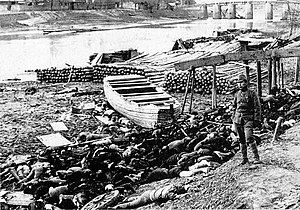

.jpg)

















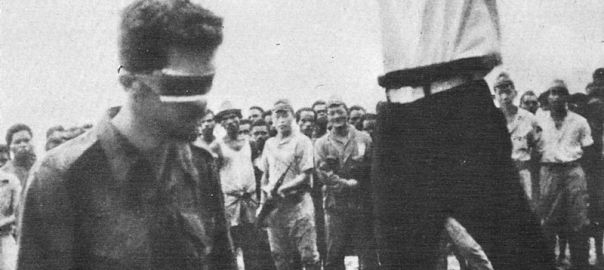


 belfastchildis.com

