Monthly Archives: November 2018

The Battle of the Diamond & The Peep o’ Day Boys

The Battle of the Diamond & The Peep o’ Day Boys
 

Capture

The Battle of the Diamond was a planned confrontation between the Catholic Defenders and the Protestant Peep o’ Day Boys that took place on 21 September 1795 near Loughgall, County Armagh, Ireland.

The Peep o’ Day Boys were the victors, killing some 30 Defenders, with no casualties in return. It led to the foundation of the Orange Order and the onset of:


“the Armagh outrages”.


Background

In the 1780s, County Armagh was the most populous county in Ireland, and the centre of its linen industry. Its population was equally split between Protestants, who were dominant north of the county, and Catholics, who were dominant in the south. Sectarian tensions had been increasing throughout the decade and were exacerbated by the relaxing of some of the Penal Laws, failure to enforce others, and the entry of Catholics into the linen industry at a time when land was scarce and wages were decreasing due to pressure from the mechanised cotton industry. This led to fierce competition to rent patches of land near markets.
 

peep boys.JPG

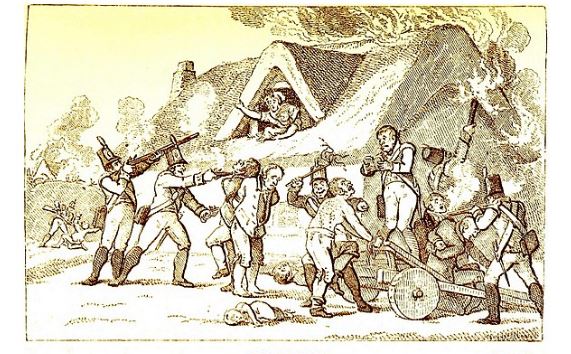
By 1784, sectarian fighting had broken out between gangs of Protestants and Catholics. The Protestants re-organised themselves as the Peep o’ Day Boys, with the Catholics forming the Defenders. The next decade would see an escalation in the violence between the two and the local population as homes were raided and wrecked

Planned confrontation
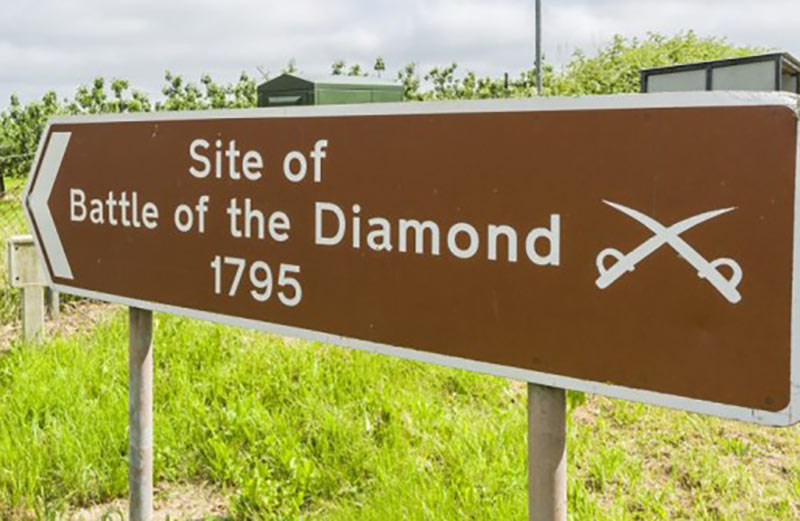
 

site of battle of dimond.jpg

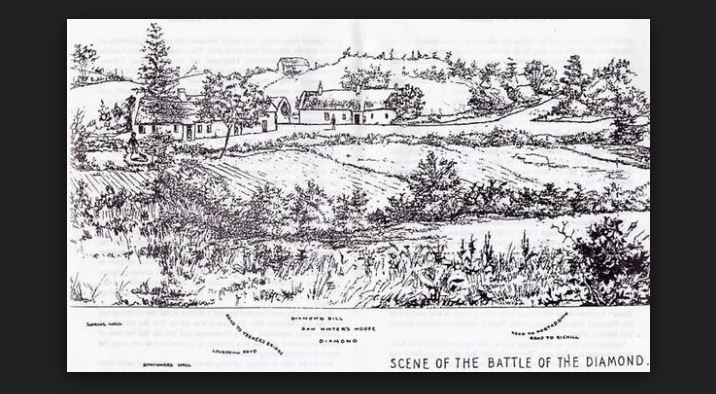
The Diamond, which was a predominantly Protestant area, is a minor crossroads in County Armagh, lying almost half-way between Loughgall and Portadown. For several days groups from both sides had been arriving at the crossroads. The Defenders had made their base on Faughart Hill in the townland of Tullymore, less than a quarter of a mile south-west of The Diamond.

The Peep o’ Day Boys, which historian Connolly states were of the “Orange Boys” faction,encamped on a hill in the townland of Grange More to the north-east.

Word of a planned confrontation appears to have been widespread well before it took place, even being gossiped about by militia-men stationed Dublin and Westport.[

Catholic Bernard Coile, from Lurgan, County Armagh, who had rose to become a merchant in the linen industry, called upon the local two parishes to agree to a non-aggression pact. This appears to have succeeded in regards to the Lurgan area, were no Lurgan men were amongst the combatants. There would also seem to have been adequate time for preparations, with one County Tyrone militia-man sending home a guinea to purchase a musket for the Defenders,  and Peep o’ Day Boys scouring Moy, County Tyrone for gunpowder.

The fact word seems to have been so widespread meant that the government could not have been unaware that trouble was stirring.

The Peep o’ Day Boys are cited in three accounts of the battle as possessing Volunteer muskets, with additional weapons provided by local squires.  One account, by Charles Teeling, who had given up hopes of being a mediator, stated that on his return to Lisburn, County Down, he saw re-formed Volunteer corps with all of their equipment heading for The Diamond.

The Defenders on the other hand may not all have been armed and possessing lesser quality firearms.

——————————————————————–

——————————————————————–

The days before the battle

The numbers had increased so much that by Friday 18 September 1795, a local magistrate, Captain Joseph Atkinson, who lived about a mile north of The Diamond, called for a peace conference between four Protestant landowners and three Catholic priests.  A priest accompanying the Defenders persuaded them to seek a truce after a group called the “Bleary Boys” came from County Down to reinforce the Peep o’ Day Boys.

At some point large numbers of Defender reinforcements from counties Londonderry and Tyrone are claimed to have been prevented from crossing the River Blackwater by James Verner and his sons who led a detachment of the North-Mayo militia, based in Dungannon, northwards to seize the boats by the river.

The Defenders failed to await substantial reinforcements from Ballygawley, County Tyrone and Keady, County Armagh, and were starting to become panicked by the situation, being on enemy soil and winter not far away.

The landowners summoned by Atkinson were: Robert Camden Cope, of the grand Loughgall Manor, MP for County Armagh and Lieutenant Colonel of the Armagh Militia; Nicholas Richard Cope and his son Arthur Walter Cope, proprietors of the much smaller Drumilly estate; and James Hardy, the squire of Drumart.

The priests were father’s: Taggart, possibly Arthur Taggart, parish priest of Cookstown, County Tyrone, who was notoriously erratic; McParland, future parish priest of Loughgall from 1799, possibly Arthur McParland; and Trainor. William Blacker claims a leader of the Defenders, “Switcher Donnelly”, was also present.  According to Patrick Tohall, there is reason to doubt the sincerity of all the delegates at this peace conference. He claims some may have used it to blindside the genuine peace-makers, with the two armed sides seeing the clash as inevitable.

On Saturday 19 September, the priests who had stayed the night in Atkinson’s house, left apparently satisfied at the outcome.  There are conflicting accounts of what happened next. According to Tohall, writing in 1953, the local Catholics had obeyed the priests, and this is evidenced by none of them being counted amongst the eventual combatants. He goes on to state that the priests seemingly failed to go to Faughart Hill and persuade the Defenders.  Blacker, who was there on the day of the battle on the Protestant side, however said when he was being questioned by a government Select Committee meeting on the Orange Order on 4 August 1835, that the Defenders had agreed to disperse and that the Peep o’ Day Boys would do likewise.

Later that day there was sporadic shooting, which didn’t trouble Atkinson, and this was followed on Sunday 20 September by overall quietness.

Some Defender reinforcements from County Tyrone however made it to The Diamond and appear to have encouraged their comrades to become:

“determined to fight”

and a decision seems to have been taken that night to advance the next day. Blacker claims:

“a large body of ‘Defenders’ not belonging to the County of Armagh, but assembled from Monaghan, Louth and I believe Cavan and Tyrone came down and were disappointed at finding a truce of this kind made, were determined not to go home without something to repay them for the trouble of their march”.


The battle

On the morning of 21 September, the Defenders, numbering around 300, made their way downhill from their base, occupying Dan Winter’s homestead, which lay to the north-west of The Diamond and directly in their line of advance.  News of this advance reached the departing Peep o’ Day Boys who quickly reformed at the brow of the hill where they had made their camp.  From this position, they gained three crucial advantages: the ability to comfortably rest their muskets, allowing for more accurate shooting; and a steep up-hill location which made it hard for attackers to scale; and a direct line-of-sight to Winter’s cottage which the Defenders made their rallying point.

This has been claimed as showing that the Peep o’ Day Boys had more experienced commanders.

The shooting began again in earnest,  and after Atkinson gave his weapon and powder to the Peep o’ Day Boys, he rode to Charlemont Garrison for troops to quell the trouble. There was no effective unit stationed in the garrison at the time, despite the fact a detachment of the North-Mayo Militia was stationed in Dungannon and a detachment of the Queen’s County Militia was at Portadown.

The battle according to Blacker, was short and the Defenders suffered “not less than thirty” deaths.  James Verner, whose account of the battle is based on hearsay, gives the total as being nearly thirty, whilst other reports give the figure as being forty-eight, however this may be taking into account those that died afterwards from their wounds.

A large amount of Defenders are also claimed to have been wounded.  One of those claimed to have been killed was “McGarry of Whiterock”, the leader of the Defenders. The Peep o’ Day Boys on the other hand in the safety of the well-defended hilltop position suffered no casualties.  Blacker praised the Bleary Boys for their prowess in the fight.

——————————————————————–

200th Anniversary Battle of the Diamond Parade 1995

——————————————————————–

Aftermath


See also: Orange Order and Peep o’ Day Boys § The Armagh outrages
In the aftermath of the battle, the Peep o’ Day Boys retired to James Sloans inn in Loughgall, and it was here that James Wilson, Dan Winter, and James Sloan would found the Orange Order, a defensive association pledged to defend :

“the King and his heirs so long as he or they support the Protestant Ascendancy”.

The first Orange lodge of this new organisation was established in Dyan, County Tyrone, founding place of the Orange Boys.

One historian claims that the victors saw the battle as:

“a Godly conquest, construed as a sanction for the spoliation of the homes of the Philistines”.

This saw violence directed firstly at the Catholics in the vicinity of The Diamond who had refrained the participating in the battle, before spreading throughout the county and further afield.

The winter of 1795–6, immediately following the battle, saw Protestants drive around 7,000 Catholics out of County Armagh in what became known as “the Armagh outrages”. In a sign that tension over the linen trade was still a burning issue, ‘Wreckers’ continued the Peep o’ Day Boys strategy of smashing looms and tearing webs in Catholic homes to eliminate competition.

This resulted in a reduction in the hotly competitive linen trade which had been in a brief slump. A consequence of this scattering of highly-political Catholics however was a spread of Defenderism throughout Ireland


——————————————————————–

The Peep O’Day Boys of Ulster

——————————————————————–

See : Peep o’ Day Boys


Walton’s Restaurant Bombing – 18th November 1975

Walton’s Restaurant Bombing

walton restaurant bombing

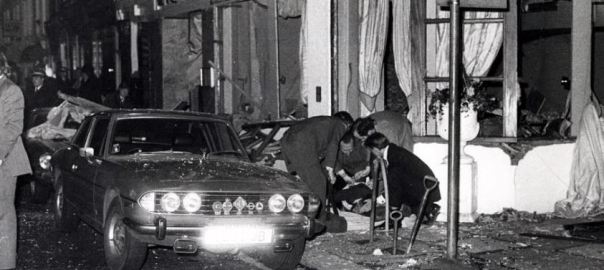
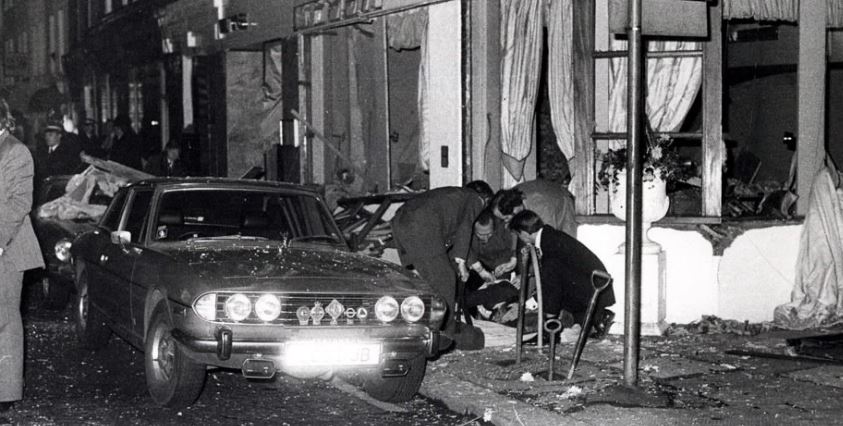
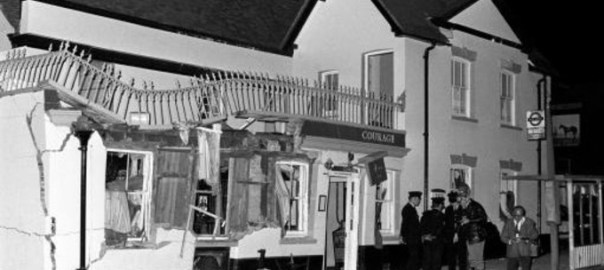
On 18 November 1975 an Irish Republican Army (IRA) unit nicknamed the Balcombe Street Gang without warning threw a bomb into Walton’s Restaurant in Walton StreetKnightsbridge, London, killing two people and injuring almost two dozen others.

Background


Related image

The IRA began a bombing campaign on Britain on 8 March 1973 when they exploded a car bomb outside the Old Bailey which injured 180 people and one man died from a heart attack. The IRA unit responsible for the Old Bailey bombing were arrested trying to leave the country.


Image result for ira asu

Thereafter to try to help avoid their active service units (ASUs) from being captured and to have a better chance of carrying out a sustained bombing assault , the IRA decided to send to England sleeper cells who would arrive within weeks before actually carrying out any military activity and blend in with the public as not to draw attention to themselves. According to the leader of the Balcombe Street unit, the first bombing they carried out was the Guildford pub bombings on 5 October 1974, which killed five people and injured over 60 for which four innocent people known as the Guildford Four were arrested and received large jail sentences.


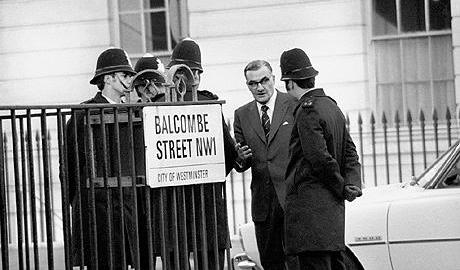
 In February 1975 the Provisional Irish Republican Army agreed to a truce and ceasefire with the British government and the Northern Ireland Office Several “incident centres” were established in Irish nationalist areas in Northern Ireland to monitor the ceasefire and the activity of the security forces. Before the truce, the IRA ASU, later dubbed the Balcombe Street Gang (because of the December 1975 Balcombe Street siege), had been bombing targets in England since autumn 1974, particularly in London and surrounding areas.

Their last attack was an assassination attempt on former Prime Minister Edward Heath but he was not home when the attackers threw a bomb into his bedroom window on 22 December 1974.

Bombing

———————————————

The Provisional IRA bomb Waltons London restaurant – 18 November 1975


———————————————

After the 1975 PIRA–British Army truce began to break, the IRA’s Balcombe Street ASU stepped up its bombing and shooting campaign on mainland Britain. On the night of 18 November 1975 the unit picked Walton’s Restaurant to bomb. Two civilians, Audrey Edgson (aged 45) and Theodore Williams (aged 49), were killed  when a bomb was thrown by one of the IRA Volunteers through the window of Walton’s Restaurant in Walton Street, Chelsea.

The device injured 23 other people, the oldest of them 71 years of age. In the bomb the IRA used miniature ball bearings to maximise injuries. Two persons, a man and woman, died at St. Stephen’s Hospital shortly after being taken there. According to Dr. Laurence Martin the consultant in charge of the casualty department in St. Stephen’s Hospital said that four of those injured required emergency operations.

“We have been involved with nine bomb incidents in the past two years but this is the worst,”

Dr. Martin said.


Senior Scotland Yard official, James Nevin, deputy head of the bomb squad, said that the bomb used in the attack had been a “shrapnel‐like device.” containing three pounds of explosives.

“This was obviously designed to kill and injure people rather than damage property,”

he said.

This was a calculated bombing campaign aimed at destroying businesses and scaring customers in London’s West End.

Other previous attacks by the unit in 1975 included Scott’s Oyster Bar bombing on 12 November, the London Hilton bombing on 5 September and the Caterham Arms Pub Bombingon 27 August. In total the unit carried out around 40 bomb and gun attacks on mainland Britain between October 1974 – December 1975.

Aftermath

This was the Balcombe Street gang’s last major attack during their fourteen-month bombing campaign of the British mainland. The IRA units bombing campaign would come to an end in December 1975 when they were caught at the Balcombe Street Siege which is where the unit got its name from.

See: Balcombe Street Siege 

The unit would eventually end up exploding close to 50 bombs in England and carried out several shootings which cost millions of pounds in damages, claimed the lives of 18 people, which included 10 civilians, 7 British soldiers and one London police officer, and injured almost 400 people, but they were only sentenced for the deaths of seven people.

The IRA would continue to attack targets in England during the rest of the 1970s and throughout the 1980s but would not launch such a sustained campaign on the British mainland again until the early 1990s.

 In custody the ASU also admitted to carrying out the Guildford pub bombings and the Kings Arms, Woolwich bombing for which the Guildford Four had been arrested, and received lengthy jail terms

See: Guildford Pub Bombings

See below on how to order a copy of my No.1 Bestselling book: A Belfast Child 

Daniel Turner – Forever 18

Daniel Turner

daniel tuner

daniel tuner donate

We are raising funds to help towards the funeral costs for Daniel Turner , a beautiful eighteen year old boy who tragically died suddenly last week after an  epileptic  fit.

Our thoughts and prayers are with his mum Rebecca and girlfriend Lauren and all his friends and family at this desperately sad time.

34248980_154143585521562_r.jpeg

Daniel went out with  our daughter Autumn for three years and was like a member of our family during this time and will always hold a special place in our hearts and minds .
We use to feed him and look after him when he had a fit and as a family we always worried that he was taking his medicine and looking after himself.

Although they had drifted apart over the past year  his death has hit Autumn and us hard and  our hearts are broken for his mum , Lauren  and all those that loved and cared for him.

Life can be so unfair sometimes and the sadness of Daniel’s sudden death is a reminder how fragile and precious life is.

Rest Easy Daniel and fly high !

daniel tuner donate

All funds will go directly to Daniels mum and any  funds left over after the funeral expenses will go to an epilepsy charity chosen by his Mum.

daniel tuner donate

The Tomb of The Unknown Warrior

The Unknown Warrior

unknown soldier blog header


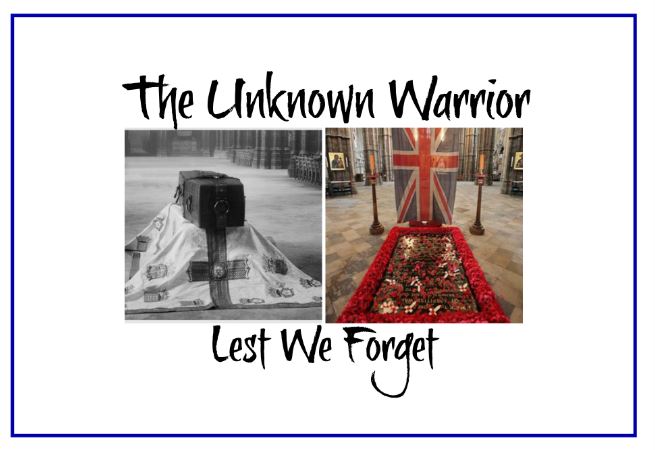
The British grave of The Unknown Warrior (often known as ‘The Tomb of The Unknown Warrior’) holds an unidentified British soldier killed on a European battlefield during the First World War.

He was buried in Westminster Abbey, London on 11 November 1920, simultaneously with a similar interment of a French unknown soldier at the Arc de Triomphe in France, making both graves the first to honour the unknown dead of the First World War. It is the first example of a tomb of the Unknown Soldier.


History of the Unknown Warrior


Origins

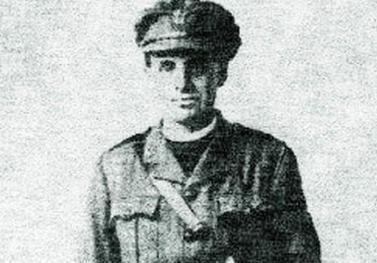
David railton

David Railton

The idea of a Tomb of the Unknown Warrior was first conceived in 1916 by the Reverend David Railton, who, while serving as an army chaplain on the Western Front, had seen a grave marked by a rough cross, which bore the pencil-written legend ‘An Unknown British Soldier’.

He wrote to the Dean of Westminster in 1920 proposing that an  unidentified British soldier from the battlefields in France be buried with due ceremony in Westminster Abbey “amongst the kings” to represent the many hundreds of thousands of Empire dead.

The idea was strongly supported by the Dean and the Prime Minister David Lloyd George

—————————————————————————

Funeral of the Unknown Warrior


—————————————————————————

Selection, arrival and ceremony

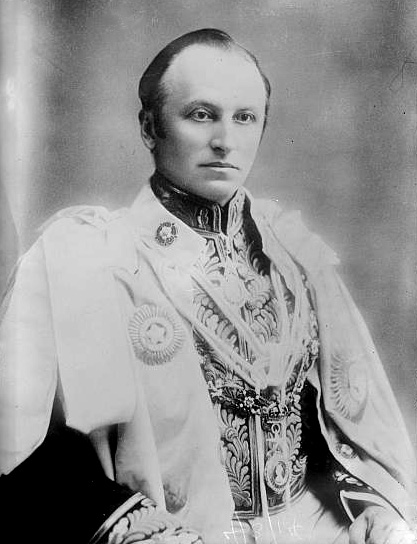
George_Curzon2.jpg

Lord Curzon of Kedleston 

Arrangements were placed in the hands of Lord Curzon of Kedleston who prepared in committee the service and location. Suitable remains were exhumed from various battlefields and brought to the chapel at Saint-Pol-sur-Ternoise near Arras, France on the night of 7 November 1920. The bodies were received by the Reverend George Kendall OBE. Brigadier L.J. Wyatt and Lieutenant Colonel E.A.S. Gell of the Directorate of Graves Registration and Enquiries went into the chapel alone.

The remains were then placed in four plain coffins each covered by Union Flags: the two officers did not know from which battlefield any individual soldier had come. Brigadier Wyatt with closed eyes rested his hand on one of the coffins. The other soldiers were then taken away for reburial by Kendall.


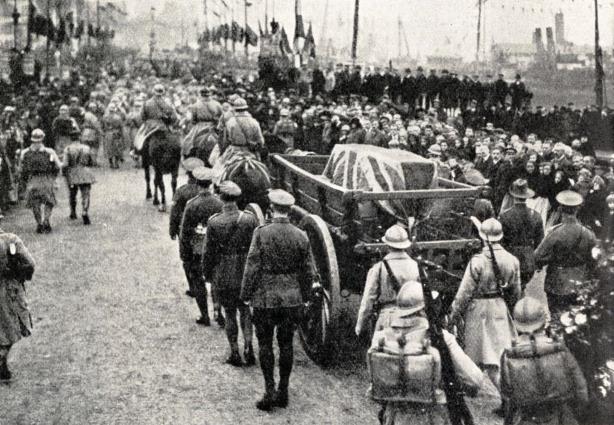
The body of the Unknown Warrior leaving france.jpg

The body of the Unknown Warrior leaving France

The coffin of the unknown warrior then stayed at the chapel overnight and on the afternoon of 8 November, it was transferred under guard and escorted by Kendall, with troops lining the route, from Ste Pol to the medieval castle within the ancient citadel at Boulogne. For the occasion, the castle library was transformed into a chapelle ardente: a company from the French 8th Infantry Regiment, recently awarded the Légion d’Honneur en masse, stood vigil overnight.

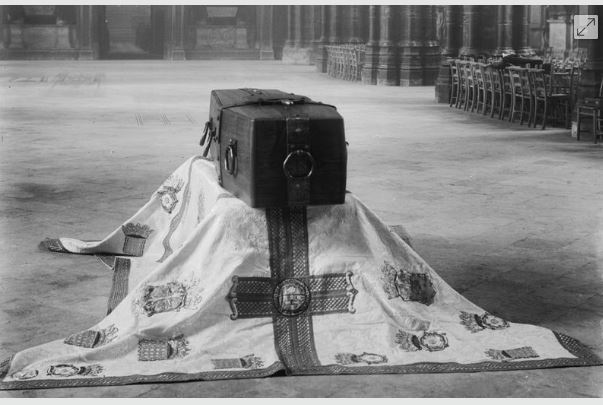
The following morning, two undertakers entered the castle library and placed the coffin into a casket of the oak timbers of trees from Hampton Court PalaceThe casket was banded with iron, and a medieval crusader’s sword chosen by King George V personally from the Royal Collection was affixed to the top and surmounted by an iron shield bearing the inscription


‘A British Warrior who fell in the Great War 1914–1918 for King and Country’.

The casket was then placed onto a French military wagon, drawn by six black horses. At 10.30 am, all the church bells of Boulogne tolled; the massed trumpets of the French cavalry and the bugles of the French infantry played Aux Champs (the French “Last Post“).

Then, the mile-long procession—led by one thousand local schoolchildren and escorted by a division of French troops—made its way down to the harbour.

At the quayside, Marshal Foch saluted the casket before it was carried up the gangway of the destroyer, HMS Verdun, and piped aboard with an admiral’s call. The Verdun slipped anchor just before noon and was joined by an escort of six battleships.

As the flotilla carrying the casket closed on Dover Castle it received a 19-gun Field Marshal‘s salute. It was landed at Dover Marine Railway Station at the Western Docks on 10 November. The body of the Unknown Warrior was carried to London in South Eastern and Chatham Railway General Utility Van No.132, which had previously carried the bodies of Edith Cavell and Charles Fryatt.


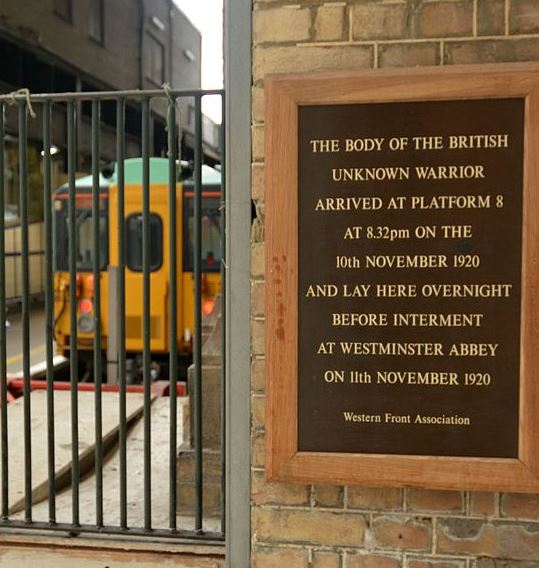
plaque victoria station.JPG

Plaque at Victoria Station

The van has been preserved by the Kent and East Sussex RailwayThe train went to Victoria Station, where it arrived at platform 8 at 8.32 pm that evening and remained overnight. (A plaque at Victoria Station marks the site: every year on 10 November, a small Remembrance service, organised by The Western Front Association, takes place between platforms 8 and 9.)

On the morning of 11 November 1920, the casket was placed onto a gun carriage of the Royal Horse Artillery and drawn by six horses through immense and silent crowds. As the cortege set off, a further Field Marshal’s salute was fired in Hyde Park.

The route followed was Hyde Park CornerThe Mall, and to Whitehall where the Cenotaph, a “symbolic empty tomb”, was unveiled by King-Emperor George V. The cortège was then followed by The King, the Royal Family and ministers of state to Westminster Abbey, where the casket was borne into the West Nave of the Abbey flanked by a guard of honour of one hundred recipients of the Victoria Cross


coffin of the unknown soldier

The guests of honour were a group of about one hundred women. They had been chosen because they had each lost their husband and all their sons in the war.

 “Every woman so bereft who applied for a place got it”.


The coffin was then interred in the far western end of the Nave, only a few feet from the entrance, in soil brought from each of the main battlefields, and covered with a silk pall. Servicemen from the armed forces stood guard as tens of thousands of mourners filed silently past. The ceremony appears to have served as a form of catharsis for collective mourning on a scale not previously known.

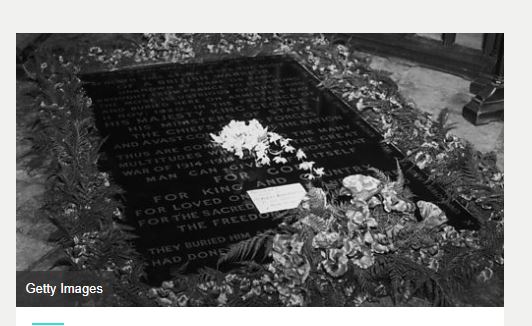
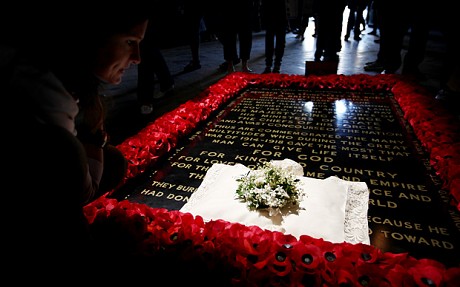
The grave was then capped with a black Belgian marble stone (the only tombstone in the Abbey on which it is forbidden to walk) featuring this inscription, composed by Herbert Edward Ryle, Dean of Westminster, engraved with brass from melted down wartime ammunition:

Beneath this stone rests the body
Of a British warrior
Unknown by name or rank
Brought from France to lie among
The most illustrious of the land
And buried here on Armistice Day
11 Nov: 1920, in the presence of
His Majesty King George V
His Ministers of State
The Chiefs of his forces
And a vast concourse of the nation

Thus are commemorated the many
Multitudes who during the Great
War of 1914 – 1918 gave the most that
Man can give life itself
For God
For King and country
For loved ones home and empire
For the sacred cause of justice and
The freedom of the world

They buried him among the kings because he
Had done good toward God and toward
His house

Around the main inscription are four New Testament quotations:

The Lord knoweth them that are his (top; 2 Timothy 2:19)
Unknown and yet well known, dying and behold we live (side; 2 Corinthians 6:9)
Greater love hath no man than this (side; John 15:13)
In Christ shall all be made alive (base; 1 Corinthians 15:22)

—————————————————————————

The Actual “Unknown Soldier” – Remembrance Day – WW

—————————————————————————

Later history

A year later, on 17 October 1921, the unknown warrior was given the United States’ highest award for valour, the Medal of Honor, from the hand of General John Pershing; it hangs on a pillar close to the tomb. On 11 November 1921, the American Unknown Soldier was reciprocally awarded the Victoria Cross.

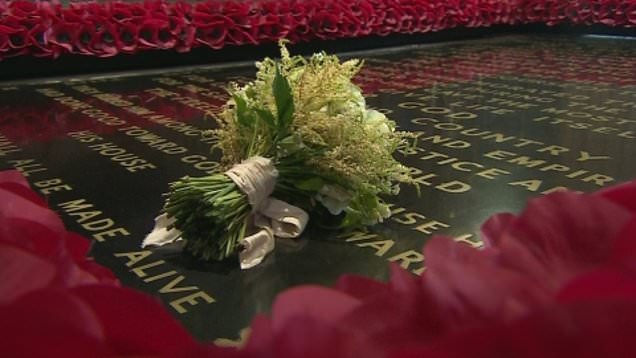
Princess Elizabeth's wedding bouquet on the Tomb of the Unknown Warrior, a tradition started by her mother in 1923..JPG

Princess Elizabeth’s wedding bouquet on the Tomb of the Unknown Warrior, a tradition started by her mother in 1923.

When Elizabeth Bowes-Lyon married the future King George VI on 26 April 1923, she laid her bouquet at the Tomb on her way into the Abbey, as a tribute to her brother Fergus who had died at the Battle of Loos in 1915 (and whose name was then listed among those of the missing on the Loos Memorial, although in 2012 a new headstone was erected in the Quarry Cemetery, Vermelles).

Royal brides married at the Abbey now have their bouquets laid on the tomb the day after the wedding and all of the official wedding photographs have been taken. It is also the only tomb not to have been covered by a special red carpet for the wedding of Prince Albert, Duke of York, and Elizabeth Bowes-Lyon.

The bridal bouquet rests on the grave

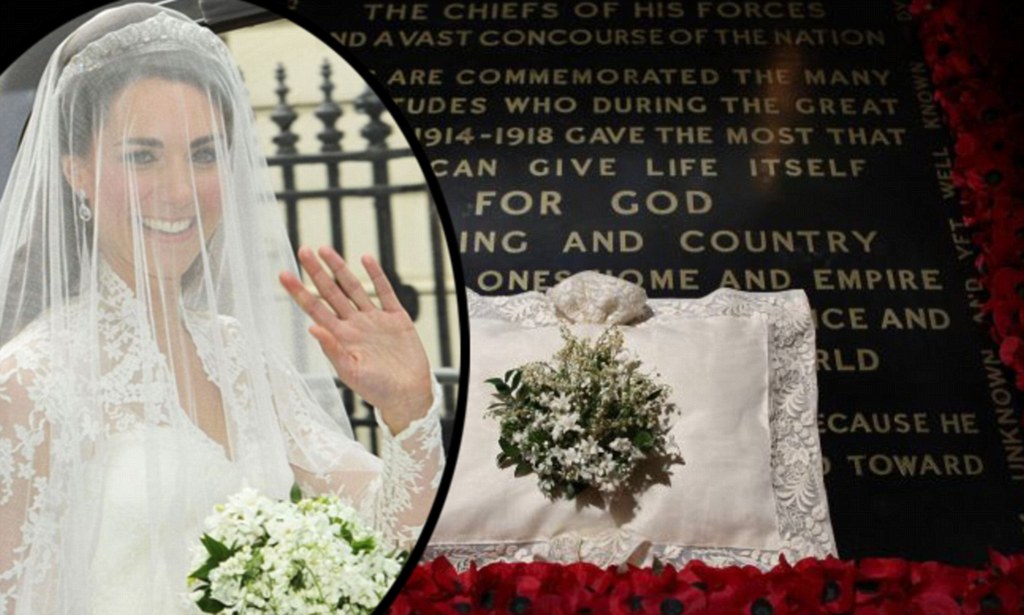
Kate Middleton’s bridal bouquet 

Meghan follows royal traditional as her bridal bouquet

Meghan follows royal traditional as her bridal bouquet is laid on the tomb of The Unknown Warrior. 

Before she died in 2002, Queen Elizabeth The Queen Mother (the same Elizabeth who first laid her wedding bouquet at the tomb) expressed the wish for her wreath to be placed on the Tomb of the Unknown Warrior. Her daughter, Queen Elizabeth II, laid the wreath the day after the funeral.

The British Unknown Warrior came 76th in the 100 Great Britons poll. The LMS-Patriot Project a charitable organisation, is building a new steam locomotive that will carry the name The Unknown Warrior. The new loco has been endorsed by the Royal British Legion as the new National Memorial Engine. A public appeal to build the locomotive was launched in 2008. The Unknown Warrior is expected to be complete by January 2019—one year late of the 100th Anniversary of the Armistice.

Heads of state from over 70 countries have lain wreaths in memoriam of the Unknown Warrior.

—————————————————————————————

Great War Tour Ep 2 – Identifying the Unknown Soldier

 —————————————————————————————


Source :  Wikipedia – The Unknown Warrior

————————————————————————————–

Telegraph Story

Kate Middleton’s bridal bouquet placed at Grave of Unknown Warrior

Kate Middleton's bridal bouquet placed at Grave of Unknown Warrior.jpg

As tradition dictates, Kate Middleton’s bridal bouquet was laid at the Grave of the Unknown Warrior inside Westminster Abbey after the Royal wedding ceremony was completed.
It is understood that the bouquet was placed at the grave, which is located at the nave in the west end of the Abbey, by a royal official after the official wedding photographs were completed.
The tradition began in 1923 following the wedding of Lady Elizabeth Bowes-Lyon – the future Queen Elizabeth – to the Duke of York, who later became George VI.
Lady Elizabeth, who became the Queen Mother in 1952, left her bouquet at the grave in memory of her brother Fergus, a young officer who was killed on the Western Front in 1915.
The grave is one of the most sacred places in the Abbey and is the only part of the floor upon which the congregations are not allowed to walk.

It is thought that the idea to commemorate the unknown war dead of the 1914-18 conflict, which saw a generation perish on Western Front, came from the Rev David Railton who served as a chaplain during the conflict.

Legend has it that in 1916, while serving in Armentieres, Rev Railton noticed a grave in the garden with a rough hand-made cross bearing the inscription “An unknown British Soldier”.

In 1920, Rev Railton wrote to Herbert Ryle, the Dean of Westminster with the suggestion that all of those who died in the trenches and whose bodies were never be found should be remembered.

The body of a soldier was exhumed from a mass grave in France after the First World War and was buried on 11 November 1920.

The grave which contains soil from France, is covered by a slab of black Belgian marble from a quarry near Namur and contains an inscription composed by Herbert Ryle, who at the time was the Dean of Westminster.

In the week after the unknown soldier was laid to rest, more than 1.2 million people visited the Abbey and the site is now one of the world’s most visited graves.

The body was chosen from four unknown British servicemen exhumed from four battle areas, the Aisne, the Somme, Arras and Ypres.

The remains were brought to the chapel at St. Pol on the night of 7 November 1920. The General Officer in charge of troops in France and Flanders, Brigadier General L.J.Wyatt, with Colonel Gell, went into the chapel alone, where the bodies on stretchers were covered by Union Flags. General Wyatt selected one and the two officers placed it in a plain coffin and sealed it.

The other bodies were reburied. The destroyer HMS Verdun, whose ship’s bell now hangs near the grave in the Abbey, transported the coffin to Dover and it was then taken by train to Victoria station in London where it rested overnight.

On the morning of 11 November the coffin was placed on a gun carriage drawn by six black horses and began its journey through the crowd-lined streets.

The coffin to the Nave through a guard of honour of 100 holders of the Victoria Cross, During the shortened form of the Burial Service, after the hymn “Lead kindly light”, the King stepped forward and dropped a handful of French earth onto the coffin as it was lowered into the grave.

Among the daughters-in-law of Queen Elizabeth II, only Sarah Ferguson, Duchess of York had laid her bouquet on the tomb as her wedding to the Queen’s second son, Prince Andrew, the Duke of York, in July 1986 was held at Westminster Abbey.

Diana and Charles were married at St. Paul’s Cathedral in July 1981, the Queen’s youngest son, Prince Edward, the Earl of Wessex and Sophie Rhys-Jones were married at St. George’s Chapel in Windsor Castle in June 1999 while Prince Charles’s church’s blessing with Camilla Parker-Bowles happened also at St. George’s chapel.

Read more : Telegraph