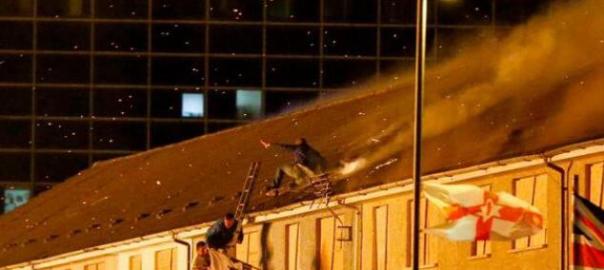
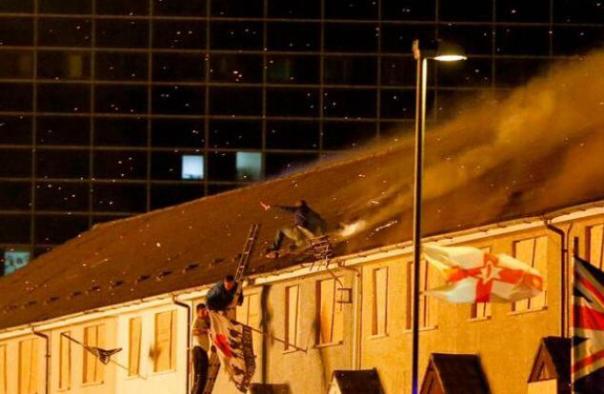
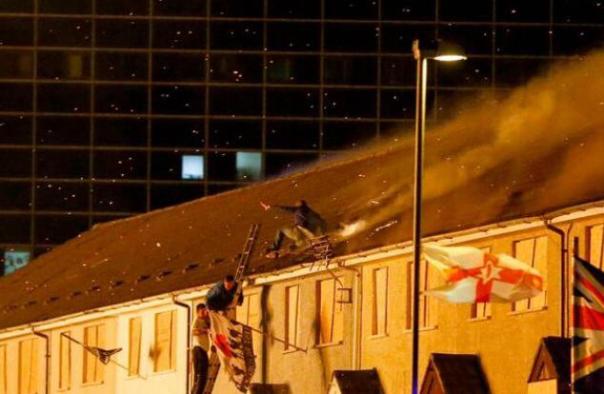
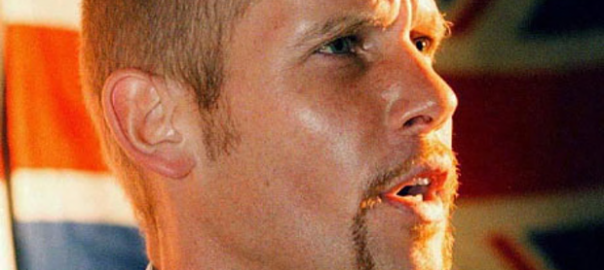
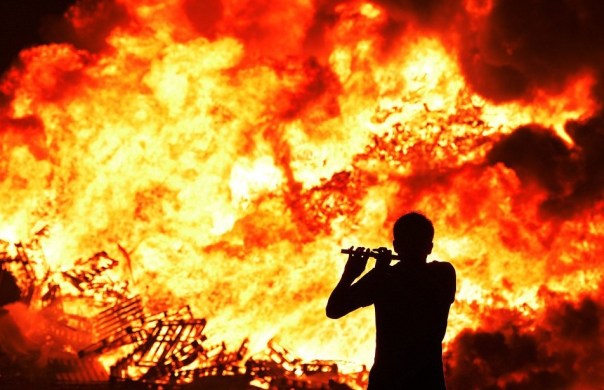
This guy was almost burnt to death trying to put out a fire in the roof of this house on the 11th and in my opinion he is the luckiest man in all of Northern Ireland today and should be thanking his lucky stars.
Seconds after this picture was taking the roof caved in and had he not move he would have fallen into the inferno that was engulfing the roof space of this house and hundreds watching would have witness someone being burnt to death and every time I think about I get shivers down my spine.
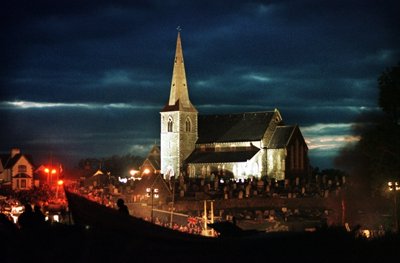
The family and I had watched a few fires in and around the Woodvale & Glenciarn before heading down to the lower Shankill to watch the main fire there , with 1000’s of others. The heat was unbelievable hot and the local council expecting this had covered the doors and windows of those houses deemed to close to the fire with hoarding , including those houses that eventually caught fire.
As the night wore on and the fire was reaching its peak everyone was happy and celebrating the 11th bonfires , but gradually we became concerned with the vast heat coming from the fire and the showers of hot ash and sparks that the wind was blowing towards the row of houses to the north of the fire. Gradually we noticed some a small fire in the air vents in one of the roofs and this quickly spread to three or four adjoining houses.
At this stage it was only tiny flames and no one seemed overly concerned when someone brought out a ladder and a few men/boy started a small chain and were passing buckets of water to the guy at the top of the ladder as he tried to put the fire out.
And then things took a sinister turn. The guy at the top climb onto the roof and to all our amazement he clambered over the roof tiles to reach the small fire better. The crowd held their breath as we watched him attempt to extinguish the flames and then to our horror he slips and one of his feet went through the tiles and flames shot up from the loft of the house and it was immediately obvious the fire was much worse than we had thought and the whole of the loft/roof spaces were engulfed in fire and the situation was grave.
Then as the guy on the roof was trying to climb away from the hole he slipped again and almost feel into the hole and certain death and i have to say my heart was in my throat and like many in the crowd i had to look away as I had no wish to see someone die such a terrible death. Screams of terror echoed round the square and everyone present held their breaths , but thankfully he made his way back over the roof and down the ladder to relative safety on the ground.
Seconds later the roof he had been on collapsed completely and had he been still in the same position he would not have been here today as it would have been impossible to save him and besides for some reason the fire-brigade had not yet arrived on the scene and when they did it seem to take them ages to get the equipment set up and working to deal with the fire.
Key Events & Deaths on this day in Northern Ireland Troubles
12th July
———————————-
Saturday 12 July 1969
As the ‘marching season’ reached its height there was serious rioting in Derry, Belfast and Dungiven. Many familles in Belfast were forced to move from their homes.
[The upsurge in violence followed a period of relative calm
Monday 12 July 1971
David Walker
A British soldier was shot dead in Belfast. The main Orange Order parades across Northern Ireland passed off relatively peacefully.
Wednesday 12 July 1972
A Protestant man was found shot dead in Portadown.
Two men, one Catholic one Protestant, were shot dead in a public house in Portadown.
Two men were shot dead in separate incidents in Belfast.
Thursday 12 July 1979
Margaret Thatcher, then British Prime Minister, criticised the British Broadcasting Corporation (BBC) after it had broadcast an interview with a member of the Irish National Liberation Army (INLA).
[This incident was to set a pattern of confrontation between the media, particularly the broadcast media, and Conservative governments during the 1980s and 1990s.]
Thursday 12 July 1984
Twelfth in Northern Ireland 2013
The annual Orange Order ‘Twelfth’ parades took place across Northern Ireland. There was violence following the parades with attacks on security forces and shops in Derry. Catholic families were also attacked in Limavady, County Derry, in Ballymena, County Antrim, and in Ballynahinch, County Down.
During speeches at the various centres across the region leading Orange figures condemned the Report of the New Ireland Forum
Friday 12 July 1985
There was further rioting in Portadown, County Armagh, following the decision by the Royal Ulster Constabulary (RUC) to re-route Orange Order and Royal Black Institution parades away from Obins Street, a mainly Catholic area of Portadown. During serious rioting between Loyalists and the RUC extensive damage was inflicted on property in the town and 52 RUC officers were injured.
Saturday 12 July 1986
There were further periods of violence following the Orange Order ‘Twelfth’ parades.
[Later the Royal Ulster Constabulary (RUC) released figures that showed there had been 128 RUC officers and 66 civilians injured and 127 arrests made. 281 plastic baton rounds had been fired and there were 79 reported cases of intimidation.]
Brian Leonard (20), a Catholic civilian, died two days after been shot while working on a building site in Shugville Street, Shankill, Belfast. The Protestant Action Force (PAF) claimed responsibility for the killing.
[The PAF killed two more Catholic civilians during July 1986 and two in September 1986.]
Wednesday 12 July 1989
Charles Haughey was re-elected as Taoiseach (Irish Prime Minister). Fianna Fáil (FF) formed the new government with the support of the Progressive Democrats (PDs). This was the first occasion that FF had been part of a coalition government.
Thursday 12 July 1990
The case of the Maguire family was referred to the Court of Appeal.
Friday 12 July 1991
The results of a survey of public opinion on the political talks (later known as the Brooke / Mayhew talks) was published. It showed a high level of support for the resumption of the talks (73 per cent of people questioned in Northern Ireland; 87 per cent in the Republic of Ireland; and 79 per cent in Britain). The survey was carried out by Ulster Marketing Surveys, Irish Marketing Surveys, and Gallup.
Tuesday 12 July 1994
The security forces in England seized a lorry containing over 1,800kgs of explosives at the port of Heysham, Lancashire. The explosives had been hidden in false compartments and the Irish Republican Army (IRA) was considered to be responsible.
[There was speculation that the explosives would have been used in London.]
Wednesday 12 July 1995
Orange Order parades took place at a number of centres across Northern Ireland. In the lower Ormeau Road area of Belfast the Royal Ulster Constabulary (RUC) moved hundreds of police officers into the area to prevent Nationalist residents from protesting on the street.
Many residents were blocked inside their homes for the duration of the operation. Approximately 150 Orangemen, accompanied by four bands, left Ballynafeigh Hall at 9.30am to parade along the Ormeau Road. There were clashes between the Nationalist residents and the RUC.
A number of vehicles were hijacked and burned. During the evening there were attacks on the homes of several Catholic and Protestant families and there were arson attacks on five Orange Halls.
[ The Irish government later accused the RUC of bias in favour of the Orange Order and made a complaint to the Anglo-Irish Secretariat at Maryfield.]
Friday 12 July 1996
Ballynafeigh Orangemen were allowed to march through the Catholic lower Ormeau Road area of Belfast. There was continuing rioting in nationalist areas.
Dermot McShane (35), a Catholic man, was killed when he was run over by a British Army armoured car in Little James Street, Derry.
It was estimated that 1,000 petrol bombs were thrown and 1,000 plastic bullets were fired in Derry. John Bruton, then Taoiseach (Irish Prime Minister), criticised the decision to allow the Orange march to proceed on the Garvaghy Road. He accused the British government of yielding to force and the threat of force.
Saturday 12 July 1997
The ‘Twelfth’ Orange Order parades across Northern Ireland passed off relatively peacefully with only minor incidents. There were some stones thrown in the White City area of Belfast. Two Royal Ulster Constabulary (RUC) officers and three soldiers were slightly injured in an Irish Republican Army (IRA) attack in north Belfast.
John Hume, then leader of the Social Democratic and Labour Party (SDLP), held a meeting with Tony Blair, then British Prime Minister, and called on the IRA to announce a new ceasefire. An RUC Landrover, being used to police an Orange Order parade at Dunloy, appeared with a handpainted rat with a crown and the words “King Rat”.
[‘King Rat’ was the nickname of Billy Wright, then leader of the Loyalist Volunteer Force (LVF). Wright was believed to have been responsible for the deaths of many innocent Catholic civilians.]
The relative of one of his victims called on the RUC to take immediate disciplinary action against the officers responsible for the painting.
Three young Catholic boys, Richard (11), Mark (10), and Jason (9) Ouinn, were burnt to death after their home, in Ballymoney, County Antrim, was petrol bombed in a sectarian attack carried out by Loyalists.
[It was later disclosed that members of the Ulster Volunteer Force (UVF) had been involved in the attack.]
Christine Quinn the boys mother, her partner, Raymond Craig, and a family friend, Christina Archibald (18) escaped from the house but they and neighbours were unable to reach the three boys. Lee Ouinn (13), the oldest son, was staying with his grandmother when the incident occurred.
[There was a general sense of shock when the news of the deaths broke and in the following days the incident was to have a major impact on the Orange Order protest at Drumcree. Although senior representatives of the Order tried to distance the organisation from the violence that had been almost continuous since the 5 July 1998, many commentators argued that the Orange Order had to accept some responsibility for the violence of its followers.]
William Bingham (Rev.), then Deputy Grand Chaplain of the Orange Order, called for the Drumcree protest to be ended and said that the 15 minute march down the Garvaghy Road would be “a hallow victory” as it would be taking place in the shadows of three little white coffins. David Trimble, then leader of the Ulster Unionist Party (UUP), and Robin Eames (Dr), then Church of Ireland Primate, also called for an end to the protest.
The Orange Order rejected these and other similar calls.
[The protest at Drumcree declined following the Quinn deaths but a token protest was maintained during most of the year to July 1999.]
Monday 12 July 1999
Across Northern Ireland the Twelfth parades passed off without incident. The largest Orange parade with around 20,000 marchers proceeded through south Belfast to the Ormeau Park, keeping to a compromise route.
Other parades passed off without major incident. Legislation was put before the Westminster Parliament, designed to act as a safeguard for the decommissioning of arms and the devolution of power in Northern Ireland.
Mary McAleese, then President of the Republic of Ireland, attended a reception to mark the 50th anniversary of the death of the Republic’s first president, Douglas Hyde (Dr). She said his message was that barriers between differing traditions should not be broken down by threat or stealth.
Wednesday 12 July 2000
Andrew Cairns (22), a member of the Ulster Volunteer Force (UVF), was shot dead while attending “eleventh night” bonfire celebrations in Boyne Square, Larne, County Antrim.
The Ulster Defence Association (UDA) were believed to have been responsible for the killing. The killing was part of a feud between the UDA and the UVF.
Thursday 12 July 2001
Serious Violence in Belfast
Orange Order parades took place across Northern Ireland. Speakers at Orange rallies across the region attacked the peace process and the Good Friday Agreement.
About a hundred members of the Ballynafeigh Lodge were prevented by a Parades Commission ruling from marching along the Nationalist Lower Ormeau Road area of Belfast.
The Parades Commission had also re-routed the main parade in Derry. The worst riots for a number of years took place as the Royal Ulster Constabulary (RUC) sealed off part of the Nationalist Ardoyne area of Belfast to allow an Orange Order parade to pass close to the Catholic area.
The RUC reported that 10 officers had been injured in the disturbances. Nationalists claimed that a number of people had been injured by the RUC with at least 12 people being struck by plastic bullets.
[Senior police later accused the Irish Republican Army (IRA) of orchestrating the violence. The claim was rejected by Sinn Féin (SF).]
There was also violence in the east of Belfast when a Orange Order parade passed the Nationalist Short Strand area.
——————————————
Remembering all innocent victims of the Troubles
Today is the anniversary of the death of the following people killed as a results of the conflict in Northern Ireland
“To live in hearts we leave behind is not to die
– Thomas Campbell
To the innocent on the list – Your memory will live forever
– To the Paramilitaries –
There are many things worth living for, a few things worth dying for, but nothing worth killing for.
18 People lost their lives on the 12th July between 1971 – 2000
——————————————
12 July 1971
David Walker (30)
nfNI Status: British Army (BA),
Killed by: Irish Republican Army (IRA)
Shot by sniper, while leaving British Army (BA) observation post, Northumberland Street, Lower Falls, Belfast.
——————————————
12 July 1972 Paul Beattie (19)
Protestant Status: Civilian (Civ),
Killed by: non-specific Republican group (REP)
Found shot in entry, off Churchill Park, Portadown, County Armagh.
——————————————
12 July 1972
Jack McCabe (48)
Catholic Status: Civilian (Civ),
Killed by: Ulster Defence Association (UDA)
Shot at his licensed premises, McCabe’s Bar, High Street, Portadown, County Armagh.
——————————————
12 July 1972 William Cochrane (53)
Protestant Status: Civilian (Civ),
Killed by: Ulster Defence Association (UDA)
Shot while inside McCabe’s Bar, High Street, Portadown, County Armagh.
——————————————
12 July 1972 David McClenaghan (15)
Catholic Status: Civilian (Civ),
Killed by: non-specific Loyalist group (LOY)
Shot at his home, Southport Street, Lower Oldpark, Belfast.
——————————————
12 July 1972 Colin Poots (21)
Protestant Status: Civilian (Civ),
Killed by: non-specific Republican group (REP)
Found shot by Flush River, off Springfield Road, Belfast.
——————————————
12 July 1973 Frederick Davis (28)
Protestant Status: Civilian (Civ),
Killed by: non-specific Republican group (REP)
Found strangled in entry off Seaforde Street, Short Strand, Belfast.
——————————————
12 July 1974 John Beattie (17)
Protestant Status: Ulster Defence Association (UDA),
Killed by: Irish Republican Army (IRA)
Shot while standing on the corner of Glenrosa Street and Moyola Street, Tiger’s Bay, Belfast
——————————————
12 July 1974 Michael Browne (16)
Catholic Status: Civilian (Civ),
Killed by: Ulster Volunteer Force (UVF)
Found shot, Castle grounds, Bangor, County Down.
——————————————
12 July 1975
James Carberry (20)
Protestant Status: Civilian (Civ),
Killed by: Irish Republican Army (IRA)
Found shot, Old Templepatrick Road, Ballyutoag, near Belfast, County Antrim.
——————————————
12 July 1978
John Fisher (19)
nfNI Status: British Army (BA),
Killed by: Irish Republican Army (IRA)
Killed by remote controlled bomb hidden in manhole while on British Army (BA) foot patrol, Crossmaglen, County Armagh.
——————————————
12 July 1979 Michael Kearney (21)
Catholic Status: Irish Republican Army (IRA),
Killed by: Irish Republican Army (IRA)
Found shot Legakelly, near Newtownbutler, County Fermanagh. Alleged informer.
——————————————
12 July 1986 Brian Leonard (20)
Catholic Status: Civilian (Civ),
Killed by: Protestant Action Force (PAF)
Died two days after being shot while working on building site, Snugville Street, Shankill, Belfast.
——————————————
12 July 1987
Alan McQuiston (46)
Protestant Status: Civilian (Civ),
Killed by: Irish Republican Army (IRA)
Shot during street disturbances, Alliance Avenue, Ardoyne, Belfast.
——————————————
12 July 1998
Richard Quinn (11)
Catholic Status: Civilian (Civ),
Killed by: Ulster Volunteer Force (UVF)
Killed during petrol bomb attack on his home, Carnany Park, Ballymoney, County Antrim
——————————————
12 July 1998
Mark Quinn (10)
Catholic Status: Civilian (Civ),
Killed by: Ulster Volunteer Force (UVF)
Killed during petrol bomb attack on his home, Carnany Park, Ballymoney, County Antrim
——————————————
12 July 1998
Jason Quinn (9)
Catholic Status: Civilian (Civ),
Killed by: Ulster Volunteer Force (UVF)
Killed during petrol bomb attack on his home, Carnany Park, Ballymoney, County Antrim.
——————————————
12 July 2000 Andrew Cairns (22)
Protestant Status: Ulster Volunteer Force (UVF),
Killed by: Ulster Defence Association (UDA)
Shot while attending eleventh night bonfire celebrations, Boyne Square, Larne, County Antrim. Ulster Defence Association (UDA) / Ulster Volunteer Force (UVF) feud.
– Disclaimer – The views and opinions expressed in these documentaries are soley intended to educate and provide background information to those interested in the Troubles of Northern I…
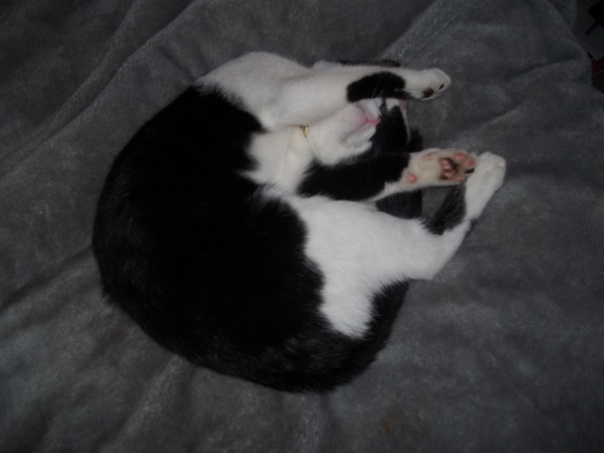
Update: 11/July/2016 Hi All just a quick update on our cat Baby ‘s condition – from Belfast. We spoke to the vet today and unfortunately Baby has managed to undo the pins in his…
Key Events & Deaths on this day in Northern Ireland Troubles
11th July
—————————————
Sunday 11 July 1971
The Irish Republican Army (IRA) exploded a number of bombs in the centre of Belfast injuring a number of people.
[A number of commentators saw these bombs as an attempt to increase tension and confrontations between the two main communities.]
Friday 11 July 1975
During the trial of the ‘Birmingham Six’ the prosecution admitted that the men were physically assaulted while in custody.
Tuesday 11 July 1978
John Boyle (16), a Catholic teenager, was shot dead by undercover members of the British Army near an Irish Republican Army (IRA) arms dump in Dunloy, County Antrim. Boyle had earlier found the dump and his family had reported the matter to the Royal Ulster Constabulary (RUC).
[The RUC, together with the British Army, took the decision to monitor the dump in the hope that members of the IRA would return to it. Boyle’s curiosity must have taken him back unsuspectingly to the dump.]
Friday 11 July 1986
The Orange Order agreed to accept an alternative route through Portadown, County Armagh, to avoid the mainly Catholic Obins Street area.
[The route suggested by the Royal Ulster Constabulary (RUC) caused resentment among Nationalists in the town as it took the parade along the mainly Catholic Garvaghy Road. Trouble over the new route broke out again in 1995.]
During the evening the RUC fired plastic bullets at Loyalists following disturbances at the traditional bonfire celebrations. There was rioting in Protestant areas of Belfast and Portadown and the disturbances continued for most of the week.
Sunday 11 July 1993
James Molyneaux, then leader of the Ulster Unionist Party (UUP), claimed that the Northern Ireland Office (NIO) had presented the Irish Republican Army (IRA) with peace proposals at the end of 1992.
Monday 11 July 1994
Raymond Smallwoods (44), a member of the Ulster Democratic Party (UDP), was shot dead by the Irish Republican Army (IRA) outside his home, Donard Drive, Tonagh, Lisburn, County Antrim.
[Smallwoods had been a member of the Ulster Defence Association (UDA).] The Belfast High Court ruled that the Coroner investigating the events surrounding the alleged ‘shoot to kill’ incidents in November and December 1982 could not have access to the contents of the Stalker report.
Tuesday 11 July 1995
A comprise was reached which allowed the Drumcree parade to proceed down the Garvaghy Road in Portadown.
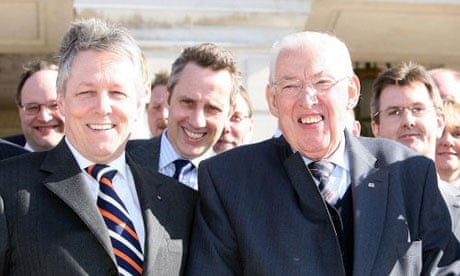
Approximately 500 Orange Order members were allowed by the police to walk down the Garvaghy Road without, however, any Loyalist bands. The parade was accompanied by Ian Paisley, then leader of the Democratic Unionist Party (DUP), and David Trimble, then Ulster Unionist Party (UUP) MP. Nationalists mounted a quiet protest but did not interfere with the parade.
When the parade reached the centre of Portadown, Paisley and Trimble clasped hands and held their arms in the air in what appeared to be a gesture of triumph.
[This led to considerable ill-feeling among the Nationalist residents of the Garvaghy Road and was to result in stronger protests in the following years.]
Hugh Annesley, then Chief Constable of the Royal Ulster Constabulary (RUC), reversed his decision and ordered his officers to allow the Orange march to pass along the Garvaghy Road in Portadown. 1,200 Orangemen were allowed to proceed down the Garvaghy Road. Protesting residents were forced off the road.
Rioting broke out in the Catholic housing estate and was followed by serious rioting in other nationalist areas including Armagh, Belfast, Derry and Lurgan.
Three RUC officers were injured by gunfire in north Belfast.
There was widespread condemnation of the decision in nationalist circles with many political and community leaders claiming there had been a surrender to the threat of physical force.
Friday 11 July 1997
Following discussions with local residents, Orangemen agreed to reroute a parade in Newtownbutler, County Fermanagh.
[The village is roughly 80 per cent Catholic. The decision by the Orange Order to hold discussions with local residents differed from other areas where Orangemen refused to hold face-to-face discussions with resident groups.]
Saturday 11 July 1998
Proximity (indirect) talks were held in Armagh between representatives of the Orange Order and the Garvaghy Road Residents Coalition (GRRC). Jonathen Powell, then Chief of Staff at Downing Street, acted as the mediator between the two groups.
The Orange Order maintained its position that it would not engage in face-to-face talks with the GRRC; there was no agreement between the two sides.
The Tour de France began in Dublin. The tour was brought to Ireland because of the French link in the 1798 Rising by the United Irishmen. It represented the largest sporting event ever staged in Ireland.
Sunday 11 July 1999
Four Royal Ulster Constabulary (RUC) officers were injured when trouble flared at a Loyalist bonfire site in Derry. Tony Blair, then British Prime Minister, tried to reassure Unionists by stating that ‘failsafe’ legislation would be introduced in the House of Commons which would safeguard the Unionist position.
An article by David Trimble, then leader of the Ulster Unionist Party (UUP), was published in The Sunday Times (a London based Newspaper) in which he stated that the UUP would reject ‘The Way Forward’ proposals unless there was a guarantee regarding the position of Sinn Féin (SF) in the event of the Irish Republican Army (IRA) not decommissioning its weapons.
Trimble called for a guarantee from John Hume, then leader of the Social Democratic and Labour Party (SDLP), that he would help to expel Sinn Féin from the proposed Executive if the IRA defaulted. Hume said that the SDLP would not sit in an Executive with any party that supported violence.
The Sunday Tribune (a Dublin based newspaper) stated that it would fully support Ed Moloney, then Northern Editor of the newspaper. Moloney had been served with a court order requesting him to provide the Royal Ulster Constabulary (RUC) with notes of an interview with William Stobie.
On 24 June 1999 Stobie was charged with the killing of the Belfast solicitor Pat Finucane who had been shot dead on 12 February 1989. The interview had been conducted in 1990 and this formed the basis of an article that appeared in The Sunday Tribune on 27 June 1999.
Loyalists attempted to block roads across Northern Ireland as Orangemen at Drumcree continued their protest about not being able to parade through the mainly nationalist Garvaghy Road in Portadown, County Armagh.
Wednesday 11 July 2001
There was widespread violence in a number of areas of Belfast on the eve of the ‘Twelfth’ of July Orange Order parades. Violence also flared at a Loyalist bonfire in Portadown in the late evening and early hours of the ‘Twelfth’.
The Royal Ulster Constabulary (RUC) said that 21 of its officers were injured during the rioting and water canon had to be used to disperse crowds of Loyalists.
Tony Blair, then British Prime Minister, and Bertie Ahern, then Taoiseach (Irish Prime Minister), decided to arrange a resumption of the Weston Park Talks following a break for the ‘Twelfth’.
[The decision raised hopes that an agreement could be found.]
——————————————
Remembering all innocent victims of the Troubles
Today is the anniversary of the death of the following people killed as a results of the conflict in Northern Ireland
“To live in hearts we leave behind is not to die
– Thomas Campbell
To the innocent on the list – Your memory will live forever
– To the Paramilitaries –
There are many things worth living for, a few things worth dying for, but nothing worth killing for.
6 People lost their lives on the 11 July between 1972 – 1994
——————————————
11 July 1972
Gerard Gibson (16)
Catholic Status: Official Irish Republican Army Youth Section (OIRAF),
Killed by: British Army (BA)
Shot while in house, Carrigart Avenue, Suffolk, Belfast
——————————————
11 July 1972 Charles Watson (21)
Catholic Status: Civilian (Civ),
Killed by: non-specific Loyalist group (LOY)
Found shot off Carlisle Circus, Belfast.
——————————————
11 July 1972 Terence Jones (23)
nfNI Status: British Army (BA),
Killed by: Irish Republican Army (IRA)
Shot while on British Army (BA) foot patrol, Great James Street, Derry.
——————————————
11 July 1976
Thomas McKenzie (45)
Protestant Status: Civilian (Civ),
Killed by: non-specific Republican group (REP)
Found stabbed to death, on waste ground, Divis Flats, Belfast
——————————————
11 July 1978
John Boyle (16)
Catholic Status: Civilian (Civ),
Killed by: British Army (BA)
Shot by undercover British Army (BA) members, while in the vicinity of an arms cache, in cemetery, Dunloy, near Ballymoney, County Antrim. Assumed to be an Irish Republican Army (IRA) member
——————————————
11 July 1994
Raymond Smallwoods (44)
Protestant Status: Ulster Defence Association (UDA),
Killed by: Irish Republican Army (IRA)
Also Ulster Democratic Party (UDP) member. Shot outside his home, Donard Drive, Tonagh, Lisburn, County Antrim.
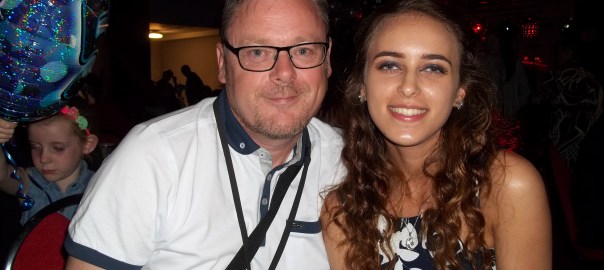
Writing from a very wet, damp , foggy Belfast and suffering the hang-over from hell. I’m ashamed to say that I went to my 50th Birthday bash on Friday and have been partying hard seen then and now I am suffering and paying for my sins. I’m getting way to old for this.
Anyway here’s a selection of photos from the birthday bash – it’s nor actually my birthday until the 16th of July – but wanted to be home for the glorious 11th & 12th and I’m praying the rain stop and the sun shines throughout next few days!
Key Events & Deaths on this day in Northern Ireland Troubles
10th July
———————————
Monday 10 July 1972
William Whitelaw, then Secretary of State for Northern Ireland, admitted that secret talks had taken place with the Irish Republican Army (IRA). [ Law Order. ]
Wednesday 10 August 1977
The Irish Republican Army (IRA) planted a small bomb in a garden on the campus of the New University of Ulster which was visited by the Queen as part of her jubilee celebrations.
The bomb exploded after the Queen had left and it caused no injuries, nor was the Queen’s schedule affected.
Members of the Social Democratic and Labour Party (SDLP) refused to attend a reception in her honour.
Friday 10 July 1981
The funeral took place of Joe McDonnell who had died on hunger strike on 8 July 1981. The British Army moved to arrest an Irish Republican Army (IRA) firing party at the funeral and seized a number of weapons and made several arrests.
Rioting broke out following this incident.
Sunday 10 July 1983
James Prior, then Secretary of State for Northern Ireland, said that the reintroduction of the death penalty in Northern Ireland would lead to an increase in ‘violent disorders’ in the region.
Thursday 10 July 1986
Ian Paisley, then leader of the Democratic Unionist Party (DUP), and Peter Robinson, then deputy leader of the DUP, along with 4,000 Loyalists staged an early morning protest in which they ‘took over’ and ‘occupied’ Hillsborough, County Down.
The action was part of the continuing protest against the Anglo-Irish Agreement (AIA).
Sunday 10 July 1994
The Irish Republican Army (IRA) carried out a gun attack on the home of William McCrea, then Democratic Unionist Party (DUP) MP, in Magherafelt, County Derry. Forty shots were fired into the house which was empty at the time.
Monday 10 July 1995
The stand-off at Drumcree continued for a second day. The numbers involved had increased to approximately 1,000 RUC officers and 10,000 Orangemen and their supporters. During the confrontation there were repeated clashes with the Orangemen and their supporters throwing bricks and bottles at the police officers who replied by firing 24 plastic baton rounds.
The disturbances and blocked roads across Northern Ireland also continued as Loyalists acted in support of the Orange Order. The port at Larne was also closed in the action.
Many towns and villages across Northern Ireland were blocked, either completely or for considerable periods during the day. The Royal Ulster Constabulary (RUC) reported that since Sunday (7 July 1996) there had been: 90 civilians and 50 RUC officers injured; 156 arrests; over 100 incidents of intimidation; 758 attacks on the RUC; and 662 plastic baton rounds fired by the RUC.
Thursday 10 July 1997
Among growing tension in the run-up to the parades planned for 12 July 1997 and talk of potential civil war, the Orange Order said that it would voluntarily reroute six contentious parades from Nationalist areas.
Hard-line members of the Orange Order accused the leadership of betrayal but the decision was praised in many quarters
Friday 10 July 1998
A large section of the crowd taking part in the demonstration at Drumcree Church tried on several occasions to break through Royal Ulster Constabulary (RUC) and British Army lines to get on to the Garvaghy Road.
Soldiers of the First Parachute Regiment were deployed at Drumcree while troops from a Scottish regiment were withdrawn, no explanation was given for the change.
There was continuing Loyalist violence across Northern Ireland with many roads blocked, and Catholic homes and businesses were again attacked. The Royal Ulster Constabulary (RUC) released figures which showed that between 6am on 4 July to 6am on 10 July there had been 1,867 public order offences across Northern Ireland. There had been 550 attacks on the security forces – including 15 shooting and 33 blast bomb attacks carried out by Loyalists, 53 RUC officers had been injured, 548 petrol bombs had been thrown, 1,910 petrol bombs recovered, 103 houses and 133 other buildings damaged, 136 cars hijacked, 367 vehicles damaged, and 151 people arrested. From 6am on 4 July to to 6am on 9 July the security forces had fired 216 plastic bullets.
Garda Síochána (the Irish police) in Dublin and Dundalk and anti-terrorist police in England arrested nine people in a series of raids. The police claimed that those arrested were about to launch a fire-bombing campaign in London. It was alleged that those arrested were aligned with the 32 County Sovereignty Committee.
Saturday 10 July 1999
There was an arson attack on a Protestant church hall in north Belfast. The ‘Orange Alert Committee’, a Loyalist grouping, organised a parade by hundreds of people to the security barrier at Drumcree, Portadown, County Armagh.
Bertie Ahern, then Taoiseach (Irish Prime Minister), held a meeting with David Trimble, then leader of the Ulster Unionist Party (UUP), at Government Buildings in Dublin. Ahern stated that if the Irish Republican Army (IRA) failed to deliver on decommissioning, the Executive would be suspended and a review would take place.
Ahern rejected a UUP demand to expel Sinn Féin (SF) if arms were not given up. The Parades Commission reversed an earlier decision and ruled that the Orange Order could parade to Ormeau Park. Seven Unionist councillors, including the Lord Mayor, had lobbied on behalf of the Orange Order.
The Irish Times (a Dublin based newspaper) published the results of a survey conducted in Northern Ireland and in the Republic of Ireland.
A total of 65% of those interviewed in Northern Ireland stated their support for the establishment of the proposed Northern Ireland Executive by 18 July 1999. There was however a noticeable difference in opinion between the two communities with the proposal supported by 91% of Nationalists but only 47% of Unionists
——————————————
Remembering all innocent victims of the Troubles
Today is the anniversary of the death of the following people killed as a results of the conflict in Northern Ireland
“To live in hearts we leave behind is not to die
– Thomas Campbell
To the innocent on the list – Your memory will live forever
– To the Paramilitaries –
There are many things worth living for, a few things worth dying for, but nothing worth killing for.
2 People lost their lives on the 10th July between 1970 – 1973
——————————————
10 July 1970
Patrick Elliman (62)
Catholic Status: Civilian (Civ),
Killed by: British Army (BA)
Died seven days after being shot near to his home, Marchioness Street, Lower Falls, Belfast.
Key Events & Deaths on this day in Northern Ireland Troubles
9th July
————————————–
Tuesday 9 July 1974
Announcement of End to Internment
Merlyn Rees, then Secretary of Sate for Northern Ireland, announced at Westminster that Internment would be gradually phased out.
[The Barron Report (published on 15 December 2003) revealed that the Garda Síochána (the Irish police) Chief Superintendent in charge of the investigation into the Dublin bombings on 17 May 1974 had written a memo (on 9 July 1974) which noted that “the investigation unit … have returned to their stations”. Over the years the Garda Síochána investigation of the bombings has been heavily criticised.]
Friday 9 July 1976
Mervyn & Rosaleen McDonald
Two Catholic civilians, a husband and wife, were killed in an attack on their home by the Ulster Freedom Fighters (UFF), a covername for the Ulster Defence Association (UDA).
Tuesday 9 August 1977
The Queen began a two-day visit to Northern Ireland as part of her jubilee celebrations. It was the first visit by the Queen for 11 years.
Thursday 9 July 1981
Danny Barrett (15), a Catholic teenager, was shot dead by the British Army while he was standing outside his home in Havana Court in the Ardoyne area of Belfast.
Nora McCabe (30), a Catholic civilian, died one day after being shot by a plastic bullet fired by the RUC. Patrick McGeown, an Irish Republican Army (IRA) prisoner, joined the hunger strike to replace Joe McDonnell.
See 1981 Hunger Strike.]
Wednesday 9 July 1986
Two British soldiers were killed by a remote controlled bomb while they were on foot patrol near Crossmaglen, County Armagh. The attack was carried out by the Irish Republican Army (IRA).
Saturday 9 July 1994
Joseph Donaghy (33), a Catholic civilian, was found shot dead at Killymoon Golf Club, Cookstown, County Tyrone.
[Six days after his body was discovered the Ulster Freedom Fighters (UFF), a cover name (pseudonym) used by the Ulster Defence Association (UDA), claimed responsibility for the killing.]
Sunday 9 July 1995
Stand-Off At Drumcree
The Royal Ulster Constabulary (RUC) prevented an Orange Order parade from returning from Drumcree Church to Portadown along the Garvaghy Road, a mainly Nationalist area. The parade organisers were told by the police to return by the same route they had taken to the church.
The decision sparked a stand-off between RUC officers and Orangemen. There were also disturbances and blocked roads across Northern Ireland as protests were organised by loyalists in support of the Orange Order. Later in the day Ian Paisley, then leader of the Democratic Unionist Party (DUP), and David Trimble, then Ulster Unionist Party (UUP) MP, attempted to broker a compromise but failed.
The British government sent an extra 1,000 troops to Northern Ireland to support the Royal Ulster Constabulary (RUC). The resources of the RUC were seriously stretched across Northern Ireland. Hundreds of roads, including motorways, were blocked by members of the Orange Order and loyalist supporters.
Several Catholic families felt sufficiently intimidated to leave their homes in the Torrens area of Belfast. Gunshots were also reported in north Belfast.
Leaders of the main Unionist parties meet with John Major, then British Prime Minister, in Downing Street, London.
Wednesday 9 July 1997
At the end of four days of rioting and disturbances the Royal Ulster Constabulary (RUC) released figures which showed that: there had been 60 RUC officers injured; 56 civilians injured; 117 people arrested; 2,500 plastic bullets fired by the security forces; 815 attacks on the security forces; 1,506 petrol bombs thrown; and 402 hijackings.
The British government promised Sinn Féin (SF) that in the event of an Irish Republican Army (IRA) ceasefire, representatives of SF would be allowed to meet with government ministers
Thursday 9 July 1998
Orange Order demonstrators at Drumcree attempted to cross security force barriers. Security force members, who came under attack from guns and blast bombs, replied with plastic bullets. Leaders of the Orange Order travelled to London for a meeting with Tony Blair, then British Prime Minister, to discuss the situation in Portadown, County Armagh. Before the meeting .
David McNarry, then a senior member of the Orange Order, said that they could “paralyse the country [Northern Ireland] in a matter of hours”. His comments were made on the BBC Radio 4 programme Today. Following the meeting the Orange Order representatives said that there appeared to be little change in the government’s attitude to the Drumcree issue.
Friday 9 July 1999
There was a meeting of the Ulster Unionist Party (UUP) Executive to consider ‘The Way Forward’ proposals. The 110 member Executive rejected the document as being fundamentally unfair.
The Belfast Telegraph (a Belfast based newspaper) reported that the Irish Republican Socialist Party (IRSP) had indicated that the Irish National Liberation Army (INLA) had no intention of decommissioning its weapons.
The News Letter (a Belfast based newspaper) published the results of an opinion poll. Of those questioned 53 per cent of Protestants disapproved of the British government’s ‘The Way Forward’ proposals.
Monday 9 July 2001
Weston Park Talks Began
Tony Blair, then British Prime Minister, and Bertie Ahern, then Taoiseach (Irish Prime Minister), began a series of intensive political talks with the pro-Agreement parties in the secluded setting of Weston Park, a stately home-cum-hotel on the Shropshire-Staffordshire border in England.
[Although the talks went on until Saturday there was no agreement on a way forward. The two Prime Minister said they would publish a document which tried to resolve the remaining issues.]
——————————————
Remembering all innocent victims of the Troubles
Today is the anniversary of the death of the following people killed as a results of the conflict in Northern Ireland
“To live in hearts we leave behind is not to die
– Thomas Campbell
To the innocent on the list – Your memory will live forever
– To the Paramilitaries –
There are many things worth living for, a few things worth dying for, but nothing worth killing for.
19 People lost their lives on the 9th July between 1972 – 1986
——————————————
09 July 1972
Joseph Flemming (30)
Catholic Status: British Army Territorial Army (TA),
Killed by: non-specific Republican group (REP)
Off duty. Found shot in partially burnt out car, Little Distillery Street, off Grosvenor Road, Belfast
——————————————
09 July 1972 Brian McMillan (21)
Protestant Status: Civilian (Civ),
Killed by: non-specific Republican group (REP)
Found shot in partially burnt out car, Little Distillery Street, off Grosvenor Road, Belfast
——————————————
09 July 1972 Alan Meehan (18)
Protestant Status: Civilian (Civ),
Killed by: non-specific Republican group (REP)
Found shot in partially burnt out car, Little Distillery Street, off Grosvenor Road, Belfast. He died 11th July 1972
——————————————
09 July 1972 David Andrews (31)
Protestant Status: Civilian (Civ),
Killed by: non-specific Republican group (REP)
Found shot, Waterworks, off Cavehill Road, Belfast.
——————————————
09 July 1972 Angelo Fionda (60)
Catholic Status: Civilian (Civ),
Killed by: British Army (BA)
Shot while driving his car, at the junction of Panton Street and Falls Road, Belfast.
——————————————
09 July 1972 Gerard Turkington (32)
Protestant Status: Ulster Defence Association (UDA),
Killed by: Irish Republican Army (IRA)
Found shot Stewart Street, Markets, Belfast.
——————————————
09 July 1972
John Dougal (16)
Catholic Status: Irish Republican Army Youth Section (IRAF),
Killed by: British Army (BA)
Shot by sniper from British Army (BA) observation post in Corry’s Timber Yard, while in the vicinity of Westrock Drive, Ballymurphy, Belfast.
——————————————
09 July 1972
Margaret Gargan (13)
Catholic Status: Civilian (Civ),
Killed by: British Army (BA)
Shot by sniper from British Army (BA) observation post in Corry’s Timber Yard, while walking along Westrock Gardens, Ballymurphy, Belfast.
——————————————
09 July 1972
Patrick Butler (38)
Catholic Status: Civilian (Civ),
Killed by: British Army (BA)
Shot by sniper from British Army (BA) observation post in Corry’s Timber Yard, while in the vicinity of Westrock Drive, Ballymurphy, Belfast.
——————————————
09 July 1972
Noel Fitzpatrick (40)
Catholic Status: Civilian (Civ),
Killed by: British Army (BA)
Catholic Priest. Shot by sniper from British Army (BA) observation post in Corry’s Timber Yard, while in the vicinity of Westrock Drive, Ballymurphy, Belfast.
——————————————
09 July 1972
David McCafferty (15)
Catholic Status: Official Irish Republican Army Youth Section (OIRAF),
Killed by: British Army (BA)
Shot by sniper from British Army (BA) observation post in Corry’s Timber Yard, while in the vicinity of Westrock Drive, Ballymurphy, Belfast.
——————————————
09 July 1973 Dorothy Lynn (46)
Protestant Status: Civilian (Civ),
Killed by: not known (nk)
Died five days after being badly burned during hijacking of bus she was travelling on, Cliftonville Road, Belfast.
——————————————
09 July 1976
Mervyn McDonald (26)
Catholic Status: Civilian (Civ),
Killed by: Ulster Freedom Fighters (UFF)
Shot at his home, Longlands Road, Greencastle, Belfast.
——————————————
09 July 1976
Rosaleen McDonald (24)
Catholic Status: Civilian (Civ), K
illed by: Ulster Freedom Fighters (UFF)
Shot at her home, Longlands Road, Greencastle, Belfast.
——————————————
09 July 1981
Danny Barrett (15)
Catholic Status: Civilian (Civ),
Killed by: British Army (BA)
Shot by British Army (BA) sniper from Flax Street British Army (BA) base while standing outside his home, Havana Court, Ardoyne, Belfast.
——————————————
09 July 1981
Nora McCabe (30)
Catholic Status: Civilian (Civ),
Killed by: Royal Ulster Constabulary (RUC)
Died one day after being shot by plastic bullet, Linden Street, Lower Falls, Belfast
——————————————
09 July 1984
Anthony McAtarsney (37)
Catholic Status: Civilian (Civ),
Killed by: Ulster Volunteer Force (UVF)
Shot while getting into his car shortly after leaving work, Millfield, Belfast
——————————————
09 July 1986 Carl Davies (24)
nfNI Status: British Army (BA),
Killed by: Irish Republican Army (IRA)
Killed by remote controlled bomb hidden in car/trailer, detonated when British Army (BA) foot patrol passed, Glassdrumman, near Crossmaglen, County Armagh.
——————————————
09 July 1986 Robert Bertram (20)
nfNI Status: British Army (BA),
Killed by: Irish Republican Army (IRA)
Killed by remote controlled bomb hidden in car/trailer, detonated when British Army (BA) foot patrol passed, Glassdrumman, near Crossmaglen, County Armagh.
——————————————
As I child I learned the stories & legends of the Battle of Boyne & Siege of Derry at my grandfather’s & father’s knees, becoming immersed in the Loyalist culture that would shape & dominate my whole existence.
Key Events & Deaths on this day in Northern Ireland Troubles
8th July
————————————
Thursday 8 July 1971
Two Men Killed by British Soldiers
Seamus Cusack & Desmond Beattie
Seamus Cusack (28), a Catholic civilian, was shot and mortally wounded by a British soldier during street disturbances at Abbey Park, in the Bogside area of Derry.
The shooting happened at approximately 1.00am and Cusack died in Letterkenny Hospital at approximately 1.40am.
[The British Army later claimed that Cusack had been armed with a rifle but local witnesses denied this.]
The death of Cusack led to further disturbances in the Bogside and at approximately 3.15pm Desmond Beattie (19), a Catholic civilian, was shot dead by British soldiers at Lecky Road.
Again the circumstances of the shooting were disputed.
[The British Army later claimed that Beattie was about to throw a nail bomb when he was shot; local people insisted he was unarmed at the time of his killing.]
The rioting in Derry intensified following the two deaths.
The Social Democratic and Labour Party (SDLP) withdrew from Stormont on 16 July 1971 because no official inquiry was announced into the killings.
An unofficial Inquiry was chaired by Lord Gifford (QC), an English barrister, and assisted by Paul O’Dwyer, an American lawyer, and Albie Sachs, a South African lawyer.
The Inquiry was held at the Guildhall, Derry, but the British Army (BA) and the Royal Ulster Constabulary (RUC) refused to participate. The Report of the Inquiry was published in August 1971.
Thursday 8 July 1976
A Catholic civilian died one day after being shot by the Ulster Freedom Fighters (UFF), a covername for the Ulster Defence Association (UDA).
Wednesday 8 July 1981
Fifth Hunger Striker Died
Joe McDonnell (30) died after 61 days on hunger strike. McDonnell had gone on strike to replace Bobby Sands.
The Irish Commission for Justice and Peace (ICJP), which had been established by the Catholics Bishops Conference, accused the Northern Ireland Office (NIO) of retreating from earlier offers made to the ICJP on the hunger strikers five demands.
See Hungry Strikes
John Dempsey
A member of the youth section of the IRA was shot dead by the British Army in Belfast.
Friday 8 July 1983
The Northern Ireland Assembly voted by 35 to 11 for the introduction of the death penalty for terrorist murders
Wednesday 8 July 1987
James Molyneaux, then leader of the Ulster Unionist Party, and Ian Paisley, then leader of the Democratic Unionist Party (DUP), said they would use the Unionist Task Force report in talks with the British government.
Wednesday 8 July 1992
There were heated exchanges between local residents and Orange Order members taking part in a parade through the mainly Catholic lower Ormeau Road area of Belfast.
Orange Order members shouted “Up the UFF” and held up one of their hands showing five fingers – a reference to the shooting dead of five Catholic civilians in a Bookmaker’s shop on the lower Ormeau Road.
The parade went right past the site of the shooting.
[Later Patrick Mayhew, then Secretary of State for Northern Ireland, said that the actions of the marchers “would have disgraced a tribe of cannibals”.]
Thursday 8 July 1993
The Guardian (a British newspaper) published an interview with Dick Spring, then Tánaiste (deputy Irish Prime Minister and Minister for Foreign Affairs).
In the interview Spring suggested that the two governments draw up a framework settlement and then put the proposal directly to the public by means of a referendum.
There was a meeting of the Anglo-Irish Intergovernmental Conference (AIIC).
Monday 8 July 1996
Many aspects of life in Northern Ireland were disrupted as protests were mounted across the region in support of the Drumcree Orangemen.
The Royal Ulster Constabulary (RUC) fired plastic bullets to control protesting crowds in Drumcree (Portadown), Sandy Row (Belfast) and Ballymena.
At the multi-party talks in Stormont, Belfast, the Ulster Unionist Party (UUP), the Democratic Unionist Party (DUP) and the United Kingdom Unionists (UKU) all pulled out of the talks in protest at the decision of the RUC to prevent the march at Drumcree.
“Fire and brimstone” speeches by unionist politicians were claimed by the McGoldrick family to be partly to blame for their son’s death on 7 July 1996.
Tuesday 8 July 1997
The Irish National Liberation Army (INLA) threatened to attack Orangemen whom it viewed as responsible for forcing parades through Nationalist areas.
The Dublin to Belfast train was stopped at Newry and damaged by petrol bombs.
The Ulster Defence Association (UDA) and the Ulster Volunteer Force (UVF) joined together to stage an armed paramilitary display which was recorded and broadcast by Ulster Television (UTV).
The UDA and UVF claimed that the display was intended to “reassure and calm Protestants”.
A Northern Ireland Office (NIO) document was leaked to the media. The document suggested that the decision to allow the Drumcree parade to proceed down the Garvaghy Road on 6 July 1997 had been taken by Marjorie (Mo) Mowlam, then Secretary of State for Northern Ireland, in conjunction with security leaders as early as 21 June 1997.
This in spite of Mowlam’s assertion that the decision was not made until the eve of the march.
Mowlam subsequently launched an inquiry into who leaked the document.
Nationalists, who were still protesting against the events at the Garvaghy Road, announced that they would block Orange Order parades planned for 12 July 1997 from passing through Nationalist areas in Armagh, Bellaghy, Belfast (lower Ormeau Road), Derry, Newry, and Strabane.
People in these areas called for Nationalist to travel to the parade routes to add their support for rerouting of the planned parades.
Wednesday 8 July 1998
The situation at Drumcree deteriorated considerably with sustained violent attacks on the Royal Ulster Constabulary (RUC) and British Army barricades by protesting Orange men.
An estimated 5,000 Orangemen from county lodges in Derry and Tyrone joined the protest at Drumcree.
Attacks against Catholic homes, businesses, schools, and churches continued to be a feature of Loyalist violence.
Eight blast bombs were thrown at Catholic homes in the Collingwood area of Lurgan in the early hours of the morning. Seamus Mallon, then deputy leader of the Social Democratic and Labour Party (SDLP), went to the Garvaghy Road to speak to the local Residents Group.
[Mallon was heckled by local residents as he left the meeting and looked to be shaken by the experience.]
In a show of support Catholics from other areas of Northern Ireland sent food supplies to the residents of the Garvaghy Road.
Thursday 8 July 1999
Loyalists left a pipe-bomb outside the house of a Sinn Féin (SF) member in Ballycastle, County Antrim.
There were two arson attacks on houses in north Belfast which the Royal Ulster Constabulary (RUC) described as sectarian.
Barry Morgan (24) was found guilty of the murder of Cyril Stewart, at the time a retired Royal Ulster Constabulary (RUC) reservist, in Armagh on March 1998.
The Irish National Liberation Army (INLA) was responsible for the attack.
A disagreement arose between Tony Blair, then British Prime Minister, and Bertie Ahern, then Taoiseach (Irish Prime Minister), over whether or not Sinn Féin (SF) was now a separate organisation from the Irish Republican Army (IRA).
Ahern said on BBC Radio Ulster that they were two separate organisations but senior police sources on both sides of the Border supported Blair’s stated view that the two organisations were “inextricably linked”.
Orangemen from Portadown, County Armagh, held talks about the Drumcree issue with Tony Blair at Downing Street, London
Sunday 8 July 2001
The annual Orange Order parade at Drumcree, County Armagh, which had been the setting for violent confrontation for several years, passed off peacefully under a heavy security presence.
[However, in the following days there were violent clashes in north Belfast.]
——————————————
Remembering all innocent victims of the Troubles
Today is the anniversary of the death of the following people killed as a results of the conflict in Northern Ireland
“To live in hearts we leave behind is not to die
– Thomas Campbell
To the innocent on the list – Your memory will live forever
– To the Paramilitaries –
There are many things worth living for, a few things worth dying for, but nothing worth killing for.
11 People lost their lives on the 8th July between 1971 – 1996
——————————————
08 July 1971
Seamus Cusack (27)
Catholic Status: Civilian (Civ),
Killed by: British Army (BA)
Shot during street disturbances, Abbey Park, Bogside, Derry
——————————————
08 July 1971 Desmond Beattie (19)
Catholic Status: Civilian (Civ),
Killed by: British Army (BA)
Shot during street disturbances, Lecky Road, Bogside, Derry.
——————————————
08 July 1972 Laurence McKenna (22)
Catholic Status: Civilian (Civ),
Killed by: Ulster Volunteer Force (UVF)
Died three days after being shot at the junction of Falls Road and Waterford Street, Lower Falls, Belfast
——————————————
08 July 1976 James Rooney (43)
Catholic Status: Civilian (Civ),
Killed by: Ulster Defence Association (UDA)
Died one day after being shot at his greengrocer’s shop, Upper Newtownards Road, Ballyhackamore, Belfast.
——————————————
08 July 1979 Alan MacMillan (18)
nfNI Status: British Army (BA),
Killed by: Irish Republican Army (IRA)
Killed by remote controlled bomb while on British Army (BA) foot patrol, Crossmaglen, County Armagh.
——————————————
08 July 1981
Joe McDonnell (30)
Catholic Status: Irish Republican Army (IRA),
Killed by: not known (nk)
Died on the 61st day of hunger strike, Long Kesh / Maze Prison, County Down.
——————————————
08 July 1981
John Dempsey (16)
Catholic Status: Irish Republican Army Youth Section (IRAF),
Killed by: British Army (BA)
Shot by British Army (BA) sniper during arson attack on bus depot, Falls Road, Belfast
——————————————
08 July 1986
John McVitty (46)
Protestant Status: Royal Ulster Constabulary (RUC),
Killed by: Irish Republican Army (IRA)
Off duty. Shot at his farm, Drumady, near Rosslea, County Fermanagh.
——————————————
08 July 1988
John Howard (29)
nfNI Status: British Army (BA),
Killed by: Irish Republican Army (IRA)
Killed by booby trap bomb when British Army (BA) patrol arrived at the scene of earlier explosion, outside Falls Baths, Falls Road, Belfast.
——————————————
08 July 1992
Cyril Murray (51)
Catholic Status: Civilian (Civ),
Killed by: Ulster Freedom Fighters (UFF)
Shot at his home, Kerrsland Drive, Bloomfield, Belfast.
——————————————
08 July 1996
Michael McGoldrick (31)
Catholic Status: Civilian (Civ),
Killed by: Ulster Volunteer Force (UVF)
Taxi driver. Found shot in his car, Montiaghs Road, Aghagallon, near Lurgan, County Antrim.
——————————————
As I child I learned the stories & legends of the Battle of Boyne & Siege of Derry at my grandfather’s & father’s knees, becoming immersed in the Loyalist culture that would shape & dominate my whole existence.
Firstly thanks to all of you who sent wishes and prayers for Baby’s our little cat after his horrendous hit-n-run accident last week. He has had surgery and now has pins and plates holding h…









.JPG)











 belfastchildis.com