Monthly Archives: June 2016

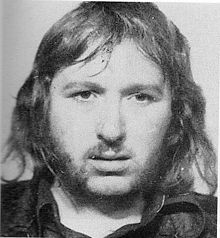
Robert “Basher” Bates 12th Dec 1948 – 11th June 1997. Shankill Butcher

Robert William Bates

” Basher “

Robert William Bates (nicknamed “Basher”) (12 December 1948 – 11 June 1997) was an Ulster loyalist from Belfast, Northern Ireland. He was a member of the Ulster Volunteer Force and the infamous Shankill Butchers gang, led by Lenny Murphy.

Shankill Butchers 
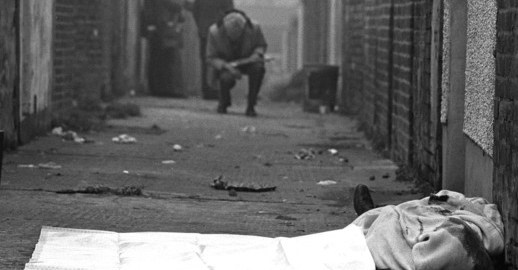
Shankill Butchers.

See Shankill Butchers

Disclaimer

The views and opinions expressed in this post and page are soley intended to educate and provide background information to those interested in the Troubles of Northern Ireland.

They in no way reflect my own opinions and I take no responsibility for any inaccuracies or factual errors


Bates was born into an Ulster Protestant family and grew up in the Shankill Road area of Belfast. He had a criminal record dating back to 1966,  and later became a member of the Ulster loyalist paramilitary organisation, the Ulster Volunteer Force (UVF).

Bates, employed as a barman at the Long Bar, was recruited into the Shankill Butchers gang in 1975 by its notorious ringleader, Lenny Murphy.

The gang used The Brown Bear pub, a Shankill Road drinking haunt frequented by the UVF, as its headquarters. Bates, a “sergeant” in the gang’s hierarchy, was an avid participant in the brutal torture and savage killings perpetrated against innocent Catholics after they were abducted from nationalist streets and driven away in a black taxi owned by fellow Shankill Butcher, William Moore.

William moore.jpg
William Moore

The killings typically involved grisly-throat slashings preceded by lengthy beatings and torture. Bates was said to have been personally responsible for beating James Moorhead, a member of the Ulster Defence Association, to death on 30 January 1977 and to have played a central role in the kidnapping and murder of Catholic Joseph Morrisey three days later. He also killed Thomas Quinn, a derelict, on 8 February 1976 and the following day was involved in shooting dead Archibald Hanna and Raymond Carlisle, two Protestant workmen that Bates and Murphy mistook for Catholics.

Martin Dillon revealed that Bates was also one of the four UVF gunmen who carried out a mass shooting in the Chlorane Bar attack in Belfast city centre on 5 June 1976. Five people (three Catholics and two Protestants) were shot dead. The UVF unit had burst into the pub in Gresham Street and ordered the Catholics and Protestants to line up on opposite ends of the bar before they opened fire. He later recounted his role in the attack to police; however, he had claimed that he never fired any shots due to his revolver having malfunctioned.

Forensics evidence contradicted him as it proved that his revolver had been fired inside the Chlorane Bar that night. Lenny Murphy was in police custody at the time the shooting attack against the Chlorane Bar took place.

Bates was arrested in 1977, along with Moore and other “Shankill Butcher” accomplices.

Gerard McLaverty and Joseph Morrissey

His arrest followed a sustained attack by Moore and Sam McAllister on Catholic Gerard McLaverty, after which they dumped his body, presuming him dead. However McLaverty survived and identified Moore and McAllister to the Royal Ulster Constabulary who drove him up and down the Shankill Road during a loyalist parade until he saw his attackers. During questioning both men implicated Bates, and other gang members, leading to their arrests.

Following a long period spent on remand, he was convicted in February 1979 of murder related to the Shankill Butcher killings and given ten life sentences, with a recommendation by the trial judge, Mr Justice O’Donnell, that he should never be released.

In prison

At the start of his sentence, Bates was involved in a series of violent incidents involving other inmates. Bates later claimed that he had perpetrated these acts in order to live up to his “Basher” nickname.

He served as company commander of the UVF inmates and became noted as stern disciplinarian.
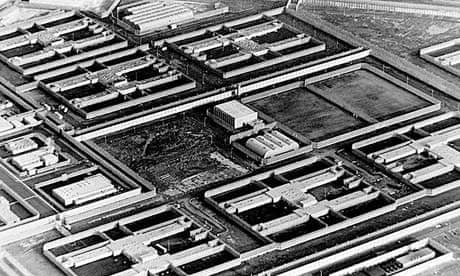
However while in the Maze Prison, he was said to have “found God”, and as a result became a born-again Christian. He produced a prison testimony, which was later reprinted in The Burning Bush, and, after publicly advocating an end to violence, was transferred to HMP Maghaberry.

Brendan hughes.jpg
Brendan Hughes

In prison, Bates formed a friendship with Provisional IRA member and fellow detainee Brendan Hughes. Bates foiled a UVF assassination plot on Hughes.

Early release and death


Ex-Prisoners Interpretative Centre, Woodvale Road, where Bates worked after his release and where he was shot

In October 1996, 18 months prior to the signing of the Good Friday Agreement, Bates was cleared for early release by the Life Sentence Review Board. He was given the opportunity of participating in a rehabilitation scheme, spending the day on a work placement and returning to prison at night.

As he arrived for work in his native Shankill area of Belfast early on the morning of 11 June 1997,  Bates was shot dead by the son of a UDA man he had killed in 1977.

The killer identified himself to Bates as the son of his victim before opening fire. Bates had been working at the Ex-Prisoners Interpretative Centre (EPIC), a drop-in centre for former loyalist prisoners.

Bates’ killing had not been sanctioned by the UDA leadership but nevertheless they refused to agree to UVF demands that the killer should be handed over to them, instead exiling him from the Shankill. He was rehoused in the Taughmonagh area where he quickly became an important figure in the local UDA as a part of Jackie McDonald‘s South Belfast Brigade.

Bates’ name was subsequently included on the banner of a prominent Orange Lodge on the Shankill Road, called Old Boyne Island Heroes.

Relatives of Shankill butchers victims Cornelius Neeson condemned the banner, stating that:

“it hurts the memory of those the butchers killed”.

A fellow Lodge member and former friend of Bates defended the inclusion of his name to journalist Peter Taylor:

“I knew him very well and he’d been a personal friend for twenty or thirty years and to me he was a gentleman”.

He went on to describe him as having been:

“an easy-going, decent fellow, and as far as the Lodge is concerned, a man of good-standing”.

He was a buried in a Free Presbyterian Church of Ulster ceremony by Reverend Alan Smylie.

Bates’ funeral was attended by a large representation from local Orange Lodges.

Mairead Maguire, July 2009

Mairead Maguire was also amongst the mourners, arguing that Bates had “repented, asked for forgiveness and showed great remorse for what he had done”, whilst a memorial service held at the spot of his killing two days after the funeral was attended by Father Gerry Reynolds of Clonard Monastery
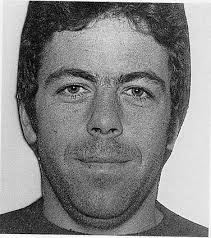
See Shankill Butchers

Shankill Butchers.

See Shankill Butchers

lennie murphy

See Lenny Murphy

——————————————–

Wednesday 11 June 1997

From killer to victim: Basher’s death sums up the futility of the Troubles

Robert “Basher” Bates, who was gunned down in Belfast yesterday, was an icon. To some he represented the very worst that the troubles has produced: to others he was testimony that even the most brutal terrorist might not be beyond redemption.

Two decades ago the 10 murders he was involved in were among the most barbaric ever seen. He shot some of his victims but others he killed in the most cruel fashion, he and his associates wielded butcher’s knives, axes and cleavers on random Catholic victims. The Shankill Butchers slaughtered human beings as one would animals.

The horror of those killings took Belfast to a new low. Yesterday his death conjured up the most appalling vista of all: that the IRA was intent on regenerating the troubles. The relief was palpable when it emerged that he had been killed not by the IRA but by a loyalist, in what is thought to have been personal revenge for the murder by Bates of a close relative, 20 years ago in a bar room brawl.

Basher Bates was one of hundreds of convicted killers released after serving an average of 15 years behind bars. There are hundreds of unsettled personal grudges in Northern Ireland: quite a few people know, or think they know, who killed their fathers or other loved ones. Yet this seems to have been the first personal revenge killing of a released prisoner.

While loyalist groups have accounted for close on 1,000 of the 3,500 victims of the Troubles, the ferocity and awfulness of the Shankill Butchers’ killings have remained in the public memory for two full decades.

A book dwelling on the graphic details has been a local bestseller for 20 years, and can still be picked up in many of the garage shops of Belfast. It was, for example, the favourite reading of Thomas Begley, the young IRA man who four years ago carried a bomb into a Shankill Road fish shop, killing himself and nine Protestants.

Bates was not the prime mover in the Shankill Butchers gang: that was UVF man Lennie Murphy, who was shot dead by the IRA in 1982. But he was one of the leading lights during their two-year reign of terror, and one photograph of him, looking like an unshaven, unkempt dullard, has remained lodged in the communal memory as a vision of a psychopathic killer.

The judge who gave him 16 life sentences for his killings told him, correctly, that his actions “will remain forever a lasting monument to blind sectarian bigotry.” When he told him he should remain behind bars for the rest of his natural life, society shuddered and hoped it had heard the last of Basher Bates.

But Northern Ireland has a scheme, not found in the rest of the UK, for the release of even the most notorious killers, and more than 300 loyalists and republicans have been quietly freed over the last decade. Many of these former lifers engross themselves, as Bates seemed to be doing, in community or welfare work.

As the years passed in jail, Bates was at first a difficult prisoner, then a troubled soul and finally a remorseful born-again Christian, praying fervently for forgiveness. One who knew him in prison said of him: “He’s now a shell of a man, very quiet and inoffensive in a bland kind of way. The hair has gone, he’s prematurely bald. He has found the Lord and he’s no threat to anyone.”

Basher Bates made a long and painful journey from merciless assassin to man of God. His personal odyssey seemed to be over: neither he nor anyone else could have foreseen the fateful circularity which in the end transformed him from killer to victim.

 

Buy Me A Coffee

10th June – Deaths & Events in Northern Ireland Troubles

Key Events & Deaths on this day in Northern Ireland Troubles

10th June

——————————–

Wednesday 10 June 1981

Crumlin Road Prison Escape

Eight Irish Republican Army (IRA) prisoners on remand escaped form the Crumlin Road Prison in Belfast. The prisoners used three handguns, which had been smuggled into the prison, to hold prison officers hostage before taking their uniforms and shooting their way out of the prison.

Friday 10 June 1983

Following the election of Gerry Adams, then Vice-President of Sinn Féin (SF), as Member of Parliament (MP) for West Belfast, William Whitelaw, then British Home Secretary, lifted the ban on him entering Britain.

Friday 10 June 1988

A branch of the Conservative Party was established in Bangor, County Down. The ‘Model Conservative Association’ was part of an attempt to introduce British political parties into Northern Ireland.

Thursday 10 June 1993

It was confirmed that Jean Kennedy Smith, sister of the late President John F. Kennedy, would be the next American Ambassador to the Republic of Ireland.

Friday 10 June 1994

Two thousand workers from the Harland and Wolff shipyard stopped work for a period in protest at the killing at the shipyard on 9 June 1994.

Monday 10 June 1996

Stormont Talks Began

All-party negotiations (hereafter referred to as the ‘Stormont talks’) began in Stormont, Belfast. The talks began with opposition from the unionist parties to the extent of the role to be played by the chair George Mitchell. John Major, then British Prime Minister, and John Bruton, then Taoiseach (Irish Prime Minister), gave a joint press conference and indicated their support for George Mitchell. Sinn Féin (SF) were refused entry to the talks and the two governments issued a joint statement on the decision to exclude SF.

Tuesday 10 June 1997

The Irish Republican Army (IRA) admitted that it was responsible for a gun attack on a British Army patrol in Derry. There were no injuries during the attack.

The Ministry of Defence admitted that a batch of 90,000 plastic bullets that had been delivered to the security forces in Northern Ireland were faulty.

The bullets had a faster muzzle velocity that was publicly stipulated. From the original batch, 8,300 had been fired over the previous year.

The Garvaghy Residents Coalition in Portadown, County Armagh, sent a letter to Orangemen in Portadown asking for a “mutual apology for any hurt, offence or injustice”.

Wednesday 10 June 1998

David Trimble, then leader of the Ulster Unionist Party (UUP), and nine other Unionist and Conservative Members of Parliament (MPs) voted against the Northern Ireland (Sentences) Bill during the second reading of the Bill in the House of Commons.

The proposed act was to allow for the early release of paramilitary prisoners as part of the Good Friday Agreement. In the Republic of Ireland the Industrial Development Authority (IDA) announced record breaking progress for the fourth consecutive year.

Reports showed that the IDA had helped to create 15,000 new jobs.

Thursday 10 June 1999

European Parliament Election

Elections to the European Parliament were held across the United Kingdom (UK). Northern Ireland was treated as a single constituency which returned three Members of the European Parliament (MEPs).

Turnout for the election was 57 per cent.

[When counting was completed on Monday 14 June the three standing candidates were returned. Ian Paisley, then leader of the Democratic Unionist Party (DUP), topped the poll for the fifth time, John Hume, then leader of the Social Democratic and Labour Party (SDLP), was a close second. Jim Nicholson, then Ulster Unionist Party MEP, retained his seat despite a sharp drop in party support, and a strong challenge from Mitchel McLaughlin of Sinn Féin. (See: detailed results.)

The Irish Times (a Dublin based newspaper) reported that the deputy leader of the Ulster Unionist Party (UUP), John Taylor, had threatened to resign twice in the past two weeks in a dispute over his refusal to endorse the party’s candidate, Jim Nicholson, in the European Parliament election.]

Radio Telefis Éireann’s (RTE) ‘Prime Time’ programme claimed that both Royal Ulster Constabulary (RUC) officers and Ulster Defence Regiment (UDR) soldiers were involved in a gun and bomb attack on 19 December 1975 at the Silverbridge Inn, County Armagh, in which three people were killed. At the time the attack was claimed by the Red Hand Commando (RHC

——————————————

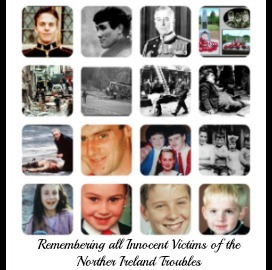
Remembering all innocent victims of the Troubles

Today is the anniversary of the death of the following people killed as a results of the conflict in Northern Ireland

“To live in hearts we leave behind is not to die

– Thomas Campbell

To the innocent on the list – Your memory will live forever

– To the Paramilitaries –

There are many things worth living for, a few things worth dying for, but nothing worth killing for.

7 People lost their lives on the 10th  June between 1972 – 1983

——————————————

10 June 1972


Martian Brown   (17)

Catholic
Status: Civilian (Civ),

Killed by: non-specific Loyalist group (LOY)
Shot from passing car while standing with friends, Roden Street, off Grosvenor Road, Belfast.

——————————————

10 June 1973


Daniel O’Neill  (35)

Catholic
Status: Civilian (Civ),

Killed by: non-specific Loyalist group (LOY)
Found shot on playing field, Deerpark Gardens, Oldpark, Belfast.

——————————————

10 June 1973


Samuel Rush  (45)

Protestant
Status: Civilian (Civ),

Killed by: non-specific Loyalist group (LOY)
Bus driver. Shot by sniper firing at British Army (BA) Vehicle Check Point (VCP), Albertbridge Road, Belfast.

——————————————

10 June 1975


Roy Suitters   (39)

Protestant
Status: Ulster Volunteer Force (UVF),

Killed by: Irish Republican Army (IRA)
Shot at his greengrocer’s shop, Crumlin Road, near Ligoniel Road, Belfast

——————————————

10 June 1975
Larry White  (25)

nfNIRI
Status: Saor Eire (SE),

Killed by: Official Irish Republican Army (OIRA)
From County Cork. Shot near his home, Orrey Road, Gurranabrahar, County Cork

——————————————

10 June 1978


 Denis Heaney  (21)

Catholic
Status: Irish Republican Army (IRA),

Killed by: British Army (BA)
Shot by undercover British Army (BA) member, while attempting to hijack a car, Harvey Street, Bogside, Derry

——————————————

10 June 1983
Geoffrey Curtis  (20)

nfNI
Status: British Army (BA),

Killed by: Irish Republican Army (IRA)
Killed by remote controlled bomb, hidden in lamp post, detonated when British Army (BA) foot patrol passed, Glenalina Road, Ballymurphy, Belfast.

——————————————


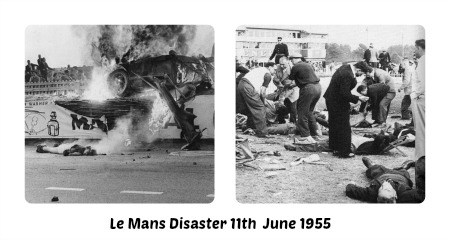
Le Mans Disaster 11th June 1955 – 84 Killed

11th June 1955

Le Mans disaster


———————–

Le Mans Disaster (1955)

———————–

The 1955 Le Mans disaster occurred during the 24 Hours of Le Mans motor race in Le Mans, France in June 1955, when a crash caused large fragments of debris to fly into the crowd. Eighty-three spectators and driver Pierre Levegh died and 120 more were injured in the most catastrophic accident in motorsport history.

—————————–

Le Mans 1955 accident: Raw footages of the crash in HD

 —————————–

Mike Hawthorn.jpg
Mike Hawthorn


There was much debate over the apportioning of blame. To reach his pit-stop, Mike Hawthorn had had to cut in front of Lance Macklin, causing Macklin to swerve into the path of Levegh in his much faster Mercedes. The collision propelled Levegh’s car upwards and into a concrete stairwell, where he was killed, and the wreck exploded in flames. The inquiry held none of the drivers responsible, and blamed the layout of the 30-year old track, which had not been designed for cars of this speed.

Before the accident

Pierre Levegh


Pierre Levegh, aged 49, had been hired by Mercedes-Benz as a factory driver that year. Part of his appeal to Mercedes was his determination shown in the 1952 race when he had driven for 23 straight hours, even though the team had a driver who could have replaced him.
He failed to win only because of a missed gear change, due to exhaustion, with just 45 minutes remaining, resulting in a failed connecting rod in his Talbot-Lago.

Mercedes-Benz had debuted its new 300 SLR sportscar in the 1955 World Sportscar Championship season, with some notable success, including a win at the Mille Miglia. The 300 SLR featured a body made of an ultralightweight magnesium alloy called Elektron with a specific gravity of 1.8 (in comparison, aluminium has a S.G. of 2.7 and steel 7.8). This new material reduced the weight of the car and thus improved its performance.

The car lacked the more effective state-of-the-art disc brakes featured on the rival Jaguar D-Type, employing instead the traditional drum brake system. The high power of the car forced Mercedes’ engineers to incorporate a large air brake behind the driver that could be raised to increase drag and slow the car for most conditions.
Safety measures commonly in place today were relatively unknown in 1955. Aside from two layout changes to make the circuit shorter, the Le Mans circuit itself had remained largely unaltered since the inception of the race in 1923, when top speeds of cars were typically in the region of 100 km/h (60 mph). By 1955 top speeds were in excess of 300 kilometres per hour (190 mph).

The cars had no seatbelts, the drivers reasoning that it was preferable to be thrown clear in a collision rather than be crushed or trapped in a burning car.

The 1955 24 Hours of Le Mans began on 11 June 1955, with Pierre Levegh behind the wheel of the #20 Mercedes-Benz 300 SLR run by Daimler-Benz. American John Fitch was Levegh’s assigned partner in the car, and he would take over driving duties later. Competition between Mercedes, Jaguar, Porsche, Ferrari, Aston Martin and Maserati was close, with all the marques fighting for the top positions early on. The race was extremely fast, with lap records being repeatedly broken.

Accident

——————————–

The Deadliest Crash: The Le Mans 1955 Disaster BBC

——————————–


Immediate cause

Towards the end of Lap 35, Levegh was following Mike Hawthorn‘s leading Jaguar D-type. Approaching the pit straight, Hawthorn passed Lance Macklin’s slower Austin Healey 100S. Seeing the Jaguar crew signaling him for his first pit stop, Hawthorn moved across Macklin’s path and slowed suddenly to enter the pits.

Attempting to avoid Hawthorn, Macklin’s car briefly remained on the right side of the track behind Hawthorn, kicking up dust with its right wheels, then swerved across the center of the track. Macklin was apparently out of control as he started to swerve, but regained direction after crossing the centerline. But by then Macklin was in the path of Levegh, still at speed (about 240 km/h (150 mph)) in front of Fangio. Levegh did not have time to react. Levegh’s car made contact with the left rear of Macklin’s car as he closed rapidly upon the slowed car.

Collision

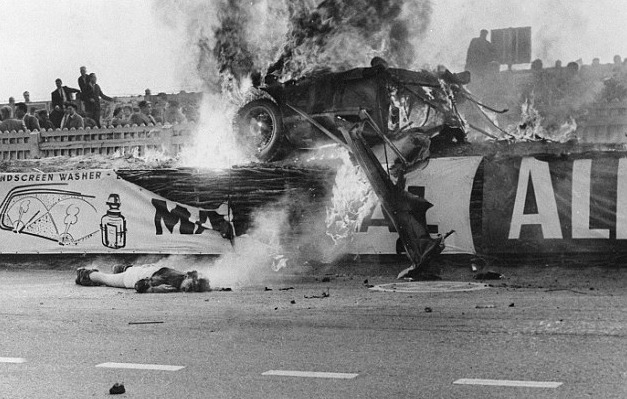
When Levegh’s 300 SLR hit Macklin’s Austin-Healey from behind, his car became airborne, soaring towards the left side of the track. It skipped the earthen embankment separating the spectator area from the track, bounced through spectator enclosures, then hit a concrete stairwell structure head-on. That impact disintegrated the front end of the car, which then somersaulted high, pitching debris into the spectator area, and landed atop the earthen embankment.

The debris included the bonnet, motor, and front axle, which separated from the frame and flew through the crowd.

The bonnet decapitated tightly jammed spectators like a guillotine. With the front of the spaceframe chassis—and thus crucial engine mounts—destroyed, the car’s heavy engine block also broke free and hurtled into the crowd. Spectators who had climbed onto ladders and scaffolding to get a better view of the track found themselves in the direct path of the lethal debris.

Pierre Levegh body 3 cropped.jpg

Levegh was thrown free of the tumbling car, but his skull was fatally crushed on landing.

When the rear section of the car landed on the embankment, the fuel tank exploded. The ensuing fuel fire raised the temperature of the remaining Elektron bodywork past its ignition temperature, which was lower than other metal alloys due to its high magnesium content. The alloy burst into white-hot flames, sending searing embers onto the track and into the crowd. Rescue workers, totally unfamiliar with magnesium fires, poured water on the inferno, greatly intensifying the fire.

As a result, the car burned for several hours. Official accounts put the death total at 84 (83 spectators plus Levegh), either by flying debris or from the fire, with a further 120 injured. Other observers estimated the toll to be much higher.

Whatever the total, it was the most catastrophic accident in motorsport history.

Fangio, driving behind Levegh, narrowly escaped the heavily damaged Austin-Healey, which was now skidding to the right of the track, across his path. Macklin then hit the pit wall, striking three people and killing one, and bounced back to the left, crossing the track again and striking the barrier. Macklin survived the incident without serious injury.

Aftermath

Conclusion of the race

Le Mans Memorial Plaque

The race was continued, officially in order to prevent departing spectators from crowding the roads and slowing down ambulances. An emergency meeting of the Daimler-Benz board of directors was convened by midnight at the request of Levegh’s co-driver, John Fitch.

Mindful of sensitivities involving German cars in a French race just 10 years after the end of World War II, the board decided to pull out from the race as a sign of respect to the victims. Eight hours after the accident, while leading the race (and two laps ahead of the Jaguar team), the Mercedes team withdrew the cars of Juan Manuel Fangio/Stirling Moss and Karl Kling/André Simon. Mercedes invited Jaguar to also retire, but they declined.

Mike Hawthorn and the Jaguar team, led by motorsport manager Lofty England, kept racing. Hawthorn won the race with teammate Ivor Bueb.

This slideshow requires JavaScript.

After the race

Funeral services were held the next day at the cathedral in the town of Le Mans.

The French press carried photographs of Hawthorn and Bueb celebrating their win with the customary champagne and treated them with scorn.

The rest of the 1955 World Sportscar Championship season was completed, with two more races at the British RAC Tourist Trophy and the Italian Targa Florio, although they were not run until September and October, several months after the accident. Mercedes-Benz won both of these events, and were able to secure the constructors championship for the season.

After winning the Targa Florio, the last major race of the 1955 season, Mercedes-Benz announced that they would no longer participate in factory sponsored motor-sport in order to concentrate on development of production cars. The self-imposed ban on circuit racing lasted until the 1980s. Several drivers, including Fangio and Jaguar’s Norman Dewis, never raced at Le Mans again.

Opinions differed widely amongst the other drivers as to who was directly to blame for the accident, and such differences remain even today. Macklin claimed that Hawthorn’s move to the pits was sudden, causing an emergency that led him to swerve into Levegh’s path. Years later Fitch claimed, based on “what I saw and what I heard” that Hawthorn caused the accident. Dewis ventured the opinions that Macklin’s move around Hawthorn was careless and that Levegh was not competent to meet the demands of driving at the speeds the 300SLR was capable of.

Macklin, on reading Hawthorn’s autobiography Challenge Me The Race in 1958, was embittered to find that Hawthorn disclaimed all responsibility for the accident without identifying who had actually caused it. With Levegh dead, Macklin presumed that Hawthorn’s implication was that he (Macklin) had been responsible, and he began a libel action. The action was unresolved when Hawthorn was killed in a crash on the Guildford bypass in 1959.

The official inquiry into the accident ruled that Hawthorn was not responsible for the crash, and that it was merely a racing incident. The death of the spectators was blamed on inadequate safety standards for track design. The Grandstand and pit areas were demolished and rebuilt soon after.

The death toll led to a ban on motorsports in France, Spain, Switzerland, Germany and other nations, until the tracks could be brought to a higher safety standard. In the United States, the American Automobile Association (AAA) dissolved their Contest Board that had been the primary sanctioning body for autosport in the US (including the Indianapolis 500) since 1904. Switzerland’s ban did not allow for the running of timed motorsports such as hillclimbs. This forced Swiss racing promoters to organize circuit events in foreign countries including France, Italy and Germany.

In 2003 the Swiss parliament started a lengthy discussion about whether this ban should be lifted. The discussion focused on traffic policy and environmental questions rather than on safety. On 10 June 2009, the Ständerat (one chamber of the parliament) defeated the proposal to lift the ban for the second time and thus definitively, which meant that the ban would stay.

Legacy

John Fitch became a major safety advocate and began active development of safer road cars and racing circuits. He invented traffic safety devices currently in use on highways.

Macklin’s Austin-Healey 100 was sold to several private buyers before appearing on the auction block. In 1969, it was purchased for £155.  In December 2011, the car was sold at auction for £843,000. The car retained the original engine SPL 261-BN and was valued at £800,000 prior to the auction.

Its condition was reported to be ‘barn find

———————————-

Pierre Levegh

Pierre Eugène Alfred Bouillin (22 December 1905 – 11 June 1955) was a French sportsman and racing driver. He took the racing name Pierre Levegh (pronounced le-VECK) in memory of his uncle, a pioneering driver who died in 1904. Levegh is mainly remembered for a disaster that killed him and 83 spectators during the 1955 24 Hours of Le Mans automobile race.

Career

Levegh, who was born in Paris, France, was also a world-class ice hockey and tennis player. In motorsport he competed in Formula One for the Talbot-Lago team in 1950 and 1951, starting six races, retiring in three, and scoring no points.

At Le Mans he raced for Talbot in four races, finishing fourth in 1951. In 1952, driving single-handedly, his car suffered an engine failure in the last hour of the race with a four lap lead. The failure was due to a bolt in the central crankshaft bearing having come loose many hours earlier in the race, although many fans placed the blame on driver fatigue. Levegh had refused to let his co-driver take over because he felt only he could nurse the car home.

In 1953 he came in eighth, and in 1954 he was involved in an accident in the seventh hour of racing.

Death

In 1955 he was tempted away from Talbot and joined the American John Fitch in racing a Mercedes-Benz 300 SLR. During the 24 Hours of Le Mans, in the third hour of racing, while on the Tribunes Straight, the car of Mike Hawthorn cut into the pits, slowing in front of the Austin-Healey of Lance Macklin. Macklin was forced to make an evasive move away from Hawthorn, pulling across the track into the path of Levegh’s faster Mercedes, which was driving just in front of Mercedes teammate Juan Manuel Fangio.

Running up the side of Macklin’s car, Levegh’s car launched into the air, striking high on a retaining wall, disintegrating and scattering components into the crowd.

Levegh was killed when he was thrown from the car and his skull crushed by the impact. The flammable magnesium body of the Mercedes quickly ignited in the accident; the combination of the fire and flying car parts killed 83 spectators with over 100 injured. The race was continued in order to prevent the spectators from leaving, which would have blocked all access roads and the ambulances.

Though Levegh was unable to save himself, he may have saved the life of five-time Formula One world champion Fangio, who maintained that a hand-signal from Levegh to slow down, a moment before he struck Macklin’s car, was the deliberate warning that had saved Fangio’s life.

While Mercedes withdrew from the race as a sign of respect to the victims (and later from motor racing in general for the next 30 years), Mike Hawthorn and Ivor Bueb continued in their Jaguar to win the race. The accident was a major contributor to changing attitudes about the acceptance of danger in motor racing and an increase in the desire to make courses safer for spectators and drivers alike.

The small British firm of Bristol Cars, whose entrants achieved a 1–2–3 finish in the 2-litre class at Le Mans that year, decided to abandon racing altogether as a result of the tragedy, scrapping all but one of their racing cars. Fitch became a safety advocate and began research into automotive safety, some of which have advanced into motorsport.

Levegh is buried in the Père Lachaise Cemetery in Paris.


9th June – Deaths & Events in Northern Ireland Troubles

Key Events & Deaths on this day in Northern Ireland Troubles

9th June

————————————–

Monday 9 June 1980

Charles Haughey, then Taoiseach (Irish Prime Minister), argued on the British Broadcasting Corporation (BBC) programme Panorama that it was in the best interest of both Britain and Ireland for Britain to withdraw from Northern Ireland.

He indicated that some form of federation could be possible in the event of a British withdrawal.

Thursday 9 June 1983

General Election in UK

In the United Kingdom (UK) General Election the Conservative Party was returned to power with an increased majority. In Northern Ireland the election was contested across the new 17 constituencies.

[When the counting was completed the major news story was the election of Gerry Adams, then Vice-President of Sinn Féin (SF), in the West Belfast constituency where he beat the sitting Member of Parliament (MP) Gerry Fitt and Joe Hendron of the Social Democratic and Labour Party (SDLP).

The Ulster Unionist Party (UUP) won 11 seats (with 34% of the vote), the Democratic Unionist Party (DUP) 3 seats (20.6%), Ulster Popular Unionist Party (UPUP) 1 seat, Social Democratic and Labour Party (SDLP) 1 seat (17.9%), and SF 1 seat (13.4%).

Unionist candidates therefore took 15 of the 17 seats. Many commentators again speculated on the possibility of SF replacing the SDLP as the main voice of Nationalism in Northern Ireland.

Sunday 9 June 1991

The Irish Republican Army (IRA) exploded a large bomb, estimate at 600 pounds, in a Protestant housing estate in Donacloney, County Down.

Wednesday 9 June 1993

The report of the Opsahl Commission, entitled A Citizens’ Inquiry, was published. The Commission had been established as part of Initiative ’92 with the intention of seeking a wide range of views on the future of Northern Ireland


Thursday 9 June 1994

The body of Maurice O’Kane (50) Catholic civilian, was found shot at his workplace, Harland and Wolff shipyard, Harbour Estate, Belfast.

The Ulster Volunteer Force (UVF) claimed responsibility for the killing.

European Elections were held in Northern Ireland

[When the votes were counted a few days later Ian Paisley, then leader of the Democratic Unionist Party (DUP), narrowly topped the poll ahead of John Hume, then leader of the Social Democratic and Labour Party (SDLP). Jim Nicholson, member of the Ulster Unionist Party (UUP), took the third seat.]

Seán Hick, Paul Hughes, and Donna Maguire, were acquitted in a court in Germany of the murder of a British Army (BA) officer in Dortmund in 1990. Hick and Hughes were released but Maguire was held on other charges.

[On 28 June 1995 Magure was sentenced to 9 years imprisonment for the bombing of a BA barracks in Osnabruck, Germany, in 1989. She was later released because of the number of years held on remand.]

Friday 9 June 1995

John Bruton, then Taoiseach (Irish Prime Minister), warned that the freeing of Lee Clegg prior to the release of paramilitary prisoners might damage the peace process. Bruton was in Paris when he made the comments.

lee glegg

[Clegg, a private in the Parachute Regiment, had been given a life sentence for the murder of Karen Reilly (16) on 30 September 1990. He had two appeals turned down. However, Clegg was released from prison on 3 July 1995 having served two years of his sentence.]

See Lee Clegg

Sunday 9 June 1996

Fra Shannon, then a member of the Irish National Liberation Army (INLA) ‘GHQ’ faction, was shot dead in west Belfast in a continuing INLA feud.

Monday 9 June 1997

The Independent Commission for Police Complaints published its annual report.

The report showed that the Commission had investigated 2,540 complaints against the police during 1996 of which 12 per cent resulted in disciplinary charges or informal action.

Tuesday 9 June 1998

Sinn Féin (SF) held a press conference to display surveillance equipment, believed to belong to the British Army, found by a farmer from south Armagh on his land.

The equipment was being used to monitor a house and a road junction in the area. Marjorie (Mo) Mowlam, then Secretary of State for Northern Ireland, announced the names of two new members of the Parades Commission; William Martin and Barbara Erwin.

The Ulster Unionist Party (UUP) launched its Assembly election manifesto. David Trimble, then leader of the Ulster Unionist Party (UUP), said that the UUP would not sit down with “unrepentant terrorists”.

Wednesday 9 June 1999

Fourteen pipe-bombs, and some ammunition, were uncovered by the Royal Ulster Constabulary (RUC) in the Loyalist Mourneview housing estate in Lurgan, County Armagh.

The weapons were discovered at the rear of a house on the estate after information was received by the RUC from members of the public.

The weapons belonged to Loyalist paramilitaries.

Edward_Daly_Bloody_Sunday

The Bloody Sunday Inquiry admitted that during the autumn of 1998, 73 sets of documents presented to the original Widgery Inquiry had been released to interested parties’ solicitors which included statements by five ex-Paratroopers who were involved in the events but did not open fire.

The statements contained the soldiers’ names, ranks, and army serial numbers.

At the annual General Assembly of the Presbyterian Church, ministers argued over the issue of the Orange Order and the Drumcree parade dispute.

See Bloody Sunday 

——————————————

Remembering all innocent victims of the Troubles

Today is the anniversary of the death of the following people killed as a results of the conflict in Northern Ireland

“To live in hearts we leave behind is not to die

– Thomas Campbell

To the innocent on the list – Your memory will live forever

– To the Paramilitaries –

There are many things worth living for, a few things worth dying for, but nothing worth killing for.

7 People lost their lives on the 9th June between 1972 – 1996

——————————————

09 June 1972
Roy Stanton   (27)

Protestant
Status: Ulster Defence Regiment (UDR),

Killed by: Irish Republican Army (IRA)
Off duty. Shot as he left his workplace, Autolite factory, Finaghy Road North, Belfast

——————————————

09 June 1974
Michelle Osborne   (13)

Catholic
Status: Civilian (Civ),

Killed by: Ulster Freedom Fighters (UFF)
Killed in premature car bomb explosion in car park of Ballymacaward Kennel Club, Hannahstown, Belfast.

——————————————

09 June 1979


Joseph McKee  (33)

Catholic
Status: Official Irish Republican Army (OIRA),

Killed by: Ulster Defence Association (UDA)
Shot while in shop, Castle Street, Belfast.

——————————————

09 June 1979


Peadar McElvanna   (24)

Catholic
Status: Irish Republican Army (IRA),

Killed by: British Army (BA)
Shot during gun battle between Irish Republican Army (IRA) and British Army (BA), Keady, County Armagh.

——————————————

09 June 1984


James Campbell  (33)

Catholic
Status: Civilian (Civ),

Killed by: Irish Republican Army (IRA)
Shot while in Pound Loney Social Club, Conway Street, Lower Falls, Belfast. Alleged criminal.

——————————————

09 June 1994


Maurice O’Kane   (50)

Catholic
Status: Civilian (Civ),

Killed by: Ulster Volunteer Force (UVF)
Found shot at his workplace, Harland and Wolff shipyard, Harbour Estate, Belfast.

——————————————

09 June 1996


Francis Shannon   (21)

Catholic
Status: Irish National Liberation Army (INLA),

Killed by: Irish National Liberation Army (INLA)
Shot, outside friends home, Norfolk Way, Turf Lodge, Belfast. Internal Irish National Liberation Army dispute

——————————————


Cambodia’s Killing Fields

Killing Fields ——————————— Khmer Rouge Cambodian genocide(full documentary)HD ———————R…

Source: Cambodia’s Killing Fields

Cambodia’s Killing Fields

skulls with text.jpg

Killing Fields

———————————

Khmer Rouge Cambodian genocide(full documentary)HD

———————————

Flag of Democratic Kampuchea.svg

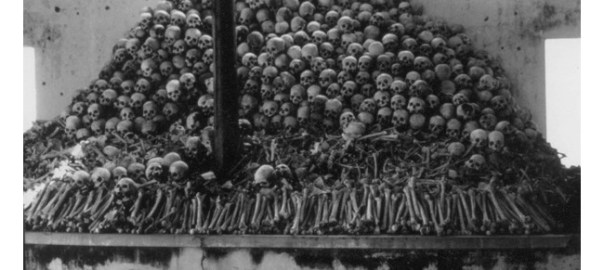
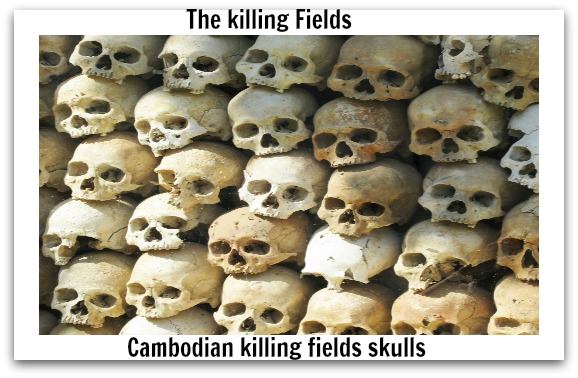
The Killing Fields (Khmer: វាលពិឃាត, Khmer pronunciation: [ʋiəl pikʰiət]) are a number of sites in Cambodia where collectively more than a million people were killed and buried by the Khmer Rouge regime, during its rule of the country from 1975 to 1979, immediately after the end of the Cambodian Civil War (1970–1975). The mass killings are widely regarded as part of a broad state-sponsored genocide (the Cambodian genocide).

Analysis of 20,000 mass grave sites by the DC-Cam Mapping Program and Yale University indicate at least 1,386,734 victims of execution.

Estimates of the total number of deaths resulting from Khmer Rouge policies, including disease and starvation, range from 1.7 to 2.5 million out of a 1975 population of roughly 8 million. In 1979, Vietnam invaded Democratic Kampuchea and toppled the Khmer Rouge regime.

Cambodian journalist Dith Pran coined the term “killing fields” after his escape from the regime

Genocide

PolPot.jpg

The Communist Khmer Rouge regime arrested and eventually executed almost everyone suspected of connections with the former government or with foreign governments, as well as professionals and intellectuals. Ethnic Vietnamese, ethnic Thai, ethnic Chinese, ethnic Cham, Cambodian Christians, and the Buddhist monkhood were the demographic targets of persecution. As a result, Pol Pot has been described as “a genocidal tyrant.”

Martin Shaw described the Cambodian genocide as:

“the purest genocide of the Cold War era.”

Ben Kiernan estimates that about 1.7 million people were killed.


Researcher Craig Etcheson of the Documentation Center of Cambodia suggests that the death toll was between 2 and 2.5 million, with a “most likely” figure of 2.2 million. After 5 years of researching some 20,000 grave sites, he concludes that:


“these mass graves contain the remains of 1,386,734 victims of execution.”

Emblem of the United Nations.svg

A UN investigation reported 2–3 million dead, while UNICEF estimated 3 million had been killed. Demographic analysis by Patrick Heuveline suggests that between 1.17 and 3.42 million Cambodians were killed,  while Marek Sliwinski suggests that 1.8 million is a conservative figure.

2,000,000

Dead


This slideshow requires JavaScript.


Even the Khmer Rouge acknowledged that 2 million had been killed—though they attributed those deaths to a subsequent Vietnamese invasion. By late 1979, UN and Red Cross officials were warning that another 2.25 million Cambodians faced death by starvation due to “the near destruction of Cambodian society under the regime of ousted Prime Minister Pol Pot,” who were saved by international aid after the Vietnamese invasion.

Cambodia’s ethnic minorities constituted 15 percent of the population in pre-Khmer Rouge era. Of the 400,000 Vietnamese who lived in Cambodia before 1975, some 150–300,000 were expelled by the previous Lon Nol regime. When Pol Pot‘s Khmer Rouge came to power, there remained about 100–250,000 Vietnamese in the country. Almost all of them were repatriated by December 1975.

The Chinese community (about 425,000 people in 1975) was reduced to 200,000 during the next four years. In the Khmer Rouge’s Standing Committee, four members were of Chinese ancestry, two Vietnamese, and two Khmers. Some observers argue that this mixed composition makes it difficult to argue that there was an intent to kill off minorities.

R.J. Rummel, an analyst of political killings, argues that there was a clear genocidal intent:

One estimate is that out of 40,000 to 60,000 monks, only between 800 and 1,000 survived to carry on their religion. We do know that of 2,680 monks in eight monasteries, a mere seventy were alive as of 1979. As for the Buddhist temples that populated the landscape of Cambodia, the Khmer Rouge destroyed 95 percent of them, and turned the remaining few into warehouses or allocated them for some other degrading use.

Amazingly, in the very short span of a year or so, the small gang of Khmer Rouge wiped out the center of Cambodian culture, its spiritual incarnation, its institutions….As part of a planned genocide campaign, the Khmer Rouge sought out and killed other minorities, such as the Moslem Cham. In the district of Kompong Xiem, for example, they demolished five Cham hamlets and reportedly massacred 20,000 that lived there; in the district of Koong Neas only four Cham apparently survived out of some 20,000.

Process


Rooms of the Tuol Sleng Genocide Museum contain thousands of photos taken by the Khmer Rouge of their victims.

Flag of Democratic Kampuchea.svg

The judicial process of the Khmer Rouge regime, for minor or political crimes, began with a warning from the Angkar, the government of Cambodia under the regime. People receiving more than two warnings were sent for “re-education,” which meant near-certain death.

People were often encouraged to confess to Angkar their “pre-revolutionary lifestyles and crimes” (which usually included some kind of free-market activity; having had contact with a foreign source, such as a U.S. missionary, international relief or government agency; or contact with any foreigner or with the outside world at all), being told that Angkar would forgive them and “wipe the slate clean.” This meant being taken away to a place such as Tuol Sleng or Choeung Ek for torture and/or execution.


killingfields2.jpg

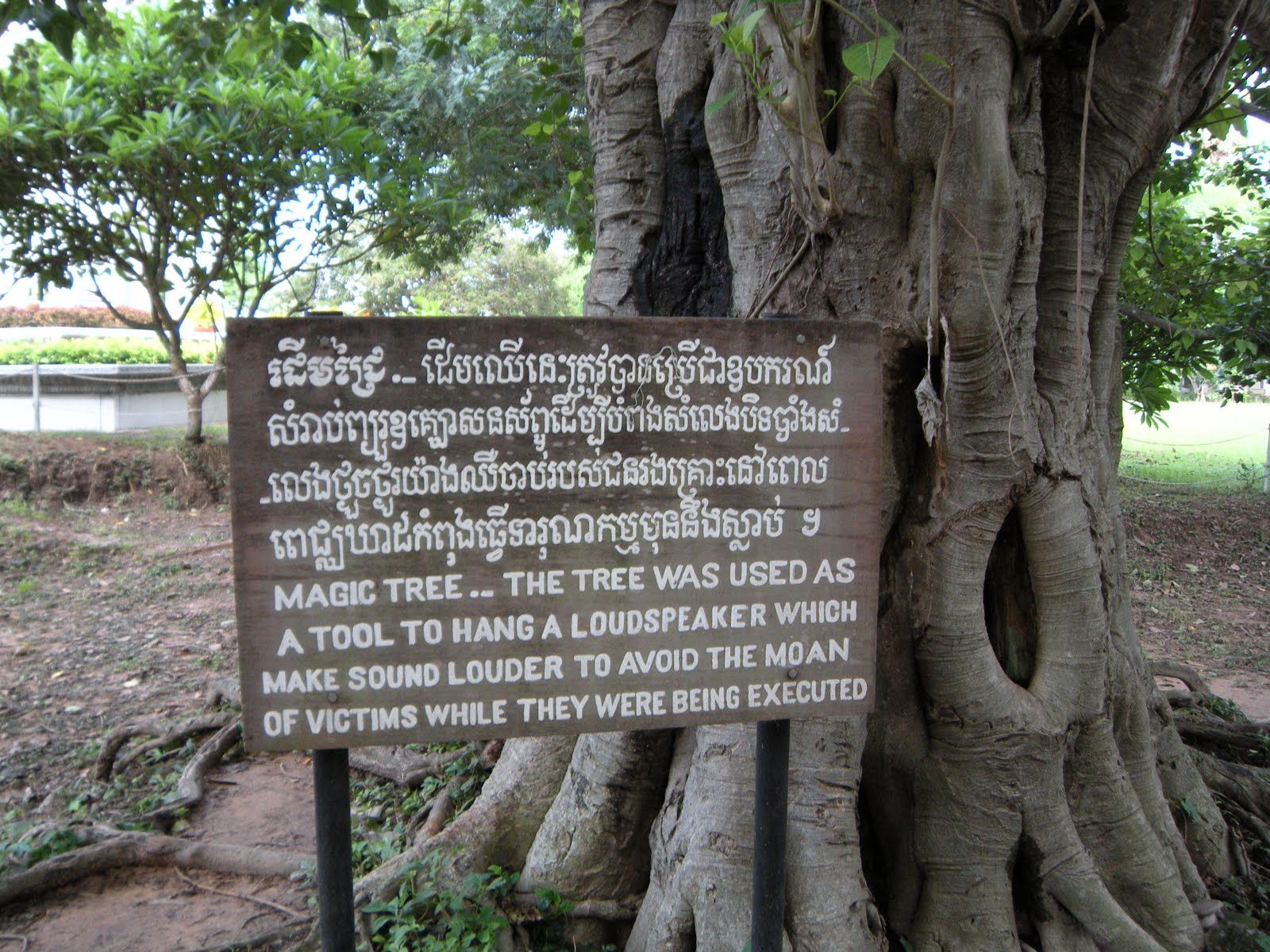
The executed were buried in mass graves. In order to save ammunition, the executions were often carried out using poison, spades or sharpened bamboo sticks. In some cases the children and infants of adult victims were killed by having their heads bashed against the trunks of Chankiri trees, and then were thrown into the pits alongside their parents. The rationale was

“to stop them growing up and taking revenge for their parents’ deaths.”

Some victims were required to dig their own graves; their weakness often meant that they were unable to dig very deep. The soldiers who carried out the executions were mostly young men or women from peasant families.

Prosecution for crimes against humanity

In 1997 the Cambodian government asked for the UN’s assistance in setting up a genocide Tribunal. It took nine years to agree to the shape and structure of the court – a hybrid of Cambodian and international laws – before the judges were sworn in in 2006.

The investigating judges were presented with the names of five possible suspects by the prosecution on July 18, 2007.  On September 19, 2007 Nuon Chea, second in command of the Khmer Rouge and its most senior surviving member, was charged with war crimes and crimes against humanity. He faced Cambodian and foreign judges at the special genocide tribunal and was convicted on 7 August 2014 and received a life sentence.

Kang Kek Lew


On July 26, 2010 Kang Kek Iew (aka Comrade Duch), director of the S-21 prison camp, was convicted of crimes against humanity and sentenced to 35 years’ imprisonment. His sentence was reduced to 19 years, as he had already spent 11 years in prison.


On February 2, 2012, his sentence was extended to life imprisonment by the Extraordinary Chambers in the Courts of Cambodia.

Today

———————————

The Killing Fields Peter Jennings Report

———————————

Buddhist Stupa at Choeung Ek killing fields, Cambodia.JPG

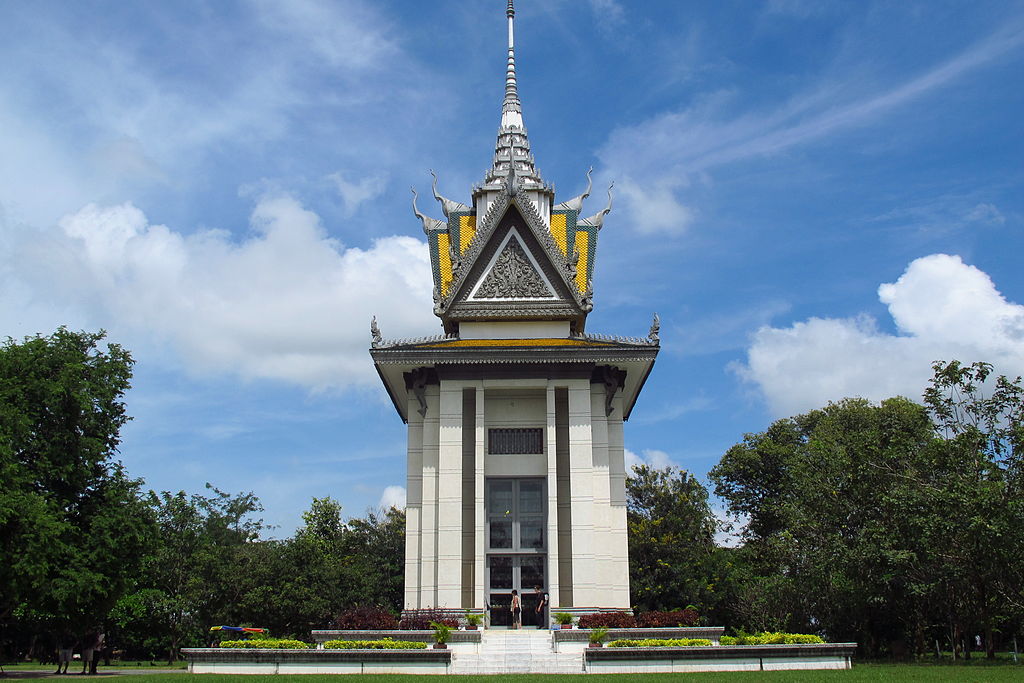
The best known monument of the Killing Fields is at the village of Choeung Ek.

Today, it is the site of a Buddhist memorial to the victims, and Tuol Sleng has a museum commemorating the genocide. The memorial park at Choeung Ek has been built around the mass graves of many thousands of victims, most of whom were executed after they had been transported from the S-21 Prison in Phnom Penh.

The utmost respect is given to the victims of the massacres through signs and tribute sections throughout the park. Many dozens of mass graves are visible above ground, many which have not been excavated yet. Commonly, bones and clothing surface after heavy rainfalls due to the large number of bodies still buried in shallow mass graves. It is not uncommon to run across the bones or teeth of the victims scattered on the surface as one tours the memorial park. If these are found, visitors are asked to notify a memorial park officer or guide.

A survivor of the genocide, Dara Duong, founded The Killing Fields Museum in Seattle, Washington, US.

—————————-

Killing fields movie Best movie clip

—————————-

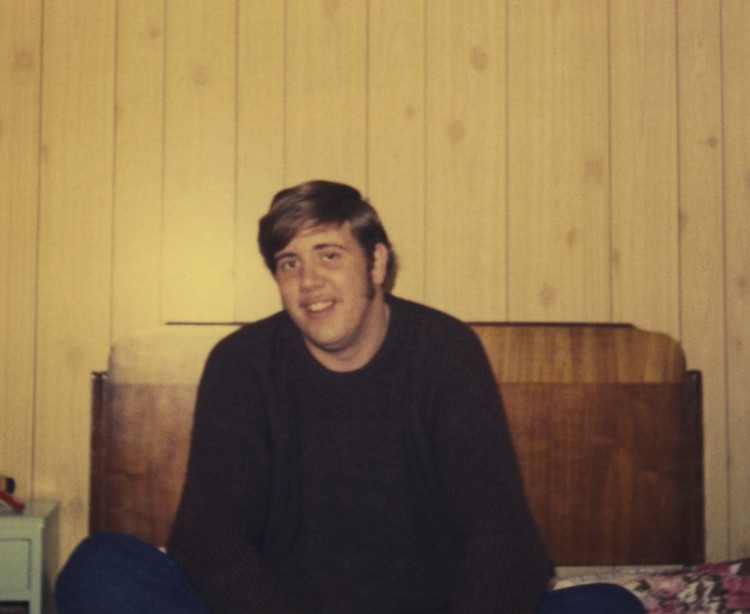
John Dawson Dewhirst

1952 – c. August 1978

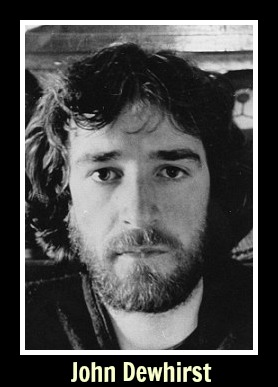
John Dewhirst resized with text

John Dawson Dewhirst (1952 – c. August 1978) was a British teacher and amateur yachtsman who was one of nine western adventurers, and two Britons, known to fall victim to the Khmer Rouge during the genocidal rule of Pol Pot.

Early life

Dewhirst was born in the Jesmond district of Newcastle Upon Tyne in 1952. His father was a headmaster, and his mother ran an antiques shop. In 1963, at age 11, the Dewhirst family moved to Cumbria. While growing up in Cumbria, Dewhirst became a sports enthusiast, and took a liking to outdoor activities. He spent most of his boyhood roaming the Cumbrian countryside.

At Appleby Grammar School, Dewhirst developed a love for poetry and aspired to be a novelist. After finishing his A Levels, he won an English scholarship to study at Loughborough University.

While studying at Loughborough University, he trained as a teacher. After receiving his degree in teaching, his desire for adventure and to become a writer drove him to travel to Tokyo, Japan to teach English in 1977.

Disappearance

Some time in July 1978, while visiting a friend in the eastern Malaysian town of Kuala Terengganu—on the slow road from Japan back to England—26-year-old Dewhirst met Canadian Stuart Glass and New Zealander Kerry Hamill, co-owners of a little Malaysian bedar (traditional, double-ended wooden boat) named Foxy Lady. The three spent several weeks or a month together in Kuala, and then headed north to Bangkok.

For reasons that are unclear, Foxy Lady ended up in Cambodian waters and was seized, off Koh Tang, by a patrol vessel attached to Division 164 of the Revolutionary Army of Kampuchea. Foxy Lady may have been on its way to Bangkok to pick up a load of Thai sticks. Glass had engaged in hashish smuggling before. Dewhirst’s history in this area is unknown. His Kuala Terengganu friend—now in her seventies—recalls Dewhirst speaking of planned adventures.

Glass was shot and killed, or drowned, during the seizure. Dewhirst and Hamill may have been held for several days on a nearby island, and were then trucked off to Democratic Kampuchea’s preeminent death house—S-21.

S-21 records

In early 1979, Vietnam invaded Democratic Kampuchea and overthrew the Pol Pot regime. They liberated Democratic Kampuchea’s S-21 prison in the capital Phnom Penh where over 14,000 Cambodians had been killed, many of them for supposedly spying against Cambodia.

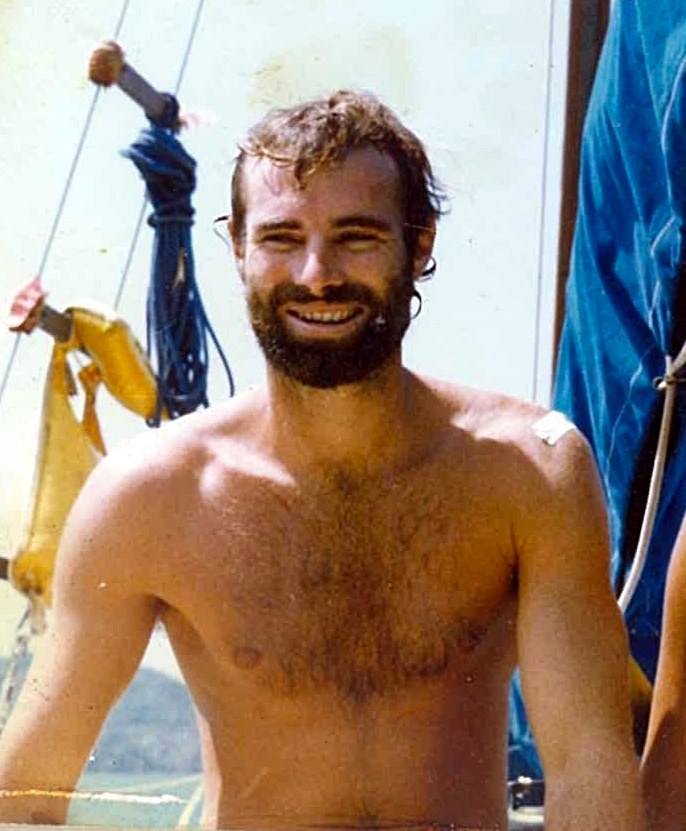
Kerry Hamill


Alleged photographs and forced confessions of nine missing Western yachtsmen (four Americans, two Australians, plus those of John Dewhirst and Kerry Hamill) were found in the prison files. The confessions of Dewhirst and Hamill revealed that they had been seized by a Khmer Rouge patrol vessel near the island of Koh Tang on the evening of 13 August 1978.

Stuart Glass


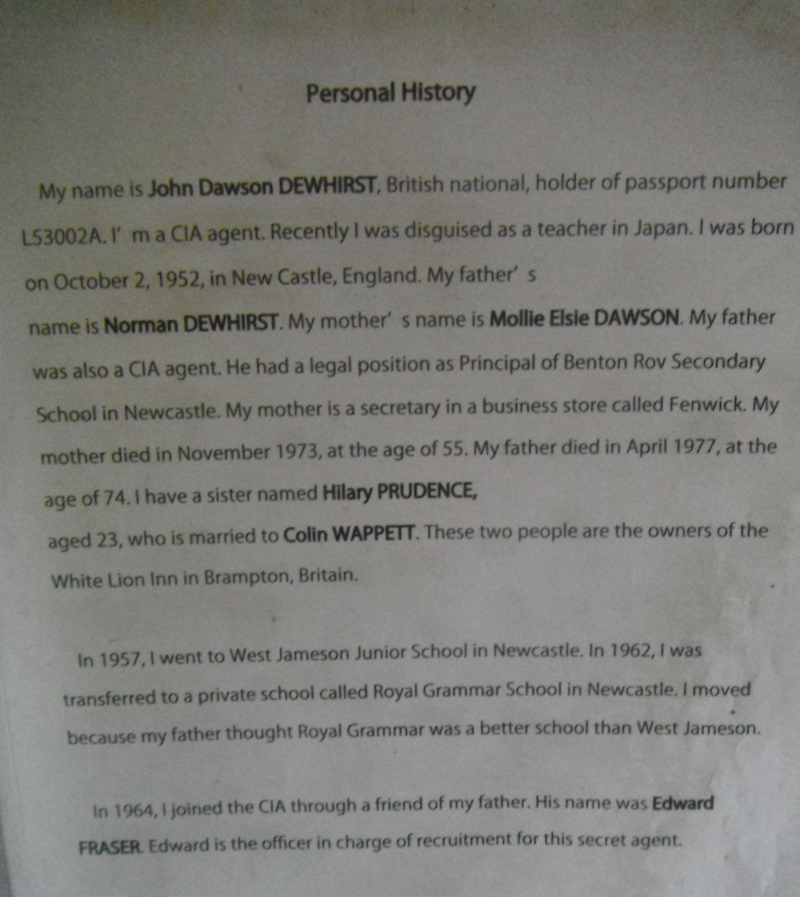
Stuart Glass, the Canadian befriended by Dewhirst and Hamill, had been shot and killed during Foxy Lady‘s capture. Hamill and Dewhirst were both brought ashore and then taken by truck to Phnom Penh. Like the other Western yachtsmen, they were almost certainly tortured. The extent of their mistreatment is not clear. Dewhirst wrote several long confessions that mixed true events in his life with wholly false accounts of his career as a CIA agent planning to subvert the Khmer Rouge regime.

He claimed that his father (also an agent) had been paid a large bribe for inducting his son into the CIA and that his college course in Loughborough was interspersed with training as a spy. Dewhirst and Hamill signed a series of confessions between September 3 and October 13, 1978.

John_Dawson_Dewhirst's_Confession_-_Page_1.png


John Dawson Dewhirst’s first page of a forced confession when being tortured by the Cambodian Pol Pot Regime in the S-21 prison in Phnom Penh.

The former administrator of the prison, Comrade Duch, said that he remembered Dewhirst as “very polite”.

News of his death

The circumstances of the deaths of Dewhirst and Hamill remain unclear. Their deaths were first reported in late 1979 and early 1980 by ABC News journalist Jim Laurie and freelance photographer Edward Rasen. Rasen provided more details, including photographs and portions of confessions in stories for the UK publication NOW! and the Australian Bulletin.

During the 2009 trial of S-21 chief Kang Kek Iew (aka Duch), a former S-21 guard named Cheam Sour claimed that one of the eight Western yachtsmen held at S-21 was burned to death. Sensational reports that this individual was John Dewhirst are unsubstantiated.

Like other S-21 inmates, Dewhirst may well have been killed with a blow to the head. Comrade Duch said that he received orders from his superiors that the bodies of the murdered westerners had to be burned to remove all traces of their remains, adding,

“I believe that nobody would dare to violate my orders.”

Aftermath

On 10 November 2005, in an interview, John Dewhirst’s sister, Hilary Dewhirst-Holland told interviewers that she wants her brother’s case to be detailed in the prosecution indictment against Duch.

During Comrade Duch’s trial beginning in 2007, Hillary did not attend the trial to testify against Duch. Instead, she handed a note to Rob Hamill, younger brother of Kerry Hamill, to share with the court.

On 27 August 2009, Rob Hamill appeared before the Extraordinary Chambers in the Courts of Cambodia (Khmer Rouge Tribunal) as a civil party in Case 001, against Comrade Duch.

In April 2011, Hamill applied to the ECCC once more for civil party status in ECCC Case 003, believed to involve former Khmer Rouge chief Meas Mut. As “Secretary” of Democratic Kampuchea’s Division 164—comprising the nation’s navy—Mut would have been responsible for the gunning down of Stuart Glass and the seizure of Foxy Lady‘s two other crew, Kerry Hamill and John Dewhirst—not to mention the arrest of the other six Western yachtsmen.

———————————–

Duch trial: 25 Jul 2010
The sister of Briton who died in Khmer Rouge killing fields says his murderer should never be freed
As the trial of a notorious Cambodian prison guard Duch draws to a close, the sister of the only Briton to die in the Killing Fields says Duch should never be freed.

When a slightly built, bespectacled former revolutionary is sentenced on Monday for ordering the deaths of more than 14,000 people, Cambodians will at last see justice being done for one of the 20th century’s greatest crimes.

Thousands of miles away on the moors of rural Cumbria, so will a solicitor whose brother fell victim to Pol Pot’s murderous regime in 1978 when an adventure went horribly wrong.

John Dewhirst, a 26-year-old teacher from Cumbria, was enjoying one last trip before returning home, sailing through the Gulf of Thailand in a motorised junk called Foxy Lady. All went well until he and his friends came too close to the coast of Cambodia, then a closed land whose rulers had instituted a chilling reign of terror.


They were seized by Khmer Rouge coastguards and taken from their boat to a torture centre in the capital Phnom Penh.


There Mr Dewhirst was brutally interrogated and forced to make the ludicrous confession that he was a CIA spy, before being slaughtered in what became known as the killing fields – the only Briton among the hundreds of thousands to die there.

See Telegraph for full story

The Glorious 12th of July – Extracts from Belfast Child

Belfast Child Chapter Four The Glorious 12th Extracts from Belfast Child. See above for additional chapters   See The Siege Of Derry what’s it all about Like the vast majority of Protestants …

Source: The Glorious 12th of July – Extracts from Belfast Child

Glencairn was a violent, ultra loyalist estate controlled by the UDA ( Ulster Defence Association )

CHAPTER TWO GLENCAIRN Extracts from my Autobiography , Belfast Child   On a sunny day in 1970 my osteomyelitis was finally given the all clear and I was on my way home from the hospital, for a coup…

Source: Glencairn was a violent, ultra loyalist estate controlled by the UDA ( Ulster Defence Association )

8th June – Deaths & Events in Northern Ireland Troubles

Key Events & Deaths on this day in Northern Ireland Troubles

8th June

————————

Tuesday 8 June 1971

General Harry Tuzo, with escorts, circa 1972

Harry Tuzo, then General Officer Commanding the British Army (BA), said that a permanent military solution to the conflict could not be achieved.

Saturday 8 June 1974

The Price sisters ended their hunger strike in Brixton Prison, England. The hunger strike had lasted six months because of a policy of force-feeding by the prison authorities.

Wednesday 8 June 1977

Roy Mason, then Secretary of State, announced that the strength of the Royal Ulster Constabulary (RUC) would be increased by 1,200 and that of the Ulster Defence Regiment (UDR) increased to 2,500 full-time members.

He also announced that there would be more undercover activity by troops, and that the spearhead battalion would be withdrawn.

Monday 8 June 1981

Tom McElwee,

Tom McElwee, then an Irish Republican Army (IRA) prisoner, joined the hunger strike.

See 1981 Hungry Strike

Friday 8 June 1990

Banbridge District Council introduced a form of ‘power-sharing’.

Monday 8 June 1992

Brian_Nelson_Loyalist

A British Broadcasting Corporation (BBC) programme made a number of claims about Brian Nelson, who had operated as a British Army (BA) agent and a Ulster Defence Association (UDA) intelligence officer.

The programme claimed that Nelson had been involved in 10 murders, attempted murders, or conspiracies to murder, and that his BA controllers had know of the events. The programme further claimed that in some instances BA intelligence had failed to pass on information about planned attacks to the Royal Ulster Constabulary (RUC).

See Brian Nelson

Tuesday 8 June 1993


Patrick Mayhew, then Secretary of State for Northern Ireland, held a meeting with James Molyneaux, then leader of the Ulster Unionist Party (UUP), in London. This was the start of a fresh set of bilateral talks.

Wednesday 8 June 1994

A small incendiary device was found in a snooker hall in Trim, County Meath, Republic of Ireland, following a statement by the Ulster Freedom Fighters (UFF), a cover name (pseudonym) used by the Ulster Defence Association (UDA), that firebombs had been planted in the Republic.

Sunday 8 June 1997

During the continuing protest by Loyalist pickets at the Catholic church at Harryville, Ballymena, there was an attempt to burn down the chapel.

A parade of bands had been organised and there were violent confrontations between the Loyalists and the Royal Ulster Constabulary (RUC) with 27 officers being injured.

A number of plastic bullets were fired at the demonstrators. Sean McNally (24) had to have his leg amputated following a ‘punishment’ shooting involving a shotgun.

Monday 8 June 1998

The fact that the newly established Police Commission in Northern Ireland did not contain any of the people nominated by the Irish government, on behalf of Nationalists in Northern Ireland, was thought to have caused considerable difficulties between the two governments.

A leaked memo indicated that Marjorie (Mo) Mowlam, then Secretary of State for Northern Ireland, had personally contacted the Irish government, the White House, the Social Democratic and Labour Party (SDLP), Sinn Féin (SF), and other interested parties to explain her decision and to seek agreement for it.

[The Royal Ulster Constabulary (RUC) was eventually called in to try to discover the source of the leak in the Northern Ireland Office (NIO). This was one of a number of leaks in the recent pass. Seamus Mallon, then deputy leader of the Social Democratic and Labour Party (SDLP), questioned the loyalty of the civil servants working for Mowlam.]

Tuesday 8 June 1999

Fourteen pipe-bombs were found by Royal Ulster Constabulary (RUC) officers in the Loyalist Mourneview estate in Lurgan, County Armagh.

[A man was later charged in relation to the find.]

Tony Blair, then British Prime Minister, and Bertie Ahern, then Taoiseach (Irish Prime Minister), announced a series of intensive talks in a final attempt to break the deadlock in the Northern Ireland talks before the 30 June 1999 deadline

. Les Rodgers, then Chairman of the Police Federation, spoke at the organisation’s annual conference. He claimed that some lawyers, academics and human rights groups were part of “an evil conspiracy to vilify this police force”. He also claimed that this attempt was “being coordinated by Sinn Féin”.

Thursday 8 June 2000

A Catholic mother and her 20 year old daughter escaped injury in a pipe-bomb attack on their home in Annalong, County Down. The two women were at home when the explosion rocked their terrace house shortly after 11.00pm. The attack was carried out by Loyalist paramilitaries.


——————————————

Remembering all innocent victims of the Troubles

Today is the anniversary of the death of the following people killed as a results of the conflict in Northern Ireland

“To live in hearts we leave behind is not to die

– Thomas Campbell

To the innocent on the list – Your memory will live forever

– To the Paramilitaries –

There are many things worth living for, a few things worth dying for, but nothing worth killing for.

5 People lost their lives on the 8th June between 1972 – 1977

——————————————

08 June 1972


Jean Smith   (24)

Catholic
Status: Civilian (Civ),

Killed by: not known (nk)
Shot by sniper, while travelling in car at bus terminus, Glen Road, Andersonstown, Belfast.

——————————————

08 June 1972
Norman Campbell  (19)

Catholic
Status: Civilian (Civ),

Killed by: not known (nk)
Shot at his workplace, building site, Upper Townsend Street, Shankill, Belfast.

——————————————

08 June 1972


Samuel Donegan   (61)

nfNI
Status: Garda Siochana (GS),

Killed by: Irish Republican Army (IRA)
Killed by booby trap bomb left by side of road, Legakelly, near Newtownbutler, County Fermanagh. Garda Donegan had strayed a few yards over the border into Northern Ireland.

——————————————

08 June 1972
Edward Megahey  (44)

Protestant
Status: Ulster Defence Regiment (UDR),

Killed by: Irish Republican Army (IRA)
Died three days after being shot by sniper while on Ulster Defence Regiment mobile patrol, Buncrana Road, Derry.

——————————————

08 June 1977
Gerald Tucker   (35)

Protestant
Status: Ulster Defence Regiment (UDR),

Killed by: Irish Republican Army (IRA)
Off duty. Shot shortly after leaving his workplace, Royal Victoria Hospital, Falls Road, Belfast.

——————————————


Petition to Raise awareness & ensure the safe release of ISIS hostage John Cantlie

John Cantlie Petition

UK Government and Parliament

John Cantlie has now been in captivity for almost four years and everyday day, minute and second of this time his life and  daily routine has been controlled and at the mercy of the mad men of Islamic State – Imagine for a moment what that must be like ?
Please DON’T forget about John and his suffering and the pain and anguish his family and loved ones go through every day.
Poppy Douglass has set up a petition to Raise awareness and ensure the safe release of British ISIS hostage John Cantlie – I’ve signed it & if you would like to add your voice and have John’s plight  considered for debate in the UK Parliament you can sign below .

Sign John Cantlie petition

Petition

John Cantlie is a British photo-journalist held captive by ISIS for over three years. He has been used in the “Lend Me your Ears” proganda videos directed and filmed by ISIS.


More details

Information on John may be found at https://en.wikipedia.org/wiki/John_Cantlie and there is a twitter page @CantlieUK.

There is also an international petition for those outside the UK at http://tinyurl.com/ktjf313


sign this petition resized

3,911 signatures

Show on a map

10,000

       At 10,000 signatures…

At 10,000 signatures, government will respond to this petition

   At 100,000 signatures…

At 100,000 signatures, this petition will be considered for debate in Parliament

See John Cantlie – Where is he & Why UK media Silence

Share this petition

cantlie-1_3061418c

See John Cantlie – Where is he & Why UK media Silence