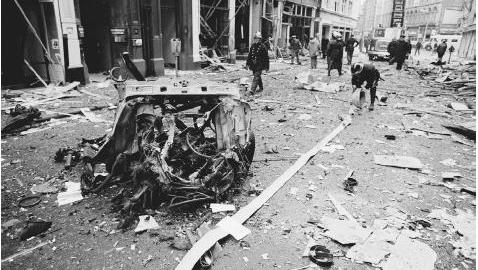
.Bloody Friday is the name given to the bombings by the Provisional Irish Republican Army (IRA) in Belfast on 21 July 1972. Twenty-six bombs exploded in the space of eighty minutes, killing nine people (including two British soldiers) and injuring 130. The majority of these were car bombs, driven to their detonation sites that same day.
Bloody Friday is the name given to the bombings by the Provisional Irish Republican Army (IRA) in Belfast on 21 July 1972. Twenty-six bombs exploded in the space of eighty minutes, killing nine people (including two British soldiers) and injuring 130. The majority of these were car bombs, driven to their detonation sites that same day.
The bombings were partly a response to the breakdown of talks between the IRA and the British government. Since the beginning of its campaign in 1969, the IRA had carried out a concerted bombing campaign against economic, military and political targets in Northern Ireland.
It carried out a total of 1,300 bombings in 1972. Bloody Friday was the spur for Operation Motorman, launched by the British Army ten days later.
– Disclaimer –
The views and opinions expressed
in this documentary/ies /post/s are soley intended to educate and provide background information to those interested in the Troubles of Northern Ireland. They in no way reflect my own opinions and I take no responsibility for an inaccuracies or factual errors .
Overview
In late June and early July 1972, a British government delegation led by William Whitelaw held secret talks with the Provisional IRA leadership. As part of the talks, the IRA agreed to a temporary ceasefire beginning on 26 June. The IRA leaders sought a peace settlement that included a British withdrawal from Northern Ireland by 1975 and the release of republican prisoners. However, the British refused and the talks broke down.
The ceasefire came to an end on 9 July. It is also speculated the the bombings were in response to the shooting deaths of innocent Catholic Civil rights marchers on 30 January 1972 known as Bloody Sunday.
“Bloody Friday” was the IRA’s response to the breakdown of the talks. According to the IRA’s Chief of Staff, Seán Mac Stíofáin, the main goal of the bombing operation was to wreak financial harm. It was a
“message to the British government that the IRA could and would make a commercial desert of the city unless its demands were met”.
Some also saw it as a reprisal for Bloody Sunday in Derry six months earlier. The attack was carried out by the IRA’s Belfast Brigade and the main organiser was Brendan Hughes, the brigade’s Officer Commanding. A total of 26 bombs were planted and, in the resulting explosions, eleven people were killed and a further 130 civilians injured, many horrifically mutilated.
At the height of the bombing, the middle of Belfast
“resembled a city under artillery fire; clouds of suffocating smoke enveloped buildings as one explosion followed another, almost drowning out the hysterical screams of panicked shoppers”.
Of those injured, 77 were women and children.
The Belfast Brigade claimed responsibility for the bombings and said that it had given warnings to the security forces (through the local media) before the bombs exploded. It said that the press, the Samaritans and the Public Protection Agency “were informed of bomb positions at least 30 minutes to one hour before each explosion”.
Mac Stíofáin said that
“It required only one man with a loud hailer to clear each target area in no time” and alleged that the warnings for the two bombs that claimed lives were deliberately ignored by the British for “strategic policy reasons”.
The security forces also received hoax warnings, which “added to the chaos in the streets”. The Royal Ulster Constabulary (RUC) and British Army only effectively cleared a small number of areas before the bombs went off. Furthermore, because of the large number of bombs in the confined area of Belfast city centre, people evacuated from the site of one bomb were mistakenly moved into the vicinity of other bombs.
Thirty years after the attack the IRA formally apologised for harming civilians.
—————————————————————————————
Bloody Friday Documentary
This excellent production from BBC NI was shown to commemorate the 40th Anniversary of Bloody Friday. Bloody Friday is the name given to the bombings by the Provisional Irish Republican Army (IRA) in Belfast on 21 July 1972. Twenty-two bombs exploded in the space of eighty minutes, killing nine people (including two British soldiers) and injuring 130.
—————————————————————————————
Timeline
The accounts of the events that appeared in the first editions of local and national newspapers were, naturally enough, somewhat confused about the details of the events of the day. The timetable below is approximate and given in BST (GMT+1). The details are based on a number of accounts.
~2:10 pm (Smithfield Bus Station)
A car bomb exploded in an enclosed yard at Smithfield Bus Station, causing extensive damage to the surrounding area.
~2:16 pm (Brookvale Hotel)
A bomb (estimated at 50 pounds (23 kg) of explosive) exploded at the Brookvale Hotel on Brookvale Avenue. The bomb was left in a suitcase by three men armed with sub-machine guns. The area had been cleared and there were no injuries.
Some sources give the time of this bombing as 2:36 pm.
A suitcase bomb (estimated at 30 pounds (14 kg) of explosive) exploded on the platform, wrecking the inside of the station and blowing the roof off. Some sources give the time of this bombing as 3:03 pm.
A car bomb exploded at the Star Taxis depot on Crumlin Road. Nearby were the houses of the Crumlin Road Prison warders and the prison itself.
Some sources say that there were two bombs and that they exploded at 3:25 pm.
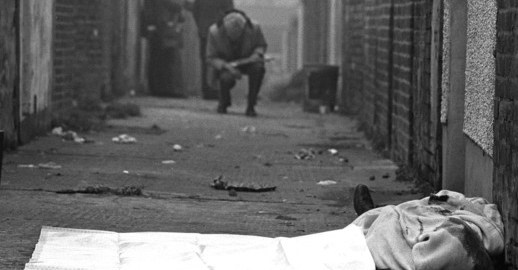
Aftermath of the Oxford Street bomb showing the body of one of the victims being shovelled into a bag
~2:48 pm (Bus depot, Oxford Street)
A carbomb exploded outside the Ulsterbus depot on Oxford Street, the busiest bus station in Northern Ireland. An Austin 1100 saloon car loaded with explosives had been driven to the rear of the depot. The blast resulted in the greatest loss of life and the greatest number of casualties. Some of the victims’ bodies were torn to pieces by the blast, which led authorities to give an initial estimate of 11 deaths.
The area was being cleared but was still crowded when the bomb exploded. Two British Army soldiers, Stephen Cooper (19) and Philip Price (27), were near the bomb when it detonated and were killed outright. Three Protestant civilians who worked for Ulsterbus were killed: William Crothers (15), Thomas Killops (39) and Jackie Gibson (45). One other Protestant Ulsterbus employee, who was a member of the Ulster Defence Association, was also killed in the blast: William Irvine (18).
Crothers, Killops and Irvine had been in the vicinity of the car bomb helping to search for the device at the moment it exploded, killing the three men instantly. Bus driver Jackie Gibson was killed after having completed his bus route just minutes before the blast. Almost 40 people suffered injuries. Some sources give the time of this bombing as 3:10 pm.
A van bomb exploded in the station’s bus yard. Four buses were wrecked and 44 others damaged. The nearby Murray’s Tobacco Factory in Sandy Row was also damaged.
~2:50 pm (Ulster Bank, Limestone Road)
A car bomb (estimated at 50 pounds (23 kg) of explosive) exploded outside the Ulster Bank on Limestone Road. The area had not been cleared and there were several injuries.[1] Some sources give the time of this bombing as 2:40 pm.
A car bomb (estimated at 160 pounds (73 kg) of explosive)[13] exploded on the Queen Elizabeth Bridge. There was some damage to the structure of the bridge.[1]
A car bomb (estimated at 50 pounds (23 kg) of explosive) exploded at the Belfast–Liverpool ferry terminus at Donegall Quay. The nearby Liverpool Bar was badly damaged.
~2:57 pm (Gas Department offices, Ormeau Avenue)
A car bomb (estimated at 50 pounds (23 kg) of explosive) exploded outside the offices of the Gas Department, causing extensive damage.
~2:59 pm (Garmoyle Street)
A parcel bomb, which had been planted by armed men, exploded at the premises of John Irwin seed merchants. The building was wrecked.
~3:02 pm (Agnes Street)
A car bomb (estimated at 30 pounds (14 kg) of explosive) exploded outside a group of houses on Agnes Street, a loyalist area off the Shankill Road. Those in the area did not receive a warning but there were no serious injuries.
~3:04 pm (M2 motorway bridge, Bellevue)
A car bomb (estimated at 30 pounds (14 kg) of explosive) partially exploded on the bridge over the M2 motorway at Bellevue in north Belfast. As the bomb only partially detonated, nearby buildings were not damaged.
~3:05 pm (Filling station, Upper Lisburn Road)
A car bomb exploded at Creighton’s filling station, setting the petrol pumps ablaze.
A car bomb exploded at an electrical substation at the junction of Salisbury Avenue and Hughenden Avenue. The substation and surrounding houses were badly damaged.
~3:05 pm (Railway bridge, Finaghy Road North)
A lorry bomb exploded on a railway bridge at Finaghy Road North.
A bomb (estimated at 30 pounds (14 kg) of explosive) exploded on a footbridge over the railway at Windsor Park football grounds. Concrete sleepers were blown on to the line, blocking it.[1] Some sources give the time of this bombing as 2:09 pm.
~3:12 pm (Eastwood’s Garage, Donegall Street)
A car bomb (estimated at 150 pounds (68 kg) of explosive) destroyed Eastwood’s Garage on Donegall Street.[17] There were several injuries.
~3:15 pm (Stewartstown Road)
A bomb, thought to have been abandoned on the Stewartstown Road, exploded but caused no serious injuries.
~3:15 pm (Cavehill Road)
A car bomb (estimated at 50 pounds (23 kg) of explosive) exploded outside a row of single storey shops near the top of Cavehill Road, north Belfast. The shops were in a religiously-mixed residential area. Those in the area had not received the bomb warning. Two women and a man died in this blast. Margaret O’Hare (37), a Catholic mother of seven children, died in her car.
Her 11-year-old daughter was with her in her car and was badly injured. Catholic Brigid Murray (65) and Protestant teenager Stephen Parker (14) were also killed. Many others were seriously injured. Stephen Parker’s father, the Rev. Joseph Parker, was only able to identify his son’s body at the mortuary by the box of trick matches in his pocket, and the shirt and scout belt he had been wearing. Some sources give the time of this bombing as 3:20 pm.
~3:25 pm (Railway line near Lisburn Road)
A bomb exploded on the railway line near the Lisburn Road.
~3:30 pm (Grosvenor Road)
A bomb (estimated at 50 pounds (23 kg) of explosive) exploded at the Northern Ireland Carriers depot on Grosvenor Road. There were no serious injuries.
Reactions and consequences
According to former RUC officer Jack Dale a large group of people in the republican Markets area had
“jeered and shouted and yelled” as if each explosion was “a good thing”.
He also drew attention to the Catholic victims, and mentioned the revulsion in the Republic of Ireland and elsewhere. Leader of the Opposition Harold Wilson described the events as “a shocking crime against an already innocent population”.
“The chief injury is not to the British Army, to the Establishment or to big business but to the plain people of Belfast and Ireland. Anyone who supports violence from any side after yesterday’s events is sick with the same affliction as those who did the deed.”
Television images of fire-fighters shovelling body parts into plastic bags at the Oxford Street bus station were the most shocking of the day.
Twenty-five years later, a police officer who had been at Oxford Street bus station described to journalist Peter Taylor the scene he came upon in the wake of the bombing:
“The first thing that caught my eye was a torso of a human being lying in the middle of the street. It was recognisable as a torso because the clothes had been blown off and you could actually see parts of the human anatomy. One of the victims was a soldier I knew personally.
He’d had his arms and legs blown off and some of his body had been blown through the railings. One of the most horrendous memories for me was seeing a head stuck to the wall. A couple of days later, we found vertebrae and a rib cage on the roof of a nearby building. The reason we found it was because the seagulls were diving onto it. I’ve tried to put it at the back of my mind for twenty-five years.”
In 1972, 479 people died in the Troubles, more than in any other year of the conflict. Ten days after the bombings the British Army launched Operation Motorman, to retake IRA-controlled areas in Belfast and Derry. There were also several revenge attacks by loyalists.
The City of Belfast Youth Orchestra set up a Stephen Parker Memorial Trust in memory of teenager Stephen Parker, who had been a music student and played the French Horn in the orchestra at the time he was killed. Stephen had also been posthumously awarded the Queen’s Commendation for bravery as he had died while trying to warn others about the car bomb left outside the row of shops on Cavehill Road.
Irish republican reaction
For the IRA, and the Belfast Brigade in particular, it was “an operation gone awry”. Brendan Hughes, Officer Commanding of the IRA’s Belfast Brigade, viewed the attack as a disaster. He described his reaction in an interview organised by Boston College:
“I was the operational commander of the ‘Bloody Friday’ operation. I remember when the bombs started to go off, I was in Leeson Street, and I thought, ‘There’s too much here’. I sort of knew that there were going to be casualties, either [because] the Brits could not handle so many bombs or they would allow some to go off because it suited them to have casualties. I feel a bit guilty about it because, as I say, there was no intention to kill anyone that day. I have a fair deal of regret that ‘Bloody Friday’ took place … a great deal of regret … If I could do it over again I wouldn’t do it.”
On 16 July 2002, the Provisional IRA issued a statement of apology to An Phoblacht, which read:
Sunday 21 July marks the 30th anniversary of an IRA operation in Belfast in 1972 which resulted in nine people being killed and many more injured.
While it was not our intention to injure or kill non-combatants, the reality is that on this and on a number of other occasions, that was the consequence of our actions.
It is therefore appropriate on the anniversary of this tragic event, that we address all of the deaths and injuries of non-combatants caused by us.
We offer our sincere apologies and condolences to their families.
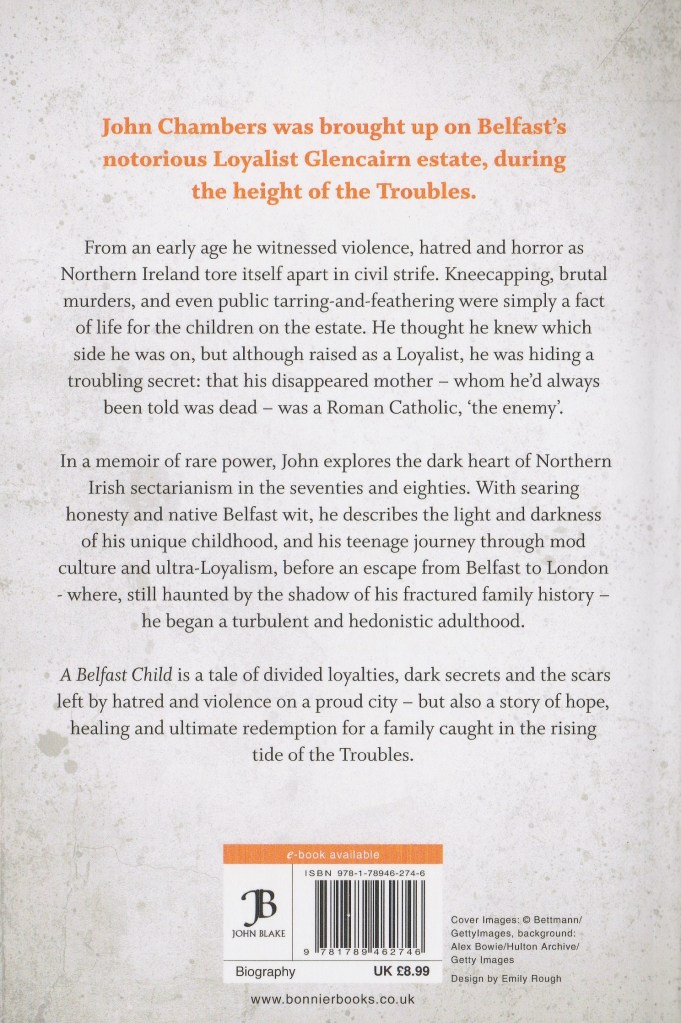
Please visit the autobiography section of this blog if you would like to read extracts from my forthcoming book – Belfast Child.
Go on- Surprise me !
As I child I learned the stories & legends of the Battle of Boyne & Siege of Derry at my grandfather’s & father’s knees, becoming immersed in the Loyalist culture that would shape & dominate my whole existence.
In memory of Sergeant Michael Willetts , GC & all other members of HM Armed Forces murdered by Irish Terrorists.
See below for the full story of this brave Hero’s death
————————————–
A short video, set to music, in memory Sergeant Michael G. Willets and all those members of HM Armed Forces murdered by Irish Terrorists.
A True British hero
We salute you all – Your memory will live on forever!
My son loves this song ( he’s 9 ) and it always brings a lump to my throat when I hear it and I feel myself welling up. Its a funny thing being a patriot sometimes , it can fill me with pride and love for my country and culture and other times melancholy flows through my being when I listen too and remember the sacrifice our glorious troops have paid to ensure our freedom and liberty.
Born in 1943 in the Nottinghamshire town of Sutton-in-Ashfield, Michael Willetts entered a local colliery after leaving school but found that he did not suit the job and soon afterwards joined the British Army, serving in the 3rd Battalion of the Parachute Regiment. He married his wife, Sandra and had two children, Dean and Trudy during his time in the army.
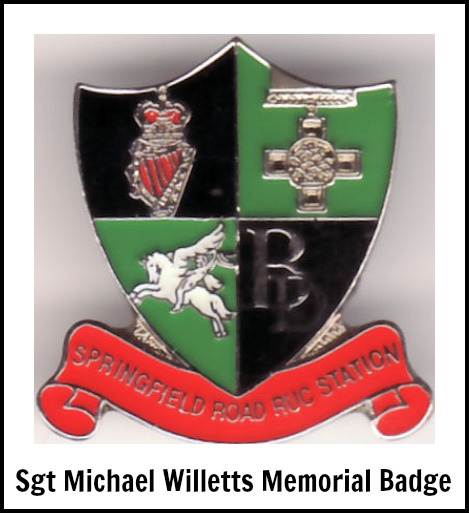
After several tours abroad and a promotion to sergeant, Willetts was dispatched with the rest of his regiment to Northern Ireland at the outbreak of violence there between Irish nationalists and the unionistRoyal Ulster Constabulary in 1971. Placed with his squad at Springfield Road police station in Belfast, Willetts engaged in local operations until 25 May 1971, when he was killed in a Provisional IRA bomb attack on the barracks.
Willetts was killed in Springfield Road RUC station by the Provisional IRA. A man in his mid-twenties emerged from a car and threw a suitcase containing a blast bomb into the lobby of the station. Willetts thrust two children and two adults into a corner and stood above them as the 30 lbs of explosives detonated, seriously injuring him.
Seven RUC officers, two British soldiers and eighteen civilians were injured in the attack. Willetts was fatally injured by a chunk of metal from a locker which had struck him in the back of the head. As he was being removed by ambulance, he and the injured officers were jeered by local youths who screamed obscenities at them. Willetts died after two hours on the operating table at Royal Victoria Hospital.
The sacrifice of Sergeant Michael G. Willets, 27, 3 Para.
Some just stared in hatred, and others turned in pain
And the lonely British soldier wished he was back home again
Come join the British Army! Said the posters in his town
See the world and have your fun come serve before the Crown
The jobs were hard to come by and he could not face the dole
So he took his country’s shilling and enlisted on the roll
For there was no fear of fighting, the Empire long was lost
Just ten years in the army getting paid for being bossed
Then leave a man experienced a man who’s made the grade
A medal and a pension some mem’ries and a trade
Then came the call to Ireland as the call had come before
Another bloody chapter in an endless civil war
The priests they stood on both sides the priests they stood behind
Another fight in Jesus name the blind against the blind
The soldier stood between them between the whistling stones
And then the broken bottles that led to broken bones
The petrol bombs that burnt his hands the nails that pierced his skin
And wished that he had stayed at home surrounded by his kin
The station filled with people the soldier soon was bored
But better in the station than where the people warred
The room filled up with mothers with daughters and with sons
Who stared with itchy fingers at the soldier and his gun
A yell of fear a screech of brakes the shattering of glass
The window of the station broke to let the package pass
A scream came from the mothers as they ran towards the door
Dragging children crying from the bomb upon the floor
The soldier stood and could not move his gun he could not use
He knew the bomb had seconds and not minutes on the fuse
He could not run to pick it up and throw it in the street
There were far too many people there too many running feet
Take cover! Yelled the soldier, Take cover for your lives
And the Irishmen threw down their young and stood before their wives
They turned towards the soldier their eyes alive with fear
For God’s sake save our children or they’ll end their short lives here
The soldier moved towards the bomb his stomach like a stone
Why was this his battle God why was he alone
He lay down on the package and he murmured one farewell
To those at home in England to those he loved so well
He saw the sights of summer felt the wind upon his brow
The young girls in the city parks how precious were they now
The soaring of the swallow the beauty of the swan
The music of the turning world so soon would it be gone
A muffled soft explosion and the room began to quake
The soldier blown across the floor his blood a crimson lake
They never heard him cry or shout they never heard him moan
And they turned their children’s faces from the blood and from the bones
The crowd outside soon gathered and the ambulances came
To carry off the body of a pawn lost in the game
And the crowd they clapped and cheered and they sang their rebel songs
One soldier less to interfere where he did not belong
But will the children growing up learn at their mothers’ knees
The story of the soldier who bought their liberty
Who used his youthful body as a means towards an end
Who gave his life to those who called him murderer not friend
Sergeant Michael Willetts, GC– 25 May 1971
At 8.24 pm on the evening of 25 May 1971 a terrorist entered the Springfield Road Police Station in Belfast. He carried a suitcase from which a smoking fuse protruded, dumped it quickly on the floor and fled outside. Inside the room were two adults, two children and several police officers.
The police officers raised the alarm and began to organize the evacuation of the hall past the reception desk, through the reception office and out of the door into the rear passage.
Sergeant Michael Willetts, 3rd Battalion The Parachute Regiment, was on duty in the inner hall. Hearing the alarm, he sent an NCO up to the first floor to warn those above and hastened to the door towards which a police officer was thrusting those in the reception hall and office. He held the door open while all passed safely through and then stood in the doorway, shielding those taking cover.
In the next moment, the bomb exploded with terrible force. Sergeant Willets was mortally wounded.
His duty did not require him to enter the threatened area, his post was elsewhere. He knew well, after four month’s service in Belfast, the peril of going towards a terrorist bomb but he did not hesitate to do so. All those approaching the door from the far side agreed that if they had had to check to open the door they would have perished. Even when those in the room had reached the rear passage, Sergeant Willets waited, placing his body as a screen to shelter them.
By this considered act of bravery, he risked and lost his life for those of the adults and children. His selflessness and courage are beyond praise.
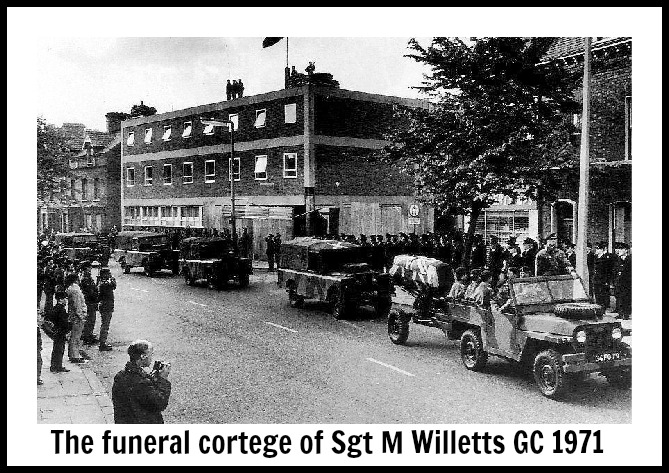
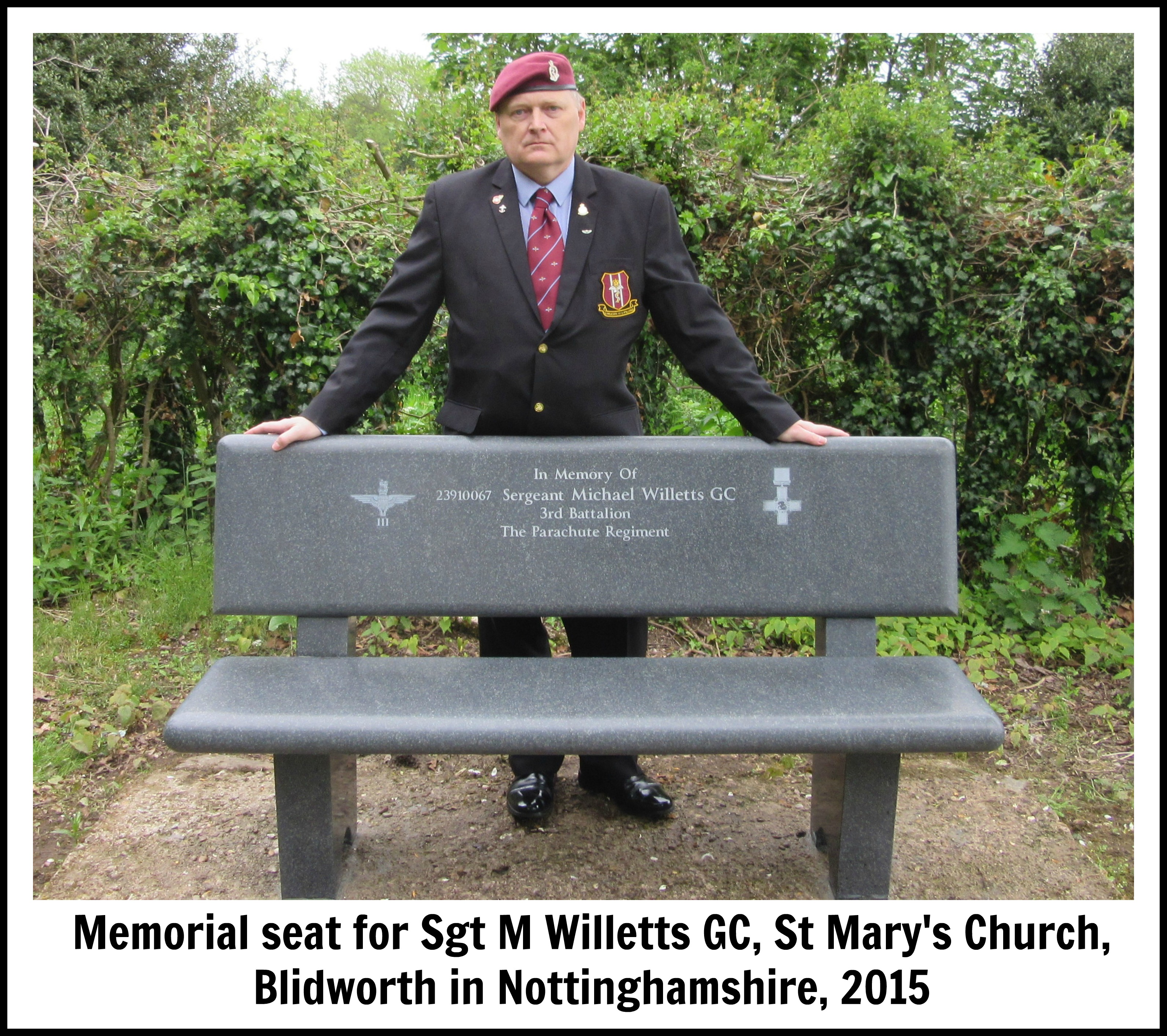
Sergeant Willetts is now buried at St Mary’s Church, Blidworth in Nottinghamshire.
by Paradata Editor
Medal citation
The George Cross was awarded to Sergeant Willett’s widow in June and the citation appeared in the London Gazette at the same time.
The Queen has been graciously pleased to approve the posthumous award of the George Cross to:
2391067 Sergeant Michael WILLETTS, The Parachute Regiment.
At 8.24 p.m. on the evening of 25th May 1971, a terrorist entered the reception hall of the Springfield Road Police Station in Belfast. He carried a suitcase from which a smoking fuse protruded, dumped it quickly on the floor and fled outside. Inside the room were a man and a woman, two children and several police officers. One of the latter saw at once the smoking case and raised the alarm. The Police Officers began to organise the evacuation of the hall past the reception desk, through the reception office and out by a door into the rear passage.
Sergeant Michael Willetts was on duty in the inner hall. Hearing the alarm, he sent an N.C.O. up to the first floor to warn those above and hastened himself to the door towards which a Police Officer was thrusting those in the reception hall and office. He held the door open while all passed safely through and then stood in the doorway, shielding those taking cover. In the next moment, the bomb exploded with terrible force.
Sergeant Willetts was mortally wounded. His duty did not require him to enter the threatened area, his post was elsewhere. He knew well, after 4 months service in Belfast, the peril of going towards a terrorist bomb but he did not hesitate to do so. All those approaching the door from the far side agree that if they had had to check to open the door they would have perished. Even when they had reached the rear passage, Sergeant Willetts waited, placing his body as a screen to shelter them. By this considered act of bravery, he risked – and lost – his life for those of the adults and children. His selflessness, his courage are beyond praise. 22nd June 1971
London Gazette, 21 June 1971
If you would like to read extracts from my autobiography please follow link above.
On the evening of the 25th May 1971 an IRA terrorist entered the reception hall of Springfield Road Police station in Belfast. He carried a suitcase from which a smoking fuse protruded, dumping the case on the floor he fled out-side, inside the room were a man a woman and two children and several police officers. One of the police officers raised the alarm then began organising an evacuation of the hall through the reception office.
Sgt Willetts was on duty in the inner hall, on hearing the alarm he sent an NCO to the first floor to warn those above and hastened himself to the door towards which the police officer was thrusting those in the reception hall and office.
He held the door open while all passed safely through and then stood in the doorway shielding those taking cover.
In the next moment the bomb exploded with terrible force. Sgt Willetts was mortally wounded. His duty did not require him to enter the threatened area. All those people who were approaching the door from the far side agreed that if they had had to check to open the door, They would have perished.
Sgt Willetts waited, placing his body as a screen to shelter them.
By this act of bravery, he risked and lost his life for those of the adults and children.
Sgt Michael Willetts was awarded the George Cross (Posthumous).
Republicans jeered when the ambulance arrived, but Willets had saved Catholic civilians and children. The IRA had no such respect for life.
Don’t forget to read extracts from my Autobiography Belfast Child , which tells the amazing story of my life growing up on the Loyalist Shankill Road and my secret 25 year search for my ” Dead” catholic mother.
Disclaimer – The views and opinions expressed in these documentary are soley intended to educate and provide background information to those interested in the Troubles of Northern Ireland. They in no way reflect my own opinions and I take no responsibility for any inaccuracies or factual errors.
Hunting the IRA
This 1992 documentary focuses on the escalating number of anti-IRA, counter-terrorist operations being carried out by the Loyalist paramilitary group UDA (Ulster Defence Association).
For over twenty years the catholic fundamentalist terrorist gang (the Irish Republican Army) had been murdering protestant civilians in Northern Ireland on a daily basis. The British government had refused to crack down on this far-right extremist group, so protestants took it upon themselves to form vigilante groups to try to halt the IRA religious murders.
The three main protestant counter-terrorist groups were the Ulster Defence Association (who also used the name ‘Ulster Freedom Fighters’ on occasion), the Ulster Volunteer Force and a smaller, more elite group called the Red Hand Commando.
Originally these groups were formed to stop IRA drive-by shootings in protestant areas but, as the IRA attacks became more deadly and targeted against civilians, these groups armed themselves and began hunting down and executing IRA terrorists in their own homes. By 1992, the Loyalist groups had the IRA on the run with a UDA group based in the Shankill Road are of west Belfast being particularly successful. This group contained Loyalists such as Stevie ‘Top Gun’ McKeag, Johnny ‘Mad Dog’ Adair, Sam ‘Skelly’ McCrory and Gary ‘Smickers’ Smyth.
By 1994 the IRA had surrendered and within a few years had given over all of their illegal arms to be destroyed by the British government.
The Loyalists’ counter-terrorism campaign had been successful.
During the 1970s a group of Protestant paramilitaries embarked on a spree of indiscriminate murder which left thirty Northern Irish Catholics dead. Their leader was Lenny Murphy, a fanatical Unionist whose Catholic-sounding surname led to his persecution as a child for which he took revenge on all Catholics.
Not for the squeamish, The Shankill Butchers is a horrifying detailed account of one of the most brutal series of murders in British legal history – a phenomenon whose real nature has been obscured by the troubled and violent context from which it sprang.
These guys were active when I was a teenager and dumped some of their poor victim’s brutalised bodies at the back of the community centre and waste ground facing were I lived on Forthriver Road , Glencairn. I use to have to pass this area on the way home and on dark winter nights I was terrified if I heard the sound of a Black Taxi climbing the hill towards me. I should have felt safe in the heartlands of Loyalist West Belfast , but although they were protestant, the Butchers struck feared into everyone and their victims included protestants and other loyalists who made the mistake of upsetting Murphy.
Also I lived around the corner from where Murphy was killed and on the night he died I heard the shots that killed him and was one of the first at the scene……
Visit the autobiography section of this blog to read more…
See Below for full details on the Shankill Butchers
Disclaimer
The views and opinions expressed in this post and page are soley intended to educate and provide background information to those interested in the Troubles of Northern Ireland.
They in no way reflect my own opinions and I take no responsibility for any inaccuracies or factual errors
With 19 murders between them, the Shankill Butchers were the most prolific gang of serial killers in UK history. With unique access to thousands of pages of evidence and exclusive interviews, Stephen Nolan goes back to the patch where he was brought up to ask how the Shankill Butchers got away with murder for so long. The programme also helps to build a psychological profile of the “ruthless and sadistic” gang leader, Lenny Murphy who, even though jailed for six years for an unrelated offence, would continue to direct the murders from his prison cell.
———————————————————————————————————————-
The Shankill Butchers
IRA execute Shankill Butcher leader Lenny Murphy | Belfast | 17th November 1982
———————————————————–
The Shankill Butchers was an Ulster loyalist gang—many of whom were members of the Ulster Volunteer Force (UVF)—that was active between 1975 and 1982 in Belfast, Northern Ireland. It was based in the Shankill area and was responsible for the deaths of at least 23 people, most of whom were killed in sectarian attacks. The gang was notorious for kidnapping and murdering random Irish Catholic civilians; each was beaten ferociously and had his throat hacked with a butcher’s knife. Some were also tortured and attacked with a hatchet. The gang also killed six Ulster Protestants over personal disputes, and two other Protestants mistaken for Catholics.
Most of the gang were eventually caught and, in February 1979, received the longest combined prison sentences in United Kingdom legal history. However, gang leader Lenny Murphy and his two chief “lieutenants” escaped prosecution. Murphy was killed in November 1982 by the Provisional IRA, likely acting with loyalist paramilitaries who perceived him as a threat.[1]
The Butchers brought a new level of paramilitary violence to a country already hardened by death and destruction.[2] The judge who oversaw the 1979 trial described their crimes as “a lasting monument to blind sectarian bigotry”.
Timeline
Background
Much of what is known about the Butchers came first from Martin Dillon‘s The Shankill Butchers: A Case Study of Mass Murder (1989 and 1998). In compiling this detailed work, Dillon was given unlimited access to the case files of the Royal Ulster Constabulary (now the Police Service of Northern Ireland), which eventually caught the gang. Eventually Dillon had to leave Northern Ireland for his safety.
The commander of the Shankill Butchers gang was Lenny Murphy. At school he was known as a bully and would threaten other boys with a knife or with retribution from his two older brothers. Soon after leaving school at 16, he joined the UVF. Murphy often attended the trials of people accused of paramilitary crimes, to become well acquainted with the laws of evidence and police procedure.
On 28 September 1972 Murphy (aged 20) shot and killed William Edward “Ted” Pavis (32) at the latter’s home in East Belfast. Pavis was a Protestant whom the UVF believed was selling weapons to the Provisional Irish Republican Army (IRA). Murphy and an accomplice, Mervyn Connor, were arrested shortly afterwards and held on remand in Belfast’s Crumlin Road prison. After a visit by police to Connor, fellow inmates suspected that he might cut a deal with the authorities with regard to the Pavis killing. On 22 April 1973, Connor died by ingesting a large dose of cyanide. Before he died he wrote a confession to the Pavis murder under Murphy’s duress.
Murphy was brought to trial for the Pavis murder in June 1973. The court heard evidence from two witnesses who had seen Murphy pull the trigger and had later picked him out of an identification parade. The jury, however, acquitted him due in part to Murphy’s disruption of the line-up. Murphy’s freedom was short-lived: he was re-arrested immediately for a number of escape attempts and imprisoned, then interned, for three years.[3]
Formation
A UVF mural on the Shankill Road, where the gang was based
In May 1975, Murphy was released from prison, where he had been married to Margaret Gillespie and during which period a daughter had been born to the couple. He spent much of his time frequenting pubs on the Shankill Road and assembling a paramilitary team that would enable him to act with some freedom at a remove from the UVF leadership (Brigade Staff). Murphy’s inner circle consisted of two people whom Dillon was unable to name for legal reasons but whom he called Murphy’s “personal friends”. These were a “Mr A” and John Murphy, one of Lenny’s brothers (referred to as “Mr B”). Further down the chain of command were Lenny Murphy’s “sergeants” William Moore and Bobby “Basher” Bates, a UVF man and former prisoner.[4] Moore, formerly a worker in a meat-processing factory, had stolen several large knives and meat-cleavers from his old workplace, tools that would later be used in more murders. Another prominent figure was Sam McAllister, who used his physical presence to intimidate others.
On 2 October 1975, the gang raided a drinks premises in nearby Millfield. On finding that its four employees (two females and two males) were Catholics, Murphy shot three of them dead and ordered an accomplice to kill the fourth. By now Murphy was using the upper floor of the Brown Bear pub, at the corner of Mountjoy Street and the Shankill Road near his home, as an occasional meeting-place for his unit.
Cut-throat killings
On 24–25 November 1975, Murphy adopted the method that gained the Butchers infamy far beyond Belfast. Using the city’s sectarian geography (which remains to this day) to identify likely targets, Murphy roamed the areas nearest the Catholic New Lodge in the hope of finding someone (likely to be Catholic) to abduct. Francis Crossen (34), a Catholic man and father of two, was walking towards the city centre at approximately 12.40 a.m. when four of the Butchers, in Moore’s taxi, spotted him. As the taxi pulled alongside Crossen, Murphy jumped out and hit the man with a wheel brace to disorientate him. He was dragged into the taxi by Benjamin Edwards and Archie Waller, two of Murphy’s gang. As the taxi returned to the safety of the nearby Shankill area, Crossen suffered a ferocious beating. It is clear that he was subjected to a high level of violence, including a beer glass being shoved into his head. Murphy repeatedly told Crossen: “I’m going to kill you, you bastard”, before the taxi stopped at an entry off Wimbledon Street. Crossen was dragged into an alleyway and Murphy, brandishing a butcher’s knife, cut his throat almost through to the spine. The gang dispersed. Crossen, whose body was found the next morning (Tuesday) by an elderly woman, was the first of three Catholics to be killed by Murphy in this “horrific and brutal manner”.[5] “Slaughter in back alley” was the headline in the city’s major afternoon newspaper that day.[6] A relative of Crossen said that his family was unable to have an open coffin at his wake because the body was so badly mutilated.[7]
The Lawnbrook Social Club (1979)
A few days later, on 30 November 1975, an internal feud led to the deaths of two members of a rival UVF company on the Shankill and to that of Archibald Waller, who had been involved in the Crossen murder. On 14 October of that year, Waller had killed Stewart Robinson in a punishment shooting that went wrong.[8] With the sanction of the UVF Brigade Staff, he in turn was gunned down by one of Robinson’s comrades in the UVF team based in the “Windsor Bar”, a quarter of a mile from the Brown Bear pub. Enraged, Murphy had the gunman, former loyalist prisoner Noel “Nogi” Shaw, brought before a kangaroo court in the Lawnbrook Club, one of his Shankill drinking-dens. After pistol whipping Shaw, Murphy shot him in front of his whole unit of about twenty men and returned to finish his drink at the bar. John Murphy and William Moore put Shaw’s body in a laundry basket, and Moore dumped it half a mile away from the murder scene.[9]
Murphy’s other cut-throat victims were Joseph Quinn (55) and Francis Rice (24). Both were abducted late at night, at the weekend, in the same area as Crossen. Quinn was murdered in the Glencairn district of the Upper Shankill in the early hours of 7 February 1976 and Rice a few streets from Murphy’s home at about 1.30 a.m. on 22 February 1976, after a butcher’s knife had been collected from a loyalist club. Quinn’s body was not found until mid-evening, after a phone call to a Belfast newspaper, while Rice’s was found about six hours after his murder. Murphy’s main accomplices on both occasions were Moore and Bates, while Edwards was party to the killing of Quinn. Another man and two women, whom Dillon did not name, were accessories to Murphy in the murder of Rice.[10]
By this time the expression “the Butchers” had appeared in media coverage of these killings, and many Catholics lived in fear of the gang. Detective Chief Inspector Jimmy Nesbitt, head of the CID Murder Squad in Tennent Street RUC base and the man charged with tracking down the Butchers, was in no doubt that the murders of Crossen, Quinn and Rice were the work of the same people. Other than that he had little information, although a lead was provided by the woman who found Rice’s body. The previous night she had heard voices in the entry where the body was later found and what she thought might have been a local taxi (those in Belfast being ex-London type black cabs). This had led to William Moore’s taxi being examined for evidence, as were all other Shankill taxis; however, the Butchers had cleaned the vehicle thoroughly and nothing incriminating was found.[11] Under Murphy’s orders, Moore destroyed the taxi and bought a yellow Ford Cortina, which was to be used in subsequent murders.
Early on 11 March 1976, Murphy tried to kill a Catholic woman in a drive-by shooting; arrested later that day, he was put on remand on an attempted murder charge. Shortly after Murphy’s arrest, he began to receive visits from “Mr A” and “Mr B”. He told “Mr A” that the cut-throat murders should continue in due course, partly to divert suspicion from himself. In a subsequent plea-bargain, Murphy pleaded guilty to a firearms charge and was sentenced on 11 October 1977 to twelve years’ imprisonment.
Another Catholic man killed by the gang was Cornelius Neeson (49), attacked with a hatchet by Moore and McAllister on the Cliftonville Road late on 1 August 1976. He died a few hours later. A brother of Mr Neeson’s, speaking in 1994, declared: “I saw the state of my brother’s body after he was butchered on the street. I said, ‘That is not my brother’. Even our mother would not have recognised him”.[12]
Later that year “Mr A” informed Moore, now the Butchers’ de facto commander, of Murphy’s orders to resume the throat-slashings. Three more Catholic men from North Belfast were subsequently kidnapped, tortured and hacked to death in the same way as before. The victims were: Stephen McCann (21), a Queen’s University student murdered on 30 October 1976; Joseph Morrissey (52), killed on 3 February 1977; and Francis Cassidy (43), a dock-worker who was killed on 30 March 1977. Moore proved himself an able deputy to Murphy, committing the throat-cuttings himself and encouraging the gang to use extreme violence on the victims beforehand. In particular, Arthur McClay attacked Morrissey with a hatchet; Moore had promoted McClay after Murphy had been jailed. The three victims were dumped in various parts of the greater Shankill area. The other gang members involved in one or more of these cut-throat murders were Sam McAllister, John Townsley, David Bell and Norman Waugh.[13] “Mr A” played a prominent part in the planning of Moore’s activities.
Capture and imprisonment
Late on Tuesday, 10 May 1977, Gerard McLaverty, a young Belfast man whose family had recently left the city, was walking down the Cliftonville Road. Two members of the Butchers approached him and, posing as policemen, forced him into a car where two of their comrades were seated. The gang, who had spent the day drinking, drove McLaverty to a disused doctor’s surgery on the corner of Emerson Street and the Shankill Road where he was beaten with sticks. He was stabbed, had his wrists slashed a number of times by Moore and McAllister, using a smallish knife, and was dumped in a back entry. Uncharacteristically, he had been left for dead by the gang but survived until early morning, when a woman heard his cries for help and called the police. In compliance with previous orders, news of the assault was given to Inspector Nesbitt. At first he did not attribute particular significance to this message, as the Butchers had left no one alive before; but on discovering the nature of the assault and the use of a knife, he came up with an idea that was to permanently change the course of his inquiries.
Taking advantage of the aftermath of a loyalist paramilitary strike and local elections, Nesbitt had the recovered McLaverty disguised and driven by police around the Shankill area on Wednesday 18 May to see if he could spot the men who had abducted or attacked him. Within a short time he identified McAllister and Edwards, and Nesbitt had a breakthrough that enabled him to widen his net. The next morning he initiated a large arrest operation and many of McAllister’s associates, including Moore, were taken into custody. At first under intense interrogation, the suspects admitted only to their involvement in the McLaverty abduction but Nesbitt, seizing on McAllister’s references to the size of a knife used on McLaverty, had his team of detectives press the case, and eventually most of the gang admitted their part in the activities of the Butchers. Further arrests followed and the overall picture became clearer.
The salient point emerging was that Lenny Murphy, the commander of the unit, was the driving force behind the cut-throat murders and other criminal activities. A number of the Butchers implicated him and his close associates “Mr A” and “Mr B” (John Murphy) in numerous paramilitary activities but later retracted these claims for fear of retribution from the UVF Brigade Staff. Lenny Murphy, in prison, and Messrs “A” and “B” were interviewed several times in connection with the Butchers’ inquiry but revealed nothing during interviews. Without corroborative or forensic evidence, the state prosecution service decided that they would not face charges.
The rest of the Butchers came to trial during 1978 and early 1979. On 20 February 1979, eleven men were convicted of a total of 19 murders, and the 42 life sentences handed out were the most ever in a single trial in British criminal history. Moore pleaded guilty to 11 counts of murder and Bates to 10. The trial judge, Lord Justice O’Donnell, said that he did not wish to be cast as “public avenger” but felt obliged to sentence the pair of them to life imprisonment with no chance of release. However, Bates was freed two years after the paramilitary ceasefires of 1994 and Moore released under the Good Friday Agreement of 1998. Martin Dillon’s own investigations suggest that a number of other individuals (whom he was unable to name for legal reasons) escaped prosecution for participation in the crimes of the Butchers and that the gang were responsible for a total of at least 30 murders. In summing-up, Lord O’Donnell stated that their crimes, “a catalogue of horror”, were “a lasting monument to blind sectarian bigotry”. After the trial, Jimmy Nesbitt’s comment was: “The big fish got away”, a reference to Murphy (referred to in court as “Mr X” or the “Master Butcher”) and to Messrs “A” and “B”. At this time Gerry McLaverty lived under Northern and Republican police protection in Dublin, where he had been given a cover name.[14]
Murphy’s release and death
His sentence for the firearms conviction complete, Lenny Murphy was released from prison on 16 July 1982. One day later, his killing spree resumed when he beat to death a local Protestant man with a learning disability in the Loyalist Club in Rumford Street. His body was dumped in a back alley over a mile away. Murphy began to assemble a new gang.[15]
On 29 August 1982, Murphy killed Jim Galway (33), a part-time Ulster Defence Regiment (UDR) soldier from the Lower Shankill area who had been passing information to the UVF and was involved with its Ballymena units. When suspicions of being an informer fell upon Galway, Murphy decided to kill him. Galway was shot in the head at a building site in the village of Broughshane near Ballymena and buried on the spot. His decayed body was not found until November 1983; he had not been seen since leaving for a short holiday at the end of August 1982. The location of the body was pointed-out in 1983 by someone in custody for other charges.[16][17]
On 5 September, Murphy killed a former UVF prisoner, Brian Smyth (30), in a dispute over money owed for a car. Murphy poisoned the man in a Shankill club before shooting him from the rear of a passing motorcycle as he sat in a car driven by Murphy’s friend and leading Red Hand Commando member Sam “Mambo” Carroll.[18]
The Shankill Butchers’ last victim was killed off Brookmount Street (pictured), where Lenny Murphy owned a house
Early on Friday 22 October, UDR soldier Thomas Cochrane was kidnapped by the IRA. The next evening, although he had been warned by the UVF Brigade Staff against abducting anyone, Murphy kidnapped a Catholic, ostensibly to demand Cochrane’s release in exchange for the Catholic hostage. He hijacked a black taxi, which one of his men drove to the Falls Road. Joseph Donegan, a middle-aged Catholic man on his way home, hailed the vehicle and got in. Murphy immediately attacked the man as the taxi was driven back to the safety of the Shankill. At a house owned by Murphy in Brookmount Street, Donegan was tortured sadistically by Murphy, who according to Dillon, pulled out all but three of his teeth with pliers. Murphy’s associate, Tommy Stewart, battered Donegan to death with a shovel. “Mr A” was party to these events. Murphy telephoned a prominent Catholic politician, Cormac Boomer, to demand that Cochrane be set free. Murphy ordered that Donegan’s body be removed from his house, but the plan was disturbed by passers-by and the victim had to be dumped in an entry behind the house. After discovery of the body on the morning of Monday 25 October, Murphy and two others were arrested; but without evidence that Murphy had been party to this crime, it was not possible to charge him. Cochrane’s body was found a week later.[19]
Murphy was assassinated by a Provisional IRA hit squad early in the evening of Tuesday 16 November 1982 outside the back of his girlfriend’s house in the Glencairn estate (where four of the Butchers’ cut-throat victims had been dumped). No sooner had he parked his car than two gunmen emerged from a van that had been following him and fired a hail of more than twenty bullets, killing him instantly. After several days’ speculation as to those responsible for the shooting, the IRA issued a statement claiming responsibility for what it termed Murphy’s “execution”:
“Lenny Murphy (master butcher) has been responsible for the horrific murders of over 20 innocent Nationalists in the Belfast area and a number of Protestants. The IRA has been aware for some time that since his release recently from prison, Murphy was attempting to re-establish a similar murder gang to that which he led in the mid-1970s and, in fact, he was responsible for a number of the recent sectarian murders in the Belfast area. The IRA takes this opportunity to restate its policy of non-sectarian attacks, while retaining its right to take unequivocal action against those who direct or motivate sectarian slaughter against the Nationalist population”.[20]
The location of the murder, in a loyalist stronghold, and the timing of the shooting to coincide with Murphy’s movements suggest that the IRA received help from UVF members who deemed Murphy “out of control” or, equally plausibly, that information had been given by an enemy of Murphy’s. Dillon suggests that Jim Craig, a leading Ulster Defence Association (UDA) godfather whose protection rackets had made him rich and feared in equal measure, fitted the bill. He was known to have clashed with Murphy on the latter’s release from prison earlier that year and may have wanted him out of the picture. In support of this theory, Craig was later executed by his UDA colleagues for “treason”, an inquiry having found some evidence of his part in the murder of other top loyalists by the IRA.[1][17]
Murphy’s family denied that he had a violent nature or was involved with the Butchers: “My Lenny could not have killed a fly”, said his mother Joyce.[21] She also accused the police of continual harassment of her son since his recent release from prison and said that he was planning to leave the country as soon as his divorce came through. The UVF gave Murphy a paramilitary funeral attended by thousands of loyalists and several unionist politicians, at which Mr A and John Murphy played prominent roles.[22] On his gravestone in Carnmoney cemetery were inscribed the words: “Here lies a soldier”.[23] Murphy’s headstone was smashed in 1989 and had to be replaced.[17]
Other activities
Moore, Bates and McAllister shot and wounded a member of the Windsor Bar UVF unit a few hours after the murder of Noel Shaw in November 1975.[24] Murphy and Moore shot dead Edward McQuaid, a Catholic man, on the Cliftonville Road on 10 January 1976. On 9 February 1976, Murphy and three of his gang shot and killed two Protestant men, Archibald Hanna and Raymond Carlisle, wrongly believing that they were Catholics on their way to work across the Shankill. Bates was involved in a gun attack on a bar in Smithfield, not far from the Shankill, that killed several people, both Catholics and Protestants, on 5 June 1976.[25] Other Protestants who met their deaths at the hands of the gang included two UDA men. The first was Thomas Easton, who made the mistake of becoming involved in an argument with McAllister, and died after being hit by falling beer-barrels on 21 December 1976. McAllister’s guilty plea to a manslaughter charge was accepted by the Crown.[26] The second was James Moorehead, a former police reservist,[27] beaten to death by McAllister, Bates and Moore in the toilets of the Windsor Bar on 29 January 1977. McAllister received a minor punishment shooting for the murder of Easton.[28] Members of the gang also carried out a bombing mission on the Falls Road that killed a 10-year-old Catholic boy on 10 April 1977.[29] Murphy’s brother John was heavily involved in the latter incident, along with “Mr A”. The gang used the services of the UVF’s leading bomb expert James “Tonto” Watt to plant the device, although Watt was not a member of the Brown Bear platoon.[30] Several of the Butchers, including John Murphy, were questioned about a serious assault in April 1977 in Union Street, near Belfast city centre, on a man they believed wrongly was a Catholic. John Murphy received three years’ imprisonment for his part in this incident.
Aftermath
Several sources indicate that Mid-Ulster UVF’s brigadier, Robin “The Jackal” Jackson from Donaghcloney (now deceased) contacted members of the gang in the Shankill, “Mr A” in particular, and had them make an attempt on the life of journalist Jim Campbell, northern editor of the Sunday World newspaper, in May 1984. Campbell, whose investigations put the spotlight on Jackson’s activities, was very seriously wounded but survived.[31]
All members of the Butchers gang were released a number of years ago. The first to be freed was John Townsley, who had been only 14 when he became involved with the gang and 16 when arrested. In October 1996, Bates was released;[32] he had reportedly “found religion” behind bars. Bates was shot and killed in the upper Shankill area on 11 June 1997 by the son of the UDA man he had killed in the Windsor Bar.[33][34] “Mr B”, John Murphy, died in a car accident in Belfast in August 1998.[35] In July 2000, Sam McAllister was injured in an attack during a loyalist feud.[36] William Moore was the final member of the gang to be released from prison in August 1998, after over twenty-one years behind bars. He died on 17 May 2009, from a suspected heart attack at his home and was given a paramilitary funeral by the UVF.[37][38] With Moore now deceased, the only senior figure still alive is “Mr A”.[39]
In November 2004, the Serious Crime Review Team in Belfast said they were looking into the unsolved death of Rosaleen O’Kane, aged 33 at the time of her death, who was found dead in her home in September 1976. Her family and authorities believe the Shankill Butchers may have been involved in her death.[40]
Found in a back alley off Emerson Street. He had been beaten and stabbed, and his wrists had been slashed. He was the only victim of the Shankill Butchers to have survived his injuries.
17 July 1982
Norman Maxwell (33)
Protestant civilian
Found beaten to death on waste ground off Alliance Road.[45] He had suffered from a learning disability.
29 August 1982
James Galway (33)
Protestant civilian
Shot dead and found buried on a building site in Broughshane.[45] He was suspected of being a police informer.
5 September 1982
Brian Smyth (30)
UVF member
Poisoned in a loyalist club before being shot from a passing motorbike on Crimea Street.[45] The killing was the result of a personal dispute.
24 October 1982
Joseph Donegan (48)
Catholic civilian
Found beaten to death in an entry off Brookmount Street.[45]
Who wants… A signed copy of my No.1 best selling book ? Makes a great Xmas gift for book lovers & those interested in the Troubles & the crazy, mad days my generation lived through.
UK orders only – if you live outside the UK email me belfastchildis@googlemail.com and Ill send you a link for ordering outside the UK.
Who wants… A signed copy of my No.1 best selling book ? Makes a great Xmas gift for book lovers & those interested in the Troubles & the crazy, mad days my generation lived through.
Award Winning Documentary. Some consider it the Best Documentary of the Troubles.
The story of the Northern Ireland Troubles through the unflinching testimony of two men who played key roles on opposite sides of that bloody conflict. Nearly ten years ago the two paramilitary leaders told their stories on condition that they could never be revealed while they were still alive.
The stories told by the Irish Republican Army’s (IRA) Brendan Hughes and Ulster Volunteer Force’s (UVF) David Ervine tell us of the motivations of the participants, the planning of campaigns of violence, the misery of a hunger strike, the tracking and killing of informers and the duplicity that ended a conflict that had lasted too long. It is also a narrative of the fate of combatants when their wars are over.
£1.00 – £10.00 would make me quite happy and anything above this would delight me so much I would consider you a dear friend and come and visit you, celebrate your birthday and other important dates in your life ,send you Xmas cards, email you and be there for you when you felt down , remember you in my prayers and tell the whole world what a great person you really are.
Below is a documentary about the history of the Troubles in Northern Ireland and gives some general background information to the roots of the {recent } problems between the two warring communities. The Loyalist , whom are proud of their connection to the British state and wish to remain part of thee United Kingdom and the Republicans who want nothing to do with the British state and are fighting for a United Ireland. Two sides locked in an age old conflict , a remnant of the British Empire and decades of bloodshed and slaughter in the name of a Free State. History is littered with the blood of the innocent and Northern Ireland sent to many to early graves and this website and my book is dedicated to the memory of the innocent victims of the Troubles and those they left behind. I will be updating and adding new links on a regular basis , so please come back.
Also, I’d love some feed back, so please get in touch – my contact details are on the contact page – off course!!
Since the Troubles began in the early sixties over 3500 people have been killed and injured and this website is dedicated to th Since the troubles began in the early sixties over 3500 people have been murdered or injured and this book is dedicated to all those innocent victims of the troubles and those they left behind. To those paramilitaries whom lost their lives during the “WAR” , well you choose to live by the sword and Good will judge you.
Please click on the picture below or follow the link to view a list of those killed during the troubles and other stats and information of interest to those interested in the Northern Troubles.
On a sunny day in 1970 my osteomyelitis was finally given the all clear and I was on my way home from the hospital, for a couple of years at least. I was so heartbroken to leave Nurse Brown, that on the day of my discharge I hid in a broom cupboard, in the childish belief if they couldn’t find me they would let me stay in the children’s ward with Nurse Browne. The day before dad had explained to me that we had a new home and that‘s where I would be going to live when I left hospital. He explained that we had moved to Glencairn to be near his family, so that our grandmother could help look after us. We all loved my grandmother dearly and although I was grief stricken at the thought of leaving Nurse Brown, I was also excited at the thought of living in a new home and being surrounded by my grandparents and cousins. When I had first gone into hospital we had lived in a mixed area of the city and spent as much time with our catholic family on mum’s side, as we had with dad’s family. When mum and dad had first parted dad forbade any of mum’s family from visiting me in hospital and as a result when they parted for good we were never to meet any of our catholic relatives again. The division in my family reflected the religious segregation that was ripping Northern Ireland apart. At four years old my political and religious destination was decided, as I left the children’s ward and headed home to my new life without mum in Glencairn. Glencairn was a violent, ultra loyalist estate in the West of the city built in the sixties and was controlled by the UDA, the largest protestant paramilitary group in Northern Ireland. The estate is cut into the mountains and is surrounded by glens and forest and from the top you can look down over Belfast City, with the giant cranes Samson and Goliath dominating the horizon of the east of the city. On my first day home I feel in love with Glencairn and I knew immediately that I would like living there. Previously we had lived in a built up area of Belfast and now I was surrounded by vast open spaces and fields and mountains as far as the eye could see. There was only one road into Glencairn and due to this isolation it became a dumping ground for victims of loyalist murder squads. My brother, cousins and I came across the mutilated bodies of innocent Catholics whom had been tortured, murdered and dumped on the waste ground behind our house. Our new house was on the Forthriver Road, half way up the estate and. two minutes walk from the local and only shopping complex in Glencairn, which was made up of a VG , a Chinese takeaway , paper shop , a wine lodge and a UDA drinking club called Grouchos, which dad worked in. Home for us was a ground floor house in a two story maisonette, with two bedrooms between five of us. It was a bit cramped and when I first came out of hospital I got to sleep with dad in his double bed and the others shared the other room. But we were all happy and I was excited about all the sudden changes in my young life. Just facing our house was St. Andrews church, which was to play a huge role in my future life, Granny and Granddad lived just around the corner from our place and Granny practically lived in our house as she helped dad look after us. About 10 minutes away from our place, at the top of the estate dad’s two younger brothers and their wives and children lived. Like a lot of deprived area of Belfast, Glencairn was a tribal community and the protestant people of the estate stuck together through thick and thin and their hatred of their catholic counter parts throughout Belfast and Northern Ireland with a passion. But the best thing for me was dad’s dog Shep, a temperamental alisation, who terrorised the area and we quickly became inseparable and before long we were the best of friends. After unpacking my things and settling me in, Dad and Granny called me into the front room and asked me to sit down. They explained that mum had gone away and that I would never see her again. If anyone were to ever ask where she was I was simply to say she had died and leave it at that. Also from then on I was to call Gerard David and Mary Margaret. Due to the ultra loyalist nature of Glencairn and the people we now lived among, all traces of our catholic heritage and mum had to be eradicated from our past and we were told never to mention mum or her family again. This was done also for our own safety, because had the truth been known we would have been ostracised and picked on. Within a short space of time I had really settled in and for the first time in my short life I was spending a lot of time with dads side of the family and I was getting to know my brother and sisters properly. Due to my leg , I got to sleep with dad in his huge double bed and every night he would carry me upstairs because , due to my calibre I was still unable to get up them by myself. Whist I had been in hospital I was surrounded by other children in wheelchairs, plaster and calibres and I had thought nothing of it. But now back at home with all those trees and never ending fields I began to feel self conscious about my calibre and the way I walk and when I had to visit the physiotherapist I pushed myself as hard as possible in my efforts to strengthen my leg muscles, so I could climb trees and run with the other kids. But I was getting stronger everyday and within a year of leaving hospital I could walk and run unaided, although I was to have a limp for the rest of my life and suffer multiply fractures in my right leg due to the weak bones in my bad leg. As the weakling of the family I got special attention from Dad and my Grandparents and during my first few months at home dad took a lot of time of work as a gardener, to look after me and help me settle into my new life. Dad had always been a special person in my tiny world , but now that I was home and spending so much time with him , he soon became the centre of my universe and I must have been a right nuisance , as I followed him around like a love sick puppy getting under his feet all the time. Within a few weeks after coming home I was enrolled in the local school, Fernhill, which was just behind our home on the perimeters of the park and glens. I was lucky in the respect that my sisters and brother and all my cousin’s attended the same school and from my first day there I loved every minute I spent there. After school we would all head off to the vast Glencairn park and when we got bored with playing on the swings or climbing trees we would go down the glen to the river and play for hours following the river as far as we could and catching rainbow trout with pieces of string attached to branches and our bare hands. It was an idyllic place to grow up and had it not been for the absence of mum and the madness going on around us, it could have been the perfect childhood. Before moving to Glencairn I had not been aware that Dad, along with his brothers was a member of the UDA. This was nothing out of the ordinary, as most of the adult men and many of the women in Glencairn and the surrounding areas were members of one of the many loyalist paramilitary groups. The UDA played a very active role within the community and if someone had a problem that needed solving or were short of cash and needed a loan they would turn to the UDA. Like a lot of the paramilitary groups in Northern Ireland, the UDA were looked upon as protectors of the people they governed. Although he was a member of the UDA, like many others dad did not get involved with the military actions of the active units and was a pacifist who hated violence. He had been a practising Christian for most of his teenage years. Dad played a very active role within the UDA and apart from running the local UDA club, Grouchos; he was responsible for setting up and running the Glencairn Accordion band. From my point of view this was excellent. My sisters and cousins were all members of the band, the younger ones played the triangle or symbols and then like my sisters Margaret and Jean, working their way up the ranks until they were taught how to play the accordion. The band was the pride of Glencairn and won many competitions throughout Northern Ireland. They practiced on Thursday nights and I use to go with dad up to the practice hall at the top of the estate and sit mesmerised in the corner, surrounded by 40 females or various ages. There was one girl who played the accordion and I feel in love with her the first time I set eyes on her. Of course she never knew .As the girls went through the rehearsals, playing various loyalist tunes and anthems, I would sing along and pretend to be the leader of the band and march up and down the hall. The girls found this absolutely hilarious and in order to gain some control back, dad would tell me off and I would have to sit quietly in the corner again, until a personal favourite of mine was played and I would be off again. During the protestant marching season and the build up to the 12th, the most important day in the loyalist calendar, the band was hired to march with various orange lodges throughout Northern Ireland. On the day of the march our house would be in complete chaos as my sisters and dad got themselves dress in the uniforms for the march. Granny would come round to help and gradually all our cousins would arrive with various instruments and get in a last minute practice. All the members of the band would meet outside the shops and a large crowd always gathered to see them off. I would almost be bursting with pride as the fell in and lead by dad would start marching down the Glencairn Road towards the meeting point on the Shankill Road. David and I would follow the band down to the bottom of the road and wave them off before heading home for a snack and then out to play until tea time. The band would normally arrive back in the estate between six and seven and we would wait eagerly near the Road until we could hear the distant sound of them approaching and rush to greet them. When we finally got home granny would prepare dinner and after eating we would all sit down and watch telly, exhausted by the day’s events. At this stage of my life I was as happy and normal as an eight –year old boy could be in my circumstances and was blissfully unaware that my life was so different from others. Life with dad and the others was a happy life and I now had a routine to my life that was missing when I was in hospital. I still occasional thought of Nurse Brown and missed her, but I was to see her again in the not too distant future. On Tuesday David and I went to the BB and Sunday school on Sunday’s. Although I really believed that god had created the earth and sacrificed his only son for the good of mankind, my god had become a protestant god and I did not love my catholic counterparts. Reverent Lewis, our vicar, was a patient and tolerant man but he occasional became exasperated at our hardcore protestant approach to religion and tried hard to teach us the concept of love, not hate. Although dad did not go to church himself it was expected of us kids to attend and religion played a very important role in my early life and teenage years. Also I think dad like to get us all out of the house for a while, so he could have some peace and quiet time to himself and a rest from looking after us. Sometime dad would be on sentry duty outside the UDA club and David and I would go and visit him on the way home. In these early years I use to think of mum only occasional and once when I asked granny about her she made it clear that mum was gone forever and I was not to mention her again and forget all about her. So I did exactly that and pushed mum to the back of my mind and got on with my new exciting life in Glencairn. One day after weeks of anticipation Margaret’s cat Smoky give birth to a little of five kittens. We were all aloud into Margaret’s bedroom to watch the birth, including dad’s dog and my best friend Shep, who was told of a few times by Smoky for getting a little too close to the action. After letting David, Shep and I have a supervised look at the five kittens Margaret banished us from the labour ward, as she needed to spend time alone with her five new charges. I was very thoughtful and to be honest jealous of Margaret having five brand new kittens to her name and I wanted some for myself. There was obviously no quick way for me to find five brand new kittens for myself, so I decided there and then that Shep would have to give birth to five puppies for me before the day was out. The major problem there was that Shep was a he! This bit of fundamental biological necessity wasn’t going to put me off. After a quick strategy plan with David we headed to our secret den in the park, with an unexpected Shep in tow. My plan was a simply one, I needed a miracle and I was going to ask God to help. Reverent Lewis had instilled in us a firm believe that if you wanted and needed something bad enough god would answer your prayers. Surely god and baby Jesus in their wisdom would recognize the importance of me having five puppies for myself. Before the end of the day. When we got to the den Shep was more than happy to lay down on the grass and rub his belly and wait for the miracle that god was about to perform. I had little knowledge of how kittens were born and how miracles worked, but I was not to be put off. After a chat with David and stroking Shep’s belly with what I felt was a miracle stroke, I lead David behind a nearby bush, sank to my knees and began a marathon prayer to god and Jesus, outlining the desperate import ants of Shep giving birth and me having my puppies. Needless to say that nothing happened and after about an hour David and Shep were beginning to give me strange looks and were obviously bored and becoming alarmed for my enthusiasm for the lord’s intervention and after a while I got bored and disillusioned and decided to throw the towel in, for now at least. It was obvious to me that god in his wisdom had decided not to grant me a miracle today, but this did not diminish my faith and I would continue to seek gods help in all matters big and small.

















 belfastchildis.com