The True Story of Scotland : Documentary on the Prehistory of Scotland (Full Documentary) Celtic nations

Scotland


if you have enjoyed reading my story and daily blogs please consider making a small donation

paypal donation button

This article is about the country. For other uses, see Scotland (disambiguation).
Scotland

Alba
Flag Royal Banner
Motto: In My Defens God Me Defend (Scots)
“In my defence God me defend”a
Anthem: Variousb
Predominantly “Flower of Scotland
Location of  Scotland  (dark green)– in Europe  (green & dark grey)– in the United Kingdom  (green)

Location of Scotland  (dark green)

– in Europe  (green & dark grey)
– in the United Kingdom  (green)

Status
Capital Edinburgh
55°57′N 3°11′W / 55.950°N 3.183°W / 55.950; -3.183
Largest city Glasgow
55°51′N 4°16′W / 55.850°N 4.267°W / 55.850; -4.267
Languages English
Recognised regional
languagesc
Ethnic groups (2011)
  • 96.0% White
  • 2.7% Asian
  • 0.7% Black
  • 0.4% Mixed
  • 0.2% Arab
  • 0.1% other[1]
Demonym
Sovereign state United Kingdom
Government Devolved government within constitutional
monarchy
e
 – Monarch Elizabeth II
 – First Minister Nicola Sturgeon
British Government
 – Prime Minister David Cameron
 – Secretary of State David Mundell
Legislature Scottish Parliament
Formation
 – Established 9th century (traditionally 843)
 – Union with England 1 May 1707
 – Devolution 19 November 1998
Area
 – Total 78,387 km2
30,414 sq mi
 – Water (%) 1.9
Population
 – 2013 estimate 5,327,700[2]
 – 2011 census 5,313,600[3]
 – Density 67.5/km2
174.1/sq mi
GDP (nominal) 2013 estimate
 – Total $245.267 billion[4]
(including revenues from
North Sea oil and gas)
 – Per capita $45,904
Currency Pound sterling (GBP)
Time zone GMT(UTC​)
 – Summer (DST) BST (UTC+1)
Date format dd/mm/yyyy (AD)
Drives on the left
Calling code +44
Patron saint
Internet TLD .scotf
Website
www.scotland.org
a. Often shown abbreviated as “In Defens”.
b. Flower of Scotland, Scotland the Brave and Scots Wha Hae have been used in lieu of an official anthem (see National anthem of Scotland).
c. Both Scots and Scottish Gaelic are officially recognised as regional languages under the European Charter for Regional or Minority Languages.[9] Under the Gaelic Language (Scotland) Act 2005, the Bòrd na Gàidhlig is tasked with securing Gaelic as an official language of Scotland that commands “equal respect” with English.[10]
d. Historically, the use of “Scotch” as an adjective comparable to “Scottish” or “Scots” was commonplace, particularly outside Scotland. Today, however, the term is used to describe products of Scotland (usually food or drink-related).
e. The head of state of the United Kingdom is the monarch (currently Queen Elizabeth II, since 1952). Scotland has limited self-government within the United Kingdom as well as representation in the UK Parliament. It is also a UK electoral region for the European Parliament. Certain executive and legislative powers have been devolved to, respectively, the Scottish Government and the Scottish Parliament at Holyrood in Edinburgh.
f. .scot is not a ccTLD, but a gTLD, open to use by all people in Scotland and related to Scotland. .uk and .eu, as part of the United Kingdom and European Union, are also used. ISO 3166-1 is GB, but .gb is unused.

Scotland (/ˈskɒt.lənd/; Scots: [ˈskɔt.lənd]; Scottish Gaelic: Alba [ˈal̪ˠapə]) is a country that is part of the United Kingdom and covers the northern third of the island of Great Britain.[11][12][13] It shares a border with England to the south, and is otherwise surrounded by the Atlantic Ocean, with the North Sea to the east and the North Channel and Irish Sea to the south-west. In addition to the mainland, the country is made up of more than 790 islands,[14] including the Northern Isles and the Hebrides.

Edinburgh, the country’s capital and second-largest city, was the hub of the Scottish Enlightenment of the 18th century, which transformed Scotland into one of the commercial, intellectual, and industrial powerhouses of Europe. Glasgow, Scotland’s largest city,[15] was once one of the world’s leading industrial cities and now lies at the centre of the Greater Glasgow conurbation. Scottish waters consist of a large sector of the North Atlantic and the North Sea,[16] containing the largest oil reserves in the European Union. This has given Aberdeen, the third-largest city in Scotland, the title of Europe’s oil capital.[17]

The Kingdom of Scotland emerged as an independent sovereign state in the Early Middle Ages and continued to exist until 1707. By inheritance in 1603, King James VI of Scotland became King of England and King of Ireland, thus forming a personal union of the three kingdoms. Scotland subsequently entered into a political union with England on 1 May 1707 to create the new Kingdom of Great Britain.[18][19] The union also created a new Parliament of Great Britain, which succeeded both the Parliament of Scotland and the Parliament of England. The Treaty of Union was agreed in 1706 and enacted by the twin Acts of Union 1707 passed by the Parliaments of both countries, despite popular opposition and anti-union riots in Edinburgh, Glasgow, and elsewhere.[20][21] Great Britain itself subsequently entered into a political union with Ireland on 1 January 1801 to create the United Kingdom of Great Britain and Ireland.

Scotland’s legal system has remained separate from those of England and Wales and Northern Ireland, and Scotland constitutes a distinct jurisdiction in public and private law.[22] The continued existence of legal, educational and religious institutions distinct from those in the remainder of the UK have all contributed to the continuation of Scottish culture and national identity since the 1707 union.[23] Following a referendum in 1997, a Scottish Parliament was re-established, this time as a devolved legislature with authority over many areas of home affairs. The Scottish National Party, which supports Scottish independence, won an overall majority in the 2011 general election.[24] An independence referendum held on 18 September 2014 rejected independence by a majority of 55% to 45% on an 85% voter turnout.[25][26]

Scotland is a member nation of the British–Irish Council,[27] and the British–Irish Parliamentary Assembly. Scotland is represented in the European Union and the European Parliament with six MEPs.[28]

Etymology

Main article: Etymology of Scotland

“Scotland” comes from Scoti, the Latin name for the Gaels. The Late Latin word Scotia (“land of the Gaels”) was initially used to refer to Ireland.[29] By the 11th century at the latest, Scotia was being used to refer to (Gaelic-speaking) Scotland north of the river Forth, alongside Albania or Albany, both derived from the Gaelic Alba.[30] The use of the words Scots and Scotland to encompass all of what is now Scotland became common in the Late Middle Ages.[18]

History

Main article: History of Scotland

Early history

Main article: Prehistoric Scotland

Repeated glaciations, which covered the entire land mass of modern Scotland, destroyed any traces of human habitation that may have existed before the Mesolithic period. It is believed the first post-glacial groups of hunter-gatherers arrived in Scotland around 12,800 years ago, as the ice sheet retreated after the last glaciation.[31][32]

Groups of settlers began building the first known permanent houses on Scottish soil around 9,500 years ago, and the first villages around 6,000 years ago. The well-preserved village of Skara Brae on the mainland of Orkney dates from this period. Neolithic habitation, burial and ritual sites are particularly common and well preserved in the Northern Isles and Western Isles, where a lack of trees led to most structures being built of local stone.[33]

The 2009 discovery in Scotland of a 4000-year-old tomb with burial treasures at Forteviot, near Perth, the capital of a Pictish Kingdom in the 8th and 9th centuries AD, is unrivalled anywhere in Britain. It contains the remains of an early Bronze Age ruler laid out on white quartz pebbles and birch bark. It was also discovered for the first time that early Bronze Age people placed flowers in their graves.[34][35]

Scotland may have been part of a Late Bronze Age maritime trading culture called the Atlantic Bronze Age, which included other Celtic nations, and the areas that became England, France, Spain, and Portugal.[36][37][38][39]

In the winter of 1850, a severe storm hit Scotland, causing widespread damage and over 200 deaths.[40] In the Bay of Skaill, the storm stripped the earth from a large irregular knoll, known as “Skerrabra”. When the storm cleared, local villagers found the outline of a village, consisting of a number of small houses without roofs.[40][41] William Watt of Skaill, the local laird, began an amateur excavation of the site, but after uncovering four houses, the work was abandoned in 1868.[41] The site remained undisturbed until 1913, when during a single weekend the site was plundered by a party with shovels who took away an unknown quantity of artefacts.[40] In 1924, another storm swept away part of one of the houses and it was determined the site should be made secure and more seriously investigated.[40] The job was given to University of Edinburgh‘s Professor Vere Gordon Childe who travelled to Skara Brae for the first time in mid-1927.[40]

Roman influence

The written protohistory of Scotland began with the arrival of the Roman Empire in southern and central Great Britain, when the Romans occupied what is now England and Wales, administering it as a province called Britannia. Roman invasions and occupations of southern Scotland were a series of brief interludes.

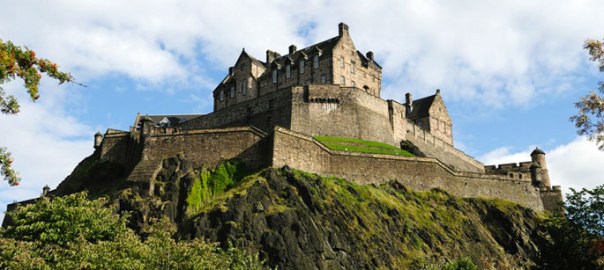
Edinburgh Castle. Human habitation of the site is dated back as far as the 9th century BC, although the nature of this early settlement is unclear.

According to the Roman historian Tacitus, the Caledonians “turned to armed resistance on a large scale”, attacking Roman forts and skirmishing with their legions. In a surprise night-attack, the Caledonians very nearly wiped out the whole 9th Legion until it was saved by Agricola’s cavalry.[42]

In AD 83–84, the General Gnaeus Julius Agricola defeated the Caledonians at the Battle of Mons Graupius. Tacitus wrote that, before the battle, the Caledonian leader, Calgacus, gave a rousing speech in which he called his people the “last of the free” and accused the Romans of “making the world a desert and calling it peace” (freely translated).[42] After the Roman victory, Roman forts were briefly set along the Gask Ridge close to the Highland line (only Cawdor near Inverness is known to have been constructed beyond that line). Three years after the battle, the Roman armies had withdrawn to the Southern Uplands.[43]

The Romans erected Hadrian’s Wall to control tribes on both sides of the wall[44] so the Limes Britannicus became the northern border of the Roman Empire; although the army held the Antonine Wall in the Central Lowlands for two short periods – the last of these during the time of Emperor Septimius Severus from 208 until 210.[45]

The Roman military occupation of a significant part of what is now northern Scotland lasted only about 40 years; although their influence on the southern section of the country, occupied by Brythonic tribes such as the Votadini and Damnonii, would still have been considerable between the first and fifth centuries. The Welsh term Hen Ogledd (“Old North”) is used by scholars to describe what is now the North of England and the South of Scotland during its habitation by Brittonic-speaking people around AD 500 to 800.[44] According to writings from the 9th and 10th centuries, the Gaelic kingdom of Dál Riata was founded in the 6th century in western Scotland.[46][47] The ‘traditional’ view is that settlers from Ireland founded the kingdom, bringing Gaelic language and culture with them. However, recently some archaeologists have argued against this view, saying there is no archaeological or placename evidence for a migration or a takeover by a small group of elites.[48]

Middle Ages

The class I Pictish stone at Aberlemno known as Aberlemno 1 or the Serpent Stone.

The Kingdom of the Picts (based in Fortriu by the 6th century) was the state that eventually became known as “Alba” or “Scotland”. The development of “Pictland”, according to the historical model developed by Peter Heather, was a natural response to Roman imperialism.[49] Another view places emphasis on the Battle of Dun Nechtain, and the reign of Bridei m. Beli (671–693), with another period of consolidation in the reign of Óengus mac Fergusa (732–761).[50]

The Kingdom of the Picts as it was in the early 8th century, when Bede was writing, was largely the same as the kingdom of the Scots in the reign of Alexander I (1107–1124). However, by the tenth century, the Pictish kingdom was dominated by what we can recognise as Gaelic culture, and had developed a traditional story of an Irish conquest around the ancestor of the contemporary royal dynasty, Cináed mac Ailpín (Kenneth MacAlpin).[51][52][53]

From a base of territory in eastern Scotland north of the River Forth and south of the River Oykel, the kingdom acquired control of the lands lying to the north and south. By the 12th century, the kings of Alba had added to their territories the English-speaking land in the south-east and attained overlordship of Gaelic-speaking Galloway and Norse-speaking Caithness; by the end of the 13th century, the kingdom had assumed approximately its modern borders. However, processes of cultural and economic change beginning in the 12th century ensured Scotland looked very different in the later Middle Ages.

The push for this change was the reign of David I and the Davidian Revolution. Feudalism, government reorganisation and the first legally recognised towns (called burghs) began in this period. These institutions and the immigration of French and Anglo-French knights and churchmen facilitated cultural osmosis, whereby the culture and language of the low-lying and coastal parts of the kingdom’s original territory in the east became, like the newly acquired south-east, English-speaking, while the rest of the country retained the Gaelic language, apart from the Northern Isles of Orkney and Shetland, which remained under Norse rule until 1468.[54][55][56] The Scottish state entered a largely successful and stable period between the 12th and 14th centuries, there was relative peace with England, trade and educational links were well developed with the Continent and at the height of this cultural flowering John Duns Scotus was one of Europe’s most important and influential philosophers.

The Wallace Monument commemorates William Wallace, the 13th-century Scottish hero.

The death of Alexander III in March 1286, followed by that of his granddaughter Margaret, Maid of Norway, broke the centuries-old succession line of Scotland’s kings and shattered the 200-year golden age that began with David I. Edward I of England was asked to arbitrate between claimants for the Scottish crown, and he organised a process known as the Great Cause to identify the most legitimate claimant. John Balliol was pronounced king in the Great Hall of Berwick Castle on 17 November 1292 and inaugurated at Scone on 30 November, St. Andrew’s Day. Edward I, who had coerced recognition as Lord Paramount of Scotland, the feudal superior of the realm, steadily undermined John’s authority.[57] In 1294, Balliol and other Scottish lords refused Edward’s demands to serve in his army against the French. Instead the Scottish parliament sent envoys to France to negotiate an alliance. Scotland and France sealed a treaty on 23 October 1295, known as the Auld Alliance (1295–1560). War ensued and King John was deposed by Edward who took personal control of Scotland. Andrew Moray and William Wallace initially emerged as the principal leaders of the resistance to English rule in what became known as the Wars of Scottish Independence (1296–1328).[58]

The nature of the struggle changed significantly when Robert the Bruce, Earl of Carrick, killed his rival John Comyn on 10 February 1306 at Greyfriars Kirk in Dumfries.[59] He was crowned king (as Robert I) less than seven weeks later. Robert I battled to restore Scottish Independence as King for over 20 years, beginning by winning Scotland back from the Norman English invaders piece by piece. Victory at the Battle of Bannockburn in 1314 proved the Scots had regained control of their kingdom. In 1315, Edward Bruce, brother of the King, was briefly appointed High King of Ireland during an ultimately unsuccessful Scottish invasion of Ireland aimed at strengthening Scotland’s position in its wars against England. In 1320 the world’s first documented declaration of independence, the Declaration of Arbroath, won the support of Pope John XXII, leading to the legal recognition of Scottish sovereignty by the English Crown.

However, war with England continued for several decades after the death of Bruce. A civil war between the Bruce dynasty and their long-term Comyn-Balliol rivals lasted until the middle of the 14th century. Although the Bruce dynasty was successful, David II’s lack of an heir allowed his half-nephew Robert II to come to the throne and establish the Stewart Dynasty.[55][60] The Stewarts ruled Scotland for the remainder of the Middle Ages. The country they ruled experienced greater prosperity from the end of the 14th century through the Scottish Renaissance to the Reformation. This was despite continual warfare with England, the increasing division between Highlands and Lowlands, and a large number of royal minorities.[60][61]

This period was the height of the Franco-Scottish alliance. The Scots Guard – la Garde Écossaise – was founded in 1418 by Charles VII of France. The Scots soldiers of the Garde Écossaise fought alongside Joan of Arc against England during the Hundred Years War.[62] In March 1421, a Franco-Scots force under John Stewart, 2nd Earl of Buchan, and Gilbert de Lafayette, defeated a larger English army at the Battle of Baugé. Three years later, at the Battle of Verneuil, the French and Scots lost around 7000 men.[63] The Scottish intervention contributed to France’s victory in the war.

Early modern era

James VI succeeded to the throne of England and Ireland (as James I) in 1603.

In 1502, James IV of Scotland signed the Treaty of Perpetual Peace with Henry VII of England. He also married Henry’s daughter, Margaret Tudor, setting the stage for the Union of the Crowns. For Henry, the marriage into one of Europe’s most established monarchies gave legitimacy to the new Tudor royal line.[64] A decade later, James made the fateful decision to invade England in support of France under the terms of the Auld Alliance. He was the last British monarch to die in battle, at the Battle of Flodden.[65] Within a generation the Auld Alliance was ended by the Treaty of Edinburgh. France agreed to withdraw all land and naval forces. In the same year, 1560, John Knox realised his goal of seeing Scotland become a Protestant nation and the Scottish parliament revoke papal authority in Scotland.[66]Mary, Queen of Scots, a Catholic and former queen of France, was forced to abdicate in 1567.[67]

In 1603, James VI, King of Scots inherited the thrones of the Kingdom of England and the Kingdom of Ireland, and became King James I of England and Ireland, and left Edinburgh for London.[68] With the exception of a short period under the Protectorate, Scotland remained a separate state, but there was considerable conflict between the crown and the Covenanters over the form of church government. The Glorious Revolution of 1688–89 saw the overthrow of the King James VII of Scotland and II of England by the English Parliament in favour of William and Mary. As late as the 1690s, Scotland experienced famine, which reduced the population of parts of the country by at least 20 per cent.[69]

In 1698, the Scots attempted an ambitious project to secure a trading colony on the Isthmus of Panama. Almost every Scottish landowner who had money to spare is said to have invested in the Darien scheme. Its failure bankrupted these landowners, but not the burghs. Nevertheless, the nobles’ bankruptcy, along with the threat of an English invasion, played a leading role in convincing the Scots elite to back a union with England.[70][71]

On 22 July 1706, the Treaty of Union was agreed between representatives of the Scots Parliament and the Parliament of England and the following year twin Acts of Union were passed by both parliaments to create the united Kingdom of Great Britain with effect from 1 May 1707.[19]

18th century

With trade tariffs with England now abolished, trade blossomed, especially with Colonial America. The clippers belonging to the GlasgowTobacco Lords were the fastest ships on the route to Virginia. Until the American War of Independence in 1776, Glasgow was the world’s premier tobacco port, dominating world trade.[72] The disparity between the wealth of the merchant classes of the Scottish Lowlands and the ancient clans of the Scottish Highlands grew, amplifying centuries of division.

David Morier’s depiction of the Battle of Culloden.

The deposed Jacobite Stuart claimants had remained popular in the Highlands and north-east, particularly amongst non-Presbyterians, including Roman Catholics and Episcopalian Protestants. However, two major Jacobite Risings launched in 1715 and 1745 failed to remove the House of Hanover from the British throne. The threat of the Jacobite movement to the United Kingdom and its monarchs effectively ended at the Battle of Culloden, Great Britain’s last pitched battle. This defeat paved the way for large-scale removals of the indigenous populations of the Highlands and Islands, known as the Highland Clearances.

The Scottish Enlightenment and the Industrial Revolution made Scotland into an intellectual, commercial and industrial powerhouse[73]–so much so Voltaire said “We look to Scotland for all our ideas of civilisation.”[74] With the demise of Jacobitism and the advent of the Union, thousands of Scots, mainly Lowlanders, took up numerous positions of power in politics, civil service, the army and navy, trade, economics, colonial enterprises and other areas across the nascent British Empire. Historian Neil Davidson notes “after 1746 there was an entirely new level of participation by Scots in political life, particularly outside Scotland.” Davidson also states “far from being ‘peripheral’ to the British economy, Scotland – or more precisely, the Lowlands – lay at its core.”[75]

19th century

Shipping on the Clyde, by John Atkinson Grimshaw, 1881

The  increased the number of Scottish MPs and widened the franchise to include more of the middle classes.[76] From the mid-century there were increasing calls for Home Rule for Scotland and the post of Secretary of State for Scotland was revived.[77] Towards the end of the century Prime Ministers of Scottish descent included William E. Gladstone,[78] and the Earl of Rosebery.[79] In the later 19th century the growing importance of the working classes was marked by Keir Hardie‘s success in the Mid Lanarkshire by-election, 1888, leading to the foundation of the Scottish Labour Party, which was absorbed into the Independent Labour Party in 1895, with Hardie as its first leader.[80]

Glasgow became one of the largest cities in the world, and known as “the Second City of the Empire” after London.[81] After 1860 the Clydeside shipyards specialised in steamships made of iron (after 1870, made of steel), which rapidly replaced the wooden sailing vessels of both the merchant fleets and the battle fleets of the world. It became the world’s pre-eminent shipbuilding centre.[82] The industrial developments, while they brought work and wealth, were so rapid that housing, town-planning, and provision for public health did not keep pace with them, and for a time living conditions in some of the towns and cities were notoriously bad, with overcrowding, high infant mortality, and growing rates of tuberculosis.[83]

Walter Scott, whose Waverley Novels helped define Scottish identity in the 19th century.

While the Scottish Enlightenment is traditionally considered to have concluded toward the end of the 18th century,[84] disproportionately large Scottish contributions to British science and letters continued for another 50 years or more, thanks to such figures as the physicists James Clerk Maxwell and Lord Kelvin, and the engineers and inventors James Watt and William Murdoch, whose work was critical to the technological developments of the Industrial Revolution throughout Britain.[85] In literature the most successful figure of the mid-19th century was Walter Scott. His first prose work, Waverley in 1814, is often called the first historical novel.[86] It launched a highly successful career that probably more than any other helped define and popularise Scottish cultural identity.[87] In the late 19th century, a number of Scottish-born authors achieved international reputations, such as Robert Louis Stevenson, Arthur Conan Doyle, J. M. Barrie and George MacDonald.[88] Scotland also played a major part in the development of art and architecture. The Glasgow School, which developed in the late 19th century, and flourished in the early 20th century, produced a distinctive blend of influences including the Celtic Revival the Arts and Crafts Movement, and Japonisme, which found favour throughout the modern art world of continental Europe and helped define the Art Nouveau style. Proponents included architect and artist Charles Rennie Mackintosh.[89]

This period saw a process of rehabilitation for Highland culture. In the 1820s, as part of the Romantic revival, tartan and the kilt were adopted by members of the social elite, not just in Scotland, but across Europe,[90][91] prompted by the popularity of Macpherson’s Ossian cycle[92][93] and then Walter Scott’s Waverley novels.[94] However, the Highlands remained very poor and traditional.[95] The desire to improve agriculture and profits led to the Highland Clearances, in which much of the population of the Highlands suffered forced displacement as lands were enclosed, principally so that they could be used for sheep farming. The clearances followed patterns of agricultural change throughout Britain, but were particularly notorious as a result of the late timing, the lack of legal protection for year-by-year tenants under Scots law, the abruptness of the change from the traditional clan system, and the brutality of many evictions.[96] One result was a continuous exodus from the land—to the cities, or further afield to England, Canada, America or Australia.[97] The population of Scotland grew steadily in the 19th century, from 1,608,000 in the census of 1801 to 2,889,000 in 1851 and 4,472,000 in 1901.[98] Even with the development of industry there were not enough good jobs. As a result, during the period 1841–1931, about 2 million Scots migrated to North America and Australia, and another 750,000 Scots relocated to England.[99]

The Disruption Assembly was painted by David Octavius Hill.

After prolonged years of struggle in the Kirk, in 1834 the Evangelicals gained control of the General Assembly and passed the Veto Act, which allowed congregations to reject unwanted “intrusive” presentations to livings by patrons. The following “Ten Years’ Conflict” of legal and political wrangling ended in defeat for the non-intrusionists in the civil courts. The result was a schism from the church by some of the non-intrusionists led by Dr Thomas Chalmers, known as the Great Disruption of 1843. Roughly a third of the clergy, mainly from the North and Highlands, formed the separate Free Church of Scotland.[100] In the late 19th century growing divisions between fundamentalist Calvinists and theological liberals resulted in a further split in the Free Church as the rigid Calvinists broke away to form the Free Presbyterian Church in 1893.[101]Catholic Emancipation in 1829 and the influx of large numbers of Irish immigrants, particularly after the famine years of the late 1840s, mainly to the growing lowland centres like Glasgow, led to a transformation in the fortunes of Catholicism. In 1878, despite opposition, a Roman Catholic ecclesiastical hierarchy was restored to the country, and Catholicism became a significant denomination within Scotland.[101]

Industrialisation, urbanisation and the Disruption of 1843 all undermined the tradition of parish schools. From 1830 the state began to fund buildings with grants; then from 1846 it was funding schools by direct sponsorship; and in 1872 Scotland moved to a system like that in England of state-sponsored largely free schools, run by local school boards.[102] The historic University of Glasgow became a leader in British higher education by providing the educational needs of youth from the urban and commercial classes, as opposed to the upper class.[103]The University of St Andrews pioneered the admission of women to Scottish universities. From 1892 Scottish universities could admit and graduate women and the numbers of women at Scottish universities steadily increased until the early 20th century.[104]

Early 20th century

Royal Scots with captured Japanese flag, Burma, January 1945.

Scotland played a major role in the British effort in the First World War. It especially provided manpower, ships, machinery, fish and money.[105] With a population of 4.8 million in 1911, Scotland sent over half a million men to the war, of whom over a quarter died in combat or from disease, and 150,000 were seriously wounded.[106]Field MarshalSir Douglas Haig was Britain’s commander on the Western Front.

The war saw the emergence of a radical movement called “Red Clydeside” led by militant trades unionists. Formerly a Liberal stronghold, the industrial districts switched to Labour by 1922, with a base among the Irish Catholic working class districts. Women were especially active in building neighbourhood solidarity on housing issues. However, the “Reds” operated within the Labour Party and had little influence in Parliament and the mood changed to passive despair by the late 1920s.[107]

The shipbuilding industry expanded by a third and expected renewed prosperity, but instead a serious depression hit the economy by 1922 and it did not fully recover until 1939. The interwar years were marked by economic stagnation in rural and urban areas, and high unemployment.[108] Indeed, the war brought with it deep social, cultural, economic, and political dislocations. Thoughtful Scots pondered their declension, as the main social indicators such as poor health, bad housing, and long-term mass unemployment, pointed to terminal social and economic stagnation at best, or even a downward spiral. Service abroad on behalf of the Empire lost its allure to ambitious young people, who left Scotland permanently. The heavy dependence on obsolescent heavy industry and mining was a central problem, and no one offered workable solutions. The despair reflected what Finlay (1994) describes as a widespread sense of hopelessness that prepared local business and political leaders to accept a new orthodoxy of centralised government economic planning when it arrived during the Second World War.[109]

The Second World War brought renewed prosperity, despite extensive bombing of cities by the Luftwaffe. It saw the invention of radar by Robert Watson-Watt, which was invaluable in the Battle of Britain as was the leadership at RAF Fighter Command of Air Chief MarshalSir Hugh Dowding.[110]

Since 1945

After 1945, Scotland’s economic situation became progressively worse due to overseas competition, inefficient industry, and industrial disputes.[111] Only in recent decades has the country enjoyed something of a cultural and economic renaissance. Economic factors contributing to this recovery include a resurgent financial services industry, electronics manufacturing, (see Silicon Glen),[112] and the North Sea oil and gas industry.[113] The introduction in 1989 by Margaret Thatcher’s government of the Community Charge (widely known as the Poll Tax) one year before the rest of the United Kingdom, contributed to a growing movement for a return to direct Scottish control over domestic affairs.[114] Following a referendum on devolution proposals in 1997, the Scotland Act 1998[115] was passed by the United Kingdom Parliament to establish a devolved Scottish Parliament and Scottish Government with responsibility for most laws specific to Scotland.[116]

Government and politics

The debating chamber of the Scottish Parliament building (left) and the Scottish Parliament building itself (right)

Scotland’s head of state is the monarch of the United Kingdom, currently Queen Elizabeth II (since 1952). The regnal numbering “Elizabeth II” caused controversy around the time of the Queen’s coronation because there had never been an Elizabeth I in Scotland. A legal action, MacCormick v. Lord Advocate (1953 SC 396), was brought to contest the right of the Queen to entitle herself Elizabeth II within Scotland, arguing that this was a breach of Article 1 of the Treaty of Union. The Crown won the case. It was decided that future British monarchs would be numbered according to either their English or their Scottish predecessors, whichever number is higher.[117] For instance any future King James would be styled James VIII—since the last Scottish King James was James VII (also James II of England, etc.)—while the next King Henry would be King Henry IX throughout the UK even though there have been no Scottish kings of that name.

Scotland has limited self-government within the United Kingdom, as well as representation in the UK Parliament. Executive and legislative powers respectively have been devolved to the Scottish Government and the Scottish Parliament at Holyrood in Edinburgh since 1999. The UK Parliament retains control over reserved matters specified in the Scotland Act 1998, including UK taxes, social security, defence, international relations and broadcasting.[118] The Scottish Parliament has legislative authority for all other areas relating to Scotland, as well as a limited power to vary income tax.[119]

The Scottish Parliament can give legislative consent over devolved matters back to the UK Parliament by passing a Legislative Consent Motion if United Kingdom-wide legislation is considered more appropriate for a certain issue. The programmes of legislation enacted by the Scottish Parliament have seen a divergence in the provision of public services compared to the rest of the UK. For instance, university education and care services for the elderly are free at point of use in Scotland, while fees are paid in the rest of the UK. Scotland was the first country in the UK to ban smoking in enclosed public places.[120]

Bute House, official residence of the First Minister of Scotland, located within 6 Charlotte Square, Edinburgh

The Scottish Parliament is a unicameral legislature with 129 members (MSPs): 73 of them represent individual constituencies and are elected on a first past the post system; the other 56 are elected in eight different electoral regions by the additional member system. MSPs serve for a four-year period (exceptionally five years from 2011–16). The Queen appoints one Member of the Scottish Parliament, nominated by the Parliament, to be First Minister. Other ministers are appointed by the First Minister and serve at his/her discretion. Together they make up the Scottish Government, the executive arm of the devolved government.[121]

In the 2011 election, the Scottish National Party (SNP) formed a majority government after winning 69 seats out of 129. This was the first majority government since the modern post-devolution Scottish Parliament was established in 1999. The leader of the SNP, Alex Salmond, continued as First Minister until 2014. The Labour Party continued as the largest opposition party, with the Conservative Party, the Liberal Democrats, and the Green Party also represented in the Parliament. As of 29 September 2014, there are also three independent MSPs sitting in parliament. On 19 November 2014, Nicola Sturgeon became First Minister of Scotland, the first woman to hold the office. The next Scottish Parliament general election is due to be held on 5 May 2016.

Scotland is represented in the British House of Commons by 59 MPs elected from territory-based Scottish constituencies. In the most recent general election, held on the 7th of May 2015, the Scottish National Party won 56 of the 59 seats and saw elected the youngest current member of the House of Commons, Mhairi Black.[122] The next United Kingdom general election is due to be held in May 2020. The Scotland Office represents the UK government in Scotland on reserved matters and represents Scottish interests within the UK government.[123] The Scotland Office is led by the Secretary of State for Scotland, who sits in the Cabinet of the United Kingdom; the current incumbent is David Mundell.

Constitutional changes

A policy of devolution had been advocated by the three main UK parties with varying enthusiasm during recent history. The late Labour leader John Smith described the revival of a Scottish parliament as the “settled will of the Scottish people”.[124] The devolved Scottish Parliament was created after a referendum in 1997 found majority support for both creating the Parliament and granting it limited powers to vary income tax. The constitutional status of Scotland is nonetheless subject to ongoing debate.

The Scottish National Party (SNP), which supports Scottish independence, was first elected to form the Scottish Government in 2007. The new government established a “National Conversation” on constitutional issues, proposing a number of options such as increasing the powers of the Scottish Parliament, federalism, or a referendum on Scottish independence from the United Kingdom. In rejecting the last option, the three main opposition parties in the Scottish Parliament created a commission to investigate the distribution of powers between devolved Scottish and UK-wide bodies.[125] The Scotland Act 2012, based on proposals by the commission, is currently in the process of devolving additional powers to the Scottish Parliament.[126]

In August 2009 the SNP proposed a bill to hold a referendum on independence in November 2010. Opposition from all other major parties led to an expected defeat.[127][128][129] After the 2011 elections gave the SNP an overall majority in the Scottish Parliament, a referendum on independence for Scotland was held on 18 September 2014.[130] The referendum rejected independence by a majority of 55% to 45%.[131][132] During the campaign, the three main parties in the UK Parliament pledged to extend the powers of the Scottish Parliament; an all-party commission chaired by Lord Smith of Kelvin has been formed.[133][134]

Administrative subdivisions

Glasgow City Chambers, viewed from George Square

Historical subdivisions of Scotland included the mormaerdom, stewartry, earldom, burgh, parish, county and regions and districts. Some of these names are still sometimes used as geographical descriptors.

Modern Scotland is subdivided in various ways depending on the purpose. In local government, there have been 32 single-tier council areas since 1996,[135] whose councils are responsible for the provision of all local government services. Community councils are informal organisations that represent specific sub-divisions of a council area.

In the Scottish Parliament, there are 73 constituencies and eight regions. For the Parliament of the United Kingdom, there are 59 constituencies. Until 2013 the Scottish fire brigades and police forces were based on a system of regions introduced in 1975. For healthcare and postal districts, and a number of other governmental and non-governmental organisations such as the churches, there are other long-standing methods of subdividing Scotland for the purposes of administration.

City status in the United Kingdom is conferred by letters patent.[136] There are seven cities in Scotland: Aberdeen, Dundee, Edinburgh, Glasgow, Inverness, Stirling and Perth.[137]

Law and criminal justice

Main article: Scots law

Scots law has a basis derived from Roman law,[138] combining features of both uncodified civil law, dating back to the Corpus Juris Civilis, and common law with medieval sources. The terms of the Treaty of Union with England in 1707 guaranteed the continued existence of a separate legal system in Scotland from that of England and Wales.[139] Prior to 1611, there were several regional law systems in Scotland, most notably Udal law in Orkney and Shetland, based on old Norse law. Various other systems derived from common Celtic or Brehon laws survived in the Highlands until the 1800s.[140]

Scots law provides for three types of courts responsible for the administration of justice: civil, criminal and heraldic. The supreme civil court is the Court of Session, although civil appeals can be taken to the Supreme Court of the United Kingdom (or before 1 October 2009, the House of Lords). The High Court of Justiciary is the supreme criminal court in Scotland. The Court of Session is housed at Parliament House, in Edinburgh, which was the home of the pre-Union Parliament of Scotland with the High Court of Justiciary and the Supreme Court of Appeal currently located at the Lawnmarket. The sheriff court is the main criminal and civil court, hearing most cases. There are 49 sheriff courts throughout the country.[141]District courts were introduced in 1975 for minor offences and small claims. These were gradually replaced by Justice of the Peace Courts from 2008 to 2010. The Court of the Lord Lyon regulates heraldry.

For many decades the Scots legal system was unique for being the only legal system without a parliament. This ended with the advent of the Scottish Parliament, which legislates for Scotland. Many features within the system have been preserved. Within criminal law, the Scots legal system is unique in having three possible verdicts: “guilty”, “not guilty” and “not proven“.[142] Both “not guilty” and “not proven” result in an acquittal, typically with no possibility of retrial in accordance with the rule of double jeopardy. There is however the possibility of a retrial where new evidence emerges at a later date that might have proven conclusive in the earlier trial at first instance, where the person acquitted subsequently admits the offence or where it can be proved that the acquittal was tainted by an attempt to pervert the course of justice – see the provisions of the Double Jeopardy (Scotland) Act 2011. Many laws differ between Scotland and the other parts of the United Kingdom, and many terms differ for certain legal concepts. Manslaughter, in England and Wales, is broadly similar to culpable homicide in Scotland, and arson is called wilful fire raising. Indeed, some acts considered crimes in England and Wales, such as forgery, are not so in Scotland. Procedure also differs. Scots juries, sitting in criminal cases, consist of fifteen, rather than twelve jurors, as is more common in English-speaking countries.

The Scottish Prison Service (SPS) manages the prisons in Scotland, which collectively house over 8,500 prisoners.[143] The Cabinet Secretary for Justice is responsible for the Scottish Prison Service within the Scottish Government.

Geography and natural history

Main article: Geography of Scotland
The island of Little Cumbrae with Isle of Arran in the background (left). Traigh Seilebost Beach on the Isle of Harris (right)

The mainland of Scotland comprises the northern third of the land mass of the island of Great Britain, which lies off the north-west coast of Continental Europe. The total area is 78,772 km2 (30,414 sq mi),[144] comparable to the size of the Czech Republic. Scotland’s only land border is with England, and runs for 96 kilometres (60 mi) between the basin of the River Tweed on the east coast and the Solway Firth in the west. The Atlantic Ocean borders the west coast and the North Sea is to the east. The island of Ireland lies only 30 kilometres (19 mi) from the south-western peninsula of Kintyre;[145] Norway is 305 kilometres (190 mi) to the east and the Faroes, 270 kilometres (168 mi) to the north.

The territorial extent of Scotland is generally that established by the 1237 Treaty of York between Scotland and the Kingdom of England[146] and the 1266 Treaty of Perth between Scotland and Norway.[19] Important exceptions include the Isle of Man, which having been lost to England in the 14th century is now a crown dependency outside of the United Kingdom; the island groups Orkney and Shetland, which were acquired from Norway in 1472;[144] and Berwick-upon-Tweed, lost to England in 1482.

The geographical centre of Scotland lies a few miles from the village of Newtonmore in Badenoch.[147] Rising to 1,344 metres (4,409 ft) above sea level, Scotland’s highest point is the summit of Ben Nevis, in Lochaber, while Scotland’s longest river, the River Tay, flows for a distance of 190 kilometres (118 mi).[148][149]

Geology and geomorphology

Main article: Geology of Scotland

Relief map of Scotland

The whole of Scotland was covered by ice sheets during the Pleistoceneice ages and the landscape is much affected by glaciation. From a geological perspective, the country has three main sub-divisions.

The Highlands and Islands lie to the north and west of the Highland Boundary Fault, which runs from Arran to Stonehaven. This part of Scotland largely comprises ancient rocks from the Cambrian and Precambrian, which were uplifted during the later Caledonian Orogeny. It is interspersed with igneous intrusions of a more recent age, remnants of which formed mountain massifs such as the Cairngorms and SkyeCuillins.

A significant exception to the above are the fossil-bearing beds of Old Red Sandstones found principally along the Moray Firth coast. The Highlands are generally mountainous and the highest elevations in the British Isles are found here. Scotland has over 790 islands divided into four main groups: Shetland, Orkney, and the Inner Hebrides and Outer Hebrides. There are numerous bodies of freshwater including Loch Lomond and Loch Ness. Some parts of the coastline consist of machair, a low lying dune pasture land.

The Central Lowlands is a rift valley mainly comprising Paleozoic formations. Many of these sediments have economic significance for it is here that the coal and iron bearing rocks that fuelled Scotland’s industrial revolution are found. This area has also experienced intense volcanism, Arthur’s Seat in Edinburgh being the remnant of a once much larger volcano. This area is relatively low-lying, although even here hills such as the Ochils and Campsie Fells are rarely far from view.

The Southern Uplands are a range of hills almost 200 kilometres (124 mi) long, interspersed with broad valleys. They lie south of a second fault line (the Southern Uplands fault) that runs from Girvan to Dunbar.[150][151][152] The geological foundations largely comprise Silurian deposits laid down some 4–500 million years ago. The high point of the Southern Uplands is Merrick with an elevation of 843 m (2,766 ft).[18][153][154][155] The Southern Uplands is home to the UK’s highest village, Wanlockhead (430 m or 1,411 ft above sea level).[152]

Climate

Tiree, one of the sunniest locations in Scotland

Main article: Climate of Scotland

The climate of Scotland is temperate and oceanic, and tends to be very changeable. As it is warmed by the Gulf Stream from the Atlantic, it has much milder winters (but cooler, wetter summers) than areas on similar latitudes, such as Labrador, southern Scandinavia, the Moscow region in Russia, and the Kamchatka Peninsula on the opposite side of Eurasia. However, temperatures are generally lower than in the rest of the UK, with the coldest ever UK temperature of −27.2 °C (−17.0 °F) recorded at Braemar in the Grampian Mountains, on 11 February 1895.[156] Winter maxima average 6 °C (42.8 °F) in the Lowlands, with summer maxima averaging 18 °C (64.4 °F). The highest temperature recorded was 32.9 °C (91.2 °F) at Greycrook, Scottish Borders on 9 August 2003.[157]

The west of Scotland is usually warmer than the east, owing to the influence of Atlantic ocean currents and the colder surface temperatures of the North Sea. Tiree, in the Inner Hebrides, is one of the sunniest places in the country: it had more than 300 hours of sunshine in May 1975.[157] Rainfall varies widely across Scotland. The western highlands of Scotland are the wettest, with annual rainfall in a few places exceeding 3,000 mm (118.1 in).[158] In comparison, much of lowland Scotland receives less than 800 mm (31.5 in) annually.[159] Heavy snowfall is not common in the lowlands, but becomes more common with altitude. Braemar has an average of 59 snow days per year,[160] while many coastal areas average fewer than 10 days of lying snow per year.[159]

Economy and infrastructure

Main article: Economy of Scotland

A drilling rig located in the North Sea.

Scotland has a western style openmixed economy closely linked with the rest of Europe and the wider world. Traditionally, the Scottish economy has been dominated by heavy industry underpinned by shipbuilding in Glasgow, coal mining and steel industries. Petroleum related industries associated with the extraction of North Sea oil have also been important employers from the 1970s, especially in the north east of Scotland.

De-industrialisation during the 1970s and 1980s saw a shift from a manufacturing focus towards a more service-oriented economy. Edinburgh is the financial services centre of Scotland, with many large finance firms based there, including: Lloyds Banking Group (owners of HBOS); the Government owned Royal Bank of Scotland and Standard Life. Edinburgh was ranked 15th in the list of world financial centres in 2007, but fell to 37th in 2012, following damage to its reputation,[179] and in 2014 was ranked 64th.[180]

In 2012, total Scottish exports (excluding intra-UK trade) were estimated to be £26 billion, of which 59% (£15.4 billion) were attributable to manufacturing.[181] Scotland’s primary exports include whisky, electronics and financial services. The United States, Netherlands, Germany, France and Norway constitute the country’s major export markets.[181] Scotland’s Gross Domestic Product (GDP), including oil and gas produced in Scottish waters, was estimated at £150 billion for the calendar year 2012.[4] If Scotland became independent, it would hold 95% of the UK’s current oil and gas reserves if they were split geographically using a median line from the English-Scottish border.[citation needed] If the reserves were split by population, that figure would be reduced to 9%.[182] Scotland also has renewable energy potential, especially in tidal energy and offshore wind.[183]

Scotland was, and still is, famous for its shipbuilding industry, which has produced world-class ships such as Queen Elizabeth 2 (pictured)

Whisky is probably the best known of Scotland’s manufactured products. Exports increased by 87% in the decade to 2012[184] and were valued at £4.3 billion in 2013, which was 85% of Scotland’s food and drink exports.[185] It supports around 10,000 jobs directly and 25,000 indirectly.[186] It may contribute £400-682 million to Scotland, rather than several billion pounds, as more than 80% of whisky produced is owned by non-Scottish companies.[187] Tourism is also widely recognised as a key contributor to the Scottish economy. A briefing published in 2002 by the Scottish Parliament Information Centre (SPICe) for the Scottish Parliament’s Enterprise and Life Long Learning Committee stated that tourism accounted for up to 5% of GDP and 7.5% of employment.[188]

In February 2012, the Centre for Economics and Business Research concluded that “Scotland receives no net subsidy” from the UK, as greater per capita tax generation in Scotland balanced out greater per capita public spending.[189] More recent data, from 2012–13, show that Scotland generated 9.1% (£53.1bn; this included a geographical share of North Sea oil revenue – without it, the figures were 8.2% and £47.6bn) of the UK’s tax revenues and received 9.3% (£65.2bn) of spending.[190] Scotland’s public spending deficit in 2012–13 was £12bn, a £3.5bn increase on the previous year; over the same period, the UK’s deficit decreased by £2.6bn.[191] Over the past thirty years, Scotland contributed a relative budget surplus[clarification needed] of almost £20billion to the UK economy.[192]

In the first quarter of 2014, the Scottish economy grew by 1.0%, above the 0.8% recorded for the UK.[193] It also expanded by a further 0.9% in the second quarter of the year, this time the same rate as that of the UK.[194] As of October 2014, Scotland outperforms the UK as a whole in all three labour market indicators. The Scottish unemployment rate of 5.5% is below the UK rate of 6.0%, the Scottish employment rate of 73.9% is higher than the UK figure of 73.0% and the rate of economic inactivity is 21.7% in Scotland but 22.2% in the UK.[195]

Religion

Main article: Religion in Scotland

Iona Abbey, an early centre of Christianity in Scotland

Just over half (54%) of the Scottish population reported being a Christian while nearly 37% reported not having a religion in a 2011 census.[243] Since the Scottish Reformation of 1560, the national church (the Church of Scotland, also known as The Kirk) has been Protestant and Reformed in theology. Since 1689 it has had a Presbyterian system of church government, and enjoys independence from the state.[18] About 12% of the population are currently members of the Church of Scotland, with 40% claiming affinity. The Church operates a territorial parish structure, with every community in Scotland having a local congregation.

Scotland also has a significant Roman Catholic population, 19% claiming that faith, particularly in the west.[244] After the Reformation, Roman Catholicism in Scotland continued in the Highlands and some western islands like Uist and Barra, and it was strengthened during the 19th century by immigration from Ireland. Other Christian denominations in Scotland include the Free Church of Scotland, various other Presbyterian offshoots, and the Scottish Episcopal Church.

Islam is the largest non-Christian religion (estimated at around 40,000, which is less than 0.9% of the population),[245] and there are also significant Jewish, Hindu and Sikh communities, especially in Glasgow.[245] The Samyé Ling monastery near Eskdalemuir, which celebrated its 40th anniversary in 2007, is the first Buddhist monastery in western Europe.[246]

Health care

Healthcare in Scotland is mainly provided by NHS Scotland, Scotland’s public health care system. This was founded by the National Health Service (Scotland) Act 1947 (later repealed by the National Health Service (Scotland) Act 1978) that took effect on 5 July 1948 to coincide with the launch of the NHS in England and Wales. However, even prior to 1948, half of Scotland’s landmass was already covered by state funded health care, provided by the Highlands and Islands Medical Service.[247] Healthcare policy and funding is the responsibility of the Scottish Government’s Health Directorates. The current Cabinet Secretary for Health and Wellbeing is Alex Neil and the Director-General (DG) Health and chief executive, NHS Scotland is Paul Gray.[248]

In 2008, the NHS in Scotland had around 158,000 staff including more than 47,500 nurses, midwives and health visitors and over 3,800 consultants. In addition, there are also more than 12,000 doctors, family practitioners and allied health professionals, including dentists, opticians and community pharmacists, who operate as independent contractors providing a range of services within the NHS in return for fees and allowances. These fees and allowances were removed in May 2010, and prescriptions are entirely free, although dentists and opticians may charge if the patient’s household earns over a certain amount, about £30,000 per annum.[249]

Life expectancy for those born in Scotland between 2010 and 2012 is 76.5 years for males and 80.7 years for females.[250] This is the lowest of any of the four countries of the UK.[250]

Military

Main article: Military of Scotland

Vanguard-class nuclear submarine at HMNB Clyde

Of the money spent on UK defence, about £3.3 billion can be attributed to Scotland as of 2013. Although Scotland has a long military tradition predating the Treaty of Union with England, its armed forces now form part of the British Armed Forces, with the notable exception of the Atholl Highlanders, Europe’s only legal private army. In 2006, the infantry regiments of the Scottish Division were amalgamated to form the Royal Regiment of Scotland. Other distinctively Scottish regiments in the British Army include the Scots Guards, the Royal Scots Dragoon Guards and the Scottish Transport Regiment, a Territorial Army Regiment of the Royal Logistic Corps.

Because of their topography and perceived remoteness, parts of Scotland have housed many sensitive defence establishments, with mixed public feelings.[251][252][253] Between 1960 and 1991, the Holy Loch was a base for the US fleet of Polarisballistic missile submarines.[254] Today, Her Majesty’s Naval Base Clyde, 25 miles (40 kilometres) north west of Glasgow, is the base for the four Trident-armed Vanguard classballistic missile submarines that comprise the UK’s nuclear deterrent. Scapa Flow was the major Fleet base for the Royal Navy until 1956.

Two frontline Royal Air Force bases are also located in Scotland. These are RAF Leuchars and RAF Lossiemouth, the last of which is the most northerly air defence fighter base in the United Kingdom. A third, RAF Kinloss will close as an RAF unit in 2013–14. RAF Leuchars is due to be turned into an army barracks, ending the RAF’s connection in Fife.[255]

The only open-air live depleted uranium weapons test range in the British Isles is located near Dundrennan.[256] As a result, over 7000 potentially toxic munitions lie on the seabed of the Solway Firth.[257][258]

Culture

Main article: Culture of Scotland

A Pipe Major playing the Great Highland Bagpipe

Scottish music is a significant aspect of the nation’s culture, with both traditional and modern influences. A famous traditional Scottish instrument is the Great Highland Bagpipe, a wind instrument consisting of three drones and a melody pipe (called the chanter), which are fed continuously by a reservoir of air in a bag. Bagpipe bands, featuring bagpipes and various types of drums, and showcasing Scottish music styles while creating new ones, have spread throughout the world. The clàrsach (harp), fiddle and accordion are also traditional Scottish instruments, the latter two heavily featured in Scottish country dance bands. Today, there are many successful Scottish bands and individual artists in varying styles including Annie Lennox, Amy Macdonald, Runrig, Boards of Canada, Cocteau Twins, Deacon Blue, Franz Ferdinand, Susan Boyle, Emeli Sande, Texas, The View, The Fratellis, Twin Atlantic and Biffy Clyro. Other Scottish musicians include Shirley Manson, Paolo Nutini and Calvin Harris.[259]

Scotland has a literary heritage dating back to the early Middle Ages. The earliest extant literature composed in what is now Scotland was in Brythonic speech in the 6th century, but is preserved as part of Welsh literature.[260] Later medieval literature included works in Latin,[261] Gaelic,[262] Old English[263] and French.[264] The first surviving major text in Early Scots is the 14th-century poet John Barbour‘s epic Brus, focusing on the life of Robert I,[265] and was soon followed by a series of vernacular romances and prose works.[266] In the 16th century the crown’s patronage helped the development of Scots drama and poetry,[267] but the accession of James VI to the English throne removed a major centre of literary patronage and Scots was sidelined as a literary language.[268] Interest in Scots literature was revived in the 18th century by figures including James Macpherson, whose Ossian Cycle made him the first Scottish poet to gain an international reputation and was a major influence on the European Enlightenment.[269] It was also a major influence on Robert Burns, whom many consider the national poet,[270] and Walter Scott, whose Waverley Novels did much to define Scottish identity in the 19th century.[271] Towards the end of the Victorian era a number of Scottish-born authors achieved international reputations as writers in English, including Robert Louis Stevenson, Arthur Conan Doyle, J. M. Barrie and George MacDonald.[272] In the 20th century the Scottish Renaissance saw a surge of literary activity and attempts to reclaim the Scots language as a medium for serious literature.[273] Members of the movement were followed by a new generation of post-war poets including Edwin Morgan, who would be appointed the first Scots Makar by the inaugural Scottish government in 2004.[274] From the 1980s Scottish literature enjoyed another major revival, particularly associated with a group of writers including Irvine Welsh.[273] Scottish poets who emerged in the same period included Carol Ann Duffy, who, in May 2009, was the first Scot named UK Poet Laureate.[275]

Television in Scotland is largely the same as UK-wide broadcasts, however the national broadcaster is BBC Scotland, a constituent part of the British Broadcasting Corporation, the publicly funded broadcaster of the United Kingdom. It runs three national television stations, and the national radio stations, BBC Radio Scotland and BBC Radio nan Gaidheal, amongst others. Scotland also has some programming in the Gaelic language. BBC Alba is the national Gaelic-language channel. The main Scottish commercial television station is STV. National newspapers such as the Daily Record, The Herald, and The Scotsman are all produced in Scotland.[276] Important regional dailies include the Evening News in Edinburgh The Courier in Dundee in the east, and The Press and Journal serving Aberdeen and the north.[276] Scotland is represented at the Celtic Media Festival, which showcases film and television from the Celtic countries. Scottish entrants have won many awards since the festival began in 1980.[277]

As one of the Celtic nations, Scotland and Scottish culture is represented at interceltic events at home and over the world. Scotland hosts several music festivals including Celtic Connections (Glasgow), and the Hebridean Celtic Festival (Stornoway). Festivals celebrating Celtic culture, such as Festival Interceltique de Lorient (Brittany), the Pan Celtic Festival (Ireland), and the National Celtic Festival (Portarlington, Australia), feature elements of Scottish culture such as language, music and dance.[278][279][280][281][282][283][284]

Sport

Main article: Sport in Scotland

Sport is an important element in Scottish culture, with the country hosting many of its own national sporting competitions. It enjoys independent representation at many international sporting events including the FIFA World Cup, the Rugby Union World Cup, the Rugby League World Cup, the Cricket World Cup and the Commonwealth Games, but not at the Olympic Games where Scottish athletes are part of the Great Britain team. Scotland has its own national governing bodies, such as the Scottish Football Association (the second oldest national football association in the world)[285] and the Scottish Rugby Union. Variations of football have been played in Scotland for centuries, with the earliest reference dating back to 1424.[286] Association football is the most popular sport and the Scottish Cup is the world’s oldest national trophy.[287]

Scotland contested the first ever international football game in 1872 against England.[288] The match took place at Hamilton Crescent, Glasgow, home of the West of Scotland Cricket Club. Scottish clubs have been successful in European competitions with Celtic winning the European Cup in 1967, Rangers and Aberdeen winning the UEFA Cup Winners’ Cup in 1972 and 1983 respectively, and Aberdeen also winning the UEFA Super Cup in 1983. Dundee United have also made it to a European final, reaching the UEFA Cup Final in 1987, but losing on aggregate 2-1 to IFK Göteborg.

With the modern game of golf originating in 15th century Scotland, the country is promoted as the home of golf.[289][290][291] To many golfers the Old Course in the Fife town of St. Andrews, an ancient links course dating to before 1574, is considered a site of pilgrimage.[292] The world’s oldest golf tournament, and golf’s first major, is The Open Championship, which was first played on 17 October 1860 at Prestwick Golf Club, in Ayrshire, Scotland, with Scottish golfers winning the earliest majors.[293] There are many other famous golf courses in Scotland, including Carnoustie, Gleneagles, Muirfield, and Royal Troon. Other distinctive features of the national sporting culture include the Highland games, curling and shinty. In boxing, Scotland has had 13 world champions, including Ken Buchanan, Benny Lynch and Jim Watt.

Scotland has competed at every Commonwealth Games since 1930 and has won 356 medals in total—91 Gold, 104 Silver and 161 Bronze.[294] Edinburgh played host to the Commonwealth Games in 1970 and 1986, and most recently Glasgow in 2014.[295]

National symbols

Saint Andrew depicted on a 16th-century coat of arms of the burgh of St. Andrews

The image of St. Andrew, martyred while bound to an X-shaped cross, first appeared in the Kingdom of Scotland during the reign of William I.[296] Following the death of King Alexander III in 1286 an image of Andrew was used on the seal of the Guardians of Scotland who assumed control of the kingdom during the subsequent interregnum.[297] Use of a simplified symbol associated with Saint Andrew, the saltire, has its origins in the late 14th century; the Parliament of Scotland decreeing in 1385 that Scottish soldiers should wear a white Saint Andrew’s Cross on the front and back of their tunics.[298] Use of a blue background for the Saint Andrew’s Cross is said to date from at least the 15th century.[299] Since 1606 the saltire has also formed part of the design of the Union Flag. There are numerous other symbols and symbolic artefacts, both official and unofficial, including the thistle, the nation’s floral emblem (celebrated in the song, The Thistle o’ Scotland), the Declaration of Arbroath, incorporating a statement of political independence made on 6 April 1320, the textile pattern tartan that often signifies a particular Scottish clan and the royal Lion Rampant flag.[300][301][302] Highlanders can thank James Graham, 3rd Duke of Montrose, for the repeal in 1782 of the Act of 1747 prohibiting the wearing of tartans.[303]

Although there is no official national anthem of Scotland,[304]Flower of Scotland is played on special occasions and sporting events such as football and rugby matches involving the Scotland national teams and since 2010 is also played at the Commonwealth Games after it was voted the overwhelming favourite by participating Scottish athletes.[305] Other currently less popular candidates for the National Anthem of Scotland include Scotland the Brave, Highland Cathedral, Scots Wha Hae and A Man’s A Man for A’ That.

St Andrew’s Day, 30 November, is the national day, although Burns’ Night tends to be more widely observed, particularly outside Scotland. In 2006, the Scottish Parliament passed the St. Andrew’s Day Bank Holiday (Scotland) Act 2007, designating the day an official bank holiday.[306]Tartan Day is a recent innovation from Canada.

The national animal of Scotland is the unicorn, which has been a Scottish heraldic symbol since the 12th century.[307]

if you have enjoyed reading my story and daily blogs please consider making a small donation

paypal donation button

Carl Frampton – The Pride of Belfast , Northern Ireland & Ulster

Carl Frampton – The Pride of Belfast , Northern Ireland & Ulster

Carl Frampton retains IBF Super Bantamweight world title with battling display

Carl Frampton knocks out Kiko Martinez Belfast 2013

Carl Frampton (born 21 February 1987) is a Northern Irish professional boxer from Tiger’s Bay, Belfast, Northern Ireland. He fights in the Super Bantamweight division [1] and is the current IBF World Super Bantamweight champion. He is managed by former WBA Featherweight champion and Boxing Hall Of Fame inductee, Barry McGuigan.[2]

Amateur career

Amateur boxing in both the Republic of Ireland and Northern Ireland is governed by the Irish Amateur Boxing Association. As an amateur, Frampton fought out of the Midland Boxing Club in Tiger’s Bay and won the Irish senior flyweight title in 2005 and added the Irish featherweight title in 2009, beating David Oliver Joyce in the final.[3]

He also claimed a silver medal at the 2007 European Union Amateur Boxing Championships in Dublin, losing to France’s Khedafi Djelkhir in the final.[4] Frampton is one of Ireland’s most successful amateur boxers of recent years, winning over 100 of his fights and losing only 8 times.

Later commenting on his decision to box for the Irish team, Frampton, who grew up in a Unionist area of Belfast, said “I get asked all the time, ‘would you have liked to have boxed for Great Britain?’ And the answer is ‘no’. I was looked after by Irish boxing from pretty much 11 years old and was very proud to box for Ireland.”[5]

Professional career

Early career

Frampton turned professional after his victory in the 2009 Irish featherweight finals. In June 2009, fought his first professional fight at the Olympia, Liverpool, in England and beat Sandor Szinavel with a second-round knock-out on a card that included Grzegorz Proksa and Ajose Olusegan. In January 2010, he was named Ireland’s Prospect of the Year at the Irish National Boxing Awards. In September 2010 he recorded an “electrifying” win over the Ukrainian Yuri Voronin in front of an Ulster Hall crowd which included Daniel Day-Lewis. The win led the Belfast Telegraph to liken him to a “reincarnation” of Barry McGuigan.[6]

In December 2010, Frampton won his first professional title, the BBBofC Celtic Super Bantamweight title, with a second-round TKO win over Scottish boxer Gavin Reid in the Ulster Hall.[7][8] Following his victory, Frampton described the Super Bantamweight division as being “super-hot” and named Scott Quigg and Rendall Munroe as potential opponents. He then went on to get a fourth-round TKO win over Venezuelan Oscar Chacin, and later fought his first defence of his BBBofC Celtic title against Welshman Robbie Turley in June 2011, winning by a unanimous decision after ten rounds.

Commonwealth and Inter-Continental champion

Carl fought Australian Mark Quon as a replacement for Kiko Martinez on 10 September for the Commonwealth Super Bantamweight title at the Odyssey Arena in Belfast winning by a fourth-round TKO stoppage.[9] On 28 January 2012, he successfully defended his Commonwealth title against Kris Hughes in the York Hall, with the fight having to be stopped in the seventh round. According to the BBC, Frampton controlled the contest from the start and was never threatened by his opponent.[10] On 17 March 2012, Frampton once again defended his title against Ghana‘s Prosper Ankrah and won by a second-round TKO stoppage. After his victory Frampton challenged the British Champion Scott Quigg saying that “I don’t know if he wants it but, if he does, he should tell his promoter”.[11]

Frampton then beat fellow unbeaten contender Raúl Hirales, Jr. (previously 16-0, 8 KO’s) of Mexico by a unanimous decision and won the vacant IBF Inter-continental Super Bantamweight title on the undercard of Carl Froch vs. Lucian Bute in Nottingham, UK. The fight took place on 26 May 2012. On 22 September 2012, Frampton took on former two-time world champion Steve Molitor. The fight took place in the Odyssey Arena in Belfast on a card that included Martin Lindsay and Paul McCloskey. Frampton scored an impressive sixth-round TKO and had the former champion on the canvas three times during the bout. After the fight, Frampton announced that he was willing to “fight anyone” and that he was “ready for a world title fight”.[12]

European champion

On 9 February 2013, Carl Frampton faced hard-punching Spaniard Kiko Martinez in front of 8,000 of his home fans in the Odyssey Arena in Belfast. Martinez, the European Champion, had previously knocked out Bernard Dunne in 86 seconds[13] to win the title and had never been knocked down. Frampton won by TKO in Round 9, winning the European Super Bantamweight title and retaining the IBF Inter-Continental Super Bantamweight title. After the fight Frampton said “I just want the people of Belfast to be proud of me,” and described his beaten opponent as “hard as nails”.[14] In August 2014, Martinez won the IBF title with a sixth-round stoppage of the previously unbeaten Colombian Jonatan Romero.

On 19 October 2013, Frampton defended his EBU and IBF Inter-Continental titles in an IBF World Title Eliminator against IBF #4 ranked Jeremy Parodi. The fight took place in front of a maximum capacity 9,000 fans at the Odyssey Arena, Belfast. Frampton knocked Parodi out with a body shot at the end of the sixth round.[15] On 4 April 2014 Frampton faced the Mexican Hugo Cazares at the Odyssey Arena in a final eliminator for Leo Santa Cruz‘s WBC Super Bantamweight World Championship. In front of a sold-out crowd of 9,000 Frampton knocked out Cazares in the 2nd Round, with a left hook to the head.[16]

World champion

Frampton challenged for his first world title on 6 September 2014 in a rematch against Kiko Martinez. Martinez’s IBF Super Bantamweight title was at stake and the bout took place in an outdoor arena at the Titanic Quarter in Belfast.[17] In the build-up to the fight, Frampton said of Martinez: “He’s very emotional and that’s what makes him dangerous… he’s a hot-head, he can be very easily agitated but he’s coming to win”.[18] Fighting in front of a crowd of 16,000 Frampton knocked Martinez down in the fifth round and won by unanimous decision, with two scores of 119-108 and one score of 118-111, winning his first world title. Interviewed after the fight Frampton said “I’ve got the world title. I feel a bit emotional – it has been a long time coming, it has been a hard road. I intend to hang on to it for a very long time.”[19] He went on to call for a unification fight with the WBA champion Scott Quigg, saying “I’ll fight him in Manchester, I’ll fight him anywhere”.[20] After the fight, Barry McGuigan said of his protege “This kid could end up as the best Irish fighter there has ever been.”[21] As result of his performances Frampton was nominated for the 2014 RTE Sports Person of the Year. In 2015 he was named Britain’s Coolest Man by ZOO Magazine beating the likes of David Beckham, Tom Hardy and Ed Sheeran to get the award. Frampton said after receiving the award, “I couldn’t believe it when they told me, I thought it was a wind-up! But it’s great, especially as it’s ZOO readers and the people of Britain who have voted for me. It’s also great for the sport of boxing.”[22]

Professional boxing record

21 Wins (14 knockouts, 7 decisions), 0 Losses, 0 Draws[23]
Res. Record Opponent Type Rd., Time Date Location Notes
Win 21–0 Mexico Alejandro González, Jr. UD 12 2015-07-18 United States Don Haskins Center, El Paso, Texas Retained IBF Super Bantamweight title.
Win 20–0 United States Chris Avalos TKO 5 (12), 1:33 2015-02-28 United Kingdom Odyssey Arena, Belfast, Northern Ireland Retained IBF Super Bantamweight title.
Win 19–0 Spain Kiko Martínez UD 12 2014-09-06 United Kingdom Titanic Quarter, Belfast, Northern Ireland Won IBF Super Bantamweight title.
Win 18–0 Mexico Hugo Cázares KO 2 (12), 1:38 2014-04-04 United Kingdom Odyssey Arena, Belfast, Northern Ireland WBC Super Bantamweight title final eliminator.
Win 17–0 France Jeremy Parodi KO 6 (12), 2:59 2013-10-19 United Kingdom Odyssey Arena, Belfast, Northern Ireland Retained EBU European and IBF Inter-Continental Super Bantamweight titles.
Win 16–0 Spain Kiko Martínez TKO 9 (12), 2:46 2013-02-09 United Kingdom Odyssey Arena, Belfast, Northern Ireland Won EBU European Super Bantamweight title.
Retained
IBF Inter-Continental Super Bantamweight title.
Win 15–0 Canada Steve Molitor TKO 6 (12), 2:21 2012-09-22 United Kingdom Odyssey Arena, Belfast, Northern Ireland Retained Commonwealth and IBF Inter-Continental Super Bantamweight titles.
Win 14–0 Mexico Raúl Hirales, Jr. UD 12 2012-05-26 United Kingdom Nottingham Arena, Nottingham, Nottinghamshire, England Won vacant IBF Inter-Continental Super Bantamweight title.
Win 13–0 Ghana Prosper Ankrah KO 2 (12), 2:45 2012-03-27 United Kingdom Motorpoint Arena, Sheffield, Yorkshire, England Retained Commonwealth Super Bantamweight title.
Win 12–0 United Kingdom Kris Hughes TKO 7 (12), 0:48 2012-01-28 United Kingdom York Hall, Bethnal Green, London, England Retained Commonwealth Super Bantamweight title.
Win 11–0 Australia Mark Quon TKO 4 (12), 1:11 2011-09-10 United Kingdom Odyssey Arena, Belfast, Northern Ireland Won vacant Commonwealth Super Bantamweight title.
Win 10–0 United Kingdom Robbie Turley UD 10 2011-06-04 United Kingdom Motorpoint Arena, Cardiff, Wales Retained BBBofC Celtic Super Bantamweight title.
Win 9–0 Venezuela Oscar Chacin TKO 4 (6), 2:20 2011-03-05 United Kingdom Leisure Centre, Huddersfield, Yorkshire, England
Win 8–0 United Kingdom Gavin Reid TKO 2 (10), 2:29 2010-12-03 United Kingdom Ulster Hall, Belfast, Northern Ireland Won vacant BBBofC Celtic Super Bantamweight title.
Win 7–0 Ukraine Yuriy Voronin TKO 3 (8), 2:43 2010-09-18 United Kingdom Ulster Hall, Belfast, Northern Ireland
Win 6–0 United Kingdom Ian Bailey UD 6 2010-06-11 United Kingdom King’s Hall, Belfast, Northern Ireland
Win 5–0 Hungary Istvan Szabo TKO 1 (6), 0:48 2010-03-05 United Kingdom Leisure Centre, Huddersfield, Yorkshire, England
Win 4–0 France Yoan Boyeaux UD 4 2010-02-12 United Kingdom York Hall, Bethnal Green, London, England
Win 3–0 Hungary Ignac Kassai TKO 3 (4), 1:26 2009-11-06 United Kingdom Meadowbank Sports Arena, Magherafelt, Northern Ireland
Win 2–0 France Yannis Lakrout UD 4 2009-09-04 United Kingdom Eston Sports Academy, Teesville, Middlesbrough, England
Win 1–0 Hungary Sandor Szinavel TKO 2 (4), 2:03 2009-06-12 United Kingdom Olympia, Liverpool, Merseyside, England Professional debut.

Titles in boxing

World Titles:

  • IBF World Super Bantamweight title

Regional / Continental Titles:

  • EBU European Super Bantamweight title
  • IBF Inter-Continental Super Bantamweight title
  • BBBofC Celtic Super Bantamweight title

if you have enjoyed reading my story and daily blogs please consider making a small donation

paypal donation button

Wayne McCullough – The Pride of Belfast , Northern Ireland & beloved son of Ulster

Wayne McCullough – The Pride of Belfast , Northern Ireland & beloved son of Ulster.

Secrets Of Her Majesty’s Secret Service Documentary Full Length

The Secret Intelligence Service (SIS), commonly known as MI6 (Military Intelligence, Section 6), is the British intelligence agency which supplies the British Government with foreign intelligence. It operates under the formal direction of the Joint Intelligence Committee (JIC) alongside the internal Security Service (MI5), the Government Communications Headquarters (GCHQ) and Defence Intelligence (DI).
————————————
Secrets Of Her Majesty’s Secret Service
————————————


Secret Intelligence Service
MI6
Secret Intelligence Service logo.svg
Agency overview
Formed 1909; 106 years ago (1909)
Preceding Agency Secret Service Bureau
Type Foreign intelligence
Jurisdiction Her Majesty’s Government
Headquarters SIS Building, London, UK
51°29′16″N 0°07′29″W / 51.48778°N 0.12472°W / 51.48778; -0.12472
Motto Semper Occultus (“Always Secret”)
Employees 3,200 (fy 2012–13)[1]
Annual budget Single Intelligence Account (£2.3 billion in 2010–2011 financial year)[2]
Minister responsible Rt Hon Philip Hammond, MP, Secretary of State for Foreign and Commonwealth Affairs
Agency executive Alex Younger, Chief of the SIS[3]
Website www.sis.gov.uk

It is frequently referred to by the name MI6 (Military Intelligence, Section 6), a name used as a flag of convenience during the First World War when it was known by many names.[4] The existence of the SIS was not officially acknowledged until 1994.[5]

In late 2010, the head of the SIS delivered what he said was the first public address by a serving chief of the agency in its then 101-year history. The remarks of Sir John Sawers primarily focused on the relationship between the need for secrecy and the goal of maintaining security within Britain. His remarks acknowledged the tensions caused by secrecy in an era of leaks and pressure for ever-greater disclosure.[6]

Since 1995, the SIS headquarters have been at Vauxhall Cross on the South Bank of the River Thames.

History and development

Foundation

The service derived from the Secret Service Bureau, which was founded in 1909.[4] The Bureau was a joint initiative of the Admiralty and the War Office to control secret intelligence operations in the UK and overseas, particularly concentrating on the activities of the Imperial German Government. The bureau was split into naval and army sections which, over time, specialised in foreign espionage and internal counter-espionage activities respectively. This specialisation was because the Admiralty wanted to know the maritime strength of the Imperial German Navy. This specialisation was formalised before 1914. During the First World War in 1916, the two sections underwent administrative changes so that the foreign section became the Directorate of Military Intelligence Section 6 (MI6), the name by which it is frequently known in popular culture today.

Its first director was Captain Sir George Mansfield Smith-Cumming, who often dropped the Smith in routine communication. He typically signed correspondence with his initial C in green ink. This usage evolved as a code name, and has been adhered to by all subsequent directors of SIS when signing documents to retain anonymity.[4][7][8]

First World War

The service’s performance during the First World War was mixed, because it was unable to establish a network in Germany itself. Most of its results came from military and commercial intelligence collected through networks in neutral countries, occupied territories, and Russia.[9]

Inter-War period

Young Englishman, member of the Secret Intelligence Service, in Yatung (bo), photographed by Ernst Schäfer in 1939

After the war, resources were significantly reduced but during the 1920s, SIS established a close operational relationship with the diplomatic service. In August 1919 Cumming created the new passport control department, providing diplomatic cover for agents abroad. The post of Passport Control Officer provided operatives with diplomatic immunity.[10]

Circulating Sections established intelligence requirements and passed the intelligence back to its consumer departments, mainly the War Office and Admiralty.

The debate over the future structure of British Intelligence continued at length after the end of hostilities but Cumming managed to engineer the return of the Service to Foreign Office control. At this time, the organisation was known in Whitehall by a variety of titles including the Foreign Intelligence Service, the Secret Service, MI1(c), the Special Intelligence Service and even C’s organisation. Around 1920, it began increasingly to be referred to as the Secret Intelligence Service (SIS), a title that it has continued to use to the present day and which was enshrined in statute in the Intelligence Services Act 1994.[4]

In the immediate post-war years under Sir George Mansfield Smith-Cumming and throughout most of the 1920s, the SIS was focused on Communism, in particular, Russian Bolshevism. Examples include a thwarted operation to overthrow the Bolshevik government[11] in 1918 by SIS agents Sidney George Reilly[12] and Sir Robert Bruce Lockhart,[13] as well as more orthodox espionage efforts within early Soviet Russia headed by Captain George Hill.

Smith-Cumming died suddenly at his home on 14 June 1923, shortly before he was due to retire, and was replaced as C by Admiral Sir Hugh “Quex” Sinclair. Sinclair created the following sections:

  • A central foreign counter-espionage Circulating Section, Section V, to liaise with the Security Service to collate counter-espionage reports from overseas stations.
  • An economic intelligence section, Section VII, to deal with trade, industrial and contraband.
  • A clandestine radio communications organisation, Section VIII, to communicate with operatives and agents overseas.
  • Section N to exploit the contents of foreign diplomatic bags
  • Section D to conduct political covert actions and paramilitary operations in time of war. Section D would come to be the foundation of the Special Operations Executive (SOE) during the Second World War.[10]

With the emergence of Germany as a threat following the ascendence of the Nazis, in the early 1930s attention was shifted in that direction.[10]

Sinclair died in 1939, after an illness, and was replaced as C by Lt Col. Stewart Menzies (Horse Guards), who had been with the service since the end of World War I.[14]

Second World War

During the Second World War the human intelligence work of the service was overshadowed by several other initiatives:

GC&CS was the source of Ultra intelligence, which was very useful.[15]

MI6 assisted the Gestapo via “the exchange of information about Communism”, and as late as October 1937, the head of the British agency’s Berlin station, Frank Foley, described his relationship with Heinrich Müller‘s so-called communism expert as “cordial”.[16]

The most significant failure of the service during the war was known as the Venlo incident, named for the Dutch town where much of the operation took place. Agents of the German army secret service, the Abwehr, and the Counter-Espionage section of the Sicherheitsdienst (SD), posed as high-ranking officers involved in a plot to depose Hitler. In a series of meetings between SIS agents and the ‘conspirators’, SS plans to abduct the SIS team were shelved due to the presence of Dutch police. On the night of 8–9 November 1939, a meeting took place without police presence. There, the two SIS agents were duly abducted by the SS.[17]

In 1940, journalist and Soviet agent Kim Philby applied for a vacancy in Section D of SIS, and was vetted by his friend and fellow Soviet agent Guy Burgess. When Section D was absorbed by Special Operations Executive (SOE) in summer of 1940, Philby was appointed as an instructor in the arts of “black propaganda” at the SOE’s training establishment in Beaulieu, Hampshire.[18]

In early 1944 MI6 re-established Section IX, its prewar anti-Soviet section, and Kim Philby took a position there. He was able to alert the NKVD about all British intelligence on the Soviets—including what the American OSS had shared with the British about the Soviets.[19]

Despite these difficulties the service nevertheless conducted substantial and successful operations in both occupied Europe and in the Middle East and Far East where it operated under the cover name Interservice Liaison Department (ISLD).[20]

Cold War

In August 1945 Russian intelligence officer Konstantin Volkov tried to defect to Britain, offering the names of all Soviet agents working inside British intelligence. Philby received the memo on Volkov’s offer, and alerted the Soviets so they could arrest him.[19] In 1946, SIS absorbed the “rump” remnant of the Special Operations Executive (SOE), dispersing the latter’s personnel and equipment between its operational divisions or “controllerates” and new Directorates for Training and Development and for War Planning.[21] The 1921 arrangement was streamlined with the geographical, operational units redesignated “Production Sections”, sorted regionally under Controllers, all under a Director of Production. The Circulating Sections were renamed “Requirements Sections” and placed under a Directorate of Requirements.

SIS operations against the USSR were extensively compromised by the fact that the post-war Counter-Espionage Section, R5, was headed for two years by an agent working for the Soviet Union, Harold Adrian Russell “Kim” Philby. Although Philby’s damage was mitigated for several years by his transfer as Head of Station in Turkey, he later returned and was the SIS intelligence liaison officer at the Embassy in Washington D.C. In this capacity he compromised a programme of joint US-UK paramilitary operations (Albanian Subversion, Valuable Project) in Enver Hoxha‘s Albania (although it has been shown that these operations were further compromised “on the ground” by poor security discipline among the Albanian émigrés recruited to undertake the operations). Philby was eased out of office and quietly retired in 1953 after the defection of his friends and fellow members of the “Cambridge spy ringDonald Duart Maclean and Guy Burgess.[22]

Operation Gold: the Berlin tunnel in 1956

SIS suffered further embarrassment when it turned out that an officer involved in both the Vienna and Berlin tunnel operations had been turned as a Soviet agent during internment by the Chinese during the Korean War. This agent, George Blake, returned from his internment to be treated as something of a hero by his contemporaries in “the office”. His security authorisation was restored, and in 1953 he was posted to the Vienna Station where the original Vienna tunnels had been running for years. After compromising these to his Soviet controllers, he was subsequently assigned to the British team involved on Operation Gold, the Berlin tunnel, and which was, consequently, blown from the outset. In 1956 MI6 Director John Alexander Sinclair had to resign after the botched affair of the death of Lionel Crabb.[23]

SIS activities included a range of covert political actions, including the overthrow of Mohammed Mossadeq in Iran in the 1953 Iranian coup d’état (in collaboration with the US Central Intelligence Agency).[24]

Despite earlier Soviet penetration, SIS began to recover as a result of improved vetting and security, and a series of successful penetrations. From 1958, SIS had three moles in the Polish UB, the most successful of which was codenamed NODDY.[25] The CIA described the information SIS received from these Poles as “some of the most valuable intelligence ever collected”, and rewarded SIS with $20 million to expand their Polish operation.[25] In 1961 Polish defector Michael Goleniewski exposed George Blake as a Soviet agent. Blake was identified, arrested, tried for espionage and sent to prison. He escaped and was exfiltrated to the USSR in 1966.[26]

Also, in the GRU, they recruited Colonel Oleg Penkovsky. Penkovsky ran for two years as a considerable success, providing several thousand photographed documents, including Red Army rocketry manuals that allowed US National Photographic Interpretation Center (NPIC) analysts to recognise the deployment pattern of Soviet SS4 MRBMs and SS5 IRBMs in Cuba in October 1962.[27] SIS operations against the USSR continued to gain pace through the remainder of the Cold War, arguably peaking with the recruitment in the 1970s of Oleg Gordievsky whom SIS ran for the better part of a decade, then successfully exfiltrated from the USSR across the Finnish border in 1985.[28]

The real scale and impact of SIS activities during the second half of the Cold War remains unknown, however, because the bulk of their most successful targeting operations against Soviet officials were the result of “Third Country” operations recruiting Soviet sources travelling abroad in Asia and Africa. These included the defection to the SIS Tehran Station in 1982 of KGB officer Vladimir Kuzichkin, the son of a senior Politburo member and a member of the KGB’s internal Second Chief Directorate who provided SIS and the British government with warning of the mobilisation of the KGB’s Alpha Force during the 1991 August Coup which briefly toppled Soviet leader Mikhail Gorbachev.[29]

After the Cold War

The end of the Cold War led to a reshuffle of existing priorities. The Soviet Bloc ceased to swallow the lion’s share of operational priorities, although the stability and intentions of a weakened but still nuclear-capable Federal Russia constituted a significant concern. Instead, functional rather than geographical intelligence requirements came to the fore such as counter-proliferation (via the agency’s Production and Targeting, Counter-Proliferation Section) which had been a sphere of activity since the discovery of Pakistani physics students studying nuclear-weapons related subjects in 1974; counter-terrorism (via two joint sections run in collaboration with the Security Service, one for Irish republicanism and one for international terrorism); counter-narcotics and serious crime (originally set up under the Western Hemisphere Controllerate in 1989); and a ‘global issues’ section looking at matters such as the environment and other public welfare issues. In the mid-1990s these were consolidated into a new post of Controller, Global and Functional.

During the transition, then-C Sir Colin McColl embraced a new, albeit limited, policy of openness towards the press and public, with ‘public affairs’ falling into the brief of Director, Counter-Intelligence and Security (renamed Director, Security and Public Affairs). McColl’s policies were part and parcel with a wider ‘open government initiative’ developed from 1993 by the government of John Major. As part of this, SIS operations, and those of the national signals intelligence agency, GCHQ, were placed on a statutory footing through the 1994 Intelligence Services Act. Although the Act provided procedures for Authorisations and Warrants, this essentially enshrined mechanisms that had been in place at least since 1953 (for Authorisations) and 1985 (under the Interception of Communications Act, for warrants). Under this Act, since 1994, SIS and GCHQ activities have been subject to scrutiny by Parliament’s Intelligence and Security Committee.[30]

During the mid-1990s the British intelligence community was subjected to a comprehensive costing review by the Government. As part of broader defence cut-backs SIS had its resources cut back 25% across the board and senior management was reduced by 40%. As a consequence of these cuts, the Requirements division (formerly the Circulating Sections of the 1921 Arrangement) were deprived of any representation on the board of directors. At the same time, the Middle East and Africa Controllerates were pared back and amalgamated. According to the findings of Lord Butler of Brockwell’s Review of Weapons of Mass Destruction, the reduction of operational capabilities in the Middle East and of the Requirements division’s ability to challenge the quality of the information the Middle East Controllerate was providing weakened the Joint Intelligence Committee’s estimates of Iraq‘s non-conventional weapons programmes. These weaknesses were major contributors to the UK’s erroneous assessments of Iraq’s ‘weapons of mass destruction’ prior to the 2003 invasion of that country.[31]

In the run up to the invasion of Iraq in 2003, it is alleged, although not confirmed, that some SIS conducted Operation Mass Appeal which was a campaign to plant stories about Iraq’s WMDs in the media. The operation was exposed in the Sunday Times in December 2003.[32][33] Claims by former weapons inspector Scott Ritter suggest that similar propaganda campaigns against Iraq date back well into the 1990s. Ritter claims that SIS recruited him in 1997 to help with the propaganda effort. “The aim was to convince the public that Iraq was a far greater threat than it actually was.”[34]

On 6 May 2004 it was announced that Sir Richard Dearlove was to be replaced as head of the SIS by John Scarlett, former chairman of the Joint Intelligence Committee. Scarlett was an unusually high-profile appointment to the job, and gave evidence at the Hutton Inquiry.[35]

On 15 November 2006, SIS allowed an interview with current operations officers for the first time. The interview was on the Colin Murray show on BBC Radio 1. The two officers (one male and one female) had their voices disguised for security reasons. The officers compared their real experience with the fictional portrayal of SIS in the James Bond films. While denying that there ever existed a “licence to kill” and reiterating that SIS operated under British law, the officers confirmed that there is a ‘Q‘-like figure who is head of the technology department, and that their director is referred to as ‘C’. The officers described the lifestyle as quite glamorous and very varied, with plenty of overseas travel and adventure, and described their role primarily as intelligence gatherers, developing relationships with potential sources.[36]

Sir John Sawers became head of the SIS in November 2009, the first outsider to head SIS in more than 40 years. Sawers came from the Diplomatic Service, previously having been the British Permanent Representative to the United Nations.[37]

During the global war on terror, SIS accepted information from the CIA that was obtained through torture, including the extraordinary rendition program. Craig Murray, a UK ambassador to Uzbekistan, had written several memos critical of the UK’s accepting this information; he was then fired from his job.[38]

On 7 June 2011, John Sawers received Romania’s President Traian Băsescu and George-Cristian Malor, the head of the Serviciul Roman de Informatii (SRI) at SIS headquarters.[39]

In July 2011 it was reported that SIS has closed several of its stations in the past couple of years, particularly in Iraq, where it used to have several outposts in the south of the country in the region of Basra according to the annual report of the parliamentary Intelligence and Security Committee. The closures have allowed the service to focus its attention on Pakistan and Afghanistan, which are its principal stations. On 16 November 2011 SIS warned the national transitional council in Benghazi after discovering details of planned strikes, said foreign secretary William Hague. ‘The agencies obtained firm intelligence, were able to warn the NTC of the threat, and the attacks were prevented,’ he said. In a rare speech on the intelligence agencies, he praised the key role played by SIS and GCHQ in bringing Gaddafi’s 42-year dictatorship to an end, describing them as ‘vital assets’ with a ‘fundamental and indispensable role’ in keeping the nation safe. ‘They worked to identify key political figures, develop contacts with the emerging opposition and provide political and military intelligence. ‘Most importantly, they saved lives,’ he said. The speech follows criticism that SIS had been too close to the Libyan regime and was involved in the extraordinary rendition of anti-Gaddafi activists. Mr Hague also defended controversial proposals for secrecy in civil court involving intelligence material.[40]

The Daily Star reported in November 2011 that SIS helped capture Saif al-Islam Gaddafi. The top-secret mission, dubbed Operation X to disguise its purpose, used modern electronic intelligence (ELINT) technologies to bug him along with his friends and family. Gaddafi had been hiding out in the desert for a month but the breakthrough came when he made two phone calls, one after the other, to say he was safe. It allowed the joint British and French bugging operation to pinpoint his location. SIS agents using the £25million top-secret equipment closed in on him before calling in the Libyan snatch squad to apprehend him.[41]

In February 2013 Channel Four News reported on evidence of MI6 spying on opponents of the Gaddafi regime and handing the information to the regime in Libya. The files looked at contained “a memorandum of understanding, dating from October 2002, detailing a two-day meeting in Libya between Gaddafi’s external intelligence agency and two senior heads of MI6 and one from MI5 outlining joint plans for “intelligence exchange, counter terrorism and mutual co-operation”.[42]

Buildings

SIS headquarters

The SIS building at Vauxhall Cross, London, seen from Vauxhall Bridge

Main article: SIS Building

Since 1995, SIS headquarters has been at 85 Vauxhall Cross, along the Albert Embankment in Vauxhall on the banks of the River Thames by Vauxhall Bridge, London. Previous headquarters have been Century House, 100 Westminster Bridge Road, Lambeth (1966–95); and 54, Broadway, off Victoria Street, London (1924–66). (Although SIS operated from Broadway, it was actually based at St James’s Street and also made considerable use of the adjoining St Ermin’s Hotel).

The building was designed by Sir Terry Farrell and built by John Laing.[43] The developer Regalian Properties approached the Government in 1987 to see if they had any interest in the proposed building. At the same time, MI5 was seeking alternative accommodation and co-location of the two services was studied. In the end this proposal was abandoned due to the lack of buildings of adequate size (existing or proposed) and the security considerations of providing a single target for attacks. In December 1987, Prime Minister Margaret Thatcher‘s Government approved the purchase of the new building for the SIS.[44]

The building design was reviewed to incorporate the necessary protection for Britain’s foreign intelligence gathering agency. This includes overall increased security, extensive computer suites, technical areas, bomb blast protection, emergency back-up systems and protection against electronic eavesdropping. While the details and cost of construction have been released, about ten years after the original National Audit Office (NAO) report was written, some of the service’s special requirements remain classified. The NAO report Thames House and Vauxhall Cross has certain details omitted, describing in detail the cost and problems of certain modifications, but not what these are.[44] Rob Humphrey’s London: The Rough Guide suggests one of these omitted modifications is a tunnel beneath the Thames to Whitehall. The NAO put the final cost at £135.05m for site purchase and the basic building, or £152.6m including the service’s special requirements.[44]

The setting of the SIS offices was featured in the James Bond films GoldenEye, The World Is Not Enough, Die Another Day and Skyfall. SIS allowed filming of the building itself for the first time in The World is Not Enough for the pre-credits sequence, where a bomb hidden in a briefcase full of money is detonated inside the building. A Daily Telegraph article claimed that the British government opposed the filming, but these claims were denied by a Foreign Office spokesperson. In Skyfall the building is once again attacked by an explosion, this time by a cyber attack turning on a gas line and igniting the fumes, after which MI6 operations are moved to a secret underground facility.[45]

On the evening of 20 September 2000, the building was attacked using a Russian-built RPG-22 anti-tank rocket. Striking the eighth floor, the missile caused only superficial damage. The Anti-Terrorist branch of the Metropolitan Police attributed responsibility to the Real IRA.[46]

Go on surprise me and make a small donation

paypal donation button

Other buildings

Most other buildings are held or nominally occupied by the Foreign & Commonwealth Office. They include:

The Circus

MI6 is nicknamed The Circus. Some say this was coined by John le Carré in his espionage novels. Leo Marks in his autobiographical Between Silk and Cyanide explains that the name arose because a section of Britain’s WWII SOE was housed in a building at 1 Dorset Square, London, which had formerly belonged to the directors of Betram Mills circus. “This inspired continuity was one of SOE’s favourite in-jokes.”[49]

Chiefs

Escape from Isis: The brutal treatment of women in Raqqa

Escape from Isis: The brutal treatment of women in Raqqa.

Battle of Clontarf . Brian Boru: 1014

Battle of Clontarf

Part 1

Part 2

The Battle of Clontarf (Irish: Cath Chluain Tarbh) was a battle that took place on 23 April 1014 at Clontarf, near Dublin, on the east coast of Ireland. It pitted the forces of Brian Boru, high king of Ireland, against a NorseIrish alliance comprising the forces of Sigtrygg Silkbeard, king of Dublin, Máel Mórda mac Murchada, king of Leinster, and a Viking contingent led by Sigurd of Orkney and Brodir of Mann. It lasted from sunrise to sunset, and ended in a rout of the Viking and Leinster forces. It is estimated that between 7,000 and 10,000 men were killed. Although Brian’s forces were victorious, Brian himself was killed, as were his son Murchad and his grandson Toirdelbach. Leinster king Máel Mórda and Viking leaders Sigurd and Brodir were also slain. After the battle, the Vikings of Dublin were reduced to a secondary power. Brian’s family was temporarily eclipsed, and there was no undisputed high king of Ireland until the late 12th century.

The battle was an important event in Irish history and is recorded in both Irish and Norse chronicles. In Ireland, the battle came to be seen as an event that freed the Irish from foreign domination, and Brian was hailed as a national hero. This view was especially popular during English and British rule in Ireland. Although the battle is today viewed in a more critical light, it still has a hold on popular imagination.[2]

Background

Map of the larger Irish kingdoms in 1014.

The Vikings (or Norsemen) began carrying out raids on Gaelic Ireland in the late eighth century, and over the following few decades they founded a number of settlements along the coast. Vikings first established themselves in Dublin in 838, when they built a fortified area, or longphort, there.[3] During the tenth century Viking Dublin developed into the Kingdom of Dublin—a thriving town and a large area of the surrounding countryside, whose rulers controlled extensive territories in the Irish Sea and, at one time, York.[4] Over time, many Vikings were assimilated into Gaelic society and became the Norse-Gaels. Dublin was closely involved in the affairs of the Kingdom of the Isles, which included the Isle of Man and the Hebrides, and when the Dublin king Amlaíb Cuarán was defeated by Máel Sechnaill mac Domnaill at the Battle of Tara in 980, he was supported by the men of the Isles.[5][6] Amlaíb’s son, Sigtrygg Silkbeard, who was king of Dublin from 990, allied himself with his uncle Máel Mórda mac Murchada, king of Leinster. They met Máel Sechnaill and Brian Boru at the Battle of Glenmama in 999, where they were defeated.[7]

From the time of the seventh-century and the reign of Domnall mac Áedo, the kingship of Tara was a title which was strongly associated with the high kingship of Ireland and was held by members of the Uí Néill dynasty, who controlled the northern half of Ireland.[8] In the tenth century, the Dál gCais, until then a small kingdom in what is now County Clare, began to expand. By the time of his death in 951, Cennétig mac Lorcáin had become king of Thomond. His son, Mathgamain mac Cennétig, was king of Munster when he died in 976.[9] Mathgamain’s brother, Brian Boru, quickly asserted his claim to the kingship of Munster, then invaded Leinster and gained its submission.[10] In 998 he attacked the Uí Néill stronghold of Meath. Máel Sechnaill responded by attacking Munster in 999, and over the following years the two kings struggled for supremacy in Ireland. In 997, Brian and Máel Sechnaill met in Clonfert and reached an agreement where they recognised each other’s reign over their respective halves of the country—Máel Sechnaill in the north and Brian in the south. Brian received the hostages of Leinster and Dublin from Máel Seachnaill, and surrendered the hostages of Connacht to him.[10] The peace was short-lived. After they had jointly defeated the Vikings at Glenmama, Brian resumed his attacks on Máel Seachnaill.[11] He marched on Tara in 1000 with the combined armies of Munster, Osraige, Leinster and Dublin, but after an advance party consisting of the latter two groups was destroyed by Máel Sechnaill, Brian Boru withdrew from the area without giving battle.[12] In 1002 he marched with the same army to Athlone, and took the hostages of Connacht and Meath. He was now the undisputed high king of Ireland.[13]

Revolt of Dublin and Leinster

Brian consolidated his hold on Ireland by eventually obtaining the submission of the northern territories of Cenél nEógain, Cenél Conaill and Ulaid, following a series of circuits of the northern part of the island. He completed the task when, following “a great hosting…by land and sea” into the Uí Néill territory of Cenél Conaill in 1011, the king was brought south to Dál gCais territory to submit to Brian Boru in person at his royal site of Cenn Corad.[14] It was not long, however, before fighting was renewed. Flaithbertach Ua Néill, king of the Cenél nEógain, resented the rise of Brian Boru. Had the old political order persisted, Flaithbertach would have been in line to succeed to the high-kingship. He attacked his Cenél Conaill neighbours in 1012 but, while doing so, Máel Seachnaill attacked the Cenél nEógain inauguration site of Tullahoge. Flaithbertach in turn raided Meath the following year and Máel Sechnaill was forced to back down.[15] Sigtrygg and Máel Mórda took advantage, and themselves raided Meath. Máel Sechnaill sent his army to raid the hinterland north of Dublin as far as Howth but he was defeated. He lost 200 men including his son Flann. Sigtrygg then sent a fleet along the coast to attack the Munster town of Cork, but that was defeated, and Sigtrygg’s nephew was killed.[16] A full-scale conflict was inevitable. Brian brought his army to Leinster in 1013, and camped outside Dublin from September until the end of the year.[17]

Sigtrygg went overseas in search of Viking (Norse) support and enlisted the help of Sigurd Hlodvirsson, the Earl of Orkney and Brodir, a warrior of the Isle of Man. According to the Icelandic Njáls saga, Sigtrygg promised both men the kingship of Ireland if they defeated Brian.[17] In early 1014, Sveinn Forkbeard, king of Denmark, had invaded and become the first Norse king of England.

The Viking fleets of Orkney and Mann sailed into Dublin in Holy Week 1014.[17] Brian mustered the army of Munster, which was joined by Máel Sechnaill and two Connacht kings, Mael Ruanaidh Ua hEidhin, king of Uí Fiachrach Aidhne, and Tadhg Ua Cellaigh, king of Uí Maine, and marched on Dublin.[18][19]

Battle

No order of battle is given in the contemporary sources; the only leaders named are those who died in the battle. The nearest contemporary accounts are the Annals of Inisfallen and the Annals of Ulster. Among the fallen on Brian’s side, they name the high king himself, his son Murchad and his grandson Toirdelbach, as well as his nephew Conaing, Domnall mac Diarmata of Corcu Baiscind (County Clare), Mac Bethad mac Muiredaig of Ciarraige Luachra (County Kerry), Mael Ruanaidh Ua hEidhin of Uí Fiachrach Aidhne, and Tadhg Ua Cellaigh of Uí Maine (both in south Connacht).[20] On the opposing side are named Máel Morda, Dubgall mac Amlaíb (brother of Sigtrygg), Gilla Ciaráin mac Glún Iairn (probably a nephew of Sigtrygg), Sigurd Hlodvirsson of Orkney, and Brodir, commander of the Viking fleet.[21] No notables from Meath are recorded among the slain; leading to the suggestion that, if present, Máel Sechnaill kept himself and his forces out of harm’s way. But the Annals of Ulster say that Máel Sechnaill and Brian rode together to Dublin, and the Annals of the Four Masters go so far as to say that it was Máel Sechnaill who won the day, and completed the rout after the death of Brian.[22] On the other hand, Cogad Gáedel re Gallaib (“The War of the Irish with the Foreigners”), says that the men of Meath came to the muster with Brian, but “were not faithful to him”.[23]

According to the Cogad, after his arrival at Dublin, Brian sent his forces north across the river to plunder the area known as Fine Gall, and they torched the country as far as Howth. Brian, now in his 70s, did not go with them but stayed behind to pray. The Dublin forces set out by land, and were joined in Clontarf at high tide by the Viking fleet that was in Dublin Bay.[24]

The front line of the Dublin/Leinster forces were the foreign Vikings, led by Brodir, Sigurd and a man called Plait, described as “the bravest knight of all the foreigners”.[25] Behind them were the men of Dublin, commanded by Dubgall mac Amlaíb and Gilla Ciaráin mac Glún Iairn. Behind them again came the Leinstermen, headed by Máel Mórda.[25] Sigtrygg remained in Dublin with enough men to defend it, should the battle go against them. He watched the battle from the walls with his wife Sláine, the daughter of Brian.[26]

At the front of Brian’s forces were the Dál gCais, led by Brian’s son Murchad, Murchad’s 15-year-old son Toirdelbach, Brian’s brother Cudulligh and Domnall mac Diarmata of Corcu Baiscind. Behind them were the other forces of Munster, commanded by Mothla mac Domnaill mic Fáeláin, king of the Déisi Muman, and Magnus mac Amchada, king of Uí Liatháin. Next came the Connachta, led by Mael Ruanaidh Ua hEidhin and Tadhg Ua Cellaigh. To one side of them were Brian’s Viking allies; Fergal ua Ruairc, with the Uí Briúin and the Conmhaícne was placed on the left flank. After the Connachta came Máel Sechnaill and the men of Meath, but (the Cogad says) he had made an agreement with the men of Dublin that if he would not attack them, they would not attack him.[27]

The battle opened with Plait taunting Domnall mac Eimin, a Scottish ally of Brian. The two men marched out into the middle of the field and fought, and both died, “with the sword of each through the heart of the other, and the hair of each in the clenched hand of the other.”[27]

Then the battle proper got under way. It is described in the Cogad as remarkably loud and bloody. The men of Connacht fought the men of Dublin, and the fighting was so fierce that only 100 Connachtmen and twenty Dublinmen survived. The last casualties occurred at “Dubgall’s Bridge”, which Seán Duffy suggests was a bridge over the River Tolka, on the road back to Dublin.[28] Brian’s son Murchad, at the head of the Dál gCais army, took on the foreign Vikings and, according to the Cogad, he himself killed 100 of the enemy—fifty with the sword in his right hand and fifty with the sword in his left.[29] The Vikings wore mail; the Irish did not. Yet the Irish gained the advantage, partly through the use of small spears, which they hurled at the enemy, and partly though numerical superiority.[30]

The battle, which had begun at first light, lasted all day. Eventually, the Dublin/Leinster forces broke, and some withdrew towards their ships, while others made for a nearby wood. However, the tide had come in again, cutting off the passage to the wood, but also carrying off the Viking ships. With no way out, they were killed in large numbers, many of them by drowning.[31] Samuel Haughton, in 1860, calculated that the tide at Clontarf would have been high at 5:30 am and again at 5:55 pm, which is consistent with the account in the Cogad.[32] It was at this point that Brian’s grandson Toirdelbach was killed. He pursued the enemy into the sea, but was hit by a wave and thrown up against the weir, and drowned.[33] Murchad killed Sigurd, the earl of Orkney, but shortly afterwards he himself was killed.[33] Brian was in his tent praying when Brodir found him, and killed him. Brodir himself was then killed.[34]

Aftermath

Viking re-enactors from all over the world at the Battle of Clontarf millennium commemoration in Saint Anne’s Park, Dublin (lining up before charging at the opposition). April 19th, 2014.

Brian’s body was brought to Swords, north of Dublin. There it was met by the coarb of Patrick, the traditional head of the church in Ireland, who brought the body back with him to Armagh, where it was interred after twelve days of mourning. Along with Brian were the body of Murchad and the heads of Conaing, Brian’s nephew, and Mothla, king of the Déisi Muman.[35] Máel Sechnaill was restored as high king of Ireland, and remained secure in his position until his death in 1022.[36]

Though the Annals imply that life was not much changed after the death of Brian Boru, it created a succession crisis, as Brian’s son and heir Murchad had died as well. Brian had two remaining sons who could challenge for the kingship: Donnchad mac Briain, his son with Gormflaith and Tadc mac Briain, his son with Echrad. According to the annals, Donnchad rallied the forces of the Dál gCais at Clontarf and lead them home to Cenn Corad.[37]

Within weeks the Dál gCais, under the new leadership of Donnchad, were battling their old masters the Eóganacht Raithlind. Tadc initially joined his brother against the Eóganacht, but would eventually be killed in 1023 at the order of Donnchad.[37]

Sigtrygg remained king of Dublin until 1036, and was apparently secure enough to go on pilgrimage to Rome in 1028.[38] However, after Clontarf, Dublin had been reduced to a lesser power. In 1052, Diarmait mac Máel na mBó, king of Leinster, captured Dublin and Fine Gall, for the first time asserting Irish overlordship over the Norse of Ireland.[39]

See also

Jules Bianchi – . 1989 – 2015. R.I.P. Your Legacy will live forever!

Jules Bianchi

Racing driver

Jules Bianchi was a French motor racing driver who was most recently a driver for Marussia F1 in the FIA Formula One World Championship. He lost his life after succumbing to head injuries sustained in an accident at the 2014 Japanese Grand Prix.

Born: August 3, 1989 (age 25), Nice, France

Died: July 17, 2015, Nice, France

Height: 1.79 m

Weight: 68 kg

2014 Suzuka accident

On lap 43 of the 2014 Japanese Grand Prix, which was held on Sunday, 5 October, under intermittent heavy rainfall caused by the approaching Typhoon Phanfone, Bianchi lost control of his car and veered right towards the run-off area on the outside of the Dunlop Curve (technically known as “Turn 7”) of the Suzuka Circuit. He collided head-on with, and perpendicular to, the rear of a tractor crane tending to the removal of Adrian Sutil‘s Sauber after Sutil had spun out of control and crashed in the same area a lap before. Bianchi’s accident caused the race to be red flagged and ended nine laps earlier than the 53-lap full race distance. Bianchi was reported as being unconscious after not responding to either a team radio call or marshals. Spectators’ video footage and photographs of the accident revealed that the left side of Bianchi’s Marussia car was extensively damaged and the roll bar destroyed as it slid under the tractor crane. The impact was such that the tractor crane was partially jolted off the ground causing Sutil’s Sauber, which was suspended in the air by the crane, to fall back to the ground.[43]

In the first instance, Bianchi was medically attended to at the crash site before being transported by ambulance to the circuit’s Medical Centre. Due to safety concerns with landing caused by the precarious weather conditions, it was determined that emergency transport by helicopter was not possible. Bianchi was thus further transported by ambulance for 32 minutes,[44] under police escort, to the Mie Prefectural General Medical Center in Yokkaichi, the nearest hospital to the circuit some 15 km (9.3 mi) away.[45][46][47] Initial reports by his father, Philippe, to television channel France 3, were that Bianchi was in critical condition with a head injury and was undergoing an operation to reduce severe bruising to his head.[48] The FIA subsequently released a statement that CT scans showed Bianchi suffered a “severe head injury” in the crash, and that he would be admitted to intensive care following surgery.[2][49]

Amongst the first hospital visitors were Marussia’s CEO Graeme Lowdon and team principal John Booth, the latter staying by Bianchi’s side even after the inaugural Russian Grand Prix, as well as Ferrari’s then team principal Marco Mattiacci – given Bianchi’s status as a Ferrari Academy driver – and current Formula One driver, Felipe Massa. On the Monday after the Suzuka race, also seen visiting the Mie University were Pastor Maldonado and Bianchi’s manager and assistant manager, Nicolas Todt and Alessandro Alunni Bravi, respectively.[50]

Bianchi’s parents, who arrived in Japan late on Monday – joined, that Thursday, by their other children, Mélanie and Tom, and Jules’ best friend, Lorenz Leclerc[51] – released a statement on Tuesday, 7 October, expressing appreciation for the outpouring of support from the public and for the presence of Professor Gerard Saillant, President of the FIA Medical Commission, and Professor Alessandro Frati, Neurosurgeon of the Sapienza University of Rome, who travelled to Japan at the request of Scuderia Ferrari. They also provided a medical update, confirming that the injury suffered was a diffuse axonal injury and that Bianchi was in a critical but stable condition.[3][52][53] A prognosis of the injury or its after-effects would not be known for weeks or at least a month according to medical specialists.[54]

Within days of the accident, unconfirmed media reports suggested that the crash occurred at a speed exceeding 200 km/h (120 mph)[55] and that the impact generated over 50 g0 (490 m/s2).[56] In the following fortnight, media reports said to be based on information obtained from FIA documents claimed that the speed of impact was recorded at 212 km/h (132 mph)[57] and that the impact generated 92 g0 (900 m/s2).[58]

Bianchi’s crash was the second major accident for the Marussia F1 team within three years; previously, in 2012, at the FIA-approved Duxford Aerodrome testing facility, reserve driver Maria De Villota suffered major head injuries after colliding with a stationary truck, upon returning to the service area from straight-line testing.[59]

Team reactions

The Monday after the Japanese Grand Prix, in which Bianchi suffered severe head injuries, then outgoing Ferrari President, Luca di Montezemolo, disclosed to the media that Bianchi was poised to be the third Ferrari F1 driver in 2015 in the event that the sport moved to three car teams as widely speculated at the time.[60]

At the inaugural Russian Grand Prix on 12 October 2014, in place of the hospitalised Bianchi, the Marussia team originally registered in the participant list the American debutant, Alexander Rossi, before finally deciding to field a single car driven by Bianchi’s team-mate, Max Chilton.[61] In addition, at the same venue:

  • Fellow Frenchman and Formula One driver, Jean-Eric Vergne, a good friend of Bianchi and was said to have been deeply affected by the Suzuka accident, championed the idea for helmet stickers to honour and support Bianchi.[62]
  • The Marussia team adopted a “#JB17” livery on the cockpit sides of its MR03 car, being a reference to their injured driver’s initials and race number, in addition to the other Twitter hashtag since the accident, #ForzaJules.
  • The drivers held a one-minute silence in honour of Bianchi just before the race; the eventual race winner, Lewis Hamilton, dedicated his win to Bianchi.

During the subsequent week of 13 October 2014, Marussia’s CEO Graeme Lowdon confirmed that the team would return to a two-car operation for the remainder of the season. At heart, was the team’s desire to defend their ninth position in the Constructors’ Championship, which was owed to Bianchi thanks to scoring his own and Marussia’s first ever points at the Monaco Grand Prix.[63] However, on 25 October 2014, it was announced that the team would not race at the United States Grand Prix due to financial reasons, with doubts also raised about their ability to participate at the Brazilian Grand Prix.[64] Ultimately, the team folded on 7 November 2014 as announced by its administrator.[65] Bianchi finished the season 17th in the Drivers’ Championship.

FIA reaction

Following Bianchi’s accident, the FIA began an investigation and also considered appropriate changes to safety procedures, such as those at Brazilian Grand Prix, where the location of a tractor crane serving the Senna “S” chicane was altered.

The FIA released its initial findings at a special conference held during the inaugural Russian Grand Prix on the Saturday after the Japanese Grand Prix weekend. Among other things, it was revealed that Bianchi had slowed down at Turn 7 but without disclosing by what margin or the speed of impact, and that the journey to the hospital by ambulance took only an extra seven minutes relative to the helicopter, without any adverse effects on Bianchi’s condition.

Further, the FIA confirmed ongoing research into closed cockpits for Formula One cars, the possibility of fitting protective skirting to all recovery vehicles as well as ways to slow down cars in crash zones more effectively than double yellow flags. With respect to the latter, the FIA moved to quickly consider the introduction of a virtual safety car – or VSC system – which was then tested during the season’s final three Grands Prix in the United States, Brazil and Abu Dhabi – based on a Le Mans racing “slow zone” arrangement that does not neutralise race proceedings as much as safety car periods.[66]

Following on from the above, in the week beginning 13 October 2014, the FIA reportedly emailed all teams to request that they retain any information related to Bianchi’s Suzuka accident, for exclusive use by an accident panel established by the FIA to investigate Bianchi’s accident.[67]

FIA accident panel findings

On 20 October 2014, the FIA announced a 10 member composition of the panel that included, among others, former drivers Emerson Fittipaldi and Alexander Wurz and former team principals Ross Brawn and Stefano Domenicali.[68] The panel’s work started in the same week, with full findings due for release at the then next meeting of the FIA World Motor Sport Council on 3 December 2014, in Doha, Qatar.[69]

In the week beginning 27 October 2014, Italy’s Autosprint published a story claiming that the accident panel was looking into whether Bianchi’s crash may have been caused by the new-for-2014 brake-by-wire system fitted to all F1 cars. At the same time, the Swiss newspaper Blick reported that a company called Air Zermatt presented to the FIA a proposal for stricken cars to be air lifted from run off areas by helicopter thus avoiding recovery vehicles being on track during any race.[70] This method was first tested in 2005 by the A1 Grand Prix series.[71]

The FIA accident panel presented its 396 page report to the FIA World Motorsport Council; the FIA published a summary of its findings on 3 December 2014.[69] The report was said to contain extensive technical explanations and to have been written in a manner that did not apportion blame to any one party:[72]

  • Accordingly, the panel found that there was no single cause for Bianchi’s accident but that it was the result of an unfortunate set of circumstances, including the difficult conditions, the speed he was going and the presence of a recovery vehicle on track;
  • Bianchi was found to not have slowed sufficiently to avoid losing control, however, it was recognised that there is no definition of how much a driver should slow during double waved yellow flags and that it had been normal practice for F1 drivers to slow down only enough for them to show they have done so should they be questioned later;
  • In relation to whether a safety car should have been deployed, the conclusion was that it had become normal and accepted practice not to do so in situations such as Sutil’s crash, with race officials found to have behaved in a manner “consistent with the regulations and their interpretation following 384 incidents in the preceding eight years”.
  • In spite of the above, a new virtual safety car (VSC) system was confirmed for introduction in F1 from 2015;
  • The panel also concluded that “It is not feasible to mitigate the injuries Bianchi suffered by either enclosing the driver’s cockpit, or fitting skirts to the crane” as “Neither approach is practical due to the very large forces involved in the accident between a 700kg car striking a 6500kg crane at a speed of 126 km/h”.

Brake-by-wire, which was introduced in 2014 as a part of the new hybrid engines’ regenerative braking system, also came under examination. The investigation revealed that Bianchi had been operating both brake and accelerator pedals as the car was leaving the track and crossed Suzuka’s Turn 7 run-off area, and that a fail-safe system should have over-ridden the throttle and cut engine power. This fail-safe system is part of the standard electronic control unit supplied to the teams by the FIA, but its parameters are set by the teams given that the ability to operate brake and throttle at the same time is an integral part of a driver’s car control during racing. The panel found that, just because the fail-safe system did not work in these specific circumstances, it did not mean that the Marussia team was culpable in any way. Nevertheless, for 2015 onwards, the FIA decided to define more specifically the boundaries within which teams can alter relevant parameters.

Medical treatment and updates

The first family update following the 5 October 2014 accident during the Japanese Grand Prix came from Bianchi’s father during the week beginning 13 October 2014. He was reported to have stated to Italy’s La Gazzetta dello Sport, that his son’s condition was “desperate”, with doctors describing his survival as a miracle, and that he believed his son would succeed in “the most important qualifying lap of his life”, also drawing hope from Michael Schumacher coming out of his coma.[73] Over the same period, other than providing an official statement on Bianchi’s conditions, the Marussia team also publicly condemned various media reports making speculative assertions about the team’s direct role in the accident.[74]

Since then, Bianchi’s mother, Christine, was said to have voiced her frustrations to an RTL correspondent about not being able to talk, but referring to people shirking responsibility and confirming that her son was being very well treated in hospital.[75]

A week later, Italy’s Omnicorse published a story which claimed that Bianchi’s condition was stable enough for relocation from Japan to Europe, speculating hospitalisation at the Swiss University Hospital of Lausanne (CHUV) where Michael Schumacher received treatment for significant brain injuries suffered following a skiing accident in 2013.[70] In response, via another joint statement by the Bianchi family and the Marussia team on the evening of the United States Grand Prix, it was reconfirmed that Bianchi was still in a critical but stable condition and that his treatment would continue in Yokkaichi, Japan.[76]

Coinciding with the Brazilian Grand Prix weekend, and amidst talks of Marussia’s return from administration for the season finale, the former team CEO, Graeme Lowdon, confirmed that Bianchi’s condition remained unchanged, being stable but critical.[77] He was still in a coma and requiring a medical ventilator.[78] On 19 November, Bianchi’s parents announced that he was no longer in an artificial coma and was breathing unaided. He was flown back to France and admitted at the Centre Hospitalier Universitaire de Nice (CHU), where he remained unconscious and in a critical condition.[79]

In December 2014, a statement from the Bianchi family confirmed no change in Bianchi’s neurological status. In addition, they confirmed that they considered his relocation to France and rehabilitation at the CHU to have been a significant and very comforting step, and they also renewed their thanks for the ongoing support received.[80]

Autoweek reported on 6 March 2015 that, according to the German tabloid Bild, Bianchi remained in a coma with no improvement in his condition.[81]

After the 2015 Australian Grand Prix in March, John Booth, now team principal of the new Manor Marussia F1 Team, paid tribute to Bianchi for scoring points in the 2014 Monaco Grand Prix because the prize money won enabled the team to stay in F1, albeit under a new corporate structure.[82] A commemorative “JB17” logo adorned the 2015 race car.[83]

In April 2015, to again acknowledge the support his family was receiving, Bianchi’s father, Philippe, released an interview to the French newspaper, Nice-Matin. Apart from reconfirming that his son remained in a coma and was medically stable, Philippe described Bianchi’s plight as a daily marathon. He referred to the stark medical advice by Japanese doctors of irreversible damage, contrasting this with the hope brought by seeing Bianchi more active through occasional body movements. Philippe emphasised that although there was no specific therapy, the importance of ongoing support was provided by the daily vigil shared amongst Bianchi’s parents, siblings and German girlfriend, Gina.[84][85]

Coinciding with the 2015 Monaco Grand Prix and the anniversary of Bianchi scoring his first and only Formula One points, the Manor Marussia team commemorated their injured driver with special red wristbands inscribed with “Monaco 2014 P8 JB17”.[86] Moreover, Bianchi’s father provided an update describing his injured son’s condition as “stagnant” notwithstanding which the family continued to hope for a miraculous recovery.[87] On 13 July 2015, however, in another update the father of the injured driver conceded becoming “less optimistic” with the lapse of time and no better progress.[88]

Death

On 17 July 2015, Jules Bianchi succumbed to the injuries he sustained at the Japanese Grand Prix.[4] Bianchi became the first Formula One driver to be killed due to injuries sustained during a race since Ayrton Senna‘s death following his accident at the 1994 San Marino Grand Prix.[89]

The official announcement was made by his family via a statement released in France, in the early hours of the following day. It commenced stating:[90]

It is with deep sadness that the parents of Jules Bianchi, Philippe and Christine, his brother Tom and sister Mélanie, wish to make it known that Jules passed away last night at the Centre Hospitalier Universitaire (CHU) in Nice, (France) where he was admitted following the accident of 5 October 2014 at Suzuka Circuit during the Japanese Formula 1 Grand Prix.

The family went on to thank treating doctors and supporters, wishing for privacy to mourn in peace.[91]

Racing record

Career summary

Season[11] Series Team Races Wins Poles F/Laps Podiums Points Position
2007 French Formula Renault 2.0 SG Formula 13 5 5 10 11 172 1st
Eurocup Formula Renault 2.0 8 0 1 1 0 4 22nd
2008 Formula 3 Euro Series ART Grand Prix 20 2 2 2 7 47 3rd
Macau Grand Prix 1 0 0 0 0 N/A 9th
Masters of Formula 3 1 1 0 0 1 N/A 1st
2009 Formula 3 Euro Series ART Grand Prix 20 9 6 7 12 114 1st
British Formula Three Championship 4 0 2 2 3 0 NC
Macau Grand Prix 1 0 0 0 0 N/A 10th
Formula Renault 3.5 Series SG Formula 1 0 0 0 0 0 NC
2009–10 GP2 Asia Series ART Grand Prix 6 0 1 2 1 8 12th
2010 GP2 Series ART Grand Prix 20 0 3 1 4 52 3rd
2011 GP2 Series Lotus ART 18 1 1 0 6 53 3rd
GP2 Asia Series 4 1 0 1 2 18 2nd
Formula One Scuderia Ferrari Test driver
2012 Formula Renault 3.5 Series Tech 1 Racing 17 3 5 7 8 185 2nd
Formula One Sahara Force India F1 Team Test driver
2013 Formula One Marussia F1 Team 19 0 0 0 0 0 19th
2014 Formula One Marussia F1 Team 15 0 0 0 0 2 17th

Bianchi was a guest driver, therefore ineligible to score points.

Complete Formula 3 Euro Series results

(key) (Races in bold indicate pole position; races in italics indicate fastest lap)

Year Entrant Chassis Engine 1 2 3 4 5 6 7 8 9 10 11 12 13 14 15 16 17 18 19 20 DC Points
2008[92] ART Grand Prix Dallara F308/049 Mercedes HOC
1

Ret
HOC
2

13
MUG
1

3
MUG
2

4
PAU
1

Ret
PAU
2

26
NOR
1

Ret
NOR
2

9
ZAN
1

3
ZAN
2

9
NÜR
1

2
NÜR
2

3
BRH
1

22
BRH
2

18
CAT
1

Ret
CAT
2

3
BUG
1

1
BUG
2

17
HOC
1

7
HOC
2

1
3rd 47
2009[93] ART Grand Prix Dallara F308 Mercedes HOC
1

5
HOC
2

3
MUG
1

1
MUG
2

14
PAU
1

1
PAU
2

3
NOR
1

1
NOR
2

1
ZAN
1

1
ZAN
2

6
NÜR
1

1
NÜR
2

5
BRH
1

Ret
BRH
2

Ret
CAT
1

1
CAT
2

5
BUG
1

2
BUG
2

1
HOC
1

1
HOC
2

7
1st 114

Complete Formula Renault 3.5 Series results

(key) (Races in bold indicate pole position; races in italics indicate fastest lap)

Year Team 1 2 3 4 5 6 7 8 9 10 11 12 13 14 15 16 17 Pos Points
2009[94] KMP Group/SG Formula CAT
1
CAT
2
SPA
1
SPA
2
MON
1

Ret
HUN
1
HUN
2
SIL
1
SIL
2
BUG
1
BUG
2
ALG
1
ALG
2
NÜR
1
NÜR
2
ALC
1
ALC
2
NC 0
2012[95] Tech 1 Racing ALC
1

DSQ
ALC
2

13
MON
1

2
SPA
1

2
SPA
2

17
NÜR
1

1
NÜR
2

12
MSC
1

2
MSC
2

7
SIL
1

1
SIL
2

3
HUN
1

3
HUN
2

9
LEC
1

4
LEC
2

1
CAT
1

7
CAT
2

Ret
2nd 185

Complete GP2 Series results

(key) (Races in bold indicate pole position; races in italics indicate fastest lap)

Year Entrant 1 2 3 4 5 6 7 8 9 10 11 12 13 14 15 16 17 18 19 20 DC Points
2010[96] ART Grand Prix ESP
FEA

Ret
ESP
SPR

12
MON
FEA

4
MON
SPR

3
TUR
FEA

Ret
TUR
SPR

13
VAL
FEA

2
VAL
SPR

Ret
GBR
FEA

2
GBR
SPR

5
GER
FEA

5
GER
SPR

4
HUN
FEA

Ret
HUN
SPR

DNS
BEL
FEA

14
BEL
SPR

Ret
ITA
FEA

2
ITA
SPR

4
ABU
FEA

18
ABU
SPR

7
3rd 52
2011[96] Lotus ART TUR
FEA

3
TUR
SPR

7
ESP
FEA

7
ESP
SPR

Ret
MON
FEA

Ret
MON
SPR

19
VAL
FEA

Ret
VAL
SPR

7
GBR
FEA

1
GBR
SPR

5
GER
FEA

4
GER
SPR

2
HUN
FEA

7
HUN
SPR

6
BEL
FEA

2
BEL
SPR

2
ITA
FEA

8
ITA
SPR

3
3rd 53

Complete GP2 Asia Series results

(key) (Races in bold indicate pole position; races in italics indicate fastest lap)

Year Entrant 1 2 3 4 5 6 7 8 DC Points
2009–10[96] ART Grand Prix ABU1
FEA
ABU1
SPR
ABU2
FEA

3
ABU2
SPR

7
BHR1
FEA

10
BHR1
SPR

NC
BHR2
FEA

10
BHR2
SPR

Ret
12th 8
2011[96] Lotus ART ABU
FEA

1
ABU
SPR

8
ITA
FEA

3
ITA
SPR

Ret
2nd 18

Complete Formula One results

(key) (Races in bold indicate pole position; races in italics indicates fastest lap)[97]

Year Entrant Chassis Engine 1 2 3 4 5 6 7 8 9 10 11 12 13 14 15 16 17 18 19 20 WDC Points
2012 Sahara Force India F1 Team Force India VJM05 Mercedes FO 108Z 2.4 V8 AUS MAL CHN
TD
BHR ESP
TD
MON CAN EUR
TD
GBR
TD
GER
TD
HUN
TD
BEL ITA
TD
SIN JPN KOR
TD
IND ABU
TD
USA BRA  –  –
2013 Marussia F1 Team Marussia MR02 Cosworth CA2013 V8 AUS
15
MAL
13
CHN
15
BHR
19
ESP
18
MON
Ret
CAN
17
GBR
16
GER
Ret
HUN
16
BEL
18
ITA
19
SIN
18
KOR
16
JPN
Ret
IND
18
ABU
20
USA
18
BRA
17
19th 0
2014 Marussia F1 Team Marussia MR03 Ferrari 059/3 1.6 V6 t AUS
NC
MAL
Ret
BHR
16
CHN
17
ESP
18
MON
9
CAN
Ret
AUT
15
GBR
14
GER
15
HUN
15
BEL
18†
ITA
18
SIN
16
JPN
20†
RUS USA BRA ABU 17th 2

Driver did not finish the Grand Prix, but was classified as they completed over 90% of the race distance.

if you have enjoyed reading my story and daily blogs please consider making a small donation

paypal donation button

Wayne McCullough – The Pride of Belfast , Northern Ireland & beloved son of Ulster

Wayne McCullough – The Pride of Belfast

if you have enjoyed reading my story and daily blogs please consider making a small donation

paypal donation button

Wayne Pocket Rocket McCullough (born Wayne William McCullough, 7 July 1970) is a retired professional boxer from Belfast, Northern Ireland. He is a former WBC Bantamweight champion.[1]

In addition to McCullough’s dogged, relentless attacking style,[2] he was renowned for his cast-iron chin, having taken on two of boxing’s biggest punchers in Naseem Hamed and Erik Morales, and going the full distance with both of them. During his bout with Morales in 1999, HBO commentator Larry Merchant joked, “If you look in the dictionary, under ‘Tough Irishman’, you’ll find a picture of Wayne McCullough”. McCullough was never once knocked down or stopped by a fighter in his whole professional career.[3]

Amateur career

McCullough had a very successful amateur career, amassing a record of 319 wins and 11 defeats, with over 100 wins coming by way of knockout. As an amateur living in the staunchly loyalist Shankill Road area of Belfast, McCullough was selected by the island-wide Irish Amateur Boxing Association to participate in the 1988 Summer Olympics in Seoul, Korea, and was asked to carry the Irish flag because he was the youngest member of the team at 18 years old. He went on to win a silver medal for Ireland at the 1992 Summer Olympics in Barcelona. Representing Northern Ireland at the 1990 Commonwealth Games in Auckland, he won a gold medal and carried the Northern Ireland flag in the closing ceremony.[4] The medal ceremony for his Commonwealth title was marked by an unusual incident. A technical problem with the public address system made it impossible to play the recording of the song “Danny Boy“, used instead of an anthem for medalists from Northern Ireland. The New Zealand official in charge of the sound, Bob Gibson, promptly took the microphone and sang the song unaccompanied.[5] In 1990, McCullough also won Bronze for Ireland at the Boxing World Cup in Mumbai, India.

1988 | Olympic Game

1990 | Commonwealth Games

  • Representing Northern Ireland at Flyweight and winning Gold, in the Aukland Commonwealth Games. Results were:
    • Defeated Benjamin Mwangata Tanzania – Points
    • Defeated Maurice Maina Kenya – Points
    • Defeated Nokuthula Tshabangu Zimbabwe – Points

1990 | World Cup

  • Representing Ireland at Flyweight and winning Bronze, in the Mumbai World Cup. Results were:
    • Defeated M. Pingle India – Points
    • Defeated D.K. Park South Korea – Points
    • Lost to Serafim Todorov Bulgaria – Points
    • Defeated Fred Mutuweta Uganda – Points

1991 | World Championships

1992 | Olympic Games

Professional career

In 1993 McCullough moved to Las Vegas to train under Eddie Futch, who agreed to train him after seeing him at the Olympics. McCullough always fought in neutral colours and did not have national anthems played at his fights; his supporters in Northern Ireland included Protestants and Catholics. Within a year of turning pro, he had won the North American Boxing Federation title. On 30 July 1995, less than 2½ years since his pro debut, he won the WBC championship by beating the champion Yasuei Yakushiji in Nagoya, Japan to become Ireland’s first ever WBC world champion. He was the first (and to date the only) fighter from Ireland or the UK to travel to Japan and win a belt.

McCullough defended his title twice before vacating the belt and moving up in weight to challenge WBC super bantamweight champion Daniel Zaragoza, but lost via a split decision in the WBC “Fight of the Year”. After this fight, his wife Cheryl and Stuart Campbell began to manage his career when his original manager, Mat Tinley, became a boxing promoter.

McCullough unsuccessfully challenged champions Naseem Hamed in 1998, and Erik Morales in 1999. In each of those exciting “Fight of the Year” contenders, he broke his opponent’s lengthy run of KO wins while taking them the distance. Hamed had knocked out 18 opponents straight before McCullough, and was 30-0 at the time with 28 knockouts to his credit. Morales had knocked out 9 of his previous 9 opponents and was 34-0 at the time, also with 28 knockouts. Morales stated that McCullough gave him one of the top three fights of his career and almost quit on his stool after the 9th round (according to Ring magazine).

In October 2000, McCullough was to return to his native Belfast for a homecoming fight. Two days before the fight was scheduled to take place, he was told that he had a cyst on his brain, he couldn’t fight again and that one more blow to the head could kill him. McCullough flew back to Las Vegas and was advised by the Nevada Commission to visit the neurosurgery department at UCLA for a more thorough investigation. Within a few weeks the doctor at UCLA, Neil Martin, called to say he had consulted with some of the top neurosurgeons in the USA and they had come to the conclusion that the cyst was not on his brain, but in a space between the brain and the skull – called the arachnoid mater – and that he saw no reason for him to give up his boxing career.

Nevertheless, the British Boxing Board of Control (BBBC) continued to deny him a license. He was relicensed in Nevada and fought again in January 2002. After a very public battle, the BBBC could no longer deny him a license and later that same year McCullough stepped back into a British ring under the Frank Warren Promotions banner.[6] Thereafter he had mixed success, winning five fights but losing to Scott Harrison and Mexican world champion Óscar Larios on two occasions. The result of his first fight with Larios is widely disputed.[7][8]

On 17 August 2005 McCullough was appointed the first WBC World Ambassador for Peace and Goodwill in Sports.

In September 2005, McCullough became a United States citizen.[9] In November 2005, McCullough released his autobiography, Pocket Rocket: Don’t Quit, in the UK and Ireland. He went on a publicity tour to promote the book, which reached Number 2 on the best sellers list.

In 2007, Wayne McCullough joined the Ultimate Fighting Championship organisation as a PR associate, to promote Mixed Martial Arts (MMA).

He currently trains fighters both in boxing and MMA and is setting up his own charity – IHOW.

The Martínez challenge

In 2007 McCullough signed to fight Spain’s Kiko Martínez who had just defeated Bernard Dunne at the Point Depot, Dublin for the European super bantamweight title. The fight between McCullough and Martínez was due to take place at Belfast‘s Kings Hall on 1 December 2007.[10]

McCullough had not fought for over two years and the Kings Hall venue was sold out for the fight. It was agreed that the non-title fight would take place at 8 st 12 lb mark. However, on the day before the fight there was uproar during the weigh-in and the fight was cancelled by the BBBC amid chaotic scenes.[11]

McCullough had already contracted to fight at 2 lb over the 8 st 10 lb championship weight and he weighed in at 8 st 9 lb. However, Martínez failed to make the agreed weight and was 1.75 lb over the agreed weight.[11][11]

Martínez was given a couple of hours to shed the excess weight, but did not return to weigh in again and the scales were closed by a BBBC official. A furious McCullough stated “I couldn’t believe it. He comes in over the weight and then after being asked to take it off he just sits there and does nothing. I just can’t believe what has happened. I was ready to fight and ready to win and he comes in that much over the weight.”[11][12]

Retirement

On 20 June 2008, McCullough fought Juan Ruiz in the Cayman Islands, his first fight in three years. He lost in six rounds, retiring on his stool. Despite being ahead on two of three judges’ scorecards after six rounds, he told his corner he could not go on due to an injury he had sustained in training.

The Belfast boxer took the microphone and revealed this might be his swansong. He said: “I think this could be my last fight and I want to thank you all for coming. I am disappointed with the way things went but I just felt I could not go on.”

Personal life

In May 2004, McCullough changed his name by deed poll to “Wayne Pocket Rocket McCullough”.[13] Today he resides in Las Vegas, Nevada and coaches around the LA area.

Professional boxing record

27 Wins (18 Knockouts), 7 Losses, 0 Draws[14]
Res. Record Opponent Type Rd Date Location Notes
Loss 27-7 United States Juan Ruiz RTD 6 (10) 2008-06-20 Cayman Islands Royal Watler Cruise Terminal, George Town, Cayman Islands For NABF Featherweight title
Loss 27-6 Mexico Oscar Larios TKO 10 (12) 2005-07-16 United States MGM Grand Garden Arena, Las Vegas, Nevada, United States For WBC Super Bantamweight title
Loss 27-5 Mexico Oscar Larios UD 12 (12) 2005-02-10 United States Palace Indian Gaming Center, Lemoore, California, United States For WBC Super Bantamweight title
Win 27-4 United States Mike Juarez TKO 2 (8) 2004-09-23 United States Pechanga Resort & Casino, Temecula, California, United States
Loss 26-4 United Kingdom Scott Harrison UD 12 (12) 2003-03-22 United Kingdom Braehead Arena, Glasgow, Scotland For WBO Featherweight title
Win 26-3 Russia Nikolay Emereev TKO 4 (10) 2002-11-02 United Kingdom Maysfield Leisure Centre, Belfast, Northern Ireland
Win 25-3 South Africa Johannes Maisa TKO 4 (10) 2002-09-14 United Kingdom York Hall, Bethnal Green, London, England
Win 24-3 United States Alvin Brown KO 2 (10) 2002-01-12 United States Cox Pavilion, Las Vegas, Nevada, United States
Loss 23-3 Mexico Erik Morales UD 12 (12) 1999-10-22 United States Joe Louis Arena, Detroit, Michigan, United States For WBC Super Bantamweight title
Win 23-2 United States Len Martinez UD 10 (10) 1999-08-30 United States Hard Rock Hotel and Casino, Las Vegas, Nevada, United States
Loss 22-2 United Kingdom Naseem Hamed UD 12 (12) 1998-10-31 United States Convention Center, Atlantic City, New Jersey, United States For WBO Featherweight title
Win 22-1 Colombia Juan Polo Perez SD 10 (10) 1998-05-19 United States Memorial Coliseum, Corpus Christi, Texas, United States
Win 21-1 Mexico Antonio Oscar Salas UD 10 (10) 1998-04-07 United States Mohegan Sun Casino, Uncasville, Connecticut, United States
Loss 20-1 Mexico Daniel Zaragoza SD 12 (12) 1997-01-11 United States Hynes Convention Center, Boston, Massachusetts, United States For WBC Super Bantamweight title / WBC fight of the year
Win 20-0 Mexico Julio Cesar Cardona UD 10(10) 1996-07-13 United States Mammoth Events Center, Denver, Colorado, United States
Win 19-0 Mexico Jose Luis Bueno SD 12 (12) 1996-03-30 Republic of Ireland Point Depot, Dublin, Republic of Ireland Retained WBC Bantamweight title
Win 18-0 Denmark Johnny Bredahl TKO 8 (12) 1995-12-02 United Kingdom King’s Hall, Belfast, Northern Ireland Retained WBC Bantamweight title
Win 17-0 Japan Yasuei Yakushiji SD 12 (12) 1995-07-30 Japan Aichi Prefectural Gym, Nagoya, Aichi, Japan Won WBC Bantamweight title
Win 16-0 Mexico Geronimo Cardoz RTD 7 (10) 1995-03-14 United States Pontchartrain Center, Kenner, Louisiana, United States
Win 15-0 France Fabrice Benichou PTS 10 (10) 1994-11-12 Republic of Ireland Point Depot, Dublin, Republic of Ireland
Win 14-0 Mexico Andres Cazares KO 3 (10) 1994-09-15 United States Silver Nugget, North Las Vegas, United States
Win 13-0 Mexico Victor Rabanales UD 12 (12) 1994-06-17 United States Taj Mahal Mark G Etess Arena, Atlantic City, New Jersey, United States Retained NABF Bantamweight title
Win 12-0 United Kingdom Mark Hargreaves KO 3 (6) 1994-03-19 United Kingdom Millwall Football Stadium, Millwall, London, England
Win 11-0 Puerto Rico Javier Medina KO 7 (12) 1994-01-18 United States Civic Auditorium, Omaha, Nebraska, United States Won NABF Bantamweight title
Win 10-0 United States Jerome Coffee RTD 5 (10) 1993-11-30 United States Civic Center, Pensacola, Florida, United States
Win 9-0 United States Andres Gonzalez KO 2 1993-11-09 United States Fargodome, Fargo, North Dakota, United States
Win 8-0 Algeria Boualem Belkif TKO 5 (10) 1993-09-24 Republic of Ireland National Boxing Stadium, Dublin, Republic of Ireland
Win 7-0 United Kingdom Conn McMullenn KO 3 (6) 1993-06-18 United Kingdom Maysfield Leisure Centre, Belfast, Northern Ireland
Win 6-0 Puerto Rico Luis Rosario TKO 6(6) 1993-06-01 United States Blue Horizon, Philadelphia, Pennsylvania, United States
Win 5-0 United States Manuel Ramirez TKO 5 (6) 1993-05-04 United States McNichols Sports Arena, Denver, Colorado, United States
Win 4-0 Mexico Oscar Lopez KO 5 1993-04-16 United States Cyclorama Building, Boston, Massachusetts, United States
Win 3-0 Mexico Oscar Zamora UD 4 (4) 1993-03-26 United States Country Club, Reseda, California, United States
Win 2-0 Mexico Sergio Ramirez KO 3 (4) 1993-03-18 United States Paramount Theatre, New York, United States
Win 1-0 Mexico Alfonso Zamora TKO 4 (4) 1993-02-23 United States Country Club, Reseda, California, United States Professional debut
Preceded by
Yasuei Yakushiji
WBC Bantamweight Champion
30 July 1995 – 11 January 1997 (vacated)
Succeeded by
Sirimongkol Singwangcha

if you have enjoyed reading my story and daily blogs please consider making a small donation

paypal donation button

Nuclear Nightmare Understanding North Korea

Nuclear Nightmare Understanding North Korea

Meet Kim Jong II, leader of North Korea – a nation imprisoned by poverty and with a population so hungry, people eat bugs and grass. Now this megalomaniacal dictator is holding the civilized world hostage with what many see as a cunning strategy of extortion, threatening to develop an arsenal of nuclear weapons. It’s a strategy by which the United States has indicated it cannot abide
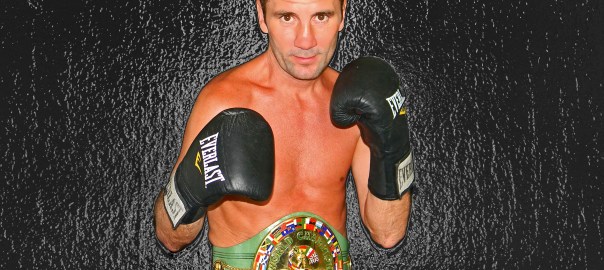
North Korea (About this sound listen), officially the Democratic People’s Republic of Korea (DPRK; Chosŏn’gŭl: 조선민주주의인민공화국; hancha: 朝鮮民主主義人民共和國; MR: Chosŏn Minjujuŭi Inmin Konghwaguk), is a country in East Asia, in the northern part of the Korean Peninsula. The capital and largest city is Pyongyang. North Korea shares a land border with China to the north and north-west, along the Amnok (Yalu) and Tumen rivers. A small section of the Tumen River also forms North Korea’s border with Russia to the northeast.[5] The Korean Demilitarized Zone marks the boundary between North Korea and South Korea. The legitimacy of this border is not accepted by either side, as both states claim to be the legitimate government of the entire peninsula.

The Empire of Japan annexed Korea in 1910. After the Japanese surrender at the end of World War II in 1945, Korea was divided into two zones by the United States and Soviet Union, with the north occupied by the Soviets and the south by the Americans. Negotiations on reunification failed, and in 1948 two separate governments were formed: the Democratic People’s Republic of Korea in the north, and the Republic of Korea in the south. The conflicting claims of sovereignty led to the Korean War in 1950. The Korean Armistice Agreement in 1953 led to a ceasefire, but no peace treaty was ever signed.[6] Both states were accepted into the United Nations in 1991.[7]

The DPRK officially describes itself as a self-reliant socialist state[8] and holds elections, but it is widely considered a dictatorship and has been described as totalitarian and Stalinist,[17][18][19] with an elaborate cult of personality around Kim Il-sung and his family. Human rights violations in North Korea have been assessed by international organizations as in a category of their own, with no parallel in the contemporary world.[20][21][22][23][24] The Workers’ Party of Korea, led by a member of the ruling family,[19] holds power in the state and leads the Democratic Front for the Reunification of the Fatherland of which all political officers are required to be a member.[25]

Over time North Korea has gradually distanced itself from the world communist movement. Juche, an ideology of national self-reliance, was introduced into the constitution as a “creative application of Marxism–Leninism” in 1972.[26][27] In 2009, the constitution was amended again, removing the brief references to communism (Chosŏn’gŭl: 공산주의).[28]

The means of production are owned by the state through state-run enterprises and collectivized farms, and most services such as healthcare, education, housing and food production are state funded or subsidized.[29] In the 1990s, North Korea suffered from a famine and continues to struggle with food production.[30]

North Korea follows Songun, or “military-first” policy.[31] It is the world’s most militarized society, with a total of 9,495,000 active, reserve, and paramilitary personnel. Its active duty army of 1.21 million is the fourth largest in the world, after China, the U.S., and India.[32] It also possesses nuclear weapons.[33][34]

Etymology

See also: Names of Korea

The name Korea derives from Goryeo, itself referring to the ancient kingdom of Goguryeo, the first Korean dynasty visited by Persian merchants who referred to Koryŏ (Goryeo; 고려) as Korea.[35] The term Koryŏ also widely became used to refer to Goguryeo, which renamed itself Koryŏ in the 5th century.[36] (The modern spelling, “Korea“, first appeared in late 17th century in the travel writings of the Dutch East India Company‘s Hendrick Hamel.[36]). Despite the coexistence of the spellings Corea and Korea in 19th century publications, some Koreans believe that Japan, around the time of the Japanese occupation, intentionally standardised the spelling on Korea, making Japan appear first alphabetically.[37] Other commentators have pointed out that Japan continued to refer to Korea as “Corea” and “Chosen,” even after Japan absorbed Korea, and that Japan would have had no need to concern itself with Korea’s alphabetical position in international forums, considering that Japan had absorbed Korea, and thus Korea ceased to appear as an independent entity in international forums.[38]

After Goryeo fell in 1392, Joseon became the official name for the entire territory, though it was not universally accepted. The new official name has its origin in the ancient country of Gojoseon (Old Joseon). In 1897, the Joseon dynasty changed the official name of the country from Joseon to Daehan Jeguk (Korean Empire). The name Daehan, which means “great Han” literally, derives from Samhan (Three Hans). However, the name Joseon was still widely used by Koreans to refer to their country, though it was no longer the official name. Under Japanese rule, the two names Han and Joseon coexisted. There were several groups who fought for independence, the most notable being the Provisional Government of the Republic of Korea.

History

Early history

Main article: History of Korea

Korea in 108 BC

Jikji, the first known book printed with movable metal type in 1377. Bibliothèque Nationale de Paris

Gyeongbok Palace is the largest of the Five Grand Palaces built during the Joseon Dynasty.

Korean history begins with the founding of Joseon (often known as “Gojoseon” to prevent confusion with another dynasty founded in the 13th century; the prefix Go- means ‘older,’ ‘before,’ or ‘earlier’) in 2333 BC by Dangun, according to Korean foundation mythology.[39] Gojoseon expanded until it controlled northern Korean Peninsula and some parts of Manchuria. The Gija Joseon was purportedly founded in 12th century BC, and its existence and role have been controversial in the modern era.[40] In the 2nd century BC, Wiman Joseon which fell to the Han China near the end of the century. Later the Han Dynasty defeated the Wiman Joseon and set up Four Commanderies of Han in 108 BC. There was a significant Chinese presence in northern parts of the Korean peninsula during the next century, and the Lelang Commandery persisted for about 400 years until it was conquered by Goguryeo.[41] After many conflicts with the Chinese Han Dynasty, Gojoseon disintegrated, leading to the Proto–Three Kingdoms of Korea period.

In the early centuries of the Common Era, Buyeo, Okjeo, Dongye, and the Samhan confederacy occupied the peninsula and southern Manchuria. Of the various states, Goguryeo, Baekje, and Silla grew to control the peninsula as Three Kingdoms of Korea. The unification of the Three Kingdoms by Silla in 676 led to the North South States Period, in which much of the Korean Peninsula was controlled by Unified Silla, while Balhae succeeded to have the control of northern parts of Goguryeo.

In Unified Silla, poetry and art was encouraged, and Buddhist culture thrived. Relationships between Korea and China remained relatively peaceful during this time. However, Unified Silla weakened under internal strife, and surrendered to Goryeo in 935. Balhae, Silla’s neighbor to the north, was formed as a successor state to Goguryeo. During its height, Balhae controlled most of Manchuria and parts of Russian Far East. It fell to the Khitan in 926.

The peninsula was united by King Taejo of Goryeo in 936. Like Silla, Goryeo was a highly cultural state and created the Jikji in 1377, using the world’s oldest movable metal type printing press.[42] The Mongol invasions in the 13th century greatly weakened Goryeo. After nearly 30 years of war, Goryeo continued to rule Korea, though as a tributary ally to the Mongols. After the Mongolian Empire collapsed, severe political strife followed and the Goryeo Dynasty was replaced by the Joseon Dynasty in 1392, following a rebellion by General Yi Seong-gye.

King Taejo declared the new name of Korea as “Joseon” in reference to Gojoseon, and moved the capital to Hanseong (old name of Seoul). The first 200 years of the Joseon Dynasty were marked by relative peace and saw the creation of Hangul by King Sejong the Great in the 15th century and the rise in influence of Confucianism in the country.

Between 1592 and 1598, Japan invaded Korea. Toyotomi Hideyoshi led the Japanese forces, but his advance was halted by Korean forces with assistance from Righteous army militias and Ming Dynasty Chinese troops. Through a series of successful battles of attrition, the Japanese forces were eventually forced to withdraw, and subsequently signed a peace agreement with diplomats of Ming China. This war also saw the rise of Admiral Yi Sun-sin and his renowned “turtle ship“. In the 1620s and 1630s, Joseon suffered from invasions by the Manchu which eventually extended to China as well.

After another series of wars against Manchuria, Joseon experienced a nearly 200-year period of peace. King Yeongjo and King Jeongjo particularly led a new renaissance of the Joseon Dynasty.

Japanese occupation (1910–45)

Three Koreans shot for pulling up rails as a protest against seizure of land without payment by the Japanese

The latter years of the Joseon Dynasty were marked by isolation from the outside world. During the 19th century, Korea’s isolationist policy earned it the name the “Hermit Kingdom“. The Joseon Dynasty tried to protect itself against Western imperialism, but was eventually forced to open trade. After the First Sino-Japanese War and the Russo-Japanese War, Korea was occupied by Japan (1910–45).

Japan tried to suppress Korean traditions and culture and ran the economy primarily for its own benefit. Anti-Japanese, pro-liberation rallies took place nationwide on 1 March 1919 (the March 1st Movement). About 7,000 people were killed during the suppression of this movement. Continued anti-Japanese uprisings, such as the nationwide uprising of students in 1929, led to the strengthening of military rule in 1931. After the outbreaks of the Sino-Japanese War in 1937 and World War II, Japan stepped up efforts to extinguish Korean culture.

Koreans were forced to adopt Japanese names. Worship at Japanese Shinto shrines was made compulsory. The school curriculum was radically modified to eliminate teaching in the Korean language and history. Numerous Korean cultural artifacts were destroyed or taken to Japan. Resistance groups known as Dongnipgun (Liberation Army) operated along the Sino-Korean border, fighting guerrilla warfare against Japanese forces. Some of them took part in allied action in China and parts of South East Asia. One of the guerrilla leaders was the communist Kim Il-sung, who later became the leader of North Korea.

During World War II, Koreans at home were forced to support the Japanese war effort. Tens of thousands of men were conscripted into Japan’s military. Around 200,000 girls and women, many from Korea, were forced to engage in sexual services for the Japanese military, with the euphemism “comfort women“.

Soviet occupation and division of Korea (1945–50)

Main article: Division of Korea

Suspected communist sympathizers awaiting execution, Jeju in May 1948

At the end of World War II in 1945, the Korean peninsula was divided into two zones along the 38th parallel, with the northern half of the peninsula occupied by the Soviet Union and the southern half by the United States. Initial hopes for a unified, independent Korea evaporated as the politics of the Cold War resulted in the establishment of two separate states with diametrically opposed political, economic, and social systems.

Soviet General Terentii Shtykov recommended the establishment of the Soviet Civil Authority in October 1945, and supported Kim Il-sung as chairman of the Provisional People’s Committee for North Korea, established in February 1946. During the provisional government, Shtykov’s chief accomplishment was a sweeping land reform program that broke North Korea’s stratified class system. Landlords and Japanese collaborators fled to the South, where there was no land reform and sporadic unrest. Shtykov nationalized key industries and led the Soviet delegation to talks on the future of Korea in Moscow and Seoul.[43][44][45][46][47] In September 1946, South Korean citizens had risen up against the Allied Military Government. In April 1948, an uprising of the Jeju islanders was violently crushed. The South declared its statehood in May 1948 and two months later the ardent anti-communist Syngman Rhee became its ruler. The Democratic People’s Republic of Korea was established in the North on 9 September 1948. Shtykov served as the first Soviet Ambassador, while Kim Il-sung became Premier.

Soviet forces withdrew from the North in 1948 and most American forces withdrew from the South the following year. Ambassador Shtykov suspected Rhee was planning to invade the North, and was sympathetic to Kim’s goal of Korean unification under socialism. The two successfully lobbied Joseph Stalin to support a short blitzkrieg of the South, which culminated in the outbreak of the Korean War.[43][44][45][46]

Korean War (1950–53)

Main article: Korean War

Civilians killed by North Korean forces near Hamhung, October 1950

The military of North Korea invaded the South on 25 June 1950, and swiftly overran most of the country. A United Nations force, led by the United States, intervened to defend the South, and rapidly advanced into North Korea. As they neared the border with China, Chinese forces intervened on behalf of North Korea, shifting the balance of the war again. Fighting ended on 27 July 1953, with an armistice that approximately restored the original boundaries between North and South Korea. More than one million civilians and soldiers were killed in the war. As a result of the war, almost every substantial building in North Korea was destroyed.[48][49]

Although some have referred to the conflict as a civil war, other important factors were involved.[50] The Korean War was also the first armed confrontation of the Cold War and set the standard for many later conflicts. It is often viewed as an example of the proxy war, where the two superpowers would fight in another country, forcing the people in that country to suffer most of the destruction and death involved in a war between such large nations. The superpowers avoided descending into an all-out war against one another, as well as the mutual use of nuclear weapons. It also expanded the Cold War, which to that point had mostly been concerned with Europe.

A heavily guarded demilitarized zone (DMZ) still divides the peninsula, and an anti-communist and anti-North Korea sentiment remains in South Korea. Since the war, the United States has maintained a strong military presence in the South which is depicted by the North Korean government as an imperialist occupation force.[51]

Post-war developments

The relative peace between the South and the North following the armistice was interrupted by border skirmishes, celebrity abductions, and assassination attempts. The North failed in several assassination attempts on South Korean leaders, most notably in 1968, 1974 and the Rangoon bombing in 1983; tunnels were frequently found under the DMZ and war nearly broke out over the axe murder incident at Panmunjom in 1976.[52] In 1973, extremely secret, high-level contacts began to be conducted through the offices of the Red Cross, but ended after the Panmunjom incident, with little progress having been made and the idea that the two Koreas would join international organizations separately.[clarification needed][53]

During the 1956 August Faction Incident, Kim Il-sung successfully resisted efforts by the Soviet Union and China to depose him in favor of Soviet Koreans or the pro-Chinese Yanan faction. [54][55] The last Chinese troops withdrew from the country in October 1958, which is the consensus as the latest date when North Korea became effectively independent, though some scholars believe that the 1956 August incident demonstrated independence.[55][54][56] North Korea remained closely aligned to China and the Soviet Union, and the Sino-Soviet split allowed Kim to play the powers off each other. North Korea sought[57] to become a leader of the Non-Aligned Movement, and emphasized the ideology of Juche to distinguish it from both the Soviet Union and China.[58]

Recovery from the war was quick — by 1957 industrial production reached 1949 levels. In 1959, relations with Japan had improved somewhat, and North Korea began allowing the repatriation of Japanese citizens in the country. The same year, North Korea revalued the North Korean won, which held greater value than its South Korean counterpart. Until the 1960s, economic growth was higher than in South Korea, and North Korean GDP per capita was equal to that of its southern neighbor as late as 1976.[59]

In the early 1970s China began normalizing its relations with the West, particularly the U.S., and reevaluating its relations with North Korea. The diplomatic problems culminated in 1976 with the death of Mao Zedong. In response, Kim Il-sung began severing ties with China and reemphasizing national and economic self-reliance enshrined in his Juche Idea, which promoted producing everything within the country. By the 1980s the economy had begun to stagnate, started its long decline in 1987, and almost completely collapsed after the dissolution of the Soviet Union in 1991 when all Russian aid was suddenly halted. The North began reestablishing trade relations with China shortly thereafter, but the Chinese could not afford to provide enough food aid to meet demand.

The Arduous March

In 1992, as Kim Il-sung’s health began deteriorating, Kim Jong-il slowly began taking over various state tasks. Kim Il-sung died of a heart attack in 1994, in the midst of a standoff with the United States over North Korean nuclear weapon development. Kim declared a three-year period of national mourning before officially announcing his position as the new leader.

North Korean efforts to build nuclear weapons were halted by the Agreed Framework, negotiations with U.S. president Bill Clinton. Kim Jong-il instituted a policy called Songun, or “military first”. There is much speculation about this policy being used as a strategy to strengthen the military while discouraging coup attempts. Restrictions on travel were tightened and the state security apparatus was strengthened.

Flooding in the mid-1990s exacerbated the economic crisis, severely damaging crops and infrastructure and led to widespread famine which the government proved incapable of curtailing. In 1996, the government accepted UN food aid. Since the outbreak of the famine, the government has reluctantly tolerated illegal black markets while officially maintaining a state socialist economy. Corruption flourished and disillusionment with the regime spread.

North Korean women present gifts to South Korean business tycoon Chung Ju-yung, 1998

In the late 1990s, North Korea began making attempts at normalizing relations with the West and continuously renegotiating disarmament deals with U.S. officials in exchange for economic aid. At the same time, building on Nordpolitik, South Korea began to engage with the North as part of its Sunshine Policy.[60][61]

21st century

The international environment changed with the election of U.S. president George W. Bush in 2001. His administration rejected South Korea’s Sunshine Policy and the Agreed Framework. The U.S. government treated North Korea as a rogue state, while North Korea redoubled its efforts to acquire nuclear weapons to avoid the fate of Iraq.[62][63][64]

On October 9, 2006, North Korea announced it had conducted its first nuclear weapons test.[65][66]

North Koreans bowing in front of statues of Kim Il-sung (left) and Kim Jong-il

In August 2009, former U.S. president Bill Clinton met with Kim Jong-il to secure the release of two American journalists who had been sentenced for entering the country illegally.[67] Current U.S. president Barack Obama‘s position towards North Korea has been to resist making deals with North Korea for the sake of defusing tension, a policy known as “strategic patience.”[68]

Tensions with South Korea and the United States increased in 2010 with the sinking of the South Korean warship Cheonan[69] and North Korea’s shelling of Yeonpyeong Island.[70][71]

On 17 December 2011, the supreme leader of North Korea Kim Jong-il died from a heart attack.[72] His youngest son Kim Jong-un was announced as his successor.

In 2013 an international crisis erupted regarding North Korea’s attempts to develop intercontinental ballistic missiles.[73][74][75][76][77]

Geography

A map of North Korea.

North Korea occupies the northern portion of the Korean Peninsula, lying between latitudes 37° and 43°N, and longitudes 124° and 131°E. It covers an area of 120,540 square kilometres (46,541 sq mi). North Korea shares land borders with China and Russia to the north, and borders South Korea along the Korean Demilitarized Zone. To its west are the Yellow Sea and Korea Bay, and to its east lies Japan across the Sea of Japan (East Sea of Korea).

The capital and largest city is Pyongyang; other major cities include Kaesong in the south, Sinuiju in the northwest, Wonsan and Hamhung in the east and Chongjin in the northeast.

Early European visitors to Korea remarked that the country resembled “a sea in a heavy gale” because of the many successive mountain ranges that crisscross the peninsula.[78] Some 80% of North Korea is composed of mountains and uplands, separated by deep and narrow valleys. All of the Korean Peninsula’s mountains with elevations of 2,000 meters (6,600 ft) or more are located in North Korea. The coastal plains are wide in the west and discontinuous in the east. A great majority of the population lives in the plains and lowlands. According to a United Nations Environmental Programme report in 2003, forest covers over 70 percent of the country, mostly on steep slopes.[79] The longest river is the Amnok (Yalu) River which flows for 790 kilometres (491 mi).[80]

The highest point in North Korea is Baekdu Mountain, a volcanic mountain which forms part of the Chinese/North Korean border with basalt lava plateau with elevations between 1,400 and 2,744 meters (4,593 and 9,003 ft) above sea level.[78] The Hamgyong Range, located in the extreme northeastern part of the peninsula, has many high peaks including Kwanmobong at approximately 2,541 m (8,337 ft).[78]

Other major ranges include the Rangrim Mountains, which are located in the north-central part of North Korea and run in a north-south direction, making communication between the eastern and western parts of the country rather difficult; and the Kangnam Range, which runs along the North Korea–China border. Mount Kumgang, or Diamond Mountain (approximately 1,638 metres or 5,374 feet), in the Taebaek Range, which extends into South Korea, is famous for its scenic beauty.[78]

Climate

North Korea has a combination of a continental climate and an oceanic climate, with four distinct seasons.[79][81] Most of North Korea is classified as being of a humid continental climate within the Köppen climate classification scheme, with warm summers and cold, dry winters. In summer, there is a short rainy season called changma.[82]

Long winters bring bitter cold and clear weather interspersed with snow storms as a result of northern and northwestern winds that blow from Siberia. The daily average high and low temperatures for Pyongyang in January are −3 and −13 °C (27 and 9 °F). On average, it snows thirty-seven days during the winter. Winter can be particularly harsh in the northern, mountainous regions.[81]

Summer tends to be short, hot, humid, and rainy because of the southern and southeastern monsoon winds that bring moist air from the Pacific Ocean. Spring and autumn are transitional seasons marked by mild temperatures and variable winds and bring the most pleasant weather. The daily average high and low temperatures for Pyongyang in August are 29 and 20 °C (84 and 68 °F).[81]

On average, approximately 60% of all precipitation occurs from June to September. Natural hazards include late spring droughts which are often followed by severe flooding. Typhoons affect the peninsula on an average of at least once every summer or early autumn.[81]

In 2015, North Korea experienced extreme drought which affected crops and electricity supplies. According to the Korean Central News Agency, the drought was the worst seen in 100 years.[83]

Administrative divisions

Map Namea Chosŏn’gŭl Administrative seat
Capital city (chikhalsi)a
1 Pyongyang 평양직할시 (Chung-guyok)
Special city (teukbyeolsi)a
2 Rason * 라선특별시 (Rajin-guyok) *
Provinces (do)a
3 South Pyongan 평안남도 Pyongsong
4 North Pyongan 평안북도 Sinuiju
5 Chagang 자강도 Kanggye
6 South Hwanghae 황해남도 Haeju
7 North Hwanghae 황해북도 Sariwon
8 Kangwon 강원도 Wonsan
9 South Hamgyong 함경남도 Hamhung
10 North Hamgyong 함경북도 Chongjin
11 Ryanggang * 량강도 Hyesan
* – Rendered in Southern dialects as “Yanggang” (양강), “Nason” (나선), or “Najin” (나진).

Government and politics

Mansudae Assembly Hall, seat of the Supreme People’s Assembly

North Korea functions as a highly centralized, single-party republic. According to its 2009 constitution, it is a self-described revolutionary and socialist state “guided in its activities by the Juche idea and the Songun idea”.[84] The Workers’ Party of Korea (WPK) has an estimated 3,000,000 members and dominates every aspect of North Korean politics. It has two satellite organizations, the Korean Social Democratic Party and the Chondoist Chongu Party[85] which participate in the WPK-led Democratic Front for the Reunification of the Fatherland. Another highly influential structure is the independent National Defence Commission (NDC). Kim Jong-un of the Kim family heads all major governing structures: he is First Secretary of the WPK, First Chairman of the NDC, and Supreme Commander of the Korean People’s Army.[86][87] Kim Il-sung, who died in 1994, is the country’s “Eternal President“,[88] while Kim Jong-il was announced “Eternal General Secretary” after his death in 2011.[86]

The unicameral Supreme People’s Assembly (SPA) is the highest organ of state authority and holds the legislative power. Its 687 members are elected every five years by universal suffrage. Supreme People’s Assembly sessions are convened by the SPA Presidium, whose president (Kim Yong-nam since 1998) also represents the state in relations with foreign countries. Deputies formally elect the President, the vice-presidents and members of the Presidium and take part in the constitutionally appointed activities of the legislature: pass laws, establish domestic and foreign policies, appoint members of the cabinet, review and approve the state economic plan, among others.[89] However, the SPA itself cannot initiate any legislation independently of party or state organs. It is unknown whether it has ever criticized or amended bills placed before it, and the elections are based around a single list of WPK-approved candidates who stand without opposition.[90]

North Koreans touring the Museum of American War Atrocities in 2009

Executive power is vested in the Cabinet of North Korea, which is headed by Premier Pak Pong-ju.[91] The Premier represents the government and functions independently. His authority extends over two vice-premiers, 30 ministers, two cabinet commission chairmen, the cabinet chief secretary, the president of the Central Bank, the director of the Central Statistics Bureau and the president of the Academy of Sciences. A 31st ministry, the Ministry of People’s Armed Forces, is under the jurisdiction of the National Defence Commission.[92]

Political ideology

Main article: Juche

The Juche Tower in Pyongyang.

The Juche ideology is the cornerstone of party works and government operations. It is viewed by the official North Korean line as an embodiment of Kim Il-sung’s wisdom, an expression of his leadership, and an idea which provides “a complete answer to any question that arises in the struggle for national liberation”.[93] Juche was pronounced in December 1955 in order to emphasize a Korea-centered revolution.[93] Its core tenets are economic self-sufficiency, military self-reliance and an independent foreign policy. The roots of Juche were made up of a complex mixture of factors, including the cult of personality centered on Kim Il-sung, the conflict with pro-Soviet and pro-Chinese dissenters, and Korea’s centuries-long struggle for independence.[94]

It was initially promoted as a “creative application” of Marxism–Leninism, but in the mid-1970s, it was described by state propaganda as “the only scientific thought… and most effective revolutionary theoretical structure that leads to the future of communist society”. Juche eventually replaced Marxist–Leninism entirely by the 1980s,[95] and in 1992 references to the latter were omitted from the constitution.[96] The 2009 constitution dropped references to communism, but retained references to socialism.[97] Juche’s concepts of self-reliance have thus evolved with time and circumstances, but still provide the groundwork for the spartan austerity, sacrifice and discipline demanded by the party.[98]

Some foreign observers have instead described North Korea’s political system as an absolute monarchy[99][100][101] or a “hereditary dictatorship”.[102] Others view its ideology as a racialist-focused nationalism similar to that of Shōwa Japan,[103][104][105][106] or bearing a resemblance to European fascism.[107] A defected North Korean scholar dismisses the idea that Juche is the country’s leading ideology, regarding its public exaltation as designed to deceive foreigners.[108]

Personality cult

The North Korean government exercises control over many aspects of the nation’s culture, and this control is used to perpetuate a cult of personality surrounding Kim Il-sung,[109] and, to a lesser extent, Kim Jong-il.[110] While visiting North Korea in 1979, journalist Bradley Martin noted that nearly all music, art, and sculpture that he observed glorified “Great Leader” Kim Il-sung, whose personality cult was then being extended to his son, “Dear Leader” Kim Jong-il.[111][page needed] Bradley Martin also reported that there is even widespread belief that Kim Il-sung “created the world”, and Kim Jong-il could “control the weather”.[111][page needed]

Such reports are contested by North Korea researcher Brian R. Myers: “divine powers have never been attributed to either of the two Kims. In fact, the propaganda apparatus in Pyongyang has generally been careful not to make claims that run directly counter to citizens’ experience or common sense.”[112] He further explains that the state propaganda painted Kim Jong-il as someone whose expertise lay in military matters and that the famine of the 1990s was partially caused by natural disasters out of Kim Jong-il’s control.[113]

A propaganda poster with Kim Il-sung’s official portrait.

The song “No Motherland Without You“, sung by the North Korean Army Choir, was created especially for Kim Jong-il and is one of the most popular tunes in the country. Kim Il-sung is still officially revered as the nation’s “Eternal President”. Several landmarks in North Korea are named for Kim Il-sung, including Kim Il-sung University, Kim Il-sung Stadium, and Kim Il-sung Square. Defectors have been quoted as saying that North Korean schools deify both father and son.[114] Kim Il-sung rejected the notion that he had created a cult around himself, and accused those who suggested this of “factionalism“.[111] Following the death of Kim Il-sung, North Koreans were prostrating and weeping to a bronze statue of him in an organized event;[115] similar scenes were broadcast by state television following the death of Kim Jong-il.

Critics maintain this Kim Jong-il personality cult was inherited from his father, Kim Il-sung. Kim Jong-il was often the center of attention throughout ordinary life in the DPRK. His birthday is one of the most important public holidays in the country. On his 60th birthday (based on his official date of birth), mass celebrations occurred throughout the country.[116] Kim Jong-il’s personality cult, although significant, was not as extensive as his father’s. One point of view is that Kim Jong-il’s cult of personality was solely out of respect for Kim Il-sung or out of fear of punishment for failure to pay homage.[117] Media and government sources from outside of North Korea generally support this view,[118][119][120][121][122] while North Korean government sources say that it is genuine hero worship.[123]

B. R. Myers also argues that the worship is real and not unlike worship of Adolf Hitler in Nazi Germany.[citation needed] In a more recent event – on 11 June 2012 – a 14-year-old North Korean schoolgirl drowned while attempting to rescue portraits of Kim Il-sung and Kim Jong-il from a flood.[124]

Law enforcement and internal security

North Korean traffic police in Pyongyang

North Korea has a civil law system based on the Prussian model and influenced by Japanese traditions and Communist legal theory.[125] Judiciary procedures are handled by the Central Court (the highest court of appeal), provincial or special city-level courts, people’s courts and special courts. People’s courts are at the lowest level of the system and operate in cities, counties and urban districts, while different kinds of special courts handle cases related to military, railroad or maritime matters.[126]

Judges are theoretically elected by their respective local people’s assemblies, but in practice they’re appointed by the Korean Workers’ Party. The penal code is based on the principle of nullum crimen sine lege (no crime without a law), but remains a tool for political control despite several amendments reducing ideological influence.[126] Courts carry out legal procedures related to not only criminal and civil matters, but also political cases as well.[127] Political prisoners are sent to labor camps, while criminal offenders are incarcerated in a separate system.[128]

The Ministry of People’s Security (MPS) maintains most law enforcement activities. It is one of the most powerful state institutions in North Korea and oversees the national police force, investigates criminal cases and manages non-political correctional facilities.[129] It also handles other aspects of domestic security like civil registration, traffic control, fire departments and railroad security.[130] The State Security Department was separated from the MPS in 1973 to conduct domestic and foreign intelligence, counterintelligence and manage the political prison system. Political camps can be short-term reeducation zones or “total control zones” for lifetime detention.[131] Camp 14 in Kaechon,[132] Camp 15 in Yodok[133] and Camp 18 in Bukchang[134] are described in detailed testimonies.[135]

The security apparatus is very extensive,[136] exerting strict control over residence, travel, employment, clothing, food and family life.[137] Security establishments tightly monitor cellular and digital communications. The MPS, State Security and the police allegedly conduct real-time monitoring of text messages, online data transfer, monitor phone calls and automatically transcribe recorded conversations. They reportedly have the capacity to triangulate a subscriber’s exact location, while military intelligence monitors phone and radio traffic as far as 140 kilometers south of the Demilitarized zone.[138] Mass surveillance is carried out through a system which includes 100,000 CCTV cameras, many of which are installed at the border with China.[139]

Foreign relations

The close China-DPRK relationship is celebrated at the Mass Games in Pyongyang

Initially, North Korea had diplomatic ties with only other communist countries. In the 1960s and 1970s, it pursued an independent foreign policy, established relations with many developing countries, and joined the Non-Aligned Movement. In the late 1980s and the 1990s its foreign policy was thrown into turmoil with the collapse of the Soviet bloc. Suffering an economic crisis, it closed 30% of its embassies. At the same time, North Korea sought to build relations with developed free market countries.[140] As a result of its isolation, it is sometimes known as the “hermit kingdom“.[141]

As of 2012[update], North Korea had diplomatic relations with 162 countries, as well as the European Union and the Palestinian Authority, and embassies in 42 countries.[140] North Korea continues to have strong ties with its socialist southeast Asian allies in Vietnam and Laos, as well as with Cambodia.[142] Most of the foreign embassies to North Korea are located in Beijing rather than in Pyongyang.[143] The Korean Demilitarized Zone with South Korea is the most heavily fortified border in the world.[144]

An aid convoy entering North Korea through the Demilitarized Zone in 1998

As a result of the North Korean nuclear weapons program, the six-party talks were established to find a peaceful solution to the growing tension between the two Korean governments, the Russian Federation, the People’s Republic of China, Japan, and the United States. North Korea was previously designated a state sponsor of terrorism[145] because of its alleged involvement in the 1983 Rangoon bombing and the 1987 bombing of a South Korean airliner.[146] On 11 October 2008, the United States removed North Korea from its list of states that sponsor terrorism after Pyongyang agreed to cooperate on issues related to its nuclear program.[147] The kidnapping of at least 13 Japanese citizens by North Korean agents in the 1970s and the 1980s was another major issue in the country’s foreign policy.[148]

Korean reunification

Main article: Korean reunification

North Korea’s policy is to seek reunification without what it sees as outside interference, through a federal structure retaining each side’s leadership and systems. In 2000, both North and South Korea signed the June 15th North–South Joint Declaration in which both sides made promises to seek out a peaceful reunification.[149] The Democratic Federal Republic of Korea is a proposed state first mentioned by then North Korean president Kim Il-sung on 10 October 1980, proposing a federation between North and South Korea in which the respective political systems would initially remain.[150]

Inter-Korean relations are at the core of North Korean diplomacy and have seen numerous shifts in the last few decades. In 1972, the two Koreas agreed in principle to achieve reunification through peaceful means and without foreign interference.[151] Despite this, relations remained cool well until the early 1990s, with the exception of a brief period in the early 1980s when North Korea provided flood relief to its southern neighbor and the two countries organized a reunion of 92 separated families.[152]

The Sunshine Policy instituted by South Korean president Kim Dae-jung in 1998 was a watershed in inter-Korean relations. It encouraged other countries to engage with the North, which allowed Pyongyang to normalize relations with a number of European Union states and contributed to the establishment of joint North-South economic projects. The culmination of the Sunshine Policy was the 2000 Inter-Korean Summit, when Kim Dae-jung visited Kim Jong-il in Pyongyang.[153] On 4 October 2007, South Korean president Roh Moo-hyun and Kim Jong-il signed an 8-point peace agreement.[154]

Relations worsened yet again in the late 2000s and early 2010s when South Korean president Lee Myung-bak adopted a more hard-line approach and suspended aid deliveries pending the de-nuclearization of the North. North Korea responded by ending all of its previous agreements with the South.[155] It also deployed additional ballistic missiles[156] and placed its military on full combat alert after South Korea, Japan and the United States threatened to intercept a Unha-2 space launch vehicle.[157] The next few years witnessed a string of hostilities, including the alleged North Korean involvement in the sinking of South Korean warship Cheonan,[69] mutual ending of diplomatic ties,[158] a North Korean artillery attack on Yeonpyeong Island,[159] and an international crisis involving threats of a nuclear exchange.[160]

Military

Korean People’s Army soldiers at Panmunjom

The Korean People’s Army (KPA) is the name of North Korea’s military organization. The KPA has 1,106,000 active and 8,389,000 reserve and paramilitary troops, making it the largest military institution in the world.[161] About 20% of men aged 17–54 serve in the regular armed forces,[32] and approximately one in every 25 citizens is an enlisted soldier.[33][162] The KPA has five branches: Ground Force, Naval Force, Air Force, Special Operations Force, and Rocket Force. Command of the Korean People’s Army lies in both the Central Military Commission of the Korean Workers’ Party and the independent National Defense Commission. The Ministry of People’s Armed Forces is subordinated to the latter.[163]

Of all KPA branches, the Ground Force is the largest. It has approximately 1 million personnel divided into 80 infantry divisions, 30 artillery brigades, 25 special warfare brigades, 20 mechanized brigades, 10 tank brigades and seven tank regiments.[164] They are equipped with 3,700 tanks, 2,100 APCs and IFVs,[165] 17,900 artillery pieces, 11,000 anti-aircraft guns[166] and some 10,000 MANPADS and anti-tank guided missiles.[167] Other equipment includes 1,600 aircraft in the Air Force and 1,000 vessels in the Navy.[168] North Korea has the largest special forces and the largest submarine fleet in the world.[169]

Ilyushin Il-76 strategic military airlifter used by Air Koryo.

North Korea possesses nuclear weapons, but its arsenal remains limited. Various estimates put its stockpile at less than 10 plutonium warheads[170][171] and 12–27 nuclear weapon equivalents if uranium warheads are considered.[172] Delivery capabilities[173] are provided by the Rocket Force, which has some 1,000 ballistic missiles with a range of up to 3,000 kilometres.[174]

Vice Marshal Jo Myong-rok meets Bill Clinton at the White House, October 2000

According to a 2004 South Korean assessment, North Korea possesses a stockpile of chemical weapons estimated to amount to 2,500–5,000 tons, including nerve, blister, blood, and vomiting agents, as well as the ability to cultivate and produce biological weapons including anthrax, smallpox, and cholera.[175][176] Because of its nuclear and missile tests, North Korea has been sanctioned under United Nations Security Council resolutions 1695 of July 2006, 1718 of October 2006, 1874 of June 2009, and 2087 of January 2013.

The military faces some issues limiting its conventional capabilities, including obsolete equipment, insufficient fuel supplies and a shortage of digital command and control assets. To compensate for these deficiencies, the KPA has deployed a wide range of asymmetric warfare technologies like anti-personnel blinding lasers,[177] GPS jammers,[178] midget submarines and human torpedoes,[179] stealth paint,[180] electromagnetic pulse bombs,[181] and cyberwarfare units.[182] KPA units have also attempted to jam South Korean military satellites.[183]

Much of the equipment is engineered and produced by a domestic defense industry. Weapons are manufactured in roughly 1,800 underground defense industry plants scattered throughout the country, most of them located in Chagang Province.[184] The defense industry is capable of producing a full range of individual and crew-served weapons, artillery, armoured vehicles, tanks, missiles, helicopters, surface combatants, submarines, landing and infiltration craft, Yak-18 trainers and possibly co-production of jet aircraft.[136] According to official North Korean media, military expenditures for 2010 amount to 15.8% of the state budget.[185]

Society

Demographics

North Koreans posing for a photo in front of Kumsusan Palace of the Sun

With the exception of a small Chinese community and a few ethnic Japanese, North Korea’s 24,852,000 people are ethnically homogeneous.[186][187] Demographic experts in the 20th century estimated that the population would grow to 25.5 million by 2000 and 28 million by 2010, but this increase never occurred due to the North Korean famine.[188] It began in 1995, lasted for three years and resulted in the deaths of between 300,000 and 800,000 North Koreans annually.[189] The deaths were most likely caused by malnutrition-related illnesses like pneumonia and tuberculosis rather than starvation.[189]

International donors led by the United States initiated shipments of food through the World Food Program in 1997 to combat the famine.[190] Despite a drastic reduction of aid under the Bush Administration,[191] the situation gradually improved: the number of malnourished children declined from 60% in 1998[192] to 37% in 2006[193] and 28% in 2013.[194] Domestic food production almost recovered to the recommended annual level of 5.37 million tons of cereal equivalent in 2013,[195] but the World Food Program reported a continuing lack of dietary diversity and access to fats and proteins.[196]

The famine had a significant impact on the population growth rate, which declined to 0.9% annually in 2002[188] and 0.53% in 2014.[197] Late marriages after military service, limited housing space and long hours of work or political studies further exhaust the population and reduce growth.[188] The national birth rate is 14.5 births per 1,000 population.[198] Two-thirds of households consist of extended families mostly living in two-room units. Marriage is virtually universal and divorce is extremely rare.[199]

Health

Further information: Health in North Korea

A dental clinic at one of North Korea’s major hospitals

North Korea had a life expectancy of 69.8 years in 2013.[200] While North Korea is classified as a low-income country, the structure of North Korea’s causes of death (2013) are unlike that of other low-income countries.[201] Instead, it is closer to worldwide averages, with non-communicable diseases—such as cardiovascular disease and cancers—accounting for two-thirds of the total deaths.[201]

A 2013 study reported that communicable diseases and malnutrition are responsible for 29% of the total deaths in North Korea. This figure is higher than those of high-income countries and South Korea, but half of the average 57% of all deaths in other low-income countries.[201] Infectious diseases like tuberculosis, malaria, and hepatitis B are considered to be endemic to the country as a result of the famine.[202]

Cardiovascular disease as a single disease group is the largest cause of death in North Korea (2013).[201] The three major causes of death in DPR Korea are ischaemic heart disease (13%), lower respiratory infections (11%) and cerebrovascular disease (7%).[203] Non-communicable diseases risk factors in North Korea include high rates of urbanisation, an aging society, high rates of smoking and alcohol consumption amongst men.[201]

According to 2003 report by the United States Department of State, almost 100% of the population has access to water and sanitation.[202] 60% of the population had access to improved sanitation facilities in 2000.[204]

A free universal insurance system is in place,[29] but quality of medical care varies significantly by region.[205] Preventive medicine is emphasized through physical exercise and sports, nationwide monthly checkups and routine spraying of public places against disease. Every individual has a lifetime health card which contains a full medical record.[206]

Education

Further information: Education in North Korea

The 2008 census listed the entire population as literate, including those in the age group beyond 80.[199] An 11-year free, compulsory cycle of primary and secondary education is provided in more than 27,000 nursery schools, 14,000 kindergartens, 4,800 four-year primary and 4,700 six-year secondary schools.[192] Some 77% of males and 79% of females aged 30–34 have finished secondary school.[199] An additional 300 universities and colleges offer higher education.[192] Kim Il-sung University is the only one with four-year courses.

Most graduates from the compulsory program do not attend university but begin their obligatory military service or proceed to work in farms or factories instead. The main deficiencies of higher education are the heavy presence of ideological subjects, which comprise 50% of courses in social studies and 20% in sciences,[207] and the imbalances in curriculum. The study of natural sciences is greatly emphasized while social sciences are neglected.[208] Heuristics is actively applied to develop the independence and creativity of students throughout the system.[209] Studying of Russian and English language was made compulsory in upper middle schools in 1978.[210]

Language

Dialects of the Korean language. Note the extent of Korean speakers living in China.

North Korea shares the Korean language with South Korea, although some dialect differences exist within both Koreas. North Koreans refer to their Pyongyang dialect as munhwa (“cultured language”) as opposed to South Korea’s Seoul dialect, the p’yojuno (“standard language”), which is viewed as decadent because of its usage of Japanese and English loanwords.[211]

Words from Japanese, Chinese or Western origin have been eliminated from munhwa along with the usage of Chinese hanja characters.[211] Written language uses the chosŏn’gul phonetic alphabet, developed under Sejong the Great (1418 – 1450).[212]

Religion

Further information: Religion in North Korea

Freedom of religion and the right to religious ceremonies are constitutionally guaranteed, but religions are restricted in practice.[213][214] According to Religious Intelligence, 64.3% of the population are irreligious adherents of the Juche idea, 16% practice Korean shamanism, 13.5% practice Chondoism, 4.5% are Buddhist and 1.7% are Christian.[215]

The influence of Buddhism and Confucianism still has an effect on cultural life.[216][217] Buddhists reportedly fare better than other religious groups. They are given limited funding by the government to promote the religion, because Buddhism played an integral role in traditional Korean culture.[218]

Chondoism (“Heavenly Way”) is an indigenous syncretic belief combining elements of Korean shamanism, Buddhism, Taoism and Catholicism that is officially represented by the WPK-controlled Chongu Party.[219] In contrast, the Open Doors mission claims the most severe persecution of Christians in the world occurs in North Korea.[220] Four state-sanctioned churches exist, but freedom of religion advocates claim these are showcases for foreigners.[221][222] Amnesty International has also expressed concerns about religious persecution in North Korea.[223]

Formal ranking of citizen’s loyalty

Further information: Songbun

Sneaker-wearing North Korean youths walking in Pyongyang.

According to North Korean documents and refugee testimonies,[224] all North Koreans are sorted into groups according to their Songbun, an ascribed status system based on a citizen’s assessed loyalty to the regime. Based on their own behavior and the political, social, and economic background of their family for three generations as well as behavior by relatives within that range, Songbun is allegedly used to determine whether an individual is trusted with responsibility, given opportunities,[225] or even receives adequate food.[224][226]

Songbun allegedly affects access to educational and employment opportunities and particularly whether a person is eligible to join North Korea’s ruling party.[225] There are 3 main classifications and about 50 sub-classifications. According to Kim Il-sung, speaking in 1958, the loyal “core class” constituted 25% of the North Korean population, the “wavering class” 55%, and the “hostile class” 20%.[224] The highest status is accorded to individuals descended from those who participated with Kim Il-sung in the resistance against Japanese occupation during and before World War II and to those who were factory workers, laborers or peasants in 1950.[227]

While some analysts believe private commerce recently changed the Songbun system to some extent,[228] most North Korean refugees say it remains a commanding presence in everyday life.[224] However the North Korean government claims all citizens are equal and denies any discrimination on the basis of family background.[229]

Human rights

A map of political prison camps in North Korea. An estimated 40% of prisoners die of malnutrition.[230]

North Korea is widely accused of having one of the worst human rights records in the world.[231] North Koreans have been referred to as “some of the world’s most brutalized people” by Human Rights Watch, because of the severe restrictions placed on their political and economic freedoms.[232][233] The North Korean population is strictly managed by the state and all aspects of daily life are subordinated to party and state planning. Employment is managed by the party on the basis of political reliability, and travel is tightly controlled by the Ministry of People’s Security.[234]

Amnesty International also reports of severe restrictions on the freedom of association, expression and movement, arbitrary detention, torture and other ill-treatment resulting in death, and executions.[235] North Korea also applies capital punishment, including public executions. Human rights organizations estimate that 1,193 executions had been carried out in the country by 2009.[236]

The State Security Department extrajudicially apprehends and imprisons those accused of political crimes without due process.[237] People perceived as hostile to the government, such as Christians or critics of the leadership,[238] are deported to labor camps without trial,[239] often with their whole family and mostly without any chance of being released.[240]

Based on satellite images and defector testimonies, Amnesty International estimates that around 200,000 prisoners are held in six large political prison camps,[238][241] where they are forced to work in conditions approaching slavery.[242] Supporters of the government who deviate from the government line are subject to reeducation in sections of labor camps set aside for that purpose. Those who are deemed politically rehabilitated may reassume responsible government positions on their release.[243]

North Korean defectors[244] have provided detailed testimonies on the existence of the total control zones where abuses such as torture, starvation, rape, murder, medical experimentation, forced labor, and forced abortions have been reported.[135] On the basis of these abuses, as well as persecution on political, religious, racial and gender grounds, forcible transfer of populations, enforced disappearance of persons and forced starvation, the United Nations Commission of Inquiry has accused North Korea of crimes against humanity.[245][246][247] The International Coalition to Stop Crimes Against Humanity in North Korea (ICNK) estimates that over 10,000 people die in North Korean prison camps every year.[248]

The North Korean government rejects the human rights abuses claims, calling them “a smear campaign” and a “human rights racket” aimed at regime change.[249][250][251] In a report to the UN, North Korea dismissed accusations of atrocities as “wild rumors”. The government also admitted some human rights issues related to living conditions and stated that it is working to improve them.[252]

Economy

North Korea has been maintaining one of the most closed and centralized economies in the world since the 1940s.[253] For several decades it followed the Soviet pattern of five-year plans with the ultimate goal of achieving self-sufficiency. Extensive Soviet and Chinese support allowed North Korea to rapidly recover from the Korean War and register very high growth rates. Systematic inefficiency began to arise around 1960, when the economy shifted from the extensive to the intensive development stage. The shortage of skilled labor, energy, arable land and transportation significantly impeded long-term growth and resulted in consistent failure to meet planning objectives.[254] The major slowdown of the economy contrasted with South Korea, which surpassed the North in terms of absolute Gross Domestic Product and per capita income by the 1980s.[255] North Korea declared the last seven-year plan unsuccessful in December 1993 and thereafter abandoned planning.[256]

The loss of Eastern Bloc trading partners and a series of natural disasters throughout the 1990s caused severe hardships, including widespread famine. By 2000, the situation improved owing to a massive international food assistance effort, but the economy continues to suffer from food shortages, dilapidated infrastructure and a critically low energy supply.[257] In an attempt to recover from the collapse, the government began structural reforms in 1998 that formally legalized private ownership of assets and decentralized control over production.[258] A second round of reforms in 2002 led to an expansion of market activities, partial monetization, flexible prices and salaries, and the introduction of incentives and accountability techniques.[259] Despite these changes, North Korea remains a command economy where the state owns almost all means of production and development priorities are defined by the government.[257]

North Korea has the structural profile of a relatively industrialized country[260] where nearly half of the Gross Domestic Product is generated by industry[261] and human development is at medium levels.[262] Purchasing power parity (PPP) GDP is estimated at $40 billion,[263] with a very low per capita value of $1,800.[264] In 2012, Gross national income per capita was $1,523, compared to $28,430 in South Korea.[265] The North Korean won is the national currency, issued by the Central Bank of the Democratic People’s Republic of Korea.

The economy is heavily nationalized.[266] Food and housing are extensively subsidized by the state; education and healthcare are free;[267] and the payment of taxes was officially abolished in 1974.[268] A variety of goods are available in department stores and supermarkets in Pyongyang,[269] though most of the population relies on small-scale janmadang markets.[270][271] In 2009, the government attempted to stem the expanding free market by banning janmadang and the use of foreign currency,[257] but the resulting inflation spike and rare public protests caused a reversal of these policies.[272] Private trade is dominated by women because most men are required to be present at their workplace, even though many state-owned enterprises are non-operational.[273]

An industrial plant in Hamhung.

Industry and services employ 65%[274] of North Korea’s 12.6 million labor force.[275] Major industries include machine building, military equipment, chemicals, mining, metallurgy, textiles, food processing and tourism.[276] Iron ore and coal production are among the few sectors where North Korea performs significantly better than its southern neighbor – it produces about 10 times larger amounts of each resource.[277] The agricultural sector was shattered by the natural disasters of the 1990s.[278] Its 3,500 cooperatives and state farms[279] were among the most productive and successful in the world around 1980[280] but now experience chronic fertilizer and equipment shortages. Rice, corn, soybeans and potatoes are some of the primary crops.[257] A significant contribution to the food supply comes from commercial fishing and aquaculture.[257] Tourism has been a growing sector for the past decade.[281] North Korea aims to increase the number of foreign visitors from 200,000 to one million by 2016 through projects like the Masikryong Ski Resort.[282]

Foreign trade surpassed pre-crisis levels in 2005 and continues to expand.[283] North Korea has a number of special economic zones (SEZs) and Special Administrative Regions where foreign companies can operate with tax and tariff incentives while North Korean establishments gain access to improved technology.[284] Initially four such zones existed, but they yielded little overall success.[285] The SEZ system was overhauled in 2013 when 14 new zones were opened and the Rason Special Economic Zone was reformed as a joint Chinese-North Korean project.[286] The Kaesong Industrial Region is a special economic zone where more than 100 South Korean companies employ some 52,000 North Korean workers.[287] Outside inter-Korean trade, more than 89% of external trade is conducted with China. Russia is the second-largest foreign partner with $100 million worth of imports and exports for the same year.[288] In 2014, Russia wrote off 90% of North Korea’s debt and the two countries agreed to conduct all transactions in rubles.[289][290] Overall, external trade in 2013 reached a total of $7.3 billion (the highest amount since 1990[288]), while inter-Korean trade dropped to an eight-year low of $1.1 billion.[291]

Infrastructure

A Soviet-built M62 diesel unit at Pyongyang Station
Tupolev Tu-204 of Air Koryo over Vladivostok Airport

The Korean Peninsula at night. North Korea is almost completely dark, the bright spot is Pyongyang

North Korea’s energy infrastructure is obsolete and in disrepair. Power shortages are chronic and would not be alleviated even by electricity imports because the poorly maintained grid causes significant losses during transmission.[292] Coal accounts for 70% of primary energy production, followed by hydroelectric power with 17%.[293] The government under Kim Jong-un has increased emphasis on renewable energy projects like wind farms, solar parks, solar heating and biomass.[294] A set of legal regulations adopted in 2014 stressed the development of geothermal, wind and solar energy along with recycling and environmental conservation.[294][295]

North Korea also strives to develop its own civilian nuclear program. These efforts are under much international dispute due to their military applications and concerns about safety.[296] Russian energy company Gazprom has a project for a $2.5 billion gas pipeline to South Korea through Pyongyang, which is expected to generate an annual revenue of $100 million from transit fees.[297][298]

Transport infrastructure includes railways, highways, water and air routes, but rail transport is by far the most widespread. North Korea has some 5,200 kilometres of railways mostly in standard gauge which carry 80% of annual passenger traffic and 86% of freight, but electricity shortages undermine their efficiency.[293] Construction of a high-speed railway connecting Kaesong, Pyongyang and Sinuiju with speeds exceeding 200 km/h was approved in 2013.[299] North Korea connects with the Trans-Siberian Railway through Rajin.[300]

Road transport is very limited — only 724 kilometers of the 25,554 kilometer road network are paved,[301] and maintenance on most roads is poor.[302] Only 2% of the freight capacity is supported by river and sea transport, and air traffic is negligible.[293] All port facilities are ice-free and host a merchant fleet of 158 vessels.[303] Eighty-two airports[304] and 23 helipads[305] are operational and the largest serve the state-run airline, Air Koryo.[293] Cars are relatively rare, but bicycles are common.[306]

Science and technology

R&D efforts are concentrated at the State Academy of Sciences, which runs 40 research institutes, 200 smaller research centers, a scientific equipment factory and six publishing houses.[307] The government considers science and technology to be directly linked to economic development.[308][309] A five-year scientific plan emphasizing IT, biotechnology, nanotechnology, marine and plasma research was carried out in the early 2000s.[308] A 2010 report by the South Korean Science and Technology Policy Institute identified polymer chemistry, animal cloning, single carbon materials, nanoscience, mathematics, software, nuclear technology and rocketry as potential areas of inter-Korean scientific cooperation. North Korean institutes are strong in these fields of research, although their engineers require additional training and laboratories need equipment upgrades.[310]

Unha-3 space launch vehicle at Sohae Satellite Launching Station

Under its “constructing a powerful knowledge economy” slogan, the state has launched a project to concentrate education, scientific research and production into a number of “high-tech development zones”. However, international sanctions remain a significant obstacle to their development.[311] The Miraewon network of electronic libraries was established in 2014 under similar slogans.[312]

Significant resources have been allocated to the national space program, which is managed by the Korean Committee of Space Technology.[313] Domestically produced launch vehicles and the Kwangmyŏngsŏng satellite class are launched from two spaceports, the Tonghae Satellite Launching Ground and the Sohae Satellite Launching Station. After four failed attempts, North Korea became the tenth spacefaring nation with the launch of Kwangmyŏngsŏng-3 Unit 2 in December 2012, which successfully reached orbit but was believed to be crippled and non-operational.[314][315] It joined the Outer Space Treaty in 2009[316] and has stated its intentions to undertake manned and Moon missions.[313] The government insists the space program is for peaceful purposes, but the United States, Japan, South Korea and other countries maintain that it serves to advance military ballistic missile programs.[317]

Usage of communication technology is controlled by the Ministry of Post and Telecommunications. An adequate nationwide fiber-optic telephone system with 1.18 million fixed lines[318] and expanding mobile coverage is in place.[319] Most phones are installed for senior government officials and installation requires written explanation why the user needs a telephone and how it will be paid for.[320] Cellular coverage is available with a 3G network operated by Koryolink, a joint venture with Orascom Telecom Holding.[321] The number of subscribers has increased from 3,000 in 2002[322] to almost two million in 2013.[321] International calls through either fixed or cellular service are restricted, and mobile Internet is not available.[321]

Internet access itself is limited to a handful of elite users and scientists. Instead, North Korea has a walled garden intranet system called Kwangmyong,[323] which is maintained and monitored by the Korea Computer Center.[324] Its content is limited to state media, chat services, message boards,[323] an e-mail service and an estimated 1,000-5,500 websites.[325] Computers employ the Red Star OS, an operating system derived from Linux, with a user shell visually similar to OS X.[325]

Culture

Despite a historically strong Chinese influence, Korean culture has shaped its own unique identity.[326] It came under attack during the Japanese rule from 1910 to 1945, when Japan enforced a cultural assimilation policy. Koreans were encouraged to learn and speak Japanese, adopt the Japanese family name system and Shinto religion, and were forbidden to write or speak the Korean language in schools, businesses, or public places.[327]

After the peninsula was divided in 1945, two distinct cultures formed out of the common Korean heritage. North Koreans have little exposure to foreign influence[328] The revolutionary struggle and the brilliance of the leadership are some of the main themes in art. “Reactionary” elements from traditional culture have been discarded and cultural forms with a “folk” spirit have been reintroduced.[328]

Korean heritage is protected and maintained by the state.[329] Over 190 historical sites and objects of national significance are cataloged as National Treasures of North Korea, while some 1,800 less valuable artifacts are included in a list of Cultural Assets. The Historic Sites and Monuments in Kaesong and the Complex of Goguryeo Tombs are UNESCO World Heritage Sites.[330]

Art

Further information: Korean art and Korean architecture

Visual arts are generally produced in the aesthetics of Socialist realism.[331] North Korean painting combines the influence of Soviet and Japanese visual expression to instill a sentimental loyalty to the system.[332] All artists in North Korea are required to join the Artists’ Union, and the best among them can receive an official licence to portray the leaders. Portraits and sculptures depicting Kim Il-sung, Kim Jong-il and Kim Jong-un are classed as “Number One works”.[331]

Most aspects of art have been dominated by Mansudae Art Studio since its establishment in 1959. It employs around 1,000 artists in what is likely the biggest art factory in the world where paintings, murals, posters and monuments are designed and produced.[333] The studio has commercialized its activity and sells its works to collectors in a variety of countries including China, where it is in high demand.[332] Mansudae Overseas Projects is a subdivision of Mansudae Art Studio that carries out construction of large-scale monuments for international customers.[333] Some of the projects include the African Renaissance Monument in Senegal,[334] and the Heroes’ Acre in Namibia.[335]

Music

Main article: Music of North Korea
KPA State Chorus
Song of Comradeship
Moranbong Band
Let us Dash towards the Future

The government emphasized optimistic folk-based tunes and revolutionary music throughout most of the 20th century.[328] Ideological messages are conveyed through massive orchestral pieces like the “Five Great Revolutionary Operas” based on traditional Korean ch’angguk.[336] Revolutionary operas differ from their Western counterparts by adding traditional instruments to the orchestra and avoiding recitative segments.[337] Sea of Blood is the most widely performed of the Five Great Operas: since its premiere in 1971, it has been played over 1,500 times,[338] and its 2010 tour in China was a major success.[337] Western classical music by Brahms, Tchaikovsky, Stravinsky and other composers is performed both by the State Symphony Orchestra and student orchestras.[339]

Pop music appeared in the 1980s with the Pochonbo Electronic Ensemble and Wangjaesan Light Music Band.[340] Improved relations with South Korea following the Inter-Korean Summit caused a decline in direct ideological messages in pop songs, but themes like comradeship, nostalgia and the construction of a powerful country remained.[341] Today, the all-girl Moranbong Band is the most popular group in the country.[342] North Koreans have also been exposed to K-pop which spreads through illegal markets.[343]

Literature

A North Korean bookstore with works of Kim Il-sung and Kim Jong-il

Unlike the former Soviet Union, no literary underground exists and there are no known dissident writers.[344] All publishing houses are owned by the government or the WPK because they are considered an important tool for propaganda and agitation.[345] The Workers’ Party of Korea Publishing House is the most authoritative among them and publishes all works of Kim Il-sung, ideological education materials and party policy documents.[346] Foreign literature did not appear until 1984, when North Korean editions of Indian, German, Chinese and Russian fairy tales, Tales from Shakespeare and some works of Bertolt Brecht and Erich Kästner were printed.[332]

Kim Il-sung’s personal works are considered “classical masterpieces” while the ones created under his instruction are labeled “models of Juche literature”. These include The Fate of a Self-Defense Corps Man, The Song of Korea and Immortal History, a series of historical novels depicting the suffering of Koreans under Japanese occupation.[328][336] More than four million literary works were published between the 1980s and the early 2000s, but almost all of them belong to a narrow variety of political genres like “army-first revolutionary literature”.[347]

Science fiction is considered a secondary genre because it somewhat departs from the traditional standards of detailed descriptions and metaphors of the leader. The exotic settings of the stories give authors more freedom to depict cyberwarfare, violence, sexual abuse and crime, which are absent in other genres. Sci-fi works glorify technology and promote the Juche concept of anthropocentric existence through depictions of robotics, space exploration and immortality.[348]

Media

Main article: Media of North Korea

Government policies towards film are no different than those applied to other arts — motion pictures serve to fulfill the targets of “social education”. Some of the most influential films are based on historic events (An Jung-geun shoots Itō Hirobumi) or folk tales (Hong Gildong).[336] Most movies have predictable propaganda story lines which make cinema an unpopular entertainment. Viewers only see films that feature their favorite actors.[344] Western productions are only available at private showings to high-ranking Party members,[349] although the 1997 Titanic is frequently shown to university students as an example of Western culture.[350] Access to foreign media products is available through smuggled DVDs and television or radio broadcasts in border areas.[351]

North Korean media are under some of the strictest government control in the world. Freedom of the press in 2013 was 177th out of 178 countries in a Reporters Without Borders index.[352] According to Freedom House, all media outlets serve as government mouthpieces, all journalists are Party members and listening to foreign broadcasts carries the threat of a death penalty.[353] The main news provider is the Korean Central News Agency. All 12 newspapers and 20 periodicals, including Rodong Sinmun, are published in the capital.[354]

There are three state-owned TV stations. Two of them broadcast only on weekends and the Korean Central Television is on air every day in the evenings.[355] Uriminzokkiri and its associated YouTube and Twitter accounts distribute imagery, news and video issued by government media.[356] The Associated Press opened the first Western all-format, full-time bureau in Pyongyang in 2012.[357]

Bias in reporting on North Korea has occurred in international media as a result of the country’s isolation. Nonsensical stories like Kim Jong-un undergoing surgery to look like his grandfather, executing his ex-girlfriend or feeding his uncle to a pack of hungry dogs have been circulated by foreign media as truth despite the lack of a credible source.[358] Many of the claims originate from the South Korean right-wing newspaper The Chosun Ilbo.[359] Max Fischer of The Washington Post has written that “almost any story [on North Korea] is treated as broadly credible, no matter how outlandish or thinly sourced”.[360] Occasional deliberate disinformation on the part of North Korean establishments further complicates the issue.[358]

Cuisine

Main article: Korean cuisine

North Korean bibimbap.

Korean cuisine has evolved through centuries of social and political change. Originating from ancient agricultural and nomadic traditions in southern Manchuria and the Korean peninsula, it has gone through a complex interaction of the natural environment and different cultural trends.[361] Rice dishes and kimchi are staple Korean food. In a traditional meal, they accompany both side dishes (panch’an) and main courses like juk, pulgogi or noodles. Soju liquor is the best-known traditional Korean spirit.[362]

North Korea’s most famous restaurant, Okryugwan, is known for its raengmyeon cold noodles.[363] Other dishes served there include gray mullet soup with boiled rice, beef rib soup, green bean pancake, sinsollo and dishes made from terrapin.[364][365] Okryugwan sends research teams into the countryside to collect data on Korean cuisine and introduce new recipes.[363] Some Asian cities host branches of the Pyongyang restaurant chain where waitresses perform music and dance.[366]

Sports

Main article: Sport in North Korea
A scene from the 2012 Arirang Festival
North Korea (in red) against Brazil at the 2010 FIFA World Cup

North Koreans have an almost obsessive sports mentality and most schools have daily practice in association football, basketball, table tennis, gymnastics, boxing and others. The DPR Korea League is popular inside the country and its games are often televised.[344] The national football team, Chollima, competed in the FIFA World Cup in 2010, when it lost all three matches against Brazil, Portugal and Ivory Coast.[367] Its 1966 appearance was much more successful, seeing a surprise 1-0 victory over Italy and a quarter final loss to Portugal by 3-5.[368] A national team represents the nation in international basketball competitions as well. In December 2013, former American basketball professional Dennis Rodman visited North Korea to help train the national team after he developed a friendship with Kim Jong-un.[369]

North Korea’s first appearance in the Olympics came in 1964. The 1972 Olympics saw its summer games debut and five medals, including one gold. With the exception of the boycotted Los Angeles and Seoul Olympics, North Korean athletes have won medals in all summer games since then.[370] Weightlifter Kim Un-guk broke the world record of the Men’s 62 kg category at the 2012 Summer Olympics in London.[371] Successful Olympians receive luxury apartments from the state in recognition for their achievements.[372]

The Arirang Festival has been recognized by the Guinness World Records as the biggest choreographic event in the world.[373] Some 100,000 athletes perform rhythmic gymnastics and dances while another 40,000 participants create a vast animated screen in the background. The event is an artistic representation of the country’s history and pays homage to Kim Il-sung and Kim Jong-il.[373][374] Rungrado 1st of May Stadium, the largest stadium in the world with its capacity of 150,000, hosts the Festival.[374][375] The Pyongyang Marathon is another notable sports event. It is a IAAF Bronze Label Race where amateur runners from around the world can participate.[376]