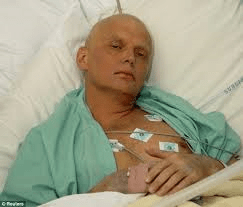
Alexander Litvinenko – Russian President Vladimir Putin “personally ordered” the killing

Panorama: How to poison a spy

Vladimir Putin ‘ordered killing’,

Russian President Vladimir Putin “personally ordered” the killing of Alexander Litvinenko, the inquiry into the former spy’s death has heard.

Ben Emmerson QC, for Mr Litvinenko’s family, said in his closing statement that Russian state responsibility had been proven “beyond reasonable doubt”.

Mr Litvinenko’s widow Marina said she believed her husband’s “murderers and their paymasters” had “been unmasked”.

But the Kremlin told the BBC it did not trust the inquiry.

‘Tinpot despot’

Dissident Mr Litvinenko, 43, drank tea containing a fatal dose of radioactive polonium during a meeting with suspects Dmitry Kovtun and Andrei Lugovoi in London in 2006.

The Kremlin wanted Mr Litvinenko dead and provided theThe Kremlin used to kill him, Mr Emmerson alleged.

Scientific evidence proves Mr Kovtun and Mr Lugovoi killed the former spy, he added.

Alexander Litvinenko
Alexander Litvinenko “vowed to expose corruption”, his widow said outside court

See What Polonium

Alexander Valterovich Litvinenko

Alexander Valterovich Litvinenko (Russian: Алекса́ндр Ва́льтерович Литвине́нко; IPA: [ɐlʲɪˈksandr ˈvaltərəvʲɪtɕ lʲɪtvʲɪˈnʲɛnkə]; 30 August 1962[2][3] [4 December 1962 by father’s account][4] – 23 November 2006) was a fugitive officer of the Russian FSB secret service who specialised in tackling organised crime.[1][5] In November 1998, Litvinenko and several other FSB officers publicly accused their superiors of ordering the assassination of the Russian tycoon and oligarch Boris Berezovsky. Litvinenko was arrested the following March on charges of exceeding the authority of his position. He was acquitted in November 1999 but re-arrested before the charges were again dismissed in 2000. He fled with his family to London and was granted asylum in the United Kingdom, where he worked as a journalist, writer and consultant for the British intelligence services.

During his time in London, Litvinenko wrote two books, Blowing Up Russia: Terror from Within and Lubyanka Criminal Group, wherein he accused the Russian secret services of staging the Russian apartment bombings and other terrorism acts in an effort to bring Vladimir Putin to power. He also accused Putin of ordering the murder in October 2006 of the Russian journalist Anna Politkovskaya.

On 1 November 2006, Litvinenko suddenly fell ill and was hospitalised in what was established as a case of poisoning by radioactive polonium-210 which resulted in his death on 23 November. He became the first known victim of lethal Polonium 210-induced acute radiation syndrome.[6] The events leading up to this are a matter of controversy, spawning numerous theories relating to his poisoning and death. A British murder investigation pointed to Andrey Lugovoy, a member of Russia’s Federal Protective Service, as the prime suspect. Britain demanded that Lugovoy be extradited, which is against the Constitution of Russia, which directly prohibits[7] extradition of Russian citizens without handing Russia any evidence related to the case. Russia denied the extradition, leading to the cooling of relations between Russia and the United Kingdom.

Early life and career

Alexander Litvinenko was born in the Russian city of Voronezh in 1962.[10] After he graduated from a Nalchik secondary school in 1980 he was drafted into the Internal Troops of the Ministry of Internal Affairs as a Private. After a year of service, he matriculated in the Kirov Higher Command School in Vladikavkaz. In 1981, Litvinenko married Nataliya, an accountant, with whom he had a son, Alexander, and a daughter, Sonia. This marriage ended in divorce in 1994 and in the same year Litvinenko married Marina, a ballroom dancer and fitness instructor, with whom he had a son, Anatoly.[11] After graduation in 1985, Litvinenko became a platoon commander in the Dzerzhinsky Division of the Soviet Ministry of Internal Affairs. He was assigned to the 4th Company, where among his duties was the protection of valuable cargo while in transit.[2][12][13] In 1986 he became an informant when he was recruited by the MVD’s KGB counterintelligence section and in 1988 he was officially transferred to the Third Chief Directorate of the KGB, Military Counter Intelligence.[12] Later that year, after studying for a year at the Novosibirsk Military Counter Intelligence School, he became an operational officer and served in KGB military counterintelligence until 1991.[12][14]

Career in Russian security services

In 1991, Litvinenko was promoted to the Central Staff of the Federal Counterintelligence Service, specialising in counter-terrorist activities and infiltration of organised crime. He was awarded the title of “MUR veteran” for operations conducted with the Moscow criminal investigation department, the MUR.[15] Litvinenko also saw active military service in many of the so-called “hot spots” of the former USSR and Russia.[16] During the First Chechen War Litvinenko planted several FSB agents in Chechnya. Although he was often called a “Russian spy” by western press, throughout his career he was not an ‘intelligence agent‘ and did not deal with secrets beyond information on operations against organised criminal groups.[12][17][18]

Litvinenko met Boris Berezovsky in 1994 when he took part in investigations into an assassination attempt on the oligarch. He later began to moonlight for Berezovsky and was responsible for the oligarch’s security.[3][12] Litvinenko’s employment under Berezovsky and other security services personnel was illegal, but the state somewhat tolerated it to retain staff who were at the time underpaid.[3][12] Thus, Litvinenko’s employment for the controversial businessman and others was not investigated. Often such inquiries in Russia were selective and targeted only at those who had stepped out of line.[12]

In 1997, Litvinenko was promoted to the FSB Directorate of Analysis and Suppression of Criminal Groups, with the title of senior operational officer and deputy head of the Seventh Section.[19] According to Dimitri Simes, the Directorate was viewed as much as a part of organised crime as it was of law enforcement.[20]

Claims against FSB leadership

According to Litvinenko’s widow, Marina, while her husband was employed in the FSB he discovered numerous links among members of the top brass of Russian law enforcement agencies and Russian mafia groups, such as the Solntsevo gang. Berezovsky arranged a meeting for him with the Director of the FSB, Mikhail Barsukov, and the Deputy Director of Internal affairs, Vyacheslav Ovchinnikov, to discuss the alleged corruption problems, with no result. This led him to the conclusion that the entire system was corrupt.[21]

In December 1997 Litvinenko claimed he received an order to kill Berezovsky. He did not inform his part-time employer until 20 March 1998.[12][22] According to his widow, on 25 July 1998, the day on which Vladimir Putin replaced Nikolay Kovalyov as the Director of the Federal Security Service, Berezovsky introduced Litvinenko to Putin. Berezovsky claimed that he had helped Putin to take the Director’s position.[23] According to his widow, Litvinenko reported to Putin on corruption in the FSB, but Putin was unimpressed.[23] According to Litvinenko, Putin was involved with a corrupt military general in the Russian army when Putin was a Deputy for Economic Affairs to the Mayor of St. Petersburg. Litvenenko was doing an investigation into the general and Uzbek drug barons and believed that Putin tried to stall the investigation to save his reputation.[24]

On 13 November 1998, Berezovsky wrote an open letter to Putin in Kommersant. He accused heads of the Directorate of Analysis and Suppression of Criminal Groups Major-General Yevgeny Khokholkov, N. Stepanov, A. Kamyshnikov, N. Yenin of ordering his assassination.[25]

Four days later Litvinenko and four other officers appeared together in a press conference at the Russian news agency Interfax. All officers worked for both FSB in the Directorate of Analysis and Suppression of Criminal Groups and for Boris Berezovsky.[12] They repeated the allegation made by Berezovsky.[12][22] The officers also claimed they were ordered to kill Mikhail Trepashkin who was also present at the press conference, and to kidnap a brother of the businessman Umar Dzhabrailov.[26]

In 2007, Sergey Dorenko provided The Associated Press and The Wall Street Journal with a complete copy of an interview he conducted in April 1998 for ORT, a television station, with Litvinenko and his fellow employees. The interview, of which only excerpts were shown in 1998, shows the FSB officers, who were disguised in masks or dark glasses, claim that their bosses had ordered them to kill, kidnap or frame prominent Russian politicians and businesspeople.

Jim Heintz of the Associated Press opined that although Berezovsky does not appear in the interview, he has an omnipresence in it, given that the officers worked for him, and the interview was taped by Dorenko, a Russian journalist who was an employee of ORT owned in part by Berezovsky.[27]

Dismissal from the FSB

After holding the press conference, Litvinenko was dismissed from the FSB.[28] Later, in an interview with Yelena Tregubova, Putin said that he personally ordered the dismissal of Litvinenko, stating, “I fired Litvinenko and disbanded his unit …because FSB officers should not stage press conferences. This is not their job. And they should not make internal scandals public.”[29] Litvinenko also believed that Putin was behind his arrest. He said, “Putin had the power to decide whether to pass my file to the prosecutors or not. He always hated me. And there was a bonus for him: by throwing me to the wolves he distanced himself from Boris [Berezovsky] in the eyes of FSB’s generals.”[30]

Flight from Russia and asylum in the United Kingdom

In October 2000, in violation of an order not to leave Moscow, Litvinenko and his family travelled to Turkey, possibly via Ukraine.[31] While in Turkey, Litvinenko applied for asylum at the United States Embassy in Ankara, but his application was denied.[31] Henry Plater-Zyberk opined that the denial may have been based on possible American opinions that Litvinenko’s knowledge was of little benefit and that he might create problems.[12] With the help of Alexander Goldfarb, Litvinenko bought air tickets for the Istanbul-London-Moscow flight,[32] and asked for political asylum at Heathrow Airport during the transit stop on 1 November 2000.[33] Political asylum was granted on 14 May 2001,[34] not because of his knowledge on intelligence matters, according to Litvinenko, but rather on humanitarian grounds.[12] While in London he became a journalist for Chechenpress and an author. He also joined Berezovsky in campaigning against Putin’s government.[35] In October 2006 he became a naturalised British citizen with residence in Whitehaven.[36]

Cooperation with MI6

In October 2007, the Daily Mail, citing “diplomatic and intelligence sources,” claimed Litvinenko was paid about £2,000 per month by the UK Secret Intelligence Service (MI6) at the time of his murder. John Scarlett, the head of MI6 (who was once based in Moscow), was allegedly personally involved in recruiting him.[17] In May 2008, The Independent opined that whilst Litvinenko’s co-operation with MI6 would likely never be confirmed, an MI6 retainer that he was reported to have been receiving suggested his systematic co-operation.[37]

Litvinenko’s widow, Marina Litvinenko, has stated that her husband co-operated with the British MI6 and MI5, working as a consultant and helping the agencies to combat Russian organised crime in Europe.[38][39]

In February 2012, Litvinenko’s father, Valter, apologised for what he called his personal “slander campaign” against the Russian government. Before the confession by Marina Litvinenko, he had publicly blamed the Russian security services for his son’s death. In an interview Valter Litvinenko said that if he had known at the time that his son was a British intelligence agent, he would not have made such accusations.[40]

During the public inquiry started in January 2015, it was confirmed that Litvinenko was recruited by MI6 as an informant in 2003, two years after he arrived in London, given an encrypted phone and assigned a minder, “Martin”, who had a meeting with Litvinenko the day before he was poisoned.[41]

Alleged threats against Litvinenko

Mikhail Trepashkin, a former FSB officer, stated that in 2002 he had warned Litvinenko that an FSB unit was assigned to assassinate him.[42] In spite of this, Litvinenko often travelled overseas with no security arrangements, and freely mingled with the Russian community in the United Kingdom, and often received journalists at his home.[12][43] In January 2007, the Polish newspaper Dziennik revealed that a target with a photo of Litvinenko on it was used for shooting practice by the Vityaz Training Centre in Balashikha in October 2002.[44] The centre, run by Sergey Lyusyuk, is not affiliated with the government, and trains bodyguards, debt collectors and private security forces,[45] although in November 2006 the centre was used by the Vityaz for a qualification examination due to their own centre being under renovation.[45] The targets, which Lyusyuk says were bought in the Olympic Market, were also photographed when the chairman of the Federation Council of Russia Sergei Mironov visited the centre and met Lyusyuk on 7 November 2006.[44][45] When asked why the photographs of Mironov’s visit were removed from the centre’s website Lyusyuk stated, “(T)hose Poles are up to something” and added that Mironov didn’t see the targets and knew nothing about them.[45]

Allegations of blackmail activities

A series of newspaper articles by Julia Svetlichnaja and James Heartfield based on interviews that they had conducted with Litvinenko were published, beginning 27 hours after Litvinenko’s death with an article in the Daily Telegraph. Eight days later The Observer published an article in which Svetlichnaja alleged that Litvinenko said he was planning to “blackmail or sell sensitive information about all kinds of powerful people, including oligarchs, corrupt officials and sources in the Kremlin”. She said. “He mentioned a figure of £10,000 that they would pay each time to stop him broadcasting these FSB documents”.[46]

Heartfield was a researcher and writer and Svetlichnaja a researcher in political theory and aesthetics, both at the University of Westminster. Their interviews with Litvinenko were source material for an article ‘The Russian Security Service’s Ethnic Division and the Elimination of Moscow’s Chechen Business Class in the 1990s’, published in Critique.[47]

Conviction in Russia

In 2002 Litvinenko was convicted in absentia in Russia and given a three and a half-year jail sentence for charges of corruption.[48][49]

Allegations

Litvinenko regularly told people about his theories relating to the power structures in Russia, and would bombard his contacts with information relating to his theories.[12][43][50] In a report for the Conflict Studies Research Centre, Henry Plater-Zyberk, a lecturer at the Defence Academy of the United Kingdom and Russian politics expert, described Litvinenko as a one-man disinformation bureau, who was at first guided by Berezovsky but later in possible pursuit of attention for himself. Plater-Zyberk notes that Litvinenko made numerous accusations without presenting any evidence to give credence to his claims, and these claims which became increasingly outlandish were often accepted by the British media without question.[12] According to Michael Mainville, Litvinenko knew the secret to a conspiracy theory is that they are based upon an absence of proof, and that the more outlandish the claim, the harder it is to disprove.[50] This has led to some political analysts dismissing his claims as those of a fantasist.[46]

Armenian parliament shooting

Litvinenko accused the Main Intelligence Directorate of the General-Staff of the Russian armed forces of having organised the 1999 Armenian parliament shooting that killed the Prime Minister of Armenia, Vazgen Sargsyan, and seven members of parliament, ostensibly to derail the peace process which would have resolved the Nagorno-Karabakh conflict, but he offered no evidence to support the accusation.[12][51][52] The Russian embassy in Armenia denied any such involvement, and described Litvinenko’s accusation as an attempt to harm relations between Armenia and Russia by people against the democratic reforms in Russia.[53]

Russian apartment bombings

Litvinenko alleged that agents from the FSB coordinated the 1999 Russian apartment bombings that killed more than 300 people, whereas Russian officials blamed the explosions on Islamic terrorists. This version of events was suggested earlier by David Satter.[54]

Moscow theatre hostage crisis

In a 2003 interview with the Australian SBS TV network, and aired on Dateline, Litvinenko claimed that two of the Chechen terrorists involved in the 2002 Moscow theatre siege—whom he named “Abdul the Bloody” and “Abu Bakar”—were working for the FSB, and that the agency manipulated the rebels into staging the attack.[55] Litvinenko said, “[W]hen they tried to find [Abdul the Bloody and Abu Bakar] among the dead terrorists, they weren’t there. The FSB got its agents out. So the FSB agents among Chechens organized the whole thing on FSB orders, and those agents were released.” This echoed similar claims made by Mikhail Trepashkin.[56] The leading role of an FSB agent, Khanpasha Terkibaev (“Abu Bakar”), was also described by Anna Politkovskaya, Ivan Rybkin and Alexander Khinshtein.[57][58][59][60] In the beginning of April 2003 Litvinenko gave “the Terkibaev file” to Sergei Yushenkov when he visited London, who in turn passed it to Anna Politkovskaya.[29] A few days later Yushenkov was assassinated. Terkibaev was later killed in Chechnya. According to Ivan Rybkin, a speaker of the Russian State Duma, “The authorities failed to keep [the FSB agent] Terkibaev out of public view, and that is why he was killed. I know how angry people were, because they knew Terkibaev had authorization from presidential administration.”[61]

Beslan school hostage crisis

Alexander Litvinenko suggested in September 2004 that the Russian secret services must have been aware of the plot beforehand, and therefore that they must have themselves organised the attack as a false flag operation. He spoke in an interview before his death with Chechenpress news agency, and said that because the hostage takers had previously been in FSB custody for committing terrorist attacks, it is inconceivable that they would have been released and still been able to carry out attacks independently. He said that they would only have been freed if they were of use to the FSB, and that even in the case that they were freed without being turned into FSB assets, they would be under a strict surveillance regime that would not have allowed them to carry out the Beslan attack unnoticed.[62] Ella Kesayeva, co-chair of the group Voice of Beslan, formalised Litvinenko’s argument in a November 2008 article in Novaya Gazeta, noting the large number of hostage takers who were in government custody not long before attacking the school, and coming to the same conclusion that Beslan was a false flag attack.[63]

Support of terrorism worldwide by the KGB and FSB

Litvinenko stated that “all the bloodiest terrorists of the world” were connected to FSB-KGB, including Carlos “The Jackal” Ramírez, Yassir Arafat, Saddam Hussein, Abdullah Öcalan, Wadie Haddad of the Popular Front for the Liberation of Palestine, George Hawi who led the Communist Party of Lebanon, Ezekias Papaioannou from Cyprus, Sean Garland from Ireland, and many others. He said that all of them were trained, funded, and provided with weapons, explosives and counterfeit documents to carry out terrorist attacks worldwide and that each act of terrorism made by these people was carried out according to the task and under the rigid control of the KGB of the USSR.[64] Litvinenko said that “the center of global terrorism is not in Iraq, Iran, Afghanistan or the Chechen Republic. The terrorism infection creeps away worldwide from the cabinets of the Lubyanka Square and the Kremlin”.[65][66]

Alleged Russia-al-Qaeda connection

In a July 2005 interview with the Polish newspaper Rzeczpospolita, Litvinenko alleged that Ayman al-Zawahiri, a prominent leader of al-Qaeda, was trained for half a year by the FSB in Dagestan in 1997 and called him “an old agent of the FSB”.[64][67] Litvinenko said that after this training, al-Zawahiri “was transferred to Afghanistan, where he had never been before and where, following the recommendation of his Lubyanka chiefs, he at once … penetrated the milieu of Osama bin Laden and soon became his assistant in Al Qaeda.”[68] Konstantin Preobrazhenskiy, a former KGB officer and writer, supported this claim and said that Litvinenko “was responsible for securing the secrecy of Al-Zawahiri’s arrival in Russia; he was trained by FSB instructors in Dagestan, Northern Caucasus, in 1996–1997.”[69] He said: “At that time, Litvinenko was the Head of the Subdivision for Internationally Wanted Terrorists of the First Department of the Operative-Inquiry Directorate of the FSB Anti-Terrorist Department. He was ordered to undertake the delicate mission of securing Al-Zawahiri from unintentional disclosure by the Russian police. Though Al-Zawahiri had been brought to Russia by the FSB using a false passport, it was still possible for the police to learn about his arrival and report to Moscow for verification. Such a process could disclose Al-Zawahiri as an FSB collaborator. In order to prevent this, Litvinenko visited a group of highly placed police officers to notify them in advance.” According to Sergei Ignatchenko, an FSB spokesman, al-Zawahiri was arrested by Russian authorities in Dagestan in December 1996 and released in May 1997.[70]

When asked in an interview who he thought the originator of the 2005 bombings in London was, Litvinenko responded saying,[64] “You know, I have spoken about it earlier and I shall say now, that I know only one organization, which has made terrorism the main tool of solving of political problems. It is the Russian special services.”

Danish cartoon controversy

According to Litvinenko, the 2005 controversy over the publication in the Danish newspaper Jyllands-Posten of editorial cartoons depicting the Islamic prophet Muhammad was orchestrated by the FSB to punish Denmark for its refusal to extradite Chechen separatists.[50]

Assassination of Anna Politkovskaya

Two weeks before his poisoning, Alexander Litvinenko accused Vladimir Putin of ordering the assassination of the Russian journalist Anna Politkovskaya and stated that a former presidential candidate, Irina Hakamada, warned Politkovskaya about threats to her life coming from the Russian president. Litvinenko advised Politkovskaya to escape from Russia immediately. Hakamada denied her involvement in passing any specific threats, and said that she warned Politkovskaya only in general terms more than a year ago.[71] It remains unclear if Litvinenko referred to an earlier statement made by Boris Berezovsky, who claimed that Boris Nemtsov, a former Russian Deputy Prime Minister, received word from Hakamada that Putin threatened her and like-minded colleagues in person. According to Berezovsky, Putin uttered that Hakamada and her colleagues “will take in the head immediately, literally, not figuratively” if they “open the mouth” about the Russian apartment bombings.[72]

Allegations concerning Romano Prodi

According to Litvinenko, the FSB deputy chief General Anatoly Trofimov said to him, “Don’t go to Italy, there are many KGB agents among the politicians. Romano Prodi is our man there,”[73][74] meaning Romano Prodi, the Italian centre-left leader, former Prime Minister of Italy and former President of the European Commission. The conversation with Trofimov took place in 2000, after the Prodi-KGB scandal broke out in October 1999 due to information about Prodi provided by Vasili Mitrokhin.[75]

In April 2006, a British Member of the European Parliament for London, Gerard Batten of the United Kingdom Independence Party (UKIP), demanded an inquiry into the allegations.[73][74] According to the Brussels-based newspaper The EU Reporter on 3 April 2006, “Another high-level source, a former KGB operative in London, has confirmed the story.”[76] On 26 April 2006, Batten repeated his call for a parliamentary inquiry, revealing that “former senior members of the KGB are willing to testify in such an investigation, under the right conditions.” He added, “It is not acceptable that this situation is unresolved, given the importance of Russia’s relations with the European Union.”[77] On 22 January 2007, the BBC and ITV News released documents and video footage from February 2006, in which Litvinenko repeated his statements about Prodi.[78][79]

A report by the Conflict Studies Research Centre of the Defence Academy of the United Kingdom from May 2007 noted that Trofimov was never the head of the FSB, which did not oversee intelligence operations, had never worked in the intelligence directorate of the KGB or its successor the SVR, nor had he worked in the counterintelligence department of the intelligence services, nor had he ever worked in Italy, making it difficult to understand how Trofimov would have had knowledge about such a recruitment. Henry Plater-Zyberk, the co-author of the report, suggested that Trofimov was “conveniently dead,” so “could neither confirm nor deny the story,” and noted Litvinenko’s history of making accusations without evidence to back them up.[12]

Cooperation with Spanish authoritie

Shortly before his death Litvinenko tipped off Spanish authorities on several organised crime bosses with links to Spain. During a meeting in May 2006 he allegedly provided security officials with information on the locations, roles, and activities of several “Russian” mafia figures with ties to Spain, including Zahkar Kalashov, Izguilov and Tariel Oniani.[80]

Other allegations

In his book Gang from Lubyanka, Litvinenko alleged that Vladimir Putin during his time at the FSB was personally involved in protecting the drug trafficking from Afghanistan organised by Abdul Rashid Dostum.[81] In December 2003 Russian authorities confiscated over 4000 copies of the book.[82]

Litvinenko commented on a new law that “Russia has the right to carry out preemptive strikes on militant bases abroad” and explained that these “preemptive strikes may involve anything except nuclear weapons.” Litvinenko said, “You know who they mean when they say ‘terrorist bases abroad’? They mean us, Zakayev and Boris and me.”[29] He also said that “It was considered in our service that poison is an easier weapon than a pistol.” He referred to a secret laboratory in Moscow that still continues development of deadly poisons, according to him.[83]

In an article written by Litvinenko in July 2006, and published online on Zakayev’s Chechenpress website, he claimed that Vladimir Putin is a paedophile.[84] Litvinenko also claimed that Anatoly Trofimov and Artyom Borovik knew of the alleged paedophilia.[85] The claims have been called “wild”[43] and “sensational and unsubstantiated”[86] in the British media. Litvinenko made the allegation after Putin kissed a boy on his stomach while stopping to chat with some tourists during a walk in the Kremlin grounds on 28 June 2006. The incident was recalled in a webcast organised by the BBC and Yandex, in which over 11,000 people asked Putin to explain the act, to which he responded, “He seemed very independent and serious… I wanted to cuddle him like a kitten and it came out in this gesture. He seemed so nice. … There is nothing behind it.”[87]

Shortly before his death, Alexander Litvinenko alleged that Vladimir Putin had cultivated a “good relationship” with Semion Mogilevich (head of the Russia mafia) since 1993 or 1994.[88]

Poisoning and death

See What Polonium

Alexander Litvinenko at University College Hospital

On 1 November 2006, Litvinenko suddenly fell ill and was hospitalised. His illness was later attributed to poisoning with radionuclide polonium-210 after the Health Protection Agency found significant amounts of the rare and highly toxic element in his body.

In interviews, Litvinenko stated that he met with two former KGB agents early on the day he fell ill – Dmitry Kovtun and Andrei Lugovoy. Though both denied any wrongdoing, a leaked US diplomatic cable revealed that Kovtun had left polonium traces in the house and car he had used in Hamburg.[89] The men also introduced Litvinenko to a tall, thin man of central Asian appearance called ‘Vladislav Sokolenko’ whom Lugovoy said was a business partner. Lugovoy is also a former bodyguard of Russian ex-Acting Prime minister Yegor Gaidar (who also suffered from a mysterious illness in November 2006). Later, Litvinenko had lunch at Itsu, a sushi restaurant in Piccadilly in London, with an Italian acquaintance and nuclear waste expert, Mario Scaramella, to whom he made the allegations regarding Italy’s Prime Minister Romano Prodi.[90] Scaramella, attached to the Mitrokhin Commission investigating KGB penetration of Italian politics, claimed to have information on the assassination of Anna Politkovskaya, 48, a journalist who was killed at her Moscow apartment in October 2006.

Marina Litvinenko, his widow, accused Moscow of orchestrating the murder. Though she believes the order did not come from Putin himself, she does believe it was done at the behest of the authorities, and announced that she will refuse to provide evidence to any Russian investigation out of fear that it would be misused or misrepresented.[91]

Death and last statement

On 22 November 2006, Litvinenko’s medical staff at University College Hospital reported he had suffered a “major setback” due to either heart failure or an overnight heart attack. He died on 23 November. Scotland Yard stated that inquiries into the circumstances of how Litvinenko became ill would continue.[92]

On 24 November 2006, a posthumous statement was released, in which Litvinenko named Putin as the man behind his poisoning.[93] Litvinenko’s friend Alex Goldfarb, who was also the chairman of Boris Berezovsky‘s Civil Liberties Fund, claimed Litvinenko had dictated it to him three days earlier. Andrei Nekrasov said his friend Litvinenko and Litvinenko’s lawyer had composed the statement in Russian on 21 November and translated it to English.[94]

Litvinenko’s grave at Highgate Cemetery in 2007.

Putin disputed the authenticity of this note while attending a Russia-EU summit in Helsinki and claimed it was being used for political purposes.[95] Goldfarb later stated that Litvinenko, on his deathbed, had instructed him to write a note “in good English” in which Putin was to be accused of his poisoning. Goldfarb also stated that he read the note to Litvinenko in English and Russian and Litvinenko agreed “with every word of it” and signed it.[93]

Litvinenko’s grave in 2014.

His autopsy took place on 1 December at the Royal London Hospital’s institute of pathology. It was attended by three physicians, including one chosen by the family and one from the Foreign Office.[96] Litvinenko was buried at Highgate Cemetery (West side) in north London on 7 December.[97] The police are treating his death as murder, although the London coroner’s inquest is yet to be completed.[98][99] On 25 November, two days after Litvinenko’s death, an article attributed to him was published by The Mail on Sunday entitled “Why I believe Putin wanted me dead”.[100]

In an interview with the BBC broadcast on 16 December 2006, Yuri Shvets said that Litvinenko had created a ‘due diligence‘ report investigating the activities of an unnamed senior Kremlin official on behalf of a British company looking to invest “dozens of millions of dollars” in a project in Russia, and that the dossier contained damaging information about the senior Kremlin official. He said he was interviewed about his allegations by Scotland Yard detectives investigating Litvinenko’s murder.[101] British media reported that the poisoning and consequent death of Litvinenko was not widely covered in the Russian news media.[102]

On 7 December 2006, he was buried at Highgate Cemetery, a Muslim prayer being said by an imam invited by Akhmed Zakayev, contrary to his wife’s wishes of a non-denominational service at the grave.[103]

Theories and investigations into death

UK criminal investigation

On 20 January 2007 British police announced that they had “identified the man they believe poisoned Alexander Litvinenko. The suspected killer was captured on cameras at Heathrow as he flew into Britain to carry out the murder.”[104] The man in question was introduced to Litvinenko as “Vladislav.”

As of 26 January 2007, British officials said police had solved the murder of Litvinenko. They discovered “a ‘hot’ teapot at London’s Millennium Hotel with an off-the-charts reading for polonium-210, the radioactive material used in the killing.” In addition, a senior official said investigators had concluded the murder of Litvinenko was “a ‘state-sponsored’ assassination orchestrated by Russian security services.” The police want to charge former Russian spy Andrei Lugovoy, who met Litvinenko on 1 November 2006, the day officials believe the lethal dose of polonium-210 was administered.[105]

On the same day, The Guardian reported that the British government was preparing an extradition request asking that Andrei Lugovoy be returned to the UK to stand trial for Litvinenko’s murder.[106] On 22 May 2007 the Crown Prosecution Service called for the extradition of Russian citizen Andrei Lugovoy to the UK on charges of murder.[107] Lugovoy dismissed the claims against him as “politically motivated” and said he did not kill Litvinenko.[108]

A British police investigation resulted in several suspects for the murder, but in May 2007, the British Director of Public Prosecutions, Ken Macdonald, announced that his government would seek to extradite Andrei Lugovoy, the chief suspect in the case, from Russia.[109] On 28 May 2007, the British Foreign Office officially submitted a request to the Government of Russia for the extradition of Lugovoy to face criminal charges in the UK.[110]

On 2 October 2011, The Sunday Times published an article wherein the chief prosecutor who investigated the murder of Litvinenko, Lord Macdonald of River Glaven, publicly spoke of his suspicion that the murder was a “state directed execution” carried out by Russia. Until that time, British public officials had stopped short of directly accusing Russia of involvement in the poisoning. “It had all the hallmarks of a state directed execution, committed on the streets of London by a foreign government,” Macdonald added.[111]

In January 2015, it was reported in the UK media that the National Security Agency had intercepted communications between Russian government agents in Moscow and those who carried out what was called a “state execution” in London: the recorded conversations allegedly proved that the Russian government was involved in Litvinenko’s murder, and suggested that the motive was Litvinenko’s revelations about Vladimir Putin’s links with the criminal underworld.[112]

Russian criminal investigation

Many publications in Russian media suggested that the death of Alexander Litvinenko was connected to Boris Berezovsky.[113][114] Former FSB chief Nikolay Kovalyov, for whom Litvinenko worked, said that the incident “looks like the hand of Boris Berezovsky. I am sure that no kind of intelligence services participated.”[115] This involvement of Berezovsky was alleged by numerous Russian television shows. Kremlin supporters saw it as a conspiracy to smear Russian government’s reputation by engineering a spectacular murder of a Russian dissident abroad.[116]

After Litvinenko’s death, traces of polonium-210 were found in an office of Berezovsky.[117] Litvinenko had visited Berezovsky’s office as well as many other places in the hours after his poisoning.[118] The British Health Protection Agency made extensive efforts to ensure that locations Litvinenko visited and anyone who had contact with Litvinenko after his poisoning, were not at risk.[119]

Russian prosecutors were not allowed to investigate the office.[120] Russian authorities have also been unable to question Berezovsky. The Foreign Ministry complained that Britain was obstructing its attempt to send prosecutors to London to interview more than 100 people, including Berezovsky.[121]

On 5 July 2007, Russia officially declined to extradite Lugovoy, citing Article 61 of the Constitution of Russia that prohibits extradition of citizens. Russia has said that they could take on the case themselves if Britain provided evidence against Lugovoy but Britain has not handed over any evidence. The head of the investigating committee at the General Prosecutor’s Office said Russia has not yet received any evidence from Britain on Lugovoy. “We have not received any evidence from London of Lugovoy’s guilt, and those documents we have are full of blank spaces and contradictions.[122] However the British ambassador to Russia, Anne Pringle, claimed that London has already submitted sufficient evidence to extradite him to Britain.[123]

Judicial inquiries

Inquest in London

On 13 October 2011, Dr. Andrew Reed, the Coroner of St. Pancras, announced that he would hold an inquest into Litvinenko’s death, which would include the examination of all existing theories of the murder, including possible complicity of the Russian government.[124] The inquest, held by Sir Robert Owen, a High Court judge acting as the coroner, originally scheduled to start on 1 May 2013, was subject to a series of pre-hearings: firstly, the coroner agreed that a group representing Russian state prosecutors could be accepted as a party to the inquest process; secondly, the British Government submitted a Public Interest Immunity (PII) certificate. Under Public Interest Immunity (PII) claims, the information at the disposal of the UK government relating to Russian state involvement, as well as how much British intelligence services could have done to prevent the death, would be excluded from the inquest.[125]

On 12 July 2013, Sir Robert, who had previously agreed to exclude certain material from the inquest on the grounds its disclosure could be damaging to national security, announced that the British Government refused the request he had made earlier in June to replace the inquest with a public inquiry, which would have powers to consider secret evidence.[8][126] After the hearing, Alex Goldfarb said: “There’s some sort of collusion behind the scenes with Her Majesty’s government and the Kremlin to obstruct justice”; Elena Tsirlina, Mrs Litvinenko’s solicitor, concurred with him.[8][126]

On 22 July 2014, the UK Home Secretary Theresa May, who had previously ruled out an inquiry on the grounds it might damage the country’s relations with Moscow,[9] announced a public enquiry into Litvinenko’s death. The enquiry is chaired by Sir Robert Owen who was the Coroner in the inquest into Litvinenko’s death; its remit stipulated that “the inquiry will not address the question of whether the UK authorities could or should have taken steps which would have prevented the death”.[127][128] The inquiry started on 27 January 2015.[9] New evidence emerged at first hearings held at the end of January 2015.[41]

Litvinenko vs Russian Federation in Strasbourg

In May 2007 Marina Litvinenko registered a complaint against the Russian Federation in the European Court of Human Rights in Strasbourg accusing RF of violating her husband’s right to life, and failing to conduct a full investigation.[129]

After Litvinenko’s death, his widow, Marina, pursued a vigorous campaign on behalf of her husband through the Litvinenko Justice Foundation. In October 2011, she won the right for an inquest into her husband’s death to be conducted by a coroner in London; the inquest was repeatedly set back by issues relating to examinable evidence.[8] A public enquiry began on 27 January 2015.[9]

See What Polonium

Miami Showband Killings – The Day The Music Died

Miami Showband Killing

The Miami Showband killings (also called the Miami Showband Massacre) was an attack by the Ulster Volunteer Force (UVF), a loyalist paramilitary group, on 31 July 1975. It took place on the A1 road at Buskhill in County Down, Northern Ireland. Five people were killed, including three members of The Miami Showband, who were then one of Ireland’s most popular cabaret bands.

The Day The Music Died

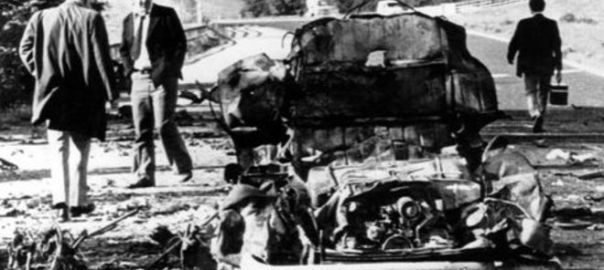
The band was travelling home to Dublin late at night after a performance in Banbridge. Seven miles (11 km) north of Newry, their minibus was stopped at what appeared to be a military checkpoint, where gunmen in British Army uniforms ordered them to line up by the roadside. At least four of the gunmen were serving soldiers from the British Army’s Ulster Defence Regiment (UDR) but, unbeknownst to the band, all were members of the UVF. While two of the gunmen (both soldiers) were hiding a time bomb on the minibus, it exploded prematurely and killed them.

It has been suggested that the plan had been for it to explode en route and kill the band, who would be branded IRA bomb smugglers. The other gunmen then opened fire on the dazed band members, killing three and wounding two.

Two serving British soldiers and one former British soldier were found guilty of the murders and received life sentences; they were released in 1998. Allegations of collusion between British military intelligence and the loyalist militants persist. According to former Secret Intelligence Service (SIS) agent Captain Fred Holroyd, the killings were organised by British Army Captain Robert Nairac (a member of 14th Intelligence Company), in collaboration with the UVF’s Mid-Ulster Brigade and its commander Robin “The Jackal” Jackson.

Robin Jackson.jpg

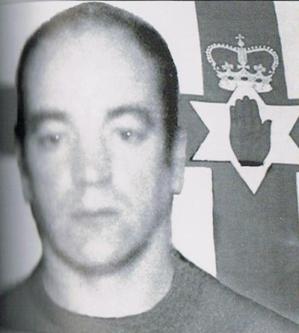
Robin ( The Jackal)  Jackson

The Historical Enquiries Team, which investigated the killings, released their report to the victims’ families in December 2011. It confirmed that Jackson was linked to the attack by fingerprints. There are claims that those involved in the Miami Showband killings belonged to the Glenanne gang; a secret alliance of loyalist militants, rogue police officers and British soldiers.

In a report published in the Sunday Mirror in 1999, Colin Wills called the Miami Showband attack “one of the worst atrocities in the 30-year history of the Troubles”. Irish Times diarist Frank McNally summed up the massacre as “an incident that encapsulated all the madness of the time”

Disclaimer

The views and opinions expressed in this post and page are soley intended to educate and provide background information to those interested in the Troubles of Northern Ireland.

They in no way reflect my own opinions and I take no responsibility for any inaccuracies or factual errors

Background

Political situation in Northern Ireland

UVF-logo123.png

The conflict in Northern Ireland, known as “The Troubles“, began in the late 1960s. The year 1975 was marked by an escalation in sectarian attacks and a vicious feud between the two main loyalist paramilitary groups, the Ulster Volunteer Force (UVF) and the Ulster Defence Association (UDA). On 4 April 1974 the proscription against the UVF had been lifted by Merlyn Rees, Secretary of State for Northern Ireland. This meant that both it and the UDA were legal organisations.

The UVF would be once more banned by the British government on 3 October 1975.

In May 1974 unionists called a general strike to protest against the Sunningdale Agreement – an attempt at power-sharing, setting up a Northern Ireland Executive and a cross-border Council of Ireland, which would have given the Government of Ireland a voice in running Northern Ireland. During that strike on 17 May, the UVF carried out the Dublin and Monaghan car bombings, which killed 33 civilians. The Provisional IRA were suspected by British police of bombing two pubs in the English city of Birmingham the following November, resulting in 21 deaths.

UK Home Secretary Roy Jenkins introduced the Prevention of Terrorism Act, which gave the government unprecedented powers against the liberty of individuals in the United Kingdom in peacetime. At Christmas 1974 the IRA declared a ceasefire, which theoretically lasted throughout most of 1975. This move made loyalists apprehensive and suspicious that a secret accord was being conducted between the British government and the IRA, and that Northern Ireland’s Protestants would be “sold out”.

Their fears were slightly grounded in fact, as the MI6 officer Michael Oatley was involved in negotiations with a member of the IRA Army Council, during which “structures of disengagement” from Ireland were discussed. This had meant the possible withdrawal of British troops from Northern Ireland. The existence of these talks led unionists to believe that they were about to be abandoned by the British government and forced into a united Ireland; as a result, the loyalist paramilitary groups reacted with a violence that, combined with the tit-for-tat retaliations from the IRA (despite their ceasefire), made 1975 one of the “bloodiest years of the conflict”.

In early 1975 Merlyn Rees set up elections for the Northern Ireland Constitutional Convention at which all of Northern Ireland’s politicians would plan their way forward. These were held on 1 May 1975 and the United Ulster Unionist Council (UUUC), which had won 11 out of 12 Northern Irish seats in the February 1974 general election, won a majority again. As the UUUC would not abide any form of power-sharing with the Dublin government, no agreement could be reached and the convention failed, again marginalising Northern Ireland’s politicians and the communities they represented

Robin Jackson and the Mid-Ulster UVF


refer to caption

Ulster Volunteer Force mural.

The UVF’s Mid-Ulster Brigade, led by Robin Jackson, was one of the most ruthless paramilitary groups that operated in the 1970s.

The UVF Mid-Ulster Brigade operated mainly around the Portadown and Lurgan areas. It had been set up in Lurgan in 1972 by part-time Ulster Defence Regiment (UDR) sergeant and permanent staff instructor Billy Hanna, who made himself commander of the brigade. His leadership was endorsed by the UVF’s leader Gusty Spence.

The brigade was described by author Don Mullan as one of the most ruthless units operating in the 1970s. At the time of the attack the Mid-Ulster Brigade was commanded by Robin Jackson, also known as “The Jackal”. Jackson had assumed command of the Mid-Ulster UVF just a few days before the Miami Showband attack, after allegedly shooting Hanna dead outside his home in Lurgan on 27 July 1975.

According to authors Paul Larkin and Martin Dillon, Jackson was accompanied by Harris Boyle when he killed Hanna. Hanna was named by former British Intelligence Corps operative Colin Wallace as having organised and led the 1974 Dublin and Monaghan bombings, along with Jackson.  Journalist Joe Tiernan suggested that Hanna was shot for refusing to participate in the Miami Showband attack and that he had become an informer for the Gardaí in exchange for immunity from prosecution for the Dublin bombings.  Dillon suggested that because a large number of joint UDR/UVF members were to be used for the planned Miami Showband ambush, Hanna was considered to have been a “security risk”, and the UVF decided he had to be killed before he could alert the authorities.

Jackson was an alleged RUC Special Branch agent who was said by Yorkshire Television‘s The Hidden Hand: The Forgotten Massacre programme to have had links to both the Intelligence Corps and Captain Robert Nairac.  A report in the Irish Times implicated Jackson in the Dublin bombings. More than 100 killings have been attributed to him by the Pat Finucane Centre, the Derry-based civil rights group.

The Miami Showband


refer to caption

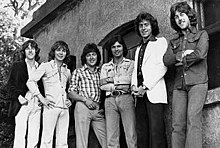
The Miami Showband in 1975; one of the last photos of the band before the attack
L–R: Tony Geraghty, Fran O’Toole, Ray Millar, Des McAlea (“Des Lee”), Brian McCoy, Stephen Travers

The Miami Showband was a popular Dublin-based cabaret band, enjoying fame and, according to journalist Peter Taylor, “Beatle-like devotion” from fans on both sides of the Irish border. A typical Irish showband was based on the popular six- or seven-member dance band. Its basic repertoire included cover versions of pop songs that were currently in the charts and standard dance numbers. The music ranged from rock and country and western to Dixieland jazz. Sometimes the showbands played traditional Irish music at their performances.

Originally called the Downbeats Quartet, the Miami Showband was reformed in 1962 by rock promoter Tom Doherty, who gave them their new name. With Dublin-born singer Dickie Rock as frontman, the Miami Showband underwent many personnel changes over the years. In December 1972, Rock left the band to be briefly replaced by two brothers, Frankie and Johnny Simon. That same year keyboardist Francis “Fran” O’Toole (from Bray, County Wicklow) had won the Gold Star Award on RTÉ‘s Reach For the Stars television programme.


In early 1973, Billy MacDonald (aka “Billy Mac”) took over as the group’s frontman when the Simon brothers quit the band. The following year, Fran O’Toole became the band’s lead vocalist after Mick Roche (Billy Mac’s replacement) was sacked. O’Toole was noted for his good looks and popularity with female fans.  was described by the Miami Showband’s former bass guitarist, Paul Ashford, as having been the “greatest soul singer” in Ireland. Ashford had been asked to leave the band in 1973, for complaining that performing in Northern Ireland put their lives at risk.

He was replaced by Johnny Brown, who in turn was replaced by Dave Monks until Stephen Travers eventually became the band’s permanent bass player. In late 1974, the Miami Showband’s song Clap Your Hands and Stomp Your Feet (featuring O’Toole on lead vocals) reached number eight in the Irish charts.

The 1975 line-up comprised four Catholics and two Protestants. They were: lead vocalist and keyboard player Fran O’Toole (28, Catholic), guitarist Anthony “Tony” Geraghty (24, Catholic) from Dublin, trumpeter Brian McCoy (32, Protestant) from Caledon, County Tyrone, saxophonist Des McAlea (aka “Des Lee”), 24, a Catholic from Belfast, bassist Stephen Travers (24, Catholic) from Carrick-on-Suir, County Tipperary and drummer Ray Millar (Protestant) from Antrim. O’Toole and McCoy were both married; each had two children. Geraghty was engaged to be married.

Their music was described as “contemporary and trans-Atlantic”, with no reference to the Northern Ireland conflict. By 1975 they had gained a large following, playing to crowds of people in dance halls and ballrooms across the island.The band had no overt interest in politics nor in the religious beliefs of the people who made up their audience. They were prepared to travel anywhere in Ireland to perform for their fans.

According to the Irish Times, at the height of the Irish showband’s popularity (from the 1950s to the 1970s), up to as many as 700 bands travelled to venues all over Ireland on a nightly basis.

Ambush

Bogus checkpoint

refer to caption

Volkswagen Type 2 (T2)
similar to the minibus used by the band


Five members of the Dublin-based band were travelling home after a performance at the Castle Ballroom in Banbridge, County Down on Thursday 31 July 1975. Ray Millar, the band’s drummer, was not with them as he had chosen to go to his home town of Antrim to spend the night with his parents. The band’s road manager, Brian Maguire, had already gone ahead a few minutes earlier in the equipment van. At about 2.30 a.m., when the band was seven miles (11 km) north of Newry on the main A1 road, their Volkswagen minibus (driven by trumpeter Brian McCoy with Stephen Travers in the front seat beside him) reached the townland of Buskhill.

Near the junction with Buskhill Road they were flagged down by armed men dressed in British Army uniforms waving a red torch in a circular motion. During “The Troubles” it was normal for the British Army to set up checkpoints daily, at any time.

Assuming it was a legitimate checkpoint, McCoy informed the others inside the minibus of a military checkpoint up ahead and pulled in at the lay-by as directed by the armed men.

As McCoy rolled down the window and produced his driving licence, gunmen came up to the minibus and one of them said in a Northern Irish accent,

“Goodnight, fellas. How are things? Can you step out of the van for a few minutes and we’ll just do a check”.

The unsuspecting band members got out and were politely told to line up facing the ditch at the rear of the minibus with their hands on their heads.  More uniformed men appeared from out of the darkness, their guns pointed at the minibus. About 10 gunmen were at the checkpoint, according to author and journalist Martin Dillon.

After McCoy told them they were the Miami Showband, one gunman, Thomas Crozier (who had a notebook) asked the band members for their names and addresses, while the others bantered with them about the success of their performance that night.

As Crozier took down the information, a car pulled up and another uniformed man appeared on the scene. He wore a uniform and beret noticeably different from the others. He spoke with an educated English accent and immediately took charge, ordering a man who appeared to have been the leader of the patrol, to tell Crozier to obtain their names and dates of birth instead of addresses.

The jocular mood of the gunmen abruptly ceased. At no time did this new soldier speak to any of the band members nor did he directly address Crozier. He relayed all his instructions to the gunman in command.  Travers, the band’s new bass player, assumed he was a British Army officer; an opinion shared by McCoy. Just after the arrival of this mysterious soldier, McCoy nudged Travers, who was standing beside him, and reassured him by saying “Don’t worry Stephen, this is British Army”.  Travers thought that McCoy, a Protestant from Northern Ireland, was familiar with security checkpoints and had reckoned the regular British Army would be more efficient than the Ulster Defence Regiment (UDR), who had a reputation for unprofessional and unpredictable behaviour especially towards people from the Irish Republic.

McCoy, son of the Orange Order‘s Grand Master for County Tyrone,  had close relatives in the security forces; his brother-in-law was a former member of the B Specials which had been disbanded in 1970. Travers described McCoy as a “sophisticated, father-type figure. Everybody was respectful to Brian”. McCoy’s words, therefore, were taken seriously by the other band members, and anything he said was considered to be accurate.

Explosion


At least four of the gunmen were soldiers from the UDR; a locally recruited infantry regiment of the British Army in Northern Ireland. Martin Dillon suggested, in The Dirty War, that at least five serving UDR soldiers were present at the checkpoint.

All the gunmen were members of the UVF’s Mid-Ulster Brigade, and had been lying in wait to ambush the band having set up the checkpoint just minutes before.

Out of sight of the band members, two of the gunmen placed a ten-pound (4.5 kg) time bomb in the rear of the minibus.  The UVF’s plan was that the bomb would explode once the minibus had reached Newry, killing all on board. However, Martin Dillon alleged that the bomb was meant to go off in the Irish Republic.

He suggested that had all gone according to plan, the loyalist extremists would have been able to clandestinely bomb the Republic of Ireland, yet claim that the band were republican bomb-smugglers carrying explosives on behalf of the IRA. They had hoped to embarrass the Government of Ireland, as well as to draw attention to its under-patrolled border. This would have resulted in the Irish authorities enforcing tighter controls over people crossing the border, thus greatly restricting IRA operations.

Dillon opined that another reason the UVF decided to target the Miami Showband was because the nationalist community held them in high regard; to attack the band was to strike the nationalists indirectly.

Stephen Travers heard the gunmen rummaging in the back of the minibus, where he kept his guitar. Concerned it may be damaged, he approached the two gunmen and told them to be careful. Asked whether he had anything valuable inside the case, Travers replied no. The gunman turned him round, punched him in the back and pushed him on the shoulder back into the line-up.

When the two gunmen closed the rear door, clumsy soldering on the clock used as a timer caused the device to explode prematurely, blowing the minibus apart and killing the gunmen Harris Boyle (aged 22, a telephone wireman from Portadown) and Wesley Somerville (aged 34, a textile worker from Moygashel) instantly. Hurled in opposite directions, they were both decapitated and their bodies dismembered. What little that remained intact of their bodies was burnt beyond recognition; one of the limbless torsos was completely charred.

Shootings

refer to caption

Luger P08 pistol
similar to the one used to kill Brian McCoy

Following the explosion, the remaining gunmen opened fire on the dazed band members, who had all been knocked down into the field below the level of the road from the force of the blast. The order to shoot was given by the patrol’s apparent leader, James McDowell, to eliminate witnesses to the bogus checkpoint and subsequent bombing. Three of the musicians were killed: lead singer Fran O’Toole, trumpeter Brian McCoy, and guitarist Tony Geraghty.

Brian McCoy was the first to die, having been hit in the back by nine rounds from a 9mm Luger pistol in the initial volley of gunfire.  Fran O’Toole attempted to run away, but was quickly chased down by the gunmen who had immediately jumped down into the field in pursuit. He was then machine-gunned 22 times, mostly in the face, as he lay supine on the ground. Tony Geraghty also attempted to escape; but he was caught by the gunmen and shot at least four times in the back of the head and back. Both men had pleaded for their lives before they were shot; one had cried out,

“Please don’t shoot me, don’t kill me”.


Bassist Stephen Travers was seriously wounded by a dum-dum bullet which had struck him when the gunmen had first begun shooting.

He survived by pretending he was dead, as he lay beside the body of McCoy.Saxophone player Des McAlea was hit by the minibus’s door when it was blown off in the explosion, but was not badly wounded. He lay hidden in thick undergrowth, undetected by the gunmen. He also survived. However, the flames from the burning hedge (which had been set on fire by the explosion) soon came dangerously close to where he lay; he was forced to leave his hiding spot. By this time the gunmen had left the scene, assuming everyone else had been killed. Travers later recalled hearing one of the departing gunmen tell his comrade who had kicked McCoy’s body to make sure he was not alive: “Come on, those bastards are dead. I got them with dum-dums”.

McAlea made his way up the embankment to the main road where he hitched a lift to alert the RUC at their barracks in Newry.

Forensic and ballistic evidence


When the RUC arrived at the site they found five dead bodies, a seriously injured Stephen Travers, body parts, the smouldering remains of the destroyed minibus, debris from the bomb blast, bullets, spent cartridges, and the band members’ personal possessions, including clothing, shoes, and a photograph of the group, strewn across the area. They also discovered a stolen white Ford Escort registration number 4933 LZ, which had been left behind by the gunmen, along with two guns, ammunition, green UDR berets and a pair of glasses later traced to James McDowell, the gunman who had ordered the shootings.

One of the first RUC men who arrived at Buskhill in the wake of the killings was scenes of crime officer James O’Neill. He described the scene as having “just the smell of utterly death about the place … burning blood, burning tyres”. He also added that “that bomb was definitely placed there with a view to killing all in that band”.

The only identifiable body part from the bombers to survive the blast (which had been heard up to four miles away) was a severed arm belonging to Wesley Somerville. It was found 100 yards from the site with a “UVF Portadown” tattoo on it.

refer to caption

Sterling submachine gun
similar to the those used in the attack


The RUC’s investigative unit, the Assassination or “A” Squad of detectives, was set up to investigate the crime and to discover the identities of the UVF gunmen who perpetrated the killings.  Afterwards, as Travers recovered in hospital, the second survivor Des McAlea gave the police a description of McDowell as the gunman with a moustache and wearing dark glasses who appeared to have been the leader of the patrol. Some time after the attack, RUC officers questioned Stephen Travers at Dublin Castle. He subsequently stated they refused to accept his description of the different-coloured beret worn by the soldier with the English accent.

The UVF gunmen had worn green UDR berets, whereas the other man’s had been lighter in colour.

The dead bombers were named by the UVF, in a statement issued within 12 hours of the attack.  Harris Boyle and Wesley Somerville were UDR soldiers as well as holding the rank of major and lieutenant, respectively, in the UVF.

In 1993 Boyle was named by The Hidden Hand programme as one of the Dublin car bombers.

The stolen Ford Escort belonged to a man from Portadown, who according to Captain Fred Holroyd, had links with one of the UVF bombers and the driver of the bomb car which had been left to explode in Parnell Street, Dublin on 17 May 1974. He was also one of the prime suspects in the sectarian killing of Dorothy Traynor on 1 April 1975 in Portadown.

Ballistic evidence indicates that the 10-member gang took at least six guns with them on the attack.  An independent panel of inquiry commissioned by the Pat Finucane Centre has established that among the weapons actually used in the killings were two Sterling 9mm submachine guns and a 9mm Luger pistol serial no. U 4. The submachine guns, which had been stolen years earlier from a former member of the B Specials, were linked to prior and later sectarian killings, whereas the Luger had been used to kill leading IRA member, John Francis Green, the previous January.


In a letter to the Independent Commission of Inquiry into the Bombing of Kay’s Tavern dated 22 February 2004, the Northern Ireland Office stated that: “The PSNI [The Police Service of Northern Ireland] have confirmed that a 9mm Luger pistol was ballistically traced both to the murder of John Francis Green and to the Miami Showband murders.”

In May 1976, Robin Jackson’s fingerprints were discovered on the metal barrel of a home-made silencer constructed for a Luger.[53] Both the silencer and pistol – which was later established to have been the same one used in the Miami Showband killings – were found by the security forces at the home of Edward Sinclair. Jackson was charged with possession of the silencer but not convicted, the trial judge having reportedly said: “At the end of the day I find that the accused somehow touched the silencer, but the Crown evidence has left me completely in the dark as to whether he did that wittingly or unwittingly, willingly or unwillingly”. The Luger was destroyed by the RUC on 28 August 1978.[54]

Aftermath

Reactions

Within 12 hours of the attack the UVF’s Brigade Staff (Belfast leadership) issued a statement. It was released under the heading Ulster Central Intelligence Agency – Miami Showband Incident Report:

A UVF patrol led by Major Boyle was suspicious of two vehicles, a minibus and a car parked near the border. Major Boyle ordered his patrol to apprehend the occupants for questioning. As they were being questioned, Major Boyle and Lieutenant Somerville began to search the minibus. As they began to enter the vehicle, a bomb was detonated and both men were killed outright.

At the precise moment of the explosion, the patrol came under intense automatic fire from the occupants of the other vehicle. The patrol sergeant immediately ordered fire to be returned. Using self-loading rifles and sub-machine guns, the patrol returned fire, killing three of their attackers and wounding another. The patrol later recovered two Armalite rifles and a pistol.

The UVF maintains regular border patrols due to the continued activity of the Provisional IRA. The Mid-Ulster Battalion has been assisting the South Down-South Armagh units since the IRA Forkhill boobytrap which killed four British soldiers. Three UVF members are being treated for gunshot wounds after last night but not in hospital.

It would appear that the UVF patrol surprised members of a terrorist organisation transferring weapons to the Miami Showband minibus and that an explosive device of some description was being carried by the Showband for an unlawful purpose. It is obvious, therefore, that the UVF patrol was justified in taking the action it did and that the killing of the three Showband members should be regarded as justifiable homicide. The Officers and Agents of the Ulster Central Intelligence Agency commend the UVF on their actions and tender their deepest sympathy to the relatives of the two Officers who died while attempting to remove the bomb from the minibus.

Harris Boyle and Wesley Somerville were given UVF paramilitary funerals conducted by Free Presbyterian minister William McCrea, a Democratic Unionist Party (DUP) politician.[

The killings shocked both Northern Ireland and Ireland and put a serious strain on Anglo-Irish relations.

The Irish Times reported that on the night following the attack, the British ambassador Sir Arthur Galsworthy was summoned to hear the Government of Ireland’s strong feelings regarding the murder of the three band members. The government held the view that the British Government had not done enough to stop sectarian assassinations in Northern Ireland.

Following the post-mortems, funerals were held for the three slain musicians; they received televised news coverage by RTÉ, Ireland’s public service broadcaster. According to RTÉ,

“Their families were in deep mourning and Ireland mourned with them”.

According to Peter Taylor, the Provisional IRA’s gun and bomb attack on the loyalist Bayardo Bar in Belfast’s Shankill Road on 13 August was in retaliation for the Miami Showband ambush. Four Protestant civilians (two men and two women) and UVF member Hugh Harris were killed in the attack.

Two days later, Portadown disc jockey Norman “Mooch” Kerr, aged 28, was shot dead by the IRA as he packed up his equipment after a show at the Camrick Bar in Armagh. Although not a member of any loyalist paramilitary group, he was a close friend of Harris Boyle and the two were often seen together.


Robert Nairac

See Robert Nairac

The IRA said it killed him because of an alleged association with British Army officer and member of 14th Intelligence Company, Captain Robert Nairac, and claimed it was in possession of his diary, which had been stolen in Portadown.

Altnamachin attack

Less than one month after the Miami Showband massacre, another UVF unit, operating as part of the Glenanne gang, used the same modus operandi on 24 August 1975, at Altnamachin, outside Tullyvallen, close to the border with the Republic of Ireland. Two Gaelic football supporters, Colm McCartney and Sean Farmer, were stopped in their car by a UVF patrol wearing full military combat uniforms at a bogus vehicle checkpoint. The two men were ordered out of the car and then both were shot dead a short distance away. Three RUC men had earlier been stopped in their unmarked car by the same “soldiers”, who let them through upon ascertaining their identity.

The RUC, however, had suspected that the checkpoint had been fake. After receiving radio confirmation that there were no authorised regular army or UDR checkpoints in the area that night, they reported the incident and requested help from the British Army to investigate it, but no action was taken.  UDR corporal Robert McConnell was implicated by RUC Special Patrol Group officer John Weir in this attack.

Convictions

A number of suspects were arrested by the RUC in early August 1975. One of these men, Lance-Corporal Thomas Raymond Crozier (aged 25, a painting contractor from Lurgan) of C Company, 11th Battalion UDR was charged with the Miami killings. It was believed he had been betrayed to the RUC by a member of the gang.

Thomas Crozier recounted that on the night of the killings, he had driven to the grounds of a school in Lurgan where he had picked up two men. He then drove to a lay-by on the Newry-Banbridge dual carriageway and met up with another five men, who were all wearing British Army uniforms. They subsequently set up a roadblock with “all the trappings of a regular military checkpoint”. Crozier told police, and later a court, that he had not played a large part in the attack. He refused to name his accomplices, as he felt that to do so would put the lives of his family in danger.

On 22 January 1976, a second UDR soldier, Sergeant James Roderick Shane McDowell (aged 29, an optical worker, also from Lurgan) was arrested and charged with the Miami killings. He served in C Company, 11th Battalion UDR. The RUC were led to him through his glasses which had been found at the murder scene. Tests done on the glasses, which were eventually traced back to McDowell, revealed that the lenses were of a prescription worn by just 1 in 500,000 of the population.

McDowell’s statement of admission was published in David McKittrick‘s book Lost Lives:

“There was very little planning. I only came into it because of my UDR connection and the fact that I had a uniform. I was given a sub-machine gun but I had never fired it. I passed out when the explosion happened and that was when I lost the gun, the glasses, and a UDR beret”.

On 15 October 1976, Crozier and McDowell both received life sentences for the Miami Showband murders. McDowell had pleaded guilty. Crozier had pleaded not guilty. The judge, by sentencing McDowell and Crozier to 35 years imprisonment each, had handed down the longest life sentences in the history of Northern Ireland; he commented that “killings like the Miami Showband must be stopped”. He added that had the death penalty not been abolished, it would have been imposed in this case.

A third person, former UDR soldier John James Somerville (aged 37, a lorry-helper and the brother of Wesley), was arrested following an RUC raid in Dungannon on 26 September 1980. He was charged with the Miami Showband murders, the attempted murder of Stephen Travers, and the murder of Patrick Falls in 1974. He was given a total of four life sentences (three for the murders of the Miami Showband members and one for the Falls murder) on 9 November 1981;  he had pleaded not guilty.

The three convicted UVF men, although admitting to having been at the scene, denied having shot anyone. None of the men ever named their accomplices, and the other UVF gunmen were never caught. The three men were sent to serve their sentence in the Maze Prison, on the outskirts of Lisburn. Fortnight Magazine reported that on 1 June 1982, John James Somerville began a hunger strike at the Maze to obtain special category status. Crozier, McDowell, and Somerville were released after 1998 under the terms of the Belfast Agreement.

Allegations

A continued allegation in the case has been the presence of Captain Robert Nairac at the scene. Former serving Secret Intelligence Service agent Captain Fred Holroyd, and others, suggested that Nairac had organised the attack in co-operation with Robin Jackson and the Mid-Ulster UVF.  In his maiden parliamentary speech on 7 July 1987, Ken Livingstone MP told the House of Commons,  “it was likely” that Nairac had organised the attack.

Surviving band members Stephen Travers and Des McAlea told police and later testified in court that a British Army officer with a “crisp, clipped English accent” oversaw the Buskhill attack, the implication being that this was Nairac.


In his book The Dirty War, Martin Dillon adamantly dismissed the allegation that Nairac had been present. He believed it was based on the erroneous linkage of Nairac to the earlier murder of IRA man John Francis Green in County Monaghan – the same pistol was used in both attacks. Regarding the soldier with the English accent, Dillon wrote:

it is to say the least highly dubious, if not absurd to conclude from such superficial factors that Nairac was present at the Miami murders. I was told by a source close to “Mr. A” and another loyalist hitman that Nairac was not present at either murder [Miami Showband and John Francis Green].

Travers had described the English-accented man as having been of normal height and thought he had fair hair, but was not certain. Travers was not able to positively identify Nairac, from his photograph, as having been the man at Buskhill . The RTÉ programme Today Tonight aired a documentary in 1987 in which it claimed that former UVF associates of Harris Boyle revealed to the programme’s researchers that Nairac had deliberately detonated the bomb to eliminate Boyle, with whom he had carried out the Green killing.

Emily O’Reilly Senate of Poland.JPG

Journalist Emily O’Reilly noted in the Sunday Tribune that none of the three men convicted of the massacre ever implicated Nairac in the attack or accused him of causing Boyle’s death.

The band’s road manager, Brian Maguire stated that when he drove away from Banbridge in the lead, a few minutes ahead of the band’s minibus, he passed through security barriers manned by the RUC. As Maguire continued ahead, up the by-pass towards Newry, he noticed a blue Triumph 2000 pulling-out from where it had been parked in a lay-by. Maguire recalled that the car first slowed down, then it accelerated, flashing its lights. Two men had been observed acting suspiciously inside the Castle Ballroom during the band’s performance that night, suggesting that the Miami Showband’s movements were being carefully monitored.

Another persistent allegation is the direct involvement of Mid-Ulster UVF leader Robin Jackson. He was one of the men taken in by the RUC in August 1975 and questioned as a suspect in the killings, but was released without charge. The independent panel of inquiry commissioned by the Pat Finucane Centre concluded that there was “credible evidence that the principal perpetrator [of the Miami Showband attack] was a man who was not prosecuted – alleged RUC Special Branch agent Robin Jackson”.

The same panel revealed that about six weeks before the attack, Thomas Crozier, Jackson, and the latter’s brother-in-law Samuel Fulton Neill, were arrested for the possession of four shotguns.  Neill’s car was one of those allegedly used in the Buskhill attack. He was later shot dead in Portadown on 25 January 1976, allegedly by Jackson for having informed the RUC about Thomas Crozier’s participation in the attack.

The panel stated that it was unclear why Crozier, Jackson, and Neill were not in police custody at the time the Miami Showband killings took place. Martin Dillon maintained in The Dirty War that the Miami Showband attack was planned weeks before at a house in Portadown, and the person in charge of the overall operation was a former UDR man, whom Dillon referred to for legal reasons as “Mr. A”. Dillon also opined in God and the Gun: the Church and Irish Terrorism that the dead bombers, Harris Boyle and Wesley Somerville, had actually led the UVF gang at Buskhill.

Journalists Kevin Dowling and Liam Collins in the Irish Independent however, suggested in their respective articles that Jackson had been the leader of the unit.

Former British soldier and writer Ken Wharton published in his book Wasted Years, Wasted Lives, Volume 1, an alternative theory that was suggested to him by loyalist paramilitarism researcher Jeanne Griffin; this was that the ambush was planned by Robin Jackson as an elaborate means of eliminating trumpet player Brian McCoy.

Griffin suggests that McCoy, who originally came from Caledon, County Tyrone and had strong UDR and Orange Order family connections, was possibly approached at some stage by Jackson with a view of securing his help in carrying out UVF attacks in the Irish Republic. When McCoy refused, Jackson then hatched his plan to murder McCoy and his band mates in retaliation, even macabrely choosing Buskhill as the ambush site due to its similarity to Bus-kill. Griffin goes on to add that the bogus checkpoint was set up not only to plant the bomb on board the van but to ensure the presence of McCoy which would have been confirmed when he handed over his driver’s license to the gunmen.

She also thinks that had everything gone to plan once the bomb was planted in the van McCoy would have been instructed to drive through Newry where the bomb would have gone off and the UVF could then afterwards portray the Miami Showband as IRA members on a mission to blow up the local RUC barracks. Griffin based her theory on the nine bullets that were fired from a Luger into McCoy’s body and that Jackson’s fingerprints were found on the silencer used for a Luger.

She furthermore opined that Jackson was the man Travers saw kicking McCoy’s body to make sure he was dead.

The Pat Finucane Centre has named the Miami Showband killings as one of the 87 violent attacks perpetrated by the Glenanne gang against the Irish nationalist community in the 1970s. The Glenanne gang was a loose alliance of loyalist extremists allegedly operating under the command of British Military Intelligence and/or RUC Special Branch. It comprised rogue elements of the British security forces who, together with the UVF, carried out sectarian killings in the Mid-Ulster/County Armagh area. Their name comes from a farm in Glenanne, County Armagh, which was owned by RUC reservist James Mitchell; according to RUC Special Patrol Group officer John Weir, it was used as a UVF arms dump and bomb-making site.

Weir alleged the bomb used in the Miami Showband attack came from Mitchell’s farm. Weir’s affidavit implicating Robin Jackson in a number of attacks including the 1974 Dublin bombings was published in the 2003 Barron Report; the findings of an official investigation into the Dublin and Monaghan bombings commissioned by Irish Supreme Court Judge Henry Barron.

Later years

During the six years from the onset of “The Troubles” until the July 1975 attack, there had never been an incident involving any of the showbands. The incident had an adverse effect on the Irish showband scene, with many of the bands afraid to play in Northern Ireland. The emergence of discos later in the decade meant that ballrooms were converted into nightclubs, leaving the showbands with few venues available in which to perform. By the mid-1980s, the showbands had lost their appeal for the Irish public; although The Miami Showband, albeit with a series of different line-ups, did not disband until 1986.

The Miami Showband reformed in 2008, with Travers, Des McAlea, Ray Millar and other new members. It is fronted by McAlea, who returned to Northern Ireland the same year after living in South Africa since about 1982.

In 1994, Eric Smyth, a former UDR member and the husband of Brian McCoy’s sister, Sheila, was killed by the IRA.

Travers travelled to Belfast in 2006 for a secret meeting with the second-in-command of the UVF’s Brigade Staff, in an attempt to come to terms with the killing of his former colleagues and friends. The meeting was arranged by Rev. Chris Hudson, a former intermediary between the government of Ireland and the UVF, whose role was crucial to the Northern Ireland peace process. Hudson, a Unitarian minister, had been a close friend of Fran O’Toole.

The encounter took place inside Hudson’s church, All Souls Belfast. The UVF man, who identified himself only as “the Craftsman”, apologised to Travers for the attack, and explained that the UVF gunmen had opened fire on the band because they “had panicked” that night.  It was revealed in Peter Taylor’s book Loyalists that “the Craftsman” had been instrumental inbringing about the 1994 Combined Loyalist Military Command (CLMC) ceasefire.

Travers also visited the home of Thomas Crozier, hoping to meet with him, but the latter did not come to the door. He presently resides near Craigavon. James McDowell lives in Lurgan, and John James Somerville became an evangelical minister in Belfast.  The UVF had cut all ties with Somerville after he had opposed the 1994 ceasefire. In January 2015 he was found dead in his Shankill Road flat. Aged 70, he died of cancer of the kidney.

Memorials

refer to caption

Memorial to the three dead band members at Parnell Square, Dublin


A monument dedicated to the dead Miami Showband members was unveiled at a ceremony at Parnell Square North, Dublin, on 10 December 2007. Survivors Stephen Travers and Des McAlea were both present at the unveiling, as was the Taoiseach, Bertie Ahern, who made a tribute. The monument, made of limestone, bronze and granite, by County Donegal sculptor Redmond Herrity, is at the site of the old National Ballroom, where the band often played.

A mural and memorial plaque to Harris Boyle and Wesley Somerville is in the Killycomain Estate in Portadown, where Boyle had lived. The plaque describes them as having been “killed in action”.

In a report on Nairac’s alleged involvement in the massacre, published in the Sunday Mirror newspaper on 16 May 1999, Colin Wills called the ambush “one of the worst atrocities in the 30-year history of the Troubles”.

Irish Times diarist, Frank McNally, summed up the massacre as “an incident that encapsulated all the madness of the time”.  In 2011, Journalist Kevin Myers denounced the attack with the following statement: “in its diabolical inventiveness against such a group of harmless and naïve young men, it is easily one of the most depraved [of the Troubles]”.

A stamp was issued in Ireland on 22 September 2010 commemorating the Miami Showband. The 55-cent stamp, designed with a 1967 publicity photograph of the band, included two of the slain members Fran O’Toole and Brian McCoy as part of the line-up when Dickie Rock was the frontman. It was one of a series of four stamps issued by An Post, celebrating the “golden age of the Irish showband era from the 1950s to the 1970s”.

The HET Report

The Historical Enquiries Team (HET), which was set up to investigate the more controversial Troubles-related deaths, released its report on the Miami Showband killings to the victims’ families in December 2011. The findings noted in the report confirmed Mid-Ulster UVF leader Robin Jackson’s involvement and identified him as an RUC Special Branch agent.

According to the report, Jackson had claimed during police interrogations that after the shootings, a senior RUC officer had advised him to “lie low”. Although this information was passed on to RUC headquarters, nothing was done about it. In a police statement made following his arrest for possession of the silencer and Luger on 31 May 1976, Jackson maintained that a week before he was taken into custody, two RUC officers had tipped him off about the discovery of his fingerprints on the silencer; he also claimed they had forewarned him: “I should clear as there was a wee job up the country that I would be done for and there was no way out of it for me”.

Although ballistic testing had linked the Luger (for which the silencer had been specifically made) to the Miami Showband attack, Jackson was never questioned about the killings after his fingerprints had been discovered on the silencer, and the Miami inquiry team were never informed about these developments.

Robin Jackson died of cancer on 30 May 1998, aged 49.

The families held a press conference in Dublin after the report was released. When asked to comment about the report, Des McAlea replied, “It’s been a long time but we’ve got justice at last”. He did, however, express his concern over the fact that nobody was ever charged with his attempted murder.

Stephen Travers

Stephen Travers offered, “We believe the only conclusion possible arising from the HET report is that one of the most prolific loyalist murderers of the conflict was an RUC Special Branch agent and was involved in the Miami Showband attack”.

The HET said the killings raised “disturbing questions about collusive and corrupt behaviour”.

Loyalists-Why we had to make a stand against IRA murder

The views and opinions expressed in this page and  documentaries are soley intended to educate and provide background information to those interested in the Troubles of Northern Ireland.

They in no way reflect my own opinions and I take no responsibility for any inaccuracies or factual errors.


Extracts from Loyalists to highlight the sectarian murder campaign of the IRA that forced Loyalists to make a stand. We will never surrender to IRA violence. Ulster is Still BRITISH and part of the UK.

Thanks for taking the time to read my story and visiting my world.

If you are feeling generous and would like to make a small (or Large ) donation then please don’t let me stop you.

Make a small donation

paypal donation button

Take care – Be Happy and Come back soon!

Ulster Defence Association ( U.D.A )

The views and opinions expressed in this page and  documentaries are soley intended to educate and provide background information to those interested in the Troubles of Northern Ireland.

They in no way reflect my own opinions and I take no responsibility for any inaccuracies or factual errors.

Ulster Defence Association ( U.D.A )

Men of the UDA

The Ulster Defence Association (UDA) is the largest[5][6] Ulster loyalist paramilitary and vigilante[7] group in Northern Ireland. It was formed in September 1971 and undertook a campaign of almost twenty-four years during The Troubles. Within the UDA was a group tasked with launching paramilitary attacks; it used the covername Ulster Freedom Fighters (UFF) so that the UDA would not be outlawed. The United Kingdom outlawed the “UFF” in November 1973, but the UDA itself was not classified as a terrorist group until 10 August 1992.[8] The UDA/UFF is also classified as a terrorist organisation by the US State Department.[9]

The UDA were responsible for Approximately 260 deaths during The Troubles.

There are a further 250 loyalist killings where it is not yet certain which group was responsible

Loyalists in Northern Ireland – Full Documentary

The UDA’s/UFF’s declared goal was to defend Ulster Protestant loyalist areas[10] and to combat Irish republicanism, particularly the Provisional IRA. However, most of its victims were unarmed civilians.[11] The majority of them were Irish Catholics,[12][13] killed in what the group called retaliation for IRA actions or attacks on Protestants.[14][15] High-profile attacks carried out by the group include the Milltown massacre, the Sean Graham bookmakers’ shooting, the Castlerock killings and the Greysteel massacre. The vast majority of its attacks were in Northern Ireland, but from 1972 onward it also carried out bombings in the Republic of Ireland. The UDA/UFF declared a ceasefire in 1994, although sporadic attacks continued until it officially ended its armed campaign in November 2007.[16]

The Very British Terrorists – Full

The UDA were often referred to by their Ulster Volunteer Force (UVF) rivals as the “Wombles”,[17] derived from the furry fictional creatures, The Wombles, or “Japs”,[18] owing to their mass rallies and marches in combat clothing. Its motto is Quis Separabit, Latin for “Who will separate [us]?”.

History

Beginning

The Ulster Defence Association emerged from a series of meetings during the summer of 1971 of loyalistvigilante” groups called “defence associations”.[19] The largest of these were the Shankill and Woodvale Defence Associations,[20] with other groups based in East Belfast, the Hammer and Roden Street.[21] The first meeting was chaired by Billy Hull, with Alan Moon as its vice-chair. Moon was quickly replaced by Jim Anderson and had left the organisation by the time of its formal launch in September.[22]

By this point, Charles Harding Smith had become the group’s leader, with former British soldier Davy Fogel as his second-in-command, who trained the new recruits in military tactics, the use of guns, and unarmed combat. Its most prominent early spokesperson was Tommy Herron,[19] however Andy Tyrie would emerge as leader soon after.[23] Its original motto was Cedenta Arma Togae (“Law before violence”) and it was a legal organisation until it was banned by the British Government on 10 August 1992.[19]

UDA members marching through Belfast city centre in a massive show of strength, summer 1972

At its peak of strength it held around forty thousand members, mostly part-time.[24][25] During this period of legality, the UDA committed a large number of attacks using the name Ulster Freedom Fighters,[26][27] including the assassination of Social Democratic and Labour Party (SDLP) politician Paddy Wilson in 1973.[28] The UDA was involved in the successful Ulster Workers Council Strike in 1974, which brought down the Sunningdale Agreement—an agreement which some unionists thought conceded too much to nationalist demands. The UDA enforced this general strike through widespread intimidation across Northern Ireland. The strike was led by VUPP Assemblyman and UDA member, Glenn Barr.[29]

The UDA were often referred to as “Wombles” by their rivals, mainly the Ulster Volunteer Force (UVF). The name is derived from the furry fictional creatures The Wombles, and was given to the UDA because many of its members wore fur-trimmed parkas.[17] Its headquarters is in Gawn Street, off the Newtownards Road in east Belfast,[30] and its current motto is Quis Separabit, which is Latin for “Who will separate us?”

Women’s units

The UDA had several women’s units, which acted independent of each other.[31][32] Although they occasionally helped man roadblocks, the women’s units were typically involved in local community work and responsible for the assembly and delivery of food parcels to UDA prisoners. This was a source of pride for the UDA.[33] The first women’s unit was founded on the Shankill Road by Wendy “Bucket” Millar, whose sons Herbie and James “Sham” Millar would later become prominent UDA members.[34] The UDA women’s department was headed by Jean Moore, who also came from the Shankill Road. She had also served as the president of the women’s auxiliary of the Loyalist Association of Workers. Her brother Ingram “Jock” Beckett, one of the UDA’s founding members, had been killed in March 1972 by a rival UDA faction in an internal dispute.[35] Moore was succeeded by Hester Dunn of east Belfast, who also ran the public relations and administration section at the UDA headquarters.[36] Wendy Millar’s Shankill Road group was a particularly active women’s unit, and another was based in Sandy Row, south Belfast, a traditional UDA stronghold. The latter was commanded by Elizabeth “Lily” Douglas.[37] Her teenaged daughter, Elizabeth was one of the members.[38]

The Sandy Row women’s UDA unit was disbanded after it carried out a vicious “romper room” punishment beating on 24 July 1974 which left 32-year-old Ann Ogilby dead. The body of Ogilby, a Protestant single mother who had an affair with the husband of one of the unit’s members, was found in a ditch five days later.[39] The day of the fatal beating Ogilby was abducted and forced upstairs to the first floor of a disused bakery in Sandy Row that had been converted into a UDA club. Two teenage girls, Henrietta Cowan and Christine Smith,[40] acting under Elizabeth Douglas’ orders to give Ogilby a “good rompering”,[41] punched, kicked, then battered her to death with bricks and sticks; the autopsy later revealed that Ogilby had suffered 24 blows to the head and body. The killing, which was carried out within earshot of Ogilby’s six-year-old daughter, caused widespread revulsion throughout Northern Ireland and was condemned by the UDA prisoners serving inside the Maze Prison. None of the other UDA women’s units had consented to or been aware of the fatal punishment beating until it was reported in the news.[32] Douglas, Cowan, and Smith were convicted of the murder and sentenced to imprisonment at Armagh Women’s Jail. Seven other members of the women’s unit and a UDA man were also convicted for their part in the murder.[41][38] The UDA “romper rooms”, named after the children’s television programme, were places where victims were beaten and tortured prior to being killed. This was known as a “rompering”. The “romper rooms” were normally located in disused buildings, lock-up garages, warehouses, and rooms above pubs and drinking clubs.[42] The use of the “romper rooms” was a more common practise among male members of the UDA than their female counterparts.[32]

Paramilitary campaign

Masked and armed UDA/UFF members at a show of strength in Belfast

The flag of the “Ulster Freedom Fighters” with a clenched fist representing the Red Hand of Ulster and the Latin motto Feriens tego, meaning “striking I defend”

Throughout the majority of its period of legality, the UDA’s attacks were carried out under the name “Ulster Freedom Fighters” (UFF). The UDA’s campaign of violence began in 1972. In May of that year, the UDA’s pressured leader Tommy Herron decided that responsibility for acts of violence committed by the UDA would be claimed by the “UFF”. Its first public statements came one month later.[43]

The UDA’s official position during the Troubles was that if the Provisional Irish Republican Army (Provisional IRA) called off its campaign of violence, then it would do the same. However, if the British government announced that it was withdrawing from Northern Ireland, then the UDA would act as “the IRA in reverse.”[44]

Ulster Defence Association – Hunting The IRA (Documentary)

Active throughout the Troubles, its armed campaign gained prominence in the early 1990s through Johnny Adair‘s ruthless leadership of the Lower Shankill 2nd Battalion, C. Company, which resulted in a greater degree of tactical independence for the UFF.[45] C. Company’s hit squad, led by Stephen McKeag, became notorious for a campaign of random murders of Catholic civilians in the first half of the 1990s.[46]

They benefited, along with the Ulster Volunteer Force, and a group called Ulster Resistance (set up by the Democratic Unionist Party), from a shipment of arms imported from Lebanon in 1988.[47] The weapons landed included rocket launchers, 200 rifles, 90 pistols and over 400 grenades.[48] Although almost two–thirds of these weapons were later recovered by the Royal Ulster Constabulary (RUC), they enabled the UDA to launch an assassination campaign against their perceived enemies.

A UFF mural in the Kilcooley estate near Bangor

A UFF mural in the Sandy Row area of South Belfast

North Belfast UDA brigadier Davy Payne was arrested after his “scout” car had been stopped at a RUC checkpoint and large caches of the weaponry were discovered in the boots of his associates’ cars. He was sentenced to 19 years in prison.

In 1992 Brian Nelson, a prominent UDA member convicted of sectarian killings, revealed that he was also a British Army agent. This led to allegations that the British Army and RUC were helping the UDA to target Irish republican activists. UDA members have since confirmed that they received intelligence files on republicans from British Army and RUC intelligence sources.[49]

One of the most high profile UDA attacks came in October 1993, when three masked men attacked a restaurant called the Rising Sun in the predominantly Catholic village of Greysteel, County Londonderry, where two hundred people were celebrating Halloween. The two men entered and opened fire. Eight people, including six Catholics and two Protestants were killed and nineteen wounded in what became known as the Greysteel massacre. The UFF claimed the attack was in retaliation to the IRA’s Shankill Road bombing which killed nine, seven days earlier.

The Shankill Bombing

The Greysteel shootings

According to the Sutton database of deaths at the University of Ulster‘s CAIN project,[50] the UDA/UFF was responsible for 259 killings during the Troubles. 208 of its victims were civilians (predominantly Catholics), 12 were civilian political activists (mainly members of Sinn Fein), 37 were other loyalist paramilitaries (including 30 of its own members), three were members of the security forces and 11 were republican paramilitaries. A number of these attacks were carried out with the assistance or complicity of the British Army, the Royal Ulster Constabulary, or both, according to the Stevens Enquiry, although the exact number of people killed as a result of collusion has not been revealed. The preferred modus operandi of the UDA was individual killings of select civilian targets in nationalist areas, rather than large-scale bomb or mortar attacks.

The UDA employed various codewords whenever they claimed their attacks. These included: “The Crucible”, “Titanic”, and “Ulster Troubles”. The UFF used the codename of “Captain Black”.

Post-ceasefire activities

Its ceasefire was welcomed by the Northern Ireland Secretary of State, Paul Murphy and the Chief Constable of the Police Service of Northern Ireland, Hugh Orde.

A UDA/UFF mural in Belfast

A UFF flag in Finvoy,a rural area of County Antrim

Since the ceasefire, the UDA has been accused of taking vigilante action against alleged drug dealers, including tarring and feathering a man on the Taughmonagh estate in south Belfast.[51][52] It has also been involved in several feuds with the UVF, which led to many killings. The UDA has also been riddled by its own internecine warfare, with self-styled “brigadiers” and former figures of power and influence, such as Johnny Adair and Jim Gray (themselves bitter rivals), falling rapidly in and out of favour with the rest of the leadership. Gray and John Gregg are amongst those to have been killed during the internal strife. On 22 February 2003, the UDA announced a “12-month period of military inactivity”.[53] It said it would review its ceasefire every three months. The UPRG’s Frankie Gallagher has since taken a leading role in ending the association between the UDA and drug dealing.[54]

Following an August 2005 Sunday World article that poked fun at the gambling losses of one of its leaders, the UDA banned the sale of the newspaper from shops in areas it controls. Shops that defy the ban have suffered arson attacks, and at least one newsagent was threatened with death.[55] The Police Service of Northern Ireland began accompanying the paper’s delivery vans.[56][57] The UDA was also considered to have played an instrumental role in loyalist riots in Belfast in September 2005.[58]

On 13 November 2005 the UDA announced that it would “consider its future”, in the wake of the standing down of the Provisional IRA and Loyalist Volunteer Force.[59]

In February 2006, the Independent Monitoring Commission reported UDA involvement in organised crime, drug trafficking, counterfeiting, extortion, money laundering and robbery.[60]

A UDA/UFF mural in Bangor

On 20 June 2006, the UDA expelled Andre Shoukri and his brother Ihab, two of its senior members who were heavily involved in crime. Some see this as a sign that the UDA is slowly coming away from crime.[61] The move did see the southeast Antrim brigade of the UDA, which had been at loggerheads with the leadership for some time, support Shoukri and break away under former UPRG spokesman Tommy Kirkham.[62] Other senior members met with Taoiseach Bertie Ahern for talks on 13 July in the same year.[63]

On 11 November 2007 the UDA announced that the Ulster Freedom Fighters would be stood down from midnight of the same day,[64] with its weapons “being put beyond use” although it stressed that these would not be decommissioned.[65]

Although the group expressed a willingness to move from criminal activity to “community development,” the IMC said it saw little evidence of this move because of the views of its members and the lack of coherence in the group’s leadership as a result of a loose structure. While the report indicated the leadership intends to follow on its stated goals, factionalism hindered this change. Factionalism was, in fact, said to be the strongest hindrance to progress. The report also said the main non-splintered faction remained active, though it was considerably smaller than the resulting party. Individuals within the group, however, took their own initiative to criminal activity. Although loyalist actions were curtailed, most of the loyalist activity did come from the UDA.

The IMC report concluded that the leadership’s willingness to change has resulted in community tension and the group would continue to be monitored, although “the mainstream UDA still has some way to go.” Furthermore, the IMC warned the group to “recognise that the organisation’s time as a paramilitary group has passed and that decommissioning is inevitable.” Decommissioning was said to be the “biggest outstanding issue for loyalist leaders, although not the only one.”[66]

A UDA/UFF South-East Antrim Brigade mural in Newtownabbey

On 6 January 2010, the UDA announced that it had put its weapons “verifiably beyond use”.[67] The decommissioning was completed five weeks before a government amnesty deadline beyond which any weapons found could have been used as evidence for a prosecution.[67] The decommissioning was confirmed by Canadian General John de Chastelain, chairman of the Independent International Commission on Decommissioning, as well as Lord Eames, former Archbishop of Armagh and Sir George Quigley, former top civil servant.[68]

Chastelain stated that the decommissioning included arms, ammunition, explosives and explosive devices and the UDA stated that the arms “constitute the totality of those under their control”.[67] Following the decommissioning the Ulster Political Research Group, the UDA’s political representatives, stated that the “Ulster Defence Association was formed to defend our communities; we state quite clearly and categorically that this responsibility now rests with the Government and its institutions where legitimacy resides”.[68] UDA representative Frankie Gallagher also stated that the group now regretted being responsible for the killing of more than 400 people.[69]

Shaun Woodward, the British Secretary of State for Northern Ireland, stated that this “is a major act of leadership by the UDA and further comprehensive evidence of the success of politics over violence in Northern Ireland” and the act was also welcomed by Sinn Féin and DUP politicians.[70] The President of the Republic of Ireland, Mary McAleese, described the decommissioning as “a very positive milestone on the journey of peace”.[71] US Secretary of State Hillary Clinton also welcomed the move as a step towards lasting peace in Northern Ireland.[72]

South East Antrim breakaway group

The breakaway faction continues to use the “UDA” title in its name, although it too expressed willingness to move towards “community development.” Though serious crime is not prevalent among the members, some who were arrested for drug peddling and extortion were exiled by the Brigade. Although a clear distinction between the factions was not available in the 20th IMC report, as this was the first report to differentiate between the two, future reports would tackle the differences.[66]

Politics

Some UDA leaders supported an independent Northern Ireland in the mid–late 1970s

In the 1970s the group favoured Northern Ireland independence, but they have retreated from this position.[73]

The New Ulster Political Research Group (NUPRG) was initially the political wing of the UDA, founded in 1978, which then evolved into the Ulster Loyalist Democratic Party in 1981 under the leadership of John McMichael, a prominent UDA member killed by the IRA in 1987, amid suspicion that he was set up to be killed by some of his UDA colleagues.

Funeral of John McMichael

In 1987, the UDA’s deputy commander John McMichael (who was then the leader of the UFF) promoted a document titled “Common Sense”, which promoted a consensual end to the conflict in Northern Ireland, while maintaining the Union. The document advocated a power sharing assembly, involving both Nationalists and Unionists, an agreed constitution and new Bill of Rights. It is not clear however, whether this programme was adopted by the UDA as their official policy.[48] However the killing of McMichael that same year and the subsequent removal of Tyrie from the leadership and his replacement with an Inner Council saw the UDA concentrate on stockpiling weapons rather than political ideas.[74]

In 1989, the ULDP changed its name to the Ulster Democratic Party (UDP) and finally dissolved itself in 2001 following very limited electoral success. Gary McMichael, son of John McMichael, was the last leader of the UDP, which supported the signing of the Good Friday Agreement but had poor electoral success and internal difficulties. The Ulster Political Research Group (UPRG) was subsequently formed to give political analysis to the UDA and act as community workers in loyalist areas. It is currently represented on the Belfast City Council.

In early January 1994, the UDA released a document calling for ethnic cleansing and repartition, with the goal of making Northern Ireland wholly Protestant.[75] The plan was to be implemented should the British Army withdraw from Northern Ireland. The vastly Catholic and nationalist areas would be handed over to the Republic, and those left stranded in the “Protestant state” would be “expelled, nullified, or interned”.[75] The story was printed in The Sunday Independent newspaper on 16 January.[76] The “doomsday plan” was based on the work of Dr Liam Kennedy, a lecturer at Queen’s University Belfast.[75] In 1986 he had published a book called Two Ulsters: A Case for Repartition; though it did not call for ethnic cleansing. The UDP’s Raymond Smallwoods said “I wasn’t consulted but the scenario set out is a perfectly plausible one”.[75] The DUP’s Sammy Wilson stated that the plan “shows that some loyalist paramilitaries are looking ahead and contemplating what needs to be done to maintain our separate Ulster identity”.[75]

Links with other groups

In his book Black Sun, Nicholas Goodrick-Clarke claimed that the UDA had links with Neo-Nazi groups in Britain—specifically Combat 18[77] (formed in 1991) and the British National Socialist Movement[78] (formed in 1985). He claims that members of these groups helped to smuggle weapons for the UDA/UFF. Ian S Wood‘s book Crimes of Loyalty: A History of the UDA claims that the UDA has received backing from Combat 18, the British National Front and the British National Party.[79] In 2006, the BBC also reported that the group has links with Combat 18.[80] It is unknown whether these links still exist. The links may not have been politically motivated, but mutually beneficial arms deals. On one occasion the UDA sent Louis Scott, one of a few black members of the UDA, to make the transaction.[81]

The Red Hand Defenders is a cover name used by breakaway factions of the UDA/UFF and the LVF.[1] The term was originally coined in 1997 when members of the LVF carried out attacks on behalf of Johnny Adair‘s “UFF 2nd Battalion, ‘C’ Company (Shankill Road)” and vice versa.[1] The relationship between the UDA/UFF (specifically Adair’s unit, not the wider leadership of the UDA) was initially formed after the death of Billy Wright, the previous leader of the LVF, and Adair’s personal friendship with Mark ‘Swinger’ Fulton, the organisations new chief.

The necessity for a cover name resulted from the need to avoid tensions between the UDA and the UVF, the organisation from which the LVF had broken away. It was perceived that any open co-operation between the UDA and the LVF would anger the UVF, something which proved to be the case in following years and resulted in the infamous ‘Loyalist Feud’.[1] There has been debate as to whether or not the Red Hand Defenders have become an entity in their own right[82] made up of dissident factions from both the UDA and the LVF (both of which have now declared ceasefires whilst the RHD has not), though much intelligence has been based on the claims of responsibility which, as has been suggested,[1] are frequently misleading.

Structure and leadership

The UDA is made up of:

  • the Inner Council
  • the Ulster Freedom Fighters (UFF)—whose role was to carry out attacks on republican and nationalist targets. However, many regard the UFF as merely a covername used when the UDA wished to claim responsibility for attacks.[83]
  • the Ulster Defence Force (UDF)—whose role was to give “specialist military training” to a select group of UDA members. The UDF was initiated by John McMichael[84] (the then UDA/UFF commander) in 1985 as a response to the Anglo-Irish Agreement. The UDF operated training camps in rural parts of Northern Ireland that young loyalists such as Johnny Adair claim to have attended.[84] One reported ‘survival’ training technique was to leave trainees stranded in Dublin with only £1.[84] Some of the training was given by former British Army soldiers and officers. It was described by the UDA as “the nucleus of a new loyalist army at the ready”.[85]
  • the Ulster Young Militants (UYM)—the “youth wing” of the group. Formed in 1973.[86]
  • the Ulster Political Research Group (UPRG)—the UDA’s “political advisory body”. Formed in 1978.[87]

The UDA operated a devolved structure of leadership, each with a brigadier representing one of its six “brigade areas”.[84] Currently, it is not entirely clear whether or not this structure has been maintained in the UDA’s post cease-fire state. The UDA’s six “brigade areas” were:

  • North Belfast
  • East Belfast
  • South Belfast, the UDA’s largest brigade area, covering all of South Belfast down to Lisburn and operating as far away as South County Down, Lurgan and Counties Tyrone and Fermanagh.[88]
  • West Belfast
  • Southeast [County] Antrim
  • North County Antrim & County Londonderry

A wall sign in Dervock showing support for the North Antrim and Londonderry brigade.

In addition to these six core brigades two others may have existed. A seventh Mid-Ulster Brigade is mentioned by Steve Bruce as having existed for part of the UDA’s history[89] although Henry McDonald and Jim Cusack characterise this as a “battalion” rather than a brigade and suggest that its rural location prevented it from fully developing.[90] In the late 1970s a Scottish Brigade was established under the command of Roddy McDonald but this proved short-lived. The security forces infiltrated this brigade almost immediately and in 1979 arrested almost its entire membership, ninety people in all. Six members received particularly lengthy prison sentences for their involvement in UDA activities in Perth and the Scottish Brigade quietly disappeared.[91]

Some of the notable past brigadiers include:

Jackie McDonald

South Belfast (~1980s-present)[92] Resident of the Taughmonagh estate in South Belfast.[92] McDonald was a cautious supporter of the UDA’s ceasefire and a harsh critic of Johnny ‘Mad Dog’ Adair during his final years of membership of the organisation.[92] McDonald remains the only brigadier who did not have a commonly used nickname.

Johnny ‘Mad Dog’ Adair—West Belfast (1990–2002)[84] An active figure in the UDA/UFF, Adair rose to notoriety in the early 1990s when he led the 2nd Battalion, C Company unit in West Belfast which was responsible for one of the bloodiest killing sprees of the Troubles.[84]

Jim ‘Doris Day’ Gray

East Belfast (1992–2005)[84][93] An unlikely figure in Northern Ireland loyalism, the openly bi-sexual[84] Gray was a controversial figure in the organisation until his death on 4 October 2005. Always flamboyantly dressed, Gray was a key figure in the UDA’s negotiations with Northern Ireland Secretary John Reid. It is widely believed that Gray received his nickname from the Royal Ulster Constabulary (RUC) Special Branch.[84]

Jimbo ‘Bacardi Brigadier’ Simpson—North Belfast (Unknown–2002)[84] Simpson is believed to have been an alcoholic, hence his nickname. He was leader of the UDA in the volatile North Belfast area, an interface between Catholics and Protestants in the New Lodge and Tiger’s Bay neighbourhoods.[84]

Billy ‘The Mexican’ McFarland—North Antrim and Londonderry (Unknown–2013)[84] He Earned his nickname because of his moustache and swarthy appearance, and had overall command of the UDA’s North Antrim and Derry brigade at the time of the Good Friday Agreement. He supported the leadership against Johnny Adair and has been associated with the magazine ‘Warrior’, which makes the case for Ulster Independence

Andre ‘The Egyptian’ Shoukri[84]

North Belfast (2002–2005)[84] Initially a close ally of Johnny Adair, Shoukri and his brother Ihab became involved with the UDA in his native North Belfast. The son of an Egyptian father and a Northern Irish mother, he was expelled from the UDA in 2005 following allegations of criminality.

John ‘Grug’ Gregg

South East Antrim (c.1993[94]–2003) John ‘Grug’ Gregg was a man with a fearsome reputation within the loyalist movement, known as a “Hawk” in loyalist circles, and controlled the streets of south east Antrim. On 14 March 1984, he severely wounded Sinn Féin president Gerry Adams in an assassination attempt for which he was jailed. When asked by the BBC in prison if he regretted anything about the shooting, his reply was “only that I didn’t succeed.” He was killed on Belfast’s Nelson Street, along with another UDA member (Rab Carson), while travelling in a taxi from the docks in 2003, and the murder was blamed on supporters of Johnny Adair, who had recently been expelled from the UDA in 2002.

Deaths as a result of activity

UDA South Belfast Brigade memorial plaque in Sandy Row

According to Malcolm Sutton’s Index of Deaths from the Conflict in Ireland (part of the CAIN database), the UDA/UFF was responsible for at least 260 killings during the Troubles, between 1969 and 2001. There are a further 250 loyalist killings where it is not yet certain which group was responsible.[95]

Of those killed by the UDA/UFF:[11]

  • 209 (~80%) were civilians, 12 of whom were civilian political activists
  • 11 (~4%) were members or former members of republican paramilitary groups
  • 37 (~14%) were members or former members of loyalist paramilitary groups
  • 3 (~1%) were members of the British security forces

There were also 91 UDA members and four former members killed in the conflict.[96]

See also

Friendly Lions. In memory of Cecil the Lion. Killed by a disgusting animal called Walter Palmer

Friendly Lions & their love for their keepers

lion 4

Unlike that arsehole Walter Palmer whom is a disgrace to the human race, these people show that lions are gentle , majestic animals, whom can show love and affection to their human “family”

Friendly Lions

Touching scenes that show Lions and their human family .

This lion keeper has an extra special bond with his lion friends 

——————————————————————————

Christian the Lions

Proof That A Lion Never Forgets

In 1969 a young Australian, John Rendall and his friend Ace Bourke, bought a small lion cub from Harrods pet department, which was then legal. ‘Christian’ was kept in the basement of a furniture shop on the Kings Road in Chelsea, the heart of the swinging sixties. Loved by all, the affectionate cub ate in a local restaurant, played in a nearby graveyard, but was growing fast…

A chance encounter with Bill Travers and Virginia McKenna led to a new life for Christian. He came to live in a huge enclosure and to sleep in a caravan at their Surrey home. Then in 1971 he was flown to Kenya, his ancestral home, and returned to the wild by lion-man George Adamson. Nine months later in 1972, John and Ace returned to Kora in Kenya. This clip is of their reunion at that time.

It was an emotional reunion: “He ran towards us, threw himself onto us, knocked us over and hugged us, with his paws on our shoulders.”


A Lioness Adopts a baby antelope


Lioness saves cub


African Lions National Geographic Documentary


A Tribute to Fallen British Armed Forces Personnel

A Tribute to Fallen British Armed Forces Personnel

Since 2001, The war in Afghanistan has claimed the lives of nearly 400 British Armed Forces Personnel.
Whether you agree with the war or not, these heroes have given their lives fighting for freedom.

Please leave your tributes either here or at http://fallenheroes.org.uk/
I would recommend donating to fallenheroes.org.uk to help keep up the good work.

What does death of Mullah Omar mean for Taliban and Afghanistan?

What does death of Mullah Omar mean for Taliban and Afghanistan?

Fault Lines – On the Front Lines with the Taliban

Mullah Mohammed Omar Mujahid (Pashto: ملا محمد عمر مجاهد‎, Mullā Muḥammad ‘Umar Mujáhid; 1959/1962[10][11] – 2013), often simply called Mullah Omar, was the supreme commander and the spiritual leader of the Taliban. He was Afghanistan‘s 11th head of state from 1996 to late 2001, under the official title “Head of the Supreme Council”.

Mullah Omar has been wanted by the United States Department of State‘s Rewards for Justice program since October 2001 for sheltering Osama Bin Laden and al-Qaeda militants in the years prior to the September 11 attacks.[12] He was believed to be directing the Taliban insurgency against the United States armed forces-led International Security Assistance Force and the government of Afghanistan.[13][14]

Despite his political rank and his high status on the Rewards for Justice most wanted list,[12] not much was publicly known about him. Only two photos exist of him, neither of them official, and a picture used in 2002 by many media outlets has since been established to be someone other than him. The authenticity of the existing images is debated. There is a lack of images of him, because it is against original Islamic law.[15] Apart from the fact that he is missing one eye, accounts of his physical appearance state that Omar is very tall at around 6 ft 6 in (1.98 m).[16][17] Mullah Omar has been described as shy and non-talkative with foreigners.[18]

During his tenure as Emir of Afghanistan, Omar seldom left the city of Kandahar and rarely met with outsiders,[16] instead relying on Foreign Minister Wakil Ahmed Muttawakil for the majority of diplomatic necessities.

It was reported on 29 July 2015 that he had died two to three years before.[19] This is not the first time Omar has been reported dead since the Taliban’s fall from power; the Afghan government is presently working to verify (or disprove) the July 2015 reports. This was confirmed by the Afghan intelligence agency; however, the Taliban themselves have not issued a confirmatory statement saying he is deceased.[20]

Personal life

According to most sources, Omar was born sometime between 1955 and 1962[11] in a village in Kandahar Province, Kingdom of Afghanistan (in present-day Kandahar Province or Uruzgan Province).[21][22] Some suggest his birth year as 1950[23][24] or 1953,[25] or as late as around 1966.[25][26] His exact place of birth is also uncertain; one possibility is a village called Nodeh near the city of Kandahar.[27][28][29] Matinuddin writes that he was born in 1961 in Nodeh village, Panjwai District, Kandahar Province.[30] Others say Omar was born in a village of the same name in Uruzgan Province.[22] In Omar’s entry in the UNSC‘s Taliban Sanctions List, “Nodeh village, Deh Rahwod District, Uruzgan Province” is given as a possible birthplace.[25] Other reports say Omar was born in 1960 in Noori village near Kandahar.[31] ‘Noori village, Maiwand District, Kandahar Province’ is a second location suggested in Omar’s entry in the Sanctions List.[25] According to a biography of Mullah Omar published online by the Taliban in April 2015, he was born in 1960 in the village of Chah-i-Himmat, in Khakrez District, Kandahar Province.[32] Better established than Omar’s place of birth is that his childhood home was in Deh Rahwod District, Uruzgan Province, having moved to a village there with his uncle after the death of his father.[21] (though some identify the district as Omar’s birthplace).[33]

An ethnic Pashtun, he was born in conservative rural Afghanistan to a poor landless family of the Hotak tribe, which is part of the larger Ghilzai branch.[27] According to Hamid Karzai, “Omar’s father was a local religious leader, but the family was poor and had absolutely no political links in Kandahar or Kabul. They were essentially lower middle class Afghans and were definitely not members of the elite.”[34] His father Mawlawi Ghulam Nabi[25] Akhund died when Omar was young.[21] According to Omar’s own words he was 3 years old when his father died, and thereafter he was raised by his uncles.[35] One of his uncles married Omar’s mother, and the family moved to a village in the poor Deh Rawod District, where the uncle was a religious teacher.[21] It is reported that they lived in the village of Dehwanawark, close to the town of Deh Rahwod.[36]

Omar fought as a rebel soldier with the anti-Soviet Mujahideen under the command of Nek Mohammad and others, but did not fight against the Najibullah regime between 1991 and 1992.[27] It was reported that he was thin, but tall and strongly built, and “a crack marksman who had destroyed many Soviet tanks during the Afghan War.”[37]

Omar was wounded four times. Mullah Abdul Salam Zaeef claims to have been present when shrapnel destroyed one of Omar’s eyes during a battle in Sangsar, Panjwaye District shortly before the 1987 Battle of Arghandab.[8] Other sources place this event in 1986[38] or in the 1989 Battle of Jalalabad.[9]

After he was disabled, Omar may have studied and taught in a madrasah, or Islamic seminary. He was reportedly a mullah at a village madrasah near the Afghan city of Kandahar.

Unlike many Afghan mujahideen, Omar speaks Arabic.[39] He was devoted to the lectures of Sheikh Abdullah Azzam,[40] and took a job teaching in a madrassa in Quetta, Pakistan. He later moved to a Mosque in Karachi, Pakistan, where he led prayers, and later met with Osama bin Laden for the first time.[16]

Forming the Taliban

Following the Soviet withdrawal from Afghanistan in 1989 and the collapse of Najibullah’s regime in 1992, the country fell into chaos as various mujahideen factions fought for control. Mullah Omar returned to Singesar[when?] and founded a madrassah.[41] According to one legend, in 1994, he had a dream in which a woman told him: “We need your help; you must rise. You must end the chaos. Allah will help you.”[41] Mullah Omar started his movement with less than 50 armed madrassah students, known simply as the Taliban (Students). His recruits came from madrassas in Afghanistan and from the Afghan refugee camps across the border in Pakistan. They fought against the rampant corruption that had emerged in the civil war period and were initially welcomed by Afghans weary of warlord rule.

The practice of bacha bazi by warlords was one of the key factors in Mullah Omar mobilizing the Taliban.[42] Reportedly, in early 1994, Omar led 30 men armed with 16 rifles to free two young girls who had been kidnapped and raped by a warlord, hanging him from a tank gun barrel.[43] Another instance arose when in 1994, a few months before the Taliban took control of Kandahar, two militia commanders confronted each other over a young boy whom they both wanted to sodomize. In the ensuing fight, Omar’s group freed the boy; appeals soon flooded in for Omar to intercede in other disputes.[44] His movement gained momentum through the year, and he quickly gathered recruits from Islamic schools. By November 1994, Mullah Omar’s movement managed to capture the whole of the Kandahar Province and then captured Herat in September 1995.[7]

Leader of the Islamic Emirate of Afghanistan

On 4 April 1996, supporters of Mullah Omar bestowed on him the title Amir al-Mu’minin (أمير المؤمنين, “Commander of the Faithful”),[45] after he donned a cloak alleged to be that of Muhammad which was locked in a series of chests, held inside the Mosque of the Cloak of the Prophet Mohammed in the city of Kandahar. Legend decreed that whoever could retrieve the cloak from the chest would be the great Leader of the Muslims, or “Amir al-Mu’minin“.[46]

In September 1996, Kabul fell to Mullah Omar and his followers. The civil war continued in the northeast corner of the country, near Tajikistan. The nation was named the Islamic Emirate of Afghanistan in October 1997 and was recognized by Pakistan, Saudi Arabia and the United Arab Emirates. A “reclusive, pious and frugal” leader,[16] Omar visited Kabul twice between 1996 to 2001. Omar stated: “All Taliban are moderate. There are two things: extremism [“ifraat”, or doing something to excess] and conservatism [“tafreet”, or doing something insufficiently]. So in that sense, we are all moderates – taking the middle path.”[47]

According to Pakistani journalist Rahimullah Yusufzai, Mullah Omar stated in the late 1990s that “We have told Osama not to use Afghan soil to carry out political activities as it creates unnecessary confusion about Taliban objectives.”[48]

In March 2001, the Buddhas of Bamiyan were destroyed by the Taliban under an edict issued from Mullah Omar, stating: “all the statues around Afghanistan must be destroyed.”.[49] This prompted an international outcry.[50]

In a BBC’s Pashto interview after the September 11 attacks in 2001, he said, “You (the BBC) and American puppet radios have created concern. But the current situation in Afghanistan is related to a bigger cause – that is the destruction of America…This is not a matter of weapons. We are hopeful for God’s help. The real matter is the extinction of America. And, God willing, it [America] will fall to the ground…”[51]

In exile

After the U.S.-led War in Afghanistan began in early October 2001, Omar went into hiding and was still at large. He is thought to be in the Pashtun tribal region of Afghanistan or Pakistan. The United States is offering a reward of US$10 million for information leading to his capture.[12] In November 2001, he ordered Taliban troops to abandon Kabul and take to the mountains, noting that “defending the cities with front lines that can be targeted from the air will cause us terrible loss”.[52]

Claiming that the Americans had circulated “propaganda” that Mullah Omar had gone into hiding, Foreign Minister Wakil Ahmed Muttawakil stated that he would like to “propose that prime minister Blair and president Bush take Kalashnikovs and come to a specified place where Omar will also appear to see who will run and who not.” He stated that Omar was merely changing locations due to security reasons.[53]

In the opening weeks of October 2001, Omar’s house in Kandahar was bombed, killing his 10-year-old son and his uncle.[54]

Mullah Omar continues to have the allegiance of prominent pro-Taliban military leaders in the region, including Jalaluddin Haqqani. The former foe Gulbuddin Hekmatyar‘s faction has also reportedly allied with Omar and the Taliban. In April 2004, Omar was interviewed via phone by Pakistani journalist Mohammad Shehzad.[55] During the interview, Omar claimed that Osama Bin Laden was alive and well, and that his last contact with Bin Laden was months before the interview. Omar declared that the Taliban were “hunting Americans like pigs.”[55]

A captured Taliban spokesman, Muhammad Hanif, told Afghan authorities in January 2007, that Omar was being protected by the Inter-Services Intelligence (ISI) in Quetta, Pakistan.[56]

Numerous statements have been released identified as coming from Omar. In June 2006, a statement regarding the death of Abu Musab al-Zarqawi in Iraq was released hailing al-Zarqawi as a martyr and claimed that the resistance movements in Afghanistan and Iraq “will not be weakened”.[57] Then in December 2006 Omar reportedly issued a statement expressing confidence that foreign forces will be driven out of Afghanistan.[58]

In January 2007, it was reported that Omar made his “first exchange with a journalist since going into hiding” in 2001 with Muhammad Hanif via email and courier. In it he promised “more Afghan War,” and said the over one hundred suicide bomb attacks in Afghanistan in the last year had been carried out by bombers acting on religious orders from the Taliban – “the mujahedeen do not take any action without a fatwa.”[59] In April 2007, Omar issued another statement through an intermediary encouraging more suicide attacks.[60]

In November 2009, The Washington Times claimed that Omar, assisted by Pakistan’s Inter-Services Intelligence (ISI) agency, had moved to Karachi in October.[61] In January 2010, Brigadier Amir Sultan Tarar, a retired officer with ISI who previously trained Omar, said that he was ready to break with his al-Qaida allies in order to make peace in Afghanistan: “The moment he gets control the first target will be the al-Qaida people.”[62]

In January 2011, The Washington Post, citing a report from the Eclipse Group, a privately operated intelligence network that may be contracted by the CIA, stated that Omar had suffered a heart attack on 7 January 2011. According to the report, Pakistan’s Inter-Services Intelligence agency rushed Omar to a hospital near Karachi where he was operated on, treated, and then released several days later. Pakistan’s ambassador to the U.S., Husain Haqqani, stated that the report “had no basis whatsoever”.[63]

On 23 May 2011, TOLO News in Afghanistan quoted unnamed sources saying Omar had been killed by ISI two days earlier. These reports remain unconfirmed.[64] A spokesman for the militant group said shortly after the news came out. “Reports regarding the killing of Amir-ul-Moemineen (Omar) are false. He is safe and sound and is not in Pakistan but Afghanistan.”[65] On 20 July 2011, phone text messages from accounts used by Taliban spokesmen Zabihullah Mujahid and Qari Mohammad Yousuf announced Omar’s death. Mujahid and Yousuf, however, quickly denied sending the messages, claimed that their mobile phones, websites, and e-mail accounts had been hacked, and they swore revenge on the telephone network providers.[66]

In 2012, it was revealed that an individual claiming to be Omar sent a letter to President Barack Obama in 2011, expressing slight interest in peace talks.[67][68]

On 31 May 2014, in return for American prisoner of war Sergeant Bowe Bergdahl, five senior Afghan detainees were released from the Guantanamo Bay detention camp in Cuba. Omar reportedly hailed their release.[69]

On 23 September 2014, Omar’s aide, Abdul Rahman Nika, was killed by Afghan special forces. According to Afghan intelligence service spokesman Abdul Nasheed Sediqi, Nika was involved in most of the Taliban’s attacks in western Afghanistan, including the kidnapping on 13 August of three Indian engineers, who were later rescued.[70]

Post NATO withdrawal from Afghanistan

In December 2014, acting Afghan intelligence chief Rahmatullah Nabil stated he wasn’t sure “whether Omar is alive or dead.” This came amid reports in late November, after the National Directorate of Security, Afghanistan’s intelligence agency revealed fracturing within the Taliban movement, speculating that a leadership struggle had ensued and therefore that Mullah Omar had died.[71] Later reports from Afghan intelligence in December revealed that Mullah Omar has been hiding in the Pakistani city of Karachi. An anonymous European intelligence official who confirmed this stated “There’s a consensus among all three branches of the Afghan security forces that Mullah Omar is alive. Not only do they think he’s alive, they say they have a good understanding of where exactly he is in Karachi.”[72]

Reported death

On 29 July 2015 the BBC and various other news agencies worldwide reported that Afghan government and intelligence sources said Omar had died two to three years previously, with no further details. Some Taliban sources denied that he had died; other sources considered the report to be speculative, designed to destabilise peace negotiations in Pakistan between the Afghan government and the Taliban. A Taliban spokesman said that they would issue a statement.[19]

Abdul Hassib Seddiqi, the spokesman for Afghanistan’s National Directorate of Security, said that Mullah Omar died in a hospital in the Pakistani city of Karachi in April 2013. “We confirm officially that he is dead,” he told The Associated Press.[73]

In memory of Cecil the Lion. Killed by a disgusting animal called Walter Palmer

In memory of Cecil the Lion.

lion 2

Killed by a disgusting animal called Walter Palmer.

 Bad Karma will find you.

Shame !

Two men have arrived at court in Zimbabwe facing charges over the killing of Cecil, the country’s most famous lion.

Professional hunter Theo Bronkhorst and farm owner Honest Ndlovu, are charged with poaching offences for not having the required hunting permit.

US dentist Walter Palmer shot the animal with a bow and rifle.

Mr Palmer, who says he was unaware of the lion’s identity, paid for the hunt and could also face poaching charges.

The two Zimbabwean men, who accompanied him on the hunt, could face up to 15 years in prison if found guilty.

Mr Palmer says he regrets shooting the well-known animal and believed he was on a legal hunt, saying he relied on professional guides to find a lion and obtain the necessary permits.

Separately, court records have shown that the dentist has a felony record in the US after killing a black bear in the state of Wisconsin in 2006.

He was given a one-year probation and fined $3,000 (£1,900), having shot the animal outside an authorised zone and then trying to pass it off as having been killed elsewhere.

Records from the Minnesota Board of Dentistry also show that Mr Palmer was the subject of a sexual harassment complaint which was settled in 2006.

A receptionist alleged that he had made indecent comments to her. Mr Palmer admitted no wrongdoing and agreed to pay out more than $127,000 (£81,000).

‘An activity I love’

The American tourist is believed to have paid about $50,000 (£32,000) to go on the hunt in Zimbabwe.

Cecil the lion was skinned and beheaded, according to the Zimbabwe Conservation Task Force (ZCTF), a local charity.

More than 265,000 people have signed an online “Justice for Cecil” petition, calling on Zimbabwe’s government to stop issuing hunting permits for endangered animals.

As news of the killing and details about the perpetrator have spread online, there has been a slew of comments on social media condemning Walter Palmer, with some people calling for him to face justice.

Mr Palmer insists that he believed his guides had secured “all proper permits” for the hunt.

“I relied on the expertise of my local professional guides to ensure a legal hunt,” he said in a statement on Tuesday.

He said he had not been contacted by authorities in Zimbabwe or the US but would “assist them in any inquiries they may have”.

The dental offices of Walter Palmer in Bloomington, Minnesota - 28 July 2015
The dental practice run by Mr Palmer in Bloomington, Minnesota, was closed on Tuesday

The dentist is believed to be back in the US, although his exact whereabouts are unknown.

“Again, I deeply regret that my pursuit of an activity I love and practise responsibly and legally resulted in the taking of this lion,” he said.

The dental practice run by Mr Palmer was closed on Tuesday and a note was placed on the door referring visitors to a public relations firm.

The practice’s Facebook page was removed from the site after being besieged by angry comments and the company website was also taken down.

line

Cecil the iconic lion

Cecil the lion, Paula French via AP, 2012
  • A major tourist attraction in Hwange National Park – Zimbabwe’s largest game reserve
  • The 13-year-old animal was renowned for being friendly towards visitors
  • Recognisable because of his large size and distinctive black mane
  • Led two prides containing six lionesses and 12 cubs along with another lion, Jericho
  • Was being monitored as part of an Oxford University study into lion conservation
line

Night-time pursuit

Cecil was believed to have been killed on 1 July but the carcass was not discovered until a few days later.

The ZCTF said the hunters had used bait to lure him outside Hwange National Park during a night-time pursuit.

Mr Palmer is said to have shot Cecil with a bow, injuring the animal. The group did not find the wounded lion until 40 hours later, when he was shot dead with a gun.

Lions in Africa

35,000

Max estimated lion population

12,000

Max lion population in southern Africa

  • 665 Approx number of ‘trophy’ lions killed for export from Africa per year
  • 49 Lion ‘trophies’ exported from Zimbabwe in 2013
  • 0.29% Contribution to GDP of Zimbabwe from trophy hunting
  • 17% Of Zimbabwe’s land given to trophy hunting
AFP

The animal had a GPS collar fitted for a research project by UK-based Oxford University that allowed authorities to track its movements. The hunters tried to destroy it, but failed, according to the ZCTF.

On Monday, the head of the ZCTF told the BBC that Cecil “never bothered anybody” and was “one of the most beautiful animals to look at”.

The six cubs of Cecil will now be killed by the new male lion in the pride, Johnny Rodrigues added, in order to encourage the lionesses to mate with him.

“That’s how it works… it’s in the wild. It’s nature taking its course,” he added.

Irish Republican Army. (I.R.A) – History & Background

Irish Republican Army. (I.R.A) – History & Background

The views and opinions expressed in this page and  documentaries are soley intended to educate and provide background information to those interested in the Troubles of Northern Ireland.

They in no way reflect my own opinions and I take no responsibility for any inaccuracies or factual errors.

Provisional Irish Republican Army

The IRA were responsible for approx.  1,823 deaths

————————————————————-

IRA Bombers (IRA Documentary


Gaddafi and the IRA – Full


The Provisional Irish Republican Army (IRA or PIRA) was[5][6][7][8] an Irish republican paramilitary organisation that sought to remove Northern Ireland from the United Kingdom and bring about an independent republic encompassing all of Ireland.[9][10] It was the biggest and most active republican paramilitary group during the Troubles. It saw itself as the successor to the original IRA and called itself simply the Irish Republican Army, or Óglaigh na hÉireann in Irish.[11] It was also widely referred to as such by others. The IRA is designated an unlawful terrorist organisation in the UK and an unlawful organisation in the Republic of Ireland.[12][13]

The Provisional IRA emerged in December 1969, following a split in the republican movement. The Troubles had begun a year before, when a Catholic, nonviolent civil rights campaign was met with violence from both Ulster loyalists and the police, culminating in the August 1969 riots and deployment of British troops.[14]

Secret Undercover British Army Terrorist Force – Military Reaction Force Disclosed


The IRA initially focused on defence, but it began an offensive campaign in 1971 (see timeline). The IRA’s primary goal was to force the British to negotiate a withdrawal from Northern Ireland. It used guerrilla tactics against the British Army and Royal Ulster Constabulary in both rural and urban areas. It also carried out a bombing campaign in Northern Ireland and England against what it saw as political and economic targets. Telephoned warnings were usually sent before such bombings. The IRA called a final ceasefire in July 1997, when Sinn Féin were re-admitted into the Northern Ireland peace talks. It supported the 1998 Good Friday Agreement and in 2005 it disarmed under international supervision.

Overview of strategies

The IRA’s initial strategy was to use force to cause the collapse of the government of Northern Ireland and to inflict enough casualties on British forces that the British government would be forced by public opinion to withdraw from the region.[15] This policy involved recruitment of volunteers, increasing after the 1972 Bloody Sunday incident, in which the British military killed unarmed protesters, and launching attacks against British military and economic targets.[16][17] The campaign was supported by arms and funding from Libya[18] and from some groups in the United States.[19][20]

The IRA agreed to a ceasefire in February 1975, which lasted nearly a year[21] before the IRA concluded that the British were drawing them into politics without offering any guarantees in relation to the IRA’s goals (as well as launching an intelligence offensive),[22] and hopes of a quick victory receded.[23] As a result, the IRA launched a new strategy known as “the Long War”. This saw them conduct a war of attrition against the British and increase emphasis on political activity, via the political party Sinn Féin.[24]

The success of the 1981 Irish hunger strike in mobilising support and winning elections led to the Armalite and ballot box strategy, with more time and resources devoted to political activity. The abortive attempt at an escalation of the military part of that strategy led republican leaders increasingly to look for a political compromise to end the conflict, with a broadening dissociation of Sinn Féin from the IRA. Following negotiations with the Social Democratic and Labour Party (SDLP) and secret talks with British civil servants, the IRA ultimately called a ceasefire in 1994 on the understanding that Sinn Féin would be included in political talks for a settlement.[25] When the British government, dependent on Ulster Unionist Party votes at Westminster, then demanded the disarmament of the IRA before it allowed Sinn Féin into multiparty talks, the IRA called off its ceasefire in February 1996.

This demand was quickly dropped after the May 1997 general election in the UK. The IRA ceasefire was then reinstated in July 1997 and Sinn Féin was admitted into all-party talks, which produced the Good Friday Agreement of 1998. The IRA’s armed campaign, primarily in Northern Ireland but also in England and mainland Europe, caused the deaths of approximately 1,800 people. The dead included around 1,100 members of the British security forces, and about 640 civilians.[26][27] The IRA itself lost 275–300 members[28] and an estimated 10,000 imprisoned at various times over the 30-year period.[1][29]

On 28 July 2005, the IRA Army Council announced an end to its armed campaign, stating that it would work to achieve its aims using “purely political and democratic programmes through exclusively peaceful means”,[30] and shortly afterwards completed decommissioning. In September 2008, the nineteenth report of the Independent Monitoring Commission stated that the IRA was “committed to the political path” and no longer represented “a threat to peace or to democratic politics”, and that the IRA’s Army Council was “no longer operational or functional”.[31][32] The organisation remains classified as a proscribed terrorist group in the UK and as an illegal organisation in the Republic of Ireland.[12][33] Two small groups split from the Provisional IRA, the Continuity IRA in 1986, and the Real IRA in 1997. Both reject the Good Friday Agreement and continue to engage in paramilitary activity.

On 26 July 2012, it was announced that some former members of the Provisional Irish Republican Army were merging with the Real Irish Republican Army, other independent republican paramilitary groups and the vigilante group Republican Action Against Drugs (but, notably, not with the Continuity Irish Republican Army) into a unified formation known simply as the “Irish Republican Army”.[34][35] This new IRA group is estimated by Police Service of Northern Ireland intelligence sources to have between 250 and 300 active militants and many more supporting associates.[36]

Origins

An IRA badge – the Phoenix is frequently used to symbolise the origins of the Provisional IRA.

In August 1969, a confrontation between Catholic residents of the Bogside and police Londonderry ollowing an Apprentice Boys of Derry march led to a large communal riot now referred to as the Battle of the Bogside – three days of fighting between rioters throwing stones and petrol bombs and police who saturated the area with CS gas.

Protests and riots organised by NICRA in support of the Bogsiders began elsewhere in the Province sparking retaliation by Protestant mobs; the subsequent burning, damage to property and intimidation largely against the minority community forced 1,505 Catholics from their homes in Belfast in what became known as the Northern Ireland riots of August 1969, with over 200 Catholic homes being destroyed or requiring major repairs[14] and a number of people were killed on both sides, some by the forces of law and order. The Irish Republican Army had been poorly armed and unable to adequately defend the Catholic community, which had been considered one of its traditional roles since the 1920s.[37]

Veteran republicans were critical of the IRA’s Dublin leadership which, for political reasons, had refused to prepare for aggressive action in advance of the violence.[38][39] On 24 August Joe Cahill, Seamus Twomey, Dáithí Ó Conaill, Billy McKee and several other future Provisional leaders came together in Belfast intending to remove the Belfast leadership and turn back to traditional militant republicanism.[40] Although the pro-Goulding commander Billy McMillen stayed in command, he was told it was only for three months and he was not to have any communication with the IRA’s Dublin based leadership.[40]

Traditional republicans formed the “Provisional” Army Council in December 1969, after an IRA Army convention was held at Knockvicar House in Boyle, County Roscommon.[41][42][43] The two main issues were the acceptance of the “National Liberation Strategy” and a motion to end abstentionism and to recognise the British, Irish and Northern Ireland parliaments. While the motion on the “National Liberation Strategy” was passed unanimously[43] the motion on abstentionism was only passed by 28 votes to 12. Opponents of this change argued strongly against the ending of abstentionism, and when the vote took place, Seán Mac Stíofáin, present as IRA Director of Intelligence, announced that he no longer considered that the IRA leadership represented republican goals.[44] However, there was not a walkout. Those opposed, who included Mac Stíofáin and Ruairí Ó Brádaigh, refused to go forward for election to the new IRA Executive.[45]

While others canvassed support throughout Ireland, Mac Stíofáin was a key person making a connection with the Belfast IRA under Billy McKee and Joe Cahill, who had refused to take orders from the IRA’s Dublin leadership since September 1969, in protest at their failure to defend Catholic areas in August.[46][47] Nine out of thirteen IRA units in Belfast sided with the Provisionals in December 1969, roughly 120 activists and 500 supporters.[48] The first “Provisional” Army Council was composed of Seán Mac Stíofáin, Ruairí Ó Brádaigh, Paddy Mulcahy, Sean Tracey, Leo Martin, and Joe Cahill,[49] and issued their first public statement on 28 December 1969, stating:

We declare our allegiance to the 32 county Irish republic, proclaimed at Easter 1916, established by the first Dáil Éireann in 1919, overthrown by forces of arms in 1922 and suppressed to this day by the existing British-imposed six-county and twenty-six-county partition states.[50]

The Sinn Féin party split along the same lines on 11 January 1970, when a third of the delegates walked out of the Ard Fheis in protest at the party leadership’s attempt to force through the ending of abstentionism, despite its failure to achieve a two-thirds majority vote of delegates required to change the policy.[51] Despite the declared support of that faction of Sinn Féin, the early Provisional IRA was extremely suspicious of political activity, arguing rather for the primacy of armed struggle.[52]

There are allegations that the early Provisional IRA received arms and funding from the Fianna Fáil-led Irish government in 1969, resulting in the 1970 “Arms trial” in which criminal charges were pursued against two former government ministers. Roughly £100,000 was donated by the Irish government to “Defence Committees” in Catholic areas and, according to historian Richard English, “there is now no doubt that some money did go from the Dublin government to the proto-Provisionals”.[53]

The Provisionals maintained the principles of the pre-1969 IRA; they considered both British rule in Northern Ireland and the government of the Republic of Ireland to be illegitimate, insisting that the Provisional IRA’s Army Council was the only valid government, as head of an all-island Irish Republic. This belief was based on a series of perceived political inheritances which constructed a legal continuity from the Second Dáil.[54][55]

The Provisionals inherited most of the existing IRA organisation in the north by 1971 and the more militant IRA members in the rest of Ireland. In addition, they recruited many young nationalists from the north, who had not been involved in the IRA before, but had been radicalised by the communal violence that broke out in 1969. These people were known in republican parlance as “sixty niners”, having joined after 1969.[56] The Provisional IRA adopted the Phoenix as symbol of the Irish republican rebirth in 1969. One of its common slogans is “out of the ashes rose the provisionals”.[57]

Organisation

The Provisional IRA was organised hierarchically. At the top of the organisation was the IRA Army Council, headed by the IRA Chief of Staff.

Leadership

All levels of the organisation were entitled to send delegates to IRA General Army Conventions (GACs). The GAC was the IRA’s supreme decision-making authority. Before 1969, GACs met regularly. Since 1969, there have only been two, in 1970 and 1986, owing to the difficulty in organising such a large gathering of an illegal organisation in secret.[58][59]

The GAC in turn elected a 12-member IRA Executive, which selected seven volunteers to form the IRA Army Council.[58] For day-to-day purposes, authority was vested in the Army Council which, as well as directing policy and taking major tactical decisions, appointed a Chief of Staff from one of its number or, less commonly, from outside its ranks.[60]

PIRA re-enacment in Galbally, County Tyrone (2009)

The Chief of Staff would appoint an adjutant general as well as a General Headquarters (GHQ), which consisted of heads of the following departments:

  • Armory
  • Finance
  • Engineering
  • Training
  • Intelligence
  • Publicity
  • Operations
  • Security

Regional command

Republican colour party in Dublin – March 2009. The blue flag being carried at the front is that of “Dublin Brigade IRA”

The IRA was divided into a Northern Command, which operated in the nine Ulster counties as well as County Leitrim and County Louth, and a Southern Command, operating in the rest of Ireland. The Provisional IRA was originally commanded by a leadership based in Dublin. However, in 1977, parallel to the introduction of cell structures at local level, command of the “war-zone” was given to the Northern Command. According to Ed Moloney, these moves at reorganisation were the idea of Ivor Bell, Gerry Adams and Brian Keenan.[61]

Brigades

The IRA refers to its ordinary members as volunteers (or óglaigh in Irish). Up until the late 1970s, IRA volunteers were organised in units based on conventional military structures. Volunteers living in one area formed a company as part of a battalion, which could be part of a brigade, although many battalions were not attached to a brigade.

For most of its existence, the IRA had five Brigade areas within what it referred to as the “war-zone”. These Brigades were located in Armagh, Belfast, Derry, Donegal and Tyrone/Monaghan.[62] The Belfast Brigade had three battalions, respectively in the west, north and east of the city. In the early years of the Troubles, the IRA in Belfast expanded rapidly. In August 1969, the Belfast Brigade had just 50 active members. By the end of 1971, it had 1,200 members, giving it a large but loosely controlled structure.[63]

The Derry Brigade had two battalions – one based in Derry City, known as the South Derry Brigade, and another in Donegal. The Derry Battalion became the Derry Brigade in 1972 after a rapid increase in membership following Bloody Sunday when British paratroopers killed 13 unarmed demonstrators at a civil rights march.[64] Volunteers based in Donegal were a part of the Derry Brigade as well. County Armagh had three battalions, two very active ones in South Armagh and a less active unit in North Armagh. For this reason the Armagh IRA unit is often referred to as the South Armagh Brigade. Similarly, the Tyrone/Monaghan Brigade, which operated from around the Border of Northern Ireland and the Republic of Ireland, is often called the East Tyrone Brigade. Fermanagh, South Down and North Antrim had units not attached to Brigades.[65] The leadership structure at battalion and company level was the same: each had its own commanding officer, quartermaster, explosives officer and intelligence officer. There was sometimes a training officer or finance officer.

Active service units

Ulster Defence Association – Hunting The IRA (Documentary


From 1973, the IRA started to move away from the larger conventional military organisational principle owing to its security vulnerability.[66] A system of two parallel types of unit within an IRA brigade was introduced in place of the battalion structures. Firstly, the old “company” structures were used for tasks such as “policing” nationalist areas, intelligence gathering, and hiding weapons. These were essential support activities. However, the bulk of actual attacks were the responsibility of a second type of unit, the active service unit (ASU). To improve security and operational capacity, these ASUs were smaller, tight-knit cells, usually consisting of five to eight members. The ASU’s weapons were controlled by a brigade’s quartermaster.[67] By the late 1980s and early 1990s, it was estimated that in the late 1980s the IRA had roughly 300 members in ASUs and about another 450 serving in supporting roles.[65]

The exception to this reorganisation was the South Armagh Brigade, which retained its traditional hierarchy and battalion structure and used relatively large numbers of volunteers in its actions.[68]

The IRA’s Southern Command, located in the Republic of Ireland, consists of a Dublin Brigade and a number of smaller units in rural areas. These were charged mainly with the importation and storage of arms for the Northern units and with raising finances through robberies and other means.[69]

Details on strategy 1969–1998

Initial phase

Following the violence of August 1969, the IRA began to arm and train to protect nationalist areas from further attack.[70] After the Provisionals’ split from the Official IRA the Provisional IRA began planning for an all-out offensive action against what it claimed was British occupation.[71]

The Official IRA were opposed to such a campaign because they felt it would lead to sectarian conflict, which would defeat their strategy of uniting the workers from both sides of the sectarian divide. The IRA Border Campaign in the 1950s had avoided actions in urban centres of Northern Ireland to avoid civilian casualties and resulting sectarian violence.[72] The Provisional IRA, by contrast, was primarily an urban organisation, based originally in Belfast and Derry.

The Provisional IRA’s strategy was to use force to cause the collapse of the Northern Ireland administration and to inflict casualties on the British forces such that the British government be forced by public opinion to withdraw from Ireland. According to journalist Brendan O’Brien, “the thinking was that the war would be short and successful. Chief of Staff Seán Mac Stíofáin decided they would ‘escalate, escalate and escalate’ until the British agreed to go”.[15] This policy involved recruitment of volunteers and carrying out attacks on British forces, as well as mounting a bombing campaign against economic targets. In the early years of the conflict, IRA slogans spoke of, “Victory 1972″ and then “Victory 1974″.[16] Its inspiration was the success of the “Old IRA” in the Irish War of Independence (1919–1922). In their assessment of the IRA campaign, the British Army would describe these years, 1970–72, as the “insurgency phase”.[73]

The British government held secret talks with the IRA leadership in 1972 to try and secure a ceasefire based on a compromise settlement within Northern Ireland after the events of Bloody Sunday when IRA recruitment and support increased. The IRA agreed to a temporary ceasefire from 26 June to 9 July. In July 1972, Seán Mac Stíofáin, Dáithí Ó Conaill, Ivor Bell, Seamus Twomey, Gerry Adams and Martin McGuinness met a British delegation led by William Whitelaw. The Irish republicans refused to consider a peace settlement that did not include a commitment to British withdrawal, a retreat of the British Army to its barracks, and a release of republican prisoners. The British refused and the talks broke up.[74]

Éire Nua and the 1975 ceasefire

The Provisionals’ goal in this period was the abolition of both the Northern Ireland and Republic of Ireland states and their replacement with a new all-Ireland federal republic, with decentralised governments and parliaments for each of the four Irish historic provinces. This programme was known as Éire Nua (New Ireland). The Éire Nua programme remained IRA policy until discontinued by the Army Council in 1979.[75] Éire Nua remained Sinn Féin policy until 1982.[76]

By the mid-1970s, the hopes of the IRA leadership for a quick military victory were receding. The British military was unsure of when it would see any substantial success against the IRA. Secret meetings between Provisional IRA leaders Ruairí Ó Brádaigh and Billy McKee with British Secretary of State for Northern Ireland Merlyn Rees secured an IRA ceasefire which began in February 1975. The IRA initially believed that this was the start of a long-term process of British withdrawal, but later came to the conclusion that Rees was trying to bring them into peaceful politics without offering them any guarantees.[23] Critics of the IRA leadership, most notably Gerry Adams, felt that the ceasefire was disastrous for the IRA, leading to infiltration by British informers, the arrest of many activists and a breakdown in IRA discipline resulting in sectarian killings and a feud with fellow republicans in the Official IRA. At this time, the IRA leadership, short of money, weapons and members, was on the brink of calling off the campaign. The ceasefire, however, broke down in January 1976.[21]

The “Long War

IRA political poster from the 1980s, featuring a quote from Bobby Sands – “There can never be peace in Ireland until the foreign, oppressive British presence is removed, leaving all the Irish people as a unit to control their own affairs and determine their own destinies as a sovereign people, free in mind and body, separate and distinct physically, culturally and economically”.

Thereafter, the IRA evolved a new strategy which they called the “Long War”. This underpinned IRA strategy for the rest of the Troubles and involved the re-organisation of the IRA into small cells, an acceptance that their campaign would last many years before being successful and an increased emphasis on political activity through Sinn Féin. A republican document of the early 1980s states, “Both Sinn Féin and the IRA play different but converging roles in the war of national liberation. The Irish Republican Army wages an armed campaign… Sinn Féin maintains the propaganda war and is the public and political voice of the movement”.[77] The 1977 edition of the Green Book, an induction and training manual used by the IRA, describes the strategy of the “Long War” in these terms:

  1. A war of attrition against enemy personnel [British Army] based on causing as many deaths as possible so as to create a demand from their [the British] people at home for their withdrawal.
  2. A bombing campaign aimed at making the enemy’s financial interests in our country unprofitable while at the same time curbing long term investment in our country.
  3. To make the Six Counties… ungovernable except by colonial military rule.
  4. To sustain the war and gain support for its ends by National and International propaganda and publicity campaigns.
  5. By defending the war of liberation by punishing criminals, collaborators and informers.[78]

Confidential documents released on 30 December 2008 from the British state archives show that the IRA leadership proposed a ceasefire and peace talks to the British government in 1978. The British refused the offer. Prime Minister James Callaghan decided that there should be “positive rejection” of the approach on the basis that the republicans were not serious and “see their campaign as a long haul”. Irish State documents from the same period say that the IRA had made a similar offer to the British the previous year. An Irish Defence Forces document, dated 15 February 1977, states that “It is now known that feelers were sent out at Christmas by the top IRA leadership to interest the British authorities in another long ceasefire.”[79]

1981 hunger strikes and electoral politics

Insight: The 1981 Hunger Strike 20 Years On – 2001


IRA funeral, 1981

IRA prisoners convicted after March 1976 did not have Special Category Status applied in prison. In response, over 500 prisoners refused to wash or wear prison clothes (see Dirty protest and Blanket protest). This activity culminated in the 1981 Irish hunger strike, when seven IRA and three Irish National Liberation Army members starved themselves to death in pursuit of political status. The hunger strike leader Bobby Sands and Anti H-Block activist Owen Carron were elected to the British Parliament, and two other protesting prisoners were elected to the Irish Dáil. In addition, there were work stoppages and large demonstrations all over Ireland in sympathy with the hunger strikers. Over 100,000 people attended the funeral of Sands, the first hunger striker to die.[80]

After the success of IRA hunger strikers in mobilising support and winning elections on an Anti H-Block platform in 1981, republicans increasingly devoted time and resources to electoral politics, through the Sinn Féin party. Danny Morrison summed up this policy at a 1981 Sinn Féin Ard Fheis (annual meeting) as a “ballot paper in this hand and an Armalite in the other”.[81]

Peace strategy

The success of the 1981 Irish hunger strike in mobilising support and winning elections led to what was referred to by Danny Morrison as, “the Armalite and ballot box strategy” with more time and resources devoted to political activity. The perceived stalemate along with British government’s hints of a compromise[82] and secret approaches in the early 1990s led republican leaders increasingly to look for a political agreement to end the conflict,[83][84] with a broadening dissociation of Sinn Féin from the IRA. Following negotiations with the Social Democratic and Labour Party (SDLP) and secret talks with British civil servants, the IRA ultimately called a ceasefire in 1994 on the understanding that Sinn Féin would be included in political talks for a settlement.[25] When the British government then demanded the disarmament of the IRA before it allowed Sinn Féin into multiparty talks, the organisation called off its ceasefire in February 1996. The renewed bombings caused severe economic damage, with the Manchester bombing and the Docklands bombing causing approximately £500 million in combined damage. After the ceasefire was reinstated in July 1997, Sinn Féin was admitted into all-party talks, which produced the Good Friday Agreement of 1998. The IRA’s armed campaign, primarily in Northern Ireland but also in England and mainland Europe, caused the deaths of approximately 1,800 people. The dead included around 1,100 members of the British security forces, and about 630 civilians.[26][27] The IRA itself lost 275–300 members,[28] of an estimated 10,000 total over the 30-year period.[1]

According to author Ed Moloney, the IRA made an attempt to escalate the conflict with the so-called “Tet Offensive” in the 1980s, which was reluctantly approved by the Army Council and did not prove successful. On the other hand, public speeches from two Northern Ireland Secretaries of State, Peter Brooke[85] and Patrick Mayhew[86] hint that, given the cessation of violence, a political compromise with the IRA was possible. Gerry Adams entered talks with John Hume, the leader of the moderate nationalist Social Democratic and Labour Party (SDLP) in 1993, and secret talks were also conducted since 1991 between Martin McGuinness and a senior MI6 officer, Michael Oatley.[82][84][87] Thereafter, Adams increasingly tried to disassociate Sinn Féin from the IRA, claiming they were separate organisations and refusing to speak on behalf of the IRA.[88] Within the Republican Movement (the IRA and Sinn Féin), the new strategy was described by the acronym “TUAS”, meaning either “Tactical Use of Armed Struggle” or “Totally Unarmed Strategy”.[89]

Weaponry and operations

The Armalite AR-18, obtained by the IRA from an IRA member in the United States in the early 1970s, was an emotive symbol of its armed campaign

An AK-47 assault rifle (over 1,000 of which were donated by Muammar Gaddafi to the IRA in the 1980s)

Heckler & Koch G3. 100 of these, stolen from the Norwegian police, finished up with the IRA

In the early days of the Troubles the IRA was very poorly armed, mainly with old World War II weaponry such as M1 Garands and Thompson submachine guns, but starting in the early 1970s it procured large amounts of modern weaponry from such sources as supporters in the United States, Libyan leader Colonel Muammar Gaddafi,[21] and arms dealers in Europe, America, the Middle East and elsewhere. The Libyans supplied the IRA with the RPG-7.

The RPG-7

In the first years of the conflict, the IRA’s main activities were providing firepower to support nationalist rioters and defending nationalist areas from attacks. The IRA gained much of its support from these activities, as they were widely perceived within the nationalist community as being defenders of Irish nationalist and Roman Catholic people against aggression.[90]

Grand Hotel following a bomb attack

 
————————————

Thatcher and the IRA Dealing with Terror BBC Documentary 2014 Full


From 1971–1994, the IRA launched a sustained offensive armed campaign that mainly targeted the British Army, the Royal Ulster Constabulary (RUC), the Ulster Defence Regiment (UDR), and economic targets in Northern Ireland. In addition, some IRA members carried out attacks against Protestant civilians.[91]

The IRA was chiefly active in Northern Ireland, although it took its campaign to England and mainland Europe. The IRA also targeted certain British government officials, politicians, judges, establishment figures, British Army and police officers in England, and in other areas such as the Republic of Ireland, West Germany and the Netherlands. By the early 1990s, the bulk of the IRA activity was carried out by the South Armagh Brigade,[citation needed] well known through its sniping operations and attacks on British Army helicopters. The bombing campaign principally targeted political, economic and military targets, and approximately 60 civilians were killed by the IRA in England during the conflict.[92]

It has been argued that this bombing campaign helped convince the British government (who had hoped to contain the conflict to Northern Ireland with its Ulsterisation policy) to negotiate with Sinn Féin after the IRA ceasefires of August 1994 and July 1997.[93][94]

Ceasefires and decommissioning of arms

On 31 August 1994, the IRA declared an indefinite ceasefire. However, from February 1996 until July 1997, the IRA called off its 1994 ceasefire because of its dissatisfaction with the state of negotiations. They re-instated the ceasefire in July 1997, and it has been in operation since then.[95]

The IRA decommissioned all of its remaining arms between July and September 2005. The decommissioning of its weaponry was supervised by the Independent International Commission on Decommissioning (IICD). Among the weaponry estimated (by Jane’s Information Group) to have been destroyed as part of this process were:

A “Sniper at Work” sign in Crossmaglen. The PIRA used snipers as a tactic in south Armagh to disrupt foot patrols

Having compared the weapons destroyed with the British security forces’ estimates of the IRA weaponry, and because of the IRA’s full involvement in the process of destroying the weapons, the IICD arrived at their conclusion that all IRA weaponry has been destroyed.[97]

Since the process of decommissioning was completed, unnamed sources in MI5 and the Police Service of Northern Ireland (PSNI) have reported to the press that not all IRA arms were destroyed during the process. This claim remains unsubstantiated so far.[98] In its report dated April 2006 the Independent Monitoring Commission (IMC) stated that it had no reason to disbelieve the IRA or to suspect that it had not fully decommissioned. It believed that any weaponry that had not been handed in had been retained locally and against the wishes of the IRA leadership.[99] The Russian and British Intelligence services alleged that during the decommissioning process the IRA secretly purchased a consignment of 20 Russian special forces AN-94 rifles in Moscow.[100][101][102]

In mid-July 2013, the Gardaí displayed arms and explosives (Semtex) recently recovered from dissident republicans in the Dublin area. The Gardaí believe this Semtex to have come from the Libyan connection back in the 1980s and therefore should have been decommissioned.[103][104][105]

Other activities

Apart from its armed campaign, the IRA has also been involved in many other activities.

Sectarian attacks

IRA, purely sectarian, calculated slaughter of Protestants at Kingsmill


The IRA publicly condemned sectarianism and sectarian attacks.[106] However, some IRA members became involved in sectarian tit-for-tat violence and attacked Protestants in retaliation for attacks on Catholics.[106] Of those killed by the IRA, Sutton classifies 130 (about 7%) of them as sectarian killings of Protestants.[107] Unlike loyalists, the IRA denied responsibility for sectarian attacks and the members involved used covernames, such as Republican Action Force.[108][109] Many in the IRA opposed these sectarian attacks, but others deemed them effective in preventing sectarian attacks on Catholics.[110]

Some unionists allege that the IRA took part in “ethnic cleansing” of the Protestant minority in rural border areas, such as Fermanagh.[111][112] Many local Protestants allegedly believed that the IRA tried to force them into leaving. However, most Protestants killed by the IRA in these areas were members of the security forces, and there was no exodus of Protestants.[113]

Alleged involvement in organised crime

The IRA have allegedly been involved in criminal activities, including racketeering, bank robbery, fuel laundering, drug dealing and kidnapping.[114][115][116]

In 2004, £26.5m was stolen from the Northern Bank‘s vaults in Belfast city centre. The British and Irish governments agreed with the Chief Constable of the Police Service of Northern Ireland’s report blaming the robbery on the IRA.[117] On 18 January 2005, the IRA issued a statement denying any involvement in the robbery.[118] In February 2005, the Independent Monitoring Commission’s Fourth Report stated their belief that the robbery was carried out with the prior knowledge and authorisation of the IRA’s leadership.[119] Commentators including Suzanne Breen have stated that the IRA was the only organisation capable of carrying out the raid.[120] In May 2009, two men were arrested in Cork, and charged with IRA membership and offences relating to the robbery.[121]

According to several sources, the organisation has also been involved in the Irish drugs trade. A 1999 report by John Horgan and Max Taylor cited Royal Ulster Constabulary reports, alleging that this involves the “licensing” of drug operations to criminal gangs and the payment of protection money, rather than direct involvement.[114][122][123] However, Chief of the RUC Drugs Squad Kevin Sheehy notes “the Provisional IRA did its best to stop volunteers from becoming directly involved [in drugs]” and noted that on one occasion an IRA member caught in possession of a small amount of cannabis for personal use was “disowned and humiliated” in his local area.[124] According to Horgan and Taylor’s report, the IRA are also involved in several legitimate businesses including taxi firms, construction, restaurants and pubs. The IRA have also been involved in racketeering, which involves the extortion of money from legitimate businesses for “protection”.[125]

Speaking at Sinn Féin 2005 Ard Fheis, Gerry Adams stated that “‘There is no place in republicanism for anyone involved in criminality”. However, he went on to say “we refuse to criminalise those who break the law in pursuit of legitimate political objectives”.[126]

In 2013 it was reported that an Italian police investigation had revealed links between the IRA and the Mafia in a €450m money laundering scheme.[127]

Vigilantism

The IRA saw itself as the police force of nationalist areas of Northern Ireland during the Troubles instead of the RUC.[128] This was made possible by a feeling of mistrust by some members of the community against the police force and army. The feeling, that the RUC, B-Specials, UDR, British Army and other arms of the Governmental apparatus in Northern Ireland were biased against the nationalist community was not new; it predated the Troubles and took in organisations like the Ulster Defence Volunteers, a home guard body of World War II, who were also widely considered sectarian.[129] Catholics did, however, serve in the UDV,[130] Ulster Defence Regiment (UDR), and Royal Ulster Constabulary (RUC).

Also, the RUC and other forces of the authorities were, in some instances, reluctant to enter or patrol certain Nationalist areas unless it was in armoured Land Rovers and in convoy. Police stations were also heavily armoured because of persistent attacks from the IRA. This gave them the appearance of being fortresses. This vacuum in policing was functional for the IRA because it stopped the local community being in contact with the police which may have posed a threat if information was passed.[131] Therefore, the community would turn to the IRA first to deal with troublemakers or those practising what came to be called “anti-social behaviour”.[132] In efforts to stamp out “anti-social behaviour” and alleged instances of drug dealing reported to or noticed by the organisation, the IRA killed or otherwise attacked suspected drug dealers and other suspected criminals. These attacks varied in severity and depended on various factors. In the first instance, the IRA may warn their intended victim, with further transgressions escalated to an attack known as a “punishment beating”. The process which the IRA went through to determine an offender’s “guilt” or “innocence” was never open to debate or scrutiny.[citation needed] The IRA also engaged in attacks that broke the bones of alleged offenders, or involved shooting through the hands, or knees for persistent offenders of activities such as joyriding or drug dealing. In certain cases, for persistent offenders the IRA would intimidate the individual into leaving the country; this was known as being “put out” of the community/country, and the clear message given to individuals served with these notices was that if they returned to the community/country they would be killed. This practice was frequently criticised by all sections of the political establishment in Northern Ireland as “summary justice“.[citation needed]

Irish Taoiseach, Enda Kenny, speaking in the Dáil Éireann, challenged Sinn Féin leader, Gerry Adams, over allegations of sexual abuse cover up by Sinn Féin/IRA. In the same debate Fianna Fáil leader Micheal Martin said victims of sex abuse by IRA members were sworn to silence. Adams denied there was any Sinn Féin cover up and accused Kenny and Martin of politicising the issue.[133] Adams also apologised to abuse victims who he said were “let down” by the IRA’s failure to properly investigate their claims of abuse.[134]

Killing of alleged informers

IRA execute suspected informer | South Armagh | 20th July 1991


In an effort to stamp out what the IRA termed “collaboration with British forces” and “informing”, they killed a number of Catholic civilians, such as Joseph Fenton. Purges against these individuals, whom the IRA considered traitors to their own community and to the cause of nationalism, were most prevalent when the IRA found itself persistently vulnerable to infiltration. Investigations into informers and infiltration are suspected to have been dealt with by an IRA unit called the Internal Security Unit (ISU), known colloquially as the “Nutting Squad”. This unit is said to be directly attached to IRA GHQ. Where a confession was solicited, the victim was often exiled or executed with a bullet in the back of the head. The body was either buried or, later in the IRA campaign, left in a public place, often in South Armagh.

One particular example of the killing of a person deemed by the IRA to have been an informer that is the source of continuing controversy is that of Jean McConville from Belfast, who was killed by the IRA. Ed Moloney and IRA sources continue to claim she was an informer despite the Police Ombudsman recently stating that this was not the case. The Social Democratic and Labour Party (SDLP) have described the killing as a “war crime“. Her family contend that she was killed as a punishment for aiding a dying British soldier in West Belfast, however this claim has been rejected in an official investigation,[135] while neither the Sutton Index or Lost Lives record the death of any British soldier near her home prior to her killing.[136] In March 2014, Ivor Bell – former IRA Chief of Staff – was arrested and charged with aiding and abetting in the murder of Jean McConville.[137] In April 2014, Sinn Féin leader Gerry Adams was arrested and questioned by PSNI detectives in relation to the abduction and murder of Jean McConville.[138] He was released four days later without charge.[139]

In March 2007, Police Ombudsman Nuala O’Loan announced that there would be an inquiry into claims of collusion between IRA members working as agents for the Special Branch and other agencies and the British security forces.[140]

Conflict with other republican paramilitaries

The IRA has also feuded with other republican paramilitary groups such as the Official IRA in the 1970s and the Irish People’s Liberation Organisation in the 1990s.

Leading Real Irish Republican Army (RIRA) member Joseph O’Connor was shot dead in Ballymurphy, west Belfast on 11 October 2000. Claims have been made by O’Connor’s family and people associated with the RIRA that he was killed by the IRA as the result of a feud between the organisations,[141] but Sinn Féin denied the claims.[142] No-one has been charged with his killing.

Casualties

This is a summary. For a detailed breakdown of casualties caused by and inflicted on the IRA see Provisional IRA campaign 1969-1997#Casualties

An IRA signpost with the word “Provoland” underneath in Strathroy, Omagh, County Tyrone.

The IRA was responsible for more deaths than any other organisation during the Troubles.[143] Two detailed studies of deaths in the Troubles, the CAIN project at the University of Ulster, and the book Lost Lives,[144] differ slightly on the numbers killed by the IRA. CAIN gives a minimum figure of 1,707 and a maximum of 1,823, while Lost Lives gives a figure of 1,781. Of these, about 1,100 were members or former members of the security forces (the British Army, Royal Ulster Constabulary etc.), while between 510[145] and 640[27] were civilians. The civilian figure also includes civilians employed by British forces, politicians, members of the judiciary, and alleged criminals and informers. The remainder were either loyalist or republican paramilitary members (including over 100 IRA members accidentally killed by their own bombs or shot for being security force agents or informers).

A little under 300 IRA members were killed in the Troubles.[146] In addition, roughly 50–60 members of Sinn Féin were killed.[147] However, many more IRA volunteers were imprisoned than killed. Journalists Eamonn Mallie and Patrick Bishop estimate in their book The Provisional IRA that roughly 8,000 people passed through the ranks of the IRA in the first 20 years of its existence, many of them leaving after arrest (senior officers are required to surrender their post after being arrested), retiring from the armed campaign or “disillusionment”. They give 10,000 as the total number of past and present IRA members at that time.[148]

Categorisation

The IRA is a proscribed organisation in the United Kingdom under the Terrorism Act 2000[12] and an unlawful organisation in the Republic of Ireland under the Offences Against the State Acts.[149] Harold Wilson‘s secret 1971 meeting with IRA leaders with the help of John O’Connell angered the Irish government; Garret FitzGerald wrote 30 years later that “the strength of the feelings of our democratic leaders … was not, however, publicly ventilated at the time” because Wilson was a former and possible future British prime minister.[150] Members of IRA are tried in the Republic of Ireland in the Special Criminal Court. In Northern Ireland, the IRA are referred to as terrorists by the Ulster Unionist Party, the Democratic Unionist Party, the Progressive Unionist Party, the Alliance Party of Northern Ireland,[151] and the Social Democratic and Labour Party.[152] On the island of Ireland, the largest political party to state that the IRA is not a terrorist organisation is Sinn Féin. Sinn Féin is widely regarded as the political wing of the IRA, but the party insists that the two organisations are separate.[153]

Peter Mandelson, a former Secretary of State for Northern Ireland, contrasted the post-1997 activities of the IRA with those of Al-Qaeda, describing the latter as “terrorists” and the former as “freedom fighters” (though Mandelson subsequently denied this sentiment).[154] The IRA prefer the terms freedom fighter, soldier, or volunteer.[155][156][157] The US Department of State lists them in the category ‘other selected terrorist groups also deemed of relevance in the global war on terrorism.’[153] The organisation has also been described as a “private army” by a number of commentators and politicians.[158][159][160]

The IRA described its actions throughout “The Troubles” as a military campaign waged against the British Army, the RUC, other security forces, judiciary, loyalist politicians and loyalist paramilitaries in Northern Ireland, England and Europe. The IRA considers these groups to be all part of the same apparatus. As noted above, the IRA seeks to draw a direct descendancy from the original IRA and those who engaged in the Irish War of Independence. The IRA sees the previous conflict as a guerrilla war which accomplished some of its aims, with some remaining “unfinished business”.[161]

A process called “Criminalisation” was begun in the mid-1970s as part of a British strategy of “Criminalisation, Ulsterisation, and Normalisation”. The policy was outlined in a 1975 British strategy paper titled “The Way Ahead”, which was not published but was referred to by Labour’s first Secretary of State for Northern Ireland, Merlyn Rees, and came to be the dominant British political theme in the conflict as it raged into the 1980s.[citation needed]

Another categorisation avoids the terms “guerrilla” or “terrorist” but does view the conflict in military terms. The phrase originated with the British military strategist Frank Kitson who was active in Northern Ireland during the early 1970s. In Kitson’s view, the violence of the IRA represented an “insurrection” situation, with the enveloping atmosphere of belligerence representing a “low intensity conflict” – a conflict where the forces involved in fighting operate at a greatly reduced tempo, with fewer combatants, at a reduced range of tactical equipment and limited scope to operate in a military manner.[citation needed]

Membership of the IRA remains illegal in both the UK and the Republic of Ireland, but IRA prisoners convicted of offences committed before 1998 have been granted conditional early release as part of the Good Friday Agreement.[162] In the United Kingdom a person convicted of membership of a “proscribed organisation”, such as the IRA, still nominally faces imprisonment for up to 10 years.[163]

Strength and support

Numerical strength

In the early to mid-1970s, the numbers recruited by the IRA may have reached several thousand, but these were reduced when the IRA re-organised its structures from 1977 onwards. An RUC report of 1986 estimated that the IRA had 300 or so members in Active Service Units and up to 750 active members in total in Northern Ireland.[65] This does not take into consideration the IRA units in the Republic of Ireland or those in Britain, continental Europe, and throughout the world. In 2005, the then Irish Minister for Justice, Equality and Law Reform, Michael McDowell told the Dáil that the organisation had “between 1,000 and 1,500″ active members.[164]

According to the book The Provisional IRA (by Eamon Mallie and Patrick Bishop), roughly 8,000 people passed through the ranks of the IRA in the first 20 years of its existence, many of them leaving after arrest, “retirement” or disillusionment.[148] In later years, the IRA’s strength has been somewhat weakened by members leaving the organisation to join hardline splinter groups such as the Continuity IRA and the Real IRA. According to former Irish Minister for Justice Michael McDowell, these organisations have little more than 150 members each.[164]

Electoral and popular support

The popular support for the IRA’s campaign in the Troubles is hard to gauge, given that Sinn Féin, the IRA’s political wing, did not stand in elections until the early 1980s. Most nationalists in Northern Ireland voted for the moderate Social Democratic and Labour Party (SDLP) until 2001. After the 1981 hunger strike, Sinn Féin mobilised large electoral support and won 105,000 votes, or 43% of the nationalist vote in Northern Ireland, in the United Kingdom general election, 1983, only 34,000 votes behind the SDLP.[165] However, by the 1992 UK General Election, the SDLP won 184,445 votes and four seats to Sinn Féin’s 78,291 votes and no seats.[166] In the 1993 Local District Council Elections in Northern Ireland, the SDLP won 136,760 votes to Sinn Féin’s 77,600 votes.[167]

Few Protestant voters voted for Sinn Féin. In 1992, many of them voted for SDLP West Belfast candidate Joe Hendron rather than a unionist candidate to make sure Gerry Adams of Sinn Féin lost his seat in the constituency.[168]

An IRA wall mural in Coalisland, County Tyrone

The IRA enjoyed some popular support in the Republic of Ireland in the early 70s. However, the movement’s appeal was hurt badly by bombings such as the killing of civilians attending a Remembrance Day ceremony at the cenotaph in Enniskillen in 1987 (Remembrance Day bombing), and the death of two children when a bomb exploded in Warrington, which led to tens of thousands of people demonstrating on O’Connell Street in Dublin to call for an end to the IRA’s campaign. In the 1987 Irish General Election, they won only 1.7% of the votes cast.[169] They did not make significant electoral gains in the Republic until after the IRA ceasefires and the Good Friday Agreement of 1998. By the 2011 Irish general election Sinn Féin’s proportion of the popular vote had reached 9.9 percent.

Sinn Féin now has 27 members of the Northern Ireland Assembly (out of 108), five Westminster MPs (out of 18 from Northern Ireland) and 14 Republic of Ireland TDs (out of 166).

Support from other countries and organisations

The IRA have had contacts with foreign governments and other illegal armed organisations.

Libya has been the biggest single supplier of arms and funds to the IRA, donating large amounts: three shipments of arms in the early 1970s and another three in the mid-1980s, the latter reputedly enough to arm two regular infantry battalions.[18]

The IRA has also received weapons and logistical support from Irish Americans in the United States. Apart from the Libyan aid, this has been the main source of overseas IRA support. American support has been weakened by the War against Terrorism, and the fallout from the events of 11 September 2001.[19][20]

In the United States in November 1982, five men were acquitted of smuggling arms to the IRA after they claimed the Central Intelligence Agency had approved the shipment, although the CIA denied this.[170] There are allegations of contact with the East German Stasi, based on the testimony of a Soviet defector to British intelligence Vasili Mitrokhin. Mitrokhin revealed that although the Soviet KGB gave some weapons to the Marxist Official IRA, it had little sympathy with the Provisionals.[171] The IRA has received some training and support from the Palestine Liberation Organization (PLO). In 1977, the Provisionals received a ‘sizeable’ arms shipment from the PLO, including small arms, rocket launchers and explosives, but this was intercepted at Antwerp after the Israeli intelligence alerted its European counterparts.[172] According to Dr Mir Ali Montazam, one-time first secretary at the Iranian embassy, Iran played a key part in funding the IRA during the 1980s. Iranian officials deposited £4 million into a secret Jersey bank account, funded by the sale of artwork from the Iranian Embassy in London. Hadi Ghaffari, the “machinegun mullah”, was sent to Belfast and organised the distribution of the money via sympathetic Irish businessmen.[173]

Falls Road in 1981

It has been alleged that the IRA had a co-operative relationship with Basque militant group ETA since the early 1970s. In 1973 it was accused of providing explosives for the assassination of Luis Carrero Blanco in Madrid.[174] In the 1970s, ETA also exchanged a quantity of handguns for training in explosives with the IRA.[175] In addition, the leaders of the political wings of the respective Irish republican and Basque separatist movements have exchanged visits on several occasions to express solidarity with each other’s cause.[176] Prominent former IRA prisoners such as Brendan McFarlane and Brendan Hughes have campaigned for the release of ETA prisoners.[177][178] In the mid-1990s after the IRA ceasefire, Basque media outlets followed the process carefully, sending a team to follow the families of those killed on Bloody Sunday as they campaigned for apology.[citation needed]

IRA propaganda poster

In May 1996, the Federal Security Service (FSB), Russia’s internal security service, publicly accused Estonia of arms smuggling, and claimed that the IRA had contacted representatives of Estonia’s volunteer defence force, Kaitseliit, and some non-government groups to buy weapons.[179][180] In 2001, three Irish men, who later became known as the Colombia Three, were arrested after allegedly training Colombian guerrillas, the Revolutionary Armed Forces of Colombia (FARC), in bomb making and urban warfare techniques. The US House of Representatives Committee on International Relations in its report of 24 April 2002 concluded “Neither committee investigators nor the Colombians can find credible explanations for the increased, more sophisticated capacity for these specific terror tactics now being employed by the FARC, other than IRA training”.[181]

In December 2013 the report of the Smithwick Tribunal concluded that “on the balance of probability” collusion took place between the IRA and members of the Garda Síochána in the 1989 killing of two RUC officers; however, the report could not conclusively prove this.[182]

Aftermath of Manchester bombing

Good Friday Agreement

Main article: Good Friday Agreement

The IRA ceasefire in 1997 formed part of a process that led to the 1998 Belfast (Good Friday) Agreement. One aim of the Agreement is that all paramilitary groups in Northern Ireland cease their activities and disarm by May 2000.

Calls from Sinn Féin led the IRA to commence disarming in a process that was monitored by Canadian General John de Chastelain‘s decommissioning body in October 2001. However, following the collapse of the Stormont power-sharing government in 2002, which was partly triggered by allegations that republican spies were operating within Parliament Buildings and the Civil Service, the IRA temporarily broke off contact with General de Chastelain.[citation needed]

In December 2004, attempts to persuade the IRA to disarm entirely collapsed when the Democratic Unionist Party, under Ian Paisley, insisted on photographic evidence. Justice Minister Michael McDowell (in public, and often) insisted that there would need to be a complete end to IRA activity.[citation needed]

At the beginning of February 2005, the IRA declared that it was withdrawing from the disarmament process, but in July 2005 it declared that its campaign of violence was over, and that transparent mechanisms would be used, under the de Chastelain process, to satisfy the Northern Ireland communities that it was disarming totally.

End of the armed campaign

On 28 July 2005, the IRA Army Council announced an end to its armed campaign, stating that it would work to achieve its aims using “purely political and democratic programmes through exclusively peaceful means”,[30] and shortly afterwards completed decommissioning. In September 2008, the nineteenth report of the Independent Monitoring Commission stated that the IRA was “committed to the political path” and no longer represented “a threat to peace or to democratic politics”, and that the IRA’s Army Council was “no longer operational or functional”.[31][32] The organisation remains classified as a proscribed terrorist group in the UK and as an illegal organisation in the Republic of Ireland.[12][33] Two small groups split from the IRA, the Continuity IRA in 1986, and the Real IRA in 1997. Both reject the Good Friday Agreement and continue to engage in paramilitary activity.

In a statement read by Séanna Breathnach, the organisation stated that it had instructed its members to dump all weapons and not to engage in “any other activities whatsoever” apart from assisting “the development of purely political and democratic programmes through exclusively peaceful means”. Furthermore, the organisation authorised its representatives to engage immediately with the Independent International Commission on Decommissioning (IICD) to verifiably put its arms beyond use “in a way which will further enhance public confidence and to conclude this as quickly as possible”.[30]

This is not the first time that organisations styling themselves IRA have issued orders to dump arms.[183] After its defeat in the Irish Civil War in 1924 and at the end of its unsuccessful Border Campaign in 1962, the IRA Army Council issued similar orders. However, this is the first time in Irish republicanism that any organisation has voluntarily decided to dispose of its arms.[184] Some authors, like Patrick McCarthy, Peter Taylor and Brendan O’Brien concluded that, unlike previous IRA campaigns, the provisionals were not defeated.[185][186][187]

On 25 September 2005, international weapons inspectors supervised the full disarmament of the IRA, a long-sought goal of Northern Ireland’s peace process. The office of IICD chairman John de Chastelain, a retired Canadian general who oversaw the weapons’ decommissioning at secret locations, released details regarding the scrapping of many tons of IRA weaponry at a news conference in Belfast on 26 September. He said the arms had been “put beyond use” and that they were “satisfied that the arms decommissioned represent the totality of the IRA’s arsenal.”

The IRA permitted two independent witnesses, including a Methodist minister, Rev. Harold Good, and Father Alec Reid, a Roman Catholic priest close to Sinn Féin leader Gerry Adams, to view the secret disarmament work.[188] Ian Paisley, the leader of the Democratic Unionist Party (DUP), complained that since the witnesses were appointed by the IRA themselves, rather than being appointed by the British or Irish governments, they therefore could not be said to be unbiased witnesses to the decommissioning. Nationalists and Catholics viewed his comments as reflecting his refusal to support devolution in Northern Ireland with Catholics in power.[189]

In 2011 Sinn Féin President Gerry Adams said: “The war is over. The IRA is gone. The IRA embraced, facilitated and supported the peace process. When a democratic and peaceful alternative to armed struggle was created the IRA left the stage.”[190] In 2014 Adams said: “The IRA is gone. It is finished”.[191]

Continuing activities of IRA members

The 10th report published in April 2006 from the Independent Monitoring Commission (IMC), an organisation monitoring activity by paramilitary groups on behalf of the British and Irish governments, prefaced its remarks about IRA activity by commenting that the IRA leadership has committed itself to following a peaceful path and that in the last three months this process has involved the further dismantling of the IRA as a military structure.

The report commented that there was no paramilitary or violent activity sanctioned by the leadership; there is a substantial erosion in the IRA’s capacity to return to a military campaign; and, that the IRA had no intentions of returning to violence.[192] However the IMC report also noted that following decommissioning, the IRA still retained a considerable amount of weaponry beyond what was needed for self-defence.[193]

The IMC has come in for criticism (mainly by republicans) as having been set up outside the terms of the Good Friday Agreement as a sop to Unionism. Sinn Féin MP Conor Murphy stated that the IMC was established outside and in breach of the terms of the Good Friday Agreement and that it is politically biased, and had an anti-Sinn Féin agenda.[194]

On 4 October 2006, the IMC ruled that the IRA were no longer a threat.[195]

In late 2008, the The Sunday Times quoted a senior Garda intelligence officer as saying that “the IRA had recruited in recent years, still held arms despite apparently decommissioning the lot, and was being maintained in ‘shadow form.’” The Gardaí also said that the IRA was still capable of carrying out attacks.[193][196] A senior member of the PSNI, Assistant Chief Constable Peter Sheridan, said that it was unlikely that the IRA would disband in the foreseeable future.[197]

At the end of March 2010, SDLP MLA Dominic Bradley said that the IRA were still active and that they had been responsible for a number of incidents in his constituency including a punishment shooting and an armed robbery during which a shot was fired.[198]

In August 2010, the 32 County Sovereignty Movement, the Republican Network for Unity and the UPRG, claimed that the IRA were responsible for a shooting incident in the Gobnascale area of Derry. It is claimed that up to 20 masked men, some armed with handguns, attacked a group of teenagers who were engaging in anti-social behaviour at an interface area. A number of the teenagers were attacked and shots were fired into the air. The men are then reported to have removed their masks when the PSNI arrived and were subsequently identified as members of the Republican Movement. Sinn Féin denied the IRA were involved.[199][200][201]

“P. O’Neill”

The IRA traditionally uses a well-known signature in its public statements, which are all issued under the pseudonym of “P. O’Neill” of the “Irish Republican Publicity Bureau, Dublin”.[202] According to Ruairí Ó Brádaigh, it was Seán Mac Stiofáin, as chief of staff of the IRA, who invented the name. However, under his usage, the name was written and pronounced according to Irish orthography and pronunciation as “P. Ó Néill”. According to Danny Morrison, the pseudonym “S. O’Neill” was used during the 1940s.[202]

Informers

Throughout the Troubles, some members of the IRA passed information to the security forces. Members of the IRA suspected of being informants were usually executed after an IRA court-martial. In the 1980s, many more IRA members were imprisoned on the testimony of former IRA members known as “supergrasses” such as Raymond Gilmour. A Belfast newspaper has claimed that secret documents show that half of the IRA’s top men were also British informers.[203]

In recent years, there have been some high profile allegations of senior IRA figures having been British informers. In May 2003, a number of newspapers named Freddie Scappaticci as the alleged identity of the British Force Research Unit‘s most senior informer within the IRA, code-named Stakeknife, who is thought to have been head of the IRA’s internal security force, charged with rooting out and executing informers. Scappaticci denies that this is the case and, in 2003, failed in a legal bid to force the then NIO Minister, Jane Kennedy, to state he was not an informer.[204] She has refused to do so, and since then Scappaticci has not launched any libel actions against the media making the allegations.

On 16 December 2005, senior Sinn Féin member Denis Donaldson appeared before TV cameras in Dublin and confessed to being a British spy for twenty years.[205] He was expelled from Sinn Féin and was said to have been debriefed by the party.[206] Donaldson was a former IRA volunteer and subsequently highly placed Sinn Féin party member. Donaldson had been entrusted by Gerry Adams with the running of Sinn Féin’s operations in the US in the early 1990s.[207] On 4 April 2006, Donaldson was found shot dead at his retreat near Glenties in County Donegal.[208] When asked whether he felt Donaldson’s role as an informer in Sinn Féin was significant, the IRA double agent using the pseudonym “Kevin Fulton” described Donaldson’s role as a spy within Sinn Féin as “the tip of the iceberg”.[209] The Real IRA claimed responsibility for his assassination on 12 April 2009.[210]

On 8 February 2008, Roy McShane was taken into police protection after being unmasked as an informant. McShane, a former IRA member, had been Gerry Adams’ personal driver for many years. Adams said he was “too philosophical” to feel betrayed.[211]

Thanks for taking the time to read my story and visiting my world.

If you are feeling generous and would like to make a small (or Large ) donation then please don’t let me stop you.

Make a small donation

paypal donation button

Take care – Be Happy and Come back soon!

Interesting Google Tricks you might want to try – If your bored and have nothing else to do!

Interesting Google Tricks one must Try Out


10 Google hacks you did not know


Google Tricks You Need To Try – Well only if you’ve nothing else to do!