Tomorrow is the anniversary of this brutal attack by the UVF.
They killed 33 civilians and a full-term unborn child, and injured almost 300.
Dublin and Monaghan Bombings
17 May 1974
The views and opinions expressed in this page and documentaries are soley intended to educate and provide background information to those interested in the Troubles of Northern Ireland. They in no way reflect my own opinions and I take no responsibility for any inaccuracies or factual errors
The Dublin and Monaghan
The Dublin and Monaghan bombings of 17 May 1974 were a series of co-ordinated no-warning car bombings in Dublin and Monaghan, Republic of Ireland. Three exploded in Dublin during rush hour and a fourth exploded in Monaghan almost ninety minutes later. They killed 33 civilians and a full-term unborn child, and injured almost 300. The bombings were the deadliest attack of the conflict known as the Troubles, and the deadliest terrorist attack in the Republic’s history.[2] Most of the victims were young women, although the ages of the…
Will the IRA’s ‘double-agent assassin’ face justice at last? TO the IRA, he was one of their trusted, cold-blooded killers — yet to the British military, “Stakeknife” was their top informant. “St…
The Military Reaction Force ——————————————— The views and opinions expressed in this documentary and page are soley intended to educate and provide background information to those interested in the…
Key Events & Deaths on this day in Northern Ireland Troubles
5th May
Friday 5 May 1972
————————————-
Sunday 5 May 1974
Pro-Assembly Unionists meeting in Portstewart, County Derry, announced the reformation of their group which was to use the name the Unionist Party
Monday 5 May 1975
The Fair Employment (NI) Bill was introduced to the House of Lords.
Wednesday 5 May 1976
Nine members of the Irish Republican Socialist Party (IRSP) escaped from the Maze Prison through a tunnel.
Thursday 5 May 1977Day 3 of the UUAC Strike
After three days of the strike the Royal Ulster Constabulary (RUC) released figures showing that it had dismantled some 300 roadblocks, arrested 23 people, and dealt with over 1,000 cases of alleged intimidation.
In addition it also claimed that the United Unionist Action Council (UUAC) was deliberately choosing to employ women and children during confrontations with the police in order to draw support to its cause and to alienate people against the RUC.
A bomb exploded outside the Lismore factory in Portadown.
[It was believed that Loyalist paramilitaries were responsible for the bombing which was thought to be a response to the factory remaining open during the stoppage.]
Saturday 5 May 1979
Humphrey Atkins succeeded Roy Mason as Secretary of State for Northern Ireland.
[The appointment prompted the Belfast Telegraph to ask ‘Humphrey Who?’]
Wednesday 5 March 1980
Tomás Ó Fiaich, then Catholic Primate of Ireland, and Edward Daly, then Bishop of Derry , held a meeting with Humphrey Atkins, then Secretary of State for Northern Ireland, to express their concerns about conditions within the Maze Prison. A former chairman of the Peace People, Peter McLachlan, resigned from the organisation.
Tuesday 5 May 1981Bobby Sands Died
After 66 days on hunger strike Bobby Sands (26), then a member of the Irish Republican Army (IRA) and a Member of Parliament (MP), died in the Maze Prison.
[The announcement of his death sparked riots in many areas of Northern Ireland but also in the Republic of Ireland. The Irish Republican Army (IRA) also stepped up its attacks on members of the security services. Following the death of Sands the British government faced extensive international condemnation for the way in which it had handled the hunger strike. The relationship between the British and Irish government was also very strained.]
Eric Guiney (45) and his son Desmond Guiney (14), both Protestant civilians, were seriously injured after their milk lorry crashed following an incident in which it was stoned by a crowd of people at the junction of New Lodge Road and Antrim Road in Belfast. Desmond Guiney died on 8 May 1981 and Eric Guiney died on 13 May 1981.
Maureen McCann (64), a Protestant civilian, was stabbed and shot by the Ulster Freedom Fighters (UFF), a covername used by the Ulster Defence Association (UDA), during an armed robbery at her post office in Killinchy, County Down.
Thursday 5 May 1983
James Prior, then Secretary of State for Northern Ireland, travelled to Dublin for talks with the Irish government.
Tuesday 5 May 1987
In response to speculation about the content of the Unionist Task Force report, Ian Paisley, then leader of the Democratic Unionist Party (DUP), stated that the DUP would have no involvement in any power-sharing arrangement.
Tuesday 5 May 1992
An inquest began into the deaths on 11 November 1982 of three Irish Republican Army (IRA) members shot dead by an undercover Royal Ulster Constabulary (RUC) unit near Craigavon, County Armagh.
The Court of Appeal in London began hearing the appeal of Judith Ward against her conviction for involvement in a bomb attack on 4 February 1974.
Wednesday 5 May 1993
Gerry Adams, then President of Sinn Féin (SF), was refused a visitor’s visa to enter the United States of America (USA
Sunday 5 May 1996
A coded warning in the name of the Ulster Volunteer Force (UVF) was issued stating that two bombs had been planted in Dublin. A suspect car at Dublin Airport was blown-up in the following security operation.
Monday 5 May 1997
The new Ministers of State at the Northern Ireland Office (NIO) were announced. Adam Ingram – Minister for Security, and Economic Development; Paul Murphy – Political and Constitutional Affairs, and Finance and Information; Tony Worthington – Education, Training, Welfare, Health, and Employment Equality; Lord Dubs – Agriculture, Environment, and NIO representative in the House of Lords.
Tuesday 5 May 1998
A group of Irish Republican Army (IRA) prisoners, known as the Balcombe Street gang, were transferred from England to Porflsoise Prison in the Republic of Ireland. To date the men had served 22 years and five months in English jails.
The United Unionist Campaign (UUC) was launched in Belfast to oppose the Good Friday Agreement in the referendum. The group was made up of representatives of the Democratic Unionist Party (DUP), the United Kingdom Unionist Party (UKUP), and also dissident Ulster Unionist Party (UUP) Members of Parliament (MPs). The UUC used the slogan: “It’s Right to say No”
There was an attempted Loyalist gun attack in north Belfast. A gunman attempted to fire shots at two boys standing outside a shop but they escaped when the gun jammed.
[The attack was later claimed by a group calling itself the ‘Protestant Liberation Force’. Some commentators believed that this was a cover name for members of the Ulster Defence Association (UDA).]
A pipe-bomb, that had been packed with nails, blew a hole in the wall of the home of a Catholic couple living in a Loyalist area of south Belfast.
Although the woman escaped unharmed, her husband received minor leg injuries. The attack was carried out by Loyalist paramilitaries.
Relatives of Pat Finucane, a Belfast solicitor killed on 12 February 1989, held a meeting at Stormont with Marjorie (Mo) Mowlam, then Secretary of State for Northern Ireland. They pressed their case for a public inquiry into his death rather than the police investigation favoured by the British government.
Gerry Adams, then President of Sinn Féin (SF), stated in an article in The Irish Post (a London based newspaper) that if the Executive proved to be successful it could make the Irish Republican Army (IRA) “irrelevant”.
Friday 5 May 2000
A Catholic couple were forced to leave their home in a Loyalist area of south Belfast following a sectarian pipe-bomb attack. The husband sustained minor leg injuries after the device, which was packed with nails, blew a hole in the back door of the house at Broadway Parade and exploded into the kitchen. His wife who also was in the kitchen escaped unhurt.
The attack was carried out by Loyalist paramilitaries.
———————————————
Remembering all innocent victims of the Troubles
Today is the anniversary of the death of the following people killed as a results of the conflict in Northern Ireland
“To live in hearts we leave behind is not to die
– Thomas Campbell
To the innocent on the list – Your memory will live forever
– To the Paramilitaries –
There are many things worth living for, a few things worth dying for, but nothing worth killing for.
8 People lost their lives on the 5th May between 1973 – 1992
———————————————–
05 May 1973
Vines, William (37) nfNI Status: British Army (BA), Killed by: Irish Republican Army (IRA)
Killed in land mine attack on British Army (BA) foot patrol, Moybane, near Crossmaglen, County Armagh.
Sergeant-Major (William) Ronnie Vines of 2 PARA was killed by an IRA mine remotely detonated by wire on 5 May 1973 at Moybane, near Crossmaglen. Married shortly before he was killed, Sgt Major Vines died aged 36 years and is now buried at Aldershot Military Cemetery.
The following obituary notice appeared in the Pegasus Journal in July 1973: “CSM Ron Vines, on his third tour in Northern Ireland was killed in a terrorist mine explosion near Crossmaglen on the 5th May 1973. He was commanding a road clearance patrol from C (Patrol) Company, and it was typical of his enthusiasm and leadership that it was he who noticed and was checking the suspect area where the mine was located. Ron re-enlisted into The Parachute Regiment in 1962 (previously he had served for three years in the Coldstream Guards) and rapidly achieved promotion to Sgt by 1964, in which rank he served in Bahrain, Malaysia, Borneo and Radfan in C (Patrol) Company of the 2nd Bn. He was detached in 1969 to the Royal Marines Training Centre as an instructor and returned to the 2nd Bn in 1972, to be CQMS of B Coy. He was promoted in September 1972 to WO2 and returned as CSM to his first love-Patrol Coy. He was a most competent and professional soldier and was fair and popular with all ranks. He will be sadly missed in the Bn and elsewhere.”
Ronnie had two daughters Jayne and Annette with his first wife Phyllis. They were married for 17 years.
Killed by: Irish Republican Army (IRA)
Killed by booby trap bomb while on British Army (BA) foot patrol, Moybane, near Crossmaglen, County Armagh.
———————————————–
05 May 1973 Terence Williams (35)
nfNI Status: British Army (BA),
Killed by: Irish Republican Army (IRA)
Killed by booby trap bomb while on British Army (BA) foot patrol, Moybane, near Crossmaglen, County Armagh.
———————————————–
05 May 1977 James Green (22)
Catholic Status: ex-British Army (xBA),
Killed by: Irish Republican Army (IRA)
From Northern Ireland. Shot while driving his taxi, when he stopped to pick up a passenger, Glen Road, Andersonstown, Belfast.
———————————————–
05 May 1981 Bobby Sands (26)
Catholic Status: Irish Republican Army (IRA),
Killed by: not known (nk)
Also Member of Parliament. Died on the 66th day of hunger strike, Long Kesh / Maze Prison, County Down.
Killed by: Ulster Volunteer Force (UVF)
Stabbed and shot during armed robbery at her post office, Killinchy, County Down.
———————————————–
05 May 1990 Graham Stewart (25)
nfNI Status: British Army (BA),
Killed by: Irish Republican Army (IRA)
Undercover British Army (BA) member. Shot during gun attack on BA concealed hilltop observation post, overlooking Cullyhanna, County Armagh.
———————————————–
05 May 1992
William Sergeant (66)
Protestant Status: Civilian (Civ),
Killed by: Irish People’s Liberation Organisation (IPLO)
Shot during gun attack on Mount Inn, North Queen Street, Tiger’s Bay, Belfast.
———————————————–
My autobiography:
A Belfast Child is now available to pre-order on Amazon , launch date now is 3rd September
" he began a turbulent and hedonistic adulthood in London "
He was the leader of the 1981 hunger strike in which Irish republican prisoners protested against the removal of Special Category Status. During his strike he was elected to the British Parliament as an Anti H-Block candidate. His death and those of nine other hunger strikers were followed by a new surge of Provisional IRA recruitment and activity. International media coverage brought attention to the hunger strikers, and the republican movement in general, attracting both praise and criticism.
– Disclaimer –
The views and opinions expressed in these pages/documentaries are soley intended to educate and provide background information to those interested in the Troubles of Northern Ireland. They in no way reflect my own opinions and I take no responsibility for any inaccuracies or factual errors.
Early years
Sands was born in 1954 to Roman Catholic parents, John and Rosaleen, who were both raised in Belfast. After marrying, they relocated to the new development of Abbots Cross, Newtownabbey, County Antrim outside North Belfast.Sands was the eldest of four children. His sisters, Marcella and Bernadette, were born in 1955 and 1958, respectively. After experiencing harassment and intimidation from their neighbours, the family abandoned the development and moved in with friends for six months before being granted housing in the nearby Rathcoole development. Rathcoole was 30% Catholic and featured Catholic schools as well as a nominally Catholic but religiously-integrated youth football club known as Star of the Sea (of which Sands was a member and for whom he played left-back), an unusual circumstance in Northern Ireland. His parents had a second son, John (born 1962), their last child.
By 1966, sectarian violence in Rathcoole (along with the rest of Belfast) had considerably worsened, and the minority Catholic population there found itself under siege; Sands and his sisters were forced to run a gauntlet of bottle- and rock-throwing Protestant youths on the way to school every morning, and the formerly integrated Rathcoole youth football club banned Catholic members and renamed itself “The Kai”, which stood for “Kill All Irish”. Despite always having had Protestant friends, Sands suddenly found that none of them would even speak to him, and he quickly learned to associate only with Catholics.
He left school in 1969 at age 15, and enrolled in Newtownabbey Technical College, beginning an apprenticeship as a coach builder at Alexander’s Coach Works in 1970. He worked there for less than a year, enduring constant harassment from his Protestant co-workers, which according to several co-workers he ignored completely, as he wished to learn a meaningful trade. He was eventually confronted after leaving his shift in January 1971 by a number of his colleagues wearing the armbands of the local Ulster loyalisttartan gang. He was held at gunpoint and told that Alexander’s was off-limits to “Fenian scum” and to never come back if he valued his life. This event, by Sands’s admission, proved to be the point at which he decided that militancy was the only solution.
In June 1972, Sands’ parents’ home was attacked and damaged by a loyalist mob and they were again forced to move, this time to the West Belfast Catholic area of Twinbrook, where Sands, now thoroughly embittered, rejoined them. He attended his first Provisional IRA meeting in Twinbrook that month and joined the IRA the same day. He was 18 years old. By 1973, almost every Catholic family had been driven out of Rathcoole by violence and intimidation.
Provisional IRA activity
In 1972, Sands joined the Provisional IRA He was arrested and charged in October 1972 with possession of four handguns found in the house where he was staying. Sands was convicted in April 1973, sentenced to five years imprisonment and released in April 1976.
Upon his release, he returned to his family home in West Belfast, and resumed his active role in the Provisional IRA. Sands and Joe McDonnell planned the October 1976 bombing of the Balmoral Furniture Company in Dunmurry. The showroom was destroyed but as the IRA men left the scene there was a gun battle with the Royal Ulster Constabulary. Leaving behind two wounded, Seamus Martin and Gabriel Corbett, the remaining four (Sands, McDonnell, Seamus Finucane, and Sean Lavery) tried to escape by car, but were arrested. One of the revolvers used in the attack was found in the car. In 1977 the four were sentenced to 14 years for possession of the revolver. They were not charged with explosive offences.
Immediately after his sentence, Sands was implicated in a ruckus and spent the first 22 days “on boards” (all furniture was removed from his cell) in Crumlin Road Prison, 15 days naked, and a No. 1 starvation diet (bread and water) every three days.
Long Kesh years
In late 1980 Sands was chosen as Officer Commanding of the Provisional IRA prisoners in Long Kesh, succeeding Brendan Hughes who was participating in the first hunger strike. Republican prisoners organised a series of protests seeking to regain their previous Special Category Status which would free them from some ordinary prison regulations. This began with the “blanket protest” in 1976, in which the prisoners refused to wear prison uniform and wore blankets instead. In 1978, after a number of attacks on prisoners leaving their cells to “slop out” (i.e., empty their chamber pots), this escalated into the “dirty protest“, wherein prisoners refused to wash and smeared the walls of their cells with excrement.
Published work
While in prison Sands had several letters and articles published in the republican paper An Phoblacht under the pseudonym “Marcella” (his sister’s name). Other writings attributed to him are: Skylark Sing Your Lonely Song and One Day in My Life. Sands also wrote the lyrics of Back Home in Derry and McIlhatton, which were both later recorded by Christy Moore, and Sad Song For Susan which was also later recorded. The melody of Back Home in Derry was borrowed from Gordon Lightfoot‘s famous 1976 song The Wreck of the Edmund Fitzgerald. The song itself is about the penal transportation of Irish republicans to Van Diemen’s Land in the 19th century (modern day Tasmania, Australia).
The sudden vacancy in a seat with a nationalist majority of about 5,000 was a valuable opportunity for Sands’s supporters “to raise public consciousness”. Pressure not to split the vote led other nationalist parties, notably the Social Democratic and Labour Party, to withdraw, and Sands was nominated on the label “Anti H-Block/Armagh Political Prisoner”. After a highly polarised campaign, Sands narrowly won the seat on 9 April 1981, with 30,493 votes to 29,046 for the Ulster Unionist Party candidate Harry West. Sands also became the youngest MP at the time.However Sands died in prison less than a month afterwards, without ever having taken his seat in the Commons.
Following Sands’s success, the British Government introduced the Representation of the People Act 1981 which prevents prisoners serving jail terms of more than one year in either the UK or the Republic of Ireland from being nominated as candidates in British elections. This law was introduced to prevent the other hunger strikers from being elected to the British parliament.
Hunger strike
The 1981 Irish hunger strike started with Sands refusing food on 1 March 1981. Sands decided that other prisoners should join the strike at staggered intervals to maximise publicity, with prisoners steadily deteriorating successively over several months.
The hunger strike centred on five demands:
the right not to wear a prison uniform;
the right not to do prison work;
the right of free association with other prisoners, and to organise educational and recreational pursuits;
the right to one visit, one letter and one parcel per week;
full restoration of remission lost through the protest.
The significance of the hunger strike was the prisoners’ aim of being considered political prisoners as opposed to criminals. The Washington Post reported that the primary aim of the hunger strike was to generate international publicity.
Sands died on 5 May 1981 in the Maze’s prison hospital after 66 days on hunger strike, aged 27. The original pathologist‘s report recorded the hunger strikers’ causes of death as “self-imposed starvation”, later amended to simply “starvation” after protests from the dead strikers’ families. The coroner recorded verdicts of “starvation, self-imposed”.
The announcement of Sands’s death prompted several days of rioting in nationalist areas of Northern Ireland. A milkman, Eric Guiney, and his son, Desmond, died as a result of injuries sustained when their milk float crashed after being stoned by rioters in a predominantly nationalist area of north Belfast. Over 100,000 people lined the route of Sands’s funeral, and he was buried in the ‘New Republican Plot’ alongside 76 others. Their graves are maintained by the National Graves Association, Belfast.
Reactions
—————————————
—————————————
The International Reaction to the Death of Bobby Sands
In response to a question in the House of Commons on 5 May 1981, British Prime Minister Margaret Thatcher said, “Mr. Sands was a convicted criminal. He chose to take his own life. It was a choice that his organisation did not allow to many of its victims”.
Cardinal Basil Hume, head of the Catholic Church in England and Wales, condemned Sands, describing the hunger strike as a form of violence. However, he noted that this was his personal view. The Roman Catholic Church’s official stance was that ministrations should be provided to the hunger strikers who, believing their sacrifice to be for a higher good, were acting in good conscience.
At Old Firm football matches in Glasgow, Scotland, some Rangers fans have been known to sing songs mocking Sands to taunt fans of Celtic. Rangers fans are mainly Protestant, and predominantly sympathetic to unionists; Celtic fans are traditionally more likely to support nationalists.
Celtic fans regularly sing the republican song The Roll of Honour, which commemorates the ten men who died in the 1981 hunger strike, amongst other songs in support of the IRA. Sands is honoured in the line “They stood beside their leader – the gallant Bobby Sands.” Rangers’s taunts have since been adopted by the travelling support of other UK clubs, particularly those with strong British nationalist ties, as a form of anti-Irish sentiment. The 1981 British Home Championship football tournament was cancelled following the refusal of teams from England and Wales to travel to Northern Ireland in the aftermath of his death, due to security concerns.
Europe
Memorial mural along Falls Road, Belfast
In Europe, there were widespread protests after Sands’s death. 5,000 Milanese students burned the Union Flag and chanted ‘Freedom for Ulster’ during a march. The British Consulate at Ghent was raided Thousands marched in Paris behind huge portraits of Sands, to chants of “the IRA will conquer”.
In the Portuguese Parliament, the opposition stood for Sands. In Oslo, demonstrators threw a tomato at Elizabeth II, the Queen of the United Kingdom, but missed. (One 28-year-old assailant said he had actually aimed for what he claimed was a smirking British soldier.) In the Soviet Union, Pravda described it as “another tragic page in the grim chronicle of oppression, discrimination, terror, and violence” in Ireland. Russian fans of Bobby Sands published a translation of the “Back Home in Derry” song (“На Родину в Дерри” in Russian) Many French towns and cities have streets named after Sands, including Nantes, Saint-Étienne, Le Mans, Vierzon, and Saint-Denis The conservative West German newspaper Die Welt took a negative view of Sands.[5]
Africa
News of the death of Bobby Sands influenced political prisoners and the African National Congress in South Africa, and reportedly inspired a new form of resistance.
Nelson Mandela was said to have been “directly influenced by Bobby Sands”, and instigated a successful hunger strike on Robben Island.
Americas
A number of political, religious, union and fund-raising institutions chose to honour Sands in the United States. The International Longshoremen’s Association in New York announced a 24-hour boycott of British ships. Over 1,000 people gathered in New York’sSt. Patrick’s Cathedral to hear Cardinal Terence Cooke offer a reconciliation Mass for Northern Ireland. Irish bars in the city were closed for two hours in mourning.
The US media expressed a range of opinions on Sands’s death. The Boston Globe commented, a few days before Sands’ death, that “[t]he slow suicide attempt of Bobby Sands has cast his land and his cause into another downward spiral of death and despair. There are no heroes in the saga of Bobby Sands.”. The Chicago Tribune wrote that “Mahatma Gandhi used the hunger strike to move his countrymen to abstain from fratricide. Bobby Sands’ deliberate slow suicide is intended to precipitate civil war. The former deserved veneration and influence. The latter would be viewed, in a reasonable world, not as a charismatic martyr but as a fanatical suicide, whose regrettable death provides no sufficient occasion for killing others.”
The New York Times wrote that “Britain’s prime minister Thatcher is right in refusing to yield political status to Bobby Sands, the Irish Republican Army hunger striker”, but added that by appearing “unfeeling and unresponsive” the British Government was giving Sands “the crown of martyrdom”.The San Francisco Chronicle argued that political belief should not exempt activists from criminal law:
“Terrorism goes far beyond the expression of political belief. And dealing with it does not allow for compromise as many countries of Western Europe and United States have learned. The bombing of bars, hotels, restaurants, robbing of banks, abductions, and killings of prominent figures are all criminal acts and must be dealt with by criminal law.”
Some American critics and journalists suggested that American press coverage was a “melodrama”.[49] Edward Langley of The Pittsburgh Press criticised the large pro-IRA Irish-American contingent which “swallow IRA propaganda as if it were taffy“, and concluded that IRA “terrorist propaganda triumphs.”
Archbishop John R. Roach, president of the US Catholic bishops, called Sands’s death “a useless sacrifice”. The Ledger of 5 May 1981 under the headline “To some he was a hero, to others a terrorist” claims that the hunger strike made Sands “a hero among Irish Republicans or Nationalists seeking the reunion of Protestant-dominated and British-ruled Northern Ireland with the predominantly Catholic Irish Republic to the south.”
The Ledger cited Sands as telling his friends: “If I die, God will understand” and one of his last messages was “Tell everyone I’ll see them somewhere, sometime.”
In Hartford, Connecticut a memorial was dedicated to Bobby Sands and the other hunger strikers in 1997, the only one of its kind in the United States. Set up by the Irish Northern Aid Committee and local Irish-Americans, it stands in a traffic island known as Bobby Sands Circle at the bottom of Maple Avenue near Goodwin Park.
In 2001, a memorial to Sands and the other hunger strikers was unveiled in Havana, Cuba.
The Iranian government renamed Winston Churchill Boulevard, the location of the Embassy of the United Kingdom in Tehran, to Bobby Sands Street, prompting the embassy to move its entrance door to Ferdowsi Avenue to avoid using Bobby Sands Street on its letterhead. A street in the Elahieh district is also named after Sands. An official blue and white street sign was affixed to the rear wall of the British embassy compound saying (in Persian) “Bobby Sands Street” with three words of explanation “militant Irish guerrilla”. The official Pars News Agency called Bobby Sands’s death “heroic”. There have been claims that the British pressured Iranian authorities to change the name of Bobby Sands Street but this was denied. A burger bar in Tehran is named in honour of Sands.
Palestinian prisoners incarcerated in the Israeli desert prison of Nafha sent a letter, which was smuggled out and reached Belfast in July 1981, which read; “To the families of Bobby Sands and his martyred comrades. We, revolutionaries of the Palestinian people…extend our salutes and solidarity with you in the confrontation against the oppressive terrorist rule enforced upon the Irish people by the British ruling elite. We salute the heroic struggle of Bobby Sands and his comrades, for they have sacrificed the most valuable possession of any human being. They gave their lives for freedom.“
The Hindustan Times said Margaret Thatcher had allowed a fellow Member of Parliament to die of starvation, an incident which had never before occurred “in a civilised country”.
In the Indian Parliament, opposition members in the upper houseRajya Sabha stood for a minute’s silence in tribute. The ruling Congress Party did not join in. Protest marches were organised against the British government and in tribute to Sands and his fellow hunger strikers.
The Hong Kong Standard said it was ‘sad that successive British governments have failed to end the last of Europe’s religious wars.’
Nine other IRA and Irish National Liberation Army (INLA) members who were involved in the 1981 Irish Hunger Strike died after Sands. On the day of Sands’s funeral, Unionist leader Ian Paisley held a memorial service outside of Belfast city hall to commemorate the victims of the IRA. In the Irish general elections held the same year, two anti H-block candidates won seats on an abstentionist basis.
The media coverage that surrounded the death of Sands resulted in a new surge of IRA activity and an immediate escalation in the Troubles, with the group obtaining many more members and increasing its fund-raising capability. Both nationalists and unionists began to harden their attitudes and move towards political extremes. Sands’s Westminster seat was taken by his election agent, Owen Carron standing as ‘Anti H-Block Proxy Political Prisoner’ with an increased majority.
In popular culture
Éire Nua flute band inspired by Bobby Sands, commemorate the Easter Rising on the 91st anniversary
The Grateful Dead played the Nassau Coliseum the following night after Sands died and guitarist Bob Weir dedicated the song “He’s Gone” to Sands. The concert was later released as Dick’s Picks Volume 13, part of the Grateful Dead’s programme of live concert releases. French musician Léo Ferré dedicated performances of his song “Thank You Satan” to Sands in 1981 and 1984.
Celtic F.C., a Scottish football club, received a €50,000 fine from the UEFA over banners depicting Sands with a political message, which was displayed during a game on 26 November 2013,by Green Brigade fans.
Bobby Sands has also been portrayed in the following films:
The Netflix original documentary The Art of Conflict has a segment describing the hunger-strike, election, and Sands’ death.
Family
Sands married Geraldine Noade while in prison on robbery charges on 3March1973. His son, Gerard, was born 8 May 1973. Noade soon left to live in England with their son.
Bernadette Sands McKevitt is opposed to the Belfast Agreement, stating that “Bobby did not die for cross-border bodies with executive powers. He did not die for nationalists to be equal British citizens within the Northern Ireland state. The RIRA was responsible for the Omagh bombing on 15 August 1998, in which 29 people, including a mother pregnant with twins, were killed and more than 200 injured. This is the highest death toll from a single incident during the Troubles. Michael McKevitt was one of those named in a civil suit filed by victims and survivors.
See Hungry Strikes
1981
The grave of hunger striker Bobby Sands, just one of the graves smashed at the Republican plot in Milltown cemetery, Belfast.
– Disclaimer –
The views and opinions expressed in these pages/documentaries are soley intended to educate and provide background information to those interested in the Troubles of Northern Ireland. They in no way reflect my own opinions and I take no responsibility for any inaccuracies or factual errors.
My autobiography: A Belfast Child is now available to pre-order on Amazon , launch date is 30th April.
Forkhill or Forkill (from Irish: Foirceal) is a small village and civil parish in south County Armagh, Northern Ireland, in the ancient barony of Upper Orior. It is within the Ring o…
Key Events & Deaths on this day in Northern Ireland Troubles
1st May
——————————————-
Thursday 1 May 1969
Chichester-Clark Elected Prime Minister
James Chichester-Clark was elected as leader of the Unionist party and succeeded Terence O’Neill as the Northern Ireland Prime Minister. Brian Faulkner was appointed as Minister of Development. Chichester-Clark announced that he would continue the reforms began by Terence O’Neill.
Thursday 1 May 1975
Constitution Convention Election
The election for the Constitutional Convention was held in Northern Ireland. The election was based on proportional representation (PR) and candidates contested 78 seats. The United Ulster Unionist Council (UUUC) won 47 seats (with 54.8 per cent of the first preference vote); the Social Democratic and Labour Party (SDLP) won 17 seats (23.7%);
The Alliance Party of Northern Ireland (APNI) won 8 seats (9.8%); the Unionist Party of Northern Ireland (UPNI) won 5 seats ((7.7%); and the Northern Ireland Labour Party (NILP) won 1 seat (1.4%). Those elected to the Convention held their first meeting on 8 May 1975.
[As the UUUC opposed power-sharing the chance of the convention reaching agreement on a constitutional settlement were very remote from the outset. The convention eventually collapsed in the autumn.]
Saturday 1 May 1976
Kenneth Newman replaced Jamie Flanagan as the Chief Constable of the Royal Ulster Constabulary (RUC).
[This appointment marked the beginning of the policy of ‘Ulsterisation’ which had the full approval of the British government.]
Sunday 1 May 1977
An additional 1,200 British soldiers were flown into Northern Ireland, and all Royal Ulster Constabulary (RUC) leave was cancelled, in anticipation of the United Unionist Action Council (UUAC) strike.
Fresh appeals were made from a range of organisations and political parties, including the Ulster Unionist Party (UUP), the Vanguard Unionist Party (VUP), the Orange Order, the Peace People, and the trade union movement, for the UUAC to call off their planned stoppage.
Tuesday 1 May 1984
A trial involving a ‘supergrass’ informer, Robert Quigley, ended with 10 people being sentenced to jail.
Thursday 1 May 1986
The cigarette company Rothman announced the closure of its factory in Carrickfergus, County Antrim, with the loss of 800 jobs.
Friday 1 May 1987
Sinn Féin published a discussion paper entitled Scenario for Peace (Sinn Féin, 1987). The document demanded a British withdrawal and called for an all-Ireland constitutional conference.
Sunday 1 May 1988
Ian Shinner & Millar Reid
Three members of the Royal Air Force (RAF) were killed in two separate attacks carried out by the Irish Republican Army (IRA) in the Netherlands.
Wednesday 1 May 1991
The British government said that proposals for Northern Ireland select committee at the House of Commons were worth considering.
[The ideal was one favoured by Unionists in favour of more integration between Northern Ireland and the rest of the United Kingdom (UK) but it was opposed by Nationalists and Republicans. The select committee was eventually established in 199x(?).]
Friday 1 May 1992
The Irish Republican Army (IRA) exploded a bomb, estimated at 1,000 pounds, at a border post in County Armagh and killed one British Army soldier and injured a number of others.
Saturday 1 May 1993
Alan Lundy (39), a Sinn Féin (SF) member, was shot dead by the Ulster Freedom Fighters (UFF), a cover name (pseudonym) used by the Ulster Defence Association (UDA).
Lundy was working a the home of Alex Maskey, then a SF councillor, in Andersonstown, Belfast, when the attack took place.
Wednesday 1 May 1996
A White Paper {external_link} was published on the future of the Royal Ulster Constabulary (RUC).
[When all the votes were counted the Labour Party had won a majority in the House of Commons of 147 seats and had returned to power for the first time since 1979.]
In Northern Ireland the biggest election news was that Sinn Féin (SF) had increased its share of the vote to 16.1 per cent to become the third largest party in the region. SF won two seats, one in West Belfast where Gerry Adams, then President of Sinn Féin (SF), was elected and one in Mid-Ulster where Martin McGuinness, the Vice-President of Sinn Féin (SF), beat William McCrea of the Democratic Unionist Party (DUP).
The other results were: Ulster Unionist Party (UUP) won 10 seats with 32.7 per cent of the vote; the Social Democratic and Labour Party (SDLP) won three seats and 24.1 per cent of the vote; the DUP won two seats and 13.6 per cent of the vote; and the United Kingdom Unionist Party (UKUP) won one seat.
Friday 1 May 1998
Ronan MacLochlainn (28), a dissident Irish Republican Army (IRA) member, was shot dead when the Garda Síochána (the Irish police) foiled a raid by six armed men on a security van near Ashford, County Wicklow, Republic of Ireland.
[The raid was thought to have been carried out by a new dissident Republican paramilitary group which was trying to raise funds to purchase arms. A group known as the “real” Irish Republican Army (rIRA) emerged on 7 May 1998.]
A ‘Parades Forum’, made up of over 60 business, community and civic leaders, held its first meeting in Derry in an attempt to find a solution to disputed parades in the city. However the Apprentice Boys of Derry (ABD), the Orange Order, the Ulster Unionist Party (UUP) and the Democratic Unionist Party (DUP) all boycotted the opening session. The ABD repeated their position that they would not talk to the Bogside Residents Group (BRG). The Orange Order called on its members (estimated at between 60,000 – 80,000) and supporters to vote ‘No’ in the forthcoming referendum. Seamus Heaney was appointed Saoi of Aosdana, the highest award Ireland can bestow on an artist. Mary McAleese, then President of the Republic of Ireland, described the poet as, “the single most important figure in modern Irish literature”.
Killed by: Irish Republican Army (IRA)
Shot at his workplace, Argory House, near Moy, County Tyrone.
———————————————–
01 May 1988
Ian Shinner (20)
nfNIE Status: Royal Air Force (RAF),
Killed by: Irish Republican Army (IRA)
Off duty. Shot by sniper while driving his car, Roermond, Netherlands.
———————————————–
01 May 1988
Millar Reid (22)
nfNIE Status: Royal Air Force (RAF),
Killed by: Irish Republican Army (IRA)
Off duty. Killed by booby trap bomb attached to his car, Nieuw-Bergen, Netherlands
———————————————–
01 May 1988 John Baxter (21)
nfNIE Status: Royal Air Force (RAF),
Killed by: Irish Republican Army (IRA)
Off duty. Killed by booby trap bomb attached to his car, Nieuw-Bergen, Netherlands
———————————————–
01 May 1992
Andrew Grundy (22)
nfNI Status: British Army (BA),
Killed by: Irish Republican Army (IRA)
Killed by bomb placed in specially constructed railway bogie, driven to permanent British Army (BA) Vehicle Check Point (VCP), Killeen, County Armagh.
———————————————–
01 May 1993
Alan Lundy (39)
Catholic Status: ex-Irish Republican Army (xIRA),
Killed by: Ulster Freedom Fighters (UFF)
Sinn Fein (SF) member. Shot while working at the home of Sinn Fein (SF) councillor Alex Maskey, Gartree Place, Andersonstown, Belfast.
———————————————–
01 May 1998 Ronan Maclochlain (28)
nfNIRI Status: real Irish Republican Army (rIRA),
Killed by: Garda Siochana (GS)
From County Dublin. Shot, during armed robbery of security van, Cullenmore, near Ashford, County Wicklow.
B Specials British State Armed Protestant Militia (Bombay Street)
———————————-
The Ulster Special Constabulary (USC; commonly called the “B-Specials” or “B Men'”) was a quasi-military reserve Special constable police force in Northern Ireland. It was set up in October 1920, shortly before the partition of Ireland. It was an armed corps, organised partially on military lines and called out in times of emergency, such as war or insurgency.
It performed this role in 1920–22 during the Irish War of Independence and in the 1950s, during the IRA Border Campaign.
During its existence, 95 USC members were killed in the line of duty. Most of these (72) were killed in conflict with the IRA in the years 1921 and 1922. Another 8 died during the Second World War, in air raids or IRA attacks. Of the remainder, most died in accidents but two former officers were killed during the Troubles in the 1980s.
The force was almost exclusively Ulster Protestant and as a result was viewed with great mistrust by Catholics. It carried out several revenge killings and reprisals against Catholic civilians in the 1920–22 conflict.Unionists generally supported the USC as contributing to the defence of Northern Ireland from subversion and outside aggression.
The Special Constabulary was disbanded in May 1970, after the Hunt Report, which advised re-shaping Northern Ireland’s security forces to attract more Catholic recruits and disarming the police. Its functions and membership were largely taken over by the Ulster Defence Regiment and the Royal Ulster Constabulary
Formation
The Ulster Special Constabulary was formed against the background of conflict over Irish independence and the partition of Ireland.
The 1919–1921 Irish War of Independence, saw the Irish Republican Army (IRA) launch a guerilla campaign in pursuit of Irish independence. Unionists in Ireland’s northeast – who were against this campaign and against Irish independence – directed their energies into the partition of Ireland by the creation of Northern Ireland as an autonomous region within the remaining United Kingdom. This was enacted by the British Parliament in the Government of Ireland Act 1920.
Two main factors were behind the formation of the Ulster Special Constabulary. One was the desire of the unionists, led by Sir James Craig (then a junior minister in the British Government, and later the Prime Minister of Northern Ireland), that the apparatus of government and security should be placed in their hands long before Northern Ireland was formally established.
A second reason was that violence in the north was increasing after the summer of 1920. The IRA began extending attacks to Royal Irish Constabulary (RIC) barracks and tax offices in the north and there had been serious rioting between Catholics and Protestants in Derry in May and June and in Belfast in July, which had left up to 40 people dead.
With police and troops being drawn towards combating insurgency in the south and west, unionists wanted a force that would both take on the IRA and also help the under-strength RIC with normal police duties. Furthermore, many unionists did not trust the RIC, which being an all-Ireland force was mostly Catholic. A third aim was to control unionist paramilitary groups, who threatened, in the words of Craig, “a recourse to arms, which would precipitate civil war”.
Craig proposed to the British cabinet a new “volunteer constabulary” which “must be raised from the loyal population” and organised, “on military lines” and “armed for duty within the six county area only”. He recommended that “the organisation of the Ulster Volunteers (UVF, the unionist militia formed in 1912) should be used for this purpose”.[Wilfrid Spender, the former UVF quartermaster in 1913–14, and by now a decorated war hero, was appointed by Craig to form and run the USC. UVF units were “incorporated en masse” into the new USC.
The idea of a volunteer police force in the north appealed to British Prime MinisterDavid Lloyd George for several practical reasons; it freed up the RIC and military for use elsewhere in Ireland, it was cheap, and it did not need new legislation. Special Constabulary Acts had been enacted in 1832 and 1914, meaning that the administration in Dublin Castle only had to use existing laws to create it. The formation of the Ulster Special Constabulary was therefore announced on 22 October 1920.
On 1 November 1920, the scheme was officially announced by the British government.
Composition
The composition of the USC was overwhelmingly Protestant and unionist, for a number of reasons. Several informal unionist “constabulary” groups had already been created, for example, in Belfast, Fermanagh and Antrim. The Ulster Unionist Labour Association had established an “unofficial special constabulary,” with members drawn chiefly from the shipyards, tasked with ‘policing’ Protestant areas. In April 1920, Captain Sir Basil Brooke, had set up “Fermanagh Vigilance”, a vigilante group to provide defence against incursions by the IRA.In Ballymacarrett, a Protestant rector named John Redmond had helped form a unit of ex-servicemen to keep the peace after the July riots.
There was a willingness to arm or recognise existing Protestant militias. Wilfrid Spender, head of the Ulster Volunteer Force, encouraged his members to join.There was an immediate and illicit supply of arms available; especially from the Ulster Volunteers. Charles Wickham, Chief of Police for the north of Ireland, favoured incorporation of the Ulster Volunteers into “regular military units” instead of having to “face them down”. A number of these groups were absorbed into the new Ulster Special Constabulary.
Sinn Féin pointed out that the composition of the USC was overwhelmingly Protestant and unionist, and claiming the government was simply arming Protestants to attack Catholics
Efforts were made to attract more Catholics into the force, but it is claimed this was not encouraged by officialdom. Catholic members were more easily targeted by the IRA for intimidation and assassination. The government suggested that, with enough Catholic recruits, special constabulary patrols made up of Catholics only could be extended into Catholic areas. However, the Nationalist Party and Ancient Order of Hibernians discouraged their members from joining.The IRA issued a statement which said that any Catholics who joined the specials would be treated as traitors by them and would be dealt with accordingly.
Organisation
The USC was initially financed and equipped by the British government and placed under the control of the RIC. The USC consisted of 32,000 men divided into four sections, all of which were armed:
A Specials – full-time and paid, worked alongside regular RIC men, but could not be posted outside their home areas (regular RIC officers could be posted anywhere in the country); usually served at static checkpoints (originally 5,500 members)
B Specials – part-time, usually on duty for one evening per week and serving under their own command structure, and unpaid, although they had a generous system of allowances (which were reduced following the reorganisation of the USC a few years later), served wherever the RIC served and manned Mobile Groups of platoon size; (originally 19,000 members)
C Specials – unpaid, non-uniformed reservists, usually rather elderly and used for static guard duties near their homes (originally 7,500 members)
C1 Specials – non-active C class specials who could be called out in emergencies. The C1 category was formed in late 1921, incorporating the various local unionist militias such as the Ulster Volunteers into a new special class of the USC, thus placing them under the control and discipline of the Stormont Government.
The units were organised on military lines up to company level. Platoons had two officers, a Head Constable, four sergeants and sixty special constables.
The Belfast units were constructed differently from those in the counties. The districts were based on the existing RIC divisions. The constables drew pistols and truncheons before going on patrol and considerable efforts were made to use them only in Protestant areas. This did free regular policemen who were generally more acceptable to Ulster Catholics.
By July 1921, more than 3,500 ‘A’ Specials had been enrolled, and almost 16,000 ‘B’ Specials. By 1922 recruiting had swelled the numbers to: 5,500 A Specials, 19,000 B Specials and 7,500 C1 Specials. Their duties would include combatting the urban guerrilla operations of the IRA, and the suppression of the local IRA in rural areas. In addition they were to prevent border incursion, smuggling of arms and escape of fugitives.
Opposition
From the outset, the formation of the USC came in for widespread criticism, not only from Irish nationalists, but also from elements of the British military and administrative establishment in Ireland and the British press, who saw the USC as a potentially divisive and sectarian force.
Sir Nevil Macready, General Officer Commanding-in-chief of the British Army in Ireland, along with his supporters in the Irish administration, refused to approve the new force but were overridden; Lloyd George approved of it from the beginning. Macready and Henry Hughes Wilson argued that the concept of a special constabulary was a dangerous one.
Wilson warned that the formation of a partisan unionist constabulary, “would mean; taking sides, civil war and savage reprisals.”. John Anderson, the Under Secretary for Ireland (head of the British Administration in Dublin) shared his fears, “you cannot, in the middle of a faction fight, recognise one of the contending parties and expect it to deal with disorder in the spirit of impartiality and fairness essential in those who have to carry out the order of the Government.”
The Irish nationalist Press was less reserved. The Fermanagh Herald noted the opposition of Irish nationalists:
These “Special Constables” will be nothing more and nothing less than the dregs of the Orange lodges, armed and equipped to overawe Nationalists and Catholics, and with a special object and special facilities and special inclination to invent ‘crimes’ against Nationalists and Catholics… they are the very classes whom an upright Government would try to keep powerless…
“Sinn Fein regarded the Specials as an excuse for arming the Orangemen and an act even more atrocious than the creation of the ‘Black and Tans‘! Their fury was natural as they saw that the Specials might well mean that they would be unable to intimidate and subdue the North by Force. Their skilful propaganda set about blackening the image of Special Constables, trying to identify them with the worst elements of the Protestant mobs in Belfast. They sought to magnify and distort every incident and to stir up hatred of the force even before it started to function.”
Training, uniform, weaponry and equipment
1920 Special Constabulary uniform, in the Ulster Museum
The standard of training was varied. In Belfast, the Specials were trained in much the same way as the regular police whereas in rural areas the USC was focused on counter-guerilla operations. ‘A Specials’ were initially given six weeks training at Newtownards Camp in police duties, the use of arms, drill and discipline.
Uniforms were not available at the outset so the men of the B Specials went on duty in their civilian clothes wearing an armband to signify they were Specials. Uniforms did not become available until 1922. Uniforms took the same pattern as RIC/RUC dress with high collared tunics. Badges of rank were displayed on the right forearm of the jacket.
The Special Constables were armed with Webley .38 revolvers and also Lee–Enfield rifles and bayonets.By the 1960s Sten and Sterling submachine guns were also used. In most cases these weapons were retained at home by the constables along with a quantity of ammunition. One of the reasons for this was to enable rapid call out of platoons, via a runner from the local RUC station, without the need to issue arms from a central armoury.
‘A Special’ platoons were fully mobile using a Ford car for the officer in charge, two armoured cars and four Crossley Tenders (one for each of the sections).
B Specials generally deployed on foot but could be supplied with vehicles from the police pool.
Irish War of Independence (1920-22)
Deployment of the USC during the Anglo-Irish War provided the Northern Ireland government with its own territorial militia to fight the IRA. The use of Specials to reinforce the RIC also allowed for the re-opening of over 20 barracks in rural areas which had previously been abandoned because of IRA attacks. The cost of maintaining the USC in 1921–22 was £1,500,000.
Their conduct towards the Catholic population was criticised on a number of occasions. In February 1921, Specials and UVF men burned down ten Catholic houses in the County Fermanagh village of Roslea after a Special who lived in the village was shot and wounded.
Following the death of a Special Constable near Newry on 8 June 1921, it was alleged that Specials and an armed mob were involved in the burning of 161 Catholic homes and the death of 10 Catholics. An inquest advised that the Special Constabulary “should not be allowed into any locality occupied by people of an opposite denomination.” The government suggested the recruitment of more Catholics to form “Catholic only” patrols to cover Catholic areas, but this was not acted upon.
After the Truce between the IRA and the British on 11 July 1921, the USC was demobilised by the British and the IRA was given official recognition while peace talks were ongoing. However, the force was remobilised in November 1921, after security powers were transferred from London to the Northern Ireland Government.
Michael Collins planned a clandestine guerilla campaign against Northern Ireland using the IRA. In early 1922, he sent IRA units to the border areas and arms to northern units. On 6 December the Northern authorities ordered an end to the Truce with the IRA.
The Special Constabulary was, as well as an auxiliary to the police, effectively an army under the control of the Northern Ireland administration. By incorporating the former UVF into the USC as the C1 Specials, the Belfast government had created a mobile reserve of at least two brigades of experienced troops in addition to the A and B Classes who, between them, made up at least another operational infantry brigade, which could be used in the event of further hostilities, and were in early 1922.
1922: Border conflict and reprisals
The USC’s most intense period of deployment was in the first half of 1922, when conditions of a low-intensity war existed along the new Irish border between the Free State and Northern Ireland.
The Anglo-Irish Treaty had agreed the partition of Ireland, between the Irish Free State and Northern Ireland. The IRA, although now split over the Treaty, continued offensive operations in Northern Ireland, with the co-operation of Michael Collins, leader of the Free State, and Liam Lynch, leader of the Anti-Treaty IRA faction. This was despite the Craig-Collins Agreement which was signed by the leaders of Northern Ireland and the Free State on 30 March, and envisaged the end of IRA activity and a reduced role for the USC.
The renewed IRA campaign involved attacking barracks, burning commercial buildings and making a large-scale incursion into Northern Ireland, occupying Belleek and Pettigo in May–June, which was repulsed after heavy fighting, including British use of artillery on 8 June.
The British Army was only used in the Pettigo and Belleek actions. Therefore the main job of counter-insurgency in this border conflict fell to the Special Constabulary while the RIC/RUC patrolled the interior. Forty-nine Special Constables were killed during the period of the “Border War”, out of a total of eighty-one British forces killed in Northern Ireland. Their biggest single loss of life came at Clones in February 1922, when a patrol which entered the Free State refused to surrender to the local IRA garrison and took four dead and eight wounded in a firefight.
In addition to action against the IRA, the USC may have been involved in a number of attacks on Catholic civilians in reprisal for IRA actions, for example, in Belfast, the McMahon Murders of March 1922, in which six Catholics were killed, and the Arnon Street killings a week later which killed another six. On 2 May 1922, in revenge for the IRA killing of six policemen in counties Londonderry and Tyrone, Special Constables killed nine Catholic civilians in the area.
The conflict never formally ended but petered out in June 1922, with the outbreak of the Irish Civil War in the Free State and the wholesale arrest and internment of IRA activists in the North.Collins continued to arrange the supply of arms covertly to the Northern IRA until shortly before his death in August 1922.
Assessments of the USC’s role in this conflict vary. Unionists have written that the Special Constabulary, “saved Northern Ireland from anarchy” and “subdued the IRA”, while nationalist authors have judged that their treatment of the Catholic community, including, “widespread harassment and a significant number of reprisal killings” permanently alienated nationalists from the USC itself and more broadly, from the Northern Irish state.
1920s to 1940s
After the end of the 1920–22 conflict, the Special Constabulary was re-organised. The regular Royal Ulster Constabulary (RUC) took over normal policing duties.
The ‘A’ and ‘C’ categories of the USC were dispensed with, leaving only the B-Specials, who functioned as a permanent reserve force, and armed and uniformed in the same manner as the RUC.
The Special Constabulary were called out during the 12 July period in Belfast in 1931 after sectarian rioting broke out. The B Specials were tasked to relieve the RUC from normal duties, to allow them and the British Army to deal with the disturbances.
During the Second World War, the USC was mobilised to serve in Britain’s Home Guard, which unusually, was put under the command of the police rather than the British Army.
Damage to property during this period was £l million and the overall cost of the campaign was £10 million to the UK exchequer. Historian Tim Pat Coogan said of the USC, “The B Specials were the rock on which any mass movement by the IRA in the North has inevitably floundered.” Six RUC and eleven IRA men (but no Special Constables) were killed in this campaign.
The IRA called off their campaign in February 1962.
1969 deployment
The USC were deployed in 1969 to support the RUC in the 1969 Northern Ireland riots. The B Specials’ role in these events led to its disbandment the following year.
Northern Ireland had been destabilised by disturbances arising out of the Northern Ireland Civil Rights Association‘s agitation for equal rights for Catholics. The USC were mobilised when the regular RUC were overstretched by riots in Derry (known as the Battle of the Bogside). The NICRA called for protests elsewhere to support those in Derry, leading to the violence spreading throughout Northern Ireland, especially in Belfast.
The USC were largely held in reserve in July and only hesitantly committed in August. The General Officer Commanding of the British Army in Northern Ireland refused to allow the Army to become involved until the Belfast administration has used “all the forces at its disposal”. This meant that the B Specials had to be deployed, although they were not trained or equipped for public order situations.
The two main centres of disturbance were in Belfast and Derry. A total of 300 Special Constables were also mobilised into the RUC during the disturbances. Some Constables were used to restrain a Protestant crowd in Derry, but others in this area joined in an exchange of petrol bombs and missiles with a Catholic crowd while another group led an attack on the Rossville Street area of the Catholic Bogside on 12 August.
In Belfast ,the USC were successful in restoring order in the predominantly Protestant Shankill area, where they performed their patrol duties unarmed. On one occasion, the Comber Platoon was petrol-bombed by a hostile Protestant crowd at Inglis’s bakery as it tried to protect Catholics who were going to work. They also successfully protected Catholic owned public houses in the area, many of which were looted after they were withdrawn.However, on 14 August they did not hold back Protestants who attacked the Catholic Dover and Percy streets in the Falls/Divis district, and instead “fought back” Catholics there.
USC shootings
The USC’s most controversial conduct in the 1969 riots came in provincial towns, where the Special Constabulary formed the main response to the rioting. The Specials, who were armed and not trained for riot duty, used deadly force on a number of occasions.
The USC shot and wounded a number of people in Dungiven and Coalisland. In Dungannon, they killed one and wounded two. In the following Scarman Tribunal, the findings said “…the Tribunal has been at a loss to find any explanation for the shooting, which it is satisfied was a reckless and irresponsible thing to do.”
When Jack Lynch, the Taoiseach of the Republic of Ireland, moved Irish Army troops up to the border in response to the rioting, platoons of Specials were deployed to guard border police stations.
Arising out the disturbances, the British Prime Minister Harold Wilson announced that the B Specials would be “phased out of their current role”. The British Government commissioned three reports into the policing response to the 1969 riots. These ultimately led to the disbanding of the Ulster Special Constabulary.
The Cameron Report
Sir John Cameron was requested to submit a report on the disturbances in Northern Ireland.
He found some evidence of cross-membership of the USC and loyalist paramilitary organisations. He reported that in Major Ronald Bunting‘s Ulster Protestant Volunteers (UPV), there was definite evidence of dual membership by Special Constables, of which he said “we consider highly undesirable and not in the public interest”. He also remarked that although “recruitment is open to both Protestant and Roman Catholic: in practice we are in no doubt that it is almost if not wholly impossible for a Roman Catholic recruit to be accepted.”
Cameron recommended that the purposes of the USC as a reserve civilian police force, as well as a counter-insurgency reserve, be properly made known in recruitment and training so that it would be more attractive to Catholics.
The Scarman Report
The Hon Justice Scarman, in his report on the rioting, was critical of the RUC’s senior officers and of the way the B Specials were deployed into areas of civil disturbance which they had no training to deal with, which in some occasions led to a worsening of the situation. He also pointed out that the B Specials were the only reserve available to the RUC and that he could see no other way of quickly reinforcing the over-stretched RUC in the circumstances. He praised the Specials where he felt it was due.
Scarman concluded in his report on the civil disturbance in the region in 1969 that: “Undoubtedly mistakes were made and certain individual officers acted wrongly on occasions. But the general case of a partisan force co-operating with Protestant mobs to attack Catholic people is devoid of substance, and we reject it utterly.“
Scarman went on to criticise the Command and Control of the RUC for deploying armed Special Constables in areas where their very presence would “heighten tension”, as he was in no doubt that they were “Totally distrusted by the Catholics, who saw them as the strong arm of the Protestant ascendancy”.
Scarman concluded that it would have been very difficult for Catholics to gain membership in 1969, even if they had applied to join.
The Hunt Report
The abolition of the B Specials was a central demand of the Northern Ireland Civil Rights Movement in the late 1960s.
On 30 April 1970, the USC was finally stood down, as a result of the Hunt Committee Report. Hunt concluded that the perceived bias of the Special Constabulary, whether true or not, had to be addressed. One of his other major concerns was the use of the police force for carrying out military style operations. His recommendations included:
(47) A locally recruited part-time force, under the control of the G.O.C., Northern Ireland, should be raised as soon as possible for such duties as may be laid upon it. The force, together with the police volunteer reserve, should replace the Ulster Special Constabulary (paragraph 171).
Disbandment
The Ulster Special Constabulary was disbanded in May 1970.
A Loyalist poster commemorating the B Specials c 1972
It has been argued that their failure to deal with the 1969 disturbances were due to a failure on behalf of the Northern Ireland government to modernise their equipment, weaponry, training and approach to the job.
On the disbandment of the USC, many of its members joined the newly established Ulster Defence Regiment (UDR), the part-time security force which replaced the B Specials. Unlike the Special Constabulary, the UDR was placed under military control. Other B Specials joined the new Part Time Reserve of the RUC. The USC continued to do duties for a month after the formation of the UDR and RUC Reserve to give both of the new forces time to consolidate.
In the final handover to the Ulster Defence Regiment, the B Specials had to surrender their weapons and uniforms.
Despite the government’s concerns about the handover of weapons and equipment, every single uniform and every single weapon was handed in.
The last night of duties for most B Men was 31 March 1970. On 1 April 1970 the Ulster Defence Regiment began duties.
Continuing influence
An Orange Order banner dedicated to the USC, London, June 2007
Since disbandment the USC has assumed a place of “almost mythic proportions” within unionist folklore, whereas in the Nationalist community they are still reviled as the Protestant only, armed wing of the unionist government “associated with the worst examples of unfair treatment of Catholics in Northern Ireland by the police force”. An Orange lodge was formed to commemorate the disbandment of the force called “Ulster Special Constabulary LOL No 1970”.
The views and opinions expressed in these pages/documentaries are soley intended to educate and provide background information to those interested in the Troubles of Northern Ireland. They in no way reflect my own opinions and I take no responsibility for any inaccuracies or factual errors.
William “Frenchie” Marchant (c. 1948 – 28 April 1987) was a Northern Irish loyalist and a high-ranking volunteer in the Ulster Volunteer Force (UVF).
He was on a Garda list of suspects in the 1974 Dublin car bombings which left a total of 26 people dead and close to 300 injured. Marchant was allegedly the leader of the Belfast UVF unit known as “Freddie and the Dreamers” which hijacked and stole the three cars which were used in the bombings.
Nine days after the bombings he was arrested and interned at the Maze Prison in relation to the bombings. When questioned by detectives regarding the latter he refused to answer. He was never brought to trial due to lack of evidence. Marchant held the rank of major in the UVF’s A Company, 1st Battalion Belfast Brigade. He was shot to death by a Provisional IRA volunteer from a passing car as he stood outside “The Eagle” chip shop below the offices where the UVF Brigade Staff had their headquarters on the Shankill Road.
A green 1970 model Hillman Avenger was one of the hijacked cars used in the Dublin bombings. It exploded in Parnell Street, killing 10 people.
Marchant was born in Belfast, Northern Ireland in about 1948. He grew up in the Ulster loyalist Shankill Road neighbourhood and was brought up as a Protestant. Some time prior to 1974, he joined the Ulster Volunteer Force (UVF), an illegal loyalist paramilitary organisation. He held the rank of major in its A Company, 1st Battalion Belfast Brigade. Marchant’s nickname was “Frenchie”.
Two units from the UVF’s Belfast and Mid-Ulster Brigades exploded three no-warning car bombs in Dublin’s city centre on 17 May 1974, the third day of the Ulster Workers Council Strike.
This was a general strike in Northern Ireland called by hard-line unionists, who opposed the Sunningdale Agreement and the Northern Ireland Assembly which had proposed their sharing political power with nationalists and planned a role for the Republic of Ireland in the governance of Northern Ireland. The explosions occurred almost simultaneously during evening rush hour resulting in the deaths of 26 people, mostly young women; close to 300 people were injured, many maimed and scarred for life.
According to former British soldier and psychological warfare operative Colin Wallace, the bombings had been organised by Billy Hanna, the Mid-Ulster Brigade’s commander at the time.
The three cars used in the attacks had been stolen and hijacked that morning in Belfast by a UVF unit known as “Freddie and the Dreamers” (named after the 1960s English pop group) allegedly led by Marchant, and then, according to the 1993 Yorkshire Television documentary The Hidden Hand: The Forgotten Massacre, driven to a farm in Glenanne, County Armagh. This farm, which had been used to make and store the bombs, was owned by Royal Ulster Constabulary (RUC) reservist James Mitchell of the Glenanne gang.
Dublin Monaghan Bombings 1974 – First Tuesday -1993
———————————–
After the cars were delivered to the waiting bomb unit, the latter drove them across the border down to the Coachman’s Inn pub carpark. Journalist Joe Tiernan suggested that the cars were driven directly to the North Dublin carpark, with only one stop in Portadown by one of the cars to collect David Alexander Mulholland, one of the alleged bombers.
Robin “the Jackal ” Jackson
It was at the carpark that the three bombs, which had been transported in a chicken lorry by senior Mid-Ulster UVF member Robin “the Jackal” Jackson, were placed inside the boots of the cars by Hanna and Jackson. The cars – a metallic green 1970 model Hillman Avenger and blue Austin 1800 Maxi – that ended up in Parnell Street and South Leinster Street had been hijacked while the metallic blue mink Ford Escort which detonated in Talbot Street had been stolen from Belfast’s docks area. All three cars had retained their original registration numbers.
The Hidden Hand: The Forgotten Massacre named Marchant as having been on a Garda Síochána list of suspects as the leader of the gang which obtained the bomb cars.[12]
Ninety minutes after the Dublin blasts, another car bomb exploded in Monaghan, causing a further seven deaths. A detective from Dublin’s Store Street Garda Station received confidential information that Marchant had masterminded both the Dublin and Monaghan attacks.
On 26 May, he was arrested by the Northern Ireland security forces under the Northern Ireland (Emergency Provision) Act 1974 and interned at the Maze Prison on an Interim Custody Order partly on suspicion of having participated in the car bombings. He was interrogated by detectives but refused to reply to any questions relating to the Dublin bombings.
Marchant and the others who had also been interned as suspects in the attacks, were never brought to trial due to lack of evidence. The RUC Special Branch, in a reply dated 23 July 1974 to an earlier Garda enquiry regarding Marchant, stated that Marchant “was our guest for a number of hours (and CID) but with negative result”.
The Barron Report which was the findings of the official investigation into the car bombings commissioned by Irish Supreme Court Justice Henry Barron confirmed that Marchant was named in the Garda files as the leader of the gang which provided the bomb cars. Colin Wallace briefed the media without attribution, identifying Marchant as the person responsible for the car hijackings and theft, based on his own information.
In a written statement to Justice For the Forgotten (an organisation of victims and relatives seeking justice for the Dublin and Monaghan bombings), Wallace maintained that Marchant was “identified to [British] Army Intelligence as a Special Branch source being run by a named officer”. When queried by the organisation’s legal team, Wallace qualified the statement by adding:
“That’s right, that was my belief…there were a number of Special Branch people who at this time appeared to have very close links with various loyalist groups. I’m not saying for good or ill, but certainly had close links with key loyalists. Marchant may well have been an informant, but I don’t know”.
Peter Taylor
Many years later, journalist Peter Taylor questioned Progressive Unionist Party politician and former senior Belfast UVF member David Ervine about UVF motives for bombing Dublin in 1974. He replied they [UVF] were “returning the serve”. Although Ervine said he had nothing to do with the bombings, he said they were carried out to make Catholics in the Republic suffer as Protestants in Northern Ireland had been suffering as the result of the IRA bombing campaign.
As of 2015, nobody has ever been convicted of the Dublin and Monaghan bombings.
Supergrass trials
In the mid-1980s Marchant was one of a number of leading UVF figures arrested on the evidence of William “Budgie” Allen, a UVF member who turned supergrass and provided evidence on the activities of a number of his fellow members.
Initially held in 1983, Marchant was granted bail in order to marry although he failed to return and was eventually rearrested after a high speed pursuit through the Shankill Road.
Based on Allen’s evidence Marchant faced a number of charges, including the attempted murder of a member of Gerry Adams’ family. However, although he was held in custody for eighteen months, Marchant was released from prison in 1985 after the Allen trial collapsed.
Although he had appeared before Belfast’s Crumlin Road Crown Court, the case against him and the others had collapsed when the judge decided Allen’s evidence was “”totally unreliable”. Allen was declared persona non grata by the UVF, who announced that he would be killed if he left his hiding place in England, although Marchant surprisingly announced that he personally forgave Allen.
Killing
Marchant commemorated, along with Trevor King and Davy Hamilton, on the Shankill Road at the corner of Spier’s Place. Marchant was shot dead by IRA gunmen from a passing car as he stood outside “The Eagle” chip shop on the crowded Shankill Road on 28 April 1987. The UVF Brigade Staff had their headquarters in the rooms above the shop.
The shooting took place close to the offices of the Progressive Unionist Party (PUP). Marchant’s fatal shooting was in retaliation for the UVF’s killing of Larry Marley, a close friend of Sinn Féin President Gerry Adams and a senior IRA member from Ardoyne, less than a month before.
The IRA claimed in a statement that Marchant had been directly involved in the killing of Marley.
On 1 May 1987, Marchant was given a full UVF paramilitary funeral. The address given at his funeral service, which denounced all paramilitary organisations and their acts of violence, was afterwards praised by Roman Catholic bishop Cathal Daly.
Marchant’s widow later gave her permission for their son to go to the USA for an ecumenical student exchange visit.
George Seawright, a member of Belfast City Council who also maintained clandestine UVF membership, stated in the aftermath of Marchant’s shooting that he had “no hesitation in calling for revenge and retribution”. Several months after Marchant’s shooting, the UVF sought to avenge his death with an attempt on the life of Anthony “Booster” Hughes, a suspected IRA man from Ardoyne.
According to author and journalist Martin Dillon, Marchant’s daily movements leading up to his death had been unpredictable and erratic; this indicated the possibility that just before his shooting someone had alerted the IRA by telephone, advising them of Marchant’s presence on the Shankill Road.
The IRA would normally have kept a hit squad on standby in a neighbourhood close to
Marchant’s killing was the third assassination carried out in the 1980s by the IRA against senior UVF members. The UVF conducted an internal inquiry in an attempt to establish whether someone within the organisation had supplied information to the IRA which had led to the killings of Marchant and the other two: Lenny Murphy and John Bingham.
Although the inquiry revealed that Marchant – as well as Murphy and Bingham – had quarrelled with powerful West Belfast UDA fund-raiser James Pratt Craig before their deaths, the UVF Brigade Staff did not consider the evidence sufficient to warrant an attack against Craig, who ran a large protection racket.
According to Dillon, Marchant had been due to meet Craig outside “The Eagle” before he was shot dead. Instead of getting out of the car at the chip shop where Marchant waited, Craig got out at the Inter-City furniture shop on the corner of Conway Street. There he engaged in conversation with another person for five minutes. Within the five minutes, Marchant was gunned down just 50 yards away. In October 1988, Craig was shot to death in an East Belfast pub by the UDA (using their cover name Ulster Freedom Fighters) for “treason”, claiming that he had been involved in the death of UDA leader John McMichael, who was blown up the previous December in a booby-trap car bomb planted by the IRA.
Steve Bruce disputes the claim that Craig was involved in Marchant’s death and quotes another (anonymous) UVF member who stated that Marchant was “like a bloody cigar store Indian”, spending long periods standing outside the PUP headquarters taking to various people.
At the junction of Spier’s Place and the Shankill Road, there is a mural and memorial plaque commemorating Marchant
Key Events & Deaths on this day in Northern Ireland Troubles
24th April
————————————
Thursday 24 April 1969
Loyalist Bomb
There was an explosion at a water pipeline between Lough Neagh and Belfast.
[It was later established that the bomb was planted by Loyalists who were members of the Ulster Volunteer Force (UVF) and the Ulster Protestant Volunteers (UPV). See 30 March 1969.]
Saturday 24 April 1993Bishopsgate Bomb
The Irish Republican Army (IRA) exploded a large bomb, estimated at over a ton of home-made explosives, at Bishopsgate in London. One person was killed and over 30 people injured in the explosion.
[Later estimates put the cost of repair at £350 million (some reported estimates were as high as £1,000 million).]
John Hume, then leader of the Social Democratic and Labour Party (SDLP), and Gerry Adams, then President of Sinn Féin (SF), held their second meeting in a fortnight and issued a first joint statement.
Sunday 24 April 1994
Two Protestants Killed by IRA
Alan Smith & John McCloy
The Irish Republican Army (IRA) shot dead Alan Smith (40) and John McCloy (28), both Protestant civilians, while they were sitting in a stationary car, on Main Street, Garvagh, County Derry.
[The IRA alleged that Smith was a member of the Ulster Defence Association (UDA) but this was denied by family and friends.]
Monday 24 April 1995
The Northern Ireland Office (NIO) announced that ministers would begin exploratory dialogue with representatives of Sinn Féin (SF).
Wednesday 24 April 1996
The Irish Republican Army (IRA) planted two bombs at Hammersmith Bridge, London. The bombs contained 30 pounds of Semtex and although the detonators went off the main charges failed to explode. There were no injuries and no damage was caused.
There were claims, in a Channel 4 ‘Dispatches’ programme, that the British Government had sanctioned secret talks with Sinn Féin (SF) which began in 1990. Patrick Mayhew, then Secretary of State for Northern Ireland, denied the claims and stated that talks only began in 1993.
Thursday 24 April 1997
Maurice Hayes claimed that Baroness Denton and Patrick Mayhew, then Secretary of State for Northern Ireland, had misrepresented his report when they claimed that the report “vindicated” Denton’s actions.
[Hayes was appointed on 10 March 1997 to investigate allegations made in the Irish News on 20 February 1997 that a Catholic woman, who was the victim of sectarian harassment was moved from Denton’s office in breach of Fair Employment guidelines.]
The British Broadcasting Corporation (BBC) in Northern Ireland refused to screen a Sinn Féin (SF) party political broadcast. The BBC objected to two scenes in the video which showed David Trimble, then leader of the Ulster Unionist Party (UUP), at Drumcree and William McCrea, then Democratic Unionist Party (DUP) MP, sharing a platform with Billy Wright, then leader of the Loyalist Volunteer Force (LVF).
Robert McCartney, then leader of the United Kingdom Unionist Party (UKUP) , won a libel case against the Irish Times and was awarded £80,000 in damages. The action resulted from an article that appeared in the Irish Times which was written by David Ervine, then a spokesperson for the Progressive Unionist Party (PUP).
Friday 24 April 1998
Last Meeting Of Forum
The Northern Ireland Forum held its final session as the body was wound up. Only 30 of the original 110 members attended the final session.
[The Forum had held 71 plenary sessions since May 1996. Sinn Féin (SF) had never taken any of the 17 seats won by the party and the Social Democratic and Labour Party (SDLP) withdrew its 24 members after 3 weeks of the operation of the Forum. The Forum then became a Unionist talking shop and was best known for infighting between the Democratic Unionist Party (DUP) and the Ulster Unionist Party (UUP). The DUP were also accused of making sexist remarks when addressing members of the Northern Ireland Women’s Coalition (NIWC), in one instance telling them to “go home and breed for Ulster”. The total cost of running the Forum was estimated at £7 million.]
The Ulster Defence Association (UDA) and Ulster Freedom Fighters (UFF) issued a statement in support of the Good Friday Agreement saying that it would not lead to a united Ireland
———————————————
Remembering all innocent victims of the Troubles
Today is the anniversary of the death of the following people killed as a results of the conflict in Northern Ireland
“To live in hearts we leave behind is not to die
– Thomas Campbell
To the innocent on the list – Your memory will live forever
– To the Paramilitaries –
There are many things worth living for, a few things worth dying for, but nothing worth killing for.
4 People lost their lives on the 24th April between 1976– 1994
———————————————–
24 April 1976
James Byrne (63)
Catholic Status: Civilian (Civ),
Killed by: non-specific Loyalist group (LOY)
Killed in car bomb explosion outside Shamrock Bar, Main Street, Hilltown, County Down.
———————————————–
24 April 1993 Edward Henty (34)
nfNIB Status: Civilian (Civ),
Killed by: Irish Republican Army (IRA)
Photographer. Died when lorry bomb exploded, Bishopsgate, London. He entered evacuated area after bomb warning given.
———————————————–
24 April 1994
Alan Smith (40)
Protestant Status: Civilian (Civ),
Killed by: Irish Republican Army (IRA)
Shot, while sitting in his stationary car, Main Street, Garvagh, County Derry.
———————————————–
24 April 1994
John McCloy, (28)
Protestant Status: Civilian (Civ),
Killed by: Irish Republican Army (IRA)
Shot, while sitting in his stationary car, Main Street, Garvagh, County Derry.
———————————————–
My autobiography: A Belfast Child is now available to pre-order on Amazon , launch date is 30th April.
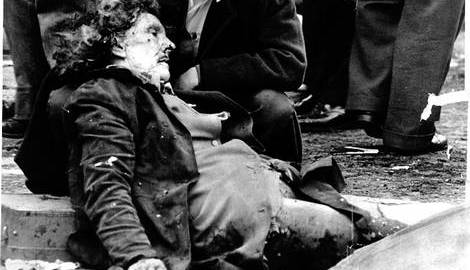

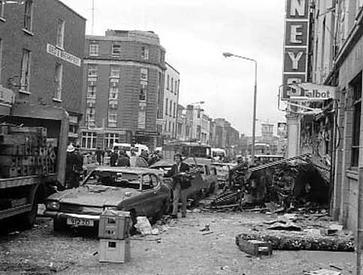


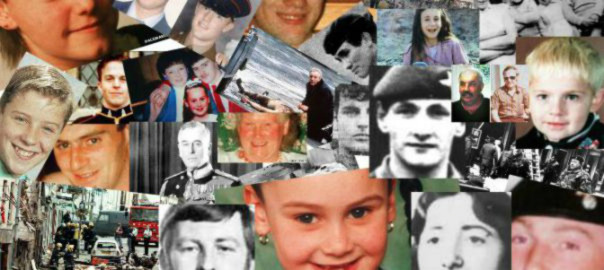


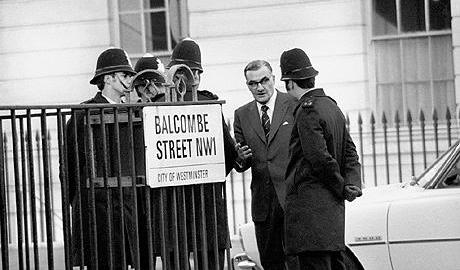
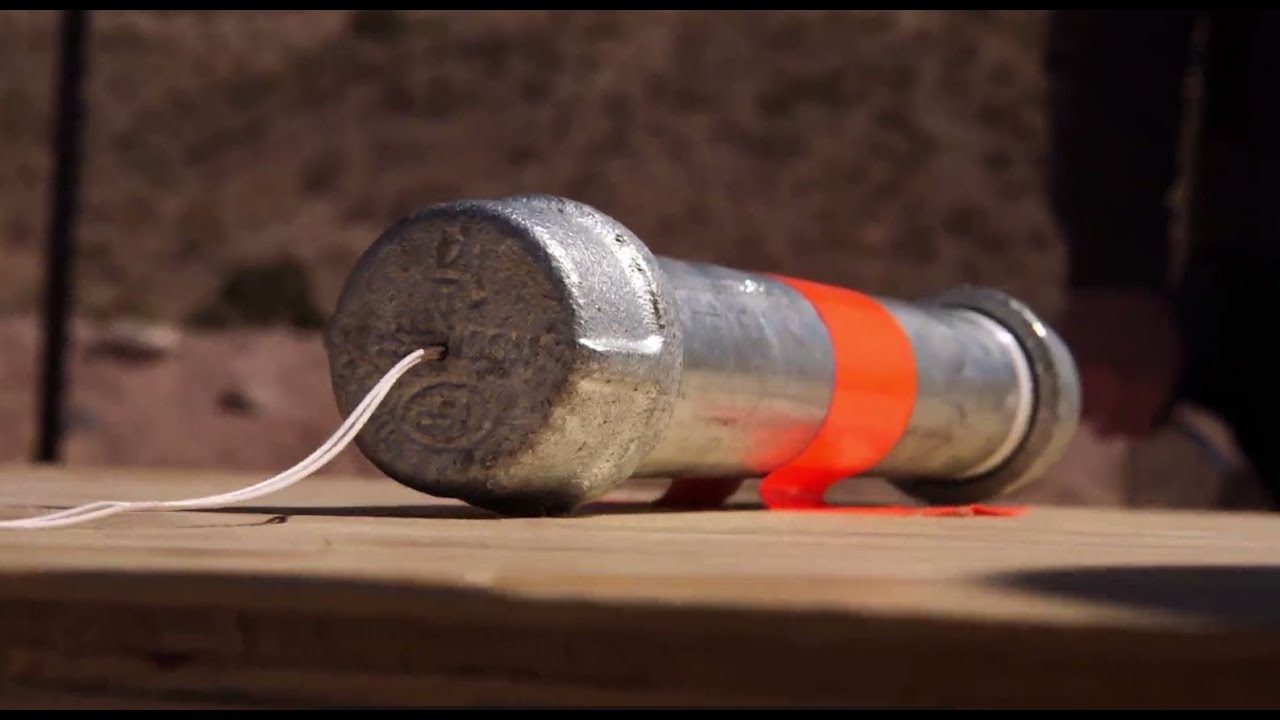


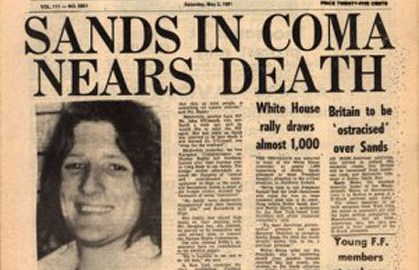


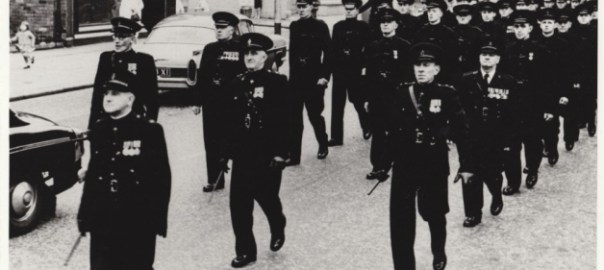
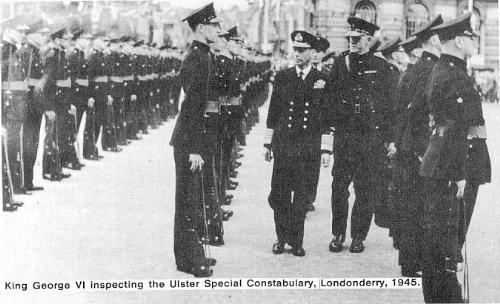


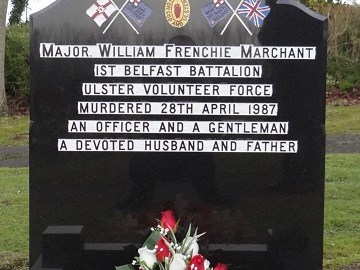
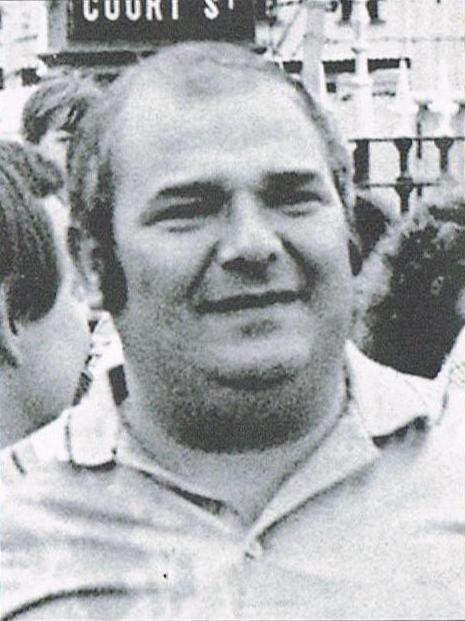

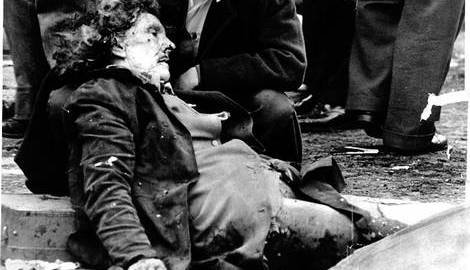
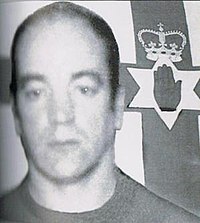


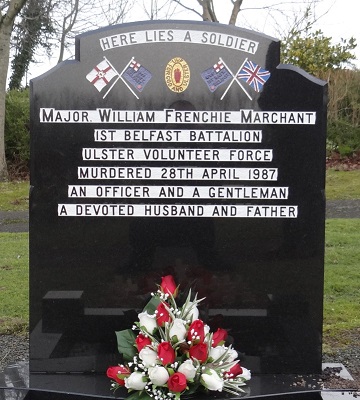
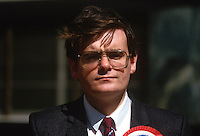

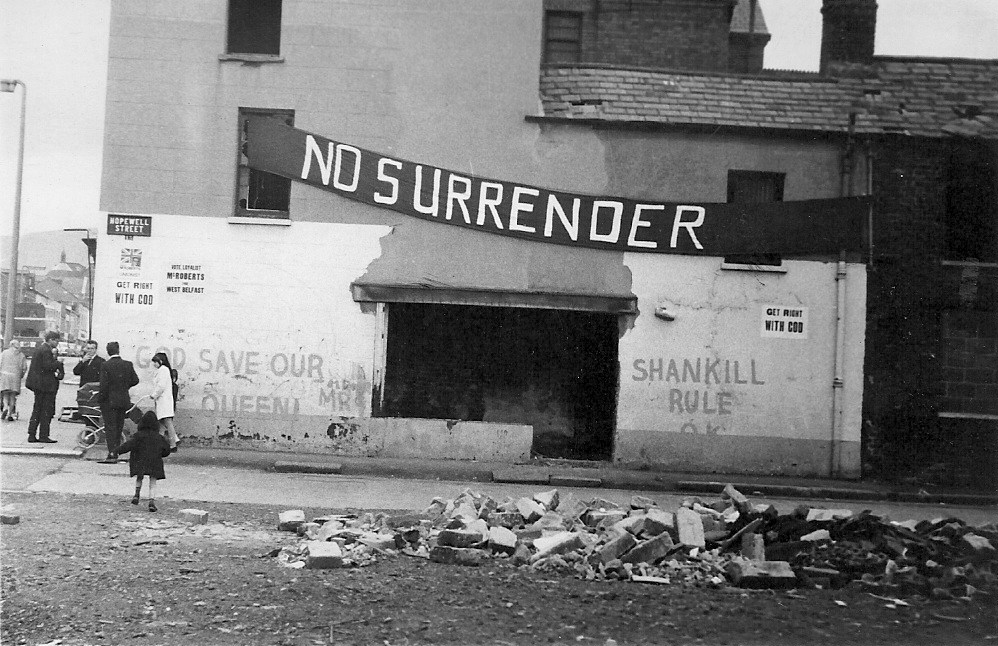
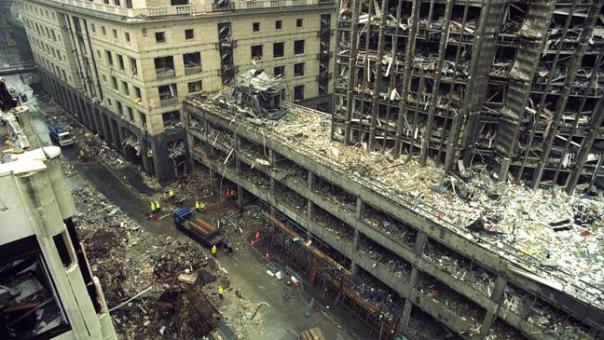





 belfastchildis.com