Category Archives: Major events in The Troubles

IRA Lisburn “Fun Run” bombing.1988 Lisburn van bombing

1988 Lisburn van Bombing

IRA Charity Run Slaughter

——————————–

——————————–

On 15 June 1988 an unmarked military van carrying six British Army soldiers was blown up by the Provisional Irish Republican Army (IRA) at Market Place in Lisburn, Northern Ireland. The explosion took place at the end of a charity marathon run in which the soldiers had participated. All six soldiers were killed in the attack – four outright, one on his way to hospital and another later on in hospital.

Lisburn van bombing.jpg

Lisburn is the headquarters of the British Army in Northern Ireland. Four of the dead were from the Royal Corps of Signals regiment whilst the other two were from the Green Howards and Royal Army Ordnance Corps regiments respectively. A booby-trap bomb was hidden under the Ford Transit van in which the soldiers were travelling, and was designed in such a way that the blast went upwards to cause maximum damage to the vehicle. Eleven civilian bystanders were injured, including a two-year-old child and 80-year-old man.

The bombing is sometimes referred to as the Lisburn “Fun Run” bombing.


On Wednesday 15 June 1988 at 8:50pm, an unmarked blue Ford Transit van carrying six off-duty British soldiers in civilian clothes drove off from a leisure centre carpark in Lisburn. The soldiers had just taken part in the “Lisburn Fun Run”, a 13-mile (21 km) charity half marathon held in the town. They had left the van unattended in the carpark, which was the start and finish point for the run.

It was there that an IRA Active Service Unit (ASU), who had been following the van, hid a booby-trap bomb underneath the vehicle. The half marathon and shorter “fun runs” were organised by Lisburn Borough Council, together with the YMCA, to raise funds for the disabled. There were 4,500 participants that day and at least 200 British Army personnel had been given leave to participate in the event.

Nine minutes later, the van stopped at traffic lights at Market Place, in Lisburn’s town centre. As the van moved on, the seven-pound (3.2 kg) booby-trap bomb detonated, turning the van into a massive fireball and instantly killing four of the soldiers as the vehicle disintegrated with the force of the blast. The Semtex device had been designed in a cone shape to channel the blast upwards, thereby causing maximum damage to the vehicle and the soldiers inside.

The area around Market Place was crowded with onlookers, including many teenagers and families with young children, although the biggest crowd was at the carpark. In all, about 10,000 onlookers had attended the charity run. There was pandemonium as frightened parents searched for their children, whilst others rushed to give aid to the dead and dying soldiers before fire engines and ambulances arrived.

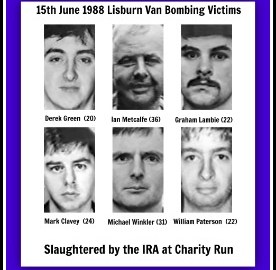
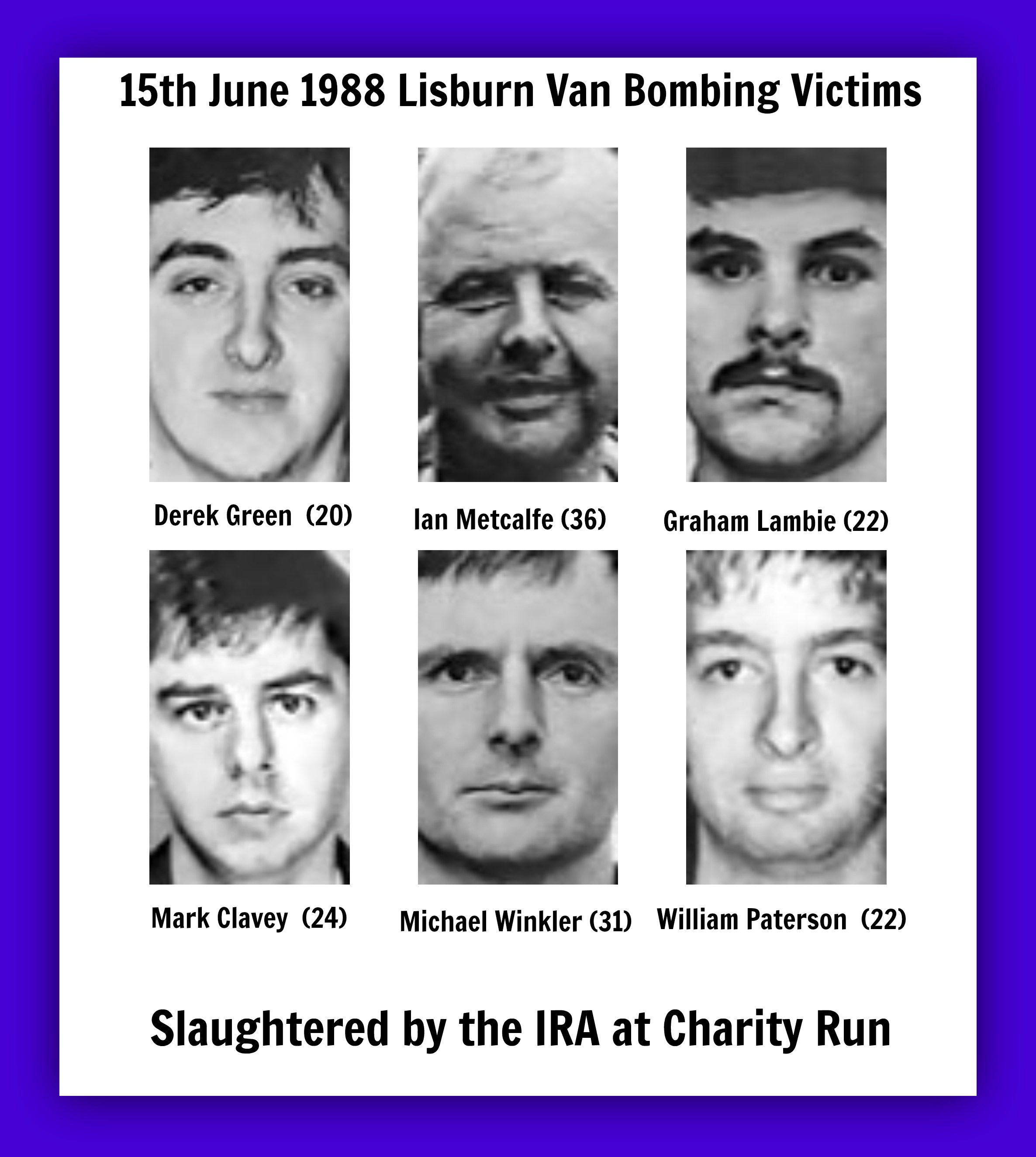
Eleven civilian bystanders were injured in the attack, including a two-year-old child and an 80-year-old man. Another soldier died on the way to hospital whilst a sixth soldier died later that night after undergoing surgery for severe head injuries. The dead soldiers were stationed at Ebrington Barracks in Derry and were returning to base when the bomb went off. Four of the men – Sergeant Michael Winkler (31), Signalman Mark Clavey (24), Lance Corporal Graham Lambie (22), and Corporal William Patterson (22) – were from the Royal Signals regiment, whilst the other two – Corporal Ian Metcalf (36) and Lance Corporal Derek Green (20) – were from the Green Howards and Royal Army Ordnance Corps regiments respectively.

Lisburn is a mainly Ulster Protestant town, 14 miles (23 km) southwest of Belfast. It serves as the garrison headquarters of the British Army in Northern Ireland. Six months before the van bombing, a booby-trap bomb planted by the IRA killed Ulster Defence Association (UDA) leader John McMichael in the town.

The van bombing resulted in the greatest loss of life suffered by the British Army since 11 soldiers were killed in the Droppin Well Disco bombing on 6 December 1982.

In Belfast, on the same day as the Lisburn attack, the IRA shot dead the Ulster Volunteer Force (UVF)’s East Belfast commander, Robert “Squeak” Seymour (33). This was retaliation for the UVF bombing of an Irish nationalist pub in which three Catholics died.

This slideshow requires JavaScript.

Aftermath

On 16 June, the Provisional IRA Belfast Brigade claimed responsibility for the bombing, promising to wage “unceasing war” against the British security forces in Northern Ireland  Sinn Féin president Gerry Adams allegedly said that the IRA’s killing of the six soldiers was “vastly preferable” to killing members of the (locally-recruited) Ulster Defence Regiment (UDR) or Royal Ulster Constabulary (RUC).

The leisure centre was forced to remain shut for a time after the loyalist Protestant Action Force (a covername of the UVF) issued a warning that they regarded Catholic staff working there as “legitimate targets”, inferring that they may have had a hand in the bombing. Lisburn mayor Councillor William Bleakes condemned the threats by the PAF.

That same day, Tom King, then Secretary of State for Northern Ireland, travelled to Lisburn where he held a meeting with Lieutenant General Sir John Waters, the British Army Commander in Northern Ireland, and senior RUC officers. They discussed the attack and proposals for heightened security. The soldiers had failed to follow proper security procedures, as they had left their vehicle unguarded for over two hours and had then driven off without having checked under it beforehand. After the Lisburn meeting, King flew to London where he reported directly to British Prime Minister Margaret Thatcher, who described the attack as a “terrible atrocity”.  However, she rejected demands from Conservative members of Parliament to bring back internment, regarding the proposal as “a very serious step”.

In his statement to the House of Commons, Tom King suggested that there would have been a much higher death toll had the bomb exploded in the carpark, where thousands of people had gathered after the run.

The Republic of Ireland‘s government also strongly condemned the killings and extended its sympathy to the families of the dead soldiers. The bombing was a topic of debate in the Seanad Éireann on 16 June 1988. Bishop Cathal Daly of Down and Connor denounced the bombers and the killings in the “strongest possible terms”.

Questions were raised as to how the IRA knew the soldiers were attending the charity run in Lisburn, how they recognised their unmarked van, and how the unit was able to plant a bomb in the predominantly loyalist town without being spotted, despite the amount of people in the carpark.

The RUC believed that the bombers may have been wearing sports gear as they mingled with the crowd that evening; they appealed to onlookers who had attended the event to hand over any film they may have taken of the “fun run” in an attempt to identify the IRA bombers .

The following Saturday, between 1,000 and 2,000 people gathered in Lisburn town centre to attend a remembrance service for the six soldiers. A book of condolences was also opened


15th June – Deaths & Events in Northern Ireland Troubles


Key Events & Deaths on this day in Northern Ireland Troubles

15th June

—————————-

Sunday 15 June 1969

The Campaign for Social Justice published a second edition of ‘Northern Ireland The Plain Truth’, [PDF; ], which set out the allegations of discrimination against Catholics by Unionists in the region.

Thursday 15 June 1972

Representatives of the Social Democratic and Labour Party (SDLP) met William Whitelaw, then Secretary of State for Northern Ireland, in London and presented the Irish Republican Army (IRA) conditions for a meeting. Whitelaw accepted the proposals.

[The IRA made an announcement about the proposed ceasefire on Thursday 22 June 1972.]

Monday 15 June 1981

Sinn Féin (SF) issued a statement to say that a Republican prisoner would join the hunger strike every week.

[This was seen as a stepping-up of the hunger strike. Paddy Quinn, then an Irish Republican Army (IRA) prisoner joined the strike.]

Tuesday 15 June 1982

The Falkland Islands were recaptured by British forces.

[This brought an end to the Falkands War.]

Friday 15 June 1984

A member of the Irish National Liberation Army (INLA) and a Royal Ulster Constabulary (RUC) officer were killed in an exchange of gunfire after the RUC surrounded a house in Lenadoon Avenue, Belfast.

Monday 15 June 1987

Tom King was reappointed as Secretary for State for Northern Ireland. Nicholas Scott, formerly the Minister for State at the Northern Ireland Office, was replaced by John Stanley.

Sunday 15 June 1988

Lisburn Killings

PicMonkey Collage with text x 3

An Irish Republican Army (IRA) bomb in Lisburn killed six off-duty British Army soldiers.

——————————–

——————————–

See IRA Lisburn “Fun Run” bombing

A member of the Ulster Volunteer Force (UVF) was killed by the IRA in Belfast.

Thursday 15 June 1989

European Elections

Elections to the European Parliament were conducted in Northern Ireland. [The percentage share of the vote was: Democratic Unionist Party (DUP) 29.95%; Social Democratic and Labour Party (SDLP) 25.5%; Ulster Unionist Party (UUP) 21.5%; Sinn Féin (SF) 9.2%; Alliance Party of Northern Ireland (APNI) 5.2%; Ecology Party (EP) 1.2%; Workers Party (WP) 1.1%; Others 1.6%; Turnout 48.3%. (See detailed results.)] Elections took place in the Republic of Ireland to the Dáil. Although Fianna Fáil (FF) gained that largest number of seats the party it did not win sufficient support to form a government.

[FF formed a government with the Progressive Democrat (PD) party on 12 July 1989.]

Friday 15 June 1990

Peter Brooke, then Secretary of State for Northern Ireland, met with representatives of the Social Democratic and Labour Party (SDLP). It was announced that talks would begin after the summer holidays.

Saturday 15 June 1991

(Sir) Ninian Stephen, then an Australian High Court judge and a former Governor-General of Australia, was named as the independent chairman for the strand of the forthcoming talks (later known as the Brooke / Mayhew talks) involving relationships between Northern Ireland and the Republic of Ireland.

Tuesday 15 June 1993

The Standing Advisory Commission on Human Rights (SACHR) argued for changes to the way in which the House of Commons dealt with legislation on Northern Ireland matters.

[Following the introduction of Direct Rule the region was governed under a Temporary Provisions Act, and Northern Ireland legislation was introduce by way of ‘Orders in Council’. The main criticism of this procedure was that the legislation could not be amended in the House of Commons.]

Wednesday 15 June 1994

Albert Reynolds, then Taoiseach (Irish Prime Minister), sent a letter containing ‘clarification’ of the Downing Street Declaration to Gary McMichael, then leader of the Ulster Democratic Party (UDP).

The letter stated: “We do not seek to impose constitutional change by stealth or coercion, whether it be a united Ireland, or joint sovereignty or joint authority. What we seek is a new accommodation between the two traditions on this island …” (Belfast Telegraph, 24 June 1994).

Thursday 15 June 1995

There was a Westminster by-election in the constituency of North Down. The by-election was called following the death on 20 March 1995 of the sitting Member of Parliament James Kilfedder. The election was won by Robert McCartney, of the United Kingdom Unionist Party (UKUP).

[The turnout at 39 per cent was the lowest in the history of Northern Ireland for a parliamentary by-election.]

Saturday 15 June 1996

Manchester Bombing

The Irish Republican Army (IRA) exploded a bomb in Manchester, which destroyed a large part of the city centre and injured 200 people.

The bomb was estimated to have contained one-and-a-half tonnes of home-made explosives. Although a warning of one hour and twenty minutes was received by a local television station injuries were still caused by the sheer scale of the explosion.

In response to the Manchester bomb the Ulster Freedom Fighters (UFF) announced that it was putting its members ‘on alert’.

Niall Donovan (28), a Catholic man, was stabbed to death near Dungannon, County Tyrone.

Tuesday 15 June 1999

In a keynote speech at Stranmillis College in Belfast Tony Blair, then British Prime Minister, said the governments would “have to look for another way forward” if the devolution deadline were missed.

Blair also invited Portadown Orangemen and representatives of the Garvaghy Road Residents’ Coalition (GRRC) to new talks at Stormont in a further attempt to resolve the dispute surrounding the Drumcree parade planned for 4 July 1999.

Bertie Ahern, then Taoiseach (Irish Prime Minister), said the Irish and British governments would “set aside” the Good Friday Agreement and seek alternative means of political progress if a breakthrough was not made by 30 June 1999. Ahern told the Dáil the decommissioning issue had now been “debated to death”.


——————————————

Remembering all innocent victims of the Troubles

Today is the anniversary of the death of the following people killed as a results of the conflict in Northern Ireland

“To live in hearts we leave behind is not to die

– Thomas Campbell

To the innocent on the list – Your memory will live forever

– To the Paramilitaries –

There are many things worth living for, a few things worth dying for, but nothing worth killing for.

15 People lost their lives on the 15th June between 1974 – 1975

——————————————

15 June 1973
Michael Wilson  (18)

Protestant
Status: Ulster Defence Association (UDA),

Killed by: Ulster Defence Association (UDA)
Shot at the home of his relative, Ulster Defence Association leader Tommy Herron, Ravenswood Park, Braniel, Belfast. Internal Ulster Defence Association dispute.

——————————————

15 June 1974


Patrick Cunningham   (26)

Catholic
Status: Civilian (Civ),

Killed by: British Army (BA)
Shot by British Army (BA) foot patrol while in disused graveyard near his home, Benburb, County Tyrone

——————————————

15 June 1982


Hugh Cummings  (39)

Protestant
Status: Ulster Defence Regiment (UDR), Killed by: Irish Republican Army (IRA)
Off duty. Shot near his workplace while walking along Lower Main Street, Strabane, County Tyrone

——————————————

15 June 1984


Michael Todd   (22)

Protestant
Status: Royal Ulster Constabulary (RUC),

Killed by: Irish National Liberation Army (INLA)
Shot during gun battle after Royal Ulster Constabulary (RUC) members surrounded house, Lenadoon Avenue, Belfast.

——————————————

15 June 1984


Paul McCann   (20)

Catholic
Status: Irish National Liberation Army (INLA),

Killed by: Royal Ulster Constabulary (RUC)
Shot during gun battle after Royal Ulster Constabulary (RUC) members surrounded house, Lenadoon Avenue, Belfast

——————————————

15 June 1985


Willis Agnew   (53)

Protestant
Status: Royal Ulster Constabulary (RUC),

Killed by: Irish Republican Army (IRA)
Off duty. Shot while sitting in stationary car outside friend’s home, Gortin Road, Kilrea, County Derry.

——————————————

15 June 1987
Nathaniel Cush   (47)

Protestant
Status: ex-Ulster Defence Regiment (xUDR),

Killed by: Irish Republican Army (IRA)
Killed by booby trap bomb attached to his car outside his workplace, Tomb Street, off Corporation Street, Belfast.

——————————————

15 June 1988
Robert Seymour   (33)

Protestant
Status: Ulster Volunteer Force (UVF),

Killed by: Irish Republican Army (IRA)
Shot at his shop, Woodstock Road, Belfast.

——————————————

15 June 1988


Derek Green  (20)

nfNI
Status: British Army (BA),

Killed by: Irish Republican Army (IRA)
Off duty. Killed by booby trap bomb attached to British Army (BA) minibus, Market Square, Lisburn, County Antrim.

See IRA Lisburn “Fun Run” bombing

——————————————

15 June 1988

Michael Winkler   (31)

nfNI
Status: British Army (BA),

Killed by: Irish Republican Army (IRA)
Off duty. Killed by booby trap bomb attached to British Army (BA) minibus, Market Square, Lisburn, County Antrim.

See IRA Lisburn “Fun Run” bombing

——————————————

15 June 1988


 Mark Clavey   (24)

nfNI
Status: British Army (BA),

Killed by: Irish Republican Army (IRA)
Off duty. Killed by booby trap bomb attached to British Army (BA) minibus, Market Square, Lisburn, County Antrim.

See IRA Lisburn “Fun Run” bombing

——————————————

15 June 1988


Graham Lambie   (22)

nfNI
Status: British Army (BA),

Killed by: Irish Republican Army (IRA)
Off duty. Killed by booby trap bomb attached to British Army (BA) minibus, Market Square, Lisburn, County Antrim.

See IRA Lisburn “Fun Run” bombing

——————————————

15 June 1988


William Paterson   (22)

nfNI
Status: British Army (BA),

Killed by: Irish Republican Army (IRA)
Off duty. Killed by booby trap bomb attached to British Army (BA) minibus, Market Square, Lisburn, County Antrim.

See IRA Lisburn “Fun Run” bombing

——————————————

15 June 1988


Ian Metcalfe  (36)

nfNI
Status: British Army (BA),

Killed by: Irish Republican Army (IRA)
Off duty. Killed by booby trap bomb attached to British Army (BA) minibus, Market Square, Lisburn, County Antrim.

See IRA Lisburn “Fun Run” bombing

——————————————

15 June 1989
Adam Gilbert  (21)

nfNI
Status: British Army (BA),

Killed by: British Army (BA)
Shot in error, by other British Army (BA) member, firing at stolen car, while on BA foot patrol, junction of New Lodge Road and Antrim Road, Belfast.

——————————————


Coleraine Bombing 12th June 1973 – The forgotten massacre of the Troubles

1973 Coleraine bombings

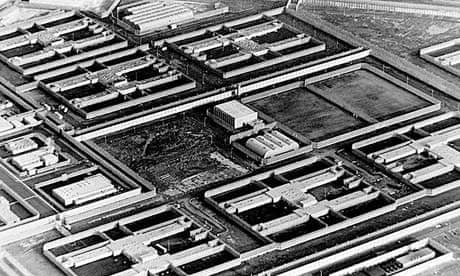
On 12 June 1973

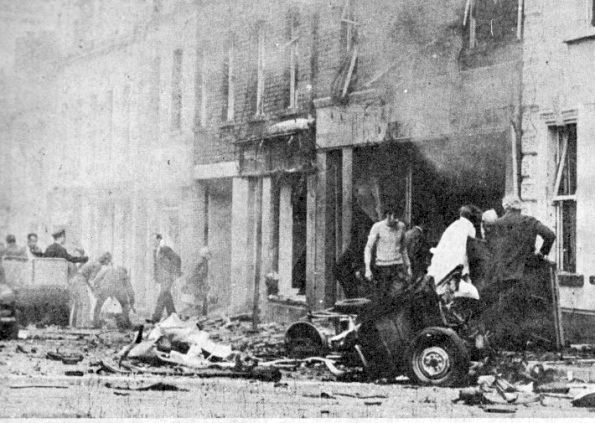
Colrain bomb blast 12th june 1973.jpg

On 12 June 1973 the Provisional IRA detonated two carbombs in Coleraine, County Londonderry, Northern Ireland. The first bomb exploded at 3:00 pm on Railway Road, killing six people and injuring 33; several lost limbs and were left crippled for life. A second bomb exploded five minutes later at Hanover Place. This did not cause any injuries, although it added to the panic and confusion in the area. The IRA had sent a warning for the second bomb but said it had mistakenly given the wrong location for the first.

As the six victims had all been Protestant, the bombings brought about a violent backlash from loyalist paramilitaries, who swiftly retaliated by unleashing a series of sectarian killings of Catholics that culminated in the double killing of Senator Paddy Wilson and Irene Andrews on 26 June.

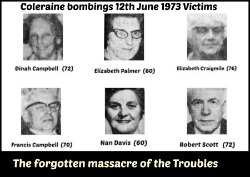
Victims

Colrain bomb victims June 12th 1973 Collage with text resized 450

——————————

12 June 1973

Francis Campbell  (70)

Protestant
Status: Civilian (Civ),

Killed by: Irish Republican Army (IRA)
Killed in car bomb explosion, Railway Road, Coleraine, County Derry. Inadequate warning given.

——————————

12 June 1973


Dinah Campbell  (72)

Protestant
Status: Civilian (Civ),

Killed by: Irish Republican Army (IRA)
Killed in car bomb explosion, Railway Road, Coleraine, County Derry. Inadequate warning given.

——————————

12 June 1973


Elizabeth Craigmile  (76)

Protestant
Status: Civilian (Civ),

Killed by: Irish Republican Army (IRA)
Killed in car bomb explosion, Railway Road, Coleraine, County Derry. Inadequate warning given.

——————————

12 June 1973


Nan Davis   (60)

Protestant
Status: Civilian (Civ),

Killed by: Irish Republican Army (IRA)
Killed in car bomb explosion, Railway Road, Coleraine, County Derry. Inadequate warning given.

——————————

12 June 1973


Robert Scott   (72)

Protestant
Status: Civilian (Civ),

Killed by: Irish Republican Army (IRA)
Killed in car bomb explosion, Railway Road, Coleraine, County Derry. Inadequate warning given.

——————————

12 June 1973


Elizabeth Palmer  (60)

Protestant
Status: Civilian (Civ),

Killed by: Irish Republican Army (IRA)
Killed in car bomb explosion, Railway Road, Coleraine, County Derry. Inadequate warning given.

——————————


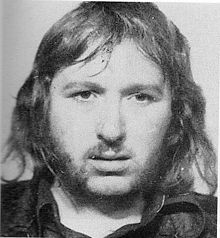
Sinn Féin councillor Sean McGlinchey, brother of former INLA Chief of Staff Dominic McGlinchey, was convicted of planting the bomb and spent 18 years in prison. He was elected mayor of Limavady Borough Council in 2011.

In his book Years of Darkness: The Troubles Remembered, academic Gordon Gillespie described the attacks as “a forgotten massacre” of the Troubles


The bombings

On 12 June 1973, two cars stolen from south County Londonderry were packed with explosives and driven by an Active Service Unit (ASU) of the South Derry Provisional IRA to the mainly-Protestant town of Coleraine. The carbombs were parked on Railway Road and Hanover Place. Two warnings made to the Telephone Exchange at 2.30 p.m. named the location for the Hanover Place device and for another bomb on Society Street, which later “proved to be a hoax”.

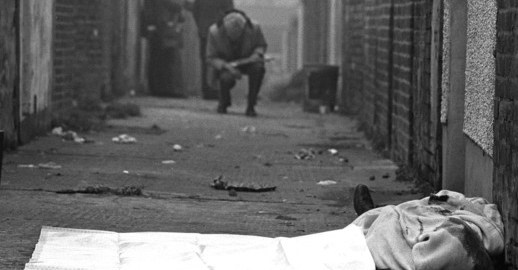
At about 3.00 p.m. a Ford Cortina containing a 100–150 pound (45–68 kg) bomb exploded outside a wine shop on Railway Road, killing six pensioners (four women and two men) and injuring 33 people, a number of them schoolchildren.

The six pensioners—Elizabeth Craigmile (76), Robert Scott (72), Dinah Campbell (72), Francis Campbell (70), Nan Davis (60), and Elizabeth Palmer (60)—were all Protestant. Elizabeth Craigmile, the Campbells and their daughter Hilary had been on a day outing and were returning home to Belfast when the bomb had gone off; they were beside the carbomb at the moment of detonation. Some of the dead had been blown to bits and Hilary Campbell lost a limb.

Several of the wounded were maimed and left crippled for life.

The bomb left a deep crater in the road and the wine shop was engulfed in flames; it also caused considerable damage to vehicles and other buildings in the vicinity. Railway Road was a scene of carnage and devastation with the mangled wreckage of the Ford Cortina resting in the middle of the street, the bodies of the dead and injured lying in pools of blood amongst the fallen masonry and roof slates, and shards of glass from blown-out windows blanketing the ground. Rescue workers who arrived at the scene spoke of “utter confusion” with many people “wandering around in a state of severe shock”.

Five minutues later, the second bomb went off in the forecourt of Stuart’s Garage in Hanover Place. Although this explosion caused no injuries, it added to the panic and confusion yielded by the first bomb.

David Gilmour, a former councillor who works as a researcher for Unionist politician George Robinson, was caught up in the bombing. Gilmour, aged ten at the time, escaped injury along with his mother. Both had been sitting a car parked directly across from the Ford Cortina containing the bomb. At the precise moment the bomb detonated another car had passed between the two cars, shielding Gilmour and his mother from the full force of the blast, although their car was badly damaged.

He recalled that when the bomb exploded everything had gone black, “deeper and darker than black – the blackness only punctuated by pinpricks of orange”. He later found that these orange pinpricks were most likely metal fragments from the exploded car or embers from the fertiliser that had been used to make the bomb. In the immediate aftermath of the blast, there had been several seconds of “deathly silence” before “all hell broke loose”, with hysterical people rushing from the scene and others going to tend the wounded who were screaming in agony.

The Provisional IRA claimed responsibility for the bombings but said they had mistakenly given the wrong location for the carbomb on Railway Road when they sent their telephoned warning to the security forces.

Gordon Gillespie alleged that no warning was given for the first bomb, adding “this led to speculation that the bombers intention was to draw people towards the bomb in Railway Road and inflict as many casualties as possible”.

Gillespie also suggested that the death toll would have likely been much higher had the bomb gone off 15 minutes later when girls from a nearby high school would have been leaving the school and walking along the street.

The IRA member who planted the bomb, Sean McGlinchey, said that he had been forced to abandon the car on Railway Road. He explained that he arrived in Coleraine to find that the town had a new one-way traffic system, of which his superiors had not informed him. The bomb was primed, on a short fuse and he was “in the wrong place at the wrong time in the one-way system”.

Mayor of Coleraine David Harding and Chief Executive of Coleraine Council Roger Wilson lay a wreath to mark 40 years after a car bomb in Railway Road killed six people and injured 33 in Coleraine

Mayor of Coleraine David Harding and Chief Executive of Coleraine Council Roger Wilson lay a wreath to mark 40 years after a car bomb in Railway Road killed six people and injured 33 in Coleraine
————————————–

Loyalist reaction

As all the victims had been Protestant, there was a violent backlash from loyalist paramilitaries. In May or June 1973, Ulster Defence Association (UDA) leaders decided that the organization should use the covername “Ulster Freedom Fighters” (UFF) when it wished to claim responsibility for its attacks.

This was spurred by fears that the government would outlaw the UDA. The “UFF’s” first attacks were in response to the Coleraine bombings.

It sought retaliation against the Catholic community, which they believed supported the IRA. Four days after the bombing, the new leadership convened in Belfast and ordered its units to avenge the six Protestant pensioners by killing a Catholic. Jim Light was one of the UDA/UFF members who was instructed to execute the killing. He later told British journalist Peter Taylor that he had felt sick upon hearing about the pensioners killed in the Coleraine bombing:

“They’d probably spent all their lives doing their day’s work and were on an outing enjoying themselves. They were coming home and were blown to bits”.

Light and other UDA/UFF members went to Irish nationalist Andersonstown in west Belfast where they could be certain of finding a Catholic victim. They chose 17-year-old Daniel Rouse, who was kidnapped from the street where he had been walking and driven away to a field. Rouse was then shot through the head at point-blank range by Light. He had no IRA or Irish republican connections.

The next day, the body of 25-year-old Catholic man Joseph Kelly was found at Corr’s Corner, near the Belfast-Larne Road. He had been shot. The UFF claimed the killing in a telephone call to a Belfast newspaper office using the words: “We have assassinated an IRA man on the way to Larne. We gave him two in the head and one in the back. He is dead”. They did not directly refer to the Coleraine bombings, but rather claimed it was in retaliation for the killing of Michael Wilson, brother-in-law of UDA leader Tommy Herron. The UDA/UFF held the IRA responsible for Wilson’s killing.

On 18 June the UFF claimed responsibility for throwing a bomb from a car at the “Meeting of the Waters”, a nationalist pub on Manor Street, North Belfast. One man was seriously injured in the attack. The UFF said it attacked the pub because it was a “known haunt of Catholics and republicans”.

On 26 June, the UFF perpetrated a double killing that shocked Northern Ireland with its savagery.

Catholic Senator Paddy Wilson and his Protestant friend Irene Andrews were repeatedly stabbed to death in a frenzied attack. Their mutilated bodies were found by the security forces at a quarry off the Hightown Road near Cavehill following a telephone call by the UFF using its codename “Captain Black”. UFF founder and leader John White was later convicted of the murders.

Convictions

On 6 July 1973, a 22-year-old woman and 19-year-old man, both charged with the murder of the six pensioners, were assaulted and abused by an angry crowd of 150 people outside Coleraine courthouse. Eggs were hurled at them as they left the building following their second court appearance.

In January 1974, the woman was acquitted of the charges against her. However, her boyfriend received an eight-year prison sentence for his part in the attacks and the leader of the bomb team, 18-year-old Sean McGlinchey, was convicted of planting the Railway Road bomb.

He was sentenced to 18 years imprisonment inside the Maze Prison for the six murders. McGlinchey is the younger brother of former INLA Chief of Staff Dominic McGlinchey. Upon his release from the Maze he became a Sinn Féin councillor and in 2011 was elected mayor of Limavady. He has repeatedly said that he deeply regretted the bombing in Coleraine, stating

“What happened is my responsibility, those were my actions. If I had known innocent people would be killed I would never have done it. I regret the deaths and I have apologised”.[13]

Shortly after becoming mayor he met Jean Jefferson, whose aunt was killed and her father horribly disfigured in the bombing. She said of McGlinchey.

“I was very impressed with somebody, who at 18 had made the wrong choice, the wrong decision, maybe to some extent been used and abused, and who is now spending his life putting back into the community more than what he ever got out of it”.

In his book Years of Darkness: The Troubles Remembered, academic and writer Gordon Gillespie described the Coleraine bombings as “a forgotten massacre” of the Troubles

—————————————————

Published 26/09/2015

Sean McGlinchey bomb victim fury: Man injured in massacre hits out at Sinn Fein councillor’s ‘proud ex-IRA’ boast.

A survivor of the 1973 car bombing of Coleraine in which six people died has slammed a Sinn Fein politician’s declaration of pride in his bloody IRA past.

Sean McGlinchey, a Causeway Coast and Glens councillor and a former mayor of Limavady, this week told a council meeting that he was “a proud ex-IRA man”.

He later defended his remarks, but said he regretted he had made them in Coleraine, which he now admits was “insensitive”.

Mr McGlinchey, then 18, was given six life sentences for the bombing in which six pensioners were murdered. He served 18 years and was released in 1992.

The row flared during a debate on the refugee crisis in Europe.

Mr McGlinchey told councillors: “I’m proud of the men and women who were in the IRA with me – but that doesn’t mean to say I am proud of everything the IRA did.”

Last night David Gilmour, who was 10 when he was injured in the bombing, slammed Mr McGlinchey’s unrepentant attitude.

He told the Belfast Telegraph: “I am not surprised by Mr McGlinchey.

“Despite what he said when he was elected mayor of Limavady about reaching out the hand of friendship to unionists and wanting to co-operate, the mask has slipped.

“I want to say that I do not hate Sean McGlinchey. Hatred brought us to where we were in 1973.

“He and I will disagree on virtually everything – but I do not want it thought that I hate Mr McGlinchey.”

Mr Gilmour, now a researcher for DUP MLA George Robinson, added: “I think it is a disgrace that he, as an elected representative, comes into a town where he cold-bloodedly slaughtered six pensioners and makes comments like he did this week.

“That has caused a great deal of hurt and offence, not just to people like me who were hurt in the bombing, or who lost relatives, but to the ordinary men and women of the town, who are disgusted.

“His remarks drag all those memories back to the forefront of our minds. You think you have moved on, moved past that event.

“You hope that people are maybe working towards a more peaceful future.

“And then a comment like that just goes to show that Mr McGlinchey obviously doesn’t share the outlook for a peaceful Northern Ireland that I do.”

Mr McGlinchey – brother of slain INLA leader Dominic McGlinchey – told this newspaper he feared that the political crisis at Stormont was risking a return to the kind of society that had led him to join the IRA.

“I’ve worked to get people away from paramilitarism. I don’t want anyone else to become what I was in the 1970s. I wish there had never been an IRA,” he said.

“But if we don’t make politics work in the Assembly, we could be going back to the terrible days of the 1970s.

“I don’t want that to happen. But what’s happening now is taking us back to the type of politics that created the Sean McGlinchey of the 1970s.

“This was a unionist state – and we can’t go back to that.”

11th June – Deaths & Events in Northern Ireland Troubles

Key Events & Deaths on this day in Northern Ireland Troubles

11th June

————————————

Sunday 11 June 1972

There was a gun battle between Loyalist and Republican paramilitaries in the Oldpark area of Belfast.

There were shooting incidents in other areas of Belfast and Northern Ireland.

In all, two Catholics, a Protestant, and a British soldier were shot and killed.

Colonel Gaddafi announced that he had supplied arms to “revolutionaries” in Ireland.

Wednesday 11 June 1980

The Irish Republican Army (IRA) issued a statement that threatened to renew attacks on prison officers.

Thursday 11 June 1981

A general election was held in the Republic of Ireland.

[When counting was completed a minority government was formed between a coalition of Fine Gael (FG) and Labour. On 30 June 1981 Garret FitzGerald replaced Charles Haughey as Taoiseach (Irish Prime Minister).

Two H-Block prisoners were elected to the Dáil.]

Saturday 11 June 1983

In the new British cabinet announced by Margaret Thatcher, then British Prime Minister, James Prior, was reappointed as Secretary of State for Northern Ireland.

Wednesday 11 June 1986

Five people, one of whom was Patrick Magee, were found guilty at the ‘Old Bailey’ court in London of conspiring to cause explosions in Britain including the Brighton bomb on 12 October 1984.

[Magee later received eight life sentences.]

Thursday 11 June 1987

General Election

A general election was held across the United Kingdom (UK).

The Conservative Party was returned to power. In Northern Ireland the Social Democratic and Labour Party (SDLP) increased their vote and their share of the poll.

The overall Unionist vote fell as did the vote of Sinn Féin (SF).

Enoch Powell, formally an Ulster Unionist Party (UUP) Member of Parliament (MP), lost his South Down seat to Eddie McGrady of the Social Democratic and Labour Party (SDLP).

Friday 11 June 1993

Queen Elizabeth paid a visit to Northern Ireland.

John Hume, then leader of the Social Democratic and Labour Party (SDLP), held another meeting with Gerry Adams, then President of Sinn Féin (SF). Amnesty International criticised certain aspects of emergence powers in Northern Ireland.

Tuesday 11 June 1996

The second day of the Stormont talks were again spent in argument over the appointment of George Mitchell as chair and the extent of his “over-arching” role.

The Ulster Unionist Party (UUP) agreed to a compromise which reduced the role of George Mitchell but which let talks proceed.

Wednesday 11 June 1997

Robert (‘Basher’) Bates (48)

Robert Basher Bates

a former leading member of the Ulster Volunteer Force (UVF) ‘Shankill Butchers’ gang, was shot dead while opening the Ex-Prisoners Information Centre on Woodvale Road, Belfast.

Initially Republican paramilitaries were blamed for the killing but all the groups denied any involvement, and it later became clear that Loyalist paramilitaries were responsible.

Bates had pleaded guilty in January 1979 to 10 murders.

Most of the victims were Catholics who were abducted, tortured, and killed with butcher knives, hatchets and sometimes guns.

One of Bates’ victims was James Moorehead (30) who at the time was a member of the Ulster Defence Association (UDA). It was believed that Bates was killed in retaliation for his part in the murder of Moorehead.

See Robert “Basher” Bates

See Shankill Butchers

See Lenny Murphy

The Queen paid a visit to Northern Ireland and travelled to Dungannon, Belfast, and Hillsborough Castle where a garden reception for 2,000 people was held.

The police and customs officials carried out a series of raids in Britain and Ireland and broke up a drugs gang which had links to the UDA. Police seized £6 million pounds of property, £2 million pounds of illicit alcohol, and £500,000 in cash.

Thursday 11 June 1998

Three shots were fired at a Sinn Féin (SF) election worker in the Markets area of south Belfast.

[Republicans claimed that the attack was carried out by “Group B” a remnant of the Official Irish Republican Army (OIRA). Residents reported increased friction in west and south Belfast between supporters of the Provisionals and Officials in recent weeks.]

Friday 11 June 1999

Tony Blair, then British Prime Minister, intensified discussions to try to resolve the issues preventing the establishment of an Executive in Northern Ireland.

The Police Authority of Northern Ireland warned that the Royal Ulster Constabulary (RUC) did not have sufficient funds to meet the additional costs in policing the violence surrounding the Drumcree dispute.


——————————————

Remembering all innocent victims of the Troubles

Today is the anniversary of the death of the following people killed as a results of the conflict in Northern Ireland

“To live in hearts we leave behind is not to die

– Thomas Campbell

To the innocent on the list – Your memory will live forever

– To the Paramilitaries –

There are many things worth living for, a few things worth dying for, but nothing worth killing for.

9 People lost their lives on the 11th   June between 1972 – 1997

——————————————

11 June 1972
John Madden  (43)

Catholic
Status: Civilian (Civ),

Killed by: non-specific Loyalist group (LOY)
Shot outside his shop, Oldpark Road, Belfast.

——————————————

11 June 1972


Joseph Campbell  (16)

Catholic
Status: Irish Republican Army Youth Section (IRAF),

Killed by: British Army (BA)
Shot during gun battle, Eskdale Gardens, Ardoyne, Belfast.

——————————————

11 June 1972


Norman McGrath  (18)

Protestant
Status: Civilian (Civ),

Killed by: British Army (BA)
Shot from passing British Army (BA) Armoured Personnel Carrier as he walked along Alloa Street, Lower Oldpark, Belfast.

——————————————

11 June 1972
Peter Raistric  (18)

nfNI
Status: British Army (BA),

Killed by: Irish Republican Army (IRA)
Shot by sniper while in Brooke Park British Army (BA) base, Derry.

——————————————

11 June 1975
Kenneth Conway   (20)

Protestant
Status: Civilian (Civ),

Killed by: not known (nk)
Died one day after being shot at the junction of Woodvale Road and Glenvale Street, Shankill, Belfast.

——————————————

11 June 1976
William Palmer   (50)

Protestant
Status: Civilian (Civ),

Killed by: non-specific Republican group (REP)
Died three days after being shot at his home, Milltown Avenue, Derriaghy, near Belfast

——————————————

11 June 1976
Edward Walker  (20)

Protestant
Status: Ulster Defence Association (UDA),

Killed by: Royal Ulster Constabulary (RUC)
Shot while travelling in stolen car along Doagh Road, Newtownabbey, County Antrim

——————————————

11 June 1982


David Reeves  (24)

Protestant
Status: Royal Ulster Constabulary (RUC),

Killed by: Irish Republican Army (IRA)
Killed by booby trap bomb while searching garage, Carranbane Walk, Shantallow, Derry.

——————————————

11 June 1997

Robert Bates  (48)

Protestant
Status: Ulster Volunteer Force (UVF),

Killed by: Ulster Defence Association (UDA)
Shot, at his workplace, Ex-prisoners Interpretative Centre, Woodvale Road, Shankill, Belfast. Ulster Defence Association / Ulster Volunteer Force feud.

See Shankill Butchers

See Lenny Murphy

——————————————

Robert “Basher” Bates 12th Dec 1948 – 11th June 1997. Shankill Butcher

Robert William Bates

” Basher “

Robert William Bates (nicknamed “Basher”) (12 December 1948 – 11 June 1997) was an Ulster loyalist from Belfast, Northern Ireland. He was a member of the Ulster Volunteer Force and the infamous Shankill Butchers gang, led by Lenny Murphy.

Shankill Butchers 

Shankill Butchers.

See Shankill Butchers

Disclaimer

The views and opinions expressed in this post and page are soley intended to educate and provide background information to those interested in the Troubles of Northern Ireland.

They in no way reflect my own opinions and I take no responsibility for any inaccuracies or factual errors


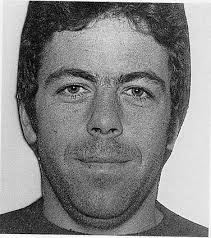
Bates was born into an Ulster Protestant family and grew up in the Shankill Road area of Belfast. He had a criminal record dating back to 1966,  and later became a member of the Ulster loyalist paramilitary organisation, the Ulster Volunteer Force (UVF).

Bates, employed as a barman at the Long Bar, was recruited into the Shankill Butchers gang in 1975 by its notorious ringleader, Lenny Murphy.

The gang used The Brown Bear pub, a Shankill Road drinking haunt frequented by the UVF, as its headquarters. Bates, a “sergeant” in the gang’s hierarchy, was an avid participant in the brutal torture and savage killings perpetrated against innocent Catholics after they were abducted from nationalist streets and driven away in a black taxi owned by fellow Shankill Butcher, William Moore.

William moore.jpg
William Moore

The killings typically involved grisly-throat slashings preceded by lengthy beatings and torture. Bates was said to have been personally responsible for beating James Moorhead, a member of the Ulster Defence Association, to death on 30 January 1977 and to have played a central role in the kidnapping and murder of Catholic Joseph Morrisey three days later. He also killed Thomas Quinn, a derelict, on 8 February 1976 and the following day was involved in shooting dead Archibald Hanna and Raymond Carlisle, two Protestant workmen that Bates and Murphy mistook for Catholics.

Martin Dillon revealed that Bates was also one of the four UVF gunmen who carried out a mass shooting in the Chlorane Bar attack in Belfast city centre on 5 June 1976. Five people (three Catholics and two Protestants) were shot dead. The UVF unit had burst into the pub in Gresham Street and ordered the Catholics and Protestants to line up on opposite ends of the bar before they opened fire. He later recounted his role in the attack to police; however, he had claimed that he never fired any shots due to his revolver having malfunctioned.

Forensics evidence contradicted him as it proved that his revolver had been fired inside the Chlorane Bar that night. Lenny Murphy was in police custody at the time the shooting attack against the Chlorane Bar took place.

Bates was arrested in 1977, along with Moore and other “Shankill Butcher” accomplices.

Gerard McLaverty and Joseph Morrissey

His arrest followed a sustained attack by Moore and Sam McAllister on Catholic Gerard McLaverty, after which they dumped his body, presuming him dead. However McLaverty survived and identified Moore and McAllister to the Royal Ulster Constabulary who drove him up and down the Shankill Road during a loyalist parade until he saw his attackers. During questioning both men implicated Bates, and other gang members, leading to their arrests.

Following a long period spent on remand, he was convicted in February 1979 of murder related to the Shankill Butcher killings and given ten life sentences, with a recommendation by the trial judge, Mr Justice O’Donnell, that he should never be released.

In prison

At the start of his sentence, Bates was involved in a series of violent incidents involving other inmates. Bates later claimed that he had perpetrated these acts in order to live up to his “Basher” nickname.

He served as company commander of the UVF inmates and became noted as stern disciplinarian.

However while in the Maze Prison, he was said to have “found God”, and as a result became a born-again Christian. He produced a prison testimony, which was later reprinted in The Burning Bush, and, after publicly advocating an end to violence, was transferred to HMP Maghaberry.

Brendan hughes.jpg
Brendan Hughes

In prison, Bates formed a friendship with Provisional IRA member and fellow detainee Brendan Hughes. Bates foiled a UVF assassination plot on Hughes.

Early release and death


Ex-Prisoners Interpretative Centre, Woodvale Road, where Bates worked after his release and where he was shot

In October 1996, 18 months prior to the signing of the Good Friday Agreement, Bates was cleared for early release by the Life Sentence Review Board. He was given the opportunity of participating in a rehabilitation scheme, spending the day on a work placement and returning to prison at night.

As he arrived for work in his native Shankill area of Belfast early on the morning of 11 June 1997,  Bates was shot dead by the son of a UDA man he had killed in 1977.

The killer identified himself to Bates as the son of his victim before opening fire. Bates had been working at the Ex-Prisoners Interpretative Centre (EPIC), a drop-in centre for former loyalist prisoners.

Bates’ killing had not been sanctioned by the UDA leadership but nevertheless they refused to agree to UVF demands that the killer should be handed over to them, instead exiling him from the Shankill. He was rehoused in the Taughmonagh area where he quickly became an important figure in the local UDA as a part of Jackie McDonald‘s South Belfast Brigade.

Bates’ name was subsequently included on the banner of a prominent Orange Lodge on the Shankill Road, called Old Boyne Island Heroes.

Relatives of Shankill butchers victims Cornelius Neeson condemned the banner, stating that:

“it hurts the memory of those the butchers killed”.

A fellow Lodge member and former friend of Bates defended the inclusion of his name to journalist Peter Taylor:

“I knew him very well and he’d been a personal friend for twenty or thirty years and to me he was a gentleman”.

He went on to describe him as having been:

“an easy-going, decent fellow, and as far as the Lodge is concerned, a man of good-standing”.

He was a buried in a Free Presbyterian Church of Ulster ceremony by Reverend Alan Smylie.

Bates’ funeral was attended by a large representation from local Orange Lodges.

Mairead Maguire, July 2009

Mairead Maguire was also amongst the mourners, arguing that Bates had “repented, asked for forgiveness and showed great remorse for what he had done”, whilst a memorial service held at the spot of his killing two days after the funeral was attended by Father Gerry Reynolds of Clonard Monastery

See Shankill Butchers

Shankill Butchers.

See Shankill Butchers

lennie murphy

See Lenny Murphy

——————————————–

Wednesday 11 June 1997

From killer to victim: Basher’s death sums up the futility of the Troubles

Robert “Basher” Bates, who was gunned down in Belfast yesterday, was an icon. To some he represented the very worst that the troubles has produced: to others he was testimony that even the most brutal terrorist might not be beyond redemption.

Two decades ago the 10 murders he was involved in were among the most barbaric ever seen. He shot some of his victims but others he killed in the most cruel fashion, he and his associates wielded butcher’s knives, axes and cleavers on random Catholic victims. The Shankill Butchers slaughtered human beings as one would animals.

The horror of those killings took Belfast to a new low. Yesterday his death conjured up the most appalling vista of all: that the IRA was intent on regenerating the troubles. The relief was palpable when it emerged that he had been killed not by the IRA but by a loyalist, in what is thought to have been personal revenge for the murder by Bates of a close relative, 20 years ago in a bar room brawl.

Basher Bates was one of hundreds of convicted killers released after serving an average of 15 years behind bars. There are hundreds of unsettled personal grudges in Northern Ireland: quite a few people know, or think they know, who killed their fathers or other loved ones. Yet this seems to have been the first personal revenge killing of a released prisoner.

While loyalist groups have accounted for close on 1,000 of the 3,500 victims of the Troubles, the ferocity and awfulness of the Shankill Butchers’ killings have remained in the public memory for two full decades.

A book dwelling on the graphic details has been a local bestseller for 20 years, and can still be picked up in many of the garage shops of Belfast. It was, for example, the favourite reading of Thomas Begley, the young IRA man who four years ago carried a bomb into a Shankill Road fish shop, killing himself and nine Protestants.

Bates was not the prime mover in the Shankill Butchers gang: that was UVF man Lennie Murphy, who was shot dead by the IRA in 1982. But he was one of the leading lights during their two-year reign of terror, and one photograph of him, looking like an unshaven, unkempt dullard, has remained lodged in the communal memory as a vision of a psychopathic killer.

The judge who gave him 16 life sentences for his killings told him, correctly, that his actions “will remain forever a lasting monument to blind sectarian bigotry.” When he told him he should remain behind bars for the rest of his natural life, society shuddered and hoped it had heard the last of Basher Bates.

But Northern Ireland has a scheme, not found in the rest of the UK, for the release of even the most notorious killers, and more than 300 loyalists and republicans have been quietly freed over the last decade. Many of these former lifers engross themselves, as Bates seemed to be doing, in community or welfare work.

As the years passed in jail, Bates was at first a difficult prisoner, then a troubled soul and finally a remorseful born-again Christian, praying fervently for forgiveness. One who knew him in prison said of him: “He’s now a shell of a man, very quiet and inoffensive in a bland kind of way. The hair has gone, he’s prematurely bald. He has found the Lord and he’s no threat to anyone.”

Basher Bates made a long and painful journey from merciless assassin to man of God. His personal odyssey seemed to be over: neither he nor anyone else could have foreseen the fateful circularity which in the end transformed him from killer to victim.


Buy Me A Coffee

RAF Chinook Crash Mull of Kintyre – 2nd June 1994

25 Security Personnel Killed in Helicopter Crash

1994 Scotland RAF Chinook crash

The 1994 Scotland RAF Chinook crash occurred on 2 June 1994 at about 18:00 hours when a Royal Air Force (RAF) Chinook helicopter (serial number ZD576, callsign F4J40) crashed on the Mull of Kintyre, Scotland, killing all twenty-five passengers and four crew on board. Among the passengers were almost all the United Kingdom’s senior Northern Ireland intelligence experts. It was the RAF’s worst peacetime disaster.

An RAF board of inquiry in 1995 ruled that it was impossible to establish the exact cause of the crash. This ruling was subsequently overturned by two senior reviewing officers who said the pilots were guilty of gross negligence for flying too fast and too low in thick fog. This finding proved to be controversial, especially in light of irregularities and technical issues surrounding the then-new Chinook HC.2 variant which were uncovered. A Parliamentary inquiry conducted in 2001 found the previous verdict of gross negligence on the part of the crew to be ‘unjustified’. In 2011, an independent review of the crash cleared the crew of negligence.

                                                         1994 Scotland RAF Chinook crash
1994 Chinook Crash Memorial.JPG
Accident summary
Date 2 June 1994 (1994-06-02)
Summary CFIT, cause undetermined
Site Mull of Kintyre, Scotland
55°18′48″N 5°47′37″W / 55.31333°N 5.79361°W / 55.31333; -5.79361Coordinates: 55°18′48″N 5°47′37″W / 55.31333°N 5.79361°W / 55.31333; -5.79361
Passengers 25
Crew 4
Injuries (non-fatal) 0
Fatalities 29 (all)
Survivors 0
Aircraft type Boeing Chinook
Operator Royal Air Force
Registration ZD576
Flight origin RAF Aldergrove (near Belfast, Northern Ireland)
Destination Inverness, Scotland


Incident

Crash

—————————–

SECONDS FROM DISASTER / Chinook Helicopter Crash

—————————–

Earlier on 2 June 1994 the helicopter and crew had carried out a trooping flight, as it was unsafe for British troops to move around in certain parts of Northern Ireland using surface transport at the time because of Provisional IRA attacks. The mission was safely accomplished and they returned to Aldergrove at 15:20.

Mull of Kintyre is located in Argyll and Bute

Mull of Kintyre

They took off for Inverness at 17:42. Weather en route was forecast to be clear except in the Mull of Kintyre area. The crew made contact with military air traffic control (ATC) in Scotland at 17:55.

Jonathan Tapper


Around 18:00, Chinook ZD576 flew into a hillside in dense fog. The pilots were Flight Lieutenants Jonathan Tapper, 28, and Rick Cook, 30. Both of them were pilots in the United Kingdom Special Forces. There were two other crew. The helicopter was carrying 25 British intelligence experts from MI5, the Royal Ulster Constabulary and the British Army, from RAF Aldergrove (outside Belfast, Northern Ireland) to attend a conference at Fort George (near Inverness) in Scotland. At the time of the accident Air Chief Marshal Sir William Wratten called it “the largest peacetime tragedy the RAF had suffered”.

One commentator stated that the loss of so many top level Northern Ireland intelligence officers in one stroke was a huge blow to the John Major government, “temporarily confounding” its campaign against the IRA.  That the crash killed so many British intelligence experts, without any witnesses in the foggy conditions, encouraged speculation and conspiracy theories over a cover-up.

“The initial point of impact was 810 feet [250 m] above mean sea level and about 500 metres east of the lighthouse, but the bulk of the aircraft remained airborne for a further 187 metres horizontally north and 90 feet [27 m] vertically before coming to rest in pieces. Fire broke out immediately. All those on board sustained injuries from which they must have died almost instantaneously. The points of impact were shrouded in local cloud with visibility reduced to a few metres, which prevented those witnesses who had heard the aircraft from seeing it.”

Initial inquiry

In 1995, an RAF board of inquiry found that there was no conclusive evidence to determine the cause of the crash. An immediate suspicion that the helicopter could have been shot down by the Provisional IRA, with their known Strela 2 surface-to-air missile capability, had been quickly ruled out by investigators. Two air marshals, on review of the evidence, found the two pilots guilty of gross negligence by flying too fast and too low in thick fog.

Both the incident and the first inquiry have been subject to controversy and dispute, primarily as to whether the crash had been caused by pilot error or by a mechanical failure. The 2011 Parliamentary report found the reviewing officers to have failed to correctly adhere to the standard of proof of “absolutely no doubt” in deciding the question of negligence.

Subsequent inquiries

The first inquiry proved to be highly controversial. A subsequent Fatal Accident Inquiry (1996), House of Commons Defence Select Committee report (2000) and Commons Public Accounts Committee report have all either left open the question of blame or challenged the original conclusion. The campaign for a new inquiry was supported by the families of the pilots, and senior politicians, including former Prime Minister John Major and former Defence Secretary Malcolm Rifkind.

The new inquiry took place in the House of Lords from September to November 2001. The findings were published on 31 January 2002, and found that the verdicts of gross negligence on the two pilots were unjustified.

Des Browne at Chatham House 2013.jpg
Des Browne


In December 2007, Defence Secretary Des Browne agreed to conduct a fresh report into the crash. It was announced on 8 December 2008 by Secretary of State for Defence John Hutton that “no new evidence” had been presented and the findings of gross negligence against the flight crew would stand.  On 4 January 2010, doubts of the official explanation were raised again with the discovery that an internal MOD document, written 9 months before the incident, described the engine software as ‘positively dangerous’ as it could lead to failure of both engines. The 2011 Review concluded that criticism that the original board had not paid enough attention to maintenance and technical issues was unjustified.

On 13 July 2011, Defence Secretary Liam Fox outlined to MPs the findings of an independent review into the 1994 crash, which found that the two pilots who were blamed for the crash had been cleared of gross negligence.

In doing so, the Government accepted Lord Philip’s confirmation that the Controller Aircraft Release (CAR) was “mandated” upon the RAF. Issued in November 1993, the CAR stated that the entire navigation and communications systems used on the Chinook HC2 were not to be relied upon in any way by the aircrew, and therefore it had no legitimate clearance to fly. Knowledge of the CAR had been withheld from the pilots; by withholding this when issuing their Release to Service (RTS) (the authority to fly), the RAF had made a false declaration of compliance with regulations. In December 2012, the Minister for the Armed Forces, Andrew Robathan, confirmed such a false declaration did not constitute “wrongdoing”, despite it leading directly to deaths of servicemen.

ZD576’s service history

Boeing CH-47C Chinook, construction number B-868, RAF serial number ZD576 was originally delivered to the Royal Air Force as a Chinook HC.1 on 22 December 1984.

It was re-delivered to No 7 Squadron as a Chinook HC.2 on 21 April 1994. On arrival at RAF Odiham, its No.1 engine had to be replaced. On 10 May 1994, a post-flight fault inspection revealed a dislocated mounting bracket causing the collective lever to have restricted and restrictive movement. This resulted in a “Serious Fault Signal”m being sent as a warning to other UK Chinook operating units. On 17 May 1994 emergency power warning lights flashed multiple times and the No.1 engine was again replaced. On 25 May 1994 a serious incident occurred indicating the No.2 engine was about to fail.

On 31 May 1994, two days before the accident, two Chinook HC.1s were withdrawn from RAF Aldergrove and replaced by a single HC.2, ZD576.

On 2 June 1994, ZD576 crashed into a hillside, killing the four crew members and all passengers on board.


RAF Chinook HC2 (ZA677) similar to accident aircraft
———————-
CH-47 Chinook Overview
———————-

Possible causes

Pilot error

Flight Lieutenants Jonathan Tapper (left) and Richard Cook (right) have

Aviation safety author Andrew Brookes wrote that the true cause will never be known, but that pilot error induced by fatigue is likely to have played a part; the crew had been on flight duty for 9 hours and 15 minutes, including 6 hours flying time, before they took off on the crash flight. Had they made it to Fort George, they would have needed special permission from a senior officer to fly back to Aldergrove.

“There is no evidence of any significant change of course and none of the decision, if any, that the crew made. When the crew released the computer from its fix on the Mull, the pilots knew how close to the Mull they were and, given the deteriorating weather and the strict visibility requirements under visual flight rules they should by that time already have chosen an alternative course. As they had not done so, they could, and, under the rules, should have either turned away from the Mull immediately or slowed down and climbed to a safe altitude.”


Baroness Symons, speaking on behalf of the Government in the House of Lords in 2000.

In his book, Steuart Campbell suggested that two errors by the pilots; failure to climb to a safe altitude upon entering cloud, and a navigational error made in the poor visibility (mistaking a fog signal station for a lighthouse), together caused the crash.

The Board of Inquiry had identified that several factors may have sufficiently distracted the crew from turning away from the Mull, and upon entering cloud, failed to carry out the correct procedure for an emergency climb in a timely manner.

RAF Visual Flight Rules (VFR) require the crew to have a minimum visibility of 5.5 kilometres above 140 knots (260 km/h), or minimum visibility of one kilometre travelling below 140 knots;  if VFR conditions are lost an emergency climb must be immediately flown. Nine out of ten witnesses interviewed in the inquiry reported visibility at ground level in the fog as being as low as ten to one hundred metres at the time of the crash; in-flight visibility may have been more or less than this. The tenth witness, a yachtsman who was offshore, reported it as being one mile (1.6 km), though he is regarded as a less reliable witness as he changed his testimony.

If witness accounts of visibility are correct, the pilots should have transferred to Instrument Flight Rules, which would require the pilots to slow the aircraft and climb to a safe altitude at the best climbing speed.

In the area around the Mull of Kintyre, the safe altitude would be 2,400 feet (730 m) above sea level, 1,000 feet (300 m) above the highest point of the terrain. The height of the crash site of ZD576 was 810 feet (250 m), 1,600 feet (490 m) below the minimum safe level.[6] The Board of Inquiry into the accident recommended formal procedures for transition from Visual Flight Rules to Instrument Flight Rules in mid-flight be developed, and the RAF has since integrated such practices into standard pilot training.

Regarding negligence on the part of the pilots, the 2011 Report said:

“the possibility that there had been gross negligence could not be ruled out, but there were many grounds for doubt and the pilots were entitled to the benefit of it… [T]he Reviewing Officers had failed to take account of the high calibre of two Special Forces pilots who had no reputation for recklessness.”

FADEC problems

“The chances are that if software caused any of these accidents, we would never know. This is because when software fails, or it contains coding or design flaws… only the manufacturer will understand its system well enough to identify any flaws… Step forward the vulnerable equipment operators: the pilots… who cannot prove their innocence. That is why the loss of Chinook ZD576 is so much more than a helicopter crash. To accept the verdict against the pilots is to accept that it is reasonable to blame the operators if the cause of a disaster is not known.”


Karl Schneider, Editor of Computer Weekly, 2002

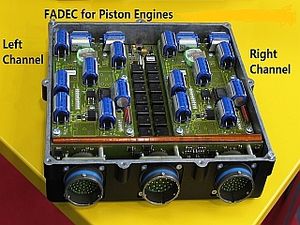
At the time of the crash, new FADEC (Full Authority Digital Engine Control) equipment was being integrated onto all RAF Chinooks, as part of an upgrade from the Chinook HC.1 standard to the newer Chinook HC.2 variant. The Ministry of Defence was given a £3 million settlement from Textron, the manufacturers of the system, after a ground-test of the FADEC systems on a Chinook in 1989 resulted in severe airframe damage. Contractors, including Textron, had agreed that FADEC had been the cause of the 1989 incident and that the system needed to be redesigned.

The committee investigating the crash were satisfied that the destructive error in 1989 was not relevant to the 1994 crash. Information provided from Boeing to the investigation led to the following conclusion regarding FADEC performance: “Data from the Digital Electronics Unit (DECU) of the second engine showed no evidence of torque or temperature exceedance and the matched power conditions of the engines post-impact indicate that there was no sustained emergency power demand. No other evidence indicated any FADEC or engine faults.”

It was expected that in a FADEC engine runaway, engine power would become asynchronous and mismatched. The investigation found the engines at the crash to have matched settings, decreasing the likelihood of a FADEC malfunction being involved.

EDS-SCICON was given the task of independently evaluating the software on the Chinook HC.2 in 1993. According to the House of Commons report:

“After examining only 18 per cent of the code they found 486 anomalies and stopped the review… intermittent engine failure captions were being regularly experienced by aircrew of Chinook Mk 2s and there were instances of uncommanded run up and run down of the engines and undemanded flight control movements”.


Tests upon the Chinooks performed by the MOD at Boscombe Down in 1994 reported the FADEC software to be

“unverifiable and … therefore unsuitable for its purpose”.


In June 1994, the MoD test pilots at Boscombe Down had refused to fly the Chinook HC.2 until the engines, engine control systems and FADEC software had undergone revision. In October 2001, Computer Weekly reported that three fellows of the Royal Aeronautical Society had said that issues with either control or FADEC systems could have led to the crash.

The main submission to Lord Philip (see above) revealed that the FADEC Safety Critical software did not have a Certificate of Design, and was therefore not cleared to be fitted to Chinook HC2. It further revealed that John Spellar MP had been wrong when claiming the software was not Safety Critical, providing the original policy document governing this definition to Lord Philip. MoD subsequently claimed it did not have its own copy, calling in to question how it could advise Spellar one way or the other.

Other factors

The onboard Tactical Air Navigation System, which only retained the last measured altitude, gave an altitude reading of 468 feet (143 m). The investigation observed that it was possible for some of the avionics systems to interfere with the Chinook’s VHF radio, potentially disrupting communications.

Flight data recorders and cockpit voice recorders were not fitted to all RAF Chinooks at the time of the accident. The absence of this data greatly reduced the amount and quality of data available to subsequent investigations. Information on speed and height were derived from the position of cockpit dials in the wreckage, and the wreckage’s condition. The RAF had begun to fit these recording devices across the Chinook HC.2 fleet in 1994, prior to the accident; this process was completed in 2002.

————————————-

TOP 10 Fatal helicopter crash compilation

————————————-

19th May – Deaths & Events in Northern Ireland Troubles

Key Events & Deaths on this day in Northern Ireland Troubles

19th May

Sunday 19 May 1974

Day 5 of the UWC strike

Merlyn Rees, then Secretary of Sate for Northern Ireland, announced a State of Emergency (Section 40, Northern Ireland Constitution Act 1973).

Rees flew to Chequers, the country home of the Prime Minister, for talks.

The United Ulster Unionist Council (UUUC) met and agreed to support the Ulster Workers’ Council (UWC). The UWC withdrew its call for a total stoppage as of midnight. Some shops reported panic buying. A memorandum was submitted by the Northern Ireland Labour Party (NILP) to the Northern Ireland Office (NIO

Tuesday 19 May 1981

Five British soldiers were killed in an Irish Republican Army (IRA) landmine attack near Bessbrook, County Armagh. The soldiers had been travelling in an armoured vehicle when the bomb exploded.

Tuesday 19 May 1987

Robert McCarty

The Ulster Unionist Party (UUP) expelled Robert McCartney because of his criticism of UUP leaders and also for his involvement in the Campaign for Equal Citizenship.

Wednesday 19 May 1993

Local Government Elections

There were district council elections to choose 582 councillors for the 26 District Councils in Northern Ireland.

[When the results were declared they showed an increase in the percentage share of the vote for the Social Democratic and Labour Party (SDLP), Sinn Féin (SF), and the Alliance Party of Northern Ireland (APNI).]

gilford pub bombing

Three former detectives in the British police who had been involved in the investigations that led to the convictions of the Guildford Four were cleared of conspiring to pervert the course of justice. The men were accused of having manufactured the interview notes of one of the Guildford Four.

See Guildford Bombing

Thursday 19 May 1994

The Northern Ireland Office (NIO) published a 21 page British government response to Sinn Féin (SF) questions that arose from the Downing Street Declaration (DSD). SF had submitted a series of 20 questions via the Irish government. Albert Reynolds, then Taoiseach (Irish Prime Minister), described the clarification as “comprehensive and positive”.

Friday 19 May 1995

At the Forum for Peace and Reconciliation in Dublin, Seamus Mallon, then deputy leader of the Social Democratic and Labour Party (SDLP), criticised the support by Sinn Féin (SF) for imposed all-Ireland institutions without a democratic assembly in Northern Ireland. Mallon argued in favour of the model in the Framework Documents (published on 22 February 1995).

Sunday 19 May 1996

Geoffrey Anderson, then a Royal Irish Regiment soldier, killed two people and injured a third before committing suicide.

See Irish Times for full story

There was a confrontation between the Royal Ulster Const abulary (RUC) and nationalists in the village of Dunloy, County Antrim, during an Apprentice Boys of Derry march

Monday 19 May 1997

Gerry Adams, then President of Sinn Féin (SF), and Martin McGuinness, then Vice-President of Sinn Féin (SF), travelled to Westminster to press their case for facilities within the House of Commons.

The two SF Members of Parliament (MPs) were denied access to the House when they refused to take their seats which would have involved taking an oath of allegiance to the Queen.

Tuesday 19 May 1998

John Hume, then leader of the Social Democratic and Labour Party (SDLP), and David Trimble, then leader of the Ulster Unionist Party (UUP), met on the stage at a U2 concert at Belfast’s Waterfront Hall.

The concert had been arranged to support the ‘Yes’ campaign.

[Bono, then lead singer with the group U2, joined the two party leaders on stage and held their arms aloft. This event was thought to have given the ‘Yes’ campaign a much needed boost. Until then the two party leaders had not campaigned together.]

A ‘pipe-bomb’ contained in a parcel was delivered to the Dublin Tourist offices in St Andrew’s Street, Dublin, Republic of Ireland. The device was spotted and defused.

[An unknown Loyalist paramilitary group was thought to be responsible for the attack. Pipe-bombs were widely used by Loyalist paramilitaries over the coming years particularly in attacks on the homes of Catholic families in Northern Ireland.]

Wednesday 19 May 1999

John Pickering (Rev), then rector of Drumcree, together with his vestry, decided to defy the General Synod’s vote on 18 May 1999 and announced that they would go ahead with the service for the Orange Order at Drumcree on 4 July 1999.

Talks were held in Downing Street involving the Ulster Unionist Party (UUP), the Social Democratic and Labour Party (SDLP), and Sinn Féin (SF).

However the parties failed to reach agreement on outstanding issues.

Loyalists clashed with Royal Ulster Constabulary (RUC) officers in Portadown, County Armagh.

Eddie Copeland was awarded £27,500 by Belfast High Court in compensation for injuries received when he was shot by a British Army soldier on 26 October 1993. The case was taken against the Ministry of Defence. Copeland had been attending the funeral of Thomas Begley who was killed planting a bomb on the Shankill Road on 23 October 1993.

Garda Síochána (the Irish police) opened an inquiry into the killing of Seamus Ludlow on 2 May 1976 who was found shot in laneway near to his home, Thistlecross, near Dundalk, County Louth. Gardaí initially blamed the Irish Republican Army (IRA) for the killing.

[However later it was claimed that Ludlow had been killed by the Red Hand Commando (RHC) / Ulster Volunteer Force (UVF). There was also speculation of involvement by the Special Air Service (SAS) and also by the Ulster Defence Regiment (UDR).]


  ——————————————

Remembering all innocent victims of the Troubles

Today is the anniversary of the death of the following people killed as a results of the conflict in Northern Ireland

“To live in hearts we leave behind is not to die

– Thomas Campbell

To the innocent on the list – Your memory will live forever

– To the Paramilitaries –

There are many things worth living for, a few things worth dying for, but nothing worth killing for.

10 People lost their lives on the 19th May between 1972 – 1981

 ——————————————

19 May 1972
Harold Morris   (15)

Protestant
Status: Civilian (Civ),

Killed by: Irish Republican Army (IRA)
Shot by sniper while walking along Boundary Street, Shankill, Belfast.

 ——————————————

19 May 1972


Manus Deery  (15)

Catholic
Status: Civilian (Civ),

Killed by: British Army (BA)
Shot by sniper from British Army (BA) observation post on city walls, while in entry off Westland Street, Derry.

 ——————————————

19 May 1973
Robert McIntyre   (24)

Protestant
Status: Ulster Volunteer Force (UVF),

Killed by: Ulster Defence Regiment (UDR)
Died two days after being shot by off duty Ulster Defence Regiment (UDR) member while attempting to hijack a car, Shankill Road, Belfast.

 ——————————————

19 May 1973
Edward Coogan    (39)

Catholic
Status: Civilian (Civ),

Killed by: non-specific Loyalist group (LOY)
Shot from passing car while walking along Adela Street, off Antrim Road, Belfast.

 ——————————————

19 May 1979
Jack McClenaghan   (64)

Protestant
Status: ex-Ulster Defence Regiment (xUDR),

Killed by: Irish Republican Army (IRA)
Shot while delivering bread, Garrison, County Fermanagh.

 ——————————————

19 May 1981


Andrew Gavin   (19)

nfNI
Status: British Army (BA),

Killed by: Irish Republican Army (IRA)
Killed in land mine attack on British Army (BA) Armoured Personnel Carrier, Chancellor’s Road, Altnaveigh, near Bessbrook, County Armagh.

 ——————————————

19 May 1981


Paul Bulman  (19)

nfNI
Status: British Army (BA),

Killed by: Irish Republican Army (IRA)
Killed in land mine attack on British Army (BA) Armoured Personnel Carrier, Chancellor’s Road, Altnaveigh, near Bessbrook, County Armagh.

 ——————————————

19 May 1981


Michael Bagshaw   (25)

nfNI
Status: British Army (BA),

Killed by: Irish Republican Army (IRA)
Killed in land mine attack on British Army (BA) Armoured Personnel Carrier, Chancellor’s Road, Altnaveigh, near Bessbrook, County Armagh.

 ——————————————

19 May 1981
John King  (20)

nfNI
Status: British Army (BA),

Killed by: Irish Republican Army (IRA)
Killed in land mine attack on British Army (BA) Armoured Personnel Carrier, Chancellor’s Road, Altnaveigh, near Bessbrook, County Armagh.

 ——————————————

19 May 1981


Grenville Winstone  (27)

nfNI
Status: British Army (BA),

Killed by: Irish Republican Army (IRA)
Killed in land mine attack on British Army (BA) Armoured Personnel Carrier, Chancellor’s Road, Altnaveigh, near Bessbrook, County Armagh.

 ——————————————

See: Bessbrook : 

The “B-Specials” or “B Men’

The Ulster Special Constabulary ( commonly called the “B-Specials” or “B Men’) ———————————- B Specials Brit…

Source: The “B-Specials” or “B Men’

Dublin and Monaghan Bombings – 17th May 1974

Dublin and Monaghan Bombings 17 May 1974 The views and opinions expressed in this page and  documentaries are soley intended to educate and provide background information to those interested in the…

Source: Dublin and Monaghan Bombings – 17 May 1974

17th May – Deaths & Events in Northern Ireland Troubles


Key Events & Deaths on this day in Northern Ireland Troubles

17th May

——————————————-

Wednesday 17 May 1972

The Irish Republican Army (IRA) opened fire on workers leaving the Mackies engineering works in West Belfast.

[Although the factory was sited in a Catholic area it had an almost entirely Protestant workforce.]

Thursday 17 May 1973

The Irish Republican Army (IRA) carried out a booby-trap bomb attack on five members of the British Army who were off duty at the time. The attack occurred in Omagh, County Tyrone.

See Palace Barracks for more details

[Four soldiers were killed on the day and the fifth soldier died on 3 June 1973.]

Loyalists killed two Catholic civilians in Belfast.

The Royal Ulster Constabulary (RUC) shot dead a man in County Fermanagh.

Friday 17 May 1974

Dublin and Monaghan Bombings  33 People Killed

Day 3 of the UWC strike
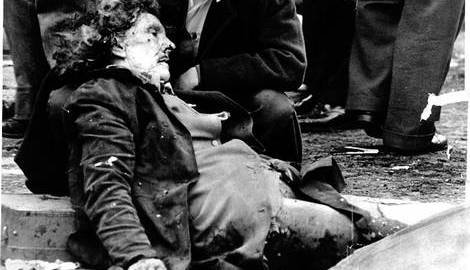
Dublin and Monaghan bombings victim

33 civilians and an unborn child were killed in the Republic of Ireland as a result of a series of explosions when four car bombs were planted by Loyalist paramilitaries in Dublin and Monaghan.

Approximately 258 people were also injured in the explosions. The death toll from the bombings was the largest in any single day of the conflict. No one was ever arrested or convicted of causing the explosions.

[On 15 July 1993 the Ulster Volunteer Force (UVF) claimed sole responsibility for carrying out the bomb attacks.]

In Dublin three car bombs exploded, almost simultaneously at approximately 5.30pm, in Parnell Street, Talbot Street, and South Leinster Street. 23 men, women and children died in these explosions and 3 others died as a result of injuries over the following few days. Another car bomb exploded at approximately 7.00pm in North Road, Monaghan, killing 5 people initially with another 2 dying in the following weeks.

The first of the three Dublin bombs went off at approximately 5.28pm in Parnell Street. Eleven people died as a result of this explosion.

The second of the Dublin bombs went off at approximately 5.30pm in Parnell Street. Fourteen people died in this explosion. The third bomb went off at approximately 5.32pm in South Leinster Street. Two people were killed in this explosion.

News of car bombs in Dublin and Monaghan raised tensions in Northern Ireland. Sammy Smyth, then press officer of both the Ulster Defence Association (UDA) and the Ulster Workers’ Council (UWC) Strike Committee, said,

“I am very happy about the bombings in Dublin. There is a war with the Free State and now we are laughing at them.”

See Dublin and Monaghan Bombings

In Northern Ireland reductions in the supply of electricity continued to have serious consequences for industry, commerce, and the domestic sector. In addition to problems in maintaining petrol distribution, a lack of electricity also meant that pumps did not operate for substantial periods of each day. Postal delivery services came to a halt following intimidation of Royal Mail employees.

There were continuing problems in farming and in the distribution of food supplies. Special arrangements were made by the Northern Ireland Executive to ensure that payments of welfare benefits would be delivered to claimants.
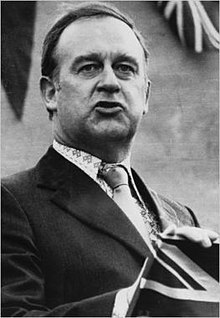
William Craig, then leader of (Ulster) Vanguard, criticised Merlyn Rees, then Secretary of Sate for Northern Ireland, for not negotiating with the Ulster Workers’ Council (UWC).

[Public Records 1974 – Released 1 January 2005: Letter from F.E.R. Butler, then in the Ministry of Defence, discussing the ‘Provision of Electric Power to Belfast’.]

Monday 17 May 1976

James Gallagher (20) was shot dead, as he travelled, as a passenger on a bus, past Fort George British Army base, Strand Road, Derry.

The soldier who shot him was on sentry duty in the base and as he handed over his rifle is reported to have said, “I’m cracking, I’m cracking”. Two other passengers on the bus, a man and a woman, were injured in the incident.

[Later Gallagher was listed on a Republican roll of honour as an Irish Republican Army (IRA) member.]

Two Protestant civilians were shot dead by Republican paramilitaries at a factory in Dungannon Street, Moy, County Tyrone.

Friday 17 May 1984
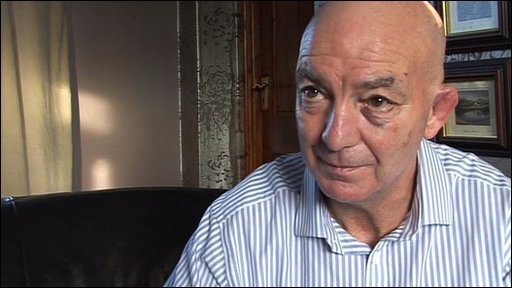
Jim Campbell, then Northern Editor of the Sunday World, was shot and seriously injured by the Ulster Volunteer Force (UVF) at his home in north Belfast.

See Martin Ohagan

Wednesday 17 May 1989

Local Government Elections

Local government elections were held across Northern Ireland.

[The percentage share of the vote was: Ulster Unionist Party (UUP) 31.4%; Democratic Unionist Party (DUP) 17.8%; Social Democratic and Labour Party (SDLP) 21.2%; Sinn Féin (SF) 11.3%; Alliance Party of Northern Ireland (APNI) 6.8%; Workers Party (WP) 2.1%; Others 9.4%; Turnout 56.0%. (See detailed results.)]

Thursday 17 May 1990

Summary of Stevens Report Published

A summary of the report of the Stevens Inquiry was published. The main finding of the report was that there had been evidence of collusion between members of the security forces and Loyalist paramilitaries.

However it was the view of the inquiry that any collusion was “restricted to a small number of members of the security forces and is neither widespread nor institutionalised”.

There was a Westminster by-election in the constituency of Upper Bann. David Trimble, of the Ulster Unionist Party (UUP), won the by-election with a majority of almost 14,000 votes. The Conservative Party candidate, Colette Jones, lost her deposit.

Sunday 17 May 1992

British soldiers of the King’s Own Scottish Borderers becamed involved in a fist-fight with local people in Coalisland, County Tyrone. Soon after members of the Parachute Regiment arrived and fired on a crowd of people standing outside a public house in the town, and shot and wounded three civilians and injured a further four others.

[This incident followed an earlier one on 12 May 1992. It was later reported that the commander of the army’s Third Brigade was transferred. Patrols by the Parachute Regiment were also ended before the official end of the regiment’s tour of duty.]

Monday 17 May 1993

The Combined Loyalist Military Command (CLMC) stated that it would look at the results of the local government elections on 19 May 1993 to see if there was any evidence of “pan-Nationalist candidates” co-operating with each other.

Tuesday 17 May 1994

Two Catholics Killed by UVF


Eamon Fox (42) and Gary Convie (24), both Catholic civilians, were shot dead by the Ulster Volunteer Force (UVF) at a building site on North Queen Street, in the Tiger Bay area of Belfast.

A review of the working of the Northern Ireland (Emergency Provisions) Act recommended that police interviews should be taped.

Wednesday 17 May 1995

Unemployment in Northern Ireland in April 1995 was recorded as 88,700 (11.8 per cent) the lowest it had been since December 1981

Saturday 17 May 1997

Gerry Adams, then President of Sinn Féin (SF), held a meeting with officials representing the Irish government at an undisclosed venue in Dublin. John Bruton, the Taoiseach (Irish Prime Minister), said afterwards that the meeting was to establish if the Irish Republican Army (IRA) was prepared to call a new ceasefire.

Sunday 17 May 1999

Tony Blair, then British Prime Minister, said there was no “plan B” if the Agreement was rejected in the referendum. Blair and Bill Clinton, then President of the United States of America (USA), issued a joint statement urging people to recognise the opportunities offered by the Agreement and to vote ‘Yes’.

Monday 17 May 1999

The Ulster Unionist Party (UUP) issued a blunt warning that it would not change its position on decommissioning before, during or after next month’s European election. David Trimble, then First Minister designate, challenged Tony Blair, then British Prime Minister, to state whether, in the British government’s view, devolution could proceed without the start of “actual decommissioning”.

In the Republic of Ireland 42 candidates were nominated for the European election on 11 June 1999. Fianna Fáil (FF) put forward eight candidates, Fine Gael seven, Labour five, Sinn Féin four, Natural Law Party four, and the Green Party three. For the first time there was no PD candidate.

Thursday 17 May 2001

Sean MacStiofain (73), former Chief of Staff of the (Provisional) Irish Republican Army (IRA), died in a hospital in the Republic of Ireland after a long illness. He became Chief of Staff of the Provisionals after they split from the Official IRA in 1970.

[MacStiofain had been born John Stephenson in London.]

Death

In 1993, Mac Stíofáin suffered a stroke. On 18 May 2001, he died in Our Lady’s Hospital, Navan, County Meath, after a long illness at the age of 73. He is buried in St Mary’s Cemetery, Navan.

Despite his controversial career in the IRA, many of his former comrades (and rivals) paid tribute to him after his death. Ruairí Ó Brádaigh, who attended the funeral, issued a glowing tribute, referring to Mac Stíofáin as an “outstanding IRA leader during a crucial period in Irish history” and as the “man for the job” as first Provisional IRA Chief of Staff. Gerry Adams and Martin McGuinness also attended. In her oration, Ita Ní Chionnaigh of Conradh na Gaeilge, whose flag draped the coffin, lambasted Mac Stíofáin’s “character assassination” by the “gutter press” and praised him as a man who had been “interested in the rights of men and women and people anywhere in the world who were oppressed, including Irish speakers in Ireland, who are also oppressed.

See here for more details on Sean MacStiofain


  ——————————————

Remembering all innocent victims of the Troubles

Today is the anniversary of the death of the following people killed as a results of the conflict in Northern Ireland

“To live in hearts we leave behind is not to die

– Thomas Campbell

To the innocent on the list – Your memory will live forever

– To the Paramilitaries –

There are many things worth living for, a few things worth dying for, but nothing worth killing for.

50  People lost their lives on the 17th between 1972 – 1990

 ——————————————

17 May 1972


Bernard Moane   (46)

Catholic
Status: Civilian (Civ),

Killed by: Ulster Defence Association (UDA)
Found shot by Knockagh War Memorial, near Greenisland, County Antrim.

 ——————————————

17 May 1972
Ronald Hurst  (25)

nfNI
Status: British Army (BA),

Killed by: Irish Republican Army (IRA)
Shot while working on perimeter fencing outside Crossmaglen Royal Ulster Constabulary (RUC) / British Army (BA) base, County Armagh.

 ——————————————

17 May 1973
Michael Leonard  (22)

nfNI
Status: Civilian (Civ),

Killed by: Royal Ulster Constabulary (RUC)
From County Donegal. Shot while driving his car, being pursued by Royal Ulster Constabulary (RUC) vehicle, Letter, near Pettigoe, County Fermanagh.

 ——————————————

17 May 1973


Eileen Mackin  (14)

Catholic
Status: Civilian (Civ),

Killed by: non-specific Loyalist group (LOY)
Shot by sniper while walking along Springhill Avenue, Ballymurphy, Belfast.

 ——————————————

17 May 1973


Thomas Ward   (34)

Catholic
Status: Civilian (Civ),

Killed by: Ulster Volunteer Force (UVF)
Shot during bomb and gun attack on Jubilee Arms, Lavinia Street, off Ormeau Road, Belfast.

 ——————————————

17 May 1973
Arthur Place   (29)

nfNI
Status: British Army (BA),

Killed by: Irish Republican Army (IRA)
Off duty. Killed by booby trap bomb while getting into car, outside Knock-na-Moe Castle Hotel, Omagh, County Tyrone.

 ——————————————

17 May 1973
 Derek Reed  (28)

nfNI
Status: British Army (BA),

Killed by: Irish Republican Army (IRA)
Off duty. Killed by booby trap bomb while getting into car, outside Knock-na-Moe Castle Hotel, Omagh, County Tyrone.

 ——————————————

17 May 1973
Sheridan Young  (26)

nfNI
Status: British Army (BA),

Killed by: Irish Republican Army (IRA)
Off duty. Killed by booby trap bomb while getting into car, outside Knock-na-Moe Castle Hotel, Omagh, County Tyrone. .

 ——————————————

17 May 1973
Barry Cox   (28)

nfNI
Status: British Army (BA),

Killed by: Irish Republican Army (IRA)
Off duty. Killed by booby trap bomb while getting into car, outside Knock-na-Moe Castle Hotel, Omagh, County Tyrone.

 ——————————————

17 May 1973
Frederick Drake  (25)

nfNI
Status: British Army (BA),

Killed by: Irish Republican Army (IRA)
Off duty. Injured by booby trap bomb while getting into car, outside Knock-na-Moe Castle Hotel, Omagh, County Tyrone. He died 3 June 1973

 ——————————————

Dublin and Monaghan Bombings

17 May 1974

Dublin and Monaghan bombings victim

33 People  lost their lives

See Dublin and Monaghan Bombings

————————————————-

17 May 1974

Marie Butler,  (21)

nfNIRI

Status: Civilian (Civ),

Killed by: Ulster Volunteer Force (UVF)
Killed when car bomb exploded Parnell Street, Dublin.

See Dublin and Monaghan Bombings

————————————————-

17 May 1974
John Dargle,   (80)

nfNIRI
Status: Civilian (Civ),

Killed by: Ulster Volunteer Force (UVF)
Killed when car bomb exploded Parnell Street, Dublin.

See Dublin and Monaghan Bombings

————————————————-

17 May 1974

Patrick Fay,  (47)

nfNIRI
Status: Civilian (Civ),

Killed by: Ulster Volunteer Force (UVF)
Killed when car bomb exploded Parnell Street, Dublin.

See Dublin and Monaghan Bombings

————————————————-

17 May 1974
Elizabeth Fitzgerald,   (59)

nfNIRI
Status: Civilian (Civ),

Killed by: Ulster Volunteer Force (UVF)
Injured when car bomb exploded Parnell Street, Dublin. She died 19 May 1974

See Dublin and Monaghan Bombings

————————————————-

17 May 1974

Antonio Magliocco,  (37)

nfNIRI
Status: Civilian (Civ),

Killed by: Ulster Volunteer Force (UVF)
Italian national. Killed when car bomb exploded Parnell Street,

See Dublin and Monaghan Bombings

————————————————-

17 May 1974

John O’Brien,   (24)

nfNIRI
Status: Civilian (Civ),

Killed by: Ulster Volunteer Force (UVF)
Killed when car bomb exploded Parnell Street, Dublin.

See Dublin and Monaghan Bombings

————————————————-

17 May 1974

Anna O’Brien  (22)

nfNIRI
Status: Civilian (Civ),

Killed by: Ulster Volunteer Force (UVF)
Killed when car bomb exploded Parnell Street, Dublin.

See Dublin and Monaghan Bombings

————————————————-

17 May 1974

Jacqueline O’Brien,   (1)

nfNIRI
Status: Civilian (Civ),

Killed by: Ulster Volunteer Force (UVF)
Killed when car bomb exploded Parnell Street, Dublin

See Dublin and Monaghan Bombings

————————————————-

17 May 1974
Anne Marie O’Brien,  (0)

nfNIRI
Status: Civilian (Civ),

Killed by: Ulster Volunteer Force (UVF)
Killed when car bomb exploded Parnell Street, Dublin.

See Dublin and Monaghan Bombings

————————————————-

17 May 1974


Edward O’Neill,  (39)

nfNIRI
Status: Civilian (Civ),

Killed by: Ulster Volunteer Force (UVF)
Killed when car bomb exploded Parnell Street, Dublin.

See Dublin and Monaghan Bombings

————————————————-

17 May 1974


Breda Turner,   (21)

nfNIRI
Status: Civilian (Civ),

Killed by: Ulster Volunteer Force (UVF)
Killed when car bomb exploded Parnell Street

See Dublin and Monaghan Bombings

————————————————-

17 May 1974

Anne Byrne,  (35)

nfNIRI
Status: Civilian (Civ),

Killed by: Ulster Volunteer Force (UVF)
Killed when car bomb exploded Talbot Street, Dublin.

See Dublin and Monaghan Bombings

————————————————-

17 May 1974

Simone Chetrit,   (30)

nfNIRI
Status: Civilian (Civ),

Killed by: Ulster Volunteer Force (UVF)
French national. Killed when car bomb exploded Talbot Street, Dublin.

See Dublin and Monaghan Bombings

————————————————-

17 May 1974


Colette Doherty,  (21)

nfNIRI
Status: Civilian (Civ),

Killed by: Ulster Volunteer Force (UVF)
Killed when car bomb exploded Talbot Street, Dublin

See Dublin and Monaghan Bombings

————————————————-

17 May 1974


Breda Grace,  (35)

nfNIRI
Status: Civilian (Civ)

, Killed by: Ulster Volunteer Force (UVF)
Killed when car bomb exploded Talbot Street, Dublin.

Dublin and Monagh Bombings

————————————————-

17 May 1974


Anna Marren,   (20)

nfNIRI
Status: Civilian (Civ),

Killed by: Ulster Volunteer Force (UVF)
Killed when car bomb exploded Talbot Street, Dublin.

See Dublin and Monaghan Bombings

————————————————-

17 May 1974

May McKenna,   (55)

nfNIRI
Status: Civilian (Civ),

Killed by: Ulster Volunteer Force (UVF)
Killed when car bomb exploded Talbot Street, Dublin.

See Dublin and Monaghan Bombings

————————————————-

17 May 1974

Dorothy  Morris,  (57)

nfNIRI
Status: Civilian (Civ),

Killed by: Ulster Volunteer Force (UVF)
Killed when car bomb exploded Talbot Street, Dublin.

See Dublin and Monaghan Bombings

————————————————-

17 May 1974


Marie Phelan,   (20)

nfNIRI
Status: Civilian (Civ),

Killed by: Ulster Volunteer Force (UVF)
Killed when car bomb exploded Talbot Street, Dublin.

See Dublin and Monaghan Bombings

————————————————-

17 May 1974

Siobhan Roice,   (19)

nfNIRI
Status: Civilian (Civ),

Killed by: Ulster Volunteer Force (UVF)
Killed when car bomb exploded Talbot Street, Dublin.

See Dublin and Monaghan Bombings

————————————————-

17 May 1974


Maureen Shields,  (46)

nfNIRI
Status: Civilian (Civ),

Killed by: Ulster Volunteer Force (UVF)
Killed when car bomb exploded Talbot Street, Dublin.

See Dublin and Monaghan Bombings

————————————————-

17 May 1974

John Walshe,   (27)

nfNIRI
Status: Civilian (Civ),

Killed by: Ulster Volunteer Force (UVF)
Killed when car bomb exploded Talbot Street, Dublin.

See Dublin and Monaghan Bombings

————————————————-

17 May 1974

Josephine Bradley,  (21)

nfNIRI
Status: Civilian (Civ),

Killed by: Ulster Volunteer Force (UVF)
Injured when car bomb exploded Talbot Street, Dublin. She died 20 May 1974

See Dublin and Monaghan Bombings

————————————————-

17 May 1974

Concepta  Dempsey,  (65)

nfNIRI
Status: Civilian (Civ),

Killed by: Ulster Volunteer Force (UVF)
Injured when car bomb exploded Talbot Street, Dublin. She died 11 June 1974.

See Dublin and Monaghan Bombings

————————————————-

17 May 1974


Anna Massey,  (21)

nfNIRI
Status: Civilian (Civ),

Killed by: Ulster Volunteer Force (UVF)
Killed when car bomb exploded South Leinster Street, Dublin

See Dublin and Monaghan Bombings

————————————————-

17 May 1974


Christine O’Loughlin,   (51)

nfNIRI
Status: Civilian (Civ),

Killed by: Ulster Volunteer Force (UVF)
Killed when car bomb exploded South Leinster Street, Dublin.

See Dublin and Monaghan Bombings

————————————————-

17 May 1974


Patrick Askin,   (44)

nfNIRI
Status: Civilian (Civ),

Killed by: Ulster Volunteer Force (UVF)
Killed when car bomb exploded Church Square, Monaghan, County Monaghan

See Dublin and Monaghan Bombings

————————————————-

17 May 1974
Thomas Campbell,  (52)

nfNIRI
Status: Civilian (Civ),

Killed by: Ulster Volunteer Force (UVF)
Killed when car bomb exploded Church Square, Monaghan, County Monaghan

See Dublin and Monaghan Bombings

————————————————-

17 May 1974

John Travers,   (28)

nfNIRI
Status: Civilian (Civ),

Killed by: Ulster Volunteer Force (UVF)
Killed when car bomb exploded Church Square, Monaghan, County Monaghan

See Dublin and Monaghan Bombings

————————————————-

17 May 1974

Peggy White,   (45)

nfNIRI
Status: Civilian (Civ),

Killed by: Ulster Volunteer Force (UVF)
Killed when car bomb exploded Church Square, Monaghan, County Monaghan.

See Dublin and Monaghan Bombings

————————————————-

17 May 1974

George Williamson,   (72)

nfNIRI
Status: Civilian (Civ),

Killed by: Ulster Volunteer Force (UVF)
Killed when car bomb exploded Church Square, Monaghan, County Monaghan

See Dublin and Monaghan Bombings

————————————————-

17 May 1974

Archie Harper,  (73)

nfNIRI
Status: Civilian (Civ),

Killed by: Ulster Volunteer Force (UVF)
Injured when car bomb exploded Church Square, Monaghan, County Monaghan. He died 21 May 1974.

See Dublin and Monaghan Bombings

————————————————-

17 May 1974

Thomas Croarkin,   (36)

nfNIRI
Status: Civilian (Civ),

Killed by: Ulster Volunteer Force (UVF)
Injured when car bomb exploded Church Square, Monaghan, County Monaghan. He died 24 July 1974.

See Dublin and Monaghan Bombings

————————————————-

17 May 1976
Robert Dobson  (35)

Protestant
Status: Civilian (Civ),

Killed by: non-specific Republican group (REP)
Shot, together with his brother, at their business premises, Dungannon Street, Moy, County Tyrone.

 ——————————————

17 May 1976
Thomas Dobson  (38)

Protestant
Status: Civilian (Civ),

Killed by: non-specific Republican group (REP)
Shot, together with his brother, at their business premises, Dungannon Street, Moy, County Tyrone.

 ——————————————

17 May 1976


James Gallagher  (20)

Catholic
Status: Irish Republican Army (IRA),

Killed by: British Army (BA)
Shot while travelling on bus which was passing Fort George British Army (BA) base, Strand Road, Derry.

 ——————————————

17 May 1986


David Wilson  (39)

Protestant
Status: Civilian (Civ),

Killed by: Irish Republican Army (IRA)
Shot while driving his firm’s van, Donaghmore, County Tyrone.

 ——————————————

17 May 1991


Douglas Carruthers   (41)

Protestant
Status: Royal Ulster Constabulary (RUC),

Killed by: Irish Republican Army (IRA)
Off duty. Killed by booby trap bomb attached to his car while driving near to his home, Mullybritt, Lisbellaw, County Fermanagh.

 ——————————————

17 May 1994


Eamon Fox  (42)

Catholic
Status: Civilian (Civ),

Killed by: Ulster Volunteer Force (UVF)
Shot, while sitting in stationary car, at his workplace, building site, North Queen Street, Tigers Bay, Belfast.

 ——————————————

17 May 1994


 Gary Convie  (24)

Catholic
Status: Civilian (Civ),

Killed by: Ulster Volunteer Force (UVF)
Shot, while sitting in stationary car, at his workplace, building site, North Queen Street, Tigers Bay, Belfast

 ——————————————