The Vietnam War (Vietnamese: Chiến tranh Việt Nam), also known as the Second Indochina War,[37] and also known in Vietnam as Resistance War Against America (Vietnamese: Kháng chiến chống Mỹ) or simply the American War, was a Cold War-era proxy war[38] that occurred in Vietnam, Laos, and Cambodia from 1 November 1955[A 1] to the fall of Saigon on 30 April 1975. This war followed the First Indochina War (1946–54) and was fought between North Vietnam—supported by the Soviet Union, China and other communist allies—and the government of South Vietnam—supported by the United States, Philippines and other anti-communistallies.[43] The Viet Cong (also known as the National Liberation Front, or NLF), a South Vietnamese communist common front aided by the North, fought a guerrilla war against anti-communist forces in the region. The People’s Army of Vietnam (also known as the North Vietnamese Army) engaged in a more conventional war, at times committing large units to battle.
———————————————-
Cold Blooded US Soldier in Vietnam speaks of his Killing Ethics
———————————————-
RETRANSMISSION TO RESIZE FILE–FILE–South Vietnamese National Police Chief Brig Gen. Nguyen Ngoc Loan executes a Viet Cong prisoner with a single pistol shot in the head in Saigon Feb. 1, 1968. Nguyen died Wednesday, July 15, 1998 at his home in Burke, a suburb of Washington, D.C., after a battle with cancer, said his daughter, Nguyen Anh. He was 67. This photo of Nguyen aiming a pistol point-blank at the grimacing prisoner’s head became a memorable image of the Vietnam War. The photograph, by Eddie Adams, won a Pulitzer prize for The Associated Press. (AP Photo/Eddie Adams)
As the war continued, the part of the Viet Cong in the fighting decreased as the role of the NVA grew. U.S. and South Vietnamese forces relied on air superiority and overwhelming firepower to conduct search and destroy operations, involving ground forces, artillery, and airstrikes. In the course of the war, the U.S. conducted a large-scale strategic bombing campaign against North Vietnam, and over time the North Vietnamese airspace became the most heavily defended in the world.[citation needed]
The U.S. government viewed its involvement in the war as a way to prevent a Communist takeover of South Vietnam. This was part of a wider containment policy, with the stated aim of stopping the spread of communism. The North Vietnamese government and the Viet Cong were fighting to reunify Vietnam under communist rule. They viewed the conflict as a colonial war, fought initially against forces from France and then America, and later against South Vietnam.[44]
Beginning in 1950, American military advisors arrived in what was then French Indochina.[45][A 3] U.S. involvement escalated in the early 1960s, with troop levels tripling in 1961 and again in 1962.[46] U.S. involvement escalated further following the 1964 Gulf of Tonkin incident, in which a U.S. destroyer clashed with North Vietnamese fast attack craft, which was followed by the Gulf of Tonkin Resolution, which gave the U.S. president authorization to increase U.S. military presence. Regular U.S. combat units were deployed beginning in 1965. Operations crossed international borders: bordering areas of Laos and Cambodia were heavily bombed by U.S. forces as American involvement in the war peaked in 1968, the same year that the communist side launched the Tet Offensive. The Tet Offensive failed in its goal of overthrowing the South Vietnamese government but became the turning point in the war, as it persuaded a large segment of the United States population that its government’s claims of progress toward winning the war were illusory despite many years of massive U.S. military aid to South Vietnam.
Gradual withdrawal of U.S. ground forces began as part of “Vietnamization“, which aimed to end American involvement in the war while transferring the task of fighting the Communists to the South Vietnamese themselves. Despite the Paris Peace Accord, which was signed by all parties in January 1973, the fighting continued. In the U.S. and the Western world, a large anti-Vietnam War movement developed as part of a larger counterculture. The war changed the dynamics between the Eastern and Western Blocs, and altered North-South relations.[47]
———————————————-
Capture of Saigon
———————————————-
Direct U.S. military involvement ended on 15 August 1973.[48] The capture of Saigon by the North Vietnamese Army in April 1975 marked the end of the war, and North and South Vietnam were reunified the following year. The war exacted a huge human cost in terms of fatalities (see Vietnam War casualties). Estimates of the number of Vietnamese soldiers and civilians killed vary from 800,000[49] to 3.1 million.[29][50][51] Some 200,000–300,000 Cambodians,[34][35][36] 20,000–200,000 Laotians,[52][53][54][55][56][57] and 58,220 U.S. service members also died in the conflict.[A 2]
ContentsNames for the warFurther information: Terminology of the Vietnam WarVarious names have been applied to the conflict. Vietnam War is the most commonly used name in English. It has also been called the Second Indochina War and the Vietnam Conflict.As there have been several conflicts in Indochina, this particular conflict is known by the names of its primary protagonists to distinguish it from others.[62] In Vietnamese, the war is generally known as Kháng chiến chống Mỹ (Resistance War Against America). It is also called Chiến tranh Việt Nam (The Vietnam War).[63]The primary military organizations involved in the war were, on one side, the Army of the Republic of Vietnam (ARVN) and the U.S. military, and, on the other side, the People’s Army of Vietnam (PAVN) (more commonly called the North Vietnamese Army, or NVA, in English language sources), and the National Front for the Liberation of South Vietnam (NLF, more commonly known as the Viet Cong in English language sources), a South Vietnamese communist guerrilla force.[64]Background to 1949———————————————-Vietnam War BBC News Documentary National Geographic HD 2014
———————————————-See also: History of Vietnam, Cochinchina Campaign, Cần Vương, Việt Nam Quốc Dân Đảng, Yên Bái mutiny, Vietnam during World War II and War in Vietnam (1945–46)France began its conquest of Indochina in the late 1850s, and completed pacification by 1893.[65][66][67] The 1884 Treaty of Huế formed the basis for French colonial rule in Vietnam for the next seven decades. In spite of military resistance, most notably by the Cần Vương of Phan Đình Phùng, by 1888 the area of the current-day nations of Cambodia and Vietnam was made into the colony of French Indochina (Laos was later added to the colony).[68] Various Vietnamese opposition movements to French rule existed during this period, such as the Việt Nam Quốc Dân Đảng who staged the failed Yên Bái mutiny in 1930, but none were ultimately as successful as the Viet Minhcommon front, which was founded in 1941, controlled by the Indochinese Communist Party, and funded by the U.S. and the Chinese Nationalist Party in its fight against Japanese occupation.[69][A 4]In 1940, during World War II, the French were defeated by the Germans. The French State (commonly known as Vichy France) was established as a client state of Nazi Germany. The French colonial authorities, in French Indochina, sided with the Vichy regime. In September 1940, Japan invaded Indochina. Following the cessation of fighting and the beginning of the Japanese occupation, the French colonial authorities collaborated with the Japanese. The French continued to run affairs in Indochina, but ultimate power resided in the hands of the Japanese.[69]The Viet Minh was founded as a league for independence from France, but also opposed Japanese occupation in 1945 for the same reason. The U.S. and Chinese Nationalist Party supported them in the fight against the Japanese.[71] However, they did not have enough power to fight actual battles at first. Viet Minh leader Ho Chi Minh was suspected of being a communist and jailed for a year by the Chinese Nationalist Party.[72]Double occupation by France and Japan continued until the German forces were expelled from France and the French Indochina colonial authorities started holding secret talks with the Free French. Fearing that they could no longer trust the French authorities, the Japanese army interned the French authorities and troops on 9 March 1945[73] and created the puppetEmpire of Vietnam state, under Bảo Đại instead.During 1944–1945, a deep famine struck northern Vietnam due to a combination of bad weather and French/Japanese exploitation (French Indochina had to supply grains to Japan).[74] Between 400,000 and 2 million[49] people died of starvation (out of a population of 10 million in the affected area).[75] Exploiting the administrative gap[76] that the internment of the French had created, the Viet Minh in March 1945 urged the population to ransack rice warehouses and refuse to pay their taxes.[77] Between 75 and 100 warehouses were consequently raided.[78] This rebellion against the effects of the famine and the authorities that were partially responsible for it bolstered the Viet Minh’s popularity and they recruited many members during this period.[76]On 22 August 1945, following the Japanese surrender, OSS agents Archimedes Patti and Carleton B. Swift Jr. arrived in Hanoi on a mercy mission to liberate allied POWs and were accompanied by Jean Sainteny, a French government official.[79] The Japanese forces informally surrendered (the official surrender took place on 2 September 1945 in Tokyo Bay) but being the only force capable of maintaining law and order the Japanese Imperial Army remained in power while keeping French colonial troops and Sainteny detained.[80]During August the Japanese forces remained inactive as the Viet Minh and other nationalist groups took over public buildings and weapons, which began the August Revolution. OSS officers met repeatedly with Ho Chi Minh and other Viet Minh officers during this period[81] and on 2 September 1945 Ho Chi Minh declared the independentDemocratic Republic of Vietnam before a crowd of 500,000 in Hanoi.[78] In an overture to the Americans, he began his speech by paraphrasing the United States Declaration of Independence: “All men are created equal. The Creator has given us certain inviolable Rights: the right to Life, the right to be Free, and the right to achieve Happiness.”[78]The Viet Minh took power in Vietnam in the August Revolution.[78] According to Gabriel Kolko, the Viet Minh enjoyed large popular support,[82] although Arthur J. Dommen cautions against a “romanticized view” of their success: “The Viet Minh use of terror was systematic….the party had drawn up a list of those to be liquidated without delay.”[83] After their defeat in the war, the Imperial Japanese Army (IJA) gave weapons to the Vietnamese, and kept Vichy French officials and military officers imprisoned for a month after the surrender. The Viet Minh had recruited more than 600 Japanese soldiers and given them roles to train or command Vietnamese soldiers.[84][85] A Japanese naval officer surrenders his sword to a British Lieutenant in Saigon on 13 September 1945.However, the major allied victors of World War II, the United Kingdom, the United States, and the Soviet Union, all agreed the area belonged to the French.[78] As the French did not have the means to immediately retake Vietnam, the major powers came to an agreement that British troops would occupy the south while Nationalist Chinese forces would move in from the north.[78] Nationalist Chinese troops entered the country to disarm Japanese troops north of the 16th parallel on 14 September 1945.[86] When the British landed in the south, they rearmed the interned French forces as well as parts of the surrendered Japanese forces to aid them in retaking southern Vietnam, as they did not have enough troops to do this themselves.[78]On the urging of the Soviet Union, Ho Chi Minh initially attempted to negotiate with the French, who were slowly re-establishing their control across the area.[87] In January 1946, the Viet Minh won elections across central and northern Vietnam.[88] On 6 March 1946, Ho signed an agreement allowing French forces to replace Nationalist Chinese forces, in exchange for French recognition of the Democratic Republic of Vietnam as a “free” republic within the French Union, with the specifics of such recognition to be determined by future negotiation.[89][90][91] The French landed in Hanoi by March 1946 and in November of that year they ousted the Viet Minh from the city.[87] British forces departed on 26 March 1946, leaving Vietnam in the hands of the French.[92] Soon thereafter, the Viet Minh began a guerrilla war against the French Union forces, beginning the First Indochina War.The war spread to Laos and Cambodia, where communists organized the Pathet Lao and the Khmer Serei, both of which were modeled on the Viet Minh.[93] Globally, the Cold War began in earnest, which meant that the rapprochement that existed between the Western powers and the Soviet Union during World War II disintegrated. The Viet Minh fight was hampered by a lack of weapons; this situation changed by 1949 when the Chinese Communists had largely won the Chinese Civil War and were free to provide arms to their Vietnamese allies.[93]Exit of the French, 1950–54Main articles: First Indochina War, Operation Vulture and Operation Passage to FreedomIn January 1950, the People’s Republic of China and the Soviet Union recognized the Viet Minh’s Democratic Republic of Vietnam, based in Hanoi, as the legitimate government of Vietnam. The following month the United States and Great Britain recognized the French-backed State of Vietnam in Saigon, led by former Emperor Bảo Đại, as the legitimate Vietnamese government.[94][95] The outbreak of the Korean War in June 1950 convinced many Washington policymakers that the war in Indochina was an example of communist expansionism directed by the Soviet Union.[96] French soldiers fight off a Viet Minh ambush in 1952.Military advisors from the People’s Republic of China (PRC) began assisting the Viet Minh in July 1950.[97] PRC weapons, expertise, and laborers transformed the Viet Minh from a guerrilla force into a regular army.[98] In September 1950, the United States created a Military Assistance and Advisory Group (MAAG) to screen French requests for aid, advise on strategy, and train Vietnamese soldiers.[99] By 1954, the United States had supplied 300,000 small arms and spent US$1 billion in support of the French military effort, shouldering 80 percent of the cost of the war.[100]There were also talks between the French and Americans in which the possible use of three tactical nuclear weapons was considered, though reports of how seriously this was considered and by whom are even now vague and contradictory.[101][102] One version of the plan for the proposed Operation Vulture envisioned sending 60 B-29s from U.S. bases in the region, supported by as many as 150 fighters launched from U.S. Seventh Fleet carriers, to bomb Viet Minh commander Võ Nguyên Giáp’s positions. The plan included an option to use up to three atomic weapons on the Viet Minh positions. Admiral Arthur W. Radford, Chairman of the U.S. Joint Chiefs of Staff, gave this nuclear option his backing. U.S. B-29s, B-36s, and B-47s could have executed a nuclear strike, as could carrier aircraft from the Seventh Fleet.[103]U.S. carriers sailed to the Gulf of Tonkin, and reconnaissance flights over Dien Bien Phu were conducted during the negotiations. According to U.S. Vice-President Richard Nixon, the plan involved the Joint Chiefs of Staff drawing up plans to use three small tactical nuclear weapons in support of the French.[101] Nixon, a so-called “hawk” on Vietnam, suggested that the United States might have to “put American boys in”.[104] U.S. President Dwight D. Eisenhower made American participation contingent on British support, but they were opposed to such a venture.[104] In the end, convinced that the political risks outweighed the possible benefits, Eisenhower decided against the intervention. Eisenhower was a five-star general. He was wary of getting the United States involved in a land war in Asia.[105]The Viet Minh received crucial support from the Soviet Union and PRC. PRC support in the Border Campaign of 1950 allowed supplies to come from the PRC into Vietnam. Throughout the conflict, U.S. intelligence estimates remained skeptical of French chances of success.[106]The Battle of Dien Bien Phu marked the end of French involvement in Indochina. Giap’s Viet Minh forces handed the French a stunning military defeat, and on 7 May 1954, the French Union garrison surrendered. Only 3,000 of the 12,000 French taken prisoner survived.[107] At the Geneva Conference, the French negotiated a ceasefire agreement with the Viet Minh, and independence was granted to Cambodia, Laos, and Vietnam.Transition periodMain articles: Geneva Conference (1954), Operation Passage to Freedom, Battle of Saigon (1955), Ba Cụt, State of Vietnam referendum, 1955 and Land reform in North Vietnam The Geneva Conference, 1954Vietnam was temporarily partitioned at the 17th parallel, and under the terms of the Geneva Accords, civilians were to be given the opportunity to move freely between the two provisional states for a 300-day period. Elections throughout the country were to be held in 1956 to establish a unified government.[108] Around one million northerners, mainly minority Catholics, fled south, fearing persecution by the communists[109] following an American propaganda campaign using slogans such as “The Virgin Mary is heading south”,[110] and aided by a U.S.-funded $93 million relocation program, which included the use of the Seventh Fleet to ferry refugees.[111] As many as two million more would have left had they not been stopped by the Viet Minh.[112] The northern, mainly Catholic refugees were meant to give the later Ngô Đình Diệm regime a strong anti-communist constituency.[113] Diệm later went on to staff his administration’s key posts mostly with northern and central Catholics.In addition to the Catholics flowing south, up to 130,000 “Revolutionary Regroupees” went to the north for “regroupment”, expecting to return to the south within two years.[114] The Viet Minh left roughly 5,000 to 10,000 cadres in the south as a “politico-military substructure within the object of its irredentism.”[115] The last French soldiers were to leave Vietnam in April 1956.[98] The PRC completed its withdrawal from North Vietnam at around the same time.[97] Around 52,000 Vietnamese civilians moved from south to north.[116]Between 1953 and 1956, the North Vietnamese government instituted various agrarian reforms, including “rent reduction” and “land reform”. This was a campaign against land owners. Declassified Politburo documents confirm that 1 in 1,000 North Vietnamese (i.e., about 14,000 people) were the minimum quota targeted for execution during the earlier “rent reduction” campaign; the number killed during the multiple stages of the considerably more radical “land reform” was probably many times greater.[117] Landlords were arbitrarily estimated as 5.68% of the population, but the majority were subject to less severe punishment than execution. Official records from the time suggest that 172,008 people were executed as “landlords” during the “land reform”, of whom 123,266 (71.66%) were later found to have been wrongly classified.[118][119] A wide range of estimates were previously suggested by independent sources.[118] In 1956, leaders in Hanoi admitted to “excesses” in implementing this program and restored a large amount of the land to the original owners.[120]The south, meanwhile, constituted the State of Vietnam, with Bảo Đại as Emperor and Ngô Đình Diệm (appointed in July 1954) as his prime minister. Neither the United States government nor Ngô Đình Diệm’s State of Vietnam signed anything at the 1954 Geneva Conference. With respect to the question of reunification, the non-communist Vietnamese delegation objected strenuously to any division of Vietnam, but lost out when the French accepted the proposal of Viet Minh delegate Phạm Văn Đồng,[121] who proposed that Vietnam eventually be united by elections under the supervision of “local commissions”.[122] The United States countered with what became known as the “American Plan”, with the support of South Vietnam and the United Kingdom.[123] It provided for unification elections under the supervision of the United Nations, but was rejected by the Soviet delegation.[123] The United States said, “With respect to the statement made by the representative of the State of Vietnam, the United States reiterates its traditional position that peoples are entitled to determine their own future and that it will not join in any arrangement which would hinder this”.[124]U.S. President Dwight D. Eisenhower wrote in 1954, “I have never talked or corresponded with a person knowledgeable in Indochinese affairs who did not agree that had elections been held as of the time of the fighting, possibly eighty percent of the population would have voted for the Communist Ho Chi Minh as their leader rather than Chief of State Bảo Đại. Indeed, the lack of leadership and drive on the part of Bảo Đại was a factor in the feeling prevalent among Vietnamese that they had nothing to fight for.”[125] According to the Pentagon Papers, however, from 1954 to 1956 “Ngô Đình Diệm really did accomplish miracles” in South Vietnam:[126] “It is almost certain that by 1956 the proportion which might have voted for Ho—in a free election against Diệm—would have been much smaller than eighty percent.”[127] In 1957, independent observers from India, Poland, and Canada representing the International Control Commission (ICC) stated that fair, unbiased elections were not possible, with the ICC reporting that neither South nor North Vietnam had honored the armistice agreement[128]From April to June 1955, Diệm eliminated any political opposition in the south by launching military operations against two religious groups: the Cao Đài and Hòa Hảo of Ba Cụt. The campaign also focused on the Bình Xuyênorganized crime group which was allied with members of the communist party secret police and had some military elements. As broad-based opposition to his harsh tactics mounted, Diệm increasingly sought to blame the communists.[22]In a referendum on the future of the State of Vietnam on 23 October 1955, Diệm rigged the poll supervised by his brother Ngô Đình Nhu and was credited with 98.2 percent of the vote, including 133% in Saigon. His American advisors had recommended a more modest winning margin of “60 to 70 percent.” Diệm, however, viewed the election as a test of authority.[129] Three days later, he declared South Vietnam to be an independent state under the name Republic of Vietnam (ROV), with himself as president.[130] Likewise, Ho Chi Minh and other communist officials always won at least 99% of the vote in North Vietnamese “elections”.[131]The domino theory, which argued that if one country fell to communism, then all of the surrounding countries would follow, was first proposed as policy by the Eisenhower administration.[132]John F. Kennedy, then a U.S. Senator, said in a speech to the American Friends of Vietnam: “Burma, Thailand, India, Japan, the Philippines and obviously Laos and Cambodia are among those whose security would be threatened if the Red Tide of Communism overflowed into Vietnam.”[133]Diệm era, 1955–63Main articles: Ngô Đình Diệm and War in Vietnam (1954–59) U.S. President Dwight D. Eisenhower and Secretary of State John Foster Dulles greet president Ngô Đình Diệm of South Vietnam in Washington, 8 May 1957.RuleSee also: Ngô Đình Diệm presidential visit to AustraliaA devout Roman Catholic, Diệm was fervently anti-communist, nationalist, and socially conservative. Historian Luu Doan Huynh notes that “Diệm represented narrow and extremist nationalism coupled with autocracy and nepotism.”[134] The majority of Vietnamese people were Buddhist, and were alarmed by actions such as Diệm’s dedication of the country to the Virgin Mary.Beginning in the summer of 1955, Diệm launched the “Denounce the Communists” campaign, during which communists and other anti-government elements were arrested, imprisoned, tortured, or executed. He instituted the death penalty against any activity deemed communist in August 1956.[135] According to Gabriel Kolko about 12,000 suspected opponents of Diệm were killed between 1955 and 1957 and by the end of 1958 an estimated 40,000 political prisoners had been jailed.[136] However, Guenter Lewy argues that such figures were exaggerated and that there were never more than 35,000 prisoners of all kinds in the whole country.[137]In May 1957, Diệm undertook a ten-day state visit to the United States. President Eisenhower pledged his continued support, and a parade was held in Diệm’s honor in New York City. Although Diệm was publicly praised, in private Secretary of State John Foster Dulles conceded that Diệm had been selected because there were no better alternatives.[138]Former Secretary of DefenseRobert McNamara wrote in Argument Without End (1999) that the new American patrons of the ROV were almost completely ignorant of Vietnamese culture. They knew little of the language or long history of the country.[94] There was a tendency to assign American motives to Vietnamese actions, and Diệm warned that it was an illusion to believe that blindly copying Western methods would solve Vietnamese problems.[94]Insurgency in the South, 1954–60————————————————————————-
Documentary on the Viet Cong Soldiers of Vietnam
Main articles: Viet Cong and War in Vietnam (1959–63) The Ho Chi Minh trail was used to supply the Viet Cong.Between 1954 and 1957 there was large-scale but disorganized dissidence in the countryside which the Diệm government succeeded in quelling. In early 1957 South Vietnam had its first peace in over a decade. However, by mid-1957 through 1959 incidents of violence increased but the government “did not construe it as a campaign, considering the disorders too diffuse to warrant committing major GVN [Government of Vietnam] resources.” By early 1959 however, Diệm considered it an organized campaign and implemented Law 10/59, which made political violence punishable by death and property confiscation.[139] There had been some division among former Viet Minh whose main goal was to hold the elections promised in the Geneva Accords, leading to “wildcat” activities separate from the other communists and anti-GVN activists.[42]In December 1960, the National Liberation Front (NLF, a.k.a. the Viet Cong) was formally created with the intent of uniting all anti-GVN activists, including non-communists. According to the Pentagon Papers, the Viet Cong “placed heavy emphasis on the withdrawal of American advisors and influence, on land reform and liberalization of the GVN, on coalition government and the neutralization of Vietnam.” Often the leaders of the organization were kept secret.[42]The reason for the continued survival of the NLF was the class relations in the countryside. The vast majority of the population lived in villages in the countryside where the key issue was land reform. The Viet Minh had reduced rents and debts; and had leased communal lands, mostly to the poorer peasants. Diem brought the landlords back to the villages. People who were farming land they held for years now had to return it to landlords and pay years of back rent. This rent collection was enforced by the South Vietnamese army. The divisions within villages reproduced those that had existed against the French: “75 percent support for the NLF, 20 percent trying to remain neutral and 5 percent firmly pro-government,”[140]North Vietnamese involvementSources disagree on whether North Vietnam played a direct role in aiding and organizing South Vietnamese rebels prior to 1960. Kahin and Lewis assert:Contrary to United States policy assumptions, all available evidence shows that the revival of the civil war in the South in 1958 was undertaken by Southerners at their own—not Hanoi’s—initiative…Insurgency activity against the Saigon government began in the South under Southern leadership not as a consequence of any dictate from Hanoi, but contrary to Hanoi’s injunctions.[42]Similarly, historian Arthur Schlesinger Jr. states that “it was not until September, 1960 that the Communist Party of North Vietnam bestowed its formal blessing and called for the liberation of the south from American imperialism”.[42]By contrast, Jeffery Race interviewed communist defectors who found such denials “very amusing”, and who “commented humorously that the Party had apparently been more successful than was expected in concealing its role.”[141] James Olson and Randy Roberts assert that North Vietnam authorized a low-level insurgency in December 1956.[41] To counter the accusation that North Vietnam was violating the Geneva Accord, the independence of the Viet Cong was stressed in communist propaganda.[142]In March 1956, southern communist leader Lê Duẩn presented a plan to revive the insurgency entitled “The Road to the South” to the other members of the Politburo in Hanoi, but as both China and the Soviets opposed confrontation at this time, Lê Duẩn’s plan was rejected.[142] However the North Vietnamese leadership approved tentative measures to revive the southern insurgency in December 1956.[143] Communist forces were under a single command structure set up in 1958.[144] The North Vietnamese Communist Party approved a “people’s war” on the South at a session in January 1959[145] and in May, Group 559 was established to maintain and upgrade the Ho Chi Minh trail, at this time a six-month mountain trek through Laos. About 500 of the “regroupees” of 1954 were sent south on the trail during its first year of operation.[146] The first arms delivery via the trail was completed in August 1959.[147]North Vietnam invaded Laos in 1959, and used 30,000 men to build invasion routes through Laos and Cambodia by 1961.[148] About 40,000 communist soldiers infiltrated into the south from 1961–63.[142] North Vietnam sent 10,000 troops of the North Vietnamese Army to attack the south in 1964, and this figure increased to 100,000 in 1965.[149]Kennedy years, 1961–63Main articles: Strategic Hamlet Program and Phạm Ngọc ThảoIn the 1960 U.S. presidential election, Senator John F. Kennedy defeated incumbent Vice President Richard Nixon. Although Eisenhower warned Kennedy about Laos and Vietnam, Europe and Latin America “loomed larger than Asia on his sights.”[150] In his inaugural address, Kennedy made the ambitious pledge to “pay any price, bear any burden, meet any hardship, support any friend, oppose any foe, in order to assure the survival and success of liberty.”[151] In June 1961, he bitterly disagreed with Soviet premier Nikita Khrushchev when they met in Vienna to discuss key U.S.–Soviet issues.The Kennedy administration remained essentially committed to the Cold War foreign policy inherited from the Truman and Eisenhower administrations. In 1961, the U.S. had 50,000 troops based in Korea, and Kennedy faced a three-part crisis – the failure of the Bay of Pigs Invasion, the construction of the Berlin Wall, and a negotiated settlement between the pro-Western government of Laos and the Pathet Lao communist movement.[152] These crises made Kennedy believe that another failure on the part of the United States to gain control and stop communist expansion would fatally damage U.S. credibility with its allies and his own reputation. Kennedy was thus determined to “draw a line in the sand” and prevent a communist victory in Vietnam. He told James Reston of The New York Times immediately after his Vienna meeting with Khrushchev, “Now we have a problem making our power credible and Vietnam looks like the place.”[153][154]In May 1961, U.S. Vice President Lyndon B. Johnson visited Saigon and enthusiastically declared Diệm the “Winston Churchill of Asia.”[155] Asked why he had made the comment, Johnson replied, “Diệm’s the only boy we got out there.”[138] Johnson assured Diệm of more aid in molding a fighting force that could resist the communists.Kennedy’s policy toward South Vietnam rested on the assumption that Diệm and his forces had to ultimately defeat the guerrillas on their own. He was against the deployment of American combat troops and observed that “to introduce U.S. forces in large numbers there today, while it might have an initially favorable military impact, would almost certainly lead to adverse political and, in the long run, adverse military consequences.”[156] The quality of the South Vietnamese military, however, remained poor. Poor leadership, corruption, and political promotions all played a part in weakening the South Vietnamese Army (ARVN). The frequency of guerrilla attacks rose as the insurgency gathered steam. While Hanoi’s support for the Viet Cong played a role, South Vietnamese governmental incompetence was at the core of the crisis.[157] South Vietnam, Military Regions, 1967One major issue Kennedy raised was whether the Soviet space and missile programs had surpassed those of the United States. Although Kennedy stressed long-range missile parity with the Soviets, he was also interested in using special forces for counterinsurgency warfare in Third World countries threatened by communist insurgencies. Although they were originally intended for use behind front lines after a conventional Soviet invasion of Europe, Kennedy believed that the guerrilla tactics employed by special forces such as the Green Berets would be effective in a “brush fire” war in Vietnam.Kennedy advisors Maxwell Taylor and Walt Rostow recommended that U.S. troops be sent to South Vietnam disguised as flood relief workers. Kennedy rejected the idea but increased military assistance yet again. In April 1962, John Kenneth Galbraith warned Kennedy of the “danger we shall replace the French as a colonial force in the area and bleed as the French did.”[158] By November 1963, there were 16,000 American military personnel in South Vietnam, up from Eisenhower’s 900 advisors.[159]The Strategic Hamlet Program was initiated in late 1961. This joint U.S.-South Vietnamese program attempted to resettle the rural population into fortified camps. It was implemented in early 1962 and involved some forced relocation, village internment, and segregation of rural South Vietnamese into new communities where the peasantry would be isolated from Communist insurgents. It was hoped these new communities would provide security for the peasants and strengthen the tie between them and the central government. However, by November 1963 the program had waned, and it officially ended in 1964.[160]On 23 July 1962, fourteen nations, including China, South Vietnam, the Soviet Union, North Vietnam and the United States, signed an agreement promising to respect the neutrality of Laos.[161]Ousting and assassination of Ngô Đình Diệm—————————————————————-CIA Archives: The South Vietnamese Coup Against Ngo Dinh Diem (1963)
—————————————————————-See also: Role of the United States in the Vietnam War § John F. Kennedy (1961–1963), 1960 South Vietnamese coup attempt, 1962 South Vietnamese Independence Palace bombing, Huế Phật Đản shootings and Xá Lợi Pagoda raidsMain articles: Cable 243, Arrest and assassination of Ngô Đình Diệm, Buddhist crisis, Krulak Mendenhall mission, McNamara Taylor mission, 1963 South Vietnamese coup and Reaction to the 1963 South Vietnamese coupThe inept performance of the South Vietnamese army was exemplified by failed actions such as the Battle of Ap Bac on 2 January 1963, in which a small band of Viet Cong won a battle against a much larger and better-equipped South Vietnamese force, many of whose officers seemed reluctant even to engage in combat.[162] As historian James Gibson summed up the situation:Strategic hamlets had failed…. The South Vietnamese regime was incapable of winning the peasantry because of its class base among landlords. Indeed, there was no longer a ‘regime’ in the sense of a relatively stable political alliance and functioning bureaucracy. Instead, civil government and military operations had virtually ceased. The National Liberation Front had made great progress and was close to declaring provisional revolutionary governments in large areas.[163] A US tank convoy during the Vietnam War.The ARVN were led in that battle by Diệm’s most trusted general, Huỳnh Văn Cao, commander of the IV Corps. Cao was a Catholic who had been promoted due to religion and fidelity rather than skill, and his main job was to preserve his forces to stave off coups; he had earlier vomited during a communist attack. Some policymakers in Washington began to conclude that Diệm was incapable of defeating the communists and might even make a deal with Ho Chi Minh. He seemed concerned only with fending off coups, and had become more paranoid after attempts in 1960 and 1962, which he partly attributed to U.S. encouragement. As Robert F. Kennedy noted, “Diệm wouldn’t make even the slightest concessions. He was difficult to reason with…”[164]Discontent with Diệm’s policies exploded following the Huế Phật Đản shootings of nine majority Buddhists who were protesting against the ban on the Buddhist flag on Vesak, the Buddha’s birthday. This resulted in mass protests against discriminatory policies that gave privileges to the Catholic Church and its adherents. Diệm’s elder brother Ngô Đình Thục was the Archbishop of Huế and aggressively blurred the separation between church and state. Thuc’s anniversary celebrations shortly before Vesak had been bankrolled by the government, and Vatican flags were displayed prominently. There had also been reports of Buddhist pagodas being demolished by Catholic paramilitaries throughout Diệm’s rule. Diệm refused to make concessions to the Buddhist majority or take responsibility for the deaths. On 21 August 1963, the ARVN Special Forces of Colonel Lê Quang Tung, loyal to Diệm’s younger brother Ngô Đình Nhu, raided pagodas across Vietnam, causing widespread damage and destruction and leaving a death toll estimated to range into the hundreds. Kennedy and McNamara Ngô Đình Diệm after being shot and killed in the 1963 coup.U.S. officials began discussing the possibility of a regime change during the middle of 1963. The United States Department of State was generally in favor of encouraging a coup, while the Defense Department favored Diệm. Chief among the proposed changes was the removal of Diệm’s younger brother Nhu, who controlled the secret police and special forces and was seen as the man behind the Buddhist repression and more generally the architect of the Ngô family’s rule. This proposal was conveyed to the U.S. embassy in Saigon in Cable 243.The Central Intelligence Agency (CIA) was in contact with generals planning to remove Diệm. They were told that the United States would not oppose such a move nor punish the generals by cutting off aid. President Diệm was overthrown and executed, along with his brother, on 2 November 1963. When he was informed, Maxwell Taylor remembered that Kennedy “rushed from the room with a look of shock and dismay on his face.”[165] He had not anticipated Diệm’s murder. The U.S. ambassador to South Vietnam, Henry Cabot Lodge, invited the coup leaders to the embassy and congratulated them. Ambassador Lodge informed Kennedy that “the prospects now are for a shorter war”.[166] Kennedy wrote Lodge a letter congratulating him for “a fine job.”[167]Following the coup, chaos ensued. Hanoi took advantage of the situation and increased its support for the guerrillas. South Vietnam entered a period of extreme political instability, as one military government toppled another in quick succession. Increasingly, each new regime was viewed by the communists as a puppet of the Americans; whatever the failings of Diệm, his credentials as a nationalist (as Robert McNamara later reflected) had been impeccable.[168]U.S military advisors were embedded at every level of the South Vietnamese armed forces. They were however criticized for ignoring the political nature of the insurgency.[169] The Kennedy administration sought to refocus U.S. efforts on pacification and “winning over the hearts and minds” of the population. The military leadership in Washington, however, was hostile to any role for U.S. advisors other than conventional troop training.[170] General Paul Harkins, the commander of U.S. forces in South Vietnam, confidently predicted victory by Christmas 1963.[171] The CIA was less optimistic, however, warning that “the Viet Cong by and large retain de facto control of much of the countryside and have steadily increased the overall intensity of the effort”.[172]Paramilitary officers from the CIA’s Special Activities Division trained and led Hmong tribesmen in Laos and into Vietnam. The indigenous forces numbered in the tens of thousands and they conducted direct action missions, led by paramilitary officers, against the Communist Pathet Lao forces and their North Vietnamese supporters.[173] The CIA also ran the Phoenix Program and participated in Military Assistance Command, Vietnam – Studies and Observations Group (MAC-V SOG), which was originally named the Special Operations Group, but was changed for cover purposes.[174]Johnson’s escalation, 1963–69Main article: Joint warfare in South Vietnam, 1963–69Further information: Role of United States in the Vietnam War: AmericanizationSee also: Opposition to the U.S. involvement in the Vietnam War, Gulf of Tonkin incident, 1964 South Vietnamese coup, September 1964 South Vietnamese coup attempt, December 1964 South Vietnamese coup and 1965 South Vietnamese coup A U.S. B-66 Destroyer and four F-105 Thunderchiefs dropping bombs on North Vietnam during Operation Rolling ThunderAt the time Lyndon B. Johnson took over the presidency after the death of Kennedy, he had not been heavily involved with policy toward Vietnam, Presidential aide Jack Valenti recalls, “Vietnam at the time was no bigger than a man’s fist on the horizon. We hardly discussed it because it was not worth discussing.”[175][176]Upon becoming president, however, Johnson immediately had to focus on Vietnam: on 24 November 1963, he said, “the battle against communism […] must be joined […] with strength and determination.”[177] The pledge came at a time when the situation in South Vietnam was deteriorating, especially in places like the Mekong Delta, because of the recent coup against Diệm.[178]The military revolutionary council, meeting in lieu of a strong South Vietnamese leader, was made up of 12 members headed by General Dương Văn Minh—whom Stanley Karnow, a journalist on the ground, later recalled as “a model of lethargy.”[179] Lodge, frustrated by the end of the year, cabled home about Minh: “Will he be strong enough to get on top of things?” His regime was overthrown in January 1964 by General Nguyễn Khánh.[180] However, there was persistent instability in the military as several coups—not all successful—occurred in a short space of time. An alleged Viet Cong activist, captured during an attack on an American outpost near the Cambodian border, is interrogated.On 2 August 1964, the USS Maddox, on an intelligence mission along North Vietnam’s coast, allegedly fired upon and damaged several torpedo boats that had been stalking it in the Gulf of Tonkin.[181] A second attack was reported two days later on the USS Turner Joy and Maddox in the same area. The circumstances of the attack were murky. Lyndon Johnson commented to Undersecretary of State George Ball that “those sailors out there may have been shooting at flying fish.”[182]The second attack led to retaliatory air strikes, prompted Congress to approve the Gulf of Tonkin Resolution on 7 August 1964,[183] signed by Johnson, and gave the president power to conduct military operations in Southeast Asia without declaring war.[184] Although Congressmen at the time denied that this was a full-scale war declaration, the Tonkin Resolution allowed the president unilateral power to launch a full-scale war if the president deemed it necessary.[184] In the same month, Johnson pledged that he was not “… committing American boys to fighting a war that I think ought to be fought by the boys of Asia to help protect their own land.”[185]An undated NSA publication declassified in 2005, however, revealed that there was no attack on 4 August.[186] It had already been called into question long before this. “Gulf of Tonkin incident”, writes Louise Gerdes, “is an oft-cited example of the way in which Johnson misled the American people to gain support for his foreign policy in Vietnam.”[187] George C. Herring argues, however, that McNamara and the Pentagon “did not knowingly lie about the alleged attacks, but they were obviously in a mood to retaliate and they seem to have selected from the evidence available to them those parts that confirmed what they wanted to believe.”[188]”From a strength of approximately 5,000 at the start of 1959 the Viet Cong’s ranks grew to about 100,000 at the end of 1964…Between 1961 and 1964 the Army’s strength rose from about 850,000 to nearly a million men.”[169] The numbers for U.S. troops deployed to Vietnam during the same period were quite different; 2,000 in 1961, rising rapidly to 16,500 in 1964.[189] By early 1965, 7,559 South Vietnamese hamlets had been destroyed by the Viet Cong.[190] A marine from 1st Battalion, 3rd Marines, moves an alleged Viet Cong activist to the rear during a search and clear operation held by the battalion 15 miles (24 km) west of Da Nang Air Base.The National Security Council recommended a three-stage escalation of the bombing of North Vietnam. On 2 March 1965, following an attack on a U.S. Marine barracks at Pleiku,[191]Operation Flaming Dart (initiated when Soviet Premier Alexei Kosygin was on a state visit to North Vietnam), Operation Rolling Thunder and Operation Arc Light commenced.[192] The bombing campaign, which ultimately lasted three years, was intended to force North Vietnam to cease its support for the Viet Cong by threatening to destroy North Vietnam’s air defenses and industrial infrastructure. As well, it was aimed at bolstering the morale of the South Vietnamese.[193] Between March 1965 and November 1968, “Rolling Thunder” deluged the north with a million tons of missiles, rockets and bombs.[194]Bombing was not restricted to North Vietnam. Other aerial campaigns, such as Operation Commando Hunt, targeted different parts of the Viet Cong and NVA infrastructure. These included the Ho Chi Minh trail supply route, which ran through Laos and Cambodia. The objective of stopping North Vietnam and the Viet Cong was never reached. As one officer noted, “This is a political war and it calls for discriminate killing. The best weapon… would be a knife… The worst is an airplane.”[195] The Chief of Staff of the United States Air ForceCurtis LeMay, however, had long advocated saturation bombing in Vietnam and wrote of the communists that “we’re going to bomb them back into the Stone Age”.[196]Escalation and ground warPlay media Universal Newsreel film about an attack on U.S. air bases and the U.S. response. 1965 Peasants suspected of being Viet Cong under detention of U.S. army, 1966 Start of Tet Offensive as seen looking north from LZ Betty’s water tower, just south of Quang Tri City Heavily bandaged woman with a tag attached to her arm which reads ‘VNC Female’ meaning Vietnamese civilianAfter several attacks upon them, it was decided that U.S. Air Force bases needed more protection as the South Vietnamese military seemed incapable of providing security. On 8 March 1965, 3,500 U.S. Marines were dispatched to South Vietnam. This marked the beginning of the American ground war. U.S. public opinion overwhelmingly supported the deployment.[197]In a statement similar to that made to the French almost two decades earlier, Ho Chi Minh warned that if the Americans “want to make war for twenty years then we shall make war for twenty years. If they want to make peace, we shall make peace and invite them to afternoon tea.”[198] As former First Deputy Foreign Minister Tran Quang Co has noted, the primary goal of the war was to reunify Vietnam and secure its independence.[citation needed] Some have argued that the policy of North Vietnam was not to topple other non-communist governments in South East Asia.[199] However, the Pentagon Papers warned of “a dangerous period of Vietnamese expansionism….Laos and Cambodia would have been easy pickings for such a Vietnam….Thailand, Malaya, Singapore, and even Indonesia, could have been next.”[200]The Marines’ initial assignment was defensive. The first deployment of 3,500 in March 1965 was increased to nearly 200,000 by December.[201] The U.S. military had long been schooled in offensive warfare. Regardless of political policies, U.S. commanders were institutionally and psychologically unsuited to a defensive mission.[201] In December 1964, ARVN forces had suffered heavy losses at the Battle of Bình Giã,[202] in a battle that both sides viewed as a watershed. Previously, communist forces had utilized hit-and-run guerrilla tactics. However, at Binh Gia, they had defeated a strong ARVN force in a conventional battle.[203] Tellingly, South Vietnamese forces were again defeated in June 1965 at the Battle of Đồng Xoài.[204] U.S. soldiers searching a village for Viet CongDesertion rates were increasing, and morale plummeted. General William Westmoreland informed Admiral U. S. Grant Sharp Jr., commander of U.S. Pacific forces, that the situation was critical.[201] He said, “I am convinced that U.S. troops with their energy, mobility, and firepower can successfully take the fight to the NLF [National Front for the Liberation of South Vietnam a.k.a. the Viet Cong].”[205] With this recommendation, Westmoreland was advocating an aggressive departure from America’s defensive posture and the sidelining of the South Vietnamese. By ignoring ARVN units, the U.S. commitment became open-ended.[206] Westmoreland outlined a three-point plan to win the war:Phase 1. Commitment of U.S. (and other free world) forces necessary to halt the losing trend by the end of 1965.Phase 2. U.S. and allied forces mount major offensive actions to seize the initiative to destroy guerrilla and organized enemy forces. This phase would end when the enemy had been worn down, thrown on the defensive, and driven back from major populated areas.Phase 3. If the enemy persisted, a period of twelve to eighteen months following Phase 2 would be required for the final destruction of enemy forces remaining in remote base areas.[207]The plan was approved by Johnson and marked a profound departure from the previous administration’s insistence that the government of South Vietnam was responsible for defeating the guerrillas. Westmoreland predicted victory by the end of 1967.[208] Johnson did not, however, communicate this change in strategy to the media. Instead he emphasized continuity.[209] The change in U.S. policy depended on matching the North Vietnamese and the Viet Cong in a contest of attrition and morale. The opponents were locked in a cycle of escalation.[210] The idea that the government of South Vietnam could manage its own affairs was shelved.[210] Soviet Premier Alexei Kosygin with U.S. President Lyndon B. Johnson at the Glassboro Summit Conference where the two representatives discussed the possibilities of a peace settlement.The one-year tour of duty of American soldiers deprived units of experienced leadership. As one observer noted “we were not in Vietnam for 10 years, but for one year 10 times.”[195] As a result, training programs were shortened.South Vietnam was inundated with manufactured goods. As Stanley Karnow writes, “the main PX [Post Exchange], located in the Saigon suburb of Cholon, was only slightly smaller than the New York Bloomingdale’s…”[211] The American buildup transformed the economy and had a profound effect on South Vietnamese society. A huge surge in corruption was witnessed. The Ho Chi Minh Trail running through Laos, 1967Washington encouraged its SEATO allies to contribute troops. Australia, New Zealand, South Korea, Thailand, and the Philippines[212] all agreed to send troops. Major allies, however, notably NATO nations Canada and the United Kingdom, declined Washington’s troop requests.[213] The U.S. and its allies mounted complex operations, such as operations Masher, Attleboro, Cedar Falls, and Junction City. However, the communist insurgents remained elusive and demonstrated great tactical flexibility.Meanwhile, the political situation in South Vietnam began to stabilize with the coming to power of prime minister Air Marshal Nguyen Cao Ky and figurehead Chief of State, General Nguyễn Văn Thiệu, in mid-1965 at the head of a military junta. This ended a series of coups that had happened more than once a year. In 1967, Thieu became president with Ky as his deputy, after rigged elections. Although they were nominally a civilian government, Ky was supposed to maintain real power through a behind-the-scenes military body. However, Thieu outmaneuvered and sidelined Ky by filling the ranks with generals from his faction. Thieu was also accused of murdering Ky loyalists through contrived military accidents. Thieu, mistrustful and indecisive, remained president until 1975, having won a one-candidate election in 1971.[214][215]The Johnson administration employed a “policy of minimum candor”[216] in its dealings with the media. Military information officers sought to manage media coverage by emphasizing stories that portrayed progress in the war. Over time, this policy damaged the public trust in official pronouncements. As the media’s coverage of the war and that of the Pentagon diverged, a so-called credibility gap developed.[216]
Tet Offensive——————————————The Tet Offensive
——————————————Main article: Tet Offensive A US “tunnel rat” soldier prepares to enter a Viet Cong tunnel.In late 1967 the Communists lured American forces into the hinterlands at Đắk Tô and at the Marine Khe Sanh combat base in Quảng Trị Province where the United States was more than willing to fight because it could unleash its massive firepower unimpeded by civilians. However, on 31 January 1968, the NVA and the Viet Cong broke the truce that traditionally accompanied the Tết (Lunar New Year) holiday by launching the largest battle of the war, the Tet Offensive, in the hope of sparking a national uprising. Over 100 cities were attacked by over 85,000 enemy troops including assaults on General Westmoreland’s headquarters and the U.S. Embassy in Saigon.[217]Although the U.S. and South Vietnamese forces were initially shocked by the scale of the urban offensive, they responded quickly and effectively, decimating the ranks of the Viet Cong. In the former capital city of Huế, the combined NVA and Viet Cong troops captured the Imperial Citadel and much of the city and massacred over 3,000 unarmed Huế civilians.[218] In the following Battle of Huế American forces employed massive firepower that left 80 percent of the city in ruins.[219] Further north, at Quảng Trị City, members of the 1st Cavalry Division and 1st ARVN Infantry Division killed more than 900 NVA and Vietcong troops in and around the city.[220][221] In Saigon, 1,000 NLF fighters fought off 11,000 U.S. and ARVN troops for three weeks. U.S. Marines in Operation Allen Brook in 1968Across South Vietnam, 1,100 Americans and other allied troops, 2,100 ARVN, 14,000 civilians, and 32,000 NVA and Vietcong lay dead.[221][222]But the Tet Offensive had another, unintended consequence. General Westmoreland had become the public face of the war. He was featured on the cover of Time magazine three times and was named 1965’s Man of the Year.[223]Time described him as “the sinewy personification of the American fighting man… (who) directed the historic buildup, drew up the battle plans, and infused the… men under him with his own idealistic view of U.S. aims and responsibilities.”[223] Six weeks after the Tet Offensive began, “public approval of his overall performance dropped from 48 percent to 36 percent–and, more dramatically, endorsement for his handling of the war fell from 40 percent to 26 percent.”[224] U.S. Marines fighting in HuếIn November 1967 Westmoreland spearheaded a public relations drive for the Johnson administration to bolster flagging public support.[225] In a speech before the National Press Club he said a point in the war had been reached “where the end comes into view.”[226] Thus, the public was shocked and confused when Westmoreland’s predictions were trumped by Tet.[225] The American media, which had until then been largely supportive of U.S. efforts, turned on the Johnson administration for what had become an increasing credibility gap.Although the Tet Offensive was a significant victory for allied forces, in terms of casualties and control of territory, it was a sound defeat when evaluated from the point of view of strategic consequences: it became a turning point in America’s involvement in the Vietnam War because it had a profound impact on domestic support for the conflict. Despite the military failure for the Communist forces, the Tet Offensive became a political victory for them and ended the career of president Lyndon B. Johnson, who declined to run for re-election as his approval rating slumped from 48 to 36 percent.[225] As James Witz noted, Tet “contradicted the claims of progress… made by the Johnson administration and the military.”[225] The offensive constituted an intelligence failure on the scale of Pearl Harbor.[212][227] Journalist Peter Arnett, in a disputed article, quoted an officer he refused to identify,[228] saying of Bến Tre (laid to rubble by U.S. attacks)[229] that “it became necessary to destroy the village in order to save it”.[230] Viet Cong/NVA killed by U.S. Air Force personnel during a perimeter attack of Tan Son Nhut Air Base during the Tet OffensiveWalter Cronkite said in an editorial, “To say that we are closer to victory today is to believe, in the face of the evidence, the optimists who have been wrong in the past. To suggest we are on the edge of defeat is to yield to unreasonable pessimism. To say that we are mired in stalemate seems the only realistic, yet unsatisfactory, conclusion.”[231][232] Following Cronkite’s editorial report, President Lyndon Johnson is reported to have said, “If I’ve lost Cronkite, I’ve lost Middle America.”[233][234]Westmoreland became Chief of Staff of the Army in March 1968, just as all resistance was finally subdued. The move was technically a promotion. However, his position had become untenable because of the offensive and because his request for 200,000 additional troops had been leaked to the media. Westmoreland was succeeded by his deputy Creighton Abrams, a commander less inclined to public media pronouncements.[235]On 10 May 1968, despite low expectations, peace talks began between the United States and North Vietnam in Paris. Negotiations stagnated for five months, until Johnson gave orders to halt the bombing of North Vietnam.As historian Robert Dallek writes, “Lyndon Johnson’s escalation of the war in Vietnam divided Americans into warring camps… cost 30,000 American lives by the time he left office, (and) destroyed Johnson’s presidency…”[236] His refusal to send more U.S. troops to Vietnam was seen as Johnson’s admission that the war was lost.[237] It can be seen that the refusal was a tacit admission that the war could not be won by escalation, at least not at a cost acceptable to the American people.[237] As Secretary of Defense Robert McNamara noted, “the dangerous illusion of victory by the United States was therefore dead.”[238]Vietnam was a major political issue during the United States presidential election in 1968. The election was won by Republican party candidate Richard Nixon.Vietnamization, 1969–72Nixon Doctrine / Vietnamization Propaganda leaflet urging the defection of Viet Cong and North Vietnamese to the side of the Republic of VietnamU.S. President Richard Nixon began troop withdrawals in 1969. His plan, called the Nixon Doctrine, was to build up the ARVN, so that they could take over the defense of South Vietnam. The policy became known as “Vietnamization”.Nixon said in 1970 in an announcement, “I am tonight announcing plans for the withdrawal of an additional 150,000 American troops to be completed during the spring of next year. This will bring a total reduction of 265,500 men in our armed forces in Vietnam below the level that existed when we took office 15 months ago.”[239]On 10 October 1969, Nixon ordered a squadron of 18 B-52s loaded with nuclear weapons to race to the border of Soviet airspace to convince the Soviet Union, in accord with the madman theory, that he was capable of anything to end the Vietnam War.Nixon also pursued negotiations. Theater commander Creighton Abrams shifted to smaller operations, aimed at communist logistics, with better use of firepower and more cooperation with the ARVN. Nixon also began to pursue détente with the Soviet Union and rapprochement with China. This policy helped to decrease global tensions. Détente led to nuclear arms reduction on the part of both superpowers. But Nixon was disappointed that China and the Soviet Union continued to supply the North Vietnamese with aid. In September 1969, Ho Chi Minh died at age seventy-nine.[240]The anti-war movement was gaining strength in the United States. Nixon appealed to the “silent majority” of Americans who he said supported the war without showing it in public. But revelations of the My Lai Massacre, in which a U.S. Army platoon raped and killed civilians, and the 1969 “Green Beret Affair” where eight Special Forces soldiers, including the 5th Special Forces Group Commander, were arrested for the murder[241] of a suspected double agent[242] provoked national and international outrage.Beginning in 1970, American troops were withdrawn from border areas where most of the fighting took place, and instead redeployed along the coast and interior, which is one reason why casualties in 1970 were less than half of 1969’s totals.[239]Cambodia and LaosMain articles: Operation Menu, Operation Freedom Deal, Operation Commando Hunt, Laotian Civil War, Cambodian Civil War and Operation Lam Son 719Prince Norodom Sihanouk had proclaimed Cambodia neutral since 1955,[243] but the communists used Cambodian soil as a base and Sihanouk tolerated their presence, because he wished to avoid being drawn into a wider regional conflict. Under pressure from Washington, however, he changed this policy in 1969. The Vietnamese communists were no longer welcome. President Nixon took the opportunity to launch a massive bombing campaign, called Operation Menu, against communist sanctuaries along the Cambodia/Vietnam border. Only five high-ranking Congressional officials were informed of Operation Menu.[244]In 1970, Prince Sihanouk was deposed by his pro-American prime minister Lon Nol. North Vietnam invaded Cambodia in 1970 at the request of Khmer Rouge deputy leader Nuon Chea.[245] U.S. and ARVN forces launched an invasion into Cambodia to attack NVA and Viet Cong bases.This invasion sparked nationwide U.S. protests as Nixon had promised to deescalate the American involvement. Four students were killed by National Guardsmen at Kent State University during a protest in Ohio, which provoked further public outrage in the United States. The reaction to the incident by the Nixon administration was seen as callous and indifferent, providing additional impetus for the anti-war movement.[246] The U.S. Air Force continued to heavily bomb Cambodia in support of the Cambodian government as part of Operation Freedom Deal.In 1971 the Pentagon Papers were leaked to The New York Times. The top-secret history of U.S. involvement in Vietnam, commissioned by the Department of Defense, detailed a long series of public deceptions on the part of the U.S. government. The Supreme Court ruled that its publication was legal.[247] M41 Walker Bulldog, the main battle tank of the ARVNHistory documentary-Operation Lam Son 719-Laos——————————–
——————————– The ARVN launched Operation Lam Son 719 in February 1971, aimed at cutting the Ho Chi Minh trail in Laos.[161] The ostensibly neutral Laos had long been the scene of a civil war, pitting the Laotian government backed by the US against the Pathet Lao and its North Vietnamese allies. After meeting resistance, ARVN forces retreated in a confused rout. They fled along roads littered with their own dead. When they exhausted fuel supplies, soldiers abandoned their vehicles and attempted to barge their way on to American helicopters sent to evacuate the wounded. Many ARVN soldiers clung to helicopter skids in a desperate attempt to save themselves. U.S. aircraft had to destroy abandoned equipment, including tanks, to prevent them from falling into enemy hands. Half of the ARVN troops involved in the operation were either captured or killed. The operation was a fiasco and represented a clear failure of Vietnamization. As Karnow noted “the blunders were monumental… The (South Vietnamese) government’s top officers had been tutored by the Americans for ten or fifteen years, many at training schools in the United States, yet they had learned little.”[248]In 1971 Australia and New Zealand withdrew their soldiers. The U.S. troop count was further reduced to 196,700, with a deadline to remove another 45,000 troops by February 1972. As peace protests spread across the United States, disillusionment and ill-discipline grew in the ranks[249] including increased drug use, “fragging” (the act of murdering the commander of a fighting unit) and desertions.[250]Vietnamization was again tested by the Easter Offensive of 1972, a massive conventional NVA invasion of South Vietnam. The NVA and Viet Cong quickly overran the northern provinces and in coordination with other forces attacked from Cambodia, threatening to cut the country in half. U.S. troop withdrawals continued. But American airpower came to the rescue with Operation Linebacker, and the offensive was halted. However, it became clear that without American airpower South Vietnam could not survive. The last remaining American ground troops were withdrawn by the end of March 1973; U.S. naval and air forces remained in the Gulf of Tonkin, as well as Thailand and Guam.[251]1972 election and Paris Peace AccordsThe war was the central issue of the 1972 U.S. presidential election. Nixon’s opponent, George McGovern, campaigned on a platform of withdrawal from Vietnam. Nixon’s National Security Advisor, Henry Kissinger, continued secret negotiations with North Vietnam’s Lê Đức Thọ. In October 1972, they reached an agreement. Operation Linebacker II, December 1972However, South Vietnamese president Thieu demanded massive changes to the peace accord. When North Vietnam went public with the agreement’s details, the Nixon administration claimed that the North was attempting to embarrass the president. The negotiations became deadlocked. Hanoi demanded new changes.To show his support for South Vietnam and force Hanoi back to the negotiating table, Nixon ordered Operation Linebacker II, a massive bombing of Hanoi and Haiphong 18–29 December 1972. The offensive destroyed much of the remaining economic and industrial capacity of North Vietnam. Simultaneously Nixon pressured Thieu to accept the terms of the agreement, threatening to conclude a bilateral peace deal and cut off American aid.On 15 January 1973, Nixon announced the suspension of offensive action against North Vietnam. The Paris Peace Accords on “Ending the War and Restoring Peace in Vietnam” were signed on 27 January 1973, officially ending direct U.S. involvement in the Vietnam War. A cease-fire was declared across North and South Vietnam. U.S. prisoners of war were released. The agreement guaranteed the territorial integrity of Vietnam and, like the Geneva Conference of 1954, called for national elections in the North and South. The Paris Peace Accords stipulated a sixty-day period for the total withdrawal of U.S. forces. “This article”, noted Peter Church, “proved… to be the only one of the Paris Agreements which was fully carried out.”[252]Opposition to U.S. involvement in the Vietnam War: 1962–1973Main article: Opposition to the U.S. involvement in the Vietnam War Protests against the war in Washington, D.C. on 24 April 1971 Anti-Vietnam War demonstration, 1967.During the course of the Vietnam War a large segment of the American population came to be opposed to U.S. involvement in South Vietnam. Public opinion steadily turned against the war following 1967 and by 1970 only a third of Americans believed that the U.S. had not made a mistake by sending troops to fight in Vietnam.[253]Nearly a third of the American population were strongly against the war. It is possible to specify certain groups who led the anti-war movement and the reasons why. Many young people protested because they were the ones being drafted while others were against the war because the anti-war movement grew increasingly popular among the counterculture and drug culture in American society and its music.Some advocates within the peace movement advocated a unilateral withdrawal of U.S. forces from Vietnam. One reason given for the withdrawal is that it would contribute to a lessening of tensions in the region and thus less human bloodshed. Early opposition to U.S. involvement in Vietnam drew its inspiration from the Geneva Conference of 1954. American support of Diệm in refusing elections was seen as thwarting the very democracy that America claimed to be supporting. John F. Kennedy, while Senator, opposed involvement in Vietnam.[189]Opposition to the Vietnam War tended to unite groups opposed to U.S. anti-communism and imperialism[254] and, for those involved with the New Left such as the Catholic Worker Movement. Others, such as Stephen Spiro opposed the war based on the theory of Just War. Some wanted to show solidarity with the people of Vietnam, such as Norman Morrison emulating the actions of Thích Quảng Đức. In a key televised debate from 15 May 1965, Eric Severeid reporting for CBS conducted a debate between McGeorge Bundy and Hans Morgenthau dealing with an acute summary of the main war concerns of the U.S. as seen at that time stating them as: “(1) What are the justifications for the American presence in Vietnam – why are we there? (2) What is the fundamental nature of this war? Is it aggression from North Vietnam or is it basically, a civil war between the peoples of South Vietnam? (3) What are the implications of this Vietnam struggle in terms of Communist China’s power and aims and future actions? And (4) What are the alternatives to our present policy in Vietnam?”[255][256]High-profile opposition to the Vietnam War turned to street protests in an effort to turn U.S. political opinion. On 15 October 1969, the Vietnam Moratorium attracted millions of Americans.[257] Riots broke out at the 1968 Democratic National Convention during protests against the war.[258] After explosive news reports of American military abuses, such as the 1968 My Lai Massacre, brought new attention and support to the anti-war movement, some veterans joined Vietnam Veterans Against the War. The fatal shooting of four students at Kent State University in 1970 led to nationwide university protests.[259] Anti-war protests ended with the final withdrawal of troops after the Paris Peace Accords were signed in 1973. South Vietnam was left to defend itself alone when the fighting resumed. Many South Vietnamese subsequently fled to the United States.[260]Exit of the Americans: 1973–75 Anti-war protestsThe United States began drastically reducing their troop support in South Vietnam during the final years of Vietnamization. Many U.S. troops were removed from the region, and on 5 March 1971, the United States returned the 5th Special Forces Group, which was the first American unit deployed to South Vietnam, to its former base in Fort Bragg, North Carolina.[261][A 5]Under the Paris Peace Accords, between North Vietnamese Foreign Minister Lê Đức Thọ and U.S. Secretary of State Henry Kissinger, and reluctantly signed by South Vietnamese president Thiệu, U.S. military forces withdrew from South Vietnam and prisoners were exchanged. North Vietnam was allowed to continue supplying communist troops in the South, but only to the extent of replacing expended materiel. Later that year the Nobel Peace Prize was awarded to Kissinger and Thọ, but the Vietnamese negotiator declined it saying that a true peace did not yet exist.The communist leaders had expected that the ceasefire terms would favor their side. But Saigon, bolstered by a surge of U.S. aid received just before the ceasefire went into effect, began to roll back the Viet Cong. The communists responded with a new strategy hammered out in a series of meetings in Hanoi in March 1973, according to the memoirs of Trần Văn Trà.[264]As the Viet Cong’s top commander, Tra participated in several of these meetings. With U.S. bombings suspended, work on the Ho Chi Minh trail and other logistical structures could proceed unimpeded. Logistics would be upgraded until the North was in a position to launch a massive invasion of the South, projected for the 1975–76 dry season. Tra calculated that this date would be Hanoi’s last opportunity to strike before Saigon’s army could be fully trained.[264] Calling for immediate withdrawal of U.S. forces from Vietnam, George McGovern’s 1972 Presidential Campaign lost 49 of 50 states to Richard Nixon.In the November 1972 Election, Democratic nominee George McGovern lost 49 of 50 states to the incumbent President Richard Nixon. On 15 March 1973, President Nixon implied that the United States would intervene militarily if the communist side violated the ceasefire. Public and congressional reaction to Nixon’s trial balloon was unfavorable and in April Nixon appointed Graham Martin as U.S. ambassador to Vietnam. Martin was a second stringer compared to previous U.S. ambassadors and his appointment was an early signal that Washington had given up on Vietnam.[citation needed] During his confirmation hearings in June 1973, Secretary of DefenseJames R. Schlesinger stated that he would recommend resumption of U.S. bombing in North Vietnam if North Vietnam launched a major offensive against South Vietnam. On 4 June 1973, the U.S. Senate passed the Case–Church Amendment to prohibit such intervention.[265]The oil price shock of October 1973 following the Yom Kippur War in Egypt caused significant damage to the South Vietnamese economy. The Viet Cong resumed offensive operations when the dry season began and by January 1974 it had recaptured the territory it lost during the previous dry season. After two clashes that left 55 South Vietnamese soldiers dead, President Thieu announced on 4 January that the war had restarted and that the Paris Peace Accord was no longer in effect. There had been over 25,000 South Vietnamese casualties during the ceasefire period.[266]Gerald Ford took over as U.S. president on 9 August 1974 after president Nixon resigned due to the Watergate scandal. At this time, Congress cut financial aid to South Vietnam from $1 billion a year to $700 million. The U.S. midterm elections in 1974 brought in a new Congress dominated by Democrats who were even more determined to confront the president on the war. Congress immediately voted in restrictions on funding and military activities to be phased in through 1975 and to culminate in a total cutoff of funding in 1976.The success of the 1973–74 dry season offensive inspired Trà to return to Hanoi in October 1974 and plead for a larger offensive in the next dry season. This time, Trà could travel on a drivable highway with regular fueling stops, a vast change from the days when the Ho Chi Minh trail was a dangerous mountain trek.[267] Giáp, the North Vietnamese defense minister, was reluctant to approve Trà’s plan. A larger offensive might provoke a U.S. reaction and interfere with the big push planned for 1976. Trà appealed over Giáp’s head to first secretary Lê Duẩn, who approved of the operation.Trà’s plan called for a limited offensive from Cambodia into Phước Long Province. The strike was designed to solve local logistical problems, gauge the reaction of South Vietnamese forces, and determine whether U.S. would return to the fray. Recently released American POWs from North Vietnamese prison camps, 1973On 13 December 1974, North Vietnamese forces attacked Route 14 in Phước Long Province. Phuoc Binh, the provincial capital, fell on 6 January 1975. Ford desperately asked Congress for funds to assist and re-supply the South before it was overrun. Congress refused. The fall of Phuoc Binh and the lack of an American response left the South Vietnamese elite demoralized.The speed of this success led the Politburo to reassess its strategy. It was decided that operations in the Central Highlands would be turned over to General Văn Tiến Dũng and that Pleiku should be seized, if possible. Before he left for the South, Dũng was addressed by Lê Duẩn: “Never have we had military and political conditions so perfect or a strategic advantage as great as we have now.”[268]At the start of 1975, the South Vietnamese had three times as much artillery and twice the number of tanks and armored cars as the opposition. They also had 1,400 aircraft and a two-to-one numerical superiority in combat troops over their Communist enemies.[269] However, the rising oil prices meant that much of this could not be used. They faced a well-organized, highly determined and well-funded North Vietnam. Much of the North’s material and financial support came from the communist bloc. Within South Vietnam, there was increasing chaos. Their abandonment by the American military had compromised an economy dependent on U.S. financial support and the presence of a large number of U.S. troops. South Vietnam suffered from the global recession that followed the Arab oil embargo.Campaign 275See also: 1975 Spring Offensive, Battle of Ban Me Thuot and Hue–Da Nang Campaign Captured U.S. armored vehiclesOn 10 March 1975, General Dung launched Campaign 275, a limited offensive into the Central Highlands, supported by tanks and heavy artillery. The target was Buôn Ma Thuột, in Đắk Lắk Province. If the town could be taken, the provincial capital of Pleiku and the road to the coast would be exposed for a planned campaign in 1976. The ARVN proved incapable of resisting the onslaught, and its forces collapsed on 11 March. Once again, Hanoi was surprised by the speed of their success. Dung now urged the Politburo to allow him to seize Pleiku immediately and then turn his attention to Kon Tum. He argued that with two months of good weather remaining until the onset of the monsoon, it would be irresponsible to not take advantage of the situation.[22]President Nguyễn Văn Thiệu, a former general, was fearful that his forces would be cut off in the north by the attacking communists; Thieu ordered a retreat. The president declared this to be a “lighten the top and keep the bottom” strategy. But in what appeared to be a repeat of Operation Lam Son 719, the withdrawal soon turned into a bloody rout. While the bulk of ARVN forces attempted to flee, isolated units fought desperately. ARVN General Phu abandoned Pleiku and Kon Tum and retreated toward the coast, in what became known as the “column of tears”.[22]As the ARVN tried to disengage from the enemy, refugees mixed in with the line of retreat. The poor condition of roads and bridges, damaged by years of conflict and neglect, slowed Phu’s column. As the North Vietnamese forces approached, panic set in. Often abandoned by the officers, the soldiers and civilians were shelled incessantly. The retreat degenerated into a desperate scramble for the coast. By 1 April the “column of tears” was all but annihilated.[22]On 20 March, Thieu reversed himself and ordered Huế, Vietnam’s third-largest city, be held at all costs, and then changed his policy several times. Thieu’s contradictory orders confused and demoralized his officer corps. As the North Vietnamese launched their attack, panic set in, and ARVN resistance withered. On 22 March, the NVA opened the siege of Huế. Civilians flooded the airport and the docks hoping for any mode of escape. Some even swam out to sea to reach boats and barges anchored offshore. In the confusion, routed ARVN soldiers fired on civilians to make way for their retreat.[22]On 25 March, after a three-day battle, Huế fell. As resistance in Huế collapsed, North Vietnamese rockets rained down on Da Nang and its airport. By 28 March 35,000 VPA troops were poised to attack the suburbs. By 30 March 100,000 leaderless ARVN troops surrendered as the NVA marched victoriously through Da Nang. With the fall of the city, the defense of the Central Highlands and Northern provinces came to an end.[22]Final North Vietnamese offensive Captured USAF warplanes in North Vietnam MuseumFor more details on the final North Vietnamese offensive, see Ho Chi Minh Campaign.With the northern half of the country under their control, the Politburo ordered General Dung to launch the final offensive against Saigon. The operational plan for the Ho Chi Minh Campaign called for the capture of Saigon before 1 May. Hanoi wished to avoid the coming monsoon and prevent any redeployment of ARVN forces defending the capital. Northern forces, their morale boosted by their recent victories, rolled on, taking Nha Trang, Cam Ranh, and Da Lat.On 7 April, three North Vietnamese divisions attacked Xuân Lộc, 40 miles (64 km) east of Saigon. The North Vietnamese met fierce resistance at Xuân Lộc from the ARVN 18th Division, who were outnumbered six to one. For two bloody weeks, severe fighting raged as the ARVN defenders made a last stand to try to block the North Vietnamese advance. By 21 April, however, the exhausted garrison were ordered to withdraw towards Saigon.An embittered and tearful president Thieu resigned on the same day, declaring that the United States had betrayed South Vietnam. In a scathing attack, he suggested U.S. Secretary of State Henry Kissinger had tricked him into signing the Paris peace agreement two years ago, promising military aid that failed to materialize. Having transferred power to Trần Văn Hương, he left for Taiwan on 25 April. At the same time, North Vietnamese tanks had reached Biên Hòa and turned toward Saigon, brushing aside isolated ARVN units along the way.By the end of April, the ARVN had collapsed on all fronts except in the Mekong Delta. Thousands of refugees streamed southward, ahead of the main communist onslaught. On 27 April 100,000 North Vietnamese troops encircled Saigon. The city was defended by about 30,000 ARVN troops. To hasten a collapse and foment panic, the NVA shelled the airport and forced its closure. With the air exit closed, large numbers of civilians found that they had no way out.Fall of Saigon Victorious NVA troops at the Presidential Palace, Saigon.Main articles: Fall of Saigon and Operation Frequent WindChaos, unrest, and panic broke out as hysterical South Vietnamese officials and civilians scrambled to leave Saigon. Martial law was declared. American helicopters began evacuating South Vietnamese, U.S., and foreign nationals from various parts of the city and from the U.S. embassy compound. Operation Frequent Wind had been delayed until the last possible moment, because of U.S. Ambassador Graham Martin’s belief that Saigon could be held and that a political settlement could be reached.Schlesinger announced early in the morning of 29 April 1975 the evacuation from Saigon by helicopter of the last U.S. diplomatic, military, and civilian personnel. Frequent Wind was arguably the largest helicopter evacuation in history. It began on 29 April, in an atmosphere of desperation, as hysterical crowds of Vietnamese vied for limited space. Martin pleaded with Washington to dispatch $700 million in emergency aid to bolster the regime and help it mobilize fresh military reserves. But American public opinion had soured on this conflict.In the United States, South Vietnam was perceived as doomed. President Gerald Ford had given a televised speech on 23 April, declaring an end to the Vietnam War and all U.S. aid. Frequent Wind continued around the clock, as North Vietnamese tanks breached defenses on the outskirts of Saigon. In the early morning hours of 30 April, the last U.S. Marines evacuated the embassy by helicopter, as civilians swamped the perimeter and poured into the grounds. Many of them had been employed by the Americans and were left to their fate.On 30 April 1975, NVA troops entered the city of Saigon and quickly overcame all resistance, capturing key buildings and installations. A tank from the 324th Division crashed through the gates of the Independence Palace at 11:30 am local time and the Viet Cong flag was raised above it. President Dương Văn Minh, who had succeeded Huong two days earlier, surrendered.[270]Other countries’ involvementPro-Hanoi“2,000 years of Chinese-Vietnamese enmity and hundreds of years of Chinese and Russian mutual suspicions were suspended when they united against us in Vietnam.”— Richard Holbrooke, 1985[271]People’s Republic of ChinaIn 1950, the People’s Republic of China extended diplomatic recognition to the Viet Minh’s Democratic Republic of Vietnam and sent weapons, as well as military advisors led by Luo Guibo to assist the Viet Minh in its war with the French. The first draft of the 1954 Geneva Accords was negotiated by French prime minister Pierre Mendès France and Chinese Premier Zhou Enlai who, fearing U.S. intervention, urged the Viet Minh to accept a partition at the 17th parallel.[272]In the summer of 1962, Mao Zedong agreed to supply Hanoi with 90,000 rifles and guns free of charge. Starting in 1965, China sent anti-aircraft units and engineering battalions to North Vietnam to repair the damage caused by American bombing, rebuild roads and railroads, and to perform other engineering works. This freed North Vietnamese army units for combat in the South. China sent 320,000 troops and annual arms shipments worth $180 million.[273]Sino-Soviet relations soured after the Soviets invaded Czechoslovakia in August 1968. In October, the Chinese demanded North Vietnam cut relations with Moscow, but Hanoi refused.[274] The Chinese began to withdraw in November 1968 in preparation for a clash with the Soviets, which occurred at Zhenbao Island in March 1969. The Chinese also began financing the Khmer Rouge as a counterweight to the Vietnamese communists at this time.China “armed and trained” the Khmer Rouge during the civil war and continued to aid them for years afterward.[275] The Khmer Rouge launched ferocious raids into Vietnam in 1975–1978. When Vietnam responded with an invasion that toppled the Khmer Rouge, China launched a brief, punitive invasion of Vietnam in 1979.Soviet Union Leonid Brezhnev was the leader of the Soviet Union during the second half of the Vietnam WarSoviet ships in the South China Sea gave vital early warnings to Viet Cong forces in South Vietnam. The Soviet intelligence ships would pick up American B-52 bombers flying from Okinawa and Guam. Their airspeed and direction would be noted and then relayed to COSVN headquarters. COSVN using airspeed and direction would calculate the bombing target and tell any assets to move “perpendicularly to the attack trajectory.” These advance warning gave them time to move out of the way of the bombers, and, while the bombing runs caused extensive damage, because of the early warnings from 1968 to 1970 they did not kill a single military or civilian leader in the headquarters complexes.[276]The Soviet Union supplied North Vietnam with medical supplies, arms, tanks, planes, helicopters, artillery, anti-aircraft missiles and other military equipment. Soviet crews fired Soviet-made surface-to-air missiles at U.S. F-4 Phantoms, which were shot down over Thanh Hóa in 1965. Over a dozen Soviet citizens lost their lives in this conflict. Following the collapse of the Soviet Union in 1991, Russian officials acknowledged that the Soviet Union had stationed up to 3,000 troops in Vietnam during the war.[277]Some Russian sources give more specific numbers: Between 1953 and 1991, the hardware donated by the Soviet Union included 2,000 tanks, 1,700 APCs, 7,000 artillery guns, over 5,000 anti-aircraft guns, 158 surface-to-air missile launchers, 120 helicopters. During the war, the Soviets sent North Vietnam annual arms shipments worth $450 million.[278][279] From July 1965 to the end of 1974, fighting in Vietnam was observed by some 6,500 officers and generals, as well as more than 4,500 soldiers and sergeants of the Soviet Armed Forces. In addition, Soviet military schools and academies began training Vietnamese soldiers – in all more than 10,000 military personnel.[280]North KoreaAs a result of a decision of the Korean Workers’ Party in October 1966, in early 1967 North Korea sent a fighter squadron to North Vietnam to back up the North Vietnamese 921st and 923rd fighter squadrons defending Hanoi. They stayed through 1968, and 200 pilots were reported to have served.[281]In addition, at least two anti-aircraft artillery regiments were sent as well. North Korea also sent weapons, ammunition and two million sets of uniforms to their comrades in North Vietnam.[282]Kim Il-sung is reported to have told his pilots to “fight in the war as if the Vietnamese sky were their own”.[283]CubaThe contribution to North Vietnam by the Republic of Cuba, under Fidel Castro have been recognized several times by representatives of the Democratic Republic of Vietnam.[284] Fidel Castro has mentioned in his discourses the Batallón Girón (Giron Battalion) as comprising the Cuban contingent that served as military advisors during the war.[285] In this battalion, alongside the Cubans, fought Nguyễn Thị Định, founding member of the Viet Cong, who later became the first female Major General in the North Vietnamese Army.[286] There are numerous allegations by former U.S. prisoners of war that Cuban military personnel were present at North Vietnamese prison facilities during the war and that they participated in torture activities, in what is known as the “Cuba Program”.[287][288][289][290][291] Witnesses to this include Senator John McCain, 2008 U.S. Presidential candidate and former Vietnam prisoner of war, according to his 1999 book Faith of My Fathers.[292] Benjamin Gilman, a Vietnam War POW/MIA issue advocate, claim evidence that Cuba’s military and non-military involvement may have run into the “thousands” of personnel.[293] Fidel Castro visited in person Quảng Trị province, held by North Vietnam after the Easter Offensive to show his support for the Viet Cong.[294]Pro-SaigonSouth KoreaMain article: Military history of South Korea during the Vietnam War Soldiers of the South Korean White Horse Division in Vietnam Vietnamese civilians of Phong Nhi village massacred by South Korean Blue Dragon Brigade in 1968On the anti-communist side, South Korea (a.k.a. the Republic of Korea, ROK) had the second-largest contingent of foreign troops in South Vietnam after the United States. In November 1961, Park Chung-hee proposed South Korean participation in the war to John F. Kennedy, but Kennedy disagreed.[295] On 1 May 1964 Lyndon Johnson requested South Korean participation.[295] The first South Korean troops began arriving in 1964 and large combat formations began arriving a year later. The Republic of Korea Marine Corps dispatched their 2nd Marine Brigade while the ROK Army sent the Capital Division and later the 9th Infantry Division. In August 1966 after the arrival of the 9th Division the Koreans established a corps command, the Republic of Korea Forces Vietnam Field Command, near I Field Force, Vietnam at Nha Trang.[296] The South Koreans soon developed a reputation for effectiveness, reportedly conducting counterinsurgency operations so well that American commanders felt that the South Korean area of responsibility was the safest.[297]Approximately 320,000 South Korean soldiers were sent to Vietnam,[298] each serving a one-year tour of duty. Maximum troop levels peaked at 50,000 in 1968, however all were withdrawn by 1973.[299] About 5,099 South Koreans were killed and 10,962 wounded during the war. South Korea claimed to have killed 41,000 Viet Cong fighters.[298] The United States paid South Korean soldiers 236 million dollars for their efforts in Vietnam,[298] and South Korean GNP increased five-fold during the war.[298]Australia and New Zealand An Australian soldier in VietnamMain articles: Military history of Australia during the Vietnam War and New Zealand in the Vietnam WarAustralia and New Zealand, close allies of the United States and members of the Southeast Asia Treaty Organization (SEATO) and the ANZUS military co-operation treaty, sent ground troops to Vietnam. Both nations had gained experience in counterinsurgency and jungle warfare during the Malayan Emergency and World War II. Their governments subscribed to the Domino theory. Australia began by sending advisors to Vietnam in 1962, and combat troops were committed in 1965.[300] New Zealand began by sending a detachment of engineers and an artillery battery, and then started sending special forces and regular infantry which were attached to Australian formations.[301] Australia’s peak commitment was 7,672 combat troops and New Zealand’s 552. More than 60,000 Australian personnel were involved during the course of the war, of which 521 were killed and more than 3,000 wounded.[302] Approximately 3,500 New Zealanders served in Vietnam, losing 37 killed and 187 wounded.[303] Most Australians and New Zealanders served in the 1st Australian Task Force in Phước Tuy Province.[300]PhilippinesSome 10,450 Filipino troops were dispatched to South Vietnam. They were primarily engaged in medical and other civilian pacification projects. These forces operated under the designation PHLCAG-V or Philippine Civic Action Group-Vietnam. More noteworthy was the fact that the naval base in Subic Bay was used for the U.S. Seventh Fleet from 1964 till the end of the war in 1975.[304][305] The Navy base in Subic bay and the Air force base at Clark achieved maximum functionality during the war and supported an estimated 80,000 locals in allied tertiary businesses from shoe making to prostitution.[306]ThailandThai Army formations, including the “Queen’s Cobra” battalion, saw action in South Vietnam between 1965 and 1971. Thai forces saw much more action in the covert war in Laos between 1964 and 1972, though Thai regular formations there were heavily outnumbered by the irregular “volunteers” of the CIA-sponsored Police Aerial Reconnaissance Units or PARU, who carried out reconnaissance activities on the western side of the Ho Chi Minh trail.[22]Republic of China (Taiwan)Main article: Republic of China in the Vietnam WarSince November 1967, the Taiwanese government secretly operated a cargo transport detachment to assist the United States and South Vietnam. Taiwan also provided military training units for the South Vietnamese diving units, later known as the Lien Doi Nguoi Nhai (LDMN) or “Frogman unit” in English.[307] In addition to the diving trainers there were several hundred military personnel.[307] Military commandos from Taiwan were captured by communist forces three times trying to infiltrate North Vietnam.[307]Canada and the ICCMain article: Canada and the Vietnam WarCanada, India and Poland constituted the International Control Commission, which was supposed to monitor the 1954 ceasefire agreement.[308] Officially, Canada did not have partisan involvement in the Vietnam War and diplomatically it was “non-belligerent”. Victor Levant suggested otherwise in his book Quiet Complicity: Canadian Involvement in the Vietnam War (1986).[309][310] The Vietnam War entry in The Canadian Encyclopedia asserts plainly that Canada’s record on the truce commissions was a pro-Saigon partisan one.[311]United Front for the Liberation of Oppressed Races (FULRO)Main article: United Front for the Liberation of Oppressed RacesThe ethnic minority peoples of south Vietnam like the Christian Montagnards (Degar), Hindu and Muslim Cham and the Buddhist Khmer Krom banded together in the United Front for the Liberation of Oppressed Races (French: Front Uni de Lutte des Races Opprimées, acronym: FULRO) to fight against the Vietnamese for autonomy or independence. FULRO fought against both the anti-Communist South Vietnamese and the Communist Viet Cong, and then FURLO proceeded to fight against the united Communist Socialist Republic of Vietnam after the fall of South Vietnam. FULRO was supported by China, the United States, Cambodia, and some French citizens.[22]During the war, the South Vietnamese President Ngo Dinh Diem began a program to settle ethnic Vietnamese Kinh on Montagnard lands in the Central Highlands region. This provoked a backlash from the Montagnards. The Cambodians under both the pro-China King Sihanouk and the pro-American Lon Nol supported their fellow co-ethnic Khmer Krom in south Vietnam, following an anti- ethnic Vietnamese policy.FULRO was formed from the amalgation of the Cham organization “Champa Liberation Front” (Front de Liberation du Champa FLC) led by the Cham Muslim officer Les Kosem who served in the Royal Cambodian Army, the Khmer Krom organization “Liberation Front of Kampuchea Krom” (Front de Liberation du Kampuchea Krom FLKK) led by Chau Dara, a former monk, and the Montagnard organizations “Central Highlands Liberation Front” (Front de Liberation des Hauts Plateaux FLHP) led by Y Bham Enuol and BAJARAKA.The leaders of FULRO were executed by the Khmer Rouge leader Pol Pot when he took power in Cambodia but FULRO insurgents proceeded to fight against the Vietnamese occupation of Cambodia and it was not until 1992 that they finally surrendered to the United Nations in Cambodia.[22]War crimes Victims of the My Lai massacreMain articles: List of war crimes § 1954–1975: Vietnam War and Vietnam War casualtiesSee also: List of massacres in VietnamA large number of war crimes took place during the Vietnam War. War crimes were committed by both sides during the conflict and included rape, massacres of civilians, bombings of civilian targets, terrorism, the widespread use of torture and the murder of prisoners of war. Additional common crimes included theft, arson, and the destruction of property not warranted by military necessity.[312]Allied war crimesMain articles: Tiger Force and Vietnam War Crimes Working GroupWar crimes committed by US forcesIn 1968, the Vietnam War Crimes Working Group (VWCWG) was established by the Pentagontask force set up in the wake of the My Lai Massacre, to attempt to ascertain the veracity of emerging claims of war crimes by U.S. armed forces in Vietnam, during the Vietnam War period.”Vietnam was an atrocity from the get-go… There were hundreds of My Lais. You got your card punched by the numbers of bodies you counted.”David H. Hackworth[313]The investigation compiled over 9,000 pages of investigative files, sworn statements by witnesses and status reports for top military officers, indicating that 320 incidents had factual basis.[314] The substantiated cases included 7 massacres between 1967 and 1971 in which at least 137 civilians were killed; seventy eight further attacks targeting non-combatants resulting in at least 57 deaths, 56 wounded and 15 sexually assaulted; one hundred and forty-one cases of US soldiers torturing civilian detainees or prisoners of war with fists, sticks, bats, water or electric shock.[314] Over 800 alleged atrocities were investigated but only 23 soldiers were ever convicted on charges and most served sentences of less than a year.[315][unreliable source?] A Los Angeles Times report on the archived files concluded that the war crimes were not confined to a few rogue units, having been uncovered in every army division that was active in Vietnam.[314]In 2003 a series of investigative reports by the Toledo Blade uncovered a large number of unreported American war crimes particularly from the Tiger Force unit.[316] Some of the most violent war criminals included men such as Sam Ybarra[317] and Sergeant Roy E. “the Bummer” Bumgarner, a soldier who served with the 1st Cavalry Division and later the 173d Airborne Brigade.[318] A Viet Cong prisoner captured in 1967 by the U.S. Army awaits interrogation. He has been placed in a stress position by tying a board between his arms.In 1971 the later U.S. presidential candidate, John Kerry, testified before the U.S. Senate and stated that over 150 U.S. veterans testified during the Winter Soldier Investigation and described war crimes committed in Southeast Asia.[22]”They told the stories of times that they had personally raped, cut off the ears, cut off heads, taped wires from portable telephones to human genitals and turned up the power, cut off limbs, blown up bodies, randomly shot at civilians, razed villages in a fashion reminiscent of Genghis Khan, shot cattle and dogs for fun, poisoned food stocks and generally ravaged the countryside of South Vietnam in addition to the normal ravage of war and the normal and very particular ravaging which is done by the applied bombing power of this country.”—John Kerry testifying before the U.S. Senate in 1971[319]According to political scientist R.J. Rummel, U.S. troops murdered about 6,000 Vietnamese civilians during the war.[320] In terms of atrocities by the South Vietnamese, from 1964 to 1975, Rummel estimated 1,500 persons died during the forced relocations of 1,200,000 civilians, another 5,000 prisoners died from ill-treatment and about 30,000 suspected communists and fighters were executed by ARVN forces. 6,000 civilians died in the more extensive shellings. This totals, from a range of between 42,000 and 118,000 deaths caused by South Vietnam, excluding NLF/North Vietnamese forces killed by the ARVN in combat.[321]Nick Turse, in his 2013 book, Kill Anything that Moves, argues that a relentless drive toward higher body counts, a widespread use of free-fire zones, rules of engagement where civilians who ran from soldiers or helicopters could be viewed as Viet Cong, and a widespread disdain for Vietnamese civilians led to massive civilian casualties and endemic war crimes inflicted by U.S. troops.[322] One example cited by Turse is Operation Speedy Express, an operation by the 9th Infantry Division, which was described by John Paul Vann as, in effect, “many My Lais”.[322] In more detail,Air force captain, Brian Wilson, who carried out bomb-damage assessments in free-fire zones throughout the delta, saw the results firsthand. “It was the epitome of immorality…One of the times I counted bodies after an air strike—which always ended with two napalm bombs which would just fry everything that was left—I counted sixty-two bodies. In my report I described them as so many women between fifteen and twenty-five and so many children—usually in their mothers’ arms or very close to them—and so many old people.” When he later read the official tally of dead, he found that it listed them as 130 VC killed.[323]War crimes committed by South Korean forcesSouth Korean forces were also culpable of war crimes as well. One of the massacres was the Tây Vinh Massacre where ROK Capital Division of the South Korean Army killed 1,200 unarmed citizens between 12 February 1966 and 17 March 1966 in Bình An village, today Tây Vinh village, Tây Sơn District of Bình Định Province in South Vietnam.[324] Another example was the Gò Dài massacre where ROK Capital Division of the South Korean Army killed 380 civilians on 26 February 1966 in Gò Dài hamlet, in Bình An commune, Tây Sơn District (today Tây Vinh District) of Bình Định Province in South Vietnam.[324]North Vietnamese, Viet Cong, and Khmer Rouge war crimesMain article: Viet Cong and PAVN strategy, organization and structure § VC/NVA use of terror Victims of the Huế MassacreAccording to Guenter Lewy, Viet Cong insurgents assassinated at least 37,000 civilians in South Vietnam and routinely employed terror.[325] Ami Pedahzur has written that “the overall volume and lethality of Viet Cong terrorism rivals or exceeds all but a handful of terrorist campaigns waged over the last third of the twentieth century”.[326] Notable Viet Cong atrocities include the massacre of over 3,000 unarmed civilians at Huế during the Tet Offensive and the incineration of hundreds of civilians at the Đắk Sơn massacre with flamethrowers.[327] Up to 155,000 refugees fleeing the final North Vietnamese Spring Offensive were killed or abducted on the road to Tuy Hòa in 1975.[328] According to Rummel, North Vietnamese and Viet Cong troops murdered between 106,000 and 227,000 civilians in South Vietnam.[320] North Vietnam was also known for its inhumane and abusive treatment of American POWs, most notably in Hỏa Lò Prison (aka the Hanoi Hilton), where severe torture was employed to extract “confessions”.[329]Viet Cong insurgents reportedly sliced off the genitals of village chiefs and sewed them inside their bloody mouths, cut off the tongues of helpless victims, rammed bamboo lances through one ear and out the other, slashed open the wombs of pregnant women, machine gunned children, hacked men and women to pieces with machetes, and cut off the fingers of small children who dared to get an education.[190][330] According to a U.S. Senate report, squads were assigned monthly assassination quotas.[331] Peer De Silva, former head of the Saigon department of the CIA, wrote that from as early as 1963, Viet Cong units were using disembowelment and other methods of mutilation for psychological warfare.[332]Khmer Rouge insurgents also reportedly committed atrocities during the war. These include the murder of civilians and POWs by slowly sawing off their heads a little more each day,[333] the destruction of Buddhist wats and the killing of monks,[334] attacks on refugee camps involving the deliberate murder of babies and bomb threats against foreign aid workers,[335] the abduction and assassination of journalists,[336] and the shelling of Phnom Penh for more than a year.[337] Journalist accounts stated that the Khmer Rouge shelling “tortured the capital almost continuously”, inflicting “random death and mutilation” on 2 million trapped civilians.[338]The Khmer Rouge forcibly evacuated the entire city after taking it, in what has been described as a death march: François Ponchaud wrote: “I shall never forget one cripple who had neither hands nor feet, writhing along the ground like a severed worm, or a weeping father carrying his ten-year old daughter wrapped in a sheet tied around his neck like a sling, or the man with his foot dangling at the end of a leg to which it was attached by nothing but skin”;[339] John Swain recalled that the Khmer Rouge were “tipping out patients from the hospitals like garbage into the streets….In five years of war, this is the greatest caravan of human misery I have seen.”[340]Women in the Vietnam WarAmerican nurses Da Nang, South Vietnam, 1968During the Vietnam War, American women served on active duty doing a variety of jobs. Early in 1963, the Army Nurse Corps (ANC) launched Operation Nightingale, an intensive effort to recruit nurses to serve in Vietnam. Most nurses who volunteered to serve in Vietnam came from predominantly working or middle-class families with histories of military service. The majority of these women were white Catholics and Protestants.[341] Because the need for medical aid was great, many nurses underwent a concentrated four-month training program before being deployed to Vietnam in the ANC.[342] Due to the shortage of staff, nurses usually worked twelve-hour shifts, six days per week and often suffered from exhaustion. First Lieutenant Sharon Lane was the only female military nurse to be killed by enemy gunfire during the war, on 8 June 1969.[343] A nurse treats a Vietnamese child, 1967At the start of the Vietnam War, it was commonly thought that American women had no place in the military. Their traditional place had been in the domestic sphere, but with the war came opportunity for the expansion of gender roles. In Vietnam, women held a variety of jobs which included operating complex data processing equipment and serving as stenographers.[344] Although a small number of women were assigned to combat zones, they were never allowed directly in the field of battle. The women who served in the military were solely volunteers. They faced a plethora of challenges, one of which was the relatively small number of female soldiers. Living in a male-dominated environment created tensions between the sexes. While this high male to female ratio was often uncomfortable for women, many men reported that having women in the field with them boosted their morale.[345] Although this was not the women’s purpose, it was one positive result of the their service. By 1973, approximately 7,500 women had served in Vietnam in the Southeast Asian theater.[346] In that same year, the military lifted the prohibition on women entering the armed forces.American women serving in Vietnam were subject to societal stereotypes. Many Americans either considered females serving in Vietnam masculine for living under the army discipline, or judged them to be women of questionable moral character who enlisted for the sole purpose of seducing men.[347] To address this problem, the ANC released advertisements portraying women in the ANC as “proper, professional and well protected.” (26) This effort to highlight the positive aspects of a nursing career reflected the ideas of second-wave feminism that occurred during the 1960s–1970s in the United States. Although female military nurses lived in a heavily male environment, very few cases of sexual harassment were ever reported.[348]Vietnamese women Master-Sergeant and pharmacist Do Thi Trinh, part of the WAFC, supplying medication to ARVN dependentsUnlike the American women who went to Vietnam, North Vietnamese women were enlisted and fought in the combat zone as well as providing manual labor to keep the Ho Chi Minh trail open and cook for the soldiers. They also worked in the rice fields in North Vietnam and Viet Cong-held farming areas in South Vietnam’s Mekong Delta region to provide food for their families and the war effort. Women were enlisted in both the North Vietnamese Army (NVA) and the Viet Cong guerrilla insurgent force in South Vietnam. Some women also served for the North Vietnamese and Viet Cong intelligence services.In South Vietnam, many women voluntarily served in the ARVN’s Women’s Armed Force Corps (WAFC) and various other Women’s corps in the military. Some, like in the WAFC, fought in combat with other soldiers. Others served as nurses and doctors in the battlefield and in military hospitals, or served in South Vietnam or America’s intelligence agencies. During Diệm’s presidency, Madame Nhu was the commander of the WAFC.[349]The war saw more than one million rural people migrate or flee the fighting in the South Vietnamese countryside to the cities, especially Saigon. Among the internal refugees were many young women who became the ubiquitous “bargirls” of wartime South Vietnam “hawking her wares – be that cigarettes, liquor, or herself” to American and allied soldiers.[350] American bases were ringed by bars and brothels.[351]8,040 Vietnamese women came to the United States as war brides between 1964 and 1975.[352] Many mixed-blood Amerasian children were left behind when their American fathers returned to the United States after their tour of duty in South Vietnam. 26,000 of them were permitted to immigrate to the United States in the 1980s and 1990s.[353]Black servicemen in Vietnam A wounded African American soldier being carried away, 1968The experience of African American military personnel during the Vietnam War has received significant attention. For example, the website “African-American Involvement in the Vietnam War” compiles examples of such coverage,[354] as does the print and broadcast work of journalist Wallace Terry.The epigraph of Terry’s book Bloods: An Oral History of the Vietnam War by Black Veterans (1984), includes the following quote: “I have an intuitive feeling that the Negro serviceman have a better understanding than whites of what the war is about.” – General William C. Westmoreland, U.S. Army, Saigon, 1967. That book’s introduction includes observations about the impact of the war on the black community in general and on black servicemen specifically. Points he makes on the latter topic include: the higher proportion of combat casualties in Vietnam among African American servicemen than among American soldiers of other races, the shift toward and different attitudes of black military careerists versus black draftees, the discrimination encountered by black servicemen “on the battlefield in decorations, promotion and duty assignments” as well as their having to endure “the racial insults, cross-burnings and Confederate flags of their white comrades” – and the experiences faced by black soldiers stateside, during the war and after America’s withdrawal.[355] Upon the war’s completion, black casualties made up 12.5% of US combat deaths, approximately equal to percentage of draft-eligible black men, though still slightly higher than the 10% who served in the military.[356]WeaponsMain article: Weapons of the Vietnam War Marines complete construction of M101 howitzer positions at a mountain-top fire support base, 1968The communist forces were principally armed with Chinese[357] and Soviet weaponry[358] though some guerrilla units were equipped with Western infantry weapons either captured from French stocks during the First Indochina war or from ARVN units or bought on the black market.[359] The ubiquitous Soviet AK-47assault rifle was often regarded as the best rifle of the war, due to its ability to continue to function even in adverse, muddy conditions. Other weapons used by the Viet Cong included the World War II-era PPSh-41 submachine gun (both Soviet and Chinese versions), the SKS carbine, the DShK heavy machine gun and the RPG-2/B-40 grenade launcher. Bicycles carried up to 400 pounds of weight and were thus effective transport vehicles.While the Viet Cong had both amphibious tanks (such as the PT-76) and light tanks (such as the Type 62), they also used bicycles to transport munitions. The US’ heavily armored, 90 mm M48A3 Patton tank saw extensive action during the Vietnam War and over 600 were deployed with US Forces. They played an important role in infantry support.The US service rifle was initially the M14 (though some units were still using the WWII-era M1 Garand for a lack of M14s). Found to be unsuitable for jungle warfare, the M14 was replaced by M16 which was more accurate and lighter than the AK-47. For a period, the gun suffered from a jamming flaw known as “failure to extract”, which means that a spent cartridge case remained lodged in the action after a round is fired.[360] According to a congressional report, the jamming was caused primarily by a change in gunpowder which was done without adequate testing and reflected a decision for which the safety of soldiers was a secondary consideration.[361] That issue was solved in early 1968 with the issuance of the M16A1 that featured a chrome plated chamber among several other features.[362] End-user satisfaction with the M16 was high except during this episode, but the M16 still has a reputation as a gun that jams easily.The M60 machine gun GPMG (General Purpose Machine Gun) was the main machine gun of the US army at the time and many of them were put on helicopters, to provide suppressive fire when landing in hostile regions. The MAC-10 machine pistol was supplied to many special forces troops in the midpoint of the war. It also armed many CIA agents in the field.Two aircraft which were prominent in the war were the AC-130 “Spectre” Gunship and the UH-1 “Huey” gunship. The AC-130 was a heavily armed ground-attack aircraft variant of the C-130 Hercules transport plane; it was used to provide close air support, air interdiction and force protection. The AC-130H “Spectre” was armed with two 20 mm M61 Vulcan cannons, one Bofors 40mm autocannon, and one 105 mm M102 howitzer. The Huey is a military helicopter powered by a single, turboshaft engine, with a two-bladed main rotor and tail rotor. Approximately 7,000 UH-1 aircraft saw service in Vietnam.The Claymore M18A1, an anti-personnel mine, was widely used during the war. Unlike a conventional land mine, the Claymore is command-detonated and directional, meaning it is fired by remote-control and shoots a pattern of 700 one-eighth-inch steel balls into the kill zone like a shotgun.The aircraft ordnance used during the war included precision-guided munition, cluster bombs, and napalm, a thickening/gelling agent generally mixed with petroleum or a similar fuel for use in an incendiary device, initially against buildings and later primarily as an anti-personnel weapon that sticks to skin and can burn down to the bone.[22]AftermathEvents in Southeast AsiaFurther information: Mayaguez incident and Indochina refugee crisis Vietnamese refugees fleeing Vietnam, 1984On 2 July 1976, North and South Vietnam were merged to form the Socialist Republic of Vietnam.[363] Over the decade following the end of the war, 1–2.5 million South Vietnamese were sent to reeducation camps, with an estimated 165,000 prisoners dying.[364][365][366] Jacqueline Desbarats, David T. Johnson, and Franklin E. Zimring estimate that between 65,000[364] and 250,000[367] South Vietnamese were executed. R. J. Rummel, an analyst of political killings, estimated that about 50,000 South Vietnamese deported to “New Economic Zones” died performing hard labor,[320] out of the 1 million that were sent.[364] 200,000 to 400,000 Vietnamese boat people died at sea, according to the United Nations High Commissioner for Refugees.[368]Phnom Penh, the capital of Cambodia, fell to the communist Khmer Rouge on 17 April 1975. Under the leadership of Pol Pot, the Khmer Rouge would eventually kill 1–3 million Cambodians in the Killing Fields, out of a population of around 8 million.[35][36][369][370] At least 1,386,734 victims of execution have been counted in mass graves, while demographic analysis suggests that the policies of the regime caused between 1.7 and 2.5 million excess deaths altogether (including disease and starvation).[370] After repeated border clashes in 1978, Vietnam invaded Democratic Kampuchea (Cambodia) and ousted the Khmer Rouge, supported by China, in the Cambodian–Vietnamese War. In response, China invaded Vietnam in 1979. The two countries fought a brief border war, known as the Sino-Vietnamese War. From 1978 to 1979, some 450,000 ethnic Chinese left Vietnam by boat as refugees or were expelled. The devastating impact of Khmer Rouge rule contributed to a 1979 famine in Cambodia, during which an additional 300,000 Cambodians perished.[34]Pathet Lao overthrew the royalist government of Laos in December 1975, establishing the Lao People’s Democratic Republic.[371] The conflict between Hmong rebels and the Pathet Lao continued in isolated pockets. The government of Laos has been accused of committing genocide against the Hmong in collaboration with the People’s Army of Vietnam,[372][373] with up to 100,000 killed out of a population of 400,000.[374][375] From 1975 to 1996, the United States resettled some 250,000 Lao refugees from Thailand, including 130,000 Hmong.[376]Over 3 million people left Vietnam, Laos, and Cambodia in the Indochina refugee crisis. Most Asian countries were unwilling to accept these refugees, many of whom fled by boat and were known as boat people.[377] Between 1975 and 1998, an estimated 1.2 million refugees from Vietnam and other Southeast Asian countries resettled in the United States, while Canada, Australia, and France resettled over 500,000. China accepted 250,000 people.[378] In 1988, Vietnam suffered a famine that afflicted millions.[379] Vietnam played a role in Asia similar to Cuba’s in Latin America: it supported local revolutionary groups and was a headquarters for Soviet-style communism.[380]Unexploded ordnance, mostly from U.S. bombing, continue to detonate and kill people today. The Vietnamese government claims that ordnance has killed some 42,000 people since the war officially ended.[381][382] In 2012 alone, unexploded bombs and other ordnance claimed 500 casualties in Vietnam, Laos and Cambodia, according to activists and government databases.[383]Agent Orange and similar chemical substances used by the U.S. have also caused a considerable number of deaths and injuries over the years, including the US Air Force crew that handled them. On 9 August 2012, the United States and Vietnam began a cooperative cleaning up of the toxic chemical on part of Danang International Airport, marking the first time Washington has been involved in cleaning up Agent Orange in Vietnam.[384]Effect on the United States Vietnam War protests at the Pentagon, October 1967In the post-war era, Americans struggled to absorb the lessons of the military intervention.[385] As General Maxwell Taylor, one of the principal architects of the war, noted, “First, we didn’t know ourselves. We thought that we were going into another Korean War, but this was a different country. Secondly, we didn’t know our South Vietnamese allies… And we knew less about North Vietnam. Who was Ho Chi Minh? Nobody really knew. So, until we know the enemy and know our allies and know ourselves, we’d better keep out of this kind of dirty business. It’s very dangerous.”[386][387] President Ronald Reagan coined the term “Vietnam Syndrome” to describe the reluctance of the American public and politicians to support further international interventions after Vietnam.Some have suggested that “the responsibility for the ultimate failure of this policy [America’s withdrawal from Vietnam] lies not with the men who fought, but with those in Congress…”[388] Alternatively, the official history of the United States Army noted that “tactics have often seemed to exist apart from larger issues, strategies, and objectives. Yet in Vietnam the Army experienced tactical success and strategic failure… The…Vietnam War…legacy may be the lesson that unique historical, political, cultural, and social factors always impinge on the military…Success rests not only on military progress but on correctly analyzing the nature of the particular conflict, understanding the enemy’s strategy, and assessing the strengths and weaknesses of allies. A new humility and a new sophistication may form the best parts of a complex heritage left to the Army by the long, bitter war in Vietnam.”[169] A young Marine private waits on the beach during the Marine landing, Da Nang, 3 August 1965U.S. Secretary of State Henry Kissinger wrote in a secret memo to president Gerald Ford that “in terms of military tactics, we cannot help draw the conclusion that our armed forces are not suited to this kind of war. Even the Special Forces who had been designed for it could not prevail.”[389] Even Secretary of Defense Robert McNamara concluded that “the achievement of a military victory by U.S. forces in Vietnam was indeed a dangerous illusion.”[390]Doubts surfaced as to the effectiveness of large-scale, sustained bombing. As Army Chief of StaffHarold Keith Johnson noted, “if anything came out of Vietnam, it was that air power couldn’t do the job.”[391] Even General William Westmoreland admitted that the bombing had been ineffective. As he remarked, “I still doubt that the North Vietnamese would have relented.”[391]The inability to bring Hanoi to the bargaining table by bombing also illustrated another U.S. miscalculation. The North’s leadership was composed of hardened communists who had been fighting for thirty years. They had defeated the French, and their tenacity as both nationalists and communists was formidable. Ho Chi Minh is quoted as saying, “You can kill ten of my men for every one I kill of yours…But even at these odds you will lose and I will win.”[392] Marine gets his wounds treated during operations in Huế City, 1968The Vietnam War called into question the U.S. Army doctrine. Marine Corps General Victor H. Krulak heavily criticised Westmoreland’s attrition strategy, calling it “wasteful of American lives… with small likelihood of a successful outcome.”[391] In addition, doubts surfaced about the ability of the military to train foreign forces.Between 1965 and 1975, the United States spent $111 billion on the war ($686 billion in FY2008 dollars).[393] This resulted in a large federal budget deficit.More than 3 million Americans served in the Vietnam War, some 1.5 million of whom actually saw combat in Vietnam.[394] James E. Westheider wrote that “At the height of American involvement in 1968, for example, there were 543,000 American military personnel in Vietnam, but only 80,000 were considered combat troops.”[395]Conscription in the United States had been controlled by the president since World War II, but ended in 1973.By war’s end, 58,220 American soldiers had been killed,[A 2] more than 150,000 had been wounded, and at least 21,000 had been permanently disabled.[396] The average age of the U.S. troops killed in Vietnam was 23.11 years.[397] According to Dale Kueter, “Of those killed in combat, 86.3 percent were white, 12.5 percent were black and the remainder from other races.”[398] Approximately 830,000 Vietnam veterans suffered some degree of posttraumatic stress disorder.[396] An estimated 125,000 Americans left for Canada to avoid the Vietnam draft,[399] and approximately 50,000 American servicemen deserted.[400] In 1977, United States president Jimmy Carter granted a full and unconditional pardon to all Vietnam-era draft dodgers.[401] The Vietnam War POW/MIA issue, concerning the fate of U.S. service personnel listed as missing in action, persisted for many years after the war’s conclusion. The costs of the war loom large in American popular consciousness; a 1990 poll showed that the public incorrectly believed that more Americans lost their lives in Vietnam than in World War II.[402]As of 2013, the U.S. government is paying Vietnam veterans and their families or survivors more than 22 billion dollars a year in war-related claims.[403][404]Impact on the U.S. militaryAs the Vietnam War continued inconclusively and became more unpopular with the American public, morale declined and disciplinary problems grew among American enlisted men and junior, non-career officers. Drug use, racial tensions, and the growing incidence of fragging—attempting to kill unpopular officers and non-commissioned officers with grenades or other weapons—created severe problems for the U.S. military and impacted its capability of undertaking combat operations. By 1971, a U.S. Army colonel writing in the Armed Forces Journal declared: “By every conceivable indicator, our army that now remains in Vietnam is in a state approaching collapse, with individual units avoiding or having refused combat, murdering their officers and non commissioned officers, drug-ridden, and dispirited where not near mutinous….The morale, discipline, and battleworthiness of the U.S. Armed Forces are, with a few salient exceptions, lower and worse than at any time in this century and possibly in the history of the United States.”[405] Between 1969 and 1971 the US Army recorded more than 700 attacks by troops on their own officers. Eighty-three officers were killed and almost 650 were injured.[406]Ron Milam has questioned the severity of the “breakdown” of the U.S. armed forces, especially among combat troops, as reflecting the opinions of “angry colonels” who deplored the erosion of traditional military values during the Vietnam War.[407] Although acknowledging serious problems, he questions the alleged “near mutinous” conduct of junior officers and enlisted men in combat. Investigating one combat refusal incident, a journalist declared, “A certain sense of independence, a reluctance to behave according to the military’s insistence on obedience, like pawns or puppets…The grunts [infantrymen] were determined to survive…they insisted of having something to say about the making of decisions that determined whether they might live or die.”[408]The morale and discipline problems and resistance to conscription (the draft) were important factors leading to the creation of an all-volunteer military force by the United States and the termination of conscription. The last conscript was inducted into the army in 1973.[409][410] The all-volunteer military moderated some of the coercive methods of discipline previously used to maintain order in military ranks.[411]Effects of U.S. chemical defoliation U.S. helicopter spraying chemical defoliants in the Mekong Delta, South VietnamOne of the most controversial aspects of the U.S. military effort in Southeast Asia was the widespread use of chemical defoliants between 1961 and 1971. They were used to defoliate large parts of the countryside to prevent the Viet Cong from being able to hide their weapons and encampments under the foliage. These chemicals continue to change the landscape, cause diseases and birth defects, and poison the food chain.[412][413]Early in the American military effort, it was decided that since the enemy were hiding their activities under triple-canopy jungle, a useful first step might be to defoliate certain areas. This was especially true of growth surrounding bases (both large and small) in what became known as Operation Ranch Hand. Corporations like Dow Chemical Company and Monsanto were given the task of developing herbicides for this purpose. American officials also pointed out that the British had previously used 2,4,5-T and 2,4-D (virtually identical to America’s use in Vietnam) on a large scale throughout the Malayan Emergency in the 1950s in order to destroy bushes, crops, and trees in effort to deny communist insurgents the concealment they needed to ambush passing convoys.[414] Indeed, Secretary of State Dean Rusk told President John F. Kennedy on 24 November 1961, that “[t]he use of defoliant does not violate any rule of international law concerning the conduct of chemical warfare and is an accepted tactic of war. Precedent has been established by the British during the emergency in Malaya in their use of aircraft for destroying crops by chemical spraying.”[415]The defoliants, which were distributed in drums marked with color-coded bands, included the “Rainbow Herbicides”—Agent Pink, Agent Green, Agent Purple, Agent Blue, Agent White, and, most famously, Agent Orange, which included dioxin as a by-product of its manufacture. About 12 million gallons (45,000,000 L) of Agent Orange were sprayed over Southeast Asia during the American involvement.[citation needed] A prime area of Ranch Hand operations was in the Mekong Delta, where the U.S. Navy patrol boats were vulnerable to attack from the undergrowth at the water’s edge.In 1961 and 1962, the Kennedy administration authorized the use of chemicals to destroy rice crops. Between 1961 and 1967, the U.S. Air Force sprayed 20 million U.S. gallons (75,700,000 L) of concentrated herbicides over 6 million acres (24,000 km2) of crops and trees, affecting an estimated 13% of South Vietnam’s land. In 1965, 42% of all herbicide was sprayed over food crops. Another purpose of herbicide use was to drive civilian populations into RVN-controlled areas.[416]Vietnamese victims affected by Agent Orange attempted a class action lawsuit against Dow Chemical and other US chemical manufacturers, but District Court Judge Jack B. Weinstein dismissed their case.[417] They appealed, but the dismissal was cemented in February 2008 by the Court of Appeals for the Second Circuit.[418] As of 2006, the Vietnamese government estimates that there are over 4,000,000 victims of dioxin poisoning in Vietnam, although the United States government denies any conclusive scientific links between Agent Orange and the Vietnamese victims of dioxin poisoning. In some areas of southern Vietnam, dioxin levels remain at over 100 times the accepted international standard.[419]The U.S. Veterans Administration has listed prostate cancer, respiratory cancers, multiple myeloma, Diabetes mellitus type 2, B-cell lymphomas, soft-tissue sarcoma, chloracne, porphyria cutanea tarda, peripheral neuropathy, and spina bifida in children of veterans exposed to Agent Orange.[420]CasualtiesSee also: Vietnam War casualtiesMilitary deaths in Vietnam War (1955–1975)YearU.S.[421]South Vietnam1956–19594n.a.196052,2231961164,0041962534,45719631225,66519642167,45719651,92811,24219666,35011,953196711,36312,716196816,89927,915196911,78021,83319706,17323,34619712,41422,738197275939,58719736827,9011974131,219197562n.a.After 19757n.a.Total58,220>254,256[422]Estimates of the number of casualties vary, with one source suggesting up to 3.8 million violent war deaths in Vietnam for the period 1955 to 2002.[423] 195,000–430,000 South Vietnamese civilians died in the war.[18][19] 50,000–65,000 North Vietnamese civilians died in the war.[18][28] The military forces of South Vietnam suffered an estimated 254,256 killed between 1960 and 1974 and additional deaths from 1954–1959 and in 1975.[424] The official US Department of Defense figure was 950,765 communist forces killed in Vietnam from 1965 to 1974. Defense Department officials believed that these body count figures need to be deflated by 30 percent. In addition, Guenter Lewy assumes that one-third of the reported “enemy” killed may have been civilians, concluding that the actual number of deaths of communist military forces was probably closer to 444,000.[18] A detailed demographic study calculated 791,000–1,141,000 war-related deaths for all of Vietnam.[49] Between 240,000[36][425] and 300,000[34] Cambodians died during the war. About 60,000 Laotians also died,[426] and 58,300 U.S. military personnel were killed.[427]Popular cultureSee also: Vietnam War in film, Vietnam War in games and War in popular cultureThe Vietnam War has been featured extensively in television, film, video games, and literature in the participant countries. In American popular culture, the “Crazy Vietnam Veteran”, who was suffering from Posttraumatic stress disorder, became a common stock character after the war.One of the first major films based on the Vietnam War was John Wayne’s pro-war film, The Green Berets (1968). Further cinematic representations were released during the 1970s and 1980s, including Michael Cimino’s The Deer Hunter (1978), Francis Ford Coppola’s Apocalypse Now (1979), Oliver Stone’s Platoon (1986) – based on his service in the U.S. Military during the Vietnam War, Stanley Kubrick’s Full Metal Jacket (1987), Hamburger Hill (1987), and Casualties of War (1989). Later films would include We Were Soldiers (2002) and Rescue Dawn (2007).[22]The war also influenced a generation of musicians and songwriters in Vietnam and the United States, both anti-war and pro/anti-communist. The band Country Joe and the Fish recorded “I-Feel-Like-I’m-Fixin’-To-Die Rag” / The “Fish” Cheer in 1965, and it became one of the most influential anti-Vietnam protest anthems.[22]See also
Dambusters pilot Les Munro dies in New Zealand aged 96
The last surviving Dambusters pilot, Les Munro, has died at the age of 96, the New Zealand Bomber Command Association has said.
Sqn Ldr Munro died in hospital in his native New Zealand on Monday following heart problems, the association said.
The legendary World War Two Dambusters operation flew from RAF Scampton, near Lincoln, in 1943 and successfully used “bouncing bombs” to attack German dams.
There are now only two surviving crew members of the Dambusters missions. Out of 133 crew, only 77 returned.
Sqn Ldr Munro’s aircraft was hit by flak, but he made it home after the hit had destroyed communications in his Lancaster bomber over the Netherlands.
Dave Homewood, of the association, described Sqn Ldr Munro as a “down-to-earth man” who was “very modest about what he did during the war”.
Sqn Ldr Munro was one of 77 Dambusters to make it home
“I think he was pretty proud to have been part of the Dambusters, although he was disappointed he never got to drop his weapon.
“He went on to be a flight commander and did a lot of very important operations after the dam raid, although these are often forgotten because the Dambusters were world-renowned.”
Sqn Ldr Munro, who was patron of the NZ Bomber Command, was still flying at the age of 95 and had co-piloted an Avro Anson plane in January, Mr Homewood added.
‘Remarkable life’
New Zealand Prime Minister John Key paid tribute, writing on Twitter: “Really sad to hear of Les Munro’s death, New Zealand has lost a remarkable man who led a remarkable life.”
In an interview with the BBC on the 70th anniversary of the Dambusters raid, Sqn Ldr Munro said he had not worried about the dangers of the mission.
“I approached most operations with a thought: ‘If I’m going to cop it, so be it,'” he said.
Earlier this year, he put his medals up for auction to help pay for the upkeep of the Bomber Command Memorial in London.
A day before the auction, they were bought by British peer Lord Ashcroft for £75,000 ($117,000). He donated them to the Museum of Transport and Technology in Auckland.
While Sqn Ldr Munro was the last living Dambusters pilot, he is survived by two crew members – Canadian former front gunner Fred Sutherland and British former bomb aimer George Johnson.
Dambusters mission
Sqn Ldr Munro’s Lancaster was the second aircraft to take off on the night of the dams raid
On the night of 16 May 1943, 19 bombers left RAF Scampton near Lincoln in three waves
The first headed to the Mohne and the Eder Dams, the second and third to the Sorpe dam
Out of the 133 crew that set off, only 77 returned, including Sqn Ldr Munro, who made it home after flak destroyed the internal and external communications in his Lancaster bomber over the Netherlands
He had been briefed to attack the Sorpe Dam by flying parallel to its wall and releasing the bomb from the lowest possible height, while flying at 180 mph (290 km/h)
The Sorpe Dam was damaged but the Mohne and Eder Dams were destroyed, flooding the Ruhr valley and killing an estimated 1,300 people, mostly civilians
Dambusters Declassified Documentary
———————————————————–
Operation Chastise
Operation Chastise was an attack on German dams carried out on 16–17 May 1943 by Royal Air ForceNo. 617 Squadron, subsequently publicised as the “Dam Busters”,[1] using a specially developed “bouncing bomb” invented and developed by Sir Barnes Wallis. The Möhne and Edersee Dams were breached, causing catastrophic flooding of the Ruhr valley and of villages in the Eder valley; the Sorpe dam sustained only minor damage. Two hydroelectric power stations were destroyed and several more were damaged. Factories and mines were also either damaged or destroyed. An estimated 1,600 German civilians drowned. The damage was mitigated by rapid repairs by the Germans, with production returning to normal in September.
Background
Prior to World War II, the British Air Ministry had identified Germany’s heavily industrialised Ruhr Valley, and especially its dams, as important strategic targets: in addition to providing hydro-electric power and pure water for steel-making, they also supplied drinking water and water for the canal transport system. The methods used to attack the dams had been carefully worked out. Calculations indicated that repeated air strikes with large bombs could be effective, but required a degree of accuracy which Bomber Command had been unable to attain in the face of enemy defences.
Concept
The mission grew out of a concept for a bomb designed by Barnes Wallis and developed by his team at Vickers. Wallis was Assistant Chief Designer at Vickers. He had worked on both the Vickers Wellesley and Vickers Wellington bombers. While working on the Vickers Windsor he had also begun work, with support of the Admiralty, on a bomb designed initially for attacking ships, although dam destruction was soon considered.
Wallis’s initial idea was to drop a 10 long tons (10 t) bomb from an altitude of about 40,000 ft (12,200 m). This idea was part of the earthquake bomb concept. At that time no bomber aircraft was capable of flying at that altitude with such a heavy payload. A much smaller explosive charge would suffice, if it could be exploded directly against the dam wall below the surface of the water, but the major German reservoir dams were protected by heavy torpedo nets to prevent such an attack.
Wallis’s breakthrough overcame this. A drum-shaped bomb — essentially a specially designed, heavy depth charge — spinning backwards at over 500 rpm, dropped at a sufficiently low altitude at the correct speed, would skip for a significant distance over the surface of the water in a series of bounces before reaching the dam wall. Its residual spin would run the bomb down the side of the dam to its underwater base. Using a hydrostatic fuse, an accurate drop could bypass the dam’s defences and enable the bomb to explode against the dam.
Using two spotlights to adjust altitude, a modified Lancaster dropped a backspun drum-bomb which skipped over torpedo nets protecting the dam. After impact the bomb spun down to the dam’s base and exploded.
Remains of the Nant-y-Gro dam breached in July 1942 during testing.
Initial testing of the concept included blowing up a plaster model dam at the Building Research Establishment, Watford in May 1942 and then the breaching of the disused Nant-y-Gro dam in Wales in July 1942. The first full-scale trials were at Chesil Beach in January 1943. This demonstrated that a bomb of sufficient size could be carried by an Avro Lancaster rather than waiting for a larger bomber such as the Windsor to be built. Air Vice-Marshal Francis Linnell at the Ministry of Aircraft Production thought the work was diverting Wallis from the development of the Windsor. Pressure from Linnell via the chairman of Vickers, Sir Charles Worthington Craven, caused Wallis to resign. Sir Arthur Harris, head of RAF Bomber Command from a briefing by Linnell also opposed the allocation of his bombers. Wallis had written to an influential intelligence officer, Group Captain Frederick Winterbotham. Winterbotham ensured that the Chief of the Air Staff, Air Chief Marshal Charles Portal heard of the project. Portal saw the film of the Chesil Beach trials and was convinced.[2] Over-riding Harris, Portal ordered on 26 February 1943 that thirty Lancasters were to be allocated to the mission and the target date was set for May, when water levels would be at their highest and breaches in the dams would cause the most damage. With eight weeks to go, the larger bomb, code-named ‘Upkeep’, that was needed for the mission, and the modifications to the Lancasters had yet to be designed.
The operation was given to No. 5 Group RAF which formed a new squadron to undertake the dams mission. It was initially called Squadron “X”, as the speed of its formation outstripped the RAF process for naming squadrons.
The targets selected were the two key dams upstream from the Ruhr industrial area, the Möhne Dam and the Sorpe Dam, with the Eder Dam on the Eder River, which feeds into the Weser, as a secondary target. While the loss of hydroelectric power was important, the loss of water supply to industry, cities, and canals would have greater effect. Also, there was the potential for devastating flooding if the dams broke.
The aircraft were modified Avro Lancaster Mk IIIs, known as B Mark III Special (Type 464 Provisioning).[3] To reduce weight, much of the internal armour was removed, as was the mid-upper machine gun turret. The size of the bomb with its unusual shape meant that the bomb-bay doors had to be removed, and the bomb itself hung, in part, below the fuselage of the aircraft. It was mounted on two crutches, and before dropping it was spun up to speed by an auxiliary motor.[4]
Preparations
“Upkeep” bouncing bomb mounted under Gibson’s Lancaster B III (Special).
Barnes Wallis and others watch a practice Upkeep bomb strike the shoreline at Reculver, Kent
Bombing from an altitude of 60 ft (18 m), at an air speed of 240 mph (390 km/h), and at a pre-selected distance from the target called for expert crews. Intensive night-time and low-altitude flight training began.
There were also technical problems to solve, the first one being to determine when the aircraft was at optimum distance from its target. Both the Möhne and Eder Dams had towers at each end. A special targeting device with two prongs, making the same angle as the two towers at the correct distance from the dam, showed when to release the bomb. (The BBC documentary Dambusters Declassified (2010) stated that the pronged device was not used due to issues related to vibration and that other methods were employed, including a length of string tied in a loop and pulled back centrally to a fixed point in the manner of a catapult.)
The second problem was determining the aircraft’s altitude, as the barometric altimeters then in use lacked sufficient accuracy. Two spotlights were mounted, one under the aircraft’s nose and the other under the fuselage, so that at the correct height their light beams would converge on the surface of the water. The crews practised at the Eyebrook Reservoir, near Uppingham, Rutland; Abberton Reservoir near Colchester; Derwent Reservoir; and Fleet Lagoon on Chesil Beach. Wallis’s bomb itself was first tested at the Elan Valley Reservoirs.
The squadron took delivery of the bombs on 13 May, after the final tests on 29 April. At 1800 on 15 May, at a meeting in Whitworth’s house, Gibson and Wallis briefed four key officers: the squadron’s two flight commanders, Squadron Leader Henry Maudslay and Sqn Ldr H. M. “Dinghy” Young; Gibson’s deputy for the Möhne attack, Flt Lt John V. Hopgood and; the squadron bombing leader, Flight Lieutenant Bob Hay. The rest of the crews were told at a series of briefings the following day, which began with a briefing of pilots, navigators and bomb-aimers at about midday.
Organisation
The squadron was divided into three formations.
Formation No. 1 was composed of nine aircraft in three groups: (listed by pilot) Gibson, Hopgood and Flt Lt H. B. “Micky” Martin (an Australian serving in the RAF); Young, Flt Lt David Maltby and Flt Lt Dave Shannon (RAAF), and; Maudslay, Flt Lt Bill Astell and Flying Officer Les Knight (RAAF). Its mission was to attack the Möhne; any aircraft with bombs remaining would then attack the Eder.
Formation No. 2, numbering five aircraft, piloted by: Flt Lt Joe McCarthy (an American serving in the RCAF), Pilot Officer Vernon Byers, Flt Lt Bob Barlow (RAAF), P/O Geoff Rice and Flt Lt Les Munro (RNZAF), was to attack the Sorpe.
Formation No. 3 was a mobile reserve consisting of aircraft piloted by: Flight Sergeant Cyril Anderson, Flt Sgt Bill Townsend, Flt Sgt Ken Brown (RCAF), P/O Warner Ottley and P/O Lewis Burpee (RCAF), taking off two hours later on 17 May, either to bomb the main dams or to attack three smaller secondary target dams: the Lister, the Ennepe and the Diemel.
Two crews were unable to make the mission owing to illness.
The Operations Room for the mission was at 5 Group Headquarters in St Vincents Hall, Grantham, Lincolnshire. The mission codes (transmitted in morse) were: Goner, meaning “bomb dropped”; Nigger, meaning that the Möhne was breached and; Dinghy meaning that the Eder was breached. “Nigger” was the name of Gibson’s dog, a black labrador retriever that had been run over and killed on the morning of the attack.[5] “Dinghy” was Young’s nickname, a reference to the fact that he had twice survived crash landings at sea where he and his crew were rescued from the aircraft’s inflatable rubber dinghy.
The attacks
Outbound
The aircraft used two routes, carefully avoiding known concentrations of flak, and were timed to cross the enemy coast simultaneously. The first aircraft, those of Formation No. 2 and heading for the longer, northern route, took off at 21:28 on 16 May.[6] McCarthy’s bomber developed a coolant leak and he took off in the reserve aircraft 34 minutes late.[7]
Formation No. 1 took off in groups of three at 10 minute intervals beginning at 21:39.[6] The reserve formation did not begin taking off until 00:09 on 17 May.[6]
Formation No. 1 entered continental Europe between Walcheren and Schouwen, flew over the Netherlands, skirted the airbases at Gilze-Rijen and Eindhoven, curved around the Ruhr defences, and turned north to avoid Hamm before turning south to head for the Möhne River. Formation No. 2 flew further north, cutting over Vlieland and crossing the IJsselmeer before joining the first route near Wesel and then flying south beyond the Möhne to the Sorpe River.[8]
The bombers flew low, at about 100 ft (30 m) altitude, to avoid radar detection. Flight Sergeant George Chalmers, radio operator on “O for Orange”, looked out through the astrodome and was astonished to see that his pilot was flying towards the target along a forest’s firebreak, below treetop level.[9]
First casualties
The first casualties were suffered soon after reaching the Dutch coast. Formation No. 2 did not fare well: Munro’s aircraft lost its radio to flak and turned back over the IJsselmeer, while Rice flew too low and struck the sea, losing his bomb in the water; he recovered and returned to base. Both Barlow’s and Byers’ Lancasters crossed over the coast around the island of Texel. Byers’ bomber was shot down by flak shortly afterwards, crashing into the Waddenzee. Barlow’s aircraft hit electricity pylons and crashed 5 km east of Rees, near Haldern. The bomb was thrown clear of the crash and was examined intact by Heinz Schweizer.[10] Only the delayed bomber piloted by McCarthy survived to cross the Netherlands. Formation No. 1 lost Astell’s bomber near the German hamlet of Marbeck when he flew his Lancaster into high voltage electrical cables and crashed into a field.[6]
Attack on the Möhne Dam
Möhne Dam after the attack.
Formation No. 1 arrived over the Möhne lake and Gibson’s aircraft (G for George) made the first run, followed by Hopgood (M for Mother). Hopgood’s aircraft was hit by flak as it made its low-level run and was caught in the blast of its own bomb, crashing shortly afterwards when a wing disintegrated. Three crew members successfully abandoned the aircraft, but only two survived. Subsequently Gibson flew his aircraft across the dam to draw the flak away from Martin’s run. Martin (P for Popsie) bombed third; his aircraft was damaged but made a successful attack. Next, Young (A for Apple) made a successful run and after him Maltby (J for Johnny) when, finally, the dam was breached. Gibson, with Young accompanying, led Shannon, Maudslay and Knight to the Eder.[6] In the attack on the Möhne one of the bombers made a running commentary on the attack, relayed to base by an airborne TR. 1142 (Transmitter Receiver) manufactured by GEC, the distance being too great for direct VHF transmission.[11]
Attack on the Eder Dam
Eder Dam on 17 May 1943
Eder Dam in 2004: the destroyed sluice-gate channels on the left were not replaced after the attack.
The Eder Valley was covered by heavy fog but not defended. The tricky topography of the surrounding hills made the approach difficult and the first aircraft, Shannon’s, made six runs before taking a break. Maudslay (Z for Zebra) then attempted a run but the bomb struck the top of the dam and the aircraft was severely damaged in the blast. Shannon made another run and successfully dropped his bomb. The final bomb of the formation, from Knight’s aircraft (N for Nan), breached the dam.[12]
Attacks on the Sorpe and Ennepe Dams
The Sorpe dam was the one least likely to be breached. It was a huge earthen dam, unlike the two concrete-and-steel gravity dams that were attacked successfully. Due to various problems, only three Lancasters reached the Sorpe Dam: Joe McCarthy (in “T for Tommy”, a delayed aircraft from the second wave) and later Brown (“F for Freddie”) and Anderson (“Y for York”), both from the third formation. This attack differed from the previous ones in two ways: the “Upkeep” bomb was not spun, and due to the topography of the valley the approach was made along the length of the dam, not at right angles over the reservoir.
McCarthy’s plane was on its own when it arrived over the Sorpe Dam at 00:15 hours, and realised the approach was even more difficult than expected: the flight path led over a church steeple in the village of Langscheid, located on the hillcrest overlooking the dam. With only seconds to go before the bomber had to pull up, to avoid hitting the hillside at the other end of the dam, the bombardier George Johnson had no time to correct the bomb’s height and heading.
The crew of “T for Tommy”
McCarthy made nine attempted bombing runs before Johnson was satisfied. The ‘Upkeep’ bomb was dropped on the tenth run. The bomb exploded, but when he turned his Lancaster to assess the damage it turned out that only a section of the crest of the dam had been blown off; the main body of the dam itself was still functional.
Meanwhile, three of the reserve aircraft had been directed to the Sorpe Dam. Burpee (“S for Sugar”) never arrived, and it was later determined that the plane had been shot down while skirting the Gilze-Rijen airfield. Brown (“F for Freddy”) reached the Sorpe Dam: in the increasingly dense fog the bomb was dropped hastily and also failed to breach the dam. Anderson (“Y for York”) arrived last, but by then the fog had become too dense for him even to attempt a bombing run. The remaining two bombers were then sent to secondary targets, with Ottley (“C for Charlie”) being shot down en route to the Lister Dam. Townsend (“O for Orange”) eventually dropped his bomb at the Ennepe Dam without harming it.[6]
Possible attack on Bever Dam
There is some evidence that Townsend might have attacked the Bever Dam by mistake rather than the Ennepe Dam.[13] Townsend reported difficulty in finding his dam, and in his post-raid report he complained that the map of the Ennepe Dam was incorrect. The Bever Dam is located only about 5 mi (8 km) southwest of the Ennepe Dam, and its reservoir has a similar topography. The Bever Dam is located on the southern edge of the reservoir while the Ennepe is located on the northern edge of its reservoir. With the foggy mists filling the valleys during the early morning hours, it would be understandable for him to have mistaken the two lakes. The War Diary of the German Naval Staff reported that the Bever Dam had been attacked at nearly the same time that the Sorpe Dam was. In addition, the Wupperverband authority responsible for the Bever Dam is said to have recovered the remains of a “mine”. Paul Keiser, a 19-year-old soldier on leave at his home close to the Bever Dam, also reported a bomber making several approaches to the dam and then dropping a bomb that caused a large explosion and a great pillar of flame.
John Sweetman, author of the book The Dambusters’ Raid, suggests Townsend’s report of the moon’s reflecting on the mist and water is consistent with an attack that was heading to the Bever Dam rather than to the Ennepe Dam, given the moon’s azimuth and altitude during the bombing attacks. Sweetman also points out that the Ennepe-Wasserverband authority was adamant that only a single bomb was dropped near the Ennepe Dam during the entire war, and that this bomb fell into the woods by the side of the dam, not in the water, as in Townsend’s report. Finally, members of Townsend’s crew independently reported seeing a manor house and attacking an earthen dam, which is consistent with the Bever Dam rather than the Ennepe Dam. The main evidence supporting the hypothesis of an attack of the Ennepe Dam is Townsend’s post-flight report that he attacked the Ennepe Dam on a heading of 355 degrees magnetic. Assuming that the heading was incorrect, all other evidence points toward an attack on the Bever Dam.[13]
Return flight
On the way back, flying again at treetop level, two more Lancasters were lost. The damaged aircraft of Maudslay was struck by flak near Netterden and Young’s “A for Apple” was flayed by flak north of IJmuiden. That bomber crashed into the North Sea just off the coast of the Netherlands.[6] On the return flight over the Dutch coast, some German flak targeting the planes was aimed so low that shells were seen to bounce off the sea.[14]
The nine surviving bombers began landing at Scampton at 03:11 hours, with Gibson returning at 04:15. The last of the survivors, Townsend’s bomber, put its wheels on the ground at 06:15.[6] It was the last to land because one of its engines had been shut down after passing the Dutch coast. Air Chief Marshall Harris was among those who came out to greet the last crew to land.[15]
Damaged by anti-aircraft fire over the Dutch coast. Returned without attacking a target.
Third Wave
Y York
Anderson
Sorpe Dam
No
N/A
N/A
Yes
Could not find the target due to mist. Landed at Scampton with an armed mine.
F Freddy
Brown
Sorpe Dam
Yes
Yes
No
Yes
Mine hit the target – no apparent effects.
O Orange
Townsend
Ennepe or Bever Dam
Yes
Yes
No
Yes
Mine hit the target – no apparent effect.
S Sugar
Burpee
N/A
No
N/A
N/A
No
Shot down over the Netherlands outbound.
C Charlie
Ottley
No
N/A
N/A
No
Shot down over Germany outbound. Frederick Tees was the only survivor of the crew
Bomb damage assessment
Bomber Command wanted a complete bomb damage assessment as soon as possible, therefore the CO of 542 Squadron was informed of the estimated time of the attacks. One of the squadron’s photo-reconnaissance Spitfires, piloted by Flying Officer Frank “Jerry” Fray,[16] took off from RAF Benson at 07:30 hours and arrived over the Ruhr River immediately after first light. Photos were taken of the breached dams and the huge floods.[17] The pilot later described the experience:[16]
When I was about 150 miles from the Möhne Dam, I could see the industrial haze over the Ruhr area and what appeared to be a cloud to the east. On flying closer, I saw that what had seemed to be cloud was the sun shining on the floodwaters. I looked down into the deep valley which had seemed so peaceful three days before [on an earlier reconnaissance mission] but now it was a wide torrent. The whole valley of the river was inundated with only patches of high ground and the tops of trees and church steeples showing above the flood. I was overcome by the immensity of it.
After the raid
Memorial to Operation Chastise members at Woodhall Spa, Lincolnshire
Three aircrew from Hopgood’s aircraft bailed out successfully, but one later died from wounds and the others were captured. One of the crew in Ottley’s aircraft survived its crash. In total, therefore, 53 of the 133 aircrew who participated in the attack were killed, a casualty rate of almost 40 percent. Thirteen of those killed were members of the Royal Canadian Air Force, while two belonged to the Royal Australian Air Force.[18]
King George VI speaks to Flight Lieutenant Les Munro while visiting 617 Squadron after the raid, 27 May 1943
Memorial to the dead in Neheim, 7 kilometres (4 mi) from the Möhne dam
Initial German casualty estimates from the floods when the dams broke were 1,294 killed, which included 749 French, Belgian, Dutch and Ukrainian prisoners of war and labourers.[20][21] Later estimates put the death toll in the Möhne Valley at about 1,600, including people who drowned in the flood wave downstream from the dam.
After a public relations tour of America and time spent working in the Air Ministry in London writing the book which was later published as Enemy Coast Ahead, Gibson returned to operations and was killed on a Mosquito operation in 1944.
Following the Dams Raid 617 Squadron was kept together as a specialist unit. The squadron badge was chosen and a motto “Après moi le déluge” (After me the flood). According to Brickhill there was some controversy over the motto, with the original version Après nous le déluge (After us the flood) being rejected by the heralds as having inappropriate provenance (having been coined, reportedly, by Madame de Pompadour), and après moi le déluge having been used by Louis XV in an “irresponsible” context. The motto having been chosen by the King, the latter was finally deemed acceptable.[22]
The squadron went on to drop Wallis’s massive Tallboy and Grand Slam bombs, including an attack on the German battleship Tirpitz, using an advanced bomb sight which enabled the bombing of small targets with far greater accuracy than was routinely obtained with conventional bomb aiming techniques.
In 1977, Article 56 of the Protocol I amendment to the Geneva Conventions, outlawed attacks on dams “if such attack may cause the release of dangerous forces from the works or installations and consequent severe losses among the civilian population”.[23]
The two direct mine hits on the Möhnesee dam resulted in a breach around 250 feet (76 metres) wide and 292 feet (89 metres) deep. The destroyed dam poured around 330 million tons of water into the western Ruhr region. A torrent of water around 32.5 feet (10 metres) high and travelling at around 15 mph (24 km/h) swept through the valleys of the Möhne and Ruhr rivers. A few mines were flooded; 11 small factories and 92 houses were destroyed and 114 factories and 971 houses were damaged. The floods washed away about 25 roads, railways and bridges as the flood waters spread for around 50 miles (80 km) from the source. Estimates show that before 15 May 1943 water production on the Ruhr was 1 million tonnes; this dropped to a quarter of that level after the raid.
The Eder drains towards the east into the Fulda which runs into the Weser to the North Sea. The main purpose of the Edersee was then, as it is now, to act as a reservoir to keep the Weser and the Mittellandkanal navigable during the summer months. The wave from the breach was not strong enough to result in significant damage by the time it hit Kassel (approx. 35 km downstream).
The greatest impact on the Ruhr armaments production was the loss of hydroelectric power. Two power stations (producing 5,100 kilowatts) associated with the dam were destroyed and seven others were damaged. This resulted in a loss of electrical power in the factories and many households in the region for two weeks. In May 1943 coal production dropped by 400,000 tons which German sources attribute to the effects of the raid.[24]
According to an article by German historian Ralf Blank,[25] at least 1,650 people were killed: around 70 in the Eder Valley, and at least 1,579 bodies were found along the Möhne and Ruhr rivers, with hundreds missing. 1,026 of the bodies found downriver of the Möhne Dam were foreign prisoners of war and forced labourers in different camps, mainly from the Soviet Union. Worst hit was the city of Neheim (now part of Neheim-Hüsten) at the confluence of the Möhne and Ruhr rivers, where over 800 people perished, among them at least 493 female forced labourers from the Soviet Union. (Some non-German sources erroneously cite an earlier total of 749 for all foreigners in all camps in the Möhne and Ruhr valleys as the casualty count at a camp just below the Eder Dam.[21])
After the operation Barnes Wallis wrote, “I feel a blow has been struck at Germany from which she cannot recover for several years”, but on closer inspection, Operation Chastise did not have the military effect that was at the time believed. By 27 June, full water output was restored, thanks to an emergency pumping scheme inaugurated the previous year, and the electricity grid was again producing power at full capacity.[citation needed] The raid proved to be costly in lives (more than half the lives lost belonging to Allied POWs and forced-labourers), but was no more than a minor inconvenience to the Ruhr’s industrial output.[26] The value of the bombing can perhaps best be seen as a very real boost to British morale.[citation needed][dubious– discuss]
In his book Inside the Third Reich, Albert Speer acknowledged the attempt: “That night, employing just a few bombers, the British came close to a success which would have been greater than anything they had achieved hitherto with a commitment of thousands of bombers.”[27] He also expressed puzzlement at the raids: the disruption of temporarily having to shift 7,000 construction workers to the Möhne and Eder repairs was offset by the failure of the Allies to follow up with additional (conventional) raids during the dams’ reconstruction, and that represented a major lost opportunity.[28] Barnes Wallis was also of this view; he revealed his deep frustration that Bomber Command never sent a high-level bombing force to hit the Mohne dam while repairs were being carried out. He argued that extreme precision would have been unnecessary and that even a few hits by conventional HE bombs would have prevented the rapid repair of the dam which was undertaken by the Germans.[29]
The effect on food production was more significant, with many square kilometres of arable land being washed away and effectively unusable until the 1950s. There was also a great loss of farm animals bred for food.
Strategic view
The Dams Raid was, like many British air raids, undertaken with a view to the need to keep drawing German defensive effort back into Germany and away from actual and potential theatres of ground war, a policy which culminated in the Berlin raids of the winter of 1943–1944. In May 1943 this meant keeping the Luftwaffe and anti-aircraft defence forces’ effort away from the Soviet Union; in early 1944, it meant clearing the way for the aerial side of the forthcoming Operation Overlord. The very considerable labour and strategic resources committed to repairing the dams, factories, mines and railways could not be used in other ways – the construction of the Atlantic Wall, for example.
The pictures of the broken dams proved to be a propaganda and morale boost to the Allies, especially to the British, still suffering under German bombing that had peaked roughly a year earlier.[16]
An associated, but equally major effect was that Barnes Wallis’s ideas on earthquake bombing, which had been rejected before, now became accepted by ‘Bomber’ Harris. Prior to this raid, bombing practice had been to ‘area bomb’ with many light bombs, in the hope that one would hit the target. Work on the earthquake bomb theory resulted in the Tallboy and Grand Slam weapons, which caused unprecedented damage to German infrastructure in the later stages of the war. They rendered the V-2 assembly building unusable, buried the V-3 guns, sank the Tirpitz and destroyed many bridges and other hardened installations. Notable amongst their successes were the U-boat pens at Brest, where they penetrated 20 ft (6.1 m) thick roofs of reinforced concrete, and the Saumur Tunnel.
This Thursday is the 70th Anniversary of the Atomic Bombings
Atomic Bombings – 6th & 9th of August 1945 Hiroshima and Nagasaki
Effects of a nuclear bomb HD
————————————————————————————-
HOW IT WORKS: The Atomic Bomb
————————————————————————————-
On the 6th of August 1945, during the final stage of the Second World War, the United States dropped atomic bombs on the Japanese cities of Hiroshima and Nagasaki.
The two bombings, which killed at least 129,000 people, remain the only use of nuclear weapons for warfare in history.
In August 1945, during the final stage of the Second World War, the United States dropped atomic bombs on the Japanese cities of Hiroshima and Nagasaki. The two bombings, which killed at least 129,000 people, remain the only use of nuclear weapons for warfare in history.
Hiroshima and Nagasaki atomic bomb documentary
As the war entered its sixth and final year, the Allies had begun to prepare for what was anticipated to be a very costly invasion of the Japanese mainland. This was preceded by an immensely destructive firebombing campaign that obliterated many Japanese cities. The war in Europe had concluded when Nazi Germany signed its instrument of surrender on May 8, 1945, but with the Japanese refusal to accept the Allies’ demands for unconditional surrender, the Pacific War dragged on. Together with the United Kingdom and China, the United States called for the unconditional surrender of the Japanese armed forces in the Potsdam Declaration on July 26, 1945; this was buttressed with the threat of “prompt and utter destruction”.
A uranium gun-type atomic bomb (Little Boy) was dropped on Hiroshima on August 6, 1945, followed by a plutonium implosion-type bomb (Fat Man) on the city of Nagasaki on August 9. Little Boy exploded 2,000 feet above Hiroshima in a blast equal to 12-15,000 tons of TNT, destroying five square miles of the city. Within the first two to four months of the bombings, the acute effects of the atomic bombings killed 90,000–166,000 people in Hiroshima and 39,000–80,000 in Nagasaki; roughly half of the deaths in each city occurred on the first day. During the following months, large numbers died from the effect of burns, radiation sickness, and other injuries, compounded by illness and malnutrition. In both cities, most of the dead were civilians, although Hiroshima had a sizable military garrison.
On August 15, just days after the bombing of Nagasaki and the Soviet Union‘s declaration of war, Japan announced its surrender to the Allies. On September 2, it signed the instrument of surrender, effectively ending World War II. The bombings’ role in Japan’s surrender and their ethical justification are still debated.
Situation of Pacific War by August 1, 1945. Japan still had control of all of Manchuria, Korea, Taiwan and Indochina, a large part of China, including most of the main Chinese cities, and much of the Dutch East Indies
In 1945, the Pacific War between the Empire of Japan and the Allies entered its fourth year. The Japanese fought fiercely, ensuring that U.S. victory would come at an enormous cost. Of the 1.25 million battle casualties incurred by the United States in World War II, including both military personnelkilled in action and wounded in action, nearly one million occurred in the twelve-month period from June 1944 to June 1945. December 1944 saw American battle casualties hit an all-time monthly high of 88,000 as a result of the German Ardennes Offensive.[1] In the Pacific, the Allies returned to the Philippines,[2]recaptured Burma,[3] and invaded Borneo.[4] Offensives were undertaken to reduce the Japanese forces remaining in Bougainville, New Guinea and the Philippines.[5] In April 1945, American forces landed on Okinawa, where heavy fighting continued until June. Along the way, the ratio of Japanese to American casualties dropped from 5:1 in the Philippines to 2:1 on Okinawa.[1]
As the Allied advance moved inexorably towards Japan, conditions became steadily worse for the Japanese people. Japan’s merchant fleet declined from 5,250,000 gross tons in 1941 to 1,560,000 tons in March 1945, and 557,000 tons in August 1945. Lack of raw materials forced the Japanese war economy into a steep decline after the middle of 1944. The civilian economy, which had slowly deteriorated throughout the war, reached disastrous levels by the middle of 1945. The loss of shipping also affected the fishing fleet, and the 1945 catch was only 22% of that in 1941. The 1945 rice harvest was the worst since 1909, and hunger and malnutrition became widespread. U.S. industrial production was overwhelmingly superior to Japan’s. By 1943, the U.S, produced almost 100,000 aircraft a year, compared to Japan’s production of 70,000 for the entire war. By the summer of 1944, the U.S. had almost a hundred aircraft carriers in the Pacific, far more than Japan’s twenty-five for the entire war. In February 1945, Prince Fumimaro Konoe advised the EmperorHirohito that defeat was inevitable, and urged him to abdicate.[6]
Even before the surrender of Nazi Germany on May 8, 1945, plans were underway for the largest operation of the Pacific War, Operation Downfall, the invasion of Japan.[7] The operation had two parts: Operations Olympic and Coronet. Set to begin in October 1945, Olympic involved a series of landings by the U.S. Sixth Army intended to capture the southern third of the southernmost main Japanese island, Kyūshū.[8] Operation Olympic was to be followed in March 1946 by Operation Coronet, the capture of the Kantō Plain, near Tokyo on the main Japanese island of Honshū by the U.S. First, Eighth and Tenth Armies. The target date was chosen to allow for Olympic to complete its objectives, for troops to be redeployed from Europe, and the Japanese winter to pass.[9]
U.S. Army poster prepares the public for the invasion of Japan after ending war on Germany and Italy
Japan’s geography made this invasion plan obvious to the Japanese; they were able to predict the Allied invasion plans accurately and thus adjust their defensive plan, Operation Ketsugō, accordingly. The Japanese planned an all-out defense of Kyūshū, with little left in reserve for any subsequent defense operations.[10] Four veteran divisions were withdrawn from the Kwantung Army in Manchuria in March 1945 to strengthen the forces in Japan,[11] and 45 new divisions were activated between February and May 1945. Most were immobile formations for coastal defense, but 16 were high quality mobile divisions.[12] In all, there were 2.3 million Japanese Army troops prepared to defend the home islands, backed by a civilian militia of 28 million men and women. Casualty predictions varied widely, but were extremely high. The Vice Chief of the Imperial Japanese Navy General Staff, Vice AdmiralTakijirō Ōnishi, predicted up to 20 million Japanese deaths.[13]
A study from June 15, 1945, by the Joint War Plans Committee,[14] who provided planning information to the Joint Chiefs of Staff, estimated that Olympic would result in between 130,000 and 220,000 U.S. casualties of which U.S. dead would be the range from 25,000 to 46,000. Delivered on June 15, 1945, after insight gained from the Battle of Okinawa, the study noted Japan’s inadequate defenses due to the very effective sea blockade and the American firebombing campaign. The Chief of Staff of the United States Army, General of the ArmyGeorge Marshall, and the Army Commander in Chief in the Pacific, General of the Army Douglas MacArthur, signed documents agreeing with the Joint War Plans Committee estimate.[15]
The Americans were alarmed by the Japanese buildup, which was accurately tracked through Ultra intelligence.[16]Secretary of WarHenry L. Stimson was sufficiently concerned about high American estimates of probable casualties to commission his own study by Quincy Wright and William Shockley. Wright and Shockley spoke with Colonels James McCormack and Dean Rusk, and examined casualty forecasts by Michael E. DeBakey and Gilbert Beebe. Wright and Shockley estimated the invading Allies would suffer between 1.7 and 4 million casualties in such a scenario, of whom between 400,000 and 800,000 would be dead, while Japanese fatalities would have been around 5 to 10 million.[17][18]
Marshall began contemplating the use of a weapon which was “readily available and which assuredly can decrease the cost in American lives”:[19]poison gas. Quantities of phosgene, mustard gas, tear gas and cyanogen chloride were moved to Luzon from stockpiles in Australia and New Guinea in preparation for Operation Olympic, and MacArthur ensured that Chemical Warfare Service units were trained in their use.[19] Consideration was also given to using biological weapons against Japan.[20]
While the United States had developed plans for an air campaign against Japan prior to the Pacific War, the capture of Allied bases in the western Pacific in the first weeks of the conflict meant that this offensive did not begin until mid-1944 when the long-ranged Boeing B-29 Superfortress became ready for use in combat.[21]Operation Matterhorn involved India-based B-29s staging through bases around Chengdu in China to make a series of raids on strategic targets in Japan.[22] This effort failed to achieve the strategic objectives that its planners had intended, largely because of logistical problems, the bomber’s mechanical difficulties, the vulnerability of Chinese staging bases, and the extreme range required to reach key Japanese cities.[23]
The early attempts to bomb Japan from the Marianas proved just as ineffective as the China-based B-29s had been. Hansell continued the practice of conducting so-called high-altitude precision bombing, aimed at key industries and transportation networks, even after these tactics had not produced acceptable results.[30] These efforts proved unsuccessful due to logistical difficulties with the remote location, technical problems with the new and advanced aircraft, unfavorable weather conditions, and enemy action.[31][32]
The Operation Meetinghousefirebombing of Tokyo on the night of March 9–10, 1945, was the single deadliest air raid of World War II;[33] with a greater area of fire damage and loss of life than the nuclear bombings of Hiroshima or Nagasaki as single events.[34][35]
Hansell’s successor, Major GeneralCurtis LeMay, assumed command in January 1945 and initially continued to use the same precision bombing tactics, with equally unsatisfactory results. The attacks initially targeted key industrial facilities but much of the Japanese manufacturing process was carried out in small workshops and private homes.[36] Under pressure from USAAF headquarters in Washington, LeMay changed tactics and decided that low-level incendiary raids against Japanese cities were the only way to destroy their production capabilities, shifting from precision bombing to area bombardment with incendiaries.[37]
Like most strategic bombing during World War II, the aim of the USAAF offensive against Japan was to destroy the enemy’s war industries, kill or disable civilian employees of these industries, and undermine civilian morale. Civilians who took part in the war effort through such activities as building fortifications and manufacturing munitions and other war materials in factories and workshops were considered combatants in a legal sense and therefore liable to be attacked.[38][39]
Over the next six months, the XXI Bomber Command under LeMay firebombed 67 Japanese cities. The firebombing of Tokyo, codenamed Operation Meetinghouse, on March 9–10 killed an estimated 100,000 people and destroyed 16 square miles (41 km2) of the city and 267,000 buildings in a single night. It was the deadliest bombing raid of the war, at a cost of 20 B-29s shot down by flak and fighters.[40] By May, 75% of bombs dropped were incendiaries designed to burn down Japan’s “paper cities”. By mid-June, Japan’s six largest cities had been devastated.[41] The end of the fighting on Okinawa that month provided airfields even closer to the Japanese mainland, allowing the bombing campaign to be further escalated. Aircraft flying from Allied aircraft carriers and the Ryukyu Islands also regularly struck targets in Japan during 1945 in preparation for Operation Downfall.[42] Firebombing switched to smaller cities, with populations ranging from 60,000 to 350,000. According to Yuki Tanaka, the U.S. fire-bombed over a hundred Japanese towns and cities.[43] These raids were also very devastating.[44]
The Japanese military was unable to stop the Allied attacks and the country’s civil defense preparations proved inadequate. Japanese fighters and antiaircraft guns had difficulty engaging bombers flying at high altitude.[45] From April 1945, the Japanese interceptors also had to face American fighter escorts based on Iwo Jima and Okinawa.[46] That month, the Imperial Japanese Army Air Service and Imperial Japanese Navy Air Service stopped attempting to intercept the air raids in order to preserve fighter aircraft to counter the expected invasion.[47] By mid-1945 the Japanese only occasionally scrambled aircraft to intercept individual B-29s conducting reconnaissance sorties over the country, in order to conserve supplies of fuel.[48] By July 1945, the Japanese had stockpiled 1,156,000 US barrels (137,800,000 l; 36,400,000 US gal; 30,300,000 imp gal) of avgas for the invasion of Japan.[49] While the Japanese military decided to resume attacks on Allied bombers from late June, by this time there were too few operational fighters available for this change of tactics to hinder the Allied air raids.[50]
The uranium atom was first split by German physicists Otto Hahn and his assistant Fritz Strassmann in 1938, making the development of an atomic bomb a theoretical possibility. Fearing that the German atomic bomb project would develop atomic weapons first, preliminary research in the U.S. began in late 1939.[54] Progress was slow until the arrival of the British MAUD Committee report in late 1941 showed that only 5-10 kilograms, and not 500 tons, of pure uranium was needed. Arthur H. Compton set up the Metallurgical Laboratory in Chicago, where, on December 2, 1942 the first sustained nuclear chain reaction was achieved. Groves appointed J. Robert Oppenheimer to organize and head the project’s Los Alamos Laboratory in New Mexico.
There was a Japanese nuclear weapon program, but it lacked the human, mineral and financial resources of the Manhattan Project, and never made much progress towards developing an atomic bomb.[58]
The 509th Composite Group was constituted on December 9, 1944, and activated on December 17, 1944, at Wendover Army Air Field, Utah, commanded by ColonelPaul Tibbets.[59] Tibbets was assigned to organize and command a combat group to develop the means of delivering an atomic weapon against targets in Germany and Japan. Because the flying squadrons of the group consisted of both bomber and transport aircraft, the group was designated as a “composite” rather than a “bombardment” unit.[60]
Working with the Manhattan Project at Los Alamos, Tibbets selected Wendover for his training base over Great Bend, Kansas, and Mountain Home, Idaho, because of its remoteness.[61] Each bombardier completed at least 50 practice drops of inert or conventional explosive pumpkin bombs and Tibbets declared his group combat-ready.[62]
The “Tinian Joint Chiefs”: Captain William S. Parsons (left), Rear Admiral William R. Purnell (center), and Brigadier General Thomas F. Farrell (right)
The 509th Composite Group had an authorized strength of 225 officers and 1,542 enlisted men, almost all of whom eventually deployed to Tinian. In addition to its authorized strength, the 509th had attached to it on Tinian 51 civilian and military personnel from Project Alberta,[63] known as the 1st Technical Detachment.[64] The 509th Composite Group’s 393d Bombardment Squadron was equipped with 15 Silverplate B-29s. These aircraft were specially adapted to carry nuclear weapons, and were equipped with fuel-injected engines, Curtiss Electric reversible-pitchpropellers, pneumatic actuators for rapid opening and closing of bomb bay doors and other improvements.[65]
The ground support echelon of the 509th Composite Group moved by rail on April 26, 1945, to its port of embarkation at Seattle, Washington. On May 6 the support elements sailed on the SS Cape Victory for the Marianas, while group materiel was shipped on the SS Emile Berliner. The Cape Victory made brief port calls at Honolulu and Eniwetok but the passengers were not permitted to leave the dock area. An advance party of the air echelon, consisting of 29 officers and 61 enlisted men flew by C-54 to North Field on Tinian, between May 15 and May 22.[66]
There were also two representatives from Washington, D.C., Brigadier GeneralThomas Farrell, the deputy commander of the Manhattan Project, and Rear AdmiralWilliam R. Purnell of the Military Policy Committee,[67] who were on hand to decide higher policy matters on the spot. Along with Captain William S. Parsons, the commander of Project Alberta, they became known as the “Tinian Joint Chiefs”.[68]
Choice of targets
The mission runs of August 6 and 9, with Hiroshima, Nagasaki, and Kokura (the original target for August 9) displayed.
General Thomas Handy‘s order to General Carl Spaatz authorizing the dropping of the atomic bombs
In April 1945, Marshall asked Groves to nominate specific targets for bombing for final approval by himself and Stimson. Groves formed a Target Committee chaired by himself, that included Farrell, Major John A. Derry, Colonel William P. Fisher, Joyce C. Stearns and David M. Dennison from the USAAF; and scientists John von Neumann, Robert R. Wilson and William Penney from the Manhattan Project. The Target Committee met in Washington on April 27; at Los Alamos on May 10, where it was able to talk to the scientists and technicians there; and finally in Washington on May 28, where it was briefed by Tibbets and CommanderFrederick Ashworth from Project Alberta, and the Manhattan Project’s scientific advisor, Richard C. Tolman.[69]
The Target Committee nominated five targets: Kokura, the site of one of Japan’s largest munitions plants; Hiroshima, an embarkation port and industrial center that was the site of a major military headquarters; Yokohama, an urban center for aircraft manufacture, machine tools, docks, electrical equipment and oil refineries; Niigata, a port with industrial facilities including steel and aluminum plants and an oil refinery; and Kyoto, a major industrial center. The target selection was subject to the following criteria:
The target was larger than 3 mi (4.8 km) in diameter and was an important target in a large urban area.
The blast would create effective damage.
The target was unlikely to be attacked by August 1945.[70]
These cities were largely untouched during the nightly bombing raids and the Army Air Forces agreed to leave them off the target list so accurate assessment of the weapon could be made. Hiroshima was described as “an important army depot and port of embarkation in the middle of an urban industrial area. It is a good radar target and it is such a size that a large part of the city could be extensively damaged. There are adjacent hills which are likely to produce a focusing effect which would considerably increase the blast damage. Due to rivers it is not a good incendiary target.”[70]
The Target Committee stated that “It was agreed that psychological factors in the target selection were of great importance. Two aspects of this are (1) obtaining the greatest psychological effect against Japan and (2) making the initial use sufficiently spectacular for the importance of the weapon to be internationally recognized when publicity on it is released. Kyoto had the advantage of being an important center for military industry, as well an intellectual center and hence a population better able to appreciate the significance of the weapon. The Emperor’s palace in Tokyo has a greater fame than any other target but is of least strategic value.”[70]
… the only person deserving credit for saving Kyoto from destruction is Henry L. Stimson, the Secretary of War at the time, who had known and admired Kyoto ever since his honeymoon there several decades earlier.[71][72]
On May 30, Stimson asked Groves to remove Kyoto from the target list, but Groves pointed to its military and industrial significance.[73] Stimson then approached PresidentHarry S. Truman about the matter. Truman agreed with Stimson, and Kyoto was temporarily removed from the target list.[74] Groves attempted to restore Kyoto to the target list in July, but Stimson remained adamant.[75][76] On July 25, Nagasaki was put on the target list in place of Kyoto.[76] Orders for the attack were issued to General Carl Spaatz on July 25 under the signature of General Thomas T. Handy, the acting Chief of Staff, since Marshall was at the Potsdam Conference with Truman.[77] That day, Truman noted in his diary that:
This weapon is to be used against Japan between now and August 10th. I have told the Sec. of War, Mr. Stimson, to use it so that military objectives and soldiers and sailors are the target and not women and children. Even if the Japs are savages, ruthless, merciless and fanatic, we as the leader of the world for the common welfare cannot drop that terrible bomb on the old capital [Kyoto] or the new [Tokyo]. He and I are in accord. The target will be a purely military one.[78]
Proposed demonstration
In early May 1945, the Interim Committee was created by Stimson at the urging of leaders of the Manhattan Project and with the approval of Truman to advise on matters pertaining to nuclear energy.[79] During the meetings on May 31 and June 1, scientist Ernest Lawrence had suggested giving the Japanese a non-combat demonstration.[80]Arthur Compton later recalled that:
It was evident that everyone would suspect trickery. If a bomb were exploded in Japan with previous notice, the Japanese air power was still adequate to give serious interference. An atomic bomb was an intricate device, still in the developmental stage. Its operation would be far from routine. If during the final adjustments of the bomb the Japanese defenders should attack, a faulty move might easily result in some kind of failure. Such an end to an advertised demonstration of power would be much worse than if the attempt had not been made. It was now evident that when the time came for the bombs to be used we should have only one of them available, followed afterwards by others at all-too-long intervals. We could not afford the chance that one of them might be a dud. If the test were made on some neutral territory, it was hard to believe that Japan’s determined and fanatical military men would be impressed. If such an open test were made first and failed to bring surrender, the chance would be gone to give the shock of surprise that proved so effective. On the contrary, it would make the Japanese ready to interfere with an atomic attack if they could. Though the possibility of a demonstration that would not destroy human lives was attractive, no one could suggest a way in which it could be made so convincing that it would be likely to stop the war.[81]
The possibility of a demonstration was raised again in the Franck Report issued by physicist James Franck on June 11 and the Scientific Advisory Panel rejected his report on June 16, saying that “we can propose no technical demonstration likely to bring an end to the war; we see no acceptable alternative to direct military use.” Franck then took the report to Washington, D.C., where the Interim Committee met on June 21 to re-examine its earlier conclusions; but it reaffirmed that there was no alternative to the use of the bomb on a military target.[82]
Like Compton, many U.S. officials and scientists argued that a demonstration would sacrifice the shock value of the atomic attack, and the Japanese could deny the atomic bomb was lethal, making the mission less likely to produce surrender. Allied prisoners of war might be moved to the demonstration site and be killed by the bomb. They also worried that the bomb might be a dud since the Trinity test was of a stationary device, not an air-dropped bomb. In addition, only two bombs would be available at the start of August, although more were in production, and they cost billions of dollars, so using one for a demonstration would be expensive.[83][84]
Leaflets
This type of leaflet was dropped on Japan, showing the names of 12 Japanese cities targeted for destruction by firebombing. The other side contained text saying “we cannot promise that only these cities will be among those attacked …”
For several months, the U.S. had dropped more than 63 million leaflets across Japan warning civilians of air raids. Many Japanese cities suffered terrible damage from aerial bombings; some were as much as 97% destroyed. LeMay thought that leaflets would increase the psychological impact of bombing, and reduce the international stigma of area-bombing cities. Even with the warnings, Japanese opposition to the war remained ineffective. In general, the Japanese regarded the leaflet messages as truthful, but anyone who was caught in possession of one was arrested.[85][86] Leaflet texts were prepared by recent Japanese prisoners of war because they were thought to be the best choice “to appeal to their compatriots”.[87]
In preparation for dropping an atomic bomb on Hiroshima, U.S. military leaders decided against a demonstration bomb, and against a special leaflet warning, in both cases because of the uncertainty of a successful detonation, and the wish to maximize psychological shock.[88] No warning was given to Hiroshima that a new and much more destructive bomb was going to be dropped.[89] Various sources give conflicting information about when the last leaflets were dropped on Hiroshima prior to the atomic bomb. Robert Jay Lifton writes that it was July 27,[89] and Theodore H. McNelly that it was July 3.[88] The USAAF history notes eleven cities were targeted with leaflets on July 27, but Hiroshima was not one of them, and there were no leaflet sorties on July 30.[86] Leaflet sorties were undertaken on August 1 and August 4. It is very likely that Hiroshima was leafleted in late July or early August, as survivor accounts talk about a delivery of leaflets a few days before the atomic bomb was dropped.[89] One such leaflet lists twelve cities targeted for firebombing: Otaru, Akita, Hachinohe, Fukushima, Urawa, Takayama, Iwakuni, Tottori, Imabari, Yawata, Miyakonojo, and Saga. Hiroshima was not listed.[90][91][92][93]
Potsdam Declaration
Truman delayed the start of the summit by two weeks in the hope that the bomb could be tested before the start of negotiations with Stalin. The Trinity Test of July 16 exceeded expectations. On July 26, Allied leaders issued the Potsdam Declaration outlining terms of surrender for Japan. It was presented as an ultimatum and stated that without a surrender, the Allies would attack Japan, resulting in “the inevitable and complete destruction of the Japanese armed forces and just as inevitably the utter devastation of the Japanese homeland”. The atomic bomb was not mentioned in the communiqué. On July 28, Japanese papers reported that the declaration had been rejected by the Japanese government. That afternoon, Prime MinisterSuzuki Kantarō declared at a press conference that the Potsdam Declaration was no more than a rehash (yakinaoshi) of the Cairo Declaration and that the government intended to ignore it (mokusatsu, “kill by silence”).[94] The statement was taken by both Japanese and foreign papers as a clear rejection of the declaration. Emperor Hirohito, who was waiting for a Soviet reply to non-committal Japanese peace feelers, made no move to change the government position.[95] Japan’s willingness to surrender remained conditional on the preservation of the imperial institution; that Japan not be occupied; that the Japanese armed forces be disbanded voluntarily; and that war criminals be prosecuted by Japanese courts.[96]
Under the 1943 Quebec Agreement with the United Kingdom, the United States had agreed that nuclear weapons would not be used against another country without mutual consent. In June 1945 the head of the British Joint Staff Mission, Field Marshal Sir Henry Maitland Wilson, agreed that the use of nuclear weapons against Japan would be officially recorded as a decision of the Combined Policy Committee.[97] At Potsdam, Truman agreed to a request from Winston Churchill that Britain be represented when the atomic bomb was dropped. William Penney and Group CaptainLeonard Cheshire were sent to Tinian, but found that LeMay would not let them accompany the mission. All they could do was send a strongly worded signal back to Wilson.[98]
Bombs
The Little Boy bomb, except for the uranium payload, was ready at the beginning of May 1945.[99] The uranium-235 projectile was completed on June 15, and the target on July 24.[100] The target and bomb pre-assemblies (partly assembled bombs without the fissile components) left Hunters Point Naval Shipyard, California, on July 16 aboard the cruiserUSS Indianapolis, arriving July 26.[101] The target inserts followed by air on July 30.[100]
The first plutonium core, along with its polonium–berylliumurchin initiator, was transported in the custody of Project Alberta courier Raemer Schreiber in a magnesium field carrying case designed for the purpose by Philip Morrison. Magnesium was chosen because it does not act as a tamper.[102] The core departed from Kirtland Army Air Field on a C-54 transport aircraft of the 509th Composite Group’s 320th Troop Carrier Squadron on July 26, and arrived at North Field July 28. Three Fat Man high-explosive pre-assemblies, designated F31, F32, and F33, were picked up at Kirtland on July 28 by three B-29s, from the 393d Bombardment Squadron, plus one from the 216th Army Air Force Base Unit, and transported to North Field, arriving on August 2.[103]
Hiroshima
Hiroshima during World War II
The Enola Gay dropped the “Little Boy” atomic bomb on Hiroshima. In this photograph are five of the aircraft’s ground crew with mission commander Paul Tibbets in the center.
At the time of its bombing, Hiroshima was a city of both industrial and military significance. A number of military units were located nearby, the most important of which was the headquarters of Field MarshalShunroku Hata‘s Second General Army, which commanded the defense of all of southern Japan,[104] and was located in Hiroshima Castle. Hata’s command consisted of some 400,000 men, most of whom were on Kyushu where an Allied invasion was correctly anticipated.[105] Also present in Hiroshima were the headquarters of the 59th Army, the 5th Division and the 224th Division, a recently formed mobile unit.[106] The city was defended by five batteries of 7-and-8-centimeter (2.8 and 3.1 in) anti-aircraft guns of the 3rd Anti-Aircraft Division, including units from the 121st and 122nd Anti-Aircraft Regiments and the 22nd and 45th Separate Anti-Aircraft Battalions. In total, over 40,000 military personnel were stationed in the city.[107]
Hiroshima was a minor supply and logistics base for the Japanese military, but it also had large stockpiles of military supplies.[108] The city was a communications center, a key port for shipping and an assembly area for troops.[73] It was also the second largest city in Japan after Kyoto that was still undamaged by air raids,[109] due to the fact that it lacked the aircraft manufacturing industry that was the XXI Bomber Command’s priority target. On July 3, the Joint Chiefs of Staff placed it off limits to bombers, along with Kokura, Niigata and Kyoto.[110]
The center of the city contained several reinforced concrete buildings and lighter structures. Outside the center, the area was congested by a dense collection of small wooden workshops set among Japanese houses. A few larger industrial plants lay near the outskirts of the city. The houses were constructed of wood with tile roofs, and many of the industrial buildings were also built around wood frames. The city as a whole was highly susceptible to fire damage.[111]
The population of Hiroshima had reached a peak of over 381,000 earlier in the war but prior to the atomic bombing, the population had steadily decreased because of a systematic evacuation ordered by the Japanese government. At the time of the attack, the population was approximately 340,000–350,000.[112] Residents wondered why Hiroshima had been spared destruction by firebombing.[113] Some speculated that the city was to be saved for U.S. occupation headquarters, others thought perhaps their relatives in Hawaii and California had petitioned the U.S. government to avoid bombing Hiroshima.[114] More realistic city officials had ordered buildings torn down to create long, straight firebreaks, beginning in 1944.[115] Firebreaks continued to be expanded and extended up to the morning of August 6, 1945.[116]
The bombing
Hiroshima was the primary target of the first nuclear bombing mission on August 6, with Kokura and Nagasaki as alternative targets. Having been fully briefed under the terms of Operations Order No. 35, the 393d Bombardment Squadron B-29 Enola Gay, piloted by Tibbets, took off from North Field, Tinian, about six hours’ flight time from Japan. The Enola Gay (named after Tibbets’ mother) was accompanied by two other B-29s. The Great Artiste, commanded by Major Charles Sweeney, carried instrumentation, and a then-nameless aircraft later called Necessary Evil, commanded by Captain George Marquardt, served as the photography aircraft.[117]
Seizo Yamada’s ground level photo taken approximately 7 km (4.3 mi) northeast of Hiroshima
Picture found in Honkawa Elementary School in 2013 of the Hiroshima atom bomb cloud, believed to have been taken about 30 minutes after detonation from about 10 km (6.2 mi) east of the hypocenter
Special Mission 13, Primary target Hiroshima, August 6, 1945[117][118]
After leaving Tinian the aircraft made their way separately to Iwo Jima to rendezvous with Sweeney and Marquardt at 05:55 at 9,200 feet (2,800 m),[119] and set course for Japan. The aircraft arrived over the target in clear visibility at 31,060 feet (9,470 m).[120] Parsons, who was in command of the mission, armed the bomb during the flight to minimize the risks during takeoff. He had witnessed four B-29s crash and burn at takeoff, and feared that a nuclear explosion would occur if a B-29 crashed with an armed Little Boy on board.[121] His assistant, Second LieutenantMorris R. Jeppson, removed the safety devices 30 minutes before reaching the target area.[122]
During the night of August 5–6, Japanese early warning radar detected the approach of numerous American aircraft headed for the southern part of Japan. Radar detected 65 bombers headed for Saga, 102 bound for Maebashi, 261 en route to Nishinomiya, 111 headed for Ube and 66 bound for Imabari. An alert was given and radio broadcasting stopped in many cities, among them Hiroshima. The all-clear was sounded in Hiroshima at 00:05.[123] About an hour before the bombing, the air raid alert was sounded again, as Straight Flush flew over the city. It broadcast a short message which was picked up by Enola Gay. It read: “Cloud cover less than 3/10th at all altitudes. Advice: bomb primary.”[124] The all-clear was sounded over Hiroshima again at 07:09.[125]
At 08:09 Tibbets started his bomb run and handed control over to his bombardier, Major Thomas Ferebee.[126] The release at 08:15 (Hiroshima time) went as planned, and the Little Boy containing about 64 kg (141 lb) of uranium-235 took 44.4 seconds to fall from the aircraft flying at about 31,000 feet (9,400 m) to a detonation height of about 1,900 feet (580 m) above the city.[127][128][129]Enola Gay traveled 11.5 mi (18.5 km) before it felt the shock waves from the blast.[130]
People on the ground reported seeing a pika or brilliant flash of light followed by a don, a loud booming sound.[134] Some 70,000–80,000 people, of whom 20,000 were soldiers, or around 30% of the population of Hiroshima, were killed by the blast and resultant firestorm,[135][136] and another 70,000 injured.[137]
Events on the ground
Some of the reinforced concrete buildings in Hiroshima had been very strongly constructed because of the earthquake danger in Japan, and their framework did not collapse even though they were fairly close to the blast center. Since the bomb detonated in the air, the blast was directed more downward than sideways, which was largely responsible for the survival of the Prefectural Industrial Promotional Hall, now commonly known as the Genbaku (A-bomb) dome. This building was designed and built by the Czech architect Jan Letzel, and was only 150 m (490 ft) from ground zero. The ruin was named Hiroshima Peace Memorial and was made a UNESCO World Heritage Site in 1996 over the objections of the United States and China, which expressed reservations on the grounds that other Asian nations were the ones who suffered the greatest loss of life and property, and a focus on Japan lacked historical perspective.[138]
The Americans estimated that 4.7 square miles (12 km2) of the city were destroyed. Japanese officials determined that 69% of Hiroshima’s buildings were destroyed and another 6–7% damaged.[139] The bombing started fires that spread rapidly through wood and paper homes. As in other Japanese cities, the firebreaks proved ineffective.[140]
Hiroshima bombing
Hiroshima aftermath
Strike order for the Hiroshima bombing as posted on August 5, 1945
The dark portions of the garments this victim wore during the flash caused burns on the skin
Eizō Nomura was the closest known survivor, who was in the basement of a reinforced concrete building (it remained as the Rest House after the war) only 170 metres (560 ft) from ground zero (the hypocenter) at the time of the attack.[141][142] He lived into his 80s.[143][144] Akiko Takakura was among the closest survivors to the hypocenter of the blast. She had been in the solidly built Bank of Hiroshima only 300 meters (980 ft) from ground-zero at the time of the attack.[145]
Over 90% of the doctors and 93% of the nurses in Hiroshima were killed or injured—most had been in the downtown area which received the greatest damage.[146] The hospitals were destroyed or heavily damaged. Only one doctor, Terufumi Sasaki, remained on duty at the Red Cross Hospital.[140] Nonetheless, by early afternoon, the police and volunteers had established evacuation centres at hospitals, schools and tram stations, and a morgue was established in the Asano library.[147]
Most elements of the Japanese Second General Army headquarters were at physical training on the grounds of Hiroshima Castle, barely 900 yards (820 m) from the hypocenter. The attack killed 3,243 troops on the parade ground.[148] The communications room of Chugoku Military District Headquarters that was responsible for issuing and lifting air raid warnings was in a semi-basement in the castle. Yoshie Oka, a Hijiyama Girls High School student who had been mobilized to serve as a communications officer had just sent a message that the alarm had been issued for Hiroshima and Yamaguchi when the bomb exploded. She used a special phone to inform Fukuyama Headquarters that “Hiroshima has been attacked by a new type of bomb. The city is in a state of near-total destruction.”[149]
Since Mayor Senkichi Awaya had been killed while eating breakfast with his son and granddaughter at the mayoral residence, Field Marshal Hata, who was only slightly wounded, took over the administration of the city, and coordinated relief efforts. Many of his staff had been killed or fatally wounded, including a Korean prince of the Joseon Dynasty, Yi Wu, who was serving as a lieutenant colonel in the Japanese Army.[150][151] Hata’s senior surviving staff officer was the wounded Colonel Kumao Imoto, who acted as his chief of staff. Hiroshima Ujina Harbor was undamaged, and soldiers from there used suicide boats intended to repel the American invasion to collect the wounded, and take them down the rivers to the military hospital at Ujina.[150] Trucks and trains brought in relief supplies and evacuated survivors from the city.[152]
Twelve American airmen were imprisoned at the Chugoku Military Police Headquarters located about 1,300 feet (400 m) from the hypocenter of the blast.[153] Most died instantly, although two were reported to have been executed by their captors, and two prisoners badly injured by the bombing were left next to the Aioi Bridge by the Kempei Tai, where they were stoned to death.[154] Later reports indicated that 8 US prisoners of war held in Hiroshima Castle and executed as part of medical experiments program prior to the bombing were reported by Japanese authorities as having been killed in the atomic blast.[155]
Japanese realization of the bombing
Hiroshima before the bombing.
Hiroshima after the bombing.
The Tokyo control operator of the Japan Broadcasting Corporation noticed that the Hiroshima station had gone off the air. He tried to re-establish his program by using another telephone line, but it too had failed.[156] About 20 minutes later the Tokyo railroad telegraph center realized that the main line telegraph had stopped working just north of Hiroshima. From some small railway stops within 16 km (9.9 mi) of the city came unofficial and confused reports of a terrible explosion in Hiroshima. All these reports were transmitted to the headquarters of the Imperial Japanese Army General Staff.[157]
Military bases repeatedly tried to call the Army Control Station in Hiroshima. The complete silence from that city puzzled the General Staff; they knew that no large enemy raid had occurred and that no sizable store of explosives was in Hiroshima at that time. A young officer was instructed to fly immediately to Hiroshima, to land, survey the damage, and return to Tokyo with reliable information for the staff. It was felt that nothing serious had taken place and that the explosion was just a rumor.[157]
The staff officer went to the airport and took off for the southwest. After flying for about three hours, while still nearly 160 km (99 mi) from Hiroshima, he and his pilot saw a great cloud of smoke from the bomb. In the bright afternoon, the remains of Hiroshima were burning. Their plane soon reached the city, around which they circled in disbelief. A great scar on the land still burning and covered by a heavy cloud of smoke was all that was left. They landed south of the city, and the staff officer, after reporting to Tokyo, began to organize relief measures.[157]
Events of August 7–9
Leaflet AB11,[158] with information on the Hiroshima bomb and a warning to civilians to petition the Emperor to surrender was dropped over Japan beginning on August 9,[158] by the 509th Composite Group on the bombing mission. Although it is not identified by them, an AB11 is in the possession of the Nagasaki Atomic Bomb Museum.[159]
After the Hiroshima bombing, Truman issued a statement announcing the use of the new weapon. He stated, “We may be grateful to Providence” that the German atomic bomb project had failed, and that the United States and its allies had “spent two billion dollars on the greatest scientific gamble in history—and won.” Truman then warned Japan: “If they do not now accept our terms, they may expect a rain of ruin from the air, the like of which has never been seen on this earth. Behind this air attack will follow sea and land forces in such numbers and power as they have not yet seen and with the fighting skill of which they are already well aware.”[160]
The Japanese government did not react. Emperor Hirohito, the government, and the war council considered four conditions for surrender: the preservation of the kokutai (Imperial institution and national polity), assumption by the Imperial Headquarters of responsibility for disarmament and demobilization, no occupation of the Japanese Home Islands, Korea, or Formosa, and delegation of the punishment of war criminals to the Japanese government.[161]
The Soviet Foreign Minister Vyacheslav Molotov informed Tokyo of the Soviet Union’s unilateral abrogation of the Soviet–Japanese Neutrality Pact on August 5. At two minutes past midnight on August 9, Tokyo time, Soviet infantry, armor, and air forces had launched the Manchurian Strategic Offensive Operation.[162] Four hours later, word reached Tokyo of the Soviet Union’s official declaration of war. The senior leadership of the Japanese Army began preparations to impose martial law on the nation, with the support of Minister of War Korechika Anami, in order to stop anyone attempting to make peace.[163]
On August 7, a day after Hiroshima was destroyed, Dr. Yoshio Nishina and other atomic physicists arrived at the city, and carefully examined the damage. They then went back to Tokyo and told the cabinet that Hiroshima was indeed destroyed by an atomic bomb. Admiral Soemu Toyoda, the Chief of the Naval General Staff, estimated that no more than one or two additional bombs could be readied, so they decided to endure the remaining attacks, acknowledging “there would be more destruction but the war would go on.”[164] American Magic codebreakers intercepted the cabinet’s messages.[165]
Purnell, Parsons, Tibbets, Spaatz, and LeMay met on Guam that same day to discuss what should be done next.[166] Since there was no indication of Japan surrendering,[165] they decided to proceed with dropping another bomb. Parsons said that Project Alberta would have it ready by August 11, but Tibbets pointed to weather reports indicating poor flying conditions on that day due to a storm, and asked if the bomb could be readied by August 9. Parsons agreed to try to do so.[167][166]
Nagasaki
I realize the tragic significance of the atomic bomb … It is an awful responsibility which has come to us … We thank God that it has come to us, instead of to our enemies; and we pray that He may guide us to use it in His ways and for His purposes.
The Bockscar and its crew, who dropped the Fat Man atomic bomb on Nagasaki
The city of Nagasaki had been one of the largest seaports in southern Japan, and was of great wartime importance because of its wide-ranging industrial activity, including the production of ordnance, ships, military equipment, and other war materials. The four largest companies in the city were Mitsubishi Shipyards, Electrical Shipyards, Arms Plant, and Steel and Arms Works, which employed about 90% of the city’s labor force, and accounted for 90% of the city’s industry.[169] Although an important industrial city, Nagasaki had been spared from firebombing because its geography made it difficult to locate at night with AN/APQ-13 radar.[110]
Unlike the other target cities, Nagasaki had not been placed off limits to bombers by the Joint Chiefs of Staff’s July 3 directive,[110][170] and was bombed on a small scale five times. During one of these raids on August 1, a number of conventional high-explosive bombs were dropped on the city. A few hit the shipyards and dock areas in the southwest portion of the city, and several hit the Mitsubishi Steel and Arms Works.[169] By early August, the city was defended by the IJA 134th Anti-Aircraft Regiment of the 4th Anti-Aircraft Division with four batteries of 7 cm (2.8 in) anti-aircraft guns and two searchlight batteries.[107]
In contrast to Hiroshima, almost all of the buildings were of old-fashioned Japanese construction, consisting of wood or wood-frame buildings with wood walls (with or without plaster) and tile roofs. Many of the smaller industries and business establishments were also situated in buildings of wood or other materials not designed to withstand explosions. Nagasaki had been permitted to grow for many years without conforming to any definite city zoning plan; residences were erected adjacent to factory buildings and to each other almost as closely as possible throughout the entire industrial valley. On the day of the bombing, an estimated 263,000 people were in Nagasaki, including 240,000 Japanese residents, 10,000 Korean residents, 2,500 conscripted Korean workers, 9,000 Japanese soldiers, 600 conscripted Chinese workers, and 400 Allied prisoners of war in a camp to the north of Nagasaki.[171][172]
The bombing
Responsibility for the timing of the second bombing was delegated to Tibbets. Scheduled for August 11 against Kokura, the raid was moved earlier by two days to avoid a five-day period of bad weather forecast to begin on August 10.[173] Three bomb pre-assemblies had been transported to Tinian, labeled F-31, F-32, and F-33 on their exteriors. On August 8, a dress rehearsal was conducted off Tinian by Sweeney using Bockscar as the drop airplane. Assembly F-33 was expended testing the components and F-31 was designated for the August 9 mission.[174]
Special Mission 16, Secondary target Nagasaki, August 9, 1945[175]
At 03:49 on the morning of August 9, 1945, Bockscar, flown by Sweeney’s crew, carried Fat Man, with Kokura as the primary target and Nagasaki the secondary target. The mission plan for the second attack was nearly identical to that of the Hiroshima mission, with two B-29s flying an hour ahead as weather scouts and two additional B-29s in Sweeney’s flight for instrumentation and photographic support of the mission. Sweeney took off with his weapon already armed but with the electrical safety plugs still engaged.[176]
Strike order for the Nagasaki bombing as posted August 8, 1945
During pre-flight inspection of Bockscar, the flight engineer notified Sweeney that an inoperative fuel transfer pump made it impossible to use 640 US gallons (2,400 l; 530 imp gal) of fuel carried in a reserve tank. This fuel would still have to be carried all the way to Japan and back, consuming still more fuel. Replacing the pump would take hours; moving the Fat Man to another aircraft might take just as long and was dangerous as well, as the bomb was live. Tibbets and Sweeney therefore elected to have Bockscar continue the mission.[177][178]
This time Penney and Cheshire were allowed to accompany the mission, flying as observers on the third plane, Big Stink, flown by the group’s operations officer, Major James I. Hopkins, Jr. Observers aboard the weather planes reported both targets clear. When Sweeney’s aircraft arrived at the assembly point for his flight off the coast of Japan, Big Stink failed to make the rendezvous.[176] According to Cheshire, Hopkins was at varying heights including 9,000 feet (2,700 m) higher than he should have been, and was not flying tight circles over Yakushima as previously agreed with Sweeney and Captain Frederick C. Bock, who was piloting the support B-29 The Great Artiste. Instead, Hopkins was flying 40-mile (64 km) dogleg patterns.[179] Though ordered not to circle longer than fifteen minutes, Sweeney continued to wait for Big Stink, at the urging of Ashworth, the plane’s weaponeer, who was in command of the mission.[180]
Atomic cloud over Nagasaki
After exceeding the original departure time limit by a half hour, Bockscar, accompanied by The Great Artiste, proceeded to Kokura, thirty minutes away. The delay at the rendezvous had resulted in clouds and drifting smoke from fires started by a major firebombing raid by 224 B-29s on nearby Yahata the previous day over Kokura. Additionally, the Yawata Steel Works intentionally burned coal tar, to produce black smoke.[181] The clouds and smoke resulted in 70% of the area over Kokura being covered, obscuring the aiming point. Three bomb runs were made over the next 50 minutes, burning fuel and exposing the aircraft repeatedly to the heavy defenses of Yawata, but the bombardier was unable to drop visually. By the time of the third bomb run, Japanese antiaircraft fire was getting close, and Second Lieutenant Jacob Beser, who was monitoring Japanese communications, reported activity on the Japanese fighter direction radio bands.[182]
After three runs over the city, and with fuel running low because of the failed fuel pump, they headed for their secondary target, Nagasaki.[176] Fuel consumption calculations made en route indicated that Bockscar had insufficient fuel to reach Iwo Jima and would be forced to divert to Okinawa. After initially deciding that if Nagasaki were obscured on their arrival the crew would carry the bomb to Okinawa and dispose of it in the ocean if necessary, Ashworth ruled that a radar approach would be used if the target was obscured.[183]
At about 07:50 Japanese time, an air raid alert was sounded in Nagasaki, but the “all clear” signal was given at 08:30. When only two B-29 Superfortresses were sighted at 10:53, the Japanese apparently assumed that the planes were only on reconnaissance and no further alarm was given.[184]
Nagasaki before and after bombing
A few minutes later at 11:00, The Great Artiste dropped instruments attached to three parachutes. These instruments also contained an unsigned letter to Professor Ryokichi Sagane, a physicist at the University of Tokyo who studied with three of the scientists responsible for the atomic bomb at the University of California, Berkeley, urging him to tell the public about the danger involved with these weapons of mass destruction. The messages were found by military authorities but not turned over to Sagane until a month later.[185] In 1949, one of the authors of the letter, Luis Alvarez, met with Sagane and signed the document.[186]
At 11:01, a last-minute break in the clouds over Nagasaki allowed Bockscar’s bombardier, Captain Kermit Beahan, to visually sight the target as ordered. The Fat Man weapon, containing a core of about 6.4 kg (14 lb) of plutonium, was dropped over the city’s industrial valley at
WikiMiniAtlas
32°46′25″N129°51′48″E / 32.77372°N 129.86325°E / 32.77372; 129.86325. It exploded 47 seconds later at 1,650 ± 33 ft (503 ± 10 m), above a tennis court[187] halfway between the Mitsubishi Steel and Arms Works in the south and the Mitsubishi-Urakami Ordnance Works (Torpedo Works) in the north. This was nearly 3 km (1.9 mi) northwest of the planned hypocenter; the blast was confined to the Urakami Valley and a major portion of the city was protected by the intervening hills.[188] The resulting explosion had a blast yield equivalent to 21 ± 2 kt (87.9 ± 8.4 TJ).[128] The explosion generated heat estimated at 3,900 °C (7,050 °F) and winds that were estimated at 1,005 km/h (624 mph).[189]
Big Stink spotted the explosion from a hundred miles away, and flew over to observe.[190] Because of the delays in the mission and the inoperative fuel transfer pump, Bockscar did not have sufficient fuel to reach the emergency landing field at Iwo Jima, so Sweeney and Bock flew to Okinawa. Arriving there, Sweeney circled for 20 minutes trying to contact the control tower for landing clearance, finally concluding that his radio was faulty. Critically low on fuel, Bockscar barely made it to the runway on Okinawa’s Yontan Airfield. With enough fuel for only one landing attempt, Sweeney and Albury brought Bockscar in at 150 miles per hour (240 km/h) instead of the normal 120 miles per hour (190 km/h), firing distress flares to alert the field of the uncleared landing. The number two engine died from fuel starvation as Bockscar began its final approach. Touching the runway hard, the heavy B-29 slewed left and towards a row of parked B-24 bombers before the pilots managed to regain control. The B-29’s reversible propellers were insufficient to slow the aircraft adequately, and with both pilots standing on the brakes, Bockscar made a swerving 90-degree turn at the end of the runway to avoid running off the runway. A second engine died from fuel exhaustion by the time the plane came to a stop. The flight engineer later measured fuel in the tanks and concluded that less than five minutes total remained.[191]
Following the mission, there was confusion over the identification of the plane. The first eyewitness account by war correspondent William L. Laurence of the New York Times, who accompanied the mission aboard the aircraft piloted by Bock, reported that Sweeney was leading the mission in The Great Artiste. He also noted its “Victor” number as 77, which was that of Bockscar, writing that several personnel commented that 77 was also the jersey number of the football player Red Grange.[192] Laurence had interviewed Sweeney and his crew, and was aware that they referred to their airplane as The Great Artiste. Except for Enola Gay, none of the 393d’s B-29s had yet had names painted on the noses, a fact which Laurence himself noted in his account. Unaware of the switch in aircraft, Laurence assumed Victor 77 was The Great Artiste,[193] which was in fact, Victor 89.[194]
Events on the ground
A photograph of Sumiteru Taniguchi‘s back injuries taken in January 1946 by a U.S. Marine photographer
Although the bomb was more powerful than the one used on Hiroshima, the effect was confined by hillsides to the narrow Urakami Valley.[195] Of 7,500 Japanese employees who worked inside the Mitsubishi Munitions plant, including mobilized students and regular workers, 6,200 were killed. Some 17,000–22,000 others who worked in other war plants and factories in the city died as well.[196] Casualty estimates for immediate deaths vary widely, ranging from 22,000 to 75,000.[197][198][199][200] In the days and months following the explosion, more people died from bomb effects. Because of the presence of undocumented foreign workers, and a number of military personnel in transit, there are great discrepancies in the estimates of total deaths by the end of 1945; a range of 39,000 to 80,000 can be found in various studies.[112][200]
Unlike Hiroshima’s military death toll, only 150 soldiers were killed instantly, including thirty-six from the IJA 134th AAA Regiment of the 4th AAA Division.[107][201] At least eight known POWs died from the bombing and as many as 13 may have died, including a British citizen, Royal Air Force Corporal Ronald Shaw,[202] and seven Dutch POWs.[203] One American POW, Joe Kieyoomia, was in Nagasaki at the time of the bombing but survived, reportedly having been shielded from the effects of the bomb by the concrete walls of his cell.[204] There were 24 Australian POWs in Nagasaki, all of whom survived.[205]
The radius of total destruction was about 1 mi (1.6 km), followed by fires across the northern portion of the city to 2 mi (3.2 km) south of the bomb.[133][206] About 58% of the Mitsubishi Arms Plant was damaged, and about 78% of the Mitsubishi Steel Works. The Mitsubishi Electric Works suffered only 10% structural damage as it was on the border of the main destruction zone. The Mitsubishi-Urakami Ordnance Works, the factory that manufactured the type 91 torpedoes released in the attack on Pearl Harbor, was destroyed in the blast.[207]
Plans for more atomic attacks on Japan
A Japanese report on the bombing characterized Nagasaki as “like a graveyard with not a tombstone standing”
Groves expected to have another atomic bomb ready for use on August 19, with three more in September and a further three in October.[84] On August 10, he sent a memorandum to Marshall in which he wrote that “the next bomb … should be ready for delivery on the first suitable weather after 17 or 18 August.” On the same day, Marshall endorsed the memo with the comment, “It is not to be released over Japan without express authority from the President.”[84] Truman had secretly requested this on August 10. This modified the previous order that the target cities were to be attacked with atomic bombs “as made ready”.[208]
There was already discussion in the War Department about conserving the bombs then in production for Operation Downfall. “The problem now [August 13] is whether or not, assuming the Japanese do not capitulate, to continue dropping them every time one is made and shipped out there or whether to hold them … and then pour them all on in a reasonably short time. Not all in one day, but over a short period. And that also takes into consideration the target that we are after. In other words, should we not concentrate on targets that will be of the greatest assistance to an invasion rather than industry, morale, psychology, and the like? Nearer the tactical use rather than other use.”[84]
Two more Fat Man assemblies were readied, and scheduled to leave Kirtland Field for Tinian on August 11 and August 14,[209] and Tibbets was ordered by LeMay to return to Albuquerque, New Mexico, to collect them.[210] At Los Alamos, technicians worked 24 hours straight to cast another plutonium core.[211] Although cast, it still needed to be pressed and coated, which would take until August 16.[212] Therefore, it could have been ready for use on August 19. However, unable to reach Marshall, Groves ordered on his own authority on August 13 that the core should not be shipped.[208]
Until August 9, Japan’s war council still insisted on its four conditions for surrender. On that day Hirohito ordered Kōichi Kido to “quickly control the situation … because the Soviet Union has declared war against us.” He then held an Imperial conference during which he authorized minister Shigenori Tōgō to notify the Allies that Japan would accept their terms on one condition, that the declaration “does not comprise any demand which prejudices the prerogatives of His Majesty as a Sovereign ruler.”[213]
On August 12, the Emperor informed the imperial family of his decision to surrender. One of his uncles, Prince Asaka, then asked whether the war would be continued if the kokutai could not be preserved. Hirohito simply replied “Of course.”[214] As the Allied terms seemed to leave intact the principle of the preservation of the Throne, Hirohito recorded on August 14 his capitulation announcement which was broadcast to the Japanese nation the next day despite a short rebellion by militarists opposed to the surrender.[215]
In his declaration, Hirohito referred to the atomic bombings:
Moreover, the enemy now possesses a new and terrible weapon with the power to destroy many innocent lives and do incalculable damage. Should we continue to fight, not only would it result in an ultimate collapse and obliteration of the Japanese nation, but also it would lead to the total extinction of human civilization.
Such being the case, how are We to save the millions of Our subjects, or to atone Ourselves before the hallowed spirits of Our Imperial Ancestors? This is the reason why We have ordered the acceptance of the provisions of the Joint Declaration of the Powers.[216]
In his “Rescript to the Soldiers and Sailors” delivered on August 17, he stressed the impact of the Soviet invasion and his decision to surrender, omitting any mention of the bombs.[217] Hirohito met with General MacArthur on September 27, saying to him that “[t]he peace party did not prevail until the bombing of Hiroshima created a situation which could be dramatized.” Furthermore, the “Rescript to the Soldiers and Sailors” speech he told MacArthur about was just personal, not political, and never stated that the Soviet intervention in Manchuria was the main reason for surrender. In fact, a day after the bombing of Nagasaki and the Soviet invasion of Manchuria, Hirohito ordered his advisers, primarily Chief Cabinet SecretaryHisatsune Sakomizu, Kawada Mizuho, and Masahiro Yasuoka, to write up a surrender speech. In Hirohito’s speech, days before announcing it on radio on August 15, he gave three major reasons for surrender: Tokyo’s defenses would not be complete before the American invasion of Japan, Ise Shrine would be lost to the Americans, and atomic weapons deployed by the Americans would lead to the death of the entire Japanese race. Despite the Soviet intervention, Hirohito did not mention the Soviets as the main factor for surrender.[218]
Life among the rubble in Hiroshima in March and April 1946. Film footage taken by Lieutenant Daniel A. McGovern (director) and Harry Mimura (cameraman) for a United States Strategic Bombing Survey project.
During the war “annihilationist and exterminationalist rhetoric” was tolerated at all levels of U.S. society; according to the British embassy in Washington the Americans regarded the Japanese as “a nameless mass of vermin”.[219] Caricatures depicting Japanese as less than human, e.g. monkeys, were common.[219] A 1944 opinion poll that asked what should be done with Japan found that 13% of the U.S. public were in favor of “killing off” all Japanese men, women, and children.[220][221]
After the Hiroshima bomb detonated successfully, Robert Oppenheimer addressed an assembly at Los Alamos “clasping his hands together like a prize-winning boxer”.[222] The Vatican was less enthusiastic; its newspaper L’Osservatore Romano expressed regret that the bomb’s inventors did not destroy the weapon for the benefit of humanity.[223] Nonetheless, news of the atomic bombing was greeted enthusiastically in the U.S.; a poll in Fortune magazine in late 1945 showed a significant minority of Americans (22.7%) wishing that more atomic bombs could have been dropped on Japan.[224][225] The initial positive response was supported by the imagery presented to the public (mainly the powerful images of the mushroom cloud) and the censorship of photographs that showed corpses and maimed survivors.[224]
Wilfred Burchett was the first journalist to visit Hiroshima after the atom bomb was dropped, arriving alone by train from Tokyo on September 2, the day of the formal surrender aboard the USS Missouri. His Morse code dispatch was printed by the Daily Express newspaper in London on September 5, 1945, entitled “The Atomic Plague”, the first public report to mention the effects of radiation and nuclear fallout.[226] Burchett’s reporting was unpopular with the U.S. military. The U.S. censors suppressed a supporting story submitted by George Weller of the Chicago Daily News, and accused Burchett of being under the sway of Japanese propaganda. Laurence dismissed the reports on radiation sickness as Japanese efforts to undermine American morale, ignoring his own account of Hiroshima’s radiation sickness published one week earlier.[227]
The Hiroshima ruins in March and April 1946, by Daniel A. McGovern and Harry Mimura
A member of the U.S. Strategic Bombing Survey, Lieutenant Daniel McGovern, used a film crew to document the results in early 1946.[228] The film crew’s work resulted in a three-hour documentary entitled The Effects of the Atomic Bombs Against Hiroshima and Nagasaki. The documentary included images from hospitals showing the human effects of the bomb; it showed burned out buildings and cars, and rows of skulls and bones on the ground. It was classified “secret” for the next 22 years.[229] During this time in America, it was a common practice for editors to keep graphic images of death out of films, magazines, and newspapers.[230] The total of 90,000 ft (27,000 m) of film shot by McGovern’s cameramen had not been fully aired as of 2009. According to Greg Mitchell, with the 2004 documentary film Original Child Bomb, a small part of that footage managed to reach part of the American public “in the unflinching and powerful form its creators intended”.[228]
Motion picture company Nippon Eigasha started sending cameramen to Nagasaki and Hiroshima in September 1945. On October 24, 1945, a U.S. military policeman stopped a Nippon Eigasha cameraman from continuing to film in Nagasaki. All Nippon Eigasha’s reels were then confiscated by the American authorities. These reels were in turn requested by the Japanese government, declassified, and saved from oblivion. Some black-and-white motion pictures were released and shown for the first time to Japanese and American audiences in the years from 1968 to 1970.[228] The public release of film footage of the city post attack, and some research about the human effects of the attack, was restricted during the occupation of Japan, and much of this information was censored until the signing of the San Francisco Peace Treaty in 1951, restoring control to the Japanese.[231]
Only the most sensitive and detailed weapons effects information was censored during this period. There was no censorship of the factually written accounts. For example, the book Hiroshima written by Pulitzer Prize winner John Hersey, which was originally published in article form in the popular magazine The New Yorker,[232] on August 31, 1946, is reported to have reached Tokyo in English by January 1947, and the translated version was released in Japan in 1949.[233][234][235] The book narrates the stories of the lives of six bomb survivors from immediately prior, to months after, the dropping of the Little Boy bomb.[232]
Film footage taken in Hiroshima in March 1946 showing victims with severe burns
In the spring of 1948, the Atomic Bomb Casualty Commission (ABCC) was established in accordance with a presidential directive from Truman to the National Academy of Sciences – National Research Council to conduct investigations of the late effects of radiation among the survivors in Hiroshima and Nagasaki.[236] One of the early studies conducted by the ABCC was on the outcome of pregnancies occurring in Hiroshima and Nagasaki, and in a control city, Kure, located 18 mi (29 km) south of Hiroshima, in order to discern the conditions and outcomes related to radiation exposure.[237] Dr. James V. Neel led the study which found that the number of birth defects was not significantly higher among the children of survivors who were pregnant at the time of the bombings.[238] The National Academy of Sciences questioned Neel’s procedure which did not filter the Kure population for possible radiation exposure.[239] Among the observed birth defects there was a higher incidence of brain malformation in Nagasaki and Hiroshima, including microencephaly and anencephaly, about 2.75 times the rate seen in Kure.[240][241]
In 1985, Johns Hopkins University human geneticist James F. Crow examined Neel’s research and confirmed that the number of birth defects was not significantly higher in Hiroshima and Nagasaki.[242] Many members of the ABCC and its successor Radiation Effects Research Foundation (RERF) were still looking for possible birth defects or other causes among the survivors decades later, but found no evidence that they were common among the survivors.[243][244] Despite the insignificance of birth defects found in Neel’s study, historian Ronald E. Powaski wrote that Hiroshima experienced “an increase in stillbirths, birth defects, and infant mortality” following the atomic bomb.[245] Neel also studied the longevity of the children who survived the bombings of Hiroshima and Nagasaki, reporting that between 90 and 95 percent were still living 50 years later.[243]
Around 1,900 cancer deaths can be attributed to the after-effects of the bombs. An epidemiology study by the RERF states that from 1950 to 2000, 46% of leukemia deaths and 11% of solid cancer deaths among the bomb survivors were due to radiation from the bombs, the statistical excess being estimated at 200 leukemia and 1,700 solid cancers.[246]
Panoramic view of the monument marking the hypocenter, or ground zero, of the atomic bomb explosion over Nagasaki
The survivors of the bombings are called hibakusha (被爆者?, Japanese pronunciation: [çiβa̠kɯ̥ᵝɕʲa̠]), a Japanese word that literally translates to “explosion-affected people.” As of March 31, 2014[update], 192,719 hibakusha were recognized by the Japanese government, most living in Japan.[247] The government of Japan recognizes about 1% of these as having illnesses caused by radiation.[248] The memorials in Hiroshima and Nagasaki contain lists of the names of the hibakusha who are known to have died since the bombings. Updated annually on the anniversaries of the bombings, as of August 2014[update] the memorials record the names of more than 450,000 hibakusha; 292,325 in Hiroshima[249] and 165,409 in Nagasaki.[250]
Hibakusha and their children were (and still are) victims of severe discrimination in Japan due to public ignorance about the consequences of radiation sickness, with much of the public believing it to be hereditary or even contagious.[251] This is despite the fact that no statistically demonstrable increase of birth defects or congenital malformations was found among the later conceived children born to survivors of Hiroshima and Nagasaki.[252] A study of the long-term psychological effects of the bombings on the survivors found that even 17–20 years after the bombings had occurred survivors showed a higher prevalence of anxiety and somatization symptoms.[253]
Double survivors
On March 24, 2009, the Japanese government officially recognized Tsutomu Yamaguchi as a double hibakusha. He was confirmed to be 3 km (1.9 mi) from ground zero in Hiroshima on a business trip when Little Boy was detonated. He was seriously burnt on his left side and spent the night in Hiroshima. He arrived at his home city of Nagasaki on August 8, the day before Fat Man was dropped, and he was exposed to residual radiation while searching for his relatives. He was the first officially recognized survivor of both bombings.[254] He died on January 4, 2010, at the age of 93, after a battle with stomach cancer.[255] The 2006 documentary Twice Survived: The Doubly Atomic Bombed of Hiroshima and Nagasaki documented 165 nijū hibakusha (lit. double explosion-affected people), and was screened at the United Nations.[256]
Korean survivors
During the war, Japan brought as many as 670,000 Korean conscripts to Japan to work as forced labor.[257] About 20,000 Koreans were killed in Hiroshima and another 2,000 died in Nagasaki. Perhaps one in seven of the Hiroshima victims were of Korean ancestry. For many years, Koreans had a difficult time fighting for recognition as atomic bomb victims and were denied health benefits. Most issues have been addressed in recent years through lawsuits.[258]
Citizens of Hiroshima walk by the Hiroshima Peace Memorial, the closest building to have survived the city’s atomic bombing
The role of the bombings in Japan’s surrender and the U.S.’s ethical justification for them has been the subject of scholarly and popular debate for decades. J. Samuel Walker wrote in an April 2005 overview of recent historiography on the issue, “the controversy over the use of the bomb seems certain to continue.” He wrote that “The fundamental issue that has divided scholars over a period of nearly four decades is whether the use of the bomb was necessary to achieve victory in the war in the Pacific on terms satisfactory to the United States.”[260]
Supporters of the bombings generally assert that they caused the Japanese surrender, preventing casualties on both sides during Operation Downfall. One figure of speech, “One hundred million [subjects of the Japanese Empire] will die for the Emperor and Nation,”[261] served as a unifying slogan, although that phrase was intended as a figure of speech along the lines of the “ten thousand years” phrase.[262] In Truman’s 1955 Memoirs, “he states that the atomic bomb probably saved half a million U.S. lives— anticipated casualties in an Allied invasion of Japan planned for November. Stimson subsequently talked of saving one million U.S. casualties, and Churchill of saving one million American and half that number of British lives.”[263] Scholars have pointed out various alternatives that could have ended the war without an invasion, but these alternatives could have resulted in the deaths of many more Japanese.[264] Supporters also point to an order given by the Japanese War Ministry on August 1, 1944, ordering the execution of Allied prisoners of war when the POW camp was in the combat zone.[265]
Those who oppose the bombings cite a number of reasons for their view, among them: a belief that atomic bombing is fundamentally immoral, that the bombings counted as war crimes, that they were militarily unnecessary, that they constituted state terrorism,[266] and that they involved racism against and the dehumanization of the Japanese people. Another popular view among critics of the bombings, originating with Gar Alperovitz in 1965 and becoming the default position in Japanese school history textbooks, is the idea of atomic diplomacy: that the United States used nuclear weapons in order to intimidate the Soviet Union in the early stages of the Cold War.[267] The bombings were part of an already fierce conventional bombing campaign. This, together with the sea blockade and the collapse of Germany (with its implications regarding redeployment), could also have led to a Japanese surrender. At the time the United States dropped its atomic bomb on Nagasaki on August 9, 1945, the Soviet Union launched a surprise attack with 1.6 million troops against the Kwantung Army in Manchuria. “The Soviet entry into the war”, argued Japanese historian Tsuyoshi Hasegawa, “played a much greater role than the atomic bombs in inducing Japan to surrender because it dashed any hope that Japan could terminate the war through Moscow’s mediation”.[268]
President Franklin D. Roosevelt signs the declaration of war against Japan on Dec. 8, 1941.
(Photo: Franklin D. Roosevelt Presidential Library and Museum)
“No man can tame a tiger into a kitten by stroking it. There can be no appeasement with ruthlessness. There can be no reasoning with an incendiary bomb. We know now that a nation can have peace with the Nazis only at the price of total surrender.”
Reduced to a common time rather than the local times spread across about 6,000 miles and the International Date Line the attacks, from troop landings at Kota Bharu, Malaya to the air attacks ranging geographically from Hong Kong to Pearl Harbor took place within the span of seven hours.
From the standpoint of the defenders, the attack commenced at 7:48 a.m. Hawaiian Time.[14] The base was attacked by 353 Japanese fighter planes, bombers, and torpedo planes in two waves, launched from six aircraft carriers. All eight U.S. Navy battleships were damaged, with four being sunk. All but one (Arizona) were later raised, and six of the eight battleships were returned to service and went on to fight in the war. The Japanese also sank or damaged three cruisers, three destroyers, an anti-aircraft training ship, and one minelayer. 188 U.S. aircraft were destroyed; 2,403 Americans were killed and 1,178 others were wounded.
Important base installations such as the power station, shipyard, maintenance, and fuel and torpedo storage facilities, as well as the submarine piers and headquarters building (also home of the intelligence section) were not attacked. Japanese losses were light: 29 aircraft and five midget submarines lost, and 64 servicemen killed. One Japanese sailor, Kazuo Sakamaki, was captured.
The attack came as a profound shock to the American people and led directly to the American entry into World War II in both the Pacific and European theaters. The following day, December 8, the United States declared war on Japan. Domestic support for non-interventionism, which had been strong, disappeared. Clandestine support of the United Kingdom (e.g., the Neutrality Patrol) was replaced by active alliance. Subsequent operations by the U.S. prompted Germany and Italy to declare war on the U.S. on December 11, which was reciprocated by the U.S. the same day.
Years later several writers alleged that parties high in the U.S. and British governments knew of the attack in advance and may have let it happen (or even encouraged it) with the aim of bringing America into war. However, this advance-knowledge conspiracy theory is rejected by mainstream historians.
There were numerous historical precedents for unannounced military action by Japan. However, the lack of any formal warning, particularly while negotiations were still apparently ongoing, led President Franklin D. Roosevelt to proclaim December 7, 1941, “a date which will live in infamy“. Because the attack happened without a declaration of war and without explicit warning, the attack on Pearl Harbor was judged by the Tokyo Trials to be a war crime.[24][25]
Background to conflict
Pearl Harbor on October 30, 1941, looking southwest
Diplomatic background
The attack on Pearl Harbor was intended to neutralize the U.S. Pacific Fleet, and hence protect Japan’s advance into Malaya and the Dutch East Indies, where it sought access to natural resources such as oil and rubber. War between Japan and the United States had been a possibility of which each nation had been aware (and developed contingency plans for) since the 1920s, though tensions did not begin to grow seriously until Japan’s 1931 invasion of Manchuria. Over the next decade, Japan continued to expand into China, leading to all-out war between those countries in 1937. Japan spent considerable effort trying to isolate China and achieve sufficient resource independence to attain victory on the mainland; the “Southern Operation” was designed to assist these efforts.
From December 1937, events such as the Japanese attack on the USS Panay, the Allison incident, and the Nanking Massacre (the International Military Tribunal of the Far East concluded that more than 200,000 Chinese non-combatants were killed in indiscriminate massacres, though other estimates have ranged from 40,000 to more than 300,000) swung public opinion in the West sharply against Japan. Fearing Japanese expansion,[27] the United States, the United Kingdom, and France provided loan assistance for war supply contracts to the Republic of China.
In 1940, Japan invaded French Indochina in an effort to control supplies reaching China. The United States halted shipments of airplanes, parts, machine tools, and aviation gasoline to Japan, which was perceived by Japan as an unfriendly act. The U.S. did not stop oil exports to Japan at that time in part because prevailing sentiment in Washington was that such an action would be an extreme step, given Japanese dependence on U.S. oil, and likely to be considered a provocation by Japan.
Early in 1941, PresidentFranklin D. Roosevelt moved the Pacific Fleet to Hawaii from its previous base in San Diego and ordered a military buildup in the Philippines in the hope of discouraging Japanese aggression in the Far East. Because the Japanese high command was (mistakenly) certain that any attack on the UK’s Southeast Asian colonies would bring the U.S. into war, a devastating preventive strike appeared to be the only way to avoid U.S. naval interference.
An invasion of the Philippines was also considered necessary by Japanese war planners. The U.S. War Plan Orange had envisioned defending the Philippines with a 40,000-man elite force. This was opposed by Douglas MacArthur, who felt that he would need a force ten times that size, and was never implemented. By 1941, U.S. planners anticipated abandonment of the Philippines at the outbreak of war and orders to that effect were given in late 1941 to Admiral Thomas Hart, commander of the Asiatic Fleet.
The U.S. ceased oil exports to Japan in July 1941, following Japanese expansion into French Indochina after the fall of France, in part because of new American restrictions on domestic oil consumption. This in turn caused the Japanese to proceed with plans to take the Dutch East Indies, an oil-rich territory.[nb 8] On 17 August, Roosevelt warned Japan that the U.S. was prepared to take steps against Japan if it attacked “neighboring countries”.[36] The Japanese were faced with the option of either withdrawing from China and losing face or seizing and securing new sources of raw materials in the resource-rich, European-controlled colonies of Southeast Asia.
Japan and the U.S. engaged in negotiations during the course of 1941 in an effort to improve relations. During these negotiations, Japan offered to withdraw from most of China and Indochina when peace was made with the Nationalist government, adopt an independent interpretation of the Tripartite Pact, and not to discriminate in trade provided all other countries reciprocated. Washington rejected these proposals. Japanese Prime Minister Konoye then offered to personally meet with Roosevelt, but Roosevelt insisted on coming to an agreement before any meeting.
The U.S. ambassador to Japan repeatedly urged Roosevelt to accept the meeting, warning that it was the only way to preserve the conciliatory Konoye government and peace in the Pacific. His recommendation was not acted upon. The Konoye government collapsed the following month when the Japanese military refused to agree to the withdrawal of all troops from China.
Japan’s final proposal, on 20 November, offered to withdraw their forces from southern Indochina and not to launch any attacks in Southeast Asia provided that the U.S., the UK, and the Netherlands ceased aiding China and lifted their sanctions against Japan. The American counter-proposal of 26 November (November 27 in Japan) (the Hull note) required Japan to evacuate all of China without conditions and conclude non-aggression pacts with Pacific powers. However the day before the Hull Note was delivered, on November 26 in Japan, the main Japanese attack fleet left port for Pearl Harbor.
Military planning
Preliminary planning for an attack on Pearl Harbor to protect the move into the “Southern Resource Area” (the Japanese term for the Dutch East Indies and Southeast Asia generally) had begun very early in 1941 under the auspices of Admiral Isoroku Yamamoto, then commanding Japan’s Combined Fleet. He won assent to formal planning and training for an attack from the Imperial Japanese Navy General Staff only after much contention with Naval Headquarters, including a threat to resign his command. Full-scale planning was underway by early spring 1941, primarily by Rear Admiral Ryunosuke Kusaka, with assistance from Captain Minoru Genda and Yamamoto’s Deputy Chief of Staff, Captain Kameto Kuroshima. The planners studied the 1940 British air attack on the Italian fleet at Taranto intensively.
Over the next several months, pilots trained, equipment was adapted, and intelligence collected. Despite these preparations, Emperor Hirohito did not approve the attack plan until November 5, after the third of four Imperial Conferences called to consider the matter. Final authorization was not given by the emperor until December 1, after a majority of Japanese leaders advised him the “Hull Note” would :
“destroy the fruits of the China incident, endanger Manchukuo and undermine Japanese control of Korea.”
By late 1941, many observers believed that hostilities between the U.S. and Japan were imminent. A Gallup poll just before the attack on Pearl Harbor found that 52% of Americans expected war with Japan, 27% did not, and 21% had no opinion.
While U.S. Pacific bases and facilities had been placed on alert on many occasions, U.S. officials doubted Pearl Harbor would be the first target; instead, they expected the Philippines would be attacked first. This presumption was due to the threat that the air bases throughout the country and the naval base at Manila posed to sea lanes, as well as to the shipment of supplies to Japan from territory to the south.They also incorrectly believed that Japan was not capable of mounting more than one major naval operation at a time.
Ever since the Japanese attack, there has been debate as to how and why the United States had been caught unaware, and how much and when American officials knew of Japanese plans and related topics. Several writers, including journalist Robert Stinnett and former United States rear admiral Robert Alfred Theobald, have argued that various parties high in the U.S. and British governments knew of the attack in advance and may even have let it happen or encouraged it in order to force the U.S. into war via the so-called “back door”. However, this Pearl Harbor advance-knowledge conspiracy theory is rejected by mainstream historians.
Objectives
The attack had several major aims. First, it intended to destroy important American fleet units, thereby preventing the Pacific Fleet from interfering with Japanese conquest of the Dutch East Indies and Malaya. Second, it was hoped to buy time for Japan to consolidate its position and increase its naval strength before shipbuilding authorized by the 1940 Vinson-Walsh Act erased any chance of victory.
Finally, it was meant to deliver a severe blow to American morale, one which would discourage Americans from committing to a war extending into the western Pacific Ocean and Dutch East Indies. To maximize the effect on morale, battleships were chosen as the main targets, since they were the prestige ships of any navy at the time. The overall intention was to enable Japan to conquer Southeast Asia without interference.
Striking the Pacific Fleet at anchor in Pearl Harbor carried two distinct disadvantages: the targeted ships would be in very shallow water, so it would be relatively easy to salvage and possibly repair them; and most of the crews would survive the attack, since many would be on shore leave or would be rescued from the harbor. A further important disadvantage—this of timing, and known to the Japanese—was the absence from Pearl Harbor of all three of the U.S. Pacific Fleet’s aircraft carriers (Enterprise, Lexington, and Saratoga). IJN top command was so imbued with Admiral Mahan‘s “decisive battle” doctrine—especially that of destroying the maximum number of battleships—that, despite these concerns, Yamamoto decided to press ahead.
Japanese confidence in their ability to achieve a short, victorious war also meant other targets in the harbor, especially the navy yard, oil tank farms, and submarine base, were ignored, since—by their thinking—the war would be over before the influence of these facilities would be felt.
On November 26, 1941, a Japanese task force (the Striking Force) of six aircraft carriers—Akagi, Kaga, Sōryū, Hiryū, Shōkaku, and Zuikaku—departed northern Japan en route to a position northwest of Hawaii, intending to launch its 408 aircraft to attack Pearl Harbor: 360 for the two attack waves and 48 on defensive combat air patrol (CAP), including nine fighters from the first wave.
The first wave was to be the primary attack, while the second wave was to attack carriers as its first objective and cruisers as its second, with battleships as the third target. The first wave carried most of the weapons to attack capital ships, mainly specially adapted Type 91aerial torpedoes which were designed with an anti-roll mechanism and a rudder extension that let them operate in shallow water.
The aircrews were ordered to select the highest value targets (battleships and aircraft carriers) or, if these were not present, any other high value ships (cruisers and destroyers). First wave dive bombers were to attack ground targets. Fighters were ordered to strafe and destroy as many parked aircraft as possible to ensure they did not get into the air to intercept the bombers, especially in the first wave. When the fighters’ fuel got low they were to refuel at the aircraft carriers and return to combat. Fighters were to serve CAP duties where needed, especially over U.S. airfields.
Before the attack commenced, two reconnaissance aircraft launched from cruisers Chikuma and Tone were sent to scout over Oahu and Maui and report on U.S. fleet composition and location. Reconnaissance aircraft flights risked alerting the U.S., and were not necessary. U.S. fleet composition and preparedness information in Pearl Harbor was already known due to the reports of the Japanese spy Takeo Yoshikawa. A report of the absence of the U.S. fleet in Lahaina anchorage off Maui was received from the fleet submarine I-72.
Another four scout planes patrolled the area between the Japanese carrier force (the Kido Butai) and Niihau, to detect any counterattack.
Submarines
Fleet submarines I-16, I-18, I-20, I-22, and I-24 each embarked a Type Amidget submarine for transport to the waters off Oahu. The five I-boats left Kure Naval District on November 25, 1941. On December 6, they came to within 10 nautical miles (19 km; 12 mi) of the mouth of Pearl Harbor and launched their midget subs at about 01:00 on December 7.
At 03:42Hawaiian Time, the minesweeperCondor spotted a midget submarine periscope southwest of the Pearl Harbor entrance buoy and alerted the destroyer Ward. The midget may have entered Pearl Harbor. However, Ward sank another midget submarine at 06:37 in the first American shots in the Pacific Theater. A midget submarine on the north side of Ford Island missed the seaplane tender Curtiss with her first torpedo and missed the attacking destroyer Monaghan with her other one before being sunk by Monaghan at 08:43.[66]
A third midget submarine, the Ha-19, grounded twice, once outside the harbor entrance and again on the east side of Oahu, where it was captured on December 8. Ensign Kazuo Sakamaki swam ashore and was captured by Hawaii National Guard Corporal David Akui, becoming the first Japanese prisoner of war. A fourth had been damaged by a depth charge attack and was abandoned by its crew before it could fire its torpedoes. Japanese forces received a radio message from a midget submarine at 00:41 on December 8 claiming damage to one or more large war vessels inside Pearl Harbor.
The fifth midget submarine was found in three parts in 1992, 2000 and 2001 by Hawaii Undersea Research Laboratory‘s submarines outside Pearl Harbor within U.S. amphibious warfare debris field. Both torpedoes were missing and their fate correlates to the reports of firing two torpedoes at light cruiser St. Louis at 10:04 at Pearl Harbor entrance and possible torpedo firing at destroyer Helm at 08:21.
The attack took place before any formal declaration of war was made by Japan, but this was not Admiral Yamamoto’s intention. He originally stipulated that the attack should not commence until thirty minutes after Japan had informed the United States that peace negotiations were at an end. The Japanese tried to uphold the conventions of war while still achieving surprise, but the attack began before the notice could be delivered. Tokyo transmitted the 5,000-word notification (commonly called the “14-Part Message”) in two blocks to the Japanese Embassy in Washington, but transcribing the message took too long for the Japanese ambassador to deliver it in time. (In fact, U.S. code breakers had already deciphered and translated most of the message hours before he was scheduled to deliver it.).
The final part of the “14 Part Message” is sometimes described as a declaration of war. While it neither declared war nor severed diplomatic relations, it was viewed by a number of senior U.S government and military officials as a very strong indicator that negotiations were likely to be terminated and that war might break out at any moment.
For decades, conventional wisdom held that Japan attacked without any official warning of a break in relations only because of accidents and bumbling that delayed the delivery of a document hinting at war to Washington. In 1999, however, Takeo Iguchi, a professor of law and international relations at International Christian University in Tokyo, discovered documents that pointed to a vigorous debate inside the government over how, and indeed whether, to notify Washington of Japan’s intention to break off negotiations and start a war, including a December 7 entry in the war diary saying,
“our deceptive diplomacy is steadily proceeding toward success.”
Of this, Iguchi said,
“The diary shows that the army and navy did not want to give any proper declaration of war, or indeed prior notice even of the termination of negotiations … and they clearly prevailed.”
First wave composition
The Japanese attacked in two waves. The first wave was detected by U.S. Armyradar at 136 nautical miles (252 km), but was misidentified as USAAFbombers arriving from the American mainland
Top:
A. Ford Island NAS B. Hickam Field C. Bellows Field D. Wheeler Field
E. Kaneohe NAS F. Ewa MCAS R-1. Opana Radar Station R-2. Kawailoa RS R-3. Kaaawa RS
G. Haleiwa H. Kahuku I. Wahiawa J. Kaneohe K. Honolulu
0. B-17s from mainland 1. First strike group 1-1. Level bombers 1-2. Torpedo bombers 1-3. Dive bombers 2. Second strike group 2-1. Level bombers 2-1F. Fighters 2-2. Dive bombers
Bottom:
A. Wake Island B. Midway Islands C. Johnston Island D. Hawaii
D-1. Oahu 1. USS Lexington 2. USS Enterprise 3. First Air Fleet
The first attack wave of 183 planes was launched north of Oahu, led by Commander Mitsuo Fuchida.[78] Six planes failed to launch due to technical difficulties. It included:
1st Group (targets: battleships and aircraft carriers)
As the first wave approached Oahu, it was detected by the U.S. Army SCR-270radar at Opana Point near the island’s northern tip. This post had been in training mode for months, but was not yet operational. Although the operators, Privates George Elliot Jr. and Joseph Lockard, reported a target, a newly assigned officer at the thinly manned Intercept Center, Lieutenant Kermit A. Tyler, presumed it was the scheduled arrival of six B-17 bombers. The direction from which the aircraft were coming was close (only a few degrees separated the two inbound courses), while the operators had never seen a formation as large on radar; they neglected to tell Tyler of its size, while Tyler, for security reasons, could not tell them the B-17s were due (even though it was widely known).
As the first wave planes approached Oahu, they encountered and shot down several U.S. aircraft. At least one of these radioed a somewhat incoherent warning. Other warnings from ships off the harbor entrance were still being processed or awaiting confirmation when the attacking planes began bombing and strafing. Nevertheless, it is not clear any warnings would have had much effect even if they had been interpreted correctly and much more promptly. The results the Japanese achieved in the Philippines were essentially the same as at Pearl Harbor, though MacArthur had almost nine hours warning that the Japanese had already attacked Pearl Harbor.
The air portion of the attack began at 7:48 a.m. Hawaiian Time (3:18 a.m. December 8 Japanese Standard Time, as kept by ships of the Kido Butai), with the attack on Kaneohe. A total of 353 Japanese planes in two waves reached Oahu. Slow, vulnerable torpedo bombers led the first wave, exploiting the first moments of surprise to attack the most important ships present (the battleships), while dive bombers attacked U.S. air bases across Oahu, starting with Hickam Field, the largest, and Wheeler Field, the main U.S. Army Air Forces fighter base. The 171 planes in the second wave attacked the Army Air Forces’ Bellows Field near Kaneohe on the windward side of the island, and Ford Island. The only aerial opposition came from a handful of P-36 Hawks, P-40 Warhawks, and some SBD Dauntless dive bombers from the carrier USS Enterprise.
A destroyed Vindicator at Ewa field, the victim of one of the smaller attacks on the approach to Pearl Harbor.
Men aboard U.S. ships awoke to the sounds of alarms, bombs exploding, and gunfire, prompting bleary-eyed men to dress as they ran to General Quarters stations. (The famous message, “Air raid Pearl Harbor. This is not drill.”, was sent from the headquarters of Patrol Wing Two, the first senior Hawaiian command to respond.) The defenders were very unprepared. Ammunition lockers were locked, aircraft parked wingtip to wingtip in the open to deter sabotage, guns unmanned (none of the Navy’s 5″/38s, only a quarter of its machine guns, and only four of 31 Army batteries got in action).
Despite this low alert status, many American military personnel responded effectively during the attack. Ensign Joe Taussig Jr., aboard USS Nevada, commanded the ship’s antiaircraft guns and was severely wounded, but continued to be on post. Lt. Commander F.J. Thomas commanded USS Nevada in the captain’s absence and got her under way until the ship was grounded at 9:10 a.m.
One of the destroyers, USS Aylwin, got underway with only four officers aboard, all ensigns, none with more than a year’s sea duty; she operated at sea for 36 hours before her commanding officer managed to get back aboard.
The second planned wave consisted of 171 planes: 54 B5Ns, 81 D3As, and 36 A6Ms, commanded by Lieutenant-CommanderShigekazu Shimazaki. Four planes failed to launch because of technical difficulties.[60] This wave and its targets comprised:
1st Group – 54 B5Ns armed with 550 lb (249 kg) and 132 lb (60 kg) general purpose bombs
27 B5Ns – aircraft and hangars on Kaneohe, Ford Island, and Barbers Point
27 B5Ns – hangars and aircraft on Hickam Field
2nd Group (targets: aircraft carriers and cruisers)
78 D3As armed with 550 lb (249 kg) general purpose bombs, in four sections (3 aborted)
3rd Group – (targets: aircraft at Ford Island, Hickam Field, Wheeler Field, Barber’s Point, Kaneohe)
35 A6Ms for defense and strafing (1 aborted)
The second wave was divided into three groups. One was tasked to attack Kāneʻohe, the rest Pearl Harbor proper. The separate sections arrived at the attack point almost simultaneously from several directions.
American casualties and damages
Ninety minutes after it began, the attack was over. 2,008 sailors were killed and 710 others wounded; 218 soldiers and airmen (who were part of the Army until the independent U.S. Air Force was formed in 1947) were killed and 364 wounded; 109 marines were killed and 69 wounded; and 68 civilians were killed and 35 wounded. In total, 2,403 Americans died and 1,178 were wounded.
Eighteen ships were sunk or run aground, including five battleships. All of the Americans killed or wounded during the attack were non-combatants, given the fact there was no state of war when the attack occurred.
USS Arizona (BB-39) during the attack.
Of the American fatalities, nearly half were due to the explosion of Arizona‘s forward magazine after it was hit by a modified 40 cm (16 in.) shell.
Already damaged by a torpedo and on fire amidships, Nevada attempted to exit the harbor. She was targeted by many Japanese bombers as she got under way and sustained more hits from 250 lb (113 kg) bombs, which started further fires. She was deliberately beached to avoid blocking the harbor entrance.
California was hit by two bombs and two torpedoes. The crew might have kept her afloat, but were ordered to abandon ship just as they were raising power for the pumps. Burning oil from Arizona and West Virginia drifted down on her, and probably made the situation look worse than it was. The disarmed target shipUtah was holed twice by torpedoes. West Virginia was hit by seven torpedoes, the seventh tearing away her rudder. Oklahoma was hit by four torpedoes, the last two above her belt armor, which caused her to capsize. Maryland was hit by two of the converted 40 cm shells, but neither caused serious damage.
Although the Japanese concentrated on battleships (the largest vessels present), they did not ignore other targets. The light cruiserHelena was torpedoed, and the concussion from the blast capsized the neighboring minelayer Oglala. Two destroyers in dry dock, Cassin and Downes were destroyed when bombs penetrated their fuel bunkers. The leaking fuel caught fire; flooding the dry dock in an effort to fight fire made the burning oil rise, and both were burned out. Cassin slipped from her keel blocks and rolled against Downes. The light cruiser Raleigh was holed by a torpedo. The light cruiser Honolulu was damaged, but remained in service. The repair vessel Vestal, moored alongside Arizona, was heavily damaged and beached. The seaplane tenderCurtiss was also damaged. The destroyer Shaw was badly damaged when two bombs penetrated her forward magazine.
This message denotes the first U.S. ship, USS St. Louis (CL49) to clear Pearl Harbor.
(National Archives and Records Administration) (Note that this is in answer to question “Is channel clear?” and faint writing at bottom concerning the answer being held until St. Louis had successfully cleared.)
Of the 402 American aircraft in Hawaii, 188 were destroyed and 159 damaged, 155 of them on the ground. Almost none was actually ready to take off to defend the base. Eight Army Air Forces pilots managed to get airborne during the attack and six were credited with downing at least one Japanese aircraft during the attack: 1st Lt. Lewis M. Sanders, 2nd Lt. Philip M. Rasmussen, 2nd Lt. Kenneth M. Taylor, 2nd Lt. George S. Welch, 2nd Lt. Harry W. Brown, and 2nd Lt. Gordon H. Sterling Jr. Sterling was shot down by Lt. Fujita over Kaneohe Bay and is listed as Body Not Recovered (not Missing In Action). Lt. John L. Dains was killed by friendly fire returning from a victory over Kaawa.
Of 33 PBYs in Hawaii, 24 were destroyed, and six others damaged beyond repair. (The three on patrol returned undamaged.) Friendly fire brought down some U.S. planes on top of that, including five from an inbound flight from Enterprise. Japanese attacks on barracks killed additional personnel.
At the time of the attack, nine civilian aircraft were flying in the vicinity of Pearl Harbor. Of these, three were shot down.
Japanese losses
Fifty-five Japanese airmen and nine submariners were killed in the attack, and one was captured. Of Japan’s 414 available planes, 29 were lost during the battle (nine in the first attack wave, 20 in the second), with another 74 damaged by antiaircraft fire from the ground.
Possible third wave
Several Japanese junior officers including Fuchida and Genda urged Nagumo to carry out a third strike in order to destroy as much of Pearl Harbor’s fuel and torpedo storage, maintenance, and dry dock facilities as possible. Genda, who had unsuccessfully advocated for invading Hawaii after the air attack, believed that without an invasion multiple strikes were necessary to disable the base as much as possible.
The captains of the other five carriers in the formation reported they were willing and ready to carry out a third strike Military historians have suggested the destruction of these would have hampered the U.S. Pacific Fleet far more seriously than the loss of its battleships. If they had been wiped out, “serious [American] operations in the Pacific would have been postponed for more than a year”; according to American Admiral Chester Nimitz, later Commander in Chief of the Pacific Fleet, “it would have prolonged the war another two years.”
Nagumo, however, decided to withdraw for several reasons:
American anti-aircraft performance had improved considerably during the second strike, and two thirds of Japan’s losses were incurred during the second wave.Nagumo felt if he launched a third strike, he would be risking three quarters of the Combined Fleet’s strength to wipe out the remaining targets (which included the facilities) while suffering higher aircraft losses.
The location of the American carriers remained unknown. In addition, the admiral was concerned his force was now within range of American land-based bombers. Nagumo was uncertain whether the U.S. had enough surviving planes remaining on Hawaii to launch an attack against his carriers.
A third wave would have required substantial preparation and turnaround time, and would have meant returning planes would have had to land at night. At the time, only the (British) Royal Navy had developed night carrier techniques, so this was a substantial risk.
Weather had deteriorated notably since the first and second wave launching, and rough seas complicated takeoff and landing for a third wave attack.
The task force’s fuel situation did not permit him to remain in waters north of Pearl Harbor much longer, since he was at the very limit of logistical support. To do so risked running unacceptably low on fuel, perhaps even having to abandon destroyers en route home.
He believed the second strike had essentially satisfied the main objective of his mission—the neutralization of the Pacific Fleet—and did not wish to risk further losses. Moreover, it was Japanese Navy practice to prefer the conservation of strength over the total destruction of the enemy.
At a conference aboard Yamato the following morning, Yamamoto initially supported Nagumo. In retrospect, sparing the vital dockyards, maintenance shops, and oil depots meant the U.S. could respond relatively quickly to Japanese activities in the Pacific. Yamamoto later regretted Nagumo’s decision to withdraw and categorically stated it had been a great mistake not to order a third strike.
Japanese Aichi D3A1 “Val” dive bombers of the second wave preparing for take off. Aircraft carrier Soryu in the background.
An Aichi D3A Type 99 kanbaku (dive bomber) launches from the Imperial Japanese Navy aircraft carrier Akagi to participate in the second wave during the attack on Pearl Harbor, Hawaii.
After a systematic search for survivors, formal salvage operations began. Captain Homer N. Wallin, Material Officer for Commander, Battle Force, U.S. Pacific Fleet, was immediately ordered to lead salvage operations.
“Within a short time I was relieved of all other duties and ordered to full time work as Fleet Salvage Officer”.
Around Pearl Harbor, divers from the Navy (shore and tenders), the Naval Shipyard, and civilian contractors (Pacific Bridge and others) began work on the ships that could be refloated. They patched holes, cleared debris, and pumped water out of ships. Navy divers worked inside the damaged ships. Within six months, five battleships and two cruisers were patched or refloated so they could be sent to shipyards in Pearl Harbor and on the mainland for extensive repair.
Intensive salvage operations continued for another year, a total of some 20,000 man-hours under water.Oklahoma, while successfully raised, was never repaired, and capsized while under tow to the mainland in 1947. Arizona and the target ship Utah were too heavily damaged for salvage, though much of their armament and equipment was removed and put to use aboard other vessels. Today, the two hulks remain where they were sunk, with Arizona becoming a war memorial.
The day after the attack, Roosevelt delivered his famous Infamy Speech to a Joint Session of Congress, calling for a formal declaration of war on the Empire of Japan. Congress obliged his request less than an hour later. On December 11, Germany and Italy, honoring their commitments under the Tripartite Pact, declared war on the United States. The pact was an earlier agreement between Germany, Italy and Japan which had the principal objective of limiting U.S. intervention in any conflicts involving the three nations.Congress issued a declaration of war against Germany and Italy later that same day. The UK actually declared war on Japan nine hours before the U.S. did, partially due to Japanese attacks on Malaya, Singapore and Hong Kong, and partially due to Winston Churchill’s promise to declare war “within the hour” of a Japanese attack on the United States.
The attack was an initial shock to all the Allies in the Pacific Theater. Further losses compounded the alarming setback. Japan attacked the Philippines hours later (because of the time difference, it was December 8 in the Philippines). Only three days after the attack on Pearl Harbor, the Prince of Wales and Repulse were sunk off the coast of Malaya, causing British Prime Minister Winston Churchill later to recollect
“In all the war I never received a more direct shock. As I turned and twisted in bed the full horror of the news sank in upon me. There were no British or American capital ships in the Indian Ocean or the Pacific except the American survivors of Pearl Harbor who were hastening back to California. Over this vast expanse of waters Japan was supreme and we everywhere were weak and naked”.
Throughout the war, Pearl Harbor was frequently used in American propaganda.
One further consequence of the attack on Pearl Harbor and its aftermath (notably the Niihau Incident) was that Japanese American residents and citizens were relocated to nearby Japanese-American internment camps. Within hours of the attack, hundreds of Japanese American leaders were rounded up and brought to high-security camps such as Sand Island at the mouth of Honolulu harbor and Kilauea Military Camp on the island of Hawai
Later, over 110,000 Japanese Americans, including United States citizens, were removed from their homes and transferred to internment camps in California, Idaho, Utah, Arizona, Wyoming, Colorado, New Mexico, Arkansas, and Texas.
The attack also had international consequences. The Canadian province of British Columbia, bordering the Pacific Ocean, had long had a large population of Japanese immigrants. Pre-war tensions were exacerbated by the Pearl Harbor attack, leading to a reaction from the Government of Canada. On February 24, 1942, Order-in-Council P.C. no. 1486 was passed under the War Measures Act allowing for the forced removal of any and all Canadians of Japanese descent from British Columbia, as well as the prohibiting from them returning to the province. The Japanese-Canadians were given a choice: either be moved into internment camps or be deported back to Japan.
Niihau Incident
Petty Officer Shigenori Nishikaichi’s aircraft shown ten days after it crashed
The Japanese planners had determined that some means was required for rescuing fliers whose aircraft were too badly damaged to return to the carriers. The island of Niihau, only 30 minutes flying time from Pearl Harbor, was designated as the rescue point.
The Zero flown by Petty Officer Shigenori Nishikaichi of Hiryu was damaged in the attack on Wheeler, so he flew to the rescue point on Niihau. The aircraft was further damaged on landing. Nishikaichi was helped from the wreckage by one of the native Hawaiians, who, aware of the tension between the United States and Japan, took the pilot’s maps and other documents. The island’s residents had no telephones or radio and were completely unaware of the attack on Pearl Harbor. Nishikaichi enlisted the support of three Japanese-American residents in an attempt to recover the documents. During the ensuing struggles, Nishikaichi was killed and a Hawaiian civilian was wounded; one collaborator committed suicide, and his wife and the third collaborator were sent to prison.
The ease with which the local ethnic Japanese residents had apparently gone to the assistance of Nishikaichi was a source of concern for many, and tended to support those who believed that local Japanese could not be trusted.
Strategic implications
Admiral Hara Tadaichi summed up the Japanese result by saying,
“We won a great tactical victory at Pearl Harbor and thereby lost the war.”
While the attack accomplished its intended objective, it turned out to be largely unnecessary. Unbeknownst to Yamamoto, who conceived the original plan, the U.S. Navy had decided as far back as 1935 to abandon ‘charging’ across the Pacific towards the Philippines in response to an outbreak of war (in keeping with the evolution of Plan Orange).
The U.S. instead adopted “Plan Dog” in 1940, which emphasized keeping the IJN out of the eastern Pacific and away from the shipping lanes to Australia, while the U.S. concentrated on defeating Nazi Germany.
Fortunately for the United States, the American aircraft carriers were untouched by the Japanese attack; otherwise the Pacific Fleet’s ability to conduct offensive operations would have been crippled for a year or more (given no diversions from the Atlantic Fleet). As it was, the elimination of the battleships left the U.S. Navy with no choice but to rely on its aircraft carriers and submarines—the very weapons with which the U.S. Navy halted and eventually reversed the Japanese advance. While six of the eight battleships were repaired and returned to service, their relatively low speed and high fuel consumption limited their deployment, and they served mainly in shore bombardment roles (their only major action being the Battle of Surigao Strait).
A major flaw of Japanese strategic thinking was a belief that the ultimate Pacific battle would be fought by battleships, in keeping with the doctrine of Captain Alfred Thayer Mahan. As a result, Yamamoto (and his successors) hoarded battleships for a “decisive battle” that never happened.
The Japanese confidence in their ability to achieve a short, victorious war meant that they neglected Pearl Harbor’s navy repair yards, oil tank farms, submarine base, and old headquarters building. All of these targets were omitted from Genda’s list, yet they proved more important than any battleship to the American war efforts in the Pacific. The survival of the repair shops and fuel depots allowed Pearl Harbor to maintain logistical support to the US Navy’s operations, such as the Battles of Coral Sea and Midway.
It was submarines that immobilized the Imperial Japanese Navy’s heavy ships and brought Japan’s economy to a virtual standstill by crippling the transportation of oil and raw materials: import of raw materials was down by half what it had been at the end of 1942, “to a disastrous ten million tons”, while oil import “was almost completely stopped”. Lastly, the basement of the Old Administration Building was the home of the cryptanalytic unit which contributed significantly to the Midway ambush and the Submarine Force’s success.
Present day
Photo from USS Missouri, looking towards the USS Arizona memorial
Today, the USS Arizona Memorial on the island of Oahu honors the lives lost on the day of the attack. Visitors to the memorial reach it via boats from the naval base at Pearl Harbor. Alfred Preis is the architect responsible for the memorial’s design. The structure has a sagging center and its ends strong and vigorous. It commemorates “initial defeat and ultimate victory” of all lives lost on December 7, 1941.
Although December 7 is known as Pearl Harbor Day, it is not considered a federal holiday in the United States. The nation does however, continue to pay homage remembering the thousands injured and killed when attacked by the Japanese in 1941. Schools and other establishments in some places around the country lower the American flag to half-staff out of respect.
Fittingly, the very naval vessel where the war ended on September 2, 1945 — the US Navy’s last battleship ever built, the USS Missouri — exists as a museum ship moored in Pearl Harbor, with its bow barely 1,000 feet (300 meters) southwest of the Arizona memorial.
Mossad is responsible for intelligence collection, covert operations, and counterterrorism, as well as bringing Jews to Israel from countries where official Aliyah agencies are forbidden, and protecting Jewish communities.
Its director reports directly to the Prime Minister.
MOSSAD The Worlds Most Efficient Killing Machine
Mossad (Hebrew: הַמוֹסָד, IPA: [ha moˈsad]; Arabic: الموساد, al-Mōsād; literally meaning “the Institute”), short for HaMossad leModiʿin uleTafkidim Meyuḥadim (Hebrew: המוסד למודיעין ולתפקידים מיוחדים, meaning “Institute for Intelligence and Special Operations”; Arabic: الموساد للاستخبارات والمهام الخاصة al-Mōsād lil-Istikhbārāt wal-Mahāmm al-Khāṣṣah), is the national intelligence agency of Israel. It is one of the main entities in the Israeli Intelligence Community, along with Aman (military intelligence) and Shin Bet (internal security).
The largest department of Mossad is Collections, tasked with many aspects of conducting espionage overseas. Employees in the Collections Department operate under a variety of covers, including diplomatic and unofficial. The Political Action and Liaison Department is responsible for working with allied foreign intelligence services, and nations that have no normal diplomatic relations with Israel. Additionally, Mossad has a Research Department, tasked with intelligence production, and a Technology Department concerned with the development of tools for Mossad activities.
The Birth of Israel(full length)
History
Mossad was formed on December 13, 1949, as the Central Institute for Coordination at the recommendation of Prime Minister David Ben-Gurion to Reuven Shiloah. Ben Gurion wanted a central body to coordinate and improve cooperation between the existing security services—the army’s intelligence department (AMAN), the Internal Security Service (Shin Bet), and the foreign office’s “political department”. In March 1951, it was reorganized and made a part of the prime minister’s office, reporting directly to the prime minister.
Motto
———————-
History of Israel MOSSAD – Special Elite Forces Documentary
———————-
Mossad’s former motto, be-tachbūlōt ta`aseh lekhā milchāmāh (Hebrew: בתחבולות תעשה לך מלחמה) is a quote from the Bible (Proverbs 24:6): “For by wise guidance you can wage your war” (NRSV). The motto was later changed to another Proverbs passage: be-‘éyn tachbūlōt yippol `ām; ū-teshū`āh be-rov yō’éts (Hebrew: באין תחבולות יפול עם, ותשועה ברוב יועץ, Proverbs 11:14). This is translated by NRSV as: “Where there is no guidance, a nation falls, but in an abundance of counselors there is safety.”
Counter-terrorist units
The Kidon is described by Yaakov Katz as “an elite group of expert assassins who operate under the Caesarea branch of the espionage organization. Not much is known about this mysterious unit, details of which are some of the most closely guarded secrets in the Israeli intelligence community.” The unit only recruits from “former soldiers from the elite IDF special force units.”
A team of five Mossad agents led by Shimon Ben Aharon slipped into Argentina and through surveillance, confirmed that he had been living there under the name of Ricardo Klement. He was abducted on May 11, 1960 and taken to a hideout. He was subsequently smuggled to Israel, where he was tried and executed. Argentina protested what it considered as the violation of its sovereignty, and the United NationsSecurity Council noted that “repetition of acts such as [this] would involve a breach of the principles upon which international order is founded, creating an atmosphere of insecurity and distrust incompatible with the preservation of peace” while also acknowledging that
“Eichmann should be brought to appropriate justice for the crimes of which he is accused”
and that “this resolution should in no way be interpreted as condoning the odious crimes of which Eichmann is accused.”
Mossad abandoned a second operation, intended to capture Josef Mengele.
United States
During the 1990s, Mossad discovered a Hezbollah agent operating within the United States in order to procure materials needed to manufacture IEDs and other weapons. In a joint operation with U.S. intelligence, the agent was kept under surveillance in hopes that he would betray more Hezbollah operatives, but was eventually arrested.
Mossad informed the FBI and CIA in August 2001 that based on its intelligence as many as 200 terrorists were slipping into the United States and planning “a major assault on the United States.” The Israeli intelligence agency cautioned the FBI that it had picked up indications of a “large-scale target” in the United States and that Americans would be “very vulnerable.”. However, “It is not known whether U.S. authorities thought the warning to be credible, or whether it contained enough details to allow counter-terrorism teams to come up with a response,” A month later, terrorists struck at the World Trade Center and the Pentagon.
Mossad gathered information on Austrian politician Jörg Haider using a mole.
Belgium
Mossad is alleged to be responsible for the killing of Canadian engineer and ballistics expert Gerald Bull on March 22, 1990. He was shot multiple times in the head outside his Brussels apartment. Bull was at the time working for Iraq on the Project Babylonsupergun. Others, including Bull’s son, believe that Mossad is taking credit for an act they did not commit to scare off others who may try to help enemy regimes. The alternative theory is that Bull was killed by the CIA. Iraq and Iran are also candidates for suspicion.
Bosnia and Herzegovina
Assisted in air and overland evacuations of Bosnian Jews from war-torn Sarajevo to Israel in 1992 and 1993.
The alleged killing of Zuheir Mohsen, a pro-Syrian member of the PLO in 1979.
The alleged killing of Atef Bseiso, a top intelligence officer of the PLO in Paris in 1992. French police believe that a team of assassins followed Atef Bseiso from Berlin, where that first team connected with another team to close in on him in front of a Left Bank hotel, where he received three head-shots at point blank range.
The killing of Yehia El-Mashad, the head of the Iraq nuclear weapons program, in 1980.
The killing of Dr. Mahmoud Hamshari, coordinator of the Munich massacre, with an exploding telephone in his Paris apartment in 1972.
The killing of Dr. Basil Al-Kubaissi, who was involved in the Munich massacre, in Paris in 1973.
The killing of Mohammad Boudia, member of the PFLP, in Paris in 1973.
On April 5, 1979, Mossad agents are believed to have triggered an explosion which destroyed 60 percent of components being built in Toulouse for an Iraqi reactor. Although an environmental organization, Groupe des écologistes français, unheard of before this incident, claimed credit for the blast, most French officials discount the claim. The reactor itself was subsequently destroyed by an Israeli air strike in 1981.
Mossad allegedly assisted Morocco‘s domestic security service in the disappearance of dissident politician Mehdi Ben Barka in 1965.
Germany
Operation Plumbat (1968) was an operation by Lekem-Mossad to further Israel’s nuclear program. The German freighter “Scheersberg A” disappeared on its way from Antwerp to Genoa along with its cargo of 200 tons of yellowcake, after supposedly being transferred to an Israeli ship.
The sending of letter bombs during the Operation Wrath of God campaign. Some of these attacks were not fatal. Their purpose might not have been to kill the receiver. A Mossad letter bomb led to fugitive Nazi war-criminal Alois Brunner losing 4 fingers from his right hand in 1980.
The alleged targeted killing of Dr Wadie Haddad, using poisoned chocolate. Haddad died on 28 March 1978, in the German Democratic Republic supposedly from leukemia. According to the book Striking Back, published by Aharon Klein in 2006, Haddad was eliminated by Mossad, which had sent the chocolate-loving Haddad Belgian chocolates coated with a slow-acting and undetectable poison which caused him to die severals months later. “It took him a few long months to die”, Klein said in the book.
Mossad discovered that Hezbollah had recruited a German national named Steven Smyrek, and that he was travelling to Israel. In an operation conducted by Mossad, the CIA, the German Internal Security agency Bundesamt für Verfassungsschutz (BfV), and the Israeli Internal Security agency Shin Bet, Smyrek was kept under constant surveillance, and arrested as soon as he landed in Israel.[27]
Mossad is alleged to have been involved in industrial espionage in Germany. In the late 1990s, the head of the BfV reportedly warned his department chiefs that Mossad remained a prime threat in stealing the country’s latest computer secrets.
Greece
The killing of Zaiad Muchasi, Fatah representative to Cyprus, by an explosion in his Athens hotel room in 1973.
Ireland
The assassination of Mahmoud Al-Mabhouh – a senior Hamas military leader – in Dubai, 2010, was suspected to be the work of Mossad, and there were eight Irish passports (six of which were used) fraudulently obtained by the Israeli embassy in Dublin, Ireland for use by apparent Mossad agents in the operation. The Irish government was angered over the use of Irish passports, summoned the Israeli ambassador and expelled the Israeli diplomat deemed responsible from Dublin, following an investigation. One of the passports was registered to a residence on Pembroke Road, Ballsbridge, on the same road as the Israeli embassy. The house was empty when later searched, but there was suspicion it had been used as a Mossad safe house in the past.
Mossad is reported to have a working relationship with Ireland’s national intelligence agency, the Directorate of Military Intelligence, and has previously tipped the Irish authorities off about arms shipments from the Middle East to Ireland for use by dissident republican militants, resulting in their interception and arrests. Mossad is also believed to cooperate with the British government in combating IRA terrorism, including involvement in Operation Flavius, 1988.
In 1986, Mossad used an undercover agent to lure nuclear whistleblower Mordechai Vanunu from the United Kingdom to Italy in a honey trap style operation where he was abducted and shipped to Israel where he was tried and found guilty of treason because of his role in exposing Israel’s nuclear programme
On July 21, 1973, Ahmed Bouchiki, a Moroccan waiter in Lillehammer, Norway, was killed by Mossad agents. He had been mistaken for Ali Hassan Salameh, one of the leaders of Black September, the Palestinian group responsible for the Munich massacre, who had been given shelter in Norway. Mossad agents had used fake Canadian passports, which angered the Canadian government. Six Mossad agents were arrested, and the incident became known as the Lillehammer affair. Israel subsequently paid compensation to Bouchiki’s family.
United Kingdom
Mossad assisted the UK Intelligence organisation MI5 following the 7/7 bombings in London. According to the 2007 edition of a book about Mossad titled Gideon’s Spies, shortly after the 7/7 London underground bombings, MI5 gathered evidence that a senior al-Qaeda operative known only by the alias Mustafa travelled in and out of Britain shortly before the 7/7 bombings.
For months, the real identity of Mustafa remained unknown, but in early October 2005, Mossad told MI5 that this person was, in fact, Azhari Husin, a bomb-making expert with Jemaah Islamiyah, the main al-Qaeda affiliate in Southeast Asia. Husin studied in Britain and reports claim that he met the main 7/7 bomber, Mohammad Sidique Khan, in late 2001 in a militant training camp in the Philippines (see Late 2001). Meir Dagan, the then head of Mossad, apparently also told MI5 that Husin helped plan and recruit volunteers for the bombings. Mossad claimed that Husin may have been in London at the time of the bombings, and then fled to al-Qaeda’s principal haven in the tribal area of Pakistan, where he sometimes hid after bombings. Husin was killed in a shootout in Indonesia in November 2005. Later official British government reports about the 7/7 bombings did not mention Husin.
In Switzerland the Israelis have an Embassy in Bern and a Consulate-General in Zurich which provide cover for Collection Department officers involved in unilateral operations. These Israeli diplomatic installations also maintain close relations with the Swiss on a local level in regard to overt functions such as physical security for Israeli official and commercial installations in the country and the protection of staff members and visiting Israelis.
There is also close collaboration between the Israelis and Swiss on scientific and technical matters pertaining to intelligence and security operations. Swiss officials have made frequent trips to Israel. There is a continual flow of Israelis to and through Switzerland. These visits, however, are usually arranged through the Political Action and Liaison regional controller at the Embassy in Paris directly with the Swiss and not through the officials in the Israeli Embassy in Bern, although the latter are kept informed.
“
”
In February 1998, five Mossad agents were caught wiretapping the home of a Hezbollah agent in a Bern suburb. Four agents were freed, but the fifth was tried, found guilty, sentenced to one year in prison, and following his release was banned from entering Switzerland for five years.
Soviet Union/Russia
Mossad was involved in outreach to Refuseniks in the Soviet Union during the crackdown on Soviet Jews in the 50’s, 60’s, 70’s, and 80’s. Mossad helped establish contact with Refuseniks in the USSR, and helped them acquire Jewish religious items, banned by the Soviet government, in addition to passing communications into and out of the USSR. Many rabbinical students from Western countries travelled to the Soviet Union as part of this program in order to establish and maintain contact with refuseniks.
Ukraine
In February 2011, a Palestinian engineer, Dirar Abu Seesi, was allegedly pulled off a train by Mossad agents en route to the capital Kiev from Kharkiv. He had been planning to apply for Ukrainian citizenship, and reappeared in an Israeli jail only 3 weeks after the incident.
Middle East
A report published on the Israeli military’s official website in February, 2014 said that Middle Eastern countries that cooperate with Israel (Mossad) are the United Arab Emirates, Afghanistan, the Republic of Azerbaijan, Bahrain and Saudi Arabia. The report claimed that Bahrain has been providing Israel with intelligence on Iranian and Palestinian organizations. The report also highlights the growing secret cooperation with Saudi Arabia, claiming that Mossad has been in direct contact with Saudi intelligence about Iran’s nuclear energy program.[44][45][46]
Egypt
Provision of intelligence for the cutting of communications between Port Said and Cairo in 1956.
Mossad spy Wolfgang Lotz, holding West German citizenship, infiltrated Egypt in 1957, and gathered intelligence on Egyptian missile sites, military installations, and industries. He also composed a list of German rocket scientists working for the Egyptian government, and sent some of them letter bombs. After the East German head of state made a state visit to Egypt, the Egyptian government detained thirty West German citizens as a goodwill gesture. Lotz, assuming that he had been discovered, confessed to his cold war espionage activities.
After a tense May 25, 1967 confrontation with CIA Tel Aviv station chief John Hadden, who warned that the United States would help defend Egypt if Israel launched a surprise attack, Mossad director Meir Amit flew to Washington, D.C. to meet with U.S. Defense Secretary Robert McNamara and reported back to the Israeli cabinet that the United States had given Israel “a flickering green light” to attack.[47]
Operation Damocles – A campaign of assassination and intimidation against German rocket scientists employed by Egypt in building missiles.
Iran
Prior to the Iranian Revolution of 1978–79, SAVAK (Organization of National Security and Information), the Iranian secret police and intelligence service was created under the guidance of United States and Israeli intelligence officers in 1957.
After security relations between the United States and Iran grew more distant in the early 1960s which led the CIA training team to leave Iran, Mossad became increasingly active in Iran, “training SAVAK personnel and carrying out a broad variety of joint operations with SAVAK.”
A US intelligence official told The Washington Post that Israel orchestrated the defection of Iranian general Ali Reza Askari on February 7, 2007. This has been denied by Israeli spokesman Mark Regev. The Sunday Times reported that Askari had been a Mossad asset since 2003, and left only when his cover was about to be blown.
Le Figaro claimed that Mossad was possibly behind a blast at the Iranian Revolutionary Guard’s Imam Ali military base, on October 12, 2010. The explosion at the base killed 18 and injured 10 others. Among the dead was also general Hassan Tehrani Moghaddam, who served as the commander of the Revolutionary Guards’ missile program and was a crucial figure in building Iran’s long-range missile program.
The base is believed to store long-range missiles, including the Shahab-3, and also has hangars. It is one of Iran’s most secure military base.
Iranian Intelligence Minister Heydar Moslehi has accused Mossad of assassination plots and killings of Iranian physicists in 2010. Reports have noted that such information has not yet been evidently proven. Iranian state TV broadcast a stated confession from Majid Jamali-Fash, an Iranian man who claimed to have visited Israel to be trained by Mossad.
Meir Dagan, who served as Director of Mossad from 2002 until 2009, while not taking credit for the assassinations, praised them in an interview with a journalist, saying “the removal of important brains” from the Iranian nuclear project had achieved so-called “white defections,” frightening other Iranian nuclear scientists into requesting that they be transferred to civilian projects.
In early February 2012, Mossad director Tamir Pardo met with U.S. national security officials in Washington, D.C. to sound them out on possible American reactions in the event Israel attacked Iran over the objections of the United States.
Assistance in the defection and rescuing of the family of Munir Redfa, an Iraqi pilot who defected and flew his MiG-21 to Israel in 1966: “Operation Diamond“. Redfa’s entire family was also successfully smuggled from Iraq to Israel. Previously unknown information about the MiG-21 was subsequently shared with the United States.
Operation Sphinx – Between 1978 and 1981, obtained highly sensitive information about Iraq’s Osiraknuclear reactor by recruiting an Iraqi nuclear scientist in France.
In what is thought to have been a reprisal action for a Hamas suicide-bombing in Jerusalem on July 30, 1997 that killed 16 Israelis, Benjamin Netanyahu authorised an operation against Khaled Mashal, the Hamas representative in Jordan. On September 25, 1997, Mashal was injected in the ear with a toxin (thought to have been a derivative of the synthetic opiate Fentanyl called Levofentanyl). Jordanian authorities apprehended two Mossad agents posing as Canadian tourists and trapped a further six in the Israeli embassy. In exchange for their release, an Israeli physician had to fly to Amman and deliver an antidote for Mashal. The fallout from the failed killing eventually led to the release of Sheik Ahmed Yassin, the founder and spiritual leader of the Hamas movement, and scores of Hamas prisoners. Netanyahu flew into Amman on September 29 to apologize personally to King Hussein, but was met instead by the King’s brother, Crown Prince Hassan.
Lebanon
The provision of intelligence and operational assistance in the 1973 Operation Spring of Youth special forces raid on Beirut.
Mossad was suspected of establishing a large spy network in Lebanon, recruited from Druze, Christian, and Sunni Muslim communities, and officials in the Lebanese government, to spy on Hezbollah and its Iranian Revolutionary Guard advisors. Some have allegedly been active since the 1982 Lebanon War. In 2009, Lebanese Security Services supported by Hezbollah’s intelligence unit, and working in collaboration with Syria, Iran, and possibly Russia, launched a major crackdown which resulted in the arrests of around 100 alleged spies “working for Israel”. Previously, in 2006, the Lebanese army uncovered a network that allegedly assassinated several Lebanese and Palestinian leaders on behalf of Israeli intelligence agency Mossad.
Syria
Eli Cohen infiltrated the highest echelons of the Syrian government, was a close friend of the Syrian President, and was considered for the post of Minister of Defense. He gave his handlers a complete plan of the Syrian defenses on the Golan Heights, the Syrian Armed Forces order of battle, and a complete list of the Syrian military’s weapons inventory. He also ordered the planting of trees by every Syrian fortified position under the pretext of shading soldiers, but the trees actually served as targeting markers for the Israel Defense Forces. He was discovered by Syrian and Soviet intelligence, tried in secret, and executed publicly in 1965.
His information played a crucial role during the Six Day War.
On 1 April 1978, 12 Syrian military and secret service personnel were killed by a sophisticated Israeli listening device planted on the main telephone cable between Damascus and Jordan.
The alleged death of General Anatoly Kuntsevich, who from the late 1990s was suspected of aiding the Syrians in the manufacture of VX nerve-gas, in exchange for which he was paid huge amounts of money by the Syrian government. On April 3, 2002, Kuntsevich died mysteriously during a plane journey, amid allegations that Mossad was responsible.
The alleged killing of Izz El-Deen Sheikh Khalil, a senior member of the military wing of Hamas, in an automobile booby trap in September 2004 in Damascus.
The uncovering of a nuclear reactor being built in Syria as a result of surveillance by Mossad of Syrian officials working under the command of Muhammad Suleiman. As a result, the Syrian nuclear reactor was destroyed by Israeli Air Forces in September 2007 (see Operation Orchard), while Suleiman was assassinated by Israel a year later.
The alleged killing of Muhammad Suleiman, head of Syria’s nuclear program, in 2008. Suleiman was on a beach in Tartus and was killed by a sniper firing from a boat.
On July 25, 2007, the al-Safir chemical weapons depot exploded, killing 15 Syrian personnel as well as 10 Iranian engineers. Syrian investigations blamed Israeli sabotage.
The decomposed body of Yuri Ivanov, the deputy head of the GRU, Russia’s foreign military intelligence service, was found on a Turkish beach in early August 2010, amid allegations that Mossad may have played a role. He had disappeared while staying near Latakia, Syria.
United Arab Emirates
Mossad is suspected of killing Mahmoud al-Mabhouh, a senior Hamas military commander, in January 2010 at Dubai, United Arab Emirates. The team which carried out the killing is estimated, on the basis of CCTV and other evidence, to have consisted of at least 26 agents traveling on bogus passports. The operatives entered al-Mabhouh’s hotel room, where Mabhouh was subjected to electric shocks and interrogated.
The door to his room was reported to have been locked from the inside.
Although the UAE police and Hamas have declared Israel responsible for the killing, no direct evidence linking Mossad to the crime has been found. The agents’ bogus passports included six British passports, cloned from those of real British nationals resident in Israel and suspected by Dubai, five Irish passports, apparently forged from those of living individuals, forged Australian passports that raised fears of reprisal against innocent victims of identity theft, a genuine German passport and a false French passport. Emirati police say they have fingerprint and DNA evidence of some of the attackers, as well as retinal scans of 11 suspects recorded at Dubai airport. Dubai’s police chief has said “I am now completely sure that it was Mossad,” adding: “I have presented the (Dubai) prosecutor with a request for the arrest of (Israeli Prime Minister Benjamin) Netanyahu and the head of Mossad,” for the murder.
Africa
Morocco
In September 1956, Mossad established a secretive network in Morocco to smuggle Moroccan Jews to Israel after a ban on immigration to Israel was imposed.
In early 1991, two Mossad operatives infiltrated the Moroccan port of Casablanca and planted a tracking device on the freighter Al-Yarmouk, which was carrying a cargo of North Korean missiles bound for Syria. The ship was to be sunk by the Israeli Air Force, but the mission was later called off by Prime Minister Yitzhak Rabin.
In the late 1990s, after Mossad was tipped off to the presence of two Iranian agents in Johannesburg on a mission to procure advanced weapons systems from Denel, a Mossad agent was deployed, and met up with a local Jewish contact. Posing as South African intelligence, they abducted the Iranians, drove them to a warehouse, and beat and intimidated them before forcing them to leave the country.
Sudan
After the 1994 AMIA bombing, the largest bombing in Argentine history, Mossad began gathering intelligence for a raid by Israeli Special Forces on the Iranian embassy in Khartoum as retaliation. The operation was called off due to fears that another attack against worldwide Jewish communities might take place as revenge. Mossad also assisted in Operation Moses, the evacuation of Ethiopian Jews to Israel from a famine-ridden region of Sudan in 1984, also maintaining a relationship with the Ethiopian government.
Asia
Pakistan
In a September 2003 news article, it was alleged by Rediff News that General Pervez Musharaf, the then-President of Pakistan, decided to establish a clandestine relationship between Inter-Services Intelligence (ISI) and Mossad via officers of the two services posted at their embassies in Washington, DC.
North Korea
Mossad may have been involved in the 2004 explosion of Ryongchon, where several Syrian nuclear scientists working on the Syrian and Iranian nuclear-weapons programs were killed and a train carrying fissionable material was destroyed.
In July 2004, New Zealand imposed diplomatic sanctions on Israel over an incident in which two Australian based Israelis, Uriel Kelman and Eli Cara, who were allegedly working for Mossad, attempted to fraudulently obtain New Zealand passports by claiming the identity of a severely disabled man. Israeli Foreign Minister Silvan Shalom later apologized to New Zealand for their actions. New Zealand cancelled several other passports believed to have been obtained by Israeli agents.
Both Kelman and Cara served half of their six-month sentences and, upon release, were deported to Israel. Two others, an Israeli, Ze’ev Barkan, and a New Zealander, David Reznick, are believed to have been the third and fourth men involved in the passport affair but they both managed to leave New Zealand before being apprehended.
Wolfe Tone and the Protestants of 1798 (Documentary)
——————————————————
The Protestants of Ulster are an ethnic or ethnonational group in the province of Ulster, Ireland.[1] They make up almost half the population of Ulster. Some Ulster Protestants are descendants of the Protestant settlers involved in the early 17th century Ulster Plantation, which introduced the first significant numbers of Protestants into the west and centre of the province. These settlers were mostly Lowland Scottish and Northern English people and predominantly from Galloway, the Scottish Borders and Northumberland.[2] Begun privately in 1606, the Plantation became government-sponsored in 1609. Colonising Ulster with loyal British settlers, the vast majority of whom were Protestant, was seen by London as a way to prevent further rebellion in the province, as it had been the region most resistant to English control during the preceding century. There was a total settler population of about 19,000 by 1622,[3] and possibly as many as 80,000 in the 1630s.
Ulster Protestants descend from a variety of lineages, including Scottish people (some of whose descendants consider themselves Ulster Scots people), English people, Irish people, and Huguenots.[4][5] Another influx of an estimated 20,000 Scottish Protestants was a result of the seven ill years in the 1690s.[6] While Presbyterians of Scottish descent and origin had already become the majority of Ulster Protestants by the 1660s (when Protestants still only made up a third of the population), they became an absolute majority in the province by the 1720s.[7]
Between 1717 and 1775, an estimated 200,000 migrated to what became the United States of America.[10] Some Presbyterians also returned to Scotland during this period. This repression largely ended after the Irish Rebellion of 1798 and the relaxation of the Penal Laws.[11] As Belfast industrialised in the 19th century, it attracted yet more Protestant immigrants from Scotland.[12] After the 1920-22 partition of Ireland, the new government of Northern Ireland launched a campaign to entice Protestants from the rest of Ireland to relocate to the new polity with inducements of state jobs and housing, and “large numbers” accepted.[13] Because of these migrations, Ulster has a lower proportion of Catholics than the other provinces of Ireland.
Percentage of Protestants in each electoral division in Ulster, based on census figures from 2001 (UK) and 2006 (ROI).
0-10% dark green, 10-30% mid-green,
30-50% light green, 50-70% light orange,
70-90% mid-orange, 90-100% dark orange.
Changes in distribution of Irish Protestants, 1861–2011
During the English Reformation in the 1530s, the Irish parliament was successful in gaining the support of many bishops from across Ireland for royal supremacy, leading to the passing the Act of Supremacy in 1536 which declared Henry VIII as head of the Church of Ireland.[4] In 1539, Henry VIII had the monasteries of Ireland dissolved, of which only Christ Church in Dublin survived after changing from monasticism to a secular constitution based on that of St. Patrick‘s.[5] The introduction of the Reformation to Ireland is regarded as the end of the medieval period in Ireland.[5]
King Edward VI (1537-1553)
It would not be until the reign of Henry VIII’s son, Edward VI, that attempts were made to introduce Protestant liturgy and bishops to Ireland.[4] These attempts were met with hostility from within the church, even by those who had previously conformed.[4] In 1551 during Edward VI’s reign, a printing press established in Dublin, printed a common book of prayer in English.[6]
A return of Catholic supremacy ensued during the reign of Henry VIIIs daughter, Mary in the 1550s, however in 1560, her half-sister and successor Elizabeth I would enact a religious settlement consisting of an Act of Supremacy and Act of Uniformity in an attempt impose Protestantism.[4] Elizabeth also had herself made supreme governor of the Church of Ireland.[4] During Elizabeth’s reign, the bulk of Protestants in Ireland were confined to the ranks of new settlers and government officials, who formed a small minority.[7] Amongst the native Irish and Old English Recusancy pre-dominated and was tolerated by Elizabeth for fear of alienating the Old English further.[7]
It was during Elizabeth’s reign that more attempts were made to boost the Reformation: Trinity College, Dublin was established in 1592 to help produce new ministers to preach the reformed faith;[7] in 1571 a Gaelic printing typeface was created to print documents in the Irish language for the purposes of evangelisation;[6] the first translation of the New Testament into Irish occurred in 1603.[7] Despite this the Reformation would ground to a halt in Ireland and ultimately fail, not helped by a dedicated and vigorous campaign by a plentiful number of Continentally-trained priests, which ensured that Irish heart-and-minds remained with the Catholic faith.[7]
The Reformation in Ireland made little progress due to two main factors: the Old English in Ireland felt increasingly alienated by political developments in regards to English rule in Ireland during Henry’s reign and became less likely to obey edicts that were issued;[8] secondly the native Irish saw the Reformation as just another attempt by the English at conquest and forced Anglicisation.[8]
The dissolution of the monasteries saw many parishes granted to lay people whose main concern was not their parishioners souls, this along with the wars that raged in Ireland throughout the 16th and 17th centuries left many parish churches—now the property of the established church—especially rural ones, in a ruinous state.[9]
17th century
Puritans
During the reigns of Elizabeth I and James I, some Protestants who adhered to forms of Puritanism escaped persecution in England and Scotland by settling in Ireland.[10] Here they were openly welcomed by the state-sponsored Church of Ireland for their strong anti-Catholicism and dedication to preaching, which it highly sought.[10]
Early 17th century
During the reigns of Elizabeth I and James I, several plantations occurred seeing the arrival of British settlers, the majority of which were Protestant.
In 1604, the Scottish Catholic Randal MacDonnell, set about settling his lands in the the Route and Glynnes in County Antrim with Protestants from the Scottish Lowlands.[11] This was followed by the considerably determined private plantation of counties counties Antrim and Down by James Hamilton and Sir Hugh Montgomery, which saw English and Scottish Protestants settling in their estates.[12] In 1606, the notorious Border Reiver clan of the Grahams of Eskdale, Leven and Sark, where invited to settle in County Roscommon.[13]
By 1607 a steady supply of Scottish Protestants where migrating to eastern Ulster, settling in the estates of Hamilton, MacDonnell, and Montgomery.[12] Whilst many Presbyterian Lowlanders fled Kintyre in Scotland for MacDonnell’s lands, Hebridean Catholics migrated as well, ensuring that the Glens of Antrim would remain Catholic as the rest of the county became predominantly Protestant.[11]
That same year, the Flight of the Earls occurred,[14][15] which saw vast tracts of land in Ulster spanning the counties of Armagh, Cavan, Coleraine, Donegal, Fermanagh, and Tyrone, escheated to James I.[16] This was followed by the Plantation of Ulster, which saw Protestant[citation needed] British settlers colonise these counties.[16] In 1610, The Honourable The Irish Society was established to undertake and finance the plantation of the new county of Londonderry (made up of County Coleraine and parts of Antrim, Donegal, and Tyrone) with British Protestant subjects.[17][18] Whilst a substantial number of English and Scottish people did come over and settle during the Plantation of Ulster, they tended to disperse to other parts of the province resulting in those tasked with settling the land having to retain native Irish who remained predominantly Catholic.[18]
James I campaign to pacify the borders resulted in great numbers of Border Reiver families arriving in Ulster.[13] The Border Reiver families were not known for their religiousness and the Reformation had made little impact on them.[13] Once they had settled in Ulster they realised the advantages of becoming Protestants and conformed to the established church.[13]
Between 1615-1620, a policy of “discovery and regrant” was used in various parts of Ireland, however few settlers were attracted to these plantations, resulting basically in new landowners.[19] This policy was used in the counties of Leitrim, Longford, northern Wexford, as well as parts of King’s County and Queen’s County.[19][20]
By the 1630s, Protestant settlers from Great Britain were migrating to Ireland by their own initiative, and helped initiate a colonial spread from the ports they arrived and into the hinterlands of Ulster.[16]
Thomas Wentworth
The Church of Ireland by the 1630s was a broad church that accepted various different Protestant practices and beliefs. As the Presbyterian church was not yet established in Ireland, Presbyterians were more than happy to join the Church of Ireland.[21] Across the island, the predominant doctrine within the Church of Ireland was puritanism, which like Presbyterianism, favoured simple and plain forms of worship and clothing.[20] During the reign of Charles I however, Lord Deputy of IrelandThomas Wentworth and Archbishop William Laud sought to bring the Irish church into line with that in England by stamping out puritanism,[10] and the anti-episcopal views of the Scottish ministers operating in Ulster.[18] They also sought to replace the preferred form of worship amongst Protestants in Ireland with the more elaborate and orthodox Anglican style favoured by Charles I.[18][20] In an attempt to achieve this, Wentworth and Laud introduced the English Thirty-Nine Articles along with stricter disciplinary canons in 1634.[10] This was followed by puritan ministers who held Presbyterian sympathies being dismissed from the church.[10]
In 1635, Wentworth proposed a plantation of Connacht, which would have seen all Catholic land confiscated and settled with only English Protestants, with the hope of converting the Gaelic and Old-English Catholics to the state religion.[20] This plantation would not see the light of day as Wentworth alienated Protestant and Catholic alike in Ireland,[18][20] and Charles I got into ever more trouble with parliament.[20]
Between 1640 and 1641, Protestants and Catholics alike in the Irish parliament united in opposition to Wentworth, and pushed for the Graces—first arranged in 1628—to be confirmed as well as filing lists of complaints about his behaviour and practices.[18] This union of cause survived until the common denominator, Wentworth, was executed by the English parliamentarians in May 1641.[18]
Rebellion and civil war
By the 1630s, more than a quarter of land in Ireland was owned by Protestants,[18] by the outbreak of the Irish Rebellion of 1641, they held roughly three-fifths.[22]
Cromwellian land settlement
The Act for the Settlement of Ireland 1652 saw Catholics found guilty of disloyalty having their estates confiscated and granted to loyal Protestants.[23] Whilst Protestants also guilty of disloyalty were to lose some of their estates, they ended up been given fines, the majority of which were never paid.[23] The result of this land settlement saw a mass changing of land ownership as Catholic ownership almost disappeared completely east of the River Shannon[23][22] It also greatly increased the number of Protestants in Ireland,[22] and saw them come to dominate both the countryside and urban centers and have near absolute control over politics and trade.[22]
Restoration Ireland
By the 1660s, Catholics owned hardly more than one-fifth of land.[22] Protestant immigration to Ireland had started in earnest in the aftermath of the restoration of the monarchy in Ireland in 1660, helped by acts such as that “to Encourage Protestant Strangers to Settle in Ireland”, passed in 1662.[24] French Protestants, known as Huguenots, escaping persecution in France formed their own small community in Dublin where they became famous for developing poplin and handsome stone buildings called “Dutch Billy’s”.[24][25] Around the same time, Jews—regarded as “foreign Protestants”—settled in Dublin having originally sought refuge in Tenerife.[24] The Plantation of Ulster also finally swung into full motion as a constant stream of English and Scottish families made their way to the north of Ireland.[24]
The death of Charles I in 1649 saw puritanism reach its peak as the Church of Ireland became restricted allowing other Protestant denominations to freely expand.[10] Puritans also went about establishing non-conforming Protestant churches such as Baptist, Quaker, Congregational, as well as Presbyterian.[10] As puritanism refused to conform to the doctrines of the established church it became known as “nonconformity”,[10] with those not adhering to the Church of Ireland being classified as Dissenters.[26]
Williamite era
The revocation of the Edict of Nantes in 1685 saw great numbers of Huguenots flee from France, with as many as 10,000 migrating to Ireland during the 1690s, including veterans from the Huguenot regiments in the army of William III.[25] In total twenty-one Huguenot communities were established the most notable of which was established at Portarlington, Queen’s County.[25] Some Huguenot congregations conformed to the Church of Ireland, though others maintained their own instilling some hostility from the established church.[25]
18th century
German Palatines
In 1709 German Palatines fled persecution to England from the Rhineland in the Holy Roman Empire.[27] Eight hundred and twenty-one families consisting of 3,073 people were resettled in Ireland that year.[27][28] Of 538 families initially taken on by as tenants, 352 are reported to have left their holdings, with many returning back to England.[29] By late 1711 only around 1,200 of the Palatines remained in Ireland.[28] The number of families dwindled to 162 by 1720.[27]
Areas where the Palatines settled included counties Cork, Dublin, Limerick, and Wexford.[27] Despite the exodus of Palatines in the years after their initial arrival in Ireland, a second relocation carried out in 1712 saw the establishment of two successful settlements, one being around Rathkeale, County Limerick, the other around Gorey, County Wexford.[29] Limerick Palatines, despite some conversions to Catholicism, largely remained religiously and culturally endogenous.[27]
The Palatines responded well to the teachings of Methodism, with John Wesley visiting them several times.[27] By the 1820s they became victims of sectarian grief at the hands of Catholic agrarian societies, which further encouraged Palatine emigration from Ireland, resulting in them ceasing to be a separate grouping.[27] Despite this, their distinctive way of life survived long into the 19th century.[29]
The Penal Laws and converts to Protestantism
From 1697 to 1728, various Penal Laws were enacted by the Irish parliament primarily targeting Catholics of the aristocracy, landed and learned classes.[26][30] Some of these laws however also targeted Protestant Dissenters.[26] Under one of these laws, Dissenters could only be married in the Church of Ireland otherwise it was not legal, making their children illegitimate in the eyes of the law.[26] Another law passed in 1704 sought to prevent anyone who did not have communion in the Church of Ireland from holding public office, however as Catholics had already been excluded from public office this primarily targeted Dissenters.[26] Despite being the target of various penal laws, Dissenters remained vocal advocates of those that targeted Catholics so kept their complaints to a courteous tone.[26] Indeed, penal laws similar to those passed by the Irish Parliament, were imposed against Protestants in France and Silesia, but in these cases it was by a majority against a minority, which was not the situation in Ireland.[26]
The Penal Laws did encourage 5,500 Catholics, almost exclusively from the aristocracy and landed gentry to convert to Protestantism.[26][30] In 1703, 14% of land in Ireland was owned by Catholics, however following the conforming of the majority of these landowners by 1780, Catholics only owned 5% despite making up three-quarters of the population of Ireland.[26][30]
Some of these converts were high profile, such as Alexander MacDonnell, 5th Earl of Antrim, whose conversion meant that in the province of Ulster there were no Catholic estates of any note.[26] Others were less so, however made the most of the opportunities that opened up for them, one example being William Conolly.[26] William Conolly was a Gaelic Catholic from Ballyshannon, County Donegal, however in the years following his conversion to Protestantism, he would became the Speaker of the Irish House of Commons as well as Ireland’s richest man despite being the son of an innkeeper.[26]
The Penal Laws ensured that for the next century, Ireland was to be dominated by an Anglican elite composed of members of the Church of Ireland.[26] This elite would become to be known as the Protestant Ascendancy.[26] Ironically, despite attempts by some,[30] the Ascendancy had no real desire to convert the mass of the Catholic population to Protestantism, fearing that it would dilute their own exclusive and highly privileged position,[26] and many of the penal laws were poorly enforced.[30]
Despite the Penal Laws and the domination of an Anglican minority over a country with an overwhelming Catholic majority, open religious violence seems to have been quite rare during most of the 18th century.[31] Not until the Armagh disturbances in the 1780s did sectarian divisions come back to the fore.[31]
19th Century
The Dublin area saw many churches like Saint Stephen’s, built in the Georgian style during the 18th century. When Ireland was incorporated in 1801 into the new United Kingdom of Great Britain and Ireland, the Church of Ireland was also united with the Church of England to form the United Church of England and Ireland. At the same time, one archbishop and three bishops from Ireland (selected by rotation) were given seats in the House of Lords at Westminster, joining the two archbishops and twenty-four bishops from the Church of England.
In 1833, the British Government proposed the Irish Church Measure to reduce the 22 archbishops and bishops who oversaw the Anglican minority in Ireland to a total of 12 by amalgamating sees and using the revenues saved for the use of parishes. This sparked the Oxford Movement[citation needed], which was to have wide repercussions for the Anglican Communion.
As the official established church, the Church of Ireland was funded partially by tithes imposed on all Irish landowners and tenant farmers, irrespective of the fact that it counted only a minority of the populace among its adherents; these tithes were a source of much resentment which occasionally boiled over, as in the Tithe War of 1831/36. Eventually, the tithes were ended, replaced with a lower levy called the tithe rent charge.
The Irish Church Act 1869 (which took effect in 1871) finally ended the role of the Church of Ireland as state church. This terminated both state support and parliament’s role in its governance, but also took into government ownership much church property. Compensation was provided to clergy, but many parishes faced great difficulty in local financing after the loss of rent-generating lands and buildings. The Church of Ireland made provision in 1870 for its own government, led by a General Synod, and with financial management by a Representative Church Body. With disestablishment, the last remnants of tithes were abolished and the Church’s representation in the House of Lords also ceased.
Concentration of Protestants in Ireland per county.
In 1991, the population of the Republic of Ireland was approximately 3% Protestant. The figure in the same geographical area was over 10% in 1891, indicating a fall of 70% in the relative Protestant population over the past century.
The Protestant depopulation in the Republic of Ireland during this time was dramatic. In 1861 only the west coast and Kilkenny were less than 6% Protestant. Dublin and two of the border counties were over 20% Protestant. In 1991, however, all but four counties were less than 6% Protestant; the rest were less than 1%. There were no counties in the Republic of Ireland which had experienced a rise in the relative Protestant population over the period 1861 to 1991. Often, the counties which managed to retain the highest proportion of Protestants were the ones which started off with a large proportion. In Northern Ireland, only counties Londonderry, Tyrone and Armagh have experienced a significant loss of the relative Protestant population; in these cases, the change was not as dramatic as in the Republic.
The previous pattern of decline started to change during the 1990’s by the time of 2006 census of the Republic of Ireland, a little over 5% of the state was Protestant. The 2011 census of the Republic of Ireland found that the Protestant population in every county had grown. In 2012 the Irish Independent reported that “Irish Anglicanism is undergoing a quite remarkable period of growth” due to immigration and Irish Catholics converting.[32]
Politics
Prior to the Plantation of Ulster in the opening decades of the 17th century, the Parliament of Ireland consisted of Catholic Old-English and Gaelic Irish MPs.[33] Whilst these MPs had few ideological objections to making Henry VIII head of the Irish church as well as to the establishment of Anglicanism in Ireland under Elizabeth I in 1660, resistance to government policies started to grow.[33] To help tip the balance of power in the parliament in favour of Protestants, Lord-Deputy Chichester established sixteen new corporate towns in Ulster in the 1610s.[16] These towns where little more than villages or planned towns.[33] This resulted in Ulster alone returning 38 MPs to the Irish parliament with the three other provinces altogether contributing 36, giving the government a majority of 32.[33] This majority was reduced upon appeal by the Old-English to six, however under Lord-Deputy Wentworth in 1640, a further sixteen Old-English seats where removed.[33] During 1640 and 1641, the interests of the Old-English and New English combined to seek Wentworth’s removal.[18]
With the drastic decrease in Catholic landowners after the Cromwellian land settlement in the 1640s, by the time of the Restoration parliament in 1661, only one Catholic MP was returned to the Irish parliament, however his election was overturned.[33]
The Protestant interest in Ireland would be no less compliant to English authority than the Old-English had been.[33] The convention of 1660, called after the restoration of the monarchy, saw 137 parliamentary members elected, all of whom were Protestant.[34] It called Charles II to summon a parliament consisting of Protestant peers and commons, as well for the re-establishment of the Church of Ireland.[35] Despite backing the restoration, as well as the system of episcopacy, it also asserted the Irish parliaments legislative superiority over itself and its intent to set and collect its own taxes.[34]
Cultural and literature impact
The Church of Ireland undertook the first publication of the Bible in Irish. The first Irish translation of the New Testament was begun by Nicholas Walsh, Bishop of Ossory, who worked on it until his death in 1585. The work was continued by John Kearny, his assistant, and Dr. Nehemiah Donellan, Archbishop of Tuam; it was finally completed by William O’Domhnuill. Their work was printed in 1602. The work of translating the Old Testament was undertaken by William Bedel (1571–1642), Bishop of Kilmore, who completed his translation within the reign of Charles I, although it was not published until 1680 in a revised version by Narcissus Marsh (1638–1713), Archbishop of Dublin. Bedell had also undertaken a translation of the Book of Common Prayer in 1606. An Irish translation of the revised prayer book of 1662 was effected by John Richardson (1664–1747) and published in 1712.
World War 1 The Great War BBC Documentary Episode 1 – War Documentary 2015 HD
WW1’s Forgotten Photographs (Hidden Histories) – BBC Documentary
World War I (WWI or WW1), also known as the First World War or the Great War, was a global war centred in Europe that began on 28 July 1914 and lasted until 11 November 1918. More than 9 million combatants and 7 million civiliansdied as a result of the war, a casualty rate exacerbated by the belligerents’ technological and industrial sophistication, and tactical stalemate. It was one of the deadliest conflicts in history, paving the way for major political changes, including revolutions in many of the nations involved.[5]
On 28 July, the Austro-Hungarians declared war on Serbia and subsequently invaded.[12][13] As Russia mobilised in support of Serbia, Germany invaded neutral Belgium and Luxembourg before moving towards France, leading Britain to declare war on Germany. After the German march on Paris was halted, what became known as the Western Front settled into a battle of attrition, with a trench line that would change little until 1917. Meanwhile, on the Eastern Front, the Russian army was successful against the Austro-Hungarians, but was stopped in its invasion of East Prussia by the Germans. In November 1914, the Ottoman Empire joined the Central Powers, opening fronts in the Caucasus, Mesopotamia and the Sinai. Italy joined the Allies in 1915 and Bulgaria joined the Central Powers in the same year, while Romania joined the Allies in 1916, and the United States joined the Allies in 1917.
The Russian government collapsed in March 1917, and a subsequent revolution in November brought the Russians to terms with the Central Powers via the Treaty of Brest Litovsk, which constituted a massive German victory until nullified by the 1918 victory of the Western allies. After a stunning Spring 1918 German offensive along the Western Front, the Allies rallied and drove back the Germans in a series of successful offensives. On 4 November 1918, the Austro-Hungarian empire agreed to an armistice, and Germany, which had its own trouble with revolutionaries, agreed to an armistice on 11 November 1918, ending the war in victory for the Allies.
By the end of the war, the German Empire, Russian Empire, Austro-Hungarian Empire and the Ottoman Empire had ceased to exist. National borders were redrawn, with several independent nations restored or created, and Germany’s colonies were parceled out among the winners. During the Paris Peace conference of 1919, the Big Four (Britain, France, the United States and Italy) imposed their terms in a series of treaties. The League of Nations was formed with the aim of preventing any repetition of such a conflict. This, however, failed with weakened states, economic depression, renewed European nationalism, and the German feeling of humiliation contributing to the rise of Nazism. These conditions eventually contributed to World War II.
Etymology
From the time of its start until the approach of World War II, it was called simply the World War or the Great War and thereafter the First World War or World War I.[14][15]
In Canada, Maclean’s Magazine in October 1914 said, “Some wars name themselves. This is the Great War.”[16] During the Interwar period (1918–1939), the war was most often called the World War and the Great War in English-speaking countries.
The term “First World War” was first used in September 1914 by the German philosopher Ernst Haeckel, who claimed that “there is no doubt that the course and character of the feared ‘European War’ … will become the first world war in the full sense of the word.”[17] After the onset of the Second World War in 1939, the terms World War I or the First World War became standard, with British and Canadian historians favouring the First World War, and Americans World War I.
In the 19th century, the major European powers had gone to great lengths to maintain a balance of power throughout Europe, resulting in the existence of a complex network of political and military alliances throughout the continent by 1900.[7] These had started in 1815, with the Holy Alliance between Prussia, Russia, and Austria. Then, in October 1873, German Chancellor Otto von Bismarck negotiated the League of the Three Emperors (German: Dreikaiserbund) between the monarchs of Austria-Hungary, Russia and Germany. This agreement failed because Austria-Hungary and Russia could not agree over Balkan policy, leaving Germany and Austria-Hungary in an alliance formed in 1879, called the Dual Alliance. This was seen as a method of countering Russian influence in the Balkans as the Ottoman Empire continued to weaken.[7] In 1882, this alliance was expanded to include Italy in what became the Triple Alliance.[18]
Bismarck had especially worked to hold Russia at Germany’s side to avoid a two-front war with France and Russia. When Wilhelm II ascended to the throne as German Emperor (Kaiser), Bismarck was compelled to retire and his system of alliances was gradually de-emphasised. For example, the Kaiser refused to renew the Reinsurance Treaty with Russia in 1890. Two years later, the Franco-Russian Alliance was signed to counteract the force of the Triple Alliance. In 1904, Britain signed a series of agreements with France, the Entente Cordiale, and in 1907, Britain and Russia signed the Anglo-Russian Convention. While these agreements did not formally ally Britain with France or Russia, they made British entry into any future conflict involving France or Russia a possibility, and the system of interlocking bilateral agreements became known as the Triple Entente.[7]
Arms race
German industrial and economic power had grown greatly after unification and the foundation of the Empire in 1871 following the Franco-Prussian War. From the mid-1890s on, the government of Wilhelm II used this base to devote significant economic resources for building up the Kaiserliche Marine (Imperial German Navy), established by Admiral Alfred von Tirpitz, in rivalry with the British Royal Navy for world naval supremacy.[19] As a result, each nation strove to out-build the other in capital ships. With the launch of HMS Dreadnought in 1906, the British Empire expanded on its significant advantage over its German rival.[19] The arms race between Britain and Germany eventually extended to the rest of Europe, with all the major powers devoting their industrial base to producing the equipment and weapons necessary for a pan-European conflict.[20] Between 1908 and 1913, the military spending of the European powers increased by 50%.[21]
Austria-Hungary precipitated the Bosnian crisis of 1908–1909 by officially annexing the former Ottoman territory of Bosnia and Herzegovina, which it had occupied since 1878. This angered the Kingdom of Serbia and its patron, the Pan-Slavic and OrthodoxRussian Empire.[22] Russian political manoeuvring in the region destabilised peace accords, which were already fracturing in what was known as the “powder keg of Europe“.[22] In 1912 and 1913, the First Balkan War was fought between the Balkan League and the fracturing Ottoman Empire. The resulting Treaty of London further shrank the Ottoman Empire, creating an independent Albanian State while enlarging the territorial holdings of Bulgaria, Serbia, Montenegro, and Greece. When Bulgaria attacked Serbia and Greece on 16 June 1913, it lost most of Macedonia to Serbia and Greece and Southern Dobruja to Romania in the 33-day Second Balkan War, further destabilising the region.[23]
Prelude
This picture is usually associated with the arrest of Gavrilo Princip, although some[24][25] believe it depicts Ferdinand Behr, a bystander.
On 28 June 1914, Austrian Archduke Franz Ferdinand visited the Bosnian capital, Sarajevo. A group of six assassins (Cvjetko Popović, Gavrilo Princip, Muhamed Mehmedbašić, Nedeljko Čabrinović, Trifko Grabež, Vaso Čubrilović) from the nationalist group Mlada Bosna, supplied by the Black Hand, had gathered on the street where the Archduke’s motorcade would pass. Čabrinović threw a grenade at the car, but missed. Some nearby were injured by the blast, but Franz Ferdinand’s convoy carried on. The other assassins failed to act as the cars drove past them. About an hour later, when Franz Ferdinand was returning from a visit at the Sarajevo Hospital with those wounded in the assassination attempt, the convoy took a wrong turn into a street where, by coincidence, Princip stood. With a pistol, Princip shot and killed Franz Ferdinand and his wife Sophie. The reaction among the people in Austria was mild, almost indifferent. As historian Zbyněk Zeman later wrote, “the event almost failed to make any impression whatsoever. On Sunday and Monday (28 and 29 June), the crowds in Vienna listened to music and drank wine, as if nothing had happened.”[26][27]
However, in Sarajevo itself, Austrian authorities encouraged violence against the Serb residents, which resulted in the Anti-Serb riots of Sarajevo, in which Croats and Bosnian Muslims killed two ethnic Serbs and damaged numerous Serb-owned buildings.[28][29] The events have been described as having the characteristics of a pogrom. Writer Ivo Andrić referred to the violence as the “Sarajevo frenzy of hate.”[30] Violent actions against ethnic Serbs were organized not only in Sarajevo, but also in many other large Austro-Hungarian cities in modern-day Croatia, Bosnia and Herzegovina.[31] Austro-Hungarian authorities in Bosnia and Herzegovina imprisoned and extradited approximately 5,500 prominent Serbs, 700 to 2,200 of whom died in prison. 460 Serbs were sentenced to death and a predominantly Muslim special militia known as the Schutzkorps was established and carried out the persecution of Serbs.[32][33][34][35]
The assassination led to a month of diplomatic manoeuvring between Austria-Hungary, Germany, Russia, France, and Britain called the July Crisis. Believing correctly that Serbian officials (especially the officers of the Black Hand) were involved in the plot to murder the Archduke, and wanting to finally end Serbian interference in Bosnia,[36] Austria-Hungary delivered to Serbia on 23 July the July Ultimatum, a series of ten demands that were made intentionally unacceptable, in an effort to provoke a war with Serbia.[37] The next day, after the Council of Ministers of Russia was held under the chairmanship of the Tsar at Krasnoe Selo, Russia ordered general mobilization for Odessa, Kiev, Kazan and Moscow military districts and fleets of the Baltic and the Black Sea. They also asked for other regions to accelerate preparations for general mobilization. Serbia decreed general mobilization on the 25th and that night, declared that they accepted all the terms of the ultimatum, except the one claiming that Austrian investigators visit the country. Following this, Austria broke off diplomatic relations with Serbia, and the next day ordered a partial mobilization. Finally, on 28 July 1914, Austria-Hungary declared war on Serbia.
On 29 July, Russia in support of its Serb protégé, unilaterally declared – outside of the conciliation procedure provided by the Franco-Russian military agreements – partial mobilization against Austria-Hungary. German Chancellor Bethmann-Hollweg was then allowed until the 31st for an appropriate response. On the 30th, Russia ordered general mobilization against Germany. In response, the following day, Germany declared a “state of danger of war.” This also led to the general mobilization in Austria-Hungary on 4 August. Kaiser Wilhelm II asked his cousin, Tsar Nicolas II, to suspend the Russian general mobilization. When he refused, Germany issued an ultimatum demanding the arrest of its mobilization and commitment not to support Serbia. Another was sent to France, asking her not to support Russia if it were to come to the defence of Serbia. On 1 August, after the Russian response, Germany mobilized and declared war on Russia.
The German government issued demands that France remain neutral as they had to decide which deployment plan to implement, it being difficult if not impossible to change the deployment whilst it was underway. The modified German Schlieffen Plan, Aufmarsch II West, would deploy 80% of the army in the west, and Aufmarsch I Ost and Aufmarsch II Ost would deploy 60% in the west and 40% in the east as this was the maximum that the East Prussian railway infrastructure could carry. The French did not respond but sent a mixed message by ordering their troops to withdraw 10 km (6 mi) from the border to avoid any incidents while ordering the mobilisation of her reserves. Germany responded by mobilising its own reserves and implementing Aufmarsch II West. Germany attacked Luxembourg on 2 August and on 3 August declared war on France.[38] On 4 August, after Belgium refused to permit German troops to cross its borders into France, Germany declared war on Belgium as well.[38][39][40] Britain declared war on Germany at 7 pm UTC on 4 August 1914 (effective from 11 pm), following an “unsatisfactory reply” to the British ultimatum that Belgium must be kept neutral.[41]
Progress of the war
Opening hostilities
Confusion among the Central Powers
The strategy of the Central Powers suffered from miscommunication. Germany had promised to support Austria-Hungary’s invasion of Serbia, but interpretations of what this meant differed. Previously tested deployment plans had been replaced early in 1914, but had never been tested in exercises. Austro-Hungarian leaders believed Germany would cover its northern flank against Russia.[42] Germany, however, envisioned Austria-Hungary directing most of its troops against Russia, while Germany dealt with France. This confusion forced the Austro-Hungarian Army to divide its forces between the Russian and Serbian fronts.
Austria invaded and fought the Serbian army at the Battle of Cer and Battle of Kolubara beginning on 12 August. Over the next two weeks, Austrian attacks were thrown back with heavy losses, which marked the first major Allied victories of the war and dashed Austro-Hungarian hopes of a swift victory. As a result, Austria had to keep sizable forces on the Serbian front, weakening its efforts against Russia.[43] Serbia’s defeat of the Austro-Hungarian invasion of 1914 counts among the major upset victories of the last century.[44]
At the outbreak of World War I, 80% of the German army (consisting in the West of seven field armies) was deployed in the west according to the plan Aufmarsch II West. However, they were then assigned the operation of the retired deployment plan Aufmarsch I West, also known as the Schlieffen Plan. This would march German armies through northern Belgium and into France, in an attempt to encircle the French army and then breach the ‘second defensive area’ of the fortresses of Verdun and Paris and the Marne river.[10]
Aufmarsch I West was one of four deployment plans available to the German General Staff in 1914, each plan favouring but not specifying a certain operation that was well-known to the officers expected to carry it out under their own initiative with minimal oversight. Aufmarsch I West, designed for a one-front war with France, had been retired once it became clear that it was irrelevant to the wars Germany could expect to face; both Russia and Britain were expected to help France and there was no possibility of Italian nor Austro-Hungarian troops being available for operations against France. But despite its unsuitability, and the availability of more sensible and decisive options, it retained a certain allure due to its offensive nature and the pessimism of pre-war thinking, which expected offensive operations to be short-lived, costly in casualties and unlikely to be decisive. Accordingly, the Aufmarsch II West deployment was changed for the offensive of 1914, despite its unrealistic goals and the insufficient forces Germany had available for decisive success.[45]
The plan called for the right flank of the German advance to bypass the French armies concentrated on the Franco-German border, defeat the French forces closer to Luxembourg and Belgium and move south to Paris. Initially the Germans were successful, particularly in the Battle of the Frontiers (14–24 August). By 12 September, the French, with assistance from the British Expeditionary Force (BEF), halted the German advance east of Paris at the First Battle of the Marne (5–12 September), and pushed the German forces back some 50 km (31 mi). The French offensive into southern Alsace, launched on 20 August with the Battle of Mulhouse, had limited success.
German soldiers in a railway goods wagon on the way to the front in 1914. Early in the war, all sides expected the conflict to be a short one.
In the east, the Russians invaded with two armies. In response, Germany rapidly moved the 8th Field Army from its previous role as reserve for the invasion of France, to East Prussia by rail across the German Empire. This army, led by general Paul von Hindenburg defeated Russia in a series of battles collectively known as the First Battle of Tannenberg (17 August – 2 September). While the Russian invasion failed, it caused the diversion of German troops to the east, allowing the tactical Allied victory at the First Battle of the Marne. This meant that Germany failed to achieve its objective of avoiding a long two-front war. However, the German army had fought its way into a good defensive position inside France and effectively halved France’s supply of coal. It had also killed or permanently crippled 230,000 more French and British troops than it itself had lost. Despite this, communications problems and questionable command decisions cost Germany the chance of a more decisive outcome.[46]
New Zealand occupiedGerman Samoa (later Western Samoa) on 30 August 1914. On 11 September, the Australian Naval and Military Expeditionary Force landed on the island of Neu Pommern (later New Britain), which formed part of German New Guinea. On 28 October, the German cruiser SMS Emden sank the Russian cruiser Zhemchug in the Battle of Penang. Japan seized Germany’s Micronesian colonies and, after the Siege of Tsingtao, the German coaling port of Qingdao on the Chinese Shandong peninsula. As Vienna refused to withdraw the Austro-Hungarian cruiser SMS Kaiserin Elisabeth from Tsingtao, Japan declared war not only on Germany, but also on Austria-Hungary; the ship participated in the defense of Tsingtao where it was sunk in November 1914.[47] Within a few months, the Allied forces had seized all the German territories in the Pacific; only isolated commerce raiders and a few holdouts in New Guinea remained.[48][49]
Some of the first clashes of the war involved British, French, and German colonial forces in Africa. On 6–7 August, French and British troops invaded the German protectorate of Togoland and Kamerun. On 10 August, German forces in South-West Africa attacked South Africa; sporadic and fierce fighting continued for the rest of the war. The German colonial forces in German East Africa, led by Colonel Paul von Lettow-Vorbeck, fought a guerrilla warfare campaign during World War I and only surrendered two weeks after the armistice took effect in Europe.[50]
Contrary to British fears of a revolt in India, the outbreak of the war saw an unprecedented outpouring of loyalty and goodwill towards Britain.[51][52] Indian political leaders from the Indian National Congress and other groups were eager to support the British war effort, since they believed that strong support for the war effort would further the cause of Indian Home Rule. The Indian Army in fact outnumbered the British Army at the beginning of the war; about 1.3 million Indian soldiers and labourers served in Europe, Africa, and the Middle East, while the central government and the princely states sent large supplies of food, money, and ammunition. In all, 140,000 men served on the Western Front and nearly 700,000 in the Middle East. Casualties of Indian soldiers totalled 47,746 killed and 65,126 wounded during World War I.[53] The suffering engendered by the war, as well as the failure of the British government to grant self-government to India after the end of hostilities, bred disillusionment and fuelled the campaign for full independence that would be led by Mohandas K. Gandhi and others.
Military tactics before World War I had failed to keep pace with advances in technology and had become obsolete. These advances had allowed the creation of strong defensive systems, which out-of-date military tactics could not break through for most of the war. Barbed wire was a significant hindrance to massed infantry advances, while artillery, vastly more lethal than in the 1870s, coupled with machine guns, made crossing open ground extremely difficult.[54] Commanders on both sides failed to develop tactics for breaching entrenched positions without heavy casualties. In time, however, technology began to produce new offensive weapons, such as gas warfare and the tank.[55]
Just after the First Battle of the Marne (5–12 September 1914), Entente and German forces repeatedly attempted manoeuvring to the north to outflank each other: this series of manoeuvres became known as the “Race to the Sea“. When these outflanking efforts failed, Britain and France soon found themselves facing an uninterrupted line of entrenched German forces from Lorraine to Belgium’s coast.[10] Britain and France sought to take the offensive, while Germany defended the occupied territories. Consequently, German trenches were much better constructed than those of their enemy; Anglo-French trenches were only intended to be “temporary” before their forces broke through the German defences.[56]
Both sides tried to break the stalemate using scientific and technological advances. On 22 April 1915, at the Second Battle of Ypres, the Germans (violating the Hague Convention) used chlorine gas for the first time on the Western Front. Several types of gas soon became widely used by both sides, and though it never proved a decisive, battle-winning weapon, poison gas became one of the most-feared and best-remembered horrors of the war.[57][58] Tanks were first used in combat by the British during the Battle of Flers–Courcelette (part of the Battle of the Somme) on 15 September 1916, with only partial success. However, their effectiveness would grow as the war progressed; the Germans employed only small numbers of their own design, supplemented by captured Allied tanks.
Neither side proved able to deliver a decisive blow for the next two years. Throughout 1915–17, the British Empire and France suffered more casualties than Germany, because of both the strategic and tactical stances chosen by the sides. Strategically, while the Germans only mounted one major offensive, the Allies made several attempts to break through the German lines.
In February 1916 the Germans attacked the French defensive positions at Verdun. Lasting until December 1916, the battle saw initial German gains, before French counter-attacks returned matters to near their starting point. Casualties were greater for the French, but the Germans bled heavily as well, with anywhere from 700,000[59] to 975,000[60] casualties suffered between the two combatants. Verdun became a symbol of French determination and self-sacrifice.[61]
The Battle of the Somme was an Anglo-French offensive that ran from July to November 1916. The opening of this offensive (1 July 1916) saw the British Army endure the bloodiest day in its history, suffering 57,470 casualties, including 19,240 dead, on the first day alone. The entire Somme offensive cost the British Army some 420,000 casualties. The French suffered another estimated 200,000 casualties and the Germans an estimated 500,000.[62]
Protracted action at Verdun throughout 1916,[63] combined with the bloodletting at the Somme, brought the exhausted French army to the brink of collapse. Futile attempts at frontal assault came at a high price for both the British and the French and led to the widespread French Army Mutinies, after the failure of the costly Nivelle Offensive of April–May 1917.[64] The concurrent British Battle of Arras was more limited in scope, and more successful, although ultimately of little strategic value.[65][66] A smaller part of the Arras offensive, the capture of Vimy Ridge by the Canadian Corps, became highly significant to that country: the idea that Canada’s national identity was born out of the battle is an opinion widely held in military and general histories of Canada.[67][68]
The last large-scale offensive of this period was a British attack (with French support) at Passchendaele (July–November 1917). This offensive opened with great promise for the Allies, before bogging down in the October mud. Casualties, though disputed, were roughly equal, at some 200,000–400,000 per side.
These years of trench warfare in the West saw no major exchanges of territory and, as a result, are often thought of as static and unchanging. However, throughout this period, British, French, and German tactics constantly evolved to meet new battlefield challenges.
At the start of the war, the German Empire had cruisers scattered across the globe, some of which were subsequently used to attack Allied merchant shipping. The British Royal Navy systematically hunted them down, though not without some embarrassment from its inability to protect Allied shipping. For example, the German detached light cruiser SMS Emden, part of the East-Asia squadron stationed at Qingdao, seized or destroyed 15 merchantmen, as well as sinking a Russian cruiser and a French destroyer. However, most of the German East-Asia squadron—consisting of the armoured cruisers Scharnhorst and Gneisenau, light cruisers Nürnberg and Leipzig and two transport ships—did not have orders to raid shipping and was instead underway to Germany when it met British warships. The German flotilla and Dresden sank two armoured cruisers at the Battle of Coronel, but was almost destroyed at the Battle of the Falkland Islands in December 1914, with only Dresden and a few auxiliaries escaping, but at the Battle of Más a Tierra these too were destroyed or interned.[69]
Soon after the outbreak of hostilities, Britain began a naval blockade of Germany. The strategy proved effective, cutting off vital military and civilian supplies, although this blockade violated accepted international law codified by several international agreements of the past two centuries.[70] Britain mined international waters to prevent any ships from entering entire sections of ocean, causing danger to even neutral ships.[71] Since there was limited response to this tactic, Germany expected a similar response to its unrestricted submarine warfare.[72]
The 1916 Battle of Jutland (German: Skagerrakschlacht, or “Battle of the Skagerrak“) developed into the largest naval battle of the war, the only full-scale clash of battleships during the war, and one of the largest in history. It took place on 31 May – 1 June 1916, in the North Sea off Jutland. The Kaiserliche Marine’s High Seas Fleet, commanded by Vice Admiral Reinhard Scheer, squared off against the Royal Navy’s Grand Fleet, led by Admiral Sir John Jellicoe. The engagement was a stand off, as the Germans, outmanoeuvred by the larger British fleet, managed to escape and inflicted more damage to the British fleet than they received. Strategically, however, the British asserted their control of the sea, and the bulk of the German surface fleet remained confined to port for the duration of the war.[73]
U-155 exhibited near Tower Bridge in London, after the 1918 Armistice.
German U-boats attempted to cut the supply lines between North America and Britain.[74] The nature of submarine warfare meant that attacks often came without warning, giving the crews of the merchant ships little hope of survival.[74][75] The United States launched a protest, and Germany changed its rules of engagement. After the sinking of the passenger ship RMS Lusitania in 1915, Germany promised not to target passenger liners, while Britain armed its merchant ships, placing them beyond the protection of the “cruiser rules“, which demanded warning and placing crews in “a place of safety” (a standard that lifeboats did not meet).[76] Finally, in early 1917, Germany adopted a policy of unrestricted submarine warfare, realising that the Americans would eventually enter the war.[74][77] Germany sought to strangle Allied sea lanes before the United States could transport a large army overseas, but could maintain only five long-range U-boats on station, to limited effect.[74]
The U-boat threat lessened in 1917, when merchant ships began travelling in convoys, escorted by destroyers. This tactic made it difficult for U-boats to find targets, which significantly lessened losses; after the hydrophone and depth charges were introduced, accompanying destroyers could attack a submerged submarine with some hope of success. Convoys slowed the flow of supplies, since ships had to wait as convoys were assembled. The solution to the delays was an extensive program of building new freighters. Troopships were too fast for the submarines and did not travel the North Atlantic in convoys.[78] The U-boats had sunk more than 5,000 Allied ships, at a cost of 199 submarines.[79] World War I also saw the first use of aircraft carriers in combat, with HMS Furious launching Sopwith Camels in a successful raid against the Zeppelin hangars at Tondern in July 1918, as well as blimps for antisubmarine patrol.[80]
Bulgarian soldiers in a trench, preparing to fire against an incoming airplane.
Austro-Hungarian troops executing captured Serbians, 1917. Serbia lost about 850,000 people during the war, a quarter of its pre-war population.[81]
Refugee transport from Serbia in Leibnitz, Styria, 1914.
Faced with Russia, Austria-Hungary could spare only one-third of its army to attack Serbia. After suffering heavy losses, the Austrians briefly occupied the Serbian capital, Belgrade. A Serbian counter-attack in the Battle of Kolubara succeeded in driving them from the country by the end of 1914. For the first ten months of 1915, Austria-Hungary used most of its military reserves to fight Italy. German and Austro-Hungarian diplomats, however, scored a coup by persuading Bulgaria to join the attack on Serbia on 6 September 1915 in Pless.[82] The Austro-Hungarian provinces of Slovenia, Croatia and Bosnia provided troops for Austria-Hungary, invading Serbia as well as fighting Russia and Italy. Montenegro allied itself with Serbia.[83]
Serbia was conquered in a little more than a month, as the Central Powers, now including Bulgaria, sent in 600,000 troops. The Serbian army, fighting on two fronts and facing certain defeat, retreated into northern Albania. The Serbs suffered defeat in the Battle of Kosovo. Montenegro covered the Serbian retreat towards the Adriatic coast in the Battle of Mojkovac in 6–7 January 1916, but ultimately the Austrians also conquered Montenegro. The surviving Serbian soldiers were evacuated by ship to Greece.[84] After conquest, Serbia was divided between Austro-Hungary and Bulgaria.
In late 1915, a Franco-British force landed at Salonica in Greece, to offer assistance and to pressure its government to declare war against the Central Powers. However, the pro-German King Constantine I dismissed the pro-Allied government of Eleftherios Venizelos before the Allied expeditionary force arrived.[85] The friction between the King of Greece and the Allies continued to accumulate with the National Schism, which effectively divided Greece between regions still loyal to the king and the new provisional government of Venizelos in Salonica. After intense negotiations and an armed confrontation in Athens between Allied and royalist forces (an incident known as Noemvriana), the King of Greece resigned and his second son Alexander took his place; Greece then officially joined the war on the side of the Allies.
In the beginning, the Macedonian Front was mostly static. French and Serbian forces retook limited areas of Macedonia by recapturing Bitola on 19 November 1916 following the costly Monastir Offensive, which brought stabilization of the front.[86]
Serbian and French troops finally made a breakthrough in September 1918, after most of the German and Austro-Hungarian troops had been withdrawn. The Bulgarians suffered their only defeat of the war at the Battle of Dobro Pole. Bulgaria capitulated two weeks later, on 29 September 1918.[87] The German high command responded by despatching troops to hold the line, but these forces were far too weak to reestablish a front.[88]
The disappearance of the Macedonian Front meant that the road to Budapest and Vienna was now opened to Allied forces. Hindenburg and Ludendorff concluded that the strategic and operational balance had now shifted decidedly against the Central Powers and, a day after the Bulgarian collapse, insisted on an immediate peace settlement.[89]
The Ottoman Empire joined the Central Powers in the war with the secret Ottoman–German Alliance signed in August 1914.[90] The Ottomans threatened Russia’s Caucasian territories and Britain’s communications with India via the Suez Canal.
The British and French opened overseas fronts with the Gallipoli (1915) and Mesopotamian campaigns (1914). In Gallipoli, the Ottoman Empire successfully repelled the British, French, and Australian and New Zealand Army Corps (ANZACs). In Mesopotamia, by contrast, after the disastrous Siege of Kut (1915–16), British Imperial forces reorganised and captured Baghdad in March 1917. The British were aided in Mesopotamia by local Arab and Assyrian tribesmen, while the Ottomans employed local Kurdish and Turcoman tribes.[94]
Xmas card from British Mesopotamian Expeditionary Force with list of engagements, Basra, 1917
Russian armies generally saw success in the Caucasus. Enver Pasha, supreme commander of the Ottoman armed forces, was ambitious and dreamed of re-conquering central Asia and areas that had been lost to Russia previously. He was, however, a poor commander.[96] He launched an offensive against the Russians in the Caucasus in December 1914 with 100,000 troops; insisting on a frontal attack against mountainous Russian positions in winter. He lost 86% of his force at the Battle of Sarikamish.[97]
In December 1914 the Ottoman Empire, with German support, invaded Persia (modern Iran) in an effort to cut off British and Russian access to petroleum reservoirs around Baku near the Caspian Sea.[98] Persia, ostensibly neutral, had long been under the spheres of British and Russian influence. The Ottomans and Germans were aided by Kurdish and Azeri forces, together with a large number of major Iranian tribes, such as the Qashqai, Tangistanis, Luristanis, and Khamseh, while the Russians and British had the support of Assyrian and Armenian forces. The Persian Campaign was to last until 1918 and end in failure for the Ottomans and their allies, however the Russian withdrawal from the war in 1917 led to Armenian and Assyrian forces, who had hitherto inflicted a series of defeats upon the forces of the Ottomans and their allies, being cut off from supply lines, outnumbered, outgunned and isolated, forcing them to fight and flee towards British lines in northern Mesopotamia.[99]
General Yudenich, the Russian commander from 1915 to 1916, drove the Turks out of most of the southern Caucasus with a string of victories.[97] In 1917, Russian Grand Duke Nicholas assumed command of the Caucasus front. Nicholas planned a railway from Russian Georgia to the conquered territories, so that fresh supplies could be brought up for a new offensive in 1917. However, in March 1917 (February in the pre-revolutionary Russian calendar), the Czar abdicated in the course of the February Revolution and the Russian Caucasus Army began to fall apart.
Along the border of Italian Libya and British Egypt, the Senussi tribe, incited and armed by the Turks, waged a small-scale guerrilla war against Allied troops. The British were forced to dispatch 12,000 troops to oppose them in the Senussi Campaign. Their rebellion was finally crushed in mid-1916.[101]
Total Allied casualties on the Ottoman fronts amounted 650,000 men. Total Ottoman casualties were 725,000 (325,000 dead and 400,000 wounded).[102]
Italian participation
Austro-Hungarian troops, Tyrol.
Depiction of the Battle of Doberdò, fought in August 1916 between the Italian and the Austro-Hungarian armies.
Italy had been allied with the German and Austro-Hungarian Empires since 1882 as part of the Triple Alliance. However, the nation had its own designs on Austrian territory in Trentino, the Austrian Littoral, Fiume (Rijeka) and Dalmatia. Rome had a secret 1902 pact with France, effectively nullifying its alliance.[103] At the start of hostilities, Italy refused to commit troops, arguing that the Triple Alliance was defensive and that Austria-Hungary was an aggressor. The Austro-Hungarian government began negotiations to secure Italian neutrality, offering the French colony of Tunisia in return. The Allies made a counter-offer in which Italy would receive the Southern Tyrol, Austrian Littoral and territory on the Dalmatian coast after the defeat of Austria-Hungary. This was formalised by the Treaty of London. Further encouraged by the Allied invasion of Turkey in April 1915, Italy joined the Triple Entente and declared war on Austria-Hungary on 23 May. Fifteen months later, Italy declared war on Germany.[104]
The Italians had numerical superiority but this advantage was lost, not only because of the difficult terrain in which fighting took place, but also because of the strategies and tactics employed.[105]Field MarshalLuigi Cadorna, a staunch proponent of the frontal assault, had dreams of breaking into the Slovenian plateau, taking Ljubljana and threatening Vienna.
On the Trentino front, the Austro-Hungarians took advantage of the mountainous terrain, which favoured the defender. After an initial strategic retreat, the front remained largely unchanged, while Austrian Kaiserschützen and Standschützen engaged Italian Alpini in bitter hand-to-hand combat throughout the summer. The Austro-Hungarians counterattacked in the Altopiano of Asiago, towards Verona and Padua, in the spring of 1916 (Strafexpedition), but made little progress.[106]
Beginning in 1915, the Italians under Cadorna mounted eleven offensives on the Isonzo front along the Isonzo (Soča) River, northeast of Trieste. All eleven offensives were repelled by the Austro-Hungarians, who held the higher ground. In the summer of 1916, after the Battle of Doberdò, the Italians captured the town of Gorizia. After this minor victory, the front remained static for over a year, despite several Italian offensives, centred on the Banjšice and Karst Plateau east of Gorizia.
The Central Powers launched a crushing offensive on 26 October 1917, spearheaded by the Germans. They achieved a victory at Caporetto (Kobarid). The Italian Army was routed and retreated more than 100 kilometres (62 mi) to reorganise, stabilising the front at the Piave River. Since the Italian Army had suffered heavy losses in the Battle of Caporetto, the Italian Government called to arms the so-called ‘99 Boys (Ragazzi del ’99): that is, all males born on 1899 and after, and so were 18 years old or older. In 1918, the Austro-Hungarians failed to break through in a series of battles on the Piave and were finally decisively defeated in the Battle of Vittorio Veneto in October of that year. On 1 November, the Italian Navy destroyed much of the Austro-Hungarian fleet stationed in Pula, preventing it from being handed over to the new State of Slovenes, Croats and Serbs. On 3 November, the Italians occupied Trieste from the sea. On the same day, the Armistice of Villa Giusti was signed. By mid-November 1918, the Italian military occupied the entire former Austrian Littoral and had seized control of the portion of Dalmatia that had been guaranteed to Italy by the London Pact.[107] By the end of hostilities in November 1918,[108] In 1918, Admiral Enrico Millo declared himself Italy’s Governor of Dalmatia.[108] Austria-Hungary surrendered in early November 1918.[109][110]
Romania had been allied with the Central Powers since 1882. When the war began, however, it declared its neutrality, arguing that because Austria-Hungary had itself declared war on Serbia, Romania was under no obligation to join the war. When the Entente Powers promised Romania large territories of eastern Hungary (Transylvania and Banat), which had a large Romanian population, in exchange for Romania’s declaring war on the Central Powers, the Romanian government renounced its neutrality and, on 27 August 1916, the Romanian Army launched an attack against Austria-Hungary, with limited Russian support. The Romanian offensive was initially successful, pushing back the Austro-Hungarian troops in Transylvania, but a counterattack by the forces of the Central Powers drove back the Russo-Romanian forces.[111] As a result of the Battle of Bucharest, the Central Powers occupied Bucharest on 6 December 1916. Fighting in Moldova continued in 1917, resulting in a costly stalemate for the Central Powers.[112][113] Russian withdrawal from the war in late 1917 as a result of the October Revolution meant that Romania was forced to sign an armistice with the Central Powers on 9 December 1917.
In January 1918, Romanian forces established control over Bessarabia as the Russian Army abandoned the province. Although a treaty was signed by the Romanian and the Bolshevik Russian governments following talks from 5–9 March 1918 on the withdrawal of Romanian forces from Bessarabia within two months, on 27 March 1918 Romania attached Bessarabia to its territory, formally based on a resolution passed by the local assembly of that territory on its unification with Romania.[114]
Romania officially made peace with the Central Powers by signing the Treaty of Bucharest on 7 May 1918. Under that treaty, Romania was obliged to end the war with the Central Powers and make small territorial concessions to Austria-Hungary, ceding control of some passes in the Carpathian Mountains, and to grant oil concessions to Germany. In exchange, the Central Powers recognised the sovereignty of Romania over Bessarabia. The treaty was renounced in October 1918 by the Alexandru Marghiloman government, and Romania nominally re-entered the war on 10 November 1918. The next day, the Treaty of Bucharest was nullified by the terms of the Armistice of Compiègne.[115][116] Total Romanian deaths from 1914 to 1918, military and civilian, within contemporary borders, were estimated at 748,000.[117]
Russian troops in a trench, awaiting a German attack, 1917.
While the Western Front had reached stalemate, the war continued in East Europe.[118] Initial Russian plans called for simultaneous invasions of Austrian Galicia and East Prussia. Although Russia’s initial advance into Galicia was largely successful, it was driven back from East Prussia by Hindenburg and Ludendorff at the Battle of Tannenberg and the Masurian Lakes in August and September 1914.[119][120] Russia’s less developed industrial base and ineffective military leadership was instrumental in the events that unfolded. By the spring of 1915, the Russians had retreated to Galicia, and, in May, the Central Powers achieved a remarkable breakthrough on Poland’s southern frontiers.[121] On 5 August, they captured Warsaw and forced the Russians to withdraw from Poland.
Despite the success of the June 1916 Brusilov Offensive in eastern Galicia,[122] dissatisfaction with the Russian government’s conduct of the war grew. The offensive’s success was undermined by the reluctance of other generals to commit their forces to support the victory. Allied and Russian forces were revived only temporarily by Romania’s entry into the war on 27 August. German forces came to the aid of embattled Austro-Hungarian units in Transylvania while a German-Bulgarian force attacked from the south, and Bucharest fell to the Central Powers on 6 December. Meanwhile, unrest grew in Russia, as the Tsar remained at the front. Empress Alexandra’s increasingly incompetent rule drew protests and resulted in the murder of her favourite, Rasputin, at the end of 1916.
In March 1917, demonstrations in Petrograd culminated in the abdication of Tsar Nicholas II and the appointment of a weak Provisional Government, which shared power with the Petrograd Soviet socialists. This arrangement led to confusion and chaos both at the front and at home. The army became increasingly ineffective.[121]
Following the Tsar’s abdication, Vladimir Lenin was allowed passage by train back into Russia from Switzerland, and financed by Germany. Discontent and the weaknesses of the Provisional Government led to a rise in the popularity of the Bolshevik Party, led by Lenin, which demanded an immediate end to the war. The Revolution of November was followed in December by an armistice and negotiations with Germany. At first, the Bolsheviks refused the German terms, but when German troops began marching across the Ukraine unopposed, the new government acceded to the Treaty of Brest-Litovsk on 3 March 1918. The treaty ceded vast territories, including Finland, the Baltic provinces, parts of Poland and Ukraine to the Central Powers.[123] Despite this enormous apparent German success, the manpower required for German occupation of former Russian territory may have contributed to the failure of the Spring Offensive and secured relatively little food or other materiel for the Central Powers war effort.
With the adoption of the Treaty of Brest-Litovsk, the Entente no longer existed. The Allied powers led a small-scale invasion of Russia, partly to stop Germany from exploiting Russian resources, and to a lesser extent, to support the “Whites” (as opposed to the “Reds”) in the Russian Civil War.[124] Allied troops landed in Arkhangelsk and in Vladivostok as part of the North Russia Intervention.
The Czechoslovak Legion fought with the Entente; their goal was to win support for the independence of Czechoslovakia. The Legion in Russia was established in 1917, in December 1917 in France (including volunteers from America) and in April 1918 in Italy. Czechoslovak Legion troops defeated the Austro-Hungarian army at the Ukrainian village Zborov in July 1917. After this success, the number of Czechoslovak legionaries increased, as well as Czechoslovak military power. In the Battle of Bakhmach, the Legion defeated the Germans and forced them to make a truce.
In Russia, they were heavily involved in the Russian Civil War fighting the Bolsheviks, at times controlling most of the Trans-Siberian railway and conquering all major cities in Siberia. The presence of the Czechoslovak Legion near the Yekaterinburg appears to have been one of the motivating forces for the Bolshevik execution of the Tsar and his family in July 1918. Legionaries came less than a week afterwards and captured the city. Because Russia’s European ports were not safe, the corps was to be evacuated by a long detour via the port of Vladivostok. The last transport was the American ship Heffron in September 1920.
Central Powers peace overtures
“They shall not pass“, a phrase typically associated with the defense of Verdun.
In December 1916, after ten brutal months of the Battle of Verdun and a successful offensive against Romania, the Germans attempted to negotiate a peace with the Allies. Soon after, the US president, Woodrow Wilson, attempted to intervene as a peacemaker, asking in a note for both sides to state their demands. Lloyd George’s War Cabinet considered the German offer to be a ploy to create divisions amongst the Allies. After initial outrage and much deliberation, they took Wilson’s note as a separate effort, signalling that the United States was on the verge of entering the war against Germany following the “submarine outrages”. While the Allies debated a response to Wilson’s offer, the Germans chose to rebuff it in favour of “a direct exchange of views”. Learning of the German response, the Allied governments were free to make clear demands in their response of 14 January. They sought restoration of damages, the evacuation of occupied territories, reparations for France, Russia and Romania, and a recognition of the principle of nationalities. This included the liberation of Italians, Slavs, Romanians, Czecho-Slovaks, and the creation of a “free and united Poland”. On the question of security, the Allies sought guarantees that would prevent or limit future wars, complete with sanctions, as a condition of any peace settlement.[125] The negotiations failed and the Entente powers rejected the German offer, because Germany did not state any specific proposals. To Wilson, the Entente powers stated that they would not start peace negotiations until the Central powers evacuated all occupied Allied territories and provided indemnities for all damage which had been done.[126]
1917–1918
Developments in 1917
German film crew recording the action.
Events of 1917 proved decisive in ending the war, although their effects were not fully felt until 1918.
The British naval blockade began to have a serious impact on Germany. In response, in February 1917, the German General Staff convinced ChancellorTheobald von Bethmann-Hollweg to declare unrestricted submarine warfare, with the goal of starving Britain out of the war. German planners estimated that unrestricted submarine warfare would cost Britain a monthly shipping loss of 600,000 tons. The General Staff acknowledged that the policy would almost certainly bring the United States into the conflict, but calculated that British shipping losses would be so high that they would be forced to sue for peace after 5 to 6 months, before American intervention could make an impact. In reality, tonnage sunk rose above 500,000 tons per month from February to July. It peaked at 860,000 tons in April. After July, the newly re-introduced convoy system became extremely effective in reducing the U-boat threat. Britain was safe from starvation, while German industrial output fell and the United States troops joined the war in large numbers far earlier than Germany had anticipated.
On 3 May 1917, during the Nivelle Offensive, the French 2nd Colonial Division, veterans of the Battle of Verdun, refused orders, arriving drunk and without their weapons. Their officers lacked the means to punish an entire division, and harsh measures were not immediately implemented. The French Army Mutinies eventually spread to a further 54 French divisions and saw 20,000 men desert. However, appeals to patriotism and duty, as well as mass arrests and trials, encouraged the soldiers to return to defend their trenches, although the French soldiers refused to participate in further offensive action.[127]Robert Nivelle was removed from command by 15 May, replaced by General Philippe Pétain, who suspended bloody large-scale attacks.
The victory of Austria-Hungary and Germany at the Battle of Caporetto led the Allies to convene the Rapallo Conference at which they formed the Supreme War Council to coordinate planning. Previously, British and French armies had operated under separate commands.
In December, the Central Powers signed an armistice with Russia. This released large numbers of German troops for use in the west. With German reinforcements and new American troops pouring in, the outcome was to be decided on the Western Front. The Central Powers knew that they could not win a protracted war, but they held high hopes for success based on a final quick offensive. Furthermore, the leaders of the Central Powers and the Allies became increasingly fearful of social unrest and revolution in Europe. Thus, both sides urgently sought a decisive victory.[128]
In 1917, Emperor Charles I of Austria secretly attempted separate peace negotiations with Clemenceau, through his wife’s brother Sixtus in Belgium as an intermediary, without the knowledge of Germany. Italy opposed the proposals. When the negotiations failed, his attempt was revealed to Germany resulting in a diplomatic catastrophe.[129][130]
Early in 1918, the front line was extended into the Jordan Valley, was occupied, following the First Transjordan and the Second Transjordan attack by British Empire forces in March and April 1918.[139] During March, most of the Egyptian Expeditionary Force’s British infantry and Yeomanry cavalry were sent to fight on the Western Front as a consequence of the Spring Offensive. They were replaced by Indian Army units. During several months of reorganisation and training during the summer, a number of attacks were carried out on sections of the Ottoman front line. These pushed the front line north to more advantageous positions in preparation for an attack and to acclimatise the newly arrived Indian Army infantry. It was not until the middle of September that the integrated force was ready for large-scale operations.
The reorganised Egyptian Expeditionary Force, with an additional mounted division, broke Ottoman forces at the Battle of Megiddo in September 1918. In two days the British and Indian infantry, supported by a creeping barrage, broke the Ottoman front line and captured the headquarters of the Eighth Army (Ottoman Empire) at Tulkarm, the continuous trench lines at Tabsor, Arara and the Seventh Army (Ottoman Empire) headquarters at Nablus. The Desert Mounted Corps rode through the break in the front line created by the infantry and, during virtually continuous operations by Australian Light Horse, British mounted Yeomanry, Indian Lancers and New Zealand Mounted Rifle brigades in the Jezreel Valley, they captured Nazareth, Afulah and Beisan, Jenin, along with Haifa on the Mediterranean coast and Daraa east of the Jordan River on the Hejaz railway. Samakh and Tiberias on the Sea of Galilee, were captured on the way northwards to Damascus. Meanwhile, Chaytor’s Force of Australian light horse, New Zealand mounted rifles, Indian, British West Indies and Jewish infantry captured the crossings of the Jordan River, Es Salt, Amman and at Ziza most of the Fourth Army (Ottoman Empire). The Armistice of Mudros, signed at the end of October, ended hostilities with the Ottoman Empire when fighting was continuing north of Aleppo.
President Wilson before Congress, announcing the break in official relations with Germany on 3 February 1917.
At the outbreak of the war, the United States pursued a policy of non-intervention, avoiding conflict while trying to broker a peace. When the German U-boat SM U-20sank the British liner RMS Lusitania on 7 May 1915 with 128 Americans among the dead, President Woodrow Wilson insisted that “America is too proud to fight” but demanded an end to attacks on passenger ships. Germany complied. Wilson unsuccessfully tried to mediate a settlement. However, he also repeatedly warned that the United States would not tolerate unrestricted submarine warfare, in violation of international law. The former president Theodore Roosevelt denounced German acts as “piracy”.[140] Wilson was narrowly reelected in 1916 as his supporters emphasized “he kept us out of war”.
In January 1917, Germany resumed unrestricted submarine warfare, realizing it would mean American entry. The German Foreign Minister, in the Zimmermann Telegram, invited Mexico to join the war as Germany’s ally against the United States. In return, the Germans would finance Mexico’s war and help it recover the territories of Texas, New Mexico, and Arizona.[141] The United Kingdom intercepted the message and presented it to the US embassy in the UK. From there it made its way to President Wilson who released the Zimmermann note to the public, and Americans saw it as casus belli. Wilson called on antiwar elements to end all wars, by winning this one and eliminating militarism from the globe. He argued that the war was so important that the US had to have a voice in the peace conference.[142] After the sinking of seven US merchant ships by submarines and the publication of the Zimmermann telegram, Wilson called for war on Germany,[143] which the US Congressdeclared on 6 April 1917.
The United States was never formally a member of the Allies but became a self-styled “Associated Power”. The United States had a small army, but, after the passage of the Selective Service Act, it drafted 2.8 million men,[144] and, by summer 1918, was sending 10,000 fresh soldiers to France every day. In 1917, the US Congress gave US citizenship to Puerto Ricans when they were drafted to participate in World War I, as part of the Jones Act. Germany had miscalculated, believing it would be many more months before American soldiers would arrive and that their arrival could be stopped by U-boats.[145]
The United States Navy sent a battleship group to Scapa Flow to join with the British Grand Fleet, destroyers to Queenstown, Ireland, and submarines to help guard convoys. Several regiments of US Marines were also dispatched to France. The British and French wanted American units used to reinforce their troops already on the battle lines and not waste scarce shipping on bringing over supplies. General John J. Pershing, American Expeditionary Forces (AEF) commander, refused to break up American units to be used as reinforcements for British Empire and French units. As an exception, he did allow African-American combat regiments to be used in French divisions. The Harlem Hellfighters fought as part of the French 16th Division, and earned a unit Croix de Guerre for their actions at Château-Thierry, Belleau Wood, and Sechault.[146] AEF doctrine called for the use of frontal assaults, which had long since been discarded by British Empire and French commanders because of the large loss of life.[147]
French soldiers under General Gouraud, with machine guns amongst the ruins of a cathedral near the Marne, 1918.
Ludendorff drew up plans (codenamedOperation Michael) for the 1918 offensive on the Western Front. The Spring Offensive sought to divide the British and French forces with a series of feints and advances. The German leadership hoped to end the war before significant US forces arrived. The operation commenced on 21 March 1918, with an attack on British forces near Amiens. German forces achieved an unprecedented advance of 60 kilometres (37 mi).[148]
British and French trenches were penetrated using novel infiltration tactics, also named Hutier tactics, after General Oskar von Hutier, by specially trained units called stormtroopers. Previously, attacks had been characterised by long artillery bombardments and massed assaults. However, in the Spring Offensive of 1918, Ludendorff used artillery only briefly and infiltrated small groups of infantry at weak points. They attacked command and logistics areas and bypassed points of serious resistance. More heavily armed infantry then destroyed these isolated positions. This German success relied greatly on the element of surprise.[149]
The front moved to within 120 kilometres (75 mi) of Paris. Three heavy Krupprailway guns fired 183 shells on the capital, causing many Parisians to flee. The initial offensive was so successful that Kaiser Wilhelm II declared 24 March a national holiday. Many Germans thought victory was near. After heavy fighting, however, the offensive was halted. Lacking tanks or motorised artillery, the Germans were unable to consolidate their gains. This situation was not helped by the now stretched supply lines as a result of their rapid advance over devastated ground.[150]
General Foch pressed to use the arriving American troops as individual replacements, whereas Pershing sought to field American units as an independent force. These units were assigned to the depleted French and British Empire commands on 28 March. A Supreme War Council of Allied forces was created at the Doullens Conference on 5 November 1917.[151] General Foch was appointed as supreme commander of the Allied forces. Haig, Petain, and Pershing retained tactical control of their respective armies; Foch assumed a coordinating rather than a directing role, and the British, French, and US commands operated largely independently.[151]
Following Operation Michael, Germany launched Operation Georgette against the northern English Channel ports. The Allies halted the drive after limited territorial gains by Germany. The German Army to the south then conducted Operations Blücher and Yorck, pushing broadly towards Paris. Operation Marne was launched on 15 July, in an attempt to encircle Reims and beginning the Second Battle of the Marne. The resulting counterattack, which started the Hundred Days Offensive, marked the first successful Allied offensive of the war.
By 20 July, the Germans had retreated across the Marne to their starting lines,[152] having achieved little, and the German Army never regained the initiative. German casualties between March and April 1918 were 270,000, including many highly trained storm troopers.
Meanwhile, Germany was falling apart at home. Anti-war marches became frequent and morale in the army fell. Industrial output was 53% of 1913 levels.
New states under war zone
In the late spring of 1918, three new states were formed in the South Caucasus: the First Republic of Armenia, the Azerbaijan Democratic Republic, and the Democratic Republic of Georgia, which declared their independence from the Russian Empire.[153] Two other minor entities were established, the Centrocaspian Dictatorship and South West Caucasian Republic (the former was liquidated by Azerbaijan in the autumn of 1918 and the latter by a joint Armenian-British task force in early 1919). With the withdrawal of the Russian armies from the Caucasus front in the winter of 1917–18, the three major republics braced for an imminent Ottoman advance, which commenced in the early months of 1918. Solidarity was briefly maintained when the Transcaucasian Federative Republic was created in the spring of 1918, but this collapsed in May, when the Georgians asked and received protection from Germany and the Azerbaijanis concluded a treaty with the Ottoman Empire that was more akin to a military alliance. Armenia was left to fend for itself and struggled for five months against the threat of a full-fledged occupation by the Ottoman Turks.[153]
Allied victory: summer 1918 onwards
Allies increased their front-line rifle strength while German strength fell in half in 1918[154]
The Allied counteroffensive, known as the Hundred Days Offensive, began on 8 August 1918, with the Battle of Amiens. The battle involved over 400 tanks and 120,000 British, Dominion, and French troops, and by the end of its first day a gap 15 mi (24 km) long had been created in the German lines. The defenders displayed a marked collapse in morale, causing Ludendorff to refer to this day as the “Black Day of the German army”.[155][156] After an advance as far as 14 miles (23 km), German resistance stiffened, and the battle was concluded on 12 August.
Rather than continuing the Amiens battle past the point of initial success, as had been done so many times in the past, the Allies shifted their attention elsewhere. Allied leaders had now realised that to continue an attack after resistance had hardened was a waste of lives, and it was better to turn a line than to try to roll over it. They began to undertake attacks in quick order to take advantage of successful advances on the flanks, then broke them off when each attack lost its initial impetus.[157]
British and Dominion forces launched the next phase of the campaign with the Battle of Albert on 21 August.[158] The assault was widened by French[159] and then further British forces in the following days. During the last week of August the pressure along a 70-mile (113 km) front against the enemy was heavy and unrelenting. From German accounts, “Each day was spent in bloody fighting against an ever and again on-storming enemy, and nights passed without sleep in retirements to new lines.”[157]
Faced with these advances, on 2 September the German Oberste Heeresleitung (OHL) issued orders to withdraw to the Hindenburg Line in the south. This ceded without a fight the salient seized the previous April.[160] According to Ludendorff “We had to admit the necessity … to withdraw the entire front from the Scarpe to the Vesle.”[161]
September saw the Allied advance to the Hindenburg Line in the north and centre. The Germans continued to fight strong rear-guard actions and launched numerous counterattacks on lost positions, but only a few succeeded, and then only temporarily. Contested towns, villages, heights, and trenches in the screening positions and outposts of the Hindenburg Line continued to fall to the Allies, with the BEF alone taking 30,441 prisoners in the last week of September. On 24 September an assault by both the British and French came within 2 miles (3.2 km) of St. Quentin.[159] The Germans had now retreated to positions at or behind the Hindenburg Line.
In nearly four weeks of fighting beginning 8 August, over 100,000 German prisoners were taken, 75,000 by the BEF and the rest by the French. As of “The Black Day of the German Army”, the German High Command realised that the war was lost and made attempts to reach a satisfactory end. The day after that battle, Ludendorff said: “We cannot win the war any more, but we must not lose it either.” On 11 August he offered his resignation to the Kaiser, who refused it, replying, “I see that we must strike a balance. We have nearly reached the limit of our powers of resistance. The war must be ended.” On 13 August, at Spa, Hindenburg, Ludendorff, the Chancellor, and Foreign Minister Hintz agreed that the war could not be ended militarily and, on the following day, the German Crown Council decided that victory in the field was now most improbable. Austria and Hungary warned that they could only continue the war until December, and Ludendorff recommended immediate peace negotiations. Prince Rupprecht warned Prince Max of Baden: “Our military situation has deteriorated so rapidly that I no longer believe we can hold out over the winter; it is even possible that a catastrophe will come earlier.” On 10 September Hindenburg urged peace moves to Emperor Charles of Austria, and Germany appealed to the Netherlands for mediation. On 14 September Austria sent a note to all belligerents and neutrals suggesting a meeting for peace talks on neutral soil, and on 15 September Germany made a peace offer to Belgium. Both peace offers were rejected, and on 24 September OHL informed the leaders in Berlin that armistice talks were inevitable.[159]
The final assault on the Hindenburg Line began with the Meuse-Argonne Offensive, launched by French and American troops on 26 September. The following week, cooperating French and American units broke through in Champagne at the Battle of Blanc Mont Ridge, forcing the Germans off the commanding heights, and closing towards the Belgian frontier.[162] On 8 October the line was pierced again by British and Dominion troops at the Battle of Cambrai.[163] The German army had to shorten its front and use the Dutch frontier as an anchor to fight rear-guard actions as it fell back towards Germany.
When Bulgaria signed a separate armistice on 29 September, Ludendorff, having been under great stress for months, suffered something similar to a breakdown. It was evident that Germany could no longer mount a successful defence.[164][165]
Men of US 64th Regiment, 7th Infantry Division, celebrate the news of the Armistice, 11 November 1918.
News of Germany’s impending military defeat spread throughout the German armed forces. The threat of mutiny was rife. Admiral Reinhard Scheer and Ludendorff decided to launch a last attempt to restore the “valour” of the German Navy. Knowing the government of Prince Maximilian of Baden would veto any such action, Ludendorff decided not to inform him. Nonetheless, word of the impending assault reached sailors at Kiel. Many, refusing to be part of a naval offensive, which they believed to be suicidal, rebelled and were arrested. Ludendorff took the blame; the Kaiser dismissed him on 26 October. The collapse of the Balkans meant that Germany was about to lose its main supplies of oil and food. Its reserves had been used up, even as US troops kept arriving at the rate of 10,000 per day.[166] The Americans supplied more than 80% of Allied oil during the war, meaning no such loss of supplies could affect the Allied effort.[167]
With the military faltering and with widespread loss of confidence in the Kaiser, Germany moved towards peace. Prince Maximilian of Baden took charge of a new government as Chancellor of Germany to negotiate with the Allies. Negotiations with President Wilson began immediately, in the hope that he would offer better terms than the British and French. Wilson demanded a constitutional monarchy and parliamentary control over the German military.[168] There was no resistance when the Social DemocratPhilipp Scheidemann on 9 November declared Germany to be a republic. The Kaiser, kings and other hereditary rulers all were removed from power. Imperial Germany was dead; a new Germany had been born: the Weimar Republic.[169]
Ferdinand Foch, second from right, pictured outside the carriage in Compiègne after agreeing to the armistice that ended the war there. The carriage was later chosen by Nazi Germany as the symbolic setting of Pétain’s June 1940 armistice.[170]
The collapse of the Central Powers came swiftly. Bulgaria was the first to sign an armistice, on 29 September 1918 at Saloniki.[171] On 30 October, the Ottoman Empire capitulated, signing the Armistice of Mudros.[171]
On 24 October, the Italians began a push that rapidly recovered territory lost after the Battle of Caporetto. This culminated in the Battle of Vittorio Veneto, which marked the end of the Austro-Hungarian Army as an effective fighting force. The offensive also triggered the disintegration of the Austro-Hungarian Empire. During the last week of October, declarations of independence were made in Budapest, Prague, and Zagreb. On 29 October, the imperial authorities asked Italy for an armistice. But the Italians continued advancing, reaching Trento, Udine, and Trieste. On 3 November, Austria-Hungary sent a flag of truce to ask for an armistice. The terms, arranged by telegraph with the Allied Authorities in Paris, were communicated to the Austrian commander and accepted. The Armistice with Austria was signed in the Villa Giusti, near Padua, on 3 November. Austria and Hungary signed separate armistices following the overthrow of the Habsburg Monarchy. Following the outbreak of the German Revolution of 1918–1919, a republic was proclaimed on 9 November. The Kaiser fled to the Netherlands.
On 11 November, at 5:00 am, an armistice with Germany was signed in a railroad carriage at Compiègne. At 11 am on 11 November 1918—”the eleventh hour of the eleventh day of the eleventh month”—a ceasefire came into effect. During the six hours between the signing of the armistice and its taking effect, opposing armies on the Western Front began to withdraw from their positions, but fighting continued along many areas of the front, as commanders wanted to capture territory before the war ended.
The occupation of the Rhineland took place following the Armistice. The occupying armies consisted of American, Belgian, British and French forces.
In November 1918, the Allies had ample supplies of men and materiel to invade Germany. Yet at the time of the armistice, no Allied force had crossed the German frontier; the Western Front was still some 450 mi (720 km) from Berlin; and the Kaiser’s armies had retreated from the battlefield in good order. These factors enabled Hindenburg and other senior German leaders to spread the story that their armies had not really been defeated. This resulted in the stab-in-the-back legend,[172][173] which attributed Germany’s defeat not to its inability to continue fighting (even though up to a million soldiers were suffering from the 1918 flu pandemic and unfit to fight), but to the public’s failure to respond to its “patriotic calling” and the supposed intentional sabotage of the war effort, particularly by Jews, Socialists, and Bolsheviks.
The Allies had much more potential wealth they could spend on the war. One estimate (using 1913 US dollars) is that the Allies spent $58 billion on the war and the Central Powers only $25 billion. Among the Allies, the UK spent $21 billion and the US $17 billion; among the Central Powers Germany spent $20 billion.[174]
The French military cemetery at the Douaumont ossuary, which contains the remains of more than 130,000 unknown soldiers.
In the aftermath of the war, four empires disappeared: the German, Austro-Hungarian, Ottoman, and Russian. Numerous nations regained their former independence, and new ones created. Four dynasties, together with their ancillary aristocracies, all fell after the war: the Hohenzollerns, the Habsburgs, and the Ottomans. Belgium and Serbia were badly damaged, as was France, with 1.4 million soldiers dead,[175] not counting other casualties. Germany and Russia were similarly affected.[176]
Formal end of the war
A formal state of war between the two sides persisted for another seven months, until the signing of the Treaty of Versailles with Germany on 28 June 1919. The United States Senate did not ratify the treaty despite public support for it,[177][178] and did not formally end its involvement in the war until the Knox–Porter Resolution was signed on 2 July 1921 by President Warren G. Harding.[179] For the United Kingdom and the British Empire, the state of war ceased under the provisions of the Termination of the Present War (Definition) Act 1918 with respect to:
After the Treaty of Versailles, treaties with Austria, Hungary, Bulgaria, and the Ottoman Empire were signed. However, the negotiation of the latter treaty with the Ottoman Empire was followed by strife (the Turkish War of Independence), and a final peace treaty between the Allied Powers and the country that would shortly become the Republic of Turkey was not signed until 24 July 1923, at Lausanne.
Some war memorials date the end of the war as being when the Versailles Treaty was signed in 1919, which was when many of the troops serving abroad finally returned to their home countries; by contrast, most commemorations of the war’s end concentrate on the armistice of 11 November 1918. Legally, the formal peace treaties were not complete until the last, the Treaty of Lausanne, was signed. Under its terms, the Allied forces divested Constantinople on 23 August 1923.
Peace treaties and national boundaries
The Signing of Peace in the Hall of Mirrors, Versailles, 28th June 1919
After the war, the Paris Peace Conference imposed a series of peace treaties on the Central Powers officially ending the war. The 1919 Treaty of Versailles dealt with Germany, and building on Wilson’s 14th point, brought into being the League of Nations on 28 June 1919.[185][186]
The Central Powers had to acknowledge responsibility for “all the loss and damage to which the Allied and Associated Governments and their nationals have been subjected as a consequence of the war imposed upon them by” their aggression. In the Treaty of Versailles, this statement was Article 231. This article became known as War Guilt clause as the majority of Germans felt humiliated and resentful.[187] Overall the Germans felt they had been unjustly dealt by what they called the “diktat of Versailles.” Schulze says, the Treaty placed Germany, “under legal sanctions, deprived of military power, economically ruined, and politically humiliated.”[188] Belgian historian Laurence Van Ypersele emphasizes the central role played by memory of the war and the Versailles Treaty in German politics in the 1920s and 1930s:
Active denial of war guilt in Germany and German resentment at both reparations and continued Allied occupation of the Rhineland made widespread revision of the meaning and memory of the war problematic. The legend of the “stab in the back” and the wish to revise the “Versailles diktat”, and the belief in an international threat aimed at the elimination of the German nation persisted at the heart of German politics. Even a man of peace such as Stresemann publicly rejected German guilt. As for the Nazis, they waved the banners of domestic treason and international conspiracy in an attempt to galvanize the German nation into a spirit of revenge. Like a Fascist Italy, Nazi Germany sought to redirect the memory of the war to the benefit of its own policies.[189]
Meanwhile, new nations liberated from German rule viewed the treaty as recognition of wrongs committed against small nations by much larger aggressive neighbors.[190] The Peace Conference required all the defeated powers to pay reparations for all the damage done to civilians. However, owing to economic difficulties and Germany being the only defeated power with an intact economy, the burden fell largely on Germany.
Austria-Hungary was partitioned into several successor states, including Austria, Hungary, Czechoslovakia and Yugoslavia, largely but not entirely along ethnic lines. Transylvania was shifted from Hungary to Greater Romania. The details were contained in the Treaty of Saint-Germain and the Treaty of Trianon. As a result of the Treaty of Trianon, 3.3 million Hungarians came under foreign rule. Although the Hungarians made up 54% of the population of the pre-war Kingdom of Hungary, only 32% of its territory was left to Hungary. Between 1920 and 1924, 354,000 Hungarians fled former Hungarian territories attached to Romania, Czechoslovakia, and Yugoslavia.[191]
The Russian Empire, which had withdrawn from the war in 1917 after the October Revolution, lost much of its western frontier as the newly independent nations of Estonia, Finland, Latvia, Lithuania, and Poland were carved from it. Romania took control of Bessarabia in April 1918.[192]
The Ottoman Empire disintegrated, and much of its non-Anatolian territory was awarded to various Allied powers as protectorates. The Turkish core in Anatolia was reorganised as the Republic of Turkey. The Ottoman Empire was to be partitioned by the Treaty of Sèvres of 1920. This treaty was never ratified by the Sultan and was rejected by the Turkish National Movement, leading to the victorious Turkish War of Independence and the much less stringent 1923 Treaty of Lausanne.
Poland reemerged as an independent country, after more than a century. The Kingdom of Serbia and its dynasty, as a “minor Entente nation” and the country with the most casualties per capita,[193][194][195] became the backbone of a new multinational state, the Kingdom of Serbs, Croats and Slovenes, later renamed Yugoslavia. Czechoslovakia, combining the Kingdom of Bohemia with parts of the Kingdom of Hungary, became a new nation. Russia became the Soviet Union and lost Finland, Estonia, Lithuania, and Latvia, which became independent countries. The Ottoman Empire was soon replaced by Turkey and several other countries in the Middle East.
Map of territorial changes in Europe after World War I (as of 1923).
In the British Empire, the war unleashed new forms of nationalism. In Australia and New Zealand the Battle of Gallipoli became known as those nations’ “Baptism of Fire”. It was the first major war in which the newly established countries fought, and it was one of the first times that Australian troops fought as Australians, not just subjects of the British Crown. Anzac Day, commemorating the Australian and New Zealand Army Corps, celebrates this defining moment.[196][197]
After the Battle of Vimy Ridge, where the Canadian divisions fought together for the first time as a single corps, Canadians began to refer to theirs as a nation “forged from fire”.[198] Having succeeded on the same battleground where the “mother countries” had previously faltered, they were for the first time respected internationally for their own accomplishments. Canada entered the war as a Dominion of the British Empire and remained so, although it emerged with a greater measure of independence.[199][200] When Britain declared war in 1914, the dominions were automatically at war; at the conclusion, Canada, Australia, New Zealand, and South Africa were individual signatories of the Treaty of Versailles.[201]
The establishment of the modern state of Israel and the roots of the continuing Israeli–Palestinian conflict are partially found in the unstable power dynamics of the Middle East that resulted from World War I.[202] Before the end of the war, the Ottoman Empire had maintained a modest level of peace and stability throughout the Middle East.[203] With the fall of the Ottoman government, power vacuums developed and conflicting claims to land and nationhood began to emerge.[204] The political boundaries drawn by the victors of World War I were quickly imposed, sometimes after only cursory consultation with the local population. These continue to be problematic in the 21st-century struggles for national identity.[205][206] While the dissolution of the Ottoman Empire at the end of World War I was pivotal in contributing to the modern political situation of the Middle East, including the Arab-Israeli conflict,[207][208][209] the end of Ottoman rule also spawned lesser known disputes over water and other natural resources.[210]
Emergency military hospital during the Spanish flu pandemic, which killed about 675,000 people in the United States alone. Camp Funston, Kansas, 1918.
The war had profound consequences in the health of the troops. Of the 60 million European military personnel who were mobilised from 1914 to 1918, 8 million were killed, 7 million were permanently disabled, and 15 million were seriously injured. Germany lost 15.1% of its active male population, Austria-Hungary lost 17.1%, and France lost 10.5%.[211] In Germany civilian deaths were 474,000 higher than in peacetime, due in large part to food shortages and malnutrition that weakened resistance to disease.[212] By the end of the war, starvation caused by famine had killed approximately 100,000 people in Lebanon.[213] Between 5 and 10 million people died in the Russian famine of 1921.[214] By 1922, there were between 4.5 million and 7 million homeless children in Russia as a result of nearly a decade of devastation from World War I, the Russian Civil War, and the subsequent famine of 1920–1922.[215] Numerous anti-Soviet Russians fled the country after the Revolution; by the 1930s, the northern Chinese city of Harbin had 100,000 Russians.[216] Thousands more emigrated to France, England, and the United States.
In Australia, the effects of the war on the economy were no less severe. The Australian prime minister, Billy Hughes, wrote to the British prime minister, Lloyd George, “You have assured us that you cannot get better terms. I much regret it, and hope even now that some way may be found of securing agreement for demanding reparation commensurate with the tremendous sacrifices made by the British Empire and her Allies.”[217] Australia received ₤5,571,720 war reparations, but the direct cost of the war to Australia had been ₤376,993,052, and, by the mid-1930s, repatriation pensions, war gratuities, interest and sinking fund charges were ₤831,280,947.[217] Of about 416,000 Australians who served, about 60,000 were killed and another 152,000 were wounded.[218]
Diseases flourished in the chaotic wartime conditions. In 1914 alone, louse-borne epidemic typhus killed 200,000 in Serbia.[219] From 1918 to 1922, Russia had about 25 million infections and 3 million deaths from epidemic typhus.[220] In 1923, 13 million Russians contracted malaria, a sharp increase from the pre-war years.[221] In addition, a major influenza epidemic spread around the world. Overall, the 1918 flu pandemic killed at least 50 million people.[222][223]
Lobbying by Chaim Weizmann and fear that American Jews would encourage the United States to support Germany culminated in the British government’s Balfour Declaration of 1917, endorsing creation of a Jewish homeland in Palestine.[224] A total of more than 1,172,000 Jewish soldiers served in the Allied and Central Power forces in World War I, including 275,000 in Austria-Hungary and 450,000 in Czarist Russia.[225]
The social disruption and widespread violence of the Russian Revolution of 1917 and the ensuing Russian Civil War sparked more than 2,000 pogroms in the former Russian Empire, mostly in the Ukraine.[226] An estimated 60,000–200,000 civilian Jews were killed in the atrocities.[227]
World War I began as a clash of 20th-century technology and 19th-century tactics, with the inevitably large ensuing casualties. By the end of 1917, however, the major armies, now numbering millions of men, had modernised and were making use of telephone, wireless communication,[231]armoured cars, tanks,[232] and aircraft. Infantry formations were reorganised, so that 100-man companies were no longer the main unit of manoeuvre; instead, squads of 10 or so men, under the command of a junior NCO, were favoured.
Artillery also underwent a revolution. In 1914, cannons were positioned in the front line and fired directly at their targets. By 1917, indirect fire with guns (as well as mortars and even machine guns) was commonplace, using new techniques for spotting and ranging, notably aircraft and the often overlooked field telephone.[233]Counter-battery missions became commonplace, also, and sound detection was used to locate enemy batteries.
Germany was far ahead of the Allies in utilising heavy indirect fire. The German Army employed 150 mm (6 in) and 210 mm (8 in) howitzers in 1914, when typical French and British guns were only 75 mm (3 in) and 105 mm (4 in). The British had a 6 inch (152 mm) howitzer, but it was so heavy it had to be hauled to the field in pieces and assembled. The Germans also fielded Austrian 305 mm (12 in) and 420 mm (17 in) guns and, even at the beginning of the war, had inventories of various calibers of Minenwerfer, which were ideally suited for trench warfare.[234]
Much of the combat involved trench warfare, in which hundreds often died for each yard gained. Many of the deadliest battles in history occurred during World War I. Such battles include Ypres, the Marne, Cambrai, the Somme, Verdun, and Gallipoli. The Germans employed the Haber process of nitrogen fixation to provide their forces with a constant supply of gunpowder despite the British naval blockade.[235] Artillery was responsible for the largest number of casualties[236] and consumed vast quantities of explosives. The large number of head wounds caused by exploding shells and fragmentation forced the combatant nations to develop the modern steel helmet, led by the French, who introduced the Adrian helmet in 1915. It was quickly followed by the Brodie helmet, worn by British Imperial and US troops, and in 1916 by the distinctive German Stahlhelm, a design, with improvements, still in use today.
Gas! GAS! Quick, boys! – An ecstasy of fumbling,
Fitting the clumsy helmets just in time;
But someone still was yelling out and stumbling,
And flound’ring like a man in fire or lime …
Dim, through the misty panes and thick green light,
As under a green sea, I saw him drowning.
A Canadian soldier with mustard gas burns, ca. 1917–1918.
The widespread use of chemical warfare was a distinguishing feature of the conflict. Gases used included chlorine, mustard gas and phosgene. Few war casualties were caused by gas,[238] as effective countermeasures to gas attacks were quickly created, such as gas masks. The use of chemical warfare and small-scale strategic bombing were both outlawed by the Hague Conventions of 1899 and 1907, and both proved to be of limited effectiveness,[239] though they captured the public imagination.[240]
The most powerful land-based weapons were railway guns, manufactured by the Krupp works, weighing hundreds of tons apiece. These were nicknamed Big Berthas, even though the namesake was not a railway gun. Germany developed the Paris Gun, able to bombard Paris from over 100 kilometres (62 mi), though shells were relatively light at 94 kilograms (210 lb).
Trenches, machine guns, air reconnaissance, barbed wire, and modern artillery with fragmentation shells helped bring the battle lines of World War I to a stalemate. The British and the French sought a solution with the creation of the tank and mechanised warfare. The British first tanks were used during the Battle of the Somme on 15 September 1916. Mechanical reliability was an issue, but the experiment proved its worth. Within a year, the British were fielding tanks by the hundreds, and they showed their potential during the Battle of Cambrai in November 1917, by breaking the Hindenburg Line, while combined arms teams captured 8,000 enemy soldiers and 100 guns. Meanwhile, the French introduced the first tanks with a rotating turret, the Renault FT, which became a decisive tool of the victory. The conflict also saw the introduction of light automatic weapons and submachine guns, such as the Lewis Gun, the Browning automatic rifle, and the Bergmann MP18.
Another new weapon, the flamethrower, was first used by the German army and later adopted by other forces. Although not of high tactical value, the flamethrower was a powerful, demoralising weapon that caused terror on the battlefield.
Trench railways evolved to supply the enormous quantities of food, water, and ammunition required to support large numbers of soldiers in areas where conventional transportation systems had been destroyed. Internal combustion engines and improved traction systems for automobiles and trucks/lorries eventually rendered trench railways obsolete.
Naval
Germany deployed U-boats (submarines) after the war began. Alternating between restricted and unrestricted submarine warfare in the Atlantic, the Kaiserliche Marine employed them to deprive the British Isles of vital supplies. The deaths of British merchant sailors and the seeming invulnerability of U-boats led to the development of depth charges (1916), hydrophones (passive sonar, 1917), blimps, hunter-killer submarines (HMS R-1, 1917), forward-throwing anti-submarine weapons, and dipping hydrophones (the latter two both abandoned in 1918).[80] To extend their operations, the Germans proposed supply submarines (1916). Most of these would be forgotten in the interwar period until World War II revived the need.
Manned observation balloons, floating high above the trenches, were used as stationary reconnaissance platforms, reporting enemy movements and directing artillery. Balloons commonly had a crew of two, equipped with parachutes,[244] so that if there was an enemy air attack the crew could parachute to safety. At the time, parachutes were too heavy to be used by pilots of aircraft (with their marginal power output), and smaller versions were not developed until the end of the war; they were also opposed by the British leadership, who feared they might promote cowardice.[245]
Recognised for their value as observation platforms, balloons were important targets for enemy aircraft. To defend them against air attack, they were heavily protected by antiaircraft guns and patrolled by friendly aircraft; to attack them, unusual weapons such as air-to-air rockets were even tried. Thus, the reconnaissance value of blimps and balloons contributed to the development of air-to-air combat between all types of aircraft, and to the trench stalemate, because it was impossible to move large numbers of troops undetected. The Germans conducted air raids on England during 1915 and 1916 with airships, hoping to damage British morale and cause aircraft to be diverted from the front lines, and indeed the resulting panic led to the diversion of several squadrons of fighters from France.[242][245]
On 19 August 1915, the German submarine U-27 was sunk by the British Q-shipHMS Baralong. All German survivors were summarily executed by Baralong’s crew on the orders of Lieutenant Godfrey Herbert, the captain of the ship. The shooting was reported to the media by American citizens who were on board the Nicosia, a British freighter loaded with war supplies, which was stopped by U-27 just minutes before the incident.[246]
On 24 September, Baralong destroyed U-41, which was in the process of sinking the cargo ship Urbino. According to Karl Goetz, the submarine’s commander, Baralong continued to fly the US flag after firing on U-41 and then rammed the lifeboat – carrying the German survivors – sinking it.[247]
HMHS Llandovery Castle
The Canadian hospital ship HMHS Llandovery Castle was torpedoed by the German submarine SM U-86 on 27 June 1918 in violation of international law. Only 24 of the 258 medical personnel, patients, and crew survived. Survivors reported that the U-boat surfaced and ran down the lifeboats, machine-gunning survivors in the water. The U-boat captain, Helmut Patzig, was charged with war crimes in Germany following the war, but escaped prosecution by going to the Free City of Danzig, beyond the jurisdiction of German courts.[248]
Chemical weapons in warfare
Gas! First WWI Attack a Century Ago Spread Horror on Flanders Fields, Changed Warfare Forever
French soldiers making a gas and flame attack on German trenches in Flanders
The first successful use of poison gas as a weapon of warfare occurred during the Second Battle of Ypres (April 22-May 25, 1915).[249] Gas was soon used by all major belligerents throughout the war. It is estimated that the use of chemical weapons employed by both sides throughout the war had inflicted 1.3 million casualties. For example, the British had over 180,000 chemical weapons casualties during the war, and up to one-third of American casualties were caused by them. The Russian Army reportedly suffered roughly 500,000 chemical weapon casualties in World War I.[250] The use of chemical weapons in warfare was in direct violation of the 1899 Hague Declaration Concerning Asphyxiating Gases and the 1907 Hague Convention on Land Warfare, which prohibited their use.[251][252]
Poison gas was not only limited to combatants but also civilians as civilian towns were at risk from winds blowing the poison gases through. Civilians rarely had a warning system put into place to alert their neighbors of the danger. In addition to poor warning systems, civilians often did not have access to effective gas masks. An estimated 100,000–260,000 civilian casualties were caused by chemical weapons during the conflict and tens of thousands of more (along with military personnel) died from scarring of the lungs, skin damage, and cerebral damage in the years after the conflict ended. Many commanders on both sides knew that such weapons would cause major harm to civilians as wind would blow poison gases into nearby civilian towns but nonetheless continued to use them throughout the war. British Field MarshalSir Douglas Haig wrote in his diary: “My officers and I were aware that such weapons would cause harm to women and children living in nearby towns, as strong winds were common in the battlefront. However, because the weapon was to be directed against the enemy, none of us were overly concerned at all.”[253][254][255][256]
Genocide and ethnic cleansing
Austro-Hungarian soldiers executing men and women in Serbia, 1916.[257]
Armenians killed during the Armenian Genocide. Image taken from Ambassador Morgenthau’s Story, written by Henry Morgenthau, Sr. and published in 1918.[258]
The ethnic cleansing of the Ottoman Empire’s Armenian population, including mass deportations and executions, during the final years of the Ottoman Empire is considered genocide.[259] The Ottomans saw the entire Armenian population as an enemy[260] that had chosen to side with Russia at the beginning of the war.[261] In early 1915, a number of Armenians joined the Russian forces, and the Ottoman government used this as a pretext to issue the Tehcir Law (Law on Deportation). This authorized the deportation of Armenians from the Empire’s eastern provinces to Syria between 1915 and 1917. The exact number of deaths is unknown, however the International Association of Genocide Scholars estimates over 1 million.[259][262] The government of Turkey has consistently rejected charges of genocide, arguing that those who died were victims of inter-ethnic fighting, famine, or disease during World War I.[263] Other ethnic groups were similarly attacked by the Ottoman Empire during this period, including Assyrians and Greeks, and some scholars consider those events to be part of the same policy of extermination.[264][265][266]
The German invaders treated any resistance—such as sabotaging rail lines—as illegal and immoral, and shot the offenders and burned buildings in retaliation. In addition, they tended to suspect that most civilians were potential franc-tireurs (guerrillas) and, accordingly, took and sometimes killed hostages from among the civilian population. The German army executed over 6,500 French and Belgian civilians between August and November 1914, usually in near-random large-scale shootings of civilians ordered by junior German officers. The German Army destroyed 15,000–20,000 buildings—most famously the university library at Louvain—and generated a wave of refugees of over a million people. Over half the German regiments in Belgium were involved in major incidents.[268] Thousands of workers were shipped to Germany to work in factories. British propaganda dramatizing the Rape of Belgium attracted much attention in the United States, while Berlin said it was both lawful and necessary because of the threat of franc-tireurs like those in France in 1870.[269] The British and French magnified the reports and disseminated them at home and in the United States, where they played a major role in dissolving support for Germany.[270][271]
The First Contingent of the Bermuda Volunteer Rifle Corps to the 1 Lincolns, training in Bermuda for the Western Front, winter 1914–1915. The two BVRC contingents suffered 75% casualties.
The British soldiers of the war were initially volunteers but increasingly were conscripted into service. Surviving veterans, returning home, often found that they could only discuss their experiences amongst themselves. Grouping together, they formed “veterans’ associations” or “Legions”.
German prisoners in a French prison camp, during the later part of the war.
About eight million men surrendered and were held in POW camps during the war. All nations pledged to follow the Hague Conventions on fair treatment of prisoners of war, and the survival rate for POWs was generally much higher than that of their peers at the front.[272] Individual surrenders were uncommon; large units usually surrendered en masse. At the siege of Maubeuge about 40,000 French soldiers surrendered, at the battle of Galicia Russians took about 100,000 to 120,000 Austrian captives, at the Brusilov Offensive about 325,000 to 417,000 Germans and Austrians surrendered to Russians, at the Battle of Tannenberg 92,000 Russians surrendered. When the besieged garrison of Kaunas surrendered in 1915, some 20,000 Russians became prisoners, at the battle near Przasnysz (February–March 1915) 14,000 Germans surrendered to Russians, at the First Battle of the Marne about 12,000 Germans surrendered to the Allies. 25–31% of Russian losses (as a proportion of those captured, wounded, or killed) were to prisoner status; for Austria-Hungary 32%, for Italy 26%, for France 12%, for Germany 9%; for Britain 7%. Prisoners from the Allied armies totalled about 1.4 million (not including Russia, which lost 2.5–3.5 million men as prisoners). From the Central Powers about 3.3 million men became prisoners; most of them surrendered to Russians.[273] Germany held 2.5 million prisoners; Russia held 2.2–2.9 million; while Britain and France held about 720,000. Most were captured just before the Armistice. The United States held 48,000. The most dangerous moment was the act of surrender, when helpless soldiers were sometimes gunned down.[274][275] Once prisoners reached a camp, conditions were, in general, satisfactory (and much better than in World War II), thanks in part to the efforts of the International Red Cross and inspections by neutral nations. However, conditions were terrible in Russia: starvation was common for prisoners and civilians alike; about 15–20% of the prisoners in Russia died and in Central Powers imprisonment—8% of Russians.[276] In Germany, food was scarce, but only 5% died.[277][278][279]
The Ottoman Empire often treated POWs poorly.[280] Some 11,800 British Empire soldiers, most of them Indians, became prisoners after the Siege of Kut in Mesopotamia in April 1916; 4,250 died in captivity.[281] Although many were in a poor condition when captured, Ottoman officers forced them to march 1,100 kilometres (684 mi) to Anatolia. A survivor said: “We were driven along like beasts; to drop out was to die.”[282] The survivors were then forced to build a railway through the Taurus Mountains.
In Russia, when the prisoners from the Czech Legion of the Austro-Hungarian army were released in 1917, they re-armed themselves and briefly became a military and diplomatic force during the Russian Civil War.
While the Allied prisoners of the Central Powers were quickly sent home at the end of active hostilities, the same treatment was not granted to Central Power prisoners of the Allies and Russia, many of whom served as forced labor, e.g., in France until 1920. They were released only after many approaches by the Red Cross to the Allied Supreme Council.[283] German prisoners were still being held in Russia as late as 1924.[284]
Military and civilian observers from every major power closely followed the course of the war. Many were able to report on events from a perspective somewhat akin to modern “embedded” positions within the opposing land and naval forces.
In the Middle East, Arab nationalism soared in Ottoman territories in response to the rise of Turkish nationalism during the war, with Arab nationalist leaders advocating the creation of a pan-Arab state.[287] In 1916, the Arab Revolt began in Ottoman-controlled territories of the Middle East in an effort to achieve independence.[287]
A number of socialist parties initially supported the war when it began in August 1914.[286] But European socialists split on national lines, with the concept of class conflict held by radical socialists such as Marxists and syndicalists being overborne by their patriotic support for war.[288] Once the war began, Austrian, British, French, German, and Russian socialists followed the rising nationalist current by supporting their countries’ intervention in the war.[289]
Italian nationalism was stirred by the outbreak of the war and was initially strongly supported by a variety of political factions. One of the most prominent and popular Italian nationalist supporters of the war was Gabriele d’Annunzio, who promoted Italian irredentism and helped sway the Italian public to support intervention in the war.[290] The Italian Liberal Party, under the leadership of Paolo Boselli, promoted intervention in the war on the side of the Allies and utilised the Dante Alighieri Society to promote Italian nationalism.[291] Italian socialists were divided on whether to support the war or oppose it; some were militant supporters of the war, including Benito Mussolini and Leonida Bissolati.[292] However, the Italian Socialist Party decided to oppose the war after anti-militarist protestors were killed, resulting in a general strike called Red Week.[293] The Italian Socialist Party purged itself of pro-war nationalist members, including Mussolini.[293] Mussolini, a syndicalist who supported the war on grounds of irredentist claims on Italian-populated regions of Austria-Hungary, formed the pro-interventionist Il Popolo d’Italia and the Fasci Rivoluzionario d’Azione Internazionalista (“Revolutionary Fasci for International Action”) in October 1914 that later developed into the Fasci di Combattimento in 1919, the origin of fascism.[294] Mussolini’s nationalism enabled him to raise funds from Ansaldo (an armaments firm) and other companies to create Il Popolo d’Italia to convince socialists and revolutionaries to support the war.[295]
Benedict XV, elected to the papacy less than three months into World War I, made the war and its consequences the main focus of his early pontificate. In stark contrast to his predecessor,[296] five days after his election he spoke of his determination to do what he could to bring peace. His first encyclical, Ad beatissimi Apostolorum, given 1 November 1914, was concerned with this subject. Benedict XV found his abilities and unique position as a religious emissary of peace ignored by the belligerent powers. The 1915 Treaty of London between Italy and the Triple Entente included secret provisions whereby the Allies agreed with Italy to ignore papal peace moves towards the Central Powers. Consequently, the publication of Benedict’s proposed seven-point Peace Note of August 1917 was roundly ignored by all parties except Austria-Hungary.[297]
The Deserter, 1916. Anti-war cartoon depicting Jesus facing a firing squad with soldiers from five European countries.
In Britain, in 1914, the Public SchoolsOfficers’ Training Corps annual camp was held at Tidworth Pennings, near Salisbury Plain. Head of the British Army, Lord Kitchener, was to review the cadets, but the imminence of the war prevented him. General Horace Smith-Dorrien was sent instead. He surprised the two-or-three thousand cadets by declaring (in the words of Donald Christopher Smith, a Bermudian cadet who was present), “that war should be avoided at almost any cost, that war would solve nothing, that the whole of Europe and more besides would be reduced to ruin, and that the loss of life would be so large that whole populations would be decimated. In our ignorance I, and many of us, felt almost ashamed of a British General who uttered such depressing and unpatriotic sentiments, but during the next four years, those of us who survived the holocaust—probably not more than one-quarter of us—learned how right the General’s prognosis was and how courageous he had been to utter it.”[298] Voicing these sentiments did not hinder Smith-Dorien’s career, or prevent him from doing his duty in World War I to the best of his abilities.
Execution at Verdun at the time of the mutinies in 1917.
Many countries jailed those who spoke out against the conflict. These included Eugene Debs in the United States and Bertrand Russell in Britain. In the US, the Espionage Act of 1917 and Sedition Act of 1918 made it a federal crime to oppose military recruitment or make any statements deemed “disloyal”. Publications at all critical of the government were removed from circulation by postal censors,[142] and many served long prison sentences for statements of fact deemed unpatriotic.
A number of nationalists opposed intervention, particularly within states that the nationalists were hostile to. Although the vast majority of Irish people consented to participate in the war in 1914 and 1915, a minority of advanced Irish nationalists staunchly opposed taking part.[299] The war began amid the Home Rule crisis in Ireland that had resurfaced in 1912 and, by July 1914, there was a serious possibility of an outbreak of civil war in Ireland.[300] Irish nationalists and Marxists attempted to pursue Irish independence, culminating in the Easter Rising of 1916, with Germany sending 20,000 rifles to Ireland to stir unrest in Britain.[300] The UK government placed Ireland under martial law in response to the Easter Rising; although, once the immediate threat of revolution had dissipated, the authorities did try to make concessions to nationalist feeling.[301]
Other opposition came from conscientious objectors—some socialist, some religious—who refused to fight. In Britain, 16,000 people asked for conscientious objector status.[302] Some of them, most notably prominent peace activist Stephen Henry Hobhouse, refused both military and alternative service.[303] Many suffered years of prison, including solitary confinement and bread and water diets. Even after the war, in Britain many job advertisements were marked “No conscientious objectors need apply”.
In 1917, a series of French Army Mutinies led to dozens of soldiers being executed and many more imprisoned.
In Milan, in May 1917, Bolshevik revolutionaries organised and engaged in rioting calling for an end to the war, and managed to close down factories and stop public transportation.[305] The Italian army was forced to enter Milan with tanks and machine guns to face Bolsheviks and anarchists, who fought violently until 23 May when the army gained control of the city. Almost 50 people (including three Italian soldiers) were killed and over 800 people arrested.[305]
In September 1917, Russian soldiers in France began questioning why they were fighting for the French at all and mutinied.[306] In Russia, opposition to the war led to soldiers also establishing their own revolutionary committees, which helped foment the October Revolution of 1917, with the call going up for “bread, land, and peace”. The Bolsheviks agreed to a peace treaty with Germany, the peace of Brest-Litovsk, despite its harsh conditions.
In northern Germany, the end of October 1918 saw the beginning of the German Revolution of 1918–1919. Units of the German Navy refused to set sail for a last, large-scale operation in a war which they saw as good as lost; this initiated the uprising. The sailors’ revolt which then ensued in the naval ports of Wilhelmshaven and Kiel spread across the whole country within days and led to the proclamation of a republic on 9 November 1918 and shortly thereafter to the abdication of Kaiser Wilhelm II.
Conscription
Young men registering for conscription, New York City, June 5, 1917.
Conscription Was common in most European countries. However it was controversial in British speaking countries. It was especially unpopular among minority ethnic groups—especially the Irish Catholics in Ireland[307] and Australia, and the French Catholics in Canada. In Canada the issue produced a major political crisis that permanently alienated the Francophiles. It opened a political gap between French Canadians, who believed their true loyalty was to Canada and not to the British Empire, and members of the Anglophone majority, who saw the war as a duty to their British heritage.[308] In Australia, a sustained pro-conscription campaign by Billy Hughes, the Prime Minister, caused a split in the Australian Labor Party, so Hughes formed the Nationalist Party of Australia in 1917 to pursue the matter. Farmers, the labour movement, the Catholic Church, and the Irish Catholics successfully opposed Hughes’ push, which was rejected in two plebiscites.[309]
In Britain, conscription resulted in the calling up of nearly every physically fit man in Britain—six of ten million eligible. Of these, about 750,000 lost their lives; Most deaths were to young unmarried men; however, 160,000 wives lost husbands and 300,000 children lost fathers.[310] In the United States, conscription began in 1917 and was generally well received, with a few pockets of opposition in isolated rural areas.[311]
The first tentative efforts to comprehend the meaning and consequences of modern warfare began during the initial phases of the war, and this process continued throughout and after the end of hostilities, and still is underway, more than a century later.
Historiography
Historian Heather Jones argues that the historiography has been reinvigorated by the cultural turn in recent years. Scholars have raised entirely new questions regarding military occupation, radicalizion of politics, race, and the male body. Furthermore, new research has revised our understanding of five major topics that historians have long debated. These are: Why did the war begin? Why did the Allies win? Were the generals to blame for the high casualty rates? How did the soldiers endure the horrors of trench warfare? To what extent did the civilian homefront accept and endorse the war effort?[312]
Memorials
A typical village war memorial to soldiers killed in World War I
National WWI Museum and Memorial in Kansas City, Missouri, is a United States memorial dedicated to all Americans who served in World War I. The Liberty Memorial was dedicated on 1 November 1921, when the supreme Allied commanders spoke to a crowd of more than 100,000 people.[315] It was the only time in history these leaders were together in one place—Lieutenant General Baron Jacques of Belgium; General Armando Diaz of Italy; Marshal Ferdinand Foch of France; General Pershing of the United States; and Admiral D. R. Beatty of Britain.[316] After three years of construction, the Liberty Memorial was completed and President Calvin Coolidge delivered the dedication speech to a crowd of 150,000 people in 1926. Liberty Memorial is also home to the National World War I Museum, the only museum in the United States dedicated solely to World War I.[315]
World War I had a lasting impact on social memory. It was seen by many in Britain as signalling the end of an era of stability stretching back to the Victorian period, and across Europe many regarded it as a watershed.[319] Historian Samuel Hynes explained:
A generation of innocent young men, their heads full of high abstractions like Honour, Glory and England, went off to war to make the world safe for democracy. They were slaughtered in stupid battles planned by stupid generals. Those who survived were shocked, disillusioned and embittered by their war experiences, and saw that their real enemies were not the Germans, but the old men at home who had lied to them. They rejected the values of the society that had sent them to war, and in doing so separated their own generation from the past and from their cultural inheritance.[320]
This has become the most common perception of World War I, perpetuated by the art, cinema, poems, and stories published subsequently. Films such as All Quiet on the Western Front, Paths of Glory and King & Country have perpetuated the idea, while war-time films including Camrades, Poppies of Flanders, and Shoulder Arms indicate that the most contemporary views of the war were overall far more positive.[321] Likewise, the art of Paul Nash, John Nash, Christopher Nevinson, and Henry Tonks in Britain painted a negative view of the conflict in keeping with the growing perception, while popular war-time artists such as Muirhead Bone painted more serene and pleasant interpretations subsequently rejected as inaccurate.[320] Several historians like John Terraine, Niall Ferguson and Gary Sheffield have challenged these interpretations as partial and polemical views:
These beliefs did not become widely shared because they offered the only accurate interpretation of wartime events. In every respect, the war was much more complicated than they suggest. In recent years, historians have argued persuasively against almost every popular cliché of World War I. It has been pointed out that, although the losses were devastating, their greatest impact was socially and geographically limited. The many emotions other than horror experienced by soldiers in and out of the front line, including comradeship, boredom, and even enjoyment, have been recognised. The war is not now seen as a ‘fight about nothing’, but as a war of ideals, a struggle between aggressive militarism and more or less liberal democracy. It has been acknowledged that British generals were often capable men facing difficult challenges, and that it was under their command that the British army played a major part in the defeat of the Germans in 1918: a great forgotten victory.[321]
Though these views have been discounted as “myths”,[320][322] they are common.[321] They have dynamically changed according to contemporary influences, reflecting in the 1950s perceptions of the war as “aimless” following the contrasting Second World War and emphasising conflict within the ranks during times of class conflict in the 1960s.[321] The majority of additions to the contrary are often rejected.[321]
The social trauma caused by unprecedented rates of casualties manifested itself in different ways, which have been the subject of subsequent historical debate.[323]
The optimism of la belle époque was destroyed, and those who had fought in the war were referred to as the Lost Generation.[324] For years afterwards, people mourned the dead, the missing, and the many disabled.[325] Many soldiers returned with severe trauma, suffering from shell shock (also called neurasthenia, a condition related to posttraumatic stress disorder).[326] Many more returned home with few after-effects; however, their silence about the war contributed to the conflict’s growing mythological status.[323] Though many participants did not share in the experiences of combat or spend any significant time at the front, or had positive memories of their service, the images of suffering and trauma became the widely shared perception.[323] Such historians as Dan Todman, Paul Fussell, and Samuel Heyns have all published works since the 1990s arguing that these common perceptions of the war are factually incorrect.[323]
Discontent in Germany
The rise of Nazism and Fascism included a revival of the nationalist spirit and a rejection of many post-war changes. Similarly, the popularity of the stab-in-the-back legend (German: Dolchstoßlegende) was a testament to the psychological state of defeated Germany and was a rejection of responsibility for the conflict. This conspiracy theory of betrayal became common, and the German populace came to see themselves as victims. The widespread acceptance of the “stab-in-the-back” theory delegitimized the Weimar government and destabilized the system, opening it to extremes of right and left.
Communist and fascist movements around Europe drew strength from this theory and enjoyed a new level of popularity. These feelings were most pronounced in areas directly or harshly affected by the war. Adolf Hitler was able to gain popularity by utilising German discontent with the still controversial Treaty of Versailles.[327] World War II was in part a continuation of the power struggle never fully resolved by World War I. Furthermore, it was common for Germans in the 1930s to justify acts of aggression due to perceived injustices imposed by the victors of World War I.[328][329][330] American historian William Rubinstein wrote that:
The ‘Age of Totalitarianism’ included nearly all of the infamous examples of genocide in modern history, headed by the Jewish Holocaust, but also comprising the mass murders and purges of the Communist world, other mass killings carried out by Nazi Germany and its allies, and also the Armenian genocide of 1915. All these slaughters, it is argued here, had a common origin, the collapse of the elite structure and normal modes of government of much of central, eastern and southern Europe as a result of World War I, without which surely neither Communism nor Fascism would have existed except in the minds of unknown agitators and crackpots.[331]
One of the most dramatic effects of the war was the expansion of governmental powers and responsibilities in Britain, France, the United States, and the Dominions of the British Empire. To harness all the power of their societies, governments created new ministries and powers. New taxes were levied and laws enacted, all designed to bolster the war effort; many have lasted to this day. Similarly, the war strained the abilities of some formerly large and bureaucratised governments, such as in Austria-Hungary and Germany.
Gross domestic product (GDP) increased for three Allies (Britain, Italy, and US), but decreased in France and Russia, in neutral Netherlands, and in the three main Central Powers. The shrinkage in GDP in Austria, Russia, France, and the Ottoman Empire ranged between 30% to 40%. In Austria, for example, most pigs were slaughtered, so at war’s end there was no meat.
In all nations, the government’s share of GDP increased, surpassing 50% in both Germany and France and nearly reaching that level in Britain. To pay for purchases in the United States, Britain cashed in its extensive investments in American railroads and then began borrowing heavily on Wall Street. President Wilson was on the verge of cutting off the loans in late 1916, but allowed a great increase in US government lending to the Allies. After 1919, the US demanded repayment of these loans. The repayments were, in part, funded by German reparations which, in turn, were supported by American loans to Germany. This circular system collapsed in 1931 and the loans were never repaid. Britain still owed the United States $4.4 billion[332] of World War I debt in 1934, and this money was never repaid.[333]
Macro- and micro-economic consequences devolved from the war. Families were altered by the departure of many men. With the death or absence of the primary wage earner, women were forced into the workforce in unprecedented numbers. At the same time, industry needed to replace the lost labourers sent to war. This aided the struggle for voting rights for women.[334]
Hyperinflation reduced German banknotes’ value so much that they could be used as wallpaper. Many savers were ruined.[335]
World War I further compounded the gender imbalance, adding to the phenomenon of surplus women. The deaths of nearly one million men during the war in Britain increased the gender gap by almost a million; from 670,000 to 1,700,000. The number of unmarried women seeking economic means grew dramatically. In addition, demobilisation and economic decline following the war caused high unemployment. The war increased female employment; however, the return of demoblised men displaced many from the workforce, as did the closure of many of the wartime factories.
In Britain, rationing was finally imposed in early 1918, limited to meat, sugar, and fats (butter and margarine), but not bread. The new system worked smoothly. From 1914 to 1918, trade union membership doubled, from a little over four million to a little over eight million.
Britain turned to her colonies for help in obtaining essential war materials whose supply had become difficult from traditional sources. Geologists such as Albert Ernest Kitson were called on to find new resources of precious minerals in the African colonies. Kitson discovered important new deposits of manganese, used in munitions production, in the Gold Coast.[336]
Article 231 of the Treaty of Versailles (the so-called “war guilt” clause) stated Germany accepted responsibility for “all the loss and damage to which the Allied and Associated Governments and their nationals have been subjected as a consequence of the war imposed upon them by the aggression of Germany and her allies.”[337] It was worded as such to lay a legal basis for reparations, and the same clause was inserted, mutatis mutandis “in the treaties with Austria and Hungary, neither of whom interpreted it as declaration of war guilt.”[338] In 1921, the total reparation sum was placed at 132 billion gold marks. However, “Allied experts knew that Germany could not pay” this sum. The total sum was divided into three categories, with the third being “deliberately designed to be chimerical” and its “primary function was to mislead public opinion … into believing the “total sum was being maintained.”[339] Thus, 50 billion gold marks (12.5 billion dollars) “represented the actual Allied assessment of German capacity to pay” and “therefore … represented the total German reparations” figure that had to be paid.[339]
This figure could be paid in cash or in kind (coal, timber, chemical dyes, etc.). In addition, some of the territory lost—via the treaty of Versailles—was credited towards the reparation figure as were other acts such as helping to restore the Library of Louvain.[340] By 1929, the Great Depression arrived, causing political chaos throughout the world.[341] In 1932 the payment of reparations was suspended by the international community, by which point Germany had only paid the equivalent of 20.598 billon gold marks in reparations.[342] With the rise of Adolf Hitler, all bonds and loans that had been issued and taken out during the 1920s and early 1930s were cancelled. David Andelman notes “refusing to pay doesn’t make an agreement null and void. The bonds, the agreement, still exist.” Thus, following the Second World War, at the London Conference in 1953, Germany agreed to resume payment on the money borrowed. On 3 October 2010, Germany made the final payment on these bonds.[343]
In Flanders Fields
Thanks for taking the time to read my story and visiting my world.
If you are feeling generous and would like to make a small (or Large ) donation then please don’t let me stop you.
Gallantry medals won by a British secret agent in World War Two should be bought for the country, the founder of a museum set up in her name has said.
Violette Szabo was captured days after the D-Day landings and killed at Ravensbruck concentration camp at the age of 23.
A Special Operations Executive (SOE) agent, her story was turned into a 1958 film Carve Her Name with Pride starring Virginia McKenna.
The medals, currently on display at the Violette Szabo museum in Herefordshire, are being auctioned on Wednesday.
Violette Reine Elizabeth SzaboGC, née Bushell, (26 June 1921 – c. 5 February 1945) was a France-born English Special Operations Executive agent during the Second World War, and a posthumous recipient of the George Cross. On her second mission into occupied France, Szabo was captured by the German Army, interrogated and tortured, and deported to Germany where she was eventually executed at Ravensbrück concentration camp.
Early life
Violette Szabo was born Violette Reine Elizabeth Bushell in Paris on 26 June 1921. She was the second child of five and the only daughter of Charles George Bushell, son of a publican from Hampstead Norreys. He was a taxi-driver, car salesman, and, during the Second World War, a storekeeper. Her mother was a French dressmaker, Reine Blanche Leroy, originally from Pont-Remy, Somme. The couple moved to London but, because of the Depression, Violette and her youngest brother, Dickie, lived with their maternal aunt in Picardy in northern France until the family was reunited in south London when Violette was eleven, first at 12 Stockwell Park Walk (now demolished), then at 18 Burnley Road, Stockwell, where she is commemorated by a Blue Plaque.
She was an active and lively girl, enjoying gymnastics, long-distance bicycling, and ice-skating, and, with four brothers and several male cousins, she was regarded as a tomboy, especially as she was taught by her father to be a good shot.
Violette attended school in Brixton, quickly relearning the English she had lost, where she was popular and regarded as exotic due to her ability to speak fluent French,.[3] At the age of fourteen she went to work at a French corsetiere in South Kensington and then at ‘Woolworths’ in Oxford Street.
Her home life was loving, though she often clashed with her strict father – once running away to France after an argument; and the family, except her monolingual father, would often converse in French. At the outbreak of the Second World War she was working at the perfume counter of Le Bon Marché, a Brixton department store.
Second World War, marriage and motherhood
In early 1940 Szabo joined the Women’s Land Army and was sent to carry out strawberry picking in Fareham, Hampshire, but she soon returned to London to work in an armaments factory in Acton.
She met Adj-chef de la 13eme Demi-brigade de la legion etranges[nb 1] Étienne Szabo, a French officer of Hungarian descent, at the Bastille Day parade in London in 1940 where Violette had been sent by her mother, accompanied by her friend Winnie Wilson, to bring home a homesick French soldier for dinner. They married at Aldershot Registry Office – Etienne was stationed at Farnborough in Hampshire – on 21 August 1940 after a whirlwind 42-day romance.
Violette was 19, Étienne was 31. They enjoyed a week’s honeymoon before Etienne set off from Liverpool to fight in the unsuccessful Free French attack on Dakar, Senegal From there Etienne returned to South Africa before seeing action, again against the Vichy French, in the successful Anglo-Free French campaigns in Eritrea and Syria in 1941.
After her marriage Violette was a switchboard operator for the General Post Office in central London, working throughout the Blitz, but, bored by the job, on 11 September 1941 she enlisted in the Auxiliary Territorial Service (ATS). She was posted to Leicester for initial training before being sent to one of the first mixed anti-aircraft batteries of 7 Heavy Anti-Aircraft Training Regiment, Royal Artillery in Oswestry, Shropshire for specialised instruction as a predictor and then to 481 Heavy (Mixed) Anti-Aircraft Battery.
After further training in Anglesey, Gunner Szabo and her unit were posted to Frodsham, Cheshire near Warrington, from December 1941 to February 1942. Violette found within weeks that she was pregnant so she left the ATS to return to London for the birth.
She took a flat at 36 Pembridge Villas, Notting Hill, W11, which was to be her home until she left for her second mission to France in June 1944. On 8 June 1942 she gave birth to Tania Damaris Desiree Szabo at St Mary’s Hospital, Paddington while Etienne was stationed at Bir Hakeim in North Africa. The following day he took part in a valiant defence against Erwin Rommel‘s Afrika Korps, escaping with his battalion from the assault of the 15th Panzer Division on 10 June.
Violette sent her baby to childminders, first in Havant, Hampshire, and then in Mill Hill, London, while she worked at the South Morden aircraft factory where her father was now stationed. Her time there was brief as she was soon informed of the death-in-action of her husband. Étienne had died from chest wounds received leading his men in a diversionary attack on Qaret el Himeimat at the beginning of the Second Battle of El Alamein on 24 October 1942.
He had never seen his daughter. It was Étienne’s death that made an inconsolable Violette decide to accept when offered the chance to train as a field agent by the British Special Operations Executive (SOE) as her best way of fighting the enemy that killed her husband.
Special Operations Executive F Section agent
It is unclear how or why Violette Szabo was recruited by F-Section, as her surviving official file is very thin, but her fluency in French and her previous service in the ATS probably brought her to the attention of SOE. What is known is that she would have been invited to an interview regarding war work with a Mr. E. Potter, the alias of Selwyn Jepson, the detective novelist, who was F-Section’s recruiter. Having satisfied Jepson of her suitability, she was given security clearance on 1 July 1943 and selected for training as a field agent on 10 July.
After an assessment for fluency in French and a series of interviews, Szabo was sent from 7 to 27 August to Winterfold House, the training school designated STS 4, and, after a moderately favourable report, from there to Special Training School 24 of Group A at Arisaig in the Scottish Highlands in September and October. Here she received intensive instruction in fieldcraft, night and daylight navigation, weapons and demolitions. Once again her reports were mixed, but she completed the course well enough to pass, and moved on to Group B.
Szabo was sent to the SOE “finishing school” at Beaulieu in Hampshire where she learnt escape and evasion, uniform recognition, communications and cryptography, and had further training in weaponry.
The final stage in training was parachute jumping which was taught at Ringway Airport near Manchester. On her first attempt, Szabo badly sprained her ankle and was sent home for recuperation, spending some time in Bournemouth (it was this ankle that was to fail her later in France). She was able to take the parachuting course again and passed with a second class in February 1944.
On 24 January 1944 Szabo made her will, witnessed by Vera Atkins and Major R. A. Bourne Paterson of SOE, naming her mother, Reine, as executrix, and her daughter, Tania, as sole beneficiary.
With reference to her time in training, in his book “Das Reich“, Max Hastings comments that Szabo was
“adored by the men and women of SOE both for her courage and endless infectious Cockney laughter”,
“A dark-haired slip of mischief….She had a Cockney accent which added to her impishness.”
First mission
Due to the ankle injury, Szabo’s first deployment was delayed, but it was during her second course at Ringway that she first met Philippe Liewer (d. c. 1948). While in London she also socialised with Bob Maloubier, so SOE decided she would work as a courier for Liewer’s Salesman circuit. However, the mission was postponed when F Section received a signal from Harry Peuleve‘s (codename Jean) Author circuit warning that several members of the Rouen-Dieppe group had been arrested, including Claude Malraux (codename Cicero; brother of novelist Andre Malraux) and radio operator Isidore Newman.
This extra time meant Szabo could be sent for a refresher course in wireless operation in London, and it was then that Leo Marks, SOE’s cryptographer, seeing her struggle with her original French nursery rhyme, gave Szabo his own composition,
On 5 April 1944 Szabo and Liewer were flown from RAF Tempsford in Bedfordshire in a US B-24 Liberator bomber and parachuted into German-occupied France, near Cherbourg.Her cover was that she was a commercial secretary named Corinne Reine Leroy (the latter two names being her mother’s first and maiden names), who was born on 26 June 1921 (her real birthdate) in Bailleul, and who was a resident of Le Havre, which gave her reason to travel to the Restricted Zone of German occupation on the coast.
Under the code name “Louise”, which happened to be her nickname (she was also nicknamed “La P’tite Anglaise”, as she stood only 5’3″ tall), she and SOE colleague Philippe Liewer (under the name “Major Charles Staunton”), organiser of the Salesman circuit, tried to assess the damage made by the German arrests, with Szabo travelling to Rouen, where Liewer could not go as a wanted man (both he and Maloubier were on wanted posters with their codenames) and Dieppe to gather intelligence and carry out reconnaissance.
It soon became clear that the circuit, which originally involved over 120 members (80 in Rouen and 40 on the coast) had been exposed beyond repair. Szabo returned to Paris to brief Liewer, and in the two days before they were due to depart, she bought a dress for Tania, three frocks and a yellow sweater for herself, and perfume for her mother and herself.
While the destruction of Salesman was a heavy blow to SOE, her reports on the local factories producing war materials for the Germans were important in establishing Allied bombing targets.
She returned to England by Lysander, piloted by Bob Large, DFC, of the RAF, on 30 April 1944, landing after a stressful flight in which the plane had been hit by anti-aircraft fire over Chateaudun, and Szabo had been thrown heavily about the body of the plane. Large had turned off the intercom when attacked and did not turn it back on for the rest of the flight, so when the plane landed heavily due to a burst tyre, and he went to get Szabo out, she (thinking they had been shot down and not having seen her blond pilot) let Large have a volley of abuse in French, mistaking him for a German. When she realised what had really happened, he was rewarded with a kiss.
Philippe Liewer returned at the same time in another Lynder.
On 24 May 1944 Szabo was promoted to Ensign in the FANY.
Second mission
After two aborted attempts, due to stormy weather on the night of 4/5 June and the abandonment of the intended landing ground on 5th/6th by the Resistance reception committee because of German patrols, Szabo and three colleagues were dropped by parachute from a USAFLiberator flown from RAF Harrington onto a landing field near Sussac on the outskirts of Limoges early on 8 June 1944 (immediately following D-Day, and Tania Szabo’s second birthday).
Szabo was part of a four-person team sent to operate in the departement of Haute Vienne with the circuit code-name ‘Salesman II’, led by her SOE commander Philippe Liewer (now codenamed Hamlet), whose rolled-up Rouen circuit had been ‘Salesman’, and including Second LieutenantJean-Claude Guiet (codenames Claude and Virgile) of the US Army as wireless operator (W/O), and Bob Maloubier (alias Robert ‘Bob’ Mortier; codenames Clothaire and Paco), Violette and Liewer’s friend and comrade, of SOE who was to act as military instructor to the local Maquis, and who had worked as weapons instructor and explosives officer for Liewer on the original Salesman I circuit. For this mission, Szabo’s cover was that she was a Mme Villeret, the young widow of an antiques dealer from Nantes.
It is possible Szabo had twisted an ankle on landing.
Upon arrival, she was sent to coordinate the activities of the local Maquis in sabotaging communication lines during German attempts to stem the Normandy landings. When he arrived in the Limousin, Philippe Liewer found the local maquis to be poorly led and less prepared for action than he expected. In order to better coordinate Resistance activity against the Germans, he decided to send his courier, Violette Szabo, as his liaison officer to the more active maquis of Correze and the Dordogne, led by Jaques Poirier, head of the renamed Digger circuit, who had taken over from Harry Peuleve of the Author circuit, upon the latter’s arrest.
However, due to poor intelligence gathering by the local Resistance, Liewer was unaware that the 2nd SS Panzer Division was making its slow journey north to the Normandy battlefields through his area.
Capture and interrogation
At 9.30 am on 10 June Szabo set off on her mission, not inconspicuously by bicycle as Liewer would have preferred, but in a Citroen driven by a young maquis section leader, Jacques Dufour (‘Anastasie’). He had insisted upon using the car, even though the Germans had forbidden the use of cars by the French after D-Day, and would drive her half the 100 km of her journey. At her request to Liewer, Szabo was armed with a Sten gun and 8 magazines of ammunition. She was dressed in a light suit, flat-heeled shoes and no stockings.
On their way across the sunlit fields of south central France they picked up Jean Bariaud, a twenty-six-year-old Resistance friend of Dufour, who would keep him company on the return journey.
Their car raised the suspicions of German troops at an unexpected roadblock outside of Salon-la-Tour that had been set up to find SturmbannführerHelmut Kämpfe, a battalion commander of the 2nd SS Panzer Division, who had been captured by the local resistance. When Dufour slowed the car, the unarmed Bariaud was able to escape and later warn the Salesman team of the arrest of his two companions.
According to Minney and Vickers, when they had stopped, Szabo and Dufour leapt from the car, he to the left and she to the right and the cover of a tree, as Dufour opened fire. A gun battle ensued during which a woman emerging from a barn was killed by the Germans. As armoured cars arrived at the scene, Szabo crossed the road to join Dufour, and they leapt a gate, before running across a field towards a small stream.
They then ran up a hill towards some trees, when Szabo fell and severely twisted an ankle. She refused Dufour’s offer of help, urging him to flee, and, dragging herself to the edge of the cornfield, she struggled to an apple tree. Standing behind the tree, she then provided Dufour with covering fire, allowing him to make his escape to hide in a friend’s barn. Szabo fought the Germans for thirty minutes, killing a corporal, possibly more, and wounding some others.
Eventually, she ran out of ammunition and was captured by two men who dragged her up the hill to a bridge over a railway. Here – hot, dishevelled, and in considerable pain – Szabo was questioned by a young officer whose armoured car had drawn up nearby. In a blazing fury of defiance, she refused his congratulations, spat out his forced cigarette, and spat in his face. She was then taken away, demanding that her arms be freed and that she be allowed one of her own cigarettes.
Szabo’s captors were most likely from the 1st Battalion of 3rd SS Panzer Grenadier Regiment Deutschland (Das Reich Division) whose commanding officer was the missing Sturmbannführer Kampfe. In R.J. Minney’s biography, as above, she is described as putting up fierce resistance with her Sten gun, although German documents of the incident record no German injuries or casualties. A recent biography of Vera Atkins, the intelligence officer for the French section of SOE, notes that there was a great deal of confusion about what happened to Szabo—the story was revised four times—and states that the Sten gun incident:
“was probably a fabrication”. But Szabo’s most recent biographer, Susan Ottaway, includes the battle in her book, as does Tania Szabo in hers, and Philip Vickers in his book on Das Reich.”
Violette Szabo was transferred to the custody of the Sicherheitsdienst(SD) (SS Security Service) in Limoges where she was interrogated for four days by SS-Sturmbannführer Kowatch . She gave her name as “Vicky Taylor”, the name she had intended to use if she needed to return to England via Spain. (Her reason for choosing this name is unknown, but it may have been a play on szabo being the Hungarian word for “tailor”.)
From there, she was moved to Fresnes Prison in Paris and brought to Gestapo headquarters at 84 Avenue Foch for interrogation and torture by the Sicherheitsdienst, who by now knew of her true identity and activities as an SOE agent.
Ravensbrück and execution
With the Allies driving deep into France and George Patton‘s 3rd US Army heading towards Paris, the decision was taken by the Germans to send their most valuable French prisoners to Germany. On 8 August 1944, Szabo, shackled to SOE wireless operator Denise Bloch, was entrained with other male and female prisoners, including several SOE agents she knew, for transfer.
At some point in the journey, probably outside Chalons-sur-Marne, an Allied air raid caused the guards to temporarily abandon the train, allowing Szabo and Bloch to get water from a lavatory to the caged male prisoners in the next carriage, the two women both providing inspiration and a morale boost to the suffering men. When the train reached Reims, the prisoners were taken by lorries to a large barn for two nights, where Szabo, still tied at the ankle to Bloch, who was in good spirits, was able to wash some of her clothes in rudimentary fashion, and to speak about her experiences to her SOE colleague Henry Peuleve.
From Reims, via Strasbourg, the prisoners went by train to Saarbruecken and a transit camp in the suburb of Neue Bremm, where hygiene facilities were nonexistent, and food was only indigestible bread crusts. After about ten days,
Szabo and most of the other women were sent on to Ravensbrück concentration camp, where over 92,000 women were to die during the war. The exhausted women arrived at this notorious place of disease, starvation, and violence on 25 August 1944 after a terrible eighteen-day journey.
Although she endured hard labour and malnutrition, she helped save the life of Belgian resistance courier Hortense Clews, kept up the spirits of her fellow detainees, and according to fellow inmate Virginia Lake, constantly planned to escape. While at Ravensbrück, Szabo, Denise Bloch, Lilian Rolfe, and Lake were among 1,000 French women sent to the Heinkel factory at the sub-camp of Torgau. Here they refused to make munitions and were made to work in the vegetable cellar outside the camp walls, and then to dig potatoes.
The British women also made contact with French prisoners at a nearby POW camp, who, being better fed, provided them with extra rations and offered to transmit coded messages back to London by means of a transmitter they had built (there is no evidence they were successful) .
After the Torgau mutiny, Szabo, Bloch, Rolfe and Lake were part of a group of around 250 prisoners sent back to Ravensbrück on 6 October,[47] where Violette was put to work in the fabric store .
In late October 1944 the protest women were transferred to a punishment camp at Königsburg, where they were forced into harsh physical labour felling trees and clearing rock-hard icy ground for the construction of an airfield, and digging a trench for a narrow-gauge railway, until Violette volunteered for tree-felling in the forest where the trees gave some shelter from the bitter winds (Lilian and Denise were too ill to join her). In the brutal East Prussian winter of 1945, each day the women were made to stand for Appell (roll-call) in the early morning for up to five hours before being sent to work, many of them freezing to death, with Szabo dressed only in the summer clothes she had been wearing when sent to Germany, and with the women receiving barely any food and sleeping in frozen barracks without blankets .
According to Christine Le Scornet, a seventeen-year-old French girl whom Violette befriended, and Jeannie Rousseau, the co-leader of the Torgau revolt, she maintained her morale, was optimistic about liberation, and continued to plan to escape .
Around 19 or 20 January 1945 the three British agents were recalled to Ravensbrück and sent firstly to the Strafblock, where they were possibly brutally assaulted, and then to the punishment bunker, where they were kept in solitary confinement .[52] They were already in poor physical condition — Rolfe could barely walk — and the abuse finally weakened even Violette Szabo’s morale.
Execution
Violette Szabo was executed in the execution alley at Ravensbrück, aged twenty-three, on or before 5 February 1945. She was shot in the back of the head while kneeling down, by SS-Rottenführer Schult in the presence of camp commandant Fritz Suhren (who pronounced the death penalty), camp overseer and deputy commandant Johann Schwarzhuber (de), SS-Scharführer Zappe, SS-Rottenführer Schenk (responsible for the crematorium), chief camp doctor Dr Trommer, and dentist Dr Hellinger, along with Denise Bloch and Lilian Rolfe — neither of whom could walk to their deaths and were carried on stretchers — by order of the highest Nazi authorities. Death was pronounced by Trommer, and the bodies were disposed of in the camp’s crematorium. Their clothes were not returned to the camp Effecktenkammer (property store) as usually happened after executions.
Along with Szabo, three other women members of the SOE were also executed at Ravensbrück: Denise Bloch, Lilian Rolfe, and Cecily Lefort, the latter murdered in the gas chamber sometime in February 1945. Of SOE’s 55 female agents, thirteen were killed in action, twelve by execution, one from typhus in a Nazi concentration camp, and one in hospital by meningitis.
While there is some confusion about the precise circumstances of her execution, Violette Szabo, along with her male and female colleagues who died in the concentration camps, is recorded by the War Office as having been killed in action. It must be noted that as an agent dressed in civilian clothes operating behind enemy lines, Violette Szabo was regarded by the Germans as a franc-tireur, and therefore not protected by the Geneva Convention, and liable to summary execution.
Though she was treated harshly at Ravensbrück, there is no conclusive proof that she was tortured or sexually assaulted by the Germans; her biographer, Susan Ottaway, thinks it unlikely, although the threat of both must have been ever-present.
Madame Szabo volunteered to undertake a particularly dangerous mission in France. She was parachuted into France in April, 1944, and undertook the task with enthusiasm. In her execution of the delicate researches entailed she showed great presence of mind and astuteness. She was twice arrested by the German security authorities but each time managed to get away. Eventually, however, with other members of her group, she was surrounded by the Gestapo in a house in the southwest of France. Resistance appeared hopeless but Madame Szabo, seizing a Sten-gun and as much ammunition as she could carry, barricaded herself in part of the house and, exchanging shot for shot with the enemy, killed or wounded several of them. By constant movement, she avoided being cornered and fought until she dropped exhausted. She was arrested and had to undergo solitary confinement. She was then continuously and atrociously tortured but never by word or deed gave away any of her acquaintances or told the enemy anything of any value. She was ultimately executed. Madame Szabo gave a magnificent example of courage and steadfastness.
Both Violette and Étienne Szabo were awarded the French Croix de guerre for their bravery in the field. On 17 December 1947 their five-year-old daughter Tania received the George Cross from King George VI on behalf of her late mother. Violette and Etienne Szabo are believed to be the most decorated married couple of World War II.
Museums and memorials
There is a blue plaque on the wall of the house where Violette Szabo grew up in Burnley Road, Stockwell.
The Violette Szabo GC Museum is located in the cottage in Wormelow Tump, Herefordshire, that Violette’s English cousins formerly owned, and that Violette would visit before the war to enjoy walks in the surrounding hills. She also stayed at the farm while she was recuperating from her ankle injury and between her two missions to France. Tania Szabo attended the museum’s opening in 2000, as did Virginia McKenna, Leo Marks and members of SOE.
The Royal College of Music offers an annual award called the Violette Szabo GC Memorial Prize for pianists who accompany singers.
There is a mural dedicated to Violette Szabo in Stockwell, South London, painted in 2001: Stockwell War Memorial, Stockwell Road. Painted on the exterior of the entrance to a deep level shelter, this mural was executed by Brian Barnes (with the assistance of children from Stockwell Park School). It features Stockwell’s famous people such as Violette Szabo and Vincent Van Gogh. It also commemorates the local people who gave their life in the war.
At the entrance to Lambeth Town Hall there is a plaque commemorating Violette’s residence in that borough.
There is a memorial to Violette Szabo in Le Clos, close to where the Salesman II team landed on 8 June 1944. She is named on the memorial to the SOE agents who were killed in France at Valencay, and also on the memorial to the SOE agents who flew from England but did not return at RAF Tempsford.
Media
Szabo’s daughter, Tania Szabo, wrote a reconstruction of her two 1944 missions into the most dangerous areas in France with flashbacks to her growing up. Author Jack Higgins wrote the foreword and US-French radio-operator, Jean-Claude Guiet, who had accompanied her on the mission in the Limousin, wrote the introduction. On 15 November 2007, at the launch of the book, Young Brave and Beautiful: The Missions of Special Operations Executive Agent Lieutenant Violette Szabo, at The Jersey War Tunnels, the Lieutenant Governor of Jersey said of her,
“She’s an inspiration to those young people today doing the same work with the risk of the same dangers”. Odette Churchill GC said, “She was the bravest of us all.”
Szabo’s wartime activities in German-occupied France were dramatised in the film Carve Her Name with Pride, starring Virginia McKenna and based on the 1956 book of the same name by R. J. Minney. Whilst in the SOE, she met Leo Marks, codes officer of the SOE, who gave her what is now thought of as the definitive World War II poem code, The Life That I Have.
The 2009 video game Velvet Assassin by Replay Studios is inspired by Szabo’s life as an allied spy during the Second World War, with the protagonist sharing her first name.
Historically, the use of “Scotch” as an adjective comparable to “Scottish” or “Scots” was commonplace, particularly outside Scotland. Today, however, the term is used to describe products of Scotland (usually food or drink-related).
e.
The head of state of the United Kingdom is the monarch (currently Queen Elizabeth II, since 1952). Scotland has limited self-government within the United Kingdom as well as representation in the UK Parliament. It is also a UK electoral region for the European Parliament. Certain executive and legislative powers have been devolved to, respectively, the Scottish Government and the Scottish Parliament at Holyrood in Edinburgh.
Edinburgh, the country’s capital and second-largest city, was the hub of the Scottish Enlightenment of the 18th century, which transformed Scotland into one of the commercial, intellectual, and industrial powerhouses of Europe. Glasgow, Scotland’s largest city,[15] was once one of the world’s leading industrial cities and now lies at the centre of the Greater Glasgow conurbation. Scottish waters consist of a large sector of the North Atlantic and the North Sea,[16] containing the largest oil reserves in the European Union. This has given Aberdeen, the third-largest city in Scotland, the title of Europe’s oil capital.[17]
Scotland’s legal system has remained separate from those of England and Wales and Northern Ireland, and Scotland constitutes a distinct jurisdiction in public and private law.[22] The continued existence of legal, educational and religious institutions distinct from those in the remainder of the UK have all contributed to the continuation of Scottish culture and national identity since the 1707 union.[23] Following a referendum in 1997, a Scottish Parliament was re-established, this time as a devolved legislature with authority over many areas of home affairs. The Scottish National Party, which supports Scottish independence, won an overall majority in the 2011 general election.[24] An independence referendum held on 18 September 2014 rejected independence by a majority of 55% to 45% on an 85% voter turnout.[25][26]
“Scotland” comes from Scoti, the Latin name for the Gaels. The Late Latin word Scotia (“land of the Gaels”) was initially used to refer to Ireland.[29] By the 11th century at the latest, Scotia was being used to refer to (Gaelic-speaking) Scotland north of the river Forth, alongside Albania or Albany, both derived from the Gaelic Alba.[30] The use of the words Scots and Scotland to encompass all of what is now Scotland became common in the Late Middle Ages.[18]
Repeated glaciations, which covered the entire land mass of modern Scotland, destroyed any traces of human habitation that may have existed before the Mesolithic period. It is believed the first post-glacial groups of hunter-gatherers arrived in Scotland around 12,800 years ago, as the ice sheet retreated after the last glaciation.[31][32]
Groups of settlers began building the first known permanent houses on Scottish soil around 9,500 years ago, and the first villages around 6,000 years ago. The well-preserved village of Skara Brae on the mainland of Orkney dates from this period. Neolithic habitation, burial and ritual sites are particularly common and well preserved in the Northern Isles and Western Isles, where a lack of trees led to most structures being built of local stone.[33]
The 2009 discovery in Scotland of a 4000-year-old tomb with burial treasures at Forteviot, near Perth, the capital of a Pictish Kingdom in the 8th and 9th centuries AD, is unrivalled anywhere in Britain. It contains the remains of an early Bronze Age ruler laid out on white quartz pebbles and birch bark. It was also discovered for the first time that early Bronze Age people placed flowers in their graves.[34][35]
Scotland may have been part of a Late Bronze Age maritime trading culture called the Atlantic Bronze Age, which included other Celtic nations, and the areas that became England, France, Spain, and Portugal.[36][37][38][39]
In the winter of 1850, a severe storm hit Scotland, causing widespread damage and over 200 deaths.[40] In the Bay of Skaill, the storm stripped the earth from a large irregular knoll, known as “Skerrabra”. When the storm cleared, local villagers found the outline of a village, consisting of a number of small houses without roofs.[40][41] William Watt of Skaill, the local laird, began an amateur excavation of the site, but after uncovering four houses, the work was abandoned in 1868.[41] The site remained undisturbed until 1913, when during a single weekend the site was plundered by a party with shovels who took away an unknown quantity of artefacts.[40] In 1924, another storm swept away part of one of the houses and it was determined the site should be made secure and more seriously investigated.[40] The job was given to University of Edinburgh‘s Professor Vere Gordon Childe who travelled to Skara Brae for the first time in mid-1927.[40]
The written protohistory of Scotland began with the arrival of the Roman Empire in southern and central Great Britain, when the Romans occupied what is now England and Wales, administering it as a province called Britannia. Roman invasions and occupations of southern Scotland were a series of brief interludes.
Edinburgh Castle. Human habitation of the site is dated back as far as the 9th century BC, although the nature of this early settlement is unclear.
According to the Roman historian Tacitus, the Caledonians “turned to armed resistance on a large scale”, attacking Roman forts and skirmishing with their legions. In a surprise night-attack, the Caledonians very nearly wiped out the whole 9th Legion until it was saved by Agricola’s cavalry.[42]
In AD 83–84, the General Gnaeus Julius Agricola defeated the Caledonians at the Battle of Mons Graupius. Tacitus wrote that, before the battle, the Caledonian leader, Calgacus, gave a rousing speech in which he called his people the “last of the free” and accused the Romans of “making the world a desert and calling it peace” (freely translated).[42] After the Roman victory, Roman forts were briefly set along the Gask Ridge close to the Highland line (only Cawdor near Inverness is known to have been constructed beyond that line). Three years after the battle, the Roman armies had withdrawn to the Southern Uplands.[43]
The Roman military occupation of a significant part of what is now northern Scotland lasted only about 40 years; although their influence on the southern section of the country, occupied by Brythonic tribes such as the Votadini and Damnonii, would still have been considerable between the first and fifth centuries. The Welsh term Hen Ogledd (“Old North”) is used by scholars to describe what is now the North of England and the South of Scotland during its habitation by Brittonic-speaking people around AD 500 to 800.[44] According to writings from the 9th and 10th centuries, the Gaelic kingdom of Dál Riata was founded in the 6th century in western Scotland.[46][47] The ‘traditional’ view is that settlers from Ireland founded the kingdom, bringing Gaelic language and culture with them. However, recently some archaeologists have argued against this view, saying there is no archaeological or placename evidence for a migration or a takeover by a small group of elites.[48]
The Kingdom of the Picts (based in Fortriu by the 6th century) was the state that eventually became known as “Alba” or “Scotland”. The development of “Pictland”, according to the historical model developed by Peter Heather, was a natural response to Roman imperialism.[49] Another view places emphasis on the Battle of Dun Nechtain, and the reign of Bridei m. Beli (671–693), with another period of consolidation in the reign of Óengus mac Fergusa (732–761).[50]
The Kingdom of the Picts as it was in the early 8th century, when Bede was writing, was largely the same as the kingdom of the Scots in the reign of Alexander I (1107–1124). However, by the tenth century, the Pictish kingdom was dominated by what we can recognise as Gaelic culture, and had developed a traditional story of an Irish conquest around the ancestor of the contemporary royal dynasty, Cináed mac Ailpín (Kenneth MacAlpin).[51][52][53]
From a base of territory in eastern Scotland north of the River Forth and south of the River Oykel, the kingdom acquired control of the lands lying to the north and south. By the 12th century, the kings of Alba had added to their territories the English-speaking land in the south-east and attained overlordship of Gaelic-speaking Galloway and Norse-speaking Caithness; by the end of the 13th century, the kingdom had assumed approximately its modern borders. However, processes of cultural and economic change beginning in the 12th century ensured Scotland looked very different in the later Middle Ages.
The push for this change was the reign of David I and the Davidian Revolution. Feudalism, government reorganisation and the first legally recognised towns (called burghs) began in this period. These institutions and the immigration of French and Anglo-French knights and churchmen facilitated cultural osmosis, whereby the culture and language of the low-lying and coastal parts of the kingdom’s original territory in the east became, like the newly acquired south-east, English-speaking, while the rest of the country retained the Gaelic language, apart from the Northern Isles of Orkney and Shetland, which remained under Norse rule until 1468.[54][55][56] The Scottish state entered a largely successful and stable period between the 12th and 14th centuries, there was relative peace with England, trade and educational links were well developed with the Continent and at the height of this cultural flowering John Duns Scotus was one of Europe’s most important and influential philosophers.
The death of Alexander III in March 1286, followed by that of his granddaughter Margaret, Maid of Norway, broke the centuries-old succession line of Scotland’s kings and shattered the 200-year golden age that began with David I. Edward I of England was asked to arbitrate between claimants for the Scottish crown, and he organised a process known as the Great Cause to identify the most legitimate claimant. John Balliol was pronounced king in the Great Hall of Berwick Castle on 17 November 1292 and inaugurated at Scone on 30 November, St. Andrew’s Day. Edward I, who had coerced recognition as Lord Paramount of Scotland, the feudal superior of the realm, steadily undermined John’s authority.[57] In 1294, Balliol and other Scottish lords refused Edward’s demands to serve in his army against the French. Instead the Scottish parliament sent envoys to France to negotiate an alliance. Scotland and France sealed a treaty on 23 October 1295, known as the Auld Alliance (1295–1560). War ensued and King John was deposed by Edward who took personal control of Scotland. Andrew Moray and William Wallace initially emerged as the principal leaders of the resistance to English rule in what became known as the Wars of Scottish Independence (1296–1328).[58]
The nature of the struggle changed significantly when Robert the Bruce, Earl of Carrick, killed his rival John Comyn on 10 February 1306 at Greyfriars Kirk in Dumfries.[59] He was crowned king (as Robert I) less than seven weeks later. Robert I battled to restore Scottish Independence as King for over 20 years, beginning by winning Scotland back from the Norman English invaders piece by piece. Victory at the Battle of Bannockburn in 1314 proved the Scots had regained control of their kingdom. In 1315, Edward Bruce, brother of the King, was briefly appointed High King of Ireland during an ultimately unsuccessful Scottish invasion of Ireland aimed at strengthening Scotland’s position in its wars against England. In 1320 the world’s first documented declaration of independence, the Declaration of Arbroath, won the support of Pope John XXII, leading to the legal recognition of Scottish sovereignty by the English Crown.
However, war with England continued for several decades after the death of Bruce. A civil war between the Bruce dynasty and their long-term Comyn-Balliol rivals lasted until the middle of the 14th century. Although the Bruce dynasty was successful, David II’s lack of an heir allowed his half-nephew Robert II to come to the throne and establish the Stewart Dynasty.[55][60] The Stewarts ruled Scotland for the remainder of the Middle Ages. The country they ruled experienced greater prosperity from the end of the 14th century through the Scottish Renaissance to the Reformation. This was despite continual warfare with England, the increasing division between Highlands and Lowlands, and a large number of royal minorities.[60][61]
This period was the height of the Franco-Scottish alliance. The Scots Guard – la Garde Écossaise – was founded in 1418 by Charles VII of France. The Scots soldiers of the Garde Écossaise fought alongside Joan of Arc against England during the Hundred Years War.[62] In March 1421, a Franco-Scots force under John Stewart, 2nd Earl of Buchan, and Gilbert de Lafayette, defeated a larger English army at the Battle of Baugé. Three years later, at the Battle of Verneuil, the French and Scots lost around 7000 men.[63] The Scottish intervention contributed to France’s victory in the war.
James VI succeeded to the throne of England and Ireland (as James I) in 1603.
In 1502, James IV of Scotland signed the Treaty of Perpetual Peace with Henry VII of England. He also married Henry’s daughter, Margaret Tudor, setting the stage for the Union of the Crowns. For Henry, the marriage into one of Europe’s most established monarchies gave legitimacy to the new Tudor royal line.[64] A decade later, James made the fateful decision to invade England in support of France under the terms of the Auld Alliance. He was the last British monarch to die in battle, at the Battle of Flodden.[65] Within a generation the Auld Alliance was ended by the Treaty of Edinburgh. France agreed to withdraw all land and naval forces. In the same year, 1560, John Knox realised his goal of seeing Scotland become a Protestant nation and the Scottish parliament revoke papal authority in Scotland.[66]Mary, Queen of Scots, a Catholic and former queen of France, was forced to abdicate in 1567.[67]
In 1698, the Scots attempted an ambitious project to secure a trading colony on the Isthmus of Panama. Almost every Scottish landowner who had money to spare is said to have invested in the Darien scheme. Its failure bankrupted these landowners, but not the burghs. Nevertheless, the nobles’ bankruptcy, along with the threat of an English invasion, played a leading role in convincing the Scots elite to back a union with England.[70][71]
With trade tariffs with England now abolished, trade blossomed, especially with Colonial America. The clippers belonging to the GlasgowTobacco Lords were the fastest ships on the route to Virginia. Until the American War of Independence in 1776, Glasgow was the world’s premier tobacco port, dominating world trade.[72] The disparity between the wealth of the merchant classes of the Scottish Lowlands and the ancient clans of the Scottish Highlands grew, amplifying centuries of division.
The deposed Jacobite Stuart claimants had remained popular in the Highlands and north-east, particularly amongst non-Presbyterians, including Roman Catholics and Episcopalian Protestants. However, two major Jacobite Risings launched in 1715 and 1745 failed to remove the House of Hanover from the British throne. The threat of the Jacobite movement to the United Kingdom and its monarchs effectively ended at the Battle of Culloden, Great Britain’s last pitched battle. This defeat paved the way for large-scale removals of the indigenous populations of the Highlands and Islands, known as the Highland Clearances.
The Scottish Enlightenment and the Industrial Revolution made Scotland into an intellectual, commercial and industrial powerhouse[73]–so much so Voltaire said “We look to Scotland for all our ideas of civilisation.”[74] With the demise of Jacobitism and the advent of the Union, thousands of Scots, mainly Lowlanders, took up numerous positions of power in politics, civil service, the army and navy, trade, economics, colonial enterprises and other areas across the nascent British Empire. Historian Neil Davidson notes “after 1746 there was an entirely new level of participation by Scots in political life, particularly outside Scotland.” Davidson also states “far from being ‘peripheral’ to the British economy, Scotland – or more precisely, the Lowlands – lay at its core.”[75]
Glasgow became one of the largest cities in the world, and known as “the Second City of the Empire” after London.[81] After 1860 the Clydeside shipyards specialised in steamships made of iron (after 1870, made of steel), which rapidly replaced the wooden sailing vessels of both the merchant fleets and the battle fleets of the world. It became the world’s pre-eminent shipbuilding centre.[82] The industrial developments, while they brought work and wealth, were so rapid that housing, town-planning, and provision for public health did not keep pace with them, and for a time living conditions in some of the towns and cities were notoriously bad, with overcrowding, high infant mortality, and growing rates of tuberculosis.[83]
While the Scottish Enlightenment is traditionally considered to have concluded toward the end of the 18th century,[84] disproportionately large Scottish contributions to British science and letters continued for another 50 years or more, thanks to such figures as the physicists James Clerk Maxwell and Lord Kelvin, and the engineers and inventors James Watt and William Murdoch, whose work was critical to the technological developments of the Industrial Revolution throughout Britain.[85] In literature the most successful figure of the mid-19th century was Walter Scott. His first prose work, Waverley in 1814, is often called the first historical novel.[86] It launched a highly successful career that probably more than any other helped define and popularise Scottish cultural identity.[87] In the late 19th century, a number of Scottish-born authors achieved international reputations, such as Robert Louis Stevenson, Arthur Conan Doyle, J. M. Barrie and George MacDonald.[88] Scotland also played a major part in the development of art and architecture. The Glasgow School, which developed in the late 19th century, and flourished in the early 20th century, produced a distinctive blend of influences including the Celtic Revival the Arts and Crafts Movement, and Japonisme, which found favour throughout the modern art world of continental Europe and helped define the Art Nouveau style. Proponents included architect and artist Charles Rennie Mackintosh.[89]
This period saw a process of rehabilitation for Highland culture. In the 1820s, as part of the Romantic revival, tartan and the kilt were adopted by members of the social elite, not just in Scotland, but across Europe,[90][91] prompted by the popularity of Macpherson’s Ossian cycle[92][93] and then Walter Scott’s Waverley novels.[94] However, the Highlands remained very poor and traditional.[95] The desire to improve agriculture and profits led to the Highland Clearances, in which much of the population of the Highlands suffered forced displacement as lands were enclosed, principally so that they could be used for sheep farming. The clearances followed patterns of agricultural change throughout Britain, but were particularly notorious as a result of the late timing, the lack of legal protection for year-by-year tenants under Scots law, the abruptness of the change from the traditional clan system, and the brutality of many evictions.[96] One result was a continuous exodus from the land—to the cities, or further afield to England, Canada, America or Australia.[97] The population of Scotland grew steadily in the 19th century, from 1,608,000 in the census of 1801 to 2,889,000 in 1851 and 4,472,000 in 1901.[98] Even with the development of industry there were not enough good jobs. As a result, during the period 1841–1931, about 2 million Scots migrated to North America and Australia, and another 750,000 Scots relocated to England.[99]
After prolonged years of struggle in the Kirk, in 1834 the Evangelicals gained control of the General Assembly and passed the Veto Act, which allowed congregations to reject unwanted “intrusive” presentations to livings by patrons. The following “Ten Years’ Conflict” of legal and political wrangling ended in defeat for the non-intrusionists in the civil courts. The result was a schism from the church by some of the non-intrusionists led by Dr Thomas Chalmers, known as the Great Disruption of 1843. Roughly a third of the clergy, mainly from the North and Highlands, formed the separate Free Church of Scotland.[100] In the late 19th century growing divisions between fundamentalist Calvinists and theological liberals resulted in a further split in the Free Church as the rigid Calvinists broke away to form the Free Presbyterian Church in 1893.[101]Catholic Emancipation in 1829 and the influx of large numbers of Irish immigrants, particularly after the famine years of the late 1840s, mainly to the growing lowland centres like Glasgow, led to a transformation in the fortunes of Catholicism. In 1878, despite opposition, a Roman Catholic ecclesiastical hierarchy was restored to the country, and Catholicism became a significant denomination within Scotland.[101]
Industrialisation, urbanisation and the Disruption of 1843 all undermined the tradition of parish schools. From 1830 the state began to fund buildings with grants; then from 1846 it was funding schools by direct sponsorship; and in 1872 Scotland moved to a system like that in England of state-sponsored largely free schools, run by local school boards.[102] The historic University of Glasgow became a leader in British higher education by providing the educational needs of youth from the urban and commercial classes, as opposed to the upper class.[103]The University of St Andrews pioneered the admission of women to Scottish universities. From 1892 Scottish universities could admit and graduate women and the numbers of women at Scottish universities steadily increased until the early 20th century.[104]
Scotland played a major role in the British effort in the First World War. It especially provided manpower, ships, machinery, fish and money.[105] With a population of 4.8 million in 1911, Scotland sent over half a million men to the war, of whom over a quarter died in combat or from disease, and 150,000 were seriously wounded.[106]Field MarshalSir Douglas Haig was Britain’s commander on the Western Front.
The war saw the emergence of a radical movement called “Red Clydeside” led by militant trades unionists. Formerly a Liberal stronghold, the industrial districts switched to Labour by 1922, with a base among the Irish Catholic working class districts. Women were especially active in building neighbourhood solidarity on housing issues. However, the “Reds” operated within the Labour Party and had little influence in Parliament and the mood changed to passive despair by the late 1920s.[107]
The shipbuilding industry expanded by a third and expected renewed prosperity, but instead a serious depression hit the economy by 1922 and it did not fully recover until 1939. The interwar years were marked by economic stagnation in rural and urban areas, and high unemployment.[108] Indeed, the war brought with it deep social, cultural, economic, and political dislocations. Thoughtful Scots pondered their declension, as the main social indicators such as poor health, bad housing, and long-term mass unemployment, pointed to terminal social and economic stagnation at best, or even a downward spiral. Service abroad on behalf of the Empire lost its allure to ambitious young people, who left Scotland permanently. The heavy dependence on obsolescent heavy industry and mining was a central problem, and no one offered workable solutions. The despair reflected what Finlay (1994) describes as a widespread sense of hopelessness that prepared local business and political leaders to accept a new orthodoxy of centralised government economic planning when it arrived during the Second World War.[109]
After 1945, Scotland’s economic situation became progressively worse due to overseas competition, inefficient industry, and industrial disputes.[111] Only in recent decades has the country enjoyed something of a cultural and economic renaissance. Economic factors contributing to this recovery include a resurgent financial services industry, electronics manufacturing, (see Silicon Glen),[112] and the North Sea oil and gas industry.[113] The introduction in 1989 by Margaret Thatcher’s government of the Community Charge (widely known as the Poll Tax) one year before the rest of the United Kingdom, contributed to a growing movement for a return to direct Scottish control over domestic affairs.[114] Following a referendum on devolution proposals in 1997, the Scotland Act 1998[115] was passed by the United Kingdom Parliament to establish a devolved Scottish Parliament and Scottish Government with responsibility for most laws specific to Scotland.[116]
The debating chamber of the Scottish Parliament building (left) and the Scottish Parliament building itself (right)
Scotland’s head of state is the monarch of the United Kingdom, currently Queen Elizabeth II (since 1952). The regnal numbering “Elizabeth II” caused controversy around the time of the Queen’s coronation because there had never been an Elizabeth I in Scotland. A legal action, MacCormick v. Lord Advocate (1953 SC 396), was brought to contest the right of the Queen to entitle herself Elizabeth II within Scotland, arguing that this was a breach of Article 1 of the Treaty of Union. The Crown won the case. It was decided that future British monarchs would be numbered according to either their English or their Scottish predecessors, whichever number is higher.[117] For instance any future King James would be styled James VIII—since the last Scottish King James was James VII (also James II of England, etc.)—while the next King Henry would be King Henry IX throughout the UK even though there have been no Scottish kings of that name.
Scotland has limited self-government within the United Kingdom, as well as representation in the UK Parliament. Executive and legislative powers respectively have been devolved to the Scottish Government and the Scottish Parliament at Holyrood in Edinburgh since 1999. The UK Parliament retains control over reserved matters specified in the Scotland Act 1998, including UK taxes, social security, defence, international relations and broadcasting.[118] The Scottish Parliament has legislative authority for all other areas relating to Scotland, as well as a limited power to vary income tax.[119]
The Scottish Parliament can give legislative consent over devolved matters back to the UK Parliament by passing a Legislative Consent Motion if United Kingdom-wide legislation is considered more appropriate for a certain issue. The programmes of legislation enacted by the Scottish Parliament have seen a divergence in the provision of public services compared to the rest of the UK. For instance, university education and care services for the elderly are free at point of use in Scotland, while fees are paid in the rest of the UK. Scotland was the first country in the UK to ban smoking in enclosed public places.[120]
The Scottish Parliament is a unicameral legislature with 129 members (MSPs): 73 of them represent individual constituencies and are elected on a first past the post system; the other 56 are elected in eight different electoral regions by the additional member system. MSPs serve for a four-year period (exceptionally five years from 2011–16). The Queen appoints one Member of the Scottish Parliament, nominated by the Parliament, to be First Minister. Other ministers are appointed by the First Minister and serve at his/her discretion. Together they make up the Scottish Government, the executive arm of the devolved government.[121]
In the 2011 election, the Scottish National Party (SNP) formed a majority government after winning 69 seats out of 129. This was the first majority government since the modern post-devolution Scottish Parliament was established in 1999. The leader of the SNP, Alex Salmond, continued as First Minister until 2014. The Labour Party continued as the largest opposition party, with the Conservative Party, the Liberal Democrats, and the Green Party also represented in the Parliament. As of 29 September 2014, there are also three independent MSPs sitting in parliament. On 19 November 2014, Nicola Sturgeon became First Minister of Scotland, the first woman to hold the office. The next Scottish Parliament general election is due to be held on 5 May 2016.
Scotland is represented in the British House of Commons by 59 MPs elected from territory-based Scottish constituencies. In the most recent general election, held on the 7th of May 2015, the Scottish National Party won 56 of the 59 seats and saw elected the youngest current member of the House of Commons, Mhairi Black.[122] The next United Kingdom general election is due to be held in May 2020. The Scotland Office represents the UK government in Scotland on reserved matters and represents Scottish interests within the UK government.[123] The Scotland Office is led by the Secretary of State for Scotland, who sits in the Cabinet of the United Kingdom; the current incumbent is David Mundell.
Constitutional changes
A policy of devolution had been advocated by the three main UK parties with varying enthusiasm during recent history. The late Labour leader John Smith described the revival of a Scottish parliament as the “settled will of the Scottish people”.[124] The devolved Scottish Parliament was created after a referendum in 1997 found majority support for both creating the Parliament and granting it limited powers to vary income tax. The constitutional status of Scotland is nonetheless subject to ongoing debate.
The Scottish National Party (SNP), which supports Scottish independence, was first elected to form the Scottish Government in 2007. The new government established a “National Conversation” on constitutional issues, proposing a number of options such as increasing the powers of the Scottish Parliament, federalism, or a referendum on Scottish independence from the United Kingdom. In rejecting the last option, the three main opposition parties in the Scottish Parliament created a commission to investigate the distribution of powers between devolved Scottish and UK-wide bodies.[125] The Scotland Act 2012, based on proposals by the commission, is currently in the process of devolving additional powers to the Scottish Parliament.[126]
In August 2009 the SNP proposed a bill to hold a referendum on independence in November 2010. Opposition from all other major parties led to an expected defeat.[127][128][129] After the 2011 elections gave the SNP an overall majority in the Scottish Parliament, a referendum on independence for Scotland was held on 18 September 2014.[130] The referendum rejected independence by a majority of 55% to 45%.[131][132] During the campaign, the three main parties in the UK Parliament pledged to extend the powers of the Scottish Parliament; an all-party commission chaired by Lord Smith of Kelvin has been formed.[133][134]
Modern Scotland is subdivided in various ways depending on the purpose. In local government, there have been 32 single-tier council areas since 1996,[135] whose councils are responsible for the provision of all local government services. Community councils are informal organisations that represent specific sub-divisions of a council area.
In the Scottish Parliament, there are 73 constituencies and eight regions. For the Parliament of the United Kingdom, there are 59 constituencies. Until 2013 the Scottish fire brigades and police forces were based on a system of regions introduced in 1975. For healthcare and postal districts, and a number of other governmental and non-governmental organisations such as the churches, there are other long-standing methods of subdividing Scotland for the purposes of administration.
Scots law has a basis derived from Roman law,[138] combining features of both uncodified civil law, dating back to the Corpus Juris Civilis, and common law with medieval sources. The terms of the Treaty of Union with England in 1707 guaranteed the continued existence of a separate legal system in Scotland from that of England and Wales.[139] Prior to 1611, there were several regional law systems in Scotland, most notably Udal law in Orkney and Shetland, based on old Norse law. Various other systems derived from common Celtic or Brehon laws survived in the Highlands until the 1800s.[140]
For many decades the Scots legal system was unique for being the only legal system without a parliament. This ended with the advent of the Scottish Parliament, which legislates for Scotland. Many features within the system have been preserved. Within criminal law, the Scots legal system is unique in having three possible verdicts: “guilty”, “not guilty” and “not proven“.[142] Both “not guilty” and “not proven” result in an acquittal, typically with no possibility of retrial in accordance with the rule of double jeopardy. There is however the possibility of a retrial where new evidence emerges at a later date that might have proven conclusive in the earlier trial at first instance, where the person acquitted subsequently admits the offence or where it can be proved that the acquittal was tainted by an attempt to pervert the course of justice – see the provisions of the Double Jeopardy (Scotland) Act 2011. Many laws differ between Scotland and the other parts of the United Kingdom, and many terms differ for certain legal concepts. Manslaughter, in England and Wales, is broadly similar to culpable homicide in Scotland, and arson is called wilful fire raising. Indeed, some acts considered crimes in England and Wales, such as forgery, are not so in Scotland. Procedure also differs. Scots juries, sitting in criminal cases, consist of fifteen, rather than twelve jurors, as is more common in English-speaking countries.
The Scottish Prison Service (SPS) manages the prisons in Scotland, which collectively house over 8,500 prisoners.[143] The Cabinet Secretary for Justice is responsible for the Scottish Prison Service within the Scottish Government.
The mainland of Scotland comprises the northern third of the land mass of the island of Great Britain, which lies off the north-west coast of Continental Europe. The total area is 78,772 km2 (30,414 sq mi),[144] comparable to the size of the Czech Republic. Scotland’s only land border is with England, and runs for 96 kilometres (60 mi) between the basin of the River Tweed on the east coast and the Solway Firth in the west. The Atlantic Ocean borders the west coast and the North Sea is to the east. The island of Ireland lies only 30 kilometres (19 mi) from the south-western peninsula of Kintyre;[145] Norway is 305 kilometres (190 mi) to the east and the Faroes, 270 kilometres (168 mi) to the north.
The territorial extent of Scotland is generally that established by the 1237 Treaty of York between Scotland and the Kingdom of England[146] and the 1266 Treaty of Perth between Scotland and Norway.[19] Important exceptions include the Isle of Man, which having been lost to England in the 14th century is now a crown dependency outside of the United Kingdom; the island groups Orkney and Shetland, which were acquired from Norway in 1472;[144] and Berwick-upon-Tweed, lost to England in 1482.
The geographical centre of Scotland lies a few miles from the village of Newtonmore in Badenoch.[147] Rising to 1,344 metres (4,409 ft) above sea level, Scotland’s highest point is the summit of Ben Nevis, in Lochaber, while Scotland’s longest river, the River Tay, flows for a distance of 190 kilometres (118 mi).[148][149]
The whole of Scotland was covered by ice sheets during the Pleistoceneice ages and the landscape is much affected by glaciation. From a geological perspective, the country has three main sub-divisions.
A significant exception to the above are the fossil-bearing beds of Old Red Sandstones found principally along the Moray Firth coast. The Highlands are generally mountainous and the highest elevations in the British Isles are found here. Scotland has over 790 islands divided into four main groups: Shetland, Orkney, and the Inner Hebrides and Outer Hebrides. There are numerous bodies of freshwater including Loch Lomond and Loch Ness. Some parts of the coastline consist of machair, a low lying dune pasture land.
The Central Lowlands is a rift valley mainly comprising Paleozoic formations. Many of these sediments have economic significance for it is here that the coal and iron bearing rocks that fuelled Scotland’s industrial revolution are found. This area has also experienced intense volcanism, Arthur’s Seat in Edinburgh being the remnant of a once much larger volcano. This area is relatively low-lying, although even here hills such as the Ochils and Campsie Fells are rarely far from view.
The Southern Uplands are a range of hills almost 200 kilometres (124 mi) long, interspersed with broad valleys. They lie south of a second fault line (the Southern Uplands fault) that runs from Girvan to Dunbar.[150][151][152] The geological foundations largely comprise Silurian deposits laid down some 4–500 million years ago. The high point of the Southern Uplands is Merrick with an elevation of 843 m (2,766 ft).[18][153][154][155] The Southern Uplands is home to the UK’s highest village, Wanlockhead (430 m or 1,411 ft above sea level).[152]
The climate of Scotland is temperate and oceanic, and tends to be very changeable. As it is warmed by the Gulf Stream from the Atlantic, it has much milder winters (but cooler, wetter summers) than areas on similar latitudes, such as Labrador, southern Scandinavia, the Moscow region in Russia, and the Kamchatka Peninsula on the opposite side of Eurasia. However, temperatures are generally lower than in the rest of the UK, with the coldest ever UK temperature of −27.2 °C (−17.0 °F) recorded at Braemar in the Grampian Mountains, on 11 February 1895.[156] Winter maxima average 6 °C (42.8 °F) in the Lowlands, with summer maxima averaging 18 °C (64.4 °F). The highest temperature recorded was 32.9 °C (91.2 °F) at Greycrook, Scottish Borders on 9 August 2003.[157]
The west of Scotland is usually warmer than the east, owing to the influence of Atlantic ocean currents and the colder surface temperatures of the North Sea. Tiree, in the Inner Hebrides, is one of the sunniest places in the country: it had more than 300 hours of sunshine in May 1975.[157] Rainfall varies widely across Scotland. The western highlands of Scotland are the wettest, with annual rainfall in a few places exceeding 3,000 mm (118.1 in).[158] In comparison, much of lowland Scotland receives less than 800 mm (31.5 in) annually.[159] Heavy snowfall is not common in the lowlands, but becomes more common with altitude. Braemar has an average of 59 snow days per year,[160] while many coastal areas average fewer than 10 days of lying snow per year.[159]
Scotland has a western style openmixed economy closely linked with the rest of Europe and the wider world. Traditionally, the Scottish economy has been dominated by heavy industry underpinned by shipbuilding in Glasgow, coal mining and steel industries. Petroleum related industries associated with the extraction of North Sea oil have also been important employers from the 1970s, especially in the north east of Scotland.
De-industrialisation during the 1970s and 1980s saw a shift from a manufacturing focus towards a more service-oriented economy. Edinburgh is the financial services centre of Scotland, with many large finance firms based there, including: Lloyds Banking Group (owners of HBOS); the Government owned Royal Bank of Scotland and Standard Life. Edinburgh was ranked 15th in the list of world financial centres in 2007, but fell to 37th in 2012, following damage to its reputation,[179] and in 2014 was ranked 64th.[180]
In 2012, total Scottish exports (excluding intra-UK trade) were estimated to be £26 billion, of which 59% (£15.4 billion) were attributable to manufacturing.[181] Scotland’s primary exports include whisky, electronics and financial services. The United States, Netherlands, Germany, France and Norway constitute the country’s major export markets.[181] Scotland’s Gross Domestic Product (GDP), including oil and gas produced in Scottish waters, was estimated at £150 billion for the calendar year 2012.[4] If Scotland became independent, it would hold 95% of the UK’s current oil and gas reserves if they were split geographically using a median line from the English-Scottish border.[citation needed] If the reserves were split by population, that figure would be reduced to 9%.[182] Scotland also has renewable energy potential, especially in tidal energy and offshore wind.[183]
Scotland was, and still is, famous for its shipbuilding industry, which has produced world-class ships such as Queen Elizabeth 2 (pictured)
Whisky is probably the best known of Scotland’s manufactured products. Exports increased by 87% in the decade to 2012[184] and were valued at £4.3 billion in 2013, which was 85% of Scotland’s food and drink exports.[185] It supports around 10,000 jobs directly and 25,000 indirectly.[186] It may contribute £400-682 million to Scotland, rather than several billion pounds, as more than 80% of whisky produced is owned by non-Scottish companies.[187] Tourism is also widely recognised as a key contributor to the Scottish economy. A briefing published in 2002 by the Scottish Parliament Information Centre (SPICe) for the Scottish Parliament’s Enterprise and Life Long Learning Committee stated that tourism accounted for up to 5% of GDP and 7.5% of employment.[188]
In February 2012, the Centre for Economics and Business Research concluded that “Scotland receives no net subsidy” from the UK, as greater per capita tax generation in Scotland balanced out greater per capita public spending.[189] More recent data, from 2012–13, show that Scotland generated 9.1% (£53.1bn; this included a geographical share of North Sea oil revenue – without it, the figures were 8.2% and £47.6bn) of the UK’s tax revenues and received 9.3% (£65.2bn) of spending.[190] Scotland’s public spending deficit in 2012–13 was £12bn, a £3.5bn increase on the previous year; over the same period, the UK’s deficit decreased by £2.6bn.[191] Over the past thirty years, Scotland contributed a relative budget surplus[clarification needed] of almost £20billion to the UK economy.[192]
In the first quarter of 2014, the Scottish economy grew by 1.0%, above the 0.8% recorded for the UK.[193] It also expanded by a further 0.9% in the second quarter of the year, this time the same rate as that of the UK.[194] As of October 2014, Scotland outperforms the UK as a whole in all three labour market indicators. The Scottish unemployment rate of 5.5% is below the UK rate of 6.0%, the Scottish employment rate of 73.9% is higher than the UK figure of 73.0% and the rate of economic inactivity is 21.7% in Scotland but 22.2% in the UK.[195]
Iona Abbey, an early centre of Christianity in Scotland
Just over half (54%) of the Scottish population reported being a Christian while nearly 37% reported not having a religion in a 2011 census.[243] Since the Scottish Reformation of 1560, the national church (the Church of Scotland, also known as The Kirk) has been Protestant and Reformed in theology. Since 1689 it has had a Presbyterian system of church government, and enjoys independence from the state.[18] About 12% of the population are currently members of the Church of Scotland, with 40% claiming affinity. The Church operates a territorial parish structure, with every community in Scotland having a local congregation.
Scotland also has a significant Roman Catholic population, 19% claiming that faith, particularly in the west.[244] After the Reformation, Roman Catholicism in Scotland continued in the Highlands and some western islands like Uist and Barra, and it was strengthened during the 19th century by immigration from Ireland. Other Christian denominations in Scotland include the Free Church of Scotland, various other Presbyterian offshoots, and the Scottish Episcopal Church.
Islam is the largest non-Christian religion (estimated at around 40,000, which is less than 0.9% of the population),[245] and there are also significant Jewish, Hindu and Sikh communities, especially in Glasgow.[245] The Samyé Ling monastery near Eskdalemuir, which celebrated its 40th anniversary in 2007, is the first Buddhist monastery in western Europe.[246]
Healthcare in Scotland is mainly provided by NHS Scotland, Scotland’s public health care system. This was founded by the National Health Service (Scotland) Act 1947 (later repealed by the National Health Service (Scotland) Act 1978) that took effect on 5 July 1948 to coincide with the launch of the NHS in England and Wales. However, even prior to 1948, half of Scotland’s landmass was already covered by state funded health care, provided by the Highlands and Islands Medical Service.[247] Healthcare policy and funding is the responsibility of the Scottish Government’s Health Directorates. The current Cabinet Secretary for Health and Wellbeing is Alex Neil and the Director-General (DG) Health and chief executive, NHS Scotland is Paul Gray.[248]
In 2008, the NHS in Scotland had around 158,000 staff including more than 47,500 nurses, midwives and health visitors and over 3,800 consultants. In addition, there are also more than 12,000 doctors, family practitioners and allied health professionals, including dentists, opticians and community pharmacists, who operate as independent contractors providing a range of services within the NHS in return for fees and allowances. These fees and allowances were removed in May 2010, and prescriptions are entirely free, although dentists and opticians may charge if the patient’s household earns over a certain amount, about £30,000 per annum.[249]
Life expectancy for those born in Scotland between 2010 and 2012 is 76.5 years for males and 80.7 years for females.[250] This is the lowest of any of the four countries of the UK.[250]
Two frontline Royal Air Force bases are also located in Scotland. These are RAF Leuchars and RAF Lossiemouth, the last of which is the most northerly air defence fighter base in the United Kingdom. A third, RAF Kinloss will close as an RAF unit in 2013–14. RAF Leuchars is due to be turned into an army barracks, ending the RAF’s connection in Fife.[255]
The only open-air live depleted uranium weapons test range in the British Isles is located near Dundrennan.[256] As a result, over 7000 potentially toxic munitions lie on the seabed of the Solway Firth.[257][258]
Scotland has a literary heritage dating back to the early Middle Ages. The earliest extant literature composed in what is now Scotland was in Brythonic speech in the 6th century, but is preserved as part of Welsh literature.[260] Later medieval literature included works in Latin,[261] Gaelic,[262] Old English[263] and French.[264] The first surviving major text in Early Scots is the 14th-century poet John Barbour‘s epic Brus, focusing on the life of Robert I,[265] and was soon followed by a series of vernacular romances and prose works.[266] In the 16th century the crown’s patronage helped the development of Scots drama and poetry,[267] but the accession of James VI to the English throne removed a major centre of literary patronage and Scots was sidelined as a literary language.[268] Interest in Scots literature was revived in the 18th century by figures including James Macpherson, whose Ossian Cycle made him the first Scottish poet to gain an international reputation and was a major influence on the European Enlightenment.[269] It was also a major influence on Robert Burns, whom many consider the national poet,[270] and Walter Scott, whose Waverley Novels did much to define Scottish identity in the 19th century.[271] Towards the end of the Victorian era a number of Scottish-born authors achieved international reputations as writers in English, including Robert Louis Stevenson, Arthur Conan Doyle, J. M. Barrie and George MacDonald.[272] In the 20th century the Scottish Renaissance saw a surge of literary activity and attempts to reclaim the Scots language as a medium for serious literature.[273] Members of the movement were followed by a new generation of post-war poets including Edwin Morgan, who would be appointed the first Scots Makar by the inaugural Scottish government in 2004.[274] From the 1980s Scottish literature enjoyed another major revival, particularly associated with a group of writers including Irvine Welsh.[273] Scottish poets who emerged in the same period included Carol Ann Duffy, who, in May 2009, was the first Scot named UK Poet Laureate.[275]
Television in Scotland is largely the same as UK-wide broadcasts, however the national broadcaster is BBC Scotland, a constituent part of the British Broadcasting Corporation, the publicly funded broadcaster of the United Kingdom. It runs three national television stations, and the national radio stations, BBC Radio Scotland and BBC Radio nan Gaidheal, amongst others. Scotland also has some programming in the Gaelic language. BBC Alba is the national Gaelic-language channel. The main Scottish commercial television station is STV. National newspapers such as the Daily Record, The Herald, and The Scotsman are all produced in Scotland.[276] Important regional dailies include the Evening News in Edinburgh The Courier in Dundee in the east, and The Press and Journal serving Aberdeen and the north.[276] Scotland is represented at the Celtic Media Festival, which showcases film and television from the Celtic countries. Scottish entrants have won many awards since the festival began in 1980.[277]
Sport is an important element in Scottish culture, with the country hosting many of its own national sporting competitions. It enjoys independent representation at many international sporting events including the FIFA World Cup, the Rugby Union World Cup, the Rugby League World Cup, the Cricket World Cup and the Commonwealth Games, but not at the Olympic Games where Scottish athletes are part of the Great Britain team. Scotland has its own national governing bodies, such as the Scottish Football Association (the second oldest national football association in the world)[285] and the Scottish Rugby Union. Variations of football have been played in Scotland for centuries, with the earliest reference dating back to 1424.[286] Association football is the most popular sport and the Scottish Cup is the world’s oldest national trophy.[287]
Scotland has competed at every Commonwealth Games since 1930 and has won 356 medals in total—91 Gold, 104 Silver and 161 Bronze.[294] Edinburgh played host to the Commonwealth Games in 1970 and 1986, and most recently Glasgow in 2014.[295]
Saint Andrew depicted on a 16th-century coat of arms of the burgh of St. Andrews
The image of St. Andrew, martyred while bound to an X-shaped cross, first appeared in the Kingdom of Scotland during the reign of William I.[296] Following the death of King Alexander III in 1286 an image of Andrew was used on the seal of the Guardians of Scotland who assumed control of the kingdom during the subsequent interregnum.[297] Use of a simplified symbol associated with Saint Andrew, the saltire, has its origins in the late 14th century; the Parliament of Scotland decreeing in 1385 that Scottish soldiers should wear a white Saint Andrew’s Cross on the front and back of their tunics.[298] Use of a blue background for the Saint Andrew’s Cross is said to date from at least the 15th century.[299] Since 1606 the saltire has also formed part of the design of the Union Flag. There are numerous other symbols and symbolic artefacts, both official and unofficial, including the thistle, the nation’s floral emblem (celebrated in the song, The Thistle o’ Scotland), the Declaration of Arbroath, incorporating a statement of political independence made on 6 April 1320, the textile pattern tartan that often signifies a particular Scottish clan and the royal Lion Rampant flag.[300][301][302] Highlanders can thank James Graham, 3rd Duke of Montrose, for the repeal in 1782 of the Act of 1747 prohibiting the wearing of tartans.[303]
Although there is no official national anthem of Scotland,[304]Flower of Scotland is played on special occasions and sporting events such as football and rugby matches involving the Scotland national teams and since 2010 is also played at the Commonwealth Games after it was voted the overwhelming favourite by participating Scottish athletes.[305] Other currently less popular candidates for the National Anthem of Scotland include Scotland the Brave, Highland Cathedral, Scots Wha Hae and A Man’s A Man for A’ That.
The Battle of Clontarf (Irish: Cath Chluain Tarbh) was a battle that took place on 23 April 1014 at Clontarf, near Dublin, on the east coast of Ireland. It pitted the forces of Brian Boru, high king of Ireland, against a Norse–Irish alliance comprising the forces of Sigtrygg Silkbeard, king of Dublin, Máel Mórda mac Murchada, king of Leinster, and a Viking contingent led by Sigurdof Orkney and Brodir of Mann. It lasted from sunrise to sunset, and ended in a rout of the Viking and Leinster forces. It is estimated that between 7,000 and 10,000 men were killed. Although Brian’s forces were victorious, Brian himself was killed, as were his son Murchad and his grandson Toirdelbach. Leinster king Máel Mórda and Viking leaders Sigurd and Brodir were also slain. After the battle, the Vikings of Dublin were reduced to a secondary power. Brian’s family was temporarily eclipsed, and there was no undisputed high king of Ireland until the late 12th century.
The battle was an important event in Irish history and is recorded in both Irish and Norse chronicles. In Ireland, the battle came to be seen as an event that freed the Irish from foreign domination, and Brian was hailed as a national hero. This view was especially popular during English and British rule in Ireland. Although the battle is today viewed in a more critical light, it still has a hold on popular imagination.[2]
Background
Map of the larger Irish kingdoms in 1014.
The Vikings (or Norsemen) began carrying out raids on Gaelic Ireland in the late eighth century, and over the following few decades they founded a number of settlements along the coast. Vikings first established themselves in Dublin in 838, when they built a fortified area, or longphort, there.[3] During the tenth century Viking Dublin developed into the Kingdom of Dublin—a thriving town and a large area of the surrounding countryside, whose rulers controlled extensive territories in the Irish Sea and, at one time, York.[4] Over time, many Vikings were assimilated into Gaelic society and became the Norse-Gaels. Dublin was closely involved in the affairs of the Kingdom of the Isles, which included the Isle of Man and the Hebrides, and when the Dublin king Amlaíb Cuarán was defeated by Máel Sechnaill mac Domnaill at the Battle of Tara in 980, he was supported by the men of the Isles.[5][6] Amlaíb’s son, Sigtrygg Silkbeard, who was king of Dublin from 990, allied himself with his uncle Máel Mórda mac Murchada, king of Leinster. They met Máel Sechnaill and Brian Boru at the Battle of Glenmama in 999, where they were defeated.[7]
From the time of the seventh-century and the reign of Domnall mac Áedo, the kingship of Tara was a title which was strongly associated with the high kingship of Ireland and was held by members of the Uí Néill dynasty, who controlled the northern half of Ireland.[8] In the tenth century, the Dál gCais, until then a small kingdom in what is now County Clare, began to expand. By the time of his death in 951, Cennétig mac Lorcáin had become king of Thomond. His son, Mathgamain mac Cennétig, was king of Munster when he died in 976.[9] Mathgamain’s brother, Brian Boru, quickly asserted his claim to the kingship of Munster, then invaded Leinster and gained its submission.[10] In 998 he attacked the Uí Néill stronghold of Meath. Máel Sechnaill responded by attacking Munster in 999, and over the following years the two kings struggled for supremacy in Ireland. In 997, Brian and Máel Sechnaill met in Clonfert and reached an agreement where they recognised each other’s reign over their respective halves of the country—Máel Sechnaill in the north and Brian in the south. Brian received the hostages of Leinster and Dublin from Máel Seachnaill, and surrendered the hostages of Connacht to him.[10] The peace was short-lived. After they had jointly defeated the Vikings at Glenmama, Brian resumed his attacks on Máel Seachnaill.[11] He marched on Tara in 1000 with the combined armies of Munster, Osraige, Leinster and Dublin, but after an advance party consisting of the latter two groups was destroyed by Máel Sechnaill, Brian Boru withdrew from the area without giving battle.[12] In 1002 he marched with the same army to Athlone, and took the hostages of Connacht and Meath. He was now the undisputed high king of Ireland.[13]
Revolt of Dublin and Leinster
Brian consolidated his hold on Ireland by eventually obtaining the submission of the northern territories of Cenél nEógain, Cenél Conaill and Ulaid, following a series of circuits of the northern part of the island. He completed the task when, following “a great hosting…by land and sea” into the Uí Néill territory of Cenél Conaill in 1011, the king was brought south to Dál gCais territory to submit to Brian Boru in person at his royal site of Cenn Corad.[14] It was not long, however, before fighting was renewed. Flaithbertach Ua Néill, king of the Cenél nEógain, resented the rise of Brian Boru. Had the old political order persisted, Flaithbertach would have been in line to succeed to the high-kingship. He attacked his Cenél Conaill neighbours in 1012 but, while doing so, Máel Seachnaill attacked the Cenél nEógain inauguration site of Tullahoge. Flaithbertach in turn raided Meath the following year and Máel Sechnaill was forced to back down.[15] Sigtrygg and Máel Mórda took advantage, and themselves raided Meath. Máel Sechnaill sent his army to raid the hinterland north of Dublin as far as Howth but he was defeated. He lost 200 men including his son Flann. Sigtrygg then sent a fleet along the coast to attack the Munster town of Cork, but that was defeated, and Sigtrygg’s nephew was killed.[16] A full-scale conflict was inevitable. Brian brought his army to Leinster in 1013, and camped outside Dublin from September until the end of the year.[17]
No order of battle is given in the contemporary sources; the only leaders named are those who died in the battle. The nearest contemporary accounts are the Annals of Inisfallen and the Annals of Ulster. Among the fallen on Brian’s side, they name the high king himself, his son Murchad and his grandson Toirdelbach, as well as his nephew Conaing, Domnall mac Diarmata of Corcu Baiscind (County Clare), Mac Bethad mac Muiredaig of Ciarraige Luachra (County Kerry), Mael Ruanaidh Ua hEidhin of Uí Fiachrach Aidhne, and Tadhg Ua Cellaigh of Uí Maine (both in south Connacht).[20] On the opposing side are named Máel Morda, Dubgall mac Amlaíb (brother of Sigtrygg), Gilla Ciaráin mac Glún Iairn (probably a nephew of Sigtrygg), Sigurd Hlodvirsson of Orkney, and Brodir, commander of the Viking fleet.[21] No notables from Meath are recorded among the slain; leading to the suggestion that, if present, Máel Sechnaill kept himself and his forces out of harm’s way. But the Annals of Ulster say that Máel Sechnaill and Brian rode together to Dublin, and the Annals of the Four Masters go so far as to say that it was Máel Sechnaill who won the day, and completed the rout after the death of Brian.[22] On the other hand, Cogad Gáedel re Gallaib (“The War of the Irish with the Foreigners”), says that the men of Meath came to the muster with Brian, but “were not faithful to him”.[23]
According to the Cogad, after his arrival at Dublin, Brian sent his forces north across the river to plunder the area known as Fine Gall, and they torched the country as far as Howth. Brian, now in his 70s, did not go with them but stayed behind to pray. The Dublin forces set out by land, and were joined in Clontarf at high tide by the Viking fleet that was in Dublin Bay.[24]
The front line of the Dublin/Leinster forces were the foreign Vikings, led by Brodir, Sigurd and a man called Plait, described as “the bravest knight of all the foreigners”.[25] Behind them were the men of Dublin, commanded by Dubgall mac Amlaíb and Gilla Ciaráin mac Glún Iairn. Behind them again came the Leinstermen, headed by Máel Mórda.[25] Sigtrygg remained in Dublin with enough men to defend it, should the battle go against them. He watched the battle from the walls with his wife Sláine, the daughter of Brian.[26]
At the front of Brian’s forces were the Dál gCais, led by Brian’s son Murchad, Murchad’s 15-year-old son Toirdelbach, Brian’s brother Cudulligh and Domnall mac Diarmata of Corcu Baiscind. Behind them were the other forces of Munster, commanded by Mothla mac Domnaill mic Fáeláin, king of the Déisi Muman, and Magnus mac Amchada, king of Uí Liatháin. Next came the Connachta, led by Mael Ruanaidh Ua hEidhin and Tadhg Ua Cellaigh. To one side of them were Brian’s Viking allies; Fergal ua Ruairc, with the Uí Briúin and the Conmhaícne was placed on the left flank. After the Connachta came Máel Sechnaill and the men of Meath, but (the Cogad says) he had made an agreement with the men of Dublin that if he would not attack them, they would not attack him.[27]
The battle opened with Plait taunting Domnall mac Eimin, a Scottish ally of Brian. The two men marched out into the middle of the field and fought, and both died, “with the sword of each through the heart of the other, and the hair of each in the clenched hand of the other.”[27]
Then the battle proper got under way. It is described in the Cogad as remarkably loud and bloody. The men of Connacht fought the men of Dublin, and the fighting was so fierce that only 100 Connachtmen and twenty Dublinmen survived. The last casualties occurred at “Dubgall’s Bridge”, which Seán Duffy suggests was a bridge over the River Tolka, on the road back to Dublin.[28] Brian’s son Murchad, at the head of the Dál gCais army, took on the foreign Vikings and, according to the Cogad, he himself killed 100 of the enemy—fifty with the sword in his right hand and fifty with the sword in his left.[29] The Vikings wore mail; the Irish did not. Yet the Irish gained the advantage, partly through the use of small spears, which they hurled at the enemy, and partly though numerical superiority.[30]
The battle, which had begun at first light, lasted all day. Eventually, the Dublin/Leinster forces broke, and some withdrew towards their ships, while others made for a nearby wood. However, the tide had come in again, cutting off the passage to the wood, but also carrying off the Viking ships. With no way out, they were killed in large numbers, many of them by drowning.[31]Samuel Haughton, in 1860, calculated that the tide at Clontarf would have been high at 5:30 am and again at 5:55 pm, which is consistent with the account in the Cogad.[32] It was at this point that Brian’s grandson Toirdelbach was killed. He pursued the enemy into the sea, but was hit by a wave and thrown up against the weir, and drowned.[33] Murchad killed Sigurd, the earl of Orkney, but shortly afterwards he himself was killed.[33] Brian was in his tent praying when Brodir found him, and killed him. Brodir himself was then killed.[34]
Aftermath
Viking re-enactors from all over the world at the Battle of Clontarf millennium commemoration in Saint Anne’s Park, Dublin (lining up before charging at the opposition). April 19th, 2014.
Brian’s body was brought to Swords, north of Dublin. There it was met by the coarb of Patrick, the traditional head of the church in Ireland, who brought the body back with him to Armagh, where it was interred after twelve days of mourning. Along with Brian were the body of Murchad and the heads of Conaing, Brian’s nephew, and Mothla, king of the Déisi Muman.[35] Máel Sechnaill was restored as high king of Ireland, and remained secure in his position until his death in 1022.[36]
Though the Annals imply that life was not much changed after the death of Brian Boru, it created a succession crisis, as Brian’s son and heir Murchad had died as well. Brian had two remaining sons who could challenge for the kingship: Donnchad mac Briain, his son with Gormflaith and Tadc mac Briain, his son with Echrad. According to the annals, Donnchad rallied the forces of the Dál gCais at Clontarf and lead them home to Cenn Corad.[37]
Within weeks the Dál gCais, under the new leadership of Donnchad, were battling their old masters the Eóganacht Raithlind. Tadc initially joined his brother against the Eóganacht, but would eventually be killed in 1023 at the order of Donnchad.[37]
Sigtrygg remained king of Dublin until 1036, and was apparently secure enough to go on pilgrimage to Rome in 1028.[38] However, after Clontarf, Dublin had been reduced to a lesser power. In 1052, Diarmait mac Máel na mBó, king of Leinster, captured Dublin and Fine Gall, for the first time asserting Irish overlordship over the Norse of Ireland.[39]
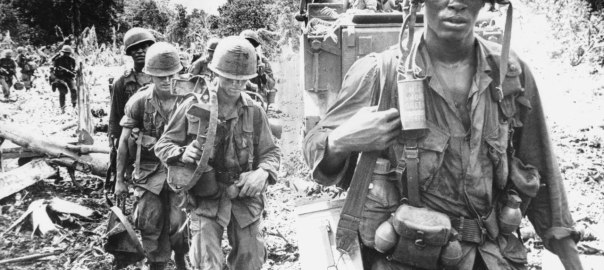

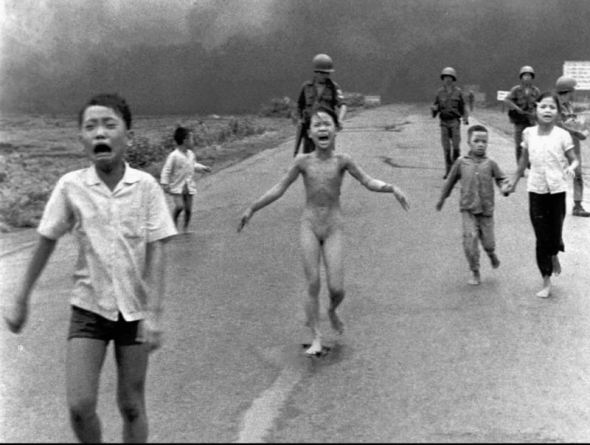
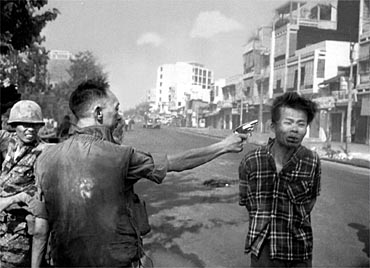


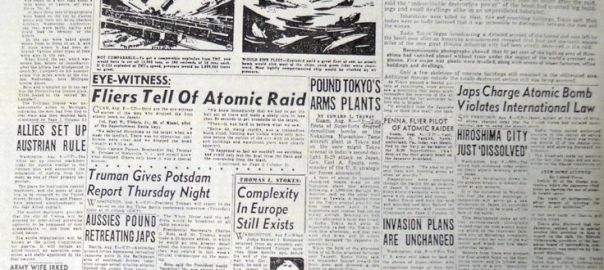


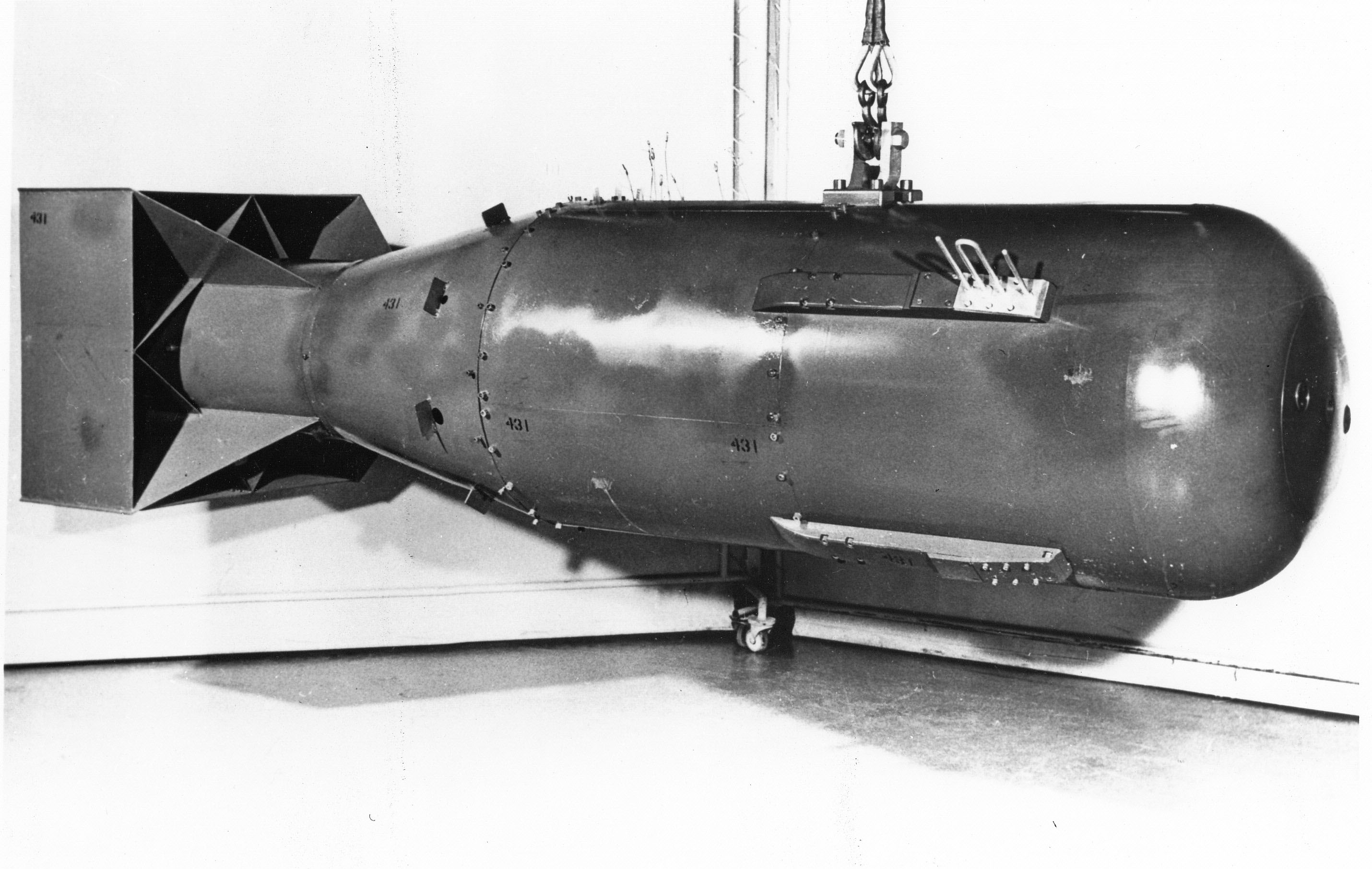


 WikiMiniAtlas


.jpg)


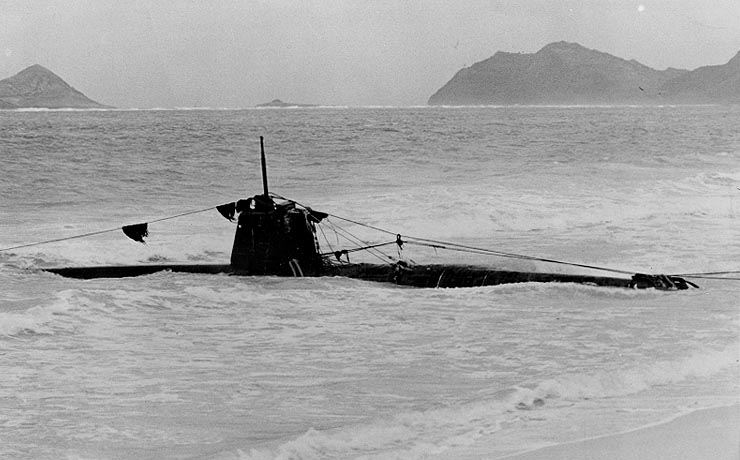
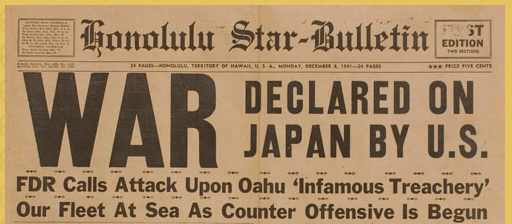


_burning_after_the_Japanese_attack_on_Pearl_Harbor_-_NARA_195617_-_Edit.jpg)











_after_the_1916_Easter_Rising.JPG)


.jpg)









.jpg)

.jpg)


_Named_(HR).png)


 belfastchildis.com