Today’s News and social media have been busy debating the fact the US pharmaceutical giant Pfizer, has recently took steps to prevent its drugs being used in lethal injection process for cap…
Source: Lethal Injection – What’s it all about?
Today’s News and social media have been busy debating the fact the US pharmaceutical giant Pfizer, has recently took steps to prevent its drugs being used in lethal injection process for cap…
Source: Lethal Injection – What’s it all about?

The Secret Intelligence Service (SIS), commonly known as MI6 (Military Intelligence, Section 6), is the British intelligence agency which supplies the British Government with foreign intelligence. …
Source: Secrets Of Her Majesty’s Secret Service Documentary Full Length
The Secret Intelligence Service (SIS), commonly known as MI6 (Military Intelligence, Section 6), is the British intelligence agency which supplies the British Government with foreign intelligence. …
Source: Secrets Of Her Majesty’s Secret Service Documentary Full Length

Today’s News and social media have been busy debating the fact the US pharmaceutical giant Pfizer, has recently took steps to prevent its drugs being used in lethal injection process for capital punishment –
Stating that :
“We strongly object to the use of any of our products in the lethal injection process for capital punishment,”
It stressed that its products were meant to save the lives of patients.
The move reportedly shuts off the last remaining open market source of drugs used in executions in the US and officials are now searching for a new drug cocktails by which the lethal injection could be achieved.
American has a long record of state sanctioned executions as a means of the ultimate deterrent and although the figures have been dropping over the past decade , the USA came fifth in a recent survey of countries who still use execution as a legal method of punishment and surprisingly came above Iraq.
China once again topped the table with over 1000 “official” executions , but this figure is believed to be substantially higher and the Mobile Death Vans have been clocking up the miles.

See China’s Mobile Execution Units
At least 25 countries were known to have carried out judicial executions in 2015. At least 1,634 executions were carried out in 2015, the highest number in 25 years. This figure does not include the thousands of executions that were believed to be carried out in China. Beginning in 2009, Amnesty International ceased to publish minimum figures for the use of the death penalty in China, where such statistics are considered to be state secrets. 89% of all recorded executions in 2015 took place in 3 countries: Iran, Pakistan, and Saudi Arabia. At least 1,998 people are known to have been sentenced to death in 2014, a decrease compared to 2014.
Source Amnesty International
| Countries with the Most Confirmed Executions in 2015 | |
| 1. China 1,000s | 4. Saudi Arabia (158+) |
| 2. Iran (977+) | 5. United States (28) |
| 3. Pakistan (326) | 6. Iraq (26+) |
Whats my view on the death penalty?
For the record I am personally fundamentally against the death penalty , regardless of the crime. That doesn’t mean I’m a bleeding hearts do-gooder , it means I’m a casual pacifist , ( I ‘m against all killings , but accept violence is sometimes necessary to put bad , evil people in their place ) and although I am now leaning towards becoming a fully fledged atheist , I spent much of my childhood in church and wanted more than anything to believe in God, baby Jesus and the essential good in all mankind.
Time and my life experiences have turned my heart hard to these principles and yet there is still a tiny smouldering amber in my soul that clings to a need for some grand plan that heaven is a real place and one day I will be reunited with those I love and lost – in the Kingdom of God and we will live in joy for all eternity – Isn’t religion a little bit insane?
In regards to crime and punishment and the death penalty , although I am against this in principle , if someone commits a heinous crime against another human & esp a defenseless child or women – then I want the bastard to suffer for the rest of his/her natural LIFE . Each and everyday that they breath the air around us. I want them to become the “Bitch” of their cells mates, I want them to be beaten unconscious every day and I want them to curse the day they were born and come to regret the crimes they committed . I want them to live in misery every second of every day and I want them to pray for death.
Amen !
Lethal injection is the practice of injecting one or more drugs into a person (typically a barbiturate, paralytic, and potassium solution) for the express purpose of causing immediate death. The main application for this procedure is capital punishment, but the term may also be applied in a broad sense to euthanasia and suicide. It kills the person by first putting them to sleep, and then stopping the breathing and heart, in that order.
First developed in the United States, it is now also a legal method of execution in China, Guatemala, Thailand and Vietnam. It was also used in Philippines until the country re-abolished the death penalty in 2006.
—————————–
Guatamala: First Ever Execution By Lethal Injection Carried Out – 1998
—————————–
Lethal injection gained popularity in the late twentieth century as a form of execution intended to supplant other methods, notably electrocution, hanging, firing squad, gas chamber, and beheading, that were considered to be more painful. It is now the most common form of execution in the United States of America.

Lethal injection, known as putting someone to death, was first proposed on January 17, 1888, by Julius Mount Bleyer, a New York doctor who praised it as being cheaper than hanging.[3] Bleyer’s idea, however, was never used. Almost half a century later, lethal injection was revisited, due to a series of botched executions and the eventual rise of public disapproval in electrocutions. Nazi Germany developed the Action T4 euthanasia program as one of its methods of disposing of Lebensunwertes Leben (“life unworthy of life”).
The British Royal Commission on Capital Punishment (1949–53) also considered lethal injection, but eventually ruled it out after pressure from the British Medical Association (BMA).
On May 11, 1977, Oklahoma‘s state medical examiner, Jay Chapman, proposed a new, less painful method of execution, known as Chapman’s Protocol:
“An intravenous saline drip shall be started in the prisoner’s arm, into which shall be introduced a lethal injection consisting of an ultra-short-acting barbiturate in combination with a chemical paralytic.”
After the procedure was approved by anesthesiologist Stanley Deutsch, formerly Head of the Department of Anaesthesiology of the Oklahoma University Medical School,[4] the Reverend Bill Wiseman introduced the method into the Oklahoma legislature, where it passed and was quickly adopted (Title 22, Section 1014(A)). Since then, until 2004, thirty-seven of the thirty-eight states using capital punishment introduced lethal injection statutes.
On August 29, 1977,Texas adopted the new method of execution, switching to lethal injection from electrocution. On December 7, 1982, Texas became the first state to use lethal injection to carry out capital punishment, for the execution of Charles Brooks, Jr.
The People’s Republic of China began using this method in 1997, Guatemala in 1998, the Philippines in 1999, Thailand in 2003, and the Republic of China (Taiwan) in 2005.[3] Vietnam first used this method in 2013. The Philippines abolished the death penalty in 2006, with their last execution being in 1999. Guatemala stopped using lethal injection in 2000 after a botched, televised execution, while Thailand stopped in 2009.
The export of drugs to be used for lethal injection was banned by the European Union (EU) in 2011, together with other items under the EU Torture Regulation. Since then, pentobarbital followed thiopental in the European Union’s ban.
By early 2014 a number of botched executions involving lethal injection, and a rising shortage of suitable drugs, had some U.S. states reconsidering lethal injection as a form of execution. Tennessee, which had previously offered inmates a choice between lethal injection and the electric chair, passed a law in May 2014 which gave the state the option to use the electric chair if lethal injection drugs are either unavailable or made unconstitutional. At the same time, Wyoming and Utah were considering the use of firing squads in addition to existing execution methods.
Procedure in China executions
————————
Mekong River Execution – China News Broadcast, March 1, 2013
————————
In the past, The People’s Republic of China executed prisoners primarily by means of shooting. In recent years, lethal injection has become more popular. The specific lethal injection procedures, including the drug or drugs used, are a state secret and not publicly known. In at least some cases, prisoners facing death by lethal injection have been sedated at a prison, then placed inside an execution van that is disguised to look like a regular police van.
Procedure in U.S. Executions

The condemned person is strapped onto a gurney; two intravenous cannulae (“IVs”) are inserted, one in each arm. Only one is necessary to carry out the execution; the other is reserved as a backup in the event the primary line fails. A line leading from the IV line in an adjacent room is attached to the prisoner’s IV, and secured so the line does not snap during the injections.
The arm of the condemned person is swabbed with alcohol before the cannula is inserted.
The needles and equipment used are sterilized. There have been questions about why these precautions against infection are performed despite the purpose of the injection being death. There are several explanations: cannulae are sterilized during manufacture, so using sterile ones is routine medical procedure. Secondly, there is a chance that the prisoner could receive a stay of execution after the cannulae have been inserted, as happened in the case of James Autry in October 1983 (he was eventually executed on March 14, 1984). Thus, it would be a hazard to prison personnel to use unsterilized equipment.
————————
HOW LETHAL INJECTION WORKS
————————
Following connection of the lines, saline drips are started in both arms. This, too, is standard medical procedure: it must be ascertained that the IV lines are not blocked, ensuring the chemicals have not precipitated in the IV lines and blocked the needle, preventing the drugs from reaching the subject. A heart monitor is attached so prison officials can determine when death has occurred.
In most states, the intravenous injection is a series of drugs given in a set sequence, designed to first induce unconsciousness followed by death through paralysis of respiratory muscles and/or by cardiac arrest through depolarization of cardiac muscle cells. The execution of the condemned in most states involves three separate injections (in sequential order):


The drugs are not mixed externally as that can cause them to precipitate. Also, a sequential injection is key to achieve the desired effects in the appropriate order: administration of the pentobarbital essentially renders the person unconscious; the infusion of the pancuronium bromide induces complete paralysis, including that of the lungs and diaphragm rendering the person unable to breathe. If the person being executed were not already completely unconscious, the injection of a highly concentrated solution of potassium chloride could cause severe pain at the site of the IV line as well as along the punctured vein, but it interrupts the electrical activity of the heart muscle and causes it to stop beating, bringing about the death of the person being executed.
The intravenous tubing leads to a room next to the execution chamber, usually separated from the condemned by a curtain or wall. Typically a prison employee trained in venipuncture inserts the needle, while a second prison employee orders, prepares and loads the drugs into the lethal injection syringes.
Two other staff members take each of the three syringes and secure them into the IVs. After the curtain is opened to allow the witnesses to see inside the chamber, the condemned person is then permitted to make a final statement. Following this, the warden will signal that the execution may commence, and the executioner(s) (either prison staff or private citizens depending on the jurisdiction) will then manually inject the three drugs in sequence.
During the execution, the condemned’s cardiac rhythm is monitored. Death is pronounced after cardiac activity stops. Death usually occurs within seven minutes, although the whole procedure can take up to two hours, as was the case with the execution of Christopher Newton on May 24, 2007. According to state law, if a physician‘s participation in the execution is prohibited for reasons of medical ethics, then the death ruling can be made by the state Medical Examiner’s Office. After confirmation that death has occurred, a coroner signs the condemned’s death certificate.
In two states (Delaware and Missouri) there is a lethal injection machine designed by Massachusetts-based Fred A. Leuchter that comprises two components: the delivery module and the control module. Two staff members each have a station in which they key the machine on and depress two stations buttons to be ready in case of mechanical failure. Each person presses one station button on the console which travels to a computer which starts all three injections electronically.
The computer then deletes who actually started the syringes so that participants are not aware if their syringe contained saline or one of the drugs necessary for execution (to assuage guilt in a manner similar to the blank cartridge in execution by firing squad). The delivery module has eight syringes.
The end syringes containing saline, syringes 2, 4, 6 containing the lethal drugs for the main line and syringes 1, 3, 5 containing the injections for the back-up line. The system was used in New Jersey before the abolition of the death penalty in 2007. Illinois previously used the computer, and Missouri and Delaware use the manual injection switch on the delivery panel.
Eleven states have switched, or have stated their intention to switch, to a one-drug lethal injection protocol. A one-drug method is using the single drug sodium thiopental to execute someone. The first state to switch to this method was Ohio, in December 8, 2009
In 2011, after pressure by activist organizations, the manufacturers of sodium thiopental and pentobarbital halted supply of the drugs to U.S. prisons performing lethal injections and required all resellers to do the same.

Conventional lethal injection protocol
Typically, three drugs are used in lethal injection. Sodium thiopental is used to induce unconsciousness, pancuronium bromide (Pavulon) to cause muscle paralysis and respiratory arrest, and potassium chloride to stop the heart.
Sodium thiopental (US trade name: Sodium Pentothal) is an ultra-short acting barbiturate, often used for anesthesia induction and for medically induced coma. The typical anesthesia induction dose is 0.35 grams. Loss of consciousness is induced within 30–45 seconds at the typical dose, while a 5 gram dose (14 times the normal dose) is likely to induce unconsciousness in 10 seconds.
A full medical dose of Thiopental reaches the brain in about 30 seconds. This induces an unconscious state. Five to twenty minutes after injection, approximately 15% of the drug is in the brain, with the rest in other parts of the body.
The half-life of this drug is about 11.5 hours, and the concentration in the brain remains at around 5–10% of the total dose during that time. When a ‘mega-dose’ is administered, as in state-sanctioned lethal injection, the concentration in the brain during the tail phase of the distribution remains higher than the peak concentration found in the induction dose for anesthesia, because repeated doses—or a single very high dose as in lethal injection—accumulate in high concentrations in body fat, from which the thiopental is gradually released.
This is the reason why an ultra-short acting barbiturate, such as thiopental, can be used for long-term induction of medical coma. Historically, thiopental has been one of the most commonly used and studied drugs for the induction of coma. Protocols vary for how it is given, but the typical doses are anywhere from 500 mg up to 1.5 grams. It is likely that this data was used to develop the initial protocols for state-sanctioned lethal injection, according to which one gram of thiopental was used to induce the coma. Now, most states use 5 grams to be absolutely certain the dosage is effective.
Barbiturates are the same class of drug used in medically assisted suicide. In euthanasia protocols, the typical dose of thiopental is 1.5 grams; the Dutch Euthanasia protocol indicates 1-1.5 grams or 2 grams in case of high barbiturate tolerance.[23] The dose used for capital punishment is therefore about 3 times more than the dose used in euthanasia.
Pancuronium bromide (Trade name: Pavulon): The related drug curare, like pancuronium, is a non-depolarizing muscle relaxant (a paralytic agent) that blocks the action of acetylcholine at the motor end-plate of the neuromuscular junction. Binding of acetylcholine to receptors on the end-plate causes depolarization and contraction of the muscle fiber; non-depolarizing neuromuscular blocking agents like pancuronium stop this binding from taking place.
The typical dose for pancuronium bromide in capital punishment by lethal injection is 0.2 mg/kg and the duration of paralysis is around 4 to 8 hours. Paralysis of respiratory muscles will lead to death in a considerably shorter time.
Other drugs in use are tubocurarine chloride and succinylcholine chloride.
Pancuronium bromide is a derivative of the alkaloid malouetine from the plant Malouetia bequaertiana.

Potassium is an electrolyte, 98% of which is intracellular. The 2% remaining outside the cell has great implications for cells that generate action potentials. Doctors prescribe potassium for patients when there is insufficient potassium, called hypokalemia, in the blood. The potassium can be given orally, which is the safest route; or it can be given intravenously, in which case there are strict rules and hospital protocols on the rate at which it is given.
The usual intravenous dose is 10–20 mEq per hour and it is given slowly since it takes time for the electrolyte to equilibrate into the cells. When used in state-sanctioned lethal injection, bolus potassium injection affects the electrical conduction of heart muscle. Elevated potassium, or hyperkalemia, causes the resting electrical potential of the heart muscle cells to be lower than normal (less negative). Without this negative resting potential, cardiac cells cannot repolarize (prepare for their next contraction).
Depolarizing the muscle cell inhibits its ability to fire by reducing the available number of sodium channels (they are placed in an inactivated state). ECG changes include faster repolarization (peaked T-waves), PR interval prolongation, widening of the QRS, and eventual sine-wave formation and asystole. Cases of patients dying from hyperkalemia (usually secondary to renal failure) are well known in the medical community, where patients have been known to die very rapidly, having previously seemed to be normal.
The Ohio protocol, developed after the incomplete execution of Romell Broom, ensures the rapid and painless onset of anesthesia by only using sodium thiopental and eliminating the use of Pavulon and potassium as the second and third drugs, respectively. It also provides for a secondary fail-safe measure using intramuscular injection of midazolam and hydromorphone in the event intravenous administration of the sodium thiopental proves problematic. The first state to switch to use Midazolam as the first drug in a new three-drug protocol was Florida on October 15, 2013.[
Then on November 14, 2013, Ohio made the same move.
In the brief for the U.S. courts written by accessories, the State of Ohio implies that they were unable to find any physicians willing to participate in development of protocols for executions by lethal injection, as this would be a violation of medical ethics, such as the Geneva Promise, and such physicians would be thrown out of the medical community and shunned for engaging in such deeds, even if they could not lawfully be stripped of their license.
On December 8, 2009, Kenneth Biros became the first person executed using Ohio’s new single-drug execution protocol. He was pronounced dead at 11:47 a.m. EST, 10 minutes after receiving the injection. On September 10, 2010, Washington became the second state to use the single-drug Ohio protocol with the execution of Cal Coburn Brown, who was proclaimed dead within two minutes after receiving the single-drug injection of sodium thiopental. Currently, eight states (Arizona, Georgia, Idaho, Missouri, Ohio, South Dakota, Texas and Washington) have used the single-drug execution protocol. Five additional states (Arkansas, Kentucky, Louisiana, North Carolina and Tennessee) have announced that they are switching to a single-drug protocol but, as of April 2014, have not executed anyone since switching protocols.
After sodium thiopental began being used in executions, Hospira, the only American company that made the drug, stopped manufacturing it due to its use in executions.[28] The subsequent nationwide shortage of sodium thiopental led states to seek for other drugs. Pentobarbital, a drug often used for animal euthanasia, was used as part of a three drug cocktail for the first time on December 16, 2010, when John David Duty was executed in Oklahoma.
It was then used as the drug in a single drug execution for the first time on March 10, 2011, when Johnnie Baston was executed in Ohio.
Lethal injection has also been used in cases of euthanasia to facilitate voluntary death in patients with terminal or chronically painful conditions. Euthanasia can be accomplished either through oral, intravenous, or intramuscular administration of drugs. In individuals who are incapable of swallowing lethal doses of medication, an intravenous route is preferred. The following is a Dutch protocol for parenteral (intravenous) administration to obtain euthanasia, with the old protocol listed first and the new protocol listed second:
A euthanasia machine may allow an individual to perform the process alone.

Philip Nitschke’s “Deliverance Machine”

In 2006, the Supreme Court ruled in Hill v. McDonough that death-row inmates in the United States could challenge the constitutionality of states’ lethal injection procedures through a federal civil rights lawsuit. Since then, numerous death-row inmates have brought such challenges in the lower courts, claiming that lethal injection as currently practiced violates the ban on “cruel and unusual punishment” found in the Eighth Amendment to the United States Constitution. Lower courts evaluating these challenges have reached opposing conclusions. For example, courts have found that lethal injection as practiced in California, Florida, and Tennessee is unconstitutional. On the other hand, courts have found that lethal injection as practiced in Missouri, Arizona, and Oklahoma is constitutionally acceptable.
As of 2014, California has nearly 750 prisoners condemned to death by lethal injection despite the moratorium imposed when in 2006 a federal court found California’s lethal injection procedures to be unconstitutional.
A newer lethal injection facility has been constructed at San Quentin State Prison which cost over $800,000, but it has yet to be used because a state court found that the California Department of Corrections and Rehabilitation violated the California Administrative Procedure Act by attempting to prevent public oversight when new injection procedures were being created.

On September 25, 2007, the United States Supreme Court agreed to hear a lethal injection challenge arising from Kentucky, Baze v. Rees. In Baze, the Supreme Court addressed whether Kentucky’s particular lethal injection procedure comports with the Eighth Amendment and will determine the proper legal standard by which lethal injection challenges in general should be judged, all in an effort to bring some uniformity to how these claims are handled by the lower courts. Although uncertainty over whether executions in the United States would be put on hold during the period in which the United States Supreme Court considers the constitutionality of lethal injection initially arose after the court agreed to hear Baze, no executions took place during the period between when the court agreed to hear the case and when its ruling was announced, with the exception of one lethal injection in Texas hours after the court made its announcement.
On April 16, 2008, the Supreme Court rejected Baze v. Rees thereby upholding Kentucky’s method of lethal injection in a majority 7–2 decision.[47] Justices Ruth Bader Ginsburg and David Souter dissented.[48] Several states immediately indicated plans to proceed with executions.
The U.S. Supreme Court also upheld lethal injection in the 2015 case Glossip v. Gross.
Ethics of lethal injection

The American Medical Association believes that a physician’s opinion on capital punishment is a personal decision. Since the AMA is founded on preserving life, they argue that a doctor “should not be a participant” in executions in any professional capacity with the exception of “certifying death, provided that the condemned has been declared dead by another person” and “relieving the acute suffering of a condemned person while awaiting execution”
Amnesty International argues that the AMA’s position effectively “prohibits doctors from participating in executions.” The AMA, however, does not have the authority to prohibit doctors from participation in lethal injection, nor does it have the authority to revoke medical licenses, since this is the responsibility of the individual states.
Typically, most states do not require that physicians administer the drugs for lethal injection, but many states do require that physicians be present to pronounce or certify death .
Some states specifically detail that participation in a lethal injection is not to be considered practicing medicine. For example, Delaware law reads “the administration of the required lethal substance or substances required by this section shall not be construed to be the practice of medicine and any pharmacist or pharmaceutical supplier is authorized to dispense drugs to the Commissioner or the Commissioner’s designee, without prescription, for carrying out the provisions of this section, notwithstanding any other provision of law” (excerpt from Title 11, Chapter 42, § 4209).[51] State law allows for the dispensing of the drugs/chemicals for lethal injection to the state’s Department of Corrections (DOC) without a prescription.
Opponents of lethal injection believe that it is not actually painless as practiced in the United States. Opponents argue that the thiopental is an ultra-short acting barbiturate that may wear off (anesthesia awareness) and lead to consciousness and an uncomfortable death wherein the inmate is unable to express their discomfort because they have been rendered paralyzed by the paralytic agent.
Opponents point to the fact that sodium thiopental is typically used as an induction agent and not used in the maintenance phase of surgery because of its short acting nature. Following the administration of thiopental, pancuronium bromide is given. Opponents argue that pancuronium bromide not only dilutes the thiopental, but (since the inmate is paralyzed) also prevents the inmate from expressing pain. Additional concerns have been raised over whether inmates are administered an appropriate level of thiopental owing to the rapid redistribution of the drug out of the brain to other parts of the body.
Additionally, opponents argue that the method of administration is also flawed. They state that since the personnel administering the lethal injection lack expertise in anesthesia, the risk of failing to induce unconsciousness is greatly increased. In reference to this problem, Jay Chapman, the creator of lethal injection, said,
“It never occurred to me when we set this up that we’d have complete idiots administering the drugs.”
Also, they argue that the dose of sodium thiopental must be customized to each individual patient, not restricted to a set protocol. Finally, the remote administration results in an increased risk that insufficient amounts of the lethal injection drugs enter the bloodstream.
In total, opponents argue that the effect of dilution or improper administration of thiopental is that the inmate dies an agonizing death through suffocation due to the paralytic effects of pancuronium bromide and the intense burning sensation caused by potassium chloride.
Opponents of lethal injection, as currently practiced, argue that the procedure employed is designed to create the appearance of serenity and a painless death, rather than actually providing it. More specifically, opponents object to the use of Pancuronium bromide, arguing that its use in lethal injection serves no useful purpose since the inmate is physically restrained. Therefore, the default function of pancuronium bromide would be to suppress the autonomic nervous system, specifically to stop breathing.[52]

In 2005, University of Miami researchers, in cooperation with an attorney representing death row inmates, published a research letter in the medical journal The Lancet. The article presented protocol information from Texas and Virginia which showed that executioners had no anesthesia training, drugs were administered remotely with no monitoring for anesthesia, data were not recorded and no peer review was done. Their analysis of toxicology reports from Arizona, Georgia, North Carolina, and South Carolina showed that post-mortem concentrations of thiopental in the blood were lower than that required for surgery in 43 of 49 executed inmates (88%); 21 (43%) inmates had concentrations consistent with awareness.
This led the authors to conclude that there was a substantial probability that some of the inmates were aware and suffered extreme pain and distress during execution. The authors attributed the risk of consciousness among inmates to the lack of training and monitoring in the process, but carefully make no recommendations on how to alter the protocol or how to improve the process. Indeed, the authors conclude, “because participation of doctors in protocol design or execution is ethically prohibited, adequate anesthesia cannot be certain. Therefore, to prevent unnecessary cruelty and suffering, cessation and public review of lethal injections is warranted.”
Paid expert consultants on both sides of the lethal injection debate have found opportunity to criticize the 2005 Lancet article. Subsequent to the initial publication in the Lancet, three letters to the editor and a response from the authors extended the analysis. The issue of contention is whether Thiopental, like many lipid-soluble drugs, may be redistributed from blood into tissues after death, effectively lowering thiopental concentrations over time, or whether thiopental may distribute from tissues into the blood, effectively increasing post-mortem blood concentrations over time. Given the near absence of scientific, peer-reviewed data on the topic of thiopental post-mortem pharmacokinetics, the controversy continues in the lethal injection community and in consequence, many legal challenges to lethal injection have not used the Lancet article.
In 2007, the same group that authored The Lancet study extended its study of the lethal injection process through a critical examination of the pharmacology of the barbiturate thiopental. This study – published in the online journal PloS Medicine – confirmed and extended the conclusions made in The Lancet article and goes further to disprove the assertion that the lethal injection process is painless.
To date these two studies by the University of Miami team serve as the only critical peer-reviewed examination of the pharmacology of the lethal injection process. These findings also appear true to be further supported by increased reporting of problematic lethal injections in the United States.
According to the New Lethal Injection Protocols section above, single-drug lethal injection is already in use, or intended, in eleven states.
The execution can be painlessly accomplished, without risk of consciousness, by the injection of a single large dose of a barbiturate. By this logic, the use of any other chemicals is entirely superfluous and only serves to unnecessarily increase the risk of pain during the execution. Another possibility would be the infusion of a powerful and fast-acting narcotic, such as fentanyl, which would ensure comfort while suppressing the victim’s respiratory drive.
When sodium pentobarbital, a barbiturate used in animal euthanasia, is administered in an overdose, it causes rapid unconsciousness. Respiratory arrest follows next, through paralysis of the diaphragm and collapse of the lungs. The drug would then suppress cardiac activity, thus causing death.
On occasion, there have also been difficulties inserting the intravenous needles, sometimes taking over half an hour to find a suitable vein. Typically, the difficulty is found in convicts with a history of intravenous drug use. Opponents argue that the insertion of intravenous lines that take excessive amounts of time are tantamount to being cruel and unusual punishment. In addition, opponents point to instances where the intravenous line has failed, or where there have been adverse reactions to drugs, or unnecessary delays during the process of execution.

On December 13, 2006, Angel Nieves Diaz was not executed successfully in Florida using a standard lethal injection dose. Diaz was 55 years old, and had been sentenced to death for murder. Diaz did not succumb to the lethal dose even after 35 minutes, necessitating a second dose of drugs to complete the execution. At first, a prison spokesman denied Diaz had suffered pain, and claimed the second dose was needed because Diaz had some sort of liver disease. After performing an autopsy, the Medical Examiner, Dr. William Hamilton, stated that Diaz’s liver appeared normal, but that the needle had been pierced through Diaz’s vein into his flesh. The deadly chemicals had subsequently been injected into soft tissue, rather than into the vein.
Two days after the execution, then-Governor Jeb Bush suspended all executions in the state and appointed a commission “to consider the humanity and constitutionality of lethal injections.” The ban was lifted by Governor Charlie Crist when he signed the death warrant for Mark Dean Schwab on July 18, 2007. On November 1, 2007, the Florida Supreme Court unanimously upheld the state’s lethal injection procedures.
A study published in 2007 in the peer-reviewed journal PLoS Medicine suggested that “the conventional view of lethal injection leading to an invariably peaceful and painless death is questionable”.
The execution of Romell Broom was abandoned in Ohio on September 15, 2009, after prison officials failed to find a vein after 2 hours of trying on his arms, legs, hands and ankle. This has stirred up intense debate in the United States about lethal injection.
Dennis McGuire was executed in Lucasville, Ohio on January 17, 2014. According to reporters the execution of McGuire took more than 20 minutes and McGuire was gasping for air for 10 to 13 minutes. It was the first use of a new drug combo which was introduced in Ohio after the European Union banned sodium thiopental exports. This renewed criticism on the conventional three-drug method.
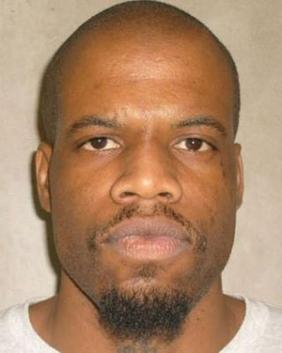
Clayton Lockett died of a heart attack during a failed execution attempt on April 29, 2014 at Oklahoma State Penitentiary in McAlester, Oklahoma. Lockett was administered an untested mixture of drugs that had not previously been used for executions in the U.S., and survived for 43 minutes before being pronounced dead. Lockett convulsed and spoke during the process, and attempted to rise from the execution table 14 minutes into the procedure, despite having been declared unconscious.
———————-
Executions on hold after lethal injection goes wrong
———————-
Due to its use for executions in the US, the UK introduced a ban on the export of sodium thiopental in December 2010, after it was established that no European supplies to the US were being used for any other purpose.
The restrictions were based on “the European Union Torture Regulation (including licensing of drugs used in execution by lethal injection)”.[70] From December 21, 2011 the European Union extended trade restrictions to prevent the export of certain medicinal products for capital punishment, stating that “The Union disapproves of capital punishment in all circumstances and works towards its universal abolition”.[71]
The combination of a barbiturate induction agent and a nondepolarizing paralytic agent is used in thousands of anesthetics every day. Supporters of the death penalty argue that unless anesthesiologists have been wrong for the last 40 years, the use of pentothal and pancuronium is safe and effective. In fact, potassium is given in heart bypass surgery to induce cardioplegia. Therefore, the combination of these three drugs is still in use today. Supporters of the death penalty speculate that the designers of the lethal injection protocols intentionally used the same drugs as used in every day surgery to avoid controversy. The only modification is that a massive coma-inducing dose of barbiturates is given. In addition, similar protocols have been used in countries that support euthanasia or physician-assisted death.
Thiopental is a rapid and effective drug for inducing unconsciousness, since it causes loss of consciousness upon one circulation through the brain due to its high lipophilicity. Only a few other drugs, such as methohexital, etomidate, or propofol have the capability to induce anesthesia so rapidly. (Narcotics such as Fentanyl are inadequate as induction agents for anesthesia.) Supporters argue that since the thiopental is given at a much higher dose than for medically induced coma protocols, it is effectively impossible for the condemned to wake up.
Anesthesia awareness occurs when general anesthesia is inadequately maintained, for a number of reasons. Typically, anesthesia is induced with an intravenous drug, but maintained with an inhaled anesthetic given by the anesthesiologist (note that there are several other methods of safely and effectively maintaining anesthesia). Barbiturates are used only for induction of anesthesia and these drugs rapidly and reliably induce anesthesia, but wear off quickly. A neuromuscular blocking drug may then be given to cause paralysis which facilitates intubation, although this is not always required. The anesthesiologist has the responsibility to ensure that the maintenance technique (typically inhalational) is started soon after induction to prevent the patient from waking up.
General anesthesia is not maintained with barbiturate drugs. An induction dose of thiopental wears off after a few minutes because the thiopental redistributes from the brain to the rest of the body very quickly. However, it has a long half-life, which means that it takes a long time for the drug to be eliminated from the body. If a very large initial dose is given, little or no redistribution takes place (since the body is saturated with the drug), which means that recovery of consciousness requires the drug to be eliminated from the body, which is not only slow (taking many hours or days), but unpredictable in duration, making barbiturates very unsatisfactory for maintenance of anesthesia.
Thiopental has a half-life of approximately 11.5 hours (however, the action of a single dose is terminated within a few minutes by redistribution of the drug from the brain to peripheral tissues) and the long acting barbiturate phenobarbital has a half-life of approximately 4–5 days. It contrasts towards the inhaled anesthetics have extremely short half-lives and allow the patient to wake up rapidly and predictably after surgery.
The average time to death once a lethal injection protocol has been started is about 7 to 11 minutes. Since it only takes about 30 seconds for the thiopental to induce anesthesia, 30–45 seconds for the pancuronium to cause paralysis, and about 30 seconds for the potassium to stop the heart, death can theoretically be attained in as little as 90 seconds. Given that it takes time to administer the drug, time for the line to flush itself, time for the change of the drug being administered, and time to ensure that death has occurred, the whole procedure takes about 7–11 minutes. Procedural aspects in pronouncing death also contribute to delay and, therefore, the condemned is usually pronounced dead within 10 to 20 minutes of starting the drugs. Supporters of the death penalty say that a huge dose of thiopental, which is between 14 and 20 times the anesthetic induction dose and which has the potential to induce a medical coma lasting 60 hours, could never wear off in only 10 to 20 minutes.
Death penalty supporters state that the claim that pancuronium dilutes the sodium thiopental dose is erroneous. Supporters argue that pancuronium and thiopental are commonly used together in surgery every day and if there were a dilution effect, it would be a known drug interaction.
Drug interactions are a complex topic. Some drug interactions can be simplistically classified as either synergistic or inhibitory interactions. In addition, drug interactions can occur directly at the site of action, through common pathways or indirectly through metabolism of the drug in the liver or through elimination in the kidney. Pancuronium and thiopental have different sites of action, one in the brain and one at the neuromuscular junction. Since the half-life of thiopental is 11.5 hours, the metabolism of the drugs is not an issue when dealing with the short time frame in lethal injections. The only other plausible interpretation would be a direct one, or one in which the two compounds interact with each other. Supporters of the death penalty argue that this theory does not hold true. They state that even if the 100 mg of pancuronium directly prevented 500 mg of thiopental from working, there would be sufficient thiopental to induce coma for 50 hours. In addition, if this interaction did occur, then the pancuronium would be incapable of causing paralysis.
Supporters of the death penalty state that the claim that the pancuronium prevents the thiopental from working, yet is still capable of causing paralysis, is not based on any scientific evidence and is a drug interaction that has never before been documented for any other drugs.
Amnesty International, Human Rights Watch, Death Penalty Information Center, Reprieve, and other anti-death penalty groups have not proposed a lethal injection protocol which they believe is less painful. Supporters of the death penalty argue that the lack of an alternative proposed protocol is testament to the fact that the painfulness of the lethal injection protocol is not the issue. Instead supporters argue that the issue is the continued existence of the death penalty, since if the only issue was the painfulness of the procedure, then Amnesty International, HRW, or the DPIC should have already proposed a less painful method.
Regardless of an alternative protocol, some death penalty opponents have claimed that execution can be less painful by the administration of a single lethal dose of barbiturate.Supporters of the death penalty, however, state that the single drug theory is a flawed concept.
Terminally ill patients in Oregon who have requested physician-assisted suicide have received lethal doses of barbiturates. The protocol has been highly effective in producing a painless death, but the time to cause death can be prolonged. Some patients have taken days to die, and a few patients have actually survived the process and have regained consciousness up to three days after taking the lethal dose.In a Californian legal proceeding addressing the issue of the lethal injection cocktail being “cruel and unusual,” state authorities said that the time to death following a single injection of a barbiturate could be as much as 45 minutes.
Scientifically, this is readily explained. Barbiturate overdoses typically cause death by depression of the respiratory center, but the effect is variable. Some patients may have complete cessation of respiratory drive, whereas others may only have depression of respiratory function. In addition, cardiac activity can last for a long time after cessation of respiration. Since death is pronounced after asystole and given that the expectation is for a rapid death in lethal injection, multiple drugs are required, specifically potassium chloride to stop the heart. In fact, in the case of Clarence Ray Allen a second dose of potassium chloride was required to attain asystole. The position of most death penalty supporters is that death should be attained in a reasonable amount of time.
Supporters of the death penalty agree that the use of pancuronium bromide is not absolutely necessary in the lethal injection protocol. Some supporters believe that the drug may decrease muscular fasciculations when the potassium is given, but this has yet to be proven.


———————-
China’s Mobile Death Vans
———————-
The execution van, also called a mobile execution unit, was developed by the government of the People’s Republic of China and was first used in 1997.
The prisoner is strapped to a stretcher and executed inside the van. The van allows death sentences to be carried out without moving the prisoner to an execution ground. The vans also require less manpower per execution, requiring four persons to assist with the injection.
The PRC states that the vans are more humane than previous forms of execution. Human-rights groups predict that the execution rate in China will increase because of mobile capital punishment.
After the 1997 decision to legalize lethal injection as a form of execution, PRC officials began using execution vans across China. Becoming popular in 2006 , these officials state that the vans are cost-effective by allowing communities without the money to build dedicated death rows to kill prisoners without the costs associated with sending prisoners away for death. Former Chinese judge and current lawyer Qiu Xingsheng argues that
“some places can’t afford the cost of sending a person to Beijing—perhaps $250—plus $125 more for the drug.”
Because Beijing is the only place where the drug is manufactured, the vans have allowed localities to administer the death sentence where the crime took place. Estimates place the number of execution vans in operation at around 40; the PRC has not confirmed this number.

A converted 24-seat bus, the execution van keeps the appearance of a normal police van on the outside with no markings indicating its purpose. The rear of the vehicle houses a windowless chamber where the execution takes place. Several cameras are present and feed closed-circuit televisions in the front of the van; a recording can be made if desired. The bed itself slides out of the wall under its own power, on which the convicted person is strapped down.
A syringe is put into the arm by a technician and a police official administers the injection by pressing a button
The PRC government claims that this is a more humane form of killing people, being far less painful than firing squad executions. Zhao Shijie, president of the Yunnan Provincial High Court, was quoted as praising the new system:
“The use of lethal injection shows that China’s death penalty system is becoming more civilized and humane.”
While the vans have moved China away from previous days of large public executions, human rights activists counter that they are “like government-sanctioned death squads”, and allow for an increased number and a higher efficiency of executions.
There is concern that mobile execution units have made organ harvesting much easier and more profitable, as lethal injection does not damage the body. In March 2006 the Ministry of Health banned the sale of organs. It is believed that this has had no effect. Activists claim that the bodies are quickly cremated, which makes it impossible for family members to determine if organs have in fact been removed

On December 22, 2003, organized crime leader Liu Yong was executed in an execution van in a controversial ruling. Liu was convicted of 32 charges and sentenced to death in 2000, but was granted a reprieve after appealing the case on the grounds that his confession was forced. Liu had been given a retrial by the Supreme Court on December 17.
It was the first time the Supreme Court had bypassed China’s two-trial system in which two trials are permitted and the verdict of the second trial may be appealed by either side.

On March 17, 2006, billionaire Yuan Baojing was executed in a van for the arranged murder of a blackmailer.
Director of the State Food and Drug Administration of the People’s Republic of China, Zheng Xiaoyu was executed in an execution van on July 10, 2007, for corruption. Zheng tried to appeal the sentence, but the court ruled that he was a “great danger” to the country and its reputation.
See Capital Punishment Where & Why

Losing a loved one is a sad fact of human life and sadly each and every one of us will one day experience the all consuming grief and emotional agony of the death of someone we love and our lives change forever – never again to be complete and clinging to memories that give us brief moments of comfort.
I was nine years old when my dad died and now I am a few months of the big 50 and have a family of my own and yet my life has been forever shadowed by the death of my dad. They say that children should not die before their parents and there is obvious wisdom in this statement. Sadly my dear cousin Denise has gone through this life destroying agony and my heart bleeds for her and I curse the cruel fate that brought this unjust tragedy to her door.
My own grief was hard to comprehend as a nine year old and at first I was unsure of what the future held for me and my siblings , Mags, Jean & David. We were lucky in the respect that we were surrounded by all our cousins , aunties , uncles and grandparents , but nothing could ease the pain and uncertainty of dad suddenly not being there anymore and ……
OK, I’ve had a few drinks and its past one and I feeling bloody depressed .So please forgive me and see below for extracts from my autobiography Belfast Child – which tells the story of my dads death and the impact it had on me and my siblings – whens I’m sober and less drunk I will update this post.
If you want to read more of my story see home page
Chapter Six
Dad’s Death
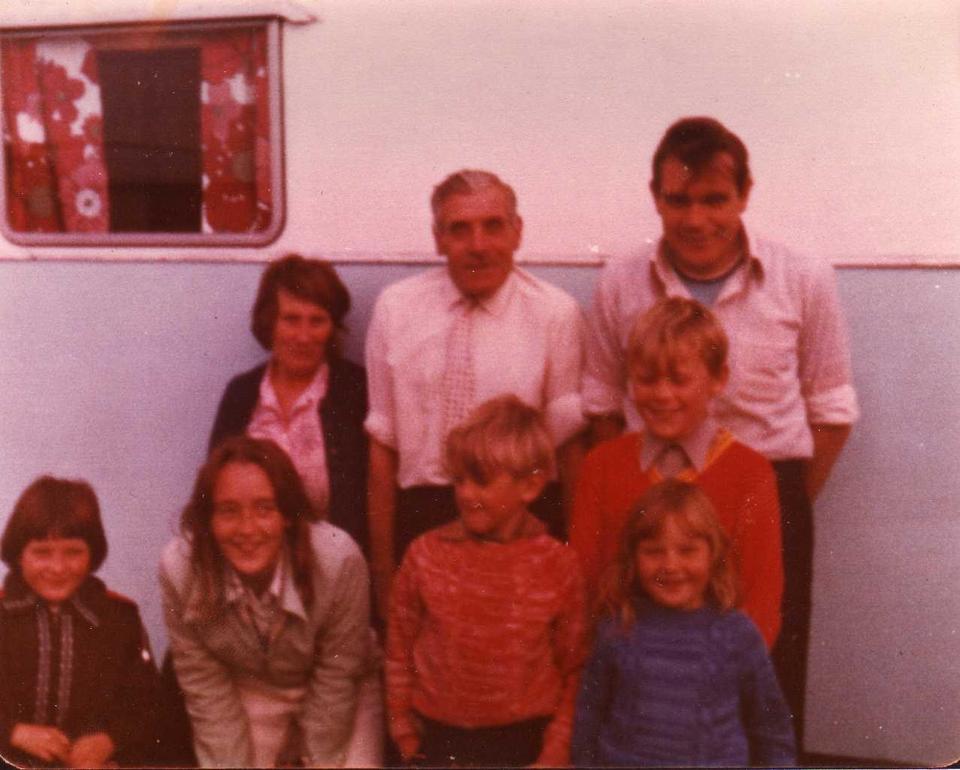
It was around 1976 that it first came to my attention that dad was ill and he was getting sicker and weaker by the day. He had always been a heavy drinker and smoker, but this was normal where we lived and we never really thought anything about it or the health implications these habits would have on him. One day when dad was supposed to be working I got home from school and found Margaret, Jean and some of their friend’s standing outside the front door. When I asked them what they were doing they said that had arrived home from school and on entering the house had heard a strange noise coming from upstairs and they had fled the house.
Trying to act all brave in from of my sisters I causally moved into the house, making sure I left the front door open, in case I had to make a quick getaway. After a nervous look downstairs and not finding anything, I began to make my way slowly up the stairs. As I got to the top I became aware of a deep rasping sound growing louder and louder that stopped me in my tracks. I’d seen enough of Dr. Who to know the sound I heard wasn’t coming from a human and I flew down the stairs and out of the house as fast as my legs could carry me. When the girls finally caught up with me I confirmed that I had indeed heard the sounds and I thought it might be one of those monsters from Dr.Who. The others looked rightly shocked at my analysis of the situation and it was decided that we would call the police. Christine Russell’s mum was the only neighbour we knew who had a phone and while Margaret and the other’s went to make the call, David and I made our way back to the house, making sure we kept a safe distance between us and the front door.
Word quickly spread around the estate that we had one of those monsters from Dr. Who hiding upstairs and before long large crowds began to gather, in the hope of seeing some action. When the police arrived they asked a few questions before entering the house and slowly making their way up the stairs. Whilst we were all waiting about outside to see what happened, Granny arrived and after a quick chat with a neighbour she made her way into the house with the police up stairs. After a while Granny came out with one of the policemen and explained to us that it was dad in the house, that he was sick and would have to go to hospital. In the distance we could hear the sound of an ambulance rushing towards us and suddenly it wasn’t funny or exciting anymore. I watched with the others as dad was stretchered out and placed in the ambulance and taken to the hospital. By the time everyone had cleared, Aunty Anne, dads younger sister arrived and explained to us that dad was going to be ok, but he would have to stay in hospital for a few days and she would be staying with us whilst he was away.
Being so young I don’t think I fully understood the magnitude of the situation and as usual I just ignored the situation that was going on around me and got on with my life. After that first time, dad was in and out of hospital all the time and gradually he became more and more ill. I remember many evenings at home, dad would take these horrible, agonising fits and one of us would have to run to Christine Russell’s house to call an ambulance. This became almost natural to us, but it was always distressing to see dad suffering so much and be unable to do anything to help.
Gradually we all began to realize that dad was very ill, although none of us wanted to accept or believe that he might die. I had already “lost” my mother and surely God wouldn’t take my dad away also? Once when he was in hospital Margaret decided that we would all do up the garden for dad and plant some rose bushes. We all went to work and by the time dad got out of hospital, the garden was looking great and dad was really impressed with our efforts and monitored the progress of the rose bushes with us. I remember the last time Granny took me up to the hospital to visit dad, I was really shocked and upset at how bad he looked. He was thin as a rake and I remember the watch he had worn all the time on his wrist had slide all the way up his arm to his elbow.
I’ve still got that watch, but I’ve never been able to wear it and every time I look at it I see dad in hospital, all skin and bones and at deaths door.
Although I didn’t know it at the time, I was too young to understand the seriousness of how ill dad was, this was the last time that I would see my dad alive.
I wish I had told him how much I loved him and told him how much the others and I would miss him, how much we needed him and didn’t want him to die.
When I got home I went straight to my room and begged God to save my dad and not take him away from us. But as usual God wasn’t listening and fate was once again messing with my destiny and making my young life a misery.
One day when we got home from school, Aunty Anne was waiting for us and told us that dad had been taken to hospital again, but he should be home in a few days. The day he was suppose to come home arrived and we all busied ourselves tidying up and making the place as nice as possible for him. Someone had told us that dad would be home around three o’clock and when the time came we all went down and stood on the main road watching for the car that would bring him home. Three o’clock came and went, then four and by 5 o’clock we were all getting bored waiting around. Eventually a car did approach us and pulled up, but our relief turned to panic when we realised that only Granny and Granddad were in the back. As they got out it was obvious that Granny was very upset and had been crying. Granddad told us he was taking her home and for us to wait indoors and they would come to see us in a while.
Dad never did come home.
Later that night Granny and Granddad gathered us all in the front room and through tears told us that dad wouldn’t be coming home. She explained to us that dad had died and was now in heaven watching over us. From the moment I heard the news I was distraught with grief and numb to everything going on around me. Dad had been the one stable thing in our lives since mum had left and now we were being told that he had died and we would never see him again.
The pain was almost too much to bear and I kept praying to myself that somehow there had been a terrible mistake and dad was going to walk through the door at any minute. But the brutal truth of the matter was that I wasn’t dreaming and once again fate and chance had entered my life and left a trail of misery and destruction in their wake.
The week of the funeral was the worst and longest of my live and to this day I am still trying to come to terms with dad’s death and the consequences it had on all our lives. After the autopsy dad’s body was brought home and laid to rest in Granny’s front room. Endless people came to pay their last respects and the sound of crying drifted constantly through the house, reminding me of my huge lose. Since the moments dad’s coffin was laid out in the front room, Shep curled up underneath and didn’t move the whole time it was in the house, apart from going for a pee. It was almost as if he was guarding dad’s body and at night when we were sleeping upstairs in Granny’s room, we could hear him whinging softly to himself, as he kept his 24 hour vigil. On the second night we were all brought in to see dad and as I stood over the coffin, looking into his lifeless face, I was praying and willing for him to move and for me to wake up from this horrible nightmare. I don’t know how long I stood looking down at him, but I was completely numb with pain and vaguely remember breaking down in tears and someone leading me away from the room.
When the day of the funeral finally arrived Granny got us all up early and dressed us in new clothes she had brought us for the funeral. I still remember the green and silver dogtooth blazer I wore that day as if it was yesterday and how I hated that jacket. After the coffin had been removed from the house we made our way to the church and I remember being surprised that there were so many people making their way to the church and the main road to see dad off. In the church we took our seats in front of the coffin and suddenly Granny absolutely lost it and threw herself over the coffin, screaming and crying for her baby son. It was really heartbreaking to see Granny suffer like that, but I was so numb with grief that it hardly registered at the time. It had been decided that dad’s band would all attend the funeral and when they stood up and played Amazing Grace it seemed as if everyone in the church was crying. When the service ended dad’s brothers and close family and friends lifted the coffin onto their shoulders and carried dad out of the church and unto the main road, for his final journey. Dads younger, Uncle Sam had been let out of jail for the funeral and his guards respectively give him the freedom to carry dad’s coffin. As the cortege made its way down the Glencairn Road, David and I fell in behind it and we followed the coffin down the Forthriver Road.
Dad had been such an integral part of the community that the whole of Glencairn came out that day to see him off and people lined the whole route all the way out of the estate. I don’t remember much about the graveyard, apart from the fact that it was a beautiful day and I could hear birds singing against the background of people crying. After the burial everyone headed back to Granny’s house for the wake and I remember wishing that I was at home in bed and alone with my broken heart, instead of being surrounded by people talking about dad and the happy memories he had left behind. It was the longest night of my life, with various people coming and going all the time and although they might have been trying to be kind to us, I just wished they would all go home and leave me alone, so I could go to bed and try to begin and comprehend dad’s death and life without him.
Eventually Aunty Anne gathered us all up and brought us home, to our own empty house and eventually got us into bed. I still remember lying there in the dark and thinking over and over again:
Why?
Why you dad?
Why, why, why?
Surely if there really was a God, what possible reason would he have to let this happen to us.
Why would he let this happen to us, after everything else we had been through? I lay awake for hours tortured by the reality of what had happened and what the future now held for us without dad to protect us and mum being a distant memory.
Eventually I feel asleep from exhaustion and had a dream about dad that I was to have for many years after his death .In the dream I’m asleep in my bed and am woken up by the sound of dad gently calling my name. I begin searching the whole house for him and finally I realise that the voice is coming from the attic. When I get half way up the ladder, dads arm reaches down and helps me the rest of the way up. In the loft I notice that dads got a camp bed, a gas oven, kettle and it looks as if he has been here for some time. I ask him what he’s doing and tell him that I thought he was dead and I feel really happy now I know that he’s alive and well and still with us. Dad sits and talks to me for ages and when I ask him to come down and see the others he says he’s hiding and I have to keep it a secret from the others. The dream always ends with me crying hysterically for dad to come down from the loft with me and him reassuring me that everything would be ok. I would always wake up crying and upset and glace through the darkness towards the loft in the hallway, wishing the dream had been real.
The day after the funeral the reality of the situation hit all and we all dealt with our grief privately. Now that dad was dead there was the immediate problem of what was going to happen to us and where we were going to live. Aunty Ann had moved into the house and we all waited apprehensively to see what would happen to us. I remember thinking about mum and wishing she was there to pick up the piece and sooth our agony over dads death. Due to the fact that we were now orphans the social services got involved with the case and there was talk of us all going into a home. When we heard this we all prayed that it would never happen and in our childish innocence we hoped that they would let Margaret look after us, so we could all stay together.
This was never a realistic options as Margaret was only thirteen at the time and legally too young to look after us. Although we were all grief stricken at dad’s death, we really wanted to remain together as a family and we let Granny know this. Granny and the family pulled together and fought tooth and nail for the social services not to take us away from them and finally our future was decided. We were to be split up among the family in Glencairn. At least this meant we would still be living close together. Because Margaret was the oldest and closer to Granny and Granddad, she and David would go to live with them. Jean would go to live with dad’s brother Uncle Jim, his wife Maureen and my cousin’s Denise, Karen and Stephen, otherwise known as Pickle, at the top of the estate. I was going to live with Uncle Sam, Aunt Gerry (who was Maureen’s younger sister) and their children Wee Sam, Linda, Mandy and Joanne, on the Forthriver road. It was not a perfect solution and although we were all really upset that we were to be split up, at least we would all be living with members of the family and would see each other on a daily basis.
I was only 11 years old at the time and like the others had suffered a terrible life at the hands of fate and destiny, but there was one more tragedy just around the corner for me to deal with. Because I was so close to Shep, it was decided that he would come and live with me in Uncle Sam’s house. Since dad’s death Shep had refused to eat or drink and two weeks after the funeral he died one night in his sleep. The vet said that he had died of a broken heart and no one doubted this. There was so much misery in my life that I was almost to numb to mourn Shep’s death at the time. Beside’s I felt like I was also dying from a broken heart and I didn’t care whether I lived or died. I was 11 years old and I had lost the will to live.
Chapter Seven
Life without Dad


What’s the hold-up ?
I’ve been waiting since last year to hear the happy News that she’s carried this promise out!
Sally Jones, who left the UK to join the extremist group of ISIS, has threatened to blow herself up after her husband was killed in a drone strike in Syria’s Raqqa.

Jones, 47, is a former punk rocker, originally from Kent. She has converted to Islam and has been radicalized recently through direct contact with terrorist groups online.
Quoting a Muslim extremist woman who killed herself along with scores of Russian soldiers in a truck bombing in 2000, Jones has expressed herself on the social media that she could be about to become a “black widow” suicide bomber.
The term “Black Widows” refers to a group of Chechen Muslim women whose husbands were killed by the Russian forces in Chechnya.
She moved to Syria with her 10-year-old son in 2013 and joined ISIS after being brainwashed.
“I know what I’m doing. Paradise has a price and I hope this will…
View original post 127 more words

Khansaa Brigade The Al-Khansaa Brigade, also spelled Al-Khanssaa Brigade, is an all-women police or religious enforcement unit of the jihadist Islamic State of Iraq and the Levant (ISIL), operating…
Source: Khansaa Brigade – ISIS ‘female ” Police “
The Military Reaction Force ——————————————— The views and opinions expressed in this documentary and page are soley intended to educate and provide background information to those interested in the…
Source: Military Reaction Force – Counter Insurgency Unit

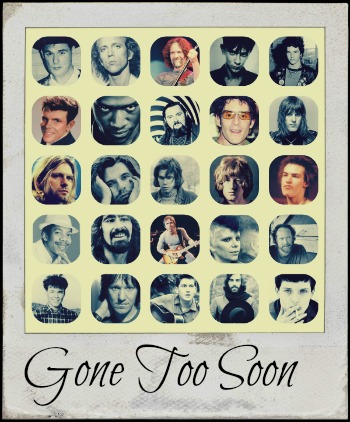
At first glance they appear to have the world at their feet and millions around the globe envy their wealth and lifestyle and long to emulate them.
And yet many rich, famous and supposedly successful people suffer from low esteem and the demons of depression stalk their daily lives and leaves them feeling empty and full of despair .
Sadly some can see no way out of this cycle of all consuming sadness and they choose to take the ultimate solution to end their misery and take their own lives.
The most commonly used method of suicide varies between countries and is partly related to the availability of effective means. Common methods include: hanging, pesticide poisoning, and firearms.
Suicide resulted in 842,000 deaths worldwide in 2013 – up from 712,000 deaths in 1990
Major depressive disorder (MDD), often simply called depression, is a mental disorder characterized by a pervasive and persistent low mood that is accompanied by low self-esteem and by a loss of interest or pleasure in normally enjoyable activities.
The term “depression” is used in a number of different ways. It is often used to mean this syndrome but may refer to other mood disorders or simply to a low mood. Major depressive disorder is a disabling condition that adversely affects a person’s family, work or school life, sleeping and eating habits, and general health.
In the United States, around 3.4% of people with major depression die by suicide, and up to 60% of people who die by suicide had depression or another mood disorder.
Like many reading this I have first hand experience of depression and I spent much of my 20’s and 30’s drifting in and out of periods of varying degrees of depression , but popping “happy pills” and having counselling seemed to work for me and I came out the other end largely in one piece.

For me the root of much of my sadness and depression was due to the fact that my beloved father John Chambers died tragically young (39) and as a nine year old boy this hit me like a sledge hammer and has haunted me throughout my life and I have never fully recovered from his death and I never will.
My mother was also absent from my life , presumed dead and as a child growing up in the mean streets of Loyalist West Belfast I considered myself an orphan and cursing the gods and a wicked fate for the misery of my young life – I struggled to find happiness for much of my childhood.
As I grew older I became more aware of the situation in Northern Ireland and like those around me I watched in horror the sectarian slaughter that engulfed and surrounded us and needless to say that this also had an effect on my already delicate state of mind and eventually depression found me and abused me for much of my teenage and young adult life.
If you would like to read more of my story see home page
At times I did have suicidal thoughts and twice I tried halfheartedly to end it all , but deep down I knew this was a cry for help and not the solution for me. I have always thought suicide a selfish act and I could never have put my family through a lifetime of the grief and guilt associated with suicide. Although I understand the utter despair that drives someone to take their own lives and the mental state that drives all reason from our normal, rational thought process.
A very close and dear friend of mine committing suicide and I had planned to include her story here – But to be honest I have found researching and putting this post together depressing enough and therefore I have left it out for now. But when I’m in a happier place I will update this post and tell her story.
——————————–
——————————–
This is a list of 25 rock/pop stars who have committed suicide and sadly ended their lives too soon , leaving millions worldwide mourning their passing and their nearest and dearest a lifetime of grief and pain and forever asking WHY?
There are a few “superstars” on this list and others who may not have been household names , but none the less had substantial fan base’s and brought joy to many. There are a few that died as a result of drugs or “accidental deaths” and although we will never know if they intended to take their own lives , the coroners have listed their deaths as suicide.
If you are suffering from depression and are feeling suicidal there is help out there. See details at end of article.

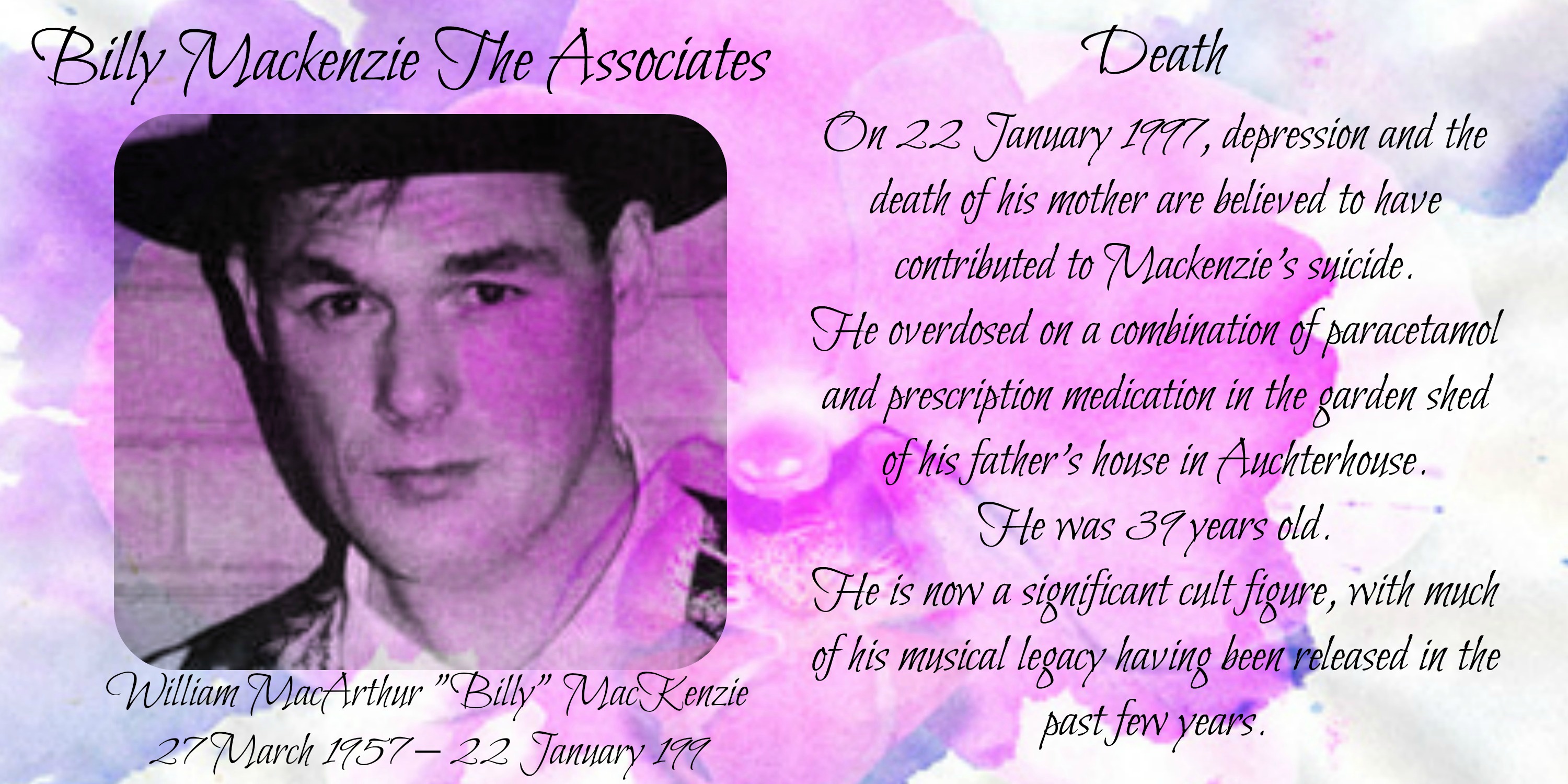
MacKenzie was born and grew up in Dundee. As a youngster, he lived in Park Avenue in the Stobswell area and attended St Mary’s Forebank Primary School and St Michael’s Secondary School. He led a peripatetic lifestyle, decamping to New Zealand at the age of 16, and travelling across America aged 17.
Here he married Chloe Dummar, the sister-in-law of his Aunt Veronica. While MacKenzie was quoted as saying the marriage was made to stave off deportation so that he could sing with the New Orleans Gospel Choir – calling his wife a ‘Dolly Parton type’ – Dummar still believes the pair were in love.
He left her after three months of marriage and returned to Dundee, and the two never had contact again. Chloe Dummar filed for divorce in 1980, and MacKenzie did not contest the filing. Chloe’s brother, Melvin Dummar, claimed to be the “one sixteenth” beneficiary of the estate of Howard Hughes, until the case was thrown out in 1978.
He returned to Scotland where he met Alan Rankine and in 1976 formed the Ascorbic Ones. They changed the name to Mental Torture and finally Associates in 1979. Rankine left Associates in 1982, but MacKenzie continued to work under the name for several years until he began releasing material under his own name in the 1990s. Mackenzie also collaborated with many other artists during his career. In 1987, he wrote lyrics for two tracks on Yello‘s album One Second: “Moon on Ice”, which he sang himself, and “The Rhythm Divine”, which was sung by Shirley Bassey and was released as a single.
A version sung by MacKenzie was released on the tape and CD versions of Associates’ Popera compilation). MacKenzie also collaborated with B.E.F. (British Electric Foundation) for their two albums Music of Quality and Distinction Volume I (1982) & Volume II (1991).
Morrissey of The Smiths was said by Craig Gannon of The Smiths to have written the song “William, It Was Really Nothing” about Mackenzie, after a brief friendship together.

On 22 January 1997, depression and the death of his mother are believed to have contributed to Mackenzie’s suicide.
He overdosed on a combination of paracetamol and prescription medication in the garden shed of his father’s house in Auchterhouse. He was 39 years old. He is now a significant cult figure, with much of his musical legacy having been released in the past few year
See Here for more information on Billy Mackenzie
Billy Mackenzie final resting place
Balgay Cemetery
Also known as: Dundee (Balgay) Cemetery

———————————-
Wild Is The Wind – Billy MacKenzie
————————————-

 Biography
Robert Lawrence “Bob” Welch, Jr. (August 31, 1945 – June 7, 2012) was an American musician. A former member of Fleetwood Mac, Welch had a successful solo career in the late 1970s. His singles included “Hot Love, Cold World,” “Ebony Eyes,” “Precious Love,” and his signature song, “Sentimental Lady.”
Bob Welch struggled with a variety of marginal bands until 1971, when he was invited to join Fleetwood Mac, then an erstwhile British blues band that had lost two of its three front-line members, Peter Green and Jeremy Spencer, within a few months. Along with fellow newcomer Christine McVie, a keyboardist/singer-songwriter (formerly of the British blues band Chicken Shack, and newly married to Fleetwood Mac founding bassist John McVie), Welch helped to steer the band in a more melodic direction, particularly after lead guitarist/singer-songwriter Danny Kirwan left the band in 1972.
In the summer of 1971, the remaining members of Fleetwood Mac held auditions at their retreat in England, Kiln House, while seeking a guitarist to replace Spencer. Judy Wong, a friend of the band who served at times as their secretary (the Kirwan-written song “Jewel-Eyed Judy” was dedicated to her), recommended her high school friend Welch to the band. Welch (who has been described as Wong’s high school boyfriend) was living in Paris at the time.
The band had a few meetings with Welch and decided to hire him without actually playing with him or listening to any of his recordings. Welch was given the role of rhythm guitar, backing up lead guitarist Danny Kirwan. It was felt that having an American in the band might extend Fleetwood Mac’s appeal in the States. Welch eventually went to live in the band’s communal home, a mansion called Benifold, which was located in Hampshire. (Using mobile equipment borrowed from The Rolling Stones, the band recorded three albums at Benifold: Bare Trees, Penguin and Mystery to Me.)
The band’s first album to feature Welch and McVie, Future Games, was recorded, however, at Advision Studios in London (as is cited on the back of the album jacket) and Bare Trees was recorded at De Lane Lea Studios in Wembley.
In September 1971, the band released Future Games, with the title song written by Welch. This album was different from anything the band had done up to that point. In 1972, six months after the release of Future Games, the band released Bare Trees, which featured Welch’s song “Sentimental Lady“. The song went on to become a much bigger hit for him five years later when he re-recorded it for his solo album French Kiss. Christine McVie also sang on the remake, and was a producer of the song.

On June 7, 2012, at the age of 66, Welch ended his own life in his Nashville home at around 12:15 p.m. He was found by his wife, Wendy, with a self-inflicted gunshot wound to the chest; a nine-page suicide note and love letter had been written to his wife. According to her, Welch had had spinal surgery three months earlier, but doctors told him he would not get better. He was in serious pain and he did not want his wife to have to care for an invalid. Also, she believes that the pain medication pregabalin (Lyrica), which he had been on for six weeks, may have contributed to his death.
See here for more details on Bob Welsh
——————————–
Bob Welch Fleetwood Mac Miles Away


Bradley Edward “Brad” Delp (June 12, 1951 – March 9, 2007) was an American musician, best known as the lead vocalist of the rock bands Boston and RTZ.
Delp was born in Peabody, Massachusetts on June 12, 1951 to French-Canadian immigrants, and raised in Danvers, Massachusetts
Music career
In 1969, guitarist Barry Goudreau introduced Delp to Tom Scholz, who was looking for a singer to complete some demo recordings. Eventually Scholz formed the short-lived band Mother’s Milk (1973–74), including Delp and Goudreau. After producing a demo, Epic Records eventually signed the act. Mother’s Milk was renamed Boston, and the eponymous debut album (recorded in 1975, although many tracks had been written years before) was released in August 1976. Delp performed all of the lead and backing vocals, including all layered vocal overdubs.
Boston’s debut has sold more than 20 million copies, and produced rock standards such as “More Than a Feeling”, “Foreplay/Long Time” and “Peace of Mind”. Delp co-wrote “Smokin'” along with Scholz, and wrote the album’s closing track, “Let Me Take You Home Tonight”.
Their next album, Don’t Look Back, was released two years later in August 1978. Its release spawned new hits such as the title track, “Party” (a sequel of sorts to “Smokin'”), and the poignant ballad “A Man I’ll Never Be”. As they did with “Smokin'”, Delp and Scholz again collaborated on “Party”, and Delp penned “Used To Bad News”.
After the first two Boston albums, Delp sang vocals on Barry Goudreau’s self-titled solo album, released in 1980. Scholz’s legendary perfectionism and a legal battle with their record company stalled any further Boston albums until 1986, when the band released the appropriately titled Third Stage. Delp co-wrote the songs “Cool the Engines” and “Can’tcha Say / Still in Love” for the album, and both songs got significant airplay.
Though well known for his “golden” voice with soaring vocals and range, Delp was also a multi-instrumentalist, playing guitar, harmonica and keyboards. He wrote or co-wrote songs for Boston, RTZ, Orion the Hunter, Lisa Guyer, and other artists.
In 1991 Delp and Goudreau formed a new band called RTZ. After Boston released the album “Walk On” in 1994 with Fran Cosmo on vocals, Delp and Boston eventually reunited later that year for another major tour and Delp continued to record vocals on several albums and projects, including new tracks for Boston’s 1997 Greatest Hits compilation and their 2002 release, Corporate America.
From the mid-1990s until his death in 2007, Delp also played in a side project when he had time off from Boston – a Beatles tribute band called Beatlejuice. The Beatles had always been a personal favorite of Delp, and he revered them for their songwriting.
During this time Delp also co-wrote and recorded with former Boston bandmate Barry Goudreau and in 2003 released the CD Delp and Goudreau.

Delp committed suicide sometime between 11:00 pm on March 8 and 1:20 pm on March 9, 2007. The local police discovered his body after a 911 call from Pamela Sullivan when she saw a dryer vent tube connected to the exhaust pipe of Delp’s yellow car. They found him lying on a pillow on his master bathroom floor of his home on Academy Avenue in Atkinson, New Hampshire. Two charcoal grills were found to have been lit inside the bathtub causing the room to fill with smoke.
A suicide note was paper-clipped to the neck of his T-shirt, which read:
“Mr. Brad Delp. ‘J’ai une âme solitaire’. I am a lonely soul.”
Delp left four sealed envelopes in his office addressed to his children, his former wife Micki, his fiancee, and another unnamed couple.
He was 55 years old.
The official cause of death was listed as suicide by carbon monoxide poisoning
The following day, Boston’s website was temporarily shut down, the webmaster having replaced their home page with a simple black background and white text message:
“We’ve just lost the nicest guy in rock and roll.”
On March 19, 2008, Barry Goudreau released one final song with Delp on vocals titled “Rockin Away”. Written and recorded in the summer of 2006, co-written with Goudreau, it is an autobiography of Delp’s musical career. The song was a hit in early 2008, charting up to No. 18 on the United States of America’s Music ranking of rock radio airplay.
On what would have been Delp’s 61st birthday, June 12, 2012, Jenna Delp, Delp’s daughter and President of the Brad Delp Foundation, released an MP3 on the foundation website of a “never before released” song which was written and recorded by Delp in 1973. It was also announced that the Foundation intended to release a complete CD of Brad’s solo work at some point in the future, which would encompass a span of 30 years of previously unreleased material written and recorded by Delp and his closest friends.
On November 25, 2015, The Supreme Judicial Court of Massachusetts found in favor of the Boston Herald and Micki Delp in a defamation lawsuit stemming from the 2007 suicide of the lead singer ( Brad Delp ) of the rock band “Boston.”
On February 23, 2016, Tom Scholz, producer, primary songwriter and lead musician for Boston, filed a writ of certiorari asking the Supreme Court of the United States to allow his defamation lawsuit against the Boston Herald and Micki Delp to go ahead. In question is if the Herald’s statement that the hard feelings coming from the breakup of Boston contributing to Delp’s suicide are opinion rather than fact, and thus the basis for a defamation suit.
See here for more details on Brad Delp
E-mails reveal tension between band members
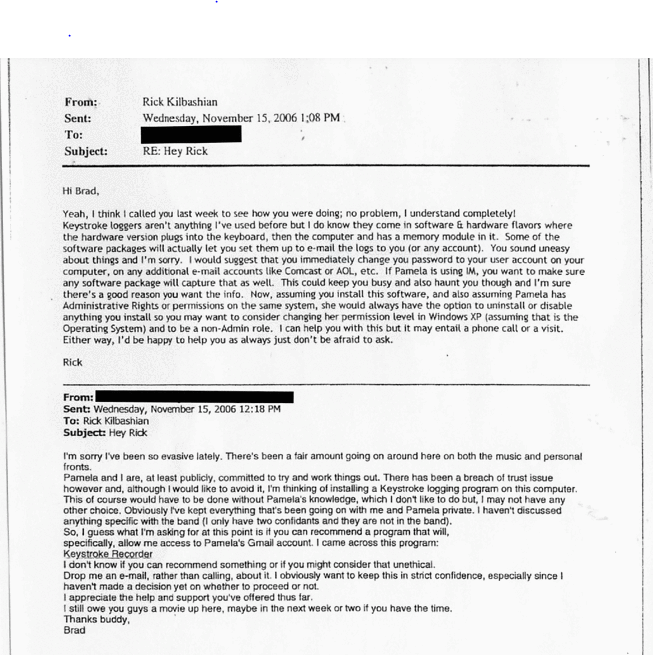
——————————–
Brad Delp last interview 3-7-07


Christopher John Dyke Acland (7 September 1966 – 17 October 1996) was an English musician. He was the drummer of the London-based shoegazing and Britpop band Lush.
Acland was born in Lancaster Infirmary. He was the son of Oliver Geoffrey Dyke Acland and Judith Veronica Williams, and the great-grandson of Sir Francis Dyke Acland, the 14th Baronet Acland
He played in a number of bands, including The Infection, Les Turds, A Touch of Hysteria and Panic, before founding Lush in 1988 with Steve Rippon, Emma Anderson, Meriel Barham and Miki Berenyi. After personnel changes gave way to a stable lineup, Lush released their debut mini album, Scar, and developed a following as a live act. They would go on to release three albums and several singles and EPs and achieve critical success.

Acland was a fan of football and a supporter of Tottenham Hotspur F.C.
On 17 October 1996, after Lush had completed their tour and music festival appearances, and two days after Anderson announced a desire to quit the band, Acland hanged himself in his parents’ house in Burneside, Cumbria.
His bandmates in Lush were devastated and disbanded after a period of mourning.

——————————-
Lush Miki Berenyi And Chris Acland Intreview


Darby Crash (formerly Bobby Pyn; born Jan Paul Beahm) (September 26, 1958 – December 7, 1980) was an American punk rock vocalist and songwriter who, along with long-time friend Pat Smear (born Georg Ruthenberg), co-founded the Germs.
He committed suicide by way of an intentional heroin overdose. In the years since his suicide at the age of 22, the Germs have attained legendary status among punk rock fans and musicians alike, as well as from the wider alternative rock and underground music community in general. Crash has come to be revered as a unique and talented songwriter; his myriad literary, musical and philosophical influences, which varied from Frederich Nietzsche and David Bowie to Charles Manson and Adolf Hitler, resulted in lyrics that were unusually wordy and impressionistic in the realm of punk rock at the time, immediately setting Crash and his band apart from most other Los Angeles punk groups that sprang up in the late 1970s.

Plagued by Crash’s worsening heroin habit, and live performances that now often ended prematurely due to violent conflict between audience members and the Los Angeles Police Department, the Germs disintegrated in April, 1980, their last show being April 26 at the Fleetwood in Redondo Beach. Crash traveled to Britain, where he became heavily enamored with the music of Adam and the Ants, adopted an Adam Ant-inspired new look that included a mohican, and put on a considerable amount of weight (some of which he eventually lost). Upon his return to the United States, Crash formed the very short-lived Darby Crash Band; Circle Jerks drummer Lucky Lehrer joined the ill-fated ensemble on the eve of their first live performance, after Crash kicked out the drummer they’d rehearsed with during soundcheck and convinced Pat Smear to act as the group’s guitarist. The band, described by Smear as “like the Germs, but with worse players”.
On December 3, 1980, an over-sold Starwood hosted a final live show of the reunited band, including drummer . Don Bolles. Fans and those who were present that night consider the performance possibly the best the group ever gave.
Crash committed suicide by intentional heroin overdose on December 7, 1980 in a house in the Mid-Wilshire section of Hollywood, California. According to SPIN magazine, apocryphal lore has Crash attempting to write “Here lies Darby Crash” on the wall as he lay dying, but not finishing. In reality, he wrote a short note to Darby Crash Band bassist David “Bosco” Danford that stated “My life, my leather, my love goes to Bosco.”
His death was largely overshadowed by that of John Lennon, who was killed by Mark David Chapman in New York just one day after Crash’s suicide.
His female friend Casey Cola Hopkins was with him that night, at her mother’s main house. Casey was supposed to have died with him in the coach house (which was a converted garage) that night as part of a supposed death pact, but ended up surviving.
Darby is interred at Holy Cross Cemetery, Culver City, California, USA, Plot: Section R (Resurrection) T9 115. He was survived by his mother Faith Sr., his elder half-sister Faith Jr., and his eldest half-sister, Christine Lucas-Smith.
Since his death, his mother received the Germs’ album and merchandise royalties, thanks to Darby’s deal with Bug Records that was etched out a few months prior to his death.
Darby’s mother, Faith Ardelan Baker (February 28, 1922 – May 31, 2009), died in Los Angeles. Up until her death, she was convinced that her son’s death was from an accidental overdose and not a suicide.
See here for more details on Darby Crash

———————————
Darby Crash Interview

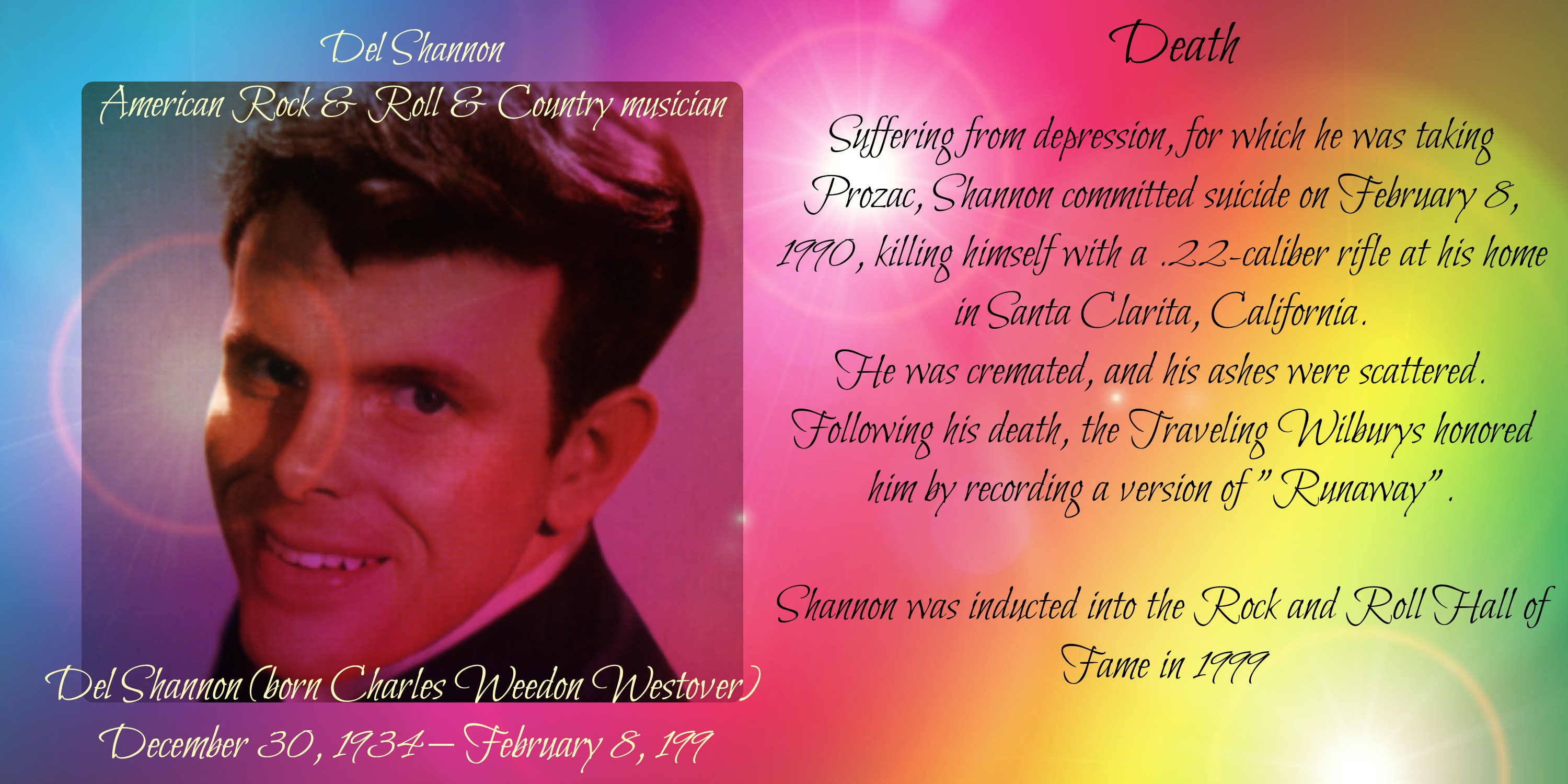
Del Shannon (born Charles Weedon Westover; December 30, 1934 – February 8, 1990) was an American rock and roll and country musician, and singer-songwriter who is best known for his 1961 No. 1 billboard hit “Runaway“.
Westover was born in Grand Rapids, Michigan, and grew up in nearby Coopersville. He learned ukulele and guitar and listened to country and western music, including Hank Williams, Hank Snow, and Lefty Frizzell. He was drafted into the Army in 1954, and while in Germany played guitar in a band called “The Cool Flames”. When his service ended, he returned to Battle Creek, Michigan, and worked as a carpet salesman and as a truck driver in a furniture factory. He found part-time work as a rhythm guitarist in singer Doug DeMott’s group called “The Moonlight Ramblers”, working at the Hi-Lo Club.
When DeMott was fired in 1958, Westover took over as leader and singer, giving himself the name Charlie Johnson and renaming the band into The Big Little Show Band.
In early 1959 he added keyboardist Max Crook, who played the Musitron (his own invention of an early synthesizer). Crook had made recordings, and he persuaded Ann Arbor disc jockey Ollie McLaughlin to hear the band. McLaughlin took the group’s demos to Harry Balk and Irving Micahnik of Talent Artists in Detroit. In July 1960, Westover and Crook signed to become recording artists and composers on the Bigtop label. Balk suggested Westover use a new name, and they came up with “Del Shannon”, combining Mark Shannon—a wrestling pseudonym used by a regular at the Hi-Lo Club—with Del, derived from the Cadillac Coupe de Ville, his favorite car.
Suffering from depression, for which he was taking Prozac, Shannon committed suicide on February 8, 1990, killing himself with a .22-caliber rifle at his home in Santa Clarita, California. He was cremated, and his ashes were scattered. Following his death, the Traveling Wilburys honored him by recording a version of “Runaway”. Lynne also co-produced Shannon’s posthumous album, Rock On, released on Silvertone in 1991.
Del Shannon’s death certificate

.Del Shannon Runaway

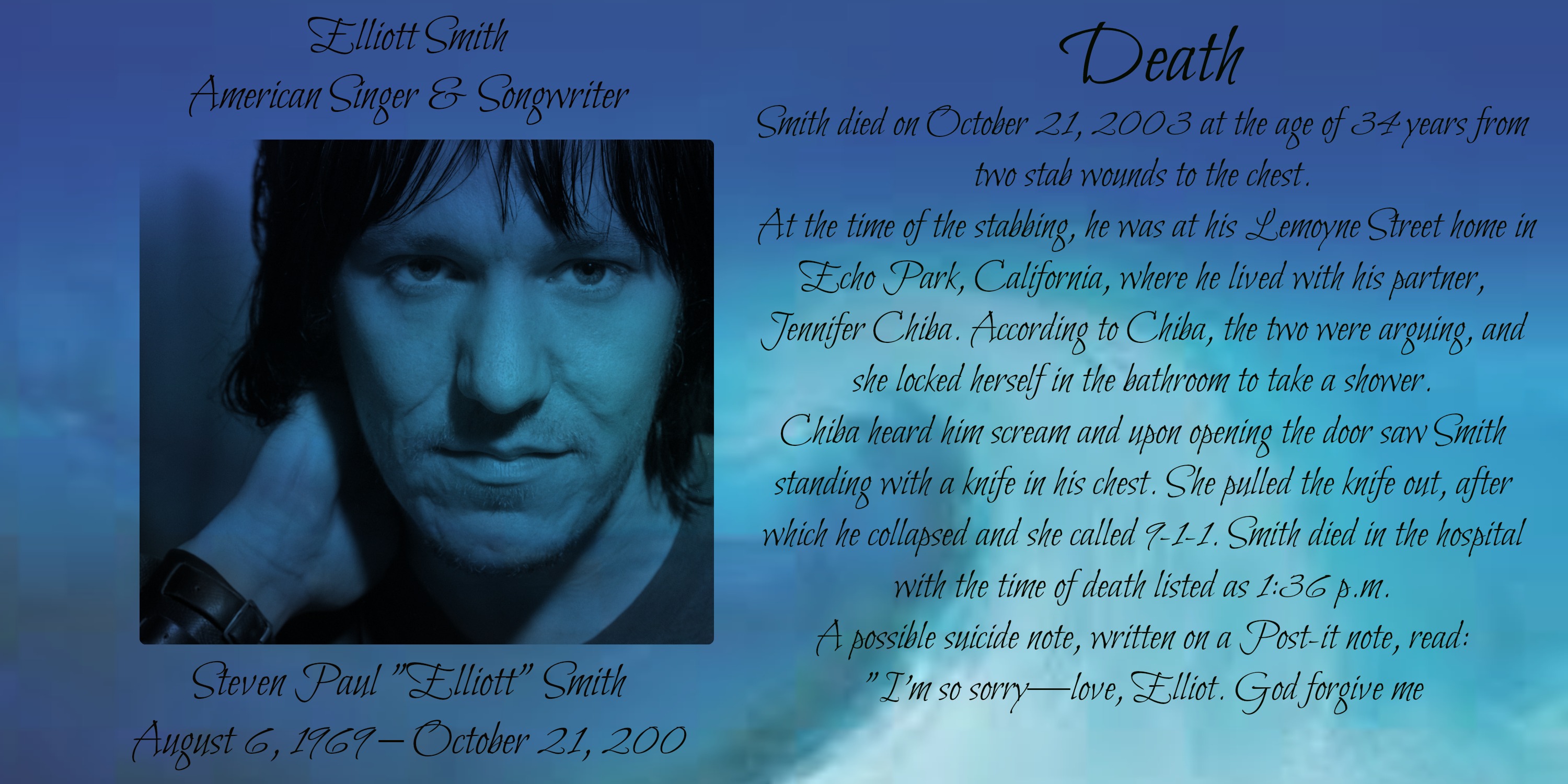
Steven Paul “Elliott” Smith (August 6, 1969 – October 21, 2003) was an American singer, songwriter, and musician. Smith was born in Omaha, Nebraska, raised primarily in Texas, and lived for much of his life in Portland, Oregon, where he first gained popularity. Smith’s primary instrument was the guitar, though he was also proficient with piano, clarinet, bass guitar, drums, and harmonica. Smith had a distinctive vocal style, characterized by his “whispery, spiderweb-thin delivery”, and used multi-tracking to create vocal layers, textures, and harmonies.
After playing in the rock band Heatmiser for several years, Smith began his solo career in 1994, with releases on the independent record labels Cavity Search and Kill Rock Stars (KRS). In 1997, he signed a contract with DreamWorks Records, for which he recorded two albums.
Smith rose to mainstream prominence when his song “Miss Misery“—included in the soundtrack for the film Good Will Hunting (1997)—was nominated for an Oscar in the Best Original Song category in 1998.
Smith suffered from depression, alcoholism, and drug dependence, and these topics often appear in his lyrics. In 2003, aged 34, he died in Los Angeles, California from two stab wounds to the chest. The autopsy evidence was inconclusive as to whether the wounds were self-inflicted. At the time of his death, Smith was working on his sixth studio album, From a Basement on the Hill, which was posthumously completed and released in 2004.

Smith died on October 21, 2003 at the age of 34 years from two stab wounds to the chest. At the time of the stabbing, he was at his Lemoyne Street home in Echo Park, California, where he lived with his partner, Jennifer Chiba. According to Chiba, the two were arguing, and she locked herself in the bathroom to take a shower.
Chiba heard him scream and upon opening the door saw Smith standing with a knife in his chest. She pulled the knife out, after which he collapsed and she called 9-1-1. Smith died in the hospital with the time of death listed as 1:36 p.m. A possible suicide note, written on a Post-it note, read:
“I’m so sorry—love, Elliot. God forgive me.”
The name “Elliott” is misspelled as “Elliot” in the coroner’s report; however, a coroner informed the Smoking Gun website “that Smith’s first name was misspelled in the report”, not on the Post-it note.
While Smith’s death was originally reported as a suicide, the official autopsy report released in December 2003 left open the question of homicide.
According to Pitchfork Media, record producer Larry Crane reported on his Tape Op message board that he had planned to help Smith mix his album in mid-November. Crane wrote, “I hadn’t talked to Elliott in over a year. His girlfriend, Jennifer, called me [last week] and asked if I’d like to come to L.A. and help mix and finish [Smith’s album]. I said ‘yes, of course’, and chatted with Elliott for the first time in ages. It seems surreal that he would call me to finish an album and then a week later kill himself. I talked to Jennifer this morning, who was obviously shattered and in tears, and she said, ‘I don’t understand, he was so healthy.'”
The coroner reported that no traces of illegal substances or alcohol were found in Smith’s system at the time of his death but did find prescribed levels of antidepressant, anxiolytic, and ADHD medications, including Clonazepam, Mirtazapine, Atomoxetine, and Amphetamine. There were no hesitation wounds, which are typical of suicide by self-infliction. However, the authorities do not seem to be investigating the case further.
Smith’s body was cremated and a public burial site or memorial was never formally announced.
————————-
Elliott Smith “Miss Misery

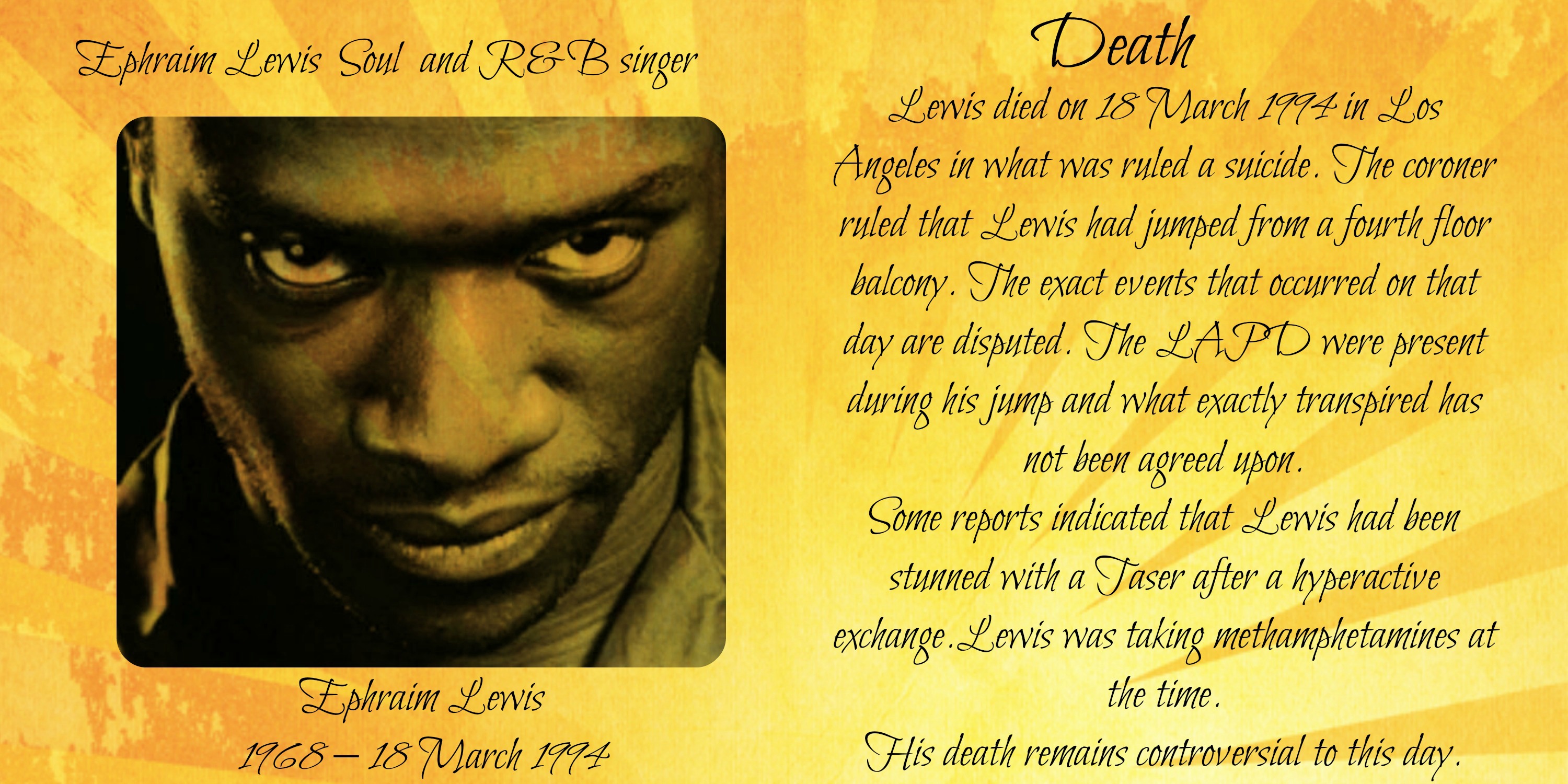
Ephraim Lewis (1968 – 18 March 1994) was an English soul/neo-soul and R&B singer and songwriter. He was one of many highly anticipated performers that emerged in the early 1990s. However, he died with only one album to his name.
Born in Wolverhampton, West Midlands, England, Lewis, known for possessing a higher-timbred, yet rich voice and impeccable diction, drew comparisons to fellow English musician, Seal. He signed with Elektra Records in 1992 and his debut Skin was released on 21 April of that year.

Lewis died on 18 March 1994 in Los Angeles in what was ruled a suicide. The coroner ruled that Lewis had jumped from a fourth floor balcony. The exact events that occurred on that day are disputed. The LAPD were present during his jump and what exactly transpired has not been agreed upon. Some reports indicated that Lewis had been stunned with a Taser after a hyperactive exchange.
Lewis was taking methamphetamines at the time.
His death remains controversial to this day. Lewis was buried on 21 April 1994.
———————————–
Ephraim Lewis – Drowning in Your Eyes


Graham John Clifton Bond (28 October 1937 – 8 May 1974) was an English musician and occultist, considered a founding father of the English rhythm and blues boom of the 1960s.
Bond was an innovator, described as “an important, under-appreciated figure of early British R&B”, along with Cyril Davies and Alexis Korner. Jack Bruce, John McLaughlin and Ginger Baker first achieved prominence in his group, the Graham Bond Organisation. Bond was voted Britain’s New Jazz Star in 1961.
He was an early user of the Hammond organ/Leslie speaker combination in British rhythm and blues – he “split” the Hammond for portability – and was the first rock artist to record using a Mellotron, on his There’s A Bond Between Us LP. As such he was a major influence upon later rock keyboardists: Deep Purple‘s Jon Lord said “He taught me, hands on, most of what I know about the Hammond organ.

Bond’s financial affairs were in chaos, and the years of lack of commercial success and the recent demise of Magus had badly hurt his pride. Throughout his career he had been hampered with severe bouts of drug addiction, and spent January 1973 in hospital after a nervous breakdown. According to Harry Shapiro, in his biography The Mighty Shadow, Bond was considered as a possible replacement for Patrick Moraz in Refugee.
On 8 May 1974, Bond died under the wheels of a Piccadilly line train at Finsbury Park station, London, at the age of 36. Most sources list the death as a suicide. Friends agree that he was off drugs, although becoming increasingly obsessed with the occult (he believed he was Aleister Crowley‘s son).
Bond’s legacy as a springboard for talent and as a Hammond Organ pioneer musician in his own right was largely overlooked for the latter part of the 20th century. However, his legacy has been somewhat re-examined in later years and in 2015 his work was the focus of a two-hour special on the Dr Boogie radio show
———————————–
The Graham Bond Organization – Hoochie Coochie Man


Ian Kevin Curtis (15 July 1956 – 18 May 1980) was an English musician and singer-songwriter. He is best known as the lead singer and lyricist of the post-punk band Joy Division. Joy Division released their debut album, Unknown Pleasures, in 1979 and recorded their follow-up, Closer, in 1980.
Curtis, who suffered from epilepsy and depression, killed himself on 18 May 1980, on the eve of Joy Division’s first North American tour, resulting in the band’s dissolution and the subsequent formation of New Order. Curtis was known for his bass-baritone voice, dance style, and songwriting filled with imagery of desolation, emptiness and alienation.
In 1995, Curtis’s widow Deborah published Touching from a Distance: Ian Curtis and Joy Division, a biography of the singer. His life and death have been dramatised in the films 24 Hour Party People (2002) and Control (2007).

Curtis’s last live performance was on 2 May 1980, at High Hall of Birmingham University, a show that included Joy Division’s first and only performance of “Ceremony“, later recorded by New Order and released as their first single. The last song Curtis performed on stage was “Digital”. The recording of this performance is on the Still album.
As described in Deborah Curtis’s Touching from a Distance, Curtis was staying at his parents’ house at this time and attempted to talk his wife into staying with him on 17 May 1980, to no avail. He told her to leave him alone in the house until he caught his train to Manchester the next morning.
In the early hours of 18 May 1980, Curtis hanged himself in the kitchen of his house at 77 Barton Street, Macclesfield, at the age of 23.
He had just viewed Werner Herzog‘s film Stroszek and listened to Iggy Pop‘s The Idiot. At the time of his death, his health was failing as a result of his epilepsy and, attempting to balance his musical ambitions with his marriage, which was foundering in the aftermath of his close relationship with journalist Annik Honoré (who in 2010 stated it was not an “affair” and merely a close and platonic relationship).
His wife found Ian’s body the next morning; he had used the kitchen’s washing line to hang himself. Deborah claimed later that he had confided to her on several occasions that he had no desire to live past his 20s.
Curtis was cremated at Macclesfield Crematorium and his ashes were buried. His memorial stone, inscribed with “Ian Curtis 18 – 5 – 80” and “Love Will Tear Us Apart“, was stolen in July 2008 from the grounds of Macclesfield Cemetery. The missing memorial stone was later replaced by a new stone with the same inscription but in a different typeface.
In a 1987 interview with Option, Stephen Morris commented on how he would describe Curtis to those who asked what he was like:
“An ordinary bloke just like you or me, liked a bit of a laugh, a bit of a joke.”
——————————–
Joy Division – Love Will Tear Us Apart


Jonathan Henry “Jon” Lee (28 March 1968 – 7 January 2002) was a Welsh drummer. He was the original drummer of the British rock band Feeder.
He committed suicide in 2002.
Feeder were formed whilst Grant Nicholas was a producer, before moving to London to gain more experience. He had already met Lee in Newport who moved to London afterwards. They formed a band named Raindancer, who despite winning a TV slot on ITV Central never gained a record deal. Shortly before this, Jon was a member of Newport band The Darling Buds, although only appearing on a couple of b-sides of the “Sure Thing” single. Raindancer’s split saw bassist John Canham part ways with the band, before Simon Blight followed soon after when they reformed as Hum, which was changed to Reel, before then changing their name once again to Real when Hirose took over bass duties in 1995.
The band signed to The Echo Label in November of that year, before changing their name to Feeder, with their debut single proper “Stereoworld” reaching number 128 in the UK charts in October 1996, while the second single “Tangerine” reached number 60. The first full-length album, Polythene, was released in May 1997. Produced by Chris Sheldon, it charted at number 65 in the UK and was certified Silver for sales over 60,000 copies in 2003 when the band had already broken through. Metal Hammer magazine included it in its Top 20 Albums of 1997 list at number 1.
The follow-up album, Yesterday Went Too Soon, was produced by Nicholas. Released in August 1999, the album was a much quicker commercial success than its predecessor (entering the UK album chart at number 8 and certified Silver in 2001, with this being upgraded to Gold in 2003). The title track was the band’s first UK Top 20 hit.
Lee committed suicide by hanging himself with a metal dog chain in 2002 at his home in Miami, Florida. Four suicide notes were found. With an increasingly successful music career, a supermodel wife and a young son, Lee’s death came as a surprise to the public and sparked a massive reaction in tributes to the drummer.
Lee’s funeral took place at St. Mary’s Church in Newport on 18 January 2002, where thousands of fans showed up alongside family and friends to pay their own respects. Matt Page, Feeder’s manager, read “Do Not Stand at My Grave and Weep“, as requested by Lee’s father. Feeder’s 1997 single “High” was also played during the ceremony, during which Grant Nicholas gave the following statement:
| “ | Jon had such a taste for life, which makes this whole thing such a mystery to us all. He could be the life and soul of any party. Yet, quiet, sensitive and understanding to anyone that needed a friendly ear. I always felt there was a raging fire in his soul which he channelled into his drumming; showing no fear to anything he put his hand to… hope you are at peace now, Jon boy. Forever young. Your friend always. | ” |
Feeder decided to continue, with Nicholas saying, “Jon would have wanted us to carry on.”
Former Skunk Anansie drummer Mark Richardson helped the band out on drum duties for their album Comfort In Sound and subsequent live performances.
See here for more details on Jon Lee

————————————
Jon Lee Tribute


Keith Noel Emerson (2 November 1944 – 10 March 2016) was an English keyboardist and composer. Emerson played in a number of bands before he found his first commercial success with the Nice, formerly P. P. Arnold‘s backing band, in the late 1960s. He became internationally famous for his work with the Nice, which included writing rock arrangements of classical music.
After leaving the Nice in 1970, he was a founding member of Emerson, Lake & Palmer (ELP), one of the early progressive rock supergroups. Emerson, Lake & Palmer were commercially successful through much of the 1970s, becoming one of the best-known progressive rock groups of the era.
Emerson wrote and arranged much of ELP’s music on albums such as Tarkus (1971) and Brain Salad Surgery (1973), combining his own original compositions with classical or traditional pieces adapted into a rock format.
Following ELP’s break-up at the end of the 1970s, Emerson pursued a solo career, composed several film soundtracks, and formed the bands Emerson, Lake & Powell and 3 to carry on in the style of ELP. In the early 1990s, Emerson rejoined ELP, which reunited for two more albums and several tours before breaking up again in the late 1990s. Emerson also reunited the Nice in 2002 for a tour.
Emerson died on 10 March 2016 in Santa Monica, California, of suicide by a gunshot wound to the head. His body was found at his Santa Monica home. The medical examiner’s report, following an autopsy, concluded that Emerson had also suffered from heart disease and from depression associated with alcohol. According to Emerson’s girlfriend Mari Kawaguchi, Emerson had become “depressed, nervous and anxious” because nerve damage had hampered his playing, and he was worried that he would perform poorly at upcoming concerts and disappoint his fans.
Emerson was buried on 1 April 2016 in East Sussex. Although his death had been reported by news sources and an official Emerson, Lake and Palmer social media page as having occurred on the night of 10 March, his grave memorial lists his date of death as 11 March 2016.
His former ELP bandmates, Carl Palmer and Greg Lake, both issued statements on his death. Palmer said, “Keith was a gentle soul whose love for music and passion for his performance as a keyboard player will remain unmatched for many years to come.”
Lake said,
“As sad and tragic as Keith’s death is, I would not want this to be the lasting memory people take away with them. What I will always remember about Keith Emerson was his remarkable talent as a musician and composer and his gift and passion to entertain. Music was his life and despite some of the difficulties he encountered I am sure that the music he created will live on forever”
See here for more information on Keith Emerson
———————————-


Kurt Donald Cobain (February 20, 1967 – c. April 5, 1994) was an American musician who was best known as the lead singer, guitarist, and primary songwriter of the rock band Nirvana. Cobain formed Nirvana with Krist Novoselic in Aberdeen, Washington, in 1985 and established it as part of the Seattle music scene and grunge genre. Nirvana’s debut album Bleach was released on the independent record label Sub Pop in 1989.
After signing with major label DGC Records, the band found breakthrough success with “Smells Like Teen Spirit” from their second album Nevermind (1991). Following the success of Nevermind, Nirvana was labeled “the flagship band” of Generation X, and Cobain hailed as “the spokesman of a generation”. Cobain, however, was often uncomfortable and frustrated, believing his message and artistic vision to have been misinterpreted by the public, with his personal issues often subject to media attention.
During the last years of his life, Cobain struggled with heroinaddiction, illness and depression. He also had difficulty coping with his fame and public image, and the professional and lifelong personal pressures surrounding himself and his wife, musician Courtney Love. On April 8, 1994, Cobain was found dead at his home in Seattle, the victim of what was officially ruled a suicide by a self-inflicted shotgun wound to the head. The circumstances of his deathat age 27 have become a topic of public fascination and debate. Since their debut, Nirvana, with Cobain as a songwriter, has sold over 25 million albums in the U.S., and over 75 million worldwide. Cobain was posthumously inducted into the Rock and Roll Hall of Fame in 2014, along with Nirvana bandmates Novoselic and Dave Grohl, in their first year of eligibility.
Following a tour stop at Terminal Eins in Munich, Germany, on March 1, 1994, Cobain was diagnosed with bronchitis and severe laryngitis. He flew to Rome the next day for medical treatment, and was joined there by his wife, Courtney Love, on March 3, 1994. The next morning, Love awoke to find that Cobain had overdosed on a combination of champagne and Rohypnol. Cobain was immediately rushed to the hospital, and spent the rest of the day unconscious. After five days in the hospital, Cobain was released and returned to Seattle. Love later stated that the incident was Cobain’s first suicide attempt.
On March 18, 1994, Love phoned the Seattle police informing them that Cobain was suicidal and had locked himself in a room with a gun. Police arrived and confiscated several guns and a bottle of pills from Cobain, who insisted that he was not suicidal and had locked himself in the room to hide from Love.
Love arranged an intervention regarding Cobain’s drug use on March 25, 1994. The ten people involved included musician friends, record company executives, and one of Cobain’s closest friends, Dylan Carlson. The intervention was initially unsuccessful, with an angry Cobain insulting and heaping scorn on its participants and eventually locking himself in the upstairs bedroom. However, by the end of the day, Cobain had agreed to undergo a detox program.
Cobain arrived at the Exodus Recovery Center in Los Angeles, California on March 30, 1994. The staff at the facility were unaware of Cobain’s history of depression and prior attempts at suicide. When visited by friends, there was no indication to them that Cobain was in any negative or suicidal state of mind. He spent the day talking to counselors about his drug abuse and personal problems, happily playing with his daughter Frances. These interactions were the last time Cobain saw his daughter.
The following night, Cobain walked outside to have a cigarette, and climbed over a six-foot-high fence to leave the facility (which he had joked earlier in the day would be a stupid feat to attempt). He took a taxi to Los Angeles Airport and flew back to Seattle. On the flight, he sat next to Duff McKagan of Guns N’ Roses. Despite Cobain’s own personal animosity towards Guns N’ Roses, and specifically Axl Rose, Cobain “seemed happy” to see McKagan. McKagan later stated he knew from “all of my instincts that something was wrong”.
Most of his close friends and family were unaware of his whereabouts. On April 2 and 3, Cobain was spotted in numerous locations around Seattle. On April 3, Love contacted private investigator Tom Grant, and hired him to find Cobain. Cobain was not seen the next day. On April 7, amid rumors of Nirvana breaking up, the band pulled out of the 1994 Lollapalooza music festival.

On April 8, Cobain’s body was discovered at his Lake Washington Boulevard home by an electrician named Gary Smith who had arrived to install a security system. Apart from a minor amount of blood coming out of Cobain’s ear, the electrician reported seeing no visible signs of trauma, and initially believed that Cobain was asleep until he saw the shotgun pointing at his chin. A note was found, addressed to Cobain’s childhood imaginary friend “Boddah”, that stated that Cobain had not “felt the excitement of listening to as well as creating music, along with really writing… for too many years now”. A high concentration of heroin and traces of diazepam were also found in his body. Cobain’s body had been lying there for days; the coroner’s report estimated Cobain to have died on April 5, 1994.
A public vigil was held for Cobain on April 10, 1994, at a park at Seattle Center drawing approximately seven thousand mourners. Prerecorded messages by Novoselic and Love were played at the memorial. Love read portions of Cobain’s suicide note to the crowd, crying and chastising Cobain. Near the end of the vigil, Love arrived at the park and distributed some of Cobain’s clothing to those who still remained.
Grohl would say that the news of Cobain’s death was:
| “ | … probably the worst thing that has happened to me in my life. I remember the day after that I woke up and I was heartbroken that he was gone. I just felt like, “Okay, so I get to wake up today and have another day and he doesn’t.” | ” |
He also believed that he knew Cobain would die at an early age, saying that “sometimes you just can’t save someone from themselves”, and “in some ways, you kind of prepare yourself emotionally for that to be a reality”.
Dave Reed, who for a short time was Cobain’s foster father, said that “he had the desperation, not the courage, to be himself. Once you do that, you can’t go wrong, because you can’t make any mistakes when people love you for being yourself. But for Kurt, it didn’t matter that other people loved him; he simply didn’t love himself enough”.
A final ceremony was arranged for Cobain, by his mother, on May 31, 1999, and was attended by both Love and Tracy Marander. As a Buddhist monk chanted, daughter Frances Bean scattered Cobain’s ashes into McLane Creek in Olympia, the city where he “had found his true artistic muse”.
Cobain’s artistic endeavors and struggles with heroin addiction, illness and depression, as well as the circumstances of his death have become a frequent topic of fascination, debate, and controversy throughout the world. According to a spokesperson for the Seattle Police Department, the department receives at least one weekly request, mostly through Twitter, to reopen the investigation, resulting in the maintenance of the basic incident report on file.
Cobain is one of the well known members of the 27 Club.

In March 2014, the Seattle police developed four rolls of film that had been left in an evidence vault—a reason was not provided for why the rolls were not developed earlier. According to the Seattle police, the 35mm film photographs show the scene of Cobain’s dead body more clearly than previous Polaroid images taken by the police. Detective Mike Ciesynski, a cold case investigator, was instructed to look at the film because “it is 20 years later and it’s a high media case”. Ciesynski stated that Cobain’s death remains a suicide and that the images would not have been released publicly. The photos in question were later released, one by one, weeks before the 20th anniversary of Cobain’s death. One photo shows Cobain’s arm, still wearing the hospital bracelet from the drug rehab facility he checked out of just a few days prior to returning to Seattle. Another photo shows Cobain’s foot resting next to a bag of shotgun shells, one of which was used in his death.
Cobain’s suicide note (full transcription). The final phrase before the valediction,
“it’s better to burn out than to fade away”, is a quote from the lyrics of Neil Young‘s song “My My, Hey Hey (Out of the Blue)“
See here for more information on Kurt Cobain
————————————
————————————


Michael Kelland John Hutchence (22 January 1960 – 22 November 1997) was an Australian musician and actor. He was a founding member, lead singer and lyricist of rock band INXS from 1977 until his death in 1997. He was a member of short-lived pop rock group Max Q and recorded solo material which was released posthumously. He acted in feature films, including Dogs in Space(1986), Frankenstein Unbound (1990) and Limp (1997). According to rock music historian, Ian McFarlane, “Hutchence was the archetypal rock showman. He exuded an overtly sexual, macho cool with his flowing locks, and lithe and exuberant stage movements”.
Hutchence won the ‘Best International Artist’ at the 1991 BRIT Awards with INXS winning the related group award.
His private life was often reported in the Australian and international press, with a string of love affairs with prominent actresses, models and singers. Hutchence’s relationship with UK television presenter Paula Yates began while she was married to musician andLive Aid organiser Bob Geldof. They divorced in 1996. During July of the same year, Hutchence and Yates had a daughter, Heavenly Hiraani Tiger Lily.
On the morning of 22 November 1997, Hutchence was found dead in his hotel room in Sydney. His death was reported by the New South Wales Coroner to be the result of suicide. In 2000, Yates died of a heroin overdose. The couple’s daughter was placed in Geldof’s custody with her half-sisters


Hutchence and INXS went on a world tour to support the April 1997 release of Elegantly Wasted, both the album and its related singles having had less chart success than their prior releases.
The final leg of their 20th anniversary tour was to be in Australia in November and December. However, on the morning of 22 November 1997, Hutchence, aged 37, was found dead in Room 524 at the Ritz-Carlton hotel in Double Bay, Sydney.
On 6 February 1998, after an autopsy and coronial inquest, New South Wales State Coroner, Derrick Hand, presented his report which ruled that Hutchence’s death was a suicide while depressed and under the influence of alcohol and other drugs.
Former girlfriend Kym Wilson and her then boyfriend, Andrew Reyment, were the last people to see Hutchence alive when they left him at 4:50 am; he was still awaiting a phone call from Yates in London concerning whether she would bring their daughter Tiger to Australia. Hutchence’s second last outgoing phone call was to his personal manager, Martha Troup’s voice-mail,
“Marth, Michael here. I’ve fucking had enough”.
When Troup returned the call there was no answer. At 9:54 am he talked to his former longtime girlfriend, Michèle Bennett, who stated that he was crying, sounded upset and said he needed to see her. Bennett arrived at his door at about 10:40 am, but there was no response. Hutchence’s body was discovered by a hotel maid at 11:50 am. Police reported that, “He was in a kneeling position facing the door. He had used his snake skin belt to tie a knot on the automatic door closure at the top of the door, and had strained his head forward into the loop so hard that the buckle had broken”.
After Hutchence’s death, Geldof and Yates each gave police statements on the phone calls they exchanged with Hutchence that morning but did not volunteer their phone records. Yates’s statement on 26 November included “He was frightened and couldn’t stand a minute more without his baby … [he] was terribly upset and he said,
‘I don’t know how I’ll live without seeing Tiger'”.
Yates contended that Geldof had repeatedly said, “Don’t forget, I am above the law”, referring to his influence since Live Aid. Her statement said that she had informed Hutchence of the custody hearing being adjourned until 17 December and that consequently she would not be bringing their daughter out to Australia as previously intended. Yates indicated that Hutchence said he was going to phone Geldof, “to let Tiger come to Australia”.
Geldof’s police statements and evidence to the coroner indicated that he patiently listened to Hutchence who was “hectoring and abusive and threatening”. A friend of Yates and Geldof confirmed the substance of this call and added that Geldof had said,
“I know what time the call ended, it was 20 to 7, I was going to log it as a threatening call”.
The occupant in the room next to Room 524 heard a loud male voice and swearing at about 5 am; the coroner was satisfied that this was Hutchence arguing with Geldof.
On 27 November, Hutchence’s coffin was carried out of St. Andrew’s Cathedral by members of the band and his younger brother Rhett. “Never Tear Us Apart” was played in the background. Nick Cave, a friend of Hutchence, performed his 1997 song “Into My Arms” during the funeral and requested that television cameras be switched off. Rhett claimed in his 2004 book, Total XS, that on the previous day at the funeral parlour, Yates had put a gram of heroin into the dead Hutchence’s pocket.
He was cremated at Northern Suburbs Crematorium, Sydney.

———————————————–
INXS – Need You Tonight

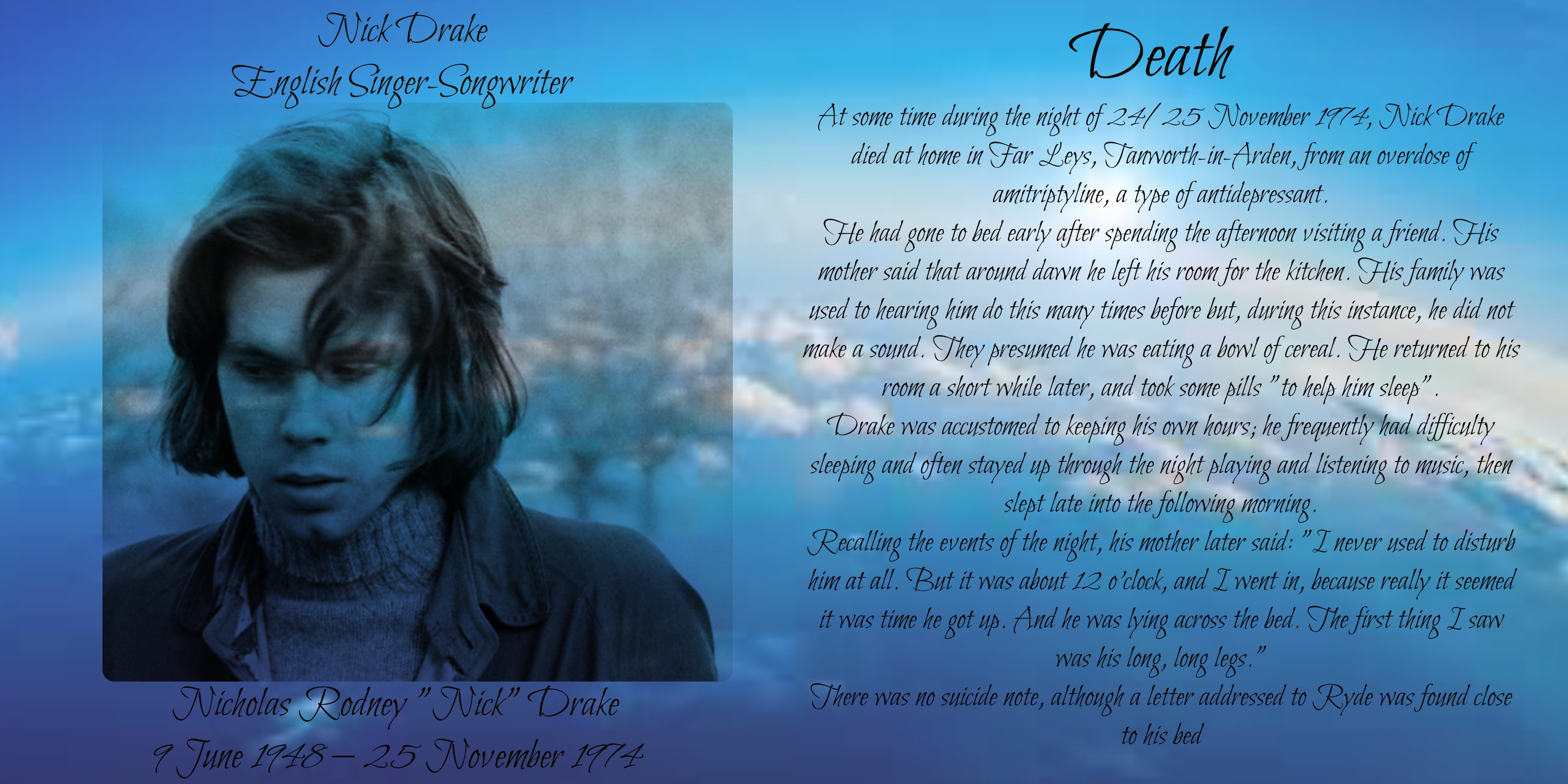
Nicholas Rodney “Nick” Drake (19 June 1948 – 25 November 1974) was an English singer-songwriter and musician, known for his acoustic guitar-based songs. He failed to find a wide audience during his lifetime, but his work has gradually achieved wider notice and recognition.
Drake signed to Island Records when he was 20 years old and was a student at the University of Cambridge, and released his debut album, Five Leaves Left, in 1969. By 1972, he had recorded two more albums—Bryter Layter and Pink Moon. Neither sold more than 5,000 copies on initial release.
Drake’s reluctance to perform live, or be interviewed, contributed to his lack of commercial success. No footage of the adult Drake has ever been released; only still photographs and home footage from his childhood.
Drake suffered from major depression. This was often reflected in his lyrics. On completion of his third album, 1972’s Pink Moon, he withdrew from both live performance and recording, retreating to his parents’ home in rural Warwickshire.
On 25 November 1974, at the age of 26, Drake died from an overdose of approximately 30 amitriptyline pills, a prescribed antidepressant. His cause of death was determined to be suicide.
Drake’s music remained available through the mid-1970s, but the 1979 release of the retrospective album Fruit Tree allowed his back catalogue to be reassessed. By the mid-1980s Drake was being credited as an influence by such artists as Robert Smith, David Sylvian and Peter Buck. In 1985, The Dream Academy reached the UK and US charts with “Life in a Northern Town“, a song written for and dedicated to Drake.
By the early 1990s, he had come to represent a certain type of “doomed romantic” musician in the UK music press. His first biography was published in 1997, followed in 1998 by the documentary film A Stranger Among Us.
By autumn 1974, Drake’s weekly retainer from Island had ceased, and his illness meant he remained in contact with only a few close friends. He had tried to stay in touch with Sophia Ryde, whom he had first met in London in 1968.
Ryde has been described by Drake’s biographers as “the nearest thing” to a girlfriend in his life, but she now prefers the description “best (girl) friend”. In a 2005 interview, Ryde revealed that a week before he died, she had sought to end the relationship:
“I couldn’t cope with it. I asked him for some time. And I never saw him again.”
As with the relationship he had earlier shared with fellow folk musician Linda Thompson, Drake’s relationship with Ryde was never consummated.
At some time during the night of 24/25 November 1974, Nick Drake died at home in Far Leys, Tanworth-in-Arden, from an overdose of amitriptyline, a type of antidepressant. He had gone to bed early after spending the afternoon visiting a friend. His mother said that around dawn he left his room for the kitchen. His family was used to hearing him do this many times before but, during this instance, he did not make a sound. They presumed he was eating a bowl of cereal. He returned to his room a short while later, and took some pills “to help him sleep”.
Drake was accustomed to keeping his own hours; he frequently had difficulty sleeping and often stayed up through the night playing and listening to music, then slept late into the following morning. Recalling the events of the night, his mother later said: “I never used to disturb him at all. But it was about 12 o’clock, and I went in, because really it seemed it was time he got up. And he was lying across the bed. The first thing I saw was his long, long legs.”
There was no suicide note, although a letter addressed to Ryde was found close to his bed
See here for more information on Nick Drake
The grave where Drake’s ashes are buried, mingled with those of his parents.
The gravestone is inscribed with the epitaph ‘Now we rise / And we are everywhere’, taken from “From the Morning,” the final song on his final album, Pink Moon.
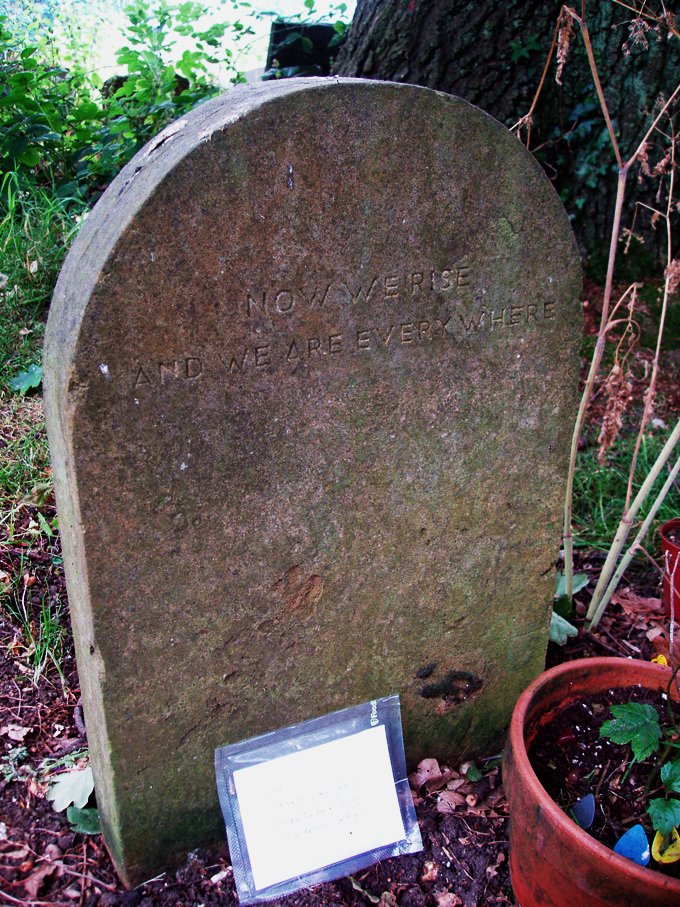
——————————

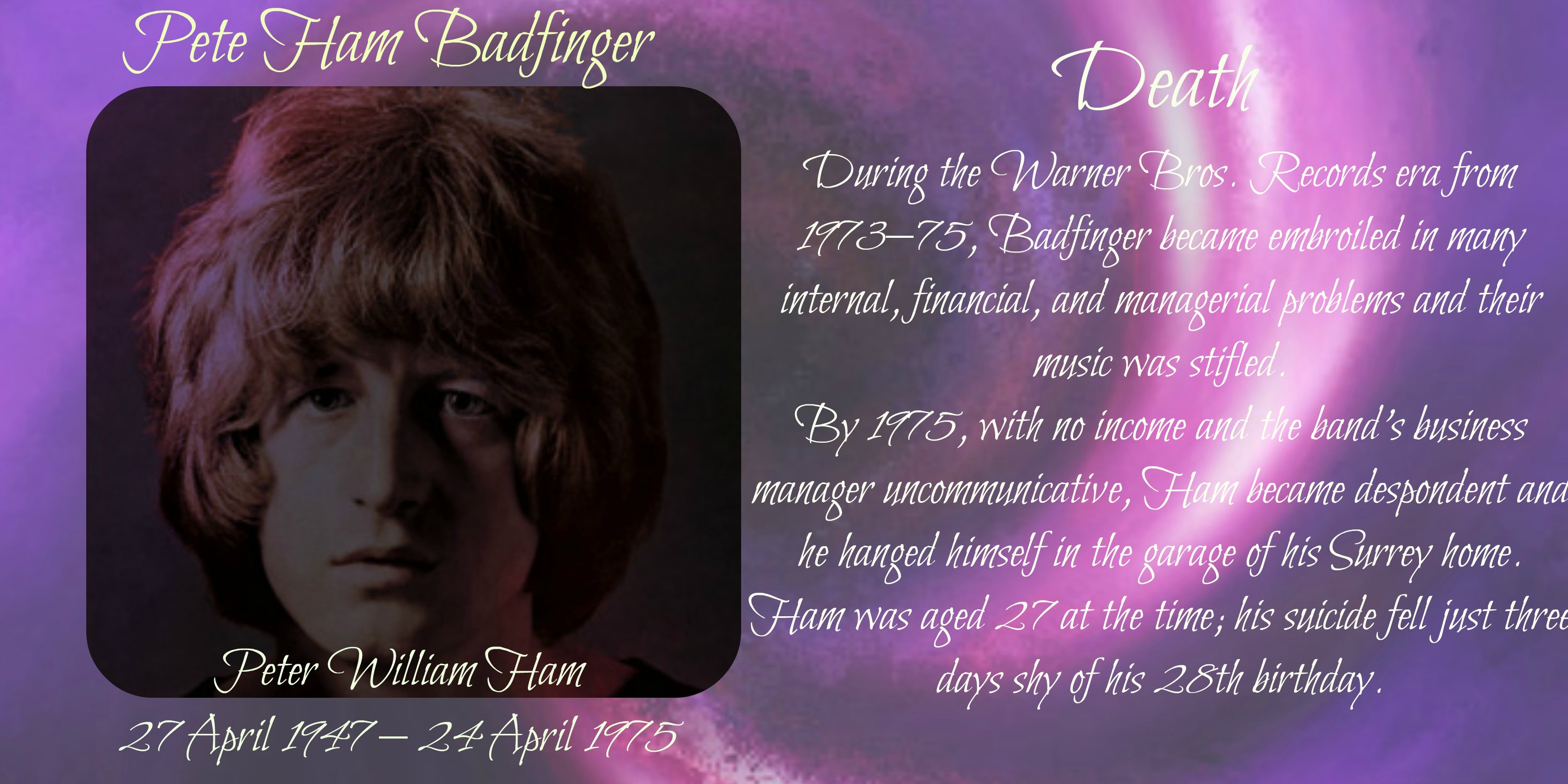
Peter William Ham (27 April 1947 – 24 April 1975) was a Welsh singer, songwriter and guitarist, primarily recognized for having been the lead singer/composer of the 1970s rock group Badfinger‘s hit songs, “No Matter What“, “Day After Day” and “Baby Blue.” He also co-wrote the ballad “Without You“, a worldwide Number One hit for Harry Nilsson and it has become a standard song as covered by hundreds of artists consistently throughout the years since. Ham was granted two Ivor Novello Awards related to the song in 1973.
———————————–
———————————–
Ham committed suicide in 1975, when he became depressed while embroiled in band-related issues, such as label and manager problems, as well as a lack of funds.
Blue plaque commemorating Pete Ham in his hometown of Swansea, Wales

During the Warner Bros. Records era from 1973–75, Badfinger became embroiled in many internal, financial, and managerial problems and their music was stifled. By 1975, with no income and the band’s business manager uncommunicative, Ham became despondent and he hanged himself in the garage of his Surrey home. Ham was aged 27 at the time; his suicide fell just three days shy of his 28th birthday. He left behind a pregnant girlfriend, who gave birth to their daughter one month after his death.
His suicide note had the statement,
“I will not be allowed to love and trust everybody. This is better.”
It also included an accusatory blast toward Badfinger’s business manager, Stan Polley:
“P.S. Stan Polley is a soulless bastard. I will take him with me.”
News of Ham’s death was not widely disseminated at the time, as no public comment was made by The Beatles, Apple Corps Ltd, or Warner Bros. Records
See below for Tom Evans who also killed himself
See here for more information on Peter Ham

——————————–


Philip David “Phil” Ochs (/ˈoʊks/; December 19, 1940 – April 9, 1976) was an American protest singer (or, as he preferred, atopical singer) and songwriter who was known for his sharp wit, sardonic humor, earnest humanism, political activism, insightful and alliterative lyrics, and distinctive voice. He wrote hundreds of songs in the 1960s and 1970s and released eight albums.
Ochs performed at many political events during the 1960s counterculture era, including anti-Vietnam War and civil rights rallies, student events, and organized labor events over the course of his career, in addition to many concert appearances at such venues as New York City’s Town Hall and Carnegie Hall. Politically, Ochs described himself as a “left social democrat” who became an “early revolutionary” after the protests at the 1968 Democratic National Convention in Chicago led to a police riot, which had a profound effect on his state of mind.
After years of prolific writing in the 1960s, Ochs’s mental stability declined in the 1970s. He eventually succumbed to a number of problems including bipolar disorder and alcoholism, and took his own life in 1976.
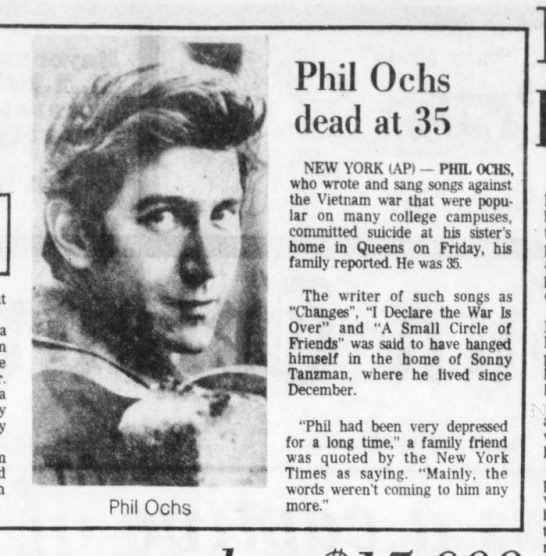
Ochs’s drinking became more and more of a problem, and his behavior became increasingly erratic. He frightened his friends both with his drunken rants about the FBI and CIA, and about his claiming to want to have Elvis’s manager Colonel Tom Parker or Kentucky Fried Chicken‘sColonel Sanders manage his career.
In mid-1975, Ochs took on the identity of John Butler Train. He told people that Train had murdered Ochs, and that he, John Butler Train, had replaced him. Train was convinced that someone was trying to kill him, so he carried a weapon at all times: a hammer, a knife, or a lead pipe.
Ochs’s friends tried to help him. His brother Michael attempted to have him committed to a psychiatric hospital. Friends pleaded with him to get help voluntarily. They feared for his safety, because he was getting into fights with bar patrons. Unable to pay his rent, he began living on the streets.
After several months, the Train persona faded and Ochs returned, but his talk of suicide disturbed his friends and family. They hoped it was a passing phase, but Ochs was determined.
One of his biographers explains Ochs’s motivation:
By Phil’s thinking, he had died a long time ago: he had died politically in Chicago in 1968 in the violence of the Democratic National Convention; he had died professionally in Africa a few years later, when he had been strangled and felt that he could no longer sing; he had died spiritually when Chile had been overthrown and his friend Victor Jara had been brutally murdered; and, finally, he had died psychologically at the hands of John Train.
In January 1976, Ochs moved to Far Rockaway, New York, to live with his sister Sonny. He was lethargic; his only activities were watching television and playing cards with his nephews. Ochs saw a psychiatrist, who diagnosed his bipolar disorder. He was prescribed medication, and he told his sister he was taking it.
On April 9, 1976, Ochs committed suicide by hanging himself in Sonny’s home.
Years after his death, it was revealed that the FBI had a file of nearly 500 pages on Ochs. Much of the information in those files relates to his association with counterculturefigures, protest organizers, musicians, and other people described by the FBI as “subversive”.
The FBI was often sloppy in collecting information on Ochs: his name was frequently misspelled “Oakes” in their files, and they continued to consider him “potentially dangerous” after his death
See here for more information on Phil Ochs
———————————————–

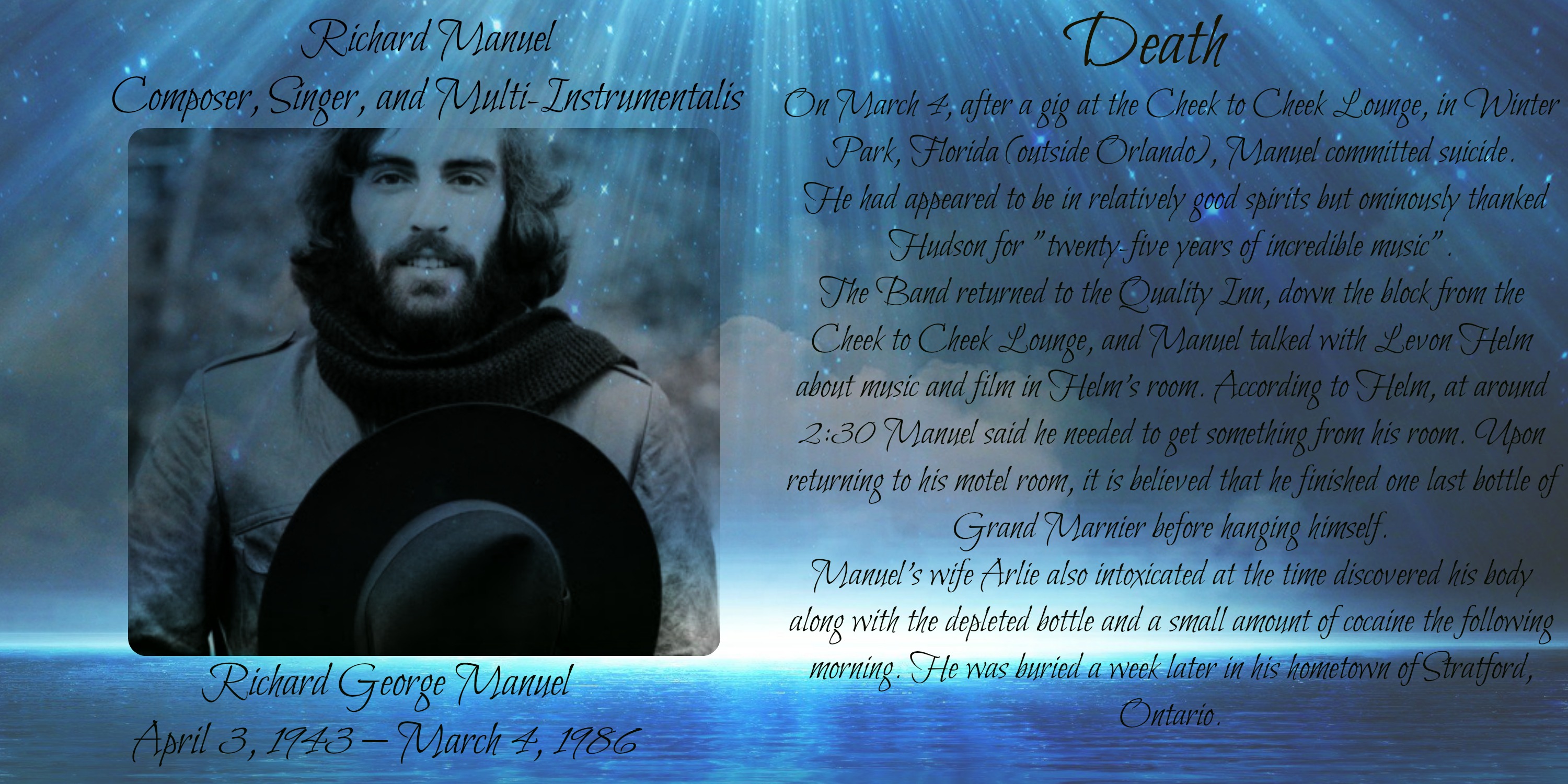
Richard George Manuel (April 3, 1943 – March 4, 1986) was a Canadian composer, singer, and multi-instrumentalist, best known as the pianist, regular lead singer, and occasional drummer of The Band. He was a member of the original band from 1967 to 1976 and the re-formed band from 1983 until his death.
Richard Manuel was born in Stratford, Ontario, Canada. His father, Ed, was a mechanic employed at a Chrysler dealership, and his mother was a schoolteacher. He was raised with his three brothers, and the four sang in the church choir. Manuel took piano lessons beginning when he was nine, and enjoyed playing piano and rehearsing with friends at his home. Manuel received a diploma from the Ontario Conservatory of Music in lap steel guitar; this was his only formal music certification. Some of his childhood influences were Ray Charles, Bobby Bland, Jimmy Reed and Otis Rush.

Manuel (back row, left) with the Revols in 1958
He and three friends started a band when he was fifteen, originally named the Rebels but later changed to the Revols, in deference to Duane Eddy and the Rebels. The group also included Ken Kalmusky, a founding member of Great Speckled Bird, and John Till, a founding member of the Full Tilt Boogie Band. Although primarily known as a naturally talented vocalist with a soulful rhythm and blues style and rich timbre (often compared to that of Ray Charles), Manuel also developed an intensely rhythmic style of piano unique in its usage of inverted chord structures. These talents were showcased in the Revols.
Manuel first became acquainted with Ronnie Hawkins and the Hawks when the Revols opened for them in Port Dover, Ontario. According toLevon Helm, Hawkins remarked to him about Manuel: “See that kid playing piano? He’s got more talent than Van Cliburn.” The two bands once again connected at the Stratford Coliseum in 1961, when the Revols ended a show featuring the Hawks as headliners. After hearing Manuel singing “Georgia on My Mind“, Hawkins hired the Revols’ pianist rather than competing with them
In January 1986, Albert Grossman died of a heart attack. Grossman had been a father figure and confidant to Manuel, and an instrumental figure in any possible solo career. Depressed by Grossman’s death, dwindling access to prestigious concert venues and the perception that the Band had stagnated and had become a traveling jukebox, Manuel returned to his alcohol and cocaine addictions. On March 4, after a gig at the Cheek to Cheek Lounge, in Winter Park, Florida (outside Orlando), Manuel committed suicide.[9] He had appeared to be in relatively good spirits but ominously thanked Hudson for “twenty-five years of incredible music”. The Band returned to the Quality Inn, down the block from the Cheek to Cheek Lounge, and Manuel talked with Levon Helm about music and film in Helm’s room. According to Helm, at around 2:30 Manuel said he needed to get something from his room. Upon returning to his motel room, it is believed that he finished one last bottle of Grand Marnier before hanging himself. Manuel’s wife Arlie—also intoxicated at the time—discovered his body along with the depleted bottle and a small amount of cocaine the following morning. He was buried a week later in his hometown ofStratford, Ontario.
At the end of March, Rick Danko declared:
“I can’t believe in a million years that he meant for that to happen. There was just no sign (…) I have to think this was just a goddamned silly accident.”
A blood toxicology report indicated that Manuel was drunk and had ingested cocaine the day he died.
See here for more information on Richard Manuel
————————————–

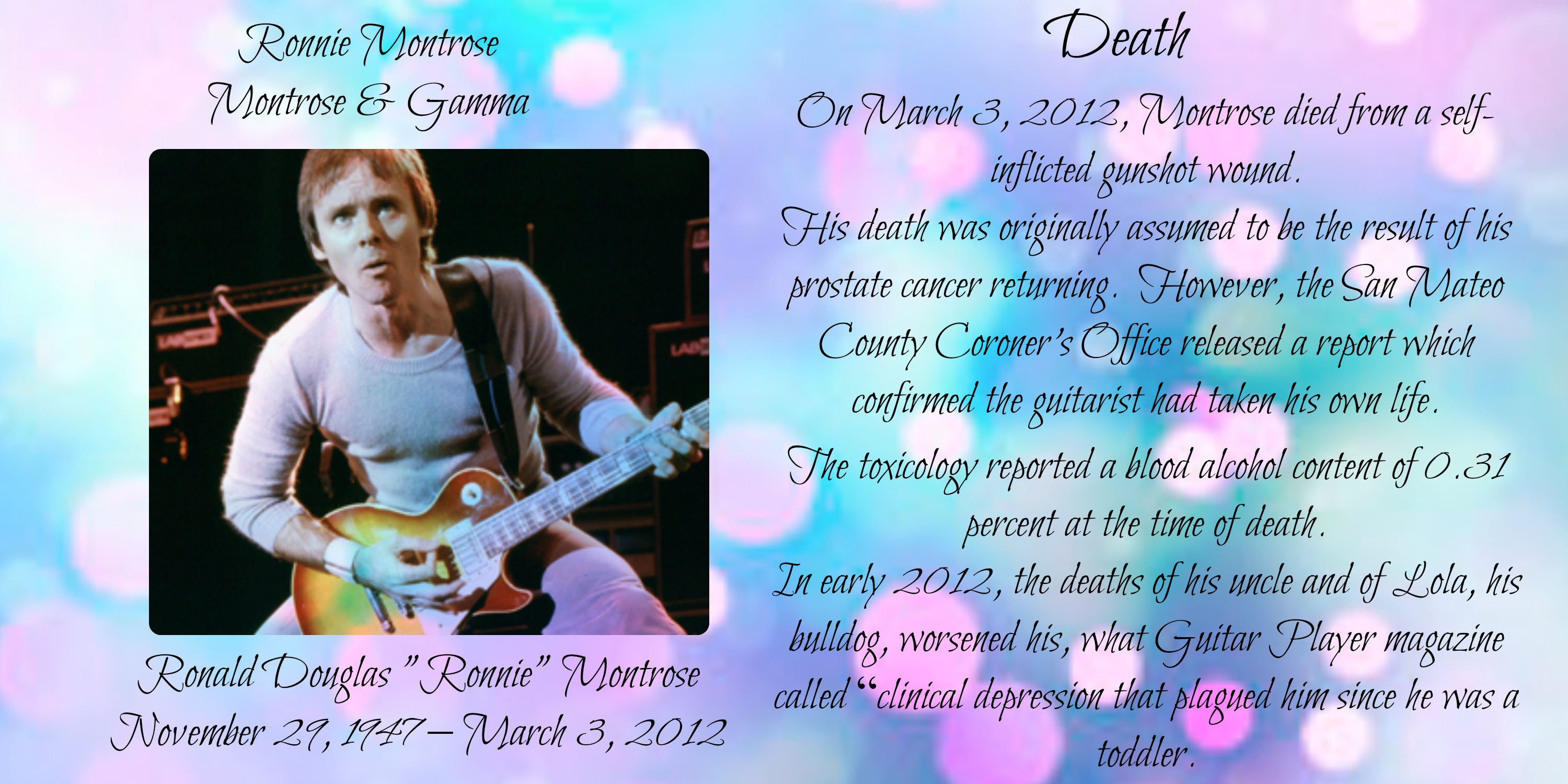
Ronald Douglas “Ronnie” Montrose (November 29, 1947 – March 3, 2012) was an American rock guitarist, who led the bandsMontrose (1973-77 & 1987) and Gamma (1979-83 & 2000) and also performed and did session work with a variety of musicians, including Van Morrison (1971–72), Herbie Hancock (1971), Beaver & Krause (1971), Boz Scaggs (1971), Edgar Winter (1972 & 1996), Gary Wright (1975), The Beau Brummels (1975), Dan Hartman (1976), Tony Williams (1978), The Neville Brothers (1987),Marc Bonilla (1991 & 1993), Sammy Hagar (1997), and Johnny Winter. The first Montrose album was often cited as “America’s answer to Led Zeppelin” and Ronnie Montrose was often referred to as one of the most influential guitarists in American hard
On March 3, 2012, Montrose died from a self-inflicted gunshot wound. His death was originally assumed to be the result of his prostate cancer returning.
However, the San Mateo County Coroner’s Office released a report which confirmed the guitarist had taken his own life.
The toxicology reported a blood alcohol content of 0.31 percent at the time of death. In early 2012, the deaths of his uncle and of Lola, his bulldog, worsened his, what Guitar Player magazine called “clinical depression that plagued him since he was a toddler
See here for more information on Ronnie Montrose
—————————————

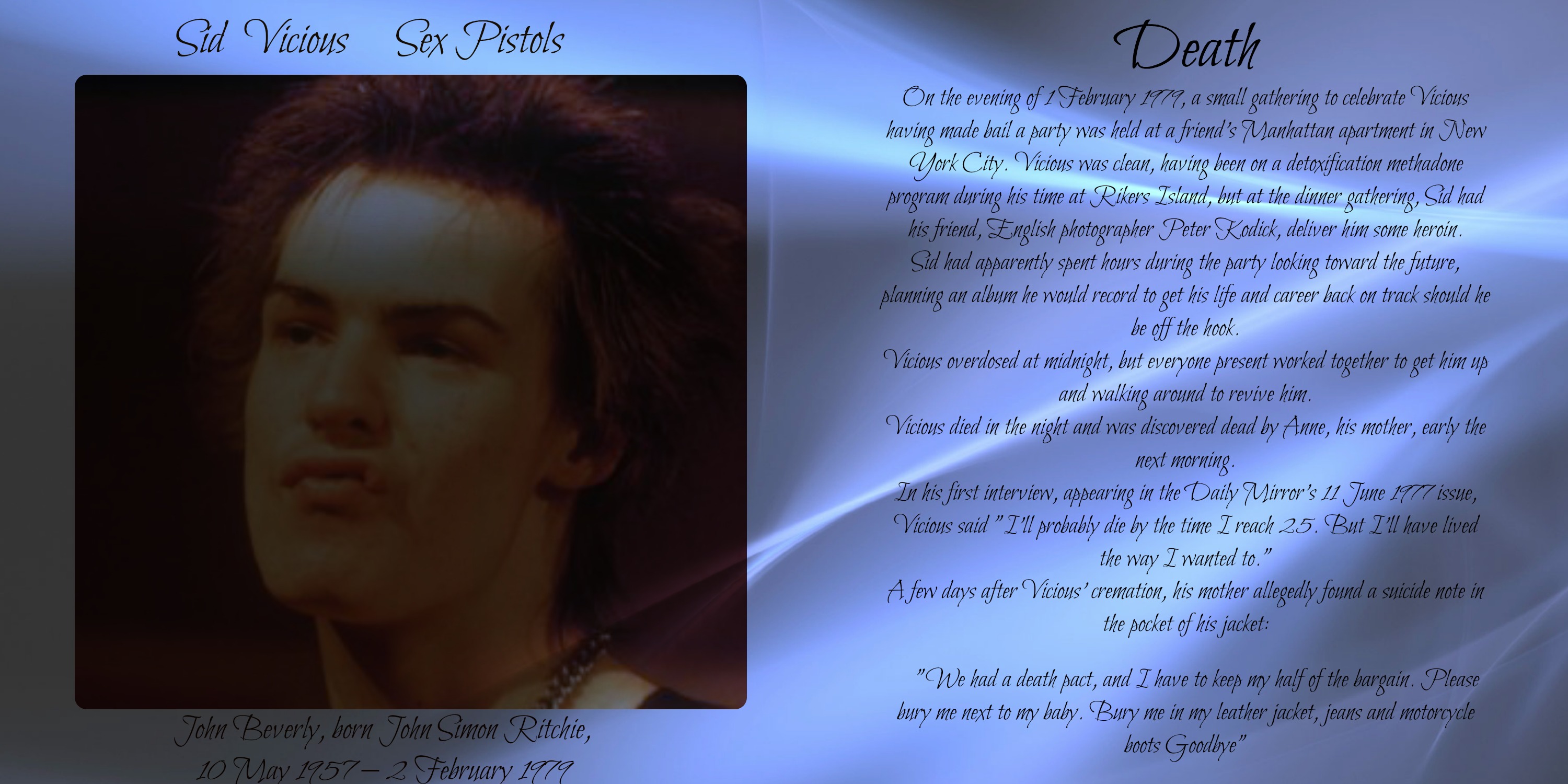
John Beverly, born John Simon Ritchie, later named Sid Vicious (10 May 1957 – 2 February 1979), was an English musician, most famous as the bass guitarist of the influential punk rock band the Sex Pistols, and notorious for his arrest for the allegedmurder of his girlfriend, Nancy Spungen.
Vicious joined the Sex Pistols in early 1977 to replace Glen Matlock, who had fallen out of favour with the rest of the group. Due tointravenous drug use, Vicious was hospitalised with hepatitis during the recording of the band’s only studio album Never Mind the Bollocks. Accordingly, his bass is only partially featured on one song from the album. Vicious would later appear as a lead vocalist, performing three cover songs, on the soundtrack to The Great Rock ‘n’ Roll Swindle, a largely fictionalised documentary about the Sex Pistols, produced by the group’s former manager Malcolm McLaren and directed by Julien Temple.
During the Sex Pistols’ brief, chaotic ascendancy, Vicious met eventual girlfriend and manager Nancy Spungen, and the pair entered a destructive codependent relationship based on drug use. This culminated in Spungen’s death from an apparent stab wound while staying in New York City‘s Hotel Chelsea with Vicious.
Under suspicion of having committed Spungen’s murder, Vicious was released on bail; he was later arrested again for assaulting Todd Smith, brother of Patti Smith, at a night club, and underwent drug rehabilitation on Rikers Island. In celebration of Vicious’ release from prison, his mother hosted a party for him at his girlfriend’s residence in Greenwich Village, which was attended notably by the Misfits bassist Jerry Only. Vicious’ mother had been supplying him with drugs and paraphernalia since he was young; late that night she assisted him in procuring heroin, and he died in his sleep after overdosing on it.
On the evening of 1 February 1979, a small gathering to celebrate Vicious having made bail was held at a friend’s Manhattan apartment in New York City. Vicious was clean, having been on a detoxification methadone program during his time at Rikers Island, but at the dinner gathering, Sid had his friend, English photographer Peter Kodick, deliver him some heroin. Sid had apparently spent hours during the party looking toward the future, planning an album he would record to get his life and career back on track should he be off the hook. Vicious overdosed at midnight, but everyone present worked together to get him up and walking around to revive him. Vicious died in the night and was discovered dead by Anne, his mother, early the next morning.
Sid Vicious Death Certificate

In his first interview, appearing in the Daily Mirror‘s 11 June 1977 issue, Vicious said “I’ll probably die by the time I reach 25. But I’ll have lived the way I wanted to.”
A few days after Vicious’ cremation, his mother allegedly found a suicide note in the pocket of his jacket:
We had a death pact, and I have to keep my half of the bargain. Please bury me next to my baby. Bury me in my leather jacket, jeans and motorcycle boots Goodbye.[27]
Since Spungen was Jewish, she was buried in a Jewish cemetery. As Vicious was not Jewish, he could not be buried with her. According to the book Please Kill Me: The Uncensored Oral History of Punk by Legs McNeil and Gillian McCain, Jerry Only of the Misfits drove Anne and her sister, and two of Sid’s friends to the cemetery where Nancy was buried, and Anne scattered Sid’s ashes over Nancy’s grave.[28] In the same book, it is alleged that the cemetery didn’t want to be associated with Vicious and his inherent negative reputation, and it is speculated that this was of greater importance to them than the above-stated reason he and Nancy could not be buried together.
See here for more information on Sid Vicious

——————————–


David Victor Emmanuel (10 February 1963 – 15 March 2011),[1] better known as Smiley Culture, was a British reggae singer and DJ known for his ‘fast chat’ style. During a relatively brief period of fame and success, he produced two of the most critically acclaimed reggae singles of the 1980s.
He died on 15 March 2011, aged 48, during a police raid on his home. An inquest found that his death was a suicide.
On 15 March 2011, Emmanuel died, reportedly from a self-inflicted stab wound, while the police were searching his house in Hillbury Road, Warlingham, Surrey. His death came an hour and a half after officers arrived with a search warrant relating to the import of Class A drugs into the UK.
A post-mortem examination revealed that he had died from a single stab wound to the heart.
He is survived by his mother, son, daughter, sister and three brothers.
His death was investigated by the Independent Police Complaints Commission. In their final report – which at the request of the coroner[26][27] was neither made public nor made available to Emmanuel’s family – the IPCC concluded that there was no evidence justifying the pressing of criminal charges against any of the four officers present at the house during the raid. In the IPCC statement following the inquest – which returned a verdict of suicide – it was stated that there was neither criminal conduct by officers, nor individual failings by officers that might amount to misconduct.
Nonetheless, the report also pointed out flaws in the police raid and called on the Metropolitan Police Service to improve the planning and execution of their drug seizures.
However, Smiley’s family raised concerns about the investigation, claiming that the IPCC “had let [them] down” and that many “unanswered questions” remained.
The conditions surrounding his death and the subsequent investigation were also questioned by members of the general public, his death often being considered in the context of police brutality and other black people dying in police custody.
A study into the causes and consequences of the 2011 United Kingdom riots, led by the London School of conomics in collaboration with the British newspaper The Guardian, identified Emmanuel’s death, perceived by some as a prominent case of police abuse, as a contributing factor to the riots.
See here for more information on Smiley Culture
———————————


William Stuart Adamson (11 April 1958 – 16 December 2001) was a Scottish guitarist, vocalist, and songwriter. He was the co-founder, lead vocalist, and guitarist of rock group Big Country, which rose to prominence in 1983. Prior to that he founded Scottishart-punk band Skids. In the 1990s he founded alternative country rock act The Raphaels. He was once described by DJ John Peel as “the new Jimi Hendrix
Adamson was born in Manchester. Both his parents were Scottish, and the family returned to Scotland when he was four. The family settled in a small mining town, Crossgates, about a mile to the east of Dunfermline in Fife.
Adamson founded his first two bands in Dunfermline and they both started out playing Dunfermline and across the Firth of Forth in Edinburgh. He went to school with Ian Rankin, who was two years younger and went on to become a fan of Skids.
Adamson was a lifelong supporter of Dunfermline Athletic Football Club.
Adamson’s father was in the fishing industry and travelled the world. He encouraged Stuart to read literature, and both parents shared an interest in folk music. Adamson founded his first band, Tattoo, in 1976 after seeing The Damned play in Edinburgh. Besides Adamson, Tattoo included his friend William Simpson, who would also play bass guitar for his next band, Skids.
Adamson came to greater international prominence with Big Country. He constructed the band with friend and fellow-guitarist Bruce Watson (then employed as a cleaner on submarines at Rosyth naval base) and a rhythm section of studio musicians Mark Brzezicki and Tony Butler, whom he found with the help of his record company.
Big Country’s first hit, 1983’s “Fields of Fire”, reached the UK’s Top Ten, and was rapidly followed by the album The Crossing. The album was a big hit in the United States powered by the single “In a Big Country“, which was performed on Saturday Night Live. The video for “In A Big Country” received frequent airplay on MTV and featured the band riding all terrain vehicles in the countryside.
Their second album Steeltown appeared in 1984. The band’s third album was The Seer. The first two albums were produced by Steve Lillywhite. The band continued to record studio albums, and to tour until 1999. Adamson supplied much of the distinctive guitar work, as well as being lead singer and main songwriter (both music and lyrics). The band’s lineup never underwent changes, the exception being a brief departure of drummer Mark Brzezicki in the early 1990s and his temporary replacement by Pat Ahern.
Adamson was also a keen motorcyclist and regularly purchased new machines for riding around Fife. His interest extended to the race track where he sponsored British Championship rider Iain Duffus in the late eighties.
Adamson was married twice. He had two children with his first wife Sandra in 1982 and 1985. His son Calum Adamson is the guitarist of British band Ahab. In 1996, Adamson split with Sandra and moved to Nashville.
There he married his second wife, Melanie Shelly, and founded his final band, the alternative country band The Raphaels, a duo of Adamson and Nashville songwriter Marcus Hummon.
On 26 November 2001, Adamson was reported missing by his wife Melanie. At the time, the couple had been estranged for six weeks, and Melanie filed for divorce on the day he disappeared. Adamson had been due to face drunk-driving charges in March 2002, and had been ordered to attend Alcoholics Anonymous. He was an alcoholic and had resumed drinking, after having been sober for over a decade. On 16 December 2001, his body was found in a closet in his room at the Best Western Plaza Hotel in Honolulu, Hawaii. According to police, Adamson had hanged himself with an electrical cord from a pole in the wardrobe. An empty wine bottle was found in the room.
At the time of death he had a blood-alcohol content of 0.279%.
U2‘s The Edge delivered the eulogy at Adamson’s funeral which was held at Carnegie Hall, Dunfermline. He told the mourners that Big Country wrote the songs that he wished U2 could write.
See here for more information on Stuart Adamson
———————————


Thomas Evans Jr (5 June 1947 – 19 November 1983) was an English musician and songwriter, most notable for his work with the band Badfinger.
n July 1967, the Iveys (Pete Ham, Ron Griffiths, Mike Gibbins and Dave Jenkins) went to Liverpool at the suggestion of their manager, Bill Collins, to recruit a replacement for Dave Jenkins, their rhythm guitarist and frontman. They discovered Tommy Evans singing with Them Calderstones and invited him to London to audition for the band. He eventually accepted and joined the Iveys in August 1967. His first gig with the Iveys was on 20 August 1967 at the Starlite Ballroom in Crawley.
On 23 July 1968, the Iveys were signed to the Beatles’ Apple Records label. Their debut worldwide single release was Maybe Tomorrow, which was a Tom Evans composition, written for his girlfriend in Liverpool, Leslie Sandton, who he used to date when he was a member of Them Calderstones.
On 15 November 1968, Maybe Tomorrow b/w an Evans/Ham song And Her Daddy’s a Millionaire was released in the UK on Apple 5. The US release date was 27 January 1969 (Apple 1803) and the song peaked at No. 51 on the Cash Box chart and No. 67 on the Billboard chart. In the Netherlands, it reached No. 1. It was also very successful throughout Europe and in Japan.
In July 1969, this prompted the release of the Iveys’ album Maybe Tomorrow being only released in those countries where the single charted high. The album was released in Japan, Italy and Germany only. The album contained the following Tom Evans compositions: Beautiful and Blue, Fisherman, Maybe Tomorrow and Angelique.
One of the attempts at a follow-up single to Maybe Tomorrow was another Tom Evans composition called Storm in a Teacup, but this was rejected and ended up being used on a promotional Apple EP for Wall’s Ice Cream in July 1969.
———————————–
———————————–
In November 1969, the Iveys changed their name to Badfinger, and Paul McCartney of the Beatles gave the group a boost by offering them his song “Come and Get It“, which he produced for the band. It became a featured track for the film The Magic Christian, which starred Ringo Starr and Peter Sellers. Evans was chosen by McCartney to sing lead on this track. It reached the Top 10 worldwide.
The B-side, Rock of All Ages, co-written by Evans with Pete Ham and Mike Gibbins, features Tom Evans singing lead. Paul McCartney also produced this, and even sang scratch vocals with Evans on the basic track. A third Magic Christian song, “Carry On Till Tomorrow” was co-written by Evans and Ham.
After the departure of original bassist Ron Griffiths, the band fruitlessly auditioned a replacement and with the arrival of Liverpudlian guitarist Joey Molland, Evans, who had previously played guitar, switched to bass and thus stabilizing the classic line-up of Ham, Evans, Gibbins and Molland.
Badfinger enjoyed more major successes in the early 1970s with singles such as “No Matter What,” “Day After Day,” and “Baby Blue“. Each featured some of Evans vocals; background harmony and dual lead. Evans’ high-career moment was with his composition “Without You,” a song co-written with bandmate Pete Ham. The song became a No. 1 hit worldwide for Harry Nilsson and has since become a standard in the music industry.
Badfinger dissolved following Ham’s suicide in 1975, after which Evans joined a group called the Dodgers with Badfinger bandmate Bob Jackson. The Dodgers released three singles produced by Muff Winwood and toured Britain before recording an album with producer Pat Moran. Evans was eventually asked to leave the band midway through the recording sessions and he briefly retired from the music industry.
Evans resurfaced in 1977 to join Joey Molland for two Badfinger “comeback” albums. The first single of two from the first album, “Airwaves” was an Evans composition “Lost Inside Your Love” but it failed to chart after its release in March 1979. The second album, “Say No More” spawned the Evans and Tansin single “Hold On,” which reached No. 56 on Billboard in 1981. Evans and Molland went their separate ways after this second album was released, and the two put together rival “Badfinger” touring bands in the US
In 1982, Jackson rejoined Evans in the latter’s version of Badfinger. Original Badfinger drummer Mike Gibbins was also enlisted for Evans’ band for one tour. But after Evans and Jackson signed separate management contracts with a Milwaukee businessman, the trio of Evans, Gibbins and Jackson said they found themselves stranded in the US without tour dates, food, money and much duress from physical threats. After returning to Britain, Evans was sued for $5 million in damages for abandoning his touring contract.
During the evening of 18 November 1983, Evans argued with Joey Molland of Badfinger on the telephone, chiefly regarding potential publishing/ASCAP divisions of the song “Without You“. ASCAP royalties accumulating for airplay of the song had been funding Evans, with other potential publishing funds being held by Apple Corps Ltd. pending resolution of debate between the group members and manager Bill Collins. Early the following morning, 19 November, Evans was found dead by suicide, his body hanging in his back garden from a willow tree.
Allegedly, he left no note, but family and friends have speculated that he was overwhelmed by the combination of his conflicts with Molland, ex-manager Bill Collins, and ex-bandmate Mike Gibbins over the pending royalties, plus the US lawsuit which he felt threatened his livelihood further. But a factor in Evans’ depression, alluded to by many friends and family members, may have been that he was never able to fully recover from his former bandmate Pete Ham‘s suicide.
Marianne Evans, his wife, was quoted in a documentary as having stated that
“Tommy said ‘I want to be where Pete is. It’s a better place than down here’ ….”
Evans is also survived by a son, Stephen.
In 1993, a CD of recordings made in the early 1980s by Evans and musician friend Rod Roach was posthumously released in the UK on Gipsy Records under the title Over You (The Final Tracks).
See here for more information on Tom Evans
—————————-

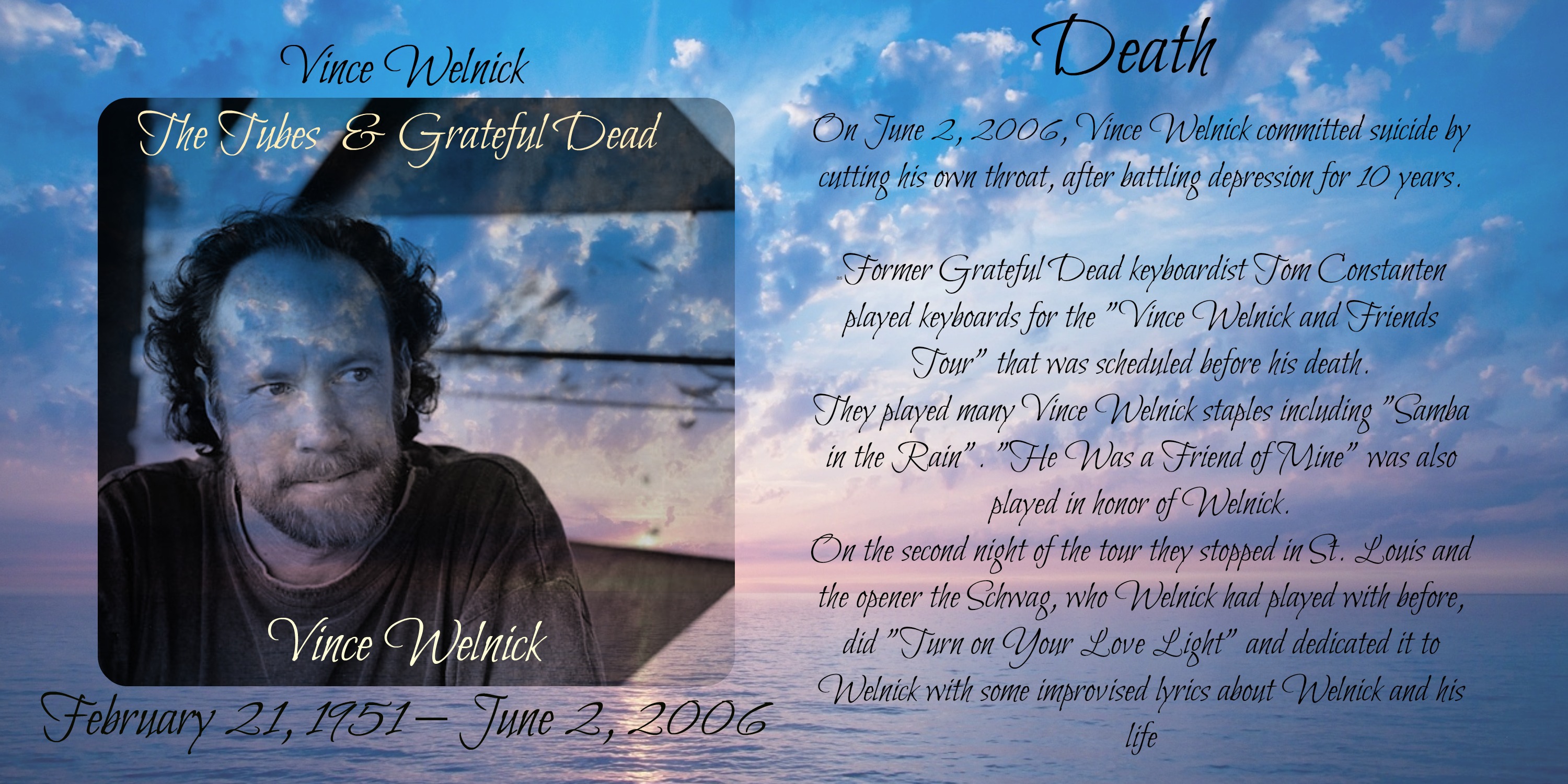
Vince Welnick (February 21, 1951 – June 2, 2006) was an American keyboardist, best known for playing with the band the Tubesduring the 1970s and 1980s and with the Grateful Dead in the 1990s.
Born in Phoenix, Arizona, as the great grandson of Prussian immigrants, Welnick started playing keyboards as a teenager. He joined a band, the Beans, which eventually morphed into the Tubes, a San Francisco-based theater rock band popular in the late 1970s and early 1980s and noted for early live performances that combined lewd quasi-pornography with wild satires of media, consumerism and politics.
The Tubes in the 1980s were a major commercial rock act with substantial MTV success. Videos for rock classics “Talk To Ya Later” and “She’s A Beauty” played in heavy rotation on the MTV network for years in the mid-1980s. While playing in the Tubes, he also played and recorded with Todd Rundgren.
When the Grateful Dead‘s keyboardist, Brent Mydland, died of a drug overdose on July 26, 1990, the band began auditioning players to replace him, including Ian McLagan, Pete Sears and T Lavitz. Welnick was selected, not least for his high vocal range for backup harmonies. His AP obituary mentioned he was so nervous at his first gig with the band in 1990 in Cleveland that he could barely play, until the fans put him at ease.
They held up banners reading, “Yo Vinnie,” which Welnick later decided to use as the name of his BMI-affiiated publishing company, Yo Vinnie Music, once obtaining his writer and publisher rights back from Ice Nine Publishing, which had copyrighted his works without an agreement in place to do so shortly after Vince joined the Grateful Dead. Bruce Hornsby also supplemented Welnick on grand piano for over 100 shows in Welnick’s first years in the Dead. Welnick remained as a member of the Grateful Dead and the band’s keyboard player until Jerry Garcia‘s death in August 1995, when the group disbanded.
In 1994, he was inducted into the Rock and Roll Hall of Fame as a member of the Grateful Dead.
Vince became very depressed following a diagnosis of cancer and emphysema shortly before the final Grateful Dead tour. Without any publicity about his illness, he decided to do the summer 1995 Grateful Dead tour, and wait to have surgery after it ended. Shortly after the tour was over, Jerry Garcia died. Welnick joined Bob Weir’s new group Ratdog as the keyboard player, touring with them around the USA.
He attempted suicide about six months after Garcia’s death on the Rat Dog tour bus on the drive to Monterey, California. Following intense therapy, successful treatment of his cancer, and management of the early stages of his lung disease, he became involved in solo efforts, including Second Sightwith Bob Bralove and Missing Man Formation, which released a critically acclaimed single album on Grateful Dead Records which included “Golden Days”, a tribute to Jerry Garcia. He was a key member of the second ever Phil Lesh and Friends show in March 1998, and toured the USA with the Mickey Hart Band later that year.

On June 2, 2006, Vince Welnick committed suicide by cutting his own throat, after battling depression for 10 years.
An ambulance was summoned at 9:30 a.m. by the Sonoma County sheriff’s dispatcher. Welnick was still alive when it arrived. An hour later, he was pronounced dead at the emergency room of Santa Rosa Memorial Hospital, according to the Sonoma County coroner’s office.
Former Grateful Dead keyboardist Tom Constanten played keyboards for the “Vince Welnick and Friends Tour” that was scheduled before his death. They played many Vince Welnick staples including “Samba in the Rain”. “He Was a Friend of Mine” was also played in honor of Welnick. On the second night of the tour they stopped in St. Louis and the opener the Schwag, who Welnick had played with before, did “Turn on Your Love Light” and dedicated it to Welnick with some improvised lyrics about Welnick and his life.
See here for more information on Vince Welnick
—————————————-


Wendy Orlean Williams (May 28, 1949 – April 6, 1998), better known as Wendy O. Williams, was an American singer, songwriter and actress. Born in Webster, New York, she first came to prominence as the lead singer of the punk rock band Plasmatics. Her infamous stage theatrics included blowing up equipment, near nudity and chain-sawing guitars.
After she left home at the age of 16, Williams hitchhiked her way to Colorado, earning money by crocheting string bikinis. She later traveled to Florida and Europe landing various jobs such as lifeguard, stripper and server at Dunkin’ Donuts. When she arrived in New York City in 1976, she began performing in live sex shows and later appeared in the adult film, Candy Goes to Hollywood (1979). That same year, she was approached by the manager Rod Swenson, who recruited her to join his newly formed punk rock band, Plasmatics. The band shortly became known on the New York City underground scene, performing at clubs such as CBGB.
After releasing three albums with Plasmatics, Williams embarked on a solo career and in 1984 released her debut album, WOW. She followed with the albums Kommander of Kaos (1986) and Deffest! and Baddest! (1988), before she retired from the music industry. Williams made her screen debut in Tom DeSimone‘s film Reform School Girls (1986), for which she recorded the title song. She also appeared in the 1989 comedy Pucker Up and Bark Like a Dog, and television series The New Adventures of Beans Baxter andMacGyver. On April 6, 1998, Williams committed suicide near her home in Storrs, Connecticut.
Dubbed “The Queen of Shock Rock,” Williams was widely considered the most controversial and radical female singer of her day. She often sported a Mohawk haircut. In 1985, she was nominated for a Grammy in the Best Female Rock Vocal Performancecategory during the height of her popularity as a solo artist.
Williams first attempted suicide in 1993 by hammering a knife into her chest where it lodged in her sternum. However, she changed her mind and called Swenson to take her to the hospital.
She attempted suicide again in 1997 with an overdose of ephedrine.
Williams died of a self-inflicted gunshot wound on April 6, 1998, when she was 48. Rod Swenson, her significant other for more than 20 years, returned to their home in the area where they had lived since moving to Connecticut from New York. He found a package that she left him with some special noodles he liked, a packet of seeds for growing garden greens, some oriental massage balm and sealed letters from her.
The suicide letters which included a “living will” denying life support, a love letter to Swenson and various lists of things to do which caused Swenson to begin searching the woods for her. After about an hour, as dusk began, he found her body in a wooded area where she would often feed the wildlife. Several nut shells were on a nearby rock where she had apparently been feeding some of the squirrels before she died. Swenson checked the body for a pulse, but found none. A pistol lay on the ground nearby, and he returned to the house to call the local authorities. “Wendy’s act was not an irrational in-the-moment act,” he said; for four years she had contemplated suicide. Swenson reportedly described her as “despondent” at the time of her death.
This is what she is said to have written in a suicide noteregarding her decision:
I don’t believe that people should take their own lives without deep and thoughtful reflection over a considerable period of time. I do believe strongly, however, that the right to do so is one of the most fundamental rights that anyone in a free society should have. For me, much of the world makes no sense, but my feelings about what I am doing ring loud and clear to an inner ear and a place where there is no self, only calm.
Gene Simmons, Joey Ramone, and many others issued statements at the time of her death. On Motörhead‘s 1999 live album Everything Louder Than Everyone Else, before the song “No Class“, Motörhead vocalist Lemmy said that he wanted to dedicate this song officially to her.
A memorial was held at CBGB on May 18.
Several of Wendy’s former Plasmatics co-members (Chosei Funahara, Richie Stotts, Wes Beech, Stu Deutsch, Jean Beauvoir and TC Tolliver) played a six-song set with four of them handling the vocals
See here for more information on Wendy O. Williams
——————————————


We’re here for you.
If you have a general query about the organisation, our contact details are:
Mind
15-19 Broadway, Stratford, London E15 4BQ
T: 020 8519 2122, F: 020 8522 1725
e: contact@mind.org.uk
Mind Cymru
3rd Floor, Quebec House, Castlebridge,
5-19 Cowbridge Road East,
Cardiff CF11 9AB
T: 029 2039 5123

We’re here 24 hours a day, 365 days a year. If you need a response immediately, it’s best to call us on the phone. This number is FREE to call.


 belfastchildis.com