Sons of Anarchy – Saddam Hussein’s Sons

noun: anarchy
  1. :  A state of lawlessness or political disorder due to the absence of governmental authorityc:

Uday Hussein

Uday Saddam Hussein al-Tikriti (Arabic: عُدي صدّام حُسين‎‎) (18 June 1964 – 22 July 2003) was the eldest son of Saddam Hussein by his first wife, Sajida Talfah, and the brother of Qusay Hussein.

Uday was seen, for several years, as the likely successor to his father, but lost the place as heir apparent to Qusay due to injuries sustained in an assassination attempt, increasingly erratic behavior, and his troubled relationship with the family.

His reputed actions include multiple allegations of rape, murder and torture (including of Iraqi Olympic athletes and the national football team).

He was several times imprisoned, exiled and received a token death sentence by his father’s regime.

Following the United States-led invasion of Iraq in 2003, he was killed alongside his brother and nephew Mustapha by Task Force 20 after a three-hour gunfight in Mosul.


Uday Hussein
Uday Saddam Hussein.png
Commander of the Fedayeen Saddam
In office
1995–1996
Preceded by Position established
Succeeded by Qusay Saddam
Personal details
Born (1964-06-18)18 June 1964
Tikrit, Iraq
Died 22 July 2003(2003-07-22) (aged 39)
Mosul, Iraq
Parents Saddam Hussein (deceased)
Sajida Talfah
Relatives Qusay Hussein (brother, deceased)

Raghad Hussein (Sister)

Religion Sunni Islam
Military service
Allegiance Baathist Iraq
Service/branch Fedayeen Saddam
Years of service 1995-2003
Rank Commander
Battles/wars 2003 Iraq War


Biography

Uday Saddam was born in Tikrit to Saddam Hussein and Sajida Talfah while his father was in prison.

Uday graduated from high school with very high marks. He started his university days in the Baghdad University College of Medicine. He only lasted in the medical college for three days, after which he moved to College of Engineering about a kilometer away.

Uday gained a degree in engineering and graduated summa cum laude from Baghdad University, ranking No. 1 in a class of 76 students. However, some of his professors later admitted that Uday barely managed to earn passing grades in many of his classes, and was granted the honor of valedictorian namely because he was Saddam’s son.

Although his status as Saddam’s elder son made him Saddam’s prospective successor, Uday fell out of favour with his father.

In October 1988, at a party in honour of Suzanne Mubarak, wife of Egyptian President Hosni Mubarak, Uday murdered his father’s personal valet and food taster, Kamel Hana Gegeo, possibly at the request of his mother.

Before an assemblage of horrified guests, an intoxicated Uday bludgeoned Gegeo, reputedly stabbing him with an electric carving knife. Gegeo had recently introduced Saddam to a younger woman, Samira Shahbandar, who later became Saddam’s second wife. Uday considered his father’s relationship with Shahbandar an insult to his mother. He also may have feared losing succession to Gegeo, whose loyalty and fidelity to Saddam Hussein was unquestioned.

As punishment for the murder, Saddam briefly imprisoned his son and sentenced him to death; however Uday probably served only three months in a private prison.

In response to personal intervention from King Hussein of Jordan, Saddam released Uday, banishing him to Switzerland as the assistant to the Iraqi ambassador there. He was expelled by the Swiss government in 1990 after he was repeatedly arrested for fighting.

Saddam later appointed Uday chairman of the Iraqi Olympic Committee and the Iraq Football Association. In the former role, he tortured athletes who failed to win.

He also became the editor of the Babel newspaper, the general secretary of the Iraqi Union of Students and the head of the Fedayeen Saddam.

Uday seemed proud of his reputation and called himself Abu Sarhan, an Arabic term for “wolf”.

Uday sustained permanent injuries during an assassination attempt in December 1996. Struck by many bullets while driving,  Uday was initially believed to be paralyzed. Evacuated to Ibn Sina Hospital, he eventually recovered but with a noticeable limp.

Despite repeated operations, however, a bullet remained lodged in his spine and could not be removed due to its location near the spinal cord.

In the wake of Uday’s subsequent disabilities, Saddam gave Qusay increasing responsibility and authority, designating him as his heir apparent in 2000.

Uday opened accounts with Yahoo! and MSN Messenger, which created controversy when the provisioning of the accounts allegedly violated U.S. trade sanctions against Iraq.

Uday also amassed a large video collection, found in his palace in 2003, much of which featured himself in both public and private situations.

Personal life

In a sign of loyalty to Saddam, Izzat Ibrahim al-Douri who was vice president of the Revolutionary Command Council, consented to marry his daughter to Uday.

But al-Douri’s influence with Hussein was so substantial that he could even levy a condition: that the union would not be consummated. Because of Uday’s violent and erratic behaviour, al-Douri quickly petitioned that his daughter be permitted to divorce Uday.

Allegations of crimes

A report released on 20 March 2003, one day after the American led invasion of Iraq, by ABC News detailed several allegations against Uday:

As head of the Iraqi Olympic Committee, Uday oversaw the imprisonment and torture of Iraqi athletes who were deemed not to have performed to expectations. According to widespread reports, torturers beat and caned the soles of the football players’ feet—inflicting intense pain without leaving visible marks on the rest of their bodies . Uday reportedly kept scorecards with written instructions on how many times each player should be beaten after a poor showing. He would insult athletes who performed below his expectations by calling them dogs and monkeys to their faces.

One defector reported that jailed football players were forced to kick a concrete ball after failing to reach the 1994 FIFA World Cup finals.

The Iraqi national football team were seen with their heads shaved after failing to achieve a good result in a tournament in the 1980s. It was widely circulated that Uday ordered the shaving as part of the punishment.

Another defector claimed that athletes were dragged through a gravel pit and subsequently immersed in a sewage tank to induce infection in the victims’ wounds.

After Iraq lost 4–1 to Japan in the quarter finals of the 2000 AFC Asian Cup in Lebanon, goalkeeper Hashim Hassan, defender Abdul Jaber and forward Qahtan Chatir were labelled as guilty of loss and eventually flogged for three days by Uday’s security.

Other allegations include:

  • Kidnapping young Iraqi women from the streets in order to rape them. Uday was known to intrude on parties and otherwise “discover” women whom he would later rape. Time published an article in 2003 detailing his sexual brutality.
  • When U.S. troops captured his mansion in Baghdad, they found a personal zoo stocked with lions and cheetahs; an underground parking garage for his collection of luxury cars; paintings glorifying him and his mother with Saddam (which was known to have infuriated his father); Cuban cigars inscribed with his name; and millions of dollars worth of fine wines, liquor and heroin.
  • An HIV testing kit was also found among his personal effects.
  • He amassed millions of U.S. dollars by running façade corporations illegally trading with Iran (although, at that time, UN restrictions did not allow foreign trading. Only later, Iraq was allowed to import certain commodities such as food and medical supplies legally under the UN Oil For Food programme).
  • Usage of an iron maiden on persons running afoul of him.
  • Beating an army officer unconscious when the man refused to allow Uday to dance with his wife; the man later died of his injuries. Uday also shot and killed an army officer who did not salute him.
  • Stealing approximately 1,200 luxury vehicles, including a Rolls-Royce Corniche valued at over $200,000. A Lamborghini LM002, given to him as a gift by Libyan leader Muammar Gaddafi, was later blown up by U.S. forces to demonstrate the effects of a car bomb.
  • Plotting, in 2000, to assassinate Ahmed Chalabi, the leader of the Iraqi National Congress. This was done shortly after Saddam named his younger son heir apparent to the dictatorship, and Uday attempted to remove Qusay from that position by currying favor with his father through this assassination.

Death


House of Uday and Qusay in Mosul, Iraq destroyed by U.S. forces, 31 July 2003

On 22 July 2003, Task Force 20, aided by troops of the United States Army 101st Airborne Division, surrounded Uday, Qusay and Qusay’s 14-year-old son Mustapha during a raid on a home in the northern Iraqi city of Mosul.
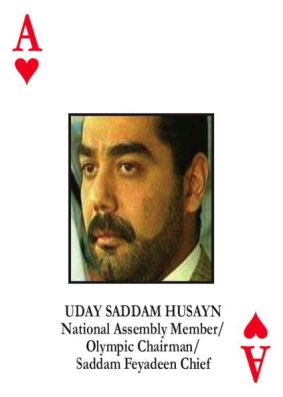
He had been the Ace of Hearts on the most-wanted Iraqi playing cards (with Qusay being the Ace of Clubs). Acting on a tip from an unidentified Iraqi, the blocking element from the 101st Airborne Division provided security while the Task Force 20 operators attempted to apprehend the inhabitants of the house. After U.S. troops hotwired Uday’s Lamborghini,  he revealed himself, upon which a gunfight ensued. The assault element withdrew to request backup.

As many as 200 American troops, later aided by OH-58 Kiowa helicopters and an A-10 “Warthog”, surrounded and fired upon the house, thus killing Uday, Qusay, and Qusay’s son. After approximately four hours of battle, soldiers entered the house and found four bodies, including the Hussein brothers’ bodyguard.

Later, the American command said that dental records had conclusively identified two of the dead men as Saddam Hussein‘s sons. They also announced that the informant (possibly the owner of the villa in Mosul in which the brothers were killed) would receive the combined $30 million reward previously offered for their apprehension.


Soldiers of the 101st Airborne Division and U.S. Special Operations (Task Force 20) watch as a TOW missile strikes the side of a house occupied by Uday and Qusay Hussein in Mosul, on 22 July 2003

The owner of the villa, Nawaf az-Zeidan, who is distantly related to Saddam, was granted U.S. citizenship, and was permitted to leave Iraq. Locals claimed that Zeidan had informed United States forces that Saddam’s sons were staying there, as the brothers became overbearing in their demands and took his hospitality for granted. On 18 June 2004, Zeidan’s brother Salaah al-Zeidan was killed, as well as three of his male relatives (including an eight-year-old boy), who were travelling in the same vehicle.

The U.S. Administration released graphic pictures of the Hussein brothers’ bodies. When criticized, the U.S. military’s response was to point out that these men were no ordinary combatants, and to express hope that confirmation of the deaths would bring closure to the Iraqi people.

Uday was buried in a cemetery near Tikrit alongside Qusay and Mustapha Hussein.

That night, and several nights following Uday and Qusay Hussein’s death, celebratory gunfire could be heard throughout Baghdad

Qusay Hussein

Qusay Saddam Hussein al-Tikriti (or Qusai, Arabic: قصي صدام حسين‎‎; (1966-05-17)17 May 1966 – 22 July 2003(2003-07-22)) was the second son of Iraqi President Saddam Hussein. He was appointed as his father’s heir apparent in 2000.

Family

Qusay’s older brother Uday was viewed as Saddam’s heir-apparent until he sustained serious injuries in a 1996 assassination attempt. Unlike Uday, who was known for extravagance and erratic, violent behavior, Qusay Hussein kept a low profile. He was married to Sahar Maher Abd al-Rashid; the daughter of Maher Abd al-Rashid, a top ranking military official, and had three sons;one of the sons, Mustapha Qusay (born 3 January 1989 in Tikrit), was killed alongside his father in an attack by U.S. troops on their house.

The other two – Yahya Qusay (born 1991) and Yaqub Qusay – are presumed alive, but their whereabouts are unknown

Qusay Hussein
قصي صدام حسين
Qusay Hussein.jpg
Member of the Regional Command of the Iraqi Regional Branch
In office
18 May 2001 – 9 April 2003
Director of the Iraqi Special Security Organization
In office
1992–1997
Preceded by Fannar Zibin Al Hasan
Succeeded by Nawfal Mahjoom Al-Tikriti
Personal details
Born Qusay Saddam Hussein al-Tikriti
(1966-05-17)17 May 1966
Baghdad, Iraq
Died 22 July 2003(2003-07-22) (aged 37)
Mosul, Iraq
Resting place Al-Awja, Iraq
Nationality Iraqi
Political party Iraqi Regional Branch of the Arab Socialist Ba’ath Party
Spouse(s) Sahar (m. 1988–2003; his death)
Children Mustapha Qusay Saddam al-Tikriti (1989–2003; deceased)
Yahya Qusay Saddam al-Tikriti (born 1991)
Yaqub Qusay Saddam al-Tikriti
Parents Saddam Hussein (father, 1937–2006; deceased)
Sajida Talfah (mother, born 1937)
Relatives Uday Saddam Hussein (brother; deceased)
Maher Abd al-Rashid (father in law)
Religion Sunni Islam
Military service
Allegiance Baathist Iraq
Service/branch Iraqi Republican Guard
Years of service 2000-2003
Rank Honorable Supervisor of the Republican Guard
Battles/wars 2003 Iraq War


Before the 2003 invasion

Unlike other members of his family and the government, little information is known about Qusay, politically or personally. It is believed that until the 2003 Invasion of Iraq Qusay was the supervisor of the Iraqi Republican Guard and the head of internal security forces (possibly the Special Security Organization (SSO)), and had authority over other Iraqi military units.

Qusay played a role in crushing the Shiite uprising in the aftermath of the 1991 Gulf War and is also thought to have masterminded the destruction of the southern marshes of Iraq. The wholesale destruction of these marshes ended a centuries-old way of life that prevailed among the Shiite Marsh Arabs who made the wetlands their home, and ruined the habitat for dozens of species of migratory birds.

The Iraqi government stated that the action was intended to produce usable farmland, though a number of outsiders believe the destruction was aimed against the Marsh Arabs as retribution for their participation in the 1991 uprising.

Iraqi dissidents claim that Qusay was responsible for the killing of many political activists. The Sunday Times reported that Qusay ordered the killing of Khalis Mohsen al-Tikriti, an engineer at the military industrialization organization, because he believed Mohsen was planning to leave Iraq. In 1998, Iraqi opposition groups accused Qusay of ordering the execution of thousands of political prisoners after hundreds of inmates were similarly executed to make room for new prisoners in crowded jails.

Death


House of Uday and Qusay Hussein in Mosul, Iraq destroyed by American forces, 31 July 2003

U.S. Army soldiers from the 101st Airborne Division watch as a TOW missile strikes the side of a house of Uday and Qusay Hussein in Mosul, Iraq, 22 July 2003


Death

House of Uday and Qusay Hussein in Mosul, Iraq destroyed by American forces, 31 July 2003

U.S. Army soldiers from the 101st Airborne Division watch as a TOW missile strikes the side of a house of Uday and Qusay Hussein in Mosul, Iraq, 22 July 2003


Death

On the afternoon of 22 July 2003, troops of the 101st Airborne 3/327th Infantry HQ and C-Company, aided by U.S. Special Forces killed Qusay, his 14-year-old son Mustapha, and his older brother Uday, during a raid on a home in the northern Iraqi city of Mosul.

Acting on a tip from a cousin, a special forces team attempted to apprehend the inhabitants of the house. After being fired on, the special forces moved back and called for backup. As little as 40 101st Soldiers and 8 Task Force 121 operators were on the scene

After Task Force 121 members were wounded, the 3/327th Infantry surrounded and fired on the house with a TOW missile, Mark 19 Automatic Grenade Launcher, M2 50 Caliber Machine guns and small arms. After about four hours of battle (the whole operation lasted 6 hours), the soldiers entered the house and found four dead, including the two brothers and their bodyguard.

There were reports that Qusay’s 14-year-old son Mustapha was the fourth body found. Brig. Gen. Frank Helmick, the assistant commander of 101st Airborne, commented that all occupants of the house died during the fierce gun battle before U.S. troops entered.

On 23 July 2003, the American command said that it had conclusively identified two of the dead men as Saddam Hussein‘s sons from dental records. Because many Iraqis were skeptical of news of the deaths, the U.S. Government released photos of the corpses and allowed Iraq’s governing council to identify the bodies despite the U.S. objection to the publication of American corpses on Arab television. They also announced that the informant, possibly the owner of the house, would receive the combined $30 million reward on the pair.
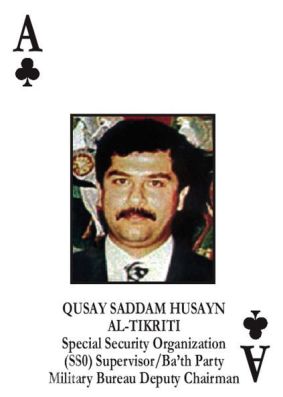
Qusay was the ace of clubs in the coalition forces’ most-wanted Iraqi playing cards. His father was the ace of spades and his brother was the ace of hearts.

……..

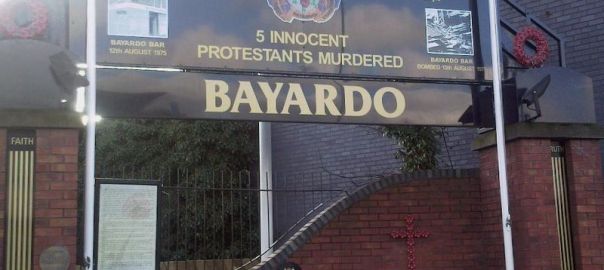
The Bayardo Bar attack – 13 August 1975

The Bayardo Bar attack

Bayardo Bar memorial.jpg


The Bayardo Bar attack took place on 13 August 1975 in Belfast, Northern Ireland. A unit of the Provisional IRA Belfast Brigade, led by Brendan McFarlane, launched a bombing and shooting attack on the pub on Aberdeen Street (off the loyalist Shankill Road), which was frequented by Ulster Volunteer Force (UVF) members as well as civilians.

Four Protestant civilians and one UVF member were killed.

————————————————————–

13 August 1975

William Gracey,  (63)

Protestant
Status: Civilian (Civ),

Killed by: Irish Republican Army (IRA)
Shot during gun and bomb attack on Bayardo Bar, Shankill Road, Belfast.

See below for more details on this attack

————————————————————–

13 August 1975

 Samuel Gunning,   (55)

Protestant
Status: Civilian (Civ),

Killed by: Irish Republican Army (IRA)
Shot during gun and bomb attack on Bayardo Bar, Shankill Road, Belfast.

————————————————————–

13 August 1975

Hugh Harris,   (21)

Protestant
Status: Ulster Volunteer Force (UVF),

Killed by: Irish Republican Army (IRA)
Shot during gun and bomb attack on Bayardo Bar, Shankill Road, Belfast.

————————————————————–

13 August 1975

 Joanne McDowell,   (29)

Protestant
Status: Civilian (Civ),

Killed by: Irish Republican Army (IRA)
Shot during gun and bomb attack on Bayardo Bar, Shankill Road, Belfast.

————————————————————–

13 August 1975
Linda Boyle,  (19)

Protestant
Status: Civilian (Civ),

Killed by: Irish Republican Army (IRA)
Injured during gun and bomb attack on Bayardo Bar, Shankill Road, Belfast. She died 21 August 1975.

————————————————————–

According to journalists Alan Murray and Peter Taylor, it was retaliation for the Miami Showband massacre almost a fortnight earlier, when the popular Dublin-based band were ambushed by the UVF at a bogus military checkpoint. Three band members were shot dead by the UVF gunmen after their minibus was blown up in a premature explosion.

McFarlane and two other IRA volunteers, Peter “Skeet” Hamilton and Seamus Clarke, were sentenced to life imprisonment for perpetrating the Bayardo attack.

Background

By the year 1975, the religious-political conflict in Northern Ireland known as “the Troubles“— was more than six years old. On 10 February 1975, the Provisional IRA and British government entered into a truce and restarted negotiations. The IRA agreed to halt attacks on the British security forces, and the security forces mostly ended its raids and searches.

However, there were dissenters on both sides. Some Provisionals wanted no part of the truce, while British commanders resented being told to stop their operations against the IRA just when—they claimed—they had the Provisionals on the run.The security forces boosted their intelligence offensive during the truce and thoroughly infiltrated the IRA.

There was a rise in sectarian killings during the truce, which ‘officially’ lasted until early 1976. Ulster loyalists, fearing they were about to be forsaken by the British government and forced into a united Ireland,  increased their attacks on the Irish Catholic and nationalist community. They hoped to force the IRA to retaliate and thus hasten an end to the truce.

Under orders not to engage the security forces, some IRA units concentrated on tackling the loyalists. The fall-off of regular operations had caused serious problems of internal discipline and some IRA members, with or without permission from higher up, engaged in tit-for-tat killings.

In the early hours of 31 July 1975 the Miami Showband (a popular dance band) were driving back to Dublin following a gig in Banbridge. At Buskhill (outside Newry) they were flagged down at a checkpoint by Ulster Volunteer Force (UVF) gunmen (some of whom were Ulster Defence Regiment (UDR) soldiers) wearing British Army uniforms. The band’s minibus pulled into a layby on the main A1 road, and the gunmen ordered the group to line-up facing a ditch.

As one gunman took the names and addresses of the band members, two others hid a bomb in the back of the bus. However, the bomb detonated prematurely, and the two men were blown to bits. The surviving gunmen then opened fire on the five Miami Showband members, killing three and wounding two.

According to journalists Peter Taylor and Alan Murray, the attack on the Bayardo was retaliation for the massacre.

The attack

The Bayardo Bar was crowded with people of all ages on Wednesday 13 August 1975. Shortly before closing time a stolen green Audi car, containing a three-man unit of the IRA’s Belfast Brigade, pulled up outside. It was driven by the unit’s leader Brendan “Bik” McFarlane, a 24-year-old volunteer from Ardoyne.[7][8][9] Volunteers Seamus Clarke and Peter “Skeet” Hamilton got out and approached the pub’s side entrance in Aberdeen Street.

One of them immediately opened fire with an Armalite, instantly killing doorman William Gracey (63) and his brother-in-law Samuel Gunning (55), with whom he had been chatting outside.

The other volunteer then entered the pub, where patrons were drinking and singing, and at the entrance he dropped a duffel bag containing a ten-pound bomb. Both men made their getaway back to the waiting car.

As panicked customers ran to the toilets for safety, the bomb exploded and brought down a section of the old brick-and-plaster building upon them. The bodies of civilian Joanne McDowell (29) and UVF member Hugh Harris (21) were later found beneath the rubble of fallen masonry.

Seventeen-year-old civilian Linda Boyle was pulled out alive, but died of her injuries in hospital on 21 August.

Over 50 people were injured in the attack.

The Belfast Telegraph claimed that, as the IRA unit drove away down Agnes Street (an arterial road linking the Shankill to the Crumlin Road), they fired into a crowd of women and children queuing at a taxi rank; there were no fatalities.

Within 20 minutes of the blast, the IRA unit were arrested after their car was stopped at a roadblock. The Armalite that had been used to kill William Gracey and Samuel Gunning was found inside the car along with spent bullet cases and fingerprints belonging to the three IRA men.

The IRA did not initially claim responsibility, However, it later stated that the Bayardo was attacked because it was a pub where UVF associates relaxed and “planned terrorist assaults” against nationalists

The pub was in the UVF-dominated middle Shankill Road area, and the Ulster Banner was displayed from its upper windows. Martin Dillon said that the Bayardo was frequented by the UVF and that Lenny Murphy, head of the Shankill Butchers gang, was a regular customer.

Steve Bruce also maintained that in the early 1970s, the UVF’s Brigade Staff (Belfast leadership) would often be found drinking in the pub, which was just around the corner from their headquarters above “The Eagle” chip shop on the Shankill Road.[16] A former IRA prisoner claimed that fellow inmate Lenny Murphy told him he had left the Bayardo ten minutes before the attack and that the Brigade Staff had just finished holding a meeting there.[17]

Retaliation and counter-retaliation

Loyalists, especially the UVF, responded with another wave of sectarian attacks against Catholics. Two days after, a loyalist car bomb exploded without warning on the Falls Road, injuring 35 people.

On 22 August, the UVF launched a gun and bomb attack on McGleenan’s Bar in Armagh. The attack was strikingly similar to that at Bayardo. One gunman opened fire while another planted the bomb; the explosion causing the building to collapse. Three Catholic civilians were killed (one of whom died on 28 August) and several more were wounded.[19] That same night, another bomb wrecked a Catholic-owned pub in nearby Blackwatertown, although there were no injuries.

These loyalist attacks were responded to in kind by the IRA (sometimes using the cover name Republican Action Force or similar), with the months that followed the Bayardo attack being characterised as a bloody game of tit-for-tat. This was met with disillusionment by imprisoned republicans such as Gerry Adams and Brendan Hughes, with the latter claiming that sectarianism was “destroying the whole struggle”.

Convictions

In May 1976, Brendan McFarlane, Seamus Clarke, and Peter Hamilton were convicted in a non-jury Diplock Court and sentenced to life imprisonment inside the Maze Prison for carrying out the Bayardo murders.

Inside the Maze, McFarlane rose to become Officer Commanding IRA prisoners and in 1983 he led the Maze Prison escape, which was the mass break-out of 38 republican prisoners, including Clarke and Hamilton. McFarlane and Clarke then went on the run, although Hamilton was immediately recaptured outside the prison’s main perimeter gate. McFarlane has never spoken about the killings, and the IRA leadership has never encouraged him to do so, considering the attack was viewed as having been “purely sectarian”.

Sinn Féin president Gerry Adams, however, told journalist Alan Murray that McFarlane “hadn’t a single, sectarian bone in his body”. Peter “Skeet” Hamilton died of cancer in Dundalk on 25 February 2011 at the age of 57.

The Bayardo Somme Association has described the Bayardo attack as “a forgotten atrocity”.

The association erected a memorial to the victims on the site where the Bayardo Bar stood before its demolition. The large steel monument was incorporated into the remaining section of the original structure; it bears the names and photographs of the five people who were killed plus photos of the pub taken before and after the bombing.[22]

13th August – Deaths & Events in Northern Ireland Troubles

13th August

Key Events & Deaths on this day in Northern Ireland Troubles

Wednesday 13 August 1969

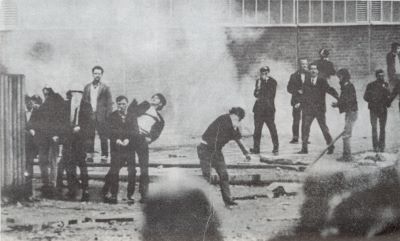
Serious rioting spread across Northern Ireland from Derry to other Catholic areas stretching the Royal Ulster Constabulary (RUC). The rioting deteriorated into sectarian conflict between Catholics and Protestants and many people, the majority being Catholics, were forced from their homes. 

Jack Lynch, then Taoiseach (Irish Prime Minister), made a television address in which he announced that ‘field hospitals’ would be set up in border areas. He went on to say that:

“… the present situation is the inevitable outcome of the policies pursued for decades by successive Stormont governments. It is clear also that the Irish government can no longer stand by and see innocent people injured and perhaps worse.”

Lynch is often misquoted as having said: ‘stand idly by’.] [ August 1969; Partition; United Nations

Friday 13 August 1971

Hugh Herron

A Catholic man was shot dead by the British Army in Derry.

Tuesday 13 August 1974


Dennis Leach  & Michael Southern

Two British soldiers were killed by the Irish Republican Army (IRA) in a remote controlled bomb attack near Crossmaglen, County Armagh.

Wednesday 13 August 1975

Bayardo_Bar_memorial 400

The Irish Republican Army (IRA) carried out a bomb and gun attack on the Bayardo Bar, Shankill Road, Belfast killing five people and injuring 40 others.

One of those killed was a member of the Ulster Volunteer Force (UVF) the other four were Protestant civilians.

See The Bayardo Bar attack

Saturday 13 August 1983

James Mallon ( INLA)

Two members of the Irish National Liberation Army (INLA) were shot dead by the Royal Ulster Constabulary (RUC) in Dungannon, County Tyrone.

Monday 13 August 1984

There was a march in west Belfast in honour of Sean Downes killed on 12 August 1984 by a plastic baton round fired by the Royal Ulster Constabulary (RUC). The march was followed by serious rioting in the area

Wednesday 13 August 1986

Gerard O’Reilly, then being held awaiting extradition from the Republic of Ireland, was freed from a Dublin court following an error in the extradition warrant.

Friday 13 August 1993

The Irish Republican Army (IRA) carried out a series of fire-bomb attacks on the pier at Bournemouth, England, and a number of shops.

Saturday 13 August 1994

An Irish Republican Army (IRA) incendiary device caused damage to shops in Bognor Regis, England. Another incendiary device was discovered and defused in Brighton.

Sunday 13 August 1995 IRA “Haven’t Gone Away”

Gerry Adams, then President of Sinn Féin (SF), addressed a demonstration at Belfast City Hall. During his speech a member of the crowd called out to Adams to, “bring back the IRA”. In an unscripted reply Adams said:

“They haven’t gone away, you know”.

[Although cheered by the crowd Adams was criticised for the remark. Unionists and the British government said that the remark highlighted the need for the decommissioning of Irish Republican Army (IRA) weapons. Since it was first uttered, the comment has been referred to repeatedly by critics of SF and the Good Friday Agreement.]

Thursday 13 August 1998

Mitchel McLaughlin, then National Chairperson of Sinn Féin (SF), issued a statement urging anyone with information about any of the ‘missing persons’ who disappeared during the course of the conflict to make that information available. [This statement was seen by many as having come about because of pressure on SF by relatives of people who had been abducted and never seen again.]

Friday 13 August 1999

Bernadette McAliskey, former MP, spoke at a rally held on the lower Ormeau Road in advance of the planned Apprentice Boys of Derry march. She said that

“marching is not a human right – for Orangemen or Republicans”.

The Progressive Unionist Party (PUP) criticised the decision of Castlereagh Borough Council decision to fly an Orange Order flag outside its civic offices. The PUP said it was “an affront to Roman Catholic and nationalist residents.

The Democratic Unionist Party (DUP) accused the PUP of hypocrisy because of the PUP’s support of the flying of Ulster Volunteer Force (UVF) flags.

Sunday 13 August 2000

The Royal Ulster Constabulary (RUC) made safe a pipe-bomb on Drumlee Road in Ballymoney, County Antrim. The device had been pushed through the letterbox of a Catholic home. The attack was carried out by Loyalist paramilitaries.

Monday 13 August 2001 Suspected IRA Men Arrested in Colombia

Three Irish men were arrested at Bogotá Airport in Colombia, South America, for travelling on false documents. Colombian authorities reported that two of the men were travelling on false British passports while the third man was using a false Irish passport.

[There was speculation that the three men were members of the (Provisional) Irish Republican Army (IRA). It was reported that the men had been in area of the country that was under the control of left-wing guerrillas.

There was further media speculation that the men had been involved in helping to train some of the guerrillas. The men were later identified as Niall Connolly, who had lived in Cuba for a number of years, James Monaghan, formerly a member of the Sinn Féin ardcomhairle, and Martin McCauley, who had been an election worker for Sinn Féin in Armagh.]

Two Catholics, one of them a 14 year-old boy, were injured when Loyalists threw a blast-bomb among a Nationalist crowd in north Belfast.

The attack happened during disturbances involving hundreds of Loyalists and Nationalists.

A hoax nail bomb and fireworks were thrown at two houses in Glengormley, County Antrim.

The British Army were also called to deal with a hoax pipe-bomb in the same area.

Thomas McCauley, formerly from Belfast, was stabbed to death in Waterford, Republic of Ireland.

McCauley was given a Republican funeral on Friday 17 August 2001. He was reported as having been a member of the IRA who had broken his links with the movement some time

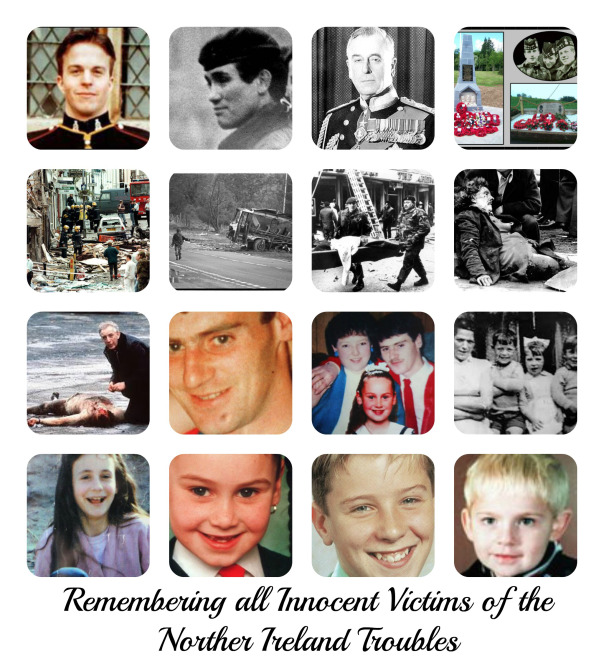
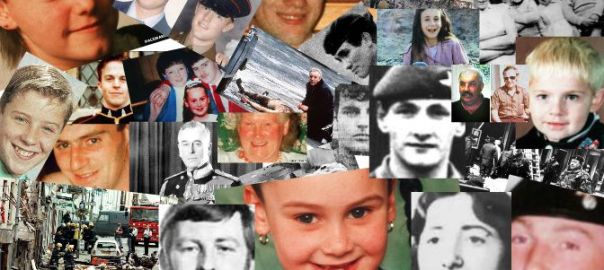
collage

————————–

Remembering all innocent victims of the Troubles

Today is the anniversary of the follow  people killed as a results of the conflict in Northern Ireland

“To live in hearts we leave behind is not to die

– Thomas Campbell

To the innocent on the list – Your memory will live forever

– To  the Paramilitaries  –

“There are many things worth living for, a few things worth dying for, but nothing worth killing for.

12  people lost their lives on the 13th August between 1971 – 1983

————————————————————–

13 August 1971


Huge Herron,   (31)

Catholic
Status: Civilian (Civ),

Killed by: British Army (BA)
Shot during gun battle, Long Tower Street, Derry.

————————————————————–

13 August 1972
Thomas Madden, (48)

Catholic
Status: Civilian (Civ),

Killed by: non-specific Loyalist group (LOY)
Found stabbed and beaten to death in shop doorway, Oldpark Road, Belfast

————————————————————–

13 August 1973

William McIlveen,   (36)

Protestant
Status: Royal Ulster Constabulary (RUC),

Killed by: Irish Republican Army (IRA)
Off duty reservist. Shot at his workplace, a factory, Cathedral Road, Armagh.

————————————————————–

13 August 1974

Dennis Leach (24) nfNI
Status: British Army (BA),

Killed by: Irish Republican Army (IRA)
Killed in remote controlled bomb attack on hilltop British Army (BA) observation post, Drummuckavall, near Crossmaglen, County Armagh.

————————————————————–

13 August 1974

Michael Southern,  (19) nfNI
Status: British Army (BA),

Killed by: Irish Republican Army (IRA)
Killed in remote controlled bomb attack on hilltop British Army (BA) observation post, Drummuckavall, near Crossmaglen, County Armagh.

————————————————————–

13 August 1975

William Gracey,  (63)

Protestant
Status: Civilian (Civ),

Killed by: Irish Republican Army (IRA)
Shot during gun and bomb attack on Bayardo Bar, Shankill Road, Belfast.

See below for more details on this attack

————————————————————–

13 August 1975

 Samuel Gunning,   (55)

Protestant
Status: Civilian (Civ),

Killed by: Irish Republican Army (IRA)
Shot during gun and bomb attack on Bayardo Bar, Shankill Road, Belfast.

————————————————————–

13 August 1975

Hugh Harris,   (21)

Protestant
Status: Ulster Volunteer Force (UVF), Killed by: Irish Republican Army (IRA)
Shot during gun and bomb attack on Bayardo Bar, Shankill Road, Belfast.

————————————————————–

13 August 1975

 Joanne McDowell,   (29)

Protestant
Status: Civilian (Civ),

Killed by: Irish Republican Army (IRA)
Shot during gun and bomb attack on Bayardo Bar, Shankill Road, Belfast.

————————————————————–

13 August 1975
Linda Boyle,  (19)

Protestant
Status: Civilian (Civ),

Killed by: Irish Republican Army (IRA)
Injured during gun and bomb attack on Bayardo Bar, Shankill Road, Belfast. She died 21 August 1975.

————————————————————–

13 August 1983
Brendan Convery,   (25) Catholic
Status: Irish National Liberation Army (INLA),

Killed by: Royal Ulster Constabulary (RUC)
Shot during attempted ambush of Royal Ulster Constabulary (RUC) members at security barrier, Dungannon, County Tyrone.

————————————————————–

13 August 1983

James Mallon,  (28)

Catholic
Status: Irish National Liberation Army (INLA),

Killed by: Royal Ulster Constabulary (RUC)
Shot during attempted ambush of Royal Ulster Constabulary (RUC) members at security barrier, Dungannon, County Tyrone.

————————————————————–

See :  The Bayardo Bar attack

The Bayardo Bar attack

Bayardo Bar memorial.jpg

The Bayardo Bar attack took place on 13 August 1975 in Belfast, Northern Ireland. A unit of the Provisional IRA Belfast Brigade, led by Brendan McFarlane, launched a bombing and shooting attack on the pub on Aberdeen Street (off the loyalist Shankill Road), which was frequented by Ulster Volunteer Force (UVF) members as well as civilians.

Four Protestant civilians and one UVF member were killed.

According to journalists Alan Murray and Peter Taylor, it was retaliation for the Miami Showband massacre almost a fortnight earlier, when the popular Dublin-based band were ambushed by the UVF at a bogus military checkpoint. Three band members were shot dead by the UVF gunmen after their minibus was blown up in a premature explosion.

McFarlane and two other IRA volunteers, Peter “Skeet” Hamilton and Seamus Clarke, were sentenced to life imprisonment for perpetrating the Bayardo attack.

Background

Main article: The Troubles
 

By the year 1975, the religious-political conflict in Northern Ireland known as “the Troubles“— was more than six years old. On 10 February 1975, the Provisional IRA and British government entered into a truce and restarted negotiations. The IRA agreed to halt attacks on the British security forces, and the security forces mostly ended its raids and searches.[1] However, there were dissenters on both sides. Some Provisionals wanted no part of the truce, while British commanders resented being told to stop their operations against the IRA just when—they claimed—they had the Provisionals on the run.[1] The security forces boosted their intelligence offensive during the truce and thoroughly infiltrated the IRA.[1]

There was a rise in sectarian killings during the truce, which ‘officially’ lasted until early 1976. Ulster loyalists, fearing they were about to be forsaken by the British government and forced into a united Ireland, increased their attacks on the Irish Catholic and nationalist community.

They hoped to force the IRA to retaliate and thus hasten an end to the truce. Under orders not to engage the security forces, some IRA units concentrated on tackling the loyalists. The fall-off of regular operations had caused serious problems of internal discipline and some IRA members, with or without permission from higher up, engaged in tit-for-tat killings.

In the early hours of 31 July 1975 the Miami Showband (a popular dance band) were driving back to Dublin following a gig in Banbridge. At Buskhill (outside Newry) they were flagged down at a checkpoint by Ulster Volunteer Force (UVF) gunmen (some of whom were Ulster Defence Regiment (UDR) soldiers) wearing British Army uniforms.

The band’s minibus pulled into a layby on the main A1 road, and the gunmen ordered the group to line-up facing a ditch. As one gunman took the names and addresses of the band members, two others hid a bomb in the back of the bus. However, the bomb detonated prematurely, and the two men were blown to bits. The surviving gunmen then opened fire on the five Miami Showband members, killing three and wounding two.

According to journalists Peter Taylor and Alan Murray, the attack on the Bayardo was retaliation for the massacre.

The attack

The Bayardo Bar was crowded with people of all ages on Wednesday 13 August 1975. Shortly before closing time a stolen green Audi car, containing a three-man unit of the IRA’s Belfast Brigade, pulled up outside. It was driven by the unit’s leader Brendan “Bik” McFarlane, a 24-year-old volunteer from Ardoyne.

Volunteers Seamus Clarke and Peter “Skeet” Hamilton got out and approached the pub’s side entrance in Aberdeen Street.  One of them immediately opened fire with an Armalite, instantly killing doorman William Gracey (63) and his brother-in-law Samuel Gunning (55), with whom he had been chatting outside.

The other volunteer then entered the pub, where patrons were drinking and singing, and at the entrance he dropped a duffel bag containing a ten-pound bomb. Both men made their getaway back to the waiting car. As panicked customers ran to the toilets for safety, the bomb exploded and brought down a section of the old brick-and-plaster building upon them. The bodies of civilian Joanne McDowell (29) and UVF member Hugh Harris (21) were later found beneath the rubble of fallen masonry.

Seventeen-year-old civilian Linda Boyle was pulled out alive, but died of her injuries in hospital on 21 August.  Over 50 people were injured in the attack. 

The Belfast Telegraph claimed that, as the IRA unit drove away down Agnes Street (an arterial road linking the Shankill to the Crumlin Road), they fired into a crowd of women and children queuing at a taxi rank; there were no fatalities. Within 20 minutes of the blast, the IRA unit were arrested after their car was stopped at a roadblock. The Armalite that had been used to kill William Gracey and Samuel Gunning was found inside the car along with spent bullet cases and fingerprints belonging to the three IRA men.

The IRA did not initially claim responsibility, However, it later stated that the Bayardo was attacked because it was a pub where UVF associates relaxed and “planned terrorist assaults” against nationalists.

The pub was in the UVF-dominated middle Shankill Road area, and the Ulster Banner was displayed from its upper windows. Martin Dillon said that the Bayardo was frequented by the UVF and that Lenny Murphy, head of the Shankill Butchers gang, was a regular customer. Steve Bruce also maintained that in the early 1970s, the UVF’s Brigade Staff (Belfast leadership) would often be found drinking in the pub, which was just around the corner from their headquarters above “The Eagle” chip shop on the Shankill Road.

A former IRA prisoner claimed that fellow inmate Lenny Murphy told him he had left the Bayardo ten minutes before the attack and that the Brigade Staff had just finished holding a meeting there.

Retaliation and counter-retaliation

Loyalists, especially the UVF, responded with another wave of sectarian attacks against Catholics. Two days after, a loyalist car bomb exploded without warning on the Falls Road, injuring 35 people. On 22 August, the UVF launched a gun and bomb attack on McGleenan’s Bar in Armagh. The attack was strikingly similar to that at Bayardo. One gunman opened fire while another planted the bomb; the explosion causing the building to collapse. Three Catholic civilians were killed (one of whom died on 28 August) and several more were wounded.

That same night, another bomb wrecked a Catholic-owned pub in nearby Blackwatertown, although there were no injuries.

These loyalist attacks were responded to in kind by the IRA (sometimes using the cover name Republican Action Force or similar), with the months that followed the Bayardo attack being characterised as a bloody game of tit-for-tat. This was met with disillusionment by imprisoned republicans such as Gerry Adams and Brendan Hughes, with the latter claiming that sectarianism was “destroying the whole struggle”.[21]

Convictions

In May 1976, Brendan McFarlane, Seamus Clarke, and Peter Hamilton were convicted in a non-jury Diplock Court and sentenced to life imprisonment inside the Maze Prison for carrying out the Bayardo murders.[5][10][11] Inside the Maze, McFarlane rose to become Officer Commanding IRA prisoners and in 1983 he led the Maze Prison escape, which was the mass break-out of 38 republican prisoners, including Clarke and Hamilton. McFarlane and Clarke then went on the run, although Hamilton was immediately recaptured outside the prison’s main perimeter gate.

McFarlane has never spoken about the killings, and the IRA leadership has never encouraged him to do so, considering the attack was viewed as having been “purely sectarian”. Sinn Féin president Gerry Adams, however, told journalist Alan Murray that McFarlane “hadn’t a single, sectarian bone in his body”.

Peter “Skeet” Hamilton died of cancer in Dundalk on 25 February 2011 at the age of 57.

The Bayardo Somme Association has described the Bayardo attack as “a forgotten atrocity”. The association erected a memorial to the victims on the site where the Bayardo Bar stood before its demolition. The large steel monument was incorporated into the remaining section of the original structure; it bears the names and photographs of the five people who were killed plus photos of the pub taken before and after the bombing.

See: The Bayardo Bar attack

12th August – Deaths & Events in Northern Ireland Troubles

12th August

Key Events & Deaths on this day in Northern Ireland Troubles

Tuesday 12 August 1969

The Battle of the Bogside

———————————————————

Battle of the Bogside;Full Documentary

———————————————————

Battle of the Bogside

Tuesday 12 August 1969 Battle of the Bogside Began As the annual Apprentice Boys parade passed close to the Bogside area of Derry serious rioting erupted. The Royal Ulster Constabulary (RUC), using armoured cars and water cannons, entered the Bogside, in an attempt to end the rioting. The RUC were closely followed and supported by a loyalist crowd. The residents of the Bogside forced the police and the loyalists back out of the area. The RUC used CS gas to again enter the Bogside area.

[This period of conflict between the RUC and Bogside (and Creggan) residents was to become known as the ‘Battle of the Bogside’ and lasted for two days.]

There was also sporadic  riots and running battles on  the Shankill , Falls and other areas of the province

See Battle of Bogside page

Thursday 12 August 1971

A Protestant man died two days after being shot by a British soldier.

Sunday 12 August 1973

The Royal Ulster Constabulary (RUC) tried out a new plastic baton round during a riot.

[The plastic baton round was eventually to replace the rubber baton round that had been in use since 2 August 1970.]

Thursday 12 August 1976

A group of 1,000 women held a demonstration on the Finaghy Road in Andersontown at the place where the three Maguire children were killed on 10 August 1976. 6,000 people signed a petition in Andersonstown calling for peace.

Sunday 12 August 1984

Martin Galvin, then leader of NORAID (Irish Northern Aid Committee), appeared at another rally this time in Belfast. Galvin was banned from the UK and Royal Ulster Constabulary (RUC) officers moved to arrest him.

Sean Downes

During an altercation with protesters an RUC officer fired a plastic baton round at close range and killed Sean Downes (22), a Catholic civilian. An RUC officer was killed by the IRA in County Tyrone.

Wednesday 12 August 1987

Ian Paisley, then leader of the Democratic Unionist Party (DUP), turned down a plan for talks between the four main constitutional parties in Northern Ireland (UUP, SDLP, DUP and APNI) that had been suggested by Robin Eames, Church of Ireland Archbishop.

Monday 12 August 1991

Pádraig Ó Seanacháin

Pádraig Ó Seanacháin (33), who was Sinn Féin (SF) election worker, was shot dead by the Ulster Freedom Fighters (UFF), a cover name (pseudonym) used by the Ulster Defence Association (UDA), in Killen, County Tyrone. It was announced that there would be a review of the case of Judith Ward who had been convicted of the Bradford coach bombing in 1974.

Wednesday 12 August 1992

The Metropolitan Police in London uncovered approximately 12 tons of explosives when they seized three vans. The explosives had been manufactured by the Irish Republican Army (IRA).

Five people were initially arrested in connection with the find but were later released.

Thursday 12 August 1993

The Royal Ulster Constabulary (RUC) prevented a bomb attack when officers intercepted a van bomb, estimated at 3,000 pounds, in Portadown, County Armagh.

Saturday 12 August 1995

The Apprentice Boys of Derry (ABD) held their annual parade in Derry. Due to the opening of security gates on the city walls the ABD was able to parade around the walls for the first time in 25 years.

However, Republicans staged a sitdown demonstration before the parade began and were forcible removed by the Royal Ulster Constabulary (RUC).

There was rioting in Derry following the parade and police fired 40 plastic bullets. There were serious confrontations between the RUC and Nationalists in the lower Ormeau Road area of Belfast. An ABD ‘feeder’ parade passed along the street once police had cleared the route. There were also disturbances at Dunloy and Rasharkin, County Antrim.

Tuesday 12 August 1997

First Debate Between SF and UUP on TV

27 Loyalist Volunteer Force (LVF) prisoners in the Maze Prison began a riot which caused severe damage to C and D wings of H-Block 6.

Irish National Liberation Army (INLA) prisoners in wings A and B of H-Block 6 had to be moved as the LVF occupied the roof.

Ken Maginnis, then Ulster Unionist Party (UUP) Member of Parliament (MP), appeared in a British Broadcasting Corporation (BBC) Newsnight programme in a debate which involved Martin McGuinness, then Vice-President of Sinn Féin (SF) and MP. This was the first time that a member of the UUP had agreed to appear alongside a member of SF on British Television.

McGuinness began moves to have a judicial review of the decision of the Speaker of the House of Commons to refuse the two SF MPs office facilities. The reason given for the refusal was the fact that the two MPs had not taken their seats in the House, which would have involved an oath of allegiance to the Queen.

Two Republican prisoners being held in Portlaoise Prison in the Republic of Ireland, were given early conditional release.

Sunday 12 August 2001

Two men were shot and injured in a Loyalist paramilitary ‘punishment’ attack in Greencastle, County Antrim.

Another man was shot and injured in a separate Loyalist paramilitary ‘punishment’ attack in the Rathcollle estate, Newtownabbey, County Antrim.

John Reid, then Secretary of State for Northern Ireland, said in an interview on the BBC Television’s Breakfast With Frost programme that he believed that the parties were “tantalisingly close” to reaching agreement. He defended his decision to suspend the political institutions as the best of the options open to him.

Speaking on the same programme Martin McGuinness, then Vice-President of Sinn Féin (SF), said the suspension, together with the Unionist response to the developments on decommissioning, had caused “a serious situation”.

———————————-

collage

Remembering all innocent victims of the Troubles

Today is the anniversary of the follow  people killed as a results of the conflict in Northern Ireland

“To live in hearts we leave behind is not to die

– Thomas Campbell

To the innocent on the list – Your memory will live forever

– To  the Paramilitaries  –

“There are many things worth living for, a few things worth dying for, but nothing worth killing for

11  people lost their lives on the 12th August between 1970 – 1992

12th August

————————————————————–

12 August 1970

Samuel Donaldson,   (23)

Protestant
Status: Royal Ulster Constabulary (RUC),

Killed by: Irish Republican Army (IRA)
Died one day after being injured by booby trap bomb, attached to abandoned car, Lissaraw, near Crossmaglen, County Armagh.

————————————————————–

12 August 1970

Robert Millar,   (26)

Protestant
Status: Royal Ulster Constabulary (RUC),

Killed by: Irish Republican Army (IRA)
Died one day after being injured by booby trap bomb, attached to abandoned car, Lissaraw, near Crossmaglen, County Armagh.

————————————————————–

12 August 1971
William Ferris,   (38)

Protestant
Status: Civilian (Civ),

Killed by: British Army (BA)
Died two days after being shot while travelling in car along Crumlin Road, Belfast

————————————————————–

12 August 1972
Francis Wynne,   (37)

Catholic
Status: Civilian (Civ),

Killed by: non-specific Loyalist group (LOY)
Found shot in abandoned car, Jaffa Street, Shankill, Belfast.

————————————————————–

12 August 1975
John Hunter,  (57)

Protestant
Status: Civilian (Civ),

Killed by: Ulster Defence Association (UDA)
Shot at his workplace, council cleansing depot, off Albertbridge Road, Belfast

————————————————————–

12 August 1977

Neil Bewley,   (19) nfNI
Status: British Army (BA),

Killed by: Irish Republican Army (IRA)
Shot by sniper while on British Army (BA) foot patrol, Norglen Drive, Turf Lodge, Belfast.

————————————————————–

12 August 1984

Sean Downes,  (22)

Catholic
Status: Civilian (Civ),

Killed by: Royal Ulster Constabulary (RUC)
Shot by plastic bullet, during anti-internment march, Andersonstown Road, Belfast

————————————————————–

12 August 1984

Malcolm White,   (26)

Protestant
Status: Royal Ulster Constabulary (RUC),

Killed by: Irish Republican Army (IRA)
Killed in land mine attack on Royal Ulster Constabulary (RUC) mobile patrol, Crockanboy, Greencastle, County Tyrone.

————————————————————–

12 August 1988
Richard Heakin,  (30) nfNIE
Status: British Army (BA),

Killed by: Irish Republican Army (IRA)
Off duty. Shot while sitting in his car stopped at traffic lights, Oostende, Belgium

————————————————————–

12 August 1991

Padraig O’Seanachain,   (33)

Catholic
Status: Civilian Political Activist (CivPA),

Killed by: Ulster Freedom Fighters (UFF)
Sinn Fein (SF) member. Shot by sniper, while travelling to work, Killen, Castlederg, County Tyrone.

————————————————————–

12 August 1992

Robin Hill, Robin (22)

Catholic
Status: ex-Irish Republican Army (xIRA),

Killed by: Irish Republican Army (IRA)
Found shot, in entry off Beechmount Crescent, Falls, Belfast. Alleged informer


Veronica Guerin – 1958 – 1996.Life & Death

Veronica Guerin 5 July 1958 – 26 June 1996 Veronica Guerin (5 July 1958 – 26 June 1996) was an Irish crime reporter who was murdered on 26 June 1996 by drug lords, an event which helped establish t…

Source: Veronica Guerin – 1958 – 1996.Life & Death

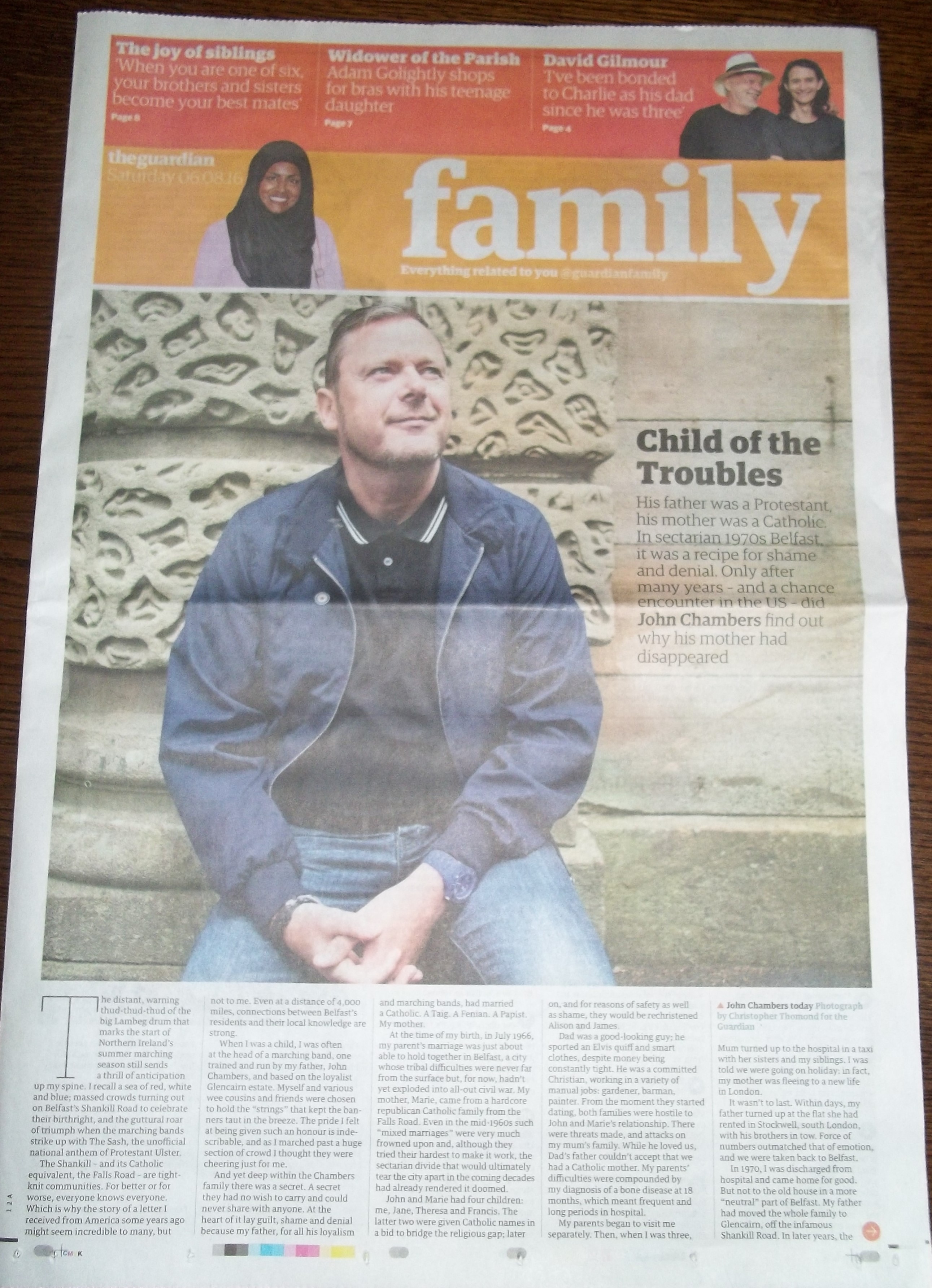
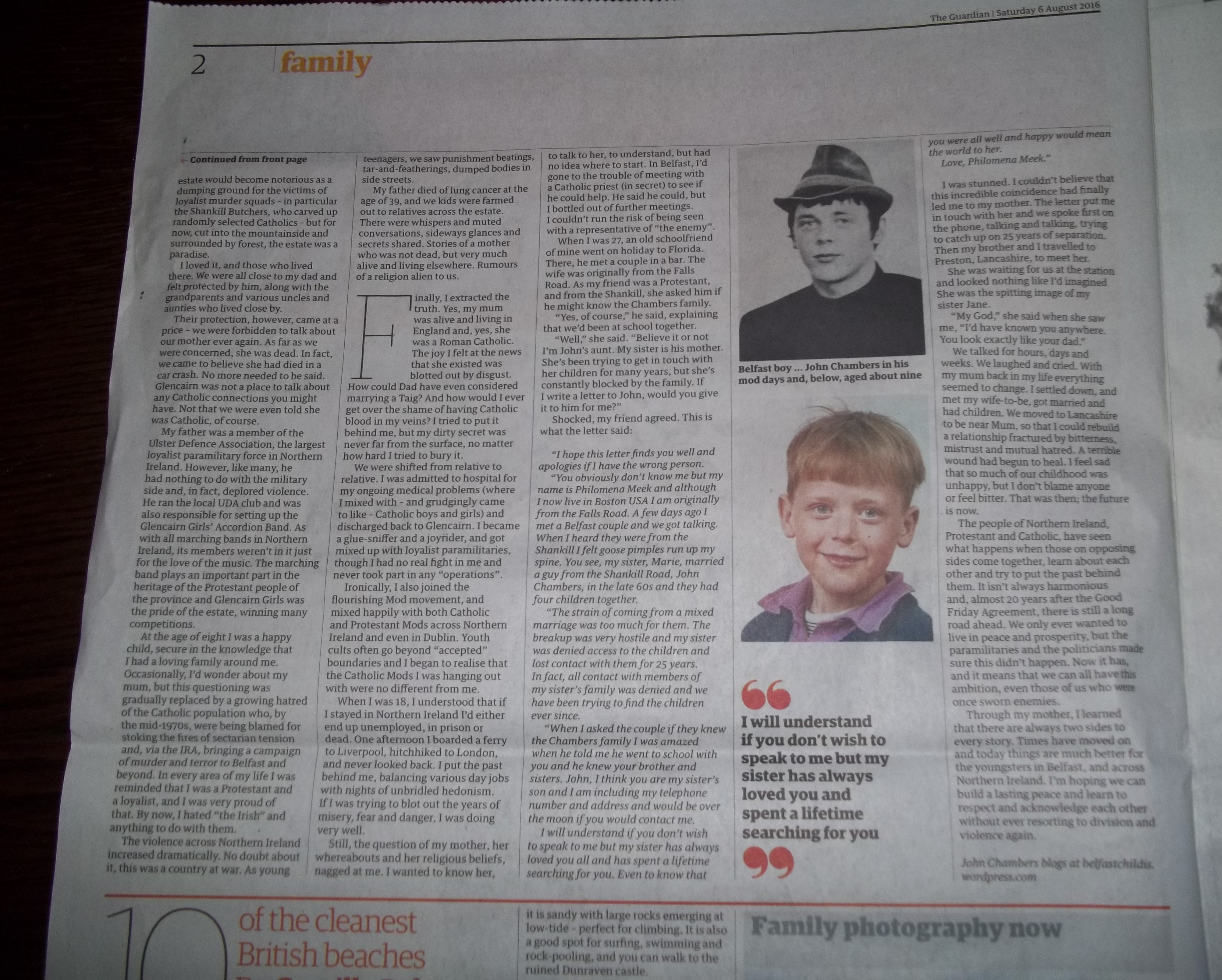
I’m in today’s Guardian – Family Section

belfastchildis's avatar

Heres a link to the story on the Guardian’s website: Click here to read my story , which is slightly different to the print version.

PS- Don’t forget to visit the Autobiography section of my blog to read the first eight chapter’s of my book Belfast Child.

Hi All  ,Just a quick blog to tell you all I’m featured in the family section  of todays Guardian – should be on their website later , so if your interested go out and buy the paper and have a read.

gurdian .jpg

gurdian 2.jpg

View original post

11th August – Deaths & Events in Northern Ireland Troubles

11th August

Key Events & Deaths on this day in Northern Ireland Troubles

Tuesday 11 August 1970


Two Royal Ulster Constabulary (RUC) officers were killed by the Irish Republican Army (IRA) when they set off a booby trap bomb planted in a car near Crossmaglen, County Armagh.

Wednesday 11 August 1971

Four people were shot dead in separate incidents in Belfast, three of them by the British Army (BA), as violence continued following the introduction of Internment.

Friday 11 August 1972

Two IRA members were killed when a bomb they were transporting exploded prematurely.

Saturday 11 August 1973

Two members of the Irish Republican Army (IRA) were killed when the bomb they were transporting exploded prematurely near Castlederg, County Tryone.

A Protestant civilian was shot dead by Loyalists in Belfast.

Wednesday 11 August 1976

The third of the Maguire children died as a result of injuries received on 10 August 197

Saturday 11 August 1979

Representatives from the Irish National Caucus paid a visit to Northern Ireland and said that the Caucus intended to make the conflict in the region a major issue during the 1980 United States (US) Presidential election. 6.

Sunday 11 August 1991

Sinn Féin (SF) held a rally in Belfast to mark the 20th anniversary of the introduction of Internment and the 10th anniversary of the hunger strike.

Wednesday 11 August 1993

Seamus Hopkins (24), a Catholic civilian, was found beaten to death in the Shankill area of Belfast.

Sir Hugh Annesley, then Chief Constable of the Royal Ulster Constabulary (RUC), announced that women officers would be armed from April 1994.

Thursday 11 August 1994

Martin L’Estrange (36), a Catholic civilian, was shot dead by the Ulster Freedom Fighters (UFF), a cover name (pseudonym) used by the Ulster Defence Association (UDA).

He was a printer and was killed at his workplace in William Street, Lurgan, County Armagh.

Monday 11 August 1997

Two Social Security officials had shots fired at their car which was also damaged by clubs in north Belfast.

There was an arson attack on the Orange Order Hall in Purdysburn in south Belfast.

Kevin Artt, Paul Brennan, and Terry Kirby, previously members of the Irish Republican Army (IRA), who had escaped from the Maze Prison on 25 September 1983 lost their case in an American court to try to stop their extradition.

The three men appealed against the decision.

Saturday 11 August 2001

Assembly Restored

John Reid, then Secretary of State for Northern Ireland, signed an order which restored the Northern Ireland Assembly and the other institutions of the Good Friday Agreement.

The latest period of suspension had lasted 24 hours and had the effect of postponing by six weeks the deadline for the election of the First Minister and Deputy First Minister (22 September 2001).

The main Apprentice Boys of Derry (ABOD) parade passed off without serious trouble. Around 10,000 ABOD members together with 170 bands marched around the city centre to commemorate the relief of the Siege of Derry in 1689.

A feeder parade in Belfast was prevented from marching past the Nationalist Ardoyne area following a Pardes Commission ruling.

The ABOD members decided to protest against the decision by blocking the Crumlin Road. The standoff with the police lasted for six hours.

—————————————————————

collage.png

Remembering all innocent victims of the Troubles

Today is the anniversary of the death of the following people killed as a results of the conflict in Northern Ireland

“To live in hearts we leave behind is not to die

– Thomas Campbell

To the innocent on the list – Your memory will live  forever

– To  the Paramilitaries  –

There are many things worth living for, a few things worth dying for, but nothing worth killing for.

14  People   lost their lives on the 11th August between 1971– 1994

  ————————————————————————

11 August 1971

John Laverty,  (20)

Catholic
Status: Civilian (Civ),

Killed by: British Army (BA)
Shot while walking along path by St Aidan’s Primary School, Ballymurphy

————————————————————–

11 August 1971
William Stronge,   (46)

Protestant
Status: Civilian (Civ),

Killed by: not known (nk)
Shot while moving furniture from sister’s home, Ballyclare Street, Belfast

————————————————————–

11 August 1971

Seamus Simpson,  (21)

Catholic
Status: Irish Republican Army (IRA),

Killed by: British Army (BA)
Shot while throwing bomb at British Army (BA) foot patrol, Rossnareen Avenue, Andersonstown, Belfast.

————————————————————–

11 August 1971

William McKavanagh,   (21)

Catholic
Status: Civilian (Civ),

Killed by: British Army (BA)
Shot while in McAuley Street, Markets, Belfast.

————————————————————–

11 August 1972
Anne Parker,  (18)

Catholic
Status: Irish Republican Army (IRA),

Killed by: Irish Republican Army (IRA)
Died in premature bomb explosion while travelling in van, North Howard Street, Lower Falls, Belfast.

————————————————————–

11 August 1972
Michael Clarke,  (22)

Catholic
Status: Irish Republican Army (IRA),

Killed by: Irish Republican Army (IRA)
Died in premature bomb explosion while travelling in van, North Howard Street, Lower Falls, Belfast

————————————————————–

11 August 1973
James McGlynn,   (20)

Catholic
Status: Irish Republican Army (IRA),

Killed by: Irish Republican Army (IRA)
Killed in premature bomb explosion while travelling in car, Kilclean, near Castlederg, County Donegal.

————————————————————–

11 August 1973

Seamus Harvey,   (23)

Catholic
Status: Irish Republican Army (IRA),

Killed by: Irish Republican Army (IRA)
Killed in premature bomb explosion while travelling in car, Kilclean, near Castlederg, County Donegal.

————————————————————–

11 August 1973
Norman Hutchinson,   (17)

Protestant
Status: Civilian (Civ),

Killed by: Ulster Volunteer Force (UVF)
Shot while walking along Ormeau Road, near University Street, Belfast.

————————————————————–

11 August 1976
Michael Quigley,  (33)

Catholic
Status: Civilian (Civ),

Killed by: Irish Republican Army (IRA)
Shot during Irish Republican Army (IRA) sniper attack on British Army (BA) observation post, while walking along Meenan Square, Bogside, Derry.

————————————————————–

11 August 1978
Alan Swift,  (25) nfNI
Status: British Army (BA),

Killed by: Irish Republican Army (IRA)
Undercover British Army (BA) member. Shot while sitting in stationary British Army (BA) civilian type car, Letterkenny Road, Derry.

————————————————————–

11 August 1981

Charles Johnston,  (43)

Protestant
Status: Civilian (Civ),

Killed by: Irish Republican Army (IRA)
Shot from passing motorcycle while walking along Talbot Street,

————————————————————–

11 August 1993

Seamus Hopkins,  (24)

Catholic
Status: Civilian (Civ),

Killed by: non-specific Loyalist group (LOY)
Found beaten to death on waste ground, off Sherbrook Way, Shankill, Belfast.

————————————————————–

11 August 1994

Martin L’Estrange,   (36)

Catholic
Status: Civilian (Civ),

Killed by: Ulster Freedom Fighters (UFF)
Shot, at his workplace, printers, William Street, Lurgan, County Armagh.

————————————————————–

Dad’s death – Extracts from Belfast Child

Chapter Six

Dad’s Death

11017548_10203103532783967_6123879336016174124_n


It was around 1976 that it first came to my attention that dad was ill and he was getting sicker and weaker by the day. He had always been a heavy drinker and smoker, but this was normal where we lived and we never really thought anything about it or the health implications these habits would have on him. One day when dad was supposed to be working I got home from school and found Margaret, Jean and some of their friend’s standing outside the front door. When I asked them what they were doing they said that had arrived home from school and on entering the house had heard a strange noise coming from upstairs and they had fled the house.

Trying to act all brave in from of my sisters I causally moved into the house, making sure I left the front door open, in case I had to make a quick getaway. After a nervous look downstairs and not finding anything, I began to make my way slowly up the stairs. As I got to the top I became aware of a deep rasping sound growing louder and louder that stopped me in my tracks. I’d seen enough of Dr. Who to know the sound I heard wasn’t coming from a human and I flew down the stairs and out of the house as fast as my legs could carry me. When the girls finally caught up with me I confirmed that I had indeed heard the sounds and I thought it might be one of those monsters from Dr.Who. The others looked rightly shocked at my analysis of the situation and it was decided that we would call the police. Christine Russell’s mum was the only neighbour we knew who had a phone and while Margaret and the other’s went to make the call, David and I made our way back to the house, making sure we kept a safe distance between us and the front door.

Word quickly spread around the estate that we had one of those monsters from Dr. Who hiding upstairs and before long large crowds began to gather, in the hope of seeing some action. When the police arrived they asked a few questions before entering the house and slowly making their way up the stairs. Whilst we were all waiting about outside to see what happened, Granny arrived and after a quick chat with a neighbour she made her way into the house with the police up stairs. After a while Granny came out with one of the policemen and explained to us that it was dad in the house, that he was sick and would have to go to hospital. In the distance we could hear the sound of an ambulance rushing towards us and suddenly it wasn’t funny or exciting anymore. I watched with the others as dad was stretchered out and placed in the ambulance and taken to the hospital. By the time everyone had cleared, Aunty Anne, dads younger sister arrived and explained to us that dad was going to be ok, but he would have to stay in hospital for a few days and she would be staying with us whilst he was away.

Being so young I don’t think I fully understood the magnitude of the situation and as usual I just ignored the situation that was going on around me and got on with my life. After that first time, dad was in and out of hospital all the time and gradually he became more and more ill. I remember many evenings at home, dad would take these horrible, agonising fits and one of us would have to run to Christine Russell’s house to call an ambulance. This became almost natural to us, but it was always distressing to see dad suffering so much and be unable to do anything to help.

Gradually we all began to realize that dad was very ill, although none of us wanted to accept or believe that he might die. I had already “lost” my mother and surely God wouldn’t take my dad away also? Once when he was in hospital Margaret decided that we would all do up the garden for dad and plant some rose bushes. We all went to work and by the time dad got out of hospital, the garden was looking great and dad was really impressed with our efforts and monitored the progress of the rose bushes with us. I remember the last time Granny took me up to the hospital to visit dad, I was really shocked and upset at how bad he looked. He was thin as a rake and I remember the watch he had worn all the time on his wrist had slide all the way up his arm to his elbow.

I’ve still got that watch, but I’ve never been able to wear it and every time I look at it I see dad in hospital, all skin and bones and at deaths door.

Although I didn’t know it at the time, I was too young to understand the seriousness of how ill dad was, this was the last time that I would see my dad alive.

I wish I had told him how much I loved him and told him how much the others and I would miss him, how much we needed him and didn’t want him to die.

When I got home I went straight to my room and begged God to save my dad and not take him away from us. But as usual God wasn’t listening and fate was once again messing with my destiny and making my young life a misery.

One day when we got home from school, Aunty Anne was waiting for us and told us that dad had been taken to hospital again, but he should be home in a few days. The day he was suppose to come home arrived and we all busied ourselves tidying up and making the place as nice as possible for him. Someone had told us that dad would be home around three o’clock and when the time came we all went down and stood on the main road watching for the car that would bring him home. Three o’clock came and went, then four and by 5 o’clock we were all getting bored waiting around. Eventually a car did approach us and pulled up, but our relief turned to panic when we realised that only Granny and Granddad were in the back. As they got out it was obvious that Granny was very upset and had been crying. Granddad told us he was taking her home and for us to wait indoors and they would come to see us in a while.

Dad never did come home.

Later that night Granny and Granddad gathered us all in the front room and through tears told us that dad wouldn’t be coming home. She explained to us that dad had died and was now in heaven watching over us. From the moment I heard the news I was distraught with grief and numb to everything going on around me. Dad had been the one stable thing in our lives since mum had left and now we were being told that he had died and we would never see him again.

The pain was almost too much to bear and I kept praying to myself that somehow there had been a terrible mistake and dad was going to walk through the door at any minute. But the brutal truth of the matter was that I wasn’t dreaming and once again fate and chance had entered my life and left a trail of misery and destruction in their wake.

The week of the funeral was the worst and longest of my live and to this day I am still trying to come to terms with dad’s death and the consequences it had on all our lives. After the autopsy dad’s body was brought home and laid to rest in Granny’s front room. Endless people came to pay their last respects and the sound of crying drifted constantly through the house, reminding me of my huge lose. Since the moments dad’s coffin was laid out in the front room, Shep curled up underneath and didn’t move the whole time it was in the house, apart from going for a pee. It was almost as if he was guarding dad’s body and at night when we were sleeping upstairs in Granny’s room, we could hear him whinging softly to himself, as he kept his 24 hour vigil. On the second night we were all brought in to see dad and as I stood over the coffin, looking into his lifeless face, I was praying and willing for him to move and for me to wake up from this horrible nightmare. I don’t know how long I stood looking down at him, but I was completely numb with pain and vaguely remember breaking down in tears and someone leading me away from the room.

When the day of the funeral finally arrived Granny got us all up early and dressed us in new clothes she had brought us for the funeral. I still remember the green and silver dogtooth blazer I wore that day as if it was yesterday and how I hated that jacket. After the coffin had been removed from the house we made our way to the church and I remember being surprised that there were so many people making their way to the church and the main road to see dad off. In the church we took our seats in front of the coffin and suddenly Granny absolutely lost it and threw herself over the coffin, screaming and crying for her baby son. It was really heartbreaking to see Granny suffer like that, but I was so numb with grief that it hardly registered at the time. It had been decided that dad’s band would all attend the funeral and when they stood up and played Amazing Grace it seemed as if everyone in the church was crying. When the service ended dad’s brothers and close family and friends lifted the coffin onto their shoulders and carried dad out of the church and unto the main road, for his final journey. Dads younger, Uncle Sam had been let out of jail for the funeral and his guards respectively give him the freedom to carry dad’s coffin. As the cortege made its way down the Glencairn Road, David and I fell in behind it and we followed the coffin down the Forthriver Road.

Dad had been such an integral part of the community that the whole of Glencairn came out that day to see him off and people lined the whole route all the way out of the estate. I don’t remember much about the graveyard, apart from the fact that it was a beautiful day and I could hear birds singing against the background of people crying. After the burial everyone headed back to Granny’s house for the wake and I remember wishing that I was at home in bed and alone with my broken heart, instead of being surrounded by people talking about dad and the happy memories he had left behind. It was the longest night of my life, with various people coming and going all the time and although they might have been trying to be kind to us, I just wished they would all go home and leave me alone, so I could go to bed and try to begin and comprehend dad’s death and life without him.

Eventually Aunty Anne gathered us all up and brought us home, to our own empty house and eventually got us into bed. I still remember lying there in the dark and thinking over and over again:

Why?

Why you dad?

Why, why, wh?

Surely if there really was a God, what possible reason would he have to let this happen to us.

Why would he let this happen to us, after everything else we had been through? I lay awake for hours tortured by the reality of what had happened and what the future now held for us without dad to protect us and mum being a distant memory.

Eventually I feel asleep from exhaustion and had a dream about dad that I was to have for many years after his death .In the dream I’m asleep in my bed and am woken up by the sound of dad gently calling my name. I begin searching the whole house for him and finally I realise that the voice is coming from the attic. When I get half way up the ladder, dads arm reaches down and helps me the rest of the way up. In the loft I notice that dads got a camp bed, a gas oven, kettle and it looks as if he has been here for some time. I ask him what he’s doing and tell him that I thought he was dead and I feel really happy now I know that he’s alive and well and still with us. Dad sits and talks to me for ages and when I ask him to come down and see the others he says he’s hiding and I have to keep it a secret from the others. The dream always ends with me crying hysterically for dad to come down from the loft with me and him reassuring me that everything would be ok. I would always wake up crying and upset and glace through the darkness towards the loft in the hallway, wishing the dream had been real.

The day after the funeral the reality of the situation hit all and we all dealt with our grief privately. Now that dad was dead there was the immediate problem of what was going to happen to us and where we were going to live. Aunty Ann had moved into the house and we all waited apprehensively to see what would happen to us. I remember thinking about mum and wishing she was there to pick up the piece and sooth our agony over dads death. Due to the fact that we were now orphans the social services got involved with the case and there was talk of us all going into a home. When we heard this we all prayed that it would never happen and in our childish innocence we hoped that they would let Margaret look after us, so we could all stay together.

This was never a realistic options as Margaret was only thirteen at the time and legally too young to look after us. Although we were all grief stricken at dad’s death, we really wanted to remain together as a family and we let Granny know this. Granny and the family pulled together and fought tooth and nail for the social services not to take us away from them and finally our future was decided. We were to be split up among the family in Glencairn. At least this meant we would still be living close together. Because Margaret was the oldest and closer to Granny and Granddad, she and David would go to live with them. Jean would go to live with dad’s brother Uncle Jim, his wife Maureen and my cousin’s Denise, Karen and Stephen, otherwise known as Pickle, at the top of the estate. I was going to live with Uncle Sam, Aunt Gerry (who was Maureen’s younger sister) and their children Wee Sam, Linda, Mandy and Joanne, on the Forthriver road. It was not a perfect solution and although we were all really upset that we were to be split up, at least we would all be living with members of the family and would see each other on a daily basis.

I was only 11 years old at the time and like the others had suffered a terrible life at the hands of fate and destiny, but there was one more tragedy just around the corner for me to deal with. Because I was so close to Shep, it was decided that he would come and live with me in Uncle Sam’s house. Since dad’s death Shep had refused to eat or drink and two weeks after the funeral he died one night in his sleep. The vet said that he had died of a broken heart and no one doubted this. There was so much misery in my life that I was almost to numb to mourn Shep’s death at the time. Beside’s I felt like I was also dying from a broken heart and I didn’t care whether I lived or died. I was 11 years old and I had lost the will to live.


Chapter Seven

Life without Dad

Post Traumatic stress disorder

Post traumatic stress disorder Combat Stress is here to support you In the UK, there are various charities and service organisations dedicated to aiding veterans in readjusting to civilian life. Th…

Source: Post Traumatic stress disorder

10th August – Deaths & Events in Northern Ireland Troubles

10th August

Key Events & Deaths on this day in Northern Ireland Troubles

Tuesday 10 August 1971

During the 9 August 1971 and the early hours of the 10 August Northern Ireland experienced the worst violence since August 1969.

Over the following days thousands of people (estimated at 7,000), the majority of them Catholics, were forced to flee their homes. Many Catholic ‘refugees’ moved to the Republic of Ireland, and have never returned to Northern Ireland.

Saturday 10 August 1974

The body of Patrick Kelly (33), a Nationalist councillor, was discovered in Lough Eyes, near Lisbellaw, County Fermanagh. Kelly had disappeared on 24 July 1974 after leaving Trillick, County Tyrone, to travel home.

Sunday 10 August 1975

There was an outbreak of shooting between the Irish Republican Army (IRA) and the British Army in west Belfast.


Siobhan McCabe, & Patrick Crawford,

Two Catholic children, aged 4 and 15 years, were killed in the crossfire during separate incidents and another eight people were injured.

[These incidents mark a further dilution of the IRA truce.]

Tuesday 10 August 1976

Peace People (Women’s Peace Movement) Established

A member of the Irish Republican Army (IRA) was shot dead, by a British Army mobile patrol, as he drove a car along Finaghy Road North, Belfast.

The car then went out of control and ploughed into the Maguire family who were walking on the pavement.

Three children were killed as a result of this incident, Joanne Maguire (9), John Maguire (3) and Andrew Maguire (6 weeks).

Two of the children died at the scene and the third died the following day. In the aftermath of these deaths there were a series of peace rallies held in Belfast and across Northern Ireland.

There were rallies on 12 August 1976, 14 August 1976, 21 August 1976, 28 August 1976 and in London on 27 November 1976.

Mairead Maguire, July 2009
Mairead Maguire

The rallies were organised by the children’s aunt, Mairead Corrigan, and another woman, Betty Williams (they were later joined by Ciaran McKeown).

Betty Williams.jpg
Betty Williams

Initially the group called itself the Women’s Peace Movement as the rallies were mainly attended by women from both the main communities. Later the name was changed to the Peace People.

The rallies were the first since ‘the Troubles’ began where large number of Catholics and Protestants joined forces on the streets of Northern Ireland to call for peace. On 10 October 1977 it was announced that Mairead Corrigan and Betty Williams would receive the Nobel Peace Prize for their work. On 5 October 1978 the original leaders of the Peace People announced that they were stepping down from the leadership of the organisation.

Wednesday 10 August 1977

The Irish Republican Army (IRA) planted a small bomb in a garden on the campus of the New University of Ulster which was visited by the Queen as part of her jubilee celebrations. The bomb exploded after the Queen had left and it caused no injuries, nor was the Queen’s schedule affected. Members of the Social Democratic and Labour Party (SDLP) refused to attend a reception in her honour.

Monday 10 August 1981

Patrick Sheehan

Patrick Sheehan, then an Irish Republican Army (IRA) prisoner, joined the hunger strike.

Friday 10 August 1984

Francis Hand (Garda Siochana )

A member of the Garda Siochana (GS) was shot dead by the Irish Republican Army (IRA) in County Meath. A member of the Ulster Defence Association (UDA) was accidentally killed as he tried to escape from the Maze Prison.

Monday 10 August 1992

UDA Banned

( See UDA Page for background & History )

Patrick Mayhew, then Secretary of State for Northern Ireland, announced that the Ulster Defence Association (UDA) was to be proscribed (banned) as of from midnight.

The move was welcomed by Nationalist politicians who felt the decision was long overdue.

Many commentators felt that the timing of the move was related to the recent upsurge in Loyalist violence. During the first six months of the year the Ulster Freedom Fighters (UFF), a cover name (pseudonym) used by the Ulster Defence Association (UDA), had killed more people than the Irish Republican Army (IRA).

Wednesday 10 August 1994

Harry O’Neill (60), a Catholic civilian, was shot dead by the Ulster Freedom Fighters (UFF), a cover name (pseudonym) used by the Ulster Defence Association (UDA).

He was killed while working as security man at a supermarket, Orby Link, Castlereagh, Belfast.

Saturday 10 August 1996

In a decision taken during the morning the Apprentice Boys of Derry organisation decided not to try to walk along the section of closed-off Derry walls. The main parade through the centre of the city went ahead as planned. Contentious parades in Newtownbutler and Roslea, County Fermanagh went ahead after compromises were reached with local residents. There was trouble in Dunloy, County Derry, when a large group of Apprentice Boys tried to parade through the village.

John Molloy (18), a Catholic man, was stabbed to death in Belfast.

Sunday 10 August 1997

The Sunday Times (a London newspaper) carried a claim by David Ervine, then a spokesperson for the Progressive Unionist Party (PUP), that the Democratic Unionist Party (DUP) had tried to persuade Loyalist paramilitaries from calling a ceasefire in 1994. It was also claimed that the DUP had continued to try to undermine the Combined Loyalist Military Command (CLMC) ceasefire once it was in place.

[The DUP later responded to the claims by saying that Ervine was engaging in “fantasy politics”.]

Sinn Féin (SF) held a rally in Belfast and called on Unionists to join them at the talks in Stormont. While the rally was in progress the Irish National Liberation Army (INLA) staged a publicity stunt involving armed members posing with weapons for a cameraman in west Belfast.

The INLA later released a statement that called the ceasefire by the Irish Republican Army (IRA) “bogus”.

Tuesday 10 August 1999

Two pipe-bombs were recovered after Royal Ulster Constabulary (RUC) officers stopped a car acting suspiciously in the Rathenraw estate in Antrim shortly after midnight. Two men were arrested and the devices were defused by British Army (BA) officers.

Thursday 10 August 2000

A pipe-bomb was discovered in Magherafelt, County Derry, and was diffused by the British army. The attack was carried out by Loyalist paramilitaries. Loyalists also attacked 12 Catholic homes in Carrickhill and Ardoyne.

Friday 10 August 2001

Assembly Suspended For 1 Day

Two men were shot in separate paramilitary ‘punishment’ attacks in west Belfast. A 17-year-old youth was shot in both legs and arms in Andersonstown after he had been taken from his home. The second man was shot in both legs in Twinbrook.

John Reid, then Secretary of State for Northern Ireland, announced that he was suspending the Northern Ireland Assembly, at midnight, for a short period and hoped the period of suspension would last just for the coming weekend.

[The suspension lasted just 24 hours. The effect of the suspension was to allow another period of six weeks (until 22 September 2001) in which the political parties would have a second opportunity to come to agreement and re-elect the First Minister and Deputy First Minister.]

There was a report in the Irish Times (a Republic of Ireland newspaper) on the scale of Loyalist paramilitary pipe-bomb attacks across Northern Ireland during 2001. Of the 134 pipe-bombs used during the year to date 50 had exploded and the rest were either defused or failed to explode. There had been 44 pipe-bomb attacks in Belfast; 19 in Coleraine; 12 in Ballymena; 6 in Larne; and 5 in Ballymoney.

Sam Kinkaid, then Assistant Chief Constable of the Royal Ulster Constabulary (RUC), said that the attacks have been carried out by the Ulster Defence Association (UDA).

Omagh Bomb

Some of the relatives of those killed by the Omagh Bomb (15 August 1998) announced that they were beginning a civil action against the “real” Irish Republican Army (rIRA).

[The legal action would involve the families sueing five men (alleged to be members of the rIRA) for compensation. This action was thought to be the first of its kind.]

See Omagh Bomb

See The IRA’s Deadliest Massacre of Civilians

————————————–

Remembering all innocent victims of the Troubles

Today is the anniversary of the death of the following people killed as a results of the conflict in Northern Ireland

“To live in hearts we leave behind is not to die

– Thomas Campbell

To the innocent on the list – Your memory will live forever

– To the Paramilitaries –

There are many things worth living for, a few things worth dying for, but nothing worth killing for.

17  people lost their lives on the 10th August between 1971 – 1994

——————————-

 10 August 1971

Norman Watson  (53)

Protestant

Status: Civilian (Civ),

Killed by: British Army (BA) Shot while driving along Irish Street, Armagh.

——————————-

10 August 1971

Paul Challoner

Paul Challoner,  (23) nfNI

Status: British Army (BA),

Killed by: Irish Republican Army (IRA) Shot while on British Army (BA) foot patrol, Bligh’s Lane, Creggan, Derry.

——————————-

 10 August 1971

Edwards Doherty,  (28)

Catholic

Status: Civilian (Civ),

Killed by: British Army (BA) Shot while walking along Whiterock Road, Ballymurphy, Belfast.

——————————-

 10 August 1973

Joseph Murphy

Joseph Murphy   (22)

Catholic

Status: Civilian (Civ),

Killed by: non-specific Loyalist group (LOY) Shot while walking along Kennedy Way, Andersonstown, Belfast.

——————————-

 10 August 1975

Siobhan McCabe

Siobhan McCabe,   (4)

Catholic

Status: Civilian (Civ),

Killed by: Irish Republican Army (IRA) Shot during gun battle between Irish Republican Army (IRA) and British Army (BA), McDonnell Street, Lower Falls, Belfast.

——————————-

 10 August 1975

Patrick Crawford

Patrick Crawford,  (15)

Catholic

Status: Civilian (Civ),

Killed by: not known (nk) Shot during gun battle between Irish Republican Army (IRA) and British Army (BA), grounds of Royal Victoria Hospital, Belfast.

——————————-

 10 August 1976

Daniel Lennon

Daniel Lennon,   (23)

Catholic

Status: Irish Republican Army (IRA),

Killed by: British Army (BA) Shot while driving car away from attempted ambush of British Army (BA) foot patrol, car went out of control and crashed into Maguire family, walking along Finaghy Road North, Belfast.

——————————-

 10 August 1976

John Maguire,   (3)

Catholic

Status: Civilian (Civ),

Killed by: not known (nk) Died when hit by car, which went out of control and mounted pavement, after the Irish Republican Army (IRA) member driver had been shot by British Army (BA) patrol, Finaghy Road North, Belfast.

——————————-

10 August 1976

Joanne Maguire

Joanne Maguire,   (9)

Catholic

Status: Civilian (Civ),

Killed by: not known (nk) Died when hit by car, which went out of control and mounted pavement, after the Irish Republican Army (IRA) member driver had been shot by British Army (BA) patrol, Finaghy Road North, Belfast.

——————————-

 10 August 1976

Andrew Maguire,  (0)

Catholic

Status: Civilian (Civ),

Killed by: not known (nk) Died when hit by car, which went out of control and mounted pavement, after the Irish Republican Army (IRA) member driver had been shot by British Army (BA) patrol, Finaghy Road North, Belfast.

——————————-

 10 August 1979

Arthur McGraw,  (29)

Protestant

Status: Civilian (Civ),

Killed by: Irish Republican Army (IRA) Shot outside his home, Moneycarrie Road, Garvagh, County Derry. Mistaken for his Ulster Defence Regiment (UDR) member brother.

——————————-

10 August 1984

Benjamin Redfern

Benjamin Redfern,  (32)

Protestant

Status: Ulster Defence Association (UDA),

Killed by: not known (nk) Crushed to death in back of refuse lorry during attempted escape from Long Kesh / Maze Prison, County Down.

——————————-

 10 August 1984

Francis Hand

Francis Hand,   (26) nfNIRI

Status: Garda Siochana (GS),

Killed by: Irish Republican Army (IRA) Shot during attempted armed robbery at post office, Drumcree, County Meath.

——————————-

 10 August 1988

Samuel Patton,  (33)

Protestant

Status: Ulster Volunteer Force (UVF),

Killed by: Ulster Volunteer Force (UVF) Found shot in field, off Ballyversal Road, near Coleraine, County Derry.

——————————-

 10 August 1988

James McPhilemy,   (20)

Catholic

Status: Irish National Liberation Army (INLA),

Killed by: British Army (BA) Shot while involved in attempted gun attack on permanent British Army (BA) Vehicle Check Point (VCP), Clady, near Strabane, County Tyrone.

——————————-

10 August 1991

James Carson,   (33)

Catholic

Status: Civilian (Civ),

Killed by: Loyalist Retaliation and Defence Group (LRDG) Shot at his shop, junction of Falls Road and Donegall Road, Falls, Belfast.

——————————-

10 August 1994

Harry O’Neill

Harry O’Neill,  (60)

Catholic

Status: Civilian (Civ),

Killed by: Ulster Freedom Fighters (UFF) Security man. Shot while in security hut at supermarket, Orby Link, Castlereagh, Belfast.

——————————-

Please follow me on Twitter and spread the word:

Twitter @bfchild66